

Submitted:
13 June 2025
Posted:
16 June 2025
You are already at the latest version
Abstract
Achieving Sustainable Development Goals (SDGs) remains a critical global challenge. This study analyses the environmental priorities related to SDGs 12, 14 and 15 - interlinked and focused on responsible production and consumption, life below water, and life on land respectively - reflected in political party manifestos from the 2019, 2022, and 2024 Portuguese general elections, assessing their alignment with the SDGs and broader European political ideologies. A content analysis reveals significant disparities in attention across these goals, with SDG 15 receiving greater prominence than SDGs 12 and 14. Findings highlight the influence of political ideology, showing left-wing parties emphasize all three SDGs more consistently than their right-wing counterparts. These results underscore the need for a more balanced and comprehensive political commitment to sustainability. By exploring the interplay between national and European political agendas, this research provides valuable insights for aligning environmental policies with the UN 2030 Agenda and fostering transformative change in sustainability governance.
Keywords:
elections
; SDG 12
; SDG 14
; SDG 15
; sustainable policies
; political agendas
1. Introduction
The Millennium Development Goals (2000-2015) and their evolution into the Sustainable Development Goals (SDGs; 2015-2030) aim to address the world’s most pressing challenges by 2030, covering economic, social, and environmental dimensions. Out of the 17 SDGs, SDG 6 (Clean Water and Sanitation), SDG 12 (Responsible Consumption and Production), SDG 14 (Life Below Water), and SDG 15 (Life on Land) share several commonalities, as they all focus on ensuring environmental sustainability and promoting the responsible use of natural resources [1]. However, we draw particular attention to those directly related to the sustainable management of ecosystems and natural resources: SDG 12 (responsible consumption and production), SDG 14 (life below water), and SDG 15 (life on land) [see 2]. According to Reid, et al. [3], ‘Healthy Ecosystems (Goals 14–15), drawn on by responsible consumption and production (Goal 12), can lead to energy, food and water security as immediate outcomes’. Therefore, we aim to concentrate our specific focus on the SDGs themselves rather than their broader outcomes. This approach prevents our analysis from becoming overly broad and losing focus on sustainable ecosystem and natural resource management, as exemplified by the inclusion of SDG 6.
SDGs 14 - 15 are interconnected and play a crucial role in promoting the biodiversity conservation and the management of natural resources in our planet. Both these SDGs are foundational for a paradigm shift towards novel sustainable development models, such as the bioeconomy, underpinning the blue economy (SDG 14) and fostering a sustainable terrestrial bioeconomy (SDG 15). Additionally, the development of the bioeconomy in general greatly enhances other SDGs such as SDG 12 [4]. Cernev and Fenner [5] advocate that responsible consumption and production (SDG 12) can enhance resource efficiency by minimizing not only waste, through recycling, reusing materials, and promoting more efficient industrial processes, but also by supporting biodiversity (SDGs 14-15) as these are less exploited under this model. Thereby, whether SDG 12 influences or is influenced, it can be associated with the conservation and sustainable use goals of SDGs 14-15. In the end, they are connected through their emphasis on sustainable exploitation and management of natural resources.
However, holistic approaches to environmental sustainability that address both marine and terrestrial ecosystems together with their resources are scarce in the literature, possibly due to sectoral focus or the complexities of interactions and compromise between SDGs targets as they are intend to be complementary and not conflicting. That is why some authors claimed for more integrated approaches [6]. Either way, policy plays a pivotal role in setting a sustainable agenda that favours this holistic approach [7]. Various actors are involved in sustainable policy-making, including individual and collective entities like academia and civil society organizations, as well as key democratic institutions such as national governments [8] and national parliaments [9]. However, ‘this field still lacks studies of political institutions exploring how the 2030 Agenda is brought into national policy-making processes’ [10]. To bridge this gap, electoral manifestos offer valuable insights into the evolving agendas of environmental policies [11].
Our primary contribution aims to analyse political positions regarding the 2030 Agenda, with a particular focus on SDG 12, SDG 14, and SDG 15, the only specific SDGs identified as ‘major challenges’ in Portugal by Lafortune, et al. [12]. Despite being recently classified as ‘major challenges’ (see [12]), Firoiu, et al. [13] revealed that the country has high achievement rates for SDGs 14 and 15, but a low achievement rate for SDG 12. In fact, Portugal faces significant challenges in fully adopting circular economy principles compared to some other European nations, particularly in the private sector [14]. However, to date, and to the best of our knowledge, there are no studies on the evolution of the political agendas in Portugal for the abovementioned SDGs.
In this context, Portugal presents an interesting case within the framework of the UN 2030 Agenda. Portugal does have the largest maritime zone (Exclusive Economic Zone) of the European Union, and 86% of Portuguese forests are privately owned [15], unlike in many other countries where forests are typically state-owned or managed as public lands. Furthermore, Portugal’s political instability with successive general elections (2019, 2022 and 2024), provides now a unique chance to examine diverse electoral manifestos and evolving environmental policies in a short timeframe. Therefore, the aim of this paper is to analyse the manifestos of the Portuguese political parties in the general elections to better understand their environmental policy agenda within the framework of SDG 12, SDG 14, and SDG15. Given its reliability in comparing electoral manifestos [16,17], we conduct a content analysis of manifestos from the Portuguese general elections in 2019, 2022, and 2024. The exploratory nature of this study, vital for advancing science [18], seeks to address specific research questions.
To summarise, we offer insights aimed at refining the environmental political agendas, categorised either by ideology on a spectrum from left to right or by their affiliations within the political groupings of the European Parliament. Subsequently, we reinforce that our contribution seeks to enhance the (weak) theoretical framework connecting political positions to the 2030 Agenda. This broadens knowledge across the left-to-right politic al spectrum and explores how European party affiliations address SDGs, providing valuable insights into pathways for achieving the 2030 Agenda.
2. Theoretical Framework
Portuguese Political Context and Partisanship
Portugal has undergone significant democratic development since the Carnation Revolution on April 25, 1974, which marked the beginning of the country’s transition to democracy and its inclusion in the global “third wave” of democratization [19]. Portugal adopted a semi-presidential system with the 1976 constitution, specifically the ‘president-parliamentary’ type [20], which is characterized by three main branches: Government, Parliament, and the Presidency [21]. Within this system, the Government, accountable to both Parliament and the Presidency, plays a central role in policy formulation, with the Prime Minister being the key figure, along with their cabinet, in initiating policies across various sectors [22,23].
Portugal’s political landscape features a diverse array of parties, yet their clearly defined ideological positions allow for a distinct separation between left and right-wing groups [24]1. On the left-wing, the Socialist Party (SP) stands out as a dominant force [25], alongside the Portuguese Communist Party (PCP), the Left Bloc (LB), and more recently, Livre [26] and the People-Animals-Nature (PAN) party2. On the right-wing, the Social Democratic Party (SDP) and the CDS-People’s Party (PP) have historically played significant roles [30], with the Liberal Initiative (LI) and the radical right party called Chega reaching out the Parliament after the 2019 elections [31]. Since the establishment of Portuguese democracy, all Prime Ministers have come from either the SP or the SDP. The SP, commonly recognized as center-left, emphasizes social welfare, public services, and redistributive policies, while the SDP, identified as center-right, focuses on economic growth, reducing state intervention, and promoting private sector development [32].
The SP has been in power for the last eight years under the leadership of António Costa, who became the fourth President of the European Council. However, the 2024 general election marked a shift, resulting in a right-wing coalition between the SDP and the PP. This trend was reinforced in the anticipated general elections of 18 May 2025, which also saw a significant rise in support for the far-right party Chega. As in 2024, Luís Montenegro won the election and was once again appointed to form a minority government. In addition, Portugal has a President supported by both SDP and PP, and the Parliament’s composition illustrated in Figure 1 (from left to right-wing spectrum). Portuguese parties retain their affiliations with European parliamentary groups as shown in Figure 1. PCP and LB are aligned with The Left group in the European Parliament (The Left), while Livre and PAN are associated with the Group of the Greens/European Free Alliance (Greens/EFA). SP relates to the Group of the Progressive Alliance of Socialists and Democrats in the European (S&D), and SDP and PP are part of the Group of the European People’s Party (EPP). JPP and LI are affiliated with Renew Europe Group (Renew), and Chega is associated with Patriots for Europe (PfE), a splinter group from the former Identity and Democracy.
Electoral Manifestos
Government Public policies and initiatives are outlined in the government programme, which is largely shaped by the electoral manifesto of the winning party or coalition [33,34]. As a key guide for a campaign and an essential tool in political science [35], an electoral manifesto can be seen as a promissory agenda of the winning party or coalition, designed to adapt to shifts in public concerns and to address unexpected events and new challenges as they arise [36]. Beyond external pressures, minority governments are generally more open to negotiating with other parties on additional policies for implementation [37]. As shown by Krauss and Thürk [38], minority governments that lack formal support agreements with non-cabinet parties face a significantly higher risk of early termination.
While opposition manifestos are important in any government setup, their role becomes particularly significant in a minority government as it can influence policy outcomes and the legislative process through negotiation, public advocacy, and strategic positioning [39]. In Portuguese general elections, Borghetto and Belchior [11] show ‘that electoral agendas drive policymaking’, while Belchior [40] argues that ‘political parties tend to deliver on their campaign promises’. In this scenario, the compatibility of party goals and the specific conditions of partisan bargaining influence the government’s negotiating power, as well as the incentives for non-cabinet parties to either cooperate or obstruct the process are crucial [41].
Electoral manifestos, whether from opposition or ruling parties, are central to shaping policymaking across multiple domains [42,43]. This has been evident in studies examining the relationship between political commitment and environmental sustainability [44,45,46], as well as in the context of some specific SDGs: SDG 5 [47], SDG 7 [48], SDG 13 [49,50]. Considering this and recognizing that sustainable development has become an increasingly prominent topic [51], we aim to determine whether the manifestos indicate or not a positive evolution, leading us to the following research question: [RQ1] What is the evolution of SDG12, SDG14, and SDG15 as reflected in electoral manifestos? Moreover, [RQ2] Do electoral manifestos maintain a balance between SDG 12, SDG 14, and SDG 15?
On the one hand, SDGs 14 and 15 are crucial for biodiversity conservation and are interconnected through their emphasis on sustainable natural resources management [52]. These goals are foundational for promoting sustainable development models like the bioeconomy, with SDG 14 supporting the blue economy and SDG 15 fostering a sustainable green bioeconomy. The growth of the bioeconomy also enhances other SDGs, particularly SDG 12 [4]. According to Cernev and Fenner [5], responsible consumption and production (SDG 12) can boost resource efficiency by minimizing waste through recycling, reusing materials, and improving industrial processes, which in turn supports the conservation efforts of SDGs 14 and 15. Therefore, SDG 12 is both influenced by and contributes to the goals of SDGs 14 and 15, highlighting their interconnectedness in promoting the sustainable use of natural resources.
On the other hand, some authors contend that there is no correlation between SDG 14 and SDG 15 [53], or that only one target of SDG 14 (target 14.5) shows a positive correlation with SDG 15 [54]. Fonseca, Domingues and Dima [53] also suggest that SDG 12 is negatively correlated with SDG 14 or not correlated with SDG 15. Additionally, Pradhan, et al. [55] argue that both SDG 12 and SDG 15 function as trade-offs, where progress in both SDG 12 negatively impacts the progress of other SDGs or vice-versa.
The ongoing debate among academics regarding the synergies and trade-offs between SDGs raises the following research question: [RQ3] Is there any correlation between SDG 12, SDG 14, and SDG 15 as reflected in electoral manifestos?
Despite the importance of electoral manifestos as drivers of policy, the SDGs in general can be taken up as an element of tension in the political arena, with various stakeholders - such as activists, civic movements, industry groups, and environmental organizations - playing key roles in influencing sustainable policies [see 56–58].
Partisanship and SDGs
‘Ideological orientation is one of the most important factors in explaining political attitudes, perceptions and behaviour’ [59]. In fact, parties ideologies can have a role in the way and extension of SDGs are achieved [60,61], while political partisanship significantly influences sustainable and environmental attitudes [62].
Some authors pointed out that left-wing parties tend to be more committed to Sustainable Development Goals (SDGs) compared to their right-wing counterparts [44,63]. This trend can be attributed to the left-wing’s general association with positive attitudes toward equality, redistribution, government intervention, social justice [64], and progress in gender equality [65]. Furthermore, individuals with a left-wing political orientation have been associated with more favourable attitudes toward environmental sustainability [66,67]. At the local level, cities with left-wing leadership and a higher number of green party representatives on the city council are more likely to apply for the European Green Capital Award [68].
While right-wing parties may prioritize different aspects compared to left-wing parties, their policies and characteristics can still play a significant role in advancing certain SDGs. For example, in the environmental domain, individuals with right-wing orientations often express significant concern about the increasing amount of waste and its treatment processes [69]. Additionally, right-wing parties often promote the adoption of new technologies in various countries [70] and facilitate green innovation, as evidenced by a study covering OECD nations [71]. Right-wing parties, recognized for advocating private sector involvement and market dynamics, can support public-private partnerships and foster an enterprise ecosystem that enhances sustainable development, with implications in the management of water, energy and food [see 72].
Despite these findings, some authors observed no differences between the political spectrum (left-right) in the implementation of SDG policies at the local level in Spain and Italy [73]. Other authors have argued that both political wings adjust their sustainability positions depending on whether they are in government or in opposition [74]. Hence, the question remains: [RQ4] Do left-wing and right-wing electoral manifestos differ in their coverage of SDG 12, SDG 14, and SDG 15?
Different sustainability agendas exist across EU political groups. The approach to sustainability varies significantly depending on the ideological orientation of each political group [75]. General areas and topics to explore for relevant research on the differences in sustainability agendas across EU political groups include examining their strategic guidelines. As sustainable and environmental issues gain popularity [51], some authors have identified a relationship between populism and sustainable development in various countries [76]. In this context, although there is a well-documented ideological connection between the far right and the natural environment [77], environmental and sustainability issues have increasingly shifted to being inclusive themes championed by the left-wing [78]. Consistent with the positions of some conservative parties [79,80], there is substantial evidence that far-right parties and their supporters often deny, or are skeptical of, the existence of anthropogenic climate change [81,82,83]. However, in recent years, far-right parties in Europe have started to engage with sustainability issues defending eco-nationalism, eco-fascism, or far-right ecologism [84,85]. Despite this shift, they remain significant obstacles to the EU’s sustainable development agenda [86]. Whether driven by opportunism or by party ideology (which may be more or less aligned with sustainability themes), the question remains: [RQ5] Do electoral manifestos differ based on the European party affiliation concerning SDG12, SDG14, and SDG15?
3. Materials and Methods
3.1. Sample and Research Design
This study examines a sample of 24 electoral manifestos from the 2019, 2022, and 2024 Portuguese general elections using content analysis, a method still frequently employed to compare electoral manifestos across various domains [16,17,87]. With nearly 4,000 pages in total, each manifesto averages 164 pages. It should be noted that only parties represented in the last Portuguese Assembly and parties having their own manifesto were analysed3.
Rather than conducting an inductive content analysis, a deductive approach is more suitable to test or validate existing theories, knowledge or pre-established frameworks [88]. As the UN SDGs are based on existing knowledge and established framework [89], the option falls on a deductive approach. This approach offers a clear structure and focus through predefined categories, promoting consistency in coding and interpretation by using established frameworks [90].
Given our focus on quantitative data analysis and research question answering, we employed a summative and latent content analysis strategy [91], diverging from the thematic analysis approach advocated by Nowell, et al. [92]. Figure 2 provides a visual representation of our deductive methodological framework, outlining the steps of summative and latent content analysis; in other words, a partial Latent Projective Content Analysis.
3.2. Coding Scheme
In accordance with the methodology outlined by Villiger, et al. [94], the coding scheme was subjected to a pre-test using a sample of Portuguese electoral manifestos from four randomly chosen parties spanning three years. To guarantee the reliability and comprehensiveness of the analysis, peer review of the raw data was conducted in line with the suggestions of McDonald, et al. [95] and Neuendorf [96]. The coding scheme to the content based on the keywords in the fields ‘UoA Text-Mining Results (global publications)’ AND ‘UN SDG Targets and Indicators’ provided by Wang, et al. [97] was applied for SDG 12, 14, and 15 – see Appendix A (Table A1, Table A2 and Table A3). In accordance with the guidelines of Erlingsson and Brysiewicz [98], a uniform coding scheme of up to short keywords per SDG was applied to each electoral manifesto to ensure consistency throughout the study.
3.3. Data Analysis and Procedures
In comparing SDGs aggregated by political spectrum, the results were weighted according to the number of political parties at both the national level (left or right-wing) and the European level (political groups in the European Parliament). To answer our research questions, we performed comparisons using parametric mean tests, Pearson correlations, and one-way analysis of variance (ANOVA). Consistent with Krippendorff [99] application of basic statistical methods in content analysis, these procedures facilitate the systematic analysis of data, enabling the identification of patterns, trends, and differences within the content of electoral manifestos. The majority of the data was analysed using MAXQDA version 24, with additional support from SPSS version 29, R software, version 4.2.1, and WordArt.com for specific tasks.
4. Results
4.1. Aggregate Results
Regarding descriptives and univariate normality assessment, Table 1 shows the statistics by each SDG in analysis according to the 24 electoral manifestos.
Frequency of coding has significantly more weight for SDG 15 compared to the other remaining SDGs, and more data dispersion across electoral manifestos (SD = 38.19). In summary, concerning the reference values established by George and Mallery [100], where |Sk| > 2 indicates marked asymmetry and |Ku| values > 2 indicate marked kurtosis, none of the variables significantly deviated from univariate normal distribution assumptions. To validate these assumptions, we conducted several normality tests for the SDGs, assuming normal distribution of the data. Table A4 suggests that data follow a univariate normal distribution, enabling the use of further parametric procedures.
The data presented in Table A5 provides additional context for the Figure 3, which illustrates that the quantity of SDG-related codes in electoral manifestos has remained relatively constant across the three election cycles examined. From a statistical standpoint, this is confirmed by a one-way ANOVA, which shows no statistically significant differences in all analysed SDGs across the electoral years: (F(2,21) = 0.123, p = .885 [SDG 12]; F(2,21) = 0.110, p = .897 [SDG 14]; F(2,21) = .134, p = .876 [SDG 15]) - see Table A6.
Overall, Figure 3 illustrates a significant disparity, with SDG 15 having around 400 related codes, whereas the remaining SDGs have between 100-200 related codes, approximately. This highlights the substantial emphasis placed on SDG 15 in electoral manifestos.
In addition to the observed stagnation of SDGs in electoral manifestos over time, Pearson correlation can be used to understand the linkages between SDG topics covered by each electoral manifesto during the same period. Figure 4 shows a positive and statistically significant correlation between the analysed SDGs in electoral manifestos. According to the correlation strength classifications proposed by Schober, et al. [101], the analysis reveals positive strong associations (correlation coefficients between 0.70 and 0.89) linking SDG 12 with SDG 14, as well as SDG 12 with SDG 15. Additionally, a positive and moderate relationship (correlation coefficients between 0.40 and 0.69) is observed between SDG 14 and SDG 15. In summary, SDG12, SDG14, and SDG15 are moderate-strongly correlated based on the number of SDG-related codes found in electoral manifestos.
Figure 5 presents the top 5 most frequent SDG-related codes, representing 47.3% of all codes identified in SDG 12, 41.7% of all codes identified in SDG 14, and 49.7% of all codes identified in SDG 15. For SDG 12, Figure 5 highlights two codes associated with circular processes, two with efficiency, and one general code (Environmental Policy). For SDG 14, Figure 5 presents the top four items related to Integrated Marine Science and Management, with the fifth item focusing on the cultivation of marine life for economic purposes (Aquaculture). For SDG 15, Figure 5 indicates that all five items pertain to conservation efforts.
4.2. Micro and Grouped Results
A more detailed analysis of the overall findings can be achieved by examining the electoral manifestos from three distinct perspectives: (i) individual political parties, (ii) position on the political spectrum (ranging from left-wing to right-wing), (iii) and Portuguese political parties’ European affiliation. This approach allows for a more nuanced understanding of how different political entities and ideologies address the SDGs.
4.2.1. Individual Political Parties
Figure 6 illustrates the fluctuation in the frequency of SDG-related codes (as a percentage of the total for each SDG) found in electoral manifestos throughout the analysed election cycles. An examination of the electoral manifestos reveals significant variations in both initial levels (baselines) and rates of change (slopes) across different parties. These disparities make it challenging to identify consistent trends or draw parallels between certain parties, which in turn increases the needed effort to establish clear patterns or group parties based on similarities in their SDG coverage. Despite the observed volatility in the data, several noteworthy patterns emerge from the analysis of electoral manifestos across the three election periods:
- -
- Livre is the only party showing consistent growth in all SDG-related code frequency across all elections;
- -
- Chega exhibited minimal or no SDG-related codes in 2019 and 2022 but showed an increase for SDG 15 and expressive increases for SDGs 12 and 14 in 2024, albeit still at relatively low frequencies;
- -
- PAN, despite high SDG-related code frequencies (particularly for SDGs 12 and 15) in 2024, recorded fewer codes across all SDGs compared to 2019;
- -
- SP showed a decrease in SDG-related codes from 2019 to 2024 across all SDGs, with a significant downward trend over the three election periods. However, it led in SDG 14 code frequency in 2024;
- -
- SDP demonstrated the most stable frequency of codes across all SDGs, closely aligning with the average number of frequency codes;
- -
- LB exhibited a concave trend, peaking in code frequency for all SDGs in 2022. A decreasing pattern was noted for SDG 12 in 2024, while SDGs 14 and 15 remained stable when comparing 2019 to 2024;
- -
- LI is characterized by relatively high frequency coding in SDG 12, contrasting with low frequencies in SDGs 14 and 15, rather than showing a clear trend;
- -
- PCP displayed a convex trend, with lower frequency codes across all SDGs in 2022, but recovered to or exceeded 2019 levels in 2024 (particularly for SDG 14).
4.2.2. Position on the Political Spectrum
Beyond temporal trends, the mean frequency of SDG-related codes in electoral manifestos across the three election cycles provides a foundation for deeper analysis along political spectrum lines and European party affiliations. Figure 7 shows how each party’s manifesto compares to the average code frequency for each SDG over the three election periods, highlighting those above and below the mean. Notably, across all SDGs under examination, left-wing party manifestos consistently occupy the top three positions in terms of code frequency.
Analytically, a parametric approach was deemed appropriate for the analysis, given that the data met the necessary univariate normality assumptions. Consequently, we employed an independent samples t-Test to investigate potential disparities between left-wing and right-wing electoral manifestos across the three election cycles. In addition, Levene’s test confirmed homogeneity of variance between the two political wings for all SDGs in analysis (t = .31, p = .58 [SDG 12]; t = .12, p = .73 [SDG 14]; t = 3.67, p = .069 [SDG 15]).
Table 2 reveals statistically significant differences between the two political wings for all SDGs in analysis. Hence, for SDG 12, SDG 14 and SDG 15, we can conclude that the electoral manifestos of left-wing parties have a statistically significantly higher number of code frequency (30.53 codes ± 2.98 [SDG 12] 20.13 codes ± 2.93 [SDG 14]; 64.80 codes ± 9.89 [SDG 15]) compared to those of right-wing parties (26.33 codes ± 6.59 [SDG 12] 8.78 codes ± 2.86 [SDG 14]; 25.78 codes ± 6.55 [SDG 15]); t(22) = 2.220, p = .0185 [SDG12], t(22) = 2.580, p = .0085 [SDG 14] and t(22) = 2.751, p = .0049 [SDG 15]. In other words, the data provides compelling statistical evidence that left-wing electoral manifestos consistently include a higher frequency of codes related to SDG 12, SDG 14 and SDG 15.
The evidence of higher code frequency in left-wing manifestos compared to right-wing ones is more prominent in SDGs 14 and 15 than in SDG 12, although statistical differences were observed across all SDGs between the political spectrums. These facts can be better visualised in Figure 8.
A qualitative approach provides a solid foundation for a more detailed content analysis. This allows us to examine the specific topics emphasized by each political spectrum across all SDGs in analysis. The raw data supporting this analysis can be found in Table A7, Table A8 and Table A9, and is visually represented in Figure 9, Figure 10 and Figure 11.
Considering Table A7 and Figure 9 for SDG 12, there is evidence that left-wing manifestos place greater emphasis on key environmental themes such as the Circular Economy, Efficient Use of Natural Resources, and Environmental Policy compared to their right-wing counterparts. In contrast, right-wing parties show a relatively higher focus on specific topics like Waste Management, Hazardous Waste Management, and Wastewater Treatment. Both political spectrums share a common interest in key areas like Building Energy Efficiency, Renewable Energy, and Waste Recycling, reflecting a mutual concern for sustainability, though the depth and focus of their approaches differ. In total, left-wing electoral manifestos address 60% of the keywords proposed by Wang, Kang and Mu [97], whereas right-wing electoral manifestos cover 46% of those keywords.
According to Table A8 and Figure 10 for SDG 14, both left-wing and right-wing electoral manifestos in Portugal emphasize Marine Ecosystems, Sustainable Fisheries, and Marine Technology, indicating shared concern for ocean health and sustainable use of marine resources. However, left-wing manifestos generally show higher frequencies across most keywords, suggesting more comprehensive coverage of SDG 14 issues. Left-wing electoral manifestos cover 56% of the keywords proposed by Wang, Kang and Mu [97], while right-wing electoral manifestos address 34% of these keywords. Notable differences include left-wing manifestos’ greater focus on Marine Pollution, Marine Protected areas, and Marine Resource Management, while right-wing manifestos give relatively more attention to Integrated Coastal Zone Management and Marine Spatial Planning. Interestingly, Destructive Fishing and Overfishing are exclusively mentioned in left-wing manifestos, potentially indicating differing priorities in fisheries management approaches.
Based on Table A9 and Figure 11 for SDG 15, the analysis shows that both left-wing and right-wing Portuguese electoral manifestos prioritize the keywords Biodivers*, Forest*, and Protected Area. However, while right-wing manifestos rank desertification and drought among their top five concerns, left-wing manifestos place poaching and native species in this top rank, reflecting a stronger emphasis on conservation. Left-wing electoral manifestos prioritize the protection of biodiversity through a strong focus on Threatened and Endangered Species, Habitat Fragmentation, the Endangered Species Act, and combating Invasive Species, highlighting their commitment to conservation over the more resource-focused approach of right-wing parties. In fact, right-wing parties adopt a more utilitarian perspective, concentrating on Land Management and Terrestrial Water Storage. Overall, left-wing manifestos address 55% of the keywords identified by Wang, Kang and Mu [97], while right-wing manifestos cover 30%, highlighting a contrast between conservation-focused approaches and resource management strategies.
4.2.3. Portuguese Political Parties’ European Affiliation
Looking at the number of codes in party manifestos, there were statistically significant differences between parties’ European affiliation for all SDGs as determined by one-way ANOVA: (F(5,18) = 7.30, p = .0007 [SDG 12]; F(5,18) = 2.53, p = .0666 [SDG 14]; F(5,18) = 9.50, p = .0001 [SDG 15]). Table 3 presents the results of a one-way ANOVA, indicating significant differences in the approaches to SDGs among party manifestos based on their European affiliations. In summary, party manifestos show significant differences in their approach to SDGs based on European affiliation for the three election periods (2019/2022/2024).
The statistically observed volatile patterns across the three election periods are graphically depicted in Figure 12. It indicates that in 2024, the volatility for all SDGs across electoral manifestos is less pronounced compared to previous year
Discussion
Whether through private sector initiatives [102] or public policies [103], SDGs are receiving growing attention regarding their implementation. In the EU, several significant initiatives have been launched that impact SDG 12, SDG 14, and SDG 15, including the Green Deal (in December 2019), the Communication on a new approach for a sustainable blue economy in the EU (in May 2021), the Sustainable Products Initiative (in March 2022), the EU Action Plan: Protecting and Restoring Marine Ecosystems for Sustainable and Resilient Fisheries (in February 2023), the EU Nature Restoration Law (in July 2023), or the EU Biotechnology and Biomanufacturing Initiative (March 2024) among others. However, this growing trend is not necessarily reflected in Portuguese electoral manifestos, indicating a stagnation in the evolution of SDG 12, SDG 14, and SDG 15 [RQ1].
The disproportionate focus on SDG 15 in electoral manifestos is nearly equivalent to the combined attention given to SDG 12 and SDG 14. This is even more surprising given the overwhelming maritime dimension of Portugal versus its smaller forest and lad area. An explanation for this could be related to the October 2017 fire in central Portugal, which marked ‘a change in Europe’s fire behaviour concept in terms of rate of spread, fire line intensity and fire growth rate’ [104]. In addition to the multiple mega-fires that occurred in October , 2017 with influence of the hurricane Ophelia [105], the response from authorities was inadequate, and it made evident a lack of prior planning [106]. The severe social, economic, and ecological impacts of these devastating wildfires [107], may explain the significant emphasis on SDG 15 in recent electoral manifestos. Additionally, whenever nature or environmental issues are mentioned, the majority of worldviews on these topics are anthropocentric and linked to habitats where humans are more present (e.g. land based) [108] and this choice can also entail an attempt to reach additional voters. Regardless of this fact, despite Portugal having one of the largest Exclusive Economic Zone (EEZ) in the EU, and a proposal for a remarkably large extended continental shelf (reaching 4 million km2) that could turn it into the largest maritime nation in Europe and one of the largest in the world, SDG 14 is notably absent from the priorities of political agendas. This is a significant concern, especially since SDG 14 was identified as a ‘major challenge’ for Portugal [12] and it would be empirically relevant for a maritime nation as this. Even though some authors suggest that Portugal’s strategy aligns with the Atlantic Action Plan and adheres to the EU Integrated Maritime Policy [109], these observations do little to alleviate general ocean related concerns and even less to promote a sustainable and sustained ocean economy. Furthermore, considering that most of SDG14 targets have the year 2020 as a deadline to be achieved then Portugal (and the rest of the Europe) is in severe delay in including these in its policy and funding frameworks. Hence, a balance between SDG 12, SDG 14, and SDG 15 is not evident in electoral manifestos, as there is significantly more emphasis on SDG 15 [RQ2].
In complement, SDG12, SDG14, and SDG15 show a moderate to strong correlation in electoral manifestos [RQ3]. To safeguard the environment and public health, decision-makers in the twenty-first century must confront novel and progressively complicated environmental issues. Environmental issues develop across extended temporal scales, occur at various spatial extents, and may have worldwide ramifications. The need for comprehensive, interdisciplinary approaches arises from the possibility that addressing one component could uncover, create or exacerbate other issues [110]. The findings in this study may indicate a holistic approach from Portuguese parties to environmental sustainability that encompasses both marine and terrestrial ecosystems along with their resources. However, this interpretation should be approached with caution, as different measures within the same SDG and across SDGs may involve various types of interactions, both negative and positive [see 6].
From a quantitative perspective on SDGs, whether addressing resource efficiency for environmental sustainability (SDG 12), marine (SDG 14), or terrestrial ecosystem (SDG 15) issues, our findings indicate that left-wing electoral manifestos place a significantly stronger emphasis on these topics compared to their right-wing counterparts. These results align with previous findings that associate left-wing parties with a stronger emphasis on sustainable development compared to their right-wing counterparts [111,112]. Interesting to note that the left-wing party Livre (one of the most recent ones in Portuguese political sphere) is the one that stands out as most inclusive of these SDGs in their manifesto with an average rise of around 56% from 2019 to 2024 elections.
From a qualitative standpoint, the analysis of SDGs in Portuguese electoral manifestos reveals distinct priorities across the political spectrum. On SDG 12, left-wing manifestos prioritize broader environmental themes like the circular economy and efficient use of natural resources, working around natural values and resources, while right-wing parties focus more on waste and hazardous waste management on a more operational and managerial perspective. Both political spectrums share an interest in circular processes, efficiency topics and environmental policy, but left-wing manifestos address a larger proportion of SDG12 related keywords (60% vs. 46%). The qualitative analysis of SDG 14 in Portuguese electoral manifestos reveals distinct priorities across the political spectrum. Left-wing manifestos place a stronger emphasis on sustainable marine management [see 113], indicating a more holistic approach to ocean conservation and sustainable use of marine resources. This focus likely encompasses aspects such as marine protected areas, ecosystem health, and pollution control [114] as reflected in the current National Ocean Strategy 2030 elaborated and approved during SP government of 2019-2022. In contrast, right-wing manifestos tend to prioritize marine resource management and spatial planning, suggesting a more utilitarian perspective that may focus on the economic aspects of marine resources, such as fisheries management and resource extraction [see 115,116]. Similarly, a qualitative analysis of Portuguese manifestos for SDG 15 show notable differences in left-right wings approaches. One the one side, left-wing electoral manifestos tend to focus more on natural values and resources and values once again, in particular in biodiversity conservation and protection, including efforts to preserve biodiversity, prevent poaching, sustainably manage forests, protect native species, and maintain protected areas [see 117]. On the other side, right-wing electoral manifestos highlight sustainable land management and conservation, encompassing the protection and restoration of biodiversity, sustainable forest management, combating desertification and drought, and the establishment and maintenance of protected areas [see 118,119].
Both quantitative and qualitative analyses provide evidence that left-wing electoral manifestos offer more extensive coverage of SDG 12, SDG 14, and SDG 15 compared to their right-wing counterparts [RQ4].
On a European perspective, Portuguese parties align with their respective European party families, given that approaches to sustainability differ significantly based on the ideological stance of each European party family [75]. Differences in all the SDGs analysed in electoral manifestos based on the European affiliations of Portuguese political parties were identified [RQ5]. These differences are shaped by four key factors found within the manifestos: (i) the significant emphasis of the Greens/EFA across all SDGs, in line with the left-wing parties manifestos in Portugal (ii) the leading position of the S&D in all SDGs during the 2019 elections, coinciding with the Green Deal launching by the EU (iii) the absence or limited agenda of the Renew Group for SDG 14, and (iv) the lack of an agenda from PfE in the 2019 and 2022 elections for all SDGs. This last party group’s focus on sustainable development in the 2024 elections mirrors a broader trend among far-right parties becoming, apparently, more eco-friendly. Some authors suggest that these parties are embracing ideologies like eco-nationalism, eco-fascism, or far-right ecologism [84,85,86] also in line with the observations for Portuguese far-right party Chega.
Practical Implications
Among all SDGs, SDG 12, SDG 14, and SDG 15 have been identified as ‘major challenges’ for Portugal [12]. Despite Portugal having in place National Action Plans for Circular Economy (launched in 2017) and for Sustainable Bioeconomy (launched in 2021) and being one of the oldest maritime nation’s leading in National Ocean Strategies since 2006, our findings indicate that SDG 12 and SDG 14 are receiving significantly less attention and commitment in Portuguese electoral manifestos compared to SDG 15. This is even more striking considering the maritime dimension of Portugal versus its land and forest-based area (97% vs 3%). Given this situation, it is crucial for political parties to not only place greater emphasis on SDG 12 and SDG 14 but also to carefully justify the extension of recent rise in political measures for land-based ecosystems when compared to their oceanic counterparts. To expedite progress, these efforts should be complemented by (joint) actions from key stakeholders who play a vital role in shaping sustainable policies [see 56–58].
It is well-known that minority governments require negotiation and political agreements to avoid the risk of an early collapse [38]. Considering our main findings, the current right-wing Portuguese minority government has a great opportunity to stand out and establish some bridges with their left-wing counterparts, particularly in issues related with SDG 14 and SDG 15. It is known how Danish right-wing government in 2001 turned green and took various environmental initiatives with left-wing parties pressure [120] and how opposition matters in policymaking [121], particularly in minority governments [39].
Concluding Remarks
This study examines how Portuguese political parties address SDGs 12, 14, and 15 within their electoral manifestos, linking it to their corresponding European affiliations, revealing essential patterns and trends in environmental policy. The analysis of manifestos from the 2019, 2022, and 2024 elections indicates a significant imbalance, with a predominant focus on SDG 15, primarily due to ongoing concerns regarding forest fires and biodiversity loss. In contrast, the limited attention given to SDG 14, despite Portugal’s extensive maritime resources, is particularly noteworthy.
The research emphasizes that left-wing parties consistently prioritize these SDGs more than their right-wing counterparts. Their manifestos reflect a broader commitment to themes such as the circular economy, biodiversity conservation, and resource efficiency. In comparison, right-wing parties tend to emphasize waste management and economic growth through resource extraction, highlighting fundamental ideological differences in their approach to environmental sustainability.
Additionally, the study finds moderate to strong correlations between SDGs 12, 14, and 15 in electoral manifestos, suggesting a holistic perspective on environmental policy among Portuguese political parties. However, the disproportionate emphasis on terrestrial issues underscores the need for a more balanced approach that includes marine sustainability, especially given the potential for Portugal to lead in sustainable ocean governance.
The influence of European party affiliations also plays a crucial role in shaping national agendas. Parties aligned with the Greens/European Free Alliance (Greens/EFA) and the Progressive Alliance of Socialists and Democrats (S&D) demonstrate a stronger commitment to sustainability goals. In contrast, far-right party Chega is beginning to engage with environmental issues, often through eco-nationalist narratives.
While there have been strides in addressing these concerns, the findings indicate a pressing need for enhanced political commitment to foster a more integrated approach that encompasses both terrestrial and marine environments. The ongoing prioritization of economic values over ecological considerations, particularly among right-wing parties, calls for a revaluation of political agendas to better reflect the interconnectedness of nature and human well-being.
A key limitation of this study is the potential for subjectivity in content analysis, which could affect the reliability of findings. Other limitation stems from the study’s temporal scope (2019, 2022, and 2024 Portuguese general elections), which does not encompass recent institutional developments (2025 Portuguese general election). Although core policy orientations remained stable, evolving parliamentary configurations may shape future dynamics beyond the period analysed. Future research could benefit from employing automated text analysis or multiple coders to improve objectivity. Moreover, expanding the study to include a comparative analysis of how political parties in different countries address these SDGs could offer valuable insights into broader trends and international influences on sustainability discourse. Longitudinal studies could also bridge the gap between manifesto rhetoric and actual policy implementation, enriching the understanding of how political commitments translate into effective sustainability actions.
Author Contributions
Conceptualization, G.R.B.; methodology, G.R.B.; software, G.R.B.; validation, A.I.L. and H.V.; formal analysis, G.R.B. and H.V.; investigation, G.R.B.; data curation, G.R.B.; writing—original draft preparation, G.R.B. and H.V.; writing—review and editing, A.I.L. and H.V.; visualization, W.S. and X.L.; supervision, A.I.L. and H.V.; project administration, A.I.L. and H.V; funding acquisition, A.I.L. All authors have read and agreed to the published version of the manuscript.
Funding
ERA Chair BESIDE project financed by the European Union’s H2020 under grant agreement, Grant/Award Number: 951389, DOI: https://doi.org/10.3030/951389. Centre for Environmental and Marine Studies (CESAM) by FCT/MCTES (UIDP/50017/2020+UIDB/50017/2020+ LA/P/0094/2020), through national funds.
Data Availability Statement
Data will be made available on request.
Acknowledgments
We would like to express our sincere gratitude to the Guest Editors for the kind invitation to contribute to the special issue titled “Sustainability in Environmental Policy and Green Economics.” We are also grateful to the anonymous reviewers for their insightful comments and constructive feedback, which greatly improved the quality of this manuscript.
Conflicts of Interest
The authors declare no conflicts of interest.
Abbreviations
The following abbreviations are used in this manuscript:
| SDG(s) | Sustainable Development Goal(s) |
| SDG 12 | Sustainable Development Goal 12 of the United Nations 2030 Agenda, titled “Ensure sustainable consumption and production patterns.” |
| SDG 14 | Sustainable Development Goal 14 of the United Nations 2030 Agenda, titled “Conserve and sustainably use the oceans, seas and marine resources for sustainable development.” |
| SDG 15 | Sustainable Development Goal 15 of the United Nations 2030 Agenda, titled “Protect, restore and promote sustainable use of terrestrial ecosystems, sustainably manage forests, combat desertification, and halt and reverse land degradation and halt biodiversity loss.” |
Appendix A

Table A1.
SDG 12 keywords adapted from W. Wang et al. (2023).
| SDG 12 Keywords | UoA Text-Mining Results (global publications) | UN SDG Targets and Indicators |
|---|---|---|
| Building Energy Efficiency | Y | |
| Circular Economy | Y | |
| Combined Heat and Power | Y | |
| Education for Sustainable Development | Y | |
| Energy Efficiency Buildings | Y | |
| Energy Saving | Y | |
| Environmental Impact Assessment | Y | |
| Environmental Impact Categories | Y | |
| Environmental Life Cycle Assessment | Y | |
| Environmental Policy | Y | |
| Environmental Technology | Y | |
| Food Waste | Y | Y |
| Green Supply Chain Management | Y | |
| Hazardous Chemicals | Y | |
| Hazardous Waste | Y | Y |
| Hazardous Waste Management | Y | |
| Heavy Metal AND Pollut* | Y | |
| Heavy Metal Pollution | Y | |
| Household Food Waste | Y | |
| Hydraulic Retention Time | Y | |
| Industrial Waste | Y | |
| Integrated Solid Waste Management | Y | |
| Life Cycle Energy Analysis | Y | |
| Life Cycle Impact Assessment | Y | |
| Low Carbon Economy | Y | |
| Lowcarbon Economy | Y | |
| Material Flow Analysis | Y | |
| Municipal Solid Waste | Y | |
| Municipal Solid Waste | Y | |
| Municipal Solid Waste Generation | Y | |
| Municipal Solid Waste Incineration | Y | |
| Municipal Solid Waste Management | Y | |
| Municipal Wastewater Treatment | Y | |
| Municipal Wastewater Treatment Plant | Y | |
| Organic Fraction of Municipal Solid Waste | Y | |
| Persistent Organic Pollutants | Y | |
| Phase Change Materials | Y | |
| Potential Environmental Impacts | Y | |
| Power Conversion Efficiency | Y | |
| Renewable Energy Technologies | Y | |
| Sewage Sludge | Y | |
| Solid Waste | Y | |
| Solid Waste Disposal | Y | |
| Solid Waste Generation | Y | |
| Solid Waste Incineration | Y | |
| Solid Waste Management | Y | |
| Solid Waste Management System | Y | |
| Sustainable AND (Production AND Consumption) | Y | |
| Sustainable Consumption | Y | Y |
| Sustainable Consumption Production | Y | |
| Sustainable Production | Y | Y |
| Sustainable Supply Chain | Y | |
| Sustainable Tourism | Y | Y |
| Sustainable Tourism Development | Y | |
| The Resource Conservation Recovery Act | Y | |
| Volatile Fatty Acid | Y | |
| Waste Management | Y | |
| Waste Management System | Y | |
| Waste Recycling | Y | |
| Waste Treatment | Y | |
| Wastewater Treatment | Y | |
| Wastewater Treatment Plant | Y | |
| Water Pollutants AND Chemical | Y | |
| Domestic Material Consumption | Y | |
| Efficient Use AND Natural Resources | Y | |
| Food Loss Index | Y | |
| Food Waste Index | Y | |
| Fossil-Fuel Subsidies | Y | |
| Global Citizenship Education | Y | |
| Global Food Waste | Y | |
| Hazardous Waste AND Treatment | Y | |
| Material Footprint | Y | |
| Multilateral Environmental Agreements | Y | |
| National Recycling Rate | Y | |
| Post-Harvest Losses | Y | |
| Public Procurement AND Sustainable | Y | |
| Renewable Energy-Generating | Y | |
| Sustainable Consumption Patterns | Y | |
| Sustainable Development AND Education | Y | |
| Sustainable Production Patterns | Y | |
| Sustainable Public Procurement Policies | Y | |
| The 10-Year Framework of Programmes on Sustainable Consumption and Production Patterns | Y | |
| Waste Generation | Y |
Table A2.
SDG 14 keywords adapted from W. Wang et al. (2023).
| SDG 14 Keywords | UoA Text-Mining Results (global publications) | UN SDG Targets and Indicators |
|---|---|---|
| Aquatic Ecosystems | Y | |
| Aquatic Food Webs | Y | |
| Baltic Sea Action Plan | Y | |
| Coastal Environment | Y | |
| Coastal Habitat | Y | |
| Coastal Management | Y | |
| Coastal Marine Ecosystems | Y | |
| Common Fisheries Policy | Y | |
| Convention for The Conservation of Antarctic Marine Living Resources | Y | |
| Coral Bleach | Y | |
| Coral Reef | Y | |
| Coral Reef Ecosystem | Y | |
| Coral Reef Fish | Y | |
| Ecosystem-Based Fisheries Management | Y | |
| Exclusive Economic Zone | Y | |
| Fish Populations | Y | |
| Fish Species | Y | |
| Fish Stocks | Y | |
| Fisheries Management | Y | |
| Fishery Management | Y | |
| Fishing Effort | Y | |
| Fishing Pressure | Y | |
| Great Barrier Reef | Y | |
| Harmful Algal Bloom | Y | |
| Integrated Coastal Zone Management | Y | |
| Integrated Multi-Trophic Aquaculture | Y | |
| Large Marine Ecosystem | Y | |
| Marine | Y | |
| Marine Ecosystem | Y | |
| Marine Environment | Y | |
| Marine Fish | Y | |
| Marine Food Web | Y | |
| Marine Habitats | Y | |
| Marine Life | Y | |
| Marine Mammals | Y | |
| Marine Organisms | Y | |
| Marine Protected Area | Y | |
| Marine Protected Area | Y | |
| Marine Resource Management | Y | |
| Marine Spatial Planning | Y | |
| Marine Species | Y | |
| Marine Stewardship Council | Y | |
| No-Take Marine Protected Area | Y | |
| No-Take Marine Reserve | Y | |
| Ocean Acidification | Y | Y |
| Plastic Debris | Y | |
| Regional Fisheries Management Organizations | Y | |
| Seagrass Bed | Y | |
| Species Richness | Y | |
| The Marine Strategy Framework Directive | Y | |
| Total Allowable Catch | Y | |
| United Nations Convention on The Law of The Sea | Y | Y |
| Aquaculture | Y | |
| Artisanal Fishers | Y | |
| Coastal Areas | Y | |
| Coastal Eutrophication | Y | |
| Destructive Fishing | Y | |
| Ecosystem-Based AND Marine Areas | Y | |
| Fisheries Subsidies | Y | |
| Healthy Oceans | Y | |
| Intergovernmental Oceanographic Commission Criteria and Guidelines on the Transfer of Marine Technology | Y | |
| Marine Acidity | Y | |
| Marine Debris | Y | |
| Marine Pollution | Y | |
| Marine Technology | Y | |
| Nutrient Pollution | Y | |
| Overfishing | Y | |
| Overfishing, Illegal, Unreported and Unregulated Fishing | Y | |
| Plastic Density Debris | Y | |
| Productive Oceans | Y | |
| Small-Scale Artisanal Fishers | Y | |
| Small-Scale Fisheries | Y | |
| Sustainable Fisheries | Y |
Table A3.
SDG 15 keywords adapted from W. Wang et al. (2023).
| SDG 15 Keywords | UoA Text-Mining Results (global publications) | UN SDG Targets and Indicators |
|---|---|---|
| Biodivers* | Y | Y |
| Biodiversity Loss | Y | |
| Biological Diversity | Y | |
| Corine Land Cover | Y | |
| Deforest* | Y | Y |
| Desertif* | Y | Y |
| Dry Season | Y | |
| Dryland* | Y | Y |
| Earth System Model | Y | |
| Ecosystem Function | Y | |
| Ecosystem Service | Y | |
| Ecosystem* | Y | Y |
| Endangered Species | Y | |
| Endangered Species Act | Y | |
| Enhanced Vegetation Index | Y | |
| Environmental Change | Y | |
| Environmental Factor | Y | |
| Environmental Impact | Y | |
| Eu Water Framework Directive | Y | |
| Fire-Fallow Cultivation | Y | |
| Forest Cover | Y | |
| Forest Degradation | Y | |
| Forest Ecosystem | Y | |
| Forest Management | Y | |
| Gross Primary Production | Y | |
| Habitat Fragmentation | Y | |
| Invasive Species | Y | |
| Iucn Red List | Y | |
| Land Cover Change | Y | |
| Land Cover Type | Y | |
| Land Data Assimilation System | Y | |
| Land Degradation | Y | |
| Land Degradation Neutrality | Y | |
| Land Management | Y | |
| Land Use and Land Cover | Y | |
| Land Use/Land Cover Change | Y | |
| Leaf Area Index | Y | |
| Low Impact Development | Y | |
| Mountain* | Y | Y |
| Native Species | Y | |
| Natural Vegetation | Y | |
| Net Ecosystem Exchange | Y | |
| Net Ecosystem Productivity | Y | |
| Normalized Difference Vegetation Index | Y | |
| Palmer Drought Severity Index | Y | |
| Plant Functional Types | Y | |
| Plant Species | Y | |
| Plant Species Richness | Y | |
| Protected Area | Y | |
| Revised Universal Soil Loss Equation | Y | |
| Soil & Water Assessment Tool | Y | |
| Soil and Water Assessment Tool | Y | |
| Soil Degradation | Y | |
| Soil Erosion | Y | |
| Soil Quality | Y | |
| Soil Quality Index | Y | |
| Soil Water Content | Y | |
| Species Distribution | Y | |
| Species Diversity | Y | |
| Species Richness | Y | |
| Terrestrial Ecosystem | Y | |
| Terrestrial Water Storage | Y | |
| Threatened Species | Y | Y |
| Topographic Wetness Index | Y | |
| Trophic Web | Y | |
| Tropical Forests | Y | |
| Tropical Rainfall Measuring Mission | Y | |
| Universal Soil Loss Equation | Y | |
| Vegetation Types | Y | |
| Wastewater Treatment Plants | Y | |
| Wetland | Y | Y |
| Wetland Ecosystem | Y | |
| Wetland* | Y | Y |
| Wetlands | Y | Y |
| Yellow River Delta | Y | |
| Afforestation | Y | |
| Aichi Biodiversity Target 2 | Y | |
| Degrad* AND Natural Habitats | Y | |
| Degraded Forests | Y | |
| Degraded Land | Y | |
| Degraded Soil | Y | |
| Drought | Y | |
| Freshwater Biodiversity | Y | |
| Genetic Resources | Y | |
| Illegal Wildlife Products | Y | |
| Inland Freshwater Ecosystems | Y | |
| Invasive Alien Species | Y | |
| Mountain Biodiversity | Y | |
| Mountain Ecosystems | Y | |
| Mountain Green Cover Index | Y | |
| Official Development Assistance AND Conservation OR Biodiversity | Y | |
| Poach* | Y | |
| Poach* AND Protected Species | Y | |
| Priority Species | Y | |
| Red List Index | Y | |
| Reforestation | Y | |
| Strategic Plan for Biodiversity 2011–2020 | Y | |
| System of Environmental-Economic Accounting | Y | |
| Terrestrial Biodiversity | Y | |
| Terrestrial Freshwater Ecosystems | Y | |
| Traffick* AND Protected Species | Y |
Table A4.
Normality tests.
| SDGs | Doornik-Hansen test | Shapiro-Wilk test | Lilliefors Test |
Jarque-Bera Test |
|---|---|---|---|---|
| SDG 12 | .318 (p-value = .853) |
.984 (p-value = .957) |
.107 (p-value = .670) |
.122 (p-value = .941) |
| SDG 14 | 2.094 (p-value = .351) |
.913 (p-value =.041) |
.145 (p-value = .200) |
1.574 (p-value = .455) |
| SDG 15 | 3.156 (p-value = .206) |
.940 (p-value = .165) |
.126 (p-value = .410) |
2.096 (p-value = .351) |
Table A5.
Annual codes frequency in Portuguese political parties’ manifestos per SDGs.
| Left-wing parties <----------------> Right-wing parties | |||||||||
| SDGs per year | PCP | LB | Livre | PAN | SP | SDP | LI | Chega | Grand Total |
| 2019 | 51 | 82 | 112 | 156 | 175 | 75 | 29 | 7 | 687 |
| SDG 12 | 20 | 21 | 28 | 40 | 54 | 33 | 11 | 3 | 210 |
| SDG 14 | 14 | 14 | 11 | 19 | 41 | 15 | 0 | 0 | 114 |
| SDG 15 | 17 | 47 | 73 | 97 | 80 | 27 | 18 | 4 | 363 |
| 2022 | 22 | 142 | 141 | 199 | 108 | 106 | 88 | 1 | 807 |
| SDG 12 | 11 | 29 | 35 | 43 | 39 | 34 | 33 | 0 | 224 |
| SDG 14 | 2 | 41 | 16 | 36 | 17 | 18 | 2 | 0 | 132 |
| SDG 15 | 9 | 72 | 90 | 120 | 52 | 54 | 53 | 1 | 451 |
| 2024 | 59 | 87 | 206 | 111 | 81 | 80 | 59 | 39 | 722 |
| SDG 12 | 21 | 21 | 43 | 29 | 24 | 21 | 24 | 14 | 197 |
| SDG 14 | 22 | 17 | 21 | 8 | 23 | 21 | 8 | 15 | 135 |
| SDG 15 | 16 | 49 | 142 | 74 | 34 | 38 | 27 | 10 | 390 |
| Grand Total | 132 | 311 | 459 | 466 | 364 | 261 | 176 | 47 | 2216 |
Table A6.
One-way analysis of variance (ANOVA) by SDGs during the three election periods (2019/2022/2024).
Table A6.
One-way analysis of variance (ANOVA) by SDGs during the three election periods (2019/2022/2024).
| SDGs | Groups | Sum of squares | df | Mean square | F | p | Eta squared |
|---|---|---|---|---|---|---|---|
| SDG 12 | Between groups | 45.583 | 2 | 22.792 | 0.123 | 0.8848 | 0.012 |
| Within groups | 3,887.375 | 21 | 185.113 | ||||
| Total | 3,932.958 | 23 | |||||
| SDG 14 | Between groups | 32.250 | 2 | 16.125 | 0.110 | 0.8967 | 0.010 |
| Within groups | 3,090.375 | 21 | 147.161 | ||||
| Total | 3,122.625 | 23 | |||||
| SDG 15 | Between groups | 508.083 | 2 | 254.042 | 0.168 | 0.8460 | 0.016 |
| Within groups | 31,717.25 | 21 | 1,510.345 | ||||
| Total | 32,225.33 | 23 |
Table A7.
Average distribution of SDG 12 codes across Portuguese electoral manifestos by political spectrum.
Table A7.
Average distribution of SDG 12 codes across Portuguese electoral manifestos by political spectrum.
| SDG 12 Keywords | Left-wing | Right-wing |
| Building Energy Efficiency | 1.533333 | 1.444444 |
| Circular Economy | 5.666667 | 4.444444 |
| Domestic Material Consumption | 0.066667 | 0 |
| Education for Sustainable Development | 0.4 | 0 |
| Efficient Use AND Natural Resources | 1.933333 | 0.777778 |
| Energy Efficiency Buildings | 0.133333 | 0 |
| Energy Saving | 0.666667 | 0.555556 |
| Environmental Impact Assessment | 0.333333 | 0.222222 |
| Environmental Policy | 2.266667 | 1.555556 |
| Environmental Technology | 0.2 | 0 |
| Food Waste | 0.733333 | 0.888889 |
| Global Citizenship Education | 0.2 | 0 |
| Green Supply Chain Management | 0.066667 | 0 |
| Hazardous Waste AND Treatment | 0.4 | 0.222222 |
| Hazardous Waste Management | 0.2 | 0.666667 |
| Heavy Metal Pollution | 0 | 0.111111 |
| Industrial Waste | 0.733333 | 0.333333 |
| Life Cycle Impact Assessment | 0.4 | 0.333333 |
| Low Carbon Economy | 1.133333 | 0.666667 |
| Material Footprint | 0.466667 | 0.111111 |
| Multilateral Environmental Agreements | 0.6 | 0.111111 |
| Municipal Solid Waste | 0.066667 | 0.111111 |
| Municipal Solid Waste Management | 0.133333 | 0.111111 |
| Municipal Wastewater Treatment | 0.066667 | 0.111111 |
| Municipal Wastewater Treatment Plant | 0 | 0.111111 |
| National Recycling Rate | 0.4 | 0 |
| Organic Fraction of Municipal Solid Waste | 0.6 | 0 |
| Persistent Organic Pollutants | 0.066667 | 0 |
| Phase Change Materials | 0.866667 | 0.111111 |
| Post-Harvest Losses | 0.066667 | 0 |
| Potential Environmental Impacts | 0.2 | 0.111111 |
| Power Conversion Efficiency | 1.066667 | 0.333333 |
| Public Procurement AND Sustainable | 0.533333 | 0.222222 |
| Renewable Energy Technologies | 0.8 | 0.333333 |
| Renewable Energy-Generating | 0.933333 | 0.555556 |
| Solid Waste Disposal | 0.066667 | 0 |
| Solid Waste Incineration | 0.466667 | 0.222222 |
| Solid Waste Management | 0.066667 | 0.222222 |
| Solid Waste Management System | 0.066667 | 0.111111 |
| Sustainable AND (Production AND Consumption) | 0.6 | 0.222222 |
| Sustainable Consumption | 0.066667 | 0.111111 |
| Sustainable Consumption Patterns | 0.466667 | 0 |
| Sustainable Consumption Production | 0.066667 | 0.111111 |
| Sustainable Development AND Education | 0.066667 | 0 |
| Sustainable Production | 1.066667 | 0.777778 |
| Sustainable Public Procurement Policies | 0 | 0.222222 |
| Sustainable Supply Chain | 0.2 | 0.222222 |
| Sustainable Tourism | 0.2 | 0.111111 |
| Waste Management | 0.266667 | 0.555556 |
| Waste Management System | 0.066667 | 0 |
| Waste Recycling | 2.533333 | 1.555556 |
| Waste Treatment | 0.2 | 0 |
| Wastewater Treatment | 0.133333 | 0.222222 |
Table A8.
Average distribution of SDG 14 codes across Portuguese electoral manifestos by political spectrum.
Table A8.
Average distribution of SDG 14 codes across Portuguese electoral manifestos by political spectrum.
| SDG 14 Keywords | Left-wing | Right-wing |
| Aquaculture | 1.200000 | 1.000000 |
| Aquatic Ecosystems | 0.266667 | 0.111111 |
| Artisanal Fishers | 0.200000 | 0.111111 |
| Coastal Management | 0.266667 | 0.111111 |
| Coastal Marine Ecosystems | 0.333333 | 0 |
| Common Fisheries Policy | 0.466667 | 0.111111 |
| Coral Reef Fish | 0.133333 | 0.111111 |
| Destructive Fishing | 0.733333 | 0 |
| Ecosystem-Based AND Marine Areas | 0.066667 | 0 |
| Ecosystem-Based Fisheries Management | 0.066667 | 0 |
| Exclusive Economic Zone | 0.066667 | 0.111111 |
| Fish Populations | 0.266667 | 0 |
| Fish Species | 0.333333 | 0.333333 |
| Fish Stocks | 0.133333 | 0 |
| Fisheries Management | 0.333333 | 0.111111 |
| Fisheries Subsidies | 0.133333 | 0 |
| Fishery Management | 0.333333 | 0 |
| Healthy Oceans | 0.400000 | 0.111111 |
| Integrated Coastal Zone Management | 0 | 0.333333 |
| Integrated Multi-Trophic Aquaculture | 0.066667 | 0.222222 |
| Marine Debris | 0.133333 | 0.111111 |
| Marine Ecosystem | 1.666667 | 1.111111 |
| Marine Environment | 0.066667 | 0.222222 |
| Marine Habitats | 0.600000 | 0 |
| Marine Living Resources | 0.733333 | 0 |
| Marine Mammals | 0.133333 | 0 |
| Marine Pollution | 1.933333 | 0.333333 |
| Marine Protected Area | 1.333333 | 0.222222 |
| Marine Resource Management | 1.533333 | 0.666667 |
| Marine Spatial Planning | 0.333333 | 0.666667 |
| Marine Stewardship Council | 0.133333 | 0.222222 |
| Marine Technology | 1.733333 | 1.111111 |
| Ocean Acidification | 0.266667 | 0 |
| Overfishing | 0.466667 | 0 |
| Overfishing, Illegal, Unreported and Unregulated Fishing | 0.266667 | 0 |
| Plastic Debris | 0.133333 | 0.222222 |
| Regional Fisheries Management Organizations | 0.400000 | 0 |
| Small-Scale Artisanal Fishers | 0.666667 | 0.111111 |
| Small-Scale Fisheries | 0.400000 | 0 |
| Sustainable Fisheries | 1.133333 | 0.888889 |
| Total Allowable Catch | 0.200000 | 0.111111 |
| United Nations Convention on The Law of The Sea | 0.066667 | 0 |
Table A9.
Average distribution of SDG 15 codes across Portuguese electoral manifestos by political spectrum.
Table A9.
Average distribution of SDG 15 codes across Portuguese electoral manifestos by political spectrum.
| SDG 15 Keywords | Left-wing | Right-wing |
| Afforestation | 0.53333 | 0.4444444 |
| Biodivers* | 16.3333 | 6.4444444 |
| Biodiversity Loss | 0.73333 | 0.4444444 |
| Biological Diversity | 0.66667 | 0.1111111 |
| Deforest* | 0.46667 | 0 |
| Degrad* AND Natural Habitats | 0 | 0.1111111 |
| Desertif* | 2.6 | 2.2222222 |
| Drought | 2.4 | 1.6666667 |
| Earth System Model | 0.26667 | 0 |
| Ecosystem Function | 0.26667 | 0 |
| Ecosystem* | 1.26667 | 1.2222222 |
| Endangered Species | 1.2 | 0 |
| Endangered Species Act | 1.06667 | 0 |
| Environmental Impact | 2.26667 | 1.5555556 |
| Forest Cover | 0.2 | 0 |
| Forest Ecosystem | 0.06667 | 0 |
| Forest Management | 2 | 1.3333333 |
| Forest* | 4.06667 | 3.1111111 |
| Freshwater Biodiversity | 0.06667 | 0 |
| Genetic Resources | 0.06667 | 0 |
| Habitat Fragmentation | 1.13333 | 0 |
| Invasive Alien Species | 0.06667 | 0 |
| Invasive Species | 1.06667 | 0.1111111 |
| Iucn Red List | 0.06667 | 0 |
| Land Degradation | 0.13333 | 0 |
| Land Management | 0.33333 | 0.5555556 |
| Land Use/Land Cover Change | 2.6 | 0.6666667 |
| Mountain* | 0 | 0.1111111 |
| Native Species | 4 | 0.4444444 |
| Natural Vegetation | 0.33333 | 0.3333333 |
| Official Development Assistance AND Conservation OR Biodiversity | 0.93333 | 0 |
| Plant Functional Types | 0.13333 | 0.2222222 |
| Plant Species | 0.06667 | 0 |
| Plant Species Richness | 0.33333 | 0.1111111 |
| Poach | 4.93333 | 0.1111111 |
| Poach AND Protected Species* | 0.06667 | 0 |
| Priority Species | 0.73333 | 0 |
| Protected Area | 3.53333 | 1.5555556 |
| Red List Index | 0.2 | 0 |
| Reforestation | 0.73333 | 0.3333333 |
| Soil Degradation | 0.66667 | 0.1111111 |
| Soil Erosion | 0.06667 | 0.1111111 |
| Soil Water Content | 0.06667 | 0 |
| Species Distribution | 0.06667 | 0.1111111 |
| Species Diversity | 0.93333 | 0.1111111 |
| Species Richness | 0.2 | 0.1111111 |
| Strategic Plan for Biodiversity 2011–2020 | 0.13333 | 0 |
| Terrestrial Biodiversity | 0.06667 | 0 |
| Terrestrial Ecosystem | 0.13333 | 0 |
| Terrestrial Freshwater Ecosystems | 0.2 | 0 |
| Terrestrial Water Storage | 0.73333 | 1.2222222 |
| Threatened Species | 1.4 | 0 |
| Traffick* AND Protected Species | 0.6 | 0.1111111 |
| Tropical Forests | 0.2 | 0 |
| Wastewater Treatment Plants | 1.2 | 0.6666667 |
| Wetland | 0.2 | 0 |
References
- Katila, P.; Colfer, C.J.P.; De Jong, W.; Galloway, G.; Pacheco, P.; Winkel, G. Sustainable development goals; Cambridge University Press: Cambridge, 2019. [Google Scholar]
- Merino-Saum, A.; Baldi, M.G.; Gunderson, I.; Oberle, B. Articulating natural resources and sustainable development goals through green economy indicators: A systematic analysis. Resources, Conservation and Recycling 2018, 139, 90–103. [Google Scholar] [CrossRef]
- Reid, A.J.; Brooks, J.L.; Dolgova, L.; Laurich, B.; Sullivan, B.G.; Szekeres, P.; Wood, S.L.R.; Bennett, J.R.; Cooke, S.J. Post-2015 Sustainable Development Goals still neglecting their environmental roots in the Anthropocene. Environ. Sci. Policy 2017, 77, 179–184. [Google Scholar] [CrossRef]
- Calicioglu, Ö.; Bogdanski, A. Linking the bioeconomy to the 2030 sustainable development agenda: Can SDG indicators be used to monitor progress towards a sustainable bioeconomy? N. Biotechnol. 2021, 61, 40–49. [Google Scholar] [CrossRef] [PubMed]
- Cernev, T.; Fenner, R. The importance of achieving foundational Sustainable Development Goals in reducing global risk. Futures 2020, 115, 1–12. [Google Scholar] [CrossRef]
- Nilsson, M.; Griggs, D.; Visbeck, M. Policy: Map the interactions between Sustainable Development Goals. Nature 2016, 534, 320–322. [Google Scholar] [CrossRef]
- Nill, J.; Kemp, R. Evolutionary approaches for sustainable innovation policies: From niche to paradigm? Res. Pol. 2009, 38, 668–680. [Google Scholar] [CrossRef]
- Owen, A.L.; Videras, J. Trust, cooperation, and implementation of sustainability programs: The case of Local Agenda 21. Ecolog. Econ. 2008, 68, 259–272. [Google Scholar] [CrossRef]
- Karlsson-Vinkhuyzen, S.I.; Groff, M.; Tamás, P.A.; Dahl, A.L.; Harder, M.; Hassall, G. Entry into force and then? The Paris agreement and state accountability. Climate Policy 2018, 18, 593–599. [Google Scholar] [CrossRef]
- Bexell, M.; Jönsson, K. Realizing the 2030 Agenda for sustainable development – engaging national parliaments? Pol. Stud. 2022, 43, 621–639. [Google Scholar] [CrossRef]
- Borghetto, E.; Belchior, A.M. Party Manifestos, Opposition and Media as Determinants of the Cabinet Agenda. Polit. Stud. 2019, 68, 37–53. [Google Scholar] [CrossRef]
- Lafortune, G.; Fuller, G.; Kloke-Lesch, A.; Koundouri, P.; Riccaboni, A. Europe Sustainable Development Report 2023/2024; Dublin University Press: Dublin, 2024. [Google Scholar]
- Firoiu, D.; Ionescu, G.H.; Pîrvu, R.; Bădîrcea, R.; Patrichi, I.C. Achievement of the sustainable development goals (SDG) in Portugal and forecast of key indicators until 2030. Technological and Economic Development of Economy 2022, 28, 1649–1683. [Google Scholar] [CrossRef]
- Marino, A.; Pariso, P. Comparing European countries’ performances in the transition towards the Circular Economy. ScTEn 2020, 729, 1–12. [Google Scholar] [CrossRef] [PubMed]
- Almeida, M.A. The use of rural areas in Portugal: Historical perspective and the new trends. Revista Galega de Economía 2020, 29, 1–17. [Google Scholar] [CrossRef]
- Huber, L.M. Beyond Policy: The Use of Social Group Appeals in Party Communication. Political Communication 2022, 39, 293–310. [Google Scholar] [CrossRef]
- Schwörer, J.; Fernández-García, B. Religion on the rise again? A longitudinal analysis of religious dimensions in election manifestos of Western European parties. Party Politics 2020, 27, 1160–1171. [Google Scholar] [CrossRef]
- Swedberg, R. Exploratory research. In The production of knowledge: Enhancing progress in social science; Elman, C., Gerring, J., Mahoney, J., Eds.; Cambridge University Press: Cambridge, 2020; pp. 17–41. [Google Scholar]
- Huntington, S.P. The third wave. In Classes and Elites in Democracy and Democratization; Halevy, E.E., Ed.; Routledge: New York, 1991; Volume 199, pp. 285–292. [Google Scholar]
- Feijó, R.G. Presidents and Governments in Portugal: Variations on a Constitutional Theme (2008–2022). In Portugal Since the 2008 Economic Crisis; Pinto, A.C., Ed.; Routledge: London, 2023; pp. 90–109. [Google Scholar]
- Martins, A. Presidential Elements in Government The Portuguese Semi-Presidential System: About Law in the Books and Law in Action. European Constitutional Law Review 2006, 2, 81–100. [Google Scholar] [CrossRef]
- Pinto, A.C.; de Almeida, P.T. Portugal: the primacy of ‘independents’. In The selection of ministers in Europe; Dowding, K., Dumont, P., Eds.; Routledge: London, 2008; pp. 147–158. [Google Scholar]
- Goes, E.; Leston-Bandeira, C. The role of the Portuguese parliament. In The Oxford handbook of Portuguese politics; Fernandes, J.M., Magalhães, P., Pinto, A.C., Eds.; Oxford Univesity Press: Oxford, 2022; pp. 136–148. [Google Scholar]
- Freire, A. The centre-left and the radical left in Portuguese democracy, 1974–2021. In The Oxford handbook of Portuguese politics; Fernandes, J.M., Magalhães, P.C., Pinto, A.C., Eds.; Oxford University Press: Oxford, 2022; pp. 88–101. [Google Scholar]
- Lopes, H.F. An unexpected Socialist majority: the 2022 Portuguese general elections. West European Politics 2022, 46, 437–450. [Google Scholar] [CrossRef]
- Fernandes, J.M.; Magalhães, P.C. The 2019 Portuguese general elections. West European Politics 2020, 43, 1038–1050. [Google Scholar] [CrossRef]
- Eduardo, M.C.; Santos, M.H.; Teixeira, A.L. Gender and Politics: A Descriptive and Comparative Analysis of the Statutes of Brazilian and Portuguese Political Parties. Social Sciences 2023, 12, 1–16. [Google Scholar] [CrossRef]
- Campos, R.; Jatowt, A.; Jorge, A. Text Mining and Visualization of Political Party Programs Using Keyword Extraction Methods: The Case of Portuguese Legislative Elections; Information for a Better World: Normality, Virtuality, Physicality, Inclusivity, Cham, 2023; Sserwanga, I., Goulding, A., Moulaison-Sandy, H., Du, J.T., Soares, A.L., Hessami, V., Frank, R.D., Eds.; Springer Nature Switzerland: Cham, 2023; pp. 340–349. [Google Scholar]
- Santana-Pereira, J.; De Giorgi, E. ‘Your Luck is Our Luck’: Covid-19, the Radical Right and Low Polarisation in the 2022 Portuguese Elections. South European Society and Politics 2022, 27, 305–327. [Google Scholar] [CrossRef]
- Lisi, M.; Freire, A. The selection of party leaders in Portugal. In The selection of political party leaders in contemporary parliamentary democracies; Pilet, J.-B., Cross, W., Eds.; Routledge: London, 2014; pp. 144–160. [Google Scholar]
- Marchi, R.; Alves, A.A. The right and far-right in the Portuguese democracy (1974–2022). In The Oxford handbook of Portuguese politics; Fernandes, J.M., Magalhães, P.C., Pinto, A.C., Eds.; Oxford University Press: Oxford, 2022; pp. 102–118. [Google Scholar]
- Lobo, M.C. Parties and Leader Effects: Impact of Leaders in the Vote for Different Types of Parties. Party Politics 2008, 14, 281–298. [Google Scholar] [CrossRef]
- Garry, J.; Mansergh, L. Party manifestos. In How Ireland Voted 1997; Marsh, M., Ed.; Routledge, 1999; pp. 82–106. [Google Scholar]
- Holroyd, C. Technological innovation and building a ‘super smart’ society: Japan’s vision of society 5.0. Journal of Asian Public Policy 2022, 15, 18–31. [Google Scholar] [CrossRef]
- Eder, N.; Jenny, M.; Müller, W.C. Manifesto functions: How party candidates view and use their party’s central policy document. Electoral Studies 2017, 45, 75–87. [Google Scholar] [CrossRef]
- Froio, C.; Bevan, S.; Jennings, W. Party mandates and the politics of attention: Party platforms, public priorities and the policy agenda in Britain. Party Politics 2016, 23, 692–703. [Google Scholar] [CrossRef]
- Strøm, K. Minority government and majority rule; Cambridge University Press: Cambridge, 1990. [Google Scholar]
- Krauss, S.; Thürk, M. Stability of minority governments and the role of support agreements. West European Politics 2022, 45, 767–792. [Google Scholar] [CrossRef]
- Moury, C.; Fernandes, J.M. Minority Governments and Pledge Fulfilment: Evidence from Portugal. Government and Opposition 2018, 53, 335–355. [Google Scholar] [CrossRef]
- Belchior, A.M. The effects of party identification on perceptions of pledge fulfilment: Evidence from Portugal. International Political Science Review 2018, 40, 627–642. [Google Scholar] [CrossRef]
- Field, B.N. Minority Government Performance and Comparative Lessons. In Why Minority Governments Work: Multilevel Territorial Politics in Spain; Field, B.N., Ed.; Palgrave Macmillan US: New York, 2016; pp. 209–219. [Google Scholar]
- Thomson, R. Parties’ Election Manifestos and Public Policies. In The Oxford Handbook of Political Representation in Liberal Democracies; Rohrschneider, R., Thomassen, J., Eds.; Oxford University Press: Oxford, 2020; pp. 340–356. [Google Scholar]
- Brouard, S.; Grossman, E.; Guinaudeau, I.; Persico, S.; Froio, C. Do Party Manifestos Matter in Policy-Making? Capacities, Incentives and Outcomes of Electoral Programmes in France. Polit. Stud. 2018, 66, 903–921. [Google Scholar] [CrossRef]
- Carter, N. Greening the mainstream: party politics and the environment. Env. Polit. 2013, 22, 73–94. [Google Scholar] [CrossRef]
- Lundquist, S. Do Parties Matter for Environmental Policy Stringency? Exploring the Program-to-Policy Link for Environmental Issues in 28 Countries 1990–2015. Polit. Stud. 2022, 72, 612–633. [Google Scholar] [CrossRef]
- Nunes, W.; Anand, S. Paradox of Sustainable Development: Agenda of Political Parties. In Sustainable Development and India: Convergence of Law, Economics, Science, and Politics; Oxford University Press, 2018; pp. 116–133. [Google Scholar]
- Rakolobe, M. An Analysis of Gender Equality Provisions in Political Parties‘ Manifestos for Lesotho‘s 2022 General Elections. African Journal of Gender, Society and Development 2024, 13, 181–203. [Google Scholar] [CrossRef]
- Schmid, N. A comparative and dynamic analysis of political party positions on energy technologies. Environmental Innovation and Societal Transitions 2021, 39, 206–228. [Google Scholar] [CrossRef]
- Farstad, F.M. What explains variation in parties’ climate change salience? Party Politics 2018, 24, 698–707. [Google Scholar] [CrossRef]
- Carter, N.; Ladrech, R.; Little, C.; Tsagkroni, V. Political parties and climate policy: A new approach to measuring parties’ climate policy preferences. Party Politics 2017, 24, 731–742. [Google Scholar] [CrossRef] [PubMed]
- Bendell, J. Replacing Sustainable Development: Potential Frameworks for International Cooperation in an Era of Increasing Crises and Disasters. Sustainability 2022, 14, 1–19. [Google Scholar] [CrossRef]
- Obersteiner, M.; Walsh, B.; Frank, S.; Havlík, P.; Cantele, M.; Liu, J.; Palazzo, A.; Herrero, M.; Lu, Y.; Mosnier, A.; Valin, H.; Riahi, K.; Kraxner, F.; Fritz, S.; van Vuuren, D. Assessing the land resource–food price nexus of the Sustainable Development Goals. Science Advances 2016, 2, 1–10. [Google Scholar] [CrossRef]
- Fonseca, L.M.; Domingues, J.P.; Dima, A.M. Mapping the Sustainable Development Goals Relationships. Sustainability 2020, 12, 1–15. [Google Scholar] [CrossRef]
- Virto, L.R. A preliminary assessment of the indicators for Sustainable Development Goal (SDG) 14 “Conserve and sustainably use the oceans, seas and marine resources for sustainable development”. Mar. Policy 2018, 98, 47–57. [Google Scholar] [CrossRef]
- Pradhan, P.; Costa, L.; Rybski, D.; Lucht, W.; Kropp, J.P. A Systematic Study of Sustainable Development Goal (SDG) Interactions. Earth’s Future 2017, 5, 1169–1179. [Google Scholar] [CrossRef]
- Sénit, C.-A. Leaving no one behind? The influence of civil society participation on the Sustainable Development Goals. Environment and Planning C: Politics and Space 2019, 38, 693–712. [Google Scholar] [CrossRef]
- Gabizon, S. Women’s movements’ engagement in the SDGs: lessons learned from the Women’s Major Group. Gender & Development 2016, 24, 99–110. [Google Scholar]
- Hassan, M.M.; Lee, K.E.; Mokhtar, M. Mainstreaming, Institutionalizing and Translating Sustainable Development Goals into Non-governmental Organization’s Programs. In Concepts and Approaches for Sustainability Management; Lee, K.E., Ed.; Springer International Publishing: Cham, 2020; pp. 93–118. [Google Scholar]
- Harring, N.; Sohlberg, J. The varying effects of left–right ideology on support for the environment: Evidence from a Swedish survey experiment. Env. Polit. 2017, 26, 278–300. [Google Scholar] [CrossRef]
- Martínez-Córdoba, P.-J.; Amor-Esteban, V.; Benito, B.; García-Sánchez, I.-M. The Commitment of Spanish Local Governments to Sustainable Development Goal 11 from a Multivariate Perspective. Sustainability 2021, 13, 1–15. [Google Scholar] [CrossRef]
- Bick, N.; Keele, D. Sustainability and climate change: Understanding the political use of environmental terms in municipal governments. Current Research in Environmental Sustainability 2022, 4, 1–11. [Google Scholar] [CrossRef]
- DeNicola, E.; Subramaniam, P.R. Environmental attitudes and political partisanship. Public Health 2014, 128, 404–409. [Google Scholar] [CrossRef] [PubMed]
- Neumayer, E. The environment, left-wing political orientation and ecological economics. Ecolog. Econ. 2004, 51, 167–175. [Google Scholar] [CrossRef]
- Noël, A.; Thérien, J.-P. Left and Right in Global Politics; Cambridge University Press: Cambridge, 2008. [Google Scholar]
- Blofield, M.; Ewig, C.; Piscopo, J.M. The Reactive Left: Gender Equality and the Latin American Pink Tide. Social Politics: International Studies in Gender, State & Society 2017, 24, 345–369. [Google Scholar]
- Harring, N.; Jagers, S.C. Should We Trust in Values? Explaining Public Support for Pro-Environmental Taxes. Sustainability 2013, 5, 210–227. [Google Scholar] [CrossRef]
- Ejelöv, E.; Nilsson, A. Individual Factors Influencing Acceptability for Environmental Policies: A Review and Research Agenda. Sustainability 2020, 12, 1–14. [Google Scholar] [CrossRef]
- Sümeghy, D.; Schmeller, D. Giving the green light to sustainability: Key political factors behind the European Green Capital Award applications. J. Urban Affairs 2023, 1–21. [Google Scholar] [CrossRef]
- Lalot, F.; Büttner, C.M.; Özkeçeci, H.; Abrams, D. Right and left-wing views: A story of disagreement on environmental issues but agreement on solutions. Translational Issues in Psychological Science 2022, 8, 503–517. [Google Scholar] [CrossRef]
- Wang, Q.-J.; Feng, G.-F.; Chen, Y.E.; Wen, J.; Chang, C.-P. The impacts of government ideology on innovation: What are the main implications? Res. Pol. 2019, 48, 1232–1247. [Google Scholar] [CrossRef]
- Tawiah, V.; Zakari, A. Government political ideology and green innovation: evidence from OECD countries. Economic Change and Restructuring 2024, 57, 125. [Google Scholar] [CrossRef]
- Mohtar, R.H. The role of the private sector in sustainable development. Water International 2022, 47, 1023–1031. [Google Scholar] [CrossRef]
- Bisogno, M.; Cuadrado-Ballesteros, B.; Rossi, F.M.; Peña-Miguel, N. Sustainable development goals in public administrations: Enabling conditions in local governments. International Review of Administrative Sciences 2023, 89, 1223–1242. [Google Scholar] [CrossRef]
- Moilanen, M.; Østbye, S. Doublespeak? Sustainability in the Arctic—A Text Mining Analysis of Norwegian Parliamentary Speeches. Sustainability 2021, 13, 1–15. [Google Scholar] [CrossRef]
- Jordan, A.; Gravey, V. Environmental Policy in the EU: Actors, Institutions and Processes, 4th ed.; Routledge: London, 2021. [Google Scholar]
- Kroll, C.; Zipperer, V. Sustainable Development and Populism. Ecolog. Econ. 2020, 176, 1–11. [Google Scholar] [CrossRef]
- Forchtner, B. The far right and the environment: Politics, discourse and communication; Routledge: Abingdon, 2019. [Google Scholar]
- Forchtner, B.; Lubarda, B. Scepticisms and beyond? A comprehensive portrait of climate change communication by the far right in the European Parliament. Env. Polit. 2023, 32, 43–68. [Google Scholar] [CrossRef]
- Krange, O.; Kaltenborn, B.P.; Hultman, M. Cool dudes in Norway: climate change denial among conservative Norwegian men. Environmental Sociology 2019, 5, 1–11. [Google Scholar] [CrossRef]
- Painter, J.; Gavin, N.T. Climate Skepticism in British Newspapers, 2007–2011. Environmental Communication 2016, 10, 432–452. [Google Scholar] [CrossRef]
- Küppers, A. ‘Climate-Soviets,’ ‘Alarmism,’ and ‘Eco-Dictatorship’: The Framing of Climate Change Scepticism by the Populist Radical Right Alternative for Germany. German Politics 2024, 33, 1–21. [Google Scholar] [CrossRef]
- Lockwood, M. Right-wing populism and the climate change agenda: exploring the linkages. Env. Polit. 2018, 27, 712–732. [Google Scholar] [CrossRef]
- Forchtner, B. Climate change and the far right. WIREs Climate Change 2019, 10, 1–11. [Google Scholar] [CrossRef]
- Bulli, G. Environmental Politics on the Italian Far Right: Not a party issue. In The Far Right and the Environment; Forchtner, B., Ed.; Routledge: London, 2019; pp. 88–103. [Google Scholar]
- Vicenova, R.; Oravcova, V.; Mišík, M. What Do Far-Right Parties Talk About When They Talk About Green Issues? ĽSNS in 2016–2020 Parliamentary Debates. Sociológia 2022, 54, 569–594. [Google Scholar] [CrossRef]
- Ungureanu, C.; Sanjaume-Calvet, M. The blurred lines between center-right and far-right: “Reverse contamination” and the People’s Party’s environmentalism in Spain. Party Politics 2024, 1–14, in press. [Google Scholar] [CrossRef]
- Orellana, S.; Bisgin, H. Using Natural Language Processing to Analyze Political Party Manifestos from New Zealand. Information 2023, 14, 1–17. [Google Scholar] [CrossRef]
- Mayring, P. Qualitative Content Analysis: Theoretical Background and Procedures. In Approaches to Qualitative Research in Mathematics Education: Examples of Methodology and Methods; Bikner-Ahsbahs, A., Knipping, C., Presmeg, N., Eds.; Springer Netherlands: Dordrecht, 2015; pp. 365–380. [Google Scholar]
- Kørnøv, L.; Lyhne, I.; Davila, J.G. Linking the UN SDGs and environmental assessment: Towards a conceptual framework. Environ. Impact Assess. Rev. 2020, 85, 1–9. [Google Scholar] [CrossRef]
- Fereday, J.; Muir-Cochrane, E. Demonstrating Rigor Using Thematic Analysis: A Hybrid Approach of Inductive and Deductive Coding and Theme Development. International Journal of Qualitative Methods 2006, 5, 80–92. [Google Scholar] [CrossRef]
- Hsieh, H.-F.; Shannon, S.E. Three Approaches to Qualitative Content Analysis. Qual. Health Res. 2005, 15, 1277–1288. [Google Scholar] [CrossRef]
- Nowell, L.S.; Norris, J.M.; White, D.E.; Moules, N.J. Thematic Analysis: Striving to Meet the Trustworthiness Criteria. International Journal of Qualitative Methods 2017, 16, 1609406917733847. [Google Scholar] [CrossRef]
- Kleinheksel, A.J.; Rockich-Winston, N.; Tawfik, H.; Wyatt, T.R. Demystifying Content Analysis. American Journal of Pharmaceutical Education 2020, 84, 7113. [Google Scholar] [CrossRef] [PubMed]
- Villiger, J.; Schweiger, S.A.; Baldauf, A. Making the Invisible Visible: Guidelines for the Coding Process in Meta-Analyses. Organizational Research Methods 2021, 25, 716–740. [Google Scholar] [CrossRef]
- McDonald, N.; Schoenebeck, S.; Forte, A. Reliability and Inter-rater Reliability in Qualitative Research: Norms and Guidelines for CSCW and HCI Practice. Proceedings of the ACM on Human-Computer Interaction 2019, 3. [Google Scholar] [CrossRef]
- Neuendorf, K.A. Content analysis and thematic analysis. In Advanced Research Methods for Applied Psychology; Brough, P., Ed.; Routledge: London, 2018; pp. 211–223. [Google Scholar]
- Wang, W.; Kang, W.; Mu, J. Mapping research to the Sustainable Development Goals (SDGs); University of Auckland: Auckland, 2023; pp. 1–23. [Google Scholar]
- Erlingsson, C.; Brysiewicz, P. A hands-on guide to doing content analysis. African Journal of Emergency Medicine 2017, 7, 93–99. [Google Scholar] [CrossRef]
- Krippendorff, K. Content Analysis: An Introduction to Its Methodology, 4th ed.; Sage Publications: Thousand Oaks, California, 2019. [Google Scholar]
- George, D.; Mallery, P. SPSS for Windows Step by Step: A Simple Guide and Reference, 17.0 update; Pearson: Boston, 2010. [Google Scholar]
- Schober, P.; Boer, C.; Schwarte, L.A. Correlation Coefficients: Appropriate Use and Interpretation. Anesth. Analg. 2018, 126, 1763–1768. [Google Scholar] [CrossRef]
- Taglialatela, J.; Pirazzi Maffiola, K.; Barontini, R.; Testa, F. Board of Directors’ characteristics and environmental SDGs adoption: an international study. Corporate Social Responsibility and Environmental Management 2023, 30, 2490–2506. [Google Scholar] [CrossRef]
- Meuleman, L. Public Administration and Governance for the SDGs: Navigating between Change and Stability. Sustainability 2021, 13, 1–22. [Google Scholar] [CrossRef]
- Castellnou, M.; Guiomar, N.; Rego, F.; Fernandes, P. Fire growth patterns in the 2017 mega fire episode of October 15, central Portugal. In Advances in forest fire research; Viegas, X., Ed.; ADAI/CEIF University of Coimbra: Coimbra, 2018; pp. 447–453. [Google Scholar]
- Campos, C.; Couto, F.T.; Filippi, J.-B.; Baggio, R.; Salgado, R. Modelling pyro-convection phenomenon during a mega-fire event in Portugal. AtmRe 2023, 290, 1–16. [Google Scholar] [CrossRef]
- Camargo, J.; Castro, P. Portugal em Chamas - Como Resgatar as Florestas; Bertrand: Lisbon, 2018. [Google Scholar]
- Ramos, A.M.; Russo, A.; DaCamara, C.C.; Nunes, S.; Sousa, P.; Soares, P.M.M.; Lima, M.M.; Hurduc, A.; Trigo, R.M. The compound event that triggered the destructive fires of October 2017 in Portugal. iScience 2023, 26, 1–19. [Google Scholar] [CrossRef]
- Pascual, U.; Balvanera, P.; Anderson, C.B.; Chaplin-Kramer, R.; Christie, M.; González-Jiménez, D.; Martin, A.; Raymond, C.M.; Termansen, M.; Vatn, A.; Athayde, S.; Baptiste, B.; Barton, D.N.; Jacobs, S.; Kelemen, E.; Kumar, R.; Lazos, E.; Mwampamba, T.H.; Nakangu, B.; O’Farrell, P.; Subramanian, S.M.; van Noordwijk, M.; Ahn, S.; Amaruzaman, S.; Amin, A.M.; Arias-Arévalo, P.; Arroyo-Robles, G.; Cantú-Fernández, M.; Castro, A.J.; Contreras, V.; De Vos, A.; Dendoncker, N.; Engel, S.; Eser, U.; Faith, D.P.; Filyushkina, A.; Ghazi, H.; Gómez-Baggethun, E.; Gould, R.K.; Guibrunet, L.; Gundimeda, H.; Hahn, T.; Harmáčková, Z.V.; Hernández-Blanco, M.; Horcea-Milcu, A.-I.; Huambachano, M.; Wicher, N.L.H.; Aydın, C.İ.; Islar, M.; Koessler, A.-K.; Kenter, J.O.; Kosmus, M.; Lee, H.; Leimona, B.; Lele, S.; Lenzi, D.; Lliso, B.; Mannetti, L.M.; Merçon, J.; Monroy-Sais, A.S.; Mukherjee, N.; Muraca, B.; Muradian, R.; Murali, R.; Nelson, S.H.; Nemogá-Soto, G.R.; Ngouhouo-Poufoun, J.; Niamir, A.; Nuesiri, E.; Nyumba, T.O.; Özkaynak, B.; Palomo, I.; Pandit, R.; Pawłowska-Mainville, A.; Porter-Bolland, L.; Quaas, M.; Rode, J.; Rozzi, R.; Sachdeva, S.; Samakov, A.; Schaafsma, M.; Sitas, N.; Ungar, P.; Yiu, E.; Yoshida, Y.; Zent, E. Diverse values of nature for sustainability. Nature 2023, 620, 813–823. [Google Scholar] [CrossRef]
- da Silva, I.M.; Santos, C.; Guerreiro, J. Comparative analysis of National Ocean Strategies of the Atlantic Basin countries. Frontiers in Marine Science 2022, 9, 1–17. [Google Scholar]
- Burke Thomas, A.; Cascio Wayne, E.; Costa Daniel, L.; Deener, K.; Fontaine Thomas, D.; Fulk Florence, A.; Jackson Laura, E.; Munns Wayne, R.; Orme-Zavaleta, J.; Slimak Michael, W.; Zartarian Valerie, G. Rethinking Environmental Protection: Meeting the Challenges of a Changing World. Environ. Health Perspect. 2017, 125, A43–A49. [Google Scholar] [PubMed]
- Spoon, J.-J.; Hobolt, S.B.; de Vries, C.E. Going green: Explaining issue competition on the environment. Eur. J. Polit. Res. 2014, 53, 363–380. [Google Scholar] [CrossRef]
- Rieiro-García, M.; Aibar-Guzmán, C.; Aibar-Guzmán, B. The 2030 Agenda in Spanish local entities: Does the government’s ideological color matter? Politics & Policy 2023, 51, 800–829. [Google Scholar]
- McKinley, E.; Acott, T.; Yates, K.L. Marine social sciences: Looking towards a sustainable future. Environ. Sci. Policy 2020, 108, 85–92. [Google Scholar] [CrossRef]
- Partelow, S.; von Wehrden, H.; Horn, O. Pollution exposure on marine protected areas: A global assessment. Mar. Pollut. Bull. 2015, 100, 352–358. [Google Scholar] [CrossRef] [PubMed]
- Gustavsson, M.; Morrissey, K. A typology of different perspectives on the spatial economic impacts of marine spatial planning. Journal of Environmental Policy & Planning 2019, 21, 841–853. [Google Scholar]
- Aswani, S.; Basurto, X.; Ferse, S.; Glaser, M.; Campbell, L.; Cinner, J.E.; Dalton, T.; Jenkins, L.D.; Miller, M.L.; Pollnac, R.; Vaccaro, I.; Christie, P. Marine resource management and conservation in the Anthropocene. Environ. Conserv. 2018, 45, 192–202. [Google Scholar] [CrossRef]
- Hoffmann, S. Challenges and opportunities of area-based conservation in reaching biodiversity and sustainability goals. Biodivers. Conserv. 2022, 31, 325–352. [Google Scholar] [CrossRef]
- Schwilch, G.; Liniger, H.P.; Hurni, H. Sustainable Land Management (SLM) Practices in Drylands: How Do They Address Desertification Threats? Environ. Manage. 2014, 54, 983–1004. [Google Scholar] [CrossRef]
- Morgera, E. SDG 15: Protect, Restore and Promote Sustainable Use of Terrestrial Ecosystems, Sustainably Manage Forests, Combat Desertification, and Halt and Reverse Land Degradation and Halt Biodiversity Loss. In The Cambridge Handbook of the Sustainable Development Goals and International Law; Ebbesson, J., Hey, E., Eds.; Cambridge University Press: Cambridge, 2022; pp. 376–398. [Google Scholar]
- Seeberg, H.B. Opposition Policy Influence through Agenda-setting: The Environment in Denmark, 1993–2009. Scand. Polit. Stud. 2016, 39, 185–206. [Google Scholar] [CrossRef]
- Seeberg, H.B. The power of the loser: Evidence on an agenda-setting model of opposition policy influence. Eur. J. Polit. Res. 2023, 62, 463–485. [Google Scholar] [CrossRef]
| 1 | JPP (Juntos Pelo Povo) resists a strict left or right-wing label, its policy positions and affiliations suggest a centrist orientation with regionalist priorities. As a new entrant in the anticipated 2025 general elections, JPP falls outside the scope of this study (2019, 2022, and 2024 general elections). |
| 2 | PAN does not strictly identify as either left-wing or right-wing, though various authors often associate it with the left 27. Eduardo, M. C.; Santos, M. H.; Teixeira, A. L., Gender and Politics: A Descriptive and Comparative Analysis of the Statutes of Brazilian and Portuguese Political Parties. Social Sciences 2023, 12, (8), 1-16, 28. Campos, R.; Jatowt, A.; Jorge, A. In Text Mining and Visualization of Political Party Programs Using Keyword Extraction Methods: The Case of Portuguese Legislative Elections, Information for a Better World: Normality, Virtuality, Physicality, Inclusivity, Cham, 2023; Sserwanga, I.; Goulding, A.; Moulaison-Sandy, H.; Du, J. T.; Soares, A. L.; Hessami, V.; Frank, R. D., Eds. Springer Nature Switzerland: Cham, 2023; pp 340-349, 29. Santana-Pereira, J.; De Giorgi, E., ‘Your Luck is Our Luck’: Covid-19, the Radical Right and Low Polarisation in the 2022 Portuguese Elections. South European Society and Politics 2022, 27, (2), 305-327. |
| 3 | In the 2022 and 2024 elections, PEV did not secure any deputies. PP also failed to elect any deputies in 2022 and formed a pre-coalition leaded by SDP in 2024, with both parties sharing the same electoral manifesto. Consequently, PEV and PP are not included in the collected sample and manifesto from coalition leaded by SDP (with PP) was compared with previous SDP manifestos in the 2019 and 2022 elections. |
Figure 1.
a) The distribution of deputies (number) among the parties in the Portuguese Parliament in the 2024 general election, b) the distribution of deputies (number) among the parties in the Portuguese Parliament in the 2025 general election, and c) Portuguese parties and their European affiliations. Data source: General Secretariat of Internal Administration and European Parliament.
Figure 1.
a) The distribution of deputies (number) among the parties in the Portuguese Parliament in the 2024 general election, b) the distribution of deputies (number) among the parties in the Portuguese Parliament in the 2025 general election, and c) Portuguese parties and their European affiliations. Data source: General Secretariat of Internal Administration and European Parliament.
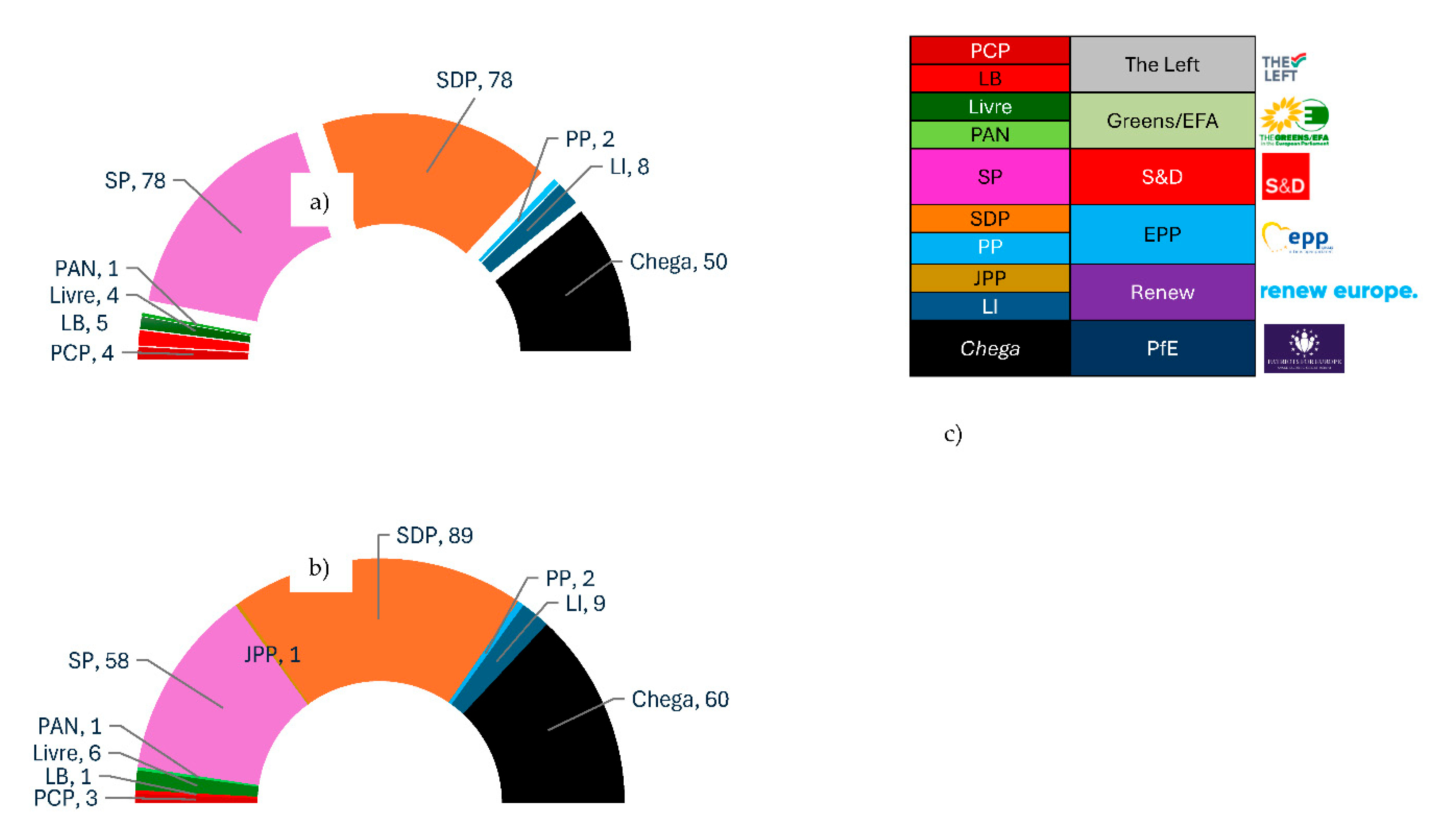
Figure 2.
Latent Projective Content Analysis. Source: Adapted from Kleinheksel, et al. [93].
Figure 2.
Latent Projective Content Analysis. Source: Adapted from Kleinheksel, et al. [93].
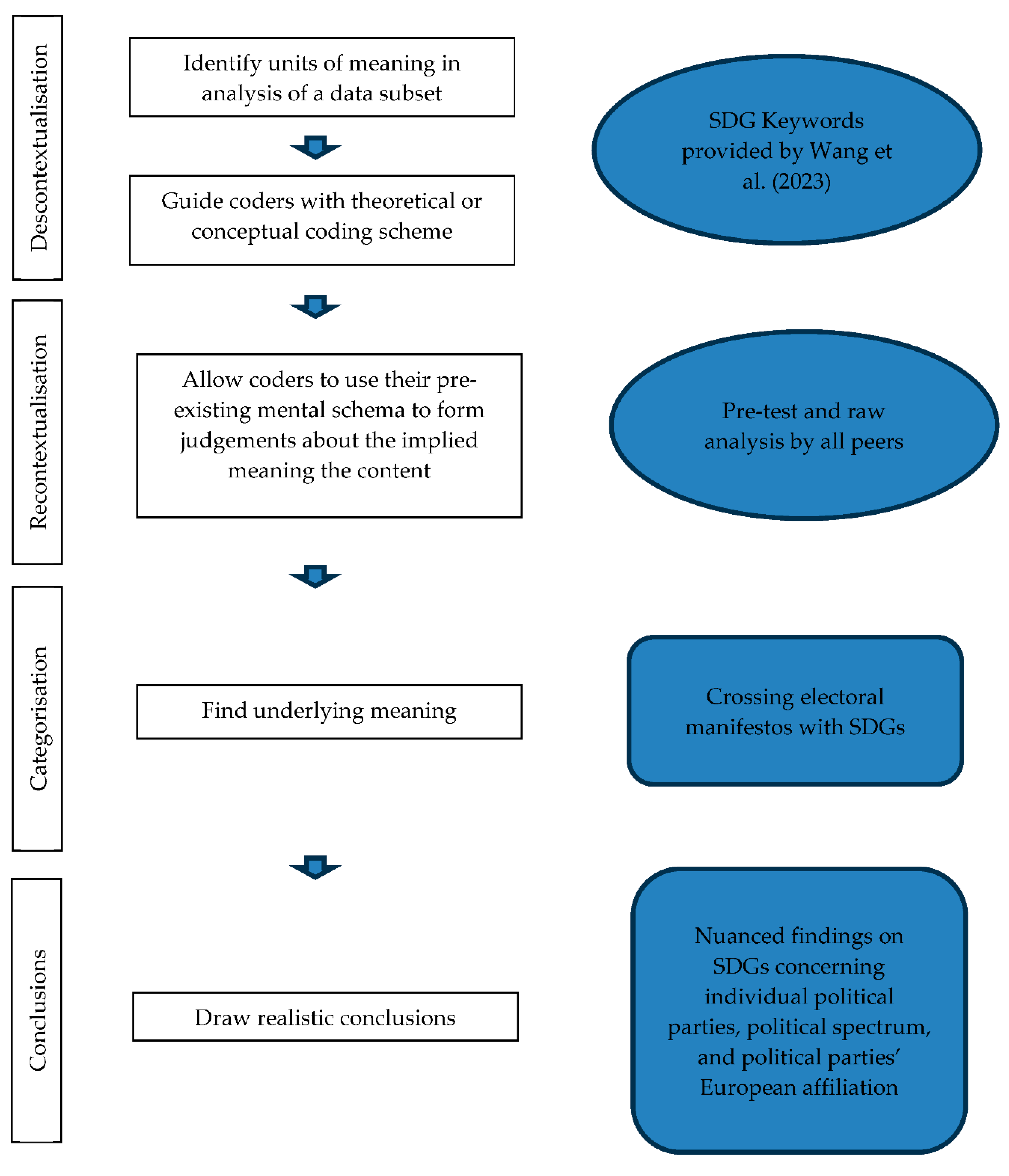
Figure 3.
Longitudinal analysis of SDGS in all Portuguese political electoral manifestos, regardless of party affiliation.
Figure 3.
Longitudinal analysis of SDGS in all Portuguese political electoral manifestos, regardless of party affiliation.
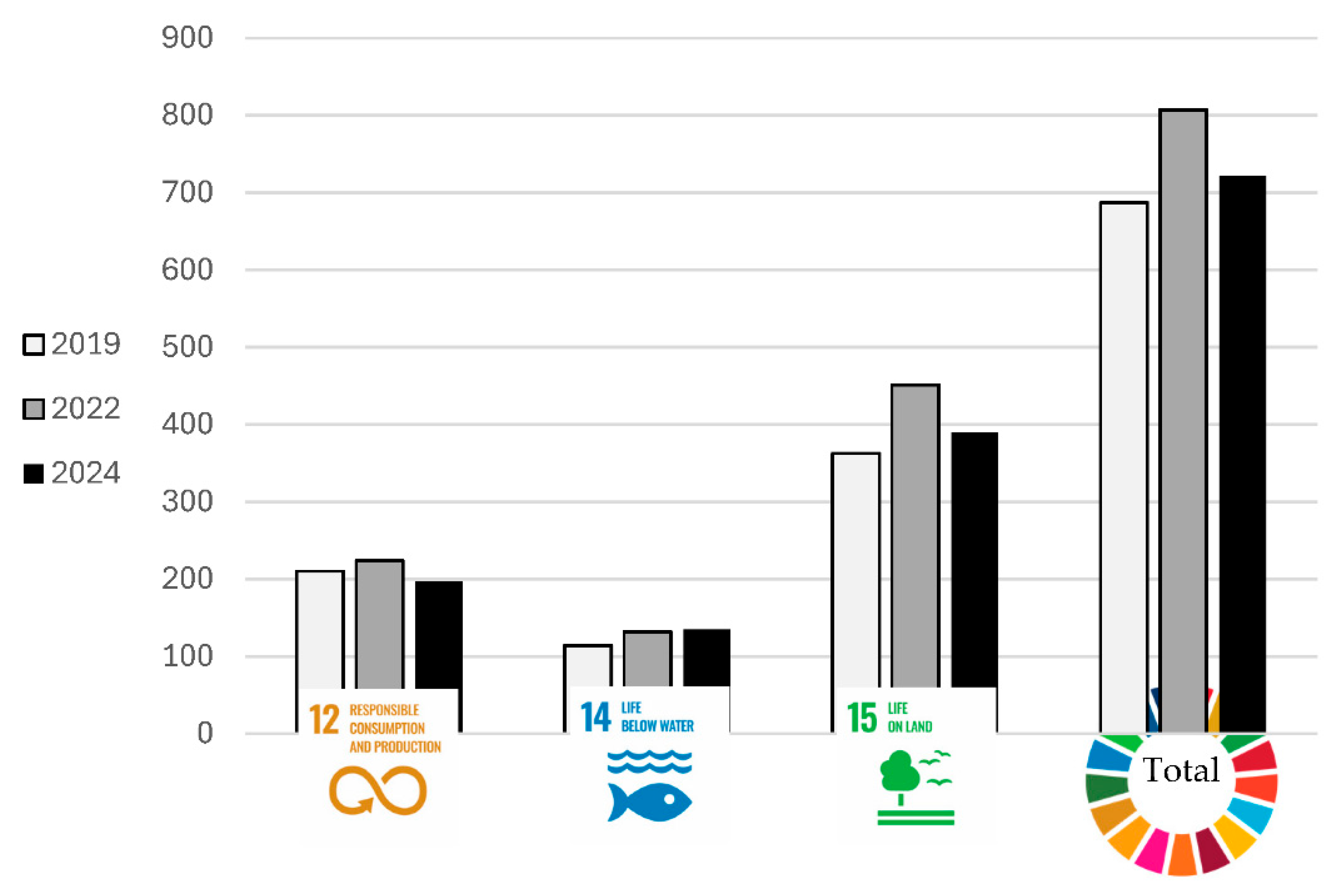
Figure 4.
Correlation matrix between SDGs. Notes: *** indicates statistical significance at the 1% level.
Figure 4.
Correlation matrix between SDGs. Notes: *** indicates statistical significance at the 1% level.
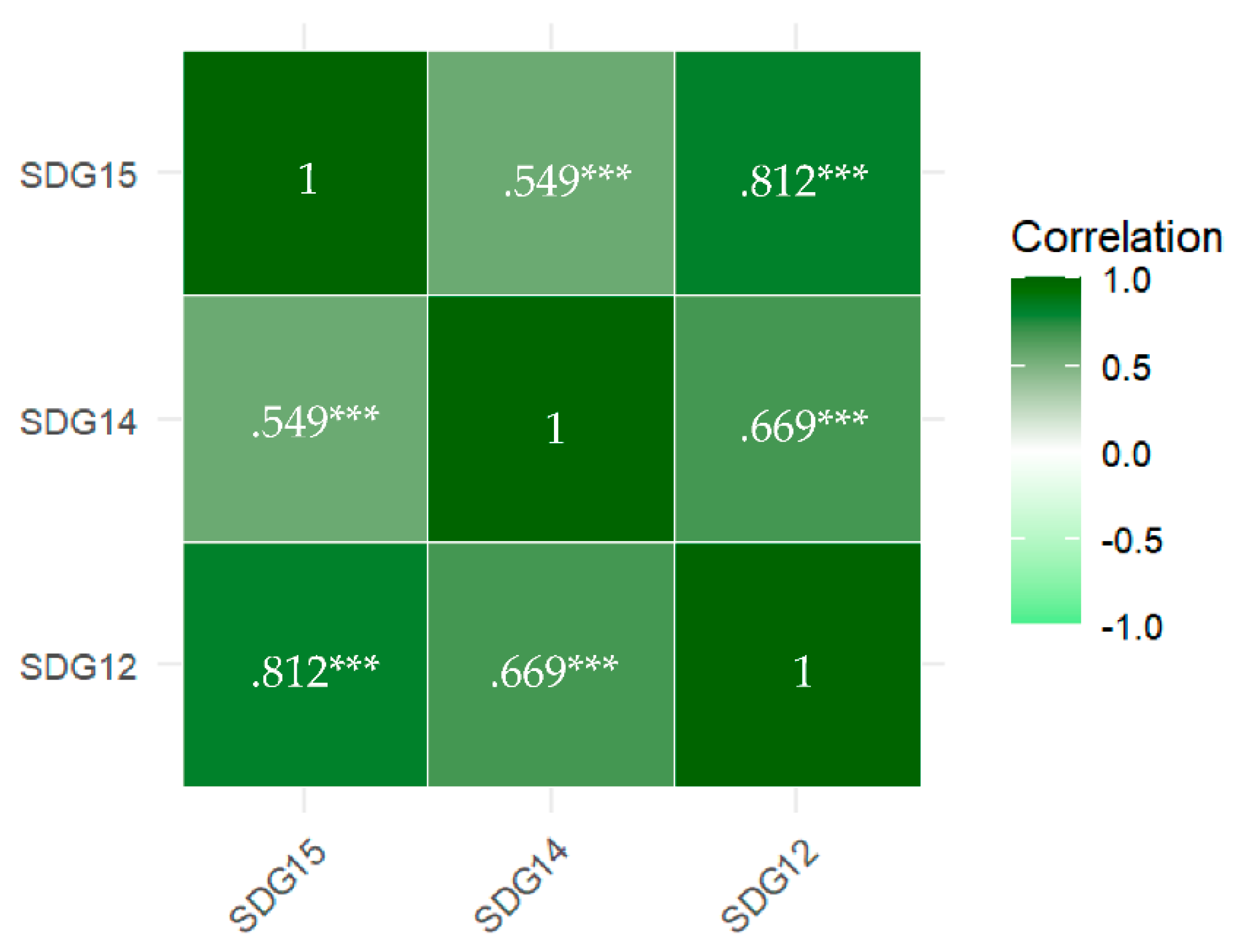
Figure 5.
Top five most frequently used SDG-related codes.
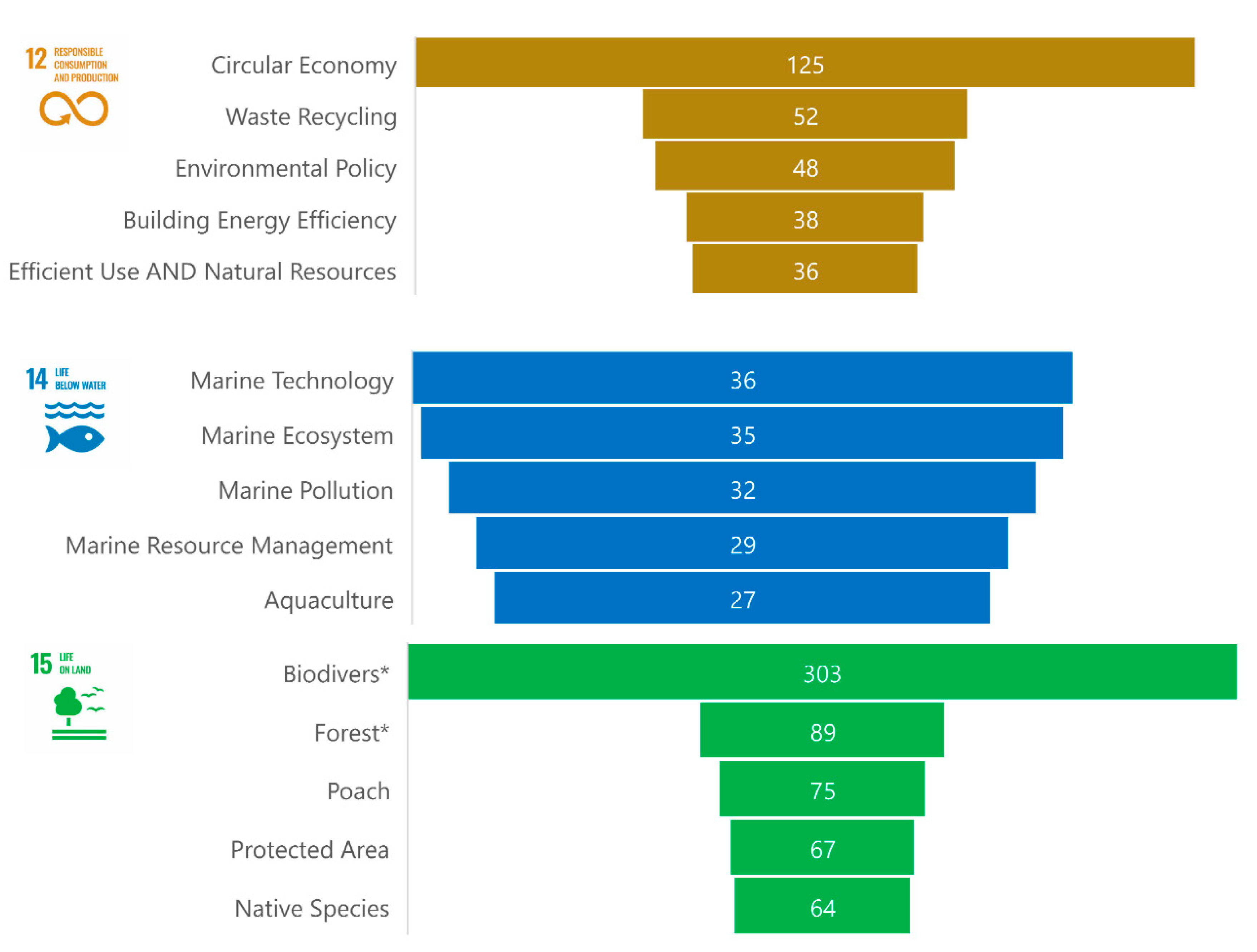
Figure 6.
Annual percentage of related codes per SDG in Portuguese electoral manifestos.
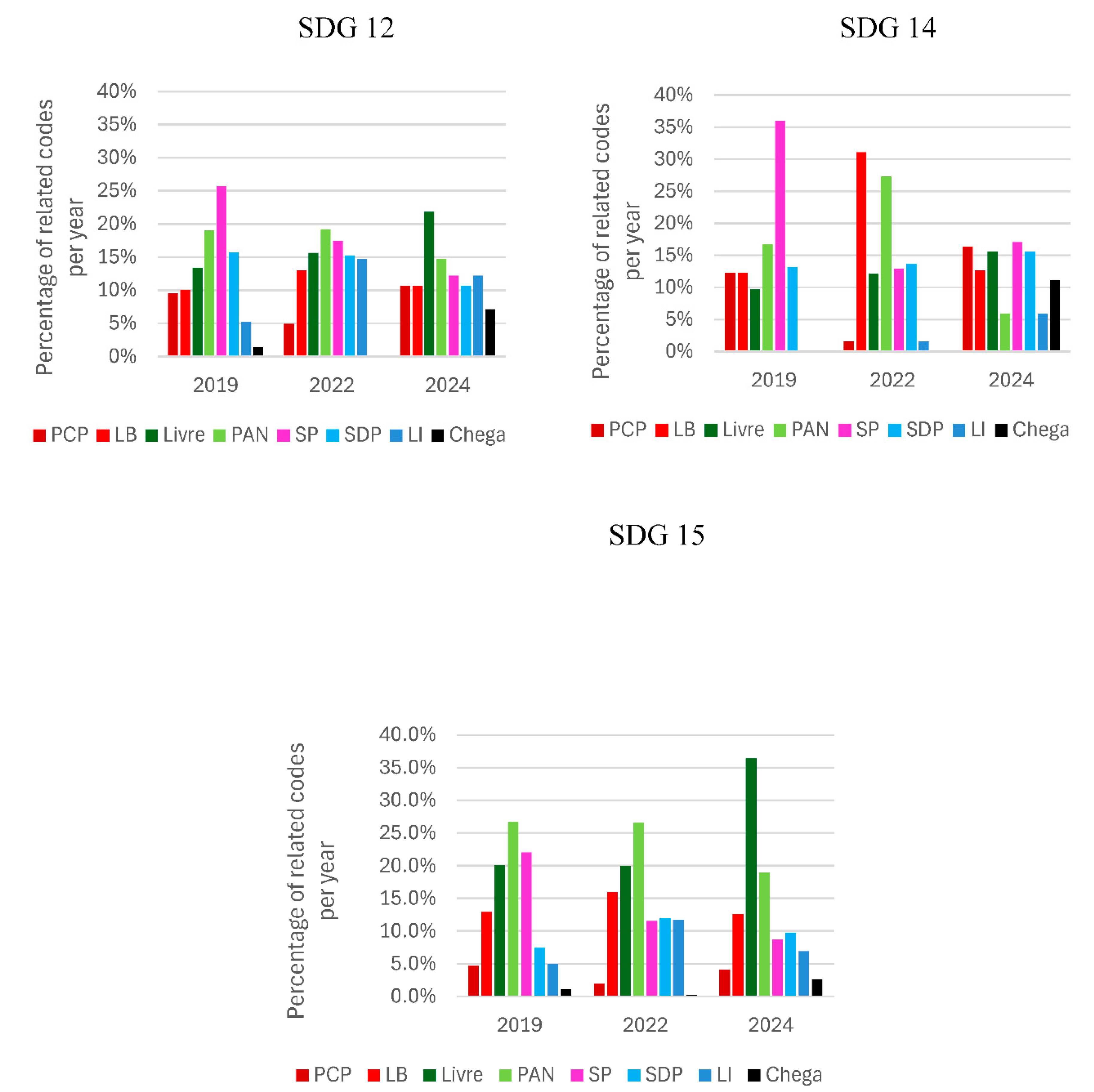
Figure 7.
Average distribution of SDGs-related codes per party electoral manifestos for the three elections period (2019/2022/2024).
Figure 7.
Average distribution of SDGs-related codes per party electoral manifestos for the three elections period (2019/2022/2024).
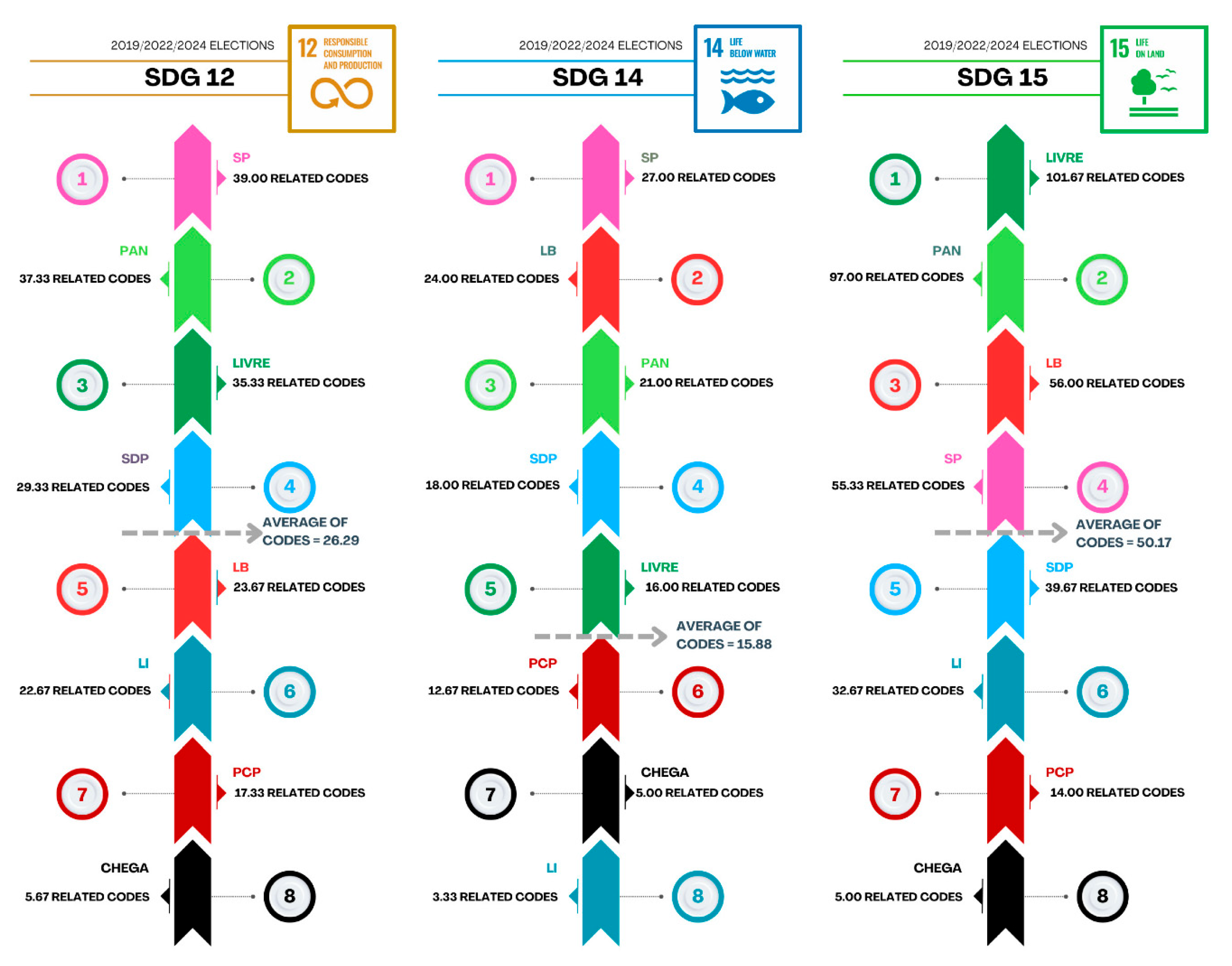
Figure 8.
Average distribution of SDGs’ codes frequency by Portuguese political spectrum (2019/2022/2024 elections).
Figure 8.
Average distribution of SDGs’ codes frequency by Portuguese political spectrum (2019/2022/2024 elections).
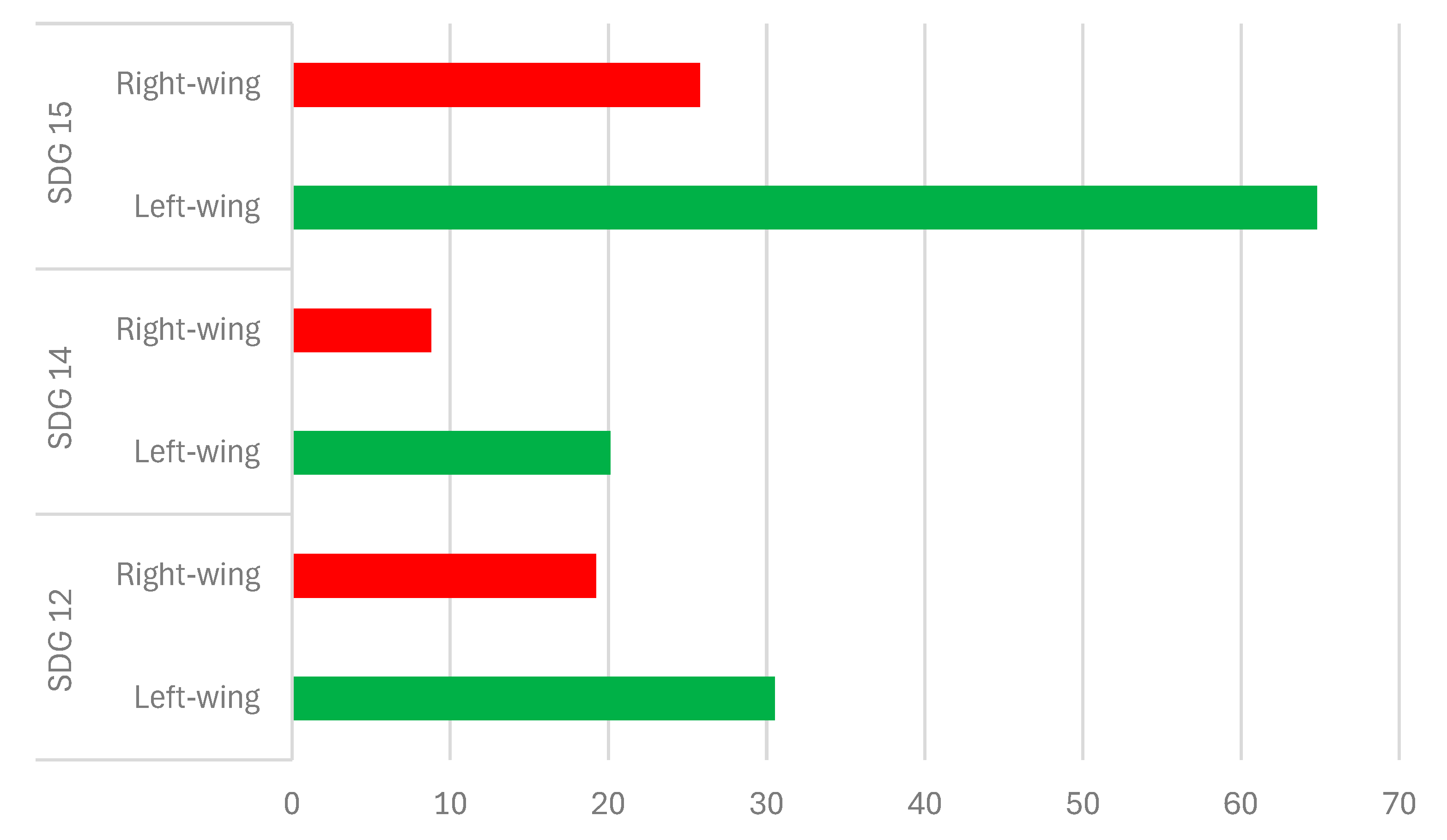
Figure 9.
Average distribution of Top 5 SDG 12 codes frequency and word cloud by Portuguese political spectrum (2019/2022/2024 elections).
Figure 9.
Average distribution of Top 5 SDG 12 codes frequency and word cloud by Portuguese political spectrum (2019/2022/2024 elections).
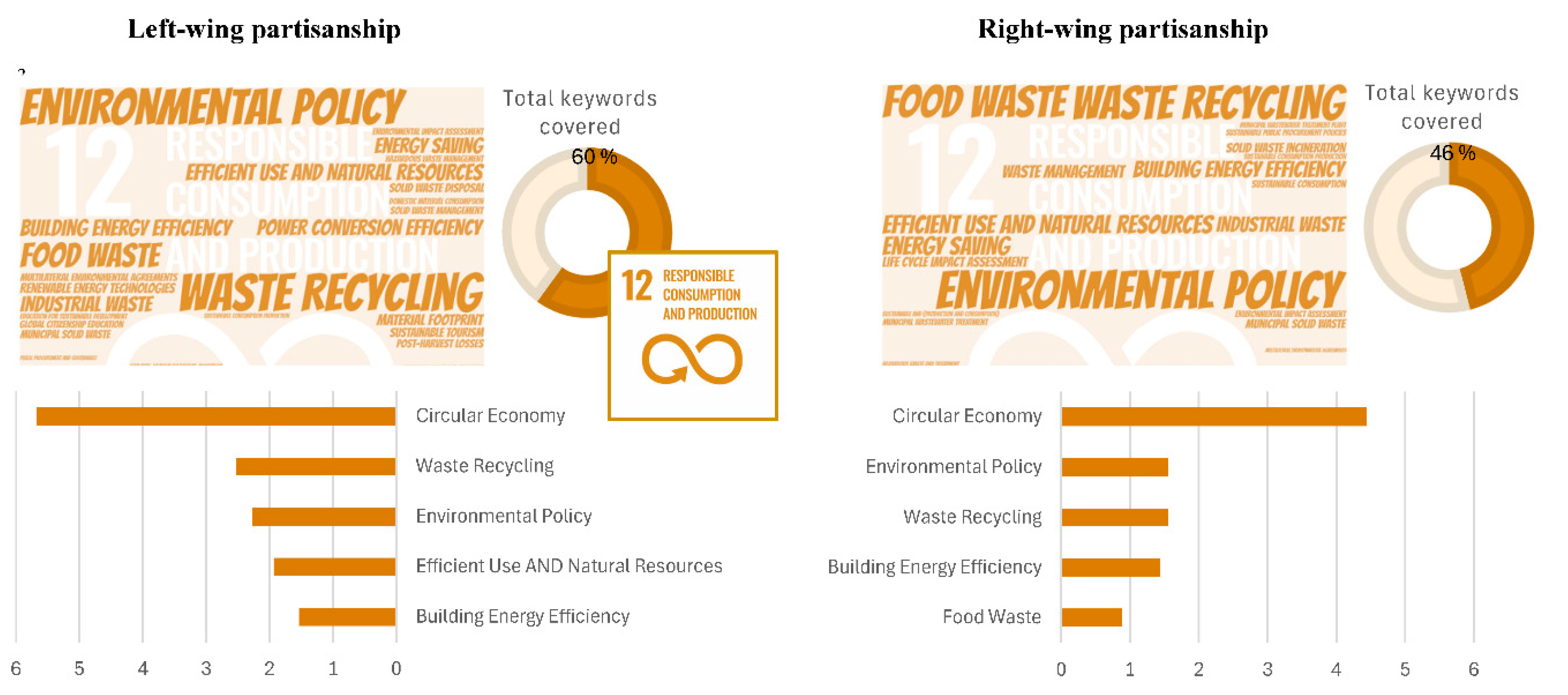
Figure 10.
Average distribution of Top 5 SDG 14 codes frequency and word cloud by Portuguese political spectrum (2019/2022/2024 elections).
Figure 10.
Average distribution of Top 5 SDG 14 codes frequency and word cloud by Portuguese political spectrum (2019/2022/2024 elections).
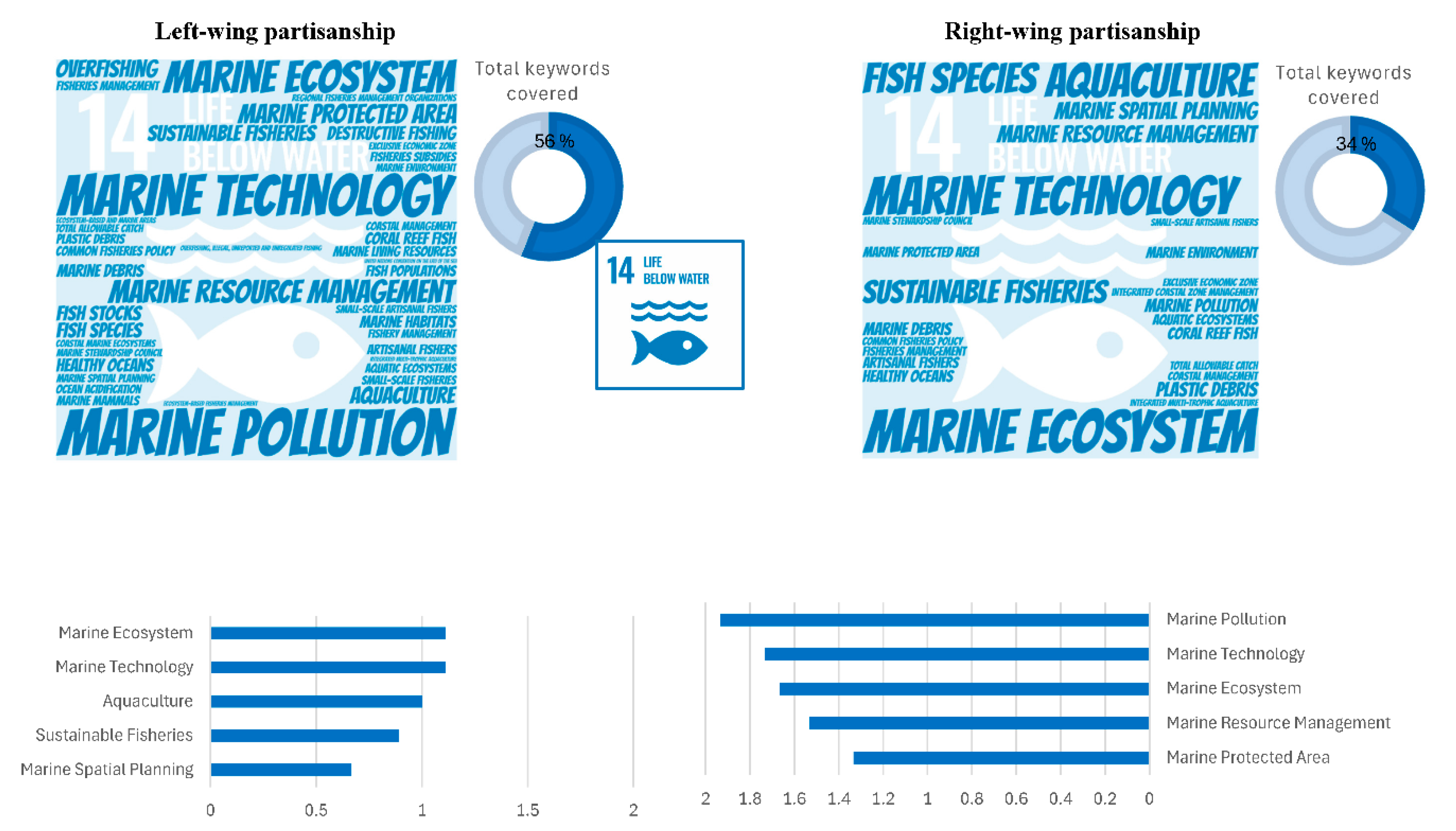
Figure 11.
Average distribution of Top 5 SDG 15 codes frequency and word cloud by Portuguese political spectrum (2019/2022/2024 elections).
Figure 11.
Average distribution of Top 5 SDG 15 codes frequency and word cloud by Portuguese political spectrum (2019/2022/2024 elections).
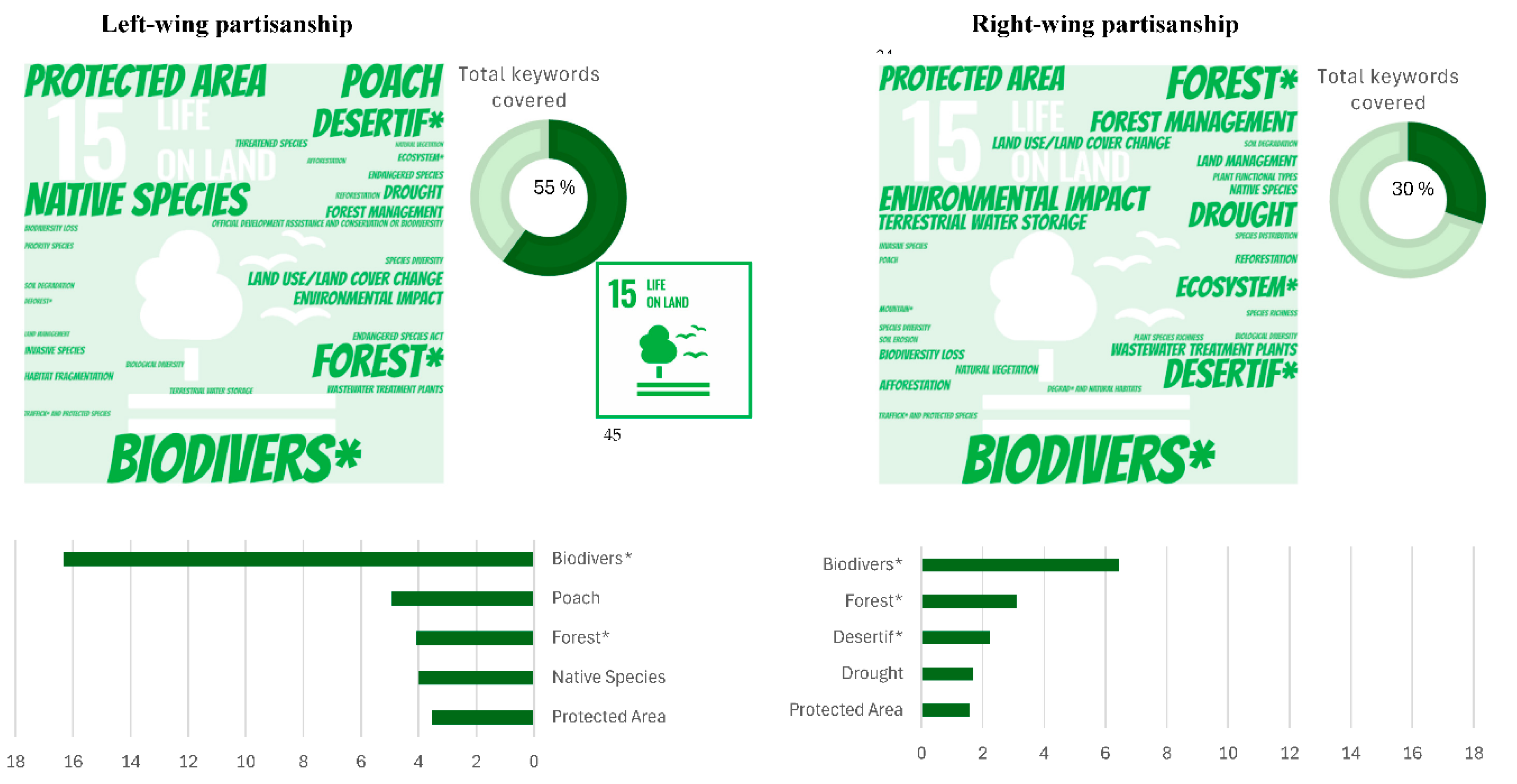
Figure 12.
Average distribution of SDG code frequencies by parties' European affiliations, expressed as percentages.
Figure 12.
Average distribution of SDG code frequencies by parties' European affiliations, expressed as percentages.
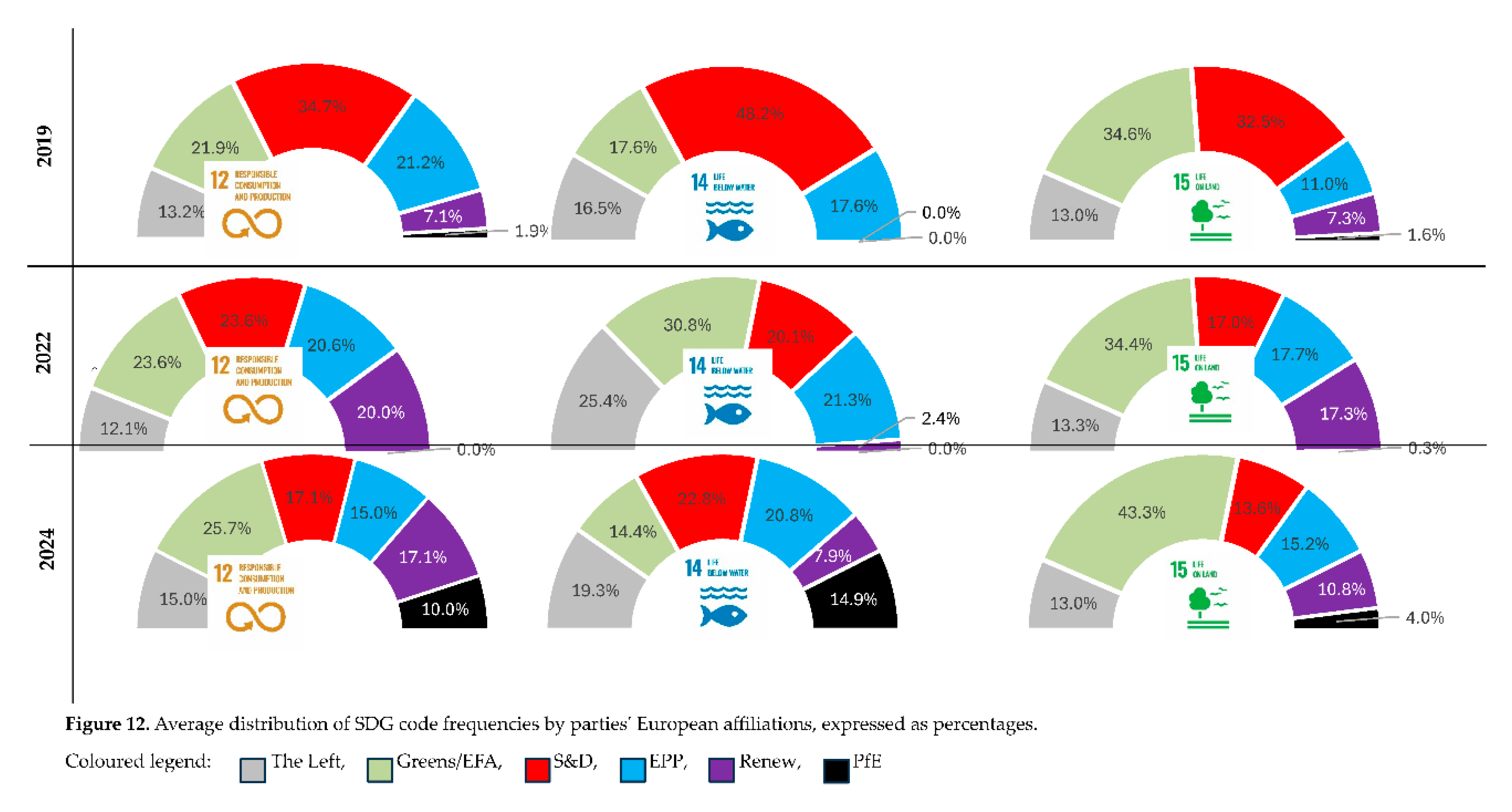
Table 1.
Code frequency summary statistics for the evaluation of SDGs in Portuguese electoral manifestos (2019-2024).
Table 1.
Code frequency summary statistics for the evaluation of SDGs in Portuguese electoral manifestos (2019-2024).
| SDGs | N | Mean | Minimum | Median | Maximum | SD | Skewness | Kurtosis |
|---|---|---|---|---|---|---|---|---|
| 12 | 24 | 26.29 | 0 | 26.0 | 54 | 13.08 | -.078 | -.096 |
| 14 | 24 | 15.88 | 0 | 15.50 | 41 | 11.65 | .669 | .362 |
| 15 | 24 | 50.17 | 1 | 48.0 | 142 | 37.43 | .770 | .132 |
Table 2.
t-Tests for independent samples by Portuguese political spectrum per SDG13 target (2019 -2024).
Table 2.
t-Tests for independent samples by Portuguese political spectrum per SDG13 target (2019 -2024).
| SDGs | N | Mean | Std. error | Variances | T | df | Sig (1-tailed) | Mean diff. | Std. error |
| SDG 12 | SDG 12 | ||||||||
| Left-wing | 15 | 30.53 | 2.98 | Hom. Variances | 2.220 | 22 | .0185** | 11.361 | 5.799 |
| Right-wing | 9 | 19.22 | 4.33 | Het. Variances | 2.152 | 15.28 | .0239** | 11.361 | 5.863 |
| SDG 14 | SDG 14 | ||||||||
| Left-wing | 15 | 20.13 | 2.93 | Hom. Variances | 2.580 | 22 | .0085*** | 11.356 | 4.401 |
| Right-wing | 9 | 8.78 | 2.86 | Het. variances | 2.771 | 20.63 | .0058*** | 11.356 | 4.098 |
| SDG 15 | SDG 15 | ||||||||
| Left-wing | 15 | 64.80 | 9.89 | Hom. Variances | 2.825 | 22 | .0049*** | 39.067 | 14.200 |
| Right-wing | 9 | 25.78 | 6.55 | Het. variances | 3.291 | 21.68 | .0017*** | 39.067 | 12.138 |
Notes: *** and ** indicate statistical significance at the 1% and 5% levels, respectively.
Table 3.
One-way analysis of variance (ANOVA) by SDGs considering the factor of Portuguese political parties’ European affiliation.
Table 3.
One-way analysis of variance (ANOVA) by SDGs considering the factor of Portuguese political parties’ European affiliation.
| SDGs | Groups | Sum of squares | Df | Mean square | F | P | Eta squared |
|---|---|---|---|---|---|---|---|
| 12 | Between groups | 2,634.13 | 5 | 526.83 | 7.30 | 0.0007*** | 0.670 |
| Within groups | 1,298.83 | 18 | 72.16 | ||||
| Total | 3,932.96 | 23 | |||||
| 14 | Between groups | 1,289.13 | 5 | 257.83 | 2.53 | 0.0666* | 0.413 |
| Within groups | 1,833.50 | 18 | 101.86 | ||||
| Total | 3,122.63 | 23 | |||||
| 15 | Between groups | 23,334.00 | 5 | 4,666.80 | 9.50 | 0.0001*** | 0.709 |
| Within groups | 8,843.33 | 18 | 491.30 | ||||
| Total | 32,177.33 | 23 |
Notes: *** and * indicate statistical significance at the 1% and 10% levels, respectively.
Disclaimer/Publisher’s Note: The statements, opinions and data contained in all publications are solely those of the individual author(s) and contributor(s) and not of MDPI and/or the editor(s). MDPI and/or the editor(s) disclaim responsibility for any injury to people or property resulting from any ideas, methods, instructions or products referred to in the content. |
© 2025 by the authors. Licensee MDPI, Basel, Switzerland. This article is an open access article distributed under the terms and conditions of the Creative Commons Attribution (CC BY) license (http://creativecommons.org/licenses/by/4.0/).
Copyright: This open access article is published under a Creative Commons CC BY 4.0 license, which permit the free download, distribution, and reuse, provided that the author and preprint are cited in any reuse.


