

Submitted:
12 June 2025
Posted:
13 June 2025
You are already at the latest version
Abstract
This study employs integrated scientometric and technometric methodologies to analyze the evolution of quantum technologies over the period 1970–2024. By analyzing longitudinal patent and publication data, we identify key growth trajectories within the quantum domain, given by Quantum Computing, Quantum Computers, Quantum Communication, Quantum Cryptography, and Quantum Emitters. In particular, regression-based trend analysis reveals the most significant growth rates in Quantum Computing (β = 0.26), Quantum Computers (β = 0.25), Quantum Communication (β = 0.20), and Quantum Cryptography (β = 0.15). These findings highlight the accelerating innovation dynamics in these subfields and offer strategic insights for policymakers, funding agencies, and R&D managers aiming to prioritize investments in high-impact quantum technologies that are poised to shape future scientific and socioeconomic landscapes.
Keywords:
disruptive innovations
; enabling technologies
; quantum innovations
; patent analytics
; technological forecasting
; innovation management
; innovation policy
1. Introduction
The goal of this study is to understand the emerging technological trajectories in quantum science by using models of technological evolution based on publication and patent data.
Quantum technology, with its focus on the transmission and manipulation of quantum bits (qubits), holds significant promise for enhancing information processing and communication in human society (Arute et al., 2019; Harrow and Montanaro, 2017; Möller and Vuik, 2017; Olivier, 2019). Positioned at the early stage of evolution, quantum technologies can address intricate societal and economic challenges and policymakers and R&D managers need scientific guidelines to design research policies and technological strategies to direct R&D investments towards fruitful innovations for capturing the added value at both national and corporate levels (Acin et al., 2018; Atik and Jeutner, 2021; Carberry et al., 2021; Wang et al., 2021).
Bickley et al. (2021) emphasize the potential of quantum science to push the theoretical and practical boundaries of research, fostering discoveries, inventions and innovations, for socioeconomic change. Wang et al. (2021) employ bibliometric analysis to reveal the current technological landscape in quantum science, underscoring the leading roles of academic institutions and scholars in the United States, China, and France. Models of technological evolution applied by Coccia (2024) show main technological trajectories in quantum computing and computer and their rates of growth that suggest path-breaking directions in quantum optics, quantum information, quantum algorithms, quantum entanglement, quantum communication and quantum cryptography. Coccia (2024a) suggest that convergence in Artificial Intelligence and Quantum Technologies is one of the fundamental determinants in the rapid evolution of these path-breaking technologies and disruptive innovations. Khan and La Torre (2021) foresee the rapid commercialization of quantum information technology and propose strategic management approaches for decision-makers to navigate this emerging quantum landscape (cf., Jiang and Chen, 2021). Inglesant et al. (2021) focus on responsible innovation in quantum technologies, acknowledging their transformative impact on economic systems. These interdisciplinary approaches are basic for the technology analysis in quantum science, for elucidating on-going scientific and technological developments (Kozlowski and Wehner, 2019). However, Holter et al. (2021) express concerns about the technological development of quantum computing and offer recommendations for policymakers, researchers, and industrial managers to ensure responsible quantum computing practices that balance commercial goals with societal needs.
Despite a vast literature in these research fields, studies about new directions in technological trajectories of quantum science and technology, particularly directed towards new market applications, remain elusive. Expanding research efforts to explore emerging quantum technologies is also particularly important in an Era of increasing rapid changes also to support an innovation quantum ecosystem including research networks, physical infrastructures, skilled human capital, technology transfer organizations, and leading firms that guide innovation avenues (Jiang and Chen, 2021; Oh et al., 2016; Coccia et al., 2023; Coccia, 2024).
This study addresses these challenges by conducting a statistical analysis based on data from publications and patents. The aim is to elucidate the temporal evolution of scientific and technological trajectories in quantum research, providing insights into the next scientific and technological change of socioeconomic systems. Such insights are valuable for identifying new directions with high potential growth in science for positive impacts on the generation of innovations for markets. The next section outlines the theoretical framework for the study design, presenting a foundation for analyzing data in quantum technology and offering information to expand scientific knowledge in this field, specifically regarding the critical theoretical and innovation management implications in quantum science and technology for guiding pathways of economic growth.
2. Theoretical Framework
The world is more and more based on innovation-based competition and technologies having a creative destruction of existing competences (Coccia, 2019, 2021, 2022; Kargi and Coccia, 2024; Teece et al., 1997). The evolution of technologies is intricately linked to science advances, often perceived as a self-organizing system that undergoes various scientific changes over time, closely associated with the development of economies and societies (Coccia, 2019a; Sun et al., 2013). Scholars posit that technological evolution results from the interaction between interrelated technological systems and scientific fields, leading to co-evolutionary pathways of scientific and technological change (Coccia and Roshani, 2024; Jovanovic et al., 2021).
Quantum technology shares many characteristics with general-purpose technologies (GPTs) due to its potential to render previous technical knowledge, products, and processes obsolete, thereby instigating industrial, economic, and social change (Bresnahan, 2010; Calvano, 2007; Sahal, 1981). General-purpose technologies (GPTs) are technologies that initially have significant potential for improvement and eventually become widely used, influencing many users and sectors (Lipsey et al., 1998, p.43). GPTs exhibit characteristics such as pervasiveness, inherent potential for technical improvements, and innovative complementarities, leading to increasing returns-to-scale, as observed in historical examples like the steam engine, electric motor, semiconductors, nanotechnologies, and Artificial Intelligence (Bresnahan and Trajtenberg, 1995, p.83; Coccia, 2024a). GPTs generate different technological trajectories driving manifold innovations for the following aspects outlined by Jovanovic and Rousseau (2005, p.1185):
- Pervasiveness: GPT should propagate to many sectors.
- Improvement: GPT should reduce costs for its adopters.
- Innovation spawning: disruptive technologies generating new products and processes having problem-driven radical innovations (cf. also, Bresnahan and Trajtenberg, 1995; cf., Coccia, 2017, 2017a, 2017b; Coccia, 2020, 2020a). GPTs often have a long-run period between their initial research in science and eventual introduction into markets with societal impact (Lipsey et al., 1998, 2005; Rosegger (1980). GPTs are instrumental in supporting new architectures of technological trajectories for various families of products/processes, influencing various sectors in economic systems (Bresnahan and Trajtenberg, 1995, p.8; Hall and Rosenberg, 2010). Coccia (2005, pp.123–124) maintains that these revolutionary innovations have the potential to affect almost every branch of the economy generating different technological trajectories. In summary, quantum technologies, like General-Purpose Technologies (GPTs), are complex technologies that drive different technological trajectories, fostering product and process innovations across various sectors, contributing to corporate, industrial, economic, and social change (Coccia, 2017; 2024).
Hence, conducting a technology analysis of new trajectories in quantum technology is essential for predicting emerging applications in markets, thereby influencing technological, economic, and social change (Nelson, 2008, p.489).
This study aims to investigate the technological trajectories in quantum technology and science to elucidate its long-run evolution in socioeconomic systems. Detecting new directions in quantum science is also basic for understanding future evolutionary paths in science and society (Coccia, 2024, 2024a; Coccia et al., 2024; Coccia and Roshani, 2024; Deshmukh and Mulay, 2021). In this context, the analysis of publications and patents (Jaffe and Trajtenberg, 2002), basic units in scientific and technological analysis, can clarify new directions in quantum science and technology, and evolutionary technological trajectories that can change the next technoeconomic ecosystems (Boyack et al., 2009; Coccia, 2022; Coccia, 2024).
Quantitative approaches using publication and patent data from journals are often employed in this research stream for capturing information about emerging technological trajectories (Cozzens et al., 2010; Ding et al., 2000).
Therefore, grounded in the theoretical background of GPTs and utilizing statistical analyses on publications and patents, this study has the goal to detect technological trends in quantum science geared toward groundbreaking applications in future markets. The results provide insights into the strategic management of policymakers for directing R&D investments toward research fields and technologies with high growth potential and positive socioeconomic impact.
The following section outlines the methods employed in this scientific investigation.
3. Research Design and Models
3.1. Sources
The study utilizes data from Scopus (2025), a multidisciplinary database encompassing journal articles, conference proceedings, and books. The Scopus (2025) database also incorporates patent records from five patent offices, including the US Patent & Trademark Office, the European Patent Office, the Japan Patent Office, the World Intellectual Property Organization, and the UK Intellectual Property Office. The “Search documents” feature in the scientific products, such as articles, conference papers, book chapters, and patents, constitute the fundamental units for technology and scientific analyses explaining the evolution of science and technology in the quantum technologies under study here (Ding et al., 2000; Glänzel and Thijs, 2012).
3.2. Search string to gather data
The search strings, directed to detect publications and patents in quantum science, are based on a combination of specific keywords and Boolean operators inserted into the search box of the search engine Scopus (2025) as follows.
The first query is (TITLE-ABS-KEY(“quantum technologies”))
After that, we consider the quantum technologies having the highest number of keywords that is a main proxy of a high intensity of scientific and technological activity in specific topics. Table 1 shows quantum technologies with the highest number of keywords that suggests main directions (cleaning the dataset from general words, such as quantum technologies, quantum theories, article, etc.).

Table 1.
Technologies having the highest number of keywords.
| Keywords | |
| Quantum Optics | 2101 |
| Quantum Computers | 916 |
| Quantum Electronics | 755 |
| Quantum Computing | 572 |
| Quantum Communication | 547 |
| Quantum Cryptography | 498 |
| Semiconductor Quantum Dots | 360 |
| Quantum Emitters | 152 |
Using technologies of Table 1, we apply the following search string in Scopus (2025) to gather data about publications and patents over time.
- -
- query : (TITLE-ABS-KEY(“quantum optics”))
- -
- query : (TITLE-ABS-KEY(“computers”))
- -
- query : (TITLE-ABS-KEY(“electronics”))
- -
- query : (TITLE-ABS-KEY(“computing”))
- -
- query : (TITLE-ABS-KEY(“communications”))
- -
- query : (TITLE-ABS-KEY(“cryptography “))
- -
- query : (TITLE-ABS-KEY(“semiconductor Quantum Dots”))
- -
- query : (TITLE-ABS-KEY(“emitters”))
3.3. Measures and samples
Scientific and technological change in quantum research is examined with the number of articles and patents related to Table 1.
Table 2 shows the size of data about publications and patents under study from 1970 to 2024 (last year with full data).
Table 2.
Sample of publications and patents in quantum technologies, 1970-2024.
| Technologies | Publications | Patents |
| Quantum Technologies | 6480 | 8713 |
| Quantum Optics | 66977 | 1288 |
| Quantum Computers | 34311 | 27814 |
| Quantum Electronics | 38764 | 14013 |
| Quantum Computing | 23117 | 25386 |
| Quantum Communication | 12759 | 4923 |
| Quantum Cryptography | 18563 | 5219 |
| Semiconductor Quantum Dots | 98256 | 7354 |
| Quantum Emitters | 3113 | 511 |
3.4. Specification of models and data analysis procedure
Data of Table 2 are analyzed as follows.
- o Model of temporal aspects in quantum technologies
Trends of quantum technology i at t
are analyzed with the following log-linear model (1):
yi,t = publications or patents of quantum technologies i at time t
log yi,t = a + b time+ ui,t
a = constant; b=coefficient of regression, proxy of temporal growth; ui,t = error term , log has base e= 2.7182818
- o Model for technological evolution in quantum technologies
The study explores the technological evolution in quantum technologies using a model that considers the number of patents (Y) as a function of the quantity of scientific publications (X) across time, denoted as Y = f(X). This analytical approach aims to uncover the relative growth rate, offering insights into the evolution of quantum technologies listed in Table 2, and whether they are characterized by acceleration, steady growth, or deceleration. The applied model for technological evolution draws inspiration from Sahal (1981) that has applied this approach in economics of innovation to show the evolution and diffusion of technologies, such as farm tractor, locomotive, tank ship, aircraft, digital computers and generation of electricity.
3.5. Assumptions and model specification
Two basic elements (X and Y): The model includes only two elements, X (representing publications) and Y (representing patents), forming a system within a specific scientific and technological domain.
S-Shaped Evolution Pattern: The assumption is that both X and Y follow an S-shaped pattern. This pattern can be mathematically represented using the differential equation of a logistic function (Sahal, 1981). Mathematical transformations of the logistic function (cf., Sahal, 1981) leads to a simple linear relationship (log-log model, see equation 2):
(2)
is the evolutionary coefficient of technological advances that measures the growth of technology Y in relation to scientific production X in the research field under study (in quantum science in this study).
This model [2] has linear parameters that are estimated with the Ordinary Least-Squares Method. The value of in the model [2] measures the relative growth of Y in relation to the growth of X and it indicates different patterns of technological evolution: B<1 (slowing down), B ≥ 1 (growth or acceleration of technological evolution). In particular,
- , whether technology Y evolves at a lower relative rate of change than X; the whole system has a slowing down evolution over the course of time.
- has a unit value: , then Y and X have proportional change during their evolution. In short, when B=1, the whole system here has a proportional evolution of its parts (growth).
- , whether Y evolves at a greater relative rate of change than X; this pattern denotes disproportionate advances. The whole system of technology Y has an accelerated evolution over the course of time.
The statistical analyses are conducted using IBM
SPSS Statistics 30®.
4. Results from Statistical Analyses
Initially, the data undergo a transformation into
logarithmic scale. This transformation is implemented to achieve normality in
the distribution of variables, ensuring that the subsequent parametric analyses
are appropriate and yield robust results.
Table 1 shows
the temporal evolution of scientific fields in quantum technologies by using
model (1) on publication data. Model estimates the coefficient of regression b
that is a proxy of temporal growth about scientific dynamics.
Table 1.
Estimated relationships of scientific production in quantum science (estimated model 1 described in methods).
Table 1.
Estimated relationships of scientific production in quantum science (estimated model 1 described in methods).
| Dependent variable: scientific products concerning fields in quantum research | ||||
| Research fields | Coefficient b1 | Constant a | F | R2 |
| Quantum communications, Log yi,t | .137*** | −269.81*** | 215.2*** | .90 |
| Quantum Computers, Log yi,t | .144*** | −281.72*** | 183.52*** | .88 |
| Quantum Computing, Log yi,t | .147*** | −288.72*** | 81.77*** | .76 |
| Quantum Cryptography, Log yi,t | .129*** | −253.35*** | 191.34*** | .88 |
| Quantum Electronics, Log yi,t | −.025 | 56.78 | .72 | .03 |
| Quantum Emitters, Log yi,t | .258*** | −515.54*** | 339.52*** | .93 |
| Quantum Optics, Log yi,t | .10*** | −190.23*** | 184.78*** | .88 |
| Semiconductor Quantum Dots, Log yi,t | .091*** | −174.48*** | 48.99*** | .66 |
Note: Explanatory variable is time in years. *** significant at 1‰; ** significant at 1%. F is the ratio of the variance explained by the model to the unexplained variance. R2 is the coefficient of determination.
Results suggest that higher scientific growth in quantum fields under study is given by:
- ▪ Quantum emitters, estimated b=0.26
- ▪ Quantum computing, estimated b=0.15
- ▪ Quantum computers, estimated b=0.144
- ▪ Quantum communication, estimated b=0.137
- ▪ Quantum cryptography, estimated b=0.13
The regression analyses of model 1 presented in Table 1 show that log-linear models estimated provide robust statistical results. The F value is significant (p-value<0.001) and explains for these relations a lot of variance in the data, except quantum electronics. The coefficient of determination R2 is high (in general more than 66%) showing a high goodness of fit in the estimated relationships. Results of Table 1 clearly show the highest value is in quantum emitters that a 1-unit change in X (time in year) corresponds to an expected value of Y (publication in the quantum emitters) by eβ =e0.25 = 1.29: expected increase of 29%. Quantum emitters are a main technology for sources of light: nanoscale technological systems capable of emitting single, discrete photons, crucial for quantum optics and inter-related technologies such as quantum computing and information processing (Yang et al., 2025). Mutatis mutandis for Quantum computing a 1 (year)-unit change corresponds to an expected increase in scientific publications of eβ =e0.15 = 1.16, i.e., 16%, Quantum computers and communication by 15% and quantum cryptography 14%.
Table 2 shows the temporal evolution of technological trajectories with patent data also by using model (1), but here patents, of course, are the explanatory variable. Results suggest that higher growth (estimated b) in technological trajectories of quantum fields under study is given by:
- o Quantum computing, estimated b=0.26
- o Quantum computers, estimated b=0.25
- o Quantum communication, estimated b=0.20
- o Quantum emitters, estimated b=0.16
- o Quantum cryptography, estimated b=0.15
Table 2.
Estimated relationships of patents in quantum science (estimated model 1 described in methods).
Table 2.
Estimated relationships of patents in quantum science (estimated model 1 described in methods).
| Dependent variable: patents in fields of quantum science | ||||
| Research fields | Coefficient b1 | Constant a | F | R2 |
| Quantum communications, Log yi,t | .202*** | −402.81*** | 224.72*** | .90 |
| Quantum Computers, Log yi,t | .245*** | −486.79*** | 247.71*** | .91 |
| Quantum Computing, Log yi,t | .258*** | −512.86*** | 282.64*** | .92 |
| Quantum Cryptography, Log yi,t | .153*** | −303.17*** | 127.82*** | .84 |
| Quantum Electronics, Log yi,t | 0.003 | 0.070 | .240 | .01 |
| Quantum Emitters, Log yi,t | .155*** | −309.11*** | 141.66*** | .85 |
| Quantum Optics, Log yi,t | .145*** | −288.19*** | 150.87*** | .86 |
| Semiconductor Quantum Dots, Log yi,t | .136*** | −267.35*** | 114.69*** | .82 |
Note: Explanatory variable is time in years. *** significant at 1‰; ** significant at 1%. F is the ratio of the variance explained by the model to the unexplained variance. R2 is the coefficient of determination.
Regression analyses in Table 2, based on model 1, show that log-linear models estimated provide robust and stronger statistical results. The F value is significant (p-value<0.001) and explains for these relations a lot of variance in the data, except quantum electronics. The coefficient of determination R2 is very high (in general more than 82%), showing a very high goodness of fit by this model. Results of Table 2 show the highest value is in quantum computing and computers, such that a 1-unit change in X (time in year) corresponds to an expected value of Y (patents, proxy of technological growth) by about eβ =e0.26 =1.30: i.e., expected increase of about 30%. Mutatis mutandis for Quantum communications a 1(year)-unit change corresponds to an expected increase in scientific publications of eβ =e0.20 = 1.22, i.e., 22%, Quantum emitters and cryptography have lower rates of technological growth.
5. Discussion, Policy and Managerial Implications
The macroevolution of technology in quantum technologies is presented in Table 3. The results are based on log-log model (2) by Sahal (1981). The value of B measures the relative growth of Y (patents) in relation to the growth of X (publications) and it indicates different patterns of evolution in technological trajectories. B<1 (slowing down of technological evolution of trajectories), whereas B ≥ 1 suggests a growth or acceleration of technological trajectories that represent promising directions directed to scientific and technological change for industrial and economic impacts (Table 3). In particular, results reveal that accelerated growth of trajectories in quantum technologies, characterized by B>1 (accelerated growth over time), suggesting promising technological and industrial applications, is in Figure 1. Regression analyses provide robust statistical results. The F value equal is significant and explains a lot of variance unexplained; the coefficient R2 is in general high and explains more than 67%, also achieving a goodness of fit by 95% in quantum cryptography. To put differently, the coefficient of regression is a measure of technological growth and advances and shows that for some technologies in Figure 1, it is greater than 1, indicating a high acceleration of technological growth, in particular in quantum computer and computing. Especially a 1% increase in publications leads to a 1.26% increase in patents in quantum computing and 1.12% increase in quantum computers. The basic aspects of quantum computers and computing are that use the laws of quantum mechanics to solve complex problems for classical computers, generating a lot of technological trajectories and technological interactions between research fields and technologies (Coccia, 2024a; Coccia and Roshani, 2024c; Nielsen and Chuang, 2010).
One of the sources of high technological evolution in quantum computing is that has many aspects of a general-purpose and disruptive technology laying the foundations for a main revolution and socioeconomic change (Coccia, 2017a, 207b; 2020; 2020a; Dowling and Milburn, 2003; Jaeger, 2018). Quantum technologies having aspects of GPTs can generate innovations in many sectors, such as finance, medicine, chemical engineering, pharmaceuticals, etc. (Arute et al., 2019; Harrow and Montanaro, 2017; Olivier, 2019). This result can be explained by Coccia and Roshani (2024c) that reveal how the evolution of quantum computing from 1990 to 2020 has a considerable average increase of connectivity in the research and technological network. This evolutionary dynamics is also due to the increase in size and complexity of the network in quantum computing research over time. This study also suggests that the network of quantum computing has a transition from hardware to software research that supports accelerated evolution of technological pathways in quantum image processing, quantum machine learning, and quantum sensors.
Results here show that another promising research field, having a high rate of technological growth is quantum communication. In fact, quantum communication is a technological trajectory that can have important applications in scientific, technological and industrial sectors, such as quantum teleportation (D’Aurelio et al., 2025), quantum cryptography (Du et al., 2025), etc. Quantum communication can improve security and efficiency. In fact, by leveraging quantum key distribution and other quantum communication methods, industries can achieve secure data transmission, protect sensitive information, and optimize various processes (Ramya et al., 2025; Kumar et al., 2025). Quantum networks have been established using fiber communication lines and satellite-to-ground links and interactions with artificial intelligence, internet of things, quantum sensors and satellite technologies can foster path-breaking innovations (Coccia, 2024; Coccia et al., 2021, 2022; Roy, 2025).
Table 3 also shows that some quantum technologies have a reduced growth driven by scientific advances (characterized by B<1) such as:
- − Quantum Electronics
- − Quantum Emitters
- − Quantum Optics,
- − Semiconductor Quantum Dots
Results here confirm that the progression of quantum science in recent decades has been unparalleled, as noted by Khan (2021) and Scheidsteger et al. (2021). Research results here indicate that quantum science follows several major technological pathways, although these are not exhaustive. These technological trajectories include: (i) quantum computing; (ii) quantum communication and cryptography; and (iii) quantum emitters (cf., D’Aurelio et al., 2025; Lanzagorta and Uhlmann, 2009; Long et al., 2019; Yang et al., 2025).
Results here are also supported by Jiang and Chen (2021) that identify primary technological clusters within this research domain, including quantum communication, quantum computation, semiconductor quantum dot technology, etc. (Zou et al., 2021). Wang et al. (2021) also highlight key topics in quantum computing spanning the period from 2016 to 2020. In an effort to provide new insights to this field of research, using updated data, the present study conducts a technology analysis to clarify primary scientific and technological trajectories in the ongoing evolution of quantum science (cf. Figure 1).
Hence, the results here reveal emerging directions in quantum science, as illustrated in empirical results (tables 1-3) and driven mainly by quantum computer and computing, quantum communication, and quantum cryptography, which have the potential to trigger a tectonic shift in technological progress, influencing future economic and social changes in human society. In particular, Quantum Communication, as one of main findings in this study is continuously exploring applications, such as in quantum teleportation (D’Aurelio et al., 2025; Zhang et al., 2025) and in quantum cryptography (Scarfe et al., 2025), aiming to protect information channels and to perform cryptographic tasks deemed impossible in classical systems (Bennett et al., 1992; Chen et al., 2015; Yang et al., 2023).
5.1. Theoretical implications
Results here suggest deductive implications of basic characteristics of technological trajectories in quantum technologies, such as:
- High interaction with manifold technologies
- Generalist behaviour and adaptation to a variety of industries and sectors generating new and improved products and processes
- Disruption of previous technologies or creation of new ecosystems with the coexistence of technologies. Some new quantum technologies also change dynamic capabilities (the organization’s ability to integrate, build, and reconfigure internal and external competences and digital competences to address rapidly changing environments; Bachmann et al., 2024; Tariq et al., 2024; Teece et al. 1997)
- High economic and social impact that can cause significant economic benefits by affecting different industries and supporting social change.
5.2. Managerial and policy implications
Managerial approaches in quantum technologies can be underpinned in the framework of the expansion of the adjacent possible, in which the restructuring of the space of technological, economic and social possibilities is conditional to the occurrence of radical innovations. Policymakers and R&D managers can use the estimated coefficient B (log-log model 2) to make efficient decisions regarding the sponsoring of specific technologies having a high rate of growth to foster technology transfer for boosting up industrial change. Technological trajectories, detected here, tend to have directions based on two contrasting forces that can have managerial implications: the tendency of retracing already explored avenues (exploit) and the inclination to explore new technological opportunities in current and new markets. Hence, empirical findings can guide an ambidexterity strategy of innovation management for quantum technologies by balancing exploration and exploitation approaches directed to the adaptation in turbulent environments to achieve and sustain competitive advantage (Duncan, 1976; March, 1991; Raisch and Birkinshaw, 2008).
In particular, the best practices for managing emerging quantum technological trajectories in firms are:
- R&D investments that are directed to innovation development, to the adoption of new technologies and their rapid adaptability to the pace of technological change.
- Involvement of stakeholders, employees, customers, and partners, to understand new problems and needs for improving innovation avenues of new quantum technologies.
- Training programs to keep human resources updated on the latest technological advances and security practices
- Implement security measures to ensure that data are protected through encryption, firewalls, and regular security audits
Instead, innovation policies of nations for managing emerging quantum technologies are:
- I.
- New infrastructure investments to build the necessary innovation ecosystem that supports R&D and the adoption of new quantum technologies.
- II.
- Optimal rate of R&D investments to foster and drive innovation in socioeconomic systems (Coccia, 2018).
- III.
- Public education to train population in new quantum technologies and their potential impacts in practical contexts.
- IV.
- Collaboration and partnerships between different subjects (government, industry, and academia) with a triple helix perspective to leverage know-how and use of resources (Leydesdorff and Etzkowitz, 1998). International collaboration to develop and implement new quantum technologies and to create appropriate regulations by ensuring responsible use in practical contexts (Li et al., 2025).
6. Conclusion and Prospects
Quantum technology, characterized by its similarities to general-purpose technologies, presents substantial opportunities for new commercial applications (Kargi et al., 2024; Khan and La Torre, 2021; Roy, 2025). This study, focused on medium-to-long-term trends, identifies the dynamics of research fields and technologies within quantum science forming a complex network involving scholars, institutions, collaborations, and financial entities (Jiang and Chen, 2021; Wang et al., 2021). Notable areas include quantum computing, communication and cryptography (Li et al., 2021). However, the swift evolution of quantum science and technologies introduces both opportunities and challenges for possible innovation failure (Coccia, 2023, 2023a; Coccia 2024, 2024b; 2025; Coccia and Roshani, 2024a, 2024b, 2024c). Responsible implementation of quantum computing, with its transformative potential, necessitates ethical and social considerations. Risks and opportunities are evident in fields such as secure communications, medicine, and finance (Batra et al., 2021; Inglesant et al., 2021).
6.1. Limitations and ideas for future studies on emerging quantum technologies
While the study provides preliminary insights, it acknowledges certain limitations. Ambiguities in search queries and data source limitations may impact precision and have to be improved.
Other limitations are that patent and publication analyses can only detect certain aspects of the on-going dynamics of quantum technologies and the next study should apply complementary analysis considering confounding factors (e.g., level of public and private R&D investments, international collaboration, etc.) that affect the evolution of new quantum technologies over time and space. Future research endeavors should also incorporate new data and methodologies, potentially exploring technometric indices to assess and predict the accuracy in the evolution of technological trajectories (cf., Coccia and Roshani, 2024a, 2024b, 2024c).
In short, there is a need for much more detailed research into the investigation of quantum technologies in socioeconomic systems. Despite these limitations, the study’s findings offer valuable insights into critical technological trajectories in quantum science and technology. Strategic management by firms and governments can be enhanced by allocating R&D investments to research fields and technologies having a high estimated coefficient B (provided by model 2) to support a positive industrial and economic impact. Policymakers are urged to direct economic resources toward key areas like quantum computing, communication and quantum cryptography (Coccia and Roshani, 2024b; Mosleh et al., 2022; Roshani et al., 2021).
This study is a starting point and encourages further theoretical exploration in the terra incognita of emerging quantum technologies within and between scientific and technological domains that have rapid change also in the presence of the new era of Artificial Intelligence and Digital technologies. These technology analyses here are basic for improving the prediction and evolutionary pathways in emerging quantum technologies and for supporting R&D investments towards quantum technologies and innovations having a high potential for growth and of impact on socioeconomic systems. However, a comprehensive explanation of sources and diffusion of quantum technologies is a difficult topic for manifold complex and inter-related factors involved in science, technology, economies and society, such that Wright (1997, p. 1562) properly claims that: “In the world of technological change, bounded rationality is the rule.”
Availability of Data and Materials
The datasets analyzed during the current study are available to the corresponding author on reasonable request.
Ethics Approval and Consent to Participate
Not applicable.
Informed Consent
Not applicable.
Competing Interests
The author declares that he has no potential conflicts of interest (COIs).
Funding
No funding was received for this study.
References
- Acín, A.; Bloch, I.; Buhrman, H.; Calarco, T.; Eichler, C.; Eisert, J.; Esteve, D.; Gisin, N.; Glaser, S.J.; Jelezko, F.; et al. The quantum technologies roadmap: a European community view. New J. Phys. 2018, 20, 080201. [Google Scholar] [CrossRef]
- Adner, R. When are technologies disruptive? a demand-based view of the emergence of competition. Strat. Manag. J. 2002, 23, 667–688. [Google Scholar] [CrossRef]
- Amarlou, A. , & Coccia, M. ( 8(2), 117–121. [CrossRef]
- Anastopoulos, I.; Bontempi, E.; Coccia, M.; Quina, M.; Shaaban, M. Sustainable strategic materials recovery, what’s next? Next Sustain. 2023, 1. [Google Scholar] [CrossRef]
- Ardito, L.; Coccia, M.; Petruzzelli, A.M. Technological exaptation and crisis management: Evidence from COVID-19 outbreaks. R&D Manag. 2021, 51, 381–392. [Google Scholar] [CrossRef]
- Arthur B., W. 2009. The Nature of Technology. What it is and How it Evolves. Free Press, Simon & Schuster.
- Arute, F.; Arya, K.; Babbush, R.; Bacon, D.; Bardin, J.C.; Barends, R.; Biswas, R.; Boixo, S.; Brandao, F.G.S.L.; Buell, D.A.; et al. Quantum supremacy using a programmable superconducting processor. Nature 2019, 574, 505–510. [Google Scholar] [CrossRef]
- Atik, J.; Jeutner, V. Quantum computing and computational law. Law, Innov. Technol. 2021, 13, 302–324. [Google Scholar] [CrossRef]
- Núñez-Delgado, A.; Bontempi, E.; Zhou, Y.; Álvarez-Rodríguez, E.; López-Ramón, M.V.; Coccia, M.; Zhang, Z.; Santás-Miguel, V.; Race, M. Editorial of the Topic “Environmental and Health Issues and Solutions for Anticoccidials and Other Emerging Pollutants of Special Concern”. Processes 2024, 12, 1379. [Google Scholar] [CrossRef]
- Bachmann, N.; Rose, R.; Maul, V.; Hölzle, K. What makes for future entrepreneurs? The role of digital competencies for entrepreneurial intention. J. Bus. Res. 2024, 174. [Google Scholar] [CrossRef]
- Batra, K.; Zorn, K.M.; Foil, D.H.; Minerali, E.; Gawriljuk, V.O.; Lane, T.R.; Ekins, S. Quantum Machine Learning Algorithms for Drug Discovery Applications. J. Chem. Inf. Model. 2021, 61, 2641–2647. [Google Scholar] [CrossRef]
- Bennett, C. H.; et al. (1992). Experimental Quantum Cryptography. Journal of Cryptology, 5(1), 3-28. [CrossRef]
- Bickley, S.J.; Chan, H.F.; Schmidt, S.L.; Torgler, B. Quantum-sapiens: the quantum bases for human expertise, knowledge, and problem-solving. Technol. Anal. Strat. Manag. 2021, 33, 1290–1302. [Google Scholar] [CrossRef]
- Boyack, K.W.; Börner, K.; Klavans, R. Mapping the structure and evolution of chemistry research. Scientometrics 2008, 79, 45–60. [Google Scholar] [CrossRef]
- Bresnahan, T. (2010). ‘General purpose technologies’, in Hall, B.H. and Rosenberg, N. (Eds.): Handbook of the Economics of Innovation, Ch. 18, Vol. 2, Elsevier, Amsterdam.
- Bresnahan, T.F.; Trajtenberg, M. General purpose technologies ‘Engines of growth’? J. Econ. 1995, 65, 83–108. [Google Scholar] [CrossRef]
- Calabrese, G.; Coccia, M.; Rolfo, S. Strategy and market management of new product development and incremental innovation: evidence from Italian SMEs. Int. J. Prod. Dev. 2005, 2, 170. [Google Scholar] [CrossRef]
- Calvano, E. (2007). Destructive Creation, Working Paper Series in Economics and Finance, No.653, December, Stockholm School of Economics.
- Carberry, D. , Nourbakhsh, A. S. ( 50, 2065–2070.
- Cavallo, E.; Ferrari, E.; Bollani, L.; Coccia, M. Strategic management implications for the adoption of technological innovations in agricultural tractor: the role of scale factors and environmental attitude. Technol. Anal. Strat. Manag. 2013, 26, 765–779. [Google Scholar] [CrossRef]
- Cavallo, E.; Ferrari, E.; Bollani, L.; Coccia, M. Attitudes and behaviour of adopters of technological innovations in agricultural tractors: A case study in Italian agricultural system. Agric. Syst. 2014, 130, 44–54. [Google Scholar] [CrossRef]
- Cavallo, E.; Ferrari, E.; Coccia, M. Likely technological trajectories in agricultural tractors by analysing innovative attitudes of farmers. Int. J. Technol. Policy Manag. 2015, 15, 158. [Google Scholar] [CrossRef]
- Chen, C.-Y.; Zeng, G.-J.; Lin, F.-J.; Chou, Y.-H.; Chao, H.-C. Quantum cryptography and its applications over the internet. IEEE Netw. 2015, 29, 64–69. [Google Scholar] [CrossRef]
- Coccia, M. Sources of technological innovation: Radical and incremental innovation problem-driven to support competitive advantage of firms. Technol. Anal. Strat. Manag. 2017, 29, 1048–1061. [Google Scholar] [CrossRef]
- Coccia, M. 2017a. Sources of disruptive technologies for industrial change. L’industria –rivista di economia e politica industriale, vol. 38, n. 1, pp. [CrossRef]
- Coccia, M. The Fishbone diagram to identify, systematize and analyze the sources of general purpose technologies. J. Soc. Adm. Sci. 2017, 4, 291–303. [Google Scholar] [CrossRef]
- Coccia, M. 2019a. Comparative Theories of the Evolution of Technology. In: Farazmand A. (ed.) Global Encyclopedia of Public Administration, Public Policy, and Governance. Springer, Cham. [CrossRef]
- Coccia, M. 2020. Destructive Technologies for Industrial and Corporate Change. In: Farazmand A. (eds), Global Encyclopedia of Public Administration, Public Policy, and Governance. [CrossRef]
- Coccia, M. 2020a. Fishbone diagram for technological analysis and foresight. Int. J. Foresight and Innovation Policy, Vol. 14, Nos. 2/3/4, pp. 225-247. [CrossRef]
- Coccia, M. 2021. Technological Innovation. The Blackwell Encyclopedia of Sociology. Edited by George Ritzer and Chris Rojek. John Wiley & Sons, Ltd. [CrossRef]
- Coccia, M. Probability of discoveries between research fields to explain scientific and technological change. Technol. Soc. 2022, 68. [Google Scholar] [CrossRef]
- Coccia, M. 2023. Innovation Failure: Typologies for appropriate R&D management. Journal of Social and Administrative Sciences - J. Adm. Soc. Sci. - JSAS - vol. 10, n.1-2 (March-June), pp. -30. [CrossRef]
- Coccia, M. New Perspectives in Innovation Failure Analysis: A taxonomy of general errors and strategic management for reducing risks. Technol. Soc. 2023, 75. [Google Scholar] [CrossRef]
- Coccia, M. Technological trajectories in quantum computing to design a quantum ecosystem for industrial change. Technol. Anal. Strat. Manag. 2022, 36, 1733–1748. [Google Scholar] [CrossRef]
- Coccia, M. Converging Artificial Intelligence and Quantum Technologies: Accelerated Growth Effects in Technological Evolution. Technologies 2024, 12, 66. [Google Scholar] [CrossRef]
- Coccia, M. The General Theory of Scientific Variability for Technological Evolution. Sci 2024, 6, 31. [Google Scholar] [CrossRef]
- Coccia, M. 2025. Invasive technologies: Technological paradigm shift in generative artificial intelligence. Journal of Innovation, Technology and Knowledge Economy, 1(1), pp. 1–32. Retrieved from https://journals.econsciences.com/index.php/JITKE/article/view/2522.
- D’aUrelio, S.E.; Bayerbach, M.J.; Barz, S. Boosted quantum teleportation. npj Quantum Inf. 2025, 11, 1–7. [Google Scholar] [CrossRef]
- Deshmukh, S. , and Mulay, P. (2021). Quantum Clustering Drives Innovations: A Bibliometric. and Patento metric Analysis, Library Philosophy and Practice, 1.
- Ding, Y.; Chowdhury, G.G.; Foo, S. Journal as Markers of Intellectual Space: Journal Co-Citation Analysis of Information Retrieval Area, 1987–1997. Scientometrics 2000, 47, 55–73. [Google Scholar] [CrossRef]
- Dowling, J.P.; Milburn, G.J.; MacFarlane, A.G.J. Quantum technology: the second quantum revolution. Philos. Trans. R. Soc. A: Math. Phys. Eng. Sci. 2003, 361, 1655–1674. [Google Scholar] [CrossRef]
- Du, Y.; Li, B.-H.; Hua, X.; Cao, X.-Y.; Zhao, Z.; Xie, F.; Zhang, Z.; Yin, H.-L.; Xiao, X.; Wei, K. Chip-integrated quantum signature network over 200 km. Light. Sci. Appl. 2025, 14, 1–9. [Google Scholar] [CrossRef]
- Duncan, R. 1976. The ambidextrous organization: Designing dual structures for innovation. Killman, R. H., L. R. Pondy, and D. Sleven (eds.) The Management of Organization. New York: North Holland. 167-188.
- Coccia, M. , Ghazinoori S., Roshani S. 2023. Evolutionary Pathways of Ecosystem Literature in Organization and Management Studies. Research Square. [CrossRef]
- Coccia, M.; Roshani, S.; Mosleh, M. Scientific Developments and New Technological Trajectories in Sensor Research. Sensors 2021, 21, 7803. [Google Scholar] [CrossRef] [PubMed]
- Coccia, M.; Roshani, S.; Mosleh, M. Evolution of Sensor Research for Clarifying the Dynamics and Properties of Future Directions. Sensors 2022, 22, 9419. [Google Scholar] [CrossRef] [PubMed]
- Cozzens, S.; Gatchair, S.; Kang, J.; Kim, K.-S.; Lee, H.J.; Ordóñez, G.; Porter, A. Emerging technologies: quantitative identification and measurement. Technol. Anal. Strateg. Manag. 2010, 22, 361–376. [Google Scholar] [CrossRef]
- Glänzel, W.; Thijs, B. Using ‘core documents’ for detecting and labelling new emerging topics. Scientometrics 2011, 91, 399–416. [Google Scholar] [CrossRef]
- Hall, B.H. , and Rosenberg, N. (Eds.) (2010). Handbook of the Economics of Innovation, Vols. 1-2, Elsevier, Amsterdam.
- Harrow, A.W.; Montanaro, A. Quantum computational supremacy. Nature 2017, 549, 203–209. [Google Scholar] [CrossRef]
- Hensen, B.; Bernien, H.; Dréau, A.E.; Reiserer, A.; Kalb, N.; Blok, M.S.; Ruitenberg, J.; Vermeulen, R.F.L.; Schouten, R.N.; Abellán, C.; et al. Loophole-free Bell inequality violation using electron spins separated by 1.3 kilometres. Nature 2015, 526, 682–686. [Google Scholar] [CrossRef]
- Holter, C.T.; Inglesant, P.; Jirotka, M. Reading the road: challenges and opportunities on the path to responsible innovation in quantum computing. Technol. Anal. Strat. Manag. 2021, 35, 844–856. [Google Scholar] [CrossRef]
- Inglesant, P.; Holter, C.T.; Jirotka, M.; Williams, R. Asleep at the wheel? Responsible Innovation in quantum computing. Technol. Anal. Strat. Manag. 2021, 33, 1364–1376. [Google Scholar] [CrossRef]
- Jaeger, L. (2018). The Second Quantum Revolution: From Entanglement to Quantum Computing and Other Super-Technologies, Springer: Berlin/Heidelberg, Germany.
- Jaffe, A.B. , and Trajtenberg, M. (2002). Patents, Citations, and Innovations: A Window on the Knowledge Economy.
- Jiang, S.-Y.; Chen, S.-L. Exploring landscapes of quantum technology with Patent Network Analysis. Technol. Anal. Strat. Manag. 2021, 33, 1317–1331. [Google Scholar] [CrossRef]
- Jovanovic, B. and Rousseau, P.L. (2005). ‘General purpose technologies’, in Aghion, P. and Durlauf, S.N. (Eds.): Handbook of Economic Growth, Ch. 18, Vol. 1B, Elsevier, Amsterdam.
- Jovanovic, M.; Sjödin, D.; Parida, V. Co-evolution of platform architecture, platform services, and platform governance: Expanding the platform value of industrial digital platforms. Technovation 2022, 118. [Google Scholar] [CrossRef]
- Kargi, B. , Coccia M.2025. Lessons learned of COVID-19 containment policies on public health and economic growth: new perspectives to face future emergencies. Discover Public Health 22, 56 (2025). [CrossRef]
- Kargı B., Uçkaç B. C., Coccia, M., (2025). Regional Responses to COVID-19 in Italy: A Comparative Analysis of Public Health Interventions and their Impact. Post-COVID-19 Society and Profound Societal Shifts (pp.1-23), London: IntechOpen.
- Kargı, B.; Coccia, M.; Uçkaç, B.C. ; Rasyidah Determinants Generating General Purpose Technologies in Economic Systems: A New Method of Analysis and Economic Implications. JOIV : Int. J. Informatics Vis. 2024, 8, 1791. [Google Scholar] [CrossRef]
- Kargı, B. Coccia M., 2024. Rethinking the Role of Vaccinations in Mitigating COVID-19 Mortality: A Cross-National Analysis. KMÜ Sosyal ve Ekonomik Araştırmalar Dergisi, KMU Journal of Social and Economic Research 26(47), 1173-1192. [CrossRef]
- Kargi, B.; Coccia, M. Emerging innovative technologies for environmental revolution: a technological forecasting perspective. Int. J. Innov. 2024, 12, e27000–e27000. [Google Scholar] [CrossRef]
- Kargı, B.; Coccia, M.; Uçkaç, B.C. ; Rasyidah Determinants Generating General Purpose Technologies in Economic Systems: A New Method of Analysis and Economic Implications. JOIV : Int. J. Informatics Vis. 2024, 8, 1791. [Google Scholar] [CrossRef]
- Kargı, B.; Coccia, M. The Developmental Routes Followed by Smartphone Technology Over Time (2008-2018 Period). Èkon. Teor. ve Anal. Derg. 2024, 9, 369–395. [Google Scholar] [CrossRef]
- Kargı, B.; Coccia, M. The Developmental Routes Followed by Smartphone Technology Over Time (2008-2018 Period). Èkon. Teor. ve Anal. Derg. 2024, 9, 369–395. [Google Scholar] [CrossRef]
- Khan, F.S.; La Torre, D. Quantum information technology and innovation: a brief history, current state and future perspectives for business and management. Technol. Anal. Strat. Manag. 2021, 33, 1281–1289. [Google Scholar] [CrossRef]
- Khan, I. (2021). “Will Quantum Computers Truly Serve Humanity?” Scientific American 17/02/2021 February 17, 2021. https://www.scientificamerican.com/article/will-quantum-computers-truly-serve-humanity/ Accessed: December 2021.
- Kocher, C.A.; Commins, E.D. Polarization Correlation of Photons Emitted in an Atomic Cascade. Phys. Rev. Lett. 1967, 18, 575–577. [Google Scholar] [CrossRef]
- Kozlowski, W. , S. (2019). Towards Large-Scale Quantum Networks. In C. Contag, T. Melodia (Eds.), Proceedings of the 6th ACM International Conference on Nanoscale Computing and Communication, NANOCOM 2019. [CrossRef]
- Kumar, A.; Awad, A.I.; Sharma, G.; Krishnamurthi, R.; Jain, S.; Srikanth, P.; Sharma, K.; Hedabou, M.; Sood, S. Artificial intelligence and blockchain for quantum satellites and UAV-based communications: a review. Quantum Mach. Intell. 2025, 7, 1–51. [Google Scholar] [CrossRef]
- Lanzagorta, M. , Uhlmann, J. K. (2009). Quantum Computer Science. Morgan & Claypool Publishers.
- Leydesdorff, L.; Etzkowitz, H. The Triple Helix as a model for innovation studies. Sci. Public Policy 1998, 25, 195–203. [Google Scholar] [CrossRef]
- Li, K. , Jia W., Li Z. 2025. Regulation of Appropriate Prompts for Users in Text-Based Generative Artificial Intelligence Programs. Software - Practice and Experience, 55(4), pp.
- Li, G., Wu, A., Shi, Y., (...), Ding, Y., and Xie, Y. (2021). On the Co-Design of Quantum Software and Hardware. Proceedings of the 8th ACM International Conference on Nanoscale Computing and Communication, NANOCOM 2021, April 15.
- Lipsey, R.G. , Bekar, C.T. and Carlaw, K.I. (1998). What requires explanation? in Helpman, E. (Ed.): General Purpose Technologies and Long-term Economic Growth, pp.15–54, MIT Press, Cambridge, MA.
- Lipsey, R.G. , Carlaw, K.I., and Bekar, C.T. (2005). Economic Transformations: General Purpose Technologies and Long Term Economic Growth, Oxford University Press, Oxford.
- Long, G.L., Mueller, P., and Patterson, J. (2019). Introducing Quantum Engineering. Quantum Eng. 1, e6.
- Coccia, M.; Roshani, S. Evolutionary Phases in Emerging Quantum Technologies: General Theoretical and Managerial Implications for Driving Technological Evolution. IEEE Trans. Eng. Manag. 2024, 71, 8323–8338. [Google Scholar] [CrossRef]
- March, J. G. (1991). Exploration and exploitation in organizational learning. Organization Science, 2, 71-87.
- Möller, M.; Vuik, C. On the impact of quantum computing technology on future developments in high-performance scientific computing. Ethic- Inf. Technol. 2017, 19, 253–269. [Google Scholar] [CrossRef]
- Mosleh, M.; Roshani, S.; Coccia, M. Scientific laws of research funding to support citations and diffusion of knowledge in life science. Scientometrics 2022, 127, 1931–1951. [Google Scholar] [CrossRef] [PubMed]
- Nelson, R.R. Factors affecting the power of technological paradigms. Ind. Corp. Chang. 2008, 17, 485–497. [Google Scholar] [CrossRef]
- Nielsen, M.A. , and Chuang, I.L. (2010). Quantum Computation and Quantum Information (2nd ed.). Cambridge: Cambridge University Press.
- Núñez-Delgado, A.; Bontempi, E.; Coccia, M.; Kumar, M.; Farkas, K.; Domingo, J.L. SARS-CoV-2 and other pathogenic microorganisms in the environment. Environ. Res. 2021, 201, 111606–111606. [Google Scholar] [CrossRef]
- Núñez-Delgado, A.; Bontempi, E.; Zhou, Y.; Álvarez-Rodríguez, E.; López-Ramón, M.V.; Coccia, M.; Zhang, Z.; Santás-Miguel, V.; Race, M. Editorial of the Topic “Environmental and Health Issues and Solutions for Anticoccidials and Other Emerging Pollutants of Special Concern”. Processes 2024, 12, 1379. [Google Scholar] [CrossRef]
- Núñez-Delgado, A.; Zhang, Z.; Bontempi, E.; Coccia, M.; Race, M.; Zhou, Y. New Research on Detection and Removal of Emerging Pollutants; MDPI AG: Basel, Switzerland, 2024; ISBN:.
- Núñez-Delgado, A.; Zhang, Z.; Bontempi, E.; Coccia, M.; Race, M.; Zhou, Y. New Research on Detection and Removal of Emerging Pollutants; MDPI AG: Basel, Switzerland, 2024; ISBN:.
- Oh, D.-S.; Phillips, F.; Park, S.; Lee, E. Innovation ecosystems: A critical examination. Technovation 2016, 54, 1–6. [Google Scholar] [CrossRef]
- Oliver, W.D. Quantum computing takes flight. Nature 2019, 574, 487–488. [Google Scholar] [CrossRef]
- Pagliaro, M.; Coccia, M. How self-determination of scholars outclasses shrinking public research lab budgets, supporting scientific production: a case study and R&D management implications. Heliyon 2021, 7, e05998. [Google Scholar] [CrossRef]
- Raisch, S.; Birkinshaw, J. Organizational Ambidexterity: Antecedents, Outcomes, and Moderators. J. Manag. 2008, 34, 375–409. [Google Scholar] [CrossRef]
- Ramya, R.; Kumar, P.; Dhanasekaran, D.; Kumar, R.S.; Sharavan, S.A. A review of quantum communication and information networks with advanced cryptographic applications using machine learning, deep learning techniques. Frankl. Open 2025, 10. [Google Scholar] [CrossRef]
- Rosegger, G. (1980). The Economics of Production and Innovation, Pergamon Press, NY.
- Coccia, M.; Roshani, S. Evolutionary Phases in Emerging Quantum Technologies: General Theoretical and Managerial Implications for Driving Technological Evolution. IEEE Trans. Eng. Manag. 2024, 71, 8323–8338. [Google Scholar] [CrossRef]
- Coccia, M.; Roshani, S. Path-Breaking Directions in Quantum Computing Technology: A Patent Analysis with Multiple Techniques. J. Knowl. Econ. 2024, 1–34. [Google Scholar] [CrossRef]
- Coccia, M.; Roshani, S. Evolution of topics and trends in emerging research fields: multiple analyses with entity linking, Mann–Kendall test and burst methods in cloud computing. Scientometrics 2024, 129, 5347–5371. [Google Scholar] [CrossRef]
- Coccia, M.; Roshani, S. General laws of funding for scientific citations: how citations change in funded and unfunded research between basic and applied sciences. J. Data Inf. Sci. 2024, 9, 71–89. [Google Scholar] [CrossRef]
- Coccia, M.; Roshani, S.; Mosleh, M. Evolution of Quantum Computing: Theoretical and Innovation Management Implications for Emerging Quantum Industry. IEEE Trans. Eng. Manag. 2024, 71, 2270–2280. [Google Scholar] [CrossRef]
- Roshani, S.; Bagherylooieh, M.-R.; Mosleh, M.; Coccia, M. What is the relationship between research funding and citation-based performance? A comparative analysis between critical disciplines. Scientometrics 2021, 126, 7859–7874. [Google Scholar] [CrossRef]
- Roy R., R. 2025. Artificial Intelligence-Based 6G Networking. Routledge.
- Sahal, D. (1981). Patterns of Technological Innovation, Addison/Wesley Publishing. Reading, Massachusetts.
- Scarfe, L.; Hufnagel, F.; Ferrer-Garcia, M.F.; D’eRrico, A.; Heshami, K.; Karimi, E. Fast adaptive optics for high-dimensional quantum communications in turbulent channels. Commun. Phys. 2025, 8, 1–8. [Google Scholar] [CrossRef]
- Scheidsteger, T.; Haunschild, R.; Bornmann, L.; Ettl, C. Bibliometric Analysis in the Field of Quantum Technology. Quantum Rep. 2021, 3, 549–575. [Google Scholar] [CrossRef]
- Elsevier Scopus. Available online: https://www.scopus.com/search/form.uri?display=basic (accessed on ).
- Sun, X.; Kaur, J.; Milojević, S.; Flammini, A.; Menczer, F. Social Dynamics of Science. Sci. Rep. 2013, 3, 1069. [Google Scholar] [CrossRef]
- Tariq, A.; Sumbal, M.S.U.K.; Dabic, M.; Raziq, M.M.; Torkkeli, M. Interlinking networking capabilities, knowledge worker productivity, and digital innovation: a critical nexus for sustainable performance in small and medium enterprises. J. Knowl. Manag. 2024, 28, 179–198. [Google Scholar] [CrossRef]
- Teece, D. J., Pisano, G., Shuen, A. 1997. Dynamic Capabilities and Strategic Management. Strategic Management Journal, 18(7), 509–533. http://www.jstor.org/stable/3088148.
- Wang, J.; Shen, L.; Zhou, W. A bibliometric analysis of quantum computing literature: mapping and evidences from scopus. Technol. Anal. Strat. Manag. 2021, 33, 1347–1363. [Google Scholar] [CrossRef]
- Wright, G. 1997. Towards A More Historical Approach to Technological Change, The Economic Journal, vol. 107, September, pp. 1560-1566.
- Yang, J.; Strandberg, I.; Vivas-Viaña, A.; Gaikwad, A.; Castillo-Moreno, C.; Kockum, A.F.; Ullah, M.A.; Muñoz, C.S.; Eriksson, A.M.; Gasparinetti, S. Entanglement of photonic modes from a continuously driven two-level system. npj Quantum Inf. 2025, 11, 1–11. [Google Scholar] [CrossRef] [PubMed]
- Coccia, M. Satisfaction, work involvement and R&D performance. Int. J. Hum. Resour. Dev. Manag. 2001, 1, 268. [Google Scholar] [CrossRef]
- Coccia, M. A New Approach for Measuring and Analysing Patterns of Regional Economic Growth: Empirical Analysis in Italy. Sci. Reg. 2009, 8, 71–95. [Google Scholar] [CrossRef]
- Coccia, M. The relation between price setting in markets and asymmetries of systems of measurement of goods. J. Econ. Asymmetries 2016, 14, 168–178. [Google Scholar] [CrossRef]
- Coccia, M.; Rolfo, S. Project management in public research organisations: strategic change in complex scenarios. Int. J. Proj. Organ. Manag. 2009, 1, 235. [Google Scholar] [CrossRef]
- Coccia, M.; Rajabzadeh, M.; Roshani, S. How research funding AMPS up citations and science diffusion : Insights from Nobel laureates in physics and physiology. COLLNET J. Sci. Inf. Manag. 2024, 18, 119–135. [Google Scholar] [CrossRef]
- Yang, X.; Li, D.; Zhou, J.; Tan, Y.; Zheng, Y.; Liu, X. Research on quantum dialogue protocol based on the HHL algorithm. Quantum Inf. Process. 2023, 22, 1–23. [Google Scholar] [CrossRef]
- Zhan, X.-H.; Zhong, Z.-Q.; Ma, J.-Y.; Wang, S.; Yin, Z.-Q.; Chen, W.; He, D.-Y.; Guo, G.-C.; Han, Z.-F. Experimental demonstration of long distance quantum communication with independent heralded single photon sources. npj Quantum Inf. 2025, 11. [Google Scholar] [CrossRef]
- Zou, N. (2021). Quantum Entanglement and Its Application in Quantum Communication. Journal of Physics: Conference Series, Vol.1827, 6th International Conference on Electronic Technology and Information Science (ICETIS 2021) 8-10 January 2021. Harbin, China.
Figure 1.
Technological growth of quantum technologies with coefficient B in model 2: B>1 acceleration, B<1 slowing down.
Figure 1.
Technological growth of quantum technologies with coefficient B in model 2: B>1 acceleration, B<1 slowing down.
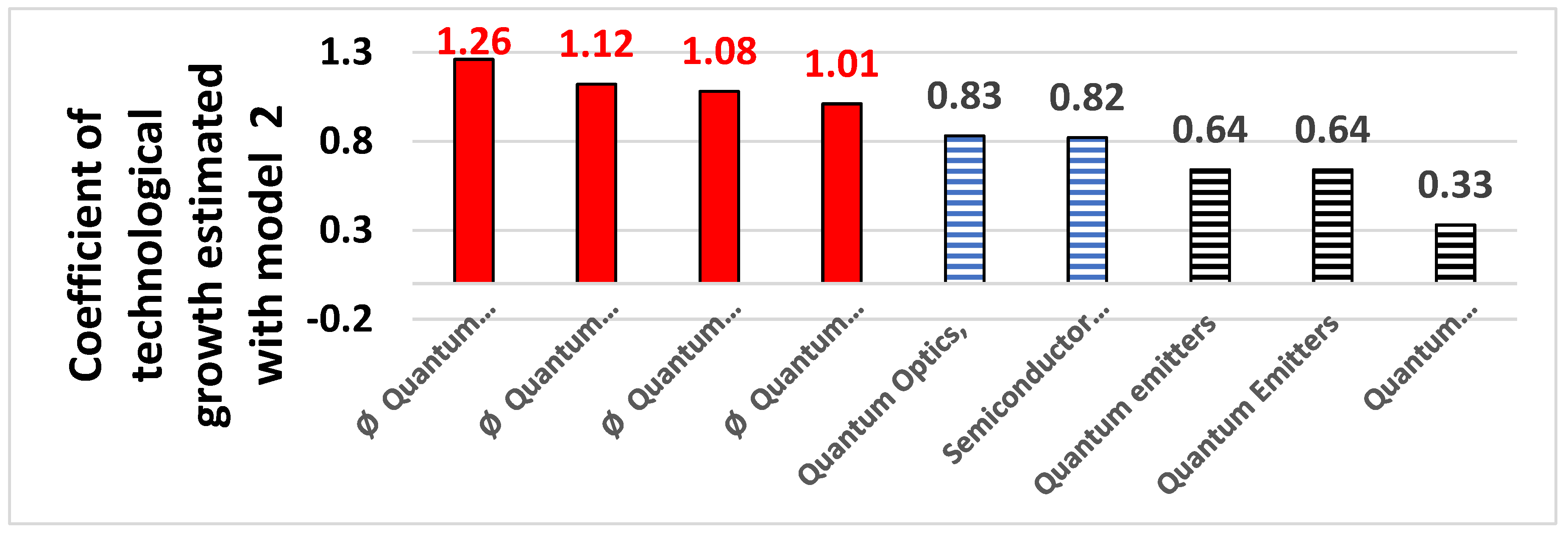
Table 3.
Parametric estimates of the log-log model of technological evolution in quantum science: logPatents in field i = a+b logPublications in field i (estimated model 2 described in methods).
Table 3.
Parametric estimates of the log-log model of technological evolution in quantum science: logPatents in field i = a+b logPublications in field i (estimated model 2 described in methods).
| Dependent variable: patents (Pat) in fields of quantum science | ||||
| Research fields | Coefficient b1 | Constant a | F | R2 |
| Quantum communications, Log Pat yi,t | 1.01*** | −1.34*** | 312.84*** | .90 |
| Quantum Computers, Log Pat yi,t | 1.26*** | −2.61*** | 344.89*** | .92 |
| Quantum Computing, Log Pat yi,t | 1.12*** | −1.26** | 234.21*** | .88 |
| Quantum Cryptography, Log Pat yi,t | 1.08*** | −1.89*** | 127.82*** | .95 |
| Quantum Electronics, Log Pat yi,t | 0.33*** | +3.63*** | 105.25*** | .67 |
| Quantum Emitters, Log Pat yi,t | 0.64*** | −0.08*** | 168.15*** | .88 |
| Quantum Optics, Log Pat yi,t | 0.83*** | −2.89*** | 181.46*** | .83 |
| Semiconductor Quantum Dots, Log Pat yi,t | 0.82*** | −1.35*** | 243.53*** | .88 |
Note: Explanatory variable is publications in quantum science. *** significant at 1‰; ** significant at 1%. F is the ratio of the variance explained by the model to the unexplained variance. R2 is the coefficient of determination.
Disclaimer/Publisher’s Note: The statements, opinions and data contained in all publications are solely those of the individual author(s) and contributor(s) and not of MDPI and/or the editor(s). MDPI and/or the editor(s) disclaim responsibility for any injury to people or property resulting from any ideas, methods, instructions or products referred to in the content. |
© 2025 by the authors. Licensee MDPI, Basel, Switzerland. This article is an open access article distributed under the terms and conditions of the Creative Commons Attribution (CC BY) license (http://creativecommons.org/licenses/by/4.0/).
Copyright: This open access article is published under a Creative Commons CC BY 4.0 license, which permit the free download, distribution, and reuse, provided that the author and preprint are cited in any reuse.


