

Submitted:
11 June 2025
Posted:
12 June 2025
You are already at the latest version
Abstract
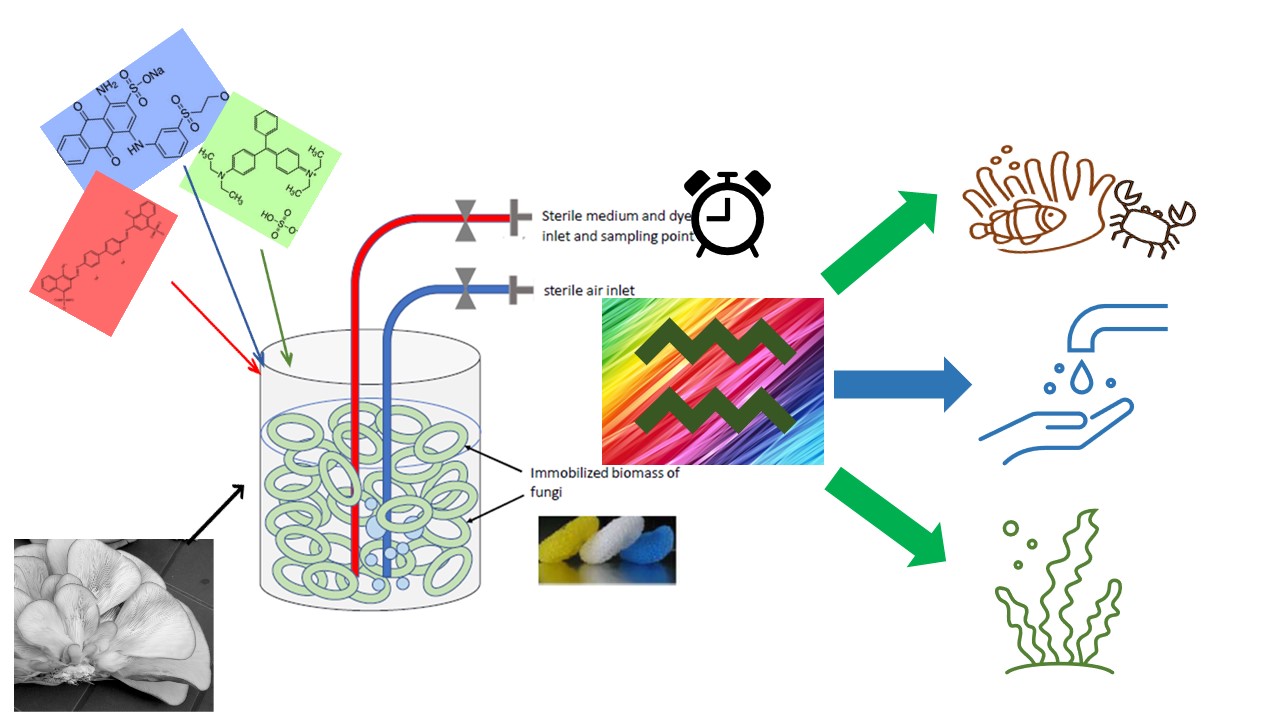
Dyes are widely used in various industries, but their removal from wastewater remains a challenge due to their resistance to biodegradation. While substantial research exists regarding the removal of individual dyes, there is much less about the removal of their mixtures. The aim of the research was to determine the possibility of using the immobilised mycelium of Pleurotus ostreatus strains to remove three-component mixtures of dyes from different classes. Efficiency of the removal in the continuously aerated reactor was similar to that obtained in a periodically aerated reactor and was over 90% at the end of each cycle. Despite the addition of subsequent portions of dyes, no increase in the toxicity of post-process samples was observed, and even a decrease of zootoxicity was noticed. The results of the study therefore indicate that an immobilised biomass can be used to remove the dyes, without the need to constantly inject air into the reactor.
Keywords:
decolourisation
; dyes mixture
; white rot fungi
; Pleurotus ostreatus
; bioreactors
-
Highlights:
- It is possible to remove mixtures of dyes from different classes by more than >90% in a sequential reactor.
- Constant aeration is not necessary for effective removal of dyes when using immobilised mycelium.
- Strains within a species differ in their potential ability to remove pollutants, including the dominant mechanism.
1. Introduction
Dyes are widely used in various industries (production of clothes, fabrics, leather, paints, varnishes, cosmetics, pharmaceuticals, food, information duplication techniques, laser techniques or medical diagnostics, and even in microelectronics). Decolourisation studies are therefore of particular importance due to the prevalence of substances that change the colour of water under the influence of anthropogenic pressure. Removal of synthetic dyes is particularly difficult, as they are supposed to be non-biodegradable. The textile industry has particularly high requirements in this regard. On the one hand, the activity of microorganisms covering our skin cannot cause a change or loss of colour. On the other hand, dyes should be resistant to physical factors and other chemicals so that they do not lose colour during washing or drying [1] (Sekhar et al., 2009).
Fungi are among the microorganisms capable of removing dyes. Different mechanisms may be used for different groups of fungi. For example, in yeast, decolourisation mechanisms include sorption, enzymatic degradation, i.e. biodegradation or biotransformation, as well as a combination of both processes [2]. The most frequently studied yeasts, which are attributed to sorption as the main mechanism, include Candida utilis, Kluyveromyces marxinus, Candida tropicalis, Debaryomyces polymorphus [2], Candida pseudoglabeosa, Yarrowia lipolytica [3]. The enzymes responsible for the enzymatic degradation of dyes are produced by: Galactomyces sp., Geotrichum sp., Debaryomyces polymorphus [2]. A combination of processes has been observed for Trichosporon akiyoshidainum [2]and Candida parapsilosis [3]. When it comes to biological degradation, it can occur, for example, in anaerobic conditions, as observed in Candida rugopelliculosa, or in aerobic conditions, as found for either Paraconiothyrium variabile or Candida tropicalis [2].
However, the main interest of researchers is focused on filamentous fungi, among which the best predisposition to decolourisation is attributed to white rot fungi [4,5,6,7].
To date, the ability to decolourise a large number of strains from this group has been tested. The best characterised species include Bjerkandera adusta, Phanerochaete chrysosporium, Trametes versicolor, Pleurotus ostreatus and Funalia trogii [4,5,6,8,9,10,11]. As mentioned by many researchers, the ability to remove dyes depends mainly on the type of enzymes produced by them, and in this case the so-called ligninolytic enzymes, which as low specificity exoenzymes are capable of transforming dyes of various structures. The most important and most frequently studied are: lignin peroxidase (LiP), Mn-dependent peroxidase (MnP), laccase and versatile peroxidases (VPs) [5,6,9]. Of course, we cannot forget about the phenomenon of biosorption. According to the researchers, even 50% of the dye can be absorbed in the first few minutes, and a balance is established after about 10 hours. Of course, the structure and concentration of the dye mainly determine the possibility and effectiveness of sorption, but one cannot forget about the reaction [2,12,13,14]. Most often, however, we deal with a combination of both processes [5].
There is a lot of information regarding the removal of individual coloured substances, but the situation is completely different when we consider mixtures of dyes. Particularly little is known about the decolourisation of mixtures of dyes from different groups and even less about the impact of the process on ecotoxicity. The aim of the research was to determine the possibility of removing three-component mixtures of dyes by the use of immobilised mycelium from two strains belonging to the Pleurotus ostreatus species. Zoo- and phytotoxicity of postprocess samples were evaluated to check the influence of the process on the environment.
2. Materials and Methods
Decolourisation studies of the dye mixture were carried out in bioreactors with immobilised mycelium of K4 and BWPH strains belonging to the Pleurotus ostreatus species. Both strains came from the collection of the Department of Environmental Biotechnology of the Silesian University of Technology [13,15].
2.1. Bioreactors
A polypropylene washer in the form of a disc was used as a biomass carrier. As was shown by the previous tests, the mycelium develops intensively throughout its space, allowing high efficiency of the decolourisation process. The reactors contained 0.5 L of culture medium with the following components: 10 g/L of glucose, 1 g/L of peptone, 0.5 g/L of MgSO4 x 7H2O and 1 g/L of KH2PO4. The reactors were equipped with a probe for sampling and supplying successive portions of medium and dyes, and with an aeration system. Both pipes were protected with a filter with a pore size of 0.45 µm, in order to eliminate contamination of bioreactors. Before introducing the mycelium into the bioreactors, they were autoclaved at 121°C for 30 minutes. Then mycelium grown on the same medium and homogenised using a BagMixer was introduced (2 ml of suspension). Reactors prepared in this way were incubated for 7 days on a shaker (150 rpm, room temperature 22 °C), which allowed mycelium to develop on the surface of the carrier. Only after this were additional portions of the dye mixture and medium added to replenish nutrients. The dye mixture consisted of: Congo red (azo dye - CR), brilliant green (triphenylmethane dye - BG) and remazol brilliant blue R (anthraquinone dye - RBBR) mixed together in a weight ratio of 1:1:1. Two reactor modifications were prepared for each strain: The first, a continuously aerated reactor, and second, a reactor which was aerated periodically (1000 mL of air was injected once a day). The autoclaved mixture of dyes was added in an amount to provide an initial concentration of 0.3 g/L in the first cycle. In subsequent cycles, due to the initial strong colour of the biomass, the decision was made to reduce the dose by half, i.e. to the level of 0.15 g/L. Decolourisation tests were carried out for 5 cycles of 7 days each. Samples (2 mL) were taken every 24 h after adding the dye and additionally 4 hours after adding the dye mixture. Absorbance measurements were made at wavelengths for which the maximum absorption of the dye was observed: 585 nm (RBBR), 617 nm (Congo Red), 622 nm (mixture of three dyes) and 624 nm (brilliant green). The analysis was carried out using a HITACHI U-1900 spectrophotometer.
2.2. Toxicity Assessment
At the end of each cycle, 50 ml samples were taken for zoo- and phytotoxicity tests. A zootoxicity test was performed with Daphnia magna (according to the OECD 202) and the lack of movement of the test organism was considered to be a toxic effect. The phytotoxicity evaluation was performed according to the OECD Lemna sp. growth inhibition test No.221. EC50 value (effective concentration of a wastewater sample that causes 50% inhibition of tested organisms) was estimated and based on that the acute toxicity unit (TUa) was calculated (Tua = 100/EC50). Samples were classified according to ACE89/BE2/D3 Final Report Commission EC (I class, TUa<0.4 – nontoxic; II class, 0.4≤TUa<1.0 – low toxicity; III class, 1.0≤TUa<10 – toxic; IV class, 10≤TUa≤100 – high toxicity; and V class, TUa>100 – extremely toxic).
3. Results and Discussion
3.1. Removal of Dye Mixture in Bioreactor
The results of the tests on the effectiveness of decolourisation of the dye mixture are presented in Figure 1 in the form of the concentration recorded in the reactors during the tests. These results refer to tests for the wavelength of 622 nm, but it should be noted that the trends obtained for the other tested wavelengths (waves of maximum absorbance for each of the dyes) were very similar.
On the first day of the experiment, immediately after the addition of dyes, high concentrations of the dye mixture (between 0.117 and 0.297 mg/L) were observed, accompanied by a strong colouration of the biomass in all reactors. Such results, taking into account the fact that a dose of dyes of 0.3 g/L was added, suggest that in almost all reactors (reactor with biomass BWPH C and in both reactors with biomass of the K4 strain) intense sorption of dyes onto the mycelium occurred (dye mixture concentration was below 0.16 g/L). After 24 hours from the addition of the dye (day 2), an intense decrease in colour was observed in almost all reactors (up to the level of 0.054 g/L). In the case of the BWPH P reactor, however, there was an increase in colour (up to 0.35 g/L). Such a phenomenon could be related to the desorption of dyes from biomass. It is necessary to mention that such a phenomenon (increase in colour, not a decrease) was noticed in previous studies for different strains including strains from Pleurotus ostreatus species [13,15].
During the first cycle of work of the reactors, it was evident that those with the BWPH strain worked much worse than those with the K4 strain. After 48h, regardless of the aeration system in both reactors with the K4 strain, the colour removal was almost complete (to the level of 0.008 g/L in the periodically aerated reactor and 0.002 g/L in the continuously aerated reactor). In the case of reactors with the BWPH strain decolourisation was lower but the tendency was similar - better decolourisation efficiency was obtained for the continuously aerated reactor (mixture concentration 0.037 and 0.14 g/L, respectively, for the continuously and periodically aerated reactor).
In the second reactor cycle (days 7 to 14), the addition of half the dose resulted in an increase in the colour of the medium, but not to the expected values of 0.15 g/L. Only in the case of the BWPH P reactor, the concentration of dyes was almost 0.2 g/L, which is close to the expected result. The aim of reducing the concentration of dyes was to preserve active fungal biomass. Very strong mycelium staining was still observed, and the addition of another, similarly large portion could cause the death of the biomass. In regard to the studied fungi, it is known that dyes are toxic and their tolerance depends on the concentration and type of dye[10,15,16,17]. It is worth emphasising that in the second cycle the reactors worked more stably and on day 14 of the tests the concentration of the mixture was only 0.007 g/L in the BWPH C and K4 C reactors, and 0.016 and 0.036 g/L in the K4 P and BWPH P reactors. The total portion of dyes added to the reactors (calculated for both cycles) was already 0.45 g/L, it can therefore be assumed that such a high colour removal is related not only to sorption, but also to the phenomenon of the biochemical transformation of dyes. However, it is difficult to estimate the amount of both phenomena in the decolourisation process.
The participation of the sorption process in colour removal seems to be confirmed by the results obtained for the K4 strain in the 3rd test cycle and in subsequent ones. In the 3rd cycle of reactor operation, day 16 shows there was a significant increase in the colour of the medium, especially in the K4 P reactor (to levels > 0.2 g/L), followed by a further decrease in colour. This phenomenon was not observed in bioreactors with the biomass of BWPH strain. An increase of colour was noticed after decolourisation in the reactor with strain K4 continuously aerated. For both reactors with the K4 strain, the removal process slowed down significantly and finally the dye mixture was removed to the level of 0.5 g/L. At the same time, in reactors with BWPH strain the concentration of dyes was reduced to the level of ~0.019 g/L. This indicates that in reactors with the BWPH strain, the process is based on the biochemical transformation, which also makes the process more stable. In the case of the K4 strain, the process can be mostly based on sorption, which causes its low stability. The last, 5th reactor cycle confirmed these observations. The reactors with the K4 strain worked worse than those with the BWPH strain. A significant increase in the colour of the substrate was observed after adding the 5th dose of the mixture of dyes, indicating the approaching exhaustion of the sorption capacity of the biomass of the K4 strain. The day 30 colour variations observed for these reactors seem to support this statement.
In the case of bioreactors with BWPH mycelium, the process was stable in the periodically aerated bioreactor, allowing for the removal of dyes to the level of 0.009g/L. In the reactor with constant aeration, the final concentration of mixture was 0.10 g/L.
As in the case of the presented research results, Kasinath et al. [18] also obtained high efficiency in removing the colour of industrial wastewater using Irpex lacteus. At the same time, it should be emphasised that the results of colour removal obtained using the BWPH and K4 strains are even better than those presented by several other authors. Mielgo et al. [19] used a bioreactor with a Phanerochaete chrysosporium strain immobilised on polyurethane foam to degrade poly R-478 in a nutrient-fed system with a pulsed air supply. It was possible to create a bioreactor that removed this dye with an efficiency of 80% even after 90 days of operation. The same species was used in a reactor tested by Pakshirajan and Kheria [20] to decolourise dilute industrial wastewater. Researchers reported that the efficiency of the process depended on the concentration of nutrients, but it was possible to obtain up to 83% colour reduction [20], which is a worse result than in the case of both tested strains of the Pleurotus ostreatus.
3.2. Ecotoxicity of Postprocess Samples
The results of ecotoxicity tests do not correlate with the efficiency of dye removal (Table 1). The high efficiency of decolourisation did not translate into a reduction in toxicity of test organisms. In the case of the first cycle of operation of the reactor with the mycelia of the BWHP strain, despite poor removal compared to reactors with the K4 strain, the post-process samples were classified as toxic (toxicity class III) in the tests with Daphnia magna and highly toxic (toxicity class IV) in the tests with Lemna minor. In the case of the K4 strain, which removed the mixture of dyes much better than the BWPH strain, the post-process samples were classified as highly toxic to the animal organism (toxicity class IV) and toxic to the plant organism (toxicity class III). For samples from reactors with mycelium of the BWHP strain, also in subsequent cycles, despite better efficiency of colour removal, no change in toxicity towards both test organisms was observed. All samples were classified as toxic in zootoxicity tests and very toxic in phytotoxicity tests.
The method of aeration also had no significant effect on toxicity. As is evident in the 5th cycle where samples from the continuously aerated reactor (BWPH C), in spite of a lower removal of dyes, were classified to the same toxicity classes as samples from the reactor operating better and more stably (periodically aerated reactor – BWPH P). It seems, however, that the mechanism of colour removal could be important for ecotoxicity, although no definite trends were observed. Only by comparing the results for both strains (BWPH and K4) can it be assumed that the high share of biotransformation in the processes of the elimination of dyes in the mixture, contributed to the fact that the zootoxicity did not increase with subsequent cycles, and was lower for samples from reactors with mycelium of the BWPH strain (always 3rd toxicity class) than in the case of reactors with K4 mycelium (always 4th toxicity class). However, the process with the BWPH strain yielded wastewater with lower zootoxicity than the process with the K4 strain.
In the case of phytotoxicity, no significant differences were noted. The lack of correlation between the efficiency of dye removal and changes in ecotoxicity has already been found in studies using the BWPH strain [12,13,15]. However, unlike in the aforementioned studies, in the case of the bioreactors discussed above, lower phytotoxicity and higher zootoxicity of post-process samples were noted. As the research results show, the mechanism of removal of the analysed mixture of dyes should be carefully assessed.
4. Conclusions
The research indicates significant differences in the efficiency of the process carried out by both tested strains, which confirms the need for the appropriate selection of the strain used. It was found that the mechanisms used by both strains are different, which determines the stability of decolourisation. Undoubtedly, the BWPH strain removed dyes better than the K4 strain. In bioreactors, regardless of the strain or aeration method used, the mixture of dyes was eliminated by more than 90%. Despite the initially poor efficiency of decolourisation in periodically aerated reactors in subsequent test cycles, good results of colour reduction were obtained, and this allowed for a reduction in cost of the process.
Author Contributions
Conceptualisation; methodology; validation; formal analysis; investigation; resources; data curation; writing; project administration; funding acquisition, W.P.; writing—review and editing, D.P. All authors have read and agreed to the published version of the manuscript.
Acknowledgments
The research was supported by funds from the Silesian University of Technology 08/020/RGJ22/0024. The author has reviewed and edited the output and takes full responsibility for the content of this publication.”
Conflicts of Interest
The author declares no conflicts of interest.
Abbreviations
The following abbreviations are used in this manuscript:
| BG | brilliant green dye |
| BWPH – | strain of Pleurotus ostreatus |
| BWPH P –, | bioreactor periodically aerated with strain BWPH |
| BWPH C – | bioreactor continuously aerated with strain BWPH |
| CR | Congo red dye |
| EC50 | half-maximal effective concentration |
| K4 – | strain of Pleurotus ostreatus |
| K4 P – | bioreactor periodically aerated with strain K4 |
| K4 C – | bioreactor continuously aerated with strain K4 |
| RBBR | remazol brilliant blue R dye |
| TUa | acute toxicity unit |
References
- Sekhar, C.P.; Kalidhasan, S.; Rajesh, V.; Rajesh, N. ; Bio-polymer adsorbent for the removal of malachite green from aqueous solution. Chemosphere 2009, 77, 842–847. [Google Scholar] [CrossRef] [PubMed]
- Solis, M.; Solis, A.; Perez, H.I.; Manjarrez, N.; Flores, M. ; Microbial decolouration of azo dyes: A review. Process. Bioch., 2012, 47, 1723–1748. [Google Scholar] [CrossRef]
- Mendes, M.; Cassoni, A.C.; Alves, S.; Pintado, M.E.; Castro, P.M.; Moreira, P. Screening for a more sustainable solution for decolorization of dyes and textile effluents using Candida and Yarrowia spp. J. Environ. Manag. 2022, 307, 114421. [Google Scholar] [CrossRef] [PubMed]
- Azmi, W.; Sani, K.R.; Banerjee, U.C. Biodegradation of triphenylmethane dyes. Enzyme. Microb. Technol. 1998, 22, 185–191. [Google Scholar] [CrossRef] [PubMed]
- Kaushik, P.; Malik, A. Fungal dye decolorization: recent advances and future potential. Environ. Int. 2009, 35, 127–141. [Google Scholar] [CrossRef] [PubMed]
- Knapp, J.S.; Newby, P.S.; Reece, L.P. Decolorization of wood-rotting basidomycete fungi. Enzyme. Microb. Technol. 1995, 17, 664–668. [Google Scholar] [CrossRef]
- Moreira, M.T.; Mielgo, I.; Feijoo, G.; Lema, J.M. Evaluation of different fungal strains in the decolorization of synthetic dyes. Biotechnol. Lett. 2000, 22, 1499–2000. [Google Scholar] [CrossRef]
- Radha, K.V.; Regupathi, A.; Arunagiri, A.; Murugesan, T. Decolorization studies of synthetic dyes using Phanerochaete chrysosporium and their kinetics. Process. Biochem. 2005, 40, 3337–3345. [Google Scholar] [CrossRef]
- Forootanfar, H.; Moezzi, A.; Aghaie-Khozani, M.; Mahmoudjanlou, Y.; Ameri, A.; Niknejad, F.; Faramarzi, M.A. Synthetic dye decolorization by three sources of fungal laccase. Iran. J. Environ. Health. Sci. Eng. 2012, 9, 27. [Google Scholar] [CrossRef] [PubMed]
- Radhika, R.; Jebapriya, G.R.; Gnanadoss, J.J. ; Decolorization of synthetic textile dyes using the edible mushroom fungi Pleurotus. Pakistan J Biological Sci. 2014, 17, 248–253. [Google Scholar] [CrossRef] [PubMed]
- Swamy, J.; Ramsay, J.A. . The evaluation of white rot fungi in the decoloration of textile dyes. Enzyme. Microb. Technol. 1999, 24, 130–137. [Google Scholar] [CrossRef]
- Przystaś, W.; Zabłocka-Godlewska, E.; Grabińska-Sota, E. Biological Removal of Azo and Triphenylmethane Dyes and Toxicity of Process By-Products. Water. Air. Soil. Pollut. 2012, 223, 1581–1592. [Google Scholar] [CrossRef] [PubMed]
- Przystaś, W.; Zablocka-Godlewska, E.; Grabińska-Sota, E. Effectiveness of dyes removal by mixed fungal cultures and toxicity of their metabolites. Water. Air. Soil. Pollut. 2013, 224, 1534. [Google Scholar] [CrossRef] [PubMed]
- Aksu, Z. Application of biosorption for the removal of organic pollutants: a review. Process. Biochem. 2005, 40, 997–1026. [Google Scholar] [CrossRef]
- Przystaś, W.; Zablocka-Godlewska, E.; Grabińska-Sota, E. Efficacy of fungal decolorization of a mixture of dyes belonging to different classes. Braz. J. Microbiol. 2015, 46, 415–424. [Google Scholar] [CrossRef] [PubMed]
- Kapdan, I.K.; Kargi, F. Biological decolorization of textile dyestuff containing wastewater by Coriolus versicolor In a rotating biological contractor. Enzyme. Microb. Technol. 2002, 30, 195–199. [Google Scholar] [CrossRef]
- Torres, J.M.O.; Cardenas, CH.V.; Moron, L.S.; Guzman, A.P.A.; dela Cruz, T.E.E. Dye decolorization activities of marine-derived fungi isolated from Manila Bay and Calatagan Bay, Philippines. Philippine. J. Sci. 2011, 140, 133–143. [Google Scholar]
- Kasinath, A.; Novotny, C.; Svobodova, K.; Patel, K.C.; Sasek, V. Decolorization of synthetic dyes by Irpex lacteus in liquid cultures and packed-bed bioreactor. Enzyme. Microb. Technol. 2003, 32, 167–173. [Google Scholar] [CrossRef]
- Mielgo, I.; Moreira, M.T.; Feijoo, G.; Lema, J.M. Biodegradation of a polymeric dye in a pulsed bed bioreactor by immobilized Phanerochaete chrysosporium. Water. Res. 2002, 36, 1896–1901. [Google Scholar] [CrossRef] [PubMed]
- Pakshirajan, K.; Kheria, S. Continuous treatment of coloured industry wastewater using immobilized Phanerochaete chrysosporium in a rotating biological contractor reactor. J. Environ. Manag. 2012, 101, 118–123. [Google Scholar] [CrossRef] [PubMed]
Figure 1.
Concentration of dye mixture (for wavelength λ= 622 nm) in bioreactors with immobilised biomass of strains BWPH and K4 (BWPH P – bioreactor periodically aerated with strain BWPH, BWPH C – bioreactor continuously aerated with strain BWPH, K4 P – bioreactor periodically aerated with strain K4, K4 C – bioreactor continuously aerated with strain K4; arrows indicate when the next dose of dyes and medium were introduced).
Figure 1.
Concentration of dye mixture (for wavelength λ= 622 nm) in bioreactors with immobilised biomass of strains BWPH and K4 (BWPH P – bioreactor periodically aerated with strain BWPH, BWPH C – bioreactor continuously aerated with strain BWPH, K4 P – bioreactor periodically aerated with strain K4, K4 C – bioreactor continuously aerated with strain K4; arrows indicate when the next dose of dyes and medium were introduced).
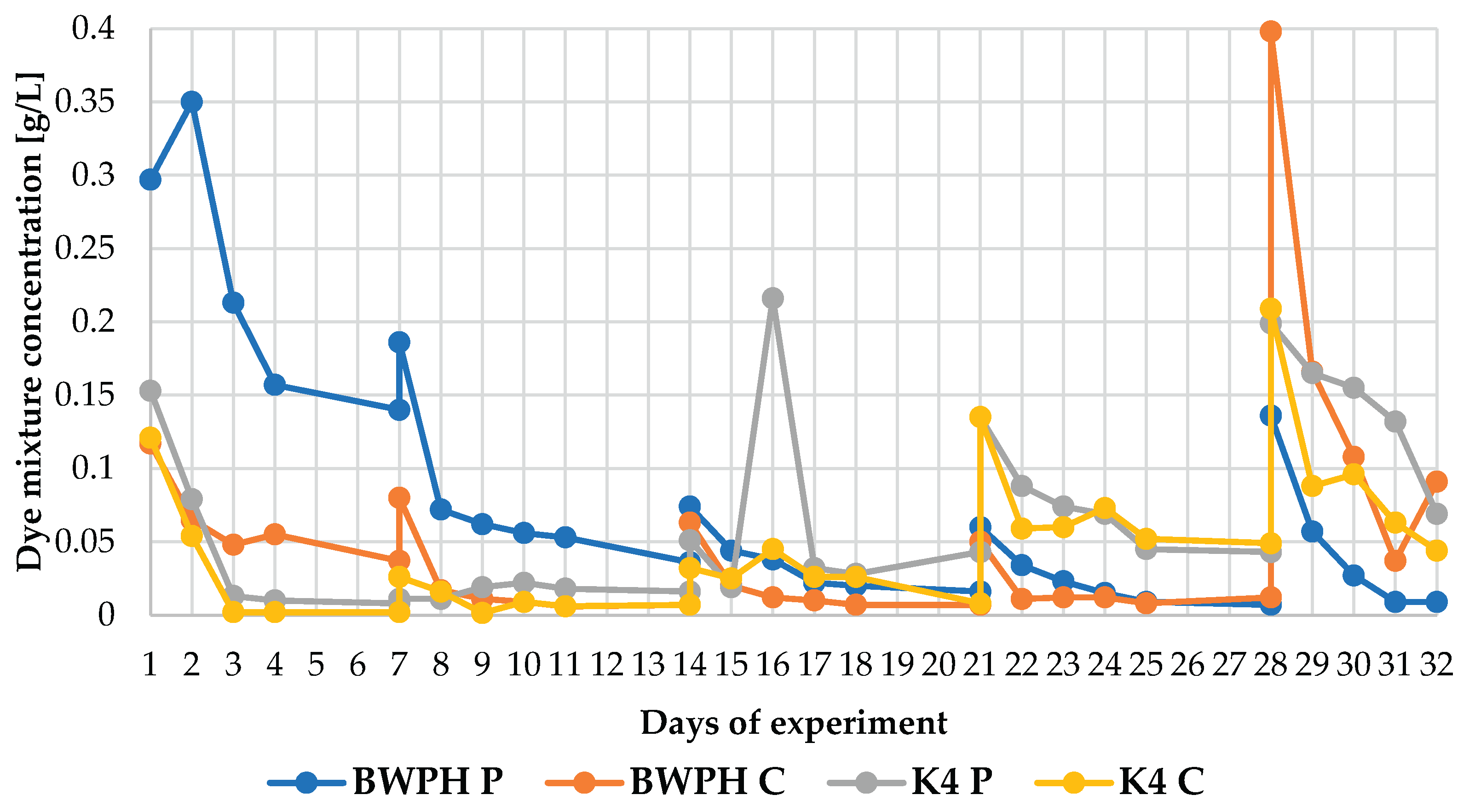

Table 1.
Ecotoxicity evaluation of post-process samples of each bioreactor after 7 days from the addition of dyes.
Table 1.
Ecotoxicity evaluation of post-process samples of each bioreactor after 7 days from the addition of dyes.
| Zootoxicity | Phytotoxicity | |||||
|---|---|---|---|---|---|---|
| Strain | Bioreactor type |
Cycle | EC50 | TUa (class) | EC50 | TUa (class) |
| BWPH | Periodically aerated (P) | 1 | 21.3 | 4.7 (III) | 3.7 | 27.0 (IV) |
| 2 | 18.4 | 5.4 (III) | 3.7 | 27.0 (IV) | ||
| 3 | 30.8 | 3.2 (III) | 1.7 | 58.8 (IV) | ||
| 4 | 22.8 | 4.4 (III) | 1.8 | 55.6 (IV) | ||
| 5 | 28.8 | 3.5 (III) | 1.8 | 55.6 (IV) | ||
| Continuously aerated (C) | 1 | 26.3 | 3.8 (III) | 3.7 | 27.0 (IV) | |
| 2 | 25.0 | 4.0 (III) | 2.3 | 43.5 (IV) | ||
| 3 | 28.8 | 3.5 (III) | 1.7 | 58.8 (IV) | ||
| 4 | 47.2 | 2.1 (III) | 2.7 | 37.0 (IV) | ||
| 5 | 31.6 | 3.2 (III) | 2.3 | 43.5 (IV) | ||
| K4 | Periodically aerated (P) | 1 | 1.2 | 83.3 (IV) | 3.6 | 27.8 (IV) |
| 2 | 1.4 | 71.4 (IV) | 2.3 | 43.5 (IV) | ||
| 3 | 2.3 | 43.5 (IV) | 7.3 | 13.7 (IV) | ||
| 4 | 2.6 | 38.5 (IV) | 2.3 | 43.5 (IV) | ||
| 5 | 2.6 | 38.5 (IV) | 2.3 | 43.5 (IV) | ||
| Continuously aerated (C) | 1 | 1.8 | 55.6 (IV) | 44.7 | 2.2 (III) | |
| 2 | 2.6 | 38.5 (IV) | 11.6 | 8.6 (III) | ||
| 3 | 3.4 | 29.4 (IV) | 3.7 | 27.0 (IV) | ||
| 4 | 3.2 | 31.3 (IV) | 4.3 | 23.3 (IV) | ||
| 5 | 3.2 | 31.3 (IV) | 4.3 | 23.3 (IV) | ||
Disclaimer/Publisher’s Note: The statements, opinions and data contained in all publications are solely those of the individual author(s) and contributor(s) and not of MDPI and/or the editor(s). MDPI and/or the editor(s) disclaim responsibility for any injury to people or property resulting from any ideas, methods, instructions or products referred to in the content. |
© 2025 by the authors. Licensee MDPI, Basel, Switzerland. This article is an open access article distributed under the terms and conditions of the Creative Commons Attribution (CC BY) license (http://creativecommons.org/licenses/by/4.0/).
Copyright: This open access article is published under a Creative Commons CC BY 4.0 license, which permit the free download, distribution, and reuse, provided that the author and preprint are cited in any reuse.


