

Submitted:
10 June 2025
Posted:
12 June 2025
You are already at the latest version
Abstract
Background/Objectives: Snake fruit is rich in vitamin C, carotene, phenolic compounds, flavonoids, and monoterpenoids—bioactive constituents known for their potent antioxidant properties. Based on these components, the present study investigated the potential effects of snake fruit jelly ingestion on endurance performance, alongside its impact on antioxidant status, inflammatory responses, and metabolic biomarkers in healthy individuals. Methods: A randomized crossover design was used in two separate experiments involving 48 healthy sedentary men and women aged 19–35 years. All participants ingested 140 g of both control jelly and snake fruit jelly on separate occasions. Experiment 1 (n = 25): Blood glucose concentrations were measured at baseline and every 30 minutes for 2 hours post-ingestion. Experiment 2 (n = 23): Following each jelly ingestion, participants performed leg cycling at 60% of peak oxygen consumption until exhaustion. Blood samples were collected before and after exercise to measure glucose, insulin, cortisol, and biomarkers of antioxidant status and inflammation. Results: In Experiment 1, blood glucose concentrations at 30 and 60 minutes post-ingestion and the incremental area under the glucose curve at 30, 60, 90, and 120 minutes were significantly lower after snake fruit jelly ingestion compared to control (all p < 0.05). In Experiment 2, endurance time and superoxide dismutase activity were significantly higher, while blood glucose, insulin, and tumor necrosis factor-alpha concentrations were significantly lower following snake fruit jelly ingestion (all p < 0.05). Cortisol and interferon-gamma levels showed no significant differences between the two conditions. Conclusions: Acute ingestion of snake fruit jelly enhances endurance performance and antioxidant activity, while reducing blood glucose, insulin, and pro-inflammatory markers in response to endurance exercise.
Keywords:
diabetes
; inflammation
; oxidative stress
; physical performance
; sports nutrition
1. Introduction
The global sports nutrition market is a multibillion-dollar industry, projected to nearly double in value by 2030 [1]. Dietary supplements are widely used by athletes across various disciplines—including speed, power, and endurance sports—as part of their training regimens or during competition. Notably, approximately 85% of elite track and field athletes report supplement use [2]. The primary motivations for supplement use include enhancing athletic performance, promoting faster recovery, and supporting overall health [1].
Sports supplements are commonly categorized into several groups, including sports foods, medical supplements, ergogenic aids, functional foods and superfoods, and other miscellaneous supplements [3]. Among ergogenic supplements, vitamins, minerals, protein, creatine, and various other compounds are frequently consumed by athletes [2]. In recent years, antioxidant supplementation has gained attention as a potential strategy to enhance athletic performance. This interest stems from the understanding that intense physical activity increases the production of free radicals, which can lead to oxidative stress. Such stress is associated with muscle inflammation and damage, increased fatigue, and impaired physical performance [4].
Snake fruit, or salak (Salacca edulis Reinw.), is a tropical fruit native to Indonesia and widely cultivated in other Southeast Asian countries such as Thailand, Malaysia, and Brunei. Nutritionally, snake fruit contains higher levels of dietary fiber, crude protein, and crude fats compared to kiwi fruit [5]. It is also a rich source of natural sugars, essential minerals, and vitamins, including ascorbic acid (vitamin C) and carotene [6]. Numerous in vitro and in vivo studies have demonstrated the medicinal potential of snake fruit, which includes antioxidant, anticancer, antihyperlipidemic, and antihyperuricemic effects. These properties are primarily attributed to its high content of phenolic compounds, flavonoids, and monoterpenoids, which possess significant antioxidative activities [7,8].
Given the valuable bioactive compounds in snake fruit—particularly its high antioxidant content—this study aimed to develop an ergogenic supplement derived from snake fruit and to investigate its potential effects on endurance performance. In addition to assessing performance outcomes, the study also explored physiologically relevant mechanisms, including antioxidant capacity, inflammatory response, and metabolic changes, to provide a more comprehensive understanding. We hypothesized that acute ingestion of snake fruit jelly would enhance endurance performance by improving antioxidant status, modulating inflammatory markers, and supporting favorable metabolic responses.
2. Materials and Methods
2.1. Study Design and Sample Size
This study was designed as a randomized, single-blind, crossover, placebo-controlled trial. It was divided into two experiments: the first examined blood glucose responses to acute ingestion of snake fruit jelly (n = 25), and the second investigated the efficacy of snake fruit jelly on endurance performance (n = 25). The sample size for each experiment was determined using the crossover study formula described by Machin and Campbell [9]. Based on a previous study evaluating the acute effects of passion fruit juice supplementation on blood glucose levels in healthy individuals [10], a mean difference of 16.4 mg/dL between treatment and control conditions was observed, with a standard deviation of 9.0. Using a Type I error (α) of 0.05 and a Type II error (β) of 0.20 (power = 80%), the required sample size was calculated to be 22 participants. To account for a potential 10% drop-out rate, the final sample size was increased to 25 participants per experiment.
2.2. Ethical Considerations
All participants provided written informed consent prior to undergoing screening procedures. They were thoroughly informed—both verbally and in writing—about the study’s objectives, experimental protocol, potential risks and benefits, as well as their rights and responsibilities as participants. The study was approved by the Human Ethics Committee of Burapha University (Approval No. IRB1-028/2566, approval date 20 March 2023) and was registered at ClinicalTrials.gov (Identifier: NCT06227260).
2.3. Participants and Screenings
A total of fifty healthy sedentary men and women, aged 18–35 years, were enrolled in the study. The inclusion criteria were as follows: (a) male or female aged between 18 and 35 years; (b) normal body mass index (BMI) ranging from 18.5 to 24.9 kg/m²; (c) absence of any diagnosed health conditions; and (d) willingness to consume snake fruit products. Exclusion criteria included: (a) known allergy to snake fruit or carrageenan; (b) regular smoking or alcohol consumption (defined as at least once per week); (c) regular participation in physical exercise exceeding 150 minutes per week or more than two days per week; (d) regular intake of dietary supplements, such as vitamins or antioxidants (more than two days per week); (e) bone, muscle, or joint problems that could interfere with leg cycling; and (f) presence of current signs or symptoms of inflammation or infection, such as fever, hyperpnea, dyspnea, or palpitations. Participants were withdrawn from the study if they: (a) exhibited abnormal symptoms during the exercise test or after jelly ingestion; (b) were unable to complete both ingestion conditions in each experiment; or (c) voluntarily chose to discontinue participation.
Screening questionnaires were administered to collect information on general demographics, current and past medical history, food allergies, physical activity participation, and dietary supplement use. Physical and physiological assessments included measurements of height, BM, BMI, blood pressure, heart rate, and body temperature. Additionally, all participants were required to consume a small sample of snake fruit jelly (approximately 50 mg) to assess for any allergic reactions or abnormal symptoms associated with acute ingestion.
2.4. Experiments
2.4.1. Experiment 1
In the first experiment, 25 participants consumed 140 g of either the control jelly or the snake fruit jelly in a randomized sequence. Blood glucose concentrations were measured at baseline (T0) and subsequently at 30, 60, 90, and 120 minutes post-ingestion (T30, T60, T90, and T120). After completing the first intervention arm, participants underwent a one-week washout period before crossing over to the alternate jelly condition. In the second arm, participants ingested the other jelly formulation and underwent blood glucose measurements following the same protocol as in the first arm.
2.4.2. Experiment 2
In the second experiment, 25 participants were randomly assigned to ingest 140 g of either the control jelly or the snake fruit jelly. Following ingestion, endurance performance was assessed using a leg cycling test performed at 60% of each participant’s peak oxygen consumption (VO₂peak) until exhaustion. Blood samples were collected before and after the endurance test to measure glucose, insulin, and cortisol concentrations, as well as biomarkers of antioxidant status and inflammation, including superoxide dismutase (SOD), interferon-gamma (IFN-γ), and tumor necrosis factor-alpha (TNF-α). After a one-week washout period, participants crossed over to consume the alternate jelly and underwent the same endurance test and biomarker assessments as in the first session.
All participants completed both Experiment 1 and Experiment 2 during the same time period and under similar environmental conditions, including consistent room temperature and humidity. Additionally, participants were instructed to maintain their usual daily routines—particularly with regard to dietary intake and physical activity—throughout the study period and during both arms of the crossover design.
2.5. Jelly Preparation
Snake fruit used in this study was sourced from Song Salueng Sub-district, Klaeng District, Rayong Province—an area well known for cultivating and distributing snake fruit in Eastern Thailand. To prepare the snake fruit jelly, the fruits were first roughly extracted using a fruit extractor to separate the juice from the pulp. The extracted juice was then double-filtered using a filter cloth to obtain a clear juice. Sucrose powder and carrageenan were added to the juice, which was then heated at medium temperature until thoroughly mixed. The mixture was allowed to cool at room temperature (22–28 °C) for approximately 30 minutes and subsequently stored in a refrigerator at 2–4 °C prior to use in the experiment. According to the Thai Food Composition Database 2015 (THAI FCD 2015), one portion (140 g) of snake fruit jelly provides approximately 241 kilocalories. The control jelly was prepared using the same process as the snake fruit jelly. However, instead of using snake fruit juice, glucose and fructose powders were added to replicate the sugar composition and total energy content of the snake fruit jelly [5]. Each participant received one portion (140 g) of jelly per ingestion.
2.6. Biochemical Assays
In Experiment 1, blood glucose concentrations were measured using the Accu-Chek® Guide blood glucose monitoring system (Roche Diabetes Care Inc., Indianapolis, IN, USA), following the procedure previously described by Prasertsri et al. [10]. In Experiment 2, approximately 10 mL of venous blood was collected in the morning (between 8:00 and 9:00 a.m.) following an overnight fast of at least 8 hours. Of this, 6 mL was drawn into glucose and clotted blood collection tubes for analysis of glucose, insulin, and cortisol concentrations. Blood glucose was measured using the VITROS Chemistry Products GLU Slides and the VITROS GLU Slide technique (Ortho Clinical Diagnostics, San Diego, CA, USA). Insulin concentration was determined using the ARCHITECT Insulin assay (Abbott Laboratories, Abbott Park, IL, USA). Cortisol levels were measured using the VITROS Immunodiagnostic Products Cortisol Reagent Pack via a competitive immunoassay technique (Ortho Clinical Diagnostics, San Diego, CA, USA). All biochemical analyses were conducted by RIA Laboratory Co., Ltd., Thailand.
2.7. Antioxidant Biomarker Assay
Approximately 1 mL of blood collected in clotted blood tubes was used for the analysis of antioxidant biomarker. SOD activity was measured in serum using the SOD Assay Kit-WST and a colorimetric method, following the manufacturer’s instructions (Dojindo Laboratories, Kumamoto, Japan).
2.8. Inflammatory Cytokines Assay
Approximately 3 mL of blood collected in clotted blood tubes was used for the analysis of inflammatory biomarkers. Serum concentrations of IFN-γ and TNF-α were measured using the OptEIA™ ELISA Sets for human IFN-γ and TNF-α, following the manufacturer’s instructions (BD Biosciences Pharmingen, San Diego, CA, USA).
2.9. Endurance Performance Test
During the first visit, participants underwent a submaximal exercise test using the Åstrand-Rhyming cycle ergometer protocol to estimate their VO₂peak and to determine the corresponding 60% VO₂peak workload [11]. On the subsequent visit, participants ingested either the control jelly or the snake fruit jelly and then performed an endurance performance test. This involved leg cycling at 60% of their VO₂peak until exhaustion, defined as the onset of maximal symptoms of dyspnea and fatigue or the inability to maintain a pedaling cadence of at least 60 revolutions per minute. Endurance performance was quantified by the total duration of the cycling effort (endurance time).
2.10. Statistical Analyses
Data were assessed for normality using the Shapiro-Wilk test, homogeneity of variance using Levene’s test, and sphericity using Mauchly’s test. In Experiment 1, differences in blood glucose concentrations across time points (T0, T30, T60, T90, and T120) within and between ingestion conditions were analyzed using repeated measures analysis of covariance (ANCOVA), with baseline glucose (T0) included as a covariate. In Experiment 2, differences in outcome variables between ingestion conditions (control vs. snake fruit jelly) were analyzed using two-way repeated measures analysis of variance (ANOVA). The Bonferroni post hoc test was employed for multiple comparisons, and results were further validated using paired (dependent) t-tests. All statistical analyses were performed using IBM SPSS Statistics for Windows (IBM Corp., Armonk, NY, USA). Data are presented as mean ± standard deviation, and a p-value of < 0.05 was considered statistically significant.
3. Results
3.1. Experiment 1
3.1.1. Participant Characteristics
In Experiment 1, all 25 participants completed the study. Of these, 4 participants (16%) were male and 21 (84%) were female. The average age, height, BM, and BMI of the participants were 22.60 ± 3.33 years, 159.52 ± 7.12 cm, 52.89 ± 8.68 kg, and 20.64 ± 2.15 kg/m², respectively (Table 1).
3.1.2. Blood Glucose and Incremental Area Under the Blood Glucose Curve
Following control jelly ingestion, blood glucose concentrations at T30 and T60 were significantly elevated compared to baseline (T0) (p < 0.001). A similar trend was observed after snake fruit jelly ingestion, with significant increases in blood glucose at T30 and T60 relative to T0 (p < 0.001).
When comparing between the two ingestion conditions, blood glucose concentrations at T30 and T60 were significantly lower in the snake fruit jelly group compared to the control jelly group (T30: 124.12 ± 15.52 vs. 143.16 ± 20.98 mg/dL, p = 0.001; T60: 98.04 ± 11.24 vs. 110.72 ± 16.52 mg/dL, p = 0.003) (Figure 1A).
Additionally, analysis of the incremental area under the blood glucose curve (iAUC) revealed that blood glucose responses at T30, T60, T90, and T120 were significantly lower in the snake fruit jelly condition compared to the control jelly condition (all p < 0.001) (Figure 1B).
3.2. Experiment 2
3.2.1. Participant Characteristics
In Experiment 2, 23 out of the initial 25 participants (92%) completed the study. Two participants (8%) were unable to participate in the second ingestion session due to discomfort. Among 23 participants, 2 (8.70%) were male and 21 (91.30%) were female. The average age, height, BM, and BMI of the participants were 21.57 ± 1.88 years, 159.52 ± 7.12 cm, 53.26 ± 6.71 kg, and 20.86 ± 1.52 kg/m², respectively (Table 2).
3.2.2. Endurance Performance
Following ingestion of snake fruit jelly, participants demonstrated a significantly greater endurance time compared to the control jelly condition (33.37 ± 1.91 vs. 25.73 ± 1.71 minutes; p < 0.001) (Figure 2). Among the 23 participants, 19 individuals (82.61%) exhibited an improvement in endurance performance. The average percentage increase in endurance time was 35.27 ± 48.86%.
3.2.3. Blood Glucose, Insulin, and Cortisol
Following control jelly ingestion, both blood glucose and insulin concentrations were significantly elevated (p < 0.001). In contrast, these elevations were not observed after snake fruit jelly ingestion. Furthermore, post-exercise concentrations of blood glucose (86.13 ± 13.83 vs. 101.22 ± 17.90 mg/dL; p = 0.003) and insulin (37.30 ± 25.49 vs. 68.30 ± 50.94 µU/mL; p = 0.010) were significantly lower in the snake fruit jelly condition compared to the control jelly condition (Figure 3). Cortisol concentrations were significantly reduced after ingestion of both jelly types (p < 0.001); however, there was no significant difference between the two conditions (p = 0.589).
3.2.4. Antioxidant Biomarker
SOD activity significantly increased following snake fruit jelly ingestion (p = 0.005), whereas no significant change was observed after control jelly ingestion (p = 0.746). Additionally, post-exercise SOD activity was significantly higher in the snake fruit jelly condition compared to the control jelly condition (47.30 ± 14.21% vs. 39.38 ± 9.05%; p = 0.041) (Figure 4).
3.2.5. Inflammatory Cytokines
TNF-α concentration significantly decreased following snake fruit jelly ingestion (p = 0.004), whereas no significant change was observed after control jelly ingestion. Moreover, post-exercise TNF-α levels were significantly lower in the snake fruit jelly condition compared to the control jelly condition (0.94 ± 1.47 vs. 13.54 ± 12.47 pg/mg; p < 0.001) (Figure 5). In contrast, IFN-γ concentrations did not change significantly after ingestion of either jelly. No significant differences were observed between the two conditions.
4. Discussion
This study hypothesized that ingestion of snake fruit jelly—a novel ergogenic supplement—could enhance endurance performance through improvements in antioxidant status, inflammatory responses, and metabolic parameters. The findings support this hypothesis, demonstrating that acute ingestion of snake fruit jelly significantly enhanced endurance performance. These effects appear to be mediated, at least in part, by increased antioxidant activity, attenuation of inflammatory responses, and improved regulation of blood glucose levels.
Reactive oxygen species (ROS) have been implicated as contributors to premature muscular fatigue during sustained muscle contractions and exercise. Skeletal muscle contains several endogenous sources of ROS, and the accumulation of ROS in active muscle has been shown to impair muscle function, thereby promoting fatigue [12,13]. As such, the use of exogenous antioxidants has been proposed as a strategy to delay muscular fatigue and enhance endurance exercise performance [14]. This concept is supported by Reid [12], who suggested that antioxidant therapy may be beneficial for individuals prone to early fatigue. The potential benefits of antioxidant supplementation are thought to involve improvements in cellular redox balance and reductions in oxidative modifications to deoxyribonucleic acid (DNA), lipids, and proteins. Vitamin C supplementation, in particular, has been extensively reported to reduce oxidative stress, muscle damage, immune dysfunction, and fatigue [15,16]. However, evidence regarding the ergogenic potential of snake fruit consumption remains limited. From a nutritional standpoint, snake fruit is rich in key antioxidant vitamins, notably ascorbic acid (vitamin C) at approximately 400 mg/kg and carotene (a precursor of vitamin A) at 5 mg/kg [6]. The antioxidant effects of vitamin C, the predominant antioxidant in plasma, have been linked to modulation of enzymes such as nicotinamide adenine dinucleotide phosphate (NADPH) oxidase and SOD [17]. Several studies have demonstrated that acute vitamin C intake in various forms can enhance antioxidant capacity and reduce oxidative stress. For example, Davison and Gleeson [18] reported that acute vitamin C ingestion reduced oxidative damage to neutrophils, increased total antioxidant capacity, and decreased oxidative stress markers following 2.5 hours of cycling at approximately 60% maximum VO2 (VO2max). Similarly, Popovic et al. [19] found that supplementation with 2,000 mg of vitamin C reduced malondialdehyde levels after exhaustive running. Yimcharoen et al. [20] also observed that a single dose of 1,000 mg of ascorbic acid prior to 30 minutes of moderate-intensity cycling enhanced antioxidant status, as indicated by increased ferric reducing antioxidant power (FRAP) and reduced lipid peroxidation.
In addition to the well-recognized interplay between oxidative stress and inflammation—termed “oxinflammation” [21]—there is growing evidence that inflammation may contribute to the development of fatigue, particularly in clinical populations [22]. A widely accepted paradigm suggests that inflammation disrupts the balance between muscle protein synthesis and degradation. Inflammatory cytokines, such as TNF-α, have been shown to impair muscle function by directly suppressing muscle-specific expression of insulin-like growth factor 1 (IGF-1) [23]. As a result, both oxidative stress biomarkers (e.g., antioxidant capacity) and inflammatory markers (e.g., TNF-α) are commonly used as indicators of muscle fatigue [24]. In the present study, an increase in SOD activity and a reduction in TNF-α concentration following snake fruit jelly ingestion suggest that key constituents of the fruit—such as vitamin C—may contribute to alleviating muscle fatigue, thereby enhancing endurance performance. These findings are consistent with previous studies in several respects. For example, Nakhostin-Roohi et al. [25] demonstrated that supplementation with 1,000 mg of vitamin C prevented exercise-induced lipid peroxidation and muscle damage following 30 minutes of endurance exercise at 75% VO₂max. However, their study did not report significant effects on inflammatory markers, including total leukocyte count, neutrophils, and interleukin-6 (IL-6). Recent meta-analyses have further supported the anti-inflammatory potential of vitamin C, showing reductions in lipid peroxidation and IL-6 following acute exercise bouts [26]. Additionally, supplementation with a combination of vitamins C and E has been shown to reduce post-exercise levels of IL-6, cortisol, creatine kinase (CK), and lipid peroxidation [27]. Taken together, these findings highlight that the effects of acute antioxidant supplementation on exercise-induced oxidative stress and inflammation may vary depending on several factors, including dosage, timing, supplementation duration, type of exercise, participant fitness level, and baseline oxidative stress/antioxidant status [4]. Regarding dosage, Braakhuis [15] noted that high doses of vitamin C (>1 g/day) may impair exercise performance by inhibiting mitochondrial biogenesis. In contrast, lower doses (~200 mg/day), typically achieved through consuming five or more servings of fruits and vegetables, may be sufficient to reduce oxidative stress and offer health benefits without negatively impacting training adaptations.
In this study, the observed improvement in endurance performance following snake fruit jelly ingestion—despite comparable total sugar content between the control and experimental jellies—suggests that additional bioactive constituents in snake fruit may contribute to the ergogenic effect. Notably, snake fruit contains a variety of vitamins that may act synergistically to enhance endurance performance. For example, vitamin C plays a role in the biosynthesis of carnitine, a key factor in fatty acid β-oxidation, and serves as a cofactor in the synthesis of catecholamines, which stimulate carbohydrate oxidation and energy production during exercise [28]. Although evidence on the direct performance-enhancing effects of vitamin C supplementation is mixed, and human studies report conflicting findings [14], several investigations have shown reductions in muscle damage markers—such as CK—after intense exercise with vitamin C supplementation [29,30,31]. Furthermore, both conventional (non-targeted) antioxidants such as vitamins C and E, quercetin, resveratrol, and α-lipoic acid, and targeted antioxidants such as Mitoquinol, have been suggested to support mitochondrial adaptations and improve peripheral circulation, thereby potentially enhancing exercise capacity [32,33]. Beyond vitamins C and E, vitamin A—also present in snake fruit—has been shown to regulate mitochondrial biogenesis and function through the p38 mitogen-activated protein kinase (MAPK)–peroxisome proliferator-activated receptor-gamma coactivator (PGC)-1α signaling pathway, as well as to influence muscle fiber composition [34]. Enhanced mitochondrial biogenesis, primarily via the activation of PGC-1α through adenosine monophosphate-activated protein kinase (AMPK), leads to increased endurance capacity, improved endothelial nitric oxide synthesis, and enhanced blood flow [32].
According to the bioactive compound analysis by Čepková et al. [5], snake fruit possesses a high total phenolic content (257.17 μg/mL), including various phenolic compounds such as chlorogenic acid, epicatechin, procyanidin B2, neochlorogenic acid, ferulic acid, quercetin, isoquercetin, and apigenin. Its antioxidant activity—measured at 10.56 μM Trolox/g of fruit pulp—is comparable to that of black mulberry (Morus nigra L.). Among these, chlorogenic acid was identified as the most abundant phenolic compound and is known for its strong antioxidant activity. In addition, chlorogenic acid has been shown to inhibit α-amylase and α-glucosidase, two key enzymes involved in carbohydrate digestion and glucose absorption, and is therefore associated with antidiabetic properties [35]. This mechanism may help explain the observed reductions in postprandial blood glucose levels following snake fruit jelly ingestion in both Experiments 1 and 2. Furthermore, in Experiment 2, participants exhibited lower insulin concentrations following snake fruit jelly ingestion compared to the control jelly, which may indicate improved insulin sensitivity or reduced insulin demand. Beyond chlorogenic acid, other phenolic compounds present in snake fruit may also contribute to its metabolic effects. For example, epicatechin has been reported to reduce blood glucose and fasting insulin levels by enhancing insulin sensitivity [36], and to inhibit α-glucosidase activity [37]. Collectively, these phenolic compounds may synergistically contribute to improved glycemic control and metabolic efficiency during exercise, thereby supporting enhanced endurance performance.
Although existing literature presents conflicting findings regarding the effects of vitamin C supplementation on blood glucose regulation, several studies support its potential benefits. For example, analysis of data from the NHANES 2013–2016 survey revealed that adults who consumed 100% fruit juice containing vitamin C (defined as any intake reported during the first 24-hour dietary recall) had significantly lower plasma glucose and glycohemoglobin levels compared to non-consumers [38]. In addition, a randomized crossover study by Mason et al. [39] demonstrated that vitamin C supplementation improved daily postprandial and 24-hour glycemia in individuals with type 2 diabetes. Further support comes from systematic reviews and meta-analyses. Ashor et al. [40] and Nosratabadi et al. [41] reported that long-term vitamin C supplementation (duration >30 days) significantly reduced fasting glucose levels in patients with type 2 diabetes. Structurally, vitamin C resembles glucose and can substitute it in several biochemical reactions [42], making it effective in scavenging free radicals generated during postprandial hyperglycemia and exhaustive exercise [43,44]. One possible mechanism explaining the reductions in blood glucose observed in both Experiments 1 and 2 (as well as insulin levels in Experiment 2) following snake fruit jelly ingestion is the modulatory effect of vitamin C on insulin action. Plasma vitamin C is believed to enhance insulin sensitivity, primarily by improving nonoxidative glucose metabolism [45]. These findings suggest that vitamin C, as a key component of snake fruit, may contribute to the observed improvements in glycemic control and metabolic efficiency during exercise.
This study has several limitations that should be acknowledged. First, blood vitamin C levels were not measured, limiting our ability to directly attribute the observed changes in antioxidant, inflammatory, and metabolic parameters—as well as endurance performance—to the bioactive compounds in snake fruit jelly. Second, insulin concentrations were not assessed in Experiment 1, hindering a comprehensive understanding of the jelly’s effects on blood glucose regulation and its relevance to individuals with type 2 diabetes mellitus. Third, Experiment 2 did not include measurements of muscle damage markers such as CK, myoglobin, or blood urea nitrogen, preventing a clear interpretation of the mechanistic links among oxidative stress, inflammation, muscle damage, and endurance performance.
Future research should address these limitations by including measurements of blood vitamin C, insulin levels in glycemic studies, and muscle damage biomarkers in exercise protocols. Additionally, long-term studies investigating the effects of snake fruit jelly ingestion in both athletic populations and individuals with type 2 diabetes are warranted to further evaluate its potential as an ergogenic aid and a functional food in clinical nutrition.
5. Conclusions
Acute ingestion of snake fruit jelly significantly enhances endurance performance in healthy sedentary young adults. This effect may be attributed to improvements in antioxidant activity (evidenced by increased SOD activity), reduced inflammation (decreased TNF-α), and better metabolic control (lower blood glucose and insulin levels) in response to endurance exercise. These findings support the potential of snake fruit jelly as a novel ergogenic supplement that may serve as an effective adjunct in exercise and training programs for physically active individuals and athletes.
Author Contributions
Conceptualization, P.P. and M.T.; methodology, P.P.; software, P.P.; validation, P.P.; formal analysis, P.P.; investigation, P.P., O.B., P.C., T.P., Y.T., and S.K.; resources, P.P.; data curation, O.B.; writing—original draft preparation, P.P. and O.B.; writing—review and editing, P.P. and O.B.; visualization, P.P.; supervision, P.P.; project administration, P.P.; funding acquisition, P.P., O.B., P.C., and M.T. All authors have read and agreed to the published version of the manuscript.
Funding
This research was funded by the Burapha University (BUU); the Thailand Science Research and Innovation (TSRI); and the National Science Research and Innovation Fund (NSRF) (Fundamental Fund 2023), grant number 31/2566.
Institutional Review Board Statement
This study was conducted in accordance with the Declaration of Helsinki, and approved by the Institutional Review Board of Burapha University (Approval No. IRB1-028/2566, approval date 20 March 2023).
Informed Consent Statement
Informed consent was obtained from all participants involved in the study.
Data Availability Statement
The data are available upon request from the corresponding author.
Acknowledgments
This research was financially supported by the Burapha University (BUU); the Thailand Science Research and Innovation (TSRI); and the National Science Research and Innovation Fund (NSRF) (Fundamental Fund 2023), grant number 31/2566.
Conflicts of Interest
The authors declare no conflicts of interest.
Abbreviations
The following abbreviations are used in this manuscript:
| AMPK | Adenosine monophosphate-activated protein kinase |
| ANCOVA | Analysis of covariance |
| ANOVA | Analysis of variance |
| BM | Body mass |
| BMI | Body mass index |
| CK | Creatine kinase |
| DNA | Deoxyribonucleic acid |
| FRAP | Ferric reducing antioxidant power |
| iAUC | Incremental area under the curve |
| IFN | Interferon |
| IGF | Insulin-like growth |
| IL | Interleukin |
| MAPK | Mitogen-activated protein kinase |
| NADPH | Nicotinamide adenine dinucleotide phosphate |
| PGC | Peroxisome proliferator-activated receptor-gamma coactivator |
| ROS | Reactive oxygen species |
| SOD | Superoxide dismutase |
| TNF | Tumor necrosis factor |
| VO2max | Maximal oxygen consumption |
| VO2peak | Peak oxygen consumption |
References
- Lauritzen, F.; Gjelstad, A. Trends in dietary supplement use among athletes selected for doping controls. Front Nutr 2023, 10, 1143187. [Google Scholar] [CrossRef] [PubMed]
- Maughan, R.J.; Depiesse, F.; Geyer, H. The use of dietary supplements by athletes. J Sports Sci 2007, 25 Suppl 1, S103–S113. [Google Scholar] [CrossRef]
- Garthe, I.; Maughan, R.J. Athletes and Supplements: Prevalence and Perspectives. Int J Sport Nutr Exerc Metab 2018, 28, 126–138. [Google Scholar] [CrossRef] [PubMed]
- Higgins, M.R.; Izadi, A.; Kaviani, M. Antioxidants and Exercise Performance: With a Focus on Vitamin E and C Supplementation. Int J Environ Res Public Health 2020, 17. [Google Scholar] [CrossRef] [PubMed]
- Hlásná Čepková, P.; Jágr, M.; Janovská, D.; Dvořáček, V.; Kotrbová Kozak, A.; Viehmannová, I. Comprehensive Mass Spectrometric Analysis of Snake Fruit: Salak (Salacca zalacca). J Food Qual 2021, 2021, 6621811. [Google Scholar] [CrossRef]
- Saleh, M.; Siddiqui, M.J.; Mat So’ad, S.; Murugesu, S.; Khatib, A.; Rahman, M. Antioxidant and α-glucosidase inhibitory activities and gas chromatography–mass spectrometry profile of salak (Salacca zalacca) fruit peel extracts. Pharmacogn Res 2018, 10, 385–390. [Google Scholar] [CrossRef]
- Saleh, M.S.M.; Siddiqui, M.J.; Mediani, A.; Ismail, N.H.; Ahmed, Q.U.; So’ad, S.Z.M.; Saidi-Besbes, S. Salacca zalacca: A short review of the palm botany, pharmacological uses and phytochemistry. Asian Pac J Trop Med 2018, 11, 645–652. [Google Scholar] [CrossRef]
- Leontowicz, H.; Leontowicz, M.; Drzewiecki, J.; Haruenkit, R.; Poovarodom, S.; Park, Y.-S.; Jung, S.-T.; Kang, S.-G.; Trakhtenberg, S.; Gorinstein, S. Bioactive properties of Snake fruit (Salacca edulis Reinw) and Mangosteen (Garcinia mangostana) and their influence on plasma lipid profile and antioxidant activity in rats fed cholesterol. Eur Food Res Technol 2006, 223, 697–703. [Google Scholar] [CrossRef]
- Machin, D.; Campbell, M., J. Cross-Sectional and Longitudinal Studies. In Design of Studies for Medical Research; 2005; pp. 78-108.
- Prasertsri, P.; Booranasuksakul, U.; Naravoratham, K.; Trongtosak, P. Acute Effects of Passion Fruit Juice Supplementation on Cardiac Autonomic Function and Blood Glucose in Healthy Subjects. Prev Nutr Food Sci 2019, 24, 245–253. [Google Scholar] [CrossRef]
- Hoehn, A.M.; Mullenbach, M.J.; Fountaine, C.J. Actual Versus Predicted Cardiovascular Demands in Submaximal Cycle Ergometer Testing. Int J Exerc Sci 2015, 8, 4–10. [Google Scholar] [CrossRef]
- Reid, M.B. Reactive Oxygen Species as Agents of Fatigue. Med Sci Sports Exerc 2016, 48, 2239–2246. [Google Scholar] [CrossRef] [PubMed]
- Pļaviņa, L.; Edelmers, E. Oxidative Stress Modulation and Glutathione System Response During a 10-Day Multi-Stressor Field Training. J Funct Morphol Kinesiol 2025, 10. [Google Scholar] [CrossRef] [PubMed]
- Mason, S.A.; Trewin, A.J.; Parker, L.; Wadley, G.D. Antioxidant supplements and endurance exercise: Current evidence and mechanistic insights. Redox Biol 2020, 35, 101471. [Google Scholar] [CrossRef] [PubMed]
- Braakhuis, A.J. Effect of vitamin C supplements on physical performance. Curr Sports Med Rep 2012, 11, 180–184. [Google Scholar] [CrossRef]
- Kim, J. Effect of high-dose vitamin C and E supplementation on muscle recovery and training adaptation: a mini review. Phys Act Nutr 2023, 27, 8–12. [Google Scholar] [CrossRef]
- Chen, X.; Touyz, R.M.; Park, J.B.; Schiffrin, E.L. Antioxidant effects of vitamins C and E are associated with altered activation of vascular NADPH oxidase and superoxide dismutase in stroke-prone SHR. Hypertension 2001, 38, 606–611. [Google Scholar] [CrossRef]
- Davison, G.; Gleeson, M. Influence of acute vitamin C and/or carbohydrate ingestion on hormonal, cytokine, and immune responses to prolonged exercise. Int J Sport Nutr Exerc Metab 2005, 15, 465–479. [Google Scholar] [CrossRef]
- Popovic, L.M.; Mitic, N.R.; Miric, D.; Bisevac, B.; Miric, M.; Popovic, B. Influence of vitamin C supplementation on oxidative stress and neutrophil inflammatory response in acute and regular exercise. Oxid Med Cell Longev 2015, 2015, 295497. [Google Scholar] [CrossRef]
- Yimcharoen, M.; Kittikunnathum, S.; Suknikorn, C.; Nak-On, W.; Yeethong, P.; Anthony, T.G.; Bunpo, P. Effects of ascorbic acid supplementation on oxidative stress markers in healthy women following a single bout of exercise. J Int Soc Sports Nutr 2019, 16, 2. [Google Scholar] [CrossRef]
- Nieman, D.C.; Wentz, L.M. The compelling link between physical activity and the body’s defense system. J Sport Health Sci 2019, 8, 201–217. [Google Scholar] [CrossRef]
- Karshikoff, B.; Sundelin, T.; Lasselin, J. Role of Inflammation in Human Fatigue: Relevance of Multidimensional Assessments and Potential Neuronal Mechanisms. Front Immunol 2017, 8, 21. [Google Scholar] [CrossRef] [PubMed]
- Bicer, S.; Reiser, P.J.; Ching, S.; Quan, N. Induction of muscle weakness by local inflammation: an experimental animal model. Inflamm Res 2009, 58, 175–183. [Google Scholar] [CrossRef] [PubMed]
- Wan, J.J.; Qin, Z.; Wang, P.Y.; Sun, Y.; Liu, X. Muscle fatigue: general understanding and treatment. Exp Mol Med 2017, 49, e384. [Google Scholar] [CrossRef]
- Nakhostin-Roohi, B.; Babaei, P.; Rahmani-Nia, F.; Bohlooli, S. Effect of vitamin C supplementation on lipid peroxidation, muscle damage and inflammation after 30-min exercise at 75% VO2max. J Sports Med Phys Fitness 2008, 48, 217–224. [Google Scholar]
- Righi, N.C.; Schuch, F.B.; De Nardi, A.T.; Pippi, C.M.; de Almeida Righi, G.; Puntel, G.O.; da Silva, A.M.V.; Signori, L.U. Effects of vitamin C on oxidative stress, inflammation, muscle soreness, and strength following acute exercise: meta-analyses of randomized clinical trials. Eur J Nutr 2020, 59, 2827–2839. [Google Scholar] [CrossRef]
- Santos de Lima, K.; Schuch, F.B.; Camponogara Righi, N.; Chagas, P.; Hemann Lamberti, M.; Puntel, G.O.; Vargas da Silva, A.M.; Ulisses Signori, L. Effects of the combination of vitamins C and E supplementation on oxidative stress, inflammation, muscle soreness, and muscle strength following acute physical exercise: meta-analyses of randomized controlled trials. Crit Rev Food Sci Nutr 2023, 63, 7584–7597. [Google Scholar] [CrossRef]
- Wesselink, E.; Koekkoek, W.A.C.; Grefte, S.; Witkamp, R.F.; van Zanten, A.R.H. Feeding mitochondria: Potential role of nutritional components to improve critical illness convalescence. Clin Nutr 2019, 38, 982–995. [Google Scholar] [CrossRef]
- Askari, G.; Ghiasvand, R.; Karimian, J.; Feizi, A.; Paknahad, Z.; Sharifirad, G.; Hajishafiei, M. Does quercetin and vitamin C improve exercise performance, muscle damage, and body composition in male athletes? J Res Med Sci 2012, 17, 328–331. [Google Scholar]
- Chou, C.C.; Sung, Y.C.; Davison, G.; Chen, C.Y.; Liao, Y.H. Short-Term High-Dose Vitamin C and E Supplementation Attenuates Muscle Damage and Inflammatory Responses to Repeated Taekwondo Competitions: A Randomized Placebo-Controlled Trial. Int J Med Sci 2018, 15, 1217–1226. [Google Scholar] [CrossRef]
- Gillam, I.H.; Cunningham, R.B.; Telford, R.D. Antioxidant Supplementation Protects Elite Athlete Muscle Integrity During Submaximal Training. Int J Sports Physiol Perform 2022, 17, 549–555. [Google Scholar] [CrossRef]
- Clemente-Suárez, V.J.; Bustamante-Sanchez, Á.; Mielgo-Ayuso, J.; Martínez-Guardado, I.; Martín-Rodríguez, A.; Tornero-Aguilera, J.F. Antioxidants and Sports Performance. Nutrients 2023, 15. [Google Scholar] [CrossRef] [PubMed]
- Jiang, Q.; Yin, J.; Chen, J.; Ma, X.; Wu, M.; Liu, G.; Yao, K.; Tan, B.; Yin, Y. Mitochondria-Targeted Antioxidants: A Step towards Disease Treatment. Oxid Med Cell Longev 2020, 2020, 8837893. [Google Scholar] [CrossRef] [PubMed]
- Song, P.; Zhao, J.; Li, F.; Zhao, X.; Feng, J.; Su, Y.; Wang, B.; Zhao, J. Vitamin A regulates mitochondrial biogenesis and function through p38 MAPK-PGC-1α signaling pathway and alters the muscle fiber composition of sheep. J Anim Sci Biotechnol 2024, 15, 18. [Google Scholar] [CrossRef] [PubMed]
- Oboh, G.; Agunloye, O.M.; Adefegha, S.A.; Akinyemi, A.J.; Ademiluyi, A.O. Caffeic and chlorogenic acids inhibit key enzymes linked to type 2 diabetes (in vitro): a comparative study. J Basic Clin Physiol Pharmacol 2015, 26, 165–170. [Google Scholar] [CrossRef]
- Abdulkhaleq, L.A.; Assi, M.A.; Noor, M.H.M.; Abdullah, R.; Saad, M.Z.; Taufiq-Yap, Y.H. Therapeutic uses of epicatechin in diabetes and cancer. Vet World 2017, 10, 869–872. [Google Scholar] [CrossRef]
- Han, L.; Zhang, L.; Ma, W.; Li, D.; Shi, R.; Wang, M. Proanthocyanidin B(2) attenuates postprandial blood glucose and its inhibitory effect on alpha-glucosidase: analysis by kinetics, fluorescence spectroscopy, atomic force microscopy and molecular docking. Food Funct 2018, 9, 4673–4682. [Google Scholar] [CrossRef]
- Agarwal, S.; Fulgoni Iii, V.L.; Welland, D. Intake of 100% Fruit Juice Is Associated with Improved Diet Quality of Adults: NHANES 2013-2016 Analysis. Nutrients 2019, 11. [Google Scholar] [CrossRef]
- Mason, S.A.; Rasmussen, B.; van Loon, L.J.C.; Salmon, J.; Wadley, G.D. Ascorbic acid supplementation improves postprandial glycaemic control and blood pressure in individuals with type 2 diabetes: Findings of a randomized cross-over trial. Diabetes Obes Metab 2019, 21, 674–682. [Google Scholar] [CrossRef]
- Ashor, A.W.; Werner, A.D.; Lara, J.; Willis, N.D.; Mathers, J.C.; Siervo, M. Effects of vitamin C supplementation on glycaemic control: a systematic review and meta-analysis of randomised controlled trials. Eur J Clin Nutr 2017, 71, 1371–1380. [Google Scholar] [CrossRef]
- Nosratabadi, S.; Ashtary-Larky, D.; Hosseini, F.; Namkhah, Z.; Mohammadi, S.; Salamat, S.; Nadery, M.; Yarmand, S.; Zamani, M.; Wong, A.; et al. The effects of vitamin C supplementation on glycemic control in patients with type 2 diabetes: A systematic review and meta-analysis. Diabetes Metab Syndr 2023, 17, 102824. [Google Scholar] [CrossRef]
- Afkhami-Ardekani, M.; Shojaoddiny-Ardekani, A. Effect of vitamin C on blood glucose, serum lipids & serum insulin in type 2 diabetes patients. Indian J Med Res 2007, 126, 471–474. [Google Scholar] [PubMed]
- O’Keefe, J.H.; Gheewala, N.M.; O’Keefe, J.O. Dietary strategies for improving post-prandial glucose, lipids, inflammation, and cardiovascular health. J Am Coll Cardiol 2008, 51, 249–255. [Google Scholar] [CrossRef] [PubMed]
- Viña, J.; Gomez-Cabrera, M.C.; Lloret, A.; Marquez, R.; Miñana, J.B.; Pallardó, F.V.; Sastre, J. Free radicals in exhaustive physical exercise: mechanism of production, and protection by antioxidants. IUBMB Life 2000, 50, 271–277. [Google Scholar] [CrossRef]
- Craven, P.A.; DeRubertis, F.R.; Kagan, V.E.; Melhem, M.; Studer, R.K. Effects of supplementation with vitamin C or E on albuminuria, glomerular TGF-beta, and glomerular size in diabetes. J Am Soc Nephrol 1997, 8, 1405–1414. [Google Scholar] [CrossRef]
Figure 1.
Blood glucose (A) and incremental area under the blood glucose curve (iAUC) (B) at baseline and subsequently at 30, 60, 90, and 120 minutes post-ingestion following the ingestion of either control jelly or snake fruit jelly. *, p < 0.05 vs. baseline; #, p < 0.05 vs. control jelly.
Figure 1.
Blood glucose (A) and incremental area under the blood glucose curve (iAUC) (B) at baseline and subsequently at 30, 60, 90, and 120 minutes post-ingestion following the ingestion of either control jelly or snake fruit jelly. *, p < 0.05 vs. baseline; #, p < 0.05 vs. control jelly.
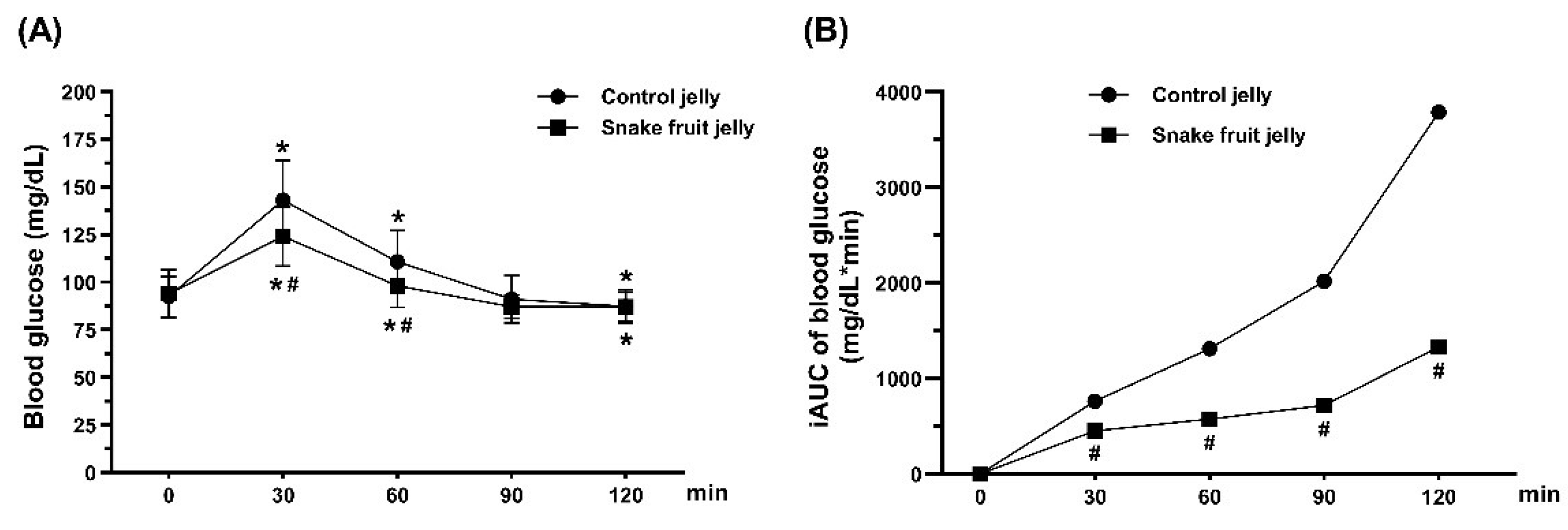
Figure 2.
Endurance time following the ingestion of either control jelly or snake fruit jelly. #, p < 0.05 vs. control jelly.
Figure 2.
Endurance time following the ingestion of either control jelly or snake fruit jelly. #, p < 0.05 vs. control jelly.
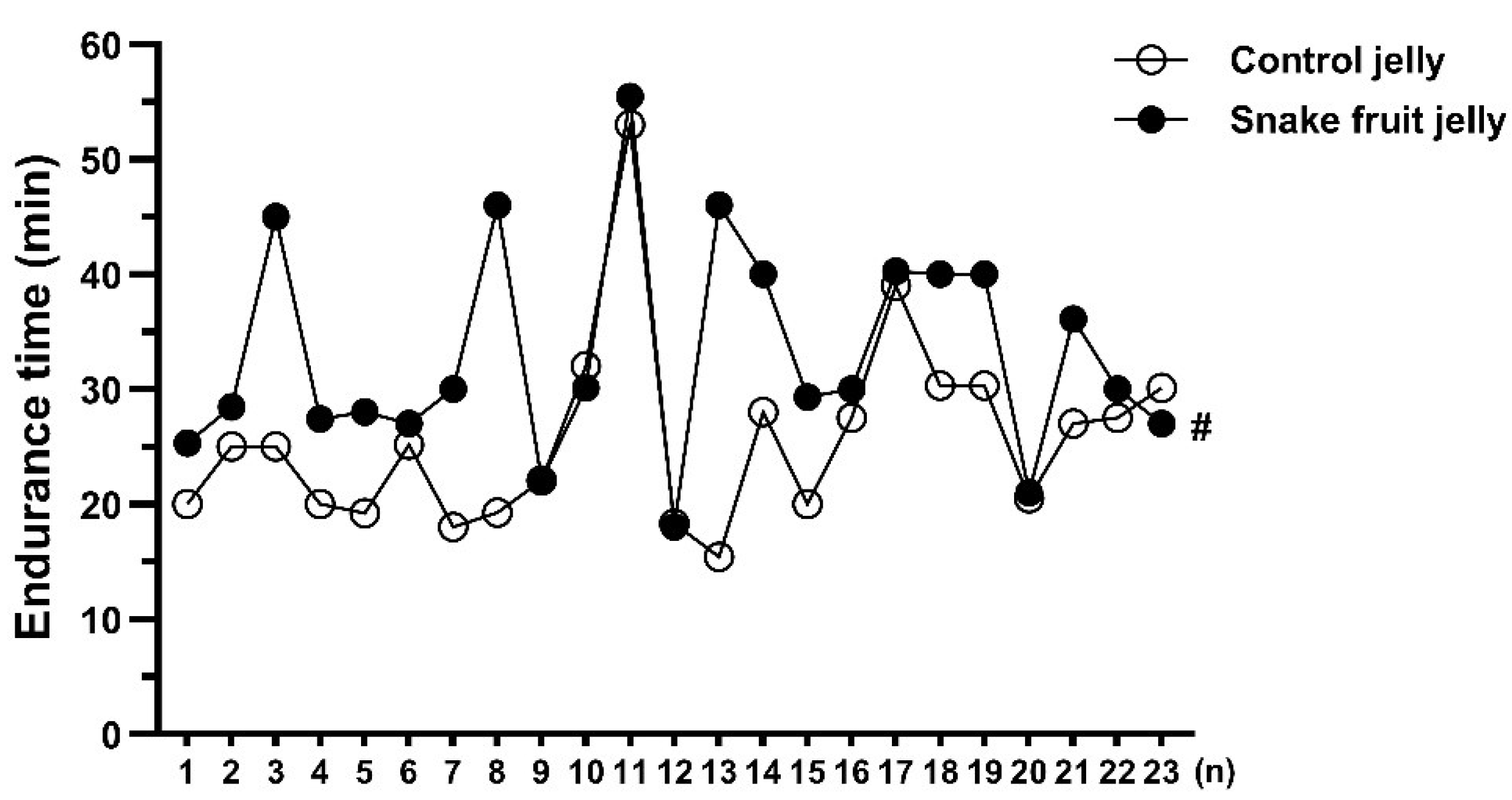
Figure 3.
Blood glucose (A), insulin (B), and cortisol (C) concentrations at baseline (pre-exercise) and immediately post-exercise following the ingestion of either control jelly or snake fruit jelly. *, p < 0.05 vs. before endurance test; #, p < 0.05 vs. control jelly.
Figure 3.
Blood glucose (A), insulin (B), and cortisol (C) concentrations at baseline (pre-exercise) and immediately post-exercise following the ingestion of either control jelly or snake fruit jelly. *, p < 0.05 vs. before endurance test; #, p < 0.05 vs. control jelly.
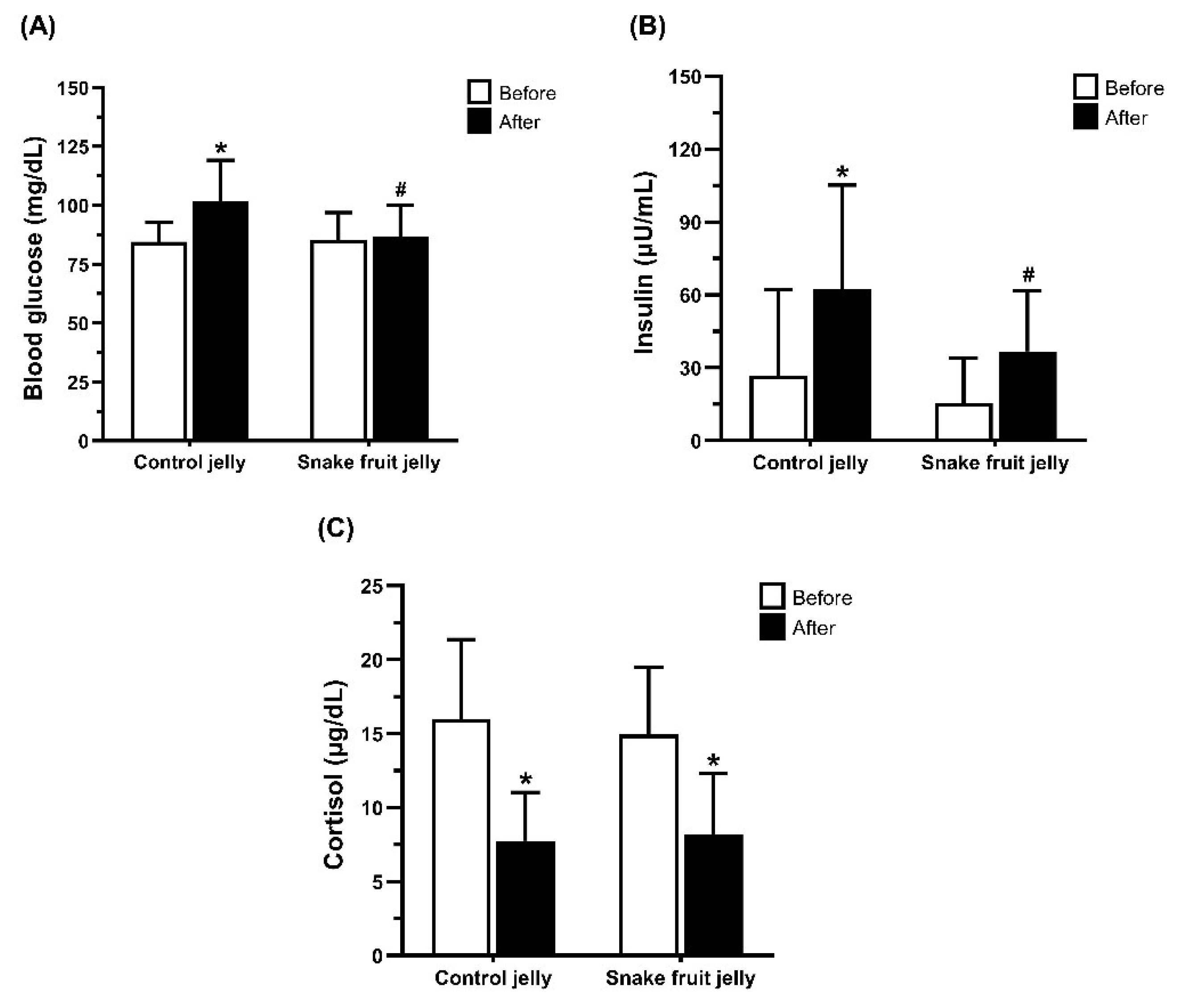
Figure 4.
Superoxide dismutase (SOD) activity at baseline (pre-exercise) and immediately post-exercise following the ingestion of either control jelly or snake fruit jelly. *, p < 0.05 vs. before endurance test; #, p < 0.05 vs. control jelly.
Figure 4.
Superoxide dismutase (SOD) activity at baseline (pre-exercise) and immediately post-exercise following the ingestion of either control jelly or snake fruit jelly. *, p < 0.05 vs. before endurance test; #, p < 0.05 vs. control jelly.
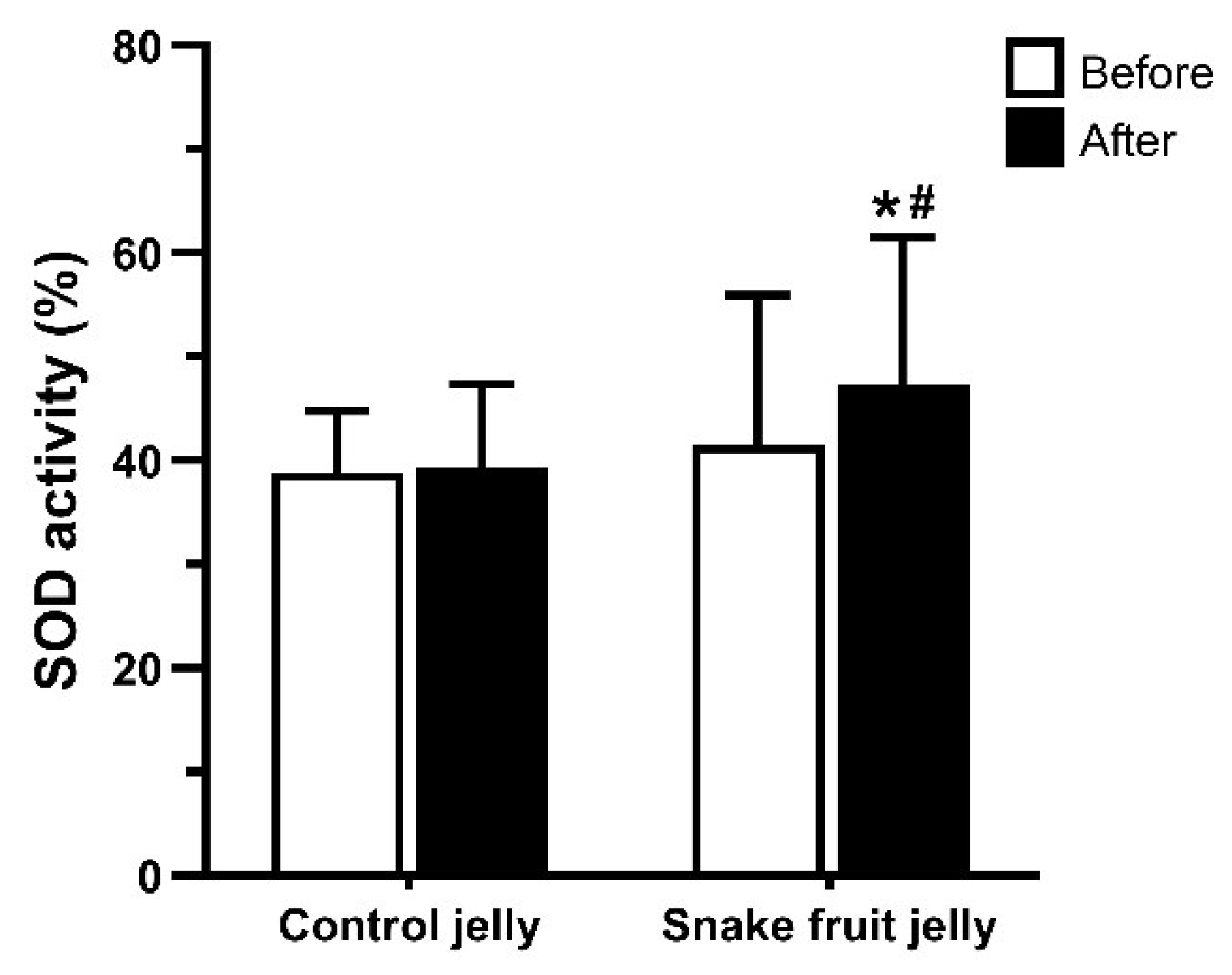
Figure 5.
Tumor necrosis factor (TNF)-alpha (A) and interferon (IFN)-gamma (B) concentrations at baseline (pre-exercise) and immediately post-exercise following the ingestion of either control jelly or snake fruit jelly. *, p < 0.05 vs. before endurance test; #, p < 0.05 vs. control jelly.
Figure 5.
Tumor necrosis factor (TNF)-alpha (A) and interferon (IFN)-gamma (B) concentrations at baseline (pre-exercise) and immediately post-exercise following the ingestion of either control jelly or snake fruit jelly. *, p < 0.05 vs. before endurance test; #, p < 0.05 vs. control jelly.
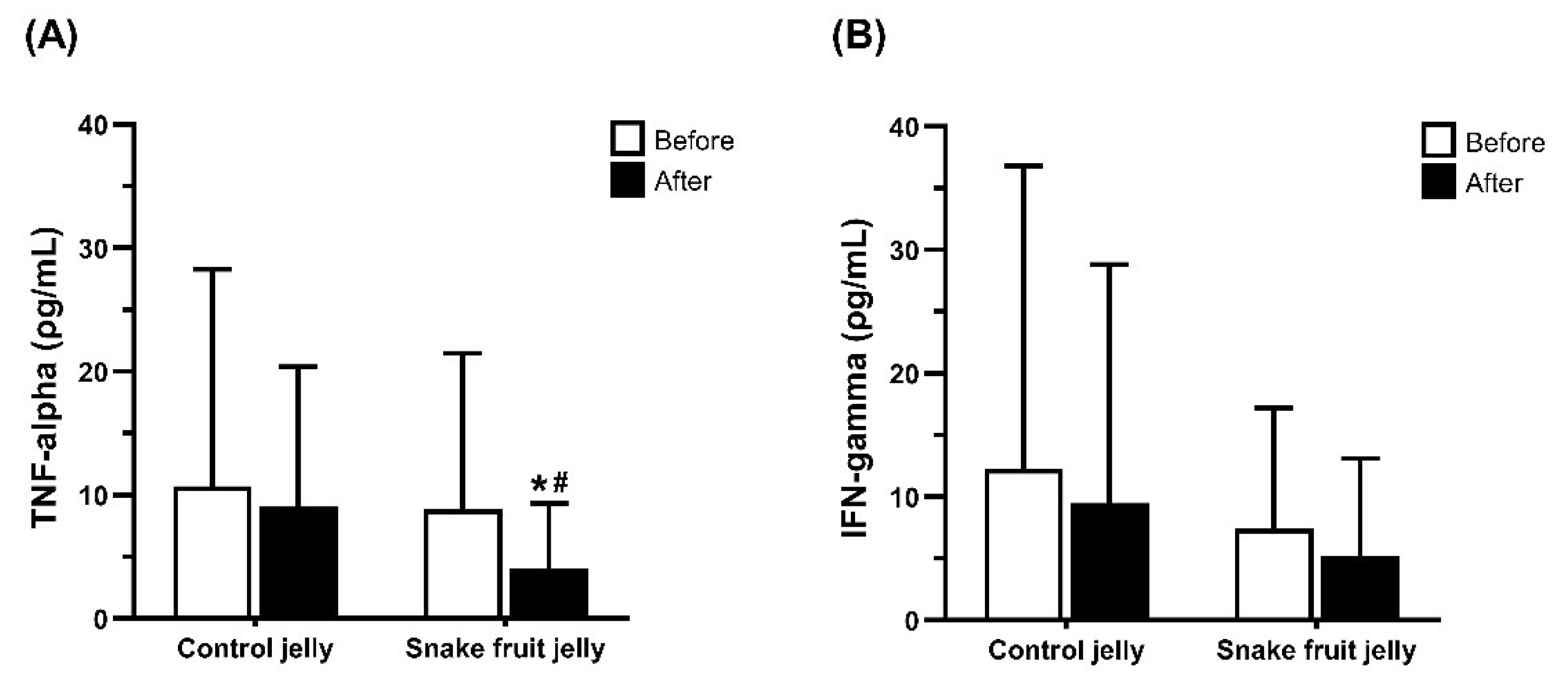

Table 1.
Baseline physical and physiological characteristics of participants before participating in Experiment 1.
Table 1.
Baseline physical and physiological characteristics of participants before participating in Experiment 1.
| Characteristics | Mean ± SD | Minimum | Maximum |
|---|---|---|---|
| Sex (n, male–female) | 4:21 | - | - |
| Age (years) | 22.60 ± 3.33 | 19 | 35 |
| Height (cm) | 159.52 ± 7.12 | 148 | 174 |
| Body mass (kg) | 52.89 ± 8.68 | 40.80 | 72.10 |
| Body mass index (kg/m2) | 20.64 ± 2.15 | 18.51 | 24.89 |
| Heart rate (/min) | 78.62 ± 12.52 | 56 | 97 |
| Systolic blood pressure (mmHg) | 103.02 ± 10.41 | 88 | 131 |
| Diastolic blood pressure (mmHg) | 66.30 ± 7.99 | 54 | 85 |
Data are presented as mean ± standard deviation (SD).
Table 2.
Baseline physical and physiological characteristics of participants before participating in Experiment 2.
Table 2.
Baseline physical and physiological characteristics of participants before participating in Experiment 2.
| Characteristics | Mean ± SD | Minimum | Maximum |
|---|---|---|---|
| Sex (n, male–female) | 2:21 | - | - |
| Age (years) | 21.57 ± 1.88 | 20 | 29 |
| Height (cm) | 159.52 ± 7.12 | 148 | 174 |
| Body mass (kg) | 53.26 ± 6.71 | 41 | 69 |
| Body mass index (kg/m2) | 20.86 ± 1.52 | 17.60 | 23.60 |
| Heart rate (/min) | 100.83 ± 12.96 | 69 | 120 |
| Systolic blood pressure (mmHg) | 110.48 ± 9.75 | 90 | 126 |
| Diastolic blood pressure (mmHg) | 68.57 ± 6.97 | 59 | 81 |
| Oxygen saturation (%) | 98.70 ± 1.02 | 96 | 100 |
| Peak oxygen consumption (L/min) | 1.00 ± 0.14 | 0.90 | 1.60 |
| Maximum workload (watts) | 58.91 ± 10.87 | 50 | 105 |
| Workload at 60% VO₂peak (watts) | 35.35 ± 6.52 | 30 | 63 |
Data are presented as mean ± standard deviation (SD).
Disclaimer/Publisher’s Note: The statements, opinions and data contained in all publications are solely those of the individual author(s) and contributor(s) and not of MDPI and/or the editor(s). MDPI and/or the editor(s) disclaim responsibility for any injury to people or property resulting from any ideas, methods, instructions or products referred to in the content. |
© 2025 by the authors. Licensee MDPI, Basel, Switzerland. This article is an open access article distributed under the terms and conditions of the Creative Commons Attribution (CC BY) license (http://creativecommons.org/licenses/by/4.0/).
Copyright: This open access article is published under a Creative Commons CC BY 4.0 license, which permit the free download, distribution, and reuse, provided that the author and preprint are cited in any reuse.


