

Submitted:
10 June 2025
Posted:
11 June 2025
You are already at the latest version
Abstract
What elements of nature do people involved in conservation projects seek to protect, and why? How do they identify and relate to nature? Answers to such fundamental questions are shaped by normative assumptions that can result in distinct conservation strategies and practices. Despite their importance, normative assumptions are rarely explicitly stated in conservation sciences, possibly because an epistemology of modern science suggests that normative backgrounds are not relevant to the production of objective knowledge, or because researchers and practitioners are unaware of the diversity of positions that exist. Using a combination of qualitative and quantitative methods, we created a catalogue of existing normative positions in conservation literature and described their key characteristics. We described 79 distinctive normative positions about human-nature relationships. Each position was characterized by unique combinations of value-states belonging to one or more of the following five dimensions: Ontology (the positionality of human with respect to nature), Axiology (value systems and ethical frameworks), Pragmatism (extent of human interventions), Epistemology (knowledge sources) and Agency (agents of change). We then scored each position in terms of its alignment (support, opposition, or neutrality) with respect to all value-states within each dimension. A fuzzy correspondence analysis revealed that the field of conservation is heterogeneous beyond the conventional gradient of intrinsic-instrumental-relational values. The frequency and circumstances under which stakeholders adopt different normative positions are unknown, but the list of dimensions and associated values provided in this study may serve as a checklist for scoping this diversity. Consideration of values stemming from alternative normative positions may help broaden support for conservation actions.
Keywords:
Worldviews
; Biodiversity
; conservation
; values
; Normativity
1. Introduction
Humans perceive and interact with nature in various, contrasting, and sometimes conflicting ways [1,2,3,4], indicating various conceptions of nature and nature-based values. Understanding and accounting for this plurality of views is critical in conservation sciences as they influence pro-environmental behaviors [5,6], shape conservation policies, and ultimately determine the diverse positive futures humans want.
The first global assessment by the Intergovernmental Science-Policy Platform for Biodiversity and Ecosystem Services [7] highlighted that national policies often prioritize anthropocentric visions and economic values from provisioning ecosystem services, neglecting other nature-based values. Building on earlier work by Pascual, Balvanera [3], the IPBES identifies four worldviews (Anthropocentric, Biocentric, ecocentric and pluricentric) and three value foci (intrinsic values, instrumental values and relational values) [8]. Recognizing and appreciating the full gamut of these views and values is integral to attaining a more sustainable society because it ensures that nature-based values important to different stakeholders are prioritized in conservation planning [9,10,11,12].
A major challenge in scoping normative positions about human-nature relationships, worldviews, and nature-based values is that the field is marred with terminological issues and lacks a cohesive framework to capture the different dimensions of human-nature relationships. For example, depending on the context in which it is used, the word “value” can refer to the principles underpinning core beliefs, a preference for a given state of the world, an indication of relative importance, or the measure of a metric (https://www.ipbes.net/glossary/values). Similarly, worldviews are understood to play a key role in shaping values and human-nature relationships, yet definitions encompass different concepts [13,14,15]. In the first global assessment of IPBES [7], the term worldview was defined by the connections between networks of concepts and systems of knowledge, values, norms, and beliefs. The IPBES values assessment [8] defined worldview as the mental lenses through which humans’ social groups perceive, think about, interpret, inhabit, and modify the world. A recent definition by [16] defines worldview as ways through which people conceive and interact with the world, stressing the cognitive dimension that may lead to behaviors and actions towards the world. In this paper, we adopt a broad definition of worldviews that includes a collection of principles (for example, based on ethical frameworks), preferences (such as religious beliefs), and choices regarding how the principles are applied. Thus, by the term "normative position" – i.e., assumptions about what we ought to do about conservation – we encompass a specific set of worldviews, values and knowledge and specific applications that are derived from such a position. The broad approach that we adopt improves the likelihood of capturing the greatest possible range of human-nature relationships we sought to describe.
A typology (classification according to types) of normative positions about human-nature relationships, and values are foundation elements in light of the calls for the inclusion of a greater diversity of value systems in nature conservation strategies [11,12,17,18,19,20]. Indeed, in recent years, the field of conservation has been marked by several contentious issues including the definition of conservation goals (strategies) and approaches (tactics) [21,22,23,24,25,26]; the place afforded to humans within an idealized world [9,11,12]; the relationships between conservation and capitalism [9,27,28,29,30]; identifying and valuing constituent parts of the biodiversity [31]; and how to value novel human-shaped ecosystems [32,33,34] and non-native species [35,36,37,38,39]. These contested views have evolved into structured opinion-based stances (or normative positions), potentially exacerbating tensions among members of the conservation movement [40]. These debates suggest that the basic normative principles underlying conservation science are diverse, if not divided [41,42]. But how can this diversity be understood and structured? How many different types of stances can we distinguish? And what kind of outcomes do different stances advocate?
Missing to date has been a comprehensive list of normative positions expressed in conservation literature over the last decades, as well as a systematic approach to identify the key dimensions that characterize them. Such a taxonomy of normative stances is essential for elucidating differences in the perception of human-nature relationships and fostering inclusion in nature conservation strategies. This study aims to help conservation actors become aware of their own values and better armed for providing guidance that accounts for a diversity of value-systems.
2. Materials and Methods
2.1. Data Collection
Multiple data sources, including peer-reviewed literature, grey literature, and expert opinions, were consulted to explore the various ways people perceive and interact with nature. All of the normative positions about human-nature relationships considered in this study fall within the realm of “nature protection” [43]. Keywords referring to nature (biodiversity, ecosystem, conservation, etc.) and normative positions (worldviews, perspectives, views, paradigms, dimensions, narratives, discourses, stances, statements, values, etc.) were used in a systematic bibliographic search in the Web of Science Core Collection (WoSCC) database. We acknowledge that some normative positions about human-nature relationships and associated values are likely missing or under-represented within the consulted literature and that our methodological choices are shaped by our own training and epistemological values. Our initial search yielded an initial corpus of 6369 records in French or English. 5754 articles were removed based on a scan of titles and abstracts. The remaining 615 documents were supplemented with 35 documents (including grey literature) drawn from the authors' personal bibliographies. The final corpus contained 650 documents that each described how human-nature relationships could be conceptualized, measured, or valued, and provided at least one discriminant factor for doing so. Our experimental unit is thus a “normative position” of human-nature relationship, which can be conceived as a collection of values, a posture or conceptualization of human-nature interactions.
First, we extracted papers that provided a typology of normative positions of human-nature relationships. In a typology, these positions are distinguished and classified by one or several “analytical dimensions” in an attempt to classify or order a range of human-nature relationships. The union of these typologies (grouped by similarity) provided a list of dimensions used to describe the normative positions (Table 1). The academic origin of each typology was also scored as coming from either the biological or social sciences. The attribution was based on how the normative positions about human-nature relationships were investigated in each paper (theoretical framework and analysis context), the author’s background, and the journal’s academic field.
We then scanned our universe of 650 papers to identify the diversity of possible value-states that are found within each analytical dimension. Once the list of dimensions and their respective value-states had been established, our goal was to score the valence of each normative position with respect to each value-state. Because it would have been unwieldy to do so for each of the 650 papers, we first grouped normative positions about human-nature relationships into rough categories according to qualitative descriptions of dimensions and value states, yielding 72 types (See Supplementary File 1). This process was conducted inductively based on the first author’s familiarity with the literature. For example, the views “Partner”, “Partner with nature” and “Partner of nature” differ subtly in syntax but carry nearly identical meanings, and as a result were consolidated. As another example, the views “Ecological modernization”, “Sustainable development”, and “Sustainable and regenerative development” differ in wording, but all promote similar goals from a conservation perspective that includes ecologically sustainable human development, and so they were also consolidated. This process simplified the universe of types of human-nature relationship, while retaining the bulk of the existing variability, akin to theoretical sampling in the social sciences.
2.2. Elaboration of a Typology of Normative Positions About Human-Nature Relationships
There is no standardized method for establishing a typology of normative positions in conservation. Recent typologies [4,44,45,46,47,48,49] used either deductive or inductive approaches. Deductive approaches take frameworks from previous theoretical works, operationalize them, and apply them in the pursuit of understanding contemporary human-nature relationships. Inductive approaches derive dimensions by clustering results of either quantitative survey data or qualitative interviews [47]. Here, our approach was first deductive at the step of identifying “distinct” normative positions. We then attempted a subsequently inductive approach in which each normative position was scored (as objectively as possible) and then described using quantitative statistical methods.
The normative positions about human-nature relationships were described through an inductive analysis based on shared characteristics. We first established an exhaustive list of 29 value-states across the analytical dimensions found in the literature (Table 1). These value-states are the states or valences commonly used in the literature to describe each analytical dimension. We aimed to score the presence or absence of each value-state for each of the 72 identified normative positions about human-nature relationships (Table 1) based on available information in the literature. We used a Fuzzy Correspondence Analysis [50] to establish a quantitative representation of the similarity/dissimilarity between normative positions using function dudi.fca within package ade4 [51] in R software version 4.1.0 [52]. A fuzzy variable (normative position) is scored as a=(x1, x2, x3) for each value-state. For instance, codes (1, 0, 0) (0, 1, 0) and (0, 0, 1) indicate that the normative positions held a “Pros”, “Cons” and “Neutral” position, respectively, for the targeted value-state. The absence of information data is thus denoted (0, 0, 0). As such, the fuzzy coding approach can accommodate for uncertainty and conflicting sources of information within the ordination analysis [50,51].
In the fuzzy correspondence matrix, some views showed no clear position (support, opposition, or neutrality) for a given value, having mixed or ambiguous positions in the literature. In addition, it was not possible to deduce the positions of some views for some of the pre-identified values due to missing information. Subsequently, we transformed the fuzzy matrix into a simplified matrix of possible values: “unknown value” (missing data), “mixed values” (ambiguous values), and “known values” (consolidated from among the pre-identified values). This set of consolidated value-states was used to compare and contrast worldviews that emanate from the social versus biological sciences.
3. Results
3.1. Pre-Existing Typologies and Dimensions of Human-Nature Interactions
We found thirty-three works between 1992 and 2022 that propose typologies (classification) of normative positions about human-nature relationships (Table 1). The union of these typologies yield five analytical dimensions along which the normative positions were described: ontological, axiological, pragmatism, epistemological and agency (Table 1). The Ontological dimension explores the positionality of human with respect to nature [9,43,53,54]. Two main value-states dominate the ontological dimension within existing normative positions: monism, which sees humans as part of nature and one species amongst many; and dualism, which emphasizes human distinctiveness and uniqueness (both in terms of responsibilities and effects) relative to other species [55]. The Axiological dimension describes the ethical framework and value-system prioritized within the human-nature relationship. Three major values are identified: intrinsic values, which prioritize nature's inherent worth and preservation; instrumental values, highlighting nature's utilitarian benefits to humans; and relational values, emphasizing intangible non-consumptive nature-based benefits. For instance, “mainstream conservation” favors intrinsic value, while “new conservation” also embraces instrumental values. Emerging positions such as “convivial conservation” and “compassionate conservation” prioritize relational values. The Pragmatism dimension assesses nature management tactics concerning the degree of human intervention that is considered acceptable. Three major values emerge: Strict protection, which advocate pristine nature preservation; Co-management, which recognize indigenous rights and local involvement; and Substantial intervention, which endorse ecosystem restoration and species control. Normative positions like “fortress conservation” prioritize strict protection, while others like “indigenous perspective” support co-management. The Epistemological dimension examines accepted knowledge sources. Two values emerge: Expert knowledge, which is based on specialized training and experience, and favored by mainstream conservation and self-proclaimed experts e.g., [56]; and non-expert knowledge, which incorporates traditional, indigenous, and local perspectives, endorsed by alternative normative positions [11]. The Agency dimension assesses the legitimacy of agents for driving change in nature conservation. Two values emerge: Human agents, which include individuals, governments, and corporations; and non-human agents, such as markets and regulatory tools. Normative positions diverge on the legitimate catalyst for change, with some prioritizing human intervention and others favoring non-human agents.
Pre-existing typologies were based on one to five of these dimensions (mean 2.16 ± 0.66) (Table 2). The most common dimensions used to cluster the worldviews are the ontology dimension (27/33 = 0.81) and the axiology dimension (20/33 = 0.61). The remaining dimensions were used less frequently (< 9/33 = 0.27) (Table 2).
The list of typologies of normative positions about human-nature relationships is not exhaustive, and we do not include any typologies from 2022 onward in our analyses.
Eleven typologies of normative positions about human-nature relationships were attributed to scientists from the conservation biology sciences and 22 typologies were attributed to scientists from the social sciences. Chronologically, typologies of normative positions about human-nature relationships first emanated from the social sciences, but since 2014 most proposed typologies are produced by conservation biology scientists (Figure 1).
The dimensions used in typologies differed as a function of academic origin (Figure 2). Typologies generated within the social sciences emphasize the axiology (82.61%) and ontology (78.26%) dimensions and, to a lesser extent, to the epistemology dimension (30.43%). Typologies from the biological sciences, by contrast, frequently were based on axiology (88.89%) and pragmatic dimensions (77.78%), to a lesser extent on the agency of change (33.33%).
3.2. Value-States Within and Across Dimensions
Each dimension had between 3 and 10 possible value-states, for a total of 29 possible value-states (Table 1). After combining value-states that were similar and introducing the possibility of “mixed” and “unknown” value states for each dimension, a total of 22 value-states remaining after consolidation (Table 1). The frequency of certain value-states within dimensions also varied depending on whether a normative position emanated from the biological or social conservation sciences (Figure 3), with sometimes unexpected and paradoxical trends. For example, the normative positions about human-nature relationships from the social sciences were more likely to be based on monism-inclusivism than types from the biological sciences (Figure 3A), although we would expect the biologist to be naturalist in the monist sense (humans are part of the evolution) and social scientist more on dualism-separatism (focusing on the constructed part of the eco-soci-system) . A significant portion (56% for biological conservation sciences and 30% for social sciences) of typologies in both fields exhibit an ambiguous value regarding human positionality towards nature. Normative positions about human-nature relationships from the biological conservation sciences were much more likely to emphasize intrinsic values (28%) than those from the social science (6%) (Figure 3B). Epistemologically, both fields acknowledge non-expert knowledge, but expert knowledge is more emphasized in biological conservation science (Figure 3D).
3.3. A Typology of the Normative Positions About Human-Nature Relationships
The fuzzy correspondence analysis evidenced five first principal components, which accounted for 49.26% of the cumulated eigenvalues. The projection of the first two principal components of fuzzy correspondence analysis accounted for 27.32% of the cumulated eigenvalues. The primary axis sorted normative positions about human-nature relationships along a gradient that loosely follows ontological and axiological dimensions. We drew 4 groups heuristically within this gradient to simplify subsequent discussions (Figure 4)
The first group (far left) including types such as Green radicalism, Gaïa Pachamama, Bio/eco-centrism, Participant in nature, etc., is primarily oriented towards equality, reverence for nature, prioritizing the intrinsic and relational values of nature, and no human intervention (strict protection).
The second group (second from left) including normative positions such as People and nature, Protection of threatened, Mainstream conservation, Guardianship of nature, etc., is oriented towards naturalized human distinctiveness (an intermediate state between monism and dualism). It prioritizes nature's intrinsic and relational values and advocates for light intervention in terms of nature management practices. These normative positions about human-nature relationships are defined in large part by value-states whose valence is opposite to types such as human exceptionalism position and dominion over nature (found on the far-right of Figure 4).
The third group (second from right), including types such as bioregionalism, survivalism, man must make use of nature, etc. that favor the responsible use of nature and accepts nature with alteration. These normative positions prioritize the instrumental values derived from nature, not the intrinsic value of nature or the relational one.
The fourth group (far right) includes types such as Providential republicanism, Conquest and colonization, Man must use nature, Master over nature, etc., and is oriented towards human exceptionalism and favors a vision of dominion and exploitation of nature that is more focused on direct manipulation of nature to maximize its instrumental values which groups an extreme set of value-states from all dimensions.
The considerable variation along the two principal components and within the rough groups evidences the importance of accounting for more than the axiological dimension when describing normative positions. For instance, the first group of positions (far left of Figure 4) views humans “as one with nature” (monism-inclusivism) and appears distinct from other positions, suggesting that ontology is a key defining factor. The second and third groups of normative positions (from left) favor an intermediate state between extreme monism and dualism but show a great variation in the extent of management that is deemed ideal, suggesting that the epistemological, pragmatism, and agency dimensions may be particularly important within this group.
4. Discussion
This work provides the first attempt to systematically assemble normative positions about human-nature relationships and typologies found in conservation scientific literature. This bibliographic corpus served as a basis for identifying not only a catalogue of five dimensions and 22 value-states used to describe normative positions, but also for creating the first quantitative, ordinal mapping of 72 distinct types. Collectively, our analyses illustrate that most positions integrate axiological values (intrinsic-instrumental-relational ethical frameworks). But they also confirm that to capture the full range of normative positions, the four other known dimensions (ontological, epistemological, agency and pragmatism) also must be considered, as they encapsulate fundamental normative assumptions that fuel debates in conservation, spanning human-nature positioning, relationship dynamics, management strategies, knowledge paradigms, and guiding agents for conservation decisions [81].
Our analyses reveal that human-nature relationships typologies are likely to capture different sets of dimensions depending on whether it emanates from the social or biological sciences. Ontological assumptions (monism vs dualism) have long been discussed within the social sciences [82,83], and so it was no surprise to find that they are frequently integrated within normative positions from the social sciences (Figure 2), but our analyses reveal that this dimension has yet to fully penetrate the biological perspective and discourse [84]. We speculate that further exploration of ontological assumptions in particular will enrichen future studies of valuation within the conservation sciences as it delineates distinctions and affinities between humans and non-human components of “nature”, thereby shaping their interactions [43].
The use of quantitative, inductive methods for creating a typology of normative positions about human-nature relationships did not provide obvious added value. The scoring of each value-state associated with each normative position was difficult and may be difficult to replicated because most texts were not written in a way that explicitly and exhaustively describes each of the five dimensions we identified. Thus, we attempt to bring some clarity and simplification at this stage through the use of a deductive approach, in which we created a synthesis of conservation archetypes within a space defined by axiology and ontology and that captures most of the existing variation in the normative positions (Figure 5).
The vertical axis is based on a continuum of four possible ways to measure the positionality of humans toward nature, ranging from “Total naturalism” (corresponding to extreme monism) to “human exceptionalism” (corresponding to extreme dualism), and in between these extremes positions the “strong naturalism” and the “naturalized human distinctiveness” [85]. Inspired by Hess [86], the horizontal axis of axiological values is rearranged as a gradient of human centered-ness, with relational values as intermediate between intrinsic and instrumental values. This better captures the values and normative positions of traditional conservation, which represents a mixture of intrinsic and relational values (large “wilderness” areas).
At one extreme (top right corner of Figure 5), “human dominion” captures beliefs in human exceptionalism and singularity that also favor the instrumental values of nature [55]. Such positions are traditionally associated with non-sustainable consequences [17] and, as a result, are generally considered outside of the realm of conservation. But holders of such positions may still value certain dimensions of biodiversity or nature.
In the opposite corner (bottom left, Figure 5), one finds an archetype that we term “One with Nature” that captures beliefs in total naturalism. This archetype likely corresponds roughly to the “Nature as culture” or “Earth stewardship”. This collection of views emphasizes intrinsic and relational values [10,81]. Between these two extreme archetypes, there are more moderate groups of worldviews corresponding to “green economy” and “nature protection,” similar to types described by Martin, Gomez-Baggethun [10] at that correspond, respectively, to “Nature for society” and “Nature for Nature” future perspectives [81]. The “Just another species” worldview holds that humans are not distinct nor exceptional from other species, but, just like any other species, is entitled to pursue instrumental goals that contribute to its well-being and fitness. We speculate that such a Darwinian view of human-nature relationships may be wide-spread among, paradoxically, non-biologists.
Our typology of dimensions likely remains incomplete and over-simplified. Indeed, our fuzzy correspondence analysis revealed that there is a much greater variety of values that result in a variety of opinions along the other perspectives (pragmatism, epistemology, and agency) illustrated heuristically by the large vertical variation within the “Nature Protection” archetype (Figure 5). In addition, a major source of contention within the conservation literature is whether conservation actions should attempt to restore forms of pristine wilderness (an idealized historical state, free of obvious human influence) or, in contrast, whether conservation ideals should be “forward looking”, accepting that change is inevitable, and shaping the course of Nature [34]. However, this historical dimension of worldviews is insufficiently captured by the existing five analytical dimensions of normative positions, suggesting that it may represent a missing dimension.
Attempts to describe the range of value systems within conservation sciences is a recent field of inquiry. As expected, such budding and interdisciplinary fields of inquiry are marked by a diversity of methodologies, definitions and approaches. [4] used expert opinions to identify a number of dimensions based on management disagreements in different case studies. Here, we attempted a systematic and quantitative approach, despite the nebulousness of many of the concepts [64]. The list of dimensions and value states from such studies can serve as a starting point for researchers wishing to self-identify their value system and for future studies that may quantify the relative frequencies of different normative positions about human-nature relationships.
Given the importance of normative positions in defining conservation strategies (ideal outcomes) and approaches (tactics), it is perhaps surprising how rarely this subject matter is explicitly discussed. Future research will need to clarify how values vary across cultures and within a given person depending on context, cultural norms, new learning experiences, emotions, and mental growth [87,88]. This work also responds in part to the numerous calls to widen the range of values considered within the field of conservation [11,12]. What remains to be clarified are the consequences of considering multiple value systems on global biodiversity goals. For example, the CBD aims to set aside 30% of terrestrial and marine surfaces for biodiversity. Can surfaces that have some human activities, but also provide numerous relational and instrumental values and unique species communities (for example, adapted to traditional farmlands) count towards such goals [89]? Making intellectual space for a great diversity of worldviews and types of human-nature relationships will potentially generate greater support for the protection of nature but also come with the risk of creating divergent nature-based strategies and tactics.
5. Conclusions
Over these last 30 years, there has been increased interest in how human–nature relationships are conceived and described both in biological conservation and social sciences. Here, we produced the most comprehensive synthesis to date of existing normative positions about human-nature relationships. In contrast to previous studies, we combine both quantitative and qualitative (inductive) approaches. We identified five recurring dimensions, and we provide an exhaustive list of value-states found within each. This ensemble of dimensions and value-states, together with our quantitative analyses, illustrates the diversity of manners in which human-nature relationships are currently conceptualized. A key take-home message is that the field of nature-protection is likely much more diverse in its underlying values than has been previously acknowledged. The frequency of these different normative positions about human-nature relationships, both within the conservation community and amongst the public at large, remain to be quantified. We expect that support for nature-friendly initiatives will increase if scientists and practitioners account for the diversity of values found amongst stakeholders.
Supplementary Materials
The following supporting information can be downloaded at the website of this paper posted on Preprints.org.
Author Contributions
Conceptualization, R.C.G. and M.S.; methodology, RCG.; MS software, R.C.G., V.K.S., ; validation, M.S.; formal analysis, R.C.G., V.K.S.; investigation, R.C.G., V.K.S., M.S.; resources, X.X.; data curation, R.C.G ; writing—original draft preparation, R.C.G., M.S. ; writing—review and editing, D.D., V.K.S., M.S., ; visualization, R.C.G., V.K.S. ; supervision, M.S.; All authors have read and agreed to the published version of the manuscript.
Funding
Please add: “This research received no external funding”.
Data Availability Statement
The data presented in this study are available on request from the corresponding author because the data requires contextual knowledge for proper interpretation. Furthermore, the dataset is part of a larger ongoing research project, with additional manuscripts currently in preparation.
Conflicts of Interest
The authors declare no conflicts of interest.
References
- Chapman, M., T. Satterfield, and K.M.A. Chan, How value conflicts infected the science of riparian restoration for endangered salmon habitat in America's Pacific Northwest: Lessons for the application of conservation science to policy. Biological Conservation, 2020. 244.
- Daily, G.C., et al., The value of nature and the nature of value. science, 2000. 289(5478): p. 395-396.
- Pascual, U., et al., Valuing nature’s contributions to people: the IPBES approach. Current Opinion in Environmental Sustainability, 2017. 26-27: p. 7-16.
- Wienhues, A., L. Luuppala, and A. Deplazes-Zemp, The moral landscape of biological conservation: Understanding conceptual and normative foundations. Biological Conservation, 2023. 288: p. 110350.
- van Riper, C.J., et al., Human-nature relationships and normative beliefs influence behaviors that reduce the spread of aquatic invasive species. Environmental management, 2019. 63(1): p. 69-79.
- Verbrugge, L.N., R.J. Van den Born, and H. Lenders, Exploring public perception of non-native species from a visions of nature perspective. Environmental management, 2013. 52(6): p. 1562-1573.
- IPBES, Global assessment report on biodiversity and ecosystem services of the Intergovernmental Science-Policy Platform on Biodiversity and Ecosystem Services, E.S. Brondízio, et al., Editors. 2019, IPBES secretariat Bonn, Germany. p. 1144.
- IPBES, Methodological Assessment Report on the Diverse Values and Valuation of Nature of the Intergovernmental Science-Policy Platform on Biodiversity and Ecosystem Services, P. Balvanera, Pascual, U., Christie, M., Baptiste, B., and González-Jiménez, D., Editor. 2022, IPBES secretariat: Bonn, Germany.
- Buscher, B. and R. Fletcher, The conservation revolution: radical ideas for saving nature beyond the Anthropocene. 2020: Verso Books.
- Martin, A., et al., Plural values of nature help to understand contested pathways to sustainability. One Earth, 2024. 7(5): p. 806-819.
- Obura, D.O., et al., Integrate biodiversity targets from local to global levels. Science, 2021. 373(6556): p. 746-748.
- Pascual, U., et al., Biodiversity and the challenge of pluralism. Nature Sustainability, 2021: p. 1-6.
- Mistry, J., et al., Indigenous Knowledge, in International Encyclopedia of Human Geography (Second Edition), A. Kobayashi, Editor. 2020, Elsevier: Oxford. p. 211-215.
- Koltko-Rivera, M.E., The psychology of worldviews. Review of general psychology, 2004. 8(1): p. 3-58.
- Soulé, M.E. and G. Lease, Reinventing nature? responses to postmodern deconstruction. 1995.
- Martin, A., et al., The role of diverse values of nature in visioning and transforming towards just and sustainable futures. 2022.
- Matulis, B.S. and J.R. Moyer, Beyond Inclusive Conservation: The Value of Pluralism, the Need for Agonism, and the Case for Social Instrumentalism. Conservation Letters, 2017. 10(3): p. 279-287.
- Sajeva, G., Assessing the values of nature to promote a sustainable future. 2023, Nature Publishing Group UK London.
- Arias-Arévalo, P., et al., Widening the evaluative space for ecosystem services: A taxonomy of plural values and valuation methods. Environmental values, 2018. 27(1): p. 29-53.
- Kareiva, P. and M. Marvier, What is conservation science? BioScience, 2012. 62(11): p. 962-969.
- Marvier, M., New conservation is true conservation. Conservation Biology, 2014. 28(1): p. 1-3.
- Miller, B., M.E. Soulé, and J. Terborgh, New conservation’or surrender to development. Animal Conservation, 2014. 17(6): p. 509-515.
- Skandrani, Z., From “what is” to “what should become” conservation biology? Reflections on the discipline’s ethical fundaments. Journal of Agricultural and Environmental Ethics, 2016. 29: p. 541-548.
- Schlaepfer, M.A., Do non-native species contribute to biodiversity? PLoS biology, 2018. 16(4): p. e2005568.
- Soulé, M., The “New Conservation”. Conservation Biology, 2013. 27(5): p. 895-897.
- Brockington, D. and R. Duffy, Capitalism and conservation. 2011: John Wiley & Sons.
- Büscher, B., W. Dressler, and R. Fletcher, Nature Inc.: environmental conservation in the neoliberal age. 2014: University of Arizona Press.
- Fletcher, R., Failing forward: The rise and fall of neoliberal conservation. 2023: Univ of California Press.
- Spash, C.L., Conservation in conflict: Corporations, capitalism and sustainable development. Biological Conservation, 2022. 269: p. 109528.
- Gbedomon, R.C., V.K. Salako, and M.A. Schlaepfer, Diverse views among scientists on non-native species. NeoBiota, 2020(54).
- Clement, S. and S. Clement, Novel decisions and conservative frames. Governing the Anthropocene: Novel Ecosystems, Transformation and Environmental Policy, 2021: p. 97-144.
- Hobbs, R.J., et al., Novel ecosystems: theoretical and management aspects of the new ecological world order. Global ecology and biogeography, 2006. 15(1): p. 1-7.
- Schlaepfer, M.A. and J.J. Lawler, Conserving biodiversity in the face of rapid climate change requires a shift in priorities. Wiley Interdisciplinary Reviews: Climate Change, 2023. 14(1): p. e798.
- Frank, D.M., Disagreement or denialism?“Invasive species denialism” and ethical disagreement in science. Synthese, 2021. 198(Suppl 25): p. 6085-6113.
- Guiaşu, R.C. and C.W. Tindale, Logical fallacies and invasion biology. Biology & Philosophy, 2018. 33: p. 1-24.
- Sagoff, M., Environmental harm: political not biological. Journal of Agricultural and Environmental Ethics, 2009. 22: p. 81-88.
- Sax, D.F., M.A. Schlaepfer, and J.D. Olden, Identifying key points of disagreement in non-native impacts and valuations. Trends in Ecology & Evolution, 2023.
- Skandrani, Z., S. Lepetz, and A.-C. Prévot-Julliard, Nuisance species: beyond the ecological perspective. Ecological Processes, 2014. 3: p. 1-12.
- Koudenburg, N. and Y. Kashima, A polarized discourse: effects of opinion differentiation and structural differentiation on communication. Personality and Social Psychology Bulletin, 2022. 48(7): p. 1068-1086.
- Sandbrook, C., et al., The global conservation movement is diverse but not divided. Nature Sustainability, 2019. 2(4): p. 316-323.
- Büscher, B. and R. Fletcher, Towards convivial conservation. Conservation and Society, 2019. 17(3): p. 283-296.
- Dempsey, B., Understanding conflicting views in conservation: An analysis of England. Land Use Policy, 2021. 104.
- Dryzek, J.S., The politics of the earth: Environmental discourses. 2022, United States of America: Oxford university press. 304.
- Flint, C.G., et al., Exploring empirical typologies of human–nature relationships and linkages to the ecosystem services concept. Landscape and Urban Planning, 2013. 120: p. 208-217.
- Mace, G.M., Whose conservation? Science, 2014. 345(6204): p. 1558-1560.
- Purdy, J., American natures: The shape of conflict in environmental law. Harvard Environmental Law Review, 2012. 36: p. 170-228.
- De Castro, E.V., Cosmological deixis and Amerindian perspectivism. Journal of the Royal anthropological Institute, 1998: p. 469-488.
- Descola, P., Beyond nature and culture. 2013: University of Chicago Press.
- Latour, B. and C. Porter, We have never been modern [1991]. Contemporary Sociological Theory, 1993: p. 448.
- Kim, H., et al., Conceptualizing human–nature relationships: Implications of human exceptionalist thinking for sustainability and conservation. Topics in Cognitive Science, 2023.
- Essl, F., et al., Drivers of future alien species impacts: An expert-based assessment. Global Change Biology, 2020. n/a(n/a).
- IPBES, Summary for Policymakers of the Methodological Assessment Report on the Diverse Values and Valuation of Nature of the Intergovernmental Science-Policy Platform on Biodiversity and Ecosystem Services, U. Pascual, et al., Editors. 2022: Bonn, Germany. p. 52.
- Palomo, I., et al., Assessing nature-based solutions for transformative change. One Earth, 2021. 4(5): p. 730-741.
- Evans, M.C., Re-conceptualizing the role (s) of science in biodiversity conservation. Environmental Conservation, 2021. 48(3): p. 151-160.
- O’Connor, S. and J.O. Kenter, Making intrinsic values work; integrating intrinsic values of the more-than-human world through the Life Framework of Values. Sustainability Science, 2019. 14(5): p. 1247-1265.
- Vaccaro, I., O. Beltran, and P.A. Paquet, Political ecology and conservation policies: some theoretical genealogies. Journal of Political Ecology, 2013. 20(1): p. 255-272.
- Gill, B., Streitfall Natur: Weltbilder in Technik-und Umweltkonflikten (Clashes on nature – Worldviews in technological and environmental conflicts). 2013: Springer-Verlag.
- Meske, M., " Natur ist für mich die Welt": lebensweltlich geprägte Naturbilder von Kindern (“Nature is the world for me”: Children’s images of nature impressed by their environment). 2011: Springer-Verlag.
- De Groot, M., M. Drenthen, and W.T. De Groot, Public visions of the human/nature relationship and their implications for environmental ethics. Environmental Ethics, 2011. 33(1): p. 25-44.
- Teel, T.L. and M.J. Manfredo, Understanding the diversity of public interests in wildlife conservation. Conservation biology, 2010. 24(1): p. 128-139.
- Kleinhückelkotten, S. and H. Nietzke, Umfrage Naturbewusstsein: Abschluss- bericht (Survey on Nature Consciousness: Final Report) 2010, ECOLOG-Institüt für sozial-ökologische Forschung und Bildung Hannover.
- Bauer, N., A. Wallner, and M. Hunziker, The change of European landscapes: Human-nature relationships, public attitudes towards rewilding, and the implications for landscape management in Switzerland. Journal of environmental management, 2009. 90(9): p. 2910-2920.
- de Groot, M. and W.T. de Groot, “Room for river” measures and public visions in the Netherlands: A survey on river perceptions among riverside residents. Water Resources Research, 2009. 45(7).
- Hunka, A.D., W.T. De Groot, and A. Biela, Visions of nature in Eastern Europe: a Polish example. Environmental Values, 2009. 18(4): p. 429-452.
- van den Born, R.J. and W.T. de Groot, The authenticity of nature: An exploration of lay people’s interpretations in the Netherlands. 2009: Springer.
- Van den Born, R.J., Rethinking nature: public visions in the Netherlands. Environmental Values, 2008. 17(1): p. 83-109.
- Buijs, A.E., et al., Looking beyond superficial knowledge gaps: Understanding public representations of biodiversity. The International Journal of Biodiversity Science and Management, 2008. 4(2): p. 65-80.
- Berghöfer, U., R. Rozzi, and K. Jax, Local versus global knowledge: Diverse perspectives on nature in the Cape Horn Biosphere Reserve. Environmental Ethics, 2008. 30(3): p. 273-294.
- Büscher, B. and W. Whande, Whims of the winds of time? Emerging trends in biodiversity conservation and protected area management. Conservation and Society, 2007. 5(1): p. 22-43.
- Fischer, A. and J.C. Young, Understanding mental constructs of biodiversity: Implications for biodiversity management and conservation. Biological conservation, 2007. 136(2): p. 271-282.
- Bögeholz, S., Nature experience and its importance for environmental knowledge, values and action: Recent German empirical contributions. Environmental education research, 2006. 12(1): p. 65-84.
- Van den Born, R.J., Implicit philosophy: images of relationships between humans and nature in the Dutch population. Visions of nature. A scientific exploration of people’s implicit philosophies regarding nature in Germany, the Netherlands and the United Kingdom. LIT Verlag, Berlin, 2006: p. 63-83.
- de Groot, W. and R.J. van den Born, Visions of nature and landscape type preferences: an exploration in The Netherlands. Landscape and urban planning, 2003. 63(3): p. 127-138.
- Zheng, Y. and R. Yoshino, Diversity patterns of attitudes toward nature and environment in Japan, USA, and European nations. Behaviormetrika, 2003. 30: p. 21-37.
- Kellert, S.R., The value of life: Biological diversity and human society. 1997: Island press.
- Osherenko, G., Human/nature relations in the Arctic: changing perspectives. Polar Record, 1992. 28(167): p. 277-284.
- Kim, H., et al., Towards a better future for biodiversity and people: modelling Nature Futures. Global Environmental Change, 2023. 82: p. 102681.
- Cronon, W., The Trouble with Wilderness; or, Getting Back to the Wrong Nature, in Uncommon Ground: Rethinking the Human Place in Nature, W. Cronon, Editor. 1995, W. W. Norton & Co: New York, NY. p. 69-90.
- Skandrani, Z., Considering the Socio-ecological Co-construction of Nature Conceptions as a Basis for Urban Environmental Governance. Journal of Geography & Natural Disasters, 2016. 06.
- IPBES, Summary for Policymakers of the Methodological Assessment Report on the Diverse Values and Valuation of Nature of the Intergovernmental Science-Policy Platform on Biodiversity and Ecosystem Services, U. Pascual, et al., Editors. 2022, IPBES Secretariat: Bonn, Germany. p. 1-37.
- Woods, M., Rethinking wilderness. 2017: Broadview Press.
- Hess, G., Éthiques de la nature. 2013: Puf.
- Storlie, T., Person-centered communication with older adults: The professional provider's guide. 2015: Academic Press.
- Soga, M. and K.J. Gaston, The ecology of human– nature interactions. Proceedings of the Royal Society B: Biological Sciences, 2020. 287(1918): p. 20191882.
- Cook, C.N., Progress developing the concept of other effective area-based conservation measures. Conservation Biology, 2024. 38(1): p. e14106.
- 86. Dray S, Dufour A (2007). The ade4 Package: Implementing the Duality Diagram for Ecologists. Journal of Statistical Software, 22 (4), 1-20. [CrossRef]
- Chevenet F, Dolédec S, Chessel D. (1994) A fuzzy coding approach for the analysis of long-term ecological data. Freshwater Biology, 31, 295–309.
Figure 1.
Chronology of typologies of normative positions about human-nature relationships between 1992 and 2022.
Figure 1.
Chronology of typologies of normative positions about human-nature relationships between 1992 and 2022.
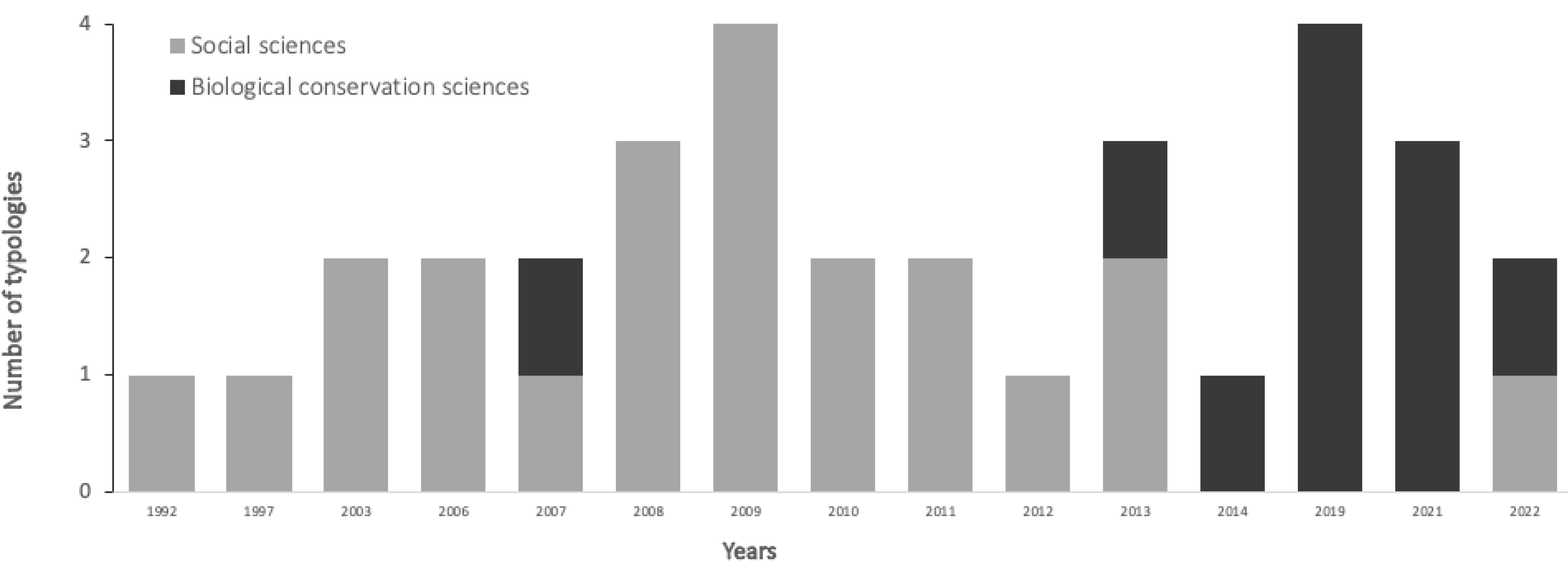
Figure 2.
Analytical dimensions used in the typologies of normative positions about human-nature relationships.
Figure 2.
Analytical dimensions used in the typologies of normative positions about human-nature relationships.
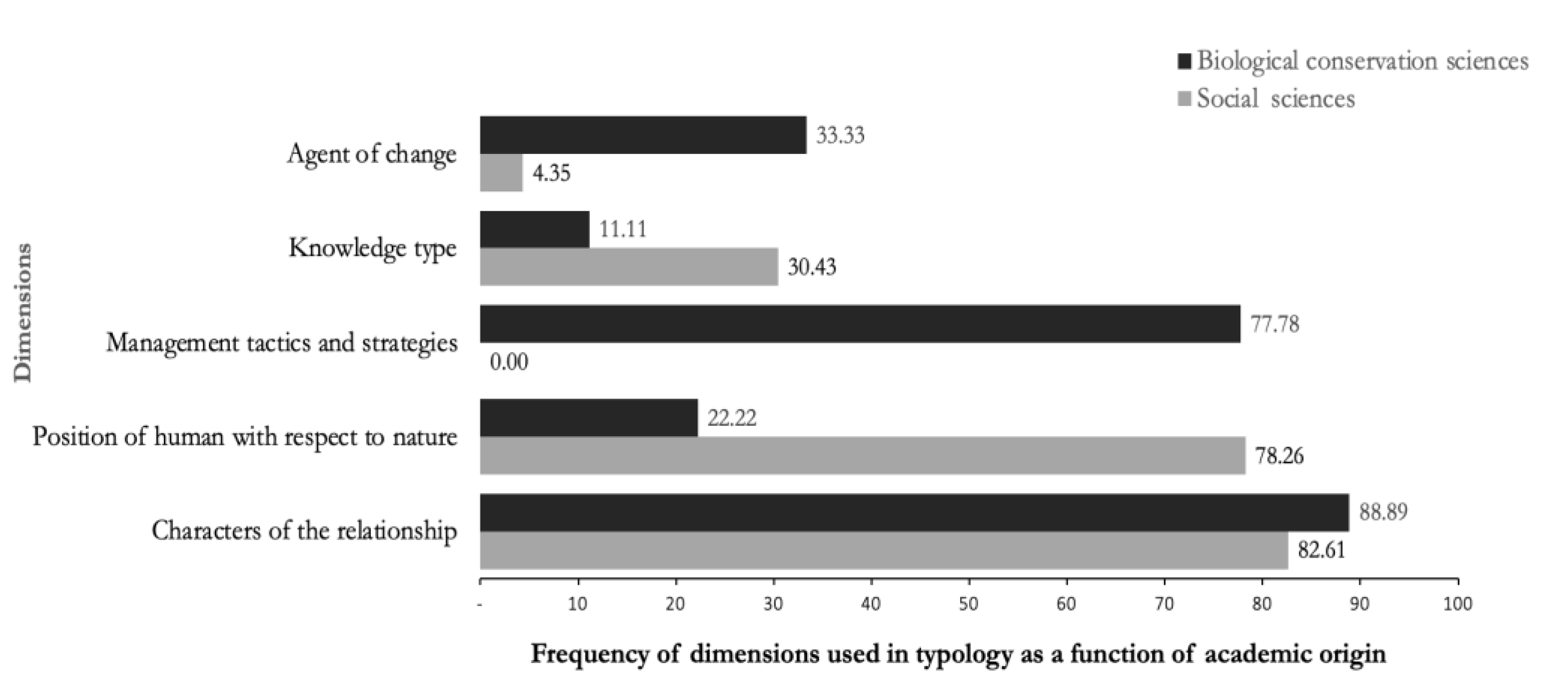
Figure 3.
The relative importance of different value-states within dimensions of ontology (A), axiology (B), pragmatic (C), epistemology (D), and agency-related values in human-nature relationships in conservation science (E) according to social sciences (SS) and biological conservation sciences (BS).
Figure 3.
The relative importance of different value-states within dimensions of ontology (A), axiology (B), pragmatic (C), epistemology (D), and agency-related values in human-nature relationships in conservation science (E) according to social sciences (SS) and biological conservation sciences (BS).
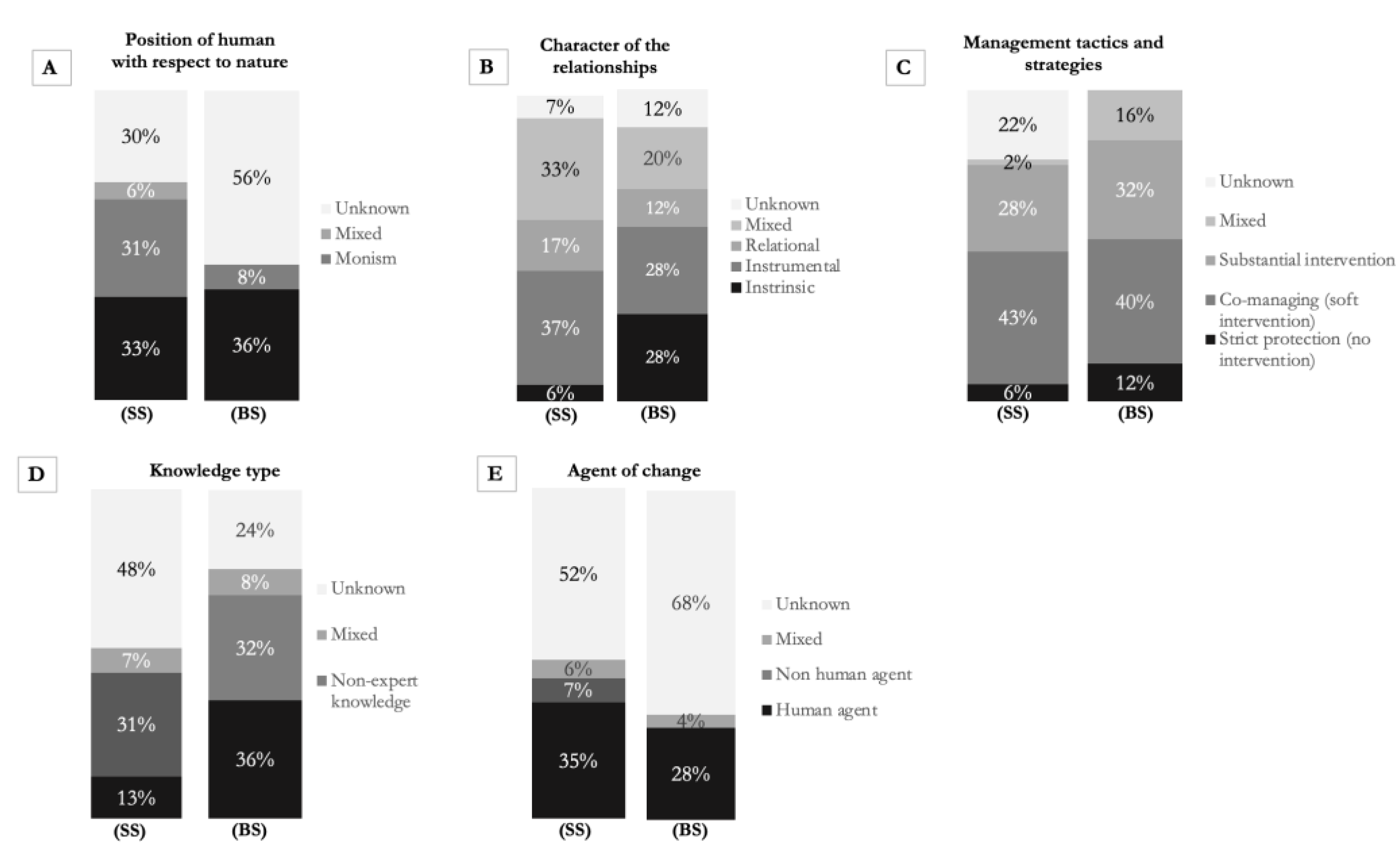
Figure 4.
Projection of the normative positions about human-nature relationships (n = 72) onto an axis formed by the two first principal components.
Figure 4.
Projection of the normative positions about human-nature relationships (n = 72) onto an axis formed by the two first principal components.
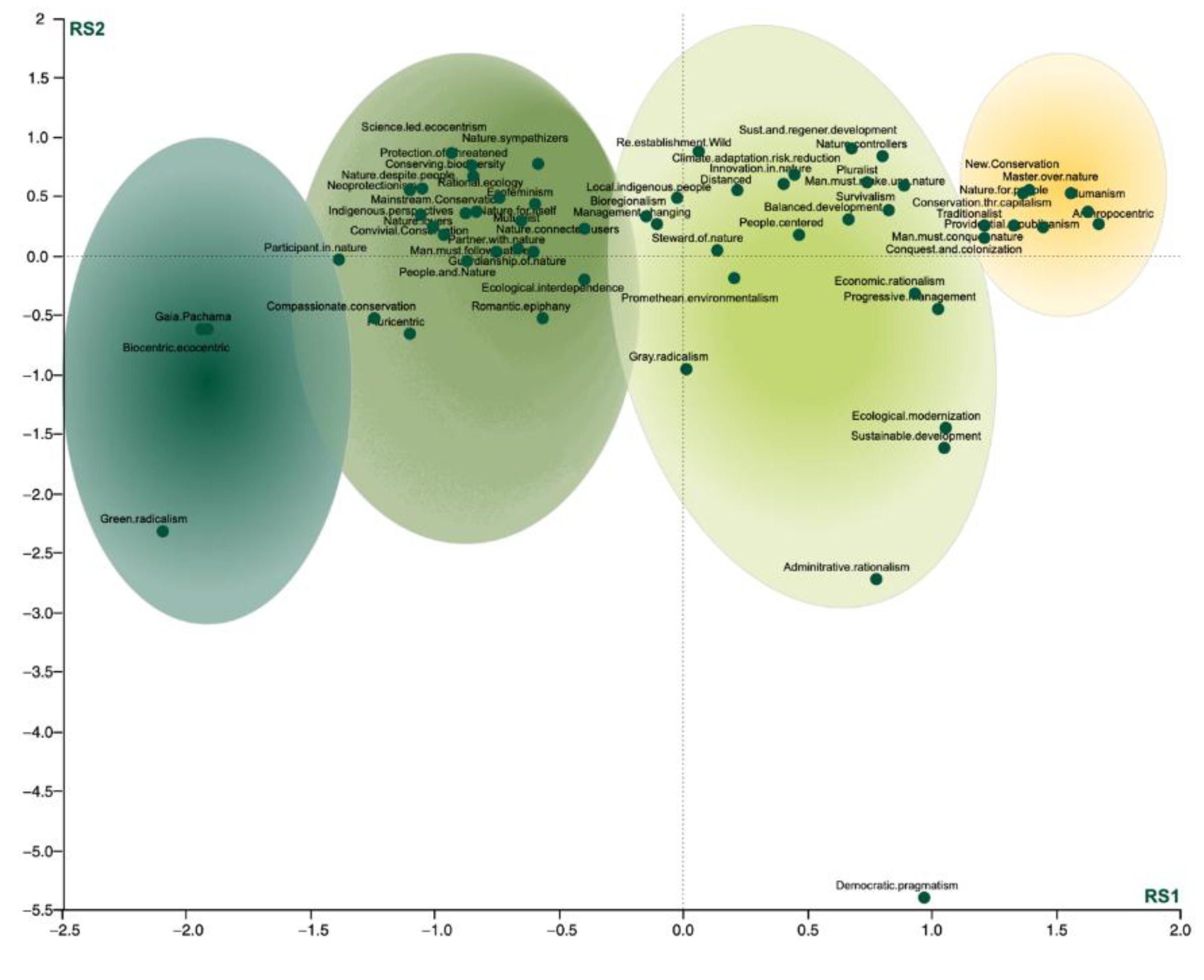
Figure 5.
Archetypes of normative positions about human-nature relationships.
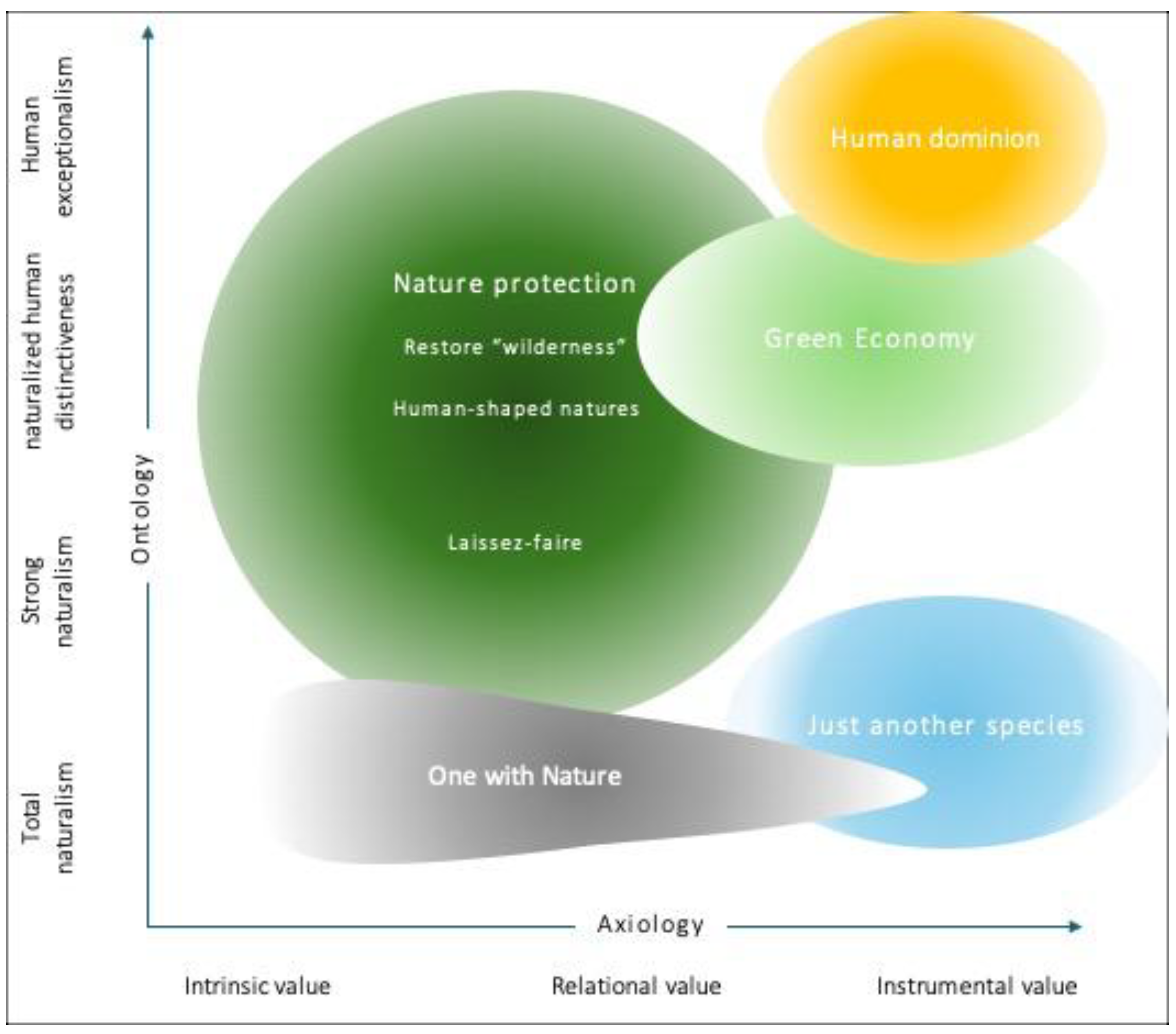

Table 1.
The diversity of analytical dimensions, and value-states used to describe the normative positions about human-nature relationships.
Table 1.
The diversity of analytical dimensions, and value-states used to describe the normative positions about human-nature relationships.
| Dimension | Values-states from the literature | Consolidated value-states |
| Position of human with respect to nature (Ontology) | Human exceptionalism, Total naturalism, Naturalized human distinctiveness; Strong naturalism, Dominion (Master of nature), Stewardship of nature, Egalitarian, Reverence to nature, Biophobia (fear of nature), Biophilia, Unconcerned | Monism, Dualism, Mixed, Unknown |
| Character of the relationship between human and nature (Axiology) | Intrinsic value (living with), Instrumental value (living in/from), Relational value (living as) | Intrinsic, Instrumental, Relational, Mixed, Unknown |
| Management tactics and strategies (Pragmatism) | No human intervention (strict protection), Light intervention, Directed intervention; Biotechnology, Pristine nature, Nature with some alteration, Domestic nature | Substantial intervention, Co-management (soft intervention), Strict protection (no intervention), Mixed, Unknown |
| Knowledge type (Epistomology) | Technical, Scientific, Indigenous, Democratic (Lay people) | Expert knowledge, Non-expert knowledge, Mixed, Unknown |
| Agent of change (Agency) | Market, Government, Corporate, People | Human agent, Non-human agent, Mixed, Unknown |
Table 2.
Typologies of normative positions about human-nature relationships, and the discriminating dimensions.
Table 2.
Typologies of normative positions about human-nature relationships, and the discriminating dimensions.
| Nr | Names of normative positions within each typology | Dimensions | Reference | ||||
| O | Ax | P | E | Ag | |||
| 1 | Survivalism; Promethean environmentalism; Administrative rationalism; Democratic pragmatism; Economic rationalism; Sustainable development; Ecological modernization; Green radicalism; Gray radicalism | ☒ | □ | □ | ☒ | ☒ | Dryzek [46] |
| 2 | Anthropocentric; Bio/ecocentric; Pluricentric | ☒ | ☒ | □ | ☒ | □ | |
| 3 | Conserving biodiversity - reducing degradation; Local and indigenous people; Biodiversity-friendly development; Climate adaptation and disaster risk reduction | ☒ | □ | ☒ | □ | ☒ | IPBES [57] |
| 4 | Management of changing; Innovation in Nature; Protection of Threatened; Re-establishment of Wild Nature | □ | □ | ☒ | □ | □ | |
| 5 | Nature for itself; Nature despite people; Nature for people; People and Nature; Peoples and natures | ☒ | □ | ☒ | □ | □ | Palomo, Locatelli [58] |
| 6 | Mainstream conservation; Neo-protectionism; New Conservation; Convivial conservation | ☒ | ☒ | □ | □ | □ | |
| 7 | People-centered; Science-led ecocentrism; Conservation through capitalism | ☒ | □ | ☒ | □ | □ | Dempsey [45] |
| 8 | Living from nature; Living in nature; Living with nature; Living as nature | ☒ | ☒ | □ | ☒ | □ | |
| 9 | Master over nature; Steward of nature; Partner with nature; Participant in nature | ☒ | ☒ | □ | □ | □ | Evans [59] |
| 10 | Nature for itself; Nature despite people; Nature for people; People and Nature | ☒ | □ | ☒ | □ | □ | |
| 11 | Animism; Totemism; Analogism; Naturalism | ☒ | ☒ | □ | □ | □ | Büscher and Fletcher [44] |
| 12 | Fortress conservation; Co-managing conservation; Neoliberal conservation | ☒ | □ | ☒ | □ | ☒ | |
| 13 | Identity discourse; Utilitarian discourse; Alternative discourse | ☒ | ☒ | □ | ☒ | □ | Sandbrook, Fisher [42] |
| 14 | Providential republicanism; Progressive management; Romantic epiphany; Ecological interdependence | ☒ | □ | ☒ | □ | □ | |
| 15 | Biocentric nature conservists; Nonreflected nature unionists; Unsure esthets; Family affected heritage of natureMedia oriented nature-dissociates | □ | ☒ | □ | ☒ | □ | O’Connor and Kenter [60] |
| 16 | Master; Guardian; Partner; Participant | ☒ | ☒ | □ | □ | □ | |
| 17 | Traditionalist (Mastery); Pluralist (domination + mutualism); Mutualist (egalitarian); Distanced | ☒ | ☒ | □ | □ | □ | van Riper, Browning [5] |
| 18 | Master of nature; Partner of nature; Nature is superior; Conservation Oriented; Unconcerned; Nature Connected; Use Oriented; Uninterested; Distanced | ☒ | ☒ | □ | ☒ | □ | |
| 19 | Nature-connected users; Nature-sympathizers; Nature controllers; Nature lovers | ☒ | ☒ | □ | □ | □ | Mace [48] |
| 20 | Master over nature; Guardianship of nature; Companionship with nature; Participant in nature | ☒ | ☒ | □ | □ | □ | |
| 21 | Conqueror of nature; Steward of nature; Spiritual participant in nature | ☒ | ☒ | □ | □ | □ | Descola [43] |
| 22 | Master over nature; Steward of nature; Partner with nature; Participant in nature | ☒ | ☒ | □ | □ | □ | |
| 23 | Master over nature; Partner with nature; Steward of nature; Participant in Nature | ☒ | ☒ | □ | □ | □ | Vaccaro, Beltran [61] |
| 24 | Humans as part of nature; Humans as participants in nature; Humans as responsible managers; Humans as separate from nature; Humans as stewards; Humans as enemies; Humans as users and engineers | □ | ☒ | □ | □ | □ | |
| 25 | Embedded relationship with Nature; Cultivating relationship; Changing relationship; Resource-use relationship; Intellectual relationship; No direct relationship; Esthetic relationship | □ | ☒ | □ | ☒ | □ | Gill [62] |
| 26 | Neoliberal conservation; Bioregional conservation; Hijacked conservation | ☒ | □ | ☒ | □ | ☒ | |
| 27 | Humans as potential enemies of nature; Humans as users of nature; Humans as active managers of nature | ☒ | ☒ | □ | ☒ | □ | Purdy [49] |
| 28 | Esthetic; Social; Instrumental-scientific; Ecological-scientific (investigative) | ☒ | □ | □ | ☒ | □ | |
| 29 | Master over nature; Steward of nature; Active partner with nature; Romantic partner with nature; Participant in nature | ☒ | ☒ | □ | □ | □ | Meske [63] |
| 30 | Man the adventurer and exploiter of nature; Man responsible for nature; Man the participant in nature | ☒ | ☒ | □ | □ | □ | |
| 31 | Man must follow nature; Man must make use of nature; Man must conquer nature | ☒ | □ | □ | □ | □ | De Groot, Drenthen [64] |
| 32 | Utilitarian; Naturalistic; Ecologistic-scientific; Esthetic; Symbolic; Humanistic; Moralistic; Dominionistic; Negativistic | ☒ | □ | □ | □ | □ | |
| 33 | Conquest and colonization; Balanced development; Sustainable development; Rational ecology; Ecofeminism; Indigenous perspectives | □ | ☒ | □ | □ | □ | Teel and Manfredo [65] |
| Frequency (out of 33) | 27 | 20 | 8 | 9 | 5 | ||
O: Ontology; Ax: Axiology; P: Pragmatism; E: Epistomology; Ag: Agency.
Disclaimer/Publisher’s Note: The statements, opinions and data contained in all publications are solely those of the individual author(s) and contributor(s) and not of MDPI and/or the editor(s). MDPI and/or the editor(s) disclaim responsibility for any injury to people or property resulting from any ideas, methods, instructions or products referred to in the content. |
© 2025 by the authors. Licensee MDPI, Basel, Switzerland. This article is an open access article distributed under the terms and conditions of the Creative Commons Attribution (CC BY) license (http://creativecommons.org/licenses/by/4.0/).
Copyright: This open access article is published under a Creative Commons CC BY 4.0 license, which permit the free download, distribution, and reuse, provided that the author and preprint are cited in any reuse.