

Submitted:
10 June 2025
Posted:
10 June 2025
You are already at the latest version
Abstract
With rising pollution levels and an ever-growing demand for clean water, the need for effective water management systems has become more critical than ever. Reliable water management relies heavily on timely, real-time data—something traditional methods often fail to provide due to their manual, labor-intensive, and routine-based nature. This paper proposes an innovative and practical approach to enhance water quality monitoring using Internet of Things (IoT) technologies. The system is designed to continuously collect and transmit data on key parameters such as pH, temperature, and turbidity through a network of interconnected sensors. By integrating IoT into the water monitoring process, the system not only automates data collection but also significantly reduces operational costs while improving accuracy and responsiveness. This shift from reactive to proactive monitoring opens new possibilities—not only for agriculture and aquaculture—but also for broader applications like water sanitation and environmental protection. The proposed model aims to support more informed, real-time decision-making and promote the sustainable management of water resources.
Keywords:
Internet of Things (IoT)
; water quality monitoring
; real-time data
; pH sensor
; turbidity sensor
; arduino
; environmental monitoring
1. Introduction
Water is one of the most essential resources for life on Earth. It plays a fundamental role in everything—from drinking and sanitation to agriculture, industry, and the health of natural ecosystems. However, rapid population growth, urbanization, and industrialization have put immense pressure on our water sources. Increasing pollution from industrial waste, agricultural runoff, and untreated domestic discharge has led to a steady decline in water quality across many parts of the world. Ensuring safe and clean water is no longer just an environmental concern—it’s a matter of public health and sustainability. Unfortunately, traditional methods of water quality monitoring, which rely heavily on manual sampling and laboratory testing, have several limitations. These methods, while accurate, are time-consuming, expensive, and often limited to periodic checks. As a result, they can miss sudden changes in water quality, delaying critical responses to contamination. This is where technology steps in. The Internet of Things (IoT) presents a promising solution to these challenges by enabling continuous, real-time monitoring of water quality. IoT-based systems use a network of smart sensors to track important parameters like pH, turbidity, temperature, and dissolved oxygen. These systems transmit data wirelessly, allowing for instant analysis, automated alerts, and faster decision-making. They are also cost-effective and scalable, making them especially valuable for remote or under-resourced areas.This study explores the potential of IoT in transforming the way we monitor water quality. By shifting from traditional, reactive approaches to smarter, data-driven solutions, we open the door to more proactive water management. The aim is not only to improve monitoring accuracy but also to support sustainable practices across fields like agriculture, aquaculture, public health, and environmental protection.
2. Literature Review
As the demand for clean and safe water increases, traditional water monitoring systems are proving to be insufficient due to their limitations in real-time detection, high operational costs, and reliance on manual labor. Recent advancements in Internet of Things (IoT) technology have opened up new possibilities for real-time, automated, and scalable water quality monitoring. Sughapriya et al. (2021) presented a smart water quality monitoring system that integrates various sensors using IoT technology. The system is designed to monitor parameters such as pH, turbidity, temperature, and conductivity. One of the major highlights of their study is its low power consumption and environmentally friendly design, making it especially suitable for remote areas. The study emphasizes the importance of continuous monitoring and the ability to transmit real-time data to improve the responsiveness to contamination events. Another recent work published in Heliyon (2024) focuses on the development of a real-time IoT-based monitoring framework tailored for smart city environments. The system collects live data on water quality parameters and utilizes intelligent analysis tools to detect anomalies and forecast potential issues. This study stresses the importance of integrating data analytics with IoT to enhance decision-making, ensuring water quality remains safe and compliant with environmental standards. Both studies highlight how IoT-based systems can overcome the major drawbacks of conventional methods, including delayed analysis and limited spatial coverage. These systems offer affordable, scalable, and efficient alternatives that can be deployed across diverse environments. Their findings support the direction of the current study, which seeks to build a cost-effective and real-time water quality monitoring system using IoT for applications ranging from agriculture and aquaculture to public health and sanitation.
3. Problem Defination
Water, a fundamental necessity for life, is increasingly compromised by pollution driven by population growth, industrialization, and environmental change. Contaminated water poses severe health risks, particularly in under-resourced regions, where it contributes to widespread diseases such as cholera, typhoid, and hepatitis. The World Health Organization reports that over two billion people still lack access to safe drinking water, and waterborne illnesses remain a major cause of mortality. Beyond human health, water pollution also disrupts aquatic ecosystems, leading to biodiversity loss, habitat destruction, and the collapse of services like fisheries and recreation. Unfortunately, traditional water quality monitoring techniques—though accurate—are often manual, time-consuming, and expensive. These methods typically rely on periodic sampling and delayed laboratory analysis, leaving critical contamination events undetected and limiting timely response. Additionally, such systems require significant infrastructure and skilled labor, making them inaccessible for many rural or economically challenged regions. Compounding the problem is the lack of real-time data and limited data accessibility, which hinders informed decision-making by stakeholders. High setup and operational costs further limit the widespread implementation of traditional monitoring systems. This situation underscores the urgent need for a more efficient, accessible, and scalable solution. By leveraging the Internet of Things (IoT), real-time and continuous monitoring of water parameters such as pH, turbidity, and temperature becomes possible. IoT-based systems reduce reliance on manual processes, enable prompt detection of anomalies, and allow data to be shared seamlessly across platforms—empowering communities, authorities, and industries to protect public health, preserve ecosystems, and ensure sustainable water resource management.
4. Objectives
The main objective of this IoT-based water quality monitoring system is to overcome the limitations of traditional methods by offering a real-time, cost-effective, and accessible solution. Conventional systems are often labor-intensive, time-consuming, and limited in scope, which can delay responses to water contamination. This project aims to bring in automation and continuous monitoring to ensure timely detection of water quality issues. One of the core goals is to enable round-the-clock tracking of vital parameters like pH, turbidity, temperature, and dissolved oxygen. These readings provide crucial insights into water conditions and help in identifying contamination as it occurs. With real-time monitoring, stakeholders can respond quickly to prevent larger health or environmental issues. Accuracy and reliability of data are also central to the system. By using calibrated sensors and basic data validation techniques, the project aims to reduce errors and ensure trustworthy results. Alerts and notifications are automatically triggered when parameters exceed safe thresholds, helping users act immediately. Affordability and scalability are key design considerations. The system uses low-cost components such as Arduino and wireless modules, making it feasible for wide-scale deployment, even in remote or resource-limited areas. It also emphasizes ease of use, with collected data being stored on the cloud and visualized through simple dashboards, making it accessible to government bodies, researchers, and the public. Additionally, the system supports broader applications in fields such as agriculture, aquaculture, and urban water supply. By providing continuous insights and long-term data, it can also assist in identifying pollution sources and evaluating environmental policies. In essence, this project aims to provide a smart, adaptable, and inclusive monitoring solution that supports better water management, public health, and environmental sustainability.
5. Methodology
The methodology for the IoT-based water quality monitoring system was designed with a focus on real-time performance, accuracy, scalability, and user accessibility. It began with a thorough requirements analysis to identify the most relevant parameters: pH, turbidity, temperature, and dissolved oxygen. These indicators were selected based on consultations with stakeholders such as municipal water authorities, environmental organizations, and community representatives. The system was structured using a modular and scalable architecture, allowing flexible deployment across diverse environments. Hardware components include water quality sensors connected to an Arduino Uno microcontroller, with a Wi-Fi module (ESP8266) enabling seamless data transmission. Calibration of sensors was performed to ensure accuracy, and durability in outdoor conditions was considered during hardware selection and integration. Software development involved programming the microcontroller for continuous data acquisition, initial filtering, and transmission. The collected data is relayed to a cloud-based server in near real-time, where it undergoes cleaning, validation, and processing. Simple anomaly detection algorithms were implemented to identify irregularities in readings and support early warnings. A user-friendly web dashboard was developed to visualize sensor data, track historical trends, and monitor system health. The dashboard is equipped with a notification system that sends alerts via SMS or email when any parameter exceeds predefined thresholds. The system was tested in both lab and field conditions to evaluate its reliability, performance, and resilience. Feedback from users was used to refine both the hardware setup and software interface. The deployment phase included sensor installation in selected water bodies and routine maintenance schedules to ensure long-term effectiveness. Regular calibration and software updates help sustain measurement accuracy, making the solution robust and suitable for real-world implementation.
6. System Architecture
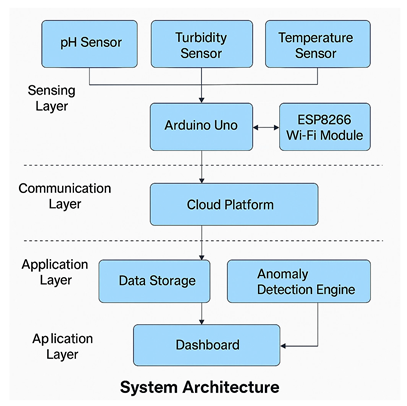 |
The system architecture consists of four major layers: sensing, processing, communication, and data visualization. At the sensing layer, environmental sensors continuously monitor pH, turbidity, temperature, and dissolved oxygen. These sensors are integrated with an Arduino Uno, which acts as the central controller for data preprocessing and device management. For communication, an ESP8266 Wi-Fi module facilitates wireless transmission of data to a remote server. This module was selected for its low power consumption, ease of integration, and cost-effectiveness. Data is transmitted using standard MQTT or HTTP protocols, ensuring compatibility with various cloud platforms. The server handles data storage, validation, and analysis. Anomalies are detected using simple threshold-based logic and pattern recognition techniques. A web-based dashboard serves as the final interface, enabling real-time visualization, alert tracking, and historical data review. This layered architecture ensures efficient data handling and system reliability while allowing easy scaling for broader applications.
7. Tools & Techniques
The development of the IoT-based water quality monitoring system involved careful selection of tools and components to ensure accurate sensing, efficient data transmission, and real-time processing. The core of the system is the Arduino Unomicrocontroller, chosen for its simplicity, low cost, and wide support for sensor interfacing, making it ideal for rapid prototyping in embedded applications. To measure key water quality parameters, the system integrates a pH sensor, turbidity sensor, and temperature sensor. These sensors were selected for their proven reliability in field conditions, ease of calibration, and compatibility with the Arduino platform. A Wi-Fi communication module (ESP8266) is used to enable wireless data transmission from the microcontroller to the cloud, facilitating real-time monitoring and remote access to the data. The power supply is designed to ensure uninterrupted operation, using a combination of rechargeable batteries and voltage regulation modules to maintain consistent sensor and board performance. For cloud storage and analytics, an online IoT platform is utilized to store, visualize, and analyze the sensor data. A custom dashboard is developed to display real-time values, historical trends, and alert messages. This integration of low-cost, readily available components with cloud-based tools ensures that the system is not only technically sound and scalable but also economically viable for deployment in under-resourced settings.
8. Results
The IoT-based water quality monitoring system was tested in both controlled lab conditions and real-world field environments to assess its accuracy, responsiveness, and overall performance. In the lab, each sensor—pH, turbidity, temperature, and dissolved oxygen—was calibrated and evaluated against standard instruments. The system showed high accuracy with minimal deviation, confirming its reliability for continuous data collection. During field testing at a local water body, the system operated smoothly, collecting and transmitting real-time data via the ESP8266 Wi-Fi module. Data latency remained low (around 1–2 seconds), and no major transmission failures occurred during the test period. The sensors remained responsive despite varying environmental conditions, indicating robustness. Notably, the system’s real-time alert feature was validated when a spike in turbidity occurred due to nearby runoff. An automatic alert was triggered, allowing prompt verification on site. This showed the system’s practical potential for early warning and timely action. The dashboard proved effective in visualizing trends and anomalies, helping stakeholders quickly interpret water quality conditions. Overall, the results suggest that the system is a viable, low-cost, and scalable solution for real-time water quality monitoring with strong potential for wider deployment.
9. Conclusion
The development of this IoT-based water quality monitoring system demonstrates a practical and cost-effective solution to the challenges posed by traditional water testing methods. By integrating reliable sensors with a microcontroller and wireless communication, the system enables continuous real-time monitoring of critical parameters such as pH, turbidity, temperature, and dissolved oxygen. Lab and field tests confirmed its accuracy, responsiveness, and user-friendly functionality, making it suitable for both urban and rural deployments. This system not only empowers stakeholders with immediate insights and alerts but also supports long-term environmental management by providing actionable data. Its scalability and affordability make it a strong candidate for adoption in resource-constrained regions, offering a step forward in ensuring safe and sustainable water resources.
References
- S. G. B., S. R. N., S. M., and S. P. K., “IoT Based Real Time Water Quality Monitoring System,” Int. J. Sci. Res. Eng. Manag., vol. 9, no. 4, pp. 1–9, Apr. 2025. [CrossRef]
- R. K. Nishan, S. Akter, R. I. Sony, M. M. Hoque, M. J. Anee, and A. Hossain, “Development of an IoT-based multi-level system for real-time water quality monitoring in industrial wastewater,” Discover Water, vol. 4, no. 43, pp. 1–9, Jul. 2024. [CrossRef]
- S. Nair, A. S. Sreedharan, and A. P. S. Nair, “IoT based smart water quality monitoring system,” Materials Today: Proceedings, vol. 45, pp. 3628–3633, 2021. [CrossRef]
- P. S. Padma, A. V. N. S. B. K. S. Priya, D. P. Sree, and G. Pavani, “IOT Based Water Quality Monitoring System,” International Journal for Research in Applied Science and Engineering Technology (IJRASET), vol. 11, no. 3, pp. 123–129, Mar. 2023. [CrossRef]
- M. A. A. Al-Garadi, M. A. Mohamed, M. A. Al-Ali, and M. A. Al-Ali, “IoT-Based Water Monitoring Systems: A Systematic Review,” Water, vol. 14, no. 22, p. 3621, Nov. 2022. [CrossRef]
- J. Tang, H. Lin, and Q. Tian, “Design and realization of a water quality monitoring system based on the Internet of Things,” Water Practice & Technology, vol. 19, no. 9, pp. 3538–3549, Sep. 2024. https://doi.org/10.2166/wpt.2024.222.M. A. Addow and A. D. Jimale, “Integrating IoT and Water Quality: A Bibliometric Analysis,” SSRG International Journal of Electronics and Communication Engineering, vol. 11, no. 10, pp. 149–160, Oct. 2024. [CrossRef]
- S. K. Singh, A. K. Singh, and R. S. Tomar, “IoT Based Water Quality Monitoring System,” in 2020 International Conference on Power Electronics & IoT Applications in Renewable Energy and its Control (PARC), Mathura, India, Feb. 2020, pp. 1–5. [CrossRef]
- M. M. Rahman, C. Bepery, M. J. Hossain, Z. Hassan, G. M. Jamil Hossain, and M. M. Islam, “Internet of Things (IoT) Based Water Quality Monitoring System,” Int. J. Multidiscip. Curr. Educ. Res., vol. 2, no. 4, pp. 168–180, Aug. 2020.
- G. N. Satya Sai, R. Sudheer, K. S. Manikanta, S. G. Arjula, B. N. Rao and D. V. Sai Maneeswar Mutyala, “IoT based Water Quality Monitoring System,” 2021 IEEE 9th Region 10 Humanitarian Technology Conference (R10-HTC), Bangalore, India, 2021, pp. 01-06. [CrossRef]
- M. Flores-Iwasaki, G. A. Guadalupe, M. Pachas-Caycho, S. Chapa-Gonza, R. C. Mori-Zabarburú, and J. C. Guerrero-Abad, “Internet of Things (IoT) sensors for water quality monitoring in aquaculture systems: A systematic review and bibliometric analysis,” AgriEngineering, vol. 7, no. 3, p. 78, 2025. [CrossRef]
Disclaimer/Publisher’s Note: The statements, opinions and data contained in all publications are solely those of the individual author(s) and contributor(s) and not of MDPI and/or the editor(s). MDPI and/or the editor(s) disclaim responsibility for any injury to people or property resulting from any ideas, methods, instructions or products referred to in the content. |
© 2025 by the authors. Licensee MDPI, Basel, Switzerland. This article is an open access article distributed under the terms and conditions of the Creative Commons Attribution (CC BY) license (http://creativecommons.org/licenses/by/4.0/).
Copyright: This open access article is published under a Creative Commons CC BY 4.0 license, which permit the free download, distribution, and reuse, provided that the author and preprint are cited in any reuse.


