

Submitted:
09 June 2025
Posted:
10 June 2025
You are already at the latest version
Abstract
The elastic and photoelastic coefficients of BTGS crystals were determined by the quantum mechanical calculation technique. Based on these data, extreme piezo-optic surfaces were constructed, which describe the change of the path difference of light beams in the crystal under the influence of mechanical stress. The results for BTGS crystals are compared with the ones for other crystals of the langasite group (LGS, CGG, CTGS and CNGS). The global maxima of the surfaces for BTGS crystals significantly exceed the ones for the other crystals mentioned above and, accordingly, BTGS crystals can be suitable for use in polarization-optic light modulators and devices based on them. The acousto-optic efficiency of BTGS crystals was evaluated. The correlations between the magnitude of the piezo- and elasto-optic coefficients and the parameters of the unit cell of the studied crystals were determined..
Keywords:
piezo‐optic effect
; elasto‐optic effect
; quantum mechanical calculation
; extreme surfaces
; acousto‐optic efficiency
Keywords piezo-optic effect; elasto-optic effect; quantum mechanical calculation; extreme surfaces; acousto-optic efficiency
1. Introduction
Sensitive elements of optical modulating devices are, as a rule, bulk crystalline materials. The number of photoelastic materials that have been used in practice includes few crystals, so the task of finding new effective materials for controlling laser radiation is relevant.
Interest in crystals of the langasite group [1-3] is due to the fact that they reveal a unique combination of various physical properties. For instance, the temperature stability of physical characteristics, in particular elastic [4, 5], as well as a large piezoelectric effect and a high coefficient of electromechanical coupling (e.g., the value of the piezoelectric coefficient d11 of langasite group crystals is in the range of 4…7 pC/N, that is 2…3 times higher than in quartz crystals [6]) - makes them a popular material for development of acoustoelectronic devices. In particular, they are used in pressure and detonation sensors, resonators in tunable generators, substrates of thermostable slices for acousto-electronic filters on surface and bulk acoustic waves, Q-switches, as well as temperature-stable broadband monolithic filters used in mobile communication systems [7-9]. Because of a high optical damage threshold of ~1 GW/cm2 [10], these crystals can be used as sensitive elements in acousto-optical converters. In our previous papers, the piezo-, elastic- and acousto-optic properties of several representatives of this group were experimentally studied, i.e. crystals of langasite La3Ga5SiO14 (LGS) [11], catangasite Сa3TaGa3Si2O14 (CTGS) [12], calcium halogermanate Ca3Ga2Ge4O14 (CGG) [13]. However, for most crystals of the LGS group (the list of these crystals, see, e.g. in [14, 15]), the piezo-optic effect (POE), elastic-optic effect (ELOE) and acousto-optic (AO) efficiency have not been studied.
Since it is problematic to experimentally study a large number of crystals by the laborious interferometric method [12, 13, 16, 17], in [18] the photoelastic (piezo- and elasto-optic) coefficients of CТGS and Ca3NbGa3Si2O14 (CNGS) crystals were calculated by the quantum mechanical technique. The calculation results for CTGS crystals [18] agree well with the experimental data [12]. Therefore, in this paper, the elastic, piezo- and elasto-optic coefficients of batangasite Ba3TaGa3Si2O14 (BTGS) crystals were calculated in a similar way. Based on these results, the spatial anisotropy of photoelasticity effects can be studied by the methods of indicative or extreme surfaces, see, e.g. [19-24]. Here the extreme surfaces describing the change in the path difference of the orthogonally polarized light beams (leading to optical retardation, i.e. the difference in phase shifts of the beams) δΔk = δ(Δnk⋅dk) under the influence of mechanical stress σm are constructed and the maximum values of this effect are found (here Δnk is the birefringence of the crystal, dk is the thickness of the sample in the direction of light propagation). The results obtained for BTGS crystal are compared with similar ones for LGS, CTGS, CNGS and CGG.
2. Results of Quantum Mechanical Calculation
BTGS crystals were chosen for calculations the piezo-optic coefficients (POCs) πim and elasto-optic coefficients (ELOCs) pik because their photoelastic properties have not been elucidated yet. In addition, because of the high refractive indices (nі ≈ 2 [25]), which are decisive for the value of the acousto-optic figure-of-merit М2, since М2 ~ [26- 28], for these crystals, one can expect a higher AO efficiency than for other crystals of the LGS group, as well as a higher efficiency in terms of path difference, which can be used in polarization-optical light modulators and, accordingly, pressure gauges based on them [29-32].
In papers [18, 33, 34] quantum mechanical calculation of POCs and ELOCs for a number of crystals using the CRYSTAL program [35] ensured good agreement with experimental data. Here the calculation of photoelastic constants of BTGS crystals was also carried out using the version CRYSTAL17 of this program [36]. The program implements automated algorithms for determination of elastic and piezoelectric [37], piezooptic and elastooptic [38] tensors for crystals of any symmetry. The hybrid PBE0 functional of the density functional theory (DFT) is used [39], which is known to provide accurate strain-related pro perties of solids [40−42]. The POB-TZVP-rev2 atom-centered Gaussian-type function basis set has been adopted for all elements [43, 44]. The integration was performed on a 5×5×5 k-grid chosen by the Monkhrost-Pack method. Convergence of the self-consistent field step of the calculations is determined by a threshold on the energy set to 10−8 Hartree.
BTGS crystals belong to the point group 32 [2] and, accordingly, have seven independent coefficients of elastic stiffness Cmk and elastic compliance Skm, as well as eight independent elasto-optic pik and piezooptic πim coefficients [45, 46]. The calculated values of elastic Сmk, Skm and photoelastic pik, πim coefficients for these crystals are indicated in Tables 1, 2.
As it is seen from Table 1, the agreement between the calculated (our data) and experimental values of the elastic coefficients Сmk and Skm is mostly well. Further these coefficients were used for calculation of the AO efficiency and constructing extreme surfaces of the change of the optical path difference δΔk between orthogonally polarized beams induced by the uniaxial pressure σm.
The highest value of POCs for BTGS crystals (Table 2) corresponds to the coefficient π33, as for other studied crystals of the LGS group [11,12,13]. For ELOCs, we see that the highest coefficients are p13 and p31, so the transverse effect prevails, as in CTGS [12] and CGG [13]. Let us pay attention to an interesting observation: if the values of the POE and ELOE in crystals of the LGS group are related to the crystal lattice parameters, then larger photoelastic effects are generally observed in CTGS [12], LGS [11] and BTGS crystals with a larger unit cell volume (V = 283.80 Å3 [48], 294.28 Å3 [48] and 326.03 Å3 [2], respectively) compared to the small value of V = 279.96 Å3 [50] for CGG crystals and, accordingly, the predominantly smaller values of POCs and ELOCs for this crystal [13]. It was also found that the maximum values of POE or ELOE are sensitive to the ratio of the cell parameters c/a. Namely, in the LGS crystal with a higher value of c/a = 0.6233 [51], longitudinal effects corresponding to the coefficients π33 and р33 [11] predominate, while in BTGS, CTGS and CGG crystals with smaller values of the c/a ratio (0.6097, 0.6148 and 0.6158, respectively [2, 48, 50]), transverse effects with the coefficients π31, р13 and р31 [11,12,13] are more significant.
3. Evaluation of Acousto-Optic Efficiency
Let us estimate the value of the AO figure-of-merit of BTGS crystal based on the known [26-28] expression , where ρ is the crystal density, Vk is the acoustic wave velocity. For the conditions of AO interaction with a longitudinal acoustic wave, which correspond to the maximum ELOC p31 = 0.185 (Table 2), this expression should be substituted with this value of p31. At that the refractive index n3 = 1.8776 (for the wavelength of 632.8 nm), the velocity of the longitudinal acoustic wave V3 = 5908 m/s calculated by the Christoffel method [46] based on the elasticity coefficients Сmk (Table 1), and the density of BTGS crystal is ρ = 5514 kg/m3 [2] were used. The result is M2 = 1.66⋅10–15 s3/kg. In terms of this M2 value, BTGS crystal is approximately 2 times superior to the strontium borate (SrB4O7) crystal, suitable for AO modulation of light in the ultraviolet range [52], and has a value comparable to the maximum of М2 of the CTGS crystal [19]. However, to find the maximum AO efficiency of BTGS crystal, it is necessary to construct AO figure-of-merit (M2) surfaces and analyze the anisotropy of these surfaces using the technique described in [23, 53, 54].
4. Extreme Piezo-Optic Surfaces of the Path Difference
The optical path difference caused by POE consists in changing the value δΔk = δ(Δnk⋅dk), i.e., changing the birefringence Δnk and the sample thickness dk under the influence of mechanical stress σm.
The construction of extreme surfaces for the path difference was carried out according to the method described in detail in [19]. In this work, the objective function , which corresponds to the optical retardation [55], is used:
Based on this expression, we obtain the equation of the surface, which describes the change in the path difference for all directions of the applied uniaxial pressure and all light propagation directions , namely:
where the dashes indicate the spatial distribution of all effects: is POE in terms of the path difference, and are POEs consist in the refractive indices of orthogonally polarized waves , changes, is the birefringence, is the effective elastic compliance coefficient. It should be emphasized that all possible geometries of piezo-optic interaction were considered, and not only the conditions of orthogonality of and directions.
The calculation by the method of extreme surfaces (see, e.g. [23, 53, 54]) was carried out in two equivalent variants. In the first variant of the calculation, for each possible direction of light propagation, such a direction of uniaxial pressure σm was determined, which would provide the maximum of the path difference . The dependence of the obtained maximum values on the direction of the light wave can be represented in the form of a surface, which we call the wave vector extreme surface. The distances of the points of this surface from the origin of coordinates correspond to the absolute values of the maximum for each direction of the wave vector . Among all maxima obtained as a result of the calculation, the global maxima of this value were determined, which correspond to the maximum achievable POE of the path difference. In the second variant of the calculation, for each possible direction of uniaxial pressure, such a direction of wave vector was determined, which would also provide the maximum of surface. The corresponding extreme surface is called the surface of mechanical stress. Both types of surfaces have all the symmetry elements of the point group of the crystal and the center of inversion (i.e., they correspond to the Laue group of the crystal [56]). The symmetry reveals in the existence of few equivalent global maxima. Although the wave vector and mechanical stress surfaces differ in form, the maximum achievable global maxima of the POE must be the same for both of them.
Parameters of LGS, CGG, CTGS, CNGS, BTGS crystals (πim, Skm, ni) used for construction of extreme surfaces were taken from [11−13, 18, 25] and Tables 1, 2.
The extreme surfaces of the POE by the path difference (2) are shown in Figure 1 and Figure 2. The results of the optimization for the experimentally studied (by interferometric method) crystals CGG [13], CTGS [12], LGS [11] and the theoretically studied (by quantum-mechanical method) crystals CTGS [17 18], CNGS [17 18] and BTGS (this paper) are indicated in Table 3 and Table 4. These tables provide data on the position of one of the global maxima, the positions of other ones can be determined using the symmetry elements of the point group (32 + inversion).
As it is seen from Table 3, for CGG and CTGS crystals, the maximum values of the surfaces were obtained for the case of orthogonal conditions of piezo-optic interaction (α = 90o), when the direction of pressure applying coincides with the main crystallographic axis X, and light propagates in the main crystallographic plane YZ in directions determined by the angles θk = 104o and 101.3o to the optical axis Z of the considered crystals. For LGS crystal, the most effective geometry of piezo-optic interaction corresponds to the case when the light propagates and the uniaxial pressure is applied in the crystallographic plane YZ. The optimal geometry of interaction is not strictly orthogonal, the angle α is equal to 95.5o. The smallest global value of POE by the path difference is obtained for CGG crystal (Table 3). This result is obviously caused by the values of the refractive indices ni, birefringence Δnk and piezo-optic coefficients πim of this crystal, which are lower compared to other representatives of the langasite group [13].
1) the directions of light propagation indicated in these tables do not correspond to the main crystallographic axes (an exception exists only for BTGS crystal, see rows 4 and 5 in Table 4); the directions of light propagation and uniaxial pressure applying are either strictly orthogonal (α = 90o, see rows 1 and 2 in Table 3 and rows 1 and 5 in Table 4), or deviate from orthogonality by small angles from 2.4o to 5.5o (see row 3 in Table 3 and rows 2–4 in Table 4);
2) among the experimentally and theoretically studied crystals, the maximal value of was obtained for BTGS crystal (14.5 Br);
3) CGG crystal reveals the lowest global maximum of (6.8 Br); for comparison, the maximum value of the POE (in terms of path difference) for quartz found by the extreme surface method is equal to 7.4 Br, which is also significantly (by a factor of 2) lower than for BTGS crystal (Table 4). Therefore, it is BTGS crystals that should be preferred when using them as sensitive elements of polarization-optic light modulators and devices based on them.
5. Conclusions
All elastic and photoelastic (piezo-optic and elasto-optic) coefficients of BTGS crystals were calculated using the quantum mechanical method realized in the Crystal17 program. Based on the calculated elastic compliance coefficients Skm and piezo-optic coefficients πim, as well as the known values of the refractive indices ni for the light wavelength λ = 632.8 nm, extreme surfaces of the POE were constructed, which describe the spatial distribution of the change in the path difference δΔk caused by the influence of the mechanical stress σm. The maximum (global) values of the piezo-optic extreme surfaces of the path difference were found by Levenberg-Marquardt method. The results obtained for BTGS crystals are compared with the ones for other crystals of the langasite group: LGS, CGG, CTGS and CNGS. The main result of the research is that BTGS crystal reveals the highest value of the POE effect among all studied crystals of langasite group (14.5 Br). This value is significantly (twice) higher than the one for quartz (7.4 Br). Therefore, BTGS crystals should be preferred when used as sensitive elements of polarization-optic light modulators and devices based on them.
The value of the AO figure-of-merit M2 of BTGS crystal was estimated based on the highest elasto-optic coefficient p31. According to the obtained value of M2 = 1.66⋅10−15 s3/kg, BTGS crystal is twice as much as the strontium borate crystal (SrB4O7), which is suitable for acousto-optic modulation of light in the ultraviolet range.
It should also be emphasized that for the studied crystals, a correlation was found between the value of the piezo-optic πim and elasto-optic pik coefficients on the one hand and the volume of the crystal lattice on the other one. Moreover, the values of the πim and pik coefficients correlate with the value of the ratio of the unit cell parameters c/a.
Author Contributions
Conceptualization, Bohdan Mytsyk; methodology, Natalia Demyanyshyn and Oleh Buryy; software, Oleh Buryy, Pavlo Solomenchuk; validation, Bohdan Mytsyk; formal analysis, Anatoliy Andrushchak; investigation, Natalia Demyanyshyn, Bohdan Mytsyk, Oleh Buryy, Pavlo Solomenchuk and Oleksandr Lishchuk; writing—original draft preparation, Natalia Demyanyshyn; writing—review and editing, Bohdan Mytsyk; visualization, Pavlo Solomenchuk; supervision, Bohdan Mytsyk and Anatoliy Andrushchak; project administration, Bohdan Mytsyk and Anatoliy Andrushchak. All authors have read and agreed to the published version of the manuscript.
Funding
This research has received funding from the Ministry of Education and Science of Ukraine in the frames of ‘Nanoelectronics’(0123U101695). We acknowledge the support of the European Union under Horizon Europe for the TeraHertz project (Grant Agreement 101086493).
Data Availability Statement
All data generated or analyzed during this study are included in this published article.
Conflicts of Interest
The authors declare no conflicts of interest.
References
- Remark, T.; Segonds, P.; Debray, J.; Jegouso, D.; Víllora, G.; Shimamura, K.; Boulanger, B. Linear and nonlinear optical properties of the langasite crystal Ca3TaAl3Si2O14. Opt. Mater. Expr. 2023, 13, 20536–20601. [Google Scholar] [CrossRef]
- Usui, H.; Kusakabe, H.; Tokuda, M.; Sugiyama, K.; Hoshina, T.; Tsurumi, T.; Takeda, H. Structure and electrical properties of Ba3TaGa3Si2O14 single crystals grown by Czochralski method. J. Ceram. Soc. Japan. 2020, 128, 441–446. [Google Scholar] [CrossRef]
- Kuzmin, N.; Klimin, S.; Mavrin, B.; Boldyrev, K.; Chernyshev, V.; Mill, B.; Popova, M. Lattice dynamics and structure of the new langasites Ln3CrGe3Be2O14 (Ln = La, Pr, Nd): Vibration alspectra and abinitio calculations. J. Phys. Chem. Sol. 2020, 138, P109266/1–18. [Google Scholar] [CrossRef]
- Andreev, I. Two decades following the discovery of thermallys table elastic properties of La3Ga5SiO14 crystal and coining of the term langasite. Tech. Phys. 2004, 49, 1101–1103. [Google Scholar] [CrossRef]
- Andreev, I.; Dubovik, M. A new piezoelectric material, langasite (La3Ga5SiO14), with a zero temperature coefficient of the elastic vibration frecuency. Sov. Tech. Phys. Lett. 1984, 10, 205–207. [Google Scholar]
- Fu, X.; Villora, E.; Matsushita, Y.; Kitanaka, Y.; Noguchi, Y.; Miyayama, M.; Shimamura, K.; Ohashi, N. Influence of growth conditions on the optical, electrical resistivity and piezoelectric properties of Ca3TaGa3Si2O14 single crystals. J. Ceram. Soc. Jap. 2016, 124, 523–527. [Google Scholar] [CrossRef]
- Fritze, H. High-temperature bulk acoustic wave sensors. Meas. Sci. Techn. 2011, 22. [Google Scholar] [CrossRef]
- Xin, Y.; Shaojun, Z.; Jiyang, W. Mutualaction of the opticalactivity and the electro-opticeffect and itsinf luence on the La3Ga5SiO14 crystal electro-optic Q switch. J. Opt. Soc. America B. 2005, 22, 394–397. [Google Scholar] [CrossRef]
- Zhang, J.; Tan, Q.; Zhang, L.; Zhao, N.; Liang, X. Langasite bonding via high temperature for fabricating sealed microcavity of pressure sensors. Micromachines. 2022, 13, 479/1–12. [Google Scholar] [CrossRef]
- Kong, H. , Wang J., Zhang H., Yin X., Zhang Sh., Ya. Liu Ya., Cheng X., Gao L., Hu X., Jiang M. Growth, properties and application as an electrooptic Q-switch of langasite crystal. J. Cryst. Growth. 2003, 254, 360–367. [Google Scholar] [CrossRef]
- Mytsyk, B.; Demyanyshyn, N.; Andrushchak, A.; Kost', Ya.; Parasyuk, O.; Kityk, A. Piezooptical coefficients of La3Ga5SiO14 and CaWO4 crystals: A combined optical interferometry and polarization-optical study. Opt. Mat. 2010, 33, 26–30. [Google Scholar] [CrossRef]
- Mytsyk, B.; Suhak, Y.; Demyanyshyn, N.; Buryy, O.; Syvorotka, N.; Sugak, D.; Ubizskii, S.; Fritze, H. Full set of piezo-optic and elasto-optic coefficients of Ca3TaGa3Si2O14 crystals at room temperature. Appl. Opt. 2020, 59, 8951–8958. [Google Scholar] [CrossRef]
- Mytsyk, B.; Demyanyshyn, N.; Andrushchak, A.; Maksishko, Yu.; Kohut, Z.; Kityk, A. Characterization of photoelastic materials by Mach-Zehnder interferometry: Application to trigonal calcium galogermanate (CGG) crystals. J. Appl. Phys. 2024, 135, 085111. [Google Scholar] [CrossRef]
- Chani, V.; Shimamura, K.; Yu, Y.; Fukuda, T. Design of newoxidecrystals with improved structural stability. Rev. J., Mater. Sci. Engin. 1997, R 20, 281–338. [CrossRef]
- Zheng, Y.; Cui, S.-X.; Chen, J.; Tu, X.; Xin, J.; Kong, H.; Shi, E. Advances in design, growth and application of piezoelectric crystals with langasite structure. Proc. 2012 Symp. on Piezoelectricity, Acoustic Waves, and Device Applications (SPAWDA), 23-25 November 2012, Shanghai, China, IEEE Xplore. 2013. 252−259.
- Mytsyk, B.; Andrushchak, A.; Vynnyk, D.; Demyanyshyn, N.; Kost, Ya.; Kityk, A. Characterization of photoelastic materials by combined Mach-Zehnder and conoscopic interferometry: Application to tetragonal lithium tetraborate crystals. Opt. Las. Engin. 2020, 127. [Google Scholar] [CrossRef]
- Mytsyk, B.; Kryvyy, T.; Demyanyshyn, N. ; Mys, O; Martynyuk-Lototska, I. ; Kokhan, O.; Vlokh, R. Piezo-, elasto- and acousto-optic properties of Tl3AsS4 crystals. Applied Optics. 2018, 57, 3796–3801. [Google Scholar]
- Mytsyk, B.; Erba, A.; Maul, J.; Demyanyshyn, N.; Shchepanskyi, P.; Syrotynsky, O. Photoelasticity of CNGS crystals. Appl. Opt. 2023, 62, 7952–7959. [Google Scholar] [CrossRef]
- Demyanyshyn, N.; Suhak, Yu.; Mytsyk, B.; Buryy, О.; Маksishko, Yu. ; Sugak, D; Fritze, H. Anisotropy of piezo-optic and elasto-optic effects in langasite family crystals. Opt. Mat. 2021, 119, 111284. [Google Scholar] [CrossRef]
- Mytsyk, B.; Demyanyshyn, N. Piezooptic surfaces of lithium niobate crystals. Crystallogr. Rep. 2006, 51, 653–660. [Google Scholar] [CrossRef]
- Demyanyshyn, N.; Mytsyk, B.; Kost, Y.; Solskii, I.; Sakharuk, O. Elasto-optic effect anisotropy in calcium tungstate crystals. Appl. Opt. 2015, 54, 2347–2355. [Google Scholar] [CrossRef]
- Buryy, O.; Demyanyshyn, N.; Mytsyk, B.; Andrushchak, A. Optimization of the piezooptic interaction geometry in SrB4O7crystal. Opt. Applik. 2016, XLVI, 447–459. [Google Scholar]
- Buryy, O. , Demyanyshyn, N., Mytsyk, B., Andrushchak, A., Sugak, D. Acousto-optic interaction in LGS and CTGS crystals. Opt. Cont. 2022, 1, 1314–1323. [Google Scholar] [CrossRef]
- Mytsyk, B.; Andrushchak, A. Spatial distribution of the longitudinal and transverse piezooptical effect in lithium tantalate crystals. Crystallogr. Rep. 1996, 41, 1001–1006. [Google Scholar]
- Konstantinova, A.; Golovina, T.; Nabatov, B.; Dudka, A.; Mill, B. Experimental and theoretical determination of the optical rotation in langasite family crystals. Cryst. Rep. 2015, 60, 907–914. [Google Scholar] [CrossRef]
- Pinnow, D.; Van, G.; Warner, A.; Bonner, W. Lead molybdate: a melt-grown crystal with a high figure of merit for acousto-optic device applications. Appl. Phys. Lett. 1969, 15, 83–86. [Google Scholar] [CrossRef]
- Dixon, R. Photoelastic properties of selected materials and their relevance for applications to acoustic light modulators and scanners. J. Appl. Phys. 1967, 38, 5149–5153. [Google Scholar] [CrossRef]
- Uchida, N.; Niizeki, N. Acoustooptic deflection materials and techniques. Proc. IEEE. 1973, 61, 1073–1092. [Google Scholar] [CrossRef]
- Spillman, Jr.W.B. Multimode fiber-optic pressure sensor based on the photoelastic effect. Opt. Let., 1982, 7, 388–390. [Google Scholar] [CrossRef]
- Trainer, N. Photoelastic measuring transducer and accelerometer based thereon. Patent 4.648.273 US, 10.03.1987.
- Andrushchak, A.; Mytsyk, B.; Osyka, B. Polarized-optical pressure meter. Devices and technique of experiment. 1990, 3, 241. (in Russian). [Google Scholar]
- Wang, B. Linear birefringence measurement instrument using two photoelastic modulators. Opt. Eng. 2000, 41, 981–987. [Google Scholar] [CrossRef]
- Mytsyk, B.; Erba, A.; Demyanyshyn, N.; Sakharuk, O. Piezo- and elasto-optic effects in lead molibdate crystals. Opt. Mat. 2016, 62, 632–638. [Google Scholar] [CrossRef]
- Erba, A.; Ruggiero, M.; Korter, T.; Dovesi, R. Piezo-optic tensor of crystals from quantum-mechanical calculations. J. Chem. Phys. 2015, 143. [Google Scholar] [CrossRef] [PubMed]
- Perger, W.; Criswell, J.; Civalleri, B.; Dovesi, R. Ab-initio calculation of elastic constants of crystalline systems with the CRYSTAL code. Comp. Phys. Commun. 2009, 180, 1753–1759. [Google Scholar] [CrossRef]
- Dovesi, R.; Saunders, V.; Roetti, C.; Orlando, R.; Zicovich-Wilson, C.; Pascale, F.; Civalleri, B.; Doll, K.; Harrison, N.; Bush, I.; D'Arco, Ph.; Llunel, M.; Causà, M.; Noël, Y.; Maschio, L.; Erba, A.; Rérat, M.; Casassa, S. CRYSTAL17, User Manual, Torino, 2018.
- Erba, A.; Caglioti, D.; Zicovich-Wilson, C.; Dovesi, R. Nuclear-relaxed elastic and piezoelectric constants of aterials: Computational aspects of two quantum-mechanical approaches. J. Comp. Chem. 2017, 38, 257–264. [Google Scholar] [CrossRef]
- Erba, A.; Dovesi, R. Photoelasticity of crystals from theoretical simulations. Phys. Rev. 2013; 88. [Google Scholar] [CrossRef]
- Adamo, C.; Barone, V. Toward reliable density functional methods without adjustable parameters: The PBE0 model. J. Chem. Phys. 1999, 110, 6158–6170. [Google Scholar] [CrossRef]
- Mahmoud, A.; Erba, A.; El-Kelany, Kh.; Rérat, M.; Orlando, R. Low-temperature phase of BaTiO3: Piezoelectric, dielectric, elastic and photoelastic properties from ab initio simulations. Phys. Rev. 2014, B 89, 045103/1–9.
- El-Kelany, Kh.; Carbonnière, Ph.; Erba, A.; Rérat, M. Inducing a finite in-plane piezoelectricity in graphene with low concentration of inversion symmetry-breaking defects. J. Phys. Chem. C. 2015, 119, 8966–8973. [Google Scholar] [CrossRef]
- El-Kelany, Kh.; Carbonnière, Ph.; Erba, A.; Sotiropoulos, J.-M.; Rérat, M. Piezoelectricity of functionalized graphene: A quantum mechanical rationalization. J. Phys. Chem. C. 2016, 120, 7795–7803. [Google Scholar] [CrossRef]
- Laun, J.; Bredow, T. BSSE-corrected consistent Gaussian basis sets of triple-zeta valence with polarization quality of the sixth period for solid-state calculations. J. Comput. Chem. 2021, 42, 1064–1072. [Google Scholar] [CrossRef] [PubMed]
- Laun, J.; Bredow, T. BSSE-corrected consistent Gaussian basis sets of triple-zeta valence with polarization quality of the fifth period for solid-state calculations. Comput. Chem. 2022, 43, 839–846. [Google Scholar] [CrossRef]
- Nye, J.F. Physical properties of crystals. Oxford: Clarendon Press, 1964.
- Narasimhamurty, T. Photoelastic and electro-optic properties of crystals. New York and London: Plenum press; 1981.
- Dudka, A. Ab Initio calculation of elastic and electromechanical constants of langasite family crystals. Cryst. Rep. 2012, 57, 131–133. [Google Scholar] [CrossRef]
- Wang, Z.; Yu, W.; Yuan, D.; Wang, X.; Xue, G.; Shi, X.; Xu, D.; Lv, M. Crystal structure of tricacium tantalum trigallium disilicon oxide, Ca3TaGa3Si2O14. Z. Kristallogr. NCS. 2003, 218, 389–390. [Google Scholar]
- Dudka, A. New multicell model for describing the atomic structure of La3Ga5SiO14 piezoelectriccrystal: unitcells of different compositions in the same single crystal. Cryst. Rep. 2017, 62, 195–204. [Google Scholar] [CrossRef]
- Dudka, A.; Mill, B. Accurate crystal-structure refinement of Ca3Ga2Ge4O14 at 295 and 100 K and analysis of the disorder in the atomic positions. Cryst. Rep. 2013, 58, 594–603. [Google Scholar] [CrossRef]
- Chait, B.; Bustamante, A.; Chout, M. A new class of ordered langasite structure compound Proc. 2000 IEEE/EIA Intern. Frequency Control Symposium and Exhibition (Cat. No.00CH37052). 2000, 9 June. USA. 163–168.
- Mytsyk, B.; Demyanyshyn, N.; Martynyuk-Lototska, I.; Vlokh, R. Piezo-optic, photoelastic, and acousto-optic properties of SrB4O7 crystals. Appl. Opt. 2011, 50, 3889–3895. [Google Scholar] [CrossRef] [PubMed]
- Buryy, O.; Andrushchak, N. ; Demyanyshyn,N. ; Andrushchak, A. Determination of acousto-optical effect maxima for optically isotropic crystalline materialon the example of GaP cubic crystal. J. Opt. Soc. Amer. B. 2019, 36, 2023–2029. [Google Scholar] [CrossRef]
- Buryy, O.; Andrushchak, A.; Kushnir, O.; Ubizskii, S.; Yurkevych, O.; Vynnyk, D.; Yurkevych, O.; Larchenko, A.; Chaban, K.; Gotra, O.; Kityk, A. Method of extreme surfaces for optimizing geometry of acousto-optic interactions in crystalline materials: Example of LiNbO3 crystals. J. Appl. Phys. 2013, 113. [Google Scholar] [CrossRef]
- Mytsyk, B. Methods for the studies of the piezo-optical effect in crystals and the analysis of experimental data. I. Methodology for the studies of piezo-optical effect. Ukr. J. Phys. Opt. 2003, 4, 1–26. [Google Scholar]
- Sirotin, Yu.; Shaskolskaja, M. Fundamentals of crystal physics. Imported Pubn., 1983.
Figure 1.
The extreme surfaces of the wave vector (left) and mechanical stress (right) for CGG, CTGS, LGS crystals; the inserts show the stereographic projections of the surfaces. The optimization is based on the experimental data; all values are in Br (10−12 m2/N).
Figure 1.
The extreme surfaces of the wave vector (left) and mechanical stress (right) for CGG, CTGS, LGS crystals; the inserts show the stereographic projections of the surfaces. The optimization is based on the experimental data; all values are in Br (10−12 m2/N).
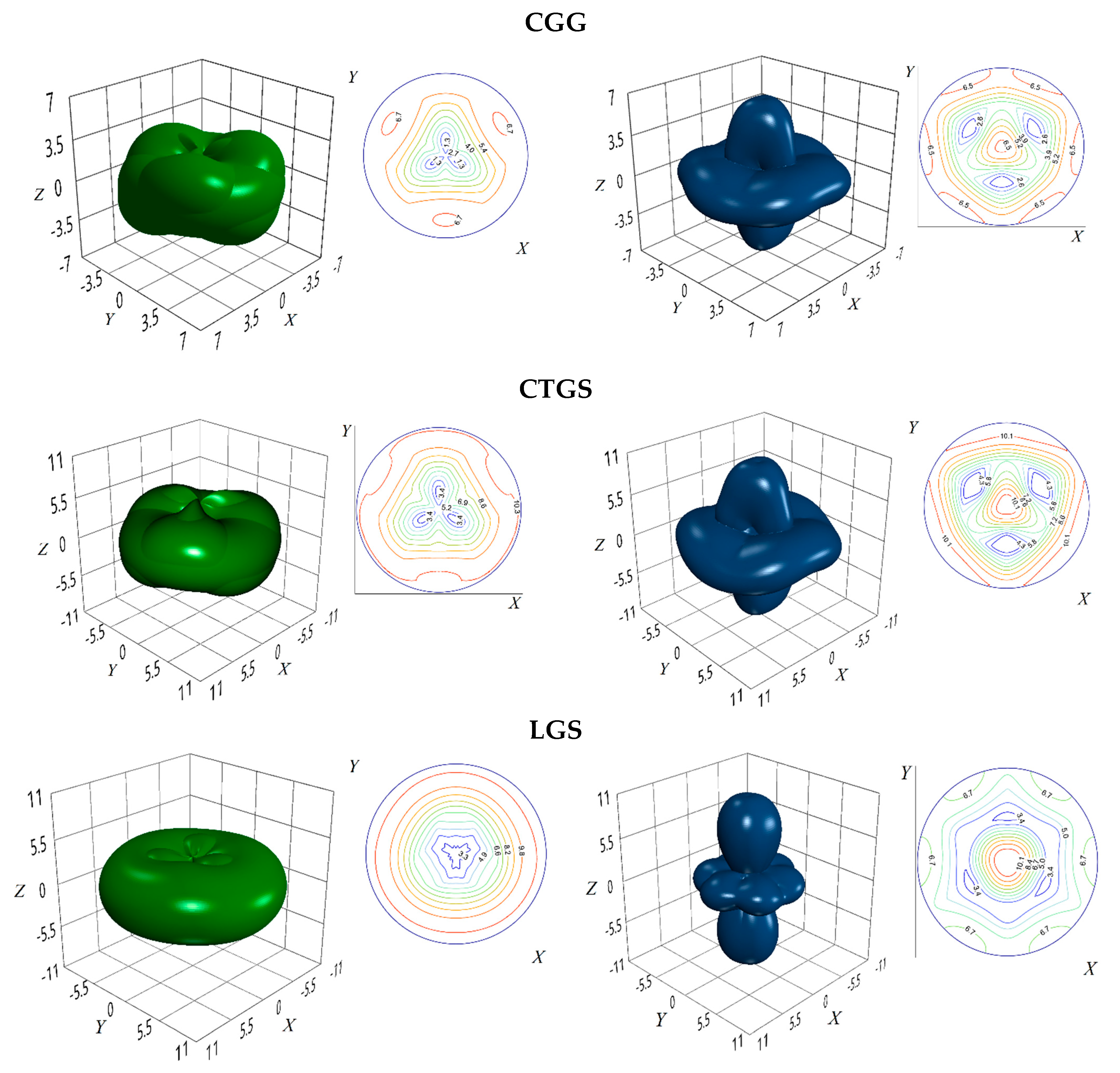
Figure 2.
The extreme surfaces of the wave vector (left) and mechanical stress (right) for BTGS crystal; the inserts show the the stereographic projections of the surfaces. The optimization is based on the data obtained by quantum-mechanical method; all values are in Br.
Figure 2.
The extreme surfaces of the wave vector (left) and mechanical stress (right) for BTGS crystal; the inserts show the the stereographic projections of the surfaces. The optimization is based on the data obtained by quantum-mechanical method; all values are in Br.
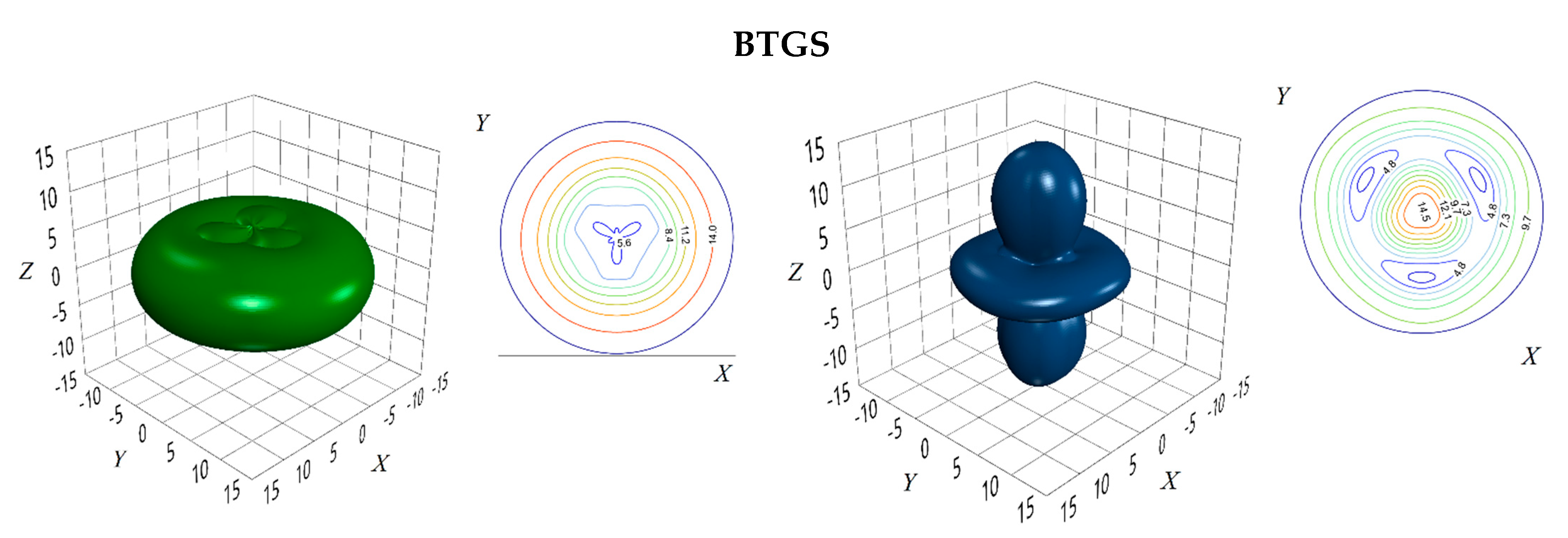

Table 1.
Elastic coefficients Сmk (109 N/m2) and Skm (10−12 m2/N) of BTGS crystals calculated by quantum mechanical technique (in comparison with literature data).
Table 1.
Elastic coefficients Сmk (109 N/m2) and Skm (10−12 m2/N) of BTGS crystals calculated by quantum mechanical technique (in comparison with literature data).
| Cmk | C11 | C12 | C13 | C33 | C14 | C44 |
|---|---|---|---|---|---|---|
| [15] | 166.0 | – | – | – | 6.3 | – |
| [46] ** | 160.5 | 77.4 | 85.5 | 170.9 | 3.03 | 63.3 |
| Our data | 164.9 | 72.0 | 83.6 | 192.0 | –6.38 | 66.3 |
| Skm | S11 | S12 | S13 | S33 | S14 | S44 |
| [46] * | 9.32 | –2.75 | –3.28 | 9.14 | 0.58 | 15.85 |
| Our data | 8.50 | –2.41 | –2.65 | 7.50 | 1.05 | 15.28 |
* The symbol (*) denotes experimentally obtained results; the symbol (**) denotes Сmk coefficients calculated based on the known relation Сmk = Skm−1 and experimentally determined Skm.
Table 2.
Piezo-optic πim (in units of 10−12 m2/N = Br = Brewster) and elasto-optic pik coeffi ci ents of BTGS crystals calculated by the quantum mechanical technique.
Table 2.
Piezo-optic πim (in units of 10−12 m2/N = Br = Brewster) and elasto-optic pik coeffi ci ents of BTGS crystals calculated by the quantum mechanical technique.
| π11 | π12 | π13 | π31 | π33 | π14 | π41 | π44 |
| –0.18 | 0.65 | 0.78 | 1.31 | –1.48 | 0.26 | 0.11 | –0.46 |
| p11 | p12 | p13 | p31 | p33 | p14 | p41 | p44 |
| 0.08 | 0.162 | 0.189 | 0.185 | –0.067 | 0.023 | 0.013 | –0.032 |
Table 3.
Maximal values and angle parameters for the extreme surfaces of POE in CGG, CTGS, LGS crystals; the optimization is based on the experimental data.
Table 3.
Maximal values and angle parameters for the extreme surfaces of POE in CGG, CTGS, LGS crystals; the optimization is based on the experimental data.
| Crystal | Light wave | Direction of uniaxial pressure applying | α, deg. |
The global maximum, Br |
||||
| θk, deg. | ϕk, deg. | θi, deg. | ϕi, deg. | θm, deg. | ϕm, deg. | |||
| CGG | 104 | 90 | 90(o), 14 (e) |
0(o), 90 (e) |
90 | 0 | 90 | 6.8 |
| CTGS | 101.3 | 90 | 90(o), 11.3 (e) |
0(o), 90 (e) |
90 | 0 | 90 | 10.4 |
| LGS | 91 | 90 | 90(o), 1 (e) |
0(o), 90 (e) |
−4.5 | 90 | 95.5 | 10.8 |
* Hereinafter θk, ϕk, θi, ϕi, θm, ϕm are the angles of spherical coordinate system for the directions of wave , light polarization and the direction of uniaxial pressure applying . This spherical coordinate system is connected with the crystal-physics Cartesian coordinate system X, Y, Z; the designations (o) and (e) correspond to the polarization directions of the ordinary and extraordinary beams respectively, α is the angle between and vectors.
Table 4.
Maximal values and angle parameters for the extreme surfaces of POE in CTGS, CNGS, BTGS crystals; the optimization is based on the data obtained by quantum-mechanical method.
Table 4.
Maximal values and angle parameters for the extreme surfaces of POE in CTGS, CNGS, BTGS crystals; the optimization is based on the data obtained by quantum-mechanical method.
| Crystal | Light wave | Direction of uniaxial pressure applying | α, deg. |
The global maximum, Br |
||||
| θk, deg. | ϕk, deg. | θi, deg. | ϕi, deg. | θm, deg. | ϕm, deg. | |||
| CTGS | 124 | 90 | 90(o), 35 (е) |
0(o), 90 (е) |
90 | 0 | 90 | 11.0 |
| 155 | 90 | 90(o), 65 (е) |
0(o), 90 (е) |
60 | 90 | 95 | 11.0 | |
| CNGS | 146.4 | 90 | 90(o), 56.4 (e) |
0(o), 90 (e) |
52 | 90 | 94.4 | 11.6 |
| BTGS | 90 | 90 | 90(o), 0 (e) |
0(o), 0 (e) |
2.4 | 90 | 87.6 | 14.5 |
| 90 | 90 | 90(o), 0 (е) |
0(o), 0 (е) |
90 | 0 | 90 | 14.5 | |
Disclaimer/Publisher’s Note: The statements, opinions and data contained in all publications are solely those of the individual author(s) and contributor(s) and not of MDPI and/or the editor(s). MDPI and/or the editor(s) disclaim responsibility for any injury to people or property resulting from any ideas, methods, instructions or products referred to in the content. |
© 2025 by the authors. Licensee MDPI, Basel, Switzerland. This article is an open access article distributed under the terms and conditions of the Creative Commons Attribution (CC BY) license (http://creativecommons.org/licenses/by/4.0/).
Copyright: This open access article is published under a Creative Commons CC BY 4.0 license, which permit the free download, distribution, and reuse, provided that the author and preprint are cited in any reuse.


