
Submitted:
05 June 2025
Posted:
09 June 2025
You are already at the latest version
Abstract
Autumn fern, Dryopteris erythrosora, is the most marketed temperate fern in the world. The rapid increase and spread of this recently naturalized fern in North America was determined and mapped using 76 herbarium specimen records and 2,553 Research Grade iNaturalist posts. In 2008, it was recorded from two states, but by 2025 it was found in 25 states in the eastern United States and in Ontario, Canada. At the end of 2017, there had been only 23 iNaturalist posts, but this grew to 511 by the end of 2020 and 2,553 by May 2025. The great increase in the number of iNaturalist posts is thought to be due to the real geographic spread and an actual increase in the abundance of the fern, as well as recognition of the fern by iNaturalists, and the increase in the number of iNaturalists. The spread and great increase are probably related to the high level of marketing, which introduces plants to the environment, and to biological characteristics of the fern, including apogamy and polyploidy and possibly natural enemy release, which allows it to flourish in new environments and to displace native plants. This study demonstrated citizen science’s (iNaturalist’s) great value to detect the naturalization and spread of alien plants.
Keywords:
escaped ornamental
; forests
; herbarium specimens
; iNaturalist
; natural areas
1. Introduction
Marketing of alien plants is widely recognized as the primary pathway for invasive plant introduction [1]. The length of time non-native horticultural plants have been marketed is related to the degree of naturalization and invasiveness of plants [2]). One of the most ubiquitous threats to biodiversity today is the conversion of native plant communities into plant assemblages dominated by non-native species [3].
McColloch-Jones et al. [4,5] reported that Dryopteris erythrosora (D.C. Eaton) Kuntze, known as autumn fern in English, is the most marketed of temperate zone ferns. Due to this high-level market intensity and its recent naturalization in some countries, these authors described it as one of four ferns of particular concern for its potential to spread further and invade. The first herbarium specimen collected in Georgia of autum fern was in 2012 [6]. In 2021, Pemberton [7] found autumn fern at 56/58 surveyed natural preserves and parks in the Atlanta/Gainesville region of Georgia. The fern was abundant at 28 of the 56 of these sites, often dominating ground level and creekside vegetation.
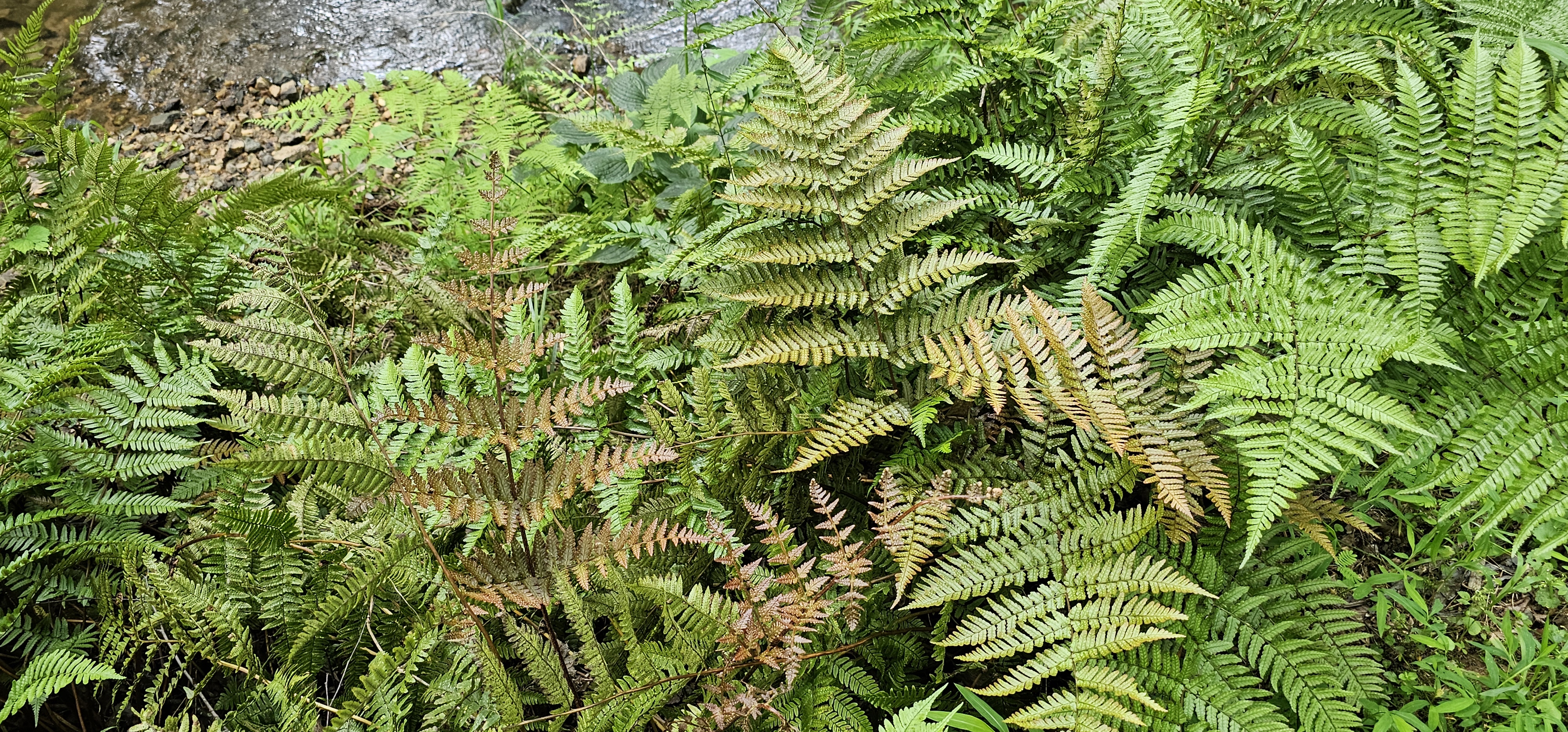
Autumn fern is native to Japan, China, South Korea, and Taiwan [8]. It is extensively planted in residential gardens, in the outdoor spaces of businesses and public parks, and in other settings. It is an appealing horticultural subject because it is fairly large, growing to 1 m tall, is evergreen, has attractive orange- or copper-colored new growth, is pest free, and requires little to no maintenance or irrigation [9] (Figure 1).
The fern’s astonishingly rapid spread and ability to dominate natural environments in the Atlanta region suggests that it has the potential to naturalize and spread elsewhere in North America. The goal of this study was to define the fern’s known naturalization and spread in North America. From the first detection of escaped autumn fern plants in Arkansas in 2007 [10], it spread to 11 states by 2017, and to 25 states and Ontario in Canada by May 2025. By the end of 2017 there were only 63 iNaturalist posts of the observer photographs of fern, which grew to 2,553 posts by early May 2025, in less than eight years. This rapid and enormous increase in the occurrence and the georgrahic spread of autumn is thought to be due the actual increase in autumn fern, as well as recognition of the fern by iNaturalists, and an increase in the number of iNaturalists. This study demonstrated citizen science’s (iNaturalist’s) great value to detect the naturalization and spread of alien plants.
The actual increase in the fern is probably related to the high level of marketing it experiences. This great increase in the fern, which is largely unrecognized, has unknown ecological significance. Autumn fern is mostly likely displacing native vegetation and probably the native biologial associates (insects, etc.) of these plants. Research needs to continue to monitor the fern’s rapid increase and spread. Future research should address autumn fern’s potential ecological impacts.
2. Results
Figure 1 shows six maps of autumn fern’s distribution from 2008 through 2023. In 2008 only two states, Arkansas and South Carolina, were known to have the fern based on herbarium collection records. In 2011 four states (Arkansas, Georgia, North Carolina, and South Carolina) had the fern based on herbarium records and the first iNaturalist post in Georgia in 2010. In 2014 the number of states with the fern doubled again to eight, based on herbarium records and five iNaturalist posts. By this date the fern occurred beyond the southeastern United States for the first time, having been found in New York. In 2017 the fern was found in 11 states, spreading to more states along the east coast, including Virginia, Maryland, Pennsylvania, and New Jersey. In 2020 the fern occurred in 18 states, spreading farther northeast to Delaware and Connecticut, west to Ohio in the Midwest, and more widely in the South to Florida, Louisiana, and Texas. In 2023 the fern was found in 23 states reaching farther northeast to Massachusetts, and to more midwestern states including Indiana, Illinois, and Michigan. During this period, the first iNaturalist post was made for the fern in Canada. This was by Owen Clarkin in Ottawa, Ontario on June 6, 2022. By May of 2025, autumn fern was found in 25 states, occurring in Kentucky and West Virginia, as well as an additional two sites in southern Ontario in Canada. In just 18 years the number of states with naturalized autumn fern plants increased from 2 to 25 and to Canada.
Figure 2.
Distribution and spread of autumn fern, Dryopteris erythrosora, at three-year intervals ending on December 31 of the year indicated, except for the 2023 period which ended Oct 1, 2013. Red spots are herbarium specimen collection locations. Black spots are iNaturalist post locations.
Figure 2.
Distribution and spread of autumn fern, Dryopteris erythrosora, at three-year intervals ending on December 31 of the year indicated, except for the 2023 period which ended Oct 1, 2013. Red spots are herbarium specimen collection locations. Black spots are iNaturalist post locations.
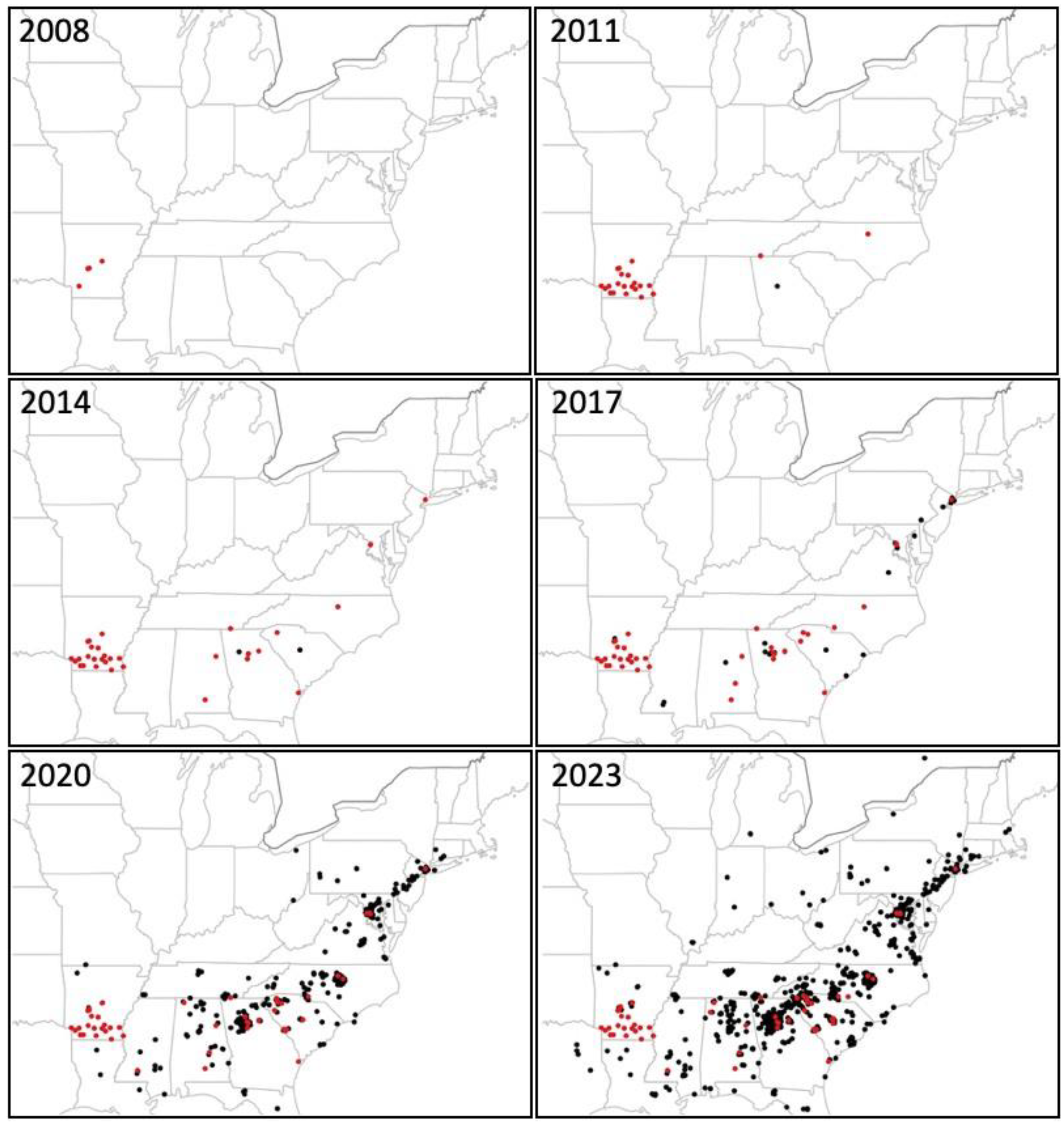
Figure 3.
Distribution of autumn fern, Dryopteris erythrosora, as of May 8, 2025. Red spots are herbarium specimen collection locations. Black spots are iNaturalist post locations.
Figure 3.
Distribution of autumn fern, Dryopteris erythrosora, as of May 8, 2025. Red spots are herbarium specimen collection locations. Black spots are iNaturalist post locations.
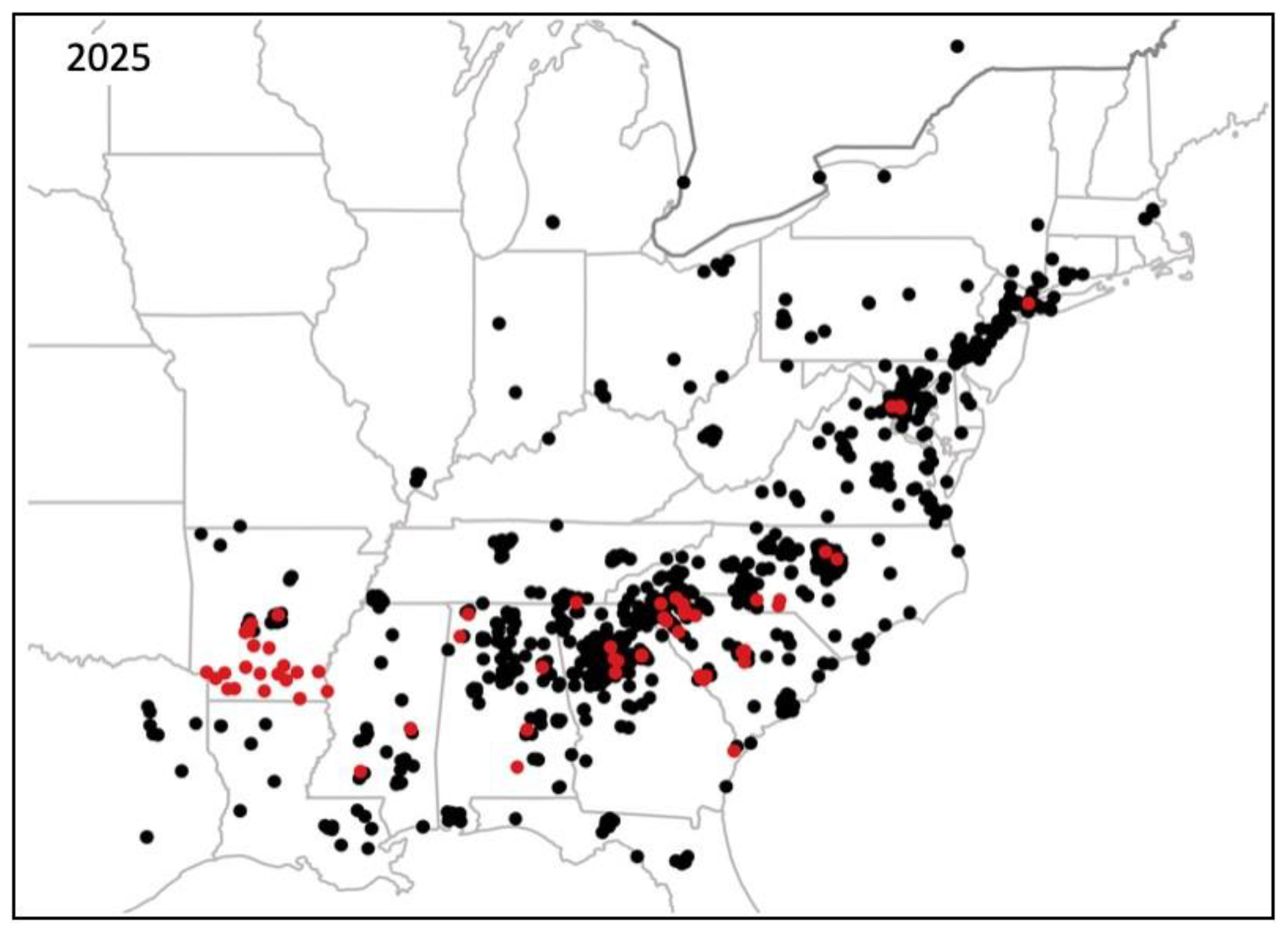
The number of occurrences of the fern also increased dramatically with time, and the type of records used also changed. iNaturalist was created in 2007 and had its first post of any type in 2008 [11]. The first post of autumn fern was in Georgia in 2010 by Francis Stiteler, which occurred two years earlier than the first herbarium specimen was collected by J. Allison in 2012. Prior to and through 2017, the majority of the occurrences of autumn fern mapped were based on herbarium records. There were only five iNaturalist posts for the fern by 2014. The cumulative number of iNaturalist posts rose to 23 by the end of 2017. Then the number of posts increased dramatically to 511 by the end of 2020, rocketing to 1,473 posts by October 2023, and 2,553 posts by May 2025. The fern’s geographic expansion reached 23 of the 25 states it occurs in 2025 by 2017, but the abundance of the fern, based on the number of iNaturalist posts for the period (23), was low. The fern’s abundance began to increase strongly during the 2020 period, when there were 488 new posts for the three-year period ending in 2020. The increase in abundance can be shown by calculating the number of new iNaturalist posts per month for each period. In the period ending at the end of 2017 there were 0.70 posts per month. By the end of 2020 there were 14.8 posts per month, which doubled to 29 posts per month by October 2023, which doubled again to 59 posts per month by May 2025. In contrast, the collection of herbarium specimens did not show a continuous or large increase with time, so the number of herbarium specimens does not appear to reflect the abundance of the fern. Peck and colleagues collected 24 specimens of autumn fern in Arkansas from 2007 through 2011. Following that there were from 2 to 6 specimens collected each year in the United States, mostly in the Southeast, through 2023. This huge increase in iNaturalist posts is due to a combination of factors.
3. Discussion
3.1. Study Methods Used
This huge increase in iNaturalist posts is due to a combination of factors. First, the actual increase in the occurrence and abundance of the fern, then its recognition by those posting on iNaturalist, followed by the apparent increase in the number of iNaturalists. Unlike many ferns, the autumn fern is easy for naturalists and other non-specialists to recognize because of the unique orange-copper coloration of its new growth. The new growth is most prominent during the spring flush, but new fronds with this distinctive coloration continue to be produced throughout the growing season. It is unknown whether the numbers of botanists increased during this time, but the collection of herbarium specimens seems to have been idiosyncratic. It was surprising that only one of the five largest herbaria, the US Natural History Museum, held specimens of the fern and it had only four specimens collected in North America. The use of herbarium specimens to look at the spread of invasive plants is biased by differing intensities of collections [12]. For instance, the numerous specimens collected in Arkansas, which we mapped, reflects the activity of pteridologist James Peck [13] and his colleagues as well as the occurrence of the plants. The apparent recency of autumn fern’s naturalization and spread is probably why so few herbarium specimens have been collected.
3.2. Prior Collections of Naturalized Autumn Fern
The first collections of autumn fern in North America were in Arkansas in 2007 by J. Peck (07-2041 in BRIT) and D. Crank (07-124 in BRIT) [10], and collections continued in subsequent years at many other localities in Arkansas [13]. Other early collections were made in Tennessee in 2009 by G. Morton (UCHT006063), North Carolina in 2010 (Rothfels 3959 in DUKE), in Virgina in 2011 (Simmons 3391 in AVCH), Alabama in 2012 (Spaulding 13,394 in NCU), and Georgia by J. Allison in 2012 (FLAS275780). Autumn fern has been recently collected in five counties in the Atlanta area, and in two counties in and near Athens, Georgia [6]. Umstead and Diggs [14] found large numbers of autumn ferns growing in a woodlot in Alpharetta in the northern suburbs of Atlanta in 2017. Dryopteris erythrosora is naturalizing in suburban woods and ravines in the Southeast and seems to be on its way to becoming an aggressive invasive [6,15].
3.3. Prior Research on Autumn Fern’s Naturalization
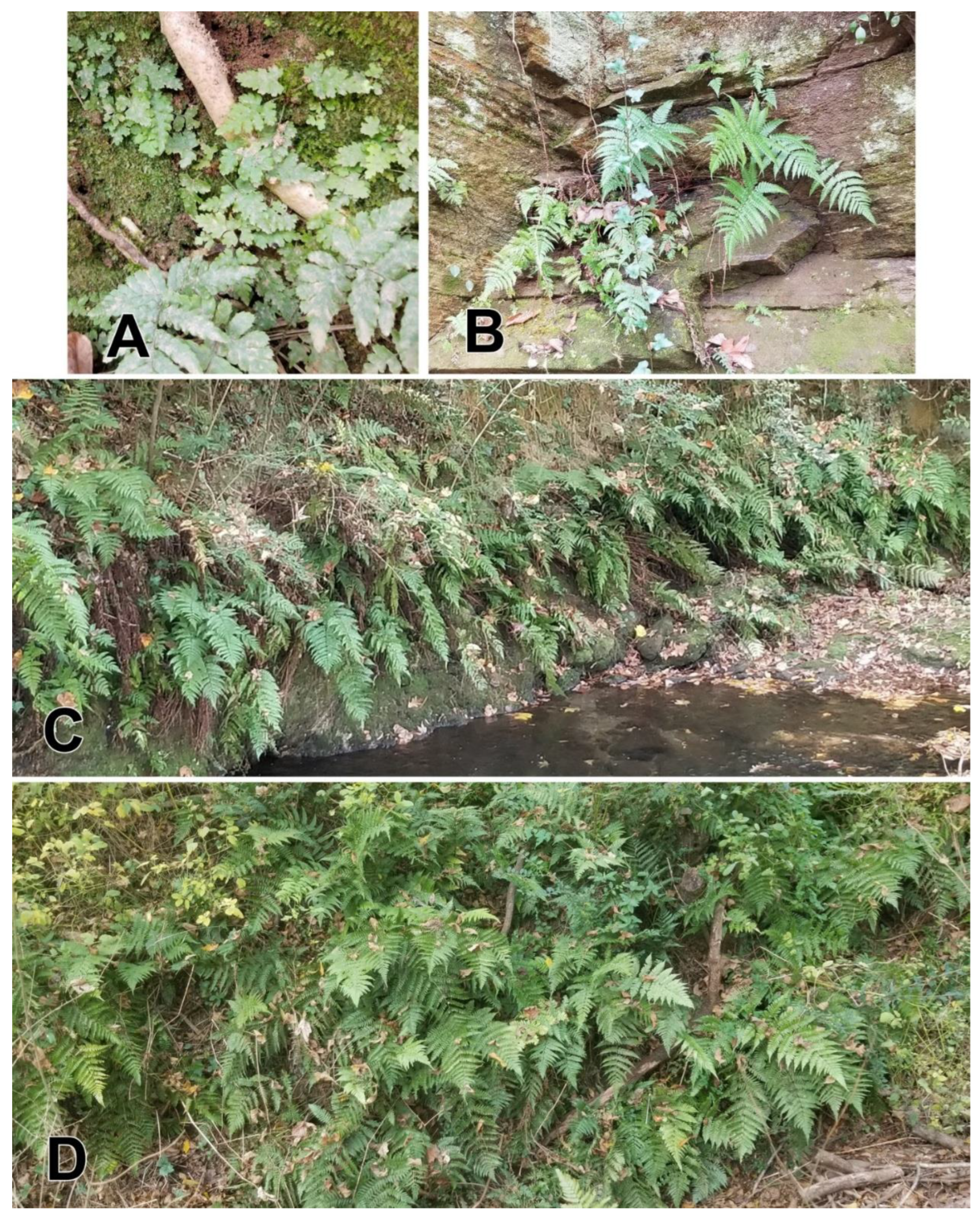
McColloch-Jones et al. [4,5] reported that Dryopteris erythrosora (D.C. Eaton) Kuntze, known as autumn fern in English, is the most marketed of temperate zone ferns as defined by the number of commercial nurseries selling the fern. Due to this high-level market intensity and its recent naturalization in some countries, these authors described it as one of four ferns of particular concern for its potential to spread further and invade. In 2021, Pemberton conducted surveys for plants of McColloch-Jones et al.’s [4,5] four ferns of most concern as potential invaders in the Atlanta/Gainesville region in northern Georgia (7). In addition to autumn fern these are Japanese holly fern, Cyrtomium falcatum (L.f.) K. Presl, blackwood fern, Dryopteris cycadina (Franch. & Sav.) C. Chr.), and Japanese or Korean tassel fern Polystichum polyblepharon (Roem. ex Kunze) C. Presl. Fifty-eight forest sites in nature preserves and natural situations in parks in eight different counties were surveyed for these ferns. Autumn fern was found at 56 of the 58 sites in seven of the eight counties surveyed. A few months after the survey, autumn fern was found at the 57th site in the eighth county. At half of the sites (28/57) where the fern was found, it was abundant. Autumn fern was also often the most abundant fern at many of these sites and dominated some environments (Figure 4).
3.4. Market Influence on the Naturalization
Although the fern’s increasing distribution is described as spread, the occurrence of this fern in an increasing number of states probably does not represent actual spread from the Southeast, where it first naturalized. This is because the intense marketing of the fern throughout eastern North America continually created plantings of new fertile plants that could promote local naturalization and spread. Given the widespread cultivation of autumn fern for many years [9,16], it probably was naturalized in other states but not recognized. The market intensity of autumn fern has been and is high. The Plant Locator Western Region [17] listed 31 specialty fern nurseries selling autumn fern in 2004. An online google search of outlets selling the fern in November of 2023 found more than 70. These included both in-store and online markets. Visits to the biggest brick and mortar stores such as Walmart, Lowes, and Home Depot in the Atlanta area found large numbers of autumn fern plants for sale. Attempts to obtain sales information on autumn fern from important national growers of temperate fern such as Costa Farms and Monrovia, as well as Pikes Nurseries, a prominent chain of Atlanta regional nurseries, were not successful.
Figure 3 shows photos of the fern in situations where it has naturalized in the Atlanta region. Figure 3A shows the many sporelings that commonly grow from gametophytes on the clay banks of creeks. Figure 3B shows plants growing on nearly vertical rock walls, 3C shows infestations of the fern growing along a creek, and 3D shows a hillside in a mesic hardwood forest slope where plants have proliferated to the degree that other vegetation is often excluded.
3.5. Biological Influences on the Naturalization
In addition to the intense marketing that introduces large numbers of ferns to the environment, other factors probably influence the naturalization of autumn fern. Dryopteris erythrosora is autogamous [18], which means that it does not have a sexual stage. A single spore can develop into a plant, and this plant, into a population, even in environments without free water. Apogamy also results in more rapid growth [9]. The spores of autumn fern are viable for one year [19]. It is a polyploid [20], a feature that appears to be related to greater naturalization of plants. The abundance and rapid spread of D. erythrosora may be due in part to the fern’s escape from its natural enemies, the “enemy release hypothesis” [21]. In its native Japan, the fern is heavily fed upon by stathmopodid moths (micro-Lepidoptera). Sawamura, Kawakita, and Kato [22] found that up to 50 larvae of these moths were found on a single leaf, and 70% of the sporangia were commonly destroyed by the feeding of the larvae.
3.6. Potential to Spread
Autumn fern is considered hardy in USDA zones 5-6, the cold temperate zone [23], enabling it to live more readily in the northeastern and central midwestern regions of the United States, where it is now being reported. This should allow it to naturalize farther north than where it now occurs in southern Ontario in Canada. There are three iNaturalist posts for the fern in southern Ontario: Owen Clarkin in Ottawa on June 6, 2022 (observations/104501853); find_report in Point Edward on 29 July 2024 (observations/269363058); and kieran2024 in Niagara Falls on 21 August 2024 (/observations/237371530). The autumn fern has also naturalized in Belgium and France [24], and there are iNaturalist posts for the Netherlands, Slovenia, and the United Kingdom (iNaturalist.com, accessed 10 May 2025).
3.7. Significance of this Naturalization
The significance of this naturalization of the autumn fern is unclear. Its ecological impacts are unknown but the fern clearly displaces native vegetation where it is abundant (Figure 4D and Figure 3E) and probably the native biota (insects, etc) associated with these plants. In the more urban preserves and parks, the forest understories and creek banks where it grows have already been significantly altered by the presence of other non-native plants such as English ivy (Hedera helix L.), Liriope spp., and another common alien fern, Macrothelypteris torresiana (Gaudich.) Ching. Unfortunately, the history of intensive cotton cultivation in the Atlanta region and other parts of Georgia and the South caused the significant loss of the native herbaceous flora and their associated biota. But a comparison of properties in Pennsylvania with native tree canopies, but with and without native shrubs and native plant ground cover, found that those with native shrubs and native ground cover supported significantly more caterpillars and caterpillar species and significantly greater bird abundance, diversity, species richness, biomass, and breeding pairs of native species [25].
Except for Christmas fern, Polystichum acrostichoides (Michx.) Schott, and to a lesser degree ebony spleenwort, Asplenium platyneuron (L.) Oakes ex D.C. Eaton, there are few native ferns growing on these rocky creeks and creek banks in the Atlanta Georgia region, the area with the most dense autumn fern populations. Perhaps these environments represent unoccupied niches for autumn fern [26]. For those of us who recognize and appreciate the difference between seeing alien plants in nature preserves, instead of native ones, the presence of autumn fern is meaningful and undesirable. The uniqueness and integrity of native environments are among the most defining important qualities that places have. But for less knowledgeable visitors, the differences between natural environments dominated by autumn fern and those without it may not be apparent, but human awareness is probably not the most meaningful criterion.
4. Materials and Methods
Two kinds of data were used to determine the distribution and abundance of the autumn fern in North America: herbarium collection records of wild-collected specimens and Research Grade iNaturalist posts of the fern (https://iNaturalist.com). Note that iNaturalist posts are supposed to be of organisms occurring naturally as opposed to being in cultivation. The primary source of collection records was the Southeast Regional Network of Expertise and Collections (SERNEC) (https://sernecportal.org/portal/collections/index.php, May 10, 2025), a consortium of 233 herbaria in the southeastern United States. While many of these herbaria focus on the Southeast, their collections are worldwide. In addition, herbarium collection data of the fern in the five largest herbaria in North America, including the US National Museum of Natural History Herbarium (US), the New York Botanical Garden (NY), the Missouri Botanical Garden (MO), Harvard University’s Grey Herbarium (GH), and the Field Museum of Natural History in Chicago (F) were evaluated on May 10, 2025. The iNaturalist posts of autumn fern used were from the first post in 2010 until the last date of data usage on May 8, 2025. The herbaria of SERNEC and the US National Museum had 88 specimens of D. erythrosora collected from North America. The only herbarium of the five largest herbaria in North America to hold collections of the fern from North America was the US National Museum of Natural Historywhich had four specimens of the fern. All four were duplicates of collections already accounted for, so a total of 76 herbarium localities and 2,553 Research Grade iNaturalist posts were mapped. These collection records and iNaturalist posts were used to create a series of six maps to show the occurrence and distribution of the fern in different time periods, mostly at three-year intervals from 2008, shortly after it was discovered in Arkansas, to October 1, 2023. A seventh map was created to display the currently known distribution of autumn fern as of May 16, 2025.
5. Conclusions
The naturalization and invasion of ornamental ferns has been little studied or documented except for research on the extremely invasive tropical Salvinia molesta D.Mitch. and Lygodium micropyhllum (Cav.) R Br. [27,28], and the efforts to document the occurrence of alien escaped ferns in Arkansas [13]. Recently this has begun to change with research looking at the relationship between naturalization and market intensity [4,5], and the efforts to document the escape and spread of ornamental ferns in Georgia [6,7,29,30]. The current study’s documentation of the rapid spread and great increase of the autumn fern, the most marketed temperate fern, adds to this effort. Hopefully this study will promote research to continue to monitor autumn fern’s expansion and its potential ecological impacts.
Author Contributions
Conceptualization, R.P.; methodology, R.P.; software, E.E.; formal analysis, E.E.; investigation, R.P. and E.E.; resources, R.P.; data curation, E.E.; writing—original draft preparation, R.P.; writing—review and editing, R.P. All authors have read and agreed to the published version of the manuscript.
Funding
This research received no external funding.
Data Availability Statement
The data used from the mapping are herbarium specimens of Dryopteris erythrosora accessible through the SERNEC portal (https://sernecportal.org/portal/collections/index.php). The iNaturalist posts used for the mapping can retrieved by searching Dryopteris erythrosora in the United States and Canada with an end date of 10 May 2025 (https://iNaturalist.com).
Acknowledgments
We wish to thank the collectors of the herbarium specimens and the herbaria where they reside and the Southeast Regional Network of Expertise and Collections which enables online access to the specimens. We also thank the numerous iNaturalists for their curiosity and posts, and the iNaturalist curators; Joanne Pemberton for making the photographic plate, Robert Wyatt for reviewing an earlier version of the manuscript, and the reviewers and editors that helped improve the manuscript and to bring it to press.
Conflicts of Interest
The author declares no conflicts of interest.
References
- Beaury, E.M.; Patrick, M.; Bradley, B.A. Invaders for sale: The ongoing spread of invasive species by the plant trade industry. Front. Ecol. Environ. 2021, 19, 550–556. [Google Scholar] [CrossRef]
- Pemberton, R. W.; Liu, H. Market time predicts naturalization. Ecology 2008, 69, 69–80. [Google Scholar]
- Johnson, M.D. Measuring habitat quality: A review. Condor 2007, 109, 489–504. [Google Scholar] [CrossRef]
- McCulloch-Jones, E.; Kraaij, T.; Crouch, N.; Fritz, H. The effect of horticultural trade on establishment success in alien terrestrial true ferns (Polypodiophyta). Biol. Invasions 2021, 23, 358–596. [Google Scholar] [CrossRef]
- McCulloch-Jones, E. , Kraaij, T., Couch, N., Faulkner, H.K. Assessing the invasion risk of traded alien ferns using species distribution models. NeoBiota 2023, 87, 161–189. [Google Scholar] [CrossRef]
- Wyatt, R. The spread of five nonnative ferns in Georgia. Amer. Fern J. 2020, 110, 95–111. [Google Scholar] [CrossRef]
- Pemberton, R.W. Naturalization and spread of four of the most marketed ornamental ferns. Amer. Fern J. in press.
- Plants of the World Online. Available online: https://powo.science.kew.org/ (accessed on 7 May 2025).
- Mickel, J. Ferns for American Gardens; Macmillan Publishing Co: New York, 1994. [Google Scholar]
- Simpson, J.; Crank, D.; Witsell, C.T.; Peck, J.H. Two exotic ferns, Dryopteris erythrosora and Marsilea quadrifolia, newly naturalized in Arkansas. Amer. Fern J. 2008, 98, 111–112. [Google Scholar] [CrossRef]
- iNaturalist. Available online: https://inaturalist.com/ (accessed on 1 May 2025).
- Delisle, F.; Lavoie, C.; Jean, M.; Lachance, D. Reconstructing the spread of invasive plants: Taking into account biases associated with herbarium specimens. J. Biogeogr. 2003, 30, 1033–1042. [Google Scholar] [CrossRef]
- Peck, J.H. History of Arkansas pteridophyte studies with a new annotated checklist and floristic analysis. Phytoneuron 2011, 38, 1–39. [Google Scholar]
- Umstead, H.; Diggs, J.T. An Ornamental plant found spreading aggressively: Potential invasiveness of Dryopteris erythrosora (Dryopteridaceae) in North America. Amer. Fern J. 2018, 108, 176–179. [Google Scholar] [CrossRef]
- Weakley, A.S.; Southeastern Flora Team. Flora of the Southeastern United States. 2023. Available online: https://fsus.ncbg.unc.edu/img/flora/FSUS_2023.pdf (accessed on 12 October 2023).
- Olsen, S. Pacific treasures for the temperate fern garden. Bull. Amer. Rock Garden Soc. 1994, 52, 1771–84. [Google Scholar]
- Hill, S.; Narizny, S. The Plant Locator: Western Region; Timber Press: Portland and Cambridge, 2004. [Google Scholar]
- Hoshizaki, B.; Wilson, K.A. The cultivated species of the fern genus Dryopteris in the United States. Amer. Fern J. 1999, 89, 19–8. [Google Scholar] [CrossRef]
- Rawlins, K.A.; Winston, R.L.; Bargeron, C.T.; Moorhead, D.J.; Carroll, R. New Invaders of the Southeast field guide, US Department of Agriculture Forest Health FHTET-2017-05.
- Guo, Q.; Kato, M.; Ricklefs, R. Life history, diversity and distribution: A study of Japanese pteridophytes. Ecography 2003, 26, 129–138. [Google Scholar] [CrossRef]
- Liu, H.; Stiling, P. Testing the enemy release hypothesis: A review and meta-analysis. Biol. Invasions 2006, 8, 1535–1545. [Google Scholar] [CrossRef]
- Sawamura, M.; A. Kawakita, A.; Kalo, M. Fern–spore-feeder interaction in temperate forests in Japan: Sporing phenology and spore-feeding insect community. Amer. J. Botany 2009, 96, 594–604. [Google Scholar] [CrossRef]
- Hoshizaki, B.; Moran, R.C. Fern Growers Manual; Timber Press: Portland, Oregon, USA, 2001. [Google Scholar]
- Randal, R.P. A Global Compendium of Weeds, 3rd ed.; R.G. & F.J. Richardson Publisher: Perth, Western Australia, 2017. [Google Scholar]
- Burghardt, K.T.; Tallamy, D.W.; Shriver, G. Impact of native plants on bird and butterfly biodiversity in suburban landscapes. Conserv. Biol. 2009, 23, 219–224. [Google Scholar] [CrossRef]
- Petersen, R.L. Towards an appreciation of fern edaphic niche requirements. Proc. Royal Soc. Edinburgh, Section B: Biol. Sci. 1985, 86, 93–103. [Google Scholar] [CrossRef]
- Room, P.M.; Harley, K.L.S.; Forno, I.W.; Sands, D.P.A. Successful biological control of the floating weed Salvinia. Nature 1981, 294, 78–80. [Google Scholar] [CrossRef]
- Pemberton, R.W.; Ferriter, A.P. Old World climbing fern, Lygodium microphyllum, a dangerous weed in Florida. Amer. Fern J. 1998, 84, 165–175. [Google Scholar] [CrossRef]
- Wyatt, R.; Wyatt, G.E. Lygodium japonicum (Thunberg) Swartz in the Piedmont of Georgia. Amer. Fern J. 2013, 103, 188–190. [Google Scholar] [CrossRef]
- Wyatt, R. , Harris, N. More on the spread of nonnative ferns in Georgia and the Southeastern United States. Amer. Fern J. 2022, 112, 36–49. [Google Scholar] [CrossRef]
Figure 1.
Garden planting of autumn ferns, Dryopteris erythrosora, showing their appealing upright growth and the coppery-orange coloration of the new leaves.
Figure 1.
Garden planting of autumn ferns, Dryopteris erythrosora, showing their appealing upright growth and the coppery-orange coloration of the new leaves.
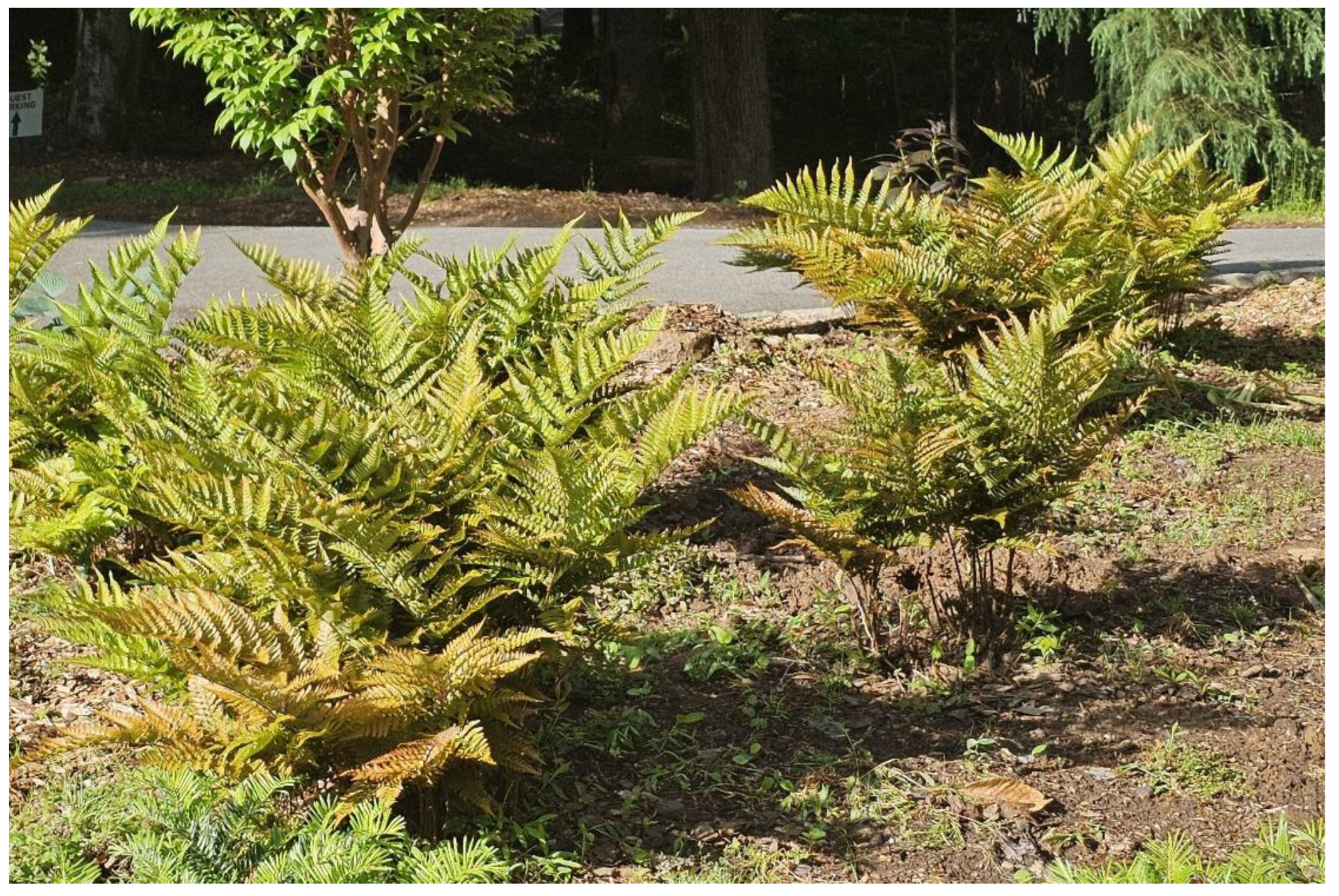
Figure 4.
Naturalized autumn fern, Dryopteris erythrosora. A. Sporelings on a clay creekbank in an Atlanta Georgia nature preserve. B. Plants growing on a cliff face in Gainesville Georgia park. C. Plants lining a creek bank in a Decatur Georgia park. D. Plants covering a mesic forest hillside in an Atlanta nature preserve.
Figure 4.
Naturalized autumn fern, Dryopteris erythrosora. A. Sporelings on a clay creekbank in an Atlanta Georgia nature preserve. B. Plants growing on a cliff face in Gainesville Georgia park. C. Plants lining a creek bank in a Decatur Georgia park. D. Plants covering a mesic forest hillside in an Atlanta nature preserve.
Disclaimer/Publisher’s Note: The statements, opinions and data contained in all publications are solely those of the individual author(s) and contributor(s) and not of MDPI and/or the editor(s). MDPI and/or the editor(s) disclaim responsibility for any injury to people or property resulting from any ideas, methods, instructions or products referred to in the content. |
© 2025 by the authors. Licensee MDPI, Basel, Switzerland. This article is an open access article distributed under the terms and conditions of the Creative Commons Attribution (CC BY) license (http://creativecommons.org/licenses/by/4.0/).
Copyright: This open access article is published under a Creative Commons CC BY 4.0 license, which permit the free download, distribution, and reuse, provided that the author and preprint are cited in any reuse.


