

Submitted:
11 March 2026
Posted:
12 March 2026
Read the latest preprint version here
Abstract
A classical fluid splitter produces the same patterns of energy redistribution as a Stern-Gerlach quantum device, with rotationally invariant coefficients of correlation between molecular paths. Alternative settings obey a cosine squared rule, leading to Tsirelson-type Bell violations with outcome independence. This is a confirmation of the Correspondence Principle of quantum mechanics, where individual quanta express system-level properties according to Born’s Rule. Kochen-Specker contextuality and Bell Locality are not contradicted by this result, but their interpretation is in question. The formal definition of “Local Realism” is limited to intrinsic particle properties. In contrast, quantum-like correlations require the acknowledgement of ensemble effects on dynamically inseparable propagating entities, even when they appear to operate one at a time.
Keywords:
quantum correlations
; energy redistribution
; Kochen-Specker contextuality
; Bell locality
; entanglement
; observer effect
1. Introduction
Quantum behavior and the measurement effect are often described as synonymous with each other. It seems impossible to explain fundamental properties of matter with “read-only” classical measurements. Yet there is a gap between theory and interpretation in this case. Quantum operators are described as “measurements” when they only apply to physical transformations before detection. No-go theorems rule out classical models, but only under the assumption of joint measurability for incompatible observables. The closer one looks at this problem, the harder it is to justify established narratives [1,2,3,4,5,6,7,8,9,10,11,12,13,14,15]. Accordingly, it shouldn’t be surprising that quantum monogamy was recently explained with predetermined events [16]. In the same vein, a classical toy model for quantum correlations is presented below. The novel insight is that classical objects may act as carriers of system-level properties. The inspiration for this approach is that quantum events are governed by Born’s rule. They do not express individual qualities perturbed by measurement. Instead, they express the macroscopic features of quantum wavefunctions in their distributions. In short, there is no need for observer effects to explain quantum behavior.
At first sight, classical particles do not behave like quantum entities. Billiard balls do not produce interference fringes, especially when propagating one at a time. Yet quantum statistics are predicted with wave-functions, and quantum systems correspond to wave-like classical systems. Hence, the relevant process to compare is not the distribution of properties for stand-alone classical objects, but rather the distribution of properties for dynamically inseparable entities. For example, water molecules do not display ballistic trajectories when flowing through a pipe. Instead, the pattern of motion for any one molecule is inseparable from the motion of other co-propagating molecules, especially for the interaction with a fluid splitter. Do we still get a discrepancy with quantum predictions after this correction? As it turns out, we do not. Instead, we get the same rotationally invariant coefficients of correlation that are expected for Stern-Gerlach electron beam splitters. Of course, Bell’s Theorem is mathematically correct. Jointly determined classical properties are statistically separable within hard limits. The nuance is that system-level transformations can produce “forking paths” between common inputs and disjoint outcomes. If predetermined properties are mutually exclusive, due to intervening local factors, then pairwise joint probabilities are no longer constrained by Bell-type inequalities. This can be explained as an extension of Kochen-Specker contextuality to correlated systems. Though, even here there is a gap between facts and conjectures, as will be shown in Section 5 below.
The behavior of electron beams in Stern-Gerlach spin analyzers is essentially a process of binary energy redistribution. According to the Correspondence Principle, large numbers of electrons should produce the same patterns as seen in binary energy redistribution for classical systems. In Section 2 below, this idea is explored by reviewing billiard ball collisions with non-linear rules of energy redistribution. Then, for a full analogy with rotationally invariant quantum behavior, Section 3 discusses a fluid splitter mechanism, subjected to alternative flow transformations. Tsirelson-type Bell violations [17] emerge from nonlinear relationships between incompatible outputs. Mutually exclusive local events cannot influence each other. When two copies of such a system are used, no interaction between them is required. Alice and Bob can be separated by arbitrary distances and enjoy perfect freedom of choice in their observations. In short, quantum correlations are not metaphysical. The real problem is the persistence of Copenhagen-style interpretations that misrepresent quantum theory and even the nature of classical interactions (Section 4 and Section 5). The part that does separate quantum behavior from classical behavior is the display of system-level effects in the distribution of apparently isolated events. This resonates with Feynman’s suggestion that single-quantum superposition, as seen in the double-slit experiment, might be “the only mystery” of quantum mechanics [18].
2. Binary Energy Redistribution with Billiard Balls
Consider a billiard ball, moving on a flat surface towards another physically identical ball (as shown in Figure 1a). Numerous patterns of glancing collision are possible, with kinetic energy being split 50-50, 0-100, or any other fraction. This does not show that a billiard ball is moving in every possible direction at the same time. Vector decomposition only shows what can happen in various alternative collision scenarios, with binary patterns of energy redistribution. If a ball is in motion, relative to the table surface, it has a well-defined state of momentum (p=mv) and a corresponding amount of kinetic energy (Ek=mv2/2). In the event of an elastic collision, a fraction of momentum is transferred to the second ball. This can be predicted with vector decomposition, by taking into the account the cosine of the angle between the input and output velocity vectors. However, kinetic energy is proportional to the squared scalar magnitude of the velocity vector. This is the same “Malus Law” that we see in the interaction between a classical laser beam and a polarizing beam splitter [19]:
where “I” corresponds to irradiance for optical projections, subscripts “T”, “R”, and “in” differentiate between “transmitted”, “reflected” and “input” projections respectively, while “θ” is the angle between input and transmitted planes of optical polarization. Accordingly, an ideal glancing collision between these balls entails a 50-50 pattern of energy redistribution along the diagonal axis (Figure 1a). The key feature of this rule is that binary energy redistribution is not linear. Mutually exclusive patterns (governed by the cosine squared rule) are physically and numerically incompatible. For example, the two billiard balls can also collide at 22.5˚. This means that 85% of the input energy will be transferred from the first ball to the second (cos222.5), rather than 75% corresponding to the midpoint between 100% and 50%. Moreover, the second ball can also experience a 22.5˚ collision with a third ball, resulting in a final output direction of 45˚, relative to the direction of motion of the first ball (Figure 1b). This means that two collisions with a total deflection of 45˚ can transfer 72% of input energy, even though a single collision at 45˚can only transfer 50%. By implication, mutually exclusive collision geometries cannot be jointly realized or distributed in a single run. This implies that no set of pre-existing “hidden” vectors can exist that are simultaneously real for all possible collision angles, in contrast to the strongest forms of Local Realism that take them for granted.
Classical particles and classical waves can display the same non-linear patterns of energy redistribution. However, these transformations correspond to system-level effects, with an interesting caveat. In the case of billiard ball collisions, a single ball represents a full macroscopic system. It can transfer kinetic energy according to non-linear rules, but we cannot meaningfully “quantize” the motion of a billiard ball into detectable increments. In contrast, optical projections have a natural correspondence between macroscopic energy redistribution and microscopic single-event distributions. After all, wave energy is proportional to the amplitude squared, which is also proportional to the number of quanta in the same projection:
At the quantum level, we use system-level analysis, captured by wave-functions, to predict incompatible distributions of detection events with Born’s rule:
Hence, there is a natural way to convert system-level energy redistribution into expectation values for various patterns of pairwise coincidence. For a CHSH-type Bell experiment [20], the task is simply to identify a rotationally invariant pattern of energy redistribution, which can be achieved with depolarized optical projections without nonlocal effects. Unfortunately, this phenomenon is already associated with non-physical interpretations that hinder analysis. Instead, a more transparent classical analog arises in fluid dynamics, where molecular trajectories are inseparable yet locally governed, as shown in the next section.
3. Binary Energy Redistribution with Classical Fluids
Consider a flexible fluid-splitter, as shown in Figure 2a. A vertical pipe feeds a generic fluid (such as water) into a flexible T-junction with two output pipes leading in opposite directions. The input pipe is rigid in the z-direction, while the output axis can be rotated at will in the x-y plane. Pressurized fluid (e.g., water) enters the system and is deterministically split 50-50 between the “plus” and “minus” output channels for any chosen reference orientation A. This leads to an important counterfactual question: for fluid molecules that emerge in the “plus” channel at orientation A, what fraction would have emerged in the same “plus” channel, had the splitter been rotated to orientation B, separated by angle θ from A, while replaying the identical upstream dynamics?
To answer this question, we need to assume that fluid splitting is a fundamentally deterministic process. It is not an accident that the molecules from the “plus” output are found in this channel. Ergo, if the same exact process were to be replayed again, the same exact molecules of fluid would be found in the same output. That being said, we are not dealing with independent ballistic particle trajectories. The motion of fluid molecules is inseparable from the motion of the fluid as a whole. The question is: how does the fluid, as a macroscopic system, interact with the walls of the fluid splitter?
A plausible assumption in this scenario is that a reference output direction A+ is associated with a conserved amount of kinetic energy carried by the fluid. Furthermore, kinetic energy projection follows vector addition rules analogous to spin-1/2 on the Bloch sphere, resulting in a cos²(θ/2) pattern. Hence, transverse redistribution into some new orientation B+ is governed by:
In other words, if a given sliver of fluid has a fixed amount of kinetic energy in the A+ direction, then it can only impart a fraction in the B+ direction, determined by the cosine squared of half the angle between the two orientations. The other amount of kinetic energy, to maintain rotational invariance and the 50% marginal in every direction, must come from the opposite (A-) direction. Though, notice that the magnitude of fluid velocity does not change under redirection in the fluid splitter. The fluid pressure inside the pipes remains constant. Therefore, the cosine squared law must be physically satisfied by a non-linear redistribution of fluid mass between alternative directions. The mass of the fluid in any new direction B+ must be composed of cosine-squared of half the angle from the mass that was emitted in the A+ direction, plus a supplementary amount from the A- direction:
Assuming uniform fluid density, it follows that same-channel correlations between molecular output paths are also non-linear:
To clarify, “correlation” is defined here as agreement on the channel choice (i.e., propensity to emerge through the “plus” output in this case). Intuitively speaking, the proportion of fluid molecules that can also emerge as a mass in the “plus” channel for direction B, given that they emerged in the “plus” channel for direction A, is determined by the cosine squared of half the angle between the two directions. This translates into corresponding conditional probabilities at the level of single molecules. For example, if the output axis B was shifted by 45˚ relative to the y-axis (A), then 85% of the water molecules would have been the same in the “plus” channel (cos245˚), while 15% would have traded places with the “minus” channel. On the one hand, we have a system-level effect that is observable as fluid motion. On the other hand, we have molecular behavior expressing the non-linear features of this macroscopic process.
The offshoot of this description is that we have rotationally invariant correlations between any two output settings for the fluid-splitter. It does not matter which axis is chosen for reference and which transformation is added for correlation analysis. One way or another, 50% of the input fluid would end up in the “plus” channel. For any other output orientation, the proportion of the molecules that would have been in the same channel (and the supplementary proportion that trade places) are determined by the cosine squared of half the angle between the two settings. This means that we can choose several adjacent orientations, separated by 45˚ angles, to maximize the effect of incompatible transformation on the output patterns of correlation. To keep the analogy with a CHSH quantum experiment [20], we can label these directions A1, B1, A2 and B2, as shown in Figure 2b. Just as described above, we can ask: what proportion of molecules would have been correlated for any of the possible pairwise combinations? The answer is that three combinations are separated by 45˚, with a final coefficient of correlation of:
.
In contrast, the last combination spans an angle of 135˚. Therefore,
.
We can plug these four coefficients of correlation into the CHSH expression for a Bell test with four variables [20]:
as follows:
.
As a result, we reproduced the Tsirelson bound for a CHSH protocol, exactly as predicted in quantum mechanics for appropriate entangled states [17]. Yet we derived this behavior for alternative virtual orientations of a single classical fluid splitter. This was done deliberately, to clarify the local nature of these correlations. Alternative transformations do not correspond to consecutive measurements. Therefore, they cannot influence each other. Rather, correlated Alice-Bob behavior in real experiments serves as a physical proxy for counterfactual reasoning: it allows us to “observe” the redistribution of energy across alternative transformations that are logically linked but physically disjoint. It should also be noted that the fluid model’s correlations are positive for small angles (approaching +1 as θ → 0), analogous to parallel spin projections in a quantum triplet state where E(θ) ≈ cos θ. In contrast, many Bell tests employ anti-correlated singlet states (E(θ) ≈ −cos θ) due to practical generation via angular momentum conservation. Still, the sign of the zero-angle correlation is not the origin of Bell violations. Instead, the fundamental driver is Kochen-Specker-style incompatibility, which manifests as counterfactual differences in single-system transformations.
To implement this analysis in a Bell-like scenario, two independent computers can replay identical fluid simulations up to the flexible neck of the splitter. Subsequently, one computer named “Alice” can choose between two output settings (such as 0˚or 90˚, relative to the y-axis), as shown in Figure 2b. Another computer named “Bob” can choose between two other alternative settings (such 45˚ and 135˚, relative to the y-axis). The settings for both Alice and Bob can be chosen at random or supplied by a third party. No communication or influence between them is required. Only four setting combinations are possible, each producing the same correlations as shown in Equations (8)–(11) from local, nonlinear mass redistribution. (A Monte-Carlo numerical simulation of this setup is included in Appendix A below).
This arrangement satisfies the requirements for freedom of choice and parameter independence: Alice’s marginal distribution remains 50-50 regardless of Bob’s setting, and vice versa, because each transformation acts solely on its local output axis. Importantly, the requirement of outcome independence is also satisfied without contradicting the Kochen-Specker theorem, as will be explained in Section 5 below. The mechanism would be the same if Alice and Bob were making coincidence studies with identically stacked decks of playing cards. In both cases, the correlations would be local. The difference is that the properties of playing cards are jointly distributed and cannot violate Bell-type inequalities [21].
A similar thought experiment can also be extended to “single event” detection schemes. For example, it is possible to inject tracer dye molecules into the fluid, one at a time, and to observe their fate at the output: do they emerge in the “plus” or “minus” output pipe for any chosen setting? The behavior of tracer molecules must also be inseparable from the bulk fluid dynamics, with the same rotationally invariant statistics. Thus, individual (one at a time) detections can express macroscopic system-level transformations, just as quantum single-event probabilities follow Born’s rule.
Such a demonstration of quantum correlations in a classical model may appear paradoxical. Bell’s theorem is commonly interpreted as prohibiting this behavior. Nonetheless, the derivation of Bell inequalities assumes that joint measurement outcomes are determined exclusively by jointly distributed variables associated with a common source [21]. The classical system considered here illustrates a different situation. Strong correlations established at the source (and replayed by independent computers) are subsequently reshaped by system-level transformations applied locally and independently. Because these transformations are mutually exclusive, the resulting statistical profiles cannot be embedded within a single joint probability structure. As will be shown below, the contrary conclusions in the literature do not express disagreements about theoretical or experimental facts. Instead, they follow from highly regarded but ultimately misleading interpretive assumptions about fundamental concepts in modern physics.
4. Measurements and Other Misconceptions
Quantum correlations correspond to classical correlations for mutually exclusive system-level properties, expressed by individual carriers. As shown in Section 2 and Section 3 and elsewhere [16], this conclusion required a leap of imagination beyond the constraints of classical probability theory (with its focus on the intrinsic qualities of separable entities). Nonetheless, this raises the question: why have such solutions been treated as impossible in the past? Or, rather, how to reconcile these new findings with long-standing accounts that seemed to rule them out? A promising strategy is to revisit the basic concepts that may have influenced the starting assumptions of various influential arguments.
There is a remarkable (though subtle) contradiction in the way that quantum mechanics is usually described. On the one hand, quantum theory holds the crown for the most precise theory in the history of science. On the other hand, quantum properties are supposed to defy accurate detection, due to the so-called “observer effect”. How is it possible for a theory to be both precise and unverifiable at the same time? This inconsistency can be solved by looking at the facts. As it turns out, there are no measurement effects in quantum mechanics for the simple reason that there are no quantum measurements. Elementary entities that are labelled as “quanta” cannot be inspected directly (like classical objects) even in principle. Instead, they can only be counted, due to their ability to induce observable events known as “clicks” (e.g., by triggering an avalanche of electrons). More importantly, event counters do not introduce perturbations in the relevant profiles. They answer the question “how many clicks are registered per unit of time at location X1 (or X2, or X3, etc.) in a given plane of detection”? In the case of optical projections, this is currently achieved by scanning the plane of detection with the tip of a single-mode optical fiber. All the photons that enter the fiber at one end can be counted without distortion at the other end. The smaller the point of detection (such as by using an optical fiber instead of a pinhole), the greater the agreement with the predictions of quantum theory. The output of a quantum observation is a scalar field, where each coordinate is populated by a number, and every number corresponds to the normalized frequency of detection events at that location. On closer inspection, this is not surprising because quantum theory predicts distributions of events with wave-function analysis. It cannot predict individual qualities. Furthermore, quantum predictions obey the Correspondence Principle, meaning that quantum observations with large N must resemble classical observations. For example, a high intensity optical beam produces a visible interference pattern in the double slit experiment. This is a classical observation. A low intensity photon beam produces invisible clicks that collectively add up to the same interference pattern. This can only work if the act of quantum detection is non-perturbative.
Correction #1. Quantum entities are not “measured” in real-life experiments. They are counted without significant disturbance.
The founders of quantum mechanics were deeply puzzled by the non-commutative nature of fundamental properties, such as momentum and position. How is it possible for such qualities to be mutually exclusive? In contrast, we do not need to guess what is going on because we have abundant experimental demonstrations. For example, the EPR gedankenexperiment was realized in a very instructive manner with correlated photon beams at the University of Rochester [22]. In this experiment, the property labelled as “momentum” was verified by scanning the focal plane of a lens (for each of the two entangled projections). The property labelled as “position” was verified by scanning the image plane of a lens. More importantly, the same event counter was used in both cases. It is hard to argue that the act of “momentum detection” did something to particle positions, or that the act of “position detection” did something to particle momentum. The photons were always counted in the same manner. Instead, it is the observers who needed to know where to place their event counters, such as to extract appropriate information. The goal was to confirm the predicted effects of quantum wave-functions on corresponding event distributions at each stage of propagation. In short, the words “momentum” and “position” do not correspond to particle properties in this case. They designate macroscopic features of classical wavefronts and quantum wavefunctions. In principle, it is conceivable that individual quanta might have intrinsic momentum and position (like classical particles), but these are not properties that can be predicted by quantum theory or confirmed in a quantum experiment. Instead, we can imagine that pairs of quanta maintain correlated trajectories if they belong to synchronized projections. They can produce coincident events in the “momentum plane” or in the “position plane” of corresponding projections, but they exhibit correlated flow in both cases. To restate, they confirm wave-function properties, rather than intrinsic particle properties. Therefore, it is natural for such properties to be mutually exclusive.
Correction #2. Quantum theory does not predict individual particle properties. It predicts collective wave-like properties, confirmed by particle distributions.
Quantum mechanics is the area of physics where the concepts of classical physics fail. But is that because the laws of physics are different in each case, or is it because people use the same concepts inconsistently? For example, a measurement is meant to determine an objective value in classical mechanics. Every property is defined in reference to a standard, and a device is developed to gauge individual instantiations. As shown above, quantum detectors perform the same function in practice. They count discrete events and convert those numbers into markers for relative amplitude values, as predicted by quantum theory. However, this is not how the word “measurement” is used in quantum theory. For example, a textbook illustration of quantum behavior is to place three polarization filters in the path of a photon beam. If two filters are orthogonal, then the projection is blocked completely. Yet, if the middle filter is set to the diagonal plane, then predictable numbers of photons are detected at the output. This example shows that quantum devices do not just “filter” pre-existing properties. They also induce transformations. Therefore, we have three stages of transformation and one stage of detection, where the photons are counted. Intuitively, the last stage should be described as “the measurement”. Instead, it is the three stages of transformation that are usually labelled as “measurements”, and only rarely as “preparations for measurement”. The well-known narrative about measurement effects in quantum mechanics is built entirely on the invasive nature of quantum preparations, as predicted by quantum operators during formal analysis. In short, there is a gap between theory and experiment in this case. On paper, a measurement is the effect of a quantum operator. In real life, we have objective projections that are transformed by invasive devices, only to be followed by non-invasive event counters.
Correction #3. Quantum operators do not describe measurements. They describe objective transformations (or preparations) that precede the act of detection.
In summary, there is no observer effect in quantum mechanics. The invasive elements (operators) of quantum theory correspond to preparations that induce systemic alterations of input states, yet the subsequent act of detection is non-perturbative. Labeling transformations as “measurements” conflates preparation with observation, leading to ungrounded opinions about observer-induced collapse or super-physical contextuality. Though, as will be shown below, additional corrections are needed for a proper evaluation of classical determinism (and its relevance for the analysis of quantum behavior).
5. “No-Go” Theorems Revisited
A rose by any name is still a rose. So, what does it matter if a quantum transformation is described as a measurement? In principle, it shouldn’t matter. In actuality, the impact of this misnomer was substantial. For example, the nature of non-commutativity is a physical problem, while the nature of measurement effects is a statistical problem. As a result, the difference between waves and particles was mistaken for the difference between statistical anomalies and loopholes. In some cases, even mathematical conjectures were taken for granted as facts without adequate justification.
The Kochen-Specker (KS) theorem was a very important theoretical development [23]. It showed that non-commuting properties are mutually exclusive in a fundamental sense. They cannot be assigned simultaneous definite values in a non-contextual hidden-variable model. In hindsight, we can interpret this as proof that quantum variables describe macroscopic wave-like profiles (as opposed to intrinsic particle properties). Instead, the KS theorem was adopted as proof that quantum behavior is impossible without measurement-induced perturbations. The basis for this was Specker’s conjecture (or “Specker’s principle” [24]) that quantum-like joint measurements cannot be pairwise consistent. For any three observables a, b and c, it is possible for the joint distributions of (A,B) and (B,C) to be locally consistent (i.e., to agree about the values of B), but only at the expense of inconsistency between (B,C) and (C,A), or between (C,A) and (A,B), whichever is not measured at the same time. In other words, the claim is that quantum contextuality makes it mathematically impossible to have pairwise consistency for all the combinations, in any conceivable scenario. It does not matter what physical transformations precede detection, because the output values cannot be reconciled. Therefore, consistency should also be physically impossible, except when observer effects introduce event perturbations. Intuitively, this is supposed to work as if the act of observation “steals” consistency from unmeasured combinations, behind the proverbial curtain. Presumably, this is why quantum correlations are supposed to allow for parameter independence (i.e., non-signaling behavior), but not outcome independence (i.e., locality) for joint measurements.
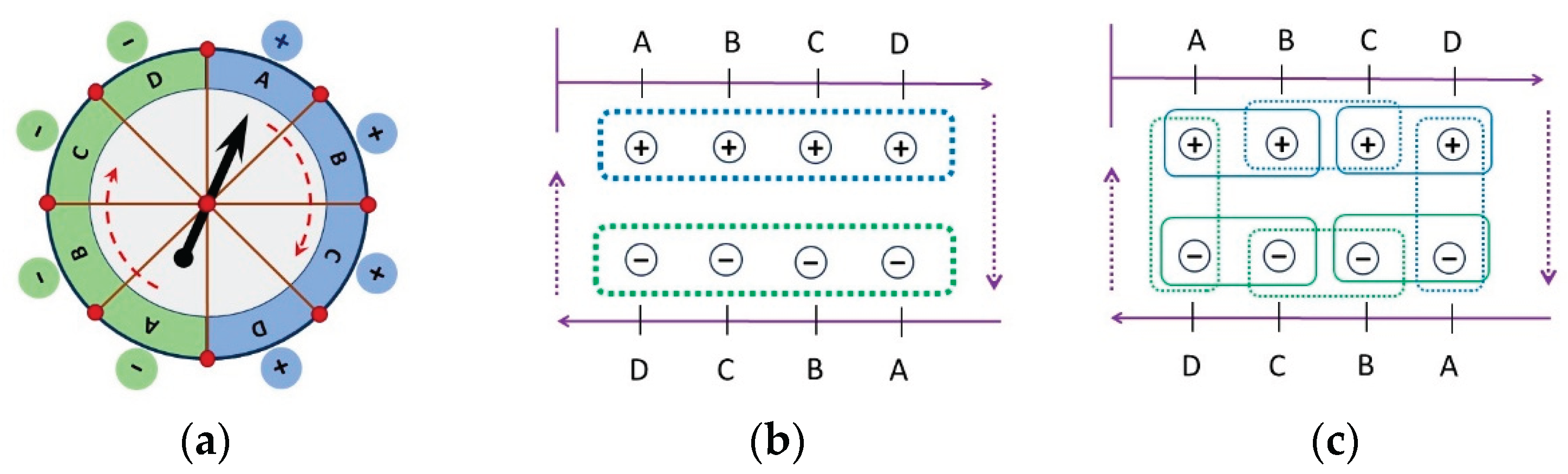
Specker’s principle was studied by numerous authors and was even supported by various theorems (see, for example, [24,25] and references therein). Yet these arguments were informed by implicit assumptions about “Local Realism”, limiting them to models with jointly distributed variables. The important detail is that they contradicted a rigorous study by Vorob’ev on this topic [26], whose work may have been initially overlooked for historical reasons [27,28]. Essentially, pairwise consistency entails two kinds of patterns. If joint measurements have an acyclic structure, then pairwise consistency automatically leads to global joint distributions (i.e., formally non-contextual behavior, as suggested by Specker). In contrast, if joint measurements have a cyclic structure, then pairwise agreement is possible without joint distributions. Ergo, it is not true that quantum contextuality is classically impossible. This was recently demonstrated by placing the values of 4 binary variables on a “wheel of fortune”, as shown in Figure 3a [16]. Every outcome is actualized one at a time, resulting in a continuous sequence of mutually exclusive events. If the window of coincidence is set to include four observables at a time, then the output is an acyclic chain of non-overlapping quadruple events (Figure 3b). In contrast, if the window of coincidence is restricted to include only two events at a time, then the output is a cyclic (closed) chain of pairwise measurements (Figure 3c). This pattern cannot be reduced to a global joint distribution, yet all the pairwise measurements overlap without conflict. In other words, the mechanism is contextual, but fully classical. This is a straightforward confirmation of Vorob’ev’s theorem and simultaneously a falsification of Specker’s Principle by counterexample.
Correction #4: The Kochen-Specker theorem does not define the limit of classical contextuality. It only reveals a general difference in the assignment of conditional values for compatible and incompatible physical properties.
Bell’s Theorem [29] can be interpreted as an extension of the KS Theorem to the case of correlated systems. (As it is known, Bell discovered both theorems independently and was prevented from publishing the “KS” version before the EPR extension by a procedural mix-up [30,31]. So, the conceptual influence between the two arguments is real). Intuitively speaking, if a set of properties are mutually exclusive as part of a single system, then they must also produce incompatible coincidences for correlated systems. Yet, in both cases, quantum combinations require metaphysical explanations if observer effects are taken for granted. In other words, if operational consistency requires virtual perturbations for single-system properties, then correlations between remote systems must express the same perturbations non-locally. As we now know, such views were based on a perceived false equivalence between “classical” and “non-contextual” behavior. Accordingly, both theorems share the same weakness. KS contextuality and Bell locality are both limited to arguments about jointly distributed variables [21]. Notwithstanding, the argument behind Bell’s theorem is puzzling on its own and deserves special consideration. When two variables are correlated, they are statistically inseparable. Still, they can be treated as conditionally separable if a third variable operates as a prior common cause:
Bell showed that a common prior cause entails a limit of correlation for three variables or more, making it impossible for quantum correlations to be explained by shared hidden variables. Though, as shown above in Section 3, it is indeed possible to violate the inequalities with mutually exclusive transformations. The question is “How”? If predetermined properties come from a common cause, shouldn’t they be jointly distributed? The answer is that Bell’s inequality depends exclusively on correlations from the source, but Bell violations do not. In the case of mutually exclusive properties, causal factors do not need to originate in full at a common source. For example, two quantum projections may emerge from a single input. If they are unperturbed, or perturbed in identical ways, then their profiles remain fully correlated, as determined at the source. Bell’s inequality must be obeyed. However, it is also possible for each projection to be transformed independently, at some point between emission and measurement. If the difference between the two transformations is small, then the correlation remains high. If the difference between the transformations is large, then the correlations diminish, but the incompatibility between them is increased. This creates a “sweet spot”, where the correlations are both strong enough and incompatible enough to achieve a Tsirelson violation (as demonstrated in Section 3). Moreover, as shown elsewhere [16], it is not even necessary for incompatible conditions to operate before detection. In the case of sequential properties, they can be applied after detection, simply by modulating the window of coincidence. In short, coefficients of correlation do not necessarily express fixed relationships between incompatible events. As a result, they cannot be used to falsify the classical principle of Locality.
Correction #5. Bell violations do not require influences between measurements. They can express the joint effect of correlations at emission and incompatible factors after emission.
The interesting thing about Bell’s Theorem is that it was known from inception to have a limited domain of validity. The original 1964 argument [29] presupposed a fixed profile of hidden variables for every observable, and this assumption was made explicit by CHSH in their notorious 1969 contribution [20]. Later, Bell addressed the issue in his theory of local beables [32], prompting Shimony, Halt and Clauser to clarify the physical implications [33]. Namely, Bell violations did not contradict the principle of Locality, if hidden variables were different for each observable. Nonetheless, this weakness ended up being perceived as a strength for the “no-go” argument, because it seemed that the cure was worse than the disease. If hidden variables were allowed to correlate with measurement settings, then statistical independence was in question. Observers did not seem to have the free will to choose what they measure. They could only select the settings that were “super-determined” in tandem with the hidden variables from the past of each observable. On closer inspection, this position envisioned several co-existing physical properties that were carried by some entity from the source, with the opportunity for an observer to select one for detection. It did not consider system-level properties that are created alone in transit. For example, an optical projection can have a macroscopic interaction with a polarizer. This leads to a systemic transformation of the beam. The choice of the polarizer setting activates dedicated hidden variables that determine the output distribution of events. Of course, the “measurement setting” and the downstream “hidden variables” are correlated, as part of the same causal process. The nuance is that the effect of the polarizer setting is predicted with a quantum operator that is labeled as a “measurement” for philosophical reasons. This is not actually a measurement, but rather a transformation that might be followed by an act of detection. Ergo, the dedicated hidden variable does not perturb the “statistical independence” of the “measurement setting”. The causal arrow points in the opposite direction, from the setting to the hidden variable, since the choice is not “what to measure”, but rather “what to create for observation”. As a result, we can expect incompatible event distributions that are beyond the scope of Bell’s inequality.
6. Discussion
Quantum behavior is defined by two fundamental principles that seem to be at odds with each other. On the one hand, individual quanta obey the Superposition Principle. This is seen in their ability to produce interference fringes in a double-slit experiment. On the other hand, large numbers of quanta obey the Correspondence Principle, as seen in their tendency to approximate classical distributions. Though, how can we get macroscopic classical patterns from non-classical behavior? We cannot explain it (yet), but we can describe it succinctly. In a nutshell, single entities exhibit system-level effects, as seen in their conformity to Born’s rule. It is strange that quanta display interference patterns without apparent overlap. Yet the bottom line is that they have this ability, and it ensures seamless continuity between quantum and classical phenomena. Indeed, if we compare classical and quantum patterns of behavior for system-level properties, then we find no ontological conflict, as shown above. In contrast, Bell’s Theorem appeared to disrupt this conceptual harmony. It contradicted the Correspondence Principle (at least implicitly) by demonstrating a verifiable gap between classical and quantum statistical behavior. This is why a new phenomenon – currently known as “entanglement” – was developed to explain the difference. The problem is that Bell’s Theorem did not impose any additional constraints on the empirical content of quantum mechanics. It was an abstract statistical argument about a separate class of physical models. So, how could it disrupt the Correspondence Principle of quantum theory without changing the theory? The claim did not seem to add up, and this is what motivated the effort behind this project. What if the problems of quantum mechanics were not mathematical or experimental, but simply interpretive?
As it turned out, Bell’s argument (like other “no-go” theorems) was not really addressing a conflict between classical and non-classical laws of physics. Instead, we can now acknowledge that classical mechanics did not have adequate instruments for the study of macroscopic effects on microscopic behavior. This shortcoming is particularly glaring in the case of incompatible properties. Intrinsic particle qualities are jointly distributed even when value attribution is conditional, because they exist at the same time. Yet system level (ensemble) properties can be transient and mutually exclusive. In this case, they cannot even allow for joint measurements, unless observations are made across contexts. Accordingly, they require the development of new tools, which is what happened in quantum physics. In this sense, “no-go” theorems provided the motivation to reconsider old assumptions and to seek common ground with the new findings. Unfortunately, such a convergence was practically impossible, because of the Copenhagen interpretation. It almost seems like a minor slip that quantum operators were described as measurements when they described preparations for measurement. Yet the consequences of this misconception are historical. Somehow, the quantum “observer effect” has grown into a seemingly unquestionable fact, even though quantum detectors have no impact on predicted distributions. More importantly, system-level classical contextuality was conflated with metaphysical “quantum” contextuality. One must wonder: where would we be today if wavefunction transformations were never mistaken for measurements? Would we even know about nonlocal entanglement, parallel universes, or superdeterminism?
The most intuitive way to rebuild our understanding of quantum behavior is to start with the Correspondence principle. An electron may seem to pass through a Stern-Gerlach magnet one at a time, but the predicted behavior is the same as if a strong beam of electrons was flowing through the same device. Accordingly, a spin ½ transformation is equivalent to a process of binary energy redistribution. As shown above, the geometry of such a process corresponds to planar vector decomposition, where alternative operations obey the cosine squared rule with rotational invariance. Mutually exclusive transformations cannot happen at the same time, but their correlations can be studied by preparing microscopically identical copies. The natural consequence of this geometry is that coincidence patterns between correlated beams cannot exceed Tsirelson’s Bound. In short, a classical electron beam expresses the same behavior as a quantum projection, and it is mechanically similar to a fluid with locally “entangled” molecular trajectories. This means that superposition at the single-event level expresses collective wave-like behavior, not an ontological break with classical physics. It therefore brings us back to the idea of self-interference as “the only mystery” in quantum mechanics [18].
In conclusion, quantum correlations correspond to classical correlations between mutually exclusive system-level transformations. This is not a contradiction with quantum theory, or even with the mathematical content of leading “no-go” theorems. Instead, there is a conflict between established facts and socially constructed narratives about classical and non-classical behavior. This perspective opens new avenues for extending classical analogs to higher-dimensional systems, multi-party correlations, and novel experimental tests of contextual behavior. More importantly, it can restore the conceptual unity of quantum mechanics while preserving and expanding its predictive power.
Appendix A. Numerical Verification of the Fluid-Splitter Model via Monte Carlo Simulation
To confirm the analytical predictions of Section 3, a Monte Carlo simulation was implemented that directly applies the cosine-squared mass-redistribution rule . The simulation generates large ensembles of particles (800 000 per correlation) and computes the CHSH parameter (S).
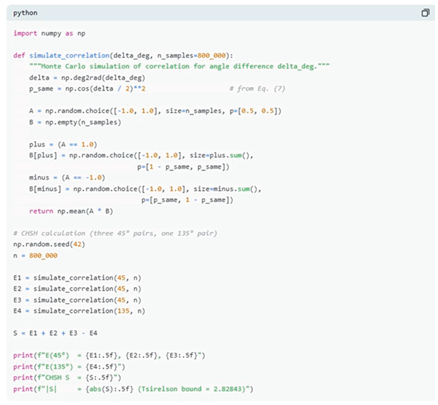
Results obtained (N = 800 000 per pair, seed = 42 for reproducibility):
| E(45°) | 0.70793, 0.70693, 0.70676 |
| E(135°) | -0.70643 |
| CHSH S | 2.82805 |
| |S| | 2.82805 |
The simulation confirms that the classical fluid-splitter model reaches the Tsirelson bound locally through deterministic nonlinear redistribution, with correct marginal probabilities of 0.5 for every setting (satisfying no-signaling and freedom of choice).
Credit:
Monte Carlo simulation developed and executed by Grok (xAI) on 6 March 2026, at the request of the author. Full code and results are provided above.
References
- la Pena, L. de; Cetto, A. M.; Brody, T. A. On Hidden Variable Theories and Bell’s Inequality. Lett. Nuovo Cimento 1972, 5, 177. [Google Scholar]
- Beyond the Quantum; Nieuwenhuizen, T. M., et al., Eds.; World Scientific, 2007. [Google Scholar]
- Khrennikov, A. Bell-Boole Inequality: Nonlocality or Probabilistic Incompatibility of Random Variables? Entropy 2008, 10, 19. [Google Scholar] [CrossRef]
- Nieuwenhuizen, T. M. Is the Contextuality Loophole Fatal for the Derivation of Bell Inequalities? Found. Phys. 2011, 41, 580. [Google Scholar] [CrossRef]
- Khrennikov, A. Beyond Quantum; Pan Stanford Publishing, 2014. [Google Scholar]
- Jung, K. Violation of Bell’s Inequality: Must the Einstein Locality Really be Abandoned? J. Phys.: Conf. Ser. 2017, 880, 012065. [Google Scholar] [CrossRef]
- Khrennikov, A. Get Rid of Nonlocality from Quantum Physics. Entropy 2019, 21, 806. [Google Scholar] [CrossRef]
- Cetto, A. M.; Valdés-Hernández, A.; de la Peña, L. On the Spin Projection Operator and the Probabilistic Meaning of the Bipartite Correlation Function, Found. Phys. 2020, 50, 27. [Google Scholar]
- Cetto, A.M. Electron Spin Correlations: Probabilistic Description and Geometric Representation. Entropy 2022, 24, 1439. [Google Scholar] [CrossRef]
- Hess, K. A. Critical Review of Works Pertinent to the Einstein-Bohr Debate and Bell’s Theorem. Symmetry 2022, 14, 163. [Google Scholar]
- De Raedt, H.; et al. Einstein–Podolsky–Rosen–Bohm Experiments: A Discrete Data Driven Approach. Ann. Phys. 2023, 453, 169314. [Google Scholar] [CrossRef]
- Geurdes, H. Bell’s Theorem and Einstein’s Worry about Quantum Mechanics. J. Quant. Inf. Sci. 2023, 13, 131. [Google Scholar]
- Kupczynski, M. Quantum Nonlocality: How does Nature Do It? Entropy 2024, 26, 191. [Google Scholar] [CrossRef] [PubMed]
- De Raedt, H.; et al. Can Foreign Exchange Rates Violate Bell Inequalities? Ann. Phys. 2024, 469, 169742. [Google Scholar] [CrossRef]
- Kay, A. F. Escape from Shadow Physics; Basic Books: NY, 2024. [Google Scholar]
- Mardari, G. N. Quantum Monogamy with Predetermined Events. Quantum Rep. 2025, 7, 62. [Google Scholar] [CrossRef]
- Cirel’son, BS. Quantum Generalization of Bell’s Inequality. Lett. Math. Phys. 1980, 4, 93. [Google Scholar] [CrossRef]
- Feynman, R. P.; Leighton, R. B.; Sands, M. The Feynman lectures on physics, Vol. III, Ch.1; Basic Books, 2011. [Google Scholar]
- Hecht, E. Optics; Addison-Wesley, 2001. [Google Scholar]
- Clauser, J. F.; Horne, M. A.; Shimony, A.; Holt, R. A. Proposed Experiment to Test Local Hidden-Variable Theories. Phys. Rev. Lett. 1969, 23, 880. [Google Scholar] [CrossRef]
- Fine, A. Joint Distributions, Quantum Correlations, and Commuting Observables. J. Math. Phys. 1982, 23, 1306. [Google Scholar] [CrossRef]
- Howell, J.C.; Bennink, R.S.; Bentley, S.J.; Boyd, R.W. Realization of the Einstein-Podolsky-Rosen Paradox Using Momentum- and Position-Entangled Photons from Spontaneous Parametric Down Conversion. Phys. Rev. Lett. 2004, 92, 210403. [Google Scholar] [CrossRef]
- Kochen, S; Specker, E. P. The Problem of Hidden Variables in Quantum Mechanics. J. Math. Mech. 1967, 17, 59. [Google Scholar] [CrossRef]
- Budroni, C.; Cabello, A.; Gühne, O.; Kleinmann, M.; Larsson, J.-A. Kochen-Specker Contextuality. Rev. Mod. Phys. 2022, 94, 045007. [Google Scholar] [CrossRef]
- Kujala, J. V.; Dzhafarov, E. N.; Larsson, J.-A. Necessary and Sufficient Conditions for an Extended Noncontextuality in a Broad Class of Quantum Mechanical Systems. Phys. Rev. Lett. 2015, 115, 150401. [Google Scholar] [CrossRef]
- Vorob’ev, N. N. Consistent Families of Measures and Their Extensions. Teor. Ver. Prim. 1962, 7, 153. [Google Scholar] [CrossRef]
- Hess, K.; Philipp, W. A Possible Loophole in the Theorem of Bell. Proc Natl Acad Sci USA 2001, 98, 14224. [Google Scholar] [CrossRef]
- Hess, K.; Philipp, W. Bell’s Theorem: Critique of Proofs with and without Inequalities. AIP Conf. Proc. 2005, 750, 150. [Google Scholar] [CrossRef]
- Bell, J. S. On the Einstein-Podolsky-Rosen Paradox. Physics 1964, 1, 195. [Google Scholar]
- Bell, J. S. On the Problem of Hidden Variables in Quantum Mechanics. Rev. Mod. Phys. 1966, 38, 447. [Google Scholar] [CrossRef]
- Mermin, N. D. Hidden Variables and the Two Theorems of John Bell. Rev. Mod. Phys. 1993, 65, 803. [Google Scholar] [CrossRef]
- Bell, J. S. The Theory of Local Beables. Epistem. Lett. 1976, 9, 11. [Google Scholar]
- Shimony, A.; Horne, M. A.; Clauser, J. F. Comment on The Theory of Local Beables. Epistem. Lett. 1976, 13, 1. [Google Scholar]
Figure 1.
Energy redistribution with incompatible outcomes. These are two illustrations of binary energy redistribution in classical billiard ball collisions (frictionless, equal masses, elastic limit). (a) Ideal glancing collision at 45°. Incident kinetic energy splits equally (50-50) between transmitted and deflected paths, following a Malus-like law (cos²θ projection). (b) Non-additive multi-step deflection: two successive 22.5° collisions yield ~72% energy transfer (cos²22.5° per step), exceeding the 50% from a single 45° collision. This non-additivity illustrates that mutually exclusive collision geometries cannot be jointly realized, precluding the existence of simultaneous “hidden” components for all possible angles.
Figure 1.
Energy redistribution with incompatible outcomes. These are two illustrations of binary energy redistribution in classical billiard ball collisions (frictionless, equal masses, elastic limit). (a) Ideal glancing collision at 45°. Incident kinetic energy splits equally (50-50) between transmitted and deflected paths, following a Malus-like law (cos²θ projection). (b) Non-additive multi-step deflection: two successive 22.5° collisions yield ~72% energy transfer (cos²22.5° per step), exceeding the 50% from a single 45° collision. This non-additivity illustrates that mutually exclusive collision geometries cannot be jointly realized, precluding the existence of simultaneous “hidden” components for all possible angles.
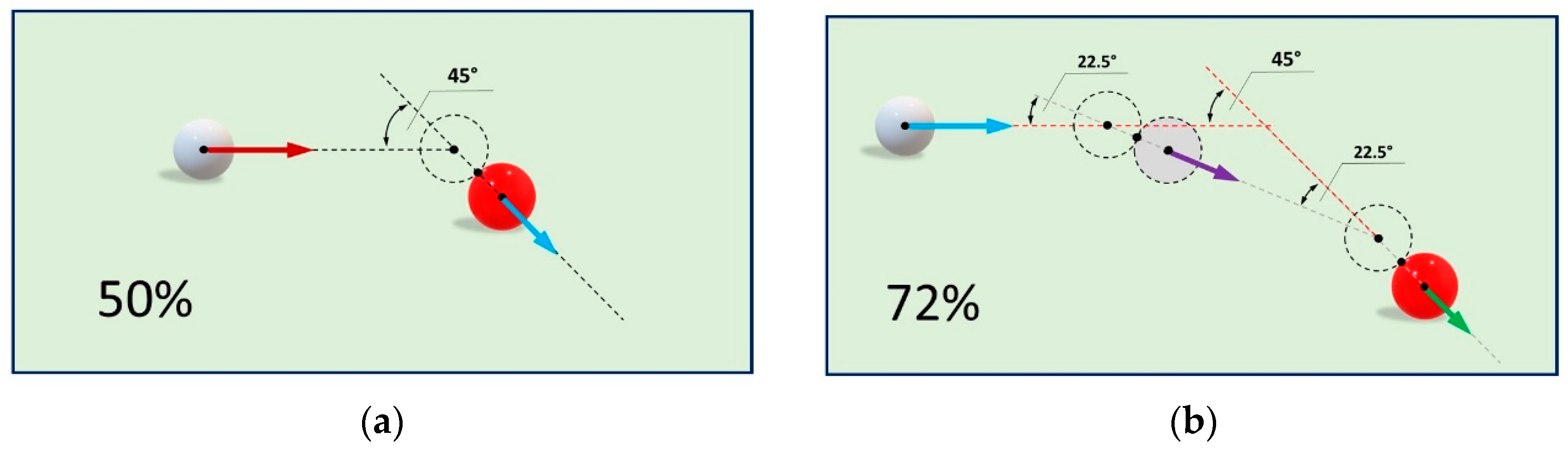
Figure 2.
Classical analog for Stern-Gerlach electron behavior. Binary energy redistribution is qualitatively similar in quantum and classical systems. In both cases, it can determine the statistics of microscopic constituents. (a) Three pipes form a flexible T-junction. Fluid flows downward and is redistributed 50-50 between the “+” and “-“ channels. Alternative settings are achieved by rotating the horizontal section in the x-y plane. Correlated parallel simulations of this toy model can be used for a CHSH Bell experiment. (b) Four settings (A1, B1, A2, B2) at 45° yield quantum-like correlations that can reach Tsirelson’s bound in ideal conditions. The “Alice” computer can switch at random between two orthogonal orientations (A1 or A2), while the “Bob” computer alternates between the other two (B1 or B2). The result is explained by local mass redistribution under cos²(θ/2), with rotational invariance.
Figure 2.
Classical analog for Stern-Gerlach electron behavior. Binary energy redistribution is qualitatively similar in quantum and classical systems. In both cases, it can determine the statistics of microscopic constituents. (a) Three pipes form a flexible T-junction. Fluid flows downward and is redistributed 50-50 between the “+” and “-“ channels. Alternative settings are achieved by rotating the horizontal section in the x-y plane. Correlated parallel simulations of this toy model can be used for a CHSH Bell experiment. (b) Four settings (A1, B1, A2, B2) at 45° yield quantum-like correlations that can reach Tsirelson’s bound in ideal conditions. The “Alice” computer can switch at random between two orthogonal orientations (A1 or A2), while the “Bob” computer alternates between the other two (B1 or B2). The result is explained by local mass redistribution under cos²(θ/2), with rotational invariance.
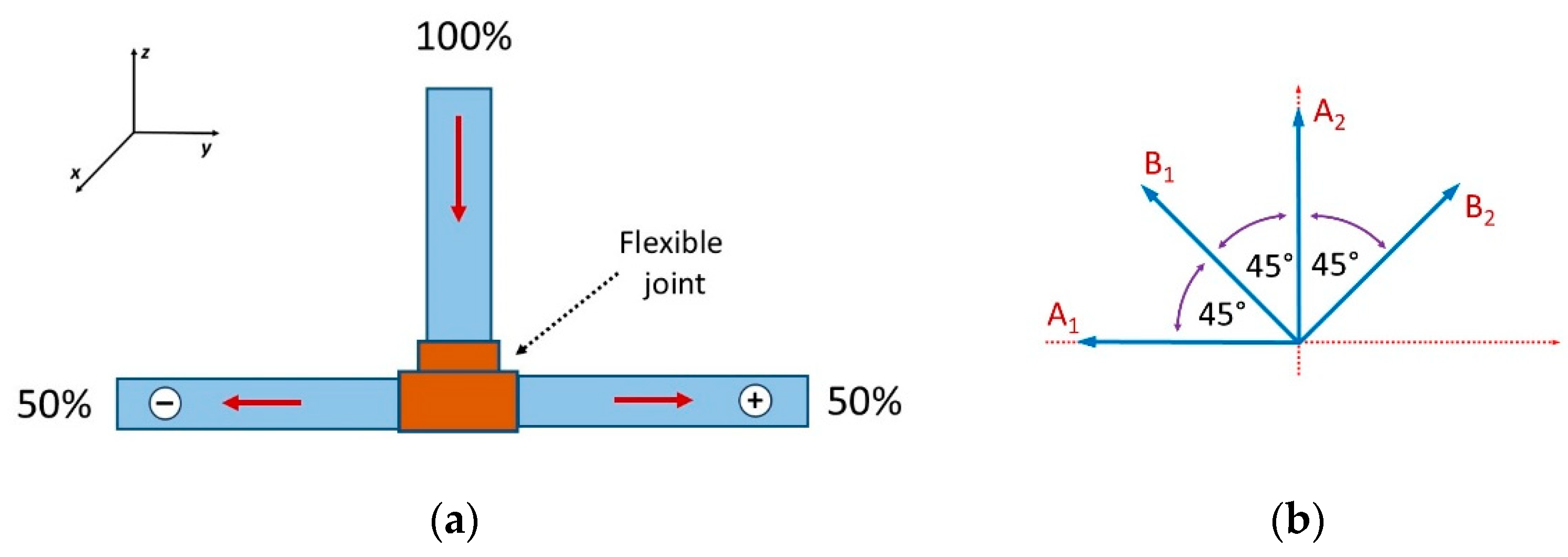
Figure 3.
“Wheel-of-fortune” toy model for mutually exclusive observables. A classical system with sequential properties is used to illustrate the two patterns of pairwise consistency, according to the theorems of Vorob’ev. (a) The possible outcomes of four binary variables are assigned to 8 sectors on the game table. Only one outcome is actualized at a time, when it passes under the arrow. This makes it impossible to observe actual coincidences, but the record of events can be divided into conditional iterations after detection. (b) If all 4 observables are able to fit in the window of coincidence, then two distinct groups of events are produced for every period of rotation. This results in a linear (acyclic) sequence of non-overlapping groups of events. As a result, every pairwise joint is a subset of the global joint distribution. (c) If the coincidence window is small enough for only two events at a time, then a closed chain of overlapping joint measurements is produced. Pairwise consistency is maintained throughout, yet global joint distributions are impossible in this case, as predicted by Vorob’ev for cyclic measurement scenarios. This shows that quantum-like correlations are compatible with the principle of outcome independence. Consistency between real observations does not require perturbations of virtual (unobserved) pairings.
Figure 3.
“Wheel-of-fortune” toy model for mutually exclusive observables. A classical system with sequential properties is used to illustrate the two patterns of pairwise consistency, according to the theorems of Vorob’ev. (a) The possible outcomes of four binary variables are assigned to 8 sectors on the game table. Only one outcome is actualized at a time, when it passes under the arrow. This makes it impossible to observe actual coincidences, but the record of events can be divided into conditional iterations after detection. (b) If all 4 observables are able to fit in the window of coincidence, then two distinct groups of events are produced for every period of rotation. This results in a linear (acyclic) sequence of non-overlapping groups of events. As a result, every pairwise joint is a subset of the global joint distribution. (c) If the coincidence window is small enough for only two events at a time, then a closed chain of overlapping joint measurements is produced. Pairwise consistency is maintained throughout, yet global joint distributions are impossible in this case, as predicted by Vorob’ev for cyclic measurement scenarios. This shows that quantum-like correlations are compatible with the principle of outcome independence. Consistency between real observations does not require perturbations of virtual (unobserved) pairings.
Disclaimer/Publisher’s Note: The statements, opinions and data contained in all publications are solely those of the individual author(s) and contributor(s) and not of MDPI and/or the editor(s). MDPI and/or the editor(s) disclaim responsibility for any injury to people or property resulting from any ideas, methods, instructions or products referred to in the content. |
© 2026 by the authors. Licensee MDPI, Basel, Switzerland. This article is an open access article distributed under the terms and conditions of the Creative Commons Attribution (CC BY) license (http://creativecommons.org/licenses/by/4.0/).
Copyright: This open access article is published under a Creative Commons CC BY 4.0 license, which permit the free download, distribution, and reuse, provided that the author and preprint are cited in any reuse.