
Submitted:
04 June 2025
Posted:
05 June 2025
You are already at the latest version
Abstract
(1) Background: This study explores the development, implementation, and impact of a social intelligence-based learning model in modern boarding schools. (2) Methods: Using a qualitative approach with purposive sampling, key informants included pesantren leaders, teachers, education personnel, and students. Data were collected through interviews, observations, documentation, and focus group discussions (FGDs), then analyzed thematically. (3) Results: Findings reveal that integrating values like tolerance, cooperation, and empathy enhances pesantren learning. Strategies such as group discussions, social simulations, and community-based projects effectively boost student engagement and social skills. However, challenges like time constraints, limited facilities, and inadequate teacher training hinder full implementation. (4) Conclusion: Despite these obstacles, the model significantly improves students' communication, cooperation, problem-solving, and tolerance. It offers a meaningful contribution to value-driven education in pesantren but requires stronger resource support, teacher training, and scheduling flexibility for broader adoption.
Keywords:
social intelligence
; social learning
; social studies
; social skills
; modern boarding schools
1. Introduction
1.1. Background
Social Science Education is essential in shaping students’ understanding of social, cultural, and historical dynamics in society (Samiah et al. 2021). Social studies education aims to improve cognitive knowledge and develop relevant social skills, such as empathy, communication, and cooperation (Brophy 1990). In the context of the era of globalization, social skills are the main competencies to face increasingly complex social and cultural challenges (Auziņa 2018). In this case, social studies, which integrates cognitive and affective dimensions, has excellent potential to shape students’ social character (Ekasari and Nurkhairina 2021).
As educational institutions that combine religious values with the general curriculum, modern Islamic boarding schools offer an excellent opportunity to form a young generation that is religiously and socially competent. In Aceh, Indonesia, modern Islamic boarding schools have unique characteristics because they integrate strong Islamic values with local Acehnese wisdom, such as the custom of “peumulia jamee,” which emphasizes the importance of hospitality and cooperation (Idris and Suroto 2023). However, social studies learning in modern Islamic boarding schools is often focused on the cognitive aspect without paying enough attention to developing students’ social intelligence. Social skills are essential in community life, especially in the context of cultural diversity and local values in Indonesia (Sholeh et al. 2019). As an institution that instills Islamic values, Islamic boarding schools have unique potential to develop students’ social skills by integrating religious and social values (Solihin et al. 2020).
The social intelligence-based social studies learning model is designed to integrate social studies materials with approaches that encourage the development of social intelligence, such as empathy, effective communication, and cooperation. This approach involves active learning through group discussions, social simulations, and analysis of real cases relevant to students’ daily lives (Hidayat et al. 2023). With this model, social studies learning is expected to become more contextual and applicable, allowing students to understand and internalize social values in their lives (Putri et al. 2024).
Social intelligence, which includes empathy, communication, cooperation, conflict resolution, and social awareness, becomes essential for forming individuals capable of interacting constructively in a diverse society (Li 2024). Integrating social intelligence in social studies learning in modern Islamic boarding schools is a strategic step to improve the social skills of students in a holistic manner (Ilyasin 2020). This study, which involved 15 modern Islamic boarding schools in Banda Aceh and Aceh Besar, Indonesia, aims to understand the needs, implementation, and Impact of social intelligence-based social studies learning models through the participation of teachers, students, and policymakers. Previous studies have shown that participatory-based learning improves students’ social skills, such as cooperation and communication. (Kim et al. 2015). This research expands these findings by developing a systematically integrated learning model.
This research aims to identify, develop, implement, and evaluate the Impact of social intelligence-based social studies learning models in modern Islamic boarding schools. The focus is on answering questions related to learning needs, effective model design, implementation, and its Impact on students’ social skills. This research has important significance in improving students’ social skills, which are the main competency in the era of globalization, by integrating Islamic values and local wisdom in formal education. As a new approach, this research offers novelty by developing a learning model designed explicitly for the context of modern Islamic boarding schools, making it unique and relevant. Hopefully, this model can provide practical guidance for pesantren and teachers, improve students’ social skills, and become the basis for developing a more targeted social studies curriculum.
1.2. Research Questions
This research is designed to answer four main questions about understanding and developing social intelligence-based social studies learning models in modern Islamic boarding schools. These four questions are interrelated to create a social intelligence-based social studies learning model that is relevant, innovative, and applicable in modern Islamic boarding schools, as well as making an essential contribution to the development of value-based education in Indonesia.
- Identifying the needs of social intelligence-based social studies learning in modern Islamic boarding schools.
- Developing a social studies learning model based on contextual social intelligence.
- Testing the implementation of the learning model in modern Islamic boarding schools.
- Evaluate the Impact of the learning model on the social skills of students.
1.3. Literature Review
Social Science Education (IPS) shapes students’ social competence. Social studies research aims to improve cognitive knowledge and build interpersonal skills such as empathy, communication, and cooperation (Indriyani et al. 2021). Integrative social studies learning can increase students’ understanding of modern society’s social and cultural dynamics (Kurniasari 2013). In the Indonesian context, modern Islamic boarding schools play an important role as educational institutions that combine religious values and the general curriculum (Qomar and Badruzaman 2024). Modern Islamic boarding schools have great potential in shaping the social character of students through Islamic values and local wisdom (Halik 2016). In Aceh, modern Islamic boarding schools integrate local customs such as “Peumulia Jamee” to teach the values of hospitality and cooperation (Anshari et al. 2023). However, social studies learning in Islamic boarding schools is often still focused on the cognitive aspect without paying attention to the development of social intelligence holistically.
Social intelligence includes the ability to understand and manage interpersonal relationships. The main aspects of social intelligence include empathy, communication, cooperation, conflict resolution, and social awareness (Afzalur Rahim et al. 2002). Social intelligence-based learning can help students develop the ability to interact constructively in diverse social environments (Hidayat et al. 2023). In this case, the social intelligence-based learning model is designed to integrate learning materials with approaches that encourage the development of interpersonal skills (Bennett 2015). Approaches such as group discussions, social simulations, and case analysis can improve students’ participation and social skills (Camacho-Minuche et al. 2021). In modern Islamic boarding schools, this learning model can be applied to help students understand social studies material more contextually and applicable (Nasri and Mulyohadi 2023).
Modern Islamic boarding schools in Aceh, with their local wisdom and Islamic values, are ideal locations to develop and implement social intelligence-based learning models (Kadis et al. 2023). The participatory approach to learning in Aceh Islamic boarding schools has been proven to improve students’ social skills (Anshari et al. 2023). This study will continue these findings by developing a more systematic and integrated learning model to significantly contribute to improving the social skills of students in modern Islamic boarding schools.
2. Materials and Methods
This research method uses a descriptive qualitative approach to describe and analyze the phenomenon being studied in depth. This approach is relevant to the purpose of the research because it provides flexibility to explore in detail the application of social intelligence-based learning models in improving the social skills of students in modern Islamic boarding schools. This method also allows researchers to understand various perspectives of the research subject.
2.1. Research Design
This study uses a descriptive design to provide a detailed overview of the implementation of social intelligence-based social studies learning models. This design was chosen because it follows the research’s focus to explore the learning process and outcomes in a particular social context (Figure 1). The justification for this design selection lies in its ability to provide an in-depth understanding of complex and multidimensional phenomena. The research was conducted in 15 modern Islamic boarding schools in Banda Aceh and Aceh Besar. This location was chosen because it has characteristics relevant to the focus of the research. The research population amounted to 300 people and consisted of various groups, namely 200 students, 15 pesantren leaders, 40 social studies teachers, 30 education personnel, and 15 other subjects such as student organization administrators. This division is carried out to ensure that all elements involved in learning are proportionally represented.
2.2. Data Collection
This research uses data collection techniques through in-depth interviews, participatory observations, documentation, and focus group discussions (FGD). Informed consent for participation was obtained from all participants prior to data collection. Participants were fully informed about the objectives, procedures, and potential risks involved in the study. Consent was obtained verbally due to the nature of the study. For minors, parental consent was obtained along with their assent.
Interviews were conducted with pesantren leaders, social studies teachers, education staff, and students to explore views and experiences of social intelligence-based learning. Observation was carried out to directly observe the learning process in the classroom and extracurricular activities. At the same time, documentation included the collection of syllabi, lesson plans, activity notes, and student statistical data. FGD involves students and teachers to explore collective ideas and perspectives.
2.3. Data Validity
The validity of the data was checked by source triangulation to ensure the consistency of information from various parties, triangulation of methods to compare the results of interviews, observations, and documentation, and member checking to confirm the accuracy of the data with informants. Trail audits are also carried out by keeping detailed records of the research process.
2.4. Data Analysis
The research data analysis uses a thematic approach with the stages of data familiarization, initial coding, theme search, theme review, and interpretation. Data from interviews, observations, FGDs, and documentation were analyzed to identify patterns such as learning strategies, student involvement, and implementation constraints. The resulting theme is interpreted by relating it to social intelligence theory and character-based learning.
2.5. Ethical Approval and Consent to Participate
This study was approved by the Ethics Committee of Syiah Kuala University, Approval Number: 66/UN11.F13/KM/DPIPS/2025. All participants were informed about the objectives of the research and participated voluntarily. Written informed consent was obtained prior to data collection. In the case of student participants who were minors, informed consent was obtained from their guardians, and assent was obtained from the students themselves.
3. Results
This study explores implementing a social intelligence-based social studies learning model to improve students’ social skills in modern Islamic boarding schools. As an educational institution focusing on religious values and social character, Pesantren is the ideal context for integrating social intelligence-based learning. This research involved 300 subjects from various elements of Islamic boarding schools, including students, Islamic boarding school leaders, social studies teachers, education personnel, and administrators of student organizations. The study results provide a comprehensive overview of the subject’s characteristics, learning process, strategies, and challenges in implementing this model. The research findings are expected to contribute to the development of social intelligence theory in education and offer practical strategies to be applied in the pesantren environment to support students’ social skills in daily life. A detailed explanation of the research results is presented in the following sections, starting with the subject’s characteristics, then analyzing the learning process, and ending with strategic recommendations.
Table 1 shows the characteristics of the research subjects totaling 300 people, consisting of students (66.67%), pesantren leaders (5%), social studies teachers (13.33%), education personnel (10%), and student organization administrators (5%). Most subjects were male (60%) and aged 16–18 (50%). Most have active involvement in social activities (50%), moderate level of social intelligence understanding (50%), access to technology (80%), and living in a full dorm (60%). Subjects come from rural (60%) and urban (40%), with education levels balanced between junior and senior secondary (50% each). This table provides an overview of the research population relevant to analyzing social intelligence-based learning models in Islamic boarding schools.
3.1. Validity of Research Data
Table 2 explains the validity strategy of research data through triangulation analysis. Five types of triangulation guarantee the validity of the data. Source triangulation is carried out by comparing data obtained from various sources, such as students, social studies teachers, pesantren leaders, and education personnel, to ensure consistency of information from multiple perspectives. Method triangulation uses data collection methods, in-depth interviews, participatory observations, documentation, and focus group discussions (FGDs), to reduce bias and improve data reliability. Time triangulation is done by collecting data at different times, such as during learning, extracurricular activities, or informal time, to understand data variations based on time contexts. Researcher triangulation involves more than one researcher in analyzing data so that the interpretation of the results is more objective and free from individual bias. Finally, theoretical triangulation compares research results with relevant theories, such as social intelligence theory and character-based learning, to validate research findings with a solid scientific basis. This strategy ensures that the study results have a high level of validity and are trustworthy.
3.2. Research Findings
This study revealed that implementing social intelligence-based learning models in modern Islamic boarding schools effectively improves students’ social skills. In-depth interviews with pesantren leaders and social studies teachers highlighted group discussions and teamwork as key strategies. These methods encourage collaboration, idea-sharing, and problem-solving while integrating values like tolerance and cooperation. Students reported improved communication skills and a better understanding of others’ perspectives. However, challenges such as limited curriculum time and difficulties engaging students with low social skills were noted. Participatory observations showed a significant increase in students’ social interactions during group-based learning compared to traditional lectures. Activities like small group discussions and extracurricular programs further enhanced social intelligence, with teachers acting as facilitators in a supportive, community-based pesantren environment.
Documentation findings indicated that the curriculum has integrated social intelligence values into lesson plans (RPP), but implementation varies across classes, particularly in larger groups. Extracurricular activities like leadership simulations and debates are crucial in developing speaking, listening, and teamwork skills. Feedback from FGDs revealed that students found this approach beneficial, boosting their confidence, communication, and cooperation. They suggested adding more interactive activities, such as educational games and group projects, to strengthen social skills. Teachers emphasized the need for additional training to effectively enhance their ability to apply these learning models.
- The Needs of Social Intelligence-Based Social Studies Learning in Modern Islamic Boarding Schools
Table 3 summarizes the need for social intelligence-based social studies learning in modern Islamic boarding schools, showing that social values such as tolerance, cooperation, and communication have been listed in the curriculum. However, their implementation in the classroom is still uneven. The dominant learning method is lectures, with limited student involvement, although they are more motivated by group activities or joint projects that have not been routinely implemented. The limitations of facilities, such as discussion rooms and learning aids, hinder social intelligence-based learning. Teachers also need additional training to improve their skills in using interactive methods. Extracurricular activities such as debates and leadership simulations effectively develop social skills but have not been integrated with social studies learning. In addition, the limited time in the curriculum is the main challenge for teachers in inserting social intelligence-based activities. These findings illustrate the urgent need to improve various aspects of learning to support the development of students’ social skills more effectively.
- 2.
- Contextual social intelligence-based social studies learning model
Table 4 describes the research findings on developing a contextual social intelligence-based social studies learning model in modern Islamic boarding schools. Integrating social values such as tolerance, cooperation, and communication in the curriculum and lesson plans is important, with learning strategies based on group discussions, social simulations, and community projects that effectively improve students’ social skills. Social studies material needs to be adapted to the context of pesantren’s life, including religious values, community life, and local social issues, to make it more relevant and easy to understand. The role of teachers as active facilitators and the use of interactive technology, such as virtual simulations, enrich the learning experience. In addition, extracurricular activities such as debates and leadership simulations provide hands-on experience in working together and interacting. Project-based evaluation and observation of social interaction are recommended to assess social skills comprehensively. This finding is essential in creating a relevant and practical social studies learning model in modern Islamic boarding schools.
- 3.
- Implementation of the learning model in modern Islamic boarding schools
Table 5 illustrates the results of testing the implementation of a social intelligence-based social studies learning model in modern Islamic boarding schools, which shows the success of group discussion methods and social simulations in increasing the active involvement of students. This method helps students understand the material more efficiently, is relevant to daily life, and increases learning motivation. After receiving training, teachers can play an effective role as facilitators, although limited learning time is the main obstacle to accommodating all planned interactive activities. Technology, such as interactive learning media and virtual simulations, has also increased student engagement. In contrast, extracurricular activities, such as debates and group projects, support the development of social skills, although their integration into formal learning still needs to be improved. The results of the project-based evaluation showed a significant improvement in the students’ communication, cooperation, and problem-solving skills. Overall, the implementation of this model is adequate, although it requires adjustments to overcome time constraints and integration of activities.
- 4.
- Evaluating the Impact of the learning model on students’ social skills
Table 6 shows that the social intelligence-based social studies learning model has improved students’ social skills in modern Islamic boarding schools. Students showed significant improvements in communication skills, such as speaking confidently, actively listening, and respecting the opinions of others. Cooperation skills have also improved, with students more easily sharing tasks and completing projects together. In addition, students are more skilled in problem-solving, tolerance, and empathy, understand diversity, and show behavior that respects differences. Learning motivation increased due to relevant and engaging learning methods. At the same time, positive changes in social behavior, such as cooperative initiatives and conflict resolution skills, confirmed the success of this model in building students’ social skills effectively.
3.3. Thematic Analysis
Table 7 summarizes the thematic analysis of the research results on the implementation and Impact of social intelligence-based social studies learning models in modern Islamic boarding schools. Key findings include the effectiveness of learning models that increase student engagement through group discussion methods, social simulations, and community projects, and the relevance of learning to their lives. The improvement of social skills can be seen in students’ ability to communicate, cooperate, solve problems, and show tolerance and empathy. The role of teachers as facilitators is the key to success, even though time constraints and supporting facilities are challenges. The Positive Impact was also seen in the change in students’ more open behavior, the initiative to work together, the ability to resolve conflicts, and the increase in learning motivation. This table illustrates the success of the learning model in improving students’ social skills holistically, although attention needs to be paid to the obstacles in its implementation.
Figure 1 illustrates the Social Intelligence-Based Learning Model paradigm for social studies in Islamic boarding schools, which integrates social pedagogic and social andragogic dimensions. This model emphasizes contextual learning with pesantren life, integrating religious values, local culture, and global social dynamics to shape students’ social skills. With activities such as group discussions, social simulations, and collaborative projects, this model supports strengthening social interaction, experiential learning, and student collaboration skills. From a social andragogic perspective, this model encourages learning independence, lifelong learning, and adaptive and inclusive leadership development while instilling values of tolerance, cooperation, and empathy. This paradigm produces a generation of students who are academically intelligent, socially competent, and ready to face challenges in various life contexts, making pesantren a pioneer of education that contributes to society.
4. Discussion
The results of the study show that social intelligence-based social studies learning is urgently needed in modern Islamic boarding schools to integrate values such as tolerance, cooperation, and empathy in the educational process (Table 3). Currently, lectures with limited student involvement still dominate learning methods, so it is necessary to innovate more interactive and participatory learning strategies. Group discussions and social simulations, part of a social intelligence-based approach, can improve material understanding while training students’ social skills. These findings align with the importance of social intelligence in understanding and managing interpersonal relationships (Zhuge 2020). In addition, observations revealed that collaborative activities such as group projects and debates were only applied to a small percentage of classes, supporting the view that cooperative learning effectively increased student engagement (Le et al. 2018).
Supporting facilities, such as discussion rooms and interactive learning tools, are essential elements to support the implementation of social intelligence-based learning models. Teachers also need additional training to optimize the application of this method, where teacher training is essential for the success of innovation-based learning (Zhazira et al. 2024). With a more interactive and collaborative approach, pesantren can create learning that is more relevant to students’ lives and answer the needs of modern education (Anggadwita et al. 2021). This supports the role of pesantren in equipping students with better adaptability in a complex social environment related to the importance of character education in the context of pesantren (Mau 2024).
The study results show that the social studies learning model based on contextual social intelligence is relevant to modern Islamic boarding schools (Table 4). This model emphasizes integrating social values, such as tolerance, cooperation, and empathy, through learning activities relevant to students’ lives. Approaches such as group discussions, social simulations, and community-based projects have proven effective in increasing student engagement and understanding of the material (Mayer et al. 2019). These findings support previous research, which suggests that social intelligence is a crucial ability to understand interpersonal relationships and create meaningful learning (Kostiainen et al. 2018). In addition, the context of pesantren that prioritizes character education makes social intelligence-based learning very appropriate, where education in pesantren needs to emphasize social values in learning (Sudarmi and Yusuf 2022).
This learning model also emphasizes the local context, which includes integrating religious, cultural, and social values relevant to students’ lives. Collaboration-based learning with a contextual approach can increase student participation and the relevance of the material (Ingrid 2019). However, applying this model requires teachers as facilitators who can direct interactive activities. Additional training for teachers is a critical need to improve their ability to implement social intelligence-based learning models (Hidayat et al. 2023). In line with the relationship with learning in the context of students’ lives, this model improves academic understanding and equips students with essential social skills for future life (Frey et al. 2019).
Implementing a social intelligence-based social studies learning model in modern Islamic boarding schools effectively increases student involvement during the learning process (Table 5). Methods such as group discussions, social simulations, and collaborative projects have encouraged students to participate in learning actively. This active engagement helps them understand social studies material more deeply while developing communication, cooperation, and tolerance skills (Suryani et al. 2021). Social intelligence facilitates interpersonal interaction-based learning (Alzubi et al. 2024). Observations also show that students feel more motivated because learning methods are relevant and contextual to their daily lives (Suryawati and Osman 2017). However, the implementation of this model is faced with obstacles, such as limited learning time to accommodate all planned interactive activities (Azlan et al. 2020).
In addition to time constraints, supporting facilities such as discussion rooms and interactive learning media are still the main challenges in implementing this model. Teachers who act as learning facilitators have a great responsibility to ensure the smooth running of each activity, but they also need additional training to direct the learning process effectively (Fessehatsion 2017). Teacher training in supporting the successful implementation of innovation-based learning models. In addition, integrating extracurricular activities, such as leadership simulations and debates, with formal learning can increase the effectiveness of this model (Aithal and Aithal 2020). This collaborative activity enriches the learning experience and strengthens students’ social skills (Øzerk et al. 2021). Implementing this model positively impacts learning in modern Islamic boarding schools, although it requires more attention to overcome technical and administrative obstacles to achieve better optimization.
The study results show that the social intelligence-based social studies learning model significantly impacts students’ social skills in modern Islamic boarding schools (Table 6). Students show improvement in communication skills, such as speaking confidently, actively listening, and respecting the opinions of others during group discussions (Costigan and Brink 2020). In addition, their cooperation ability has also increased, as seen from the students’ success in sharing tasks and completing projects collectively. Social intelligence is the foundation for building effective interpersonal relationships, which is important in a collaborative learning environment (Chikersal et al. 2017). Activities such as social simulations also help students critically understand and solve social problems, training them to think creatively in real-world challenges (Bunt and Gouws 2020).
In addition to communication and cooperation skills, this learning model also increases students’ tolerance and empathy, especially in interacting with friends from different backgrounds. Collaboration-based learning not only improves academic skills but also fosters an attitude of mutual respect among students. Evaluation through project-based activities shows that students can show initiative in working together and resolving conflicts effectively (Lin et al. 2024). This change is also supported by increased learning motivation, where students feel more connected to the material taught because of its relevance to their lives (Appova and Arbaugh 2018). However, adequate facility support and continuous teacher training are needed to maximize the Impact of this model, where learning innovations can only succeed if supported by sufficient resources (Burns 2023). This evaluation confirms that the social intelligence-based learning model improves students’ social skills and prepares them to face social challenges in future life (Warsah et al. 2024).
Social intelligence-based learning models in boarding schools effectively integrate social values such as tolerance, cooperation, and empathy into social studies learning through group discussions, simulations, and community projects. This approach supports the previous researcher’s view that the importance of social intelligence in building interpersonal relationships is in line with the character of pesantren, which emphasizes character education (Shiddiq et al. 2024). Although effective, implementing this model faces challenges such as limited time and facilities and the need for additional training for teachers as facilitators (Goh et al. 2017). Integrating extracurricular activities, such as leadership simulations and debates, can enrich students’ learning experiences and strengthen their social skills (Siddiky 2019). By overcoming this obstacle, the social intelligence-based learning model can become a new paradigm that produces academically intelligent and socially competent students.
5. Conclusions
This study concludes that the social intelligence-based social studies learning model effectively improves students’ social skills in modern Islamic boarding schools. This model can integrate social values such as tolerance, cooperation, and empathy through interactive learning methods like group discussions, social simulations, and community projects. Implementing this model also increases the involvement of students in learning, helps them understand social studies material more deeply, and strengthens communication, cooperation, problem-solving, and empathy skills. These findings show that social intelligence-based learning is relevant not only to the educational context in Islamic boarding schools but also to the demands of modern education that emphasize the development of social skills.
6. Research Limitation
This research has several limitations that need to be considered. First, the limited learning time in pesantren is an obstacle in accommodating all interactive activities planned in the learning model. Second, supporting facilities, such as discussion rooms and interactive learning tools, are not entirely adequate to support the optimal implementation of this model. Third, additional training for teachers is still needed so that they are more skilled in facilitating social intelligence-based learning. Finally, this research was conducted in one pesantren, so the results cannot be generalized to all with different characteristics. Further studies involving various Islamic boarding schools with diverse contexts are needed to validate and develop these findings.
Author Contributions
Conceptualization, S.B.R. and R.Y.; methodology, S.B.R., R.Y, and M.A.M.; validation, R.Y, M.A.M, and M.S.; formal analysis, S.B.R.; writing—original draft preparation, S.B.R.; writing—review and editing, S.B.R., R.Y, and M.S.; funding acquisition, S.B.R. All authors have read and agreed to the published version of the manuscript.
Funding
This research received no external funding.
Institutional Review Board Statement
The study was conducted in accordance with the Declaration of Helsinki, and approved by the Institutional Review Board (or Ethics Committee) of SYIAH KUALA UNIVERSITY (Approval Number: 66/UN11.F13/KM/DPIPS/2025 and April 17, 2025). All participants were informed about the objectives of the research and participated voluntarily. Written informed consent was obtained prior to data collection. In the case of student participants who were minors, informed consent was obtained from their guardians, and assent was obtained from the students themselves.
Informed Consent Statement
Not applicable.
Data Availability Statement
The original contributions presented in this study are included in the article; further inquiries can be directed to the corresponding author.
Acknowledgments
Thank you to all respondents and enumerators involved in this research, and thank you also to the research team for contributing to the research results.
Conflicts of Interest
The authors declare no conflicts of interest.
References
- (Afzalur Rahim et al. 2002) Afzalur Rahim, M, Clement Psenicka, Panagiotis Polychroniou, Jing-Hua Zhao, Chun-Sheng Yu, Kawai Anita Chan, Kwok Wai Yee Susana, Maria G Alves, Chang-Won Lee, and Sahidur Ralunan. 2002. A model of emotional intelligence and conflict management strategies: A study in seven countries. The International journal of organizational analysis 10: 302-26.
- (Aithal and Aithal 2020) Aithal, PS, and Shubhrajyotsna Aithal. 2020. Promoting Faculty and Student Centered Research and Innovation based Excellence Model to Reimage Universities. International Journal of Management, Technology, and Social Sciences (IJMTS) 5: 24-41.
- (Alzubi et al. 2024) Alzubi, Ali A, Mohd Nazim, and Jalal Ahamad. 2024. Examining the effect of a collaborative learning intervention on EFL students’ English learning and social interaction. Journal of Pedagogical Research 8: 26-46.
- (Anggadwita et al. 2021) Anggadwita, Grisna, Leo-Paul Dana, Veland Ramadani, and Reza Yanuar Ramadan. 2021. Empowering Islamic boarding schools by applying the humane entrepreneurship approach: the case of Indonesia. International Journal of Entrepreneurial Behavior & Research 27: 1580-604.
- (Anshari et al. 2023) Anshari, Ismail, Teuku Zulfikar, Tihalimah Tihalimah, Irwan Abdullah, and Mujiburrahman Mujiburrahman. 2023. Understanding” Service Learning” in a Traditional Islamic Boarding Schools in Aceh, Indonesia. Qualitative Report 28.
- (Appova and Arbaugh 2018) Appova, Aina, and Fran Arbaugh. 2018. Teachers’ motivation to learn: Implications for supporting professional growth. Professional development in education 44: 5-21.
- (Auziņa 2018) Auziņa, Anita. 2018. Teacher competences for facing challenges of globalisation in education. The Journal of Education, Culture, and Society 9: 24-37.
- (Azlan et al. 2020) Azlan, Che Ahmad, Jeannie Hsiu Ding Wong, Li Kuo Tan, Muhammad Shahrun Nizam AD Huri, Ngie Min Ung, Vinod Pallath, Christina Phoay Lay Tan, Chai Hong Yeong, and Kwan Hoong Ng. 2020. Teaching and learning of postgraduate medical physics using Internet-based e-learning during the COVID-19 pandemic–A case study from Malaysia. Physica Medica 80: 10-16.
- (Bennett 2015) Bennett, Bo. 2015. Social intelligence of undergraduates enrolled in traditional vs. distance higher education learning programs. Walden University.
- (Brophy 1990) Brophy, Jere. 1990. Teaching social studies for understanding and higher-order applications. The Elementary School Journal 90: 351-417.
- (Bunt and Gouws 2020) Bunt, Byron, and Grantt Gouws. 2020. Using an artificial life simulation to enhance reflective critical thinking among student teachers. Smart Learning Environments 7: 1-19.
- (Burns 2023) Burns, Mary. 2023. Distance Education for Teacher Training: Modes, Models, and Methods. Education Development Center, Inc.
- (Camacho-Minuche et al. 2021) Camacho-Minuche, Gina, Verónica Espinoza-Celi, and Eva Ulehlova. 2021. Cooperative language learning elements to enhance social skills in English classrooms: a case study. Higher Education, Skills and Work-Based Learning 11: 1116-29.
- (Chikersal et al. 2017) Chikersal, Prerna, Maria Tomprou, Young Ji Kim, Anita Williams Woolley, and Laura Dabbish. Year. Deep structures of collaboration: Physiological correlates of collective intelligence and group satisfaction. Paper presented at the Proceedings of the 2017 ACM conference on computer supported cooperative work and social computing.
- (Costigan and Brink 2020) Costigan, Robert D, and Kyle E Brink. 2020. Developing listening and oral expression skills: Pillars of influential oral communication. Journal of Management Education 44: 129-64.
- (Ekasari and Nurkhairina 2021) Ekasari, Raudah Devi, and Nurkhairina Nurkhairina. 2021. Integration of Character Education in Social Studies Learning. Indonesian Journal of Primary Education 5: 13-22.
- (Fessehatsion 2017) Fessehatsion, Petros Woldu. 2017. School Principal’s Role in Facilitating Change in Teaching-Learning Process: Teachers’ Attitude. A Case Study on Five Junior Schools in Asmara, Eritrea. Journal of Education and Practice 8: 134-42.
- (Frey et al. 2019) Frey, Nancy, Douglas Fisher, and Dominique Smith. 2019. All learning is social and emotional: Helping students develop essential skills for the classroom and beyond. Ascd.
- (Goh et al. 2017) Goh, Tan Leng, James C Hannon, Collin A Webster, and Leslie Podlog. 2017. Classroom teachers’ experiences implementing a movement integration program: Barriers, facilitators, and continuance. Teaching and Teacher Education 66: 88-95.
- (Halik 2016) Halik, Abdul. 2016. Paradigm of Islamic education in the future: The integration of Islamic boarding school and favorite school. Information Management and Business Review 8: 24-32.
- (Hidayat et al. 2023) Hidayat, Fadhil Nur, Sekar Purbarini Kawuryan, Dhiniaty Gularso, and Aminul Qodat. 2023. Relationship Analysis and the Enhancement of Student Social Intelligence in Problem-Based Social Science Learning. Jurnal Iqra’: Kajian Ilmu Pendidikan 8: 380-97.
- (Idris and Suroto 2023) Idris, M Arif, and Suroto Suroto. 2023. Strengthening Character Education in the Perspective of Local Wisdom in Aceh Province. Didaktika Religia 11: 41-60.
- (Ilyasin 2020) Ilyasin, Mukhamad. 2020. Transformation of Learning Management: Integrative Study of Islamic Boarding School Curriculum. Dinamika Ilmu 20: 13-22.
- (Indriyani et al. 2021) Indriyani, Ina Eka, Syaharuddin Syaharuddin, and Jumriani Jumriani. 2021. Social interaction contents on social studies learning to improve social skills. The Innovation of Social Studies Journal 2: 93-102.
- (Ingrid 2019) Ingrid, I. 2019. The effect of peer collaboration-based learning on enhancing English oral communication proficiency in MICE. Journal of Hospitality, Leisure, Sport & Tourism Education 24: 38-49.
- (Kadis et al. 2023) Kadis, Kadis, Ali Imron, Mustiningsih Mustiningsih, and Raden Bambang Sumarsono. 2023. Trends and insights on multiple intelligences in Islamic schools: A bibliometric analysis. Journal of Education (University of KwaZulu-Natal): 89-119.
- (Kim et al. 2015) Kim, Yunhwan, Michael Glassman, and Michael Steven Williams. 2015. Connecting agents: Engagement and motivation in online collaboration. Computers in Human Behavior 49: 333-42.
- (Kostiainen et al. 2018) Kostiainen, Emma, Tuija Ukskoski, Maria Ruohotie-Lyhty, Merja Kauppinen, Johanna Kainulainen, and Tommi Mäkinen. 2018. Meaningful learning in teacher education. Teaching and Teacher Education 71: 66-77.
- (Kurniasari 2013) Kurniasari, Yuyun. 2013. The effect of integrated social studies teaching-learning toward the enhancement of students’ critical and meaningful thinking skills. Historia: Jurnal Pendidik dan Peneliti Sejarah 14: 337-56.
- (Le et al. 2018) Le, Ha, Jeroen Janssen, and Theo Wubbels. 2018. Collaborative learning practices: teacher and student perceived obstacles to effective student collaboration. Cambridge Journal of education 48: 103-22.
- (Li 2024) Li, Peijia. 2024. Rethinking Aggressive behavior in Adolescents: an exploration of the relationship between social Intelligence and empathy. Interdisciplinary Humanities and Communication Studies 1.
- (Lin et al. 2024) Lin, Chia-Ju, Hsin-Yu Lee, Wei-Sheng Wang, Yueh-Min Huang, and Ting-Ting Wu. 2024. Enhancing STEM collaboration through reflective strategies in the 6E learning model: insights from voice recognition analysis. Education and Information Technologies: 1-26.
- (Mau 2024) Mau, Fajli Aijat. 2024. Integrating Character Education in Al-Syifa Islamic Boarding Schools: A Case Study Approach. Edu Spectrum: Journal of Multidimensional Education 1: 01-14.
- (Mayer et al. 2019) Mayer, Brian, Amelia Blume, Candace Black, and Sally Stevens. 2019. Improving student learning outcomes through community-based research: The poverty workshop. Teaching Sociology 47: 135-47.
- (Nasri and Mulyohadi 2023) Nasri, Ulyan, and Arif Mulyohadi. 2023. Salafi Islamic Education: Teaching Methods, Traditions and Ideologies in Lombok Boarding Schools:(Case study at Dar al-Qur’an and al-Hadith al-Majidiyyah al-Syafi’iyyah Institute in Nahdlatul Wathan Lombok). Syaikhuna: Jurnal Pendidikan dan Pranata Islam 14: 216-33.
- (Øzerk et al. 2021) Øzerk, Kamil, Gül Özerk, and Tracey Silveira-Zaldivar. 2021. Developing social skills and social competence in children with autism. International Electronic Journal of Elementary Education 13: 341-63.
- (Putri et al. 2024) Putri, Selsha Juliana Dwi, Ulin Khusnul Hotimah, Silvina Noviyanti, and Faizal Chan. 2024. The Relationship between Values, Norms, and Morals in Forming National Character Through Social Studies Education. Tekno-Pedagogi: Jurnal Teknologi Pendidikan 14: 35-45.
- (Qomar and Badruzaman 2024) Qomar, Mujamil, and Abad Badruzaman. 2024. Optimizing Learning Design for Islamic Religious Education in Islamic Boarding Schools: Efforts to Increase the Intelligence and Academic Quality of Students. Attanwir: Jurnal Keislaman dan Pendidikan 15: 152-65.
- (Samiah et al. 2021) Samiah, Samiah, Syaharuddin Syaharuddin, and Mutiani Mutiani. 2021. The Contribution of Historical Science in Social Studies Teaching Materials in The Junior High School. The Innovation of Social Studies Journal 2: 159-68.
- (Shiddiq et al. 2024) Shiddiq, Ahmad, Nurul Ulfatin, Ali Imron, and Arifin Imron. 2024. Developing student character education through Islamic boarding school culture in Islamic elementary schools. AL-ISHLAH: Jurnal Pendidikan 16: 2276-88.
- (Sholeh et al. 2019) Sholeh, Muh, Idrus Affandi, Kokom Komalasari, and Erlina Wiyanarti. Year. Building Social Intelligence Based on Islamic Boarding School Values. Paper presented at the International Conference on Rural Studies in Asia (ICoRSIA 2018).
- (Siddiky 2019) Siddiky, Muhammad Roknuzzaman. 2019. Developing co-curricular activities and extra-curricular activities for all-round development of the undergraduate students: A study of a selected public university in Bangladesh. Pakistan Journal of Applied Social Sciences 10: 61-82.
- (Solihin et al. 2020) Solihin, Ihin, Aan Hasanah, and Hisny Fajrussalam. 2020. Core ethical values of character education based on Islamic values in Islamic boarding schools. International Journal on Advanced Science, Education, and Religion 3: 21-33.
- (Sudarmi and Yusuf 2022) Sudarmi, Anik Anik, and Muhammad Yusuf. 2022. Developing Islamic Education and Character Based Learning Models Based on Emotional Intelligence to Improve Morality of Students at Budi Utomo Vocational School (SMK) Way Jepara. Journal of Research in Islamic Education 4: 148-60.
- (Suryani et al. 2021) Suryani, Nunuk, Leo Agung Sutimin, Nur Fatah Abidin, and Atqo Akmal. 2021. The Effect of Digital Learning Material on Students’ Social Skills in Social Studies Learning. International Journal of Instruction 14: 417-32.
- (Suryawati and Osman 2017) Suryawati, Evi, and Kamisah Osman. 2017. Contextual learning: Innovative approach towards the development of students’ scientific attitude and natural science performance. EURASIA Journal of Mathematics, Science and Technology Education 14: 61-76.
- (Warsah et al. 2024) Warsah, Idi, Ruly Morganna, Berliani Aslam Alkiromah Warsah, and Bizikrika Hably Hudaya Warsah. 2024. Self-Efficacy and Moral Education in Enhancing the Moral Development and Social Intelligence of Muslim Adolescents. Islamic Counseling: Jurnal Bimbingan dan Konseling Islam 8: 123-50.
- (Zhazira et al. 2024) Zhazira, Stambekova, Raissa Izmagambetova, Massimova Khurshidam, Bekbolatova Kuralay, Madvakas Seksembaevich Myrzakanov, and Karim Baigutov. 2024. A Comprehensive Study on Fostering Innovative Activities in Future Specialists through Training and Student-Centered Learning Approaches. Pakistan Journal of Life & Social Sciences 22.
- (Zhuge 2020) Zhuge, Hai. 2020. Cyber-Physical-Social Intelligence. Cyber-Physical-Social Intelligence.
Figure 1.
Social Intelligence-Based Learning Model in Islamic Boarding Schools (Pesantren).
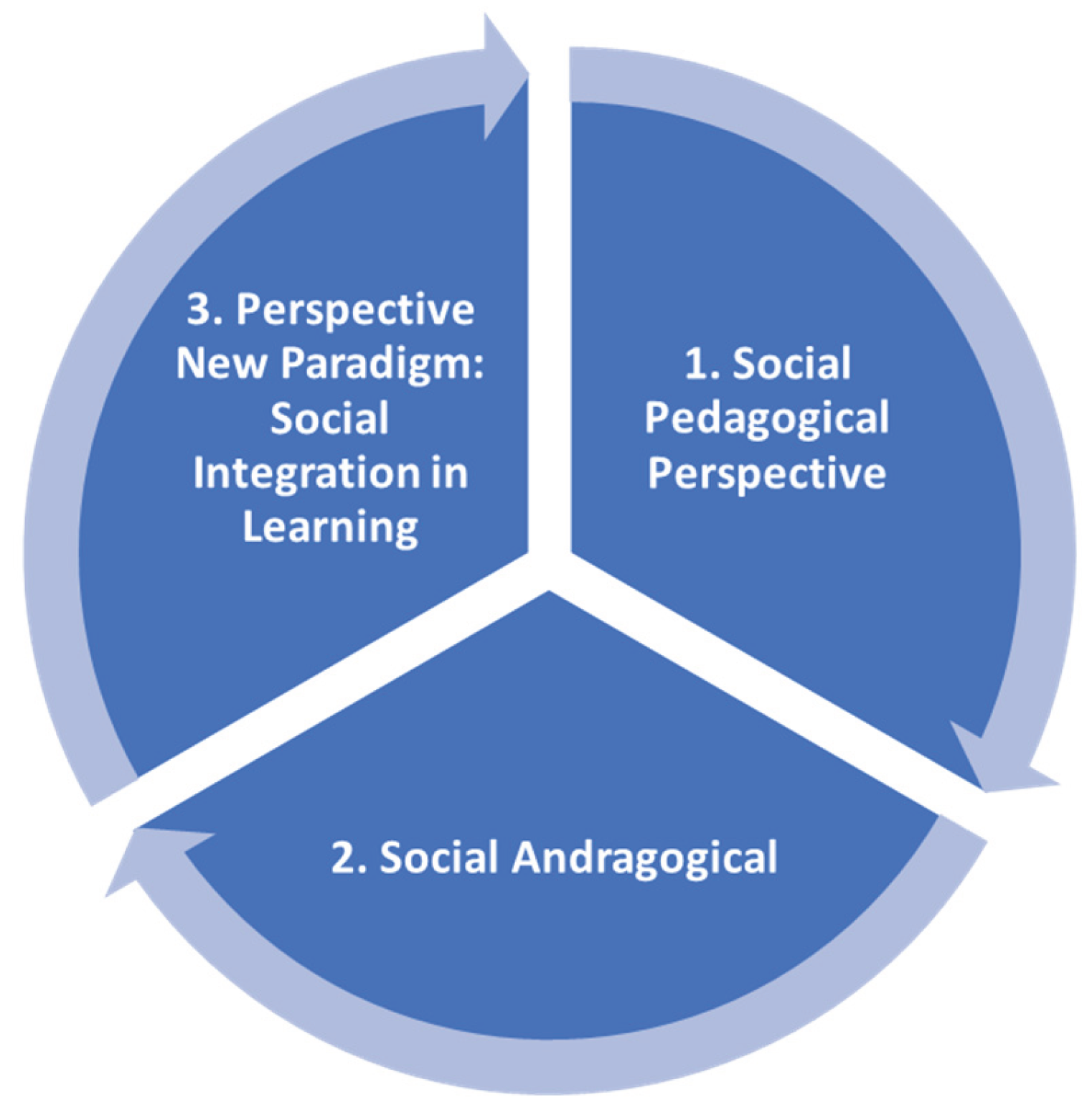

Table 1.
Characteristics of the Research Subject.
| Elements | Information | Number (N) | Percentage (%) |
|---|---|---|---|
| Gender | Man | 180 | 60% |
| Woman | 120 | 40% | |
| Age | 12–15 years | 100 | 33.33% |
| 16–18 years old | 150 | 50% | |
| >18 years old | 50 | 16.67% | |
| Role in Islamic Boarding Schools | Students | 200 | 66.67% |
| Islamic Boarding School Leaders | 15 | 5% | |
| Social Studies Teacher | 40 | 13.33% | |
| Education Personnel | 30 | 10% | |
| Santri Organization Manager | 15 | 5% | |
| Long time as a student/teacher | <1 year | 60 | 20% |
| 1–3 years | 120 | 40% | |
| >3 years | 120 | 40% | |
| Engagement Rate in Social Activities | Very active | 100 | 33.33% |
| Active | 150 | 50% | |
| Inactive | 50 | 16.67% | |
| Level of Understanding of Social Intelligence | Tall | 120 | 40% |
| Keep | 150 | 50% | |
| Low | 30 | 10% | |
| Availability of Access to Technology | Have access | 240 | 80% |
| Don’t have access | 60 | 20% | |
| Origin of Educational Background | Related Education | 40 | 66.67% |
| Education is not related | 20 | 33.33% | |
| Condition of Santri Families | Living in an entire dormitory | 180 | 60% |
| Roundtrip | 120 | 40% | |
| Motivation for Learning/Teaching | Tall | 180 | 60% |
| Keep | 90 | 30% | |
| Low | 30 | 10% | |
| Origin of Santri Region | Urban (kota) | 120 | 40% |
| Rural | 180 | 60% | |
| Level of Education of Students | Junior, intermediate level | 150 | 50% |
| Upper middle level | 150 | 50% | |
| Focus of Study Field (Teacher/Education Personnel) | IPS | 40 | 66.67% |
| Religious education | 15 | 25% | |
| Other fields | 5 | 8.33% | |
| Types of Extracurricular Activities Participated in | Religious activities | 100 | 33.33% |
| Arts and cultural activities | 80 | 26.67% | |
| Sports activities | 70 | 23.33% | |
| Others | 50 | 16.67% |
Data Processing, 2024.
Table 2.
Validity of research data with Triangulation analysis.
| Types of Triangulation | Procedures Performed | Purpose |
|---|---|---|
| Source Triangulation | Data from various sources, such as students, social studies teachers, pesantren leaders, and education personnel, were compared. | Ensure consistency of information from different perspectives of the research subject. |
| Triangulation Methods | Data collection methods were used for in-depth interviews, participatory observations, documentation, and FGDs. | Reduce bias and improve data reliability by comparing results from different methods. |
| Triangulation Time | Collect data at different times, for example, during the learning process, extracurricular activities, and informal times. | Captures variations in data based on a specific time context. |
| Triangulation of Researchers | Involve more than one researcher to compare and discuss the results of data analysis. | Reduce subjectivity and increase objectivity in the interpretation of research results. |
| Triangulation Theory | Compare research findings with relevant theories, such as social intelligence theory and character-based learning. | Validate the research results with a theoretical basis to increase confidence in the findings. |
Data Processing, 2024.
Table 3.
Identification of Social Intelligence-Based Social Science Learning Needs.
| Aspects | Key findings | Explanation |
|---|---|---|
| Curriculum | Social values such as tolerance, cooperation, and communication are listed in the RPP, but their implementation is not evenly distributed. | The curriculum document shows the integration of social values, but not all teachers can apply them consistently. |
| Learning Methods | Lecture methods with limited student involvement still dominate the majority of learning. | Teachers need more interactive methods like group discussions and simulations to increase student engagement. |
| Student Involvement | -Students feel more motivated if learning involves group activities or joint projects. | Students show enthusiasm for social interaction-based learning, but activities like this have not been applied often. |
| Supporting Facilities | Limited facilities, such as space for group discussions and interactive learning tools. | Teachers and students identified the need for adequate facilities to support social intelligence-based learning. |
| The Role of Teachers | Teachers need additional training to implement social intelligence-based learning models. | Teachers recognize that the application of interactive methods requires improving their pedagogical skills. |
| Extracurricular Activities | Activities such as debates and leadership simulations support the development of social skills but have not been integrated with social studies learning. | This activity is considered adequate by students, but it is not directly related to social studies learning in the classroom. |
| Implementation Barriers | Limited time in the curriculum schedule is an obstacle to inserting social intelligence-based activities. | Teachers struggle to manage the time between completing academic materials and developing students’ social skills. |
Data Processing, 2024.
Table 4.
Contextual Social Intelligence-Based Social Social Intelligence Social Social Learning Model.
Table 4.
Contextual Social Intelligence-Based Social Social Intelligence Social Social Learning Model.
| Aspects | Key findings | Explanation |
|---|---|---|
| Curriculum Components | The integration of social values such as tolerance, cooperation, and communication needs to be strengthened in the lesson plan and implementation in the classroom. | The curriculum must emphasize more local and global contexts relevant to students’ lives. |
| Learning Strategies | Group discussion methods, social simulations, and community-based projects are practical approaches to improve social skills. | Learning needs to involve real situations relevant to the students’ daily experiences. |
| The Role of Teachers | Teachers must act as facilitators who actively guide discussions and simulations to encourage productive social interaction. | Additional training for teachers is needed to improve their ability to apply social intelligence-based methods. |
| Contextualization of Materials | Social studies materials need to be adapted to the context of Islamic boarding schools, such as religious values, community life, and local social issues. | Students find it easier to understand the material if it relates to their daily lives and their social challenges. |
| Extracurricular Activities | Debates, leadership simulations, and project collaboration must be integrated with social studies learning. | This activity provides direct experience in interacting and working together, strengthening students’ social skills. |
| Use of Technology | Technologies such as interactive learning media, digital platforms, and virtual simulations can be used to increase student engagement. | Technology helps present diverse social situations and enrich students’ learning experience. |
| Learning Evaluation | Project-based assessment, observation of social interactions, and group reflection must be applied to measure social skills. | The evaluation should assess social skills comprehensively, including communication and cooperation skills. |
Data Processing, 2024.
Table 5.
Implementation of Social Intelligence-Based Social Sciences Learning Model.
| Implementation Aspects | Key findings | Explanation |
|---|---|---|
| Application of Learning Methods | Group discussions and social simulations are well implemented and increase student involvement. | Students participate more actively and show better communication skills during learning activities. |
| Response Center | Students feel that this method helps them understand the material more quickly and is relevant to their daily lives. | Santri stated that a social intelligence-based approach makes learning more engaging and increases learning motivation. |
| The Role of Teachers | Teachers can adapt to new learning models after receiving training. | Teachers play an effective role as facilitators in encouraging social interaction during the learning process. |
| Implementation Constraints | Learning time is limited to accommodate all planned interactive activities. | Teachers find it difficult to balance the completion of academic materials with the implementation of social intelligence-based activities. |
| Use of Technology | Technology such as interactive learning media and virtual simulations increases student engagement. | Technology helps present a more diverse social situation and enrich students’ learning experience. |
| Extracurricular Activities | Debates and group projects support social skills but are not yet fully integrated into social studies learning. | This activity provides hands-on experience in cooperation and social interaction but needs better time management. |
| Learning Evaluation Results | Project-based assessments show an improvement in communication, cooperation, and problem-solving skills in students. | Students showed significant progress in social skills as measured through group activities and reflection. |
Data Processing, 2024.
Table 6.
Evaluation of the Impact of Social Intelligence-Based Social Studies Learning Model on Social Skills of Students.
Table 6.
Evaluation of the Impact of Social Intelligence-Based Social Studies Learning Model on Social Skills of Students.
| Evaluation Aspects | Key findings | Explanation |
|---|---|---|
| Communication Skills | Students improve their speaking and listening skills during group discussions and activities. | Students are more confident in expressing their opinions and can respect the opinions of others during interactions. |
| Cooperative Ability | Students find working in groups easier, sharing tasks and completing projects together. | Group activities increase the sense of responsibility and solidarity among students. |
| Troubleshooting | - Students can analyze social problems given in simulations and offer solutions collaboratively. | This learning model encourages critical and creative thinking in facing social challenges. |
| Tolerance and Empathy | Students better understand the importance of tolerance and show empathy when interacting with friends from different backgrounds. | Social intelligence-based activities increase students’ awareness of diversity. |
| Learning Motivation | Students’ motivation to participate in learning increases because of methods that are interesting and relevant to their lives. | The contextual approach encourages active participation and interest in the subject matter. |
| Changes in Social Behavior | Students show a more open attitude and initiative to work together, and they can resolve conflicts effectively. | Social intelligence-based learning positively impacts students’ daily behavior in Islamic boarding schools. |
Data Processing, 2024.
Table 7.
Thematic analysis of the four research results.
| Theme | Sub Theme | Key findings | Explanation |
|---|---|---|---|
| Effectiveness of the Learning Model | Student Involvement | - The application of group discussion methods, social simulations, and community projects has increased student involvement. | Students are more motivated and actively participate in learning because of the relevant and interesting methods. |
| Relevance of Learning | - Learning becomes more relevant to the daily life of students, increasing their interest and motivation. | Students feel that the material taught is easier to understand because it relates to their social experience. | |
| Social Skills Enhancement | Communication | - Students show improved speaking skills, active listening, and respect for other people’s opinions. | The interactive learning method encourages students to be confident in expressing their opinions and listening with empathy. |
| Cooperation | - Students are easier to work in groups, share tasks, and complete projects together. | Group activities increase the sense of responsibility and solidarity among students. | |
| Troubleshooting | - Students can critically analyze social problems and provide solutions collaboratively. | Social simulations and community projects encourage critical and creative thinking skills in facing social challenges. | |
| Tolerance and Empathy | - Social intelligence-based activities increase students’ awareness of diversity and empathy for others. | Students appreciate differences more and can interact with friends from different backgrounds. | |
| The Role of Teachers and Implementation Obstacles | The Role of Teachers as Facilitators | - Teachers successfully guided discussions and interactive activities after attending additional training. | Teachers play an active role in supporting students’ social involvement during learning. |
| Time constraints | - Time limitations are an obstacle to accommodate all social intelligence-based activities. | Teachers find it difficult to balance the need for completing academic materials and developing students’ social skills. | |
| Supporting Facilities | -The limitations of discussion rooms and interactive learning tools are obstacles in implementing the learning model. | Adequate facility support is needed to support social intelligence-based learning activities. | |
| Positive Impact on Social Behavior | Changes in Social Behavior | - Students show more open behavior and initiative to work together and can resolve conflicts effectively. | The social intelligence-based approach encourages students to be more adaptive and cooperative in daily social interactions. |
| Learning Motivation | - Students’ motivation increases because of relevant and interesting learning methods. | Students are more enthusiastic about participating in learning because they feel that the material taught is relevant to their lives. |
Data Processing, 2024.
Disclaimer/Publisher’s Note: The statements, opinions and data contained in all publications are solely those of the individual author(s) and contributor(s) and not of MDPI and/or the editor(s). MDPI and/or the editor(s) disclaim responsibility for any injury to people or property resulting from any ideas, methods, instructions or products referred to in the content. |
© 2025 by the authors. Licensee MDPI, Basel, Switzerland. This article is an open access article distributed under the terms and conditions of the Creative Commons Attribution (CC BY) license (http://creativecommons.org/licenses/by/4.0/).
Copyright: This open access article is published under a Creative Commons CC BY 4.0 license, which permit the free download, distribution, and reuse, provided that the author and preprint are cited in any reuse.


