
Submitted:
04 June 2025
Posted:
05 June 2025
You are already at the latest version
Abstract
Background: This qualitative study investigates how schools in Aceh integrate technology with educational values to foster students' character development within the framework of Society 5.0. As the world undergoes rapid digital transformation, this research explores how Aceh’s educational institutions adapt to these changes while preserving cultural and moral values; Methods: Employing in-depth interviews, classroom observations, and document analysis, the study involved teachers, students, and administrators from multiple schools. The key areas of focus include pedagogical strategies, technology integration, and character-building initiatives; Results: The findings indicate that schools are embedding technology in education while prioritizing empathy, collaboration, and social responsibility essential attributes for thriving in Society 5.0. Furthermore, this study identifies both challenges and opportunities in achieving this balance; Conclusions: The insights derived provide valuable recommendations for educators and policymakers, offering a structured framework to harmonize technological advancements with character education in the digital era.
Keywords:
culture and education in aceh
; curriculum and digital innovation
; society 5.0 era
; technological advancement in schools
; values and character education
1. Introduction
The Society 5.0 era is a phase of societal development marked by the integration of digital technology and social life, where technology is not only a tool but also an integral part of daily life, including in the field of Education (Zhanbayev et al., 2023). In Aceh, as in many other regions, adopting technology in education poses challenges and opportunities (Taufik, 2020). Technology has opened up more comprehensive access to information and enabled more interactive learning. Still, it has also raised issues such as the digital divide and the risk of declining local social and cultural values (Aissaoui, 2022).
In particular, this research focuses on how technology integration can be aligned with educational values and character development in Aceh schools. Although technology offers various benefits in improving the quality of learning, there are significant challenges in balancing the use of technology with the preservation of cultural values and character education, especially in areas with strong traditions such as Aceh. Currently, many schools in Aceh face problems in integrating technology effectively while still maintaining local values, where the main obstacles include limited infrastructure, teacher training, and resistance to change.
Previous research has shown that technology integration in education often focuses on improving students' technical skills and learning effectiveness. At the same time, aspects of character and social values tend to receive less attention (Bereczki & Kárpáti, 2021). Several studies highlight the importance of character education in the digital era. Still, few have specifically discussed how technology can reinforce local values and character education (Chambers & Sandford, 2019) in a society with a solid cultural background, such as Aceh.
The urgency of this research lies in the need to develop an educational approach that utilizes technology to improve academic skills and strengthen local ethical and cultural values. Considering the unique characteristics of Acehnese society, this research offers a technology integration model that respects and promotes local values and supports the development of holistic student character. This is important so that education in the Society 5.0 era produces technologically competent individuals with empathy, responsibility, and strong ethics.
This study aims to provide strategic recommendations for developing curriculum and educational policies that are responsive to the demands of the times while maintaining the richness of local culture. This research is expected to be adopted by other countries or regions with similar cultural backgrounds and challenges, such as Southeast Asian regions and other developing countries. Thus, this concept is expected to help countries face global challenges while maintaining traditional identities and values in the digital era.
2. Literature Review
The use of technology in education has opened up many opportunities to improve the quality and effectiveness of learning (Haleem et al., 2022). Technology can expand students' access to information and learning resources and facilitate more interactive and collaborative learning (Fu & Hwang, 2018). However, significant challenges, such as the digital divide, are still obstacles, especially in rural or remote areas such as some parts of Aceh, which can limit access and quality of education (Qodir & Choerudin, 2024). In addition, uncontrolled use of technology has the potential to have negative impacts, such as screen addiction and decreased quality of social interaction (Cham et al., 2019). As the need for character education increases in the digital age, instilling moral and ethical values is becoming increasingly important, especially in this increasingly connected world (Rumiati et al., 2022). Effective character education requires a holistic approach integrated into all learning aspects (Chowdhury, 2018). In the context of Society 5.0, character education must also include digital literacy and ethics to ensure students can use technology wisely and responsibly (Muntakhib et al., 2024).
Previous research emphasizes the importance of maintaining local cultural identities in education, especially when integrating technology (Makarova et al., 2019). Including local cultural elements in the curriculum can strengthen students' identities and foster a sense of pride in their cultural heritage (Sakti et al., 2024). This approach is especially relevant in Aceh, where traditional and religious values are central to people's lives (Abee et al., 2019). Education that values local values while still utilizing technology can create a balance between modernity and cultural preservation (Makarova et al., 2019). In addition, the role of teachers has changed significantly in the digital age, from simply being an information conveyor to a facilitator and mentor who helps students develop critical thinking skills and strong character (Tathahira, 2020). In addition, many teachers still need adequate training and professional development to integrate technology into learning effectively (Yurtseven Avci et al., 2020).
Curriculum development in the Society 5.0 era must include a wide range of skills, from technical and digital skills to social-emotional skills, as well as character education emphasizing ethical and cultural values (Iksal et al., 2024). Previous research confirms that curricula relevant to Society 5.0 must be responsive to technological changes and student needs (Carayannis & Morawska-Jancelewicz, 2022). Additionally, education that engages local communities and encourages collaboration between schools, families, and communities can increase the relevance and effectiveness of educational programs (Maier et al., 2017). Other research reports that community involvement in education helps ensure that technology is adopted for academic purposes and supports the development of social character and values (Huda, 2019).
3. Materials and Methods
3.1. Research Desgin
The study will be conducted in Aceh Province in 2024, involving schools in both urban and rural areas. The sample is selected purposively, taking into account variations in technology use and character building approaches, and prioritising schools that demonstrate innovative practices in integrating technology and educational values. Using a qualitative approach with a case study design, this research aims to explore in depth how technology is integrated with educational values and character development in Aceh schools. Case studies were chosen to comprehensively understand the dynamics of educational practices in the context of the Society 5.0 era.
3.2. Partisipants
The data involved 300 respondents, consisting of teachers, students, parents, administrative staff and education policy makers. Data was collected through in-depth interviews to explore their views and experiences regarding the use of technology and educational values in schools. Each group of respondents will provide different perspectives, resulting in a more holistic understanding of how technology affects the education process and character building in the school environment.
3.3. Data Collection
Data will be collected through in-depth interviews with 100 teachers, 50 students, 50 parents, 50 administrative staff, and 50 education policymakers to explore their views and experiences regarding the use of technology and the value of education. Direct observation will be conducted in classrooms and school environments to understand how technology and character education are integrated into daily practices, focusing on interactions, technology usage, and social dynamics. Additionally, document analysis will be performed on curricula, lesson plans, and other educational materials to evaluate policies and practices that support technology integration in schools.
3.4. Data Analysis
The data will be thematically analyzed through several steps, beginning with the transcription of interviews and observations to facilitate the analysis. The data will then be coded to identify themes and subthemes inductively. The main themes related to integrating technology and character education will be identified, and emerging patterns will be analyzed in greater depth. Conclusions will be drawn based on the relationships between the themes, focusing on understanding how schools in Aceh balance technology and educational values within the context of Society 5.0.
3.5. Validity and Reliability
To improve the validity and reliability of the research, triangulation will be employed using multiple data sources (teachers, students, parents, administrative staff, and policymakers), various methods (interviews, observations, and document analysis), and the involvement of multiple researchers in the analysis process to reduce bias.
4. Results
The results of this study show that integrating technology in education in Aceh schools in the Society 5.0 era can improve the quality of learning and student engagement, primarily through e-learning platforms, project-based learning, and teacher training. The study also emphasizes incorporating character elements, such as digital ethics and social-emotional learning, to form students with strong character. In addition, integrating local cultural content and collaboration with the community helps harmonize technology with educational values so education remains relevant to Aceh's social and cultural context. This study identifies challenges and opportunities in combining technology with educational values in schools.
4.1. Research Respondents
Table 1 outlines the demographics of the research subjects, showing a predominance of male participants (73%) compared to females (27%), which may introduce gender-related bias in the findings. Most participants hold a Bachelor's degree (67%), followed by Senior High School graduates (17%), Master's degree holders (13%), and a small proportion with Doctoral degrees (3%), indicating a skew towards higher educational backgrounds. Age distribution reveals that 43% of participants are aged 25-45, suggesting a focus on young to middle-aged adults who may be more engaged in educational activities, while the 15-17 and 56-70 age groups each represent 17%, and the 46-55 age group accounts for 23%. Representation across roles is balanced, with teachers making up 33% and students, administration staff, parents, and policymakers each comprising 17%, ensuring diverse perspectives. While the age and role diversity provides a broad understanding, the gender imbalance and concentration of participants with Bachelor's degrees may affect the generalizability of the results.
4.2. Validity and Reliability
Table 1 demonstrates the use of triangulation analysis to validate research variables across eight analytical elements. To provide diverse insights, triangulation of sources involves gathering data from various perspectives, including teachers, students, parents, school principals, and cultural figures. Triangulation of methods uses data collection techniques, such as interviews, classroom observations, content analysis, and policy reviews, to ensure consistency in the findings. Triangulation of researchers involves multiple researchers reviewing data and interpretations, reducing bias and enhancing reliability. This comprehensive approach helps validate the findings by cross-checking information from multiple angles, thus increasing the study's credibility and robustness.
Figure 1 illustrates the research results from in-depth interview sources, direct observations, and document analysis. Furthermore, this data will be analyzed and developed thematically. The results of these three data collection methods provide a comprehensive picture of the state of technology integration and educational values in Aceh schools, as well as the challenges faced in efforts to achieve education relevant to the Society 5.0 era.
In-Depth Interviews: The in-depth interviews show that most respondents, including teachers, students, parents, and policymakers, see technology integration as an essential step in modernizing education. Teachers stated that technology helps facilitate more interactive and engaging learning, while students feel more motivated due to access to more diverse learning resources. However, the challenges faced include a lack of teacher training in the use of technology and a digital divide that results in limited access in remote areas. Respondents also emphasized the importance of maintaining local values and character in the curriculum amid technology adoption.
Direct Observation: School observations show that technology is used in learning, although the adoption rate varies. In some schools, the use of digital devices such as tablets and laptops has become a routine part of teaching and learning activities, while in other schools, the use of technology is still limited due to infrastructure problems. Observations also noted that interactions between students and teachers often continue despite technology integration. Still, there is a tendency for students to focus more on digital devices than direct interactions. Some extracurricular activities have also begun to utilize technology to enrich the student learning experience.
Document Analysis: From the analysis of documents, such as curriculum, lesson plans, and school policies, it is found that there are efforts to integrate elements of technology and character education. However, the implementation has not been evenly distributed throughout schools. The curriculum generally includes components of digital ethics and technology literacy, but its implementation depends on each school's readiness. Some policy documents also reflect efforts to engage local communities in supporting education rooted in cultural values, although this involvement still needs to be scaled up to be more effective.
4.3. Thematic Analysis
4.3.1. Technology Integration in the Curriculum
Table 2 reports the analyses of technology integration in school curricula in Aceh and assesses its impact on teaching and learning methods. Overall, the results show that integrating technology in education in Aceh has significantly changed teaching and learning methods. Despite significant progress, some challenges still need to be addressed, such as teacher training, access gaps, and parental support, to maximize the potential of technology in education.
Table 3 reports examine character-building strategies and initiatives in Acehnese schools in the context of technology use and assessments of the delivery of values and ethics in the digital era. This research shows that schools in Aceh have made great efforts to incorporate technology in character education. Despite the challenges, these efforts are generally seen as a positive step in preparing students for life in the digital era by maintaining strong values and ethics.
4.3.2. Influence of Local Culture and Traditions
Table 4 explores how local cultural values and traditions in Aceh are maintained and adapted to educational technology, as well as analyzes the role of education in maintaining cultural identity amid globalization and digitalization. Research shows that schools in Aceh actively seek to integrate and sustain local cultural values and traditions through educational technology. Despite the challenges, there is a solid commitment to maintaining cultural identity amid the influence of globalization and digitalization.
4.3.3. The Role of Teachers and Educators
Table 5 assesses how the role of teachers is changing with the integration of technology in education and identifies training and professional development needs for teachers in the era of Society 5.0. Research shows that integrating technology has brought about significant changes in the role and practice of teachers. There is a clear need for training and professional development focused on technological and pedagogical skills, as well as ongoing support to address challenges in the use of technology in education in the era of Society 5.0.
4.3.4. Impact of Technology on Students
Table 6 reports that technology use affects students' social, emotional, and cognitive development and evaluates technology's use in support of inclusive education needs. Research shows that technology significantly impacts students' cognitive, social, and emotional development and supports inclusive education. However, challenges remain, particularly related to teacher training, access gaps, and the need for effective supervision.
4.3.5. School Policy and Management
Table 7 reports how the school policies respond to the challenges and opportunities of technology integration and assessing the effectiveness of management strategies in implementing educational technology. Research shows that school policy and management face challenges but also find opportunities in technology integration. The significance of technology implementation depends heavily on good management strategies, teacher training, adequate infrastructure, and community involvement.
4.3.6. Community and Parent Involvement:
Table 8 reports the roles of communities and parents in supporting technology integration and character education and assessing the impact of technology on school-community relationships. Research shows that parent and community involvement is critical in helping technology integration and character education in schools. They contribute in the form of resources and as active partners in education. The impact of technology on school-community relationships is generally positive, although challenges must be overcome to maximize its benefits.
Table 9 outlines the main approaches to integrating technology in Aceh schools during the Society 5.0 era. Technology is integrated into the curriculum through digital platforms, project-based learning, and teacher training for effective implementation. Character development strategies include a digital ethics curriculum, social-emotional learning, and extracurricular activities to build student character. Additionally, the influence of Aceh's local culture is evident in the integration of local content, community-based education, and value-based education, ensuring technology use aligns with cultural and religious norms.
5. Discussion
This research shows that schools in Aceh have adopted technology in their curriculum through various means, such as the use of computers, tablets, and e-learning platforms to deliver learning materials (Smith, 2020), which is in line with previous findings on the importance of technology integration to improve access and quality of education (Johnson, 2018). Technology has changed teaching methods, making learning more interactive, increasing student engagement (Raja & Nagasubramani, 2018), and improving critical thinking and problem-solving skills (Kong, 2014). However, challenges like teacher training needs and infrastructure gaps between urban and rural schools still exist (Fulton, 2012). Community and parent support is critical in successfully integrating technology (Gess-Newsome et al., 2019). Technology has brought about positive changes in learning methods in Aceh, although challenges must be overcome to maximize its benefits (Zainuddin, 2015).
Schools in Aceh are adopting technology for character education by seeking to maintain local values and ethics while taking advantage of the advantages of the digital era. Technology integration in character education has become a global trend, including in Aceh, through educational applications, e-learning platforms, and social media to teach moral and ethical values (Campion et al., 2011). While technology can improve students' understanding of ethical concepts, its use must be appropriately controlled (Kasneci et al., 2023). This approach is supported by previous research emphasizing the importance of maintaining local cultural identity and values in the digital age by creating digital content that reflects local wisdom and ethical principles such as honesty, respect, and responsibility (Eko & Putranto, 2019). Additionally, teachers need a deep understanding of technology and its teaching methods to integrate these values effectively (Ottenbreit-Leftwich et al., 2010). While facing challenges such as cyberbullying, online privacy, and the digital divide, schools in Aceh are educating students on safe and ethical online behavior (Ribble, 2015). The study also highlights the importance of maintaining a balance between technology and human interaction, in line with research that shows that social interaction and traditional learning experiences remain essential in the formation of social character and value (Wirtz et al., 2010)
Schools in Aceh face unique challenges in bridging local cultural values with modern educational technology. Still, with a creative and collaborative approach, they have strong potential to use education to maintain and strengthen cultural identity amid globalization and digitalization. This includes using digital platforms to convey content related to Acehnese culture, such as history, art, and social values, which is effective in previous research as long as it is done sensitively and sustainably (Sun, 2012). This research also shows how schools in Aceh adapt and present local traditions in formats relevant to the digital era, such as developing interactive learning materials that utilize visual and audio elements to make them more attractive to the younger generation (Ryan et al., 2011). Education plays a vital role in strengthening cultural identity amid the pressures of globalization, including teaching cultural values in curricula and extracurricular activities and dialogue between schools and communities to reflect societal values (McCarty & Lee, 2014). While there are challenges, such as resistance to change and difficulty finding the right resources, integrating technology can be an innovative opportunity to reform teaching methods, allowing for more collaborative and interactive learning in the classroom (Collins & Halverson, 2018).
This research shows that integrating technology into education has significantly changed the role of teachers, creating new needs for training and professional development. Consistent with previous findings, adaptation, and sustainable development are key to teacher success in the era of Society 5.0 (König et al., 2020), with the teacher's role shifting from merely conveying knowledge to being a facilitator of learning, mentor, and liaison between technology and students (Asención Delaney, 2012). The research highlights the urgent need for teachers to receive training in educational technology, including digital literacy, digital tools, and innovative and adaptive teaching methods (Ghavifekr & Rosdy, 2015). In the context of Society 5.0, teacher adaptation includes student-centered teaching approaches, using data to tailor instructional techniques, and integrating cross-disciplinary learning (Fukuyama, 2018). Although challenges such as resource limitations, resistance to change, and digital skills gaps among teachers persist (Howard & Mozejko, 2015), these issues are also recognized as opportunities for innovation and professional growth Kopcha, 2010).
This research shows that technology significantly impacts students' social, emotional, and cognitive development while supporting inclusive education. Technology can enhance social and emotional skills such as empathy, cooperation, and communication through social media and digital collaborative tools. However, excessive reliance on technology can reduce face-to-face social interaction, which is crucial for emotional development (Pea et al., 2012). Regarding cognitive development, technology facilitates access to information, independent learning, and personalized learning approaches (Liaw et al., 2010) while improving critical thinking and creativity. It also plays a key role in inclusive education by aiding students with special needs through tools like screen readers and adaptive software, providing equal learning opportunities (Warschauer & Matuchniak, 2010). Challenges include the digital divide, screen time balance, mental health concerns, and adequate teacher training. However, the judicious and tailored use of technology is seen as an opportunity to develop more inclusive and sustainable strategies (Godfrey et al., 2013).
This research demonstrates that school policies and management strategies play a crucial role in addressing the challenges and opportunities of integrating educational technology, with continuous adaptation, stakeholder engagement, and strategic planning being essential for success (Razali et al., 2023). Additionally, technology presents opportunities for more personalized learning and enhanced collaboration. The study also highlights the significant role of communities and parents in supporting technology integration and character education, emphasizing the need for coordinated efforts among schools, families, and the broader community to maximize the benefits of technology (Epstein, 2018). This support includes providing resources, participating in school activities, and monitoring technology use at home. Technology can facilitate communication through school websites, apps, and social media, although challenges such as the digital divide and varying levels of technology understanding persist (Hornby & Lafaele, 2011).
6. Conclusions
The research highlights schools in Aceh's progressive efforts to integrate technology and character building, demonstrating a commitment to comprehensive education in the digital age. Technology enhances access to learning resources and creates interactive experiences that promote values like integrity and empathy, crucial for character development. By aligning digital tools with local values, schools ensure education remains culturally grounded despite technological shifts. Teachers play a key role, emphasizing the need for professional development, while parental and community involvement strengthens the process. Aceh’s schools are well-positioned to face the challenges of Society 5.0, balancing technology and cultural preservation.
7. Research Limitation
The limitation of this research is that it focuses only on schools in Aceh, so the results may not be generalisable to other regions with different conditions. Differences in access to technology between urban and rural schools affected the results, and the focus on short-term implementation did not examine long-term impacts. Variations in teachers' skills in using technology also affect the effectiveness of integration. In addition, stakeholder participation may not fully represent the perspective of the entire population due to limitations in sampling and data collection methods.
Author Contributions
Conceptualization, S.S., R.R and SL.SL.; methodology, S.S., R.R and SL.SL; software, S.S.; validation, S.S., R.R and SL.SL.; formal analysis, R.R.; investigation, S.S., R.R and SL.SL.; resources, S.S., R.R and SL.SL.; data curation, S.S., R.R and SL.SL.; writing—original draft preparation, S.S., R.R and SL.SL.; writing—review and editing, S.S., R.R and SL.SL. All authors have read and agreed to the published version of the manuscript.
Funding
This research received no external funding
Institutional Review Board Statement
Not applicable
Informed Consent Statement
Informed consent was obtained from all subjects involved in the study.
Data Availability Statement
Data are not available due to ethical restrictions.
Acknowledgments
We acknowledge the teachers that participated in this study.
Conflicts of Interest
The authors declare no conflicts of interest.
Appendix A. Research Questions and Descriptions

Table A1.
Technology Integration in the Curriculum.
| Research Questions | Description |
|---|---|
| How do schools integrate technology into their curriculum? | This question explores the methods and strategies schools use to incorporate technology into the curriculum. This includes using digital devices, e-learning platforms, and other educational tools. |
| What impact does technology integration have on students' learning experience? | The focus is on the influence of technology on student engagement, concept understanding, and overall learning outcomes. |
| How do teachers design and implement lessons with technology? | Investigate how teachers prepare and manage lessons that integrate technology, including their challenges and opportunities. |
| What are the main challenges schools face in integrating technology into the curriculum? | This question seeks to understand obstacles that schools may face, such as limited resources, teacher training, or infrastructure issues. |
| How do schools adapt traditional curricula to today's technology needs? | This exploration aims to understand how schools combine traditional curriculum elements with new technology learning tools and methods. |
| What are teachers' perceptions and attitudes toward the use of technology in teaching? | Explores how teachers perceive the effectiveness and usefulness of technology in education and how this affects how they teach. |
| What is the role of technology in supporting inclusive and diverse education? | Assess how technology can support diverse learning needs and deliver a more inclusive education. |
| How does technology integration affect 21st-century skills such as problem-solving, critical thinking, and collaboration? | Investigate the impact of technology on the development of key skills necessary for success in the modern world. |
| How does technology affect creativity and innovation in the learning process? | An exploration of how technology facilitates or enhances creativity and innovation among students. |
| How do schools assess and monitor the effectiveness of technology integration in the curriculum? | Investigate the methods and tools schools use to evaluate and improve their technology integration practices. |
Table A2.
Character Building in the Digital Age.
| Research Questions | Description |
|---|---|
| How do schools integrate character-building in their digital curricula? | The focus is to explore strategies and approaches educational institutions use to combine character learning with technology. |
| What is the impact of technology on the development of values and ethics among students? | This question aims to understand how technology affects moral and ethical aspects in forming student character. |
| How do teachers facilitate character learning in an increasingly digital environment? | Investigate the role of teachers in teaching and promoting values such as integrity, empathy, and cooperation in the context of digital learning. |
| How does social media and digital platforms affect students' social behavior and attitudes? | Assess how online interactions affect students' character development, including cyberbullying, digital empathy, and safety. |
| What challenges do educators face in teaching values in the digital age? | An exploration of educators' barriers to integrating traditional values in a technology-dominated curriculum. |
| How do schools assess and measure progress in student character building in the digital age? | Evaluate the methods and tools schools use to measure the effectiveness of their character-building programs in a digital context. |
| How can technology be used to increase social awareness and responsibility among students? | Investigate how digital tools can be used to develop social and ethical awareness among students. |
| What is the role of parents and communities in supporting character-building in the digital age? | Exploring how cooperation between schools, parents, and communities helps students develop strong character in the digital age. |
| How do schools deal with digital security issues in the context of character building? | Examine how schools teach and implement digital safety policies as part of character education. |
| What are effective strategies for integrating digital literacy with character education? | Analyze practical approaches in combining learning about responsible and ethical use of technology with character-building programs. |
Table A3.
Influence of Local Culture and Traditions.
| Research Questions | Description |
|---|---|
| How do schools maintain and integrate local cultures and traditions in curricula that are increasingly dominated by technology? | This question explores the approach schools use in combining elements of local culture and tradition with technology-based education. |
| What is the role of technology in documenting and promoting local cultural heritage? | Investigate how technology is used to preserve and disseminate knowledge about local cultures and traditions. |
| How do students perceive incorporating local cultures and traditions in their education? | Assess how students respond to and appreciate efforts to integrate local cultures and traditions into their learning. |
| How are educators and policymakers addressing the challenges of aligning modern curricula with traditional values? | An exploration of strategies educators and policymakers use in synchronizing technology-oriented curricula with traditional values. |
| How do local communities engage in the educational process to ensure the transmission of culture and tradition? | Investigate the role of local communities in education, particularly in maintaining and enriching cultural and traditional teaching in schools. |
| How does integrating local cultures and traditions in education impact students' identity and sense of pride? | Evaluate how this integration affects students' identity formation and sense of pride in their cultural heritage. |
| How does technology help in addressing cultural and linguistic gaps in education? | Assess how technology can be harnessed to bridge cultural and linguistic gaps in the context of multicultural education. |
| How do schools adapt technology to teach and preserve local languages and dialects? | Investigate the strategies and methods schools use in using technology to teach local languages and dialects to students. |
| How do students respond to the teaching of local cultures and traditions in the digital age? | Examine students' reactions and adaptations to learning materials that incorporate local cultures and traditions in digital format. |
| How do schools evaluate the effectiveness of teaching local cultures and traditions in technology-enriched settings? | Assess the methods used by schools in evaluating the effectiveness of programs that blend local culture and traditions with technology. |
Table A4.
The Role of Teachers and Educators.
| Research Questions | Description |
|---|---|
| How are teachers adjusting their roles in an increasingly digital educational environment? | This exploration aims to understand how teachers adapt to technological educational changes and how this affects their teaching practices. |
| What challenges do teachers face in integrating technology into their teaching methods? | This question seeks to identify and understand the barriers teachers face in applying technology in teaching. |
| How do teachers maintain student engagement in the digital age? | The focus is to explore strategies teachers use to maintain or increase student engagement in technology-rich learning contexts. |
| How do educators assess and monitor student learning progress in technology-enriched settings? | This question aims to understand teachers' methods and tools to evaluate and monitor student progress in a digital learning environment. |
| What is the role of teachers in character building and social development of students in the digital age? | Investigate how teachers incorporate character learning and social skills in education using technology. |
| How do teachers address the digital divide among students? | This exploration aims to determine how teachers identify and address differences in technology access and expertise among students. |
| How are teachers using technology to support inclusive education? | Assess how teachers use technology to meet the needs of diverse students and create inclusive learning environments. |
| What innovative teaching approaches and methods are teachers applying in the digital age? | This question explores innovative techniques teachers use to integrate technology into their teaching. |
| How do professional training and continuous development for teachers affect the use of technology in education? | Investigate the impact of professional training and ongoing development on teachers' ability and readiness to use educational technology. |
| How do teachers balance the use of technology with traditional teaching methods? | This question aims to understand how teachers balance technology and conventional teaching techniques. |
Table A5.
Impact of Technology on Students.
| Research Questions | Description |
|---|---|
| How does the use of technology in education affect student engagement and motivation? | This question explores how technology affects students' interest and participation in the learning process. |
| What impact does technology have on students' mental and emotional well-being? | The focus is to understand how exposure to and use of technology impacts students' mental and emotional health, including aspects such as stress, anxiety, or pleasure. |
| How does technology affect students' development of social and communication skills? | Investigate the impact of technology use on students' ability to interact socially and communicate effectively online and offline. |
| How do students adjust to changing technology-driven learning methods? | This exploration aims to understand students' adaptation to new learning methods integrated with technology, such as online or blended learning. |
| What impact does disparate access to technology among students have on educational equity? | This question assesses how differences in technology access among students affect their learning opportunities and equity in education. |
| How does the use of technology impact students' critical thinking and problem-solving skills? | Investigate the effects of technology use on students' ability to think critically, analyze information, and solve problems. |
| How does technology affect student independence and management of study time? | This exploration aims to understand how technology supports or hinders students' learning independence and time management. |
| What is the long-term impact of technology use on student academic achievement? | Assess how long-term use of technology affects student learning outcomes and academic achievement. |
| How do students view technology as a learning tool in their education? | This question aims to understand students' perceptions and attitudes towards the use of technology in education. |
| How does technology support or hinder inclusive learning and diversification of learning styles? | Investigate how technology can be used to accommodate a variety of learning styles and special educational needs to create inclusive learning environments. |
Table A6.
School Policy and Management.
| Research Questions | Description |
|---|---|
| How does school policy govern the integration and use of technology in education? | This question aims to understand the policy framework created by schools to adopt technology in the learning process. |
| How does school management respond to the challenges and opportunities brought by educational technology? | Investigate strategies and approaches taken by school management in dealing with technology-induced changes in education. |
| What are the obstacles faced by schools in the implementation of technology policies? | This exploration aims to identify and understand practical barriers to implementing technology policy, such as resources, infrastructure, or training. |
| How does school leadership affect the use and acceptance of technology among teachers and students? | Assess the role of school leadership in encouraging or hindering the adoption of educational technology. |
| How do schools ensure data safety and security in digital learning systems? | This question aims to understand how schools are protecting student and staff data and privacy in a technology-enriched learning environment. |
| How do school policies support students' character-building and social development in the digital age? | Investigate how school policies are designed to incorporate character-building and social development in technology-oriented curricula. |
| How do schools assess and evaluate the effectiveness of technology use in education? | Evaluate the methods and criteria schools use to measure the effectiveness of technology use in education. |
| How does school management facilitate teacher training and professional development in the context of educational technology? | This question aims to understand school strategies for providing and supporting teacher training in educational technology. |
| How do schools address the digital divide and ensure equal access to technology for all students? | Investigate strategies implemented by schools to ensure that all students have fair and equal access to technological resources. |
| How do school policies encourage innovation and creativity in the use of technology? | Assess how school policies encourage innovation and creative use of technology in education. |
Table A7.
Community and Parent Involvement.
| Research Questions | Description |
|---|---|
| How does school policy govern the integration and use of technology in education? | This question aims to understand the policy framework created by schools to adopt technology in the learning process. |
| How does school management respond to the challenges and opportunities brought by educational technology? | Investigate strategies and approaches taken by school management in dealing with technology-induced changes in education. |
| What are the obstacles faced by schools in the implementation of technology policies? | This exploration aims to identify and understand practical barriers to implementing technology policy, such as resources, infrastructure, or training. |
| How does school leadership affect the use and acceptance of technology among teachers and students? | Assess the role of school leadership in encouraging or hindering the adoption of educational technology. |
| How do schools ensure data safety and security in digital learning systems? | This question aims to understand how schools are protecting student and staff data and privacy in a technology-enriched learning environment. |
| How do school policies support students' character-building and social development in the digital age? | Investigate how school policies are designed to incorporate character-building and social development in technology-oriented curricula. |
| How do schools assess and evaluate the effectiveness of technology use in education? | Evaluate the methods and criteria schools use to measure the effectiveness of technology use in education. |
| How does school management facilitate teacher training and professional development in the context of educational technology? | This question aims to understand school strategies for providing and supporting teacher training in educational technology. |
| How do schools address the digital divide and ensure equal access to technology for all students? | Investigate strategies implemented by schools to ensure that all students have fair and equal access to technological resources. |
| How do school policies encourage innovation and creativity in the use of technology? | Assess how school policies encourage innovation and creative use of technology in education. |
References
- Abee, S., Nasution, H. B., & Abas, S. (2019). Dayah Cleric Views towards Aceh Community Plurality. Budapest International Research and Critics in Linguistics and Education (BirLE) Journal, 2(3), 06-14.
- Aissaoui, N. (2022). The digital divide: a literature review and some directions for future research in light of COVID-19. Global Knowledge, Memory and Communication, 71(8/9), 686-708. [CrossRef]
- Asención Delaney, Y. (2012). Research on mentoring language teachers: Its role in language education. Foreign Language Annals, 45(s1), s184-s202. [CrossRef]
- Bereczki, E. O., & Kárpáti, A. (2021). Technology-enhanced creativity: A multiple case study of digital technology-integration expert teachers’ beliefs and practices. Thinking Skills and Creativity, 39, 100791. [CrossRef]
- Campion, M. A., Fink, A. A., Ruggeberg, B. J., Carr, L., Phillips, G. M., & Odman, R. B. (2011). Doing competencies well: Best practices in competency modeling. Personnel psychology, 64(1), 225-262. [CrossRef]
- Carayannis, E. G., & Morawska-Jancelewicz, J. (2022). The futures of Europe: Society 5.0 and Industry 5.0 as driving forces of future universities. Journal of the Knowledge Economy, 13(4), 3445-3471. [CrossRef]
- Cham, S., Algashami, A., Aldhayan, M., McAlaney, J., Phalp, K., Almourad, M. B., & Ali, R. (2019). Digital addiction: Negative life experiences and potential for technology-assisted solutions. New Knowledge in Information Systems and Technologies: Volume 2,.
- Chambers, F., & Sandford, R. (2019). Learning to be human in a digital world: a model of values fluency education for physical education. Sport, Education and Society. [CrossRef]
- Chowdhury, M. (2018). Emphasizing morals, values, ethics, and character education in science education and science teaching. MOJES: Malaysian Online Journal of Educational Sciences, 4(2), 1-16.
- Collins, A., & Halverson, R. (2018). Rethinking education in the age of technology: The digital revolution and schooling in America. Teachers College Press.
- Eko, B. S., & Putranto, H. (2019). The role of intercultural competence and local wisdom in building intercultural and inter-religious tolerance. Journal of Intercultural Communication Research, 48(4), 341-369. [CrossRef]
- Epstein, J. L. (2018). School, family, and community partnerships: Preparing educators and improving schools. Routledge.
- Fu, Q.-K., & Hwang, G.-J. (2018). Trends in mobile technology-supported collaborative learning: A systematic review of journal publications from 2007 to 2016. Computers & education, 119, 129-143. [CrossRef]
- Fukuyama, M. (2018). Society 5.0: Aiming for a new human-centered society. Japan Spotlight, 27(5), 47-50.
- Fulton, K. (2012). Upside down and inside out: Flip your classroom to improve student learning. Learning & Leading with Technology, 39(8), 12-17.
- Gess-Newsome, J., Taylor, J. A., Carlson, J., Gardner, A. L., Wilson, C. D., & Stuhlsatz, M. A. (2019). Teacher pedagogical content knowledge, practice, and student achievement. International Journal of Science Education, 41(7), 944-963.
- Ghavifekr, S., & Rosdy, W. A. W. (2015). Teaching and learning with technology: Effectiveness of ICT integration in schools. International journal of research in education and science, 1(2), 175-191. [CrossRef]
- Godfrey, A. G., Masquelin, T., & Hemmerle, H. (2013). A remote-controlled adaptive medchem lab: an innovative approach to enable drug discovery in the 21st Century. Drug Discovery Today, 18(17-18), 795-802. [CrossRef]
- Haleem, A., Javaid, M., Qadri, M. A., & Suman, R. (2022). Understanding the role of digital technologies in education: A review. Sustainable Operations and Computers, 3, 275-285. [CrossRef]
- Hornby, G., & Lafaele, R. (2011). Barriers to parental involvement in education: An explanatory model. Educational review, 63(1), 37-52. [CrossRef]
- Howard, S. K., & Mozejko, A. (2015). Teachers: technology, change and resistance. Teaching and digital technologies: Big issues and critical questions, 2(1), 307-317.
- Huda, M. (2019). Empowering application strategy in the technology adoption: insights from professional and ethical engagement. Journal of Science and Technology Policy Management, 10(1), 172-192.
- Iksal, I., Hayani, R. A., & Aslan, A. (2024). Strengthening character education as a response to the challenges of the times. Indonesian Journal of Education (INJOE), 4(3), 761~ 774-761~ 774.
- Johnson, L. L. (2018). Where do we go from here? Toward a critical race English education. Research in the Teaching of English, 53(2), 102-124. [CrossRef]
- Kasneci, E., Seßler, K., Küchemann, S., Bannert, M., Dementieva, D., Fischer, F., Gasser, U., Groh, G., Günnemann, S., & Hüllermeier, E. (2023). ChatGPT for good? On opportunities and challenges of large language models for education. Learning and individual differences, 103, 102274. [CrossRef]
- Kong, S. C. (2014). Developing information literacy and critical thinking skills through domain knowledge learning in digital classrooms: An experience of practicing flipped classroom strategy. Computers & education, 78, 160-173. [CrossRef]
- König, J., Jäger-Biela, D. J., & Glutsch, N. (2020). Adapting to online teaching during COVID-19 school closure: teacher education and teacher competence effects among early career teachers in Germany. European journal of teacher education, 43(4), 608-622. [CrossRef]
- Liaw, S.-S., Hatala, M., & Huang, H.-M. (2010). Investigating acceptance toward mobile learning to assist individual knowledge management: Based on activity theory approach. Computers & education, 54(2), 446-454. [CrossRef]
- Maier, A., Daniel, J., Oakes, J., & Lam, L. (2017). Community Schools as an Effective School Improvement Strategy: A Review of the Evidence. Learning Policy Institute.
- Makarova, E. A., Makarova, E. L., & Korsakova, T. V. (2019). The Role of Globalization and Integration in Interdisciplinary Research, Culture and Education Development. Journal of History, Culture & Art Research/Tarih Kültür ve Sanat Arastirmalari Dergisi, 8(1). [CrossRef]
- McCarty, T., & Lee, T. (2014). Critical culturally sustaining/revitalizing pedagogy and Indigenous education sovereignty. Harvard educational review, 84(1), 101-124. [CrossRef]
- Muntakhib, A., Mustolehudin, M., Taruna, M. M., & Dahri, H. (2024). Cultivating Character in The Digital Age: Umar Ibn Ahmad Bārājā's Moral Education Framework for Society 5.0. Analisa: Journal of Social Science and Religion, 9(1), 112-127.
- Ottenbreit-Leftwich, A. T., Glazewski, K. D., Newby, T. J., & Ertmer, P. A. (2010). Teacher value beliefs associated with using technology: Addressing professional and student needs. Computers & education, 55(3), 1321-1335. [CrossRef]
- Pea, R., Nass, C., Meheula, L., Rance, M., Kumar, A., Bamford, H., Nass, M., Simha, A., Stillerman, B., & Yang, S. (2012). Media use, face-to-face communication, media multitasking, and social well-being among 8-to 12-year-old girls. Developmental psychology, 48(2), 327.
- Qodir, A., & Choerudin, A. (2024). Educational Management Strategies for Enhancing Access and Quality of Education for Students in Remote Areas. Jurnal Terobosan Peduli Masyarakat (TIRAKAT), 1(3), 170-181.
- Razali, R., Sundana, L., & Ramli, R. (2023). Curriculum Development in Higher Education in Light of Culture and Religiosity: A Case Study in Aceh of Indonesia. International Journal of Society, Culture & Language, 1-17.
- Ribble, M. (2015). Digital citizenship in schools: Nine elements all students should know. International Society for technology in Education.
- Rumiati, S., Karim, A. A., Darmawan, C., Fitriasari, S., & Pudjiastuti, S. R. (2022). Establishment Of Student Character Through Citizens Ethics In The Digital Era. Proceeding of International Conference on Education,.
- Ryan, S. D., Magro, M. J., & Sharp, J. H. (2011). Exploring educational and cultural adaptation through social networking sites. Journal of Information Technology Education: Research, 10. [CrossRef]
- Sakti, S. A., Endraswara, S., & Rohman, A. (2024). Integrating local cultural values into early childhood education to promote character building. International Journal of Learning, Teaching and Educational Research, 23(7), 84-101. [CrossRef]
- Smith, D. G. (2020). Diversity's promise for higher education: Making it work. JHU Press.
- Sun, H. (2012). Cross-cultural technology design: Creating culture-sensitive technology for local users. OUP USA.
- Tathahira, T. (2020). Promoting students’ critical thinking through online learning in higher education: Challenges and strategies. Englisia: Journal of Language, Education, and Humanities, 8(1), 79-92. [CrossRef]
- Taufik, M. (2020). Strategic role of Islamic religious education in strengthening character education in the era of industrial revolution 4.0. Jurnal Ilmiah Islam Futura, 20(1), 86-104. [CrossRef]
- Warschauer, M., & Matuchniak, T. (2010). New technology and digital worlds: Analyzing evidence of equity in access, use, and outcomes. Review of research in education, 34(1), 179-225. [CrossRef]
- Wirtz, B. W., Schilke, O., & Ullrich, S. (2010). Strategic development of business models: implications of the Web 2.0 for creating value on the internet. Long range planning, 43(2-3), 272-290.
- Yurtseven Avci, Z., O'Dwyer, L. M., & Lawson, J. (2020). Designing effective professional development for technology integration in schools. Journal of Computer Assisted Learning, 36(2), 160-177. [CrossRef]
- Zainuddin, Z. (2015). Exploring the potential of blended learning and learning Management Systems (LMSs) for Higher Education in Aceh. Englisia: Journal of Language, Education, and Humanities, 2(2), 70-85. [CrossRef]
- Zhanbayev, R. A., Irfan, M., Shutaleva, A. V., Maksimov, D. G., Abdykadyrkyzy, R., & Filiz, Ş. (2023). Demoethical model of sustainable development of society: A roadmap towards digital transformation. Sustainability, 15(16), 12478. [CrossRef]
Figure 1.
The process of collecting research data.
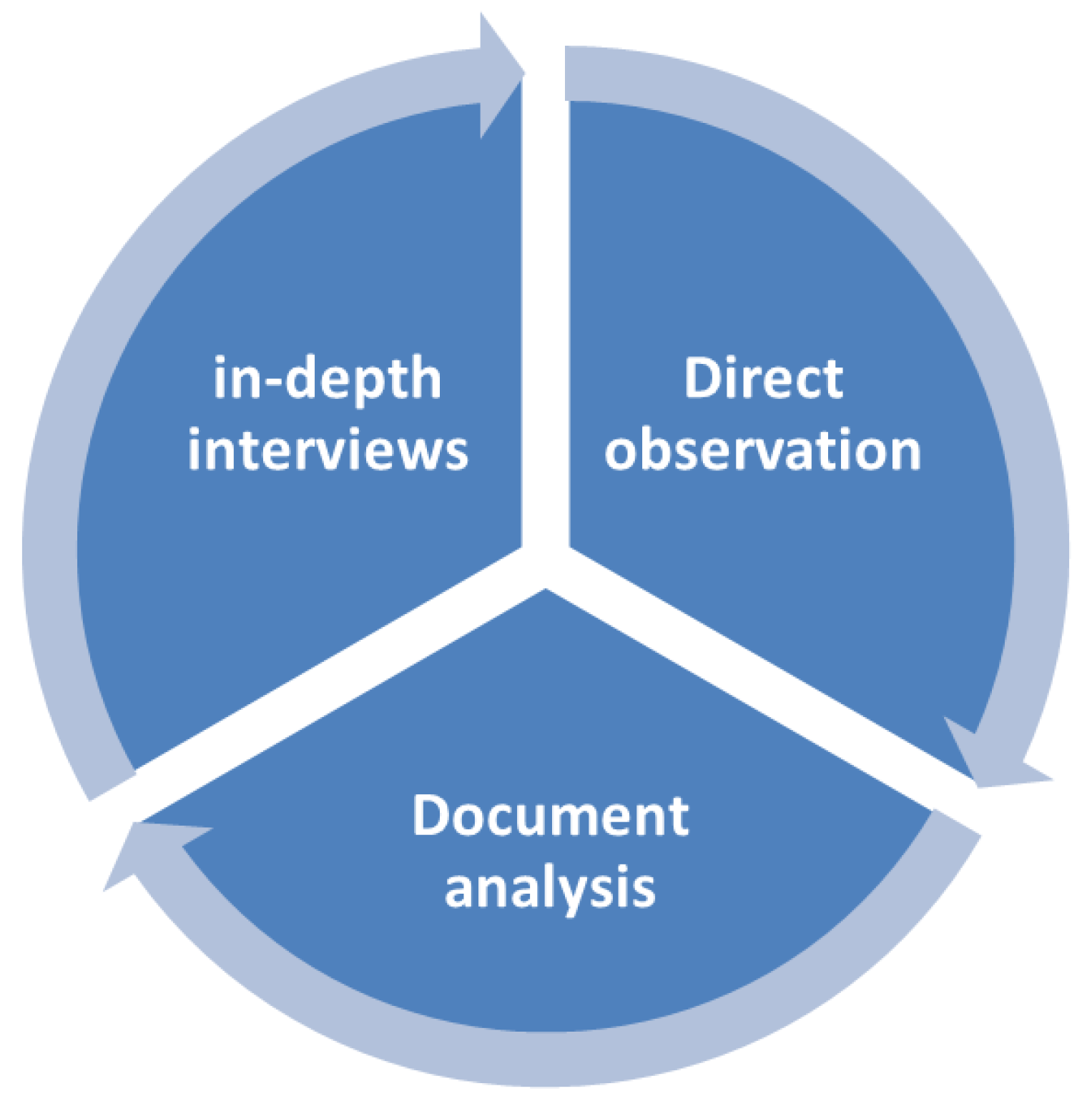
Table 1.
Triangulation analysis of validity and reliability of the research variables .
| Analytical Element | Triangulation of Sources | Triangulation of Methods | Triangulation of Researchers |
|---|---|---|---|
| Technology Integration in the Curriculum | Data from teachers, students, and principals to get perspectives on the application of technology. | Interviews, classroom observations, and document analysis were used to confirm the consistency of the findings. | Involve multiple researchers to analyze the data and ensure objective interpretation. |
| Character Building in the Digital Era | Data from teachers, students, and parents to understand the influence of technology on students' moral values. | Using interviews, analysis of digital content used in learning, and direct observation. | Involve several researchers to evaluate data on the use of technology in character learning. |
| Influence of Local Culture and Traditions | Data from teachers, students, and local cultural figures to understand cultural integration in technology-based learning. | We are using content analysis of digital teaching materials, interviews, and observation of school activities to evaluate the incorporation of cultural values. | Several researchers are involved in ensuring consistency in interpreting cultural values in the curriculum. |
| The Role of Teachers and Educators | Data from teachers, students, and principals regarding teachers' changing role in the technology context. | Using classroom observations, interviews with teachers, and analysis of training documents. | Involve more than one researcher to review the data and avoid bias in interpreting teacher roles. |
| Impact of Technology on Students | Information from students, teachers, and parents to evaluate the influence of technology on student development. | Interviews, performance tests, and analysis of student progress records are used to assess the impact of using technology. | Involve several researchers to analyze the results to ensure reliability in the evaluation of the impact of technology. |
| School Policy and Management | Data from principals, teachers, and school policy documents on technology and resource management. | Interviews, analysis of policy documents, and review of field implementation are used to assess the effectiveness of management strategies. | We are using multiple researchers to review policies and strategies implemented by schools. |
| Community and Parent Involvement | Data from students, parents, and communities are needed to understand support for technology and character education. | I will combine interviews, observe school activities involving the community and parents, and review school program documents. | Involve several researchers to assess consistency in community and parent engagement outcomes. |
| Readiness to Face Society 5.0 | Data from teachers, students, parents, and education experts to evaluate school readiness. | Interviews, analysis of school strategy documents, and direct observation were used to assess readiness to face the digital era. | Some researchers analyzed the data to verify consistency in school readiness assessments. |
Source: Primary data 2024.
Table 2.
The results of the study of aspects of integration technology in the curriculum.
| Evaluation Topics | Research Findings |
|---|---|
| Technology Integration in the Curriculum | Research finds that schools in Aceh have progressively integrated technology into their curricula. This includes utilizing diverse digital tools such as tablets, computers, interactive whiteboards, e-learning platforms, and online resources. |
| Improvement of Teaching Methods | Technology has allowed teachers to adopt more innovative and interactive teaching methods. Using multimedia and interactive learning tools has been found to increase student engagement and facilitate understanding of complex concepts. |
| Impact on Student Learning | Students in Aceh responded positively to the use of technology in learning. Technology has helped facilitate access to information and enrich their learning experience. |
| Teacher Training and Capacity Building | One of the key challenges identified was the need for more intensive teacher training in the use of technology. Teacher capacity building was a key factor for the practical application of technology in education. |
| Resource and Access Gaps | Despite progress, there are still gaps in resources and access to technology between schools in various areas of Aceh, especially between urban and rural schools. |
| Parent Involvement and Support | It was found that parental involvement and support in the learning process with technology are important factors, especially in assisting students in learning at home. |
| Evaluation of Teaching Effectiveness | Schools have adopted various ways to evaluate the effectiveness of technology use in teaching, including student feedback and classroom observation. |
| The Role of Technology in Inclusive Education | Technology was found to support inclusive education by providing learning aids tailored to students' individual needs. |
Source: Primary data 2024.
Table 3.
The results of research on aspects of character formation in the digital era.
| Evaluation Topics | Research Findings |
|---|---|
| Integration of Values and Technology in the Curriculum | Schools in Aceh have integrated technology into their curriculum to maintain and reinforce local values and ethics. This includes using tailored digital apps and platforms to deliver lessons about social and moral values. |
| The Use of Digital Media in Character Building | Digital media and technological tools have taught honesty, responsibility, and empathy. This includes videos, educational games, and simulations that reflect ethical and moral situations. |
| Teacher Training in Technology and Character Education | Teachers have received specialized training to incorporate technology in teaching values and ethics, ensuring they can use digital tools effectively in character-building contexts. |
| The Challenge of Balancing Technology and Traditional Values | One of the key challenges identified was balancing the use of technology with the maintenance and affirmation of traditional and cultural values. This includes balancing technological innovation and more conventional value teaching methods. |
| Parent and Community Involvement | The involvement of parents and local communities in the character education process has increased, with schools using technology to facilitate communication and participation in character education activities. |
| Digital Ethical Adoption | Special emphasis is placed on digital ethics, including safe and responsible internet use and awareness about cyberbullying and online privacy. |
| Student Response to Technology-Based Character Education | Students generally respond positively to the integration of technology in character education. They found that technology makes learning more engaging and interactive. |
| Program Evaluation and Assessment | Schools have adopted evaluation and assessment methods to measure the effectiveness of technology-based character-building programs. This includes student surveys, teacher feedback, and assessments of student behavior. |
Source: Primary data 2024.
Table 4.
The results of research on aspects of the influence of local culture and traditions.
| Evaluation Topics | Research Findings |
|---|---|
| Cultural Preservation Through Technology-Based Curriculum | Schools in Aceh have integrated aspects of local culture and traditions into a technology-enriched curriculum. This includes digital content showcasing Aceh's local history, arts, and traditions. |
| Use of Technology to Document and Spread Culture | Technologies like the internet and social media have been used to document and disseminate information about Acehnese culture. It helps raise awareness and appreciation of cultural heritage among the younger generation. |
| Education as a Tool for Cultural Identity Preservation | Education is considered a vital tool in maintaining cultural identity. Teachers and educators play an essential role in conveying knowledge and cultural values to students, often with the help of technological tools. |
| Balance between Globalization and Local Traditions | A common theme is the challenge of maintaining a balance between maintaining local traditions and adopting the positive aspects of globalization through technology. Schools strive to achieve this balance in their curriculum and learning activities. |
| Community and Parent Involvement | The active involvement of communities and parents was important in the cultural preservation process. They contribute by providing support and resources and participating in school activities related to culture. |
| Adapting Technology in Traditional Practices | Some schools have adapted technology in teaching cultural and traditional practices, such as dance, music, and art, ensuring that students learn and appreciate these aspects through interesting and relevant methods. |
| The Role of Education in Building Bridges Between Past and Future | Education in Aceh is seen as a bridge connecting the past with the future, maintaining cultural values while preparing students for a globalized and digital world. |
| Development of Inclusive Educational Materials | Efforts have been made to develop educational materials that reflect Aceh's cultural diversity and traditions, ensuring that education remains relevant and inclusive. |
Source: Primary data 2024.
Table 5.
The results of research on aspects of the role of teachers and educators.
| Evaluation Topics | Research Findings |
|---|---|
| Transforming the Role of Teachers | Research shows that the role of the teacher has changed from the conveyor of information to the facilitator of learning. Teachers now play more of a role in directing and supporting students in an independent and collaborative learning process enriched with technology. |
| Technology Training Needs | There is an urgent need for training focused on integrating technology into education. Teachers need skills and knowledge to use technology tools effectively, including online learning platforms and Education apps. |
| Development of pedagogical skills | In addition to technical skills, teachers also require development in pedagogical skills related to technology, such as digital learning design, project-based learning, and online assessment strategies. |
| Changes in Teaching Strategy | The integration of technology allows for more diverse and adaptive teaching approaches. Teachers use technology to make learning more interactive, engaging, and tailored to students' needs. |
| Overcoming Technology Challenges | Teachers face challenges in overcoming technical barriers and resistance to change. These challenges include infrastructure limitations, limited access to resources, and the need for adaptation to new tools and platforms. |
| Professional Support and Collaboration | Ongoing support and professional collaboration opportunities are needed for teachers to share best practices and address shared challenges in using technology. |
| The Importance of Digital Literacy | Digital literacy, digital ethics, and security awareness are essential for teacher training. |
| Student Engagement | Technology has increased student engagement in learning, and teachers play an essential role in facilitating this learning experience. |
| Curriculum Evaluation and Adjustment | Teachers should evaluate and adjust the curriculum to ensure that learning materials remain relevant, current, and effective in a technology-enriched environment. |
Source: Primary data 2024.
Table 6.
Research results in aspects of the impact of technology on students.
| Evaluation Topics | Research Findings |
|---|---|
| Influence on Cognitive Development | Technology was found to play an essential role in improving students' cognitive skills. Using digital tools and online resources has facilitated deeper learning and expanded access to diverse learning materials. In addition, interactive technologies, such as educational apps and games, effectively improved problem-solving and critical-thinking skills. |
| Impact on Social and Emotional Development | The use of technology in education also affects students' social and emotional development. Social media and collaborative platforms have helped in building social skills and cooperation. However, there are concerns about the impact of overexposure to technology on students' mental health, including the potential for social isolation and anxiety. |
| Inclusive Education and Technology | Technology has played an essential role in supporting inclusive education. Special education tools and apps help meet diverse learning needs, including those of students with special needs. In addition, technological aids and accessible digital content have enabled students with disabilities to participate better and engage in learning. |
| Teacher Training Needs | Teachers need further training to optimize the use of technology in supporting students' social, emotional, and cognitive development, as well as in the implementation of inclusive education. |
| The Access to Technology Gap | Gaps in access to technology between students from different backgrounds create challenges in providing an equal and inclusive educational experience. |
| Personalized Learning Approach | Technology enables a more personalized approach to learning, which adapts to each student's pace and learning style, supporting their holistic growth. |
| Supervision and Guidance | Supervision and guidance from teachers and parents is necessary to ensure that students' technological interactions are healthy and constructive. |
Source: Primary data 2024.
Table 7.
Research results of aspects of school policy and management.
| Research Findings | |
| School Policy Response to Technology Integration | School policies generally support technology integration, with procedures in place to maximize its use in the classroom. These policies address IT infrastructure, using digital devices in learning, and security and ethical guidelines for internet and social media use. |
| Technology Management and Implementation | Management strategies for technology implementation vary across schools. Some exhibit strong practices with effective technology integration, while others face challenges related to resources and technical support. Proactive leadership from school management, including principals and administrative staff, is essential in overcoming these challenges and maximizing the benefits of technology. |
| Staff Training and Development | The effectiveness of technology integration largely depends on teachers' training and professional development. Research shows that inadequate teacher training often hampers successful technology implementation. |
| Community Engagement and Support | Community involvement and support from parents were important in school management strategies. This engagement includes participation in technology-based school activities and support for technology education initiatives. |
| Infrastructure and Resource Challenges | The main challenges that many schools face are related to infrastructure and access to technological resources. This includes device availability, a stable internet connection, and Education software. |
| Evaluation and Feedback | Schools have adopted various methods to evaluate the effectiveness of technology use, including surveys and feedback from teachers and students. |
| Awareness of the Need for Change and Adaptation | There is an increasing awareness among school management staff about the need to constantly adapt and change strategies in the face of rapid technological developments. |
Source: Primary data 2024.
Table 8.
Research results on aspects of community and parent involvement.
| Evaluation Topics | Research Findings |
|---|---|
| The Active Role of Parents and the Community | Parents and communities play an essential role in supporting technology integration in schools. Many parents are actively involved in their children's learning process, especially in assisting the use of technology for educational purposes at home. In addition, Communities, including local organizations and businesses, contribute by supporting resources, such as providing equipment or technological expertise. |
| Support for Character Education | Parents and community members were identified as key partners in supporting character education. They collaborate with schools on initiatives to develop values and ethics, often through technological activities. |
| The Impact of Technology on Community Engagement | Technology has facilitated broader and more diverse forms of community engagement with schools. This includes using digital platforms for communication, participation in online school activities, and access to educational resources. |
| Influence on School-Community Relations | The use of technology has helped strengthen the relationship between schools and communities. For example, schools use social media and websites to share information and celebrate student achievements, which increases community engagement and pride. |
| Technology Training and Awareness for Parents | There is a need to increase technology awareness and training for parents to support their children in online learning and safe and responsible use of technology. |
| Difficulties and Challenges | Several challenges were identified, including gaps in technology access between different families and communities and challenges in ensuring children's effective and safe use of technology. |
| Impact on Inclusive Education | Technology also supports inclusive education, with communities and parents supporting initiatives targeting students from diverse backgrounds and needs. |
Source: Primary data 2024.
Table 9.
The concept of technology integration in education learning and values.
| Aspects | Key Takeaways | Description |
|---|---|---|
| Technology Integration in Curriculum Development and Learning Process | Use of Digital Platforms | Adopt e-learning platforms and digital tools to facilitate wider access and create an engaging and immersive learning process. |
| Project-Based Learning | Use a project-based learning approach to actively engage students and encourage the development of practical skills that fit into real life. | |
| Teacher Training | Provide training and professional development for teachers to use technology effectively to support teaching and learning. | |
| Character Development Strategy in the Digital Era | Digital Ethics Curriculum | Integrate digital ethics into the curriculum to teach students about the responsible and safe use of technology. |
| Social-Emotional Learning | Apply social-emotional learning elements to improve students' collaboration, communication, and decision-making skills. | |
| Extracurricular Activities | Extracurricular activities such as debate, art, and sports clubs can be utilized to strengthen student character building. | |
| The Influence of Aceh's Local Culture in the Harmonization of Technology and Educational Values | Local Content in Learning | Integrate Aceh's local cultural content in learning materials to maintain and promote cultural heritage. |
| Community-Based Education | Collaborate with local communities to ensure educational approaches relevant to the social and cultural context. | |
| Value-Based Education | Prioritizing Acehnese cultural and religious values in the educational process ensures that the use of technology follows local norms. |
Source: Primary data 2024.
Disclaimer/Publisher’s Note: The statements, opinions and data contained in all publications are solely those of the individual author(s) and contributor(s) and not of MDPI and/or the editor(s). MDPI and/or the editor(s) disclaim responsibility for any injury to people or property resulting from any ideas, methods, instructions or products referred to in the content. |
© 2025 by the authors. Licensee MDPI, Basel, Switzerland. This article is an open access article distributed under the terms and conditions of the Creative Commons Attribution (CC BY) license (http://creativecommons.org/licenses/by/4.0/).
Copyright: This open access article is published under a Creative Commons CC BY 4.0 license, which permit the free download, distribution, and reuse, provided that the author and preprint are cited in any reuse.


