

Submitted:
03 June 2025
Posted:
05 June 2025
Read the latest preprint version here
Abstract
Despite growing evidence supporting the efficacy of LSD-assisted psychothera-py in treating major depressive disorder (MDD), identifying reliable psychopharmacolog-ical biomarkers remains necessary. Oxytocin, a neuropeptide implicated in social bonding and flexibility, is a promising candidate due to its release following serotonergic psyche-delic administration in healthy individuals; however, its dynamics in psychiatric popula-tions are currently unexplored. This observational pilot study aimed to characterize sali-vary oxytocin dynamics during a single LSD-assisted psychotherapy session in our pa-tients with treatment-resistant MDD. Participants received 100 or 150 µg LSD and salivary oxytocin was measured at baseline, 60, 90, and 180 minutes post-LSD. Concurrently, par-ticipants rated subjective drug intensity (0-10 scale) at 60, 90, and 180 minutes. A linear mixed model revealed significant variation of oxytocin levels over time. Perceived psy-chedelic intensity also significantly varied over time. This supports oxytocin as a potential biomarker. Larger, controlled trials are warranted to replicate these findings and clarify mechanistic links between oxytocin dynamics and clinical outcomes, including changes in depressive symptoms and mental flexibility.
Keywords:
Psychedelics
; LSD
; oxytocin
; Major depressive disorder
; biomarkers
1. Introduction
Despite growing evidence supporting the efficacy of LSD-assisted psychotherapy in treating major depressive disorder (MDD) [1,2,3], reliable biomarkers of psychopharmacological or treatment response are not yet fully identified [4]. LSD (lysergic acid diethylamide), a classical serotonergic psychedelic, exerts its acute psychoactive effects primarily through partial agonism at the 5-HT₂A receptor, initiating a cascade of neurotransmitter and neuropeptide release [5,6,7,8]. The neuropeptide oxytocin, for instance, is released within this cascade and could be a potential psychopharmacological biomarker for LSD-assisted psychotherapy in MDD due to its implication in social bonding, stress modulation, and most importantly, flexibility [9,10,11]. Indeed, theoretical models suggest that flexibility is a major mechanism underlying mood improvement following psychedelic treatment [12,13,14].
In healthy volunteers, plasma oxytocin concentrations consistently rise 90–180 minutes after oral LSD administration, subsequently declining after the peak [5,6,15,16,17,18]. Studies in rodents, conducted over two decades ago, demonstrated that the selective 5-HT₂A agonist (±)-2,5-dimethoxy-4-iodoamphetamine (DOI) produces a comparable oxytocin increase, which is blocked by the 5-HT₂A antagonist ritanserin [19,20]. Interestingly, in humans, the antagonist ketanserin attenuates LSD’s subjective effects [5]. Despite these convergent findings, oxytocin reactivity during psychedelic treatment was not yet characterized in psychiatric populations. Furthermore, salivary oxytocin, a convenient and non-invasive measurement method, was not yet assessed during LSD administration.
Here, we report pilot data on salivary oxytocin dynamics during a single LSD-assisted psychotherapy session in patients with treatment-resistant MDD, conducted under compassionate-use approval from the Swiss Federal Office of Public Health. Our primary objective was to characterize salivary oxytocin reactivity across the acute pharmacodynamic window of a single LSD session. We also explored concurrent ratings of subjective drug intensity.
2. Materials and Methods
Design and Setting
This single-center, observational pilot study was integrated into the routine clinical care at the Psychedelic Program of the Division of Addictology, Geneva University Hospitals (HUG), Switzerland. The study protocol was approved by the regional ethics committee (BASEC No.2024-01122) and prospectively registered on ClinicalTrials.gov (NCT06557239). All procedures adhered to the Declaration of Helsinki and Good Clinical Practice guidelines. Patients were invited to participate in this research after they had obtained individual compassionate-use authorization for LSD-assisted psychotherapy from the Swiss Federal Office of Public Health (OFSP). The research protocol, which primarily involved additional salivary sample collection, did not alter the standard clinical routine. All participants provided written informed consent prior to any study procedures. Data collection for this pilot study occurred between September 2024 and February 2025
Participants
Participants were eligible if they met the following inclusion criteria: Major Depressive disorder according to the DSM-5 [21], with criteria of treatment resistance (two or more failed antidepressant treatments of different classes),aged between 18 and 55 years, old, were receiving their first or second LSD treatment with a dose between 100 ug or 150 ug. There were nt restriction related to ongoing antidepressant medication, menstrual cycle phase or hormonal contraception use, due to the pilot nature of the study. Exclusion criteria which are part of the routine protocol were as follow: current psychotic or bipolar disorder, imminent suicide risk, severe cardiovascular, hepatic or neurological disease, pregnancy or breastfeeding, systemic corticosteroid use.
Twelve participants (5 females, 7 males), aged between 25 and 55 years old (Mean: 43.9, SD: 8.79), signed informed consent and agreed to comply with the protocol. However, we initially had problems with salivary sampling of two participants (1 male and 1 female, for who we did not have enough saliva in more than one time-point, impeding the analysis of reactivity). Our instructions and sampling procedures were adapted and repeated measurements could be analyzed for the 10 other participants. Missing data were considered at random and were treated within the Linear mixed model as described below.
Salivary Oxytocin
Saliva samples were collected using Salivette® synthetic swabs (Sarstedt, Germany) at four distinct time-points on the day of LSD administration: Pre-LSD (−10 min before taking the substance, representing baseline), then 60min, 90min and 180 min post-LSD. Samples were temporarily stored at -20 0C , then centrifuged and stored at −80 °C. Aliquots were subsequently shipped on dry ice to RIAgnosis (Germany) for oxytocin analysis using a radioimmunoassay (RIA). The specific assay procedures are consistent with those described in previous studies, including a study led by our group [22,23].
Subjective Measures
At each salivary oxytocin collection time-point after LSD intake (60, 90 and 190 min post-LSD), participants provided momentary ratings of subjective drug intensity ranging between 0 (none) and 10 (maximal intensity).
Statistical Analyses
Analyses were performed in IBM SPSS Statistics 28. A linear mixed model (LMM) was employed to investigate the effect of time on oxytocin levels. Oxytocin levels were designated as the dependent variable. Time, a categorical variable with four levels (Pre-LSD, 60min post-LSD, 90min post-LSD, and 180min post-LSD), was included as a fixed effect. To account for the repeated measures nature of the data and individual variability, participant-specific random intercepts were included in the model, with participant ID as the subject grouping variable. An Autoregressive First-Order (AR1) covariance structure was specified for the within-subject repeated measures of oxytocin. The model was estimated using Restricted Maximum Likelihood (REML). A Friedman ANOVA was employed to assess differences in the perceived intensity of psychedelic effects across three repeated measurements (60min post-LSD, 90min post-LSD, and 190min post-LSD). This non-parametric test was chosen due to the ordinal nature of the perceived intensity scale (0-10) and to account for the repeated measures design
3. Results
A linear mixed model analysis revealed a significant main effect of time on oxytocin levels, F (3, 19.8) = 14.9, p < 0.001. This indicates that oxytocin levels changed significantly across the four measurement points (Pre-LSD, 60min post-LSD, 90min post-LSD, and 180min post-LSD). The estimated marginal means for oxytocin levels and standard errors at each time point are presented in Figure 1.
Regarding the random effects, the estimated variance for participant-specific random intercepts was 0.004 (SE = 0.01). The test of this variance component against zero was not significant (Z = 0.40, p = 0.690), suggesting no detectable significant individual differences in participants’ overall oxytocin levels in this pilot study. The 95% confidence interval for the random intercept variance was [~0.000, 0.587], with the lower bound indicating a boundary solution where the estimated variance is effectively zero.
The estimated AR1 parameter for the within-subject covariance structure was 0.009 (SE = 0.011, 95% CI = [0.001, 0.097]). This parameter was also not significantly different from zero (Z = 0.81, p = 0.418), suggesting no significant autocorrelation between oxytocin levels at adjacent time points within individuals in this sample.
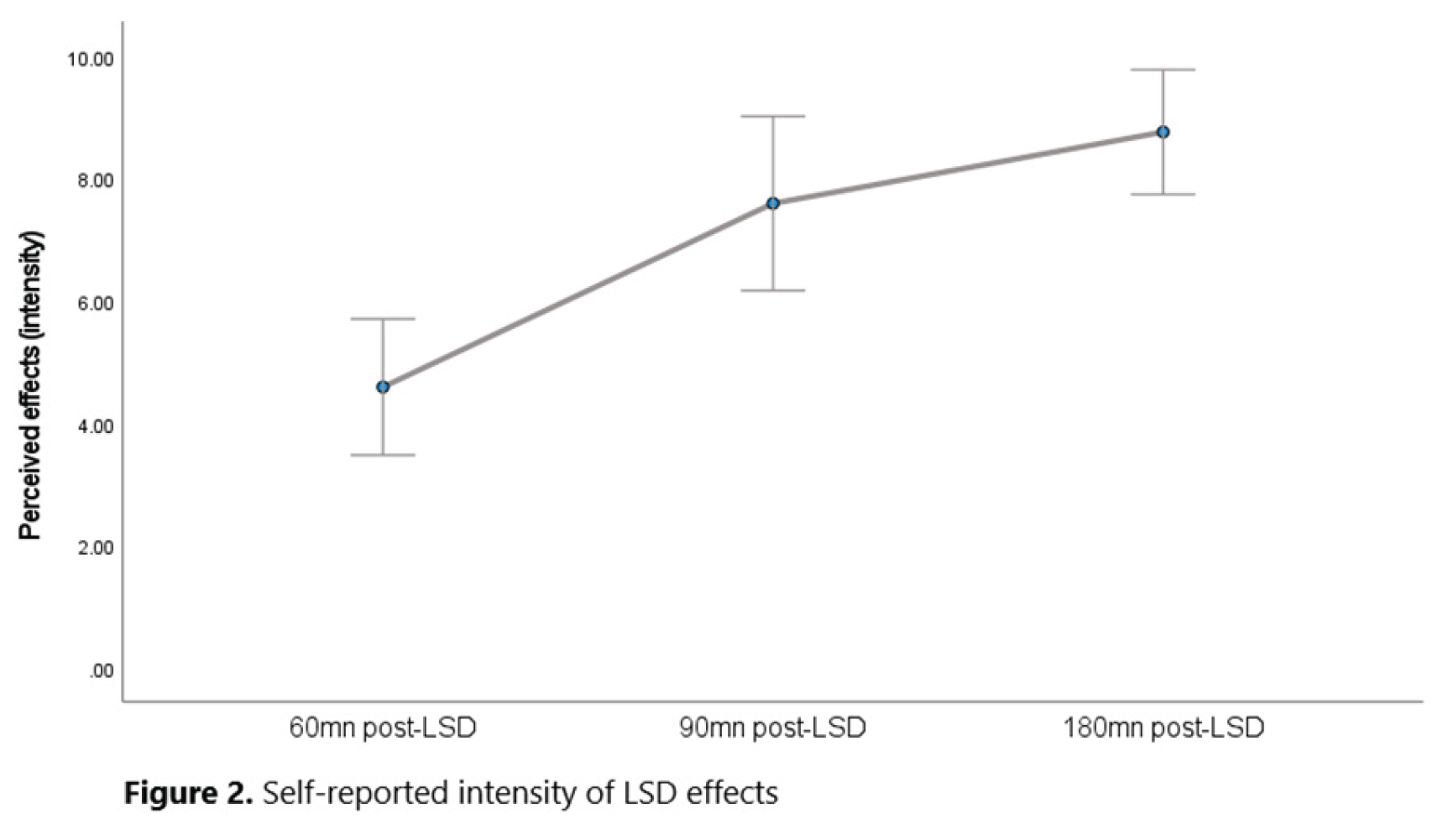
A Friedman ANOVA indicated a statistically significant effect of time on the perceived intensity of psychedelic effects (Figure 2), χ 2 (2, N = 12) = 21.273, p<.001. This suggests that the perceived intensity of effects varied significantly across the three measurement points (60, 90, and 180 minutes).
4. Discussion
This pilot study presents, to our knowledge, the first characterization of salivary oxytocin dynamics following acute LSD administration in patients with Major Depressive Disorder (MDD). It demonstrates that a non-invasive salivary sampling approach yields temporal information on oxytocin release comparable to that obtained via plasma sampling in earlier investigations. Further, we observed a significant modulation of salivary oxytocin levels over time (with a peak 90 minutes post-LSD intake), paralleling the acute subjective intensity of effects. This finding aligns with previous observations in healthy participants [5,15,24] and is consistent with rodent evidence suggesting 5-HT2A-mediated oxytocin release [19]. While MDMA is more widely recognized for potent oxytocin release and distinct empathogenic properties [16,18], the shared capacity of these compounds to induce oxytocin release, albeit to differing extents, points to potentially convergent neuroendocrine circuits.
Despite encouraging initial findings, it’s important to highlight the pilot nature of this study and its obvious limitations. Generalizability, for instance, is further constrained by the open-label design, heterogeneous medication status of participants, and the absence of a control condition. This study also lacked longitudinal oxytocin follow-up and didn’t directly assess the relationship between oxytocin release and treatment response (e.g., reduction of depressive symptoms) or mental flexibility. Larger, controlled trials are warranted to replicate these findings and clarify mechanistic links between oxytocin dynamics and clinical outcomes, including changes in depressive symptoms and mental flexibility.
Author Contributions
Conceptualization, TAB; methodology, TAB, LC; formal analysis, TAB; investigation, LC, SA, CA, CM, AB, LF resources, GT, LP, DZ; data curation, TAB, AB; writing—original draft preparation, TAB; project administration, TAB; funding acquisition, TAB. All authors have read and agreed to the published version of the manuscript.
Funding
This research was funded by the Geneva University Hospitals, grant number PRD 5-2021-II, to TAB. The study was conducted in accordance with the Declaration of Helsinki, and approved by the local Ethics Committee for studies involving humans (BASEC No.2024-01122, July 2024).
Conflicts of Interest
The authors declare no conflicts of interest.
References
- Geyer, M.A., A Brief Historical Overview of Psychedelic Research. Biol Psychiatry Cogn Neurosci Neuroimaging, 2024. 9(5): p. 464-471. [CrossRef]
- Hendricks, P.S., et al., Past, Present, and Future of Psychedelics: A Psychedelic Medicine Roundtable Discussion. Psychedelic Med (New Rochelle), 2023. 1(1): p. 2-11. [CrossRef]
- Maia, L.O., Y. Beaussant, and A.C.M. Garcia, The Therapeutic Potential of Psychedelic-assisted Therapies for Symptom Control in Patients Diagnosed With Serious Illness: A Systematic Review. J Pain Symptom Manage, 2022. 63(6): p. e725-e738. [CrossRef]
- Vollenweider, F.X. and K.H. Preller, Psychedelic drugs: neurobiology and potential for treatment of psychiatric disorders. Nat Rev Neurosci, 2020. 21(11): p. 611-624. [CrossRef]
- Holze, F., et al., Role of the 5-HT(2A) Receptor in Acute Effects of LSD on Empathy and Circulating Oxytocin. Front Pharmacol, 2021. 12: p. 711255. [CrossRef]
- Holze, F., et al., Serotonergic Psychedelics - a Comparative review Comparing the Efficacy, Safety, Pharmacokinetics and Binding Profile of Serotonergic Psychedelics. Biol Psychiatry Cogn Neurosci Neuroimaging, 2024. [CrossRef]
- Liechti, M.E., Modern Clinical Research on LSD. Neuropsychopharmacology, 2017. 42(11): p. 2114-2127. [CrossRef]
- Liechti, M.E., P.C. Dolder, and Y. Schmid, Alterations of consciousness and mystical-type experiences after acute LSD in humans. Psychopharmacology (Berl), 2017. 234(9-10): p. 1499-1510. [CrossRef]
- Chini, B., et al., Learning about oxytocin: pharmacologic and behavioral issues. Biol Psychiatry, 2014. 76(5): p. 360-6. [CrossRef]
- De Dreu, C.K., M. Baas, and N.C. Boot, Oxytocin enables novelty seeking and creative performance through upregulated approach: evidence and avenues for future research. Wiley Interdiscip Rev Cogn Sci, 2015. 6(5): p. 409-17. [CrossRef]
- Quintana, D.S. and A.J. Guastella, An Allostatic Theory of Oxytocin. Trends Cogn Sci, 2020. 24(7): p. 515-528. [CrossRef]
- Johansen, L., et al., How psychedelic-assisted therapy works for depression: expert views and practical implications from an exploratory Delphi study. Front Psychiatry, 2023. 14: p. 1265910. [CrossRef]
- Kocarova, R., J. Horacek, and R. Carhart-Harris, Does Psychedelic Therapy Have a Transdiagnostic Action and Prophylactic Potential? Front Psychiatry, 2021. 12: p. 661233. [CrossRef]
- Magaraggia, I., Z. Kuiperes, and R. Schreiber, Improving cognitive functioning in major depressive disorder with psychedelics: A dimensional approach. Neurobiol Learn Mem, 2021. 183: p. 107467. [CrossRef]
- Holze, F., et al., Direct comparison of the acute effects of lysergic acid diethylamide and psilocybin in a double-blind placebo-controlled study in healthy subjects. Neuropsychopharmacology, 2022. 47(6): p. 1180-1187. [CrossRef]
- Holze, F., et al., Distinct acute effects of LSD, MDMA, and D-amphetamine in healthy subjects. Neuropsychopharmacology, 2020. 45(3): p. 462-471. [CrossRef]
- Ley, L., et al., Comparative acute effects of mescaline, lysergic acid diethylamide, and psilocybin in a randomized, double-blind, placebo-controlled cross-over study in healthy participants. Neuropsychopharmacology, 2023. 48(11): p. 1659-1667. [CrossRef]
- Straumann, I., et al., Acute effects of MDMA and LSD co-administration in a double-blind placebo-controlled study in healthy participants. Neuropsychopharmacology, 2023. 48(13): p. 1840-1848. [CrossRef]
- Bagdy, G. and K.T. Kalogeras, Stimulation of 5-HT1A and 5-HT2/5-HT1C receptors induce oxytocin release in the male rat. Brain Res, 1993. 611(2): p. 330-2. [CrossRef]
- Levy, A.D., et al., Repeated cocaine modifies the neuroendocrine responses to the 5-HT1C/5-HT2 receptor agonist DOI. Eur J Pharmacol, 1992. 221(1): p. 121-7. [CrossRef]
- American Psychiatric Association, Diagnostic and statistical manual of mental disorders (5th ed). 2013.
- Aboulafia-Brakha, T., et al., Hypomodulation of salivary oxytocin in patients with borderline personality disorder: A naturalistic and experimental pilot study. Psychiatry Research Communications, 2023. 3(2). [CrossRef]
- Bernhard, A., et al., Adolescent oxytocin response to stress and its behavioral and endocrine correlates. Horm Behav, 2018. 105: p. 157-165. [CrossRef]
- Schmid, Y., et al., Acute Effects of Lysergic Acid Diethylamide in Healthy Subjects. Biol Psychiatry, 2015. 78(8): p. 544-53. [CrossRef]
Figure 1.
Salivary oxytocin during LSD intake.
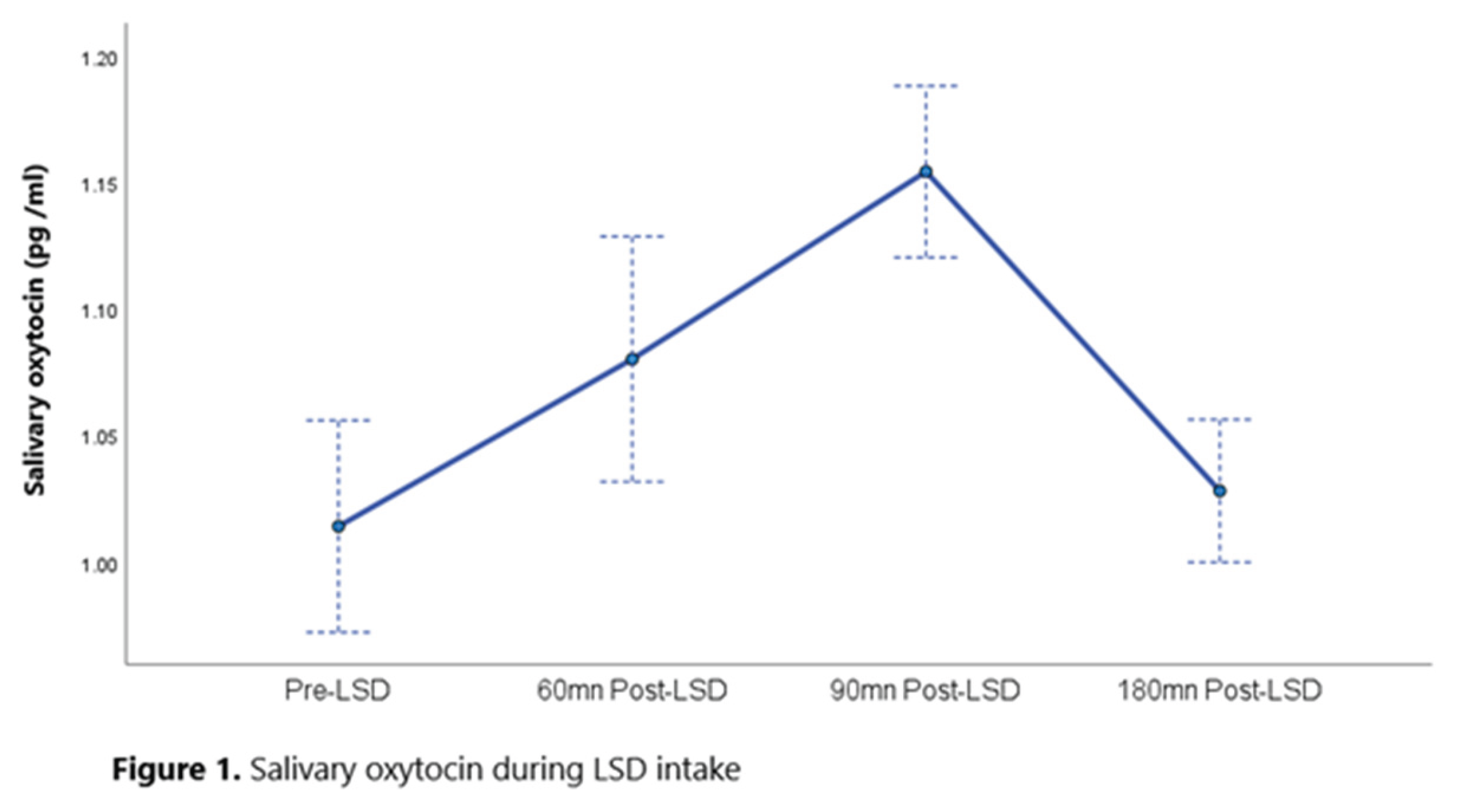
Figure 2.
Self-reported intensity of LSD effects.
Disclaimer/Publisher’s Note: The statements, opinions and data contained in all publications are solely those of the individual author(s) and contributor(s) and not of MDPI and/or the editor(s). MDPI and/or the editor(s) disclaim responsibility for any injury to people or property resulting from any ideas, methods, instructions or products referred to in the content. |
© 2025 by the authors. Licensee MDPI, Basel, Switzerland. This article is an open access article distributed under the terms and conditions of the Creative Commons Attribution (CC BY) license (http://creativecommons.org/licenses/by/4.0/).
Copyright: This open access article is published under a Creative Commons CC BY 4.0 license, which permit the free download, distribution, and reuse, provided that the author and preprint are cited in any reuse.


