

Submitted:
02 July 2025
Posted:
03 July 2025
You are already at the latest version
Abstract
General Relativity introduced the geometrization of gravity. Einstein's field equations are considered one of the greatest intellectual achievements of physics. Their weak point is that they do not have a physical meaning. Einstein's field equations are meant to describe the gravitational force, but cannot be used to calculate it. For example, with the GR mathematics, we cannot calculate the gravitational force between the Moon and the Earth. The curvature of space is a geometric description of gravity, which the variable energy density of the ether, a new name, superfluid quantum space, can replace successfully. In 1920, Einstein became aware that general relativity without ether is unthinkable. The reintroduction of ether into physics describes gravity as a pushing force of space and introduces an evidence-based cosmology where black holes are the rejuvenating systems of the universe.
Keywords:
Einstein’s field equations
; curvature of space
; ether
; variable energy density of superfluid space
; gravity
; relativity
; black holes
; cosmology
1. Introduction
In the Introduction, the model is presented, where ether is the physical origin of space and has variable energy density, which is related to the physical objects. The energy density of space carries gravity and is the physical origin of the relativistic mass when a given physical object moves in space. In the second chapter, Ether Relativity, it is presented that all relativistic phenomena can be elegantly described by the variable energy density of ether and the dynamic properties of local ether that move and rotate with physical objects. In the Third chapter, Ether Cosmology, the cosmology model, which is based on astronomical observations and has no theoretical standpoints, is presented. In the fourth chapter, Experimental verification of ether, an experiment for additional verification of ether’s existence is proposed. In the fifth chapter, the Ether Theory of Everything, the model of ether is presented, which incorporates consciousness and the mathematical universe of Mark Tegmark.
In 1920, Einstein was aware that physics without ether is unthinkable. In his speech at the University of Leiden 5th of May 1920, he admitted: “Recapitulating, we may say that according to the general theory of relativity space is endowed with physical qualities; in this sense, therefore, there exists an ether. According to the general theory of relativity space without ether is unthinkable; for in such space there not only would be no propagation of light, but also no possibility of existence for standards of space and time (measuring-rods and clocks), nor therefore any space-time intervals in the physical sense” [1]. In this article, we will develop General Relativity (GR) where the ether is the physical origin of the universal space. Curvature of space will be replaced by the variable energy density of ether, which today has a new name: superfluid quantum space – SQS. Einstein’s field equation [2]
has a weak point, namely, by this equation (1), we cannot calculate the gravitational force between two stellar objects. Also, more than 100 years after its creation, it is still unclear what units this equation has [3]. The gravitational force we measure with Newton’s and Einstein’s field equations does not use Newton as a unit. Because of this phenomenological weakness, geometrization of gravity led to the idea that gravity is not a force. Einstein’s field equations are “figurative mathematics” that have no physical meaning. Newton’s equation has a physical meaning and a bijective correspondence with the physical world. Every element in the equation corresponds to exactly one element in physical reality, see Eq. (2) below:
The curvature of space in Einstein’s Relativity is a mathematical theory that needs to be developed into a physical theory. This can be achieved by extension of the mass-energy equivalence principle on the universal space, which has a physical origin in the superfluid quantum space. Every physical object diminishes the energy density of superfluid quantum space in its center accordingly to its mass and corresponding energy. This is expressed in Eq. (3) below: [4]
where is the mass of the object, is the Planck energy density of superfluid quantum space in intergalactic areas, is the energy density of superfluid quantum space in the center of a given physical object, and is the volume of the object.
In the relativistic domain, for example, when a proton in a cyclotron is accelerated to high velocity close to the speed of light, its mass increases according to Eq. (4):
where γ is the Lorentz factor and is the additionally diminished energy density in the center of the moving object due to its relativistic mass. For example, in cyclotrons, protons reach high velocities close to the speed of light, they interact with the energy of superfluid space, and integrate some of the energy of superfluid space, so their mass increases. The idea that a proton has a different mass for different observers is false: “The measured mass of the high-energy proton traveling at 0.999956c relative to an observer is calculated to be over 100-fold greater than its mass when measured in the reference frame of an observer or its mass at rest” [5]. Relativistic mass of the proton related to the motion in superfluid space and is “observer invariant”. Relativistic mass is real and has nothing to do with the position of the observer, as was suggested by Einstein. The value of the Lorentz factor γ increases with the velocity of the moving object with respect to the superfluid quantum space, see Eq. (5) below:
In Eq. (5), we see that the Lorentz factor depends on the difference between the Planck energy density of the superfluid space that is characteristic for interstellar space and the energy density of superfluid space in the centre of the moving object [6]. The protons of the spaceship in interstellar space that accelerate with integrate energy of superfluid space, and so the mass of the spaceship increases. The increase of the mass diminishes the energy density of space in the center of the spaceship, which is equal to the energy density of space on the Earth’s surface. That’s why inertial mass and gravitational mass are equal; they have the same origin in the variable energy density of superfluid quantum space. Taylor and Wheller suggested relativistic mass originates from geometrical properties of space: “The concept of ‘relativistic mass’ is subject to misunderstanding [...]. First, it applies the name mass – belonging to the magnitude of a 4-vector – to a very different concept, the time component of a 4-vector. Second, it makes increase of energy of an object with velocity or momentum appear to be connected with some change in internal structure of the object. In reality, the increase of energy with velocity originates not in the object but in the geometric properties of spacetime itself” [7]. Here, the geometrical properties of space-time (curvature) are replaced by the variable energy density of space. The internal structure of the moving object is related to the medium in which the object moves; a moving proton, for example, absorbs energy from the space. In the proposed model, we developed a physical understanding of relativistic mass.
Muons’ decay has nothing to do with the position of the observers, as it is explained in textbooks: “Muons are created above 10 km about the ground when protons coming from the outer space are interacting with the atmosphere. They need about 34µs to reach the ground. The average lifetime of muons at rest is 2,25µs. Let’s take the one million muons is released 10 km above the Earth surface. The decay number N of the muons that will decay at the sea level is 0,27. This is the result of nonrelativistic calculation. The measured decay is close to 48800 muons on one million muons released 10 km above the surface. Decay number N = 48800 is confirmed by the relativistic calculation of radioactive decay where the muon average lifetime at the 0,98 of light speed is 11,25µs. In our model, muons that are moving with a velocity close to the light speed are highly decreasing the energy density of SQS and so their decay slows down. In our view, the decay of muons is a pure technicality of the variable energy density of the SQS and has nothing to do with the observer at rest on the Earth as is presented in the textbooks of physics. Muons are decaying with the same velocity for all observers” [6].
Extension of the mass-energy equivalence principle on superfluid SQS gives us a new physical model of gravity. Eq. (3) relates the energy of a given physical object to the energy of the medium in which the object exists. A given physical object diminishes the energy density of space in its center correspondingly to its mass and energy. This implies that the medium (superfluid space) is not homogeneous. The gravitational force between two massive objects is the result of a pushing force of superfluid space in the direction from higher to lower energy density of superfluid space, see Figure 1 below:
Superfluid space is 4D, and physical objects are 3D. They follow the gravitational vectors that are in the direction from higher to lower energy density of superfluid space [8]. Inertial mass and gravitational mass have their origin in the variable energy density of superfluid space as presented in Eq. (6) below: [4]
The gravitational force between two physical objects is calculated by Eq. (7) below: [4]
In the Einstein model, physical objects curve space, and the curvature of space tells them how to move. His model is geometric; it has a mathematical character. In the model presented here, physical objects diminish the energy density of space, which generates gravity. This model explains the real physical origin of gravity.
Einstein’s idea that matter curves space and space tells matter where to move is an oversimplification that led physics to the wrong idea that gravity is not a force and is related to entropy [8]. Gravity has nothing to do with entropy because the gravitational force’s physical origin is the ether’s variable energy density [4]. The model of gravity presented in this article was already predicted by Issac Newton: “Doth not this aethereal medium in passing out of water, glass, crystal, and other compact and dense bodies in empty spaces, grow denser and denser by degrees, and by that means refract the rays of light not in a point, but by bending them gradually in curve lines? . . . Is not this medium much rarer within the dense bodies of the Sun, stars, planets and comets, than in the empty celestial space between them? And in passing from them to great distances, doth it not grow denser and denser perpetually, and thereby cause the gravity of those great bodies towards one another, and of their parts towards the bodies; everybody endeavoring to go from the denser parts of the medium towards the rarer?” [9]. The Cavendish experiment confirms that gravity is an ether-pushing force. Metal balls in the Cavendish experiment are pushed together by the variable energy density of ether, not by the curvature of space [10]. Also, the Kasimir force is the pushing force of the ether. Two metal plates positioned close together form an area of ether with lower energy density. Outer ether area with higher energy density pushes towards the area with lover energy density, see Figure 2 below:
2. Ether Relativity
2.1. Reintroduction of Ether
In recent years, ether has been reintroduced into physics. French physicist Mayeul Arminjon also suggested in 2011 that gravity acts as a pressure force of the ether [11]. Chinese physicist Xiao-Song Wang states on 2023 that GR has several difficulties that can be solved by the introduction of ether: “The Einstein’s field equations of gravity is a fundamental assumption in GR. Although GR has held up under every experimental test, it still face some difficulties, for instance, medium of gravity, inharmonious between GR and quantum mechanics, CCP, the paradoxes of black holes, the velocity of the propagation of gravity, the definition of inertial system, origin of inertial force, gravitational waves, the speed of light in vacuum, the velocity of individual photons, etc. New considerations on the old concept of gravitational ether in the history may be needed” [12]. Ether is a medium that builds universal space, and only with the ether model will cosmology experience its full development.
We developed a model where gravity is carried by a 4-dimensional layer of ether in which 3-dimensional physical objects are immersed [4]. A photon is a wave of 4-dimensional ether and has two components. The electric component is the excitation of ether along the coordinates ; the magnetic component is the excitation of ether along the coordinates . Russian-American physicist Sbitnev developed a model where elementary particles vortexes of the physical vacuum which is a new name for ether [13,14].
2.2. Relativistic Rate of Clocks and Energy Density of Ether
With Einstein’s Theory of Relativity, physics entered a new paradigm where mathematics overruled physics. Today is most important that a model is mathematically correct and nobody is interested in whether it has physical meaning. This led physics into a deep crisis that can only be surpassed by the new paradigm, where the introduction of new elements in the theory is allowed only when an element is observed or measured. Time as a 4th dimension of space was never observed and measured, and still, physics is convinced that it exists. It does not; universal space is time-invariant. There is no physical past and no physical future. Events in the universe run in superfluid quantum space, which is time-invariant. Time as duration enters existence in the process of measurement [15].
Einstein’s idea in SR that light can move through a space deprived of physical properties is counterproductive and against the fact that light is energy and that energy can move only in a medium that has attributes of energy. Mainstream physics never accepted that in 1920, Einstein changed his mind and advocated the return of ether into physics. Still today, the idea of an empty curved space deprived of physical properties that carries gravity is the official teaching in physics classes. This idea is one of the main obstacles to the progress of physics, astronomy, and cosmology. Physics without ether has been marching for 100 years in the wrong direction. Curvature of space as a carrier of gravity is still popular because it is not logical and introduces esoteric thinking based on the figurative mathematics of Einstein’s field equations. The scientific mind likes most what it cannot fully understand and has a veil of mystery. That’s why curvature of space, gravitational singularities, and hypothetical cosmological initial singularities are so popular.
Einstein’s famous view, expressed in a quote, “Imagination is more important than knowledge”, led him to introduce elements in physics that have no physical reality. He introduced “coordinate time”, “proper time”, “time dilation”, “length contraction” (adopted from Hendrik Lorentz), “relative time”, and “curvature of space”. None of these ideas has physical existence. Time and clocks are human inventions [16].
In the universe, we observe only the velocities of motion of different physical objects. These velocities are relative and depend on the variable energy density of ether. The higher the energy density of ether, the bigger the relative velocity. Clocks run on the Moon faster than on Earth because the energy density of the ether is higher on the Moon’s surface than on the Earth’s surface, and has nothing to do with the observers, as suggested by Einstein. Ether has less dense energy density on the orbital distance of GPS satellites than on the Earth’s surface; consequently, clocks “tick” faster per 45µs per day. GPS satellites have a higher orbital velocity than the Earth’s surface. Because of this velocity, protons of satellites absorb the energy of ether, which causes relativistic mass and additionally diminishes the energy density of ether in the satellites. This causes the rate of clocks to be smaller on the satellites by 7µs per day compared to the Earth’s surface. The relative rate of clocks depends on the variable energy density of ether and is valid for all observers [6].
Einstein’s famous thought experiment with a train passing a train station is false. In his interpretation, for the observer on the train, the clock on the train runs slower than the clock at the station. Einstein introduced the relative motion concept, which allows imagining that the train is at rest and the station is moving away from the train; the observer on the station will experience that his clock runs slower than the rate of the clock on the train. This thought experiment is erroneous. The clock on the train has a slower rate than the clock on the train station; the relative rate of clocks is valid for both observers. Protons of the train absorb the energy of the ether, which increases train mass, and this additionally decreases the energy density of the ether in the train. That’s why the clock in the train has a lower rate than the clock at the train station.
2.3. Space Dragging Effects and Ether
Precise measurement confirmed that light neds microseconds extra when traveling from San Francisco to New York: “However, an accurate measurement of the time interval given by the GPS shows that light takes an extra 0.014 microseconds for light to travel eastward (from S.F. to N.Y.)” [17]. Earth rotates in the direction from N.Y. to S.F. Local ether moves and rotates with the Earth. That’s why light, when moving in the direction of Earth’s motion, has a bigger velocity than when moving in the opposite direction. The distance from New York to San Francisco is 4500 km. Light needs 15000 microseconds to travel this distance. If Earth were to move through the stationary ether, the situation would be as follows:
Earth rotates local ether and the situation is as follows:
This measurement confirms that at the latitudes of San Francisco and New York, at the height of GPS satellites, which is 20.200 km above the surface, ether has a velocity of 280 km/s. At 39 degrees north, Earth’s surface rotation velocity is 1301 km/h. The Earth is rotating the local ether at a height of 20.200 kilometres above Earth’s surface, with approximately 22% of its rotational velocity. We suppose that at the Earth’s surface, the rotational velocity of the ether is close to the rotational velocity of the Earth’s surface. The local ether is moving and rotating with the Earth. That’s why the Michelson-Morley experiment gave a null result. It was carried out with the preposition that Earth moves through the stationary ether, which is not the case. Mercury’s perihelium precession occurs because the rotation of the Sun around its axis rotates the local ether inside the solar system. Mercury’s precession is 43 arcseconds in 100 years, and its orbital time is 88 days. In one orbiting period, this is 29 km, which in 100 years is 12028 km. 100 years is seconds, which yields the orbital velocity of the ether on Mercury’s orbit is 3.81 millimeters per second.
Return to Einstein’s ether [1], gives physics more beauty and power of description. The local ether rotation around stellar objects elegantly describes the Lense-Thirring effect [18] of frame dragging. SMBHs are rotating local ether inside galaxies, which is the physical cause of the galaxy rotation curves [19]. The Sagnac experiment [20] confirms that a rotating interferometer rotates local ether, changing the interference pattern. In Ether Relativity (ER), there are no inertial systems. The relative rate of clocks is valid for all observers and depends on the variable energy density of the ether. Photon is the wave of the ether, and its velocity has minimal variations in the moving and rotating ether. The speed of light also diminishes minimally with the increase of gravity and the decrease of the variable energy density of ether. We call this effect “gravitational time delay”: “Because, according to the general theory, the speed of a light wave depends on the strength of the gravitational potential along its path, these time delays should thereby be increased by almost 2×10⁻⁴ sec when the radar pulses pass near the sun. Such a change, equivalent to 60 km in distance, could now be measured over the required path length to within about 5 to 10% with presently obtainable equipment” [21]. The official interpretation of gravitational time delay is that in stronger gravity, time as the 4th coordinate of space stretches, and this means that the signal needs more time to reach from point A to point B. Interpretation is false; the fact is that in stronger gravity, where the energy density of ether diminishes, light speed diminishes minimally.
2.4. Ether Is Multidimensional and Time-Invariant
A group of physicists recently published an article, which presented the model of primordial black holes that are 5-dimensional and older than the universe of the Big Bang model: “We therefore conclude that it is far more likely for all 5D black holes formed from phase transitions to have lifetimes longer than the current age of the universe” [22]. The existence of higher-dimensional energy layers of ether is also important for the integration of the evolution of life into cosmology. The universe is a system, and life is a subsystem of the universe that develops within the entire universe. In the 21st-century science, it is necessary to develop models that integrate consciousness into physics [23]. Consciousness acts in every physicist as the observer. Strengthening the observer is important for the development of the bijective research methodology in physics, which verifies if a given element in the model has a real correspondent element in physical reality. We will go deeper into this subject in Chapter 4.
We have seen in the Introduction, with the reintroduction of ether, a new picture of physical existence arises where relativistic particles interact with the ether and absorb its energy, which is the origin of relativistic mass. Ether Relativity (ER) has a physical explanation for all relativistic phenomena, which have their origin in the variable energy density of ether and the motion and rotation of local ether with stellar and physical objects. In ER, the observer plays no role. Such a physical model is more realistic and less mystical. Clocks run faster on the Moon than on the Earth, regardless someone is watching them or not. The universe is not determined by the observer; the opposite is valid: the observer is a constitutive element of the universe. The observer is the crucial element of physics. In the process of the measurement, the observer creates time as duration. Ether is utterly timeless; in the ether, there is no arrow of time, there is no thermodynamic time, there is no proper time, there is no coordinate time, and there is no cosmological time. All these timers are inventions of the scientific mind and exist only in the scientific mind. CTC – closed time curves and Hawking Chronology Protection Principle also exist only in theory; they have no physical implications. They are a result of the belief that time is a physical reality in which motion happens. It is not. Motion happens in time-invariant space. Physics is coming closer to the insight that CTC and Hawking Chronology Protection are fictitious: “The arguments presented in the paper, do not represent a complete no-go for the construction of CTCs, and neither, as yet, does the Hawking Chronology Protection Principle. However within a simple class of configurations, we have established that the creation of CTCs is inexorably tied to strong coupling issues, making such configurations unreliable using the description at hand. As with the Hawking Chronology Protection Principle, much needs to be done to prove the general validity of this argument” [24]. ER categorically excludes travel in time on micro and macro levels because time has no physical existence, so motion in time is impossible [25].
3. Ether Cosmology
3.1. Gravity and Time-Invariant Ether
Ether Relativity is built by the awakened observer who fully knows how the scientific mind builds scientific models. For the last 120 years, physicists have been inventing new elements into physics to solve different problems. The result is that we have more unsolved problems, for example, the introduction of dark matter into physics. By reintroducing ether, physics gained immense power for the objective description of physical reality and the entire universe. For example, in ER, gravity is the result of the supersymmetry between ether and matter. In the intergalactic space energy density of ether has a Planck value. At the point in the center of a given stellar object, the energy density of ether diminishes correspondingly to the energy of the stellar object, see Eq. (10) and Eq. (11) below:
Where is the Planck energy density of ether in intergalactic space, is the energy density of ether in the center of a physical object, is the mass of the stellar object, and is the volume of the stellar object. Gravity is embedded in the variable energy density of dynamic ether, which moves and rotates with the stellar objects. Because of the rotation of the local ether around the Earth, the GSP system uses Sagnac corrections [26]. The Moon is rotating around the Earth without any energy use. This is because Moon moves in the local ether that rotates around the Earth, and gravitational force and centripetal force are in equilibrium, see Eq. (12) below:
In the universe, except for the human mind, everything is perfect. The scientific mind, when enriched by consciousness, has the power to step out of linear time and experience the universe in the beauty of its timelessness. Albert Einstein remains our inspiration: “Once Einstein said that the problem of the Now worried him seriously. He explained that the experience of the Now means something special for man, something essentially different from the past and the future, but that this important difference does not and cannot occur within physics. That this experience cannot be described in science seemed to him a matter of painful but inevitable resignation. … Einstein thought that these scientific descriptions cannot possibly satisfy our human needs; that there is something essential about the Now which is just outside the realm of science” [27]. We experience the time-invariant physical property of ether as NOW [28]. Experience of NOW is the next revolution of physics announced by Julian Barbour in 1999 [29]. The author of this article published a book with the same title in the Slovene language in 1990 [30]. A proper comprehension of time is essential for the progress of physics and cosmology.
In Ether Cosmology (EC), SMBHs transform old matter into fresh energy in the form of astronomical jets, which also contain protons. In the centre of SMBHs gravity is zero and the energy density of the ether is at its minimum. In the center of a proton, the minimal energy density of ether is approximately times higher than in supermassive black hole ASASSN-14li. The extremely low energy density of ether in the center of the proton suggests that the proton remains a stable particle also in the center of black holes. Besides other particles, protons also compose astrophysical jets from AGN. Blandford-Znajek’s mechanism explains the electromagnetic component of the jets, but it cannot explain the presence of protons. The EC suggests that the origin of protons in astrophysical jets is a consequence of the decay of atoms at the center of AGN” [10].
In ER, there are no singularities of any type. In the centre of black holes, the energy density of the ether diminishes to the value where atoms become unstable and disintegrate into elementary particles. This process can cause the explosion of a black hole in the supernova [10]. When the black hole mass is so big that the gravitational force prevents an explosion, the pressure of the fresh energy in the centre of a black hole makes holes in the direction of the rotational axis of the black hole, and fresh energy forms astrophysical jets, SMBHs are rejuvenating systems of the universe, they transform their mass into fresh energy that is the row material for the formation of new stars [10]. The universe is an uncreated system in a dynamic equilibrium. The Big Bang model belongs to the history of physics [31].
Ether is a non-created fundamental energy of the universe. The idea of some beginning of the universe which exploded from the mathematical point is not scientific; it is a religious idea. For a serious physicist, “How the universe started?” is not the right question. The right question is “How does the universe function?” This is because universal space is time-invariant. There is no past and there is no future in the universe [32]; the only existing universe is the one that we observe. All the rest is just human imagination. Einstein’s intuition was right: “For us believing physicists, the distinction between past, present, and future only has the meaning of an illusion, though a persistent one” [27]. We know today that the only existing time is the duration that enters existence in the measurement. The universe is utterly timeless; the flow of change in the universe is irreversible and runs in the time-invariant superfluid space [15,16].
We can express the gravitational constant with the Planck units, see Eq. (9) below.
where is the Planck energy density of ether in intergalactic areas [33]. This confirms that Planck units represent the real values of the physical universe. In intergalactic space, the ether has a Planck energy density which is 4-dimensional. Gravity force is 4-dimensional.
Based on GR, Penrose predicted the existence of gravitational singularities [34]. Gravitational singularities, which are the result of extreme curvature of space, have no physical reality. Penrose’s idea that gravity in the center of the black hole is infinite is false. In the centre of a black hole, the value of energy density of space is calculated by Eq. (8). On the surface of a black hole, d is equal to r (d = r), and the gravity is at its maximum and diminishes towards the center of the black hole. At the center of a black hole, the energy density of space is at its minimum, the gravity is zero, as is the case for all stellar objects. Gravity inside black holes obeys Newton’s shell theorem [10]. Also, the initial singularity of the Big Bang proposed by Hartle and Hawking [35] is fictitious and should be abandoned from cosmology. Mathematical point is dimensionless, and a dimensionless entity cannot have physical attributes. Energy cannot appear from a mathematical point [31].
Energy density of ether at the given point from the centre of a given stellar object, we calculate with Eq. (8) below:
where r is the radius of the physical object, and d is the distance from its center [32]. The size of the gravity force at point T depends on mass m, radius r, and distance from the center of the physical object.
Light bends when passing near stellar objects because the variable energy density of the ether changes the refractive index of light. When light moves towards the stellar object, the energy density of space decreases; when light moves away from the object, the energy density of ether increases, causing light to bend [4]. The bending of light does not prove that universal space is curved [36].
Black hole physics without gravitational singularities [10] gives a clear answer on the unclear origin of gravitational waves GW: “The subject of this paper is a stochastic (i.e., random) background of gravitational radiation, first studied in detail by Michelson, Christensen, and Flanagan. Roughly speaking, it is the type of gravitational radiation produced by an extremely large number of weak, independent, and unresolved gravity-wave sources. The radiation is stochastic in the sense that it can be characterized only statistically. As mentioned above, a stochastic background of gravitational radiation might be the result of processes that took place very shortly after the Big Bang. But since we know very little about the state of the universe at that time, it is impossible to say with any certainty” [37]. In the black hole physics model without singularities, gravitational waves are created in areas where the energy density of the ether is so low that atoms become unstable and fall apart into elementary particles. This process occurs in black holes. For example, SMBHs in the centre of galaxies transform a huge amount of matter into fresh energy that forms astronomical jets. SMBHs are rejuvenating systems of the universe; they transform old matter into fresh energy that is the raw material for the formation of new stars [10]. Gravitational waves GW are ripples of ether appearing when matter disintegrates into elementary particles.
3.2. CMB and Ether
No signal can move in time because there is no physical time. The idea that the CMB is the remaining radiation from the recombination period 378000 years after the hypothetical Big Bang is false, because no signal moves through time. Every signal moves only in space, which has ether as its origin. CMB is the radiation of the ether. Nobody can receive a signal that originates in some remote physical past, because there is no physical past; the universe exists and evolves in NOW [16]. Ether is time-invariant, and the entire universe exists in the same ether, that is, NOW. Light that comes to us from the most remote galaxies comes from the same NOW we experience in this moment. Light moves through the ether that is always and only NOW. The understanding and experience that the universe evolves in NOW is a paradigm shift in physics announced by Barbour [29]. Time is a human invention that allows the measurement of the velocity of motion of a given physical object (from micro to macro level) in space.
3.3. Expansion of the Universe and Ether
Timeless ether is the fundamental arena of the universe. The universe is ageless and does not expand. In the FLWR metric, the density parameter Ω ultimately governs whether the curvature is: negative (Ω < 0), positive (Ω> 0), or flat (Ω = 0). When the density parameter Ω is 1 in the FLWR metric, the universal space has a Euclidean shape, and FLWR metrics predict that such a space can expand. This is against the metrics of Euclidean geometry, where the distance between two points is always constant. In a 4-dimensional Euclidean space that is a geometric description of ether, the distance between points ρ and cannot expand [31], see Eq. (13) below:
Universal space could expand if it had Riemann geometry, which is not the case. The measured redshift from distant galaxies is the gravitational redshift. The Doppler effect in an expanding space was never experimentally observed; cosmological redshift is a misinterpretation of gravitational redshift. Light, when pulling out of strong gravity, experiences the loss of energy, which we observe as a shift towards the red spectrum [38].
The idea that universal space is deprived of physical properties, curved, and expanding belongs to the history of physics. The hypothetical expansion of universal space can be measured today on the Earth’s surface: “Today, precise measurements of distances measure 113 km on one nanometre (1nm) precisely. This precision allows us to measure universal space expansion directly and accurately on Earth’s surface. The method of measuring the redshift of distant galaxies and calculating out from these data the expansion is indirect. We can measure universal space expansion directly by measuring the daily increase of distance between two points on the Earth’s surface. It is clear that at bigger distances the expansion of space is bigger and at smaller distances expansion is smaller, but it exists. If universal space expands, this means that distances on Earth are expanding. The only question is whether these small dilations are measurable. At a distance of 113 km, the velocity of space expansion is 2.665975305E-13 m/s. In one year, this yields 0.0000084132 m. The distance of 0.0000084132 m is 8413 nm. If the universe expands at the declared rate of 72,8 km per Mps [39], the distance of 113 km will increase by 23 nm per day [38]. Einstein predicted that when light moves in the direction of a gravity vector, it gains some energy; when light moves in the opposite direction of gravity, it loses some of its energy [40]. Light, when escaping the intense gravity of faraway galaxies, undergoes energy loss; the so-called “cosmological redshift” is a measured gravitational redshift [38].
Ether is a primordial multidimensional substratum of the universe and has a constant level of entropy . That’s why photons, protons, and electrons, which are structures of ether, have theoretically an infinite lifetime. SMBHs are rejuvenating systems of the universe; they transform old matter with high entropy into fresh gas with low entropy. That’s why the universe’s entropy is constant, see Eq. (14):
The idea of some magical explosion out of nothing belongs to the 20th-century physics mindset, which created the unsolvable problems of today’s physics [41]. Albert Einstein was clear: “The significant problems we face cannot be solved at the same level of thinking we were at when we created them”. That’s why Einstein’s suggestion from 1920 to reintroduce ether into physics has to be taken seriously.
4. Experimental Verification of Ether
The Sagnac experiment undoubtedly proved the existence of ether. When the interferometer rotates, it also rotates the local ether, changing the velocity of light [42,43]. Also, the Fizeau experiment proves the existence of ether. In his experiment, water in the tube moves local ether, changing the velocity of light that moves through the tube [44,45]. The Fizeau experiment is the most convenient one and can be performed today in a manner that undoubtedly proves that light does not move through the empty, that light is a wave of the medium which builds space, the ether. Optical cable is placed in a plastic tube with a diameter of 1 meter. We have 1000 loops of the optical cable, and the entire length is 3140 m. The velocity of the signal in optical cable is about 210.000 km/s (70% of the velocity of light in ether). We have the source of the signal, the receiver, and the counter, see Figure 3 below. The source is activated by the counter that runs times.
Distance of 3140 m multiplied by is m. To pass this distance, the signal needs about 149.5238095 seconds. Let’s have a pump that will move water with a velocity of 2 m/s. When the signal moves in the direction of water, its velocity is 210.000.002 m/s, the signal needs 149.5238081seconds. When the signal moves in the opposite direction of water, its velocity is 209.999.998 m/s, the signal needs 149.5238109 seconds. The time difference is second. We can measure this difference in time with a precise clock.
5. Ether Theory of Everything
The ether model developed in this article proposes the Ether Theory of Everything (E-TOE), where the ether plays a crucial role:
- -
- Dark energy is the energy of the ether and represents 95% of the energy of the universe; 5% of the energy is in the form of matter
- -
- Ether is dynamic; it moves and rotates with stellar objects, and is the answer to the dark matter
- -
- A photon is a wave of the 4-dimensional layer of ether
- -
- Elementary particles are vortexes of the 4-dimensional layer of ether
- -
- The gravitational force is carried by the variable energy density of the ether
- -
- The Platonic world and the Mathematical universe of Max Tegmark [46] are carried by the higher-dimensional structures of the ether. The multidimensional ether model explains the physical origin with Max Tegmark’s mathematical universe model. Higher levels of ether carry information of a mathematical code that governs the physical universe.
- -
- Consciousness is the Planck frequency of an n-dimensional layer of ether, see Eq. (15) below:
Consciousness is the fundamental arena of the universe and is the origin of universal space, which is also infinite. NASA measured in 2014 that the universal space has a shape of Euclidean geometry [47]. Consciousness acts in every physicist as the observer and so represents the central point of physics. We need to build physics where the observer is fully aware of how the scientific mind creates physics. The introduction of new elements in the physical models requires these elements to be directly observed and measured. We see in this article that time, as the 4th dimension of space, we cannot observe and measure, the curvature of space we cannot observe and measure, time dilation, and length contraction we cannot observe and measure. A given model in physics that is in the process of creation has to pass the test of “bijective verification”, which assures that all the elements in the model are observed and measured, see Figure 4 below.
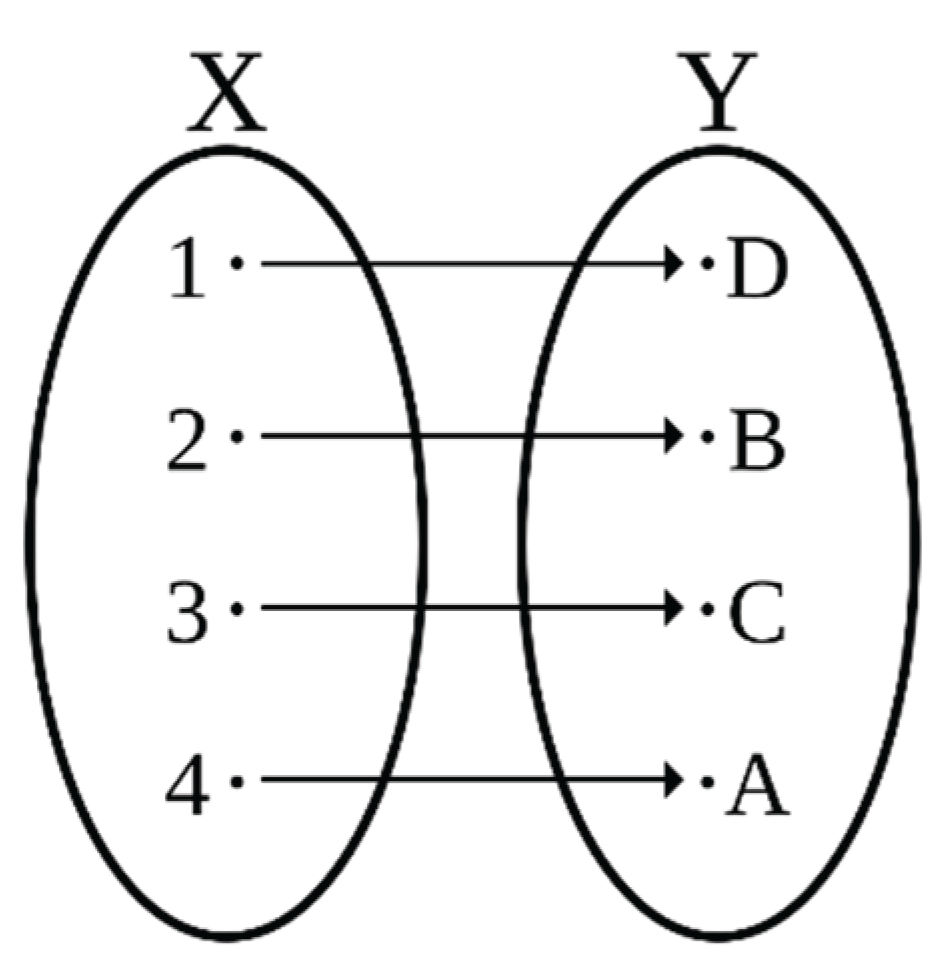
The Bijective verification builds the models where the physical model relates to physical reality under conditions of a bijective function, see Figure 5 below and Eq. (16):
where set X is {1, 2, 3, 4} and set Y is {A, B, C, D}. For example, f(1) = D. Bijective verification will bring physics back to the roots. Strengthening the observer is important, as it allows physicists to become aware that the physical model is not physical reality. Today, physicists project their models into physical reality. They believe that their models are the physical reality itself. An advancement of physics requires a clear distinction between the model and the physical reality that the model describes.
Today, you can publish a theoretical article with a valid mathematical model in a journal with a high impact factor, and reviewers are not concerned if the article makes physical sense. But you cannot publish an article that has a physical sense and contradicts existing dogmas, for example, a magic initial explosion, inflation, and expansion of space, which were never directly observed and measured. A school example of an element that bijective verification would not allow is the introduction of negative mass [48]. Mass cannot be positive or negative; mass has an absolute value . The same is valid for the energy , for gravitational force , and for time Time cannot be negative. A photon cannot experience negative time, as suggested in a recent article [49]. A photon only moves in a time-invariant space and does not experience either positive or negative time. Time is the duration of the motion of a photon in space. Time-symmetry model has no bijective relation with physical existence; it is flawed [50].
NASA’s opinion is that negative mass is allowed in general relativity [51]. In Ether Relativity, negative mass is not allowed. Antigravity can be achieved with the development of technology that will increase the energy density of the ether. By the decrease of energy density of ether, a given apparatus will increase the gravitational force on it. When a given apparatus increases the energy density of the ether, it will automatically move towards the intergalactic space where the energy density of the ether is at its maximum.
A given local area of ether will always move towards the area of the ether with a similar value of energy density. A mass of 1 kilogram diminishes the energy density of local ether on the Earth’s surface, and so this local area wants to move towards the center of the Earth, where energy density is at its minimum. When an apparatus increases the energy density of the local ether, this local area moves towards the area where the energy density of the ether is at its maximum. In ER, we call this phenomenon ether buoyancy.
6. Conclusions
Mathematics is an indispensable tool of physics, but it cannot be the ruler of physics. Mathematics’ natural role is that it is a servant of physics. With Einstein’s field equations and with the idea that space is curved and curvature carries gravity, mathematics overruled physics. It is clear today that Einstein’s field equations and curvature of space are only the mathematical presentation of gravity and have no existence in the physical world. Gravity is the fundamental force of the universe, which is carried by the variable energy density of superfluid quantum space. Ether, as the physical origin of universal space, has to be reintroduced into physics. With SR in 1905, Einstein contributed to the abolishment of the ether from physics. In 1920, he understood that ether is an indispensable element of physics. Fully acknowledging this fact is an assurance for physics progress.
References
- Einstein, A. (2007). Ether and the Theory of Relativity. In: Janssen, M., Norton, J.D., Renn, J., Sauer, T., Stachel, J. (eds) The Genesis of General Relativity. Boston Studies in the Philosophy of Science, vol 250. Springer, Dordrecht. [CrossRef]
- Chris Ormel, Einstein Field Equations, NASA https://spsweb.fltops.jpl.nasa.gov/portaldataops/mpg/MPG_Docs/Source%20Docs/Einstein’s%20Field%20Equations.pdf (2001).
- P G L Porta Mana, Dimensional analysis in relativity and in differential geometry, European Journal of Physics, 42 (2021), no. 4. [CrossRef]
- A. Sorli, N. Gorjup, R. Gorjup, Replacement of space-time with superfluid space and restoration of Newton’s dynamic ether, Rep. Adv. Phys. Sci., 7 (2023), 2350005. [CrossRef]
- Michael F. L’Annunziata, Radioactivity, Chapter 7 - Hall of Fame: Part III, Elsevier (2014) . [CrossRef]
- Amrit Sorli, Stefan Celan, Niko Gorjup, Physical origin of the relative rate of clocks in GPS and errors of relative motion concept, Advanced Studies in Theoretical Physics, Vol. 16, 2022, no. 4, 191-200 https://www.m-hikari.com/astp/astp2022/astp1-4-2022/91893.html.
- E. F. Taylor, J. A. Wheeler: Spacetime Physics: Introduction to Special Relativity, 2nd ed. (Freeman, New York 1992) pp. 250-251.
- Schlatter and R E Kastner, Gravity from transactions: fulfilling the entropic gravity program, Journal of Physics Communications (2025). https://iopscience.iop.org/article/10.1088/2399-6528/acd6d7.
- I. Newton, The Third Book of Optics (1718). https://www.newtonproject.ox.ac.uk/view/texts/normalized/NATP00051.
- Amrit Srecko Sorli, Rado Gorjup, Niko Gorjup, Tomaz Makovec, Akash Saroj, Akash Ranjan, Piyush Singh, Re-examination of Penrose’s and Kerr’s singularities and the origin of protons in astrophysical jets, Advanced Studies in Theoretical Physics, Vol. 18, 2024, no. 2, 61-82 https://www.m-hikari.com/astp/astp2024/astp1-4-2024/92117.html.
- Mayeul Arminjon, Gravitation as a pressure force: a scalar ether theory (2011) . [CrossRef]
- Wang, XS. The New Concepts of Ether and Calculation of the Cosmological Constant. Phys. Part. Nuclei 54, 991–996 (2023). [CrossRef]
- V. I. Sbitnev, Hydrodynamics of the Physical Vacuum: II. Vorticity Dynamics. Found. Phys. 46 (2016) 1238–1252. [CrossRef]
- Sbitnev, Hydrodynamics of the Physical Vacuum: I. Scalar Quantum Sector. Found. Phys. 46 (2016) 606–619. [CrossRef]
- Amrit Sorli, Stefan Celan, Temporal and timeless cognition in physics Physics Essays, Volume 35, Number 3, September 2022, pp. 305-308(4) . [CrossRef]
- Amrit Sorli, Implications of Time-Invariant Superfluid Quantum Space Model in Fundamental Physics and Cosmology, Applied Physics Research (2025) https://ccsenet.org/journal/index.php/apr/article/view/0/51593.
- Paul Marmet, The GPS and the constant velocity of light, Acta Scientiarum, 22 (2000), no. 5, 1269-1279. https://periodicos.uem.br/ojs/index.php/ActaSciTechnol/article/view/3062/2214.
- Lense, J.; Thirring, H. (1918). “Über den Einfluss der Eigenrotation der Zentralkörper auf die Bewegung der Planeten und Monde nach der Einsteinschen Gravitationstheorie”. Physikalische Zeitschrift. 19: 156–163. Bibcode:1918PhyZ...19..156L. [On the Influence of the Proper Rotation of Central Bodies on the Motions of Planets and Moons According to Einstein’s Theory of Gravitation].
- Niko Gorjup, Amrit Sorli, SMBH relativistic mass and missing dark matter, Advanced Studies in Theoretical Physics, Vol. 16, 2022, no. 4, 291-297 https://www.m-hikari.com/astp/astp2022/astp1-4-2022/91963.html.
- Sagnac, Georges (1913), ”L’éther lumineux démontré par l’effet du vent relatif d’éther dans un interféromètre en rotation uniforme” [The demonstration of the luminiferous aether by an interferometer in uniform rotation], Comptes Rendus, 157: 708–710.
- Irwin I. Shapiro (1964). “Fourth Test of General Relativity”. Physical Review Letters. 13 (26): 789-791. Bibcode:1964PhRvL..13..789S. doi:10.1103/PhysRevLett.13.789.
- Luis A. Anchordoqui, Alek Bedroya, Dieter Lüst, Primordial Black Holes are 5D (2025) https://arxiv.org/abs/2506.14874.
- Amrit Sorli, Bio-cosmology. Integration of life and consciousness into cosmology Advanced Studies in Theoretical Physics, Vol. 17, 2023, no. 1, 9-20 https://www.m-hikari.com/astp/astp2023/astp1-4-2023/91969.html.
- Clare Burrage et al JCAP07(2012)004. https://iopscience.iop.org/article/10.1088/1475-7516/2012/07/004.
- Niko Gorjup, Rado Gorjup, Amrit Srecko Sorli, End of time travel, Advanced Studies in Theoretical Physics, Vol. 18, 2024, no. 3, 109-116 https://www.m-hikari.com/astp/astp2024/astp1-4-2024/92131.html.
- Hu, W., Farrell, J.A. Derivation of the Sagnac (Earth-rotation) correction and analysis of its accuracy for GNSS applications. J Geod 98, 102 (2024). [CrossRef]
- Bracco, “Einstein and Besso: From Zurich to Milano,” e-print https://arxiv.org/ftp/arxiv/papers/1412/1412.6981.pdf (2014).
- Saulson, P., (2021) “THE NATURE OF TIME AS A PUZZLE FOR NATURALISM”, Zygon: Journal of Religion and Science 56(4), 922–942. doi: . [CrossRef]
- The End of Time: The Next Revolution in Physics, Oxford University Press, 1999, ISBN 0-297-81985-2.
- The End of Time (Konec časa), self-publishing, CIP 18417920, Slovenia, 1990.
- Sorli, A., Jafari, S., Fiscaletti, D., Gorjup, N., Gorjup, R., & Makovec T. (2023). Evidence-Based Cosmology – Black holes are rejuvenating systems of the universe. Reports in Advances of Physical Sciences, 7, 2350012. [CrossRef]
- Šorli, A.S. & Čelan Š., Time-Invariant Superfluid Quantum Space as the Unified Field Theory, Reports in Advances of Physical Sciences, 4 (2020), no. 3, 20050007. [CrossRef]
- Rado Gorjup, Amrit Srecko Sorli, Planck’s energy density of intergalactic space and gravitational constant G, Advanced Studies in Theoretical Physics, Vol. 18, 2024, no. 4, 163-172 https://www.m-hikari.com/astp/astp2024/astp1-4-2024/92135.html.
- Penrose, R. Gravitational collapse and space-time singularities, Physical Review Letters, 14 (1965), no. 3, 57. [CrossRef]
- J. B. Hartle and S. W. Hawking, Wave function of the Universe, Phys. Rev. D 28 (1983) 2960. [CrossRef]
- 36. Oscar del Barco, An accurate equation for the gravitational bending of light by a static massive object, Monthly Notices of the Royal Astronomical Society, Volume 535, Issue 3, December 2024, Pages 2504–2510, . [CrossRef]
- Bruce Allen and Joseph D. Romano, Detecting a stochastic background of gravitational radiation: Signal processing strategies and sensitivities, Phys. Rev. D 59, 102001 – Published 31 March 1999, . [CrossRef]
- Amrit Sorli, Gravity as a vector of superfluid space and universe expansion, Advanced Studies in Theoretical Physics, Vol. 19, 2025, no. 1, 21-29. https://www.m-hikari.com/astp/astp2025/astp1-4-2025/92245.html.
- Adam G. Riess et al., ApJ, 977 (2024), 120. https://iopscience.iop.org/article/10.3847/1538-4357/ad8c21.
- A. Einstein, On the influence of gravitation on the propagation of light, Annalen der Physik, 35, pp. 898-908 (1911) http://eotvos.dm.unipi.it/documents/EinsteinPapers/Einstein1911English.pdf.
- Paul S. Wesson, FUNDAMENTAL UNSOLVED PROBLEMS IN PHYSICS AND ASTROPHYSICS (2025) http://www.calphysics.org/problems.pdf.
- Sagnac, Georges (1913), ”L’éther lumineux démontré par l’effet du vent relatif d’éther dans un interféromètre en rotation uniforme” [The demonstration of the luminiferous aether by an interferometer in uniform rotation], Comptes Rendus, 157: 708–710.
- Sagnac, Georges (1913), ”Sur la preuve de la réalité de l’éther lumineux par l’expérience de l’interférographe tournant” [On the proof of the reality of the luminiferous aether by the experiment with a rotating interferometer], Comptes Rendus, 157: 1410–1413.
- Fizeau, H. (1851). ”Sur les hypothèses relatives à l’éther lumineux”. Comptes Rendus. 33: 349–355. English: Fizeau, H. (1851). ”The Hypotheses Relating to the Luminous Aether, and an Experiment which Appears to Demonstrate that the Motion of Bodies Alters the Velocity with which Light Propagates itself in their Interior” . Philosophical Magazine. 2: 568–573.
- Fizeau, H. (1859). ”Sur les hypothèses relatives à l’éther lumineux”. Ann. Chim. Phys. 57: 385–404. English: Fizeau, H. (1860). ”On the Effect of the Motion of a Body upon the Velocity with which it is traversed by Light” . Philosophical Magazine. 19: 245–260.
- Tegmark, Max (November 1998). “Is “the Theory of Everything” Merely the Ultimate Ensemble Theory?”. Annals of Physics. 270 (1): 1–51. arXiv:gr-qc/9704009. Bibcode:1998AnPhy.270....1T. doi:10.1006/aphy.1998.5855. S2CID 41548734.
- NASA, Our Universe https://wmap.gsfc.nasa.gov/universe/uni shape.html (2014).
- Farnes, J.S. (2018). “A Unifying Theory of Dark Energy and Dark Matter: Negative Masses and Matter Creation within a Modified ΛCDM Framework”. Astronomy & Astrophysics. 620: A92. arXiv:1712.07962. Bibcode:2018A&A...620A..92F. doi:10.1051/0004-6361/201832898. S2CID 53600834.
- Daniela Angulo et al., Experimental evidence that a photon can spend a negative amount of time in an atom cloud (2024) . [CrossRef]
- Šorli, Amrit S., Čelan, Štefan, Inconsistency of time-symmetry model, Physics Essays, Volume 34, Number 4, December 2021, pp. 470-471(2) . [CrossRef]
- Geoffrey A. Landis, Negative Mass in Contemporary Physics and its Application to Propulsion (2019) https://ntrs.nasa.gov/api/citations/20200000366/downloads/20200000366.pdf.
Figure 1.
The gravitational force is carried by the variable energy density of superfluid space.
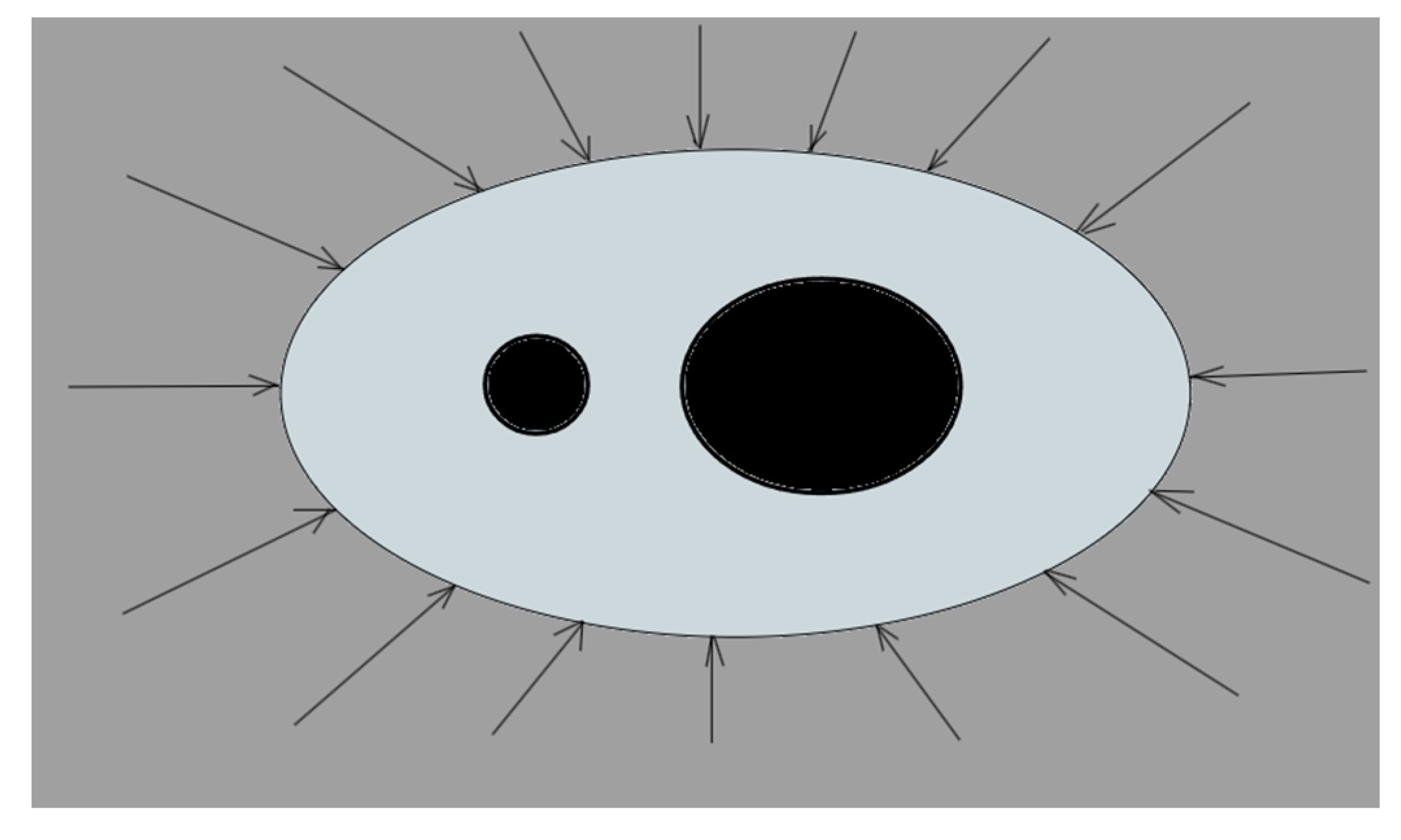
Figure 2.
The Kasimir force is a pushing force of the ether.
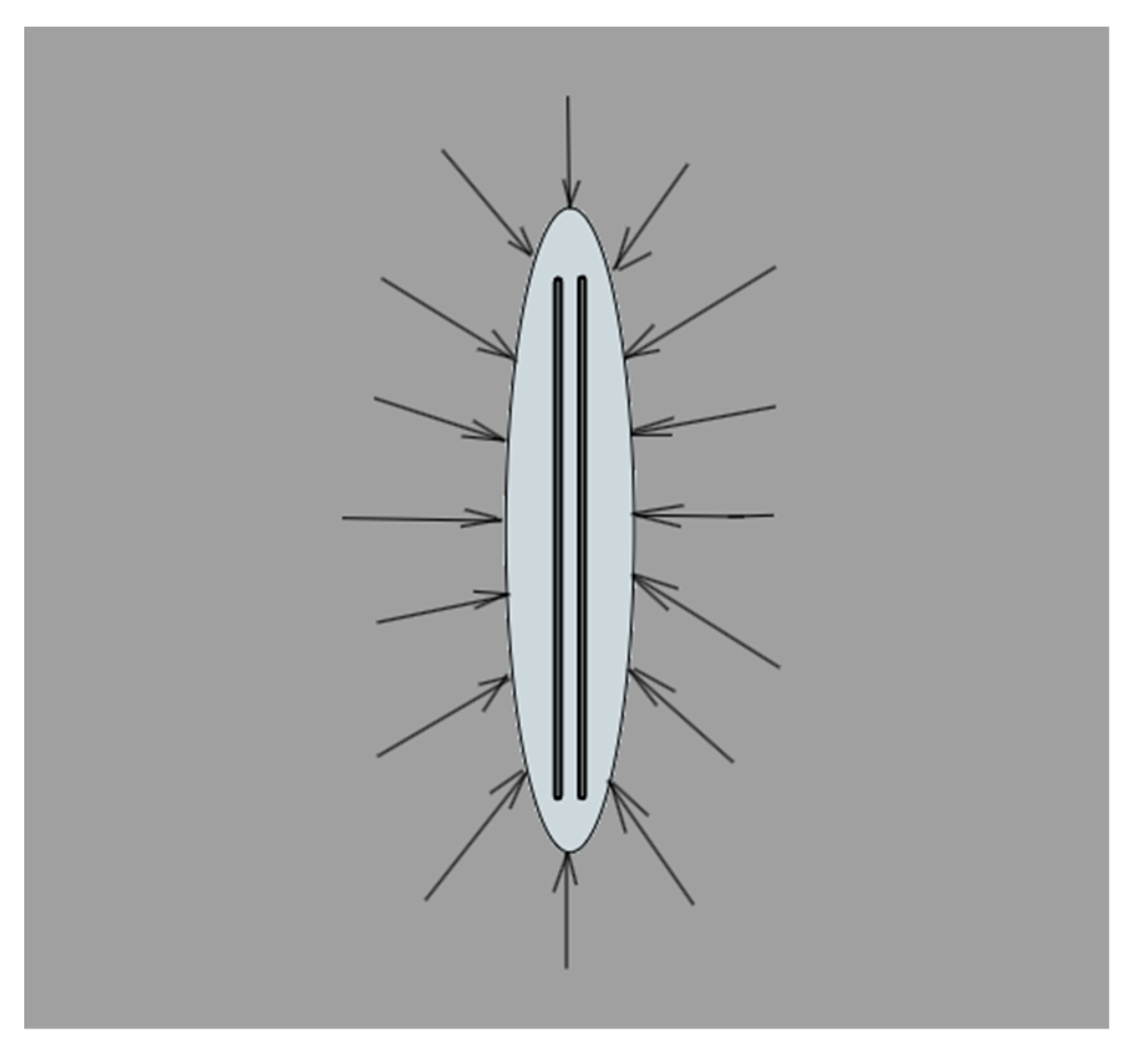
Figure 3.
Ether experiment.
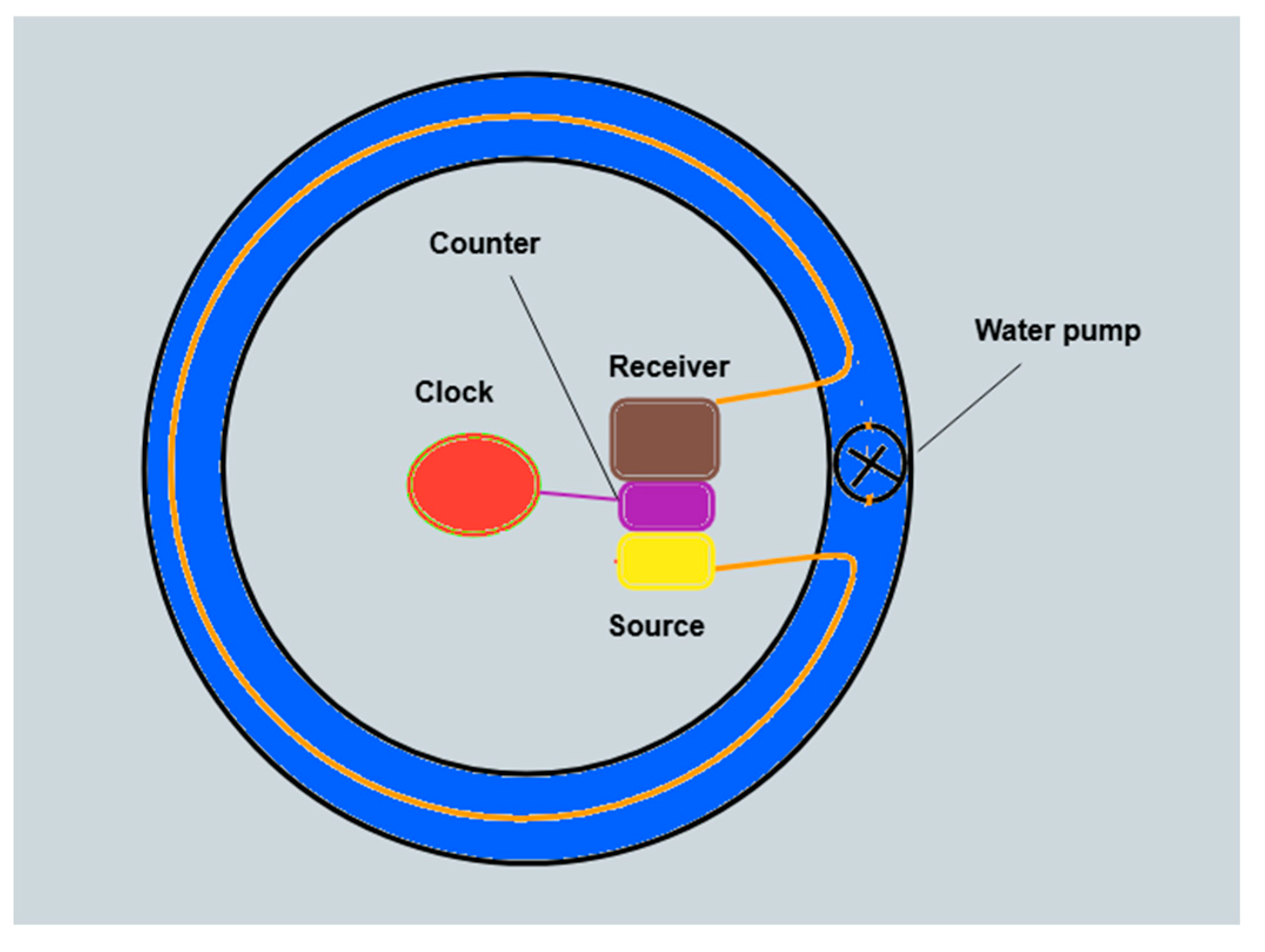
Figure 4.
Bijective verification.
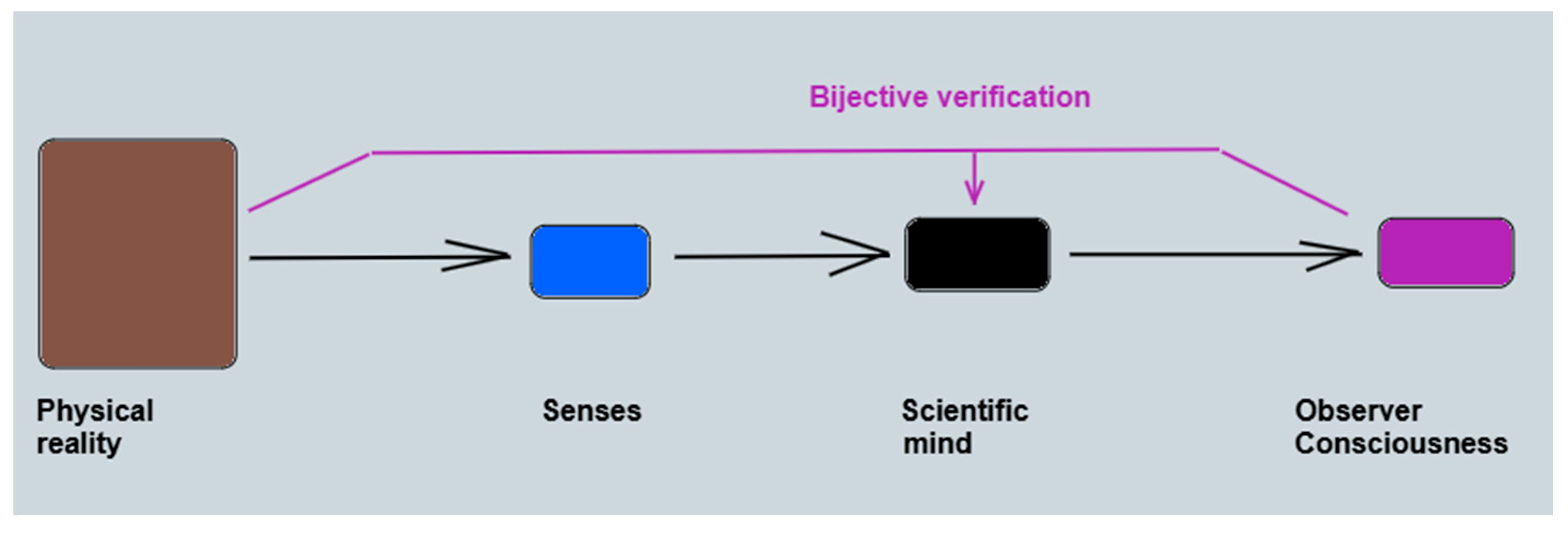
Figure 5.
Bijective function.
Disclaimer/Publisher’s Note: The statements, opinions and data contained in all publications are solely those of the individual author(s) and contributor(s) and not of MDPI and/or the editor(s). MDPI and/or the editor(s) disclaim responsibility for any injury to people or property resulting from any ideas, methods, instructions or products referred to in the content. |
© 2025 by the authors. Licensee MDPI, Basel, Switzerland. This article is an open access article distributed under the terms and conditions of the Creative Commons Attribution (CC BY) license (http://creativecommons.org/licenses/by/4.0/).
Copyright: This open access article is published under a Creative Commons CC BY 4.0 license, which permit the free download, distribution, and reuse, provided that the author and preprint are cited in any reuse.


