

Submitted:
03 June 2025
Posted:
04 June 2025
You are already at the latest version
Abstract
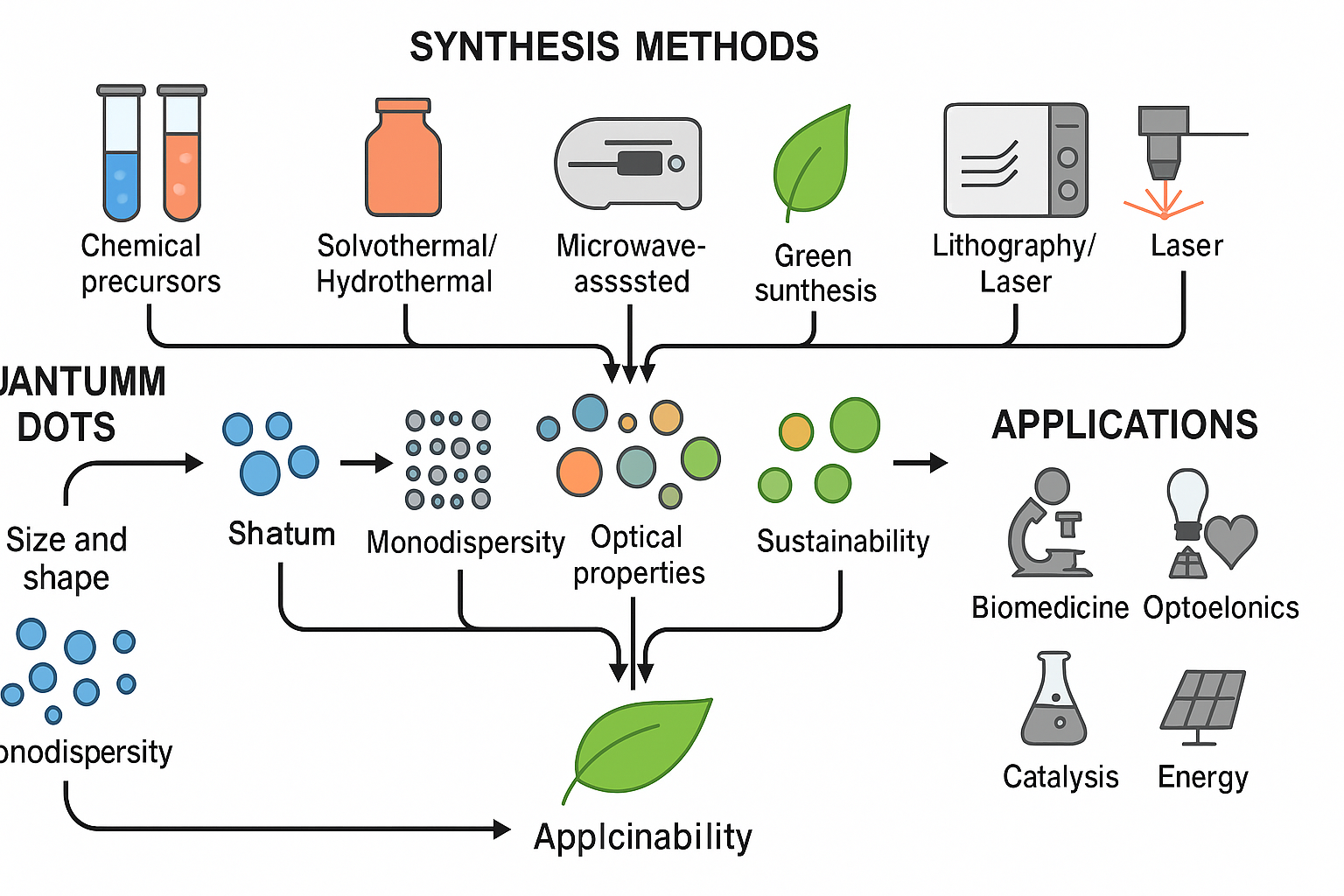
Because of their superior effects in optics and electronics, “Quantum dots” (QDs) have many applications in biomedical imaging, optoelectronics, photovoltaics and catalysis [1]. The synthesis of QDs significantly influences their size, shape, monodispersity, and functional performance, necessitating a comparative evaluation of different synthetic methodologies [2]. This review aims to provide comprehensive comparative analysis of the two primary synthesis approaches: bottom-up and top-down. Bottom-up methods, like colloidal, solvothermal, microwave-assisted, and green synthesis, enable us to have precise control over QD characteristics along with high quantum yields but often involve toxicity concerns and scalability limitations [3]. In contrast, top-down techniques like including lithography, laser ablation, and ball milling promise high-purity QDs with excellent crystallinity but suffer from high costs and energy consumption, limiting their large-scale availability [4].
A comparative analysis of various QDs synthesis methods showed that no single technique is universally superior; but the selection of the synthetic method depends on the focused applications of Nanocrystals [2]. For biomedical applications, non-toxic and biocompatible QDs synthesized through green methods are preferred, whereas high-performance optoelectronic applications benefit from monodisperse QDs synthesized via colloidal or solvothermal approaches [5]. Despite many significant advancements in synthetic methods of QDs, challenges remain in controlling toxicity, production scalability, and cost-effectiveness[4]. By integrating hybrid synthetic strategies of both bottom-up and top-down methods, advancements can be made to achieve a designed biodegradable, nontoxic QDs [6]. Overcoming these issues is key to increasing the use of QDs in industry and science, so they can be used reliably and widely throughout future nanotechnology.
Keywords:
“quantum dots” (QDs)
; colloidal synthesis
; hydrothermal
; microwave-assisted
; solvothermal
; green synthesis
; bottom-up approach
Introduction
What Are “Quantum Dots”?
“Quantum dots” (QDs) are such nanoscale semiconductor particles which, due to their quantum confinement effects, show unique optical and electronic properties [7]. QDs typically range between 1 to 10 nm in size, this type of nanomaterials which display size-dependent photoluminescence, with their emission wavelength acts and shift as a function of their dimensions [8]. Obviously, QDs possess discrete energy levels, which results in improved properties, such as high fluorescence efficiency, tunable bandgaps, and extra ordinary stability under different environmental conditions [1].
“Quantum dots” are having versatile applications in various fields which promise their significance in nanotechnology [9]. Now a days, quantum dot displays (QLEDs), photovoltaic cells, and lasers widely use QDs [10] because of their greater brightness and energy efficiency [11]. In biomedical sciences, they act as fluorescent markers aiding bioimaging along with drug delivery systems, [12] proving more advantageous as compared to conventional dyes due to their higher photostability and tunability [12]. Furthermore, there are numerous applications of QDs including environmental monitoring, catalysis, and quantum computing, making them an essential class of nanomaterials for present scientific research [13].
Why Is Synthesis Important?
Synthetic methods of “Quantum dots” always play important role in understanding and determining their size, shape, crystallinity, surface chemistry, and overall stability, which affect their optical and electronic properties directly [14]. As we know that QDs' photoluminescence and electronic behavior of QDs are size-dependent, precise control of their synthesis is crucial to optimize the functionality for their specific applications [15].
Size and Shape Control:
Emitted radiation wavelength can be controlled by the synthesis of various sized QDs [16]. As per dependent upon their size, smaller QDs show blue shifted emissions as compared to larger QDs showing red shifted emissions [17]. The interaction of light with the QDs depends upon their size and shape like spherical shaped have different properties than rod-shaped QDs. They can be tuned by using their shape and size [18].
Optical Properties:
Surface Chemistry:
Stability and Scalability:
According to the Synthetic method, QDs should be reliably stable under many terms in addition, pH, temperature and possible exposures to solvents [23]. Furthermore, scalable and cost-effective synthesis methods are necessary for industrial applications of QDs, to ensure large-scale production without compromising the quality [24].
Toxicity and Environmental Concerns:
Conventional QDs may contain toxic heavy metals like cadmium, which raise concerns about their environmental and biological impacts [25]. The development of eco-friendly and heavy-metal-free QDs through novel synthesis techniques is an active area of research.
Objective of the Review
The main purpose of this review is to closely compare different ways to synthesize QDs, showing the benefits, drawbacks and uses of each technique. Essentially, constructing QDs involves two routes: bottom-up methods centered on colloidal, hydrothermal and green methods and top-down processes that rely on lithography, laser ablation and electrochemistry [26]. With these approaches, this review seeks to answer the following questions:
- Explaining the main ideas behind every synthetic approach.
- Observation of several synthetic methods by taking factors such as size control, mono-dispersity, yield, cost and environmental aspects into account.
- An explanation of modern direction in QD preparation along with the new methods inspired by green chemistry.
- Highlighting the problems in QD research and what future work could involve. Pointing out the challenges in the field and potential future directions for QD synthesis research.
With a thorough comparison of these synthetic methodologies discussed below, this review seeks to help researchers in choosing the most appropriate synthesis method for aiming specific applications of QDs, thereby promoting progress in QD-related technologies and innovations.
Classification of “Quantum Dots”
Quantum dots (QDs) vary depending on their composition, form, synthesis method and use, showing their wide uses in optoelectronics and biology. Here, schemes are examined using several illustrative cases [27].
Based upon Composition
II–VI semiconductor QDs: Classic chalcogenide QDs made from elements in groups II and VI, for example CdSe, CdTe, CdS and ZnS [28]. These materials can be sized to have narrow or wide bandgaps and are very bright which allows them to emit any color. Since many II–VI QDs are photoluminescent but contain toxic heavy metal salts, people are now seeking alternative materials that do not include them [28].
III–V semiconductor QDs: Cadmium-free QDs made from InP, InAs and GaAs or group III-V compounds, have direct bandgaps and large Bohr radii [29]. The emission efficiency of these dots lies in the same range as II–VI dots containing a lot of Cd [29]. For example, lots of research has been done on InP QDs for their use in “safe” displays and imaging.
Group IV QDs (Si, Ge): Elemental silicon and Germanium quantum dots are completely safe for use. They complement current silicon-based technology, yet since they have an indirect bandgap, their photoluminescence is weak unless designed to be strengthened [30]. Such QDs are being investigated for applications in steady photonics and use in batteries or sensors [30].
Ternary/Quaternary QDs (I–III–VI): Copper Indium sulfide and AgIndium sulfide nanocrystals are heavy metal-free. The broad emission and long lives of these dots make them helpful in solar power and biochemical labeling [31]. The energy range that separates electrical from nonelectrical states is set by mixing various semiconductors [31].
Carbon-based QDs: Carbon dots and graphene QDs are small groups of carbon (frequently <10 nm in size). They contain no metal and are very compatible with living tissue [32]. Surface functional groups and graphitic domains cause blue/green emission, making them suitable for use in bioimaging, sensing and photocatalysis [32].
Perovskite QDs: Nanocrystals made from halide perovskites such as CsPbX₃ stand out as a special group. They demonstrate very efficient PL (up to 10%) and tight emission lines [33]. Halide makeup is adjusted to select the color and the defects in the perovskite crystal structure provide bright and lasting illumination [33]. Though perovskite QDs are advancing display technologies (wide color gamut LEDs), they must be carefully passivated on their surface [33].
Based upon Structure
Core QDs: Thickness-adjusted single-material dots are created from one type of material that is the same throughout. Quantum confinement within the nanocrystal controls the bandgap [34]. While it is simple to produce core QDs, they still pick up an electrical charge on their surface without the addition of ligands [34].
Core–Shell QDs: One type of semiconductor is used as a shell around another such as a ZnS shell covering a CdSe core. With the shell protecting the core, surface traps are neutralized, carriers are enclosed and both quantum yield and stability are strongly increased [34]. In multi-shell architectures (for example, CdSe/CdS/ZnS), layers between the semiconductors lessen the misfit in the lattice as well as keep the band offsets wide [34].
Doped QDs: Adding impurity ions into the dots allows for the use of new methods of emission. When doped with Mn²⁺, ZnS QDs generate strongly orange light from the Mn-d orbitals, besides the light emitted by the host [35]. When transition metal or rare-earth ions are introduced, doped QDs acquire magnetism or more fluorescence peaks which make them suitable for magnetic and fluorescent imaging [35].
Alloyed QDs: All of these seem to have the same composition such as CdSₓSe₁₋ₓ with 0 to 1 moles of each. Change in alloy fraction alters the bandgap, without affecting the crystal’s dimensions [36]. That’s why alloyed QDs can be adjusted to emit light anywhere between the two parent compounds, allowing for white light emission or covering many wavelengths [36].
Hetero-structured/Multicomponent QDs: Apps that are organized using graded, layered or branched structures are included in this class. Staggered alignment between the type-II core/shell QDs leads to electron and hole separation [37]. Distributing charges in multi-shell designs or quantum well QDs helps decrease Auger recombination. Advanced tasks (such as splitting charge and emitting over a wide range of light wavelengths) are achieved in heterostructures, more so than in simple core/shell dots [37].
Synthetic Methods of “Quantum Dots”
Many different methods are used to produce “Quantum dots” which generally fall into bottom-up or top-down approaches [38]. Bottom-up techniques are called chemical synthetic methods and help you control the specific size and arrangement of the nanostructures [39]. Physical or mechanical methods called top-down techniques break down bulk materials into nanoscale bits [40]. The following is a comprehensive comparative analysis of these methods.
Bottom-Up Approaches (Chemical Synthesis)
Colloidal synthesis and hydrothermal methods are used in bottom-up techniques that give us outstanding control over QDs, so they are suitable for use in optoelectronics and biomedicine [41]. These synthesis methods focus on building QDs from molecular or atomic precursors through managed chemical reactions [42]. Because these methods give such precise management of the particles’ size, shape and structure, their optical and electronic properties are highly customizable [43]. Typical bottom-up methods include the following.
Colloidal Synthesis
To produce high quality mono-disperse Nanoparticles with tunable optical properties, colloidal synthesis method for QDs synthesis is widely preferred [43]. Precursors, stabilizers and surfactants are required in the solution for the development of “Quantum dots” [44]. Influencing temperature, precursor quantity and reaction duration determines the properties the QDs will obtain [45].
- Principle and Mechanism: This method relies on adding QD precursors over a nucleation liquid to trigger the growth of QDs. You can achieve an accurate size of QDs by carefully managing temperature, the amount of precursors and the amount of time allocated to the reaction. The procedure results in size-related behavior of light particles. [46].
- Key Precursors and Solvents Used: Commonly, precursors are metal salts (such as CdCl2 and Pb(NO3)2), various chalcogens (Se, S and Te) and organic surfactants like trioctylphosphine oxide and oleic acid [47]. Common solvents for keeping colloidal dispersions stable are octadecene and toluene which are not polar [48].
- Control of QD Size & Monodispersity: Common solvents for keeping colloidal dispersions stable are octadecene and toluene which are not polar [49]. Rapid nucleation followed by slow growth results in forming uniform particle sizes, with improved monodispersity and optical performance of QDs.
-
Applications: Colloidal QDs are widely used in;
- ○
- biomedical imaging (as fluorescent markers),
- ○
- light-emitting diodes (LEDs) (for display technologies),
- ○
- solar cells (to enhance photovoltaic efficiency).
- Advantages and Disadvantages: Making QDs using the Colloidal method is simple, lets you adjust the size, produces high efficiency and is easily reproduced. Most of the time, these processes use harmful starting materials and very specific conditions must be used [50].
Solvothermal /Hydrothermal Synthesis
Solvothermal and hydrothermal techniques are solution-based synthetic techniques that are conducted under high-temperature and pressure conditions which make possibility for the formation of high-quality QDs. High temperature and high-pressure conditions are utilized in aqueous and organic solvents respectively. It will facilitate the ger [51].
Solvent-Based High-Pressure Synthesis: Controlled nucleation and growth of QDs is achieved by using metal precursors, which are dissolved in solvents and subjected to elevated temperatures (100-300°C) in a sealed autoclave [52].
- Temperature and Reaction Time Dependency: How large and well-structured QDs become depends both on the reaction temperature and the duration chosen for the process. When the temperature is higher, the crystalline quality improves and continuing the reaction over time ensures all QDs grow uniformly [53].
- Applications: This approach is followed when high purity and surface control are needed, often found in perovskite solar cell applications and drug delivery [54].
- Pros and Cons: The solvothermal method provides high crystallinity and controlled morphology of QDs; although it is energy intensive and need high pressure equipment [46].
Microwave Assisted Synthesis
This approach is followed when high purity and surface control are needed, often found in perovskite solar cell applications and drug delivery [55].
- Rapid Heating and Controlled Nucleation: The unique heating mechanism of microwaves allows for rapid, homogeneous heating. It decreases temperature gradients while ensuring uniform QD growth [56].
- Comparison with Traditional Methods: The process becomes more efficient and reproducible for QDs when microwave-assisted synthesis is used rather than older heating methods.
- Applications: Such materials are effective in biosensing fields (for example, for disease detection) and in catalysis (including for caring for the environment).
Green Synthesis (Eco Friendly Methods)
- Because of more attention on green products, people have created various biological and non-toxic methods to produce QDs.
- Exploiting Plant Extracts, Bacteria and Natural Biological Agents: Lots of natural materials are used to greenly produce and maintain QDs.
- Sustainable Alternatives to Toxic Solvents: True Solutions offer water-based processes and biodegradable stabilizers as healthy alternatives to normal organic solvents.
- Limitations and Scalability Issues: Synthesizing QDs using green methods often produces a low yield. It is not easy to reproduce because of its narrow scalability which restricts its use.
Top-Down Approaches (Physical Methods)
Sophisticated equipment is needed for top-down methods and these methods are not as well suited for making large quantities. Factors such as the purpose of the QDs, their price and the effects on the environment drive the selection of a synthetic strategy for manufacturing QDs. The development of green synthesis, as well as new manufacturing techniques, has driven many progressions in QDs and supported the creation of sustainable and effective high-performance advanced nanomaterials.
Lithography and Etching Methods
For the synthesis and fabrication of Semiconductor QDs with well-defined geometries and high precision, Lithography and etching methods are widely applied.
- Electron-beam lithography and ion-beam etching: To make the QDs ideal for optoelectronic applications, high resolution techniques that allow the precise patterning of QDs on substrate are Electron beam lithography and ion beam etching method.
- High Precision but High Cost: While methods offer excellent control over the QD size and arrangement, they are expensive and require sophisticated instrumentation.
Laser Ablation and Electrochemical Synthesis
Laser ablation and electrochemical synthesis are effective techniques for directly producing high-purity QDs from bulk materials. To produce high-purity “Quantum dots” from bulk materials directly, Laser ablation and electrochemical synthesis are much effective techniques.
- Production of “Quantum dots” from bulk materials: A high-energy laser beam is directly used to fragment bulk materials into nanoscale particles, such method is termed as Laser Ablation. Similarly, high voltage is applied to induce controlled “Quantum dots” to form solution medium. Such medium is termed as Electrochemical Synthesis of QDs.
- Advantages of Purity and Crystallinity: These methods give high-purity QDs with well-defined crystallinity and minimal contamination, making synthesized QDs for high performance optical and electronic applications.
Other Techniques (Mechanical Grinding, Ball Milling)
The other cost-effective techniques used for reducing bulk materials to the nanoscale are mechanical techniques such as ball milling and grinding.
- Ball Milling: Using high-speed ball mills to crush a large amount of substance into nanoscale nanoparticles leads to an ongoing decrease in particle size.
- Limitations: Although it can be done at a low cost and in large quantities, these approaches lead to QDs with mixed sizes and numerous defects. Problems with QD shape can influence both their optical and electronic functions.
“Quantum dots” synthesis is rapidly evolving field and there are various techniques with their several advantages and limitations.
Comparative Analysis of Different Methods
To give a systematic evaluation of the methods used to synthesize the QD particles, a comparative analysis of the methods is essential. Owing to the intended applications of the QDs, the suitable synthesis method is chosen. Out of all the synthetic methods of QDs, Colloidal synthesis of QDs remains the most versatile and widely used technique. It is due to its balance of cost, scalability, and precise size control. Microwave-assisted and environmentally friendly methods are arising as suitable replacements for typical ones, especially for medical and ecological uses of QDs. In addition, lithography and laser ablation are the best tools for special, very accurate tasks that do not have budget restrictions.
The key parameters for comparison include:
- Size Control: It concerns the skill of perfectly controlling the shape of QDs.
- Monodispersity: Uniform distribution of particle size.
- Yield: It is the quantitative efficiency of production of QDs.
- Cost: To assess if each type of synthetic method is financially viable.
- Environmental Impact: So that QDs produced synthetically are environmentally friendly.
- Scalability: The possibility to make materials in large quantities.

Table 1.
Showing Comparative Analysis of various parameters amongst QDs synthesized via several Methods.
Table 1.
Showing Comparative Analysis of various parameters amongst QDs synthesized via several Methods.
|
Synthesis Method |
Size Control | Mono-dispersity | Yield | Cost | Environmental Impact | Scalability |
| Colloidal Synthesis | Excellent | High | Moderate | Moderate | Moderate | High |
|
Solvothermal/ Hydrothermal |
Good | Moderate | High | Moderate | Low | Moderate |
| Microwave-Assisted | Good | High | High | Low | Low | Moderate |
| Green Synthesis | Moderate | Moderate | Low | Low | Very Low | Low |
| Lithography & Etching | High | Very High | Low | High | High | Very Low |
| Laser Ablation | High | High | Moderate | High | Moderate | Low |
| Ball Milling & Mechanical | Low | Low | High | Low | Moderate | High |
Discussion on Optimal Methods for Different Applications
Biomedical Applications
Biomedical tasks such as delivering drugs, imaging the body and sensing biological activities use colloidal synthesis and microwave-assisted synthesis as the preferred approach. Using these methods, it’s easy to make nanoparticles that are a consistent size and shape, so they can safely be used inside the body. Attention is also growing for green synthesis because it doesn’t harm the environment, despite the difficulties in scaling it up.
Optoelectronics
For applications in optoelectronics, including LEDs and solar cells, preparing materials by colloidal and solvothermal or hydrothermal methods is most common. Since they can be customized, have a good output and are moderately scalable, these techniques are well-suited for use in industry. The high level of precision in these methods, lithography and etching, makes them unsuitable and too costly for mass production.
Catalysis
Catalysts used in photocatalysis, and energy conversion are most often prepared using solvothermal, hydrothermal and laser ablation methods. Using these methods, highly crystalline QDs are produced, and they have enhanced catalytic function. Even though mechanical and ball milling are convenient and cost little, they often create polydisperse and uneven-shaped QDs that are not very efficient in catalysis.
Challenges and Future Perspectives
Challenges in Synthesis
Despite considerable advances in the synthesis of quantum points (QDS), there are several challenges, which limit widespread application and industrial costs.
Toxicity Concerns
One important problem facing QDs made with heavy metals such as Cadmium (Cd), Lead (Pb) and arsenic compounds, is their toxicity. [57]. These issues can result in serious environmental and health problems because to their possibility to build up in living tissues and cause harm. [58]. The introduction of metal ions in biological systems causes worry about damage to cells, increased stress and the possibility of lasting contamination [59]. To overcome these difficulties, carbon-based QDs and silicon QDs that do not cause harm and work just as well are needed [60].
Scalability Issues in Industrial Production
Many synthesis techniques, especially those that bring high quality QDs of precise size and shape control, face scalability challenges. For example, colloidal synthesis and solvent methods require careful control of reaction parameters, limiting reproducibility on a large scale [4]. The stacked variations observed in these ways prevent direct translation into commercial production. Furthermore, complex cleaning procedures such as ligand exchange and surface modification are dissatisfied with large-scale production processes [61].
Cost Effectiveness and Reproducibility
How cost-effective QD is also a significant limit [62]. Lithography and laser ablation techniques increase accuracy and purity but make high operational costs and energy-intensive properties unrealistic in large-scale applications. Also, it is hard to guarantee that batches made by green and other biological processes will be reproducible. Variability in pioneer availability, reaction conditions, and synthesis periods often lead to inconsistencies in QD properties that affect functional performance in real applications [62].
Future Research Directions
Continuous research is aiming at new methods that improve the process and widen the use of biocatalysts.
Emerging Green Synthesis Methods
By lowering both the use of toxic pioneers and hazardous solvents, environmentally friendly synthetic practices are growing in popularity. Green synthetic methods with plant extracts, microorganisms and biodegradable organic compounds provide a promising alternative [63]. This system works well in biomedical and pharmaceutical fields because it saves the environment and increases biocompatibility too. Still, better results are needed to enhance the yield, stability and useful features of QDs produced with the green method [64].
Hybrid Synthetic Strategies Combining Both Bottom-Up and Top-Down Approaches
Future research can be improved by bringing together traditional synthesis methods with contemporary physical manufacture techniques. Sometimes called a dual-approach, researchers reach impressive QD properties by combing bottom-up techniques (e.g. colloid synthesis) with top-down approaches (e.g. lithography and etching) [65]. Such hybrid strategies provide improved uniformity, controlled surface functionalization, and scalability, providing a gap between laboratory preparation production and industrial implementation [66].
Potential for Biodegradable and Non-Toxic “Quantum Dots”
Because of worries about safety and toxicity, scientists are starting to require QDs that are beneficial to the environment [67]. Because of worries about safety and toxicity, scientists are starting to require QDs that are beneficial to the environment [68]. In the future, researchers should concentrate on creating applications for such materials, improving their quantum yields, expanding sustainable energy, aiding in medical diagnostics and affecting the environment [69].
Conclusion
Scientists produce “Quantum dots” using different techniques over time aimed at controlling their size and shape and their properties for various uses [13]. It presents a wide comparison of techniques and synthetic approaches that measure their popularity, performance and effect on the environment, as well as their use in research and industry.
Bottom-up approaches, such as colloidal synthesis [70], solvothermal synthesis [71], microwave-assisted synthesis of QDs [72], and green synthesis of QDs [73], have demonstrated remarkable control over QD size and mono-dispersity. Out of all methods for QDs synthesis, Colloidal synthesis has emerged as a leading method due to its precise tunability, high quantum yield, and is applicable in fields such as biomedical imaging, optoelectronics, and photovoltaics [4]. Still, the use of harmful substances and solvents in this area leads to environmental and health problems, so Green chemistry is being sought [74]. Green synthesis methods, in short, use nature to make things in an environmentally friendly way, but it's hard to make a lot of product consistently [75].
It presents a wide comparison of techniques and synthetic approaches that measures their popularity, performance and effect on the environment, as well as their use in research and industry [38]. While these techniques provide superior crystallinity, their high costs and strong reliance on energy stop most manufacturers from using them for large-scale work. Since nanodevice fabrication and advanced electronics depend on extremely accurate processes, top-down techniques are not easily replaced [76].
A comprehensive comparative analysis of these methods shows that not only a single approach is universally superior for QDs synthesis, but instead, the choice of synthetic technique depends upon the needed or targeted applications. When designing for biomedical uses, making QDs that are non-toxic and biocompatible is very important, so green and carbon-based QDs are favored [77]. Meanwhile, colloidal and solvothermal synthesis lead to QDs that perform well in various high-performance optoelectronic applications [78]. Scalability is still a significant problem, as industrial uses require synthesis methods to be economical, repeated and high-yielding.
The challenges related to making QDs mainly involve issues of toxicity, expansion in mass production and affordability, so ongoing research is needed [3]. New strategies using both bottom-up and top-down processes are expected to help reach the goal of precision synthesis without losing the ability for industrial use [79]. Furthermore, making environmentally friendly QDs would benefit nature and allow them to use in different green and healthcare technologies.
All in all, the ongoing development of QD synthesis is helping to drive progress in nanotechnology and strongly affecting energy harvesting, imaging in biology, delivery of medicine and technology for electronic devices [14]. It is also expected that future study will improve the environmental process of making QDs, find better methods for producing large batches of QDs and design stronger QDs that are safer and more suitable for research and industry [80]. Because quantum dot research involves different scientific fields, experts in chemistry, materials and engineering must collaborate to overcome issues and fully use “Quantum dots” in technology [81].
References
- L. Wang, D. Xu, J. Gao, X. Chen, Y. Duo, and H. Zhang, “Semiconducting quantum dots: Modification and applications in biomedical science,” Sci. China Mater., vol. 63, no. 9, pp. 1631–1650, Sep. 2020. [CrossRef]
- P. Reiss, M. Carrière, C. Lincheneau, L. Vaure, and S. Tamang, “Synthesis of Semiconductor Nanocrystals, Focusing on Nontoxic and Earth-Abundant Materials,” Chem. Rev., vol. 116, no. 18, pp. 10731–10819, Sep. 2016. [CrossRef]
- E. A. Chaparro Barriera and S. J. Bailón-Ruiz, “Fabrication, Characterization, and Nanotoxicity of Water stable Quantum Dots,” MRS Adv., vol. 5, no. 43, pp. 2231–2239, Aug. 2020. [CrossRef]
- Y. Pu, F. Cai, D. Wang, J.-X. Wang, and J.-F. Chen, “Colloidal Synthesis of Semiconductor Quantum Dots toward Large-Scale Production: A Review,” Ind. Eng. Chem. Res., vol. 57, no. 6, pp. 1790–1802, Feb. 2018. [CrossRef]
- S. Iravani and R. S. Varma, “Green synthesis, biomedical and biotechnological applications of carbon and graphene quantum dots. A review,” Environ. Chem. Lett., vol. 18, no. 3, pp. 703–727, May 2020. [CrossRef]
- J. X. Soares et al., “Rationally designed synthesis of bright AgInS2/ZnS quantum dots with emission control,” Nano Res., vol. 13, no. 9, pp. 2438–2450, Sep. 2020. [CrossRef]
- S. Kargozar, S. J. Hoseini, P. B. Milan, S. Hooshmand, H. Kim, and M. Mozafari, “Quantum Dots: A Review from Concept to Clinic,” Biotechnol. J., vol. 15, no. 12, p. 2000117, Dec. 2020. [CrossRef]
- M.-X. Zhao and E.-Z. Zeng, “Application of functional quantum dot nanoparticles as fluorescence probes in cell labeling and tumor diagnostic imaging,” Nanoscale Res. Lett., vol. 10, no. 1, p. 171, Dec. 2015. [CrossRef]
- N. Bajwa, N. K. Mehra, K. Jain, and N. K. Jain, “Pharmaceutical and biomedical applications of quantum dots,” Artif. Cells Nanomedicine Biotechnol., pp. 1–11, Jun. 2015. [CrossRef]
- Y. Shu, X. Lin, H. Qin, Z. Hu, Y. Jin, and X. Peng, “Quantum Dots for Display Applications,” Angew. Chem. Int. Ed., vol. 59, no. 50, pp. 22312–22323, Dec. 2020. [CrossRef]
- Q. Wan et al., “Ultrathin Light-Emitting Diodes with External Efficiency over 26% Based on Resurfaced Perovskite Nanocrystals,” ACS Energy Lett., vol. 8, no. 2, pp. 927–934, Feb. 2023. [CrossRef]
- P. Koutsogiannis, E. Thomou, H. Stamatis, D. Gournis, and P. Rudolf, “Advances in fluorescent carbon dots for biomedical applications,” Adv. Phys. X, vol. 5, no. 1, p. 1758592, Jan. 2020. [CrossRef]
- Kausar, “Polymer dots and derived hybrid nanomaterials: A review,” J. Plast. Film Sheeting, vol. 37, no. 4, pp. 510–528, Oct. 2021. [CrossRef]
- M. Alizadeh-Ghodsi, M. Pourhassan-Moghaddam, A. Zavari-Nematabad, B. Walker, N. Annabi, and A. Akbarzadeh, “State-of-the-Art and Trends in Synthesis, Properties, and Application of Quantum Dots-Based Nanomaterials,” Part. Part. Syst. Charact., vol. 36, no. 2, p. 1800302, Feb. 2019. [CrossRef]
- E. A. Slejko and V. Lughi, “Size Control at Maximum Yield and Growth Kinetics of Colloidal II–VI Semiconductor Nanocrystals,” J. Phys. Chem. C, vol. 123, no. 2, pp. 1421–1428, Jan. 2019. [CrossRef]
- S. C. Dey and S. S. Nath, “SIZE-DEPENDENT PHOTOLUMINESCENCE AND ELECTROLUMINESCENCE OF COLLOIDAL CdSe QUANTUM DOTS,” Int. J. Nanosci., vol. 12, no. 02, p. 1350013, Apr. 2013. [CrossRef]
- R. Tsekov, P. Georgiev, S. Simeonova, and K. Balashev, “Quantifying the Blue Shift in the Light Absorption of Small Gold Nanoparticles,” 2017. [CrossRef]
- J. X. Xu, Y. Yuan, M. Liu, S. Zou, O. Chen, and D. Zhang, “Quantification of the Photon Absorption, Scattering, and On-Resonance Emission Properties of CdSe/CdS Core/Shell Quantum Dots: Effect of Shell Geometry and Volumes,” Anal. Chem., vol. 92, no. 7, pp. 5346–5353, Apr. 2020. [CrossRef]
- M. Perikala and A. Bhardwaj, “Engineering Photo-Luminescent Centers of Carbon Dots to Achieve Higher Quantum Yields,” ACS Appl. Electron. Mater., vol. 2, no. 8, pp. 2470–2478, Aug. 2020. [CrossRef]
- L. Huang, Z. Ye, L. Yang, J. Li, H. Qin, and X. Peng, “Synthesis of Colloidal Quantum Dots with an Ultranarrow Photoluminescence Peak,” Chem. Mater., vol. 33, no. 5, pp. 1799–1810, Mar. 2021. [CrossRef]
- L. Liu, H. Xu, B. Shen, and X. Zhong, “High-Quality Water-Soluble Core/Shell/Shell CdSe/CdS/ZnS Quantum Dots Balanced by Ionic and Nonionic Hydrophilic Capping Ligands,” Nano, vol. 11, no. 07, p. 1650073, Jul. 2016. [CrossRef]
- Y. Yan, Y. Cai, X. Liu, G. Ma, W. Lv, and M. Wang, “Hydrophobic Modification on the Surface of SiO2 Nanoparticle: Wettability Control,” Langmuir, vol. 36, no. 49, pp. 14924–14932, Dec. 2020. [CrossRef]
- J. H. Jo, H. S. Heo, and K. Lee, “Assessing Stability of Nanocomposites Containing Quantum Dot/Silica Hybrid Particles with Different Morphologies at High Temperature and Humidity,” Chem. Mater., vol. 32, no. 24, pp. 10538–10544, Dec. 2020. [CrossRef]
- H. Jin, C. Wu, S. Zhou, Y. Xin, T. Sun, and C. Guo, “Practical and Scalable Manufacturing Process for a Novel Dual-Acting Serotonergic Antidepressant Vilazodone,” Org. Process Res. Dev., vol. 25, no. 5, pp. 1184–1189, May 2021. [CrossRef]
- S. Nikazar, V. S. Sivasankarapillai, A. Rahdar, S. Gasmi, P. S. Anumol, and M. S. Shanavas, “Revisiting the cytotoxicity of quantum dots: an in-depth overview,” Biophys. Rev., vol. 12, no. 3, pp. 703–718, Jun. 2020. [CrossRef]
- L. Zhu, D. Shen, C. Wu, and S. Gu, “State-of-the-Art on the Preparation, Modification, and Application of Biomass-Derived Carbon Quantum Dots,” Ind. Eng. Chem. Res., vol. 59, no. 51, pp. 22017–22039, Dec. 2020. [CrossRef]
- Valizadeh et al., “Quantum dots: synthesis, bioapplications, and toxicity,” Nanoscale Res. Lett., vol. 7, no. 1, p. 480, Dec. 2012. [CrossRef]
- Chen, D. Li, and F. Wang, “InP Quantum Dots: Synthesis and Lighting Applications,” Small, vol. 16, no. 32, p. 2002454, Aug. 2020. [CrossRef]
- T. Zhou et al., “Bandgap Tuning of Silicon Quantum Dots by Surface Functionalization with Conjugated Organic Groups,” Nano Lett., vol. 15, no. 6, pp. 3657–3663, Jun. 2015. [CrossRef]
- T. Zhou et al., “Bandgap Tuning of Silicon Quantum Dots by Surface Functionalization with Conjugated Organic Groups,” Nano Lett., vol. 15, no. 6, pp. 3657–3663, Jun. 2015. [CrossRef]
- J. S. Niezgoda, M. A. Harrison, J. R. McBride, and S. J. Rosenthal, “Novel Synthesis of Chalcopyrite CuxInyS2 Quantum Dots with Tunable Localized Surface Plasmon Resonances,” Chem. Mater., vol. 24, no. 16, pp. 3294–3298, Aug. 2012. [CrossRef]
- J. Liu, R. Li, and B. Yang, “Carbon Dots: A New Type of Carbon-Based Nanomaterial with Wide Applications,” ACS Cent. Sci., vol. 6, no. 12, pp. 2179–2195, Dec. 2020. [CrossRef]
- T. Liang, W. Liu, X. Liu, Y. Li, W. Wu, and J. Fan, “In Situ Phase-Transition Crystallization of All-Inorganic Water-Resistant Exciton-Radiative Heteroepitaxial CsPbBr3-CsPb2Br5 Core-Shell Perovskite Nanocrystals,” Chem. Mater., vol. 33, no. 13, pp. 4948–4959, Jul. 2021. [CrossRef]
- B. Ji, S. Koley, I. Slobodkin, S. Remennik, and U. Banin, “ZnSe/ZnS Core/Shell Quantum Dots with Superior Optical Properties through Thermodynamic Shell Growth,” Nano Lett., vol. 20, no. 4, pp. 2387–2395, Apr. 2020. [CrossRef]
- H. Zhang et al., “An Aqueous Route Synthesis of Transition-Metal-Ions-Doped Quantum Dots by Bimetallic Cluster Building Blocks,” J. Am. Chem. Soc., vol. 142, no. 38, pp. 16177–16181, Sep. 2020. [CrossRef]
- S. Dey, S. Chen, S. Thota, M. R. Shakil, S. L. Suib, and J. Zhao, “Effect of Gradient Alloying on Photoluminescence Blinking of Single CdSxSe 1– x Nanocrystals,” J. Phys. Chem. C, vol. 120, no. 37, pp. 20547–20554, Sep. 2016. [CrossRef]
- Y. Cheng et al., “Continuously Graded Quantum Dots: Synthesis, Applications in Quantum Dot Light-Emitting Diodes, and Perspectives,” J. Phys. Chem. Lett., vol. 12, no. 25, pp. 5967–5978, Jul. 2021. [CrossRef]
- K. Kaiming, L. Baoyou, H. Ju, R. Hongwei, W. Limin, and Y. Gang, “Green preparation and application of carbon quantum dots,” IOP Conf. Ser. Earth Environ. Sci., vol. 826, no. 1, p. 012036, Jul. 2021. [CrossRef]
- J. M. Tour, “Top-Down versus Bottom-Up Fabrication of Graphene-Based Electronics,” Chem. Mater., vol. 26, no. 1, pp. 163–171, Jan. 2014. [CrossRef]
- Y. H. Lanyon and D. W. M. Arrigan, “Top-Down Approaches to the Fabrication of Nanopatterned Electrodes,” in Nanostructured Materials in Electrochemistry, 1st ed., A. Eftekhari, Ed., Wiley, 2008, pp. 187–210. [CrossRef]
- M. Z. Hu and T. Zhu, “Semiconductor Nanocrystal Quantum Dot Synthesis Approaches Towards Large-Scale Industrial Production for Energy Applications,” Nanoscale Res. Lett., vol. 10, no. 1, p. 469, Dec. 2015. [CrossRef]
- J. Van Embden, A. S. R. Chesman, and J. J. Jasieniak, “The Heat-Up Synthesis of Colloidal Nanocrystals,” Chem. Mater., vol. 27, no. 7, pp. 2246–2285, Apr. 2015. [CrossRef]
- C. Yang, L. Tang, Q. Li, A. Bai, Y. Wang, and Y. Yu, “Preparation of Monodisperse Colloidal ZnO Nanoparticles and their Optical Properties,” Nano, vol. 10, no. 05, p. 1550074, Jul. 2015. [CrossRef]
- L. Li et al., “Fragmentation of Magic-Size Cluster Precursor Compounds into Ultrasmall CdS Quantum Dots with Enhanced Particle Yield at Low Temperatures,” Angew. Chem. Int. Ed., vol. 59, no. 29, pp. 12013–12021, Jul. 2020. [CrossRef]
- J. Zhang, R. W. Crisp, J. Gao, D. M. Kroupa, M. C. Beard, and J. M. Luther, “Synthetic Conditions for High-Accuracy Size Control of PbS Quantum Dots,” J. Phys. Chem. Lett., vol. 6, no. 10, pp. 1830–1833, May 2015. [CrossRef]
- C.-D. Kim, H. T. Kim, B.-K. Min, and C. Park, “Effects of Growth Temperature on the Properties of CdSe Nano-Crystals Synthesized Eco-Friendly Using Colloidal Route,” Mol. Cryst. Liq. Cryst., vol. 602, no. 1, pp. 151–158, Oct. 2014. [CrossRef]
- J. Van Embden, A. S. R. Chesman, and J. J. Jasieniak, “The Heat-Up Synthesis of Colloidal Nanocrystals,” Chem. Mater., vol. 27, no. 7, pp. 2246–2285, Apr. 2015. [CrossRef]
- Bera, D. Mandal, P. N. Goswami, A. K. Rath, and B. L. V. Prasad, “Generic and Scalable Method for the Preparation of Monodispersed Metal Sulfide Nanocrystals with Tunable Optical Properties,” Langmuir, vol. 34, no. 20, pp. 5788–5797, May 2018. [CrossRef]
- L. Lv, J. Li, Y. Wang, Y. Shu, and X. Peng, “Monodisperse CdSe Quantum Dots Encased in Six (100) Facets via Ligand-Controlled Nucleation and Growth,” J. Am. Chem. Soc., vol. 142, no. 47, pp. 19926–19935, Nov. 2020. [CrossRef]
- M. Alizadeh-Ghodsi, M. Pourhassan-Moghaddam, A. Zavari-Nematabad, B. Walker, N. Annabi, and A. Akbarzadeh, “State-of-the-Art and Trends in Synthesis, Properties, and Application of Quantum Dots-Based Nanomaterials,” Part. Part. Syst. Charact., vol. 36, no. 2, p. 1800302, Feb. 2019. [CrossRef]
- J. Van Embden, A. S. R. Chesman, and J. J. Jasieniak, “The Heat-Up Synthesis of Colloidal Nanocrystals,” Chem. Mater., vol. 27, no. 7, pp. 2246–2285, Apr. 2015. [CrossRef]
- J. Zhang, R. W. Crisp, J. Gao, D. M. Kroupa, M. C. Beard, and J. M. Luther, “Synthetic Conditions for High-Accuracy Size Control of PbS Quantum Dots,” J. Phys. Chem. Lett., vol. 6, no. 10, pp. 1830–1833, May 2015. [CrossRef]
- S. Chen, X. Zhang, Y. Zhao, and Q. Zhang, “Effects of reaction temperature on size and optical properties of CdSe nanocrystals,” Bull. Mater. Sci., vol. 33, no. 5, pp. 547–552, Oct. 2010. [CrossRef]
- H. Maghsoudi, M. Mahboub, and S. Asgari, “Processing and characterization of monodisperse phosphine-free CdSe colloidal quantum dots,” presented at the SPIE NanoScience + Engineering, E. M. Campo, E. A. Dobisz, and L. A. Eldada, Eds., San Diego, California, United States, Aug. 2014, p. 91701J. [CrossRef]
- W. Schumacher, A. Nagy, W. J. Waldman, and P. K. Dutta, “Direct Synthesis of Aqueous CdSe/ZnS-Based Quantum Dots Using Microwave Irradiation,” J. Phys. Chem. C, vol. 113, no. 28, pp. 12132–12139, Jul. 2009. [CrossRef]
- H.-Q. Wang and T. Nann, “Monodisperse Upconverting Nanocrystals by Microwave-Assisted Synthesis,” ACS Nano, vol. 3, no. 11, pp. 3804–3808, Nov. 2009. [CrossRef]
- S. Nikazar, V. S. Sivasankarapillai, A. Rahdar, S. Gasmi, P. S. Anumol, and M. S. Shanavas, “Revisiting the cytotoxicity of quantum dots: an in-depth overview,” Biophys. Rev., vol. 12, no. 3, pp. 703–718, Jun. 2020. [CrossRef]
- H. Ali, E. Khan, and I. Ilahi, “Environmental Chemistry and Ecotoxicology of Hazardous Heavy Metals: Environmental Persistence, Toxicity, and Bioaccumulation,” J. Chem., vol. 2019, pp. 1–14, Mar. 2019. [CrossRef]
- X. Wu, S. J. Cobbina, G. Mao, H. Xu, Z. Zhang, and L. Yang, “A review of toxicity and mechanisms of individual and mixtures of heavy metals in the environment,” Environ. Sci. Pollut. Res., vol. 23, no. 9, pp. 8244–8259, May 2016. [CrossRef]
- Y. Sun, M. Zhang, B. Bhandari, and C. Yang, “Recent Development of Carbon Quantum Dots: Biological Toxicity, Antibacterial Properties and Application in Foods,” Food Rev. Int., vol. 38, no. 7, pp. 1513–1532, Oct. 2022. [CrossRef]
- B. Shakeri and R. W. Meulenberg, “A Closer Look into the Traditional Purification Process of CdSe Semiconductor Quantum Dots,” Langmuir, vol. 31, no. 49, pp. 13433–13440, Dec. 2015. [CrossRef]
- S. Kapoor, A. Jha, H. Ahmad, and S. S. Islam, “Avenue to Large-Scale Production of Graphene Quantum Dots from High-Purity Graphene Sheets Using Laboratory-Grade Graphite Electrodes,” ACS Omega, vol. 5, no. 30, pp. 18831–18841, Aug. 2020. [CrossRef]
- S. A. Shaik, S. Sengupta, R. S. Varma, M. B. Gawande, and A. Goswami, “Syntheses of N-Doped Carbon Quantum Dots (NCQDs) from Bioderived Precursors: A Timely Update,” ACS Sustain. Chem. Eng., vol. 9, no. 1, pp. 3–49, Jan. 2021. [CrossRef]
- F. Arshad, M. P. Sk, S. K. Maurya, and H. R. Siddique, “Mechanochemical Synthesis of Sulfur Quantum Dots for Cellular Imaging,” ACS Appl. Nano Mater., vol. 4, no. 4, pp. 3339–3344, Apr. 2021. [CrossRef]
- J. Zhang, R. W. Crisp, J. Gao, D. M. Kroupa, M. C. Beard, and J. M. Luther, “Synthetic Conditions for High-Accuracy Size Control of PbS Quantum Dots,” J. Phys. Chem. Lett., vol. 6, no. 10, pp. 1830–1833, May 2015. [CrossRef]
- H. Xie, E. Chen, Y. Ye, S. Xu, and T. Guo, “Highly Stabilized Gradient Alloy Quantum Dots and Silica Hybrid Nanospheres by Core Double Shells for Photoluminescence Devices,” J. Phys. Chem. Lett., vol. 11, no. 4, pp. 1428–1434, Feb. 2020. [CrossRef]
- Y. Sun, M. Zhang, B. Bhandari, and C. Yang, “Recent Development of Carbon Quantum Dots: Biological Toxicity, Antibacterial Properties and Application in Foods,” Food Rev. Int., vol. 38, no. 7, pp. 1513–1532, Oct. 2022. [CrossRef]
- L. Zhu, D. Shen, C. Wu, and S. Gu, “State-of-the-Art on the Preparation, Modification, and Application of Biomass-Derived Carbon Quantum Dots,” Ind. Eng. Chem. Res., vol. 59, no. 51, pp. 22017–22039, Dec. 2020. [CrossRef]
- S. Wu, Y. Li, W. Ding, L. Xu, Y. Ma, and L. Zhang, “Recent Advances of Persistent Luminescence Nanoparticles in Bioapplications,” Nano-Micro Lett., vol. 12, no. 1, p. 70, Dec. 2020. [CrossRef]
- G. Cárdenas-Triviño and S. Triviño-Matus, “Synthesis and characterization of Fe, Co, and Ni colloids in 2-mercaptoethanol,” Nanomater. Nanotechnol., vol. 10, p. 184798042096688, Jan. 2020. [CrossRef]
- M. K. Devaraju and I. Honma, “Hydrothermal and Solvothermal Process Towards Development of LiMPO4 (M = Fe, Mn) Nanomaterials for Lithium-Ion Batteries,” Adv. Energy Mater., vol. 2, no. 3, pp. 284–297, Mar. 2012. [CrossRef]
- T.-T. Xuan, J.-Q. Liu, R.-J. Xie, H.-L. Li, and Z. Sun, “Microwave-Assisted Synthesis of CdS/ZnS:Cu Quantum Dots for White Light-Emitting Diodes with High Color Rendition,” Chem. Mater., vol. 27, no. 4, pp. 1187–1193, Feb. 2015. [CrossRef]
- P. K. Yadav et al., “Green Synthesis of Fluorescent Carbon Quantum Dots from Azadirachta indica Leaves and Their Peroxidase-Mimetic Activity for the Detection of H2 O2 and Ascorbic Acid in Common Fresh Fruits,” ACS Biomater. Sci. Eng., vol. 5, no. 2, pp. 623–632, Feb. 2019. [CrossRef]
- K. Venkatesan, J. Sundarababu, and S. S. Anandan, “The recent developments of green and sustainable chemistry in multidimensional way: current trends and challenges,” Green Chem. Lett. Rev., vol. 17, no. 1, p. 2312848, Dec. 2024. [CrossRef]
- J. Najeeb, S. Naeem, M. F. Nazar, K. Naseem, and U. Shehzad, “Green Chemistry: Evolution in Architecting Schemes for Perfecting the Synthesis Methodology of the Functionalized Nanomaterials,” ChemistrySelect, vol. 6, no. 13, pp. 3101–3116, Apr. 2021. [CrossRef]
- G. Kim, D. Kim, Y. Choi, A. Ghorai, G. Park, and U. Jeong, “New Approaches to Produce Large-Area Single Crystal Thin Films,” Adv. Mater., vol. 35, no. 4, p. 2203373, Jan. 2023. [CrossRef]
- K. Tungare, M. Bhori, K. S. Racherla, and S. Sawant, “Synthesis, characterization and biocompatibility studies of carbon quantum dots from Phoenix dactylifera,” 3 Biotech, vol. 10, no. 12, p. 540, Dec. 2020. [CrossRef]
- M. F. Prodanov, S. K. Gupta, C. Kang, M. Y. Diakov, V. V. Vashchenko, and A. K. Srivastava, “Thermally Stable Quantum Rods, Covering Full Visible Range for Display and Lighting Application,” Small, vol. 17, no. 3, p. 2004487, Jan. 2021. [CrossRef]
- L. Meng, H. Fan, J. M. D. Lane, and Y. Qin, “Bottom-Up Approaches for Precisely Nanostructuring Hybrid Organic/Inorganic Multi-Component Composites for Organic Photovoltaics,” MRS Adv., vol. 5, no. 40–41, pp. 2055–2065, Aug. 2020. [CrossRef]
- K. Kaiming, L. Baoyou, H. Ju, R. Hongwei, W. Limin, and Y. Gang, “Green preparation and application of carbon quantum dots,” IOP Conf. Ser. Earth Environ. Sci., vol. 826, no. 1, p. 012036, Jul. 2021. [CrossRef]
- C. R. Kagan, L. C. Bassett, C. B. Murray, and S. M. Thompson, “Colloidal Quantum Dots as Platforms for Quantum Information Science,” Chem. Rev., vol. 121, no. 5, pp. 3186–3233, Mar. 2021. [CrossRef]
Disclaimer/Publisher’s Note: The statements, opinions and data contained in all publications are solely those of the individual author(s) and contributor(s) and not of MDPI and/or the editor(s). MDPI and/or the editor(s) disclaim responsibility for any injury to people or property resulting from any ideas, methods, instructions or products referred to in the content. |
© 2025 by the authors. Licensee MDPI, Basel, Switzerland. This article is an open access article distributed under the terms and conditions of the Creative Commons Attribution (CC BY) license (http://creativecommons.org/licenses/by/4.0/).
Copyright: This open access article is published under a Creative Commons CC BY 4.0 license, which permit the free download, distribution, and reuse, provided that the author and preprint are cited in any reuse.


