

Submitted:
31 May 2025
Posted:
04 June 2025
You are already at the latest version
Abstract
Visible light is an electromagnetic wave propagated by photons. Visible light can interfere and diffraction, indicating that there will be interaction between photons. The amplitude of the electromagnetic wave attenuates with distance. It can be inferred that the interaction (amplitude) of the two groups of photons is inversely proportional to the distance. When two columns of electromagnetic waves at the same frequency intersect, they will have mutual influence at the intersection points. Generally, this influence is too small and cannot be observed. When a column of visible light passes by a large-mass planet, the electromagnetic waves emitted by the large-mass planet completely cover the visible light. This visible light is continuously affected by the continuous influence of the same frequency light emitted by the large-mass planet, and will form an arc curve around the large-mass planet, just like gravitational curves. This is why people form the impression of "gravitational curved light". It can be predicted that when the light passes next to the neutron star, the beam-shaped radio waves emitted by the neutron star do not intersect with the visible light, so the light is completely unaffected by the neutron star and will not cause the light to bend. The observer sees the primary shadow of the planet; when the beam-shaped radio waves emitted by the neutron star intersect with the visible light, the observer can see the slightly blurred primary shadow and phantom at the same time, which is significantly different from the prediction of gravitational curved light.
Keywords:
electromagnetic wave
; photon
; syndiotial interference
; gravitational bending light
1. Review of Gravitational Bending Light, Gravitational Lenses
Light travels in a straight line, and light also has reflection and refraction. In 1704, Newton proposed: In mechanics, the orbits of objects can be bent by external forces, and light can be bent in the medium, so can light be bent by gravity? In 1784, Cavendish and in 1801, Saldner (Germany) believed that Newton's theory of gravity predicted that the starlight near a large-mass celestial body would be bent. Saldner also regarded light as a heavy object to calculate the deflection angle of the gravitational deflection light. This calculation was published in 1804 [1] and has been passed down to this day. In 1911, Einstein began to calculate based on the principle of equivalence, that is, the concept of uniform gravitational field and acceleration equivalent, and the result was the same as Soldern's result. However, in the process of constructing general relativity, Einstein realized in 1915 that the previous calculation result only obtained half of the deflection angle, so it was revised to 1.75 arc seconds [3], and Einstein became the first person to correctly calculate the rays of gravitational curved light. In 1919, the team led by Eddington took pictures of starry sky at the time of total solar eclipse. These eclipse photos accurately measured the deflection angle of light passing near the sun, thus verifying the correctness of Einstein's gravitational deflection theory. In 1936, Einstein finally proposed the concept of gravitational lens [4]. In 1979, the UK organized a reprocessing of Eddington's photo data, and concluded that "Eddington's results were reasonable."
Einstein started based on "mass curves space-time, and light is a zero geodesic in space-time." The derivation result [5,6] is:
For the sun, Gm/C2=1.47km and R=697000km, so the deflection angle is about 1.75". As shown in Figure 1.
The solar spectrum [7] is a set of absorption spectrums of different wavelengths (as shown in Figure 2). The wavelength ranges from 150nm to 5300nm, and the wavelength between 150nm and 4000nm accounts for more than 99%. The wavelength 290-400nm is ultraviolet rays. The solar radiation energy in the ultraviolet region is very small, accounting for only about 7% of the total amount. The wavelength of 400-760nm is visible light, and after scattering, it is divided into seven colors: red, orange, yellow, green, cyan, blue, and purple. When concentrated, it becomes white light.
Solar radiation [8] is mainly concentrated in the visible part (as shown in Figure 3). The visible light region accounts for about 50% of the total energy of solar radiation, and is infrared rays greater than 760nm. The infrared region accounts for about 43% of solar radiation. The band range of solar radiation observed on the ground is about 295-2500nm. Solar radiation shorter than 295 nm and greater than 2500 nm cannot reach the ground due to the strong absorption of ozone, water gas and other atmospheric molecules in the Earth's atmosphere.
From the sun's spectrum we see that the sun's spectrum covers all the visible light part, and solar radiation is mainly concentrated in the visible light part.
From wireless electromagnetic waves, we know that electromagnetic waves at the same frequency will affect each other. As visible light and sunlight are both electromagnetic waves, and sunlight all cover the visible light band. It can be concluded that when visible light and sunlight encounter, they will definitely affect each other.
2. Analysis on the Influence of Light When Passing Near a Large-Mass Planet
We all know that two electromagnetic waves with the same or similar frequencies will interfere with each other. There are many examples of concurrent interference in real life, so I won’t describe it here.
For gravity, gravity is an energy wave [9], whose frequency is higher than γ rays and can penetrate any matter. Gravity is that the real particles such as protons and neutrons emit gravitons with energy h. After propagation, they are absorbed by another real particles such as protons and neutrons to realize the process of energy transfer. Each real particle such as protons and neutrons absorbs gravitons into the excited state, and the next state emits gravitons back to the ground state. The real particles are in a state of constantly absorbing and emitting gravitons, forming the gravitons between the real particles and forming their own mass.
Photons and gravitons are propagators in elementary particles. Photons cannot absorb gravitons or emit gravitons. The gravitational frequency is much higher than the frequency of visible light waves and cannot form homofrequency interference. Therefore, gravitons will not interact with photons, and gravitons and light waves will not interact. Gravitational bending light is impossible in microscopic mechanism.
Next, we analyze the situation where the light ray passes by a large-scale planet and the same frequency interference occurs: Figure 4 shows the situation where the light q meets the light ray p1 and p2 emitted by the planet when the light ray q passes by the planet PO. Here we look at the light ray emitted by the planet p as quantization lines like electric field lines and magnetic field lines. The angle between each group of light is Δθ. The light q only considers the deflection of the baseline and does not consider the impact of the specific waveform of each period.
The visible light q emits from the real image of the planet to the intersection of point Q1 at sunlight p2. The offset of point Q1 is determined by the difference between the offset Q11Q1 and Q1Q13 perpendicular to the propagation direction of electromagnetic wave q. The displacement of Q11Q1 is generated by the amplitude Q11Q12 perpendicular to the sunlight p2. The displacement of Q1Q13 is generated by the amplitude Q14Q13 perpendicular to the sunlight p2. The dotted lines on both sides of p2 represent the amplitude of p2, and the amplitude of p2 is accompanied by the propagation distance. In order to avoid the influence of electromagnetic waves in each period, the amplitude is valid. From the figure, it can be seen that Q11Q12>Q14Q13. Therefore, when the light q and p2 meet, q will be affected by p2, and the light q will shift to the left. Generally, this offset is very small. When the two light rays intersect separately, it cannot be reflected at all. Under the continuous influence of large-mass luminous planets, the light q passing by next to large-mass planets will undergo continuous deflection. Suppose that when the photon group q on the light ray enters the light range of the planet p, the center distance between the photon group q and the planet p is R0, the propagation direction of the light q and the starting angle of the light ray emitted by the planet p is β0, ΔR is the expected distance between the photon group q and the adjacent light rays of the planet p, R01 is the distance between the photon group q and the center of the planet p when the next light ray of the planet p intersects, AP is the amplitude of the light ray emitted by the planet p, γ is the deflection angle of the photon group q deflected by the influence of the light ray of the planet p, β1 is the angle between the photon group q and the next light ray of the planet p, R1 is the new distance between the photon group q and the center of the planet p:
Through the above derivation and analysis, data simulation can be carried out on the bending of light when passing through the vicinity of a large-scale luminous planet. Table 1 is a screenshot of the principle data simulation of the continuous action of the sun when the light passes by the sun. In the figure: Δθ is the angle between the light emitted by p, AP is the amplitude of the light emitted by the sun, β is the angle between the light q and the sun, and R is the distance between the photon mass on the light and the center of the sun. In the figure, the angle unit is radian and the distance unit is meters.
Figure 5 is a simulation rendering of principled data, with units in meters. It can be seen that light will cause a significant deflection when passing by the sun.simulation effect of the sun bending light
3. The Light Around the Neutron Star Is Curved
In 1967, Joslin Bell, a student of British scientist Huyish, discovered pulsars (a type of neutron star [10]). There are more than 300 pulsars discovered so far. In 2007, astronomers used the European Aviation Agency (ESA) Gamma Ray Telescope to discover the fastest-rotating neutron star to date. This neutron star is numbered XTE J1739-285 and can rotate 1122 turns along its axis per second. The diameter of this neutron star is about 10 kilometers, but its mass is similar to that of the sun. The neutron star radiates χ rays, γ rays and visible light. The density of the neutron star is the density of the atomic nucleus. The temperature of the neutron star is extremely high and the internal pressure is extremely strong. The magnetic field of the neutron star is extremely strong. The extremely strong magnetic field of the neutron star makes the neutron star emit beam-like radio waves (radio waves) along the direction of the magnetic poles. The magnetic poles of the neutron star usually do not match the two poles. Therefore, if the magnetic poles of the neutron star happen to face the earth, then as it rotates, the radio beam emitted by the neutron star will sweep across the earth again and again like a rotating lighthouse to form radio pulses. People also call such a celestial body "pulsar". The rotation rate of pulsars is very high, with a period ranging from one-700th of a second to 30 seconds. "Magnetos" are a type of neutron stars. They all have extremely strong magnetic fields. The decay generated by them makes their energy source continuously release high-energy electromagnetic radiation, mainly X-rays and gamma rays.
The observed results are the same when light passes by a generally large-mass luminous star. Only one beam of light passes by a neutron star, which will be different without considering the influence of the magnetic field of the neutron star. At this time, two situations usually occur, as shown in Figure 6.
a. The beam-shaped radio waves emitted by neutron stars do not intersect with this light, so the light is completely unaffected by the neutron stars and will not cause the bending of the light. The observer sees the primary shadow of the planet; but according to the theory of gravitational bending light, this beam of light is affected by the strong gravitational field, which will produce relatively large bending, and the observer sees the phantom of the planet.
b. When the beam-shaped radio wave emitted by a neutron star intersects with this light, the visible light is affected by the pulsar beam-shaped radio wave. At this time, when the beam-shaped radio wave pulse sweeps through this light, the light is bent to form a phantom. When the beam-shaped radio wave emitted by a pulsar sweeps through the pulse gap of this light, the light is not affected. The observer sees the primary shadow of the planet. Generally, the pulsar scans very quickly. The observer can see the primary shadow of the planet and the phantom at the same time, and the two will be slightly blurred; but according to the theory of gravitational bending light, this beam of light is bent by a strong gravitational field and will only see a clear phantom of the planet.
4. Discuss
In this paper, the photon equivalent radius is only an estimated value, so the data in numerical simulation cannot be used as accurate data. The issue of photon equivalent radius needs further research.
5. In Conclusion
Gravity is an energy wave, its frequency is higher than that of γ rays and can penetrate any matter. Gravity is that the physical particles such as proton neutrons emit gravitons with energy h. After propagation, they are absorbed by physical particles such as another proton neutrons, realizing the process of energy transfer. Each physical particle such as proton, neutrons absorbs the gravitons into the excited state, and the next state emits the gravitons back to the ground state. The physical particles are in a state of constant absorption and emission of gravitons, forming the gravity between the physical particles and forming their own mass. Photons and gravitons are propagators in elementary particles. Photons cannot absorb gravitons or emit gravitons. The gravitational frequency is much higher than the frequency of visible light waves and cannot form homofrequency interference. Therefore, gravitons will not interact with photons, and gravitons and light waves will not interact. Gravitational bending light is impossible in microscopic mechanism.
Visible light is an electromagnetic wave propagated by photons. Visible light can interfere and diffraction, indicating that there will be interaction between photons. Electromagnetic waves are derived from radio waves and magnetic waves. The force between photons is also propagated through electric field and magnetic field. The intensity of the electric field and magnetic field attenuates with the square of the distance. It can be inferred that the interaction (amplitude) of the two groups of photons is inversely proportional to the distance. When two columns of electromagnetic waves at the same frequency intersect, the direction of the intersection electromagnetic waves will undergo a very small deflection. Usually this deflection angle is too small and difficult to detect and measure. When a column of visible light passes by a large-mass planet, the wireless electromagnetic waves emitted by the large-mass planet completely cover the visible light. This visible light is continuously affected by the continuous influence of the same frequency light emitted by the large-mass planet, and will form an arc curve around the large-mass planet, just like gravitational curves, which is why people form "gravitational curved light". It can be predicted that when the light passes next to a neutron star, the beam-shaped radio waves emitted by the neutron star do not intersect with this light, and the light is completely unaffected by the neutron star and will not cause the bending of the light. The observer sees the primary shadow of the planet; when the beam-shaped radio waves emitted by the neutron star intersect with this light, the observer can see the slightly blurred primary shadow and phantom at the same time, which is significantly different from the prediction of gravitational curved light.
References
- Johann Georg von Soldner, over the distraction of a lights from his straightforward movement, Berlin Astronomical Yearbook, 161-172 (1804).
- A.einstein (1911). About the influence of gravity to the spread of light. , 340 (10), 898–908. [CrossRef]
- Arthur Stanley Eddington, The mathematical theory of relativity, Cambridge University Press (1923).
- Albert Einstein, Lense-like action of a star by the deviation of light in the gravitational field, Science 84, 506-507(1936). [CrossRef]
- Mignard, F. (2002).Fundamental Physics with GAIA. EAS Publications Series, 2, 107–121. [CrossRef]
- Proof of the sun's gravitational deflection on light https://baijiahao.baidu.com/s?id=1665267461151981160&wfr=spider&for=pc application date 2023.1.27.
- There is no pink in the sun's spectrum, why can we see this color?https://new.qq.com/rain/a/20211117A015KO00 Application date 2023.1.27.
- You may be just a huge difference between you and your healthy lighting life and the sun spectrum https://m.ledinside.cn/qiye/20190626-45504.html Application date 2023.1.27.
- Chen Junli, Kang Yaohui, "Astronomy and Astrophysics" January 10, 2022, Issue 1, Gravitation, Gravitational Field and Gravitationalons - Inference on the Frequency of Gravitational Energy Waves.
- Neutron Star (Star Body) - Baidu Encyclopedia.https://baike.baidu.com/item/%E4%B8%AD%E5%AD%90%E6%98%9F/101875?fr=aladdin Quote Date: 2023.1.27.
Figure 1.
Gravity bends light.
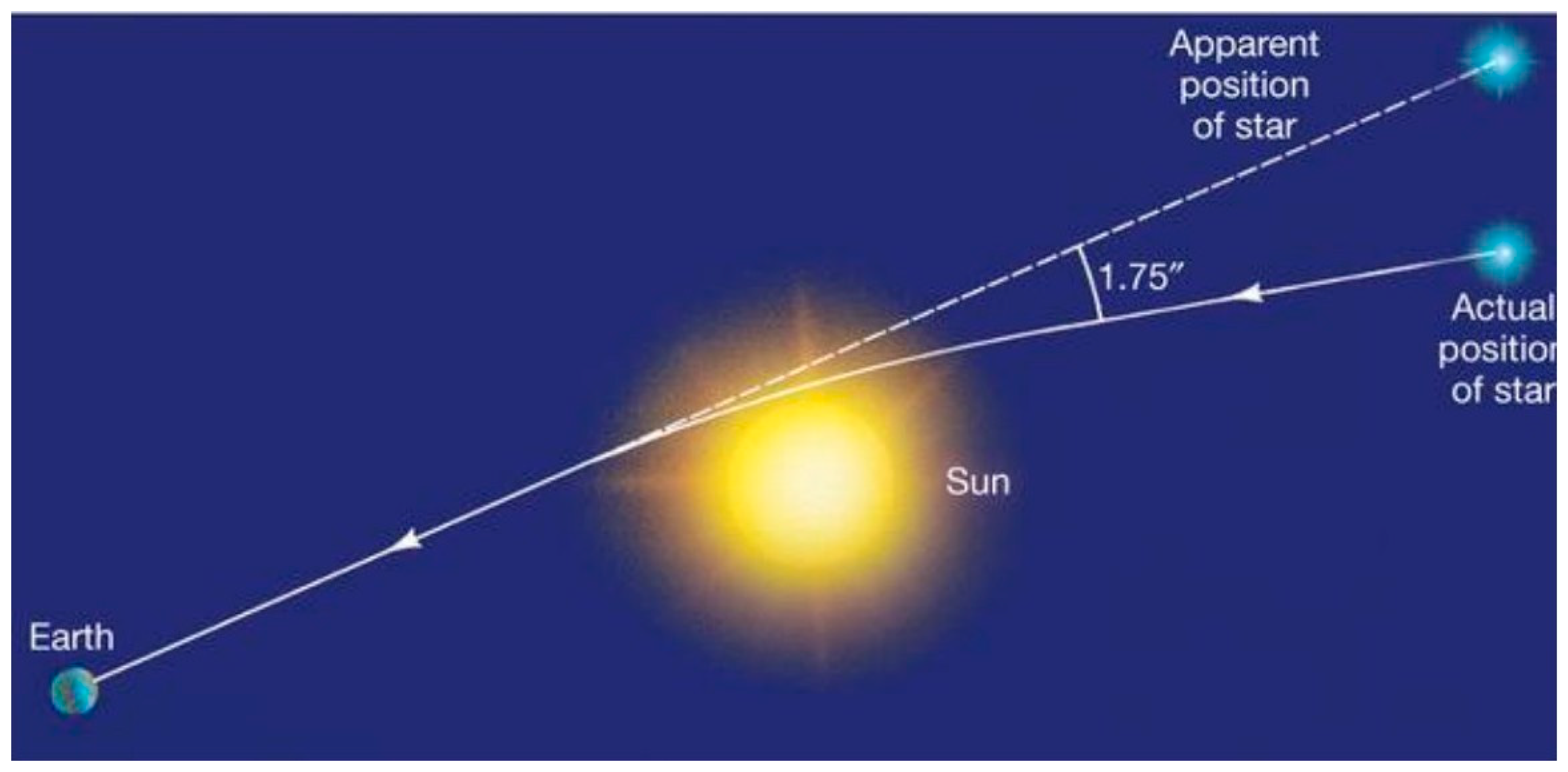
Figure 2.
Sun spectrum.
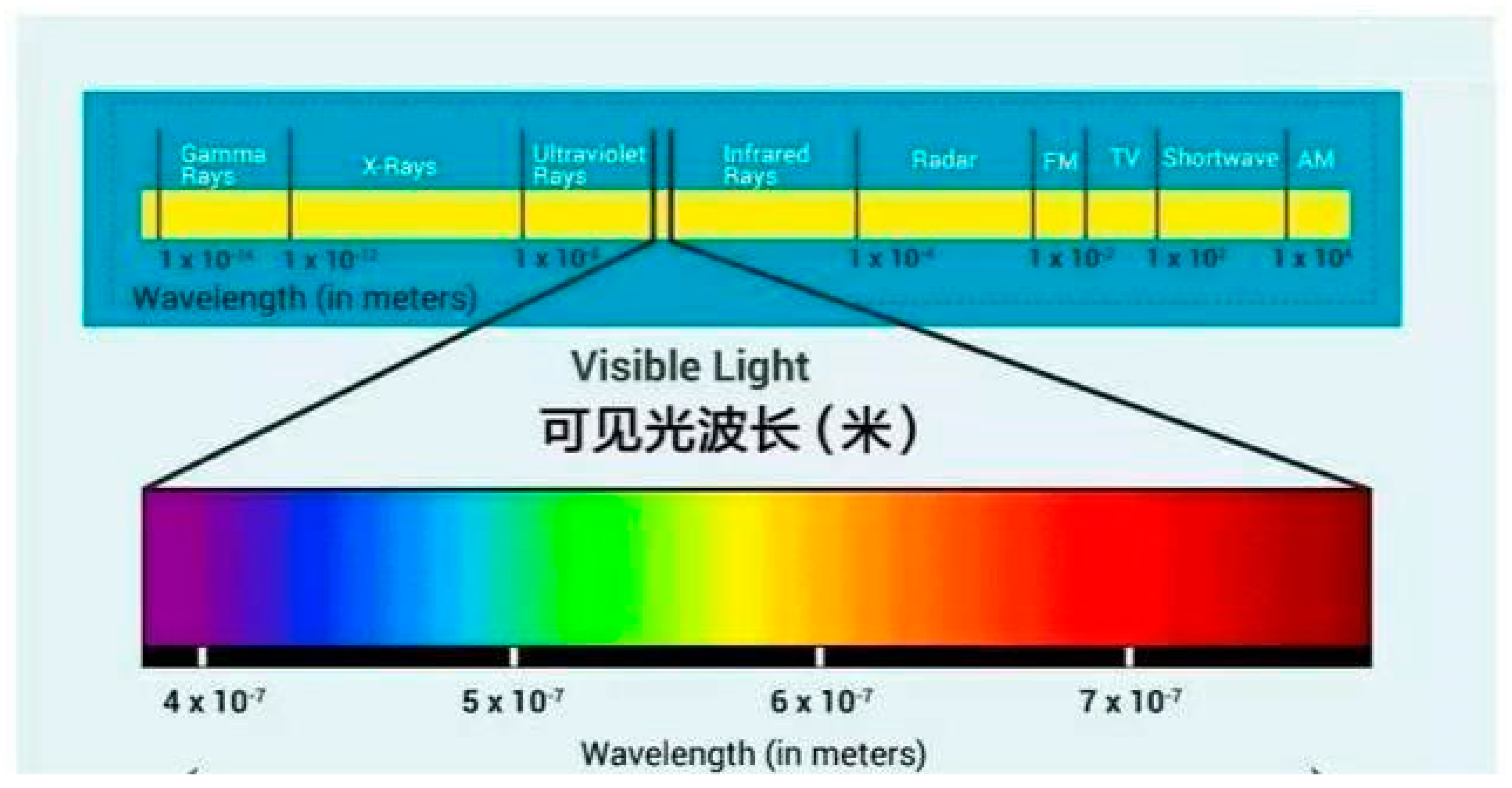
Figure 3.
Solar radiation.
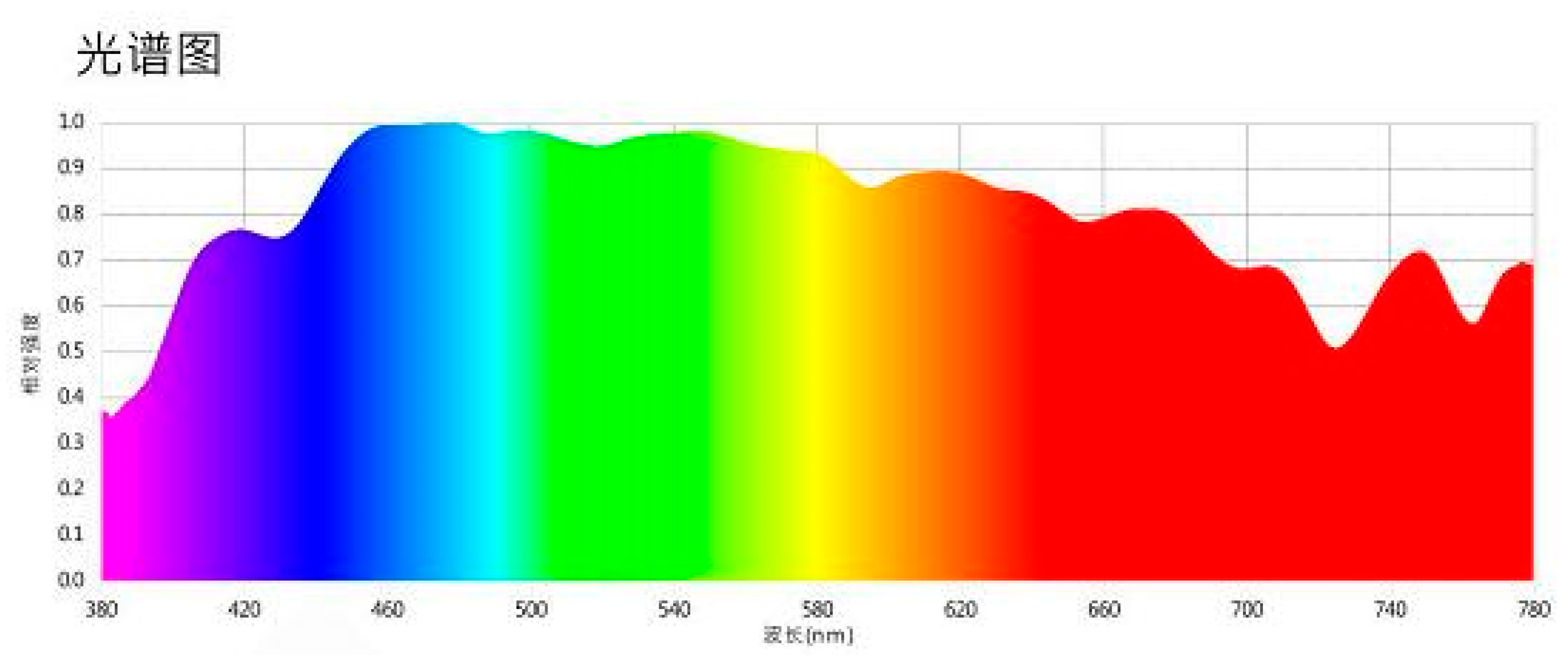
Figure 4.
Sun bending light analysis.
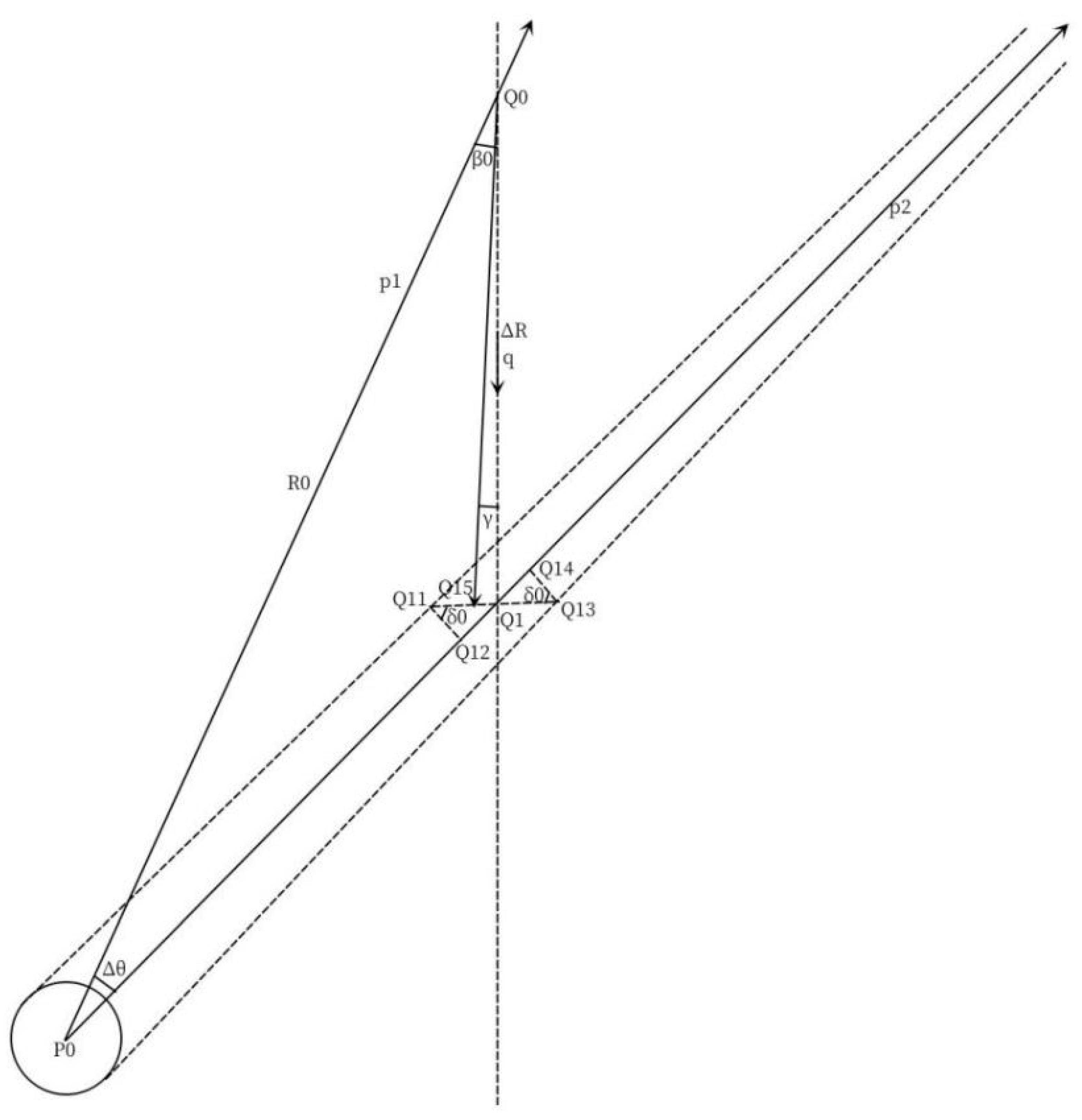
Figure 5.
Schematic diagram of the principle.
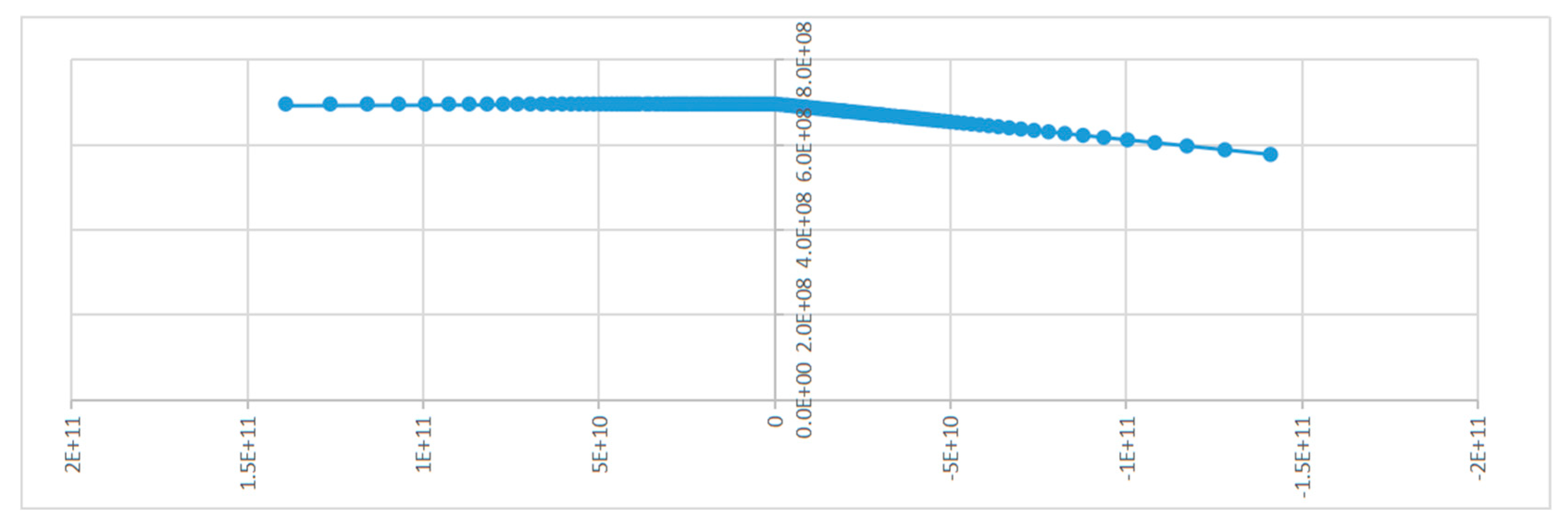
Figure 6.
Light passing by the neutron star.
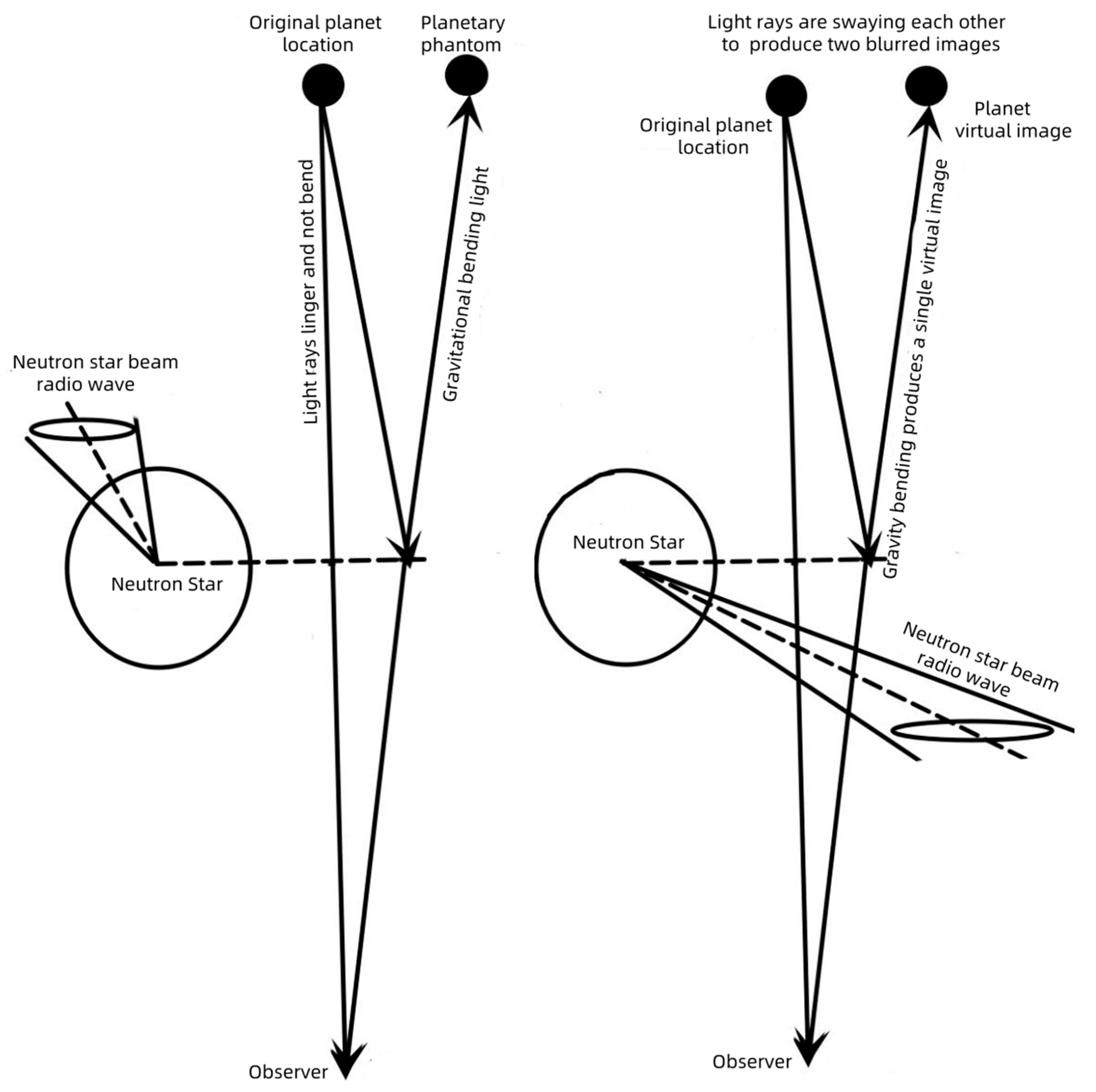

Table 1.
Analog table for the principle data of sun bending rays.
| Δθ (rad) | Β (rad) | R(m) | TAN γ | γ (rad) | θ (rad) | X(m) | Y(m) |
| 0.0005 | 0.005 | 1.39E+11 | 1.07543E-20 | 1.07543E-20 | 1.565796327 | 695500000 | 1.39099E+11 |
| AP0 (m) | 0.0055 | 1.26455183E+11 | 1.82774E-20 | 1.82774E-20 | 1.565296327 | 695500000 | 1.26453E+11 |
| 5E+12 | 0.006 | 1.15917362E+11 | 2.97517E-20 | 2.97517E-20 | 1.564796327 | 695500000 | 1.15915E+11 |
| 0.0065 | 1.07000753E+11 | 4.66868E-20 | 4.66868E-20 | 1.564296327 | 695500000 | 1.06998E+11 | |
| 0.007 | 9.93579543E+10 | 7.09891E-20 | 7.09891E-20 | 1.563796327 | 695500000 | 99355520019 | |
| 0.0075 | 9.27342027E+10 | 1.05026E-19 | 1.05026E-19 | 1.563296327 | 695500000 | 92731594577 | |
| 0.008 | 8.69384273E+10 | 1.51693E-19 | 1.51693E-19 | 1.562796327 | 695500000 | 86935645325 | |
| 0.0085 | 8.18245147E+10 | 2.14491E-19 | 2.14491E-19 | 1.562296327 | 695500000 | 81821558819 | |
| 0.009 | 7.72788210E+10 | 2.976E-19 | 2.976E-19 | 1.561796327 | 695500000 | 77275691267 | |
| 0.0095 | 7.32116275E+10 | 4.05969E-19 | 4.05969E-19 | 1.561296327 | 695500000 | 73208323886 | |
| 0.01 | 6.95511592E+10 | 5.45395E-19 | 5.45395E-19 | 1.560796327 | 695500000 | 69547681651 | |
| 0.0105 | 6.62393124E+10 | 7.22624E-19 | 7.22624E-19 | 1.560296327 | 695500000 | 66235660970 | |
| 0.011 | 6.32285478E+10 | 9.45446E-19 | 9.45446E-19 | 1.559796327 | 695500000 | 63224722540 | |
| 0.0115 | 6.04795939E+10 | 1.2228E-18 | 1.2228E-18 | 1.559296327 | 695500000 | 60475594763 | |
| 0.012 | 5.79597244E+10 | 1.56486E-18 | 1.56486E-18 | 1.558796327 | 695500000 | 57955551307 | |
| 0.0125 | 5.56414490E+10 | 1.9832E-18 | 1.9832E-18 | 1.558296327 | 695500000 | 55637102053 | |
| 0.013 | 5.35015069E+10 | 2.49084E-18 | 2.49084E-18 | 1.557796327 | 695500000 | 53496986133 | |
| 0.0135 | 5.15200834E+10 | 3.10243E-18 | 3.10243E-18 | 1.557296327 | 695500000 | 51515388730 | |
| 0.014 | 4.96801943E+10 | 3.83433E-18 | 3.83433E-18 | 1.556796327 | 695500000 | 49675325719 | |
| 0.0145 | 4.79671981E+10 | 4.70478E-18 | 4.70478E-18 | 1.556296327 | 695500000 | 47962155611 | |
| 0.015 | 4.63684055E+10 | 5.734E-18 | 5.734E-18 | 1.555796327 | 695500000 | 46363189115 | |
| 0.0155 | 4.48727645E+10 | 6.94437E-18 | 6.94437E-18 | 1.555296327 | 695500000 | 44867374268 | |
| 0.016 | 4.34706047E+10 | 8.36054E-18 | 8.36054E-18 | 1.554796327 | 695500000 | 43465040603 | |
| 0.0165 | 4.21534278E+10 | 1.00096E-17 | 1.00096E-17 | 1.554296327 | 695500000 | 42147689832 | |
| 0.017 | 4.09137354E+10 | 1.19212E-17 | 1.19212E-17 | 1.553796327 | 695500000 | 40907823463 | |
| 0.0175 | 3.97448858E+10 | 1.41277E-17 | 1.41277E-17 | 1.553296327 | 695500000 | 39738799977 | |
| 0.018 | 3.86409755E+10 | 1.66646E-17 | 1.66646E-17 | 1.552796327 | 695500000 | 38634715799 | |
| 0.0185 | 3.75967391E+10 | 1.95702E-17 | 1.95702E-17 | 1.552296327 | 695500000 | 37590305580 | |
| 0.019 | 3.66074657E+10 | 2.28862E-17 | 2.28862E-17 | 1.551796327 | 695500000 | 36600858219 | |
| 0.0195 | 3.56689271E+10 | 2.66578E-17 | 2.66578E-17 | 1.551296327 | 695500000 | 35662145802 | |
| 0.02 | 3.47773184E+10 | 3.09335E-17 | 3.09335E-17 | 1.550796327 | 695500000 | 34770363210 | |
| 0.0205 | 3.39292057E+10 | 3.57661E-17 | 3.57661E-17 | 1.550296327 | 695500000 | 33922076552 | |
| 0.021 | 3.31214820E+10 | 4.1212E-17 | 4.1212E-17 | 1.549796327 | 695500000 | 33114178976 | |
| 0.0215 | 3.23513296E+10 | 4.7332E-17 | 4.7332E-17 | 1.549296327 | 695500000 | 32343852639 | |
| 0.022 | 3.16161867E+10 | 5.41912E-17 | 5.41912E-17 | 1.548796327 | 695500000 | 31608535866 | |
| 0.0225 | 3.09137194E+10 | 6.18593E-17 | 6.18593E-17 | 1.548296327 | 695500000 | 30905894685 | |
| 0.023 | 3.02417967E+10 | 7.0411E-17 | 7.0411E-17 | 1.547796327 | 695500000 | 30233798080 | |
| 0.0235 | 2.95984689E+10 | 7.99258E-17 | 7.99258E-17 | 1.547296327 | 695500000 | 29590296397 | |
| 0.024 | 2.89819489E+10 | 9.04887E-17 | 9.04887E-17 | 1.546796327 | 695500000 | 28973602453 | |
| 0.0245 | 2.83905953E+10 | 1.0219E-16 | 1.0219E-16 | 1.546296327 | 695500000 | 28382074958 | |
| 0.025 | 2.78228981E+10 | 1.15126E-16 | 1.15126E-16 | 1.545796327 | 695500000 | 27814203925 | |
| 0.0255 | 2.72774659E+10 | 1.29398E-16 | 1.29398E-16 | 1.545296327 | 695500000 | 27268597798 |
Disclaimer/Publisher’s Note: The statements, opinions and data contained in all publications are solely those of the individual author(s) and contributor(s) and not of MDPI and/or the editor(s). MDPI and/or the editor(s) disclaim responsibility for any injury to people or property resulting from any ideas, methods, instructions or products referred to in the content. |
© 2025 by the authors. Licensee MDPI, Basel, Switzerland. This article is an open access article distributed under the terms and conditions of the Creative Commons Attribution (CC BY) license (http://creativecommons.org/licenses/by/4.0/).
Copyright: This open access article is published under a Creative Commons CC BY 4.0 license, which permit the free download, distribution, and reuse, provided that the author and preprint are cited in any reuse.


