

Submitted:
31 May 2025
Posted:
02 June 2025
You are already at the latest version
Abstract
Evaluating the toxicity of specific pesticides and novel nanoparticle products was the aim of the study. On the Liriomyza congesta infesting broad bean crop the following compound namely; abamectin, Bacillus Thuringiensis, Metaflumizone, Novaluron, K Z oil, and Nerium oleander nanoparticles were made sustainably using aqueous extract and corresponding salt (sliver nitrate) were applied. The results showed that Abamectin ˃ B. Thuringiensis ˃ Metaflumizone ˃ Novaluron ˃ N. oleander AgNps ˃ K Z oil were the pesticides and extracts of silver nanoparticles that reduced the amount of L. congesta in broad bean plants. However, the widespread use of synthetic pesticides by growers has led to a number of problems, such as environmental contamination, the rise of pest resistance, and hazards to human health. According to those results, mineral oil and nanosilver extracts considerably decreased the mortality rate of L. congesta in comparison to traditional control, and they could be a financially viable alternative in next IPM campaigns to fight this pest.
Keywords:
Insecticide
; L. congesta
; Silver nano particles
; mineral oil
Introduction
The main leguminous field crop in Egypt is the broad bean, Vicia faba L., which is vital to Egyptian cuisine and is eaten as dry mature seeds, fresh green pods, and immature fresh seeds. Liriomyza congesta (Beck), a broad bean leafminer, damages the crop's yield and quality (Deen 2024). The faba bean (V. faba L.), which is eaten as a green vegetable and as a dried and preserved seed, is a significant source of protein in Egyptian diets. Numerous insect pests target this extremely nutrient-dense crop, such as the leafminer Liriomyza congesta, which lowers output. (Abdel-Aliem et al. 2025). In terms of L. trifolii's preferred host, it is evident that common bean plants had the highest mean numbers. (Hassan et al 2025).To determine the effectiveness of traditional insecticides against this pest, numerous authors conducted a number of tests. Furthermore, the advancement of our knowledge regarding the population dynamics of this pest depends on quantitative research. Poor research was done on the earlier bug species in southern Egypt's wide bean fields. As a result, the current study might assist provide some knowledge about the pest, which could help implement a successful control program to monitor the damage caused by pests in broad bean fields. Environmentally friendly synthesis outperforms chemical and physical processes in terms of cost, environmental friendliness, ease of scaling up for large-scale synthesis, and the absence of hazardous materials, high pressure, energy, or temperature. (Allam et al., 2022) investigated innovative, economical ways to control P. hypostoma instead of using synthetic pesticides and mineral oils. They also assessed green nanoparticles created using aqueous extract biosynthesised Ag+ nanoparticles and corresponding salt (sliver nitrate). (Sebak et al., 2025) found that exposing Culex pipiens larvae to the LC50 of essential oils of sandalwood, camphor, and black pepper significantly decreased the protein content.
Plant extracts are safe for the environment and have strong bioactivity against a variety of pests. The creation of plant extracts with strong toxic or repellent properties and their bioactivities against pests may aid in the creation of new pesticides that are safe for the environment (Guo et al., 2025).
Materials and Methods
Abamectin, B. Thuringiensis, Metaflumizone, Novaluron, N. oleander AgNps, and K Z oil were evaluated for their toxicity in broad bean plants throughout the 2023–2024 and 2024–2025 seasons.

Table 1.
Compounds used in the study.
| Compounds | Active ingredients | Rate | |
|---|---|---|---|
| Abamectin | Abamet 1.8% EC | 80cm3/fd | |
| Bacillus Thuringiensis | Agree 50% WG | 500 gm/fd | |
| Metaflumizone | Alferde 24 % SC | 200 cm3/fd | |
| Novaluron | Aque 10% EC | 80cm3/fd | |
| Nerium oleander AgNps | oleandrin and oleandrigenin | 200 cm3/fd | |
| K Z oil | Mineral oil | 200 cm3/fd |
Tests of Nanoparticles
UV–Test
Using a "Shimadzu UV-2401 PC, Japan" analytical spectrophotometer, the optical density (OD) of silver nanoparticles (AgNPs) containing Nerium oleander for UV–visible spectrum characterisation was determined at a resolution of 1 nm and a scanning speed of 300 nm/min within 200 and 800 nm. The baseline was modified as a blank in a volume containing 2 mM silver nitrate using the UV–vis spectra of 1 ml of the sample and 2 ml ionized as water in a quartz cell (Wiley et al., 2006).
TEM-Test
Samples of the precipitate that gathered at the bottom of the conical flasks and the suspension above were collected for transmission electron microscopy (TEM) investigation following the reaction. The size and shape of extract nanoparticles were examined at 70 kV using a transmission electron microscope (TEM) called the "LEOL-2010, Japan" that was outfitted with a digital "Kodak Megaplus 1.6i camera" and image processing and analysis software (AMT, USA). The sample was pared by placing a drop of each solution on a copper grid covered in carbon and letting it dry at room temperature, as previously mentioned by Sathish Kumar et al. (2009). The resulting nanoparticles' size distribution was determined using TEM micrographs.
FTIR-Test
The FTIR spectra of AgNPs at room temperature were recorded in the 4000–400 cm-1 region using a Perkin-Elmer spectrophotometer. We recorded the diffuse spectrum of reflectance in the 200–800 nm wavelength range using the UV140404B spectrophotometer. Numerical data was plotted using the 'Origin 7' software (Slman et al., 2018).
XRD-Test
To get the AgNPs ready for the X-ray powder diffraction tests, the fluid containing the generated silver nanoparticles was spun for 30 minutes at 10,000 rpm. Following two rounds of washing with double-distilled water, the solid residues were dried at 80 degrees Celsius. Metal radiation (Cu Ka, 1.5406) at 40 kV and 30 mA was used to record the XRD powder patterns on a Shimadzu XRD-6000 (Slman et al., 2018).
Results and Discussion
Tests of AgNPs
This work provided a complete idea on the produce of nanoparticles of silver by fresh Nerium oleander. The water-soluble silver ions were converted to silver nanoparticles when added to the assessed plant extracts. In accordance with Hussein (2023), who stated that the brown color shift of the 1 mm silver nitrate solution will be the initial indication that nanoparticles are forming, the color of the solutions for N. oleander changed from yellow to brown 24 hours prior to the reaction. A UV–vis spectrophotometer was used to track the development and stability of the reduced silver nanoparticles in the colloidal suspension. The longer the plant extract and silver nitrate were incubated, the higher the absorbance at 420 nm in the UV-vis spectra. (Figure 1).
FTIR analysis of silver nanoparticles confirmed the plant extract's dual functions as a capping and reducing agent as well as the presence of particular functional groups. Using TEM, it is now feasible to ascertain the size and shape of nanoparticles. According to the results, silver nanoparticles are mostly spherical and uniformly dispersed, but some of them have asymmetrical shapes, as seen in (Figure 1).
The relative toxicity of the poisonous action of Abamectin, B. Thuringiensis, Metaflumizone, Novaluron, N. oleander AgNps, and K Z oil against L. congesta was shown by the data in Table 2 and Figure 2.
The data clearly demonstrated that at both the LC50 and LC90 levels, the tested pesticides' order of efficiency was the same. Abamectin, B. Thuringiensis, Metaflumizone, Novaluron, N. oleander AgNps, and K Z oil are the tested pesticides that might be arranged in the following descending order. The associated LC90 values were 1.87, 7.13, 39.49, 14.76, 348.09, and 1777.58 ppm, respectively, whereas the related LC50 values were 0.17, 0.97, 2.05, 2.98, 11.59, and 44.80 ppm.
The results showed that the comparable compounds were 100, 17.39, 8.23, 5.67, 1.46, and 0.38 times as efficacious as abamectin at the LC50 level. They did not overlap with those of Abamectin, B. Thuringiensis, N. oleander AgNps, or K Z oil, but they did overlap with Metaflumizone and Novaluron, as could be shown by comparing the confidence limits and how they overlapped with those of other substances. Consequently, we may say that although Metaflumizone and Novaluron are very different from other substances, they are different. (Figure 2). Furthermore, Table 2 and Figure 2 make it evident that K Z oil had the steepest toxicity line and Abamectin the flattest; however, B. Thuringiensis, Metaflumizone, Novaluron, and N. oleander AgNps were situated in the middle.
This demonstrates the superiority of Abamectin over K.Z. oil. Abamectin was clearly the most harmful substance, while K.Z. oil was clearly the least hazardous. Table 2 show LC50 value of Bacillus Thuringiensis was 0.97 ppm which shows very high toxicity to the leaf miner pest in the faba bean plants compared to other compounds used. These results were in line with a study conducted by (Abdel-Aliem et al 2025) examined the entomopathogenic fungicides BioMeta (Metarhizium anisopliae) and Biossiana (Beauveria bassiana) generated larval population reductions of 50.68 and 42.91%, respectively, while the standard insecticide abamectin reduced the larval population of L. congesta by 89.85%. Chen et al. (2015) that looked at how eleven different pesticides affected the subterranean termite, Reticulitermes speratus. The pesticide categories are arranged in decreasing order of termite toxicity: Organophosphate > Avermectin > Phenylpyrazole > Neonicotinoid > Pyrethroid > Carbamate. Researchers have also looked into farmer-friendly termite control techniques that are widely appealing, such as biological, physical, and cultural management (Abhishek et al., 2021). When used as part of an integrated pest management approach, entomopathogenic agents can produce better results. Furthermore, at different concentrations, the essential oils of clove leaves, neem, orange, and KZ were found to have insecticidal effects against the adult pests under study (Richa et al., 2021; Allam et al., 2022). It was found that the higher the concentration level, the higher the death rate.
Conclusion
For the safe and efficient management of L. congesta in the broad bean crop, it may be recommended to apply K Z mineral oil, N. oleander AgNps, and Bacillus Thuringiensis bacterium. The findings allow for the recommendation that, in addition to mineral oil, green synthesised silver nanoparticles be used into IPM programs.
Funding
This research has no funding.
Authors’ Contributions
Every author has contributed to this study.
Institutional Review Board Statement
All Institutional Review Board Statement are confirmed and approved.
Data Availability Statement
Data presented in this study are available on fair request from the respective author.
Ethics Approval and Consent to Participate
This work was completed in accordance with all departmental guidelines at the Plant Protection Department.
Consent for Publication
Not applicable.
Conflicts of Interest
The authors declare no conflict of interest.
References
- Abdel-Aliem H.I., Abo Elela M.R. and Abou-Elkassem A.B. (2025) Role of Parasitoids, Entomopathogens and Chemical Compounds in Managing Liriomyza congesta Populations in Faba bean Fields. Arab Journal of Plant Protection, Volume 43, Issue 2. [CrossRef]
- Abhishek, R., Chandel, R.S., Verma, K.S., Manishkumar, J.J. (2021). 'Termites in Important Crops and their management.', Indian Journal of Entomology 83 Online published Ref. No. e20115. [CrossRef]
- Allam, R.O.H. 1; Badawy, A.M.M. and M.A. Ali. (2022). Green synthesized silver nanoparticles for controlling subterranean termites, Psammotermes hypostoma (Desneux). SVU-International Journal of Agricultural Sciences, 4 (1): 135-143. [CrossRef]
- Chen, Z., Qu, Y., Xiao, D., Song, L., Zhang, S., Gao, X., Song, D. (2015). 'Lethal and social-mediated effects of ten insecticides on the subterranean termite Reticulitermes speratus.', Journal of pest science, 88(4): pp. 741-751. [CrossRef]
- Deen M. B., Sajad A. K., Inayat U. L. (2024) First record of leaf miner, Phyllocnistis unipunctella (Stephens, 1834) (Lepidoptera, Gracillariidae) infesting Populus deltoides Marsh (Salicaceae) in Jammu and Kashmir, India. Entomon Archives / Vol. 49 No. 3. [CrossRef]
- Guo, Y. B., Liu, Z. J., Ye, Y. Y., Chen, Y. Y., and Wu, Z. W. 2025. Antifeedant and contact toxicity activity of crude extracts from 10 plants to red imported fire ant, Solenopsis invicta Buren (Hymenoptera: Formicidae). Journal of Asia-Pacific Entomology, 28(1), 102350. [CrossRef]
- Hassan A.T.1, El-Solimany E.A., Allam R.O.H. (2025). Population density of liriomyza trifolii (burgess) on four summer plant hosts in relation to some weather factors at Sohag governorate. J. Agric. & Env. Sci. 24(1): 163 – 181. [CrossRef]
- Henderson, C. F. and Tilton, E. W. (1955). Tests with acaricides against the brown wheat mite'. Journal of Economic Entomology, 48: 157-161. [CrossRef]
- Hussein A. R. A. (2023). Detection of the effect of silver nanoparticles prepared by using extract leaves Prosperis juliflora on pathogenic fungus Trichophyton tonsurans isolated from human scalp. GSC Biological and Pharmaceutical Sciences, 25(01): 245–251. [CrossRef]
- Richa, S., Kamin, A., Lal, E.P. (2021). 'Insecticidal Activities of Some Essential Oils on Subterranean Termites.', International Journal of Innovative Science and Research Technology, ISSN No:-2456-2165. [CrossRef]
- Sathishkumar, M., Sneha, K., Won, S., Cho, C. W., Kim, S. and Yun, Y. S. (2009). Cinnamon zeylanicum bark extract and powder mediated green synthesis of nano-crystalline silver particles and its bactericidal activity. Colloids and Surfaces B: Biointerfaces, 73: 332-338. [CrossRef]
- Sebak, S. I., Shaurub, E. S. H., Mahmoud, S. H., and Salem, S. A. 2025. Insights into biochemical, genotoxic, and molecular impacts, and molecular docking analysis-based possible mechanism of action of some essential oils against Culex pipiens larvae. Pesticide Biochemistry and Physiology, 209, 106352. [CrossRef]
- Slman, D. K., Jalill, R. D. A. and Abd, A. N. (2018). Biosynthesis of zinc oxide nanoparticles by hot aqueous extract of Allium sativum plants. Journal of Pharmaceutical Sciences and Research, 10: 1590-1596.
- Wiley, B. J., Im, S. H., Li, Z. Y, McLellan, J., Siekkinen, A. and Xia, Y. (2006). Maneuvering the surface plasmon resonance of silver nanostructures through shape-controlled synthesis. ACS Publications. [CrossRef]
Figure 1.
Tests on the production of silver nanoparticles by of Nerium oleander aqueous extract.
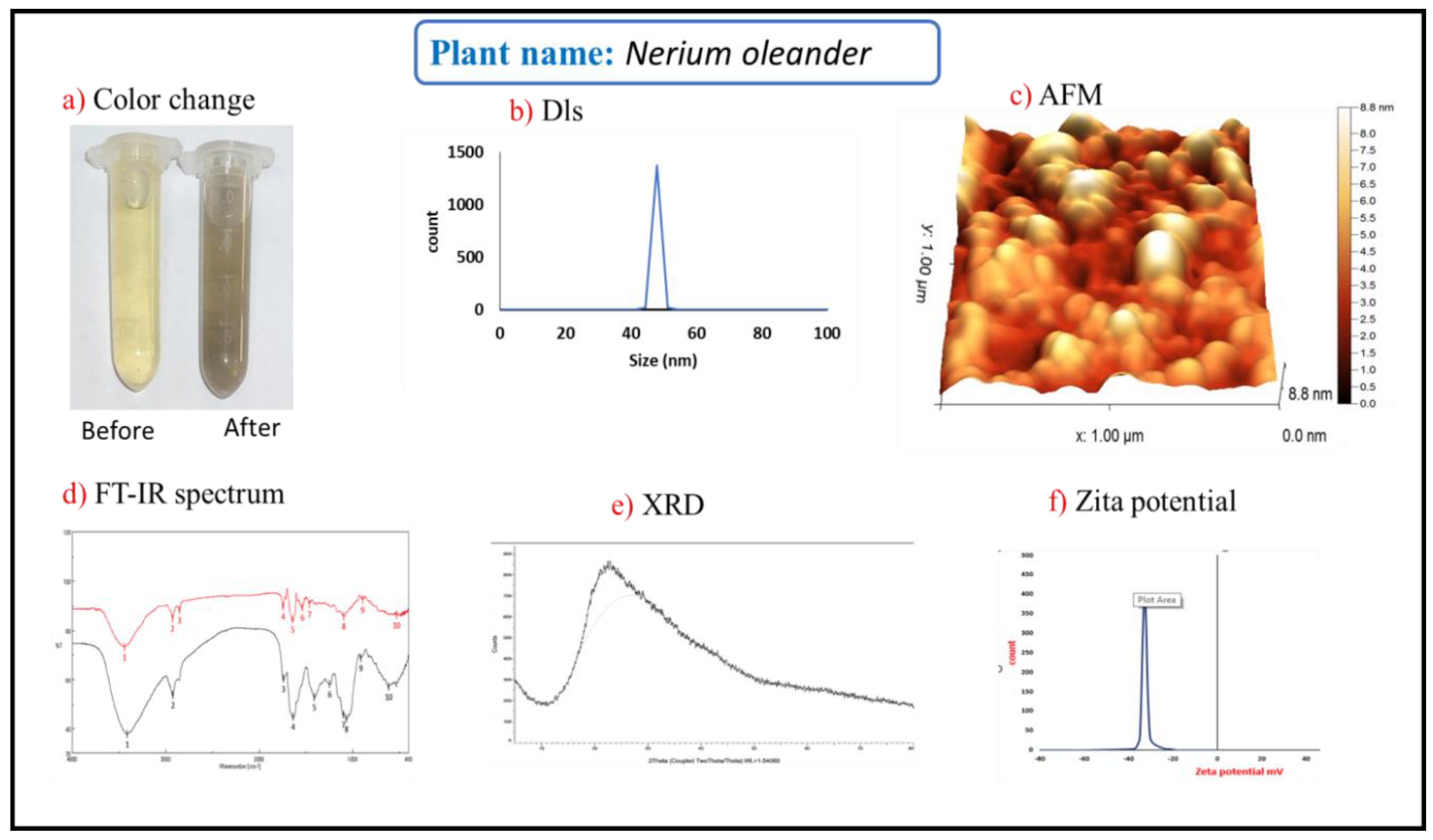
Figure 2.
Toxicity lines of pesticides and their alternatives against L. congesta.
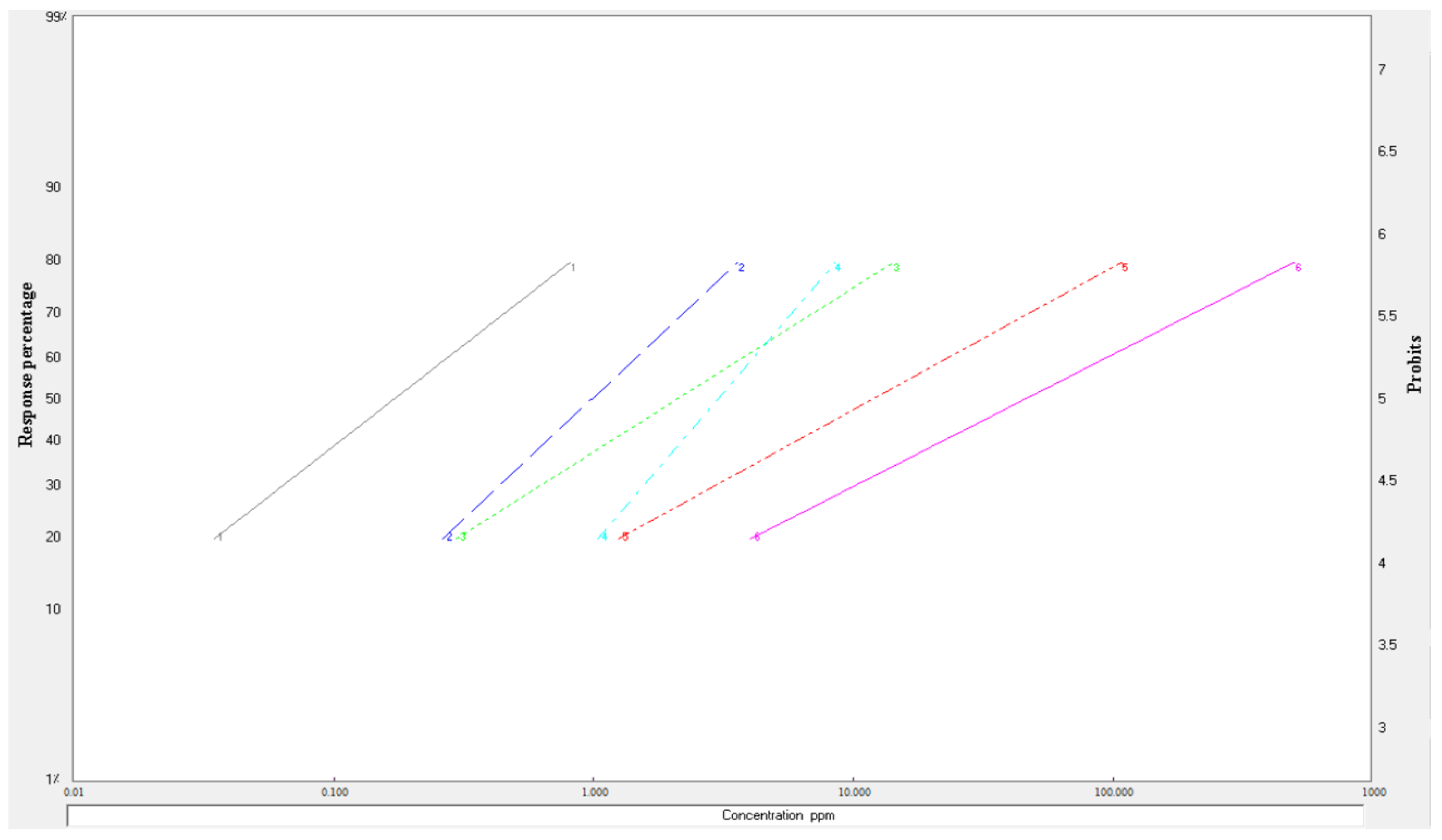
Table 2.
Toxicity of certain insecticides against L. congesta.
| Line name | LC50 | Confidence limits of LC 50, S *ppm | Index | Slope ± | LC90 | |
|---|---|---|---|---|---|---|
| Lower | Upper | |||||
| Abamectin | 0.17 | 0.11 | 0.39 | 100 | 1.23 ±0.22 | 1.87 |
| Bacillus Thuringiensis | 0.97 | 0.56 | 1.99 | 17.39 | 1.48 ±0.30 | 7.13 |
| Metaflumizone | 2.05 | 1.21 | 3.67 | 8.23 | 0.99 ±0.25 | 39.49 |
| Novaluron | 2.98 | 2.25 | 4.22 | 5.67 | 1.85 ±0.29 | 14.76 |
| Nerium oleander AgNps | 11.59 | 5.77 | 21.81 | 1.46 | 0.87 ±0.25 | 348.09 |
| K Z oil | 44.80 | 23.08 | 105.46 | 0.38 | 0.80 ±0.24 | 1777.58 |
T.I. - Index compared with Abamectin T.I. - compared with KZ. Oil * = ppm based on a:i.
Disclaimer/Publisher’s Note: The statements, opinions and data contained in all publications are solely those of the individual author(s) and contributor(s) and not of MDPI and/or the editor(s). MDPI and/or the editor(s) disclaim responsibility for any injury to people or property resulting from any ideas, methods, instructions or products referred to in the content. |
© 2025 by the authors. Licensee MDPI, Basel, Switzerland. This article is an open access article distributed under the terms and conditions of the Creative Commons Attribution (CC BY) license (http://creativecommons.org/licenses/by/4.0/).
Copyright: This open access article is published under a Creative Commons CC BY 4.0 license, which permit the free download, distribution, and reuse, provided that the author and preprint are cited in any reuse.


