

Submitted:
29 May 2025
Posted:
30 May 2025
You are already at the latest version
Abstract
High-impact technology research and its applications, including robotics, automated machines, and intelligent manufacturing, raise urgent concerns regarding ethics, social implications, law, and politics. Combining advanced satellite communications, artificial intelligence, and machine learning drastically enhanced navigation systems, but not without the high cost of impacting socio-ethical dilemmas.
Drones are rapidly becoming one of the most significant technologies, and there is a great need for further development. Although technical advancements in drones have been applied in various sectors, more research is being conducted on the social effects of drones, the moral conundrums they raise, and their revolutionary potential. Building on these perspectives, the current research presents the findings of a qualitative study that examined perceptions of the escalating socio-ethical issues surrounding the development of drone applications. According to the obtained results, perceptions of drone applications appear consistent across various levels of expertise. Military objectives (0.73), civil protection (0.61), and passenger transit and medical purposes (0.56) have the most notable associations. Highly Approved Applications indicate that science (8.70), agriculture (8.78), and disaster management (8.87) are all widely accepted applications, most likely due to their obvious social benefits and reduced likelihood of ethical challenges. Regardless of their experience, participants generally hold similar views on the public approval of various drone applications.
Since people's attitudes, understanding, and usage will undoubtedly impact future advancements in this technology, the study's findings can inform future research on promoting value-sensitive development in society more broadly, help shape the discussion on drone acceptability in specific contexts, and guide researchers and decision-makers on the use of drones.
Keywords:
drone technology
; high-impact technology
; AI ethics
; socio-ethical impacts of drones
; drone ethical dilemmas
; the future of drones
; drone applications
1. Introduction
Understanding how drone technology, commonly referred to as Unmanned Aerial Vehicles (UAVs), operates is crucial, as it has gained popularity and has had both positive and negative effects on society. The drone industry, which utilizes AI designs derived from machine learning techniques, is among the sectors with the fastest growth rate, and its applications are becoming more widespread than the general public is aware of. Drones are among the most impactful technologies that have revolutionized contemporary enterprises by streamlining productivity and leveraging advancements in AI, cloud computing, machine learning, and big data analytics. They utilize multiple sensors to comprehend their environment, detect obstacles, identify objects, and evaluate complex situations [1].
They are equipped with modern technologies, can fly autonomously, make intelligent decisions, and function effectively and affordably. Since they are flying robots that can be commanded remotely or fly independently using software-controlled flight plans, they might be considered high-tech technology, incorporating robotics into assembly lines to expedite manufacturing procedures [2].
Drones’ ethical dilemmas have recently garnered increased research focus. While human comprehension of AI decisions is not always possible, the lack of transparency and privacy issues in AI technologies are occasionally identified as significant concerns. Drone deployment greatly depends on advancements in AI technology, as drones can function without continual human supervision. The demand for ethical AI systems from both the commercial and public sectors is growing, while the number of unethical AI applications is also rising. To address the moral dilemmas that AI developers face and the urgent need for morally acceptable standards to be widely implemented, such as in cases of discrimination against minorities, AI development and drone applications must become more professionalized [3].
The social, moral, psychological, and legal issues surrounding drones, including their impact on day-to-day living, privacy, ownership, safety, security, accountability, and legal responsibility, as well as the legitimization of their use through licenses and regulations, have become a recent focus of debate. Civil society advocates for increased responsibility in using high-impact technology to address the potential ethical and legal issues that may arise from the growing integration of drone technology into people’s daily lives. Over the past few years, the use of drones in urban areas has increased exponentially, reflecting political debates about the potential hazards and challenges associated with the expanding use of this significant technology in both the private and public sectors [4].
Drone literature presents several technical studies highlighting ways to enhance drone specs, such as cameras, flight range, and collision avoidance. Public safety concerns, privacy issues, and evaluating the advantages and disadvantages of drones may shape the public’s perception of them. It becomes essential to be aware of the socio-ethical, legislative, environmental, and sociological dilemmas related to the knowledge, attitudes, practices, and acceptability of drone technology among the general public and stakeholders. The possible social repercussions of drones have received little attention. The practical capabilities of drones are occasionally limited due to legal constraints in various parts of the world. Drones provide a versatile, accurate, and cost-effective solution to technological challenges in environmental surveillance and control [5].
A socio-ethical dilemma related to AI technology development may arise when a behavior, if adopted by everyone, would benefit society. However, doing so would have unfavorable repercussions for each individual, making them reluctant to embrace it. Scholars have hypothesized that current frameworks frequently compel developers who are socially unable to reject unethical development to take responsibility for doing so. Suppose the primary ethical conundrum facing robotics can be summed up by asking whether robots are a long-term or short-term threat to humanity. In that case, the question of drone application may necessitate considering whether drones are a tool that is both beneficial and detrimental. The public’s perception of drones will undoubtedly influence their acceptance, industrial value, and future progress [6].
Concerns about drones being used as terrorist tools or weapons of mass destruction have grown worldwide as a result of the growing employment of kamikaze drones in recent wars. The danger scenario has increased because of these one-way attack drones, which are capable of carrying out deadly and accurate assaults. In addition to causing physical devastation, drone warfare presents significant psychological risks to both military personnel and civilians, such as trauma, ongoing worry, and progressive desensitization to violence [7].
Serious psychological consequences for both soldiers and civilians might result from drone warfare, including desensitization. The moral ramifications of using drones in warfare have recently drawn considerable scholarly attention, and privacy concerns and the ethical implications of surveillance have long piqued the curiosity of many academics. Drone research developments were overshadowed by moral dilemmas around the surveillance of citizens without consent and the potential for misuse. Governments and commercial businesses employ drones for surveillance, raising serious concerns about privacy violations and expanding government authority [8].
Nonetheless, due to significant advances in computerization and miniaturization, there is ample evidence that the use of drones in society has increased dramatically in recent years. Despite the growing ethical challenges and the crucial need to address the defects that compromise drones’ principled concerns, such as security and accountability, the potential benefits of this new technology for humanity are vast. Drones have become safer, more affordable, lighter, and more accessible in areas such as geographical and social sciences, despite the need for further investigation into whether drones qualify as a tool in the social scientist’s toolbox, as well as the moral implications of their use in spatial and social science. Recent scientific attention has been focused on drones due to their growing importance and expanding range of humanitarian applications. Although drone applications raise challenging legal, sociological, ethical, economic, and psychological issues, governments, navies, armies, commercial organizations, recreational users, and other businesses employ drones in various technological and developmental applications [9].
Despite concerns about job displacement in traditional industries, drones can create new jobs and foster the development of emerging industries, including logistics, media, and agriculture. Drones can generate employment and support, transforming new businesses in logistics, media, agriculture, health, transportation, and entrepreneurship despite concerns about job loss in traditional sectors. They have transformed various sectors [10,11,12,13,14,15].
They provide increased efficiency, excellent safety, and cost and time savings. They enhance efficiency and production across various sectors, transforming the industry in fields such as farming, construction, photography, and filmmaking. Photography drones can generate a profit as they are fitted with high-quality cameras to capture breathtaking aerial film and images. Drones for oil and gas operations transform the energy industry by enhancing sustainability, security, and efficiency across various tasks [16,17].
The article’s arrangement strikes a balance between theoretical background and statistical analysis, as the depth of theoretical analysis plays a crucial role in quantitative research. Definitions of the terminology employed have not been overlooked, although the study’s problem, significance, and rationale are given particular attention. Certain social and cultural elements, perceived threats, and expected ethical quandaries are highlighted. The positive aspects of drones’ social influence and instances of their beneficial uses have been discussed. The benefits and drawbacks have been addressed, along with specific examples related to their applications. The public’s acceptance of drones, potential remedies, and focus areas for promoting drone adoption have all been examined. To ensure precise statistical analyses yield robust results, particular attention was given to refining the study’s methodology. The study’s limitations and areas that require further investigation have been highlighted. Concluding remarks summarizing the research’s most significant contribution and the significance of its findings help accurately reflect the study’s breadth.
2. Definitions
A drone: An aircraft that can be remotely operated by a person or a code that has been preprogrammed.
Unmanned Aerial Vehicles: Aircraft flying autonomously and without human intervention.
Artificial intelligence: The processes that robots use to simulate human intelligence.
The ethics of technology: Examining the moral ramifications and factors associated with the creation and application of contemporary technology, emphasizing issues such as accountability, risk, and autonomy.
Drone ethics: A set of principles, guidelines, and methods that utilize generally accepted morality to guide ethical behavior in the development, application, and marketing of drone techniques.
Privacy issues: Using drones might infringe on people’s privacy.
Drones’ legal risks: Lawful hazards related to trespassing, air safety, and privacy breaches.
Applications for Drones: The circumstances when drones are employed and the numerous business applications of drone technology related to sectors employing drone technology to complete hundreds of jobs.
Social Impact: The various ways in which drone use affects society.
Social Acceptance: Whether an organization or initiative has the support or approval of its community and other relevant stakeholders.
3. Problem of the Study
Drones represent a growing social phenomenon, and their technology is gaining popularity. They are becoming more advantageous for use, more affordable, and accessible than ever before. As a result, their ethical and social public applications necessitate the continuous deployment of highly advanced, cutting-edge investigative techniques.
Little is known about the public’s acceptance of drones and the boundaries of the ethical quandaries surrounding them, despite their versatile applications, increasing attractiveness, and the fact that their marketability has dramatically grown due to their popularity. The current study aims to contribute to the understanding of their socio-ethical dilemmas. There is a growing need to shed more light on moral issues such as privacy violations by drones with cameras, remote theft by drones, and the trafficking of drugs using drones.
4. Justification of the Study
The implications of adopting and integrating new technology into society on moral, social, and regulatory levels have emerged as a significant contemporary theme. Nonetheless, both short—term and long-term projections indicate that drones are already being employed extensively for public safety, commercial, recreational, and scientific purposes. They will soon revolutionize several industries, although it is unclear whether the public can handle the anticipated drone congestion. The study aims to contribute to bridging this gap.
5. Importance of the Study
Drones are altering society. They influence how we think and feel about our physical environment because they can gather data and traditionally convey weights. Due to their ability to fly autonomously and perform various tasks, drones have undoubtedly revolutionized industries such as aerial photography, delivery services, and surveillance. However, their powers pose significant security concerns. Although public opinion is the fundamental instrument for democratically governing society and adopting its rules and regulations, drones have become increasingly common in civilian settings, providing benefits to society while raising worries about their risks.
6. Theoretical Background: Some Trends of Drone Ethical Dilemmas
Understanding the factors that influence the results of scientific research using drones is crucial for both enthusiasts and experts. Although research on drones reveals numerous revolutionary societal benefits, including economic and humanitarian applications, agricultural advantages, and aid in medical supply distribution, drone literature highlights certain social and cultural aspects, such as perceived risks and anticipated ethical dilemmas, and threats such as smuggling, airspace threats, vehicles for weapons, drone-based hacking, and collisions [18].
According to Sabino et al. (2022), concerns about the potential harmful consequences of drones and their potential for transformational and positive benefits have influenced the public’s opinion. The research found that socio-cultural factors, including demographic traits, geographic location, technological aptitude, and understanding of drone terminology, influence public opinion on the acceptability of drones. The most notable perceived risks were misuse of drones, privacy infringement, safety concerns, and legal liability. The research emphasized the relevance of the key expected benefits, including application flexibility and safety [19].
Some authors analyzed the overall attitude toward drones, including concerns, permissions for various use cases, the minimum tolerable flying altitude, permitted flight zones, and the influence of personal and demographic characteristics on drone acceptance. Their investigation result is that the widespread academic use of drones can only raise more severe concerns about their ethical limitations [20].
Stolz et al. (2024) conducted a survey demonstrating broad public acceptability. They emphasize that approval is highly dependent on the specific use case. Drones for civic and public purposes are more universally accepted than those for private and commercial use [21]. While other research found that, as an emerging technology, drone governance requires the development of high-trust values [22], the challenges posed by drone use regulations are related to the diverse range of drone applications [23].
Although the potential for civilian use of drones is rising, concerns are growing since drones may collect, disseminate, and store photos of events and people while complying with a set of still-evolving standards. The existing regulatory gaps and difficulties in enforcing established standards pose the most significant challenges. The legislative implementation of drone regulation will significantly impact current and future usage, impacting civilian utilization.
The findings underlined the widespread concern about potential privacy infringement and the importance of considering civilians’ opinions when developing future drone laws to protect outdoor recreation. Civilians’ perspectives comprise a significant portion of drone buyers and users. Still, drone developers play a crucial role in the utilization of drones as they envision how their drones will be employed [24].
Despite the legislation’s initial ambiguity, contemporary drone regulation necessitates the development of new standards that promote safety and security. These include constraints on where, how, and by whom drones can be utilized. [25]. Drone use is growing worldwide, and it has emerged as a key weapon in the global war against terrorism. Some researchers have investigated the viability of modern warfare technologies, including offensive drones. The conclusion is that, compared to traditional military ethics, new technologies fundamentally alter the military’s value system, rendering large portions of classical armed forces ethics obsolete [26]. Examining drones’ diverse applications, Matthew Ayamga et al. (1221) found that despite their varied and rich benefits, drones have the potential to be hijacked by extremists, as well as hurt and destroy people and property if used haphazardly [27].
In summary, a wide range of industries currently use drones. Thus, this general literature analysis addresses only some of their applications and societal problems. Today’s industries include urban planning, digital cities, law enforcement, mineral resource development, forest fire prevention and monitoring, flood and drought resistance, environmental monitoring, border security, marketing, logistics, construction, and photography. Due to their relatively low cost and high maneuverability, they are likely to be adopted in new sectors soon, based on the need for their use.
7. What Are Drones’ Impacts on Society?
Drones can potentially alter civilization in the future, as they now aid in rescue operations, transport essential pharmaceuticals to remote regions, and facilitate navigation in challenging conditions, among other applications. Drones are changing the way things are done in some industries. Drones can be utilized for community engagement and development by collecting data from the community, as they are an effective data collection device that provides a wealth of information for various decision-making purposes [28].
Although the aircraft’s flight must be handled by public opinion about drone use in civilian areas, the impact of drones on society is growing as their technology advances from a weapon of war to a tool for enhancing people’s quality of life. The drone’s capacity to collect data and deliver objects influenced our views and feelings about our physical surroundings. Although technological and regulatory problems dominate drone debates, public acceptability will become increasingly important in the future development of drone technology. Understanding public opinion on drones is crucial for influencing government decisions, particularly those involving emerging technologies. Their social ideals in health and first aid, data gathering and analysis, monitoring, and security attracted scholarly attention [29].
Although drones help replace humans and provide services to people, especially in hazardous environments or when traveling long distances, it is unclear how capabilities that prevent abuses of public values, such as security, privacy, and transparency, may facilitate drone operation. Due to their appealing qualities, drones can potentially violate private rights or compromise public safety and security.
Although the rise of drones is associated with critical ethical considerations, their rapid development raises questions about traditional notions of safety, security, privacy, ownership, accountability, liability, and regulation. Many other related social issues often involve significant ethical concerns. The potential social repercussions of drones have received little attention. The practical capabilities of drones may occasionally be limited due to legal constraints in various parts of the world. However, drones offer a versatile, accurate, and inexpensive solution to technology challenges in environmental surveillance and control [30].
8. Commercial and Humanitarian Drones as Bright Examples of Drone Applications
8.1. Commercial Drones and Their Societal Impact
Commercial drones are the fastest-growing sector, although smaller than the hobby industry. Many firms are experimenting with them. The most well-known uses include transporting and delivering cargo, which Amazon and Domino’s Pizza have investigated. Restrictions have delayed this application because drones are considered by many to be a threat and a loud nuisance; nevertheless, these laws may be relaxed over the next several years. Integrating commercial drones into existing public, administrative, and private infrastructures has enormous societal implications, according to Bharat Rao et al. (2016). Nonetheless, drones are seen as surveillance technology, and individuals and activist groups have criticized their commercial use [31].
Like other breakthrough technologies, drones are intended to pioneer new ways to accomplish tasks effectively. With their potential to gather information and transport cargo, the commercial use of drones can significantly impact our perceptions and actions regarding their role in our everyday lives and their capability to transform various sectors. Given their marvelous and varied benefits, the negative image associated with drones, which were initially designed as a weapon of war, may be inaccurate. Drones’ social benefits are diverse. For instance, drones are gaining popularity and increasing acceptance due to their success on television and in video production.
Drones can fly autonomously, be remotely controlled by a pilot, follow preprogrammed flight plans, or be operated by automated systems. They can be rapidly adapted to fit new requirements, making society’s daily life more convenient and dynamic. Drones have become popular among civilians as they help cities become more technologically advanced. Due to their popularity and low cost, Drones are widely employed in the military, commercial, and government sectors despite growing ethical and legal concerns.
Nonetheless, the concept that robots will take over has lately gained prominence. Drone fear can be related to the fact that there are yet no commonly accepted modifiers for the word ‘drone’ in our society that distinguish between different types within the ‘drone’ category. Most people are familiar with drones as a broad category of flying devices [32].
However, such fears do not undermine the enormous benefits. The advantages of drone delivery are among the most significant societal benefits. Drones can reach remote or rural areas, reduce traffic congestion, and save fuel. One of the key social benefits of drone delivery is that it may benefit both customers and companies by reducing delivery times, increasing efficiency, lowering operational costs, increasing productivity, and expanding into new markets. Although drones significantly influence everyday life for some scientists, their future position depends on their capacity to boost productivity, save time and money, accomplish tasks more correctly, and improve operational safety [33].
8.2. The Enormous Humanitarian Potential of Drones
The enormous ethical and legal conundrums that armed drones pose have largely overshadowed investigations on humanitarian drones [34]. Humanitarian principles may be challenged by technological advancements in crisis response that intersect with moral ideals and conventions. As unarmed drones are increasingly used in peacekeeping for tasks like surveillance, humanitarian groups may face specific ethical and legal dilemmas. Notwithstanding possible legal and moral challenges, humanitarian drones have been increasingly utilized to support relief and rebuilding efforts during epidemics, natural disasters, and population displacement, as well as to overcome systemic obstacles to healthcare delivery in resource-constrained areas. Undoubtedly, drones used for humanitarian purposes are unmistakable evidence that UAVs are multipurpose devices, showing that their humanitarian qualities primarily depend on who uses them and how. This is true, although the massive ethical and legal dilemmas that armed drones pose have overshadowed mainly the widespread use of humanitarian drones in disaster relief and prevention, as well as global health.
Although maintaining neutrality is one of humanitarianism’s core tenets, the conflicting goals of engineers working in the defense-dominated UAV industry and technicians who provided problem-solving tools ultimately led to the development of humanitarian drones, creating tensions and challenges to the true intentions of these efforts. Additionally, operating drones from a safe distance is one of their key benefits. A unique humanitarian perspective does not allow technology to be viewed as a secure solution to all issues in every situation. Understanding and adapting to challenging conditions, as well as emotional reactions, may require a human touch that goes beyond technology. Drones undoubtedly have enormous humanitarian potential, but technology will never be able to completely substitute the situational awareness and compassionate nature of health and humanitarian personnel [35].
9. Some Notable Ethical Risks of Drones
The drone industry has recently been concerned about the ethical issues surrounding drones. The rapid rise of drones presents serious moral problems, such as intrusive surveillance, confidentiality, and the threat that drones may be used to carry out terrorist attacks. Numerous ethical risks are associated with drones, which can be demonstrated as follows [36,37,38]:
9.1. Safety Concerns
If safety and security are a must, not a choice, in cyberspace, it must be the top priority in drone technology. This is an essential feature, as drones with good sensors can identify potential accidents and avoid them safely. The capabilities of drones must be comparable to those of pilots in human-operated aircraft. Selecting qualified drone service providers that are capable of conducting secure and damage-free aerial drone operations is recommended. There is a higher chance of ground collisions or damage from system malfunctions or hacking for drones operating in highly populated areas.
Thus, safety should be considered a primary focus when it comes to drone technology. Drones with high-quality sensors can detect and safely maneuver around potential collisions, making this a crucial feature. Drone capabilities must be comparable to those of manned aircraft navigators. Choosing competent drone service providers who can operate an aerial drone safely and without damaging it is advisable. Drones flying in densely populated regions face an increased risk of ground collisions or damage due to system failures or hacking.
9.2. Legislative Uncertainties
Despite the growing popularity of drone use, laws are continually evolving as the technology advances rapidly. Both commercial and recreational use can benefit from specific techniques developed for micro drones. They are, however, confounding in several ways. Drone technology operates in a legal gray area, as laws governing the movement of drones and protecting property from airborne incursions are still being developed. Many inconsistencies exist between state or local laws governing aerial property rights and government regulations. As a result, drone operators can unintentionally cross boundaries they are unaware of. The drone code of ethics emphasizes responsibility, empathy, safety, privacy, and environmental preservation, encompassing the moral principles and values that guide the behavior of drone pilots. The pilot’s adherence to transparency can help reduce the likelihood of misuse.
9.3. Privacy Issues
Although drones may directly endanger public safety by carrying bombs, poisons, and biological weapons, protecting people’s privacy is crucial due to the intrusive nature of drone monitoring. A moral conundrum arises when balancing the need to collect the required evidence and the duty to protect people’s privacy.
Many of the same features developed for surveillance will also be required for delivery, and as drone use becomes more common, concerns about people’s privacy are expected to increase. Although there is a chance that a drone accident might cause harm to people, the most significant danger is that the privacy or confidentiality of the data that drones acquire will be compromised if it is shared improperly. Nonetheless, drones offer numerous benefits, but they also have significant drawbacks, such as the fact that they can be readily controlled and invade the privacy of a group or individual. Although many individuals wish to use drones for personal protection, doing so may compromise numerous individual liberties in the name of public safety.
The public value of high-quality, low-cost geospatial data produced using drone platforms must be balanced against social issues, such as privacy concerns. Although drones are often considered valuable for collecting geospatial data, concerns are emerging over their ethical use.
9.4. Software Concerns and Malfunctions
In the past, a large number of drones fired firearms at people, causing a great deal of death, injury, and property damage as a consequence of malfunctions or software flaws. Drone mishaps put other military personnel’s safety in danger. To prevent accidents and hazards to human life, drones may harm the environment and are vulnerable to animal attacks, including those that can cause harm. Drone operators risk hitting a tree or coming into contact with a vulnerable animal while flying close to a dense population of wild animals.
9.5. Spying Issues
Abusers often use drones to target and monitor their victims. Thieves may now intrude on someone’s privacy since the loud propeller noises are no longer an issue and are ignored. Numerous drones equipped with thermal and night sensors gather vital signals and accurately target the spy’s target. Without authorization, drones can monitor routine operations and identify suspicious activity, as they can gather precise data.
9.6. The Threat of Being Easy to Hack
One significant disadvantage of the growth of drone technology is its susceptibility. Hackers may quickly access a drone’s central control system and take over as the original controller. The central control system contains critical information that hackers can access without the initial operator’s awareness. Hackers can access sensitive information, corrupt or damage files, and disclose data to unauthorized third parties. Hackers may have plenty of new opportunities thanks to drones. Drones can be used to collect valuable information from the public, but they can also be compromised during flight, potentially leading to accidents or crashes.
9.7. Threat to Tourist Business
Drones have numerous detrimental effects on the travel industry, including increased risks, highlighting the importance of addressing safety and security concerns related to drone use in tourism enterprises. This is crucial to prevent visitors from having a hectic overall experience at a location, which can pose privacy and safety issues. Various network risks and intricate network topologies present significant security challenges for the drone industry, affecting drone development. Due to technological, environmental, and human factors, implementing effective risk management procedures in drone operations is becoming increasingly vital. These characteristics pose significant risks due to technological, environmental, and human factors in tourism-related enterprises, necessitating measures to mitigate unfavorable outcomes.
Drones destroy any security we thought we had. While most people do not associate drones with security issues, they present various vulnerabilities, and incidents involving drones, such as mishaps and near-miss collisions, are on the rise. With over one million drones entering global airspace each month, securing them is becoming increasingly complex. Almost every worst-case scenario can be resolved with a drone [39].
10. Some Factors Impacting Drone Acceptance
Regarding the increased use of drones and the underlying concerns about public acceptance, such as privacy and safety, policymakers are eager to learn about stakeholder and public concerns. This section highlights the main factors impacting drone acceptance [40].
The research suggests that sociocultural variables, primary perceived risks, and primary expected rewards may influence public opinion. Sociocultural factors linked to demographic characteristics include geographic location, technological proficiency, and familiarity with drone-related terminology. Among the primary expected risks are the misuse of drones, privacy invasion, malfunction, damage, safety concerns, noise pollution, and potential legal liability. The expected benefits include safety, cost savings, emergency response and monitoring, and application flexibility [41].
While most people do not associate drones with security hazards, they can pose various threats, and reports of drone-related mishaps and near-misses are on the rise. With over one million drones entering global airspace each month, the challenge of safeguarding drones grows increasingly severe.
Conditions of danger can boost public support for drone attacks. Adverse emotional reactions, notably rage, mediate the impact of threat perceptions on support for drone attacks. Criminals have used drones for smuggling, spying, surveillance, and direct assaults, to name a few. The use of drones by criminals looking to carry out destructive operations remotely and covertly has grown in popularity. Due to their accessibility, adaptability, and capacity to carry numerous UAVs/UAS equipped with cameras, GPS, night vision equipment, and even lethal bombs, they have become a go-to option for various criminal organizations.
Due to their adaptability and accessibility, criminals can utilize drones for illicit purposes. We must acknowledge the dual nature of drone technology and develop appropriate regulations, compliance measures, and countermeasures to maximize its advantages while mitigating its drawbacks. Criminal groups and individuals use drones to obstruct border control efforts, avoid discovery, and perhaps support illicit activities, including human trafficking and smuggling. These assaults underscore the need for enhanced border monitoring and counter-drone measures to protect border regions and help law enforcement operations [42].
However, because there is a dearth of actual data about attitudes and beliefs toward employing such technologies, building a body of knowledge on progressive technology and creating governance instruments and normative frameworks to facilitate its adoption and social integration is crucial. As this technology has experienced significant growth in recent decades, with individuals and groups seeking new possibilities, further study on its implications for people and society is warranted. Civilians are increasingly using drones, improving cities’ intelligence and connectivity. Government policy must be guided by an understanding of public opinion, particularly in the context of developing technologies. On the other hand, few studies on public opinion regarding drones exist, and those are often country— or region-specific. Recently, scientific research has focused on the explicit and implicit societal acceptability variables associated with the use of drones in urban regions. A more impartial assessment of the merits and drawbacks of diverse uses must be consistently monitored to adhere to underlying drone norms and conventions and maximize their potential [43].
11. Suggested Solutions: Areas of Concentration to Foster Drone Societal Impacts
By focusing on specific areas, drone technology has the potential to improve living conditions and address significant concerns in many communities. It may have a considerable impact on society in various ways. Drones are used differently in different nations, with differing degrees of technological advancement, which is not without significant issues. Drones can pollute the air, endanger wildlife, and damage the ecosystem. However, they can also help monitor climate change, protect the environment, and provide disaster assistance. Drones are associated with accessibility, inequality, and the technological divide since they make technology more accessible. The social and economic benefits of drones might further exacerbate the divide between affluent and less affluent areas.
A comprehensive strategy for maximizing the benefits of drones should focus on the following key areas to boost social acceptability and fully leverage their potential [44,45].
11.1. Community Engagement
To ensure that initiatives reflect the needs and values of local communities and involve them in the conception and execution of drone programs. [46].
11.2. Policy and Regulation
Conduct public awareness campaigns to promote informed community involvement regarding the advantages and dangers of drone technology [47].
Regulatory Frameworks
Develop and implement rules that govern the use of drones, ensuring adherence to ethical, privacy, and safety standards.
Laws about general accountability may discourage careless behavior and mitigate the potential harm that drones could cause. Nevertheless, negligent drone operators often violate the regulations, which makes drone usage more challenging. The effectiveness of the incentive and punishment mechanisms that governments have put in place to curb illegal drone operations is unknown.
Some researchers employed an innovative approach to investigating the intricate interplay between multiple airspace laws and infrastructure requirements. The findings underscore the importance of developing regulations tailored to the specific needs of drone delivery, transportation, and other operations, while preserving privacy and security.
11.3. Gaining and Developing Skills
11.3.1. STEM Education
Utilize drone technology to educate children about environmental science, engineering, and robotics, sparking their interest in STEM subjects.
11.3.2. Community Training
Offer drone operating and maintenance training courses to nearby towns to foster local competence and create new employment opportunities [48].
11.4. Environmental Protection
11.4.1. Animal Monitoring
Drones can monitor animal populations, analyze migratory patterns, and detect poaching operations to enhance conservation efforts. Drone services can also improve healthcare provision by delivering essential medical supplies to remote or underserved areas, including prescription medications and vaccinations.
11.4.2. Medical Supply Transport
Drone services can transport essential medical supplies, including prescription drugs and vaccinations, to underserved or rural areas, thereby increasing access to healthcare.
11.4.3. Emergency Response
In disaster-affected areas, drones equipped with medical supplies deliver aid quickly and facilitate prompt medical operations.
11.4.4. Handling of Disasters
Search and Rescue Missions: Drones can locate and assist people in emergencies, enhancing the effectiveness and safety of rescue operations.
11.4.5. Damage Assessment
Drones can assess damage in affected areas, facilitating quicker and more accurate disaster response planning. They can also protect archaeological sites [49].
11.5. Agriculture Monitoring and Infrastructure
Drones can help farmers adopt more environmentally friendly agricultural practices by evaluating soil conditions, monitoring crop health, and optimizing irrigation techniques [50].
11.6. Moral Deliberations
11.6.1. Privacy Protection
To soothe public concerns about monitoring, drone deployment zones should be regulated to safeguard individuals’ privacy rights [51].
12. Research Methodology
Understanding the factors that influence the results of scientific research using drones is crucial for both enthusiasts and experts. Although research on drones reveals numerous revolutionary societal benefits, including economic and humanitarian applications, agricultural advantages, and aid in medical supply distribution, drone literature highlights certain social and cultural aspects, such as perceived risks and anticipated ethical dilemmas, and threats such as smuggling, airspace threats, vehicles for weapons, drone-based hacking, and collisions.
Comprehending an extensive techno-social subject requires a sufficiently broad and adaptable perspective. Public perceptions of drone technology contain definitions, scenarios, themes, and discourse we use, as well as context to experience, which is critical for comprehending what we take for granted and expect to be real. The current research employed a qualitative approach to gain a comprehensive understanding of the issue under examination, to gain new insights, and to build adequate hypotheses for future socio-ethical drone research. The authors drew observations to collect information about the ethics of drone technology that cannot be quantified or judged. They conducted qualitative interviews using open-ended questions and various approaches to delve further into participants’ diverse experiences and wide-ranging viewpoints, going beyond surface-level responses. This qualitative technique is suitable for the current study because it offers several benefits, including spontaneity, open communication with participants, a small sample size, adaptability, high internal validity, increased versatility, enriched perceptions that capture new insights, and contextual comprehension [52].
12.1. The Reasons for Adopting the Interpretivist Paradigm
This research aims to reconcile the negative public perception of drones in the literature with experts’ optimistic stance on their future applications. A diverse narrative review methodology and theme patterns were employed to enhance transdisciplinary or interdisciplinary collaboration, particularly in the theoretical development of drone applications.
Due to the exploratory nature of the current study, we employed a qualitative technique based on the interpretivism paradigm, a philosophical position and method of inquiry in social sciences that assumes reality is multifaceted and socially constructed. Interpretivism is a qualitative strategy for analyzing data on human activities in sociology in which an action or occurrence is studied in light of the culture’s customs, standards, and ideals. It seeks to interpret elements in the study and comprehend the reality of social life by personal perceptions and emotional knowledge rather than pursuing generalizations. Qualitative data may be gathered using interpretive research methodologies, including observations, focus groups, telephone interviews, and in-person interviews.
The interpretive paradigm is based on the premise that people’s perceptions, ideas, thoughts, and essential meanings may be comprehended via observation and interpretation. Examining people’s subjective interpretations and experiences provides a profound and complex understanding of social processes. Researchers can find insights using this strategy that more rigorous, quantitative approaches might overlook. Interpretivism’s adaptability as a flexible concept is a further benefit [53].
In interpretative research, meaning is revealed, found, and experienced by emphasizing meaning-making, description, and detail. According to the antinaturalistic interpretive researcher, human activity consists of personal interpretations of the content. What we know is constantly debated within cultures, social contexts, and interactions with others. Accordingly, the adopted paradigm emphasizes the participants’ diverse encounters with reality [54].
Because this method aims to understand how individuals construct and interpret their social realities, we employed qualitative data to capture how the broader community perceives drone applications and how scientists perceive their genuine concerns.
12.2. Research Context and Participant Recruitment
In this research, a qualitative investigation prioritizes in-depth comprehension over quantitative data, exploring and understanding the “why” and “how” of the drone social phenomenon. Twenty-three scientists from various scholarly areas were selected to provide breadth and coverage across as many scientific areas as possible. The factors associated with drone adoption are complex, and having individuals with various specialties aids in understanding the fundamental factors impacting acceptance, aligning with the interdisciplinary nature of the current research. In interpretive qualitative research, researchers often collect preliminary data from accessible populations [55].
To identify relevant drone applications, acceptability criteria, and potential socio-ethical challenges, 23 experts from diverse backgrounds, including academia, business, and research institutions, were interviewed and participated in focus groups for this study. The researchers obtained the participants’ consent by asking them about their preferred methods of communication and any necessary changes. Using open-ended questions, participants were invited to express any valid concerns. Table 1 demonstrates the specializations and participants’ years of experience.
12.3. Interview Content
The authors benefited greatly from the processes and experiences Barbara B. Kawulich (2005) suggested when selecting qualitative research participants [56]. Dahal et al. (2024) recently highlighted these considerations in their observations, drawn from their research on participant perceptions and selection procedures in qualitative research [57]. Three independent colleagues with qualitative experience in robotics, intelligent manufacturing, and psychology were contacted to assess the study’s exploratory nature and how the findings will further the field’s understanding. By helping to select appropriate interview subjects and pertinent items to include in checklists and sessions, qualitative experts contribute to ensuring the study’s validity, relevance, and methodological rigor. The criteria for selecting questions on the checklist are based on the topic, theoretical framework, and research purpose, ensuring that participants’ perceptions are thorough and meaningful.
Two short checklists were used:
- A checklist on the predicted level of public approval for some drone applications, such as research, disaster management, medical purposes, agriculture, military purposes, passenger transport, civil protection, energy supply, parcel delivery, hobby, photos, videos, and films.
- A checklist of the acceptance of the seriousness of some known drone concerns, such as growing warfare threats, violation of privacy, technology maturity, noise, misuse of criminal actions, doubts regarding accountability and insurance, potential damage and injury, unclarity of legal regulations, negative public perceptions, traffic concerns such as congested skies and endangerment of road traffic and low-cost increase easiness of acquisitions.
12.4. Data Collection
This qualitative research design involved an in-depth exploration of the issue through focus groups and individual semi-structured interviews. Quantitative surveys often employ checklist questions, as they simplify and quantify respondents’ attitudes or behaviors. The current study employs two checklists primarily because they are valuable tools for ensuring that all essential data elements are included and can be used to validate the key components of a qualitative study [58].
The combination of focus groups and interviews was adopted to gain a more thorough understanding of the phenomenon, thereby increasing the depth of inquiry and enriching the data. Focus groups help achieve more rigorous outcomes for the second checklist, whereas the former was used to produce results related to the first short checklist. An interview and focus group guide were provided to elicit rich responses, ensuring the questions were relevant, had face validity, and captured the key characteristics of respondents’ experiences and perspectives [59].
12.5. Data Analysis
The authors utilized the human sciences’ propensity to adopt a flexible approach that can yield rigorous results aligned with the interdisciplinary work. They employ a hybrid technique that blends thematic patterns and narrative research. While the latter usually refers to a collection of texts, such as transcripts, and seeks recurrent themes, subjects, concepts, and patterns of meaning within the text, the former is employed as a tool to establish the methodological and theoretical framework for the study [60].
They tracked and analyzed several ethical variables associated with the future of drone technology using an adaptable technique that aligns with the interdisciplinary nature of this study.
Interviews were evaluated thematically based on the following three steps:
12.5.1. Phase One
Using Braun and Clarke’s (2006) flexible technique [61], we conduct the first phase of initial coding as follows:
- Study the transcripts attentively to familiarize ourselves with the facts.
- To verify their relevance and coherence, create initial codes based on theoretical ideas before applying them to raw data.
- Organize emergent ideas using a theoretical framework.
- Finalize themes and related topics: We followed the conceptual structure and made final selections.
- Continue to analyze the data until no new noteworthy patterns arise.
- Ensure all interviews include thorough theme development and in-depth data collection.
12.5.2. Phase Two
Using Anney’s (2014) pragmatic approach to improving the reliability of qualitative research findings [62], we advance to validate the coding process by including an intermediate re-coding step one week after the first coding, aiming to validate and ensure consistency in the original coding. Accomplished tasks were as follows:
- Remove any prejudices from the initial code cycle.
- Compare the updated codes to the originals to identify inconsistencies and ensure consistent coding.
- Review contradictions and reach final judgments.
- Evaluate the reliability of the first coding and reaffirm the dependability of the results.
12.5.3. Phase Three
Using Ketemaw et al.’s (2022) comprehensive strategy for analyzing qualitative research [63], we focus on the final evaluation in this stage to ensure transparency and integrity. Accomplished tasks were as follows:
- Select extracts and sample excerpts from interviews to demonstrate themes and ensure that the data accurately reflects the participants’ perspectives.
- Prepare the final theme analysis report, verifying that the findings are consistent and indicative of the data.
12.6. How the Results Were Obtained
While research questions direct the study, themes in qualitative research serve as broader classifications that highlight the key trends in the data. A theme reflects the characteristics of the participants, incorporates key information pertinent to the study’s objective, and reveals the pattern of linkages.
The research questions are:
- What factors impact the predicted level of public approval for drone applications?
- What are the main factors impacting how approval ratings for different drone applications relate?
- Do public approval ratings vary depending on each drone application?
- What are the reactions to acknowledging the gravity of some well-known drone issues, such as the increasing threat of war and privacy violations?
The authors took advantage of other researchers’ observations about the human sciences’ propensity to combine narrative research—which aims to find recurrent themes, subjects, concepts, and patterns of meaning in the text—with thematic patterns in a collection of texts, like transcripts, as a tool to develop the methodological and theoretical framework for research [64].
The authors employed a flexible approach that fits the interdisciplinary nature of this study to analyze various long-term societal and ethical concerns associated with drone technology [65].
Drones, societal, ethical, acceptance, and application represent the central notions of this research. The authors recognize that applied qualitative research centers on investigating “what,” “how,” and “why” issues in daily life, as well as each participant’s interpretations and justifications. Although nothing compares to a close examination of the texts to identify themes that may be subtler or not immediately apparent, the authors keep in mind that the themes represent the characteristics of participants in the qualitative research and are identified by physically arranging the examples into groups of similar meaning.
12.7. Methodology Used for ANOVA Analysis
ANOVA is used to determine whether there are statistically significant differences in the mean approval ratings for drone applications across different groups based on their years of expertise [66].
12.7.1. Steps
- Data Preparation: The dataset is divided into groups based on the participants’ years of expertise (e.g., 5-10 years, 10-20 years, etc.).
-
Define Dependent and Independent Variables:
- o
- IDependent variables: Approval ratings for each drone application (e.g., Research, Medical purposes).
- o
- IIndependent variable: Years of expertise (categorical variable).
-
Assumptions Check: Ensure the data meets ANOVA assumptions:
- o
- IThe data should be normally distributed within groups.
- o
- IHomogeneity of variance: The variance within each group should be similar.
-
Conduct ANOVA: Use a one-way ANOVA to compare the mean approval ratings of drone applications across different expertise levels.
- o
- INull Hypothesis (H0): There is no difference in mean approval ratings across expertise levels.
- o
- IAlternative Hypothesis (H1): There is a difference in mean approval ratings across expertise levels.
-
Interpretation:
- o
- If the p-value is less than 0.05, reject the null hypothesis, indicating a significant difference between groups.
- o
- IIf the p-value is greater than 0.05, fail to reject the null hypothesis, indicating no significant difference between groups.
Software/Tools Used: Python (using scipy.stats for ANOVA).
12.7.2. Correlation Analysis Methodology
Purpose: Correlation analysis measures the strength and direction of the linear relationship between different drone application ratings (e.g., how support for one application is related to another).
12.7.3. Steps
- Data Preparation: Extract the approval ratings for each drone application (e.g., Research, Military purposes) from the dataset.
-
Define Variables:
- o
- IAll drone applications are considered independent variables to identify relationships between them.
-
Calculate Correlation Coefficients: Use Pearson’s correlation coefficient (r) to quantify the linear relationship between two variables.
- o
-
IThe Pearson correlation coefficient ranges from -1 to +1:
- ▪
- +1: A perfect positive relationship (as one variable increases, the other increases).
- ▪
- -1: A perfect negative relationship (as one variable increases, the other decreases).
- ▪
- 0: No linear relationship.
-
Interpretation:
- o
- IStrong positive correlation: Values close to +1 indicate that the approval for two drone applications increases together.
- o
- IStrong negative correlation: Values close to -1 indicate that as approval for one application increases, the other decreases.
- o
- IWeak or no correlation: Values near 0 suggest no significant linear relationship.
Software/Tools Used: Python (using Pandas to calculate the Pearson correlation matrix).
12.7.4. Summary of Methods
- ANOVA was used to test whether years of expertise significantly affected the mean approval ratings for each drone application. The method compares means between different groups to find significant differences.
- Correlation Analysis measured how approval ratings for different drone applications related to each other. This technique helps uncover how public attitudes toward one application might influence their views on others [67].
13. The Results
13.1. The Average Public Approval Ratings
The mean ratings of popular approval ratings for each drone application based on the survey results are as follows:
- Disaster Management: 8.87
- Agriculture: 8.78
- Research: 8.70
- Photos, videos, and films: 8.04
- Military purposes: 7.91
- Parcel delivery: 7.74
- Hobby: 7.13
- Civil protection: 6.65
- Medical purposes: 6.61
- Energy supply: 6.13
- Passenger transport: 5.22
Figure 1.
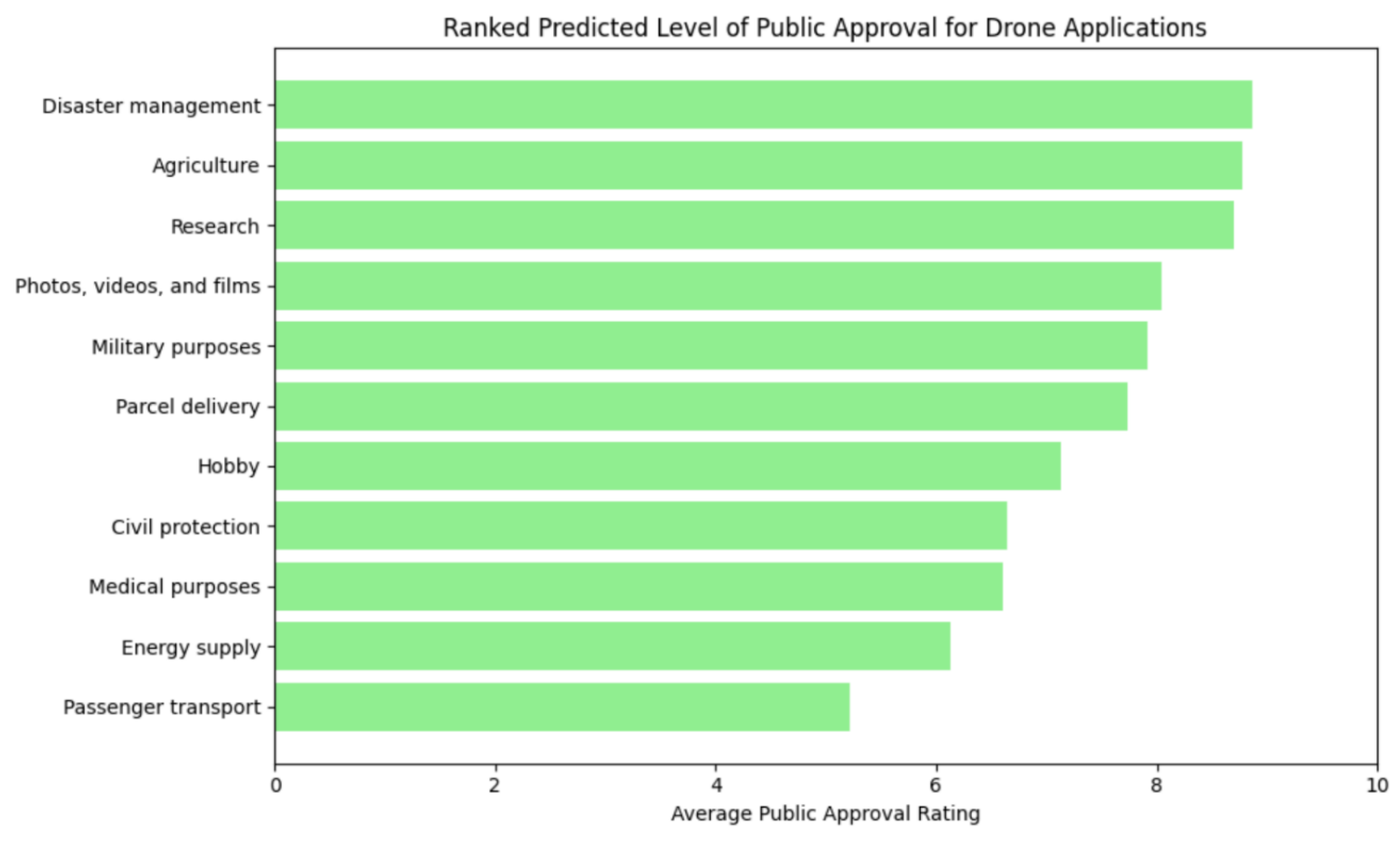
The averages indicate that applications such as disaster management, agriculture, and research are considered more beneficial and have the highest predicted levels of public approval. In contrast, passenger transport and energy supply have relatively lower approval ratings. This result aligns with recent research findings, which demonstrate high public approval for the use of drones in disaster management [68].
This highlights the urgent need for further study on the use of drones for public transportation and reveals a lack of enthusiasm among the general public for their adoption in logistics [69].
13.2. Interpretation
- Despite the growing ethical and psychological risks associated with drone warfare, these risks were not represented in the responses. Drones were perceived as helpful instruments rather than disruptive technologies or security threats [70].
- Highly Approved Applications: Disaster management (8.87), agriculture (8.78), and research (8.70) are highly accepted, likely due to their clear societal benefits.
- Moderate Approval: Medical purposes (6.61), military purposes (7.91), parcel delivery (7.74), and photos/videos (8.04) have moderate approval, reflecting a balance between perceived usefulness and concerns over safety, ethics, or privacy.
- Lower Approval: Passenger transport (5.22), civil protection (6.65), and energy supply (6.13) show lower approval, likely due to concerns about safety, privacy issues, or unfamiliarity.
Overall, the public favors drone applications with clear benefits but remains cautious about those involving personal use, safety risks, or privacy concerns.
13.3. General Insights
- Public Perception and Safety: Applications directly contributing to safety and societal benefits (e.g., disaster management, research) generally receive high approval.
- Privacy and Ethical Concerns: Applications involving drones in public spaces or for personal use (e.g., civil protection, passenger transport) may raise concerns over privacy, security, and ethics, resulting in lower approval ratings.
- Unfamiliarity or Mistrust: Lower ratings for energy supply and passenger transport suggest that the public may be unfamiliar with these applications or lack sufficient trust in the technology for such critical tasks.
13.4. Insights Based on the Main Factors Impacting Drone Acceptance
The focus group results aligned with the checklist’s conclusions regarding acknowledging the gravity of several well-known drone challenges. They stress that rising risks to military operations, growing privacy violations, misconceptions, and unfavorable public perceptions are the main elements influencing drone adoption.
13.5. Insights Based on Participants’ Years of Expertise
- ▪
- 5-10 Years: This group supported drone applications like disaster management and research while being more cautious about military purposes and civil protection.
- ▪
- 10-20 Years: Participants in this group displayed balanced approval across most applications, with notably lower ratings for passenger transport, reflecting caution in areas where public safety is a concern.
- ▪
- 20-30 Years: This group favored disaster management, agriculture, and parcel delivery but was more skeptical about passenger transport and energy supply.
- ▪
- 30-40 Years: The most experienced participants were generally positive, especially for medical purposes and military uses, suggesting more confidence in advanced applications, but they were less enthusiastic about photos/videos and hobby drones.
These results suggest that more experienced participants favor practical and established drone applications. In contrast, those with less experience tend to express more skepticism, particularly in safety-sensitive areas such as passenger transport and civil protection.
14. Advanced Statistical Analysis
14.1. ANOVA (Analysis of Variance)
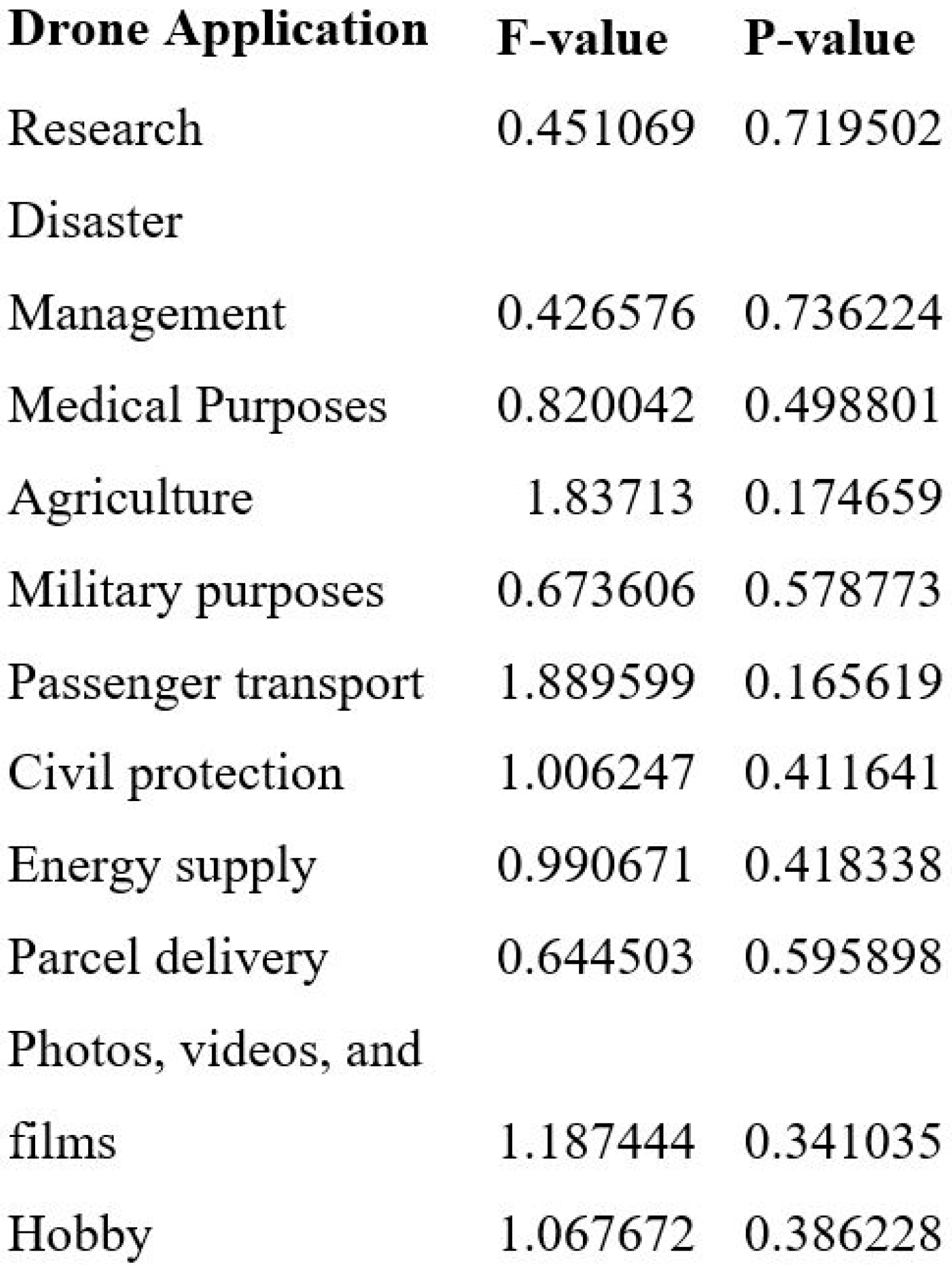
Test whether the differences in the ratings for each drone application across the various years of expertise groups are statistically significant.

Table 2.
The differences in the ratings for each drone application across the various years of expertise groups.
Table 2.
The differences in the ratings for each drone application across the various years of expertise groups.
14.2. The Implications of the Advanced Statistics
The ANOVA results indicate the following for each drone application:
- No drone applications have statistically significant differences across the years of expertise, as all the p-values are above 0.05.
Here are some key findings:
- Passenger transport (F-value: 1.89, p-value: 0.166) and Agriculture (F-value: 1.84, p-value: 0.175) show relatively higher F-values, indicating some differences in approval across experience levels, but not enough to be statistically significant.
- Applications such as Research (p-value: 0.72) and Disaster Management (p-value: 0.74) exhibit very low F-values, indicating that the ratings are pretty consistent across different experience levels.
This suggests that participants, regardless of their years of expertise, generally hold similar views on the public approval of various drone applications.
14.3. Visual Representation of the Result That No Drone Applications Have Statistically Significant Differences Across the Years of Expertise
Python may be used to illustrate this outcome visually. The ANOVA visual graph shows the F-values and P-values for each drone application based on the analysis of variance across years of expertise. The F-values (blue line) indicate the variance between groups (different expertise levels) relative to the variance within groups. Higher F-values suggest greater differences between expertise levels.
The P-values (red dashed line) measure the statistical significance of those differences. A P-value below 0.05 would imply a statistically significant difference in group approval ratings. However, in this graph, all P-values are above 0.05, suggesting that none of the applications show statistically significant differences in approval across expertise levels.
This implies that participants often share similar opinions about whether different drone applications are approved by the public, regardless of their level of experience. Figure 2 demonstrates this as follows:
- (1)
- F-values show the variance ratio between groups to the variance within groups.
- (2)
- P-values indicate the differences in statistical significance.
15. Implications of the Correlation Analysis
The correlation analysis provides insights into how different drone applications are related to each other based on the ratings provided. Here are some notable findings:
15.1. Strong Positive Correlations
- ▪
- Military purposes and Photos, videos, and films (0.73): Participants who rated military purposes highly also favored using drones for photos and videos.
- ▪
- Civil Protection and Energy Supply (0.61): A strong relationship exists between approval for drones in civil protection and energy supply, possibly reflecting a belief in the utility of drones in infrastructure and security.
- ▪
- Passenger transport and Medical purposes (0.56): Participants who were positive about passenger transport also supported drones for medical purposes, indicating trust in drones for high-stakes applications.
15.2. Moderate Negative Correlations
- ▪
- Research and Medical purposes (-0.43): Participants who rated drones highly for research purposes were more skeptical of their use in medical contexts.
- ▪
- Photos, videos, and films, and Energy supply (-0.43): A moderate negative relationship suggests that those who approve of drones for media may not favor their use in infrastructure services.
15.3. Other Notable Correlations
- ▪
- Passenger transport and Civil protection (0.56): A positive correlation indicates that participants who support drones in transport also believe in their effectiveness for civil protection.
- ▪
- Photos, videos, and films (0.38): Those who support drones for media applications also tend to favor their use for hobbies, demonstrating alignment in personal and creative drone usage.
These correlations reveal trends in how participants perceive various drone applications, with clear relationships between public safety-related uses and more personal or creative applications.
16. The Main Results of Both Analyses
The following threefold remarks illustrate the key findings of both analyses:
- Consistency Across Expertise Levels: Both the ANOVA and regression analyses indicate that years of expertise do not significantly influence approval ratings. This suggests that the perception of drone applications is shaped more by the nature of the application than by professional experience.
- Application-Specific Relationships: The correlation analysis reveals interesting relationships between different drone applications, highlighting how certain use cases, such as military and media or civil protection and energy supply, tend to be perceived together. These correlations suggest a broader mindset, where some participants view drones as versatile tools for safety, while others associate them with creative or commercial uses.
- Public Perception Trends: Participants are generally more supportive of drones in areas with clear societal benefits, such as disaster management, research, and agriculture. However, there is more skepticism about drones in personal or controversial applications (e.g., passenger transport and energy supply).
17. Limitations of the Study
- Privacy concerns spark discussions around data usage and permission. Concerns regarding the specific challenges of drone technology may arise due to legal and procedural issues, which are not examined in this research. Regulations that lessen concerns about drone fear are desperately needed. However, the current study did not address legal issues or provide recommendations for controlling them.
- The research may be limited in focusing solely on scientists’ opinions on drone application and acceptability rather than the general public. Potential bias of experts toward particular applications, depending on their field of expertise, may be considered a limitation of our expert interview research.
- Since the creation of frameworks controlling the future use of drones depends on the degree of public acceptability, the authors attempt to exercise caution when implying potential issues that would be difficult to pinpoint without precise benchmarks.
- Despite our efforts to incorporate some elements that influence drone acceptability and applications, further research is required to examine other related issues. Although the issue of ethicality has been covered, burden, perceived effectiveness, intervention coherence, and self-efficacy are examples of different components that make up the theoretical framework of acceptability (TFA).
18. Future Considerations
- This new research is intended to understand drones’ potential negative social implications and develop suitable mitigating strategies. The sense of societal success will increase public acceptance and credibility of drones, promoting practitioners’ confidence and favorable scientific outcomes.
- Future studies should investigate the most effective ways to provide precise information on drones, including their types, potential risks, and advantages, as people are often eager to learn more about them and the outcomes of fulfilling their information requests to alleviate concerns about drones.
- The benefits of drone applications need more studies. To eliminate misconceptions about drones, a more effective study is required. Generally speaking, people assume that all drones are equipped with AI and are far more sophisticated and powerful than they actually are.
- One of the biggest concerns with drones is the potential for privacy violations. Highly fruitful research based on real-life experience is lacking. Because they perceive drones as flying robots violating their privacy, some may harbor unfounded fears, preventing them from being widely accepted.
- There is a growing need for more attention to future ethical challenges and how they might be addressed as drones become increasingly integrated into daily life.
- One of the key areas of future improvements in drone technology is the integration of AI and autonomous drones.
- A code of ethics for drone operators must be established for ethical monitoring and responsibility.
- There is a growing need for in-depth research on drone ethics because technology may develop more rapidly than the ethical frameworks for drones.
- The balance between moral dilemmas and technological development provides potential solutions or areas for further study.
- A potential future crucial problem that requires thorough investigation, particularly about international treaties, legal issues, and ethical standards, is how to regulate drone technology and utilize it to strike a balance between innovation and responsibility. Governments and businesses must ensure that drones are appropriately used, which is tied to military and corporate accountability. The humanitarian and severe psychological, social, and ethical implications of using drones in warfare need more research to be highlighted. There is an increasing demand for specialist studies on the possible psychological impact of armed drones on operators, target populations, and societies [71].
19. A Special Remark on How to Address the Potential Social Impact of Drones and Anti-Drones
From a societal expert perspective, a comprehensive lens that balances innovation, safety, privacy, and ethical considerations may be used to understand how drones and anti-drone technologies affect society. The following is a methodical evaluation of their influence on society:
19.1. Drones’ Notable Benefits Include
- Public safety and emergency response: Drones help manage disasters, flood surveillance, firefighting, and search and rescue. Medical supplies delivered to isolated or emergency areas improve access to healthcare.
- Economic Growth and Job Creation: New industries in drone maintenance, manufacturing, and services create skilled jobs, boosting media, logistics, infrastructure inspection, and agriculture output.
- Environmental Monitoring: Maintaining forests with a small ecological imprint, detecting pollutants, and safeguarding animals.
- Smart City Development: Incorporated into infrastructure assessment, traffic monitoring, and urban planning.
19.2. Notable Drawbacks of Drones
- Privacy Invasion: Unauthorized monitoring and data gathering are major worries associated with civilian drones.
- Risks to Security: Terrorists and non-state groups have turned drones into weapons, raising the possibility of asymmetric warfare and open assaults. Small drones make sabotage, surveillance, and smuggling more practical.
- Safety and Airspace Risks: The possibility of mid-air collisions with airplanes, particularly close to airports and in metropolitan areas. Unauthorized planes violate no-fly zones and put onlookers in danger [72].
19.3. Significance of Emphasizing Anti-Drone Technology
Drones and anti-drones have been developed recently to combat drone attacks.
As of May 2025, anti-drone technology has made great strides in combating the increasing risks posed by unmanned aerial systems (UAS). The benefits of anti-drone technologies have become increasingly evident as the threat posed by drones continues to grow. In recent years, notable developments have occurred, and there has been broad acceptance of anti-drone technology.
Due to growing worries about drone-related risks, the anti-drone industry is expanding quickly. Nonetheless, issues such as the need for design and usage standards and high research and development expenditures continue to exist. To solve these problems, efforts are being made to provide economical and effective alternatives [73].
These developments demonstrate a global commitment to enhancing security protocols against the evolving risks posed by unmanned aerial vehicles. Integrating cutting-edge technology and global partnerships emphasizes the significance of proactive approaches in addressing drone-related issues [74].
19.4. Significant Impacts of Anti-Drone Technology
- Strengthening Public Security: Anti-drone systems safeguard against harmful drone activity in critical locations (airports, military installations, and public gatherings) and ensure safe airspace in conflict areas or during high-profile events.
- Moral and Legal Conundrums: There are legal concerns when intercepting or disarming drones: Who owns the airspace? What happens if defenseless drones are destroyed? There is a possibility of abuse or overreach by the government.
- Issues with Civil Liberties: Radar and RF tracking are surveillance-based anti-drone devices that might increase society’s acceptance of invasive monitoring.
- The Rise in Militarization: The proliferation of drones and countermeasures might hasten arms races and normalize ongoing monitoring in daily life [75].
19.5. Notable Societal Balancing Act
- The public’s perception of drones changes according to the visibility of their use cases: commercial or military surveillance raises suspicions, while humanitarian uses encourage acceptance.
- There is an increasing need for policy frameworks that govern ownership, operation, airspace rights, and countermeasures to maintain societal trust.
- Digital literacy and ethical education must advance to help citizens understand the potential and limitations of drone and anti-drone technologies [76].
20. Concluding Remarks
Regarding their diverse benefits and rich applications, the research has added to the conviction that drones are transforming society. They are a social phenomenon becoming increasingly popular, and their technology is becoming more useful, accessible, and affordable than ever before. Consequently, their moral and societal public uses require the constant application of highly sophisticated, cutting-edge research methods. They are changing how we think and feel about our physical surroundings due to their ability to collect data, help in humanitarian and rescue operations, and transfer weights in novel ways. The research demonstrates that drones are transforming our perceptions and understanding of the physical environment and are becoming increasingly widespread for various applications poised to revolutionize numerous industrial sectors and become a future game changer.
Despite their many uses, growing appeal, and considerable increased marketability due to their popularity, little is known about the public’s acceptance of drones and the limits of the ethical dilemmas surrounding them. Therefore, one of the primary objectives of the current study was to contribute to understanding their socio-ethical dilemmas. Although drone technology offers numerous benefits, using drones for safety purposes shouldn’t infringe on personal freedoms for the sake of public safety.
Because the public’s perception and the ethical concerns drones raise could significantly impact their adoption and technological progress in the future, one of the aims of this study was to enhance understanding of the factors that shape public perception of the benefits and risks associated with drone usage and propose some relevant solutions. The research demonstrated that drone applications are diverse and span various fields, including delivery, surveillance, agriculture, military and humanitarian operations, and medical supply distribution. The concerns surrounding each drone domain are peculiar and require specialized tackling.
The main investigation results suggest that perceptions of drone applications are relatively stable across different experience levels. However, people tend to see some applications as complementary, while others are viewed in isolation, reflecting nuanced trust and comfort levels with the technology. Nonetheless, various ethical and social challenges threaten to hinder the swift advancement of drone technology and its applications.
On the other hand, the focus group results concurred with the checklist’s findings, acknowledging the severity of several well-known drone issues. They emphasize that the primary factors driving drone adoption include escalating privacy violations, misconceptions, negative public impressions, and increased hazards to military operations.
Regression analysis and ANOVA indicate that years of experience have no discernible effect on approval ratings, consistent across competence levels. This suggests that the type of application influences how drone apps are perceived more than the expertise of the user.
While examining the relationship between various drone applications, the correlation analysis reveals some intriguing correlations. These correlations highlight how specific use cases, combined with findings on public perception trends, suggest that people are generally more favorable toward apparent drones in areas with obvious societal benefits.
The study has numerous ethical implications. It can help us focus efforts on the ethics of drone technology and enhance our understanding of their morality and humanitarian implications. Because autonomous drones can be programmed to recognize and track individuals, serious ethical concerns will arise from balancing technological advancement with the protection of civil liberties. This could lead to mass surveillance without the subjects’ knowledge or consent.
The study’s findings can help shape the debate on the acceptability of drones in specific contexts, inform future research on promoting valued development in society more broadly, and guide academics and policymakers on the use of drones. People’s attitudes, understanding, and usage will undoubtedly impact future technological advancements.
Author Contributions
Conceptualization, H.O.K. and S.M.; Methodology, H.O.K. and S.M.; Validation, S.M.; Formal analysis, S.M.; Investigation, H.O.K. and S.M.; Resources, H.O.K. and S.M.; Data curation, H.O.K. and S.M.; Writing—original draft, H.O.K. and S.M.; Writing—review & editing, S.M.; Visualization, H.O.K.; Project administration, H.O.K. and S.M. Both authors discussed the results and contributed to the final manuscript. All authors have read and agreed to the published version of the manuscript.
Funding
This research received no external funding.
Institutional Review Board Statement
This study was approved by the Interdisciplinary Research Center for Intelligent Manufacturing and Robotics Ethics Committee (IMR-2-4-2024, 2 April 2024).
Informed Consent Statement
Informed consent was obtained from all subjects involved in the study.
Data Availability Statement
The original contributions presented in this study are included in the article material. Further inquiries can be directed to the corresponding author.
Acknowledgments
The author would like to acknowledge the support of King Fahd University of Petroleum and Minerals, the Deanship for research oversight and coordination, and the Interdisciplinary Research Center for Intelligent Manufacturing and Robotics.
Conflicts of Interest
No potential conflicts of interest were disclosed by the author concerning the research, writing, or publication of this paper.
Appendix A. Python Code used for Bar-Graph Generation Jupyter Notebook
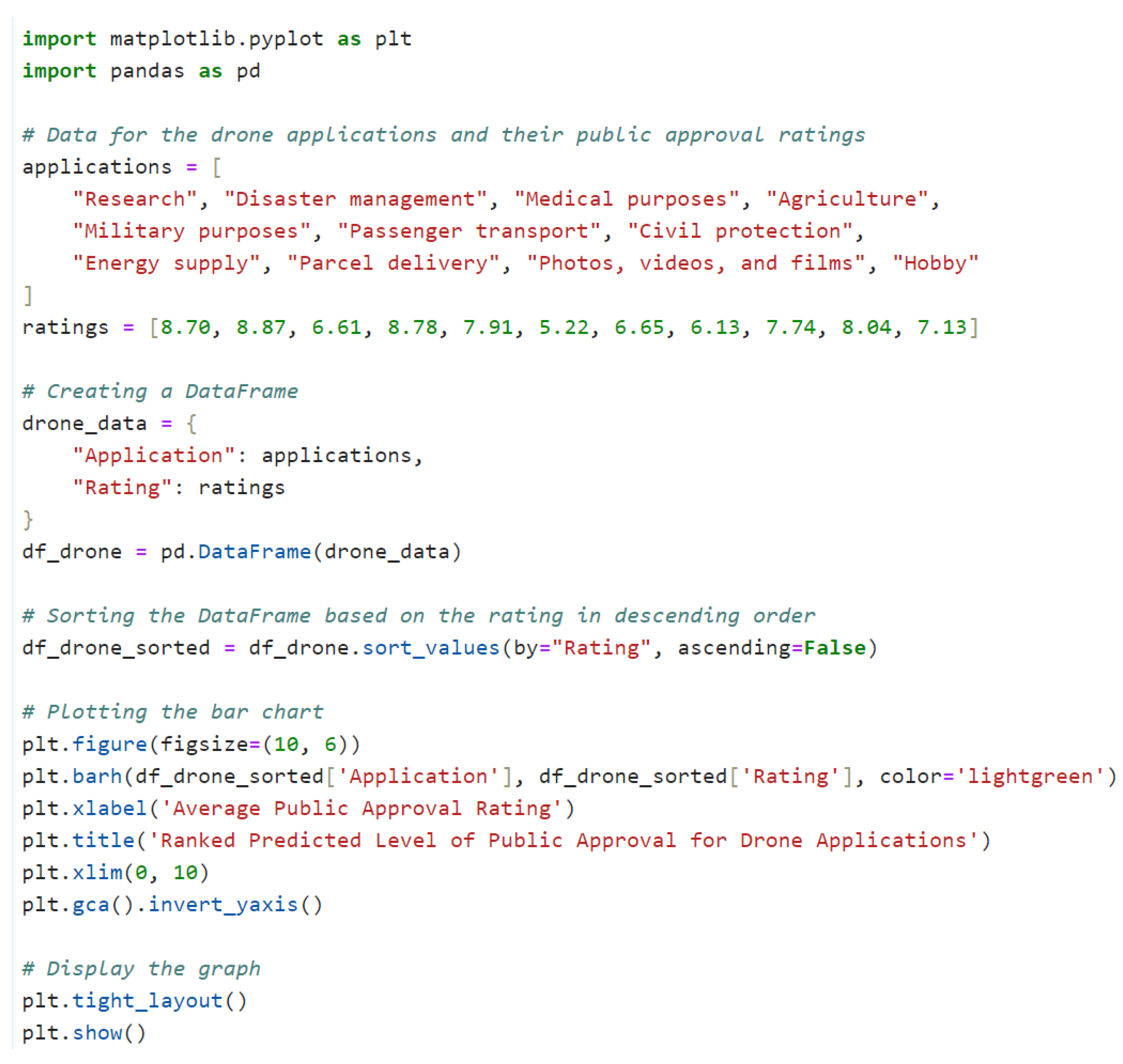
Appendix B. Code for ANOVA results: F-Values and P-Values
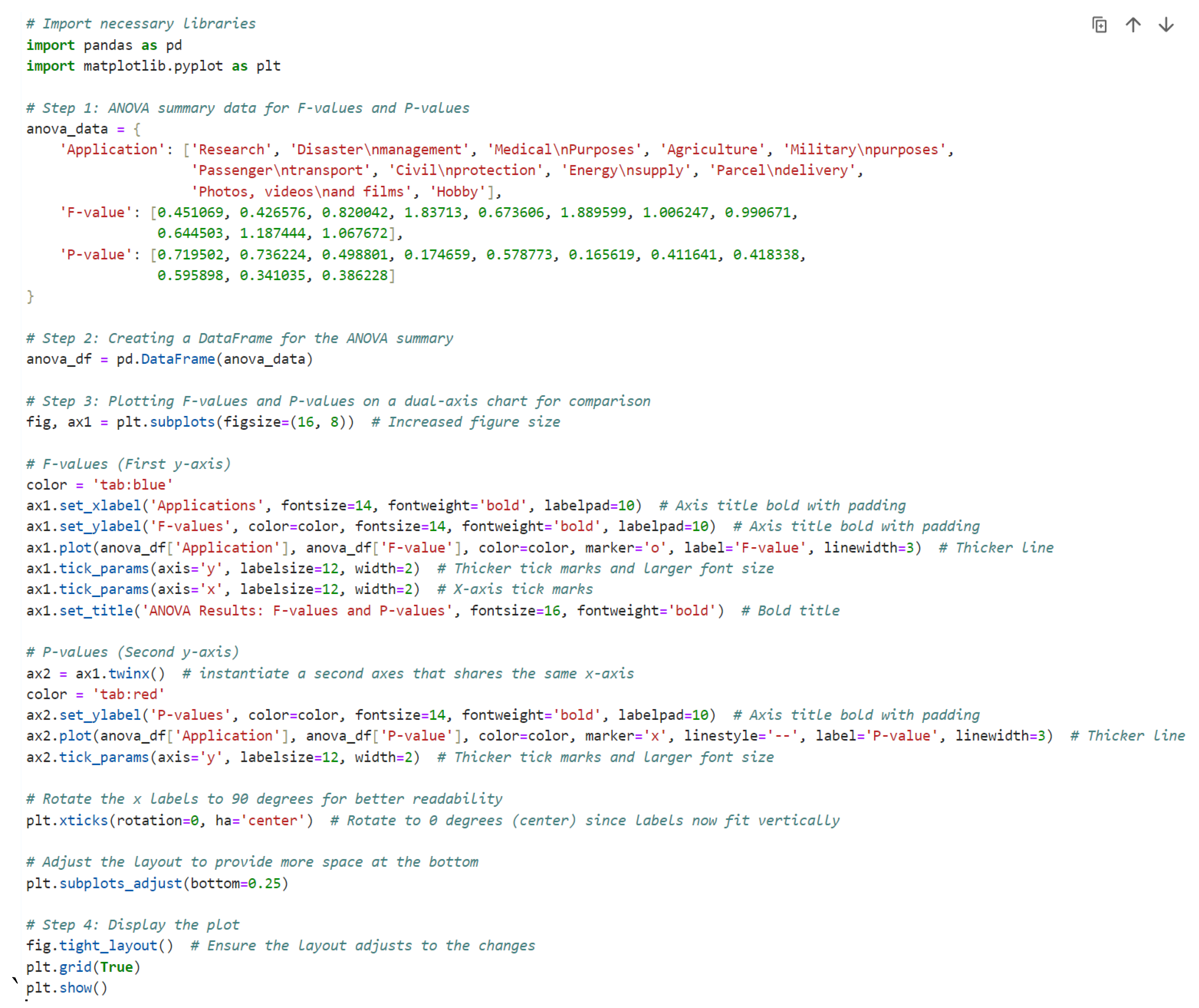
References
- Tubis, A. A., Poturaj, H., Dereń, K., & Żurek, A. (2024). Risks of Drone Use in Light of Literature Studies. Sensors, 24(4), 1205. [CrossRef]
- Mohsan SAH, Othman NQH, Li Y, Alsharif MH, Khan MA. Unmanned aerial vehicles (UAVs): practical aspects, applications, open challenges, security issues, and future trends. Intell Serv Robot. 2023;16(1):109-137. Epub 2023 Jan 16. [CrossRef] [PubMed] [PubMed Central]
- Wang, N., Christen, M. & Hunt, M. Ethical Considerations Associated with “Humanitarian Drones”: A Scoping Literature Review. Sci Eng Ethics 27, 51 (2021). [CrossRef]
- Otto, N. Agatz, J. Campbell, B. Golden, E. Pesch, Optimization approaches for civil applications of unmanned aerial vehicles (UAVs) or aerial drones: a survey Networks, 72 (2018), pp. 411-458. [CrossRef]
- Moreham, N. (2023). New Technologies, Established Ideas: Drone Cameras and the Privacy Torts. Victoria University of Wellington Law Review, 54(1), 253–264. [CrossRef]
- Ning Wang, Nico Mutzner, Karl Blanchet, Societal acceptance of urban drones: A scoping literature review, Technology in Society, Volume 75, 2023, 102377, ISSN 0160-791X. (https://www.sciencedirect.com/science/article/pii/S0160791X23001823). [CrossRef]
- Fisk, K., Merolla, J. L., & Ramos, J. M. (2019). Emotions, Terrorist Threat, and Drones: Anger Drives Support for Drone Strikes. Journal of Conflict Resolution, 63(4), 976-1000. [CrossRef]
- Sarah Jane Fox, Drones: Foreseeing a ‘risky’ business? Policing the challenge that flies above, Technology in Society, Volume 71,2022,102089,ISSN0160-791X. (https://www.sciencedirect.com/science/article/pii/S0160791X22002305). [CrossRef]
- Yu, Lijun. (2023). The Prospect of Drone Applications. Applied and Computational Engineering. 3. 300-304. [CrossRef]
- K.B. Laksham, Unmanned aerial vehicle (drones) in public health: a SWOT analysis, J. Fam. Med. Prim. Care, 8 (2) (2019), p. 342.
- Robin Kellermann, Tobias Biehle, Liliann Fischer, Drones for parcel and passenger transportation: A literature review, Transportation Research Interdisciplinary Perspectives, Volume 4, 2020, 100088, ISSN 2590-1982. (https://www.sciencedirect.com/science/article/pii/S2590198219300879). [CrossRef]
- S. Hogan, M. Kelly, B. Stark, Y. Chen, Unmanned aerial systems for agriculture and natural resources, Calif. Agric., Berkel., 71 (1) (2017), pp. 5-14.
- G. Sylvester, E-Agriculture in Action: Drones for Agriculture, Food and Agriculture Organization of the United Nations and International Telecommunication Union, Bangkok (2018) content (fao.org).
- Eichleay M, Evens E, Stankevitz K, Parker C. Using the Unmanned Aerial Vehicle Delivery Decision Tool to Consider Transporting Medical Supplies via Drone. Glob Health Sci Pract. 2019 Dec 23;7(4):500-506. [CrossRef] [PubMed] [PubMed Central]
- Das, Ajit & Singh, Professor & Rathore, Manager & Kumar, Research. (2024). Drones Usage Opportunities For Entrepreneurs Contributing Towards Aatmanirbar Bharat. SMS Journal of Entrepreneurship & Innovation. 10. 24-36. [CrossRef]
- Drones in Construction: How Technology is Reshaping the Industry - MRINetwork (accessed on 29 January 2025).
- How Drone Services Will Transform Industries in 2025 (accessed on 30 January 2025).
- 18. Jean-Paul Yaacoub, Hassan Noura, Ola Salman, Ali Chehab, Security analysis of drones systems: Attacks, limitations, and recommendations, Internet of Things, Volume 11, 2020, 100218, ISSN 2542-6605. (https://www.sciencedirect.com/science/article/pii/S2542660519302112). [CrossRef]
- Sabino, Hullysses et. al. (2022). A systematic literature review on the main factors for public acceptance of drones. Technology in Society. 71. 102097. (https://www.sciencedirect.com/science/article/pii/S0160791X2200238X). [CrossRef]
- Hall, O., & Wahab, I. (2021). The Use of Drones in the Spatial Social Sciences. Drones, 5(4), 112. [CrossRef]
- Stolz, Maria, Anne Papenfuß, Franziska Dunkel, and Eva Linhuber. 2024. “Harmonized Skies: A Survey on Drone Acceptance across Europe” Drones 8, no. 3: 107. [CrossRef]
- J. Nelson, T. Gorichanaz, Trust as an ethical value in emerging technology governance: the case of drone regulation, Technol. Soc., 59 (2019), Article 101131. [CrossRef]
- Matthew Ayamga, Bedir Tekinerdogan, Ayalew Kassahun, Exploring the Challenges Posed by Regulations for the Use of Drones in Agriculture in the African Context, Land, 10 (2) (2021), p. 164. [CrossRef]
- Mousazadeh, Reza & Basiri, Abbas & Babaee, Mojtaba & Tabasi, Ali. (2016). Analyzing the Legal Dimensions of Unmanned Combat Aerial Vehicle in International Law. Journal of Politics and Law. 9. 1. [CrossRef]
- Serafinelli, E. (2022). Imagining the social future of drones. Convergence, 28(5), 1376, 1391. [CrossRef]
- Fatic, Aleksandar. (2017). The ethics of drone warfare. Filozofija i drustvo / Philosophy and Society. 28. 349-364. 10.2298/FID1702349F.
- Matthew Ayamga, Selorm Akaba, Albert Apotele Nyaaba, Multifaceted applicability of drones: A review, Technological Forecasting and Social Change, Volume 167, 2021, 120677, ISSN 0040-1625. (https://www.sciencedirect.com/science/article/pii/S0040162521001098). [CrossRef]
- Gevaert, Caroline M., Richard Sliuzas, Claudio Persello, and George Vosselman. 2018. “Evaluating the Societal Impact of Using Drones to Support Urban Upgrading Projects” ISPRS International Journal of Geo-Information 7, no. 3: 91. [CrossRef]
- Clothier, Reece & Greer, Dominique & Greer, Duncan & Mehta, Amisha. (2015). Risk Perception And The Public Acceptance Of Drones. Risk Analysis. 35. 10.1111/risa.12330.
- Hoek Spaans, Remy & Drumond Silveira, Bruna & van Daalen, Kim & Vitor, Ana & Derbyshire, Alison & Silva, Adriano & Lana, Raquel & Vega, Mauricio & Carrasco-Escobar, Gabriel & Escada, Maria & Codeço, Cláudia & Lowe, Rachel. (2024). Ethical considerations related to drone use for environment and health research: A scoping review protocol. PLOS ONE. 19. e0287270. 10.1371/journal.pone.0287270.
- Bharat Rao, Ashwin Goutham Gopi, Romana Maione, The societal impact of commercial drones, Technology in Society, Volume 45, 2016, Pages 83-90, ISSN 0160-791X. [CrossRef]
- Dan Jin, Navigating the spectrum of human-robot collaboration: Addressing robophobia-robophilia in the hospitality industry, International Journal of Hospitality Management, Volume 122, 2024, 103840, ISSN 0278-4319. (https://www.sciencedirect.com/science/article/pii/S027843192400152X). [CrossRef]
- Majeed, Rizwan & Abdullah, Nurul & Mushtaq, Muhammad & Kazmi, Rafaqut. (2021). Drone Security: Issues and Challenges. International Journal of Advanced Computer Science and Applications. 12. [CrossRef]
- Emery JR. The Possibilities and Pitfalls of Humanitarian Drones. Ethics & International Affairs. 2016;30(2):153-165. doi:10.1017/S0892679415000556.
- Ruiz Estrada, Mario. (2020). The Uses of Drones in Case of Massive Epidemics Contagious Diseases Relief Humanitarian Aid: Wuhan-COVID-19 Crisis. SSRN Electronic Journal. [CrossRef]
- Bradley, S., & Chiou, E. (2024). Examining the Ethical Considerations of Humanitarian Drones. Proceedings of the Human Factors and Ergonomics Society Annual Meeting, 68(1), 845-850. (Original work published 2024). [CrossRef]
- Top 5 Ethical Issues in Drone Surveillance (accessed on 30 January 2025).
- What Are The Ethical Considerations In The Use Of Drones For Surveillance And Law Enforcement? - Consensus Academic Search Engine (accessed on 16 January 2025).
- Resnik DB, Elliott KC. Using Drones to Study Human Beings: Ethical and Regulatory Issues. Sci Eng Ethics. 2019 Jun;25(3):707-718. Epub 2018 Feb 27. [CrossRef] [PubMed] [PubMed Central]
- Smith, Angela & Dickinson, Janet & Marsden, Greg & Cherrett, Tom & Oakey, Andrew & Grote, Matt. (2022). Public acceptance of the use of drones for logistics: The state of play and moving towards more informed debate. Technology in Society. 68. 101883. [CrossRef]
- Stefanie Beninger, Karen Robson, Social, economic, and environmental implications of drones in marketing: A framework of safeguards for sustainable technology implementation, Journal of Business Research, Volume 191, 2025, 115251, ISSN 0148-2963. (https://www.sciencedirect.com/science/article/pii/S0148296325000748). [CrossRef]
- Huanfa Chen, Xiaowei Gao, Huanhuan Li, Zaili Yang, A framework for the optimal deployment of police drones based on street-level crime risk, Applied Geography, Volume 162, 2024, 103178, ISSN 0143-6228. (https://www.sciencedirect.com/science/article/pii/S0143622823003090). [CrossRef]
- 43. Mo ElSayed, Ahmed Foda, Moataz Mohamed, The impact of civil airspace policies on the viability of adopting autonomous unmanned aerial vehicles in last-mile applications, Transport Policy, Volume 145, 2024, Pages 37-54, ISSN 0967-070X. [CrossRef]
- Çetin, E., Cano, A., Deransy, R., Tres, S., & Barrado, C. (2022). Implementing Mitigations for Improving Societal Acceptance of Urban Air Mobility. Drones, 6(2), 28. [CrossRef]
- 45. Strategies to Improve the Social Acceptability of Drones | Max Bell School of Public Policy - McGill University.
- Xue Li, Glenys Jia Xuan Lee, Kum Fai Yuen, Consumer acceptance of urban drone delivery: The role of perceived anthropomorphic characteristics, Cities, Volume 148, 2024, 104867, ISSN 0264-2751. (https://www.sciencedirect.com/science/article/pii/S0264275124000817). [CrossRef]
- Aishwarya Raghunatha, Patrik Thollander, Stephan Barthel, Addressing the emergence of drones – A policy development framework for regional drone transportation systems, Transportation Research Interdisciplinary Perspectives, Volume 18, 2023, 100795, ISSN 2590-1982. (https://www.sciencedirect.com/science/article/pii/S2590198223000428). [CrossRef]
- Djatmiko, I & Yatmono, Sigit & Nugraha, Ariadie. (2021). Development and Effectiveness of Drone as a Learning Media in Islamic Boarding School. Journal of Physics: Conference Series. 2111. 012011. [CrossRef]
- Graham, E. (2025). Drone Survey to Monitor Erosion Impacts on Coastal Archaeological Sites. Journal of Field Archaeology, 50(1), 22–41. [CrossRef]
- Abderahman Rejeb, Alireza Abdollahi, Karim Rejeb, Horst Treiblmaier, Drones in agriculture: A review and bibliometric analysis, Computers and Electronics in Agriculture, Volume 198, 2022, 107017, ISSN 0168-1699. (https://www.sciencedirect.com/science/article/pii/S0168169922003349). [CrossRef]
- Beninger S, Robson K. The disruptive potential of drones. Mark Lett. 2020;31(4):315-319. doi: . Epub 2020 Oct 2. [CrossRef] [PubMed] [PubMed Central]
- Oranga, J. and Matere, A. (2023) Qualitative Research: Essence, Types and Advantages. Open Access Library Journal, 10, 1-9. [CrossRef]
- Erin, N., Haugen. (2023). Interpretive Analysis. Springer texts in education, 249-255. [CrossRef]
- The SAGE Handbook of Qualitative Research | SAGE Publications Inc (accessed on 5 January 2025).
- Etikan, Ilker. (2016). Comparison of Convenience Sampling and Purposive Sampling. American Journal of Theoretical and Applied Statistics. 5. 1. [CrossRef]
- Barbara B. Kawulich (2005), View of Participant Observation as a Data Collection Method, Forum Qualitative Social Research. (Forum Qualitative Sozialforschung), Volume 6, No. 2, Art. 43 – May 2005.
- Dahal N, Neupane BP, Pant BP, Dhakal RK, Giri DR, Ghimire PR, Bhandari LP. Participant selection procedures in qualitative research: experiences and some points for consideration. Front Res Metr Anal. 2024 Dec 12;9:1512747. [CrossRef] [PubMed] [PubMed Central]
- Frels, Rebecca & Onwuegbuzie, Anthony. (2013). Administering Quantitative Instruments With Qualitative Interviews: A Mixed Research Approach. Journal of Counseling & Development. 91. [CrossRef]
- Lambert, Sylvie & Loiselle, Carmen. (2008). Combining individual interviews and focus groups to enhance data richness. Journal of advanced nursing. 62. 228-37. Combining individual interviews and focus groups to enhance data richness - PubMed.
- Khogali, H.O.; Mekid, S. The blended future of automation and AI: Examining some long-term societal and ethical impact features. Technol. Soc. 2023, 73, 102232.
- Braun, V. and Clarke, V. (2006) Using thematic analysis in psychology. Qualitative Research in Psychology, 3 (2). pp. 77-101. ISSN 1478-0887 Available from: http://eprints.uwe.ac.uk/11735.
- Anney, B. (2014). Ensuring the Quality of Qualitative Research Findings: Examining the Trustworthiness Criteria. Journal of Emerging Trend in Educational Research and the Policy Studies (JETERAPS), 5, 272-281. Scholarlink Research Institute Journals, 2015 (ISSN: 2141-6990) jeteraps.scholarlinkresearch.com. Ensuring The Quality Of The Findings new.pdf (scholarlinkinstitute.org).
- Ketemaw, Adissu & Lemi, Kenenisa & Agazu, Biniam. (2022). A Comparative Review of Qualitative Research: A Guide to Design and Implementation and Implementation. Qualitative Report. 27. 1498-1508. [CrossRef]
- McAllum, Kirstie & Fox, Stephanie & Simpson, Mary & Unson, Christine. (2019). A comparative tale of two methods: how thematic and narrative analyses author the data story differently. Communication Research and Practice. 5. 1-18. [CrossRef]
- Rabia Tahseen, Uzma Omer, Shoaib Farooq, Ethical guidelines for artificial intelligence: a systematic literature review, VFAST Transactions on Software Engineering, 9 (2021), pp. 33-47.
- Weissgerber TL, Garcia-Valencia O, Garovic VD, Milic NM, Winham SJ. Why we need to report more than ‘Data were Analyzed by t-tests or ANOVA’. Elife. 2018 Dec 21;7:e36163. [CrossRef] [PubMed] [PubMed Central]
- Kelly, C.A., Sharot, T. Individual differences in information-seeking. Nat Commun 12, 7062 (2021). [CrossRef]
- Sharifah M. S. M. Daud, et al., Applications of drone in disaster management: A scoping review, Science & Justice, Volume 62, Issue 1, 2022, Pages 30-42, ISSN 1355-0306. [CrossRef]
- Angela Smith, Janet E. Dickinson, Greg Marsden, Tom Cherrett, Andrew Oakey, Matt Grote, Public acceptance of the use of drones for logistics: The state of play and moving towards more informed debate, Technology in Society, Volume 68, 2022, 101883, ISSN 0160-791X. (https://www.sciencedirect.com/science/article/pii/S0160791X22000240). [CrossRef]
- Hijazi, Alaa, Harold Hall, Mark Hovee, Feliciano Ferraro, and Sher Schreiber (2019). Psychological Dimensions of Drone Warfare. Current Psychology. 38. [CrossRef]
- Richardson, M. (2022). Drone trauma: violent mediation and remote warfare. Media, Culture & Society, 45(1), 202-211. (Original work published 2023). [CrossRef]
- Hell, Peter & Varga, Péter. (2019). Drone Systems for Factory Security and Surveillance. Interdisciplinary Description of Complex Systems. 17. 458-467. 10.7906/indecs.17.3.4.
- Chauhan, Dharmendra & Kagathara, Harshil & Mewada, Hiren & Patel, Sagarkumar & Kavaiya, Sagar & Barb, Gordana. (2025). Nation’s Defense: A Comprehensive Review of Anti-Drone Systems and Strategies. IEEE Access. PP. 1-1. [CrossRef]
- Counter-Drone Tech Struggles to Keep Up with Evolving Threat (accessed on 25 February 2025).
- Nair, M.M., Sriraman, H., Sai, G.H. et al. DroneSilient (drone + resilient): an anti-drone system. J Big Data 11, 144 (2024). [CrossRef]
- Serafinelli, E. (2022). Imagining the social future of drones. Convergence, 28(5), 1376-1391. (Original work published 2022). [CrossRef]
Figure 2.
Statistical Differences Across the Years of Expertise.
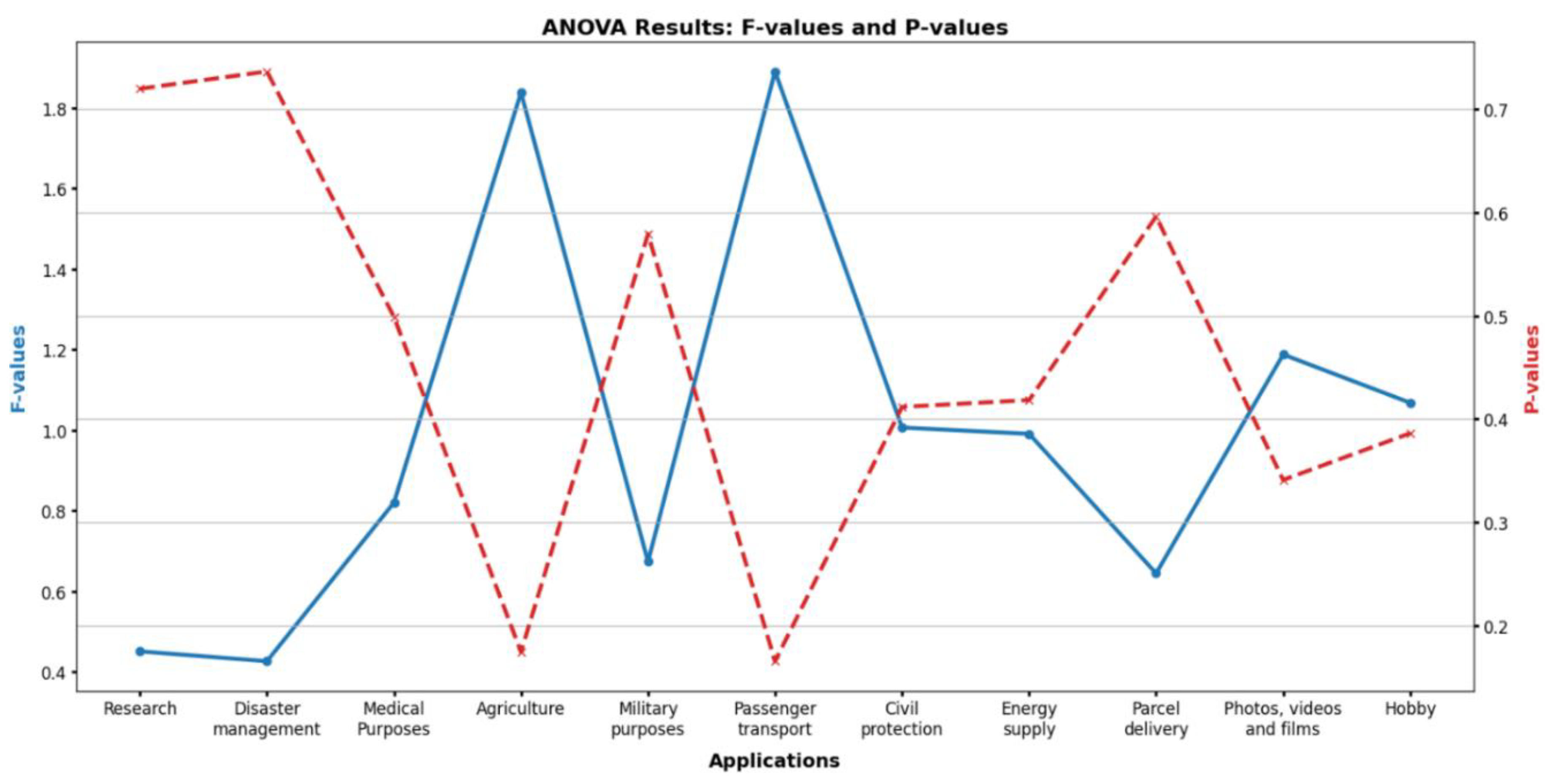
Table 1.
The Specializations and Years of Experience of Participants.
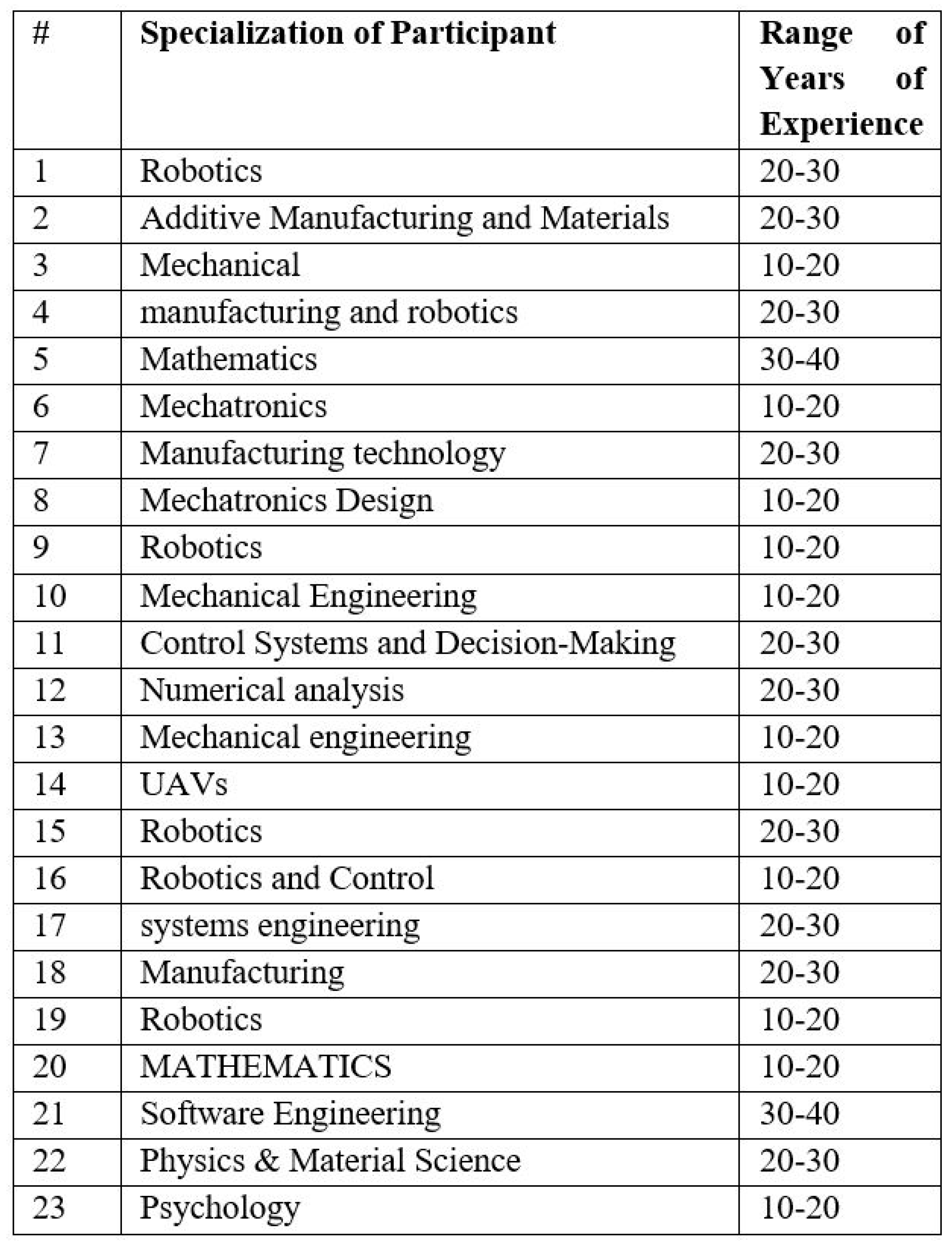
Disclaimer/Publisher’s Note: The statements, opinions and data contained in all publications are solely those of the individual author(s) and contributor(s) and not of MDPI and/or the editor(s). MDPI and/or the editor(s) disclaim responsibility for any injury to people or property resulting from any ideas, methods, instructions or products referred to in the content. |
© 2025 by the authors. Licensee MDPI, Basel, Switzerland. This article is an open access article distributed under the terms and conditions of the Creative Commons Attribution (CC BY) license (http://creativecommons.org/licenses/by/4.0/).
Copyright: This open access article is published under a Creative Commons CC BY 4.0 license, which permit the free download, distribution, and reuse, provided that the author and preprint are cited in any reuse.


