

Submitted:
27 May 2025
Posted:
28 May 2025
You are already at the latest version
Abstract
This study examines residents' perceptions of environmental and disaster risks near the “Duboko” regional landfill in Serbia. It aims to uncover factors that affect public trust and community resilience. This approach is rooted in interdisciplinary perspectives on risk perception, institutional trust, and socio-ecological resilience. A structured, self-administered questionnaire was used to collect data from a stratified sample of 1,180 respondents across nine municipalities in Western Serbia. The statistical analysis involved descriptive statistics, t-tests, ANOVA, Pearson correlation, and multiple linear regression. The regression models indicated that gender, education level, type of settlement, property ownership, and household size were significant predictors across various thematic dimensions. The model addressing risk perception and environmental impact accounted for 5.6% of the variance, while the model regarding institutional trust and transparency explained 7.4% of the variance. Higher perceived risk and lower institutional trust were found among women, individuals with lower levels of education, rural residents, and respondents from smaller households. Furthermore, increased transparency and access to environmental information correlated with enhanced trust and perceived resilience. These results emphasise the complex nature of landfill risk perception and highlight the need for participatory communication, transparent governance, and context-sensitive community involvement to bolster disaster resilience and public health protection in areas impacted by landfills.
Keywords:
risk perception
; community resilience
; public trust
; vulnerability
; environmental communication
; waste management
; ‘Duboko’ landfill
; local community
; environmental safety
; risk management
1. Introduction
Perceptions of environmental and health risks associated with landfills represent a critical dimension of modern waste management and public health policy, as well as the image of community sustainability [1,2,3,4,5,6]. This aligns with the global development objective to “make cities and human settlements inclusive, safe, resilient and sustainable” (Goal 11, United Nations SDGs 2030) as outlined in the resolution Transforming our world: the 2030 Agenda for Sustainable Development (A/RES/70/1). Risk perception in this context reflects how individuals and communities understand, interpret, and emotionally respond to the presence of landfill sites in their surroundings [4,6,7,8,9,10,11,12,13,14,15,16,17,18]. It encompasses not only assessments of objective environmental hazards but also subjective judgments shaped by socio-cultural experiences, institutional dynamics, and the quality of risk communication strategies [19,20,21,22,23]. A substantial body of research emphasises that public perception and awareness significantly influence the effectiveness of environmental risk governance, underscoring the need to incorporate social, cultural, and economic dimensions into decision-making processes [24,25,26,27,28,29,30].
Numerous studies have identified proximity to landfills [4], demographic and community characteristics [8], and the degree of transparency in planning and operations [9] as key determinants of how risk is perceived. While the physical threats posed by landfills—such as contamination of air, water, and soil—are often more pronounced for communities living nearby, the risks can be significantly mitigated through technological improvements, robust institutional engagement, and participatory approaches to environmental governance [31,32].
The long-term environmental impact of landfills is further exacerbated by age-related deterioration. Older landfill sites are associated with higher concentrations of persistent contaminants, including heavy metals and antibiotic-resistant genes, which tend to accumulate in leachate and surrounding ecosystems over time [33,34,35,36]. These pollutants pose chronic threats to groundwater and public health, persisting for decades and complicating risk assessment and remediation efforts. Therefore, risk assessments increasingly advocate for the integration of landfill age and lifecycle considerations into environmental planning to understand cumulative impacts better and prioritise mitigation strategies [31,34,36,37].
It is crucial to note that public risk perception does not always match the scientifically assessed risks. Individuals residing near landfills often experience symptoms such as respiratory distress, skin and eye irritation, fatigue, and psychological distress [38]. Concerns about long-term health effects, such as congenital anomalies and cancer risks often exacerbate these symptoms. However, establishing direct causal relationships is challenging due to confounding factors and a lack of comprehensive data on exposure [38,39,40].
In addition to biomedical and environmental factors, psychological and psychosocial factors—such as fear, mistrust, and dissatisfaction with public authorities—are crucial in determining how risk is perceived and responded to. A study focusing on port-related pollution revealed that perceived health risks had a significant effect on local anxiety and stress [41], pointing to the broader relevance of perception-based research in risk-prone environments. Common nuisances near landfill sites include offensive odours, water and air contamination, and increased prevalence of pests, particularly in communities located near poorly managed or unregulated landfills [4,39,42].
Evidence further suggests that residents living within 600 to 1000 meters of landfill sites express heightened environmental awareness, greater dissatisfaction with their living conditions, and a stronger desire to relocate compared to those living farther away [4,39]. A lack of meaningful involvement in decision-making processes, particularly during the landfill siting phase and subsequent operations, can intensify community dissatisfaction, reinforce perceptions of injustice, and erode institutional trust [9].
Recent advancements in risk assessment methodologies have promoted the development of comprehensive frameworks that integrate multi-pathway exposure analysis (e.g., air, water, soil) with community-based perspectives. These models facilitate a more nuanced assessment of risks throughout the landfill lifecycle, contributing to more informed, transparent, and adaptive governance strategies [6,43,44]. Even though modern engineered landfills tend to be less hazardous than open dumps, long-term impacts remain a concern when maintenance, monitoring, or community engagement is inadequate [31,44].
Recommendations for best practices in landfill risk management increasingly highlight the need for technical measures—such as efficient landfill gas capture, daily waste coverage, and odour suppression—combined with socially inclusive mechanisms like community outreach, participatory planning, and real-time public information sharing [4,39,43]. In parallel, the research emphasises the importance of effective risk communication, calling for the presentation of both qualitative and quantitative data in accessible formats (e.g., fact boxes, infographics), clear articulation of uncertainties, and the use of interactive, participatory formats that foster local engagement and resilience [28,45,46,47,48,49].
From previous research, it has been found that waste management in Serbia faces a wide array of persistent challenges, posing significant risks to both public health and the environment [50]. Initial assessments have revealed multiple issues, either directly or indirectly linked to: a) the absence of systematic waste separation; b) inadequate infrastructure for safe waste disposal; c) frequent and prolonged landfill fires releasing hazardous pollutants such as dioxins and furans; d) a shortage of sanitary landfills; e) improper handling of industrial waste; f) incidents of landslides and contamination of underground water sources; g) weak regulatory oversight and enforcement; h) limited environmental awareness and low civic participation; i) underdeveloped recycling systems; j) insufficient funding and investment in the waste sector; k) widespread illegal dumping and the proliferation of unregulated landfill sites; l) poor utilization of waste for energy production; m) inadequate incorporation of circular economy practices; n) deficiencies in the management of medical waste; o) lack of transparency and reliable data in waste management processes; and p) slow progress in aligning with EU regulations and in adopting comprehensive waste management strategies [50].
Most municipalities in Serbia rely on landfill disposal, and many of these sites fail to meet sanitary standards [51,52,53,54,55,56,57]. There is a minimal level of reuse and recycling, and hazardous waste frequently remains temporarily stored due to insufficient treatment facilities. Remediating dumpsites and establishing sanitary landfills is a significant priority; however, progress varies significantly by region and is generally slow [51,52,53,54,55,56,57]. Insufficient and unreliable data regarding waste generation and composition obstruct efficient planning. Limited administrative capabilities and inadequate financial management also complicate the execution of modern waste management systems [51,52,55,58]. Poor waste management leads to environmental contamination and health risks, including exposure to persistent organic pollutants and other hazardous substances [54,55].
Waste production in Serbia significantly reflects the nation's economic climate, where limited financial motivation for recycling and material recovery continues to hinder effective waste management. Although some investments have been made, their impact on overall waste reduction has been negligible, primarily due to deficiencies in financial oversight [51,57]. Regarding regulatory compliance, Serbia is striving to align its national laws with EU waste management directives. Still, major obstacles persist, especially in developing and implementing policies, reinforcing institutional structures, and ensuring sufficient investment in infrastructure [52,53,55].
A vital component of the existing system is the informal waste sector, which is responsible for over 60% of all separated waste. Despite its considerable role, this sector functions outside formal regulations, making it highly vulnerable to disruptions from policy changes or institutional shifts [59]. Nevertheless, advancements are being made. There is an increasing interest in circular economy principles, with certain municipalities actively adopting best practices from EU member states. However, reuse and recycling rates remain low, and the implementation of sophisticated waste treatment technologies is still in its infancy [52,58].
Public perceptions also create potential opportunities. For example, household food waste levels in Serbia are relatively low, and there is a generally favourable attitude toward waste prevention. Nonetheless, these improvements were somewhat undermined during the COVID-19 pandemic as changes in consumption and purchasing behaviours resulted in a temporary rise in food waste [60]. Moving forward, a unified and strategic approach is essential. This involves synchronised efforts to improve data collection and transparency, implement extensive legislative reforms, strengthen investment in waste management infrastructure, and promote continuous public participation.
The present research investigates the perception of environmental and disaster-related risks among residents living in the vicinity of the regional "Duboko" landfill in Serbia. The study aims to examine the influence of demographic, socio-economic, spatial, and informational factors on public risk perception, institutional trust, and community resilience. By integrating theories of risk perception, trust in public institutions, and socio-ecological resilience, the study seeks to provide a multidimensional understanding of how communities experience and respond to environmental threats posed by large-scale waste facilities. Ultimately, the goal is to inform more effective and inclusive approaches to risk governance and communication in the context of waste management and disaster risk reduction.
1.1. Literature Review
Perceived severity of environmental threats—rather than mere awareness of their existence—has emerged as a significant factor driving proactive public behaviour, including waste minimisation and proper waste segregation [61]. Therefore, strategies for risk communication concerning landfill management should consider critical demographic factors, especially age, to encourage meaningful public involvement in mitigation initiatives. [61]. Among demographic factors, age and gender are particularly influential in shaping how individuals perceive environmental risks and threats associated with landfills.
Gender plays a critical yet complex role in risk perception. Numerous studies have shown that women, particularly white women, tend to perceive greater environmental threats from landfills and hazardous waste sites compared to men [62,63,64,65]. In contrast, white men consistently report the lowest perceived levels of risk, while nonwhite women and men display heightened and more similar levels of concern [62,63,64,65]. This phenomenon is often known as the “white male effect,” in which white men tend to minimise environmental risks more than other demographic groups [32,34]. Importantly, the influence of gender on risk perception does not operate in isolation but intersects with other factors such as race, class, and social roles. For example, women of colour have been recognised as active agents in resisting environmental injustices, emphasising the need to examine risk perception through an intersectional lens [64,66]. Furthermore, gendered perceptions are shaped by power relations, access to knowledge, and socially defined community roles, which in turn affect how risks are internalised and acted upon [67,68]. In some contexts, particularly within nonwhite or economically marginalised populations, gender-based differences are less pronounced, with both men and women expressing similar levels of environmental concern [62,64]. In communities directly affected by landfills, research has even found cases where gender differences in environmental concern or activism are negligible, suggesting that local dynamics may override general trends [8]. Among migrant populations, environmental risks have been shown to affect physical and mental health differently by gender: women more frequently report impacts on physical health, while men are more likely to experience mental health effects related to environmental stressors [69].
Age is similarly crucial in shaping risk perceptions and behavioural responses. Younger individuals, especially those raising children, consistently express greater concern regarding landfill risks and are more inclined to take action to mitigate them [8,70]. Conversely, older adults, especially those aged 50 and above, often exhibit a lower willingness to support or fund initiatives aimed at mitigating long-term environmental health risks. This trend suggests a diminished sense of urgency or personal susceptibility [70,71]. Some studies suggest that age may have a more substantial influence on environmental risk perception than other sociocultural variables such as profession or information sources, potentially due to generational differences in ecological awareness and values [70].
In addition to demographic characteristics, public trust has been widely recognised as a pivotal factor in shaping community responses to landfill siting and waste management initiatives [72,73,74,75,76,77]. Community attitudes toward environmental projects are often grounded not only in scientific assessments of risk but also in the perceived credibility, transparency, and integrity of the institutions and decision-makers involved. A general scepticism toward technological solutions and expert knowledge remains a significant challenge in managing environmental risks, including those related to landfills [75,78]. Trust levels are further shaped by personal experience, economic dependency, and willingness to accept certain risks in exchange for financial benefits. For instance, communities that derive economic advantage from landfill operations may report higher trust in managing institutions and greater tolerance toward perceived risks [79]. Conversely, communities with a history of exclusion or negative interactions with waste management authorities tend to display deep scepticism and opposition to new projects [74]. In such cases, resistance is not necessarily irrational but often rooted in a lack of shared values or transparency. Indeed, scepticism can catalyse more inclusive and negotiated project outcomes [74].
Public concern about landfill issues does not automatically arise; instead, it is often triggered when waste management becomes highly visible or starts to affect daily life. The salience of landfill-related risks and the extent to which they are perceived as urgent or threatening depends on local socio-political context and public awareness [76]. For successful implementation of waste management policies—particularly those involving public-private partnerships—citizen confidence in government oversight, the competence of developers, and the reliability of waste treatment technologies is crucial [77]. State ownership and clearly defined long-term liability mechanisms can also help mitigate public concerns. Broader trust in policy frameworks is influenced by the presence of economic incentives (e.g., landfill taxes), institutional stability, and effective coordination among government bodies [80]. Even in technologically advanced systems, public distrust may persist due to lingering concerns about environmental and health safety, revealing a disconnect between scientific claims and community sentiment [75].
Education is another key determinant of risk perception and environmental behaviour. Individuals with higher educational attainment are more likely to recognise the ecological and health impacts of landfill sites and to support responsible waste management policies [81,82,83]. University students, particularly those pursuing studies in technical or environmental fields, display progressively deeper understanding and more critical perspectives on landfill siting and operations as they advance academically [81]. Education has also been linked to greater support for stakeholder participation in environmental decision-making, as well as stronger endorsement of collective accountability for waste-related issues [81,82]. More educated individuals are also more aware of the broader social and ecological consequences of poor waste management, such as traffic congestion, aesthetic degradation, and contamination from leachate [83].
Although education significantly improves knowledge and attitudes, its effect on actual behaviour is less straightforward. Educational campaigns and awareness initiatives can increase consciousness about waste reduction, but they do not always result in behavioural change. Additional measures—such as incentives, institutional support, and culturally sensitive outreach—are often required to translate knowledge into action [55]. Nonetheless, along with age and gender, education remains one of the most consistent predictors of how individuals and communities perceive and respond to landfill-related risks [54].
In contrast, there is limited evidence linking employment status directly to awareness or perception of landfill-related risks. Existing studies primarily explore the impact of employment on waste generation and exposure rather than on risk awareness or environmental attitudes [84,85,86,87,88]. This highlights a potential area for future research.
Household-level factors also influence risk perception and behaviour. Social context, leadership roles, and family dynamics contribute significantly to how environmental information is processed and acted upon [89,90,91,92]. Households in which leaders model environmentally responsible behaviour and encourage waste reduction tend to exhibit greater awareness and higher levels of pro-environmental behaviour. One study found that family leadership accounted for nearly 28.4% of the variance in household awareness and engagement with waste management issues, while motivation and education explained the rest [89]. Despite general awareness of the health hazards associated with landfills, this awareness does not always lead to active support for waste management policies [90,92]. However, households that display higher awareness—particularly those with children or younger members—are more likely to adopt positive behaviours and demonstrate stronger engagement with local environmental initiatives [8,90,92].
In sum, landfill risk perception is shaped by a dynamic interplay of demographic characteristics, trust in institutions, educational background, and social context. These factors not only influence how communities perceive environmental risks but also determine the extent to which they are willing to take action in response to them. Understanding these interrelationships is crucial for developing inclusive, responsive, and practical strategies in environmental and disaster risk management.
2. Methods
This research investigates risk perception, trust in institutions, and community resilience among residents near the regional “Duboko” landfill. It considers their demographic, socioeconomic, and spatial factors, as well as their access to information and levels of civic engagement. The study falls under the category of applied, empirically based quantitative research, incorporating both explanatory and correlational elements. It utilises analysis of intervariable dependencies and multiple regression analysis to uncover predictive factors influencing risk perception and institutional trust.
This research aims to scientifically predict, explain, and describe how demographic and socioeconomic factors influence the perception of environmental and disaster risks, the level of trust in public institutions, and the emotional and cognitive responses of the local community towards the “Duboko” regional landfill.
The research questions include:
- How do demographic factors (gender, age) influence the perception of environmental risks and threats, as well as trust in institutions among residents living near the “Duboko” landfill?
- How does socio-economic status (level of education, employment, income, household size) shape the sense of preparedness, safety, and emotional resilience?
- Do spatial distance from the landfill and the type of settlement (urban vs. rural) affect the level of concern about environmental threats and the degree of institutional trust?
- How do housing conditions (property ownership) influence the sense of personal vulnerability and concern about long-term consequences?
- To what extent do access to information and civic participation predict the sense of preparedness, trust in institutions, and optimism among residents?
2.1. Hypotheses
This study combines theories of risk perception, frameworks on institutional trust, and socio-ecological models of community resilience to better understand what shapes how residents living near the “Duboko” regional landfill perceive environmental risks and their confidence in public institutions. The research hypotheses are designed to reflect the potential influence of demographic, socio-economic, geographic, and informational factors.
Hypothesis 1. Demographic characteristics have a notable effect on how people perceive risk and trust institutions. It is anticipated that factors such as gender and age are closely tied to how individuals experience and respond to environmental risks. Specifically, it is expected that women and older adults (those 45 and above) will report feeling more concerned about these risks and will have lower levels of trust in public authorities and emergency services.
Hypothesis 2. Socio-economic background plays a key role in shaping views on disaster readiness, safety, and resilience. Participants with higher levels of education (including university and postgraduate degrees), secure employment, higher household incomes, and smaller household sizes are expected to express greater trust in institutional responses and exhibit more emotional stability. On the other hand, those with only elementary education, those who are unemployed, or those earning less than 215 EUR per month are expected to report higher levels of anxiety, feel less in control, and place less trust in authorities.
Hypothesis 3. Where someone lives and how close they are to the landfill are likely to influence their sense of risk and vulnerability. Living closer to the landfill—especially within 5 kilometres—and residing in rural areas is expected to be associated with a greater concern about pollution, public health, and overall environmental degradation. These individuals are also likely to report lower trust in institutions compared to people living farther away or in more urban settings.
Hypothesis 4. Housing conditions and property ownership are linked to feelings of safety and psychological reactions. People who live in homes they own or in property owned by their family feel more personally at risk from environmental harm. They are also expected to show more concern about losing property value or facing long-term consequences than those living in rented spaces.
Hypothesis 5. Access to information and civic involvement are essential predictors of trust and preparedness. Those who are well-informed about landfill-related issues and actively involved in environmental or community efforts are expected to feel better prepared, more optimistic, and more positive about the transparency of institutions. In contrast, individuals with limited access to reliable information or who are less civically engaged may feel more distrustful, less empowered, and more emotionally affected by the potential risks tied to the landfill.
This study draws on insights from risk perception theory, institutional trust theory, and existing literature on the social determinants of safety to propose several hypotheses examining how young individuals perceive security through different lenses. These hypotheses, grouped by independent variables, can be classified into three primary categories: demographic attributes, socio-economic status, and levels of institutional trust and exposure.
2.2. Sample Characteristics
Using a multi-stage random sampling method, a total of 1,180 respondents were surveyed from nine local communities in Serbia: Čačak, Užice, Požega, Lučani, Kosjerić, Čajetina, Bajina Bašta, Ivanjica, and Arilje (Table 1). The gender distribution is balanced, with 49.2% of respondents identifying as male and 50.5% as female. The largest age group consists of individuals aged 30–44 (32.9%), while those over 60 years make up 17.8% of the sample. In terms of education, most respondents have completed secondary education (55%), while 26.5% hold higher education degrees, and only 2.8% possess a master's or doctoral degree. Regarding their place of residence, the majority of respondents (60.6%) live in urban areas, while 17% reside in suburban or semi-rural areas, and 22.4% live in rural settlements. Regarding the distance from the regional landfill “Duboko,” most respondents (59.07%) live more than 10 km away, while only 8.73% live within 1 km of it. In terms of employment, 64.5% of respondents are employed (including those with occasional or seasonal jobs), 16% are unemployed, 15.7% are retired, and 3.8% are students. Most participants reside in family-owned properties (40.3%), while 32% own their property independently, and 27.7% live in rented housing. The household structure indicates that the majority of respondents live in households with three members (34.7%) or four or more members (26.2%). The most represented monthly income bracket is between €515 and €770 (35.8%), followed by 28.4% earning between €215 and €515. A below-average income (under €215) is reported by 9.2% of respondents, while 12% have a monthly income exceeding €1,280.
2.3. Questionnaire Design
To better understand how people living near the regional “Duboko” landfill perceive environmental and disaster-related risks, a structured field survey was carefully planned and conducted. The project was titled “Disaster Risk Perception and Community Resilience around the ‘Duboko’ Landfill: Public Trust, Vulnerability, and Environmental Communication in Serbia.” Its central focus was to explore how the public perceives environmental hazards, how much they trust institutions, and how aware and psychologically affected they are by the landfill’s presence—all within the broader framework of waste management and community resilience.
The data collection was conducted entirely through face-to-face interviews, utilising a paper-based questionnaire in selected nearby communities. Before participating, each respondent was informed about the study's purpose and reassured that their answers would be kept confidential and participation was voluntary.
The questionnaire consisted of seven sections, totalling 52 closed-ended questions and one open-ended item. These were organised as follows:
1. Demographic and socioeconomic characteristics (11 items) – This section collected essential background information, including gender, age, education, employment status, household income, household size, property ownership, and distance from the landfill. These variables formed the basis for interpreting how different groups perceive risks.
2. Risk perception and environmental impact (6 items) – This section measured concerns about the landfill’s effects on air, water, and soil, as well as its perceived impact on health, property values, and community well-being.
3. Psychological responses and perceived control (4 items) – This section of the survey examined emotional reactions, such as stress and optimism, as well as perceptions of personal agency and the effectiveness of individual actions.
4. Environmental values and engagement (4 items) – Focused on personal attitudes toward environmental protection, this section also examined how often people participate in eco-friendly activities and how much they value nature conservation.
5. Perception of disaster and potential threats (4 items) – This part assessed how worried people are about possible environmental or technological accidents—like fires or financial consequences—and how much importance they place on being informed about such risks.
6. Information, media, and communication (4 items + 1 open-ended question) – This section reviewed how informed citizens feel, their satisfaction with media coverage, trust in official information, and how they prefer institutions to engage with them.
7. Institutional trust and transparency (19 items) – The most detailed section examined the extent to which people trust various authorities—local, national, environmental, and scientific—as well as their views on transparency, institutional effectiveness, and whether improved communication could alleviate public concerns.
A five-point Likert scale was used throughout the questionnaire, allowing respondents to indicate the strength of their opinions, whether they were assessing trust, concern, or agreement, depending on the topic. The questionnaire underwent several revisions, guided by expert feedback and small-scale pilot tests, to ensure that the questions were clear and thematically coherent. Reliability was confirmed through Cronbach’s alpha scores, which ranged from 0.80 to 0.88, indicating solid internal consistency. Specialists also verified the content and construct validity, as well as the existing models related to disaster risk and environmental communication. Overall, this tool provides a solid foundation for analysing public attitudes and shaping more effective risk communication in communities that live in the shadow of large-scale waste facilities, such as the “Duboko” landfill.
2.4. Analyses
To gain a more precise and more nuanced understanding of how nearby communities perceive risks associated with the “Duboko” regional landfill—including their level of trust in institutions, emotional responses, and willingness to get involved—researchers employed a layered and comprehensive statistical approach. All analyses were conducted using IBM SPSS Statistics (Version 26), with a significance level set at the standard two-tailed p-value threshold of less than 0.05.
The first phase of analysis focused on descriptive statistics, which helped sketch out broad patterns in public opinion. This included insights into how people view environmental damage, health hazards, institutional transparency, and the landfill’s overall effect on daily life. To make sense of the data, researchers calculated averages, standard deviations, and frequency distributions—providing a solid overview of the sample.
Next, the study moved into the more comparative territory, using statistical tools to explore whether personal and socioeconomic background factors—such as gender, education, where people live, and their assessment of their financial status—had any noticeable impact on risk perception or trust in institutions. Independent-sample t-tests were used to detect any gender-based differences. In contrast, one-way ANOVA was used to assess variations across groups defined by education, urban versus rural location, and self-assessed income level. In situations where equal variance assumptions didn’t hold up, alternative methods like Welch’s ANOVA and the Brown–Forsythe test ensured the results stayed valid. Whenever significant results emerged, post hoc tests such as Tukey’s HSD were applied to figure out exactly which groups differed.
To better understand how various factors interacted, the research team used Pearson’s correlation coefficients. These calculations revealed the strength and direction of connections between variables, such as institutional trust, financial background, and public awareness, forming a crucial foundation for the predictive models that followed.
To pinpoint which factors most strongly influenced how people perceived risk and trusted institutions, a set of multiple linear regression models was built. These followed a step-by-step or hierarchical structure, with demographic factors coming first, followed by economic variables, and finally, trust and informational exposure. This layering enabled researchers to determine the extent to which each block of variables contributed to the final explanation. Key diagnostics, such as checking for multicollinearity through VIF and tolerance values, ensured that the models were statistically sound.
To make the data more manageable and easier to interpret, six composite variables were created (Table 2). Each one corresponded to a central theme covered by the survey:
- Perceived risk perception and environmental impact of the landfill,
- Psychological responses and sense of control,
- Environmental values and civic involvement,
- Perceptions of disaster risk and potential threats,
- Public awareness and communication,
- Trust in institutions and transparency.
Each of these variables was calculated as an average of several closely related survey items, all rated on a five-point Likert scale—from strong disagreement or low perception to strong agreement or high perception. This approach provided continuous variables that could be used in more in-depth statistical analysis, facilitating easier comparisons across different domains. To ensure the reliability of these groupings, Cronbach’s alpha was used to test internal consistency, with all six scales demonstrating solid reliability (α values ranging from 0.80 to 0.88). All statistical procedures were conducted in accordance with established ethical standards. The study adhered to the principles outlined in the Declaration of Helsinki and received ethical approval from the Institutional Committee of the Scientific−Professional Society for Disaster Risk Management under protocol 003/2025.
3. Results
3.1. Descriptive Analysis
The descriptive statistics are presented across six thematic sections, aligned with the structure of the questionnaire: (1) demographic and socioeconomic characteristics; (2) risk perception and environmental impact; (3) psychological responses and perceived control; (4) environmental values and engagement; (5) perception of disaster and potential threats; and (6) information, media, and communication. Together, these categories provide a detailed overview of participants’ profiles, their concerns related to landfills, emotional and behavioural reactions, environmental attitudes, perceived risks, and the effectiveness of institutional communication.
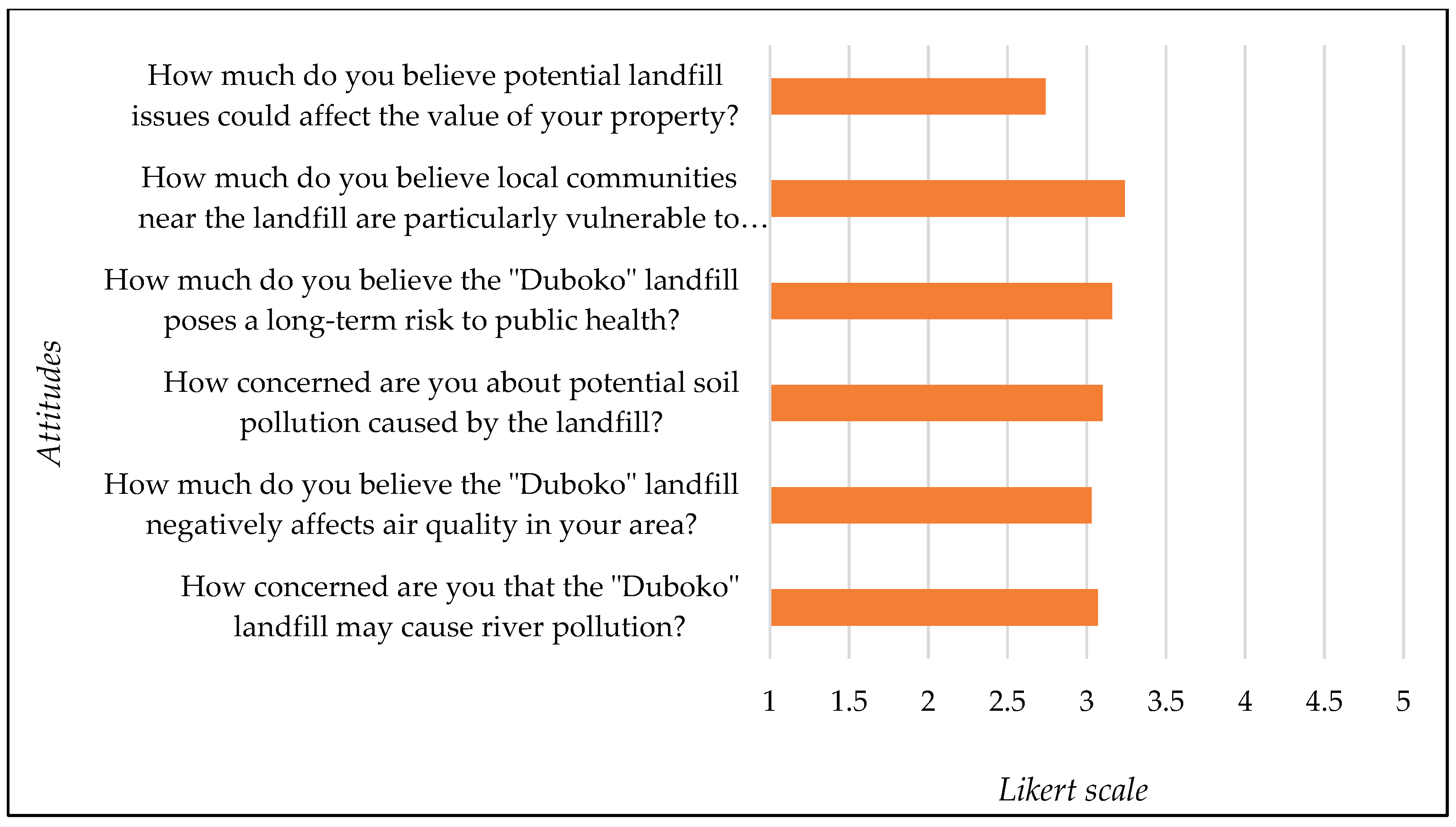
Notably, the highest average score emerged for the statement, “Local communities near the landfill are particularly vulnerable to risks associated with it” (M = 3.24, SD = 1.25), highlighting a strong perception among respondents that those living closest to the “Duboko” landfill face elevated environmental risks. Similarly high scores were observed in responses to items regarding long-term health hazards (M = 3.16, SD = 1.13) and concerns about soil pollution (M = 3.10, SD = 1.17), indicating widespread public unease about the landfill’s potential long-term effects on both ecological and human health.
Moderate levels of concern were also reflected in scores related to river contamination (M = 3.07, SD = 1.16) and air quality decline (M = 3.03, SD = 1.23), suggesting a broader awareness of environmental impacts stemming from the landfill.
By contrast, the lowest average score appeared for the statement, “Potential landfill issues could affect the value of your property” (M = 2.74, SD = 1.76), indicating that while environmental and health issues weigh heavily in public opinion, economic concerns—especially regarding personal property—are viewed as less significant. The overall scale average (M = 3.06, SD = 1.30) reflects a generally elevated sense of risk and awareness about the landfill’s environmental repercussions (Table 3).
Figure 3.
Descriptive statistics of youth perceptions of personal safety.
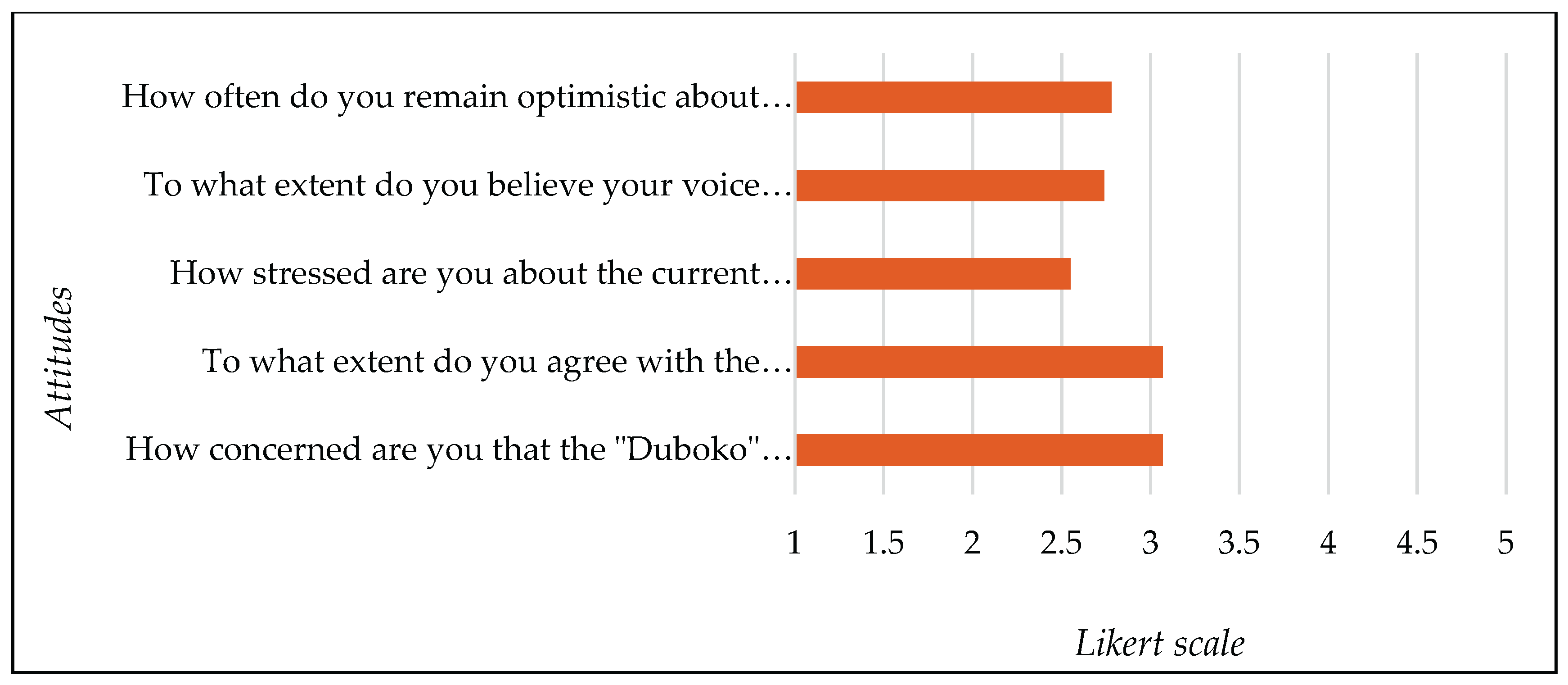
The highest average score in this group was linked to the statement, “You can influence solving the ‘Duboko’ landfill problem” (M = 3.07, SD = 2.24), indicating a moderate sense of personal agency among respondents. However, the relatively large standard deviation points to considerable variation in how individuals perceive their influence over environmental outcomes.
At the opposite end, the lowest agreement was recorded for the item, “How stressed are you about the current situation with the ‘Duboko’ landfill?” (M = 2.55, SD = 1.29), suggesting that while the issue is recognised, the emotional stress it triggers remains relatively low. Respondents also provided moderate ratings regarding their perception of how effective they feel their voice is in addressing the problem (M = 2.74, SD = 1.22) and their ability to remain optimistic about potential solutions (M = 2.78, SD = 1.07).
Taken together, the average score for this set of psychological indicators (M = 2.78, SD = 1.53) portrays a cautious equilibrium between perceived control, emotional involvement, and hopefulness. However, the broad range of responses reveals varied psychological engagement across the population (Table 4).
Figure 4.
Descriptive statistics on psychological responses and perceived control.
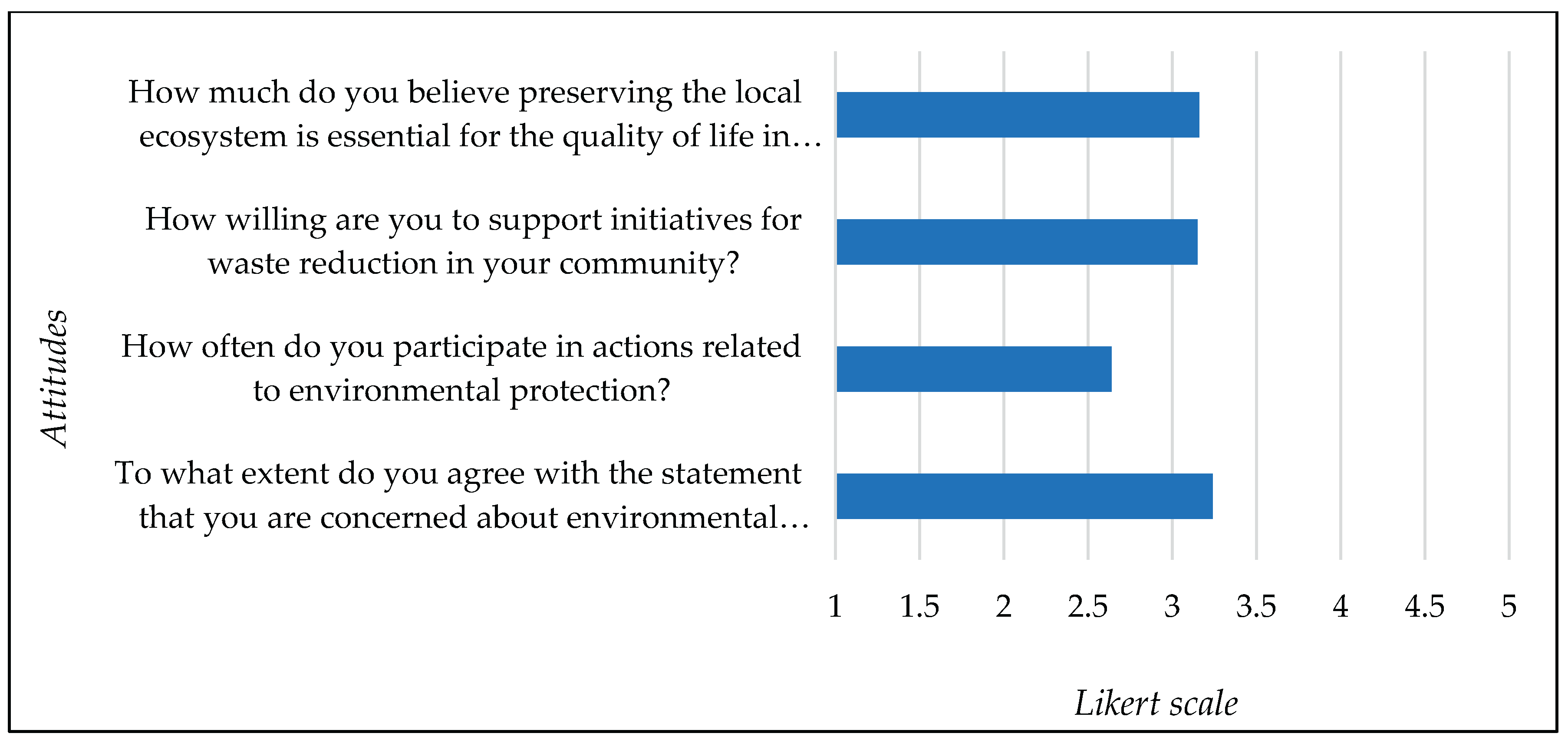
The strongest agreement in this group was recorded for the statement, “Preserving the local ecosystem is essential for the quality of life in your community” (M = 3.16, SD = 1.10), closely followed by concern for environmental protection (M = 3.24, SD = 1.17) and support for local waste reduction efforts (M = 3.15, SD = 1.14). These results reflect a clear orientation toward valuing ecological preservation and sustainable community initiatives.
In contrast, the statement regarding “Participation in actions related to environmental protection” received the lowest mean score (M = 2.64, SD = 1.49), indicating that although pro-environmental attitudes are prevalent, actual engagement in related activities is less consistent. The higher standard deviation further suggests considerable differences in civic involvement across respondents.
Overall, the composite score for this set (M = 3.05, SD = 1.23) indicates broadly positive environmental values, although it also highlights a moderate gap between concern and direct action (Table 5).
Figure 5.
Descriptive statistics on environmental values and engagement.
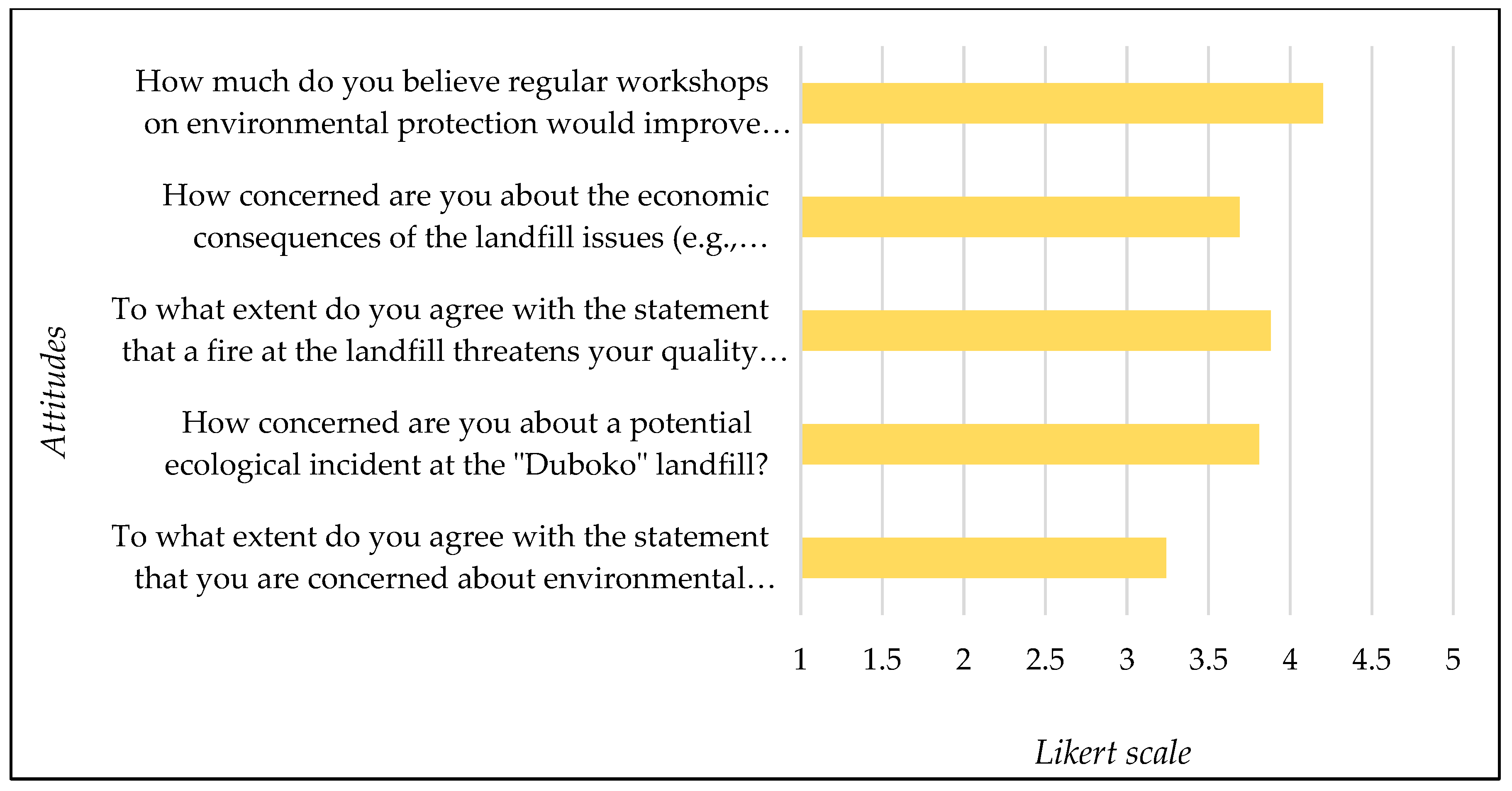
The highest average score within this group was associated with the statement, “Regular workshops on environmental protection would improve your understanding of landfill issues” (M = 4.20, SD = 0.93), indicating a strong perceived need for educational initiatives that enhance public knowledge and engagement. Nearly as high was the belief that “A fire at the landfill threatens your quality of life” (M = 3.88, SD = 1.11), indicating widespread concern over potential environmental emergencies.
Respondents also expressed considerable apprehension about potential ecological incidents (M = 3.81, SD = 1.21) and the economic consequences of landfill-related problems, including their impact on agriculture and tourism (M = 3.69, SD = 1.21). These findings suggest that the public recognises not only immediate environmental risks but also broader socioeconomic impacts associated with the landfill.
The overall mean score (M = 3.89, SD = 1.12) for this set points to a heightened awareness of both current and future threats from the “Duboko” landfill, reinforcing the public’s call for better preparedness, transparency, and environmental education (Table 6).
Figure 6.
Descriptive statistics on the perception of disaster and potential threats.
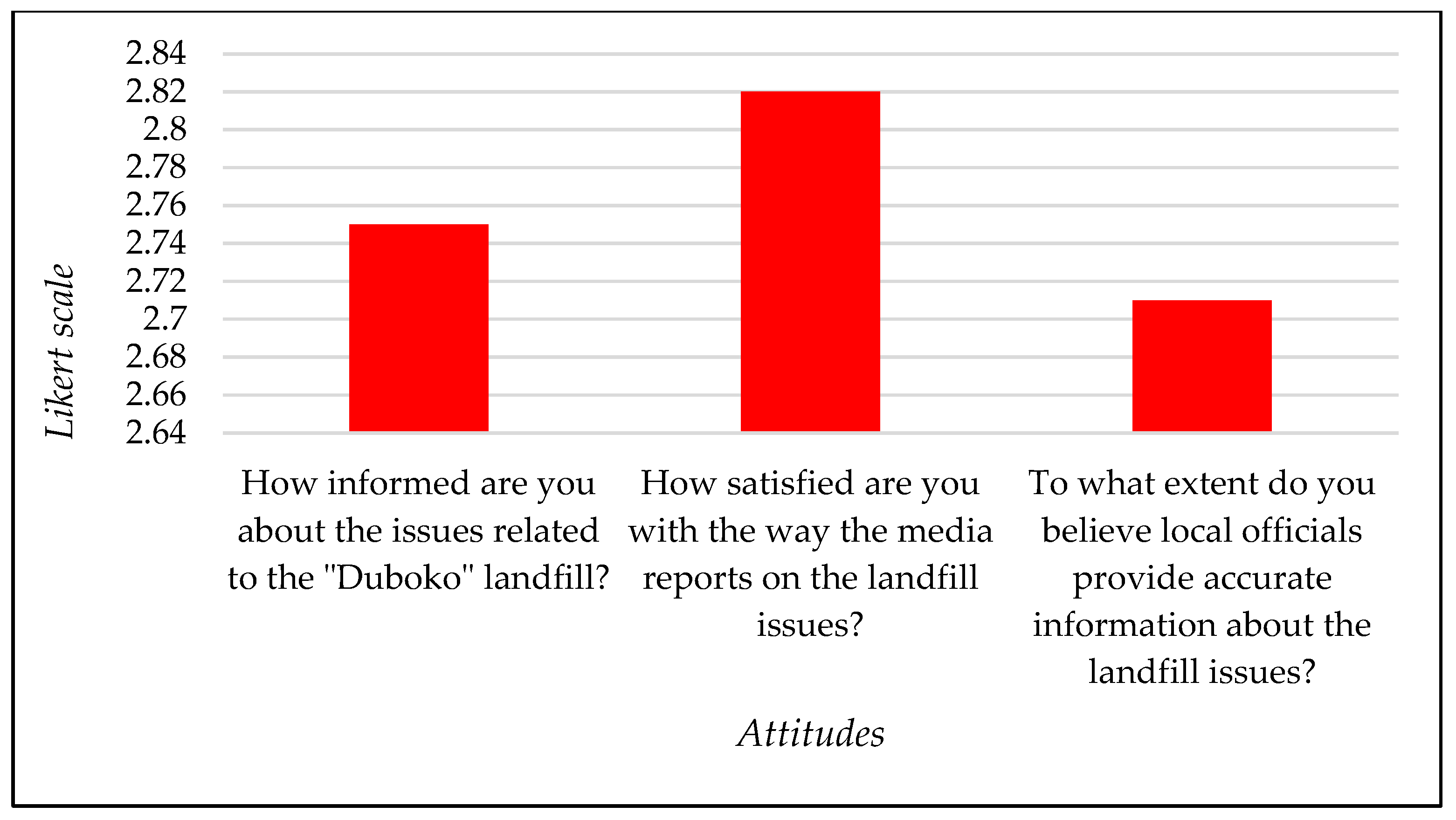
The results revealed moderate levels of institutional confidence, with the highest mean score attributed to the statement "Satisfaction with the way the media reports on the landfill issues" (M = 2.82, SD = 1.22), indicating a slightly more favourable perception of media coverage compared to other information sources. Perceptions of being well-informed about the landfill (M = 2.75, SD = 1.21) and trust in the accuracy of information provided by local officials (M = 2.71, SD = 1.21) remained consistently moderate.
Although none of the items reflects strong institutional trust or confidence, the overall composite score (M = 2.76, SD = 1.21) suggests a cautious, possibly sceptical public stance toward the adequacy and credibility of information dissemination regarding the “Duboko” landfill issue. The uniformity of standard deviations across items further points to a stable but moderately low level of institutional trust within the sample (Table 7).
Figure 8.
Descriptive statistics on perceptions of information, media, and communication.
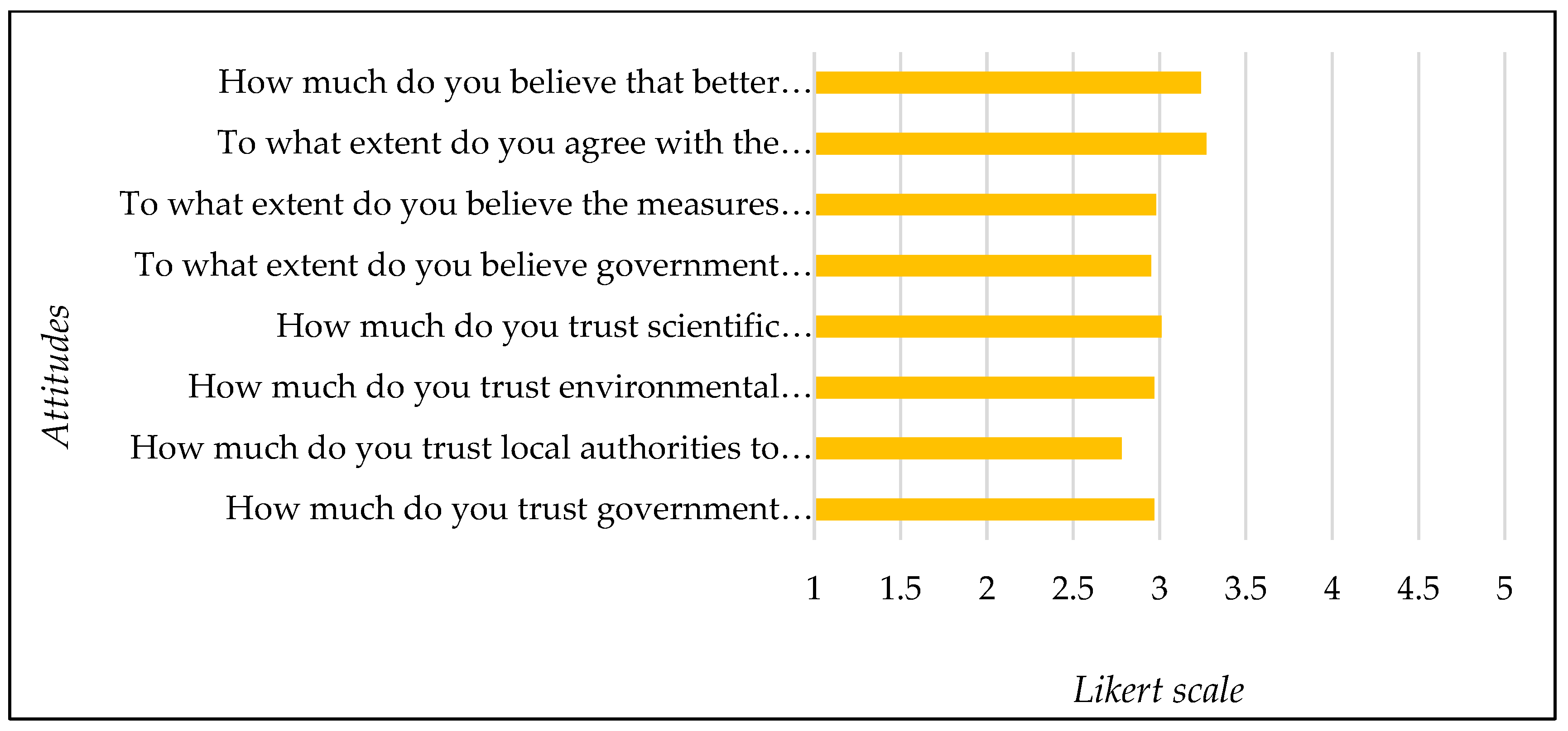
Among the surveyed items, the highest average score was noted for the statement, “Greater transparency of institutions would increase your trust” (M = 3.27, SD = 1.11), indicating a broad belief that openness plays a crucial role in strengthening public trust. Respondents also showed relatively strong agreement with the statement, “Better public information would reduce citizens' concerns” (M = 3.24, SD = 1.18), indicating that improved communication is perceived as a crucial way to alleviate public concerns about the landfill situation.
Moderate levels of trust were recorded for scientific institutions (M = 3.01, SD = 1.25), national environmental inspectors (M = 2.97, SD = 1.49), and government institutions (M = 2.97, SD = 1.26), suggesting a steady but cautious confidence in these bodies. Trust in local authorities was somewhat lower (M = 2.78, SD = 1.22), possibly reflecting reservations about their ability to manage the issue effectively.
Ratings for institutional clarity (M = 2.98, SD = 1.21) and transparency (M = 2.95, SD = 1.34) mirrored the overall trust pattern, further underscoring a moderate stance.
The overall composite score (M = 3.02, SD = 1.26) reflects a view that, while generally optimistic, remains critical, highlighting the potential for institutions to build greater trust through more transparent communication and openness (Table 8).
Figure 8.
Descriptive statistics on perceptions of institutional confidence and trust in security policy.
Figure 8.
Descriptive statistics on perceptions of institutional confidence and trust in security policy.
3.2. Correlations and Effects of Socio-Demographic Factors on Disaster Risk Perception and Community Resilience
3.2.1. Group Differences in Perceptions of Disaster Risk Perception and Community Resilience: Independent Samples T-Test Results
The study uncovered notable gender-related differences in how individuals perceive and respond to environmental risks tied to the “Duboko” landfill. Women reported significantly higher stress levels regarding the landfill (M = 2.69, SD = 1.25) than men (M = 2.42, SD = 1.32), a difference that proved highly significant (t = -3.613, p < 0.001). This points to a heightened emotional response among women when confronted with environmental threats.
Participation in environmental protection efforts also differed by gender. Women reported greater involvement (M = 2.74, SD = 1.70) than men (M = 2.53, SD = 1.21), with the difference reaching statistical significance (t = -2.45, p = 0.014). These results echo prior research indicating that women are often more engaged in ecological and civic initiatives.
Views on environmental education revealed further contrasts. Women were more inclined to believe that workshops enhance understanding (M = 3.04, SD = 1.05) compared to men (M = 2.91, SD = 1.12), a difference that was statistically significant (t = -2.094, p = 0.036). They also demonstrated higher awareness of landfill-related issues (M = 2.84, SD = 1.16) than their male counterparts (M = 2.65, SD = 1.25), as supported by the data (t = -2.698, p = 0.007).
Another key difference appeared in perceptions of local authorities. Women showed greater trust in the accuracy of information provided by regional officials (M = 2.82, SD = 1.15) compared to men (M = 2.60, SD = 1.26), with statistical analysis confirming the gap (t = -3.119, p = 0.002).
In contrast, no significant gender differences were observed in other areas, such as institutional trust, transparency, pollution concerns, or fears about property value decline. These findings suggest a broadly shared baseline of concern and understanding across genders. In summary, women tend to display stronger emotional, informational, and participatory engagement with environmental and public health challenges. These distinctions offer essential insights for tailoring communication strategies and shaping inclusive community outreach efforts (Table 9).
Apparent differences emerged between urban and rural residents in how they perceive and respond to environmental risks associated with the “Duboko” landfill. Rural respondents expressed significantly stronger concern for environmental protection (M = 3.46, SD = 1.12) than their urban counterparts (M = 3.10, SD = 1.18), with the difference being highly significant (t = −5.234, p < 0.001). This heightened awareness was reflected across a range of indicators.
For instance, rural participants felt more capable of influencing landfill-related outcomes (M = 3.30, SD = 3.23) compared to urban residents (M = 2.91, SD = 1.18; t = −2.995, p = 0.003). They also reported higher stress related to the landfill (M = 2.66) than those in urban areas (M = 2.49; t = −2.263, p = 0.024). Concerns were particularly elevated among rural respondents regarding river pollution (M = 3.22 vs 2.97; p < 0.001), air quality (M = 3.17 vs 2.94; p = 0.002), soil contamination (M = 3.27 vs. 3.00; p < 0.001), and potential health impacts (M = 3.35 vs. 3.03; p < 0.001).
Trust in institutions and perceptions of transparency also varied. Rural residents showed higher confidence in government institutions (M = 3.15 vs 2.85; p < 0.001), local authorities (M = 2.91 vs 2.70; p = 0.003), environmental inspectors (M = 3.22 vs 2.80; p < 0.001), and scientific bodies (M = 3.12 vs 2.94; p = 0.015). They were more inclined to view government actions as transparent (M = 3.14 vs. 2.83; p < 0.001) and believed such transparency could build public trust (M = 3.44 vs. 3.15; p < 0.001).
Communication also played a role. Rural respondents were more likely to agree that improved public communication would alleviate concerns (M = 3.46 vs. 3.11; p < 0.001), and they perceived communities near the landfill as being especially vulnerable (M = 3.46 vs. 3.10; p < 0.001). They also viewed landfill problems as having a more direct impact on property values (M = 2.90 vs. 2.64; p = 0.013).
In terms of environmental action, rural participants expressed more substantial support for waste reduction efforts (M = 3.35 vs. 3.02; p < 0.001) and more strongly endorsed the importance of protecting the local ecosystem for quality of life (M = 3.28 vs. 3.08; p = 0.002). They were also more optimistic about the potential for resolving landfill-related problems (M = 2.87 vs. 2.72; p = 0.025).
Taken together, the data indicate that rural communities are more deeply engaged—emotionally, cognitively, and behaviorally—across nearly all aspects of environmental risk perception and trust in institutional response. These insights highlight the need for targeted communication and participatory approaches that reflect the heightened concerns and increased engagement levels of rural residents (Table 10).
3.2.2. Correlational Analysis of Demographic and Socioeconomic Predictors of Disaster Risk Perception and Community Resilience
While the correlations between income and survey items are generally weak, several statistically significant relationships were found. Higher income correlated positively with a greater perceived influence in addressing the landfill issue (r = 0.097, p ≤ 0.05), a stronger belief in the adequacy of fire protection measures (r = 0.069, p ≤ 0.05), and increased satisfaction with media coverage (r = 0.108, p ≤ 0.01). Moreover, trust in government (r = 0.107, p ≤ 0.01) and in scientific institutions (r = 0.103, p ≤ 0.01) also displayed significant positive correlations. These results imply that individuals with higher incomes might feel more empowered and informed, potentially due to higher educational levels or better access to information. As a result, they demonstrate greater confidence in the responses from institutions and in communication strategies. Conversely, income displayed a weak but significant negative correlation with civic participation indicators, such as support for citizen associations (r = –0.096, p ≤ 0.05) and a willingness to engage in waste reduction initiatives (r = –0.097, p ≤ 0.05), indicating a possible disengagement from grassroots environmental activism among wealthier respondents.
While significant correlations associated with proximity to the landfill were few, they were meaningful. A negative correlation was found between distance and participation in environmental protection activities (r = –0.086, p ≤ 0.05), suggesting that individuals living nearer to the landfill are more likely to take part in environmental efforts. Furthermore, distance also showed a negative association with being well-informed about landfill issues (r = –0.064, p ≤ 0.05), supporting the idea that those who are geographically closer perceive these issues as more relevant, exposed, and aware. These findings support the “proximity hypothesis,” which suggests that people living closer to a risk source often experience heightened salience and stronger emotional reactions, possibly prompting them to engage more in action and seek information.
Age showed the most consistent and statistically significant pattern of associations. Older respondents indicated notably higher levels of concern and awareness across a variety of issues, including worries about environmental protection (r = 0.188, p ≤ 0.01), stress related to the landfill (r = 0.192, p ≤ 0.01), and belief in health risks (r = 0.164, p ≤ 0.01). The strongest correlation in the dataset was between age and the perceived sufficiency of fire protection measures (r = 0.214, p ≤ 0.01). Positive correlations between age and trust in institutions (for example, r = 0.158 for government entities) suggest that older individuals may have a higher level of confidence in formal systems. Additionally, older respondents expressed more optimism about addressing landfill issues and were more likely to view transparency and effective communication as factors that enhance trust. This may stem from older individuals having more experience with bureaucratic processes and greater familiarity with long-term environmental discussions, potentially leading to heightened risk awareness and belief in institutions' ability to solve problems (Table 13).

Table 11.
Pearson’s correlation results for the relationship between six thematic subsections variables and their age (n = 1.180).
Table 11.
Pearson’s correlation results for the relationship between six thematic subsections variables and their age (n = 1.180).
| Variables | Income (r) | Distance from landfill (r) | Age (r) |
|---|---|---|---|
| Concern about environmental protection | −0.027 | 0.019 | 0.188** |
| Participation in environmental protection actions | 0.064* | −0.086* | 0.114** |
| Belief in the ability to influence solving the 'Duboko' landfill problem | 0.097* | 0.02 | 0.093* |
| Stress level due to the 'Duboko' landfill | −0.028 | −0.102** | 0.192** |
| The belief that your voice contributes to solving the problem | 0.074* | 0.003 | 0.153** |
| Concern about river pollution from the landfill | 0.001 | −0.024 | 0.174** |
| The belief that landfill negatively affects air quality | 0.043 | −0.031 | 0.163** |
| Concern about soil pollution caused by the landfill | −0.021 | −0.019 | 0.202** |
| The belief that landfill is a health risk | −0.03 | −0.03 | 0.164** |
| Concern about the long-term consequences of a fire at the landfill | −0.039 | 0.009 | 0.161** |
| Adequacy of fire protection measures at the landfill | 0.069* | 0.003 | 0.214** |
| Concern about potential health issues linked to the landfill | 0.00 | −0.016 | 0.152** |
| The belief that landfill worsens environmental quality | 0.023 | −0.037 | 0.129** |
| Concern about potential ecological incidents at the landfill | −0.041 | 0.004 | 0.128** |
| The belief that fire at the landfill threatens the quality of life | −0.065* | -0.017 | 0.163** |
| Concern about the economic consequences of the landfill | −0.014 | 0.023 | 0.161** |
| Support for citizen association activities | −0.096* | −0.019 | 0.155** |
| The usefulness of initiatives to solve landfill problems | −0.018 | −0.009 | 0.161** |
| Level of information on landfill-related problems | 0.013 | −0.064* | 0.140** |
| Satisfaction with media reporting on landfill issues | 0.108** | -0.016 | 0.171** |
| The belief that local officials provide accurate information | −0.015 | -0.049 | 0.128** |
| Trust in government institutions to solve the landfill issue | 0.107** | 0.009 | 0.158** |
| Trust in local authorities to solve the problem | −0.016 | −0.034 | 0.128** |
| Trust in Environmental Protection inspectors | 0.038 | −0.005 | 0.174** |
| Trust in scientific institutions addressing landfill issues | 0.103** | −0.044 | 0.137** |
| The belief that institutions are transparent about landfill issues | 0.057* | 0.001 | 0.132** |
| The belief that institutions take clear and practical measures | 0.089* | 0.01 | 0.183** |
| The belief that transparency would increase trust | 0.006 | 0.007 | 0.175** |
| The belief that better information reduces public concern | 0.04 | −0.01 | 0.150** |
| Belief that local communities near landfills are vulnerable | −0.029 | 0.013 | 0.114** |
| The belief that landfill issues affect property value | −0.051 | −0.051 | 0.107** |
| Willingness to support waste reduction initiatives | −0.097* | 0.000 | 0.126** |
| The belief that preserving the ecosystem is key to quality of life | −0.021 | −0.016 | 0.166** |
| Optimism about solving landfill problems | 0.026 | −0.045 | 0.166** |
| The belief that workshops improve understanding of landfill issues | 0.036 | −0.053 | 0.128** |
Note: * p ≤ 0.05; ** p ≤ 0.01.
3.2.3. ANOVA Analysis of Sociodemographic Determinants of Disaster Risk Perception and Community Resilience
The results of the ANOVA analysis indicate that education level has a significant impact on how people perceive environmental risks, trust institutions, and engage in civic activities related to the “Duboko” landfill. One of the clearest findings relates to perceptions of institutional transparency. Participants with a secondary education reported the highest levels of perceived transparency in state institutions (M = 3.06, SD = 1.18), followed closely by those with higher education (M = 3.01, SD = 1.57). Interestingly, those without any formal education (M = 2.42, SD = 1.56) and individuals with postgraduate degrees (M = 2.62, SD = 1.13) expressed noticeably lower perceptions of transparency (F(4, 1191) = 4.59, p = 0.001).
A similar pattern emerged when looking at trust in state institutions. Again, individuals with secondary (M = 3.07, SD = 1.25) and higher education (M = 3.02, SD = 1.21) expressed more trust, whereas respondents without formal education (M = 2.67, SD = 1.67) and those with advanced degrees (M = 2.65, SD = 1.01) appeared more sceptical (F(4, 1192) = 3.34, p = 0.010). This trend was mirrored in levels of trust in environmental inspectors (F(4, 1192) = 3.73, p = 0.005), where participants with secondary education (M = 3.08, SD = 1.63) and higher education (M = 2.95, SD = 1.16) again reported the highest trust, while the extremes of the educational scale showed the lowest levels.
Education level had a significant influence on participation in environmental protection efforts (F(4, 1193) = 4.527, p = 0.001). Individuals with higher education reported the most active involvement (M = 2.79, SD = 1.19), followed closely by those with secondary education (M = 2.65, SD = 1.20). In contrast, participation was notably lower among respondents with only primary education (M = 2.33, SD = 1.06) and those without formal education (M = 2.29, SD = 1.08), suggesting a clear divide in civic engagement tied to educational background. The belief that one’s voice can help address the landfill issue also varied significantly depending on education (F(4, 1192) = 4.277, p = 0.002). Respondents with secondary (M = 2.85, SD = 1.27) and higher education (M = 2.81, SD = 1.16) were more likely to feel their input mattered, whereas those without formal schooling were the least hopeful (M = 2.22, SD = 1.07).
Perceptions of the landfill's negative environmental impact differed across educational groups as well (F(4, 1193) = 4.535, p = 0.001). People with higher education (M = 3.21, SD = 1.11) and those with secondary education (M = 3.09, SD = 1.09) viewed the landfill as more harmful, while those without formal education rated its impact less severely (M = 2.66, SD = 1.21). Further, concern over the landfill's economic consequences also showed a significant link to education level (F(4, 1193) = 4.611, p = 0.001). The strongest concerns were expressed by respondents with secondary (M = 3.10, SD = 1.11) and higher education (M = 3.03, SD = 1.08), while those without any formal education were the least concerned (M = 2.52, SD = 1.22). Next, satisfaction with how the media covers landfill-related issues varied significantly (F(4, 1190) = 6.288, p < 0.001). Respondents with higher education expressed greater satisfaction (M = 2.93, SD = 1.20), whereas individuals lacking formal education reported lower satisfaction levels (M = 2.34, SD = 1.21), pointing to potential disparities in media literacy or access to quality information.
Additionally, trust in the accuracy of information provided by local officials was influenced by education (F(4, 1190) = 3.210, p = 0.012). The highest trust levels were found among those with secondary education (M = 2.80, SD = 1.22), while those without education again reported the lowest trust (M = 2.26, SD = 1.26). Although overall trust in local authorities approached but did not reach statistical significance (F(4, 1192) = 2.052, p = 0.085), the trend still aligned with previous findings—respondents with secondary and higher education generally expressed more confidence than others.
Lastly, while education did not significantly affect concern over ecological incidents linked to the landfill (F(4, 1193) = 1.428, p = 0.222), employment status did show a significant impact (F = 4.946, p = 0.000), so further breakdowns by education aren’t needed here.
The usefulness of civic initiatives was also rated differently across education groups (F(4, 1192) = 2.88, p = 0.022). Respondents with higher education were most likely to view such initiatives as valuable (M = 3.10, SD = 1.07), with slightly lower ratings among those with secondary education (M = 2.98, SD = 1.03). In contrast, those with postgraduate degrees were the most sceptical (M = 2.68, SD = 1.22). Willingness to support local waste reduction initiatives followed a similar pattern (F(4, 1193) = 3.41, p = 0.009), with respondents holding higher education expressing the strongest support (M = 3.26, SD = 1.10) and those without formal education the least (M = 2.83, SD = 1.40).
Other dimensions also showed meaningful variation. Concern about river pollution was significantly influenced by education level (F(4, 1193) = 2.45, p = 0.044), with the highest concern expressed by respondents with higher education (M = 3.19, SD = 1.10) and the lowest by those with postgraduate degrees (M = 2.62, SD = 1.18). Similarly, education level shaped perceptions of the long-term consequences of a potential fire at the landfill (F(4, 1192) = 2.85, p = 0.024) and levels of trust in scientific institutions (F(4, 1192) = 3.17, p = 0.013), again highlighting a pattern where those with moderate education tend to express greater confidence than those at either end of the educational spectrum.
However, not all variables showed statistically significant differences. For example, levels of general concern for the environment (F(4, 1193) = 1.65, p = 0.162), stress caused by the landfill (F(4, 1193) = 1.29, p = 0.274), and the belief that one’s voice can contribute to solving the landfill problem (F(4, 1192) = 1.22, p = 0.302) were relatively uniform across educational levels. The average scores for these dimensions ranged from M = 2.50 to M = 3.42, suggesting a broadly shared perception regardless of formal education.
Overall, these findings highlight the significant role that education plays in shaping individuals' environmental perceptions and their trust in institutions. Individuals with secondary and higher education tend to express more trust, greater civic optimism, and more substantial support for local environmental initiatives. Meanwhile, those at the lower and upper ends of the educational spectrum appear more skeptical, disengaged, or ambivalent. These insights underscore the importance of tailoring communication and engagement efforts to distinct educational groups when developing strategies to foster public trust and encourage participation in environmental problem-solving.
Further ANOVA results indicate that employment status plays a significant role in shaping how individuals perceive environmental issues, trust institutions, and engage civically concerning the “Duboko” landfill. Differences across employment groups were statistically significant across a wide range of variables.
Environmental protection concern showed notable variation (F = 9.640, p < 0.001), with pensioners (M = 3.65, SD = 1.23) and seasonal workers (M = 3.73, SD = 0.99) reporting higher levels of concern than unemployed individuals (M = 2.87, SD = 1.27). Participation in environmental activities also differed by employment (F = 7.268, p < 0.001), with pensioners (M = 3.04, SD = 1.39) and part-time workers (M = 2.84, SD = 1.20) more involved than the unemployed (M = 2.39, SD = 1.12).
Belief in personal ability to contribute to solving the landfill issue was significantly stronger among full-time employees (M = 3.25, SD = 2.86) and pensioners (M = 3.36, SD = 1.35), compared to the unemployed (M = 2.37, SD = 1.19; F = 4.841, p < 0.001). Similarly, the belief that one’s voice matters (F = 8.135, p < 0.001) was highest among pensioners (M = 3.16, SD = 1.45) and seasonal workers (M = 3.22, SD = 1.21) and lowest among unemployed respondents (M = 2.38, SD = 1.25).
Stress linked to the landfill was significantly higher among pensioners (M = 3.06, SD = 1.47) and seasonal workers (M = 3.14, SD = 1.38), while unemployed individuals reported lower stress (M = 2.37, SD = 1.24; F = 9.383, p < 0.001). This trend was echoed in concern over river pollution (F = 10.529, p < 0.001), where pensioners (M = 3.40, SD = 1.14) and seasonal workers (M = 3.39, SD = 1.10) again showed more concern than the unemployed (M = 2.78, SD = 1.15).
Concern for air pollution also varied significantly (F = 8.519, p < 0.001), with higher values among pensioners (M = 3.40, SD = 1.26) and seasonal workers (M = 3.38, SD = 1.21), as compared to the unemployed (M = 2.80, SD = 1.23). Concern about soil contamination (F = 10.711, p < 0.001) followed a similar pattern, with pensioners showing the highest concern (M = 3.36, SD = 1.20) and the unemployed reporting the lowest (M = 2.76, SD = 1.14). Health-related concerns were also significantly higher among pensioners and seasonal workers across several measures: general health risk (F = 7.090, p < 0.001), potential fire consequences (F = 7.511, p < 0.001), and adequacy of fire protection (F = 12.018, p < 0.001). Concerns about specific health problems were also more pronounced among pensioners (M = 3.19, SD = 1.30) compared to the unemployed (M = 2.58, SD = 1.12; F = 5.136, p < 0.001).
Pensioners and seasonal workers were more likely to view the landfill as degrading the environment (F = 6.845, p < 0.001) and more strongly believed that a landfill fire would impact the quality of life (F = 8.496, p < 0.001). Employment status also shaped institutional trust. Pensioners and seasonal workers showed higher trust in environmental inspectors (F = 7.674, p < 0.001) and scientific institutions (F = 6.840, p < 0.001), while the unemployed expressed the least trust. Similar trends were observed in trust toward government institutions (F = 7.606, p < 0.001), where pensioners (M = 3.27, SD = 1.35) and full-time workers (M = 3.10, SD = 1.22) showed higher levels of trust compared to unemployed respondents (M = 2.59, SD = 1.28).
Views on institutional transparency (F = 7.056, p < 0.001) and the effectiveness of government measures (F = 8.946, p < 0.001) also differed significantly, with employed and retired groups expressing greater confidence than the unemployed or those in irregular jobs.
Employment status further influenced civic participation. Support for citizen associations (F = 7.379, p < 0.001) was more prevalent among pensioners (M = 3.28, SD = 1.23) and part-time workers (M = 3.22, SD = 1.19). The perceived usefulness of civic initiatives (F = 8.275, p < 0.001) was especially recognised by the employed and retired. Media satisfaction (F = 7.915, p < 0.001) and belief in the accuracy of information from local officials (F = 6.813, p < 0.001) were also highest among full-time workers and pensioners and lowest among unemployed respondents.
Finally, access to information on landfill issues varied significantly by employment status (F = 8.256, p < 0.001), with retirees and employed individuals feeling better informed than those who were unemployed.
Overall, these findings underscore the significance of employment status as a key factor influencing people’s engagement, trust, and awareness of environmental issues. Pensioners and those with stable employment appear more informed, more engaged, and more trusting of institutions—while unemployed individuals tend to report lower levels of concern, participation, and perceived influence. This suggests that future interventions must be sensitive to employment-related disparities to address community responses to environmental challenges effectively.
Table 12.
One-way ANOVA results examine the relationship between socio-economic characteristics (education, employment, property ownership, household size) and selected variables (n = 1.180).
Table 12.
One-way ANOVA results examine the relationship between socio-economic characteristics (education, employment, property ownership, household size) and selected variables (n = 1.180).
| Variables | Education | Employment | Property Ownership | Household Members | ||||
| F | p | F | p | F | p | F | p | |
| Concern about environmental protection | 3.722 | 0.005 | 9.64 | 0.000 | 27.36 | 0.000 | 2.307 | 0.075 |
| Participation in environmental protection actions | 4.527 | 0.001 | 7.268 | 0.000 | 0.289 | 0.749 | 1.072 | 0.36 |
| Belief in the ability to influence solving the 'Duboko' landfill problem | 5.374 | 0.000 | 4.841 | 0.000 | 2.089 | 0.124 | 1.853 | 0.136 |
| Stress level due to the 'Duboko' landfill | 1.268 | 0.281 | 9.383 | 0.000 | 1.604 | 0.202 | 4.853 | 0.002 |
| The belief that your voice contributes to solving the problem | 4.277 | 0.002 | 8.135 | 0.000 | 3.488 | 0.031 | 0.471 | 0.703 |
| Concern about river pollution from the landfill | 5.755 | 0.000 | 10.529 | 0.000 | 13.176 | 0.000 | 2.692 | 0.045 |
| The belief that landfill negatively affects air quality | 7.85 | 0.000 | 8.519 | 0.000 | 6.898 | 0.001 | 2.086 | 0.1 |
| Concern about soil pollution caused by the landfill | 4.133 | 0.002 | 10.711 | 0.000 | 13.811 | 0.000 | 2.643 | 0.048 |
| The belief that landfill is a health risk | 3.451 | 0.008 | 7.09 | 0.000 | 16.302 | 0.000 | 2.932 | 0.033 |
| Concern about the long-term consequences of a fire at the landfill | 3.56 | 0.007 | 7.511 | 0.000 | 22.946 | 0.000 | 2.837 | 0.037 |
| Adequacy of fire protection measures at the landfill | 3.944 | 0.003 | 12.018 | 0.000 | 4.834 | 0.008 | 1.716 | 0.162 |
| Concern about potential health issues linked to the landfill | 2.198 | 0.067 | 5.136 | 0.000 | 6.609 | 0.001 | 2.556 | 0.054 |
| The belief that landfill worsens environmental quality | 4.535 | 0.001 | 6.845 | 0.000 | 4.716 | 0.009 | 0.339 | 0.797 |
| Concern about potential ecological incidents at the landfill | 1.428 | 0.222 | 4.946 | 0.000 | 2.313 | 0.099 | 2.378 | 0.068 |
| The belief that fire at the landfill threatens the quality of life | 3.092 | 0.015 | 8.496 | 0.000 | 11.513 | 0.000 | 2.215 | 0.085 |
| Concern about the economic consequences of the landfill | 4.611 | 0.001 | 7.997 | 0.000 | 9.193 | 0.000 | 2.049 | 0.105 |
| Support for citizen association activities | 1.794 | 0.128 | 7.379 | 0.000 | 5.163 | 0.006 | 4.416 | 0.004 |
| The usefulness of initiatives to solve landfill problems | 2.658 | 0.032 | 8.275 | 0.000 | 3.564 | 0.029 | 2.518 | 0.057 |
| Level of information on landfill-related problems | 3.644 | 0.006 | 8.256 | 0.000 | 2.44 | 0.088 | 2.251 | 0.081 |
| Satisfaction with media reporting on landfill issues | 6.288 | 0.000 | 7.915 | 0.000 | 5.092 | 0.006 | 2.868 | 0.035 |
| The belief that local officials provide accurate information | 3.21 | 0.012 | 6.813 | 0.000 | 0.387 | 0.679 | 1.161 | 0.324 |
| Trust in government institutions to solve the landfill issue | 5.415 | 0.000 | 7.606 | 0.000 | 8.847 | 0.000 | 7.353 | 0.000 |
| Trust in local authorities to solve the problem | 2.052 | 0.085 | 6.368 | 0.000 | 0.93 | 0.395 | 2.338 | 0.072 |
| Trust in Environmental Protection inspectors | 3.354 | 0.01 | 7.674 | 0.000 | 5.634 | 0.004 | 3.835 | 0.01 |
| Trust in scientific institutions addressing landfill issues | 8.585 | 0.000 | 6.84 | 0.000 | 11.246 | 0.000 | 5.825 | 0.001 |
| The belief that institutions are transparent about landfill issues | 6.449 | 0.000 | 7.056 | 0.000 | 10.729 | 0.000 | 3.098 | 0.026 |
| The belief that institutions take clear and practical measures | 4.074 | 0.003 | 8.946 | 0.000 | 17.319 | 0.000 | 3.898 | 0.009 |
Note: * p ≤ 0.05; ** p ≤ 0.01.
The analysis reveals that property ownership has a significant impact on how individuals perceive environmental risks, their trust in institutions, and their level of civic engagement regarding the “Duboko” landfill.
Starting with environmental concerns, property owners expressed notably stronger concern for environmental protection (F = 27.36, p < 0.001; M = 3.40, SD = 1.09) than those without property (M = 2.76, SD = 1.24), suggesting a heightened sense of responsibility or vulnerability. This trend extended to specific environmental issues: concern over river pollution (F = 13.176, p < 0.001), air quality (F = 6.898, p = 0.001), and soil contamination (F = 13.811, p < 0.001) were consistently higher among owners, with means ranging from 3.16 to 3.26, compared to 2.86–2.93 among non-owners.
Health-related perceptions followed a similar pattern. Owners were more likely to believe the landfill poses health risks (F = 16.302, p < 0.001; M = 3.32, SD = 1.13 vs. M = 2.92, SD = 1.16) and expressed greater concern about long-term consequences of a fire (F = 22.946, p < 0.001), potential health impacts (F = 6.609, p = 0.001), and the adequacy of fire protection (F = 4.834, p = 0.008). In all cases, property owners reported higher average concern or confidence.
Property status also shaped broader environmental perceptions. Owners were more likely to believe that the landfill worsens environmental quality (F = 4.716, p = 0.009) and threatens the quality of life in the event of a fire (F = 11.513, p < 0.001), with an average concern consistently above 3.1, compared to under 3.0 among non-owners. Economic concerns also varied significantly (F = 9.193, p < 0.001), with owners expressing greater worry (M = 3.19, SD = 1.08) than those without property (M = 2.92, SD = 1.14), possibly due to perceived risks to property value.
Differences extended to civic and institutional dimensions. Owners were more likely to believe their voice contributes to solving the issue (F = 3.488, p = 0.031) and showed greater support for citizen association activities (F = 5.163, p = 0.006), along with a higher perception of the usefulness of initiatives addressing landfill problems (F = 3.564, p = 0.029). Satisfaction with media coverage also varied (F = 5.092, p = 0.006), with owners receiving higher ratings.
Trust in institutions showed a clear divide. Property owners had significantly more confidence in government institutions (F = 8.847, p < 0.001), environmental inspectors (F = 5.634, p = 0.004), and scientific institutions (F = 11.246, p < 0.001), with average scores consistently higher than those reported by non-owners. Perceptions of institutional transparency (F = 10.729, p < 0.001) and belief in the effectiveness of institutional actions (F = 17.319, p < 0.001) followed the same pattern, with property owners reporting stronger agreement across the board. Together, these findings suggest a consistent trend: individuals who own property tend to be more environmentally concerned, more engaged in civic activities, and more trusting—or at least more attentive—to institutional responses compared to those without property.
Additionally, the ANOVA analysis reveals that the number of people in a household significantly influences how residents perceive environmental threats, institutional trust, and civic engagement regarding the “Duboko” landfill. One of the most apparent distinctions appears in how people experience stress related to landfills. Households with three members report the highest levels of stress (M = 2.73, SD = 1.35), while those with four members report the lowest (M = 2.37, SD = 1.23), a statistically significant difference (F(3, 1186) = 4.853, p = 0.002). Next, concern about river pollution also varies meaningfully by household size (F(3, 1195) = 2.692, p = 0.045), with three-person households expressing the most concern (M = 3.16, SD = 1.15) compared to those living alone (M = 2.82, SD = 1.23). Similar trends are observed with soil contamination (F(3, 1195) = 2.643, p = 0.048), where individuals in three-member households again expressed the highest concern (M = 3.21, SD = 1.20). Perceived health risks associated with the landfill also differed across household sizes (F(3, 1181) = 2.932, p = 0.033), with the highest scores from three-member households (M = 3.20, SD = 1.17) and the lowest from individuals living alone (M = 2.86, SD = 1.13). Concerns about long-term consequences from potential landfill fires showed similar variation (F(3, 1191) = 2.837, p = 0.037), with a peak again among three-member households (M = 3.38, SD = 1.17).
Besides that, trust in government institutions to handle the landfill issue significantly varied as well (F(3, 1195) = 4.416, p = 0.004), with those living alone showing the least trust (M = 2.51, SD = 1.18) and four-member households the most (M = 3.14, SD = 1.18). Furthermore, trust in environmental inspectors followed a similar trend (F(3, 1195) = 2.868, p = 0.035), as four-member households reported higher trust (M = 3.09, SD = 1.13) than single-person households (M = 2.55, SD = 1.15). Perceptions of scientific institutions’ roles also differed (F(3, 1189) = 3.835, p = 0.010), with trust highest among four-member households (M = 3.14, SD = 1.19) and lowest among individuals living alone (M = 2.59, SD = 1.16). There were also notable differences in how clearly and effectively state institutions were seen to act (F(3, 1195) = 3.098, p = 0.026), with larger households again expressing more confidence.
One of the strongest findings was the belief that transparency would improve institutional trust, where agreement increased with household size (F(3, 1195) = 7.353, p < 0.001). Respondents from larger households were also more likely to believe that improved public information would ease citizens' concerns (F(3, 1192) = 3.898, p = 0.009), with concern lowest among those living alone. Support for civic activities led by citizen associations also showed variation (F(3, 1196) = 2.556, p = 0.054), with three-member households again expressing the most support (M = 3.24, SD = 1.23). Taken together, these findings suggest that individuals from larger households—especially those with three or four members—tend to show greater concern for environmental issues, more trust in institutions, and higher engagement in civic matters. In contrast, those living alone consistently report lower levels across these areas.
3.3. Predictors of Perceived Disaster Risk and Community Resilience around the ‘Duboko’ Landfill: Regression Model Analysis
To examine how various socio-demographic, economic, and spatial factors influence residents’ perception of disaster risk and environmental impact, a multivariate linear regression analysis was conducted across six thematic dimensions: (1) risk perception and environmental impact, (2) psychological responses and perceived control, (3) environmental values and civic engagement, (4) perception of disaster and potential threats, (5) disaster preparedness and crisis response, and (6) information, media, and communication. Each model employed a consistent set of independent variables, including gender, education level, settlement type, proximity to the landfill, employment status, property ownership, and number of household members.
The results for each thematic domain are presented in Table 13. Before conducting the regression analyses, the assumptions of normality, linearity, multicollinearity, and homoscedasticity were tested and confirmed, ensuring the robustness and reliability of the models. This methodological rigour strengthens the validity of the findings and supports the credibility of the conclusions drawn from the statistical approach applied in this study.
The multivariate regression analysis on environmental risk perception revealed a statistically significant model (R² = 0.056, Adj. R² = 0.051, F(7, 1192) = 10.15, p < 0.001), indicating that the included predictors collectively explain approximately 5.1% of the variance in perceived environmental risk.
Among the predictors, property ownership emerged as the strongest statistically significant predictor (β = 0.172, t = 5.81, p < 0.001), suggesting that individuals who own additional property perceive environmental risks as more severe. The level of education (β = −0.121, t = −3.92, p < 0.001) and settlement type (β = -0.119, t = −4.12, p < 0.001) also significantly influenced risk perception. Specifically, higher education and living in urban areas were associated with lower perceived environmental risk.
Other significant but weaker predictors included gender (β = −0.062, t = −2.13, p = 0.034) and number of household members (β = −0.058, t = −2.03, p = 0.042), both indicating a slight decrease in risk perception. Variables such as employment status and proximity to potential environmental hazards did not reach statistical significance (p > 0.05). Overall, although the model reached statistical significance, the low R² indicates that a significant portion of the variability in environmental risk perception remains unexplained by the included socio-demographic factors.
To explore how socio-demographic and spatial characteristics influence emotional responses and perceived psychological control related to the ‘Duboko’ Landfill, a multivariate linear regression analysis was conducted. The model, which included seven predictors—gender, education, settlement type, proximity to the landfill, employment status, property ownership, and household size—was statistically significant (R² = 0.030, Adj. R² = 0.024, F(7, 1192) = 5.27, p < 0.001). Although the model explains only 2.4% of the variance in psychological responses, it nevertheless reveals several meaningful relationships.
Among the examined predictors, education, settlement type, and property ownership were found to be statistically significant. Higher education levels were associated with lower levels of psychological distress (β = −0.122, p < 0.001), indicating a greater sense of emotional stability and perceived control among more educated individuals. Similarly, settlement type showed that residents in rural areas experienced more intense psychological responses (β = −0.111, p < 0.001), possibly due to a heightened sense of exposure or limited access to institutional support. In contrast, individuals who own property exhibited stronger emotional reactions (β = 0.073, p = 0.016), likely reflecting a greater sense of personal vulnerability regarding potential environmental consequences.
Other factors, such as gender, employment status, proximity to the landfill, and household size, did not have statistically significant effects in this model. Despite the modest explanatory power, the results highlight the significance of structural vulnerability—specifically, education level, place of residence, and property status—in shaping psychological responses to environmental threats. These findings can inform the design of targeted communication and intervention strategies aimed at strengthening emotional resilience in affected communities.
Table 13.
Results of a multivariate regression analysis concerning six thematic subsections variables (n = 1.180).
Table 13.
Results of a multivariate regression analysis concerning six thematic subsections variables (n = 1.180).
| Predictor Variable |
Risk perception and environmental impact | Psychological Responses and Perceived Control | Environmental values and engagement | Perception of disaster and potential threats | Information, media, and communication | Institutional trust and transparency | ||||||||||||
|---|---|---|---|---|---|---|---|---|---|---|---|---|---|---|---|---|---|---|
| B | SE | β | B | SE | β | B | SE | β | B | SE | β | B | SE | β | B | SE | β | |
| Gender | −0.129 | 0.061 | −0.062* | -0.108 | 0.068 | −0.047 | −0.154 | 0.058 | −0.079* | −0.038 | 0.067 | −0.017 | −0.224 | 0.065 | −0.103** | −0.185 | 0.062 | −0.086* |
| Education | −00.354 | 0.090 | −0.121** | -0.391 | 0.100 | −0.122** | −0.266 | 0.086 | −0.096* | −0.193 | 0.100 | −0.060 | −0.396 | 0.096 | −0.128** | −0.391 | 0.092 | −0.129** |
| Settlement type | −0.253 | 0.061 | −0.119** | -0.258 | 0.068 | −0.111** | −0.219 | 0.059 | −0.109** | −0.260 | 0.068 | −0.112** | −0.079 | 0.065 | −0.036 | −0.310 | 0.063 | −0.142** |
| Proximity | 0.031 | 0.249 | 0.003 | 0.014 | 0.276 | 0.001 | −0.039 | 0.238 | −0.005 | 0.022 | 0.275 | 0.002 | 0.257 | 0.265 | 0.028 | 0.059 | 0.254 | 0.007 |
| Employment status | −0.065 | 0.064 | −0.031 | -0.077 | 0.071 | −0.034 | −0.105 | 0.061 | −0.053 | −0.025 | 0.071 | −0.011 | −0.146 | 0.068 | −0.066* | −0.001 | 0.065 | 0.000 |
| Property ownership status | 0.384 | 0.066 | 0.172** | 0.177 | 0.073 | 0.073* | 0.2056 | 0.063 | 0.121** | 0.253 | 0.073 | 0.104* | 0.204 | 0.071 | 0.087* | 0.360 | 0.068 | 0.157** |
| Number of household members | −0.203 | 0.100 | −0.058* | −0.177 | 0.111 | −0.046 | −0.181 | 0.096 | −0.055 | −0.284 | 0.111 | −0.074* | −0.187 | 0.107 | −0.051 | −0.478 | 0.102 | −0.132** |
| R2 () | 0.056 (0.051) | 0.035 (0.024) | 0.037 (0.032) | 0.030 (0.024) | 0.031 (0.026) | 0.074 (0.069) | ||||||||||||
* p ≤ 0.05; ** p ≤ 0.01; B: unstandardized (B) coefficients; SE: std. error; β: standardised (β) coefficients. Note: male respondents with primary education, living in urban areas, residing 1 to 5 km from the landfill, with a monthly household income between 25,000 and 60,000 RSD, living in personally owned property, and in households with up to 2 members — have been coded as 1; all others have been assigned 0.
To assess the socio-demographic and spatial factors influencing pro-environmental values and civic participation concerning the Duboko landfill, a multivariate linear regression analysis was conducted. The model considered predictors such as gender, education, type of settlement, proximity to the landfill, employment status, home ownership, and household size, yielding statistically significant findings (R² = 0.037, Adj. R² = 0.032, F(7, 1192) = 6.60, p < 0.001).
Although the model explains a modest 3.2% of the variance in environmental values and engagement, the results underscore significant trends related to structural vulnerability and social positioning. Several predictors emerged as statistically significant. Gender demonstrated a link to environmental engagement, with women showing slightly stronger values (β = −0.079, p = 0.008), suggesting a greater sense of environmental responsibility among female participants. Education also displayed a notable negative impact (β = −0.096, p = 0.002), indicating that individuals with lower educational attainment report heightened environmental concerns and involvement, likely reflecting their direct experiences with ecological degradation. Settlement type was another key variable (β = −0.109, p < 0.001), showing that rural residents are more likely to value the environment and engage more actively than urban residents.
Moreover, property ownership was positively predicted by environmental engagement (β = 0.121, p < 0.001), suggesting that property owners are more attentive to environmental sustainability, possibly due to a perceived long-term interest in local ecological conditions. Other factors, including proximity to the landfill, employment status, and household size, were not statistically significant (p > 0.05). In summary, the findings suggest that gender, education, place of residence, and property ownership have a substantial
Perceptions of disaster risk among residents living near the "Duboko" landfill were further explored through a multivariate linear regression model, which incorporated a range of socio-demographic and spatial predictors. The model reached statistical significance (R² = 0.030, Adj. R² = 0.024, F(7, 1192) = 5.29, p < 0.001), revealing that the selected variables together account for just over 2% of the variance in perceived disaster threats. While modest, this level of explanation still offers valuable insights into the structural influences that shape public concern.
The findings indicate that the type of settlement played a particularly significant role. Individuals residing in rural areas expressed greater concern about disaster risks compared to their urban counterparts (β = −0.109), highlighting the heightened vulnerability and environmental awareness among those in less urbanised settings. Similarly, property ownership emerged as a positive predictor (β = 0.121), suggesting that those who own residential property—either independently or through family—tend to perceive environmental and disaster-related risks as more serious, likely due to their long-term investment and potential exposure to loss.
Although weaker in effect, number of household members was negatively associated with disaster perception (β = −0.055, p = 0.048), indicating a trend where individuals in smaller households may feel more exposed or less supported in the face of environmental threats. Other variables, including gender, education, employment status, and proximity to the landfill, did not demonstrate statistically significant effects in this model.
The analysis explored patterns in information-seeking behaviour, media usage, and communication about environmental risks, utilising a multivariate linear regression model. This model achieved statistical significance (R² = 0.031, Adj. R² = 0.026, F(7, 1192) = 5.50, p < 0.001), indicating that the socio-demographic and spatial variables included account for approximately 2.6% of the variance in media engagement concerning environmental issues.
Among the predictors, gender emerged as a significant factor (β = −0.103, p = 0.001), indicating that women tend to exhibit slightly higher levels of engagement with information and media than men. Education level also significantly influenced the results (β = 0. 00.128, p < 0.001), with respondents who had less education showing greater involvement in media and communication about environmental matters. This inverse correlation may indicate a reliance on external information sources when formal education fails to provide sufficient ecological literacy.
Additionally, employment status displayed a minor yet significant adverse impact (β = 0.066, p = 0.033), suggesting that individuals who are unemployed or informally employed are more likely to engage with media to remain informed about environmental issues. Conversely, property ownership was correlated positively with higher levels of media and communication engagement (β = 0.087, p = 0.004), likely reflecting a stronger inclination to stay informed due to increased personal interest in local environmental conditions.
Other predictors, including settlement type, landfill proximity, and household size, did not exhibit statistically significant impacts within this model. Overall, although the explained variance remains limited, the results suggest that demographic factors, such as gender, education level, employment status, and property ownership, play a role in shaping how people engage with environmental information through media and communication platforms. These findings can inform the development of more effective public outreach and information dissemination strategies tailored to specific demographic segments.
A multiple linear regression model was used to assess trust in institutions and perceptions of transparency, incorporating seven socio-demographic and spatial predictors. The model demonstrated statistical significance (R² = 0.074, Adj. R² = 0.069, F(7, 1191) = 13.62, p < 0.001), suggesting that the variables account for roughly 6.9% of the variance in institutional trust and perceived transparency, marking it as the model with the highest explanatory power among those analysed in this study.
Several predictors appeared particularly significant. Settlement type harmed trust (β = 0.142, p < 0.001), with individuals in rural areas reporting notably lower levels of institutional trust. A similar trend was observed with education (β = 0.129, p < 0.001), suggesting that individuals with lower educational backgrounds may have slightly more faith in institutions, possibly due to less critical engagement with these processes or differing perspectives on trust. Furthermore, gender (β = 0.086, p = 0.003) showed that women are more likely to indicate reduced levels of institutional trust and transparency. In contrast, property ownership (β = 0.157, p < 0.001) correlated positively with increased trust, possibly reflecting a sense of greater influence or alignment with formal systems among property owners.
Interestingly, the number of people in a household revealed a notable negative correlation (β = 0. 00.132, p < 0.001), implying that those residing in smaller households tend to have higher institutional trust. Variables such as distance to the landfill and employment status exhibited no significant effects in this model. Overall, these findings demonstrate that perceptions of institutional trust and transparency are influenced not just by educational and spatial elements but also by gender roles, ownership patterns, and household composition—emphasising the complex nature of public trust in governance systems.
4. Discussion
The findings of this study reveal a pronounced public awareness of environmental and health threats posed by the “Duboko” landfill. Respondents particularly emphasized long-term health risks, soil contamination, and the heightened vulnerability of nearby communities. These results align with previous studies that emphasize the role of perceived severity—rather than mere awareness—in motivating concern and engagement in environmental issues [61]. In this context, participants appear highly sensitive to chronic and cumulative threats, suggesting that risk communication should not only inform but underscore the consequences of inaction.
Interestingly, economic concerns such as property devaluation were perceived as less urgent. This mirrors research suggesting that economic considerations, while important, are often secondary to ecological and health-related fears, especially when immediate community well-being is at stake [78]. Moreover, similar to past findings [76], this study shows that concern is triggered when waste management issues become visible and integrated into daily life.
Moderate levels of emotional engagement and perceived self-efficacy were identified, with respondents recognizing the landfill issue but showing ambivalence about their ability to influence outcomes. This suggests a perceived lack of agency, echoing earlier findings that trust and participatory structures are critical to empowering individuals in environmental decision-making [74,75,76,77]. The large variation in perceived control likely reflects disparities in past experiences with institutional responsiveness and participatory opportunities.
These insights reinforce the idea that interventions must go beyond information dissemination to foster inclusive participation and shared responsibility, especially among groups historically excluded from environmental governance [74].
Participants expressed strong pro-environmental values, particularly in relation to preserving local ecosystems and supporting waste reduction. However, these values did not consistently translate into active engagement in environmental initiatives—a phenomenon well documented in the literature as the attitude–behavior gap [75].
This gap may be partly explained by a lack of civic infrastructure, distrust in the efficacy of citizen action, or limited institutional support for grassroots involvement. Previous research emphasizes that even well-informed and concerned individuals may refrain from acting unless supported by incentives, visible leadership, or opportunities for collective engagement [75,81].
Respondents demonstrated a strong awareness of both environmental and socio-economic risks associated with the landfill, including fears of ecological incidents, fires [93,94], and threats to tourism [95] and agriculture [96,97]. These concerns resonate with broader findings that communities near landfills experience a diverse spectrum of fears—ranging from pollution and aesthetics to broader livelihood disruption [83].
The pronounced demand for educational workshops reflects earlier studies suggesting that structured environmental education can serve as a key tool for enhancing resilience and reducing anxiety [82]. When well designed, such interventions can bridge gaps between risk perception, trust, and action.
Perceptions of institutional trust and transparency were moderate to low, with respondents expressing more confidence in scientific and national environmental authorities than in local government actors. These findings echo widespread concerns about institutional credibility and the role of trust in mediating public responses to environmental management [72,75,77].
Numerous studies have identified the credibility, transparency, and fairness of decision-making processes as crucial in shaping community acceptance of waste-related infrastructure [72,76]. A lack of transparency not only fosters distrust but can also fuel public resistance—even in technologically advanced or scientifically sound projects [75]. The observed skepticism here supports these conclusions, underlining the need for sustained, bi-directional communication between institutions and the public.
The results highlight significant gender-based differences, with women reporting higher stress levels, environmental awareness, and civic engagement. These findings align with extensive literature documenting that women—especially those in caregiving or community leadership roles—are more likely to perceive environmental threats and advocate for protective measures [62,63,64,65]. This pattern is consistent across different contexts and is often attributed to differences in social roles, values, and exposure to environmental responsibility [67,68].
However, some studies have shown that in contexts of direct exposure or shared marginalization, gender differences in risk perception diminish [8,66]. The findings here suggest that while gender remains a key variable, it is likely moderated by contextual factors, reinforcing the need for intersectional approaches in environmental policy [66].
Rural respondents exhibited consistently higher environmental concern, greater trust in institutions, and a stronger sense of efficacy. This supports the proximity hypothesis—the idea that those living closer to risk sources tend to perceive greater threats and are more motivated to engage [8]. Moreover, rural populations may feel more directly exposed and invested in the outcome, especially when livelihood or resource dependency is high.
Age emerged as one of the strongest correlates of environmental concern and institutional trust. Older individuals showed heightened awareness of health and ecological risks, as well as greater optimism about institutional capacity. These results align with prior studies emphasizing age as a key determinant of landfill risk perception and response [70,71].
In contrast, income had a dual effect—individuals with higher incomes expressed more institutional trust but showed lower civic engagement, possibly indicating a preference for top-down solutions or detachment from grassroots efforts [79].
The relationship between proximity and environmental awareness, though weak, still supports findings that geographic closeness can increase the salience of environmental threats and promote protective behaviors [8,76].
Education consistently predicted stronger environmental attitudes, trust in institutions, and support for participatory governance—findings that echo decades of research highlighting education as a key determinant of environmental knowledge and action [81,82,83]. University students and those with technical or environmental backgrounds tend to show greater analytical engagement with landfill issues, particularly as they progress academically [81].
Notably, the least and most educated groups expressed lower trust and civic involvement, suggesting that both knowledge gaps and academic disillusionment may limit engagement. These results reinforce the need for inclusive education and engagement strategies that target both ends of the educational spectrum.
Employment status was also a significant factor, with pensioners and employed individuals expressing more trust, concern, and willingness to act than unemployed respondents. These findings are consistent with broader literature suggesting that economic stability increases civic engagement and institutional trust [84,85,86].
Household size further influenced stress levels, awareness, and trust. Previous studies have shown that family dynamics and leadership roles significantly shape household responses to landfill-related risks [89,90,91,92]. Families with environmentally aware leadership, especially those with children, tend to demonstrate more concern and higher participation in community action [90,92]. This supports the idea that risk perception is socially distributed and reinforced within the home environment.
Regression models identified property ownership, settlement type, and education as the most consistent predictors of risk perception, engagement, and institutional trust. These findings align with prior research emphasising the importance of structural vulnerability—such as economic investment (ownership), place-based identity (rural vs. urban), and educational access—in shaping risk-related attitudes [72,79].
Interestingly, proximity to the landfill did not emerge as a significant predictor in any of the regression models, suggesting that while closeness may heighten awareness, broader social and institutional variables have a more substantial predictive value. These results reinforce the growing consensus that risk perception is shaped more by trust, identity, and participation than by physical distance alone [78].
The highest predictive value across all models was observed for institutional trust and transparency, underscoring that trust remains the foundation of effective risk governance. The modest variance explained by the models also reflects the multifaceted nature of risk perception, highlighting the need for future research that incorporates psychological, cultural, and historical factors.
4.1. Recommendations
Drawing from the recognised systemic shortcomings in waste management and risk governance in Serbia, Table 14 below outlines structured recommendations designed to tackle significant challenges. Each recommendation corresponds to a particular issue, specifies the stakeholders responsible for its implementation, and assesses the feasibility of carrying it out. These initiatives aim to facilitate a shift toward a more resilient, inclusive, and EU-compliant waste management system that robustly protects environmental and public health.
5. Conclusions
This study provides a comprehensive, multifaceted examination of how individuals residing near Serbia’s “Duboko” regional landfill perceive environmental and disaster risks. It also examines how these perceptions relate to their trust in institutions and the resilience of their communities. Drawing on key theories related to risk perception, trust in institutions, and socio-ecological resilience, the research provides strong support for all five original hypotheses. It shows that people’s sense of risk isn’t just about being physically close to environmental hazards—it’s also shaped by their social environment, values, and life experiences.
Demographic factors, such as gender and age, emerged as significant predictors. Women and older individuals consistently demonstrated greater concern, stronger emotional reactions, and less trust in institutions. This aligns with global research that frequently reveals women exhibit heightened environmental awareness and emotional investment, while older adults, likely due to life experiences, are more sceptical of official narratives. Additionally, socioeconomic status has an influential impact on both risk perception and resilience. Individuals with higher education, greater incomes, and stable employment exhibited more trust in institutions, a more optimistic outlook, and a greater sense of control. Conversely, those with limited economic resources experienced heightened vulnerability, stress, and a sense of disconnection from institutional frameworks. These results underscore the importance of social equity in managing environmental risks and emphasise the need for policies tailored to support marginalised communities. The location also played a crucial role. Residents of rural areas or those living within 5 km of the landfill voiced greater concerns about pollution, public health, and environmental degradation. They exhibited more intense emotional responses and greater distrust toward public authorities. These trends strengthen the “proximity hypothesis,” which posits that individuals living closer to environmental hazards tend to have heightened awareness, stronger emotional reactions, and increased civic engagement. Housing conditions and property ownership also influenced concern levels. People living in homes they or their families owned were more psychologically invested and more anxious about long-term consequences like health issues or falling property values. This likely reflects a sense of long-term commitment and deeper emotional ties to the area, emphasising how place attachment plays into vulnerability.
Access to information and participation in civic life emerged as significant factors driving trust, preparedness, and emotional resilience. Individuals who remained informed, engaged in community or environmental initiatives, and viewed institutions as open and transparent exhibited notably greater trust and optimism. This underscores the effectiveness of participatory communication and open governance in fostering stronger and more connected communities. On the academic front, this research makes substantial contributions. By integrating various theoretical perspectives, it enhances our understanding of how individuals perceive and respond to environmental risks. It demonstrates the necessity of looking beyond merely technical risk data to also consider personal, emotional, and institutional dimensions. The study further introduces a flexible model that may be applicable to other environmental contexts, particularly in areas adapting to EU regulations. Regarding policy, the findings provide clear guidance for enhancing waste management in Serbia. There is a need for more inclusive, strategic, and transparent approaches to planning and managing landfills. Special attention should be directed towards engaging the most affected and sceptical groups—particularly rural communities, women, and those with limited resources. Public education, clear risk communication, and increased opportunities for citizen involvement must all be expanded to restore trust and promote more sustainable behaviour.
To support this, the study concludes with 18 specific recommendations. These initiatives are designed to address Serbia’s key waste management challenges, including fragmented institutions, poor communication, a lack of community input, inadequate infrastructure, and the informal sector’s weak regulation. Each recommendation is linked to practical steps, relevant stakeholders, and feasibility, providing a clear path forward in the real world. This study adds to both scholarly conversations and practical policymaking. It makes clear that you can’t achieve environmental safety or community resilience without trust, fairness, and people’s participation. Going forward, building a waste system that’s both socially and environmentally responsible will take lasting political will, cooperation across sectors, and authentic engagement with the communities that live closest to the risks.
Author Contributions
N.N. conceived the original idea for this study and, in collaboration with V.M.C. and R.R., developed the study design and questionnaire. N.N., V.M.C., and J.G. coordinated the dissemination of the questionnaire, while V.M.C. conducted the data analysis and interpretation. N.N., R.R., and M.Z. made substantial contributions to drafting the introduction, while the discussion section was primarily written by N.N. and V.M.C. The conclusions were composed by N.N., R.R., and M.Z. All authors critically reviewed the data analysis and contributed to revising and finalising the manuscript.
Funding
This research was funded by the Scientific–Professional Society for Disaster Risk Management, Belgrade (https://upravljanje-rizicima.com/, accessed February 17, 2025) and the International Institute for Disaster Research, Belgrade, Serbia (https://idr.edu.rs/, accessed February 17, 2025).
Institutional Review Board Statement
The study was conducted in accordance with the guidelines of the Declaration of Helsinki and was approved by the Institutional Review Board of the Scientific–Professional Society for Disaster Risk Management and the International Institute for Disaster Research (protocol code 005/2025, dated May 15, 2025).
Informed Consent Statement
Informed consent was obtained from all subjects involved in the study.
Data Availability Statement
Data are contained within the article.
Acknowledgements
The authors acknowledge the use of Grammarly Premium and ChatGPT 4.0 in translating and improving the clarity and quality of the English language in this manuscript. The AI tools were used to assist in language enhancement but were not involved in developing the scientific content. The authors take full responsibility for the originality, validity, and integrity of the manuscript.
Conflicts of Interest
The authors declare that they have no conflicts of interest.
Appendix A
Survey Questionnaire − Disaster Risk Perception and Community Resilience around the ‘Duboko’ Landfill: Public Trust, Vulnerability, and Environmental Communication in Serbia
1. Demographic and Socio-Economic Characteristics
Gender:
(1) Male
(2) Female
(3) Other
Age:
(1) Under 18 years
(2) 18–29 years
(3) 30–44 years
(4) 45–59 years
(5) 60 years or older
Level of Education:
(1) No formal education
(2) Primary education
(3) Secondary education
(4) Higher education
(5) Master's/Doctoral studies
Place of Residence:
(1) Rural/Suburban area
(2) Urban area
Proximity to the "Duboko" Landfill:
(1) Less than 1 km
(2) 1–5 km
(3) 5–10 km
(4) More than 10 km
Employment Status:
(1) Employed
(2) Unemployed
(3) Retired
(4) Student
Monthly Household Income:
(1) Below €210
(2) €210–€500
(3) €500–€750
(4) €750–€1,250
(5) Above €1,250
Property Ownership:
(1) Owned property
(2) Rented property
(3) Family-owned property
Number of Household Members:
(1) One
(2) Two
(3) Three
(4) Four or more
2. Risk Perception and Environmental Impact
Please evaluate the following statements using a 5-point Likert scale, where: (1) = Not at all / Very Low, (2) = Slightly, (3) = Moderately, (4) = Quite a lot, (5) = Extremely / Very High
How concerned are you that the "Duboko" landfill may cause river pollution?
- □
- 1 Not concerned at all
- □
- 2 Slightly concerned
- □
- 3 Moderately concerned
- □
- 4 Very concerned
- □
- 5 Extremely concerned
How much do you believe the "Duboko" landfill negatively affects air quality in your area?
- □
- 1 Does not affect at all
- □
- 2 Slightly affects
- □
- 3 Moderately affects
- □
- 4 Significantly affects
- □
- 5 Strongly affects
How concerned are you about potential soil pollution caused by the landfill?
- □
- 1 Not concerned at all
- □
- 2 Slightly concerned
- □
- 3 Moderately concerned
- □
- 4 Very concerned
- □
- 5 Extremely concerned
How much do you believe the "Duboko" landfill poses a long-term risk to public health?
- □
- 1 Not a risk at all
- □
- 2 Slightly risky
- □
- 3 Moderately risky
- □
- 4 Quite risky
- □
- 5 Extremely risky
How much do you believe local communities near the landfill are particularly vulnerable to risks associated with it?
- □
- 1 Not vulnerable at all
- □
- 2 Slightly vulnerable
- □
- 3 Moderately vulnerable
- □
- 4 Quite vulnerable
- □
- 5 Highly vulnerable
How much do you believe potential landfill issues could affect the value of your property?
- □
- 1 Would not affect at all
- □
- 2 Would slightly affect
- □
- 3 Would moderately affect
- □
- 4 Would significantly affect
- □
- 5 Would strongly affect
3. Psychological Responses and Perceived Control
Please rate each item using a 5-point Likert scale: (1) = Not at all / Strongly Disagree / Never, (2) = Slightly / Disagree / Occasionally, (3) = Moderately / Neutral, (4) = Quite a lot / Agree / Often, (5) = Extremely / Strongly Agree / Always
To what extent do you agree with the statement that you can influence solving the "Duboko" landfill problem?
- □
- 1 Strongly disagree
- □
- 2 Disagree
- □
- 3 Neutral
- □
- 4 Agree
- □
- 5 Strongly agree
How stressed are you about the current situation with the "Duboko" landfill?
- □
- 1 Not stressed at all
- □
- 2 Slightly stressed
- □
- 3 Moderately stressed
- □
- 4 Very stressed
- □
- 5 Extremely stressed
To what extent do you believe your voice can contribute to solving this problem?
- □
- 1 Cannot contribute at all
- □
- 2 Can contribute slightly
- □
- 3 Can contribute moderately
- □
- 4 Can contribute significantly
- □
- 5 Can contribute completely
How often do you remain optimistic about solving issues related to the landfill?
- □
- 1 Never
- □
- 2 Occasionally
- □
- 3 Moderately often
- □
- 4 Very often
- □
- 5 Always
4. Environmental Values and Engagement
Please express your level of agreement or frequency using the 5-point Likert scale: (1) = Not at all / Strongly Disagree / Never, (2) = Slightly / Disagree / Occasionally, (3) = Moderately / Neutral, (4) = Quite a lot / Agree / Often, (5) = Extremely / Strongly Agree / Always
To what extent do you agree with the statement that you are concerned about environmental protection?
- □
- 1 Strongly disagree
- □
- 2 Disagree
- □
- 3 Neutral
- □
- 4 Agree
- □
- 5 Strongly agree
How often do you participate in actions related to environmental protection?
- □
- 1 Never
- □
- 2 Occasionally
- □
- 3 Often
- □
- 4 Very often
- □
- 5 Always
How willing are you to support initiatives for waste reduction in your community?
- □
- 1 Not willing at all
- □
- 2 Slightly willing
- □
- 3 Moderately willing
- □
- 4 Quite willing
- □
- 5 Fully willing
How much do you believe preserving the local ecosystem is essential for the quality of life in your community?
- □
- 1 Not essential at all
- □
- 2 Slightly essential
- □
- 3 Moderately essential
- □
- 4 Quite essential
- □
- 5 Very essential
5. Perception of Disaster and Potential Threats
Please rate your level of concern or agreement using the following 5-point Likert scale: (1) = Not at all / Strongly Disagree, (2) = Slightly / Disagree, (3) = Moderately / Neutral, (4) = Quite a lot / Agree, (5) = Extremely / Strongly Agree
How concerned are you about a potential ecological incident at the "Duboko" landfill?
- □
- 1 Not concerned at all
- □
- 2 Slightly concerned
- □
- 3 Moderately concerned
- □
- 4 Very concerned
- □
- 5 Extremely concerned
To what extent do you agree with the statement that a fire at the landfill threatens your quality of life?
- □
- 1 Strongly disagree
- □
- 2 Disagree
- □
- 3 Neutral
- □
- 4 Agree
- □
- 5 Strongly agree
How concerned are you about the economic consequences of the landfill issues (e.g., impact on agriculture or tourism)?
- □
- 1 Not concerned at all
- □
- 2 Slightly concerned
- □
- 3 Moderately concerned
- □
- 4 Very concerned
- □
- 5 Extremely concerned
How much do you believe regular workshops on environmental protection would improve your understanding of the landfill issues?
- □
- 1 Would not improve at all
- □
- 2 Would slightly improve
- □
- 3 Would moderately improve
- □
- 4 Would significantly improve
- □
- 5 Would fully improve
6. Information, Media, and Communication
Please assess the following statements using a 5-point Likert scale: (1) = Not at all / Not Accurate / Not Satisfied, (2) = Slightly, (3) = Moderately, (4) = Quite a lot, (5) = Completely / Fully
How informed are you about the issues related to the "Duboko" landfill?
- □
- 1 Not informed at all
- □
- 2 Slightly informed
- □
- 3 Moderately informed
- □
- 4 Well informed
- □
- 5 Fully informed
How satisfied are you with the way the media reports on the landfill issues?
- □
- 1 Not satisfied at all
- □
- 2 Slightly satisfied
- □
- 3 Moderately satisfied
- □
- 4 Satisfied
- □
- 5 Very satisfied
To what extent do you believe local officials provide accurate information about the landfill issues?
- □
- 1 Do not provide accurate information at all
- □
- 2 Provide slightly accurate information
- □
- 3 Provide moderately accurate information
- □
- 4 Provide quite accurate information
- □
- 5 Provide entirely accurate information
What form of communication with institutions would increase your trust? (Open-ended question)
7. Institutional Trust and Transparency
Please indicate your trust and agreement level using a 5-point Likert scale: (1) = Not at all / Strongly Disagree / Not Transparent, (2) = Slightly / Disagree, (3) = Moderately / Neutral, (4) = Quite a lot / Agree, (5) = Fully / Strongly Agree
How much do you trust government institutions to resolve the landfill issues?
- □
- 1 Do not trust at all
- □
- 2 Slightly trust
- □
- 3 Moderately trust
- □
- 4 Quite trust
- □
- 5 Fully trust
How much do you trust local authorities to resolve this issue?
- □
- 1 Do not trust at all
- □
- 2 Slightly trust
- □
- 3 Moderately trust
- □
- 4 Quite trust
- □
- 5 Fully trust
How much do you trust environmental protection inspectors at the national level?
- □
- 1 Do not trust at all
- □
- 2 Slightly trust
- □
- 3 Moderately trust
- □
- 4 Quite trust
- □
- 5 Fully trust
How much do you trust scientific institutions in addressing the "Duboko" landfill issue?
- □
- 1 Do not trust at all
- □
- 2 Slightly trust
- □
- 3 Moderately trust
- □
- 4 Quite trust
- □
- 5 Fully trust
To what extent do you believe government institutions operate transparently on landfill-related issues?
- □
- 1 Not transparent at all
- □
- 2 Slightly transparent
- □
- 3 Moderately transparent
- □
- 4 Quite transparent
- □
- 5 Fully transparent
To what extent do you believe the measures taken by government institutions are clear and effective?
- □
- 1 Not clear and effective at all
- □
- 2 Slightly clear and effective
- □
- 3 Moderately clear and effective
- □
- 4 Quite clear and effective
- □
- 5 Fully clear and effective
To what extent do you agree with the statement that greater transparency of institutions would increase your trust?
- □
- 1 Strongly disagree
- □
- 2 Disagree
- □
- 3 Neutral
- □
- 4 Agree
- □
- 5 Strongly agree
How much do you believe that better public information would reduce citizens' concerns?
- □
- 1 Would not reduce concerns at all
- □
- 2 Would slightly reduce concerns
- □
- 3 Would moderately reduce concerns
- □
- 4 Would significantly reduce concerns
- □
- 5 Would completely reduce concerns
References
- Aralu, C.C.; Okoye, P.A.C.; Eze, V.; Abugu, H.; Abba, S.I.; Egbueri, J. Seasonality of environmental health risks and soil pollution from an unsanitary landfill in Nigeria: Implications for water security, agriculture, and climate adaptation. Journal of Hazardous Materials Advances 2025. [CrossRef]
- El-Fadel, M.; Findikakis, A.; Leckie, J. Environmental Impacts of Solid Waste Landfilling. Journal of Environmental Management 1997, 50, 1-25. [CrossRef]
- Fida, M.; Li, P.; Alam, S.; Wang, Y.; Nsabimana, A.; Shrestha, P.S. Review of Groundwater Nitrate Pollution from Municipal Landfill Leachates: Implications for Environmental and Human Health and Leachate Treatment Technologies. Exposure and Health 2024. [CrossRef]
- Njoku, P.; Edokpayi, J.; Odiyo, J. Health and Environmental Risks of Residents Living Close to a Landfill: A Case Study of Thohoyandou Landfill, Limpopo Province, South Africa. International Journal of Environmental Research and Public Health 2019, 16. [CrossRef]
- Siddiqua, A.; Hahladakis, J.; Al-Attiya, W. An overview of the environmental pollution and health effects associated with waste landfilling and open dumping. Environmental Science and Pollution Research International 2022, 29, 58514-58536. [CrossRef]
- Wang, Y.; Li, J.; An, D.; Xi, B.; Tang, J.; Yang, W.; Yang, Y. Site selection for municipal solid waste landfill considering environmental health risks. Resources, Conservation and Recycling 2018. [CrossRef]
- Changxin, N.; Tang, M.-L.; Yuqiang, L.; Xu, Y.; Lu, D.; Jingcai, L.; Huang, Q. Potentially contamination and health risk to shallow groundwater caused by closed industrial solid waste landfills: Site reclamation evaluation strategies. Journal of Cleaner Production 2020, 125402. [CrossRef]
- Ostry, A.; Hertzman, C.; Teschke, K. Community risk perception: a case study in a rural community hosting a waste site used by a large municipality. Canadian journal of public health = Revue canadienne de sante publique 1993, 84 6, 415-418.
- Wakefield, S.; Elliott, S. Environmental risk perception and well-being: effects of the landfill siting process in two southern Ontario communities. Social science & medicine 2000, 50 7-8, 1139-1154. [CrossRef]
- Cvetković, V.M.; Renner, R.; Jakovljević, V. Industrial Disasters and Hazards: From Causes to Conse-quences—A Holistic Approach to Resilience. International Journal of Disaster Risk Management 2024, 6, 149-168.
- Cvetković, V.M. A Predictive Model of Community Disaster Resilience based on Social Identity Influences (MODERSI). International Journal of Disaster Risk Management 2023, 5, 57-80.
- Thennavan, E.; Ganapathy, G.; Chandrasekaran, S.; Rajawat, A. Probabilistic rainfall thresholds for shallow landslides initiation – A case study from The Nilgiris district, Western Ghats, India. International Journal of Disaster Risk Management 2020, 2, 1-14.
- Olawuni, P.; Olowoporoku, O.; Daramola, O. Determinants of Residents’ Participation in Disaster Risk Management in Lagos Metropolis Nigeria. International Journal of Disaster Risk Management 2020, 2.
- Jha, D. Indicator based assessment of integrated flood vulnerability index for Brunei Darussalam. International Journal of Disaster Risk Management 2020, 2.
- Hussaini, A. Environmental Planning for Disaster Risk Reduction at Kaduna International Airport, Kaduna Nigeria. International Journal of Disaster Risk Management 2020, 2.
- Aleksandrina, M.; Budiarti, D.; Yu, Z.; Pasha, F.; Shaw, R. Governmental Incentivization for SMEs’ Engagement in Disaster Resilience in Southeast Asia. International Journal of Disaster Risk Management 2019, 1, 32-50.
- Kumiko, F.; Shaw, R. Preparing International Joint Project: Use of Japanese Flood Hazard Map in Bangladesh. International Journal of Disaster Risk Management 2019, 1, 62-80.
- Perić, J.; Vladimir, C.M.J.I.J.o.D.R.M. Demographic, socio-economic and phycological perspective of risk perception from disasters caused by floods: case study Belgrade. 2019, 1, 31-43.
- Baker, F. Risk Communication about Environmental Hazards. Journal of Public Health Policy 1990, 11, 341-359. [CrossRef]
- Cvetkovich, G.; Earle, T. Environmental Hazards and the Public. Journal of Social Issues 1992, 48, 1-20. [CrossRef]
- Malecki, K.; Keating, J.; Safdar, N. Crisis Communication and Public Perception of COVID-19 Risk in the Era of Social Media. Clinical Infectious Diseases: An Official Publication of the Infectious Diseases Society of America 2020, 72, 697-702. [CrossRef]
- Sullivan-Wiley, K.; Gianotti, A. Risk Perception in a Multi-Hazard Environment. World Development 2017, 97, 138-152. [CrossRef]
- Wachinger, G.; Renn, O.; Begg, C.; Kuhlicke, C. The Risk Perception Paradox—Implications for Governance and Communication of Natural Hazards. Risk Analysis 2013, 33. [CrossRef]
- Bodoque, J.; Díez-Herrero, A.; Amérigo, M.; García, J.; Olcina, J. Enhancing flash flood risk perception and awareness of mitigation actions through risk communication: A pre-post survey design. Journal of Hydrology 2019. [CrossRef]
- Cothran, F.; Paun, O.; Strayhorn, S.; Barnes, L. ‘Walk a mile in my shoes:’ African American caregiver perceptions of caregiving and self-care. Ethnicity & Health 2020, 27, 435-452. [CrossRef]
- Foster, S.; Wood, L.; Christian, H.; Knuiman, M.; Giles-Corti, B. Planning safer suburbs: do changes in the built environment influence residents' perceptions of crime risk? Social science & medicine 2013, 97, 87-94. [CrossRef]
- Gajer, P.; Brotman, R.; Bai, G.; Sakamoto, J.; Schütte, U.; Zhong, X.; Koenig, S.; Fu, L.; Zhou, X.; Abdo, Z.; et al. Temporal Dynamics of the Human Vaginal Microbiota. Science Translational Medicine 2012, 4, 132-132. [CrossRef]
- Guo, Z.; Wu, Q.; Wang, X.; Dai, Y.; Yajun; Qiu, Y.; Zhang, Y.; Wang, X.; Jin, J. Effects of message framing and risk perception on health communication for optimum cardiovascular disease primary prevention: a protocol for a multicenter randomized controlled study. Frontiers in Public Health 2024, 12. [CrossRef]
- Heaney, C.; Wing, S.; Campbell, R.; Caldwell, D.; Hopkins, B.; Richardson, D.; Yeatts, K. Relation between malodor, ambient hydrogen sulfide, and health in a community bordering a landfill. Environmental research 2011, 111 6, 847-852. [CrossRef]
- Lee, S.; Maglalang, D.; Avila, J.; Leavens, E.; Nollen, N.; Pulvers, K.; Ahluwalia, J. Change in E-cigarette risk perception and smoking behavior of Black and Latinx individuals who smoke. Drug and alcohol dependence 2023, 245, 109824. [CrossRef]
- Madon, I.; Drev, D.; Likar, J. Long-term risk assessments comparing environmental performance of different types of sanitary landfills. Waste management 2019, 96, 96-107. [CrossRef]
- Vaverkov, M.D. Landfill Impacts on the Environment— Review. Geosciences 2019. [CrossRef]
- Chen, Z.; Yao, L.; Sun, F.; Zhu, Y.; Li, N.; Shen, D.; Wang, M. Antibiotic resistance genes are enriched with prolonged age of refuse in small and medium-sized landfill systems. Environmental research 2021, 111194. [CrossRef]
- Shijun; Zhou, C.; Pan, J.; Yang, G.; Sun, C.; Liu, Y.; Chen, X.; Zhao, Z. Leachate from municipal solid waste landfills in a global perspective: Characteristics, influential factors and environmental risks. Journal of Cleaner Production 2022. [CrossRef]
- Abiriga, D.; Vestgarden, L.; Klempe, H. Groundwater contamination from a municipal landfill: Effect of age, landfill closure, and season on groundwater chemistry. The Science of the total environment 2020, 737, 140307. [CrossRef]
- Hussein, M.; Yoneda, K.i.; Mohd-Zaki, Z.; Amir, A.; Othman, N. Heavy metals in leachate, impacted soils and natural soils of different landfills in Malaysia: An alarming threat. Chemosphere 2020, 128874. [CrossRef]
- Simangunsong, T.; Salami, I. Environmental risk assessment of landfill. E3S Web of Conferences 2024. [CrossRef]
- Mattiello, A.; Chiodini, P.; Bianco, E.; Forgione, N.; Flammia, I.; Gallo, C.; Pizzuti, R.; Panico, S. Health effects associated with the disposal of solid waste in landfills and incinerators in populations living in surrounding areas: a systematic review. International Journal of Public Health 2013, 58, 725-735. [CrossRef]
- Roy, S.; Bose, A.; Basak, D.; Chowdhury, I. Open landfill site and threat to the proximity resident’s: Addressing perceived consequences of unscientific solid waste dumping using GIS techniques. 2022. [CrossRef]
- Vrijheid, M. Health effects of residence near hazardous waste landfill sites: a review of epidemiologic literature. Environmental Health Perspectives 2000, 108, 101-112. [CrossRef]
- Yang, Y.-L.; Shyu, W.-H.; Li, C.; Ding, J. Environmental risk perceptions of port residents: an empirical study on east side of keelung port. Journal of Marine Science and Technology 2016, 24, 669-681. [CrossRef]
- Palmiotto, M.; Fattore, E.; Paiano, V.; Celeste, G.; Colombo, A.; Davoli, E. Influence of a municipal solid waste landfill in the surrounding environment: toxicological risk and odor nuisance effects. Environment international 2014, 68, 16-24. [CrossRef]
- Nguyen, N.T.T.; Hoa, N.T.; Lien, N.T. Innovative multi-criteria risk assessment framework for unsanitary, closed landfills: Integrating the fuzzy analytic hierarchy process with a weighted geometric mean approach. The Science of the total environment 2024, 959, 178245. [CrossRef]
- Butt, T.; Javadi, A.; Nunns, M.; Beal, C. Development of a conceptual framework of holistic risk assessment - Landfill as a particular type of contaminated land. The Science of the total environment 2016, 569-570, 815-829. [CrossRef]
- Fan, R.; Papatheodoridis, G.; Sun, J.; Innes, H.; Toyoda, H.; Xie, Q.; Mo, S.; Sypsa, V.; Guha, I.; Kumada, T.; et al. aMAP risk score predicts hepatocellular carcinoma development in patients with chronic hepatitis. Journal of hepatology 2020. [CrossRef]
- Gbadebo, A.; Alabi, O.; Alimba, C.; Bakare, A. Metal Bioaccumulation, Cytogenetic and Clinico-Biochemical Alterations in Rattus norvegicus Exposed In Situ to a Municipal Solid Waste Landfill in Lagos, Nigeria. Biological Trace Element Research 2021, 200, 1287-1302. [CrossRef]
- Ngandu, T.; Lehtisalo, J.; Solomon, A.; Levälahti, E.; Ahtiluoto, S.; Antikainen, R.; Bäckman, L.; Hänninen, T.; Jula, A.; Laatikainen, T.; et al. A 2 year multidomain intervention of diet, exercise, cognitive training, and vascular risk monitoring versus control to prevent cognitive decline in at-risk elderly people (FINGER): a randomised controlled trial. The Lancet 2015, 385, 2255-2263. [CrossRef]
- Rodenbach, R.; Thordardottir, T.; Brauer, M.; Hall, A.; Ward, E.; Smith, C.; Campbell, T. Communication Strategies of Transplant Hematologists in High-Risk Decision-Making Conversations. JCO Oncology Practice 2024, 20, 538-548. [CrossRef]
- Seyranian, V.; Sinatra, G.; Polikoff, M. Comparing communication strategies for reducing residential water consumption. Journal of Environmental Psychology 2015, 41, 81-90. [CrossRef]
- Cvetković, V.; Renner, R.; Nikolić, N.; Raupenstrauch, H. Enhancing Resilience and Addressing Vulnerability through Risk Communica-tion in Waste Management: Tackling Landfill Fires and Disaster Risks in Serbia. In Proceedings of the 8th International Conference on Industrial and Hazardous Waste Management, CRETE 2025, Chania, Greece, 27-31 May, 2025.
- Ilić, M.; Nikolic, M. Drivers for development of circular economy – A case study of Serbia. Habitat International 2016, 56, 191-200. [CrossRef]
- Ilić, M.; Nikolic, M. Waste management benchmarking: A case study of Serbia. Habitat International 2016, 53, 453-460. [CrossRef]
- Pavićević, V.; Stamenović, M. Waste management in Serbia. 2005, 242-253.
- Stevanović-Čarapina, H.; Milic, J.; Ćurčić, M.; Randjelovic, J.; Krinulović, K.; Jovović, A.; Brnjaš, Z. Solid waste containing persistent organic pollutants in Serbia: From precautionary measures to the final treatment (case study). Waste Management & Research 2016, 34, 677-685. [CrossRef]
- Todorović, M. Waste treatment in the Republic of Serbia. 2020, 1, 131-144. [CrossRef]
- Tošić, N.; Vasović, D. Analysis of contemporary municipal waste management practice in the Republic of Serbia. 2020, 10, 89-96. [CrossRef]
- Pavlović, A.; Ivanišević, A.; Katic, I.; Lošonc, A.; Radišić, M. The effect of solid waste management investments in the Republic of Serbia. 2021. [CrossRef]
- Vujić, G.; Tot, B. Solid Waste Management in the Republic of Serbia. 2020, 306-326. [CrossRef]
- Jovicic, M.; Bošković, G.; Jovicic, N.; Savkovic, M.; Mačužić, I.; Stefanovic, M.; Klochkov, Y. Assessment of the Fragility of the Municipal Waste Sector in Serbia Using System Dynamics Modelling. Sustainability 2022. [CrossRef]
- Berjan, S.; Vaško, Z.; Hassen, T.B.; Bilali, H.E.; Allahyari, M.; Tomić, V.; Radosavac, A. Assessment of household food waste management during the COVID-19 pandemic in Serbia: a cross-sectional online survey. Environmental Science and Pollution Research International 2021, 29, 11130-11141. [CrossRef]
- Janmaimool, P.; Chontanawat, J.; Chudech, S. The effects of perceptions of environmental health risk and environmental risk on sustainable infectious waste management behaviours among citizens in Bangkok, Thailand. Cleaner and Responsible Consumption 2024. [CrossRef]
- Flynn, J.; Slovic, P.; Mertz, C. Gender, race, and perception of environmental health risks. Risk analysis : an official publication of the Society for Risk Analysis 1994, 14 6, 1101-1108. [CrossRef]
- Bord, R.; O'Connor, R. The gender gap in environmental attitudes : The case of perceived vulnerability to risk : Research on the environment. Social Science Quarterly 1997, 78, 830-840.
- K, B. Gender, Race, and Perceived Environmental Risk: The “White Male” Effect in Cancer Alley, LA. Sociological Spectrum 2004, 24, 453-478. [CrossRef]
- Henwood, K.; Parkhill, K.; Pidgeon, N. Science, technology and risk perception: from gender differences to the effects made by gender. Equality, Diversity and Inclusion 2008, 27, 662-676. [CrossRef]
- Cannon, C. Intersectional and Entangled Risks: An Empirical Analysis of Disasters and Landfills. 2021, 3. [CrossRef]
- Bee, B. Power, perception, and adaptation: Exploring gender and social–environmental risk perception in northern Guanajuato, Mexico. Geoforum 2016, 69, 71-80. [CrossRef]
- Avery, R.; Kulich, C.; Thaqi, L.; Elbindary, A.; Bouchrifi, H.E.; Favre, A.J.l.; Gmür, S.; Hauke, S.; Huete, C.; Lee, S.Y.; et al. Gendered attitudes towards pro-environmental change: The role of hegemonic masculinity endorsement, dominance and threat. The British journal of social psychology 2024, 64 1. [CrossRef]
- Jiang, Y.; Luo, H.; Yang, F. Influences of Migrant Construction Workers’ Environmental Risk Perception on Their Physical and Mental Health: Evidence from China. International Journal of Environmental Research and Public Health 2020, 17. [CrossRef]
- Sales, R.; Sousa, A.R.; Yáñez, E.; Cano, L.B.; Raffin, D.; Jatar, L.; Astrada, E.; Rubio, M.; Aguilera, P.; Quintana, R.; et al. Degree of importance of demographic and socio-cultural factors in environmental perception: bases for the design of public policies in Argentina and Spain. Environment, Development and Sustainability 2023, 1-20. [CrossRef]
- Nielsen, J.; Gyrd-Hansen, D.; Kristiansen, I.; NexØE, J. Impact of Socio-demographic Factors on Willingness to Pay for the Reduction of a Future Health Risk. Journal of Environmental Planning and Management 2003, 46, 39-47. [CrossRef]
- Eghtesadifard, M.; Afkhami, P.; Bazyar, A. An integrated approach to the selection of municipal solid waste landfills through GIS, K-Means and multi-criteria decision analysis. Environmental research 2020, 185, 109348. [CrossRef]
- García, M. Negotiating in the absence of trust: exploring the interactions between officials and residents in a waste management project in Copacabana, Bolivia. Local Environment 2017, 22, 667-681. [CrossRef]
- García, M.M. Negotiating in the absence of trust: exploring the interactions between officials and residents in a waste management project in Copacabana, Bolivia. Local Environment 2017, 22, 667-681. [CrossRef]
- Hamer, G. Solid waste treatment and disposal: effects on public health and environmental safety. Biotechnology advances 2003, 22 1-2, 71-79. [CrossRef]
- Hird, M.; Lougheed, S.; Rowe, R.; Kuyvenhoven, C. Making waste management public (or falling back to sleep). Social Studies of Science 2014, 44, 441-465. [CrossRef]
- Ibitayo, O. Public-private partnerships in the siting of hazardous waste facilities: the importance of trust. Waste Management & Research 2002, 20, 212-222. [CrossRef]
- Ali, S. Trust, Risk and the Public: The Case of the Guelph Landfill Site. Canadian Journal of Sociology 1997, 22, 481-504. [CrossRef]
- Williams, B.L.; Brown, S.; Greenberg, M. Determinants of Trust Perceptions among Residents Surrounding the Savannah River Nuclear Weapons Site. Environment and Behavior 1999, 31, 354-371. [CrossRef]
- Cohen, E. The Waste Landfill Policy in Israel: Economic and Political Perspectives. Sustainability 2024. [CrossRef]
- Feo, G.; Williams, I. Siting landfills and incinerators in areas of historic unpopularity: surveying the views of the next generation. Waste management 2013, 33 12, 2798-2810. [CrossRef]
- Blair, J.; Mataraarachchi, S. A Review of Landfills, Waste and the Nearly Forgotten Nexus with Climate Change. Environments 2021. [CrossRef]
- Salah, M.; Al-Sari’, M.; Al-Khatib, I.; Kontogianni, S. Local residents’ perception of landfill impacts in Palestine: the case of Zahrat Al-Finjan landfill. Journal of Material Cycles and Waste Management 2019, 22, 673-681. [CrossRef]
- Dolev-Amit, T.; Rubin, A.; Zilcha-Mano, S. Is Awareness of Strengths Intervention Sufficient to Cultivate Wellbeing and Other Positive Outcomes? Journal of Happiness Studies 2020, 1-22. [CrossRef]
- Hu, Z.; Wang, X.; Zheng, C.; Zhang, L.; Cao, X.; Tian, Y.; Gu, R.; Cai, J.; Tian, Y.; Shao, L.; et al. Association Between the Improvement of Knowledge, Attitude and Practice of Hypertension Prevention and Blood Pressure Control-A Cluster Randomized Controlled Study. American journal of health promotion : AJHP 2024, 8901171241237016. [CrossRef]
- Namburar, S.; Von Renteln, D.; Damianos, J.; Bradish, L.; Barrett, J.; Aguilera-Fish, A.; Cushman-Roisin, B.; Pohl, H. Estimating the environmental impact of disposable endoscopic equipment and endoscopes. Gut 2021, 71, 1326-1331. [CrossRef]
- Ning, F.; Sun, X.; Ge, B.; Li, S.; Hou, B.; Wang, Y.; Zhang, D. Short-term lifestyle education on obesity reduction in adolescents. Frontiers in Medicine 2024, 11. [CrossRef]
- Zhang, Z.; Liang, W.; Zheng, X.; Zhong, Q.; Hu, H.; Huo, X. Kindergarten dust heavy metal(loid) exposure associates with growth retardation in children. Environmental Science and Pollution Research 2023, 30, 118341-118351. [CrossRef]
- Pangesti, D.T.; Syah, N.; Dewata, I.; Arlian, E.; Sholichin, M. The Influence of Family Leadership Style in Encouraging Awareness and Action on Household Waste Management. Jurnal Penelitian Pendidikan IPA 2024. [CrossRef]
- Salem, M.; Raab, K.; Wagner, R. Solid waste management: The disposal behavior of poor people living in Gaza Strip refugee camps. Resources, Conservation and Recycling 2020. [CrossRef]
- Soesilo, N.; Alfarizi, M. Psycho-social conditions of urban communities in the complexity of waste management: Are awareness and waste banks the main solution? Socio-Economic Planning Sciences 2024. [CrossRef]
- Yoada, R.M.; Chirawurah, D.; Adongo, P. Domestic waste disposal practice and perceptions of private sector waste management in urban Accra. BMC Public Health 2014, 14, 697-697. [CrossRef]
- Cvetković, V.M.; Dragašević, A.; Protić, D.; Janković, B.; Nikolić, N.; Milošević, P. Fire safety behavior model for residential buildings: Implications for disaster risk reduction. International Journal of Disaster Risk Reduction 2022, 76, 102981. [CrossRef]
- Cvetkovic, V.M. Risk Perception of Building Fires in Belgrade. International Journal of Disaster Risk Management 2019, 1, 81-91.
- Manojlović, B.; Cvetković, V.; Renner, R.; Grozdanić, G.; Renner, R. The Influence of Socio-Demographic Factors on Local Attitudes Towards Sustainable Tourism Development in Skadar Lake and Durmitor National Parks, Montenegro. Sustainability 2025, 17, 3200. [CrossRef]
- Cvetković, V.M.; Tanasić, J.; Ocal, A.; Kešetović, Ž.; Nikolić, N.; Dragašević, A. Capacity Development of Local Self-Governments for Disaster Risk Management. International Journal of Environmental Research and Public Health 2021, 18, 10406. [CrossRef]
- Cvetković, V.; Martinović, J. Inovative solutions for flood risk management. International Journal of Disaster Risk Management 2020, 2.
Table 1.
Basic socio-economic and demographic data (n = 1.180).
| Variables | Category | Total | |
|---|---|---|---|
| N | % | ||
| Gender | Male | 582 | 49.2 |
| Female | 598 | 50.5 | |
| Age | 18−29 | 346 | 28.9 |
| 30−44 | 395 | 32.9 | |
| 45−59 | 240 | 20 | |
| 60+ | 214 | 17.8 | |
| Education | Elementary | 188 | 17.7 |
| Secondary | 659 | 55 | |
| High | 317 | 26.5 | |
| Master/PhD | 34 | 2.8 | |
| Residence | Rural/Suburba | 203 | 17 |
| Urban | 724 | 60.6 | |
| Rural | 267 | 22.4 | |
| Distance from Duboko | <1 km | 103 | 8.73 |
| 1–5 km | 250 | 21.19 | |
| 5–10 km | 130 | 11.02 | |
| >10 km | 697 | 59.07 | |
| Employment status | Employed | 771 | 64.5 |
| Unemployed | 191 | 16.0 | |
| Retired | 188 | 15.7 | |
| Student | 46 | 3.8 | |
| Property | Owned | 381 | 32.0 |
| Rented | 330 | 27.7 | |
| Family-owned | 479 | 40.3 | |
| Household members | One | 116 | 9.9 |
| Two | 345 | 29.3 | |
| Three | 408 | 34.7 | |
| Four or more | 308 | 26.2 | |
| Income | < 215 EUR | 110 | 9.2 |
| 215–515 EUR | 339 | 28.4 | |
| 515–770 EUR | 427 | 35.8 | |
| 770–1,280 EUR | 174 | 14.6 | |
| > 1,280 EUR | 143 | 12.0 | |
Table 2.
Matrix of Hypotheses, Variables, and Statistical Procedures.
| Hypothesis | Independent Variables | Dependent Variables (Composite Scales) | Expected Relationship | Statistical Methods | Type of Analysis |
|---|---|---|---|---|---|
| H1. Demographic characteristics have a significant influence on risk perception and institutional trust. | Gender, age | Environmental risks, psychological responses, institutional trust | Women and older respondents (>45) are expected to report higher concern and lower trust in institutions | t-test, Pearson correlation | Descriptive, inferential |
| H2. Socioeconomic status shapes preparedness, perceived control, and resilience. | Education, employment, income, household size | Preparedness, psychological resilience, institutional trust | Higher status → greater trust and lower stress; lower status → higher vulnerability | ANOVA, Pearson correlation, multiple regression analysis | Correlational, regression |
| H3. Geographic factors influence perceived exposure and environmental risk. | Distance from landfill, type of settlement (urban, rural, suburban) | Environmental risks, institutional trust, psychological responses | Residents closer to the landfill and in rural areas → higher perceived risk and lower trust | Pearson correlation, ANOVA, | Descriptive, inferential |
| H4. Housing conditions and property ownership relate to perceived long-term threats and personal vulnerability. | Ownership status (owned, family-owned, rented) | Psychological responses, concern over property value | Owners express greater concern for health and property → higher emotional exposure | ANOVA, t-test | Inferential |
| H5. Information access and civic engagement are predictive of institutional trust and community preparedness. | Level of information, sources of information, participation in initiatives | Institutional trust, preparedness, and sense of control | Higher engagement/information → more trust and resilience, lower stress | Pearson correlation, regression analysis | Correlational, regression |
Table 3.
Descriptive statistics of risk perception and environmental impact.
| Attitudes | М | SD |
|---|---|---|
| How concerned are you that the "Duboko" landfill may pollute the river? | 3.07 | 1.16 |
| How much do you believe the "Duboko" landfill negatively affects air quality in your area? | 3.03 | 1.23 |
| How concerned are you about potential soil pollution caused by the landfill? | 3.10 | 1.17 |
| How much do you believe the "Duboko" landfill poses a long-term risk to public health? | 3.16 | 1.13 |
| How much do you believe local communities near the landfill are particularly vulnerable to risks associated with it? | 3.24 | 1.25 |
| How much do you believe potential landfill issues could affect the value of your property? | 2.74 | 1.76 |
| Total | 3.06 | 1.30 |
Note: M = Mean; SD = Standard Deviation
Table 4.
Descriptive statistics on psychological responses and perceived control.
| Attitudes | М | SD |
|---|---|---|
| To what extent do you agree with the statement that you can influence solving the "Duboko" landfill problem? | 3.07 | 2.24 |
| How stressed are you about the current situation with the "Duboko" landfill? | 2.55 | 1.29 |
| To what extent do you believe your voice can contribute to solving this problem? | 2.74 | 1.22 |
| How often do you remain optimistic about solving issues related to the landfill? | 2.78 | 1.07 |
| Total | 2.78 | 1.53 |
Note: M = Mean; SD = Standard Deviation
Table 5.
Descriptive statistics on environmental values and engagement.
| Attitudes | М | SD |
|---|---|---|
| To what extent do you agree with the statement that you are concerned about environmental protection? | 3.24 | 1.17 |
| How often do you participate in actions related to environmental protection? | 2.64 | 1.49 |
| How willing are you to support initiatives aimed at reducing waste in your community? | 3.15 | 1.14 |
| How much do you believe preserving the local ecosystem is essential for the quality of life in your community? | 3.16 | 1.10 |
| Total | 3.05 | 1.23 |
Note: M = Mean; SD = Standard Deviation
Table 6.
Descriptive statistics on the perception of disaster and potential threats.
| Attitudes | М | SD |
|---|---|---|
| How concerned are you about a potential ecological incident at the "Duboko" landfill? | 3.81 | 1.21 |
| To what extent do you agree with the statement that a fire at the landfill threatens your quality of life? | 3.88 | 1.11 |
| How concerned are you about the economic consequences of the landfill issues (e.g., impact on agriculture or tourism)? | 3.69 | 1.21 |
| How much do you believe regular workshops on environmental protection would improve your understanding of landfill issues? | 4.20 | 0.93 |
| Total | 3.89 | 1.12 |
Note: M = Mean; SD = Standard Deviation
Table 7.
Descriptive statistics on information, media, and communication.
| Attitudes | М | SD |
|---|---|---|
| How informed are you about the issues related to the "Duboko" landfill? | 2.75 | 1.21 |
| How satisfied are you with the way the media reports on the landfill issues? | 2.82 | 1.22 |
| To what extent do you believe local officials provide accurate information about the landfill issues? | 2.71 | 1.21 |
| Total | 2.76 | 1.21 |
Note: M = Mean; SD = Standard Deviation
Table 8.
Descriptive statistics on institutional trust and transparency.
| Attitudes | М | SD |
|---|---|---|
| How much do you trust government institutions to resolve the landfill issues? | 2.97 | 1.26 |
| How much do you trust local authorities to resolve this issue? | 2.78 | 1.22 |
| How much do you trust environmental protection inspectors at the national level? | 2.97 | 1.49 |
| How much do you trust scientific institutions in addressing the "Duboko" landfill issue? | 3.01 | 1.25 |
| To what extent do you believe government institutions operate transparently on landfill-related issues? | 2.95 | 1.34 |
| To what extent do you believe the measures taken by government institutions are clear and compelling? | 2.98 | 1.21 |
| To what extent do you agree with the statement that greater transparency of institutions would increase your trust? | 3.27 | 1.11 |
| How much do you believe that better public information would reduce citizens' concerns? | 3.24 | 1.18 |
| Total | 3.02 | 1.26 |
Note: M = Mean; SD = Standard Deviation
Table 9.
Independent samples t-test findings on gender disparities analysed variables (n = 1.180).
| Variable | F | t | Sig. (2-Tailed) | df | Male M (SD) | Female M (SD) |
|---|---|---|---|---|---|---|
| To what extent do you agree with the statement that you are concerned about environmental protection? | 1.338 | -0.303 | 0.762 | 1198 | 3.23 (1.19) | 3.25 (1.15) |
| How often do you participate in actions related to environmental protection? | 0.26 | -2.45 | 0.014 | 1198 | 2.53 (1.21) | 2.74 (1.70) |
| To what extent do you agree with the statement that you can influence solving the "Duboko" landfill problem? | 6.455 | 0.597 | 0.551 | 1196 | 3.11 (2.98) | 3.03 (1.16) |
| How stressed are you about the current situation with the "Duboko" landfill? | 3.225 | -3.613 | 0.0 | 1188 | 2.42 (1.32) | 2.69 (1.25) |
| To what extent do you believe your voice can contribute to solving this problem? | 10.75 | -1.011 | 0.312 | 1189 | 2.71 (1.27) | 2.78 (1.17) |
| How concerned are you that the "Duboko" landfill may cause river pollution? | 5.912 | -0.263 | 0.792 | 1197 | 3.06 (1.20) | 3.08 (1.13) |
| How much do you believe the "Duboko" landfill negatively affects air quality in your area? | 0.179 | -1.624 | 0.105 | 1196 | 2.97 (1.23) | 3.09 (1.22) |
| How concerned are you about potential soil pollution caused by the landfill? | 1.736 | -0.673 | 0.501 | 1197 | 3.08 (1.19) | 3.13 (1.16) |
| How much do you believe the "Duboko" landfill poses a long-term risk to public health? | 2.298 | -0.917 | 0.36 | 1183 | 3.12 (1.16) | 3.18 (1.10) |
| How concerned are you about a potential ecological incident at the "Duboko" landfill? | 7.404 | 1.315 | 0.189 | 1195 | 3.13 (3.26) | 2.95 (1.03) |
| To what extent do you agree with the statement that a fire at the landfill threatens your quality of life? | 17.198 | 0.03 | 0.976 | 1191 | 3.11 (1.17) | 3.11 (1.04) |
| How concerned are you about the economic consequences of the landfill issues (e.g., impact on agriculture or tourism)? | 15.95 | 0.55 | 0.582 | 1196 | 3.08 (1.17) | 3.04 (1.05) |
| How willing are you to support initiatives for waste reduction in your community? | 6.977 | 0.036 | 0.972 | 1198 | 3.10 (1.24) | 3.09 (1.07) |
| How much do you believe regular workshops on environmental protection would improve your understanding of landfill issues? | 4.616 | -2.094 | 0.036 | 1198 | 2.91 (1.12) | 3.04 (1.05) |
| How informed are you about the issues related to the "Duboko" landfill? | 10.505 | -2.698 | 0.007 | 1197 | 2.65 (1.25) | 2.84 (1.16) |
| How satisfied are you with the way the media reports on the landfill issues? | 15.228 | -1.405 | 0.16 | 1182 | 2.77 (1.28) | 2.87 (1.17) |
| To what extent do you believe local officials provide accurate information about the landfill issues? | 12.998 | -3.119 | 0.002 | 1194 | 2.60 (1.26) | 2.82 (1.15) |
| How much do you trust government institutions to resolve the landfill issues? | 44.182 | -1.24 | 0.215 | 1197 | 2.92 (1.36) | 3.01 (1.16) |
| How much do you trust local authorities to resolve this issue? | 31.892 | -2.787 | 0.005 | 1190 | 2.68 (1.29) | 2.88 (1.14) |
| How much do you trust environmental protection inspectors at the national level? | 19.056 | -1.071 | 0.285 | 1197 | 2.92 (1.78) | 3.01 (1.15) |
| How much do you trust scientific institutions in addressing the "Duboko" landfill issue? | 16.78 | -1.266 | 0.206 | 1191 | 2.97 (1.31) | 3.06 (1.18) |
| To what extent do you believe government institutions operate transparently on landfill-related issues? | 13.013 | -1.743 | 0.082 | 1196 | 2.88 (1.30) | 3.02 (1.38) |
| To what extent do you believe the measures taken by government institutions are clear and compelling? | 32.848 | -1.337 | 0.181 | 1197 | 2.93 (1.29) | 3.02 (1.12) |
| To what extent do you agree with the statement that greater transparency of institutions would increase your trust? | 21.953 | -0.341 | 0.733 | 1197 | 3.25 (1.18) | 3.28 (1.05) |
| How much do you believe that better public information would reduce citizens' concerns? | 27.934 | -0.678 | 0.498 | 1194 | 3.22 (1.28) | 3.27 (1.08) |
| How much do you believe local communities near the landfill are particularly vulnerable to risks associated with it? | 11.469 | 0.265 | 0.791 | 1191 | 3.25 (1.31) | 3.23 (1.20) |
| How much do you believe potential landfill issues could affect the value of your property? | 4.608 | -0.769 | 0.442 | 1192 | 2.70 (2.18) | 2.78 (1.26) |
| How willing are you to support initiatives aimed at reducing waste in your community? | 11.541 | -0.32 | 0.749 | 1198 | 3.14 (1.20) | 3.16 (1.09) |
| How much do you believe preserving the local ecosystem is essential for the quality of life in your community? | 6.621 | -0.4 | 0.689 | 1198 | 3.15 (1.15) | 3.17 (1.05) |
| How often do you remain optimistic about solving issues related to the landfill? | 6.453 | -1.62 | 0.105 | 1198 | 2.73 (1.10) | 2.83 (1.04) |
| How much do you believe regular workshops on environmental protection would improve your understanding of landfill issues? | 13.662 | -1.792 | 0.073 | 1187 | 2.87 (1.24) | 3.00 (1.14) |
Note: * p ≤ 0.05; ** p ≤ 0.01.
Table 10.
Independent Samples t-Test Results: Urban-Rural Differences in Youth Perceptions of Environmental Risk and Institutional Trust Related to the “Duboko” Landfill (n = 1.180).
Table 10.
Independent Samples t-Test Results: Urban-Rural Differences in Youth Perceptions of Environmental Risk and Institutional Trust Related to the “Duboko” Landfill (n = 1.180).
| Variable | F | t | Sig. (2-Tailed) | df | Urban M (SD) | Rural M (SD) |
|---|---|---|---|---|---|---|
| To what extent do you agree with the statement that you are concerned about environmental protection? | 0.04 | −5.23 | 0.0 | 1198 | 3.10 (1.18) | 3.46 (1.12) |
| How often do you participate in actions related to environmental protection? | 4.157 | −1.15 | 0.247 | 1198 | 2.60 (1.17) | 2.70 (1.86) |
| To what extent do you agree with the statement that you can influence solving the 'Duboko' landfill problem? | 6.234 | −2.99 | 0.003 | 1196 | 2.91 (1.18) | 3.30 (3.23) |
| How stressed are you about the current situation with the 'Duboko' landfill? | 2.912 | −2.26 | 0.024 | 1188 | 2.49 (1.26) | 2.66 (1.34) |
| To what extent do you believe your voice can contribute to solving this problem? | 11.76 | −1.51 | 0.13 | 1189 | 2.70 (1.17) | 2.81 (1.29) |
| How concerned are you that the 'Duboko' landfill may pollute the river? | 0.007 | −3.68 | 0.0 | 1197 | 2.97 (1.17) | 3.22 (1.12) |
| How much do you believe the 'Duboko' landfill negatively affects air quality in your area? | 1.713 | −3.09 | 0.002 | 1196 | 2.94 (1.21) | 3.17 (1.24) |
| How concerned are you about potential soil pollution caused by the landfill? | 2.092 | −3.96 | 0.0 | 1197 | 3.00 (1.17) | 3.27 (1.17) |
| How much do you believe the 'Duboko' landfill poses a long-term risk to public health? | 2.868 | −4.95 | 0.0 | 1183 | 3.03 (1.17) | 3.35 (1.03) |
| How concerned are you about a potential ecological incident at the 'Duboko' landfill? | 1.767 | −3.64 | 0.0 | 1195 | 2.84 (1.11) | 3.35 (3.51) |
| To what extent do you agree with the statement that a fire at the landfill threatens your quality of life? | 0.341 | −3.26 | 0.001 | 1191 | 3.02 (1.15) | 3.24 (1.03) |
| How concerned are you about the economic consequences of the landfill issues (e.g., impact on agriculture or tourism)? | 0.0 | −2.68 | 0.007 | 1196 | 2.99 (1.12) | 3.17 (1.08) |
| How willing are you to support initiatives aimed at reducing waste in your community? | 1.105 | −3.58 | 0.0 | 1198 | 3.00 (1.10) | 3.24 (1.22) |
| How much do you believe regular workshops on environmental protection would improve your understanding of landfill issues? | 0.083 | −2.58 | 0.01 | 1198 | 2.91 (1.09) | 3.08 (1.09) |
| How informed are you about the issues related to the 'Duboko' landfill? | 1.013 | −0.54 | 0.588 | 1197 | 2.73 (1.19) | 2.77 (1.24) |
| How satisfied are you with the way the media reports on the landfill issues? | 1.497 | −1.12 | 0.26 | 1182 | 2.79 (1.20) | 2.87 (1.26) |
| To what extent do you believe local officials provide accurate information about the landfill issues? | 0.03 | −0.75 | 0.451 | 1194 | 2.69 (1.21) | 2.74 (1.21) |
| How much do you trust government institutions to resolve the landfill issues? | 0.106 | −3.95 | 0.0 | 1197 | 2.85 (1.25) | 3.15 (1.26) |
| How much do you trust local authorities to resolve this issue? | 0.0 | −2.99 | 0.003 | 1190 | 2.70 (1.19) | 2.91 (1.25) |
| How much do you trust environmental protection inspectors at the national level? | 1.574 | −4.76 | 0.0 | 1197 | 2.80 (1.21) | 3.22 (1.81) |
| How much do you trust scientific institutions in addressing the 'Duboko' landfill issue? | 0.488 | −2.43 | 0.015 | 1191 | 2.94 (1.25) | 3.12 (1.24) |
| To what extent do you believe government institutions operate transparently on landfill-related issues? | 2.087 | −3.958 | 0.0 | 1196 | 2.83 (1.19) | 3.14 (1.53) |
| To what extent do you believe the measures taken by government institutions are clear and compelling? | 2.754 | −4.173 | 0.0 | 1197 | 2.86 (1.18) | 3.16 (1.23) |
| To what extent do you agree with the statement that greater transparency of institutions would increase your trust? | 0.096 | −4.305 | 0.0 | 1197 | 3.15 (1.12) | 3.44 (1.08) |
| How much do you believe that better public information would reduce citizens' concerns? | 2.056 | −5.03 | 0.0 | 1194 | 3.11 (1.17) | 3.46 (1.17) |
| How much do you believe local communities near the landfill are particularly vulnerable to risks associated with it? | 0.085 | −4.865 | 0.0 | 1191 | 3.10 (1.24) | 3.46 (1.24) |
| How much do you believe potential landfill issues could affect the value of your property? | 1.24 | −2.495 | 0.013 | 1192 | 2.64 (1.28) | 2.90 (2.31) |
| How willing are you to support initiatives aimed at reducing waste in your community? | 0.498 | −4.971 | 0.0 | 1198 | 3.02 (1.17) | 3.35 (1.07) |
| How much do you believe preserving the local ecosystem is essential for the quality of life in your community? | 0.809 | −3.152 | 0.002 | 1198 | 3.08 (1.12) | 3.28 (1.05) |
| How often do you remain optimistic about solving issues related to the landfill? | 0.532 | −2.252 | 0.025 | 1198 | 2.72 (1.05) | 2.87 (1.09) |
| How much do you believe regular workshops on environmental protection would improve your understanding of landfill issues? | 11.448 | −1.884 | 0.06 | 1187 | 2.88 (1.23) | 3.02 (1.14) |
Note: * p ≤ 0.05; ** p ≤ 0.01.
Table 14.
Recommendations for Improving Waste Management and Risk Governance in Serbia.
| Identified Deficiency | Recommendation | Responsible Stakeholders | Feasibility |
|---|---|---|---|
| Lack of waste separation at the source | Implement nationwide programs for source-separated waste collection with citizen incentives. | Local governments, utility services | Medium – requires coordination and public engagement |
| Inadequate disposal infrastructure | Invest in modern, compliant waste treatment and disposal facilities across regions. | Ministry of Environmental Protection, municipalities | High – with dedicated funding and planning |
| Frequent landfill fires | Install fire prevention and early detection systems at all landfill sites. | Landfill operators, fire departments | Medium – needs technology and trained personnel |
| Insufficient sanitary landfills | Accelerate the development of certified sanitary landfills in underserved areas. | National and local authorities | Medium – dependent on long-term infrastructure planning |
| Poor industrial waste treatment | Introduce stricter regulations and dedicated facilities for hazardous industrial waste. | Environmental protection agencies, industry regulators | Medium – requires industry cooperation and enforcement |
| Groundwater contamination risks | Conduct regular monitoring of groundwater near landfills and enforce protective barriers. | Water management agencies, environmental inspectors | High – can be implemented through existing monitoring systems |
| Weak monitoring and oversight | Establish a centralized agency for oversight with periodic audits and public reporting. | State audit institutions, environmental ministries | Medium – needs institutional reform and political will |
| Low environmental awareness | Launch national education and risk communication campaigns to boost public understanding and engagement. | Ministry of Education, Ministry of Health NGOs, media | High – can be integrated into school curricula and media |
| Underdeveloped recycling system | Develop a national recycling network with support for local collection centers. | Recycling companies, local administrations | Medium – requires logistics and market development |
| Insufficient investment | Allocate stable funding sources and promote public-private partnerships in waste management. | Finance Ministry, public-private investment boards | Medium – dependent on budget reallocations and PPPs |
| Illegal dumping and informal landfills | Strengthen enforcement against illegal dumping and provide formal alternatives. | Municipal inspectors, environmental police | Low – requires strong enforcement and legal reforms |
| Limited waste-to-energy usage | Support investment in technologies that recover energy from waste sustainably. | Energy ministry, waste tech companies | Medium – needs capital investment and tech transfer |
| Lack of circular economy integration | Create incentives and legal frameworks to promote reuse, repair, and sustainable design. | Ministries of Environment and Economy | Medium – requires systemic shifts and incentives |
| Improper medical waste handling | Enforce hospital compliance with safe disposal standards and invest in medical waste tech. | Health ministry, hospital administrations | High–regulated by health laws, easily targeted |
| Non-compliance with EU standards | Establish clear roadmaps with benchmarks for implementing EU directives and reporting. | Ministry for EU Integration, legislative bodies | Low – needs comprehensive reform and EU alignment |
| Lack of public participation in decision-making | Establish mandatory public consultation processes in waste planning and siting decisions. | Municipal governments, Ministry of Environment | Medium – needs legal changes and institutional support |
| Weak data infrastructure and reporting systems | Develop a national digital platform for real-time reporting and analytics of waste data. | Statistical Office, Ministry of Environment, IT agencies | Medium – requires tech infrastructure and capacity-building |
| Unregulated role of the informal waste sector | Formalise and support the informal sector through cooperatives, training, and integration programs. | Ministry of Social Affairs, NGOs, local authorities | Medium – depends on intersectoral cooperation and funding |
Disclaimer/Publisher’s Note: The statements, opinions and data contained in all publications are solely those of the individual author(s) and contributor(s) and not of MDPI and/or the editor(s). MDPI and/or the editor(s) disclaim responsibility for any injury to people or property resulting from any ideas, methods, instructions or products referred to in the content. |
© 2025 by the authors. Licensee MDPI, Basel, Switzerland. This article is an open access article distributed under the terms and conditions of the Creative Commons Attribution (CC BY) license (http://creativecommons.org/licenses/by/4.0/).
Copyright: This open access article is published under a Creative Commons CC BY 4.0 license, which permit the free download, distribution, and reuse, provided that the author and preprint are cited in any reuse.