
Submitted:
27 May 2025
Posted:
27 May 2025
You are already at the latest version
Abstract
This study aims to examine the integration of instructional technology in English language learning in Indonesian universities with a focus on the effectiveness of technology use in improving engagement and learning quality. This study uses a case study approach involving lecturers and students as the main participants, and collects data through interviews, observations, and documentation. The results of the study indicate that technology such as Learning Management Systems (LMS) and interactive learning applications can significantly increase student motivation and participation, as long as they are supported by adequate infrastructure readiness and lecturer capabilities. However, obstacles such as the gap in access to technology and variations in lecturers' digital capabilities are the main challenges that hinder the optimization of technology integration. This study also reveals the importance of the right pedagogical approach so that technology is not only a technical tool, but also enriches contextual and personal learning experiences. In addition, the role of institutional leaders in providing policy support and ongoing training for lecturers is crucial to ensure the sustainability of effective technology use. These findings provide empirical contributions to the development of digital learning theory in the context of higher education in developing countries, as well as providing practical recommendations for educational institutions to strengthen the implementation of instructional technology in an inclusive and adaptive manner. Thus, this study offers important insights in overcoming challenges and maximizing the potential of technology to improve the quality of English language learning in the digital era.
Keywords:
Digital Learning
; Higher Education
; Instructional Technology
; Language Learning
Introduction
The rapid development of information and communication technology (ICT) in the last two decades has brought about major transformations in various sectors, including education. Globally, the integration of technology in English language learning has become part of the strategy to improve the quality of 21st-century learning, especially in the context of higher education (Ammade et al., 2018; Azmina et al., 2018; Lubis, 2018; Mali & Salsbury, 2021; Rofi’I et al., 2023). In Indonesia, the urgency of digital transformation in the world of education has increased since the COVID-19 pandemic forced educational institutions to adapt to online and hybrid learning. Although the emergency period has passed, the need for continued technology integration in English classes remains a major concern, as the demands of globalization and 21st-century competencies require cross-cultural communication skills and digital mastery. In the national context, the Indonesian Ministry of Education, Culture, Research, and Technology continues to encourage the use of instructional technology to improve the quality of learning and the competitiveness of college graduates. Mastery of English as a global lingua franca is not only seen as a linguistic ability, but also as a tool for access to knowledge, international networks, and academic mobility (Habibi et al., 2020; Albana et al., 2020; Pratiwi & Waluyo, 2023; Syafryadin et al., 2024; Kuliahana & Marzuki, 2024). Therefore, the integration of technology in English classes has strategic potential to support the transformation of higher education in Indonesia. However, its implementation in the field still faces significant challenges, especially related to the readiness of lecturers, technological infrastructure, and relevant pedagogical approaches.
Theoretically and practically, the integration of instructional technology in English teaching has a strong foundation. The theory of connectivism emphasizes the importance of digital networks in the learning process, where technology is the main medium in building understanding. In practice, the use of Learning Management Systems (LMS), interactive applications, and Artificial Intelligence (AI)-based tools such as Grammarly and ChatGPT have opened up new opportunities in learning grammar, speaking, and academic writing (Alek et al., 2020; Amalia & Marzuki, 2023; Amalia et al., 2024; Anita et al., 2024; Apriani et al., 2025). However, there has not been much research that has examined in depth how this integration is carried out contextually in English classes in Indonesian universities, including in terms of learning design, student admissions, and effectiveness on learning outcomes.
On the other hand, previous studies have shown a gap between the availability of technology and its optimal use in the learning process (Marzuki, & Kuliahana, 2021; Marzuki & Santiana, 2022; Muthmainnah et al., 2024; Muthmainnah, Cardoso et al., 2024; Muthmainnah et al., 2025). Many lecturers still use technology partially without complete pedagogical integration. This shows a research gap in the in-depth understanding of the practices, challenges, and effective strategies in integrating instructional technology in English teaching at the university level. Existing research tends to focus solely on technical aspects or is limited to user responses, without examining holistically in the socio-pedagogical context that is typical of Indonesia.
This study offers novelty through a case study approach that comprehensively examines the practice of technology integration in English classrooms in the context of Indonesian higher education. With an in-depth qualitative approach, this study aims to explore the experiences of teachers and students, the types of technology used, and the supporting and inhibiting factors. This research is important to conduct at this time because it is part of an effort to strengthen digital transformation in higher education and answer the concrete needs of adaptive, contextual, and inclusive technology-based English learning.
Thus, the results of this study are expected to provide real contributions to the development of science in the field of educational technology and English language teaching, as well as provide policy input for universities and education stakeholders in Indonesia. Furthermore, this study can also provide practical recommendations for lecturers and study program managers in designing effective English learning that is relevant to global challenges. Based on this description, the formulation of the problem in this study is how the practice of instructional technology integration is applied in English classes in Indonesian higher education, as well as what factors support or inhibit the integration process in a specific local context.
Literature Review
- Technology Integration in Higher Education
Digital transformation in higher education has become a global concern in the last decade. The use of instructional technology in learning is considered to be able to increase efficiency, flexibility, and personalization of the learning process (Alek, Marzuki, Farkhan, & Deni, 2020; Kuliahana & Marzuki, 2020; Santiana & Marzuki, 2022; Erizar et al., 2024). In Indonesia, the implementation of technology in the context of higher education has begun to show progress, especially after the COVID-19 pandemic encouraged institutions to adopt online learning massively. However, the effectiveness of technology use is highly dependent on institutional readiness, lecturer capacity, and holistic policy support (Marzuki, 2019a; Marzuki, 2019b; Santiana et al., 2021; Muthmainnah, Darmawati et al., 2024). This shows that technology integration is not just about the availability of devices, but also about paradigm transformation in the learning process.
- 2.
- English Language Learning in the Digital Era
Teaching English as an international language faces new challenges and opportunities in the digital era. Technology opens up access to richer learning resources, such as interactive videos, communication simulations, and AI-based applications to strengthen language skills (Santiana et al., 2024; Muthmainnah, Marzuki et al., 2024). Research shows that technology-based learning, if designed with the right pedagogical approach, can improve student motivation and learning outcomes (Kuliahana et al., 2024; Kuliahana, Marzuki, & Rustam, 2024). However, this success is largely determined by the lecturer's ability to integrate technology into learning activities in a meaningful way, not just as a visual aid.
- 3.
- Instructional Technology and Its Role in Language Learning
Instructional technology refers to technology-based tools, media, and strategies designed to support the teaching and learning process. In the context of English language teaching, this technology includes the use of Learning Management Systems (LMS), speech recognition applications, online assessment tools, and AI-based chatbots (Marzuki, 2019c; Iftitah et al., 2020). Instructional technology can facilitate adaptive and interactive learning, especially in improving listening and speaking skills (Marzuki et al., 2018; Muthmainnah et al., 2022). However, there are still gaps in its maximum utilization, especially in higher education environments in developing countries.
- 4.
- Challenges of Implementing Technology in English Classrooms
Although technology integration shows a lot of potential, the implementation process is not free from various obstacles. Some of the challenges that are often faced include limited infrastructure, resistance to change from lecturers, lack of professional training, and linguistic and cultural barriers (Marzuki, 2016; Marzuki, 2017; Santiana et al., 2021). In the Indonesian context, many lecturers are still in the adaptation stage and have not fully mastered technology-based teaching strategies. This condition creates a gap between national policy design and learning practices in the field. Therefore, mapping the challenges and actual needs at the classroom level is important to optimize the technology integration process.
- 5.
- Research Gap and Need for Contextual Studies
Most previous studies have focused more on the use of technology in learning in general, and have not specifically explored the practice of technology integration in English classes in Indonesian universities. In addition, the approaches used are often quantitative and do not provide a complete picture of the socio-pedagogical dynamics in the integration process (Santiana & Marzuki, 2024). In fact, a qualitative approach with contextual case studies can open up a deeper understanding of the direct experiences of lecturers and students in facing the challenges of technology integration. This gap is an important foundation for this study to provide an original scientific contribution.
- 6.
- Urgency of the Study and Research Contribution
Based on the literature review above, it can be concluded that there is still an urgent need to conduct a study that focuses on the practice of integrating instructional technology in English classes in Indonesian higher education environments. This research is important not only to answer academic needs, but also to respond to national policies related to the digital transformation of education. The findings of this study are expected to provide input for curriculum development, lecturer training, and more effective and contextual technology implementation strategies. Thus, this study has the potential to provide a significant impact on the development of science, pedagogical practices, and policy making in the future.
Method
This study uses a qualitative approach with a case study design to explore in depth the practice of integrating instructional technology in English language learning in Indonesian higher education. This approach was chosen because it is appropriate for uncovering complex phenomena in a natural context and allows researchers to gain a holistic understanding of classroom dynamics (Apriani et al., 2025). The focus of the study is directed at exploring how lecturers and students interact with technology in the learning process, as well as the factors that support or hinder the integration process. This study was conducted at one of the state universities in Indonesia that is actively implementing digital transformation in its learning process, especially in the English Language Education Study Program. The selection of locations was carried out purposively by considering the availability of technological resources, institutional readiness, and active involvement of lecturers in digital learning innovation.
Participants in this study consisted of five English lecturers and ten fifth to seventh semester students who actively participated in technology-based classes. The selection of participants used a purposive sampling technique to obtain relevant and in-depth information (Kuliahana & Marzuki, 2024). The lecturers involved were those who had used instructional technology for at least the last two semesters, while students were selected based on their activeness in online or hybrid learning. By selecting the right informants, this study aims to explore the experiences and perceptions of key actors in the use of instructional technology in the higher education environment.
Data collection was carried out through semi-structured interviews, classroom observations for two months, and documentation such as RPS, digital teaching materials, learning recordings, and evaluation results. Interviews were recorded and transcribed for analysis, while observations focused on the interactions between lecturers, students, and technology during the teaching and learning process. Data analysis used a thematic approach based on Braun and Clarke (2019) with the help of NVivo 12 to organize themes systematically. Data validity was maintained through member checking, peer debriefing, and audit trail (Amalia et al., 2024; Anita et al., 2024). This method allows for an in-depth understanding of the motivations, challenges, and pedagogical impacts of technology integration, while providing practical recommendations for institutional policy and curriculum development in the digital era.
Results
This study successfully uncovered several important dimensions related to the integration of instructional technology in English language learning in Indonesian universities. From the analysis of interview, observation, and documentation data, it was found that digital technology has become a key element in supporting the teaching and learning process, especially in expanding access to learning resources and increasing class interactivity. Lecturers use Learning Management System (LMS) platforms such as Moodle and Google Classroom intensively to organize materials and assignments, while students show a fairly high level of acceptance of the use of mobile applications for independent language practice. This is in line with previous findings that the use of LMS can significantly increase student engagement (Santiana et al., 2024).
However, despite the clear advantages, this study also found a number of practical challenges that still hinder the optimization of technology integration. Some lecturers acknowledged that there were technical constraints, such as unstable internet connections and limited devices at students’ homes, which impacted the quality of interactions during online learning. In addition, there was a gap in digital skills among lecturers, which caused significant variation in the quality of technology-based teaching. This condition was exacerbated by the lack of training provided by institutions, so many lecturers relied on self-study and trial-and-error in developing their digital teaching methods. Observational data supported these findings by showing that classes equipped with interactive technology such as online quizzes and application-based discussion forums showed higher levels of participation compared to classes using conventional methods. Table 1 below illustrates a comparison of student engagement levels based on the type of technology used in class.
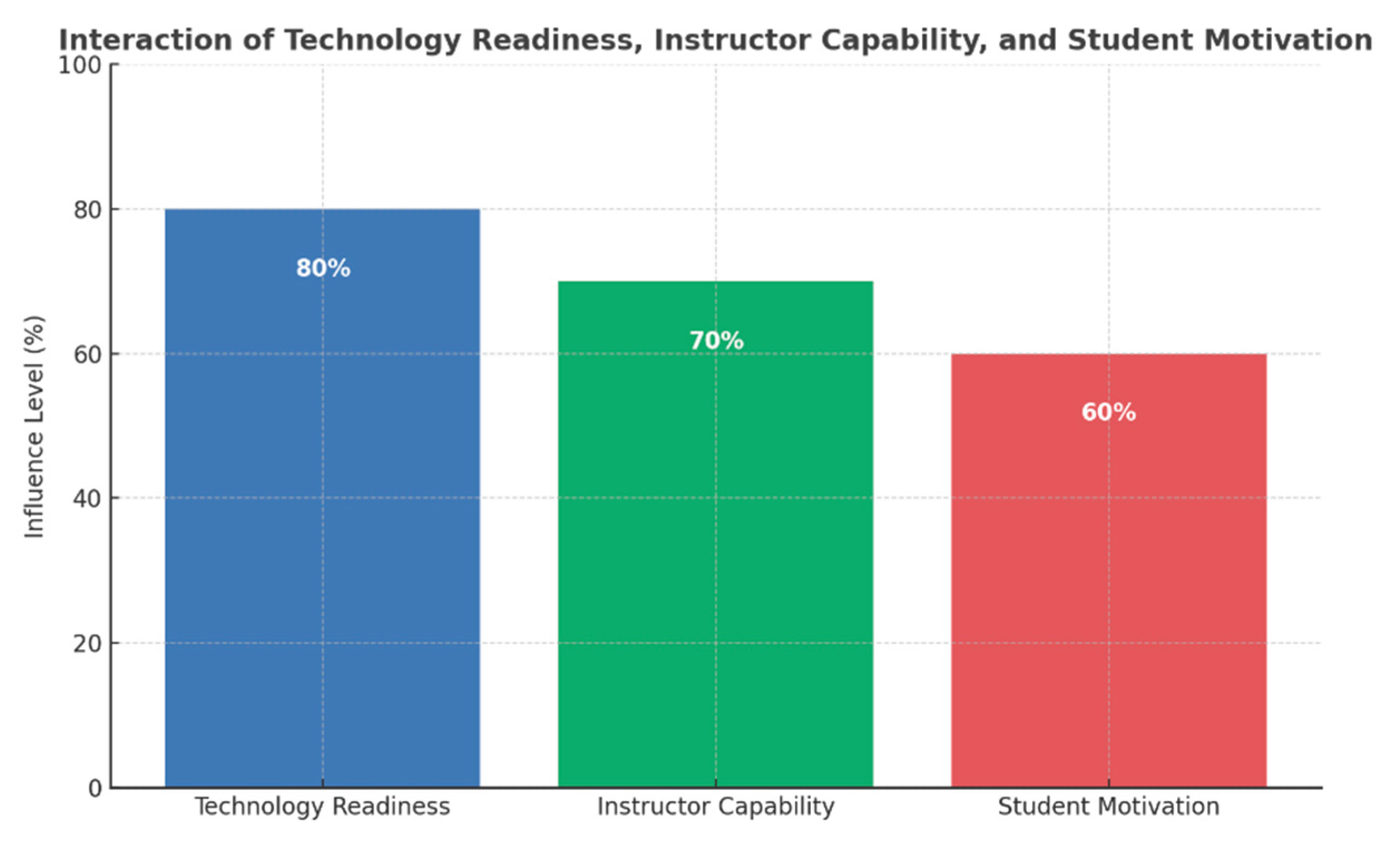
In addition, thematic analysis of the interviews identified three main themes that influenced the technology integration process: technology readiness, lecturer capability, and student motivation. Diagram 1 below illustrates the dynamic interaction of these three factors in supporting or hindering the success of technology integration in the English classroom.
Diagram 1.
Interaction of technology Readiness, Instructor Capability, and Students Motivation.
The study also found that students were more motivated when technology was used to create contextual and personalized learning, for example through language learning applications that provide immediate feedback and adaptive assessments. However, some students also expressed frustration when the technology used did not match their needs or tended to burden them with additional, less relevant tasks. These findings indicate the importance of a balanced pedagogical approach to the use of technology, rather than simply applying technology technically.
In the context of professional development, lecturers emphasized the need for ongoing training that focuses not only on the technical aspects of technology use, but also on pedagogical strategies for optimizing technology in English language teaching. Collaborative and problem-based training programs, as well as support from institutional leaders, were identified as important factors in improving lecturer competence. This is in line with the literature that emphasizes the need for lecturer capacity development as the key to successful digital learning (Muthmainnah, Darmawati et al., 2024).
Furthermore, this study confirms that institutional policies and infrastructure are the main foundations for successful technology integration. The availability of a reliable internet network, computer facilities, and responsive technical support are non-negotiable prerequisites. Without such support, lecturers and students' efforts to optimize technology are very limited. Institutions that have successfully demonstrated a real commitment to digital transformation, including in providing resources and incentives for innovative lecturers.
Overall, the results of this study indicate that the integration of instructional technology in English language learning in Indonesian universities has great potential to improve the quality of learning, but also requires serious attention to existing challenges. The main recommendations are the development of holistic policies, ongoing lecturer training, and equitable infrastructure improvements. These findings are expected to be a reference for policy makers and education practitioners in developing adaptive and effective English language learning strategies in the digital era.
Discussion
The results of this study confirm that the integration of instructional technology in English language learning in Indonesian universities has a positive contribution to increasing engagement and learning quality, in accordance with the initial objectives of the study. The use of Learning Management Systems (LMS) and interactive applications significantly increased student participation, which is in line with the findings of Santiana & Marzuki, 2022 that LMS can increase engagement and learning effectiveness. These findings strengthen the argument that technology is not just a tool, but a strategic component in building a learning experience that is more adaptive and responsive to student needs. However, this achievement cannot be separated from the context of infrastructure readiness and teacher capabilities, which are key variables in the success of technology integration. However, the digital divide that occurs in the field such as unstable internet connections and disparities in digital skills between lecturers is a real obstacle that affects the quality of learning interactions. This is different from several global studies that report smooth use of technology due to more adequate facilities (Kuliahana & Marzuki, 2024). This difference shows that the local context of Indonesia has its own challenges that must be taken into account in designing technology implementation strategies. These external factors are not only technical but also administrative and organizational culture, which also limit teaching innovation even though the devices and platforms are technically available.
Thematic analysis shows that student motivation is strongly influenced by how technology is used pedagogically, not just the presence of the technology itself. Students tend to be motivated when technology supports contextual and personalized learning, providing fast and relevant feedback. This is consistent with the concept of student-centered learning which places students as the main actors in the learning process (Santiana et al., 2021). Conversely, if technology is only used to add to the workload without clear added value, motivation decreases and learning becomes less effective. This finding underscores the importance of a wise instructional approach in using technology, avoiding mechanical and formalistic teaching mechanisms.
In the context of lecturer capacity development, this study confirms the urgent need for training that is not only technical, but also pedagogical and sustainable. These results strengthen the recommendations of Amalia & Marzuki (2023) who emphasize problem-based and collaborative training as effective strategies to improve teacher competence in digital learning. Interestingly, the involvement of institutional leaders as facilitators and incentive providers has proven to be a significant driving factor in encouraging lecturer innovation. This shows that successful technology integration requires synergy between individuals and institutional systems, so that change can be comprehensive and sustainable.
Although the results of the study provide a comprehensive picture, there are limitations that need to be considered. This study is a case study in one university so that the findings cannot be generalized widely to the entire context of higher education in Indonesia. Variations in institutional policies, technological facilities, and teaching cultures are very likely to differ in other places. In addition, the data collected are more qualitative and subjective, so the possibility of participant perception bias cannot be completely ignored. Therefore, further research with a wider scope and mixed methods is needed to strengthen the validity of the findings and explore the quantitative relationship between technology variables, motivation, and learning outcomes.
Practically, this study provides important implications for policy makers, education practitioners, and curriculum developers. Institutions need to develop holistic policies that integrate infrastructure development, lecturer training, and student mentoring simultaneously. In addition, these results open up space for in-depth research on innovative training models and learning strategies that are truly centered on the needs and characteristics of Indonesian students in the digital era. Thus, this study contributes to a broader understanding of the challenges and opportunities in implementing language learning technology in dynamic local contexts, while providing an empirical basis for inclusive and adaptive educational transformation.
Conclusion
This study concludes that the integration of instructional technology in English language learning in Indonesian universities has a significant positive impact on improving the quality and engagement of student learning, especially through the use of Learning Management Systems and interactive applications that support a more adaptive and personalized learning process. However, the success of implementing this technology is highly dependent on the readiness of the infrastructure and the capabilities of lecturers who require continuous training in order to optimize the use of technology pedagogically. Barriers such as the gap in access to technology and the digital capabilities of lecturers are major challenges that need to be overcome through comprehensive institutional policies and strong leadership support. The results of the study emphasize that technology must be integrated with appropriate teaching strategies so that it is not just a burden, but rather a tool that enriches the learning experience and motivates students. Thus, this study provides important contributions both theoretically and practically in strengthening the literature on digital learning in the context of Indonesian higher education, as well as being a reference for the development of more inclusive, adaptive, and effective learning policies and practices in the current digital era.
References
- Albana, H. H., Marzuki, A. G., Alek, A., & Hidayat, D. N. (2020). Cohesive Devices in Student’s Writing (A Discourse Analysis on Argumentative Text). Jurnal Pendidikan Humaniora, 8(1), 6-11.
- Alek, A., Marzuki, A. G., Farkhan, M., & Deni, R. (2020). Self-Assessment in Exploring EFL Students’ Speaking Skill. Al-Ta lim Journal, 27(2), 208-214. [CrossRef]
- Alek, A., Marzuki, A. G., Farkhan, M., Surahman, D., Daryanto, D., & Febrianto, S. (2020). Computer Based Testing in Senior High School on National Examination. Indonesian Journal of Learning Education and Counseling, 2(2), 204-210. [CrossRef]
- Amalia, I., & Marzuki, A. G. (2023). The Implementation of Bilingual Class Program in Islamic Elementary School. Al-Ta lim Journal, 30(1). [CrossRef]
- Amalia, I., Marzuki, A. G., Anita, A., Rahmawati, E., & Ulfah, U. (2024). Technological-Based Application in Writing Instruction: A Model of Project-Based Learning. Jurnal Onoma: Pendidikan, Bahasa, dan Sastra, 10(4), 4277-4290. [CrossRef]
- Anita, A., Marzuki, A. G., Silfani, A. N., Al Viyani, V., & Ulfah, U. (2024). Native Language Interference in EFL Students’ Writing of Reflective Journal in Indonesia. Journal of English Education and Teaching, 8(3), 528-551.
- Apriani, E., Daulay, S. H., Aprilia, F., Marzuki, A. G., Warsah, I., Supardan, D., & Muthmainnah. (2025). A mixed-method study on the effectiveness of using ChatGPT in academic writing and students’ perceived experiences. Journal of Language and Education, 11(1), 26–45. [CrossRef]
- Erizar, E., Marzuki, A. G., Hidayati, T., Juliana, R., & Yulia, A. (2024). The Impact of Online Learning on Undergraduate English Students’ Achievement. Journal of English Education and Teaching, 8(2), 288-302. [CrossRef]
- Iftitah, A. N., Marzuki, A. G., & Kuliahana, A. (2020). Developing Vocabulary Mastery through Guessing Words Game for the Seventh Grade Students of SMP Negeri 10 Palu. Datokarama English Education Journal, 1(1), 19-37. [CrossRef]
- Kuliahana, A., & Marzuki, A. G. (2020). Repetition Technique in an EFL Speaking Class in Islamic Higher Education in Indonesia. Academic Journal Perspective: Education, Language, and Literature, 8(1), 20-28. [CrossRef]
- Kuliahana, A., & Marzuki, A. G. (2024). Utilizing Group Discussion Technique in Developing Speaking Skill in an EFL Classroom. ENGLISH FRANCA: Academic Journal of English Language and Education, 7(2 November), 305-316. [CrossRef]
- Kuliahana, A., Marzuki, A. G., & Nurfaizah, A. (2024). Developing Students’speaking Performance through Mastering Question Words in Islamic University Setting. Journal of Innovation Research and Knowledge, 4(7), 5063-5072.
- Kuliahana, A., Marzuki, A. G., & Rustam, R. (2024). Developing Speaking Skill through Opinion Expression Method in Islamic Higher Education Context. ENGLISH FRANCA: Academic Journal of English Language and Education, 8(1 May), 121-132.
- Marzuki, A. G. (2019a). The Implementation of SQ3R Method to Develop Students’ Reading Skill on Islamic Texts in EFL Class in Indonesia. Register Journal, 12(1), 49-61.
- Marzuki, A. G. (2019b). The Roles of School Principal Leadership in Developing English Teachers’ Creativities in Palu. Al-Ta lim Journal, 26(3), 267-279. [CrossRef]
- Marzuki, A. G. (2019c). Utilizing Recorded English Dialogues in Teaching English Word Stress to Islamic Higher Education Students in Indonesia. Jurnal Pendidikan Islam, 5(1), 53-64. [CrossRef]
- Marzuki, A. G., & Kuliahana, A. (2021). Using Language Games to Enhance EFL Students’ Speaking Skill in Indonesia. Al-Ta lim Journal, 28(3), 213-222. [CrossRef]
- Marzuki, A. G., & Santiana, S. (2022). Bringing YouTube into the Classroom, is it Possible or not?. In Proceeding of International Conference on Islamic and Interdisciplinary Studies (Vol. 1, pp. 29-33).
- Marzuki, A. G., Alim, N., & Wekke, I. S. (2018). Improving the reading comprehension through cognitive reading strategies in language class of coastal area in indonesia. In IOP Conference Series: Earth and Environmental Science, 156(1), 012050). IOP Publishing.
- Marzuki, A.G. (2016). Utilizing cooperative learning in islamic college students’ classroom, IJEE (Indonesian Journal of English Education), 3(2), 123-139. [CrossRef]
- Marzuki, A.G. (2017). Developing speaking skill through oral report in an efl class in indonesia, Al-Ta’lim Journal, 24(3), 243-254. [CrossRef]
- Muthmainnah, M., Apriani, E., Marzuki, A. G., Al Yakin, A., Aeni, N., Azar, A. S., & Riyawi, M. R. (2024). Navigating education 5.0 robotic technique for teaching foreign languages in todays classroom: Unveiling the potential of virtual pedagogical agents. In Preconceptions of Policies, Strategies, and Challenges in Education 5.0 (pp. 118-138). IGI Global.
- Muthmainnah, M., Cardoso, L., Kaur, D., Al Yakin, A., Marzuki, A. G., & Apriani, E. (2024). Informatization on developing e-learning materials for IoT-assisted education to enhance EFL in higher education. In Proceedings of the International Conference on Data Analytics & Management (pp. 529–552).
- Muthmainnah, M., Cardoso, L., Marzuki, A. G., & Al Yakin, A. (2025). A new innovative metaverse ecosystem: VR-based human interaction enhances EFL learners’ transferable skills. Discover Sustainability, 6, 156. [CrossRef]
- Muthmainnah, M., Darmawati, B., Sidik, U., Marzuki, A. G., Al Yakin, A., Aeni, N., & Apriani, E. (2024). Innovative Pedagogical Practices Through the Development and Design of EFL Teaching Materials Tailored to Sustainability Through AI in the Digital Revolution. In Explainable AI for Education: Recent Trends and Challenges (pp. 207-227). Cham: Springer Nature Switzerland.
- Muthmainnah, M., Marzuki, A. G., Santiana, S., Erizar, E., & Nursyam, N. (2022). Utilizing smartphone-based Pinterest applications in developing EFL students speaking skills in Indonesia. JEES (Journal of English Educators Society), 7(2), 205-209. [CrossRef]
- Muthmainnah, M., Marzuki, A. G., Santiana, S., Erizar, E., Ulinsa, U., & Purwaningsi, U. (2024). Character Analysis Ability of M. Night Shyamalan Split Translation Film Characters in Indonesian EFL Students. Jurnal Onoma: Pendidikan, Bahasa, dan Sastra, 10(2), 1237-1243. [CrossRef]
- Santiana, S., & Marzuki, A. G. (2022). YouTube: a Modern Breakthrough of Autonomous Learning to Hone Speaking Skills. In Proceeding of International Conference on Islamic and Interdisciplinary Studies (Vol. 1, pp. 23-28).
- Santiana, S., & Marzuki, A. G. (2024). Scrutinising Padlet to enhance students’ collaborative writing in a virtual learning environment. Proceedings of the International Conference on Islamic and Interdisciplinary Studies (ICIIS), 533. https://jurnal.uindatokarama.ac.id/index.php/iciis/issue/archive.
- Santiana, S., Efendi, S. N., Pujasari, R. S., Marzuki, A. G., & Erizar, E. (2021). Digital Games-Based Learning: An Innovative Language Learning in EFL Classroom by Utilizing Kahoot! Jurnal Pendidikan, 9(4).
- Santiana, S., Enriquez, A., Marzuki, A. G., Mahmud, R., & Ghofur, A. (2024). KARDS Model: An Alternative Approach to Language Education. TLEMC (Teaching and Learning English in Multicultural Contexts), 8(1), 1-12.
- Santiana, S., Lesmana, D. S., Marzuki, A. G., & Erizar, E. (2021). An Insight of Anitales Apps Perceived by Digital Storytelling Students. In Proceeding of International Conference on Islamic Education (ICIED) (Vol. 6, No. 1, pp. 23-30).
- Syafryadin, S., Safnil, S., Noermnzah, N., Wardhana, D. E. C., Marzuki, A. G., Astrid, A., & Amalia, S. (2024). TAGANA thematic textbook: Cultivating junior high school students’ English proficiency with HOTS-PBL integration. Studies in English Language and Education, 11(3), 1636-1651. [CrossRef]
- Ammade, S., Mahmud, M., Jabu, B., & Tahmir, S. (2018). Integrating technology in English language teaching: global experiences and lessons for Indonesia. International Journal of English Linguistics, 8(6), 107. [CrossRef]
- Rofi’i, A., Nurhidayat, E., & Firharmawan, H. (2023). Teachers’ Professional Competence in Integrating Technology: A Case Study at English Teacher Forum in Majalengka. IJLECR (International Journal of Language Education and Cultural Review), 9(1), 64-73. [CrossRef]
- Lubis, A. H. (2018). ICT integration in 21st-century Indonesian English language teaching: Myths and realities. Jurnal Cakrawala Pendidikan, 37(1). [CrossRef]
- Mali, Y. C. G., & Salsbury, T. L. (2021). Technology Integration in an Indonesian EFL Writing Classroom. TEFLIN Journal: A Publication on the Teaching & Learning of English, 32(2).
- Azmina, B. A., Fauziati, E., & Drajati, N. A. (2019). Instructional design of CALL course in Indonesian higher education for future English teachers: A case study. International Journal of Educational Research Review, 4(2), 223-230. [CrossRef]
- Habibi, A., Razak, R. A., Yusop, F. D., Mukminin, A., & Yaqin, L. N. (2020). Factors affecting ICT integration during teaching practices: A multiple case study of three Indonesian universities. Qualitative Report, 25(5), 1127-1144. [CrossRef]
- Pratiwi, D. I., & Waluyo, B. (2023). Autonomous Learning and the Use of Digital Technologies in Online English Classrooms in Higher Education. Contemporary Educational Technology, 15(2). [CrossRef]

Table 1.
Comparison of Student Engagement Levels.
| Instructional Technology Used | Average Student Participation (%) |
| LMS with interactive quizzes | 85 |
| Video conferencing only | 60 |
| Basic document sharing | 45 |
| Traditional face-to-face without tech | 30 |
Disclaimer/Publisher’s Note: The statements, opinions and data contained in all publications are solely those of the individual author(s) and contributor(s) and not of MDPI and/or the editor(s). MDPI and/or the editor(s) disclaim responsibility for any injury to people or property resulting from any ideas, methods, instructions or products referred to in the content. |
© 2025 by the authors. Licensee MDPI, Basel, Switzerland. This article is an open access article distributed under the terms and conditions of the Creative Commons Attribution (CC BY) license (http://creativecommons.org/licenses/by/4.0/).
Copyright: This open access article is published under a Creative Commons CC BY 4.0 license, which permit the free download, distribution, and reuse, provided that the author and preprint are cited in any reuse.


