

Submitted:
23 May 2025
Posted:
26 May 2025
You are already at the latest version
Abstract
This study evaluated the physicochemical and antioxidant characteristics of yogurt incorporated with commercial and agglomerated (with 30% maltodextrin in a fluidized bed) Spirulina platensis powdered, at concentrations of 0.5-2.0% (w/v) prior to fermentation. Fermentations were carried out at 42ºC for 5 hours and then the yogurts were stored at 4ºC for 28 days for stabilization. All yogurts obtained achieved characteristic values according to the legislation with total acidity (0.6-1.5%), pH (3.5-4.6) and viable lactic bacteria of at least 106 CFU.g-1, without significantly affecting the quality of the final product or the activity of lactic acid bacteria. For the centesimal composition, it was observed that the greater the amount of cyanobacteria incorporated, the higher the concentrations of proteins (4.2-5.6%) and ashes (1.3-1.8%) in the product, and for the antioxidant content, the incorporation increased its amount significantly for phenolic compounds (2.98-14.96 mg.100g-1) and added important amounts of phycocyanin (2.19-3.65 mg.100g-1), β-carotene (4.73-6.37 mg.100g-1) and chlorophyll a (12.39-13.77 mg.100g-1), for both formulations using commercial and agglomerated S. platensis powder. Also, it was found that the agglomerated S. platensis powder preserved a higher amount of these bioactive compounds in the yogurt, one of the main functions considering the incorporation of this cyanobacterium.
Keywords:
Cyanobacteria
; Lactic acid bacteria
; Physicochemical composition
; Antioxidants
1. Introduction
Some factors such as the spread of nutritional knowledge and the search for information about the benefits of foods, together with practices that improve health and promote longevity, make today's society choose functional and nutraceutical food products. Consequently, the food industry has had to adapt in this direction, considering the importance of a healthy diet in the development of new products [1,2].
The market for these foods with functional and nutraceutical characteristics, with benefits to human health, is hindered by the wide variety that exists between manufacturers and formulations, which in their vast majority do not present the same profile of benefits. Therefore, an effort is required between agencies and health professionals to regulate production guidelines and quality control more strictly, and to provide correct information to consumers. This divergence is present in modern foods, mainly in the variation in the content of sugars, lipids, salts or other additional components, such as added flavorings and preservatives, which go against the goals of consuming healthier foods [3,4].
One of the foods that stands out in this scenario is the yogurt, as it has nutritional value and versatility, and has been present for thousands of years in different cultures and geographies around the world [5,6,7]. Yogurt contains significant amounts of proteins, bioactive compounds and minerals, such as B vitamins and calcium, which are important for bone health, metabolism and neuromuscular function, and can be a food that is well adapted to the incorporation of additional bioactive components, such as fiber, antioxidants and plant -based proteins [8,9]. Another important characteristic of yogurt is its probiotic function, a specific function and the differential of this food, where the live microorganisms present have beneficial effects on the intestinal tract and the immune system, reinforcing yogurt as a suitable alternative for consumers seeking a healthy lifestyle [10,11].
In this context, recent scientific studies show that the incorporation of components into traditionally consumed foods increases their nutritional quality, improving their functional qualities. The cyanobacterium Spirulina sp. (Arthrospira sp.), especially Spirulina platensis (Arthrospira platensis), has been widely used as a component incorporated into foods such as biscuits, pasta, olive oil, meat, among others [7,12,13,14]. The cyanobacterium Spirulina sp. has an excellent nutritional composition with a high content of proteins, vitamins, minerals and antioxidant compounds, and is therefore widely used in food incorporation, due to the demand for practical and functional foods. For example, the incorporation of Spirulina sp. in dairy products, such as yogurt, because it is a food with high consumption worldwide and because of its practicality of consumption, offers a line of opportunity for the development of functional products that meet the needs of consumers and studies new applications for the use of this biomass [15,16].
There are some references to the incorporation of Spirulina sp. into yogurt, but these studies are scarce, and often the incorporation occurs after fermentation and there are not enough studies on the relationship that it can have with lactic acid bacteria, which can harm its probiotic characteristics. It is also necessary to verify these effects when using Spirulina biomass modified by some technique such as encapsulation or agglomeration (responsible for improving the insertion of bioactive compounds or their physical characteristics) [17,18,19]. All of this is related to the optimization of the fermentation process and the guarantee of the functional capacity of the final food, proving to be a need for both the scientific community and regulatory agencies [20,21].
Therefore, this study aimed to investigate the production and characterization of yogurt incorporated with Spirulina platensis, investigating the fermentation kinetics, its centesimal composition and its quantity of antioxidants at the end of the process, applying commercial and agglomerated (with maltodextrin in a fluidized bed) biomass.
2. Materials and Methods
The yogurt fermentation was divided into two stages. The first stage was the exponential phase of lactic fermentation, where commercial and agglomerated cyanobacteria were incorporated into the milk. The second stage involved the stabilization of the fermented yogurt in refrigeration at 4°C for 28 days. During the fermentation kinetics and storage, analyses of microbial viability (lactic acid bacteria), hydrogen potential (pH), total acidity and total sugars were performed. At the end of the 28th-day storage period, physicochemical (centesimal composition) and microbiological (quantity of lactic acid bacteria) analyses were carried out on the final yogurt. The quantification of the antioxidant capacity of the final yogurt was also performed. A control stage, without the addition of Spirulina biomass, was performed to verify whether there was a noticeable change in the profile of the yogurts, either during fermentation or in the final product.
2.1. Kinetics of the Fermentation Process
The fermentation process to produce incorporated yogurt was divided into two stages. The first stage was the fermentation kinetics at 42°C for 5 hours, where commercial and agglomerated cyanobacteria were incorporated, with samples collected every 0.5 hours. The second stage was the storage of the yogurt in a refrigerator at 4°C for 28 days, with samples collected every 7 days, in a laminar flow hood.
Initially, the milk was pasteurized at 80°C for 10 minutes (Valedourado, Batch WV07, Palmeira dos Índias, Brazil) as recommended by Mesbah et al. [7] and Pan-Utai et al. [14]. After this process, the pasteurized milk was divided into small batches of 180 mL (containers where the fermentations were carried out), and then the milk culture for preparing fermented milk (BioRich natural yogurt type - Batch: L36595170, Hørsholm, Denmark) was added, around 3 g.L-1, in order to obtain a microorganism cell concentration (inoculum) of 104 -105 CFU.mL-1. Then, the commercial and agglomerated Spirulina platensis biomass were added.
Commercial Spirulina platensis was obtained from the company Saúde In NATURA Alimen-tos Funcionais® (Maringá, Paraná, Brazil) (Composition of commercial cyanobacteria - carbohydrates 12.51% ± 0.49, proteins 63.90 ± 0.46, ashes 6.76% ± 0.02, lipids 8.83% ± 0.03 and mean diameter (D50) of 49.47 ± 0.21 36 µm) and the agglomerated one, produced from the same batch, was obtained in a fluidized bed (air temperature of 85 °C and binder flow rate of 2.5 mL.min-1) (Composition of agglomerated cyanobacteria - carbohydrates 21.45% ± 0.26, proteins 56.26 ± 0.38, ash 8.35% ± 0.09, lipids 7.05% ± 0.09 and mean diameter (D50) of 170.0 ± 0.53 µm) by agglomeration process with maltodextrin 30% (9 ≤ DE-value ≤ 12) as indicated by Carneiro et al. [22] .The incorporation of commercial and agglomerated cyanobacterial biomass was done in proportions of 0.5, 1.0, 1.5 and 2.0% (w/v), in relation to milk. Visual differences between commercial and agglomerated S. plaltensis are shown in Figure 1.
The fermentation process was carried out in closed containers in a yogurt maker (Model SF-4007, 50W, Sonifer, Yiwu, Zhejiang Province, China). Fermentation began with the stabilization of the temperature of the yogurt maker at 40-42°C and lasted approximately 5 h, with samples collected every 0.5 h. These samples were used to analyse the exponential kinetic curve of lactic acid fermentation through the analysis of viable lactic acid bacteria (LAB) counting, hydrogen potential (pH), total acidity and total sugars.
The quantification of viable lactic acid bacteria (LAB) microorganisms used the pour plate technique on MRS Agar (Kasvi, Madrid, Spain) and expressed in Colony Forming Units per gram (CFU.g-1), as indicated by Oliveira et al. [23] and Sousa et al. [24]. The pH was measured using a digital pH meter (TECNAL TEC-5, Piracicaba, Brazil) previously calibrated with buffer solutions at pH 4.0 and 7.0. The amount of total sugars in the fermentations was determined using the anthrone method (Exodo Científica, Sumaré, Brazil) [26], which after reaction has a spectrophotometric reading (Kasvi K17 UV/VIS 1100NM) at 625 nm.
Total acidity was determined by neutralization volumetry using titration with standardized sodium hydroxide and expressed in % [25], according to Equation 1.
where: V = volume of sodium hydroxide solution used in the titration, in ml; N = normality of the sodium hydroxide solution (0.10N); f = standardization factor of the sodium hydroxide solution; p = weight of the sample in grams; eq = gram equivalent expressed in acid.
At the end of the 5-hour fermentation process, the containers containing the yogurt were stored in the refrigerator at 4°C for 28 days, as indicated by Mesbah et al. [7] and Pan-Utai et al. [14] for stabilization. Finally, the yogurts were characterized physicochemically (centesimal composition) and in their quantity of antioxidants, described in the following sections.
2.2. Physicochemical Characterization (Centesimal Composition)
For the centesimal characterization of the yogurt, the following analyses were performed: moisture and ashes or dry mineral residue, according to the analytical standards of the Adolfo Lutz Institute [25], and total protein and lipid contents according to the analytical standards of the Official Method of Analysis [27]. Moisture was determined using a moisture content tester (Marconi, model id50, 220v and 250w), through a drying process at 105°C. Total protein analysis followed the Kjeldahl method, which determined the total nitrogen content of the sample, expressed in nitrogen units multiplied by a factor of 6.25 for conversion to protein content. Lipid content corresponded to extraction with hexane in Soxhlet at 105°C for 4 hours. Ashes were obtained by incineration at temperatures between 550 and 570°C for 3 to 4 hours. Total carbohydrate content was calculated by the difference of the aforementioned analyses (moisture, protein, lipid and ash content). All parameters were expressed as percentage in matter.
2.3. Antioxidant Capacity
The total phenolic, beta-carotene, chlorophyll a and phycocyanin contents were analysed by spectrophotometric method (Kasvi K17 UV/VIS 1100NM, Madrid, Spain). The total phenolic content was determined by the method proposed by Waterhouse [28], using the Folin-Ciocalteu reagent, and expressed in mg of gallic acid equivalent per 100 g of sample (mg.100 g-1), with reading at a wavelength of 760 nm. The beta-carotene and chlorophyll a contents were determined according to the method proposed by Nagata and Yamashita [29]. Lycopene was extracted using a mixture of acetone and hexane (4:6) and 1 g of biomass. The extracts were subjected to reading in a spectrophotometer at different wavelengths (453, 505, 645 and 663 nm). The determination of the amount of phycocyanin was performed according to the methodology expressed by Silveira et al. [30] extracted with 0.1 M phosphate buffer solvent and pH 7.0 and reading at wavelengths of 620 and 625 nm.
2.4. Statistical Analyses
All results for centesimal composition and antioxidant capacity for all yogurt samples were analysed by Tukey’s test considering p < 0.05 (95% of confidence level) to identify significant differences between the results obtained.
3. Results
3.1. Kinetics of the Fermentation Process
The results obtained during the monitoring of the fermentation kinetics for the formation of lactic acid, milk sugars consumption and growth of lactic bacteria in the yogurts incorporated with commercial and agglomerated Spirulina platensis are shown in Figure 2. Regarding the classical fermentation profiles, these include Deindoerfer [31] who mentions the relationship between the limiting substrate and product(s) formed, the formation of lactic acid, classified as a simple fermentation, and Gaden [32], who shows a fermentation associated with growth, who classifies this type of fermentation as product associated to growth.
Initially, when analysing the profile of the kinetic curve of the formation of the final product, it is clear that there was an increase in the acidity of the yogurts incorporated with Spirulina platensis (Figure 2A,B), observing that the acidity varied between 1.0 and 1.1%, between the control and them, as well as a decrease in the hydrogen potential (pH) (Figure 2C,D), leaving the final product with values between 3.6-4.0, but without significant difference. It was noted that in approximately 4 hours of fermentation all the yogurts reached the peak of acid formation. The pH indicative of the production of lactic acid is around 4.2 to 4.5, which generates an average fermentation time of approximately 4.0 hours [7,14,33] and it agrees with the results found in this work. Normative instruction No. 46/2007 of the Ministry of Agriculture, Livestock and Food Supply – MAPA of Brazil [34] for yogurt, states that the acidity variation limit for yogurt must be between 0.6 and 1.5 total acidity (g of lactic acid.100g-1 or %) and pH between 3.5 and 4.6, in addition to a minimum number of viable lactic bacteria of 1.106 UFC.g-1 of product, with the yogurts obtained within the established limits.
In this context, the Codex Alimentarius Standard for fermented milk (CXS 243-2003) is used as an international parameter and establishes that the minimum protein content must be 2.5%, the fat content must be less than 15%, the acidity must be at least 0.6% and the amount of lactic bacteria microorganisms - LAB of 107 UFC.g-1 [35]. The concentration of total sugars at the end of fermentation varied between 8-11 g.L-1, with a small variation depending on the concentration of cyanobacteria incorporated (Figure 2E,F), with the fermentation being carried out with the agglomerated cyanobacteria closest to the control. For bacterial growth, values of around 108 CFU.mL-1 were found for all yogurts produced, in compliance with the legislation, and likewise, the concentration required to be classified as probiotic (Figure 2G,H).
Therefore, the incorporation of commercial or agglomerated cyanobacteria biomass did not inhibit the activity of lactic acid bacteria in a way that would significantly interfere with the quality of the final product. This same behaviour was observed in studies that incorporated commercial Spirullina platensis biomass into yogurt. For example, in the results of Matos et al. [36] and Yamaguchi et al. [37], where lactic fermentation was carried out at 42-43°C for 4h and both obtained a pH decrease close to 4.5. Similarly, Pan-Utai et al. [14] producing yogurts incorporated with Arthrospira (Spirulina) platensis in concentrations between 0.1-10% (w/v) and fermented with Lactobacillus bulgaricus and Streptococcus thermophillus cultures at 3% (w/v) of inoculum, fermented at 43°C for 4h obtained a final pH of 4.3 and Mesbah et al. [7], incorporating Arthrospira (Spirulina) platensis prior to fermentation at concentrations of 0.5-1.5% (w/v) with L. bulgaricus and S. thermophillus cultures at a ratio of 1:1 for 3% inoculum (w/v) at 42°C, obtained a final pH of 4.6 and a final sugar concentration between 6.62-7.26 g.L-1.
In addition, Ebid et al. [38], who incorporated S. platensis at 0.2-1.0% (w/v) into yogurt, fermented with L. bulgaricus and S. thermophillus at a ratio of 1:1 for 5% inoculum (w/v) at 37°C to pH 4.6, presented a final sugar concentration of 6.9-7.5 g.L-1. In Bchir et al. [39] the production of yogurt fortified with dry and fresh Spirulina platensis, adding 0.1-0.7% (w/v), and cultures of L. bulgaricus and S. thermophilus, 3% inoculum (w/v) was investigated. The fermentation was conducted at 43°C for 4h until pH 4.3, obtained a final concentration of lactic bacteria between 3.65-4.05.104 CFU.g-1. Finally, Atallah et al. [40] characterizing skimmed functional yogurt enriched with whey protein concentrate, calcium caseinate and Spirulina (1% w/v), fermented with cultures of L. bulgaricus and S. thermophilus, 3% inoculum (w/v), at 42°C for 4 hours until pH 4.6, obtained a final concentration of lactic bacteria between 8.11-8.51.1010 CFU.mL-1.
3.2. Centesimal Composition of the Yogurts
The incorporation of cyanobacteria into dairy products can bring significant changes to the nutritional quality of the final yogurt [36,41]. The centesimal composition of the yogurt samples showed that the protein and total ash content increased proportionally and more significantly with the incorporation of Spirulina sp. biomass, but with slightly differences between the commercial and agglomerated biomass (Table 1).
The moisture content in yogurt with or without incorporation of Spirulina was in accordance with the values found in the literature, being slightly higher than 80% [14,42]. Regarding the protein content, the addition of commercial and agglomerated cyanobacteria provided a significant increase as the amount of incorporated biomass was increased, ranging from 4.21-5.49% for the incorporated yogurts compared to 3.92% for the control. Similar results were found for Ebid et al. [38] and Nazir et al. [43], with added concentrations of cyanobacteria between 2-5%, an increase in the amount of proteins in the incorporated yogurt between 5.2-6.3% was observed, evidencing an improvement in the protein quality of the final product. The behaviour for the ash content of the yogurts was similar as for proteins, having 1.27-1.87% for the incorporated yogurts and 1.1% for the control formulation. In this context, Mesbah et al. [7] and Nazir et al. [43] who incorporated 2-3% of cyanobacteria biomass obtained 2.1-2.5% of ash content while the control presented 1.05%. Similarly, Ebid et al. [38], who incorporated yogurt with 5% of cyanobacteria obtained 4.5% of ash content in relation to a control with 1.2%.
Analysing the lipid content, there was a slight decrease in relation to the control formulation. This behaviour is similar to that found by Naziry et al. [43] and Zaid et al. [44], in which yogurts enriched with 2% Spirulina presented similar lipid contents, 0.98% and 1.02%, respectively, while the control formulation contained 1.32%. Finally, a variation between 9-10% of the carbohydrate content was obtained in the incorporation between 0.5-2.0%, presenting the same behaviour found in Mesbah et al. [7] and Nazir et al. [43] who obtained a variation between 5-6% of the carbohydrate content for yogurt incorporated with 2-3% of Spirulina. It is worth highlighting that the increase in the physical-chemical composition of the incorporated yogurt will depend on the composition of the cyanobacteria used, the type of cyanobacteria, and the growth culture of this microorganism, among other factors [45].
3.3. Antioxidant Content in the Incorporated Yogurts
Biological oxidizing compounds can present bioactive properties of great interest for improving the nutritional quality and functional and nutraceutical profile of foods. The incorporation of components into foods for enrichment and reduction of oxidative stress and its effects has been widely studied [43,46]. Cyanobacteria, such as S. platensis, have been studied because they have significant amounts of antioxidants, such as phycocyanin, carotenoids, chlorophyll, and other secondary pigments. The composition of antioxidant compounds in yogurts incorporated with cyanobacteria significantly increased the amount of antioxidants and inserted compounds such as phycocyanin, β-carotene, and chlorophyll, even after the fermentation process, demonstrating the stability of these bioactive compounds in the incorporated food (Table 2).
Phenolic compounds are excellent antioxidants, anti-inflammatories and have cardioprotective activity. Their main group is flavonoids, which have the ability to reduce oxidative stress and inflammation in the body [47]. The addition of these components increases nutritional quality to improve health and prevent diseases. In addition to the increase in the amount of phenolic compounds in relation to the control yogurt, it is interesting to note that the incorporation of agglomerated cyanobacteria preserved higher amount of phenolic compounds, mainly at concentrations of 0.5-1.0%, after the fermentation process and constitutes an important justification for using biomass in this way.
Analysing the content of phenolic compounds, there was an increase in the quantity in relation to the control formulation, to values up to around 15 mg.100g-1 for incorporation, especially for agglomerated S. platensis, while the control formulation presented a value of 5.58 mg.100g-1. The same behaviour was also found in Ebid et al. [38] who studied the impact of Spirulina platensis on antioxidant properties of incorporated yogurt with 4% of Spirulina platensis obtaining 17 mg.100g-1 of phenolic compounds in comparison with the control that presented 4.59 mg.100g-1.
According to Nazir et al. [43], who studied the evaluation of the nutritional value of yogurt cream incorporated with 1.5% of Spirulina platensis obtained 11.37 mg.100g-1 of phenolic compounds while the control showed 5.07 mg.100g-1. Also, according to Mesbah et al. [7] who studied the functional properties of yogurt fortified with 0.5% of Spirulina platensis demonstrated yogurts with 16.80 mg.100g-1 of phenolic compounds respect to the control with 7.12 mg.100g-1.
Carotenoids are important antioxidants that contribute to the reduction of free radicals, are excellent transporters of Vitamin A, and improve immune health [48], so their addition improves the nutritional quality of yogurt. In the results, the higher cyanobacteria biomass addition, the higher the carotenoid content in the final yogurt, with special detail in those with agglomerated cyanobacteria. Regarding the β-carotene content, there was an increase for the incorporation of 0.5-2.0% of S. platensis and being absent in the control formulation.
Similarly, Mesbah et al. [7] who assessed the functional properties of yogurt fortified with Spirulina platensis and milk protein concentrate, incorporating 1.5% of Spirulina platensis in the yogurt, obtaining a value of 7.43 mg.100g-1 of β-carotene compared to the control that had 0.82 mg.100g-1. Also, Nazir et al. [43] who evaluated the nutritional value of yogurt incorporated with Spirulina platensis, incorporating 1.5%, obtained a content of 4.35 mg.100g-1 of β-carotene compared to the control that had 0.23 mg.100g-1.
Regarding phycocyanin, a specific pigment of cyanobacteria, which is only present in yogurt due to the addition of cyanobacteria, and which plays an important role in preserving the liver and in lipid peroxidation [37]. The phycocyanin content was present in concentration between 2.19-3.65 mg.100g-1, being absent in the control formulation.
The behaviour found is similar in Barkallak et al. [49] who incorporated 0.25% of Spirulina platensis into yogurt, obtaining 0.297 mg.100g-1of phycocyanin in comparison and the control where it was absent. In Ebid et al. [38], who studied the impact of Spirulina platensis on antioxidant properties of functional yogurt, they incorporated 0.7% of Spirulina platensis into yogurt obtaining 4.73 mg.100g-1 of phycocyanin and Pan-Utai et al. [14], who incorporated 0.5% of Spirulina platensis, obtained 0.345 mg.100g-1 of phycocyanin.
Also, chlorophyll a (from photosynthetic organisms) will only be present in yogurt due to its addition to cyanobacteria and it is associated with a high capacity to neutralize free radicals, reducing negative oxidative effects [50,51]. Regarding the chlorophyll a content, there was a significant increase in the formulations, with a variation between 12.4-13.7 mg.100g-1.
In this sense, Mesbah et al. [7], who studied the functional properties of yogurt fortified with Spirulina platensis incorporated in 1.0% (w/v) the yogurt, obtained 11.32 mg.100g-1 of chlorophyll a, which was absent in the control formulation. Confirming this effect, Barkallak et al. [49] studied the effects of fortification with Spirulina platensis with 0.25% in the yogurt resulted in a chlorophyll a content of 27.06 mg.100g-1, an antioxidant.
This can be attributed to the joining of smaller particles could promote greater encapsulation of these compounds and helping their stability when incorporated into yogurt [51]. It is interesting that the incorporated cyanobacteria biomass managed to preserve a greater concentration of antioxidant compounds in the final yogurts, and this may be the result of the agglomeration of the particles that, in addition to improving the physical characteristics of the powder, also produced this secondary effect [22].
Several studies have shown that the agglomeration process is an efficient technological alternative for preserving bioactive compounds, especially those of an antioxidant nature, in dehydrated plant matrices. The technique, widely applied in the food industry, is associated with the improvement of the functional, physical-chemical and stability properties of powders obtained by drying, contributing to greater protection against environmental factors such as oxygen, light and temperature [52,53].
For example, Castaño Peláez et al. [52] investigated the stability of a strawberry-based powder formulation, previously obtained by spray drying and subsequently agglomerated in a fluidized bed. The samples were stored for up to 180 days at different temperatures (15, 25 and 35°C), and the authors observed high retention rates of antioxidant activity, with values above 50% for the ABTS and DPPH methods, in addition to the preservation of 76% of the total phenolic compounds and approximately 40% of vitamin C. The results were attributed to the joint action of the carrying agents (maltodextrin and gum arabic) and the microstructure generated by the agglomeration, which contribute to the formation of a physical barrier against oxidative and thermal processes. It is also noteworthy that the best performances were obtained in the samples kept at controlled temperatures of 15 and 25°C.
Similar results were reported by Gallón-Bedoya et al. [53], who evaluated the stability of an agglomerated powder made from Andean fruits (Physalis peruviana, Fragaria x ananassa and Rubus glaucus) subjected to storage for 180 days. The antioxidant activity, measured by ABTS and DPPH, showed moderate losses of 22% and 36%, respectively, in the samples stored at 15°C, evidencing the effectiveness of the microparticulate structure and the carriers used in protecting the bioactive compounds, especially phenolics and ascorbic acid, against oxidative degradation.
4. Conclusions
The integration of cyanobacterial biomass powder as an additional source of nutrients and bioactive compounds has proven to be a promising strategy to improve the nutritional profile of yogurts, expanding their functionalities and making them innovative, since they are widely consumed worldwide. The incorporation of S. platensis did not significantly alter the fermentation profile of yogurt, while maintaining the legal requirements for the product under all conditions studied. It was observed that the greater the amount of cyanobacteria incorporated into the yogurt, the higher the concentration of proteins and ash was obtained in the final product, mainly. Additionally, the antioxidant content was increased, even after the fermentation process and the stabilization period under refrigeration. It is noteworthy that the antioxidant content was more stable in the product when the agglomerated biomass was used, in contrast to the direct use of commercial biomass.
Author Contributions
Conceptualization, R.C.V.A. and C.E.d.F.S.; methodology, R.C.V.A. and C.E.d.F.S. ; validation, C.E.d.F.S.; formal analysis, R.C.V.A., M.C.d.S.S., M.V.A.F. and C.E.d.F.S.; investigation, R.C.V.A. and C.E.d.F.S.; data curation, R.C.V.A., J.V.O.N.d.S. and C.E.d.F.S.; writing—original draft preparation, R.C.V.A. and C.E.d.F.S.; writing—review and editing, C.E.d.F.S., W.d.S.C., K.A., B.M.V.d.G. and A.E.d.S.; visualization, C.E.d.F.S., W.d.S.C., K.A., B.M.V.d.G., A.E.d.S.; supervision, C.E.d.F.S. and K.A.; project administration, C.E.d.F.S.; funding acquisition, C.E.d.F.S.
Funding
This research work was funded by National Council of Research and Technological Development of Brazil (CNPq) (project numbers: 312996/2022-5, 404455/2024-7, 440026/2024-5 and 445935/2024-4) and the Research Support Foundation of Alagoas (project number: E:60030.0000002360/2022 and E:60030.0000000318/2023).
Data Availability Statement
Data available on request.
Acknowledgments
Authors would like to thank CNPq – Brazil (National Council for Scientific and Technological Development) and FAPEAL (Foundation for Research Support of Alagoas – Brazil).
Conflicts of Interest
The authors declare no conflicts of interest.
References
- Garavand, F.; Daly, D.F.M.; Gómez-Mascaraque, L.G. Biofunctional, structural and tribological attributes of GABA-enriched probiotic yogurts containing Lacticaseibacillus paracasei alone or in combination with prebiotics. Int. Dairy J. 2022, 129, 105348. [CrossRef]
- Hyatt, J.R.; Zhang, S.; Akoh, C.C. Combination of antioxidants and processing techniques to improve the oxidative stability of a Schizochytrium algae oil ingredient with application in yogurt. Food Chem. 2023, 417, 135835. [CrossRef]
- Beheshtipour, H.; Mortazavian, A.M.; Haratiano, P.; Khosravi-Darani, K. Effects of the addition of Chlorella vulgaris and Arthrospira platensis on the viability of probiotic bacteria in yogurt and their biochemical properties. Eur. Food Res. Technol 2012, 235, 719–728.
- Bullock, Y.; Gruen, I. Effect of strained yogurt on the physicochemical, textural and sensory properties of low-fat frozen desserts. Food Chem. Adv. 2023, 2, 100161, 2023.
- Devnani, B.; Ong, L., Kentish, S.; Scales, P.J.E.; Gras, S.L. Physicochemical and rheological properties of commercial almond-based yogurts as alternatives to dairy and soy yogurts. Future Foods 2022, 6, 100185. [CrossRef]
- Fan, X.; Yu, L.; Shi, Z.; Li, C.; Zeng, X.; Wu, Z.; Pan, D. Characterization of a novel flavored yogurt enriched in γ-aminobutyric acid fermented by Levilactobacillus brevis CGMCC1.5954. J. Dairy. Sci. 2022, 106, 852–867. [CrossRef]
- Mesbah, E.; Matar, A.; Karam-Allah, A. Functional Properties of Yogurt Fortified with Spirulina platensis and Concentrated Milk Protein. J. Food Dairy Sci. 2022, 13, 1–7.
- Aktar, T. Physicochemical and sensorial characterization of different yogurt production methods. Int. Dairy J. 2021, 125, 105245.
- Jaeger, S.R.; Cardello, A.V.; Jin, D.; Ryan, G.S.; Giacalone, D. Consumer perception of plant-based yogurt: sensory drivers of taste and emotional, holistic and conceptual associations. Int. Food Res. J. 2023, 167, 112666.
- Aleman, R.S.; Cedillos, R.; Page, R.; Olson, D.; Aryana, K. Physicochemical, microbiological and sensory characteristics of yogurt affected by various ingredients. J. Dairy Sci. 2023, 106, 3868–3883.
- Hernández, H.M.; Nunes, M.T.; Prista, C.; Raymundo, A. Innovative and healthier dairy products through the addition of microalgae: a review. Food 2021, 11, 755–755. [CrossRef]
- Habib, M.A.B.; Parvin, M.; Huntington, T.C.; Hasan, M.R. A review on culture, production and use of Spirulina platensis as food humans and feeds for domestic animals and fish. FAO 2008, 1034, 1-33.
- Kraus, A. Factors influencing the decisions to buy and consume functional food. Br. Food J. 2015, 117, 1622-1636. [CrossRef]
- Pan-Utai, W.; Atkonghan, J.; Onsamark, T.; Imthalay, W. Effect of Arthrospira Microalga Fortification on the Physicochemical Properties of Yogurt. Curr. Res. Nutr. Food Sci. 2020, 8(2), 531-540. [CrossRef]
- Shimamatsu, H. Mass production of Spirulina platensis an edible microalga. Hydrobiology 2004, 512 (1), 39-44.
- López, E.P. Superalimento para un mundo en crisis: Spirulina platensis a bajo costo. Idesia 2013, 31(1), 135-139. [CrossRef]
- Vogt, E.T.C.; Weckhuysen, B.M. Fluid catalytic cracking: recent developments on the grand old lady of zeolite catalysis. Chem. Soc. Rev. 2015, 44, 7342-7370. [CrossRef]
- Fröhlich, J.A.; Ruprecht, N.A.; Hinrichs, J.; Kohlus, R. Nozzle zone agglomeration in spray dryers: Effect of powder addition on particle coalescence. Powder Technol. 2020, 374, 223-232. [CrossRef]
- Albuquerque, R.C.V.; Silva, C.E.D.F.; Carneiro, W.D.S.; Andreola, K.; Gama, B.M.V.; Silva, A.E.D. Incorporation of Cyanobacteria and Microalgae in Yogurt: Formulation Challenges and Nutritional, Rheological, Sensory, and Functional Implications. Appl. Microbiol. 2024, 4(4), 1493-1514. [CrossRef]
- Avila-Leon, I.; Matsudo, M. C.; Sato, S.; De Carvalho, J.C.M. Arthrospira platensis biomass with high protein content cultivated in continuous process using urea as nitrogen source. J. Appl. Microbiol. 2012, 6(112), 1086-1094. [CrossRef]
- ANVISA - Agência Nacional de Vigilância Sanitária. Instrução Normativa - in n° 28, de 26 de julho de 2018. Diário Oficial da União. Publicado em: 27/07/2018 | edição: 144 | seção: 1 | página: 141. 2018.
- Carneiro, W.S.; Andreola, K.; Silva, C.E.F.; Gama, B.M.V.; Albuquerque, R.C.V.; Freitas, J.M.D.; Freitas, J.D. Agglomeration Process of Spirulina platensis Powder in Fluidized Bed improves its Flowability and Wetting Capacity. ACS Food Sci. Technol. 2024, 4(12), 3120-3134.
- Oliveira, E.A.M.; Soldi, C.L.; Caveião, C.; Sales, W.B. Contagem de bactérias láticas viáveis em leites fermentados. Revista Univap 2018, 24(46), 94-104.
- Sousa, T.L.T.L.; Silva, A.M.S.; Silva, M.K.G.; Lima, G.S.; Veloso, R.R.; Shinohara, N.K.S. Counting of lactic bacteria in yogurts and dairy drinks in the metropolitan region of Recife-PE. Res. Soc. Dev. 2022, 11 (15), e157111537002, 2022.
- Instituto Adolfo Lutz. In Métodos físico-químicos para análise de alimentos, edition 4ª, Instituto Adolfo Lutz Eds. Publisher: São Paulo, São Paulo, 2005.
- Trevelyan, W.E.; Forrest, R.S.; Harrison, J.S. Determination of yeast carbohydrates with the anthrone reagent. Nature 1952, 170(4328), 626-627. [CrossRef]
- AOAC. In Official Method of Analysis, edition 16ª, Association of Official Analytical. Publisher: Washington DC, 2002.
- Waterhouse, A.L. PoMANYlyphenolics: determination of total phenolics. In WROLSTAD, R. E. Currente protocols in food analytical chemistry; J. Wiley Eds.; Publisher: New York, EUA, Volume 1, pp. 11-18, 2002.
- Nagata, M., Yamashita, I. Simple method for simultaneous etermination of chlorophyll and carotenoids in tomato fruit. J. Japan. Soc. Food Sci. Technol. 1992, 39(10), 925-928. [CrossRef]
- Silveira, S.T.; Burkert, J.F.M.; Costa, J.A.V.; Burkert, C.A.V.; Kalil, S. J. Optimization of phycocyanin extraction from Spirulina. platensis using factorial design. Bioresour. Technol. 2007, 98(8), 1629-16934. [CrossRef]
- Deindoerfer, F.H.; West, J.M. Rheological examination of some fermentation broths. J. Biochem. Microb. Technol. Eng. 1960, 2(2), 165-175. [CrossRef]
- Gaden, E.L.Jr. Fermentation process kinetics. J. Biochem. Microb. Technol. Eng. 1959, 1(4), 413-429.
- Schmidell, W.; de Almeida Lima, U.; Borzani, W.; Aquarone, E. Biotecnologia industrial. In Engenharia bioquímica; Blucher Eds.; Publisher: São Paulo, Brazil, Volume 2, 2001.
- Brasil. Regulamento técnico de identidade e qualidade de leites fermentados. Instrução Normativa Nº 46 de 23 de outubro de 2007. https://www.studocu.com/pt-br/document/centro-universitario-uniftc/clinica-cirurgica/instrucao-normativa-n-46-de-23-de-outubro-de-2007-leites-fermentados/38234614 (accessed on 7 de Jun. 2023).
- OMC. Food and Agriculture Organization of the United Nations. Codex Alimentarius. Standard for Fermented Milk (CXS 243-2003).
- Matos, J.; Afonso, C.; Cardoso, C.; Serralheiro, M.L.; Bandarra, N. M. Yogurt enriched with Isochrysis galbana: An innovative functional food. Food 2021, 10(7), 1458. [CrossRef]
- Yamaguchi, S.K.F.; Moreira, J.B.; Costa, J.A.V.; De Souza, C.K.; Bertoli, S.L.; Carvalho, L.F.D. Evaluation of Adding Spirulina to Freeze-Dried Yogurts Before Fermentation and After Freeze-Drying. Ind. Biotechnol. 2019, 15(2), 89-94. [CrossRef]
- Ebid, W.M.; Ali, G.S.; Elewa, N. A. Impact of Spirulina platensis on the physicochemical, antioxidant, microbiological and sensory properties of functional labneh. Discov. Food 2022, 2(1), 29. [CrossRef]
- Bchir, B.; Felfoul, I.; Bouaziz, M.A.; Garred, T.; Yaich, H.; Numi, E. Investigation of the physicochemical, nutritional, textural and sensory properties of yogurt fortified with fresh and dried Spirulina (Arthrospira platensis). Int. Food Res. 2019, 1(26), 65–76.
- Atallah, A.; Morsy, O.; Dalia, G. Characterization of functional low-fat yogurt enriched with whey protein concentrate, Ca-caseinate and Spirulina. Int. J. Food Prop. 2020, 23, 78–91.
- Part, N.; Kazantseva, J.; Rosenvald, S.; Kallastu, A.; Vaikma, H.; Kriščiunaite, T.; Pismennõi, D.; Viiard, E. Microbiological, chemical and sensorial characterization of commercially available vegetable yogurt alternatives. Future Foods 2023, 7, 100212.
- Barkallah, M.; Dammak, M.; Louati, I.; Hentati, F.; Hadrich, B.; Mechichi, T.; Ayadi, M.A.; Fendri, I.; Attia, H.; Abdelkafi, S. Effect of Spirulina platensis fortification on the physicochemical, textural, antioxidant and sensory properties of yogurt during fermentation and storage. LWT 2017, 84, 323-330. [CrossRef]
- Nazir, F.; Saeed, M.A.; Abbas, A.; Majeed, M.R.; Israr, M.; Zahid, H.; Ilyas, M.; Nasir, M. Development, quality assessment and nutritional enhancement of Spirulina platensis in yogurt paste. Food Sci. Appl. Biotechnol. 2022, 5, 106–106.
- Zaid, A.A.; Hammad, D.M.; Sharaf, E.M. Antioxidant and Anticancer Activity of S. platensis Water Extracts. Int. J. Pharmacol. 2015, 11(7), 846-851.
- Jesus, C.S.; Uebel, L.S.; Costa, S.S.; Miranda, A.L.; Morais, E.G.; Morais, M.G.; Costa, J.A.V.; Nunes, I.L.; Ferreira, E.S.; Druzian, J.I. Outdoor pilot-scale cultivation of Spirulina sp. LEB-18 in different geographic locations for evaluating its growth and chemical composition. Bioresource technology 2018, 256, 86-94. [CrossRef]
- Abdelhamid, S.M; Edris, A.E.; Sadek, Z. Novel approach for the inhibition of Helicobacter pylori contamination in yogurt using selected probiotics combined with eugenol and cinnamaldehyde nanoemulsions. Food Chem. 2023, 417, 135877–135877. [CrossRef]
- Ahmad, I.; Xiong, Z.; Xiong, H.; Aadil, R.M.; Khalid, N.; Lakhoo, A.B.J.; Zia-Ud-Din, N.A.W.A.Z.A.; Walayat, N.; Khan, R.S. Physicochemical, rheological and antioxidant profile of yogurt prepared from non-enzymatically and enzymatically hydrolyzed potato powder under refrigeration. Food Sci. Hum. Wellbeing 2023, 12, 69-78. [CrossRef]
- Chen, C.; Tang, T.; Shi, Q.; Zhou, Z.; Fan, J. The potential and challenge of microalgae as promising future food sources. Trends Food Sci. Technol. 2022, 126, 99-112. [CrossRef]
- Barkallah, M.; Dammak, M.; Louati, I.; Hentati, F.; Hadrich, B.; Mechichi, T.; Ayadi, M.A.; Fendri, I.; Attia, H.; Abdelkafi, S. Effect of Spirulina platensis fortification on physicochemical, textural, antioxidant and sensory properties of yogurt during fermentation and storage. Lwt 2017, 84, 323-330. [CrossRef]
- Wu, T.; Deng, C.; Luo, S.; Liu, C.; Hu, X. Effect of rice bran on yogurt properties: Comparison between bran addition before and after fermentation. Food Hydrocoll. 2023, 135, 108122.
- Wang, X.; Kong, X.; Zhang, C.; Hua, Y.; Chen, Y.; Li, X. Comparison of physicochemical properties and volatile flavor compounds of vegetable yogurt and dairy yogurt. Int. Food Res. J. 2023, 164, 112375.
- Castaño Peláez, H. I.; Cortés-Rodríguez, M.; Ortega-Toro, R. Storage stability of a fluidized-bed agglomerated spray-dried strawberry powder mixture. F1000Res. 2023, 12, 1174. [CrossRef]
- Gallón-Bedoya, M.; Cortés-Rodríguez, M.; Gil-González, J.; Lahlou, A.; Guil-Guerrero, J.L. Influence of storage variables on the antioxidant and antitumor activities, phenolic compounds and vitamin C of an agglomerate of Andean berries. Heliyon 2023, 9(4), e14857. [CrossRef]
Figure 1.
Scanning electron microscopy of commercial and agglomerated Spirulina platensis.
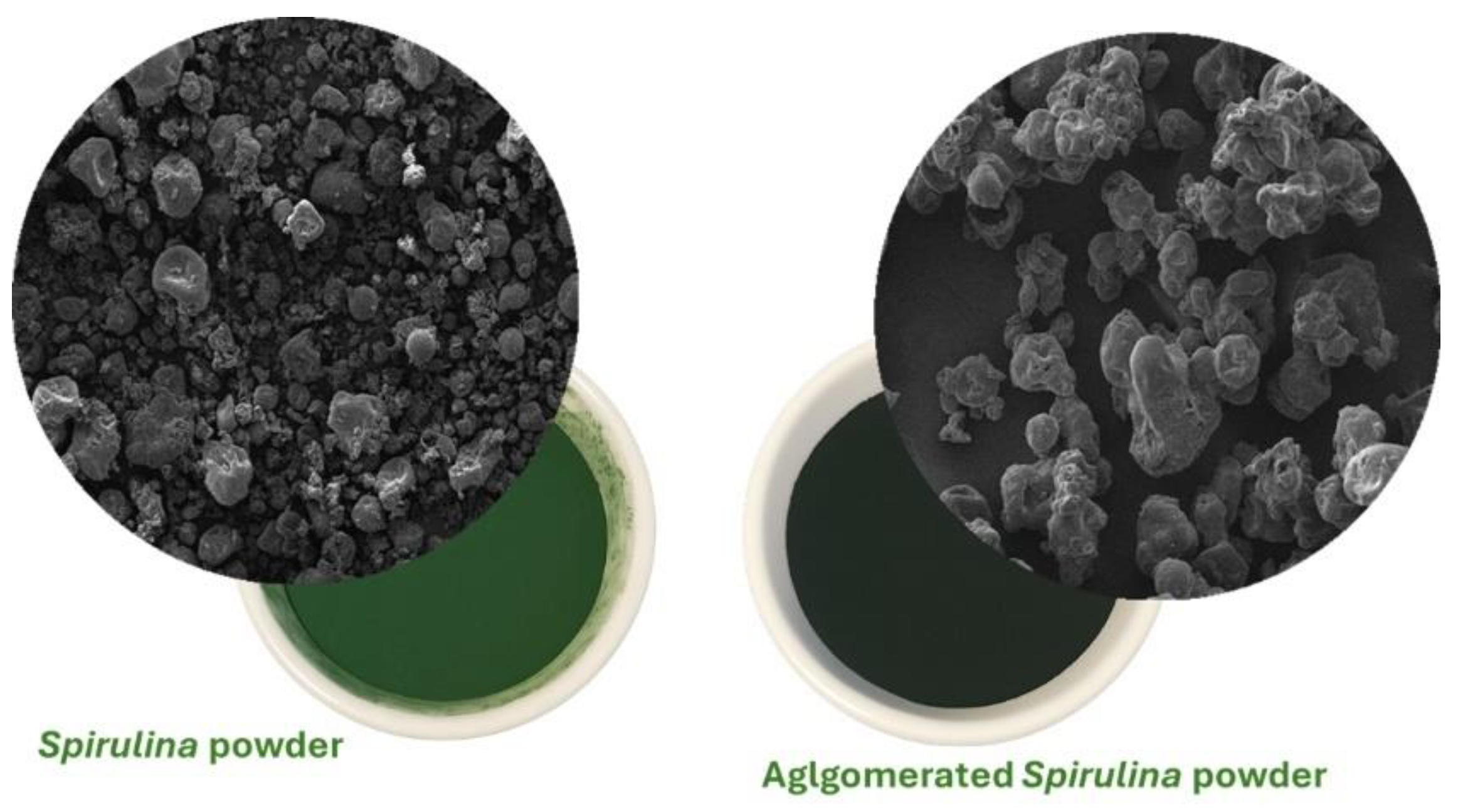
Figure 2.
Fermentation kinetic curves of yogurt with commercial (left) and agglomerated with 30% maltodextrin (right) Spirulina platensis. A and B) Total titratable acidity in % (lactic acid). C) and D) pH. E) and F) Total sugars in g.L-1. G) and H) Viable lactic acid bacteria in CFU.g-1.
Figure 2.
Fermentation kinetic curves of yogurt with commercial (left) and agglomerated with 30% maltodextrin (right) Spirulina platensis. A and B) Total titratable acidity in % (lactic acid). C) and D) pH. E) and F) Total sugars in g.L-1. G) and H) Viable lactic acid bacteria in CFU.g-1.
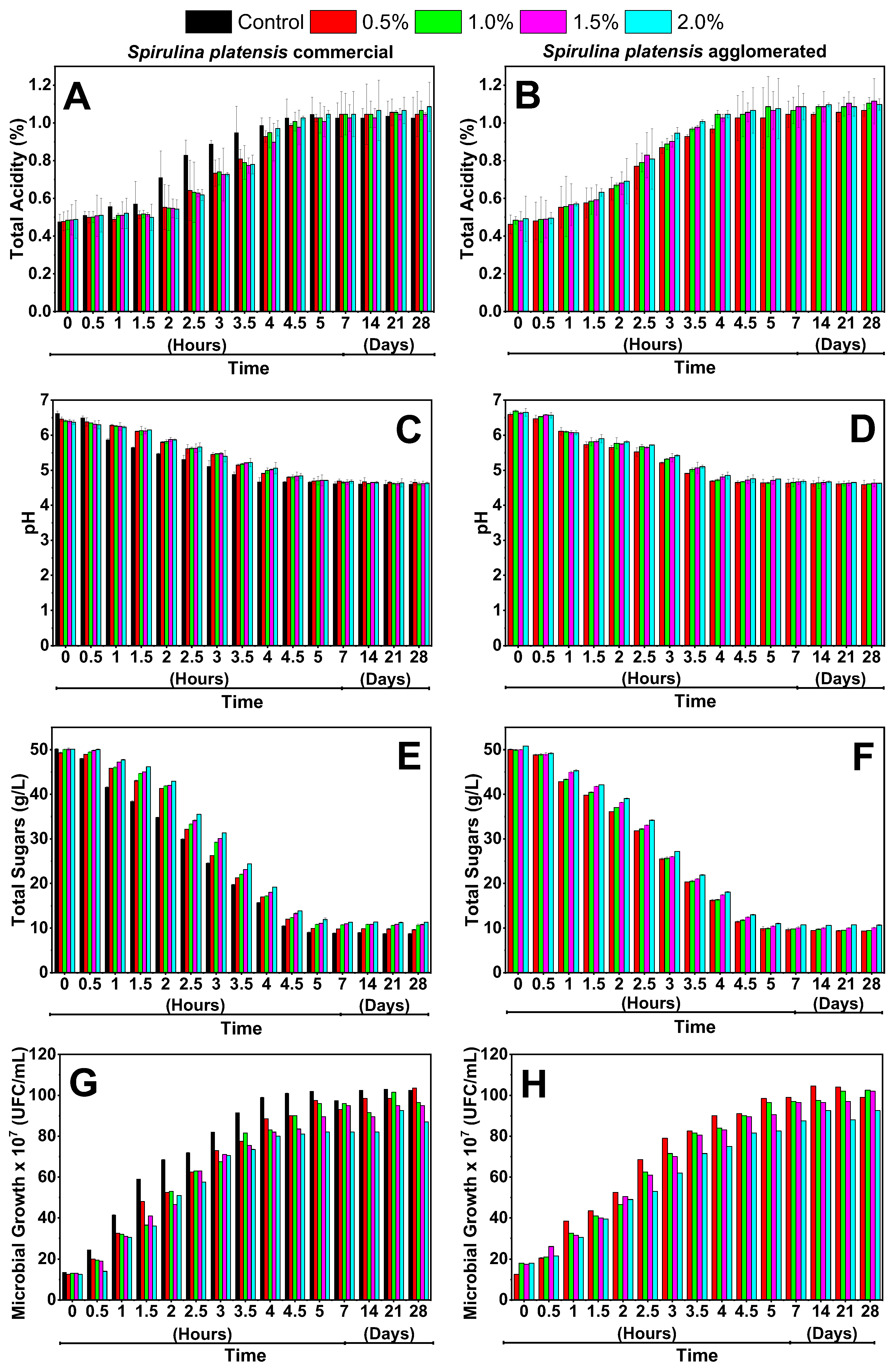

Table 1.
Centesimal composition of the yogurts incorporated with Spirulina platensis.
| Sample | Protein (%) | Lipids (%) | Moisture (%) | Ash (%) | Carbohydrates (%) |
|---|---|---|---|---|---|
| Control | 3.96 ± 0.05d | 3.13 ± 0.21a | 83.10 ± 1.30a | 1.10 ± 0.20d | 8.74 ± 0.28c |
| Spirulina plantesis commercial | |||||
| 0.5% | 5.44 ± 0.26a | 2.28 ± 0.15c | 81.48 ± 1.60a | 1.31 ± 0.10cd | 9.49 ± 0.70b |
| 1.0% | 5.74 ± 0.03a | 2.41 ± 0.15bc | 80.15 ± 1.86a | 1.52 ± 0.10b | 9.26 ± 0.50b |
| 1.5% | 5.74 ± 0.03a | 2.52 ± 0.16bc | 80.25 ± 2.12a | 1.65 ± 0.14a | 9.86 ± 0.49b |
| 2.0% | 5.63 ± 0.54a | 2.53 ± 0.12bc | 80.18 ± 2.52a | 1.86 ± 0.20a | 10.05 ± 0.32ab |
| Spirulina platensis agglomerated with maltodextrin 30% (w/v) | |||||
| 0.5% | 4.33 ± 0.30c | 2.42 ± 0.15c | 82.66 ± 1.10a | 1.27 ± 0.05cd | 9.68 ± 0.14b |
| 1.0% | 4.81 ± 0.25bc | 2.64 ± 0.13bc | 81.14 ± 2.10a | 1.56 ± 0.12ab | 10.55 ± 0.16a |
| 1.5% | 5.41 ± 0.36a | 2.70 ± 0.18ab | 80.14 ± 1.85a | 1.67 ± 0.10a | 10.43 ± 0.11a |
| 2.0% | 5.49 ± 0.57ab | 2.79 ± 0.22ab | 80.13 ± 1.92a | 1.87 ± 0.10a | 10.36 ± 0.13a |
Statistical analysis at a level of 95% of confidence (p < 0.05) must be read as: - different letters indicate significant differences between the samples, i.e., a, b, c and d are different statistically, and; - mixed letters as the example - ab has no statistical difference between samples with a, b and ab.
Table 2.
Antioxidant compounds in yogurts incorporated with Spirulina platensis.
| Sample | Phenolic Compounds (mg.100g-1) |
Phycocyanin (mg.100g-1) |
β-carotene (mg.100g-1) |
Chlorophyll a (mg.100g-1) |
|---|---|---|---|---|
| Control | 5.58 ± 0.02e | 0.00 ± 0.00d | 0.00 ± 0.00g | 0.00 ± 0.00e |
| Spirulina plantesiscommercial | ||||
| 0.5% | 2.98 ± 0.02f | 2.19 ± 0.03c | 4.73 ± 0.05f | 12.39 ± 0.04d |
| 1.0% | 5.93 ± 0.06e | 3.39 ± 0.15a | 5.09 ± 0.02e | 12.70 ± 0.01d |
| 1.5% | 11.20 ± 0.05c | 3.57 ± 0.17a | 5.34 ± 0.06c | 13.28 ± 0.16c |
| 2.0% | 13.62 ± 0.02b | 3.65 ± 0.13a | 5.63 ± 0.01b | 14.07 ± 0.03a |
| Spirulina platensisagglomerated with maltodextrin 30% (w/v) | ||||
| 0.5% | 11.02 ± 0.02c | 3.07 ± 0.04b | 5.06 ± 0.03e | 12.43 ± 0.08d |
| 1.0% | 12.00 ± 0.42c | 3.12 ± 0.19ab | 5.24 ± 0.01d | 12.48 ± 0.04d |
| 1.5% | 13.19 ± 0.32b | 3.06 ± 0.01b | 5.49 ± 0.11c | 12.60 ± 0.19d |
| 2.0% | 14.96 ± 0.13a | 3.13 ± 0.06b | 6.37 ± 0.03a | 13.77 ± 0.12b |
Statistical analysis at a level of 95% of confidence (p < 0.05) must be read as: - different letters indicate significant differences between the samples, i.e., a, b, c, d, e, f and g are different statistically, and; - mixed letters as the example - ab has no statistical difference between a, b and ab.
Disclaimer/Publisher’s Note: The statements, opinions and data contained in all publications are solely those of the individual author(s) and contributor(s) and not of MDPI and/or the editor(s). MDPI and/or the editor(s) disclaim responsibility for any injury to people or property resulting from any ideas, methods, instructions or products referred to in the content. |
© 2025 by the authors. Licensee MDPI, Basel, Switzerland. This article is an open access article distributed under the terms and conditions of the Creative Commons Attribution (CC BY) license (http://creativecommons.org/licenses/by/4.0/).
Copyright: This open access article is published under a Creative Commons CC BY 4.0 license, which permit the free download, distribution, and reuse, provided that the author and preprint are cited in any reuse.


