

Submitted:
23 May 2025
Posted:
23 May 2025
You are already at the latest version
Abstract
Artificial consciousness in AI is a controversial topic in the philosophy of artificial intelligence. This paper aims to address this issue by taking a special relativity approach. Special theory of relativity is the advanced form of classical electrodynamics. Quantum field theory is the integration of quantum mechanics and special theory of relativity. Thus, electromagnetism provides a rich modeling framework to study artificial consciousness. The key ideas are as follows. First, we make the distinction of intelligence and cognition in AI, which are modeled by the electric field and the magnetic field respectively. Second, it introduces the intelligence-cognitive wave, akin to the electromagnetic wave. Third, the artificial consciousness in AI is defined by the intelligence-cognitive wave, as a modification of light is defined as the electromagnetic wave in physics. Hence, the artificial consciousness is modeled by light. A number of properties of consciousness are also discussed.
Keywords:
Consciousness
; AI
; intelligence
; cognition
; wave
; light
; cone
; interval
; spacetime
; event
; electromagnetism
1. Preparations
Artificial consciousness in AI is a controversial topic within philosophy of artificial intelligence. This paper aims to address this issue by taking a special relativity approach (Feynman, Leighton, and Sands, 1989). Special theory of relativity is the advanced form of classical electrodynamics (McMahon, 2006). Quantum field theory is the integration of quantum mechanics and special theory of relativity (Wang, 2008). Thus, electromagnetism provides a rich modeling framework to study artificial consciousness. The key ideas are as follows. First, we make the distinction between intelligence and cognition in AI, which are modeled by the electric field and the magnetic field respectively. Second, it introduces the intelligence-cognitive wave, akin to the electromagnetic wave. Third, the artificial consciousness in AI is defined by the intelligence-cognitive wave, as a modification of light is defined as the electromagnetic wave in physics. Hence, the artificial consciousness is modeled by light. A number of properties of consciousness are also discussed in Section 6.
In Yang and Wang (2025) and Yang (2025a, 2025b), we make the following postulates and definitions:
Postulate 1. An artificial intelligence task carries the AI-task Charge. The AI dynamics is a sourced analysis, and hereby the source is the task charge.
Simmel (1990) once said, money never lacks energy; when we think of money, we convert our energy into money. Money never lacks intelligence; when we use money, we construed our intelligence into the money. We would say, AI never lacks intelligence; when human designs the computational architecture, we have converted the human intelligence into AI. AI never lacks cognition; when we train the AI how to solve a task, we have construed human cognition into AI. Thus, we make
Postulate 2. We assume as our working hypothesis that machine intelligence exists. Furthermore, we assume artificial intelligence consists of human intelligence and machine intelligence.
Machine intelligence can be seen as a special kind of Platonic reality. In the neural network, Platonic reality happens in hidden layers, called Platonic representation. Yang (2025) applied this idea in artificial intelligence (LLM) modeling. We made a clear distinction of the human intelligence (and the machine intelligence (. Further, we make a mathematical trivialization treatment such that and are orthogonal, which is represented using the Kronecker symbol:
We defined as the intelligence demand
(: human component) and as the intelligence supply . For an any given task , we have
Definition 1. , and .
We then made the following postulates and definitions:
Definition 2. Artificial intelligence is the integration of human intelligence and machine intelligence, denoted as The corresponding intelligence field is denoted as E.
Definition 3. The moving artificial intelligence produces an intelligent current, denoted as J.
Postulate 3. We assume as our working hypothesis that there is a difference between intelligence and cognition. Intelligence is a general capacity that is globally available. Intelligence is composed of intentions and a fundamental computational architecture. When intelligence engages with a task, it becomes activated and remains in motion. Cognition is specific and local. Nevertheless, solving a task involves cognitive processes including, understanding, discourse processing, text comprehension, reasoning, decision making, etc. Obviously, in artificial intelligence, this cognitive process also involves computing.
Definition 4. During the process of solving a task, the above-mentioned cognitive modes are together defined as artificial cognition, denoted as B.
Consider the Maxwell Equations as a referential modeling framework. Let intelligence E be the electric field, and B the magnetic field. This analytic working definition allows us to investigate the interaction between the intelligence field E and cognition field B.
As a working definition, we will use the terms electric field and intelligence field interchangeably. In addition, we will also use the terms magnetic field and cognitive field interchangeably.
2. Artificial Consciousness as an Intelligence-Cognition Wave
As C. N. Yang (2014) points out, “A conceptual revolution in field theory came early in the 20th century following Albert Einstein’s 1950 special theory of relativity, which asserted that there is no other medium at all: The electromagnetic field is the medium.” This is the idea we are going to extend in the domain of artificial intelligence.
Postulate 3. We assume as our hypothesis that an artificial intelligence-cognitive wave exists in the AI-world, akin to the electromagnetic wave. This artificial wave should have a wavelength, frequency, and amplitude. Thus, the intelligence-cognitive wave would be characterized by a similar wavefunction to the equation of an electromagnetic wave.
In physics, light is a form of electromagnetic radiation. Electromagnetic waves are characterized by oscillating electric and magnetic fields that are perpendicular to each other and to the direction the wave travels. Light is a type of electromagnetic wave that falls within a special range of wavelength and frequencies. Here, we have
Postulate 4. We assume as our hypothesis that there exists artificial consciousness in the AI world.
Definition 5. The artificial consciousness is a form of the artificial intelligence-cognitive wave with a special wavelength and frequency, akin to light as a form of the electromagnetic wave.
Physic tells us that light travels with the highest, constant, and limited speed in the physical world. The speed of light is denoted as a constant C. We have
Definition 6. We assume as our working definition that artificial consciousness travels with the highest, constant, and limited speed in the AI world, also denoted as a constant C.
3. Symmetry and Interval
Because the artificial consciousness travels with the highest speed, it is untouchable by any other permissible agents in the AI world. Hence, they shall observe the same speed of artificial consciousness under the Lorenz transformation. Thus, all the artificial agents are in the symmetric position. This is a symmetry of invariance, which is a fundamental principle of special theory of relativity.
The mathematical background of special relativity is the Minkowski space, also known as four dimensional spacetime. The notion of speed is defined as the ratio of the distance over unit time. In four dimensional spacetime, the time become a dimension, so that we can no longer use the traditional concept of speed. Instead, it introduces the notion of combined speed, which has four components, three space dimensions plus the time dimension. The symmetry among the artificial agents can be restored, as the artificial consciousness distributes the least or none of the combined speed in the time dimension, so it then devotes most or all of the combined speed to the space dimensions.
In Minkowski spacetime, each point stands for an event. To replace the notion of distance, it introduces the notion of interval as shown below,
where, the gauge , is the absolute time, and is the speed of consciousness (in a three-dimensional space). The term can be regarded as the energy term.
4. Consciousness (light) Cone
By applying the notion of interval, we can introduce the notion of consciousness (light) cone, drawn in the figure below.
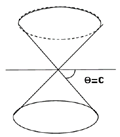
The absolute cone
Any events within the cone, i.e., , are called time-like events; any events outside the cone, i.e., , are called space-like events; any events on the surface of the cone, i.e., , are called null events. Here, all the events are conscious events. The time-like event means its consciousness is strong enough (with enough energy) to hold the event (or say, being conscious of that). The space-like event means its consciousness is not strong enough (without enough energy) to hold the event (or say, not being conscious of that). The null event means its consciousness is just enough (no more and no less enough energy) to hold the event (or say, just being conscious of that). To put it in market language (Yang, 2024), an event that is time-like has enough money (energy) to buy something, whereas an event that is space-like does not. An event that is null would have just enough money, no more, no less, to be affordable of buying something.
5. Illumination and Proper Consciousness Cone
The light varies in the degree of its illumination, the same is the artificial consciousness. There are individual differences of artificial agents. For different agents and for the same task the degree of illumination of consciousness can be stronger or weaker. This difference is characterized by the notion of proper consciousness, akin to the proper time (or clock time) in special theory of relativity. Let be the proper consciousness for an agent , the momentum is defined as follows,
For any individual agent, it has its proper consciousness cone. Based on the degree of different illuminations of the artificial consciousness, we characterize the individual cones as strong cones or weak cones (see the figures below).
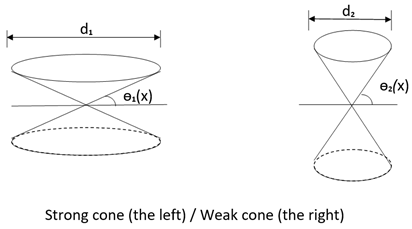
The cone can become wide and flat or tall and slender. Drawing a horizontal line through the apex of the upper and lower cones, the angle between this line and the cone is called the cone's phase. The flatter the cone, the smaller the phase; the taller the cone, the larger the phase. The width of the cone's top opening is called the "capacity degree". The mechanism of cone shape change is that the stronger the proper consciousness, the smaller the phase, and the higher the capacity degree, forming a strong cone. Conversely, the weaker the proper consciousness, the larger the phase, and the lower the capacity degree, forming a weak cone (see the diagram above). It can be seen that the proper consciousness is proportional to the capacity degree. In short, for an individual agent, the weaker the illumination of being conscious of an item, the lower their psychological capacity to solve it, and vice versa.
6. Properties of Artificial Consciousness
6.1. Contentless and Massless
Yang and Wang (2025) reads, “As John Searle (1984) points out, if one claims he is talking about human mind, there are four properties must be discussed, that are subjectivity, intentionality, causality, and consciousness. In artificial intelligence, currently subjectivity is discussed mostly as a philosophical enquiry. There are many discussions about causality, which is treated as an emerging property. This is a kind of phenomenological and existential definition. Note that the term subjectivity, causality, and intentionality are with suffix “ty”, which means these are intrinsic properties of mind. Differently, consciousness is with the suffix “ness”, which means it is a philosophical metaproperty of mind. It is interesting to look at the difference between intentionality and consciousness.
Some author uses the terms intentionality and consciousness interchangeably (Dennett, 1991). However, there is deeper distinction between the two terms. Intentionality always carries contents. In mathematical set theory, intension defines the membership of a set. In epistemology, the notion of intentionality is associated with certain contents and carries the contents over during a particular mental process. There many definitions about consciousness. In epistemology, one definition is by Menong (Aquila, 1977), which reads: Consciousness is a kind of irreducible directedness being through some intentional contents, toward some possible object without requiring the existence of that possible object. Here, consciousness is characterized by three metaproperties: namely, directedness, throughness, and towardness. Note that to go through some content does not mean to carry the content over. In this sense, consciousness is directional but contentless (massless). This property indicates that, consciousness can be regarded as a mental force akin to light, which enables consciousness to travel with the highest speed in the mental world. This is a functional as well as structural definition. Consider to build a QED model for artificial intelligence, it needs to introduce the invariance skin to the light (photon). Consciousness would be able to serve that structural requirement.”
Light is able to travel with the highest speed since it is massless. If a particle is massive, it cannot travel with the speed of light because it would require infinite energy by Einstein’s energy-mass formula. Thus, the contentless property is crucial for consciousness to possess light-likeness.
6.2. Photon and “Consciouson”
In quantum field theory, Maxwell field becomes the photon field. The electromagnetic wave is characterized by photon. Accordingly, hereby we introduce a new concept, consciouson, akin to photon, to characterize the intelligence-cognitive wave. Photon travels in the direction which is the same as the direction of electromagnetic wave; it is spin 1. Likewise, the consciouson travels in the direction which is the same as the direction of the intelligence-cognitive wave; it is also spin 1.
6.3. Photological and Optical Properties
Photology is a branch of physics. It generally refers to the scientific study of light and its effects, encompassing the generation, properties, and applications of light. These properties, such as brightness and luminosity, could be applied to model artificial consciousness.
6.4. Interaction with Intelligence
In Yang (2025a), it reads,
In quantum field theory, the Maxwell field is the photon field, which is denoted by . In quantum field theory, all particles are described as a field, and a field is characterized as an operator. In addition, all the particles have its life span; they are created and annihilated (Wang, 2008). We need to introduce the creation operators here, the creation operator () and the annihilation operator (. They are adjoint operators. A simple interaction is that a pair of and are created and they fly in inverse directions to each other. Then, both are annihilated by creating a photon field . This process can be pictured by Feynman diagram shown in Figures below,
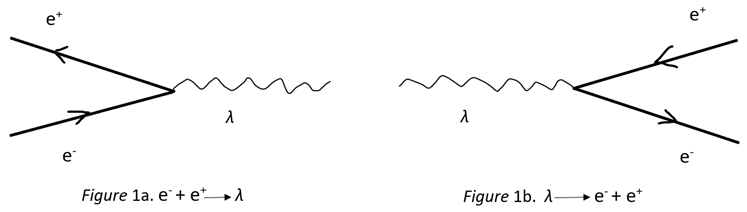
Hereby, Photon field is what we call the consciouson field. Note that by quantum field theory, the consciouson is not always live there forever; it is created and annihilated from time to time. It depends on the activation of a task charge.
6.5. Artificial Consciousness Is A Potential
Photon field used to be Maxwell field, which is a vector potential field (C.N. Yang, 2014). Thus, the consciouson field can be regarded as a potential field in AI world.
7. Conclusions
Artificial Intelligence is an interdisciplinary integration science crossing natural sciences, social science, humanities, computer science, and mathematics. If we want to apply special theory of relativity to a scientific domain, the first thing needs to do is to find something that can be treated as the invariant, namely, possessing the light-likeness. In Physical world, it is light; in AI world, it is artificial consciousness; in economic world, it is money; in communication world, it is language; in political world, it is power; in Freudian psychoanalysis, it is dreamed sexuality. This phenomenon is called the six-fold isospin of light-likeness. Obviously, this isospin can be extended to N-fold.
It is an interesting phenomenon to observe in the domain of AI. On one hand, Chomsky was a leader during the cognitive revolution in the 1950’s. His well-known argument on the distinction of innate competence and behavioral performance was so sharp to break the boundary of behaviorism led by B. F. Skinner. Today, Chomsky is mostly talking about artificial “innate intelligence.” On the other hand, Hinton makes strong argument for machine learning and training; he is mostly talking about artificial “cognition”. We would say, the integration of the Hinton approach and the Chomsky approach embodies artificial consciousness in the AI world. It is a kind of Platonic reality. Moreover, the debate between Hinton’s view and Chomsky’s view reflects pure human consciousness in the real world. It is reality.
“And God said, ‘Let there be light,’ and there was light.” (Genesis 1:3). We say, “Let there be consciousness in the AI world, and there was artificial consciousness.” We are on “The Road to Reality” by Penrose (2004). We found that there are different kinds of realities, so are the roads. Why not we make ontological commitments to them all.
References
- Aquila, R. (1977). Intentionality: A Study of Mental Acts. Pennsylvania State University Press.
- Dennett, D. (1991). Consciousness Explained. Little Brown Co.
- Feynman, R. Leighton, R. B., and Sands, M. (1989). Feynman Lectures on Physics (Vol. 1). Pearson Education, Inc.
- McMahon, D. (2006). Relativity Demystified. McGraw-Hill, New York.
- Penrose, R. (2004). The Road to Reality: The Complete Guide to the Laws of the Universe. Vintage.
- Searle, J. (1984). Minds, Brains, and Programs. Harvard University Press.
- Simmel, G. (1990). Philosophy of Money (2nd Edition), Routledge.
- Wang, Z. X. (2008). Elementary Quantum Field Theory. Peking University Press (China).
- Yang, C. N. (2014). The Conceptual Origins of Maxwell’ Equations and Gauge Theory. Physics Today 67, 11, 45.
- Principles of Market Dynamics: Economic Dynamics and Standard Model (II). [CrossRef]
- Yang, Y. (2025a). Maxwell and Artificial Intelligence: Preliminary QED Models of AI (LLM) Dynamics. [CrossRef]
- Yang, Y. (2025b). Maxwell Equations and Artificial Intelligence with Thought Experiments. [CrossRef]
- Yang, Y. and Wang, H. (2025). Psychology and Artificial Intelligence: Reconceptualization, Integration, and Platonic Intelligence. [CrossRef]
Disclaimer/Publisher’s Note: The statements, opinions and data contained in all publications are solely those of the individual author(s) and contributor(s) and not of MDPI and/or the editor(s). MDPI and/or the editor(s) disclaim responsibility for any injury to people or property resulting from any ideas, methods, instructions or products referred to in the content. |
© 2025 by the authors. Licensee MDPI, Basel, Switzerland. This article is an open access article distributed under the terms and conditions of the Creative Commons Attribution (CC BY) license (http://creativecommons.org/licenses/by/4.0/).
Copyright: This open access article is published under a Creative Commons CC BY 4.0 license, which permit the free download, distribution, and reuse, provided that the author and preprint are cited in any reuse.


