
Submitted:
16 May 2025
Posted:
23 May 2025
You are already at the latest version
Abstract
The quantitative modeling of agent qualia remains an open challenge. Here we describe the construction of a multi-agent based model which manifestly takes into account cognition and agent communication at the outset. In this framework agent qualia and perceptions can be represented by pullbacks of geometric quantities unique to each agent. Agents are constructed as pairs of local sections of associated bundles Ei to a principal G-bundle N composed of a base manifold C and Lie group G. Agents interact via induced connections and evolve according to a generalized variational energy. We demonstrate that a U(1) gauge structure naturally arises from the recognition and model coordination of multiple agents serving as a mechanism for minimizing prediction error under partial information. This structure allows agents to maintain coherence in perception and inference, despite fundamentally local and subjective perspectives. Language, in this view, is a gauge theory.
Keywords:
inference
; gauge theory
; cognition
; linguistics
; agent-based model
1. Introduction
Agent-based models have proven to be powerful tools across diverse domains, from economics and social dynamics to machine learning, cognition, and artificial intelligence [1,4,10,19,22]. In these contexts, agents are typically endowed with beliefs, preferences, and decision-making capabilities, allowing researchers to model systems where cognition, learning, and adaptation play central roles. In contrast, the study of physical systems has traditionally eschewed such subjective elements, focusing instead on the dynamics of inanimate matter governed by fundamental laws. Meanwhile, cognitive scientists, philosophers, and others have found that human perception is largely an evolutionarily constructed subjective perception aimed at maintaining organism stability and survival [1,2,3,5]. In this view space, time, and physical properties are not fundamental to our universe but instead comprise useful constructions for adaptability and survival.
Thus there exists a great, but largely unspoken, tension between the field of physics and the field of cognition, philosophy, and neuroscience. Despite remarkable advances in both domains, efforts to place the observer within the formalism of physical theory — especially in the context of quantum mechanics — remain fraught with ambiguity. The measurement problem, the role of the observer in quantum theory, and many more challenges remain unresolved after more than a century of scrutiny [7,8,9,11,20].
In this work, our aim is to bridge this divide by proposing a minimal agent-based framework in which cognition is not an emergent afterthought but a central and generative component. We formulate this theory by modeling agents as local sections of associated bundles whose fibers encode beliefs and generative models. By introducing a generalized variational energy functional that governs agent interactions, we show that the resulting epistemic dynamics naturally give rise to an emergent global gauge structure. Agents pull back geometric structures such as the Fisher information metric, variational energy gradients, and observational data from the recognition bundle onto the base manifold, thereby encoding subjective inference in a manner grounded in objective structure.
2. Materials and Methods
We take the following as axioms of our framework:
1. Let be a smooth principal G-bundle where is a smooth manifold, G is a Lie group acting freely and transitively on the right on . The projection satisfies for all .
2. Let be a representation of G on a smooth manifold or vector space called the recognition or belief fiber. Then the associated recognition bundle to is defined as:
where
This gives a fiber bundle with fiber .
3. We define a second associated bundle in the same manner we call the "model bundle" with fiber . and are manifolds of probability distributions or model parameters and do not necessarily comprise a vector space.
4. An agent is a pair of local sections over
6. There exists a generalized functional on the sections we call variational energy such that
determines the dynamics of agents.
7. A multi-agent () over is a tuple of agents (where is an index set)
8. A scale-dependent agent is a multi-agent whose agents share the same generative models.
9. An observation/observable is a local section of
This is similar to an agent, but does not require a section over .
Next, in the standard way [13], via horizontal lifting from to , we may construct a variety of morphisms and induced connections across scales :
- ;
- ;
- ;
- ;
- ;
- ;
- ;
- .
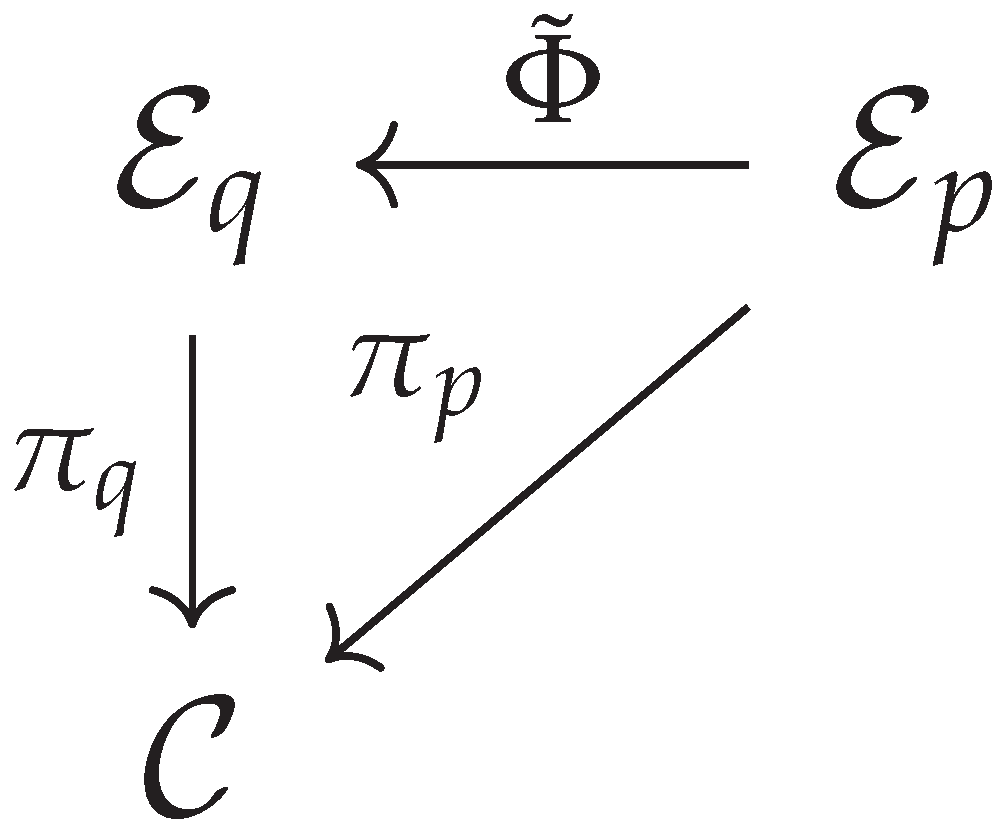
The two bundle morphisms are Figure 1 and Figure 2. When these diagrams commute (that is when , where are the bundle projection maps), we say that we have an "experimentally verified prediction of an agent’s model". In general, however, these bundle morphisms need not commute.
These connections lead to terms in the generalized variational energy representing possible agent/agent and agent/multi-agent interactions. In our current study we will only focus on the induced connection such that agents can compare beliefs between different sections of where
The induced connection provides a notion of parallel transport of beliefs which in turn defines the coordination structure used in our generalized variational energy term. This construction is well defined even when the fibers are not vector spaces so long as it carries a smooth G-action[34].
Following Friston [1], we define a variational free energy as
In our more general framework, agent beliefs and models occupy distinct associated bundles, and the comparison between them is only possible via , morphisms. This leads to a more flexible and scalable framework, particularly amenable to multi-agent and multi-scale settings with gauge structure.
Here, we consider that agents share information via parallel transport of beliefs and models. We define a generalized variational energy for an agent A as
where represents possible interactions between other agents mediated by gauge connections. In the present work we shall consider only one term which couples recognitions between two agents as
where represents a general coupling. For multiple agents, we sum over terms between each pair of agents. We note in passing that this expression bears remarkable similarities with the Grand potential in standard thermodynamics.
Importantly, a local non-equilibrium steady state can be approximated by locally. Then, during some discrete computational update step, we have such that the change in information is given by
where represents a local gauge transformation acting by left action on an agent’s belief fiber.
3. Results
3.1. Agent Pullbacks to
Since agents do not perceive directly (as consistent with modern neuroscience and cognition) [17], we define their base manifold perceptions as pullbacks of geometric quantities from to the base manifold . For example, the Fisher information metric may be defined on the agent’s fibers as
allowing us to locally expand around under pullback as
This perceived metric on governs the agent’s experience of a geometry on . Since belief dynamics vary between agents, their perceived geometries differ unless a subset of their beliefs over are in agreement.
Consistent with cognitive science, we propose that the standard Euclidean spacetime emerges as an evolutionary flow in the belief space of human-scale agents. We therefore assume that we have the freedom to choose a particular decomposition such that
Specifically, since is G-invariant any subgroup defines an invariant subspace of . Then the Lie algebra decomposes under the adjoint action of H. In this manner, we can block diagonalize the metric for subgroups of G.
As an example, consider , , and . Then
In which case
Here, represents the perceived Euclidean space metric and represents an unobservable 7-dimensional "dark" component. This dark component reflects the fact that there generally are aspects of the geometry that are not directly accessible or observable within the agent’s belief space, though they influence the agent’s perceptual experience indirectly. Importantly, perturbations to the agent’s Fischer metric manifest as perturbations on both the perceived and dark pullback metrics.
In this manner, an agent’s perception is an emergent and subjective block and not a unique decomposition. Furthermore, the dimension of can be flexible as allowed by the representations of G.
Taking human agents as an example, we point out that this procedure is compatible with reports of observations and perceptions which violate standard physical assumptions (particularly under the effects of hallucinogens, trauma, stroke, etc) [4]. In our framework this directly corresponds to mixing the pullback metric under perturbed belief states about with respect to the Euclidean metric. In this sense our framework is cognitively consistent and offers a path towards a more unified model of physical systems in which the observer and observed are modeled together.
Similarly, we can pull back other dimensionless geometric objects from an agent’s sections. For example, with respect to human agents, we conjecture that Plank’s constant is represented as the pullback of the minimum update step to the variational energy. That is, if bit, then
3.2. Emergence of a Gauge Structure
Given the possibility of block-diagonalizing the pullback metric into a standard physical metric we can show that a gauge theory naturally emerges from the agents coordinating and adjusting their beliefs in response to one another.
We consider two overlapping agents under pullback metric coordinates. Agent A has a belief about and agent B has belief . Agents interact via the connection of their beliefs
where e represents the "strength" of the disagreement in their beliefs and a general element of the Lie algebra.
Next, we write our agents’ beliefs as a pair where is the belief magnitude and is the canonically conjugate phase to representing dynamic information on . We can encode both coordinates into a complex variable as
Their interaction term is then
Given , , and allows us to expand
If the phase mismatches are small then we have
Here is the local Yang-Mills field associated to on .
Minimizing the interaction potential leads to the condition that the phases of the agents must align, resulting in
Thus, arises as a gauge field that compensates for the phase mismatch between the agents. In this framework is not ontological, but instead an epistemic necessity invented by the agents to resolve prediction errors due to their limited knowledge of . The local gauge field facilitates the alignment of beliefs, allowing the agents to share consistent beliefs and coordinate their perceptions of the world.
4. Discussion
Our framework represents a novel multi-agent based model that allows agents to coordinate beliefs via rich geometric structures. If we take this model as a serious representation of reality then physics is not a description of an external, observer-independent reality but rather a description of belief coordination among agents embedded within a shared epistemic landscape. This echoes the views of Kant, Helmholtz, and modern cognitive researchers that perception is a manifestation of agent inference [1,2,3,4,5,6,17].
In this view, we cannot take our observations as elements of an underlying reality but rather as constructions our minds utilize to maximize survival under evolutionary pressures. The philosophy of science in this sense is largely about what perceptions are shared among typical agents. Traditionally reports of perceptual perturbations of our generative models (hallucinations) are discounted as subjectively spurious, yet here they offer deep insight into the underlying geometric structure itself.
In the most general framework each agent perceives a world of correlations (via the agent’s sensory data) and builds models with which to represent patterns in those correlations [5]. Our minimal geometric model allows subjective experience and differing perceptions based on the pullback of geometric objects from an agent’s fibers down to the hidden base manifold . This represents an exciting avenue with which to study subjective aspects of reality such as consciousness and qualia. Every observation and perception, even the pathological, then become valuable data.
The model we have proposed naturally bears similarities to standard field theories in physics. For example, we propose an experimental program by which coupling coefficients in are phenomenologically determined across multiple scales and via renormalization procedures ( and connections) predict new configurations of agents which may not otherwise be discerned.
Furthermore, if the pullback of the minimal variational energy update is related to ℏ and/or we assume that information is conserved then researchers may be able to experimentally apply this framework as a novel path in fundamental physics. For example, Landauer’s principle, in our view, becomes a fundamental reflection between information at the associated bundle level and energy/entropy at the perceptual level. If so, then this suggests that belief updates may leak into unobservable sections of perceptual reality.
These claims are falsifiable and experimentally tractable given the recent trends and experiments in computational biology and molecular chemistry [25]. Constraints on our model and interaction couplings may be elucidated by firm experiments. For example, neural synchronicity between agents presents a natural arena in which to study epistemic gauge interactions.
Our model has further applications in linguistics where human language might best be studied as a gauge theory. If so, then evolutionary pressures have fixed useful models that humans share and align as multi-agents under gauge connection. These features can be probed by historical data, anthropology, and other tools that study the dynamics of language over time and space. In this view, language is a concrete biologically instantiated epistemic gauge field: language is a gauge theory.
Still further, our work resonates with, and extends, ideas from quantum Bayesianism (QBism) [23], the Free Energy Principle[1], and relational interpretations of quantum theory [24]. However, our framework differs in that it offers a precise geometric and gauge-theoretic formalism for belief coordination and perception via pullback geometries. It unifies the subjective and objective: agents and observations are not separate but unified, joined by the mathematical language of differential geometry.
Remarkably, our framework reveals a subtle but significant duality in the interpretation of dynamics. We regard the base manifold as either:
1. A dynamic base space under right action of G such that agents and observables dynamically evolve as elements of , or
2. A fixed base space where the beliefs of agents evolve within their associated bundles via the left action of G, representing the internal dynamics of agents updating their beliefs about a local patch of a fixed over time.
This distinction is not merely mathematical — it also becomes a choice of philosophical stance: as agents embedded within a universe of fixed hidden states, our beliefs of those states are in constant flux. Or we view a dynamically evolving universe with stationary observers whose beliefs reflect that motion. Either stance yields equivalent observable content, but reflects different assumptions about what is taken to be ontological and what is epistemic as well as possibly offering unique perspectives on intelligence, consciousness, and free will [5,6].
Our framework raises many more questions and suggests many future directions of exploration. We have only scratched the surface of an incredibly rich geometric framework of agents and their coordination. The principal bundle, while abstractly postulated, is not yet explicitly modeled. However, via the duality mentioned above this is not necessarily a limit our framework. Furthermore, the full implications of agent coordination as parallel transport of beliefs and models remain to be explored.
Nevertheless, the central insight remains: physics, at its deepest level, is a study of how agents construct, refine, and align structured beliefs about an underlying reality which they can never directly access. In this sense, it is not merely a study of physical properties, but a refined language for organizing perception, grounded in geometry, inference, and communication.
We have proposed a radical but principled synthesis of observation, inference, cognition, and science. Our results suggest that our current understanding of physical law is not necessarily inscribed in nature as we perceive, but instead arises from the alignment of structured beliefs (recognition and model fibers) across agents constrained by geometry. The underlying manifold may be out of reach, but by considering cognitive agents and their patterns of belief updates (including subjective experience and qualia) we hope to glean new information about our shared, fundamental reality.
5. Conclusions
By considering an agent-based model where agents are pairs of local sections of associated bundles to a principal G-bundle which evolve via a Fristonian variational energy minimization we have shown that a gauge structure emerges naturally from the act of communication, specifically, from agents’ attempts to align beliefs about the base manifold. Gauge fields need not be fundamental ontological entities, but instead are understood as epistemic structures required for coherence between interacting observers with limited information. Language, then, is a gauge theory coordinating agents.
This framework offers a fertile ground for unifying traditionally opposed dualities: subject and object, observer and observation, epistemic and ontological. It provides a geometric and information-theoretic language for discussing the emergence of spacetime, interactions, and dynamics from the internal structure of belief and inference echoing Wheeler’s "it from bit" [12,14,15,16,18,21]
Our approach opens new avenues for the study of collective cognition, distributed intelligence, and hierarchical inference, with possible applications to machine learning, multi-agent systems, and socio-physical models. By grounding communication, coordination, and belief-updating in a differential-geometric setting, we offer a path toward a general theory of epistemic interaction, where physical and cognitive processes co-emerge from a shared inferential geometry.
Funding
This research received no external funding.
Data Availability Statement
This study is theoretical and does not involve empirical data. All relevant derivations and equations are included in the main text.
Conflicts of Interest
The authors declare no conflicts of interest.
Abbreviations
The following abbreviations are used in this manuscript:
| SO(N) | Special Orthogonal Group in N Dimensions |
| U(N) | Unitary Group in N Dimensions |
| SU(N) | Special Unitary Group in N Dimensions |
| KL | Kullback-Liebler |
References
- Friston 1, K. The Free Energy Principle: A Unified Brain Theory? Nature Reviews Neuroscience 2010, 11(2), 127–138. [Google Scholar] [CrossRef] [PubMed]
- Kant, I. Critique of Pure Reason (M. Weigelt, Trans.), 3rd ed.; Penguin Classics: London, England, 2003. [Google Scholar]
- Meulders, M.; Garey, L. Helmholtz: From Enlightenment to Neuroscience, 3rd ed.; The MIT Press: Boston, USA, 2010. [Google Scholar]
- Glattfelder, J. Information - Consciousness - Reality: How a New Understanding of the Universe Can Help Answer Age-Old Questions of Existence.; Springer Open: Cham, Switzerland, 2019. [Google Scholar]
- Seth, A. Being You: A New Science of Consciousness, Penguin: London, England, 2021.
- Chalmers, D. The Conscious Mind: In Search of a Fundamental Theory, 3rd ed.; Oxford Paperbacks: New York, USA, 1997. [Google Scholar]
- Vedral, D. Decoding Reality: The universe as Quantum Information, 3rd ed.; Oxford University Press: New York, USA, 2018. [Google Scholar]
- Zurek, W. Complexity, Entropy, and Physics of Information, CRC Press: Boca Raton, USA, 1997.
- Deutsch, D. Fabric of Reality, 3rd ed.; Penguin: London, England, 1998. [Google Scholar]
- Gilbert, N. Agent-Based Models, 3rd ed.; Sage Publications Inc: New York, USA, 2019. [Google Scholar]
- Norsen, T. Foundations of Quantum Mechanics, Springer: Cham, Switzerland, 2017.
- Davies, P.W. The New Physics, Cambridge University Press: Cambridge, England, 1989.
- Nakahara, M. Geometry, Topology and Physics, 2nd ed; CRC Press: Boca Raton, USA, 2003. [Google Scholar]
- Wheeler, J. Information, Physics, Quantum: The Search for Links. Feynman and computation: exploring the limits of computers, 2nd ed; Perseus: Cambridge, USA, 2018; 309–336. [Google Scholar]
- Wheeler, J. Toward "It From Bit". In Proceedings of the International Conference on Fundamental Aspects of Quantum Theory, Colombia, USA, 10-12 December 1992 ; 281. [Google Scholar]
- Arkani-Hamed, N. , Trnka, J. The Amplituhedron. J. High Energy Phys. 2014, 10, 1–33. [Google Scholar]
- Tononi, G. Koch, C. Consciousness: Here, There, and Everywhere? Phil. Trans. Royal Soc. B: Biological Sciences 2015, 370, 1668. [Google Scholar] [CrossRef] [PubMed]
- Maldecena, J, Susskind, L. Cool Horizons for Entangled Black Holes Fortshritte der Physik 2013, 61(9), 781–811.
- Mahesh, B. Machine Learning Algorithms - A Review. Int. J. Science and Research IJSR 2020, 9(1), 381–386. [Google Scholar] [CrossRef]
- Verlinde, E. Emergent Gravity and the Dark Universe Sci. Post Physics 2012, 2(3), 016. [Google Scholar]
- Bousso, R. The Holographic Principle Rev. Mod. Phys. 2002, 74(3), 825. [Google Scholar] [CrossRef]
- Arthur, W.B. 2021.
- Fuchs, C. , Mermin, N.D., Schack, R. An Introduction to QBism with an Application to the Locality of Quantum Mechanics. American Journal of Physics 2014, 82(8), 749–754. [Google Scholar] [CrossRef]
- Rovelli, C. Relational Quantum Mechanics. International Journal of Theoretical Physics 2012, 35(8), 1637–1678. [Google Scholar] [CrossRef]
- Strong, S. , Koberle, R. , Van Steveninck, R., Bailek, W. Entropy and information in neural spike trains Phys. Rev. Lett 1998, 80, 197–200. [Google Scholar]
Figure 1.
Right Bundle Morphism.
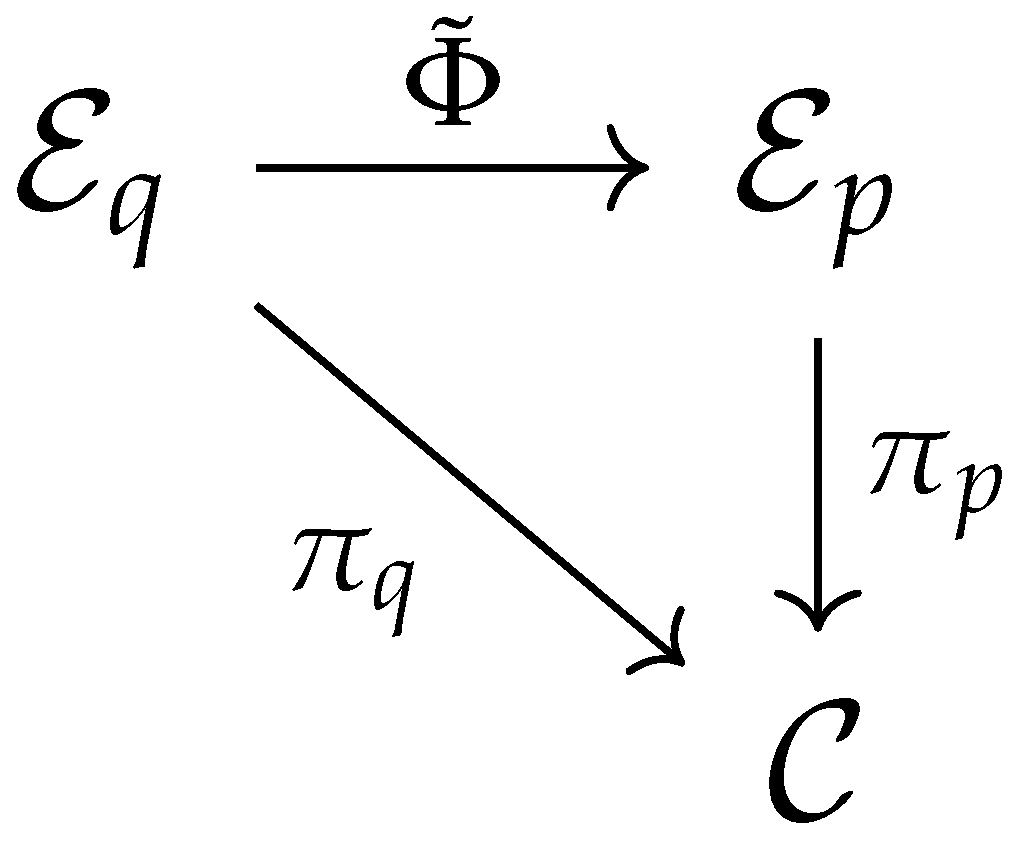
Figure 2.
Left Bundle Morphism.
Disclaimer/Publisher’s Note: The statements, opinions and data contained in all publications are solely those of the individual author(s) and contributor(s) and not of MDPI and/or the editor(s). MDPI and/or the editor(s) disclaim responsibility for any injury to people or property resulting from any ideas, methods, instructions or products referred to in the content. |
© 2025 by the authors. Licensee MDPI, Basel, Switzerland. This article is an open access article distributed under the terms and conditions of the Creative Commons Attribution (CC BY) license (http://creativecommons.org/licenses/by/4.0/).
Copyright: This open access article is published under a Creative Commons CC BY 4.0 license, which permit the free download, distribution, and reuse, provided that the author and preprint are cited in any reuse.


