

Submitted:
20 May 2025
Posted:
21 May 2025
You are already at the latest version
Abstract
This paper proposes the equivalent spherical surface of the planet's graviton emitted by gravitons and the gravitational action point of the planet, which illustrates the separation phenomenon of the gravitational action point and the center of mass. Take the earth and the moon as an example. The gravitational action point of the moon is at a radius 0.5 near the earth-moon gravitational action point on the moon and the center of mass of the moon, the gravity of the earth acts on the moon, which will cause the moon to produce a centripetal force orbiting the earth, and the moon will produce a force that rotates inversely around the gravitational action point. According to the law of conservation of momentum, the linear velocity of the moon orbiting the earth formed by gravity formed by the moon's linear velocity and direction opposite to the linear velocity of the moon's rotation. They reflect that the angular velocity of the earth is equal and direction opposite. This is the fundamental reason for the conservation of angular momentum of the moon's rotation. Under the combined action of the inertial force of the moon, the centripetal force of the earth and the rotation of the moon in the opposite direction around the gravitational action point, the moon's rotation will form an elliptical orbit. This article simulates the elliptical orbits of the eight major planets in the moon and the solar system, and finds that the gravitational coefficient is not a constant. This article believes that the gravitational coefficient consists of a fixed part and an exponential part related to distance. The fixed part reflects the number of gravitational lines between the planets, and the exponential part reflects the probability of the gravitational lines and the nucleon.
Keywords:
gravitational action point
; revolution
; elliptical orbit
; gravitational coefficient
1. Deflection Gravity Theory
Quantum gravity theory believes that gravity propagates through gravitons. Deflection gravity theory [1,2] has conducted in-depth research on this basis, and believes that the most basic unit of matter is nucleons (collective name of protons and neutrons). All nucleons emit gravitons. The energy carried by gravitons is the Planck constant h. Gravitationalons propagate in space with gravitational energy waves. Gravitational energy waves resonate with other nucleons, transmit energy to form gravitational force. For planets, gravitons emitted by nucleons inside the planet interact with other nucleons inside the planet to form the cohesion of the planet. Gravitational nucleons emitted by nucleons near the outside of the planet are partially emitted outside the ball, and propagate in space with gravitational energy waves. Gravitational energy waves encounter nucleons from other planets, and resonate with them to transfer energy to form gravitational forces between the planets.
1.1. The Shell Thickness and Equivalent Radius of the Planet’s Graviton Emitted
“The attempt to correct the universal gravitational formula from the proportion of the planet emitted to the outside of the ball - the ratio of the outside of the ball graviton in the deflection gravity theory” [3] article calculates the number of gravitons sent to the outside of the ball and the thickness of the graviton shell sent to the outside of the ball. Figure 1 is a schematic diagram of the thickness of the shell of the planet being sent to the outside of the ball. In the figure, rs is the planet’s radius, and rso is the thickness of the graviton shell of the planet being sent to the outside of the ball. There should be a spherical layer RSE in the middle. It can be considered that all gravitons on the planet are emitted by this spherical layer. If this spherical layer is used as the equivalent spherical layer emitted by the planet’s gravitons, for general circumstances, it can be considered that this spherical layer is in the middle of the planet’s graviton emission shell.
The thickness of the outer layer where the planet can emit gravitons outside the ball is:
In the formula, kng is the ratio in which gravitons passing through the nucleus can be absorbed by the nucleus, m0 is the mass of the nucleus, r0 is the radius of the nucleus, and ρs is the density of the shell matter of the planet. Through calculation, the thickness of the shell of the planet emitting gravitons outward is much smaller than the planet’s radius, so the equivalent shell radius of the planet’s emitting gravitons is approximately equal to the planet’s radius.
For ordinary planets, the number of gravitons sent to the outside of the ball is:
In the formula, kgr is the constant and rs is the radius of the planet.
1.2. The Center of Mass and Gravity of the Planet
Figure 2 is an analysis diagram of the gravity effect between two planets. In the picture, the planet E rotates around the planet S. The center of mass of the central planet S is S0, the radius is rs, the mass The quantity is ms, the center of mass of the planet E is E0, the radius is re, the mass is me, and the center of mass distance between the planets is R0. In the picture, only the gravitons emitted by planet S facing the nucleons on the sphere of planet E can form gravity on planet E’s shell nucleons facing planet S. This phenomenon can be understood from the basic action process of gravity, or can be proved by the gravity double valley phenomenon during solar eclipse [4]. Before the solar eclipse, objects on the ground are subjected to the dual gravity of the sun and the moon, and the gravity of the earth that the object receives will decrease; during the solar eclipse, the gravity of objects on the ground is measured, and the results show that the gravity of objects on the ground is the same as the gravity when there is only the sun, which means that the gravitons received by the sun on the ground are blocked by the moon; when the solar eclipse ends, the sun is no longer blocked by the moon, and the objects on the ground are superimposed by the gravity of the sun and the moon, and the gravity decreases again, which forms the gravity double valley phenomenon during the solar eclipse.
To accurately calculate the effect of gravitons emitted by planet S on planet E, we should calculate the gravity of each surface element on planet S on planet E. When the distance between planets is much greater than the planet’s radius, it can be approximately believed that the energy transmitted between the surface elements of the two planets is equal, So that the energy transmitted from planet S to planet E is proportional to the area of the spherical surface. The spherical surface of the planet S emits gravitons is equivalent to a point as the gravitational action point. The distance from this point to the center of mass of planet S is:
For planet E, the force affected by planet S is equivalent to a point, and the distance from this point to the center of mass of planet E is:
The energy transmitted by planet S to planet E is the ratio of the area of the sphere occupied by planet E from planet S distance R0 to the total number of gravitons emitted by planet S:
Here Gi is the gravitational coefficient, kgr is the proportional coefficient of the graviton sent to the outside of the ball by the planet, and h is the Planck constant. From the above analysis, we can find that the energy (gravity) transmitted by nucleons between planets is proportional to the planet’s surface area, rather than to the planet’s mass.
1.3. Analysis of the Effect of Gravity on Planetary Movement
Figure 3 is an analysis diagram of the planet’s revolution and rotation caused by planet gravity.In the figure, S0 is the center of mass of the central planet S. E is the planet orbiting the central planet S. When the planet E is at the E0 position,the gravitational action point of planet S on planet E is Eg0. Since the gravitational action point is separated from the planet center of mass, gravity is divided into Fs0 related to the center planet S and Fe0 related to the planet E.
When the same planet E is at position E1, gravity is divided into Fs1 related to the center planet S and Fe1 related to the planet E. When the planet E is at position E2, gravity is divided into Fs2 related to the center planet S and Fe2 related to the planet E. It can be seen that Fs0, Fs1, and Fs2 related to the center planet S act on the gravitational action point E, forming the driving force for the planet E to orbit the planet S. From the effect, Fs forms the centripetal force of planet E orbiting the planet S.
Since the gravitational action point Eg is separated from the planet’s center of mass, another effect of gravity received by the gravitational action point Eg is to drag the planet E to run. Generally, external forces rotate around the center of the sphere. Without considering the planet E orbiting the central planet S, it can be considered that the planet E has always been affected by a gravitational Fe, and this point of action is fixed at the gravitational action point Eg. Therefore, this is not an external force rotates around the planet, but the center of mass of the planet rotates around the gravitational action point Eg. At the initial position E0, the planet’s center of mass tends to run towards A0. With the increase of time, the angle of rotation of the planet’s center of mass increases. Under the combined action of the two components of gravity, when the planet is at position E1, the center of mass moves to point A1, and when the planet is at position E2, the center of mass moves to point A2.
According to the above analysis, the total gravity Fse of the planet is:
The components related to the E-region of the planet are:
In the formula, gravity causes the linear velocity of the planet E to orbit the central planet S to be vs, unit m/s, the angular velocity of the revolution to be Ωs, unit radian/s, and me is the mass of the object (unit kg).
The moment of inertia of the planet E about the gravitational action point Eg is:
where me is the mass of the planet E, re is the radius of the planet E, and he is the distance between the gravitational action point Eg and the center of mass of the planet E.
According to the rotation law of rigid body fixed axis:
where Mz represents the external torque for a certain fixed axis, I represents the moment of inertia of the rigid body about a given axis, and α represents the angular acceleration. Here the torque is the component force of gravity and the rotation of the planet. The force arm is the distance he between the gravitational action point Eg and the center of mass of the planet. According to the definition of angular acceleration, there are:
At this time, the law of rotation of the rigid body fixed axis can be written as:
For the rotation of a planet, it refers to the component of rotation in the planet’s rotation plane, which is generally not on the same plane as the actual rotation of the planet. Therefore, the angular velocity of the planet here is not the planet’s rotation angular velocity that is usually observed.
For objects that move in a circular motion, the relationship between linear velocity and angular velocity is as follows:
According to the law of conservation of momentum, momentum cannot be generated and disappeared out of thin air. For planet E, the planet’s revolution generates a positive momentum, and planet E rotates around the center of mass Eg to produce a reverse momentum, and these two should be equal:
Bring the above result into formula (8):
The ratio of component force used for planet rotation to the entire gravity is:
From this we can see that almost all the gravity of the planet is used for the rotation of the planet, and only a little bit is left for the rotation of the planet. Here, it can also be considered that at the point of gravity, the torque of the planet’s revolution is equal to the moment of the planet’s rotation. Since the force arm of the planet’s revolution is much larger than the force arm of the planet’s rotation, the force used for the planet’s revolution is much smaller than the force of the planet’s rotation.
The movement of a planet is not a simple unforced system, it is subject to gravity at any time. Therefore, the angular momentum of a planet at any point includes: the angular momentum of the initial velocity of the planet relative to the angular momentum of the central planet, gravity forms the angular momentum of the planet’s revolution, and gravity forms the angular momentum of the planet’s rotation reflected to the sphere of the revolution:
Since vs is equal to ve, after the above formula is included
The angular momentum of the planet’s revolution is only the angular momentum caused by the initial velocity. It can be seen that the offset of the angular momentum of the planet’s revolution generated by gravity is the fundamental reason for the conservation of angular momentum in the planet’s revolution system.
For different positions, according to the law of conservation of angular momentum, there are:
In the formula, L is the angular momentum, R0, v0, and β0 are the distance between the planet and the central planet at its initial position, the linear velocity of the planet, the angle between the gravity line and the linear velocity, R1, v1, and β1 are the distance between the central planet after the change in the position of the planet, the linear velocity of the planet, the angle between the gravity line and the linear velocity. From the above formula:
At present, the minimum orbital speed and maximum orbital speed of the moon have not been found. Kepler’s area law is used to estimate the minimum speed of the moon’s apogee. Assuming that the semi-major axis of the orbit of the planet E is a and the semi-major axis is b, then the elliptical area of the orbit of the planet E is:
According to Kepler’s law of area, when the planet E moves in an elliptical orbit, the area it swept through with the sun’s line within an equal time. If the planet E runs into n parts, the ellipse area is also divided into n parts. Assuming the unit area is Sn, assuming the linear velocity of planet E running is v0, the angle between planet E and the gravitational line is β0, the distance between planet E and the central planet S is R0, and the time interval is Δt:
When the moon is at an apogee, the direction of the moon’s velocity is at an angle of 90° with the direction of gravity line. The above formula is simplified to:
The initial linear velocity of the moon’s apogee is:
Figure 4 is a planet operation analysis diagram. Here, the operation cycle of planet E is divided into n parts by time,and the unit time is Δt. In the figure, the center S0 of the central planet S is the coordinate origin, R0 is the distance between the initial position of the planet and S0, v0 is the initial speed of planet E, β0 is the angle between the initial direction of the planet and the gravitational line, θe is the angle at which the center of mass of planet E rotates around the gravitational action point Eg in unit time, θs is the angle at which the planet E rotates around the central planet S under the action of gravitational component, and translates v0 to point A0, and its end point is A1, and then rotates A1 to the angle of θs to position A2, A2 is the end point of the center of mass of planet E through Δt time. Here the coordinates of point A1 are:
The distance from point A1 to S0 is:
The angle α between point A1 and the initial position of planet E satisfies:
When the planet E rotates through Δt time to the A2 position under the action of the gravitational component Fs, the distance between planet E and S0 remains unchanged to R1, and the angle between the position A2 of planet E and the initial position increases to:
It can be seen that the planet’s rotation is inertia when it is running on the equilibrium planet.
1.4. Simulation of the Elliptical Orbit of the Planet
The relevant parameters of the moon and the earth [5] are as follows: the average radius of the moon is about 1737.10km, the mass is 7.342×10^22kg, the average radius of the earth is 6371.393km, the perigee distance of the moon: 363300km; the apogee distance is 405696km; the average revolution period is 27.32 days; the average revolution speed is 1.023 kilometers/sec; the rotation period is: 27 days, 7 hours, 43 minutes, 11.559 seconds (27.32 days, synchronous rotation); the inclination angle of the rotation axis varies between 3.60° and 6.69°, the semi-major axis of the moon orbit orbit is 384403km, and the criterion rate is 0.0549.
Based on the above derivation, the moon’s orbit can be simulated. Table 1 is a partial screenshot of the simulation data table of the moon’s orbit around the earth. The most column in the table is the correlation constant, re is the radius of the moon, me is the mass of the moon, rs is the radius of the earth, and Gr is the gravitational coefficient for the application of the planet’s semi-compassing calculation. Unlike the commonly used gravitational coefficient G that uses the mass of the planet to calculate gravity, T is the orbital period, which refers to the time when the moon orbits the earth, unit seconds, n is the number of equal parts of the period. Here is 10,000, and Table 1 above is just a few of the data. Δt is unit time, S is the orbital area calculated based on the moon’s semi-major axis and eccentricity, and is used to calculate the initial velocity of the moon’s apogee. The first column R in Table 2 shows the distance between the moon and the earth when the moon is at different positions. The initial value is the apogee. The second column he is the distance between the gravitational action point Eg, which acts on the moon and the center of mass. The third column is the angle between the direction of the moon and the gravitational line. The fourth column is the velocity of the moon. The calculation of the initial velocity of the apogee uses Kepler’s area law. The fifth column is the gravity of the earth to the moon. Here the earth and the radius of the moon are used to calculate the gravity of the earth to the moon. The sixth column ωe is the angular velocity generated by gravity to cause the moon to be driven by the autobiography of the moon. The seventh column Ωs is the angular velocity generated by the force used for the moon’s revolution. The eighth column α is the angle in which the moon’s initial inertia v0 and gravity causes the moon to be rotated. The tenth column θc is the angular displacement actually generated by the moon unit time. It is the sum of θs and α. Column 11 θ is the accumulation of angular displacement per unit time, and columns 12-13 are the rectangular coordinates used when plotting simulated data.
Figure 5 is a simulation diagram of the lunar orbit directly generated in Table 2. The apogee is 4.056960E+08m, given by the initial simulation value, the perigee is 3.5547541E+8m, and the apogee is 4.051655E+08m, and the apogee is 4.056960E+08m, which is the common power base in the table. 4.056960×10^8m, which can be seen from the parameters that it is an ellipse. The angle between the moon’s running direction and the gravitational line is at a given value of 1.57080 radians at the aurora point. As the moon moves from avera to perigee, this angle gradually decreases. After decreasing to the minimum value of 1.5056601 radians, it begins to gradually increase. After passing through 1.57080, it continues to increase. When it increases to the maximum value of 1.6359258, it begins to gradually decrease, and finally returns to the aurora, with the return value of 1.5711103 radians. The velocity value of the moon’s apogee is 968.061m/s, the perigee velocity is 1107.073m/s, and the return value of the apogee is 969.329m/s. Under the action of the earth’s gravity, the moon’s rotation angular velocity on the white path is 7.355E-5 radian/s, the maximum angular displacement is 8.409E-5 radian/s, the average angular velocity of the revolution is 2.662E-6 radian/s, and the simulated average is 2.725E-6 radian/s. The angular velocity of the moon generated by the earth’s gravity is 29.49 times greater than the angular velocity of the revolution. More than 99.9% of the earth’s gravity is used for the rotation of the moon.
Although the above simulation process is generally consistent with the actual situation, there are still many inconsistencies in the details, and the simulation data of the moon and the earth need to be further carefully adjusted.
2. Gravity Coefficient
The basic information of the eight planets in the solar system is as follows:
The average radius of the earth is 6.371×10^6m, the earth’s mass is 5.972×10^24kg, the sun’s radius is 6.955×10^8m, the earth’s orbital period is 365.256363 days (stellar day), 23:56:4.100 seconds (stellar hour) (stellar day), the aphrodisiac distance is 1.52097597×10^11m, the perihelion distance is 1.4709845×10^11m, the average revolution speed is 29783 m/s, the maximum revolution speed is 30287 m/s, the minimum revolution speed is 29291 m/s, the semi-major axis of the orbit is 1.49598×10^11m, and the semi-short axis of the orbit is 1.4958×10^11m.
Mercury’s mass is 3.3011×10^23kg, diameter is 4880km, semi-major axis is 0.3871 astronomical unit, eccentricity is 0.205630, orbital period is 87.9691 days, perihelion point is 0.307499 astronomical unit, average point is 0.466697 astronomical unit.
Venus mass is 4.8675×10^24kg, diameter is 12103.6 km, semi-major axis is 0.723332 astronomical unit, eccentricity is 0.006772, orbital period is 224.701 days, perihelion point is 0.718440 astronomical unit, average point is 0.728213 astronomical unit.
Mars’ mass is 6.4171×10^23kg, diameter is 6779km, semi-major axis is 1.523679 astronomical unit, eccentricity is 0.09341233, orbital period is 686.971 days, perihelion point is 1.382 astronomical unit, and average point is 1.666 astronomical unit.
Jupiter’s mass is 1.8982×10^27kg, diameter is 139822 km (average diameter), rotation period is 9 hours, 55 minutes and 30 seconds, semi-major axis is 5.2044 astronomical units, eccentricity is 0.0489, orbital period is 11.862 years, averu 5.4588 astronomical units, perihelion point is 4.9501 astronomical units.
Saturn’s mass is 5.6834×10^26kg, diameter is 116464 km, semi-major axis is 9.5826 astronomical units, eccentricity is 0.0565, orbital period is 29.4571 years, perihelion point is 9.0412 astronomical units, and average point is 10.1238 astronomical units.
Uranus mass is 8.681×10^25kg, diameter is 50724km, semi-major axis is 19.2184 astronomical units, eccentricity is 0.046381, orbital period is 84.0205, perihelion point is 18.33 astronomical units, and average point is 20.11 astronomical units.
Neptune’s mass is 1.0241×10^26kg, diameter is 49244km, semi-major axis is 30.07 astronomical units, eccentricity is 0.008678, orbital period is 164.8 years, averule point is 30.33 astronomical units, perihelion point is 29.81 astronomical units.
According to the above analysis, data simulation is performed on the orbits of the planets in the solar system, and the gravitational coefficient is adjusted to achieve good closure of the planet’s elliptical orbit. Table 2 is the statistical table of the gravitational coefficients corresponding to the planets in the solar system.
In the table, rs is the radius of the central planet, re is the radius of the planet or the moon, Rm is the distance of the near-center planet, RM is the distance of the distant center planet, m is the mass of the planet, T is the orbital period, S is the ellipse area of the orbit, and Gi is the gravitational coefficient obtained by data simulation. It can be seen that the gravity coefficient is not a fixed value.
In the discussion in the above section, we only focus on the number of gravitons sent to the planet by the central planet, that is, we only focus on the number of gravitational lines sent to the planet by the central planet. In fact, there is also the probability of each gravitational line and the planet’s nucleon. Figure 6 is a schematic diagram of the gravitational line passing through the nucleus. In the figure, S0 is the center of mass of the central planet, E is a nucleus on the planet E, R0 is the distance between the two planets, r0 is the radius of the nuclear, αi is the angle between the gravitational line passing through the nucleus and the line connecting the nucleus and the center of mass of the central planet, and αM is its maximum angle.
In the figure, in the triangle x1x2E0, the length of the gravity line passing through the nucleus:
The length of the gravitational line through the nucleon and the probability of the action of the nucleon conforms to the positive distribution or Rayleigh distribution. Here we only discuss the probability of the action of a single gravitational line and the nucleon. The normal distribution should be chosen, and the probability is:
Here x is the length of the gravitational line passing through the nucleus, μ is the expected value, and σ is the variance. For gravitons emitted by the central planet, the peak of the action probability is 1 when x=2r0 (nucleon radius), so the action probability when the length of the gravitational line passing through the nucleon is x is:
Bring in (37):
Assumptions
When δi is very small
Merge the constants into b1:
当 αm = Di 时,
Figure 7 is a graph of the probability of action of gravity lines and nucleons. The five-pointed star in the figure represents the possible location of gravity lines. Divide the nucleon into a circle with a spacing Δα. The possible position spacing of gravity lines on each circle is also Δα. At this time, in addition to the possibility of the center of the nucleon on the planet E, a single gravity line and the nucleon will also form a circle of possible gravity line action points around the center. The viewing angle of this circle is Δα. There should be 2π possible gravity line action points on a circle according to the minimum spacing. On this circle, the probability of the gravity line and the nucleon is equal. At this time, the sum of the probability is:
The average probability of a single gravity line is
When αM=2Δα,
At this time, in addition to the possible action point of the gravitational line at the center of the nucleon on the planet E, two possible gravitational line action points will be formed around the center. The radius of this circle is Δr and 2Δr, and the corresponding possible gravitational line action points are 2π and 2×2π. The probability of the gravitational line and the nucleon on the same circle is magnitude. At this time, the average probability of the gravitational line is:
当αM = nD 时,
At this time, in addition to the possible action point of the gravitational line at the center of the nucleon on the planet E, an n-circle possible gravity line action point will also be formed around the center. The radius of this circle is Δr to nΔr, and the corresponding possible gravity line action point is 2π to n×2π. The probability of the gravitational line and the nucleon on the same circle is magnitude. At this time, the average probability of the gravitational line is:
It is difficult to sum this formula. Here, adjust the constant b1 to b2, and you should find an exponential function to make all exponential functions equal. Obviously, this exponential function is related to n. At this time, the average probability of the total single gravity line remains unchanged:
here:
Introduce the above formula, merge constant is b, and the probability of action of a single gravitational line is
This is the probability of the resonance of a gravitational line on planet S and a nuclear unit on planet E.
At this time, the gravity formula (6) can be modified as:
The gravitational coefficient Gi between different planets is:
In the formula, Gr, Gi, and b are constants.
The moon orbits the earth as the first group, the earth orbits the sun as the second group, and brings data to calculate the constant b:
Adding the gravitational coefficients of the eight planets in the solar system and the moon can obtain the gravitational coefficient Gr:
The eight planets and moon data list of the solar system are adjusted appropriately to make the gravitational coefficients calculated from the orbital simulations to minimize the deviation of the gravitational coefficients. Table 3 is the gravitational coefficient calculation table. This is just based on the gravitational coefficients fitted by the solar system planets, which may not be applicable to cases where the distance is too small and too large.
The first column in the table is some constants, the second column is the planet name, the third column is the central planet radius, the fourth column is the planet or moon radius,The fifth column is the average distance between the planet and the central planet. The sixth column is the gravitational coefficient Gi obtained when orbital simulation is obtained. The seventh column is the exponential part when calculating the gravitational coefficient, the eighth column is the gravitational coefficient calculated by formula (59). The last column is the calculation to obtain the gravitational coefficient difference between the gravitational coefficient and the simulation is obtained. The last item below is the sum of some items. Through list calculation and adjustment, the gravitational coefficient is finally obtained as:
Figure 8 is a graph of the relationship between the old and new gravitational coefficients and distances directly generated by Table 4. The horizontal coordinate in the figure is the distance between the planets, unit meters; the vertical coordinate is the size of the gravitational coefficient. In the figure, the blue color is the planet’s orbit simulation to obtain the gravitational coefficient, and the orange color is the gravitational coefficient calculated by the gravitational formula. In fact, it should change according to the exponential relationship. Since the distance of the horizontal coordinate is not uniform, it looks like a broken line.
According to the new gravitational coefficient formula, the planet’s orbit is simulated again and the planet’s mass is adjusted. The adjusted planet’s mass is as follows:
In the lunar orbit simulation in the table, the gravitational coefficient index part was not brought into gravitational calculation, but the gravitational coefficient was only adjusted uniformly. In the orbit simulation of other planets, the gravitational coefficient index part was directly brought into gravitational calculation. In the table, m (original) is the mass before adjustment, m (new) is the mass after adjustment, and Δm is the ratio of the mass difference. It can be seen that Mercury and Venus have more mass increases, while Jupiter and Neptune have more reductions. It should be noted that this is the gravitational coefficient adjusted according to the minimum difference in the total gravitational coefficient of the planet in the solar system. If there is sufficient evidence to prove that the mass of a certain planet (such as the earth) is very accurate, the gravitational coefficient and planetary mass can also be adjusted according to the parameters of a certain planet. In addition, this method cannot determine the mass of the central planet.
3. In Conclusions
Gravity is the process in which nucleons emit gravitons and gravitons propagate in space with gravitational energy waves, and gravitational energy waves resonate with other nucleons and form energy transfer. For planets, gravitons emitted by nucleons inside the planet interact with other nucleons inside the planet, forming the cohesion of the planet. Gravitationaltons emitted by nucleons on the surface of the planet are partially emitted outside the ball. These gravitons emitted outside the ball meet the nucleons of other planets and resonate with them to form energy transfer. These transferred energy will cause the resonant nucleons to produce a vertical gravity line displacement, forming a vertical and gravitational line action force. The planets orbiting the central planet S, only spherical nucleons facing the central planet S can receive The gravitons emitted by the central planet S, the nucleus of the central planet S, will not receive the gravitons of the central planet S. In this way, for the entire planet, the equivalent gravitational action point Eg is not at the center of mass of the planet, but at a radius of about 0.5 on the side of the center of mass close to the central planet S. In this way, the central planet S will have two effects on the planet E that rotates around it. One is the centripetal force that rotates around the central planet S, and the other is the rotational force that rotates around the center of mass of the planet around the gravitational action point Eg. Within a certain time Δt, the initial velocity of planet E will cause the planet to move a uniform linear displacement. Planet E is subjected to the component force Fs of the gravity of the center planet S, which will cause the planet E to move for a distance in the arc. Planet E is subjected to another component force Fe of the gravity of the center planet S, which will cause the center of mass of planet E to move backwards on the arc for a distance around the gravitational point. Under the combined action of these three, planet E will form a standard elliptical orbit. According to the law of conservation of momentum, the linear velocity of a planet formed by gravity around the central planet is equal to the linear velocity of the planet rotation, and the angular velocity of the planet formed by gravity around the central planet is equal to the angular velocity of the planet’s rotation reflected to the central planet. At this time, for the planet’s revolution, the angular momentum generated by gravity cancels each other, leaving only the angular momentum formed by the initial velocity of the planet. This is the fundamental reason for the conservation of the angular momentum of the planet under the action of gravity. After derivation calculation and data simulation, more than 99.9% of the gravity of the central planet is used for the rotation of the planet. It can also be said that at the balanced inertia of the planet’s movement, it can also be considered that at the point of gravity, the moment of the planet’s revolution is equal to the moment of the planet’s rotation. Since the force arm of the planet’s revolution is much larger than the force arm of the planet’s rotation, the force used for the rotation of the planet is much smaller than the force of the planet’s rotation. In addition to being related to the number of gravitational lines (gravitationaltons) between planets, the gravity between planets is also related to the probability of gravitational lines and nucleons acting. The probability of gravitational lines and nucleons acting is exponentially related to distance. The probability of distance being small is small, and when distance is large, the probability of gravitational coefficient between planets is composed of a fixed part and an exponential part related to distance. The fixed part reflects the number of gravitational lines between planets, and the exponential part reflects the probability of gravitational lines acting between planets.
References
- Chen Junli, Deflection Gravity Theory, Hans Press 2024-06-24, https://www.hanspub.org/books/BookManage?BookID=308. ISBN 978-1-64997-896-7.
- Chen Junli, Kang Yaohui. Gravitational, gravitational field and graviton—Inference on the frequency of gravitational energy waves[J]. Astronomy and Astrophysics, 2022, 10(1): 1-10. [CrossRef]
- Chen Junli, Kang Yaohui. An attempt to correct the universal gravitational formula from the proportion of the planet to the extrasphere gravitons - the ratio of extrasphere gravitons in deflection gravitational theory [J]. Astronomy and Astrophysics, 2023, 11(3): 27-39. [CrossRef]
- Chen Junli. Analysis of the causes of the formation of the Alai effect and gravity valley[J]. Astronomy and Astrophysics, 2023, 11(2): 13-26. [CrossRef]
- Moon - Baidu Encyclopedia, https://baike.baidu.com/item/%E6%9C%88%E7%90%83/30767, 2025-2-16.
Figure 1.
The equivalent spherical surface of the planet’s launch of gravitons.
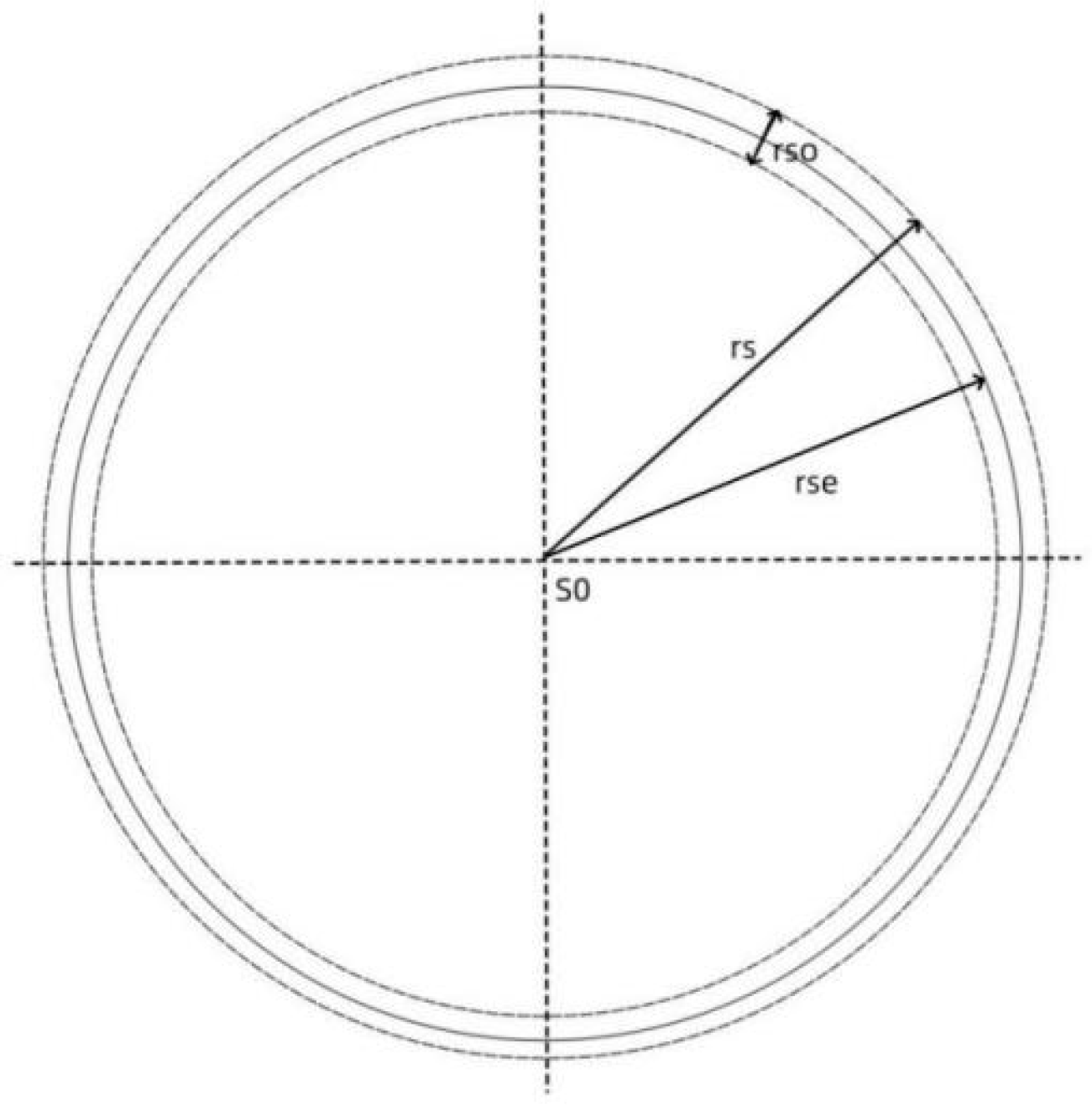
Figure 2.
Schematic diagram of separation of gravitational action point and centroid.
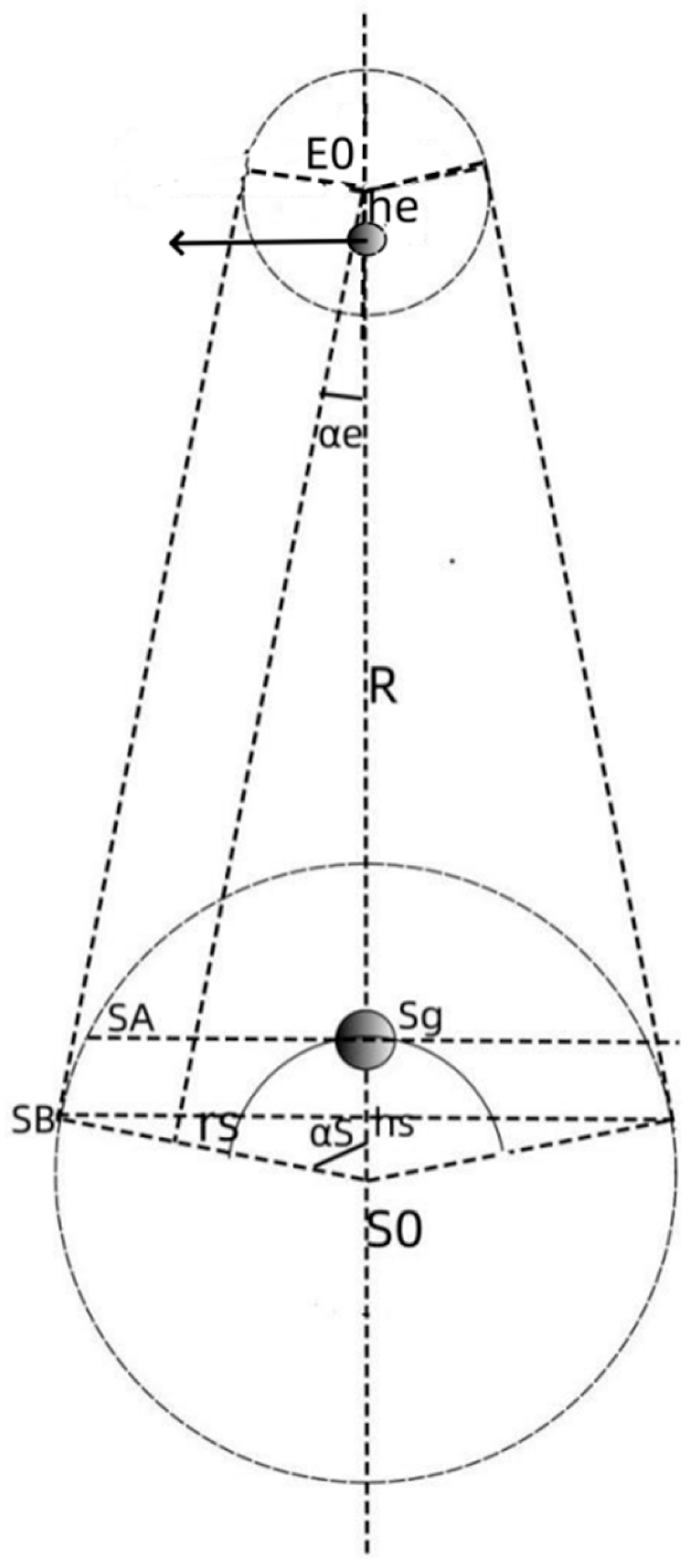
Figure 3.
The planet’s revolution and rotation formed by gravity.
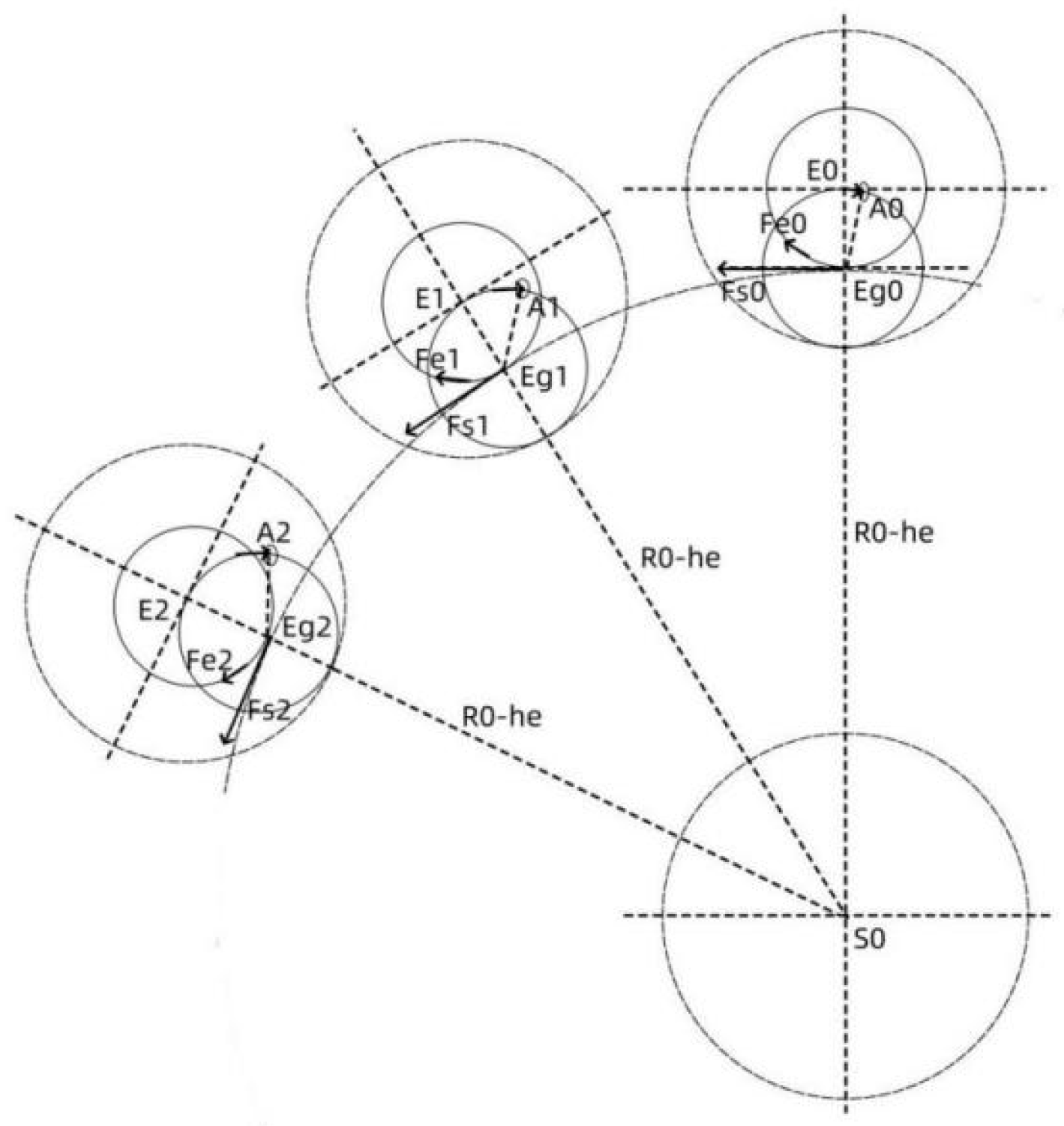
Figure 4.
Planet operation analysis diagram.
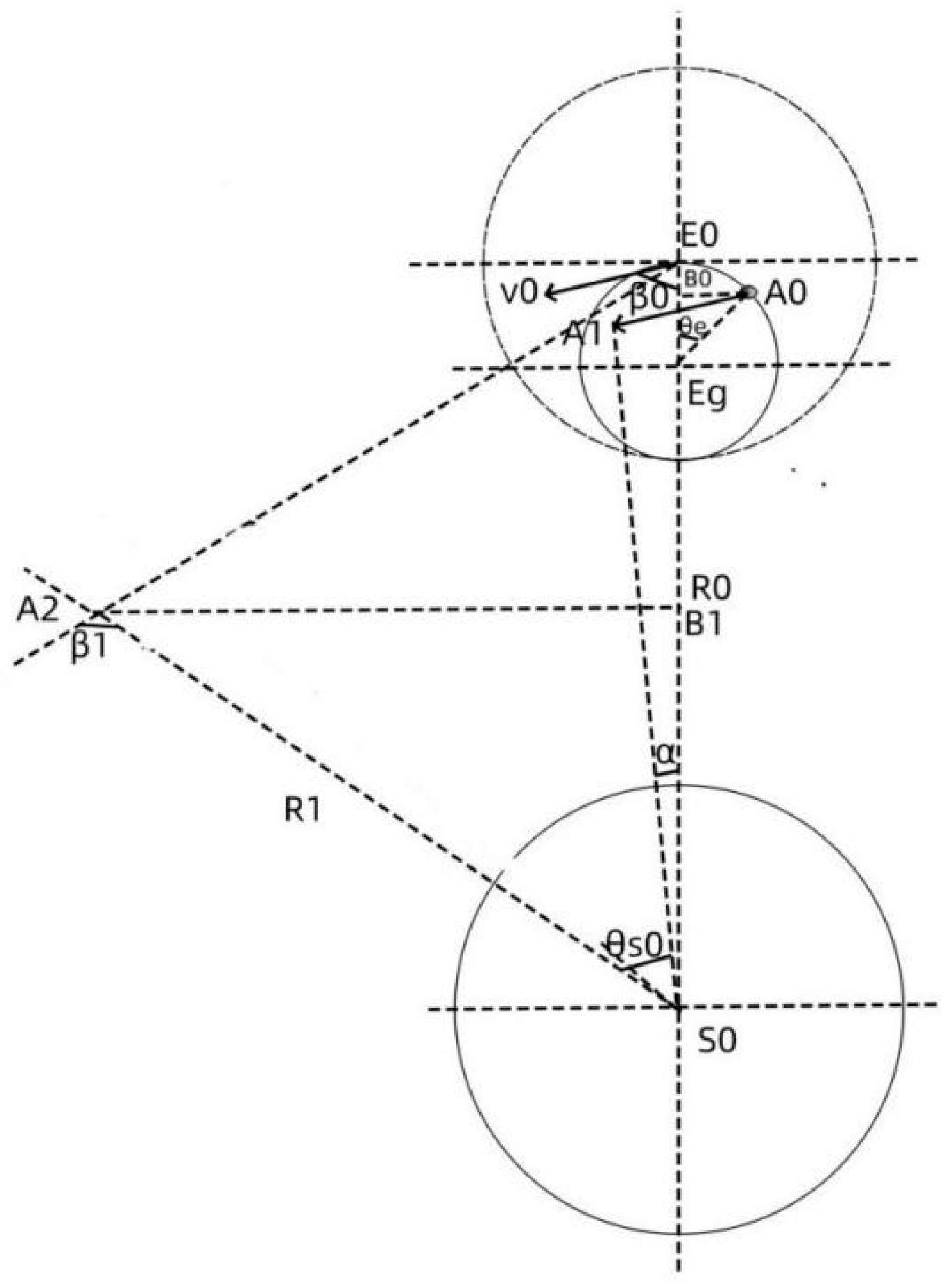
Figure 5.
lunar orbit simulation diagram.
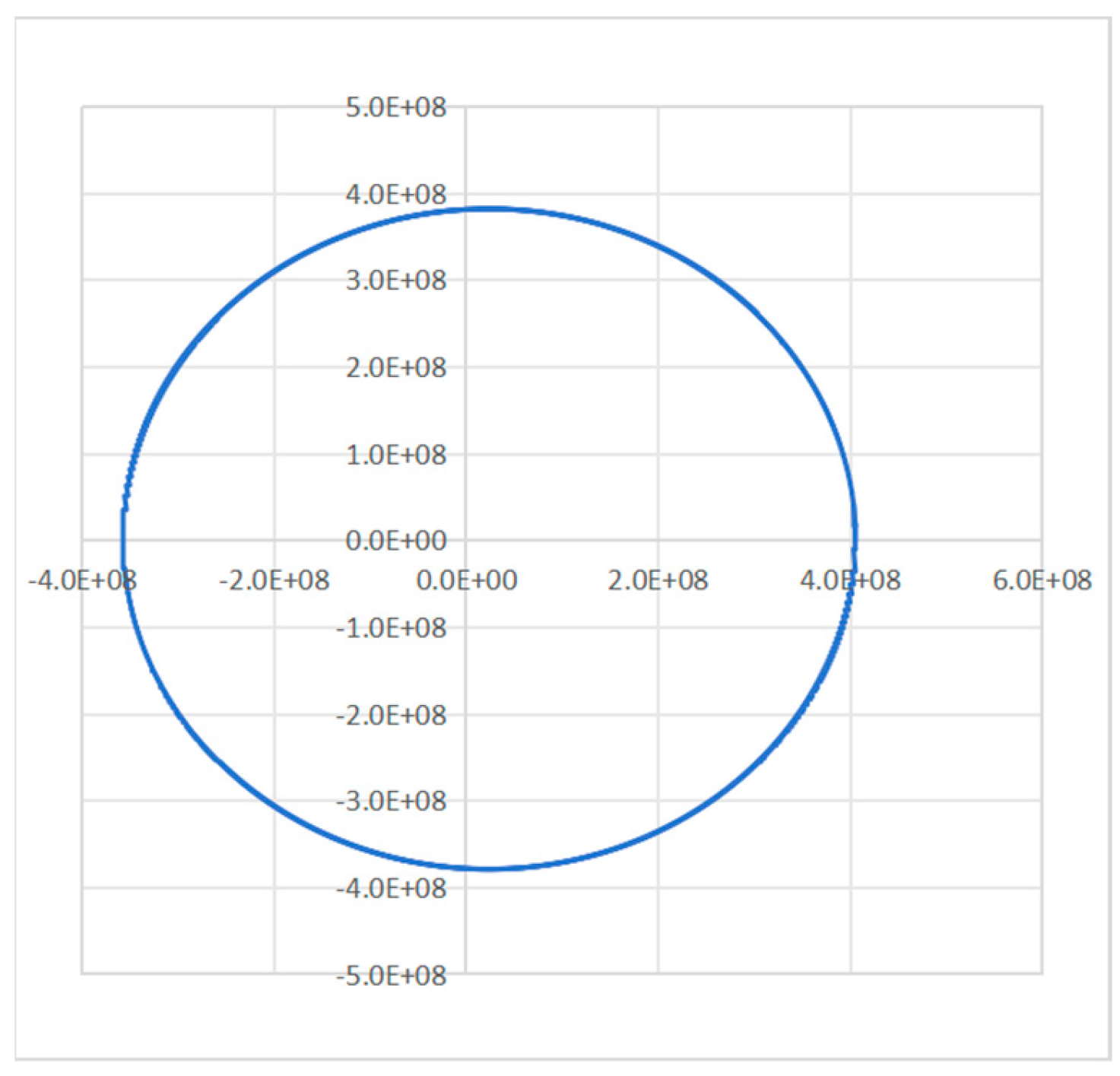
Figure 6.
Schematic diagram of gravity line passing through the nucleus.
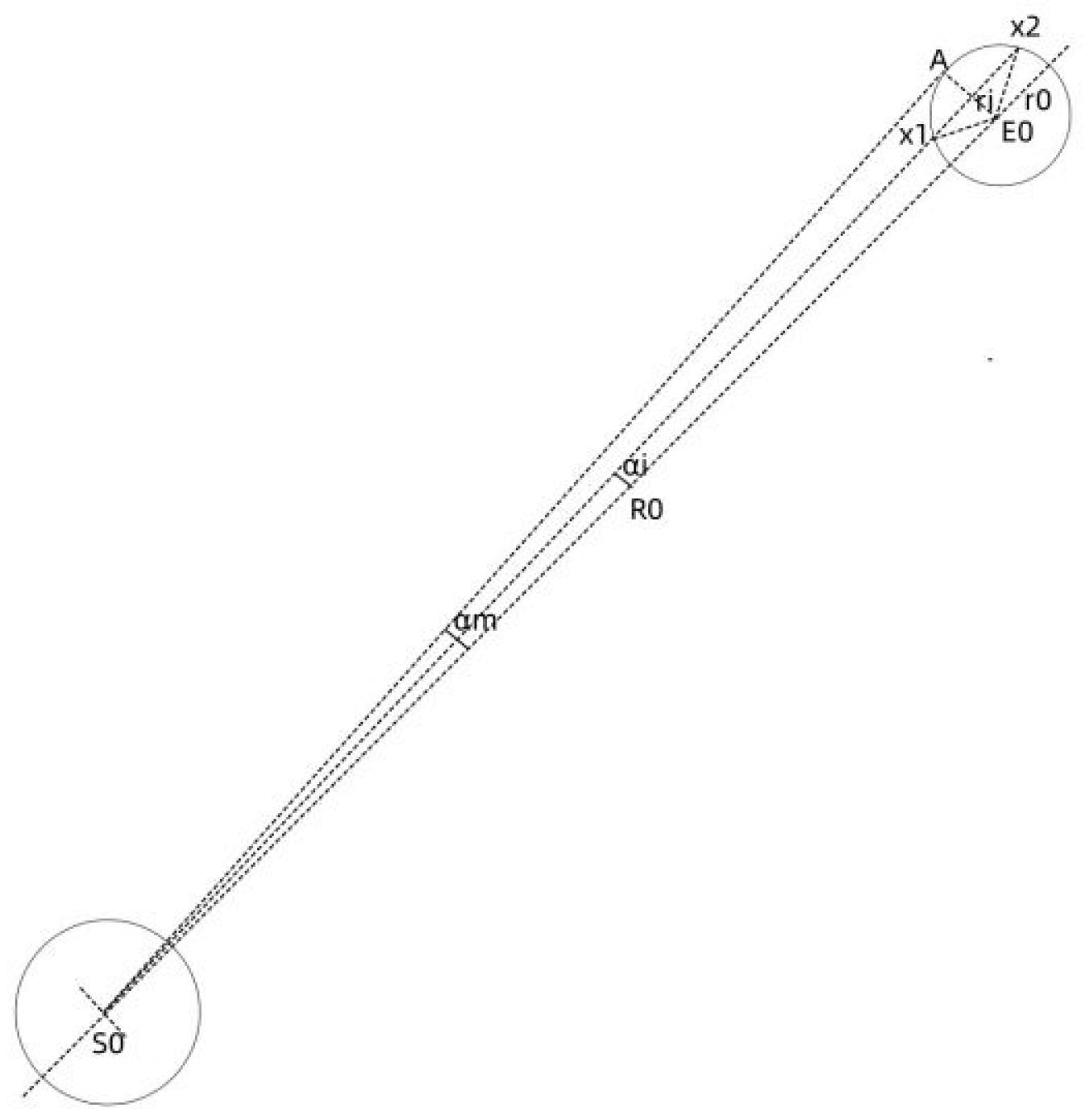
Figure 7.
Calculation of the probability of action of gravitons and nucleons.
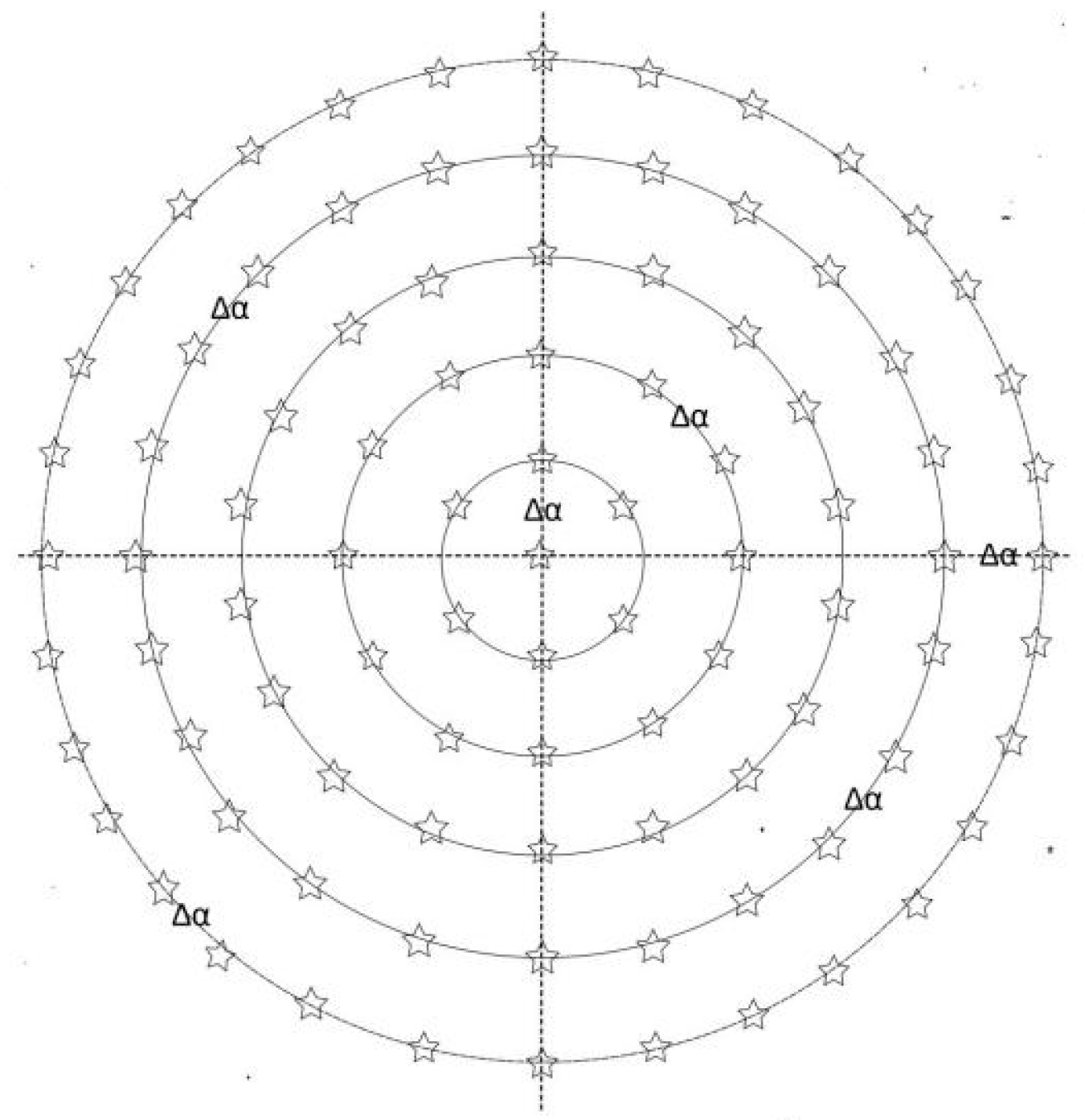
Figure 8.
The relationship between the old and new gravitational coefficients and distance.
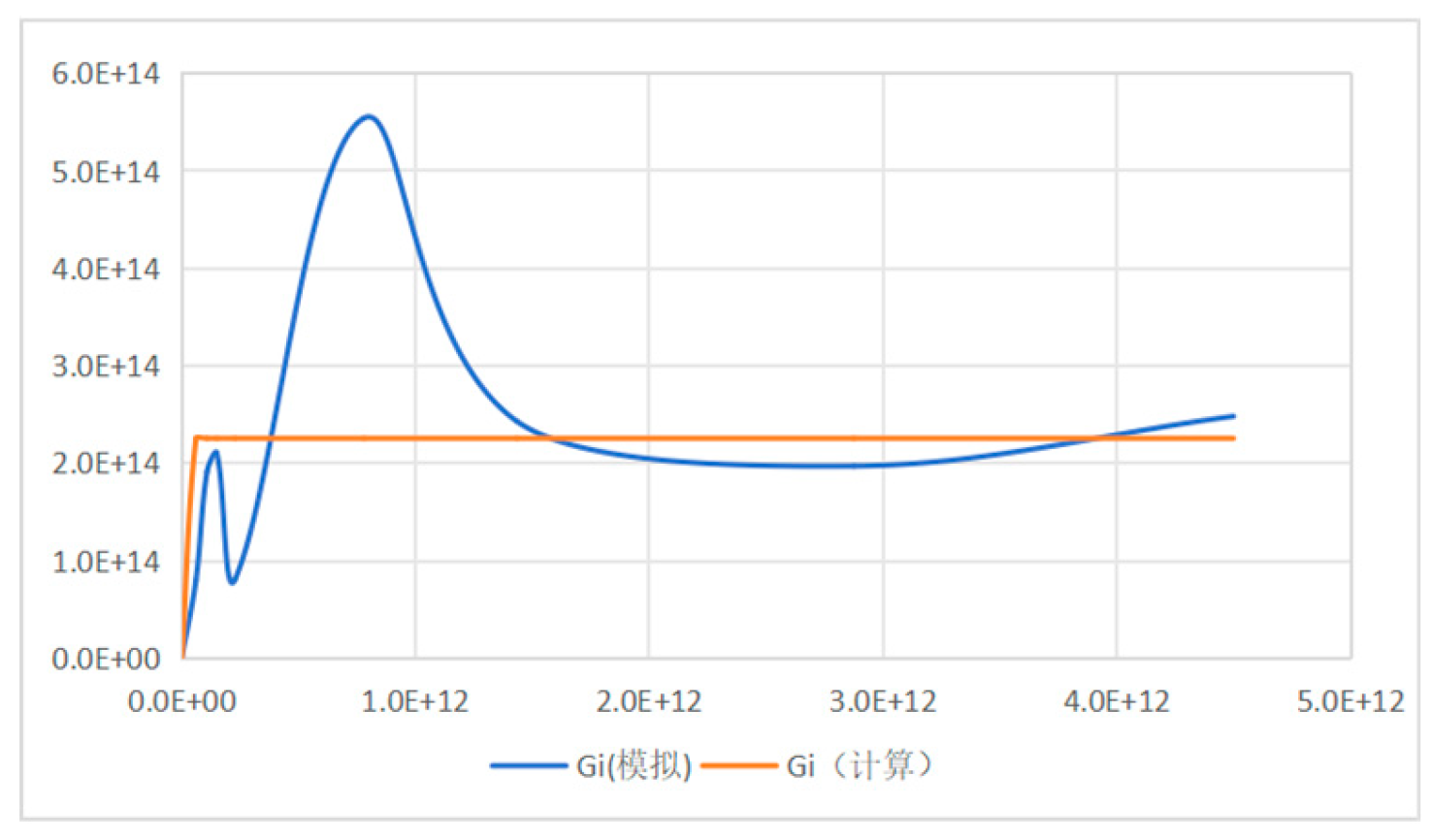

Table 1.
Data simulation table of the moon orbit around the earth.
| R(m) | He (m) |
β0 | v0( m/s) |
Fse (N) |
ωe | Ωs | α | θc | θ | x | y | Re (m) |
| 4.0569 60E+08 |
8.586 E+05 |
1.570 7963 |
968 .061 |
9.001 E+20 |
7.355 E-05 |
1.557 E-07 |
5.265 E-04 |
5.632 E-04 |
0.00 056 |
4.057 E+08 |
2.285 E+05 |
1.737 E+06 |
| 4.0569 59E+08 |
8.586 E+05 |
1.570 7577 |
968 .061 |
9.001 E+20 |
7.355 E-05 |
1.557 E-07 |
5.265 E-04 |
5.632 E-04 |
0.00 113 |
4.057 E+08 |
4.570 E+05 |
Me (kg) |
| 4.0569 58E+08 |
8.586 E+05 |
1.570 7191 |
968 .061 |
9.001 E+20 |
7.355 E-05 |
1.557 E-07 |
5.265 E-04 |
5.632 E-04 |
0.00 169 |
4.057 E+08 |
6.855 E+05 |
7.342 E+22 |
| 4.0569 58E+08 |
8.586 E+05 |
1.570 6805 |
968 .062 |
9.001 E+20 |
7.355 E-05 |
1.557 E-07 |
5.265 E-04 |
5.632 E-04 |
0.00 225 |
4.057 E+08 |
9.140 E+05 |
Rs (m) |
| 4.0569 57E+08 |
8.586 E+05 |
1.570 6419 |
968 .062 |
9.001 E+20 |
7.355 E-05 |
1.557 E-07 |
5.265 E-04 |
5.632 E-04 |
0.00 282 |
4.057 E+08 |
1.143 E+06 |
6.371 E+06 |
| 4.0569 55E+08 |
8.586 E+05 |
1.570 6033 |
968 .062 |
9.001 E+20 |
7.355 E-05 |
1.557 E-07 |
5.265 E-04 |
5.632 E-04 |
0.00 338 |
4.057 E+08 |
1.371 E+06 |
Gr |
| 4.0569 54E+08 |
8.586 E+05 |
1.570 5647 |
968 .062 |
9.001 E+20 |
7.355 E-05 |
1.557 E-07 |
5.265 E-04 |
5.632 E-04 |
0.00 394 |
4.057 E+08 |
1.600 E+06 |
1.20960 E+12 |
| 4.0569 53E+08 |
8.586 E+05 |
1.570 5261 |
968 .063 |
9.001 E+20 |
7.355 E-05 |
1.557 E-07 |
5.265 E-04 |
5.632 E-04 |
0.00 451 |
4.057 E+08 |
1.828 E+06 |
T(s) |
| 4.0569 52E+08 |
8.586 E+05 |
1.570 4875 |
968 .063 |
9.001 E+20 |
7.355 E-05 |
1.557 E-07 |
5.265 E-04 |
5.632 E-04 |
0.00 507 |
4.057 E+08 |
2.057 E+06 |
2360448 |
| 4.0569 50E+08 |
8.586 E+05 |
1.570 4489 |
968 .063 |
9.001 E+20 |
7.355 E-05 |
1.557 E-07 |
5.265 E-04 |
5.632 E-04 |
0.00 563 |
4.057 E+08 |
2.285 E+06 |
n |
| 4.0569 49E+08 |
8.586 E+05 |
1.570 4103 |
968 .064 |
9.001 E+20 |
7.355 E-05 |
1.557 E-07 |
5.265 E-04 |
5.632 E-04 |
0.00 620 |
4.057 E+08 |
2.514 E+06 |
10000 |
| 4.0569 47E+08 |
8.586 E+05 |
1.570 3717 |
968 .064 |
9.001 E+20 |
7.355 E-05 |
1.557 E-07 |
5.265 E-04 |
5.632 E-04 |
0.00 676 |
4.057 E+08 |
2.742 E+06 |
Δt(s) |
| 4.0569 45E+08 |
8.586 E+05 |
1.570 3331 |
968 .065 |
9.001 E+20 |
7.355 E-05 |
1.557 E-07 |
5.265 E-04 |
5.633 E-04 |
0.00 732 |
4.057 E+08 |
2.971 E+06 |
236 |
| 4.0569 44E+08 |
8.586 E+05 |
1.570 2945 |
968 .065 |
9.001 E+20 |
7.355 E-05 |
1.557 E-07 |
5.265 E-04 |
5.633 E-04 |
0.00 789 |
4.057 E+08 |
3.199 E+06 |
Rmin (m) |
| 4.0569 42E+08 |
8.586 E+05 |
1.570 2559 |
968 .066 |
9.001 E+20 |
7.355 E-05 |
1.557 E-07 |
5.265 E-04 |
5.633 E-04 |
0.00 845 |
4.057 E+08 |
3.428 E+06 |
3.631 E+08 |
| 4.0569 40E+08 |
8.586 E+05 |
1.570 2173 |
968 .066 |
9.001 E+20 |
7.355 E-05 |
1.557 E-07 |
5.265 E-04 |
5.633 E-04 |
0.00 901 |
4.057 E+08 |
3.656 E+06 |
Rmax (m) |
| 4.0569 38E+08 |
8.586 E+05 |
1.570 1787 |
968 .067 |
9.001 E+20 |
7.355 E-05 |
1.557 E-07 |
5.265 E-04 |
5.633 E-04 |
0.00 958 |
4.057 E+08 |
3.885 E+06 |
4.057 E+08 |
| 4.0569 36E+08 |
8.586 E+05 |
1.570 1401 |
968 .067 |
9.001 E+20 |
7.355 E-05 |
1.557 E-07 |
5.265 E-04 |
5.633 E-04 |
0.01 014 |
4.057 E+08 |
4.113 E+06 |
S (m^2) |
| 4.0569 33E+08 |
8.586 E+05 |
1.570 1015 |
968 .068 |
9.001 E+20 |
7.355 E-05 |
1.557 E-07 |
5.265 E-04 |
5.633 E-04 |
0.01 070 |
4.057 E+08 |
4.342 E+06 |
4.635 E+17 |
| 4.0569 31E+08 |
8.586 E+05 |
1.570 0629 |
968 .068 |
9.001 E+20 |
7.355 E-05 |
1.557 E-07 |
5.265 E-04 |
5.633 E-04 |
0.01 126 |
4.057 E+08 |
4.570 E+06 |
|
| 4.0569 29E+08 |
8.586 E+05 |
1.570 0243 |
968 .069 |
9.001 E+20 |
7.355 E-05 |
1.557 E-07 |
5.265 E-04 |
5.633 E-04 |
0.01 183 |
4.057 E+08 |
4.799 E+06 |
Table 2.
Gravitational coefficient statistics table.
| Planet Name | rs(m) | re(m) | Rm(m) | RM(m) | m(kg) | T(s) | S(m^2) | Gr(N/m^2) |
| Moon | 6.371E+06 | 1.737E+06 | 3.631E+08 | 4.057E+08 | 7.342E+22 | 2.354E+06 | 4.635E+17 | 1.1995E+12 |
| Mercury | 6.955E+08 | 2.440E+06 | 5.234E+10 | 6.982E+10 | 3.301E+23 | 7.580E+06 | 1.031E+22 | 8.0110E+13 |
| Venus | 6.955E+08 | 6.052E+06 | 1.075E+11 | 1.089E+11 | 4.868E+24 | 1.936E+07 | 3.678E+22 | 1.9119E+14 |
| Earth | 6.955E+08 | 6.371E+06 | 1.471E+11 | 1.521E+11 | 5.972E+24 | 3.147E+07 | 7.007E+22 | 2.1055E+14 |
| Mars | 6.955E+08 | 3.390E+06 | 2.067E+11 | 2.492E+11 | 6.417E+23 | 5.919E+07 | 1.625E+23 | 8.0780E+13 |
| Jupiter | 6.955E+08 | 6.991E+07 | 7.405E+11 | 8.166E+11 | 1.898E+27 | 3.733E+08 | 1.902E+24 | 5.5409E+14 |
| Saturn | 6.955E+08 | 5.823E+07 | 1.353E+12 | 1.514E+12 | 5.683E+26 | 9.271E+08 | 6.446E+24 | 2.4310E+14 |
| Uranus | 6.955E+08 | 2.536E+07 | 2.742E+12 | 3.008E+12 | 8.681E+25 | 2.644E+09 | 2.594E+25 | 1.9715E+14 |
| Neptune | 6.955E+08 | 2.462E+07 | 4.460E+12 | 4.537E+12 | 1.024E+26 | 5.187E+09 | 6.357E+25 | 2.4816E+14 |
Table 3.
Gravitational coefficient calculation table.
| e | name | rs(m) | re(m) | Ra(m) | Gi (simulation) |
Index section | Gi (calculate) |
ΔG |
| 2.71828 | Moon | 6.371E+06 | 1.737E+06 | 3.844E+08 | 1.200E+12 | 0.00532 | 1.200E+12 | 0.00000000 |
| b | Mercury | 6.955E+08 | 2.440E+06 | 6.108E+10 | 8.011E+13 | 0.99979 | 2.256E+14 | 1.81617289 |
| 7.73848853E+17 | Venus | 6.955E+08 | 6.052E+06 | 1.082E+11 | 1.912E+14 | 0.99993 | 2.256E+14 | 0.18016370 |
| Gr | Earth | 6.955E+08 | 6.371E+06 | 1.496E+11 | 2.106E+14 | 0.99997 | 2.256E+14 | 0.07168182 |
| 2.25650410E+14 | Mars | 6.955E+08 | 3.390E+06 | 2.280E+11 | 8.078E+13 | 0.99999 | 2.256E+14 | 1.79335294 |
| Jupiter | 6.955E+08 | 6.991E+07 | 7.786E+11 | 5.541E+14 | 1.00000 | 2.257E+14 | 0.59275547 | |
| Saturn | 6.955E+08 | 5.823E+07 | 1.434E+12 | 2.431E+14 | 1.00000 | 2.257E+14 | 0.07177982 | |
| Uranus | 6.955E+08 | 2.536E+07 | 2.875E+12 | 1.972E+14 | 1.00000 | 2.257E+14 | 0.14456195 | |
| Neptune | 6.955E+08 | 2.462E+07 | 4.498E+12 | 2.482E+14 | 1.00000 | 2.257E+14 | 0.09070599 | |
| total | 1.806E+15 | 8.00499 | 4.76117458 |
Table 4.
Planet Quality Adjustment Table.
| name | rs(m) | re(m) | Ra(m) | Gi(simulation) | Gi(calculate) | m(kg Old) | m(kg new) | Δm |
| Moon | 6.371E+06 | 1.737E+06 | 3.844E+08 | 1.200E+12 | 1.200E+12 | 7.342E+22 | 7.3420E+22 | 0.00000 |
| Mercury | 6.955E+08 | 2.440E+06 | 6.108E+10 | 8.011E+13 | 2.256E+14 | 3.301E+23 | 9.2978E+23 | 1.81658 |
| Venus | 6.955E+08 | 6.052E+06 | 1.082E+11 | 1.912E+14 | 2.256E+14 | 4.868E+24 | 5.7446E+24 | 0.18020 |
| Earth | 6.955E+08 | 6.371E+06 | 1.496E+11 | 2.106E+14 | 2.256E+14 | 5.972E+24 | 6.4006E+24 | 0.07174 |
| Mars | 6.955E+08 | 3.390E+06 | 2.280E+11 | 8.078E+13 | 2.256E+14 | 6.417E+23 | 1.7925E+24 | 1.79332 |
| Jupiter | 6.955E+08 | 6.991E+07 | 7.786E+11 | 5.541E+14 | 2.257E+14 | 1.898E+27 | 7.7304E+26 | -0.59275 |
| Saturn | 6.955E+08 | 5.823E+07 | 1.434E+12 | 2.431E+14 | 2.257E+14 | 5.683E+26 | 5.2755E+26 | -0.07177 |
| Uranus | 6.955E+08 | 2.536E+07 | 2.875E+12 | 1.972E+14 | 2.257E+14 | 8.681E+25 | 9.9358E+25 | 0.14455 |
| Neptune | 6.955E+08 | 2.462E+07 | 4.498E+12 | 2.482E+14 | 2.257E+14 | 1.898E+27 | 9.312E+25 | -0.95094 |
Disclaimer/Publisher’s Note: The statements, opinions and data contained in all publications are solely those of the individual author(s) and contributor(s) and not of MDPI and/or the editor(s). MDPI and/or the editor(s) disclaim responsibility for any injury to people or property resulting from any ideas, methods, instructions or products referred to in the content. |
© 2025 by the authors. Licensee MDPI, Basel, Switzerland. This article is an open access article distributed under the terms and conditions of the Creative Commons Attribution (CC BY) license (http://creativecommons.org/licenses/by/4.0/).
Copyright: This open access article is published under a Creative Commons CC BY 4.0 license, which permit the free download, distribution, and reuse, provided that the author and preprint are cited in any reuse.


