

Submitted:
19 May 2025
Posted:
20 May 2025
You are already at the latest version
Abstract
The present study investigated the thermal and dynamic mechanical properties of epoxy polymer bio-composites reinforced with 15 wt.% sisal fiber and varying concentrations (0, 0.5, 1.0, 1.5, and 2.0 wt.%) of carbon nanotube (CNT) additives. Thermogravimetric Analysis (TGA) revealed that the composite with 1.0 wt.% CNT exhibited the highest thermal stability, with minimal weight loss across a temperature range of 30°C – 790°C. Differential Scanning Calorimetry (DSC) results indicated enhanced crystallinity and thermal resilience in the 1.0 wt.% CNT formulation. Dy-namic Mechanical Analysis (DMA) indicated that the proposed composite has the highest storage modulus of 3859.28 MPa, loss modulus of 539.44 MPa, and a glass tran-sition temperature of 89.26°C. It also has the lowest damping factor (tan δ = 0.25), de-noting superior stiffness and reduced energy dissipation. The reported results highlight the optimal reinforcement effect of 1.0 wt.% CNT, improving thermal stability, mechanical performance, and interfacial bonding in sisal fiber-reinforced epoxy composites for advanced industrial applications.
Keywords:
Dynamic Mechanical Analysis
; Bio-composite
; Carbon Nanotube
; Glass Transition Temperature
1. Introduction
Natural fiber-reinforced polymer composites have emerged as a pivotal material in modern engineering due to their exceptional strength-to-weight ratio, cost-effectiveness, and environmental sustainability, with sisal fiber standing out as a prominent reinforcement candidate owing to its high tensile strength, stiffness, and natural abundance [1]. The historical lineage of natural fiber composites traces back to ancient civilizations, such as the Egyptians (circa 4000 BC), who fortified clay structures with straw, and Mesopotamians (3400 BC), who engineered plywood via adhesives and angled wood strips, illustrating early ingenuity in composite design [2]. The Mongols further advanced composite technology by crafting bows from animal glue, wood, and bone, achieving remarkable precision and power. These early innovations laid the groundwork for contemporary composite systems, which leverage natural fibers like sisal, coconut palm leaves, wood (comprising cellulose fibers in a lignin matrix), and animal bone (collagen fibers in a mineralized apatite matrix) as bio-inspired templates for synthetic composites [3]. The 19th and 20th centuries marked transformative milestones, including the development of synthetic polymers (polyester, vinyl, phenol) and the advent of glass-reinforced composites during World War II, which catalyzed industrial applications in boat hulls, electrical components, and automotive parts. Post-war advancements in manufacturing techniques [4,5]—pultrusion, resin transfer molding, and vacuum bag molding—propelled composites into mainstream use, further accelerated by the 1961 invention of carbon fiber, which revolutionized high-performance applications in aerospace, marine, and sports industries. By the 1990s, composites had solidified their role as lightweight, durable alternatives to metals and engineered polymers, driven by innovations in carbon nanotube (CNT) [6], integration, which enhanced mechanical, thermal, and electrical properties. Sisal fiber composites, in particular, have garnered extensive research focus, with studies exploring their dynamic mechanical behavior, thermal stability, and environmental resilience [7,8]. For instance, investigations into short sisal fiber-reinforced polypropylene (PP) composites revealed temperature-dependent storage modulus (E') and loss modulus (E'') trends, with treated fibers outperforming untreated counterparts due to improved interfacial adhesion [9]. Thermal analyses by Nair et al. 2001 [10] demonstrated that sisal-polystyrene (PS) composites exhibit enhanced stability, with decomposition initiating at 329°C for 20% sisal-PS blends compared to 288°C for pure PS, attributed to fiber-matrix interactions.
Dynamic mechanical analysis (DMA) [11] of these composites highlighted reduced storage modulus with rising temperature, linked to segmental mobility, while residual solvent in composites lowered their glass transition temperature (Tg) relative to pure PS. Jayaraman in 2003 [12] optimized sisal-PP composites via hot-pressing and vacuum methods, identifying 15–35% fiber mass fraction and >10 mm fiber length as critical for maximizing mechanical performance. Environmental degradation studies by P.V. Joseph et al. in 2002 [13] underscored the vulnerability of sisal/PP composites to water and UV exposure, where moisture-induced plasticization weakened fiber-matrix interfaces, leading to tensile property deterioration. Fiber treatment strategies, such as those by Rong et al. in 2001 [14], emphasized enhancing sisal-epoxy adhesion without disrupting intercellular bonding, thereby improving tensile strength and laminate performance. Similarly, Sreekumar et al. 2007 [15] achieved peak flexural properties in sisal-polyester composites at 50% fiber loading and 30 mm length, though excessive fiber content and length induced brittleness. Hybridization studies, including Idicula et al. in 2004 [16] on banana/sisal-polyester composites, revealed optimal dynamic mechanical properties at 0.40 fiber volume fraction, with a 3:1 banana-sisal ratio enhancing interfacial adhesion and stress transfer. Shahzad and Isaac in 2014 [17] contrasted hemp and glass fiber composites, noting hemp’s brittle fatigue failure versus glass fiber’s progressive modulus decline, highlighting natural fibers’ unique failure mechanisms. Milanese et al. in 2012 [18] demonstrated that thermal treatment of sisal fibers in phenolic composites reduced mechanical property variability, recommending it for structural applications despite minimal strength changes. Contemporary research focuses on integrating CNTs into sisal-epoxy systems to augment toughness, stiffness, and strength, capitalizing on CNTs’ nano-reinforcement potential [19]. Epoxy resins, favored for their robust adhesion to sisal fibers, serve as ideal matrices, with ongoing studies optimizing CNT dispersion, fiber-matrix compatibility, and processing techniques to tailor composites for automotive, construction, and aerospace sectors [20,21,22]. This synthesis of historical insights, empirical findings, and cutting-edge innovations underscores the potential of sisal-CNT-epoxy composites to address global demands for sustainable, high-performance materials, bridging ancient material wisdom with modern nanotechnology.The natural fiber reinforced polymer exhibits good specific mechanical properties than synthetic fiber reinforced polymer composite. Viscoelastic properties, mechanical properties, thermal properties and physical properties of the natural fiber reinforced polymer composite are dependent on various parameters such as fiber length, treatment, and method of manufacturing etc.For better interface bonding between matrix and reinforcement the chemical treatment of fibers is playing a vital role.Natural fiber reinforced polymer composites are very good replacement of synthetic fiber. The hybrid natural fiber reinforced polymer composite can be enhanced mechanical, wear resistance and thermal properties. On increasing the fiber content, the mechanical properties (tensile, flexural and impact) increasing and the best combination is found with 30 Vol. % of fiber.The hand lay-up method is mostly used in thermoset polymer matrix reinforced composite and injection moulding is mostly used in thermoplastic polymer matrix reinforcedcomposite.
The primary objective of this study is to develop eco-friendly, high-performance bio-composites by integrating sisal fibers and carbon nanotubes (CNTs) into an epoxy matrixemphasizing the optimization of processing techniques and material ratios (e.g., fiber/matrix compatibility, CNT dispersion) to achieve a homogeneous structure. Moreover, thermal analysis to evaluate the composites’ stability and degradation behavior under varying temperatures also been done. Techniques such as thermogravimetric analysis (TGA) and differential scanning calorimetry (DSC) will be employed to assess glass transition temperatures. This analysis aims to determine how CNT incorporation influences the thermal resilience of sisal-reinforced epoxy composites, crucial for applications in high-temperature environments.Dynamic mechanical analysis (DMA) is used to investigate the viscoelastic properties of the biocomposites under dynamic loading conditions. Parameters such as storage modulus, loss modulus, and damping factor (tan δ) will be analyzed to understand the interfacial bonding between fibers, CNTs, and the epoxy matrix. This study seeks to correlate the reinforcement mechanisms with enhanced mechanical performance, including stiffness, damping capacity, and thermal transitions, to validate their suitability for automotive, aerospace, or structural applications. Collectively, this work aims to advance sustainable material solutions by balancing ecological benefits with engineered performance.
2. Materials and Methods
The biocomposites were reinforced with sisal fibers procured from the Women Development Organization located in Dehradun, Uttarakhand, India. The continuous phase of the composites consisted of an epoxy resin (LY556) cured with its hardener (HY951). Multiwall carbon nanotubes (MWCNTs) were purchased from Adnano Technologies Private Limited India with an average size of were utilized as property-modifying additives.
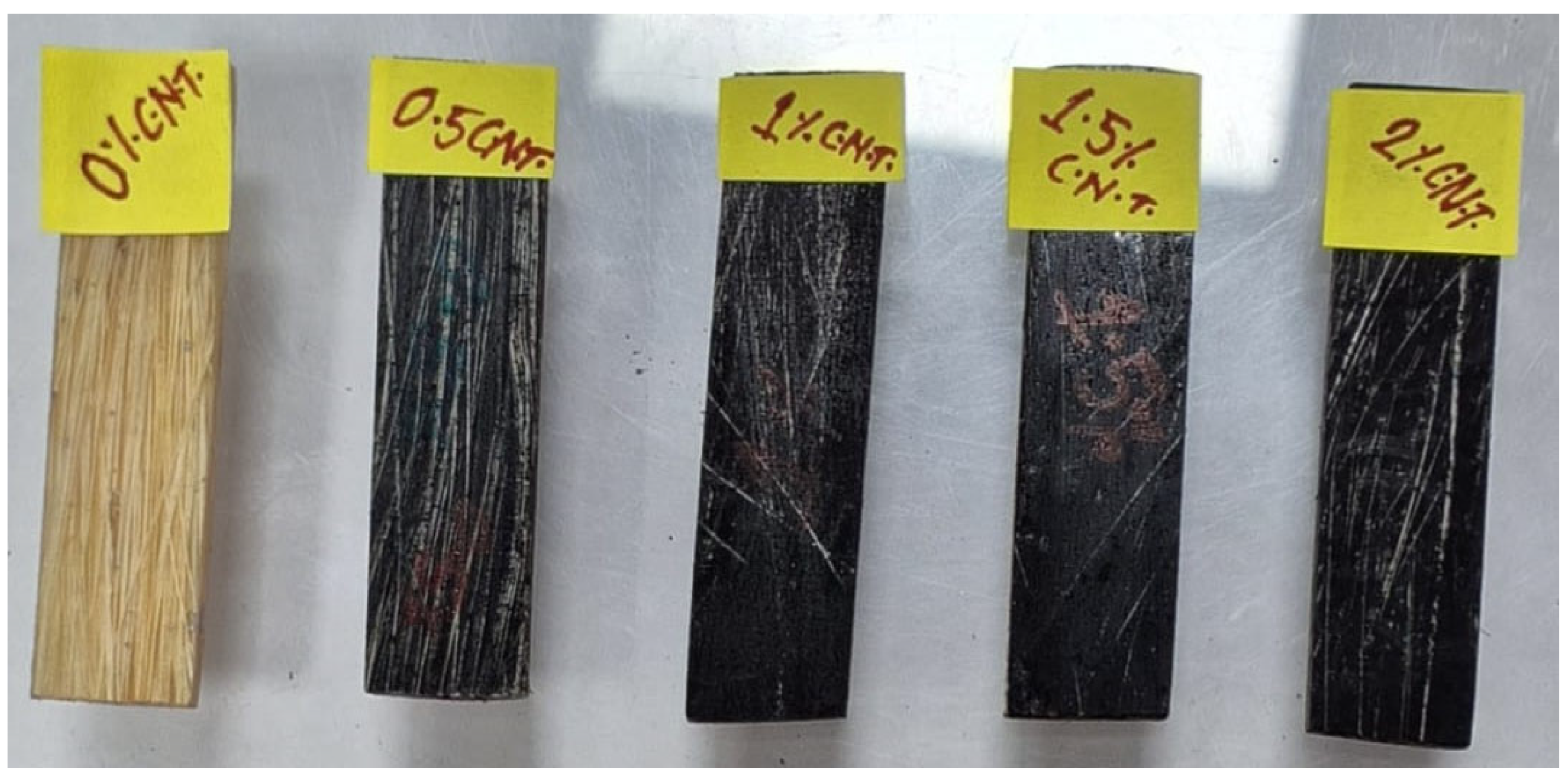
The composite fabrication employed a hand lay-up technique [23] using a stainless-steel mold (300mm × 200mm × 3mm). A wax-based releasing agent was applied to the mold surface to facilitate demolding. Unidirectional sisal fibers, fixed at 15 wt.% of the bio-composite, were uniformly arranged within the mold. Multi-walled carbon nanotubes (CNT) were incorporated as additives at 0, 0.5, 1.0, 1.5, and 2 wt.% relative to the composite weight. Epoxy resin was mixed with a hardener and poured over the fiber-CNT layers, ensuring thorough impregnation. Two flat plates compressed the stacked layers under a 50 kg load to eliminate air voids, maintain sheet flatness, and promote uniform curing. The setup was cured at ambient conditions for 24 hours. Post-curing, the bio-composite sheet was carefully demolded, yielding a 3mm-thick panel. Specimens were labeled based on CNT content (Table 1). This method ensured consistent fiber alignment, controlled CNT dispersion, and uniform matrix distribution, adhering to standardized dimensions and weight fractions.
Figure 1.
Fabrication Samples of Bio-composites.
3. Characterization and Testing technique
3.1. Thermogravimetry Analysis (TGA)
Thermogravimetric Analysis (TGA) is a valuable method for assessing the thermal stability and decomposition characteristics of materials, such as composites reinforced with natural fibers such as sisal and synthetic reinforcements such as multi-walled carbon nanotubes (MWCNTs). Detailed insights into their thermal behavior can be obtained through the use of TGA.The thermal stability of epoxy composites reinforced with 15 wt.% sisal fiber and varying quantities of carbon nanotubes (CNTs) (0.5, 1.0, 1.5, and 2.0 wt.%) was characterized using a thermogravimetric analyzer (model: TGA, STA 409 Netzsch). For the thermal stability analysis of each composite, approximately 2-8 mg were heated from 30˚C to 750˚C at a rate of 10˚C/min in a nitrogen atmosphere [24]. Thermogravimetric Analysis (TGA) is a valuable method for assessing the thermal stability and decomposition characteristics of materials, such as composites reinforced with natural fibers such as sisal and synthetic reinforcements such as carbon nanotubes (CNTs). Detailed insights into their thermal behavior can be obtained through the use of TGA.
3.2. Differential Scanning Calorimetry (DSC)
The Differential Scanning Calorimetry (DSC) methodology is a sophisticated thermal analysis method that is utilized to investigate the thermal transitions of various materials. This includes the glass transition temperature (Tg), the melting temperature (Tm), and the behavior of crystallization. DSC has the potential to offer extremely helpful insights on the thermal stability of composite components as well as their interaction with one another.
3.3. Dynamic Mechanical Analysis (DMA)
Dynamic Mechanical Analysis (DMA) and mechanical properties evaluation were performed on epoxy composites reinforced with 15 wt% sisal fiber and multiwall carbon nanotube (CNT) additives at concentrations of 0.5%, 1.0%, 1.5%, and 2.0% by weight. For detailed insights into the DMA results and mechanical behavior, including modulus, strength, and other relevant parameters.Dynamic Mechanical Analysis (DMA) was conducted to evaluate the viscoelastic response of the PVA-based films using a Hitachi DMA7100 analyzer, following the ASTM D5026 standard [25]. The tests were performed in sinusoidal tensile mode with rectangular samples (20 mm × 10 mm). A temperature sweep from 25°C to 180°C was applied at a heating rate of 2°C/min. Additionally, the creep and recovery behavior of the films was assessed under a force-controlled tensile module to study time-dependent deformation properties.
4. Result and Discussion
4.1. Thermal Gravimetric Analysis (TGA)
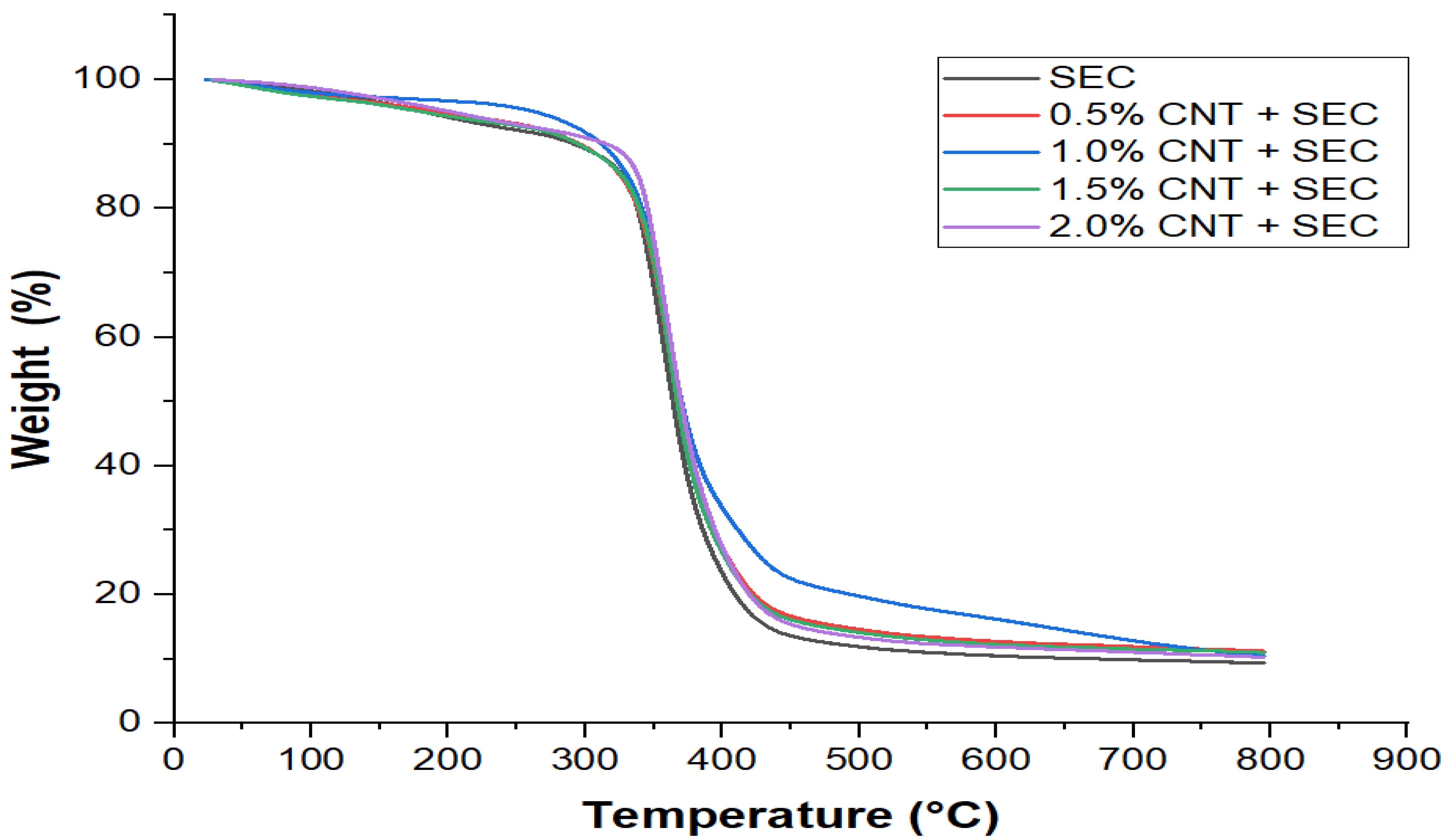
Figure 2 illustrates the thermograms of nanocellulose and epoxy bio-composites.Additionally, Table 2 summarizes the percentages of weight losses at various temperatures. Epoxy, sisal, and CNT bio-composites exhibit three primary degradation stages, as illustrated in Figure 4.1. The thermal degradation of sisal with epoxy and all composites occurred within the temperature range of 30-100˚C during the initial stage of low-temperature degradation. This loss may be attributed to the evaporation of physically weak and loosely bonded moisture from the composites' surfaces [26]. Figure 2 shows the variation of weight loss of sisal epoxy composites at various temperature range. As we can see that as we increase the weight % of CNT weight loss percentage also decreases but after 1% of CNT addition it again starts increasing [27]. So, at 30-100 °C weight loss % is minimum at 1.5% CNT i.e. 1.23 and max. at 2% CNT i.e. 2.58. As we increase the temperature, we can further observe that the minimum weight loss of the Biocomposites is at 1% of CNT addition. So, we can say that the maximum stability is at 1% CNT + SEC.
Figure 2.
TGA curve for bio-composites.
4.2. Differential Scanning Calorimetry (DSC)
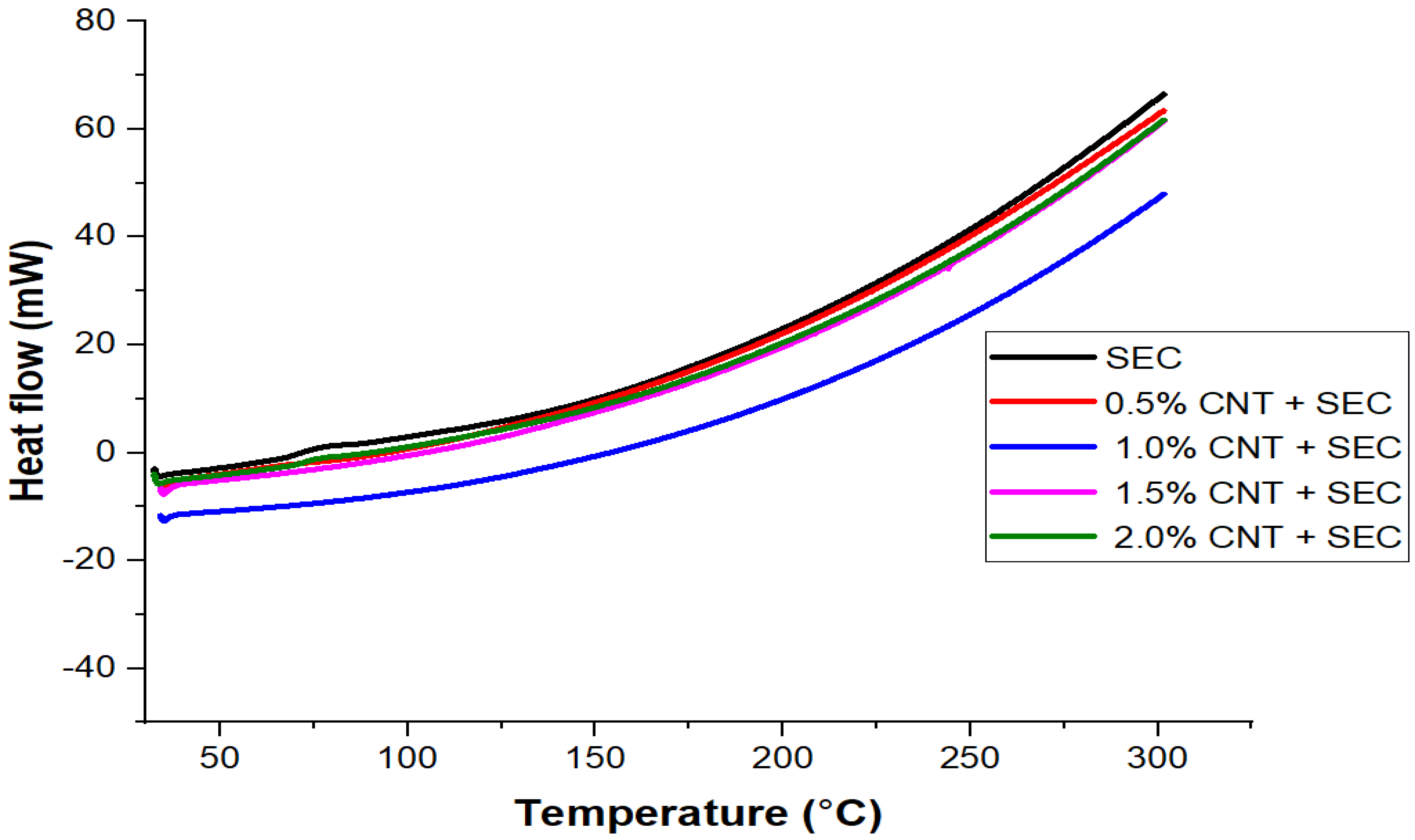
The DSC diagrams of epoxy composites reinforced with 15 wt.% sisal fiber and varying quantities of carbon nanotubes (CNTs) (0.5, 1.0, 1.5, and 2.0 wt.%) are depicted in Figure 3. Two distinct endothermic alterations are observed in all five thermograms as temperatures rise. The initial endothermic maxima at 110 °C were observed in all sisal fibers and CNT as a result of the moisture loss [28]. TGA studies have previously documented this form of moisture loss in response to temperature increases. The presence of hydrophilic substances (cellulose, hemicelluloses, and lignin) in the sisal fiber resulted in a significant quantity of heat being absorbed by 1.0 wt.% in comparison to other fibers and CNT for moisture loss. A distinct endothermic nature was observed in each of them as a result of a change in the composition of CNT. The final decomposition of CNT and fibers was observed at 380-390 °C, which may be attributed to the decomposition of the fibers' constituents. The thermal stability of hemp fiber was improved by the addition of 1.0 wt. % of CNT [29]. A superior reinforcement for polymeric films and composites that are intended for use in industrial applications can be provided on the basis of the enhanced thermal stability of 1.0 weight percent carbon nanotubes (CNT), which is the consequence of an increase in the crystallinity of the material.
Figure 3.
DSC thermograms of bio-composites.
4.3. Dynamic Mechanical Analysis (DMA)
4.3.1. Storage Modulus
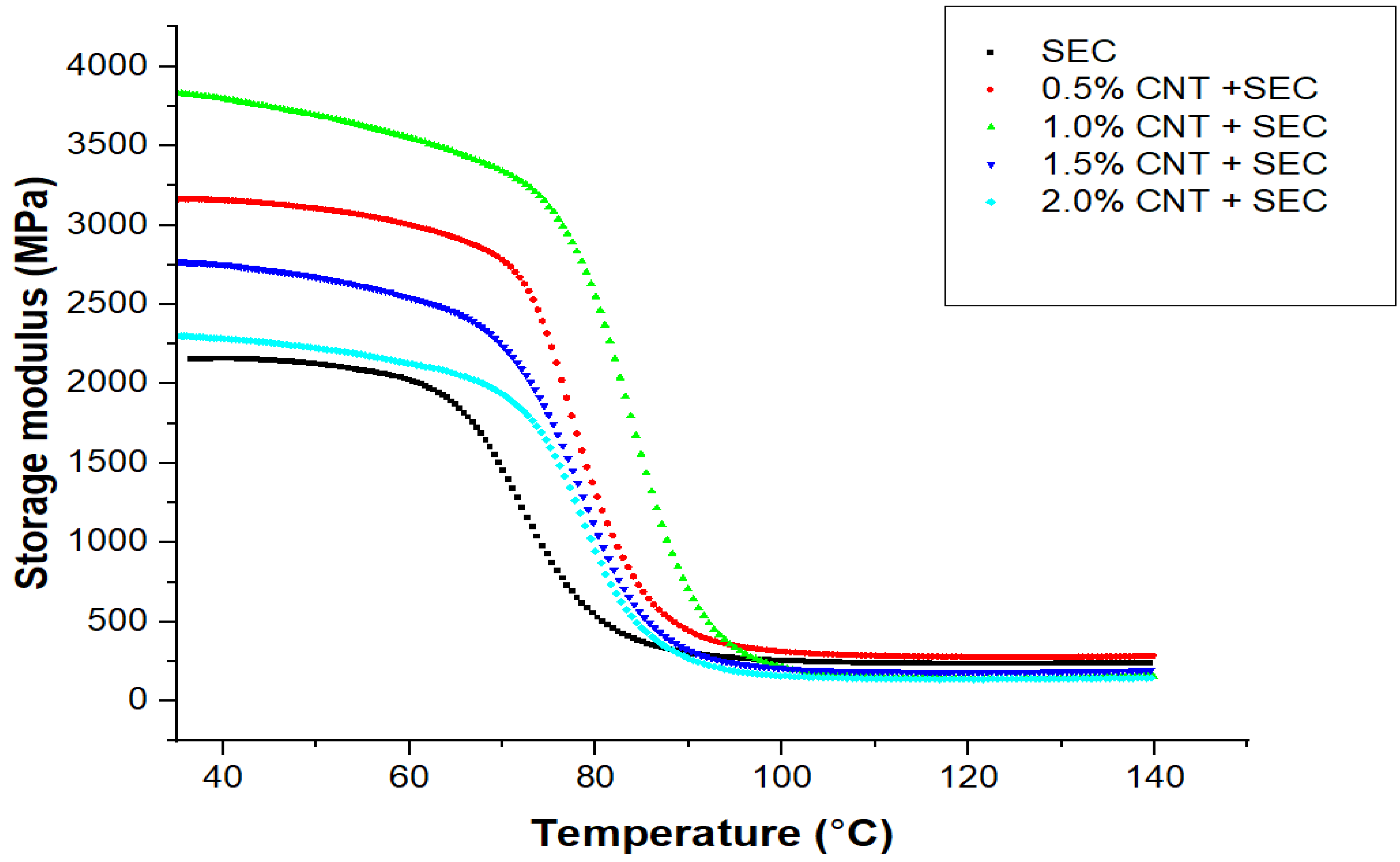
The storage or elastic modulus is used to assess the rigidity of a polymer composite. Figure 4 illustrates the temperature-dependent variations of epoxy composites reinforced with 15 wt.% sisal fiber and varying quantities of carbon nanotubes (CNTs) (0.5, 1.0, 1.5, and 2.0 wt.%) at a frequency of 1 Hz. The incorporation of rigid CNT resulted in an improvement in the values of. In comparison to the epoxy matrix, each composite exhibited a higher value, with the composites containing 1.0 wt.% of CNT exhibiting the highest value. The composites containing 1.0 wt.% of CNT provided the most advantageous value in the vitreous region [30]. This outcome may be attributed to the inclusion of nanocellulose, which enhances the composite’s stiffness, thereby increasing its value. Hydrogen bonds between the polar groups of the epoxy matrix and the sisal fiber with 1.0 wt.% CNT may also be responsible for the enhanced value, which is achieved through homogeneous distribution. In contrast, the epoxy matrix exhibited the lowest values of due to its minimal degree of stiffness. The value of composites containing more than 1.0 wt.% of CNT may have decreased due to agglomeration. The values of were observed to diminish for epoxy and all sisal and CNT bio-composites as the temperature increased. The storage modulus of short sisal composites is illustrated in Figure 4 as a function of temperature. Upon comparing the various composites, it is discovered that the value of Eʼ increases as the amount of CNT additives increases up to 1%, and then decreases. The maximum and lowest values of Eʼ are 3859.28 M Pa and 2159.37 M Pa for composites 1.0% CNT +SEC and SEC, respectively, in the vitreous region.
Figure 4.
Storage modulus for bio-composites.
4.3.2. Loss Modulus
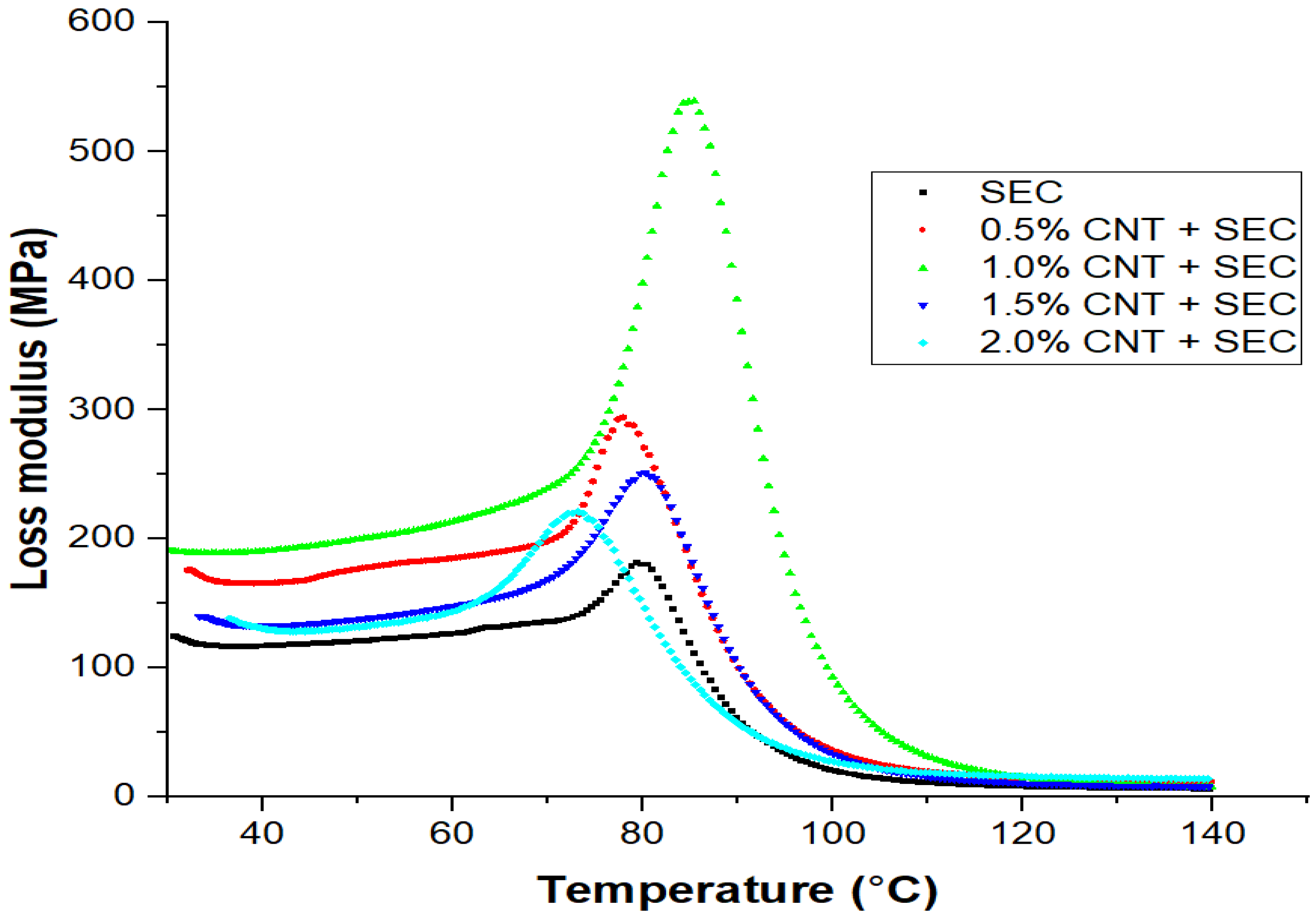
It is defined as the amount of energy that is lost during each cycle of sinusoidal stress and is taken into consideration to be a viscous response of polymeric materials. A frequency of 1Hz is used to depict the loss modulus vs temperature curve of epoxy sisal fiber and carbon nanotube (CNT) bio-composites, which can be found in Figure 5. It is easy to determine the value of, which is the temperature that is linked with the highest apex of the loss modulus curve, because the loss modulus presents this information. The uppermost peaks of loss modulus curves and sisal fiber, CNT-reinforced epoxy bio-composites are summarized in Table 3, which contains a summary of the values that were measured. It is evident that the highest maxima of each composite, which includes epoxy, are reached and subsequently decrease as the temperature increases. The curve's highest peak was observed in the composite with 1.0 wt.% of CNT and sisal fiber, while the lowest peak was observed in the 2.0 wt.% CNT with sisal fiber (15 wt.%). The composites containing CNT at a concentration of up to 1.0 wt.% exhibited a shift in peaks toward a higher temperature in comparison to epoxy. The composite with 1.0 wt.% of CNT exhibited the maximum value (89.26°C), which was 7.11 % higher than that of sisal epoxy bio-composites [30].
Figure 5.
Loss modulus for bio-composites.
4.3.3. Damping Factor
It is a ratio of the loss modulus to the storage modulus or a ratio of the energy lost to the energy stored per oscillation cycle. Figure 4.5 illustrates the relationship between the temperature of the epoxy matrix and nanocellulose bio-composites and the variation in Tan δ at a frequency of 1 Hz. The Tan δ curve is also beneficial in revealing the value of, similar to the loss modulus curve. Table 3.3 summarizes the measured values of the highest peaks in Tan δ curves and epoxy and nano cellulose bi-composites. The curves increased until they reached their highest peak, at which point they began to decline. The sisal fiber-reinforced epoxy composite exhibited the highest apex, suggesting a greater degree of molecular mobility. The composite containing 1.0 wt. % of CNT and sisal fiber exhibited the lowest value, while the remaining composites exhibited intermediate values [31]. The lowest Tan δ peak demonstrates low damping properties and a high load-bearing capacity, and the converse is also true.
Figure 6.
Damping factors for bio-composites.
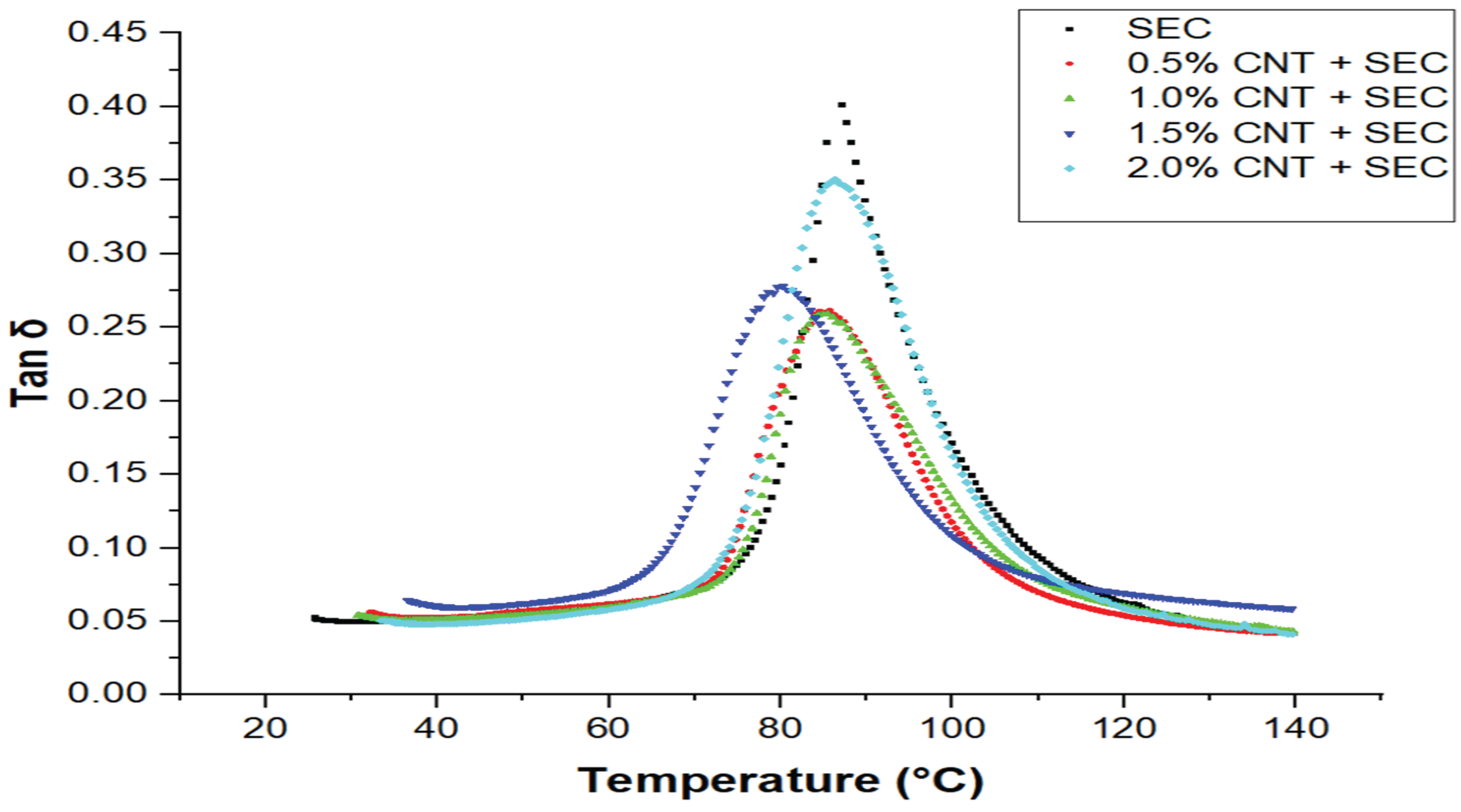

Table 2.
Dynamic mechanical properties of various bio-composites.
| Biocomposites | Storage modulus E’(MPa) | Loss modulus E” (MPa) | Damping factor (Tan δ) | Glass temperature Tg (°C) at loss modulus |
|---|---|---|---|---|
| SEC | 2159.37 | 181.63 | 0.58 | 80.16 |
| 0.5% CNT + SEC | 3165.60 | 294.34 | 0.26 | 85.68 |
| 1.0% CNT + SEC | 3859.28 | 539.44 | 0.25 | 89.26 |
| 1.5% CNT + SEC | 2773.18 | 251.35 | 0.28 | 86.34 |
| 2.0% CNT + SEC | 2306.484 | 221.01 | 0.35 | 85.78 |
5. Conclusions
The following conclusions may be drawn from the present study on the thermal and dynamic mechanical analyses of epoxy-based bio-composites reinforced with 15 wt.% sisal fiber and varying amounts of carbon nanotubes (CNTs):
- The thermal gravimetric analysis (TGA) showed that all bio-composites undergo three main stages of degradation, with the lowest weight loss and thus highest thermal stability observed in the composite containing 1.0 wt.% CNT. Notably, this formulation exhibited the most resistance to thermal decomposition in the 100–380°C range, confirming the role of CNTs in enhancing the thermal resistance up to an optimal content level.
- The differential scanning calorimetry (DSC) thermograms showed a pronounced endothermic peak at 110°C, corresponding to moisture loss, particularly in composites with hydrophilic constituents such as cellulose and lignin from sisal fibers. Composites with 1.0 wt.% CNT showed increased crystallinity, leading to enhanced thermal stability.
- The storage modulus (E′), which reflects rigidity, was maximized at 1.0 wt.% CNT (3859.28 MPa), indicating optimal reinforcement and improved load-bearing capacity due to effective dispersion and interaction of CNTs within the matrix.
- Composites with 1.0 wt.% CNT exhibited the highest loss modulus and the lowest tan δ, indicating both superior stiffness and reduced energy dissipation—favorable traits for structural applications.
- The glass transition temperature (Tg) also peaked at 89.26°C in the 1.0 wt.% CNT composite, signifying increased thermal and dimensional stability.
In summary, the incorporation of 1.0 wt.% carbon nanotubes into sisal fiber-reinforced epoxy composites provides the most balanced enhancement in thermal stability, stiffness, and damping behavior, making it an optimal formulation for advanced bio-composite applications in automotive, construction, and packaging industries.
Authors Contribution
D.K.R. and C.K.K. conducted experimental tests on bio-composites and performed data processing; N.J., and U.S.S. helped with the collection of data from the scientific literature review, organized the results obtained from the scientific community, and wrote the manuscript; D.M.G., D.G.P. and K.R. contributed to result interpretation and the discussion of the selected results. All authors have read and agreed to the published version of the manuscript.
Funding
This work was partially supported by the GeoBioTec Research Unit, through the strategic projects UIDB/04035/2020 (https://doi.org/10.54499/UIDB/04035/2020) and UIDP/04035/2020 (https://doi.org/10.54499/UIDP/04035/2020), funded by the Fundação para a Ciência e a Tecnologia, IP/MCTES through national funds (PIDDAC).
Data Availability Statement
The data presented in this study are available within the article.
Conflicts of Interest
The authors declare no conflicts of interest.
References
- Stachurski, Z. H. Fundamentals of Amorphous Solids : Structure and Properties; Wiley-Vch Verlag Gmbh & Co. Kgaa: Weinheim, Germany, 2015. [Google Scholar]
- Lucas, A. Ancient Egyptian Materials; 1926.
- Kar, K. K. (Ed.) Composite Materials; Springer Berlin Heidelberg: Berlin, Heidelberg, 2017. [Google Scholar] [CrossRef]
- Mazumdar, S. K. Composites Manufacturing : Materials, Product, and Process Engineering; Crc Press: Boca Raton, Fla, 2002. [Google Scholar]
- Sharma, S.; Sudhakara, P.; Nijjar, S.; Saini, S.; Singh, G. Recent Progress of Composite Materials in Various Novel Engineering Applications. Materials Today: Proceedings 2018, 5, 28195–28202. [Google Scholar] [CrossRef]
- Thostenson, E. T.; Ren, Z.; Chou, T.-W. Advances in the Science and Technology of Carbon Nanotubes and Their Composites: A Review. Composites Science and Technology 2001, 61(13), 1899–1912. [Google Scholar] [CrossRef]
- Li, Y.; Mai, Y.-W.; Ye, L. Sisal Fibre and Its Composites: A Review of Recent Developments. Composites Science and Technology 2000, 60(11), 2037–2055. [Google Scholar] [CrossRef]
- Faruk, O.; Bledzki, A. K.; Fink, H.-P.; Sain, M. Biocomposites Reinforced with Natural Fibers: 2000–2010. Progress in Polymer Science 2012, 37(11), 1552–1596. [Google Scholar] [CrossRef]
- Joseph, K.; Thomas, S.; Pavithran, C. Effect of Chemical Treatment on the Tensile Properties of Short Sisal Fibre-Reinforced Polyethylene Composites. Polymer 1996, 37(23), 5139–5149. [Google Scholar] [CrossRef]
- Nair, K. C. M.; Thomas, S. Effect of Interface Modification on the Mechanical Properties of Polystyrene-Sisal Fiber Composites. Polymer Composites 2003, 24(3), 332–343. [Google Scholar] [CrossRef]
- Menard, K. P.; Menard, N. R. Dynamic Mechanical Analysis; CRC Press, 2020. [CrossRef]
- Jayaraman, K. Manufacturing Sisal–Polypropylene Composites with Minimum Fibre Degradation. Composites Science and Technology 2003, 63, (3–4). [Google Scholar] [CrossRef]
- Joseph, P. V.; Rabello, M. S.; Mattoso, L. H. C.; Joseph, K.; Thomas, S. Environmental Effects on the Degradation Behaviour of Sisal Fibre Reinforced Polypropylene Composites. Composites Science and Technology 2002, 62, (10–11). [Google Scholar] [CrossRef]
- Rong, M. Z.; Zhang, M. Q.; Liu, Y.; Yang, G. C.; Zeng, H. M. The Effect of Fiber Treatment on the Mechanical Properties of Unidirectional Sisal-Reinforced Epoxy Composites. Composites Science and Technology 2001, 61, 1437–1447. [Google Scholar] [CrossRef]
- Sreekumar, P. A.; Joseph, K.; Unnikrishnan, G.; Thomas, S. A Comparative Study on Mechanical Properties of Sisal-Leaf Fibre-Reinforced Polyester Composites Prepared by Resin Transfer and Compression Moulding Techniques. Composites Science and Technology 2007, 67, (3–4). [Google Scholar] [CrossRef]
- Idicula, M.; Malhotra, S. K.; Joseph, K.; Thomas, S. Dynamic Mechanical Analysis of Randomly Oriented Intimately Mixed Short Banana/Sisal Hybrid Fibre Reinforced Polyester Composites. Composites Science and Technology 2005, 65, (7–8). [Google Scholar] [CrossRef]
- Shahzad, A.; Isaac, D. H. Fatigue Properties of Hemp and Glass Fiber Composites. Polymer Composites 2014, 35, 1926–1934. [Google Scholar] [CrossRef]
- Milanese, A. C.; Cioffi, M. O. H.; Voorwald, H. J. C. Thermal and Mechanical Behaviour of Sisal/Phenolic Composites. Composites Part B: Engineering 2012, 43, 2843–2850. [Google Scholar] [CrossRef]
- Manirao Ramachandrarao; Khan, S. H.; Abdullah, K. Carbon Nanotubes and Nanofibers – Reinforcement to Carbon Fiber Composites - Synthesis, Characterizations and Applications: A Review. Composites Part C Open Access 2024, 100551–100551. [Google Scholar] [CrossRef]
- Dwivedi, U. K.; M. Trihotri; Gupta, S. C.; Khan, F. H.; Malik, M. M.; Qureshi, M. S. Effect of Carbon Nanotubes Implantation on Electrical Properties of Sisal Fibre–Epoxy Composites. Composite interfaces 2016, 24, 111–123. [Google Scholar] [CrossRef]
- G., Vijayasekaran; P., Selvaraju; Dominic, A.; Krishnamurthy, N. G. Vijayasekaran; P. Selvaraju; Dominic, A.; Krishnamurthy, N.; A. Yasminebegum; S. K. Hasane Ahammad. Mechanical Properties Evaluation of Carbon Nanotube/Sisal Fiber/Marble Dust Reinforced Polymer Based Composites. Materials Today: Proceedings 2023. [Google Scholar] [CrossRef]
- Joseph, L.; Kumar, P. S.; Deeraj, B. D. S.; Joseph, K.; Jayanarayanan, K.; Mini, K. M. Modification of Epoxy Binder with Multi Walled Carbon Nanotubes in Hybrid Fiber Systems Used for Retrofitting of Concrete Structures: Evaluation of Strength Characteristics. Heliyon 2022, 8. [Google Scholar] [CrossRef]
- Joseph, P. V.; Rabello, M. S.; Mattoso, L. H. C.; Joseph, K.; Thomas, S. Environmental Effects on the Degradation Behaviour of Sisal Fibre Reinforced Polypropylene Composites. Composites Science and Technology 2002, 62, (10–11). [Google Scholar] [CrossRef]
- Wang, F.; Drzal, L. T.; Qin, Y.; Huang, Z. Multifunctional Graphene Nanoplatelets/Cellulose Nanocrystals Composite Paper. Composites Part B: Engineering 2015, 79, 521–529. [Google Scholar] [CrossRef]
- Test Method for Plastics: Dynamic Mechanical Properties: In Tension. 2015. [CrossRef]
- Jorge Ananias Neto; Henrique; Ricardo C. T. Aguiar; Banea, M. D. A Review on the Thermal Characterisation of Natural and Hybrid Fiber Composites. Polymers 2021, 13, 4425–4425. [Google Scholar] [CrossRef]
- Ewelina Ciecierska; Boczkowska, A. ; Krzysztof Jan Kurzydlowski; Iosif Daniel Rosca; Suong Van Hoa. The Effect of Carbon Nanotubes on Epoxy Matrix Nanocomposites. Journal of Thermal Analysis and Calorimetry 2012, 111, 1019–1024. [Google Scholar] [CrossRef]
- Pereira, A. L.; Banea, M. D.; Neto, J. S. S.; Cavalcanti, D. K. K. Mechanical and Thermal Characterization of Natural Intralaminar Hybrid Composites Based on Sisal. Polymers 2020, 12. [Google Scholar] [CrossRef] [PubMed]
- Bao, X.; Wu, F.; Wang, J. Thermal Degradation Behavior of Epoxy Resin Containing Modified Carbon Nanotubes. Polymers 2021, 13. [Google Scholar] [CrossRef] [PubMed]
- Turan, F.; Mehmet Guclu; Koray Gurkan; Durmus, A. ; Yener Taskin. The Effect of Carbon Nanotubes Loading and Processing Parameters on the Electrical, Mechanical, and Viscoelastic Properties of Epoxy-Based Composites. Journal of the Brazilian Society of Mechanical Sciences and Engineering 2022, 44. [Google Scholar] [CrossRef]
- Her, S.-C.; Lin, K.-Y. Dynamic Mechanical Analysis of Carbon Nanotube-Reinforced Nanocomposites. Journal of Applied Biomaterials & Functional Materials 2017, 15, 13–18. [Google Scholar] [CrossRef]
- Dinesh Kumar Rao, Prakash Chandra Gope, Fracture Toughness of Walnut Particles (Juglans regia L.) and Coconut Fibre Reinforced Hybrid Biocomposite. Journal of Polymer Composites, 2014, , Volume 36, Issue 1, pages 167–173. [CrossRef]
- Prakash Chandra Gope and Dinesh Kumar Rao, “Fracture behaviour of epoxy biocomposite reinforced with short coconut fibres (Cocos nucifera) and walnut particles (Juglans regia L.)” Journal of Thermoplastic Composite Materials,Vol 29, Issue 8, pages 1098-1117, 2014. [CrossRef]
- Prakash Chandra Gope, Vinay Kumar Singh, Dinesh Kumar Rao, “Mode I Fracture Toughness of Bio-fiber and Bio Shell Particle Reinforced Epoxy Bio-composites” Journal of Reinforced Plastics and Composites, Vol. 34 , Issue 13, p131075-1089, 2015. [CrossRef]
- Dinesh Kumar Rao, “Tensile, Compressive and Flexural Behaviour with Characterization of Hybrid Bio-Composite Reinforced with Walnut Shell Particles and Coconut Fibres”. In the proceedings of International Society of Agile Manufacturing, Conference on Advanced and Agile Manufacturing System,KNIT Sultanpur support on TEQIP-II, International Society of Agile Manufacturing (ISAM), Dec 28-29,2015, p310-314.ISBN:978-93-85777-03-5.
- DK Rao, P Sharma, V Kumar, PK Agarwal, CK Kaithwas, "Introduction to thermo plastic polymer composites:applications, advantages, and drawbacks",Mechanical and Mathematical Modeling, Elsevier book in Dynamic Mechanical and Creep-Recovery Behavior of Polymer-Based Composites, p1-9. 2024. [CrossRef]
Table 1.
Nomenclature of bio-composites.
| Nomenclature | Specification of bio-composites |
|---|---|
| SEC | Sisal fibre (constant 15 wt.% loading) epoxy composite |
| SEC + 0.5% CNT | Sisal fibre (constant 15 wt.% loading) epoxy composite with 0.5 wt.% CNT additives |
| SEC + 1.0% CNT | Sisal fibre (constant 15 wt.% loading) epoxy composite with 1.0 wt.% CNT additives |
| SEC + 1.5% CNT | Sisal fibre (constant 15 wt.% loading) epoxy composite with 1.5 wt.% CNT additives |
| SEC + 2.0% CNT | Sisal fibre (constant 15 wt.% loading) epoxy composite with 2.0 wt.% CNT additives |
Table 2.
TGA results of bio-composites.
| Temperature (°C) | Weight loss (%) of bio-composites | ||||
|---|---|---|---|---|---|
| SEC | 0.5% CNT + SEC | 1.0% CNT + SEC | 1.5% CNT + SEC | 2.0% CNT + SEC | |
| 30-100 | 1.80 | 2.44 | 2.01 | 1.23 | 2.58 |
| 100-380 | 66.14 | 61.71 | 57.62 | 60.13 | 62.85 |
| 380-420 | 82.80 | 79.23 | 72.28 | 80.04 | 79.87 |
| 420-790 | 90.60 | 88.72 | 89.38 | 89.65 | 88.93 |
Disclaimer/Publisher’s Note: The statements, opinions and data contained in all publications are solely those of the individual author(s) and contributor(s) and not of MDPI and/or the editor(s). MDPI and/or the editor(s) disclaim responsibility for any injury to people or property resulting from any ideas, methods, instructions or products referred to in the content. |
© 2025 by the authors. Licensee MDPI, Basel, Switzerland. This article is an open access article distributed under the terms and conditions of the Creative Commons Attribution (CC BY) license (http://creativecommons.org/licenses/by/4.0/).
Copyright: This open access article is published under a Creative Commons CC BY 4.0 license, which permit the free download, distribution, and reuse, provided that the author and preprint are cited in any reuse.


