
Submitted:
16 May 2025
Posted:
19 May 2025
You are already at the latest version
Abstract
The cultural habitat of Eriocheir sinensis is a crucial factor influencing its nutritional quality. This study investigated and compared the nutritional value of three edible parts (hepatopancreas, gonads, and muscle) of the female Eriocheir sinensis from three different habitats in the lower reach of the Yangtze River, with a special emphasis on lipid compounds. In addition to tissue indices, proximate composition, energy con-tent, lipid classes and fatty acid profile, eight lipid quality indices were proposed to evaluate the lipid nutritional quality based on their fatty acid composition. The result indicated that Eriocheir sinensis of three different habitats were all in good develop-ment condition. There were no significant differences in the hepatopancreas index (HIS), gonadosomatic index (GSI) and total edible yield (TEY) among the three habi-tats, except that muscle index (MI) was significantly higher in L-crabs and E-crabs compared to P-crabs. The highest protein content was found in the gonads, while the hepatopancreas had the highest crude lipids content. Concerning lipid classes, hepatopancreas was dominated by triglycerides and muscle was predominated by phospholipids, whereas phospholipids and triglycerides were predominant in equal amounts approximately in the gonads. Eriocheir sinensis from three different habitats showed good nutritional quality suitable for human dietary needs. Taking eight lipid quality indices into account together, the three major edible tissues of Eriocheir sinensis from the estuarine habitat had the highest nutrient value, followed by hepatopancreas from the pond habitat. Current research will provide basic nutritional data for con-sumers when purchasing Eriocheir sinensis and theoretical insights into how habitats affect the nutritional composition.
Keywords:
Eriocheir sinensis
; habitats
; lipid class composition
; fatty acid
; lipid quality indices
1. Introduction
Eriocheir sinensis is a small crab species, commonly called the Chinese mitten crab, and native to coastal and estuarine habitats from the Fujian province in China (26◦N) to the Korean Peninsula (40◦N) [1,2]. Although the Chinese mitten crab is considered as an invasive species in the European and American regions[3,4], it is one of the most important economic aquatic animals worldwide, especially in East Asia[5].In China, Eriocheir sinensis is a unique traditional aquatic species and widely distributed, especially in the Yangtze River basin[6],with production reaching about 888629 tons in 2023 [7]; Eriocheir sinensis is the most favored and consumed crab because of its rich nutritional profile, palatable taste as well as unique and pleasant aroma [8].
In recent years, with the continuous improvement of breeding technology and aquacultural practices, the farming of Eriocheir sinensis has spread across China [9]. However, the lower reaches of the Yangtze River are still the main farming areas for Eriocheir sinensis in terms of its farming sizes and economic benefits [10,11]. Lakes and ponds are the traditional farming habitats for Eriocheir sinensis. The Chinese mitten crab from Yangcheng Lake has been the most renowned for a long time [12]. In the Yangtze River estuary, which is situated at the intersection of the Yangtze River and the East China Sea, there is a slightly higher salinity compared to freshwater areas. The Chinese mitten crab is an euryhaline crustacean, and it has been demonstrated that salinity can affected the lipid composition and flavor quality of Chinese mitten crab [13,14]. Additionally, the quality of Chinese mitten crabs from lakes and rivers varied due to different natural ecosystems, such as microorganisms, aquatic plants, etc. [15,16].
Hepatopancreas, gonads, and muscles were three main edible biological tissues of Eriocheir sinensis and tissue indices, as the development indicators of edible tissues, directly affected their nutritional quality [17]. The nutritional quality of Eriocheir sinensis were usually evaluated through content and compositional analyses of conventional nutrients in three edible tissues. Nutritionally, the amount of crude protein, crude fat, ash, and sugar in muscle, hepatopancreas, and gonads was found to vary [18]. Additionally, nutritional value of Eriocheir sinensis from different habitats varied in the aforementioned three edible tissues. By comparing the morphological characteristics, tissue indices, proximate and fatty acid compositions of hepatopancreas, gonad and muscle of pond-reared and lake-stocked Eriocheir sinensis, the results suggested that the nutritional quality of lake-stocked crabs was better than that of pond-reared crabs [19]. It was speculated that the low biodiversity of microalgae and flourishing macrophytes in the lakes contributed directly or indirectly to the quality difference of Chinese mitten compared to in the ponds [20]. Nutritional quality and fatty acids composition of chinese mitten crab as an invasive species in Europe from Odra Estuary (Baltic Basin) have been studied [1]. However, Nutritional value and lipid quality of Eriocheir sinensis from the Yangtze River Estuarine habitats are not yet reported.
Studies of human dietary habits have shown that the consumption of aquatic products is beneficial to health, mainly because aquatic products provide almost all the fatty acids that are beneficial to human health, especially omega-3 PUFA [21]. The n-3 family of long-chain polyunsaturated fatty acids (n-3 LCPUFA) is a key nutrient whose beneficial effects on human health are well known [22]. Eicosapentaenoic acid (EPA, 20:5n-3) and docosahexaenoic acid (DHA, 22:6n-3) are the most recognized n-3LCPUFA because of their nutritional and physiological function in all life stages, which cannot be synthesized by humans and must be obtained from the diet [23]. Lipids are nutritionally significant in crustaceans; a number of studies have investigated the functional properties of lipid fraction and fatty acid profile, but the implications of fatty acid ratio for human health have been scarcely investigated. Moreover, some lipid quality indices are also important indicators for evaluating the composition of fatty acids [24,25]. As such, the present study proposed the use of different lipid quality indices to assess the nutritional properties of Eriocheir sinensis based on their fatty acid composition.
The aims of this study are to assess the tissue indices, proximate composition, especially for the nutritional value of fatty acid quality of three edible tissues of Eriocheir sinensis from three different habitats, namely, lakes, estuaries and ponds, in the lower reach of the Yangtze River. These results of this study not only provide nutritional reference information for consumers to make informed choices when purchasing Eriocheir sinensis, but also lay theoretical and technical foundation for improving nutritional value of Eriocheir sinensis by modifying culture conditions.
2. Materials and Methods
2.1. Study Areas and Sampling Methods
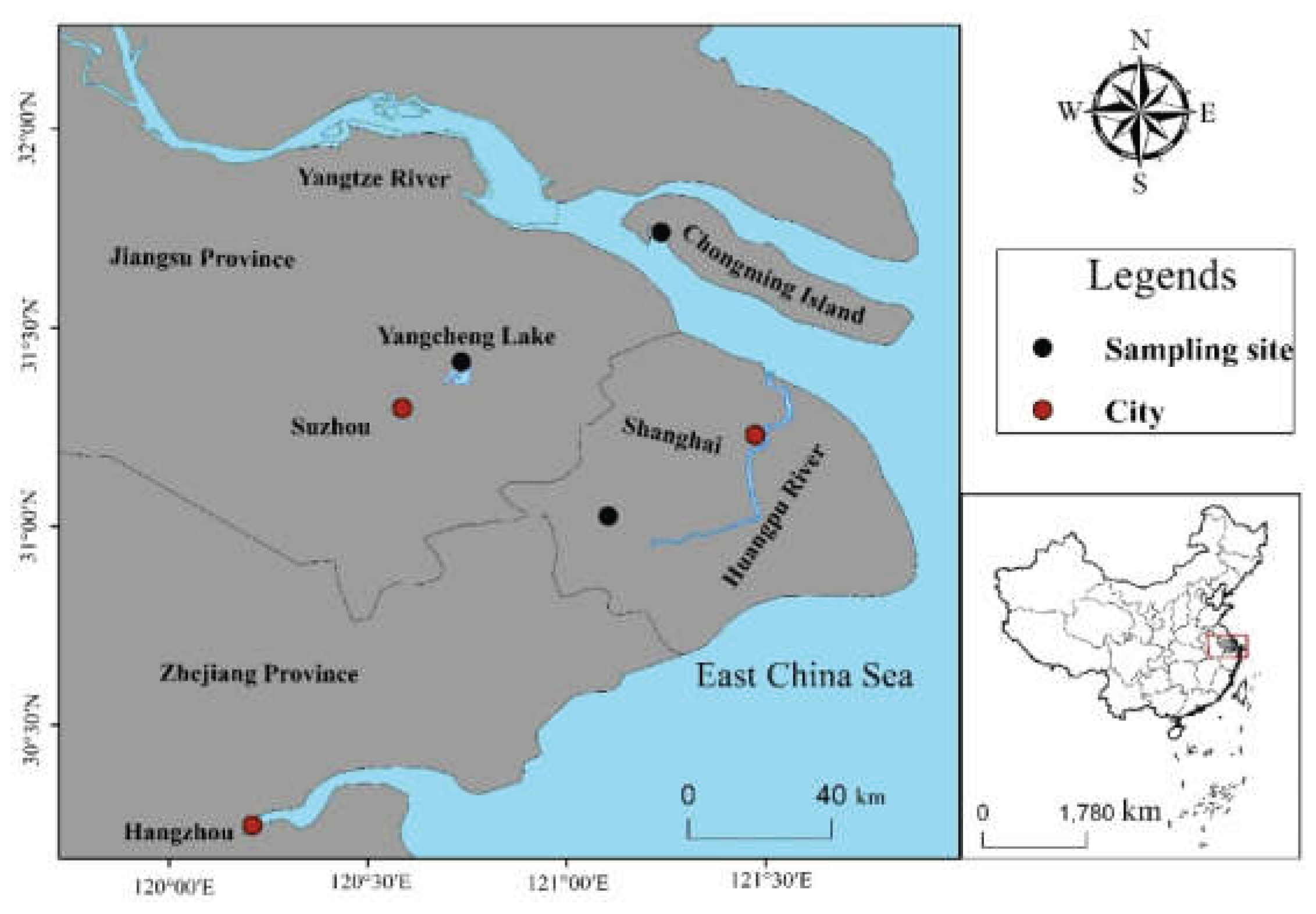
The lower reaches of the Yangtze River, located in East China and bordering the East China Sea, is one of the main breeding areas for Chinese mitten crab. Specifically, three different habitat sources are located in Yangcheng Lake, the Yangtze River estuary of Chongming Island and the upper reaches of Huangpu River. Correspondingly, crab samples were reared in the lake, the Yangtze River estuary and pond waters, respectively; accordingly, these samples were named as L-crabs, E-crabs and P-crabs, separately. The geographic locations of the collected Eriocheir sinensis are shown in Fig.1. Except for different habitats, all experimental crabs belonged to the same genetic species and were raised using the same cultural practices.
Figure 1.
Location of Sample sites of Eriocheir sinensis-black point
In November 2023, 90 female samples were collected from 3 sampling sites, each containing 30 individuals. Each crab was all commercially appropriate sizes(150±10g).The practice of sampling plans for crabs was conducted according to the Chinese Standard GB/T 30891-2014[26]. At every sampling site, 30 female samples were collected live randomly and transported to the laboratory of Food Nutrition and Quality Evaluation, Shanghai Ocean University within two hours. In order to prevent cannibalism, all crabs were tied individually by a cotton rope, and they were packed into the perforated plastic box (20 cm×30 cm×40 cm) with ice bags to lower the temperature.
2.2. Sample Preparation and Tissues Indices
All crabs were kept in a refrigeration house (5-8℃) to decrease their metabolism, and then washed through water rinsing carefully, and stunned before being euthanized by piercing the two nerve centres using a stainless steel rod. The rod was inserted through one of the eyes and the vent as recommended by the Codex Alimentarius Commission[27]. Nextly, the crabs were then dissected to obtain hepatopancreas and ovaries, and the meat from the whole body was carefully removed and collected. The ovary, hepatopancreas and meat from each crab were subsequently weighed. Finally, all collected samples were stored at -40 ℃ for later biochemical analysis. Tissues indices were calculated using equations in Table 1, respectively.
2.3 Proximate composition determination and Energy Content
Before biochemical analysis, the same tissues of crabs from each habitat were pooled and homogenized. Moisture, total ash, crude protein and total lipid contents were determined according to the AOAC methods [28]. while total carbohydrate content in the samples was measured using the phenol-sulfuric acid method as detailedly described by [29]. The results were expressed in % of wet weight. The energy content was estimated as proteins, 4.27 kcal g-1 of wet weight; lipids,9.02 kcal g-1 of wet weight; and carbohydrates, 4.11 kcal g-1 of wet weight (1 kcal = 4184 kJ) [30].
2.4. Lipid Classes and Fatty Acid Profile Analysis
Firstly, the chloroform-methanol solution(2:1,V/V) was used to extract total lipids[31].Lipid classes were analyzed based on a previous methods[32]. Briefly, the separation of the lipid fractions was carried out using hexane/diethyl ether/formic acid (42/28/0.3, v/v/v) solvent system. Resulting lipid classes were the quantified for total phospholipids (PL), triacylglycerol (TAG), free fatty acids (FFA) and cholesterol (CHO) using an Iatroscan MK-6 s TLC-FID analyzer (Iatron Laboratries Inc., Tokyo, Japan). The level of each lipid class was expressed as a percentage of total lipid classes (%).
A slightly modified approach was used to prepare the fatty acid methyl esters (FAME)[33]. In short, 5 mL of methanolic-NaOH (0.5 mol/mL) was mixed with 100 μL of C19:0 internal standard (10 mg/mL) and 0.1 g of total lipid samples. After that, the mixture was heated for 10 minutes at 100 °C on a condensing and concentrating apparatus (HWS24, HongLang, Zhengzhou, Henan, P.R. China). After that, 3 mL boron trifluoride-methanol (14% in methanol) was added to the mixture at 100 °C and stirred for 3 min, followed by the addition of 2 mL n-hexane and held at 100 °C for 2 min. Lastly, 10 mL saturated NaCl solution was added to the mixture. After cooling the sample to room temperature (24–27°C), the upper n-hexane layer was collected using a 2 mL disposable syringe, placed in a 2 mL thread screw neck vial with a septum (32×11.6 mm, ANPEL Inc.), and filtered using a nylon syringe filter (13 mm×0.22 µm) for further analysis.
The fatty acid profile of total lipids was determined by GC analysis. A gas chromatograph TRACE GC ULTRA (Thermos Fisher Inc., Waltham, MA. USA) fitted with a flame ionization detector (Thermo Fisher Inc.) and an Agilent (Santa Clara, CA.USA) SP-2560 capillary column (100 m length×250 µm internal diameter, 0.2 µm of film) was used. The temperatures that the chromatographic columns were programmed to reach was as follows: the initial temperature was 70 °C, heated to 140 °C (20 °C/min), held for 1 min; then to 180 °C (4 °C/min), held for 1 minute; and 225 °C (3 °C/min), held for 30 minutes. The gasification temperature was 250 °C. The flow rate of N2 was 1 mL/min. The injection volume was 1 μL, with a split ratio of 45:1. FAME were identified by comparison of their retention time with the standard mixture. The contents of different fatty acids were determined using the area ratio of GC peak between internal standard C19:0 and different fatty acids being tested. The specific calculation formula is as follows:
Fatty acid composition was expressed as mg/100g of total lipids.
2.5. Lipids Quality Indices
Eight nutritional quality indices were calculated in three edible tissues of E sinensis by means of the following formulae provided in Table2.
2.6. Statistical Analysis
All samples and assays were carried out thrice(n=3), except for biological indices tissue, which were replicated ten times (n=10). Values were presented as average standard deviation. The statistical significance of the differences among samples was measured using one-way analysis of variance (ANOVA) followed by a Tukey post-hoc test using SPSS 20.0(SPSS Chicago, IL, USA). All differences were considered to be statistically significant at p=0.05. Principal component analysis (PCA) biplot and hierarchical cluster analysis (HCA) were was accomplished by XLSTAT 2019 (Addinsoft, NY, USA). Origin (2025) were used to create and process images.
3. Results and Discussion
3.1 Tissues Indices
The determination of the tissue indices in Crustaceans such as Eriocheir sinensis is of biological and technological interest [35]. The present study highlights tissue indices differences for Eriocheir sinensis from three typical habitats. As is illustrated in Figure 2, there were no significant differences in the HIS and GSI indices of female crabs from the three habitats, and MI was significantly higher in L-crabs and E-crabs than in P-crabs, but there were no significant differences in TEY from the three different habitat sources. Fulton’s condition factor is widely used in fisheries and general fish biology studies as an indicator of the “condition,” “well-being,” “plumpness,” etc. [36]. Herein, in terms of CF, there were also no significant differences among the three habitat sources, indicating that Eriocheir sinensis sampled in this study were homogeneous and in good growth condition. In addition, as can also be seen in Figure1, among the three edible tissues ( HSI, GSI and MI ), they all conformed to the following order:MI>HSI>GSI, regardless of their habitat sources.
The nuances in these parameters may be attributed to the distinct cultural environments of the three habitats. Currently, the classification of different grades of commercial Eriocheir sinensis and the factors consumers consider When purchasing crabs are mainly based on the body weight of Eriocheir sinensis and their corresponding tissue indices [37].Therefore, the availability of tissues indices to both consumers and farmers for making comparisons related to breeding habitats is of great importance as it may provides foundational reference data.
3.2 Proximate Composition and Energy Content
Table 2 shows the proximate composition and energy content of female Eriocheir sinensis from three different habitats in the lower reach of the Yangtze River. There were no significant differences in moisture, total lipids, total carbohydrates and energy values in edible hepatopancreatic tissues from the three habitat sources. However, The total ash content of P-crabs was significantly lower than that of L-crabs and E-crabs. The opposite was true for crude protein in P-crabs, which was significantly higher than the other both. In gonadal tissues, there were no significant differences in total ash and crude protein among the three habitat sources of crabs. Total lipids and total carbohydrates had the same characteristics, with P-crabs having the lowest levels and significantly lower than E-crabs and L-crabs. In crab meat, there were no significant differences in moisture or crude protein content among the three habitats of Eriocheir sinensis. Total lipid and energy values followed the same pattern, with P-crabs having the highest values and significantly higher values than E-crabs and L-crabs.
Regardless of the habitat of Eriocheir sinensis, from the perspective of the three major edible tissues, the hepatopancreas had the highest total lipids content; the gonads had the highest protein content, and the muscle had the highest total carbohydrate content. This is in line with previous findings [18,21]. These data provided a basis for choosing different edible tissues according to our nutritional needs when eating crabs.
3.3 Lipid Classes
Four lipids classes, namely, TG, FFA, CH and PL were detected by TLC-FID in the three edible tissues, and the results was presented in Figure 3. In ovaries, PL and TAG represented the main lipid classes, while Low in both FFA and CHO with <1% of total lipids. The levels of TG content were noticeably greater in P-and L-Crabs compared to E-crabs(p<0.05). On the contrary, the highest amount of PL was found in E-Crabs, significantly higher than L-crabs and P-crabs(p<0.05). Lipids in hepatopancreas tissues were mainly in the form of TGs (>85%), followed by PL. FFAs and CHOs were the least abundant (<1%). The lowest TG content was found in P-crabs, significantly lower than L-crabs and E-crabs(p<0.05). When it comes to PL content, there were noticeable variations in hepatopancreas tissues from three different sources. Pond crabs had higher levels of PL content compared to estuarine and lake crabs. When it comes to PL content, The contents of the three in descending order are as follows: P-crabs, E-crabs, L-crabs ( p<0.05). In crab meat, Lipids were mainly in the form of PLs (>90%), followed by CHO (approximately 5%). TG and FFA were both low. There were no significant differences found in the PL contents of crabs meat from the three habitats. Crabs living in estuaries had a noticeably greater amount of CHO compared to the other two habitats. Regardless of the source, different edible tissues exhibited different lipid class profiles, which was in agreement with previous studies [38].
3.4. Fatty Acid Profile
The fatty acid content in the three edible tissues of Eriocheir sinensis from three different habitats is listed in Table S1 (See Supplementary Table S1 for detailed data). In this experiment, 33 fatty acid molecules were detected in total. Unsaturated fatty acids (UFAs) was dominant in all three tissues of three habitat-sourced crabs. However, the fatty acid composition varied depending on different edible tissues and sourced habitats of E. sinensis, which reflected the effect of sourced habitats on the quality of Eriocheir sinensis.
In the hepatopancreas, the most abundant saturated fatty acid (SFA) was found in the L-crabs, followed by P-crabs and E-crabs(p<0.05). P-crabs and L-crabs have higher MUFA content than E-crabs(p<0.05). Higher PUFA was found in L-Crab than E-Crab and P-crab. The intake of PUFA is important for human health. However, humans do not possess the specific enzymes to introduce double bonds at the n-3 or n-6 positions, so n-3 and n-6 PUFA fatty acids must be supplied dietarily through food[39]. Of PUFA, 20:5 n-3 (EPA) and 22:6 n-3 (DHA)were the two most significant fatty acids in all tissues analyzed. DHA and EPA have been shown to be beneficial in reducing coronary heart disease and cancer[40]. The daily intake of EPA and DHA, 250 mg day−1 for adults recommended by FAO/WHO [41]. Similar to MUFA, P-crabs and L-crabs have higher EPA+DHA content than E-crabs(p<0.05). In the gonads, SFA content of three habitat-sourced Eriocheir sinensis was the same as in hepatopancreas. As for MUFA, the highest level was found in P-crabs, followed by E-crabs and L-Crabs(p<0.05). However, P-crabs gonads possessed the highest content of PUFA and EPA+DHA. In the meat of E. sinensis from all three habitats, P-crabs and L-crabs have higher SFA, PUFA and EPA+DHA content than E-crabs(p<0.05). However, higher MUFA was found in E-crabs compared to the other two(p<0.05).In comparison to hepatopancreatic and gonads, the abdomen was a low lipid and high protein content tissue, and other study also found the same result [42].
PCA and HCA were used to compare further the differences and similarities in fatty acid composition among different edible parts. The PCA biplot for the fatty acid composition of the different edible tissues (Figure. 4A), in which each red point represents a fatty acid variable and each blue point denotes an edible tissue, clearly evidences differences among the different edible tissues and the relationship between edible tissues and fatty acids. The first and second principal components accounted for 68.82% of the variation (44.29% and 24.53%, respectively) (Figure 4A). Based on fatty acid compositions, the different edible tissues were grouped into four clusters, which were in line with HCA results (Figure. 4B). Only E-M was located in the second quadrant, far from the other edible tissues (Figure 4A), and is therefore clustered in a separate category (Figure. 4B), and this is also the case for L-G, which were located in the upper of the first quadrant. E-H, P-H, L-H and E-G were located in the third quadrant (Figure 4A) and they were clustered into one category (Figure. 4B). The other three edible tissues were clustered together. It was concluded that the fatty acid composition of the hepatopancreas of female Eriocheir sinensis from different habitats had less variation, which was exactly the opposite of the gonads, in which there was a large variation in the fatty acid composition. Muscles of Eriocheir sinensis from the Estuary differed greatly from lake and pond habitats, which had similar fatty acid profiles.
3.5. Lipid Quality Indices
The nutritional value of dietary food is generally assessed using nutritional indices [43]. Eight quality indices were determined by using the formulae in Table 4. These calculated fatty acid ratios characterize the quality of lipids in tissues from different perspectives. Excessive intake of SFA has been reported to be undesirable because it is associated with elevated serum levels of total cholesterol and LDL cholesterol. In order to keep a healthy cardiovascular status, a PUFA/SFA ratio above 0.40 is desirable[44]. Aquatic products are considered an excellent source of healthy lipids because of their higher n-3 polyunsaturated fatty acid (PUFA) content compared to other animal food sources. Since high levels of n-6 PUFA may promote inflammatory diseases, normal diets typically contain lower amounts of n-3 PUFA than n-6 PUFA[45]. FAO/WHO recommended that the appropriate ratio of n-3/n-6 PUFA is 0.1–0.2[46]. If the ratio is greater than 0.2, it is more beneficial to human health[47]. Diets rich in n-3 polyunsaturated fatty acids, mainly EPA and DHA, are thought to be beneficial for the prevention and treatment of a variety of diseases, including cardiovascular disease and inflammation [48]. The FLQ calculates the sum of EPA and DHA as a percentage of total fatty acids and was originally used to assess the quality of the fish lipids and is more suitable for marine products because of their high proportions of EPA and DHA[49]. Previous studies have reported the quality of fish fat through the FLQ index, with values ranging from 13.01 to 36.37[50]. In the present study, PUFA/SFA were all greater than 0.4, with the highest ratio, especially in crab meat. The ratios of n-3/n-6 were also all greater than 0.2, and similarly, the proportion of body meat was the largest. However, the ratios obtained for swimming crab Portunus trituberculatus [51] are all greater than those obtained in this study. Hepatopancreatic tissue has the lowest FLQ value, and in comparison, Gonads and flesh of lake and pond crabs have higher FLQ values. Combining these three ratios described above, Lipid nutrient quality was highest in gonads and crab meat, particularly from lake and pond habitats.
AI characterizes the atherogenic potential of FA, indicating the relationship between the sum of SFAs and the sum of UFAs, whereas TI characterizes the thrombogenic potential of FAs, indicating the tendency to form clots in blood vessels and contributes different FAs[50]. The ratio HH is directly related to cholesterol metabolism, and predicts the cardiovascular risk, characterizes the relationship between hypocholesterolemic fatty acid (C18: 1 and PUFA) and hypercholesterolemia FA, first proposed by Santos-Silva et al. in 2002 [52]. The HPI, the inverse of the AI, was proposed to assess the nutritional value of dietary fat[53], which focuses on the effect of FA composition on cardiovascular diseases(CVD).Banskalieva, V et al suggested that the ratio of 18:0+18:1/16:0 (NVI) could better describe possible health effects of different types of lipids[54].A healthy diet was characterized by low AI and TI indices as well as high HH, HPI and NVI indices[48]. In hepatopancreas, AI and TI indices were significantly highest in L crabs, while there were no significant differences between E and P crabs. HH and HPI followed the trend: E-crabs > P-crabs > L-crabs(p<0.05).In the case of NVI, E-Crab and P- crabs presented higher values compared to L-crabs. Combining the above five indicators, E-Crab and P-Crab hepatopancreas were found to be higher in Lipid nutrient quality.
Concerning the gonads, AI and TI of L-crab were significantly higher than E-crab and P-crab, with no significant difference between the latter two. P-crab had significant lower HH value than L-crab and E-crab, but no significant difference was observed between the latter two. E-crab and P-crab have a significantly higher HPI value than L-crabs, but no significant difference was observed between the former two. NVI values were not statistically significantly different among the three sources of crabs (p>0.05). In conclusion, gonads from estuary habitat presented the highest lipids nutritional value. In the crab meat tissues, E-crab had a significantly lower AI and AI, as well as higher HH, HPI and NVI indices than P-crab and L-crab, with no significant between the latter two. Therefore, Crabmeat from the estuary habitat possessed the highest lipid nutritional value.
Overall, in terms of lipid nutrient quality, the results of the present study indicated that the three major edible tissues of crabs from the estuarine habitat had the highest nutrient value, which may be related to the fact that estuarine waters have relatively high salinity, resulting in the three major edible tissues containing high levels of UFA ,especially PUFA[55].Additionally, P-Crab hepatopancreas was also nutritious in Lipid nutrient quality.
4. Conclusions
This study elucidated and compared the nutritional value of female Eriocheir sinensis from three different habitats in the lower reach of the Yangtze River according to tissues indices, proximate composition, energy content, with a special emphasis on lipid quality including lipids classes, fatty acid profile, lipid quality indices. Eriocheir sinensis of three different habitats were all in good development condition. As for lipids classes, triglycerides was dominant in Hepatopancreas, muscles was predominated by phospholipids, and lipids in the gonads were dominated by triglycerides and phospholipids in equal amounts approximately. Fatty acid profile indicated Eriocheir sinensis possessed a high nutritional value, considering the important benefits of n-3 PUFA for human health. Eight nutritional quality indices were calculated and the results indicated that the three major edible tissues of crabs from estuarine habitat had the highest nutrient value, followed by P-Crabs hepatopancreas in terms of lipid nutrient quality. The nutritional values of different habitats studied will have important implications for modifying culture conditions for more nutritious Eriocheir sinensis and consumers when purchasing crabs.
Supplementary Materials
The following supporting information can be downloaded at https://www.mdpi.com/article/doi/s1. All supporting information is provided at the end of the article, Table S1: Fatty acid composition in the hepatopancreas, gonads and muscle for three different habitats female Eriocheir sinensis in the lower reach of the Yangtze River (mg/100g total lipids).
Author Contributions
Conceptualization, L.Y., X.G., M.Y. and X.W.; methodology, L.Y. and X.G.; software, M.Y.; validation, M.Y.; investigation, M.Y. and X.W.; resources, M.Y. and X.W.; data curation, L.Y. and X.W.; writing—original draft preparation, L.Y., M.Y. and X.W.; writing—review and editing, L.Y., and X.W.; supervision, X.W.; funding acquisition, M.Y. and X.W. All authors have read and agreed to the published version of the manuscript.
Funding
This work was supported by Agriculture Research System of Shanghai, China (Grant No. 202104).
Institutional Review Board Statement
Not applicable.
Informed Consent Statement
Not applicable.
Data Availability Statement
The original contributions presented in this study are included in the article; further inquiries can be directed to the corresponding author.
Conflicts of Interest
The authors declare no conflicts of interest. The funders had no role in the design of this study; in the collection, analyses, or interpretation of data; in the writing of the manuscript; or in the decision to publish the results.
References
- Czerniejewski, P.; Bienkiewicz, G.; Tokarczyk, G. Nutritional Quality and Fatty Acids Composition of Invasive Chinese Mitten Crab from Odra Estuary (Baltic Basin). Foods 2023, 12, 16. [Google Scholar] [CrossRef] [PubMed]
- He, L.; Li, F.; Tang, J. Fatty acid composition in freeze-dried chinese mitten crabs (Eriocheir sinensis). Open Journal of Marine Science 2012, 2, 90–95. [Google Scholar] [CrossRef]
- Chang, G.; Wang, Z.; Jiang, X.; Zhang, M.; Seinen, F.; Wu, X. Comparison in biochemical composition and nutritional value of the invasive Chinese mitten crab, Eriocheir sinensis, from Lake IJsselmeer, The Netherlands, and its natural habitat, the Yangtze River, China. Crustaceana 2022, 95, 1145–1169. [Google Scholar] [CrossRef]
- Tepolt, C.K.; Blum, M.J.; Lee, V.A.; Hanson, E.D. Genetic analysis of the Chinese mitten crab (Eriocheir sinensis) introduced to the North American Great Lakes and St. Lawrence Seaway. Journal of Great Lakes Research 2007, 33, 658–667. [Google Scholar] [CrossRef]
- Wang, S.; He, Y.; Wang, Y.; Tao, N.; Wu, X.; Wang, X.; Qiu, W.; Ma, M. Comparison of flavour qualities of three sourced Eriocheir sinensis. Food chemistry 2016, 200, 24–31. [Google Scholar] [CrossRef]
- Zou, J.; Chao, C.; Meng, S.; Hu, G.; Qiu, L.; Fan, L.; Chen, J. Effects of feed on fatty acid composition in muscles and gonads of the Chinese mitten crab (Eriocheir sinensis). Oceanological and Hydrobiological Studies 2021, 50, 338–351. [Google Scholar] [CrossRef]
- Bureau, C.F. China fishery statistical yearbook 2024; China Agriculture Press: Beijing 2024.
- Wu, H.; Ge, M.; Chen, H.; Jiang, S.; Lin, L.; Lu, J. Comparison between the nutritional qualities of wild-caught and rice-field male Chinese mitten crabs (Eriocheir sinensis). Lwt 2020, 117, 108663. [Google Scholar] [CrossRef]
- Wang, X.P.; Zhang, G.W.; Gao, D.D.; Ge, Y.C.; Cheng, Y.X.; Wang, X.H. Whole-Genome Sequencing Reveals the Progress of Genetic Breeding in Eriocheir sinensis. Animals 2025, 15, 15. [Google Scholar] [CrossRef]
- Agbekpornu, H.; Yuan, X.; Zhang, Z.; Zhu, W. Profiling of Chinese Mitten Crab Farmers in the Jiangsu Province of China. Asian Journal of Agricultural Extension, Economics & Sociology 2018, 26, 1–10. [Google Scholar]
- Wang, Q.; Liu, J.; Zhang, S.; Lian, Y.; Ding, H.; Du, X.; Li, Z.; De Silva, S.S. Sustainable farming practices of the Chinese mitten crab (Eriocheir sinensis) around Hongze Lake, lower Yangtze River Basin, China. Ambio 2016, 45, 361–373. [Google Scholar] [CrossRef]
- Xue, J.R.; Jiang, T.; Chen, X.B.; Liu, H.B.; Yang, J. Stable isotopic fingerprints of genuine and "bathing" cultured Chinese mitten crabs (Eriocheir sinensis) in Yangcheng Lake, China. Microchemical Journal 2024, 199, 6. [Google Scholar] [CrossRef]
- Zhang, L.; Yin, M.; Zheng, Y.; Tao, N.-P.; Wu, X.; Wang, X. Short-term rearing in brackish water regulates the taste-related metabolites of abdomen muscle for adult male Eriocheir sinensis. Lwt 2021, 142, 110898. [Google Scholar] [CrossRef]
- Long, X.; Wu, X.; Zhu, S.; Ye, H.; Cheng, Y.; Zeng, C. Salinity can change the lipid composition of adult Chinese mitten crab after long-term salinity adaptation. PLoS One 2019, 14, e0219260. [Google Scholar] [CrossRef]
- Tang, Y.; Peng, J.; Chen, J.; Zhao, Y.; Ding, Y.; Dai, J.; Hu, Z.; Huang, T.; Dong, M.; Xu, Z. Effect of Water Area and Waterweed Coverage on the Growth of Pond-Reared Eriocheir sinensis. Fishes 2022, 7, 282. [Google Scholar] [CrossRef]
- Gao, J.; Tai, X.; Shao, N.; Sun, Y.; Nie, Z.; Wang, Y.; Li, Q.; Xu, P.; Xu, G. Effects of effective microorganisms on the growth performance, nutritional composition and flavour quality of the pond-cultured Eriocheir sinensis. Aquaculture Research 2021, 52, 871–880. [Google Scholar] [CrossRef]
- Wang, S.; Wang, Y.; Wu, X.; Zhang, X.; Zhao, J.; Yang, J.; Cheng, Y. Gonadal development and biochemical composition of Chinese mitten crabs (Eriocheir sinensis) from four sources. Journal of Food Science 2021, 86, 1066–1080. [Google Scholar] [CrossRef]
- Feng, W.R.; He, Q.H.; Li, J.L.; Zhou, J.; Hua, G.A.; Xu, Y.F.; Jiang, G.; Tang, Y.K. Variability in Morphological Traits and Nutritional Profiles of Adult Eriocheir sinensis in Different Aquacultural Regions. Animals 2025, 15, 24. [Google Scholar] [CrossRef]
- Wu, X.; Cheng, Y.; Sui, L.; Yang, X.; Nan, T.; Wang, J. Biochemical composition of pond-reared and lake-stocked Chinese mitten crab Eriocheir sinensis (H. Milne-Edwards) broodstock. Aquaculture Research 2007, 38, 1459–1467. [Google Scholar] [CrossRef]
- Kong, L.; Cai, C.; Ye, Y.; Chen, D.; Wu, P.; Li, E.; Chen, L.; Song, L. Comparison of non-volatile compounds and sensory characteristics of Chinese mitten crabs (Eriocheir sinensis) reared in lakes and ponds: Potential environmental factors. Aquaculture 2012, 364, 96–102. [Google Scholar] [CrossRef]
- Zhang, B.Y.; Hou, Y.L.; Zhu, R.; Wang, W.J.; Liu, H.J.; Yang, Z.N.; Wu, M.; Wang, Q.J. Comparative study on growth performance and nutritional quality of Eriocheir sinensis between Liaohe River strain and Yangtze River strain under rice field culture environment. Journal of Food Composition and Analysis 2025, 137, 10. [Google Scholar] [CrossRef]
- Zhang, T.-T.; Xu, J.; Wang, Y.-M.; Xue, C.-H. Health benefits of dietary marine DHA/EPA-enriched glycerophospholipids. Progress in lipid research 2019, 75, 100997. [Google Scholar] [CrossRef] [PubMed]
- Cherifi, H.; Ajjabi, L.C.; Sadok, S. Nutritional value of the Tunisian mussel Mytilus galloprovincialis with a special emphasis on lipid quality. Food chemistry 2018, 268, 307–314. [Google Scholar] [CrossRef] [PubMed]
- Chen, J.; Liu, H. Nutritional indices for assessing fatty acids: A mini-review. International journal of molecular sciences 2020, 21, 5695. [Google Scholar] [CrossRef] [PubMed]
- Paszczyk, B.; Tonska, E. Influence of Plant Additives on Changes in the Composition of Fatty Acids, Lipid Quality Indices and Minerals of Fermented Dairy Products from Cow's Milk. Molecules 2025, 30. [Google Scholar] [CrossRef] [PubMed]
- Chinese National Standard.Practice of sampling plans for aquatic products. 2014, GB/T 30891-2014, 1-10.
- Barrento, S.; Marques, A.; Teixeira, B.; Mendes, R.; Bandarra, N.; Vaz-Pires, P.; Nunes, M.L. Chemical composition, cholesterol, fatty acid and amino acid in two populations of brown crab Cancer pagurus: Ecological and human health implications. Journal of Food Composition and Analysis 2010, 23, 716–725. [Google Scholar] [CrossRef]
- Latimer, G. , Horwitz, W. Official Methods of Analysis of the Association of Official Analytical Chemists International, 18th ed.; AOAC: Gaithersburg, MD, USA, 2005; pp. 3100–3126. [Google Scholar]
- Kochert, A.G. Carbohydrate determination by the phenol-sulfuric acid method. In Handbook of Phycolocical Methods: Physiological and Biochemical Methods; Hellebust, J.A., Craigie, J.S., Eds.; Cambridge University Press: Cambridge, UK, 1978; pp. 95–97. [Google Scholar]
- Barrento, S.; Marques, A.; Teixeira, B.; Vaz-Pires, P.; Nunes, M.L. Nutritional quality of the edible tissues of European lobster Homarus gammarus and American lobster Homarus americanus. Journal of agricultural and food chemistry 2009, 57, 3645–3652. [Google Scholar] [CrossRef]
- Folch, J.M.; Lee, S.S.G.; Sloane-Stanley, G.H. A simple method for the isolation and purification of total lipids from animal tissue. Journal of Biological Chemistry 1957, 22, 477–509. [Google Scholar]
- Long, X.; Guo, Q.; Wang, X.; Francis, D.S.; Cheng, Y.; Wu, X. Effects of fattening period on ovarian development and nutritional quality of adult female Chinese mitten crab Eriocheir sinensis. Aquaculture 2020, 519. [Google Scholar] [CrossRef]
- Jing, Z.; Ningping, T.; Mingfu, W.; Wenzheng, S.; Binqing, Y.; Xichang, W.; Qingcheng, Z.; Chuanxiang, H. Characterization of phospholipids from Pacific saury (Cololabis saira) viscera and their neuroprotective activity. Food Bioscience 2018, 24, 120–126. [Google Scholar]
- Akinbule, O.O.; Onabanjo, O.O.; Sanni, S.A.; Adegunwa, M.O.; Akinbule, A.S. Fatty acid, lipid profiles, and health lipid quality of selected Nigerian composite meals and soups. Food Chemistry 2022, 391, 133227. [Google Scholar] [CrossRef]
- Nędzarek, A.; Czerniejewski, P. The edible tissues of the major European population of the invasive Chinese mitten crab (Eriocheir sinensis) in the Elbe River, Germany, as a valuable and safe complement in essential elements to the human diet. Journal of Food Composition and Analysis 2021, 96, 103713. [Google Scholar] [CrossRef]
- Nash, R.D.M.; Valencia, A.H.; Geffen, A.J. The origin of Fulton's condition factor - Setting the record straight. Fisheries 2006, 31, 236–238. [Google Scholar]
- Wang, Q.; Wu, X.; Long, X.; Zhu, W.; Ma, T.; Cheng, Y. Nutritional quality of different grades of adult male Chinese mitten crab, Eriocheir sinensis. Journal of Food Science and Technology 2018, 55, 944–955. [Google Scholar] [CrossRef]
- Long, X.; Guo, Q.; Wang, X.; Francis, D.S.; Cheng, Y.; Wu, X. Effects of fattening period on ovarian development and nutritional quality of adult female Chinese mitten crab Eriocheir sinensis. Aquaculture 2020, 519, 734748. [Google Scholar] [CrossRef]
- Marques, A.; Teixeira, B.; Barrento, S.; Anacleto, P.; Carvalho, M.L.; Nunes, M.L. Chemical composition of Atlantic spider crab Maja brachydactyla: Human health implications. Journal of Food Composition and Analysis 2010, 23, 230–237. [Google Scholar] [CrossRef]
- Cui, J.T.; Jiang, X.M.; Zhang, W.M.; Li, C.; Cao, J. Positional characterization of DHA/EPA in triacylglycerol and phospholipid and production of DHA/EPA-rich phospholipid. Journal of Food Composition and Analysis 2024, 129. [Google Scholar] [CrossRef]
- Fan, Z.H.; Wang, Q.; Chen, X.; Qiu, L.P.; Yin, Y.T.; Fan, L.M.; Song, C.; Meng, S.L. Quantitative benefit and risk assessment of arsenic and nutrient levels in cooked and raw chinese mitten crab (Eriocheir sinensis) using an in vitro digestion model. Food Chemistry 2022, 368. [Google Scholar]
- Zhang, L.; Wang, W.; Zhou, F.; Zheng, Y.; Wang, X. Tenderness and histochemistry of muscle tissues from Eriocheir sinensis. Food Bioscience 2020, 34, 100479. [Google Scholar] [CrossRef]
- Araujo, P.; Truzzi, C.; Belghit, I.; Antonucci, M. The impact of seawater warming on fatty acid composition and nutritional quality indices of Trematomus bernacchii from the Antarctic region. Food Chemistry 2021, 365. [Google Scholar] [CrossRef]
- Rincón-Cervera, M.A.; González-Barriga, V.; Valenzuela, R.; López-Arana, S.; Romero, J.; Valenzuela, A. Profile and distribution of fatty acids in edible parts of commonly consumed marine fishes in Chile. Food Chemistry 2019, 274, 123–129. [Google Scholar] [CrossRef]
- Wu, N.; Wang, X.C. Comparison of Gender Differences in Nutritional Value and Key Odor Profile of Hepatopancreas of Chinese Mitten Crab (Eriocheir Sinensis). Journal of Food Science 2017, 82, 536. [Google Scholar] [CrossRef]
- FAO/WHO. Fats and oils in human nutrition: report of a joint expert consultation / Fats and oils in human nutrition: report of a joint expert consultation. FAO food & nutrition paper.
- Hu, C.; Xu, X.; Hu, X.; Zhang, J.; Shen, L. Edible plant oils with high n-3/n-6 polyunsaturated fatty acids ratio prolong the lifespan of Drosophila by modulating lipid metabolism. Food Chemistry 2025, 143121. [Google Scholar] [CrossRef] [PubMed]
- Giandomenico, S.; Nigro, M.; Parlapiano, I.; Spada, L.; Grattagliano, A.; Prato, E.; Biandolino, F. Effect of in-house cooking in Mytilus galloprovincialis and Trachurus trachurus: Lipid and fatty acids quality and polycyclic aromatic hydrocarbons formation. Food and Chemical Toxicology 2023, 173. [Google Scholar] [CrossRef] [PubMed]
- Sang, Y.; Li, X.; He, Z.; Qin, C.; Xu, C.; Nie, G.; Li, Y.; Xie, D. Effects of dietary SFA/MUFA ratios on serum biochemical indices, lipid metabolism-related gene expression, and muscle quality in Yellow River carp (Cyprinus carpio haematopterus) during FO finishing strategy. Aquaculture 2025, 603, 742409. [Google Scholar] [CrossRef]
- Gowda, S.G.B.; Minami, Y.; Gowda, D.; Chiba, H.; Hui, S.P. Detection and characterization of lipids in eleven species of fish by non-targeted liquid chromatography/mass spectrometry. Food Chemistry 2022, 393. [Google Scholar] [CrossRef]
- Sun, Q.; Jiang, X.; Hou, W.; He, J.; Francis, D.S.; Wu, X. Ovarian fullness affects biochemical composition and nutritional quality of female swimming crab Portunus trituberculatus. Journal of Food Composition and Analysis 2022. [Google Scholar] [CrossRef]
- Santos-Silva, J.; Bessa, R.J.B.; Santos-Silva, F. The effect of genotype, feeding system and slaughter weight on the quality of light lambs: 1. Growth, carcass composition and meat quality. Livestock Production Science 2002, 77, 187–194. [Google Scholar] [CrossRef]
- Chen, S.; Bobe, G.; Zimmerman, S.; Hammond, E.G.; Luhman, C.M.; Boylston, T.D.; Freeman, A.E.; Beitz, D.C. Physical and sensory properties of dairy products from cows with various milk fatty acid compositions. Journal of Agricultural and Food Chemistry 2004, 52, 3422–3428. [Google Scholar] [CrossRef]
- Banskalieva, V.; Sahlu, T.a.; Goetsch, A. Fatty acid composition of goat muscles and fat depots: a review. Small Ruminant Research 2000, 37, 255–268. [Google Scholar] [CrossRef]
- Liu, M.M.; Li, T.; Zhang, H.; Wang, Z.; Wu, X.G.; He, J.; Dong, Z.G. Salinity affects the lipid metabolism and intestinal microbial composition of swimming crab Portunus trituberculatus. Aquaculture Reports 2025, 40. [Google Scholar] [CrossRef]
Figure 2.
Tissues indices of Eriocheir sinensis from three different habitats. Values in the same tissues indices that do not share the same superscript are statistically significantly different (p<0.05). Abbreviation: L, lake; E, estuary; P, pond.
Figure 2.
Tissues indices of Eriocheir sinensis from three different habitats. Values in the same tissues indices that do not share the same superscript are statistically significantly different (p<0.05). Abbreviation: L, lake; E, estuary; P, pond.
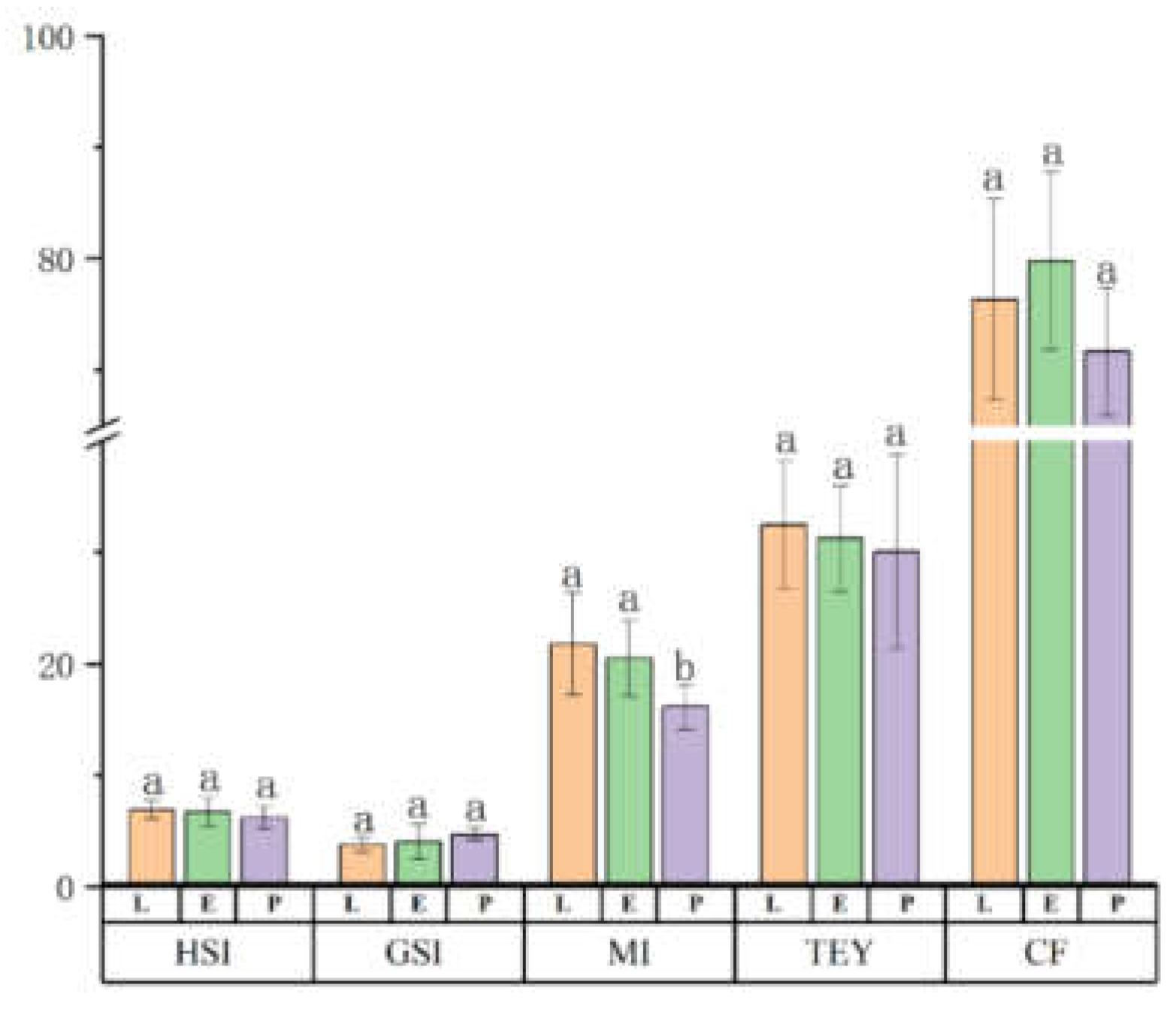
Figure 3.
Main lipid classes of different edible tissues in female Eriocheir sinensis (%total lipids). A certain lipid class of the same edible tissues sharing different lowercases are significantly different (p < 0.05).
Figure 3.
Main lipid classes of different edible tissues in female Eriocheir sinensis (%total lipids). A certain lipid class of the same edible tissues sharing different lowercases are significantly different (p < 0.05).
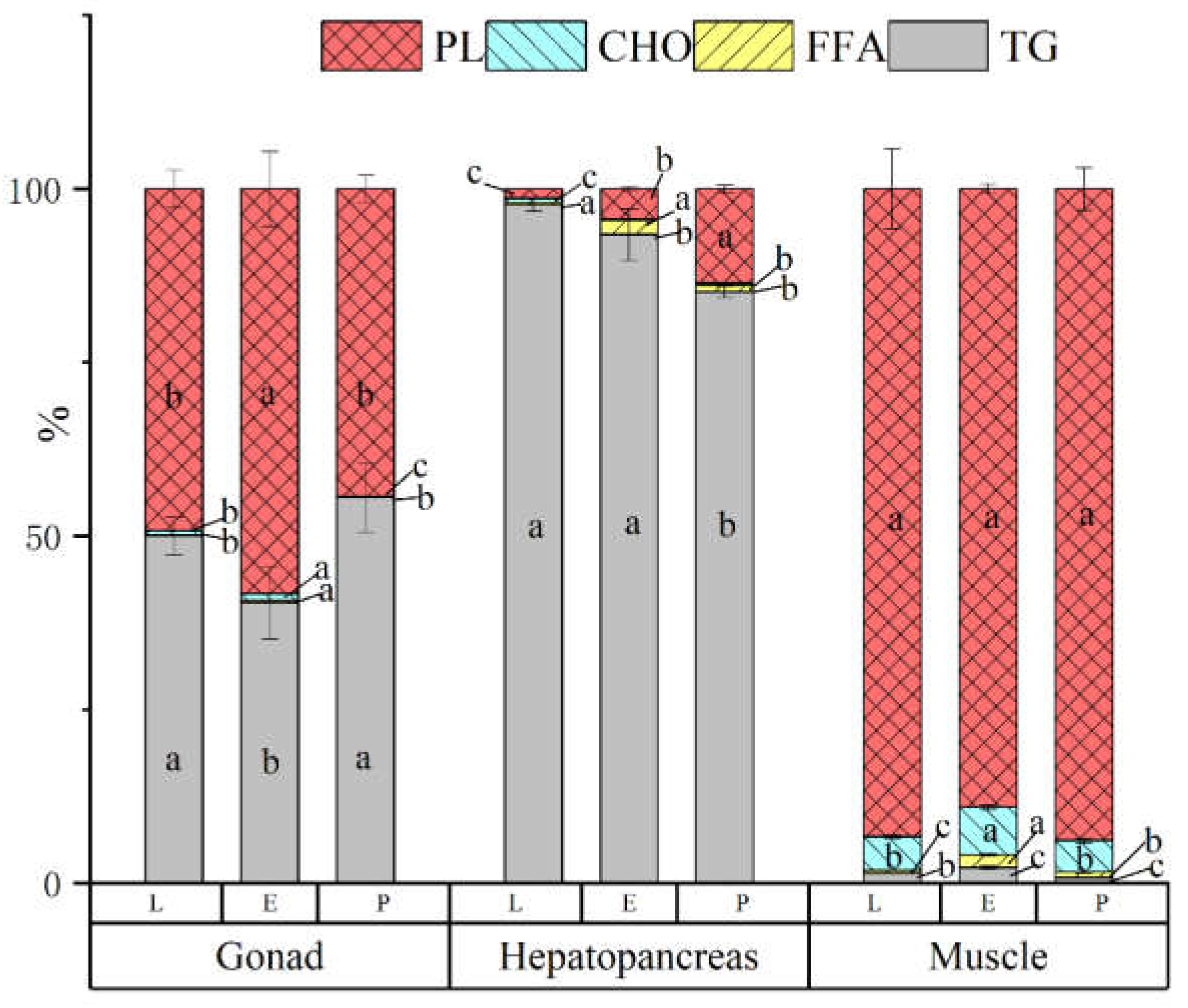
Figure 4.
PCA biplot (A) and HCA (B) based on fatty acid profile of different edible tissues of female Eriocheir sinensis from three different habitats. P-H, L-H, E-H: hepatopancreas from pond, lake and estuary, respectively; P-G, L-G, E-G: gonads from pond, lake and estuary, respectively; P-M, L-M, E-M: muscles from pond, lake and estuary, respectively.
Figure 4.
PCA biplot (A) and HCA (B) based on fatty acid profile of different edible tissues of female Eriocheir sinensis from three different habitats. P-H, L-H, E-H: hepatopancreas from pond, lake and estuary, respectively; P-G, L-G, E-G: gonads from pond, lake and estuary, respectively; P-M, L-M, E-M: muscles from pond, lake and estuary, respectively.
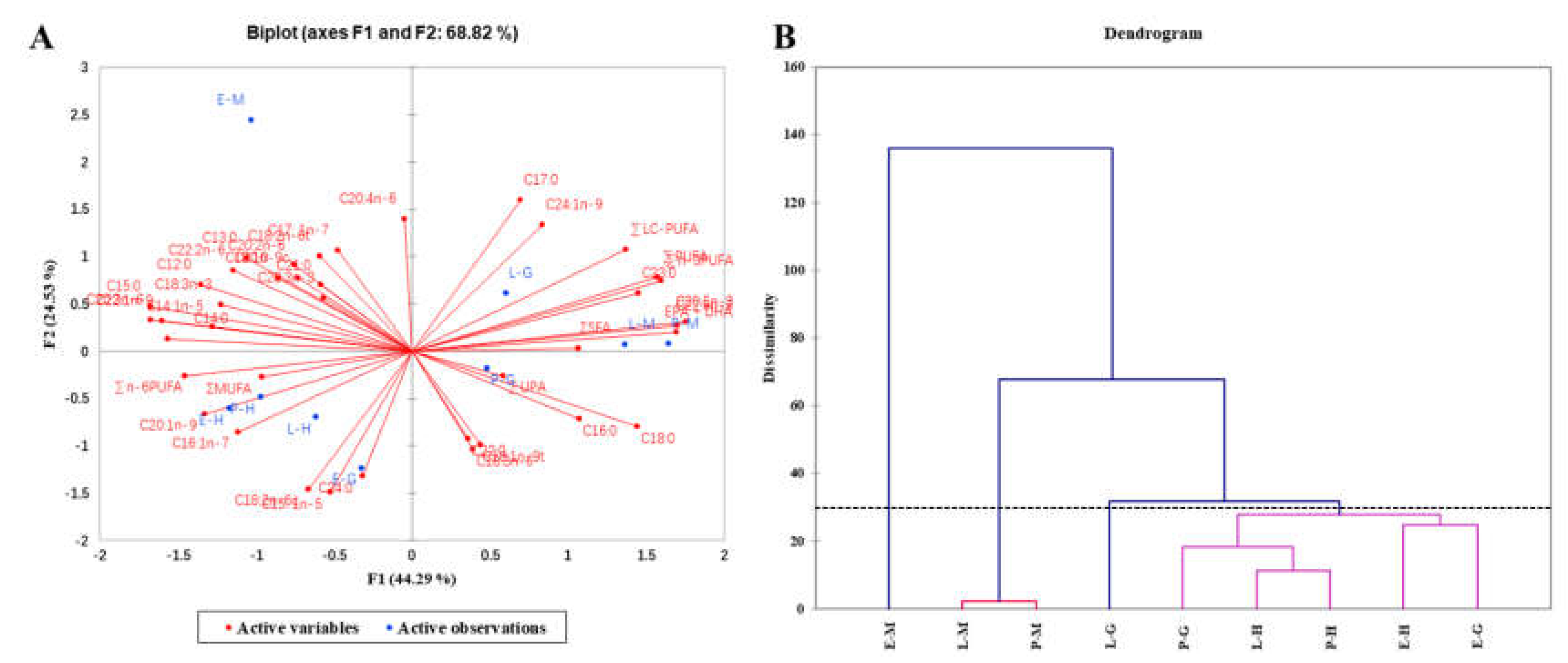

Table 1.
List of Tissues indices and their mathematical expression
| Tissues indices | Mathematical expression |
|---|---|
| Hepatopancreas index | |
| Gonadosomatic index | |
| Muscle index | ×100 |
| Total edible yield | |
| Condition factor |
Table 2.
List of lipid quality indices and their mathematical expression
| Quality index | Mathematical expression |
|---|---|
| Polyunsaturated to saturated fatty acid ratio | PUFA/SFA=(∑PUFA)/(∑SFA) |
| omega-3/omega-6 ratio | n-3/n-6= |
| Fish lipid quality | ) |
| Atherogenicity index | |
| Thrombogenicity index | |
| Hypo-to hyper-cholesterolemic ratio | |
| Health-promoting index | |
| Nutritive value index |
Table 3.
Proximate composition and energy content in the hepatopancreas, gonads and muscle for three different habitat female Eriocheir sinensis in the lower reach of the Yangtze River.
Table 3.
Proximate composition and energy content in the hepatopancreas, gonads and muscle for three different habitat female Eriocheir sinensis in the lower reach of the Yangtze River.
| Indices | Lake | Estuary | Pond |
|---|---|---|---|
| Hepatopancreas | |||
| Moisture (%) | 53.18±0.57a | 46.42±3.20a | 53.12 ± 8.92a |
| Total ash (%) | 1.33±0.09a | 1.18±0.14ab | 1.08±0.05b |
| Total lipid (%) | 34.02 ± 2.37a | 35.42 ± 2.11a | 33.65 ± 4.84a |
| Crude protein (%) | 7.68 ± 0.45b | 6.89 ± 0.78b | 9.24 ± 1.19a |
| Total carbohydrate (%) | 0.73 ± 0.33a | 0.46 ± 0.01a | 0.47 ± 0.04a |
| Energy(Kcal per 100 g) | 342.64 ± 21.62a | 350.82 ± 19.42a | 344.87 ± 40.03a |
| Gonads | |||
| Moisture (%) | 53.55±1.09a | 45.16±3.42b | 49.15±1.96ab |
| Total ash (%) | 2.46±0.36a | 2.26±0.07a | 2.14±0.07a |
| Total lipid (%) | 7.34 ± 0.81a | 6.90 ± 0.36a | 4.94 ± 0.22b |
| Crude protein (%) | 28.83 ± 1.63a | 27.12 ± 1.59a | 29.02 ± 1.39a |
| Total carbohydrate | 1.39 ± 0.26a | 1.35 ± 0.08a | 0.14 ± 0.03b |
| Energy(Kcal per 100 g) | 195.08 ± 13.08a | 183.63 ± 3.51ab | 169.05 ± 7.76b |
| Muscles | |||
| Moisture (%) | 75.74 ± 2.3a | 74.41±2.24a | 74.75 ± 2.42a |
| Total ash (%) | 2.17±0.06a | 1.88±0.11b | 2.04±0.03a |
| Total lipid (%) | 0.20 ± 0.07b | 0.59 ± 0.18b | 0.79 ± 0.39a |
| Crude protein (%) | 18.05 ± 1.59a | 16.98 ± 1.04a | 17.44 ± 1.39a |
| Total carbohydrate(%) | 1.11 ± 0.06a | 0.78 ± 0.2b | 0.33 ± 0.03c |
| Energy(Kcal per 100 g) | 83.48 ± 6.38b | 81.09 ± 5.73b | 109.07 ± 8.14a |
Values in the same line that do not share the same superscript are statistically significantly different (p<0.05).
Table 4.
Values of the lipid quality indexes in the hepatopancreas, gonads and muscle for three different habitats of female Eriocheir sinensis in the lower reaches of the Yangtze River.
Table 4.
Values of the lipid quality indexes in the hepatopancreas, gonads and muscle for three different habitats of female Eriocheir sinensis in the lower reaches of the Yangtze River.
| Quality#break#indices | Hepatopancreas | Gonads | Abdomen | ||||||
|---|---|---|---|---|---|---|---|---|---|
| Lake | Estuary | Pond | Lake | Estuary | Pond | Lake | Estuary | Pond | |
| PUFA/SFA | 1.45±0.05a | 0.86±0.04c | 1.26±0.10b | 0.59±0.02b | 1.25±0.04a | 1.25±0.02a | 1.70±0.07b | 1.84±0.05a | 1.66±0.05b |
| n-3/n-6 | 1.02±0.03a | 0.61±0.03b | 1.28±0.37a | 2.44±0.14a | 1.18±0.12c | 2.16±0.11b | 4.07±0.08b | 1.88±0.02c | 4.41±0.04a |
| FLQ | 6.43±0.31b | 6.32±0.12b | 12.67±2.72a | 17.94±2.40a | 11.47±0.58b | 20.75±1.16a | 35.60±0.85a | 11.87±0.29b | 35.42±1.07a |
| AI | 1.30±0.06a | 0.22±0.02b | 0.32±0.01b | 0.31±0.06a | 0.23±0.00b | 0.22±0.01b | 0.18±0.01a | 0.12±0.01b | 0.18±0a |
| TI | 1.94±0.09a | 0.45±0.02b | 0.49±0.01b | 1.07±0.40a | 0.64±0.01b | 0.56±0.04b | 1.15±0.03a | 0.16±0.01b | 1.13±0.04a |
| HH | 1.15±0.06c | 3.55±0.24a | 2.16±0.16b | 2.26±0.05a | 2.26±0.11a | 1.88±0.04b | 3.70±0.17b | 12.83±0.31a | 3.75±0.22b |
| HPI | 2.46±0.11c | 4.61±0.33a | 3.08±0.14b | 3.33±0.61b | 4.32±0.07a | 4.54±0.30a | 5.43±0.20b | 8.53±0.39a | 5.47±0.12b |
| NVI | 1.53±0.08b | 3.16±0.29a | 3.12±0.14a | 1.36±0.83a | 2.16±0.05a | 1.39±0.35a | 2.31±0.10b | 10.81±0.84a | 2.39±0.06b |
Values in a same row that do not share a same superscript are significantly different (p < 0.05).
Disclaimer/Publisher’s Note: The statements, opinions and data contained in all publications are solely those of the individual author(s) and contributor(s) and not of MDPI and/or the editor(s). MDPI and/or the editor(s) disclaim responsibility for any injury to people or property resulting from any ideas, methods, instructions or products referred to in the content. |
© 2025 by the authors. Licensee MDPI, Basel, Switzerland. This article is an open access article distributed under the terms and conditions of the Creative Commons Attribution (CC BY) license (http://creativecommons.org/licenses/by/4.0/).
Copyright: This open access article is published under a Creative Commons CC BY 4.0 license, which permit the free download, distribution, and reuse, provided that the author and preprint are cited in any reuse.


