

Submitted:
19 May 2025
Posted:
19 May 2025
You are already at the latest version
Abstract
Cadmium (Cd) stress poses significant threats to vegetable crops, impacting their growth, physi-ological processes, and safety as part of the human food chain. This review systematically sum-marizes the latest advances in the molecular mechanisms of vegetable crops’ resistance to Cd stress. First, physiological and biochemical responses are outlined, including growth inhibition, impaired photosynthesis, oxidative stress, disrupted nutrient absorption, altered phytohormone levels, and gene expression changes. Next, key molecular mechanisms are discussed, focusing on the roles of transporter-related genes (e.g., NRAMP, HIPP, ABCG), transcription factors (e.g., HsfA1a, WRKY, ERF), enzyme-related genes (e.g., E3 ubiquitin ligase, P-type ATPase), microRNAs (e.g., miR398), and potential functional genes in Cd uptake, translocation, and detoxification. Ad-ditionally, the regulatory roles of phytohormones and their analogues (e.g., brassinosteroids, gib-berellin, salicylic acid) in mitigating Cd toxicity are analyzed, highlighting their involvement in antioxidant defense, gene regulation, and stress signaling pathways. Finally, future research di-rections are proposed, emphasizing species-specific defense mechanisms, root hair-specific Cd exclusion mechanisms, and interdisciplinary approaches integrating AI and microbiome manipu-lation. This review provides a comprehensive reference for enhancing Cd stress resistance in vegetable crops and promoting safe crop production.
Keywords:
vegetable crops
; cadmium stress
; molecular mechanisms
; transporter genes
; phytohormones
; antioxidant enzymes
; genetic breeding
1. Introduction
Cadmium (Cd) contamination of agricultural soils has emerged as a global environmental challenge, threatening crop productivity and human health through the food chain. As a non-essential heavy metal with high mobility and long soil persistence, Cd accumulates readily in vegetable crops—critical components of human diets—posing significant risks via chronic ingestion [1].
Vegetable crops respond to Cd stress through a cascade of physiological and molecular mechanisms, including growth inhibition, photosynthetic disruption, and oxidative stress. At the molecular level, studies in model plants like Arabidopsis and rice have identified key pathways, such as metal transporter-mediated sequestration (e.g., NRAMP, HMA) and antioxidant enzyme activation (e.g., SOD, CAT) [2]. However, these insights are poorly translated to vegetable species, which exhibit unique genetic and metabolic traits. For instance, solanaceous crops (e.g., tomato) and crucifers (e.g., Chinese cabbage) show divergent Cd accumulation patterns, yet the underlying molecular determinants—such as tissue-specific transporter expression or hormone signaling—remain incompletely understood [3,4].
A critical gap exists in deciphering the species-specific molecular networks that govern Cd tolerance in vegetables. While transporter genes (e.g., StNRAMP2 in potato, BcHIPP16 in pak choi) and transcription factors (e.g., HsfA1a in tomato) have been partially characterized [5,6], the roles of microRNAs (e.g., Sly-miR398), epigenetic regulators (e.g., histone demethylases), and uncharacterized genes (e.g., putative HSPs in radish) are largely unexplored [7,8,9]. Additionally, phytohormones such as brassinosteroids and salicylic acid play pivotal but understudied roles in integrating stress responses and modulating Cd uptake [10,11].
This review synthesizes current knowledge of Cd stress resistance in vegetable crops, focusing on physiological and biochemical responses, multi-layered molecular mechanisms (e.g., transporters, transcription factors, microRNAs), and phytohormone signaling networks. Prospective research directions, such as CRISPR-based gene editing and AI-driven modeling to enhance Cd tolerance, are discussed to inform future molecular breeding strategies. By integrating mechanistic insights with translational goals, this work aims to guide the development of sustainable solutions for Cd-stressed vegetable production.
2. Physiological and Biochemical Reactions of Vegetable Crops under Cadmium Stress
2.1. Growth Inhibition
Cd significantly hinders the growth and development processes of vegetable crops, leading to a remarkable reduction in seed germination rate, retarded seedling growth, and a notable decrease in plant biomass. Excessive soil Cd levels impede seed sprouting, stunt root and stem elongation, and reduce both fresh and dry plant weights. Waris et al. (2023) showed that Cd stress led to a lower germination rate of lettuce seeds and slower growth of lettuce seedlings, as indicated by shorter root and shoot lengths, and also caused a significant decrease in the fresh and dry weights of both shoots and roots [12]. Meena et al. (2018) reported that high Cd levels resulted in significant reductions in the root length and volume of tomatoes [13]. Sun et al. (2024) found that Cd stress suppressed carrot seed germination, shortened hypocotyl length, and reduced seed viability [14]. In summary, Cd contamination imposes multifaceted constraints on vegetable crop development, disrupting seed germination, retarding growth, and reducing biomass.
2.2. Impaired Photosynthesis
Cd disrupts multiple aspects of photosynthesis in vegetable crops. It reduces the content of photosynthetic pigments like chlorophyll and carotenoids, hampering the light-dependent reaction. Additionally, Cd induces stomatal closure, decreasing carbon dioxide uptake, which impairs the light-independent reaction and ultimately lowers the photosynthetic rate. Hédiji et al. (2015) reported that Cd exposure led to a decrease in the chlorophyll content of tomatoes [15]. Huang et al. (2022) showed that Cd stress significantly reduces the photosynthetic rate of pak choi seedlings, with the rate dropping to only 40% of that in control seedlings, and also causes stomatal closure and a decrease in intercellular CO2 concentration [16]. Shahzad et al. (2024) found that Cd stress disrupts photosynthesis in radish by inhibiting chlorophyll synthesis, affecting photosystem functioning, and reducing biomass production [17]. In conclusion, Cd disrupts plant photosynthesis through multiple pathways, severely impairing the photosynthetic physiological processes and growth of vegetable crops.
2.3. Oxidative Stress Response and Altered Enzyme Activity
Under Cd stress, vegetable crops overproduce reactive oxygen species (ROS) such as hydrogen peroxide (H₂O₂), superoxide anion (O₂⁻), and hydroxyl radical (·OH). This triggers oxidative stress, exacerbates lipid peroxidation, increases the level of malondialdehyde (MDA), and damages the structure and function of cell membranes. Meanwhile, Cd binds to the active sites of antioxidant enzymes like superoxide dismutase (SOD), peroxidase (POD), and catalase (CAT), disrupting the antioxidant enzyme system. To cope with excessive ROS, the activities of these enzymes in different vegetable crops may either increase or decrease. For example, Dong et al. (2006) found that Cd stress induced the accumulation of MDA and an increase in antioxidant enzyme activities in tomato seedlings [18]. Cui et al. (2023) reported that Cd stress increased the contents of H₂O₂, MDA, and O₂⁻ in pak choi, causing oxidative damage and affecting the activities of POD, SOD, and CAT, with the enzymes generally increasing their activities to reduce oxidative damage [19]. Huang et al. (2022) showed that Cd stress in radish led to increased oxidative stress, as indicated by elevated levels of H₂O₂ and MDA, and also altered the activities of SOD, POD, and CAT [17]. In conclusion, Cd stress in vegetable crops disrupts the balance between ROS generation and antioxidant defense, leading to oxidative damage and diverse responses in antioxidant enzyme activities, which vary among different vegetable species.
2.4. Disordered Nutrient Element Absorption
Cd competes with nutrient elements such as calcium (Ca), magnesium (Mg), iron (Fe), and zinc (Zn) in vegetable crops for absorption sites or transport proteins, thereby disrupting the normal absorption and transport processes and causing nutrient imbalance. For instance, Cd can interfere with Fe absorption in certain vegetable crops, inducing Fe-deficiency chlorosis and inhibiting photosynthesis. Research has provided evidence for these effects: Hédiji et al. (2015) documented the changes in the contents of Ca, potassium (K), and Mg in tomato plants under varying Cd exposures [4]; Ma et al. (2025) reported that in radishes, excessive Cd absorption disrupts the normal uptake of elements like Fe and Mn, ultimately hindering the growth and development [20]; Wu et al. (2021) found that Cd stress affects nutrient element absorption in pak choi, increasing Fe concentration, reducing Zn concentration, and altering Mn absorption [21]. In summary, Cd’s interference with the absorption and transport of nutrient elements through competitive mechanisms results in diverse and vegetable-crop-specific nutrient imbalances, significantly impacting the physiological functions and growth of vegetable crops.
2.5. Changes in phytohormone Levels
Plant hormones are essential for vegetable crops to respond to Cd stress. Cd impacts the synthesis, metabolism, and signal transduction of various hormones, including auxin (IAA), gibberellin (GA), cytokinin (CK), abscisic acid (ABA), salicylic acid (SA), jasmonic acid (JA), and ethylene (ET), thereby regulating the growth and defense mechanisms of vegetable crops. Research has shown diverse effects of Cd on hormone levels across different vegetable species. For instance, Asaf et al. (2023) discovered that Cd stress increased the levels of stress-related phytohormones like JA, ABA, and ET in tomato plants, and this increase could be mitigated by inoculating the endophytic fungus SL1[22]. In contrast, Yang et al. (2024) reported that Cd stress decreased the JA content in potato plants, while the content of BR increased, and JA content was found to have positive correlations with IAA and SA, and negative correlations with BR, ET, ABA, GA, etc. [23]. Moreover, Tang et al. (2023) demonstrated that in lettuce, Cd stress increased the expression of SAMT involved in salicylic acid synthesis and decreased the expression of WRKY6 related to plant hormone-mediated regulation, thus disrupting normal hormone-related physiological functions under stress [11]. In summary, Cd stress exerts complex and varied impacts on the hormones of vegetable crops, influencing different aspects of their physiological processes, and understanding these relationships is crucial for developing effective strategies to improve the Cd tolerance of vegetable crops.
2.6. Changes in Gene Expression Regulation
Cd stress triggers diverse gene expression changes in vegetable crops, involving genes related to metal detoxification such as those encoding metallothioneins and phytochelatins, antioxidant enzyme genes, transporter genes, and genes related to photosynthesis, cell cycle, and signal transduction, with these transcriptional adjustments enabling vegetable crops to adapt to Cd stress or mitigate its toxicity. For example, Meena et al. (2018) found that Cd stress upregulates the LeNRAMP3 gene in tomato with peak expression at 250 μM Cd, indicating its role in Cd translocation from roots to leaves [13]. Kim et al. (2007) demonstrated that Cd stress induces the Brassica rapa type-1 metallothionein gene (BrMT1) particularly in the roots of Chinese cabbage and enhances Cd resistance in transgenic yeast and Arabidopsis [24]. Sun et al. (2024) showed that Cd stress upregulates the DcMYB62 gene in carrot promoting carotenoid biosynthesis and enhancing Cd tolerance by activating genes related to ABA, H₂S production, and heavy metal resistance (e.g., AtNAS4) in transgenic Arabidopsis [25]. These studies collectively illustrate how gene expression reprogramming underlies the adaptive strategies of vegetable crops against Cd stress, with diverse genes contributing to detoxification, transport, and stress tolerance through interconnected molecular pathways.
Under Cd stress, vegetable crops exhibit diverse physiological/biochemical responses across species/varieties, as illustrated by tomato plants’ morphological and physiochemical changes (see Figure 1). Deciphering these differences requires exploring multi-gene regulatory networks governing Cd tolerance, including transporter genes, signaling pathways, antioxidant systems, etc. Such insights underpin strategies to enhance plant resilience and reduce Cd accumulation in vegetables.
3. Molecular Mechanisms of Multiple Genes in Regulating Vegetable Crops’ Response to Cadmium Stress
3.1. Transporter-Related Genes
Cd stress poses significant challenges to vegetable crops, with transporter-related genes playing pivotal roles in regulating Cd uptake, translocation, and tolerance. In potato, the StNRAMP2 gene (NRAMPs family) influences Cd accumulation in a tissue-specific manner: silencing StNRAMP2 increases Cd in tubers but decreases it in other tissues, while heterologous overexpression in tomato enhances Cd content, confirming its role in metal ion transport and redistribution [5]. In pak choi, the plasma membrane-localized BcHIPP16 (HIPP family) acts as a metal chaperone to promote Cd and copper (Cu) uptake. Transgenic Arabidopsis expressing BcHIPP16 shows enhanced Cd2+ influx and accumulation, linking its function to direct metal ion translocation across membranes [6]. In radish, the ABCG subfamily member RsPDR8 functions as a Cd efflux pump. Overexpression in Arabidopsis reduces Cd accumulation in roots and shoots, improves root elongation under Cd stress, and enhances ROS scavenging via upregulated antioxidant enzymes (e.g., APX, SOD), highlighting its dual role in metal extrusion and stress tolerance [26]. These findings collectively highlight the multifaceted roles of transporter-related genes in modulating Cd stress responses, encompassing tissue-specific metal allocation, membrane transport dynamics, and antioxidant defense coordination. For a detailed summary of these genes and their specific functions in vegetable crops under Cd stress, refer to Table 1.
3.2. Transcription Factors
Cd stress represents a major threat to vegetable crops, with transcription factors (TFs) emerging as critical regulators of gene expression to mitigate Cd toxicity. In tomato, the heat shock transcription factor HsfA1a directly binds to the promoter of caffeic acid O-methyltransferase 1 (COMT1) via heat shock elements (HSEs) to upregulate melatonin biosynthesis, which in turn enhances Cd tolerance by promoting phytochelatin biosynthesis, vacuolar Cd sequestration, and activating heat shock proteins (HSPs) such as HSP20 and HSP70 [28]. In pepper, CaWRKY41 forms a positive feedback loop with H₂O₂: Cd stress induces CaWRKY41 expression, which upregulates NADPH oxidase genes (RBOHC/F) to enhance H₂O₂ accumulation, while H₂O₂ further activates CaWRKY41 [2]; this loop improves resistance to Ralstonia solanacearum but increases Cd sensitivity by upregulating Zn transporters (ZIP3/4/9), leading to enhanced Cd uptake [29]. In bean, the ethylene response factor PvERF15 binds to an AC-rich element in the PvMTF-1 promoter to activate its expression for enhanced Cd tolerance, while PvMTF-1 promotes Trp biosynthesis and Cd detoxification and RNAi-mediated PvERF15 knockdown reduces PvMTF-1 expression and Cd tolerance in transient assays [30]. These studies illustrate that TFs orchestrate multifaceted responses to Cd stress, integrating hormone signaling (e.g., ethylene), ROS homeostasis, and metal transporter regulation. For a comprehensive overview of transcription factors and their specific regulatory roles in vegetable crops under Cd stress, including additional genes and mechanisms, refer to Table 2.
3.3. Enzyme-related Genes
Cd stress poses substantial threats to vegetable crops, and enzyme-related genes play crucial roles in regulating Cd tolerance, detoxification, and metabolic adaptation. In tomato, the RING E3 ubiquitin ligase gene SlRING1 confers Cd tolerance by reducing Cd accumulation and oxidative stress through decreasing root/shoot Cd content, enhancing antioxidant enzyme activities, and improving photosynthetic efficiency, with its E3 ligase activity and subcellular localization (plasma membrane and nucleus) indicating roles in protein ubiquitination and stress signaling [36,37]. In pepper, the Golgi/ER-localized heavy metal-transporting ATPase CaHMA1 (P-type ATPase family) promotes fruit Cd accumulation via histidine/glutamic acid residues in its HEGGILLVC motif, as VIGS-mediated silencing reduces fruit Cd content while Arabidopsis overexpression increases Cd uptake, confirming its role in metal ion translocation [38]. In Chinese flowering cabbage, the peptidemethionine sulfoxide reductase BpPMSR3 enhances Cd tolerance by reducing methionine sulfoxide (MetSO) and increasing glutathione/phytochelatin levels, with transgenic Arabidopsis overexpressing BpPMSR3 exhibiting improved root growth and upregulated Cd-tolerance genes (AtHMA3, AtNramp1), indicating roles in oxidative stress mitigation and metal detoxification [39]. These studies illustrate the diverse functions of enzyme-related genes in Cd stress responses, including oxidative stress regulation, protein modification, and metal ion transport. For a comprehensive overview of these genes and their regulatory roles in vegetable crops under Cd stress, refer to Table 3.
3.4. microRNAs and Other Types of Genes
Cd stress presents substantial challenges to vegetable crops, where microRNAs and various genes play crucial roles in governing Cd uptake, translocation, and tolerance. In tomato, Cd stress downregulates Sly-miR398 to upregulate CSD1 and SOD, while transgenic overexpression of Sly-miR398 promotes Cd uptake (via IRT1/2 and NRAMP2) and reduces vacuolar sequestration (via HMA3), leading to elevated shoot Cd and oxidative damage [7]. In water spinach, IamiR-4-3p downregulates GST3 and AWPM19-like, causing higher Cd accumulation in transgenic Arabidopsis via weakened apoplastic barriers and increased oxidative stress, which enhances metal translocation [47]. In Chinese cabbage, BrSSA4c (an HSP70 family gene) enhances Cd tolerance likely through altered metal transport or stress signaling, distinct from its mechanism in yeast where ScSSA4 translocates to the nucleus to interact with POM34 and activate VHS1 for reduced Cd accumulation [4]. These studies highlight the diverse roles of microRNAs and genes in Cd stress responses, including transcriptional regulation of transporters, redox balance modulation, and subcellular metal compartmentalization. For a detailed summary of these genes and their specific functions in vegetable crops under Cd stress, refer to Table 4.
3.5. Potential Functional Genes
While significant progress has been made in identifying well-characterized genes involved in Cd stress responses in vegetable crops, a growing body of research, including gene family analyses, comparative genomics, and targeted transcriptomic studies, has identified numerous genes with potential functions in Cd stress responses that remain to be fully elucidated. These genes were detected through transcriptomic and proteomic profiling under Cd stress treatments, often showing differential expression patterns indicative of stress responses. However, due to limited functional validation experiments, their specific roles in Cd uptake, translocation, sequestration, or detoxification remain speculative. For instance, certain members of NRAMP gene familie demonstrated altered expression in multiple studies but lacked transgenic or knockout confirmation [3,50,51]. Despite this, these genes represent promising targets for future research to dissect the complex molecular mechanisms underlying vegetable crops’ tolerance to Cd stress. Their identification not only expands our understanding of plant stress biology but also holds potential for developing biotechnological strategies to enhance crop safety and quality. A comprehensive list of these potential functional genes, summarized from recent literature, is presented in Table 5 for further reference.
4. Molecular Mechanisms of Phytohormones and Their Analogues in Regulating Vegetable Crops’ Response to Cadmium Stress
Phytohormones serve as pivotal regulators in orchestrating plant adaptive responses to Cd stress, integrating physiological adjustments and molecular mechanisms across diverse vegetable species. For example, BRs such as 24-epibrassinolide (24-EBL) and 3-epibrassinolide (3-EBL) exhibit multifaceted roles in cucumber. 24-EBL mitigates Cd toxicity by enhancing antioxidant enzyme activities (e.g., SOD, POD) and modulating gene expression related to ethylene and auxin biosynthesis, thereby reducing lipid peroxidation and Cd uptake [92]. Similarly, 3-EBL improves photosynthetic efficiency and water relations while regulating stress-responsive genes, linking hormonal signaling to physiological resilience [93]. In lettuce, gibberellin (GA) and salicylic acid (SA) adopt distinct strategies: GA down-regulates metal transporter genes (IRT1, Nramp1, HMA2, HMA4) to restrict Cd uptake and translocation [94], whereas SA enhances photosynthesis, antioxidant defenses, and osmolyte accumulation while suppressing Nramp5 and HMA4 expression to limit Cd accumulation [11]. These mechanisms, summarized in Table 6, highlight the versatility of phytohormones in fine-tuning stress tolerance across vegetable crops.
In preceding sections, the molecular mechanisms of stress-responsive genes (e.g., Nramp, HMA, antioxidant enzyme genes) and the regulatory roles of phytohormones (e.g., BRs, GA, SA) in vegetable crops’ Cd stress tolerance were systematically discussed. These two thematic areas—gene-driven stress responses and hormone-mediated alleviation strategies—are concisely summarized in Figure 2.
5. Conclusions and Future Directions
This review systematically summarizes current knowledge of vegetable crops’ responses to Cd stress, covering their physiological and biochemical reactions, multigenic regulatory mechanisms, and phytohormone-mediated signaling pathways. Building on these foundations, future research on the molecular mechanisms of cadmium resistance in vegetable crops should address several interconnected scientific challenges with targeted methodologies.
A pressing challenge lies in decoding the species-specific defense strategies of vegetable crops. Despite diverse Cd tolerance profiles, the molecular basis of this diversity remains unclear. Integrating transcriptomics, proteomics, and metabolomics with CRISPR-Cas9 could dissect crop-specific defense modules. For example, in tomato, CRISPR-mediated knockout of root-localized HMA transporters, such as SlHMA2, could clarify their role in Cd sequestration. Promoter analysis might reveal cis-elements co-regulated with detoxification genes, like PCS. These insights could be translated to other vegetables, such as lettuce and radish, using optimized Agrobacterium-mediated transformation protocols [102,103], thus establishing a “gene toolkit” for Cd-resistant breeding.
Another critical area for investigation is the root hair-specific adaptation mechanisms for Cd exclusion. Vegetable roots rely on root hairs for nutrient uptake, yet how these structures modulate Cd influx remains uncharacterized. Advanced live-cell imaging techniques, such as confocal laser scanning microscopy, can be applied to track dynamic changes in ZIP transporter localization, antioxidant enzyme activity in root hair tip cells, and cell wall modifications that trap Cd ions at the apoplastic barrier. These studies would resolve whether root hairs actively “block” Cd uptake or serve as passive diffusion barriers, providing a basis for engineering “Cd-reflective” root architectures.
Engineering transdisciplinary solutions via AI and microbiome manipulation also holds great promise. Machine learning models trained on multi-omics datasets could predict optimal root exudate compositions to suppress Cd solubility. Meanwhile, AI-driven protein design could optimize phytochelatin sequences for enhanced Cd-binding affinity, overcoming natural detoxification bottlenecks. Identifying rhizobacteria, such as Pseudomonas spp., that secrete Cd-chelating compounds or induce systemic resistance via salicylic acid signaling is crucial. Metagenomic analyses can map microbial genes involved in Cd methylation/oxidation, enabling co-cultivation strategies that convert bioavailable Cd into stable mineral forms.
By linking gene regulatory networks, such as metal transporter hierarchies, to AI-optimized rhizosphere engineering, this framework enables precision breeding for “Cd-resilient” vegetables. Epigenetic studies, like bisulfite sequencing, could identify Cd-responsive DNA methylation hotspots in spinach, facilitating marker-assisted selection for stress “memory” traits. The development of smart biosensors, combining soil Cd nanosensors and plant-derived stress biomarkers, such as Cd-bound phytochelatins in xylem sap, would enable real-time irrigation and nutrient management. This integrative approach balances fundamental discovery, such as the molecular basis of Zn/Cd discrimination in roots, with translational innovation, offering dual benefits: reducing dietary Cd exposure through crop biofortification while preserving each species’ unique adaptive strategies. Success will ultimately depend on fostering collaborations between molecular biologists, computational ecologists, and agricultural engineers to bridge lab-scale mechanistic insights with field-applicable solutions.
Author Contributions
Conceptualization, M.Z. and C.D.; writing—original draft preparation, M.Z.; writing—review and editing, M.Z. and C.D.; visualization, M.Z.; funding acquisition, C.D. All authors have read and agreed to the published version of the manuscript.
Funding
This work was supported by the National Key R&D Program of China (Grant No. 2023YFD2300704); the National Natural Science Foundation of China (Grant No. 32372795); and the Science and Technology Innovation Project of Chinese Academy of Agricultural Sciences (Grant No. CAAS-ASTIP-IVFCAAS, CAAS-ZDRW202302).
Conflicts of Interest
The authors declare no conflicts of interest.
References
- Huang, Y.; He, C.; Shen, C.; Guo, J.; Mubeen, S.; Yuan, J.; Yang, Z. Toxicity of cadmium and its health risks from leafy vegetable consumption. Food Funct. 2017, 8, 1373–1401. [Google Scholar] [CrossRef]
- Yu, Y.; Alseekh, S.; Zhu, Z.H.; Zhou, K.J.; Fernie, A.R. Multiomics and biotechnologies for understanding and influencing cadmium accumulation and stress response in plants. Plant Biotechnol. J. 2024, 22, 2641–2659. [Google Scholar] [CrossRef]
- Liu, J.L.; Bao, X.Q.; Qiu, G.Y.; Li, H.; Wang, Y.; Chen, X.D.; Fu, Q.L.; Guo, B. Genome-Wide identification and expression analysis of SlNRAMP genes in tomato under nutrient deficiency and cadmium stress during arbuscular mycorrhizal symbiosis. Int. J. Mol. Sci. 2024, 25. [Google Scholar] [CrossRef]
- Zheng, H.; Yuan, C.; Bu, T.; Liu, Q.; Li, J.J.; Wang, F.D.; Zhang, Y.H.; He, L.L.; Gao, J.W. Mediates Cd tolerance via activation of the cis element of VHS1 in yeast and enhances Cd tolerance in Chinese cabbage. Int. J. Mol. Sci. 2024, 25. [Google Scholar] [CrossRef] [PubMed]
- Zhang, Y.L.; He, T.B.; Tian, W.J.; Xia, Y.B.; He, Y.Q.; Su, M.M.; He, G.D. The expression of the StNRAMP2 gene determined the accumulation of cadmium in different tissues of potato. Int. J. Mol. Sci. 2023, 24. [Google Scholar] [CrossRef] [PubMed]
- Niu, M.Y.; Bao, C.J.; Zhan, J.Y.; Yue, X.M.; Zou, J.N.; Su, N.A.; Cui, J. Plasma membrane-localized protein BcHIPP16 promotes the uptake of copper and cadmium in planta. Ecotox. Environ. Safe 2021, 227. [Google Scholar] [CrossRef] [PubMed]
- Yan, G.C.; Hua, Y.C.; Jin, H.; Huang, Q.Y.; Zhou, G.F.; Xu, Y.M.; He, Y.; Zhu, Z.J. Sly-miR398 participates in cadmium stress acclimation by regulating antioxidant system and cadmium transport in tomato (Solanum lycopersicum). Int. J. Mol. Sci. 2023, 24. [Google Scholar] [CrossRef]
- Dong, Y.L.; Ma, Y.F.; Li, Q.; Cao, Y.L.; Dong, D.X.; Chen, C.; Zhang, X.X.; Fan, Y.W.; Jin, X.X. Overexpression of histone demethylase gene SlJMJ18 and SlJMJ23 from tomato confers cadmium tolerance by regulating metal transport and hormone content in Arabidopsis. Plant Sci. 2024, 346. [Google Scholar] [CrossRef]
- Pan, X.X.; Zheng, Y.; Lei, K.R.; Tao, W.L.; Zhou, N. Systematic analysis of Heat Shock Protein 70 (HSP70) gene family in radish and potential roles in stress tolerance. Bmc Plant Biol. 2024, 24. [Google Scholar] [CrossRef]
- Huang, L.P.; Liu, X.; Liu, Y.; Tanveer, M.; Chen, W.; Fu, W.X.; Wang, Q.Q.; Guo, Y.J.; Shabala, S. Revealing mechanistic basis of ameliorating detrimental effects of cadmium in cherry tomatoes by exogenous application of melatonin and brassinosteroids. Ecotox. Environ. Safe 2024, 283. [Google Scholar] [CrossRef]
- Tang, W.; Liang, L.; Xie, Y.D.; Li, X.M.; Lin, L.J.; Huang, Z.; Sun, B.; Sun, G.C.; Tu, L.H.; Li, H.X.; et al. Foliar application of salicylic acid inhibits the cadmium uptake and accumulation in lettuce (Lactuca sativa L.). Front. Plant Sci. 2023, 14. [Google Scholar] [CrossRef] [PubMed]
- Waris, Z.; Noreen, Z.; Shah, A.A.; Usman, S.; Shah, A.N.; Rizwan, M.; Casini, R.; Elansary, H.O. Efficacy of γ-aminobutyric acid (GABA) on physio-biochemical attributes of lettuce (Lactuca sativa L.) under cadmium toxicity. J. Plant Growth Regul. 2023, 42, 5041–5057. [Google Scholar] [CrossRef]
- Meena, M.; Aamir, M.; Kumar, V.; Swapnil, P.; Upadhyay, R.S. Evaluation of morpho-physiological growth parameters of tomato in response to Cd induced toxicity and characterization of metal sensitive NRAMP3 transporter protein. Environ. Exp. Bot. 2018, 148, 144–167. [Google Scholar] [CrossRef]
- Sun, M.; Qiao, H.X.; Yang, T.; Zhao, P.; Zhao, J.H.; Luo, J.M.; Luan, H.Y.; Li, X.; Wu, S.C.; Xiong, A.S. Hydrogen sulfide alleviates cadmium stress in germinating carrot seeds by promoting the accumulation of proline. J. Plant Physiol. 2024, 303. [Google Scholar] [CrossRef]
- Hédiji, H.; Djebali, W.; Belkadhi, A.; Cabasson, C.; Moing, A.; Rolin, D.; Brouquisse, R.; Gallusci, P.; Chaïbi, W. Impact of long-term cadmium exposure on mineral content of Solanum lycopersicum plants: Consequences on fruit production. S. Afr. J. Bot. 2015, 97, 176–181. [Google Scholar] [CrossRef]
- Huang, Y.F.; Chen, J.H.; Sun, Y.M.; Wang, H.X.; Zhan, J.Y.; Huang, Y.N.; Zou, J.W.; Wang, L.; Su, N.N.; Cui, J. Mechanisms of calcium sulfate in alleviating cadmium toxicity and accumulation in pak choi seedlings. Sci. Total Environ. 2022, 805. [Google Scholar] [CrossRef] [PubMed]
- Shahzad, K.; Danish, S.; Mubeen, S.; Dawar, K.; Fahad, S.; Hasnain, Z.; Ansari, M.J.; Almoallim, H.S. Minimization of heavy metal toxicity in radish (Raphanus sativus) by strigolactone and biochar. Sci. Rep. 2024, 14. [Google Scholar] [CrossRef]
- Dong, J.; Wu, F.; Zhang, G. Influence of cadmium on antioxidant capacity and four microelement concentrations in tomato seedlings (Lycopersicon esculentum). Chemosphere 2006, 64, 1659–1666. [Google Scholar] [CrossRef]
- Cui, Q.L.; Liu, D.D.; Chen, H.S.; Qiu, T.Y.; Zhao, S.L.; Duan, C.J.; Cui, Y.X.; Zhu, X.Z.; Chao, H.R.; Wang, Y.H.; et al. Synergistic interplay between Azospirillum brasilense and exogenous signaling molecule H₂S promotes Cd stress resistance and growth in pak choi (Brassica chinensis L.). J. Hazard. Mater. 2023, 444. [Google Scholar] [CrossRef]
- Ma, Y.F.; Huang, Y.D.; Zhang, W.L.; Dong, J.H.; Zhang, X.L.; Zhu, Y.L.; Wang, Y.; Liu, L.W.; Xu, L. RsNRAMP5, a major metal transporter, promotes cadmium influx and ROS accumulation in radish (Raphanus sativus L.). Plant Physiol. Bioch. 2025, 218. [Google Scholar] [CrossRef]
- Wu, X.; Su, N.N.; Yue, X.M.; Fang, B.; Zou, J.W.; Chen, Y.H.; Shen, Z.G.; Cui, J. IRT1 and ZIP2 were involved in exogenous hydrogen-rich water-reduced cadmium accumulation in Brassica chinensis and Arabidopsis thaliana. J. Hazard. Mater. 2021, 407. [Google Scholar] [CrossRef] [PubMed]
- Asaf, S.; Jan, R.H.T.L.; Khan, M.A.; Lubna; Khan, A.L.; Asif, S.; Bilal, S.; Ahmad, W.; Waqas, M.; Kim, K.M.; et al. Unraveling the mutualistic interaction between endophytic Curvularia lunata CSL1 and tomato to mitigate cadmium (Cd) toxicity via transcriptomic insights. Sci. Total Environ. 2023, 861. [CrossRef]
- Yang, M.F.; Yang, S.W.; Wang, W.D.; Wei, X.L.; Lou, F.; He, G.D.; He, T.B. Multiomics combined with expression pattern analysis reveals the regulatory response of key genes in potato jasmonic acid signaling pathways to cadmium stress. J. Agr. Food Chem. 2024, 72, 22369–22384. [Google Scholar] [CrossRef] [PubMed]
- Kim, S.H.; Lee, H.S.; Song, W.Y.; Choi, K.S.; Hur, Y. Chloroplast-targeted BrMT1 (Brassica rapa type-1 metallothionein) enhances resistance to Cadmium and ROS in transgenic Arabidopsis plants. J. Plant Biol. 2007, 50, 1–7. [Google Scholar] [CrossRef]
- Sun, M.; Qiao, H.X.; Yang, T.; Zhao, P.; Zhao, J.H.; Luo, J.M.; Liu, F.F.; Xiong, A.S. DcMYB62, a transcription factor from carrot, enhanced cadmium tolerance of Arabidopsis by inducing the accumulation of carotenoids and hydrogen sulfide. Plant Physiol. Bioch. 2024, 216. [Google Scholar] [CrossRef] [PubMed]
- Zhang, X.Y.; Ma, Y.F.; Lai, D.Q.; He, M.; Zhang, X.L.; Zhang, W.L.; Ji, M.M.; Zhu, Y.L.; Wang, Y.; Liu, L.W.; et al. RsPDR8, a member of ABCG subfamily, plays a positive role in regulating cadmium efflux and tolerance in radish (Raphanus sativus L.). Plant Physiol. Bioch. 2023, 205. [Google Scholar] [CrossRef]
- Yue, X.M.; Song, J.X.; Fang, B.; Wang, L.; Zou, J.W.; Su, N.N.; Cui, J. BcNRAMP1 promotes the absorption of cadmium and manganese in Arabidopsis. Chemosphere 2021, 283. [Google Scholar] [CrossRef]
- Cai, S.Y.; Zhang, Y.; Xu, Y.P.; Qi, Z.Y.; Li, M.Q.; Ahammed, G.J.; Xia, X.J.; Shi, K.; Zhou, Y.H.; Reiter, R.J.; et al. HsfA1a upregulates melatonin biosynthesis to confer cadmium tolerance in tomato plants. J. Pineal Res. 2017, 62. [Google Scholar] [CrossRef]
- Dang, F.F.; Lin, J.H.; Chen, Y.P.; Li, G.X.; Guan, D.Y.; Zheng, S.J.; He, S.L. A feedback loop between CaWRKY41 and H2O2 coordinates the response to Ralstonia solanacearum and excess cadmium in pepper. J. Exp. Bot. 2019, 70, 1581–1595. [Google Scholar] [CrossRef]
- Lin, T.T.; Yang, W.N.; Lu, W.; Wang, Y.; Qi, X.T. Transcription factors PvERF15 and PvMTF-1 form a cadmium stress transcriptional pathway. Plant Physiol. 2017, 173, 1565–1573. [Google Scholar] [CrossRef]
- Chen, W.W.; Jin, J.F.; Lou, H.Q.; Liu, L.; Kochian, L.V.; Yang, J.L. LeSPL-CNR negatively regulates Cd acquisition through repressing nitrate reductase-mediated nitric oxide production in tomato. Planta 2018, 248, 893–907. [Google Scholar] [CrossRef]
- He, G.D.; Saleem, M.; Deng, T.F.; Zhong, Z.Y.; He, T.B.; Wu, J.H. Unraveling the mechanism of StWRKY6 in potato (Solanum tuberosum)’s cadmium tolerance for ensuring food safety. Foods 2023, 12. [Google Scholar] [CrossRef]
- Youm, J.W.; Jeon, J.H.; Choi, D.; Yi, S.Y.; Joung, H.; Kim, H.S. Ectopic expression of pepper CaPF1 in potato enhances multiple stresses tolerance and delays initiation of in vitro tuberization. Planta 2008, 228, 701–708. [Google Scholar] [CrossRef] [PubMed]
- Wang, C.Y.; Qiao, F.; Wang, M.Q.; Wang, Y.; Xu, Y.; Qi, X.T. PvERF104 confers cadmium tolerance in Arabidopsis: Evidence for metal-responsive element-binding transcription factors. Environ. Exp. Bot. 2023, 206. [Google Scholar] [CrossRef]
- Sun, N.; Liu, M.; Zhang, W.T.; Yang, W.N.; Bei, X.J.; Ma, H.; Qiao, F.; Qi, X.T. Bean metal-responsive element-binding transcription factor confers cadmium resistance in tobacco. Plant Physiol. 2015, 167, 1136-+. [Google Scholar] [CrossRef]
- Ahammed, G.J.; Li, C.X.; Li, X.; Liu, A.R.; Chen, S.C.; Zhou, J. Overexpression of tomato RING E3 ubiquitin ligase gene SlRING1 confers cadmium tolerance by attenuating cadmium accumulation and oxidative stress. Physiol. Plantarum 2021, 173, 449–459. [Google Scholar] [CrossRef]
- Qi, Z.Y.; Ahammed, G.J.; Jiang, C.Y.; Li, C.X.; Zhou, J. The E3 ubiquitin ligase gene SlRING1 is essential for plant tolerance to cadmium stress in Solanum lycopersicum. J. Biotechnol. 2020, 324, 239–247. [Google Scholar] [CrossRef]
- Xu, W.H.; Huang, H.; Li, X.D.; Yang, M.; Chi, S.L.; Pan, Y.; Li, N.N.; Paterson, A.H.; Chai, Y.R.; Lu, K. CaHMA1 promotes Cd accumulation in pepper fruit. J. Hazard. Mater. 2023, 460. [Google Scholar] [CrossRef]
- Han, Y.Y.; Du, Y.L.; Wang, J.W.; Wu, T. Overexpression of Chinese flowering cabbage BpPMSR3 enhances the tolerance of Arabidopsis thaliana to cadmium. J. Plant Nutr. Soil Sc. 2018, 181, 787–794. [Google Scholar] [CrossRef]
- Liu, C.X.; Yang, T.; Zhou, H.; Ahammed, G.J.; Qi, Z.Y.; Zhou, J. The E3 ubiquitin ligase gene Sl1 is critical for cadmium tolerance in Solanum lycopersicum L. Antioxidants 2022, 11. [Google Scholar] [CrossRef]
- Zhong, M.; Wang, Y.; Hou, K.; Shu, S.; Sun, J.; Guo, S. TGase positively regulates photosynthesis via activation of Calvin cycle enzymes in tomato. Hortic Res 2019, 6, 92. [Google Scholar] [CrossRef]
- Zhong, M.; Yue, L.Q.; Qin, H.Y.; Wang, G.H.; Xiao, L.W.; Cheng, Q.Q.; Lei, B.F.; Huang, R.M.; Yang, X.; Kang, Y.Y. TGase-induced Cd tolerance by boosting polyamine, nitric oxide, cell wall composition and phytochelatin synthesis in tomato. Ecotox. Environ. Safe 2023, 259. [Google Scholar] [CrossRef]
- Zhao, S.Y.; Ma, Q.F.; Xu, X.; Li, G.Z.; Hao, L. Tomato jasmonic acid-deficient mutant spr2 seedling response to cadmium stress. J. Plant Growth Regul. 2016, 35, 603–610. [Google Scholar] [CrossRef]
- Muhammad, T.; Zhang, J.; Ma, Y.L.; Li, Y.S.; Zhang, F.; Zhang, Y.; Liang, Y. Overexpression of a mitogen-activated protein kinase SlMAPK3 positively regulates tomato tolerance to cadmium and drought stress. Molecules 2019, 24. [Google Scholar] [CrossRef]
- Li, Q.; Sun, W.Y.; Chen, C.; Dong, D.X.; Cao, Y.L.; Dong, Y.L.; Yu, L.J.; Yue, Z.H.; Jin, X.X. Overexpression of histone demethylase gene SlJMJ524 from tomato confers Cd tolerance by regulating metal transport-related protein genes and flavonoid content in Arabidopsis. Plant Sci. 2022, 318. [Google Scholar] [CrossRef]
- Luo, W.; Long, Y.M.; Feng, Z.L.; Li, R.; Huang, X.J.; Zhong, J.X.; Liu, D.Y.; Zhao, H.B. A γ-glutamylcysteine ligase AcGCL alleviates cadmium-inhibited fructooligosaccharides metabolism by modulating glutathione level in Allium cepa L. J. Hazard. Mater. 2021, 419. [Google Scholar] [CrossRef] [PubMed]
- Shen, C.; Huang, Y.Y.; Xin, J.L.; He, C.T.; Yang, Z.Y. A novel microRNA IamiR-4-3p from water spinach (Ipomoea aquatica Forsk.) increased Cd uptake and translocation in Arabidopsis thaliana. Environ. Sci. Pollut. R. 2022, 29, 41375–41385. [Google Scholar] [CrossRef]
- Manara, A.; Fasani, E.; Molesini, B.; DalCorso, G.; Pennisi, F.; Pandolfini, T.; Furini, A. The tomato metallocarboxypeptidase inhibitor I, which Interacts with a heavy metal-associated isoprenylated protein, is implicated in plant response to cadmium. Molecules 2020, 25. [Google Scholar] [CrossRef] [PubMed]
- Ma, J.Y.; Dong, X.M.; Yu, L.J.; Zhang, Y.H. Response and function of Solanum lycopersicum L. SlSGR2 Gene under cadmium stress. Horticulturae 2022, 8. [Google Scholar] [CrossRef]
- Feng, S.J.; Shen, Y.H.; Xu, H.A.; Dong, J.Y.; Chen, K.X.; Xiang, Y.; Jiang, X.D.; Yao, C.J.; Lu, T.; Huan, W.W.; et al. RNA-seq identification of Cd responsive transporters provides insights into the association of oxidation resistance and Cd accumulation in Cucumis sativus L. Antioxidants 2021, 10. [Google Scholar] [CrossRef]
- Shen, C.; Huang, B.F.; Hu, L.; Yuan, H.W.; Huang, Y.Y.; Wang, Y.B.; Sun, Y.F.; Li, Y.; Zhang, J.R.; Xin, J.L. Comparative transcriptome analysis and Arabidopsis thaliana overexpression reveal key genes associated with cadmium transport and distribution in root of two Capsicum annuum cultivars. J. Hazard. Mater. 2024, 465. [Google Scholar] [CrossRef] [PubMed]
- Zhang, Y.X.; Chai, T.Y.; Dong, J.; Zhao, W.M.; An, C.C.; Chen, Z.L.; Burkard, G. Cloning and expression analysis of the heavy-metal responsive gene PvSR2 from bean. Plant Sci. 2001, 161, 783–790. [Google Scholar] [CrossRef]
- Qi, X.T.; Zhang, Y.X.; Chai, T.Y. Characterization of a novel plant promoter specifically induced by heavy metal and identification of the promoter regions conferring heavy metal responsiveness. Plant Physiol. 2007, 143, 50–59. [Google Scholar] [CrossRef]
- Zhang, X.Y.; Li, J.L.; Cao, Y.Y.; Huang, J.B.; Duan, Q.H. Genome-wide identification and expression analysis under abiotic stress of BrAHL genes in Brassica rapa. Int. J. Mol. Sci. 2023, 24. [Google Scholar] [CrossRef]
- Jin, Q.J.; Yuan, X.X.; Cui, W.T.; Han, B.; Feng, J.F.; Xu, S.; Shen, W.B. Isolation and characterization of a heme oxygenase-1 gene from Chinese cabbage. Mol. Biotechnol. 2012, 50, 8–17. [Google Scholar] [CrossRef]
- Anwar, A.; Yuan, C.; Cui, B.; Wang, L.X.; He, L.L.; Gao, J.W. BrMYB116 transcription factor enhances Cd stress tolerance by activating FIT3 in yeast and Chinese cabbage. Front. Plant Sci. 2024, 15. [Google Scholar] [CrossRef]
- Janicka, M.; Reda, M.; Napieraj, N.; Michalak, A.; Jakubowska, D.; Kabala, K. Involvement of diamine oxidase in modification of plasma membrane proton pump activity in Cucumis sativus L. seedlings under cadmium stress. Int. J. Mol. Sci. 2023, 24. [Google Scholar] [CrossRef]
- Duan, L.; Yu, J.W.; Xu, L.; Tian, P.; Hu, X.; Song, X.M.; Pan, Y. Functional characterization of a type 4 metallothionein gene (CsMT4) in cucumber. Hortic. Plant J. 2019, 5, 120–128. [Google Scholar] [CrossRef]
- Liu, J.Y.; Zhang, J.; Kim, S.H.; Lee, H.S.; Marinoia, E.; Song, W.Y. Characterization of Brassica rapa metallothionein and phytochelatin synthase genes potentially involved in heavy metal detoxification. Plos One 2021, 16. [Google Scholar] [CrossRef]
- Zhang, H.Y.; Xu, W.Z.; Guo, J.B.; He, Z.Y.; Ma, M. Coordinated responses of phytochelatins and metallothioneins to heavy metals in garlic seedlings. Plant Sci. 2005, 169, 1059–1065. [Google Scholar] [CrossRef]
- Zhang, H.Y.; Xu, W.Z.; Dai, W.T.; He, Z.Y.; Ma, M. Functional characterization of cadmium-responsive garlic gene AsMT2b: A new member of metallothionein family. Chinese Sci. Bull. 2006, 51, 409–416. [Google Scholar] [CrossRef]
- Sutkovic, J.; Karic, A.; Yildirim, A. In silico identification and expression analysis of Metal-nicotianamine transporter (YSL3) and Oligopeptide transporter 3 (OPT3) under Cd stress in Brassica oleracea var. acephala. Bot. Sci. 2020, 98, 516–523. [Google Scholar] [CrossRef]
- Zhang, Q.; Zhang, A.X.; Yang, L.; Wei, J.P.; Bei, J.L.; Xu, Z.J.; Wang, X.F.; Chen, B.X. Identification of XTH family genes and expression analysis of endosperm weakening in lettuce (Lactuca sativa L.). Agronomy-Basel 2024, 14. [Google Scholar] [CrossRef]
- Kolahi, M.; Kazemi, E.M.; Yazdi, M.; Goldson-Barnaby, A. Oxidative stress induced by cadmium in lettuce (Lactuca sativa Linn.): Oxidative stress indicators and prediction of their genes. Plant Physiol. Bioch. 2020, 146, 71–89. [Google Scholar] [CrossRef]
- Gao, F.; Li, J.; Zhang, J.; Li, N.H.; Tang, C.A.; Bakpa, E.P.; Xie, J.M. Genome-wide identification of the ZIP gene family in lettuce (Lactuca sativa L.) and expression analysis under different element stress. Plos One 2022, 17. [Google Scholar] [CrossRef]
- Cheng, H.; Kun, W.P.; Liu, D.S.; Su, Y.Q.; He, Q.W. Molecular cloning and expression analysis of CmMlo1 in melon. Mol. Biol. Rep. 2012, 39, 1903–1907. [Google Scholar] [CrossRef]
- Leng, Y.; Niu, Z.B.; Liu, S.H.; Qiao, F.J.; Liu, G.F.; Cheng, B.; Li, S.W. Characterisation of cytochrome c oxidase-coding genes from mung bean and their response to cadmium stress based on genome-wide identification and transcriptome analysis. Mol. Biol. Rep. 2025, 52. [Google Scholar] [CrossRef] [PubMed]
- Yu, R.G.; Tang, Y.S.; Liu, C.F.; Du, X.L.; Miao, C.M.; Shi, G.R. Comparative transcriptomic analysis reveals the roles of ROS scavenging genes in response to cadmium in two pak choi cultivars. Sci. Rep. 2017, 7. [Google Scholar] [CrossRef]
- Wu, X.; Chen, J.H.; Yue, X.M.; Wei, X.N.; Zou, J.W.; Chen, Y.H.; Su, N.N.; Cui, J. The zinc-regulated protein (ZIP) family genes and glutathione s-transferase (GST) family genes play roles in Cd resistance and accumulation of pak choi (Brassica campestris ssp. chinensis). Ecotox. Environ. Safe 2019, 183. [Google Scholar] [CrossRef]
- Yang, X.Y.; Lv, H.P.; Zhang, W.; Liang, H.J.; Gao, Y.P.; Kang, Y.C.; Wu, Y.B.; Wang, F.F.; Xi, C.Y. Genome-wide identification and expression patterns in response to signals from cadmium of gene family in potato (Solanum tuberosum L.). Chem. Biol. Technol. Ag. 2024, 11. [Google Scholar] [CrossRef]
- Tian, W.J.; Huang, Y.; Li, D.D.; Meng, L.L.; He, T.B.; He, G.D. Identification of StAP2/ERF genes of potato (Solanum tuberosum) and their multiple functions in detoxification and accumulation of cadmium in yeast: Implication for Genetic-based phytoremediation. Sci. Total Environ. 2022, 810. [Google Scholar] [CrossRef]
- Tian, W.J.; He, G.D.; Qin, L.J.; Li, D.D.; Meng, L.L.; Huang, Y.; He, T.B. Genome-wide analysis of the NRAMP gene family in potato (Solanum tuberosum): Identification, expression analysis and response to five heavy metals stress. Ecotox. Environ. Safe 2021, 208. [Google Scholar] [CrossRef] [PubMed]
- Liu, Y.; He, G.D.; He, Y.Q.; Tang, Y.Y.; Zhao, F.L.; He, T.B. Discovery of cadmium-tolerant biomacromolecule (StCAX1/4 transportproteins) in potato and its potential regulatory relationship with WRKY transcription factors. Int. J. Biol. Macromol. 2023, 228, 385–399. [Google Scholar] [CrossRef] [PubMed]
- Li, D.D.; He, G.D.; Tian, W.J.; Saleem, M.; Huang, Y.; Meng, L.L.; Wu, D.X.; He, T.B. Comparative and systematic omics revealed low Cd accumulation of potato StMTP9 in yeast: Suggesting a new mechanism for heavy metal detoxification. Int. J. Mol. Sci. 2021, 22. [Google Scholar] [CrossRef]
- He, Y.Q.; He, G.D.; Lou, F.; Zhou, Z.; Liu, Y.; Zhang, Y.L.; He, T.B. Identification of the major effector StSROs in potato: A potential StWRKY-SRO6 regulatory pathway enhances plant tolerance to cadmium stress. Int. J. Mol. Sci. 2022, 23. [Google Scholar] [CrossRef] [PubMed]
- He, G.D.; Tian, W.J.; Qin, L.J.; Meng, L.L.; Wu, D.X.; Huang, Y.; Li, D.D.; Zhao, D.G.; He, T.B. Identification of novel heavy metal detoxification proteins in Solanum tuberosum: Insights to improve food security protection from metal ion stress. Sci. Total Environ. 2021, 779. [Google Scholar] [CrossRef]
- Charfeddine, M.; Charfeddine, S.; Bouaziz, D.; Ben Messaoud, R.; Bouzid, R.G. The effect of cadmium on transgenic potato (Solanum tuberosum) plants overexpressing the StDREB transcription factors. Plant Cell Tiss. Org. 2017, 128, 521–541. [Google Scholar] [CrossRef]
- Zheng, Z.F.; Gao, J.; Wang, C.Y.; Peng, H.; Zeng, J.; Chen, F.B. Genome-wide identification and expression pattern analysis of the MATE gene family in carmine radish (Raphanus sativus L.). Gene 2023, 887. [Google Scholar] [CrossRef]
- Tang, M.J.; Zhang, X.L.; Xu, L.; Wang, Y.; Chen, S.; Dong, J.H.; Liu, L.W. Genome- and transcriptome-wide characterization of ZIP gene family reveals their potential role in radish (Raphanus sativus) response to heavy metal stresses. Sci. Hortic. 2024, 324. [Google Scholar] [CrossRef]
- Peng, H.; Gao, J.; Song, X. Identification of heavy metal-responsive genes in radish (Raphanus sativus L.) through RNA-Seq meta-analysis. Sci. Hortic. 2021, 288. [Google Scholar] [CrossRef]
- Chen, L.; Wu, M.; Jin, W.; Lei, T.; Li, Y.; Wu, X.; Fu, S. Gene identification and transcriptome analysis of cadmium stress in tomato. Front. Sustain. Food S. 2023, 7. [Google Scholar] [CrossRef]
- Xing, Q.F.; Hasan, M.K.; Li, Z.C.; Yang, T.; Jin, W.D.; Qi, Z.Y.; Yang, P.; Wang, G.H.; Ahammed, G.J.; Zhou, J. Melatonin-induced plant adaptation to cadmium stress involves enhanced phytochelatin synthesis and nutrient homeostasis in Solanum lycopersicum L. J. Hazard. Mater. 2023, 456. [Google Scholar] [CrossRef]
- Pan, X.J.; Liu, Z.S.; Feng, L.; Wang, C.L.; Liu, C.; Li, A.L.; Yao, K.D.; Liao, W.B. The response of DNA methyltransferase and demethylase genes to abiotic stresses in tomato seedling. Plant Physiol. Bioch. 2024, 217. [Google Scholar] [CrossRef]
- Kisa, D.; Öztürk, L.; Tekin, S. Gene expression analysis of metallothionein and mineral elements uptake in tomato (Solanum lycopersicum) exposed to cadmium. J. Plant Res. 2016, 129, 989–995. [Google Scholar] [CrossRef] [PubMed]
- Khan, I.; Asaf, S.; Jan, R.H.T.L.; Bilal, S.; Lubna; Khan, A.L.; Kim, K.M.; Al-Harrasi, A. Genome-wide annotation and expression analysis of WRKY and bHLH transcriptional factor families reveal their involvement under cadmium stress in tomato (Solanum lycopersicum L.). Front. Plant Sci. 2023, 14. [CrossRef]
- He, L.; Wang, H.T.; Zhao, Q.; Cheng, Z.B.; Tai, P.D.; Liu, W. Tomato grafting onto Torubamu (Solanum melongena): miR166a and miR395b reduce scion Cd accumulation by regulating sulfur transport. Plant Soil 2020, 452, 267–279. [Google Scholar] [CrossRef]
- Beauchet, A.; Gévaudant, F.; Gonzalez, N.; Chevalier, C. In search of the still unknown function of FW2.2/CELL NUMBER REGULATOR, a major regulator of fruit size in tomato. J. Exp. Bot. 2021, 72, 5300–5311. [Google Scholar] [CrossRef]
- Xu, J.R.; Cui, J.; He, Q.Y.; Liu, Y.Z.; Lu, X.F.; Qi, J.; Xiong, J.L.; Yu, W.J.; Li, C.X. Genome-wide identification of HIPP and mechanism of SlHIPP4/7/9/21/26/32 mediated phytohormones response to Cd, osmotic, and salt stresses in tomato. Plant Physiol. Bioch. 2024, 217. [Google Scholar] [CrossRef]
- Anwar, A.; Wang, Y.D.; Chen, M.Q.; Zhang, S.W.; Wang, J.M.; Feng, Y.Q.; Xue, Y.X.; Zhao, M.F.; Su, W.; Chen, R.Y.; et al. Zero-valent iron (nZVI) nanoparticles mediate SlERF1 expression to enhance cadmium stress tolerance in tomato. J. Hazard. Mater. 2024, 468. [Google Scholar] [CrossRef]
- Wu, Y.S.; Li, X.; Chen, D.; Han, X.; Li, B.Q.; Yang, Y.H.; Yang, Y.P. Comparative expression analysis of heavy metal ATPase subfamily genes between Cd-tolerant and Cd-sensitive turnip landraces. Plant Diversity 2019, 41, 275–283. [Google Scholar] [CrossRef]
- Huang, Y.Y.; Gong, F.Y.; Shen, C.; He, C.T.; Fu, H.L.; Wang, X.S.; Tan, X.; Xu, P.L.; Yang, Z.Y. Cloning, characterization and expression analysis of metallothioneins from Ipomoea aquatica and their cultivar-dependent roles in Cd accumulation and detoxification. Ecotox. Environ. Safe 2018, 165, 450–458. [Google Scholar] [CrossRef] [PubMed]
- Shah, A.A.; Ahmed, S.; Yasin, N.A. 24-epibrassinolide triggers cadmium stress mitigation in Cucumis sativus through intonation of antioxidant system. S. Afr. J. Bot. 2019, 127, 349–360. [Google Scholar] [CrossRef]
- Shah, A.A.; Ahmed, S.; Abbas, M.; Yasin, N.A. Seed priming with 3-epibrassinolide alleviates cadmium stress in Cucumis sativus through modulation of antioxidative system and gene expression. Sci. Hortic. 2020, 265. [Google Scholar] [CrossRef]
- Chen, H.; Yang, R.X.; Zhang, X.; Chen, Y.H.; Xia, Y.; Xu, X.M. Foliar application of gibberellin inhibits the cadmium uptake and xylem transport in lettuce (Lactuca sativa L.). Sci. Hortic. 2021, 288. [Google Scholar] [CrossRef]
- Feng, L.; Wei, L.J.; Liu, Y.Y.; Hu, D.L.; Gong, W.T.; Liao, W.B. Hydrogen peroxide is involved in methyl jasmonate-induced adventitious rooting in cucumber under cadmium stress. Sci. Hortic. 2023, 309. [Google Scholar] [CrossRef]
- Chen, X.M.; Shi, X.Y.; Ai, Q.; Han, J.Y.; Wang, H.S.; Fu, Q.S. Transcriptomic and metabolomic analyses reveal that exogenous strigolactones alleviate the response of melon root to cadmium stress. Hortic. Plant J. 2022, 8, 637–649. [Google Scholar] [CrossRef]
- Leng, Y.; Wu, P.M.; Li, S.W.; Zhang, X.J. Foliar application of abscisic acid alleviates cadmium stress by modulating differential physiological and transcriptome response in leaves, stems, and roots of mung bean seedlings. J. Plant Growth Regul. 2024, 43, 4904–4922. [Google Scholar] [CrossRef]
- Waheed, A.; Zhang, Q.; Xu, H.; Dou, H.; Muhammad, M.; Aili, A.; Alshaharni, M.O. Mitigation of cadmium stress by salicylic acid: Physiological and biochemical responses in NM-2006, NM-92, and Mash-88 mung bean varieties. J. Hazard. Mater. 2024, 485, 136878. [Google Scholar] [CrossRef]
- Rady, M.M.; Alshallash, K.S.; Desoky, E.M.; Taie, H.A.A.; Mohamed, I.A.A.; El-Badri, A.M.; Howladar, S.M.; Abdelkhalik, A. Synergistic effect of trans-zeatin and silymarin on mitigation of cadmium stress in chili pepper through modulating the activity of antioxidant enzymes and gene expressions. J. Appl. Res. Med. Aroma. 2023, 35. [Google Scholar] [CrossRef]
- Khan, M.Y.; Prakash, V.; Yadav, V.; Chauhan, D.K.; Prasad, S.M.; Ramawat, N.; Singh, V.P.; Tripathi, D.K.; Sharma, S. Regulation of cadmium toxicity in roots of tomato by indole acetic acid with special emphasis on reactive oxygen species production and their scavenging. Plant Physiol. Bioch. 2019, 142, 193–201. [Google Scholar] [CrossRef]
- Guan, X.X.; Sui, C.L.; Luo, K.C.; Chen, Z.F.; Feng, C.Y.; Dong, X.F.; Zeng, B.P.; Dong, X.; Liu, X.F. Effects of α-naphthylacetic acid on cadmium stress and related factors of tomato by regulation of gene expression. Agronomy 2022, 12. [Google Scholar] [CrossRef]
- Roche, M.C.; Liu, W.; Hernández, R. An improved method for agrobacterium-mediated genetic transformation of three types of lettuce. Plants 2025, 14. [Google Scholar] [CrossRef] [PubMed]
- Yi, X.; Wang, C.; Yuan, X.; Zhang, M.; Zhang, C.; Qin, T.; Wang, H.; Xu, L.; Liu, L.; Wang, Y. Exploring an economic and highly efficient genetic transformation and genome-editing system for radish through developmental regulators and visible reporter. The Plant Journal 2024, 120, 1682–1692. [Google Scholar] [CrossRef] [PubMed]
Figure 1.
Responses of Tomato Plants to Cadmium Stress: Morphological and Physiochemical Changes.
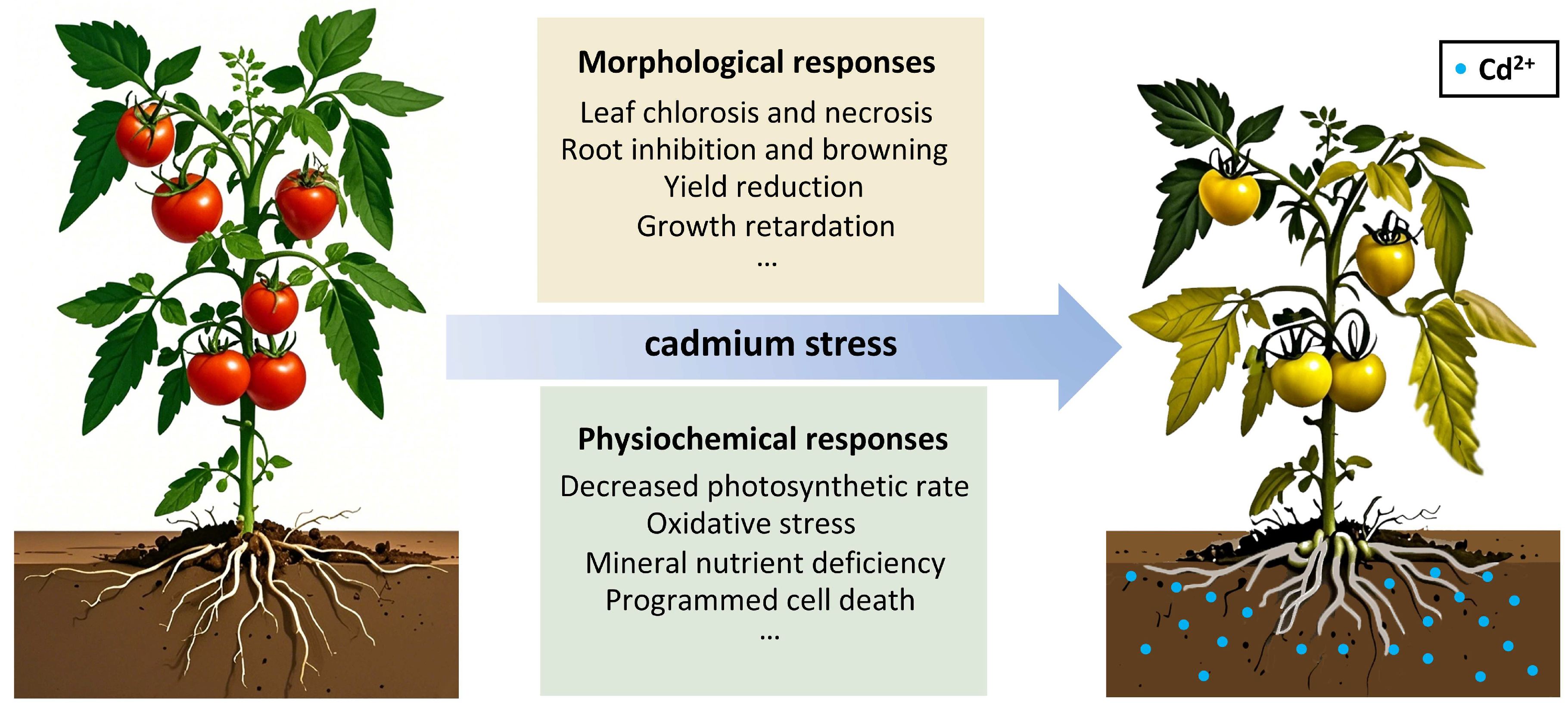
Figure 2.
Cadmium-Induced Signal Pathways and Phytohormone-Mediated Alleviation in Vegetable Crops.
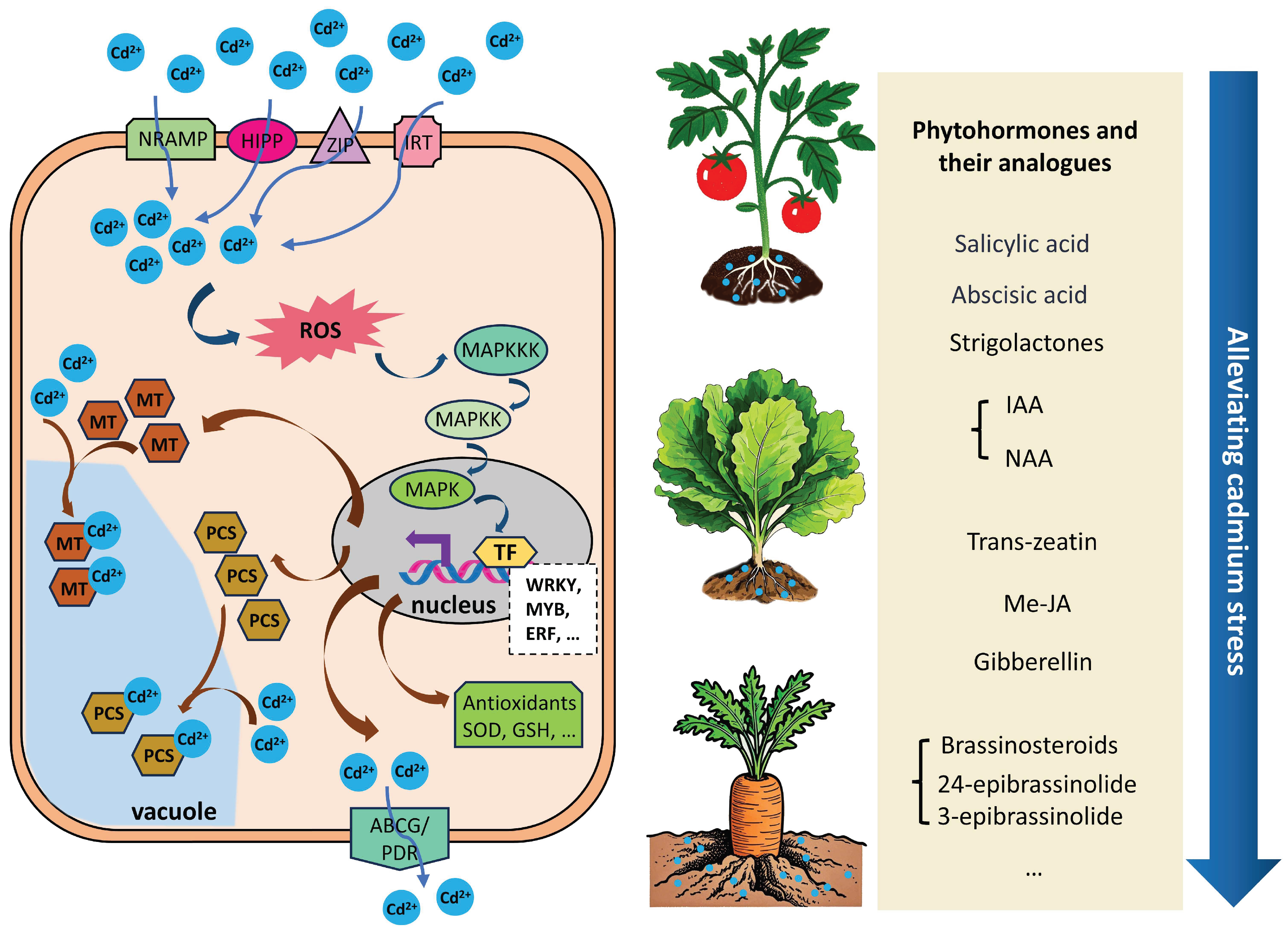

Table 1.
Regulatory Roles of Transporter-related Genes in Vegetable Crops under Cadmium Stress.
| Veg. Name | Gene | Tissue Specificity^a | Localization^b | Core Mechanism Summary | Key Functional Impact | Ref. |
|---|---|---|---|---|---|---|
| Tomato | LeNRAMP3 | - | PM | Interacts with NAS/FRO/IRT1 complex; mediates Fe/Cd transport and signaling | ↑heavy metal translocation | [13] |
| Potato | StNRAMP2 | - | - | Regulates Cd partitioning: silencing ↑Cd in tubers, overexpression ↑Cd in shoots | Modulates Cd accumulation patterns | [5] |
| Pak choi | BcHIPP16 | Whole seedling | PM | Direct Cd²⁺ influx promoter in roots | ↑Cd uptake efficiency | [6] |
| Chinese cabbage | BcNRAMP1 | Whole plant | PM | Activated by Cd/Mn deficiency; ↑Cd/Mn root uptake | Dual regulation under metal stress | [27] |
| Chinese cabbage | BrMT1 | Roots/flowers^c | Cyto/Chl^d | Cysteine-rich Cd chelation; chloroplast targeting ↑ROS scavenging | Confers Cd resistance via subcellular targeting | [24] |
| Radish | RsPDR8 | Vascular tissues^e | PM | ↑Cd efflux via PM transport; ↑ROS scavenging & membrane stability | ↓cellular Cd accumulation | [26] |
| Radish | RsNRAMP5 | Vascular cambium | PM | ↑Cd influx; differential regulation of ROS/proline genes | Mediates Cd uptake-toxicity balance | [20] |
^a Tissue expression sites abbreviated if absent (“-”) or non-specific (“whole plant”). ^b PM: Plasma membrane; Cyto: Cytosol; Chl: Chloroplast. ^c High in roots/flowers, low in old leaves/stems. ^d Localization dependent on expression system (Arabidopsis). ^e Xylem/phloem/cambium.^f Arrows (↑/↓) denote enhancement/reduction of processes.
Table 2.
Regulatory Roles of Transcription Factors in Vegetable Crops under Cadmium Stress.
| Veg. Name | Gene | Tissue Specificity^a | Localization^b | Core Mechanism Summary | Key Functional Impact | Ref. |
|---|---|---|---|---|---|---|
| Tomato | LeSPL-CNR | - | - | ↓Cd acquisition via NO-mediated repression of nitrate reductase | ↓Cd accumulation (via iron-uptake suppression) | [31] |
| Tomato | HsfA1a | - | - | ↑Melatonin biosynthesis (COMT1) and HSP expression under Cd stress | ↑Cd tolerance (via upregulating HSP) | [28] |
| Potato | StWRKY6 | - | Nu | ↑Antioxidant enzymes and photosynthesis regulation for stress resilience | ↑Cd tolerance; ↓Cd accumulation | [32] |
| Pepper | CaPF1 | - | - | ↑Antioxidant enzyme activity and ↓lipid peroxidation under Cd stress | ↑Cd tolerance in transgenic plants | [33] |
| Pepper | CaWRKY41 | Roots, leaves, (shoots, flowers) | Nu (Arabidopsis) | ↑H₂O₂ accumulation and ↑Zn transporters activation for Cd uptake | ↓Cd tolerance; ↑Cd uptake | [29] |
| Carrot | DcMYB62 | - | Nu | ↑Carotenoid/ABA/H₂S biosynthesis, ↓ROS, and ↑stomatal closure activation | ↓ROS; ↑expression of heavy metal resistance genes | [25] |
| Bean | PvERF104 | - | Nu | ↓Cd-induced lipid peroxidation and ↑regulation of MRE-containing Cd response genes | ↓Cd accumulation; ↑stress tolerance | [34] |
| Bean | PvMTF-1 | - | Nu | ↑Tryptophan synthesis via ASA2-mediated pathway by binding ASA2 promoter under Cd stress | ↓Cd accumulation | [35] |
| Bean | PvERF15 | - | Nu | ↑PvMTF-1 promoter activation via ACE-binding for Cd stress response regulation | Forms transcriptional pathway for Cd response | [30] |
^a Tissue expression sites abbreviated if absent (“-”). ^b Nu: Nucleus; “Arabidopsis” denotes experimental system. ^c Arrows (↑/↓) denote enhancement/reduction of processes.
Table 3.
Regulatory Roles of Enzyme-related Genes in Vegetable Crops under Cadmium Stress.
| Veg. Name | Gene | Tissue Specificity^a | Localization^b | Core Mechanism Summary | Key Functional Impact | Ref. |
|---|---|---|---|---|---|---|
| Tomato | SlRING1 | - | PM/Nu | E3 ligase-mediated ubiquitination ↑antioxidant/detoxification pathways | ↓Cd accumulation & oxidative stress | [36,37] |
| Tomato | Sl1 | Roots^c | PM | E3 ligase-mediated suppression of metal transporters ↑antioxidant activity | ↓Root Cd uptake | [40] |
| Tomato | Tgase | Leaves/flowers | Mt/CW/Chl | ↑Polyamine/NO accumulation & cell wall modification | ↑Cd chelation capacity | [41,42] |
| Tomato | SlSPR2 | - | - | JA-dependent regulation ↑Cd-responsive metabolic pathways | Maintains physiological homeostasis | [43] |
| Tomato | SlMAPK3 | Stems/roots | - | MAPK signaling ↑antioxidant activation & root morphology regulation | ↑Root function under stress | [44] |
| Tomato | SlJMJ524 | Leaves/flowers | - | Epigenetic regulation ↓metal transporters & ↑GSH-PC synthesis | ↑Cd sequestration | [45] |
| Tomato | SlJMJ18/23 | Flowers (SlJMJ18) ^c, young leaves (SlJMJ23)^c | - | Epigenetic regulation ↓metal transporters (ZIP1, IRT1) & ↑antioxidant/phenol synthesis | ↑Antioxidant capacity & phenol synthesis | [8] |
| Pepper | CaHMA1 | - | GA/ER | Heavy metal-binding domain ↑Cd accumulation | ↑Cd translocation to fruits | [38] |
| Chinese cabbage | BpPMSR3 | - | - | Methionine redox regulation ↑GSH synthesis | ↑Cd detoxification | [39] |
| Onion | AcGCL | Roots^c | - | ↑GSH/PC synthesis & protection of FOS metabolism | Maintains carbohydrate metabolism | [46] |
^a Tissue expression sites abbreviated if absent (“-”). ^b PM: Plasma membrane; Nu: Nucleus; Mt: Mitochondria; CW: Cell wall; Chl: Chloroplast; GA: Golgi apparatus; ER: Endoplasmic reticulum. ^c Highest expression compared to other tissues. ^d Arrows (↑/↓) denote enhancement/reduction of processes.
Table 4.
Regulatory Roles of microRNAs and Other Types of Genes in Vegetable Crops under Cadmium Stress.
Table 4.
Regulatory Roles of microRNAs and Other Types of Genes in Vegetable Crops under Cadmium Stress.
| Veg. Name | Gene | Tissue Specificity^a | Localization^b | Core Mechanism Summary | Key Functional Impact | Ref. |
|---|---|---|---|---|---|---|
| Tomato | Sly-miR398 | Roots, stems | - | ↓regulated under Cd stress; ↑CSD1/SOD expression to ↑antioxidant defense; ↓Cd uptake/translocation genes. | ↓Oxidative damage; ↑growth recovery | [7] |
| Water spinach | IamiR-4-3p | - | - | ↓regulates GST3 and AWPM19-like, causing ↑oxidative damage and ↑Cd uptake/translocation. | ↑Cd toxicity; ↓apoplastic barrier | [47] |
| Tomato | SlTCMP-1 | Flower buds, leaves, fruits | - | Induced by Cd stress; interacts with HIPP26 to ↑ROS scavenging genes and ↓Cd translocation. | ↑Cd stress response | [48] |
| Tomato | SlSGR2 | Various tissues | Chloroplast | Inhibits chlorophyll degradation; ↓MDA content; ↑antioxidant enzyme activity under Cd stress. | ↑Cd tolerance; ↓chlorophyll loss | [49] |
| Chinese cabbage | BrSSA4c | - | - | Overexpression ↑Cd tolerance via activation of cis elements. | ↑Cd resilience | [4] |
^a Tissue expression sites abbreviated if absent (“-”). ^b PM: Plasma membrane; “-” indicates unavailable localization data. ^c Arrows (↑/↓) denote enhancement/reduction of processes.
Table 5.
Potential Functional Genes in Vegetable Crops under Cadmium Stress.
| Veg. Name | Botanical Name | Genes | Ref.(s) |
|---|---|---|---|
| bean | Phaseolus vulgaris L. | PvSR3; PvSR2 | [52,53] |
| Chinese cabbage | Brassica rapa L. | BrAHL24; BrHO1; BrMYB116 | [54,55,56] |
| cucumber | Cucumis sativus L. | DAO; CsNramp1, CsNramp4, CsZIP1, CsZIP8, CsHMA5, CsHMA2, CsHMA7; CsMT4 | [57,50,58] |
| flowering Chinese cabbage | Brassica rapa L. Chinensis | BrMTs, BrPCSs | [59] |
| garlic | Allium sativum L. | AsPCS1, AsMT2a; AsMT2b | [60,61] |
| kale | Brassica oleracea var. acephala | OPT3, YSL3 | [62] |
| lettuce | Lactuca sativa L. | LsXTH6, LsXTH7, LsXTH8, LsXTH32, and LsXTH33; LsAPXs, LsSODs; LsZIP1, LsZIP3, LsZIP10, LsZIP12, LsZIP13, LsZIP17, LsZIP19 | [63,64,65] |
| melon | Cucumis melo L. | CmMlo1 | [66] |
| mung bean | Vigna radiata (L.) R. Wilczek | VrCOXs | [67] |
| pak choi | Brassica chinensis L. | Fe SOD1, POD A2/44/54/62, and GST1; BcIRT1, BcZIP2; BcGSTUs | [68,21,69] |
| pepper | Capsicum annuum L. | CaNRAMP5, CaCOMT1 | [51] |
| potato | Solanum tuberosum L. | StCADs; StOPR1, StJAZ14; StAP2/ERF genes; StNRAMPs; StSROs 5/6; StABCs; StDREB1, StDREB2 | [70,23,71,72,73,74,75,76,77] |
| radish | Raphanus sativus L. | RsHSP70-5, RsHSP70-14, RsHSP70-21, RsHSP70-32; RsMATE37-a, RsMATE21, RsMATE43-c, RsMATE49-b, RsMATE31-b, RsMATE33, RsMATE46-c, RsMATE13-a, RsMATE16-b, RsMATE43-a, RsMATE27, RsMATE35-a, RsMATE40-b, RsMATE13-c and RsMATE26; RsZIP genes; WRKY6, WRKY28-like, WRKY33, MYB16, bHLH143, ERF - rap2.7, PIN1, MRP, ABC transporter genes, GST and LCC4 | [9,78,79,80] |
| tomato | Solanum lycopersicum L. | Solyc05g051550, Solyc02g077370, Solyc04g009440, Solyc12g099130, Solyc04g077960, Solyc04g051690, Solyc08g078180, Solyc07g045030, Solyc05g015850, Solyc05g053330, Solyc12g013640, Solyc07g065320, Solyc11g012700, Solyc11g069735, Solyc01g104820; COMT, PCS; SlDML1, SlDML2, SlDML3, SlDML4, SlMET1, SlDRM1L, SlDRM5 and SlDRM1L1; SlNRAMP1-5; SlMT1-4; SlWRKY76, SlWRKY38, SlWRKY46, SlWRKY19, SlWRKY33, SlWRKY35, SlWRKY45, SlWRKY51, SlWRKY55, SlbHLHs; miR166a, miR395b; FW2.2/CELL NUMBER REGULATOR (CNR); SlHIPP7/21/26/32;SlERF1 | [3,81,82,83,84,85,86,87,88,89] |
| turnip | Brassica rapa L. | BrHMAs | [90] |
| water spinach | Ipomoea aquatica Forsk. | IaMT2, IaMT3 | [91] |
Table 6.
Regulatory Roles of Phytohormones and Their Analogues in Vegetable Crops under Cadmium Stress.
Table 6.
Regulatory Roles of Phytohormones and Their Analogues in Vegetable Crops under Cadmium Stress.
| Veg. Name | Botanical Name | Substance Name | Core Mechanism Summary^a | Key Functional Impact | Ref.(s) |
|---|---|---|---|---|---|
| cherry tomato | Solanum lycopersicum var. cerasiforme | Melatonin and brassinosteroids (BRs) | ↓Cd content in shoots; ↑antioxidant enzyme activities/gene expression; regulates K+ balance | ↑Cd detoxification | [10] |
| cucumber | Cucumis sativus L. | 24-epibrassinolide (24-EBL) | ↑Antioxidant system; regulates ethylene/IAA biosynthesis genes; ↓lipid peroxidation and Cd uptake | ↓Cd toxicity | [92] |
| cucumber | Cucumis sativus L. | 3-epibrassinolide (3-EBL) | ↑Antioxidant enzymes; regulates ethylene/auxin biosynthesis genes; improves photosynthesis/water physiology | ↑Cd stress resilience | [93] |
| cucumber | Cucumis sativus L. | Me-JA and H₂O₂ | ↑Cell cycle-related gene expression; activates adventitious rooting through H₂O₂ signaling (inhibited by CAT/DPI) | ↑Root development | [95] |
| lettuce | Lactuca sativa L. | Gibberellin (GA) | ↓IRT1/Nramp1 expression (↓Cd uptake); ↓HMA2/HMA4 expression (↓root-to-shoot translocation) | ↑Cd tolerance | [94] |
| lettuce | Lactuca sativa L. | salicylic acid (SA) | Regulates Nramp5/HMA4/SAMT expression; ↑photosynthesis; modulates antioxidant/osmotic systems | ↓Cd accumulation; ↑oxidative defense | [11] |
| melon | Cucumis melo L. | SLs | ↓Cd stress in roots by regulating redox-related genes (POD, LOX), transcription factors (MYB, AP2/ERF), and ↑JA biosynthesis/flavonoid pathways | ↑Antioxidant capacity; ↓oxidative damage | [96] |
| mung bean | Vigna radiata L. | abscisic acid (ABA) | ↑Antioxidative enzymes/IAA oxidase activity; regulates cell wall/secondary metabolism genes | ↑Adventitious root formation | [97] |
| mung bean | Vigna radiata L. | SA | ↑SOD/POD/CAT/APX activities; modulates phytohormones (↑ABA/JA, ↓ethylene); regulates osmolyte metabolism | ↑Physiological homeostasis | [98] |
| pepper | Capsicum annuum L. | Trans-zeatin (tr-Z) and silymarin (Sm) | ↓Cd uptake/accumulation; ↑antioxidant enzymes/compounds; modulates stress-responsive gene expression | ↑Antioxidant defense system | [99] |
| radish | Raphanus sativus L. | Strigolactone (SL) and acidified biochar (AB) | SL regulates root architecture and chloroplast development; AB adsorbs Cd ions and improves soil conditions; combination ↑antioxidant activities | ↑Cd stress tolerance | [17] |
| tomato | Solanum lycopersicum L. | IAA | ↑NO accumulation → activates AsA-GSH cycle; ↓Cd accumulation/oxidative markers | ↑Photosynthetic protection | [100] |
| tomato | Solanum lycopersicum L. | α-naphthaleneacetic acid (NAA) | Regulates defense genes in shoots and oxidoreductase/auxin-response genes in roots; modulates antioxidant system/Cd transport | ↓Cd-induced damage |
^a Arrows (↑/↓) denote enhancement/reduction of processes.
Disclaimer/Publisher’s Note: The statements, opinions and data contained in all publications are solely those of the individual author(s) and contributor(s) and not of MDPI and/or the editor(s). MDPI and/or the editor(s) disclaim responsibility for any injury to people or property resulting from any ideas, methods, instructions or products referred to in the content. |
© 2025 by the authors. Licensee MDPI, Basel, Switzerland. This article is an open access article distributed under the terms and conditions of the Creative Commons Attribution (CC BY) license (http://creativecommons.org/licenses/by/4.0/).
Copyright: This open access article is published under a Creative Commons CC BY 4.0 license, which permit the free download, distribution, and reuse, provided that the author and preprint are cited in any reuse.


