

Submitted:
08 August 2025
Posted:
08 August 2025
You are already at the latest version
Abstract
In recent years, long-term observations and studies by researchers have shown that: (1) the Earth's rotation has seasonal variations and periodic changes with cycles of half a year and a year; (2) the Earth's rotation speed is gradually slowing down; (3) there is a strong correlation between the solar orbital motion and changes in the Earth's rotation rate; (4) the Earth's core is rapidly rotating in the opposite direction. What are the reasons for these phenomena? This paper analyzes the gravitational interactions between celestial bodies, proposes the concept of an equivalent spherical surface for the emission of gravitational particles from celestial bodies, and discusses the separation phenomenon between the gravitational focus and the centre of mass. Taking the Sun-Earth system as an example, the point of gravitational influence of the Earth by the Sun is at 0.5 radii on the side of the Earth closest to the Sun. Due to the separation between the Sun-Earth gravitational influence point and the Earth's centre of mass, the gravitational influence of the Sun on this point causes the Earth to experience a centripetal force that orbits the Sun, while simultaneously generating a force that causes the Earth to rotate in the opposite direction around the gravitational influence point. Under the combined effect of the Earth's inertial force while orbiting, the centripetal force towards the Sun, and the force of the Earth's reverse rotation around the gravitational influence point, the Earth's revolution leads to an elliptical orbit. This paper simulates the elliptical orbit of the Earth around the Sun. Through calculations and simulations, it is found that 99.99% of the Earth's gravitational influence from the Sun is used for the Earth's rotation. This essentially identifies the intrinsic reasons for variations in the Earth's rotation. This paper argues that the seasonal periodic variations in the Earth's rotation, the long-term slowdown, and the rapid reverse rotation of the Earth's core are all closely related to the changes in the Sun's orbit and the separation phenomenon between the Sun's gravitational influence point and the Earth's centre, being inevitable results of the Sun's gravity being almost entirely applied to the Earth's rotation. Keywords: seasonal periodic variations in the Earth's rotation; long-term slowdown of the Earth's rotation; changes in the Earth's rotation strongly related to solar orbital motion; rapid reverse rotation of the Earth's core; separation phenomenon between celestial gravitational focus and centre of mass.
Keywords:
seasonal variations in the Earth's rotation
; long-term slowing of the Earth's rotation
; changes in the Earth's rotation strongly correlate with the Sun's orbital motion
; rapid counter-rotation of the Earth's core
; phenomenon of the gravitational focus of celestial bodies separating from their center of mass
1. Introduction
In recent years, seismology has developed rapidly, confirming that the Earth is composed of the crust, mantle, and core through the study of the abrupt interfaces of seismic wave propagation speeds, as shown in Table 1.
Crust: The crust is the Earth’s outer layer of solid rock, with an average thickness of about 17 kilometers, but it is unevenly distributed. The continental crust is thicker (average 33 kilometers, reaching 60-70 kilometers in the Tibetan Plateau), primarily composed of granite (sial layer) and basalt (sima layer); the oceanic crust is thinner (average 6 kilometers) and almost devoid of granite, mainly consisting of basalt.
Mantle: Divided into the upper mantle and the lower mantle, with a total thickness of about 2900 kilometers. The top of the upper mantle contains the asthenosphere (depth about 60-250 kilometers), which is the source of magma; the material in the lower mantle is in a plastic solid state, with density and pressure increasing with depth. The upper mantle is mainly composed of olivine, and the part near the core contains iron and nickel oxides.
Core: Divided into the outer core and the inner core. The outer core (depth 2900-5100 kilometers) is a liquid iron-nickel alloy, while the inner core (from 5100 kilometers to the Earth’s center) is solid iron-nickel. Evidence from seismic waves: shear waves (S-waves) cannot pass through the outer core, confirming its liquid nature.
In recent years, American Chinese scientist Song Xiaodong and others have discovered through seismic wave observations that the rotation direction of the core is opposite to the Earth’s rotation direction, with an angle of 10° to the rotation axis, and that the inner core rotates about 1.1° faster each year than the Earth itself.
Recent long-term observations by researchers have shown that the Earth’s rotation speed slows down in spring and speeds up in autumn, with an annual cycle amplitude of about 20-25 milliseconds. The traditional view is that this is mainly related to seasonal variations in atmospheric circulation, particularly the activities of wind systems leading to the redistribution of the Earth’s angular momentum.
Recent long-term observations by researchers indicate that the Earth’s rotation speed is gradually slowing down, resulting in an increase in day length of about 12 milliseconds per century; the traditional view is that tidal friction of the Earth is the main cause of long-term changes in rotation speed.
Recent long-term observations by researchers have shown that “the correlation between the solar orbital motion and the change in the Earth’s rotation rate reaches 0.9994.”Through in-depth research on quantum gravity theory.
The author believes that the above phenomena are related to the separation of the point of gravitational influence of the Sun on the Earth from the Earth’s center of mass, and that 99.99% of the Sun’s gravitational force on the Earth is related to the Earth’s rotation.
2. Analysis of Gravity Between Planets and Formation of Elliptical Orbits
2.1. Equivalent Radius of Planet Launching Gravitons
The article “Gravity, Gravitational Field, and Gravitational Particles–Inference on the Frequency of Gravitational Energy Waves” [16] argues that the most fundamental unit of matter is the nucleus (a collective term for protons and neutrons), and all nucleons emit gravitons. The energy carried by gravitons is Planck’s constant h, which is 6.626 × 10 ^ (-34) J · s. gravitons propagate in space as gravitational energy waves, which resonate with other nucleons and transfer energy to form gravity. For planets [17], the gravitons emitted by the nucleons inside the planet interact with other nucleons inside the planet, forming the cohesion of the planet. Some of the gravitons emitted by the shell nucleons near the outside of the planet are emitted to the outside of the planet and propagate in space as gravitational energy waves. When the gravitational energy waves encounter nucleons from other planets, they resonate and transfer energy, forming the gravitational force between the planets.
Figure 1 is a schematic diagram of the equivalent sphere of a planet emitting gravitons. In the figure, rs is the radius of the planet, and rso is the thickness of the graviton shell that the planet emits to the outside of the sphere. There should be a sphere layer rse between them. It can be considered that all gravitons on the planet are emitted from this sphere layer. If this sphere layer is used as the equivalent medium effect sphere layer for the planet’s graviton emission, in general, it can be considered that this sphere layer is located in the middle of the planet’s graviton emission shell.
The article “An Attempt to Correct the Universal Gravitation Formula by Proportioning the Number of Extraspherical Gravitational Elements Launched from a Planet—The Proportion of Extraspherical Gravitational Elements in the Theory of Deflection Gravity” [18] calculated the number of gravitons emitted from a planet to the outside of the sphere. The outer layer thickness of a planet that can emit gravitons outside the sphere is:
In the equation, kng is the proportion of gravitons passing through the nucleus that can be absorbed by the nucleus, m0 is the mass of the nucleus, r0 is the radius of the nucleus, and ρ is the density of the planet’s shell material. From the above analysis and calculation, it can be seen that the shell thickness of the planet’s outward launch of gravitons is too small relative to the planet’s radius and can be ignored. Therefore, the equivalent shell radius of the planet’s launch of gravitons is approximately equal to the planet’s radius.
The approximate number of gravitons that a planet sends out of the sphere is:
In the formula, kgr is a constant and rs is the radius of the planet.
2.2. Gravitational Points and Spheres of a Planet
Figure 2 is an analysis diagram of the gravitational interaction between two planets. Planet E in the picture rotates around planet S. The center of mass of the central planet S is S0, with a radius of rs and a mass of ms, while the center of mass of planet E is E0, with a radius of re and a mass of me. The distance between the centers of mass of the planets is R0. Now analyzing the effect of planet S on planet E, only the gravitons emitted by the nucleons on the surface of planet E in the figure can form a gravitational force on the shell nucleons of planet E facing planet S. This phenomenon can be demonstrated by the gravitational double valley phenomenon during a solar eclipse [19]. Before a solar eclipse occurs, objects on the ground are subjected to the dual gravitational forces of the sun and moon, and the gravitational force of the earth on the objects will decrease; During the solar eclipse, the gravity of objects on the ground was measured, and the results showed that the gravity of objects on the ground was the same as that when only the sun was present, indicating that the gravitons received by the sun on the ground were obstructed by the moon; At the end of the solar eclipse, the sun is no longer obstructed by the moon, and objects on the ground are subject to the gravitational forces of the sun and the moon, causing the gravity to decrease again. This forms the double valley phenomenon of gravity during the solar eclipse.
To accurately calculate the effect of the gravitons emitted by planet S on planet E, it is necessary to calculate the gravitational force of each element on the sphere of planet S on each element on the sphere of planet E. When the distance between planets is much greater than the radius of the planets, it can be approximated that the energy transmitted between the spherical elements of the two planets is equal, In this way, the energy transmitted from the sphere of planet S to the sphere of planet E is proportional to the surface area of the sphere.
Obviously, the nuclear equivalent center of the sphere of planet S that has an effect on planet E is located on the line connecting the centroids of the two planets, as shown at point Sg in the figure. Assuming that the distance between the center of gravity and the centroid S0 of planet S is hs, there is
For planet E, the equivalent center of gravity is closer to the center of mass of planet E, as shown in Eg in the figure. Assuming the distance between the center of gravity and the center of mass is he, there is
The energy transmitted from planet S to planet E is the ratio of the area of the sphere occupied by planet E at a distance R0 from planet S to the total number of gravitons emitted by planet S
Here Gi is the gravitational coefficient, kgr is the proportionality coefficient of the gravitational particles emitted by the planet to the outside, and h is the Planck constant. From the above analysis, it can be concluded that the energy (gravity) transferred by nucleons between planets is proportional to the surface area of the planet, rather than the mass of the planet.
2.3. Analysis of the Effect of Gravity on the Operation of Planets
Figure 3 shows the analysis of the planet’s revolution and rotation caused by its gravitational pull. In the figure, S0 is the center of mass of the central planet S, and E is the planet that orbits around the central planet S. When planet E is at position E0, the point of gravitational action of planet S on planet E is Eg0. Due to the separation of the gravitational action point from the center of mass of the planet, the gravitational force is divided into Fs0 related to the central planet S and Fe0 related to planet E. Similarly, when planet E is at position E1, the gravitational force is divided into Fs1 related to the central planet S and Fe1 related to planet E. When planet E is at position E2, the gravitational force is divided into Fs2 related to the central planet S and Fe2 related to planet E. It can be seen that Fs0, Fs1, and Fs2 related to the central planet S all act on the gravitational action point Eg0 of the planet. F forms the driving force for the orbit of planet E around planet S, and in terms of effect, Fs forms the centripetal force for the orbit of planet E around planet S.
Due to the separation of the gravitational point Eg from the center of mass of the planet, another effect of the gravitational force acting on the gravitational point Eg is to drag the planet E to move. Generally, external forces rotate around the center of the sphere. Without considering the orbit of planet E around the center planet S, it can be assumed that planet E is constantly subjected to a gravitational force Fe, and this point of action is fixed at the gravitational point Eg. Therefore, it is not an external force rotating around the planet, but rather the center of mass of the planet rotating around the gravitational point Eg. At the initial position E0, the center of mass of the planet tends to move towards A0. As time increases, the angle of rotation of the center of mass of the planet around the gravitational point Eg increases. Under the joint action of the two components of gravity, When the planet is at position E1, its center of mass moves to point A1, and when the planet is at position E2, its center of mass moves to point A2.
According to the above analysis, the total gravitational force Fse of the planet is:
The force related to the revolution of planet E is:
The linear velocity of planet E orbiting the central planet S due to gravity in the equation is vs, in m/s, the angular velocity is Ω s, in radians/s, and me is the mass of the object (in kg).
For the planet E rotating around the point of gravitational action Eg, its moment of inertia is:
In the formula, me is the mass of planet E, re is the radius of planet E, and he is the distance between the gravitational point Eg and the center of mass of planet E. KI is the coefficient of inertia, and for the Earth, kI is 0.3307.
According to the law of fixed axis rotation of rigid bodies, there are:
Among them, Mz represents the combined external torque for a certain fixed axis, I represents the moment of inertia of the rigid body around the given axis, and α represents the angular acceleration. The moment here refers to the force component of the gravitational force and the rotation of the planet. The force arm is the distance he between the gravitational force point Eg and the center of mass of the planet. According to the definition of angular acceleration:
At this point, the law of rigid body fixed axis rotation can be written as:
For the rotation of a planet, it refers to the component of the planet’s rotation on the plane of revolution, which is generally not in the same plane as the actual rotation of the planet. Therefore, the rotational angular velocity of the planet here is not the commonly observed rotational angular velocity of the planet.
For an object undergoing circular motion, the relationship between its linear velocity and angular velocity is as follows:
According to the law of conservation of momentum, momentum cannot be generated or dissipated out of thin air. For planet E, its revolution generates a positive momentum, while its rotation around the center of mass Eg generates a negative momentum. These two should be equal:
Substitute the above results into formula (8):
The ratio of the force component used for planetary rotation to the total gravitational force is:
From this, it can be seen that almost all of the planet’s gravity is used for the planet’s rotation, leaving only a small amount for the planet’s revolution. Here, it can also be considered that at the point of gravitational force, the moment of the planet’s revolution is equal to the moment of the planet’s rotation. Since the force arm of the planet’s revolution is much greater than that of its rotation, the force used for the planet’s revolution is much smaller than that of its rotation.
The operation of a planet is not a simple force free system, it is constantly subject to the action of gravity. Therefore, the common angular momentum of a planet at any point includes: the angular momentum of the planet’s initial velocity relative to the central planet, the angular momentum of the planet’s revolution formed by gravity, and the angular momentum of the planet’s self rotation reflected on the revolving sphere formed by gravity
Since vs equals ve, after entering the above equation
The angular momentum of a planet’s revolution is only the angular momentum caused by its initial velocity. It can be seen that the fundamental reason for the conservation of angular momentum in a planet’s revolution system is the mutual cancellation of the angular momentum generated by gravity.
For different positions, according to the law of conservation of angular momentum, there are:
In the formula, L is the angular momentum, R0, v0, β0 are the distance between the planet and the central planet at the initial position, the planet’s linear velocity, and the angle between the gravitational line and the linear velocity. R1, v1, β1 are the distance between the planet and the central planet, the planet’s linear velocity, and the angle between the gravitational line and the linear velocity after the planet’s position changes. From the above equation:
Figure 4 is an analysis diagram of the planet’s operation. Here, the operation period of planet E is divided into n equal parts according to time, with the unit time being Δt. The center S0 of the central planet S is taken as the coordinate origin in the figure, R0 is the distance between the initial position of the planet and S0, v0 is the initial velocity of planet E’s operation, β0 is the angle between the initial direction of the planet’s operation and the gravitational line, θe is the angle at which the center of mass of planet E rotates around the gravitational point Eg at unit time Δt, and θs is the angle at which planet E rotates around the central planet S due to the gravitational component. v0 is translated to point A0, and its endpoint is A1. A1 is then rotated by θs to position A2, which is the time at which planet E’s center of mass passes through Δt. The endpoint position. Taking S0 as the origin, the coordinates of point A1 are:
The distance from point A1 to S0 is:
The angle α between point A1 and the initial position of planet E satisfies:
When planet E rotates through Δt time and θs angle to position A2 under the action of gravitational component Fs, the distance between planet E and S0 remains constant at R1, and the angle between planet E’s position A2 and the initial position increases as follows:
It can be seen that the rotation of the planet balances the inertia of its motion.
2.4. Simulation of the Earth’s Elliptical Orbit
The relevant parameters of the Earth [20] are as follows: the average radius of the Earth is 6.371 × 10 ^ 6m, the mass of the Earth is 5.972 × 10 ^ 24kg, the radius of the Sun is 6.955 × 10 ^ 8m, the orbital period of the Earth is 365.256363 days (sidereal day), 23:56:41.00 seconds per day (sidereal time) (sidereal day), the distance from the aphelion is 1.52097597 × 10 ^ 11m, the distance from the perihelion is 1.4709845 × 10 ^ 11m, the average orbital velocity is 29783 m/s, the maximum orbital velocity is 30287 m/s, the minimum orbital velocity is 29291 m/s, the calculated value is 29277m/s, and the coefficient of inertia of the Earth is 0.3307.
Based on the above deduction, the Earth’s orbit can be simulated. Table 2 is a screenshot of the simulated data table of the Earth’s orbit around the Sun.
The first column in the table is the correlation constant, where re is the radius of the Earth, me is the mass of the Earth, rs is the radius of the Sun, Gr is the gravitational coefficient calculated using the semi longitude of the planet, which is different from the commonly used gravitational coefficient G calculated using the mass of the planet. T is the orbital period, which refers to the time it takes for the Earth to orbit the Sun once, in seconds, and n is the number of equal parts of the period. Here, 10000 is taken. Table 3 above is only a small part of the data. Δt is the unit time. The first column R in Table 3 represents the distance between the Earth and the Sun when the Earth is in different positions, with the initial value being the apogee. The second column he represents the distance from the gravitational point Eg of the Sun acting on the Earth to the Earth’s center of mass. The combined motion of the two causes the Earth to deflect, and the tenth column θc is the actual angular displacement generated by the Earth per unit time, which is the sum of θs and α. The 11th column θ is the accumulation of angular displacement per unit time, and the 12th to 13th columns are the Cartesian coordinates used for simulating data plotting.
Figure 5 is a simulation diagram of the Earth’s orbit directly generated from the solar orbit data simulation table. The aphelion is 1.520976E+11m, and given the initial simulation value, the perihelion is 1.469384E+11m. Returning to the aphelion of 1.515900E+11m, it can be seen from the parameters that it is an ellipse. The angle between the direction of the Earth’s movement and the gravitational line: At the aphelion, it is a given value of 1.57080 radians. As the Earth moves from the aphelion to the perihelion, this angle gradually decreases and reaches a minimum value of 1.55381 radians before gradually increasing. It continues to increase after passing through 1.57080 radians at the perihelion and reaches a maximum value of 1.58673 radians before gradually decreasing. Finally, it returns to the aphelion with a return value of 1.57066 radians. The velocity of the Earth’s aphelion is 29291 m/s, the velocity of its perihelion is 30319 m/s, and the return value of the aphelion is 29389 m/s. The minimum and maximum angular velocities of the Earth’s rotation on the ecliptic caused by gravity are 6.010E-05 radians/s and 6.221E-05 radians/s, respectively, with a return value of 6.030E-05 radians/s and an average of 6.118E-05 radians/s. The average radius of the sphere under gravity is 3.171E+06m. More than 99.99% of the gravitational force exerted by the sun on the Earth is used for its rotation.
In the above simulation process, although it is generally consistent with reality, there are still many inconsistencies in the details, and the simulation data of the Earth needs further careful adjustment.
3. Rotation of the Earth
For the entire the Earth, the gravitational point of the Sun forms a circle with a radius of 3.171E+06m. As shown in Table 1, the gravitational point (circle) of the Sun on the Earth falls into the liquid layer. On the circle affected by the gravitational force of the sun, the average rotational angular velocity of the Earth generated by the gravitational force of the sun is 6.118E-05 radians/s, and the linear velocity is 194m/s.
3.1. Reverse Rotation of the Earth’s Core
Due to the gravitational effect of the sun on the Earth, it is difficult to calculate the rotational speed of the inner sphere caused by gravity from the gravitational sphere of the setting sun on the Earth’s liquid layer. Only qualitative inference can be made here: there is a rotation in the Earth’s core that is opposite to the Earth’s rotation around the sun. Due to the small distance between the circle and the solid sphere caused by gravity and the high density of liquid matter, the Earth’s rotation speed driven by the gravity of the circle will be greater than the rotation speed of the crust.
3.2. Reasons for the Slow Rotation of the Earth
From the gravitational force of the sun acting outward, the Earth’s rotational speed caused by gravity rapidly decays until the solid matter in the crust stops decaying. At this point, in the Earth’s orbital plane (ecliptic plane), gravity will produce a rotational speed opposite to the Earth’s orbital speed on the crust. This can only be a qualitative inference. It is difficult to calculate the speed of crustal rotation caused by gravity from the gravitational sphere. Here, we can deduce the proportional coefficient of the Earth’s rotational speed on a circle driven by gravity, which in turn drives the rotation of the Earth’s crust.
The Earth revolves counterclockwise around the Sun, with its orbital plane (ecliptic plane) forming an angle of 23.439281 ° (0.40909 radians) with the Earth’s equator,
This angle is also the angle between the axis of rotation and the axis of rotation, as shown in Figure 6. The Earth’s rotation period is 23 hours, 56 minutes, and 04 seconds (sidereal day). The average angular velocity is:
The equatorial velocity is approximately 465 meters per second.
According to data, the Earth’s rotational speed slows down by an average of about 0.00015 seconds per year. Average daily slowdown:
Let the angular velocity generated by gravity be ωg, and the angular velocity of the Earth after one rotation be ω1
Enter numerical values and take a reasonable value as:
The ratio of the rotational angular velocity of the Earth’s crust formed by gravity to the rotational angular velocity on the gravitational circle is:
It can be seen that due to the gravitational point falling into the liquid layer, the Earth’s rotational angular velocity caused by gravity has greatly decreased.
3.3. Seasonal and Periodic Changes in the Earth’s Rotation
The seasonal and periodic changes in the Earth’s rotation are related to its position on its orbit, which is reflected in the gravitational force exerted on the Earth by the Sun. The Earth’s gravitational pull from the Sun follows formula (6), and the Earth’s reverse angular velocity formed by the Sun’s gravitational pull on the ecliptic plane follows formula (22). The Earth’s angular velocity formed by the Sun’s gravitational pull on the ecliptic plane is:
In the formula, ωe is the reverse angular velocity of the Earth formed by the gravitational point of the Sun on the ecliptic plane, re is the radius of the Earth, rs is the radius of the Sun, R0 is the distance between the Sun and the Earth, Gi is the gravitational constant, me is the mass of the Earth, and he is the distance from the gravitational point to the Earth’s center. Since he<<R0, except for R0, everything else is constant. Therefore, the angular velocity of the Earth formed by gravity is approximately inversely proportional to the distance between the Sun and the Earth.
The coupling coefficient between the angular velocity at the point of gravitational action and the rotation of the Earth’s crust is k ω, and the angular velocity at which gravity causes the Earth’s crust to rotate in the opposite direction is:
From this, it can be seen that if the distance between the sun and the earth changes by 5%, the Earth’s rotational angular velocity formed by gravity will also change by approximately 5%, which will be reflected in the Earth’s crustal rotational angular velocity changing by 5%. That is to say, the change in the distance between the sun and the earth (gravity) can be 100% reflected in the Earth’s rotation speed formed by the gravity of the ecliptic plane.
The combination of the Earth’s rotational angular velocity formed by gravity and the Earth’s own angular velocity forms a new the Earth’s rotational angular velocity that conforms to formula (36). Therefore, the crustal rotational angular velocity caused by ω g1 is:
The crustal angular velocity caused by ω g2 is:
The change in crustal rotation velocity caused by the variation of ω g2- ω g1 is:
The change in crustal rotation speed caused by gravity determines the variation in the Earth’s rotation speed. In summary, the position of the Earth on its orbit varies seasonally and with six-month and yearly cycles. Therefore, the gravitational force between the Earth and the Sun undergoes seasonal changes with six-month and yearly cycles, and the changes in the gravitational force between the Earth and the Sun determine the changes in the rotation of the Earth’s crust. Finally, it will inevitably manifest as seasonal variations in the Earth’s rotational speed, with periods of six months and one year.
3.4. Changes in the Earth’s Rotational Speed are Strongly Correlated with the Gravitational Pull of the Sun
According to years of research by scholars such as Teng Yongfu, Liu Fugang, Luo Jinming, and Berlin from the School of Science at Qiqihar University, the correlation between solar orbital motion and changes in the Earth’s rotation rate has reached 0.9994. The movement of the sun’s orbit actually reflects the change in the distance between the sun and the earth, and the change in the distance between the sun and the earth determines the change in the gravitational force between the sun and the earth. According to the derivation and calculation in the previous section, the change in the gravitational force between the sun and the earth determines the change in the rotation of the earth. Therefore, it is inevitable that the change in the speed of the earth’s rotation is strongly correlated with the movement of the sun’s orbit.
3.5. The Influence of the Moon, Jupiter, and Saturn on the Changes in the Earth’s Rotation Speed
In the solar system, due to the gravitational force of the sun on the earth, the earth revolves around the sun; Due to the gravitational pull of the Earth on the Moon, the Moon revolves around the Earth; At the same time as the Earth forms a gravitational force on the Moon, the Moon also forms a gravitational force on the Earth. The gravitational force of the Moon on the Earth causes the Earth to produce a reverse rotational angular velocity at the point of gravitational force, which affects the Earth’s rotation due to changes in the distance (gravity) between the Earth and the Moon. Jupiter, Saturn, and other planets have larger volumes and can also exert a certain amount of gravity on the Earth. As the distance between Jupiter, Saturn, and the Earth changes, their gravity on the Earth will also change. These changes in gravity will also affect the Earth’s rotation speed, but the magnitude of the impact varies.
4. Discussion
The coupling coefficient of the force from the Earth’s liquid layer (on the gravitational circle) driving the rotation of the crust and core needs further research and determination.
5. Conclusions
Gravity is the process in which nucleons emit gravitons, which propagate in space as gravitational energy waves. When gravitational energy waves encounter other nucleons, they resonate with them and form energy transfer. For planets, the gravitons emitted by the nucleons inside the planet interact with other nucleons inside the planet, forming the cohesion of the planet. Some of the gravitons emitted by the surface nucleons of the planet are emitted outside the sphere. These gravitons emitted outside the sphere collide with nucleons from other planets and resonate with them, forming energy transfer. The transferred energy causes the resonating nucleons to produce a displacement perpendicular to the gravitational line, forming a force perpendicular to the gravitational line. The planet the Earth, which orbits around the Sun, only the spherical nucleons facing the Sun can receive the gravitons emitted by the Sun. The spherical nucleons of the Earth facing away from the Sun do not receive the gravitons emitted by the Sun. Therefore, for the entire the Earth, the equivalent gravitational point Eg does not coincide with the Earth’s center of mass, but is located about 0.5 radius away from the Sun’s center of mass. This way, the Sun’s gravitational force on the Earth will have two effects: one is the centripetal force of the Earth’s rotation around the Sun, and the other is the rotational force of the Earth’s center of mass rotating around the gravitational point Eg. Within a certain period of time Δ t, the initial velocity of the Earth will cause a uniform linear displacement of the planet. The force of the Sun’s gravity on the Earth will cause the Earth to rotate a certain angle on its orbit. The other force of the Sun’s gravity on the Earth will cause the Earth’s center of mass to rotate backwards on a circular arc around the point of gravity. Under the combined action of these three factors, the Earth will form a standard elliptical orbit. According to the law of conservation of momentum, the linear velocity of the Earth’s orbit around the Sun formed by gravity is equal to and opposite to the linear velocity of the Earth’s rotation. The angular velocity of the Earth’s orbit around the Sun formed by gravity is equal to and opposite to the angular velocity reflected by the Earth’s rotation to the Earth’s revolution. At this point, the angular momentum generated by the Sun’s gravity cancels each other out, leaving only the angular momentum formed by the Earth’s initial velocity. This is the fundamental reason for the conservation of the Earth’s common angular momentum under the action of gravity. After deduction, calculation, and data simulation, more than 99.99% of the gravitational force of the sun is used for the rotation of the earth. It can also be said that in balancing the inertia of the earth’s movement, it can be considered that at the point of gravitational action, the moment of the earth’s revolution is equal to the moment of the earth’s rotation. Due to the fact that the force arm of the earth’s revolution is much larger than that of its rotation, the force used for the earth’s revolution is much smaller than that used for the earth’s rotation. For the Earth, the rotational speed on the circle due to the gravitational force of the Sun is reflected in the crust, which is superimposed with the initial rotational speed of the Earth, resulting in a slow decrease in the rotational speed of the Earth. This speed is reflected in the Earth’s core, causing it to rotate in the opposite direction to the current the Earth’s rotation, and this rotational speed is greater than that of the crust. The changes in the four seasons of the Earth, with annual cycles, are closely related to the position of the Earth on its orbit. The position of the Earth on its orbit reflects the changes in the gravitational force exerted on the Earth by the Sun. 99.99% of the Sun’s gravitational force is used for the Earth’s rotation. Therefore, the changes in the Sun’s gravitational force determine the changes in the Earth’s rotation speed on the gravitational circle, the coupling of the Earth’s rotation speed on the gravitational circle to the Earth’s crust, and the actual the Earth’s rotation speed after the superposition of the Earth’s rotation speed and the Earth’s own rotation speed. In summary, the seasonal and periodic changes in the Earth’s rotation, which slow down over a long period of time, are strongly related to the changes in the Sun’s orbit. The rapid reverse rotation of the Earth’s core is also related to the phenomenon of separation between the gravitational point of the Sun and the Earth’s center, and is an inevitable result of almost all of the Sun’s gravity being used for the Earth’s rotation.
References
- Earth structure (geographical term)—Baidu Encyclopedia. Available online: https://baike.baidu.com/item/%E5%9C%B0%E7%90%83%E7%BB%93%E6%9E%84/10631795.
- A.M. Dziewonski, R. Jeanloz, Ding Zhifeng. Rotation of the Earth’s Inner Core within the Planet. Translated World Seismology, 1997; 5.
- Yang Kuiyi. The Earth’s Core Rotates Faster than the Earth. Science and Culture, 1997; 1.
- M. Carlowicz, Xiao Chunyan, Teng Yuntian. Observations suggest Earth’s inner core spins faster than the Earth itself. Translated World Seismology, 1997; 2.
- Li Le, Zhou Huilan, Chen Qifu. Progress in the seismological study of the Earth′s inner core. Progress in Geophysics, 2004; 19. [CrossRef]
- ZHANG Han-wei, XU Hou-ze, WANG Ai-sheng, The research of Inner core Earth rotation and terrestrial reference frame. Progress in Geophysics 2005, 20, 712–717.
- Zhi Yan. The rotation direction of the Earth’s core. Required Reading for Junior Middle School Students, 2016(10)1.
- Yang Xuexiang. A Surprising Discovery: Rapid Rotation of the Earth’s Solid Inner Core. Earth 1997, 01, 7–8. [Google Scholar]
- Yang Xuexiang, Chen Dianyou. Dynamic Action of the Earth Core. Progress in Geophysics 1996, 11, 3. [Google Scholar]
- ZHU Tao. The Earth’s differential rotation. Progress in Geophysics 2003, 18, 247–255. [Google Scholar]
- YANG Dong-hong, YANG Xue-xiang. Study and model on variation of Earth’s Rotation speed. Progress in Geophysics 2013, 28, 58–70. [Google Scholar]
- Song Guanyi. Solutions on seasonal transformation of the velocity of Earth rotation. Progress in Geophysics 2011, 26, 450–455. [CrossRef]
- SONG Guan-yi. Solutions on the key puzzles left from the science of the earth rotation. Progress in Geophysics 2014, 29, 4–14.
- Baidu Encyclopedia. Earth’s rotation. Available online: https://baike.baidu.com/item/%E5%9C%B0%E7%90%8C%E8%87%AA%E8%BD%AC/799188.
- TENG Yong-fu, LIU Fu-gang, LUO Jin-ming, BAI Lin. Response of Earth’s rotation angular velocity change for a long period to the characteristics of sun’s orbital motion. Progress in Geophysics 2019, 34, 1794–1801. [Google Scholar]
- 军, 利. Gravity, Gravitational Fields, and Gravitons—Inference about the Frequency of Gravitational Energy Waves. Astron. Astrophys. 2022, 10, 1–10. [Google Scholar] [CrossRef]
- Chen, Junli. Theory of Deflection Gravity; Hans Publishers, 24 June 2024; Available online: https://www.hanspub.org/books/BookManage?BookID=308ISBN 978-1-64997-896-7.
- 军, 利. An Attempt to Correct the Formula of Universal Gravitation Based on the Proportion of Gravitons Emitted from the Planet to the Outside of the Sphere—The Ratio of Gravitons Outside of the Sphere in Deflection Gravity Theory. Astron. Astrophys. 2023, 11, 27–39. [Google Scholar] [CrossRef]
- 军, 利. The Allais Effect and the Cause Analysis of Gravity Valley Formation. Astron. Astrophys. 2023, 11, 13–26. [Google Scholar] [CrossRef]
- Earth—Baidu Encyclopedia. 16 February 2025. Available online: https://baike.baidu.com/item/%E5%9C%B0%E7%90%83/6431.
Figure 1.
Schematic diagram of equivalent spherical surface of planet launching gravitons.
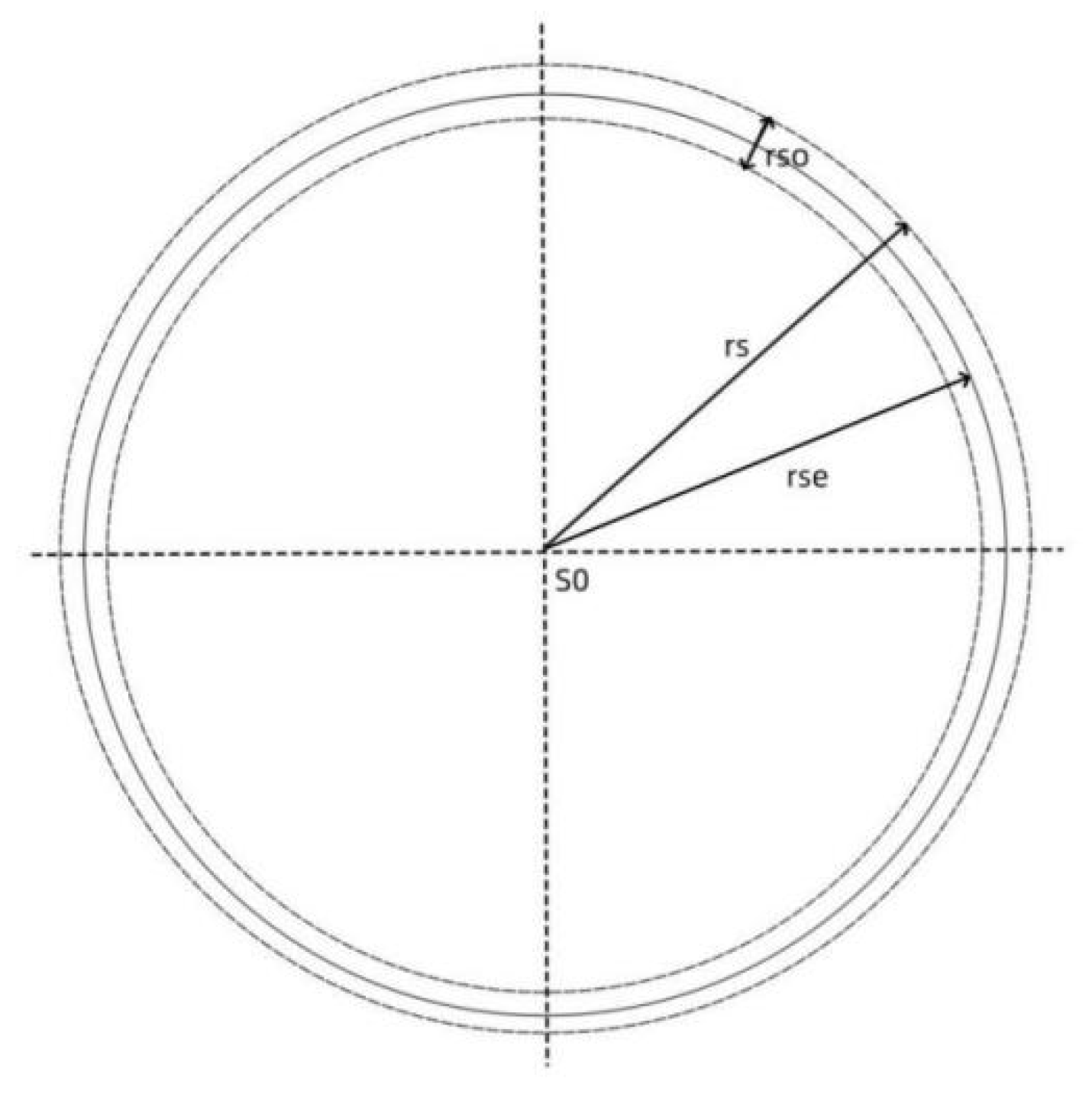
Figure 2.
Schematic diagram of separation of gravitational action point and centroid.
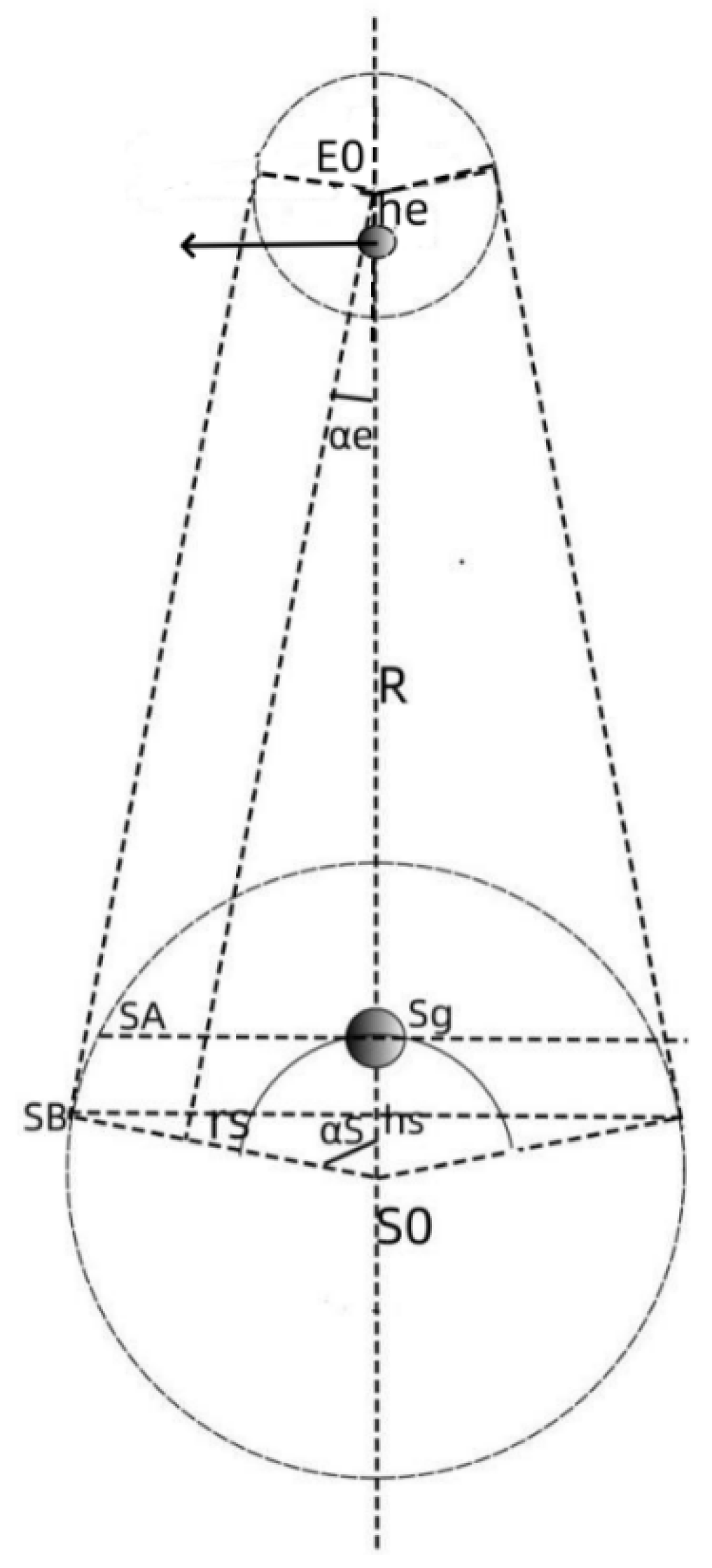
Figure 3.
Schematic diagram of the planet’s revolution and rotation formed by gravity.
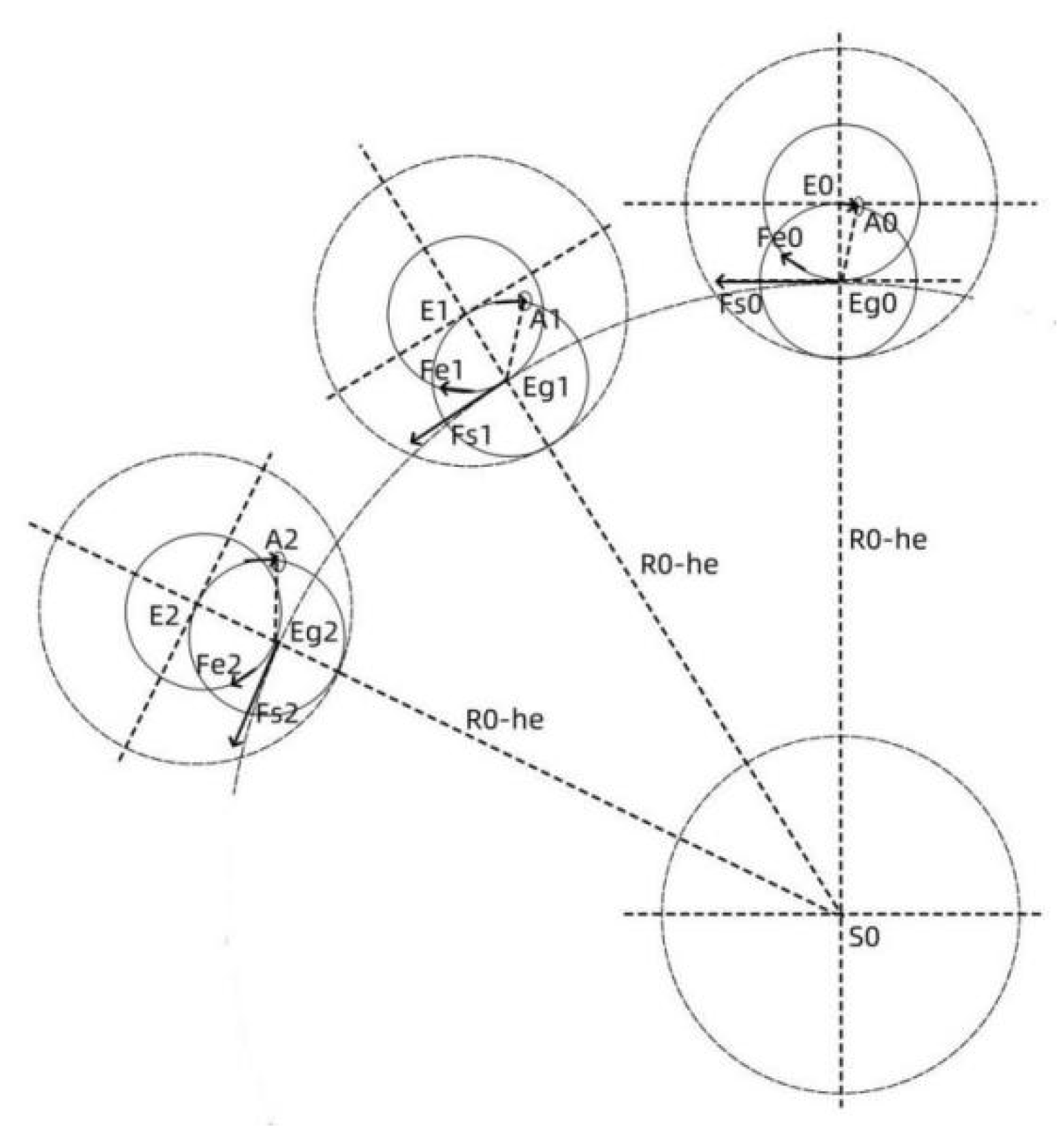
Figure 4.
Planet operation analysis diagram.
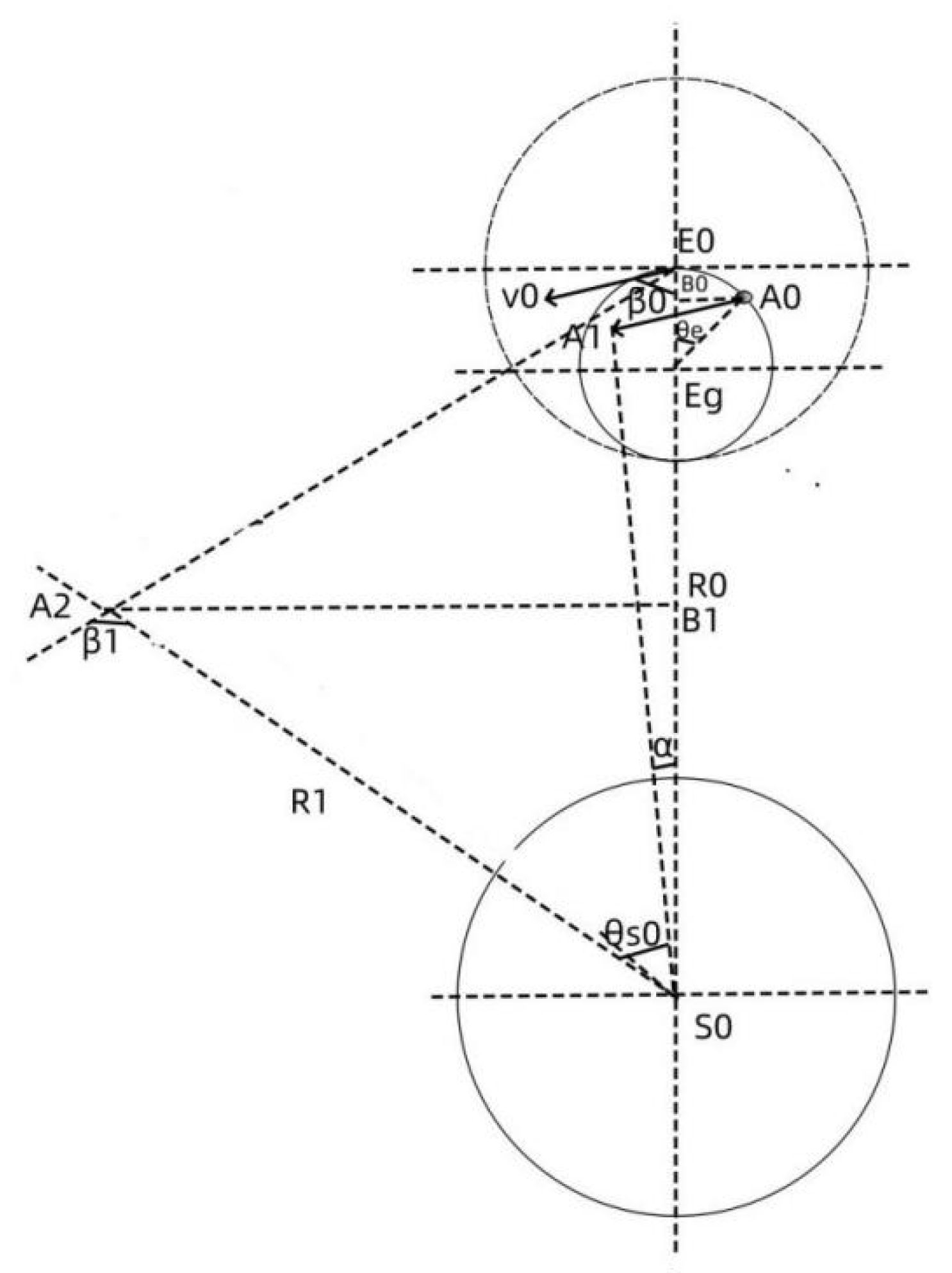
Figure 5.
The Earth orbit simulation diagram.
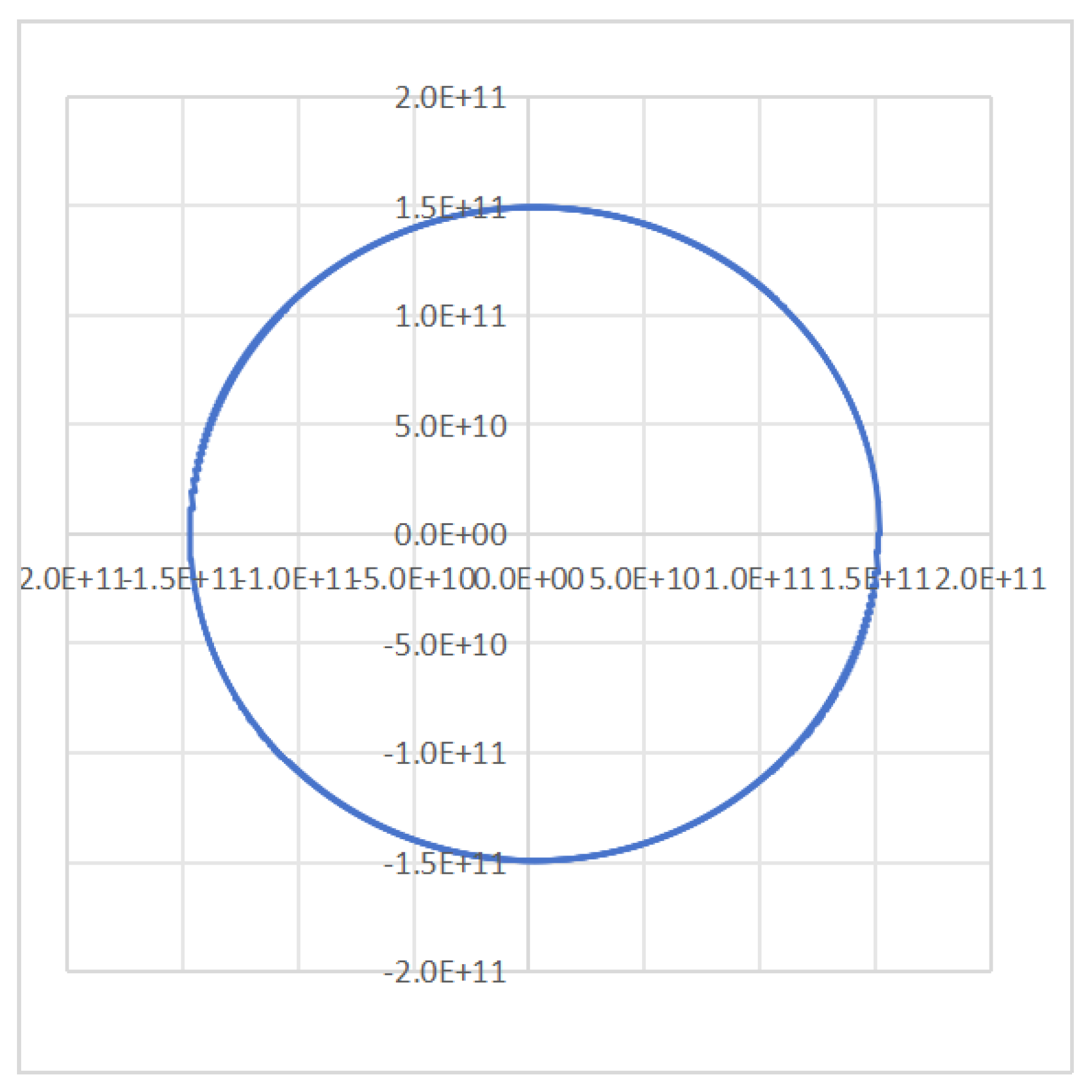
Figure 6.
ball rotation analysis diagram.
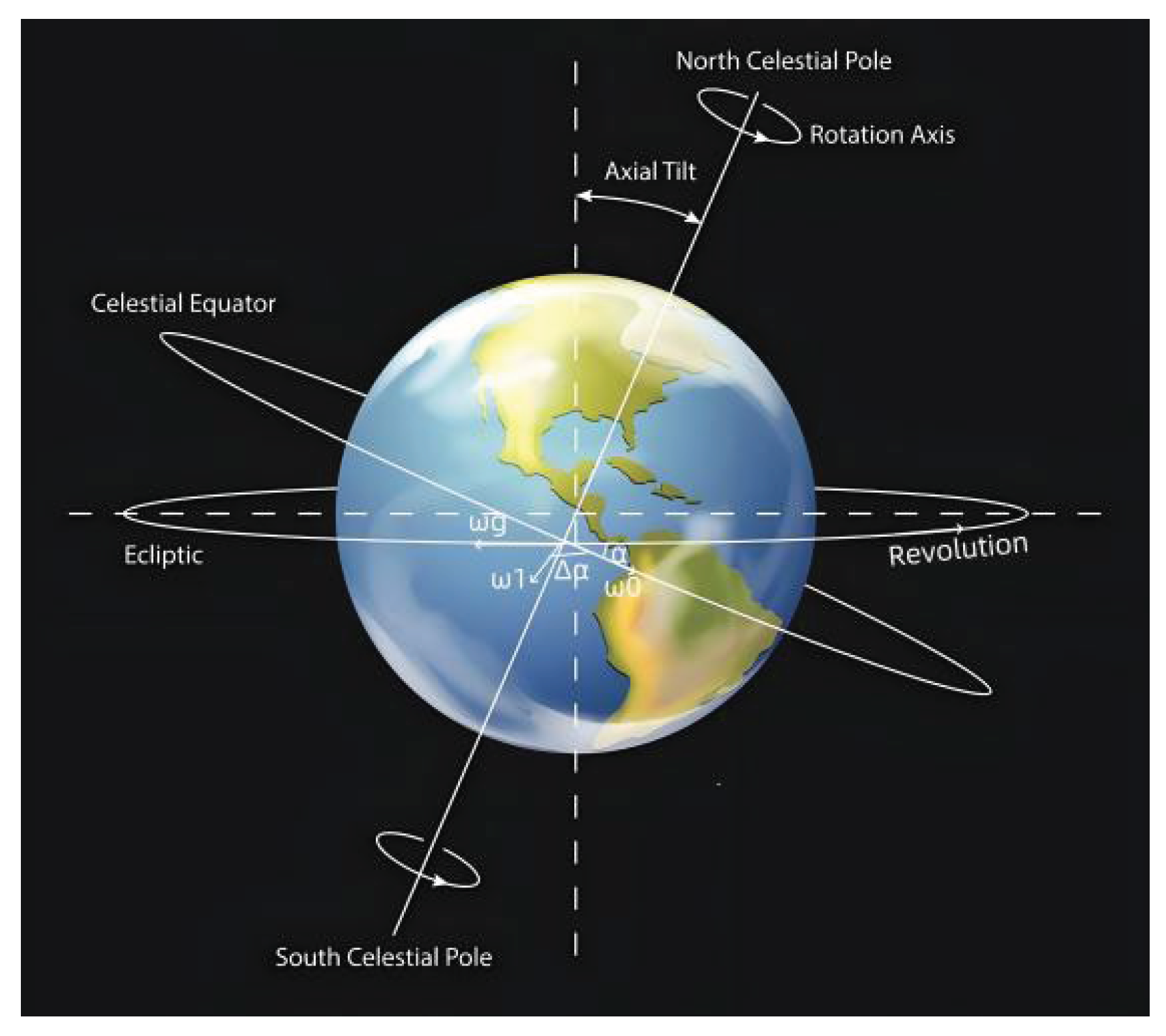

Table 1.
Solid Earth Structure Table.
| The Earth’s Circle Name | Depth (km) |
radius (km) |
earthquake P-wave velocity (km/s) |
earthquake shear velocity (km/s) |
Density (grams/cubic centimeter) | State of matter | |||
|---|---|---|---|---|---|---|---|---|---|
| First level layering | second level layering |
traditional layering | |||||||
| Outer sphere | crust | crust | 0~33 | 6338-6371 | 5.6~7.0 | 3.4~4.2 | 2.6~2.9 | Solid state substance | |
| Outer transition layer | Outer transition layer (Above) | Upper mantle | 33~980 | 5391-6338 | 8.1~10.1 | 4.4~5.4 | 3.2~3.6 | Partially melted substance | |
| Outer transition layer (Below) | Lower mantle | 980~2900 | 3471-5391 | 12.8~13.5 | 6.9~7.2 | 5.1~5.6 | Liquid-solid state substance | ||
| Liquid layer | Liquid layer | outer core | 2900~4700 | 1671-3471 | 8.0~8.2 | cannot pass through | 10.0~11.4 | Liquid state substance | |
| Inner sphere | Internal transition layer | transition layer | 4700~5100 | 1271-1671 | 9.5~10.3 | 12.3 | Liquid -solid state substance | ||
| The earth’s core | inner core | 5100~6371 | 0-1271 | 10.9~11.2 | 12.5 | solid state substance | |||
Table 2.
Simulation table of The Earth’s revolution around the sun.
| re (m) |
R (m) |
he (m) |
β0 | v0 (m/s) |
Fse (N) |
ωe | ωs | α | θc | θ | x (m) |
y (m) |
|---|---|---|---|---|---|---|---|---|---|---|---|---|
| 6.371E+06 | 1.520976E+11 | 3.171E+06 | 1.57080 | 2.929E+04 | 1.597E+23 | 6.010E-05 | 1.253E-09 | 6.022E-04 | 6.061E-04 | 0.00061 | 1.521E+11 | 9.219E+07 |
| me(kg) | 1.520976E+11 | 3.171E+06 | 1.57079 | 2.929E+04 | 1.597E+23 | 6.010E-05 | 1.253E-09 | 6.022E-04 | 6.061E-04 | 0.00121 | 1.521E+11 | 1.844E+08 |
| 5.972E+24 | 1.520975E+11 | 3.171E+06 | 1.57077 | 2.929E+04 | 1.597E+23 | 6.010E-05 | 1.253E-09 | 6.022E-04 | 6.061E-04 | 0.00182 | 1.521E+11 | 2.766E+08 |
| rs(m) | 1.520975E+11 | 3.171E+06 | 1.57076 | 2.929E+04 | 1.597E+23 | 6.010E-05 | 1.253E-09 | 6.022E-04 | 6.061E-04 | 0.00242 | 1.521E+11 | 3.688E+08 |
| 6.955E+08 | 1.520975E+11 | 3.171E+06 | 1.57075 | 2.929E+04 | 1.597E+23 | 6.010E-05 | 1.253E-09 | 6.022E-04 | 6.061E-04 | 0.00303 | 1.521E+11 | 4.609E+08 |
| Rmax(m) | 1.520974E+11 | 3.171E+06 | 1.57074 | 2.929E+04 | 1.597E+23 | 6.010E-05 | 1.253E-09 | 6.022E-04 | 6.061E-04 | 0.00364 | 1.521E+11 | 5.531E+08 |
| 1.521E+11 | 1.520974E+11 | 3.171E+06 | 1.57073 | 2.929E+04 | 1.597E+23 | 6.010E-05 | 1.253E-09 | 6.022E-04 | 6.061E-04 | 0.00424 | 1.521E+11 | 6.453E+08 |
| vmin (m/s) |
1.520974E+11 | 3.171E+06 | 1.57072 | 2.929E+04 | 1.597E+23 | 6.010E-05 | 1.253E-09 | 6.022E-04 | 6.061E-04 | 0.00485 | 1.521E+11 | 7.375E+08 |
| 2.929E+04 | 1.520973E+11 | 3.171E+06 | 1.57071 | 2.929E+04 | 1.597E+23 | 6.010E-05 | 1.253E-09 | 6.022E-04 | 6.061E-04 | 0.00546 | 1.521E+11 | 8.297E+08 |
| kI | 1.520973E+11 | 3.171E+06 | 1.57070 | 2.929E+04 | 1.597E+23 | 6.010E-05 | 1.253E-09 | 6.022E-04 | 6.061E-04 | 0.00606 | 1.521E+11 | 9.219E+08 |
| 0.3307 | 1.520973E+11 | 3.171E+06 | 1.57068 | 2.929E+04 | 1.597E+23 | 6.010E-05 | 1.253E-09 | 6.022E-04 | 6.061E-04 | 0.00667 | 1.521E+11 | 1.014E+09 |
| Gr | 1.520972E+11 | 3.171E+06 | 1.57067 | 2.929E+04 | 1.597E+23 | 6.010E-05 | 1.253E-09 | 6.022E-04 | 6.061E-04 | 0.00727 | 1.521E+11 | 1.106E+09 |
| 1.88160E+14 | 1.520972E+11 | 3.171E+06 | 1.57066 | 2.929E+04 | 1.597E+23 | 6.010E-05 | 1.253E-09 | 6.022E-04 | 6.061E-04 | 0.00788 | 1.521E+11 | 1.198E+09 |
| 1天(s) | 1.520971E+11 | 3.171E+06 | 1.57065 | 2.929E+04 | 1.597E+23 | 6.010E-05 | 1.253E-09 | 6.022E-04 | 6.061E-04 | 0.00849 | 1.521E+11 | 1.291E+09 |
| 8.616E+04 | 1.520971E+11 | 3.171E+06 | 1.57064 | 2.929E+04 | 1.597E+23 | 6.010E-05 | 1.253E-09 | 6.022E-04 | 6.061E-04 | 0.00909 | 1.521E+11 | 1.383E+09 |
| T(s) | 1.520971E+11 | 3.171E+06 | 1.57063 | 2.929E+04 | 1.597E+23 | 6.010E-05 | 1.253E-09 | 6.022E-04 | 6.061E-04 | 0.00970 | 1.521E+11 | 1.475E+09 |
| 3.147E+07 | 1.520970E+11 | 3.171E+06 | 1.57062 | 2.929E+04 | 1.597E+23 | 6.010E-05 | 1.253E-09 | 6.022E-04 | 6.061E-04 | 0.01030 | 1.521E+11 | 1.567E+09 |
| n | 1.520970E+11 | 3.171E+06 | 1.57061 | 2.929E+04 | 1.597E+23 | 6.010E-05 | 1.253E-09 | 6.022E-04 | 6.061E-04 | 0.01091 | 1.521E+11 | 1.659E+09 |
| 10000 | 1.520969E+11 | 3.171E+06 | 1.57059 | 2.929E+04 | 1.597E+23 | 6.010E-05 | 1.253E-09 | 6.022E-04 | 6.061E-04 | 0.01152 | 1.521E+11 | 1.752E+09 |
| Δt(s) | 1.520969E+11 | 3.171E+06 | 1.57058 | 2.929E+04 | 1.597E+23 | 6.010E-05 | 1.253E-09 | 6.022E-04 | 6.061E-04 | 0.01212 | 1.521E+11 | 1.844E+09 |
| 3147 | 1.520968E+11 | 3.171E+06 | 1.57057 | 2.929E+04 | 1.597E+23 | 6.010E-05 | 1.253E-09 | 6.022E-04 | 6.061E-04 | 0.01273 | 1.521E+11 | 1.936E+09 |
Disclaimer/Publisher’s Note: The statements, opinions and data contained in all publications are solely those of the individual author(s) and contributor(s) and not of MDPI and/or the editor(s). MDPI and/or the editor(s) disclaim responsibility for any injury to people or property resulting from any ideas, methods, instructions or products referred to in the content. |
© 2025 by the authors. Licensee MDPI, Basel, Switzerland. This article is an open access article distributed under the terms and conditions of the Creative Commons Attribution (CC BY) license (http://creativecommons.org/licenses/by/4.0/).
Copyright: This open access article is published under a Creative Commons CC BY 4.0 license, which permit the free download, distribution, and reuse, provided that the author and preprint are cited in any reuse.


