

Submitted:
23 May 2025
Posted:
26 May 2025
You are already at the latest version
Abstract
This brief paper explores classical and quantum entropy through the lens of relativistic observer-dependence. By modeling a qubit-populated spherical system, we analyze entropy as perceived by spatially separated observers, introducing time delay effects in information acquisition. Shannon and von Neumann entropies are formulated as observer-dependent functions, and a framework is proposed for the spatiotemporal propagation of informational entropy. The work emphasizes that entropy, typically viewed as a scalar or global property, acquires field-like behavior when relativistic considerations are included.
Keywords:
shannon entropy
; neumann entropy
1. Introduction
Entropy is central to classical and quantum information theory. Shannon entropy quantifies uncertainty in a discrete probability distribution [1], while von Neumann entropy generalizes this concept to quantum systems via density matrices [2].
In relativistic contexts, simultaneity becomes relative, and information cannot travel faster than light. Consequently, observers at different space-time coordinates perceive different states of the same system at the same coordinate time. Building on ideas from relativistic quantum information theory [3,4,5], this work presents a formalism in which entropy becomes an observer-dependent, space-time-dependent quantity. We reformulate classical and quantum entropy to include signal delay and define an entropy field over space-time.
2. Entropy in Classical Information Theory
Let Be a binary alphabet, and let Be a discrete random variable over , with a probability distribution The Shannon entropy is:
Assume the information source is located at position x_s, and the observer is at position , with spatial separation.Given the speed of light c, the observer receives delayed information with a time lag. . Thus, the observer-relative Shannon entropy becomes:
3. Quantum Information: von Neumann Entropy
For quantum systems, the state is described by a density matrix , with The von Neumann entropy is:
Let ρ(t) denote the time-evolving density matrix. The entropy as perceived by an observer at position is delayed:
4. Time Evolution and Dynamics
4.1. Classical Case: Markov Dynamics
Consider a binary Markov process where the probability p of the system being in stateevolves according to:
The time-dependent Shannon entropy is:
Incorporating information delay, the observer-relative entropy becomes:
4.2. Quantum Case: Lindblad Evolution
For unitary evolution of a closed quantum system: the von Neumann entropy remains constant if is diagonal. For open systems, the evolution is governed by the Lindblad master equation:
The perceived entropy evolves as:
5. Entropy as a Spacetime Field
We define an entropy field E(x, t) over space-time, accounting for relativistic delay:
This field exhibits discontinuities along null surfaces—i.e., the light cones—referred to as entropy horizons.
6. Entropy Gradient and Information Flux
We define the information flux as the spatial gradient of the entropy field:
This vector field encodes the spatial rate of change of perceived entropy. The temporal derivative represents the local rate of informational change.
7. Conclusion
By incorporating the finite speed of information transfer, this work demonstrates that both classical and quantum entropy become observer-relative quantities in space-time. The resulting framework leads naturally to the concept of entropy as a dynamical field, with gradients and fluxes constrained by causal structure. These insights may prove valuable in areas such as:
- -
- Cosmological entropy flows
- -
- Black hole thermodynamics
- -
- Relativistic quantum communication
Future work could include coupling the entropy field with curved spacetime metrics and exploring its behavior in general relativistic settings.
Figure representations
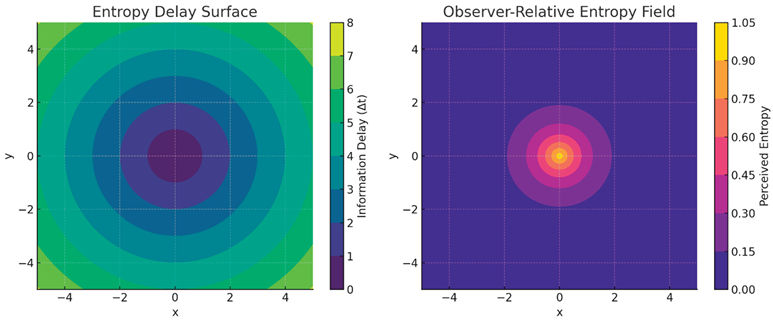
Here are two visualizations:
- Entropy Delay Surface: This shows how information delay (Δt) increases with spatial separation from the observer (at the origin). It forms concentric contours, similar to light cones.
- Observer-Relative Entropy Field: This model perceived entropy as decreasing with distance due to the delay, following an exponential decay for illustrative purposes.
References
- Shannon, C. E. (1948). A Mathematical Theory of Communication. Bell System Technical Journal, 27(3), 379–423. [CrossRef]
- Nielsen, M. A., & Chuang, I. L. (2010). Quantum Computation and Quantum Information. Cambridge University Press.
- Peres, A., & Terno, D. R. (2004). Quantum Information and Relativity Theory. Rev. Mod. Phys., 76(1), 93–123. [CrossRef]
- Rovelli, C. (1996). Relational Quantum Mechanics. Int. J. Theor. Phys., 35(8), 1637–1678. [CrossRef]
- Sorkin, R. D. (1997). Forks in the Road, on the Way to Quantum Gravity. Int. J. Theor. Phys., 36(12), 2759–2781. [CrossRef]
- Gorini, V., Kossakowski, A., & Sudarshan, E. C. G. (1976). Completely Positive Dynamical Semigroups of N-Level Systems. J. Math. Phys., 17(5), 821–825. [CrossRef]
- Bekenstein, J. D. (1973). Black Holes and Entropy. Phys. Rev. D, 7(8), 2333–2346. [CrossRef]
- Wootters, W. K. (1981). Statistical Distance and Hilbert Space. Phys. Rev. D, 23(2), 357–362. [CrossRef]
- Terno, D. R. (2006). Introduction to Relativistic Quantum Information. In Quantum Information Processing: From Theory to Experiment (pp. 61–86). Springer.
Disclaimer/Publisher’s Note: The statements, opinions and data contained in all publications are solely those of the individual author(s) and contributor(s) and not of MDPI and/or the editor(s). MDPI and/or the editor(s) disclaim responsibility for any injury to people or property resulting from any ideas, methods, instructions or products referred to in the content. |
© 2025 by the authors. Licensee MDPI, Basel, Switzerland. This article is an open access article distributed under the terms and conditions of the Creative Commons Attribution (CC BY) license (http://creativecommons.org/licenses/by/4.0/).
Copyright: This open access article is published under a Creative Commons CC BY 4.0 license, which permit the free download, distribution, and reuse, provided that the author and preprint are cited in any reuse.


