
Submitted:
13 May 2025
Posted:
14 May 2025
You are already at the latest version
Abstract
As neutrino experiments enter into the precision era, it is desirable to identify deviations from data in comparison to theory as well as provide possible models as explanation. Particularly useful is the description in terms of non-standard interactions (NSI), which can be related to neutral (NC-NSI) or charged (CC-NSI) currents. Previously, we have developed the code eft-neutrino that connects NSI with generic UV models at tree-level matching. In this work, we integrate our code with other tools, increasing the matching between the UV and IR theories to one-loop level. As working example, we consider the pion and kaon decay, the main production mechanisms for accelerator neutrino experiments. We provide up-to-date allowed regions on a set of Wilson coefficients related to pion and kaon decay. We also illustrate how our chain of codes can be used in particular UV models, showing that promising large value for CC-NSI can be misleading when considering a specific UV model.
Keywords:
neutrinos
; effective field theory
; beyond standard model
1. Introduction
Neutrino physics is approaching the precision era, given the development of a new generation of accelerator, atmospheric and astrophysical facilities. The Deep Underground Neutrino Experiment (DUNE) are now under construction and projected to deliver sub-percent measurements of oscillation parameters and lepton–universality tests [1,2]. In Japan, Hyper-Kamiokande will bring an eight-fold mass increase over Super-K and will start data-taking in 2027, providing complementary sensitivity to proton decay, supernova neutrinos and CP violation in the lepton sector [3]. At the energy frontier, forward detectors such as FASER and SND@LHC have already observed the first TeV-scale neutrino interactions and aim to measure charged–current (CC) events by the end of LHC Run-3, opening a qualitatively new window on neutrino interactions and forward meson production [4,5].
All of these beamlines depend overwhelmingly on leptonic meson decays for their fluxes. The channels and alone supply more than 90% of the flux at DUNE and Hyper-K, while forward decays generate the bulk of the LHC neutrino spectrum. Thanks to experimental control of decay rates and lattice-QCD calculations of hadronic matrix elements, these processes are among the cleanest electroweak observables; The latest NA62 branching-ratio measurement [6], when interpreted within the low-energy–effective–theory (LEFT) framework, already forces the dominant vector-type coefficient to satisfy as shown by EFT analyses in Refs. [7,8]. Comparable—or even stronger—bounds apply to scalar and tensor structures [9]. Given such precision, any deviation seen by upcoming neutrino detectors could plausibly originate in the production stage and would point to charged non-standard interactions (CC-NSI) or other beyond-the-Standard-Model (BSM) effects in meson decay.
Non-standard neutrino interactions were first introduced by Wolfenstein in 1978 to describe coherent forward scattering in matter [10]. Comprehensive reviews by Ohlsson [11] and by Farzan & Tortola [12] summarise three decades of phenomenology, while more recent global fits highlight the parameter degeneracies that next-generation beams must resolve [13]. Model builders have explored many ultraviolet (UV) origins, including scalar doublets, vector leptoquarks and gauge bosons; several of these scenarios generate sizeable CC-NSI only at the one-loop level, thereby evading tree-level constraints, see for instance [14,15,16,17,18,19,20,21,22,23,24,25].
The natural language to connect such UV completions with experimental observables is Effective Field Theory (EFT). Below the electroweak scale, the LEFT describes meson decays through five four-fermion operators whose Wilson coefficients are denoted . These coefficients match onto the Standard-Model EFT (SMEFT) at GeV and can then be evolved up to any heavy mass scale. The complete tree-level LEFT↔SMEFT dictionary was completed in [26], while the one-loop extension was presented in [27]. Loop effects are crucial. For instance, they can enforce correlations with flavour-changing processes that would be invisible in a purely low-energy fit.
A set of public codes now renders this multi-scale programme computationally possible. Among those, flavio provides predictions and likelihoods for hundreds of flavour observables [28]; wilson performs renormalisation-group running and threshold matching across SMEFT, LEFT and QED/QCD EFTs [29]; while smelli wraps these ingredients into a global likelihood engine [30]. From a top-down perspective, codes such as matchmakereft [31] and Matchete [32] aim to provide the one-loop matching from given UV models to the SMEFT or LEFT. Focusing exclusively on the SMEFT as target EFT, SOLD [33,34] is particularly useful. It not only provides a user-friendly implementation of tree-level matching results presented in [35], but also extends those to one-loop matching (restricted at present to UV models containing fermions or scalars). Focusing on neutrinos experiments, in [36] we have developed the code eft-neutrinos, which provides the UV connection to Wilson coefficients in the LEFT automatically, at tree-level matching.
In this work, we extend our previous analysis to one-loop matching, relying on the recent developments of SOLD. In particular, we aim to map the models that could be behind possible anomalies detected in future neutrino experiments such as DUNE, HyperK, and Faser. For pion decay, we have already mapped all the UV realizations at tree-level matching in a previous work [36]. We will go beyond these findings by extending the matching to one-loop order. We will also generalize the results to include kaon decay.
This work is organized as follows: in Section 2 we present the methodology employed in our work, as well as setting the notation used. In Section 3 we present our results, in particular the bounds on the CC-NSI as well as in the SMEFT WC relevant for pion and kaon decay. In Section 4 we put our findings into perspective and conclude.
2. Methodology
Given the non-observation of unexpected resonances at the LHC, the influence of new heavy states can only be detected indirectly. This task is generally accomplished by resorting to an effective field theory approach, where the impact of BSM states is encapsulated into Wilson coefficients. In order to access the present constraints on dimension-six SMEFT WCs, we employed the codes flavio, wilson, and smelli [28,29,30]. The connection to UV models can be achieved with the help of SOLD [33,34]. The chain of codes employed can be summarized in Figure 1. Here, we used eft-neutrinos [36] to obtain the WCs of SMEFT relevant for pion and kaon decay. Then, we used flavio, wilson, and smelli to obtain the present bounds on those WCs. After, we used SOLD to find the UV models at one-loop matching that could also generate those WCs. We have chosen one of such UV models, finding all the WCs that they could generate, apart from the ones connected directly to pion and kaon decay. Equipped with this knowledge, we reprocessed the results in flavio, wilson, and smelli, which finally gave the ultimate allowed values for the CC-NSI.
In the next section we present the UV models relevant for meson decay, as well as the current constraints on SMEFT WCs related to these observables. In the remaining of the section we briefly discuss our notation.
In neutrino accelerator experiments, neutrinos are mainly produced by charged-current processes. In this case, it is natural to employ an EFT where the , Z bosons were integrated, which we denote by WEFT. The Wilson Coefficients for the WEFT are commonly denoted Non-Standard Interactions (NSI). For our purposes, the relevant part of the EFT Lagrangian is given by [26,37]
We assume that all charged fermions are in the mass eigenstate basis, V is the CKM matrix, and GeV is the Higgs vacuum expectation value. We can relate this Lagrangian to more commonly used Low Energy EFT (LEFT) Lagrangian, which renders the following connection in the notation of [26]
where and we are using an asterisk to denote complex conjugation here. One can perform the matching to the SMEFT, which was done in [26]. For completeness, we reproduce it below
where
We are adopting the so-called up basis where the up quark and charged lepton Yukawa matrices are diagonal.
In order to connect the CC-NSI to neutrino experiments, we employ a quantum field theory (QFT) framework [38,39,40,41]. For accelerator neutrino experiments, where neutrinos are produced trough pion decay, we obtain that the differential event rate for neutrinos produced with flavor to be detected with flavor and energy at a detector distant L from the source S is given by [42]
where is the SM flux, while is the SM cross-section. The matrix is the PMNS matrix, while the matrix is given by
It is clear from the equation above that neutrino accelerator experiments are sensitive only to the direction . It is straightforward to express the CC-NSI parameters in terms of the WC of the SMEFT, which we also reproduce below for completeness [36]
where we used the notation .
3. Results
Given the chain introduced in Figure 1 we have obtained the present constrains on all SMEFT WCs relevant to pion and kaon decay. The results can be seen in Figure 2, Figure 3, Figure 4.
In figure we show the bounds on CC-NSI relevant for pion decay, namely . By considering only one SMEFT WC non-null at time, we obtain the red/blue bands. We also include as black lines the current limits extracted directly from pion or tau decay experiments [43]. In figure we show the bounds on each SMEFT WC that enter in the prediction of the pion decay rate. We consider only one non-null WC at time. In red we show the present limits coming directly from pion or tau decay [43]. A similar figure can be devised for the SMEFT WC that impact the kaon decay. We show the present bounds on Figure 4, where in red we represent the direct limits from kaon or tau decay [43].
Regarding the SMEFT WCs related to pion decay, as the plots clear show, the WCs are the least constrained by flavio. However, one needs to add the bound that comes directly from pion decay, which reduces significantly the maximum allowed value for . Therefore, we will seek models that can generate .
The complete list of UV models up to one-loop matching relevant to pion and kaon decay is provided into the repository eft-neutrinos1. As illustrative example we consider an UV model containing a leptoquark . Its quantum numbers under the gauge group are . Performing the one-loop matching with SOLD we obtain
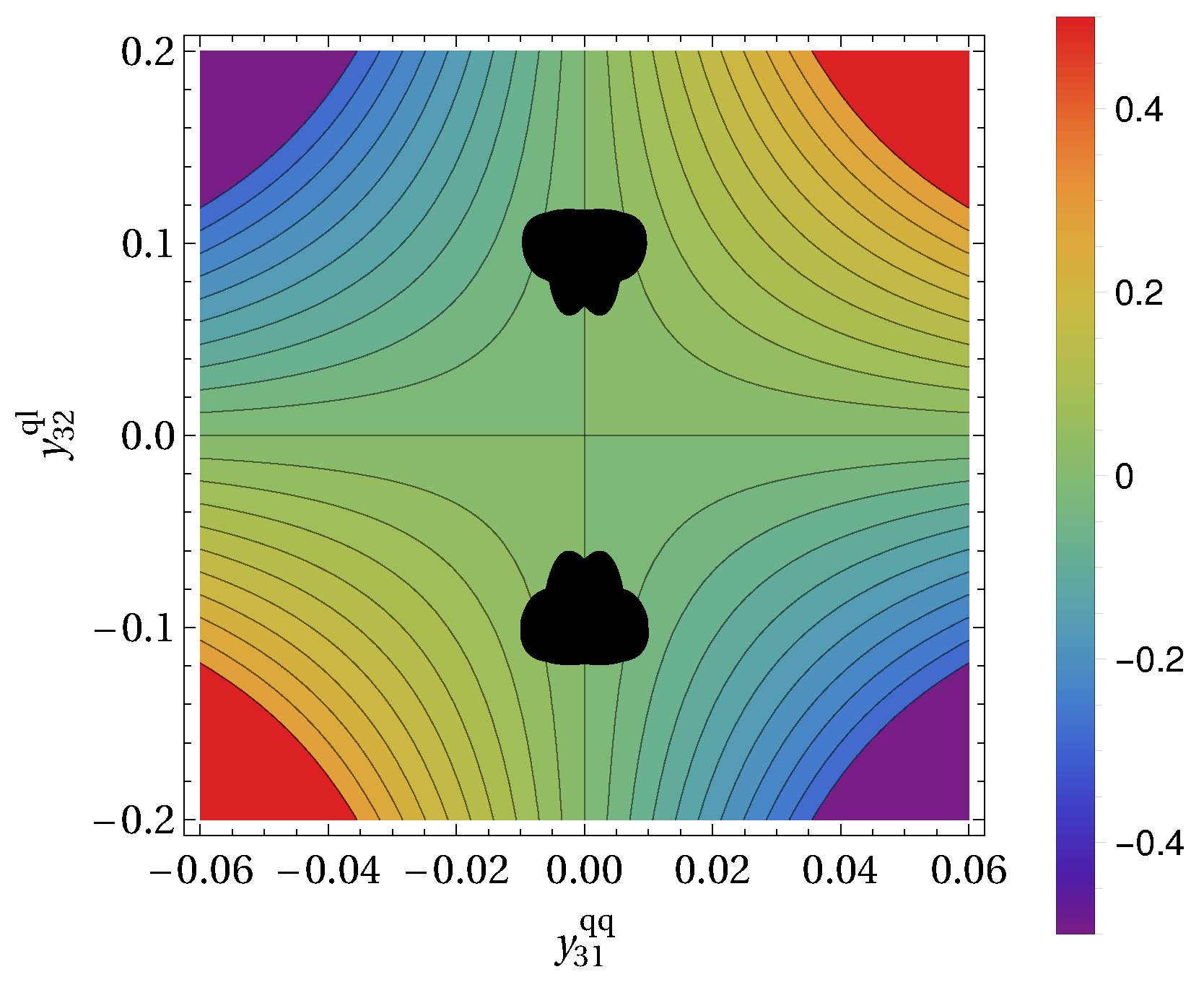
This model generates other WC at one-loop matching, such as . Actually, there is a contribution already at tree-level. In order to suppress those, we will consider couplings with third generation quarks in the loop. In other words, we only consider the case . Under this scenario, the one-loop matching to is null. Therefore, we will consider a UV model containing where only the couplings are non-null. We also consider that they are real for simplicity. Under these circumstances, we found the allowed region on those parameters. The result can be seen in Figure 5
In Figure 5 we show in black the 90% C.L. allowed region on the parameters . We are considering and . Using those values, we can also find the contours for different values of , which we also display. The values should be multiplied by . After imposing bounds coming from other WCs, we find that can be at most . Therefore, the allowed CC-NSI in this UV model is much lower than our initial analysis suggested. A similar reasoning can be applied to WC that affects kaon decay. We have checked that same the pattern depicted in Figure 5 emerges, where the only difference is that is non-null (and equal to one).
Other interesting UV model is the one where we add a scalar doublet , whose quantum numbers are . We assume no-mixing with the standard higgs doublet, and that does not develop a vev. Also, only a specific combination of Yukawas are non-null, namely and . Therefore, already at tree-level matching there is a contribution
We have performed the one-loop matching to the SMEFT of this model under the assumption that only and are non-null. As expected, many other operators are induced. However, the stronger bounds still come from pion decay, setting
Thus, for order one couplings, the lower bound on the scalar mass is of order 3.5 TeV.
For the case of , that enters in the kaon decay prediction, we need only to consider non-null instead of . We have performed this analysis, and checked that the strongest bound is still coming from kaon decay directly, namely
Thus, for order one couplings, the lower bound on the scalar mass is of order 7.6 TeV.
Another models can be devised as well, using the results in the repository eft-neutrinos. A thorough investigation is beyond the scope of this work, since our main aim was to provide and exemplify the chain of codes depicted in Figure 1.
4. Discussion
Neutrino experiments are delving into the precision era. In this scenario, the constrains on new phenomena will either become tidier or a clean sign of new physics will emerge. In order to help navigate into the latter case, the usage of effective field theories is particularly promising. This approach provides a consistent way to connect low-energy phenomena (extracted at neutrino experiments, for instance) with the possible underlying UV models.
In this work we have focused on possible new phenomena perceived in accelerator neutrino experiments, from modifications at the standard pion or kaon decay. The imprints of such new phenomena can be conveniently written as CC-NSI. Using an EFT approach, we mapped all models with BSM fermions or scalars at one-loop matching that could affect the pion or kaon decay rate. Once a model was chosen, we illustrated how bounds from other sources (mainly flavor experiments) could play a role on constraining the maximum allowed CC-NSI.
Funding
A.C. acknowledges support from National Council for Scientific and Technological Development—CNPq.
Data Availability Statement
Data used in this work can be found in the repository eft-neutrinos2.
Conflicts of Interest
The author declare no conflicts of interest. The funders had no role in the design of the study; in the collection, analyses, or interpretation of data; in the writing of the manuscript; or in the decision to publish the results.
Abbreviations
The following abbreviations are used in this manuscript:
| UV | Ultra-violet |
| IR | Infrared |
| WC | Wilson coefficient |
| BSM | Beyond Standard Model |
| EFT | Effective Field Theory |
| NC-NSI | Neutral non-standard interactions |
| CC-NSI | Charged non-standard interactions |
References
- Abi, B.; et al. Deep Underground Neutrino Experiment (DUNE), Far Detector Technical Design Report, Volume II: DUNE Physics 2020. [arXiv:hep-ex/2002.03005].
- Abi, B.; et al. Prospects for beyond the Standard Model physics searches at the Deep Underground Neutrino Experiment. Eur. Phys. J. C 2021, 81, 322, [arXiv:hep-ex/2008.12769]. [CrossRef]
- Abe, K.; et al. Hyper-Kamiokande Design Report 2018. [arXiv:physics.ins-det/1805.04163].
- Mammen Abraham, R.; et al. First Measurement of νe and νμ Interaction Cross Sections at the LHC with FASER’s Emulsion Detector. Phys. Rev. Lett. 2024, arXiv:hep-ex/2403.12520133, 021802. [Google Scholar] [CrossRef] [PubMed]
- Abreu, H.; et al. First Direct Observation of Collider Neutrinos with FASER at the LHC. Phys. Rev. Lett. 2023, arXiv:hep-ex/2303.14185131, 031801. [Google Scholar] [CrossRef] [PubMed]
- Cortina Gil, E.; et al. Measurement of the very rare K+→π+νν¯ decay. JHEP 2021, arXiv:hep-ex/2103.15389]06, 093. [Google Scholar] [CrossRef]
- Li, T.; Ma, X.D.; Schmidt, M.A. Implication of K→πνν¯ for generic neutrino interactions in effective field theories. Phys. Rev. D 2020, arXiv:hep-ph/1912.10433]101, 055019. [Google Scholar] [CrossRef]
- Gorbahn, M.; Moldanazarova, U.; Sieja, K.H.; Stamou, E.; Tabet, M. The anatomy of K+→π+νν¯ distributions. Eur. Phys. J. C 2024, arXiv:hep-ph/2312.06494]84, 680. [Google Scholar] [CrossRef]
- Deppisch, F.F.; Fridell, K.; Harz, J. Constraining lepton number violating interactions in rare kaon decays. JHEP 2020, arXiv:hep-ph/2009.04494]12, 186. [Google Scholar] [CrossRef]
- Wolfenstein, L. Neutrino Oscillations in Matter. Phys. Rev. D 1978, 17, 2369–2374. [Google Scholar] [CrossRef]
- Ohlsson, T. Status of non-standard neutrino interactions. Rept. Prog. Phys. 2013, arXiv:hep-ph/1209.2710]76, 044201. [Google Scholar] [CrossRef]
- Farzan, Y.; Tortola, M. Neutrino oscillations and Non-Standard Interactions. Front. in Phys. 2018, arXiv:hep-ph/1710.09360]6, 10. [Google Scholar] [CrossRef]
- Coloma, P.; Gonzalez-Garcia, M.C.; Maltoni, M.; Pinheiro, J.a.P.; Urrea, S. Global constraints on non-standard neutrino interactions with quarks and electrons. JHEP 2023, arXiv:hep-ph/2305.07698]08, 032. [Google Scholar] [CrossRef]
- Bergmann, S.; Grossman, Y.; Pierce, D.M. Can lepton flavor violating interactions explain the atmospheric neutrino problem? Phys. Rev. D 2000, 61, 053005. [Google Scholar] [CrossRef]
- Antusch, S.; Baumann, J.P.; Fernandez-Martinez, E. Non-Standard Neutrino Interactions with Matter from Physics Beyond the Standard Model. Nucl. Phys. B 2009, arXiv:hep-ph/0807.1003]810, 369–388. [Google Scholar] [CrossRef]
- Gavela, M.B.; Hernandez, D.; Ota, T.; Winter, W. Large gauge invariant non-standard neutrino interactions. Phys. Rev. D 2009, arXiv:hep-ph/0809.3451]79, 013007. [Google Scholar] [CrossRef]
- Meloni, D.; Ohlsson, T.; Winter, W.; Zhang, H. Non-standard interactions versus non-unitary lepton flavor mixing at a neutrino factory. JHEP 2010, arXiv:hep-ph/0912.2735]04, 041. [Google Scholar] [CrossRef]
- Altmannshofer, W.; Tammaro, M.; Zupan, J. Non-standard neutrino interactions and low energy experiments. JHEP 2019, arXiv:hep-ph/1812.02778]09, 083. [Google Scholar] [CrossRef]
- Babu, K.S.; Dev, P.S.B.; Jana, S.; Thapa, A. Non-Standard Interactions in Radiative Neutrino Mass Models. JHEP 2020, arXiv:hep-ph/1907.09498]03, 006. [Google Scholar] [CrossRef]
- Bischer, I.; Rodejohann, W. General neutrino interactions from an effective field theory perspective. Nucl. Phys. B 2019, arXiv:hep-ph/1905.08699]947, 114746. [Google Scholar] [CrossRef]
- Davidson, S.; Gorbahn, M. Charged lepton flavor change and nonstandard neutrino interactions. Phys. Rev. D 2020, arXiv:hep-ph/1909.07406]101, 015010. [Google Scholar] [CrossRef]
- Terol-Calvo, J.; Tórtola, M.; Vicente, A. High-energy constraints from low-energy neutrino nonstandard interactions. Phys. Rev. D 2020, arXiv:hep-ph/1912.09131]101, 095010. [Google Scholar] [CrossRef]
- Babu, K.S.; Gonçalves, D.; Jana, S.; Machado, P.A.N. Neutrino Non-Standard Interactions: Complementarity Between LHC and Oscillation Experiments. Phys. Lett. B 2021, arXiv:hep-ph/2003.03383]815, 136131. [Google Scholar] [CrossRef]
- Du, Y.; Li, H.L.; Tang, J.; Vihonen, S.; Yu, J.H. Non-standard interactions in SMEFT confronted with terrestrial neutrino experiments. JHEP 2021, arXiv:hep-ph/2011.14292]03, 019. [Google Scholar] [CrossRef]
- Du, Y.; Li, H.L.; Tang, J.; Vihonen, S.; Yu, J.H. Exploring SMEFT induced nonstandard interactions: From COHERENT to neutrino oscillations. Phys. Rev. D 2022, arXiv:hep-ph/2106.15800]105, 075022. [Google Scholar] [CrossRef]
- Jenkins, E.E.; Manohar, A.V.; Stoffer, P. Low-Energy Effective Field Theory below the Electroweak Scale: Operators and Matching. JHEP 2018, arXiv:hep-ph/1709.04486]03, 016. [Google Scholar] [CrossRef]
- Dekens, W.; Stoffer, P. Low-energy effective field theory below the electroweak scale: matching at one loop. JHEP 2019, arXiv:hep-ph/1908.05295]10, 197. [Google Scholar] [CrossRef]
- Straub, D.M. flavio: A Python package for flavour and precision phenomenology in the Standard Model and beyond 2018. [arXiv:hep-ph/1810.08132].
- Aebischer, J.; Kumar, J.; Straub, D.M. Wilson: A Python package for the running and matching of Wilson coefficients above and below the electroweak scale. Eur. Phys. J. C 2018, arXiv:hep-ph/1804.05033]78, 1026. [Google Scholar] [CrossRef]
- Aebischer, J.; Kumar, J.; Stangl, P.; Straub, D.M. A Global Likelihood for Precision Constraints and Flavour Anomalies. Eur. Phys. J. C 2019, arXiv:hep-ph/1810.07698]79, 509. [Google Scholar] [CrossRef]
- Carmona, A.; Lazopoulos, A.; Olgoso, P.; Santiago, J. Matchmakereft: Automated tree-level and one-loop matching. SciPost Phys. 2022, arXiv:hep-ph/2112.10787]12, 198. [Google Scholar] [CrossRef]
- Fuentes-Martín, J.; König, M.; Pagès, J.; Thomsen, A.E.; Wilsch, F. A proof of concept for matchete: An automated tool for matching effective theories. Eur. Phys. J. C 2023, arXiv:hep-ph/2212.04510]83, 662. [Google Scholar] [CrossRef]
- Guedes, G.; Olgoso, P.; Santiago, J. Towards the one loop IR/UV dictionary in the SMEFT: One loop generated operators from new scalars and fermions. SciPost Phys. 2023, arXiv:hep-ph/2303.16965]15, 143. [Google Scholar] [CrossRef]
- Guedes, G.; Olgoso, P. From the EFT to the UV: The complete SMEFT one-loop dictionary 2024. [arXiv:hep-ph/2412.14253].
- de Blas, J.; Criado, J.C.; Perez-Victoria, M.; Santiago, J. Effective description of general extensions of the Standard Model: the complete tree-level dictionary. JHEP 2018, arXiv:hep-ph/1711.10391]03, 109. [Google Scholar] [CrossRef]
- Cherchiglia, A.; Santiago, J. DUNE potential as a new physics probe. JHEP 2024, arXiv:hep-ph/2309.15924]03, 018. [Google Scholar] [CrossRef]
- Cirigliano, V.; Jenkins, J.; Gonzalez-Alonso, M. Semileptonic decays of light quarks beyond the Standard Model. Nucl. Phys. B 2010, arXiv:hep-ph/0908.1754]830, 95–115. [Google Scholar] [CrossRef]
- Giunti, C.; Kim, C.W.; Lee, J.A.; Lee, U.W. On the treatment of neutrino oscillations without resort to weak eigenstates. Phys. Rev. D 1993, 48, 4310–4317. [Google Scholar] [CrossRef]
- Akhmedov, E.K.; Kopp, J. Neutrino Oscillations: Quantum Mechanics vs. Quantum Field Theory. JHEP 2010, arXiv:hep-ph/1001.4815]04, 008. [Google Scholar] [CrossRef]
- Kobach, A.; Manohar, A.V.; McGreevy, J. Neutrino Oscillation Measurements Computed in Quantum Field Theory. Phys. Lett. B 2018, arXiv:hep-ph/1711.07491]783, 59–75. [Google Scholar] [CrossRef]
- Falkowski, A.; González-Alonso, M.; Tabrizi, Z. Consistent QFT description of non-standard neutrino interactions. JHEP 2020, arXiv:hep-ph/1910.02971]11, 048. [Google Scholar] [CrossRef]
- Bresó-Pla, V.; Falkowski, A.; González-Alonso, M.; Monsálvez-Pozo, K. EFT analysis of New Physics at COHERENT. JHEP 2023, arXiv:hep-ph/2301.07036]05, 074. [Google Scholar] [CrossRef]
- Falkowski, A.; González-Alonso, M.; Kopp, J.; Soreq, Y.; Tabrizi, Z. EFT at FASERν. JHEP 2021, arXiv:hep-ph/2105.12136]10, 086. [Google Scholar] [CrossRef]
| 1 | |
| 2 |
Figure 1.
Chain of codes employed in our analysis.
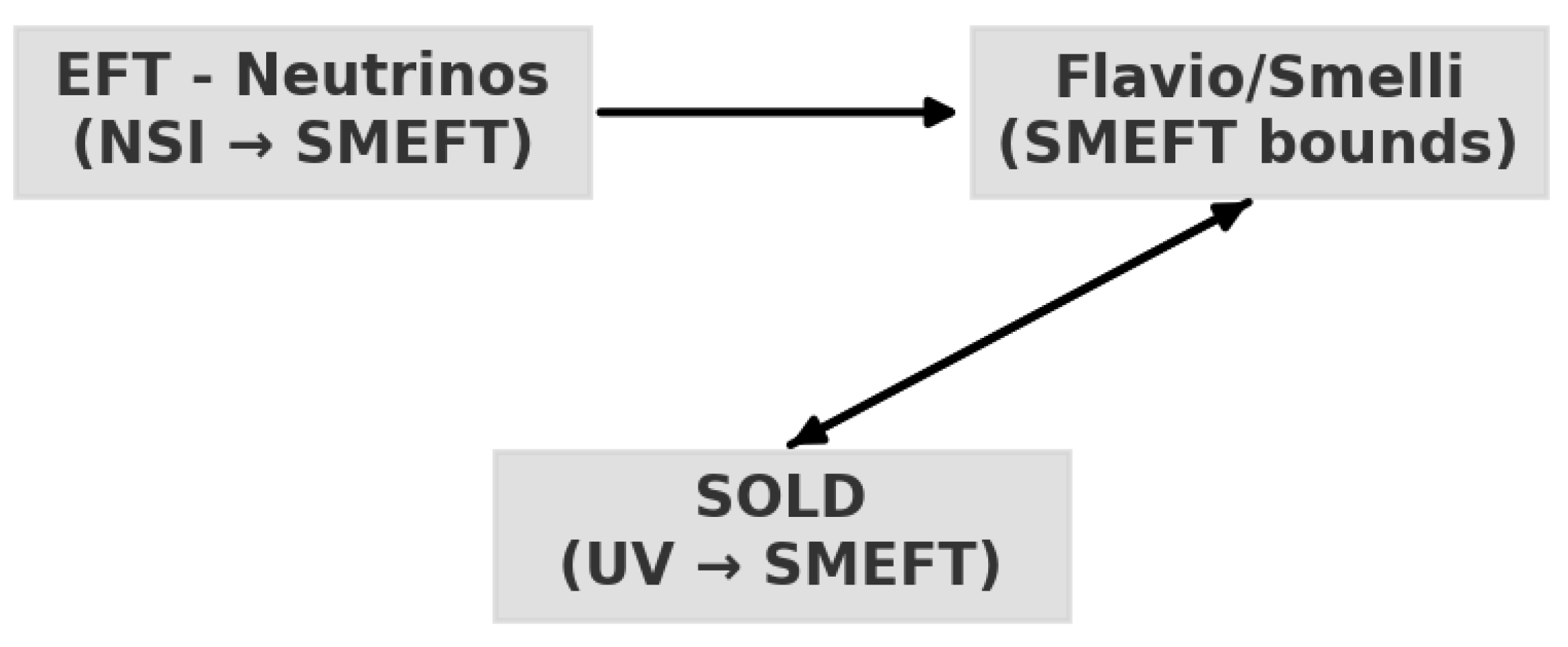
Figure 2.
Bounds on the CC-NSI that affect pion decay: (a) Bound on due to SMEFT WCs , and . (b) Bound on due to SMEFT WC , and on due to . (c) Bound on due to SMEFT WCs , and . In black we depict the bounds coming directly from pion or tau decay [43].
Figure 2.
Bounds on the CC-NSI that affect pion decay: (a) Bound on due to SMEFT WCs , and . (b) Bound on due to SMEFT WC , and on due to . (c) Bound on due to SMEFT WCs , and . In black we depict the bounds coming directly from pion or tau decay [43].
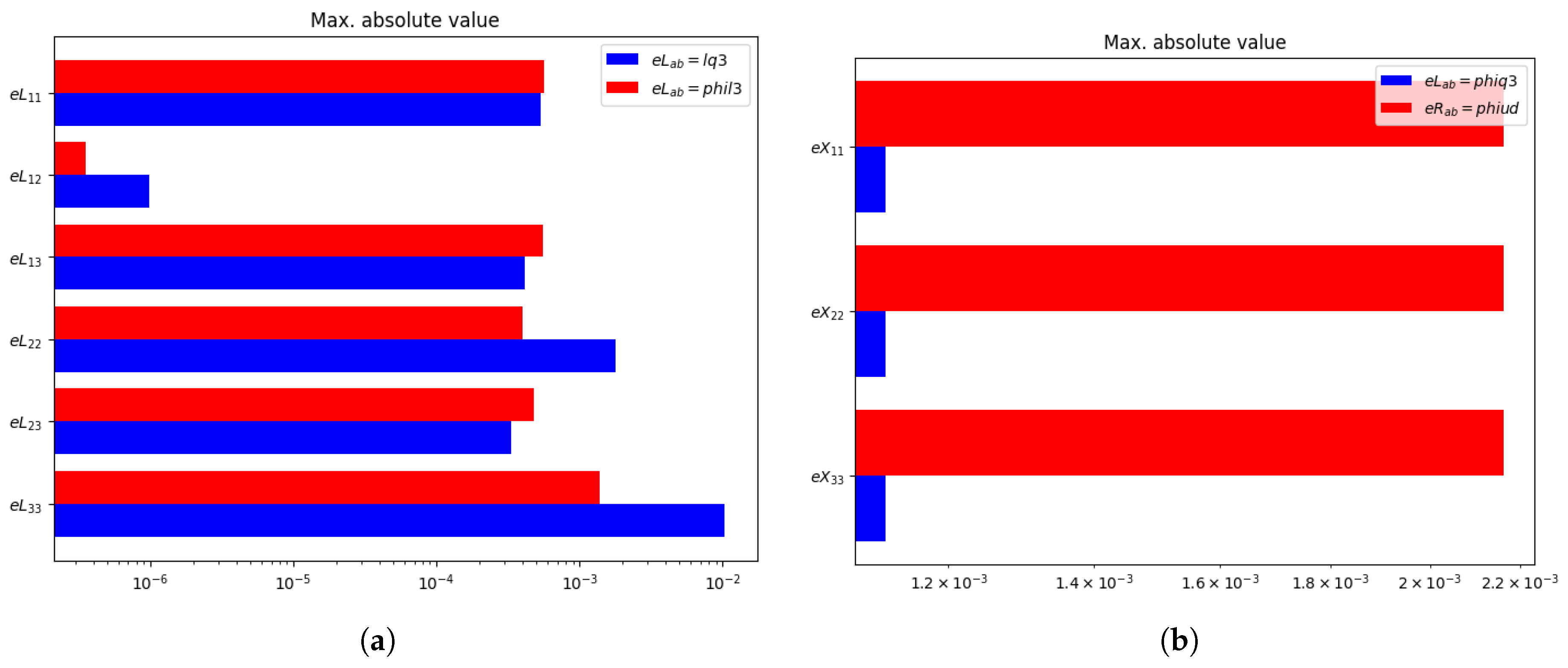
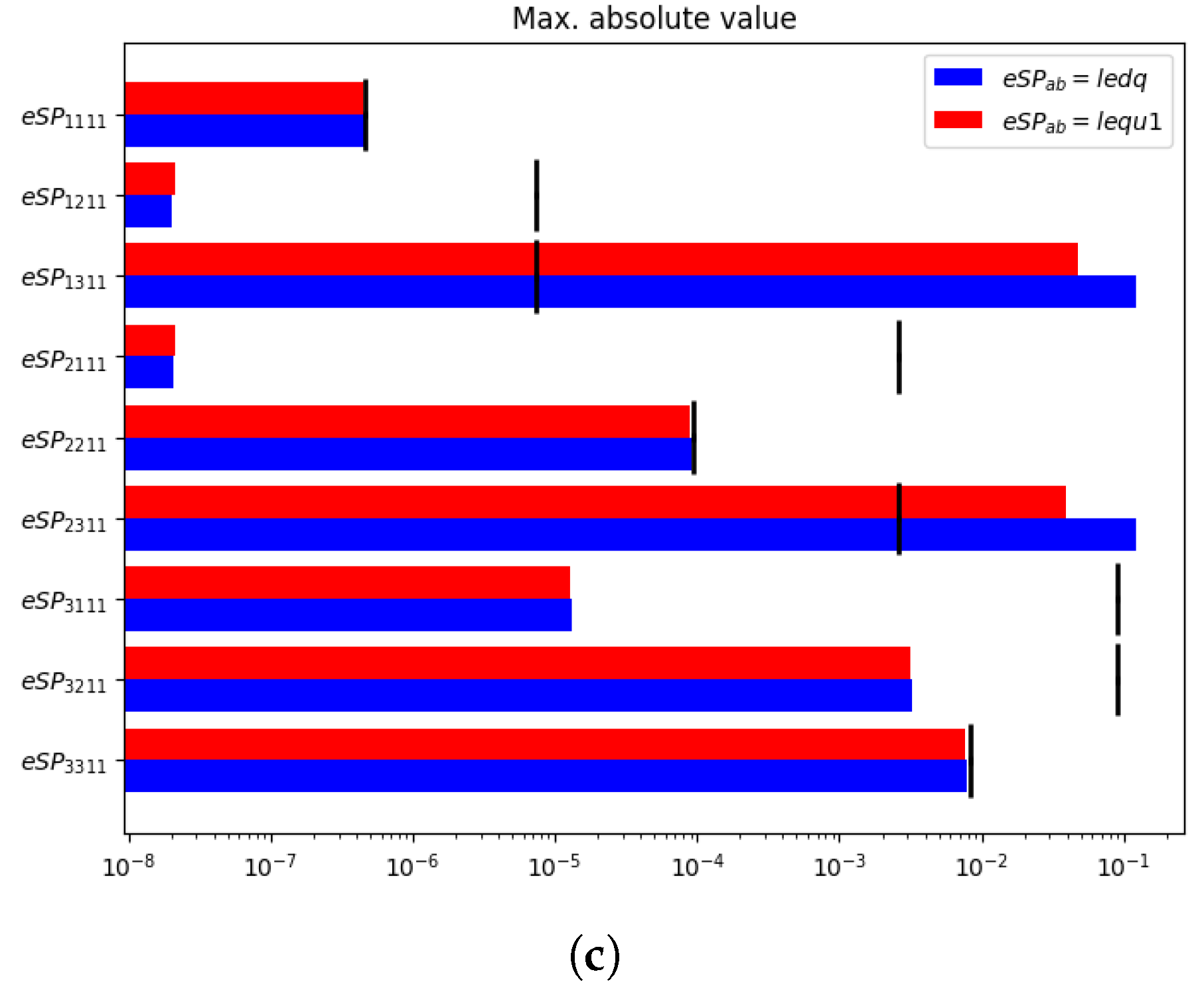
Figure 3.
Bounds on the SMEFT WC that affect pion decay: (a) Bound on . (b) Bounds on , and . Notice that indices are relevant for pion(kaon) decay. (c) Bound on . (d) Bound on . In red we depict the bounds coming directly from pion or tau decay [43]. (e) Bound on . In red we depict the bounds coming directly from pion or tau decay [43].
Figure 3.
Bounds on the SMEFT WC that affect pion decay: (a) Bound on . (b) Bounds on , and . Notice that indices are relevant for pion(kaon) decay. (c) Bound on . (d) Bound on . In red we depict the bounds coming directly from pion or tau decay [43]. (e) Bound on . In red we depict the bounds coming directly from pion or tau decay [43].
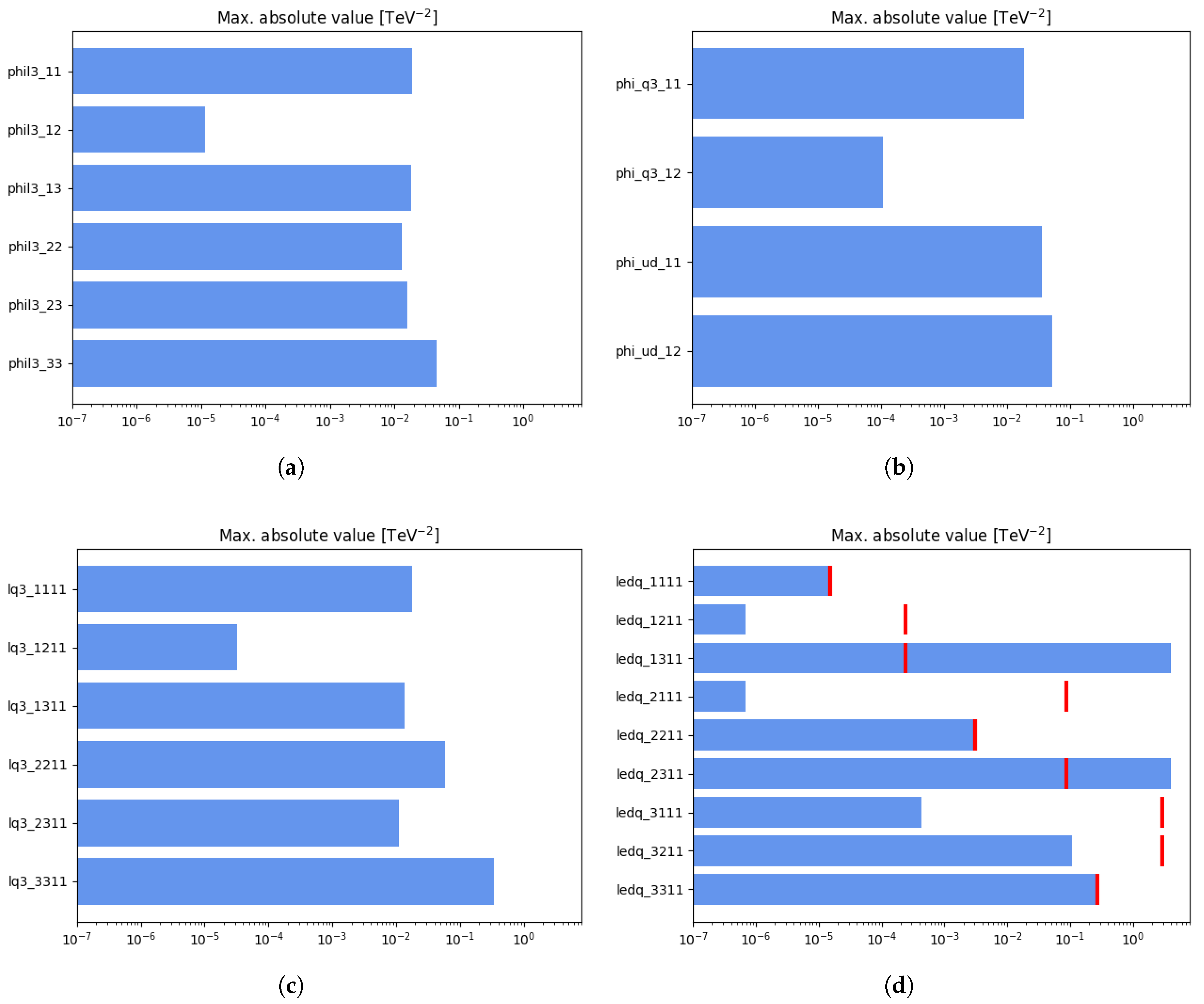
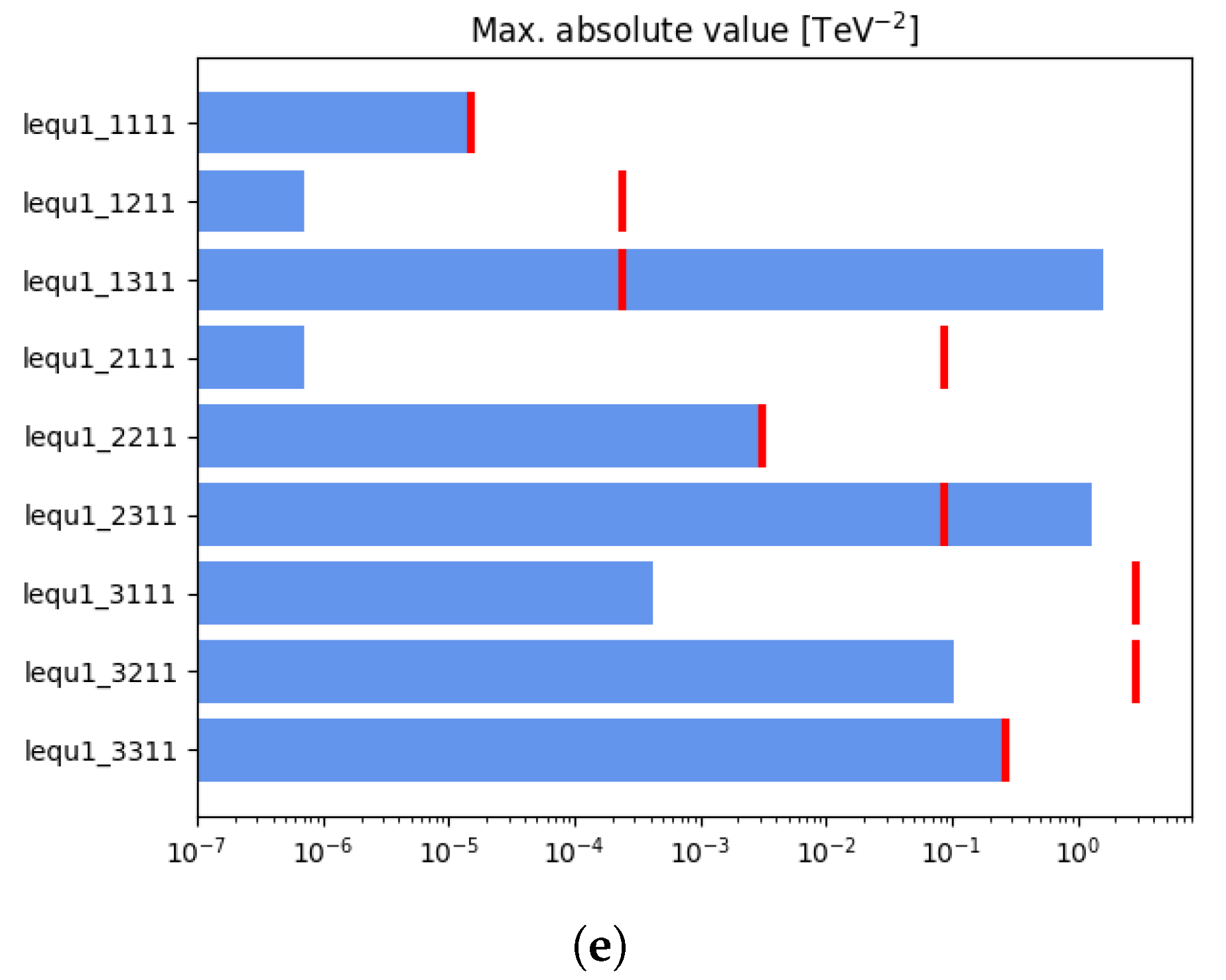
Figure 4.
Bounds on the SMEFT WC that affect kaon decay: (a) Bound on . (b) Bound on . In red we depict the bounds coming directly from kaon or tau decay [43]. (c) Bound on . In red we depict the bounds coming directly from kaon or tau decay [43]. (d) Bound on . In red we depict the bounds coming directly from kaon or tau decay [43].
Figure 4.
Bounds on the SMEFT WC that affect kaon decay: (a) Bound on . (b) Bound on . In red we depict the bounds coming directly from kaon or tau decay [43]. (c) Bound on . In red we depict the bounds coming directly from kaon or tau decay [43]. (d) Bound on . In red we depict the bounds coming directly from kaon or tau decay [43].
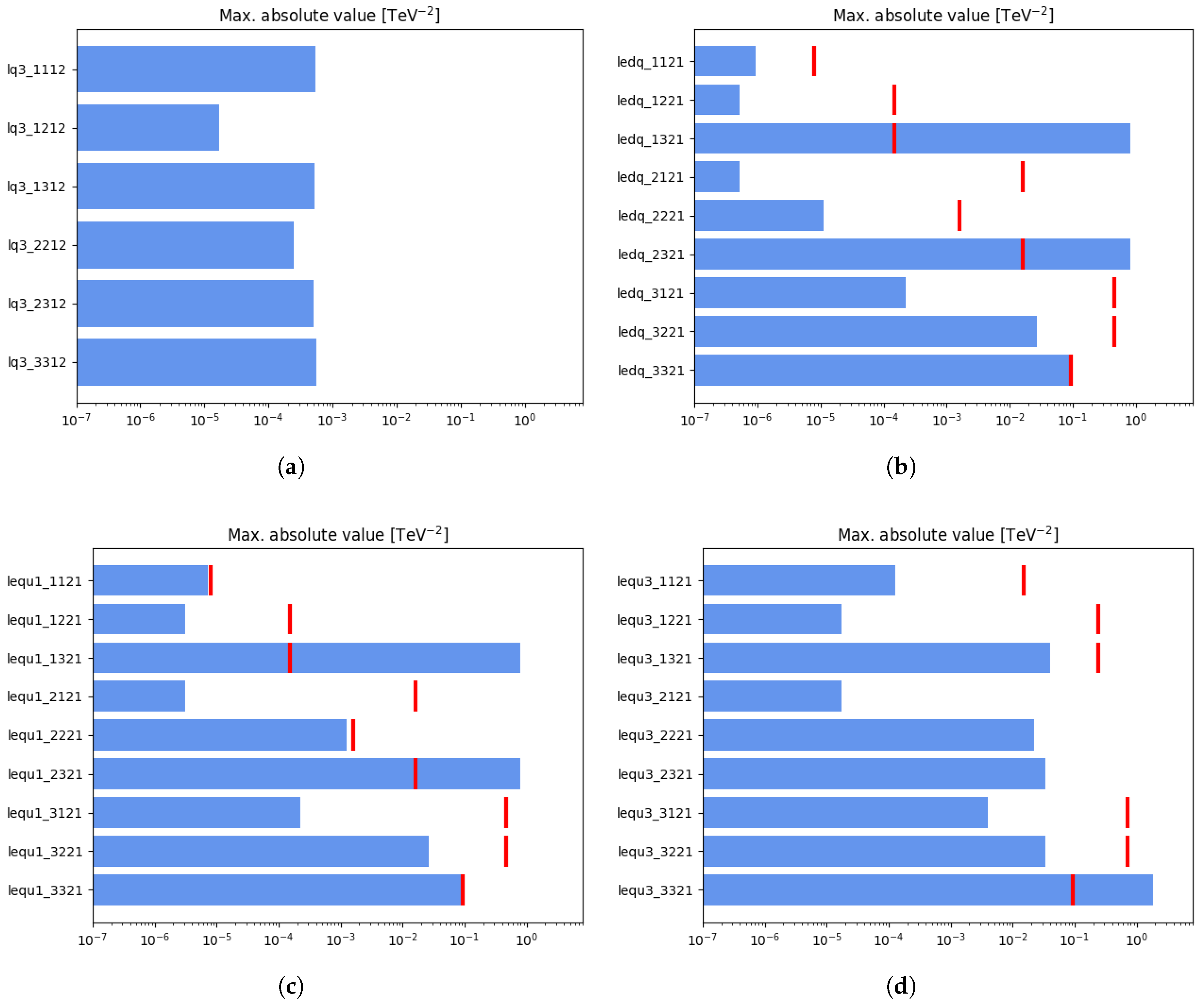
Figure 5.
Allowed region on at 90% C.L. in black. Contour lines (in units of ) for different values of , considering and .
Figure 5.
Allowed region on at 90% C.L. in black. Contour lines (in units of ) for different values of , considering and .
Disclaimer/Publisher’s Note: The statements, opinions and data contained in all publications are solely those of the individual author(s) and contributor(s) and not of MDPI and/or the editor(s). MDPI and/or the editor(s) disclaim responsibility for any injury to people or property resulting from any ideas, methods, instructions or products referred to in the content. |
© 2025 by the authors. Licensee MDPI, Basel, Switzerland. This article is an open access article distributed under the terms and conditions of the Creative Commons Attribution (CC BY) license (http://creativecommons.org/licenses/by/4.0/).
Copyright: This open access article is published under a Creative Commons CC BY 4.0 license, which permit the free download, distribution, and reuse, provided that the author and preprint are cited in any reuse.


