

Submitted:
13 May 2025
Posted:
14 May 2025
You are already at the latest version
Preprints on COVID-19 and SARS-CoV-2
Abstract
Artificial Intelligence (AI) and Machine Learning (ML) have emerged as crucial technologies in addressing the COVID-19 pandemic, enabling predictive analytics, diagnostics, forecasting, and drug development. This article looks at the most modern AI/ML approaches to COVID-19 management, including as early detection, patient triage, medical imaging analysis, epidemiological forecasting, and drug repurposing. It also examines the issues of AI adoption in healthcare, such as data bias, interpretability, and ethical concerns. The emphasis is on quantitative evaluation of machine learning models to determine their efficacy in real-world applications. This study gives insight on the future of AI/ML-powered platforms for pandemic management and global healthcare preparedness.
Keywords:
COVID-19
; SARS-CoV-2
; machine learning algorithms
; artificial intelligence
1. Introduction
In December 2019, a series of acute atypical respiratory illnesses emerged in Wuhan, China, leading to the identification of a novel coronavirus. Due to its high genetic homology (~80%) with the SARS-CoV virus, which caused acute respiratory distress syndrome (ARDS) and high mortality during the 2002–2003 outbreak, the new virus was named severe acute respiratory syndrome coronavirus-2 (SARS-CoV-2) [1,2,3,4]. The World Health Organization (WHO), on March 11, 2020, declared the novel coronavirus (COVID-19) outbreak a global pandemic. As of February 2025, the COVID-19 pandemic has resulted in over 700 million reported cases and 6 million deaths across more than 200 countries. From moderate, asymptomatic upper respiratory infections to severe respiratory failure, SARS-CoV-2 can cause a wide range of symptoms. The post-infectious, longer-term effects remain an active area of research [3,5].
Machine learning and artificial intelligence (AI) have rapidly emerged as transformative forces in the technology landscape, driving innovation across various industries. Machine learning, a subset of AI, focuses on developing algorithms that enable computers to learn from data and make predictions or decisions without being explicitly programmed. AI, on the other hand, encompasses a broader range of technologies, including natural language processing, computer vision, and robotics, that seek to simulate human intelligence. Together, machine learning and AI are revolutionizing fields such as healthcare, finance, manufacturing, and entertainment by automating tasks, improving decision-making, and enhancing user experiences [6]. In healthcare, AI-powered diagnostic tools help in early disease detection. Current studies have shown that machine learning algorithms (MLs) and artificial intelligence (AI) are exciting innovations used in basic healthcare activities by various health professionals, as these innovations lead to better levels of computational power, increased efficiency, and possibly even superior human results [7]. As such, separate ML and AI tools have been used globally by the hospitality industry and physicians to combat COVID-19 infection and resolve problems even during epidemics. AI was not used in the healthcare profession to substitute human experience but rather to provide physicians with guidance based on what they are modelled [8]. The area of machine learning has developed from a broad field of artificial intelligence, which seeks to emulate computers with the intellectual capabilities of humans. A vocabulary description of machine learning has multiple similarities, including the ability to acquire experience, awareness, or ability through research, teaching, or application and the ability to change a behavioural inclination through knowledge. Machine learning typically applies to improvements in programs that execute artificial intelligence (AI)-related tasks. Acknowledgment, analysis, preparation, device power, and estimation are included in those activities. The changes may involve modifications to existing programs or the application of new programs [9].
After viewing chest X-ray frames, machine learning techniques may play a significant role in distinguishing COVID-19 victims. In multiple image recognition areas, such as image recognition, image detection, and segmentation techniques, ML has demonstrated better precision [10]. Image processing involves removing the important features of an image through a description or object phase and using a classification model such as an SVM; this characteristic could be included in the classification algorithm. Compared with handmade characteristics, deep convolutional neural network approaches have high efficiency in categorizing pictures and deriving attributes. Many other studies have used machine learning-based approaches to sort chest X-ray images within COVID-19 patient types or regular case categories according to ML attributes [11].
Massive technologies, including artificial intelligence, exploit unparalleled intensity in attempts to solve the COVID-19 disease outbreak scenario (AI). Different AI spinoffs have been used previously for many infectious diseases. In the battle against COVID-19, AI can play a critical role. AI can be used effectively in diagnosing infectious disease incidents, event control, disease estimation, probability of fatalities, detection of COVID-19, cost efficiency of disease control, facilitation of preparation, administrative activities, and information processing to research infection patterns [12].
The COVID-19 pandemic, caused by SARS-CoV-2, has had a profound global impact, necessitating rapid advancements in medical and computational technologies. AI and ML have revolutionized various healthcare domains by automating diagnostic processes, enhancing predictive analytics, and facilitating drug discovery. Unlike traditional epidemiological models, AI-based approaches can leverage large datasets for high-accuracy prediction and real-time decision-making [13]. AI has facilitated the rapid and automated detection of COVID-19 through medical imaging techniques such as computed tomography (CT) scans and chest X-rays, improving diagnostic accuracy and reducing the burden on radiologists. ML models have also been instrumental in predicting disease severity, patient outcomes, and resource allocation, assisting healthcare professionals in optimizing treatment strategies [14]. Additionally, AI-powered surveillance systems have enhanced outbreak modeling by analyzing epidemiological trends, enabling policymakers to implement timely interventions and public health measures [15].
Beyond diagnostics and epidemiology, AI has played a crucial role in drug discovery and vaccine development. Advanced computational models have accelerated the identification of potential therapeutic targets, repurposed existing drugs, and optimized vaccine candidates. Natural Language Processing (NLP) techniques have facilitated the extraction of critical insights from vast biomedical literature, aiding researchers in understanding the evolving nature of the virus [16].
Despite these advancements, the integration of AI in pandemic management is not without challenges. Data privacy concerns, biases in AI models, ethical considerations, and the need for extensive validation remain significant hurdles. Moreover, reliance on high-quality datasets and standardized methodologies is essential to ensure the reliability and generalizability of AI-driven solutions.
This article explores the role of AI and ML in managing the COVID-19 pandemic, focusing on their applications in clinical diagnostics, disease prognosis, outbreak prediction, and pharmacological advancements. Furthermore, we discuss methodological advancements, existing challenges, and the future potential of AI-driven technologies in handling healthcare crises, emphasizing the need for robust, interpretable, and ethical AI frameworks.
2. Machine Learning Algorithms and Artificial Intelligence Application in the SARS-CoV-2 Outbreak
Inspiringly, sophisticated machine learning methods are being used in the taxonomic identification of COVID-19 genes, CRISPR-based COVID-19 identification analysis, recovery estimation of extreme COVID-19 victims, and discovery of new drugs for the treatment of COVID-19 within a limited time frame after the COVID-19 outbreak. Consequently, machine learning methods can be used to examine the biochemistry of scientific research on COVID-19 individuals for medical purposes not only to recognise some accurate risk considered but also to ensure appropriate identification and forecasting for healthy planning of existing disease care and COVID-19 safety [17]. The medical insurance partnership has continued to develop since the first human expert was established in 1976, called MYCIN. By recommending drugs to clinicians, MYCIN was programmed to use 450 rules obtained from a specialist doctor to treat infections [8]. Electronic health records (EHR) contain details that could be used to classify the medical health conditions of patients and that could be added to the plethora of “data analytics” relevant to mammal experiences. ML and AI are best suited for integrating several datasets to provide risk management forecasts or to help expose the belief systems whereby structural threats propagate. With respect to patients who have been infected with SARS-CoV-2, it is important to anticipate the likelihood of suffering side effects on a customised scale, or even the particular health services an individual may or will require, or the nature of such requires [18].
At present, many researchers have attempted to improve the application of deep learning algorithms for innovative clinical practice. For example, machine learning-based scanning of SARS-CoV-2 test structures with high sensitivity and frequency but the use of a CRISPR-based virus tracking system have been reported. Indeed, the accelerated implementation of automatic monitoring programs based on artificial intelligence and machine learning has led to improved diagnostic speed and precision, but medical care staff may also be covered by reducing their interactions with victims of COVID-19 [17]. This offers either a chance to forecast the progression of such a particular symptom but also to explain why particular occurrences can shift individuals in one course or region or a sequential pathway to someone by using obey results. It was critical to the development of ways to allow scarce care providers to be handled dynamically. A much more technical nature of tracking must include adding past data of the specific treatment at every point in history to use all appropriate findings. Nation AI-based initiatives focused on time series will notify these triage processes. These AI-enabled programs have been designed and validated, but their effectiveness has also been proven. They can forecast the proper treatment requirements of a clinic but can also treat abnormally acquired information or ascribe incomplete attributes but also suggest significant patient result determinants [18].
Furthermore, AI-driven predictive models have played a pivotal role in forecasting COVID-19 case surges, guiding healthcare resource allocation, and informing public health policies. AI-assisted molecular docking and deep learning-based drug screening have significantly accelerated drug discovery, reducing the time required for clinical trials. However, challenges such as regulatory hurdles, ethical concerns regarding data privacy, and biases in AI models must be addressed to ensure equitable and transparent AI deployment in pandemic response efforts. Table 1 outlines the major challenges associated with AI implementation in COVID-19 healthcare, along with potential solutions to mitigate issues such as data privacy concerns, model bias, explainability, computational costs, and standardization.
AI approaches discuss critical and multiple concerns and provide a shared vocabulary wherein health professionals can share a knowledge base and factors of success. AI has significant potential to make better choices easier for medical professionals by benefiting from the “experiments” actually occurring for individual hospitals in various climates [18]. AI easily analyses unusual signs or other warning flags and thereby warns patients and medical officials. It allows, and is expensive, quicker policy making. Medical professionals experienced such more stress because of the rapid and significant spate of cases after the COVID-19 disease outbreak. Currently, to ease the burden of care providers, AI is used. It continues to provide accurate intervention and care via online technology and operations research at an early point, encouraging employees and physicians with the latest preparation for this illness. AI will have an effect on prospective health treatment and overcome more new problems that minimise physicians’ burden. Updated material that is beneficial for detecting this illness may be presented by AI. It is used throughout this epidemic to forecast the possible locations of transmission, the distribution of the disease, and the need for rooms and medical personnel [19].
The latest studies on the nature of successful drug testing clearly show that with the implementation of ML, both the performance and efficacy of RCTs have substantially increased. Although most RCTs merely assign people by standardised random sampling to care and support classes, in accordance with the methods, this technique could become extremely insufficient. The results per population may well be detected when the next sample is included, which can be homogenous through distinct subpopulations. ML-enabled innovative lab tests may enrol physicians in groups [18]. In several diverse respiratory illnesses, CT has a well-known function as an assignee, especially in combination with clinical evidence. The observation of COVID-19 seems to be of interest because patients who need critical care and ventricular assistance are being plagued by major issues for physicians, and a correct prognosis is potentially a far more urgent clinical issue than prediction is. Learning an algorithm to forecast results such as death, the entry of hospitals, or the need for artificial ventilation may have substantial clinical consequences for patients with COVID-19. The development of accurate differentiation methods to determine an individual easily will help direct medical practitioners to make tough choices, mostly regarding the distribution of limited resources [20].
3. Machine Learning Algorithms and Artificial Intelligence in SARS-CoV-2 Prediction and Forecasting
Artificial intelligence (AI) and data analytics help manage the massive amount of unparalleled information generated through observations of human health or tracking of actual disease outbreaks. Large amounts of data will allow actual surveillance of a global pandemic. With respect to past diseases and the occurrence of disease outbreaks, COVID-19 is unparalleled in that freely accessible databases are freely accessible, providing a regular influx of black diseases that are degraded by the state and, in certain instances, towns. It provides the unique resource to merge statistical modelling or AI, together with all the evidence for the mobility of migrants [21]. Increased CT of the heart, along with molecular assays or experiments, element multiplex nucleotide amplification or mass spectrometry, is important for tracking the spread of the disease or its development in terms of intensity and clinical course [21].
AI-based resources promoted selective lockdown or reopening, track temperatures, allow patients to be easily identified and categorised, and assist in the production of vaccines. Regulation of quarantine mechanisms in mainland China For those subject to both active surveillance and enforcement of laws, stringent home lockdown. Security checks established at any and all base stations are reached only by citizens with green barcodes [22].
Data charts, transition charts, machine learning, facts from devices and mobile technology have been used in countries such as China, Sweden, Taiwan and Singapore to monitor sources of contamination in full detail. The benefit of this feature is that it facilitates a clear image of distribution, guides boundary constraints, facilitates the utilisation of funds and advises forecasting [23]. China’s rapid reply (QR) coding scheme, in which people are expected to perform a condition questionnaire and report their heat, helps medical surveillance and controller design by the authorities. To identify and limit people standing in public, China even uses digital video surveillance, helicopter cameras, and portable recording devices. In Taiwan, when a lockdown violation occurs, the wiretapping of living persons is enabled via state cell phones monitored by GPS. One such automated barrier is person notifications and issuing penalties. To track people with COVID-19 to ensure that they live in person, Iceland has introduced a cell phone application. Using video calls and automated surveillance, interactive care systems are used globally to provide remote services to patients as a way to reduce their SARS-CoV-2 risk in medical canters [23].
After all, software, by timely detection and tracking of emerging incidents, may also significantly delay this spread. These innovations include the use of information obtained via remote control, deep learning, and cloud and edge capabilities. This method adds to the knowledge of the existence of the virus by capturing, reviewing and indexing related performance with respect to true tracking. A prototype IoT protection and medical device scheme was suggested by Wu et al [24]. The aim is to increase safety. The information processing and machine learning algorithms are hosted by the Data Centre. Figure 1 illustrates the AI and ML-based workflow for COVID-19 prediction and forecasting. It highlights the data processing pipeline, from dataset preparation to model evaluation, ensuring accurate forecasting and informed decision-making in pandemic management. These equations have been used to construct a model for COVID-19 and provide the data input with a true overview. The template may now be used, on the basis of fact gathered and submitted by consumers, to classify or forecast future COVID-19 events rapidly [25]. The recommendations of machine learning help us to predict the reported cases of COVID-19 as excellent results. Even then, deciding that is the right plan to use refers to the data behaviour of each region, as it is easier to use the multilayer perceptron in certain instances, although the support vector machine is easier for many others [26].
4. Machine Learning Algorithms and Artificial Intelligence in SARS-CoV-2 Screening and Treatment
Rapid and reliable COVID-19 detection might save lives, restrict the progression of the virus, and process the data through which AI models can be trained. In this context, AI should provide valuable feedback, promoting open, highly detailed diagnoses of chest X-rays. Compared with regular COVID-19 studies, AI will be as exact as possible, conserve hours to radiologists, or make predictions less expensive and more efficient. It is possible to use both X-ray and computed tomography (CT) analyses. Figure 2 presents an AI-driven framework for COVID-19 diagnosis and prognosis, demonstrating the integration of clinical, imaging, and epidemiological data for accurate patient risk assessment and treatment prioritization. This capacity has not yet been translated into practice; however, a range of Chinese institutions are being documented to have implemented only “AI-assisted” diagnostic techniques. Radiologists nowhere voiced their concern that inadequate knowledge is willing to develop AI systems and that most of the COVID-19 pictures available from Chinese institutions may suffer through self-selection, but the use of CT scans and X-rays may infect instruments and thereby spread the infection [27].
In addition, four severe medical characteristics, namely, GHS, CD3 amount, protein content, and clinical age variations in health, experimental characteristics, and personal factors, are proposed, and a Help vector machine is used as an aligned goal support vector machine classifier [8]. COVID-19 has advanced medical situations in which people are routinely tested via statistical models for virus monitoring compliance but corresponding care. This case study illustrates the rapid deployment of formerly “analysis” strategies to quickly start the software scanning algorithm of even an organisation with COVID-19. In addition, a far more robust resource that guides the choices of their virtual care practitioners will be provided by extending training examples and designing a statistical model to simulate currently existing health conditions [28].
By evaluating interventions that prioritise patients and ultimately minimise side effects, ML and AI approaches could improve the expertise of hospitals and doctors and assist facilities in managing the number of clients. If patient numbers continue to grow, ML and AI software could be used to assess risk estimates for multiple periods that are dependent on this ever-critical reflection, laboratories, medicines, and commands. For doctors and nurses, simple forecasts could be used to prioritise treatment. Medium projections can enable teams to classify people with the lowest risk of relapse; this stabilisation factor can encourage patients’ options to tailor therapy to the road to discharge. Finally, long-term designs, such as ventilation systems, rooms, and personnel, help managers distribute limited resources [29]. In the healthcare industry, ML and AI have become more widespread, or the global COVID-19 epidemic poses a crucial position that needs the introduction of ML methods. Implementations of these methods are focused on hospital attention, patient safety, resource usage, or facility volume management [29]. Table 2 summarizes the key AI/ML applications in COVID-19 management, listing the AI models used, their benefits, and limitations across different domains such as early diagnosis, prognosis, drug discovery, and vaccine optimization.
Since the performance of almost any ML depends upon the type and reliability of the information presented, the central database for their study was chosen with care, taking into consideration the objectives we hope to meet. Only certain patients or patients undergoing treatment for COVID-19 (chest CT showing typical spots on extreme parts of the lungs), other symptoms of bacterial pneumonia, such as respiratory syncytial virus (RSV), flu A (H1N1, H5N1) and ordinary stable lungs, were identified. The evaluation of the CT scan would be the first screening or alternative test for both the clinicians’ actual reverse transcription real-time PCR (RT–PCR) study. Coronavirus-induced disease displays a common cloudy spot on the extreme parts of a lung, indicating a trend, so ML may be used for effective avian influenza identification [16].
Furthermore, AI-assisted COVID-19 screening has been employed in telemedicine, enabling remote consultations to reduce physical contact and prevent hospital overcrowding. AI-powered chatbots and virtual assistants have been used for preliminary assessments, symptom tracking, and guiding individuals to appropriate healthcare resources. The combination of AI with IoT technologies has enhanced real-time monitoring of patients, ensuring timely medical interventions while optimizing healthcare resources [30]. The integration of machine learning algorithms, computer vision, and deep learning in SARS-CoV-2 treatment strategies has also shown promise. AI models have been used to analyze genetic sequences of emerging variants, aiding in vaccine development and adaptation. Predictive analytics help identify high-risk populations and optimize vaccine distribution. Reinforcement learning approaches are being explored to personalize treatment strategies based on a patient’s unique genetic and clinical profile, thereby improving therapeutic outcomes and minimizing adverse effects [31].
5. Machine Learning Algorithms and Artificial Intelligence Technology in SARS-CoV-2 Contact Tracing
U.S. central and government departments speak with the use of position data collection or face detection to track infected individuals or to map and impose isolation on businesses, including Google, Facebook, and divisive developer Clearview AI. Governments across the globe are also increasingly pursuing the introduction of remote touch tracking for individuals with COVID-19. In addition, in the UK, after China, Israel, and Singapore, the NHS is creating an application that will simplify the tracking of COVID-19 [32].
Touch tracking is an essential indicator of commands for breaking links. Individuals transmitting from COVID-19. Although signs of COVID-19 in certain individuals are vague, symptomless and often unnoticed, monitoring does not avoid distribution but involves contact tracking to accelerate the identification of connections among infected individuals to avoid more dissemination. If combined with smartphones, wearable devices, predictive thermostats, and preliminary scanning of suspicious activity via metabolic rates, among other methods, provide a “group chat” for true connectivity, learning and managing the diversity of persons, then probable tasks can be carried out via COVID-19 touch tracking software built with AI for daily temperature management [31].
When sampling communities, AI and ML are being introduced to determine the risk of disease. These AI-powered thermal scans, for example, were implemented during the COVID-19 disease outbreak in common spaces in China. Thermal testing has also been proven to classify indications and separate reported infectious cases. Thermal cameras also increasingly provide body heat imagery for COVID-19 case identification and allow individuals who have “high body temperature” to be distinguished easily and reliably but are among the main signs of COVID-19. Consequently, to monitor the geographic coverage of COVID-19, an AI-powered mobile application was created. These applications are focused on identifying which demographics and neighbourhoods are more vulnerable, helping medical practitioners disseminate real-time information and notifying people about possible locations of disease to prevent those areas accurately [33]. To recognise the growing danger of contamination, robots, which are used as smart devices that provide viral data, and medical robotics, which are used for medical imaging, are other AI-based technologies. The dissemination of the COVID-19 disease outbreak has been tracked and understood via AI techniques. By the use of disease-sensing solar sensors, machine vision detection devices and image recognition devices, mobile applications using AI are determined by monitoring the position of an individual and even searching for common buildings for possibly affected individuals. A touch tracking application for COVID-19 has been adopted by nations such as China and Singapore. Consequently, utilising the current location on mobile applications, both states have adopted touch tracking [33]. In addition, TraceTogether is a digital platform in Singapore that allows neighbourhood touch tracking whereby users share their location data and length via wireless signals when another device with the application available on it is detected by their phone.
CNN, RNN and LSTM are the AI algorithms used in developing these applications. The CNN model seems to be the most commonly used model for visual identification and detection. This could be due to its reliability with respect to case identification and production. Long short-term memory (LSTM), recurrent neural networks (RNNs) and several others are other machine learning frameworks that are carefully utilised. LSTMs and RNNs, for example, are often used to estimate the average lifespan of electronic health records [33]. To detect patterns and correlations around remote touch tracking, studies and communicable diseases, AI-powered resources can be useful. The good mobile surveillance allowed by smartphones connected to dramatically proportioned research would be an important aspect of our battle toward COVID-19 [34].
6. Machine Learning Algorithms and Artificial Intelligence for SARS-CoV-2 Drugs and Vaccination
Thus, to accurately assess and prioritize the diverse impacts observed in these drug tests, researchers have employed advanced ML approaches that integrate multi-dimensional data. Biological functions that could clarify how any of these drugs interact with virus assembly within living cells were established in this study. Among the most successful approved drugs, further SARS-CoV-2 drug tests are needed. Successful hits from six COVID-19 drug tests can be leveraged to train ML models, enabling the classification of drug impacts and facilitating the ongoing reassessment of compounds with similar characteristics. Each normal framework of ML classification is meant to illustrate the ability of the public library-accumulated drug collections for ML applications to be used [35].
Throughout the COVID-19 pandemic, AI-enabled drug discovery will prove advantageous to technological developments in AI coupled with improved computing capacity. Through the development of both classification algorithms, AI has been applied in the specialty field, or a fast-computational method has been used to show the performance appropriately. AI can easily identify medicines that can treat viral infections such as COVID-19 via a medication approach. This tool has the power to maximise COVID-19 drug development, preparation, care, and recorded results, making it a proof medical instrument. Therefore, the possibility of using the AI technique to develop drugs is possible [36]. With respect to previous patient satisfaction, few older medications could be easily added to care for COVID-19 patients if they are found to be successful against SARS-CoV-2. The efficacy of medication retooling will increase dramatically for AI partnerships with toxicology. The AI-based reduplication solution is easier, quicker, and more reliable or can eliminate clinical study failure. Even without an original trial or experiment, the recycled drug will join the progress stage for indirect testing. While AI-enabled drug discovery is currently in its infancy, this technique is an effective alternative for the production of new COVID-19 remedies [36].
Pharmacotherapy advancements can be expedited by constantly developing strong, creative AI as well as web therapy technology. Utilizing empirical evidence, such as computerized medical reports, to identify successfully repurposed approved drugs is another significant feature of AI applications for novel drug discovery. Telemedicine regularly records specific treatment documents, such as demo images, symptoms, drugs, treatments, and lab test findings, which are held in a virtually consistent format that is shared and viewed. Substantial debates on the use of actual evidence for drug development and growth have also actually occurred. Sufferers in actual stats, on the one hand, seem to be more reflective of clinicians who will be prescribed while the medication is now on the marketplace than patients in RCTs, who are registered mostly on the basis of specific requirements for similarities and differences [37]. To date, the future capacity of AI to discover novel target drugs that can be immediately made eligible for drug testing and integrated into medical services if accepted is unprecedented, rendering AI a cornerstone of emerging technology. As a result, AI is a viable technique to accelerate the remaking of drugs for viral infections and emerging and developing illnesses, including COVID-19. New AI algorithms required to exploit these vast collections of large datasets are in short supply with the emergence of data analytics, namely, medical, health, and accessible information [37].
In several areas of the COVID-19 disease outbreak, such as biological, clinical, and social use, advancements in computers (MLs) could be beneficial. ML simulations, from a biochemical viewpoint, are used to quickly remember the cellular processes involved in SARS-CoV-2 disease to identify new indications for therapy. To model the 3D protein configuration that has been defined by nucleotide sequences and the effect on the position and associated proteins of interest, an AlphaFold design is used. Biotechnology data recreate the interactions that would forecast theoretically productive drug targets among proteins and medicines. ML thus has the ability, on a microscopic level, to determine the shape of the protein, to recognise new drugs that attack these enzymes and to facilitate therapy for COVID-19 [38].
7. Conclusions
In conclusion, the continued implementation of AI and ML has greatly enhanced the course of observation, diagnosis, monitoring, estimation, prediction, touch tracking, and creation of medicines or vaccines for the COVID-19 disease outbreak and minimised human interference in clinical practice. Most versions have also not been adequately implemented to illustrate their instructional methods, and they are already up to scratch to counter the SARS-CoV-2 outbreak.
Author Contributions
Suresh Kumar: Conceptualization, writing—review and editing. Gunasekaran Subramanium: Writing—review and editing. K.J. Senthil Kumar: Conceptualization, writing—review and editing.
Data Availability Statement
This is a perspective article and does not contain original research data.
Conflicts of Interest
All authors of this manuscript declare that they have no conflicts of interest or financial conflicts to disclose.
References
- Kumar S, Thambiraja TS, Karuppanan K, Subramaniam G. Omicron and Delta variant of SARS-CoV-2: A comparative computational study of spike protein. J Med Virol. 2022; 94(4):1641-1649.
- Kumar S, Karuppanan K, Subramaniam G. Omicron (BA.1) and sub-variants (BA.1.1, BA.2, and BA.3) of SARS-CoV-2 spike infectivity and pathogenicity: A comparative sequence and structural-based computational assessment. J Med Virol. 2022; 94(10):4780-4791.
- Cucinotta D, Vanelli M. WHO Declares COVID-19 a Pandemic. Acta Biomed. 2020; 91(1):157-160.
- Giovanetti M, Angeletti S, Benvenuto D, Ciccozzi M. A doubt of multiple introduction of SARS-CoV-2 in Italy: A preliminary overview. J Med Virol. 2020; 92(9):1634-1636.
- Das S, Kumar S. Exploring the mechanisms of long COVID: Insights from computational analysis of SARS-CoV-2 gene expression and symptom associations. J Med Virol. 2023; 95(9):e29077.
- Rashid AB, Kausik MDAK. AI revolutionizing industries worldwide: A comprehensive overview of its diverse applications. Hybrid Adv. 2024; 7:100277.
- Bajwa J, Munir U, Nori A, Williams B. Artificial intelligence in healthcare: transforming the practice of medicine. Future Health J. 2021; 8(2):e188-e194.
- Lalmuanawma S, Hussain J, Chhakchhuak L. Applications of machine learning and artificial intelligence for Covid-19 (SARS-CoV-2) pandemic: A review. Chaos Solitons Fractals. 2020; 139:110059.
- Auslander N, Gussow AB, Koonin EV. Incorporating Machine Learning into Established Bioinformatics Frameworks. Int J Mol Sci. 2021; 22(6):2903.
- Alshahrni MM, Ahmad MA, Abdullah M, Omer N, Aziz M. An intelligent deep convolutional network based COVID-19 detection from chest X-rays. Alex Eng J. 2023; 64:399-417.
- Chakraborthy S, Murali B, Mitra AK. An Efficient Deep Learning Model to Detect COVID-19 Using Chest X-ray Images. Int J Environ Res Public Health. 2022; 19(4):2013.
- Seetharam K, Raina S, Sengupta PP. The Role of Artificial Intelligence in Echocardiography. Cur Cardiol Rep. 2020; 22(9):99.
- Ashique S, Mishra N, Mohanto S, Garg A, Taghizadeh-Hesary F, Gowda BHJ, Chellappan DK. Application of artificial intelligence (AI) to control COVID-19 pandemic: Current status and future prospects. Heliyon. 2024; 10(4):e25754.
- Fusco R, Grassi R, Granata V, Setola SV, Grassi F, Cozzi D, Pecori B, Izzo F, Petrillo A. Artificial Intelligence and COVID-19 Using Chest CT Scan and Chest X-ray Images: Machine Learning and Deep Learning Approaches for Diagnosis and Treatment. J Pers Med. 2021; 11(10):993.
- Kang L, Hu J, Cai K, Jing W, Liu M, Liang W. The Intelligent Infectious Disease Active Surveillance and early warning system in China: An application of dengue prevention and control. Glob Transit. 2024; 6:249-255.
- Sharma A, Virmani T, Pathak V, Sharma A, Pathak K, Kumar G, Pathak D. Artificial Intelligence-Based Data-Driven Strategy to Accelerate Research, Development, and Clinical Trials of COVID Vaccine. Biomed Res Int. 2022; 2022:7205241.
- Alimadadi A, Aryal S, Manandhar I, Munroe PB, Joe B, Cheng X. Artificial intelligence and machine learning to fight COVID-19. Physiol Genom. 2020; 52(4):200-202.
- van der Schaar M, Alaa AM, Floto A, Gimson A, Scholtes S, Wood A, McKinney E, Jarrett D, Lio P, Ercole A. How artificial intelligence and machine learning can help healthcare systems respond to COVID-19. Mach Learn. 2021; 110(1):1-14.
- Vaishya R, Javaid M, Khan IH, Haleem A. Artificial Intelligence (AI) applications for COVID-19 pandemic. Diabetes & Metabolic Syndrome: Clin Res Rev. 2020; 14(4):337-339.
- Bachtiger P, Peters NS, Walsh SLF. Machine learning for COVID-19-asking the right questions. Lancet Digit Health. 2020; 2(8):e391-e392.
- Bragazzi NL, Dai H, Damiani G, Behzadifar M, Martini M, Wu J. How Big Data and Artificial Intelligence Can Help Better Manage the COVID-19 Pandemic. Int J Environ Res Public Health. 2020; 17(9):3176.
- Lin L, Hou Z. Combat COVID-19 with artificial intelligence and big data. J Travel Med. 2020; 27(5):taaa080.
- Whitelaw S, Mamas MA, Topol E, Van Spall HGC. Applications of digital technology in COVID-19 pandemic planning and response. Lancet Digit Health. 2020; 2(8):e435-e440.
- Wu F, Wu T, Yuce MR. An Internet-of-Things (IoT) Network System for Connected Safety and Health Monitoring Applications. Sensors. 2018; 19(1):21.
- Otoom M, Otoum N, Alzubaidi MA, Etoom Y, Banihani R: An IoT-based framework for early identification and monitoring of COVID-19 cases. Biomed Signal Process Control. 2020;62:102149.
- Jojoa M, Garcia-Zapirain B. Forecasting COVID 19 Confirmed Cases Using Machine Learning: the Case of America. In: Preprints. Preprints; 2020.
- Townsend DW, Carney JPJ, Yap JT, Hall NC. PET/CT Today and Tomorrow. J Nuc Med. 2004; 45(1):4S-14S.
- Obeid JS, Davis M, Turner M, Meystre SM, Heider PM, O’Bryan EC, Lenert LA. An artificial intelligence approach to COVID-19 infection risk assessment in virtual visits: A case report.J Am Med Inform Assoc. 2020; 27(8):1321-1325.
- Debnath S, Barnaby DP, Coppa K, Makhnevich A, Kim EJ, Chatterjee S, Tóth V, Levy TJ, Paradis Md, Cohen SL et al. Machine learning to assist clinical decision-making during the COVID-19 pandemic. Bioelectron Med. 2020; 6(1):14.
- Li C, Wang J, Wang S, Zhang Y: A review of IoT applications in healthcare. Neurocomputing. 2024; 565:127017.
- Mbunge E: Integrating emerging technologies into COVID-19 contact tracing: Opportunities, challenges and pitfalls. Diabetes & Metabolic Syndrome: Clin Res Rev. 2020; 14(6):1631-1636.
- Calvo RA, Deterding S, Ryan RM: Health surveillance during covid-19 pandemic. BMJ. 2020; 369:m1373.
- Agbehadji IE, Awuzie BO, Ngowi AB, Millham RC: Review of Big Data Analytics, Artificial Intelligence and Nature-Inspired Computing Models towards Accurate Detection of COVID-19 Pandemic Cases and Contact Tracing. Int J Environ Res Public Health. 2020; 17(15):5330.
- Kricka LJ, Polevikov S, Park JY, Fortina P, Bernardini S, Satchkov D, Kolesov V, Grishkov M. Artificial Intelligence-Powered Search Tools and Resources in the Fight Against COVID-19. EJIFCC. 2020; 31(2):106-116.
- Kuleshov MV, Stein DJ, Clarke DJB, Kropiwnicki E, Jagodnik KM, Bartal A, Evangelista JE, Hom J, Cheng M, Bailey A et al. The COVID-19 Drug and Gene Set Library. Patterns. 2020; 1(6):100090.
- Mohanty S, Harun Ai Rashid M, Mridul M, Mohanty C, Swayamsiddha S. Application of Artificial Intelligence in COVID-19 drug repurposing. Diabetes Metab Syndr. 2020; 14(5):1027-1031.
- Zhou Y, Wang F, Tang J, Nussinov R, Cheng F. Artificial intelligence in COVID-19 drug repurposing. Lancet Digit Health. 2020; 2(12):e667-e676.
- Allam M, Cai S, Ganesh S, Venkatesan M, Doodhwala S, Song Z, Hu T, Kumar A, Heit J, Study Group C-, Coskun AF. COVID-19 Diagnostics, Tools, and Prevention. Diagnostics. 2020; 10(6):409.
Figure 1.
A schematic representation of the AI and ML-based workflow for COVID-19 prediction and forecasting. The process begins with a COVID-19 dataset, which undergoes data pre-processing before being split into training and test sets. Machine learning (ML) and artificial intelligence (AI) models are then trained and evaluated using the test set. The best-performing model is identified based on evaluation metrics and subsequently utilized for future forecasting, aiding in pandemic management and decision-making.
Figure 1.
A schematic representation of the AI and ML-based workflow for COVID-19 prediction and forecasting. The process begins with a COVID-19 dataset, which undergoes data pre-processing before being split into training and test sets. Machine learning (ML) and artificial intelligence (AI) models are then trained and evaluated using the test set. The best-performing model is identified based on evaluation metrics and subsequently utilized for future forecasting, aiding in pandemic management and decision-making.
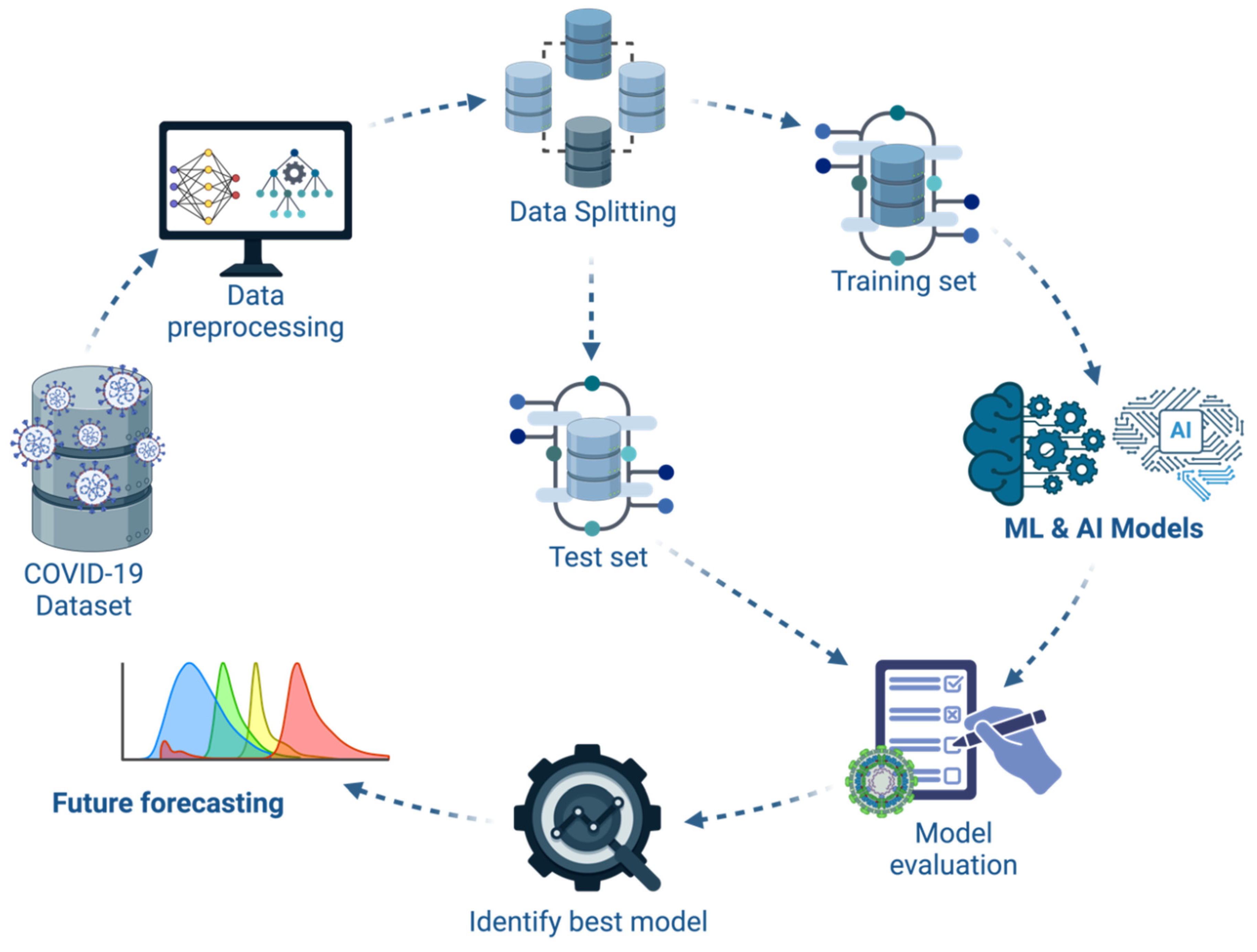
Figure 2.
A framework for AI and ML-driven COVID-19 diagnosis and prognosis. Patient data is collected from hospitals and public online databases, encompassing individual diagnoses, laboratory findings, medical imaging, electronic medical records, clinical characteristics, and demographic/epidemiological data. Machine learning (ML) and artificial intelligence (AI) models analyze these datasets to predict disease severity, aiding in the diagnosis of severe cases over time. The resulting predictive models are categorized into prognostic, diagnostic, and screening models, facilitating early detection, risk assessment, and clinical decision-making in COVID-19 management.
Figure 2.
A framework for AI and ML-driven COVID-19 diagnosis and prognosis. Patient data is collected from hospitals and public online databases, encompassing individual diagnoses, laboratory findings, medical imaging, electronic medical records, clinical characteristics, and demographic/epidemiological data. Machine learning (ML) and artificial intelligence (AI) models analyze these datasets to predict disease severity, aiding in the diagnosis of severe cases over time. The resulting predictive models are categorized into prognostic, diagnostic, and screening models, facilitating early detection, risk assessment, and clinical decision-making in COVID-19 management.
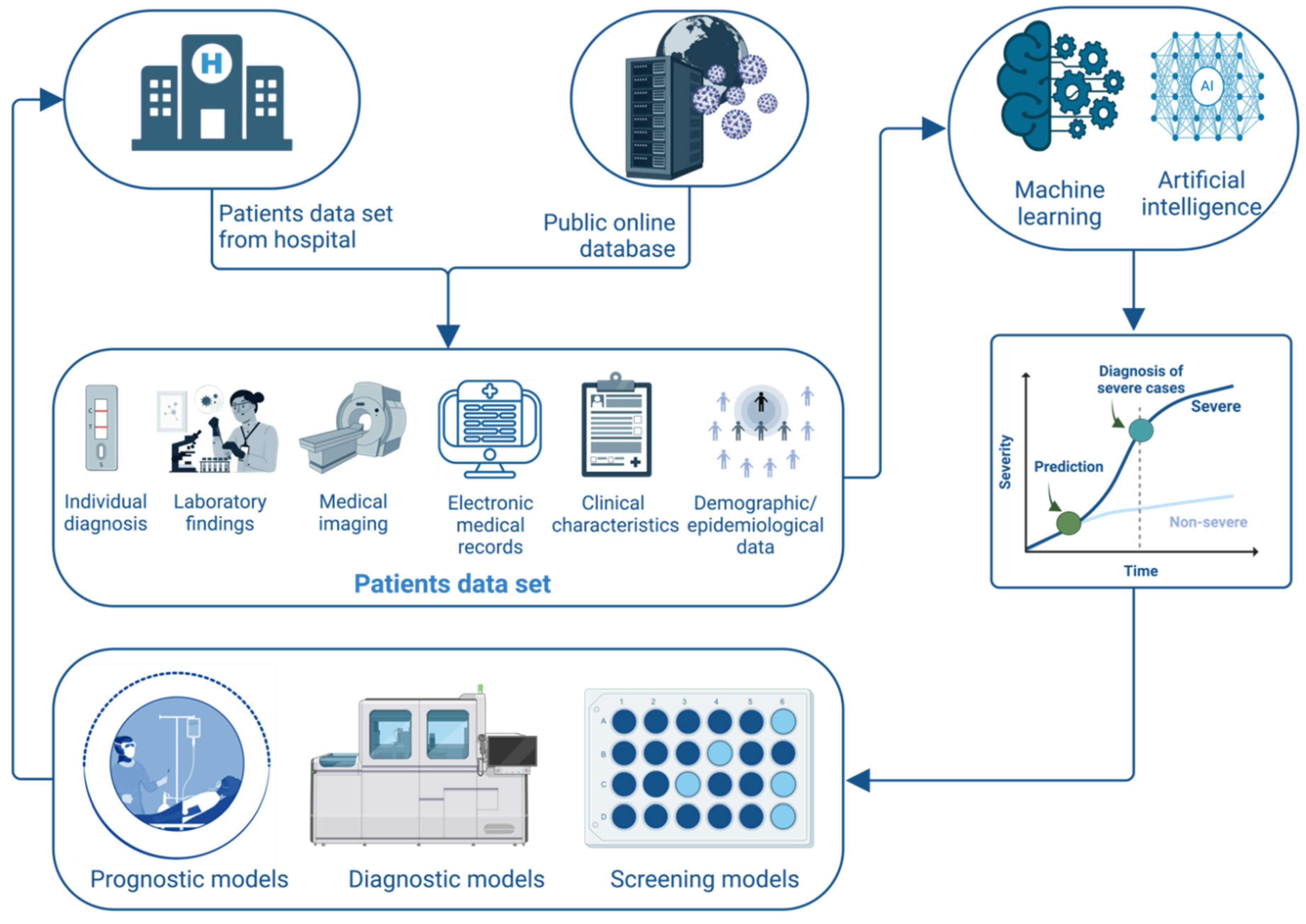

Table 1.
Summary of AI/ML Applications in COVID-19 Management.
| Application Area | AI Model Used | Key Benefits | Limitations |
|---|---|---|---|
| Early Diagnosis | CNN, ResNet, SVM, Random Forest | Rapid and accurate detection from X-rays & CT scans; reduces burden on radiologists | Data bias, need for large labeled datasets, risk of overfitting |
| Prognosis | LSTM, RNN, XGBoost, Decision Trees | Predicts disease severity & patient outcomes; assists in triage & resource allocation | Model interpretability, dependency on high-quality EHR data |
| Epidemiological Modeling | LSTM, ARIMA, Bayesian Networks | Real-time forecasting of infection trends; helps in public health planning | Requires continuous data updates, sensitive to missing/incomplete data |
| Drug Discovery | Deep Learning (DNN, GANs), Reinforcement Learning, Molecular Docking | Speeds up drug repurposing; identifies potential drug candidates | Computationally expensive, limited experimental validation |
| Vaccine Optimization | AI-based protein structure modeling (AlphaFold), Reinforcement Learning | Accelerates vaccine design; predicts immunogenicity of viral proteins | Requires extensive experimental validation, ethical concerns |
| Contact Tracing | NLP, Geolocation-based AI, Computer Vision | Identifies high-risk individuals, prevents spread through real-time monitoring | Privacy concerns, regulatory challenges, potential for false positives |
Table 2.
Challenges in AI Implementation for COVID-19 Healthcare.
| Challenge | Description | Potential Solutions |
|---|---|---|
| Data Privacy | Ensuring the confidentiality and security of patient health data while using AI models | Implement federated learning, enforce strict data encryption, comply with GDPR/HIPAA regulations |
| Bias in Models | AI models may produce skewed results due to imbalanced or non-representative training data | Use diverse and representative datasets, apply fairness-aware ML techniques, conduct bias audits |
| Explainability | Many AI models, especially deep learning, function as “black boxes,” making their decisions difficult to interpret | Develop explainable AI (XAI) models, use SHAP/LIME methods, incorporate clinician-in-the-loop approaches |
| Computational Costs | AI models require significant computing power, making real-time applications challenging, especially in resource-limited settings | Optimize models for efficiency, utilize cloud computing, leverage hardware accelerators (e.g., GPUs, TPUs) |
| Standardization Issues | Lack of uniform validation frameworks for AI in healthcare, leading to inconsistencies in adoption and regulatory approval | Develop standardized evaluation metrics, promote regulatory frameworks, encourage interoperability between AI systems |
Disclaimer/Publisher’s Note: The statements, opinions and data contained in all publications are solely those of the individual author(s) and contributor(s) and not of MDPI and/or the editor(s). MDPI and/or the editor(s) disclaim responsibility for any injury to people or property resulting from any ideas, methods, instructions or products referred to in the content. |
© 2025 by the authors. Licensee MDPI, Basel, Switzerland. This article is an open access article distributed under the terms and conditions of the Creative Commons Attribution (CC BY) license (https://creativecommons.org/licenses/by/4.0/).
Copyright: This open access article is published under a Creative Commons CC BY 4.0 license, which permit the free download, distribution, and reuse, provided that the author and preprint are cited in any reuse.


