

Submitted:
13 May 2025
Posted:
13 May 2025
You are already at the latest version
Abstract
Fermented functional foods are gaining global recognition for their health-promoting properties, particularly their role as rich sources of natural antioxidants. These foods are increasingly recognized for their role in promoting a healthy gut microbiome and enhancing overall health. This review explores diverse fermented food categories including dairy, plant-based, grain-based, and beverages for their antioxidant potential, alongside emerging substrates such as algae and fruit by-products. Advances in fermentation technology, including precision fermentation and bioreactor optimization, are highlighted for their potential to enhance antioxidant yields sustainably. Additionally, the review delves into the development of novel functional foods and their role in promoting overall well-being. Despite significant progress, challenges such as antioxidant stability, regulatory hurdles, and consumer acceptance remain. This paper provides a comprehensive perspective on the progress, challenges, and future directions of fermented functional foods as antioxidant sources, emphasizing their importance in sustainable nutrition and health solutions.
Keywords:
Functional foods
; Antioxidant Potential
; Precision fermentation
; Bioavailability
; Antioxi-dant enhancement
; Gut microbiota
; Sustainable nutrition
1. Introduction
Oxidative stress is a phenomenon characterized by an imbalance between the production of reactive oxygen species (ROS) and the body’s ability to detoxify these reactive intermediates or repair the resulting damage [1,2]. This imbalance can lead to cellular damage, contributing to the pathogenesis of various chronic diseases, including neurodegenerative disorders, cardiovascular diseases, cancer, and diabetes [3,4]. The accumulation of oxidative damage to lipids, proteins, and DNA is a significant factor in the aging process and the development of these diseases [3,4]. Recent studies have highlighted the role of oxidative stress in the inflammatory processes that underlie many chronic conditions, suggesting that effective management of oxidative stress could mitigate disease progression [4]. Antioxidants play a crucial role in neutralizing ROS and preventing oxidative damage. They can be classified into enzymatic antioxidants, such as superoxide dismutase and catalase, and non-enzymatic antioxidants, including vitamins C and E, flavonoids, and polyphenols [5,6]. The intake of dietary antioxidants has been associated with a reduced risk of chronic diseases, as they help to maintain the redox balance within cells and tissues [5,7]. Recent research indicates that the consumption of foods rich in antioxidants can enhance the body’s defense mechanisms against oxidative stress, thereby lowering the incidence of diseases linked to oxidative damage [4,6]. Fermented foods have been an important component of human civilization providing improved flavours, longer shelf-life and superior nutritional qualities through the activity of microorganisms [8]. Fermented foods, in particular, are recognized for their potential health benefits, including improved gut health, enhanced immune function, and antioxidant effects [9]. One of the most convincing health benefits of fermentation lies in its remarkable ability to enhance the antioxidant capacity of foods [10]. The fermentation process not only enhances the nutritional profile of these foods but also increases the bioavailability of beneficial compounds, making them an integral part of a health-promoting diet [11]. The fermentation process involves the action of microorganisms, such as lactic acid bacteria and yeasts, which can enhance the antioxidant capacity of the food through the production of bioactive compounds [6], 12]. Fermentation process elevates the concentration of antioxidants and ameliorates their molecular structure, enhancing their solubility and bioavailability, thereby improving their efficacy in human beings [13]. Recent studies have demonstrated that fermented foods can significantly contribute to dietary antioxidant intake, providing a natural source of compounds that combat oxidative stress [11]. The increasing awareness of the relationship between diet and health has led to a growing demand for functional foods that can support overall well-being and reduce the risk of chronic diseases [14]. The significance of fermented foods as functional foods lies not only in their antioxidant potential but also in their ability to modulate gut microbiota, which plays a crucial role in maintaining overall health [9]. Functional foods are becoming increasing popular globally owing to their health-promoting properties, easy accessibility, and affordability. The health-promoting abilities of such foods is due to the prevalence of numerous bioactive molecules. Figure 1 portrays the effects of fermentation on the antioxidant potential of different food substrates & benefits of consuming fermented functional foods. Despite the promising advances in fermented functional foods, several research gaps need to be addressed to fully understand their potential as potent antioxidant sources. While fermentation is known to enhance antioxidant activity, the specific interactions between different microbial strains and their impact on the final product are not fully understood [15]. While traditional fermented foods like yogurt and sauerkraut are well-studied, there is a need for more research on novel fermented products using different plant-based materials and microbial strains. Exploring the potential of lesser-known plant species and by-products could lead to the discovery of new and potent antioxidant sources [15]. Furthermore, the regulatory framework surrounding these foods is often unclear and inconsistent, creating significant challenges for manufacturers, consumers, and regulatory agencies alike [16]. Present review aims to explore the latest research findings on the antioxidant properties of various fermented foods and their potential health benefits. It highlights the role of microbes in enhancing the antioxidant properties of foods. Furthermore, it delves into the development of novel functional foods as health-promoting foods that provide extra/added benefits beyond basic nutrition. Furthermore, it will provide insights into regulatory framework surrounding fermented functional foods and factors influencing their commercial viability. By emphasizing the significance of fermented foods as potent antioxidant sources, this review seeks to contribute to the growing body of knowledge in the field of functional foods and nutrition.
2. Current Trends in the Functional Food Market
The functional food market is a dynamic and rapidly evolving sector, driven by a confluence of factors including increasing health consciousness, technological advancements, and sustainability concerns. The market is characterized by a constant stream of product innovations, utilizing a diverse range of ingredients and focusing on specific health benefits. The functional food market has witnessed significant transformations in recent years, driven by evolving consumer preferences and increasing awareness regarding health and nutrition. In 2024, the global functional food market was valued at USD 337.85 billion and is projected to expand from USD 359.81 billion in 2025 to USD 595.49 billion by 2033, with a Compound Annual Growth Rate (CAGR) of 6.5% over the forecast period (2025–2033) [17]. This expanding market encompasses a wide range of food products fortified with bioactive compounds or ingredients that offer potential health benefits beyond basic nutrition [18]. These benefits can range from improved gut health and immune function to disease prevention and management. Several factors contribute to the expansion of the functional food market. One of the key drivers favouring this expansion is the increasing health consciousness among consumers [19]. Consumers are actively seeking ways to improve their well-being through dietary choices, resulting in a escalated demand for foods that offer specific health benefits [20]. This trend is more pronounced in developed countries with aging populations and rising rates of chronic diseases [18]. Furthermore, there is a growing preference for natural and minimally processed foods with consumers showing a clear inclination towards ingredients perceived as “clean label”. This preference is pushing manufacturers to innovate and develop functional foods using natural sources and avoiding synthetic additives [20]. The shift towards natural ingredients in food products has been a prominent trend, particularly in the context of antioxidants. Consumers are increasingly seeking natural sources of antioxidants as alternatives to synthetic additives, which have been associated with various health concerns. Research indicates that natural antioxidants, such as polyphenols, carotenoids, and vitamins, are prevalent in fruits, vegetables, herbs, and spices, and their incorporation into food products is gaining substantial interest [21,22]. Studies have highlighted the antioxidant potential of by-products from fruit and vegetable processing, suggesting that these sources can be effectively utilized in functional food formulations [23,24]. Imeneo et al., investigated the effect of utilizing onion peel waste to enhance the functional and qualitative characteristics of white bread. The findings revealed a significant increase in the bioactive compound content and antioxidant activity of the white bread. This approach exemplifies the innovative approaches being adopted in the industry for functional food development [25]. The demand for natural antioxidants is not only driven by consumer preferences but also by the growing body of evidence linking antioxidant-rich diets to health benefits, including reduced risks of chronic diseases such as heart disease and cancer [26]. The growing awareness of oxidative stress and its health implications has further fueled this trend, leading to a surge in research focused on the extraction and application of natural antioxidants from various food sources [27].
Fermented foods have gained significant attention in recent years, largely due to their perceived health benefits and their role as natural sources of probiotics. The fermentation process not only enhances the nutritional profile of foods but also contributes to the development of bioactive compounds with antioxidant properties [28]. The COVID-19 pandemic has further accelerated consumer interest in immune-boosting foods, with fermented products being at the forefront of this trend [29]. Research has shown that the antioxidant activity of fermented dairy products can be enhanced through the addition of plant extracts, thereby improving their functional properties [28]. Additionally, the integration of traditional fermented foods, such as kimchi and kefir, into modern diets reflects a broader trend towards embracing cultural heritage while promoting health [30]. This resurgence of interest in fermented foods is also supported by studies demonstrating their potential in managing gut health and overall well-being [27]. The functional food market is witnessing the emergence of innovative products that cater to the evolving preferences of health-conscious consumers. The use of by-products and waste streams from food processing is another key trend. Recent developments have seen the introduction of gluten-free options fortified with antioxidant-rich extracts, such as those derived from olive leaves and olive mill wastewater [31]. These novel products not only meet dietary restrictions but also enhance the nutritional value of everyday foods. Furthermore, the incorporation of bioactive peptides derived from food proteins into functional foods is gaining momentum. These peptides have been shown to possess antioxidant properties and can be utilized in various applications, from nutritional supplements to food fortification [32]. The exploration of new sources of antioxidants, such as algae and seaweeds, is also indicative of the innovative approaches being adopted in the functional food sector [33]. The potential of these ingredients to provide health benefits while appealing to environmentally conscious consumers underscores the dynamic nature of the market.
The integration of traditional fermented foods into contemporary diets is a notable trend that reflects a growing appreciation for cultural culinary practices. These foods, often rich in probiotics and antioxidants, are being reintroduced into modern diets as consumers seek to enhance their health and well-being [34]. The valorisation of traditional foods not only supports nutritional diversity but also promotes sustainable food practices by utilizing local ingredients and methods. Research has highlighted the antioxidant properties of various traditional fermented foods, indicating their potential role in functional food formulations [28]. The fermentation of dairy products can enhance their antioxidant capacity, making them more appealing to health-conscious consumers. Antioxidant peptides generated during milk fermentation enhance the antioxidant capacity of dairy products, and the probiotic strains support this enhancement [28]. Additionally, the incorporation of traditional knowledge regarding fermentation processes into modern food production can lead to the development of innovative products that resonate with consumers desires for authenticity and health benefits [35].
3. Fermented Foods as Antioxidant Sources
Fermented foods have garnered significant attention in recent years owing to their potential health benefits, particularly their antioxidant properties [36]. Antioxidants play a vital role in neutralizing free radicals, thereby reducing oxidative stress and the risk of chronic diseases. Here we discuss various categories of fermented foods, including dairy-based products, plant-based foods, grain-based foods, fermented beverages, and emerging non-traditional substrates, highlighting their antioxidant capacities. Dairy-based fermented products, such as yogurt, kefir, and cheese, are well-known sources of bioactive compounds with antioxidant properties. The fermentation process boosts the bioactive content of the products and introduces key properties such as antioxidant activity to make them functional [37]. The bioavailability of antioxidants increases primarily due to the action of lactic acid bacteria (LAB) that metabolize lactose and produce various bioactive peptides and phenolic compounds. For instance, the antioxidant activity of fermented milk products is attributed to the release of antioxidant peptides during fermentation, which can scavenge free radicals effectively [28].
3.1. Dairy Products
Recent studies have shown that the antioxidant potential of dairy products can be significantly enhanced by incorporating plant extracts or using specific probiotic strains. Yaneva et al. investigated the effect of addition of chokeberry juice to probiotic oat beverage upon the antioxidant capacity. The findings revealed that the addition of chokeberry juice (20%) before fermentation resulted in enhanced antioxidant activity of the beverage compared to the addition after fermentation [38]. Furthermore, the use of mixed cultures of LAB has been shown to improve the radical scavenging activity of fermented goat milk, indicating that the combination of different strains can synergistically enhance antioxidant properties. Liu et al., studied the effect of incorporation of a probiotic strain L. fermentum WXZ 2-1 alongside S. salivarius ssp. thermophilus and L. delbrueckii ssp. bulgaricus in goat milk fermentation. The addition resulted in synergistic effects with improved texture, flavour and enhanced antioxidant capacity of fermented goat milk [39]. The findings of the study suggest the potential of Limosilactobacillus fermentum WXZ 2-1 as a valuable probiotic strain in improving the functionality and desirability of fermented goat milk. This opens up new opportunities for developing functional foods with enhanced health benefits and superior quality.
The fermentation of milk with specific strains of Lactobacillus has been reported to produce higher levels of bioactive compounds, thereby increasing the overall antioxidant activity of the final product [28]. In this context Isik et al. investigated the multifunctional benefits of peptides and gamma-aminobutyric acid (GABA) in fermented milk produced using specific Lactobacillus strains. While bacterial strains (Lactiplantibacillus plantarum 156, Lactobacillus casei ATCC 334, Lactobacillus helveticus DPC 4571, and Streptococcus thermophilus 20S4) remained highly viable, their combinations influenced bioactive properties, with L. casei ATCC 334 and L. helveticus DPC 4571 enhancing ACE-inhibitory activity. Fermented milk also exhibited antioxidant and antimicrobial properties, with significant variations in GABA content linked to proteolytic activity [40]. These findings suggest its potential as a functional food for promoting health and reducing disease risk. This indicates that the choice of bacterial culture and fermentation conditions can significantly influence the antioxidant potential of dairy-based fermented foods.
3.2. Plant-Based Fermented Foods
Plant-based fermented foods are rich in antioxidants due to their high content of phenolic compounds and other bioactive metabolites. The fermentation process not only enhances the bioavailability of these compounds but also leads to the production of new antioxidant substances. Hsieh et al. studied the lactic acid fermentation of cabbage by employing a consortium of Lactiplantibacillus plantarum, and antioxidant-rich strains Lactobacillus acidophilus and Bifidobacterium longum. A 5 L bioreactor was utilized to facilitate the controlled fermentation process (35 °C, 24 h of fermentation at 5 rpm). The bioreactor-facilitated lactic acid fermentation effectively enhanced the antioxidant capacity of cabbage with sustained Glucosinolate retention at 82.02%. The controlled fermentation process significantly improved the DPPH radical scavenging rate by 16.32% compared to non-fermented cabbage. Storage stability tests further confirmed minimal glucosinolate degradation over 14 days, emphasizing the potential of this approach for improving the nutritional and functional value of cabbage [41]. Tahir et al. performed a comparative study to assess the nutritional and antioxidant activity of raw and fermented (black) garlic. For this purpose, different varieties of desi raw garlic (DRG) and farmi raw garlic (FRG) were fermented at 60°C and 70–80% humidity level for 30 days. The findings revealed significant enhancement in protein, crude fiber, crude ash, and carbohydrate contents after fermentation. Additionally, the protein content of desi fermented (black) garlic (DFG) and farmi fermented garlic (FFG) increased to 9.5 ± 0.35 and 8.1 ± 0.06 g/100 g after fermentation compared to 8.57 ± 0.21 and 6.38 ± 0.05 g/100 g in DRG and FRG before fermentation. Furthermore, antioxidant activity analysis revealed that the total phenolic content (TPC) was 2421.3 and 2128.5 mg GAE/kg in DRG and FRG, respectively, while it increased to 2886.7 and 2529.8 mg GAE/kg in DFG and FFG. Similarly, total flavonoid content was 124 and 101 mg RE/100 g in DRG and FRG, respectively, rising to 191 and 121 mg RE/100 g in DFG and FFG. Additionally, FRAP, DPPH, and ABTS values were higher in DRG and DFG compared to FRG and FFG, indicating stronger antioxidant potential in desi garlic varieties. Overall, the fermented black garlic exhibited a higher nutritional profile, mineral content, and antioxidant activity compared to raw garlic [42]. In another study, Tan et al. studied the impact of impact of fermentation by Bifidobacterium adolescentis and Monascus purpureus on the functional components and antioxidant activity of ginger. The findings revealed that fermentation of ginger with Bifidobacterium adolescentis and Monascus purpureus significantly enhanced its functional components and antioxidant activity. The process increased gingerol, flavonoids, and polyphenols, leading to improved free radical scavenging (DPPH, ABTS, FRAP). M. purpureus fermentation yielded higher antioxidant capacity and bioactive compounds, including Monascus pigments and Monacolin K [43]. Chen et. Investigated the fermentation of ‘Summer Black’ grape juice with 6 Lactic Acid Bacteria Strains. The findings showed that Lactic acid bacteria (LAB) fermentation enhanced the antioxidant activity, organic acid content, and amino acid profile of ‘Summer Black’ grape juice while pH and total sugar content were reduced. Amongst the tested bacterial strains, Lactobacillus plantarum exhibited highest DPPH and OH− scavenging ability. Streptococcus thermophilus exhibited an increased total phenol and total flavonoid content by 5.2% and 4.1%, respectively [44]. These studies emphasize the potential of plant-based fermented foods as functional foods with enhanced antioxidant content.
3.3. Grain-Based Fermented Foods
Grain-based fermented foods, such as sourdough bread and fermented millet, also exhibit significant antioxidant properties. Research indicates that sourdough fermentation leads to the breakdown of complex carbohydrates and the release of phenolic compounds, which contribute to the antioxidant activity of the final product. In this context, Pejcz et al. investigated the changes in fermentable oligosaccharide, disaccharide, monosaccharide, and polyol (FODMAP) compounds derived from wheat flour, alongside their antioxidant activity, during both inoculated and spontaneous sourdough fermentation. The findings revealed that inoculating sourdough with specific microorganisms, such as Lactobacillus plantarum and Lactobacillus casei, enhanced the controlled fermentation process, allowing for targeted conversion of chemical compounds. In a 72-hour fermentation of Lactobacillus plantarum-inoculated sourdough, the FODMAP content was reduced by 91%. Additionally, the 72-h fermentation time had exhibited effect on the polyphenolic content and antioxidant activity irrespective of the fermentation type. These results emphasize the potential of tailored sourdough fermentation in developing functional, gut-friendly cereal products with enhanced health benefits [45].
Fermented millet, has also been shown to possess high levels of antioxidants. In this context, Balli et al. studied the effect of fermentation on phenolic composition, starch, mineral content and prebiotic activity of pearl millet. Fermenting pearl millet with specific microbial combinations [(Saccharomyces boulardii (FPM1), Saccharomyces cerevisiae plus Campanilactobacillus paralimentarius (FPM2) and Hanseniaspora uvarum plus Fructilactobacillus sanfranciscensis (FPM3)] enhanced its nutritional properties. Among the tested fermentations, Saccharomyces cerevisiae plus Campanilactobacillus paralimentarius (FPM2) exhibited the most promising results, significantly increasing calcium (282 ppm), iron (~100 ppm), total phenols (2.74 mg/g), and resistant starch (9.83 g/100 g). Additionally, FPM2 promoted the growth of Bifidobacterium breve B632, indicating potential prebiotic benefits. These findings suggest that FPM2-fermented millet could serve as a nutrient-rich food option for populations relying on millet as a staple crop [46]. These studies underscore the potential of grain-based fermented foods as functional foods with enhanced antioxidant content.
3.4. Fermented Beverages
Fermented beverages are also increasingly recognized for their antioxidant properties. Kombucha, a fermented tea beverage, is particularly noted for its high levels of polyphenols and organic acids, which contribute to its antioxidant capacity. Studies have shown that the antioxidant activity of kombucha is influenced by the type of tea used and fermentation time. In this context, Jakubczyk et al. analysed the chemical composition and antioxidant potential of kombucha derived from different tea types (black, green, white, and red) over various fermentation periods. The findings of the study revealed that green tea kombucha exhibited the highest antioxidant potential, followed by red, white, and black tea variants. The antioxidant activity, measured using DPPH and FRAP assays, exhibited an increase during the initial days of fermentation, peaking around day 7 before declining. Fermentation increased the total polyphenol content, particularly in green and red tea kombucha, with the highest levels observed on day 14. Flavonoid content initially decreased but later recovered. Kombucha from red and green tea, especially on days 1 and 14, was the richest in flavonoids, reinforcing its functional food potential with significant health benefits [47]. These findings suggest that kombucha fermentation enhances bioactive compounds, improving its antioxidant capacity and potential health benefits.
The fermentation of fruit juices into fermented beverages also enhances their antioxidant properties. In a study conducted by Zhao et al., the fermentation of red jujube fruits and bamboo shoots with Lactiplantibacillus plantarum resulted in an increase in total phenolic content, which is closely associated with antioxidant activity [48]. This study involved the successful fermentation of red jujube fruits and bamboo shoots using Lactiplantibacillus plantarum TUST-232 to develop a novel functional beverage. The nutritional profile of the beverage was significantly enhanced upon fermentation (37°C, 14 h), increasing total phenolic content (11.09%), total antioxidant capacity (12.30%), and superoxide anion scavenging ability (59.80%), while reducing sucrose content by 44.10% [48]. The findings highlight the potential of this fermentation process to create a high-fiber, antioxidant-rich beverage, offering a promising approach for developing functional foods that support health and well-being. The incorporation of various substrates, such as turmeric and black tea, into the fermentation process has been found to significantly boost the antioxidant activity of the resulting beverages [49]. This indicates that the choice of fermentation substrate is crucial for maximizing the antioxidant potential of fermented beverages.
3.5. Non-Traditional Substrates
The exploration of non-traditional substrates for fermentation, such as algae and fruit peels, is gaining traction in the field of functional foods. These substrates are often rich in bioactive compounds and can serve as excellent sources of antioxidants. The fermentation of algae has been shown to produce bioactive peptides with significant antioxidant activity [37]. In this context, a novel fermented microalgae-based bakery product was developed by incorporating Arthrospira platensis (spirulina) biomass into sourdough ‘crostini,’ resulting in a distinctive green color [50]. Increasing the fermented microalgae content (2% to 10% w/w) significantly enhanced the protein, phycocyanin, and phenolic content (P < 0.05). The study highlights that these A. platensis F&M-C256-based crostini serve as unique functional foods with antioxidant properties (boosted by extra virgin olive oil) and provide an alternative source of easily digestible proteins.
Fruit peels, often discarded as waste, can also be utilized as substrates for fermentation. Studies have demonstrated that the fermentation of fruit peels can enhance their antioxidant properties, making them valuable ingredients in the production of functional foods. In this context, Araújo et al. studied the effect of solid-state fermentation (SSF) solid-state fermentation (SSF) with Aspergillus ibericus and Rhizopus oryzae in enhancing the nutritional value and antioxidant activity of orange peels (OPs) and banana peels (BPs). Both the fungi were able to grow on untreated FPs thereby enhancing their protein content and antioxidant activity. Fermented OPs and BPs exhibited 200% and 123% increase in protein content respectively. Additionally, fermented OPs and BPs exhibited improved fiber, mineral content and higher antioxidant activity compared to unfermented peels [51]. The application of fermentation in the valorization of agro-industrial by-products is gaining significant attention due to its potential for waste reduction and value addition. Table 1 provides a comprehensive summary of how different by-products have been effectively processed through fermentation technologies. This innovative approach supports a circular economy by transforming fruit processing byproducts into nutrient-rich ingredients for functional food applications. As research continues to uncover the health benefits of these foods, they are likely to play an important role in promoting health and preventing chronic diseases.
4. Microbes Driven Antioxidant Enhancement in Foods
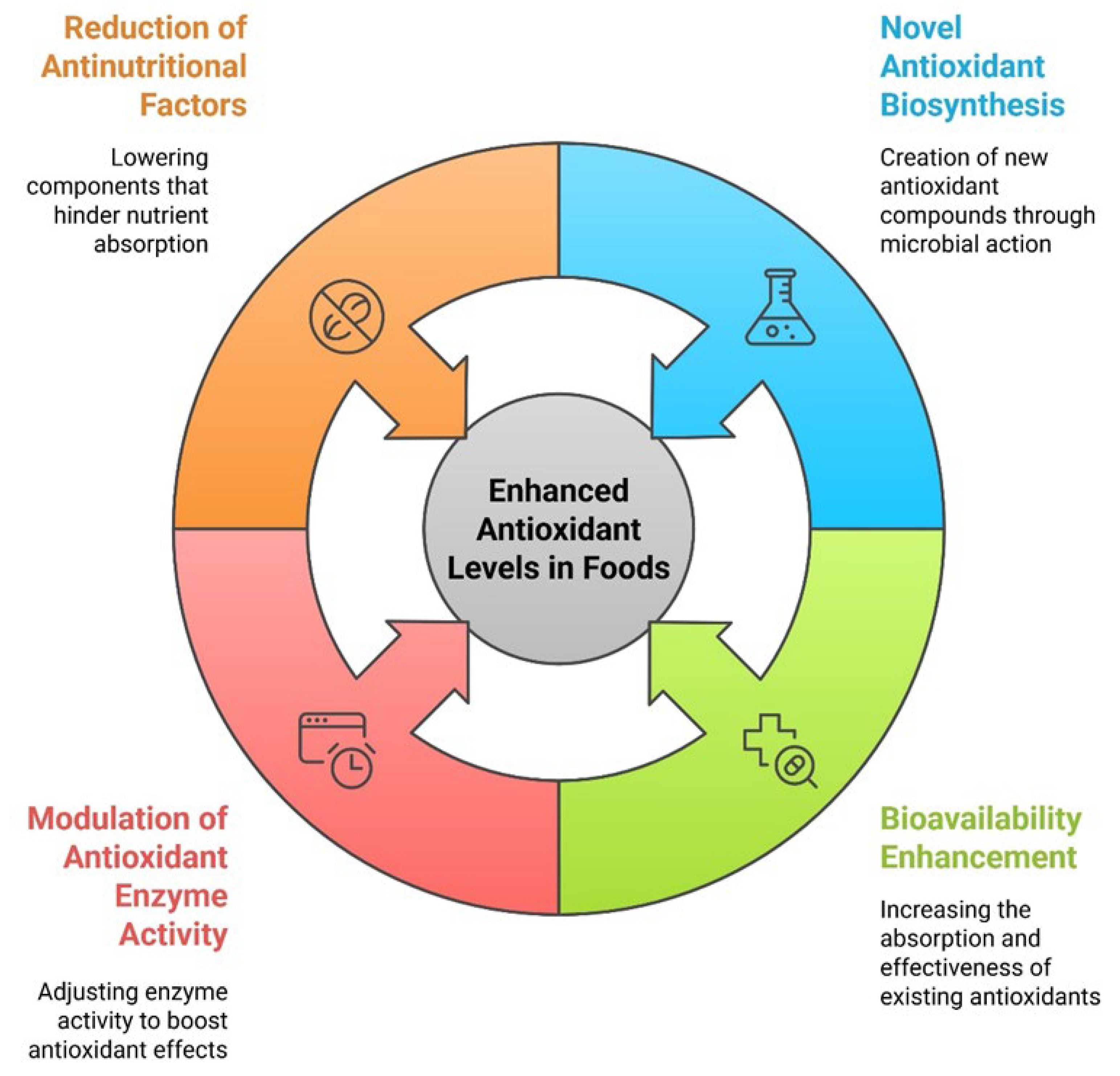
The role of microbes in enhancing the antioxidant properties of foods is a fascinating/expanding/emerging field of research with significant implications for human health and food security. Antioxidants, substances that protect cells from damage caused by free radicals, are crucial for preventing chronic diseases like cancer, cardiovascular disease, and neurodegenerative disorders [2]. While many foods naturally contain antioxidants, microbial fermentation offers a promising avenue to increase their levels and bioavailability, thereby improving the nutritional and functional properties of food products [65]. Consuming microbe-enhanced foods may reduce oxidative stress, improve immunity, and protect against chronic diseases. Microbial fermentation is a powerful biotechnological tool used to enhance the nutritional value and sensory properties of food products [15,66]. This process involves the controlled growth of microorganisms, such as bacteria, yeasts, and molds, which metabolize substrates within the food matrix, leading to the formation of new compounds and the modification of existing ones [65]. Several key mechanisms including biosynthesis of novel antioxidants, enhanced bioavailability of existing antioxidants, modulation of antioxidant enzyme activity & reduction of antinutritional factors contribute to the microbes’ ability to enhance antioxidant levels in foods (Figure 2).
Figure 2.
Microbial Enhancement of Food Antioxidants.
4.1. Biosynthesis of Novel Antioxidants
Certain microbes are capable of synthesizing novel antioxidant compounds during fermentation. Some lactic acid bacteria (LAB) produce various bioactive metabolites with antioxidant properties. These compounds can directly scavenge free radicals or indirectly modulate cellular pathways involved in antioxidant defense mechanisms. In this context, Chen et al. explored the potential of Lactobacillus plantarum 60 (L60), a wild strain isolated from kefir, in fermenting goat milk to produce novel antioxidant peptides. The findings revealed that Goat milk fermented with L60 exhibited significantly enhanced DPPH radical scavenging activity (70.81%), along with higher viable bacterial counts and favourable acidity (pH 4.7–4.3). The fermented milk demonstrated improved hydroxyl free radical scavenging activity and Fe²⁺ chelating ability, crucial for preventing oxidative damage. Three novel antioxidant peptides were identified in L60-fermented goat milk: VGINYWLAHK, TPEVDKEALEK and DLLER. These peptides exhibited high radical scavenging activity, metal ion chelation, and strong Fe²⁺ chelating ability [67]. Qamar et al. explored the effects of enzymatic pretreatment and fermentation with Lactobacillus plantarum and Lactobacillus reuteri on the antioxidant activity of Palm kernel meal (PKM), utilizing an integrated metagenomics and metabolomics approach. Fermented PKM exhibited significantly improved (p < 0.05) free radical scavenging activity, with increased total flavonoid and polyphenol content. Non-targeted metabolomics revealed biosynthesis of 25 novel antioxidant biopeptides and an increased (p < 0.05) enrichment ratio of the isoflavonoids and secondary metabolites biosynthesis pathways [68]. et al., (2024) investigated the antioxidant Guo potential of novel peptides derived from whey protein metabolites fermented by Lactobacillus rhamnosus B2-1. Three peptides (PKYPVEPF, LEASPEVI, and YPFPGPIHNS) were identified and exhibited remarkable antioxidant activity, increasing HepG2 cell viability from 49.02 ± 3.05% to 88.59 ± 10.49%, 82.38 ± 19.16%, and 85.15 ± 7.19%, respectively, under H₂O₂-induced oxidative stress. The peptides also enhanced catalase and superoxide dismutase activity while reducing reactive oxygen species levels. Molecular docking analysis revealed their ability to bind to the Kelch domain of Keap1, preventing Keap1-Nrf2 interaction and activating antioxidant defense mechanisms [69]. These findings suggest the potential of whey-derived peptides as functional food ingredients with health-promoting properties. A novel exopolysaccharide (EPS) was successfully produced by Lactococcus lactis F-mou (LT898177.1), a strain isolated from Sahrawi camel milk in Algeria. Optimization using the Plackett-Burman and Box-Behnken designs significantly enhanced EPS yield, reaching 301 g/L, which was 47 times higher than the initial production. Functional properties revealed its strong antioxidant and anti-clotting activities [70]. Furthermore, probiotics, defined as live microorganisms that confer health benefits when consumed in adequate amounts, can contribute to the overall antioxidant capacity of fermented foods by producing biologically active compounds that enhance antioxidant activity [71]. A synbiotic combination of Cudrania tricuspidata leaf extract and the probiotic Lactobacillus gasseri was found to enhance the metabolism of phenolic acids in milk, leading to the production of a novel metabolite, 3,4-dihydroxy-hydrocinnamic acid, along with bioactive peptides. These compounds significantly boosted the free radical scavenging activity of the fermented milk and improved its in vivo efficacy [72,73]. Next-generation probiotics (NGPs) represent a novel group of beneficial bacteria that are actively being explored through research and development [74]. The specific types of antioxidants produced vary depending on the microbial strain and the food matrix.
4.2. Enhanced Bioavailability of Existing Antioxidants
Bioavailability refers to the fraction of nutrients that are absorbed and utilized by the body post consumption of the food. During fermentation, microorganisms like bacteria, yeast, and molds generate enzymes that break down complex compounds into simpler molecules, making them more easily digestible and absorbable by the human body [66]. Fermentation enhances antioxidant levels and also alters their molecular structure, improving solubility and bioavailability, thereby enhancing their effectiveness in the human body [13]. In individuals with metabolic disorders like hyperglycemia and hyperlipidemia, fermentation enhances the bioavailability of antioxidants, supporting overall metabolic health and aiding in the management of non-communicable diseases, including diabetes and cardiovascular disease [75]. Wei et al. investigated the effect of lactic acid bacteria (LAB) fermentation on the antioxidant capacity and γ-aminobutyric acid (GABA) content of Ganmai Dazao Decoction (GMDZD), a traditional Chinese medicinal formula. The findings revealed that LAB fermentation significantly increased the total phenolic content (TPC) and total flavonoid content (TFC), which are associated with improved antioxidant potential. Antioxidant activities, including DPPH free radical scavenging (92.14%) and hydroxyl radical clearance (78.14%), were significantly enhanced post-fermentation. The increase in antioxidant activity is attributed to phenolic compound hydrolysis by microbial enzymes, which releases bioactive phenolics with higher radical scavenging ability [76]. In another study, Islam et al. investigated the impact of Lactobacillus plantarum-mediated solid-state fermentation (SSF) on the release of phenolic compounds and their antioxidant activity in whole wheat flour (WWF). The results indicated that fermentation techniques efficiently converted bound phenolic fractions into their free form in the treated wheat, significantly enhancing the free-to-bound ratio of phenolic compounds. The total phenolic (TPC), flavonoid (TFC), and antioxidant content (TAC) of both free and bound phenolic fractions showed substantial enhancement during solid-state fermentation. For solid-state fermented wheat grain (SSFWG) TPC, TFC, and TAC increased by 284.87% and 39.60%, 339.92% and 105.86%, and 157.13% and 52.43%, respectively. Similarly, for solid-state fermented wheat flour (SSFWF), the respective increases were 399.59% and 103.24%, 522.18% and 102.72%, and 226.35% and 95.67% until 72 hours of fermentation. High-performance liquid chromatography (HPLC) analysis revealed a significant rise in individual free phenolics, especially 3,4-dihydroxy benzoic acid, which increased by 164.54 % and 220.47 %, respectively for SSFWG and SSFWF among the other individual phenolics. Additionally, in vitro antioxidant assays (DPPH•, ABTS•+, H2O2 scavenging, and ferric reducing power) confirmed the improved antioxidant capacity of fermented wheat [77].
4.3. Modulation of Antioxidant Enzyme Activity
Microbes can indirectly enhance antioxidant levels by modulating the activity of antioxidant enzymes within the food matrix and in the human body after consumption. During fermentation, microbial metabolism leads to the production of bioactive compounds, such as peptides, polyphenols, and exopolysaccharides, which can stimulate the activity of key antioxidant enzymes like superoxide dismutase (SOD), catalase (CAT), and glutathione peroxidase (GPx). Superoxide dismutases (SODs) are one of the key antioxidant enzymes in LAB. They catalyze the dismutation of O₂⁻, helping to regulate free metal cation concentrations and protect cells from H₂O₂ damage [78]. These enzymes help neutralize reactive oxygen species (ROS) and reduce oxidative stress in food, thereby improving its stability and nutritional quality. Studies suggest that some probiotic LAB strains have been found to either enhance antioxidative enzyme activity or mitigate circulatory oxidative stress, reducing the risk of oxidative stress-induced cellular damage [79]. In this context Łepecka et al. evaluated the antioxidant activity of 23 LAB strains isolated from raw fermented meat products. The findings revealed that Pediococcus pentosaceus KL14 and KL10 showed the highest DPPH radical scavenging activity. P. pentosaceus KL11 and KL14 were most effective in scavenging ABTS radicals. The highest superoxide dismutase (SOD) activity was found in P. pentosaceus BAL6 and BAL3. P. pentosaceus BAL6 and KL14 could produce hydrogen peroxide (H₂O₂), while KL14 and BAL5 showed resistance to H₂O₂ [80]. These findings emphasize that microbes enhance antioxidant levels by modulating antioxidant enzyme activity in food. In another study, Prudêncio de Souza et al. investigated the effects of lactic acid bacteria (LAB) fermentation on the antioxidant activity of caffeic acid phenethyl ester (CAPE) and mangiferin. The antioxidant activity of the post fermentation products was compared to that of the pure substances before fermentation. This comparison was evaluated using high-performance liquid chromatography (HPLC), in vitro through 2,2-Diphenyl-1-picrylhydrazyl (DPPH) assay, and in vivo in yeast cell models. High-performance liquid chromatography (HPLC) confirmed compositional changes post-fermentation, but significant antioxidant alterations were observed only in mutant yeast strains under H₂O₂-induced oxidative stress. Fermented mangiferin showed increased dependence on glutathione (GSH) for antioxidant defense, while CAPE acted as a preconditioning agent, enhancing oxidative stress tolerance even after fermentation. The findings of the study suggest that, fermentation by lactic acid bacteria (LAB) modulated the activity of antioxidant enzymes within the food matrix by altering the bioavailability and metabolic impact of caffeic acid phenethyl ester (CAPE) and mangiferin [81].
Some microbial metabolites can stimulate the expression or activity of endogenous antioxidant enzymes, such as superoxide dismutase (SOD) and catalase (CAT). This leads to increased scavenging of free radicals and reduced oxidative stress. The interaction between resveratrol, a potent antioxidant compound found in grapes and other plants and gut microbiota exemplifies this mechanism. Resveratrol’s ability to protect against oxidative stress is further enhanced by its interaction with the gut microbiota, suggesting a synergistic effect between natural compounds and microbial metabolism [82].
4.4. Reduction of Antinutritional Factors
Anti-nutritional factors are naturally occurring compounds that can hinder with the digestion and absorption of nutrients [66]. Many plant-based foods contain antinutritional factors, such as phytic acid and tannins, which can inhibit the absorption of nutrients and reduce the bioavailability of antioxidants [83]. Fermentation can reduce the levels of these antinutritional factors, thereby enhancing the overall antioxidant capacity of the food [66]. This is achieved through microbial enzymatic activity, which degrades or modifies these inhibitory compounds, making the antioxidants more accessible. Phytic acid is a key anti-nutritional factor present in cereals and legumes. Microbial fermentation stimulates phytase production thereby facilitating the phytic acid degradation. This degradation process enhances the bioavailability of minerals, free amino acids (FAAs), and proteins and reduces the inhibitory effects of phytic acid on mineral absorption. Fang et al., reported that mixed fermentation employing Lactobacillus paracasei LG0260, L. plantarum LG1034, Lactococcus lactis LG0827, and S. cerevisiae J2815 and S. cerevisiae J8202 resulted in enhanced phytic acid degradation (up to 96.6%) in sourdough bread and improved DPPH free radical scavenging activity [84]. In another study, the solid-state fermentation (SSF) of tannin-rich sorghum employing L. plantarum, S. cerevisiae, R. oryzae, A. oryzae, and Neurospora sitophila reduce the tannin content and free phenolic content by 56.36% and 23.48% respectively. This reduction enhanced protein digestibility and mineral bioavailability, making sorghum more nutritionally beneficial [85]. Fermentation has also been reported to lessen other anti-nutritional factors present in various legumes. In this context, Xing et al. studied the effect of spontaneous solid-state fermentation (SSF) of chickpea sourdough using LAB strains (Pediococcus pentosaceus and Pediococcus acidilactici). The findings revealed that fermentation process significantly reduced α-galactosides (88.3–99.1%), phytic acid (17%), and pH (6.6 to 4.2) while enhancing phenolic content (119%) and water-holding capacity (67%), improving both nutritional quality and functional properties of chickpea products [86]. While fermentation effectively reduces phytic acid, α-galactosides, and tannins, maintaining precise control over factors like pH, temperature, and microbial strain selection remains a challenge. To maximize its benefits, future research should focus on designing tailored fermentation protocols for various food types and exploring genetically modified or novel microbial strains that can break down anti-nutritional compounds while preserving both the taste and nutritional quality of the food [66].
5. Novel Functional Food Development
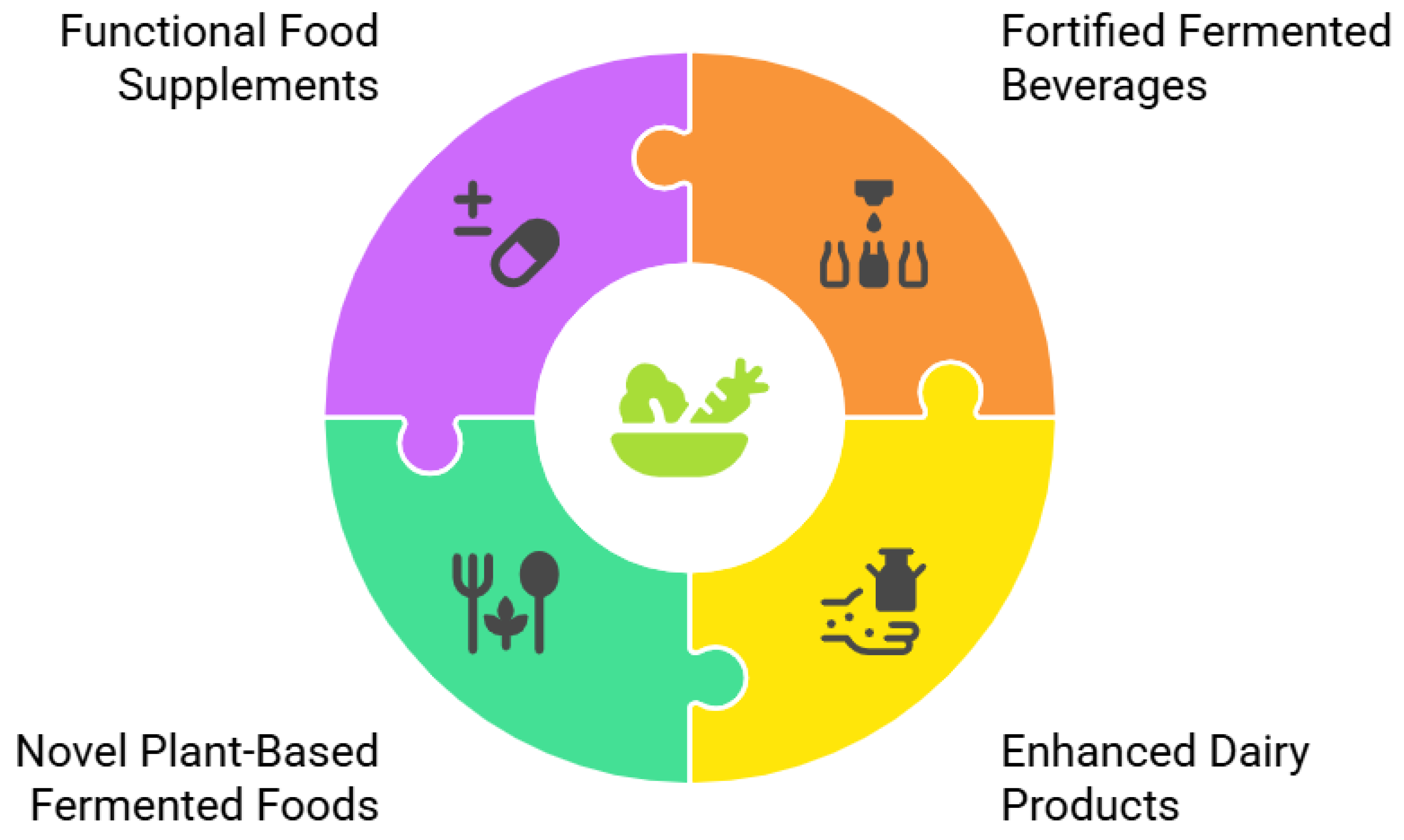
The development of novel functional foods has gained significant momentum in recent years, particularly in the realm of fermented products. These innovations are driven by the increasing consumer demand for health-promoting foods that offer additional benefits beyond basic nutrition. Recent studies highlight several key areas of product innovation, including fortified fermented beverages, enhanced dairy products, novel plant-based fermented foods, and functional food supplements (Figure 3).
Figure 3.
Innovations in Functional Foods Development.
5.1. Fortified Fermented Beverages
Fortified fermented beverages have emerged as a prominent category in functional food development [87]. A study demonstrated that an iron-fortified fermented milk beverage, supplemented with Lactobacillus acidophilus, significantly improved growth metrics in preschool children [88]. The study reported that while red blood cell, haemoglobin, and haematocrit levels decreased in both test and control groups, they remained within the normal range. Children consuming the probiotic-fortified beverage showed improved red blood cell status and a positive correlation between iron intake and haemoglobin. Nutritional status improved in both groups, with increased energy and nutrient intake, reducing the prevalence of inadequacy. The findings suggest that iron-fortified fermented milk can enhance nutrient intake and support child growth, though nutrient mobilization for growth may affect blood parameters. This indicates that such beverages can serve dual purposes: providing essential nutrients while also delivering beneficial probiotics. Tawfek et al. investigated the effect of date palm (DP) supplementation on the composition and quality of fermented camels’ milk (FCM) and fermented goats’ milk (FGM) [89]. It was reported that with an increasing percentage (10%, 20% and 30% (w/v) of date palm addition, pH, protein, and fat levels decreased, while total solids, carbohydrates, ash, viscosity, vitamins, minerals, and antioxidants increased compared to the control. Microbial counts significantly increased (P < 0.05) during storage, enhancing the microbiological quality. Sensory evaluation indicated that 10%–20% DP supplementation resulted in the most acceptable texture and flavor [89]. Overall, DP fortification improved the nutritional and functional properties of fermented camels’ and goats’ milk. In another study, Elkot et al. developed a novel probiotic fermented beverage using ricotta cheese whey supplemented with Spirulina platensis (0.25–0.75%), lemon, and peppermint juice. The 0.5% Spirulina concentration enhanced structural properties and sensory acceptance, while all formulations maintained probiotic viability (>7 log CFU/mL) over 21 days. The beverage showed increased vitamins, minerals, antioxidants, and total phenolic compounds, highlighting its potential as a functional probiotic drink [90]. Farmani et al. investigated the effects of thermal pasteurization and carrot juice addition (10–50%) on the bioactives and stability of functional milk-based drinks during 13-day storage at 4°C. The findings revealed that higher carrot juice concentration increased total carotenoids, ascorbic acid, and total phenols, though carotenoids and ascorbic acid declined over time. Antioxidant capacity (FRAP & DPPH) peaked at 50% carrot juice, which also had the highest oxidative stability. The 40% carrot juice sample was the most suitable in terms of physicochemical and sensory attributes up to 10 days [91]. Younis et al. (2024) evaluated the feasibility of developing a date–milk beverage with enhanced nutritional and antioxidant properties while optimizing formulation and storage conditions. Increasing date powder concentration led to higher dietary fiber and phenolic content, while lower storage temperatures (1°C) helped preserve antioxidant activity. Antioxidant levels increased during storage, but microbial growth was higher at warmer temperatures (5°C) and lower date concentrations. The study suggests that a 25% date powder concentration and 1°C storage for 10 days provide the best balance of nutritional quality, stability, and consumer appeal without artificial additives [92]. This study indicates that incorporating dates into dairy-based beverages results in nutritious drinks free from additives, processed sugars, and preservatives, while maintaining consumer appeal. Abdi et al. optimized the formulation of a novel fermented beverage-green tea water kefir (GTWK) using varying concentrations of honey (10–50%) and lemon juice (1–5%) [93]. The optimal formulation (42.85% honey and 1.77% lemon juice) yielded the highest microbial count, antioxidant activity, and overall acceptability. The beverage exhibited strong antibacterial effects against E. coli, S. aureus, and S. typhimurium, along with anti-inflammatory properties, as indicated by a significant reduction in TNF-α levels in CaCo-2 and RAW264.7 cells. These findings highlight the functional potential of GTWK as a probiotic, antioxidant, and anti-inflammatory beverage [93].
Furthermore, the incorporation of fruit juices into emmer-based beverages has shown potential in enhancing probiotic viability and overall functional properties, suggesting a promising avenue for product innovation. Emmer-based probiotic beverages fortified with aronia, blueberry, and grape juices were developed and fermented with Lactiplantibacillus plantarum 2035. The addition of juices enhanced total phenolic content (22.3–31.9 mg GAE/100 g), antioxidant activity (94–136 µmol Trolox equivalents/100 g), and improved viscosity and water-holding capacity. L. plantarum 2035 maintained high viability (>10⁸ CFU/g for 21 days), especially in fruit-fortified beverages, highlighting a positive synergy between probiotics and fruit-derived prebiotics [94]. These beverages show great potential as dairy-free functional foods, offering a novel alternative for probiotic delivery.
5.2. Enhanced Dairy Products
The enhancement of dairy products through fermentation has also been a focal point of innovation. Research indicates that optimizing fermentation conditions can lead to improved quality and consistency in yogurt production, which is crucial for consumer acceptance. Moreover, the development of novel fermented soy milk as a meal replacement has shown promising results in weight management, highlighting the potential of dairy alternatives in functional food markets [95]. These advancements not only cater to health-conscious consumers but also address dietary restrictions associated with lactose intolerance. In this context, Srivastava et al. studied the physicochemical and functional characterization of a novel fermented pearl millet–soy milk-based synbiotic beverage. This study highlights the development and characterization of a novel fermented pearl millet–soy milk-based synbiotic beverage. The optimized formulation (40% pearl millet, 10.41% sugar) achieved high consumer acceptability and superior nutritional and physicochemical qualities compared to the unfermented counterpart. The fermented synbiotic beverage, containing Lactiplantibacillus plantarum strains at levels exceeding 10⁸ CFU/mL, demonstrated enhanced nutritional and physicochemical properties compared to its unfermented counterpart. The viability of lactic acid bacteria in the developed beverage remained significantly high at 87.83%. After 25 days of storage, probiotic survivability was 76.71% in simulated gastric juice and 73.87% in simulated intestinal juice, highlighting its potential for gut health benefits [96]. These findings demonstrate that millet-based substrates, combined with probiotic strains, offer a promising approach for developing non-dairy synbiotic beverages. Wu et al. explored the texture, polyphenol content, and protein digestibility of soymilk fermented by Bacillus natto (B. natto), Propionibacterium freudenreichii subsp. shermanii (P. shermanii), and traditional milk fermenters. Co-fermentation with B. natto or P. shermanii increased gallic acid, caffeic acid, and GABA levels, enhancing the nutritional profile. Protein digestibility and bioactive peptide release were significantly improved, with P. shermanii and Lactobacillus plantarum (L. plantarum) producing the highest percentage of bioactive peptides. The intervention of B. natto and Streptococcus thermophilus (S. thermophilus) contributed to more diverse peptide formation [97]. These findings highlight the potential of B. natto/S. thermophilus or P. shermanii/L. plantarum in developing bio-enhanced, functional soymilk products. In another study, Rana et al. optimized the fermentation of B2-enriched soymilk using riboflavin-producing Lactiplantibacillus plantarum strains and Lactobacillus acidophilus NCIM2902 [98]. Using a central composite design, the optimal conditions (36°C, pH 5.5, 11 h fermentation) resulted in a threefold increase in B2 concentration (481 µg/L) while maintaining a probiotic count of 9 log CFU/mL. Techno-functional characterization, including rheology and texture profile analysis revealed that enhanced protease activity of co-cultured LAB improved protein hydrolysis (6259 nm) and water-holding capacity, positively influencing texture and acceptability [98]. This s optimized fermentation process offers a novel approach in developing nutritionally enhanced, dairy-free alternative for lactose-intolerant and vegan consumers, leveraging the synergistic effects of co-fermentation using two riboflavin-producing Lactiplantibacillus plantarum strains alongside the traditional Lactobacillus acidophilus starter culture for improved bioavailability of Vitamin B2.
5.3. Novel Plant-Based Fermented Foods
The rise of plant-based diets has spurred the innovation of novel fermented plant-based foods. The global market of plant-based products produced through fermentation was valued at USD 329.29 million in 2021 and is anticipated to grow to USD 422.26 million by 2026, with a compound annual growth rate (CAGR) of 5.0% [99]. The outbreak of COVID-19 resulted in increased consumer interest in fermented plant-based products, owing to their health benefits including enhanced performance of immune system, improved gut health, and reduced inflammation [100].
Furthermore, with the growing shift toward plant-based diets and alternative proteins, dairy and meat substitutes are gaining increasing popularity worldwide [101]. In recent years, fermentation has gained significant attention as an eco-friendly and sustainable approach in developing plant-based alternatives with features closely resembling traditional foods. In this context, the development of several novel plant-based fermented foods has been reported in the literature. Vila-Real et al. highlighted the potential of controlled fermentation in enhancing the safety, nutritional, and functional properties of non-dairy fermented products [102]. Authors developed a finger millet-based probiotic beverage (PBFB) utilizing Weissella confusa 2LABPT05 and Lactiplantibacillus plantarum 299v (1%, 1:1 ratio (v/v)), at 30 °C/200 rpm in an orbital incubator until pH ≈ 4.5–5.0. Fermentation resulted in enhanced antidiabetic activity (21% vs. 14%) and total phenolic content (244 vs. 181 mg GAE/kg PBFB). In vitro digestion and in vitro faecal fermentation were employed to evaluate the impact of the fermented plant-based functional beverage (PBFB) on the human gut microbiota. The digested fermented PBFB increased Bifidobacterium’s 16S rRNA gene copy numbers within the first 6 hours, along with a significant release of acetic, propionic, butyric short-chain fatty acids, and lactic acid [102]. The novel PBFB exhibited antidiabetic potential and bifidogenic effects, which may may positively impact blood glucose levels and gut microbiota, making it a promising functional food alternative.
Scarpelin et al. reported new plant-based fermented beverages with kefir cultures as a potential source of gamma-aminobutyric acid (GABA) [103]. Authors assessed GABA production in plant-based fermented beverages using milk and water kefir cultures. Peanut and Brazil nut extracts were tested as non-dairy substrates, with Brazil nut extract proving superior for GABA production despite peanut’s higher protein content. Results of the study suggested that composition of kefir culture, substrate type, and glutamic acid addition influenced GABA synthesis. Fermented beverages also exhibited antihypertensive activity via angiotensin-converting enzyme (ACE) inhibition, with Brazil nut-extract based beverage achieving 80% inhibition [103]. The findings highlight kefir fermentation as a tool to enhance bioactivity in plant-based beverages, offering a novel functional food combining probiotics and GABA for health benefits. In another study, Agarbati et al. explored the fermentation of blended wort-rooibos beverages with probiotic yeasts as a novel alternative to fermented dairy products [104]. Probiotic strains Lachancea thermotolerans (Lt101), Kazachstania unispora (Kum3-B3), Meyerozyma guilliermondii (Mg112), Meyerozyma caribbica (Mc58), and Debaryomyces hansenii (Dh36) were evaluated for viability, bioactive metabolite production, and functional properties. The final beverages exhibited a balanced nutritional profile, with Dh36, Mc58, Kum3-B3, and Mg112 strains showing high antioxidant activity and total phenolic content, reinforcing their health-promoting potential. The estimated glycaemic index (77–87%) indicated no significant impact on glycaemic response [104]. These findings highlight the potential of this new plant-based fermented beverage as functional, dairy-free alternatives with enhanced bioactive properties.
5.4. Functional Food Supplements
Functional food supplements represent another area of innovation, particularly in the context of enhancing health outcomes. The development of selenium-fortified kombucha beverages, which utilize in situ biosynthesized selenium nanoparticles, showcases the potential for functional supplements to provide antioxidant benefits. Tritean developed a functional food supplement by fortifying Kombucha with biogenic selenium nanoparticles (SeNPs) synthesized in situ during fermentation with pollen. The fermentation process enhanced the bioavailability of SeNPs while also boosting the prebiotic and probiotic properties of Kombucha. The optimized formulation was rich in polyphenols, antioxidants, and essential bioactive compounds, making it a nutritionally enhanced beverage. Additionally, the study confirmed the biocompatibility and antioxidant benefits of the SeNP-enriched Kombucha, demonstrating its potential as a health-promoting functional supplement [105]. Such innovations not only enhance the nutritional profile of traditional fermented products but also introduce novel health benefits that appeal to a broader consumer base. The optimization of fermentation processes is critical for the successful development of novel functional foods. Key advancements in processing techniques have focused on controlled fermentation conditions, strain selection and improvement, novel fermentation technologies, and the preservation of bioactive compounds. The establishment of controlled fermentation conditions has been pivotal in enhancing the quality and safety of fermented foods. Research has shown that maintaining specific temperature and pH levels during fermentation can significantly influence the growth of beneficial microorganisms and the production of bioactive compounds [106,107]. For instance, temperature-controlled fermentation of coffee has been linked to improved sensory qualities and metabolomic profiles, underscoring the importance of precise environmental control in fermentation processes [108].
The selection and improvement of microbial strains are essential for optimizing fermentation outcomes. The use of specific strains can enhance the functional properties of fermented foods, as demonstrated by the successful fermentation of green coffee beans with Wickerhamomyces anomalus, which resulted in increased total phenolic content and antioxidant activity [109]. Additionally, the application of strain improvement techniques, such as mutagenesis, has been shown to enhance the production of valuable metabolites in fermentation processes. In this context Gong et al. studied the effect of strain improvement on rhamnolipid production at weak-acid conditions [110]. This study contributed to strain improvement for rhamnolipid production by employing ultraviolet (UV) and ethyl methanesulfonate (EMS) composite mutagenesis, which led to a 0.9-fold increase in rhamnolipid yield. The research demonstrated that maintaining a weak-acid fermentation environment (pH 5.5) not only reduced excessive foaming but also supported enhanced production. The study highlighted key physiological and biochemical changes in the improved strain, such as increased surface tension, reduced viscosity, and weakened electrostatic repulsion, which collectively contributed to efficient fermentation [110]. The findings provide a foundation for genetic modifications and pH-based strategies to optimize large-scale rhamnolipid production.
Innovative fermentation technologies, such as electro-fermentation, are emerging as effective methods for optimizing fermentation processes. Electro-fermentation has been shown to stabilize fermentation metabolisms by controlling substrate purity and redox conditions, leading to improved microbial biomass yield and product quality [111,112]. These technologies offer new avenues for enhancing the efficiency and effectiveness of fermentation, ultimately contributing to the development of high-quality functional foods. The preservation of bioactive compounds during fermentation is also crucial for maintaining the health benefits associated with functional foods. Studies have indicated that controlled fermentation conditions can help retain these compounds, thereby enhancing the nutritional value of the final product [113]. For example, the degradation of harmful substances during sauerkraut fermentation has been linked to the preservation of beneficial microbial populations, which play a vital role in the overall health benefits of fermented foods [114]. The development of novel functional foods, in the context of fermented products, is a dynamic field characterized by continuous innovation and optimization. The integration of fortified beverages, enhanced dairy products, and novel plant-based options, combined with advancements in fermentation processes, positions the functional food market for significant growth.
6. Advances in Fermentation Technology for Antioxidant Production
The production of antioxidants through fermentation technology has gained significant attention in recent years, driven by the increasing demand for functional foods that can provide health benefits beyond basic nutrition. This section explores the latest advances in fermentation technology, focusing on precision fermentation and microbial engineering, optimization of fermentation conditions, the role of bioreactors and automation in large-scale production, and sustainable practices such as upcycling food waste into antioxidant-rich fermented products.
6.1. Precision Fermentation and Microbial Engineering
Precision fermentation represents a paradigm shift in the production of bioactive compounds, including antioxidants. This approach utilizes genetically modified microorganisms to enhance the production of specific metabolites with antioxidant properties. For instance, the engineering of Corynebacterium glutamicum has been shown to improve its resistance to oxidative stress, thereby enhancing its ability to produce antioxidants during bioreactor cultivations [115]. Corynebacterium glutamicum, a key strain in precision fermentation, relies on mycothiol (MSH) as a major low molecular weight (LMW) thiol to counteract oxidative stress. In bioreactor cultivations, the MSH-deficient ΔmshC mutant exhibited impaired growth at high oxygen levels (pO2 30%), while normal growth was observed at pO2 20%, indicating its susceptibility to oxidative stress. Redox biosensor analysis revealed a significant oxidative shift in the MSH redox potential (EMSH) at pO2 >20%, emphasizing MSH’s critical role in maintaining redox balance [115]. These findings underscore the importance of MSH in enhancing the robustness and industrial efficiency of C. glutamicum in precision fermentation, ensuring optimal metabolic performance and product yields under aerobic conditions. Furthermore, the application of specific strains of lactic acid bacteria (LAB) has been demonstrated to significantly increase the levels of phenolic compounds and flavonoids in fermented products, which are crucial for their antioxidant activity. In this context, a study evaluated the impact of Lactiplantibacillus paracasei SP5 and Pediococcus pentosaceus SP2 on the bioactive composition of mixed fruit juices during fermentation. Both LAB strains maintained high viability (>9 Log CFU/mL) after 48 hours. Fermentation led to a significant increase in total phenolic content (TPC), carotenoids (zeaxanthin + lutein, β-carotene), and antioxidant activity compared to control samples. Notably, chlorogenic acid levels decreased, while quinic acid and tyrosol concentrations increased, indicating metabolic transformations of phenolic compounds [116]. These findings highlight the potential of LAB fermentation to enhance the nutritional and functional properties of fruit-based beverages. Another study demonstrated that fermenting mulberry juice with Lactiplantibacillus plantarum O21 enhanced probiotic proliferation, increased total anthocyanin concentration, and improved antioxidant capacity. The addition of prebiotic inulin and agar–agar as a gelling agent positively influenced the quality attributes of functional mulberry jellies. These formulations maintained a high LAB count, good sensory properties, and antioxidant benefits throughout 10 days of storage at 4°C. Lactic acid fermentation was found to be a beneficial approach for improving the functional and technological properties of mulberry-based probiotic jellies [117].
Recent studies have highlighted the importance of microbial consortia in precision fermentation. Co-fermentation strategies have been shown to synergistically enhance the antioxidant content of fermented products by increasing the bioavailability of phenolic compounds. In this context, Khan et al. investigated the effects of fermentation on the phenolic components and their bio-accessibility in extruded brown rice (EBR). The saccharified solution of EBR (SS-EBR) fermented with a co-culture of Lactobacillus plantarum, Lactobacillus fermentum, and Saccharomyces cerevisiae showed a 93.3% and 61.3% increase in total phenolics and flavonoids, respectively. Notably, vanillic acid and quercetin increased over 10-fold, while ferulic, p-coumaric, and chlorogenic acids rose by 83.5%, 52.2%, and 113.4%, respectively. Kaempferol and cinnamic acid were detected only in fermented SS-EBR. Additionally, fermentation improved the oxygen radical absorption capacity (ORAC) and bio-accessible phenolics, making co-culture fermented SS-EBR a promising functional supplement rich in antioxidants [118]. In another study, Wang et al. developed a microbial co-culture fermentation system using Monascus anka, Saccharomyces cerevisiae, and Bacillus subtilis to enhance the release and conversion of oat phenolics. The findings revealed that the most effective microbial co-fermentation system was achieved by introducing Saccharomyces cerevisiae on the fourth day and Bacillus subtilis on the eighth day during Monascus anka fermentation (MF + 4S + 8B). The optimized system (MF + 4S + 8B) enhanced the phenolic content to 26.93 mg GAE/g DW, representing a 41.08-fold increase compared to unfermented oats (UF). Furthermore, supplementing the microbial co-fermentation with crude enzyme solution further enhanced phenolic content and composition, reinforcing the effectiveness of the MF + 4S + 8B system in phenolic release and transformation [119]. This study provides a comprehensive understanding of phenolic mobilization in oats during co-fermentation, offering a promising strategy to improve the functional properties of cereal products and advance microbial cell factory applications.
6.2. Optimization of Fermentation Conditions
The optimization of fermentation conditions is critical for maximizing antioxidant production. Factors such as pH, temperature, inoculum volume and moisture content etc. play a significant role in the metabolic pathways of microorganisms and, consequently, in the synthesis of antioxidant compounds. In this context, Gao et al. isolated and identified Bacillus cereus (XBMU-SK-01) from fermented bean curd, exhibiting high protease activity (96.2 ± 1.3 U/mL) based on 16S rDNA sequencing. Using response surface methodology (RSM), optimal fermentation conditions for producing antioxidant peptides from yak casein were determined (pH 7.96, temperature 32.5°C, and inoculation amount 6.99%). Under these conditions, the DPPH radical scavenging rate reached 78.19%, and the degree of hydrolysis (DH) was 19.8%, indicating strong antioxidant potential. Sequence analysis identified 11 distinct antioxidant peptides, suggesting their role in mitigating oxidative damage [120]. This study established an effective method for producing bioactive peptides from yak milk, offering a valuable approach for developing functional foods and high-value dairy products. Fermentation of black soybeans with Bacillus spp. demonstrated that varying the pH and temperature significantly influenced the antioxidant potential of the final product, with optimal conditions leading to higher yields of bioactive compounds [121].
Ordonez-Cano et al. investigated the potential of solid-state fermentation (SSF) using Aspergillus niger GH1 to enhance the extraction of phenolic compounds from Pistachio Green Hull (PGH), a non-edible agro-industrial waste. The highest total phenolic content (TPC) of 23.83 mg/g dry mass was obtained after 24 hours of fermentation, which showed a significant correlation with antioxidant capacity (Pearson’s R = 0.69). Key parameters such as moisture, inoculum concentration, and aeration rate played a crucial role in optimizing TPC and antioxidant activity. The best results were achieved under conditions of 60% moisture, 5 × 10⁶ spores/mL, and an aeration rate of 1 L/Kgwm min, leading to a 129% increase in TPC and a 1039% rise in antioxidant capacity (measured via DPPH, ABTS, and FRAP assays). High-performance liquid chromatography coupled with mass spectrometry identified bioactive compounds such as gallic acid 4-O-glucoside and geranine in the extracts [122].
In another study, Akbari et al. developed a sustainable method to enhance the bioactive potential of corn bran by optimizing solid-state fermentation (SSF) conditions, followed by extraction using natural deep eutectic solvents (NADESs). The optimized SSF process (pH: 5.7, Moisture content: 60%, Inoculum size: 2 mL) using Lactobacillus reuteri, significantly increased the total phenolic content (TPC) to 3.31 mg GAE/g dw [123].
The fermentation time also significantly influences the accumulation of phenolic compounds with antioxidant properties across various substrates. Research indicates that optimal fermentation durations can enhance the concentration of these beneficial compounds, although the effects can vary depending on the specific material and fermentation conditions. Cuellar Alvarez et al. investigated the effect of fermentation time on the phenolic content and antioxidant activity of Cupuassu (Theobroma grandiflorum) beans. Results showed that phenolic compounds and antioxidant activity peaked at six days of fermentation, with total phenol content reaching 1030 mg/g and antioxidant activity (DPPH assay) at 1687.72 µmol Trolox/g. Beyond this period, a decline was observed, with phenol content dropping to 190.7 mg/g and DPPH activity reducing to 564.1 µmol Trolox/g by the tenth day. Catechin and epicatechin levels also decreased from 10.06 mg/g and 5.74 mg/g at the start to 2.25 mg/g and 1.26 mg/g, respectively, after full fermentation. Additionally, theobromine and caffeine content declined from 4.25 mg/g and 4.72 mg/g to 1.01 mg/g and 1.13 mg/g, respectively [124]. The findings suggested that fermentation beyond six days negatively impacted bioactive compounds and antioxidant potential, making shorter fermentation periods more suitable for industrial applications in food and cosmetics. Punia et al. evaluated the impact of fermentation on the antioxidant properties of rice bran (RB) using Aspergillus oryzae MTCC 3107. Total phenolic content (TPC) and antioxidant activity (DPPH, ABTS+, TAC, and RPA assays) increased until the 4th day of fermentation before declining. High-performance liquid chromatography (HPLC) confirmed a significant (p < 0.05) rise in bioactive compounds, with gallic acid and ascorbic acid reaching 23.3 µg/g and 12.7 µg/g, respectively, on day 4 [125]. Lin et al. evaluated the impact of solid-state fermentation (SSF) using Pleurotus geesteranus on the nutritional and antioxidant properties of undehusked foxtail millet. Fermentation for 30 days significantly increased crude protein (11.46%), vitamin C (27.78%), and crude polysaccharides (54.17%). Antioxidant activity improved, with in vitro scavenging rates of 73.19% (DPPH), 93.86% (ABTS·+), and 63.75% (superoxide anion radicals). The total antioxidant capacity (T-AOC) and superoxide dismutase (SOD) activity of fermented millet were 1.01 mM Trolox equivalents (TE)/g and 89.05 U/g, respectively. Additionally, antioxidant enzyme activities increased, while malondialdehyde (MDA) levels decreased in mice organs, indicating enhanced oxidative stress resistance [126]. In another study, Tsalissavrina et al. examined the impact of fermentation duration (0–5 days) on the total phenolic compounds, antioxidant activity, and isoflavone content of germinated jackbean tempeh. The highest total phenolic content (10.70±0.31 mg GAE/g) and antioxidant activity (IC50: 457.04±151.91%) were recorded on the fifth day, with significant differences observed between treatment groups. Isoflavone levels also peaked on day 5, with daidzein (4.6341±1.7431 mg/kg), glycitein (5.4483±2.2936 mg/kg), genistein (0.9236±0.3288 mg/kg), and factor-2 (0.458±0.209 mg/kg) exhibiting maximum concentrations [127]. The findings suggested that an extended fermentation period enhanced the nutritional and functional properties of tempeh, making it a richer source of antioxidants and isoflavones.
Furthermore, the control of oxygen levels during fermentation is crucial as it significantly influences the growth of both aerobic and anaerobic microorganisms, ultimately affecting the accumulation of phenolic compounds with antioxidant properties. Wei et al., optimized the fermentation process of Daldinia eschscholzii to enhance the production of 2,3-Dihydro-5-hydroxy-2-methylchromen-4-one (TL1-1), a phenolic compound with potent anti-fungal and anti-cancer activities. The optimal fermentation medium was identified in shake flasks, and dissolved oxygen (DO) was found to be a key factor influencing cell growth and TL1-1 biosynthesis. By adjusting agitation speed and aeration rate, TL1-1 production was significantly enhanced in a lab-scale bioreactor. Successful scale-up to a 500-L bioreactor yielded 873.63 mg/L TL1-1, a 15.4-fold increase from the initial 53.27 mg/L [128]. In another study, anaerobic fermentation significantly increased gallic acid (GA) levels in pickled tea, reaching 24.26 mg/g at 18 days. This increase was accompanied by a decline in epicatechin gallate (ECG), epiafzelechin-3-O-gallate (EAG), and 7-galloylcatechin (7-GC), while epigallocatechin gallate (EGCG) remained stable, indicating that it contributed little to GA formation. The microbial analysis revealed an increase in the relative abundance of Bacillus and six other bacterial genera, suggesting their involvement in the bioconversion of key catechin precursors into GA [129]. The manipulation of these environmental parameters allows for the fine-tuning of fermentation processes to enhance the production of desired antioxidants.
6.3. Advances in Bioreactor Design and Automation for Enhanced Antioxidant Production
The transition from traditional fermentation methods to bioreactor-based systems has revolutionized the production of antioxidants. Bioreactors provide a controlled environment that allows for the precise regulation of fermentation parameters, leading to consistent and scalable production of antioxidant-rich products [130]. Recent advancements in bioreactor design have shown promising results in enhancing the antioxidant capacity of various substrates. The development of bioreactor technology has played a pivotal role in enhancing the antioxidant capacity of various substrates. By optimizing bioreactor design and fermentation strategies, researchers have been able to improve the production of bioactive compounds, including phenolics, flavonoids, and other antioxidants. The use of cascade mode bioreactors has been shown to significantly enhance antioxidant activity in fermented products. In a study on Spirulina fermentation, the cascade mode improved protein hydrolysis and antioxidant activity, as confirmed by DPPH and TEAC assays [131]. This approach allows for better control of dissolved oxygen levels, which is critical for microbial growth and bioactive compound production. A novel bioreactor design for solid-state fermentation (SSF) was developed to improve the antioxidant potential of rice koji. This bioreactor design increased the yield of phenolics and enhanced DPPH scavenging activity compared to conventional SSF methods [132]. The design’s effectiveness was attributed to higher enzyme activity, particularly β-glucosidase and α-amylase, which play a crucial role in releasing bound phenolic compounds. The use of silica microparticles in bioreactors has been explored to improve oxygen mass transfer, which is essential for microbial growth and antioxidant production. A study found that silica microparticles significantly increased the oxygen transfer coefficient (kLa), leading to improved bioreactor performance [133]. This innovation is particularly relevant for large-scale fermentation processes where oxygen transfer is a limiting factor.
A novel 3D-printed micro bubble column reactor (3D-µBCR) was developed for biotechnological applications. This reactor achieved rapid homogenization and high oxygen transfer rates, with kLa values up to 788 h-1 [134]. The integrated microsensor technology allowed for real-time monitoring of process parameters, making it an ideal system for optimizing fermentation conditions for antioxidant production. The advancements in bioreactor design and fermentation strategies have significantly enhanced the antioxidant capacity of various substrates. A comparison of various bioreactor designs and their influence on antioxidant capacity is presented in Table 2.
Innovations such as cascade mode bioreactors, novel bioreactor designs for SSF, stirred tank bioreactors, and 3D-printed micro bubble column reactors have provided new avenues for optimizing fermentation conditions. Substrate-specific approaches, including the use of solid-state fermentation, liquid fermentation, co-fermentation, and ultrasound-assisted fermentation, have further improved the yield and bioactivity of antioxidant compounds. These developments highlight the potential of bioreactor technology to enhance the production of bioactive compounds with applications in food, pharmaceutical, and cosmetic industries.
Furthermore, automated monitoring and control systems enable real-time adjustments to fermentation conditions, ensuring optimal growth conditions for microorganisms and maximizing the yield of antioxidant compounds. The integration of sensors and data analytics has led to significant improvements in antioxidant yields through the optimization of fermentation conditions. Antioxidants, such as polyphenols and carotenoids, are sensitive to fermentation conditions, and their yields can be maximized through precise control of parameters such as pH, temperature, and oxygen levels. The use of data analytics to optimize fermentation parameters has been demonstrated in various studies. For example, the optimization of light intensity and nutrient supply in microalgal fermentation has been shown to enhance the production of high-value antioxidants such as lutein and astaxanthin [143]. Similarly, the use of advanced monitoring and control strategies has been applied to improve the production of polyphenols in fungal fermentation processes [144]. Real-time monitoring of antioxidant production during fermentation is critical for maximizing yields. The use of sensors such as UV-Vis spectroscopy and HPLC has been employed to monitor the production of antioxidants in real-time, enabling the dynamic adjustment of fermentation conditions [145]. The integration of these data with predictive models has further enhanced the ability to optimize fermentation processes for maximum antioxidant production.
The integration of sensors and data analytics has also led to significant reductions in production costs through the optimization of resource utilization and the minimization of waste. These cost savings are achieved through the precise control of fermentation conditions, the reduction of energy consumption, and the minimization of raw material usage. The use of advanced control strategies and predictive models has enabled the optimization of energy consumption in bioreactor operations [146,147]. By dynamically adjusting process conditions such as temperature and agitation speed, energy usage can be minimized while maintaining optimal fermentation performance. Additionally, the use of real-time monitoring and feedback control has enabled the precise control of nutrient supply, reducing raw material usage and minimizing waste. The integration of sensors and data analytics has also contributed to the sustainability of bioprocesses by minimizing waste and reducing the environmental impact of fermentation operations [143,144]. The use of advanced monitoring and control strategies has enabled the optimization of fermentation conditions, reducing the generation of by-products and improving the overall efficiency of the process. These advancements have also facilitated the development of circular economy approaches, where waste materials are converted into valuable products. The integration of sensors and data analytics in bioreactor operations has significantly improved fermentation efficiency, increased antioxidant yields, and reduced production costs. These advancements have been driven by the development of advanced sensor technologies, data fusion strategies, and predictive modelling approaches. As the bioprocessing industry continues to evolve, the integration of AI, machine learning, and advanced control strategies will further enhance the optimization of fermentation processes, leading to improved product yields and reduced production costs. However, challenges such as data management, cybersecurity, and regulatory compliance must be addressed to fully realize the potential of these technologies.
6.4. Sustainable Practices: Upcycling Food Waste into Antioxidant-Rich Fermented Products
Sustainability is a key consideration in modern fermentation technology, particularly in the context of food waste management. Food waste valorisation through fermentation is a promising approach to reduce environmental impacts and create economic benefits. Upcycling food waste into antioxidant-rich fermented products not only addresses environmental concerns but also adds value to by-products that would otherwise be discarded. In an investigation by De Oliveira et al. acerola and guava byproducts were subjected to submerged fermentation (SmF) for 120 hours using Lactobacillus isolates. Ascorbic acid content declined in acerola but increased in guava, likely due to guava’s more acidic pH inhibiting ascorbic acid autoxidation. Total phenolic content increased in both fruits, reaching 2669.81 mg GAE/100 g in acerola and 60.62 mg GAE/100 g in guava. Antioxidant activity, measured by ABTS and FRAP assays, also improved throughout fermentation, peaking at 120 hours. The highest ABTS values were 759 and 101 μmol TEAC/100 g, while FRAP values reached 768 and 313.63 μmol TEAC/100 g for acerola and guava, respectively [56]. Larios-Cruz et al. explored the solid-state fermentation of grapefruit by-products using Aspergillus niger GH1 in Raimbault column bioreactors. Two moisture levels (50% and 70%) were tested, with fungal growth monitored via CO₂ quantification. The results indicated that A. niger GH1 exhibited better growth at 70% moisture content, leading to a higher recovery of antioxidant compounds and a 50% reduction in solids. Antioxidant activity was assessed using FRAP, LOI, and DPPH assays [148]. The findings highlight the potential of solid-state fermentation for the valorization of grapefruit by-products, utilizing them as both a support matrix and a carbon source for antioxidant production.
In another study, Sugiharto et al. assessed the effect of Chrysonilia crassa fermentation on the nutritional composition and antioxidant activity of cassava pulp mixed with selected leaves meal. Fermentation for three days increased crude protein, ether extract, ash, and gross energy while reducing fiber content. True protein content improved with both leaf meal supplementation and fermentation. The fermented products exhibited superior antioxidant activity and higher amino acid levels than raw cassava pulp. Among the tested leaves, supplementation further enhanced nutritional quality. Overall, fermentation with Chrysonilia crassa significantly improved the nutritional value and antioxidant potential of cassava pulp, making it more suitable for feed applications [149].
The use of microbial fermentation to convert food waste into functional foods aligns with the principles of circular economy, promoting resource efficiency and reducing waste. Studies have demonstrated that fermentation can increase the bioavailability of antioxidants in food waste, making them more accessible for human consumption. In a study conducted by Yousif et al. fermentation and nanotechnology enhanced the absorption efficiency and functionality of wheat and rice by-products. Superfine grinding of raw and solid-state fermented materials led to the development of nano and fermented-nano powders. Fermentation significantly increased phenolic content in fermented-nano wheat bran (40.5%), wheat germ (59.2%), and rice bran (27.9%). The free, conjugated, and bound phenolic acids also increased, improving antioxidant activity. Additionally, ultrafine grinding enhanced cytotoxic activity, with nano rice bran extract showing the highest effect (IC50 = 4.10 mg/mL) [150]. These findings suggest that superfine grinding and fermentation improved bioactivity by altering the rigid structure and increasing releasable bioactive molecules.
Navajas-Porras et al. explored the use of Spent Coffee Grounds (SCG) and blood meal as feedstocks for Black Soldier Fly Larvae (BSFL) and their impact on nutritional composition after simulated human digestion and fermentation. Chicken feed resulted in the highest BSFL growth (P < 0.05), whereas SCG led to the lowest. BSFL meal from blood meal-fed larvae exhibited the highest protein content and short-chain fatty acid (SCFA) production post-fermentation. In contrast, SCG-fed larvae had superior antioxidant capacity (DPPH, FRAP, ABTS assays). Overall, alternative feedstocks influenced macronutrient digestibility, antioxidant release, and SCFA production, highlighting BSFL’s potential as a sustainable protein source [151]. In another study, Kalinina et al. explored the use of spent brewer’s yeast (Saccharomyces cerevisiae) as a carrier for encapsulating the plant antioxidant curcumin and its impact on bioavailability in an in vitro digestion model. Encapsulation was achieved in a nanostructured manner and analyzed using laser dynamic light scattering, microscopy, and FTIR. The process demonstrated an encapsulation efficiency of 47.7% when curcumin was prenanostructured. In vitro digestion studies revealed that yeast-based encapsulation retained 79.5% of curcumin, highlighting its potential as a natural delivery system [152]. The findings suggest a sustainable approach to utilizing spent yeast while enhancing curcumin bioavailability.
Bas-Bellver et al. evaluated the impact of fermentation pretreatment on the drying behavior and antioxidant properties of broccoli stem powders. Fermentation with Lactiplantibacillus plantarum significantly accelerated drying rates and enhanced the retention of bioactive compounds. Fermented samples exhibited a higher total flavonoid content (1.2 mg QE/g) and antioxidant activity (DPPH: 1.1 mg TE/g, ABTS: 5.46 mg TE/g) compared to non-fermented samples. Additionally, drying at higher temperatures (up to 70°C) increased phenolic content and antioxidant activity due to Maillard reactions and reduced enzymatic degradation. Freeze-drying (FD) and low-temperature hot-air drying (HAD 50°C) preserved probiotic viability (>10⁷ CFU/g), making these powders suitable as functional ingredients [153]. The study supports fermentation and controlled drying as effective strategies for valorizing broccoli waste into bioactive-rich powders.
Advances in fermentation technology have significantly enhanced the production of antioxidants, offering promising avenues for the development of functional foods. Precision fermentation and microbial engineering, optimization of fermentation conditions, the role of bioreactors and automation, and sustainable practices such as upcycling food waste are all critical components of this evolving field. Continued research and innovation in these areas will be essential for maximizing the health benefits of fermented functional foods and addressing global challenges related to nutrition and sustainability.
7. Challenges Associated with Fermented Functional Foods
The exploration of fermented functional foods as potent antioxidant sources has gained considerable attention in recent years. However, several challenges persist that hinder their widespread adoption and optimization. Here we highlight the technical challenges and research needs associated with fermented functional foods.
7.1. Technical Challenges
7.1.1. Lack of Standardized Production Processes
One of the primary challenges in the production of fermented functional foods is the lack of standardized production processes. This lack of standardization leads to inconsistencies in product quality and efficacy across different batches and production sites. The quality standards for fermented functional foods are often outdated and vary significantly across regions. For example, in the case of fermented Chinese medicine, the lack of modernized fermentation technology and quality control methods hinders the establishment of uniform quality standards [154]. The variability in fermentation conditions further exacerbates the challenges in producing consistent and high-quality fermented functional foods. The variability in fermentation conditions further exacerbates the challenges in producing consistent and high-quality fermented functional foods. These conditions include temperature, pH, substrate composition, and microbial starter cultures.
Temperature and pH are critical factors in fermentation processes. Even minor deviations from optimal conditions can significantly impact microbial growth, metabolic activity, and product quality. The selection and optimization of microbial starter cultures are crucial for achieving consistent fermentation outcomes. However, the use of commercial starter cultures often focuses solely on technological features, neglecting their functional properties, such as probiotic potential or flavor production [155]. This suboptimal selection can lead to variability in product quality and functionality. The diversity of substrates used in fermentation processes adds another layer of complexity. For example, in the production of fermented beverages from food by-products, the availability and quality of raw materials significantly influence product yield and quality [156].
The lack of standardized processes and variability in fermentation conditions have a direct impact on the quality and efficacy of fermented functional foods.
Fermented functional foods are valued for their nutritional and functional properties, such as probiotic activity, antioxidant content, and flavor profile. However, variability in fermentation conditions can lead to inconsistent levels of these properties. The sensory characteristics of fermented foods, such as flavor and texture, are highly dependent on fermentation conditions. For instance, in the production of fermented meats, the growth of microorganisms and their metabolic activities significantly influence the texture and flavor profile of the final product [157]. Variability in fermentation conditions can also raise safety concerns. For example, in the production of fermented maize ogi, the presence of pathogenic microorganisms and toxic compounds can compromise product safety if fermentation conditions are not properly controlled [158].
To overcome the challenges in the production of fermented functional foods, several strategies can be employed. Advanced fermentation technologies, such as multi-omics analysis and mass spectrometry-based spent media analysis, can provide insights into microbial metabolism and fermentation dynamics, enabling precise control of fermentation processes [113]. The development of starter cultures with specific functional properties, such as probiotic potential and flavor production, can enhance product consistency and quality [155]. The standardization of fermentation conditions, including temperature, pH, and substrate composition, is essential for achieving consistent product quality. Mathematical modeling and process optimization techniques can be used to determine optimal fermentation parameters [159]. The implementation of robust quality control measures, such as real-time monitoring of fermentation parameters and microbial activity, can ensure product consistency and safety.
7.1.2. Stability of Fermented Foods
The stability of fermented foods during storage is significantly influenced by environmental factors such as temperature and light, which can affect the degradation of bioactive compounds. These compounds, including vitamins, phenolics, and pigments, are crucial for both nutritional value and product quality. Understanding how these factors influence degradation is essential for optimizing storage conditions and preserving the bioactive properties of fermented foods. Temperature is one of the most critical factors affecting the stability of bioactive compounds in fermented foods. Higher storage temperatures generally accelerate the degradation of these compounds due to increased enzymatic activity and chemical reactions. For instance, in fermented red dragon fruit drink, the loss of betacyanins was significantly higher at 25°C compared to 4°C, with a 56.32% reduction at the higher temperature [160]. Similarly, in soymilk powder, isoflavone content declined more rapidly at 25°C than at 4°C, emphasizing the importance of lower temperatures in preserving these compounds [161]. Conversely, lower storage temperatures, such as 4°C, have been shown to slow down the degradation of bioactive compounds.
In this context, Sun et al. evaluated the effects of long-term storage at different temperatures (4°C, 25°C, and 35°C) on the flavor, microbiological, and physicochemical properties of Suanyu, a traditional Chinese low-salt fermented fish. Pathogenic bacteria were inhibited across all storage conditions for 90 days, ensuring safety. However, higher temperatures (25 and 35°C) accelerated moisture loss, lipid oxidation, and proteolysis, leading to faster deterioration in quality. Refrigerated storage (4°C) effectively preserved odor and slowed microbial and physicochemical changes. Biogenic amine concentrations remained below 200 mg/kg, confirming safety [162]. The findings highlight the importance of refrigerated storage for maintaining Suanyu’s sensory and microbial quality during transport and storage.
Light exposure is another critical factor that can influence the stability of bioactive compounds. Menaquinone-7 (MK-7), a vitamin K2 isomer, has been shown to be extremely light-sensitive, with significant degradation occurring under light exposure. However, when stored in the absence of light, the all-trans MK-7 isomer remained stable over an 8-week period [163].
Oxygen levels and processing methods also play a role in the stability of bioactive compounds. In the case of soymilk powder, the addition of deoxidants during storage at 4°C significantly improved the retention of isoflavones, particularly the aglycone forms, which are more bioactive [161]. High-pressure processing (HPP) has also been shown to enhance the stability of bioactive compounds in fermented foods. For instance, in fermented minced pepper, HPP-treated samples retained higher levels of capsanthin and ascorbic acid compared to thermally pasteurized samples during storage [164].
The pH of the storage environment can also influence the stability of bioactive compounds. In a study on ethanolic extracts from fermented Cirsium setidens Nakai, the stability of pectolinarin and pectolinarigenin was higher at acidic and neutral pH levels (4.0–7.0) compared to alkaline conditions [165]. This suggests that maintaining an optimal pH range during storage can help preserve the bioactive properties of fermented foods.
Storage duration is another factor that affects the stability of bioactive compounds. In a study on cherry syrup, the total phenolic content (TPC), total flavonoid content (TFC), and antioxidant activity (AA) remained relatively stable for up to 60 days at -20°C and 4°C, but significant losses were observed at higher temperatures (28°C and 40°C) [166]. This highlights the importance of shorter storage durations and lower temperatures in preserving the quality of fermented foods.
The findings from these studies have important implications for the food industry. To maximize the stability of bioactive compounds in fermented foods, storage at lower temperatures (e.g., 4°C) in the absence of light is generally recommended. Additionally, the use of processing techniques such as HPP and the addition of stabilizers or antioxidants can further enhance the stability of these compounds. Understanding the specific degradation kinetics of bioactive compounds under different storage conditions can also help in predicting shelf life and optimizing product formulation.
7.1.3. Scale-Up Issues & Quality Control
Scaling up production from laboratory to industrial levels presents additional challenges. The transition often leads to changes in microbial dynamics and fermentation kinetics, which can adversely affect the quality and safety of the final product. For instance, traditional fermentation methods may not be easily adaptable to large-scale production without compromising the unique characteristics of the food. The microbial communities in traditional fermentation are highly diverse and influenced by environmental conditions and raw materials, leading to significant variations [167]. Eventually, maintaining consistency in large-scale fermentation processes becomes challenging. Traditional fermentation often lacks precise regulation of essential factors such as temperature, humidity, and oxygen levels, which are critical for achieving successful fermentation. This necessitates further research into scalable fermentation technologies that can maintain the integrity of the product while ensuring safety and quality.
To overcome these challenges utilizing well defined starter cultures or specific microorganisms can help standardize fermentation processes and maintain consistent product quality [168]. Modern fermentation techniques like controlled fermentation that typically takes place under carefully regulated conditions, including temperature, pH, and oxygen levels, can be employed enhance efficiency and ensure product safety. Furthermore, precision fermentation that employs genetically engineered microorganisms to generate specific compounds or ingredients, may also enable enhanced control and efficiency in the fermentation process. Quality control is crucial in ensuring the safety and efficacy of fermented foods. The presence of pathogenic microorganisms or contaminants can pose significant health risks [168]. Implementing rigorous quality control measures, including microbial testing and monitoring of fermentation parameters, is essential to mitigate these risks. However, the complexity of microbial interactions in fermented foods makes it challenging to establish comprehensive quality control protocols. Therefore, developing standardized methods for assessing the quality and safety of fermented products is a pressing need.
7.2. Research Needs
Fermented foods have been a cornerstone of human diets for millennia, offering a rich source of bioactive compounds that contribute to human health. Recent research has highlighted the potential of these foods to modulate the gut microbiome, influence metabolic pathways, and exert therapeutic effects. However, the mechanisms through which fermented foods exert their health benefits remain poorly understood. Understanding the biochemical pathways and interactions between bioactive compounds and the human microbiome can provide insights into the therapeutic potential of these foods [169]. Future research should focus on identifying and characterizing the full spectrum of bioactive compounds in fermented foods. This includes understanding the metabolic pathways involved in their production and how these compounds interact with host cells and microbial communities. Advanced metabolomics and metaproteomics techniques can provide deeper insights into these processes, enabling the optimization of fermentation strategies to enhance the bioavailability of beneficial compounds [170,171].
The gut microbiome is a key mediator of the health benefits of fermented foods. Fermented foods contain live microorganisms and metabolites that can influence the diversity and activity of the gut microbiota. However, the mechanisms by which fermented foods modulate the microbiome are not fully understood. Future research should investigate how different types of fermented foods shape the microbiome and how these changes translate to health outcomes. This includes exploring the role of microbial metabolites, such as short-chain fatty acids (SCFAs) and polyphenol-derived compounds, in regulating inflammation and immune responses [172,173]. The therapeutic potential of fermented foods extends to a wide range of conditions, including inflammatory bowel disease (IBD), type 2 diabetes, and cardiovascular disease. To realize the therapeutic potential of fermented foods, future research should focus on identifying specific bioactive compounds and their mechanisms of action. This includes investigating how these compounds interact with key signaling pathways, such as the MAPK and NF-κβ pathways, to modulate inflammation and immune responses [173]. Additionally, clinical trials are needed to validate the efficacy of fermented foods in preventing and treating chronic diseases. Fermentation not only preserves food but also enhances its nutritional value by increasing the bioavailability of essential nutrients. Future research should explore how different fermentation strategies can be optimized to enhance the nutritional and functional properties of fermented foods. This includes investigating the role of starter cultures, fermentation time, and environmental conditions in modulating the production of bioactive compounds [170,174]. Recent advancements in metabolomics, metagenomics, and metaproteomics have revolutionized the study of fermented foods. These technologies enable researchers to identify and characterize the complex microbial communities and bioactive compounds present in fermented foods. Future research should leverage these technologies to map the chemical and microbial landscapes of fermented foods. This includes identifying novel bioactive compounds, understanding their metabolic pathways, and exploring their interactions with the human microbiome. Such efforts will pave the way for the development of functional foods with targeted health benefits [170,171]. Despite the growing body of research on fermented foods, several knowledge gaps remain. For example, the mechanisms by which fermented foods modulate the gut-brain axis and influence cognitive and emotional health are not well understood [175]. Additionally, the role of biogenic amines and other secondary metabolites in mediating the health effects of fermented foods requires further investigation [176].
Future research should also address the challenges associated with scaling up the production of fermented foods while maintaining their nutritional and functional properties. This includes developing sustainable fermentation strategies and ensuring the safety of fermented foods by minimizing the risk of contamination and the production of harmful compounds like biogenic amines [174,176].
Enhancing the bioavailability of bioactive compounds in fermented foods presents several challenges that stem from the complex nature of these compounds and their interactions within food matrices. Key issues include the stability of bioactive compounds during processing, their absorption in the gastrointestinal tract, and the influence of food components on their bioavailability. Bioactive compounds often exhibit poor chemical stability, which can be exacerbated by processing conditions such as heat and light exposure [177]. Fermentation can alter the structure of these compounds, potentially affecting their bioactivity and stability [178]. The bioavailability of bioactive compounds is influenced by their liberation, absorption, distribution, metabolism, and elimination (LADME) processes [179]. Factors such as molecular structure, food matrix effects, and the presence of transporters significantly impact absorption rates [179]. The interaction between bioactive compounds and other food components can hinder their bioavailability, necessitating innovative delivery systems to enhance solubilization [177,179]. Traditional fermented foods may contain compounds that either promote or inhibit the absorption of bioactive ingredients, complicating their efficacy [180]. Despite these challenges, ongoing research into advanced extraction techniques and fermentation processes aims to improve the bioavailability of bioactive compounds, highlighting the potential for innovative solutions in the functional food industry [181]. Investigating novel strategies, such as the use of microencapsulation or the development of synergistic food combinations, could improve the bioavailability of antioxidants and other beneficial metabolites. The development of novel microbial strains with enhanced functional properties is essential for advancing the field of fermented foods. Selecting and engineering strains that can produce higher levels of beneficial metabolites or exhibit improved stability during storage could significantly enhance the health benefits of these products. Additionally, exploring the potential of indigenous strains from traditional fermented foods may uncover unique properties that can be harnessed for functional food development. Optimizing fermentation processes to maximize the production of bioactive compounds is a key research need. This includes investigating the effects of various fermentation parameters, such as substrate selection, fermentation time, and temperature, on the yield of antioxidants and other functional components. Implementing advanced fermentation technologies, such as bioreactors with controlled environments, could facilitate the optimization of these processes.
8. Regulatory and Commercial Considerations
The regulatory and commercial landscape for fermented functional foods is complex and multifaceted, encompassing safety assessments, health claim validations, labelling requirements, and international standards. Additionally, commercial viability hinges on cost-effectiveness, consumer acceptance, market positioning, and supply chain management.
8.1. Regulatory Framework
Fermented functional foods, which combine the benefits of fermentation with potential health-promoting properties, are subject to a complex regulatory framework. Safety assessments are paramount for fermented foods, particularly those containing live microorganisms. The regulatory framework governing fermented functional foods is critical for ensuring consumer safety and fostering market growth. The regulatory framework varies across regions and involves legal standards, compliance requirements, and considerations for commercial viability. The global regulatory landscape for fermented functional foods is characterized by diversity and a lack of harmonization. Each country or region has its own approach to regulating these products, reflecting differences in cultural, scientific, and legal traditions. For instance, while the European Union (EU) has established detailed regulations on health claims and novel foods, other regions like the United States and Japan have distinct systems for functional foods [182,183,184]. The EU regulates functional foods under the Food Labelling Regulations, which prohibit claims that suggest a food can prevent, treat, or cure diseases. Health claims must be scientifically substantiated and approved by the European Food Safety Authority (EFSA) [184,185]. The U.S. Food and Drug Administration (FDA) oversees functional foods, with a focus on ensuring safety and truthful labeling. The Dietary Supplement Health and Education Act (DSHEA) provides a framework for dietary supplements, which often include functional food components [183,186]. Japan has a well-established system for functional foods, known as “Foods for Specified Health Use” (FOSHU), which requires rigorous scientific evaluation of health claims [183,187]. China’s regulatory system for functional foods, referred to as “health foods,” is evolving. The Chinese Food and Drug Administration (CFDA) is working to improve the efficiency of health food registration and align regulations with global standards [188]. Health claims on fermented functional foods are a critical area of regulation. In the EU, health claims must be based on sound scientific evidence and approved by EFSA. The EU also prohibits claims that suggest a food can prevent, treat, or cure diseases [184,185]. In contrast, Japan’s FOSHU system allows for specific health claims, provided they are supported by scientific evidence [183,187]. Regulatory frameworks also establish standards for the safety and quality of fermented functional foods. These standards may include requirements for the safety of microbial strains, the absence of contaminants, and the accuracy of labeling. For example, the use of lactic acid bacteria in fermented foods is subject to safety evaluations, particularly in Europe [187]. The registration and approval processes for fermented functional foods vary significantly across regions. In Brazil, functional foods with health claims must be registered with the National Sanitary Surveillance Agency (ANVISA) and the Ministry of Agriculture, Livestock and Supply [189]. In the EU, novel foods, including some fermented functional foods, must undergo a pre-market approval process [185]. Advertising and labeling compliance is a key aspect of regulatory frameworks. In Brazil, ANVISA supervises the advertising of functional foods, ensuring that claims are truthful and not misleading [189]. Similarly, the EU requires that labeling and advertising comply with regulations on nutrition and health claims [184,185]. Regulatory bodies enforce compliance through penalties for non-compliance. In India, the Food Safety and Standards Authority of India (FSSAI) imposes penalties for violations of food safety and labeling regulations [190]. Similarly, the U.S. FDA can take enforcement action against companies that violate labeling or safety standards [183,186].
International standards play a significant role in the regulation of fermented foods. Organizations such as the Codex Alimentarius Commission provide guidelines that harmonize food safety and quality standards across countries, facilitating international trade [191]. Compliance with these standards is essential for manufacturers seeking to enter global markets, as it ensures that their products meet the safety and quality expectations of consumers worldwide. Additionally, adherence to international standards can enhance the marketability of fermented foods, as consumers often perceive products that comply with recognized standards as being of higher quality.
The market for fermented functional foods is driven by consumer demand for health-promoting products. In Europe, the market for functional foods is less developed compared to Japan and the U.S., partly due to restrictive health claim regulations [192]. However, the harmonization of EU regulations on nutrition and health claims is expected to stimulate growth in the European market [192]. Innovation in fermented functional foods is driven by advances in food technology and consumer preferences. The use of probiotics and prebiotics in fermented foods is a key area of innovation, with manufacturers seeking to create products that offer specific health benefits [193,194]. Despite the growing demand for fermented functional foods, commercialization faces challenges. Regulatory uncertainty, particularly in regions with complex or evolving frameworks, can hinder product development and market entry [195,196]. Additionally, the need for scientific substantiation of health claims can increase the cost and time required for product approval [184,185].
8.2. Commercial Viability
The commercial viability of fermented functional foods is influenced by various factors, including cost-effectiveness, consumer acceptance, market positioning, and supply chain management. Cost-effectiveness is a critical consideration for the commercialization of fermented foods. The production processes for these foods can be resource-intensive, requiring careful management to maintain profitability. The economies of scale play a crucial role in determining the cost-effectiveness of fermented food production. Larger production scales often lead to lower unit costs due to the spreading of fixed costs over a larger output. However, smaller-scale productions can also be economically viable, particularly when utilizing low-cost substrates and simple production processes. For instance, the production of kombucha flavoured with passion fruit from the caatinga has been shown to be economically feasible at a micro-industry scale, with a net present value (NPV) of R$ 253,154.68 and an internal rate of return (IRR) of 22% [197]. Similarly, the production of low-sodium fermented fish at a community enterprise level has demonstrated high profitability, with a return on investment (ROI) of 110.58% and a short payback period of 5.7 months [198]. Market demand and consumer preferences are critical factors influencing the cost-effectiveness of fermented food commercialization. Consumer perceptions of fermented foods can vary widely based on cultural factors and individual preferences. For instance, traditional fermented foods may be more readily accepted in cultures with a long history of fermentation, while novel products may face skepticism [199]. Furthermore, effective marketing strategies that educate consumers about the health benefits and safety of fermented foods are essential for fostering acceptance. Therefore, effective marketing strategies that educate consumers about the health benefits and safety of fermented foods are essential for fostering acceptance.
The increasing demand for health-promoting and sustainable food products has created new market opportunities for fermented foods. For example, the production of low-sodium fermented fish has been driven by the growing consumer demand for healthier food options, leading to a profitable venture with a gross profit margin of 58.29% [198]. The integration of traditional fermentation techniques with modern market demands has also been shown to enhance the economic viability of fermented food production. For instance, the use of lactic fermentation for African indigenous vegetables has not only improved the safety and shelf life of these products but has also created new market opportunities, contributing to sustainable community development [200].
Market positioning is another critical factor influencing the commercial success of fermented foods. Companies must identify and target specific market segments, such as health-conscious consumers or those seeking functional foods that support gut health. Differentiation through unique product offerings, such as organic or locally sourced fermented foods, can also enhance market positioning [201]. Furthermore, leveraging the growing trend of personalized nutrition can provide opportunities for companies to develop customized fermented products that cater to individual health needs [199]. Effective supply chain management is also crucial for ensuring the consistent quality and availability of fermented foods. The fermentation process can be sensitive to variations in raw materials, environmental conditions, and microbial cultures, necessitating robust supply chain practices [202,203]. Implementing quality control measures throughout the supply chain can help mitigate risks associated with food safety and product quality. Additionally, collaboration with suppliers and distributors can enhance the efficiency of the supply chain, ensuring that products reach consumers in optimal condition.
The regulatory and commercial considerations surrounding fermented functional foods are complex and interrelated. A robust regulatory framework is essential for ensuring the safety and efficacy of these products, while commercial viability hinges on factors such as cost-effectiveness, consumer acceptance, market positioning, and supply chain management. As the demand for health-promoting foods continues to grow, stakeholders in the fermented foods industry must navigate these considerations to successfully bring innovative products to market.
9. Future Opportunities
The future of fermented functional foods may lie in the development of personalized nutrition strategies. Tailoring fermented products to meet individual health needs and preferences could enhance their acceptance and efficacy. Advances in nutrigenomics and microbiome research can provide insights into how different individuals respond to specific fermented foods, paving the way for personalized dietary recommendations. Innovative delivery systems for bioactive compounds in fermented foods present exciting opportunities for enhancing their health benefits. For instance, the use of nanotechnology to encapsulate bioactive compounds can improve their stability and bioavailability. Additionally, exploring alternative delivery methods, such as functional beverages or snack bars, can make these health-promoting foods more accessible to consumers.
Smart packaging technologies can play a crucial role in extending the shelf life and maintaining the quality of fermented foods. Incorporating sensors that monitor temperature, humidity, and microbial activity can help ensure optimal storage conditions and prevent spoilage. Furthermore, developing biodegradable packaging materials that can actively enhance the preservation of bioactive compounds could align with sustainability goals in food production. The integration of fermentation with other food processing technologies, such as high-pressure processing or ultrasound, may enhance the functional properties of fermented foods. These technologies can improve the extraction and stability of bioactive compounds, leading to products with superior health benefits. Collaborative research efforts that combine expertise from food science, microbiology, and technology will be essential to explore these innovative approaches.
10. Conclusions
The potential of fermented functional foods to contribute to sustainable health solutions cannot be overstated. These foods not only provide essential nutrients and bioactive compounds but also support the principles of sustainability in food production and consumption. The fermentation process can enhance the nutritional value of food products, reduce food waste, and promote the utilization of underused agricultural resources. Furthermore, the consumption of fermented foods aligns with dietary patterns that emphasize whole, minimally processed foods, which are associated with lower incidences of chronic diseases. By fostering a diet rich in fermented products, individuals can improve their gut health, enhance nutrient absorption, and potentially mitigate the effects of oxidative stress. This dietary shift not only benefits individual health but also contributes to broader public health goals by reducing healthcare costs associated with diet-related diseases.
In addition, the production of fermented foods can be an environmentally friendly alternative to conventional food processing methods. The use of microbial fermentation can lead to lower carbon footprints and reduced energy consumption, aligning with global sustainability goals. As such, promoting fermented foods can be seen as a dual strategy for improving health outcomes while also addressing environmental challenges. Despite the promising findings regarding the health benefits of fermented functional foods, there remains a pressing need for continued research and innovation in this field. Future studies should focus on elucidating the specific mechanisms by which different types of fermented foods exert their antioxidant effects, as well as identifying the optimal strains of probiotics and fermentation conditions that maximize health benefits. Additionally, there is a need for more extensive clinical trials to validate the health claims associated with fermented foods and to explore their potential roles in disease prevention and management. Moreover, innovation in food technology can play a crucial role in enhancing the production and accessibility of fermented foods. Advances in fermentation technology, such as the application of omics technologies, can facilitate the development of novel functional foods that are tailored to meet specific health needs. Furthermore, educational initiatives aimed at increasing consumer awareness about the health benefits of fermented foods can drive demand and encourage sustainable dietary practices.
In conclusion, the exploration of fermented functional foods as potent antioxidant sources presents a significant opportunity for advancing public health and sustainability. By fostering a collaborative approach among researchers, food technologists, and public health advocates, we can harness the full potential of these foods to improve health outcomes and promote a more sustainable food system.
Funding
This work did not receive any specific funding from public, commercial, or not-for-profit funding agencies.
Credit Authorship Contribution Statement
Sunny Dhiman: Conceptualization, Writing – original draft, Writing – review & editing, Visualization, Software, Methodology, Investigation, Data curation, Formal analysis; Anu Kumar: Project administration, Formal analysis Tejpal Dhewa: Supervision, Project administration, Formal analysis. All the authors have read and approved the paper and it has not been published previously nor is it being considered by any other peer-reviewed journal.
Data availability
No datasets were generated or analyzed during the current study.
Acknowledgement
NA
Conflict of Interest
None
References
- Pizzino, G.; Irrera, N.; Cucinotta, M.; Pallio, G.; Mannino, F.; Arcoraci, V.; Squadrito, F.; Altavilla, D.; Bitto, A. Oxidative Stress: Harms and Benefits for Human Health. Oxidative Medicine and Cellular Longevity 2017, 2017, 8416763. [Google Scholar] [CrossRef] [PubMed]
- Muscolo, A.; Mariateresa, O.; Giulio, T.; Mariateresa, R. Oxidative Stress: The Role of Antioxidant Phytochemicals in the Prevention and Treatment of Diseases. IJMS 2024, 25, 3264. [Google Scholar] [CrossRef] [PubMed]
- Suruga, K.; Tomita, T.; Kadokura, K. Soybean Fermentation with Basidiomycetes (Medicinal Mushroom Mycelia). Chem. Biol. Technol. Agric. 2020, 7, 23. [Google Scholar] [CrossRef]
- Gille, D.; Schmid, A.; Walther, B.; Vergères, G. Fermented Food and Non-Communicable Chronic Diseases: A Review. Nutrients 2018, 10, 448. [Google Scholar] [CrossRef]
- Annunziata, G.; Arnone, A.; Ciampaglia, R.; Tenore, G.C.; Novellino, E. Fermentation of Foods and Beverages as a Tool for Increasing Availability of Bioactive Compounds. Focus on Short-Chain Fatty Acids. Foods 2020, 9, 999. [Google Scholar] [CrossRef]
- Sharma, R.; Diwan, B.; Singh, B.P.; Kulshrestha, S. Probiotic Fermentation of Polyphenols: Potential Sources of Novel Functional Foods. Food Prod Process and Nutr 2022, 4, 21. [Google Scholar] [CrossRef]
- Sivamaruthi, B.S.; Kesika, P.; Prasanth, M.I.; Chaiyasut, C. A Mini Review on Antidiabetic Properties of Fermented Foods. Nutrients 2018, 10, 1973. [Google Scholar] [CrossRef]
- Marco, M.L.; Heeney, D.; Binda, S.; Cifelli, C.J.; Cotter, P.D.; Foligné, B.; Gänzle, M.; Kort, R.; Pasin, G.; Pihlanto, A.; et al. Health Benefits of Fermented Foods: Microbiota and Beyond. Current Opinion in Biotechnology 2017, 44, 94–102. [Google Scholar] [CrossRef]
- Dimidi, E.; Cox, S.; Rossi, M.; Whelan, K. Fermented Foods: Definitions and Characteristics, Impact on the Gut Microbiota and Effects on Gastrointestinal Health and Disease. Nutrients 2019, 11, 1806. [Google Scholar] [CrossRef]
- Saud, S.; Xiaojuan, T.; Fahad, S. The Consequences of Fermentation Metabolism on the Qualitative Qualities and Biological Activity of Fermented Fruit and Vegetable Juices. Food Chemistry: X 2024, 21, 101209. [Google Scholar] [CrossRef]
- Djorgbenoo, R.; Hu, J.; Hu, C.; Sang, S. Fermented Oats as a Novel Functional Food. Nutrients 2023, 15, 3521. [Google Scholar] [CrossRef] [PubMed]
- Castellone, V.; Bancalari, E.; Rubert, J.; Gatti, M.; Neviani, E.; Bottari, B. Eating Fermented: Health Benefits of LAB-Fermented Foods. Foods 2021, 10, 2639. [Google Scholar] [CrossRef] [PubMed]
- Bryant, K.L.; Hansen, C.; Hecht, E.E. Fermentation Technology as a Driver of Human Brain Expansion. Commun Biol 2023, 6, 1190. [Google Scholar] [CrossRef] [PubMed]
- Longoria-García, S.; Cruz-Hernández, M.A.; Flores-Verástegui, M.I.M.; Contreras-Esquivel, J.C.; Montañez-Sáenz, J.C.; Belmares-Cerda, R.E. Potential Functional Bakery Products as Delivery Systems for Prebiotics and Probiotics Health Enhancers. J Food Sci Technol 2018, 55, 833–845. [Google Scholar] [CrossRef]
- Yang, X.; Hong, J.; Wang, L.; Cai, C.; Mo, H.; Wang, J.; Fang, X.; Liao, Z. Effect of Lactic Acid Bacteria Fermentation on Plant-Based Products. Fermentation 2024, 10, 48. [Google Scholar] [CrossRef]
- Martirosyan, D.; Alvarado, A. Functional Foods Regulation System: Proposed Regulatory Paradigm by Functional Food Center. FFS 2023, 3, 275. [Google Scholar] [CrossRef]
- Functional Food Market Size, Growth and Forecast by 2033 Available online:. Available online: https://straitsresearch.com/report/functional-food-market (accessed on 6 May 2025).
- Rai, S.; Wai, P.P.; Koirala, P.; Bromage, S.; Nirmal, N.P.; Pandiselvam, R.; Nor-Khaizura, M.A.R.; Mehta, N.K. Food Product Quality, Environmental and Personal Characteristics Affecting Consumer Perception toward Food. Front. Sustain. Food Syst. 2023, 7, 1222760. [Google Scholar] [CrossRef]
- Martirosyan, D.; Stratton, S. Advancing Functional Food Regulation. BCHD 2023, 6, 166. [Google Scholar] [CrossRef]
- Goksen, G.; Demir, D.; Dhama, K.; Kumar, M.; Shao, P.; Xie, F.; Echegaray, N.; Lorenzo, J.M. Mucilage Polysaccharide as a Plant Secretion: Potential Trends in Food and Biomedical Applications. International Journal of Biological Macromolecules 2023, 230, 123146. [Google Scholar] [CrossRef]
- Kashtiban, A.E.; Okpala, C.O.R.; Karimidastjerd, A.; Zahedinia, S. Recent Advances in Nano-Related Natural Antioxidants, Their Extraction Methods and Applications in the Food Industry. Explor Foods Foodomics 2024, 2, 125–154. [Google Scholar] [CrossRef]
- Calderón-Oliver, M.; Ponce-Alquicira, E. Environmentally Friendly Techniques and Their Comparison in the Extraction of Natural Antioxidants from Green Tea, Rosemary, Clove, and Oregano. Molecules 2021, 26, 1869. [Google Scholar] [CrossRef] [PubMed]
- Kumar, K.; Srivastav, S.; Sharanagat, V.S. Ultrasound Assisted Extraction (UAE) of Bioactive Compounds from Fruit and Vegetable Processing by-Products: A Review. Ultrasonics Sonochemistry 2021, 70, 105325. [Google Scholar] [CrossRef] [PubMed]
- Petcu, C.D.; Tăpăloagă, D.; Mihai, O.D.; Gheorghe-Irimia, R.-A.; Negoiță, C.; Georgescu, I.M.; Tăpăloagă, P.R.; Borda, C.; Ghimpețeanu, O.M. Harnessing Natural Antioxidants for Enhancing Food Shelf Life: Exploring Sources and Applications in the Food Industry. Foods 2023, 12, 3176. [Google Scholar] [CrossRef] [PubMed]
- Imeneo, V.; Piscopo, A.; Santacaterina, S.; De Bruno, A.; Poiana, M. Sustainable Recovery of Antioxidant Compounds from Rossa Di Tropea Onion Waste and Application as Ingredient for White Bread Production. Sustainability 2023, 16, 149. [Google Scholar] [CrossRef]
- Safdar, M.N.; Baig, U.Y.; Riaz, M.M.; Mumtaz, A.; Jabbar, S.; E-Zehra, D.; Ur-Rehman, N.; Ahmad, Z.; Malik, H.; Yousaf, S. Extraction of Polyphenols from Different Herbs for the Development of Functional Date Bars. Food Sci. Technol 2022, 42, e43521. [Google Scholar] [CrossRef]
- Tadesse, S.A.; Emire, S.A. Production and Processing of Antioxidant Bioactive Peptides: A Driving Force for the Functional Food Market. Heliyon 2020, 6, e04765. [Google Scholar] [CrossRef]
- Stobiecka, M.; Król, J.; Brodziak, A. Antioxidant Activity of Milk and Dairy Products. Animals 2022, 12, 245. [Google Scholar] [CrossRef]
- Galanakis, C.M.; Rizou, M.; Aldawoud, T.M.S.; Ucak, I.; Rowan, N.J. Innovations and Technology Disruptions in the Food Sector within the COVID-19 Pandemic and Post-Lockdown Era. Trends in Food Science & Technology 2021, 110, 193–200. [Google Scholar] [CrossRef]
- Valentino, V.; Magliulo, R.; Farsi, D.; Cotter, P.D.; O’Sullivan, O.; Ercolini, D.; De Filippis, F. Fermented Foods, Their Microbiome and Its Potential in Boosting Human Health. Microbial Biotechnology 2024, 17, e14428. [Google Scholar] [CrossRef]
- Conte, P.; Pulina, S.; Del Caro, A.; Fadda, C.; Urgeghe, P.P.; De Bruno, A.; Difonzo, G.; Caponio, F.; Romeo, R.; Piga, A. Gluten-Free Breadsticks Fortified with Phenolic-Rich Extracts from Olive Leaves and Olive Mill Wastewater. Foods 2021, 10, 923. [Google Scholar] [CrossRef]
- Zhu, Y.; Lao, F.; Pan, X.; Wu, J. Food Protein-Derived Antioxidant Peptides: Molecular Mechanism, Stability and Bioavailability. Biomolecules 2022, 12, 1622. [Google Scholar] [CrossRef] [PubMed]
- Rogel-Castillo, C.; Latorre-Castañeda, M.; Muñoz-Muñoz, C.; Agurto-Muñoz, C. Seaweeds in Food: Current Trends. Plants 2023, 12, 2287. [Google Scholar] [CrossRef] [PubMed]
- Cuamatzin-García, L.; Rodríguez-Rugarcía, P.; El-Kassis, E.G.; Galicia, G.; Meza-Jiménez, M.D.L.; Baños-Lara, Ma.D.R.; Zaragoza-Maldonado, D.S.; Pérez-Armendáriz, B. Traditional Fermented Foods and Beverages from around the World and Their Health Benefits. Microorganisms 2022, 10, 1151. [Google Scholar] [CrossRef] [PubMed]
- Teng, T.S.; Chin, Y.L.; Chai, K.F.; Chen, W.N. Fermentation for Future Food Systems: Precision Fermentation Can Complement the Scope and Applications of Traditional Fermentation. EMBO Reports 2021, 22, e52680. [Google Scholar] [CrossRef]
- Seo, M.-J. Fermented Foods and Food Microorganisms: Antioxidant Benefits and Biotechnological Advancements. Antioxidants 2024, 13, 1120. [Google Scholar] [CrossRef]
- Sarıtaş, S.; Duman, H.; Karav, S. Nutritional and Functional Aspects of Fermented Algae. International Journal of Food Science and Technology 2024, 59, 5270–5284. [Google Scholar] [CrossRef]
- Yaneva, T.; Dinkova, R.; Gotcheva, V.; Angelov, A. Modulation of the Antioxidant Activity of a Functional Oat Beverage by Enrichment with Chokeberry Juice. Food Processing Preservation 2022, 46. [Google Scholar] [CrossRef]
- Liu, D.; Zhao, F.; Li, L.; Zhang, J.; Wu, S.; Lü, X.; Zhang, H.; Yi, Y. Enhancing the Antioxidant Capacity and Quality Attributes of Fermented Goat Milk through the Synergistic Action of Limosilactobacillus Fermentum WXZ 2-1 with a Starter Culture. Journal of Dairy Science 2024, 107, 1928–1949. [Google Scholar] [CrossRef]
- Isık, S.; Dagdemir, E.; Tekin, A.; Hayaloglu, A.A. Metabolite Profiling of Fermented Milks as Affected by Adjunct Cultures during Long-Term Storage. Food Bioscience 2023, 56, 103344. [Google Scholar] [CrossRef]
- Hsieh, C.-C.; Liu, Y.-H.; Lin, S.-P.; Santoso, S.P.; Jantama, K.; Tsai, T.-Y.; Hsieh, C.-W.; Cheng, K.-C. Development of High-Glucosinolate-Retaining Lactic-Acid-Bacteria-Co-Fermented Cabbage Products. Fermentation 2024, 10, 635. [Google Scholar] [CrossRef]
- Tahir, Z.; Saeed, F.; Nosheen, F.; Ahmed, A.; Anjum, F.M. Comparative Study of Nutritional Properties and Antioxidant Activity of Raw and Fermented (Black) Garlic. International Journal of Food Properties 2022, 25, 116–127. [Google Scholar] [CrossRef]
- Tan, Y.; Gao, M.; Li, L.; Jiang, H.; Liu, Y.; Gu, T.; Zhang, J. Functional Components and Antioxidant Activity Were Improved in Ginger Fermented by Bifidobacterium Adolescentis and Monascus Purpureus. LWT 2024, 197, 115931. [Google Scholar] [CrossRef]
- Chen, Y.; Jiang, J.; Li, Y.; Xie, Y.; Cui, M.; Hu, Y.; Yin, R.; Ma, X.; Niu, J.; Cheng, W.; et al. Enhancing Physicochemical Properties, Organic Acids, Antioxidant Capacity, Amino Acids and Volatile Compounds for ‘Summer Black’ Grape Juice by Lactic Acid Bacteria Fermentation. LWT 2024, 209, 116791. [Google Scholar] [CrossRef]
- Pejcz, E.; Lachowicz-Wiśniewska, S.; Nowicka, P.; Wojciechowicz-Budzisz, A.; Spychaj, R.; Gil, Z. Effect of Inoculated Lactic Acid Fermentation on the Fermentable Saccharides and Polyols, Polyphenols and Antioxidant Activity Changes in Wheat Sourdough. Molecules 2021, 26, 4193. [Google Scholar] [CrossRef]
- Balli, D.; Cecchi, L.; Pieraccini, G.; Venturi, M.; Galli, V.; Reggio, M.; Di Gioia, D.; Furlanetto, S.; Orlandini, S.; Innocenti, M.; et al. Millet Fermented by Different Combinations of Yeasts and Lactobacilli: Effects on Phenolic Composition, Starch, Mineral Content and Prebiotic Activity. Foods 2023, 12, 748. [Google Scholar] [CrossRef]
- Jakubczyk, K.; Kałduńska, J.; Kochman, J.; Janda, K. Chemical Profile and Antioxidant Activity of the Kombucha Beverage Derived from White, Green, Black and Red Tea. Antioxidants 2020, 9, 447. [Google Scholar] [CrossRef]
- Zhao, C.-M.; Du, T.; Li, P.; Du, X.-J.; Wang, S. Production and Characterization of a Novel Low-Sugar Beverage from Red Jujube Fruits and Bamboo Shoots Fermented with Selected Lactiplantibacillus Plantarum. Foods 2021, 10, 1439. [Google Scholar] [CrossRef]
- Su, J.; Tan, Q.; Wu, S.; Abbas, B.; Yang, M. Application of Kombucha Fermentation Broth for Antibacterial, Antioxidant, and Anti-Inflammatory Processes. IJMS 2023, 24, 13984. [Google Scholar] [CrossRef]
- Niccolai, A.; Venturi, M.; Galli, V.; Pini, N.; Rodolfi, L.; Biondi, N.; D’Ottavio, M.; Batista, A.P.; Raymundo, A.; Granchi, L.; et al. Development of New Microalgae-Based Sourdough “Crostini”: Functional Effects of Arthrospira Platensis (Spirulina) Addition. Sci Rep 2019, 9, 19433. [Google Scholar] [CrossRef]
- Araújo, L.P.; Vilela, H.; Solinho, J.; Pinheiro, R.; Belo, I.; Lopes, M. Enrichment of Fruit Peels’ Nutritional Value by Solid-State Fermentation with Aspergillus Ibericus and Rhizopus Oryzae. Molecules 2024, 29, 3563. [Google Scholar] [CrossRef]
- Santos, T.R.; Feitosa, P.R.; Gualberto, N.C.; Narain, N.; Santana, L.C. Improvement of Bioactive Compounds Content in Granadilla ( Passiflora Ligularis ) Seeds after Solid-State Fermentation. Food sci. technol. int. 2021, 27, 234–241. [Google Scholar] [CrossRef] [PubMed]
- Akbulut, M.; Çoklar, H.; Bulut, A.N.; Hosseini, S.R. Evaluation of Black Grape Pomace, a Fruit Juice By-product, in Shalgam Juice Production: Effect on Phenolic Compounds, Anthocyanins, Resveratrol, Tannin, and in Vitro Antioxidant Activity. Food Science & Nutrition 2024, 12, 4372–4384. [Google Scholar] [CrossRef]
- Li, J.; Ye, F.; Zhou, Y.; Lei, L.; Chen, J.; Li, S.; Zhao, G. Tailoring the Composition, Antioxidant Activity, and Prebiotic Potential of Apple Peel by Aspergillus Oryzae Fermentation. Food Chemistry: X 2024, 21, 101134. [Google Scholar] [CrossRef] [PubMed]
- Dobón-Suárez, A.; Giménez, M.J.; Gutiérrez-Pozo, M.; Zapata, P.J. Development of New Craft Beer Enriched with a By-Product of Orange. Acta Hortic. 2024, 107–112. [Google Scholar] [CrossRef]
- De Oliveira, S.D.; Araújo, C.M.; Borges, G.D.S.C.; Lima, M.D.S.; Viera, V.B.; Garcia, E.F.; De Souza, E.L.; De Oliveira, M.E.G. Improvement in Physicochemical Characteristics, Bioactive Compounds and Antioxidant Activity of Acerola (Malpighia Emarginata D.C.) and Guava (Psidium Guajava L.) Fruit by-Products Fermented with Potentially Probiotic Lactobacilli. LWT 2020, 134, 110200. [Google Scholar] [CrossRef]
- De Oliveira, S.D.; De Souza, E.L.; Araújo, C.M.; Martins, A.C.S.; Borges, G.D.S.C.; Lima, M.D.S.; Viera, V.B.; Garcia, E.F.; Da Conceição, M.L.; De Souza, A.L.; et al. Spontaneous Fermentation Improves the Physicochemical Characteristics, Bioactive Compounds, and Antioxidant Activity of Acerola (Malpighia Emarginata D.C.) and Guava (Psidium Guajava L.) Fruit Processing by-Products. 3 Biotech 2023, 13, 315. [Google Scholar] [CrossRef]
- Barakat, N.; Bouajila, J.; Beaufort, S.; Rizk, Z.; Taillandier, P.; El Rayess, Y. Development of a New Kombucha from Grape Pomace: The Impact of Fermentation Conditions on Composition and Biological Activities. Beverages 2024, 10, 29. [Google Scholar] [CrossRef]
- Le, B.X.N.; Phan Van, T.; Phan, Q.K.; Pham, G.B.; Quang, H.P.; Do, A.D. Coffee Husk By-Product as Novel Ingredients for Cascara Kombucha Production. J. Microbiol. Biotechnol. 2024, 34, 673–680. [Google Scholar] [CrossRef]
- Martin-Gómez, H.; Diez, M.; Abadias, M.; Rivera, A.; Aguiló-Aguayo, I. Promoting a Circular Economy by Developing New Gastronomic Products from Brassica Non-edible Leaves. Int J of Food Sci Tech 2024, 59, 1071–1079. [Google Scholar] [CrossRef]
- Uzun, D.E.; Dikmetas, D.N.; Karbancioglu-Guler, F.; Tomas, M.; Capanoglu, E. Exploring the Impact of Fermentation on Bioactive Compounds in Two Different Types of Carrot Pomace. Food Bioscience 2024, 61, 104646. [Google Scholar] [CrossRef]
- Song, Y.; Shin, N.; Baik, S. Physicochemical Properties, Antioxidant Activity and Inhibition Ofα-glucosidase of a Novel Fermented Pepper ( C Apsiccum Annuum L.) Leaves-based Vinegar. Int J of Food Sci Tech 2014, 49, 2491–2498. [Google Scholar] [CrossRef]
- Salas-Millán, J.Á.; Conesa-Bueno, A.; Aguayo, E. A Novel Antidiabetic Lactofermented Beverage from Agro-Industrial Waste (Broccoli Leaves): Process Optimisation, Phytochemical Characterisation, and Shelf-Life through Thermal Treatment and High Hydrostatic Pressure. Food Bioscience 2024, 59, 103999. [Google Scholar] [CrossRef]
- Cioni, E.; Di Stasi, M.; Iacono, E.; Lai, M.; Quaranta, P.; Luminare, A.G.; Gambineri, F.; De Leo, M.; Pistello, M.; Braca, A. Enhancing Antimicrobial and Antiviral Properties of Cynara Scolymus L. Waste through Enzymatic Pretreatment and Lactic Fermentation. Food Bioscience 2024, 57, 103441. [Google Scholar] [CrossRef]
- Hidalgo-Fuentes, B.; De Jesús-José, E.; Cabrera-Hidalgo, A.D.J.; Sandoval-Castilla, O.; Espinosa-Solares, T.; González-Reza, Ricardo.M.; Zambrano-Zaragoza, M.L.; Liceaga, A.M.; Aguilar-Toalá, J.E. Plant-Based Fermented Beverages: Nutritional Composition, Sensory Properties, and Health Benefits. Foods 2024, 13, 844. [Google Scholar] [CrossRef]
- Sawant, S.S.; Park, H.-Y.; Sim, E.-Y.; Kim, H.-S.; Choi, H.-S. Microbial Fermentation in Food: Impact on Functional Properties and Nutritional Enhancement—A Review of Recent Developments. Fermentation 2025, 11, 15. [Google Scholar] [CrossRef]
- Chen, L.; Hui, Y.; Gao, T.; Shu, G.; Chen, H. Function and Characterization of Novel Antioxidant Peptides by Fermentation with a Wild Lactobacillus Plantarum 60. LWT 2021, 135, 110162. [Google Scholar] [CrossRef]
- Qamar, H.; He, R.; Li, Y.; Song, M.; Deng, D.; Cui, Y.; Yu, M.; Ma, X. Metabolome and Metagenome Integration Unveiled Synthesis Pathways of Novel Antioxidant Peptides in Fermented Lignocellulosic Biomass of Palm Kernel Meal. Antioxidants 2024, 13, 1253. [Google Scholar] [CrossRef]
- Guo, H.; Zang, C.; Zheng, L.; Ding, L.; Yang, W.; Shan Ren; Guan, H. Novel Antioxidant Peptides from Fermented Whey Protein by Lactobacillus Rhamnosus B2-1: Separation and Identification by in Vitro and in Silico Approaches. J. Agric. Food Chem. 2024, 72, 23306–23319. [Google Scholar] [CrossRef]
- Nehal, F.; Sahnoun, M.; Smaoui, S.; Jaouadi, B.; Bejar, S.; Mohammed, S. Characterization, High Production and Antimicrobial Activity of Exopolysaccharides from Lactococcus Lactis F-Mou. Microbial Pathogenesis 2019, 132, 10–19. [Google Scholar] [CrossRef]
- Abouelela, M.E.; Helmy, Y.A. Next-Generation Probiotics as Novel Therapeutics for Improving Human Health: Current Trends and Future Perspectives. Microorganisms 2024, 12, 430. [Google Scholar] [CrossRef]
- Ha, J.; Oh, H.; Oh, N.S.; Seo, Y.; Kang, J.; Park, M.H.; Kim, K.S.; Kang, S.H.; Yoon, Y. Anti-Inflammatory Effect of a Peptide Derived from the Synbiotics, Fermented Cudrania Tricuspidata with Lactobacillus Gasseri, on Inflammatory Bowel Disease. Mediators of Inflammation 2020, 2020, 1–8. [Google Scholar] [CrossRef] [PubMed]
- Oh, N.S.; Lee, J.Y.; Oh, S.; Joung, J.Y.; Kim, S.G.; Shin, Y.K.; Lee, K.-W.; Kim, S.H.; Kim, Y. Improved Functionality of Fermented Milk Is Mediated by the Synbiotic Interaction between Cudrania Tricuspidata Leaf Extract and Lactobacillus Gasseri Strains. Appl Microbiol Biotechnol 2016, 100, 5919–5932. [Google Scholar] [CrossRef]
- Al-Fakhrany, O.M.; Elekhnawy, E. Next-Generation Probiotics: The Upcoming Biotherapeutics. Mol Biol Rep 2024, 51, 505. [Google Scholar] [CrossRef] [PubMed]
- Hu, X.; Hu, J.; Leng, T.; Liu, S.; Xie, M. Rosa Roxburghii-Edible Fungi Fermentation Broth Attenuates Hyperglycemia, Hyperlipidemia and Affects Gut Microbiota in Mice with Type 2 Diabetes. Food Bioscience 2023, 52, 102432. [Google Scholar] [CrossRef]
- Wei, L.; Li, Y.; Hao, Z.; Zheng, Z.; Yang, H.; Xu, S.; Li, S.; Zhang, L.; Xu, Y. Fermentation Improves Antioxidant Capacity and γ-Aminobutyric Acid Content of Ganmai Dazao Decoction by Lactic Acid Bacteria. Front. Microbiol. 2023, 14, 1274353. [Google Scholar] [CrossRef]
- Islam, S.; Miah, Md.A.S.; Islam, Md.F.; Tisa, K.J.; Bhuiyan, Md.H.R.; Bhuiyan, M.N.I.; Afrin, S.; Ahmed, K.S.; Hossain, Md.H. Fermentation with Lactic Acid Bacteria Enhances the Bioavailability of Bioactive Compounds of Whole Wheat Flour. Applied Food Research 2024, 4, 100610. [Google Scholar] [CrossRef]
- Feng, T.; Wang, J. Oxidative Stress Tolerance and Antioxidant Capacity of Lactic Acid Bacteria as Probiotic: A Systematic Review. Gut Microbes 2020, 12, 1801944. [Google Scholar] [CrossRef]
- Dowarah, R.; Verma, A.K.; Agarwal, N.; Singh, P.; Singh, B.R. Selection and Characterization of Probiotic Lactic Acid Bacteria and Its Impact on Growth, Nutrient Digestibility, Health and Antioxidant Status in Weaned Piglets. PLoS ONE 2018, 13, e0192978. [Google Scholar] [CrossRef]
- Łepecka, A.; Szymański, P.; Okoń, A.; Zielińska, D. Antioxidant Activity of Environmental Lactic Acid Bacteria Strains Isolated from Organic Raw Fermented Meat Products. LWT 2023, 174, 114440. [Google Scholar] [CrossRef]
- Prudêncio de Souza, E.R.; Braz, M.V.D.C.; Castro, R.N.; Pereira, M.D.; Riger, C.J. Influence of Microbial Fermentation on the Antioxidant Activity of Phenolic Substances in Saccharomyces Cerevisiae. Journal of Applied Microbiology 2023, 134, lxad148. [Google Scholar] [CrossRef]
- Prakash, V.; Bose, C.; Sunilkumar, D.; Cherian, R.M.; Thomas, S.S.; Nair, B.G. Resveratrol as a Promising Nutraceutical: Implications in Gut Microbiota Modulation, Inflammatory Disorders, and Colorectal Cancer. IJMS 2024, 25, 3370. [Google Scholar] [CrossRef] [PubMed]
- Duraiswamy, A.; Sneha A., N. M.; Jebakani K., S.; Selvaraj, S.; Pramitha J., L.; Selvaraj, R.; Petchiammal K., I.; Kather Sheriff, S.; Thinakaran, J.; Rathinamoorthy, S.; et al. Genetic Manipulation of Anti-Nutritional Factors in Major Crops for a Sustainable Diet in Future. Front. Plant Sci. 2023, 13, 1070398. [Google Scholar] [CrossRef] [PubMed]
- Fang, L.; Wang, W.; Dou, Z.; Chen, J.; Meng, Y.; Cai, L.; Li, Y. Effects of Mixed Fermentation of Different Lactic Acid Bacteria and Yeast on Phytic Acid Degradation and Flavor Compounds in Sourdough. LWT 2023, 174, 114438. [Google Scholar] [CrossRef]
- Zhang, D.; Wang, Q.; Li, Z.; Shen, Z.; Tan, B.; Zhai, X. Changing the Polyphenol Composition and Enhancing the Enzyme Activity of Sorghum Grain by Solid-state Fermentation with Different Microbial Strains. J Sci Food Agric 2024, 104, 6186–6195. [Google Scholar] [CrossRef]
- Xing, Q.; Dekker, S.; Kyriakopoulou, K.; Boom, R.M.; Smid, E.J.; Schutyser, M.A.I. Enhanced Nutritional Value of Chickpea Protein Concentrate by Dry Separation and Solid State Fermentation. Innovative Food Science & Emerging Technologies 2020, 59, 102269. [Google Scholar] [CrossRef]
- Gupta, A.; Sanwal, N.; Bareen, M.A.; Barua, S.; Sharma, N.; Joshua Olatunji, O.; Prakash Nirmal, N.; Sahu, J.K. Trends in Functional Beverages: Functional Ingredients, Processing Technologies, Stability, Health Benefits, and Consumer Perspective. Food Research International 2023, 170, 113046. [Google Scholar] [CrossRef]
- Silva, M.R.; Dias, G.; Ferreira, C.L.L.F.; Franceschini, S.C.C.; Costa, N.M.B. Growth of Preschool Children Was Improved When Fed an Iron-Fortified Fermented Milk Beverage Supplemented with Lactobacillus Acidophilus. Nutrition Research 2008, 28, 226–232. [Google Scholar] [CrossRef]
- Tawfek, M.A.; Baker, E.A.; El-Sayed, H.A. Study Properties of Fermented Camels’ and Goats’ Milk Beverages Fortified with Date Palm (<I>Phoenix Dactylifera L</I>.). FNS 2021, 12, 418–428. [Google Scholar] [CrossRef]
- Elkot, W.F.; Elmahdy, A.; El-Sawah, T.H.; Alghamdia, O.A.; Alhag, S.K.; Al-Shahari, E.A.; AL-Farga, A.; Ismail, H.A. Development and Characterization of a Novel Flavored Functional Fermented Whey-Based Sports Beverage Fortified with Spirulina Platensis. International Journal of Biological Macromolecules 2024, 258, 128999. [Google Scholar] [CrossRef]
- Farmani, B.; Bodbodak, S.; Yerlikaya, O. Development of a Novel Milk-Based Product Fortified with Carrot Juice. Food Bioscience 2024, 58, 103792. [Google Scholar] [CrossRef]
- Younis, M.; Ahmed, K.A.; Ahmed, I.A.M.; Yehia, H.M.; Abdelkarim, D.O.; Alhamdan, A.; Elfeky, A. Optimization and Storage Stability of Milk–Date Beverages Fortified with Sukkari Date Powder. Processes 2024, 12, 1739. [Google Scholar] [CrossRef]
- Abdi, A.; Gatri, E.; Filannino, P.; M’Hir, S.; Ayed, L. Formulation Design and Functional Characterization of a Novel Fermented Beverage with Antioxidant, Anti-Inflammatory and Antibacterial Properties. Beverages 2025, 11, 27. [Google Scholar] [CrossRef]
- Dimitrellou, D.; Kandylis, P.; Kokkinomagoulos, E.; Hatzikamari, M.; Bekatorou, A. Emmer-Based Beverage Fortified with Fruit Juices. Applied Sciences 2021, 11, 3116. [Google Scholar] [CrossRef]
- Shen, B.; Liu, J.; Cao, W.; Wang, X. Formulating a Novel Fermented Soy Milk Functional Meal Replacement among Overweight Individuals: A Preliminary Weight Loss Clinical Trial. Journal of Food Bioactives 2021, 69–74. [Google Scholar] [CrossRef]
- Srivastava, U.; Singh, A.; Ahmed, M.; Iqbal, U.; Saini, P. Functional and Physicochemical Characterization of a Novel Pearl Millet—Soy Milk-based Synbiotic Beverage. Food Safety and Health 2025, 3, 115–127. [Google Scholar] [CrossRef]
- Wu, X.; Liu, H.; Han, J.; Zhou, Z.; Chen, J.; Liu, X. Introducing Bacillus Natto and Propionibacterium Shermanii into Soymilk Fermentation: A Promising Strategy for Quality Improvement and Bioactive Peptide Production during in Vitro Digestion. Food Chemistry 2024, 455, 139585. [Google Scholar] [CrossRef]
- Rana, A.; Taneja, N.K.; Singh, A.; Dhewa, T.; Kumar, V.; Kumar, A.; Chauhan, K.; Juneja, V.; Oberoi, H.S. Synergistic Fermentation of Vitamin B2 (Riboflavin) Bio-Enriched Soy Milk: Optimization and Techno-Functional Characterization of next Generation Functional Vegan Foods. Discov Food 2025, 5, 10. [Google Scholar] [CrossRef]
- Fermented Plant-Based Alternatives Market - A Global and Regional Analysis: Focus on Applications, Products, Patent Analysis, and Country Analysis - Analysis and Forecast, 2019-2026 Available online:. Available online: https://www.researchandmarkets.com/reports/5359984/fermented-plant-based-alternatives-market-a (accessed on 6 May 2025).
- Shahbazi, R.; Sharifzad, F.; Bagheri, R.; Alsadi, N.; Yasavoli-Sharahi, H.; Matar, C. Anti-Inflammatory and Immunomodulatory Properties of Fermented Plant Foods. Nutrients 2021, 13, 1516. [Google Scholar] [CrossRef]
- Boukid, F.; Hassoun, A.; Zouari, A.; Tülbek, M.; Mefleh, M.; Aït-Kaddour, A.; Castellari, M. Fermentation for Designing Innovative Plant-Based Meat and Dairy Alternatives. Foods 2023, 12, 1005. [Google Scholar] [CrossRef]
- Vila-Real, C.; Costa, C.; Pimenta-Martins, A.; Mbugua, S.; Hagrétou, S.-L.; Katina, K.; Maina, N.H.; Pinto, E.; Gomes, A.M.P. Novel Fermented Plant-Based Functional Beverage: Biological Potential and Impact on the Human Gut Microbiota. Foods 2025, 14, 433. [Google Scholar] [CrossRef]
- Scarpelin, C.; De Souza Cordes, C.L.; Kamimura, E.S.; Macedo, J.A.; De Paula Menezes Barbosa, P.; Alves Macedo, G. New Plant-Based Kefir Fermented Beverages as Potential Source of GABA. J Food Sci Technol 2025, 62, 264–272. [Google Scholar] [CrossRef] [PubMed]
- Agarbati, A.; Canonico, L.; Ciani, M.; Morresi, C.; Damiani, E.; Bacchetti, T.; Comitini, F. Functional Potential of a New Plant-Based Fermented Beverage: Benefits through Non-Conventional Probiotic Yeasts and Antioxidant Properties. International Journal of Food Microbiology 2024, 424, 110857. [Google Scholar] [CrossRef] [PubMed]
- Tritean, N.; Dima, Ștefan-O. ; Trică, B.; Stoica, R.; Ghiurea, M.; Moraru, I.; Cimpean, A.; Oancea, F.; Constantinescu-Aruxandei, D. Selenium-Fortified Kombucha–Pollen Beverage by In Situ Biosynthesized Selenium Nanoparticles with High Biocompatibility and Antioxidant Activity. Antioxidants 2023, 12, 1711. [Google Scholar] [CrossRef]
- Thanzami, K.; Lalremruati, C.; Vanlalthlana; Lalthasanga, A. ; Tungoe, P.C.; Ralte, J.L.; Lalhlenmawia, H. Changes in Biochemical and Nutritional Properties of Bekang-Um (Fermented Soybean) Prepared by Traditional Method and Customized Incubator. Sci Vis 2019, 19, 35–42. [Google Scholar] [CrossRef]
- Wang, S.; Xiong, W.; Wang, Y.; Nie, Y.; Wu, Q.; Xu, Y.; Geisen, S. Temperature-Induced Annual Variation in Microbial Community Changes and Resulting Metabolome Shifts in a Controlled Fermentation System. mSystems 5, e00555–20. [CrossRef] [PubMed]
- Peñuela-Martínez, A.E.; Moreno-Riascos, S.; Medina-Rivera, R. Influence of Temperature-Controlled Fermentation on the Quality of Mild Coffee (Coffea Arabica L.) Cultivated at Different Elevations. Agriculture 2023, 13, 1132. [Google Scholar] [CrossRef]
- Haile, M.; Kang, W.H. Antioxidant Properties of Fermented Green Coffee Beans with Wickerhamomyces Anomalus (Strain KNU18Y3). Fermentation 2020, 6, 18. [Google Scholar] [CrossRef]
- Gong, Z.; Yang, G.; Che, C.; Liu, J.; Si, M.; He, Q. Enhancing Rhamnolipid Production and Exploring the Mechanisms of Low-Foaming Fermentation under Weak-Acid Conditions 2020.
- Amaro-Reyes, A.; Marcial-Ramírez, D.; Vázquez-Landaverde, P.A.; Utrilla, J.; Escamilla-García, M.; Regalado, C.; Macias-Bobadilla, G.; Campos-Guillén, J.; Ramos-López, M.A.; Favela-Camacho, S.E. Electrostatic Fermentation: Molecular Response Insights for Tailored Beer Production. Foods 2024, 13, 600. [Google Scholar] [CrossRef]
- Bhagchandanii, D.D.; Babu, R.P.; Sonawane, J.M.; Khanna, N.; Pandit, S.; Jadhav, D.A.; Khilari, S.; Prasad, R. A Comprehensive Understanding of Electro-Fermentation. Fermentation 2020, 6, 92. [Google Scholar] [CrossRef]
- Shi, H.; An, F.; Lin, H.; Li, M.; Wu, J.; Wu, R. Advances in Fermented Foods Revealed by Multi-Omics: A New Direction toward Precisely Clarifying the Roles of Microorganisms. Front. Microbiol. 2022, 13, 1044820. [Google Scholar] [CrossRef]
- Maden, B.; Yildirim Kumral, A. Degradation Trends of Some Insecticides and Microbial Changes during Sauerkraut Fermentation under Laboratory Conditions. J. Agric. Food Chem. 2020, 68, 14988–14995. [Google Scholar] [CrossRef] [PubMed]
- Hartmann, F.S.F.; Clermont, L.; Tung, Q.N.; Antelmann, H.; Seibold, G.M. The Industrial Organism Corynebacterium Glutamicum Requires Mycothiol as Antioxidant to Resist Against Oxidative Stress in Bioreactor Cultivations. Antioxidants 2020, 9, 969. [Google Scholar] [CrossRef] [PubMed]
- Mantzourani, I.; Nikolaou, A.; Kourkoutas, Y.; Alexopoulos, A.; Dasenaki, M.; Mastrotheodoraki, A.; Proestos, C.; Thomaidis, N.; Plessas, S. Chemical Profile Characterization of Fruit and Vegetable Juices after Fermentation with Probiotic Strains. Foods 2024, 13, 1136. [Google Scholar] [CrossRef] [PubMed]
- Szydłowska, A.; Zielińska, D.; Sionek, B.; Kołożyn-Krajewska, D. The Mulberry Juice Fermented by Lactiplantibacillus Plantarum O21: The Functional Ingredient in the Formulations of Fruity Jellies Based on Different Gelling Agents. Applied Sciences 2023, 13, 12780. [Google Scholar] [CrossRef]
- Khan, S.A.; Zhang, M.; Liu, L.; Dong, L.; Ma, Y.; Wei, Z.; Chi, J.; Zhang, R. Co-Culture Submerged Fermentation by Lactobacillus and Yeast More Effectively Improved the Profiles and Bioaccessibility of Phenolics in Extruded Brown Rice than Single-Culture Fermentation. Food Chemistry 2020, 326, 126985. [Google Scholar] [CrossRef] [PubMed]
- Wang, Z.; Luo, D.; Xu, W.; Liu, H.; Pang, M.; Chen, G. Regulation of the Phenolic Release and Conversion in Oats (Avena Sativa L.) by Co-Microbiological Fermentation with Monascus Anka, Saccharomyces Cerevisiae and Bacillus Subtilis. Bioprocess Biosyst Eng 2025, 48, 287–299. [Google Scholar] [CrossRef]
- Gao, D.; Guo, X.; Chen, Y.; Li, H.; Yang, X.; Song, L.; Ke, Y.; Yang, J.; Ma, Z. Optimization of the Fermentation Conditions for Producing Antioxidant Peptides From Yak ( Bos Grunniens ) Casein by Bacillus Cereus (XBMU-SK-01). Journal of Food Processing and Preservation 2024, 2024, 7923106. [Google Scholar] [CrossRef]
- Sanjukta, S.; Sahoo, D.; Rai, A.K. Fermentation of Black Soybean with Bacillus Spp. for the Production of Kinema: Changes in Antioxidant Potential on Fermentation and Gastrointestinal Digestion. J Food Sci Technol 2022, 59, 1353–1361. [Google Scholar] [CrossRef]
- Ordoñez-Cano, A.J.; Ramírez-Esparza, U.; Méndez-González, F.; Alvarado-González, M.; Baeza-Jiménez, R.; Sepúlveda-Torre, L.; Prado-Barragán, L.A.; Buenrostro-Figueroa, J.J. Recovery of Phenolic Compounds with Antioxidant Capacity Through Solid-State Fermentation of Pistachio Green Hull. Microorganisms 2024, 13, 35. [Google Scholar] [CrossRef]
- Akbari, M.; Gómez-Urios, C.; Razavi, S.H.; Khodaiyan, F.; Blesa, J.; Esteve, M.J. Optimization of Solid-State Fermentation Conditions to Improve Phenolic Content in Corn Bran, Followed by Extraction of Bioactive Compounds Using Natural Deep Eutectic Solvents. Innovative Food Science & Emerging Technologies 2024, 93, 103621. [Google Scholar] [CrossRef]
- Cuellar Alvarez, L.; Cuellar Alvarez, N.; Galeano Garcia, P.; Suárez Salazar, J.C. Effect of Fermentation Time on Phenolic Content and Antioxidant Potential in Cupuassu (Theobroma Grandiflorum (Willd. Ex Spreng.) K.Schum.) Beans. Acta Agron. 2017, 66, 473–479. [Google Scholar] [CrossRef]
- Punia, S.; Sandhu, K.S.; Grasso, S.; Purewal, S.S.; Kaur, M.; Siroha, A.K.; Kumar, K.; Kumar, V.; Kumar, M. Aspergillus Oryzae Fermented Rice Bran: A Byproduct with Enhanced Bioactive Compounds and Antioxidant Potential. Foods 2020, 10, 70. [Google Scholar] [CrossRef] [PubMed]
- Lin, T.; Li, Z.; Fan, G.; Xie, C. Enhancing the Nutritional Value and Antioxidant Properties of Foxtail Millet by Solid-state Fermentation with Edible Fungi. Food Science & Nutrition 2024, 12, 6660–6672. [Google Scholar] [CrossRef]
- Tsalissavrina, I.; Murdiati, A.; Raharjo, S.; Lestari, L.A. The Effects of Duration of Fermentation on Total Phenolic Content, Antioxidant Activity, and Isoflavones of The Germinated Jack Bean Tempeh (Canavalia Ensiformis). Indonesian J Pharm 2023. [Google Scholar] [CrossRef]
- Wei, X.; Tang, L.; Lu, Y. Dissolved Oxygen Control Strategy for Improvement of TL1-1 Production in Submerged Fermentation by Daldinia Eschscholzii. Bioresour. Bioprocess. 2017, 4, 1. [Google Scholar] [CrossRef]
- Zhang, H.; Liu, Y.-Z.; Xu, W.-C.; Chen, W.-J.; Wu, S.; Huang, Y.-Y. Metabolite and Microbiome Profilings of Pickled Tea Elucidate the Role of Anaerobic Fermentation in Promoting High Levels of Gallic Acid Accumulation. J. Agric. Food Chem. 2020, 68, 13751–13759. [Google Scholar] [CrossRef]
- Anupama, M. P. Anupama, M. P. (2024). Bioreactors - a critical review on construction, considerations and applications (pp. 50–76). [CrossRef]
- Yay, C.; Cinar, Z.O.; Donmez, S.; Tumer, T.B.; Guneser, O.; Hosoglu, M.I. Optimizing Bioreactor Conditions for Spirulina Fermentation by Lactobacillus Helveticus and Kluyveromyces Marxianus: Impact on Chemical & Bioactive Properties. Bioresource Technology 2024, 403, 130832. [Google Scholar] [CrossRef]
- Bhanja, T.; Rout, S.; Banerjee, R.; Bhattacharyya, B.C. Studies on the Performance of a New Bioreactor for Improving Antioxidant Potential of Rice. LWT - Food Science and Technology 2008, 41, 1459–1465. [Google Scholar] [CrossRef]
- Pereira, M.M.; Matos, I.L.O.; Cordeiro, F.M.M.; Silva, A.C.M.D.; Cavalcanti, E.B.; Lima, Á.S. Enhanced Oxygen Mass Transfer in Mixing Bioreactor Using Silica Microparticles. Fermentation 2024, 10, 255. [Google Scholar] [CrossRef]
- Frey, L.J.; Vorländer, D.; Ostsieker, H.; Rasch, D.; Lohse, J.-L.; Breitfeld, M.; Grosch, J.-H.; Wehinger, G.D.; Bahnemann, J.; Krull, R. 3D-Printed Micro Bubble Column Reactor with Integrated Microsensors for Biotechnological Applications: From Design to Evaluation. Sci Rep 2021, 11, 7276. [Google Scholar] [CrossRef]
- Lung, M.Y.; Chang, Y.C. In Vitro Antioxidant Properties of Polysaccharides from Armillaria Mellea in Batch Fermentation. African Journal of Biotechnology 2011, 10, 7048–7057. [Google Scholar]
- Sousa, D.; Salgado, J.M.; Cambra-López, M.; Dias, A.; Belo, I. Biotechnological Valorization of Oilseed Cakes: Substrate Optimization by Simplex Centroid Mixture Design and Scale-up to Tray Bioreactor. Biofuels Bioprod Bioref 2023, 17, 121–134. [Google Scholar] [CrossRef]
- Wei, C.; Luo, C.-Y.; Yao, X.-Z.; Jiao, Y.-J.; Lu, L.-T. Optimization of the Theabrownins Process by Liquid Fermentation of Aspergillus Niger and Their Antioxidant Activity. Applied Sciences 2022, 12, 9720. [Google Scholar] [CrossRef]
- Wang, K.; Niu, M.; Song, D.; Liu, Y.; Wu, Y.; Zhao, J.; Li, S.; Lu, B. Evaluation of Biochemical and Antioxidant Dynamics during the Co-fermentation of Dehusked Barley with Rhizopus Oryzae and Lactobacillus Plantarum. J Food Biochem 2020, 44. [Google Scholar] [CrossRef]
- Xie, M.; Ma, Y.; An, F.; Yu, M.; Zhang, L.; Tao, X.; Pan, G.; Liu, Q.; Wu, J.; Wu, R. Ultrasound-Assisted Fermentation for Antioxidant Peptides Preparation from Okara: Optimization, Stability, and Functional Analyses. Food Chemistry 2024, 439, 138078. [Google Scholar] [CrossRef]
- Zhang, Y.; Zhou, J.; Zhang, N.; Zhao, L.; Wu, W.; Zhang, L.; Zhou, F. Process Optimization for Production of Ferulic Acid and Pentosans from Wheat Brans by Solid-State Fermentation and Evaluation of Their Antioxidant Activities. ACS Food Sci. Technol. 2022, 2, 1114–1122. [Google Scholar] [CrossRef]
- Abd. Razak, D.L.; Abd. Rashid, N.Y.; Jamaluddin, A.; Abd Ghani, A.; Abdul Manan, M. Antioxidant Activities, Tyrosinase Inhibition Activity and Bioactive Compounds Content of Broken Rice Fermented with Amylomyces Rouxii. Food Res. 2021, 5, 65–72. [Google Scholar] [CrossRef]
- Wang, M.; Zhou, B.; Shi, J.; Xu, Y.; Yang, Y.; Li, N.; Li, P.; Jiang, L. Research on the Development and Biological Activity of an Antioxidant Compound Fruit and Vegetable Ferment.; Jinan City, China, 2020; p. 020009.
- Mendes, A.R.; Spínola, M.P.; Lordelo, M.; Prates, J.A.M. Advances in Bioprocess Engineering for Optimising Chlorella Vulgaris Fermentation: Biotechnological Innovations and Applications. Foods 2024, 13, 4154. [Google Scholar] [CrossRef]
- Pohlscheidt, M.; Charaniya, S.; Bork, C.; Jenzsch, M.; Noetzel, T.L.; Luebbert, A. Bioprocess and Fermentation Monitoring. In Encyclopedia of Industrial Biotechnology; Wiley, 2013; pp. 1469–1491 ISBN 9780471799306.
- Roberts, J.; Power, A.; Chapman, J.; Chandra, S.; Cozzolino, D. The Use of UV-Vis Spectroscopy in Bioprocess and Fermentation Monitoring. Fermentation 2018, 4, 18. [Google Scholar] [CrossRef]
- Mandenius, C.-F. Recent Developments in the Monitoring, Modeling and Control of Biological Production Systems. Bioprocess Biosyst Eng 2004, 26, 347–351. [Google Scholar] [CrossRef]
- Nikita, S.; Mishra, S.; Gupta, K.; Runkana, V.; Gomes, J.; Rathore, A.S. Advances in Bioreactor Control for Production of Biotherapeutic Products. Biotech & Bioengineering 2023, 120, 1189–1214. [Google Scholar] [CrossRef]
- Larios-Cruz, R.; Buenrostro-Figueroa, J.; Prado-Barragán, A.; Rodríguez-Jasso, R.M.; Rodríguez-Herrera, R.; Montañez, J.C.; Aguilar, C.N. Valorization of Grapefruit By-Products as Solid Support for Solid-State Fermentation to Produce Antioxidant Bioactive Extracts. Waste Biomass Valor 2019, 10, 763–769. [Google Scholar] [CrossRef]
- Sugiharto, S.; Widiastuti, E.; Yudiarti, T.; Wahyuni, H.I.; Sartono, T.A. Improving the Nutritional Values of Cassava Pulp Through Supplementation of Selected Leaves Meal and Fermentation with Chrysonilia Crassa. JAP 2021, 23, 104–110. [Google Scholar] [CrossRef]
- Yousif, E.-S.; Yaseen, A.; Abdel-Fatah, A.-F.; Shouk, A.-H.; Gdallah, M.; Mohammad, A. Antioxidant and Cytotoxic Properties of Nano and Fermented-Nano Powders of Wheat and Rice by-Products 2022.
- Navajas-Porras, B.; Delgado-Osorio, A.; Hinojosa-Nogueira, D.; Pastoriza, S.; Del Carmen Almécija-Rodríguez, M.; Rufián-Henares, J.Á.; Fernandez-Bayo, J.D. Improved Nutritional and Antioxidant Properties of Black Soldier Fly Larvae Reared on Spent Coffee Grounds and Blood Meal By-Products. Food Research International 2024, 196, 115151. [Google Scholar] [CrossRef]
- Kalinina, I.; Fatkullin, R.; Naumenko, N.; Popova, N.; Stepanova, D. Using Spent Brewer’s Yeast to Encapsulate and Enhance the Bioavailability of Sonochemically Nanostructured Curcumin. International Journal of Food Science 2024, 2024, 7593352. [Google Scholar] [CrossRef]
- Bas-Bellver, C.; Barrera, C.; Betoret, N.; Seguí, L. Impact of Fermentation Pretreatment on Drying Behaviour and Antioxidant Attributes of Broccoli Waste Powdered Ingredients. Foods 2023, 12, 3526. [Google Scholar] [CrossRef]
- Fu, T. , Yin, X., Cai, M., Zhu, R., Huang, H., Liao, S., Qu, C., Dong, X.-X., Zhou, Y.-H., & Ni, J. Varieties systematization and standards status analysis of fermented Chinese medicine 2023, 48, 2699–2712. [Google Scholar] [CrossRef]
- Ravyts, F.; Vuyst, L.D.; Leroy, F. Bacterial Diversity and Functionalities in Food Fermentations. Engineering in Life Sciences 2012, 12, 356–367. [Google Scholar] [CrossRef]
- Alexandre, E.M.C.; Aguiar, N.F.B.; Voss, G.B.; Pintado, M.E. Properties of Fermented Beverages from Food Wastes/By-Products. Beverages 2023, 9, 45. [Google Scholar] [CrossRef]
- Ashaolu, T.J.; Khalifa, I.; Mesak, M.A.; Lorenzo, J.M.; Farag, M.A. A Comprehensive Review of the Role of Microorganisms on Texture Change, Flavor and Biogenic Amines Formation in Fermented Meat with Their Action Mechanisms and Safety. Critical Reviews in Food Science and Nutrition 2023, 63, 3538–3555. [Google Scholar] [CrossRef]
- IZAH, S. C., T KIGIGHA, L., & OKOWA, I. P. (2016). Microbial quality assessment of fermented maize Ogi (a cereal product) and options for overcoming constraints in production. Biotechnological Research, 2(2), 81-93. Retrieved from http://br.biomedpress.org/index.php/br/article/view/718.
- Dikhanbayeva, F.T.; Uzakov, Y.M.; Dauletbakov, B.D.; Smailova, Zh.Zh.; Kuzembayeva, G.К.; Bazylkhanova, E.Ch. Mathematical Modeling of Quality Parameters of Fermented Milk Products. jour 2024, 146, 20–27. [Google Scholar] [CrossRef]
- Choo, K.Y.; Kho, C.; Ong, Y.Y.; Thoo, Y.Y.; Lim, R.L.H.; Tan, C.P.; Ho, C.W. Studies on the Storage Stability of Fermented Red Dragon Fruit (Hylocereus Polyrhizus) Drink. Food Sci Biotechnol 2018, 27, 1411–1417. [Google Scholar] [CrossRef] [PubMed]
- Chien, H.-L.; Yang, T.-C.; Chou, C.-C. Effects of Storage Conditions on the Stability of Isoflavone Isomers in Lactic Fermented Soymilk Powder. Food Bioprocess Technol 2013, 6, 1059–1066. [Google Scholar] [CrossRef]
- Sun, Y.; Gao, P.; Xu, Y.; Xia, W.; Hua, Q.; Jiang, Q. Effect of Storage Conditions on Microbiological Characteristics, Biogenic Amines, and Physicochemical Quality of Low-Salt Fermented Fish. Journal of Food Protection 2020, 83, 1057–1065. [Google Scholar] [CrossRef]
- Lal, N.; Seifan, M.; Berenjian, A. Fermentation of Menaquinone-7: The Influence of Environmental Factors and Storage Conditions on the Isomer Profile. Processes 2023, 11, 1816. [Google Scholar] [CrossRef]
- Li, J.; Zhao, F.; Liu, H.; Li, R.; Wang, Y.; Liao, X. Fermented Minced Pepper by High Pressure Processing, High Pressure Processing with Mild Temperature and Thermal Pasteurization. Innovative Food Science & Emerging Technologies 2016, 36, 34–41. [Google Scholar] [CrossRef]
- Lee, J.-H.; Moon, S.-Y.; Cho, B.-Y.; Choi, S.-I.; Jung, T.-D.; Choi, S.-H.; Kim, J.-D.; Lee, O.-H. Stability of Ethanolic Extract from Fermented Cirsium Setidens Nakai by Bioconversion during Different Storing Conditions. The Korean Journal of Food And Nutrition 2017, 30, 388–394. [Google Scholar] [CrossRef]
- Ouaabou, R.; Hssaini, L.; Ennahli, S.; Alahyane, A. Evaluating the Impact of Storage Time and Temperature on the Stability of Bioactive Compounds and Microbial Quality in Cherry Syrup from the ‘Burlat’ Cultivar. Discov Food 2024, 4, 83. [Google Scholar] [CrossRef]
- Zhang, K.; Zhang, T.-T.; Guo, R.-R.; Ye, Q.; Zhao, H.-L.; Huang, X.-H. The Regulation of Key Flavor of Traditional Fermented Food by Microbial Metabolism: A Review. Food Chemistry: X 2023, 19, 100871. [Google Scholar] [CrossRef]
- Skowron, K.; Budzyńska, A.; Grudlewska-Buda, K.; Wiktorczyk-Kapischke, N.; Andrzejewska, M.; Wałecka-Zacharska, E.; Gospodarek-Komkowska, E. Two Faces of Fermented Foods—The Benefits and Threats of Its Consumption. Front. Microbiol. 2022, 13, 845166. [Google Scholar] [CrossRef]
- Zheng, Y.; Qin, C.; Wen, M.; Zhang, L.; Wang, W. The Effects of Food Nutrients and Bioactive Compounds on the Gut Microbiota: A Comprehensive Review. Foods 2024, 13, 1345. [Google Scholar] [CrossRef] [PubMed]
- Sarkar, S.; Sha, S.P.; Ghatani, K. Metabolomics of Ethnic Fermented Foods and Beverages: Understanding New Aspects through Omic Techniques. Front. Sustain. Food Syst. 2023, 7, 1040567. [Google Scholar] [CrossRef]
- Orgaz, C.; Sánchez-Ruiz, A.; Colmenarejo, G. Identifying and Filling the Chemobiological Gaps of Gut Microbial Metabolites. J. Chem. Inf. Model. 2024, 64, 6778–6798. [Google Scholar] [CrossRef] [PubMed]
- Padhi, S.; Sarkar, P.; Sahoo, D.; Rai, A.K. Potential of Fermented Foods and Their Metabolites in Improving Gut Microbiota Function and Lowering Gastrointestinal Inflammation. J Sci Food Agric 2024, jsfa.13313. [CrossRef]
- Cruz-Valencia, R.; Santiago-López, L.; Mojica, L.; Hernández-Mendoza, A.; Vallejo-Cordoba, B.; Sáyago-Ayerdi, S.G.; Beltrán-Barrientos, L.M.; González-Córdova, A.F. Effect of Fermented Foods on Inflammatory Bowel Disease: A Focus on the MAPK and NF-Kβ Pathways. ACS Food Sci. Technol. 2025, 5, 398–410. [Google Scholar] [CrossRef]
- Ngamsamer, C.; Muangnoi, C.; Tongkhao, K.; Sae-Tan, S.; Treesuwan, K.; Sirivarasai, J. Potential Health Benefits of Fermented Vegetables with Additions of Lacticaseibacillus Rhamnosus GG and Polyphenol Vitexin Based on Their Antioxidant Properties and Prohealth Profiles. Foods 2024, 13, 982. [Google Scholar] [CrossRef]
- Schneider, E.; Balasubramanian, R.; Ferri, A.; Cotter, P.D.; Clarke, G.; Cryan, J.F. Fibre & Fermented Foods: Differential Effects on the Microbiota-Gut-Brain Axis. Proc. Nutr. Soc. 2024, 1–16. [Google Scholar] [CrossRef]
- Wei, L.; Van Beeck, W.; Hanlon, M.; DiCaprio, E.; Marco, M.L. Lacto-Fermented Fruits and Vegetables: Bioactive Components and Effects on Human Health. Annual Review of Food Science and Technology 2025, 16, 289–314. [Google Scholar] [CrossRef]
- Ubeyitogullari, A.; Ahmadzadeh, S.; Kandhola, G.; Kim, J. Polysaccharide-based Porous Biopolymers for Enhanced Bioaccessibility and Bioavailability of Bioactive Food Compounds: Challenges, Advances, and Opportunities. Comp Rev Food Sci Food Safe 2022, 21, 4610–4639. [Google Scholar] [CrossRef]
- Chourasia, R.; Chiring Phukon, L.; Abedin, M.M.; Padhi, S.; Singh, S.P.; Rai, A.K. Bioactive Peptides in Fermented Foods and Their Application: A Critical Review. Syst Microbiol and Biomanuf 2023, 3, 88–109. [Google Scholar] [CrossRef]
- Rein, M.J.; Renouf, M.; Cruz-Hernandez, C.; Actis-Goretta, L.; Thakkar, S.K.; Da Silva Pinto, M. Bioavailability of Bioactive Food Compounds: A Challenging Journey to Bioefficacy. Brit J Clinical Pharma 2013, 75, 588–602. [Google Scholar] [CrossRef]
- Laya, A.; Wangso, H.; Fernandes, I.; Djakba, R.; Oliveira, J.; Carvalho, E. Bioactive Ingredients in Traditional Fermented Food Condiments: Emerging Products for Prevention and Treatment of Obesity and Type 2 Diabetes. Journal of Food Quality 2023, 2023, 1–26. [Google Scholar] [CrossRef]
- Harahap, I.A.; Suliburska, J.; Karaca, A.C.; Capanoglu, E.; Esatbeyoglu, T. Fermented Soy Products: A Review of Bioactives for Health from Fermentation to Functionality. Comp Rev Food Sci Food Safe 2025, 24, e70080. [Google Scholar] [CrossRef] [PubMed]
- Mukherjee, A.; Gómez-Sala, B.; O’Connor, E.M.; Kenny, J.G.; Cotter, P.D. Global Regulatory Frameworks for Fermented Foods: A Review. Front. Nutr. 2022, 9, 902642. [Google Scholar] [CrossRef] [PubMed]
- Chieffi, D.; Fanelli, F.; Fusco, V. Legislation of Probiotic Foods and Supplements. In Probiotics for Human Nutrition in Health and Disease; Elsevier, 2022; pp. 25–44 ISBN 9780323899086.
- Ovesen, L. Regulatory Aspects of Functional Foods: European Journal of Cancer Prevention 1997, 6, 480–482. [CrossRef]
- Craddock, N. Mapping Out the Regulatory Landscape for Functional Foods Across Europe. Journal of Nutraceuticals, Functional & Medical Foods 2000, 2, 47–64. [Google Scholar] [CrossRef]
- Chugh, P.; Misra, S.; Dhar, M.S.; Raghuwanshi, S. Regulatory Aspects Relevant to Probiotic Products. In Probiotics, Prebiotics, Synbiotics, and Postbiotics; Kothari, V., Kumar, P., Ray, S., Eds.; Springer Nature Singapore: Singapore, 2023; ISBN 9789819914623. [Google Scholar]
- Feord, J. Lactic acid bacteria in a changing legislative environment. Antonie Van Leeuwenhoek International Journal of General and Molecular Microbiology, 2002, 82, 353–360. [CrossRef]
- O’Brien, P. (2015). Regulation of functional foods in China: A framework in flux.
- Csar, P.; Henriques Do Amaral, M.D.P.; Pereira, L.; Santana Pereira, M.C.; Oliveira Pinto, M.A.D. Public Health Policies and Functional Property Claims for Food in Brazil. In Structure and Function of Food Engineering; Amer Eissa, A., Ed.; InTech, 2012 ISBN 9789535106951.
- Dinker, N.; Gangwar, S.; Shrivastava, S. FSSAI: Standards, Rules and Regulations, Non-Compliances and Action Taken. IJCA 2023, 185, 18–24. [Google Scholar] [CrossRef]
- Wto | the wto and the fao/who codex alimentarius. Retrieved March 13, 2025, from https://www.wto.org/english/thewto_e/coher_e/wto_codex_e.htm#:~:text=The%20Codex%20Alimentarius%20is%20a,to%20reduce%20hunger%20and%20poverty.
- Bech-Larsen, T.; Scholderer, J. Functional Foods in Europe: Consumer Research, Market Experiences and Regulatory Aspects. Trends in Food Science & Technology 2007, 18, 231–234. [Google Scholar] [CrossRef]
- Marco, M.L.; Sanders, M.E.; Gänzle, M.; Arrieta, M.C.; Cotter, P.D.; De Vuyst, L.; Hill, C.; Holzapfel, W.; Lebeer, S.; Merenstein, D.; et al. The International Scientific Association for Probiotics and Prebiotics (ISAPP) Consensus Statement on Fermented Foods. Nat Rev Gastroenterol Hepatol 2021, 18, 196–208. [Google Scholar] [CrossRef]
- Naik, V. V., & Kerkar, S. (2024). Fermentation assisted functional foods. Iterative International Publishers, Selfypage Developers Pvt Ltd., 2024; pp. 11–32 ISBN 9789362521804. [CrossRef]
- Maurya, N.K. Regulating Innovation: A Review of Product Development and Regulatory Frameworks in the Food Industry. JNFP 2024, 07, 01–08. [Google Scholar] [CrossRef]
- Jose, J.; Ndang, K.; Chethana, M.B.; Chinmayi, C.S.; Afrana, K.; Gopan, G.; Parambi, D.G.T.; Munjal, K.; Chopra, H.; Dhyani, A.; et al. Opportunities and Regulatory Challenges of Functional Foods and Nutraceuticals During COVID-19 Pandemic. CNF 2024, 20, 1252–1271. [Google Scholar] [CrossRef]
- Cerqueira Araujo Magalhães, C.; Brandão Mafra De Carvalho, G.; Ailton Conceição Bispo, J. ECONOMIC FEASIBILITY STUDY FOR THE IMPLEMENTATION OF A MICRO-INDUSTRY PRODUCING KOMBUCHA FLAVORED WITH PASSION FRUIT FROM THE CAATINGA. RET 2024, 11. [Google Scholar] [CrossRef]
- Jeeranan Wongwatanyoo; Piyachat Thongpaeng; Janjira Chatmontri An Analysis of the Cost Structure and Cost-Effective Investment in the Production of Low-Sodium Fermented Fish with Traditional Flavors from Isaan Local Wisdom. NANO-NTP 2024, 1286–1296. [CrossRef]
- Devi, A.N.; Devi, L.G.; Devi, C.B. Traditional Soybean Fermentation of Meitei of Manipur. Int. J. Agric. Extension Social Dev. 2024, 7, 674–677. [Google Scholar] [CrossRef]
- Lys, I.M. The Role of Lactic Fermentation in Ensuring the Safety and Extending the Shelf Life of African Indigenous Vegetables and Its Economic Potential. Applied Research 2025, 4, e202400131. [Google Scholar] [CrossRef]
- Fan, J.; Qu, G.; Wang, D.; Chen, J.; Du, G.; Fang, F. Synergistic Fermentation with Functional Microorganisms Improves Safety and Quality of Traditional Chinese Fermented Foods. Foods 2023, 12, 2892. [Google Scholar] [CrossRef] [PubMed]
- Rämö, S.; Kahala, M.; Joutsjoki, V. Aflatoxin B1 Binding by Lactic Acid Bacteria in Protein-Rich Plant Material Fermentation. Applied Sciences 2022, 12, 12769. [Google Scholar] [CrossRef]
- Salas-Millán, J.Á.; Aguayo, E. Fermentation for Revalorisation of Fruit and Vegetable By-Products: A Sustainable Approach Towards Minimising Food Loss and Waste. Foods 2024, 13, 3680. [Google Scholar] [CrossRef]
Figure 1.
Effects of Fermentation on Antioxidant Potential and Functional Benefits of fermented foods & beverages.
Figure 1.
Effects of Fermentation on Antioxidant Potential and Functional Benefits of fermented foods & beverages.
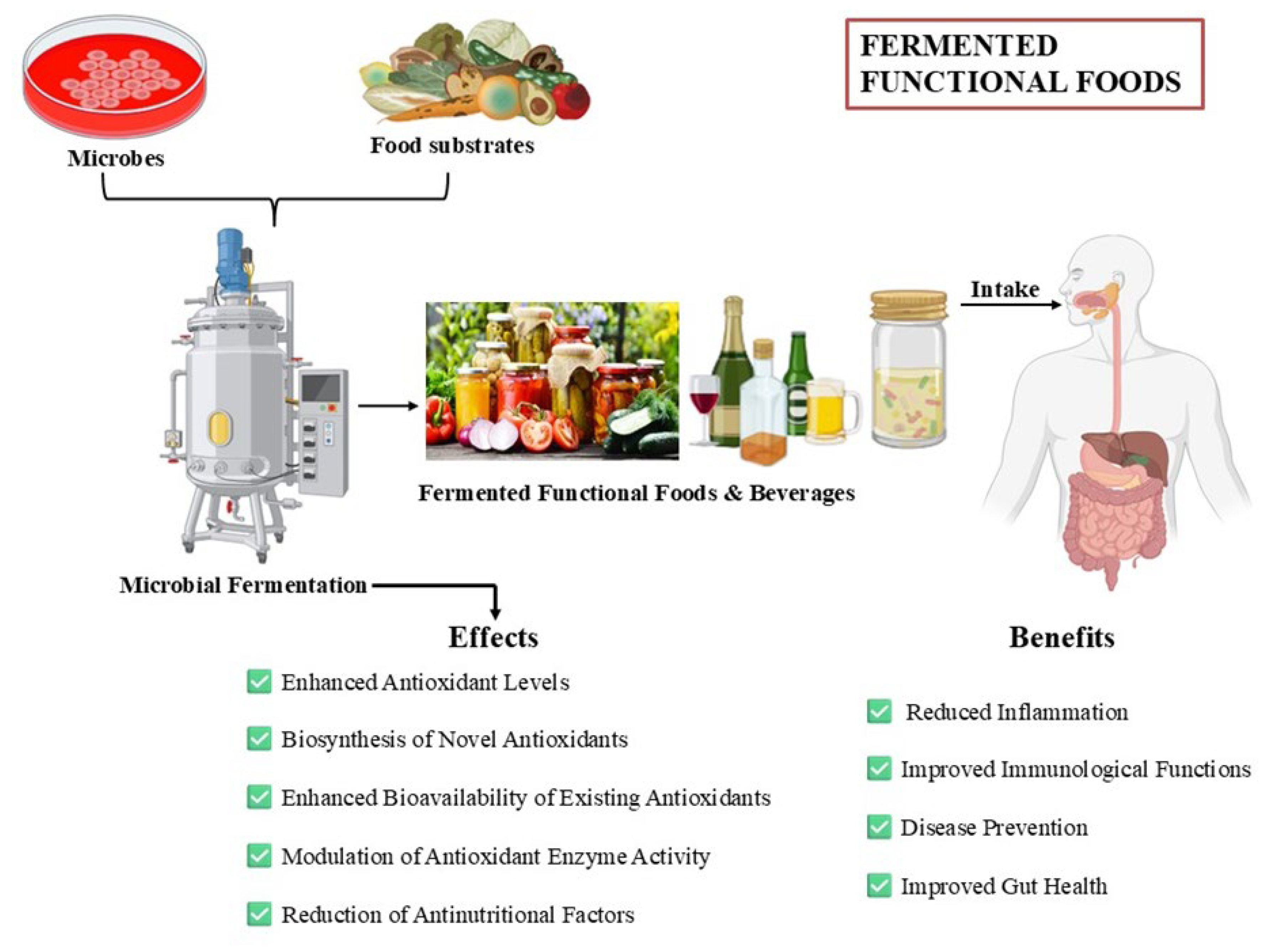

Table 1.
Valorisation of fruit and vegetable by-products through fermentation (Adapted from [203].
Table 1.
Valorisation of fruit and vegetable by-products through fermentation (Adapted from [203].
| Fruit/Vegetable Source | By-Product utilized | Microorganism employed | Fermentation Product | Effect | Reference |
|---|---|---|---|---|---|
| Granadilla | Seed | Aspergillus niger | Ingredient for food, cosmetic, and pharmaceutical industries | ↑Total phenolic ↑Total flavonoids ↑Antioxidant capacity |
[52] |
| Black grape | Pomace | Yeast | Shalgam juice | ↑Tannins ↑Total polyphenolic content |
[53] |
| Apple | Apple peel | Aspergillus oryzae | Food ingredient | ↑Polyphenolic content and antioxidant capacity ↑Prebiotic potential | [54] |
| Orange | Peel | Yeast | Enriched beer | ↑Colour ↑Alcohol ↑Total polyphenolic content, antioxidant capacity, Good acceptability |
[55] |
| Acerola, guava | By-products | L. casei L-26, L. fermentum56, L. paracasei106, L. plantarum53 | Food ingredients | ↑Total flavonoids, polyphenols, antioxidant | [56,57] |
| Grape | Pomace | Kombucha consortia inoculum | Kombucha | ↑Anti-inflammatory activities ↑Anti-diabetic activities ↑Total phenolics and anthocyanins |
[58] |
| Coffee | Coffee husk | Brettanomyces bruxellensis, Saccharomycescerevisiae, Komagataeibacter pomaceri, and Komagataeibacter rhaeticus | Enriched kombucha | ↑Total polyphenolic content, flavonoids, antioxidant capacity | [59] |
| Brassica species B. oleraceavar. sabelica× B. oleracea var.Gemmifera Brassica oleracea var.capitata | Leaves | symbiotic culture of bacteria and yeast (SCOBY) | Kombucha | ↑Total phenolics ↑Antioxidant capacity | [60] |
| Carrot | Pomace | Lactobacillus acidophilus LA-5, Lactobacillus casei 431, and Lactobacillus plantarum Harvest-LB1 | Food ingredient | ↑Phenolic acid content ↑Anthocyanin content ↑α-carotene |
[61] |
| Pepper | Leaves | Lactobacillus homohiochii JBCC25 and JBCC46, Saccharomyces cerevisiae ATCC18824, Actobacter aceti KACC1978 | Vinegar | ↑Anti-diabetic potential ↑Antioxidant activity ↑Total phenolics |
[62] |
| Broccoli | Leaves | Lactiplantibacillus plantarum | Lactofermented beverage | ↑Total phenolics ↑Isothiocyanates ↑Indoles ↑Antioxidant capacity ↑Anti-diabetic potential |
[63] |
| Artichoke | Leaves, stems, and outer bracts | Lactobacillus casei ATTC3931; L. plantarum ATTC8014; L. casei subs. Rhamnosus ATCC7469; L. fermentum ATCC9338 | Food additives (antimicrobial and antiviral constituents) | ↑Flavonoid content ↑Antimicrobial and antiviral effect | [64] |
Table 2.
Comparison of Bioreactor Designs and Their Impact on Antioxidant Capacity.
| Bioreactor Design/Fermentation process | Substrate/Process | Outcome | Reference |
|---|---|---|---|
| Cascade Mode Bioreactor | Spirulina fermentation | Enhanced protein hydrolysis and antioxidant activity | [131] |
| Novel Bioreactor for SSF | Rice koji | Increased phenolics and DPPH scavenging activity | [132] |
| Stirred Tank Bioreactor | Armillaria mellea polysaccharides | High antioxidant activity with low EC50 values | [135] |
| Silica Microparticles | Rice fermentation | Improved oxygen transfer and bioreactor performance | [133] |
| 3D-Printed Micro Bubble Column | Saccharomyces cerevisiae cultivation | High oxygen transfer rates and real-time monitoring of process parameters | [134] |
| Solid-State Fermentation | Oilseed cakes | Increased lignocellulolytic enzymes and antioxidants | [136] |
| Liquid Fermentation | Theabrownins production | Higher total phenolic content and antioxidant activity | [137] |
| Co-Fermentation | Dehusked barley | Enhanced antioxidant dynamics and radical scavenging activities | [138] |
| Ultrasound-Assisted Fermentation | Okara peptides | Increased peptide content and DPPH scavenging rate | [139] |
| Solid-State Fermentation | Wheat bran | Increased ferulic acid and pentosans with improved antioxidant activity | [140] |
| Co-Fermentation | Broken rice | Significant increase in total phenolic content and antioxidant activity | [141] |
| Fruit and Vegetable Ferment | Compound fruits and vegetables | Increased polyphenols, flavonoids, and proanthocyanidins | [142] |
Disclaimer/Publisher’s Note: The statements, opinions and data contained in all publications are solely those of the individual author(s) and contributor(s) and not of MDPI and/or the editor(s). MDPI and/or the editor(s) disclaim responsibility for any injury to people or property resulting from any ideas, methods, instructions or products referred to in the content. |
© 2025 by the authors. Licensee MDPI, Basel, Switzerland. This article is an open access article distributed under the terms and conditions of the Creative Commons Attribution (CC BY) license (http://creativecommons.org/licenses/by/4.0/).
Copyright: This open access article is published under a Creative Commons CC BY 4.0 license, which permit the free download, distribution, and reuse, provided that the author and preprint are cited in any reuse.


