

Submitted:
09 May 2025
Posted:
12 May 2025
You are already at the latest version
Abstract
In the context of sustainability, the concept of balanced development is crucial at both global and regional levels. This principle is equally significant for specific regions, natural-economic complexes, and local communities. Sustainable regional development necessitates a holistic approach to addressing economic, social, and environmental challenges, which are particularly pertinent at the regional scale. The sustainable development of nations is intrinsically linked to their integration into global processes; however, its resilience and stability are contingent upon balanced regional progress. The West Kazakhstan region exemplifies an economic powerhouse within the country and plays a pivotal role in national regional policy. This study introduces a conceptual model designed to evaluate sustainable development through the balanced interaction of various indicators. The results reveal a disparity between the financial and economic potential of different regions and their environmental challenges. These findings form the foundation for developing a new paradigm of sustainable development that emphasizes the integration of economic growth, social stability, and environmental security.
Keywords:
balanced development
; sustainable growth model
; sustainable natural resources use
; regional progress
; West Kazakhstan
1. Introduction
Global trends in human development brought income inequality, scarcity of resources and environmental and climate transformations. These drivers contributed to the development of the Global Plan for Sustainable Development, adopted under the auspices of the United Nations (UN) [1]. This plan is the result of decades of international initiatives, concepts, and agreements aimed at balancing economic growth, social justice, and environmental protection [2,3,4,5,6,7,8,9]. Sustainable development is a fundamental principle for advancing human and economic progress while preserving the functional integrity of ecological and social systems that support regional economies. Achieving sustainable development requires the use of clearly defined parameters to set goals and targets to assess the development potential and the progress made [10,11]. Meadows et al. (1972) [12] associate sustainable development with resource constraints and the environmental sustainability of the Earth’s natural systems. They argue that the development of the Earth is a closed system. Thus, developments cannot be based on quantitative growth only, but must follow a qualitatively transformative path. Thus, there are no simple thresholds that guarantee sustainable development. Indicators are most often dynamic, and on the one hand reflect sustainable socio-economic development, and on the other hand – sustainable environmental management.
Achieving full sustainable development depends on access to sustainable livelihoods and socio-economic development at the individual level, which ensures progress toward other development goals. Improving the quality of life and securing sustainable livelihoods are key objectives of socio-economic policy, as real and lasting development is only possible through inclusive growth [13].
The aim of this study is to identify the relationships between individual well-being, socio-economic development and sustainable forms of environmental management. Conversely, satisfying human needs and maintaining economic development requires sufficient natural resources – land, water, minerals, and biodiversity – which together constitute the natural resource potential. This highlights the other side of sustainable socio-economic development: sustainable environmental management. This aspect considers the ecological impacts of natural resource use in each area and seeks to minimize negative environmental consequences.
In this context, it is hypothesized that sustainable environmental management is a prerequisite for achieving balanced socio-economic growth under conditions of climatic and anthropogenic changes. The main research questions are: what regional characteristics determine the sustainability of environmental management and what are the mechanisms for integrating the principles of sustainable environmental management into the socio-economic policy of the region.
Therefore, the global environmental agenda and the need for a national sustainable development strategy underscore the importance of socio-economic development alongside the rational use of natural resources.
Understanding and addressing these questions requires a deep immersion in the historical and theoretical foundations of human-environment interactions. Analyzing past development trajectories can reveal how socio-economic priorities have involved alongside or in opposition to environmental considerations.
Since the 18th century, the Industrial Revolution has brought about irreversible transformations in human societies. Human development became closely associated with economic growth and material progress. D. Worster [14] described industrialization as “the greatest revolution in worldview that has ever taken place”, as it led people to believe that they had the right to dominate nature and convert it into consumer goods.
There was a widespread belief that scientific and technological progress would lead to the moral advancement of humanity [15]. However, industrial capitalism did not benefit all equally. The advantages of the global economic system accrued mainly to industrialized nations, widening the gap between rich and poor societies. In the long term, this inequality in the distribution of wealth is likely to be a key point of contention in discussions about development and sustainability.
Many of the consequences of industrial development were initially unrecognized, but they eventually led to significant environmental degradation due to the large-scale exploitation of raw materials [16,17]. This gave rise to widespread concerns about sustainability.
Van Zon noted that the demand for raw materials and its environmental consequences have been constant throughout human history [18]. Thinkers like Plato in the 5th century BCE, Strabo and Columella in the 1st century BCE, and Pliny the Elder in the 1st century CE discussed environmental degradation resulting from human activity [19]. These scholars not only analyzed degradation processes but also proposed practices that we would now call “sustainable” to preserve the earth’s vitality. For instance, in the 1st century CE, Varro wrote that “we can, by exercising caution, reduce the deleterious effects” [20] – highlighting the importance of careful resource use.
G. P. Marsh in his book (1864), which is considered a foundational text of the environmental conservation movement, argued that “man has long since forgotten that the earth was given to him for use only, not for consumption and still less for waste” [21]. His work emphasized protecting nature not for its own sake but for the benefit of humanity – a viewpoint shared by modern advocates of sustainable development.
In the 19th century, concerns about population growth and its effect on resource consumption emerged and became a key question of some studies [22]. The most influential among them was the work of T. R. Malthus (1803), who warned that unchecked population growth could outstrip food production [23].
The focus then shifted to coal as the dominant energy source, raising fears about its depletion. In the first half of the 20th century, many scientists discussed limitations on the supply of raw materials and energy sources and warned against wasteful consumption [24,25]. T. Veblen et al. [26,27,28,29,30,31] considered the consequences of overexploitation of natural resources and urged people to use these resources responsibly to ensure the continued existence of civilized society.
In 1950, K. W. Kapp published the analysis of most environmental issues that are now part of the sustainable development discourse [32]. According to Van Zon, the concept of “sustainable development” was anticipated by many 19th-century publications, even before the term itself came into use [18].
The foundations for modern approaches to sustainability were also laid by Soviet scholars, particularly D. L. Armand. In his book (1964) he emphasized the responsibility toward future generations in environmental matters [33]. This concept continues to evolve today in the work of Russian researchers such as E. V. Girusov and S. N. Bobylev [34,35].
Internationally, Johan Rockström is a leading voice in sustainability science. He and a team of researchers developed the “planetary boundaries” concept, which defines critical environmental thresholds that, if exceeded, could have catastrophic consequences for humanity [36].
Another major contributor is Herman Daly, one of the founders of ecological economics. Daly proposed a rethinking of economic growth considering environmental constraints and advocated for structural reforms to align the economic system with ecological limits [37,38,39]. His ideas have influenced environmental standards in institutions such as the UN, World Bank, and EU [40,41]. Nonetheless, many countries still lack a unified index for assessing sustainable development, which complicates investment attraction.
Financial development also plays a main role in implementing sustainable policies. It is closely linked to economic growth and system efficiency [42,43] and has been recognized as a public policy tool for solving environmental problems [44,45].
Contemporary research uses various indices to evaluate sustainability, covering economic, social, and environmental aspects [46,47,48,49,50]. All aim to measure the effectiveness of environmental policies through different indicators of resource management and ecosystem health.
One key contribution is the works of F. Hinterberger, who developed a framework for assessing progress toward sustainable development. His model seeks to ensure a decent life for all people within planetary and social boundaries [51]. The idea of the study is to create a system of indicators that will accurately show the extent to which different actors and policies are contributing to the global sustainable development goals.
In Kazakhstan, special attention is given to research on sustainable agricultural development, including efficient environmental management, the preservation of agroecosystems, and the enhancement of agricultural productivity [52,53,54]. These studies demonstrate how a combination of factors can strengthen rural sustainability and highlight the importance of investment and innovation in boosting economic efficiency.
In conclusion, the foundations of the sustainable development concept trace back to antiquity, but rising population, post-industrial consumption growth, and the risk of resource depletion have fueled today’s urgency. Fears that future generations may be unable to maintain their quality of life have driven the development and global adoption of sustainable development principles.
2. Materials and Methods
2.1. Case Study Area
Kazakhstan is one of the most dynamically developing countries in Central Asia and offers a compelling example of achieving ambitious goals while considering national priorities and characteristics. It is part of the “One Belt, One Road” initiative, acting as a bridge between Europe and Asia [55]. Kazakhstan also collaborates actively with international organizations such as UNEP (United Nations Environment Programme) and GEF (Global Environment Facility), and it initiated the establishment of the International Green Technologies and Investment Projects Center under the UN framework [56]. Since the adoption of the Sustainable Development Goals (SDGs), the United Nations Development Programme (UNDP) has provided active support to Kazakhstan, aiding the country in identifying priority SDG areas and offering technical and material assistance for their implementation [57,58,59,60,61]. However, ongoing global crises and transformations necessitate the development of a long-term, science-based national strategies for sustainable development that can respond to the challenges of the 21st century.
Kazakhstan has made significant socio-economic progress since adopting the SDGs, elevating the national human development level. According to the Human Development Report of 2015 [62], Kazakhstan’s Human Development Index was 0.788; by 2022, the country had entered the group of nations with a very high level of development, achieving a score of 0.811 [63,64].
This study focuses on the western region of Kazakhstan, especially Aktobe region, where unique characteristics and barriers to sustainable development practices can be identified (Figure 1). A comprehensive approach is used to analyze not only economic aspects but also social and environmental factors. Despite its high development potential, the region faces serious environmental challenges and social tensions that adversely affect both public health and the biodiversity of the ecologically sensitive arid landscape.
Aktobe Region in Western Kazakhstan (Figure 1) is one of Kazakhstan’s key industrial regions, attracting large-scale investments across multiple sectors: mining, traditional and renewable energy, agro-industrial development, and transport infrastructure. The region benefits from a well-developed transport infrastructure and is rich in mineral resources. Industry accounts for about 40% of the region’s gross product [65].
2.2. Estimation Strategy of Sustainability
An effective assessment of sustainable environmental management requires a system of indicators reflecting three main spheres: economic, environmental, and social [66]. In our view, sustainable development represents a form of equilibrium – a superposition of opposing forces or a balance of heterogeneous indicators. Therefore, the selection of assessment factors depends on the study’s purpose. In the context of Kazakhstan, two key factors are used to assess sustainable development in isolated areas, consistent with the goals of this study: the capacity (potential) of the natural environment and resources to support sustainable growth for a defined population engaged in economic activity; the amount of investment required to support such growth.
If we assess sustainable socio-economic development using these two parameters, we can assume that a single person living in a remote area requires substantial investments to ensure access to social services: communications, security, clean drinking water, and other basic amenities. As population size increases, the cost per person decreases due to economies of scale. However, once a certain population threshold is reached, the effect of scale diminishes, and further increases do not significantly reduce per capita costs. Moreover, in regional sustainable development, additional factors such as the size of the area and the ecological sensitivity of habitats must also be considered.
The size of a territory is directly proportional to the number of people who can live on it. Hence, it is logical to analyze population density (people per km²), which ultimately determines environmental pressure and infrastructure investment requirements.
Another crucial factor is the ecological sensitivity of natural habitats. Deserts and semi-deserts are particularly sensitive to anthropogenic impacts and often cannot absorb waste products on their own. The fragile structure of such ecosystems makes them highly vulnerable to disruption, leading to biodiversity loss.
Before proposing a function to analyze sustainable population livelihoods, we formulate the following theorems:
Theorem 1.
A population density of 1 person per km2 does not have a significant negative impact on the natural environment that it cannot mitigate through self-regulating processes. This is generally valid for all territories except extreme environments like Arctic ice deserts or high-altitude glacial areas.
Theorem 2
The maximum level of investment required to support sustainable human livelihoods can be defined per unit of population density.
From these, we derive the Equation 1:
with
f (x) = investment per capita for sustainable development
Imax = investment per capita at a population density of 1 person/km2;
Imin = investment per capita when the effect of scale no longer applies
x = population density of the area under study
In our concept, the ecological sensitivity of a region is reflected by the relative difference between maximum and minimum investment levels. The higher the difference, the more sensitive the territory is, and the more investment is needed. This can be expressed as a coefficient between 0 and 1 in Equation 2:
with
Kes = Imin / Imax,
Kes = coefficient of ecological sensitivity
Imin = investment per capita when effect of scale no longer applies
Imax = investment per capita at 1 person/km²
Hence, the basic equation can be transformed in Equation 3:
with
f (x) = investment per capita for sustainable development
Imax = investment per capita at 1 person/km²
Kes = coefficient of ecological sensitivity
x = population density of the area under study
To determine ecological sensitivity, we identify four coefficients:
- Water stress coefficient.
- Atmospheric air pollution coefficient.
- Landscape stress factor.
- Biodiversity distribution coefficient.
The Water Stress Index (WSI) reflects the pressure on water basins with significant irrigation demands. Forecasts of future water withdrawals are based on projected population growth and anticipated changes in water use intensity across domestic, industrial, and agricultural sectors.
However, this indicator does not account for water quality. According to the United Nations (UN) framework on Water Resources Management under SDG 6, water stress is calculated at the national level using the Equation 4 for the Water Stress Index (WSI) [67]:
(WSI) = Total freshwater withdrawal / Available water resources ⋅ 100%,
Values range from 0 (no stress) to 1 (severe stress).
The concept of an “atmospheric air pollution coefficient” is not standardized and lacks a universally accepted formulation. However, for the purposes of this study, it is assumed that the coefficient may be derived from general principles of environmental risk assessment, incorporating components related to air quality and population vulnerability and is presented in the form of an Equation 5:
Atmospheric air pollution coefficient =
Actual pollutant emissions / Maximum permissible emission standard,
Actual pollutant emissions / Maximum permissible emission standard,
Landscape stress refers to pressure, disturbance, or interference experienced by natural landscapes because of various human activities or natural processes. The landscape stress factor incorporates multiple elements such as land-use change, habitat fragmentation, pollution, and other anthropogenic impacts that affect terrestrial ecosystems. To conceptualize this, the following generalized Equation 6 is proposed:
Landscape stress factor = Used area of the region / Total area of the region,
The landscape stress coefficient integrates various indicators that assess the degree of disturbance or degradation of natural landscapes. It is typically expressed as a numerical value ranging from 0 to 1, where 0 indicates minimal stress (a healthy landscape), and 1 indicates severe stress (a highly degraded landscape).
The biodiversity distribution coefficient is an indicator used to quantify the spatial distribution of species within a specific region or ecosystem. It is calculated based on species occurrence data and is typically derived from formulas that compare the observed distribution of species to a theoretical uniform distribution [68].
Based on commonly used approaches, the following generalized Equation 7 is proposed:
Biodiversity distribution coefficient =
(Endangered species / Total number of species) / (Specially protected area / Total area),
(Endangered species / Total number of species) / (Specially protected area / Total area),
If the biodiversity distribution coefficient is close to 0, it indicates that biodiversity is freely and actively dispersing across the territory. This may reflect high rates of species migration, colonization, or introduction into new habitats.
Conversely, if the coefficient approaches 1, it suggests limited or absent species movement, implying ecological isolation or fragmentation. In such cases, species are likely confined to specific areas or habitats, with little or no exchange between populations.
Accordingly, the primary input data for the assessment include: the level of per capita investment required for sustainable development at a population density of 1 person per km², and the environmental sensitivity of natural habitats, determined by characteristics such as land resources, water availability, and biodiversity.
As noted earlier, the other side of sustainable development is sustainable environmental management. All human activity within a defined area produces both useful outputs (goods and services) and waste, which must be processed or disposed of. Environmental management addresses the impacts of these activities – pollution of air, water, and soil – and includes the eventual recycling or disposal of goods after use. The greater the population density in a region, the greater the pressure on natural ecosystems from human-generated waste.
Accordingly, investments in environmental management increase alongside population growth and socio-economic activity, both in absolute terms and per capita. More economic activity necessitates higher investments to preserve environmental quality. In real-world terms, capital investments in sustainable environmental management include the construction of treatment facilities, waste incinerators, land reclamation projects, green energy initiatives, and conservation of endangered species.
Several parameters affect the final investment levels.
Firstly, this includes the structure of economic activity in the region. For instance, if the regional economy is primarily based on natural resource extraction, its impact on natural systems is significantly greater than in regions focused on the production of final consumer goods.
The manufacture of complex goods and the provision of highly skilled services typically exert less pressure on ecosystems. At the same time, investments in these sectors tend to produce a stronger multiplier effect compared to simpler forms of economic activity – indicating an inverse relationship between environmental impact and economic return on investment.
Secondly, sustainable environmental management is influenced by the level of social well-being. The more socially prosperous a population is, the greater its consumption of goods and services – resulting in a correspondingly greater impact on the natural environment.
Thirdly, the investment indicator for sustainable development should be adjusted for the ratio of imports to exports, since goods produced for export will not generate waste or environmental pressure within the producing region.
Taking all of these factors and constraints into account, the function can be represented as Equation 8:
with
f (x) = investment per capita in sustainable environmental management
Igross, Igreen = gross capital and green/environmental investment per capita
= gross regional product (GRP) multiplier
INsw = Human Development Index (normalized for the region)
Im, Ex = regional import and export volumes
x = population density of the area under study
Sustainable development is thus viewed as a target state of dynamic equilibrium. For the purposes of this study, the key parameter used to assess regional sustainability is investment per capita, which varies with population density (Figure 2). The optimal investment level is the point at which indicators of sustainable socio-economic development and sustainable environmental management intersect.
Thus, the conceptual methods developed in this study for assessing sustainable development are grounded in the balanced evaluation of indicators that define the parameters of both sustainable socio-economic development and sustainable environmental management. The optimal per capita investment volume required to enable a transition to sustainable development in the region under study is considered the most informative and significant resulting indicator.
3. Results
3.1. Sustainable Socio-Economic Development: Data-Based Insights
Australia was selected as a benchmark example of state-driven financial investment in sustainable development. Its unique geographic characteristics and relatively low population density make it an ideal comparator. Despite the challenges of the COVID-19 pandemic, Australia maintained growth in public investment in 2019 [69]. State and local governments prioritized the construction of hospitals, schools, roads, and railways.
Between 2016 and 2022, average annual public investment in Australia reached US$2089 per capita [69]. Based on this, and using Australia’s investment at a population density of 1 person/km², the Imax value was set at US$ 3315 per capita (Table 1). This figure is considered a benchmark for ensuring a high quality of life and can be used in assessments for other regions, such as Kazakhstan’s Aktobe Region.
Based on our calculations, the investment required for sustainable socio-economic development in Aktobe Region is US$ 2 657.951 per capita (Table 1).
Calculations for Aktobe Region indicate that the level of public investment needed to ensure sustainable socio-economic development is US$ 2 657.95 per capita, or 1 249 237.4 KZT (at an exchange rate of 470 in 2022). However, the actual public investment from national and local budgets in 2022 was 76.8 billion KZT, equating to only 82 626.9 KZT per capita—14 times lower than the required level, according to our calculations. Yet, labor productivity in Aktobe is only three times lower than in Australia, suggesting that closing the investment gap by a factor of three – i.e., raising per capita investment to 417,000 KZT annually – is both fair and achievable given current income levels.
3.2. Sustainable Environmental Management: Data-Based Insights
To estimate investment needs for sustainable environmental management in Aktobe Region, we used full data available for 2022 (Table 2) [65].
The analysis shows that investment in one sector often stimulates development in others due to the multiplier effect. Our calculations show that required investments in sustainable environmental management in Aktobe Region total 170 803.23 KZT per capita, or 157.6 billion KZT for the entire region (based on 922 456 residents).
Currently, green investments account for just 0.452% of the local budget. According to our model, this should increase to 16.412% to significantly improve the state of the natural environment and minimize human impact.
Although Western Kazakhstan’s low population density somewhat offsets the high ecological sensitivity of its landscapes, insufficient environmental funding leads to the accumulation of ecological issues that may escalate into a crisis. Aktobe region’s export volume far exceeds imports, implying a lower burden on local waste infrastructure. Our analysis confirms relatively low anthropogenic pressure, making the region well-positioned for population growth.
4. Discussion
The results of the study indicate the existence of a critical imbalance in Aktobe region: despite relatively high incomes and positive economic indicators, insufficient investment in environmental infrastructure remains a major constraint to sustainable development. This demonstrates the connection of socio-economic development and welfare of the population with sustainable forms of nature management.
The deficit of investments, especially in nature management, directly limits the region’s ability to preserve its natural resource potential and satisfy the needs of the population in the long term. Based on this, it can be concluded that sustainable environmental management is a prerequisite for balanced development, especially under increasing anthropogenic and climatic pressures.
The results of the work allowed us to answer the key research questions. Environmental fragility, underdeveloped infrastructure and imbalance in the investment sphere determine the critical characteristics of Aktobe region.
Currently, Aktobe region’s policy is not oriented toward long-term sustainability of natural-economic systems. While some development indicators show improvement, problem-solving effectiveness remains low.
5. Conclusions and Outlook
This study presents a new conceptual model for assessing sustainable development based on the balance of heterogeneous indicators. The model considers the outcomes of human activity in interaction with the natural environment and evaluates two key dimensions: sustainable socio-economic development and sustainable environmental management.
The principal criterion of sustainability is the provision of sustainable livelihoods, which reflect the potential for socio-economic progress. Improving quality of life is the main objective of socio-economic policy. However, natural resources are essential for meeting human needs and achieving sustainable development, which requires responsible, long-term environmental management.
The model allows for the estimation of required per capita investment at varying population densities – whether regional or national. It demonstrates that sustainable development depends on reaching a dynamic equilibrium between human and environmental systems.
The results show a significant imbalance in the sustainable development of Aktobe Region, due to a gap between financial/economic capacity and environmental challenges. Currently, most environmental problems are addressed through increased spending on short-term solutions. However, well-justified, long-term investments could resolve these issues more effectively and allow a shift toward strategic, forward-looking regional development.
Therefore, our calculations demonstrate that the current level of investment is critically insufficient to meet the development needs of the Aktobe Region. For example, investments in flood protection infrastructure would substantially reduce future costs for damage recovery and restoration.
In this context, a step-by-step strategy is needed. First, it is necessary to increase capital expenditures in the regional budget relative to current spending. This is necessary to close the critical investment gap. Second, it is important to attract financing for major infrastructure projects at the national and international level. Equally important is the stimulation of “green” investments by the private sector. Finally, it is necessary to involve civil society and non-governmental organizations (NGOs) in financial initiatives to improve living conditions and environmental quality.
For the next stages of the study, the methodology for calculating investment needs and environmental thresholds needs to be improved. Integration of climate change variables may be necessary to better assess regional vulnerability and adaptive capacity. Further comparisons between regions are necessary to assess the applicability of this approach. By advancing these directions, future research can help to mainstream environmental sustainability into the basis of regional planning.
In this regard, the findings of this research may serve as a basis for shaping a new development paradigm aimed at ensuring economic growth, social stability, and environmental security. This approach seeks to establish the long-term conditions necessary for the progressive and balanced development of Western Kazakhstan, which can only be achieved through the strategic planning and implementation of adequate investment in education, healthcare, infrastructure, and environmental protection.
Author Contributions
Conceptualization, A.M. and M.A.; methodology, A.M..; software, A.Z.; validation, M.A. and A.Z.; formal analysis, A.M. and U.B.; investigation, A.Z. and U.B.; resources, A.Z. and U.B.; data curation, A.M. and H.K.; writing—A.M.; writing—review and editing, M.A., A.Z and H.K.; visualization, A.Z.; supervision, A.M.; project administration M.A.; funding acquisition, A.M. and M.A. All authors have read and agreed to the published version of the manuscript.
Funding
This research has been funded by the Committee of Science of the Ministry of Science and Higher Education of the Republic of Kazakhstan (Grant No. BR21882122), BR21882122 –«Sustainable development of natural-industrial and socio-economic systems of the West Kazakhstan region in the context of green growth: a comprehensive analysis, concept, forecast estimates and scenarios».
Institutional Review Board Statement
Not applicable.
Informed Consent Statement
Not applicable.
Data Availability Statement
The data presented in this study are available upon request from the corresponding author.
Conflicts of Interest
The authors declare no conflicts of interest. The funders had no role in the design of the study; in the collection, analyses, or interpretation of data; in the writing of the manuscript; or in the decision to publish the results.
References
- United Nations. Sustainable Development Goals. Available online: URL https://www.un.org/sustainabledevelopment/ru/sustainable-development-goals/ (accessed on 28 March 2025).
- United Nations. Report of the World Commission on Environment and Development: Our Common Future. Available online: URL https://sustainabledevelopment.un.org/content/documents/5987our-common-future.pdf (accessed on 28 March 2025).
- United Nations. United Nations Conference on Environment and Development (Rio de Janeiro, 1992) Available online: URL https://www.un.org/ru/conferences/environment/rio1992 (accessed on 28 March 2025).
- United Nations. Kyoto Protocol to the United Nations Framework Convention on Climate Change. Available online: URL https://www.un.org/ru/documents/decl_conv/conventions/kyoto.shtml (accessed on 28 March 2025).
- United Nations. United Nations Millennium Declaration. Available online: URL https://www.un.org/ru/documents/decl_conv/declarations/summitdecl.shtml (accessed on 28 March 2025).
- United Nations. Millennium Summit (New York, 2000). Available online: URL https://www.un.org/ru/conferences/environment/newyork2000 (accessed on 28 March 2025).
- United Nations. World Summit on Sustainable Development (Johannesburg, 2002). Available online: URL https://www.un.org/en/conferences/environment/johannesburg2002/ (accessed on 28 March 2025).
- United Nations. United Nations Conference on Sustainable Development (Rio de Janeiro, 2012). Available online: URL https://www.un.org/ru/conferences/environment/rio2012 / accessed on 28 March 2025).
- United Nations. Paris Agreement. Available online: URL https://www.un.org/ru/climatechange/paris-agreement (accessed on 28 March 2025).
- Potschin, M.; Klug, H.; Haines-Young, R.; From Vision to Action: Framing the Leitbild Concept in the context of Landscape planning. Futures 2010, 42, 656–667. [CrossRef]
- Klug, H. An integrated holistic transdisciplinary landscape planning concept after the Leitbild approach. Ecological Indicators 2012, 23, 616–626. [CrossRef]
- Meadows, D.; Randers, J.; Meadows, D. Limits to Growth. 30 years later, 3rd ed.; Earthscan: UK, 2005.
- International Labour Organization. Guidelines for a just transition towards environmentally sustainable economies and societies for all. Available online: https://www.ilo.org/sites/default/files/wcmsp5/groups/public/@ed_emp/@emp_ent/documents/publication/wcms_432859.pdf (accessed on 28 March 2025).
- Worster, D. The wealth of nature: environmental history and the ecological imagination; Oxford University Press: New York, USA, 1993.
- Nisbet, R. A. History of the Idea of Progress, 2nd ed.; Routledge: UK, 1994.
- Goudie, A. The human impact on the natural environment, 2nd ed.; MIT Univ. Press: USA, 1986.
- Boyden, S. The Human Component of Ecosystems. Humans as Components of Ecosystems 1993, 72-77.
- Van Zon, H. Geschiedenis & duurzame ontwikkeling: duurzame ontwikkeling; Netwerk Duurzaam Hoger Onderwijs:Netherlands, 2002.
- Columella. On Agriculture, Volume I: Books 1–4; Harvard University Press: Cambridge, MA, 1941.
- Cato, M.P; Varro M.T. On agriculture; Harvard University Press: Cambridge, MA, 1960.
- Marsh, G. P. Man and Nature: Physical Geography as Modified by Human Action; University of Washington Press: Seattle, 2003; p. 512.
- Petty, W. The Economic Writings of Sir William Petty; Legare Street Press: UK, 1899.
- Malthus, T. R. An Essay on the Principle of Population (Rev. ed.); Cambridge University Press: NY, USA, 1803.
- Holley, J. Gifford Pinchot and the Fight for Conservation: The Emergence of Public Relations and the Conservation Movement, 1901–1910. Journalism History 2016, 42, 91–100. [CrossRef]
- Jaeger, F. M.; Van Klooster, H. S. Studien über natürliche und künstliche Sulfoantimonite und Sulfoarsenite. Zeitschrift für anorganische Chemie 1912, 78, 245–268. [CrossRef]
- Veblen, T. An Inquiry into the Nature of Peace and the Terms of its Perpetuation; The Macmillan Company: London, 1918.
- Pigou, A. Economics of Welfare, 3rd ed.; The Macmillan Company: London, 1929.
- Egbert, V. De aarde betaalt: de rijkdommen der aarde en hun betekenis voor wereldhuishouding en politiek; Uitgeverij Albani, 1948.
- William, V.; Baruch B.M., Road to survival; Kessinger Publishing:USA, 2007.
- Osborn, F. Our Plundered Planet, 1st ed.; Little, Brown and Company: Boston, 1948.
- Osborn F. The limits of the earth, 1st ed.; Faber & Faber:UK, 1954.
- Kapp K. W. The social costs of private enterprise. Science and Society 1953, 17, 79–81.
- Armand D.L. Us and grandchildren; Mysl: M., 1964.. [in Russian].
- Girusov, E.V.; Bobylev, S.N. & Novoselov, A.L. Ecology and the Economics of Natural Resourse Use. In Ecology and the Economics of Nature Management, 2 nd ed.; UNITY: Moscow, Russia, 2000. [in Russian].
- Bobylev, S.N. Economics of Sustainable Development; KNORUS:Moscow, 2021. [in Russian].
- Will Steffen et al. Planetary boundaries: Guiding human development on a changing planet. Science Express 2015, 347, 1–41.
- Daly, H. E. Ecological economics. In Dictionary of Ecological Economics; Haddad, B. M., Solomon, B. D. Edit.; Edward Elgar Publishing: Cheltenham, UK, 2023.
- Daly, H. E; John B.; Cobb, Jr. For the Common Good: Redirecting the Economy toward Community, the Environment, and a Substainable Future; Beacon Press: Boston, MA, 1990.
- Daly, H.E. The steady-state economy: From toward a steady-state economy. In Dictionary of Ecological Economics; Haddad, B. M., Solomon, B. D. Edit.; Edward Elgar Publishing: Cheltenham, UK, 2023.
- Daly, H.E. Beyond Growth, The Economics of Sustainable Development; Beacon Press: Boston, USA, 1997.
- Daly, H.E. Uneconomic Growth: In Theory, in Fact, in History, and in Relation to Globalization. Clemens Lecture Series 1999, 10, 7–8.
- Wang, B.; Yan, C.; Iqbal, N.; Fareed, Z.; Arslan, A. Impact of human capital and financial globalization on environmental degradation in OBOR countries: Critical role of national cultural orientations. Environmental Science and Pollution Research 2022, 29. [CrossRef]
- Baloch, Q. B.; Shah, S. N.; Iqbal, N.; Sheeraz, M.; Asadullah, M.; Mahar, S.; Khan, A. U. Impact of tourism development upon environmental sustainability: a suggested framework for sustainable ecotourism. Environmental Science and Pollution Research 2023, 30. [CrossRef]
- Saud, S.; Chen, S.; Haseeb, A. The role of financial development and globalization in the environment: accounting ecological footprint indicators for selected one-belt-one-road initiative countries. Journal of cleaner production 2020, 250. [CrossRef]
- Lapinskaite, I.; Skvarciany, V.; Janulevicius, P. Impact of Investment Sources for Sustainability on a Country’s Sustainable Development: Evidence from the EU. Sustainability 2020, 12, 1–24. [CrossRef]
- United Nations Development Programme. Human Development Report 1990 Concept and Measurement of Human Development. Available online: URL https://hdr.undp.org/content/human-development-report-1990 (accessed on 28 March 2025).
- Hickel, J. The sustainable development index: Measuring the ecological efficiency of human development in the anthropocene. Ecological Economics 2020, 167. [CrossRef]
- Wolf, M. J.; Emerson, J. W.; Esty, D. C.; de Sherbinin, A.; Wendling, Z. A. Environmental Performance Index results; New Haven, CT: Yale Center for Environmental Law & Policy, 2022. Available online: URL https://epi.yale.edu/ (accessed on 28 March 2025).
- Ledger, S.E.H.; Loh, J.; Almond, R. et al. Past, present, and future of the Living Planet Index. Npj Biodivers 2023, 2, 1–11. [CrossRef]
- Davidsdottir, Brynhildur. An appraisal of interlinkages between macro-economic indicators of economic well-being and the sustainable development goals. Ecological Economics 2021, 184.
- Stocker, A; Hinterberger, F.; Großmann, A.; Distelkamp, M.; Bernardt, F. Selection of suitable SDG indicators for the evaluation of climate mitigation scenarios meetPASS: meeting the Paris Agreement and Supporting Sustainability Working Paper No. 1; Vienna, 2018.
- Tokbergenova, A.; Kiyassova, L.; Kairova, S. Sustainable Development Agriculture in the Republic of Kazakhstan. Polish Journal of Environmental Studies 2018, 27. [CrossRef]
- Kurmanova, D.S. et al. Investments as a Factor of Sustainable Development of Rural Areas. Journal of Environmental Management and Tourism 2023, 14. [CrossRef]
- Mustafayev, Z.; Medeu, A.; Skorintseva, I.; Bassova, T.; Aldazhanova, G. Improvement of the Methodology for the Assessment of the Agro-Resource Potential of Agricultural Landscapes, Sustainability 2024, 16.
- Irsalieva S.A. ‘One Belt, One Road’ as an international initiative: goals, objectives, features. In the conference materials “The economic Belt of the silk Road and Current Issues of Sino-Kazakhstan Cooperation”, Astana, Kazakhstan, 2 July 2018. Available online: URL https://isca.kz/ru/analytics-ru/2765 (accessed on 11 April 2025).
- International Center for Green Technologies and Investment Projects. Available online: URL https://igtipc.org/history/ (accessed on 28 March 2025).
- United Nations. Sustainable Development Goals in Kazakhstan. Available online: URL https://kazakhstan.un.org/ru/sdgs (accessed on 28 March 2025).
- Official website of the President of the Republic of Kazakhstan. Strategy “Kazakhstan-2050”. Available online: URL https://www.akorda.kz/ru/official_documents/strategies_and_programs (accessed on 28 March 2025).
- Official website of the Prime Minister of the Republic of Kazakhstan. Strategic Plan 2025. Available online: URL https://primeminister.kz/ru/documents/gosprograms/stratplan-2025 (accessed on 28 March 2025).
- Official website of the President of the Republic of Kazakhstan. Legal Acts. Available online: URL https://akorda.kz/ru/ob-utverzhdenii-perechnya-nacionalnyh-proektov-1391918 (accessed on 28 March 2025).
- Coordinating Council. Available online: URL https://eri.kz/ru/Celi_ustojchivogo_razvitija/Koordinacionnyj_sovet/ (accessed on 28 March 2025).
- United Nations Development Programme. Human Development Report 2015. Available online: URL https://hdr.undp.org/content/human-development-report-2015 (accessed on 28 March 2025).
- United Nations Development Programme. Human Development Report 2021-22. Available online: URL https://hdr.undp.org/content/human-development-report-2015 (accessed on 28 March 2025).
- United Nations Development Programme. National Human Development Report: Sustainable development goals and the development of Kazakhstan’s Regions Based on Their Productive Capacities, 2016. Available online: URL https://hdr.undp.org/system/files/documents/2016humandevelopmentreportpdf1pdf.pdf (accessed on 28 March 2025).
- Bureau of National Statistics of the Republic of Kazakhstan. Main socio-economic indicators for Aktobe region. Available online: URL https://stat.gov.kz/ru/region/aktobe/dynamic-tables/291541/ (accessed on 21 April 2025).
- Fraser E. D; Dougill A. J; Mabee W. E; Reed M; McAlpine P. Bottom up and top down: analysis of participatory processes for sustainability indicator identification as a pathway to community empowerment and sustainable environmental management. Journal of Environmental Management 2006, 78, 114–127. [CrossRef]
- United Nations. Global SDG Database. Available online: URL https://w3.unece.org/SDG/ru/Indicator?id=140 (accessed on 28 March 2025).
- Shaykhutdinova, A. A. Methods of biodiversity assessment: methodological guidelines; Orenburg State Univ. Orenburg: OGU, 2019.
- Australian Bureau of Statistics. Australian National Accounts: Insights into public investment. Available online: URL https://www.abs.gov.au/articles/insights-public-investment (accessed on 21 April 2025).
- Bureau of National Statistics of the Republic of Kazakhstan. Investment activity of Aktobe region. Available online: URL https://stat.gov.kz/ru/region/aktobe/spreadsheets/?industry=&year=&name=68430&period=&type= (accessed on 21 April 2025).
- Ministry of Ecology and Natural Resources of the Republic of Kazakhstan. National report on the state of the environment and the use of natural resources of the Republic of Kazakhstan. Available online: URL https://www.gov.kz/uploads/2022/1/21/195d4245b75123a2c2aecce3ed1ccb39_original.38998496.pdf (accessed on 21 April 2025).
- Bureau of National Statistics of the Agency for Strategic Planning and Reforms of the Republic of Kazakhstan. Yearbook on Aktobe region for 2022. Available online: URL https://stat.gov.kz/ru/region/aktobe/ (accessed on 21 April 2025).
Figure 1.
West Kazakhstan region map.
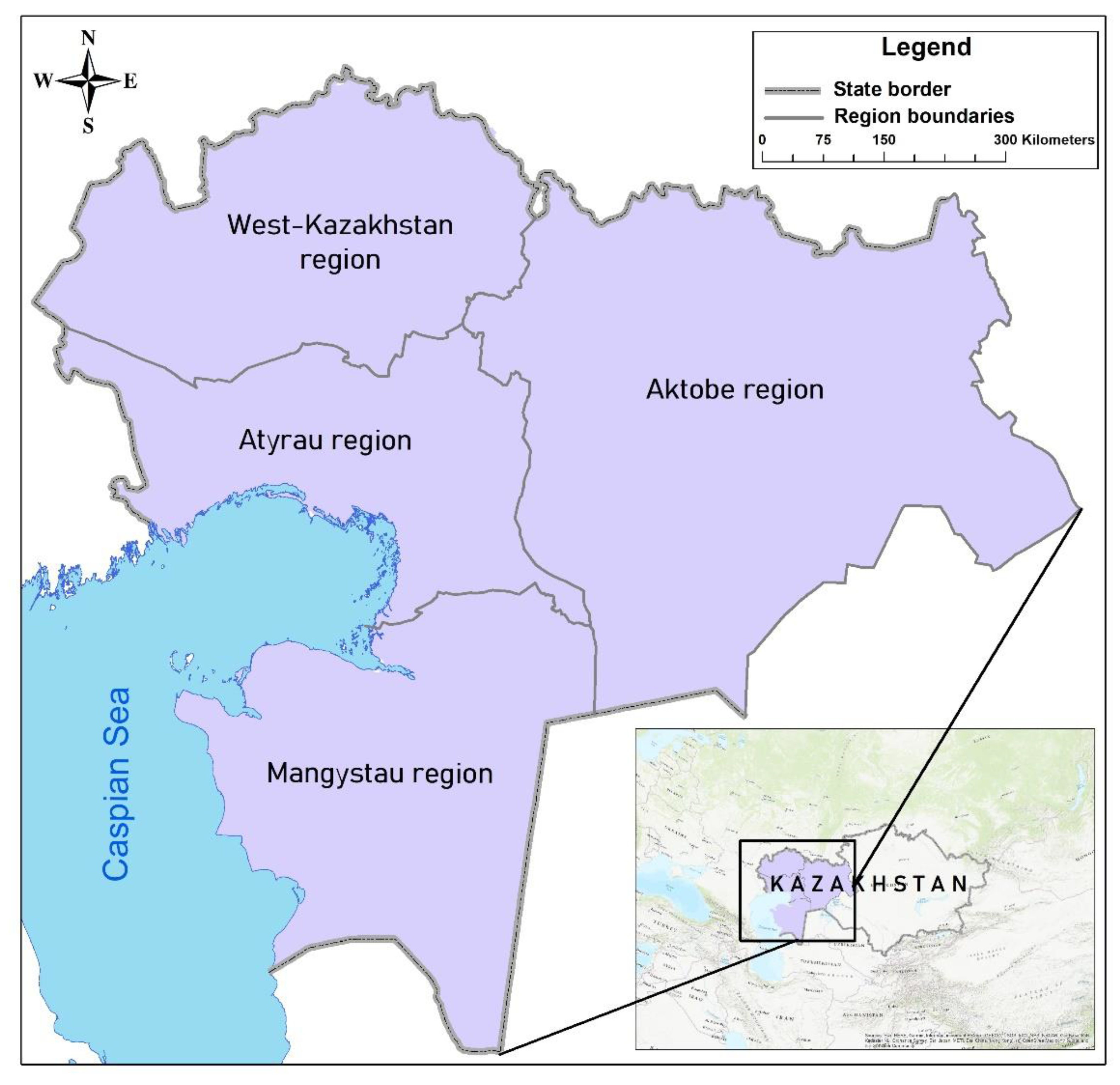
Figure 2.
Sustainable development factors in the investment/population system.
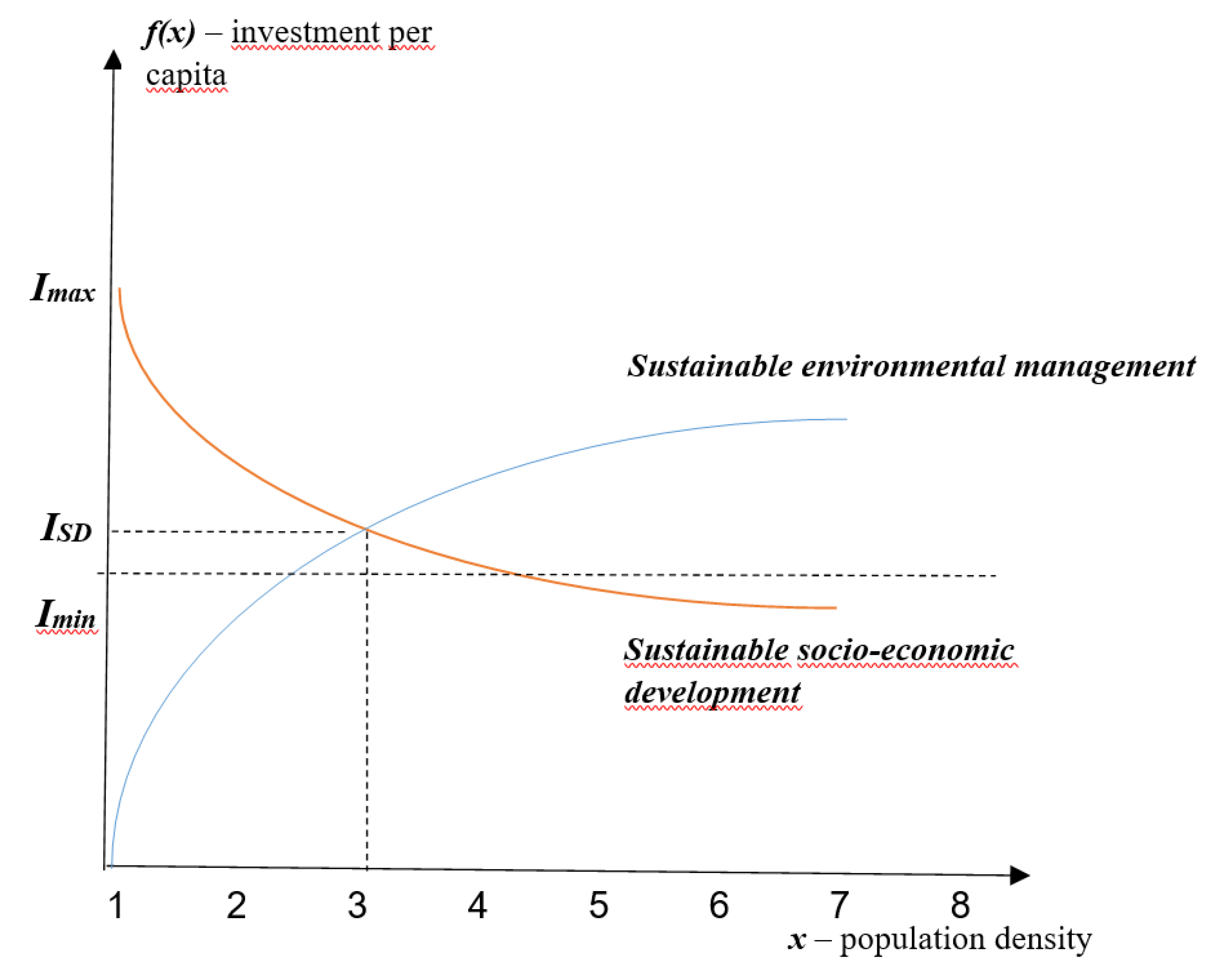

Table 1.
Estimated indicators for sustainable socio-economic development (2022) compiled by the authors according to [65,69].
| Indicators | Australia | Aktobe region (KZ) |
|---|---|---|
| Water stress coefficient | 0.05 | 0.482 |
| Atmospheric air pollution coefficient | 1.5 | 0.506 |
| Landscape stress factor | 0.51 | 0.44 |
| Biodiversity distribution coefficient | 0.04 | 4.4 |
| Ecological sensitivity index | 0.19 | 0.541 |
| Population density | 3.4 | 3.07 |
Table 2.
Indicators for calculating investments in sustainable environmental management (2022) [70,71,72].
| Indicators | Aktobe region (KZ) |
|---|---|
| Investments in fixed assets | 960 038 538 thousand KZT (2022) 817 136 000 thousand KZT (2021) |
| Environmental protection investments (green) | 4 335 302 thousand KZT |
| Average annual population | 922 456 persons |
| Import | US$ 1 379 712. 9 |
| Export | US$ 3 568 372.3 |
| GRP (Gross Regional Product) | 4 416 89.4 million KZT (2022) 3 586 222.6 million KZT (2021) |
| Human development index | 0.593 |
| Population density | 3.07 |
| Per capita investment in environmental management | 170 803.23 KZT |
Disclaimer/Publisher’s Note: The statements, opinions and data contained in all publications are solely those of the individual author(s) and contributor(s) and not of MDPI and/or the editor(s). MDPI and/or the editor(s) disclaim responsibility for any injury to people or property resulting from any ideas, methods, instructions or products referred to in the content. |
© 2025 by the authors. Licensee MDPI, Basel, Switzerland. This article is an open access article distributed under the terms and conditions of the Creative Commons Attribution (CC BY) license (http://creativecommons.org/licenses/by/4.0/).
Copyright: This open access article is published under a Creative Commons CC BY 4.0 license, which permit the free download, distribution, and reuse, provided that the author and preprint are cited in any reuse.


