

Submitted:
08 May 2025
Posted:
09 May 2025
You are already at the latest version
Abstract
Relativistic jets from AGN are an important driver of feedback in galaxies. They interact with their environments over a wide range of physical scales during their lifetime, and an understanding of these interactions is crucial for unraveling the role of supermassive blackholes in shaping galaxy evolution. The impact of such jets have been traditionally considered in the context of heating the large-scale environments. However, in the last few decades there has been additional focus on the immediate impact of jet feedback on the host galaxy itself. In this review we outline the development of various numerical simulations since the onset of studies of jets to the present day, where sophisticated numerical techniques have been employed to study jet feedback including a range of physical processes. The jets can act as an important agent of injecting energy in the host’s ISM, as confirmed both in observations of multi-phase gas, as well as in simulations. Such interactions have the potential to impact the kinematics of the gas as well as its star formation. We summarize the recent results from simulations of jet feedback on kpc scales, and outline the broader implications for observations and galaxy evolution.
Keywords:
AGN feedback
; relativistic jets
; numerical simulations
1. Introduction
1.1. A Brief Overview of Classical AGN Feedback
Feedback from supermassive blackholes (SMBH) in large early type galaxies has been strongly established as a major influencer of galaxy evolution [1,2]. However, the exact mechanism of how the active galactic nuclei (AGN) affect the galaxy and its environment, and the different implications of this on the galaxy’s properties, is still not settled. From a historical perspective, since the advent of X-ray observations of galaxy clusters, cooling flows of gas cooled via thermal Bremsstrahlung from the cluster environment [3] have been both postulated from theoretical modeling [4] and observationally confirmed [5,6]. However, the fate of the gas cooled below X-ray emitting temperatures ( keV) hwas left uncertain, due to lack of distinct observational signatures [7,8]. This prompted considerations of re-heating of the gas by some mechanism, with feedback from the AGN being a viable source[1,9]. The early concept of AGN feedback had been primarily proposed to investigate two major implications: a) explain the the well known relation due to the co-evolution of the SMBH and the galaxy-core’s [10] b) a heating mechanism to offset over-cooling of cluster cores [9,11]. These two different tracks, eventually led to the evolution of the concept of dual-mode feedback by AGN, viz. a) Quasar or Establishment mode related to the local impact of AGN driven outflows and co-evolution of the SMBH and galaxy mass, and b) Radio or Maintainence mode, catering to the large scale heating of gas reservoirs external to the galaxy and preventing cooling flows. In this dual mode scenario, the role of relativistic jets have been largely confined to their impact on extra-galactic gas, for the Radio/Establishment mode, whereas non-relativistic winds in high Eddington ratio systems have been considered to be the primary driver of Quasar/Establishment mode feedback. However, in the recent decades, a large body of studies have demonstrated both from theory and observations that jets can have a significant impact on the ISM of the host galaxy. This makes the earlier dual mode distinction ambiguous in some cases, requiring re-thinking of the traditional defintions [see [2] for a discusison].
1.2. Scope of the Current Review
Over the last few decades there have been some excellent reviews on different aspects of the topic of relativistic jets and their feedback, by various authors. However, their scope and focus have been different and often non-overlapping. Some have highlighted the advances on the physics of relativistic jets themselves [12] or their simulations [13]. Others have given excellent overviews on the astrophysical implications of jets and outflows in general [14,15], and on the topic of AGN feedback in particular [1,2,16,17,18,19,20]. Some related reviews have focused on on other diverse issues related to the topic, such as AGN sources and their radio-loud counterparts [21,22,23,24], gas in and around AGN host galaxies leading to feeding and feedback [25,26,27,28], episodic nature of AGN outbursts [17] etc. The above works provide broad overviews of the various complex astrophysical processes interlinked with the topics of feedback and galaxy evolution. However, there have been only a few detailed reviews that have discussed the complex issues of the interactions of such outflows, specifically jets, with the host galaxy itself [29,30,31,32]. In this review we primarily focus on the development of simulation techniques involved in studying jets in general, with a focus on developments over the past few decades dedicated to the study interaction of jets with their environment. The review is not meant to be a comprehensive summary of all accumulated results till date. Rather, it aims to provide broad summary of the major achievements in this field and their historical developments, to place them in the context of the general question of AGN feedback and galaxy evolution.
2. Modelling Jet Driven Feedback at Galactic Scales
2.1. Jets in Homogeneous Medium
In the mid and late 1970s, there were several seminal developments of theoretical models to explain the dynamics and emission from extra-galactic relativistic jets [such as the `twin-exhaust’ & beam models, the B-Z jet-launch mechanism, diffusive shock acceleration models [34,35,36], etc.], which defined the studies of jets and non-thermal emission in future. Attempts at simulating such jet beams have been made even at such early stages as well, although with limited resolution [37]. The first detailed 2D simulations of propagation of hypersonic jet beams and their structures were presented by Yokosawa et al. [38] and Norman et al. [39], published nearly at the similar times in 1982, the latter paper being more widely recognized in literature. The Yokosawa et al. [38] paper showed that nature of the jet beam (ballistic vs turbulent) and formation of well defined backflows depends on the relative density contrast of the jet and ambient media, and jet velocity. Norman et al. [39] presented more detailed exploration of jetted beams which confirmed the structure of the jet-beam, working surface and backflow; as proposed in Blandford and Rees [34] (see Figure 1). These works spawned several numerical works to probe different aspects of dynamics of supersonic jet beams such as beamed synchrotron emission [40], 3D generalisation [41,42,43,44], stability of slab jets [45], MHD simulations [46,47] etc. Future works have built on the early success of such numerical simulations with larger domain, grid sizes and resolution, although true convergence of the cocoon and beam structures remain elusive [48,49] due to the small scale structures generated with increase in resolution.
Relativistic nature of jet flows had been inferred very early [50,51,52,53,54] from observations of super-luminal motion of jet knots in radio studies. Numerical simulations of steady state jets with relativistic solvers had been presented as early as 1987 [55]. Full fledged dynamic simulations with relativistic solvers were presented a decade later [56,57,58,59,60,61]. A key focus of these simulations were firstly to re-confirm the proposed model of the jet structure in the relativistic limit, and explore a larger parameter space of some key properties of the jet. These initial studies established that internal structures of relativistic jets show significant dependence on the Mach number of the jet beam, jet Lorentz factor and internal pressure. Highly relativistic flows are more stable due to longer growth time scales (as later demonstrated in linear stability analyses [62]). On the other hand, lower mach number (progressively hotter jets) show a difference in their behavior; varying from more internal structures in warm jets ([61]) to more stable cocoons for even hotter jets ( [61]) as the small scale perturbations are either ill-resolved by the numerical grid or KH instabilities do not couple well with the jet flow. Attempts at simulating magnetised relativistic jets have been made been in tandem as well [59,63,64,65]. However, such simulations of jets received more momentum with the development of efficient high resolution shock capturing schemes in the late 90s and early 2000s [66,67,68,69,70,71,72,73].
In later years, improvement of computational facilities and high order numerical schemes has led to a wide range of AGN jet simulations probing diverse topics such as impact of fluid instabilities and on the jet and cocoon structure [e.g., [49,74,75,76,77,78,79,80,81], etc.], the origin of turbulent structures and dynamics of lower power FR-I jets [e.g., [82,83,84,85,86,87,88,89]] and the larger more powerful FR-II counterparts [such as [90,91,92]] etc. Another focus of such works have been to compare the jet dynamics with predictions of semi-analytical models of jet evolution [e.g., [93,94]]. Models based on self-similar expansion has been proposed for analytical simplicity [90,94,95], although such evolution remain doubtful for all of the life-time of the jet [96,97], especially for the early phase of jets [74]. In many cases, the general scaling laws predicted by Begelman and Cioffi [93], duly modified for a power-law background atmosphere, show good fit with simulated results [74,90].
Simulations of large scale jets have been further driven by efforts to understand impact of jets on cluster scale environment and follow the evolution of non-thermal emission [e.g., [98,99,100,101,102,103,104,105,106] etc.]. Such works have given detailed results of the dynamics of jets in large scale medium, energy transfer to the environment and evolution of synchrotron surface brightness and polarization characteristics as a function of jet length. These have further motivated numerical model based scaling laws predicting synchrotron power for a given mechanical power of the jet [107]. In recent years, large scale simulations of jets have also been utilized to address other science goals such as production of ultra-high energy cosmic rays from large scale shocks driven by jets [108,109,110], impact of multi-species fluid on jet dynamics and emission [e.g., [111,112,113]], jet precession and production of X-shaped structures [114,115,116,117,118,119,120], impact of in-situ particle acceleration of non-thermal electrons [121,122,123,124,125,126,127,128] etc., demonstrating the diverse areas of interest on this topic.
2.2. Jets in Inhomogeneous Medium
2.2.1. Non-Relativistic Simulations
The early phase: The earliest of such suggestions of jets interacting with intervening gas clouds was proposed to explain the observed knots in the jet of Cen A, as early as 1979 [54,129]1. Focus of a jet’s impact on a dense environment was renewed in the 90s by studies of Gigahertz Peaked Spectrum (GPS), Compact Steep Spectrum (CSS) or Compact Symmetric object (CSO), as evolutionary phases of radio galaxies [22,134,135,136]. One of the proposed absorption methods to explain the turnover in the spectrum is due to free-free absorption by intervening ionised gas; either as swept up matter in the forward shock or pre-existing clouds engulfed by the evolving bubble of a radio jet [135,137]. This motivated several theoretical simulations to probe the evolutionary stages of a jet through the host’s ISM, as outlined below.
Jet-single cloud interactions:
Some of the earliest 2D simulation of jets drilling through an inhomogeneous ISM were by DeYoung [139], Steffen et al. [140], who considered a random distribution of spherical (or point-like) dense structures to mimic an inhomogeneous ISM. However, the several aspects of the physics of jet-ISM interaction were first elucidated by more simpler configurations of jets piercing an oblique density discontinuity [141,142,143]. These papers highlighted how the jet’s mach disc tilts and regular structure of the jet-cocoon is broken into turbulent vortices, that also promote instabilities. Such results, gave the early hint of disruption of the jet-beam demonstrated by more complex simulations later. Following on, several simulations explored the impact of jets on individual clouds, usually modeled as a sphere [144,145,146,147,148,149], and some with more updated version of the earlierDeYoung [139] papers evolved 3D jets with multiple randomly distributed clouds [e.g., [150]]. Such simulations2 were a first step to understand the impact of jets on an inhomogeneous ISM, besides probing other science goals such as explaining sources with bent radio jet (wide angle tailed) or those with asymmetric hybrid morphologies. Later simulations included more involved physics such as atomic and molecular cooling [160,161], idealised set ups of shear-layers and mixing [162], self-gravity and starformation [163,164] and realistic morphological models of inhomogeneous molecular clouds including all other previously described physics based models[138,165].
Resolved simulations of jet-cloud3 are insightful in providing the details of how the jets/outflows are affected by the presence of a cloud [143,145,166,167] and more importantly the various evolutionary stages of the clouds themselves (e.g., see Figure 2). Different fluid instabilities can be well captured in such resolved simulations[138,160,165], which otherwise become difficult to follow on global scales. Recent works have also included upgraded models of starformation [138,165] to quantify the positive feedback expected due to the compression by radiative shocks from the AGN outflows. However, a drawback of such individual simulations of jet-cloud interaction is that they do not probe the global impact on the ISM at larger scales, and the evolutionary stages of the jet through the ISM, as it interacts with individual clouds.
The first studies of Jets in fractal inhomogeneous medium: A separate line of simulations probed jets in large scale inhomogeneous ISM; a more realistic depiction than the early works of DeYoung [139], Steffen et al. [140]. Although such simulations have moderate resolutions ( cell across a cloud diameter [168,169]) than the previously mentioned single jet-cloud works, they probe the global impact of the outflow on the turbulent structures in the central few kpc of the galaxy. Hence, such simulations are a bridge between the highly resolved jet-ISM interaction of single clouds, to large scale cosmological simulations with much poorer resolutions [ pc ] which cannot capture the internal structures of molecular clouds in any detail. A key new introduction of such simulations were the use of a fractal density distribution as a realistic model of the ISM. 2D simulations of jets through a fractal ISM were first introduced in the early 2000s [170,171]. The first detailed 3D simulations were presented in Sutherland and Bicknell [33, hereafter SB07], where a non-relativistic jet was injected through a two-phase ISM. This was a pioneering paper in many aspects, as it laid both the technical foundation for several future publications, as well as elucidating the basic evolutionary stages of a jet breaking out through an inhomogeneous ISM. These works were later improved upon by relativistic simulations of jet-ISM interaction, outlined in the next section (Section 2.2.2).
Other non-relativistic jet-ISM simulations with improved physics: Beyond the SB07 works, there has been several other papers, that have explored different facets of the process of jet-ISM interaction with slightly different initialization. One such series viz. Dugan et al. [163], Gaibler et al. [172,173], Dugan et al. [174] focused on simulating larger gas disks (), as opposed to a few kpc disks considered in other papers [33,169,175,176]. However, the larger scales necessitated a more modest resolution pc, lower by nearly 10 times that of the other resolved studies mentioned earlier. Nonetheless, these simulations truly probed the global impact of an AGN jet on the large scale disk.
These works outlined several important results such as asymmetric jet morphologies due to local inhomogeneities [172], large scale compression driven positive feedback over the galactic scales [173], a ring-like morphology of enhanced SFR surrounding the central cavity and appearance of hyper-velocity stars with strong non-circular velocities [174], comparison of jet vs wind driven feedback and impact of jet orientation [163] which was a pre-cursor to the later study by Mukherjee et al. [169]. These provide definitive predictions to test the applicability of such models in observations, along with identifying past AGN activity from the disturbed stellar kinematics. While the above papers considered an existing fractal density distribution, other recent works have also explored generation of a self-consistent inhomogeneous ISM by stellar feedback, before jet launch [177]. Most of the above works have only explored hydrodynamic simulations, without magnetic fields. Only a handful of papers [177,178] have explored the impact of magnetic fields on jet-cloud interaction, which remains an area to be explored in future.
In recent years, a more detailed self-consistent evolution of jets and their environment have been carried out in another series of publications viz. Fiacconi et al. [179], Talbot et al. [180,181,182]. The authors have a introduced a novel sub-grid blackhole accretion-ejection model based on a thin accretion disk model, duly accounting for mass build up of the accretion disk while following the angular momentum exhange between the in-falling gas, blackhole and the disk. The jet power is determined from a Blandford-Znajeck mechanism, with the efficiency parameterised from GRMHD results [179,180]. The innovative model has been employed to study the mutual evolution of jets and a circum-nuclear disk of height (radius pc, height pc) [180,181]. Jets in larger kpc scale gas disk were explored in a subsequent paper [182]. The simulations probed outflows from lower-mass blackholes () and hence had typically low kinetic power of jets (), although higher power jets were probed for simulations exploring AGN triggering from mergers [182] which also had larger kpc scale gas reservoirs.
Although these simulations explore a different range of parameters, more suited to Seyferts, than typical massive radio-loud AGN, the qualitative evolution of the jet and its interaction with the multi-phase gas is similar to other works (see Section 3 for a general summary). However, one of the key outcomes of Talbot et al. [181] works is the self-consistent evolution of the jet angular momentum and the Bardeen-Peterson effect driven re-orientation of the jets for inclined jets. The simulations also predicted significant cold ( K) outflows from the circum-nuclear disk, with an increase in rates for inclined jets, which conforms well with observations [183]. Although the authors did not find significant blackhole spin evolution during a single outburst, the general applicability of the method makes it very suitable to be implemented in large scale cosmological simulations as demonstrated in Talbot et al. [182], which can potentially track the blackhole growth over cosmic time.
2.2.2. Relativistic Simulations
Why relativistic MHD? A drawback of non-relativistic simulations probing dynamics of jets that are inherently relativistic in their bulk flows, is the difference in the momentum exchange with the external environment. The momentum conservation equation in relativistic hydrodynamics is
where is the relativistic enthalpy, the internal energy; and an identity tensor. The Lorentz factor of the flow velocity is . A jet with a given rest-frame density, pressure and bulk velocity, a relativistic formulation implies higher momentum imparted by the jet beam, at least by a factor of . For example, the difference () becomes even for mildly relativistic flows of (). Thus non-relativistic formulation of the fluid equations will under evaluate the momentum advantage imparted by the jet. Of course the total energy flux of a relativistic and non-relativistic jet, with identical fluid parameters, are thus not the same. Hence, non-relativistic simulations of jets have often employed an equivalent jet beam by constraining the jet pressure, velocity and injection radius to be same, but deriving the density to match the total energy flux. The relations between the densities for such an equivalent non-relativistic () and its relativistic counterpart () were derived by Komissarov and Falle [184] as
where is the ratio of the rest mass energy and the non-relativistic part of the rest-frame enthalpy (). Equation 2 shows that a flux matched non-relativistic jet has a higher density and hence a heavier jet. This results in narrower jet cocoons, faster jet propagation, higher mach numbers [61,184] and lower cavity pressures [185] than that of a relativistic jets. Thus irrespective of the choice of initial jet parameters, whether done by strictly ignoring relativistic effects, or by deriving effective jet parameters by matching fluxes, the momentum balance is strongly affected by the neglect of relativistic solvers while evolving AGN jets[13,61,184]. However, accuracy of the momentum exchange is crucial for the physics of jet-ISM interaction and the implications for local scale AGN feedback effects by the jets. This necessitates the usage of relativistic solvers in simulations of jet-feedback.
Jets in static fractal ISM: The first such simulations were presented in Wagner and Bicknell [168] and later expanded with a larger set of simulations [186] probing different volume filling factors of the dense gas. These simulations modeled a relativistic jet ploughing through a static fractal ISM [33] immersed in a constant density background halo. The simulations did not have an external gravitational field of the galaxy. The dense ISM was assumed to be distributed spherically, unlike SB07 [33] who considered a disk. The suite of simulations probed several different parameters of the simulations relevant for studying jet-ISM interaction, such as i) jet power: , ii) mean cloud density: , iii) volume filling factor4: and iv) cloud sizes: pc (See Table 2 of Wagner et al. [186]). All the simulations were run for a jet of and (see Equation (2)).
These simulations, along with SB07 [33], were the first to explicitly identify the various stages of the jet’s evolution as it channels through an inhomogeneous ISM (discussed in more detail in Section 3.1). They discussed the impact of the jet on the cloud ablation and acceleration, dynamics of the jet driven bubble, their impact on ISM energetics, and placed such cases in the context of AGN feedback processes in galaxies, showing definitively that as jets can significantly impact the host’s ISM. Future simulations have expanded and confirmed these results. Besides the above, these papers highlighted two other primary impacts of jets, not often highlighted in other works:
- ISM with small size clouds ( pc) could easily be cleared by the jet and result in mean radial velocities higher than the stellar velocity dispersion with moderate values of Eddington ratios (). However, sufficiently accelerating larger clouds, typical of galactic GMC[187,188,189] ( pc), would require higher Eddington ratio () for jets of power (), and hence more efficient outburst from larger mass SMBH. This implies stronger confinement of jets in ISM with larger clouds, which would be more difficult to ablate, as also confirmed in later works [175].
- The jets were found to provide a strong mechanical advantage, higher than unity (defined as the ratio of total outward momentum of clouds to the net momentum imparted by the jet). This also correlated with kinetic energy transfer to the ISM , later refined to slightly lower values by future works [175,190].
Jet-ISM interaction in dynamic environments: The above works were taken forward by four subsequent papers: Mukherjee et al. [175], Bicknell et al. [191],Mukherjee et al. [192] and Mukherjee et al. [169], as a direct continuation of the earlier efforts. These papers had a few new additions: i) An external gravitational potential (double isothermal) with a hydrostatic atmosphere, which enabled more correct calculations of long term gas kinematics (see Section 3.3). ii) A dynamic turbulent velocity dispersion in the dense fractal ISM. This added further realism to the set ups, which successfully enabled ready comparison with several observed sources (see Section 4). The results from these simulations have formed the primary benchmark for studies of jet-ISM interactions in recent years.
The above works primarily focused on high jet powers . An update on these for a broader range of powers were carried out by Tanner and Weaver [176], where a key focus was extending the jet-ISM simulations to much lower power () and compare the dynamics with higher power cases in the same numerical framework. While these simulations recovered the earlier results of [169], one important distinction was that the confinement of the jet was seen to less strongly depend on the morphology of the ISM for higher power jets , which eventually drill through the ISM. Lower power jets were prone to disruption and break up, likely resulting from the lower jet density and pressure resulting in lower momentum flux; which would in turn result in longer ablation time scales of the clouds. Similar results have also been supported in more recent non-relativistic simulations [193]. The nature of the jet-ISM interaction for a given jet power was in general however, found to proceed along similar lines of earlier works [169].
3. Summary of Key Results
Although specific individual results often vary between different simulations, due to different choices of parameters of the jet, the ambient medium or the physics involved; a common set of general outcomes can be ascertained. In the following the sections we outline the broad summary of some general conclusions and key results.
3.1. Evolutionary Stages of the Jet Through an Inhomogeneous Medium
A common set of evolutionary phases [first identified by [33] of a jet moving through the ISM of a gas rich host can be identified, as illustrated in Figure 3.
- The Confined phase: The jet remains confined within the clumpy ISM ( kpc), resulting in the formation of a flood-channel scenario (see right panel of Figure 1). The jet-plasma is diverted to low density channels through the clouds, percolating into the ISM. The jet beam’s forward progress is halted, leading to a temporary stalling of the jet-head. However, the jet’s energy is dispersed over a quasi-spherical volume as the forward shock sweeps through the ambient medium in the form a energy driven bubble. Simulations find the time of the confined phase can last from a few hundred kilo-years to a Myr, depending on the power of the jet, the density of the ambient medium and extent of the dense gas. An approximate analytical analysis of the duration of confinement is presented in Appendix A. Since these conditions can vary over wide range between different galaxies, the impact of jet and the efficiency of coupling with the ISM can have a wide variation as well.
- Jet breakout phase: The jet breaks free from the confinement of the dense ISM and the hemi-spherical bubble, to proceed onwards. During this phase the jet driven bubble can still indirectly impact the dense ISM. The bubble remains over-pressurised and eventually engulfs the ISM. This is accentuated by the drafts of backflow from the tip of the jet. This drives shocks into the clouds away from the jet axis, which can raise turbulence [169] and impact starformation over the inner few kpc of the galaxy [169,194,195]. During this phase the jet and its ensuing bubble still has significant impact on the ISM. However, as the decrease in pressure with the expansion of the bubble weakens the impact on the dynamical evolution of the dense gas.
- The classical phase: Beyond the break-out phase, the jet carves a clear path through the ISM. Subsequent energy flows have less impact on the ISM. The jet proceeds into the low density stratified homogeneous halo gas. Beyond this, the dynamics of the jet are similar to the conventional models of jet propagation into a static homogeneous medium. The dynamics of the ISM and perturbed velocity dispersion of the clouds start to decay back to the pre-jet levels [195].
Of the above stages, the confined phase is of primary interest in the context of AGN feedback. During this phase, there is significant coupling of the jet with the dense gas, which results in transfer of of the jet’s energy flux into the ISM in the form of kinetic energy, creating local outflows [175,186,190] and also additionally heating the gas to create radiative shocks. The efficiency of such an interaction depends primarily on the following criteria:
- The volume filling factor of the dense gas ().
- Jet’s orientation with respect the ISM morphology, with jets inclined to a gas disk being more productive ().
- Jet power ().
- Mean density of the clouds in the ISM ().
Thus the impact of jet driven feedback on kpc scales depends on a four-dimensional parameter space. The maximal impact of course is in a case with jet directly oriented into the dense ISM (e.g., jets pointed into the disk [169,192,196]), higher jet power and higher cloud densities, leading to longer confinement. More detailed discussion on the impact of parameters 1, 3 and 4 on jet confinement are discussed later in Appendix A. However, the interactions can also be gentle if one of the parameters are weak, even though others are prominent; such as in the case of NGC 3100 [197] where in spite of dense gas disk observed in CO 1-0 with a moderately powerful jet (), the impact of the jet on the disk’s kinematics is minimal. This is likely due to weak coupling arising from the relative orientation of the jet away from the disk’s plane. However, on the other hand, several detailed spatially resolved observations have uncovered more telltale smoking gun signatures of strong impact of the jet on the confining ISM, as discussed later in Section 4.
3.2. Global Impact on the ISM
Simulations of jets through the inhomogeneous ISM have strongly supported that jets can cause a large scale effect on the central few kpcs of the galaxy, contrary to earlier beliefs that such thin collimated structures are less important in the global context [198]. There are again three distinct types of impact of the jet, which has varied effects on the ISM.
- Direct impact of jet-beam ( kpc): Clouds directly along the path of the jet are strongly impacted by the flow and eventually ablated. Such an interaction affects both the clouds as well as the jet. For large clouds (e.g., a GMC of size pc) directly along the jet-beam, which may nearly cover the jet’s width, the jet is strongly decelerated till the cloud moves away from the jet’s path or is completely disintegrated. The region of such impact is usually confined to kpc, where the jet-beam and its ensuing backflow directly interacts with the ISM. This region experiences much higher turbulent velocity dispersion and density enhancement [195] due to stronger ram pressure driven shocks. In addition, the stronger interaction in the central region also results in mass removal and formation of a cavity [169,173,195]. However, simulations that better resolve the cloud structures show that such cavities are not completely devoid of dense gas [192,196]. Strands of dense cloud cores, with a radiative shock enhanced high density outer shell remain embedded inside such cavities, that are slowly ablated by the jet driven flows [169,192].
- Indirect impact by energy bubble ( kpc): As mentioned earlier in Section 3.1, the confined jet’s energy spreads out in the form of an energy bubble sweeping through the ISM. The indirect interaction operates differently depending on the evolutionary phase of the jet (see Section 3.1). During the jet confinement phase, the forward shock sweeps through the ISM. The embedded clouds face a steady outward radial flow of the jet plasma being re-directed in lateral directions from the jet axis, through the flood-channel mechanism. This results in outward radial flows inside the ISM, away from the jet axis. In the jet breakout phase and beyond, the jet expands beyond the immediate confines along its path and the over-pressured cocoon engulfs the ISM. This is more prominent for gas disks, as shown in the right panel of Figure 3. Such indirect interactions are responsible for more large scale impact of the jet, beyond the central 1 kpc range. This raises the velocity dispersion of the gas in general all through the ISM and also shocks a larger volume of the ISM [199,200]. Inclined jets strongly confined within the ISM [163,169,176,192] are also able to process a large volume as the jet-plasma spreads beyond the decelerated jet-head and drive radial inflows through the ISM.
The fact that jets can in principle affect a larger volume of the ISM than their apparent width near their launch axis, has strong implications for AGN feedback. This demonstrates that jets can creates strong global outflows and impact gas kinematics and starformation rate, as discussed in further below.
3.3. Impact on ISM Kinematics
As discussed above, the jets can affect a significant fraction of the ISM during the confined and break-out phase. This results in launch of fast multiphase outflows [33,163,175,176,181,186,190,192]. The nature of the outflows depend on the four key factors listed in Section 3.1. We list below some of the broad major inferences that can be drawn from these theoretical simulations.
3.3.1. Multi-Phase Outflow:
In a realistic system, one would expect a wide range of gas phases to co-exist: dilute hot gas in the halo of galaxies, dense gas ionised by shocks (collisional) or photons from a central source like AGN [199] or shock-precursors [201], warm molecular gas likely representing cooling fronts or shocks/turbulence that have penetrated dense clouds [202,203], cold dense molecular gas [204,205] and neutral HI gas [31]. However, most simulations consider a single fluid system and do not explicitly track the chemical evolution of the constituents of the fluid due to the computational complexities, although some recent works have started some preliminary investigations to model differences in composition [206,207,208].
Nonetheless, simulations that can resolve the density sub-structures inside an inhomogeneous ISM can track the variation of density, temperature and velocity structures of the fluid, which act as a proxy for the different phases [192,199,209]. Some theoretical papers have attempted to understand the multi-phase nature of the ISM and disentangle the relative contributions of different gas properties in the outflows by evaluating 2D histograms [138,175,190] or analysing the simulations based on temperature thresholds [181]. A better representation of the multi-dimensional nature of the phase space is shown in Figure 4, where the mass distribution is represented in terms of the three primary variables of interest, viz. density (n), temperature (T) and outward radial velocity () corresponding to outflowing gas. The corresponding 2D distributions, obtained by summing along each axis of the 3D distribution, are plotted on the right. However, the summed 2D distributions often fail to capture variation in the phase space visible in the 3D image. The plot is for the last panel of Figure 14 of simulation D from Mukherjee et al. [169], which corresponds to a jet of power launched at to the axis of the disk.
Several distinct identifiable regions have been highlighted in the 3D figure (Figure 4).
- Cloud cores: There is collection of mass at K, with high densities near the left face of the 3D figure. This corresponds to the cores of the clouds, with a temperature near the cooling floor of the simulation (K). The clouds have some positive radial velocity () which likely correspond to the turbulent bulk velocity of the clouds injected at initialisation and also mild acceleration after jet-ISM interaction.
- Dense warm outflow: There is a distinct collection of mass in Figure 4, shifted from the cloud cores, that is centred around K in temperature and extending from in velocity and density . This corresponds to dense shock heated gas that has cooled and accelerated to high velocities. This phase has the highest mass among all of the outflowing gas, and hence accounts for the dominant contributor to the kinetic energy budget of the outflows. In observational studies, this phase would correspond to the warm molecular gas [202,210,211,212] and may also proxy the cold gas outflows [204,209,213] as modelled in Mukherjee et al. [192].
- Shocked cloud layers: Beyond the dense warm phase, there is another distinct, but small, collection of mass peaking between K, and at a lower density () than the dense warm phase. The temperature range corresponds to the peak of the cooling curve. This phase belongs to either the outskirts of the clouds being shocked by the enveloping pressure bubble or shocked dense cloud-lets ablated from large clouds [169,200]. This phase accounts for the majority of the observed emission in optical lines used as diagnostics of shock ionisation such as O[II], O[III], S[II] etc. [192,200]. It should be noted that the mass represented in this phase is small compared to the dense phase. Hence, inferences of ionised gas mass from shocked gas are often lower limits to the gas mass actually contained in the ISM, but often missed due to lack of multi-wavelength coverage of the system.
- Hot tenuous outflow: The jet driven outflows pushes out the ablated gas in a tenuous hot form (, K). This gas forms a tail of the distribution extending to very low densities and high velocities. Such a hot tenuous gas is predicted to be seen in X-rays wavebands [33]. Detecting the soft X-rays from such thermal gas with sufficient spatial resolution to distinguish it from the central nucleus is challenging, owning to the contribution from the AGN, but has been tenatively confirmed in some sources [214,215].
3.3.2. Galactic Fountain:
Although the jets can launch strong local outflows, there is no significant large scale blow-out of the dense ISM, as often required by semi-analytical models of galaxy evolution in the context of AGN feedback to quench starformation by mass removal. Instead, the total mass weighted mean velocities are in fact negative [175,190]. This indicates, that although there are strong localised outflows, a significant fraction of the ISM stays within the gravitational potential of the host galaxy. This is best demonstrated by the escape fraction plot in Figure 20 of Mukherjee et al. [175]. It shows that only of the ISM moves beyond the central few kpc. Thus outflows, without escape, result in a localised galactic fountain scenario, where gas will likely be re-cycled within the galaxy’s own confines [175].
3.3.3. Turbulent Velocity Dispersion:
A key focus of local AGN feedback studies in both observational and theoretical domains has been to understand the influence of AGN driven outflows on the turbulence of the ISM. Resolved simulations of jet-ISM interactions have shown that as the jet driven bubble sweeps over the central few kpc of the ISM, it can significantly raise the velocity dispersion by up to an order of magnitude from its initial value. However, this seems to depend on the phase of the gas. For example, Mukherjee et al. [169] shows that hotter shock ionised gas ( K) will have higher velocity dispersion () than the colder component (). This is because the shocks progress very slowly within the dense cores. The primary impact of the jet driven bubble is on the ablated cloud-lets stripped from the larger clouds. Random bulk motions of such clouds adds to the velocity dispersion. However, the dense gas is not completely undisturbed. Detailed comparison of kinematics of dense gas in galaxies such as IC 5063 [204] and B2-0258 [209,216] with simulations [169,192,200] have shown excellent correspondence of the spread in the observed gas kinematics. An interesting new feature identified in both simulations [192,200] and observations [217,218,219,220,221] is the the appearance of high velocity dispersion in directions perpendicular to the jet. Such features are conjectured to arise from deceleration of a jet strongly inclined in to the gas disk, resulting in outflows of plasma both along the minor axis following the path of least resistance [192,200], as well as into the plane of the gas disk [222]. A combined effect of both types of motions are predicted to result in such apparent enhanced widths perpendicular to the jet [200,222].
3.4. Impact on Starformation Rate
One of the primary focus of the studies of AGN feedback has been to understand the impact of AGN driven outflows on the starformation rate (SFR) of the galaxy, both instantaneous and long term. In simulations starformation rates have been primarily estimated as
where is often assumed to be a constant efficiency factor () and is the local free-fall time. Since gas density was the only fluid parameter affecting the above, reduction in SFR was modeled to occur primarily due to evacuation of gas by the outflows and enhancement due to compression by shocks. Spatially resolved simulations of jet-ISM interaction have predicted a central cavity (hence negative feedback) surrounded by a ring of SFR enhanced region due to compression in the immediate rim of the cavity [163,169,173,177]. Strong compression from the ensuing pressure bubble have been predicted to strongly promote starformation in extended regions of the galaxy [173,194]. Such predictions of positive feedback do indeed align with some observed sources, especially with the aligment of starforming streams with the outflows [223,224,225,226]. However, the simplistic density threshold based starformation model as described above often lead to very high SFR (), which would imply very high addition of new stellar material ( [173]) for each outburst. Such high rates of starformation are unlikely for Radio loud AGN and likely point to the deficiencies in the quantitative sub-grid SFR models. Predictions of global negative feedback have been limited in such studies, except in some simulations with low gas mass/density that suffers very strong ablation from the jet [e.g., simulation E of [169]]. However, several radio-loud galaxies have been demonstrated to have significant reduction of their SFR [210,227].
In a recent study, Mandal et al. [195] proposed a new turbulence regulated framework to estimate the SFR in simulations where turbulent gas structures can be resolved. A key difference in this approach is to duly account for variation in the local free-fall time as a function of density, the virial parameter () and the mach number of the gas (). The work extends the theoretical framework of turbulence regulated starformation in molecular clouds [228,229]. This method assumes that only densities beyond a certain threshold are gravitationally unstable to form stars. This occurs for densities with Jean’s length lower than the sonic scale (), where the sonic scale corresponds to the length scales at which the turbulent velocity dispersion is lower than the sound speed. At scales higher than the sonic scale, turbulent pressure offsets the gravitational collapse. Using the above criteria, a turbulence regulated estimate of SFR has been carried out in postprocess of jet-ISM interaction simulations by Mandal et al. [195]. In a departure from either pure positive or negative feedback, the physics driven approach reveals some new aspects, such as i) a mild global reduction in the SFR during the onset of the jet-ISM interaction, ii) in-efficient positive feedback occurs in inner regions directly impacted by the jet that suffer both jet driven compression as well as enhanced turbulence, iii) the ISM going through a sequence of evolutionary phases in the Kennicutt-Schmidt (KS) plot, till the jet-break out phase, beyond which turbulent velocities return to pre-jet levels. Although in its infancy, the inclusion of turbulence regualated starformation in large scale simulations shows promise in addressing several existing issues related to impact of AGN feedback processes on SFR.
4. Observational Implications
As outlined earlier in Section 1.2, several reviews have summarized the observational evidence and implications of AGN feedback. We refer the reader to Harrison and Ramos Almeida [2], a more recent addition to the series. However, in the following sections we briefly summarize the observational results pertaining in particular to jet-ISM interaction, with a narrower focus than the discussion in the reviews mentioned earlier.
4.1. Observations of Jet-ISM Interactions
Observations of jet-ISM interactions have been reported from the very early start of studies of relativistic jets in galaxies. One of the earliest suggestions of expulsion ionised gas co-incident with radio emitting ridges in NGC 4258 by a “nuclear explosion” was reported as early as 1972 [230]. However, the authors at that time discounted that relativistic electrons were streamed directly from the nucleus, assuming propagation at Alfvén speeds, as the concept of non-thermal plasma moving at bulk relativistic speeds was still not well-developed. Later works of this well studied galaxy have established it to harbor radio jets co-planar with the gas disk [231,232,233]. Later in the early 80s, several studies of individual galaxies with co-located radio and ionised gas emission, often with enhanced kinematics and evidence of de-polarisation of radio emission were presented, suggestive of jet-ISM interaction e.g., 3C 66B, 3C 31, NGC 315, 3C 449 [234], 3C 277.3 [235], 3C 305 [236], 3C 171 [237], 3C 293 [238], 3C 310 with a proposed radio bubble from a trapped jet [239] etc. These works were later updated with multi-object studies of radio-optical alignment [240,241,242,243], which provided strong evidence of wide prevalence of impact of jets on ionised gas and potentially positive feedback in starformation. More on the alignment effect is presented in the reviews by McCarthy [244] and O’Dea and Saikia [22].
In recent years, with better access to spatially resolved and more sensitive observations, there has been a plethora of multi-wavelength multi-phase observations of jets interacting with their ambient medium (see Figure 5 for an example). A collection of sources have been presented in Table A1 of Appendix B, along with comments on the nature of the interaction where applicable. The sources listed show signs of interaction of a jet with the ambient gas by demonstration of spatially resolved outflows and/or enhanced velocity dispersion of the gas. The list is not meant to be a complete collection of all observed cases, but a representative sample showing the diverse nature of observations of jet-ISM interaction. In many cases however, presence of strong central AGN also permits driving of outflows from an energetic point of view. However, several factors, especially resolve spatial morphology of the gas kinematics and jet, lends credence to the jet-driven feedback scenario. Besides such spatially resolved studies of individual galaxies, several other papers have explored the tentative observations of jet driven outflows in a broader sample of radio loud galaxies [e.g., [245,246,247,248], etc.], confirming that jet driven outflows strongly influence the gas in their host.
Such observations provide strong support to the results of the spatially resolved simulations outlined earlier in this review. These results have been further augmented by direct predictions of observable signatures of jet-ISM interaction from simulations, such as predictions for ionised gas kinematics by Meenakshi et al. [200]. Similar efforts of direct comparison of observed sources with simulations have been very fruitful in recent years e.g., IC 5063 [192], 4C 31.04 [203], B2 0258+35 [209,214,216,249], 2MASSX J23453269-044925 [227,250], Tea Cup galaxy [222] etc., highlighting the growing synergy between spatially resolved simulations and observations.
4.2. Implications for Compact and Peaked Sources (CSS/GPS/CSO)
Studies of compact jets are directly related to and motivated by the confined young radio jets discussed in this review . The origin and nature of compact peaked spectrum sources, on whether they are young newly evolving sources or trapped by the host’s ISM are still debatable [22,136]. Synchrotron based age estimates of such sources with linear size kpc, have been found to support the “young” source scenario [251]. However, the short confinement times can also be due to the powerful () nature of these sources [252,253]. There are many ancillary evidence to suggest that such sources are gas rich, such as high rotation measures [see [22,136,254,255,256], and references therein], high column depths in X-ray observations [257,258], enhanced IR emission as indication of reprocessing from dust [253,259]. There are also direct detection of atomic and molecular gas in many such systems, as described in reviews by O’Dea [136], Fanti [260], O’Dea and Saikia [22]. Recent observations [261] have also uncovered strong ionized outflows in a large number of such compact systems, indicating strong coupling of the jet with the gas, as predicted by simulations outlined in Section 3.3.1. Hence, given the abundance of possibilities of jet-ISM interaction in these systems, such galaxies may indeed follow the evolutionary sequence outlined in Section 3.1 and remain confined for some duration (see Appendix A for a derivation of the confinement period). Besides the traditional peaked spectrum sources, recent surveys have uncovered a large sample of compact FR0 sources [24,262] where the jet remains compact. Compact jet-like systems have also been uncovered in resolved radio imaging of traditional radio-quiet systems as well [263,264]. Longer confinement time ( Myr) of low power jets (), even for modest mean densities of the ISM clouds () can explain compactness of such sources. Indeed, significant detection of molecular gas has been detected in several such galaxies with compact radio emission [265,266]. This makes such compact radio sources ideal test beds for the physical processes of jet-ISM interaction, as discussed in this review.
5. Concluding Perspectives
The review outlines the development of numerical simulations of relativistic jets propagating through their environment, with a particular focus on jet-ISM interaction. In addition, the observational implications of such processes have also been outlined. The last few decades has seen a very prominent growth of studies in this domain. This is in contrast to earlier general skepticism (e.g., see the arguments in Section 1 of Ostriker et al. [198]) regarding the impact of jets in the Establishment phase of AGN feedback. However, as discussed in this review, such perceptions are starting to change. Some of the major points that have emerged in this context are summarized below.
- Are RLAGN gas rich? One of the major concerns of the role of jets on their host galaxy was whether radio loud galaxies have enough gas in the first place to be affected by jets. The traditional view has been that in the nearby universe, powerful radio jets are usually found in early type galaxies (ETG), which were considered to be gas poor. However, systematic surveys of such systems have uncovered a significant fraction ([267]) to host dense gas, with higher fractions for radio loud AGN ( [268]). A summary of the various surveys can be found in Table 4 of Tadhunter et al. [268]; also see recent the recent review Ruffa and Davis [269] for more details on molecular gas in local ETG. Interestingly, fractions of radio loud galaxies with molecular gas and the estimated masses, have also been found to increase in with redshift [270], with masses spanning . Thus, dense gas is present in a significant fraction of radio galaxies, opening up the potential for jet-driven local feedback, should jets have significant coupling with the ISM.
- Radio detected fraction of AGN? Earlier studies of AGN populations had demonstrated that the radio-detected fraction of AGN reaches up to for high mass galaxies [271,272]. This, though small, is non-negligible. More recent sensitive radio surveys [273] have extended these to lower radio luminosities and have substantially increased the fractions, to point towards more ubiquitous distribution of nuclear radio activity. Although the higher fractions correspond to radio powers an order of magnitude or more lower than considered earlier, implying weaker nature of the AGN, they nonetheless, provide credence to wide-spread presence of radio activity. Furthermore, it is important to distinguish between the traditional definition of “radio-loudness” inferred from correlations of [OIII] and 1.4 GHz radio luminosity may not often imply radio “silent”. As demonstrated in recent surveys [263,264] a significant fraction of traditional “radio-quiet” sources may harbor nuclear radio emission driven by an AGN, or a jet. They may also demonstrate jet-ISM interaction, as shown in Figure 5 [219].
- Extent of the jet’s impact: Although the apparent beam of radio jets are often found to be thin, collimated structures, the fact that they can have a wider influence, has been well demonstrated by simulations and observations, as outlined in this review. The observed size in radio wavelengths, may often under-represent the large scale impact (e.g., in 4C 31.04 [203], and several other sources in Section B) as the jets are broken into low density streams in the flood-channel phase. However, the even though such impacts may extend beyond the immediate confines of the jet, in most cases, the impact has been seen to be in the central few kpc. Though non-negligible, there needs to be better proof for more wider scale impact, to confirm/discard the predictions from simulations.
- Nature of jet’s impact: outflows, turbulence, starformation: Observed studies have strongly established the presence of jet driven outflows in the central few kpc of several sources, in line with predictions from simulations as outlined in Section 4. The outflows are coincident with broad line widths indicating turbulent motions, demonstrating the jet’s ability to affect the local gas. However, the broader long term implications for such actions in the context of galaxy evolution, especially with regards to starformation, is an open question. Although, several prominent radio loud sources are known to show deficiency in star formation rate [210,225], the ubiquitousness of such cases of jet feedback have been questioned in other recent studies that find less impact on wider scale molecular gas [266]. Even from a theoretical point of view, the theory of turbulence regulated starformation applied to large scale simulations is in its infancy. It should also be noted that any impact from a given jet/AGN feedback episode may not have an instantaneous impact on the SFR, but will have accumulated effect, as stressed in recent reviews [2]. Hence, more systematic studies of long term impact of jets in particular, and AGN in general are needed in future to answer these questions.
-
Need for theoretical improvements: As outlined in the review, recent simulations efforts have reached high levels of sophistication and realism in modeling jet-ISM interaction and its impact on galaxy evolution. There however do remain several lacunae that needs improvement. A primary drawback of kpc scale simulations of jet-ISM interaction is the inability to resolve cooling length scales at the outer surface of dense clouds. For example, as outlined in Appendix A of Meenakshi et al. [200], the typical cooling length5 in multi-phase simulations of Mukherjee et al. [169] ranges from pc, below the resolution of the simulations. Achieving such resolutions will require an order of magnitude increase in current resources, which remains a challenging task. Such resolutions are further required also to better understand the shock-cloud interaction, as demonstrated in Figure 2. Such intricate substructures of the cloudlets are not resolved in current simulations.Besides the need for better resolutions, most of the simulations in this domain have been carried out for only a few Myr, due to limitations of computational time requirements. However, this explores only a very short phase of the jet and galaxy’s lifetime. Larger scale feedback studies exploring the heating-cooling cycles of jet driven large scale feedback [20,274,275,276] have explored longer run times up to a Gyr. However, they do not resolve the multi-phase gas structures internal to the ISM. Future efforts have to explore at least few tens of Myr of run time, with self-consistent injection of AGN power to account for at least one duty cycle of the AGN. All of these would require larger computational resources, which is expected to become available in near future.In addition to the above, new physics based modules need to be incorporated to augment current capabilities of simulations. One such of primary importance is the need for inclusion of the chemistry of ionized and molecular gas phases and other species such as dust. Most numerical codes follow a single fluid prescription, with cooling of matter primary driven by pre-computed tables based on gas densities and temperatures. Very works [208,277] have included more sophisticated treatments of individual fluid elements. In addition to this, impact of photoionizing radiation from the central AGN have been largely unexplored in large scale simulations of AGN feedback, barring a few works [196,199,278,279]. Although well explored for studying cloud dynamics in broad line regions or close to wind lauch zones [e.g., see [280,281,282], and references therein], their effect on larger kpc scale simulations are yet to fully explored.Another ill-explored parameter is the effect of magnetic field on shock-cloud dynamics and starformation. Very simulations have included the evolution of magnetic fields [177,178] in simulations of jet-ISM interaction. Magnetic fields can potentially change the nature of shock-cloud interaction by affecting Kelvin-Helmholtz growth rates and also affect estimates of turbulence regulated starformation rates [229], and should be explored in more detail.Lastly, another key ingredient overlooked in the current literature is the effect of cosmic rays on the fluid dynamics of jet-ISM interaction in particular, and AGN feedback in general. Active interaction of the jet with dense clouds are expected to be strong sites of production of cosmic rays, due to diffusive shock acceleration at jet-cloud interfaces. Cosmic rays are expected to provide additional momentum and pressure to the fluid, which would in turn affect the local dynamics of the gas. This has been tentatively explored in some cases, e.g., for IC 5063 [283]. Inclusion of cosmic ray diffusion and heating in MHD simulations of galaxy formation is being actively explored by several groups [e.g., [284,285,286]]. However, their impact is yet to be explored in the context of multi-phase AGN feedback.
Funding
This research received no external funding
Data Availability Statement
No new data were created or analyzed in this study. Data sharing is not applicable to this article. The original contributions presented in this study are included in the article/supplementary material. Further inquiries can be directed to the corresponding author(.
Acknowledgments
I would like to thank the organizers of the conference “AGN on the Beach”, held at Tropea, from 10-15 September where this review was presented. I would also like to thank the Lorentz Centre and the organisers of the workshop “The importance of jet induced feedback on galaxy scales”, where much of the ideas expressed here were discussed. I would like to thank Isabella Prandoni, Illaria Ruffa and the editors of this review series for their encouragement and patience in accommodating delays encountered in this review. I thank Martin Bourne for discussions and suggestions during the compilation of the review. I thank Ankush Mandal for making available the data used to create Figure 2 and helpful discussion in general. I also thank M. Meenakshi and Christopher Harrison for their consent in reproducing figures used in Figure 5 and helpful d
Appendix A. Duration of the Confined Phase of the Jet in the ISM
The duration of the confined phase depends on the extent of the dense gas, its volume filling factor and density, along the path of the jet as well as the jet’s properties; ranging from a kyr [33,168,186] to Myr [169,175,190]. An approximate estimate of the jet confinement may be obtained by computing the advance speed of the jet through the dense ambient medium, as in Equation (A2), obtained by equating the momentum flux of the jet and cloud in the frame of the jet’s working surface [see section 3 and section 3.3 of [60,74], respectively]. Using the expression of the jet power () in Equation (A1), one can replace the jet density () to express the jet advance speed in terms of the jet power and ambient density (Equations (A3) and (A4)):
Here , with and h referring to the density and specific enthalpy. is the density of the ambient gas external to the jet. The jet’s area is approximated to be that of a cylinder of radius . refers to the jet lorentz factor and is the adiabatic index of the gas, assuming ideal equation of state, not explicitly used in the above equations. The non-dimensional parameter , as defined earlier in Equation (2) [first introduced in [287]], is an useful indicator regarding the composition of the jet [see discussion in Appendix A of [74]].
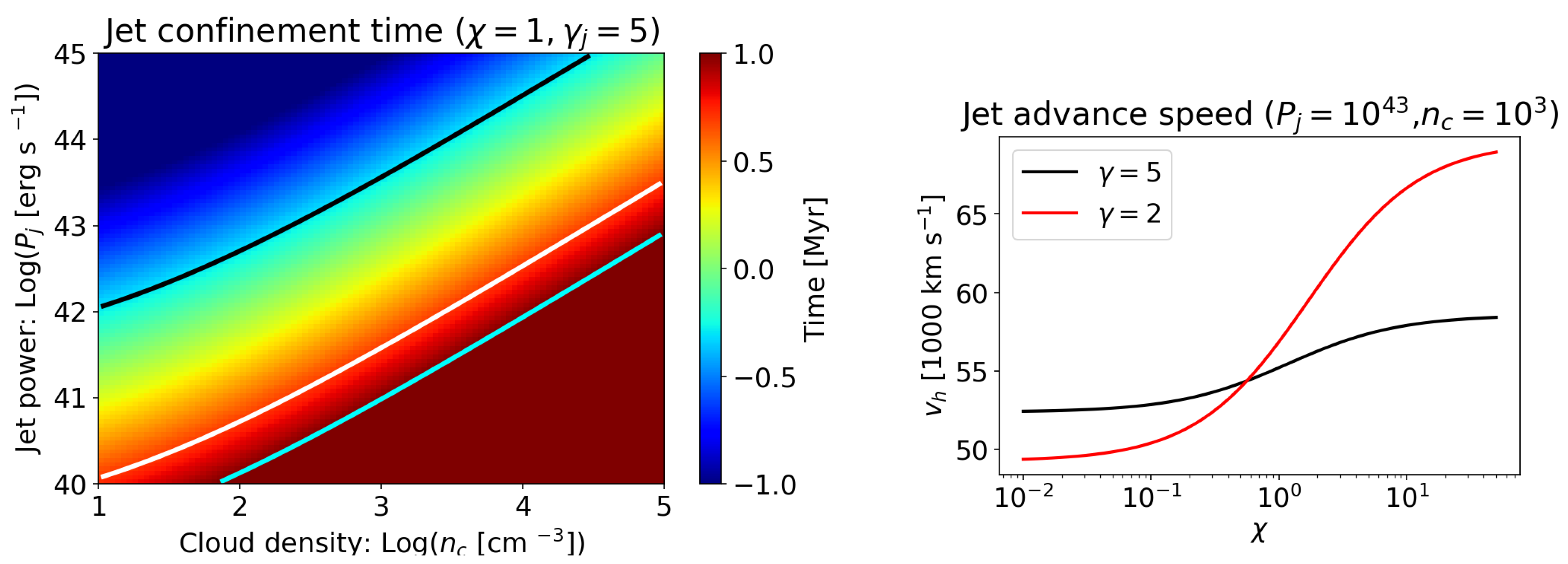
It is apparent that dense clouds along the path of the jet can strongly decelerate jets. Typical densities of molecular clouds can range from , resulting in decrease of advance speed by several orders of magnitude. An approximate time scale of confinement can be assessed by computing the travel time of the jet-head for scale height (e.g., pc, typical core radii of bulges and ellipticals) . Assuming a volume filling factor of the dense clouds to be , the jet confinement time in the ISM will be given by Equation (A5). Here is the advance of the jet trough dense clouds with mean density and is the advance speed through the gaps between the clouds with low density low density ambient halo gas (). The results for different jet powers and cloud density are presented in the left panel of Figure A1, for jets with and . Typical confinement times are seen to range from a few hundred kilo-year for and cloud densities ; to Myr for higher densities and lower power. Such approximate estimates align very well with the results from the various (relativistic) hydrodynamic simulations listed earlier. The results are also in agreement with more detailed semi-analytical dynamical models presented earlier [288]. The results are not strongly dependent on the choice of , as shown in the right panel of Figure A1. The advance speeds tend to asymptote to terminal values for and . It is interesting to note that lower power jets can remain trapped in the central regions of galaxy for very long times ( Myr), failing in reaching the breakout the phase. Thus even modest ISM parameters of and can trap low power jets, restricting their large sale growth.
Figure A1.
Left: Confinement timescales (see Equation (A5)) for different jet powers and mean cloud densities, with and . The black, white and cyan contours correspond to Myr. Right: Jet advance speed’s variation with for two different jet Lorentz factors. The jet power is and cloud density .
Figure A1.
Left: Confinement timescales (see Equation (A5)) for different jet powers and mean cloud densities, with and . The black, white and cyan contours correspond to Myr. Right: Jet advance speed’s variation with for two different jet Lorentz factors. The jet power is and cloud density .
Appendix B. Observations of Jet-ISM Interaction
We list in Table A1 a selection of galaxies or broad survey efforts highlighting prominent detection of outflows and feedback processes induced by a relativistic jets. The list is not meant to be a complete sensus of jet-ISM interaction, but rather a representation of the diverse nature of objects and observational studies where jet-ISM interactions have been reported. The third column denotes the gas phase where the more prominent impact of jets have been ascertained. The immediate references studying such jet-ISM interaction have been listed in fourth column. Many of these sources are well studied in the literature. Broader description of the existing studies on each source may be found from within the references cited.

Table A1.
A selection of cases with observations of jet-gas interaction.
| Source/Survey | Gas phase | Comments & References | |
|---|---|---|---|
| 1 | J1430 (Tea Cup), J1509, J1356, part of the QSOFEED survey | Molecular (CO, WH2, PAH), Ionised | Part of a sample of 48 Type-2 Seyferts (44 detected in radio) with several examples of well defined jetted system driving outflows. [222,289,290,291,292,293] |
| 2 | NGC 5929 | Molecular (WH2), Ionised (FeII) | Outflows perpendicular to the jet axis.[218,294] |
| 3 | QFeedS survey [263] | Molecular (CO), Ionised ( HNOS) | Spatially resolved analysis of 5 sources from the QFeedS sample, also showing outflows perpendicular to the jet. [219,220,295] |
| 4 | NGC 5972 | Ionised (HOS) | Detection of jet induced shocks. [296] |
| 5 | 3C 293 (UGC 8782) | Molecular (WH2), Atomic (HI absorption), Ionised (HNS) | [297,298,299,300,301] |
| 6 | IC 5063 | Molecular (CO,WH2), Ionised (Emission lines IR/optical+Xrays) | A very well studied source with a jet strongly inclined into a kpc scale disk. Shows outflow perpendicular to the jet.[204,302,303,304,305,306] |
| 7 | NGC 5643, NGC 1068, NGC 1386, NGC 1365 | Ionised | Part of the MAGNUM survey, also including IC 5063. Several of these sources show outflow perpendicular to the jet. [217,307,308] |
| 8 | NGC 3393 | Molecular (CO), Ionised (Emission lines optical+Xrays) | [309,310,311] |
| 9 | NGC 7319 in Stephan’s quintet | Molecular (CO), Ionised | A well studied group of 5 interacting galaxies with one showing prominent jet-ISM interaction. [312,313] |
| 10 | 3C 326 | Molecular (CO,WH2), Ionised | Early evidence of strong jet induced turbulence, refined with better spatial resolution (JWST) to uncover in-situ outflows [210,314,315,316] |
| 11 | GATOS survey | Molecular (CO), Ionised | A survey of dusty CND of 19+ Seyferts [317,318]. Several show very prominent jet-ISM interaction, reported as part of this survey and also from other multi-wavelength observations. [319,320,321,322,323] |
| 12 | WIDE-AEGIS-2018003848 | Ionised | Detection of strong shock from emission line modelling, likely powered by the radio jet. [324] |
| 13 | B2 0258+35 (NGC 1167) | Molecular (CO), Ionised (Xray) | A confirmed detection of jet clearing the central kpc of dense gas. Tentative confirmation of thermal X-rays. [209,214,216,249] |
| 14 | NGC 3100, IC 1531, NGC 3557 | Molecular (CO,tentative HCO+) | A subset from a survey of 11 LERG, showing evidence of only mild jet-ISM interaction, in spite of potential conditions available for more stronger effects observed elsehwere. [197,325,326,327] |
| 15 | NGC 1052 | Ionised | Prominent ionised bubble along the galaxy’s minor axis, blown by a jet inclined towards a nuclear gas disk, besides detection of large scale disturbed kinematics and shocks. [328,329,330,331] |
| 16 | NGC 3079 | Radio (deceleration of knots), Ionised | A well studied source with prominent gas filaments from nuclear outflows [332]. Observed pc scale jet-ISM interaction[333,334], which may power the large scale outflow [335,336]. |
| 17 | XID2028 | Molecular (CO), Ionised | Co-spatial collimated molecular, ionised jet-driven outflows outflow piercing gas shells ( kpc) from the nucleus. [337],[338] |
| 18 | 4C 31.04 | Ionised, Neutral | CSS source with pc jet but large scale ( kpc) shocked gas. [203],[213] |
| 19 | NGC 3998 | Radio | Indirect evidence of jet-medium interaction from radio emission. [339] |
| 20 | NGC 4579 (Messier 58) | Molecular (CO,WH2,PAH), Ionised | [340] |
| 21 | IRAS 10565+2448 | Molecular (CO), Atomic (HI emission+absorption), Ionised | [341] |
| 22 | 4C 41.17 | Molecular (CO), Ionised | A galaxy associated with positive feedback [225,342] |
| 23 | PKS 1549-79 | Molecular (CO), Ionised, Atomic (HI absorption) | Nuclear molecular outflow, extended ionised outflow. [343,344] |
| 24 | Sub sample of 9 sources from the southern 2 Jy sample [345] | Ionised | Broad integrated outflowing emission lines (, FWHM) driven by jets. [346] |
| 25 | 3C 273 | Molecular (CO), Ionised | Expanding jet driven cocoon impinging on a gas disk. [347] |
| 26 | HE 1353-1917, HE0040-1105 | Ionised | Nuclear scale jet driven outflow. Part of the CARS survey. [348,349] |
| 27 | 4C 12.50 (F13451+1232) | Molecular (CO,WH2), Ionised | Strong jet driven nuclear ( pc) outflow[350][351][352], but not on large scales[353]. |
| 28 | TNJ 1338-1942 | Ionised | Jet impact on extra-galactic gas cloud with extreme kinematics. [354,355,356] |
| 29 | NGC 6328 (PKS 1718-649) | Molecular (CO) | GPS source with pc scale jet interacting with ambient gas. [357] |
| 30 | PKS 0023-26 | Molecular (CO) | [358] |
| 31 | HzRG-MRC 0152-209 (Dragonfly galaxy) | Molecular (CO) | Molecular outflow (jet/AGN driven) perpendicular to the jet, with indications of jet-ISM interaction at small scales. [359] |
| 32 | ESO 420-G13 | Molecular (CO), Ionised | [360] |
| 33 | Jet driven HI outflows (including 3C 236, 3C 305, 3C 459, OQ 208) | Molecular (CO), Atomic (HI absorption) | [361,362,363,364] |
| 34 | NGC 4258 (Messier 106) | Molecular (WH2), Ionised, Xrays | Detection of shocks and turbulence induced by jets. [231,232,233] |
| 35 | Molecular Hydrogen Emission line Galaxies (MOHEG) | Molecular (WH2) | A sample of 17 Radio Loud galaxies with detections of warm H2 lines and indications of jet driven shocks. [365] |
| 36 | PKS B1934-63 | Ionised, WH2 | Compact GPC source with ionised outflow but not in molecular phase. [366] |
| 37 | Cen A (NGC 5128) | Molecular (CO) | Jet induced inefficient starformation in filaments along the jet. [367],[368] |
| 38 | Cygnus A | Molecular (WH2, PAH), Ionised | High velocity kpc scale outflow driven by jet. [369] |
| 39 | SINFONI survey of RLAGN | Molecular (WH2), Ionised | A survey of 33 powerful RLAGN, confirming widespread jet-driven extreme gas kinematics. [211,212,370] |
| 40 | NGC 6951 | Ionised | [371] |
References
- Fabian, A.C. Observational Evidence of Active Galactic Nuclei Feedback. ARAA 2012, 50, 455–489. [Google Scholar] [CrossRef]
- Harrison, C.M.; Ramos Almeida, C. Observational Tests of Active Galactic Nuclei Feedback: An Overview of Approaches and Interpretation. Galaxies 2024, 12, 17. [Google Scholar] [CrossRef]
- Lea, S.M.; Silk, J.; Kellogg, E.; Murray, S. Thermal-Bremsstrahlung Interpretation of Cluster X-Ray Sources. ApJL 1973, 184, L105. [Google Scholar] [CrossRef]
- Cowie, L.L.; Binney, J. Radiative regulation of gas flow within clusters of galaxies: a model for cluster X-ray sources. ApJ 1977, 215, 723–732. [Google Scholar] [CrossRef]
- Fabian, A.C.; Nulsen, P.E.J. Subsonic accretion of cooling gas in clusters of galaxies. MNRAS 1977, 180, 479–484. [Google Scholar] [CrossRef]
- Fabian, A.C.; Nulsen, P.E.J. Cooling flows, low-mass objects and the Galactic halo. MNRAS 1994, 269, L33. [Google Scholar]
- Peterson, J.R.; Paerels, F.B.S.; Kaastra, J.S.; Arnaud, M.; Reiprich, T.H.; Fabian, A.C.; Mushotzky, R.F.; Jernigan, J.G.; Sakelliou, I. X-ray imaging-spectroscopy of Abell 1835. A&A 2001, 365, L104–L109. [Google Scholar] [CrossRef]
- Tamura, T.; Kaastra, J.S.; Peterson, J.R.; Paerels, F.B.S.; Mittaz, J.P.D.; Trudolyubov, S.P.; Stewart, G.; Fabian, A.C.; Mushotzky, R.F.; Lumb, D.H.; et al. X-ray spectroscopy of the cluster of galaxies Abell 1795 with XMM-Newton. A&A 2001, 365, L87–L92. [Google Scholar] [CrossRef]
- Croton, D.J.; Springel, V.; White, S.D.M.; De Lucia, G.; Frenk, C.S.; Gao, L.; Jenkins, A.; Kauffmann, G.; Navarro, J.F.; Yoshida, N. The many lives of active galactic nuclei: cooling flows, black holes and the luminosities and colours of galaxies. MNRAS 2006, 365, 11–28. [Google Scholar] [CrossRef]
- Silk, J.; Rees, M.J. Quasars and galaxy formation. A&A 1998, 331, L1–L4. [Google Scholar]
- Bower, R.G.; Benson, A.J.; Malbon, R.; Helly, J.C.; Frenk, C.S.; Baugh, C.M.; Cole, S.; Lacey, C.G. Breaking the hierarchy of galaxy formation. MNRAS 2006, 370, 645–655. [Google Scholar] [CrossRef]
- Blandford, R.; Meier, D.; Readhead, A. Relativistic Jets from Active Galactic Nuclei. ARAA 2019, 57, 467–509. [Google Scholar] [CrossRef]
- Komissarov, S.; Porth, O. Numerical simulations of jets. New Astronomy Reviews 2021, 92, 101610. [Google Scholar] [CrossRef]
- Veilleux, S.; Maiolino, R.; Bolatto, A.D.; Aalto, S. Cool outflows in galaxies and their implications. Astron Astrophys Rev 2020, 28, 2. [Google Scholar] [CrossRef]
- Laha, S.; Reynolds, C.S.; Reeves, J.; Kriss, G.; Guainazzi, M.; Smith, R.; Veilleux, S.; Proga, D. Ionized outflows from active galactic nuclei as the essential elements of feedback. Nature Astronomy 2021, 5, 13–24. [Google Scholar] [CrossRef]
- Harrison, C.M. Impact of supermassive black hole growth on star formation. Nature Astronomy 2017, 1, 0165. [Google Scholar] [CrossRef]
- Morganti, R. The many routes to AGN feedback. Frontiers in Astronomy and Space Sciences 2017, 4, 42. [Google Scholar] [CrossRef]
- Eckert, D.; Gaspari, M.; Gastaldello, F.; Le Brun, A.M.C.; O’Sullivan, E. Feedback from Active Galactic Nuclei in Galaxy Groups. Universe 2021, 7, 142. [Google Scholar] [CrossRef]
- Combes, F. Active Galactic Nuclei: Fueling and Feedback; 2021. [Google Scholar] [CrossRef]
- Bourne, M.A.; Yang, H.Y.K. Recent Progress in Modeling the Macro- and Micro-Physics of Radio Jet Feedback in Galaxy Clusters. Galaxies 2023, 11, 73. [Google Scholar] [CrossRef]
- Tadhunter, C. Radio AGN in the local universe: unification, triggering and evolution. Astron Astrophys Rev 2016, 24, 10. [Google Scholar] [CrossRef]
- O’Dea, C.P.; Saikia, D.J. Compact steep-spectrum and peaked-spectrum radio sources. Astron Astrophys Rev 2021, 29, 3. [Google Scholar] [CrossRef]
- Hardcastle, M.J.; Croston, J.H. Radio galaxies and feedback from AGN jets. New Astronomy Reviews 2020, 88, 101539. [Google Scholar] [CrossRef]
- Baldi, R.D. The nature of compact radio sources: the case of FR 0 radio galaxies. Astron Astrophys Rev 2023, 31, 3. [Google Scholar] [CrossRef]
- Morganti, R.; Oosterloo, T. The interstellar and circumnuclear medium of active nuclei traced by H i 21 cm absorption. Astron Astrophys Rev 2018, 26, 4. [Google Scholar] [CrossRef]
- Storchi-Bergmann, T.; Schnorr-Müller, A. Observational constraints on the feeding of supermassive black holes. Nature Astronomy 2019, 3, 48–61. [Google Scholar] [CrossRef]
- Gaspari, M.; Tombesi, F.; Cappi, M. Linking macro-, meso- and microscales in multiphase AGN feeding and feedback. Nature Astronomy 2020, 4, 10–13. [Google Scholar] [CrossRef]
- Combes, F. Fueling Processes on (Sub-)kpc Scales. Galaxies 2023, 11, 120. [Google Scholar] [CrossRef]
- Wagner, A.Y.; Bicknell, G.V.; Umemura, M.; Sutherland, R.S.; Silk, J. Galaxy-scale AGN feedback - theory. Astronomische Nachrichten 2016, 337, 167. [Google Scholar] [CrossRef]
- Mukherjee, D.; Bicknell, G.V.; Wagner, A.Y. Resolved simulations of jet–ISM interaction: Implications for gas dynamics and star formation. Astronomische Nachrichten 2021, 342, 1140–1145. [Google Scholar] [CrossRef]
- Morganti, R.; Murthy, S.; Guillard, P.; Oosterloo, T.; Garcia-Burillo, S. Young Radio Sources Expanding in Gas-Rich ISM: Using Cold Molecular Gas to Trace Their Impact. Galaxies 2023, 11, 24. [Google Scholar] [CrossRef]
- Krause, M.G.H. Jet Feedback in Star-Forming Galaxies. Galaxies 2023, 11, 29. [Google Scholar] [CrossRef]
- Sutherland, R.S.; Bicknell, G.V. Interactions of a Light Hypersonic Jet with a Nonuniform Interstellar Medium. ApJS 2007, 173, 37. [Google Scholar] [CrossRef]
- Blandford, R.D.; Rees, M.J. A “twin-exhaust” model for double radio sources. MNRAS 1974, 169, 395–415. [Google Scholar] [CrossRef]
- Scheuer, P.A.G. Models of extragalactic radio sources with a continuous energy supply from a central object. MNRAS 1974, 166, 513. [Google Scholar] [CrossRef]
- Blandford, R.D.; Ostriker, J.P. Particle acceleration by astrophysical shocks. ApJL 1978, 221, L29–L32. [Google Scholar] [CrossRef]
- Rayburn, D.R. A numerical study of the continuous beam model of extragalactic radio sources. MNRAS 1977, 179, 603–617. [Google Scholar] [CrossRef]
- Yokosawa, M.; Ikeuchi, S.; Sakashita, S. Structure and Expansion Law of a Hypersonic Beam. PASJ 1982, 34, 461. [Google Scholar]
- Norman, M.L.; Winkler, K.H.A.; Smarr, L.; Smith, M.D. Structure and dynamics of supersonic jets. A&A 1982, 113, 285–302. [Google Scholar]
- Wilson, M.J.; Scheuer, P.A.G. The anisotropy of emission from hotspots in extragalactic radio sources. MNRAS 1983, 205, 449–463. [Google Scholar] [CrossRef]
- Williams, A.G.; Gull, S.F. A three-dimensional model of the fluid dynamics of radio-trail sources. Nature 1984, 310, 33–36. [Google Scholar] [CrossRef]
- Arnold, C.N.; Arnett, W.D. Three-dimensional Structure and Dynamics of a Supersonic Jet. ApJL 1986, 305, L57. [Google Scholar] [CrossRef]
- Hardee, P.E.; Clarke, D.A. The non-Linear Dynamics of a Three-Dimensional Jet. ApJ 1992, 400, L9. [Google Scholar] [CrossRef]
- Norman, M.L.; Balsara, D.S. 3-D Hydrodynamical Simulations of Extragalactic Jets. In Jets in Extragalactic Radio Sources; Röser, H.J., Meisenheimer, K., Eds.; 1993; Volume 421, p. 229. [Google Scholar] [CrossRef]
- Norman, M.L.; Hardee, P.E. Spatial Stability of the Slab Jet. II. Numerical Simulations. ApJ 1988, 334, 80. [Google Scholar] [CrossRef]
- Clarke, D.A.; Norman, M.L.; Burns, J.O. Numerical Simulations of a Magnetically Confined Jet. ApJL 1986, 311, L63. [Google Scholar] [CrossRef]
- Clarke, D.A.; Norman, M.L.; Burns, J.O. Numerical Observations of a Simulated Jet with a Passive Helical Magnetic Field. ApJ 1989, 342, 700. [Google Scholar] [CrossRef]
- Koessl, D.; Mueller, E. Numerical simulations of astrophysical jets: the influence of boundary conditions and grid resolution. A&A 1988, 206, 204–218. [Google Scholar]
- Mignone, A.; Rossi, P.; Bodo, G.; Ferrari, A.; Massaglia, S. High-resolution 3D relativistic MHD simulations of jets. MNRAS 2010, 402, 7–12. [Google Scholar] [CrossRef]
- Cohen, M.H.; Kellermann, K.I.; Shaffer, D.B.; Linfield, R.P.; Moffet, A.T.; Romney, J.D.; Seielstad, G.A.; Pauliny-Toth, I.I.K.; Preuss, E.; Witzel, A.; et al. Radio sources with superluminal velocities. Nature 1977, 268, 405–409. [Google Scholar] [CrossRef]
- O’Dell, S.L. The continuum radiation of compact extragalactic objects. In Proceedings of the BL Lac Objects; Wolfe, A.M., Ed. 1978; pp. 312–325. [Google Scholar]
- Cohen, M.H.; Pearson, T.J.; Readhead, A.C.S.; Seielstad, G.A.; Simon, R.S.; Walker, R.C. Superluminal variations in 3C 120, 3C 273, and 3C 345. ApJ 1979, 231, 293–298. [Google Scholar] [CrossRef]
- Blandford, R.D.; McKee, C.F.; Rees, M.J. Super-luminal expansion in extragalactic radio sources. Nature 1977, 267, 211–216. [Google Scholar] [CrossRef]
- Blandford, R.D.; Königl, A. Relativistic jets as compact radio sources. ApJ 1979, 232, 34–48. [Google Scholar] [CrossRef]
- Wilson, M.J. Steady relativistic fluid jets. MNRAS 1987, 226, 447–454. [Google Scholar] [CrossRef]
- Marti, J.M.; Mueller, E.; Ibanez, J.M. Hydrodynamical simulations of relativistic jets. A&A 1994, 281, L9–L12. [Google Scholar]
- Duncan, G.C.; Hughes, P.A. Simulations of Relativistic Extragalactic Jets. ApJL 1994, 436, L119. [Google Scholar] [CrossRef]
- Marti, J.M.A.; Muller, E.; Font, J.A.; Ibanez, J.M. Morphology and Dynamics of Highly Supersonic Relativistic Jets. ApJL 1995, 448, L105. [Google Scholar] [CrossRef]
- Koide, S.; Nishikawa, K.I.; Mutel, R.L. A Two-dimensional Simulation of Relativistic Magnetized Jet. ApJL 1996, 463, L71. [Google Scholar] [CrossRef]
- Martí, J.M.; Müller, E.; Font, J.A.; Ibáñez, J.M.Z.; Marquina, A. Morphology and Dynamics of Relativistic Jets. ApJ 1997, 479, 151–163. [Google Scholar] [CrossRef]
- Rosen, A.; Hughes, P.A.; Duncan, G.C.; Hardee, P.E. A Comparison of the Morphology and Stability of Relativistic and Nonrelativistic Jets. ApJ 1999, 516, 729–743. [Google Scholar] [CrossRef]
- Bodo, G.; Mamatsashvili, G.; Rossi, P.; Mignone, A. Linear stability analysis of magnetized relativistic jets: the non-rotating case. MNRAS 2013, 434, 3030–3046. [Google Scholar] [CrossRef]
- van Putten, M.H.P.M. Knots in Simulations of Magnetized Relativistic Jets. ApJL 1996, 467, L57. [Google Scholar] [CrossRef]
- Nishikawa, K.I.; Koide, S.; Sakai, J.i.; Christodoulou, D.M.; Sol, H.; Mutel, R.L. Three-Dimensional Magnetohydrodynamic Simulations of Relativistic Jets Injected along a Magnetic Field. ApJL 1997, 483, L45–L48. [Google Scholar] [CrossRef]
- Nishikawa, K.I.; Koide, S.; Sakai, J.i.; Christodoulou, D.M.; Sol, H.; Mutel, R.L. Three-dimensional Magnetohydrodynamic Simulations of Relativistic Jets Injected into an Oblique Magnetic Field. ApJ 1998, 498, 166–169. [Google Scholar] [CrossRef]
- Komissarov, S.S. Numerical simulations of relativistic magnetized jets. MNRAS 1999, 308, 1069–1076. [Google Scholar] [CrossRef]
- Komissarov, S.S. A Godunov-type scheme for relativistic magnetohydrodynamics. MNRAS 1999, 303, 343–366. [Google Scholar] [CrossRef]
- Koldoba, A.V.; Kuznetsov, O.A.; Ustyugova, G.V. An approximate Riemann solver for relativistic magnetohydrodynamics. MNRAS 2002, 333, 932–942. [Google Scholar] [CrossRef]
- Del Zanna, L.; Bucciantini, N. An efficient shock-capturing central-type scheme for multidimensional relativistic flows. I. Hydrodynamics. A&A 2002, 390, 1177–1186. [Google Scholar] [CrossRef]
- Del Zanna, L.; Bucciantini, N.; Londrillo, P. An efficient shock-capturing central-type scheme for multidimensional relativistic flows. II. Magnetohydrodynamics. A&A 2003, 400, 397–413. [Google Scholar] [CrossRef]
- Leismann, T.; Antón, L.; Aloy, M.A.; Müller, E.; Martí, J.M.; Miralles, J.A.; Ibáñez, J.M. Relativistic MHD simulations of extragalactic jets. A&A 2005, 436, 503–526. [Google Scholar] [CrossRef]
- Mignone, A.; Plewa, T.; Bodo, G. The Piecewise Parabolic Method for Multidimensional Relativistic Fluid Dynamics. ApJS 2005, 160, 199–219. [Google Scholar] [CrossRef]
- Mignone, A.; Bodo, G. An HLLC Riemann solver for relativistic flows - II. Magnetohydrodynamics. MNRAS 2006, 368, 1040–1054. [Google Scholar] [CrossRef]
- Mukherjee, D.; Bodo, G.; Mignone, A.; Rossi, P.; Vaidya, B. Simulating the dynamics and non-thermal emission of relativistic magnetized jets I. Dynamics. MNRAS 2020, 499, 681–701. [Google Scholar] [CrossRef]
- Meenakshi, M.; Mukherjee, D.; Bodo, G.; Rossi, P. A polarization study of jets interacting with turbulent magnetic fields. MNRAS 2023, 526, 5418–5440. [Google Scholar] [CrossRef]
- Mattia, G.; Del Zanna, L.; Bugli, M.; Pavan, A.; Ciolfi, R.; Bodo, G.; Mignone, A. Resistive relativistic MHD simulations of astrophysical jets. A&A 2023, 679, A49. [Google Scholar] [CrossRef]
- Perucho, M.; López-Miralles, J.; Gizani, N.A.B.; Martí, J.M.; Boccardi, B. On the large scale morphology of Hercules A: destabilized hot jets? MNRAS 2023, 523, 3583–3594. [Google Scholar] [CrossRef]
- Rossi, P.; Bodo, G.; Massaglia, S.; Capetti, A. The different flavors of extragalactic jets: Magnetized relativistic flows. A&A 2024, 685, A4. [Google Scholar] [CrossRef]
- Upreti, N.; Vaidya, B.; Shukla, A. Bridging simulations of kink instability in relativistic magnetized jets with radio emission and polarisation. Journal of High Energy Astrophysics 2024, 44, 146–163. [Google Scholar] [CrossRef]
- Costa, A.; Bodo, G.; Tavecchio, F.; Rossi, P.; Capetti, A.; Massaglia, S.; Sciaccaluga, A.; Baldi, R.D.; Giovannini, G. FR0 jets and recollimation-induced instabilities. A&A 2024, 682, L19. [Google Scholar] [CrossRef]
- Costa, A.; Bodo, G.; Tavecchio, F.; Rossi, P.; Coppi, P.; Sciaccaluga, A.; Boula, S. How do recollimation-induced instabilities shape the propagation of hydrodynamic relativistic jets? arXiv e-prints arXiv:2503.18602. [CrossRef]
- Perucho, M.; Martí, J.M. A numerical simulation of the evolution and fate of a Fanaroff-Riley type I jet. The case of 3C 31. MNRAS 2007, 382, 526–542. [Google Scholar] [CrossRef]
- Rossi, P.; Mignone, A.; Bodo, G.; Massaglia, S.; Ferrari, A. Formation of dynamical structures in relativistic jets: the FRI case. A&A 2008, 488, 795–806. [Google Scholar] [CrossRef]
- Perucho, M.; Martí, J.M.; Laing, R.A.; Hardee, P.E. On the deceleration of Fanaroff-Riley Class I jets: mass loading by stellar winds. MNRAS 2014, 441, 1488–1503. [Google Scholar] [CrossRef]
- Massaglia, S.; Bodo, G.; Rossi, P.; Capetti, S.; Mignone, A. Making Faranoff-Riley I radio sources. I. Numerical hydrodynamic 3D simulations of low-power jets. A&A 2016, 596, A12. [Google Scholar] [CrossRef]
- Massaglia, S.; Bodo, G.; Rossi, P.; Capetti, S.; Mignone, A. Making Faranoff-Riley I radio sources. II. The effects of jet magnetization. A&A 2019, 621, A132. [Google Scholar] [CrossRef]
- Rossi, P.; Bodo, G.; Massaglia, S.; Capetti, A. The different flavors of extragalactic jets: The role of relativistic flow deceleration. A&A 2020, 642, A69. [Google Scholar] [CrossRef]
- Massaglia, S.; Bodo, G.; Rossi, P.; Capetti, A.; Mignone, A. Making Fanaroff-Riley I radio sources. III. The effects of the magnetic field on relativistic jets’ propagation and source morphologies. A&A 2022, 659, A139. [Google Scholar] [CrossRef]
- Bhattacharjee, A.; Seo, J.; Ryu, D.; Kang, H. A Simulation Study of Low-power Relativistic Jets: Flow Dynamics and Radio Morphology of FR-I Jets. ApJ 2024, 976, 91. [Google Scholar] [CrossRef]
- Perucho, M.; Martí, J.M.; Quilis, V. Long-term FRII jet evolution: clues from three-dimensional simulations. MNRAS 2019, 482, 3718–3735. [Google Scholar] [CrossRef]
- Seo, J.; Kang, H.; Ryu, D. A Simulation Study of Ultra-relativistic Jets. II. Structures and Dynamics of FR-II Jets. ApJ 2021, 920, 144. [Google Scholar] [CrossRef]
- Perucho, M.; Martí, J.M.; Quilis, V. Long-term FRII jet evolution in dense environments. MNRAS 2022, 510, 2084–2096. [Google Scholar] [CrossRef]
- Begelman, M.C.; Cioffi, D.F. Overpressured Cocoons in Extragalactic Radio Sources. ApJ 1989, 345, L21. [Google Scholar] [CrossRef]
- Kaiser, C.R.; Alexander, P. A self-similar model for extragalactic radio sources. MNRAS 1997, 286, 215–222. [Google Scholar] [CrossRef]
- Falle, S.A.E.G. Self-similar jets. MNRAS 1991, 250, 581. [Google Scholar] [CrossRef]
- Carvalho, J.C.; O’Dea, C.P. Evolution of Global Properties of Powerful Radio Sources. I. Hydrodynamical Simulations in a Constant Density Atmosphere and Comparison with Self-similar Models. ApJS 2002, 141, 337–370. [Google Scholar] [CrossRef]
- O’Neill, S.M.; Tregillis, I.L.; Jones, T.W.; Ryu, D. Three-dimensional Simulations of MHD Jet Propagation through Uniform and Stratified External Environments. ApJ 2005, 633, 717–732. [Google Scholar] [CrossRef]
- Perucho, M.; Quilis, V.; Martí, J.M. Intracluster Medium Reheating by Relativistic Jets. ApJ 2011, 743, 42. [Google Scholar] [CrossRef]
- Hardcastle, M.J.; Krause, M.G.H. Numerical modelling of the lobes of radio galaxies in cluster environments. MNRAS 2013, 430, 174–196. [Google Scholar] [CrossRef]
- Perucho, M.; Martí, J.M.; Quilis, V.; Ricciardelli, E. Large-scale jets from active galactic nuclei as a source of intracluster medium heating: cavities and shocks. MNRAS 2014, 445, 1462–1481. [Google Scholar] [CrossRef]
- Hardcastle, M.J.; Krause, M.G.H. Numerical modelling of the lobes of radio galaxies in cluster environments - II. Magnetic field configuration and observability. MNRAS 2014, 443, 1482–1499. [Google Scholar] [CrossRef]
- English, W.; Hardcastle, M.J.; Krause, M.G.H. Numerical modelling of the lobes of radio galaxies in cluster environments - III. Powerful relativistic and non-relativistic jets. MNRAS 2016, 461, 2025–2043. [Google Scholar] [CrossRef]
- English, W.; Hardcastle, M.J.; Krause, M.G.H. Numerical modelling of the lobes of radio galaxies in cluster environments - IV. Remnant radio galaxies. MNRAS 2019, 490, 5807–5819. [Google Scholar] [CrossRef]
- Chen, Y.H.; Heinz, S.; Enßlin, T.A. Jets, bubbles, and heat pumps in galaxy clusters. MNRAS 2019, 489, 1939–1949. [Google Scholar] [CrossRef]
- Jerrim, L.A.; Shabala, S.S.; Yates-Jones, P.M.; Krause, M.G.H.; Turner, R.J.; Anderson, C.S.; Stewart, G.S.C.; Power, C.; Rodman, P.E. Faraday rotation as a probe of radio galaxy environment in RMHD AGN jet simulations. MNRAS 2024, 531, 2532–2550. [Google Scholar] [CrossRef]
- Giri, G.; Bagchi, J.; Thorat, K.; Deane, R.P.; Delhaize, J.; Saikia, D.J. Probing the formation of megaparsec-scale giant radio galaxies: I. Dynamical insights from magnetohydrodynamic simulations. A&A 2025, 693, A77. [Google Scholar] [CrossRef]
- Hardcastle, M.J. A simulation-based analytic model of radio galaxies. MNRAS 2018, 475, 2768–2786. [Google Scholar] [CrossRef]
- Matthews, J.H.; Bell, A.R.; Blundell, K.M.; Araudo, A.T. Ultrahigh energy cosmic rays from shocks in the lobes of powerful radio galaxies. MNRAS 2019, 482, 4303–4321. [Google Scholar] [CrossRef]
- Seo, J.; Ryu, D.; Kang, H. A Simulation Study of Ultra-relativistic Jets. III. Particle Acceleration in FR-II Jets. ApJ 2023, 944, 199. [Google Scholar] [CrossRef]
- Seo, J.; Ryu, D.; Kang, H. Model Spectrum of Ultrahigh-energy Cosmic Rays Accelerated in FR-I Radio Galaxy Jets. ApJ 2024, 962, 46. [Google Scholar] [CrossRef]
- Ohmura, T.; Machida, M. Simulations of two-temperature jets in galaxy clusters. I. Effect of jet magnetization on dynamics and electron heating. A&A 2023, 679, A160. [Google Scholar] [CrossRef]
- Ohmura, T.; Machida, M.; Akamatsu, H. Simulations of two-temperature jets in galaxy clusters. II. X-ray properties of the forward shock. A&A 2023, 679, A161. [Google Scholar] [CrossRef]
- Joshi, R.K.; Chattopadhyay, I. The Morphology and Dynamics of Relativistic Jets with Relativistic Equation of State. ApJ 2023, 948, 13. [Google Scholar] [CrossRef]
- Rossi, P.; Bodo, G.; Capetti, A.; Massaglia, S. 3D relativistic MHD numerical simulations of X-shaped radio sources. A&A 2017, 606, A57. [Google Scholar] [CrossRef]
- Nawaz, M.A.; Wagner, A.Y.; Bicknell, G.V.; Sutherland, R.S.; McNamara, B.R. Jet-intracluster medium interaction in Hydra A - I. Estimates of jet velocity from inner knots. MNRAS 2014, 444, 1600–1614. [Google Scholar] [CrossRef]
- Nawaz, M.A.; Wagner, A.Y.; Bicknell, G.V.; Sutherland, R.S.; McNamara, B.R. Jet-intracluster medium interaction in Hydra A - II The effect of jet precession. MNRAS 2015. submitted. [Google Scholar] [CrossRef]
- Horton, M.A.; Krause, M.G.H.; Hardcastle, M.J. 3D hydrodynamic simulations of large-scale precessing jets: radio morphology. MNRAS 2020, 499, 5765–5781. [Google Scholar] [CrossRef]
- Giri, G.; Vaidya, B.; Rossi, P.; Bodo, G.; Mukherjee, D.; Mignone, A. Modelling X-shaped radio galaxies: Dynamical and emission signatures from the Back-flow model. A&A [arXiv:astro-ph.GA/2203.01347]. 2022, 662, A5. [Google Scholar] [CrossRef]
- Giri, G.; Vaidya, B.; Fendt, C. Deciphering the Morphological Origins of X-shaped Radio Galaxies: Numerical Modeling of Backflow versus Jet Reorientation. ApJS 2023, 268, 49. [Google Scholar] [CrossRef]
- Giri, G.; Fendt, C.; Thorat, K.; Bodo, G.; Rossi, P. X-shaped radio galaxies: probing jet evolution, ambient medium dynamics, and their intricate interconnection. Frontiers in Astronomy and Space Sciences 2024, 11, 1371101. [Google Scholar] [CrossRef]
- Tregillis, I.L.; Jones, T.W.; Ryu, D. Simulating Electron Transport and Synchrotron Emission in Radio Galaxies: Shock Acceleration and Synchrotron Aging in Three-dimensional Flows. ApJ 2001, 557, 475–491. [Google Scholar] [CrossRef]
- Tregillis, I.L.; Jones, T.W.; Ryu, D. Synthetic Observations of Simulated Radio Galaxies. I. Radio and X-Ray Analysis. ApJ 2004, 601, 778–797. [Google Scholar] [CrossRef]
- Vaidya, B.; Mignone, A.; Bodo, G.; Rossi, P.; Massaglia, S. A Particle Module for the PLUTO Code. II. Hybrid Framework for Modeling Nonthermal Emission from Relativistic Magnetized Flows. ApJ 2018, 865, 144. [Google Scholar] [CrossRef]
- Mukherjee, D.; Bodo, G.; Rossi, P.; Mignone, A.; Vaidya, B. Simulating the dynamics and synchrotron emission from relativistic jets - II. Evolution of non-thermal electrons. MNRAS 2021, 505, 2267–2284. [Google Scholar] [CrossRef]
- Chen, Y.H.; Heinz, S.; Hooper, E. A numerical study of the impact of jet magnetic topology on radio galaxy evolution. MNRAS 2023, 522, 2850–2868. [Google Scholar] [CrossRef]
- Meenakshi, M.; Mukherjee, D.; Bodo, G.; Rossi, P.; Harrison, C.M. A comparative study of radio signatures from winds and jets: modelling synchrotron emission and polarization. MNRAS 2024, 533, 2213–2231. [Google Scholar] [CrossRef]
- Dubey, R.P.; Fendt, C.; Vaidya, B. Particles in Relativistic MHD Jets. I. Role of Jet Dynamics in Particle Acceleration. ApJ 2023, 952, 1. [Google Scholar] [CrossRef]
- Dubey, R.P.; Fendt, C.; Vaidya, B. Particles in Relativistic Magnetohydrodynamic Jets. II. Bridging Jet Dynamics with Multi–wave band Nonthermal Emission Signatures. ApJ 2024, 976, 144. [Google Scholar] [CrossRef]
- Blandford, R.D.; Koenigl, A. A Model for the Knots in the M87 Jet. ApJL 1979, 20, 15. [Google Scholar]
- Kraft, R.P.; Forman, W.R.; Jones, C.; Murray, S.S.; Hardcastle, M.J.; Worrall, D.M. Chandra Observations of the X-Ray Jet in Centaurus A. ApJ 2002, 569, 54–71. [Google Scholar] [CrossRef]
- Hardcastle, M.J.; Worrall, D.M.; Kraft, R.P.; Forman, W.R.; Jones, C.; Murray, S.S. Radio and X-Ray Observations of the Jet in Centaurus A. ApJ 2003, 593, 169–183. [Google Scholar] [CrossRef]
- Worrall, D.M. The X-ray jets of active galaxies. Astron Astrophys Rev 2009, 17, 1–46. [Google Scholar] [CrossRef]
- Bogensberger, D.; Miller, J.M.; Mushotzky, R.; Brandt, W.N.; Kammoun, E.; Zoghbi, A.; Behar, E. Superluminal proper motion in the X-ray jet of Centaurus A. arXiv e-prints arXiv:2408.14078. [CrossRef]
- Begelman, M.C. Baby Cygnus A’s. In Proceedings of the Cygnus A: Study of a Radio Galaxy; Carilli, C.L., Harris, D.A., Eds.; Cambridge, 1996; p. 209. [Google Scholar]
- Bicknell, G.V.; Dopita, M.A.; O’Dea, C.P. Unification of the Radio and Optical Properties of GPS and CSS Radio Sources. ApJ 1997, 485, 112. [Google Scholar] [CrossRef]
- O’Dea, C.P. The Compact Steep-Spectrum and Gigahertz Peaked-Spectrum Radio Sources. PASP 1998, 110, 493–532. [Google Scholar] [CrossRef]
- Begelman, M.C. Young radio galaxies and their environments. In Proceedings of the The Most Distant Radio Galaxies; Röttgering, H.J.A.; Best, P.N.; Lehnert, M.D., Eds. 1999; p. 173. [Google Scholar]
- Mandal, A.; Mukherjee, D.; Federrath, C.; Bicknell, G.V.; Nesvadba, N.P.H.; Mignone, A. Probing the role of self-gravity in clouds impacted by AGN-driven winds. MNRAS [arXiv:astro-ph.GA/2405.10005]. 2024, 531, 2079–2110. [Google Scholar] [CrossRef]
- DeYoung, D.S. F-R I and F-R II Radio Galaxies. ApJ 1993, 405, L13. [Google Scholar] [CrossRef]
- Steffen, W.; Gómez, J.L.; Raga, A.C.; Williams, R.J.R. Jet-Cloud Interactions and the Brightening of the Narrow-Line Region in Seyfert Galaxies. ApJL 1997, 491, L73–L76. [Google Scholar] [CrossRef]
- Hooda, J.S.; Wiita, P.J. Three-dimensional Simulations of Extragalactic Jets Crossing Interstellar Medium/Intracluster Medium Interfaces. ApJ 1996, 470, 211. [Google Scholar] [CrossRef]
- Hooda, J.S.; Wiita, P.J. Instabilities in Three-dimensional Simulations of Astrophysical Jets Crossing Tilted Interfaces. ApJ 1998, 493, 81–90. [Google Scholar] [CrossRef]
- Hughes, P.A.; Miller, M.A.; Duncan, G.C. Three-dimensional Hydrodynamic Simulations of Relativistic Extragalactic Jets. ApJ 2002, 572, 713–728. [Google Scholar] [CrossRef]
- Higgins, S.W.; O’Brien, T.J.; Dunlop, J.S. Structures produced by the collision of extragalactic jets with dense clouds. MNRAS 1999, 309, 273–286. [Google Scholar] [CrossRef]
- Wang, Z.; Wiita, P.J.; Hooda, J.S. Radio Jet Interactions with Massive Clouds. ApJ 2000, 534, 201–212. [Google Scholar] [CrossRef]
- Wiita, P.J. Jet Propagation Through Irregular Media and the Impact of Lobes on Galaxy Formation. Ap&SS 2004, 293, 235–245. [Google Scholar] [CrossRef]
- Choi, E.; Wiita, P.J.; Ryu, D. Hydrodynamic Interactions of Relativistic Extragalactic Jets with Dense Clouds. ApJ 2007, 655, 769–780. [Google Scholar] [CrossRef]
- Antonuccio-Delogu, V.; Silk, J. Active galactic nuclei jet-induced feedback in galaxies - I. Suppression of star formation. MNRAS 2008, 389, 1750–1762. [Google Scholar] [CrossRef]
- Antonuccio-Delogu, V.; Silk, J. Active galactic nuclei jet-induced feedback in galaxies - I. Suppression of star formation. MNRAS 2008, 389, 1750–1762. [Google Scholar] [CrossRef]
- Dutta, R.; Sharma, P.; Sarkar, K.C.; Stone, J.M. Dissipation of AGN Jets in a Clumpy Interstellar Medium. ApJ 2024, 973, 148. [Google Scholar] [CrossRef]
- Klein, R.I.; McKee, C.F.; Colella, P. On the Hydrodynamic Interaction of Shock Waves with Interstellar Clouds. I. Nonradiative Shocks in Small Clouds. ApJ 1994, 420, 213. [Google Scholar] [CrossRef]
- Cooper, J.L.; Bicknell, G.V.; Sutherland, R.S.; Bland-Hawthorn, J. Starburst-Driven Galactic Winds: Filament Formation and Emission Processes. ApJ 2009, 703, 330. [Google Scholar] [CrossRef]
- Pittard, J.M.; Hartquist, T.W.; Falle, S.A.E.G. The turbulent destruction of clouds - II. Mach number dependence, mass-loss rates and tail formation. MNRAS 2010, 405, 821–838. [Google Scholar] [CrossRef]
- Scannapieco, E.; Brüggen, M. The Launching of Cold Clouds by Galaxy Outflows. I. Hydrodynamic Interactions with Radiative Cooling. ApJ 2015, 805, 158. [Google Scholar] [CrossRef]
- Banda-Barragán, W.E.; Parkin, E.R.; Federrath, C.; Crocker, R.M.; Bicknell, G.V. Filament formation in wind-cloud interactions - I. Spherical clouds in uniform magnetic fields. MNRAS 2016, 455, 1309–1333. [Google Scholar] [CrossRef]
- Pittard, J.M.; Parkin, E.R. The turbulent destruction of clouds - III. Three-dimensional adiabatic shock-cloud simulations. MNRAS 2016, 457, 4470–4498. [Google Scholar] [CrossRef]
- Banda-Barragán, W.E.; Federrath, C.; Crocker, R.M.; Bicknell, G.V. Filament formation in wind-cloud interactions- II. Clouds with turbulent density, velocity, and magnetic fields. MNRAS 2018, 473, 3454–3489. [Google Scholar] [CrossRef]
- Gronke, M.; Oh, S.P. The growth and entrainment of cold gas in a hot wind. MNRAS 2018, 480, L111–L115. [Google Scholar] [CrossRef]
- Cottle, J.; Scannapieco, E.; Brüggen, M.; Banda-Barragán, W.; Federrath, C. The Launching of Cold Clouds by Galaxy Outflows. III. The Influence of Magnetic Fields. ApJ 2020, 892, 59. [Google Scholar] [CrossRef]
- Fragile, P.C.; Murray, S.D.; Anninos, P.; van Breugel, W. Radiative Shock-induced Collapse of Intergalactic Clouds. ApJ 2004, 604, 74–87. [Google Scholar] [CrossRef]
- Fragile, P.C.; Anninos, P.; Croft, S.; Lacy, M.; Witry, J.W.L. Numerical Simulations of a Jet-Cloud Collision and Starburst: Application to Minkowski’s Object. ApJ 2017, 850, 171. [Google Scholar] [CrossRef]
- Krause, M.; Alexander, P. Simulations of multiphase turbulence in jet cocoons. MNRAS 2007, 376, 465–478. [Google Scholar] [CrossRef]
- Dugan, Z.; Gaibler, V.; Silk, J. Feedback by AGN Jets and Wide-angle Winds on a Galactic Scale. ApJ 2017, 844, 37–1608.01370. [Google Scholar] [CrossRef]
- Gardner, C.L.; Jones, J.R.; Scannapieco, E.; Windhorst, R.A. Numerical Simulation of Star Formation by the Bow Shock of the Centaurus A Jet. ApJ 2017, 835, 232. [Google Scholar] [CrossRef]
- Laužikas, M.; Zubovas, K. Slow and steady does the trick: Slow outflows enhance the fragmentation of molecular clouds. A&A 2024, 690, A396. [Google Scholar] [CrossRef]
- Jeyakumar, S. Interaction of radio jets with clouds in the ambient medium: Numerical simulations. Astronomische Nachrichten 2009, 330, 287. [Google Scholar] [CrossRef]
- Nolting, C.; Lacy, M.; Croft, S.; Fragile, P.C.; Linden, S.T.; Nyland, K.; Patil, P. Observations and Simulations of Radio Emission and Magnetic Fields in Minkowski’s Object. ApJ 2022, 936, 130. [Google Scholar] [CrossRef]
- Wagner, A.Y.; Bicknell, G.V. Relativistic Jet Feedback in Evolving Galaxies. ApJ 2011, 728, 29. [Google Scholar] [CrossRef]
- Mukherjee, D.; Bicknell, G.V.; Wagner, A.e.Y.; Sutherland, R.S.; Silk, J. Relativistic jet feedback - III. Feedback on gas discs. MNRAS 2018, 479, 5544–5566. [Google Scholar] [CrossRef]
- Bicknell, G.V.; Saxton, C.J.; Sutherland, R.S. GPS and CSS Sources - Theory and Modelling. PASA 2003, 20, 102–109. [Google Scholar] [CrossRef]
- Saxton, C.J.; Bicknell, G.V.; Sutherland, R.S.; Midgley, S. Interactions of jets with inhomogeneous cloudy media. MNRAS 2005, 359, 781–800. [Google Scholar] [CrossRef]
- Gaibler, V.; Khochfar, S.; Krause, M. Asymmetries in extragalactic double radio sources: clues from 3D simulations of jet-disc interaction. MNRAS 2011, 411, 155–161. [Google Scholar] [CrossRef]
- Gaibler, V.; Khochfar, S.; Krause, M.; Silk, J. Jet-induced star formation in gas-rich galaxies. MNRAS 2012, 425, 438–449. [Google Scholar] [CrossRef]
- Dugan, Z.; Bryan, S.; Gaibler, V.; Silk, J.; Haas, M. Stellar Signatures of AGN-jet-triggered Star Formation. ApJ 2014, 796, 113–1404.0381. [Google Scholar] [CrossRef]
- Mukherjee, D.; Bicknell, G.V.; Sutherland, R.; Wagner, A. Relativistic jet feedback in high-redshift galaxies - I. Dynamics. MNRAS 2016, 461, 967–983. [Google Scholar] [CrossRef]
- Tanner, R.; Weaver, K.A. Simulations of AGN-driven Galactic Outflow Morphology and Content. AJ 2022, 163, 134. [Google Scholar] [CrossRef]
- Clavijo-Bohórquez, W.E.; de Gouveia Dal Pino, E.M.; Melioli, C. Role of AGN and star formation feedback in the evolution of galaxy outflows. MNRAS 2024, 535, 1696–1720. [Google Scholar] [CrossRef]
- Asahina, Y.; Nomura, M.; Ohsuga, K. Enhancement of Feedback Efficiency by Active Galactic Nucleus Outflows via the Magnetic Tension Force in the Inhomogeneous Interstellar Medium. ApJ 2017, 840, 25. [Google Scholar] [CrossRef]
- Fiacconi, D.; Sijacki, D.; Pringle, J.E. Galactic nuclei evolution with spinning black holes: method and implementation. MNRAS 2018, 477, 3807–3835. [Google Scholar] [CrossRef]
- Talbot, R.Y.; Bourne, M.A.; Sijacki, D. Blandford-Znajek jets in galaxy formation simulations: method and implementation. MNRAS 2021, 504, 3619–3650. [Google Scholar] [CrossRef]
- Talbot, R.Y.; Sijacki, D.; Bourne, M.A. Blandford-Znajek jets in galaxy formation simulations: exploring the diversity of outflows produced by spin-driven AGN jets in Seyfert galaxies. MNRAS 2022, 514, 4535–4559. [Google Scholar] [CrossRef]
- Talbot, R.Y.; Sijacki, D.; Bourne, M.A. Simulations of spin-driven AGN jets in gas-rich galaxy mergers. MNRAS 2024, 528, 5432–5451. [Google Scholar] [CrossRef]
- García-Burillo, S.; Alonso-Herrero, A.; Ramos Almeida, C.; González-Martín, O.; Combes, F.; Usero, A.; Hönig, S.; Querejeta, M.; Hicks, E.K.S.; Hunt, L.K.; et al. The Galaxy Activity, Torus, and Outflow Survey (GATOS). I. ALMA images of dusty molecular tori in Seyfert galaxies. A&A 2021, 652, A98. [Google Scholar] [CrossRef]
- Komissarov, S.S.; Falle, S.A.E.G. LargeScale Structure of Relativistic Jets. In Proceedings of the Energy Transport in Radio Galaxies and Quasars; Hardee, P.E., Bridle, A.H., Zensus, J.A., Eds.; Astronomical Society of the Pacific Conference Series; 1996; Vol. 100, p. 173. [Google Scholar]
- Perucho, M.; Martí, J.M.; Quilis, V.; Borja-Lloret, M. Radio mode feedback: Does relativity matter? MNRAS 2017, 471, L120–L124. [Google Scholar] [CrossRef]
- Wagner, A.Y.; Bicknell, G.V.; Umemura, M. Driving Outflows with Relativistic Jets and the Dependence of Active Galactic Nucleus Feedback Efficiency on Interstellar Medium Inhomogeneity. ApJ 2012, 757, 136. [Google Scholar] [CrossRef]
- Hughes, A.; Wong, T.; Ott, J.; Muller, E.; Pineda, J.L.; Mizuno, Y.; Bernard, J.P.; Paradis, D.; Maddison, S.; Reach, W.T.; et al. Physical properties of giant molecular clouds in the Large Magellanic Cloud. MNRAS 2010, 406, 2065–2086. [Google Scholar] [CrossRef]
- Hughes, A.; Meidt, S.E.; Colombo, D.; Schinnerer, E.; Pety, J.; Leroy, A.K.; Dobbs, C.L.; García-Burillo, S.; Thompson, T.A.; Dumas, G.; et al. A Comparative Study of Giant Molecular Clouds in M51, M33, and the Large Magellanic Cloud. ApJ 2013, 779, 46. [Google Scholar] [CrossRef]
- Faesi, C.M.; Lada, C.J.; Forbrich, J. The ALMA View of GMCs in NGC 300: Physical Properties and Scaling Relations at 10 pc Resolution. ApJ 2018, 857, 19. [Google Scholar] [CrossRef]
- Mukherjee, D.; Bicknell, G.V.; Sutherland, R.; Wagner, A. Erratum: Relativistic jet feedback in high-redshift galaxies I. Dynamics. MNRAS 2017, 471, 2790–2800. [Google Scholar] [CrossRef]
- Bicknell, G.V.; Mukherjee, D.; Wagner, A.Y.; Sutherland, R.S.; Nesvadba, N.P.H. Relativistic jet feedback - II. Relationship to gigahertz peak spectrum and compact steep spectrum radio galaxies. MNRAS 2018, 475, 3493–3501. [Google Scholar] [CrossRef]
- Mukherjee, D.; Wagner, A.Y.; Bicknell, G.V.; Morganti, R.; Oosterloo, T.; Nesvadba, N.; Sutherland, R.S. The jet-ISM interactions in IC 5063. MNRAS 2018, 476, 80–95. [Google Scholar] [CrossRef]
- Borodina, O.; Ni, Y.; Bennett, J.S.; Weinberger, R.; Bryan, G.L.; Hirschmann, M.; Farcy, M.; Hlavacek-Larrondo, J.; Hernquist, L. You Shall Not Pass! The Propagation of Low-/Moderate-powered Jets Through a Turbulent Interstellar Medium. ApJ 2025, 981, 149. [Google Scholar] [CrossRef] [PubMed]
- Bieri, R.; Dubois, Y.; Silk, J.; Mamon, G.A.; Gaibler, V. External pressure-triggering of star formation in a disc galaxy: a template for positive feedback. MNRAS 2016, 455, 4166–4182. [Google Scholar] [CrossRef]
- Mandal, A.; Mukherjee, D.; Federrath, C.; Nesvadba, N.P.H.; Bicknell, G.V.; Wagner, A.Y.; Meenakshi, M. Impact of relativistic jets on the star formation rate: a turbulence-regulated framework. MNRAS 2021, 508, 4738–4757. [Google Scholar] [CrossRef]
- Cielo, S.; Bieri, R.; Volonteri, M.; Wagner, A.Y.; Dubois, Y. AGN feedback compared: jets versus radiation. MNRAS 2018, 477, 1336–1355. [Google Scholar] [CrossRef]
- Ruffa, I.; Prandoni, I.; Laing, R.A.; Paladino, R.; Parma, P.; de Ruiter, H.; Mignano, A.; Davis, T.A.; Bureau, M.; Warren, J. The AGN fuelling/feedback cycle in nearby radio galaxies I. ALMA observations and early results. MNRAS 2019, 484, 4239–4259. [Google Scholar] [CrossRef]
- Ostriker, J.P.; Choi, E.; Ciotti, L.; Novak, G.S.; Proga, D. Momentum Driving: Which Physical Processes Dominate Active Galactic Nucleus Feedback? ApJ 2010, 722, 642–652. [Google Scholar] [CrossRef]
- Meenakshi, M.; Mukherjee, D.; Wagner, A.Y.; Nesvadba, N.P.H.; Morganti, R.; Janssen, R.M.J.; Bicknell, G.V. The extent of ionization in simulations of radio-loud AGNs impacting kpc gas discs. MNRAS 2022, 511, 1622–1636. [Google Scholar] [CrossRef] [PubMed]
- Meenakshi, M.; Mukherjee, D.; Wagner, A.Y.; Nesvadba, N.P.H.; Bicknell, G.V.; Morganti, R.; Janssen, R.M.J.; Sutherland, R.S.; Mandal, A. Modelling observable signatures of jet-ISM interaction: thermal emission and gas kinematics. MNRAS 2022, 516, 766–786. [Google Scholar] [CrossRef]
- Sutherland, R.S.; Dopita, M.A. Effects of Preionization in Radiative Shocks. I. Self-consistent Models. ApJS 2017, 229, 34. [Google Scholar] [CrossRef]
- Nesvadba, N.P.H.; De Breuck, C.; Lehnert, M.D.; Best, P.N.; Binette, L.; Proga, D. The black holes of radio galaxies during the “Quasar Era”: masses, accretion rates, and evolutionary stage. A&A 2011, 525, A43. [Google Scholar] [CrossRef]
- Zovaro, H.R.M.; Sharp, R.; Nesvadba, N.P.H.; Bicknell, G.V.; Mukherjee, D.; Wagner, A.Y.; Groves, B.; Krishna, S. Jets blowing bubbles in the young radio galaxy 4C 31.04. MNRAS 2019, 484, 3393–3409. [Google Scholar] [CrossRef]
- Morganti, R.; Oosterloo, T.; Oonk, J.B.R.; Frieswijk, W.; Tadhunter, C. The fast molecular outflow in the Seyfert galaxy IC 5063 as seen by ALMA. A&A 2015, 580, A1–1505.07190. [Google Scholar] [CrossRef]
- Salomé, Q.; Krongold, Y.; Longinotti, A.L.; Bischetti, M.; García-Burillo, S.; Vega, O.; Sánchez-Portal, M.; Feruglio, C.; Jiménez-Donaire, M.J.; Zanchettin, M.V. Star formation efficiency and AGN feedback in narrow-line Seyfert 1 galaxies with fast X-ray nuclear winds. MNRAS 2023, 524, 3130–3145. [Google Scholar] [CrossRef]
- Perucho, M.; López-Miralles, J.; Reynaldi, V.; Labiano, Á. Jet propagation through inhomogeneous media and shock ionization. Astronomische Nachrichten 2021, 342, 1171–1175. [Google Scholar] [CrossRef]
- Perucho, M.; López-Miralles, J. Numerical simulations of relativistic jets. Journal of Plasma Physics 2023, 89, 915890501. [Google Scholar] [CrossRef]
- Perucho, M. Shocks, clouds, and atomic outflows in active galactic nuclei hosting relativistic jets. A&A 2024, 684, A45. [Google Scholar] [CrossRef]
- Murthy, S.; Morganti, R.; Wagner, A.Y.; Oosterloo, T.; Guillard, P.; Mukherjee, D.; Bicknell, G. Cold gas removal from the centre of a galaxy by a low-luminosity jet. Nature Astronomy 2022, 6, 488–495. [Google Scholar] [CrossRef]
- Nesvadba, N.P.H.; Boulanger, F.; Salomé, P.; Guillard, P.; Lehnert, M.D.; Ogle, P.; Appleton, P.; Falgarone, E.; Pineau Des Forets, G. Energetics of the molecular gas in the H2 luminous radio galaxy 3C 326: Evidence for negative AGN feedback. A&A 2010, 521, A65–1003.3449. [Google Scholar] [CrossRef]
- Collet, C.; Nesvadba, N.P.H.; De Breuck, C.; Lehnert, M.D.; Best, P.; Bryant, J.J.; Hunstead, R.; Dicken, D.; Johnston, H. Kinematic signatures of AGN feedback in moderately powerful radio galaxies at z ~2 observed with SINFONI. A&A 2016, 586, A152. [Google Scholar] [CrossRef]
- Nesvadba, N.P.H.; De Breuck, C.; Lehnert, M.D.; Best, P.N.; Collet, C. The SINFONI survey of powerful radio galaxies at z 2: Jet-driven AGN feedback during the Quasar Era. A&A 2017, 599, A123. [Google Scholar] [CrossRef]
- Murthy, S.; Morganti, R.; Oosterloo, T.; Schulz, R.; Paragi, Z. Turbulent circumnuclear disc and cold gas outflow in the newborn radio source 4C 31.04. A&A 2024, 688, A84. [Google Scholar] [CrossRef]
- Fabbiano, G.; Paggi, A.; Morganti, R.; Baloković, M.; Elvis, M.; Mukherjee, D.; Meenakshi, M.; Siemiginowska, A.; Murthy, S.M.; Oosterloo, T.A.; et al. Jet-ISM Interaction in NGC 1167/B2 0258+35, an LINER with an AGN Past. ApJ 2022, 938, 105. [Google Scholar] [CrossRef]
- Fabbiano, G.; Elvis, M. The Interaction of the Active Nucleus with the Host Galaxy Interstellar Medium. In Handbook of X-ray and Gamma-ray Astrophysics; Bambi, C., Sangangelo, A., Eds.; 2022; p. 92. [Google Scholar] [CrossRef]
- Murthy, S.; Morganti, R.; Oosterloo, T.; Mukherjee, D.; Bayram, S.; Guillard, P.; Wagner, A.Y.; Bicknell, G. Cold gas bubble inflated by a low-luminosity radio jet. A&A 2025, 694, A110. [Google Scholar] [CrossRef]
- Venturi, G.; Cresci, G.; Marconi, A.; Mingozzi, M.; Nardini, E.; Carniani, S.; Mannucci, F.; Marasco, A.; Maiolino, R.; Perna, M.; et al. MAGNUM survey: Compact jets causing large turmoil in galaxies. Enhanced line widths perpendicular to radio jets as tracers of jet-ISM interaction. A&A 2021, 648, A17. [Google Scholar] [CrossRef]
- Riffel, R.A.; Storchi-Bergmann, T.; Riffel, R. An Outflow Perpendicular to the Radio Jet in the Seyfert Nucleus of NGC 5929. ApJL 2014, 780, L24. [Google Scholar] [CrossRef]
- Girdhar, A.; Harrison, C.M.; Mainieri, V.; Bittner, A.; Costa, T.; Kharb, P.; Mukherjee, D.; Arrigoni Battaia, F.; Alexander, D.M.; Calistro Rivera, G.; et al. Quasar feedback survey: multiphase outflows, turbulence, and evidence for feedback caused by low power radio jets inclined into the galaxy disc. MNRAS 2022, 512, 1608–1628. [Google Scholar] [CrossRef]
- Ulivi, L.; Venturi, G.; Cresci, G.; Marconi, A.; Marconcini, C.; Amiri, A.; Belfiore, F.; Bertola, E.; Carniani, S.; D’Amato, Q.; et al. Feedback and ionized gas outflows in four low-radio power AGN at z ∼ 0.15. A&A 2024, 685, A122. [Google Scholar] [CrossRef]
- Ruschel-Dutra, D.; Storchi-Bergmann, T.; Schnorr-Müller, A.; Riffel, R.A.; Dall’Agnol de Oliveira, B.; Lena, D.; Robinson, A.; Nagar, N.; Elvis, M. AGNIFS survey of local AGN: GMOS-IFU data and outflows in 30 sources. MNRAS 2021, 507, 74–89. [Google Scholar] [CrossRef]
- Audibert, A.; Ramos Almeida, C.; García-Burillo, S.; Combes, F.; Bischetti, M.; Meenakshi, M.; Mukherjee, D.; Bicknell, G.; Wagner, A.Y. Jet-induced molecular gas excitation and turbulence in the Teacup. A&A 2023, 671, L12. [Google Scholar] [CrossRef]
- Salomé, Q.; Salomé, P.; Combes, F. Jet-induced star formation in 3C 285 and Minkowski’s Object. A&A 2015, 574, A34–1410.8367. [Google Scholar] [CrossRef]
- Lacy, M.; Croft, S.; Fragile, C.; Wood, S.; Nyland, K. ALMA Observations of the Interaction of a Radio Jet with Molecular Gas in Minkowski’s Object. ApJ 2017, 838, 146–1703.03006. [Google Scholar] [CrossRef]
- Nesvadba, N.P.H.; Bicknell, G.V.; Mukherjee, D.; Wagner, A.Y. Gas, dust, and star formation in the positive AGN feedback candidate 4C 41.17 at z = 3.8. A&A 2020, 639, L13. [Google Scholar] [CrossRef]
- Duggal, C.; O’Dea, C.P.; Baum, S.A.; Labiano, A.; Tadhunter, C.; Worrall, D.M.; Morganti, R.; Tremblay, G.R.; Dicken, D. Optical- and UV-continuum Morphologies of Compact Radio Source Hosts. ApJ 2024, 965, 17. [Google Scholar] [CrossRef]
- Nesvadba, N.P.H.; Wagner, A.Y.; Mukherjee, D.; Mandal, A.; Janssen, R.M.J.; Zovaro, H.; Neumayer, N.; Bagchi, J.; Bicknell, G. Jet-driven AGN feedback on molecular gas and low star-formation efficiency in a massive local spiral galaxy with a bright X-ray halo. A&A 2021, 654, A8. [Google Scholar] [CrossRef]
- Krumholz, M.R.; McKee, C.F. A General Theory of Turbulence-regulated Star Formation, from Spirals to Ultraluminous Infrared Galaxies. ApJ 2005, 630, 250–268. [Google Scholar] [CrossRef]
- Federrath, C.; Klessen, R.S. The Star Formation Rate of Turbulent Magnetized Clouds: Comparing Theory, Simulations, and Observations. ApJ 2012, 761, 156. [Google Scholar] [CrossRef]
- van der Kruit, P.C.; Oort, J.H.; Mathewson, D.S. The Radio Emission of NGC 4258 and the Possible Origin of Spiral Structure. A&A 1972, 21, 169. [Google Scholar]
- Cecil, G.; Greenhill, L.J.; DePree, C.G.; Nagar, N.; Wilson, A.S.; Dopita, M.A.; Pérez-Fournon, I.; Argon, A.L.; Moran, J.M. The Active Jet in NGC 4258 and Its Associated Shocks. ApJ 2000, 536, 675–696. [Google Scholar] [CrossRef]
- Ogle, P.M.; Lanz, L.; Appleton, P.N. Jet-shocked H2 and CO in the Anomalous Arms of Molecular Hydrogen Emission Galaxy NGC 4258. ApJL 2014, 788, L33. [Google Scholar] [CrossRef]
- Appleton, P.N.; Diaz-Santos, T.; Fadda, D.; Ogle, P.; Togi, A.; Lanz, L.; Alatalo, K.; Fischer, C.; Rich, J.; Guillard, P. Jet-related Excitation of the [C II] Emission in the Active Galaxy NGC 4258 with SOFIA. ApJ 2018, 869, 61. [Google Scholar] [CrossRef]
- Butcher, H.R.; van Breugel, W.; Miley, G.K. Optical observations of radio jets. ApJ 1980, 235, 749–754. [Google Scholar] [CrossRef]
- Miley, G.K.; Heckman, T.M.; Butcher, H.R.; van Breugel, W.J.M. Optical emission from the extended radio source 3C 277.3 (Coma A). ApJL 1981, 247, L5–L9. [Google Scholar] [CrossRef]
- Heckman, T.M.; Miley, G.K.; Balick, B.; van Breugel, W.J.M.; Butcher, H.R. An optical and radio investigation of the radio galaxy 3C 305. ApJ 1982, 262, 529–553. [Google Scholar] [CrossRef]
- Miley, G.K.; Heckman, T.M.; Butcher, H.R.; van Breugel, W.J.M. Optical emission from the extended radio source 3C 277.3 (Coma A). ApJL 1981, 247, L5–L9. [Google Scholar] [CrossRef]
- van Breugel, W.; Heckman, T.; Butcher, H.; Miley, G. Extended optical line emission from 3C 293 : radio jets propagating through a rotating gaseous disk. ApJ 1984, 277, 82–91. [Google Scholar] [CrossRef]
- van Breugel, W.; Fomalont, E.B. Is 3C 310 blowing bubbles ? ApJL 1984, 282, L55–L58. [Google Scholar] [CrossRef]
- Chambers, K.C.; Miley, G.K.; van Breugel, W. Alignment of radio and optical orientations in high-redshift radio galaxies. Nature 1987, 329, 604–606. [Google Scholar] [CrossRef]
- McCarthy, P.J.; van Breugel, W.; Spinrad, H.; Djorgovski, S. A Correlation between the Radio and Optical Morphologies of Distant 3 CR Radio Galaxies. ApJL 1987, 321, L29. [Google Scholar] [CrossRef]
- de Vries, W.H.; O’Dea, C.P.; Baum, S.A.; Sparks, W.B.; Biretta, J.; de Koff, S.; Golombek, D.; Lehnert, M.D.; Macchetto, F.; McCarthy, P.; et al. Hubble Space Telescope Imaging of Compact Steep-Spectrum Radio Sources. ApJS 1997, 110, 191–211. [Google Scholar] [CrossRef]
- Vries, W.D.; O’Dea, C.P.; Baum, S.A.; Barthel, P.D. Optical-Radio Alignment in Compact Steep-Spectrum Radio Sources. ApJ 1999, 526, 27–39. [Google Scholar] [CrossRef]
- McCarthy, P.J. High redshift radio galaxies. ARAA 1993, 31, 639–688. [Google Scholar] [CrossRef]
- Kukreti, P.; Morganti, R.; Tadhunter, C.; Santoro, F. Ionised gas outflows over the radio AGN life cycle. A&A 2023, 674, A198. [Google Scholar] [CrossRef]
- Kukreti, P.; Wylezalek, D.; Alb\’an, M.; DallAgnol de Oliveira, B. Feedback from low-to-moderate luminosity radio-AGN with MaNGA. arXiv e-prints [arXiv:astro-ph.GA/2503.20889]. arXiv:2503.20889. [CrossRef]
- Calistro Rivera, G.; Alexander, D.M.; Harrison, C.M.; Fawcett, V.A.; Best, P.N.; Williams, W.L.; Hardcastle, M.J.; Rosario, D.J.; Smith, D.J.B.; Arnaudova, M.I.; et al. Ubiquitous radio emission in quasars: Predominant AGN origin and a connection to jets, dust, and winds. A&A 2024, 691, A191. [Google Scholar] [CrossRef]
- Nandi, P.; Stalin, C.S.; Saikia, D.J. Warm Ionized Gas Outflows in Active Galactic Nuclei: What Causes it? arXiv e-prints arXiv:2503.06719. [CrossRef]
- Murthy, S.; Morganti, R.; Oosterloo, T.; Schulz, R.; Mukherjee, D.; Wagner, A.Y.; Bicknell, G.; Prandoni, I.; Shulevski, A. Feedback from low-luminosity radio galaxies: B2 0258+35. A&A 2019, 629, A58. [Google Scholar] [CrossRef]
- Drevet Mulard, M.; Nesvadba, N.P.H.; Meenakshi, M.; Mukherjee, D.; Wagner, A.; Bicknell, G.; Neumayer, N.; Combes, F.; Zovaro, H.; Janssen, R.M.J.; et al. Star formation in a massive spiral galaxy with a radio-AGN. A&A 2023, 676, A35. [Google Scholar] [CrossRef]
- Murgia, M. Spectral Ages of CSOs and CSS Sources. PASA 2003, 20, 19–24. [Google Scholar] [CrossRef]
- An, T.; Baan, W.A. The Dynamic Evolution of Young Extragalactic Radio Sources. ApJ 2012, 760, 77. [Google Scholar] [CrossRef]
- Patil, P.; Nyland, K.; Whittle, M.; Lonsdale, C.; Lacy, M.; Lonsdale, C.; Mukherjee, D.; Trapp, A.C.; Kimball, A.E.; Lanz, L.; et al. High-resolution VLA Imaging of Obscured Quasars: Young Radio Jets Caught in a Dense ISM. ApJ 2020, 896, 18. [Google Scholar] [CrossRef]
- Rossetti, A.; Dallacasa, D.; Fanti, C.; Fanti, R.; Mack, K.H. The B3-VLA CSS sample. VII. WSRT polarisation observations and the ambient Faraday medium properties revisited. A&A 2008, 487, 865–883. [Google Scholar] [CrossRef]
- Mantovani, F.; Rossetti, A.; Junor, W.; Saikia, D.J.; Salter, C.J. Radio polarimetry of compact steep spectrum sources at sub-arcsecond resolution. A&A 2013, 555, A4. [Google Scholar] [CrossRef]
- Orienti, M. Radio properties of Compact Steep Spectrum and GHz-Peaked Spectrum radio sources. Astronomische Nachrichten 2016, 337, 9. [Google Scholar] [CrossRef]
- Siemiginowska, A.; LaMassa, S.; Aldcroft, T.L.; Bechtold, J.; Elvis, M. X-Ray Properties of the Gigahertz Peaked and Compact Steep Spectrum Sources. ApJ 2008, 684, 811–821. [Google Scholar] [CrossRef]
- Siemiginowska, A.; Sobolewska, M.; Migliori, G.; Guainazzi, M.; Hardcastle, M.; Ostorero, L.; Stawarz. X-Ray Properties of the Youngest Radio Sources and Their Environments. ApJ 2016, 823, 57. [Google Scholar] [CrossRef]
- Nascimento, R.S.; Rodríguez-Ardila, A.; Dahmer-Hahn, L.; Fonseca-Faria, M.A.; Riffel, R.; Marinello, M.; Beuchert, T.; Callingham, J.R. Optical properties of Peaked Spectrum radio sources. MNRAS 2022, 511, 214–230. [Google Scholar] [CrossRef]
- Fanti, C. Radio properties of CSSs and GPSs. Astronomische Nachrichten 2009, 330, 120–127. [Google Scholar] [CrossRef]
- Miranda Marques, B.L.; Rodríguez-Ardila, A.; Fonseca-Faria, M.A.; Panda, S. Powerful Outflows of Compact Radio Galaxies. ApJ 2025, 978, 16. [Google Scholar] [CrossRef]
- Baldi, R.D.; Capetti, A.; Massaro, F. FR0CAT: a FIRST catalog of FR 0 radio galaxies. A&A 2018, 609, A1. [Google Scholar] [CrossRef]
- Jarvis, M.E.; Harrison, C.M.; Mainieri, V.; Alexander, D.M.; Arrigoni Battaia, F.; Calistro Rivera, G.; Circosta, C.; Costa, T.; De Breuck, C.; Edge, A.C.; et al. The quasar feedback survey: discovering hidden Radio-AGN and their connection to the host galaxy ionized gas. MNRAS 2021, 503, 1780–1797. [Google Scholar] [CrossRef]
- Njeri, A.; Harrison, C.M.; Kharb, P.; Beswick, R.; Calistro-Rivera, G.; Circosta, C.; Mainieri, V.; Molyneux, S.; Mullaney, J.; Sasikumar, S. The quasar feedback survey: zooming into the origin of radio emission with e-MERLIN. MNRAS 2025. [Google Scholar] [CrossRef]
- Jarvis, M.E.; Harrison, C.M.; Mainieri, V.; Calistro Rivera, G.; Jethwa, P.; Zhang, Z.Y.; Alexander, D.M.; Circosta, C.; Costa, T.; De Breuck, C.; et al. High molecular gas content and star formation rates in local galaxies that host quasars, outflows, and jets. MNRAS 2020, 498, 1560–1575. [Google Scholar] [CrossRef]
- Molyneux, S.J.; Calistro Rivera, G.; De Breuck, C.; Harrison, C.M.; Mainieri, V.; Lundgren, A.; Kakkad, D.; Circosta, C.; Girdhar, A.; Costa, T.; et al. The Quasar Feedback Survey: characterizing CO excitation in quasar host galaxies. MNRAS 2024, 527, 4420–4439. [Google Scholar] [CrossRef]
- Davis, T.A.; Greene, J.E.; Ma, C.P.; Blakeslee, J.P.; Dawson, J.M.; Pandya, V.; Veale, M.; Zabel, N. The MASSIVE survey - XI. What drives the molecular gas properties of early-type galaxies. MNRAS 2019, 486, 1404–1423. [Google Scholar] [CrossRef]
- Tadhunter, C.; Oosterloo, T.; Morganti, R.; Ramos Almeida, C.; Martín, M.V.; Emonts, B.; Dicken, D. An ALMA CO(1-0) survey of the 2Jy sample: large and massive molecular discs in radio AGN host galaxies. MNRAS 2024, 532, 4463–4485. [Google Scholar] [CrossRef]
- Ruffa, I.; Davis, T.A. Molecular Gas Kinematics in Local Early-Type Galaxies with ALMA. Galaxies 2024, 12, 36. [Google Scholar] [CrossRef]
- Audibert, A.; Dasyra, K.M.; Papachristou, M.; Fernández-Ontiveros, J.A.; Ruffa, I.; Bisigello, L.; Combes, F.; Salomé, P.; Gruppioni, C. CO in the ALMA Radio-source Catalogue (ARC): The molecular gas content of radio galaxies as a function of redshift. A&A 2022, 668, A67. [Google Scholar] [CrossRef]
- Best, P.N.; Kauffmann, G.; Heckman, T.M.; Brinchmann, J.; Charlot, S.; Ivezić, Ž.; White, S.D.M. The host galaxies of radio-loud active galactic nuclei: mass dependences, gas cooling and active galactic nuclei feedback. MNRAS 2005, 362, 25–40. [Google Scholar] [CrossRef]
- Mauch, T.; Sadler, E.M. Radio sources in the 6dFGS: local luminosity functions at 1.4GHz for star-forming galaxies and radio-loud AGN. MNRAS 2007, 375, 931–950. [Google Scholar] [CrossRef]
- Sabater, J.; Best, P.N.; Hardcastle, M.J.; Shimwell, T.W.; Tasse, C.; Williams, W.L.; Brüggen, M.; Cochrane, R.K.; Croston, J.H.; de Gasperin, F.; et al. The LoTSS view of radio AGN in the local Universe. The most massive galaxies are always switched on. A&A 2019, 622, A17. [Google Scholar] [CrossRef]
- Gaspari, M.; Melioli, C.; Brighenti, F.; D’Ercole, A. The dance of heating and cooling in galaxy clusters: three-dimensional simulations of self-regulated active galactic nuclei outflows. MNRAS 2011, 411, 349–372. [Google Scholar] [CrossRef]
- Gaspari, M.; Ruszkowski, M.; Sharma, P. Cause and Effect of Feedback: Multiphase Gas in Cluster Cores Heated by AGN Jets. ApJ 2012, 746, 94–1110.6063. [Google Scholar] [CrossRef]
- Yang, H.Y.K.; Reynolds, C.S. How AGN Jets Heat the Intracluster Medium–Insights from Hydrodynamic Simulations. ApJ 2016, 829, 90. [Google Scholar] [CrossRef]
- Richings, A.J.; Faucher-Giguère, C.A. The origin of fast molecular outflows in quasars: molecule formation in AGN-driven galactic winds. MNRAS 2018, 474, 3673–3699. [Google Scholar] [CrossRef]
- Roos, O.; Juneau, S.; Bournaud, F.; Gabor, J.M. Thermal and Radiative Active Galactic Nucleus Feedback have a Limited Impact on Star Formation in High-redshift Galaxies. ApJ 2015, 800, 19. [Google Scholar] [CrossRef]
- Bieri, R.; Dubois, Y.; Rosdahl, J.; Wagner, A.; Silk, J.; Mamon, G.A. Outflows driven by quasars in high-redshift galaxies with radiation hydrodynamics. MNRAS 2017, 464, 1854–1873. [Google Scholar] [CrossRef]
- Proga, D.; Kallman, T.R. Dynamics of Line-driven Disk Winds in Active Galactic Nuclei. II. Effects of Disk Radiation. ApJ 2004, 616, 688–695. [Google Scholar] [CrossRef]
- Proga, D.; Jiang, Y.F.; Davis, S.W.; Stone, J.M.; Smith, D. The Effects of Irradiation on Cloud Evolution in Active Galactic Nuclei. ApJ 2014, 780, 51. [Google Scholar] [CrossRef]
- Dyda, S.; Dannen, R.C.; Kallman, T.R.; Davis, S.W.; Proga, D. Time-Dependent AGN Disc Winds II – Effects of Photoionization. arXiv e-prints arXiv:2504.00117. [CrossRef]
- Dasyra, K.M.; Paraschos, G.F.; Bisbas, T.G.; Combes, F.; Fernández-Ontiveros, J.A. Insights into the collapse and expansion of molecular clouds in outflows from observable pressure gradients. Nature Astronomy 2022, 6, 1077–1084. [Google Scholar] [CrossRef]
- Dubois, Y.; Commerçon, B. An implicit scheme for solving the anisotropic diffusion of heat and cosmic rays in the RAMSES code. A&A 2016, 585, A138. [Google Scholar] [CrossRef]
- Chan, T.K.; Kereš, D.; Hopkins, P.F.; Quataert, E.; Su, K.Y.; Hayward, C.C.; Faucher-Giguère, C.A. Cosmic ray feedback in the FIRE simulations: constraining cosmic ray propagation with GeV γ-ray emission. MNRAS 2019, 488, 3716–3744. [Google Scholar] [CrossRef]
- Farcy, M.; Rosdahl, J.; Dubois, Y.; Blaizot, J.; Martin-Alvarez, S. Radiation-magnetohydrodynamics simulations of cosmic ray feedback in disc galaxies. MNRAS 2022, 513, 5000–5019. [Google Scholar] [CrossRef]
- Bicknell, G.V. On the Relationship between BL Lacertae Objects and Fanaroff-Riley I Radio Galaxies. ApJ 1994, 422, 542. [Google Scholar] [CrossRef]
- Carvalho, J.C. The evolution of GHz-peaked-spectrum radio sources. A&A 1998, 329, 845–852. [Google Scholar]
- Ramos Almeida, C.; Bischetti, M.; García-Burillo, S.; Alonso-Herrero, A.; Audibert, A.; Cicone, C.; Feruglio, C.; Tadhunter, C.N.; Pierce, J.C.S.; Pereira-Santaella, M.; et al. The diverse cold molecular gas contents, morphologies, and kinematics of type-2 quasars as seen by ALMA. A&A 2022, 658, A155. [Google Scholar] [CrossRef]
- Venturi, G.; Treister, E.; Finlez, C.; D’Ago, G.; Bauer, F.; Harrison, C.M.; Ramos Almeida, C.; Revalski, M.; Ricci, F.; Sartori, L.F.; et al. Complex AGN feedback in the Teacup galaxy. A powerful ionised galactic outflow, jet-ISM interaction, and evidence for AGN-triggered star formation in a giant bubble. A&A 2023, 678, A127. [Google Scholar] [CrossRef]
- Bessiere, P.S.; Ramos Almeida, C.; Holden, L.R.; Tadhunter, C.N.; Canalizo, G. QSOFEED: Relationship between star formation and active galactic nuclei feedback. A&A 2024, 689, A271. [Google Scholar] [CrossRef]
- Zanchettin, M.V.; Ramos Almeida, C.; Audibert, A.; Acosta-Pulido, J.A.; Cezar, P.H.; Hicks, E.; Lapi, A.; Mullaney, J. Unveiling the warm molecular outflow component of type-2 quasars with SINFONI. A&A 2025, 695, A185. [Google Scholar] [CrossRef]
- Ramos Almeida, C.; Garcia-Bernete, I.; Pereira-Santaella, M.; Speranza, G.; Maiolino, R.; Ji, X.; Audibert, A.; Cezar, P.H.; Acosta-Pulido, J.A.; Alonso-Herrero, A.; et al. JWST MIRI reveals the diversity of nuclear mid-infrared spectra of nearby type-2 quasars. arXiv e-prints arXiv:2504.01595. [CrossRef]
- Riffel, R.A.; Storchi-Bergmann, T.; Riffel, R. Feeding versus feedback in active galactic nuclei from near-infrared integral field spectroscopy - X. NGC 5929. MNRAS 2015, 451, 3587–3605. [Google Scholar] [CrossRef]
- Girdhar, A.; Harrison, C.M.; Mainieri, V.; Fernández Aranda, R.; Alexander, D.M.; Arrigoni Battaia, F.; Bianchin, M.; Calistro Rivera, G.; Circosta, C.; Costa, T.; et al. Quasar feedback survey: molecular gas affected by central outflows and by 10-kpc radio lobes reveal dual feedback effects in ’radio quiet’ quasars. MNRAS 2024, 527, 9322–9342. [Google Scholar] [CrossRef]
- Ali, A.; Sebastian, B.; Kakkad, D.; Silpa, S.; Kharb, P.; O’Dea, C.P.; Singha, M.K. Rubinur., Baum, S.A., Eds.; et al. Jet-mode feedback in NGC 5972. insights from resolved MUSE, GMRT and VLA observations. In arXiv e-prints; 2025. [Google Scholar] [CrossRef]
- Mahony, E.K.; Morganti, R.; Emonts, B.H.C.; Oosterloo, T.A.; Tadhunter, C. The location and impact of jet-driven outflows of cold gas: the case of 3C 293. MNRAS 2013, 435, L58–L62. [Google Scholar] [CrossRef]
- Lanz, L.; Ogle, P.M.; Evans, D.; Appleton, P.N.; Guillard, P.; Emonts, B. Jet-ISM Interaction in the Radio Galaxy 3C 293: Jet-driven Shocks Heat ISM to Power X-Ray and Molecular H2 Emission. ApJ 2015, 801, 17. [Google Scholar] [CrossRef]
- Mahony, E.K.; Oonk, J.B.R.; Morganti, R.; Tadhunter, C.; Bessiere, P.; Short, P.; Emonts, B.H.C.; Oosterloo, T.A. Jet-driven outflows of ionized gas in the nearby radio galaxy 3C 293. MNRAS 2016, 455, 2453–2460. [Google Scholar] [CrossRef]
- Riffel, R.A.; Riffel, R.; Bianchin, M.; Storchi-Bergmann, T.; Souza-Oliveira, G.L.; Zakamska, N.L. Spatially resolved observations of outflows in the radio loud AGN of UGC 8782. MNRAS 2023, 521, 3260–3272. [Google Scholar] [CrossRef]
- Costa-Souza, J.H.; Riffel, R.A.; Souza-Oliveira, G.L.; Zakamska, N.L.; Bianchin, M.; Storchi-Bergmann, T.; Riffel, R. Blowing Star Formation Away in Active Galactic Nuclei Hosts. I. Observation of Warm Molecular Outflows with JWST MIRI. ApJ 2024, 974, 127. [Google Scholar] [CrossRef]
- Dasyra, K.M.; Combes, F.; Oosterloo, T.; Oonk, J.B.R.; Morganti, R.; Salomé, P.; Vlahakis, N. ALMA reveals optically thin, highly excited CO gas in the jet-driven winds of the galaxy IC 5063. A&A 2016, 595, L7–1609.03421. [Google Scholar] [CrossRef]
- Oosterloo, T.; Raymond Oonk, J.B.; Morganti, R.; Combes, F.; Dasyra, K.; Salomé, P.; Vlahakis, N.; Tadhunter, C. Properties of the molecular gas in the fast outflow in the Seyfert galaxy IC 5063. A&A 2017, 608, A38. [Google Scholar] [CrossRef]
- Fonseca-Faria, M.A.; Rodríguez-Ardila, A.; Contini, M.; Dahmer-Hahn, L.G.; Morganti, R. Physical conditions and extension of the coronal line region in IC 5063. MNRAS 2023, 524, 143–160. [Google Scholar] [CrossRef]
- Travascio, A.; Fabbiano, G.; Paggi, A.; Elvis, M.; Maksym, W.P.; Morganti, R.; Oosterloo, T.; Fiore, F. AGN-Host Interaction in IC 5063. I. Large-scale X-Ray Morphology and Spectral Analysis. ApJ 2021, 921, 129. [Google Scholar] [CrossRef]
- Dasyra, K.M.; Paraschos, G.F.; Combes, F.; Patapis, P.; Helou, G.; Papachristou, M.; Fernandez-Ontiveros, J.A.; Bisbas, T.G.; Spinoglio, L.; Armus, L.; et al. A Case Study of Gas Impacted by Black-hole Jets with the JWST: Outflows, Bow Shocks, and High Excitation of the Gas in the Galaxy IC 5063. ApJ 2024, 977, 156. [Google Scholar] [CrossRef]
- Cresci, G.; Marconi, A.; Zibetti, S.; Risaliti, G.; Carniani, S.; Mannucci, F.; Gallazzi, A.; Maiolino, R.; Balmaverde, B.; Brusa, M.; et al. The MAGNUM survey: positive feedback in the nuclear region of NGC 5643 suggested by MUSE. A&A 2015, 582, A63. [Google Scholar] [CrossRef]
- Marconcini, C.; Marconi, A.; Cresci, G.; Mannucci, F.; Ulivi, L.; Venturi, G.; Scialpi, M.; Tozzi, G.; Belfiore, F.; Bertola, E.; et al. Evidence of the fast acceleration of AGN-driven winds at kiloparsec scales. Nature Astronomy 2025, [arXiv:astro–phGA/250324359]. [Google Scholar] [CrossRef]
- Finlez, C.; Nagar, N.M.; Storchi-Bergmann, T.; Schnorr-Müller, A.; Riffel, R.A.; Lena, D.; Mundell, C.G.; Elvis, M.S. The complex jet- and bar-perturbed kinematics in NGC 3393 as revealed with ALMA and GEMINI-GMOS/IFU. MNRAS 2018, 479, 3892–3908. [Google Scholar] [CrossRef]
- Maksym, W.P.; Fabbiano, G.; Elvis, M.; Karovska, M.; Paggi, A.; Raymond, J.; Wang, J.; Storchi-Bergmann, T. CHEERS Results from NGC 3393. II. Investigating the Extended Narrow-line Region Using Deep Chandra Observations and Hubble Space Telescope Narrow-line Imaging. ApJ 2017, 844, 69. [Google Scholar] [CrossRef]
- Maksym, W.P.; Fabbiano, G.; Elvis, M.; Karovska, M.; Paggi, A.; Raymond, J.; Wang, J.; Storchi-Bergmann, T.; Risaliti, G. CHEERS Results from NGC 3393. III. Chandra X-Ray Spectroscopy of the Narrow Line Region. ApJ 2019, 872, 94. [Google Scholar] [CrossRef]
- Pereira-Santaella, M.; Álvarez-Márquez, J.; García-Bernete, I.; Labiano, A.; Colina, L.; Alonso-Herrero, A.; Bellocchi, E.; García-Burillo, S.; Hönig, S.F.; Ramos Almeida, C.; et al. Low-power jet-interstellar medium interaction in NGC 7319 revealed by JWST/MIRI MRS. A&A 2022, 665, L11. [Google Scholar] [CrossRef]
- Emonts, B.H.C.; Appleton, P.N.; Lisenfeld, U.; Guillard, P.; Xu, C.K.; Reach, W.T.; Barcos-Muñoz, L.; Labiano, A.; Ogle, P.M.; O’Sullivan, E.; et al. Bird’s-eye View of Molecular Gas across Stephan’s Quintet Galaxy Group and Intragroup Medium. ApJ 2025, 978, 111. [Google Scholar] [CrossRef]
- Nesvadba, N.P.H.; Boulanger, F.; Lehnert, M.D.; Guillard, P.; Salome, P. Dense gas without star formation: the kpc-sized turbulent molecular disk in 3C 326 N. A&A 2011, 536, L5. [Google Scholar] [CrossRef]
- Esposito, F.; Alonso-Herrero, A.; García-Burillo, S.; Casasola, V.; Combes, F.; Dallacasa, D.; Davies, R.; García-Bernete, I.; García-Lorenzo, B.; Hermosa Muñoz, L.; et al. AGN feedback in the Local Universe: Multiphase outflow of the Seyfert galaxy NGC 5506. A&A 2024, 686, A46. [Google Scholar] [CrossRef]
- Leftley, J.H.; Nesvadba, N.P.H.; Bicknell, G.V.; Janssen, R.M.J.; Mukherjee, D.; Petrov, R.; Shende, M.B.; Zovaro, H.R.M. JWST/NIRSpec and MIRI observations of an expanding, jet-driven bubble of warm H2 in the radio galaxy 3C 326 N. A&A 2024, 689, A314. [Google Scholar] [CrossRef]
- García-Burillo, S.; Alonso-Herrero, A.; Ramos Almeida, C.; González-Martín, O.; Combes, F.; Usero, A.; Hönig, S.; Querejeta, M.; Hicks, E.K.S.; Hunt, L.K.; et al. The Galaxy Activity, Torus, and Outflow Survey (GATOS). I. ALMA images of dusty molecular tori in Seyfert galaxies. A&A 2021, 652, A98. [Google Scholar] [CrossRef]
- Peralta de Arriba, L.; Alonso-Herrero, A.; García-Burillo, S.; García-Bernete, I.; Villar-Martín, M.; García-Lorenzo, B.; Davies, R.; Rosario, D.J.; Hönig, S.F.; Levenson, N.A.; et al. A radio-jet-driven outflow in the Seyfert 2 galaxy NGC 2110? A&A 2023, 675, A58. [Google Scholar] [CrossRef]
- García-Bernete, I.; Alonso-Herrero, A.; García-Burillo, S.; Pereira-Santaella, M.; García-Lorenzo, B.; Carrera, F.J.; Rigopoulou, D.; Ramos Almeida, C.; Villar Martín, M.; González-Martín, O.; et al. Multiphase feedback processes in the Sy2 galaxy NGC 5643. A&A 2021, 645, A21. [Google Scholar] [CrossRef]
- García-Bernete, I.; Alonso-Herrero, A.; García-Burillo, S.; Pereira-Santaella, M.; García-Lorenzo, B.; Carrera, F.J.; Rigopoulou, D.; Ramos Almeida, C.; Villar Martín, M.; González-Martín, O.; et al. Multiphase feedback processes in the Sy2 galaxy NGC 5643. A&A 2021, 645, A21. [Google Scholar] [CrossRef]
- Alonso Herrero, A.; García-Burillo, S.; Pereira-Santaella, M.; Shimizu, T.; Combes, F.; Hicks, E.K.S.; Davies, R.; Ramos Almeida, C.; García-Bernete, I.; Hönig, S.F.; et al. AGN feedback in action in the molecular gas ring of the Seyfert galaxy NGC 7172. A&A 2023, 675, A88. [Google Scholar] [CrossRef]
- Esposito, F.; Alonso-Herrero, A.; García-Burillo, S.; Casasola, V.; Combes, F.; Dallacasa, D.; Davies, R.; García-Bernete, I.; García-Lorenzo, B.; Hermosa Muñoz, L.; et al. AGN feedback in the Local Universe: Multiphase outflow of the Seyfert galaxy NGC 5506. A&A 2024, 686, A46. [Google Scholar] [CrossRef]
- Zhang, L.; Packham, C.; Hicks, E.K.S.; Davies, R.I.; Shimizu, T.T.; Alonso-Herrero, A.; Hermosa Muñoz, L.; García-Bernete, I.; Pereira-Santaella, M.; Audibert, A.; et al. The Galaxy Activity, Torus, and Outflow Survey (GATOS). IV. Exploring Ionized Gas Outflows in Central Kiloparsec Regions of GATOS Seyferts. ApJ 2024, 974, 195. [Google Scholar] [CrossRef]
- D’Eugenio, F.; Maiolino, R.; Mahatma, V.H.; Mazzolari, G.; Carniani, S.; de Graaff, A.; Maseda, M.V.; Parlanti, E.; Bunker, A.J.; Ji, X.; et al. JWST/NIRSpec WIDE survey: a z = 4.6 low-mass star-forming galaxy hosting a jet-driven shock with low ionization and solar metallicity. MNRAS 2025, 536, 51–71. [Google Scholar] [CrossRef]
- Ruffa, I.; Davis, T.A.; Prandoni, I.; Laing, R.A.; Paladino, R.; Parma, P.; de Ruiter, H.; Casasola, V.; Bureau, M.; Warren, J. The AGN fuelling/feedback cycle in nearby radio galaxies - II. Kinematics of the molecular gas. MNRAS 2019, 489, 3739–3757. [Google Scholar] [CrossRef]
- Ruffa, I.; Laing, R.A.; Prandoni, I.; Paladino, R.; Parma, P.; Davis, T.A.; Bureau, M. The AGN fuelling/feedback cycle in nearby radio galaxies - III. 3D relative orientations of radio jets and CO discs and their interaction. MNRAS 2020, 499, 5719–5731. [Google Scholar] [CrossRef]
- Ruffa, I.; Prandoni, I.; Davis, T.A.; Laing, R.A.; Paladino, R.; Casasola, V.; Parma, P.; Bureau, M. The AGN fuelling/feedback cycle in nearby radio galaxies - IV. Molecular gas conditions and jet-ISM interaction in NGC 3100. MNRAS 2022, 510, 4485–4503. [Google Scholar] [CrossRef]
- Dopita, M.A.; Shastri, P.; Davies, R.; Kewley, L.; Hampton, E.; Scharwächter, J.; Sutherland, R.; Kharb, P.; Jose, J.; Bhatt, H.; et al. Probing the Physics of Narrow Line Regions in Active Galaxies. II. The Siding Spring Southern Seyfert Spectroscopic Snapshot Survey (S7). ApJS 2015, 217, 12. [Google Scholar] [CrossRef]
- Cazzoli, S.; Hermosa Muñoz, L.; Márquez, I.; Masegosa, J.; Castillo-Morales, Á.; Gil de Paz, A.; Hernández-García, L.; La Franca, F.; Ramos Almeida, C. Unexplored outflows in nearby low luminosity AGNs. The case of NGC 1052. A&A 2022, 664, A135. [Google Scholar] [CrossRef]
- Molina, M.; Eracleous, M.; Barth, A.J.; Maoz, D.; Runnoe, J.C.; Ho, L.C.; Shields, J.C.; Walsh, J.L. The Shocking Power Sources of LINERs. ApJ 2018, 864, 90. [Google Scholar] [CrossRef]
- Goold, K.; Seth, A.; Molina, M.; Ohlson, D.; Runnoe, J.C.; Böker, T.; Davis, T.A.; Dumont, A.; Eracleous, M.; Fernández-Ontiveros, J.A.; et al. ReveaLLAGN 0: First Look at JWST MIRI Data of Sombrero and NGC 1052. ApJ 2024, 966, 204. [Google Scholar] [CrossRef]
- Cecil, G.; Bland-Hawthorn, J.; Veilleux, S.; Filippenko, A.V. Jet- and Wind-driven Ionized Outflows in the Superbubble and Star-forming Disk of NGC 3079. ApJ 2001, 555, 338–355. [Google Scholar] [CrossRef]
- Middelberg, E.; Agudo, I.; Roy, A.L.; Krichbaum, T.P. Jet-cloud collisions in the jet of the Seyfert galaxy NGC3079. MNRAS 2007, 377, 731–740. [Google Scholar] [CrossRef]
- Fernandez, L.C.; Secrest, N.J.; Johnson, M.C.; Fischer, T.C. FRAMEx. IV. Mechanical Feedback from the Active Galactic Nucleus in NGC 3079. ApJ 2023, 958, 61. [Google Scholar] [CrossRef]
- Shafi, N.; Oosterloo, T.A.; Morganti, R.; Colafrancesco, S.; Booth, R. The `shook up’ galaxy NGC 3079: the complex interplay between H I, activity and environment. MNRAS 2015, 454, 1404–1415. [Google Scholar] [CrossRef]
- Veilleux, S.; Meléndez, M.; Stone, M.; Cecil, G.; Hodges-Kluck, E.; Bland-Hawthorn, J.; Bregman, J.; Heitsch, F.; Martin, C.L.; Mueller, T.; et al. Exploring the dust content of galactic haloes with Herschel - IV. NGC 3079. MNRAS 2021, 508, 4902–4918. [Google Scholar] [CrossRef]
- Brusa, M.; Cresci, G.; Daddi, E.; Paladino, R.; Perna, M.; Bongiorno, A.; Lusso, E.; Sargent, M.T.; Casasola, V.; Feruglio, C.; et al. Molecular outflow and feedback in the obscured quasar XID2028 revealed by ALMA. A&A 2018, 612, A29. [Google Scholar] [CrossRef]
- Cresci, G.; Tozzi, G.; Perna, M.; Brusa, M.; Marconcini, C.; Marconi, A.; Carniani, S.; Brienza, M.; Giroletti, M.; Belfiore, F.; et al. Bubbles and outflows: The novel JWST/NIRSpec view of the z = 1.59 obscured quasar XID2028. A&A 2023, 672, A128. [Google Scholar] [CrossRef]
- Sridhar, S.S.; Morganti, R.; Nyland, K.; Frank, B.S.; Harwood, J.; Oosterloo, T. LOFAR view of NGC 3998, a sputtering AGN. A&A 2020, 634, A108. [Google Scholar] [CrossRef]
- Ogle, P.M.; López, I.E.; Reynaldi, V.; Togi, A.; Rich, R.M.; Román, J.; Caceres, O.; Li, Z.C.; Donnelly, G.; Smith, J.D.T.; et al. Radio Jet Feedback on the Inner Disk of Virgo Spiral Galaxy Messier 58. ApJ 2024, 962, 196. [Google Scholar] [CrossRef]
- Su, R.; Mahony, E.K.; Gu, M.; Sadler, E.M.; Curran, S.J.; Allison, J.R.; Yoon, H.; Aditya, J.N.H.S.; Chandola, Y.; Chen, Y.; et al. Does a radio jet drive the massive multiphase outflow in the ultra-luminous infrared galaxy IRAS 10565 + 2448? MNRAS 2023, 520, 5712–5723. [Google Scholar] [CrossRef]
- Bicknell, G.; Sutherland, R.; van Breugel, W.; Dopita, M.; Dey, A.; Miley, G. Jet-induced Emission-Line Nebulosity and Star Formation in the High-Redshift Radio Galaxy 4C 41.17. ApJL 2000, 540, 678. [Google Scholar] [CrossRef]
- Holt, J.; Tadhunter, C.; Morganti, R.; Bellamy, M.; González Delgado, R.M.; Tzioumis, A.; Inskip, K.J. The co-evolution of the obscured quasar PKS 1549-79 and its host galaxy: evidence for a high accretion rate and warm outflow. MNRAS 2006, 370, 1633–1650. [Google Scholar] [CrossRef]
- Oosterloo, T.; Morganti, R.; Tadhunter, C.; Raymond Oonk, J.B.; Bignall, H.E.; Tzioumis, T.; Reynolds, C. ALMA observations of PKS 1549-79: a case of feeding and feedback in a young radio quasar. A&A 2019, 632, A66. [Google Scholar] [CrossRef]
- Tadhunter, C.N.; Morganti, R.; Robinson, A.; Dickson, R.; Villar-Martin, M.; Fosbury, R.A.E. The nature of the optical-radio correlations for powerful radio galaxies. MNRAS 1998, 298, 1035–1047. [Google Scholar] [CrossRef]
- Santoro, F.; Tadhunter, C.; Baron, D.; Morganti, R.; Holt, J. AGN-driven outflows and the AGN feedback efficiency in young radio galaxies. A&A 2020, 644, A54. [Google Scholar] [CrossRef]
- Husemann, B.; Bennert, V.N.; Jahnke, K.; Davis, T.A.; Woo, J.H.; Scharwächter, J.; Schulze, A.; Gaspari, M.; Zwaan, M.A. Jet-driven Galaxy-scale Gas Outflows in the Hyperluminous Quasar 3C 273. ApJ 2019, 879, 75. [Google Scholar] [CrossRef]
- Husemann, B.; Scharwächter, J.; Davis, T.A.; Pérez-Torres, M.; Smirnova-Pinchukova, I.; Tremblay, G.R.; Krumpe, M.; Combes, F.; Baum, S.A.; Busch, G.; et al. The Close AGN Reference Survey (CARS). A massive multi-phase outflow impacting the edge-on galaxy HE 1353-1917. A&A 2019, 627, A53. [Google Scholar] [CrossRef]
- Singha, M.; Winkel, N.; Vaddi, S.; Perez Torres, M.; Gaspari, M.; Smirnova-Pinchukova, I.; O’Dea, C.P.; Combes, F.; Omoruyi, O.; Rose, T.; et al. The Close AGN Reference Survey (CARS): An Interplay between Radio Jets and AGN Radiation in the Radio-quiet AGN HE0040-1105. ApJ 2023, 959, 107. [Google Scholar] [CrossRef]
- Morganti, R.; Fogasy, J.; Paragi, Z.; Oosterloo, T.; Orienti, M. Radio Jets Clearing the Way Through a Galaxy: Watching Feedback in Action. Science 2013, 341, 1082–1085. [Google Scholar] [CrossRef] [PubMed]
- Villar Martín, M.; Castro-Rodríguez, N.; Pereira Santaella, M.; Lamperti, I.; Tadhunter, C.; Emonts, B.; Colina, L.; Alonso Herrero, A.; Cabrera-Lavers, A.; Bellocchi, E. Limited impact of jet-induced feedback in the multi-phase nuclear interstellar medium of 4C12.50. A&A 2023, 673, A25. [Google Scholar] [CrossRef]
- Holden, L.R.; Tadhunter, C.; Audibert, A.; Oosterloo, T.; Ramos Almeida, C.; Morganti, R.; Pereira-Santaella, M.; Lamperti, I. ALMA reveals a compact and massive molecular outflow driven by the young AGN in a nearby ULIRG. MNRAS 2024, 530, 446–456. [Google Scholar] [CrossRef]
- Holden, L.R.; Tadhunter, C.N. No evidence for fast, galaxy-wide ionized outflows in a nearby quasar - the importance of accounting for beam smearing. MNRAS 2025, 536, 1857–1877. [Google Scholar] [CrossRef]
- Duncan, K.J.; Windhorst, R.A.; Koekemoer, A.M.; Röttgering, H.J.A.; Cohen, S.H.; Jansen, R.A.; Summers, J.; Tompkins, S.; Hutchison, T.A.; Conselice, C.J.; JWST’s PEARLS: TN J1338-1942 -, I.; et al. Extreme jet-triggered star formation in a z = 4.11 luminous radio galaxy. MNRAS 2023, 522, 4548–4564. [Google Scholar] [CrossRef]
- Roy, N.; Heckman, T.; Overzier, R.; Saxena, A.; Duncan, K.; Miley, G.; Villar Martín, M.; Gabányi, K.É.; Aydar, C.; Bosman, S.E.I.; et al. JWST Reveals Powerful Feedback from Radio Jets in a Massive Galaxy at z = 4.1. ApJ 2024, 970, 69. [Google Scholar] [CrossRef]
- Saxena, A.; Overzier, R.A.; Villar-Martín, M.; Heckman, T.; Roy, N.; Duncan, K.J.; Röttgering, H.; Miley, G.; Aydar, C.; Best, P.; et al. Widespread AGN feedback in a forming brightest cluster galaxy at z = 4.1, unveiled by JWST. MNRAS 2024, 531, 4391–4407. [Google Scholar] [CrossRef]
- Papachristou, M.; Dasyra, K.M.; Fernández-Ontiveros, J.A.; Audibert, A.; Ruffa, I.; Combes, F.; Polkas, M.; Gkogkou, A. A plausible link between dynamically unsettled molecular gas and the radio jet in NGC 6328. A&A 2023, 679, A115. [Google Scholar] [CrossRef]
- Morganti, R.; Oosterloo, T.; Tadhunter, C.; Bernhard, E.P.; Raymond Oonk, J.B. Taking snapshots of the jet-ISM interplay: The case of PKS 0023-26. A&A 2021, 656, A55. [Google Scholar] [CrossRef]
- Zhong, Y.; Inoue, A.K.; Sugahara, Y.; Morokuma-Matsui, K.; Komugi, S.; Kaneko, H.; Fudamoto, Y. Revisiting the Dragonfly galaxy II. Young, radiatively efficient radio-loud AGN drives massive molecular outflow in a starburst merger at z = 1.92. MNRAS 2024, 529, 4531–4553. [Google Scholar] [CrossRef]
- Fernández-Ontiveros, J.A.; Dasyra, K.M.; Hatziminaoglou, E.; Malkan, M.A.; Pereira-Santaella, M.; Papachristou, M.; Spinoglio, L.; Combes, F.; Aalto, S.; Nagar, N.; et al. A CO molecular gas wind 340 pc away from the Seyfert 2 nucleus in ESO 420-G13 probes an elusive radio jet. A&A 2020, 633, A127. [Google Scholar] [CrossRef]
- Morganti, R.; Tadhunter, C.N.; Oosterloo, T.A. Fast neutral outflows in powerful radio galaxies: a major source of feedback in massive galaxies. A&A 2005, 444, L9–L13. [Google Scholar] [CrossRef]
- Struve, C.; Conway, J.E. The circumnuclear cold gas environments of the powerful radio galaxies 3C 236 and 4C 31.04. A&A 2012, 546, A22. [Google Scholar] [CrossRef]
- Schulz, R.; Morganti, R.; Nyland, K.; Paragi, Z.; Mahony, E.K.; Oosterloo, T. Mapping the neutral atomic hydrogen gas outflow in the restarted radio galaxy 3C 236. A&A 2018, 617, A38. [Google Scholar] [CrossRef]
- Guillard, P.; Ogle, P.M.; Emonts, B.H.C.; Appleton, P.N.; Morganti, R.; Tadhunter, C.; Oosterloo, T.; Evans, D.A.; Evans, A.S. Strong Molecular Hydrogen Emission and Kinematics of the Multiphase Gas in Radio Galaxies with Fast Jet-driven Outflows. ApJ 2012, 747, 95–1201.1503. [Google Scholar] [CrossRef]
- Ogle, P.; Boulanger, F.; Guillard, P.; Evans, D.A.; Antonucci, R.; Appleton, P.N.; Nesvadba, N.; Leipski, C. Jet-powered Molecular Hydrogen Emission from Radio Galaxies. ApJ 2010, 724, 1193–1217. [Google Scholar] [CrossRef]
- Santoro, F.; Rose, M.; Morganti, R.; Tadhunter, C.; Oosterloo, T.A.; Holt, J. Probing multi-phase outflows and AGN feedback in compact radio galaxies: the case of PKS B1934-63. A&A 2018, 617, A139. [Google Scholar] [CrossRef]
- Salomé, Q.; Salomé, P.; Combes, F.; Hamer, S.; Heywood, I. Star formation efficiency along the radio jet in Centaurus A. A&A 2016, 586, A45–1511.04310. [Google Scholar] [CrossRef]
- Salomé, Q.; Salomé, P.; Miville-Deschênes, M.A.; Combes, F.; Hamer, S. Inefficient jet-induced star formation in Centaurus A. High resolution ALMA observations of the northern filaments. A&A 2017, 608, A98–1710.09851. [Google Scholar] [CrossRef]
- Ogle, P.M.; Sebastian, B.; Aravindan, A.; McDonald, M.; Canalizo, G.; Ashby, M.L.N.; Azadi, M.; Antonucci, R.; Barthel, P.; Baum, S.; et al. The JWST View of Cygnus A: Jet-driven Coronal Outflow with a Twist. ApJ 2025, 983, 98. [Google Scholar] [CrossRef]
- Nesvadba, N.P.H.; Drouart, G.; De Breuck, C.; Best, P.; Seymour, N.; Vernet, J. Gas kinematics in powerful radio galaxies at z 2: Energy supply from star formation, AGN, and radio jets. A&A 2017, 600, A121. [Google Scholar] [CrossRef]
- May, D.; Steiner, J.E.; Ricci, T.V.; Menezes, R.B.; Andrade, I.S. Digging process in NGC 6951: the molecular disc bumped by the jet. MNRAS 2016, 457, 949–970. [Google Scholar] [CrossRef]
| 1 | |
| 2 | Simulations of gas clouds in a wind, often called `cloud-crushing’ experiments, have been performed more widely in the context of more gentler starformation driven outflows [e.g., [151,152,153,154,155,156,157,158,159] and references therein]. The basic physics and results from such simulations holds true also for AGN driven winds, which however are hotter and have higher velocities. |
| 3 | |
| 4 | This is defined as , with . Here is the density probability distribution function (PDF). is the critical temperature of the dense clouds, beyond which the fractal density is replaced by the halo gas in the simulation. Since the dense clouds are considered to be in pressure equilibrium with the halo gas, the essentially implies a lower cut-off of the lognormal density PDF (). |
| 5 | Cooling length is defined as . Here is the cooling timescale and the shock velocity). |
Figure 1.
A cartoon of a jet and its cocoon evolving in a homogeneous medium (left) and clumpy ISM (right). The jet in a smooth homogeneous medium has a collimated beam with recollimation shocks, a conical forward shock, followed by contact discontinuity corresponding to the density jump between the cocoon filled by the non-thermal jet material and the swept up gas from the external medium. A jet in an inhomogeneous ISM results in a more spherical shaped forward shock as the jet beam is trapped by intervening clouds. The jet material is channeled through gaps between clouds (`flood-channel’ phase [33]). Clouds directly in the path of jet beam are more strongly impacted. Clouds embedded in the evolving forward shock on the sides face lower shock velocities. See Section 3.1 for more details on the confined phase.
Figure 1.
A cartoon of a jet and its cocoon evolving in a homogeneous medium (left) and clumpy ISM (right). The jet in a smooth homogeneous medium has a collimated beam with recollimation shocks, a conical forward shock, followed by contact discontinuity corresponding to the density jump between the cocoon filled by the non-thermal jet material and the swept up gas from the external medium. A jet in an inhomogeneous ISM results in a more spherical shaped forward shock as the jet beam is trapped by intervening clouds. The jet material is channeled through gaps between clouds (`flood-channel’ phase [33]). Clouds directly in the path of jet beam are more strongly impacted. Clouds embedded in the evolving forward shock on the sides face lower shock velocities. See Section 3.1 for more details on the confined phase.
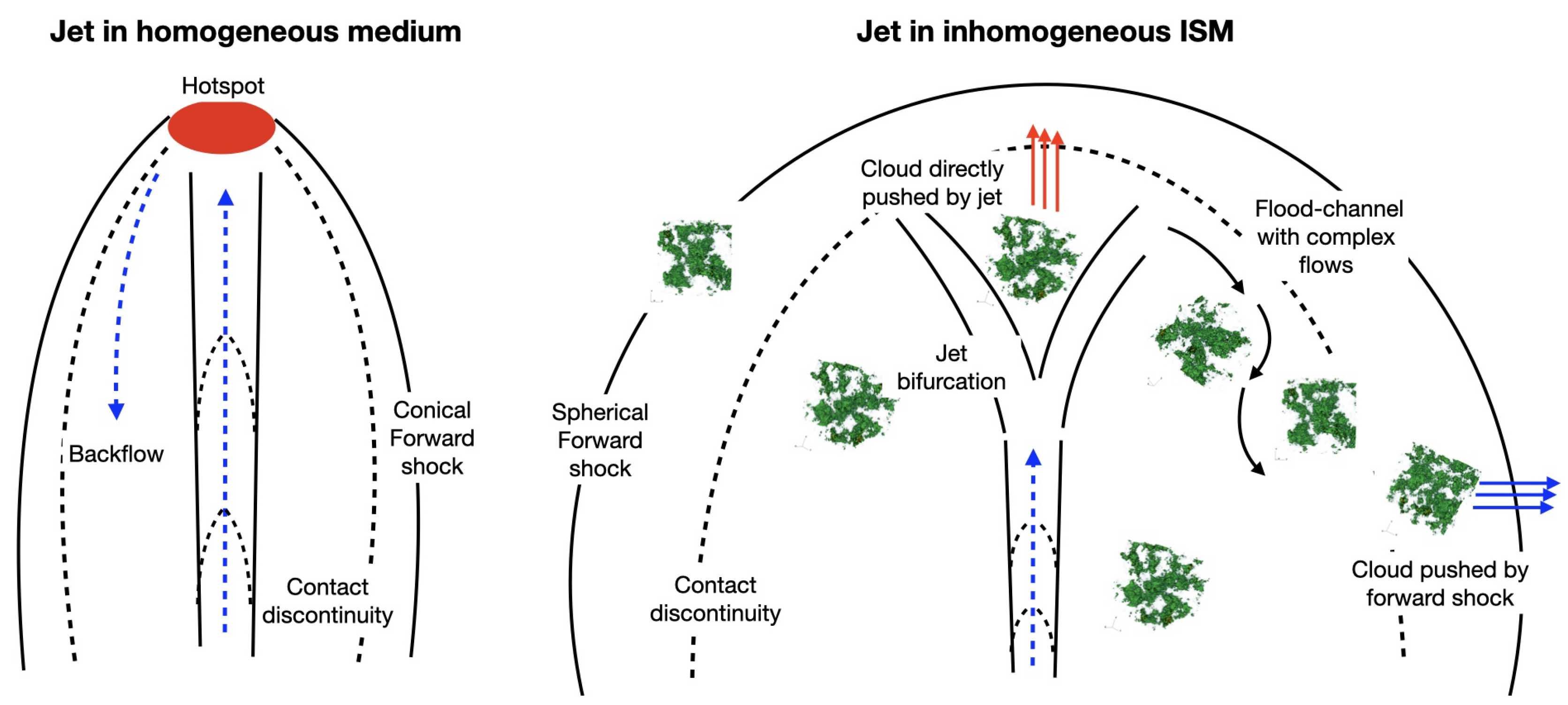
Figure 2.
3D visulations of density distribution of a fractal cloud being impacted by a AGN driven wind, from simulation GC45_K3 of Mandal et al. [138]. The top right panel corresponds to the initial compression phase, which is followed by the onset of ablation due to Kelvin-Helmholtz instabilities and shear flows (lower left panel). Finally, the cloud disperses into several mini-cloudlets, being swept up with the flow as extended cometary tails. Such detailed interactions and micro-structures are usually missed in global simulations of jet-ISM interaction due to inadequate resolution.
Figure 2.
3D visulations of density distribution of a fractal cloud being impacted by a AGN driven wind, from simulation GC45_K3 of Mandal et al. [138]. The top right panel corresponds to the initial compression phase, which is followed by the onset of ablation due to Kelvin-Helmholtz instabilities and shear flows (lower left panel). Finally, the cloud disperses into several mini-cloudlets, being swept up with the flow as extended cometary tails. Such detailed interactions and micro-structures are usually missed in global simulations of jet-ISM interaction due to inadequate resolution.
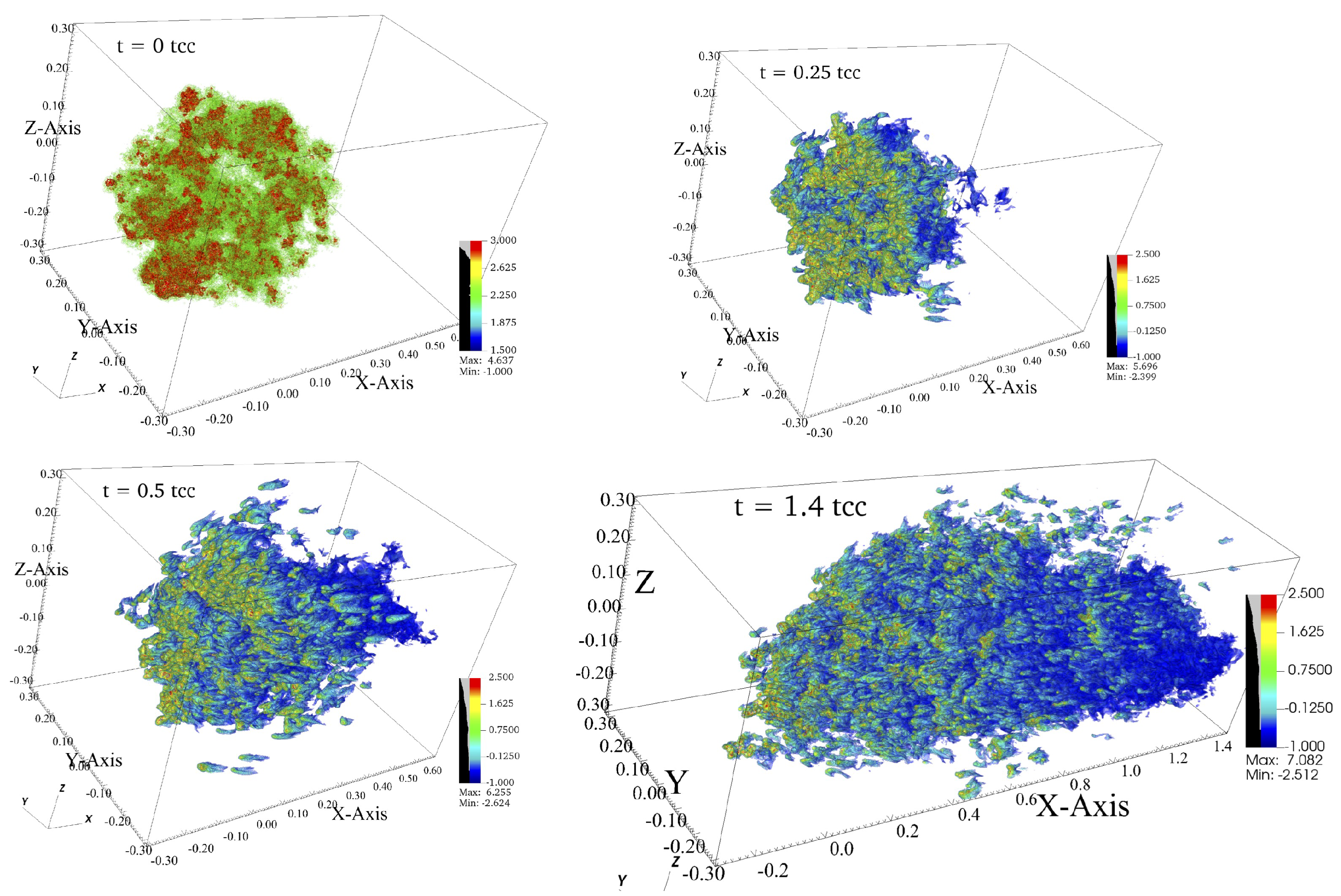
Figure 3.
Evolution of a jet through a dense kpc scale gas disk, depicting the three phases of evolution outlined in Section 3.1. The 3D visualation depict the temperature () of the gas and the jet tracer in blue, for simulation B of Mukherjee et al. [169] with a jet of power launched perpendicular to the disk plane. The red-coloured contours trace the cocoon of hot gas expanding into the ISM. Post break-out, the hot pressurized cocoon spreads over the ISM and engulfs it from the upper and lower regions. See Section 3.2 and Section 3.3.3 for broader discussion.
Figure 3.
Evolution of a jet through a dense kpc scale gas disk, depicting the three phases of evolution outlined in Section 3.1. The 3D visualation depict the temperature () of the gas and the jet tracer in blue, for simulation B of Mukherjee et al. [169] with a jet of power launched perpendicular to the disk plane. The red-coloured contours trace the cocoon of hot gas expanding into the ISM. Post break-out, the hot pressurized cocoon spreads over the ISM and engulfs it from the upper and lower regions. See Section 3.2 and Section 3.3.3 for broader discussion.
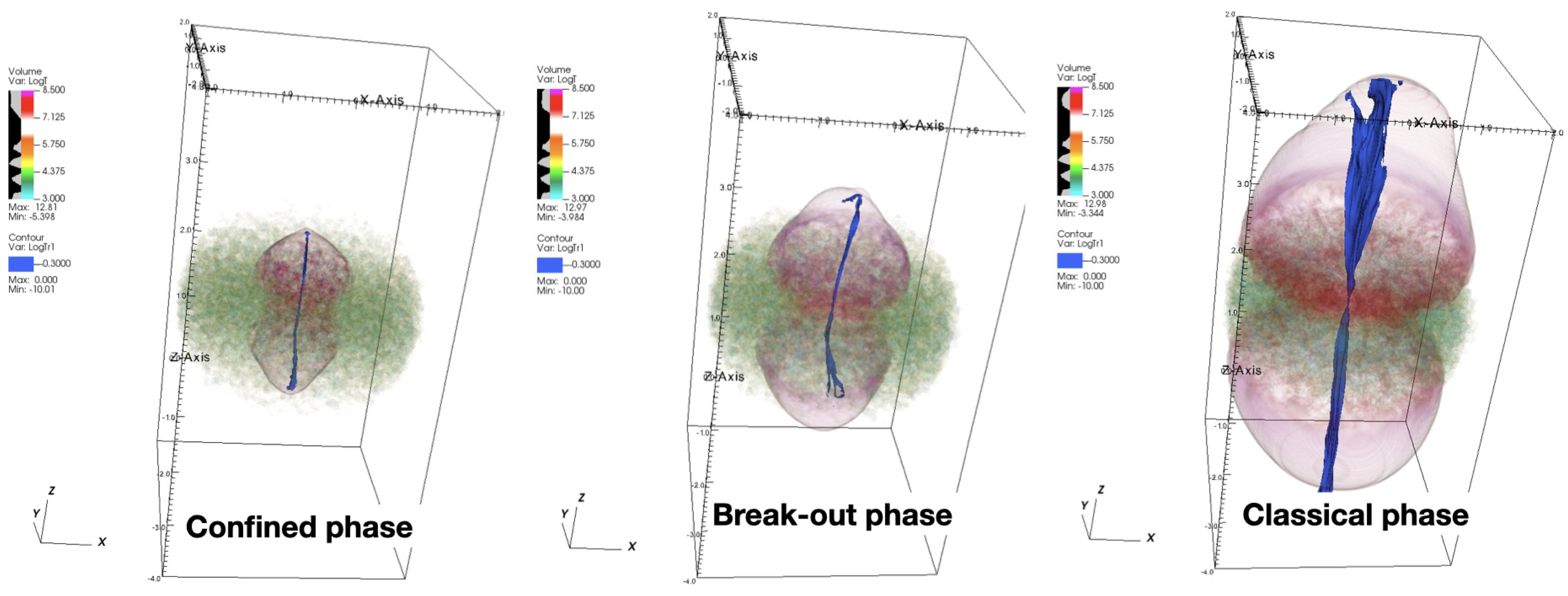
Figure 4.
A 3D visualisation of mass distribution as a function of positive radial velocity (), density (n) and temperature (T), to depict the multi-phase nature of the jet impacted ISM. The results are from the data corresponding to the last panel of Figure 14 of simulation D from [169], at 2.14 Myr. Right panels show the corresponding 2D distributions, obtained by summing the 3D histogram along a chosen axis. Several distinct phases have been be identified. See text in Section 3.3 for more details.
Figure 4.
A 3D visualisation of mass distribution as a function of positive radial velocity (), density (n) and temperature (T), to depict the multi-phase nature of the jet impacted ISM. The results are from the data corresponding to the last panel of Figure 14 of simulation D from [169], at 2.14 Myr. Right panels show the corresponding 2D distributions, obtained by summing the 3D histogram along a chosen axis. Several distinct phases have been be identified. See text in Section 3.3 for more details.
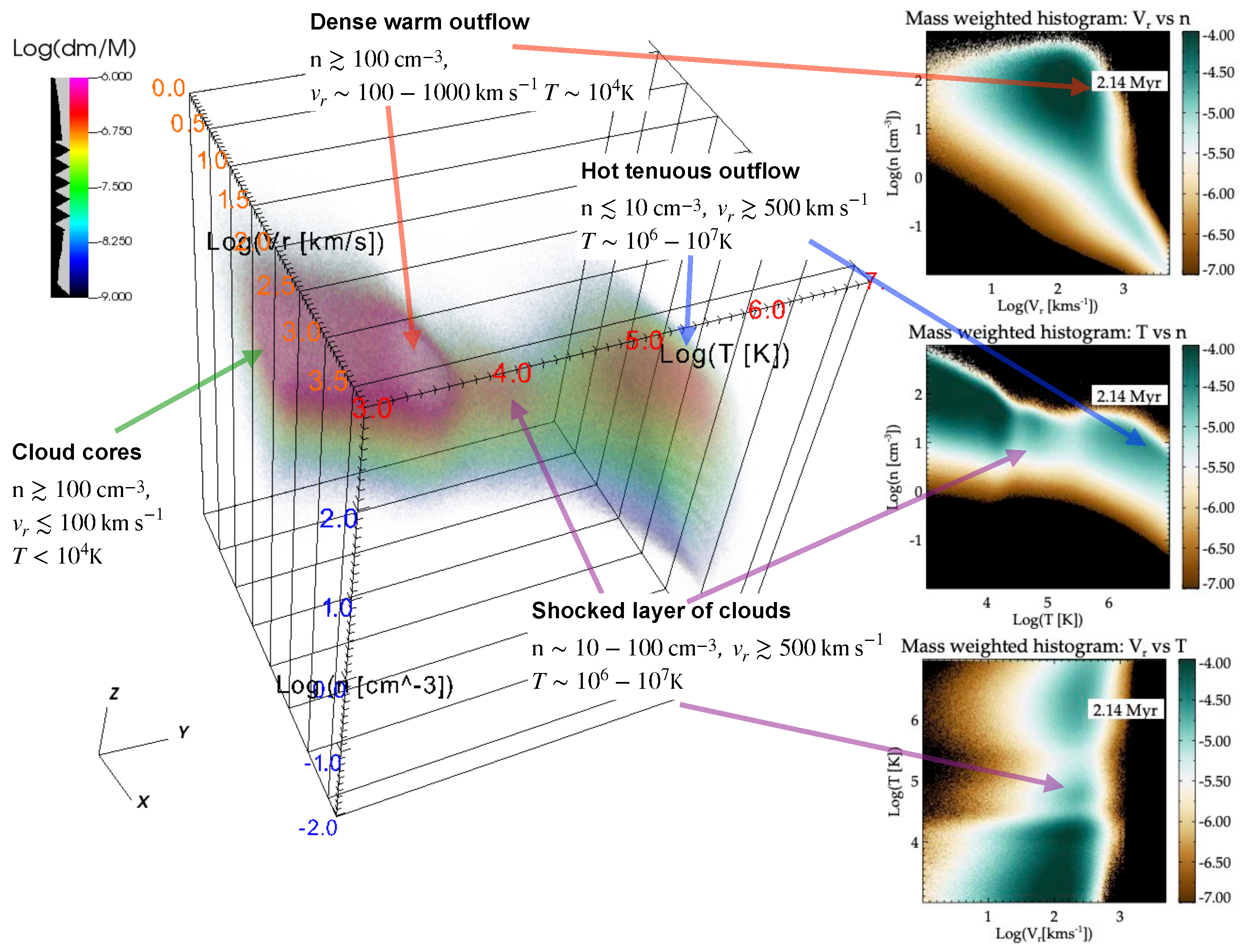
Figure 5.
Top: Representation of the top two panels of Figure 5 and Figure 6 from Girdhar et al. [219] showing enhanced kinematics in ionised and molecular gas of J1316+1753, a prototype of multi-phase observation of jet-ISM interaction. Bottom: Representation of the middle panel of Figure 8 of Meenakshi et al. [200], showing predicted [OIII] emission and line widths (W80) from simulations of jet-ISM interaction, with enhanced widths perpendicular to the jet, as also observed in multi-phase observations, such as top panel. Credits: Top: Girdhar et al. 2022 [219], reproduced with permission, ©MNRAS. Bottom: Meenakshi et al. 2022 [200], reproduced with permission. ©MNRAS.
Figure 5.
Top: Representation of the top two panels of Figure 5 and Figure 6 from Girdhar et al. [219] showing enhanced kinematics in ionised and molecular gas of J1316+1753, a prototype of multi-phase observation of jet-ISM interaction. Bottom: Representation of the middle panel of Figure 8 of Meenakshi et al. [200], showing predicted [OIII] emission and line widths (W80) from simulations of jet-ISM interaction, with enhanced widths perpendicular to the jet, as also observed in multi-phase observations, such as top panel. Credits: Top: Girdhar et al. 2022 [219], reproduced with permission, ©MNRAS. Bottom: Meenakshi et al. 2022 [200], reproduced with permission. ©MNRAS.
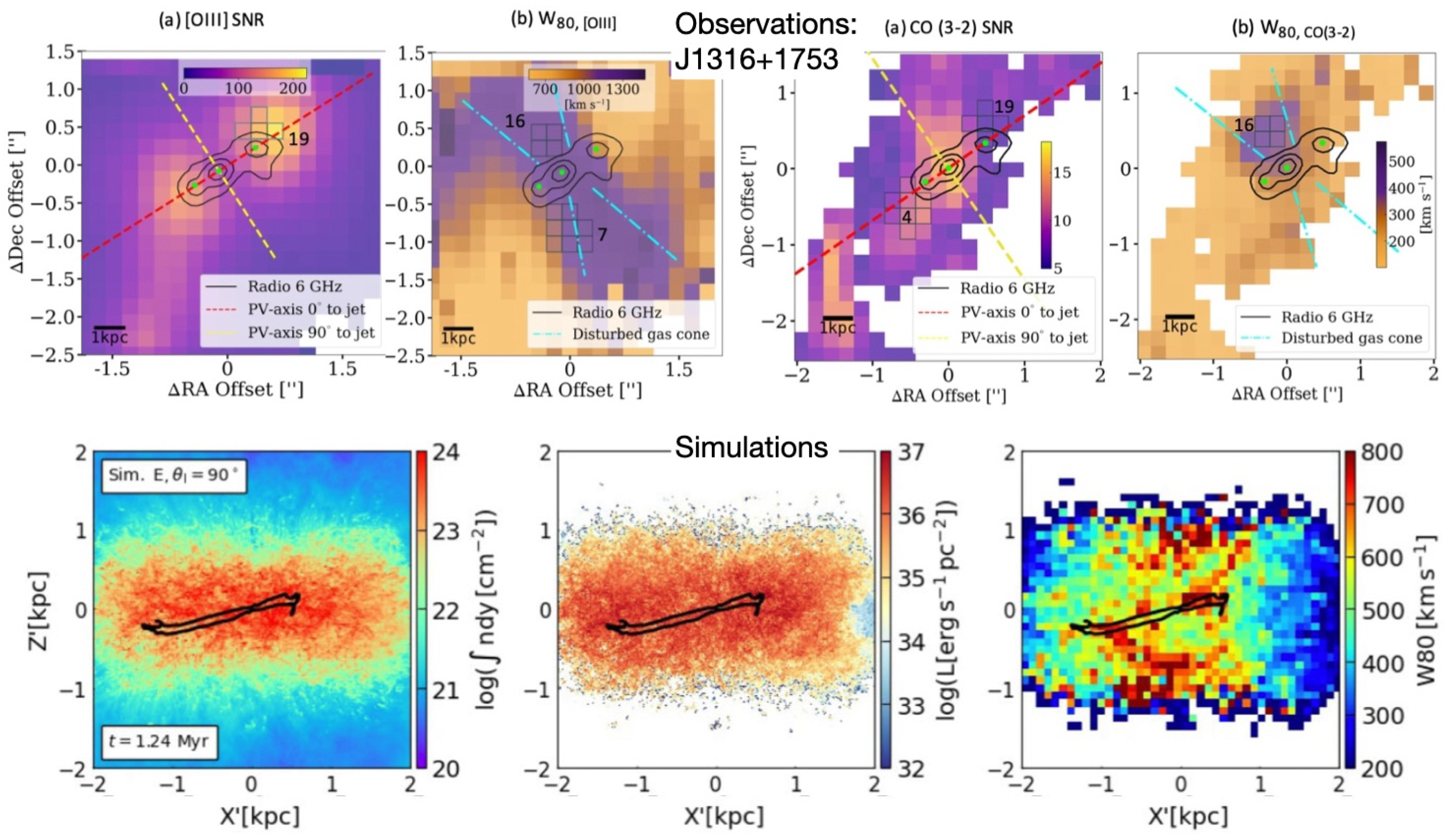
Disclaimer/Publisher’s Note: The statements, opinions and data contained in all publications are solely those of the individual author(s) and contributor(s) and not of MDPI and/or the editor(s). MDPI and/or the editor(s) disclaim responsibility for any injury to people or property resulting from any ideas, methods, instructions or products referred to in the content. |
© 2025 by the authors. Licensee MDPI, Basel, Switzerland. This article is an open access article distributed under the terms and conditions of the Creative Commons Attribution (CC BY) license (http://creativecommons.org/licenses/by/4.0/).
Copyright: This open access article is published under a Creative Commons CC BY 4.0 license, which permit the free download, distribution, and reuse, provided that the author and preprint are cited in any reuse.