

Submitted:
09 May 2025
Posted:
13 May 2025
You are already at the latest version
Abstract
Interest in using warm-season grasses, including switchgrass (SG) (Panicum virgatum L.), as a bioenergy crop has increased in Europe. This study evaluated the effects of harvesting regimes with two cuts per year on productivity, chemical composition and methane potential of SG cultivars ‘Dacotah’, ‘Foresburg’ and ‘Cave in Rock’in environments with cool and moderate climates in Europe with minimal fertilizer application. The results of two harvest years suggest that biomass yield, chemical composition and energy potential depend on grass cultivars and harvesting time. Significant effects (P<0.05) of harvest date and cultivar were observed for most measured parameters for biomass and silage quality. All three SG cultivars harvested on August 8 produced the lowest (P<0.05) volume of methane per kg of biomass (181–202 normal litres (NL) per kg-1 volatile solids (VS) compared to biomass of the respective cultivar harvested on July 14 (287–308 NL kg-1 VS) or on October 3 as regrowth after the first cut made in mid-July (274–307 NL kg-1 VS). Stands of all three SG cultivars, when the first harvest was done in mid-July, achieved a higher annual area-specific methane yield than those harvested first in August (1128–1900 Nm3 ha-1 and 888–1332 Nm3 ha-1, respectively). Depending on the harvest regime and cultivar, annual gross energy presented as lower heating value varied from 31.8 GJ ha-1 to 68.0 GJ ha-1. It is concluded that SG growing under the cool temperate climate of Northern Europe could be an interesting alternative crop for methane production. Our study proved that cultivar choice also plays an important role.
Keywords:
switchgrass
; biomass yield
; biogas production
; harvesting regime
; low-input farming
1. Introduction
The development of a sustainable European bio-based economy critically depends on the establishment of a reliable supply of sustainably produced biomass. To this end, policy interventions and technical approaches should focus on the integration of region-specific energy hubs and the implementation of optimized organic waste valorization strategies. In particular, the effective exploitation of residual biomass and livestock waste can significantly enhance local biomass availability while reducing reliance on primary biomass sources [1,2,3,4]. According to de Wit and Faaij [5], regions that stand out with respect to high potential and low costs are large parts of Poland, the Baltic States, Romania, Bulgaria and Ukraine. Growing interest in the use of agricultural biomass for energy purpose has created demand for novel, high biomass yielding, specific quality crops for sustainable use [6,7].
Low-input grassland biomass from marginal and other slightly more fertile sites can be used for energy production without competing with food or fodder production [8]. It is predicted that due to global warming, in the next 50 years, in many parts of the world, the main factors slowing plant growth will be higher air temperatures and more frequent droughts [9,10,11]. Therefore, in areas where these phenomena are most likely to be expected, xerotrophic warm-season C4 grass species, which are better adapted to changing challenging climate conditions than C3 species, should become strategic agricultural crops, mainly due to high light, water and nitrogen use efficiency [12,13]. C4 grass switchgrass (Panicum virgatum L.) has been identified by the United States Department of Energy as main herbaceous energy crop because of its potential for high yields, low environmental impact and low input requirements [14]. Liu and Basso [15] found that the majority of Michigan's land could have high aboveground net primary productivity of switchgrass and low risk of failure with no more than 60 kg N ha−1 fertilizer input. The switchgrass is a more efficient collector of solar radiation (171.0 GJ of solar energy per ha) and has lower energy input requirements in its production cycle than other agricultural crops – from 37.1 GJ ha-1 (rye) to 116.3 GJ ha-1 (grain maize) [16]. This efficiency results in a net energy gain per ha (163.8 GJ ha-1) which is approximately 60 % higher than that of grain maize (98.3 GJ ha-1). The species has good adaptive qualities in various climatic and edaphic conditions, plants are resistant both to drought and waterlogging as well as to various biotic stressors. Therefore, switchgrass could be cultivated without use of chemical plant protection products and large amount of nitrogen fertilizers [17,18,19].
Switchgrass management in Europe as a bioenergy crop is relatively a new subject-matter. Results from various studies have suggested that switchgrass is broadly adapted to many European countries [20,21]. Currently, species is introduced and intensely explored countries with Mediterranean climate in the South and oceanic climate of Western Europe [21]. The switchgrass genotypes originating from North Dakota appeared to be adaptable to the European environment with cool and moderate climate and short growing season [22]. With reference to calculation based on the 2004 economic situation in Europe, Smeets et al. [20] stated that in countries of Central Europe, including Lithuania, the costs per tonne of switchgrass dry biomass, counting storage and transportation of about 100 km radius, are low and equal to 43–64 € or 2.4–3.6 € per GJ of higher heating value (HHV), and by 2030 the predicted cultivation costs should remain attractive [20].
Biogas production through the anaerobic digestion of feedstocks provides an excellent way to convert the chemical energy accumulated in the biomass of lignocellulosic crops into renewable energy [23,24]. According to Budzianowski [25] in climates relevant for central EU-countries, biogas can be suitably produced from grasses. Canadian research group reported specific methane yields from switchgrass silage ranging from 0.191 to 0.309 normalized litres per gram of volatile solids [26]. Specific methane yields from anaerobically digested switchgrass [26] same as from temperate grasses [27,28] decreased with advancing stages of crop development; however methane concentration in the biogas produced from young biomass was lower at the beginning of batch assay [29]. Other authors [30,31] concluded that specific methane yield is more affected by harvest management than by genotype. Nevertheless [32] reported substantial differences between varieties of reed canary grass in terms of both chemical properties and methane yield. Based on the fodder analysis of 41 different energy crops, [33] revealed that the specific methane yield significantly negatively correlated with ADL. Besides lignin, contents of fibre fractions namely acid detergent fibre [34] and neutral detergent fibre [35] moderately negatively correlated with methane yields from biomass.
Though switchgrass was recognised as having potential an energy crop, no information exists on its true potential for biogas production not only in Northern area of Europe, i.e. Lithuania but also in entire Europe. According to Carlsson et al. [36] greenhouse gas (GHG) emissions from biogas obtained from fertilized biomass were, on average, twice as high as in the unfertilized treatments, as a result of additional emissions from mineral fertilizer production and distribution as well as nitrogen losses, notably as nitrous oxide, contributing with high climate impacts. Therefore, this study was set out to evaluate the potential of biogas production from biomass of three switchgrass cultivars grown in low-input farming system in Northen Europe, and likewise to determine the effect of harvesting regime on methane yield.
2. Materials and Methods
2.1. Field Experiment Conditions and Switchgrass Management
2.1.1. Field and Weather Characteristics
Field experiments were conducted in Central Lowland of Lithuania (55°23′49″N; 23°51′40″E), at the Institute of Agriculture, Lithuanian Research Centre for Agriculture and Forestry during 2014–2016. The soil of the experimental site is an Endocalcari-Epihypogleyic Cambisol, neutral light loam (FAO-UNESCO 1997). Prior to seeding, soil samples of the arable layer (0-30 cm) were analysed for chemical and granulometric compositions. The soil granulometric composition was done by the standard method ISO 11277:2020 [37]. Soil pHKCl was determined potentiometrically, organic carbon (C) content using dichromate oxidation at 160 ºC, the contents of available phosphorus (P2O5), and potassium (K2O) were measured using the A-L method, and available sulphur (S) were found by the turbidimetric method using extracting solution of 1 M potassium (KCl). Soil mineral nitrogen (N) was determined colorimetrically: N nitrate (N-NO3) using hydrazine sulfate and sulfanilamide, and N ammonium (N-NH4) with sodium phenolate and sodium hypochlorite. The soil is composed of sand (51.1 %, 2000-63 μm), silt (27.5%, 63-2 μm) and clay (21.4 %, <2 μm). The nutrient contents of the 0–30 cm soil layers in the initial stage of the experiment and at the end of the investigations are presented in Table 1.
Pre-planting fertilization comprised of 15 kg N ha-1, 45 kg P2O5 ha-1 and 70 kg K2O ha-1. During the following years after harvesting additional fertilization was not applied.
According to the environmental stratification of Europe, Lithuania is assigned to the Nemoral zone with the cool temperate climate and quite a short growing season of 190 – 195 days [38]. The annual mean precipitation in the experimental site is 550–600 mm and mean annual temperature is 6.0–6.5 °C. The average temperature in January, the coldest month in Lithuania, is -2.9 °C, and in the warmest month July 19.7 °C. According to temperature amplitudes, climatic conditions of Central Lithuania are equal to plants winter hardiness zone 5b.
The daily weather parameters were recorded in agro-meteorological station situated within 0.2 km of the experimental location. However, during the 2014–2016 experimental period the weather conditions markedly differed between years. The first season of 2014–2015 was characterized by a late winter with thin snow cover; very early, warm spring and changeable summer with heat waves. The winter of 2015 was short, without a permanent snow cover. The weather was uncharacteristically warm and wet. The spring was very early and contrasting – warm days alternated with cold ones. Moisture content for the perennial grasses was critical almost all summer. Precipitation during the 2015 growing season was 55 mm below historic averages for the research site. Moreover, hydrothermal coefficient (HTK=0.1) indicated very strong drought in August. The season of 2016 was characterized by warm winter and warm, windy, wet spring. Summer season was unusually rainy and changeable in terms of temperature. The autumn was warm and dry.
2.1.2. Switchgrass Cultivars and Management
Three cultivars of switchgrass ‘Dacotah’, ‘Foresburg’ and ‘Cave in Rock’ were chosen for the experiment. The criteria used for the selection of the cultivars were based on their geographical origin and potential for adaptation to Northern European conditions.
The experiment was based on two-factorial design, consisting 2 harvest regimes and 3 cultivars (Table 2). All three cultivars were cut twice per season at the same dates in both harvest years (2015 – 1st cut in the first harvest year and 2016 – 1st cut in the second harvest year). Plants were not harvested during the establishment year (2014) to enable them to become fully established. The harvest dates were scheduled in order to receive the yield quality suitable for anaerobic digestion and to ensure vigorous spring regrowth next year. The choice of the dates is based on experiences of other researchers [26,39] and our previous study [40] and takes the local climatic conditions into account. Depending on cultivar, the period from the resumption of vegetative growth to heading (BBCH 52-55) took 68 – 99 days in 2015 and 51 – 88 days in 2016, and the duration from beginning of spring regrowth to flowering (BBCH 61-65) lasted 71 – 114 days in 2015 and 88 – 124 days in 2016.
2.2. Sample Preparation and Chemical Analyses
2.2.1. Plant Material and Silage Preparation
The four replicate samples were pooled for chemical analyses and anaerobic digestion procedures. For chemical analyses, harvested samples were chopped into 3–5 cm particles, oven-dried at (65 ± 5) ºC for 24 hours and then ground in a cyclonic mill with a 1 mm screen. Ground samples were stored in plastic vials at room temperature. Before analysis, a small portion (2–3 g) of each sample was dried to a constant mass in a forced-air oven at 105 ± 5 °C so that data could be expressed per unit dry matter (DM).
After the cutting, the chopped switchgrass samples were ensiled for anaerobic digestion tests. Silage was prepared in 3 L glass jars and sealed for at least 120 days. Any preservatives for ensiling were not used.
2.2.2. Chemical Analyses of Biomass and Silage
Switchgrass plant and silage samples were analysed according to standard methods as follows: for ash content the dried samples were incinerated at 550° C. Total carbon (C) and nitrogen (N) contents of switchgrass samples were determined simultaneously by dry combustion using Vario EL III CNS-autoanalyser (Elementar, Germany). Neutral detergent fibre (NDF), acid detergent fibre (ADF), and acid detergent lignin (ADL) were determined using cell wall detergent fractionation method according to Van Soest [41]. NDF and ADF extraction was done on an ANKOM220 Fiber Analyzer (ANKOM Technology, Macedon, NY, USA) using F57 filter bags (25-µm porosity). Lignin was identified with ADL and it was determined in beakers on the remaining material from the ADF procedure as a residue insoluble in sulfuric acid (72% w/w). Cellulose (Cel) was determined as the difference between ADF and ADL, and hemicellulose (HCel) as the difference between ADF and NDF. Concentrations of soluble carbohydrates (SC) in the 40% ethanolic extracts of dried samples were measured spectrophotometrically (M107, Camspec, UK) using the anthrone reagent [42]. Starch was determined in plant material residue after SC extracting. Remaining plant material was solubilised and hydrolysed to glucose using enzymes α-amylase and amyloglucosidase and released glucose was assayed following the general procedures described by Zhao et al. [42]. Before analysis, a small portion (2–3 g) of each sample was dried to a constant mass in a forced-air oven at 105 ± 5 °C so that data could be expressed per unit dry matter (DM) or total solids (TS).
Wet samples of ensiled switchgrass were analysed for TS in a forced-air oven at 105 ± 5 °C, pH was determined by pH meter and volatile solids content (VS) was measured as the mass loss after dried samples were completely incinerated at 550° C in a muffle furnace.
2.3. Anaerobic Digestion Experiments
The specific methane (CH4) yield from switchgrass was assessed in batch assays using the automatic methane potential test system (AMPTS, Bioprocess Control AB, Sweden). Prepared biomass silage samples of 200 g were put into inoculum (digester volume of 20 litres) for acclimation. Anaerobically digested material from piggery farm biogas plant with addition of maize silage was used as the inoculum. After the acclimation period (50 - 60 days) a biomethane potential (BMP) assay was started. The BMP experiments were performed as they were previously described by [43,44,45]. The BMP tests were conducted in triplicates under mesophilic conditions (38 oC ± 1 oC), and the inoculum to substrate ratio (based on VS amount) was set at 2:1 to avoid any inhibition. Total solids and volatile solids of the inoculum were measured every time before test set-up. Volatile solids were adjusted to 40 g kg-1 of the inoculum by adding distilled water. An active volume of 400 ml in 500 ml bottles was used in all tests. The flasks and tubing were purged with pure CH4 to ensure anaerobic conditions. In the experiments of anaerobic digestion, the control test with the sole methanogenic inoculum (without the addition of switchgrass silage biomass) at the same dilution rate as for plant samples was included to measure its intrinsic CH4 production. The CH4 produced by the inoculum was subtracted from the results obtained from the test samples. The substrate was mixed by a stirrer driven by an electric gear with a mixing period of 30 s at a frequency of 1 s-1 with 3 min pauses. The volume of CH4 was calculated to standard temperature and pressure conditions (0 °C and atmospheric pressure of 1 bar). Cumulative specific methane yield was calculated as the sum of CH4 produced over the incubation period and expressed as normal litres (NL) per kilogram on wet mass (WM), TS and VS bases (CH4YWM, CH4YTS and CH4YVS, respectively) of switchgrass silage added to the test.
Yield of higher heating value (HHVY) and lower heating value (LHVY) per area of switchgrass stand (MJ ha−1) was computed as follows: HHVY = DMY x CH4YTS x 39.8 and LHVY = DMY x CH4YTS x 35.8, where 39.8 is HHV and 35.8 is LHV (MJ) for 1 Nm-3 of methane. The values are used by National Renewable Energy Laboratory [46].
2.4. Statistical Analysis
The means were compared by t-test and F-test. Differences were considered to be significant at the 95 % level. The correlation (Pearson’s correlation) and regression analysis between the data sets was done. Analysis of variance was performed to estimate the differences in the tested parameters among the treatments (year and genotype). Fisher’s Protected LSD was used to compare means at P = 0.05 and P = 0.01. Analyses of variances were conducted using the statistical packages SAS Enterprise Guide 7.1 software (SAS Institute Inc), and MS Excel Analysis ToolPak.
3. Results and Discussion
3.1. Chemical Compositions of Harvested and Ensiled Biomasses
The chemical compositions of the harvested switchgrass biomass are shown in Table 4. Significant effects (P<0.05) of harvest date and cultivar were observed for most measured biomass quality parameters. Harvest date effect on concentrations of cell wall-related components (NDF, ADF, and ADL), ash, N, C, as well as C to N ratio (C/N) tended to be more consistent than cultivar-dependent effect. In later harvested (BBCH 61-65, Aug 08) biomass of three cultivars, the NDF, ADF, ADL, C concentrations and C/N were higher, while protein and ash concentrations were lower in comparison with chemical composition of the biomass of respective cultivar harvested in mid-July and in the switchgrass regrowth harvested in early October. At flowering, the NDF ranged between 734 and 745 g kg-1 DM, ADL measured up to 83.3 g kg-1 DM, ash and N contents declined up to 45.7 and 7.18 g kg-1 DM, respectively. Due to the higher C and lower N concentrations, biomass of flowering plants had the highest C/N values (62.4-67.9) than biomasses of other two harvests. Although the biomass of switchgrass regrowth was chemically more similar to biomass of heading stage than to that of flowering, significant (P<0.05) differences also evidenced between early first cut and regrowth: biomass cut in October was the lowest in NDF, starch and C concentrations but highest in ash. The concentration of the cellulose (Cel) as well as ADL to Cel and ADL to hemicellulose (HCel) ratios also differed between samples of different cuts with the later harvested samples being higher in these biomass quality parameters than in samples cut in mid-July and in early October.
Among the cultivars, early-maturing switchgrass ‘Dacotah’ had the highest NDF, ADF and ADL contents and late-maturing ‘Cave in Rock’ tended to be the lowest in these biomass components. However, such tendency was evident for biomass cut at mid-July and partly apparent for the biomass of regrowth. Conversely for biomass of the late first cut (Aug 08), ‘Dacotah’ exhibited the least alteration in the concentrations of these components with harvest delay since July 14 to Aug 08. Among three cultivars, ‘Cave in Rock’ had the lowest (P<0.05) ash concentrations in the biomass of all harvest dates. As regards concentration of other components in biomass cut at the identical time, variation among cultivars was inconsistent, though there were established some significant differences.
Silages of different switchgrass samples revealed also diverse characteristics (Table 3). The average TS content ranged from 30.8 % to 42.4%, pH varied from 4.0 to 5.1 and VS alternated from 92.3% to 94.9%. Ensiled biomass of late primary growth exhibited generally higher pH, TS and VS values than biomass of other two cuts.
Generally, the study results addressing the chemical composition of switchgrass biomass agree with the values presented in the preceding reports [47,48,49,50]. Our study has shown a trend of alternation in switchgrass quality with harvest delay which is consistent with preceding results of studies carried out in USA and Canada [47,48,51,52,53,54,55]. Similarly as our findings showed, in their experiments the researchers were observed increases in fibre and its components, decreases in nitrogen and ash concentrations of switchgrass with harvesting date. Aurangzaib et al. [51] and Heaton et al. [56] also found that C/N increased continuously with advancing maturity. Differences in the chemical composition between harvests might be explained by the decrease leaf to stem ratios with advancing maturity [57]. Stems have greater fibre, lignin concentrations than leaves [58], resulting in greater NDF, ADF and ADL values in the harvest of 08 Aug. Higher nitrogen and ash concentrations in biomass of leafier heading plants and regrowth than flowering plants might be because of the same reason, as leaf components contain more nitrogen and ash than stems [50,59]. Our results on NDF and ADF of switchgrass harvested at plant heading and flowering stages as well as at regrowth were of comparable values to those reported by Richner et al. [48]for switchgrass grown in USA, Missouri State and harvested at similar stages. In our study, concentrations of fibre fractions both NDF and ADF of ‘Cave in Rock’ biomass from harvest of July 14 (679 and 384 g kg-1 DM, respectively) were very close to those obtained in biomass of the same switchgrass cultivar cut late July in Eastern Canada (680 and 383 g kg-1 DM, [44]. In the biomass of regrowth, we observed more fibre than Canadian researchers found but in line with NDF and ADF values reported by Liu et al. [50] from Virginia, USA. However, at early seed head stage, McIntosh et al. [54] found more NDF and ADF than we determined in switchgrass of respective (heading) stage. On the subject of ADL content in biomass, Liu et al. [50] observed less lignified biomass of both harvests in July and regrowth than we determined. Our ADL values agree with ones received by Richner et al. [48] for biomass of pre-anthesis harvest. However concerning biomass of regrowth, ADL varied in different ranges: 40-100 g kg-1 DM ([45]), 38.9-47.0 g kg-1 DM ([50]) and 53.3-58.6 g kg-1 DM (the current study). In our research, we found that ‘Cave in Rock’ had low ADL at the first harvest date, but higher or similar to Dacotah and Forestburg at the other two harvest dates. According to Casler and Boe [52], most of the variation in ADL among cultivars could be explained by the cultivar main effect and by differences in rate of ADL accumulation with later harvest date. Presumably, ‘Cave in Rock’ had higher rate of ADL accumulation with harvest delay than other two cultivars. Basically, this is consistent with observation of Casler and Boe [49] and Aurangzaib et al. [51].
Similarly as in study [52], we also observed that biomass of ‘Cave in Rock’ contained less ash than biomass ‘Dacotah’ and ‘Forestburg’. Ash concentration in biomass of cv. ‘Cave in Rock’ harvested in mid-July was in line to those determined by [50,60]. As for N (CP) concentration in switchgrass, data found in the literature are variable. Sadeghpour et al. [57] determined 5-7.2 g N kg-1 DM in biomass harvested in mid-July, McIntosh et al. [54] found 86.8 g CP kg-1 DM or 13.9 g N kg-1 DM at early seed head stage, Richner et al. [48] observed 80-100 g N kg-1 DM at boot stage and 80-90 g N kg-1 DM at regrowth. Data on WSC, starch and carbon concentrations as well as carbon to nitrogen ratio (C/N) in switchgrass biomass cut in summertime or regrowth are very limited. In switchgrass ‘Cave in Rock’, Bélanger et al. [47] reported an increase in soluble carbohydrates concentration from late July to early September. In our study, we also observed the similar trend from mid-July to first ten-day of August for all three cultivars. We found considerably more starch in biomasses of all harvests and all cultivars than Bélanger et al. [47] obtained. Aurangzaib et al. [51] noticed that the changes in amount of total nonstructural carbohydrates (TNC) were inconsistent among varieties throughout the growing season. Contrary for WSC in our study, the authors did not establish significant differences among varieties for their TNC concentration. Sugars are one of the first products of photosynthesis, therefore, their concentration is more dependent on environmental factors than concentrations of other plant quality components [61]. Averaged over 3 locations and two years, the mean C/N ratio of P. virgatum was approximately 80 in August [56], i.e. C/N was higher than we observed in switchgrass at this time (62.4-67.9). According to findings of Aurangzaib et al. [51], C/N in biomass of five switchgrass cultivars varied in a range of 35-50 at July 10 (190 day of year) and steadily increased up to 40-70 at the end of July (210 day of year).
Generally, our findings on chemical composition are in accordance with respective literature data. Some perceptible discrepancies between data of various investigations in biomass composition might be associated with the differences in edaphoclimatic conditions, fertilizer applications, cultivars involved and other reasons.
3.2. Cumulative and Area Specific Methane Yield
The average cumulative and daily methane production of switchgrass samples as a function of day of aerobic digestion during 16 days of incubation at mesophilic temperature are presented in Figure 1 and Figure 2 respectively. The remarkable difference in the development of the methane production curves was observed for switchgrass biomass when plant harvesting dates were compared (Figure 1). During entire period of observation, the cumulative volumes of methane produced from switchgrass cut at mid-July and 03 Oct were similar but larger than that of batches of switchgrass sampled on 08 Aug. The figure also shows that methane formation was generally stopped after 16 days from start of anaerobic digestion of all samples.
The methane production from switchgrass samples started sharpish after incubation. Daily methane production reached peaks during the first day for all samples, followed by a sharp decline in the further 2-4 days and thereafter only small volumes of methane were released (Figure 2). The peaks in the first day of anaerobic digestion differed in values when harvesting time showed more obvious differences than cultivar of the respective harvest. The initial degradation rate was the highest for the samples of younger plants from first cut and regrowth. The maximum daily methane productions were 71.5-81.8 NL kg-1 VS d−1 of switchgrass cut at mid-July, 80.0-89.6 NL kg-1 VS d−1 of regrowth biomasses and switchgrass biomasses sampled on 08 Aug featured the lowest peaks 37.3-42.0 NL kg-1 VS d−1. This made 24.7-30.4 % of total accumulated specific methane yield (CH4YVS) for biomasses of early first cut and regrowth and 18.7-20.8 % CH4YVS for biomass cut at 08 Aug (Table 4). The high initial methane production for first day, probably, was due to of easily biodegradable organic compounds of ensiled biomass: residual water soluble carbohydrates and products of biomass fermentation like volatile acids. For all the bathes investigated, it was found that approximately 50% of the CH4YVS accumulated during 16 days of assay was gained after only 3 days of anaerobic digestion.
Ahn et al. [62] also showed rapid biogas production from switchgrass-manure substrates for the first 2 days, followed by a rapid decrease in biogas production between days 2 and 4. Similarly, Dandikas et al. [63] noticed that approximately 80% or more of the total biogas production of energy crops is usually recorded at the first half of the experiment. Luna-delRisco et al. [64] revealed that the methane production from different feedstocks started actively after incubation and for grass silage, time to reach 80% of ultimate methane yield was 15 days. Meanwhile in the experiment carried out by Barbanti et al. [65] switchgrass featured low peak (7.0 ml CH4 g−1 VS d−1 after ten days of incubation. The CH4 production assessment was conducted on oven-dried (60ºC) biomass samples harvested on October 5 at initial senescence of plants, when cell wall was highly lignified and biomass characterized by unfavourable for anaerobic digestion great carbon to nitrogen ratio. Ragaglini et al. [66] clearly showed that methane production from frozen giant reed reached peaks during the first days in accordance with the stage of development of the crop. In the early stage and regrowth the maximum methane rate gained 37- 44.4 NL kg VS-1 day-1, while in the mid-season stages it ranged between 28.5 and 37.8 NL kg VS-1 day-1 and at crop maturity it was less than 20 NL CH4 kg VS-1 day-1.
The specific methane yield was primarily subjected to the harvest timing of the cut: all three switchgrass cultivars harvested at Aug 08 produced the lowest (P<0.05) volume of methane per kg of biomass (171-191 NL kg-1 TS and 181-202 NL kg-1 VS) compared with biomass of respective cultivar harvested at July 14 or Oct 03 (254-290 NL kg-1 TS and 275-308 NL kg-1 VS) (Figure 3). For corresponding cultivar, the statistically significant differences between specific methane yields produced from biomass of first cut in July 14 and regrowth were not found. As regards cultivar effect on methane production, biomass of Forestburg cut in July 14 and regrowth showed higher potential (P<0.05) than other two cultivars. Over 16 days of incubation, biomasses of Forestburg and Cave in Rock cut in Aug 08 produced similar CH4 volumes per kg, which were significantly higher (P<0.05) than that produced from biomass of early maturing Dacotah harvested at the same date. Cultivars Dacotah, Forestburg and Cave in Rock harvested in Oct 03 as a regrowth after the first cut made in mid-July had resulted cultivar-dependent (P<0.05) CH4Ys with total of 275, 307 and 293 NL kg-1 VS, respectively.
Massé et al. [26] pointed out that switchgrass remains an interesting renewable alternative energy source under relatively the cool and humid climate of Eastern Canada. Biomass of Cave in Rock produced 0.266 - 0.309 NL CH4 g-1 VS in mid-summer and 0.269 - 0.276 NL CH4 g-1 VS in the second cut on 01 Oct. These values are comparable to those obtained in our study for the first harvest in late July and the second harvest (regrowth) in October. However, methane potential from Cave in Rock biomass harvested on August was lower in our study (202 NL g-1 VS) than those obtained by [26] for the same cultivar harvested late summer (235 NL CH4 g-1 VS).
But it should be noted that the wide differences in potential methane yield of switchgrass are reported in the literature. Specific methane yield from switchgrass cultivated in other countries varied in the range from 127 to 309 NL g-1 VS: 127-198 NL g-1 VS ([64], USA), 112-298 NL g-1 VS ([68], Canada), 184-309 NL g-1 VS ([26], Canada), 216 NL g-1 VS ([62], Italy), 296 NL g-1 VS ([69], France), 137.5-300.5 NL g-1 VS ([70], Italy). These differences might be explained by variations in the switchgrass maturity, cultivar, biomass pretreatment, application of mixtures with additional feedstock. Our results confirm previous observations that crop maturity is important factor leading to the significant decrease of the specific methane yields from both C3 and C4 grasses [26,66,68,71,72]. There El-Mashad [67] reported that the specific methane yields of switchgrass harvested in the post killing frost stage were only 127 and 198 ml g−1 VS at mesophilic and thermophilic temperatures, respectively. Similar methane yields (140 – 205 ml g−1 VS, from winter and summer harvested switchgrass biomass, respectively) were received by [68]. Plant maturity effect could be explained by the fact that lower methane yield during plant senescence was caused by shortage of nitrogen quantity, resulted higher C/N ratio and increase of fibre with higher cell wall lignification. The relationship between fibre content in switchgrass biomass and specific methane yield supports this point [47]. Massé et al. [26] noticed that the concentration of non-digestible matter increases with advancing plant maturity.
There is a lack of information concerning cultivar effect on methane production; however such studies deal with other crops. Oleszek et al. [32] clearly showed that the methane fermentation results revealed a significantly higher (p < 0.05) biogas yield from the cultivated variety of canary grass than from the wild one. BMP of 24 clones of Arundo donax also varied in a wide range from 147 ml g−1 VS to 243 ml g−1 VS [73]. Significant genotypic variation for specific methane yield was revealed in winter rye [31]. Significant differences among Miscanthus sinensis genotypes were found both for quality traits relevant for specific bioenergy conversion routes and for specific bioenergy yield, including methane [35]. However, according to Dickeduisberg et al. [30], the choice of the wheatgrass germplasm was less important than cutting frequency and cutting height. As concerns switchgrass, we could not find any information on this subject. The results obtained in our study are logical and may be related to cultivar-dependent variation in chemical composition. Results from the study of Aurangzaib et al. [51] also clearly demonstrated a significant at the P ≤ 0.01 variation between switchgrass ecotypes for energy-important quality traits.
Compared to other perennial grasses, P. virgatum biomass produced less methane per kg VS than biomasses of temperate species Festuca arundinacea, Dactylis glomerata, Phalaris arundinacea, Phleum pratense or xFestulolium [74,75,76,77]. True, Massé et al. [44] received opposite data: the average specific methane yield from reed canarygrass-seeded plots was less than from switchgrass-seeded plots. On the other hand, there are different ways to improve methane production potential from switchgrass biomass. Even switchgrass harvested during September while plants were mature could gain of 296 L CH4 kg-1 VS, probably because that for this experiment, green samples were compressed and stored under anaerobic conditions by N2 flushing [69]. Storage of the green grass might affect its biodegradability [67]. The different biomass pretreatments evocative of effects on improved accessibility of the cell wall components to microbial attacks could enhance value of switchgrass biomass as a feedstock for methane production. These could be physical, chemical or biological pretreatments of lignocellulosic biomass [68,69,70,78,79]. Furthermore, to increase the yield of methane production from switchgrass, another feedstock, e.g., Spirulina platensis algae could be used to adjust the carbon to nitrogen ratio of switchgrass [67]. Swine manure–switchgrass mixture anaerobic digestion also proved to have the high biogas production potential (0.337 L CH4 g-1 VS) [62].
3.3. Association Between Biomass Composition and Specific Methane Yield
Figure 4 presents the matrix of Pearson correlations, computed to investigate the relationships among chemical components of switchgrass biomass and the dependence of specific methane yield both on TS and VS basis on the chemical composition. The effect of the concentrations of fibre (NDF, ADF), ADL, C as well as C/N on specific methane yield was significant (P≤0.01) and negative. Cellulose of biomass and pH and TS of ensiled switchgrass showed also negative but weaker (P≤0.05) impact on methane production. Structural carbohydrates of cell wall reflected weak negative impact on methane production with significance at P≤0.05 for cellulose only. However, cell wall lignification level, i.e. the lignin ratios to hemicellulose and cellulose evidenced a negative and significant (P≤0.01) impact on accumulated specific methane yield. There were found no or low correlations between CH4YTS and non-structural carbohydrates, ash of plant biomass and VS of ensiled samples. The interrelationships among chemical components in forage crops are well known. Generally, correlations observed are in agreement with previous studies.
Thus, the correlation between methane yields and the main chemical biomasses confirmed that chemical composition of fibre fractions of biomass is essential to estimate the biogas potential [80]. Nitrogen concentration was solely one component which significantly positively impacted on SMY. Similarly, it was noticed by Herrmann et al. [34]. The significant negative SMY correlations with C and C/N indicate that high parameters’ values of biomass used for biogas production are undesirable traits. Several investigators clearly showed that methane potential increased first and then decreased with increases of C/N ratios [81]. The highest methane potential was observed with a C/N ratio of 25 – 30. For set of different agro-industrial biomasses, Dinuccio et al. [80] obtained a negative and statistically significant correlation between methane yield and ADL. Numerous researchers investigated anaerobic digestion of different feedstocks confirmed the same point on ADL as a strong negative predictor of methane yield ([82] energy crops and animal manures; [28] reed canary grass leaves and stems separately; [33] different plant species; [34] silages from 43 different crop species; [35] miscanthus). From moderate significant to low negative impact of concentrations of NDF, ADF and cellulose in the biomass on SMYVS also has been reported by several research groups [28,33,34,35,47,82]. These relationships were similar as we revealed in our study.
The strong relationship between specific methane yield and ADL ratio to cellulose established in the current study endorse previous observation [76], who stated that the biodegradability of one substrate can be evaluated by the ratio of lignin to cellulose. This is consistent with the fact that biomass pretreatments leading to decrease of lignin to cellulose ratio improve biodegradability and enhance biogas production [78,79]. In previous studies it was also observed that fibre lignification level expressed as an ADL ratio to NDF statistically significantly correlated with SMYVS [77]. It was established that applying both lignin and cellulose increased probability of SMYVS prediction comparing that when only lignin or cellulose was used as the independent variable [28,82].
Only weak correlations between CH4YTS and nonstructural carbohydrates (both WSC and starch) were received by Dandikas et al. [33]. In authors’ opinion, these parameters are not suitable variables for a linear regression because these carbohydrates exhibit the highest variation among all parameters. Aurangzaib et al. [51] also noticed that the changes in amount of total non-structural carbohydrates (TNC) were inconsistent throughout the growing season. Their concentrations are more affected by environmental factors than concentrations of other plant quality components [61].
In general, Pearson correlations determined in our work are in agreement with other researches; however, most of them are stronger than they were established in previous works. This could be due to the fact that most of the cited authors counted correlations for sample sets composed of various feedstocks.
3.4. Area specific Methane and Energy Yield
Annual methane yield per hectare outlined evident differences both among cultivars and between harvest regimes being the highest from biomass of Cave in Rock or Forestburg, depending on cutting regime, and the lowest from Dacotah (Table 6). Stands of all three switchgrass cultivars, when first harvest was done on mid-July, gained higher annual area specific methane yield than those firstly harvested in August (1128-1900 Nm3 ha-1 and 888-1332 Nm3 ha-1, respectively). Regarding methane output from biomass of the second cut, it was lower by 1.53-3.24 folds for regrowth after early first cut and by 4.87-14.7 folds for regrowth after first cut accomplished on Aug 08. The primary our data from the current study showed also that regrowth after later first cut (II regime) is negligible and it is difficult to conceive the economic benefits of collecting such low biomass quantity for bioenergy purposes. Therefore, data on methane yield from the second cut of II harvest regime has only theoretical but not practical implication. Assuming that higher heating value (HHV) and lower heating value for methane are 39.8 MJ m-3 and 35.8 MJ m-3, respectively [46], theoretical energy output per hectare were computed (Table 5). Depending on harvest regime and cultivar, annual gross energy presented as LHVY varied from 31.8 GJ ha-1 (Dacotah of II harvest regime) to 68.0 GJ ha-1 (Cave in Rock, I harvest regime).
Few studies have evaluated the area specific methane yield of switchgrass and the researchers' data varies widely. As cited by Massé et al. [26], preliminary results showed that 2300 to 5400 Nm3 CH4 ha-1 could be obtained for different varieties of switchgrass grown in Florida. However, methane yields reported by Canadian researchers as well as in our experiment were noticeably lower than in the study from Florida: 1200–2600 m3 ha-1 [65], 2280–30440 Nm3 ha-1 [23] and 888–1900 Nm3 ha-1 (current study, Table 6 The LHVY (gross energy) data for switchgrass obtained in the investigation of Barbanti et al. [62] were considerably higher (158 GJ ha−1). One of crucial factors to enhance bioenergy output per area is biomass yield. Barbanti et al. [65] reported switchgrass yield of 22.4 Mg ha−1 which exceeds those we received in our experiment for 2016 (22.4 t ha-1 and 4.24 – 6.98 t ha-1, respectively). The switchgrass biomass yield <10 t ha−1 determined low or moderate biogas production also in Canada [26,68]. Kandel et al. [77] stated that biomass yield augmentation is more important than biomass maturity to achieve high methane yield per hectare from festulolium and tall fescue. However, in our study, we revealed that despite higher by 25-58% biomass DMY of first cut on Aug 08 than on July 14 (Figure 1), annual methane yields produced from these biomasses were of similar values when the same cultivar was compared (Table 6). Consequently, the other factors including harvest time and regime are relevant to methane and energy output via increase of biomass convertibility. Approximately 25% more methane was produced by hectare for the two-cut strategy (2900–3440 Nm3 ha-1) compared to the one-cut strategy with a harvest in late summer (2280–2770 Nm3 ha-1) [26]. The same rule obtains regarding to harvest time and regime of other grasses [66,76].
If compared with temperate grasses investigated as feedstocks for biogas production, results on yield and methanization of switchgrass biomass from current study do not seem very promising. Methane yield per hectare (5277−6963 Nm3 CH4 ha−1) observed in the study of Kandel et al. [77] represent high-end values for temperate perennial grasses ×Festulolium and tall fescue in central and northern Europe. The energy potential obtained by producing biogas from reed canary grass, cocksfoot and tall fescue grown under Lithuanian climatic conditions ranged from 65 GJ ha−1 to 172 GJ ha−1 from plots fertilised with 90 kg ha−1 or 180 kg ha−1 of mineral nitrogen fertilisers [76]. Energy yields from different grasses and harvest years were ranged from 1200 to 3600 Nm3 CH4 ha-1, corresponding from 43.2 to 129.6 GJ ha-1 [74].
Greater biomass and methane yields would be expected with fertilization. In areas with sufficient rainfall, sustainable yields of ∼15 Mg ha−1 yr−1 may be achievable by applying ∼50 kg N ha−1 yr−1 at a commercial scale [18]. Hence N fertilization might significantly increase also the methane and energy yield per hectare [26,76]. In our field experiment, plots were fertilized with minimal nitrogen rate (15 kg N ha-1) only once per trial period, i.e. before trial establishment. Therefore, in our opinion, switchgrass growing under cool temperate climate conditions for biogas merit further long term researches for the impacts of environmental conditions, level of stand fertilisation, biomass pretreatments, modelling of anaerobic digestion process. Our study proved that the cultivar choice also plays an important role.
4. Conclusions
The chemical composition of switchgrass biomass was significantly influenced by both harvest date and cultivar. Harvest timing had a greater impact on cell wall components (NDF, ADF, ADL), ash, nitrogen, carbon, and the C/N ratio. Delayed harvesting led to higher fiber and carbon concentrations as well as lower protein and ash content, ultimately resulting in elevated C/N ratios. These findings align with previous literature highlighting the fluctuating quality of biomass as plants maturity and genetic variation.
Anaerobic digestion of switchgrass harvested at different times showed significant differences in methane yield. Comparing the late-harvested (August) biomass to the mid-July and early October harvests, it was found that the latter two stages produced comparable or higher cumulative methane volumes. Younger plants, especially after regrowth, produced more methane likely due to the presence of easily biodegradable compounds. Across all cultivars, about 50% of the total methane yield was achieved within the first three days of digestion. However, the overall specific methane yield was notably lower for the August harvest. Therefore, the timing of harvesting plays a crucial role in optimizing switchgrass for use as a biogas feedstock.
A correlation analysis revealed a relationship between biomass composition and methane yield. Specific methane yields were negatively correlated with fiber compositions (NDF, ADF), lignin composition (ADL), carbon content, and C/N ratio. Elevated lignin-to-cellulose and lignin-to-hemicellulose ratios strongly correlated with reduced methane production, highlighting how lignification hinders the breakdown of the biomass. These findings reinforce the importance of biomass chemical composition, particularly the levels of structural carbohydrates and lignin, as key determinants of its potential for anaerobic digestion and subsequent methane production.
The annual area-specific methane yield varied significantly among the different switchgrass cultivars and harvest regimes. Harvesting the first cut in mid-July typically resulted in higher annual methane yields compared to harvesting in early August. The methane yield from the second cut (regrowth) was noticeably lower than the first cut, especially when the initial harvest was delayed until August. This indicates limited practical benefits from late regrowth. As a result, the theoretical annual energy output, calculated based on methane lower heating value, demonstrated that 'Cave in Rock' under the early first-cut regime displayed the highest energy potential. This study emphasizes the importance of cultivar selection and harvest management in maximizing biogas production from switchgrass.
Author Contributions
Conceptualization, E.N., B.B and K.V.; methodology, E.N., B.B., V.K. and K.N.; software, E.N. and G.P.; validation, K.A-V., C.G. and K.N.; formal analysis, B.B., A.L., G.P. and V.K.; investigation, E.N. and K.V.; resources, K.N. and B.B.; data curation, B.B., A.L., G.P. and K.A-V.; writing—original draft preparation, E.N., K.V., K.A-V. and C.G.; writing—review and editing, K.N. and C.G.; visualization, E.N. All authors have read and agreed to the published version of the manuscript.
Funding
This research received no external funding.
Institutional Review Board Statement
Not applicable.
Data Availability Statement
The raw data supporting the conclusions of this article will be made available by the authors on request.
Conflicts of Interest
The authors declare no conflicts of interest.
References
- Lewandowski, I. The Role of Perennial Biomass Crops in a Growing Bioeconomy. In Perennial Biomass Crops for a Resource-Constrained World; Springer International Publishing: Cham, 2016; pp. 3–13. [Google Scholar]
- Orlando, S.; Greco, C.; Tuttolomondo, T.; Leto, C.; Cammalleri, I.; La Bella, S. Identification of Energy Hubs for the Exploitation of Residual Biomass in an Area of Western Sicily. 2017, 10.5071/25thEUBCE2017-1AO.7.5.
- Attard, G.; Comparetti, A.; Febo, P.; Greco, C.; Mammano, M.; Orlando, S. Case Study of Potential Production of Renewable Energy Sources (RES) from Livestock Wastes in Mediterranean Islands. Chemical Engineering Transactions, 2017, 58, 553–558. [Google Scholar] [CrossRef]
- Comparetti, A.; Febo, P.; Greco, C.; Navickas, K.; Nekrosius, A.; Orlando, S.; Venslauskas, K. ASSESSMENT OF ORGANIC WASTE MANAGEMENT METHODS THROUGH ENERGY BALANCE. American Journal of Applied Sciences, 1631. [Google Scholar] [CrossRef]
- de Wit, M.; Faaij, A. European biomass resource potential and costs. Biomass and Bioenergy 2010, 34, 188–202. [Google Scholar] [CrossRef]
- Kadžiulienė, Ž.; Tilvikienė, V.; Liaudanskienė, I.; Pocienė, L.; Černiauskienė, Ž.; Zvicevicius, E.; Raila, A. Artemisia dubia growth, yield and biomass characteristics for combustion. Zemdirbyste 2017, 104. [Google Scholar] [CrossRef]
- Comparetti, A.; Greco, C.; Navickas, K.; Orlando, S.; Venslauskas, K. Life Cycle Impact Assessment applied to cactus pear crop production for generating bioenergy and biofertiliser. Riv. DI Stud. SULLA SOSTENIBILITA’ 2020, 11, 315–329. [Google Scholar] [CrossRef]
- Popp, D.; von Gillhaussen, P.; Weidlich, E.W.A.; Sträuber, H.; Harms, H.; Temperton, V.M. Methane yield of biomass from extensive grassland is affected by compositional changes induced by order of arrival. GCB Bioenergy 2017, 9, 1555–1562. [Google Scholar] [CrossRef]
- Bolan, S.; Padhye, L.P.; Jasemizad, T.; Govarthanan, M.; Karmegam, N.; Wijesekara, H.; Amarasiri, D.; Hou, D.; Zhou, P.; Biswal, B.K.; et al. Impacts of climate change on the fate of contaminants through extreme weather events. Sci. Total Environ. 2024, 909, 168388. [Google Scholar] [CrossRef]
- Thomson, A.M.; Brown, R.A.; Rosenberg, N.J.; Izaurralde, R.C.; Benson, V. Climate Change Impacts for the Conterminous USA: An Integrated Assessment. Clim. Change 2005, 69, 43–65. [Google Scholar] [CrossRef]
- Sheffield, J.; Wood, E.F. Projected changes in drought occurrence under future global warming from multi-model, multi-scenario, IPCC AR4 simulations. Clim. Dyn. 2008, 31, 79–105. [Google Scholar] [CrossRef]
- Vendramini, J.M.B.; Silveira, M.L.; Moriel, P. Resilience of warm-season (C4) perennial grasses under challenging environmental and management conditions. Anim. Front. 2023, 13, 16–22. [Google Scholar] [CrossRef]
- Byrt, C.S.; Grof, C.P.L.; Furbank, R.T. C4 Plants as Biofuel Feedstocks: Optimising Biomass Production and Feedstock Quality from a Lignocellulosic PerspectiveFree Access. J. Integr. Plant Biol. 2011, 53, 120–135. [Google Scholar] [CrossRef]
- Bouton, J. Improvement of Switchgrass as a Bioenergy Crop. In Genetic Improvement of Bioenergy Crops; Springer New York: New York, NY; pp. 309–345.
- Liu, L.; Basso, B. Spatial evaluation of switchgrass productivity under historical and future climate scenarios in Michigan. GCB Bioenergy 2017, 9, 1320–1332. [Google Scholar] [CrossRef]
- Samson, R.; Mani, S.; Boddey, R.; Sokhansanj, S.; Quesada, D.; Urquiaga, S.; Reis, V.; Ho Lem, C. The Potential of C 4 Perennial Grasses for Developing a Global BIOHEAT Industry. CRC. Crit. Rev. Plant Sci. 2005, 24, 461–495. [Google Scholar] [CrossRef]
- Barney, J.N.; Mann, J.J.; Kyser, G.B.; Blumwald, E.; Van Deynze, A.; DiTomaso, J.M. Tolerance of switchgrass to extreme soil moisture stress: Ecological implications. Plant Sci. 2009, 177, 724–732. [Google Scholar] [CrossRef]
- Parrish, D.J.; Fike, J.H. The Biology and Agronomy of Switchgrass for Biofuels. CRC. Crit. Rev. Plant Sci. 2005, 24, 423–459. [Google Scholar] [CrossRef]
- Emery, S.M.; Stahlheber, K.A.; Gross, K.L. Drought minimized nitrogen fertilization effects on bioenergy feedstock quality. Biomass and Bioenergy 2020, 133, 105452. [Google Scholar] [CrossRef]
- Smeets, E.M.W.; Lewandowski, I.M.; Faaij, A.P.C. The economical and environmental performance of miscanthus and switchgrass production and supply chains in a European setting. Renew. Sustain. Energy Rev. 2009, 13, 1230–1245. [Google Scholar] [CrossRef]
- Parrish, D.J.; Casler, M.D.; Monti, A. The Evolution of Switchgrass as an Energy Crop. In; 2012; pp. 1–28.
- Lemežienė, N.; Norkevičienė, E.; Liatukas, Ž.; Dabkevičienė, G.; Cecevičienė, J.; Butkutė, B. Switchgrass from North Dakota – an adaptable and promising energy crop for northern regions of Europe. Acta Agric. Scand. Sect. B — Soil Plant Sci. 2015, 65, 118–124. [Google Scholar] [CrossRef]
- Sawatdeenarunat, C.; Surendra, K.C.; Takara, D.; Oechsner, H.; Khanal, S.K. Anaerobic digestion of lignocellulosic biomass: Challenges and opportunities. Bioresour. Technol. 2015, 178, 178–186. [Google Scholar] [CrossRef]
- Campiotti, C.A.; Bibbiani, C.; Greco, C. Renewable energy for greenhouse agriculture. Qual. - Access to Success 2019, 20. [Google Scholar]
- Budzianowski, W.M. Sustainable biogas energy in Poland: Prospects and challenges. Renew. Sustain. Energy Rev. 2012, 16, 342–349. [Google Scholar] [CrossRef]
- Massé, D.; Gilbert, Y.; Savoie, P.; Bélanger, G.; Parent, G.; Babineau, D. Methane yield from switchgrass harvested at different stages of development in Eastern Canada. Bioresour. Technol. 2010, 101, 9536–9541. [Google Scholar] [CrossRef]
- Butkutė, B.; Lemežienė, N.; Kanapeckas, J.; Navickas, K.; Dabkevičius, Z.; Venslauskas, K. Cocksfoot, tall fescue and reed canary grass: Dry matter yield, chemical composition and biomass convertibility to methane. Biomass and Bioenergy 2014, 66, 1–11. [Google Scholar] [CrossRef]
- Kandel, T.P.; Sutaryo, S.; Møller, H.B.; Jørgensen, U.; Lærke, P.E. Chemical composition and methane yield of reed canary grass as influenced by harvesting time and harvest frequency. Bioresour. Technol. 2013, 130, 659–666. [Google Scholar] [CrossRef] [PubMed]
- Kandel, T.P.; Gislum, R.; Jørgensen, U.; Lærke, P.E. Prediction of biogas yield and its kinetics in reed canary grass using near infrared reflectance spectroscopy and chemometrics. Bioresour. Technol. 2013, 146, 282–287. [Google Scholar] [CrossRef]
- Dickeduisberg, M.; Laser, H.; Tonn, B.; Isselstein, J. Tall wheatgrass ( Agropyron elongatum ) for biogas production: Crop management more important for biomass and methane yield than grass provenance. Ind. Crops Prod. 2017, 97, 653–663. [Google Scholar] [CrossRef]
- Hübner, M.; Oechsner, H.; Koch, S.; Seggl, A.; Hrenn, H.; Schmiedchen, B.; Wilde, P.; Miedaner, T. Impact of genotype, harvest time and chemical composition on the methane yield of winter rye for biogas production. Biomass and Bioenergy 2011, 35, 4316–4323. [Google Scholar] [CrossRef]
- Oleszek, M.; Król, A.; Tys, J.; Matyka, M.; Kulik, M. Comparison of biogas production from wild and cultivated varieties of reed canary grass. Bioresour. Technol. 2014, 156, 303–306. [Google Scholar] [CrossRef]
- Dandikas, V.; Heuwinkel, H.; Lichti, F.; Drewes, J.E.; Koch, K. Correlation between biogas yield and chemical composition of energy crops. Bioresour. Technol. 2014, 174, 316–320. [Google Scholar] [CrossRef]
- Herrmann, C.; Idler, C.; Heiermann, M. Biogas crops grown in energy crop rotations: Linking chemical composition and methane production characteristics. Bioresour. Technol. 2016, 206, 23–35. [Google Scholar] [CrossRef] [PubMed]
- van der Weijde, T.; Kiesel, A.; Iqbal, Y.; Muylle, H.; Dolstra, O.; Visser, R.G.F.; Lewandowski, I.; Trindade, L.M. Evaluation of Miscanthus sinensis biomass quality as feedstock for conversion into different bioenergy products. GCB Bioenergy 2017, 9, 176–190. [Google Scholar] [CrossRef]
- Carlsson, G.; Mårtensson, L.; Prade, T.; Svensson, S.; Jensen, E.S. Perennial species mixtures for multifunctional production of biomass on marginal land. GCB Bioenergy 2017, 9, 191–201. [Google Scholar] [CrossRef]
- ISO 11277 (2020). Soil quality — Determination of particle size distribution in mineral soil material — Method by sieving and sedimentation. 2020.
- Metzger M., J. , Shkaruba A. D., Jongman R. H. G., B.R.G.H. Descriptions of the European environmental zones and strata, 2012. [Google Scholar]
- Mulkey, V.R.; Owens, V.N.; Lee, D.K. Management of Switchgrass-Dominated Conservation Reserve Program Lands for Biomass Production in South Dakota. Crop Sci. 2006, 46, 712–720. [Google Scholar] [CrossRef]
- Norkevičienė, E.; Lemežienė, N.; Cesevičienė, J.; Butkutė, B. Switchgrass ( Panicum virgatum L.) from North Dakota—a New Bioenergy Crop for the Nemoral Zone of Europe. Commun. Soil Sci. Plant Anal. 2016, 47, 64–74. [Google Scholar] [CrossRef]
- Van Soest, P.J.; Robertson, J.B.; Lewis, B.A. Methods for Dietary Fiber, Neutral Detergent Fiber, and Nonstarch Polysaccharides in Relation to Animal Nutrition. J. Dairy Sci. 1991, 74, 3583–3597. [Google Scholar] [CrossRef] [PubMed]
- Zhao, D.; MacKown, C.T.; Starks, P.J.; Kindiger, B.K. Rapid Analysis of Nonstructural Carbohydrate Components in Grass Forage Using Microplate Enzymatic Assays. Crop Sci. 2010, 50, 1537–1545. [Google Scholar] [CrossRef]
- Badshah, M.; Lam, D.M.; Liu, J.; Mattiasson, B. Use of an Automatic Methane Potential Test System for evaluating the biomethane potential of sugarcane bagasse after different treatments. Bioresour. Technol. 2012, 114, 262–269. [Google Scholar] [CrossRef] [PubMed]
- Strömberg, S.; Nistor, M.; Liu, J. Towards eliminating systematic errors caused by the experimental conditions in Biochemical Methane Potential (BMP) tests. Waste Manag. 2014, 34, 1939–1948. [Google Scholar] [CrossRef]
- Angelidaki, I.; Alves, M.; Bolzonella, D.; Borzacconi, L.; Campos, J.L.; Guwy, A.J.; Kalyuzhnyi, S.; Jenicek, P.; van Lier, J.B. Defining the biomethane potential (BMP) of solid organic wastes and energy crops: a proposed protocol for batch assays. Water Sci. Technol. 2009, 59, 927–934. [Google Scholar] [CrossRef]
- Waldheim, L. and T.N. Heating Value of Gases from Biomass Gasification. TPS01/16. IEA Bioenergy Agreement Subcommittee on Thermal Gasification of Biomass, 2001. [Google Scholar]
- Bélanger, G.; Savoie, P.; Parent, G.; Claessens, A.; Bertrand, A.; Tremblay, G.F.; Massé, D.; Gilbert, Y.; Babineau, D. Switchgrass silage for methane production as affected by date of harvest. Can. J. Plant Sci. 2012, 92, 1187–1197. [Google Scholar] [CrossRef]
- Richner, J.M.; Kallenbach, R.L.; Roberts, C.A. Dual Use Switchgrass: Managing Switchgrass for Biomass Production and Summer Forage. Agron. J. 2014, 106, 1438–1444. [Google Scholar] [CrossRef]
- Nges, I.A.; Wang, B.; Cui, Z.; Liu, J. Digestate liquor recycle in minimal nutrients-supplemented anaerobic digestion of wheat straw. Biochem. Eng. J. 2015, 94, 106–114. [Google Scholar] [CrossRef]
- Liu, X.A.; Fike, J.H.; Galbraith, J.M.; Fike, W.B.; Parrish, D.J.; Evanylo, G.K.; Strahm, B.D. Effects of harvest frequency and biosolids application on switchgrass yield, feedstock quality, and theoretical ethanol yield. GCB Bioenergy 2015, 7, 112–121. [Google Scholar] [CrossRef]
- Aurangzaib, M.; Moore, K.J.; Archontoulis, S. V.; Heaton, E.A.; Lenssen, A.W.; Fei, S. Compositional differences among upland and lowland switchgrass ecotypes grown as a bioenergy feedstock crop. Biomass and Bioenergy 2016, 87, 169–177. [Google Scholar] [CrossRef]
- Casler, M.D.; Boe, A.R. Cultivar × Environment Interactions in Switchgrass. Crop Sci. 2003, 43, 2226–2233. [Google Scholar] [CrossRef]
- Guretzky, J.A.; Biermacher, J.T.; Cook, B.J.; Kering, M.K.; Mosali, J. Switchgrass for forage and bioenergy: harvest and nitrogen rate effects on biomass yields and nutrient composition. Plant Soil 2011, 339, 69–81. [Google Scholar] [CrossRef]
- McIntosh, D.W.; Bates, G.E.; Keyser, P.D.; Allen, F.L.; Harper, C.A.; Waller, J.C.; Birckhead, J.L.; Backus, W.M. Forage Harvest Timing Impact on Biomass Quality from Native Warm-Season Grass Mixtures. Agron. J. 2016, 108, 1524–1530. [Google Scholar] [CrossRef]
- Mitchell, R.; Fritz, J.; Moore, K.; Moser, L.; Vogel, K.; Redfearn, D.; Wester, D. Predicting Forage Quality in Switchgrass and Big Bluestem. Agron. J. 2001, 93, 118–124. [Google Scholar] [CrossRef]
- HEATON, E.A.; DOHLEMAN, F.G.; LONG, S.P. Seasonal nitrogen dynamics of Miscanthus × giganteus and Panicum virgatum. GCB Bioenergy 2009, 1, 297–307. [Google Scholar] [CrossRef]
- Frank, A.B.; Berdahl, J.D.; Hanson, J.D.; Liebig, M.A.; Johnson, H.A. Biomass and Carbon Partitioning in Switchgrass. Crop Sci. 2004, 44, 1391–1396. [Google Scholar] [CrossRef]
- Butkutė, B.; Lemežienė, N.; Cesevičienė, J.; Liatukas, Ž.; Dabkevičienė, G. Carbohydrate and lignin partitioning in switchgrass biomass (Panicum virgatum L.) as a bioenergy feedstock. Zemdirbyste-Agriculture 2013, 100, 251–260. [Google Scholar] [CrossRef]
- Butkutė, B.; Cesevičienė, J.; Lemežienė, N.; Norkevičienė, E.; Dabkevičienė, G.; Liatukas, Ž. The Variation of Ash and Inorganic Elements Concentrations in the Biomass of Lithuania-Grown Switchgrass (Panicum Virgatum L.). In Renewable Energy in the Service of Mankind Vol I; Springer International Publishing: Cham, 2015; pp. 75–90. [Google Scholar]
- Sadeghpour, A.; Gorlitsky, L.E.; Hashemi, M.; Weis, S.A.; Herbert, S.J. Response of Switchgrass Yield and Quality to Harvest Season and Nitrogen Fertilizer. Agron. J. 2014, 106, 290–296. [Google Scholar] [CrossRef]
- Watts, K.A. Forage and pasture management for laminitic horses. Clin. Tech. Equine Pract. 2004, 3, 88–95. [Google Scholar] [CrossRef]
- Ahn, H.K.; Smith, M.C.; Kondrad, S.L.; White, J.W. Evaluation of Biogas Production Potential by Dry Anaerobic Digestion of Switchgrass–Animal Manure Mixtures. Appl. Biochem. Biotechnol. 2010, 160, 965–975. [Google Scholar] [CrossRef] [PubMed]
- Dandikas, V.; Heuwinkel, H.; Lichti, F.; Drewes, J.E.; Koch, K. Predicting methane yield by linear regression models: A validation study for grassland biomass. Bioresour. Technol. 2018, 265, 372–379. [Google Scholar] [CrossRef] [PubMed]
- Luna-delRisco, M.; Normak, A.; Orupõld, K. Biochemical methane potential of different organic wastes and energy crops from Estonia. Agron. Res. 2011, 9. [Google Scholar]
- Barbanti, L.; Di Girolamo, G.; Grigatti, M.; Bertin, L.; Ciavatta, C. Anaerobic digestion of annual and multi-annual biomass crops. Ind. Crops Prod. 2014, 56, 137–144. [Google Scholar] [CrossRef]
- Ragaglini, G.; Dragoni, F.; Simone, M.; Bonari, E. Suitability of giant reed (Arundo donax L.) for anaerobic digestion: Effect of harvest time and frequency on the biomethane yield potential. Bioresour. Technol. 2014, 152, 107–115. [Google Scholar] [CrossRef]
- El-Mashad, H.M. Kinetics of methane production from the codigestion of switchgrass and Spirulina platensis algae. Bioresour. Technol. 2013, 132. [Google Scholar] [CrossRef]
- Frigon, J.C.; Roy, C.; Guiot, S.R. Anaerobic co-digestion of dairy manure with mulched switchgrass for improvement of the methane yield. Bioprocess Biosyst. Eng. 2012, 35. [Google Scholar] [CrossRef]
- Jackowiak, D.; Frigon, J.C.; Ribeiro, T.; Pauss, A.; Guiot, S. Enhancing solubilisation and methane production kinetic of switchgrass by microwave pretreatment. Bioresour. Technol. 2011, 102. [Google Scholar] [CrossRef]
- Capecchi, L.; Galbe, M.; Wallberg, O.; Mattarelli, P.; Barbanti, L. Combined ethanol and methane production from switchgrass (Panicum virgatum L.) impregnated with lime prior to steam explosion. Biomass and Bioenergy 2016, 90. [Google Scholar] [CrossRef]
- Butkute, B.; Lemežiene, N.; Kanapeckas, J.; Navickas, K.; Dabkevičius, Z.; Venslauskas, K. Cocksfoot, tall fescue and reed canary grass: Dry matter yield, chemical composition and biomass convertibility to methane. Biomass and Bioenergy 2014, 66. [Google Scholar] [CrossRef]
- Peng, X.; Li, C.; Liu, J.; Yi, Z.; Han, Y. Changes in composition, cellulose degradability and biochemical methane potential of Miscanthus species during the growing season. Bioresour. Technol. 2017, 235, 389–395. [Google Scholar] [CrossRef] [PubMed]
- Amaducci, S.; Perego, A. Field evaluation of Arundo donax clones for bioenergy production. Ind. Crops Prod. 2015, 75, 122–128. [Google Scholar] [CrossRef]
- Seppälä, M.; Paavola, T.; Lehtomäki, A.; Rintala, J. Biogas production from boreal herbaceous grasses – Specific methane yield and methane yield per hectare. Bioresour. Technol. 2009, 100, 2952–2958. [Google Scholar] [CrossRef]
- Butkutė, B.; Lemežienė, N.; Kanapeckas, J.; Navickas, K.; Dabkevičius, Z.; Venslauskas, K. Cocksfoot, tall fescue and reed canary grass: Dry matter yield, chemical composition and biomass convertibility to methane. Biomass and Bioenergy 2014, 66, 1–11. [Google Scholar] [CrossRef]
- Tilvikiene, V.; Kadziuliene, Z.; Dabkevicius, Z.; Venslauskas, K.; Navickas, K. Feasibility of tall fescue, cocksfoot and reed canary grass for anaerobic digestion: Analysis of productivity and energy potential. Ind. Crops Prod. 2016, 84, 87–96. [Google Scholar] [CrossRef]
- Kandel, T.P.; Ward, A.J.; Elsgaard, L.; Møller, H.B.; Lærke, P.E. Methane yield from anaerobic digestion of festulolium and tall fescue cultivated on a fen peatland under different harvest managements. Acta Agric. Scand. Sect. B — Soil Plant Sci. 2017, 67, 670–677. [Google Scholar] [CrossRef]
- Zhong, W.; Zhang, Z.; Luo, Y.; Sun, S.; Qiao, W.; Xiao, M. Effect of biological pretreatments in enhancing corn straw biogas production. Bioresour. Technol. 2011, 102, 11177–11182. [Google Scholar] [CrossRef]
- Lalak, J.; Kasprzycka, A.; Martyniak, D.; Tys, J. Effect of biological pretreatment of Agropyron elongatum ‘BAMAR’ on biogas production by anaerobic digestion. Bioresour. Technol. 2016, 200, 194–200. [Google Scholar] [CrossRef]
- Dinuccio, E.; Balsari, P.; Gioelli, F.; Menardo, S. Evaluation of the biogas productivity potential of some Italian agro-industrial biomasses. Bioresour. Technol. 2010, 101, 3780–3783. [Google Scholar] [CrossRef] [PubMed]
- Wang, X.; Yang, G.; Feng, Y.; Ren, G.; Han, X. Optimizing feeding composition and carbon–nitrogen ratios for improved methane yield during anaerobic co-digestion of dairy, chicken manure and wheat straw. Bioresour. Technol. 2012, 120, 78–83. [Google Scholar] [CrossRef] [PubMed]
- Triolo, J.M.; Sommer, S.G.; Møller, H.B.; Weisbjerg, M.R.; Jiang, X.Y. A new algorithm to characterize biodegradability of biomass during anaerobic digestion: Influence of lignin concentration on methane production potential. Bioresour. Technol. 2011, 102, 9395–9402. [Google Scholar] [CrossRef] [PubMed]
Figure 1.
Cumulative methane production from anaerobically digested wet biomass of three switchgrass cultivars harvested at different dates (1st day – start of AD experiment).
Figure 1.
Cumulative methane production from anaerobically digested wet biomass of three switchgrass cultivars harvested at different dates (1st day – start of AD experiment).
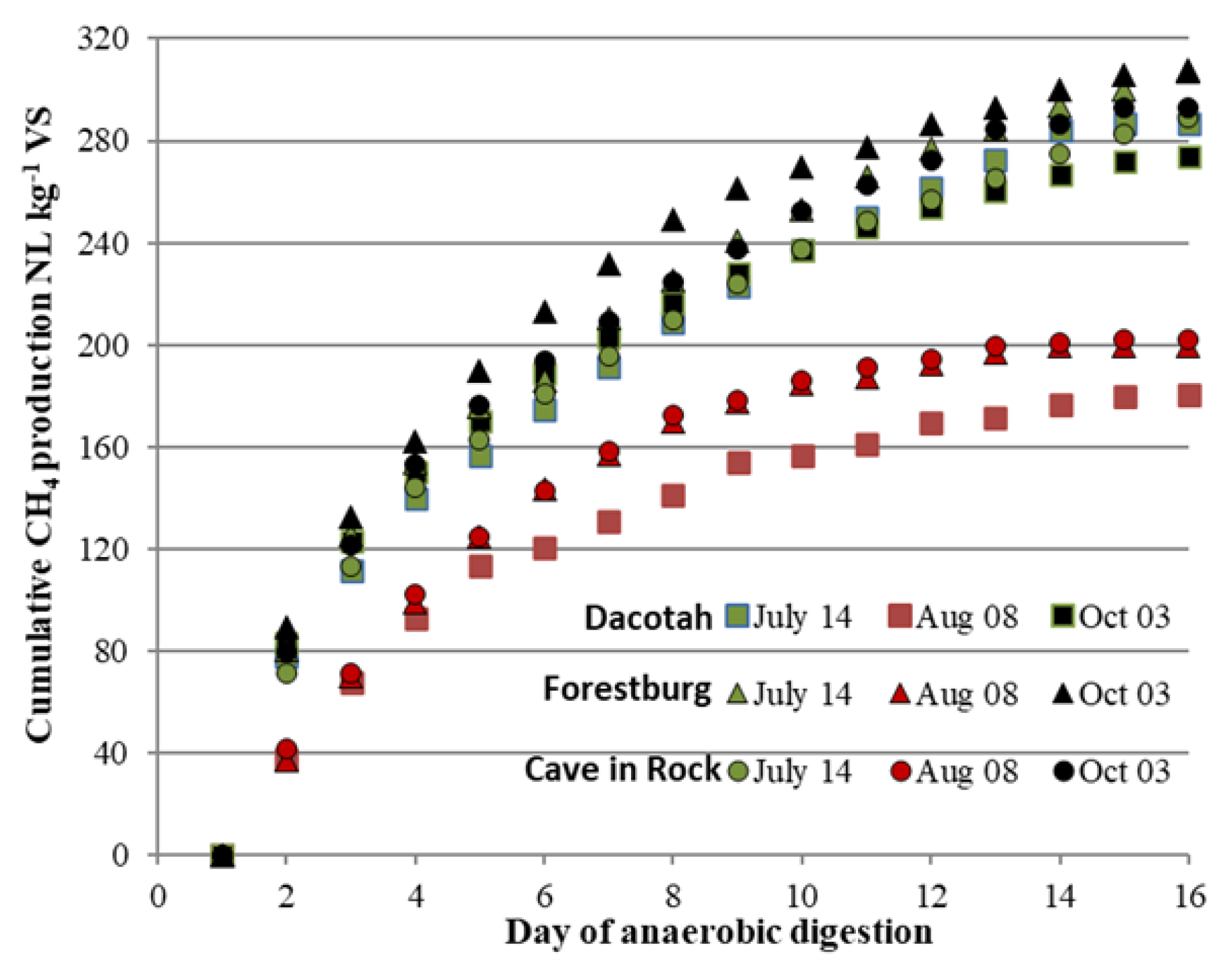
Figure 2.
Daily methane production from anaerobically digested wet biomass of three switchgrass cultivars harvested at different dates (1st day – start of AD experiment).
Figure 2.
Daily methane production from anaerobically digested wet biomass of three switchgrass cultivars harvested at different dates (1st day – start of AD experiment).
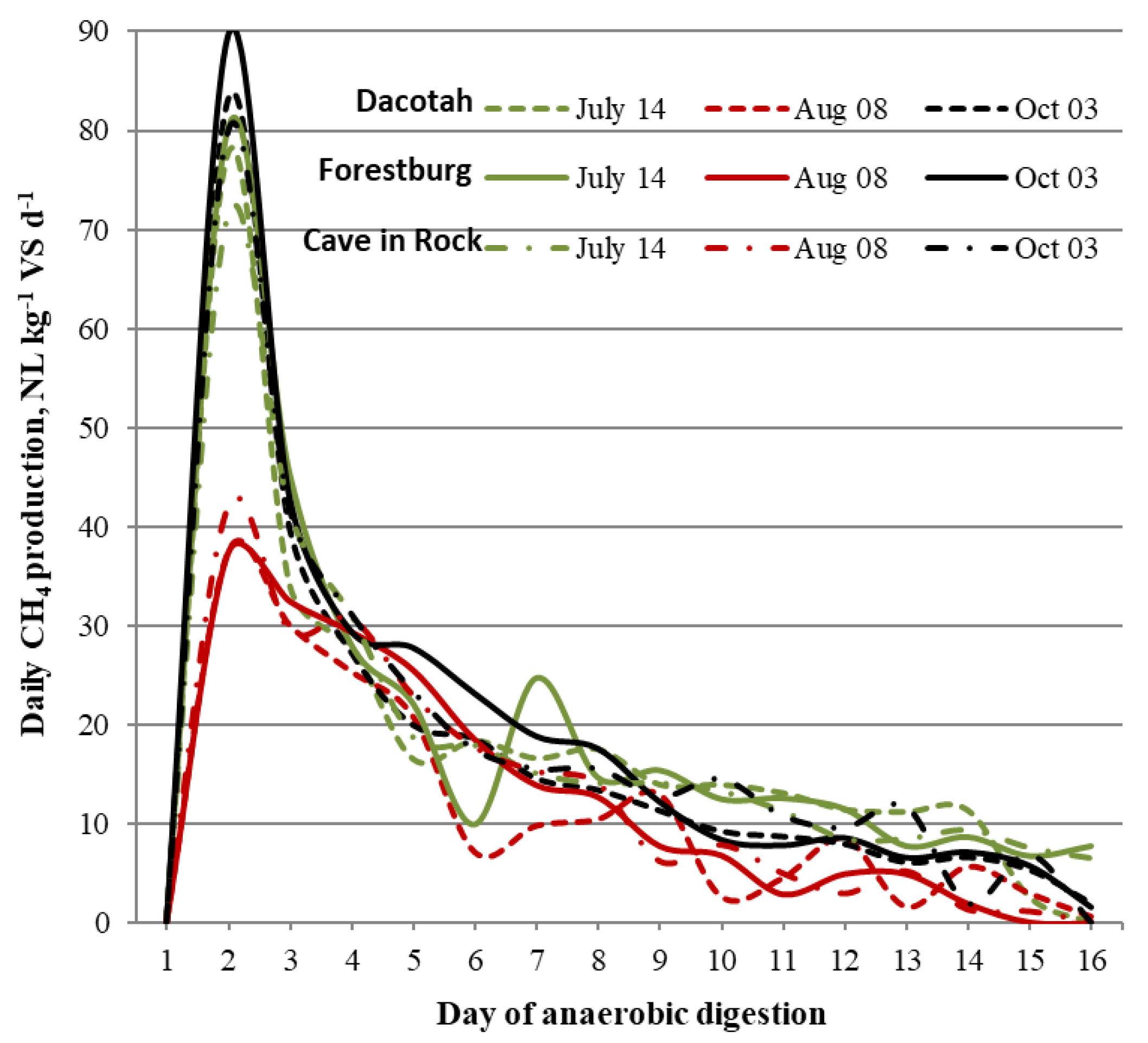
Figure 3.
Specific methane yield for three switchgrass cultivars at the end of anaerobic digestion as influenced by different harvest date. The different letters a and b on the column indicate significant differences (P < 0.05) in CH4Y between harvest date within switchgrass cultivar and the different letters x, y and z indicate significant differences (P < 0.05) in CH4Y between switchgrass cultivars of the same harvest date.
Figure 3.
Specific methane yield for three switchgrass cultivars at the end of anaerobic digestion as influenced by different harvest date. The different letters a and b on the column indicate significant differences (P < 0.05) in CH4Y between harvest date within switchgrass cultivar and the different letters x, y and z indicate significant differences (P < 0.05) in CH4Y between switchgrass cultivars of the same harvest date.
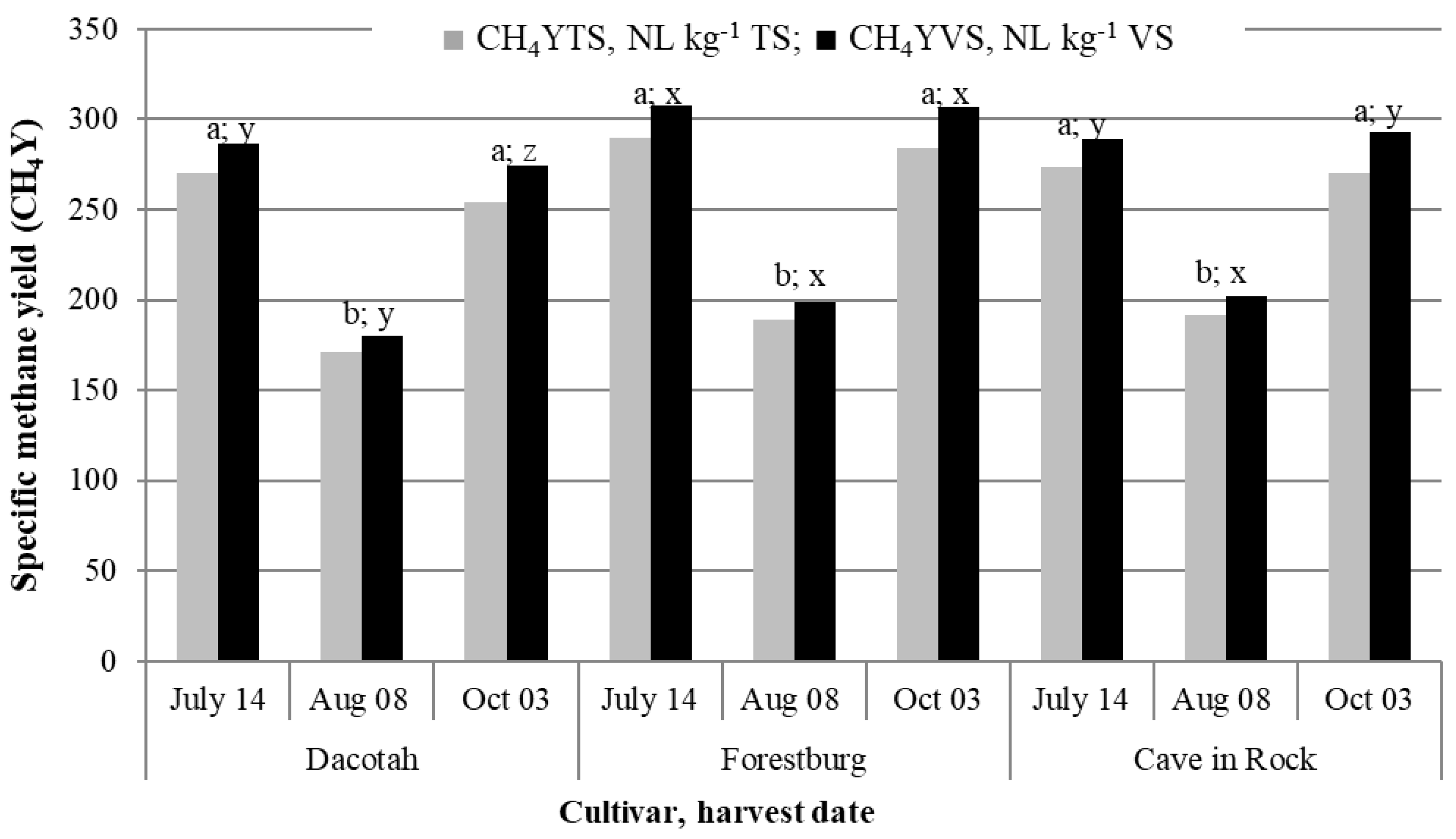
Figure 4.
Pearson correlations among specific methane yield (CH4YTS) and chemical characteristics of switchgrass biomass and silage. According to statistical significance, the reported correlations are coloured as follows: significant at p ≤ 0.01 (■ - negative, ■ - positive), at p ≤ 0.05 (■ - negative, ■ - positive) and not significant (■ - negative, ■ - positive). CH4YTS specific methane yield on a TS basis; Components of plant biomass: NDF neutral detergent fibre; ADF acid detergent fibre; ADL acid detergent lignin; N nitrogen; C carbon; C/N C to N ratio; HCel hemicellulose; CEL cellulose; WSC water-soluble carbohydrates; characteristics of ensiled switchgrass: TS total solids; VS volatile solids.
Figure 4.
Pearson correlations among specific methane yield (CH4YTS) and chemical characteristics of switchgrass biomass and silage. According to statistical significance, the reported correlations are coloured as follows: significant at p ≤ 0.01 (■ - negative, ■ - positive), at p ≤ 0.05 (■ - negative, ■ - positive) and not significant (■ - negative, ■ - positive). CH4YTS specific methane yield on a TS basis; Components of plant biomass: NDF neutral detergent fibre; ADF acid detergent fibre; ADL acid detergent lignin; N nitrogen; C carbon; C/N C to N ratio; HCel hemicellulose; CEL cellulose; WSC water-soluble carbohydrates; characteristics of ensiled switchgrass: TS total solids; VS volatile solids.
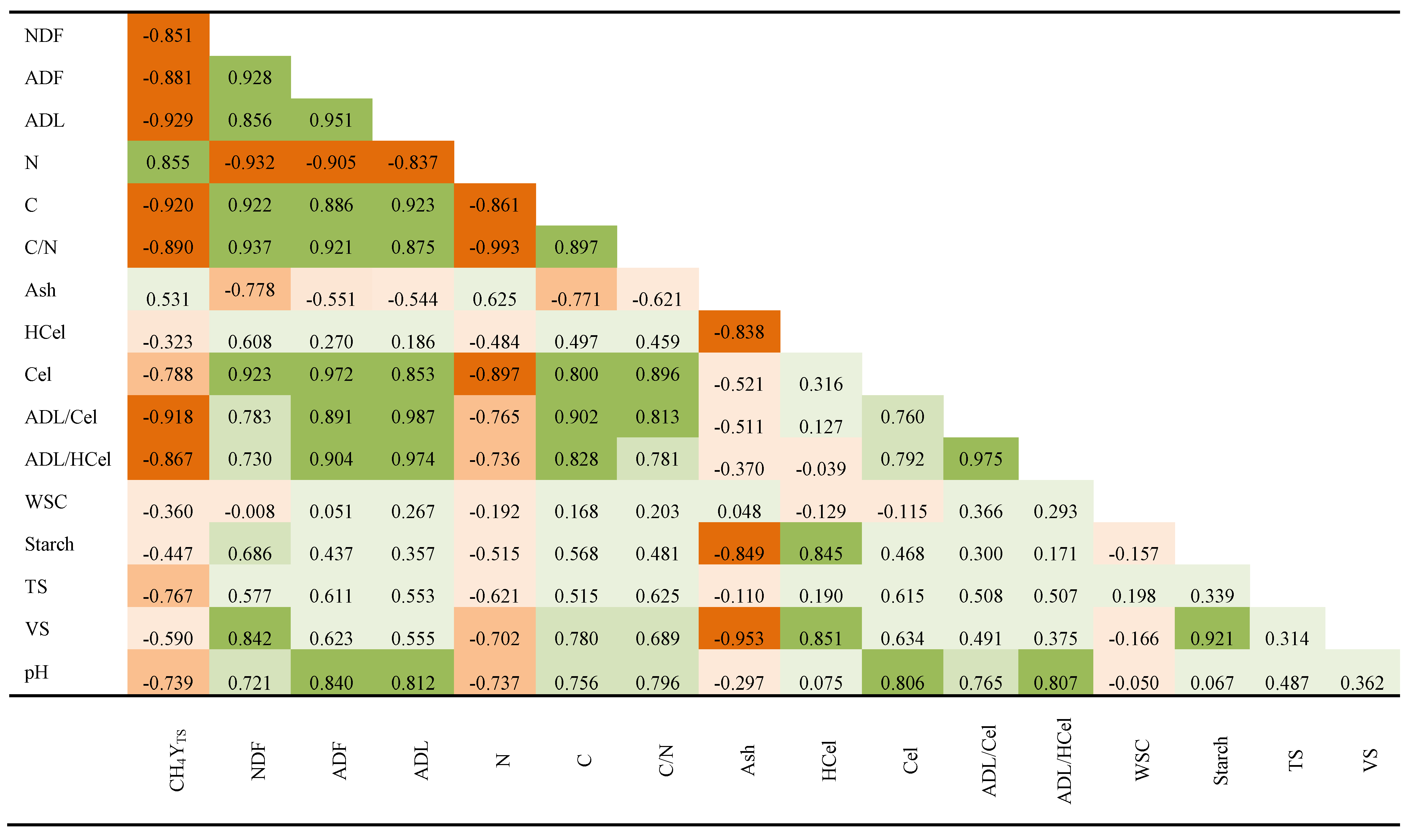

Table 1.
The chemical properties of soil arable layer at the experimental plots.
| Year | Soil property | ||||||
| Corg. | N-NO3 | N-NH4 | K2O | P2O5 | S | pHKCl | |
| g kg-1 | mg kg-1 | ||||||
| Before establishment of experiment in 2014 | 21.3 | 7.60 | 1.80 | 158 | 196 | 2.5 | 6.8 |
| After the investigation in 2016 | 23.1 | 4.29 | 1.59 | 162 | 154 | 1.7 | 6.9 |
Table 2.
Harvest dates and growth stage of switchgrass cultivars.
| Harvest regime | Cut | Harvest date | Growth stage | ||
| ‘Dacotah’ | ‘Foresburg’ | ‘Cave in Rock’ | |||
| I | First | July 13 | Heading | Heading | Booting |
| Second | October 06 | Regrowth of aftermath | |||
| II | First | August 08 | Flowering | Flowering | Heading |
| Second | October 06 | Regrowth of aftermath | |||
Table 3.
Mean values of the biomass chemical composition of three switchgrass cultivars at three harvest dates.
Table 3.
Mean values of the biomass chemical composition of three switchgrass cultivars at three harvest dates.
| Cultivar | Harvestdate | NDF | ADF | ADL | WSC | Starch | Ash | N | C | Cel | HCel | C/N | ADL/Cel | ADL/HCel | Silage characteristics | ||
| g kg-1 DM | pH | TS,% WM | VS,% TS | ||||||||||||||
| Dacotah | July 14 | 697 b; x | 418 b; x | 62.4 b; x | 65.9 b; y | 91.7 a; x | 52.3 b; x | 10.30 a; x | 481 b; x | 356 | 279 | 46.7 b; x | 0.175 | 0.223 | 4.2 | 32.8 | 94.3 |
| Aug 08 | 736 a; y | 440 a; y | 74.3 a; y | 95.0 a; x | 99.5 a; x | 49.3 c; x | 7.79 b; x | 486 a; y | 366 | 296 | 62.4 a; y | 0.203 | 0.251 | 4.4 | 42.4 | 94.9 | |
| Oct 03 | 666 c; x | 405 b; x | 58.6 c; x | 70.1 b; z | 60.6 b; x | 66.9 a; x | 11.10 a; x | 480 b; x | 346 | 261 | 43.4 b; y | 0.169 | 0.224 | 4.4 | 37.2 | 92.6 | |
| Forestburg | July 14 | 694 b; x | 400 b; y | 51.4 b; y | 61.5 c; y | 80.5 a; y | 51.9 b; x | 10.30 a; x | 481 b; x | 349 | 294 | 46.7 c; x | 0.147 | 0.175 | 4.2 | 31.9 | 94.1 |
| Aug 08 | 745 a; x | 457 a; x | 79.7 a; x | 72.5 b; z | 80.7 a; y | 49.0 c; x | 7.18 c; y | 488 a; x | 377 | 288 | 67.9 a; x | 0.211 | 0.277 | 5.1 | 37.4 | 94.9 | |
| Oct 03 | 669 c; x | 402 b; x | 53.3 b; y | 86.5 a; y | 58.8 b; x | 67.0 a; x | 9.60 b; y | 478 c; y | 349 | 267 | 49.8 b; x | 0.153 | 0.200 | 4.2 | 34.6 | 92.4 | |
| Cave inRock | July 14 | 679 b; y | 384 b; z | 50.6 c; y | 79.7 c; x | 90.8 a; x | 49.1 b; y | 10.20 b; x | 482 b; x | 334 | 294 | 47.2 b; x | 0.152 | 0.172 | 4.0 | 32.4 | 94.7 |
| Aug 08 | 734 a; y | 454 a; x | 83.3 a; x | 89.6 b; y | 82.7 b; y | 45.7 c; y | 7.76 c; x | 488 a; x | 371 | 280 | 62.9 a; y | 0.225 | 0.298 | 4.6 | 34.5 | 94.8 | |
| Oct 03 | 654 c; y | 385 b; y | 57.8 b; x | 98.4 a; x | 55.4 c; x | 61.2 a; y | 11.40 a; x | 480 b; x | 328 | 269 | 42.1 c; y | 0.176 | 0.215 | 4.2 | 30.8 | 92.3 | |
The different letters a, b and c in the column indicate significant differences (P < 0.05) in concentration of respective biomass component within switchgrass cultivar for harvest date, and the different letters x, y and z indicate significant differences (P < 0.05) in the component concentration between switchgrass cultivars of the same harvest date.
Table 4.
The percentage of methane produced during the first four days of the BMP experiment.
| Day of BMP assay | CH4, % CH4YVS | ||||||||
| Dacotah | Forestburg | Cave in Rock | |||||||
| July 14 | Aug 08 | Oct 03 | July 14 | Aug 08 | Oct 03 | July 14 | Aug 08 | Oct 03 | |
| 2nd | 27.1 | 20.8 | 30.4 | 26.1 | 18.7 | 29.2 | 24.7 | 20.8 | 27.3 |
| 3rd | 11.9 | 16.6 | 14.5 | 14.7 | 16.3 | 14.0 | 14.4 | 14.6 | 14.2 |
| 2nd+3rd | 39.0 | 37.4 | 44.9 | 40.8 | 35.0 | 43.1 | 39.1 | 35.4 | 41.5 |
| 4th | 9.77 | 14.1 | 10.0 | 9.11 | 14.7 | 9.57 | 10.8 | 15.2 | 10.6 |
| 2nd+3rd+4th | 48.8 | 51.4 | 54.8 | 49.9 | 49.8 | 52.7 | 49.8 | 50.6 | 52.2 |
Table 5.
Area specific methane and energy yields.
| Cultivar | Harvest date of the first cut (Harvest regime) | CH4YTS, Nm3 ha-1 from biomass of | HHVY GJ ha-1 | LHVY GJ ha-1 | ||
| first cut | second cut | annual | annual | annual | ||
| Dacotah | July 14 (I) | 862 | 266 | 1128 | 44.9 | 40.4 |
| Aug 08 (II) | 828 | 59† | 888 | 35.3 | 31.8 | |
| Average | 845 | 163 | 1008 | 40.1 | 36.1 | |
| Forestburg | July 14 (I) | 1211 | 522 | 1732 | 68.9 | 62.0 |
| Aug 08 (II) | 1247 | 85† | 1332 | 53.0 | 47.7 | |
| Average | 1229 | 304 | 1532 | 61.0 | 54.9 | |
| Cave in Rock | July 14 (I) | 1148 | 752 | 1900 | 75.6 | 68.0 |
| Aug 08 (II) | 1004 | 206† | 1210 | 48.2 | 43.3 | |
| Average | 1076 | 479 | 1555 | 61.9 | 55.7 | |
| Average for three cultivars | July 14 (I) | 1074 | 514 | 1587 | 63.2 | 56.8 |
| Aug 08 (II) | 1026 | 117 | 1143 | 45.5 | 40.9 | |
† not investigated for methane production, computed using CH4YTS values for regrowth of respective cultivar when the first cut was performed at heading stage.
Disclaimer/Publisher’s Note: The statements, opinions and data contained in all publications are solely those of the individual author(s) and contributor(s) and not of MDPI and/or the editor(s). MDPI and/or the editor(s) disclaim responsibility for any injury to people or property resulting from any ideas, methods, instructions or products referred to in the content. |
© 2025 by the authors. Licensee MDPI, Basel, Switzerland. This article is an open access article distributed under the terms and conditions of the Creative Commons Attribution (CC BY) license (http://creativecommons.org/licenses/by/4.0/).
Copyright: This open access article is published under a Creative Commons CC BY 4.0 license, which permit the free download, distribution, and reuse, provided that the author and preprint are cited in any reuse.


