
Submitted:
06 May 2025
Posted:
08 May 2025
You are already at the latest version
Abstract
Dried distillers grains (DDG) have become a popular protein source in poultry rations. Technology has allowed distillers grain producers to fraction out part of the fiber component utilizing a patented fiber separation process (ICM , Inc. Colwich, Kansas). Two Hi-Pro DDG products were investigated in laying hen diets at inclusion rates of 0,5,10 or 15% of a balanced ration with corn and soybean meal. Hi-Pro DDG 1 had 40.3 % protein with added yeast and Hi-Pro DDG2 had 39.1 % protein with no added yeast. White Leghorn laying hens were housed in cages from 21 to 43 wks of age. There were no significant effects of DDG source or level on any production variable except egg yolk color. Significant time x diet interactions were found for EP (p < 0.02), and yolk color score (p < 0.003). Egg production improved during the later weeks of the trial in hens fed the diets with either DDG source at 15% of the ration. Yolk color score increased as either source of DDG level increased in the diet but did show some decrease over time regardless of treatment. DDG source or level did not significantly affect FI, EW, or hen wts. In summary, hens can be safely fed up to 15% of Hi-Pro DDG products with or without yeast with no detrimental effects on FI , EWt in laying hens and with some improvements to yolk color and EP shown in later stages of EP.
Keywords:
Hi-Pro DDG
; dried distillers grain
; leghorn hens
; egg production
1. Introduction
The US ethanol industry is one of the largest producers of low cost, animal nutrition products both domestically and internationally. In 2024, 36 million metric tons of dried distillers grains and corn gluten meal were produced in the US (RFA, 2024), of which a third was exported. As feed costs continue to rise, nutritionists look for ways to combat this through alternative ingredients, using byproducts like dried distillers grains (DDG). DDG have a moderate level of protein but are also somewhat high in fiber which is not a nutrient required by poultry (NANP, 2025).
Distillers grains have been successfully fed to laying hens at levels up to 25% of balanced rations with equal performance for egg production and hen wt. gain (Masa’deh et al, 2011). Improvement in yolk color score was noted by Masa’deh et al., 2011, due to the increase in carotenoids contained in DDGs vs corn or soybean meal. These results were confirmed, with no treatment effects on egg production, feed intake or egg and eggshell parameters by Swiatkiewicz et al, 2013; El-Sheikh, and Salama. 2020. However, feeding up to 40% DDGs to laying hens has shown some significant differences in feed intake, feed conversion ratio, egg production, egg weight, and Haugh unit (Olofintoye and Bolu, 2013). This suggests that there may be an ideal, or a maximum, level that DDG can be effectively fed to laying hens.
Studies have been conducted in broiler chickens with 10% DDG with and without yeast products (Alizadeh et al, 2016a,b) who concluded that growth performance and feed intake did not differ between treatment groups.
High protein DDG is produced from a patented fiber separation process to result in a more concentrated form of DDG with a higher protein content and the potential to replace portions of soybean meal and corn in poultry diets. The process washes and separates fiber from the corn mash and adds enzymes that convert starch to sugar. Grains are then separated and dried without solubles or fiber fractions. This process results in a higher protein product that is hypothesized to improve digestion in monogastrics (ICM 2025, Inc, Colwich, Kansas), Bottger and Sudekum, 2018.
2. Materials and Methods
2.1. Birds and Housing
A flock of 216 Shaver White Leghorn chickens was used for this study, with 3 hens per cage and 9 replicate cages per treatment (Shaver Poultry, Boxmeer, The Netherlands-EU). Hens were 21 weeks of age at the start of the trial, and the trial ran to 44 weeks of age. Hens were housed in a Chore-Time cage system that consisted of two sides containing 3 rows of wire cages separated vertically by manure belts (CTB, Inc., Milford, IN). Each hen had 688.17 cm2 of floor space. Hens were fed 110 gm of feed per day, and water was available ad libitum via nipple drinkers at the back of each cage. The photoperiod followed the Shaver White breed guidelines: 15 hours of light and 9 hours of dark for the entire length of the study. The cage unit was separated into blocks, and cages in each block were randomly assigned to 1 of 8 treatment groups in a Randomized Complete Block Design. The conditions of the trial were approved by the Institutional Animal Care and Use Committee at the University of Nebraska – Lincoln and the trial was held in a secure section of the Animal Science Complex. This trial was designed to be 25 weeks total; however, we were forced to end a few weeks early (22 weeks) due to the COVID-19 shutdown at the University of Nebraska.
2.2. Diets
The independent variable of this trial was diet and consisted of 8 treatment groups in a 2x4 factorial design. Two dried distillers products (Hi-Pro DDG1 with active yeast and Hi-Pro DDG2 without active yeast) were tested at four different levels. The DDG products were sourced from ICM, Inc (ICM, Inc, Colwich, Kansas). The control consisted of a corn-soybean basal diet, treatment 2 through 4 contained 5, 10, and 15% Hi-Pro DDG 1, and Treatment 5 through 7 contained 5, 10, and 15% Hi-Pro DDG2. Rations are shown in Table 1. Diets were formulated to be equal in metabolizable energy, lysine and total sulfur amino acid content. Feed and DDG 1 and 2 samples were sent to Midwest Labs (Omaha, NE) for protein, Ca and P analyses. Hi-Pro DDG1 had 40.3% Protein, .59% Phosphorus and .05% Calcium and Hi-Pro DDG2 had 39.1% Protein, .47% Phosphorus and .01% Calcium (Table 2). NRC (1994) nutrient values for DDG were used for formulation for amino acids and minerals not analyzed by Midwest Labs.
2.3. Measurements
Feed intake and mortality were recorded daily, beginning on d1. Average feed intake (g/bird/d) was calculated by subtracting the amount of feed remaining from the amount of feed given and then dividing it by the number of hens in each cage. Average percent egg production was calculated by taking the total number of eggs laid and dividing it by the number of hens and then multiplying by 100. Average egg weight (g) and yolk color score were measured biweekly, starting in wk 2. Average egg weight was calculated using a sample of up to three eggs per cage. Yolk color score was measured by breaking open the sample eggs and comparing yolk color to a DSM Yolk Color Fan (DSM-Firmenich, Maastricht, Netherlands/Kalseraugst, Switzerland). Average body weight (g) and eggshell breaking strength (N) was recorded monthly, or every 4 wks beginning in wk 4. Each cage was weighed as a whole, and individual bird weight was averaged by dividing the total weight in grams by the total number of hens in each cage. Eggshell breaking strength was analyzed using a texture analyzer (TA, XTPlus, Texture Technologies Corporation, Scarsdale, NY). The force in Newtons necessary to crack the eggshell was graphed using exponent software (Stable Micro Systems LTD, Surrey, UK).
2.4. Statistical Analysis
Data were analyzed using the PROC GLIMMIX procedure of SAS, version 9.4 (SAS Institute Inc., Cary, NC, 2015). All response variables were analyzed using a repeated measures model including the fixed effects of time, treatment and their interaction.
3. Results and Discussion
Commercial White Leghorn laying hen performance was evaluated when fed a basal, corn-soy diet or diets with 5, 10 or 15% of two Hi-Pro DDG products- DDG1 with active yeast cultures and Hi-Pro DDG 2 without yeast. This resulted in a slight decrease in overall corn grain inclusion and a decrease in soybean meal inclusion (Table 1). In addition, vegetable oil inclusion decreased as DDG level increased. All diets were formulated to meet NRC 1994 recommendations for actively laying White Leghorn hens in their first lay cycle, with equal protein and energy levels. (Table 2). Lab analysis values for protein, Ca and P are also given in Table 2.
Laying hens fed diets containing 0, 5, 10 or 15% of both Hi-Pro DDG products had similar feed intakes regardless of diet (Table 3), indicating good palatability of the experimental diets for laying hens. This supports the findings of Masa’deh et al. (2011), Swiatkiewicz et al. (2013), Trupia et al. (2016), and Shin et al. (2016), where hens fed up to 25% DDGs showed no differences in feed intake compared to a corn-soybean control.
Average percent egg production for hens fed diets containing 5, 10 and 15% Hi-Pro DDG1 ranged from 91.40% to 95.80%, and Hi-Pro DDG2 ranged from 90.90% to 96.7%, compared to hens fed a corn-soybean diet, which was 94.00% overall. No statistically significant differences between dietary treatments were found. This aligns with previous research, when birds were fed up to 25% DDGs showed no significant difference in egg production (Masa’deh et al, 2011; Swiatkiewicz et al, 2013; Trupia et al, 2013; and Shin et al, 2016. There were differences in time (p < 0.0001) and there was an interaction between treatment and time (p<.05). Throughout the course of this study, overall percent egg production decreased as hens aged. During week 5, birds fed diets with 5% Hi-Pro DDG2 displayed a spike in egg production. Whereas during week 15, birds fed diets fed 5% Hi-Pro DDG2 noted a numerical drop in egg production.
No differences in body weight were observed due to treatment, or a treatment by time interaction. However, a time effect was noted (p < 0.0001). Throughout the study, bird weight increased overall. This aligns with an expected slow increase in body weight as the hen ages (Shaver, 2024). Hens may gain weight as egg production drops with age. Additionally, this agrees with observations by Masa’deh et al. (2011) and Trupia et al. (2016), where hens fed diets containing up to 25% DDGs were similar in body weight to hens fed a corn-soybean control diet.
Hens fed diets containing 5, 10 or 15% HiPro DDG with or without yeast or the control, corn-soybean diet laid eggs that averaged between 53.0 and 56.0 grams. No significant treatment effects or treatment by time effects were found for average egg weight. This confirms findings of Swiatkiewicz et al. (2013), in which hens fed up to 20% DDGs laid eggs comparable in weight to hens fed a corn-soybean meal based diet. However, this opposes the findings of Masa’deh et al. (2011), in which hens fed diets including up to 25% DDGs had lower egg weights during phase I of lay when compared to eggs laid by hens fed diets of corn-soybean. Additionally, a time effect was seen (p < 0.0001, Figure 4). Overall egg weight increased with time, as expected with aging hens. Hens fed 15% HiPro DDG2 showed a slightly higher egg weight for the second half of the trial, most notably in week 16.
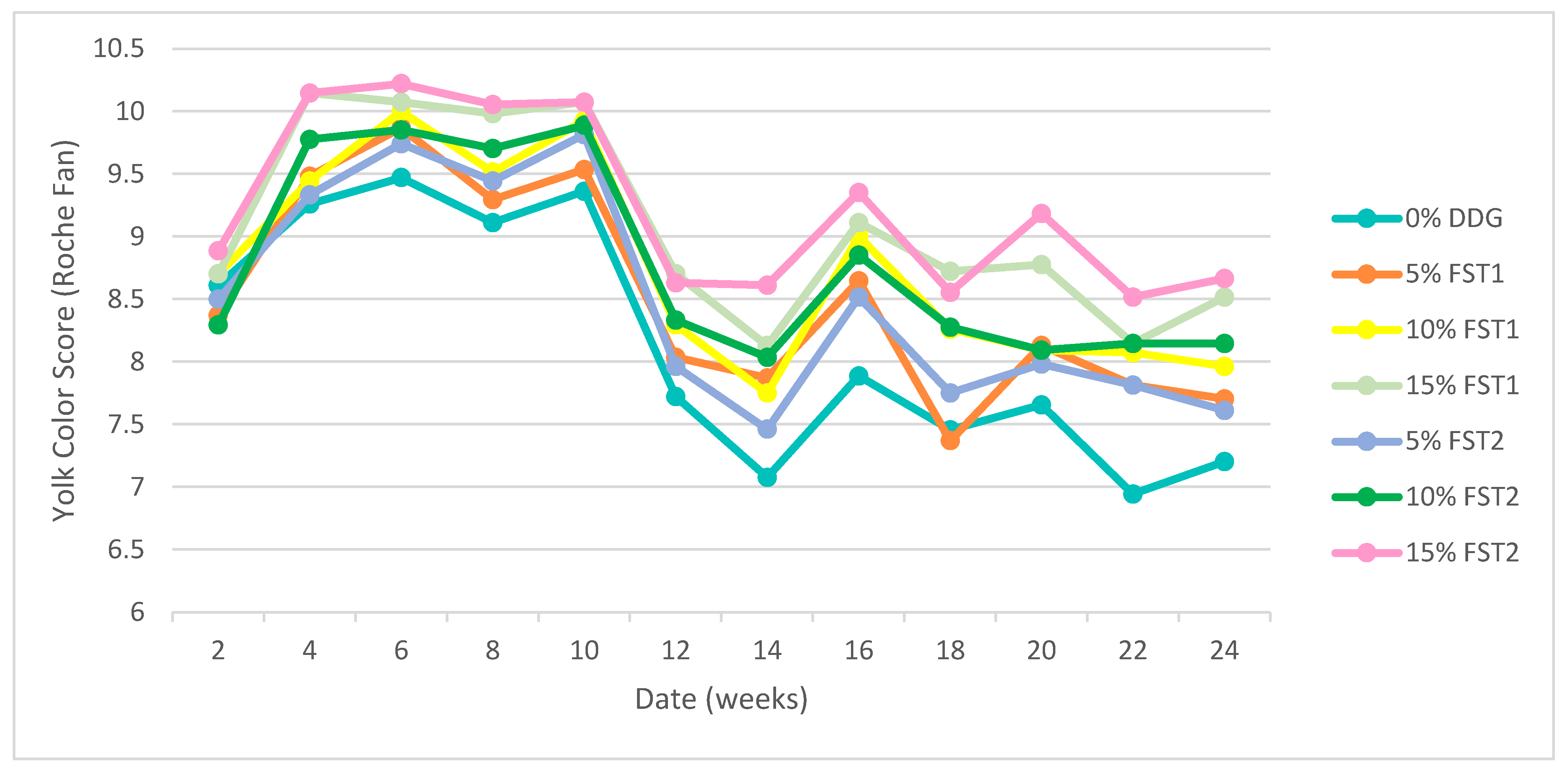
Yolk color score was higher (p < 0.0001) for eggs from hens fed either DDG product when compared to the control group. Yolk color score for hens fed 5, 10 and 15% H-iPro DDG1 with yeast averaged 8.51 to 9.09, hens fed 5, 10 and 15% Hi-Pro DDG2 without yeast averaged 8.42 to 9.24. Hens fed a corn-soybean control diet had an average yolk color score of 8.04. This correlates with the increase in pigment (carotenoids) of DDG products compared to corn grain or soybean meal. Hens will metabolize and transfer the pigment from either DDG product into the yolk, resulting in a darker yolk compared to hens fed a paler corn-soybean feed (Ghazalah et al, 2011). Yolk color score also increased as DDG inclusion increased, further supporting the transfer of pigment. Market trends indicate the average US consumer prefers a darker yolk (Fluck et al, 2023). In addition, there was a time effect (p < 0.00001, Figure 2), and a treatment and time interaction (p = 0.003) with yolks getting lighter as the trial progressed. This agrees with the results of Masa’deh et al. (2011), in which yolk color score increased as DDG inclusion increased, when hens were fed up to 25% DDGs.
Eggshell breaking strength from hens fed 5, 10 or 15% Hi-Pro DDG with or without yeast, or the control, corn-soybean diet ranged from 63.30 to 67.32 newtons. Treatment had no effect on eggshell breaking strength. However, a time affect was noted (p < 0.0001). Eggshell strength decreased as the trial went on, which is consistent with expectations of aging birds. The eggshell thins as egg size increases with age, resulting in a weaker shell. In addition, there was a treatment by time interaction. Hens fed 15% Hi-Pro DDG2 showed a spike in eggshell strength in month 4 compared to all other treatments.
4. Conclusions
- The Hi-Pro DDG products used for this project are more concentrated with lower fiber and higher protein due to a patented fiber separation technology, replacing corn and soybean meal in the final diet rations.
- Overall, findings indicated that when feeding Hi-Pro DDG with or without yeast at 5, 10 or 15%, hens consumed equal amounts of feed and performed comparably to the hens fed a corn-soy control diet.
- Eggs from hens fed up to 15% Hi-Pro DDG have higher yolk color score compared to eggs from hens fed a corn-soy control diet.
Figure 1.
Average percent egg production for hens fed diets containing 0, 5, 10 and 15% FST1 Hi-Pro DDG with yeast or FST2 Hi-Pro DDG without yeast[1].[1] p-values: TRT=0.NS, Time<0.0001, TRT x Time=0.0206.
Figure 1.
Average percent egg production for hens fed diets containing 0, 5, 10 and 15% FST1 Hi-Pro DDG with yeast or FST2 Hi-Pro DDG without yeast[1].[1] p-values: TRT=0.NS, Time<0.0001, TRT x Time=0.0206.
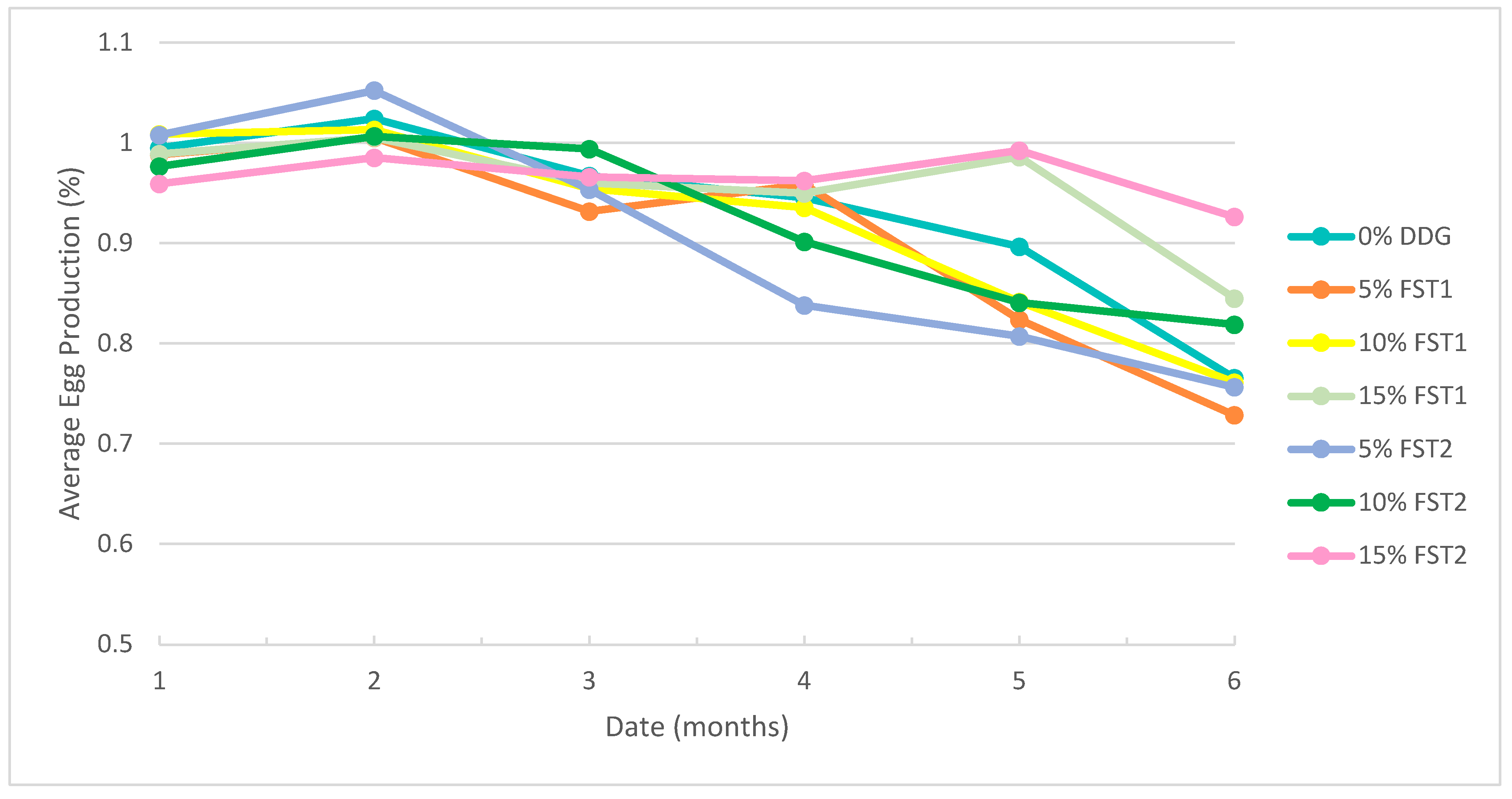
Figure 2.
Average yolk color score for hens fed diets containing 0, 5, 10 and 15% Hi-Pro DDG1 with yeast or Hi-Pro DDG2 without yeast[2] [1] p-values: TRT<0.0001. Time<0.0001, TRT x Time=0.0032.
Figure 2.
Average yolk color score for hens fed diets containing 0, 5, 10 and 15% Hi-Pro DDG1 with yeast or Hi-Pro DDG2 without yeast[2] [1] p-values: TRT<0.0001. Time<0.0001, TRT x Time=0.0032.
Author Contributions
Conceptualization, Purdum and Foley; Methodology, Purdum and Foley; Investigation: Purdum and Foley; Data Curation: Foley; Resources, Purdum; Original Draft and Writing, Foley; Review and Editing, Purdum and Karr; Supervision and Project Administration, Purdum; Funding Acquisition, Purdum. .
Funding
This research was supported by a grant from ICM Inc., (ICM, Inc, Colwich, Kansas). to the University of Nebraska. ICM also provided the 2 Hi-Pro DDG products for this research. .
Data Availability
Data is available at the University of Nebraska, Dept. of Animal Science at UNL One Drive – 19-PO2 file, Lincoln, NE. 68583.
Acknowledgments
This work is/was supported (in part), by (Multistate) Hatch funds from the USDA National Institute of Food and Agriculture.
Conflicts of Interest
The authors declare that they have no conflict of interest.
References
- Alizadeh, M., A. Rogiewicz, E. McMillan, J. C. Rodriguez-Lecompte, R. Patterson, and B. A. Slominski. Effect of yeast-derived products and distillers dried grains with solubles (DDGS) on growth performance and local innate immune response of broiler chickens challenged with Clostridium perfringens. Avian Pathology. 2016, 45, 334–345.
- Alizadeh, M., J. C. Rodriguez-Lecompte, A. Rogiewicz, R. Patterson, and B. A. Slominski. Effect of yeast derived products and distillers dried grains with solubles (DDGS) on growth performance, gut morphology, and gene expression of pattern recognition receptors and cytokines in broiler chickens. Poult. Sci. 2016, 95, 507–517. [Google Scholar] [PubMed]
- Bottger, C and K. H. Sudekum. Review: protein value of distillers dried grains with solubles (DDGS) in animal nutrition as affected by the ethanol production process. Ani. Feed Sci. and Tech. 2018, 244, 11–17. [Google Scholar] [CrossRef]
- El-Sheikh, S. E. M. , and A. A. Salama. Utilization of dry corn grains distillation by-product with soluble (DDGS) as an alternative non-conventional feed stuff in laying hen diets. Egyption J. Nutr. And Feeds. 2020, 23, 473–483. [Google Scholar] [CrossRef]
- Fluck, A. C., K. M. Cardinal, O. A. Denardin Costa, L. Piffer de Borba and P. Gabriela da Silva Pires. Yolk and eggshell colour: are these the parameters that influence egg purchasing? A systematic review. W. Poul. Sci. J. 2023, 79, 551–562. [Google Scholar] [CrossRef]
- Ghazalah, A. A., M. O. Abd-Elsamee and Eman, and S. Moustafa. Use of distillers dried grains with solubles (DDGS) as replacement for soybean meal in laying hen diets. Int. J. of Poult. Sci. 2011, 10, 505–513. [Google Scholar] [CrossRef]
- ICM, Inc. 2025. Fiber Separation TechnologyTM. https://icminc.com/process-technologies/fiber-separation-technology/.
- Masa’deh, M. K., S. E. Purdum, and K. J. Hanford. Dried distillers grains with solubles in laying hen diets. Poult. Sci. 2011, 90, 1960–1966. [Google Scholar] [CrossRef] [PubMed]
- Olofintoye, O. R., and S. A. Bolu. Effects of corn distillers dried grains on the performance and egg quality of laying hens. Ani. Res. Int. 2013, 10, 1665–1672.
- Renewable Fuels Association. 2025. Crucial Co-Products.https://ethanolrfa.org/upload/files/Library/Fact%20Sheet/coproducts_brief_2025.pdf.
- Shaver Poultry. 2024. Shaver commercial management guide. https://layinghens.hendrix-genetics.com/en/technical-support/.
- Shin, H. S., J. W. Kim, J. H. Kim, D. G. Lee, S. Lee, and D. Y. Kil. Effect of feeding duration of diets containing corn distillers dried grains with solubles on productive performance, egg quality, and lutein and zeaxanthin concentrations of egg yolk in laying hens. Poult. Sci. 2016, 95, 2366–2371.
- Swiatkiewicz, S, A. Arczewska-Wlosek, J. Krawczyk, M. Puchala, and D. Jozefiak. Effects of selected feed additives on the performance of laying hens given a diet rich in maize dried distiller’s grains with solubles (DDGS). British Poult. Sci. 2013, 54, 478–485. [Google Scholar] [CrossRef] [PubMed]
- Trupia, S., J. K. Winkler-Moser, A. C. Guney, R. Beckstead, and C-Y. O. Chen. Nutritional quality of eggs from hens fed distillers dried grains with solubles. Poult. Sci. 2016, 95, 2592–2601. [Google Scholar] [CrossRef] [PubMed]

Table 1.
Ingredient composition of diets containing 0, 5, 10, or 15% Hi-Pro DDG1 with yeast or Hi-Pro DDG2 without yeast.
Table 1.
Ingredient composition of diets containing 0, 5, 10, or 15% Hi-Pro DDG1 with yeast or Hi-Pro DDG2 without yeast.
|
Ingredient, % |
Control: 0% DDG |
Diet 2, 5: 5% DDG |
Diet 3, 6: 10% DDG |
Diet 4, 7: 15 % DDG |
| Corn | 51.13 | 50.28 | 49.54 | 48.85 |
| Soybean Meal | 32.50 | 28.30 | 24.10 | 19.70 |
| Hi-Pro DDGa | 5.00 | 10.00 | 15.00 | |
| Vegetable Oil | 4.40 | 4.30 | 4.15 | 4.00 |
| Dicalcium Phosphorus | 1.60 | 1.60 | 1.60 | 1.55 |
| Limestone-LPL | 4.75 | 4.80 | 4.80 | 4.85 |
| Limestone - SPL | 4.75 | 4.80 | 4.80 | 4.85 |
| Salt | 0.40 | 0.40 | 0.40 | 0.40 |
| Lysine | 0.07 | 0.15 | 0.23 | |
| DL Methionine | 0.27 | 0.25 | 0.24 | 0.23 |
| Premixb | 0.20 | 0.20 | 0.20 | 0.20 |
a Hi-Pro DDG1 with yeast or Hi-Pro DDG2 without yeast, manufactured by ICM, Inc., Colwich, KS. bPremix Guaranteed Analysis - Crude Protein (min) 4%, Crude Fiber (max) 14%, Calcium (min) 2.5%, Calcium (max) 3.5%, Selenium (min) 120 ppm, Phytase (min) 68,040 FYT/lb,.
Table 2.
Calculated and analyzed dietary composition of diets containing 0, 5, 10, or 15% Hi-Pro DDG1 with yeast or Hi-Pro DDG2 without yeast.
Table 2.
Calculated and analyzed dietary composition of diets containing 0, 5, 10, or 15% Hi-Pro DDG1 with yeast or Hi-Pro DDG2 without yeast.
| Control: 0% DDG |
5% DDG |
10% DDG |
15 % DDG |
|
| Nutrienta | ||||
| Metabolizable Energy | 2900 kcal/kg | 2900 | 2900 | 2900 |
| Protein, % | 19.00 | 19.00 | 19.00 | 19.00 |
| Methionine, % digestible | 0.53 | 0.52 | 0.52 | 0.52 |
| Lysine, % digestible | 0.95 | 1.05 | 1.05 | 0.94 |
| Ca, % Analyzed Protein, % Analyzed Ca, % Analyzed Total P, % |
4.19 17.90 4.33 .70 |
4.21 18.05 4.67 .71 |
4.20 18.80 4.57 .73 |
4.21 18.55 4.84 .65 |
a Nutrient composition calculated in formulation software.
Table 3.
Effects of Hi-Pro DDG1 with yeast or Hi-Pro DDG2 without yeast on egg production parameters of White Leghorn laying hens.
Table 3.
Effects of Hi-Pro DDG1 with yeast or Hi-Pro DDG2 without yeast on egg production parameters of White Leghorn laying hens.
| Measurement | p-value | SEM | |||||||||
| 0% DDG | 5% DDG1 | 10% DDG1 | 15% DDG1 | 5% DDG2 | 10% DDG2 | 15% DDG2 | TRT | Time | TRTxTime | ||
| Feed Intake, g/bird/d | 93.40 | 94.00 | 94.40 | 95.40 | 93.70 | 93.60 | 94.60 | NS | <0.0001 | NS | 0.23 |
| Egg P, % | 94.00 | 91.40 | 92.60 | 95.80 | 90.90 | 92.80 | 96.70 | NS | <0.0001 | 0.02 | 0.09 |
| Egg Wt, g | 53.00 | 53.80 | 53.60 | 53.70 | 53.30 | 54.10 | 55.00 | NS | <0.0001 | NS | 0.11 |
| Hen Wt, g | 1508 | 1513 | 1500 | 1491 | 1525 | 1507 | 1503 | NS | <0.0001 | NS | 3.68 |
| Yolk Color Score | 8.04 | 8.51 | 8.75 | 9.09 | 8.42 | 8.78 | 9.24 | <0.0001 | <0.0001 | 0.003 | 0.04 |
| Eggshell Breaking Strength, N | 66.63 | 65.90 | 65.56 | 64.87 | 63.30 | 63.27 | 67.32 | NS | <0.0001 | 0.07 | 0.45 |
Disclaimer/Publisher’s Note: The statements, opinions and data contained in all publications are solely those of the individual author(s) and contributor(s) and not of MDPI and/or the editor(s). MDPI and/or the editor(s) disclaim responsibility for any injury to people or property resulting from any ideas, methods, instructions or products referred to in the content. |
© 2025 by the authors. Licensee MDPI, Basel, Switzerland. This article is an open access article distributed under the terms and conditions of the Creative Commons Attribution (CC BY) license (http://creativecommons.org/licenses/by/4.0/).
Copyright: This open access article is published under a Creative Commons CC BY 4.0 license, which permit the free download, distribution, and reuse, provided that the author and preprint are cited in any reuse.


