

Submitted:
06 May 2025
Posted:
09 May 2025
You are already at the latest version
Abstract
In previous studies, a new methodology was developed to determine the free dispersive and polar energies, the surface energies and Lewis acid‐base parameters of polystyrene‐ divinylbenzene (S‐DVB) copolymer modified by melamine, 5‐Hydroxy‐6‐methyluracil, and 5‐ fluouracil. In this paper, we were interested in the determination of the work of adhesion of solvents on the modified copolymer as a function of temperature and for the different modifiers with the help of the inverse gas chromatography at infinite dilution. The variations of the London dispersive and polar surface properties of copolymers against the temperature led to the determination of the different acid‐base components of their surface energies. Using Fowkes’s equation, van Oss ‘s relation, and Owens’s concept, we obtained the variations of the dispersive and polar works of adhesion of the different solid surfaces as well as the corresponding forces of interaction between the organic solvents and the modified copolymer. It was showed that the work of adhesion is function of two thermodynamic variables: the temperature and the modifier percentage.
Keywords:
adhesion
; adsorption
; surfaces and interfaces
; Hamieh thermal model
; surface enthalpy and entropy of adhesion
; Fowkes’s equation
; van Oss ‘s method
The study of surface interactions between polymers and solvents is fundamental in many technological and industrial applications such as adsorption, swelling, diffusion, composite fabrication, coatings and adhesives to membrane separations, and adhesion. Polymer surfaces and interfaces play an essential role in many commercial applications of polymers, such as coatings, adhesives, blends, packaging, resists, building, engineering, and biomedical industries. Understanding the interaction processes taking place at interfaces is, therefore, increasingly important for the wide variety of polymer uses. The most important parameter that governs such interfacial interactions is the work of adhesion (Wₐ), which quantifies the energy required to separate two phases in contact, solid or a liquid solvent, and a solid polymer surface [1,2]. Understanding the thermodynamics and molecular mechanisms that dictate solvent adhesion to polymer or copolymer surfaces is essential for controlling wettability, solvent uptake, film stability, and interfacial compatibility [3,4]. The strength of adhesion to a solid surface can be estimated from a value of the thermodynamic “work of adhesion”, , a concept first introduced by Harkins [5] using the various surface tensions intervening when a liquid adheres to a solid.
The adhesion process was described in classical interfacial thermodynamics, using surface tensions and contact angle measurements and utilizing the work of Harkins [5] and the Young-Dupré equation [6,7]. Later, models were proposed by Fowkes [8], Owens-Wendt [9], and van Oss et al. [10,11] taking into account intermolecular forces, including dispersive, polar, and acid-base interactions [8,9,10,11]. These models provided a more comprehensive understanding of the thermodynamic equilibrium at the solid-liquid interface, especially when dealing with chemically complex or functionalized polymer surfaces.
Polymers and copolymers, such as polystyrene, polymethyl methacrylate (PMMA), and styrene–divinylbenzene (S–DVB) resins, exhibit different chemical functionalities, crosslinking densities, and very interesting morphologies. These properties play a key role in how solvents interact at the surface and in the bulk [12,13]. Moreover, the choice of solvent, characterized by its polarity, hydrogen bonding capacity, and molecular size, directly influences its adsorption behavior and the resulting adhesion energy [13,14]. The synergy between solvent properties and polymer surface energetics thus determines the degree of solvent penetration, polymer swelling, and final desorption dynamics [15].
Despite the crucial role played by adhesion, a rigorous understanding of solvent-polymer adhesion remains elusive due to the complex interplay of a large number of physical, mechanical, thermodynamic, and chemical factors. However, recent advances in experimental techniques, such as contact angle goniometry, isothermal titration calorimetry (ITC), and inverse gas chromatography (IGC), have allowed more precise quantification of adhesion energies and provided a better understanding of solvent-surface interactions at the molecular level [2,12].
In this paper, we aim to provide a new way to determine the work of adhesion of solvents on the surfaces of polymers or copolymers such as polystyrene-divinylbenzene (S-DVB) copolymer modified by several molecules or supramolecules that have had great success in biochemical and pharmaceutical applications. This study is based on the theoretical models that have been validated by experimental results such as the Hamieh thermal model [16,17,18,19,20,21] and the separation method of the London dispersive and polar free energy of adsorption [22,23] using the well-known inverse gas chromatography (IGC) technique [24,25,26,27,28,29,30,31,32,33,34] at infinite dilution. This research used our new results on the different surface properties of modified copolymers [35,36,37] to determine the work of adhesion of the various organic model solvents on S-DVB copolymer versus the modifier percentage and the temperature.
2. Materials and Methods
2.1. Materials and Technique
The different organic solvents, modifiers, the S-DVB copolymer, and their origins were described in previous papers [35,36,37]. The chromatographic measurements of the retention volume of the various organic adsorbed on the modified S-DVB, as well as the IGC technique, and the experimental procedure were the same as those given in previous works [35,36,37].
2.2. Thermodynamic Methods
2.2.1. Surface Energy Parameters of Modified Copolymers
The application of the Hamieh thermal model allowed obtaining the correct London dispersive surface energy of the S-DVB copolymer respectively modified by melamine [35], 5-hydroxy-6-methyluracil [36], and 5-fluouracil [37], for percentages varying from 1% to 10% and the temperature from 443.15 K to 473.15 K. Whereas, the new applied methodology led to the separation between the dispersive free energy and the polar free energy of adsorption of the various organic adsorbed on the modified S-DVB copolymer at different temperatures.
Denoting the polar surface energy of the modified copolymer, the total surface energy can be written as follows:
Applying the Van Oss et al.’s method [11] to the modified copolymers, it was possible to obtain the different values of the Lewis acid , and base surface energies using the following expression of and the well-known surface parameters of two polar solvents such as ethyl acetate and dichloromethane:
Equation (2) led to the values of the acid-base surface energy or of the solid surfaces with the help of Relation (3):
2.2.2. Surface Energy and Work of Adhesion
Considering a liquid of known surface tension in contact with a simple solid, smooth, homogeneous, non-deformable and isotropic surface, the corresponding work of adhesion can be then written as:
Where is the solid/liquid interface tension.
Young [38] proposed the following equation:
by defining the concept of the contact angle formed between the liquid drop and the plan solid surface.
Whereas, Dupré [7] used the Young’s equation and expressed the work of adhesion by Equation (6):
Fowkes [8] applied the geometric mean of the dispersive components of the solid and liquid and proposed a new expression of the work of adhesion:
where Equation (7) is only valid for dispersive interactions.
Later, the Fowkes’s equation [8] was extended to an approach taking into account the polar contribution (hydrogen bonding) [9] in the expression of the work adhesion:
The values of and the Lewis acid , and base surface energies of solid copolymers were obtained using Van Oss et al.’s method [10] and applying Equation (9):
This allowed obtaining the polar (or acid–base) surface energy of the modified copolymers using Equation (10):
Therefore, the work of adhesion can be expressed as follows:
The different surface energy components of the modified copolymers were previously determined, it was then possible to calculate the work of adhesion with the help of Equations (11).
Furthermore, the dispersive and polar contributions of the work of adhesion can be written as follows:
3. Results
3.1. London Dispersive Surface Energy of Modified Copolymers
Based on the Hamieh thermal model [22,24] and the Fowkes’s equation [8], the representation of the variations of of n-alkanes adsorbed on the modified copolymers as a function of led to of the various copolymers against the temperatures [H1-H3]. The results were plotted in Figure 1 where a decrease of was observed as the temperature increased. The highest London dispersive surface energy was obtained with 1% melamine / S-DVB closest to of the copolymer alone, while the lowest values were shown with 10% 5-HMU / S-DVB. An important difference in of the copolymer behavior was found affected both by the modifier and its percentage. Figure 1 clearly showed a decrease in the values of of S-DVB when it was modified by 5-HMU or 5-FU certainly due to the morphology change in the copolymer structure.
The different linear equations of function of the temperature, were given in Table 1 with the values of the surface entropy and the maximum temperature of the various modified copolymers. The results in Table 1 proved a difference in the various surface thermodynamic variables of the modified copolymers. Furthermore, the abnormally high values of the London dispersive surface extrapolated at 298.15K observed in Table 1 are mainly due to the nonlinear variations of of the solid surfaces for lower temperatures resulted in the important change in the surface groups of the copolymers when the temperature undergoes severe variations from 475.15K to 298.15K.
Table 1 showed that the different values of -, , and , increased when the percentage of 5-hydroxy-6-methyluracil increased. This also showed an important effect of the surface groups of the copolymer on the London dispersive surface parameters. However, a decrease was observed in the values of when the modifier percentage increased certainly due to the decrease of for higher temperatures.
3.2. Polar (Lewis Acid–Base) Surface Energy of Modified Copolymers
First, the polar acid and base surface energies of modified copolymers were obtained using the method of van Oss et al. [10]. This led to the values of the polar surface energy and consequently to those of the total surface energy obtained as a function of temperature using the previous equations and the results of . The values of of the copolymers were given in Table 2. They showed that the modifier 2% melamine on S-DVB copolymer exhibited the highest polar surface energy followed by 5% 5-Fu / S-DVB. Whereas the lowest was observed with 1% 5-Fu / S-DVB. The results in Table 2 clearly showed the large effect of the temperature and the modifier on the polar surface energy.
To highlight the effect of the modifier percentage on of the different modified copolymers, the curves of of solid surfaces were drawn in Figure 2 as a function of the modifier percentage. The variations of for all used modifiers are not linear when the modifier percentage varies. A maximum of was observed at 2% melamine / S-DVB and a minimum at 3% of melamine for all temperatures with a pallier after 4% melamine (Figure 2a). However, a minimum of was observed at 1% of 5-HMU (Figure 2b.) and 5-FU (Figure 2c.) for the different temperatures and a pallier shown in Figure 2 after 4% of modifier on S-DVB copolymer. The results thus proved that the polar surface energy is strongly affected not only by the temperature but also by both the nature and the percentage of the modifier as it was shown in Figure 3. It seems that the S-DVB copolymer modified by melamine gives the highest at 2% melamine, while the 5-Fu on S-DVB exhibits the highest after 4% 5-Fu.
3.3. Polar Surface Energy of Organic Solvents
The polar free energy of adsorption of solvents on the various copolymers can be also written as:
Where is the polar surface energy of the solvents depending on temperature.
The variations of of the various polar solvents versus the temperature were previously determined [35,36,37]. Knowing the values of of the various copolymers and those of the surface area of the different organic molecules [16,17,18,19,20,21,22,23], the variations of were directly obtained using Equation (13). The results were plotted in Figure S1. The curves in Figure S1 showed linear variations of of the different polar solvents versus the temperature. The different equations of were given in Table 3.
Results in Figure S1 and Table 3 highlighted the important dependence of both on the temperature and the modifier percentage. It was shown that the polar surface energy of ethanol, propanol, i-propanol, and n-butanol, i-butanol and n-pentanol gave the highest values whereas cyclohexane, benzene, and toluene exhibited the lowest . Of course, the presence of hydroxyl group in these solvents strengthens their polarity relative to other polar molecules.
3.4. Work of Adhesion of Organic Solvents on Modified Copolymer
The determination of the London dispersive and polar surface energies of the various modified copolymers as well as the values of polar surface energy of adsorbed solvents led using the Equations (12) to the values of dispersive , polar , and total work of adhesion between solvents and the various solid surfaces by varying the temperature, the modifier, and its percentage. The variations of were plotted in Figures S2 as a function of temperature for all copolymers and modifiers at different percentages. Whereas the evolution of versus the temperature was drawn in Figures 3. An excellent linearity of the curves and was observed in Figures S2 and Figure 2 for all solvents and solid materials. A general decrease was noticed against the temperature for the two dispersive and polar works of adhesion with different behaviors depending on the modifier nature and its percentage. It was shown in Figure 3 that the polar adhesion work of ethanol on S-DVB modified by melamine was the highest while that of benzene and toluene was the lowest where a minimum of polar adhesion has been noticed confirming the lowest values obtained in adsorption of these solvents on the modified copolymer. However, in the case of the modification of S-DVB by 5-HMU, the polar work of adhesion of ethyl acetate was the highest for 1% and 3.5% of 5-HMU, while that of i-propanol gave the highest for 10% 5-HMU, 1% 5-FU and 5% 5-FU. Furthermore, the comparison between the various modifiers led to conclude using Figure S3 that the maximum of adhesion work was obtained with 5-FU.
The sum of the two dispersive and polar contributions of the adhesion work allowed the determination of the total work of adhesion of the various solvents on the different modified copolymers. The obtained results were given in Table 4 in the form of the equations functions of temperature, the modifier and its percentage. Two new thermodynamic parameters were defined. The first one is the surface entropy of adhesion work and the second term is relative to the surface enthalpy of adhesion work. The general equation of can be then written as:
The values of and of the different organic solvents given in Table 4 for the modified copolymers at different modifier percentages led to linear relations between these surface parameters and the corresponding percentage () of melamine (noted Mela), 5-HMU, and 5-FU. The equations of and relative to the work of adhesion on the modified copolymers were given in Table 5 with the linear regression coefficients. The results in Table 5 led to the following general equations:
Where , , , and given in Table 5 are constant coefficients depending on the work of adhesion of the solvents on the modified S-DVB.
The combination of Equations (14) to (16) led to a universal equation giving the work of adhesion of organic solvent on a copolymer modified by a modifier percentage :
(17)
given by Equation (17) is a function of two variables and .
The above equation represents a quantification of the work of adhesion knowing the temperature and the modifier percentage. This result is similar to that obtained in previous studies during the study of the adsorption of PMMA on silica and alumina at different recovery fractions where the polar free energy of adsorption was correlated to the two thermodynamic variables such as the temperature and the percentage of adsorption.
Another interesting result was obtained from Table 5 by drawing the variations of and of the different modified copolymers. Linear relation of the surface enthalpy of adhesion work was obtained versus the surface entropy for the different copolymers and a new surface temperature was defined. This new variable constitutes a real characteristic of the copolymer. The linear equations were given in table 6.
The various equations presented in Table 6 can be generally described by the following equation for all materials:
where the slope represents an isokinetic surface temperature () at which all processes in series of organic solvents proceed with the same work of adhesion here given by the constant parameter . This interesting equation traduces the surface enthalpy – surface entropy compensation with excellent linear regression coefficient for all studied copolymers.
4. Conclusions
A new method was proposed to determine the variations of the work of adhesion of model organic solvents on S-DVB copolymer modified by melamine, 5-HMU, and 5-FU at different percentages by varying the temperature. The surface properties of modified copolymers such as the dispersive and polar free energy of adsorption, the London dispersive and polar surface energies of copolymers were used to determine the dispersive and polar works of adhesion of the various organic model solvents on S-DVB copolymer as a function of temperature and modifier percentage. Results showed an excellent linearity of and as a function of temperature for all solvents and copolymers with a decrease against the temperature depending on the modifier nature and its percentage. The highest polar adhesion work was obtained with ethanol on S-DVB modified by melamine while the values of of benzene and toluene were the lowest. The comparison between the various modifiers led to conclude that the maximum of adhesion work was obtained with 5-FU on S-DVB copolymer. The work of adhesion was correlated to the surface enthalpy and entropy of organic solvents adsorbed on copolymers at different modifier percentages ( via the following equation:
It was proved that and linearly varied as a function of the modifier percentage ( as follows: The results in Table 5 led to the following general equations:
A new relation of the work of adhesion function of the two variables and was therefore proposed:
Furthermore, linear relations of the surface enthalpy of adhesion work as a function of the surface entropy of adhesion were obtained and a new surface temperature representing an isokinetic surface temperature was defined.
Supplementary Materials
The following supporting information can be downloaded at the website of this paper posted on Preprints.org. Figure S1. Variations of the polar surface energy of solvents as a function of temperature for S-DVB copolymer at different modifier percentages. S-DVB copolymer (a), 1% Melamine/S-DVB (b), 2% Melamine/S-DVB (c), 3% Melamine/S-DVB (d), 4% Melamine/S-DVB (e), 1% 5-HMU/S-DVB (f), 3.5% 5-HMU/S-DVB (g), 10% 5-HMU/S-DVB (h), 1% 5-FU/S-DVB (i), 5% 5-FU/S-DVB (j), and 10% 5-FU/S-DVB (k). Figure S2. Variations of the dispersive component of the work of adhesion of solvents on the modified S-DVB copolymer versus the temperature at different modifier percentages. S-DVB copolymer (a), 1% Melamine/S-DVB (b), 2% Melamine/S-DVB (c), 3% Melamine/S-DVB (d), 4% Melamine/S-DVB (e), 1% 5-HMU/S-DVB (f), 3.5% 5-HMU/S-DVB (g), 10% 5-HMU/S-DVB (h), 1% 5-FU/S-DVB (i), 5% 5-FU/S-DVB (j), and 10% 5-FU/S-DVB (k).
Author Contributions
Conceptualization, T.H. and V.Y.G.; methodology, T.H.; software, T.H.; validation, T.H. and V.Y.G.; formal analysis, T.H. and V.Y.G.; investigation, T.H. and V.Y.G.; resources, V.Y.G.; data curation, V.Y.G.; writing—original draft preparation, T.H.; writing—review and editing, T.H.; visualization, T.H. and V.Y.G.; project administration, T.H. and V.Y.G.; funding acquisition, V.Y.G. All authors have read and agreed to the published version of the manuscript.
Funding
This research received no external funding.
Data Availability Statement
The data presented in this study are available in the article and Supplementary Materials.
Conflicts of Interest
The authors declare no conflicts of interest.
References
- Wu, S. Polymer Interface and Adhesion. Marcel Dekker, New York, USA, 1982. [CrossRef]
- Mittal, K.L. Polymer Surface Modification: Relevance to Adhesion, Volume 5 (1st ed.). CRC Press. 2009. [Google Scholar] [CrossRef]
- Venkatakrishnan, A.; Kuppa, V.K. Polymer adsorption on rough surfaces, Current Opinion in Chemical Engineering, 2018, 19, 170-177. [CrossRef]
- Zdziennicka, A.; Krawczyk, J.; Jańczuk, B. Wettability and Adhesion Work Prediction in the Polymer–Aqueous Solution of Surface Active Agent Systems. Colloids Interfaces 2018, 2, 21. [Google Scholar] [CrossRef]
- Harkins, W.D. Surface energy and the orientation of molecules in surfaces as revealed by surface energy relations. Z Phys Chem, 1928, 139, 647_691.
- Young, T. An essay on the cohesion of fluids. Philosophical Transactions of the Royal Society of London, 1805, 95, 65–87. [Google Scholar] [CrossRef]
- Dupré, A. Théorie mécanique de la chaleur. Paris, Gauthier-Villars, France, 1869.
- Fowkes, F. M. Attractive forces at interfaces. Industrial & Engineering Chemistry, 1964, 56, 40–52. [Google Scholar]
- Owens, D. K.; Wendt, R. C. (1969). Estimation of the surface free energy of polymers. Journal of Applied Polymer Science, 1969, 13, 1741–1747. [Google Scholar] [CrossRef]
- van Oss, C. J.; Chaudhury, M. K.; Good, R. J. Interfacial Lifshitz–van der Waals and polar interactions in macroscopic systems. Chemical Reviews, 1988, 88, 927–941. [Google Scholar] [CrossRef]
- Van Oss, C.J.; Good, R.J.; Chaudhury, M.K. Additive and nonadditive surface tension components and the interpretation of contact angles. Langmuir. 1988, 4, 884–891. [Google Scholar] [CrossRef]
- Voelkel, A. IGC as a tool for surface characterization of polymers. Journal of Chromatography A, 2004, 1037, 467–478. [Google Scholar]
- Hansen, C. M. (2007). <italic>Hansen Solubility Parameters: A User’s Handbook</italic> (2nd ed.). CRC Press.
- Packham, D.E. Surface energy, surface topography and adhesion, International Journal of Adhesion and Adhesives, 2003, 23(6), 437-448. [CrossRef]
- Nikkhah, S.J.; Moghbeli, M.R.; Hashemianzadeh, S.M. Investigation of the interface between polyethylene and functionalized graphene: A computer simulation study, Current Applied Physics, 2015, 15(10), 1188-1199. A. [CrossRef]
- Hamieh, T. Study of the temperature effect on the surface area of model organic molecules, the dispersive surface energy and the surface properties of solids by inverse gas chromatography. J. Chromatogr. A 2020, 1627, 461372. [Google Scholar] [CrossRef]
- Hamieh, T. New methodology to study the dispersive component of the surface energy and acid–base properties of silica particles by inverse gas chromatography at infinite dilution. J. Chromatogr. Sci. 2022, 60, 126–142. [Google Scholar] [CrossRef]
- Hamieh, T. Inverse Gas Chromatography to Characterize the Surface Properties of Solid Materials. Chem. Mater. 2024, 36, 2231–2244. [Google Scholar] [CrossRef]
- Hamieh, T. Some Irregularities in the Evaluation of Surface Parameters of Solid Materials by Inverse Gas Chromatography. Langmuir 2023, 39, 17059–17070. [Google Scholar] [CrossRef] [PubMed]
- Hamieh, T. Serious irregularities and errors in the determination of the surface free energy and acido-basicity of MXene materials, Carbon, 2025, 120209. [CrossRef]
- Hamieh, T. New Physicochemical Methodology for the Determination of the Surface Thermodynamic Properties of Solid Particles. AppliedChem 2023, 3, 229–255. [Google Scholar] [CrossRef]
- Hamieh, T. New Progress on London Dispersive Energy, Polar Surface Interactions, and Lewis’s Acid–Base Properties of Solid Surfaces. Molecules 2024, 29, 949. [Google Scholar] [CrossRef]
- Hamieh, T. London Dispersive and Lewis Acid-Base Surface Energy of 2D Single-Crystalline and Polycrystalline Covalent Organic Frameworks. Crystals 2024, 14, 148. [Google Scholar] [CrossRef]
- Conder, J.R.; Locke, D.C.; Purnell, J.H. Concurrent solution and adsorption phenomena in chromatography. I. J. Phys. Chem. 1969, 73, 700–708. [Google Scholar] [CrossRef]
- Conder, J.R.; Purnell, J.H. Gas chromatography at finite concentrations. Part 2.—A generalized retention theory. Trans. Faraday Soc. 1968, 64, 3100–3011. [Google Scholar] [CrossRef]
- Conder, J.R.; Purnell, J.H. Gas chromatography at finite concentrations. Part 1.—Effect of gas imperfection on calculation of the activity coefficient in solution from experimental data. Trans. Faraday Soc. 1968, 64, 1505–1512. [Google Scholar] [CrossRef]
- Sawyer, D.T.; Brookman, D.J. Thermodynamically based gas chromatographic retention index for organic molecules using salt-modified aluminas and porous silica beads. Anal. Chem. 1968, 40, 1847–1850. [Google Scholar] [CrossRef]
- Saint-Flour, C.; Papirer, E. Gas-solid chromatography. A method of measuring surface free energy characteristics of short carbon fibers. 1. Through adsorption isotherms. Ind. Eng. Chem. Prod. Res. Dev. 1982, 21, 337–341. [Google Scholar] [CrossRef]
- Saint-Flour, C.; Papirer, E. Gas-solid chromatography: Method of measuring surface free energy characteristics of short fibers. 2. Through retention volumes measured near zero surface coverage. Ind. Eng. Chem. Prod. Res. Dev. 1982, 21, 666–669. [Google Scholar] [CrossRef]
- Donnet, J.-B.; Park, S.; Balard, H. Evaluation of specific interactions of solid surfaces by inverse gas chromatography. Chromatographia 1991, 31, 434–440. [Google Scholar] [CrossRef]
- Brendlé, E.; Papirer, E. A new topological index for molecular probes used in inverse gas chromatography for the surface nanorugosity evaluation, 2. Application for the Evaluation of the Solid Surface Specific Interaction Potential. J. Colloid Interface Sci. 1997, 194, 217–224. [Google Scholar] [CrossRef] [PubMed]
- Brendlé, E.; Papirer, E. A new topological index for molecular probes used in inverse gas chromatography for the surface nanorugosity evaluation, 1. Method of Evaluation. J. Colloid Interface Sci. 1997, 194, 207–216. [Google Scholar] [CrossRef] [PubMed]
- Liu, Y.; Gu, Y.; Wang, S.; Li, M. Optimization for testing conditions of inverse gas chromatography and surface energies of various carbon fiber bundles. Carbon Lett. 2023, 33, 909–920. [Google Scholar] [CrossRef]
- Pal, A.; Kondor, A.; Mitra, S.; Thua, K.; Harish, S.; Saha, B.B. On surface energy and acid–base properties of highly porous parent and surface treated activated carbons using inverse gas chromatography. J. Ind. Eng. Chem. 2019, 69, 432–443. [Google Scholar] [CrossRef]
- Hamieh, T.; Gus'kov, V.Y. Surface Thermodynamic Properties of Styrene–Divinylbenzene Copolymer Modified by Supramolecular Structure of Melamine Using Inverse Gas Chromatography. Chemistry 2024, 6, 830–851. [Google Scholar] [CrossRef]
- Hamieh, T.; Gus’kov, V.Y. London Dispersive and Polar Surface Properties of Styrene–Divinylbenzene Copolymer Modified by 5-Hydroxy-6-Methyluracil Using Inverse Gas Chromatography. Crystals 2025, 15, 438. [Google Scholar] [CrossRef]
- Hamieh, T.; Gus’kov, V. Y. Determination of Surface Physicochemical Parameters of Styrene–Divinylbenzene Copolymer Modified by 5-Fluouracil Using Inverse Gas Chromatography. Preprints 2025, 2025041864. [Google Scholar] [CrossRef]
- Young, T. Miscellaneous works of the late Thomas Young. London: John Murray; 1855.
Figure 1.
Variations in the London dispersive surface energy of copolymers modified by different molecules versus the temperature. Melamine / S-DVB (a), 5-HMU / S-DVB, and 5-FU / S-DVB for different percentages of modifier.
Figure 1.
Variations in the London dispersive surface energy of copolymers modified by different molecules versus the temperature. Melamine / S-DVB (a), 5-HMU / S-DVB, and 5-FU / S-DVB for different percentages of modifier.
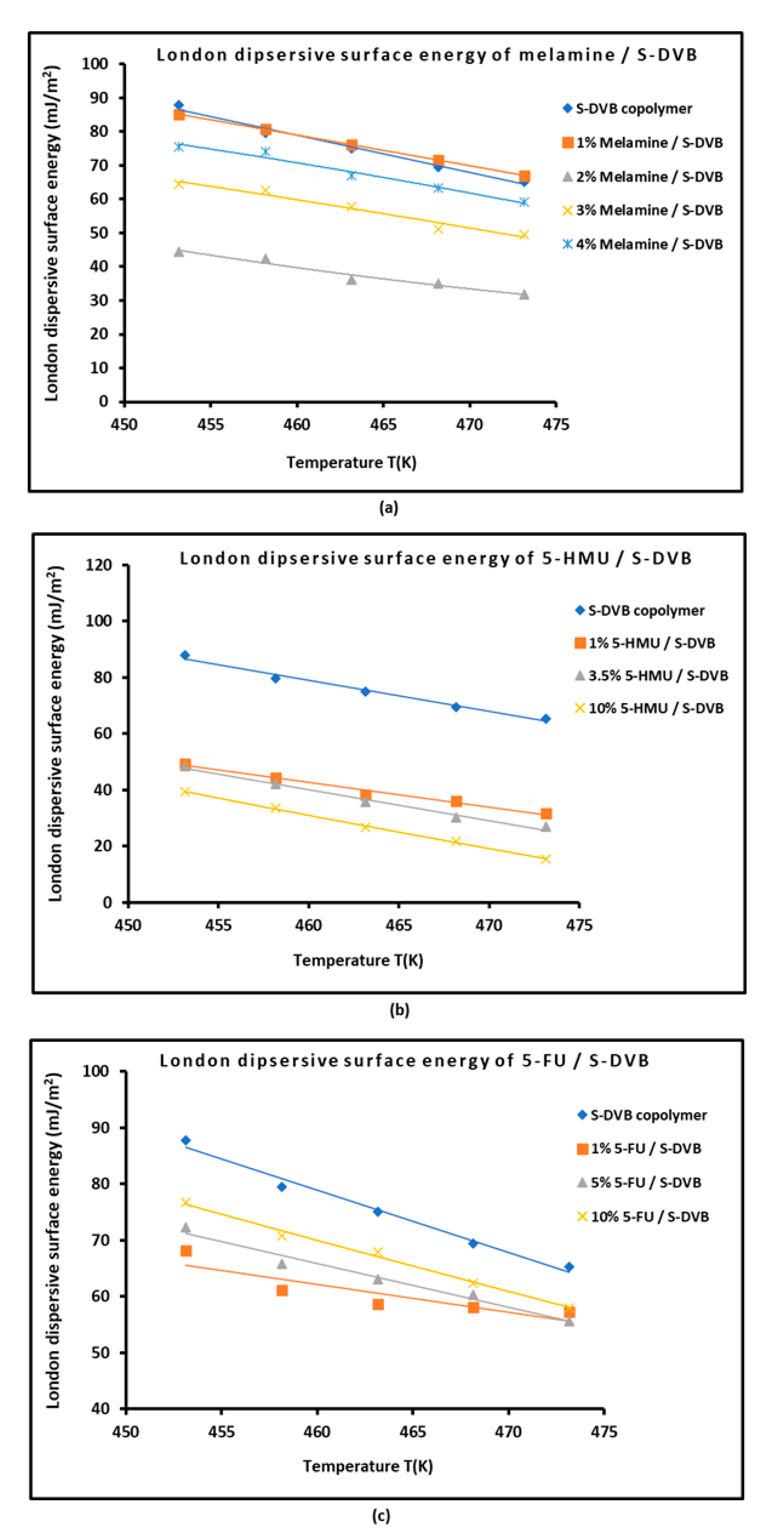
Figure 2.
Variations of the polar surface energy of the different modified copolymers as a function of modifier percentage at various temperatures. Melamine / S-DVB (a), 5-HMU /S-DVB (b), and 5-FU / S-DVB.
Figure 2.
Variations of the polar surface energy of the different modified copolymers as a function of modifier percentage at various temperatures. Melamine / S-DVB (a), 5-HMU /S-DVB (b), and 5-FU / S-DVB.
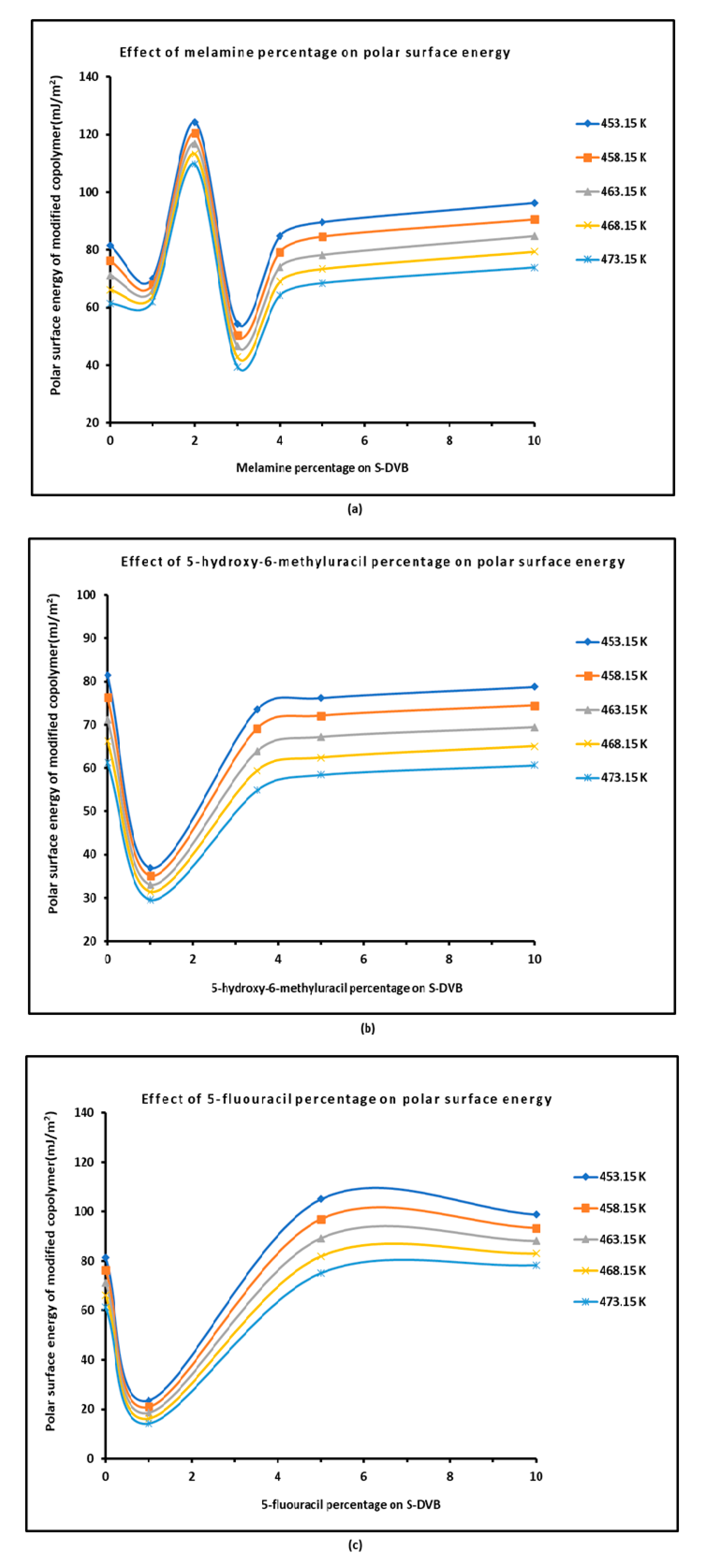
Figure 3.
Variations of the polar component of the work of adhesion of solvents on the modified S-DVB copolymer versus the temperature at different modifier percentages. S-DVB copolymer (a), 1% Melamine/S-DVB (b), 2% Melamine/S-DVB (c), 3% Melamine/S-DVB (d), 4% Melamine/S-DVB (e), 1% 5-HMU/S-DVB (f), 3.5% 5-HMU/S-DVB (g), 10% 5-HMU/S-DVB (h), 1% 5-FU/S-DVB (i), 5% 5-FU/S-DVB (j), and 10% 5-FU/S-DVB (k).
Figure 3.
Variations of the polar component of the work of adhesion of solvents on the modified S-DVB copolymer versus the temperature at different modifier percentages. S-DVB copolymer (a), 1% Melamine/S-DVB (b), 2% Melamine/S-DVB (c), 3% Melamine/S-DVB (d), 4% Melamine/S-DVB (e), 1% 5-HMU/S-DVB (f), 3.5% 5-HMU/S-DVB (g), 10% 5-HMU/S-DVB (h), 1% 5-FU/S-DVB (i), 5% 5-FU/S-DVB (j), and 10% 5-FU/S-DVB (k).
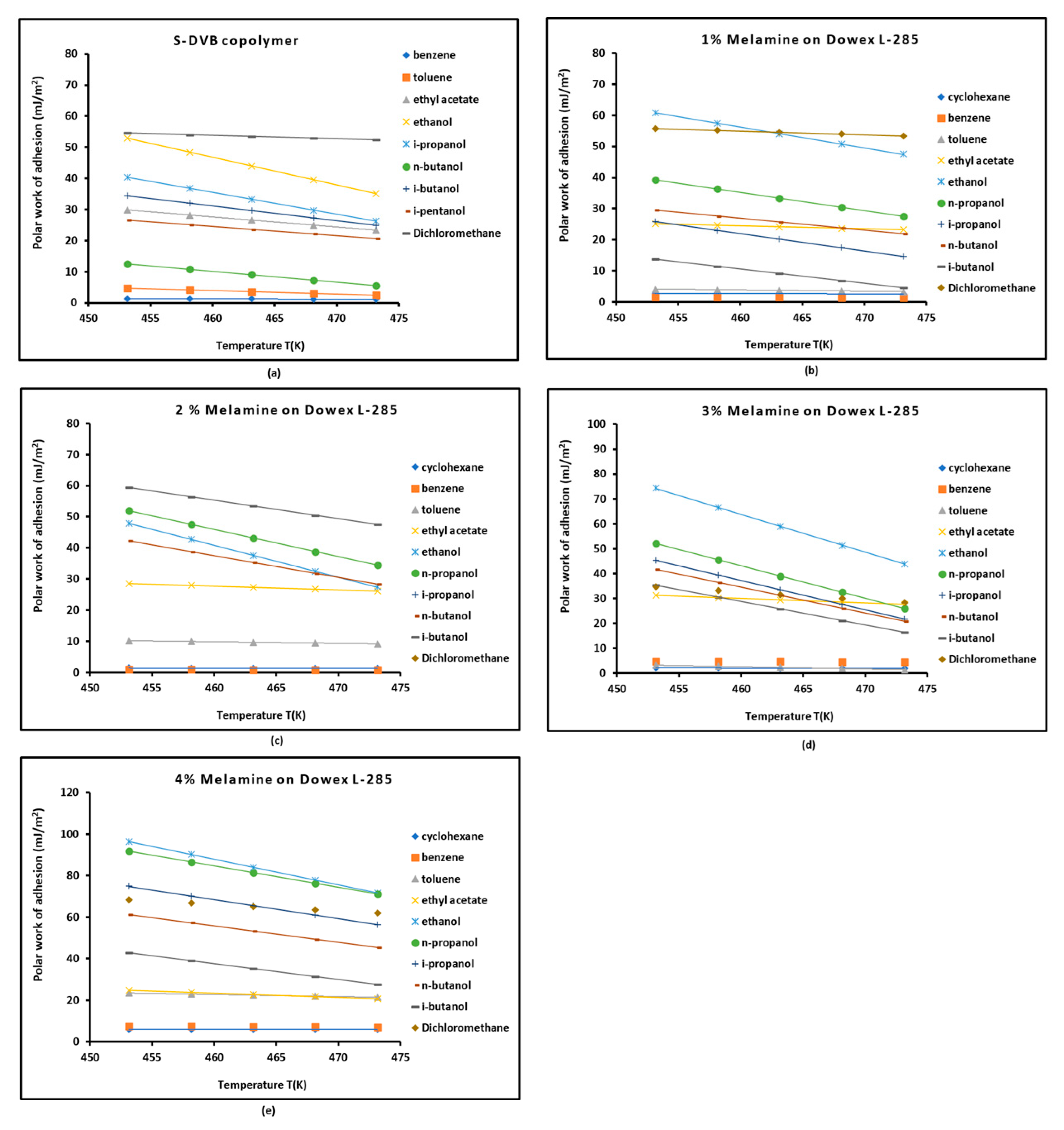
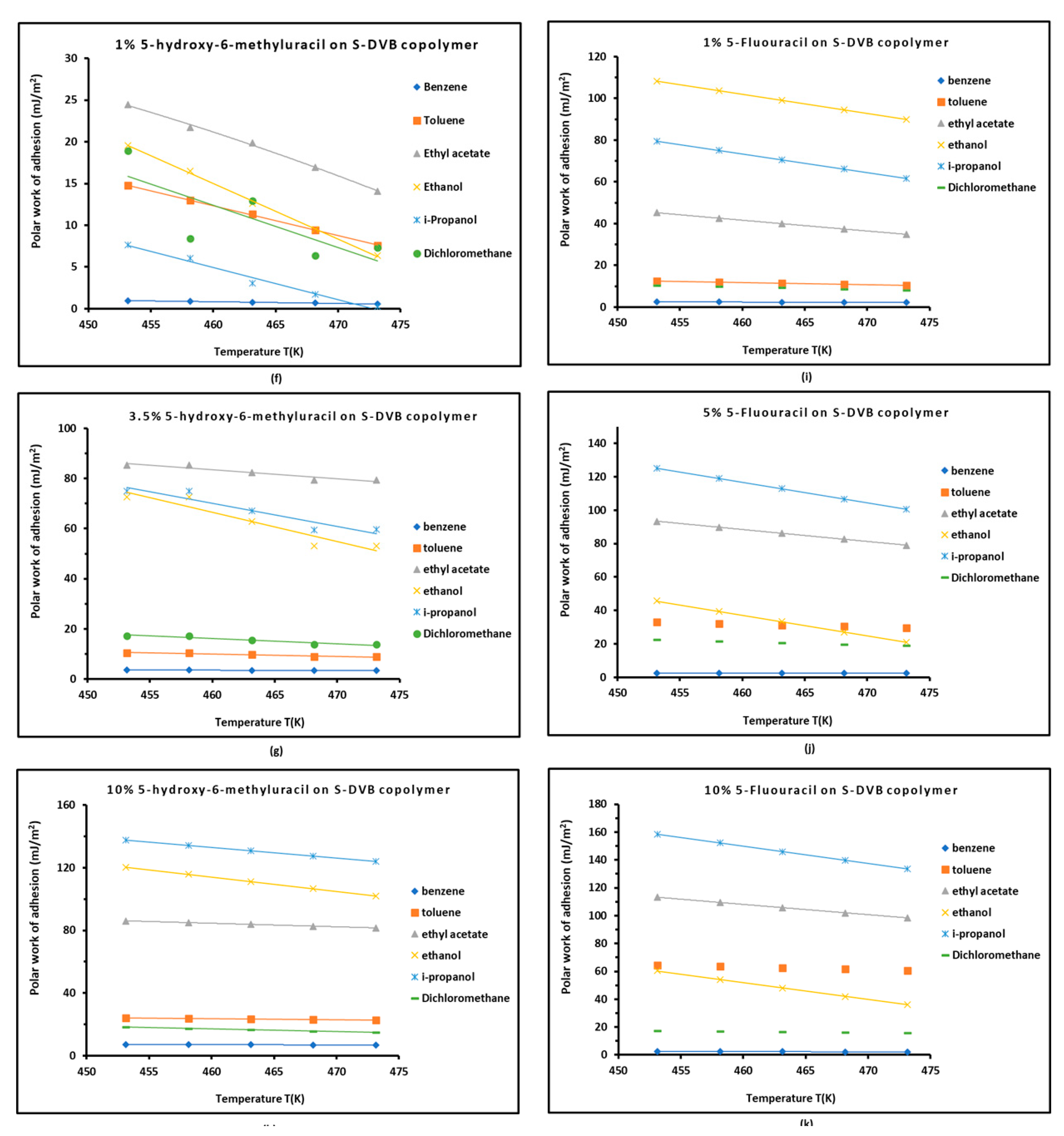

Table 1.
Equations of of S-DVB-L-285 varying the percentage of 5-hydroxy-6-methyluracil, the linear regression coefficients R2, the London dispersive surface entropy , the values of London dispersive surface energy extrapolated at 0 K and 298.15 K, and the temperature maximum , using the Hamieh thermal model.
Table 1.
Equations of of S-DVB-L-285 varying the percentage of 5-hydroxy-6-methyluracil, the linear regression coefficients R2, the London dispersive surface entropy , the values of London dispersive surface energy extrapolated at 0 K and 298.15 K, and the temperature maximum , using the Hamieh thermal model.
| Copolymer | (mJ/m2) | (mJ m−2 K−1) | (mJ/m2) | (mJ/m2) | (K) | |
|---|---|---|---|---|---|---|
| S+DVB | = −1.105 T + 587.13 | 0.9980 | 0.835 | 587.13 | 257.7 | 531.4 |
| 1% Melamine/ S-DVB | = −0.907 T + 496.21 | 0.9972 | 0.907 | 496.21 | 225.79 | 547.1 |
| 2% Melamine/ S-DVB | = −0.656 T + 341.59 | 0.9590 | 0.656 | 341.59 | 146.12 | 521.0 |
| 3% Melamine/ S-DVB | = −0.827 T + 439.96 | 0.9608 | 0.827 | 439.96 | 193.51 | 532.3 |
| 4% Melamine/ S-DVB | = −0.876 T + 473.64 | 0.975 | 0.876 | 473.64 | 212.40 | 540.6 |
| 5% Melamine/ S-DVB | = −0.935 T + 501.23 | 0.9825 | 0.935 | 501.23 | 222.46 | 536.07 |
| 10% Melamine/ S-DVB | = −1.220 T + 584.42 | 0.9915 | 1.220 | 584.42 | 220.68 | 479.03 |
| Copolymer | Equation of (mJ/m2) | (mJ m−2 K−1) | (mJ/m2) | (mJ/m2) | (K) | |
| 1% HMU/ S-DVB | = -0.874 T + 444.68 | 0.9837 | 0.874 | 444.68 | 184.16 | 508.9 |
| 3.5% HMU/ S-DVB | = -1.096 T + 544.23 | 0.9886 | 1.096 | 544.23 | 217.52 | 496.7 |
| 5% HMU/ S-DVB | = -1.120 T + 552.77 | 0.9973 | 1.198 | 552.77 | 218.84 | 493.6 |
| 10% HMU/ S-DVB | = -1.198 T + 582.13 | 0.9973 | 1.198 | 582.13 | 224.95 | 485.9 |
| Copolymer | Equation of (mJ/m2) | (mJ m−2 K−1) | (mJ/m2) | (mJ/m2) | (K) | |
| 1% 5-FU / S-DVB | = -0.497 T + 290.95 | 0.8900 | 0.497 | 290.95 | 142.77 | 585.4 |
| 5% 5-FU / S-DVB | = -0.780 T + 424.67 | 0.9800 | 0.780 | 424.67 | 192.11 | 544.4 |
| 10% 5-FU / S-DVB | = -0.913 T + 490.08 | 0.9900 | 0.913 | 490.08 | 217.87 | 536.8 |
Table 2.
Variations of polar surface energy (in mJ/m2) of modified copolymers avec the corresponding linear equations.
Table 2.
Variations of polar surface energy (in mJ/m2) of modified copolymers avec the corresponding linear equations.
| Temperature T(K) | 453.15 | 458.15 | 463.15 | 468.15 | 473.15 | R² | |
|---|---|---|---|---|---|---|---|
| S-DVB copolymer | 81.54 | 76.29 | 71.17 | 66.19 | 61.33 | = -1.0104 T + 539.27 | 0.9998 |
| 1% Melamine / S-DVB | 70.11 | 68.03 | 65.99 | 64 | 62.07 | = -0.4022 T + 252.32 | 0.9998 |
| 2% Melamine / S-DVB | 124.35 | 120.53 | 116.81 | 113.18 | 109.63 | = -0.7358 T + 457.69 | 0.9998 |
| 3% Melamine / S-DVB | 54.36 | 50.34 | 46.51 | 42.87 | 39.41 | = -0.7474 T + 392.86 | 0.9991 |
| 4% Melamine / S-DVB | 84.71 | 79.24 | 73.99 | 68.97 | 64.16 | = -1.0274 T + 550.05 | 0.9994 |
| Temperature T(K) | 453.15 | 458.15 | 463.15 | 468.15 | 473.15 | Equation | R² |
| 1% 5-HMU / S-DVB | 36.89 | 35.08 | 33.04 | 31.34 | 29.61 | = -0.366 T + 202.7 | 0.9990 |
| 3.5% 5-HMU / S-DVB | 73.56 | 69.12 | 63.85 | 59.40 | 54.90 | = -0.9408 T + 499.9 | 0.9992 |
| 10% 5-HMU / S-DVB | 78.82 | 74.47 | 69.42 | 65.06 | 60.66 | = -0.9146 T + 493.28 | 0.9994 |
| Temperature T(K) | 453.15 | 458.15 | 463.15 | 468.15 | 473.15 | Equation | R² |
| 1% 5-FU / S-DVB | 23.61 | 21.01 | 18.60 | 16.35 | 14.28 | = -0.4664 T + 234.78 | 0.9980 |
| 5% 5-FU / S-DVB | 105.08 | 96.96 | 89.26 | 81.96 | 75.06 | = -1.5008 T + 784.76 | 0.9990 |
| 10% 5-FU / S-DVB | 98.84 | 93.37 | 88.12 | 83.08 | 78.23 | = -1.0302 T + 565.47 | 0.9994 |
Table 3.
Equations of (in mJ/m2) of the various polar solvents adsorbed on the modified copolymers with the linear regression coefficients.
Table 3.
Equations of (in mJ/m2) of the various polar solvents adsorbed on the modified copolymers with the linear regression coefficients.
| S-DVB | ||||
| Solvents | Equation | R² | ||
| cyclohexane | = 4×10⁻⁴ T - 0.116 | 0.9909 | ||
| benzene | = 3×10⁻⁵ T - 0.010 | 0.9911 | ||
| toluene | = -0.0022 T + 1.048 | 0.9984 | ||
| ethyl acetate | = -0.0251 T + 14.11 | 0.9999 | ||
| ethanol | = -0.180 T + 90.12 | 0.9999 | ||
| n-propanol | = -0.063 T + 30.01 | 0.9905 | ||
| i-propanol | = -0.111 T + 55.49 | 0.9999 | ||
| n-butanol | = -0.019 T + 9.124 | 0.9958 | ||
| i-butanol | = -0.054 T + 28.21 | 0.9999 | ||
| n-pentanol | = -0.0032 T + 1.766 | 0.9995 | ||
| i-pentanol | = -0.020 T + 11.360 | 0.9994 | ||
| Pyridine | = -0.065 T + 33.38 | 1 | ||
| Dichloromethane | = 0.094 T - 33.51 | 0.9906 | ||
| 1% melamine/S-DVB | ||||
| Solvents | Equation | R² | ||
| cyclohexane | = 6×10⁻⁵ T - 0.003 | 0.9999 | ||
| benzene | = -6×10⁻⁵ T + 0.035 | 1 | ||
| toluene | = -8×10⁻⁴ T + 0.437 | 0.9999 | ||
| ethyl acetate | = -0.004 T + 4.024 | 0.9999 | ||
| ethanol | = -0.205 T + 105.85 | 0.9998 | ||
| n-propanol | = -0.122 T + 60.84 | 0.9992 | ||
| i-propanol | = -0.076 T + 36.61 | 0.9966 | ||
| n-butanol | = -0.059 T + 29.78 | 0.9997 | ||
| i-butanol | = -0.030 T + 14.080 | 0.9846 | ||
| Dichloromethane | = 0.020 T + 2.037 | 0.9995 | ||
| 2% melamine/S-DVB | ||||
| Solvents | Equation | R² | ||
| cyclohexane | = -2×10⁻⁵ T + 0.013 | 0.9999 | ||
| benzene | = -3×10⁻⁵ T + 0.016 | 0.9999 | ||
| toluene | = -8×10⁻⁴ T + 0.561 | 0.9999 | ||
| ethyl acetate | = -0.004 T + 3.351 | 0.9999 | ||
| ethanol | = -0.145 T + 70.16 | 0.9966 | ||
| n-propanol | = -0.136 T + 66.86 | 0.9987 | ||
| i-propanol | = -0.147 T + 99.70 | 0.9999 | ||
| n-butanol | = -0.088 T + 43.58 | 0.9989 | ||
| i-butanol | = -0.097 T + 50.92 | 1 | ||
| Dichloromethane | = 0.037 T - 1.415 | 0.9995 | ||
| 3% melamine/S-DVB | ||||
| Solvents | Equation | R² | ||
| cyclohexane | = 2×10⁻⁴ T - 0.050 | 0.9977 | ||
| benzene | = 0.0012 T - 0.452 | 0.9969 | ||
| toluene | = -0.0017 T + 0.825 | 0.9978 | ||
| ethyl acetate | = 0.020 T - 4.373 | 0.9979 | ||
| ethanol | = -0.662 T + 325.2 | 0.9999 | ||
| n-propanol | = -0.409 T + 197.56 | 0.999 | ||
| i-propanol | = -0.325 T + 156.67 | 0.9985 | ||
| n-butanol | = -0.263 T + 126.86 | 0.9991 | ||
| i-butanol | = -0.201 T + 96.57 | 0.9984 | ||
| Dichloromethane | = -0.022 T + 15.682 | 0.9996 | ||
| 4% melamine/S-DVB | ||||
| Solvents | Equation | R² | ||
| cyclohexane | = 0.002 T - 0.587 | 0.9971 | ||
| benzene | = 0.002 T - 0.497 | 0.9978 | ||
| toluene | = 0.008 T - 2.192 | 0.9983 | ||
| ethyl acetate | = -0.007 T + 4.91 | 0.9992 | ||
| ethanol | = -0.371 T + 195.72 | 0.9998 | ||
| n-propanol | = -0.253 T + 139.54 | 0.9995 | ||
| i-propanol | = -0.210 T + 111.55 | 0.9997 | ||
| n-butanol | = -0.154 T + 80.89 | 0.9997 | ||
| i-butanol | = -0.124 T + 61.62 | 1 | ||
| Dichloromethane | = 0.057 T - 11.874 | 0.9973 | ||
| 1% 5-HMU/S-DVB | ||||
| Solvents | Equation | R² | ||
| benzene | = 3×10⁻⁵ T + 0.008 | 0.9914 | ||
| toluene | = -0.043 T + 24.09 | 0.9891 | ||
| ethyl acetate | = 0.036 T - 3.586 | 0.9981 | ||
| ethanol | = -0.292 T + 140.76 | 0.9961 | ||
| i-propanol | = -0.090 T + 42.2 | 0.9287 | ||
| n-butanol | = -0.210 T + 103.05 | 0.9992 | ||
| i-butanol | = -0.124 T + 60.03 | 0.9973 | ||
| i-pentanol | = -0.121 T + 60.29 | 0.9998 | ||
| Dichloromethane | = -0.005 T + 4.348 | 0.9983 | ||
| 3.5% 5-HMU/S-DVB | ||||
| Solvents | Equation | R² | ||
| benzene | = 4×10⁻⁴ T - 0.156 | 0.9935 | ||
| toluene | = -4×10⁻⁴ T + 0.542 | 0.9988 | ||
| ethyl acetate | = 0.183 T - 58.14 | 0.9938 | ||
| ethanol | = -0.248 T + 130.23 | 0.9997 | ||
| i-propanol | = -0.139 T + 82.08 | 0.9985 | ||
| n-butanol | = -0.1274 T + 72.60 | 0.9983 | ||
| i-butanol | = -0.105 T + 62.56 | 0.998 | ||
| i-pentanol | = 0.047 T + 14.09 | 0.9983 | ||
| Dichloromethane | = -0.0070 T + 4.119 | 0.9998 | ||
| 10% 5-HMU/S-DVB | ||||
| Solvents | Equation | R² | ||
| benzene | = 0.0017 T - 0.588 | 0.9942 | ||
| toluene | = 0.013 T - 3.856 | 0.9949 | ||
| ethyl acetate | = 0.183 T - 59.09 | 0.9945 | ||
| ethanol | = -0.150 T + 113.86 | 0.9995 | ||
| i-propanol | = 0.154 T - 9.398 | 0.995 | ||
| n-butanol | = -0.097 T + 52.92 | 0.9993 | ||
| i-butanol | = 0.162 T - 21.42 | 0.996 | ||
| i-pentanol | = -0.074 T + 37.042 | 1 | ||
| Dichloromethane | = -0.008 T + 4.491 | 0.9999 | ||
| 1% 5-FU/S-DVB | ||||
| Solvents | Equation | R² | ||
| benzene | = 0.0016 T - 0.668 | 0.9905 | ||
| toluene | = 0.015 T - 5.243 | 0.9945 | ||
| ethyl acetate | = -0.020 T + 30.52 | 0.987 | ||
| ethanol | = 0.882 T - 276.34 | 0.9948 | ||
| i-propanol | = -0.021 T + 76.68 | 0.8954 | ||
| n-butanol | = 0.862 T - 304.64 | 0.9947 | ||
| i-butanol | = 0.965 T - 334.37 | 0.995 | ||
| i-pentanol | = -0.520 T + 259.83 | 0.9995 | ||
| Dichloromethane | = 0.001 T + 0.671 | 0.9858 | ||
| 5% 5-FU/S-DVB | ||||
| Solvents | Equation | R² | ||
| benzene | = 2×10⁻⁴ T - 0.074 | 0.9967 | ||
| toluene | = 0.016 T - 4.833 | 0.9979 | ||
| ethyl acetate | = 0.003 T + 19.418 | 0.9717 | ||
| ethanol | = -0.175 T + 84.021 | 0.9983 | ||
| i-propanol | = -0.175 T + 116.52 | 0.9974 | ||
| n-butanol | = -0.219 T + 121.67 | 0.9985 | ||
| i-butanol | = 0.160 T - 9.321 | 0.9997 | ||
| i-pentanol | = -0.003 T + 31.15 | 0.9386 | ||
| Dichloromethane | = -0.0002 T + 1.280 | 0.9714 | ||
| 10% 5-FU/S-DVB | ||||
| Solvents | Equation | R² | ||
| benzene | = 1×10⁻⁴ T - 0.036 | 0.9986 | ||
| toluene | = 0.063 T - 17.82 | 0.9988 | ||
| ethyl acetate | = -0.073 T + 65.639 | 0.9991 | ||
| ethanol | = -0.2547 T + 124.57 | 0.9992 | ||
| i-propanol | = -0.326 T + 211.43 | 0.9992 | ||
| n-butanol | = -0.318 T + 176.42 | 0.9996 | ||
| i-butanol | = -0.192 T + 93.24 | 0.9989 | ||
| i-pentanol | = -0.347 T + 213.6 | 0.9999 | ||
| Dichloromethane | = 0.002 T - 0.057 | 0.9981 | ||
Table 4.
Equations of total work of adhesion (in mJ/m2) of the various model organic solvents on S-DVB modified by melamine, 5-HMU, and 5-FU at by different percentages, with the linear regression coefficients, the surface entropy (in mJ m-2 K-1) and the surface enthalpy (in mJ m-2) of adhesion work, the maximum temperature
Table 4.
Equations of total work of adhesion (in mJ/m2) of the various model organic solvents on S-DVB modified by melamine, 5-HMU, and 5-FU at by different percentages, with the linear regression coefficients, the surface entropy (in mJ m-2 K-1) and the surface enthalpy (in mJ m-2) of adhesion work, the maximum temperature
| S-DVB Copolymer | |||||
| Solvents | (K) | R² | |||
| n-hexane | = -1.07 T + 513.05 | 1.07 | 513.05 | 477.57 | 0.9972 |
| n-heptane | = -0.92 T + 454.45 | 0.92 | 454.45 | 495.64 | 0.9858 |
| n-octane | = -0.95 T + 475.17 | 0.95 | 475.17 | 502.61 | 0.9804 |
| n-nonane | = -0.99 T + 498.93 | 0.99 | 498.93 | 506.17 | 0.9778 |
| Benzene | = -1.10 T + 550.93 | 1.10 | 550.93 | 502.67 | 0.9812 |
| Toluene | = -1.29 T + 664.32 | 1.29 | 664.32 | 514.42 | 0.9754 |
| Ethyl acetate | = -1.29 T + 669.43 | 1.29 | 669.43 | 518.38 | 0.9859 |
| Ethanol | = -1.85 T + 945.32 | 1.85 | 945.32 | 510.21 | 0.9932 |
| i-Propanol | = -1.74 T + 891.1 | 1.74 | 891.1 | 511.04 | 0.9905 |
| Dichloromethane | = -1.23 T + 654.39 | 1.23 | 654.39 | 531.03 | 0.9921 |
| 1% Melamine / S-DVB Copolymer | |||||
| Solvents | R² | ||||
| n-hexane | = -1.00 T + 480.8 | 1.00 | 480.8 | 479.55 | 0.9967 |
| n-heptane | = -0.66 T + 335.68 | 0.65 | 335.68 | 512.65 | 0.9999 |
| n-octane | = -0.59 T + 317.85 | 0.60 | 317.85 | 531.17 | 0.9999 |
| n-nonane | = -0.58 T + 316.17 | 0.58 | 316.17 | 542.69 | 0.9999 |
| Benzene | = -0.71 T + 375.92 | 0.71 | 375.92 | 531.94 | 0.9999 |
| Toluene | = -0.57 T + 335.24 | 0.57 | 335.24 | 585.37 | 0.9999 |
| Ethyl acetate | = -0.58 T + 319.32 | 0.58 | 319.32 | 554.47 | 0.9999 |
| Ethanol | = -0.64 T + 368.46 | 0.64 | 368.46 | 574.46 | 0.9999 |
| i-Propanol | = -1.21 T + 668.61 | 1.21 | 668.61 | 553.39 | 0.9999 |
| Dichloromethane | = -1.34 T + 662.71 | 1.34 | 662.71 | 494.38 | 0.9997 |
| 2% Melamine / S-DVB Copolymer | |||||
| Solvents | R² | ||||
| n-hexane | = -0.78 T + 372.02 | 0.78 | 372.02 | 477.93 | 0.9946 |
| n-heptane | = -0.52 T + 265.41 | 0.52 | 265.41 | 506.89 | 0.994 |
| n-octane | = -0.50 T + 260.01 | 0.50 | 260.01 | 520.64 | 0.9894 |
| n-nonane | = -0.50 T + 263.73 | 0.50 | 263.73 | 528.73 | 0.9864 |
| Benzene | Wa = -0.59 T + 308.05 | 0.59 | 308.05 | 519.30 | 0.9904 |
| Toluene | = -0.58 T + 324.78 | 0.58 | 324.78 | 563.95 | 0.9789 |
| Ethyl acetate | = -0.59 T + 334.41 | 0.59 | 334.41 | 568.34 | 0.9892 |
| Ethanol | = -1.5 T + 764.61 | 1.50 | 764.61 | 510.52 | 0.9983 |
| i-Propanol | = -1.15 T + 694.21 | 1.15 | 694.21 | 602.30 | 0.9964 |
| Dichloromethane | = -0.85 T + 502.92 | 0.85 | 502.92 | 590.42 | 0.9978 |
| 3% Melamine / S-DVB Copolymer | |||||
| Solvents | R² | ||||
| n-hexane | = -0.88 T + 423.69 | 0.88 | 423.69 | 479.34 | 0.9952 |
| n-heptane | = -0.60 T + 307.28 | 0.60 | 307.28 | 509.75 | 0.9954 |
| n-octane | = -0.56 T + 296.17 | 0.56 | 296.17 | 525.68 | 0.9917 |
| n-nonane | = -0.56 T + 297.66 | 0.56 | 297.66 | 535.36 | 0.9889 |
| Benzene | = -0.67 T + 355.5 | 0.67 | 355.5 | 529.33 | 0.9926 |
| Toluene | = -0.65 T + 363.83 | 0.65 | 363.83 | 557.68 | 0.9822 |
| Ethyl acetate | = -0.69 T + 392.76 | 0.69 | 392.76 | 566.75 | 0.992 |
| Ethanol | = -2.05 T + 1049.6 | 2.05 | 1049.6 | 511.88 | 0.9991 |
| i-Propanol | = -1.72 T + 875.58 | 1.72 | 875.58 | 510.42 | 0.9983 |
| Dichloromethane | = -1.12 T + 577.52 | 1.12 | 577.52 | 516.75 | 0.9985 |
| 4% Melamine / S-DVB Copolymer | |||||
| Solvents | R² | ||||
| n-hexane | = -0.96 T + 460.73 | 0.96 | 460.73 | 479.28 | 0.9952 |
| n-heptane | = -0.63 T + 323.74 | 0.63 | 323.74 | 511.52 | 0.9969 |
| n-octane | = -0.58 T + 308.83 | 0.58 | 308.83 | 528.91 | 0.995 |
| n-nonane | = -0.57 T + 308.54 | 0.57 | 308.54 | 539.59 | 0.9934 |
| Benzene | = -0.71 T + 377.26 | 0.71 | 377.26 | 535.04 | 0.9956 |
| Toluene | = -0.67 T + 394.99 | 0.66 | 394.99 | 594.24 | 0.9896 |
| Ethyl acetate | = -0.73 T + 407.05 | 0.73 | 407.05 | 557.37 | 0.9956 |
| Ethanol | = -1.78 T + 950.98 | 1.78 | 950.98 | 535.58 | 0.9993 |
| i-Propanol | = -1.47 T + 797.06 | 1.47 | 797.06 | 543.18 | 0.9986 |
| Dichloromethane | = -1.17 T + 638 | 1.17 | 638 | 545.21 | 0.9988 |
| 1% 5-HMU / S-DVB Copolymer | |||||
| Solvents | R² | ||||
| n-hexane | = -0.79 T + 377.09 | 0.79 | 377.09 | 478.42 | 0.9996 |
| n-heptane | = -0.59 T + 297.17 | 0.59 | 297.17 | 503.00 | 0.9969 |
| n-octane | = -0.58 T + 298.07 | 0.58 | 298.07 | 514.00 | 0.9949 |
| n-nonane | = -0.59 T + 306.26 | 0.59 | 306.26 | 520.14 | 0.9939 |
| Benzene | = -0.69 T + 355.57 | 0.69 | 355.57 | 512.20 | 0.9956 |
| Toluene | = -1.01 T + 530.27 | 1.01 | 530.27 | 523.16 | 0.9969 |
| Ethyl acetate | = -1.08 T + 552.6 | 1.08 | 552.6 | 514.14 | 0.9991 |
| Ethanol | = -1.23 T + 617.99 | 1.23 | 617.99 | 501.37 | 0.9969 |
| i-Propanol | = -0.98 T + 495.06 | 0.98 | 495.06 | 507.75 | 0.9897 |
| Dichloromethane | = -1.26 T + 619.03 | 1.26 | 619.03 | 490.52 | 0.9023 |
| 3.5% 5-HMU / S-DVB Copolymer | |||||
| Solvents | R² | ||||
| n-hexane | = -0.80 T + 380.26 | 0.80 | 380.26 | 477.77 | 0.999 |
| n-heptane | = -0.66 T + 326.22 | 0.66 | 326.22 | 497.51 | 0.997 |
| n-octane | = -0.67 T + 337.84 | 0.67 | 337.84 | 505.37 | 0.9958 |
| n-nonane | = -0.69 T + 353 | 0.69 | 353 | 509.53 | 0.9954 |
| Benzene | = -0.78 T + 397.1 | 0.78 | 397.1 | 508.39 | 0.996 |
| Toluene | = -0.89 T + 471.28 | 0.89 | 471.28 | 526.98 | 0.9955 |
| Ethyl acetate | = -0.97 T + 567.37 | 0.97 | 567.37 | 582.46 | 0.9976 |
| Ethanol | = -1.66 T + 862.63 | 1.66 | 862.63 | 520.85 | 0.9992 |
| i-Propanol | = -1.49 T + 795.55 | 1.490 | 795.55 | 533.78 | 0.9988 |
| Dichloromethane | = -0.99 T + 495.17 | 0.986 | 495.17 | 502.00 | 0.9989 |
| 10% 5-hydroxy-6-methyluracil / S-DVB Copolymer | |||||
| Solvents | R² | ||||
| n-hexane | = -0.76 T + 361.98 | 0.76 | 361.98 | 476.48 | 0.9998 |
| n-heptane | = -0.70 T + 344.16 | 0.70 | 344.16 | 490.89 | 0.9996 |
| n-octane | = -0.75 T + 371.62 | 0.75 | 371.62 | 495.49 | 0.9993 |
| n-nonane | = -0.80 T + 396.43 | 0.80 | 396.43 | 497.78 | 0.9991 |
| Benzene | = -0.87 T + 438.65 | 0.87 | 438.65 | 502.58 | 0.9994 |
| Toluene | = -1.08 T + 562.98 | 1.08 | 562.98 | 522.63 | 0.9979 |
| Ethyl acetate | = -1.02 T + 585.03 | 1.02 | 585.03 | 573.90 | 0.9992 |
| Ethanol | = -1.71 T + 931.89 | 1.71 | 931.89 | 544.61 | 0.9998 |
| i-Propanol | = -1.54 T + 878.5 | 1.54 | 878.5 | 569.09 | 0.9995 |
| Dichloromethane | = -1.01 T + 503.78 | 1.01 | 503.78 | 499.09 | 0.9998 |
| 1% 5-Fluouracil / S-DVB Copolymer | |||||
| Solvents | R² | ||||
| n-hexane | = -0.85 T + 409.22 | 0.85 | 409.22 | 480.47 | 0.9991 |
| n-heptane | = -0.53 T + 276.42 | 0.53 | 276.42 | 517.25 | 0.9892 |
| n-octane | = -0.47 T + 253.35 | 0.47 | 253.35 | 540.65 | 0.9742 |
| n-nonane | = -0.44 T + 247.09 | 0.44 | 247.09 | 556.26 | 0.9622 |
| Benzene | = -0.56 T + 301.56 | 0.56 | 301.56 | 540.91 | 0.9769 |
| Toluene | = -0.48 T + 295.44 | 0.48 | 295.44 | 614.09 | 0.9325 |
| Ethyl acetate | = -0.92 T + 507.43 | 0.92 | 507.43 | 554.51 | 0.9892 |
| Ethanol | = -1.32 T + 753.74 | 1.32 | 753.74 | 569.94 | 0.9949 |
| i-Propanol | = -1.29 T + 716.03 | 1.29 | 716.03 | 556.01 | 0.9931 |
| Dichloromethane | = -0.85 T + 432.53 | 0.85 | 432.53 | 508.32 | 0.997 |
| 5% 5-Fluouracil / S-DVB Copolymer | |||||
| Solvents | R² | ||||
| n-hexane | = -0.91 T + 438.27 | 0.91 | 438.27 | 479.61 | 0.9983 |
| n-heptane | = -0.60 T + 309.29 | 0.60 | 309.29 | 512.15 | 0.9978 |
| n-octane | = -0.55 T + 293.5 | 0.55 | 293.5 | 530.26 | 0.9956 |
| n-nonane | = -0.54 T + 292.32 | 0.54 | 292.32 | 541.53 | 0.9941 |
| Benzene | = -0.6554 T + 347.96 | 0.6554 | 347.96 | 530.91 | 0.9961 |
| Toluene | = -0.6949 T + 415.71 | 0.6949 | 415.71 | 598.23 | 0.9927 |
| Ethyl acetate | = -1.2143 T + 693.27 | 1.2143 | 693.27 | 570.92 | 0.9986 |
| Ethanol | = -1.7361 T + 880.53 | 1.7361 | 880.53 | 507.19 | 0.9993 |
| i-Propanol | = -1.7287 T + 963.71 | 1.7287 | 963.71 | 557.48 | 0.9991 |
| Dichloromethane | = -0.9861 T + 507.27 | 0.9861 | 507.27 | 514.42 | 0.9991 |
| 10% 5-Fluouracil / S-DVB Copolymer | |||||
| Solvents | R² | ||||
| n-hexane | = -0.94 T + 451.85 | 0.94 | 451.85 | 479.67 | 0.9976 |
| n-heptane | = -0.64 T + 327.09 | 0.64 | 327.09 | 510.76 | 0.9992 |
| n-octane | = -0.59 T + 313.4 | 0.59 | 313.4 | 527.52 | 0.9986 |
| n-nonane | = -0.58 T + 313.9 | 0.58 | 313.9 | 537.68 | 0.9981 |
| Benzene | = -0.70 T+ 369.84 | 0.70 | 369.84 | 528.04 | 0.9987 |
| Toluene | = -0.77 T+ 484.8 | 0.77 | 484.8 | 627.41 | 0.9978 |
| Ethyl acetate | = -1.28 T+ 744.91 | 1.28 | 744.91 | 581.55 | 0.9996 |
| Ethanol | = -1.77T+ 912.74 | 1.77 | 912.74 | 515.38 | 0.9998 |
| i-Propanol | = -1.80 T+ 1031.2 | 1.80 | 1031.2 | 572.89 | 0.9997 |
| Dichloromethane | = -0.93 T+ 478.52 | 0.93 | 478.52 | 514.04 | 0.9993 |
Table 5.
Equations of the surface adhesion parameters and of the different solvents on the modified copolymers as a function of the modifier percentage with the linear regression coefficients.
Table 5.
Equations of the surface adhesion parameters and of the different solvents on the modified copolymers as a function of the modifier percentage with the linear regression coefficients.
| S-DVB Copolymer | ||||
| Solvents | Equation (in mJ m-2K-1) | R² | Equation (in mJ m-2) | R² |
| n-hexane | = 0.076 q (Mela) + 0.65 | 0.9757 | = 46.92 q (Mela) + 277.19 | 0.9948 |
| n-heptane | = 0.033 q (Mela) + 0.615 | 0.9945 | = 33.70 q (Mela) + 196.20 | 0.9699 |
| n-octane | = 0.024 q (Mela) + 0.485 | 0.9931 | = 24.44 q (Mela) + 215.01 | 0.9701 |
| n-nonane | = 0.016 q (Mela) + 0.51 | 0.9143 | = 22.05 q (Mela) + 223.96 | 0.9647 |
| Benzene | = 0.065 q (Mela) + 0.46 | 0.9837 | = 34.78 q (Mela) + 242.54 | 0.9821 |
| Toluene | = 0.031 q (Mela) + 0.545 | 0.9468 | = 30.83 q (Mela) + 270.14 | 0.9852 |
| Ethyl acetate | = 0.055 q (Mela) + 0.51 | 0.9181 | = 32.15 q (Mela) + 283.00 | 0.9313 |
| Ethanol | = 0.235 q (Mela) + 0.97 | 0.9612 | = 193.26 q (Mela) + 225.28 | 0.9515 |
| i-Propanol | = 0.146 q (Mela) + 1.04 | 0.9769 | = 101.67 q (Mela) + 517.19 | 0.9238 |
| Dichloromethane | = -0.09 q (Mela) + 1.41 | 0.962 | = 60.23 q (Mela) + 394.56 | 0.9885 |
| S-DVB/5-HMU | ||||
| Solvents | Equation (in mJ m-2K-1) | R² | Equation (in mJ m-2) | R² |
| n-hexane | = -0.003 q (5-HMU) + 0.793 | 0.9963 | = 1.15 q (5-HMU) + 376.06 | 0.9992 |
| n-heptane | = 0.011 q (5-HMU) + 0.592 | 0.9106 | = 3.98 q (5-HMU) + 306.11 | 0.9177 |
| n-octane | = 0.018 q (5-HMU) + 0.582 | 0.9209 | = 7.58 q (5-HMU) + 299.23 | 0.9137 |
| n-nonane | = 0.022 q (5-HMU) + 0.589 | 0.9508 | = 9.35 q (5-HMU) + 306.71 | 0.9276 |
| Benzene | = 0.019 q (5-HMU) + 0.689 | 0.9382 | = 8.66 q (5-HMU) + 355.24 | 0.9383 |
| Toluene | = 0.02 q (5-HMU) + 0.88 | 0.9999 | = 3.55 q (5-HMU) + 527.96 | 0.9914 |
| Ethyl acetate | = -0.006 q (5-HMU) + 1.080 | 0.9382 | = 3.43 q (5-HMU) + 551.78 | 0.9606 |
| Ethanol | = 0.050 q (5-HMU) + 1.233 | 0.9261 | = 33.10 q (5-HMU) + 610.84 | 0.9582 |
| i-Propanol | = 0.033 q (5-HMU) + 1.205 | 0.9999 | = 39.70 q (5-HMU) + 497.81 | 0.9249 |
| Dichloromethane | = -0.026 q (5-HMU) + 1.254 | 0.9008 | = -12.08 q (5-HMU) + 620.49 | 0.9479 |
| S-DVB/5-FU | ||||
| Solvents | Equation (in mJ m-2K-1) | R² | Equation (in mJ m-2) | R² |
| n-hexane | = 0.010 q (5-FU) + 0.848 | 0.9368 | = 4.65 q (5-FU) + 408.29 | 0.9286 |
| n-heptane | = 0.012 q (5-FU) + 0.526 | 0.9523 | = 5.55 q (5-FU) + 274.69 | 0.9462 |
| n-octane | = 0.013 q (5-FU) + 0.467 | 0.9368 | = 6.56 q (5-FU) + 251.75 | 0.9357 |
| n-nonane | = 0.015 q (5-FU) + 0.439 | 0.9089 | = 7.30 q (5-FU) + 245.52 | 0.9311 |
| Benzene | = 0.015 q (5-FU) + 0.557 | 0.9286 | = 7.46 q (5-FU) + 300.03 | 0.9296 |
| Toluene | = 0.032 q (5-FU) + 0.478 | 0.9026 | = 20.74 q (5-FU) + 288.02 | 0.9529 |
| Ethyl acetate | = 0.026 q (5-FU) + 1.037 | 0.9126 | = 25.73 q (5-FU) + 511.32 | 0.8628 |
| Ethanol | = 0.049 q (5-FU) + 1.312 | 0.9243 | = 11.00 q (5-FU) + 809.76 | 0.9292 |
| i-Propanol | = 0.056 q (5-FU) + 1.284 | 0.9141 | = 23.48 q (5-FU) + 811.75 | 0.9257 |
| Dichloromethane | = 0.019 q (5-FU) + 0.892 | 0.9999 | = 5.08 q (5-FU) + 428.94 | 0.9898 |
Table 6.
Equations of as a function of of the different modified copolymers with the values of and the corresponding linear regression coefficients.
Table 6.
Equations of as a function of of the different modified copolymers with the values of and the corresponding linear regression coefficients.
| Copolymer | R² | ||
|---|---|---|---|
| S-DVB Copolymer | = 527.12 - 23.502 | 527.12 | 0.9923 |
| 1% Melamine / S-DVB Copolymer | = 476.71 + 42.251 | 476.71 | 0.9672 |
| 2% Melamine / S-DVB Copolymer | = 543.47 - 1.841 | 543.47 | 0.9596 |
| 3% Melamine / S-DVB Copolymer | = 500.3 + 18.342 | 500.3 | 0.9957 |
| 4% Melamine / S-DVB Copolymer | = 532.74 + 1.972 | 532.74 | 0.9882 |
| 1% 5-HMU / S-DVB Copolymer | = 494.38 + 9.860 | 494.38 | 0.9917 |
| 3.5% 5-HMU / S-DVB Copolymer | = 546.19 - 25.452 | 546.19 | 0.9838 |
| 10% 5-HMU / S-DVB Copolymer | = 609.06 - 86.224 | 609.06 | 0.9884 |
| 1% 5-Fluouracil / S-DVB Copolymer | = 558.33 - 11.407 | 558.33 | 0.9793 |
| 5% 5-Fluouracil / S-DVB Copolymer | = 534.46 - 0.318 | 534.46 | 0.9803 |
| 10% 5-Fluouracil / S-DVB Copolymer | = 556.11 - 14.185 | 556.11 | 0.973 |
Disclaimer/Publisher’s Note: The statements, opinions and data contained in all publications are solely those of the individual author(s) and contributor(s) and not of MDPI and/or the editor(s). MDPI and/or the editor(s) disclaim responsibility for any injury to people or property resulting from any ideas, methods, instructions or products referred to in the content. |
© 2025 by the authors. Licensee MDPI, Basel, Switzerland. This article is an open access article distributed under the terms and conditions of the Creative Commons Attribution (CC BY) license (http://creativecommons.org/licenses/by/4.0/).
Copyright: This open access article is published under a Creative Commons CC BY 4.0 license, which permit the free download, distribution, and reuse, provided that the author and preprint are cited in any reuse.


