

Submitted:
03 May 2025
Posted:
07 May 2025
You are already at the latest version
Abstract
In this paper, we describe two new species of Philanthaxia Deyrolle, 1864, from Hainan, China: P. longicorna Ni & Song, sp. n. and P. lui Ni & Song, sp. n. The characters of the new species are described with illustrations, and comparisons are made with the most similar species.
Keywords:
Taxonomy
; Buprestinae
; Philanthaxia
; new species
; Hainan
1. Introduction
The genus Philanthaxia Deyrolle, 1864 belongs to the tribe Thomassetiini Bellamy, 1987, and was first described by Deyrolle (1864) with Philantahxia curta Deyrolle, 1864 as the type species [1]. Species of the genus Philanthaxia are characterized by smaller, more oval-shaped eyes and more convex vertex, which is typically 4.5-6 times wider than the eye width; the pronotum widest at base, with dense reticulate or punctate striations; the pygidium regularly rounded, with a circular cross-section or occasionally slight apical distortion [2].
Before Bílý (1993) first revision of the species, Philanthaxia was mainly described as being distributed in Southeast Asia and the Greater Sunda Islands. Subsequently, the distribution of this genus expanded, with new records from the Maluku Islands and Papua New Guinea [3-4]. Additionally, Bellamy (2008) described seven new species of the genus from the Philippines [5], while Bílý (2016) reported three new species from the Philippines and one from Vietnam, indicating the broad distribution of Philantahxia species in Asia [6]. In China, two species of the genus have been recorded in Taiwan region: Philanthaxia sauteri Kerremans, 1912 [7] and Philanthaxia convexifrons Kurosawa, 1954 [8], so this paper provides a diagnosis comparative between these two known insect species and the two novel species.
At present, records of the biological habits of the genus Philanthaxia are scarce. The existing records mainly report that the adult of the Philanthaxia species which are found on the Castanopsis sp., primarily in the elevated layers of the canopy, and larvae of this genus are still unknown [9].
According to the four new species reported by Bílý & Nakládal (2011), as well as the four new species reported by Bílý (2016), combined with the two new species described in this article discovered in Hainan, China, the total number of insect species in this genus has increased to 71 worldwide, including one fossil species [10].
2. Materials and Methods
Body length: length between the top of the head to the tip of the elytra.
Body width: widest part of the body.
Aedeagus length: length between the base to the tip of the aedeagus.
Aedeagus width: the widest part of parameres.
3. Results
Taxonomy
Family Buprestidae Leach, 1815
Subfamily Buprestinae Leach, 1815
Tribe Thomassetiini Bellamy, 1987
Genus Philanthaxia Deyrolle, 1864
Type species: Philanthaxia curta Deyrolle, 1864.
3.1. Philanthaxia longicorna Ni & Song, sp. nov.
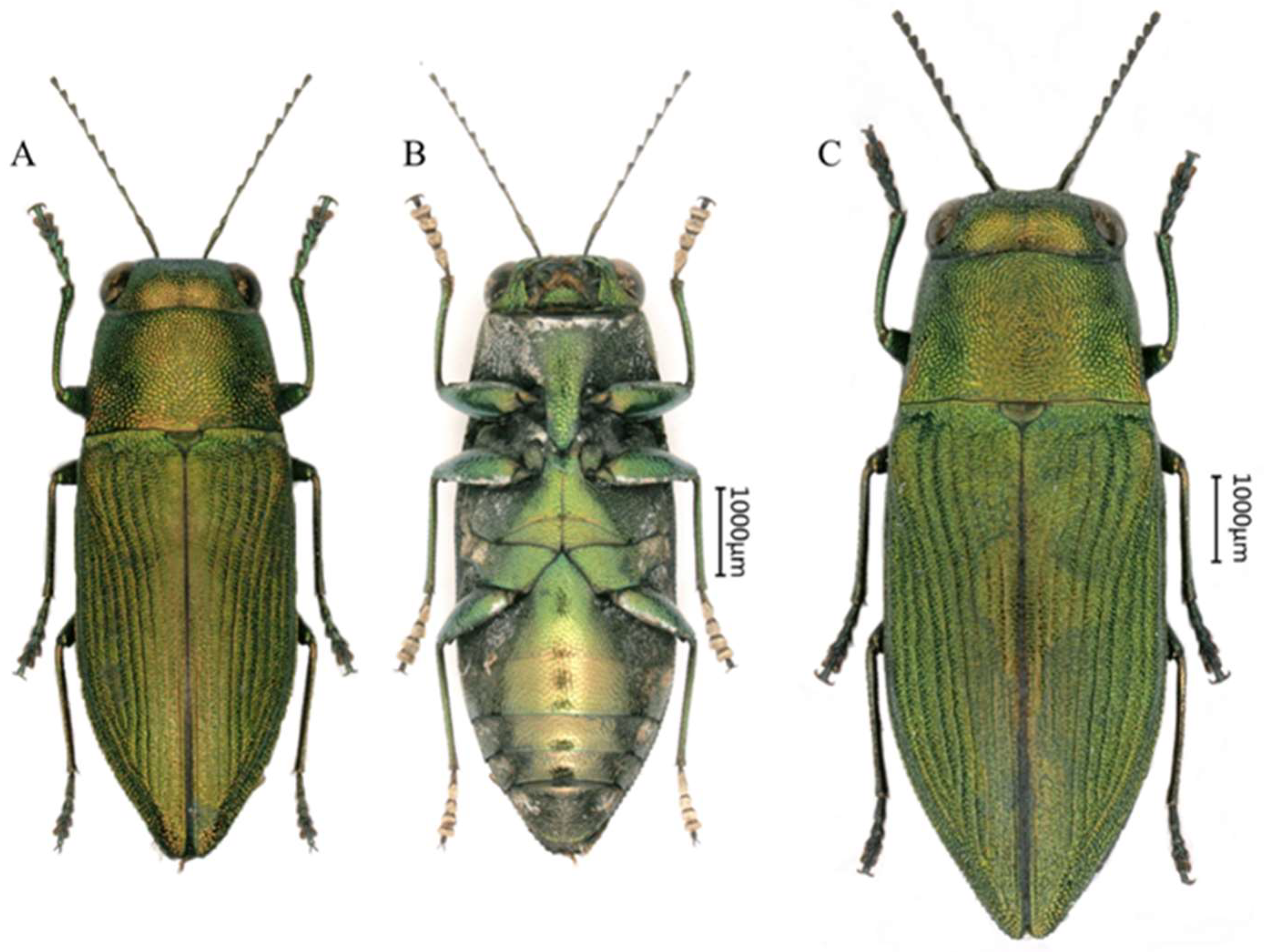
(Fig. 1 )
Type locality: Mt. Lizhiling, Sanya City, Hainan Province, China.
Type specimen. Holotype (male, FAF): Southern Hainan Province, Sanya City, Mt. Lizhiling, 18°21'21"N 109°27'20"E, alt. 390m, 2021-Ⅵ-19, Haitian Song leg.; paratypes (14 males, 15 females, FAF): same data as holotype.
Description of holotype. Length 6.9 mm, width 2.6 mm; the aedeagus measures around 2.4 mm in length and 0.4 mm in width. Spindle-shaped, entirely gold-green with metallic luster.
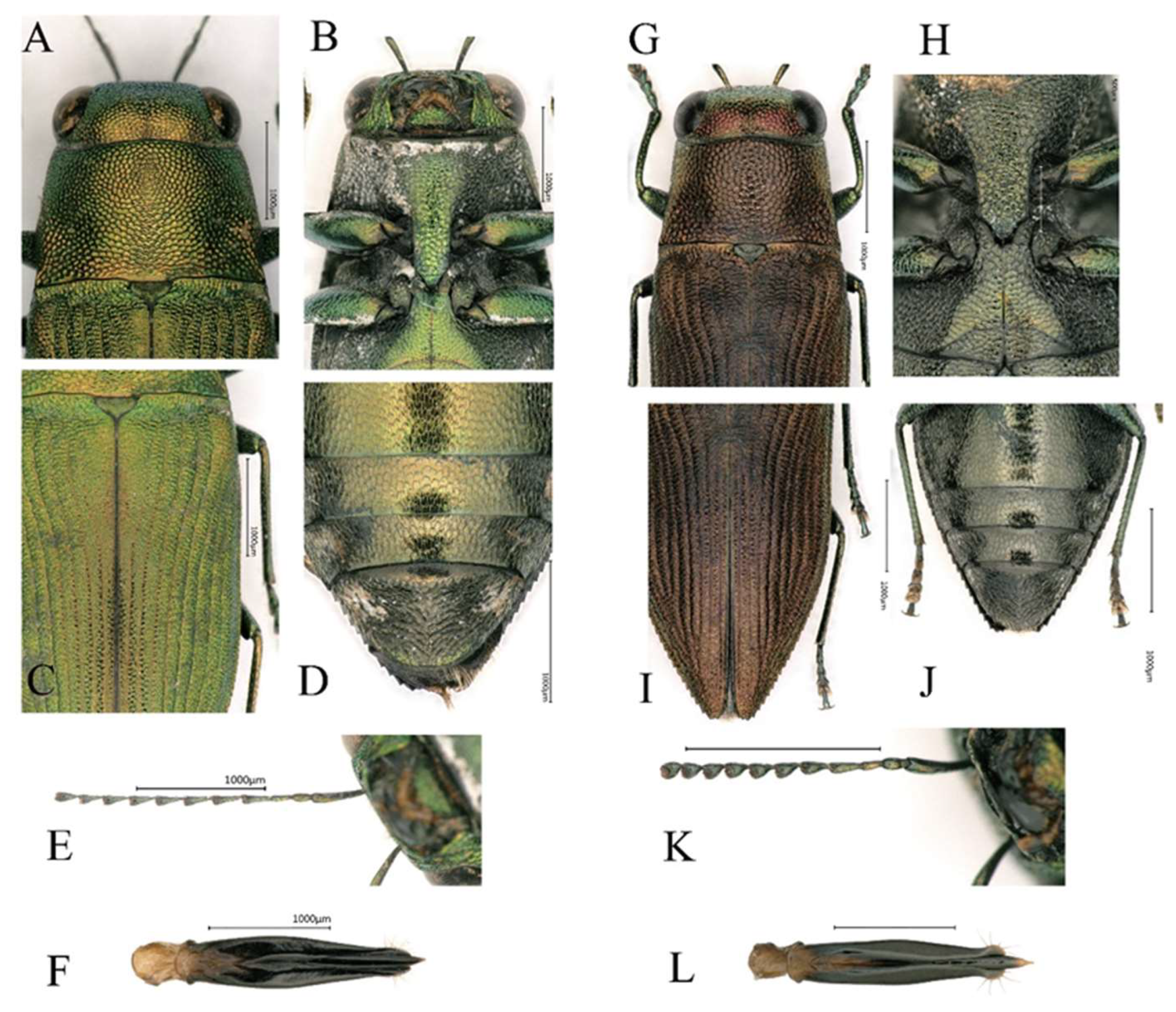
Head (Fig. 3A) golden-green, broader than the lateral side of pronotum, covered with evenly small, reticulate, irregular polygonal sculpturing. Fine white setae present at the frons. The vertex relatively flat, 5.1 times wider than eye. The eyes large, nearly oval, and laterally convex. The antennae (Fig. 3E) very slender and elongated, consisting of 11 segments, with white setae. The scape rod-shaped, 6.0 times longer than wide. The pedicel short and ovoid, 2.0 times as long as wide. The antennomere 3 almost cylindrical, 2.4 times as long as wide. Antennomeres 4–10 slender and triangular, with a length-to-width ratio of 2.1–3.5; the antennomeres 4 and 5 longer, while the final two shorter. The terminal antennomere nearly triangular, 1.5 times longer than wide.
Pronotum (Fig. 3A) nearly trapezoidal, about 1.6 times wider than long, featuring sculpturing and patterns similar to those on the head. Overall golden-green with a metallic sheen. The anterior edge curved, slightly convex in the middle; the posterior edge nearly straight, with the sides normally curved. The scutellum wide, 2.0 times as wide as long, dark green, subcordiform, and depressed near the base of the pronotum.
Elytra (Fig. 3C) 1.8 times longer than wide, with yellow coloration on both sides of the elytral suture, tapers sharply near the distal third. Each elytron has 8 distinct striae with fine transverse lines between them. The lateral margins with fine serrations near apical third. The humeral callosities do not prominently protrude beyond the elytral lateral edges.
Legs (Fig. 1) slender, covered with setae; fore tibiae slightly bent outward, without serrations, and the tarsal segments 2–4 enlarged. The tarsal segments covered with setae.
Ventral side (Fig. 1B) The abdomen sparsely covered with short white setae. Prosternal process (Fig. 3B) elongated, forming an inverted tower shape, tapering directly at the top to a near-conical form. Abdominal apex lighter, transitioning from green to gold, with darker sides shifting from green to black. The ventral surface of the last visible ventrite (Fig. 3D) more or less black, covered with relatively denser and longer white setae, apex rounded.
Aedeagus (Fig. 3F) widest at the middle, tapering at the posterior; apices of parameres sharp, not distinctly expansion, the sides of the terminal portion covered with setae; apex of median lobe sharp.
Sexual dimorphism. Female (Fig. 1C) differs from male easily by the extra shorter antennae and somewhat more robust body.
Etymology. This species is named after the morphological features of long antennae.
Distribution. China (Hainan).
Figure 1.
Habitus of Philanthaxia longicorna Ni & Song, sp. nov. (A–B) male, holotype, 6.9 mm, from Sanya, Hainan (C) female, paratype, 8.4 mm, from Sanya, Hainan (A, C) dorsal view (B) ventral view. Scale bar = 1.0 mm.
Figure 1.
Habitus of Philanthaxia longicorna Ni & Song, sp. nov. (A–B) male, holotype, 6.9 mm, from Sanya, Hainan (C) female, paratype, 8.4 mm, from Sanya, Hainan (A, C) dorsal view (B) ventral view. Scale bar = 1.0 mm.
3.2. Philanthaxia lui Ni & Song, sp. nov.
(Fig. 2)
Type locality. Mt. Lizhiling, Sanya City, Hainan Province, China.
Type specimen. Holotype (male, FAF): Southern Hainan Province, Sanya City, Mt. Lizhiling, 18°21'21"N 109°27'20"E, alt. 390m, 2021-Ⅵ-19, Haitian Song leg.; paratypes (1 male, 1 female, FAF): same data as holotype.
Description of holotype. Length 5.6 mm, width 2.1 mm; the aedeagus measures around 2.2 mm in length and 0.3 mm in width, fusiform with most of the anterior body copper-colored; with metallic luster.
Head (Fig. 3G) large and broad, significantly wider than the pronotum. Vertex flat without noticeable convex, and width about 4.8 times than the eye width. Eyes large, oval and prominently protrude beyond the body sides. Antennae (Fig. 3K) long, horizontally positioned, almost reaching the base of pronotum; scape nearly clavate, slightly curved, and 5.7 times longer than wide; pedice ovoid, about twice as long as wide. The antennomere 3 slender and ovoid, about 5.0 times as long as wide. The 4-10 antennomeres transition from conical to nearly triangular shapes, shorter and thicker, with lengths 2.0–2.4 times their widths. The terminal flagellomere nearly triangular, 2.0 times as long as wide. The sculpture features clearly defined boundaries, consisting of small, irregular polygons with a metallic copper-green sheen. A fine groove runs along the middle, and the apex covered with extremely fine white setae.
Pronotum (Fig. 3G) evenly convex, 1.4–1.7 times as wide as long; anterior margin convex at the center, posterior margin slightly curves inward at middle, lateral margins mostly straight. The lateral margins of the pronotum bear paired symmetrical shallow depressions. The posterolateral edges slightly expand outward, marking the widest point of the pronotum. The pronotum sculpture resembles that of the head but with larger individual sculptural cells. Scutellum large, darker in color than the pronotum, subcordiform, depressed at the anterior, 1.6 times as wide as long.
Elytra (Fig. 3I) flat, slightly raised along the suture, 2.0 times as long as wide; two-thirds of anterior nearly parallel, with fine serrations along the sides, while the posterior third tapers sharply, with serrations larger than those on the anterior two-thirds. The humeral callosities distinct, with the apex slightly projecting beyond the sides of the elytra. The basal transverse area broadly and shallowly depressed, almost connecting with the scutellum, and aligns with the pronotum without notable indentations or protrusions. Each elytron has eight deep and distinct longitudinal striae, with fine transverse lines between the striae.
Ventral side (Fig. 2E) overall dark green, with the abdominal ventrite being the lightest in color. The entire abdomen flat and covered with fine setae. Prosternal process (Fig. 3H) broad, nearly parallel, and has an obtusely pointed apex. The anal ventrite (Fig. 3J) nearly circular, lacks serrations, and covered with setae.
Legs (Fig. 2D, E) slender, cover with setae, no serration, fore tibiae with gentle bent outward, and the anterior tarsal claws hooked.
Aedeagus (Fig. 3L) slender, subparallel, parameres middle widest, stir up and connect at two third, with the apex forming a transparent, extremely fine, and sharp area, the sides of the terminal portion protruding with setae.
Sexual dimorphism. Female differs from male by much larger and reddish in frons and lateral sides of pronotum.
Etymology. This new species is named after Mr. Jiasheng Lu (陆嘉胜) (Sanya, Hainan), who is butterfly lover, leading the way for us during the collection.
Distribution. China (Hainan).
Figure 2.
Habitus of Philanthaxia lui Ni & Song, sp. nov. (D–E) male, holotype, 5.6 mm, from Sanya, Hainan (F) female, paratype, 8.5 mm, from Sanya, Hainan (D, F) dorsal view (E) ventral view. Scale bar = 1.0 mm.
Figure 2.
Habitus of Philanthaxia lui Ni & Song, sp. nov. (D–E) male, holotype, 5.6 mm, from Sanya, Hainan (F) female, paratype, 8.5 mm, from Sanya, Hainan (D, F) dorsal view (E) ventral view. Scale bar = 1.0 mm.
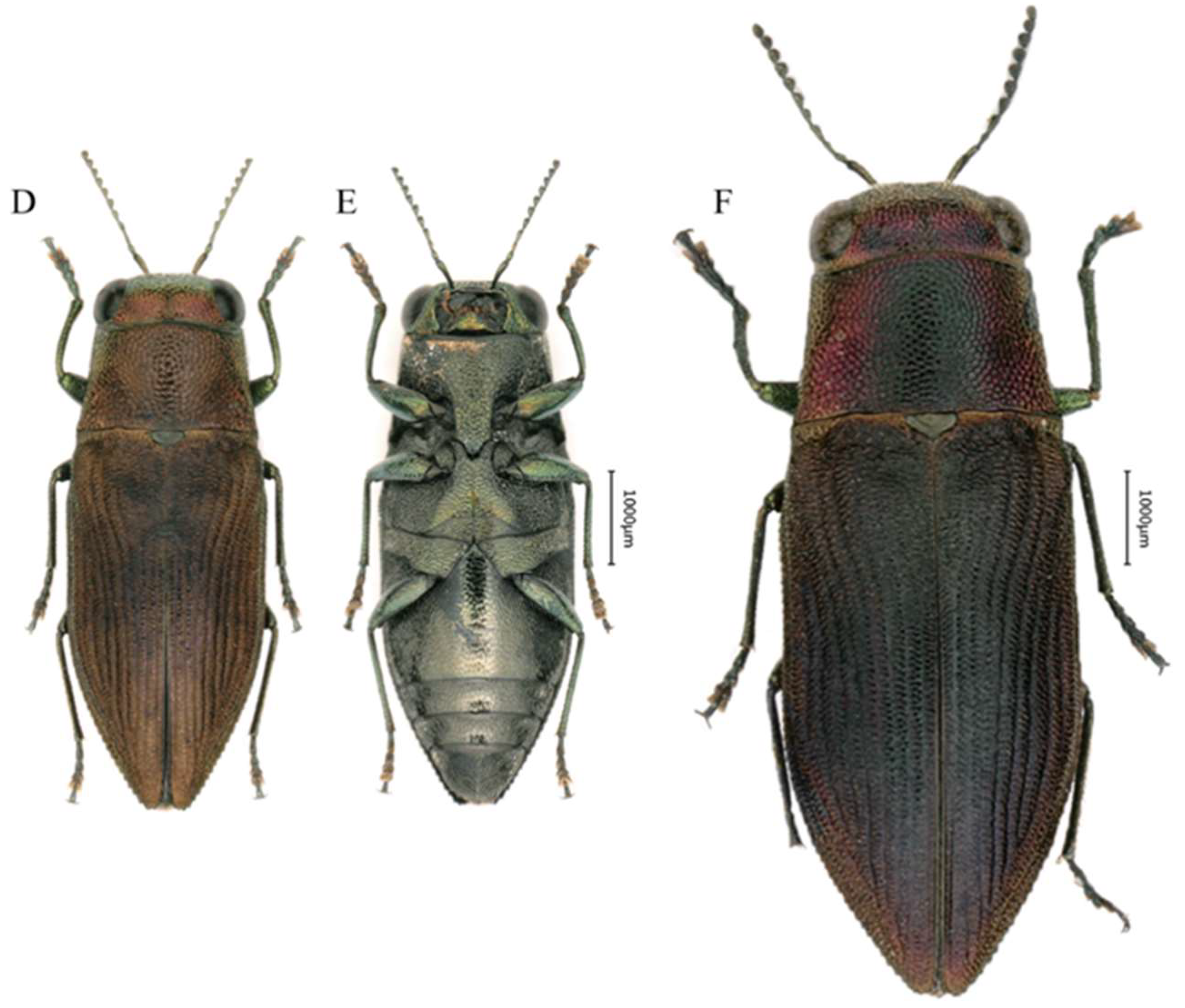
Figure 3.
(A-F)Philanthaxia longicorna Ni & Song, sp. nov. (holotype) (G-L) Philanthaxia lui Ni & Song, sp. nov. (holotype) (A, G) Details of pronotum (B, H) prosternal process (C, I) elytra (D, J) abdomen (E, K) antennae (F, L) aedeagus (A, C, G, I, F, L) dorsal view (B, D, H, J, E, K) ventral view. Scale bar = 1.0 mm, except scale bar of (H) = 0.5 mm.
Figure 3.
(A-F)Philanthaxia longicorna Ni & Song, sp. nov. (holotype) (G-L) Philanthaxia lui Ni & Song, sp. nov. (holotype) (A, G) Details of pronotum (B, H) prosternal process (C, I) elytra (D, J) abdomen (E, K) antennae (F, L) aedeagus (A, C, G, I, F, L) dorsal view (B, D, H, J, E, K) ventral view. Scale bar = 1.0 mm, except scale bar of (H) = 0.5 mm.
3.3. The Ecological Environment of These Two New Species
4. Discussion
Author Contributions
Conceptualization, H. S.; methodology, R.W., H.S.; software, T.N.; formal analysis, T.N.; Z. Q.; investigation, T.N., Z.Q., X.P.; writing—original draft preparation, T.N.; writing—review and editing, T.N., Z.Q., H.S., R.W.; supervision, H.S. and R.W.; funding acquisition, R.W. All authors have read and agreed to the published version of the manuscript.
Funding
This work is supported by the National Natural Science Foundation of China (grant numbers: 31900354, 31600522), and the Natural Science Foundation of Fujian Province (grant number: 2017J0106).
Data Availability Statement
The data presented in this study are available upon request from the corresponding author.
Acknowledgments
We are grateful to Jiasheng Lu and Shijie Lu, who lead the way for us during the collection. We also thank prof. Xueliang Hou and Zhongsheng He for identifying the host plant.
Conflicts of Interest
The authors declare no conflicts of interest.
Abbreviation
The following abbreviation is used in this manuscript:
| FAF | Fujian Academy of Forestry, Fuzhou, China |
References
- Deyrolle H. 1864. Description des Buprestides de la Malaisie recueillés par M. Wallace pendant son voyage dans cet Archipel. Annales de la Société entomologique de Belgique 8:1-280, 4 plates, i-iii in color. [English summary including keys in Zoological Record for 1865].
- Bílý S. A revision of the genera Philanthaxia Deyrolle and Pagdeniella Théry (Coleoptera, Buprestidae). Folia Heyrovskyana 1993, 1 (9-10), 84–115.
- Bílý S. Comments on the genus Philanthaxia, with descriptions of new species (Coleoptera: Buprestidae). Folia Heyrovskyana 2001, 9, 105–129.
- Bílý S. Philanthaxia nelsoni sp. nov. from Indonesia (Coleoptera: Buprestidae). The Pan-Pacific Entomologist 2006, 82 (2), 144–146.
- Bellamy C, L. A world catalogue and bibliography of the jewel beetles (Coleoptera: Buprestoidea). Volume 3. Buprestinae: Pterobothrini through Agrilinae: Rhaeboscelina.; Pensoft Series Faunistica: Bulgaria, Sofia, 2008; No.76, pp. 1265–1931.
- Bílý S. Four new species of the genus Philanthaxia Deyrolle, 1864 (Coleoptera: Buprestidae: Thomassetiini). Zootaxa 2016, 4205 (1), 24–30. [CrossRef]
- Ong U.; Hattori T. Jewel beetles of Taiwan. Vol. 1 Kuá series.; Ministry of Beetles: Taiwan, Tainan, 2019; pp. 235.
- Ong U.; Curletti G.; Hattori T. Jewel beetles of Taiwan Vol. 2: Buprestidae. Kud series.; Ministry of Beetles: Taiwan, Tainan, 2023; pp. 219.
- Bílý S.; Nakládal O. Four new species of the genus Philanthaxia Deyrolle, 1864 from Southeast Asia and comments on P. iris Obenberger, 1938 (Coleoptera, Buprestidae, Thomassetiini). ZooKeys 2011, 116, 37–47. [CrossRef]
- Weidlich M. Systematik und Taxonomie der Buprestidae des mitteleozänen Geiseltales (Insecta, Coleoptera). Hallesches Jahrbuch für Geowissenschafen 1987, 12, 29-52.
Figure 4.
(A) insect capture site photographed at Lizhiling. The arrow indicates the host plant Casearia membranacea (B, C) Host plant leaves.
Figure 4.
(A) insect capture site photographed at Lizhiling. The arrow indicates the host plant Casearia membranacea (B, C) Host plant leaves.
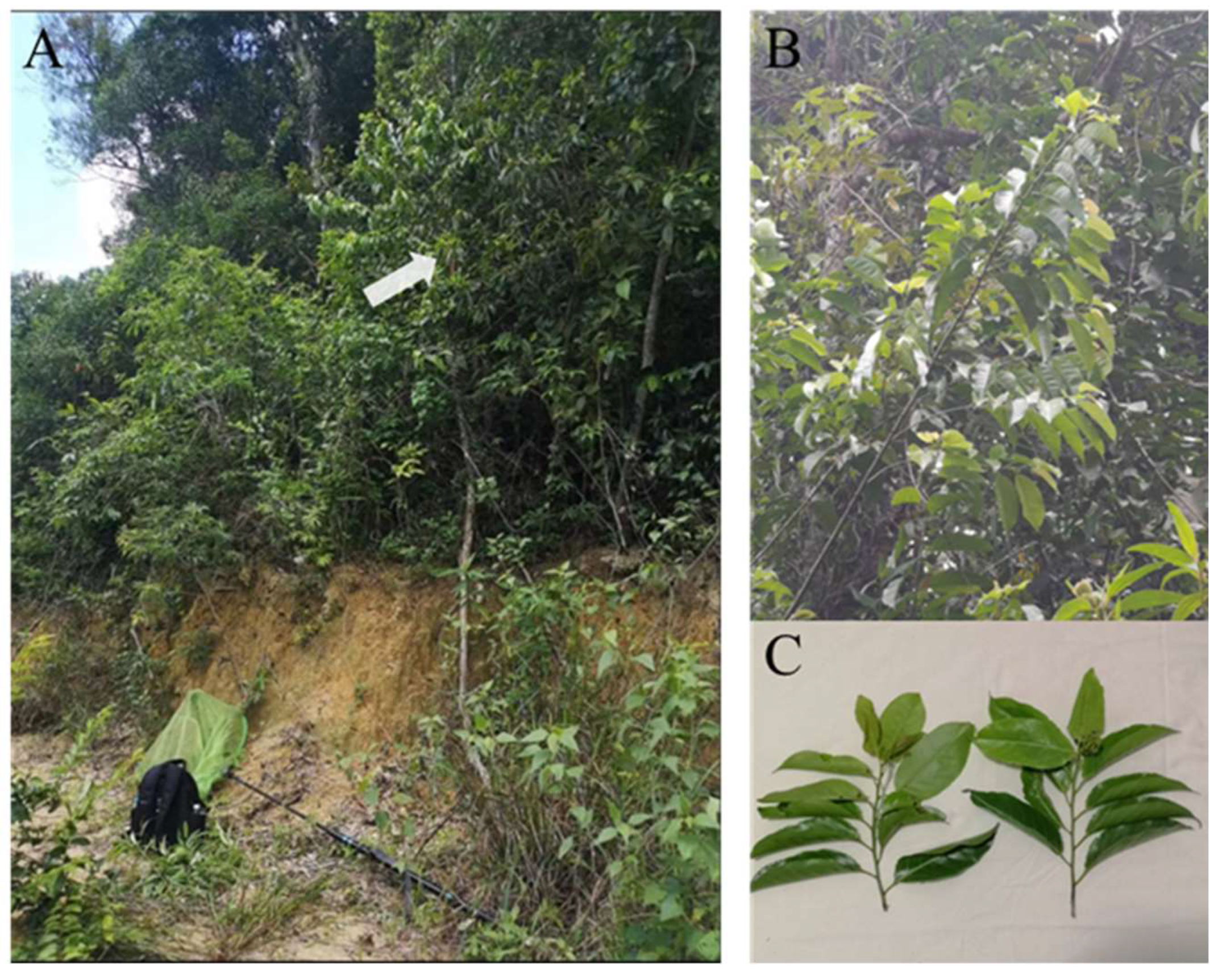
Figure 5.
(A, B) Philanthaxia longicorna Ni & Song, sp. nov., feeding on leaves, the arrow indicates the specific feeding site; (C, D) Philanthaxia lui Ni & Song, sp. nov., staying on leaves.
Figure 5.
(A, B) Philanthaxia longicorna Ni & Song, sp. nov., feeding on leaves, the arrow indicates the specific feeding site; (C, D) Philanthaxia lui Ni & Song, sp. nov., staying on leaves.
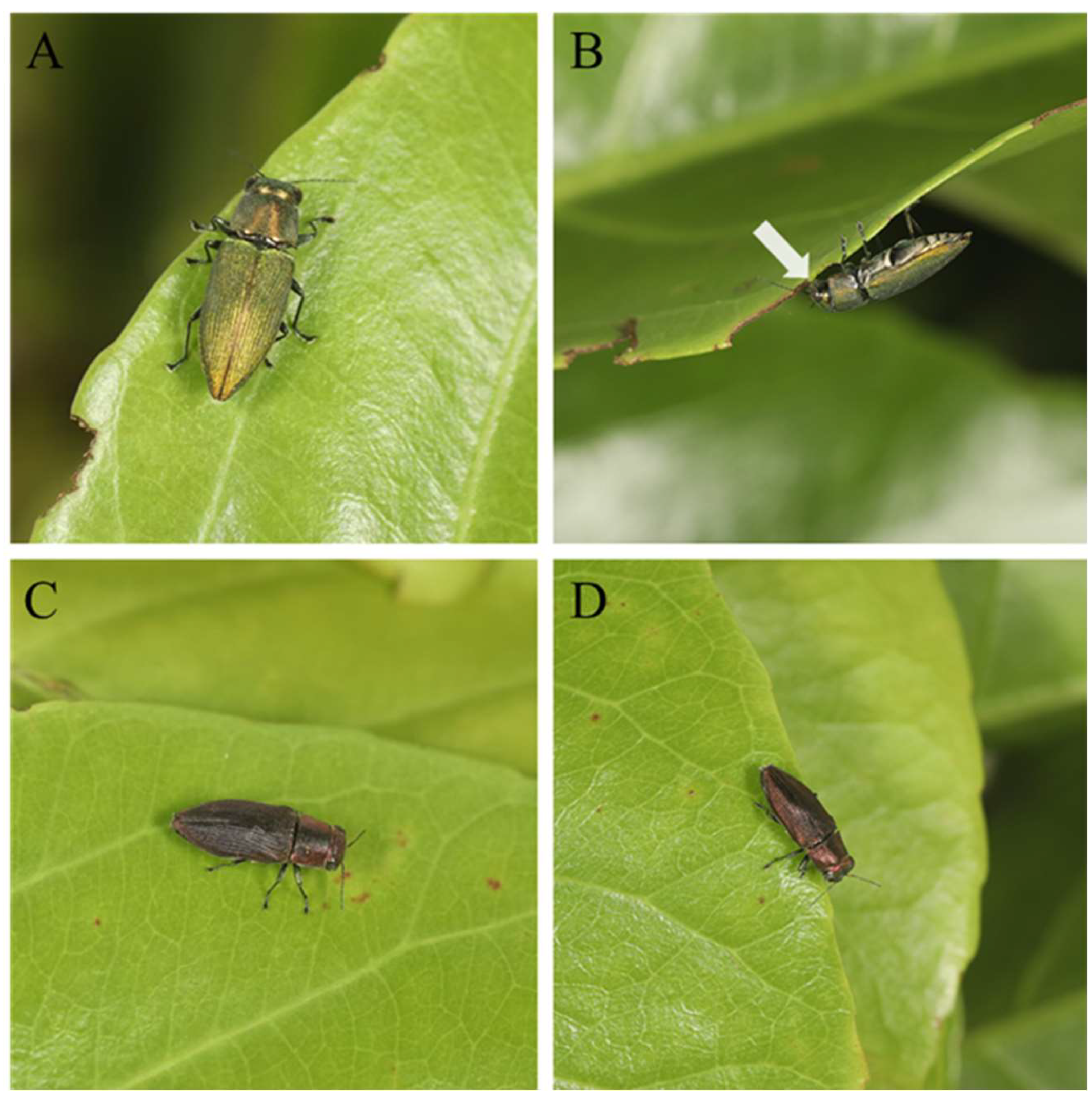

Table 1.
Differential Diagnosis of Philanthaxia longicorna Ni & Song, sp. nov. with two morphologically similar congeners.
Table 1.
Differential Diagnosis of Philanthaxia longicorna Ni & Song, sp. nov. with two morphologically similar congeners.
| Philanthaxia splendida, Van De Poll, 1892 (Vietnam) | Philanthaxia sauteri Kerremans, 1912 (Taiwan) | Philanthaxia longicorna Ni & Song, sp. nov. (Hainan) | |
| Size | 5.0-7.2 mm | 8.0-10.0 mm | 6.7-7.9 mm |
| Color | bright golden green; no record of ventral side color | dark color, mainly green, with red or black; ventral side green or reddish | bright golden green, same with ventral side |
| Head | frons less convex, larger head and eyes, | frons slightly depressed, smaller head and eyes | frons evenly convex, larger head and eyes |
| Antenna | antennae reach two third of pronotum horizontally; length-width ratio: scape 3.3, pedicel 1.7, antennae 3-10 1.4-2.8, terminal 1.6 | antennae reach half of pronotum horizontally; length-width ratio: scape 2.8, pedicel 1.9, antennae 3-10 1.2-1.5, terminal 1.3 | antennae extremely long, reach elytra and over scutellum horizontally; length-width ratio: scape 6, pedicel 2.0, antennae 3-10 2.1-3.5, terminal 1.5 |
| Pronotum | general evenly convex on both sides; sculpture regular, dense near the base | depressed laterally near posterior angle; sculpture irregular horizontal pattern | both sides of basal slightly depressed; sculpture regular polygon, dense near the base |
| Elytra | golden-green, monochrome | golden-green along suture, but changing color toward sides | golden-green, monochrome |
| Aedeagus | relatively short; parameres separated in sixth with apical portion slightly raised; apex not processing out of parameres | relatively robust; parameres separated in posterior half with no obvious raise; apex robust and not processing out of parameres | relatively slender; parameres without separation, slightly raised; apex sharp and processing out of parameres |
Table 2.
Differential Diagnosis of Philanthaxia lui Ni & Song, sp. nov. with two morphologically similar congeners.
Table 2.
Differential Diagnosis of Philanthaxia lui Ni & Song, sp. nov. with two morphologically similar congeners.
| Philanthaxia convexifrons Kurosawa, 1954 (Taiwan) | Philanthaxia iriei Kurosawa, 1985 (Ryu Kyu) | Philanthaxia lui Ni & Song sp. nov. (Hainan) | Philanthaxia splendida, Van De Poll, 1892 (Vietnam) | Philanthaxia sauteri Kerremans, 1912 (Taiwan) | Philanthaxia longicorna Ni & Song, sp. nov. (Hainan) | ||
| Size | 6.9-7.0mm | 6.8-8.0 mm | 5.6-8.6 mm | Size | 5.0-7.2 mm | 8.0-10.0 mm | 6.7-7.9 mm |
| Color | bronze-black; ventral side bronze-black | bronze-black or reddish-bronze; no record of ventral side color | bronze-black; ventral side dark green | Color | bright golden green; no record of ventral side color | dark color, mainly green, with red or black; ventral side green or reddish | bright golden green, same with ventral side |
| Head | frons evenly convex without any depressions or reliefs, same color for genders; smaller eyes with slightly raised | frons slightly convex between eyes, female frons bronze or reddish, male frons green; larger eyes and strongly projecting beyond outline of head | frons evenly convex, female frons reddish, male frons green; eyes large and projecting beyond outline of head | Head | frons less convex, larger head and eyes, | frons slightly depressed, smaller head and eyes | frons evenly convex, larger head and eyes |
| Pronotum | general evenly convex, regular and small sculpture | general evenly convex, sculpture horizontally irregular, dense near the base | both sides of basal slightly depressed, with more regular and large polygon sculpture | Antenna | antennae reach two third of pronotum horizontally; length-width ratio: scape 3.3, pedicel 1.7, antennae 3-10 1.4-2.8, terminal 1.6 | antennae reach half of pronotum horizontally; length-width ratio: scape 2.8, pedicel 1.9, antennae 3-10 1.2-1.5, terminal 1.3 | antennae extremely long, reach elytra and over scutellum horizontally; length-width ratio: scape 6, pedicel 2.0, antennae 3-10 2.1-3.5, terminal 1.5 |
| Elytra | black, slight violet, monochrome | bronze-black and reddish, luster, with serrations of lateral sides | bronze-black, monochrome, with serrations of one third lateral sides | Pronotum | general evenly convex on both sides; sculpture regular, dense near the base | depressed laterally near posterior angle; sculpture irregular horizontal pattern | both sides of basal slightly depressed; sculpture regular polygon, dense near the base |
Disclaimer/Publisher’s Note: The statements, opinions and data contained in all publications are solely those of the individual author(s) and contributor(s) and not of MDPI and/or the editor(s). MDPI and/or the editor(s) disclaim responsibility for any injury to people or property resulting from any ideas, methods, instructions or products referred to in the content. |
© 2025 by the authors. Licensee MDPI, Basel, Switzerland. This article is an open access article distributed under the terms and conditions of the Creative Commons Attribution (CC BY) license (http://creativecommons.org/licenses/by/4.0/).
Copyright: This open access article is published under a Creative Commons CC BY 4.0 license, which permit the free download, distribution, and reuse, provided that the author and preprint are cited in any reuse.


