

Submitted:
03 May 2025
Posted:
06 May 2025
You are already at the latest version
Abstract
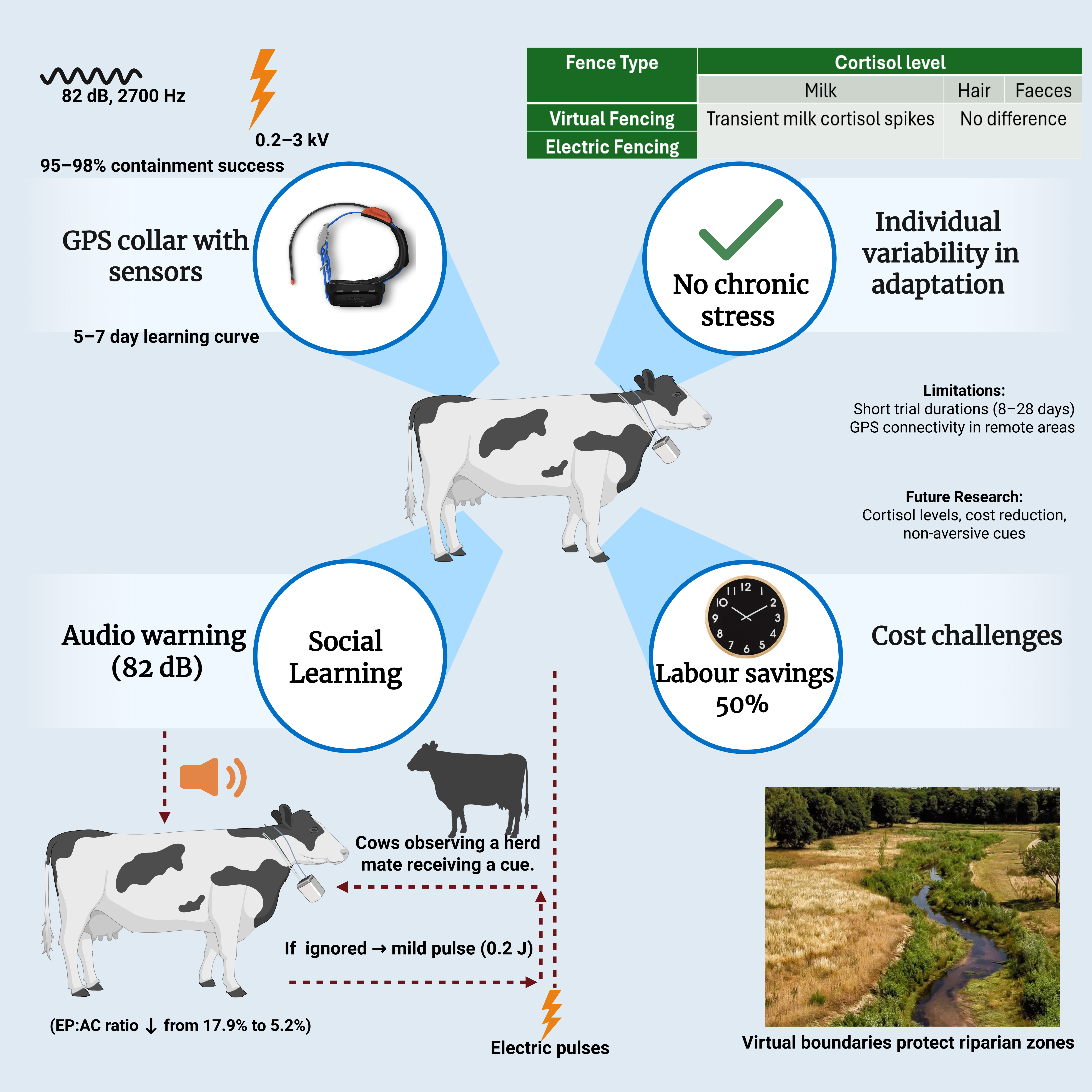
Virtual fencing (VF) technology represents an innovative approach to livestock management, utilizing GPS-enabled collars to establish invisible boundaries through auditory and mild electrical stimuli. This review examines the efficacy, welfare im-plications, and practical applications of VF in cattle production systems. Studies demonstrate that cattle rapidly learn to associate auditory cues with electrical pulses, achieving high containment rates (≥90%) within days, with minimal long-term wel-fare impacts as indicated by stable cortisol levels. However, short-term behavioral disruptions and occasional collar-related abrasions have been reported, particularly in dairy cattle. While VF enhances pasture management flexibility and reduces labor costs, challenges such as connectivity issues, individual animal variability, and high initial investment costs limit widespread adoption. The findings suggest that VF is a promising tool for precision livestock farming, though further research is needed to optimize training protocols, assess long-term welfare effects, and improve scalability across diverse farming systems.
Keywords:
virtual fencing
; cattle welfare
; precision livestock farming
; GPS collars
; associative learning
1. Introduction
Grazing livestock has been a fundamental agricultural practice for centuries, shaping landscapes and providing essential food resources [1]. Historically, controlling the movement of grazing animals relied primarily on herding and physical barriers such as stone walls, hedges, and wire fences [2]. While these traditional methods were effective, they required significant labor and infrastructure investment. The past century has seen substantial changes in temperate grazing dairy systems, particularly due to the increasing demand for animal-derived protein, which is projected to nearly double by 2050 [3]. This growing demand has intensified pressure on grazing lands, necessitating more efficient and flexible management strategies [4].
In response, technological advancements have led to the development of Precision Livestock Farming (PLF), which aims to enhance animal management through automated monitoring [5,6]. PLF technologies, including electronic identification systems, on-animal sensors (e.g., accelerometers and GPS), and stationary management systems, are increasingly being adopted in both intensive and extensive farming operations [7,8]. Within this technological progression, virtual fencing (VF) has emerged as an innovative solution to manage animal movement without physical barriers [2,6]. VF systems typically involve wearable collars that deliver sensory cues, such as audio warnings followed by mild electrical pulses, to contain animals within predefined virtual boundaries [9]. This technology represents a significant advancement in flexible, data-driven grazing management, offering potential benefits for pasture utilization and environmental conservation [10].
Virtual fencing is defined as an enclosure or boundary system without physical structures, relying instead on wearable devices such as collars [2,4,6]. When an animal approaches a virtual boundary, it first receives an audio cue, followed by a low-intensity electrical pulse if it continues moving forward [9]. This operant conditioning approach trains animals to retreat upon hearing the initial warning, minimizing the need for electrical corrections over time [7]. Research has demonstrated that cattle can successfully adapt to these systems, with prior exposure to physical electric fences accelerating learning [11,12]. Companies such as Halter, Vence, Nofence, eShepherd/Gallaghers, and Boviguard have commercialized VF technology, leveraging GPS tracking and wireless communication to dynamically adjust grazing areas [13].
A key advantage of VF is its ability to facilitate rotational and strip-grazing systems, which traditionally require labor-intensive fence adjustments [10]. By enabling farmers to modify grazing zones remotely via smartphones or computers, VF enhances pasture utilization efficiency while reducing labor costs [14]. Furthermore, VF can protect environmentally sensitive areas, such as riparian zones, by temporarily excluding livestock to prevent soil erosion and water contamination [9,15]. Studies have shown that VF can effectively restrict cattle from vulnerable ecosystems while maintaining pasture productivity [16].
A critical aspect of VF is the animal’s ability to learn and adapt to virtual boundaries through associative learning [7]. Research on beef heifers in rotational grazing systems has shown a decline in electric-to-acoustic signal ratios over time, indicating successful behavioral adaptation [12]. Similarly, nursing cows undergoing VF training exhibited reduced electrical stimuli as they learned to respond to audio cues alone [14]. However, concerns remain regarding animal welfare, particularly the potential stress induced by electrical pulses [17]. Studies assessing fecal cortisol metabolites (FCM), a stress indicator, have yielded mixed results. Some research found lower FCM levels in virtually fenced cattle compared to those in physical fences, suggesting reduced stress [17], while others reported no significant differences in welfare indicators such as lying time and weight gain [13]. These findings highlight the need for further investigation into the long-term welfare implications of VF across different livestock species.
This paper examines the potential of VF as an innovative tool for modern grazing management. It explores the technological foundations of VF systems, including their reliance on wearable collars with GPS and auditory-electrical stimuli to control livestock movement without physical barriers. The paper reviews studies on animal learning and behavioral adaptation, assessing how cattle respond to virtual boundaries over time. Additionally, it evaluates animal welfare implications, particularly the stress responses associated with electrical stimuli, by analyzing physiological indicators such as fecal cortisol metabolites (FCM) and behavioral metrics.
Beyond animal behavior, the paper discusses the practical applications of VF in grazing systems, including its role in rotational grazing, pasture optimization, and environmental protection (e.g., preventing overgrazing near riparian zones; [9,15]). It also situates VF within the broader framework of PLF, highlighting how sensor-based monitoring enhances livestock management efficiency. Finally, the paper considers barriers to adoption, such as cost and farmer acceptance, while emphasizing the technology’s potential to support sustainable livestock production in the face of growing global food demand and environmental challenges.
2. Materials and Methods
2.1. Literature Search
To comprehensively assess the potential of virtual fencing (VF) for cattle management, a systematic literature search was conducted across multiple academic databases, including Google Scholar, ScienceDirect, Scopus, PubMed, and Web of Science. The goal was to gather peer-reviewed studies evaluating the efficacy, animal welfare implications, and practical applications of VF in grazing systems. Both controlled experiments and field trials were included to ensure a balanced understanding of real-world applicability. While peer-reviewed journal articles formed the core of the review, relevant conference papers and technical reports were also considered to capture emerging trends in the field.
2.2. Searching Criteria
The search strategy employed targeted keywords such as "virtual fencing cattle behavior," "precision livestock farming grazing," "animal welfare virtual fencing," and "GPS collars grazing management." Boolean operators (AND/OR) were used to refine results, focusing primarily on studies involving cattle. Additional filters were applied to prioritize studies examining animal learning, stress responses (e.g., cortisol levels), and pasture utilization efficiency. No restrictions were placed on publication years to ensure the inclusion of both foundational and recent research. To maintain scientific rigor, non-peer-reviewed sources, commercial advertisements, and non-English publications without verified translations were excluded. Reference lists of key articles were manually screened to identify further relevant studies.
3. The Concept and Mechanism of Virtual Fencing for Cattle
Virtual fencing represents an innovative advancement in precision livestock farming, offering a boundary control system that eliminates the need for physical barriers [18]. This technology has gained attention for its potential to revolutionize grazing management through targeted grazing approaches, labor reduction, and application in environmentally sensitive areas where traditional fencing proves impractical [19]. Unlike conventional fencing methods, VF systems utilize wearable technology, typically GPS-enabled collars, to establish and maintain virtual boundaries (Figure 1).
The operational mechanism of virtual fencing relies on a sophisticated integration of positioning technology and behavioral conditioning [20]. As [21] explain, these systems continuously monitor an animal's position through GPS tracking, comparing it against predefined virtual boundaries established by farmers using digital mapping tools. When cattle approach these boundaries, the system initiates a two-stage deterrent process: first emitting an audible warning signal, followed by a mild electrical stimulus if the animal continues moving toward the boundary [22]. This design is rooted in operant conditioning principles, where animals learn to associate the initial auditory cue with the subsequent aversive stimulus [7].
Research demonstrates that cattle can effectively learn this association, with studies showing a significant reduction in electrical stimuli required over time as animals learn to respond to audio cues alone [9]. [23] reported that experienced cattle showed containment rates comparable to physical fencing, with electrical stimuli decreasing by up to 80% after the initial learning period. This learning capacity is crucial for both the effectiveness and ethical justification of virtual fencing systems [24]. Current commercial systems like eShepherd and NoFence have demonstrated impressive containment capabilities, with some studies reporting ≥99% effectiveness in keeping cattle within designated areas [25]. However, as [4] note, these systems may not completely eliminate boundary breaches to the same degree as physical barriers. Despite this limitation, the technology offers unique advantages, including the ability to create exclusion zones within pastures and precisely track animal movements [10]. These features enable more dynamic grazing management strategies, such as rotational grazing systems that can be adjusted remotely in response to pasture conditions [16].
Several virtual fencing systems and manufacturers have been evaluated in research (Table 1). For instance, the Halter® system, developed for intensive pastoral dairy farming, utilizes sound and vibration as primary cues and a low-energy electrical pulse as a secondary aversive cue [26]. Research has shown that cows can learn to respond to sound cues within a day and can be remotely herded to the milking parlor [27]. Another widely studied system, Nofence®, has demonstrated success in keeping cattle within virtual enclosures, with animals learning to respond to auditory warnings over time [28,29]. Similarly, eShepherd® by Gallagher has been tested on pasture-raised Angus and Jersey cows, showing effective boundary compliance through proximity-based beep and pulse responses [30]. Early research by [31] and [32] laid the groundwork by defining virtual fencing and reviewing its evolution, highlighting its potential in rangeland settings.
A wide range of parameters have been measured to assess the efficacy, animal welfare, and behavioral responses to virtual fencing (Table 1). Technology efficacy, often measured by the percentage of time animals remain within virtual boundaries, has generally shown high containment rates (≥99%) for various cattle types, including heifers, steers, dry cows, and lactating dairy cows [33]. [34] studied lactating dairy cows in intensive grazing systems and found that while virtual front-fences did not entirely eliminate entry into exclusion zones, containment within inclusion zones was high. These findings align with earlier studies on beef and dry dairy cattle [35]. However, [36] reported occasional containment failures, suggesting that effectiveness may vary depending on environmental conditions and herd dynamics. The number and type of cues delivered (audio vs. electrical pulses) are frequently recorded to assess animal learning. A common finding is that electrical pulses decrease over time as cattle learn to associate auditory warnings with boundary limits [37].
Animal welfare is a critical aspect investigated in virtual fencing studies. Researchers have measured physiological stress indicators such as cortisol levels in milk, hair, and feces [29,38]. While [34] noted transient increases in milk cortisol concentrations during the initial week of virtual fencing, [39] found no significant changes in manure cortisol levels. A systematic review by [40] concluded that most welfare indicators, including fecal cortisol metabolites (FCMs), showed no significant differences between virtually and physically fenced cattle, with some studies even reporting lower stress levels in VF-managed herds. Behavioral responses, such as time spent near virtual fences, lying duration, and activity levels, have also been analyzed. Studies indicate that cattle may initially avoid fence boundaries but adapt over time [41]. Individual differences in behavior suggest that temperament influences adaptation, with more exploratory animals requiring more corrective stimuli [42].
3.1. Learning Behavior and Social Adaptation
Learning behavior is a key focus, with studies examining how quickly cattle respond to audio cues and avoid electrical pulses. Naïve heifers have been shown to comply with virtual fence boundaries within 3-7 days, with learning retention observed over extended periods [43]. The decreasing ratio of electrical to acoustic signals over time indicates successful associative learning [44]. Social learning also plays a role, as cattle react to herd mates receiving stimuli, suggesting that group training may enhance compliance [45]. Training protocols, whether individual or group-based, have been explored to optimize learning efficiency, with some studies recommending phased training to minimize stress [46].
3.2. Impact on Livestock Performance and Pasture Management
The impact of virtual fencing on livestock performance, including weight gain and milk production, has been evaluated. [38] found no negative effects on beef heifer weight gain compared to traditional electric fencing. Similarly, [36] reported no adverse effects on dairy cow milk yield or live weight. Pasture utilization studies present mixed findings: some suggest lower grazing efficiency with VF, while others highlight its potential to prevent overgrazing and protect sensitive ecosystems [44]. Virtual fencing is applied in rotational grazing, strip-grazing, and conservation grazing, offering labor and cost savings over physical fences [28]. It also enables dynamic pasture management, such as creating firebreaks or protecting riparian zones [47]. However, limitations remain, including the need for further research on large-scale deployments, suckler cows with calves, and long-term welfare impacts [48]. Future studies should explore individual animal variability, optimal training methods, and integration with precision livestock farming technologies [44]. While challenges remain, virtual fencing represents a significant advancement in precision livestock farming, providing a flexible, welfare-compatible tool for pasture-based management. Ongoing innovations and research will continue to enhance its applicability, making it a promising solution for sustainable cattle production.
4. Commercial Cattle Monitoring Systems in Pasture-Based Systems
Diverse commercial Precision Livestock Farming (PLF) technologies are designed for pasture-based livestock systems (Table 2). These systems vary in sensor types (e.g., accelerometers, GPS, thermometers), target species, and geographic origins, reflecting the adaptability of PLF solutions to different agricultural contexts [58]. Devices such as smaXtec (Austria/Germany) and Allflex SenseHub (Israel) utilize accelerometers and thermometers to monitor rumination, body temperature, and calving events, aligning with research indicating that accelerometers effectively detect behavioral changes linked to health and reproduction, while thermometers enable early disease detection [58]. In contrast, Ceres Tag (Australia) and digitanimal (Spain) integrate GPS with accelerometers to track activity and geofencing, addressing challenges like theft prevention and pasture utilization, particularly valuable in large-scale grazing systems where manual monitoring is impractical [58].
Virtual fencing technologies like eShepherd (Australia), Halter (New Zealand), and Vence (USA) rely on GPS and accelerometers to guide livestock via auditory cues and electric stimuli, reducing labor costs and enabling dynamic pasture allocation, though their success depends on consistent animal training and ethical welfare considerations [58]. Reproductive efficiency is a key focus for devices like Datamuster (Australia) and Moocall (Ireland), which use walk-over-weigh systems and accelerometers to predict calving and maternal parentage, supporting automated weight monitoring for genetic selection and reduced postpartum losses [58]. Similarly, IceTag (UK) and Moomonitor+ (Ireland) prioritize lameness and heat detection (Table 2), addressing welfare concerns in pasture-based systems.
Despite these advancements, challenges such as cost, data transmission reliability, and farmer adoption persist. GPS collars and multi-sensor systems face limitations in battery life, connectivity, and affordability for small-scale farmers [58]. This highlights the need for user-friendly, energy-efficient designs to enhance scalability. Emphasizing multi-sensor integration while acknowledging economic and operational barriers is crucial for broader implementation.
5. Impact of Virtual Fencing Devices on Animal Behaviour and Welfare
Virtual fencing systems have been increasingly studied for their effectiveness in livestock containment and their implications for animal behaviour and welfare [59]. The findings from multiple studies suggest that while these devices generally achieve successful containment, their impact on animal welfare varies depending on factors such as device design, electric pulse intensity, acoustic signals, and individual animal responses. Most collars used in VF systems weigh between 1.4-1.45 kg, with Nofence® and eShepherd® being the most commonly tested [60,61,62]. The lightweight design appears to have minimal physical impact, though some studies reported occasional jaw abrasions, particularly with prolonged use [34,36]. This suggests that while collar weight itself may not be a major welfare concern, improper fit or extended wear could lead to minor physical discomfort in some animals. The electric pulses delivered by these devices typically range from 0.2-3 kV, often preceded by an 82 dB acoustic warning lasting 5-20 seconds [39,60,63]. The use of an auditory cue before the electric pulse is critical in promoting associative learning, allowing animals to avoid the stimulus over time. Studies found that cattle generally adapt within 5-7 days, with a decreasing ratio of electric to acoustic stimuli [9,64]. However, individual variability exists, with some animals requiring more stimuli than others [46,57].
5.1. Impact of Device Weight and Electric Pulses on Animal Welfare
The design and weight of virtual fencing (VF) collars play a significant role in animal welfare, with variations in materials and construction influencing comfort and long-term usability. [65] reported that device weight and materials directly affect animal welfare, noting that the eShepherd collar (2.1 kg; Figure 2) incorporates a nylon strap and counterweight, while lighter alternatives such as the Halter system (1.420 kg) and Nofence cattle collar (1.446 kg) use materials like polyester, foam, and rubber to reduce strain. In contrast, the Vence collar (1.13 kg) employs stainless steel and plastic chain links, which may require careful fitting to avoid pressure sores [65]. While cattle generally tolerate heavier collars well, smaller livestock like sheep may experience fatigue, highlighting the need for species-specific designs [65]. These findings align with studies on cattle, where collars weighing 1.4-1.45 kg (e.g., Nofence® and eShepherd®) showed minimal adverse behavioural effects [60,61,62]. However, [36] and [34] reported jaw abrasions in dairy cows, suggesting that even within cattle, prolonged wear or improper fit can lead to physical discomfort. This contrasts with [65]'s observation that cattle adapt well to heavier collars, indicating that while weight alone may not be a major issue, material choice and ergonomic design remain critical to prevent localized injuries.
Electric pulses, typically ranging from 0.2 J at 3 kV to low-voltage 800 V stimuli, are often preceded by acoustic warnings to facilitate associative learning. [64] found that cattle progressively reduced their reliance on electrical stimuli, with heifers decreasing their electrical-to-audio (E:A) response ratio from 17.9% during training to 5.2% during grazing. Similarly, [63] reported that Limousin cows learned to avoid restricted zones with minimal stress, as indicated by stable cortisol levels. However, [57] observed that some individuals received repeated pulses, raising concerns about potential aversion and welfare costs in less responsive animals. This variability suggests that while most cattle adapt well, individual differences in temperament and learning speed must be considered to minimize unnecessary stress. The implications of these findings highlight a balance between effective containment and animal welfare. While current VF systems are generally well-tolerated by cattle, improvements in collar materials, such as softer straps or adjustable fits, could mitigate abrasion risks [36,65]. Additionally, optimizing pulse intensity and ensuring consistent acoustic warnings may further reduce reliance on electrical stimuli, particularly for slower-learning individuals [57,64].
5.2. Role of Acoustic Signals in Animal Training
Acoustic cues play a crucial role in conditioning cattle to virtual boundaries. Most studies reported using tones between 82 dB and 2700 Hz, with rising pitch signals proving effective in eliciting avoidance behaviour [39,60,66]. [67] noted that dairy cows achieved 90% containment within four days, with decreasing reliance on pulses as they learned to respond to auditory warnings. However, individual variability exists, as [64] found that some heifers required more time to adapt, while [63] observed that shorter audio tones improved responsiveness. These findings suggest that while acoustic signals are generally effective, their duration and frequency should be optimized to minimize stress and enhance learning efficiency.
5.3. Cortisol Data and Stress Implications
Cortisol measurements across studies indicate that VF systems do not generally induce significant stress compared to traditional electric fencing (EF). [60] and [62] found no significant differences in faecal cortisol metabolites (FCM) between VF and EF groups, while [39] reported stable manure cortisol levels throughout their study. [63] further supported this, showing no significant changes in hair cortisol concentrations (HCC) before and after VF exposure. However, [36] recorded elevated milk cortisol levels in dairy cows during early VF exposure, though these stabilized over time. These discrepancies may reflect differences in study duration, animal type (beef vs. dairy), or individual stress susceptibility. Overall, the cortisol data suggest that once animals adapt, VF does not impose chronic stress, but initial exposure may require careful management to mitigate short-term welfare impacts.
5.4. Behavioural Adaptations and Welfare Outcomes
Behavioural observations indicate that cattle generally adapt well to VF, with most studies reporting high containment rates (>90%) and reduced escape attempts over time (Table 3; [9,46]). [61] found that cattle learned to avoid virtual boundaries with minimal welfare concerns, even in winter conditions, while [68] reported successful herd conditioning in dairy cows, albeit with slightly more vocalizations and displacements compared to EF groups. However, some studies highlight potential welfare trade-offs, such as reduced lying time [9] and altered grazing distribution [52]. Additionally, [34] noted that pasture depletion reduced VF efficacy, requiring more auditory cues, which could increase stress if not managed properly.
Beef cattle appear to adapt more readily to VF than dairy cattle, possibly due to differences in temperament and prior handling [60 vs. 36]. Additionally, younger animals and previously trained individuals (e.g., first-calf cows in [64]) show faster learning, suggesting that prior experience enhances VF efficacy. The presence of uncollared companions (e.g., calves) did not significantly disrupt containment [64], supporting VF use in mixed groups (Table 3). However, device-related injuries [36] and individual variability in stimulus response [57] highlight the need for ergonomic collar designs and tailored training protocols.
Virtual fencing technology has demonstrated significant potential in livestock management, with studies reporting high containment rates and rapid animal learning (Table 4). Grinnell et al. (2025) found that VF achieved a success ratio of 94.6% to 97.9%, comparable to electric fencing, with no adverse effects on welfare or weight gain. Similarly, Harland et al. [49] observed that cattle learned to associate audio cues with electrical pulses within 5–7 days, reducing the EP-to-AC ratio from 17.9% during training to just 5.2% during grazing. These findings suggest that VF is an effective containment method, though individual variability in learning rates was noted [49,57].
Despite these successes, several limitations were identified across studies (Table 4). Short trial durations (e.g., 8 weeks in Grinnell et al. [43]; 28 days in Verdon et al. [67] and small sample sizes (e.g., n=20 in Confessore et al. [29]; n=13 studies in Wilms et al. [13] restrict the generalizability of findings. Additionally, reliance on controlled environments, such as double-fence setups [43] or artificial paddocks [69], may not reflect real-world conditions. Technical challenges, including GPS inaccuracies [66] and collar connectivity issues [37], further complicate implementation. Ethical concerns regarding EPs were also raised, though no direct welfare harms were reported [49,70].
Future research should prioritize longer-term studies to assess habituation and welfare impacts, as suggested by multiple authors [9,67]. Improved collar designs, better GPS accuracy, and alternative stimuli (e.g., vibration or bidirectional sound) could enhance reliability [4,67]. Testing in diverse environments, such as arid or tropical systems [49], and integrating visual cues [27] may further optimize VF efficacy. Economic feasibility remains a barrier, with high costs limiting small-scale adoption [71]. The implications of these findings are twofold: VF offers a promising tool for precision grazing and ecological management [48,72], but scalability depends on addressing technical, ethical, and economic challenges. Future studies should adopt standardized protocols, larger sample sizes, and multi-breed comparisons to ensure broader applicability [13,54]. Refining technology and validating long-term impacts could revolutionize sustainable livestock management through virtual fencing.
6. Conclusions
Virtual fencing technology has emerged as a transformative tool in precision livestock farming, offering a flexible and labor-efficient alternative to traditional fencing. Studies demonstrate that cattle rapidly learn to associate auditory cues with mild electrical stimuli, achieving high containment rates (≥90%) with minimal long-term welfare impacts, as evidenced by stable cortisol levels and normal behavioral patterns. However, short-term behavioral disruptions and occasional collar-related abrasions highlight the need for optimized device design and training protocols. The integrated findings suggest that VF can significantly enhance pasture management by enabling dynamic rotational grazing, protecting sensitive ecosystems, and reducing labor costs. However, challenges such as high initial costs, connectivity limitations, and individual animal variability must be addressed for broader adoption. Regulatory standards should ensure welfare-compliant designs, while farmer education programs can facilitate smoother transitions to VF systems. The novelty of VF lies in its integration of GPS tracking and behavioral conditioning, providing a scalable solution for sustainable livestock production. Future research should focus on long-term welfare assessments, cost-effective scalability, and the development of non-aversive stimuli. As the technology evolves, VF has the potential to redefine cattle management, aligning productivity with environmental and animal welfare goals.
Author Contributions
I.U.G.: Conceptualization, Data Extraction, Table Visualization, Writing—Original Draft, Project Management, Coordination, Graphical Abstract, Writing—Review & Editing, Final Proofreading Before Publication. H.A.: Writing—Review & Editing. Q.H.: Writing—Review & Editing. S.R.: Writing—Original Draft, Writing—Review & Editing. All authors have read and agreed to the published version of the manuscript.
Funding
This article was funded through the support of Ruminants, an international, peer-reviewed, open access journal published quarterly online by MDPI. The journal invited Ishaya Usman Gadzama to write a feature paper based on his excellent research background.
Institutional Review Board Statement
Not applicable.
Informed Consent Statement
Not applicable.
Data Availability Statement
No new data were created or analyzed in this study. Data sharing is not applicable to this article.
Acknowledgments
The authors express their gratitude to the Editorial Board of Ruminants for the invitation and support. The graphical abstract was created using BioRender.com.
Conflicts of Interest
The authors declare no conflicts of interest.
References
- Roche, J. R.; Berry, D. P.; Bryant, A. M.; Burke, C. R.; Butler, S. T.; Dillon, P. G.; Macmillan, K. L. A 100-Year Review: A Century of Change in Temperate Grazing Dairy Systems. J. Dairy Sci. 2017, 100, 10189–10233. [Google Scholar] [CrossRef] [PubMed]
- Umstätter, C. The Evolution of Virtual Fences: A Review. Comput. Electron. Agric. 2011, 75, 10–22. [Google Scholar] [CrossRef]
- Gadzama, I. U.; Ray, S.; Méité, R.; Mugweru, I. M.; Gondo, T.; Rahman, M. A.; Redoy, M. R. A.; Rohani, M. F.; Kholif, A. E.; Salahuddin, M.; Brito, A. F. Chlorella vulgaris as a Livestock Supplement and Animal Feed: A Comprehensive Review. Animals 2025, 15, 879. [Google Scholar] [CrossRef] [PubMed]
- Goliński, P.; Sobolewska, P.; Stefańska, B.; Golińska, B. Virtual Fencing Technology for Cattle Management in the Pasture Feeding System—A Review. Agric. 2022, 13, 91. [Google Scholar] [CrossRef]
- Gadzama, I. U.; Ray, S. Precision Livestock Farming in Pasture-Based Dairy Systems: Monitoring Grazing Behavior; Wikifarmer, 2024. https://www.researchgate.net/publication/385053381.
- Gadzama, I. U. Virtual Fencing for Livestock Management: Effects on Cattle Behavior, Welfare, and Productivity; ResearchGate, 2025. https://www.researchgate.net/publication/388036239.
- Lee, C.; Colditz, I. G.; Campbell, D. L. M. A Framework to Assess the Impact of New Animal Management Technologies on Welfare: A Case Study of Virtual Fencing. Front. Vet. Sci. 2018, 5, 187. [Google Scholar] [CrossRef]
- Gadzama, I. U. How AI is Revolutionizing Animal Farming: Benefits, Applications, and Challenges; Wikifarmer, 2025. https://www.researchgate.net/publication/387828770.
- Campbell, D. L. M.; Lea, J. M.; Keshavarzi, H.; Lee, C. Virtual Fencing Is Comparable to Electric Tape Fencing for Cattle Behavior and Welfare. Front. Vet. Sci. 2019, 6, 445. [Google Scholar] [CrossRef]
- Langworthy, A. D.; Verdon, M.; Freeman, M. J.; Corkrey, R.; Hills, J. L.; Rawnsley, R. P. Virtual Fencing Technology to Intensively Graze Lactating Dairy Cattle. I: Technology Efficacy and Pasture Utilization. J. Dairy Sci. 2021, 104, 7071–7083. [Google Scholar] [CrossRef]
- Verdon, M.; Horton, B.; Rawnsley, R. A Case Study on the Use of Virtual Fencing to Intensively Graze Angus Heifers Using Moving Front and Back-Fences. Front. Anim. Sci. 2021, 2, 663963. [Google Scholar] [CrossRef]
- Verdon, M.; Langworthy, A.; Rawnsley, R. Virtual Fencing Technology to Intensively Graze Lactating Dairy Cattle. II: Effects on Cow Welfare and Behavior. J. Dairy Sci. 2021, 104, 7084–7094. [Google Scholar] [CrossRef]
- Wilms, L.; Komainda, M.; Hamidi, D.; Riesch, F.; Horn, J.; Isselstein, J. How Do Grazing Beef and Dairy Cattle Respond to Virtual Fences? A Review. J. Anim. Sci. 2024, 102, skae108. [Google Scholar] [CrossRef]
- Nyamuryekung'e, S.; Cox, A.; Perea, A.; Estell, R.; Cibils, A. F.; Holland, J. P.; Waterhouse, T.; Duff, G.; Funk, M.; McIntosh, M. M.; Spiegal, S.; Bestelmeyer, B.; Utsumi, S. Behavioral Adaptations of Nursing Brangus Cows to Virtual Fencing: Insights from a Training Deployment Phase. Animals 2023, 13, 3558. [Google Scholar] [CrossRef] [PubMed]
- Grudzinski, B.; Fritz, K.; Dodds, W. Does Riparian Fencing Protect Stream Water Quality in Cattle-Grazed Lands? Environ. Manage. 2020, 66, 121–135. [Google Scholar] [CrossRef] [PubMed]
- Schillings, J.; Holohan, C.; Lively, F.; Arnott, G.; Russell, T. The Potential of Virtual Fencing Technology to Facilitate Sustainable Livestock Grazing Management. Animal 2024, 18, 101231. [Google Scholar] [CrossRef] [PubMed]
- Sonne, C.; Alstrup, A. K. O.; Pertoldi, C.; Frikke, J.; Linder, A. C.; Styrishave, B. Cortisol in Manure from Cattle Enclosed with Nofence Virtual Fencing. Animals 2022, 12, 3017. [Google Scholar] [CrossRef]
- Anderson, D. M. Virtual Fencing—Past, Present and Future. Rangeland Journal 2007, 29, 65–78. [Google Scholar] [CrossRef]
- Jachowski, D. S.; Slotow, R.; Millspaugh, J. J. Good Virtual Fences Make Good Neighbors: Opportunities for Conservation. Anim. Conserv. 2014, 17, 187–196. [Google Scholar] [CrossRef]
- Lee, C.; Henshall, J. M.; Wark, T. J.; Crossman, C. C.; Reed, M. T.; Brewer, H. G.; O'Grady, J.; Fisher, A. D. Associative Learning by Cattle to Enable Effective and Ethical Virtual Fences. Appl. Anim. Behav. Sci. 2009, 119, 12–22. [Google Scholar] [CrossRef]
- Anderson, D. M.; Estell, R. E.; Holechek, J. L.; Ivey, S.; Smith, G. B. Virtual Herding for Flexible Livestock Management–A Review. The Rangeland Journal 2014, 36, 205–221. [Google Scholar] [CrossRef]
- Campbell, D. L.; Lea, J. M.; Haynes, S. J.; Farrer, W. J.; Leigh-Lancaster, C. J.; Lee, C. Virtual Fencing of Cattle Using an Automated Collar in a Feed Attractant Trial. Appl. Anim. Behav. Sci. 2018, 200, 71–77. [Google Scholar] [CrossRef]
- Verdon, M.; Lee, C.; Marini, D.; Rawnsley, R. Pre-Exposure to an Electrical Stimulus Primes Associative Pairing of Audio and Electrical Stimuli for Dairy Heifers in a Virtual Fencing Feed Attractant Trial. Animals 2020, 10, 217. [Google Scholar] [CrossRef]
- Lee, C.; Campbell, D. L. M. A Multi-Disciplinary Approach to Assess the Welfare Impacts of a New Virtual Fencing Technology. Front. Vet. Sci. 2021, 8, 637709. [Google Scholar] [CrossRef] [PubMed]
- Boyd, C. S.; O'Connor, R.; Ranches, J.; Bohnert, D. W.; Bates, J. D.; Johnson, D. D.; Davies, K. W.; Parker, T.; Doherty, K. E. Virtual Fencing Effectively Excludes Cattle from Burned Sagebrush Steppe. Rangeland Ecology & Management 2022, 81, 55–62. [Google Scholar] [CrossRef]
- Rahman, A.; Smith, D. V.; Little, B.; Ingham, A. B.; Greenwood, P. L.; Bishop-Hurley, G. J. Cattle Behavior Classification from the Collar, Halter, and Ear Tag Sensors. Inf. Process. Agric. 2018, 5, 124–133. [Google Scholar] [CrossRef]
- McSweeney, D.; O'Brien, B.; Coughlan, N. E.; Férard, A.; Ivanov, S.; Halton, P.; Umstätter, C. Virtual Fencing Without Visual Cues: Design, Difficulties of Implementation, and Associated Dairy Cow Behaviour. Comput. Electron. Agric. 2020, 176, 105613. [Google Scholar] [CrossRef]
- Goliński, P.; Sobolewska, P.; Stefańska, B.; Golińska, B. Virtual Fencing Technology for Cattle Management in the Pasture Feeding System—A Review. Agric. 2022, 13, 91. [Google Scholar] [CrossRef]
- Confessore, A.; Schneider, M. K.; Pauler, C. M.; Aquilani, C.; Fuchs, P.; Pugliese, C.; Dibari, C.; Argenti, G.; Accorsi, P. A.; Probo, M. A Matter of Age? How Age Affects the Adaptation of Lactating Dairy Cows to Virtual Fencing. J. Anim. Sci. 2024, 102, skae137. [Google Scholar] [CrossRef]
- Costly Fencing Renewal Replaced with Virtual Fencing; The Cows Wear a Collar on Which Hangs a Two-Sided Solar Panel Approximately the Same Size as a Swiss Cowbell. Ontario Farmer 2024, B.10. https://www.proquest.com/magazines/costly-fencing-renewal-replaced-with-virtual-cows/docview/3072070025/se-2?accountid=14723.
- Anderson, D. M.; Hale, C. S. Animal Control System Using Global Positioning and Instrumental Animal Conditioning. U.S. Patent 6,232,880 B1, May 15, 2001. [Google Scholar]
- Umstätter, C. The Evolution of Virtual Fences: A Review. Comput. Electron. Agric. 2011, 75, 10–22. [Google Scholar] [CrossRef]
- Fuchs, P.; Stachowicz, J.; Schneider, M. K.; Probo, M.; Bruckmaier, R. M.; Umstätter, C. Stress Indicators in Dairy Cows Adapting to Virtual Fencing. J. Anim. Sci. 2024, 102, skae024. [Google Scholar] [CrossRef]
- Langworthy, A. D.; Verdon, M.; Freeman, M. J.; Corkrey, R.; Hills, J. L.; Rawnsley, R. P. Virtual Fencing Technology to Intensively Graze Lactating Dairy Cattle. I: Technology Efficacy and Pasture Utilization. J. Dairy Sci. 2021, 104, 7071–7083. [Google Scholar] [CrossRef]
- Banks, T. Wearable Tech for Cows Helps Herds Communicate with Farmers. Design Week (Online) 2015, July 28. https://www.proquest.com/magazines/wearable-tech-cows-helps-herds-communicate-with/docview/1699347294/se-2?accountid=14723.
- Verdon, M.; Langworthy, A.; Rawnsley, R. Virtual Fencing Technology to Intensively Graze Lactating Dairy Cattle. II: Effects on Cow Welfare and Behavior. J. Dairy Sci. 2021, 104, 7084–7094. [Google Scholar] [CrossRef]
- Harland, A. J.; Novais, F. J.; Fitzsimmons, C. J.; Church, J. S.; da Silva, G. M.; Londono-Mendez, M. C.; Bork, E. W. Evaluating Virtual Fencing as a Tool to Manage Beef Cattle for Rotational Grazing Across Multiple Years. J. Environ. Manage. 381, 125166. [CrossRef] [PubMed]
- Hamidi, D.; Grinnell, N. A.; Komainda, M.; Riesch, F.; Horn, J.; Ammer, S.; Traulsen, I.; Palme, R.; Hamidi, M.; Isselstein, J. Heifers Don't Care: No Evidence of Negative Impact on Animal Welfare of Growing Heifers When Using Virtual Fences Compared to Physical Fences for Grazing. Animal 2022, 16, 100614. [Google Scholar] [CrossRef] [PubMed]
- Sonne, C.; Alstrup, A. K. O.; Pertoldi, C.; Frikke, J.; Linder, A. C.; Styrishave, B. Cortisol in Manure from Cattle Enclosed with Nofence Virtual Fencing. Animals 2022, 12, 3017. [Google Scholar] [CrossRef]
- Wilms, L.; Komainda, M.; Hamidi, D.; Riesch, F.; Horn, J.; Isselstein, J. How Do Grazing Beef and Dairy Cattle Respond to Virtual Fences? A Review. J. Anim. Sci. 2024, 102, skae108. [Google Scholar] [CrossRef]
- Aaser, M. F.; Staahltoft, S. K.; Korsgaard, A. H.; Trige-Esbensen, A.; Alstrup, A. K. O.; Sonne, C.; Pertoldi, C.; Bruhn, D.; Frikke, J.; Linder, A. C. Is Virtual Fencing an Effective Way of Enclosing Cattle? Personality, Herd Behaviour and Welfare. Animals 2022, 12, 842. [Google Scholar] [CrossRef]
- Lee, C.; Colditz, I. G.; Campbell, D. L. M. A Framework to Assess the Impact of New Animal Management Technologies on Welfare: A Case Study of Virtual Fencing. Front. Vet. Sci. 2018, 5, 187. [Google Scholar] [CrossRef]
- Grinnell, N. A.; Hamidi, D.; Komainda, M.; Riesch, F.; Horn, J.; Traulsen, I.; Palme, R.; Isselstein, J. Supporting Rotational Grazing Systems with Virtual Fencing: Paddock Transitions, Beef Heifer Performance, and Stress Response. Animal 2025, 19, 101416. [Google Scholar] [CrossRef]
- Musinska, J.; Skalickova, S.; Nevrkla, P.; Kopec, T.; Horky, P. Unlocking Potential, Facing Challenges: A Review Evaluating Virtual Fencing for Sustainable Cattle Management. Livest. Sci. 2025, 105693. [Google Scholar] [CrossRef]
- Versluijs, E.; Niccolai, L. J.; Spedener, M.; Zimmermann, B.; Hessle, A.; Tofastrud, M.; Devineau, O.; Evans, A. L. Classification of Behaviors of Free-Ranging Cattle Using Accelerometry Signatures Collected by Virtual Fence Collars. Front. Anim. Sci. 2023, 4, 1083272. [Google Scholar] [CrossRef]
- Nyamuryekung'e, S.; Cox, A.; Perea, A.; Estell, R.; Cibils, A. F.; Holland, J. P.; Waterhouse, T.; Duff, G.; Funk, M.; McIntosh, M. M.; Spiegal, S.; Bestelmeyer, B.; Utsumi, S. Behavioral Adaptations of Nursing Brangus Cows to Virtual Fencing: Insights from a Training Deployment Phase. Animals 2023, 13, 3558. [Google Scholar] [CrossRef]
- Campbell, D. L. M.; Haynes, S. J.; Lea, J. M.; Farrer, W. J.; Leigh-Lancaster, C. J.; Lee, C. Temporary Exclusion of Cattle from a Riparian Zone Using Virtual Fencing Technology. Animals 9, 5. [CrossRef] [PubMed]
- Boyd, C. S.; O'Connor, R. C.; Ranches, J.; Bohnert, D. W.; Bates, J. D.; Johnson, D. D.; Davies, K. W.; Parker, T.; Doherty, K. E. Using Virtual Fencing to Create Fuel Breaks in the Sagebrush Steppe. Rangeland Ecology & Management 2023, 89, 87–93. [Google Scholar] [CrossRef]
- Harland, A. J.; Novais, F. J.; Durunna, O. N.; Fitzsimmons, C. J.; Church, J. S.; Bork, E. W. Evaluation of the Technical Performance of the Nofence Virtual Fencing System in Alberta, Canada. Smart Agric. Technol. 2025, 10, 100713. [Google Scholar] [CrossRef]
- Hamidi, D.; Grinnell, N. A.; Komainda, M.; Wilms, L.; Riesch, F.; Horn, J.; Hamidi, M.; Traulsen, I.; Isselstein, J. Training Cattle for Virtual Fencing: Different Approaches to Determine Learning Success. Appl. Anim. Behav. Sci. 2024, 273, 106220. [Google Scholar] [CrossRef]
- Murray, B. D.; Wagner, K. L.; Reuter, R.; Goodman, L. E. Use of Virtual Fencing to Implement Critical Conservation Practices. Rangelands 2024, 47, 41–49. [Google Scholar] [CrossRef]
- Fuchs, P.; Stachowicz, J.; Schneider, M.; Probo, M.; Bruckmaier, R. M.; Umstätter, C. PSVI-16 Conditioning Dairy Cows to a Virtual Fencing System Is Compatible with Animal Welfare. J. Anim. Sci. 2023, 101, 334–335. [Google Scholar] [CrossRef]
- Hamidi, D.; Hütt, Ch.; Komainda, M.; Grinnell, N. A.; Horn, J.; Riesch, F.; Hamidi, M.; Traulsen, I.; Isselstein, J. Grid Grazing: A Case Study on the Potential of Combining Virtual Fencing and Remote Sensing for Innovative Grazing Management on a Grid Base. Livest. Sci. 2023, 278, 105373. [Google Scholar] [CrossRef]
- Confessore, A.; Aquilani, C.; Nannucci, L.; Fabbri, M. C.; Accorsi, P. A.; Dibari, C.; Argenti, G.; Pugliese, C. Application of Virtual Fencing for the Management of Limousin Cows at Pasture. Livest. Sci. 2022, 263, 105037. [Google Scholar] [CrossRef]
- Colusso, P. I.; Clark, C. E. F.; Ingram, L. J.; Thomson, P. C.; Lomax, S. Dairy Cattle Response to a Virtual Fence When Pasture on Offer Is Restricted to the Post-Grazing Residual. Front. Anim. Sci. 2021, 2, 791228. [Google Scholar] [CrossRef]
- Lomax, S.; Colusso, P.; Clark, C. E. F. Does Virtual Fencing Work for Grazing Dairy Cattle? Animals 2019, 9, 429. [Google Scholar] [CrossRef]
- Aquilani, C.; Confessore, A.; Bozzi, R.; Sirtori, F.; Pugliese, C. Review: Precision Livestock Farming Technologies in Pasture-Based Livestock Systems. Animal 2022, 16, 100429. [Google Scholar] [CrossRef] [PubMed]
- Waterhouse, T. Virtual fencing systems: balancing production and welfare outcomes. Livestock 2023, 28, 227–234. [Google Scholar] [CrossRef]
- Additional References (numbered 60-65).
- Hamidi, D.; Grinnell, N. A.; Komainda, M.; Wilms, L.; Riesch, F.; Horn, J.; Hamidi, M.; Traulsen, I.; Isselstein, J. Training Cattle for Virtual Fencing: Different Approaches to Determine Learning Success. Appl. Anim. Behav. Sci. 2024, 273, 106220. [Google Scholar] [CrossRef]
- Confessore, A.; Aquilani, C.; Nannucci, L.; Fabbri, M. C.; Accorsi, P. A.; Dibari, C.; Argenti, G.; Pugliese, C. Application of Virtual Fencing for the Management of Limousin Cows at Pasture. Livest. Sci. 2022, 263, 105037. [Google Scholar] [CrossRef]
- Harland, A. J.; Novais, F. J.; Fitzsimmons, C. J.; Church, J. S.; da Silva, G. M.; Londono-Mendez, M. C.; Bork, E. W. Evaluating Virtual Fencing as a Tool to Manage Beef Cattle for Rotational Grazing Across Multiple Years. J. Environ. Manage. 381, 125166. [CrossRef]
- Fisher, A.; Cornish, A. Independent Scientific Literature Review on Animal Welfare Considerations for Virtual Fencing; Department of Agriculture, Fisheries and Forestry: 2022.
- Lund, S. M.; Jacobsen, J. H.; Nielsen, M. G.; Friis, M. R.; Nielsen, N. H.; Mortensen, N. Ø.; Skibsted, R. C.; Aaser, M. F.; Staahltoft, S. K.; Bruhn, D.; Sonne, C.; Alstrup, A. K. O.; Frikke, J.; Pertoldi, C. Spatial Distribution and Hierarchical Behaviour of Cattle Using a Virtual Fence System. Animals 2024, 14, 2121. [Google Scholar] [CrossRef]
- Verdon, M.; Hunt, I.; Rawnsley, R. The Effectiveness of a Virtual Fencing Technology to Allocate Pasture and Herd Cows to the Milking Shed. J. Dairy Sci. 2024, 107, 6161–6177. [Google Scholar] [CrossRef]
- Fuchs, P.; Stachowicz, J.; Schneider, M. K.; Probo, M.; Bruckmaier, R. M.; Umstätter, C. Stress Indicators in Dairy Cows Adapting to Virtual Fencing. J. Anim. Sci. 2024, 102, skae024. [Google Scholar] [CrossRef]
- Umstätter, C.; Brocklehurst, S.; Ross, D. W.; Haskell, M. J. Can the Location of Cattle Be Managed Using Broadcast Audio Cues? Appl. Anim. Behav. Sci. 2013, 147, 34–42. [Google Scholar] [CrossRef]
- Grumett, D.; Butterworth, A. Electric Shock Control of Farmed Animals: Welfare Review and Ethical Critique. Anim. Welf. J. 2022, 31, 373–385. [Google Scholar] [CrossRef]
- Heins, B. J.; Pereira, G. M.; Sharpe, K. T. Precision Technologies to Improve Dairy Grazing Systems. JDS Commun. 2023, 4, 318–323. [Google Scholar] [CrossRef] [PubMed]
- Wróbel, B.; Zielewicz, W.; Staniak, M. Challenges of Pasture Feeding Systems—Opportunities and Constraints. Agric. 2023, 13, 974. [Google Scholar] [CrossRef]
- Occhiuto, F.; Vázquez-Diosdado, J. A.; King, A. J.; Kaler, J. Using Precision Technology to Investigate Personality and Plasticity of Movement in Farmed Calves and Their Associations with Weight Gain. Anim. Sci. Proc. 2023, 14, 160. [Google Scholar] [CrossRef]
- Holohan, C.; Gordon, A.; Palme, R.; Buijs, S.; Lively, F. An Assessment of Young Cattle Behaviour and Welfare in a Virtual Fencing System. Proc. XXV Int. Grassl. Congr. 2023, KY, 35. [Google Scholar]
- Herlin, A.; Brunberg, E.; Hultgren, J.; Högberg, N.; Rydberg, A.; Skarin, A. Animal Welfare Implications of Digital Tools for Monitoring and Management of Cattle and Sheep on Pasture. Animals 2021, 11, 829. [Google Scholar] [CrossRef]
- Colusso, P. I.; Clark, C. E. F.; Lomax, S. Should Dairy Cattle Be Trained to a Virtual Fence System as Individuals or in Groups? Animals 2020, 10, 1767. [Google Scholar] [CrossRef]
- Bhargava, K.; Ivanov, S.; Kulatunga, C.; Donnelly, W. Fog-Enabled WSN System for Animal Behavior Analysis in Precision Dairy. In 2017 International Conference on Computing, Networking and Communications (ICNC); IEEE: 2017; pp 504-510.
- French, P.; O'Brien, B.; Shalloo, L. Development and Adoption of New Technologies to Increase the Efficiency and Sustainability of Pasture-Based Systems. Anim. Prod. Sci. 2015, 55, 931–935. [Google Scholar] [CrossRef]
Figure 1.
The concept of virtual fencing.
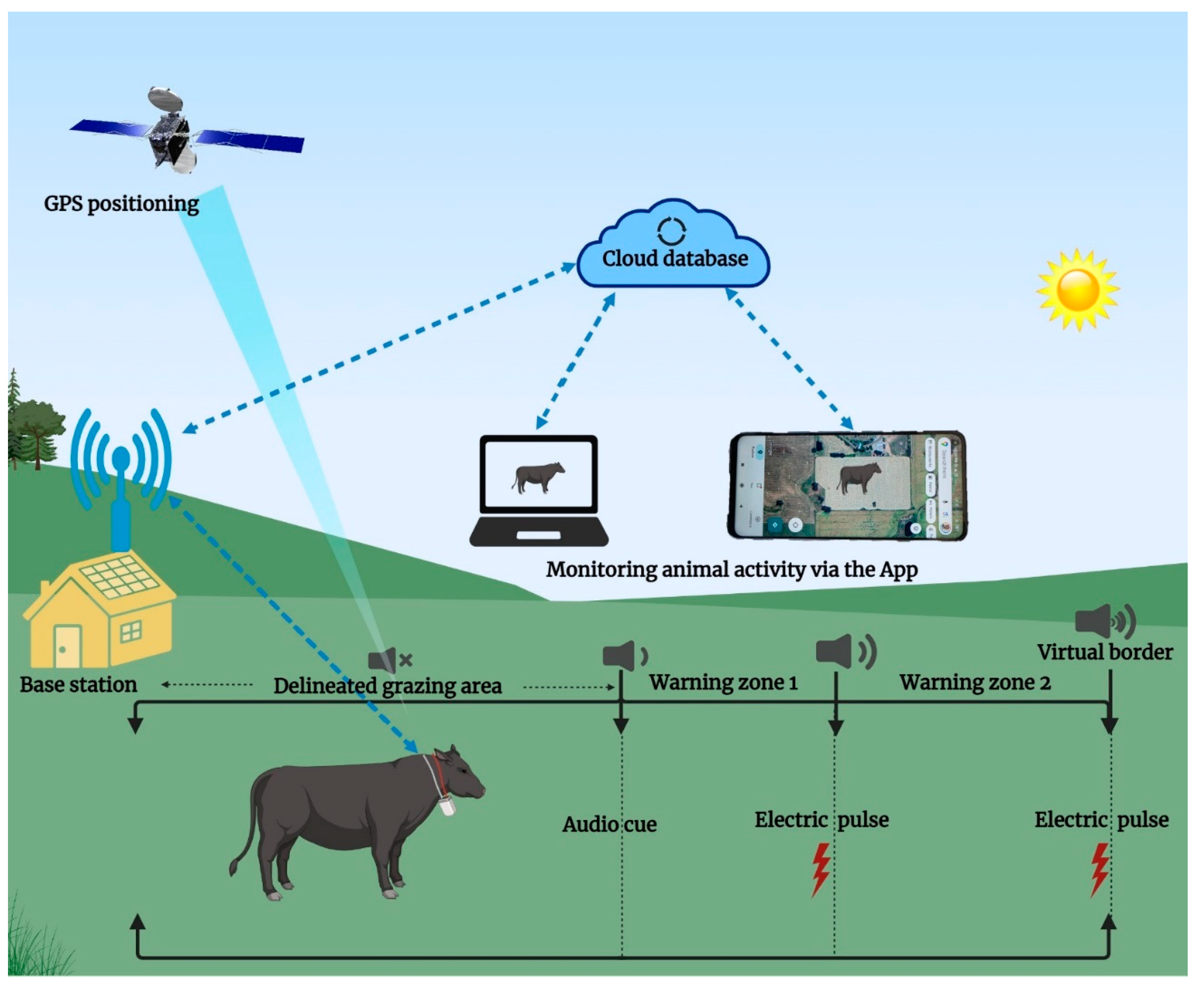
Figure 2.
Weight of virtual fencing devices. Adapted from Fisher & Cornish [65].
Figure 2.
Weight of virtual fencing devices. Adapted from Fisher & Cornish [65].
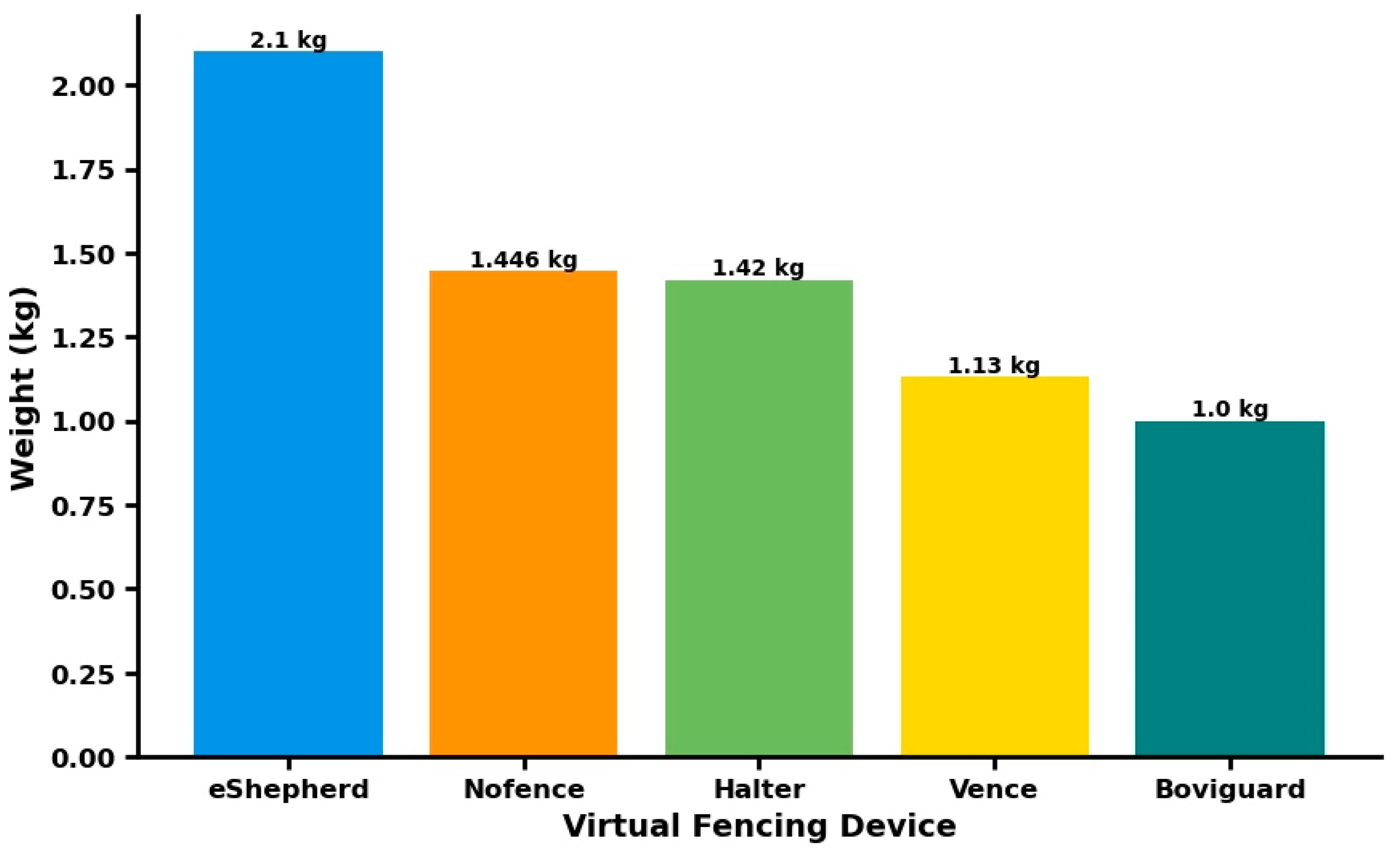

Table 1.
Overview of virtual fencing studies in cattle: devices, manufacturers, and measured parameters (2001–2025).
Table 1.
Overview of virtual fencing studies in cattle: devices, manufacturers, and measured parameters (2001–2025).
| Year | Animal Species/Breed | Virtual Fencing Device | Device Manufacturer | Location on Animal | Behavior/Parameters Measured | Reference |
| 2025 | Kinsella Composite (KC) crossbred beef cattle (heifers & cows) | Nofence® | Nofence AS, Batnfjordsøra (Norway) | Neck collar with adjustable strap | Electrical pulses (EPs) and audio cues (ACs) received EP-to-AC ratio (E:A) Inclusion zone frequency (IZF, % time within boundaries) Escape frequency/duration Step counts (via leg sensor) Lying/standing time |
[49] |
| 2025 | Kinsella Composite (KC) crossbred beef cattle (heifers & cows) | IceQube+ activity sensor | Peacock Technologies (Stirling, UK) | Lower left rear leg | Activity patterns (step counts) Lying vs. standing time |
[49] |
| 2025 | Fleckvieh heifers | Nofence® | Nofence AS, Batnfjordsøra (Norway) | Neck | Success ratio (auditory:electrical), escape alerts, GNSS, faecal cortisol, body weight gain | [50] |
| 2024 | Fleckvieh heifers | Nofence® | Nofence AS, Batnfjordsøra (Norway) | Neck collar | Behavior metrics, herbage intake, stress indicators (faecal cortisol) | [51] |
| 2024 | Angus cows | Vence® VF system | Vence (vence.io; Merck & Co., Inc., Rahway, NJ) | GPS-enabled VF collar | Percentage of cow locations in different management zones (riparian exclusion, ridge exclusion, grazing area, large-area exclusions), noncompliance | [52] |
| 2024 | Lactating Holstein-Friesian | Nofence® | Nofence AS, Batnfjordsøra (Norway) | Neck collar | Acoustic warnings, electrical pulses, step count, milk yield, hair cortisol | [29] |
| 2024 | Pasture-raised Angus beef, Jersey dry cows | eShepherd®) | Gallagher, Hamilton (New Zealand) | Collar | Proximity to boundary (beep/pulse response) | [30] |
| 2023 | Dairy cows | Nofence® | Nofence AS, Batnfjordsøra (Norway) | Neck collar | Cow positions, audio tones (AT), electric pulses (EP), activity | [53] |
| 2023 | Free-ranging cattle | Nofence® | Nofence AS, Batnfjordsøra (Norway) | Below the neck | Accelerometry-inferred behaviors (feeding, resting, scratching) | [45] |
| 2023 | Fleckvieh heifers | Nofence® (Model: C2.1) |
Nofence, AS, Batnfjordsøra (Norway) | Attached to the neck | GPS data (walking distance, lying time, spatial pattern of movement), lying time (validated with observational data), active time, spatial distribution (Camargo’s Index of Evenness) | [54] |
| 2023 | Cattle | Nofence® | Nofence AS, Batnfjordsøra (Norway) | Neck collar | Distance to boundary, acoustic warnings, aversive stimuli | [28] |
| 2022 | Cattle | Vence® | Vence Corporation, San Diego (USA) | GPS collar | Location, welfare, animal distribution | [48] |
| 2022 | Pregnant Limousin cows | Nofence® | Nofence AS, Batnfjordsøra (Norway) | Neck collar | Hair cortisol, signal responses | [55] |
| 2022 | 12 pregnant Angus cows | Nofence® | Nofence AS, Batnfjordsøra (Norway) | Neck collar | Activity levels | [41] |
| 2021 | Dairy cattle (Holstein-Friesian) | Pre-commercial prototype (eShepherd®) | Agersens, Melbourne (Australia) | Neckband | Location, stimuli count, time per zone, speed | [56] |
| 2021 | Lactating Dairy Cows (Friesian/Jersey) | eShepherd pre-commercial prototype | Agersens, Melbourne (Australia) | Neckband | Time in exclusion zone, stimuli ratio | [34] |
| 2020 | Non-lactating Holstein Friesian | GPS/DGPS collar with stimuli unit | MediaTek (Hsinchu, Taiwan), Trimble (Sunnyvale, USA) | Neck collar | Boundary challenges, behavior (grazing/walking/drinking) | [27] |
| 2019 | Holstein-Friesian dairy cows | eShepherd™ collar (automated prototype) | Agersens, Melbourne (Australia) | Top of the neck | Grazing time, GPS position, audio/electric pulses | [57] |
| 2018 | Cattle | Halter® | Halter (New Zealand) | Neck-collar + head-halter | Health (body temperature), response to audio/tactile/visual/electrical stimuli | [26] |
| 2015 | Dairy cattle | Cowbell collar (audible alarm + shock) | Cambridge Industrial Design (Cambridge, UK), Teagasc (Ireland) | Around the neck | Grazing, socializing, lying, milk yields | [35] |
| 2001 | Cattle | Directional Virtual Fence (DVFTM) | Anderson & Hale (Patent) | GPS collar | Location relative to boundary | [31] |
VF = Virtual Fencing; EP = Electrical Pulse; AC = Audio Cue; E:A = Electrical-to-Audio ratio; IZF = Inclusion Zone Frequency (% time within boundaries); GNSS = Global Navigation Satellite System; GPS = Global Positioning System; DGPS = Differential GPS; AT = Audio Tone; FCM = Fecal Cortisol Metabolites; HCC = Hair Cortisol Concentration; GWD = Grazing/Walking/Drinking; KC = Kinsella Composite; N/A = Not Applicable.
Table 2.
Commercial cattle monitoring systems.
| Device | Sensors | Outputs / Functionalities | Country |
| Datamuster | Walk-over-weigh (weighing crate) | Maternal parentage, reproductive efficiency, growth rates, calving, property mapping | Australia |
| smaXtec (GmbH) | Accelerometer, thermometer | pH, body temperature, calving, heat detection, health, rumination | Austria, Germany |
| Ceres Tag | GPS, Accelerometer | Activity, geofencing, health monitoring | Australia |
| Allflex SenseHub | Accelerometer | Health, rumination, feed intake, heat detection, calving, activity, heat stress | Israel |
| Moomonitor+ | Accelerometer | Activity, resting, feeding, rumination, heat detection | Ireland |
| IceTag / IceQube | Accelerometer | Lameness, activity, resting, heat detection | UK |
| Moocall | Accelerometer | Calving, heat detection | Ireland |
| CalveSense | Accelerometer | Calving monitoring | Israel |
| eShepherd® | GPS, Accelerometer | Virtual fencing, activity monitoring, pasture management | Australia |
| Halter® | GPS, Accelerometer | Virtual fencing, activity monitoring, pasture management | New Zealand |
| Vence® | GPS, Accelerometer | Virtual fencing, activity monitoring, pasture management | USA |
| Nofence® | GPS, Accelerometer | Virtual fencing, activity monitoring | Norway |
| digitanimal | GPS, Accelerometer, thermometer | Activity, geofencing, body temperature | Spain |
Abbreviations and Symbols: GPS = Global Positioning System; GmbH = Gesellschaft mit beschränkter Haftung (German for "company with limited liability"); pH = potential of Hydrogen (measure of acidity/alkalinity); UK = United Kingdom; USA = United States of America. Adapted from Aquilani [58].
Table 3.
Comparative analysis of virtual fencing systems: behavioral responses, welfare impacts, and technical specifications across cattle studies.
Table 3.
Comparative analysis of virtual fencing systems: behavioral responses, welfare impacts, and technical specifications across cattle studies.
| Study Reference | Animal Type (n) | Device (Weight) | Electric Pulse | Acoustic Signal | Cortisol Data | Key Behavioral & Welfare Findings |
| [43] | Beef heifers (n=32) | Nofence® (1.45 kg) | 0.2 J at 3 kV (max 3) | 82 dB (increasing pitch) | No significant FCM differences | Comparable to EF, adaptation over time, initial slower transitions |
| [49] | Yearling beef heifers, bulls, cows + calves |
Nofence® (1.45 kg) |
Mild electrical pulse (1.5-3 kv) |
Audio cues (frequency not specified) | Not measured | Cattle learned to avoid virtual boundaries with minimal welfare concerns. The system provided effective containment, despite some collar losses, without major welfare issues. Animals adapted well, showing no significant behavioral stress. It was also effective in winter conditions, with no adverse welfare effects. |
| [37] | Yearling heifers (n=49) | Nofence® (1.45 kg) |
1.5–3 kV | 82 dB (5–20 s) | Not measured | Heifers adapted to VF boundaries in 5–7 days; E:A ratio decreased from 17.9% (training) to 5.2% (grazing). High individual variability in response. |
| [37] | First-calf cows (n=39, same animals as heifers in Year 1) | Nofence® (1.45 kg) |
1.5–3 kV | 82 dB (5–20 s) | Not measured | Cows retained prior learning (E:A ratio: 1.6% during re-training, 2.2% during grazing). Presence of uncollared calves did not significantly reduce containment (>99% compliance). |
| [37] | Bulls (n=2 in Year 1; n=3 in Year 2) | Nofence® (1.45 kg) |
1.5–3 kV | 82 dB (5–20 s) | Not measured | Excluded from analysis due to small sample size. |
| [51] | Fleckvieh heifers | 1.45 kg | 0.2 J at 3 kV | 82 dB at 1 m (rising pitch) | No effect on faecal cortisol compared to a physical fence | Minor and inconsistent differences in activity budget |
| [67] | Dairy cows (n=80) |
Halter® (1.4 kg) |
Up to 0.18 J (20 µs) | 2700 Hz crescendo | Not reported | 90% containment (<1.7 min beyond fence), autonomous herding by day 4, decreasing pulse ratio |
| [66] | Angus cattle (n=17) | Nofence® | 0.2 J (1 s) | 82 dB rising tone (5-20 s) | Not measured | The cattle effectively responded to audio alerts and remained securely contained within the enclosure. No spatial issues or welfare concerns were observed. |
| [52] | Angus cows (n=12) | Vence® | 800V (0.5 s) | 0.5-s auditory cue | Not reported | Reduced exclusion use, grazing distribution changes, some noncompliance |
| [33] | Dairy cows (n=20) | Nofence® | 25x weaker than EF; 0.1 ± 0.7/day | Audio tone (1.9 ± 3.3/day) |
Milk cortisol: no difference vs. EF | Successful herd conditioningNo welfare differences vs. EFMore vocalizations/displacements (VF) |
| [14] | Nursing Brangus cows (n = 28) | Nofence® (1.45 kg) |
Mild electric pulse | - | Not reported | Cows learned to avoid restricted zones and spent more time in containment areas. They needed fewer audio-electric cues, relied more on auditory signals, traveled less daily, explored smaller areas, and showed reduced overall activity. Training minimized negative impacts on their comfort, well-being, and welfare. |
| [17] | Angus cows (n=5) | Nofence® |
0.2 J at 3 kV for one second | 82 dB tones increasing in pitch for 5–20 s | Manure cortisol concentrations ranged from 12 to 42 ng/g w/w, with a mean of 20.6 ± 5.23 ng/g w/w. No significant differences among individuals. Levels remained stable throughout the study | No negative effects on cattle behavior and welfare VF was comparable to traditional electric fencing. There was no evidence of stress from VF, as indicated by manure cortisol levels. The study suggests using manure cortisol analysis as a noninvasive stress measure for large grazers during VF. |
| [55] | Limousin cows (n=20) | Nofence® | Low electric pulse | Rise tone scale of sounds lasting from 5 s to 20 s | Hair cortisol concentration (HCC) in pg/mg. Mean Ti (beginning): 1.14 pg/mg; Mean Tf (end): 0.82 pg/mg. No significant differences were observed in HCC before and after the VF treatment | Cows learned with fewer stimuli over time and a lower ratio of sounds to pulses. They stayed in designated zones more consistently, with minimal escapes. Stress levels remained stable, and shorter audio tones showed better responsiveness. |
| [12] | Lactating dairy cows (mixed breed) (n=30) | eShepherd® prototype (~1.4 kg) |
Short, sharp (kV range; confidential) Short, sharp |
Non-aversive audio tone | Increased milk cortisol levels: higher at d5 (VF) vs. d8 (EF) | Lower activity/grazing (d4–6)No aversion behaviorsJaw abrasions, influenced grazing behavior (study halted) Cows were successfully contained behind the virtual fence for 10 days. |
| [56] | Non-lactating dry cows (Holstein-Friesian) (n=34) | eShepherd® prototype ~1.4 kg (~725 g unit) |
Short, sharp (kV range; confidential) Short |
Distinctive audio tone | Not measured | Cows learned to remain within the VF over time, even with restricted feed. Restricted cows received more stimuliLearned retention (≤17% AT→EP)Feed motivation influenced behavior |
| [10] | Dairy cattle | eShepherd® (0.73 kg) |
Short, sharp electrical pulse sequence in the kilovolt range | Distinctive but nonaversive audio cue within the animal’s hearing range | Not reported | Cows learned to respond to audio cues to avoid electrical stimuli, with a daily ratio of 0.18 ± 0.27. Stayed within the inclusion zone ≥99% of the time. Pasture depletion slightly reduced efficacy, and more audio cues were needed when entering new paddocks. VF effectively contained the herd without affecting production metrics, but did not fully prevent entry into the exclusion zone. Some cows developed jaw abrasions from the neckband, and social learning may have occurred. |
| [9] | Beef steers (n=64) |
eShepherd® (∼1.4 kg) | Low voltage 800 V (<1 s) |
785 Hz | Fecal cortisol metabolite (FCM) concentrations (ng/g of dry feces). No differences between fence types overall. Concentrations decreased across time for all cattle. Cohort 1 had significantly higher overall concentrations than cohort 2 | VF successfully contained animals over 4 weeks with minimal welfare impacts. Animals spent slightly less time lying (<20 min/day). They all learned to respond to audio cues, showing no avoidance behaviors or significant stress differences (measured via FCM). Individual learning rates varied. Further research is needed for pastured dairy and beef cattle. |
| [57] | Dairy cows (n=12) | eShepherd® (~1.4 kg) |
Short, sharp pulse in the kilovolt range | Distinctive audio tone (within the animal’s hearing range) | Not measured | Cows were successfully contained 99% of the time, but there was significant variation in stimuli received and paddock usage among individuals. Some cows experienced potential welfare costs due to repeated electrical pulses and possible aversion to the fence line. Further research is needed on the long-term welfare impacts. |
Abbreviations and Symbols: VF = Virtual Fencing; EF = Electric Fencing; EP = Electrical Pulse; AC = Audio Cue; E:A = Electrical-to-Audio ratio; FCM = Fecal Cortisol Metabolites; HCC = Hair Cortisol Concentration; dB = Decibel; J = Joule; kV = Kilovolt; µs = Microsecond; Hz = Hertz; s = Second; min = Minute; ng/g = Nanogram per Gram; pg/mg = Picogram per Milligram; w/w = Wet Weight; n = Sample Size; d = Day; vs. = Versus; ~ = Approximately; ± = Standard Deviation.
Table 4.
Summary of key findings, limitations, and future directions in virtual fencing studies.
| Reference | Summary of Main Findings | Limitations of the Study | Future Directions/Recommendations |
| [43] | VF success ratio improved (94.6% to 97.9%); no welfare/weight gain differences vs EF; proposed 90% success threshold benchmark. | Short duration (8 weeks); double-fence setup; infrequent cortisol sampling; high forage availability; human intervention. | Longer-term studies; open-range testing; frequent stress sampling; varied forage conditions; minimal human intervention. |
| [49] | Naïve cattle learned to associate audio cues (ACs) with electrical pulses (EPs) within 5–7 days, reducing EP-to-AC ratio from 17.9% (training) to 5.2% (grazing). Heifers retained learning over a 300-day hiatus; first-calf cows with prior VF experience had even lower EP rates (1.6% re-training, 2.2% grazing). Cattle stayed within VF boundaries >99% of the time, though cows with uncollared calves had slightly more escapes. Individual variability observed (high-, moderate-, low-stimuli cohorts), but all achieved similar containment rates. Stocking density influenced cow behavior (higher density = more ACs/EPs). |
No non-VF control group for direct comparisons. Confounding factors (uncollared calves, prior VF experience) complicated behavioral interpretations. Small sample sizes for high-stimuli cohorts (n=5–7). Limited to temperate grasslands; may not generalize to arid/tropical systems. Ethical concerns about EPs, though no adverse welfare impacts noted. |
Further research on long-term welfare effects. Investigate scalability for commercial herds. Optimize training durations. Explore alternatives to EPs for welfare-sensitive applications. Test VF in diverse climates and production systems. |
| [37] | Network connectivity was generally good, with mean connection intervals within the optimal 15-minute window. Poor connections occurred <1% of the time. Collars primarily used 4G-LTE, but rural areas in Canada may have limited network availability. Most collar failures were due to connectivity issues, with older (v2.1) collars showing increased failures in the second year. Physical collar loss occurred, especially with bulls. Battery charge remained high (>96%) in all trials, including winter, though solar charging was lower in winter. Habitat and animal behavior influenced charging. Collar battery capacity was sufficient for cattle in both summer and winter. |
Limited generalizability due to study being conducted in only two Alberta locations; broader rural Canada has poor cellular access. Study duration may have been insufficient to assess long-term collar performance. Unmeasured factors (cloud cover, precipitation, animal behavior, wildfires) could affect solar charging. Focused on technical performance; impacts on animal behavior, welfare, and grazing management need further study. |
Longer-term studies to assess collar durability and performance over multiple years. Research in areas with poorer network coverage to evaluate VF feasibility. Further investigation into environmental and behavioral factors affecting solar charging. Studies on animal welfare, behavior, and grazing efficiency under VF systems. Improved collar design (e.g., better fit, reduced loss risk, enhanced connectivity in remote areas). |
| [30] | Solar-powered eShepherd collars reduced fencing costs and enabled dynamic grazing. | Cellular dependency, small sample (n=60), and no cost-benefit comparisons. | Off-grid collar solutions, larger trials, and diversified trade strategies. |
| [29] | No age-related differences in VF learning; younger cows received more ATs later, older cows responded faster. No long-term stress (milk yield, hair cortisol stable). | Short (31-day) trial; small sample (n=20); only Holstein-Friesians; heat waves may have confounded results. | Longer studies; multi-breed trials; forage availability effects. |
| [67] | Dairy cows using the Halter VF system showed rapid learning, with electrical pulse (EP) rates dropping from 60% (Day 1) to 2.6% post-training. 90% of cows spent ≤1.7 min/day beyond boundaries, and 50% received no paddock pulses by the final week. Superior to earlier VF systems due to bidirectional sound, vibration, and machine learning. | Short 28-day period; no long-term welfare metrics; sample limited to mid-lactation cows in one region; operational mismanagement caused pulse spikes. | Longer-term studies; welfare assessments (e.g., cortisol); economic feasibility analysis; testing in diverse environments. |
| [13] | No welfare differences between VF and PF in weight gain/lying behavior; lower FCM in VF cattle (P=0.0165). Learning evidenced by reduced electric:acoustic signal ratio (P=0.0014). | Small sample (n=13 studies); beef cattle focus; short trial durations; variable protocols; FCM may miss acute stress. | Long-term dairy cow studies; standardized protocols; assess individual learning differences; multimodal stress indicators. |
| [66] | No consistent leadership hierarchy found in Angus cows using Nofence© (W=0.15, p<0.001). Daily rank variability suggests dynamic social interactions rather than stable leadership. | GPS inaccuracies (3.5-10 m); short observation period (45 days); focused on spatial metrics rather than direct social interactions. | Longer observation periods; integrate direct interaction data; improve GPS precision; assess age/experience effects. |
| [50] | Heifers successfully learned virtual fencing (VF) over 12 days, showing: Fewer strong reactions (scores 2 & 3) & more mild reactions (score 1). Increased acoustic signals & decreased electric pulses (higher success ratio). Collar data showed a 91.3% success ratio by trial end. Improved confidence ratio (phases 2 → 3). Faster mode switching (teach → operate) in Round 2 vs. Round 1. Cattle learn to associate audio cues with shocks, adjusting behavior to avoid pulses. |
Only 37% of collar cues were observed (group dynamics hindered tracking). Bias risk: Observers focused on the first reacting heifer. Technical issues: Inconsistent acoustic signals before mode activation across collars. Training variables: Unclear if 12 days is optimal; physical fence (PF) proximity may influence learning. Single escape incident after PF removal. Small pasture size (3000 m²) and visual support from physical fences may limit real-world applicability |
Refine observation methods for group settings. Improve collar algorithms for consistency. Study longer training periods & PF-VF distance effects. Test VF reliability in PF-free environments. Explore individual vs. herd learning differences. Single escape incident suggests further research is needed on fence distance effects. Confidence ratio requires refinement. |
| [45] | Tri-axial accelerometer data from collars effectively classified cattle behaviors (accuracy: 0.998). Orientation correction didn't improve performance. 20-second smoothing window optimized results. Rare behaviors were classified but with lower accuracy. | Short-duration behaviors excluded; individual variability not assessed; smoothing may obscure rapid transitions; rare behaviors underrepresented. | Include short-duration behaviors; account for individual differences; optimize smoothing parameters; collect more rare behavior data. |
| [52] | Cows adapted to VF within 3 days; EP/AT ratio declined. No lasting welfare impacts (milk yield, cortisol stable). More vocalizations/displacements initially. | Small sample (n=20); short duration; group-based training; controlled conditions. | Individual training protocols; on-farm trials; larger/longer welfare assessments. |
| [4] | Virtual fencing (eShepherd, Nofence, etc.) reduces labor/costs and benefits ecologically sensitive areas. Auditory cues minimize welfare concerns, but individual learning varies. | High costs; variable efficacy in large/diverse herds; GPS reliability issues; underdeveloped regulations. | Cost reduction; improve GPS reliability; welfare optimization; stakeholder engagement for regulatory frameworks. |
| [53] | VF collars showed 92% precision for lying time detection Strong correlation between UAV RGBVI and herbage changes Behavior changes: ↓ lying time, ↑ walking distance over days Improved spatial distribution (Camargo's Index) Random forest model showed moderate correlation (R²=0.43) between UAV data and animal activity Demonstrated potential for "grid grazing" precision management |
Small-scale case study: Only 2 pastures/treatment for 15 days Limited imagery: RGB-only (no NIR/NDVI data) Environmental variables not fully controlled Potential animal acclimatization bias |
Larger-scale trials needed for validation Incorporate NIR/NDVI sensors for better pasture assessment Study forage scarcity scenarios Develop decision support systems for practical farming use Explore long-term effects of grid grazing |
| [14] | 98% containment; 76% fewer electric cues; rapid learning; reduced movement/exploration. | Individual variability; artificial pen setting; no calf data; short duration (12 days); audio design questions. | Pasture testing; include calves; longer trials; optimize auditory signals; assess social learning. |
| [72] | Pasture systems provide ecosystem services (carbon sequestration, biodiversity) and nutritionally enhanced milk (higher CLA/omega-3). Rotational grazing and virtual fencing improve sustainability, but continuous grazing risks degradation. Multi-species/silvopastoral systems enhance resilience. | Focused on temperate regions; limited long-term data on innovations; economic feasibility of technologies understudied; climate change impacts not addressed. | Context-specific research; long-term studies of grazing innovations; cost-benefit analyses; tropical/arid system adaptations. |
| [71] | Wearables (e.g., SCR Heatime Pro+) showed moderate-high accuracy for rumination/eating. Satellite NDVI correlated well with forage biomass (r=0.74–0.94). Virtual fencing (e.g., Nofence) contained cattle without welfare harm. | Wearables less accurate in grazing vs. confinement. Satellite limitations: weather dependency, multi-species pastures. Virtual fencing lacked long-term welfare/economic data. High costs hinder small-scale adoption. | Pasture-specific algorithm refinements, cost reduction, and longitudinal studies on scalability. Autonomous tools (e.g., CowBot) need further validation. |
| [73] | Personality matters: Consistent activity differences (walking distance) between calves Active calves grow faster: Positive correlation between movement and weight gain Predictable plasticity: Personality type influences environmental adaptation |
Controlled environment: May not reflect all farm conditions Limited behaviors: Focused mainly on locomotion Small sample: 64 calves total |
Expand to production traits Develop personality-based management Include more behavior metrics |
| [48] | 42% reduction in fine fuel biomass within VF boundaries 50% forage utilization inside vs 5% outside fuel breaks High containment: Dry cows (100%) vs cow/calf pairs (75%) Low shock rates: 2.3/day (dry cows), 10.1/day (cow/calf pairs) Effective learning: Cattle associated audio cues (0.5s tone) with boundaries Water access improved containment |
Case study design limits generalizability Mixed groups may have influenced behavior No cortisol measurements for welfare assessment Short 30-day trial may not show long-term effects No visual cues with virtual boundaries |
Longer-term studies on habituation Welfare assessments (e.g., cortisol levels) Separate trials for dry cows vs cow/calf pairs Visual cue integration to aid learning Testing in diverse landscapes |
| [74] | No welfare difference: Similar stress (faecal cortisol) and behavior between VF and EF Equal growth rates: No difference in daily weight gain Learning curve: Shock frequency decreased after initial period Individual variation: Different learning speeds among calves |
Short duration: 21-day grazing period Limited population: Dairy-origin calves only Missing specs: No VF pulse details provided Single stress measure: Only cortisol metabolites analyzed |
Longer-term studies Breed/age comparisons Standardized VF parameters Multi-measure welfare assessment |
| [17] | No cortisol changes (20.6±5.23ng/g) over 18 days; stable individual levels (12-42ng/g); supports noninvasive monitoring. | Small sample (n=5); short duration; no control group; methodological cortisol variability; pregnant cows only. | Larger samples; longer studies; include controls; standardize cortisol methods; diverse physiological states. |
| [70] | Electric shocks in farm management (fencing, trainers, prods) inherently cause pain, raising ethical concerns unless justified by welfare benefits. Virtual fencing allows controlled shocks but may disproportionately affect slow learners. Technologies like prods/poultry wires were deemed ethically indefensible due to stress. | Reliance on manufacturer data may underreport risks. Long-term behavioral impacts (especially in sheep) were insufficiently explored. Gaps in validated non-aversive alternatives (e.g., tactile collars). Societal desensitization to animal pain was theorized but not tested. | Longitudinal welfare studies, interdisciplinary research (ethics/tech/economics), and development of non-aversive alternatives. |
| [57] | PLF tools (RFID, GPS, accelerometers) enable monitoring of health, behavior, and pasture use. Virtual fencing reduces infrastructure but has welfare/response variability. Remote sensing (UAVs/satellites) aids biomass assessment, though integration with sensors is limited. | Battery life/transmission range constraints, high costs, variable animal responses to virtual fencing, remote sensing accuracy affected by vegetation/weather. | Improve battery/connectivity solutions; cost reduction; standardize virtual fencing protocols; integrate sensor/remote sensing data. |
| [61] | Rapid learning: 89% reduction in electric pulses over 4 trials Effective containment: 92% success rate in final trial No chronic stress: HCC levels remained stable (Δ=0.07μg/g). No hair cortisol changes; breed-specific learning. Behavior adaptation: Audio response time improved by 65% |
Limited to adult Limousins Short duration (21 days) Single-breed study; group training effects; No pasture utilization data Small cortisol sample (n=16); 2G dependency. |
Long-term welfare studies (6+ months) Multi-breed trials (Angus, Hereford) Individual training Calf-specific protocols Grazing efficiency metrics Standardize virtual fencing protocols; integrate sensor/remote sensing data. |
| [41] | Significant learning; herd behavior influenced responses; no activity changes post-stimulus. | Small sample (n=12); no control; short-term focus; sheep-calibrated accelerometers; single breed. | Larger, diverse samples; controls; long-term welfare; cattle-specific sensors; multiple breeds/demographics. |
| [10] | eShepherd VF contained cows ≥99% in inclusion zones but not fully in exclusion zones. EP/audio tone (AT) ratio dropped to 0.18 ± 0.27. Pasture depletion had minimal impact (≤28 sec/hr in exclusion zones). Uniform grazing near VF, unlike dry cows (Lomax et al., 2019). Comparable welfare/energy intake to electric fencing. | Short duration (10 days/treatment); no herd replication; neckband abrasions in dairy cows; excluded grazing-function audio cues. | Longer studies with herd replication; device design improvements; testing in varied terrains. |
| [12] | VF initially matched electric fencing in welfare metrics, but days 4–6 showed reduced activity/grazing and higher cortisol. Early termination due to neckband abrasions. | Small sample (n=30); early termination; cortisol variability; no visual cue testing. | Improved collar design; long-term welfare studies; visual cue integration. |
| [55] | Dairy cattle contained successfully (89% time in inclusion zone). No difference in stimuli between fresh/residual pasture days. Diurnal activity patterns observed near boundaries. | Non-lactating cows used; short restriction period; GPS inaccuracies (8.4m buffer); small sample (n=10); social dynamics not measured. | Include lactating cows; longer restriction periods; improve GPS accuracy; larger samples; assess social interactions. |
| [75] | Digital tools (GPS collars, drones, virtual fences) improved health/behavior monitoring. Virtual fences had mixed welfare outcomes due to individual learning variability. Drones risked stress if flown too close. | Sensor accuracy lacked standardization. GPS errors in dense vegetation. Small/long-term virtual fencing trials. Drone stress data was limited. Connectivity/battery issues in remote areas. | Standardized validation protocols, ethical frameworks for shock use, and adaptive tech for remote pastures. |
| [27] | Cows learned VF boundaries but relied on visual cues (e.g., white tape). Removal of visual cues increased boundary challenges. Reduced grazing/rumination during training suggested stress. | Small sample (n=9); short training; directional ambiguity of audio cues; no social learning analysis; unquantified stress. | Larger/longer studies; improved audio cue directionality; integration of social learning; physiological stress measures. |
| [76] | Group-trained cows relied more on social cues; reduced paired stimuli (45%→14%). | Technical failures; short tests (10min); artificial setting; feed motivation declined. | Improve collar reliability; longer tests; pasture applications; sustained motivation methods. |
| [56] | Virtual fencing (VF) collars effectively contained dairy cows (99% success rate), with reduced stimuli over time (EP:AT ratio dropped from 20% to 12%), indicating learning. However, individual variability was high, and some cows avoided fence zones, suggesting welfare concerns. | Short duration (6 days), no physiological stress measures (e.g., cortisol), non-lactating cows, pasture quality not measured, and proprietary collar algorithms limited transparency. | Longer trials with larger herds, physiological welfare assessments with lactating cows, quantify pasture, and transparent collar specs for reproducibility. |
| [9] | Virtual fencing contained cattle as effectively as electric tape over 4 weeks, with 71.51% of interactions using only audio cues. No difference in fecal cortisol metabolites (stress indicator) between groups. Slightly reduced lying time (<20 min/day) in virtual fence groups (P=0.02) but within normal range. Weight gain differences between cohorts suggest environmental factors influence results. | Short duration (4 weeks); technical malfunctions in neckbands; pasture quality not quantified; small sample size (n=8/group); individual temperament not assessed. | Longer-term studies; improved device reliability; quantify pasture quality; larger sample sizes; assess individual temperament effects. |
| [77] | Fog-enabled WSN with edge mining (IEM) achieved 83–95% activity classification accuracy, reducing cloud dependency. Energy-efficient but performance depended on parameter tuning (γ, ε). Jerky motions reduced accuracy. | Used human (not cattle) acceleration data. Parameter sensitivity required cloud optimization. Limited to binary activity states (e.g., standing/walking). Scalability in large herds untested. | Species-specific algorithm training, on-farm parameter optimization, and broader behavioral classification (e.g., grazing/lameness). |
| [78] | Precision tools (e.g., Grasshopper rising plate meter, PastureBase Ireland) improved pasture management accuracy (r² = 0.99). Virtual fencing enabled dynamic grazing but required GPS reliability. | Limited validation in commercial pastures, GPS dependency, and lack of long-term welfare data. | Wider validation in diverse climates, improved GPS robustness, and cost-effective scaling for small farms. |
| [35] | CID’s cowbell-shaped tracking collar provided real-time grazing and milk yield data, integrating GPS and virtual fencing. | Small trial (n=50), durability claims unverified, reliance on mobile networks. | Larger-scale trials, peer-reviewed durability testing, and alternative data transmission (e.g., LoRaWAN). |
| [69] | Broadcast audio cues (8kHz tones, dog barks) reduced cattle presence near speakers but habituation risks and inconsistent sound levels limited efficacy. Mobile sound delivery may improve consistency. | Stationary speakers caused variable exposure. Small sample (n=24), artificial paddock setup. Uncontrolled variables: age, breed, hearing sensitivity. No long-term habituation data. | Mobile sound systems, field testing in diverse terrains, and integration with wearable devices. |
Abbreviations and Symbols: VF = Virtual Fencing; EF = Electric Fencing; ACs = Audio Cues; EPs = Electrical Pulses; AT = Audio Tone; PF = Physical Fencing; UAV = Unmanned Aerial Vehicle; NDVI = Normalized Difference Vegetation Index; RGBVI = Red-Green-Blue Vegetation Index; FCM = Fecal Cortisol Metabolites; HCC = Hair Cortisol Concentration; W = Kendall’s W (coefficient of concordance); Δ = Change; ↑ = Increase; ↓ = Decrease; n = Sample size; r = Correlation coefficient.
Disclaimer/Publisher’s Note: The statements, opinions and data contained in all publications are solely those of the individual author(s) and contributor(s) and not of MDPI and/or the editor(s). MDPI and/or the editor(s) disclaim responsibility for any injury to people or property resulting from any ideas, methods, instructions or products referred to in the content. |
© 2025 by the authors. Licensee MDPI, Basel, Switzerland. This article is an open access article distributed under the terms and conditions of the Creative Commons Attribution (CC BY) license (http://creativecommons.org/licenses/by/4.0/).
Copyright: This open access article is published under a Creative Commons CC BY 4.0 license, which permit the free download, distribution, and reuse, provided that the author and preprint are cited in any reuse.


