

Submitted:
05 May 2025
Posted:
07 May 2025
You are already at the latest version
Abstract
Alternaria brown spot is one of the most critical diseases affecting susceptible mandarins worldwide, being a limiting factor for their cultivation. Although there are numerous reports on effective substances against the disease, field control is failing. In the literature, some of the results are contradictory, depending on the study and experimental scale. Therefore, this paper aimed to collate, analyze, and synthesize the most relevant empirical evidence to answer the following questions: (i) What substances have been used to control ABS and what is their effectiveness? (ii) What are the methodologies used to test the sub-stances? (iii) Why is ABS field control failing and what are the main factors hindering such control? An extensive literature search was performed in five databases: WoS, Scopus, Google Scholar, PubMed, and SciELO. The search string used was “Alternaria alternata” AND “Citrus”. Records were classified into ten groups according to their main topic. Group 3 “natural substances” and Group 4 “fungicides” were full text reviewed for data extraction (98 reports). Details of the natural substances and fungicides used against A. alternata, as well as summaries of the methodologies are provided. During this research, we highlighted significant aspects that may be hindering the control of Alternaria alternata in citrus: long periods of fruit sensitivity, abundance and floatability of inoculum, rapid infections, the appearance of resistance to fungicides, moderate effectiveness inhibiting the germination of conidia, uncertainty about the times of application, and persistence of the products.
Keywords:
Alternaria alternata
; Citrus
; systematic review
; fungicides
; natural substances
; Alternaria Brown Spot
; Nova
; Leanri
; field control
1. Introduction
Alternaria brown spot (ABS), caused by the ascomycete fungus Alternaria alternata (Fr.) Keissler causes leaf, twig, and fruit lesions, reducing the yield and fruit quality of many tangerines (Citrus reticulata Blanco) and their hybrids [1]. Among the most affected cultivated varieties are cultivars from 'Dancy’ as a direct or indirect parent, such as ‘For-tune’, Minneola’, and ‘Nova’ [2]. Several varieties of grapefruit, as well as mandarin ‘Emperor’, and the hybrids ‘Murcott’, Orlando’, ‘Fairchild’, ‘and ‘Page’ are also affected [3]. The new variety ‘Leanri’ is seriously affected.
ABS is the most critical disease for susceptible tangerines worldwide, including all countries where these varieties are grown, such as Spain, Italy, the USA, Israel, China, and Brazil [4,5,6,7]. The disease represents a significant problem for susceptible varieties to the point that it constitutes a limiting factor for profitable cultivation. In fact, the appearance of ABS in Spanish citrus-growing regions has already forced the abandonment of 'Fortune' mandarin production, given the difficulty of controlling this disease using fungicides [8]. Other susceptible varieties, such as ‘Nova’, are beginning to be phased out of cultivation as current field treatments are failing (personal communication from farmers' organizations).
Alternaria spp. have specific cells known as appressoria, which play an important role in recognizing the host through certain hydrophobic materials released from the host surface [9,10]. Once the conidia arrive and germinates, the Alternaria Citri Toxin (ACT) produced by the pathogen induces necrotic lesions on young leaves and fruits [11]. Therefore, ABS is a contact disease, where highly buoyant conidia reach sensitive organs (young leaves and fruits), initiating an infection process [12]. Alternaria alternata survives for a long time in the soil or in the leaves as conidia [13], and infection of leaves in the spring results in inoculum buildup that makes the disease difficult to control on fruit later in the season [14].
There are numerous reports on substances and treatments used to control ABS; however, some results are contradictory throughout the studies and even between experi-mental scales (i.e., laboratory and field experiments). Considering these diverse results, a systematic review may help clarify this variability. While traditional reviews may fail in selecting those studies that argue the authors´ initial viewpoints, systematic reviews are based on unbiased data extraction from a subset of studies that fit the pre-established eli-gibility criteria, aiming to provide a robust and sensible answer to a focused research question. Therefore, a systematic review is proposed for the first time to identify the most effective substances and assess their potential to control ABS under field conditions.
Therefore, this paper aims to collate, present, analyze, and synthesize the most rele-vant empirical evidence to answer the following questions: (i) What substances have been used to control ABS, and their effectiveness? (ii) What are the methodologies used to test the substances? And (iii) Why is ABS field control failing? Highlighting the main factors hindering such control.
2. Materials and Methods
A systematic review uses explicit, systematic methods to collate and synthesize findings of studies that address a clearly formulated question [15]. The Preferred Reporting Items for Systematic Reviews and Meta-Analyses (PRISMA) guidelines were followed [16]. This methodology was created by researchers around the world to standardize and improve the validity of systematic reviews and meta-analyses.
2.1. Step 1: Information Sources and Search Strategy
First, a broad literature search to obtain all records on the topic was carried out in five databases: WoS, Scopus, Google Academics, PubMed, and Scielo. The databases were consulted in January 2025. The search string used in all databases was, "Alternaria alternata” AND “Citrus” and, whenever possible, it was limited to the title, abstract and key words (Table 1). Searches were not limited to publication dates (all years), document type (all) or language (all).
2.2. Step 2: Initial Classification of Records and First Data Collection
From the 891 identified records, duplicates were removed (Figure 1). The remaining 437 records were examined by title and abstract and classified into 10 groups (GRP) according to the main topic to which they referred. At this point, an initial reading of the abstract of each report was performed to obtain an overview of Alternaria alternata, not only related to treatments to control the pathogen but also on taxonomy, phylogenetics, pathogenicity, etc.
2.3. Step 3: Eligibility Criteria for Full-Text Review
From the 10 groups, group 3 (biocontrol and natural substances; n = 59) and group 4 (fungicides to control ABS; n= 54) were selected for full-text screening (n = 113, Figure 1). These two groups included information on the substances used to control A. alternata in both laboratory and field experiments, which are required to answer the research questions. Conferences (n =4), reports with no outcome of interest (n =7; remoteness of results from the main topic), reports focused on post-harvest disease and not on ABS (n =2), and wrong species (n =2; seeding albinism in lemon) were excluded (Figure 1), resulting in a total of 98 records.
2.4. Step 4: Charting Data
The data from the 98 records were included in two tables: one for natural substances (S1 Table) and one for fungicides (S2 Table) with the following items:
- Article identifiers: authors, year of publication, country, and title.
- Target species: plant species, variety, and disease (A. a. general, ABS, or post-harvest losses)
- Substance Information: group, common (commercial) name, scientific (substance) name, additional information.
- Experiment information: type (I, II; when two different types of experiments were used in the same study), concentration, and additional information (field experiments: yes/no).
- Main result: text (the results explained in the text), MIC (Minimum Inhibitory Concentration), MGI (Mycelial Growth Inhibition), EC50% (Concentration causing 50% growth inhibition), effectiveness (Type I, Type II).
- Conclusion: text.
- Interest: importance (goes from 1 to 5, and reflects the closeness to the main topic), reliability scale (goes from 1 to 3, low, medium, high; and reflects the quality and reproducibility of experiments).
2.5. Step 5: Collating, Summarizing, and Reporting the Results
A descriptive numerical summary of the characteristics of the included studies was prepared. Tables and graphs were created to reflect the overall number of studies included, study designs and settings, publication years, reported outcomes, and the countries where studies were conducted. All the statistical analyses were performed using R [17] and RStudio [18]. For the graphics, ggplot2 [19] and waffle [20] packages were also used.
3. Results
3.1. Search in Databases
In all, 891 articles were retrieved from five databases. The WoS database contributed the majority of articles for this review, 39% of the total (Figure 1). The Scopus, Google Academics, PubMed, and SciELO databases represented, respectively, 31%, 16%, 12%, and 2% of the papers found. The databases with a broader search spectrum, such as WoS, Scopus, and Google Scholar, retrieved the largest number of records. Other databases were searched, but they only increased duplicates (data not shown). Most records were duplicated twice or even 3-4 times, coming from the different databases. When duplicates were eliminated (n= 454), a total number of 437 records was obtained for the next step (Figure 1).
3.2. Initial Classification
After removing duplicates, records were classified into 10 groups according to their content and main topic (Figure 2). At this abstract screening phase, any record that did not relate to the topic was rejected (n = 35; 8%). One of the most numerous report group was group 8 (molecular characterization and diversity) with 63 articles (15.7%, Figure 2). Other significant groups were group 6 (metabolic pathways; 13.2%), group 5 (host-phytopathogen interactions and ecophysiology; 11.4%) and group 9 (toxins; 9.5%) with a large number of reports (Figure 2). Group 2 (A.a. pathogen in citrus; 7.5%) included first reports of the disease and varieties' sensibility studies. Abstracts were read from these groups, which contributed to obtaining an initial broad overview. Group 3 (biocontrol and natural substances; 14.7%) and group 4 (fungicides to control ABS; 13.4%) were not examined at this point as these records were moved to the next phase to continue the processes of screening, eligibility, and data extraction.
3.3. Data Extraction for the Main Topic (Groups 3 and 4)
After the selection phase, 26%, or 113 out of 437 total papers were selected for the main topic review (groups 3 and 4). In the extraction phase, from the previously selected 113 papers, 87% were accepted and 13% were rejected by the exclusion criteria (Figure 1). Thus, 98 out of 113 papers related to treatments and substances to control ABS were selected for the full data extraction. Of these 98 papers, 56 corresponded to group 3 and 42 to group 4.
3.4. Studies Characteristics of Group 3: Biocontrol and Natural Substances
After applying the eligibility criteria, 56 reports were included in this group for full text review. In those 56 papers, the antifungal activity against A. alternata was evaluated for more than 250 substances or microorganisms (S1 Table). Studies were published from 1969 to 2024 (Figure 3A) and the main countries of publication were Brazil, USA, India, China and Egypt (Figure 3B).
There has been an increasing trend in the number of publications until 2018, with a decrease afterward (Figure 3A). Regarding natural substances, the reports could be grouped into 4 subgroups related to the nature of the treatments: microorganisms, essential oils, plant extracts, and other compounds (Figure 3C). The essential oil group was the largest with 22 articles (38%), followed by plant extracts (13; 25%), other compounds (12; 21%), and the smallest group, microorganisms with 9 articles (16%) (Figure 4A).
3.4. Studies Characteristics of Group 4: Fungicides to Control ABS
Forty-two papers were included in this group for data extraction and full-text review. In these 42 papers, the antifungal activity against A. alternata was studied at different experimental scales (from laboratory to field) for 38 fungicides and other substances (S2 Table). Studies were published from 1996 to 2022 (Figure 4A) and the main countries of publication were the USA, Brazil, South Africa, Israel, and Spain (Figure 4B). Fungicides were grouped following the Fungicide Resistance Action Committee (FRAC) in 11 groups (Figure 4C). The most representative groups were Quinone outside Inhibitors (QoI), copper (inorganic), dithiocarbamates, and demethylation inhibitors (DMI). Most experiments were conducted at a laboratory scale, but robust field experiments were also performed (10 out of 42, S2 Table).
4. Discussion
4.1. Natural Substances to Control ABS
The main objective of analyzing this group of reports was to answer: (i) what are the methodologies used to test natural substances, (ii) which are the most effective natural substances or microorganisms to control ABS, and (iii) why they are not currently being used by farmers.
During this review, the effectiveness of the different substances was easily compared within each study [21,22]. However, the effectiveness of the substances was hard to compare among papers due to the use of different assays, concentrations, and modes of application and evaluation. In all cases, the antifungal activity depended on the applied concentration: the higher the concentration, the greater the effect [23,24,25].
4.1.1. Methodologies Used to Test the Antifungal Activity of Natural Substances
The type of experiment used to test the antifungal activity was related to the substance/treatment tested. For microorganisms, dual culture antagonist assays [26] and compartmentalized Petri dishes assays [27] were used, together with Mycelial Growth Assays (MGA) in solid PDA medium and in vivo tests on fruits (where usually wounded fruits were inoculated and then treated) [28]. For essential oils, plant extracts, and other compounds, 7 different types of assays were used. The smallest experimental scale was represented by (1) microdilution method fungal growth assays (in liquid medium), used to calculate the MIC [29]. In addition, (2) MGA, (3) spore germination assays and (4) pathogenicity tests on detached fruits were very common experiments throughout all the studies [30]. Those closer to field conditions were (5) detached leaves assays, (6) pathogenicity tests on seedlings, and finally, (7) field experiment on semi-real conditions [24,31,32].
Of all these techniques, the most frequent was MGA, which was used in 68% of the reports (Figure 5). For the evaluation of the antifungal effect in MGA, many studies used the MGI, calculated as a percentage, (MGI (%) = [(Dc − Dt)/Dc] × 100), where Dc is the control diameter growth and Dt is the treatment diameter growth. However, in some other studies, the results were expressed as the concentration causing 50% MGI (EC50, mgL-1) [33] or as Mycelial Growth Rate (MGR) (millimeters of mycelial growth after several days) [34], which made results difficult to compare among all these studies.
The conidia germination assay (also called spore germination assay) and pathogenicity tests on fruits, were frequent as well, used in 20% and 18% of the papers respectively (Figure 5). The results of the germination assays were expressed directly as a percentage (number of conidia germinated over 100 conidia observed) or as a percentage of inhibition (compared to the control) or even as the concentration that causes 50% inhibition of spore germination (EC50, mg/L) [33,35,36]. Results on fruits were evaluated as the diameter of the rot spot or more commonly as the area under the disease progress curve (AUDPC) and the percentage of protection [37].
Experiments closer to field conditions or the plant–pathogen interaction were the least used. Only two studies (3% of the total), one testing Cinnamomum zeylanicum Blume essential oil (EO) and the other one testing hexanoic acid, used field experiments, and only another two studies (in this group of natural substances) used detached leaves assays [24,38]. Experiments with seedlings were used in 7 reports (12.5%) representing an interesting methodology between lab and field conditions [21,39,40,41].
4.1.2. Biocontrol and Natural Substances to Control ABS
- - Microorganisms to Control ABS
Nine out of 56 reports (16%) focused on the effect of microorganisms against A. alternata. Recombinant yeast Pichia pastoris (with cecropin A gene), P. guilliermondii, Saccharomyces cerevisiae, Trichoderma harzianum (strains 55 and IC-30), and the bacteria Pseudomonas syringae, P. flourescens (RK-1105), Burkholderia metallica (strain A53), B. territorii (strain A63), Bacillus subtilis (TV-6F and TV-17C) and Agrobacterium rubi (RK-33) showed more or less antifungal activity against A. alternata on MGA [42,43,44,45]. For Burkholderia metallica and B. territorii a strong in vitro antifungal activity against A. alternata was reported [46]. Trichoderma harzianum and several non-pathogenic bacterial strains significantly reduced disease severity on mandarin fruits during storage, all related to chitinase, glucanase, and protease enzyme activities [28,47].
Several studies pointed out that the use of these microorganisms can be dangerous in some cases due to their phytotoxic effects or because it is currently impossible to distinguish between potentially useful isolates and those capable of causing plant diseases [24,48]. The microbiome associated with crop plants has a strong impact on their health and productivity [46] and the massive inoculation with just one microorganism could cause imbalances. Therefore, biocontrol requires a broad approach that takes into account complex ecological interactions, the production of metabolites (enzymes) and phytohormones, competition for space and nutrients, and the use of local strains adapted to the local climatic conditions [48,49].
- - Essential oils to control ABS
The EO subgroup was the most widely studied with 22 out of 56 papers (39%). Over 100 EOs have been tested for their in vitro antifungal activity against A. alternata (Table S2). Most of the EOs had a partial inhibitory effect on the fungus, showing that the higher the concentration used in the culture media, the greater the direct fungi-toxicity effect on the pathogen-inhibiting mycelial growth [24]. The EOs of Thymus vulgaris L., Cinnamomum verum J. Presl, Artemisia monosperma Delile, Origanum onites L. and Brassica nigra (L.) W. D. J. Koch stood out as the most effective ones [22,25,33,50]. For example, 0.6 mg/mL of T. vulgaris EO caused 70.8% of MGI [51], while 0,054 mg/mL of A. monosperma EO caused 50% MGI [33], and 0.02 mg/mL of O. onites EO inhibited completely mycelial growth [22]. When the active ingredient of the EO was identified, less concentration of the pure active ingredient was necessary to have the same effect. Therefore, Thymus EO had a MIC of 500 µg/mL, while thymol had a MIC of 250 µg/mL [34]. Similarly, Cinnamomum zeylanicum EO had a MIC of 500 µg/mL, while eugenol had a MIC of 250 µg/mL, and trans-cinnamaldehyde (a second active ingredient in the EO) had a MIC of 62.5 µg/mL [29]. In this last report, Nativo® commercial fungicide, composed of trifloxystrobin + tebuconazole (1:2 m/m) at 800 g L-1, was used as a control giving a MIC of 18.75 µg/mL. Other fungicides were used as controls, but the one that showed the lowest MIC was always Nativo® [29].
Citrus essential oils (CEO) were also studied against A. alternata but with some contradictory results. While for Affes et al. (2022) and Ajayi Moses et al. (2019) several CEOs from peel had a weak antifungal effect (with MICs over 12000 µg/mL); for Azevedo et al. (2023), EOs from mandarin peels had an effect high enough to be considered as an alternative method to control A. alternata [24,38,52]. No significant differences were found in the activity of EOs from ripe and unripe citrus fruit peels [24]. Although the studies could be compared, the minimum concentration to obtain 100% MGI was not calculated. To obtain 100% MGI, the EO of Citrus × sinensis (L.) Osbeck epicarp was applied at 0.5% [53], or at 0.2% [54]. C. × sinensis EO from fresh leaves was applied at 0.075% to obtain the same result [55]. The best result was obtained using the hydro-distillation of Citrus × aurantium L. mature leaves with 0.1 mg/ml for 100% MGI [56]. About CEO, several studies point to concentrations of around 2000 μg/ mL to completely inhibit mycelial growth [57], which were usually higher than the concentrations indicated for Thymus, Artemisia, or Origanum EOs.
- - Plant extracts to control ABS
Thirteen papers out of 56 (23%) studied the effect of plant extracts against A. alternata, being the second most numerous subgroup within "natural substances". Thoroughly, the concentrations used to obtain antifungal activity were higher than those used with EOs. For example, Triaca et al. (2018) used concentrations of 20 and 40% in a PDA medium and only the 40% concentration of the fermented extract of Trifolium pratense L. was effective. De Lima et al. (2016) used concentrations of 10, 20 and 30% finding a moderated effect of Allium sativum L. extract at the maximum concentration. Citrus peel phenolic extracts from the variety 'Mossambi' were effective at 7% concentration [58,59,60]. When the active ingredients of the extracts were studied, the antifungal activity was mostly attributed to the phenol and sterol compounds [61,62]. Therefore, the best results for plant extracts were obtained with β-sitosterol and β-sitosteryl linoleate isolated from Anadenanthera colubrina (Vell.) Brenan, which had MICs of 250 and 500 µg/mL, respectively, against A. alternata [61]. Similar MICs were found for EOs, but still far away from Nativo® commercial fungicide with around 20 µg/mL MIC. Polyphenolic extract of Citrus × sinensis at the highest concentration assayed (1.5 gL-1) completely inhibited the conidial germination and growth of the fungal pathogen [62]. A moderated antifungal effect (MGI around 30-60%) was found for lemon by-product aqueous extracts [35] or Myrcia splendens (Sw.) DC. mature leaf extracts [63], although fermented extracts were generally more active than non-fermented ones [60]. On the other hand, Anadenanthera spp. Speg and Caesalpinia ferrea C. Mart. were highlighted as promising extracts to control A. alternata [21,40,41,64].
- - Other compounds to control ABS
Within this subgroup, substances as diverse as silver and vanadium nanoparticles, salicylic acid, chalcones, hexanoic acid, and chitosan films, among others were included. Twelve out of 56 (22%) papers were included here. Spraying citrus plants with 1 mM hexanoic acid four days before the first infection reduced the disease incidence, leading to smaller lesions (50% protection rate), lasting this protection against A. alternata for at least two months [8,65]. Among 137 chalcones, only chalcones D7 and D8 (B-ring as a 2,4,5-trimethoxyphenyl group) at 500μg/mL showed a moderate antifungal activity [39].
Vanadium and silver nanoparticles at 100 μg/mL showed strong antifungal activity [66,67], while nonspecific lipid transfer protein at 100 mg/mL only reduced spore germination of A. alternata to 51.6%, showing a moderate antifungal activity [68].The inhibitory activity of haloacylated cephalosporin TM1s against A. alternata was stronger than that of the positive control prochloraz [69]. Spraying salicylic acid showed an effect in protecting the treated fruits against fungal invasion throughout the 20 days of storage [32]. Finally, evaluation demonstrated that CHI/AntiFun-LM films gained considerable antifungal properties against fungi responsible for post-harvest decay [70].
4.1.3. Summary of the Findings of the Biological Control and Natural Substances Group and Why These Substances Are Rarely Used in Field Conditions
Many substances and microorganisms showed moderate to high antifungal activity against A. alternata. For some of them, the effectiveness was comparable to that of the controls with fungicides, but still far from the effectiveness shown at laboratory by some fungicide mix like trifloxystrobin + tebuconazole (20 µg/mL MIC). Trans-cinnamaldehyde, an active ingredient from Cinnamomum zeylanicum EO, had a very low MIC (62.5 µg/mL), even lower than most fungicides [29].
Thus, the vast majority of studies found effective natural substances with antifungal activity, and in most of them, the substances were described as promising candidates to control ABS in citrus [8,23,25,47]. Nevertheless, after consulting many citrus growers associations in Spain, these substances are not currently being used by citrus growers to control the disease under actual field conditions. Therefore, ABS in citrus remains an unsolved problem for susceptible varieties.
Several natural substances could replace fungicides, but this would require robust field experiments. Only two of the 56 papers conducted field experiments and the results showed only partial protection against ABS. The lack of evidence of the effectiveness of these substances in the field limits its use by farmers.
4.2. Fungicides to Control ABS
The objective of analyzing this group of reports was to find out which fungicides were the most effective for ABS control, what methodologies were used to test their effectiveness, and whether they were effective, or not, under field conditions. At the end of the section, we discussed the difficulties of field control, which would explain the lack of correspondence between laboratory and field experiment results. Results of experiments dealing with fungicides to control ABS were expressed in very dissimilar units, although most reports expressed results as percentages. In laboratory experiments, the percentage of MGI and the percentage of germination inhibition were common. In field experiments, the percentage of marketable fruit was usually used. Therefore, to be able to compare the results of the reports, we have used the percentage of inhibition or percentage of marketable fruit, and we have assigned them to a low (<40%), medium (40-70%), and high (>70%) effectiveness.
4.2.1. Methodologies Used to Test the Antifungal Activity of Fungicides
The experiments performed to test the activity of the fungicides were similar to those used for the natural substances, although less diverse. At the laboratory scale, mycelial growth and spore germination assays were mostly used. In addition, at an intermediate scale between field and lab, detached leaves assays and seedling assays (in the greenhouse) were likewise used. Field experiments were performed more frequently and robustly (with larger sizes) than for natural substances, but still represented a low percentage within the group (24%, only 10 of the 42 reports included field experiments).
4.2.2. Fungicides to Control ABS
- - Copper (Inorganic) Group
Following the Fungicide Resistance Action Committee (FRAC) Code List for 2024, copper molecules are chemicals with multi-site contact activity (MSCA), and therefore generally considered a low-risk group without any signs of developing resistance to the fungicides [71]. Several copper substances such as Bordeaux mixture, copper hydroxide, copper oxychloride, cuprous oxide, and tribasic copper sulfate have been tested to control Alternaria alternata (Table 2). Effectiveness was variable depending on the formulation, type of experiment, and report.
Copper oxychloride was the most tested copper molecule (9 reports, Table 2). In lab experiments, effectiveness varied from low [72] to medium [73]. For some authors, copper oxychloride showed high effectiveness (89%) in the field experiments with 8 applications [76]. However, for some other authors, field effectiveness was medium (50-60%) with 10 applications [77], or even low [74]. Copper hydroxide was the second most tested copper molecule (5 reports, Table 2). In lab experiments, effectiveness was low to medium and variable [72,81], while in field experiments, it showed medium effectiveness with 14 applications [82]. Copper hydroxide was also tested on seedlings with medium effectiveness (50%) and very low persistence (only two days) [96]. Both, copper oxychloride and copper hydroxide were also tested mixed with oil, but without a clear improvement in efficacy [74,82]. Bordeaux mixture and tribasic copper sulfate were very ineffective in lab conditions while cuprous oxide had high effectiveness [72]. Vincent et al. (2007, 2009) tested these copper substances, finding good effectiveness and persistence.
- Dithiocarbamates group and other MSCA
Dithiocarbamates are MSCA fungicides as well [71], and therefore considered a low-risk group for resistance development. Mancozeb, Propineb, Maneb, Ferbam, and Metiram were tested to control A. alternata (Table 2). Mancozeb was the most frequently tested dithiocarbamate (8 reports, Table 2) and is also one of the most widely used fungicides to control ABS by farmers (in those countries where it is permitted). Mancozeb was highly effective in lab experiments with an inhibition percentage of around 70% [72,73]. Furthermore, it showed high effectiveness in inhibiting spore germination [72], which was not very common among other fungicides. In field experiments, the effectiveness was medium to high [75,79,82]. However, Peres and Timmer (2006) had to perform 10 applications to obtain 60% of marketable fruits. Mancozeb was also evaluated in mixtures with other fungicides, obtaining medium to high effectiveness [74,84].
Propineb was tested in laboratory experiments and found to be highly effective (around 85%), even more than Mancozeb [73,85]. In the field experiments, it was tested in a mixture with copper and trifloxys, and found to be medium to high effective [74]. Maneb was ineffective in field experiments [84], while in the same study, Metiram showed medium effectiveness. Ferbam was ineffective in detached leaves assays [86].
Other MSCA fungicides tested were chlorothalonil (Chloronitriles) and captan (Phthalimides) with some contradictory results (Table 2). Chlorothalonil was ineffective in field experiments [84], but effective when mixed with pyrimthanil [82]. Captan in field experiments was effective for Miles et al. (2005), but ineffective for Solel et al. (1997).
- - DeMethylation Inhibitors (DMI) imidazoles and triazoles group
DeMethylation Inhibitors belong to the "G" group according to FRAC: they affect sterol biosynthesis in membranes and are considered to be a medium-risk group for resistance development [71]. Prochloraz showed high effectiveness in mycelial growth assays with an MGI of 100% [73], while it showed low effectiveness in field experiments [84]. Tebuconazole showed medium to high effectiveness in lab experiments [81], but low effectiveness in the field [84]. Tebuconazole's effectiveness was greatly improved when mixed with other fungicides such as trifloxystrobin [87]. Difenoconazole showed low effectiveness in the field [74,79], while pyrifenox was effective in mycelial growth assays [85] (Table 2).
- - Quinone outside Inhibitors (QoI) group
QoI was one of the most numerous groups since they were studied in many reports (Table 2). Resistance is known in various fungal species with target site mutations and, therefore, is considered a high-risk group for resistance emergence [71]. Azoxystrobin and pyraclostrobin have been widely tested, while trifloxystrobin, methoxycrylate, and famoxadone have been tested to a lesser extent (Table 2). Azoxystrobin was found to be ineffective [88], highly effective [85], or low to medium effective in laboratory experiments [72,81]. These contradictory results were probably related to the variable resistance degree of the strains used. Jamiołkowska (2011) described its effectiveness as medium but of short duration (the effect lasted only a few days). In field experiments, it showed medium effectiveness [74,82], but 10 to 14 applications were required. Numerous studies have reported the appearance of resistance, rapid laboratory-emergent resistance, and cross-resistance [90,91,92,93,94].
Pyraclostrobin obtained better results than Azoxystrobin, although resistance was also detected. In laboratory experiments, it showed high MGI, but slight inhibition of spore germination [88,95]. Pyraclostrobin was highly effective in seedling experiments although its effect lasted only 5 days [14,96]. In field experiments, it showed high effectiveness [74,82] even with 8 applications [76]. Resistance and cross-resistance were widely identified for pyraclostrobin [83,90,91,93,94].
Trifloxystrobin showed low effectiveness inhibiting conidia germination [81]. In field experiments, it was effective for Colturato et al. (2009), but not for Miles et al. (2005). In this same study, methoxycrylate was more effective in the field than trifloxystrobin [82]. Famoxadone showed medium to low effectiveness and only two days of persistence in experiments with seedlings [96].
- - Benzimidazoles, Diarylamine and Dicarboximides group
Carbendazim and Thiophanate methyl (Methyl Benzimidazole Carbamates, MBC) were found to be not very effective in lab [72,73]. They showed a positive effect in preventing fruit drop, but were not specifically tested for A. alternata in the field [75]. In addition, they are considered high-risk group for resistance development [71].
Fluazinam, a diarylamine with low resistance risk, showed high effectiveness in the laboratory [72,97], but contradictory results were obtained in field experiments. For Highland and Timmer (2004) it was effective in the field experiments, while for Solel et al. (1997) it was ineffective in the field.
Iprodione and procymidone belong to the dicarboximides, a group of fungicides with a medium to high risk of resistance [71]. Iprodione showed high effectiveness both in the laboratory [95] and in the field [82,84,95]. However, resistance has already been detected and has even emerged rapidly in the laboratory [74,99,100]. Procymidone showed low effectiveness in field experiments [84].
- - Succinate-dehydrogenase inhibitors (SDHI) group
The SDHI group has also been important since several fungicides have been tested within this group. It is considered a medium to high-risk group for the emergence of resistance [71]. Fluopyram, Flutolanil, and Thifluzamide were highly effective in laboratory experiments, but there is no data on their effectiveness in the field [81,97]. Boscalid showed medium effectiveness in mycelial growth assays but was ineffective in inhibiting spore germination [95,97,101]. The emergence of resistance has already been described for Boscalid [101].
- - Others (not classified in previous groups)
Along with fungicides, other substances and techniques were evaluated to compare their effectiveness. Some were presented as "host plant defense inductors" or "plan activators". However, in most cases, the mechanism of action was not clear. Laboratory experiments were promising for some substances, such as Natamycin (bio-fungicide) [74] or Metallothionein [102], but no field experiments were carried out. The metallothionein mode of action is thought to be through zinc sequestration. As Alternaria alternata requires zinc to produce the mycotoxin, if zinc is not available the toxin is not produced and there is no infection [102].
For many other substances, such as silicon [103,104], calcium nitrate [75,105], chitosan [76], salicyl hydroxamic acid [83], or acibenzolar [14,82] the effectiveness was below that of fungicides. These substances were proposed as possible enhancers of fungicidal applications (in mixtures), but not as clear substitutes. The use of potassium phosphite stands out. In laboratory experiments, potassium phosphite did not show any antifungal activity; but unexpectedly, in field experiments, it showed effectiveness equivalent to that of fungicides (60-70%) [95]. The potassium phosphite effect was attributed to a plant activation activity, but there was no clear evidence of its mode of action [95], and other mechanisms cannot be ruled out.
4.2.3. Summary of the Findings of the Fungicides Group to Control ABS and Why They Are Currently Failing to Control the Disease in the Field
Of the reviewed fungicides, mancozeb (already banned in several countries), pyraclostrobin, and iprodione were the most effective ones. However, Peres and Timmer (2006) had to apply 10 times mancozeb to obtain 60% of marketable fruits, and evidence of resistance development has been provided for pyraclostrobin and iprodione [90,99]. The mixture of trifloxystrobin + tebuconazole was very effective as a control in the group of natural substances (Nativo®) [29] and with good field effectiveness within the fungicide group [87]. However, these two fungicides have shown moderate effectiveness when used separately.
Although highly effective fungicides were reported in the laboratory experiments, field control of A. alternata is currently failing in Spain and many other countries (data from cooperatives and other producer organizations). Results of this review showed that average results in field experiments were around 60-70% effective with 10, 14, or even 17 applications. This high number of applications may be not suitable from an environmental and economic point of view; especially considering that most exporters will not harvest plots with 30% of infected fruits, since this means great losses due to damage in storage.
The main difficulties for field disease control can be highlighted. Several studies have shown that fruits were sensitive to infections from petal fall until a few days before harvest [106]. This means a very long period of fruit sensitivity of around seven to eight months. In addition, inoculum was found to be abundant in affected fields, with a high incidence of latent infections and highly buoyant conidia [12,81]. In fact, 86% of sampled flowers had latent infections [81]. Regarding the floatability of conidia, Badal et al. (2004) observed that the concentration of conidia in the air followed a marked circadian periodicity, sometimes with up to 450 conidia/m3 at midday. Other authors observed that disease symptoms (brown and black spots) may appear up to 24 hours after infection if fungal growth conditions are optimal [107].
All this evidence together – a long period of fruit sensitivity, an abundant inoculum with high buoyancy, and rapid infections – makes the control of the disease extremely difficult. Therefore, attempts to eradicate the pathogen in plots have failed: up to 20 applications with mancozeb, and plots with 14-17 fungicide sprays resulted in a continuous inoculum buildup (data from the reviewed reports and producer organizations). In this regard, it is important to highlight that most fungicides inhibited fungal growth in the lab, but not conidia germination to the same extent [72,81,88,90,95]. Germination inhibition percentages were modest, probably indicating a more fungistatic than fungicidal activity, which may be behind the difficulty of eradication.
We have also found controversy regarding application periods, persistence, and rain fastness. While for Solel et al. (1997) the best application time was spring, and autumn applications were not effective, for Yogev et al. (2006) and Vicent et al. (2007), the autumn applications were very effective. Several weather-based models have been developed for timing fungicide sprays, based on temperatures, rain, and leaf wetness [12,108]. However, for Peres and Timmer (2006) the use of the weather-based model did not improve fruit quality when compared to the scheduled program. About persistence, for Mondal et al. (2007) copper hydroxide and famoxadone provided 50% control of disease but for only two days after application and there was little or no disease control when the products were applied four or more days before inoculation. Only pyraclostrobin had a slightly better result, with five days of protection [96]. Low persistence and rain washout were mentioned by several authors, except for Vicent et al. (2007; 2009), who reported a persistence of 28 days for several coppers and resistance to washout in a rain simulator.
5. Conclusions
In this review, 98 reports were full-text reviewed to extract all the information about the substances and treatments used to control ABS. From the beginning, main topic reports were classified into two groups: those referring to natural substances and those referring to traditional fungicides. The details of the natural substances and fungicides used against A. alternata, and a summary of the methodologies used to test these substances have been provided.
During this research, we have also highlighted important aspects that may be hindering the control of the disease in the field, despite the existence of substances with proven antifungal activity. In the case of the natural substances group, although there were many that showed antifungal activity in the laboratory, very few have been tested in the field. In the scarce field experiments, the results showed lower effectiveness than fungicides. Therefore, more field experiments are probably needed.
Regarding fungicides, we have found contradictory results between reports, and even little coherence between laboratory and field experiments results. For example, potassium phosphite, which did not show antifungal activity in the laboratory, showed a field effectiveness equivalent to that of fungicides. In addition, we found inconsistencies between mycelial growth assays, spore germination assays, and seedlings experiments, and variable results depending on the strains (probably due to the development of resistance).
A long period of fruit sensitivity, abundance and floatability of inoculum, rapid infections, appearance of resistance to fungicides, moderate effectiveness inhibiting the germination of conidia, uncertainty about the times of application and persistence of the products, are all handicaps that greatly hinder the control of the pathogen in real field conditions.
All this information suggests that disease control probably requires a different approach than that based only on the application of antifungal substances. In fact, reports indicated that affected areas have a lot of inoculum, which continues to build up and cannot be eradicated with fungicide sprays. Consequently, we can only protect the fruit at the destination, assuming that the conidia will arrive at the fruit. For protecting citrus fruits in the field, perhaps not only the antifungal activity is important, but also the persistence of the effect and other mechanisms that could prevent the fungal infection process.
Supplementary Materials
The following supporting information can be downloaded at the website of this paper posted on Preprints.org. Table S1: Database for the extraction of information in the group of natural substances; Table S2: Database for the extraction of information in the group of fungicides.
Author Contributions
Conceptualization, H.M., A.G., M.F. and R.B.; methodology, H.M., M.C.P. and R.B.; software, A.G.; validation, H.M., M.F., M.D.R. and A.G.; formal analysis, H.M., A.G. and M.F.; investigation, H.M.; resources, H.M. and F.G.-B.; data curation, H.M., M.F. and A.G.; writing—original draft preparation, H.M.; writing—review and editing, H.M., M.F., A.G., R.B., F.G.-B., M.D.R. and M.C.P. ; visualization, H.M., A.G., F.G.-B., M.C.P. and M.F.; supervision, H.M. and M.D.R.; project administration, H.M.; funding acquisition, H.M. All authors have read and agreed to the published version of the manuscript.”
Funding
This research was funded by the Citrusalte SAT, Artan Frut Coop. V., Casa Blava SAT 58CV and Versol SAT 108 CV as part of a project undertaken with the Universitat Politècnica de València (Spain, UPV 20250023), of which Merle H, was the principal researcher. There was no additional external funding received for this study.
Data Availability Statement
The data presented in this study are openly available in DOI: 10.5281/zenodo.15146186 web: https://www.doi.org/10.5281/zenodo.15146186 web: https://zenodo.org/records/15146186.
Acknowledgments
The authors thank Carlos Zornoza for providing technical assistance and facilitating contacts with farmers' organizations.
Conflicts of Interest
The authors declare no conflicts of interest. The funders had no role in the design of the study, in the collection, analyses, or interpretation of data, in the writing of the manuscript, or in the decision to publish the results.
Abbreviations
The following abbreviations are used in this manuscript:
| ABS | Alternaria Brown Spot |
| ACT | Alternaria Citri Toxin |
| AUDPC | Area under the disease progress curve |
| CEO | Citrus essential oil |
| DMI | DeMethylation Inhibitors |
| EC50 | Concentration causing 50% growth inhibition |
| EO: | Essential oil |
| FRAC | Fungicide Resistance Action Committee |
| MBC | Methyl Benzimidazole Carbamates |
| MGA | Mycelial Growth Assay |
| MGI | Mycelial Growth Inhibition |
| MGR | Mycelial growth rate |
| MIC | Minimum Inhibitory Concentration |
| MSCA: | Multi-Site Contact Activity |
| QoI | Quinone outside Inhibitors |
| SDHI | Succinate-dehydrogenase inhibitors |
References
- Whiteside, J.O. Alternaria-Recognition, Prevention and Control of Alternaria Brown Spot on Dancy Tangerines and Minneola Tangelos. Citrus Industry Magazine 1986, 67, 44–47.
- Pacheco, F.A. de, Camilla de Andrade, Martelli, Ivan Bortolato, Polydoro, Denis Augusto, Schinor, Evandro Henrique, Pio, Rose Mary, Kupper, Kátia Cristina, Azevedo Resistance and Susceptibility of Mandarins and Their Hybrids to Alternaria Alternata. Scientia Agricola 2012, 69, 386–392. [CrossRef]
- Reis, R.F.; Almeida, T.F. de; Stuchi, E.S.; Goes, A. de Susceptibility of Citrus Species to Alternaria Alternata, the Causal Agent of the Alternaria Brown Spot. Scientia Horticulturae 2007, 113, 336–342. [CrossRef]
- Arlotta, C.; Ciacciulli, A.; Strano, M.C.; Cafaro, V.; Salonia, F.; Caruso, P.; Licciardello, C.; Russo, G.; Smith, M.W.; Cuenca, J.; et al. Disease Resistant Citrus Breeding Using Newly Developed High Resolution Melting and CAPS Protocols for Alternaria Brown Spot Marker Assisted Selection. AGRONOMY-BASEL 2020, 10. [CrossRef]
- de Souza, M.C.; Stuchi, E.S.; de Goes, A. Evaluation of Tangerine Hybrid Resistance to Alternaria Alternata. Scientia Horticulturae 2009, 123, 1–4.
- Hu, J.; Liu, R.; Wang, X.; Zhou, N.; Hong, Q.; Yao, T.; Li, T.; Jiang, D.; Cao, L.; Li, H. Evaluation of Citrus Germplasm Resistance to Alternaria Alternata. Journal of Fruit Science 2015, 32, 672–680.
- Solel, Z.; Kimchi, M. Susceptibility and Resistance of Citrus Genotypes to Alternaria Alternata Pv. Citri. JOURNAL OF PHYTOPATHOLOGY-PHYTOPATHOLOGISCHE ZEITSCHRIFT 1997, 145, 389–391. [CrossRef]
- Llorens, E.; Scalschi, L.; Fernández-Crespo, E.; Lapeña, L.; García-Agustín, P. Hexanoic Acid Provides Long-Lasting Protection in “Fortune” Mandarin against Alternaria Alternata. Physiological and Molecular Plant Pathology 2015, 91, 38-45-38–45. [CrossRef]
- Felipini, R.B.; Brito, R.A.S.; Azevedo, F.A.; Massola, N.S. Alternaria Alternata f. Sp. Citri Tangerine Pathotype Induces Reactive Oxygen Species Accumulation in Susceptible Citrus Leaves. Physiological and Molecular Plant Pathology 2023, 126.
- Kimura, N.; Tsuge, T. Gene Cluster Involved in Melanin Biosynthesis of the Filamentous Fungus Alternaria Alternata. J Bacteriol 1993, 175, 4427–4435. [CrossRef]
- Ajiro, N.; Miyamoto, Y.; Masunaka, A.; Tsuge, T.; Yamamoto, M.; Ohtani, K.; Fukumoto, T.; Gomi, K.; Peever, T.L.; Izumi, Y.; et al. Role of the Host-Selective ACT-Toxin Synthesis Gene ACTTS2 Encoding an Enoyl-Reductase in Pathogenicity of the Tangerine Pathotype of Alternaria Alternata. Phytopathology 2010, 100, 120–126. [CrossRef]
- Badal, J.; Cuenca, F.; Zornoza, C.; Jiménez, J.G.; Peris, A.; Armengol, J.; Civera, A.V.; Alfaro-Lassala, F. Conocimientos Sobre La Epidemiología de Alternaria Alternata Pv. Citri y Su Utilización En El Diseño de Estrategias de Control de La Mancha Marrón de Los Cítricos. Phytoma España: La revista profesional de sanidad vegetal 2004, 112–116.
- Timmer, L.W.; Peever, T.L.; Solel, Z.; Akimitsu, K. Alternaria Diseases of Citrus - Novel Pathosystems. Phytopathologia Mediterranea 2003, 42, 99–112.
- Agostini, J.; Bushong, P.; Timmer, L. Greenhouse Evaluation of Products That Induce Host Resistance for Control of Scab, Melanose, and Alternaria Brown Spot of Citrus. PLANT DISEASE 2003, 87, 69–74. [CrossRef]
- Chandler, J.; Cumpston, M.; Li, T.; Page, M.J.; Welch, V. Cochrane Handbook for Systematic Reviews of Interventions. Hoboken: Wiley 2019.
- Page, M.J.; McKenzie, J.E.; Bossuyt, P.M.; Boutron, I.; Hoffmann, T.C.; Mulrow, C.D.; Shamseer, L.; Tetzlaff, J.M.; Akl, E.A.; Brennan, S.E. Declaración PRISMA 2020: Una Guía Actualizada Para La Publicación de Revisiones Sistemáticas. Revista española de cardiología 2021, 74, 790–799.
- R Core Team R: A Language and Environment for Statistical Computing; R Foundation for Statistical Computing: Vienna, Austria, 2024;
- RStudio Team RStudio: Integrated Development Environment for R; RStudio, PBC: Boston, MA, 2025;
- Wickham, H.; Chang, W.; Henry, L.; Pedersen, T.L.; Takahashi, K.; Wilke, C.; Woo, K.; Yutani, H.; Dunnington, D. Ggplot2: Create Elegant Data Visualisations Using the Grammar of Graphics; 2023;
- Rudis, B.; Gandy, D. Waffle: Create Waffle Chart Visualizations; 2023;
- Pinto, K.M.S.; Melo, P.A.F.R. de; Nascimento, L.C. do; Cortez, M.I.G.M.; Aires, A.A. de C.; Mondego, J.M.; Lima, R.P.; Silva, E.C. da; Mesquita, M.L.R.; Lemos, R.N.S. de Biological Potential of Extracts of Caatinga Plants in the Control of Alternaria Alternata f. Sp. Citri in Citrus. Journal of Agricultural Science (Toronto) 2018, 10, 116–125. [CrossRef]
- Soylu, E.M.; Kose, F. Antifungal Activities of Essential Oils Against Citrus Black Rot Disease Agent Alternaria Alternata. Journal of Essential Oil Bearing Plants 2015, 18, 894-903-894–903. [CrossRef]
- Carvalho, D.D.C.; Alves, E.; Camargos, R.B.; Oliveira, D.F.; Scolforo, J.R.S.; de Carvalhod, D.A.; Batista, T.R.S. Plant Extracts to Control Alternaria Alternata in Murcott Tangor Fruits. Revista Iberoamericana De Micologia 2011, 28, 173-178-173–178. [CrossRef]
- de Azevedo, F.A.; Devite, F.T.; Bastianel, M.; Schinor, E.H.; Da Conceição, P.M. Citrus Essential Oils as an Alternative Method of Control of the Fungus Alternaria Alternata (Fr.: Fr.) Keissler 2023.
- Tullio, V.; Nostro, A.; Mandras, N.; Dugo, P.; Banche, G.; Cannatelli, M.A.; Cuffini, A.M.; Alonzo, V.; Carlone, N.A. Antifungal Activity of Essential Oils against Filamentous Fungi Determined by Broth Microdilution and Vapour Contact Methods. Journal of Applied Microbiology 2007, 102, 1544-1550-1544–1550. [CrossRef]
- Fokkema, N.J. Fungal Antagonisms in the Phyllosphere. Annals of Applied Biology 1978, 89, 115–119. [CrossRef]
- Dilantha Fernando, W.G.; Linderman, R.G. Inhibition of Phytophthora Vignae and Stem and Root Rot of Cowpea by Soil Bacteria. Biological Agriculture & Horticulture 1995, 12, 1–14. [CrossRef]
- Tozlu, E.; Kotan, M.S.; Tekiner, N.; Dikbas, N.; Kotan, R. Biological Control of Postharvest Spoilage in Fresh Mandarins (Citrus Reticulata Blanco) Fruits Using Bacteria During Storage. Erwerbs-Obstbau 2019, 61, 157-164-157–164. [CrossRef]
- Perina, F.J.; Lage de Andrade, C.C.; Moreira, S.I.; Nery, E.M.; Ogoshi, C.; Alves, E. Cinnamomun Zeylanicum Oil and Trans-Cinnamaldehyde against Alternaria Brown Spot in Tangerine: Direct Effects and Induced Resistance. PHYTOPARASITICA 2019, 47, 575–589. [CrossRef]
- Camargos, R.B.; Perina, F.J.; Carvalho, D.D.C.; Alves, E.; Mascarello, A.; Chiaradia-Delatorre, L.D.; Yunes, R.A.; Nunes, R.J.; Oliveira, D.F. CHALCONES TO CONTROL Alternaria Alternata IN MURCOTT TANGOR FRUITS. Bioscience Journal 2016, 32, 1512-1521-1512–1521.
- Demartelaere, A.C.F.; do Nascimento, L.C.; Abraão, P.C.; Gomes, R.S.S.; Marinho, C.O.; Nunes, M.C. Alternatives in the Control of Alternaria Brown Spot in ‘Dancy’ Tangerine. Summa Phytopathologica 2018, 44, 164-169-164–169. [CrossRef]
- Lamine, M.; Hamdi, Z.; Zemni, H.; Rahali, F.Z.; Melki, I.; Mliki, A.; Gargouri, M. From Residue to Resource: The Recovery of High-Added Values Compounds through an Integral Green Valorization of Citrus Residual Biomass. Sustainable Chemistry and Pharmacy 2024, 37. [CrossRef]
- Badawy, M.E.I.; Abdelgaleil, S.A.M. Composition and Antimicrobial Activity of Essential Oils Isolated from Egyptian Plants against Plant Pathogenic Bacteria and Fungi. Industrial Crops and Products 2014, 52, 776–782. [CrossRef]
- Perina, F.J.; Amaral, D.C.; Fernandes, R.S.; Labory, C.R.G.; Teixeira, G.A.; Alves, E. Thymus Vulgaris Essential Oil and Thymol against Alternaria Alternata (Fr.) Keissler: Effects on Growth, Viability, Early Infection and Cellular Mode of Action. Pest Management Science 2015, 71, 1371-1378-1371–1378. [CrossRef]
- Papoutsis, K.; Vuong, Q.V.; Tesoriero, L.; Pristijono, P.; Stathopoulos, C.E.; Gkountina, S.; Lidbetter, F.; Bowyer, M.C.; Scarlett, C.J.; Golding, J.B. Microwave Irradiation Enhances the in Vitro Antifungal Activity of Citrus By-Product Aqueous Extracts against Alternaria Alternata. International Journal of Food Science and Technology 2018, 53, 1510-1517-1510–1517. [CrossRef]
- Saks, Y.; Barkaigolan, R. ALOE VERA GEL ACTIVITY AGAINST PLANT-PATHOGENIC FUNGI. Postharvest Biology and Technology 1995, 6, 159–165.
- Porcino, L.C., Mirelly M.,. Oliveira, Valdeir de S.,. da Silva, Hilderlande F.,. de Souza, Mileny dos S.,. do Nascimento Essential Oils in the Management of Alternaria Alternata f. Sp. Citri in ‘Dancy’ Tangerine Fruits. Revista Caatinga 2023, 36, 291–299.
- Affes, T.G.; Lasram, S.; Hammami, M.; Yeddes, W.; Wannes, W.A.; Khammassi, S.; Ben Hmida, N.L.; Nasraoui, B.; Tounsi, M.S. In Vitro Antifungal Potential of Peel Essential Oils from Different Citrus Species on Alternaria Alternata. Trends in Phytochemical Research 2022, 6, 214-223-214–223. [CrossRef]
- Camargos, R.B.; Perina, F.J.; Carvalho, D.D.C.; Alves, E.; Mascarello, A.; Chiaradia-Delatorre, L.D.; Yunes, R.A.; Nunes, R.J.; Oliveira, D.F. Chalcones to Control Alternaria Alternata in Murcott Tangor Fruits; [Chalconas No Controle de Alternaria Alternata Em Frutos de Tangor Murcote]. Bioscience Journal 2016, 32, 1512–1521.
- Demartelaere, A.C.F.; Nascimento, L.C.; Almeida, L.C.; Vargas, C.S.; Porcino, M.M.; Clemente, P.A. Using Caesalpinia Ferrea Extract the Management of Alternaria Brown Spot in Tangerine Seedlings “Dancy.” Revista Brasileira de Plantas Medicinais 2021, 19, 58–66.
- Pinto, K.M.S.; Melo, P.A.F.R. de; Mondego, J.M.; Nascimento, L.C. do; Cortez, M.I.M.M.; Aires, A.A. de C.; Anjos Neto, A.P. dos; Medeiros, R.L.S. de; Araujo, J.R.G.; Silva, H.F. da Plant Extracts Enhancers of Defense Response in Ponkan Mandarin Seedlings against Alternaria Alternate f. Spp. Citri Infection. African Journal of Agricultural Research 2018, 13, 650–656. [CrossRef]
- Cirvilleri, G.; Bonaccorsi, A.; Scuderi, G.; Scortichini, M. Potential Biological Control Activity and Genetic Diversity of Pseudomonas Syringae Pv. Syringae Strains. Journal of Phytopathology 2006, 154, 654–666.
- Khalil, M.S.A.; El-Gamal, N.G.; El-Mougy, N.S.; Abdel-Kader, M.M. Occurrence of Citrus Brown and Black Spot Diseases and Their Control Using Pre-Harvest Approaches. Bioscience Journal 2022, 38. [CrossRef]
- Wilson, C.; Chalutz, E.; Wilson, C.L.; McLaughlin, R.J.; McLaughin, R.J. Biological Control of Post-Harvest Rot on Fruits by Applying New Strains of Pichia Guilliermondii (Anamorph Candida Guilliermondii).
- Zhang, R.; Yu, J.; Yin, X.; Ren, X.; Kong, Q. Biocontrol of Postharvest Decay on Cherry Tomatoes by Recombinant Strain GS115/CEC and Its Possible Mechanism. Food Biotechnology 2018, 32, 163–177.
- Riera, N.; Handique, U.; Zhang, Y.Z.; Dewdney, M.M.; Wang, N.A. Characterization of Antimicrobial-Producing Beneficial Bacteria Isolated from Huanglongbing Escape Citrus Trees. Frontiers in Microbiology 2017, 8, 2415–2415. [CrossRef]
- Ferreira, F.V.; Herrmann-Andrade, A.M.; Calabrese, C.D.; Bello, F.; Vazquez, D.; Musumeci, M.A. Effectiveness of Trichoderma Strains Isolated from the Rhizosphere of Citrus Tree to Control Alternaria Alternata, Colletotrichum Gloeosporioides and Penicillium Digitatum A21 Resistant to Pyrimethanil in Post-Harvest Oranges (Citrus Sinensis L. (Osbeck)). Journal of Applied Microbiology 2020, 129, 712-727-712–727. [CrossRef]
- Scuderi, G.; Bonaccorsi, A.; Panebianco, S.; Vitale, A.; Polizzi, G.; Cirvilleri, G. Some Strains of Burkholderia Gladioli Are Potential Candidates for Postharvest Biocontrol of Fungal Rots in Citrus and Apple Fruits. Journal of Plant Pathology 2009, 91, 207-213-207–213.
- Turaeva, B.I.; Soliev, A.B.; Karimov, H.K.; Azimova, N.S.Q.; Kutlieva, G.J.; Khamidova, K.M.; Zuxritdinova, N.Y. Disease Causing Phytopathogenic Micromycetes in Citrus in Uzbekistan. Pakistan Journal of Phytopathology 2021, 33, 383–393. [CrossRef]
- Lu, Q.; Liu, J.; Tu, C.; Li, J.; Lei, C.; Guo, Q.; Zhang, Z.; Qin, W. In Vitro Antibacterial Activity of 34 Plant Essential Oils against Alternaria Alternata. E3S Web of Conferences 2019, 136.
- Aslam, M.F.; Irshad, G.; Naz, F.; Khan, M.A. Evaluation of the Antifungal Activity of Essential Oils against Alternaria Alternata Causing Fruit Rot of Eriobotrya Japonica. Turkish Journal of Biochemistry 2022, 47, 511–521.
- Ajayi-Moses, O.B.; Ogidi, C.O.; Akinyele, B.J. Bioactivity of Citrus Essential Oils (CEOs) against Microorganisms Associated with Spoilage of Some Fruits. Chemical and Biological Technologies in Agriculture 2019, 6, 22–22. [CrossRef]
- Shukla, A.C.; Shahi, S.K.; Anupam Dikshit, A.D. Epicarp of Citrus Sinensis: A Potential Source of Natural Pesticide. Indian Phytopathology 2000, 53, 468–471.
- Raina, P.K. In Vitro Fungitoxicity of Citrus Sinensis Essential Oil to Compost-Based Weed Fungi of Agaricus Bisporus. Mushroom Research 2004, 13, 82–83.
- Singh, P.; Shukla, R.; Prakash, B.; Kumar, A.; Singh, S.; Mishra, P.K.; Dubey, N.K. Chemical Profile, Antifungal, Antiaflatoxigenic and Antioxidant Activity of Citrus Maxima Burm. and Citrus Sinensis (L.) Osbeck Essential Oils and Their Cyclic Monoterpene, DL-Limonene. Food and Chemical Toxicology 2010, 48, 1734-1740-1734–1740. [CrossRef]
- Hamdani, F.Z.; Allem, R. Antifungal Properties of Leaf Essential Oils of Citrus against Alternaria Alternata and Penicillium Sp in Vitro. Phytotherapie 2017, 15, 263-266-263–266. [CrossRef]
- Gomes, M. de S.; Cardoso, M. das G.; Souza, P.E. de; Machado, S.M.F.; Silva, L.F.; Teixeira, M.L.; Andrade, J. de; Miranda, C.A.S.F. de; Andrade, M.A. Multivariate Analysis of the Essential Oil Components of the Genus Citrus and Their Antifungal Activity. Cientifica (Jaboticabal) 2013, 41, 111–121.
- de Lima, C.B.; Assumpcao Rentschler, L.L.; Bueno, J.T.; Boaventura, A.C. Plant Extracts and Essential Oils on the Control of Alternaria Alternata, Alternaria Dauci and on the Germination and Emergence of Carrot Seeds (Daucus Carota L.). CIENCIA RURAL 2016, 46, 764–770. [CrossRef]
- Shafique, S.; Shafique, S.; Ahmed, A. Ecofriendly Response of Citrus Peels to Alternaria Leaf Spots of Tomato: Exclusive Role of Peel Phenolics. International Journal of Agriculture and Biology 2013, 15, 1236–1242.
- Triaca, T.; Cavião, H.C.; Pansera, M.R.; Venturin, L.; Sartori, V.C. Detection of Antifungal Activity of Plant Extracts on Alternaria Citrus. Summa Phytopathologica 2018, 44, 185-188-185–188. [CrossRef]
- Campos, V.A.; Perina, F.J.; Alves, E.; Sartorelli, J.; Moura, A.M.; Oliveira, D.F. Anadenanthera Colubrina (Vell.) Brenan Produces Steroidal Substances That Are Active against Alternaria Alternata (Fr.) Keissler and That May Bind to Oxysterol-Binding Proteins. Pest Management Science 2014, 70, 1815-1822-1815–1822. [CrossRef]
- Hernández, A.; Ruiz-Moyano, S.; Galván, A.I.; Merchán, A.V.; Pérez Nevado, F.; Aranda, E.; Serradilla, M.J.; Córdoba, M.D.G.; Martín, A. Anti-Fungal Activity of Phenolic Sweet Orange Peel Extract for Controlling Fungi Responsible for Post-Harvest Fruit Decay. Fungal Biology 2021, 125, 143-152-143–152. [CrossRef]
- Pontes, F.C.; Abdalla, V.C.P.; Imatomi, M.; Fuentes, L.F.G.; Gualtieri, S.C.J. Antifungal and Antioxidant Activities of Mature Leaves of Myrcia Splendens (Sw.) DC. Brazilian Journal of Biology 2019, 79, 127-132-127–132. [CrossRef]
- Carvalho, D.D.C.; Alves, E.; Barbosa Camargos, R.; Ferreira Oliveira, D.; Soares Scolforo, J.R.; de Carvalho, D.A.; Sâmia Batista, T.R. Plant Extracts to Control Alternaria Alternata in Murcott Tangor Fruits. Revista Iberoamericana de Micologia 2011, 28, 173–178.
- Llorens, E.; Camanes, G.; Lapena, L.; Garcia-Agustin, P. Priming by Hexanoic Acid Induce Activation of Mevalonic and Linolenic Pathways and Promotes the Emission of Plant Volatiles. Frontiers in Plant Science 2016, 7, 495–495. [CrossRef]
- Abdel-Ghafar, R.Y.; Sehim, A.E.; Hamza, Z.K.; El-Nekeety, A.A.; Abdel-Wahhab, M.A. Evaluation of the Antimicrobial, Antioxidant, and Cytotoxicity Against MCF-7 Breast Cell Lines of Biosynthesized Vanadium Nanoparticles. BioNanoScience 2022, 12, 1097–1105.
- Shende, S.S.; Gade, A.K.; Minkina, T.M.; Ingle, P.U.; Rajput, V.D.; Sushkova, S.N.; Mandzhieva, S.S.; Rai, M.; Wong, M.H. Exploring Sustainable Management by Using Green Nano-Silver to Combat Three Post-Harvest Pathogenic Fungi in Crops. Discover Nano 2024, 19.
- Nishimura, S.; Tatano, S.; Gomi, K.; Ohtani, K.; Fukumoto, T.; Akimitsu, K. Chloroplast-Localized Nonspecific Lipid Transfer Protein with Anti-Fungal Activity from Rough Lemon. Physiological and Molecular Plant Pathology 2008, 72, 134-140-134–140. [CrossRef]
- Li, Y.; Fan, L.; Tang, X.-M.; Yang, D.-M.; Hu, J.-H.; Wu, Y.-Z.; Zhan, S.; Yang, D.-C. Synthesis and Antibacterial Activity of C-7 Haloacyl Cephalosporins. Yaoxue Xuebao 2021, 56, 1965-1975-1965–1975. [CrossRef]
- Arslan, D.; Tuccitto, N.; Auditore, A.; Licciardello, A.; Marletta, G.; Riolo, M.; La Spada, F.; Conti Taguali, S.; Calpe, J.; Meca, G.; et al. Chitosan-Based Films Grafted with Citrus Waste-Derived Antifungal Agents: An Innovative and Sustainable Approach to Enhance Post-Harvest Preservation of Citrus Fruit. International Journal of Biological Macromolecules 2024, 264.
- Fungicide Resistance Action Committee FRAC Code List 2024: Fungicide Classification According to Mode of Action 2024.
- Huang ChiaoWen, H.C.; Wu ChaoJung, W.C.; Yang HongRen, Y.H.; Lai SuYu, L.S.; Ni HuiFang, N.H. Physiological Characteristics, Pathogenicity and Fungicide Screening of Citrus Alternaria Brown Spot Disease Caused by Alternaria Alternata. Journal of Taiwan Agricultural Research 2018, 67, 387–400.
- Sharma, R.N.; Gaur, R.B. Management of Post-Harvest Core Rot, Alternaria Alternata in Kinnow, Citrus Deliciosa Fruits. Indian Journal of Plant Protection 2009, 37, 207–210.
- Colturato, A.B.; Paulossi, T.; Venâncio, W.S.; Furtado, E.L. Efficiency and Cost of Chemical Control of Alternaria Brown Spot; [Eficiência e Custo Do Controle Químico Da Mancha de Alternaria Em Tangor Murcote]. Summa Phytopathologica 2009, 35, 210–215.
- Dinesh Singh, D.S.; Thakur, A.K.; Bhagwat, V.R. Effect of Fungicides and Calcium Nitrate on Fruit Drop of Kinnow. Bioved 2005, 16, 47–50.
- Garganese, F.; Sanzani, S.M.; Di Rella, D.; Schena, L.; Ippolito, A. Pre- and Postharvest Application of Alternative Means to Control Alternaria Brown Spot of Citrus. CROP PROTECTION 2019, 121, 73–79. [CrossRef]
- Peres, N.A.; Timmer, L.W. Evaluation of the Alter-Rater Model for Spray Timing for Control of Alternaria Brown Spot on Murcott Tangor in Brazil. Crop Protection 2006, 25, 454-460-454–460. [CrossRef]
- van Zyl, J.G.; Fourie, P.H.; Schutte, G.C. Spray Deposition Assessment and Benchmarks for Control of Alternaria Brown Spot on Mandarin Leaves with Copper Oxychloride. CROP PROTECTION 2013, 46, 80–87. [CrossRef]
- Vicent, A.; Armengol, J.; García-Jiménez, J. Rain Fastness and Persistence of Fungicides for Control of Alternaria Brown Spot of Citrus. Plant Disease 2007, 91, 393–399. [CrossRef]
- Vicent, A.; Armengol, J.; García-Jiménez, J. Protectant Activity of Reduced Concentration Copper Sprays against Alternaria Brown Spot on “Fortune” Mandarin Fruit in Spain. Crop Protection 2009, 28, 1–6.
- Camiletti, B.X.; Lichtemberg, P.S.F.; Paredes, J.A.; Carraro, T.A.; Velascos, J.; Michailides, T.J. Characterization, Pathogenicity, and Fungicide Sensitivity of Alternaria Isolates Associated with Preharvest Fruit Drop in California Citrus. FUNGAL BIOLOGY 2022, 126, 277–289. [CrossRef]
- Miles, A.K.; Willingham, S.L.; Cooke, A.W. Field Evaluation of a Plant Activator, Captan, Chlorothalonil, Copper Hydroxide, Iprodione, Mancozeb and Strobilurins for the Control of Citrus Brown Spot of Mandarin. Australasian Plant Pathology 2005, 34, 63-71-63–71. [CrossRef]
- Mondal, S.N.; da Silva, A.G.; Dewdney, M.M. Resistance to Strobilurin Fungicides in a Population of Alternaria Alternata Causing Alternaria Brown Spot of Citrus. PHYTOPATHOLOGY 2009, 99, S88–S88.
- Solel, Z.; Oren, Y.; Kimchi, M. Control of Alternaria Brown Spot of Minneola Tangelo with Fungicides. CROP PROTECTION 1997, 16, 659–664. [CrossRef]
- Oren, Y.; Solel, Z.; Kimki, M.; Sadovski, A. Controlling Alternaria Alternata in the Citrus Varieties ‘Minneola’and ‘Nova.’ Phytoparasitica 1999, 27, 152–153.
- Reis, R.F.; de Goes, A.; Mondal, S.N.; Shilts, T.; Brentu, F.C.; Timmer, L.W. Effect of Lesion Age, Humidity, and Fungicide Application on Sporulation of Alternaria Alternata, the Cause of Brown Spot of Tangerine. PLANT DISEASE 2006, 90, 1051–1054. [CrossRef]
- Nouhra, G.; Poloni, N.M.; Pereira, F.D.; de Goes, A. Efficiency of Trifloxystrobin and Tebuconazole, in a Commercial Formulation, Associated with Protective Fungicides to Control Alternaria Brown Spot on “Murcott” Tangors. Summa Phytopathologica 2021, 47, 122–125. [CrossRef]
- Mondal, S.; Bhatia, A.; Shilts, T.; Timmer, L. Baseline Sensitivities of Fungal Pathogens of Fruit and Foliage of Citrus to Azoxystrobin, Pyraclostrobin, and Fenbuconazole. PLANT DISEASE 2005, 89, 1186–1194. [CrossRef]
- Jamiołkowska, A. Laboratory Effect of Azoxystrobin (Amistar 250 SC) and Grapefruit Extract (Biosept 33 SL) on Growth of Fungi Colonizing Zucchini Plants; [Laboratoryjna Ocena Wpływu Azoksystrobiny i Ekstraktu z Grejpfruta Na Wzrost Grzybów Wystepujacych Na Cukinii]. Acta Scientiarum Polonorum, Hortorum Cultus 2011, 10, 245–257.
- Chitolina, G.M.; Silva-Junior, G.J.; Feichtenberger, E.; Pereira, R.G.; Amorim, L. Distribution of Alternaria Alternata Isolates with Resistance to Quinone Outside Inhibitor (QoI) Fungicides in Brazilian Orchards of Tangerines and Their Hybrids. CROP PROTECTION 2021, 141. [CrossRef]
- Chitolina, G.M.; Silva-Junior, G.J.; Feichtenberger, E.; Pereira, R.G.; Amorim, L. First Report on Quinone Outside Inhibitor Resistance of Alternaria Alternata Causing Alternaria Brown Spot in Tangerines in São Paulo, Brazil. Plant Health Progress 2019, 20, 94–94. [CrossRef]
- Nicoletta, K.R.; Vega, B.; Dewdney, M.M. Distribution of Azoxystrobin Resistance in Nonpathogenic Alternaria Alternata Isolates of Citrus. PHYTOPATHOLOGY 2015, 105, 101–101.
- Vega, B.; Dewdney, M.M.; Fla State Hort Soc Geographical Distribution of Strobilurin Resistance of Alternaria Alternata, Causal Agent of Alternaria Brown Spot in Florida Citrus Groves.; 2012; Vol. 125, pp. 33–35.
- Vega, B.; Dewdney, M.M. Distribution of Qol Resistance in Populations of Tangerine-Infecting Alternaria Alternata in Florida. PLANT DISEASE 2014, 98, 67–76. [CrossRef]
- Yogev, E.; Sadowsky, A.; Solel, Z.; Oren, Y.; Orbach, Y. The Performance of Potassium Phosphite for Controlling Alternaria Brown Spot of Citrus Fruit. JOURNAL OF PLANT DISEASES AND PROTECTION 2006, 113, 207–213. [CrossRef]
- Mondal, S.N.; Vicent, A.; Reis, R.F.; Timmer, L.W. Efficacy of Pre- and Postinoculation Application of Fungicides to Expanding Young Citrus Leaves for Control of Melanose, Scab, and Alternarial Brown Spot. PLANT DISEASE 2007, 91, 1600–1606. [CrossRef]
- He, M.; Fu, Y.; Ruan, R.; Li, H. Sensitivity Assay of Alternaria Alternata from Citrus in China to Four New Fungicides. Journal of Zhejiang University (Agriculture and Life Sciences) 2016, 42, 535–542.
- Highland, B.H.; Timmer, L.W. The Use of Serenade Biofungicide to Control Foliar Fungal Diseases of Florida Citrus. Proceedings of the Florida State Horticultural Society 2004, 117, 127–130.
- Erkiliç, A.; Canihoş, Y.; Biçici, M.; Kurt, Ş. Iprodione Resistance of Alternaria Alternata f.Sp. Citri Minneola Tangelo Isolates in Turkey; [Türkiye’de Alternaria Alternata f.Sp. Citri’nin Minneola Tangelo İzolatlarinin İprodione’a Dayanikliliklari]. Turkish Journal of Agriculture and Forestry 1999, 23, 1051–1056.
- Solel, Z.; Timmer, L.W.; Kimchi, M. Iprodione Resistance of Alternaria Alternata Pv. Citri from Minneola Tangelo in Israel and Florida. Plant Disease 1996, 80, 291–293.
- Byron, V. Sensitivity of Alternaria Alternata from Citrus to Boscalid and Polymorphism in Iron-Sulfur and in Anchored Membrane Subunits of Succinate Dehydrogenase 2015.
- Nishimura, S.; Tatano, S.; Miyamoto, Y.; Ohtani, K.; Fukumoto, T.; Gomi, K.; Tada, Y.; Ichimura, K.; Akimitsu, K. A Zinc-Binding Citrus Protein Metallothionein Can Act as a Plant Defense Factor by Controlling Host-Selective ACR-Toxin Production. PLANT MOLECULAR BIOLOGY 2013, 81, 1–11. [CrossRef]
- Asanzi, N.M.; Taylor, N.J.; Vahrmeijer, J.T. Can Silicon Be Used to Prevent Alternaria Alternata in Citrus Trees? SA Fruit Journal 2014, 13, 48–51.
- Mvondo-She, M.A.; Gatabazi, A.; Laing, M.D.; Ndhlala, A.R. A Review on the Role of Silicon Treatment in Biotic Stress Mitigation and Citrus Production. AGRONOMY-BASEL 2021, 11. [CrossRef]
- Alayon Luaces, P.; Chabbal, M.D.; Piccoli, A.B.; Yfran Elvira, M.M.; Gaiad, J.E.; Gimenez, L.I. Combination of Treatments with Fungicides and Calcium Nitrate for the Control of Brown Spot (Alternaria Alternata) and Its Effect on the Production of “Murcott” Tangor. RIA, Revista de Investigaciones Agropecuarias 2022, 48, 10–15.
- Vicent, A.; Badal, J.; Asensi, M.; Sanz, N.; Armengol, J.; García-Jiménez, J. Laboratory Evaluation of Citrus Cultivars Susceptibility and Influence of Fruit Size on Fortune Mandarin to Infection by Alternaria Alternata Pv. Citri. EUROPEAN JOURNAL OF PLANT PATHOLOGY 2004, 110, 245–251. [CrossRef]
- Llorens, E.; Fernández-Crespo, E.; Vicedo, B.; Lapeña, L.; García-Agustín, P. Enhancement of the Citrus Immune System Provides Effective Resistance against Alternaria Brown Spot Disease. Journal of Plant Physiology 2013, 170, 146–154. [CrossRef]
- Timmer, L.W.; Darhower, H.M.; Bhatia, A. The Alter-Rater, a New Weather-Based Model for Timing Fungicide Sprays for Alternaria Control; University of Florida Cooperative Extension Service, Institute of Food and …, 2001;
Figure 1.
Overview of the article selection process. Papers were collected considering the search string (step 1). GRP= Groups. The classification includes: A. sp. in other species (GRP1), A. a. pathogen in citrus (GRP2), Biocontrol and natural substances (GRP3), Fungicides to control ABS (GRP4), Host-phytopathogen interactions and ecophysiology (GRP5), Metabolic pathways (GRP6), Methodology (GRP7), Molecular characterization and diversity (GRP8), Toxins (GRP9) and Hotchpotch (GRP10).
Figure 1.
Overview of the article selection process. Papers were collected considering the search string (step 1). GRP= Groups. The classification includes: A. sp. in other species (GRP1), A. a. pathogen in citrus (GRP2), Biocontrol and natural substances (GRP3), Fungicides to control ABS (GRP4), Host-phytopathogen interactions and ecophysiology (GRP5), Metabolic pathways (GRP6), Methodology (GRP7), Molecular characterization and diversity (GRP8), Toxins (GRP9) and Hotchpotch (GRP10).
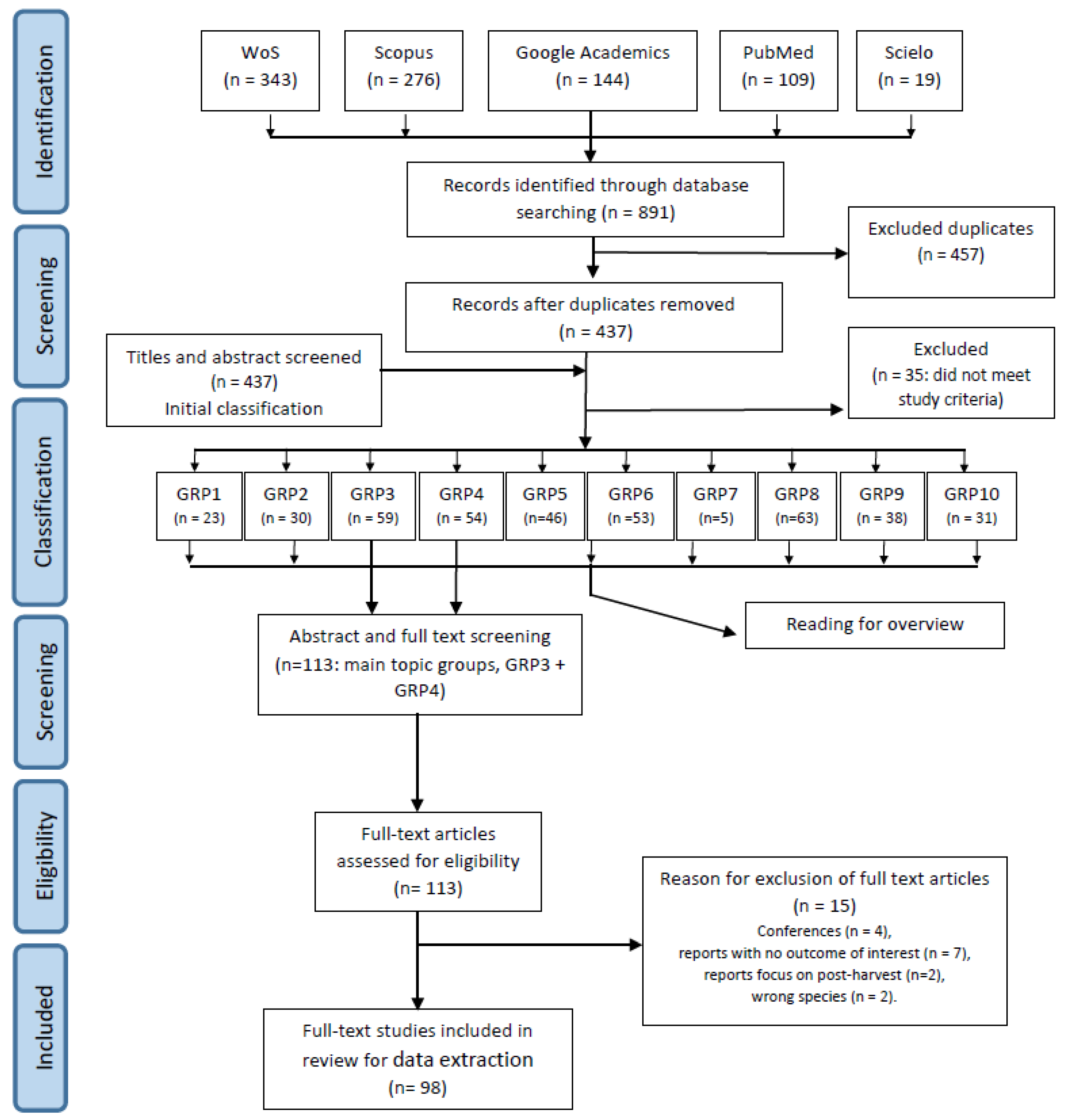
Figure 2.
Classification of the records in 10 groups according to the main topic related to A. alternate (ordered from most to least abundant).
Figure 2.
Classification of the records in 10 groups according to the main topic related to A. alternate (ordered from most to least abundant).
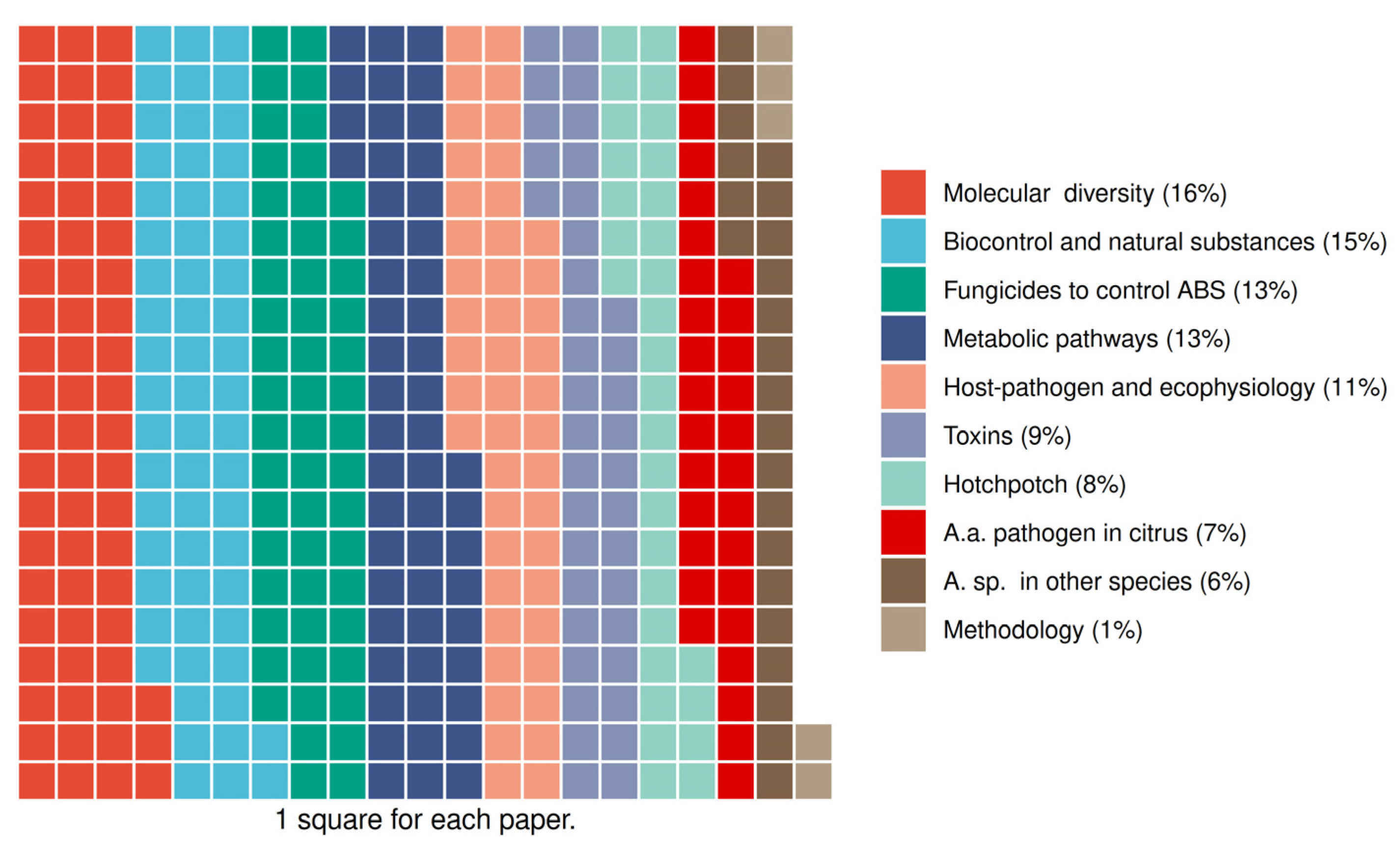
Figure 3.
Natural substances number of publications per year. (A), per country. (B) and subgroups inside the natural substances group (C).
Figure 3.
Natural substances number of publications per year. (A), per country. (B) and subgroups inside the natural substances group (C).
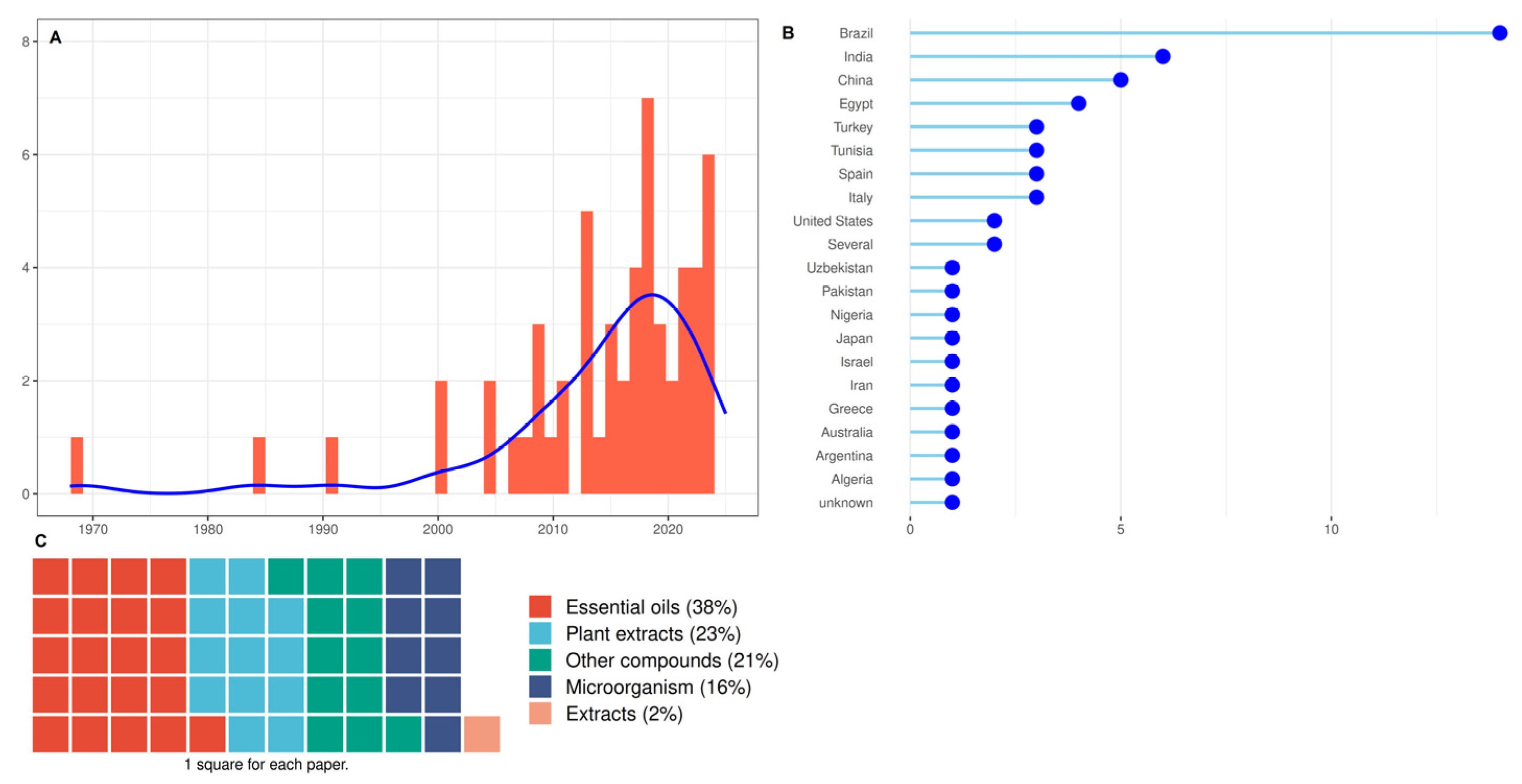
Figure 4.
Fungicides number of publications per year. (A), per country. (B) and subgroups inside the fungicides group (C).
Figure 4.
Fungicides number of publications per year. (A), per country. (B) and subgroups inside the fungicides group (C).
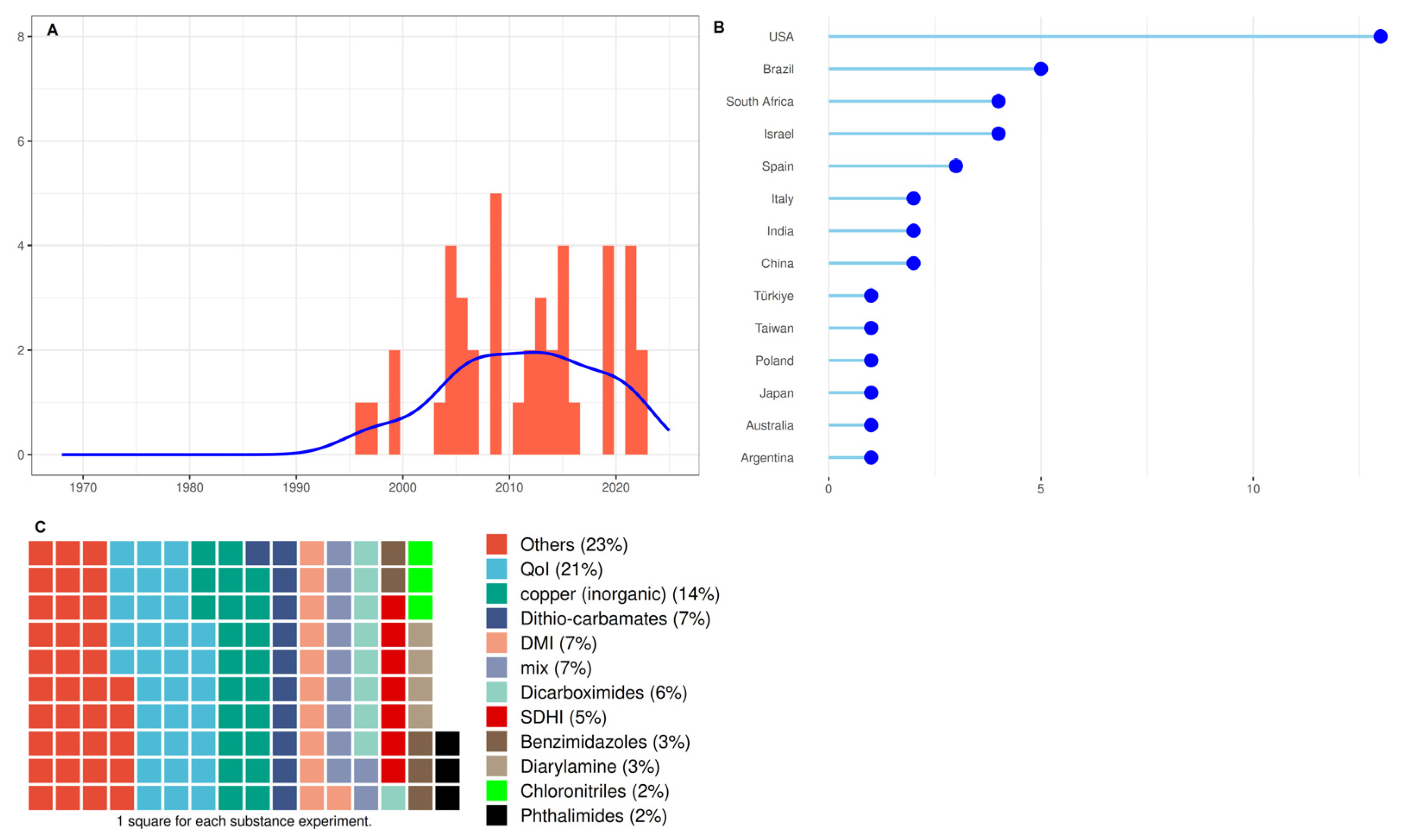
Figure 5.
Types of assays, MGA (68%), SGA (20%), DFA (18%), MMG (12%), SAA (12%), DCA (7%), DLA (4%), FEE (4%), DDM (4%), CPD (2%), VCA (2%). MGA (mycelial growth assays), SGA (spore germination assays), DFA (detached fruits assays), MMG (micro-dilution method fungal growth assays), SAA (seedlings assays), DCA (dual culture antagonist assays), DLA (detached leaves assays), FEE (field experiment), DDM (disk diffusion method), CPD (compartmentalized petri dishes assays), VCA (vapor contact assay). Only one type of experiment by article was taken into account. Percentages were calculated by the total number of papers.
Figure 5.
Types of assays, MGA (68%), SGA (20%), DFA (18%), MMG (12%), SAA (12%), DCA (7%), DLA (4%), FEE (4%), DDM (4%), CPD (2%), VCA (2%). MGA (mycelial growth assays), SGA (spore germination assays), DFA (detached fruits assays), MMG (micro-dilution method fungal growth assays), SAA (seedlings assays), DCA (dual culture antagonist assays), DLA (detached leaves assays), FEE (field experiment), DDM (disk diffusion method), CPD (compartmentalized petri dishes assays), VCA (vapor contact assay). Only one type of experiment by article was taken into account. Percentages were calculated by the total number of papers.
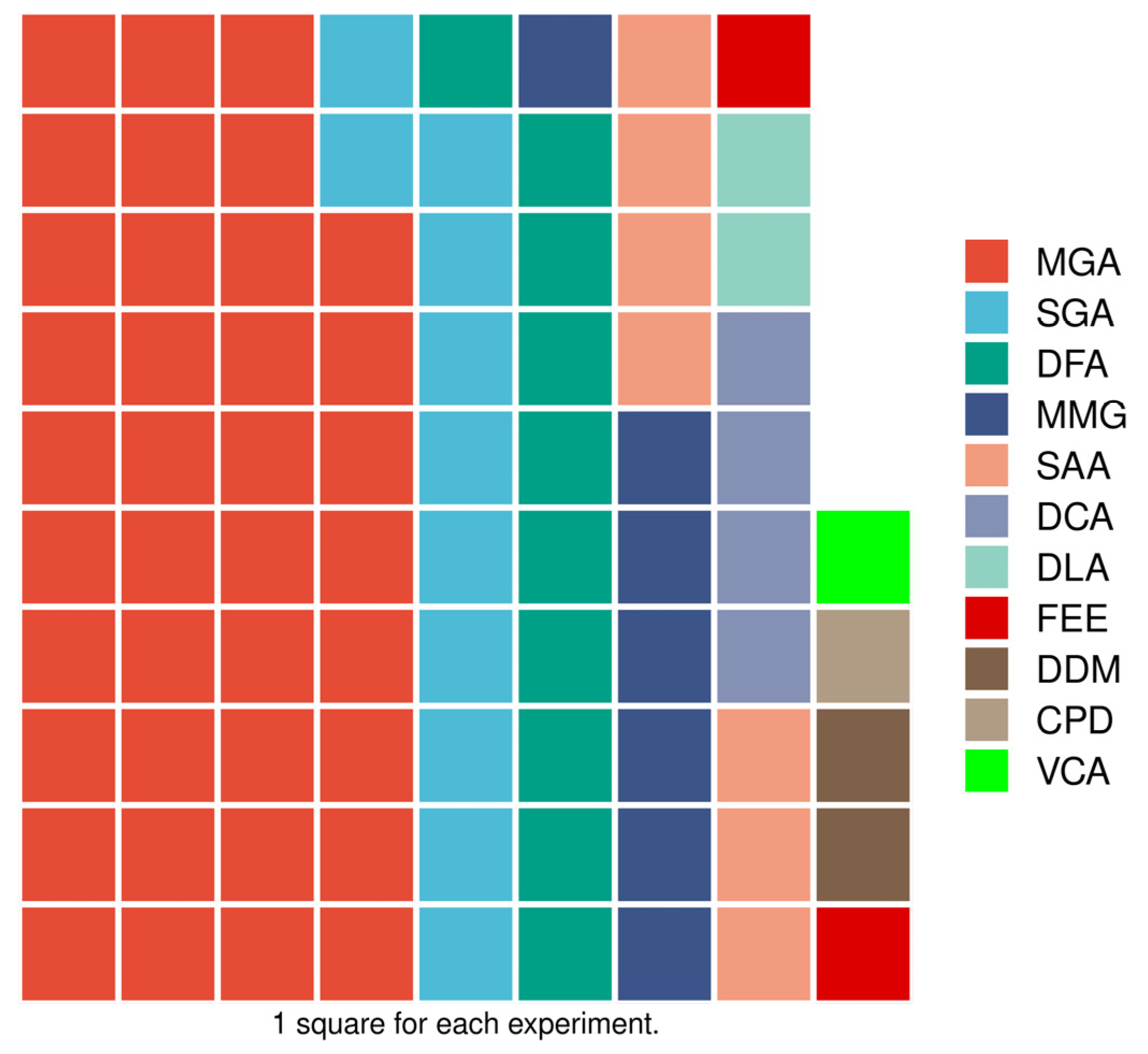

Table 1.
Electronic search strategy.
| Database | Specific search string | Published | Doc type | Lang | n |
| WoS | (TI=(Alternaria alternata AND citrus)) OR AB=(Alternaria alternata AND citrus) OR AK=(Alternaria alternata AND citrus) OR KP=(Alternaria alternata AND citrus) | all years | all | Auto | 343 |
| Scopus | TITLE-ABS-KEY ( Alternaria AND alternata AND citrus ) | all years | all | all | 276 |
| Google Academics | allintitle: Alternaria alternata citrus | all years | all | all | 144 |
| PubMed | (Alternaria alternata[Title/Abstract]) AND citrus[Title/Abstract] | all years | all | all | 109 |
| Scielo | All indexes: (Alternaria alternata) AND (citrus) | all years | all | all | 19 |
TI=Title; AB=Abstract; AK=Author Keywords; KP=Keyword Plus; ABS=Abstract; KEY=Keywords; Lang, the search language; n, the number of publications found.
Table 2.
Fungicide group, with FRAC groups and code, substance name, resistance development, laboratory effectiveness, field effectiveness, number of references, and references.
Table 2.
Fungicide group, with FRAC groups and code, substance name, resistance development, laboratory effectiveness, field effectiveness, number of references, and references.
| Graph . | FRAC Code | Substance | Resist | Lab effectiveness | Field effectiveness | Refs | References |
|---|---|---|---|---|---|---|---|
| copper (inorganic) | MSCA | copper oxychloride | No | low to medium | low to high | 9 | [72,73,74,75,76,77,78,79,80] |
| copper hydroxide | No | low to medium | medium | 5 | [72,79,81,82,83] | ||
| Bordeaux mixture | No | ineffective | not tested | 3 | [72,79,80] | ||
| cuprous oxide | No | high | not tested | 3 | [72,79,80] | ||
| tribasic copper sulfate | No | low | not tested | 1 | [72] | ||
| Dithiocarbamates | MSCA | Mancozeb | No | high | medium to high | 8 | [72,73,74,75,77,79,82,84] |
| Propineb | No | high | medium to high | 3 | [73,74,85] | ||
| Maneb | No | not tested | ineffective | 1 | [84] | ||
| Ferbam | No | ineffective | not tested | 1 | [86] | ||
| Metiram | No | not tested | medium | 1 | [84] | ||
| Chloronitriles | MSCA | Chlorothalonil | No | not tested | ineffective | 2 | [82,84] |
| Phthalimides | MSCA | Captan | No | not tested | contradictory | 2 | [82,84] |
| DeMethylation Inhibitors | DMI | Prochloraz | high | low | 2 | [73,84] | |
| Tebuconazole | medium to high | low | 3 | [81,84,87] | |||
| Difenoconazole | not tested | low | 2 | [74,79] | |||
| Pyrifenox | low to high | not tested | 1 | [85] | |||
| Quinone outside Inhibitors | QoI | Azoxystrobin | Yes | contradictory | medium | 12 | [72,74,81,82,85,88,89,90,91,92,93,94] |
| Pyraclostrobin | Yes | high | high | 12 | [14,74,76,82,83,88,90,91,93,94,95,96] | ||
| Trifloxystrobin | Yes | low | contradictory | 3 | [74,81,82] | ||
| Methoxycrylate | Yes | not tested | medium | 1 | [82] | ||
| Famoxadone | Yes | not tested | not tested | 1 | [96] | ||
| Benzimidazole | MBC | Carbendazim | Yes | low | not tested | 2 | [72,75] |
| Thiophanate methyl | Yes | low | not tested | 2 | [72,73] | ||
| Diarylamine | Fluazinam | No | high | contradictory | 4 | [72,84,97,98] | |
| Dicarboximides | Iprodione | Yes | high | high | 6 | [74,82,84,95,99,100] | |
| Procymidone | Yes | not tested | low | 1 | [84] | ||
| Succinate-dehydrogenase inhibitors | SDHI | Fluopyram | Yes | high | not tested | 1 | [81] |
| Flutolanil | Yes | high | not tested | 1 | [97] | ||
| Thifluzamide | Yes | high | not tested | 1 | [97] | ||
| Boscalid | Yes | medium to low | not tested | 3 | [95,97,101] | ||
| Others | Natamycin | No | high | not tested | 1 | [74] | |
| Metallothionein | No | high | not tested | 1 | [102] | ||
| Silicon | No | medium to low | not tested | 2 | [103,104] | ||
| Calcium nitrate | No | not tested | medium to low | 2 | [75,105] | ||
| Chitosan | No | not tested | medium to low | 1 | [76] | ||
| Salicyl-hydroxamic acid | No | medium to low | not tested | 1 | [83] | ||
| Acibenzolar | No | medium to low | not tested | 2 | [14,82] | ||
| Potassium phosphite | No | ineffective | medium to high | 1 | [95] |
Disclaimer/Publisher’s Note: The statements, opinions and data contained in all publications are solely those of the individual author(s) and contributor(s) and not of MDPI and/or the editor(s). MDPI and/or the editor(s) disclaim responsibility for any injury to people or property resulting from any ideas, methods, instructions or products referred to in the content. |
© 2025 by the authors. Licensee MDPI, Basel, Switzerland. This article is an open access article distributed under the terms and conditions of the Creative Commons Attribution (CC BY) license (http://creativecommons.org/licenses/by/4.0/).
Copyright: This open access article is published under a Creative Commons CC BY 4.0 license, which permit the free download, distribution, and reuse, provided that the author and preprint are cited in any reuse.


