
Submitted:
01 May 2025
Posted:
05 May 2025
You are already at the latest version
Preprints on COVID-19 and SARS-CoV-2
Abstract
This paper investigates the implication of the COVID-19 pandemic on households food insecurity in Burkina Faso. We use data from the High Frequency Phone Survey collected from the period June 2020 to June 2021 by the World Bank in collaboration with the National Institute of Statistics. To assess the persistence of food inadequacy, we estimate a dynamic linear probability model. Our results reveal that female and elderly household members were more likely to skip meals during the pandemic than their respective counterparts were. For households that skipped a meal due to the pandemic, the likelihood of facing food insecurity in the subsequent month increased by 37 per cent. Similarly, individuals who ran out of food in consecutive months were 0.28 times more likely to experience the same situation in the following month. While other shocks can cause food insecurity, the global health-related, economic, social, and information dimensions of the COVID-19 created a distinctive and multifaceted form of food shortage that sets it apart from many other types of shocks. These findings suggest the implementation of effective programmes to respond to shocks and the mitigation effects on the most disadvantged groups.
Keywords:
COVID-19
; food insecurity persistence
; Burkina Faso
1. Introduction
The COVID-19 pandemic led to substantial concern about threats to food security (Amare et al., 2021; Hirvonen et al., 2021; Laborde et al., 2020). In April 2020, the World Food Programme (WFP) projected the number of acutely food insecure people in the world could double by the end of 2020 without concerted action (WFP, 2020). The World Bank’s recent estimates show that, globally, the pandemic pushed 23 million people into extreme poverty in Sub-Saharan Africa in 2020. In addition, research on the effects of COVID-19 pandemic on food security, food systems, and poverty revealed that the hunger and malnutrition associated with the pandemic might actually kill or debilitate more people than the disease itself; especially in regions of the world with weaker social safety nets (Fanzo, 2020; HLPE, 2020; United Nations, 2020).
This paper investigates the implications of the COVID-19 pandemic for household food security in Burkina Faso. Burkina Faso is an interesting case study, as the pandemic contributed to exacerbation of food insecurity for three main reasons. First, agricultural production and food security in Burkina Faso are highly dependent on weather shocks. According to the Food Crisis Prevention Network (2020), rainfall variability has reduced agricultural production by between 6 and 15% in 2019. This could tip 10.1% of population into food insecurity. In addition, in recent years, the country has been affected by violent terrorist attacks and regional unrest. Second, the Fund for Peace (2020) has concluded that Burkina Faso is rated as the fourth most affected country by terrorism in 2019. Terrorism led to the closure of more than 2000 schools, 600,000 internally displaced people and shutdown of health centers. On December 31, 2022, 6,253 schools were closed, and 1.7 million people were internally displaced due to insecurity and violence. These recurrent and violent attacks have deteriorated households’ livelihoods in several regions. Finally, the availability of a large nationally representative panel of households observed during the pandemic makes Burkina Faso an ideal setting for an early empirical examination of COVID-19’s impacts.
The effects of the pandemic are expected to differ both by geography and by type of household, with pre-existing vulnerabilities to food security likely to be magnified (Devereux et al., 2020; Ravallion, 2020). Impacts are expected to be most severe for poorer households in both rural and urban areas (Ravallion, 2020). According to FAO (2021), COVID-19 was a contributing factor to the increase in moderate and severe food insecurity between 2019 and 2020. Indeed, moderate and severe food insecurity increased from 43 percent to 59 percent in Burkina Faso. As the spread of the pandemic initiates in urban areas, government responses, including mobility restrictions and lockdowns, would likely be most intense in urban areas and might affect urban residents more directly than rural households in the short term. However, the impact of COVID-19 was also expected to vary across livelihood options, with those activities that require face-to-face interactions likely to experience a significant loss in demand (Abay et al., 2020). Value chain disruptions might extend deeply into rural areas, affecting both input supply and output demand for farmers and affecting the income of those employed in both upstream and downstream agricultural value chains (Amjath-Babu et al., 2020). FAO and WFP (2020) identified the following five ways that food insecurity can be affected by COVID-19: (i) food access through reduced purchasing power of households (ii) availability of food by reducing agricultural production, and disrupting food supply chains; (iii) the limit of government capacities to protect vulnerable populations; (iv) leading to political stability; and (v) conflicts dynamics.
More precisely, our study answers the following questions:
- What is the persistence of food insecurity during COVID-19 periods?
- Do the potential effects vary across households?
- What are the effects of the spread of the pandemic on food insecurity outcomes?
To answer the above questions, we use the 2020-2021 High Frequency Phone Survey. We also investigate other factors affecting food insecurity indicators using a dynamic ordinary least square regression.
Previous studies on the effects of COVID-19 on food security in Burkina Faso focused on the broader macroeconomic national level (Zidouemba et al., 2020) and the urban environment (Ouoba and Sawadogo, 2022; Sawadogo and Ouoba, 2023). Our study fills the gap by analyzing the effects on a microeconomic level and on both rural and urban environments.
The remainder of the paper is organized as follows. In the next section, we present the literature review and discuss the COVID-19 situation in Burkina Faso in the Section 3. The theoretical framework is described in Section 4. In Section 5, we describe the data and document the food insecurity profile in section 6. We present the empirical strategy in Section 7 as well as the discussion surrounding our results. We conclude the paper in Section 8.
2. Literature Review
Several empirical studies document the impacts of the COVID-19 pandemic on food insecurity. Three main channels have been identified to highlight these impacts:
- Income losses and demand shocks
- Food supply chain disruptions
- Policy responses: hoarding at country level (food export bans) and fiscal stimulus.
Income losses and demand shocks contribute significantly to the reduction of food security during the COVID-19 pandemic. Related to food access disruptions, preventive responses created employment shocks through employment losses. Evidence from low and middle-income countries shows overall income losses due to stay-at-home policies (Bottan et al., 2020; Ceballos et al., 2020; Hamadani et al., 2020; Kansiime et al., 2021; Koos et al., 2020; Laborde et al., 2021; Mahmud & Riley, 2021). Laborde et al. (2021) assess the impact of COVID-19 on poverty, food insecurity in Asia and Africa South of Sahara using IFPRI’s global general equilibrium model. They find that the increases in poverty are concentrated in South Asia and Sub-Saharan Africa, with harder impacts in urban areas than in rural areas. The COVID-19-related lockdown measures explain most of the fall in output, whereas declines in savings soften the adverse impacts on food consumption. Using phone-based surveys in Mali, Adjognon et al. (2021) reported high levels of food insecurity and short-falls in labor market participation in urban areas. In Nigeria, food insecurity and short-falls in labor market participation were also exacerbated by COVID-19 cases and some containment measures like lockdowns (Amare et al., 2021). The link between more stringent restrictions, food insecurity, and off-farm income reduction has also been established using a robust statistical analysis to compare the areas of Nigeria which experienced differential restrictions (Amare et al., 2021). Moreover, several recent empirical studies document the impact of the externality of infection (i.e., the unintended impact of an individual’s infection on the health and economic outcomes of others) on income (see Alinsato, 2021; Bethune &Korinek, 2020; Eichenbaum et al., 2021; Welfens, 2020 for a review). Indeed, the spread of COVID-19 could have led to a decrease in economic productivity, which in turn could result in low incomes for individuals. With the COVID-19 outbreak, some people took time off to care for themselves or their family members, or to avoid getting infected. This could have led to reduced productivity in the workplace and, in turn, a decline in income for individuals and businesses.
Food supply chain disruptions: Stock-outs affected online markets due to reduced farm deliveries (Mahajan & Tomar, 2021), and prices of grains became unstable although minimum support prices shielded producers from very low prices (Varshney et al., 2020). Despite government support mechanisms, such as minimum prices some products (e.g., vegetables) still suffered price drops(Ali & Khan, 2020). COVID-19 has disrupted not only food markets but also the overall national and international supply chains(Aday & Aday, 2020; Ayanlade & Radeny, 2020; Cao et al., 2021; Elleby et al., 2020), including access to agricultural inputs, such as fertilizers and others(Ayanlade & Radeny, 2020; Nchanji et al., 2021; Pan et al., 2020; Pu & Zhong, 2020). We expect households to become more food insecure due to COVID-19 and related lockdown measures.
Policy responses - hoarding at the country level (food export bans) and fiscal stimulus: COVID-19 triggered a range of policy responses at both the national and international levels. Two important policy responses are hoarding at the country level, particularly food export bans, and fiscal stimulus. Hoarding at the country level refers to the act of governments restricting or banning exports of essential commodities such as food, medical supplies, and other goods in response to the COVID-19 pandemic. Some countries have implemented export bans on food and other essential goods to ensure their domestic food security and meet the needs of their population. However, these policies can lead to shortages in other countries, particularly in low-income countries, which can exacerbate food insecurity and contribute to global price volatility. Fiscal stimulus refers to policies aimed at boosting economic growth and mitigating the impact of the COVID-19 pandemic on businesses and individuals. Fiscal stimulus measures can take the form of direct payments to individuals, tax breaks, loans and grants to businesses, and increased government spending on public infrastructure projects. These measures are aimed at maintaining aggregate demand and supporting households and businesses that are struggling financially owing to the pandemic. Fiscal stimulus policies have been widely implemented by governments around the world in response to the COVID-19 pandemic. The scale and scope of these policies have varied, with some countries implementing large-scale stimulus packages while others have adopted more targeted measures. The effectiveness of these policies in mitigating the economic impact of the pandemic has been mixed, with some countries experiencing a rebound in economic activity while others continue to struggle. In summary, hoarding, at the country level, and fiscal stimulus are two important policy responses to the COVID-19 pandemic. While hoarding can contribute to global price volatility and exacerbate food insecurity, fiscal stimulus policies are aimed at mitigating the economic impact of the pandemic on households and businesses. The effectiveness of these policies in mitigating the impact of the pandemic will continue to be evaluated over time.
Although the literature on the effect of COVID-19 on food security in low and middle-income countries continues to grow, minimal research exists on the magnitude of the impact of the coronavirus pandemic on the above mechanisms, partly because detailed household survey data are not yet available. This study aims to examine the implications of the spread of the pandemic and associated lockdown measures on ultimate food security outcomes of households. Burkina Faso is highly susceptible to income shocks and food insecurity associated with the spread of the pandemic. Thus, national and regional lockdowns and mobility restrictions were disrupting major economic activities, including local businesses. These restrictions affected food transportation within the country, with clear implications for food supply. There are indications that Burkina Faso’s domestic and international food supply chains have been disrupted, food prices have increased, and informal sector unemployment rates are likely to be increasing. All these effects are likely to generate significant repercussions for food insecurity, particularly in poorer and vulnerable households (Amare et al., 2021; Ericksen et al., 2012; Gilligan, 2020; Tendall et al., 2015).
Using multivariate analysis, Syafiq et al. (2022) found that reduced income and work stoppage status of households are related to household food security during the pandemic in Indonesia. They also found that households with lower income had four times higher risk of experiencing food insecurity. Also, households with younger people had two times higher risk to experience food insecurity compared to those older counterparts. Ouoba and Sawadogo (2022) analyzed the effect of income loss due to COVID-19 on food security and poverty among urban households of small traders in Burkina Faso. They found that the pandemic has reduced incomes by increasing household likelihood of entering poverty. In addition, COVID-19 increased the likelihood of households being food insecure due to their lower food consumption. Ouoba and Sawadogo concluded that households with adaptive capacity were able to adjust to the shock.
Using a computable general equilibrium model with two alternative scenarios (i.e., optimistic and pessimistic), Zidouemba et al. (2020) suggest that the COVID-19 pandemic contributes to a worsening of food security as food insecurity is increasing among poor households in rural and urban areas in Burkina Faso. The authors show that while urban non-poor households are resilient to the pandemic effects, the rural non-poor households are likely to fall into vulnerable people.
3. Theoretical Framework
COVID-19 has had significant impacts on food security globally. Conceptually, the impacts of COVID-19 on food security can be understood through a range of theoretical frameworks, including the food systems framework, the household livelihoods framework, and the global political economy framework. The food systems framework emphasizes the interconnectedness of the different components of the food system, including production, processing, distribution, and consumption. The COVID-19 pandemic disrupted all of these components, with impacts on farmers, food processors, transport workers, and retailers (Kumar & Kumar Singh, 2022). The resulting disruptions led to food shortages, increased prices, and reduced access to nutritious foods, particularly for vulnerable populations (Laborde et al., 2020). The food systems framework can help to understand the complex and interrelated impacts of COVID-19 on food security and inform policy responses that address the different components of the food system.
The household livelihoods framework emphasizes the role of individual households in securing their access to food. The COVID-19 pandemic led to widespread job losses and economic insecurity, which has had significant impacts on households' ability to access and afford food (Karpman et al., 2020). In addition, lockdowns and other public health measures limited households' ability to access food markets and other sources of food. The household livelihoods framework can help to understand the differential impacts of COVID-19 on households, depending on their socio-economic status and other factors, and inform policy responses that target vulnerable households and address the underlying economic drivers of food insecurity.
The global political economy framework emphasizes the role of international trade and power relations in shaping food security. The COVID-19 pandemic led to disruptions in global trade and supply chains, including food exports and imports. In addition, the economic impacts of the pandemic disproportionately affected low-income countries and small-scale farmers, who are often reliant on international trade for their livelihoods (Clapp & Moseley, 2020). The global political economy framework can help to understand the underlying structural drivers of food insecurity, and inform policy responses that address the power imbalances and inequities in the global food system.
Overall, these theoretical frameworks can help to understand the complex and interrelated impacts of COVID-19 on food security and inform policy responses that address the underlying drivers of food insecurity.
4. COVID-19 Measures in Burkina Faso
The COVID-19 pandemic, which began in China in December 2019, quickly spread to all countries in the world. Burkina Faso officially recorded its first infected case on March 9, 2020. On April 12, 2022, there were 20,865 confirmed cases of COVID-19 with 383 deaths. Like many countries worldwide, Burkina Faso followed the physical distancing, handwashing and face covering measures as ways to limit the spread of the virus. In view of the increase in the incidence of COVID-19 cases, in addition to the barrier measures, new additional social and economic measures have been taken three weeks after the start of the epidemic and gradually introduced within the country. To contain the spread of the disease, the Government of Burkina Faso took additional preventive measures, the first of which came into force on March 16, 2020. These measures included: the closure of schools and universities, the closure of certain markets, the closure of restaurants and bars, the closure of all places of worship, the introduction of a curfew (from 7pm to 5am in March and later from 9pm to 4 am in April) throughout the territory. Also, the government implemented the restriction of travel within the country, the quarantine of cities recording at least one case, closure of air, land and rail borders, cessation of all non-essential activities including sports and cultural activities; the prohibition of gatherings of more than 50 people. While these restrictive measures were primarily intended to reduce the spread of the disease, they impacted the living conditions of populations to varying degrees. For example, the closure of markets impacted access to food in cities and among the poor due to the increase in prices. Indeed, during the period of implementation of anti-COVID measures, 25 percent of households nationwide were unable to access staple foods (INSD, 2020). Thus, COVID-19 affected people's ability to meet their food needs, which could ultimately exacerbate food and nutrition insecurity in Burkina Faso.
However, the closure of markets in the main cities was the most contested measure as a vast majority of self-employed young people work in the informal sector, in the markets, and make a living from day-to-day selling of their products (Tapsoba, 2022). In Ouagadougou, the political capital of Burkina Faso, 36 markets were closed from March 26 to April 20, 2020, and the big market was closed in Bobo Dioulasso, the economic capital, from March 30 to April 12, 2020. To mitigate the impact of its measure on livelihood, the government opted for the distribution of food and necessities to those impacted by the decision specifically to informal traders. Although the donations, riots and demonstrations erupted, urging the government to suspend the decision to close the markets (Tapsoba, 2022). Indeed, weeks later, a decision was taken to reopen markets, but with the conditions to the respect of measures such as disinfection of all markets, reduction of clients’ number, installation of hand-washing equipment in every shop, social distancing, and mask wearing for customers and merchants. While keeping markets opened helped to maintain traders’ incomes and preventing them from sliding into poverty, the food security of the many urban residents who rely on them is preserved. According to the FAO (2021), during the pandemic, a solidarity fund was established by the government in the country to benefit actors in the informal sector, particularly for women, to revive trade activities in vegetables and fruits.
5. Data
We use data from the Burkina Faso’s High Frequency Phone Survey (HFPS), collected by the World Bank in collaboration with the Burkina Faso National Institute of Statistics and Demography (INSD). The HFPS are used to assess the impacts of the COVID-19 pandemic and include 11 rounds collected from June 9, 2020, to June 28, 2021. Table 1 presents the dates of data collection. The HFPS is a subsample of the Burkina Faso 2018/19 Living Standards and Measurement Survey (LSMS). We merged data from all the 11 rounds and kept the cases with complete information. These data provide information on food, nutrition security indicators, employment, income, etc. Adjusting for potential attrition in the HFPS survey and constructing nationally representative statistics necessitates constructing and applying appropriate sampling weights. The HFPS team constructed sampling weights using the weights for the LSMS as the basis, with further adjustment for attrition in the phone survey. The weights for the final sample of households from the HFPS were calculated in several stages and are shown to ensure comparable distribution of observable characteristics from the LSMS and the HFPS. Since HFPS data contain important information on households’ participation in economic activities and food insecurity experience, we can therefore assess the persistence of the impacts of the COVID-19 pandemic on food insecurity.
We measure food insecurity using three indicators, capturing households’ experience of food insecurity, the food insecurity experience scale (FIES). In HFPS, households’ food insecurity experiences are elicited using the self-reported experience of hunger and food shortage in the last 30 days (Hoddinott, 1999; Carletto et al., 2013; Bellemare and Novak, 2017). The first indicator asks if a household head or any other adult in the household had skipped a meal because there was not enough money or other resources to get food. The second indicator elicits whether the household has run out of food due to lack of monetary or other resources to get food. The third indicator takes a value of 1 if the household or any other adult in the household went without eating for a whole day because of a lack of money or other resources. These three indicators are used as the reduced FIES (Akim et al., 2024; Amare et al., 2021). Amare et al. (2021) and Akim et al. (2024) used the same three indicators to measure food insecurity during COVID-19 in the case of Nigeria. In the general and COVID-19 literature the full FIES consist of eight indicators (Rudin-Rush et al., 2022; Adjognon et al., 2021). However, the reduced FIES is consistent with the traditional food insecurity classification (Akim et al., 2024). In addition to the separate indicators Akim et al. (2024) used the FIES indicators to compute a food insecurity index and food insecurity score. Indeed, based on the reduced FIES indicators, Amare et al. (2021) used principal component analysis (PCA) to construct a composite index of food insecurity while Akim et al., (2024) included the sum of the indicators to measure the food insecurity score. Moreover, Rudin-Rush et al., (2022) and Adjognon et al., (2021) used the food insecurity severity classifications.
Table 2 reports weighted and pooled summary statistics of our sample. About 15 percent of respondents in our sample are female; 14.9 percent of households skipped a meal because of a lack of monetary resources; 8 percent ran out of food and 5 percent went out without eating for a whole day. Figure 1 plots the proportion of respondents who experienced food insecurity between 2020 and 2021. Although between 10 percent and 28 percent of people experienced food insecurity during the beginning of the pandemic, the trend over this time shows that less than 10 percent of respondents experienced food insecurity in the second quarter of 2021. This trend would reflect improved resilience and adaptive measures within the population, despite the challenges in the broader Burkina Faso context.
6. Food Insecurity Profiles in Burkina Faso
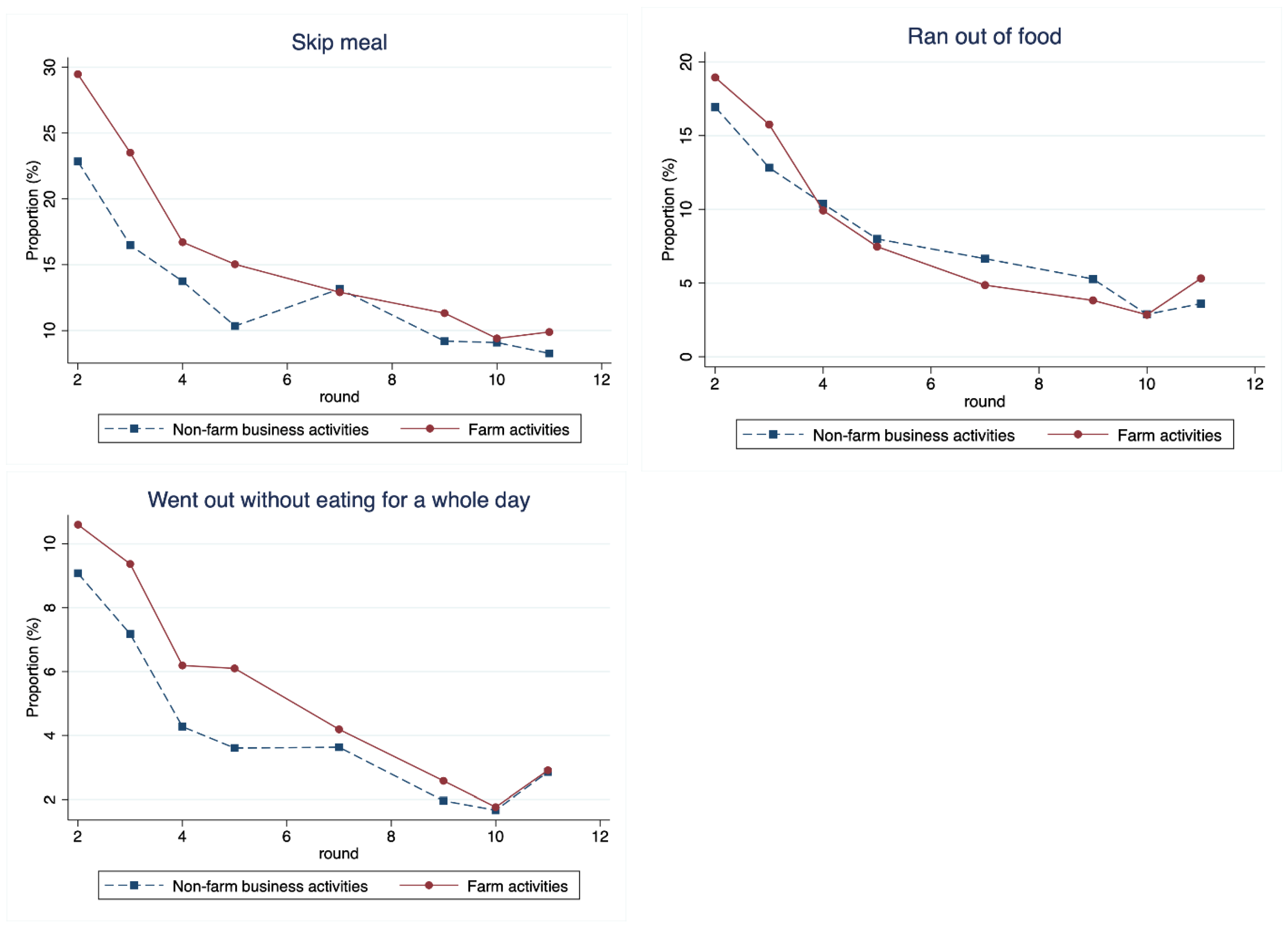
In this section, we provide other patterns in the dynamics of food insecurity as well as its individual correlates. The proportion of people transitioning into and out of food insecurity points to a changing pattern in the experience of food insecurity. Figure 2 shows the changes in the proportion of people becoming food insecure and those moving out of food insecurity. It shows that between 40% and 50% of individuals who reported having skipped meals in the previous months still skipping meals in the following months. In the same vein, between 18% and 40% of households starting with running out of food during the pandemic stays in that state even 1 year after the pandemic. The same figure is observed among those who went out without eating (between 5% and 25%). These patterns reveal a high persistence in food insecurity. Moreover, we observe that women have a higher prevalence of food insecurity than men (Figure A1 in the Appendix A). Young people (18-24) are particularly more affected, followed by people over 45 years old (Figure A2). There is a substantial difference in food insecurity depending on the household size, the place of residence and the type of activities of household members (Figure A3, Figure A4 and Figure A5). All these patterns confirm that food insecurity remains a growing social issue in Burkina Faso.
7. Empirical Analysis
We assess the persistence of food insecurity through the coefficient in the following fixed-effects model:
where stands for each of the food insecurity indicators presented in the previous section.is a one-period lagged food insecurity, with autoregressive parameter . This coefficient is expected to be between 0 and 1, which is consistent with the convergence idea. We include the lag of food insecurity in the equation (1) to account for the environmental time-invariant determinants of food insecurity at individual level. is a vector of observable characteristics. The individual fixed-effects are represented by and controls for year (survey periods) fixed-effects. is an error term assumed to be uncorrelated to , , and . We rely on the Ordinary Least Squares regression (Linear Probability Model (LPM)) to estimate Equation (1). The individual fixed effects capture the individual-specific characteristics which could be innate qualities, and which could remain constant for a particular individual throughout the period analyzed. By including individual fixed-effects in the LPM, we control for the influence of unmeasured individual-specific factors. Equation (1) is run for different sub-groups (gender, age group, household size).
The time fixed-effects are introduced in the model to control for the influence of time-related factors that affect all individuals in the same way. The time-fixed effects therefore capture common shocks or events that might simultaneously impact all individuals in the sample in a given period. This helps in distinguishing the effects of individual-level variables (captured by individual-fixed effects) from those related to changes occurring at the same time for all individuals (captured by time fixed-effects).
Our results in Table 3a show the implications of the spread of the pandemic on food insecurity outcomes, measured as binary indicators of food insecurity experience. Overall, results indicate a persistence in food insecurity for all food insecurity indicators. Table 3a reveals that whatever the background characteristics considered, the coefficients on the lagged values of the food insecurity indicators (Yt-1) are statistically significant, indicating strong persistence in food insecurity. In fact, the estimates on the one time lagged food insecurity are respectively 0.37 (in households who skipped the meal), 0.28 (among respondents who ran out of food) and 0.25 (among those who went without food).
This result indicates that for individuals, skipping a meal, running out of food, and going without food in a previous period increases the probability of experiencing food insecurity in the next period by 0.37 (37%), 0.28 (28%), and 0.25 (25%) respectively compared to individuals who did not experience food insecurity (Please note that respondents in this paper are not household heads, but rather households’ individuals. When surveyed, we asked questions to the respondents’ household members). Indeed, Burkina Faso’s economy, heavily relies on agriculture, faced disruptions due to pandemic-induced lockdowns and restrictions. The limited activities in many markets and disruptions in supply chain might impended farmers’ ability to produce, transport, and sell their goods, creating a ripple effect that might be reverberated across the entire food system. This disruption likely significantly diminished the country’s capacity to domestically produce and distribute food, leading to increased dependence on external sources. Furthermore, Burkina Faso’s susceptibility to climate change and recurrent droughts may have strained local agricultural productivity even more during the Covid-19 period. The pandemic would overlap with these existing challenges, exacerbating the reliance on external aid for food assistance. International assistance and humanitarian aid became crucial to fill the widening gap between local food production and the population’s nutritional needs.
In addition, the estimation by gender in Table 3a indicates that females were more likely to experience food insecurity than their counterparts. For example, females who ran out of food in the previous month are 35% more likely to run out of food in the following month while males are 26% more likely to run out of food. Also, going without food in a given month increases the probability of experiencing food insecurity in the next month by 31% for females against 24% for males.
Results in Table 3b show that elderly were more likely to experience food insecurity than their counterparts. Individuals aged 65 and above and who experienced food insecurity in a previous month were more likely to experience food insecurity in the next month than people aged 45-64. Indeed, running out of food in the previous month increases the probability of experiencing food insecurity during the next by 34% for people aged 65 and above compared to 32% and 22% for people aged 45-64 and 25-44 respectively.
Several interconnected factors may contribute to these results (Table 3a,b). Firstly, pre-existing gender disparities played a crucial role. Burkina Faso, like many other African societies, often assigns traditional gender roles, with women primarily responsible for household chores and caregiving. The pandemic-induced disruptions disrupted these roles, increasing the burden on women who had to juggle multiple responsibilities, hindering their ability to engage income-generating activities or access essential resources for food security.
Secondly, elderly individuals faced heightened risks due to their susceptibility to severe illness from COVID-19, which prompted many to isolate themselves to avoid infection. This isolation limited their mobility, making it challenging to access markets or participate in agricultural activities, thus compromising their ability to secure sufficient food.
Moreover, the pandemic disrupted supply chains and economic activities, leading to increased unemployment and reduced income for vulnerable populations. Women, who often engage in informal and precarious employment, were disproportionately affected by these economic shocks. The elderly, reliant on pensions or familial support, were more likely to see their income sources diminish, exacerbating their vulnerability to food insecurity.
In addition, the pandemic’s economic repercussions, including widespread job losses and income reductions, left a substantial portion of the population financially strained. This economic downturn further heightened dependence on external assistance, as many individuals and households lacked the financial means to secure an adequate food supply.
In Table 3c, it also appears that the persistence in food insecurity varies by household size group. Households with 4-6 members who experienced food insecurity in the previous period had a lower probability of experiencing food insecurity in a subsequent time period relative to a household with 0-3 members. Indeed, those who skipped a meal and ran out of food in the previous period had respectively a 40.7% and 16.3% lower probability of experiencing food insecurity in a subsequent time period. In contrast a household with 7 and 8 members had a higher probability of experiencing food insecurity. For instance, a household with 7 members who skipped a meal and who run out of food in the previous period had respectively a 37.7% and 19.8% higher probability of experiencing food insecurity. In addition, a household with 8 members who went out without eating had a 25.7% higher probability of experiencing food insecurity. In fact, a high household size translates into a dilution of wealth and lower per capita income, all else being equal. The high dependency ratio and limited income opportunities available to members of the households could also be potential drivers. For instance, Mitiku et al. (2012) found that a large household size is associated with higher food burden and food insecurity in Kenya.
The relationships and all estimates in Table 3a–c are likely to be confounded by national and regional-level government responses to the pandemic, which included social distancing and mobility restrictions as well as partial lockdown measures. Due to the lack of data, we do not quantify the implication of variations in region-level responses to the pandemic. However, Amare et al. (2021) examined the effects of infection rates and lockdowns in Nigeria and found that households in states recording high COVID-19 cases and with lockdown measures are hit hardest and hence experience the greatest increase in food insecurity. Their results suggest that both the spread of the pandemic as well as government-induced lockdown measures are associated with increased food insecurity.
Like food insecurity results, several empirical studies document that lockdowns limit economic activities and hence households’ participation in labor market activities. Indeed, Amare et al. (2021) showed that state-level lockdown measures in Nigeria are associated with larger reductions in non-farm business activities. However, wage-related activities may be less affected by lockdown measures since they may still be operated remotely and individuals can continue working remotely (Dingel & Neiman, 2020). In addition, individuals engaged in wage-related activities are likely to have formal contracts and hence less likely to lose their job in short notice (Abay et al., 2020; Amare et al., 2021; Dingel & Neiman, 2020).
8. Discussion
The persistent food insecurity in Burkina Faso, exacerbated by the lingering impacts of the COVID-19 pandemic, demands a critical examination to understand the depth of challenges facing the policy makers in addressing food scarcity. Burkina Faso, with its predominantly agrarian economy, has long contended with issues such as climate variability and general resource scarcity. The emergence of the global health crisis, however, has unveiled the intricate layers of vulnerability woven into the fabric of the country's socio-economic landscape. One of the central concerns in stabilizing food supplies lies in the gendered dimensions of food insecurity. The pandemic disrupted traditional gender roles, disproportionately burdening women with increased responsibilities and limiting their access to healthcare and income-generating activities. This not only deepened existing gender inequalities but also contributed to a more pronounced vulnerability of women to food insecurity.
The reliance on agriculture, a cornerstone of Burkina Faso's economy, faced unprecedented challenges during the pandemic. Lockdowns and restrictions disrupted supply chains and markets, leaving farmers unable to produce, transport, or sell their goods. This compounded the pre-existing vulnerabilities stemming from the country's susceptibility to climate change, resulting in a double blow to food production and availability. Furthermore, the economic fallout from the pandemic, characterized by widespread job losses and income disparities, intensified food insecurity. Vulnerable populations, already on the brink, found themselves pushed further to the margins, struggling to meet basic nutritional needs.
Importantly, the dependence on external aid for food assistance underscored the nation's vulnerability to global shocks. While humanitarian assistance played a crucial role in immediate relief, questions arise about the sustainability of such interventions and the need for comprehensive, long-term strategies to build resilience within the country. In sum, the persistence of food insecurity in Burkina Faso amid the enduring impacts of the COVID-19 pandemic demands a holistic and critical approach. Addressing the root causes of vulnerability, reimagining gender roles, and fostering sustainable agricultural practices are essential components of a comprehensive strategy to not only alleviate immediate suffering but also build a more resilient and food-secure future for the nation.
9. Conclusions and Suggestions for Public Policy Research
Food insecurity is a common social issue affecting several African households. The COVID-19 pandemic increased food insecurity, with long-term consequences that may be hard to measure with the pandemic data alone. This paper contributes to our understanding of the dynamics of food insecurity and its persistence in Burkina Faso. We use panel data from eleven rounds of the High Frequency Phone Survey, in which we were able to track down changes in food insecurity over almost two years after the onset of pandemic. We find that there is a strong persistence in food insecurity in Burkina Faso. Estimates from our dynamic ordinary least squares model indicate that skipping meals, running out of food and going out without eating in a given month increases the likelihood to experience food insecurity in the following months. Women and individuals aged between 44 and 64 are most affected.
These findings have three policy implications. First, there it is important to enable access to food for most disadvantaged groups. Policy makers need to implement assistance programs to help in reducing food insecurity considering gender, area of residence type of activities of individuals. Second, given that women and elderly experience more the persistence in food insecurity, it is necessary that policies to mitigate the impact of COVID-19 and related shocks to be gender sensitive. Third, in the context of terrorism it is critical to design policies to reduce inequalities and household vulnerability, to protect food supply chains, promote social protection, and build resilience during pandemics and generally in periods of crises. This will ultimately allow individuals and households to adapt to exogenous shocks and reduce their dependence on social assistance. As the study does not quantify the implication of variations in region-level responses to the pandemic, further empirical analysis across a wider variety of national policy and economic contexts in Burkina Faso may further clarify such relationships and the policy lessons they imply.
Appendix A
Figure A1.
Dynamics of Food Security by Gender. Source: Authors using data from the HFPS 2020-21.
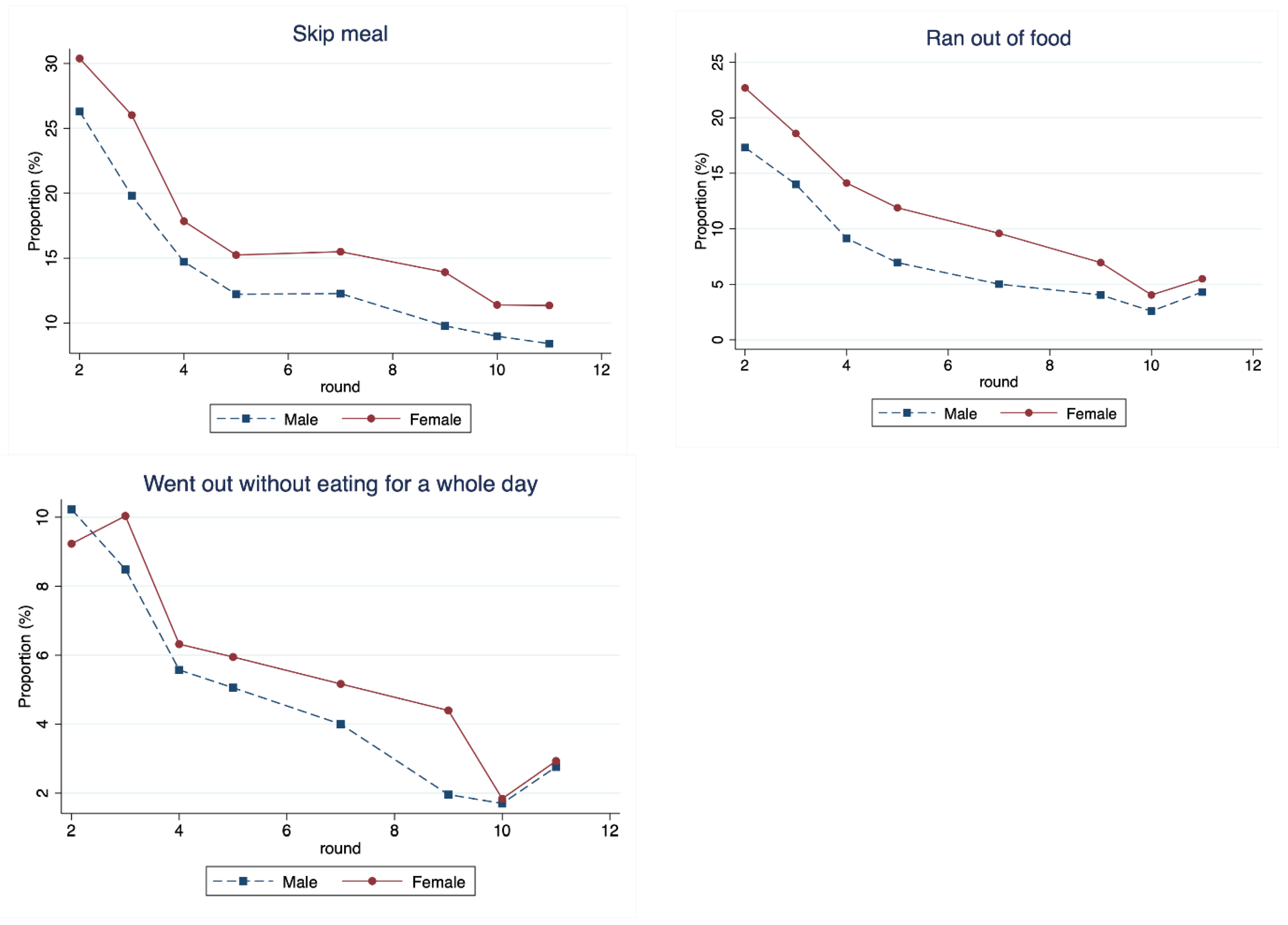
Figure A2.
Dynamics of Food Security by Age group. Source: Authors using data from the HFPS 2020-21.
Figure A2.
Dynamics of Food Security by Age group. Source: Authors using data from the HFPS 2020-21.
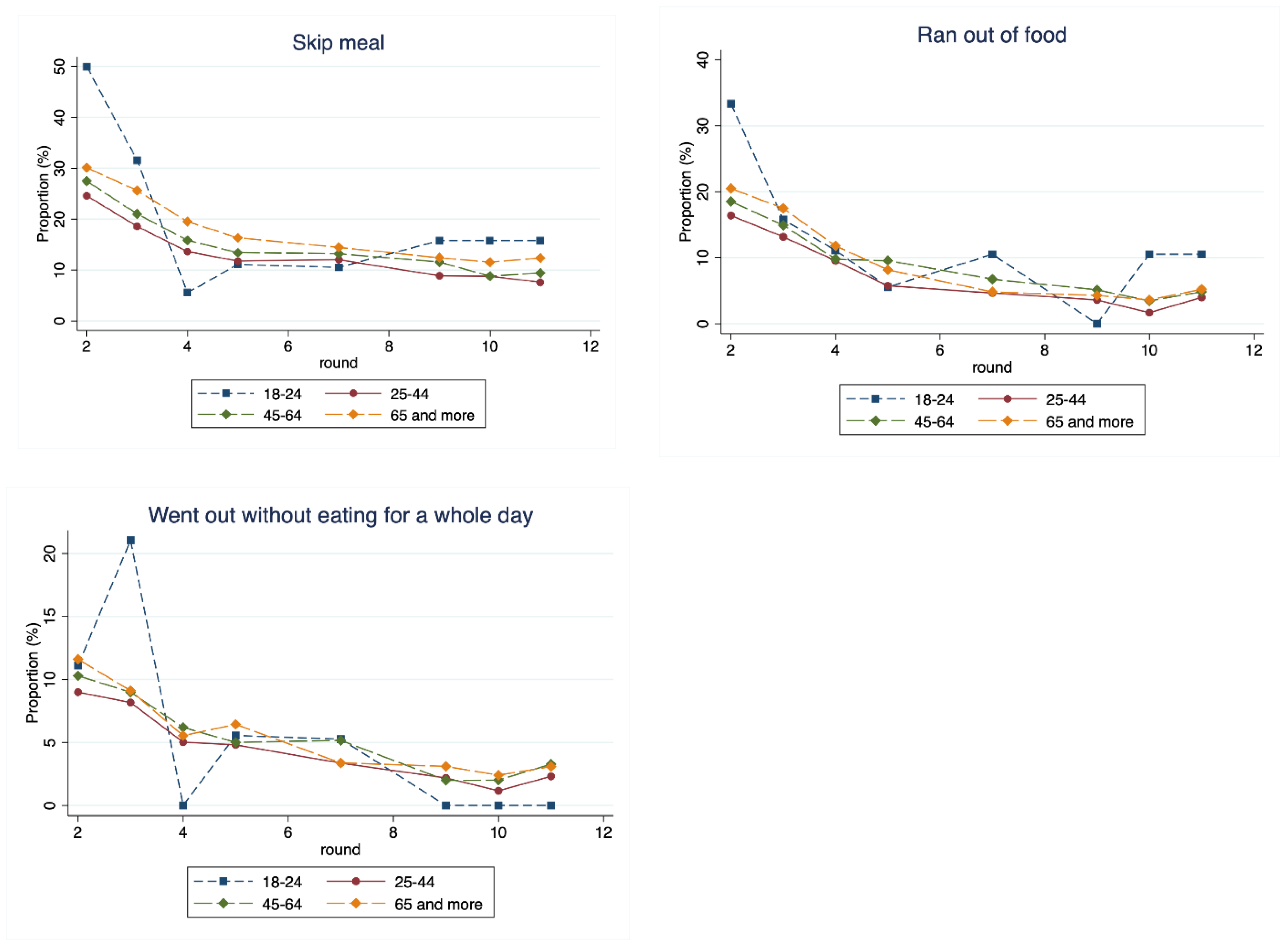
Figure A3.
Dynamics of Food Security by Household Size. Source: Authors using data from the HFPS 2020-21.
Figure A3.
Dynamics of Food Security by Household Size. Source: Authors using data from the HFPS 2020-21.
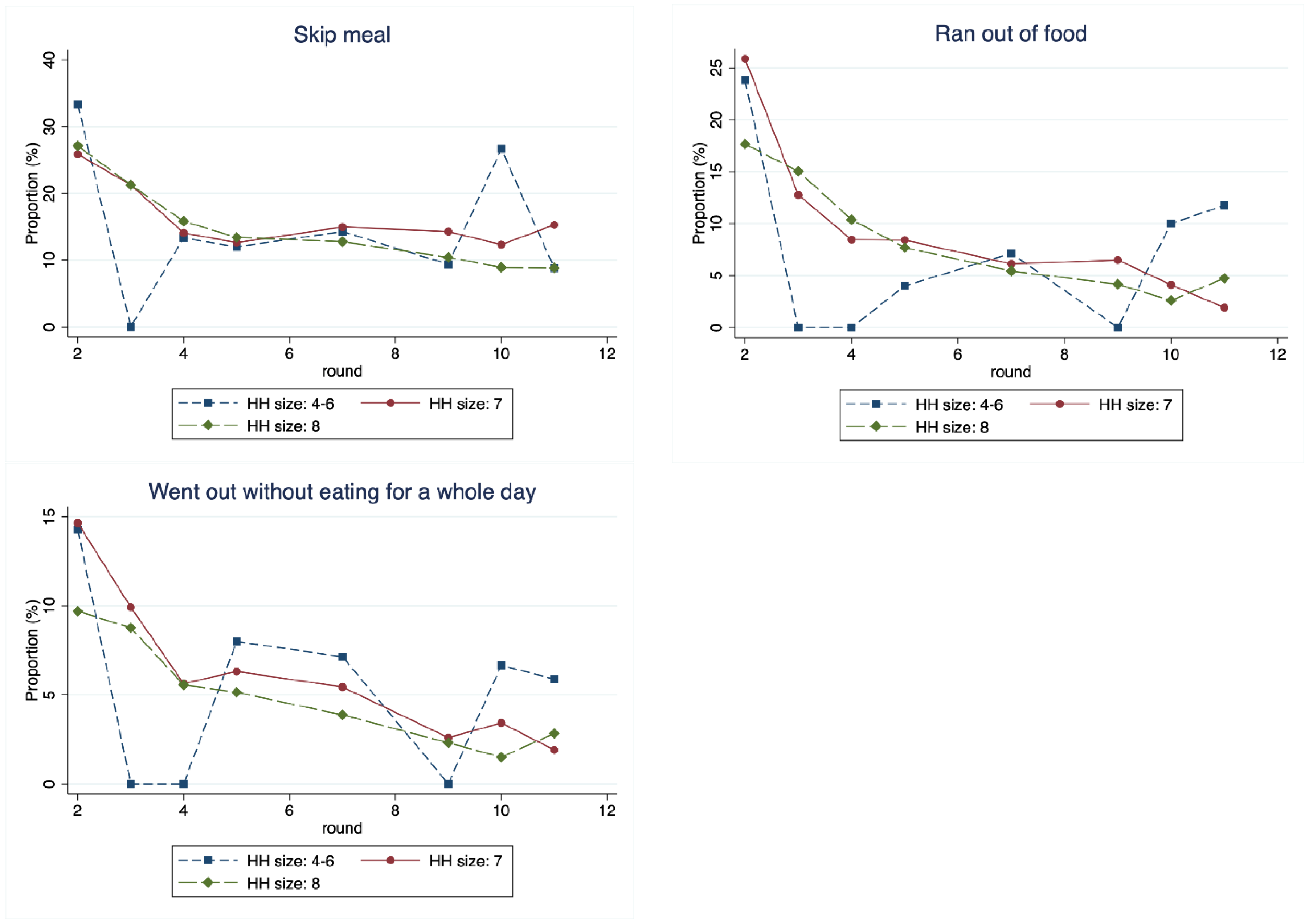
Figure A4.
Dynamics of Food Security by the Place of Residence. Source: Authors using data from the HFPS 2020-21.
Figure A4.
Dynamics of Food Security by the Place of Residence. Source: Authors using data from the HFPS 2020-21.
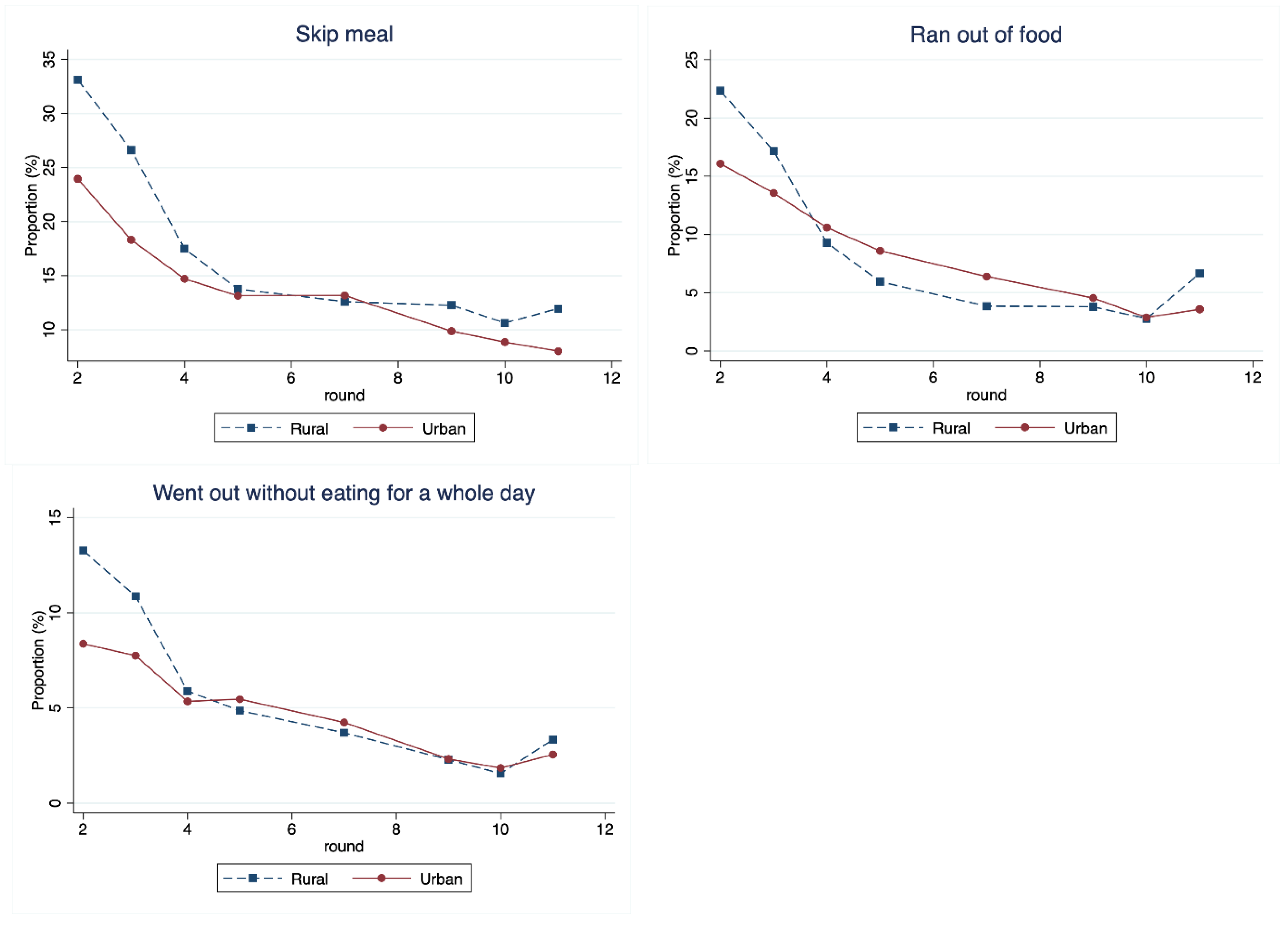
Figure A5.
Dynamics of Food Security by Type of Activities. Source: Authors using data from the HFPS 2020-21.
Figure A5.
Dynamics of Food Security by Type of Activities. Source: Authors using data from the HFPS 2020-21.
References
- Abay, K. A., Tafere, K., & Woldemichael, A. (2020). Winners and losers from COVID-19: Global evidence from Google Search. World Bank Policy Research Working Paper, 9268. [CrossRef]
- Aday, S., & Aday, M. S. (2020). Impact of COVID-19 on the food supply chain. Food Quality and Safety, 4(4), 167–180. [CrossRef]
- Adjognon, G. S., Bloem, J. R., & Sanoh, A. (2021). The coronavirus pandemic and food security: Evidence from Mali. Food Policy, 101, 102050. [CrossRef]
- Akim, Al-mouksit., Ayivodji, F. and Kouton, J. (2024). Food security and the COVID-19 employment shock in Nigeria: Any ex-ante mitigating effects of past remittances. Food policy, 122 (102574). [CrossRef]
- Ali, J., & Khan, W. (2020). Impact of COVID-19 pandemic on agricultural wholesale prices in India: A comparative analysis across the phases of the lockdown. Journal of Public Affairs, 20(4), e2402. [CrossRef]
- Alinsato, A. S. (2021). COVID-19 en Afrique subsaharienne: Analyse des facteurs explicatifs des réponses d’atténuation des effets socioéconomiques. Ouvrage Collectif Boudarbat et Al.
- Amare, M., Abay, K. A., Tiberti, L., & Chamberlin, J. (2021). COVID-19 and food security: Panel data evidence from Nigeria. Food Policy, 101, 102099. [CrossRef]
- Amjath-Babu, T. S., Krupnik, T. J., Thilsted, S. H., & McDonald, A. J. (2020). Key indicators for monitoring food system disruptions caused by the COVID-19 pandemic: Insights from Bangladesh towards effective response. Food Security, 12(4), 761–768. [CrossRef]
- Ayanlade, A., & Radeny, M. (2020). COVID-19 and food security in Sub-Saharan Africa: Implications of lockdown during agricultural planting seasons. Npj Science of Food, 4(1), 1–6. [CrossRef]
- Bellemare, M. F., and Novak, L. (2017). Contract farming and food security. American Journal of Agricultural Economics, 99 (2), 357–378. [CrossRef]
- Bethune, Z. A. , & Korinek, A. (2020). Covid-19 Infection Externalities: Trading off lives vs. Livelihoods. NBER Working Paper No. 27009, http://www.nber.org/papers/w27009.
- Bottan, N., Hoffmann, B., & Vera-Cossio, D. (2020). The unequal impact of the coronavirus pandemic: Evidence from seventeen developing countries. PloS One, 15(10), e0239797. [CrossRef]
- Cao, L., Li, T., Wang, R. and Zhu, J. (2021), "Impact of COVID-19 on China's agricultural trade", China Agricultural Economic Review, Vol. 13 No. 1, pp. 1-21. [CrossRef]
- Carletto, C., Zezza, A., and Banerjee, R. (2013). Towards better measurement of household food security: Harmonizing indicators and the role of household surveys. Global Food Security, 2 (1), 30–40. [CrossRef]
- Ceballos, F., Kannan, S., & Kramer, B. (2020). Impacts of a national lockdown on smallholder farmers’ income and food security: Empirical evidence from two states in India. World Development, 136, 105069. [CrossRef]
- Clapp, J., & Moseley, W. G. (2020). This food crisis is different: COVID-19 and the fragility of the neoliberal food security order. The Journal of Peasant Studies, 47(7), 1393–1417. [CrossRef]
- Devereux, S., Béné, C., & Hoddinott, J. (2020). Conceptualising COVID-19’s impacts on household food security. Food Security, 12(4), 769–772. [CrossRef]
- Dingel, J. I., & Neiman, B. (2020). How many jobs can be done at home? Journal of Public Economics, 189, 104235. [CrossRef]
- Eichenbaum, M. S., Rebelo, S., & Trabandt, M. (2021). The macroeconomics of epidemics. The Review of Financial Studies, 34(11), 5149–5187. [CrossRef]
- Elleby, C., Domínguez, I. P., Adenauer, M., & Genovese, G. (2020). Impacts of the COVID-19 pandemic on the global agricultural markets. Environmental and Resource Economics, 76(4), 1067–1079. [CrossRef]
- Ericksen, P., Bohle, H.-G., & Stewart, B. (2012). Vulnerability and resilience of food systems. In Food security and global environmental change (pp. 87–97). Routledge.
- Fanzo, J. (2020). Covid-19 Threatens to Starve Africa. BloombergQuint.(April 27) https://www.bloombergquint.com/gadfly/covid-19-threatens-to-starve-africa.
- FAO (2021). Assessing the impact of the COVID-19 pandemic on agriculture, food security and nutrition in Africa. Accra. [CrossRef]
- FAO and WFP (2020). FAO-WFP early warning analysis of acute food insecurity hotspots: July 2020. Rome. [CrossRef]
- Food Crisis Prevention Network. (2020). Burkina Faso. https://www.food-security.net/en/datas/burkina-faso/.
- Fund for Peace. (2020). Fragile States Index 2020–Annual Report.
- INSD (2020). COVID-19 Impact Monitoring at the Household level- Burkina Faso. Bulletin n°3, INSD & World Bank.
- Gilligan, D. (2020). Social safety nets are crucial to the COVID-19 response: Some lessons to boost their effectiveness. In COVID-19 and global food security, eds. Johan Swinnen and John McDermott. Part Seven: Policy responses, Chapter 23, Pp. 102-105. Washington, DC: International Food Policy Research Institute (IFPRI). [CrossRef]
- Hamadani, J. D., Hasan, M. I., Baldi, A. J., Hossain, S. J., Shiraji, S., Bhuiyan, M. S. A., Mehrin, S. F., Fisher, J., Tofail, F., & Tipu, S. M. U. (2020). Immediate impact of stay-at-home orders to control COVID-19 transmission on socioeconomic conditions, food insecurity, mental health, and intimate partner violence in Bangladeshi women and their families: An interrupted time series. The Lancet Global Health, 8(11), e1380–e1389. [CrossRef]
- HLPE. (2020). Impacts of COVID-19 on food security and nutrition: developing effective policy responses to address the hunger and malnutrition pandemic. Rome. [CrossRef]
- Hirvonen, K., De Brauw, A., & Abate, G. T. (2021). Food consumption and food security during the COVID-19 pandemic in Addis Ababa. American Journal of Agricultural Economics, 103(3), 772–789. [CrossRef]
- Hoddinott, J. (1999). Choosing outcome indicators of household food security. Technical Guide # 7, International Food Policy Research Institute, Washington, D. C.
- Kansiime, M. K., Tambo, J. A., Mugambi, I., Bundi, M., Kara, A., & Owuor, C. (2021). COVID-19 implications on household income and food security in Kenya and Uganda: Findings from a rapid assessment. World Development, 137, 105199. [CrossRef]
- Karpman, M., Zuckerman, S., Gonzalez, D., & Kenney, G. M. (2020). The COVID-19 pandemic is straining families’ abilities to afford basic needs. Washington, DC: Urban Institute, 500.
- Koos, C., Hangoma, P., & Mæstad, O. (2020). Household wellbeing and coping strategies in Africa during COVID-19–Findings from high frequency phone surveys. Chr. Michelsen Institute Report No.4.
- Kumar, P., & Kumar Singh, R. (2022). Strategic framework for developing resilience in Agri-Food Supply Chains during COVID 19 pandemic. International Journal of Logistics Research and Applications, 25(11), 1401–1424. [CrossRef]
- Laborde, D., Martin, W., Swinnen, J., & Vos, R. (2020). COVID-19 risks to global food security. Science, 369(6503), 500–502. [CrossRef]
- Laborde, D., Martin, W., & Vos, R. (2021). Impacts of COVID-19 on global poverty, food security, and diets: Insights from global model scenario analysis. Agricultural Economics, 52(3), 375–390. [CrossRef]
- Mahajan, K., & Tomar, S. (2021). COVID-19 and supply chain disruption: Evidence from food markets in India. American Journal of Agricultural Economics, 103(1), 35–52.
- Mahmud, M., & Riley, E. (2021). Household response to an extreme shock: Evidence on the immediate impact of the Covid-19 lockdown on economic outcomes and well-being in rural Uganda. World Development, 140, 105318. [CrossRef]
- Mitiku, A., Fufa, B., & Tadese, B. (2012). Empirical analysis of the determinants of rural households food security in Southern Ethiopia: The case of Shashemene District. Basic Research Journal of Agricultural Science and Review, 1(6), 132–138.
- Nchanji, E. B., Lutomia, C. K., Chirwa, R., Templer, N., Rubyogo, J. C., & Onyango, P. (2021). Immediate impacts of COVID-19 pandemic on bean value chain in selected countries in sub-Saharan Africa. Agricultural Systems, 188, 103034. [CrossRef]
- Ouoba, Y., and Sawadogo, N. (2022). Food security, poverty and household resilience to COVID-19 in Burkina Faso: Evidence from urban small traders’ households, World Development Perspectives,25, 100387. [CrossRef]
- Pan, D., Yang, J., Zhou, G., & Kong, F. (2020). The influence of COVID-19 on agricultural economy and emergency mitigation measures in China: A text mining analysis. PloS One, 15(10), e0241167. [CrossRef]
- Pu, M., & Zhong, Y. (2020). Rising concerns over agricultural production as COVID-19 spreads: Lessons from China. Global Food Security, 26, 100409. [CrossRef]
- Ravallion, M. (2020). Pandemic policies in poor places. CGD Note (April 24), Center for Global Development, Washington, DC.
- Rudin-Rush, L., Michler, J. D., Josephson, A., Bloem, J. R. (2022). Food insecurity during the first year of the COVID-19 pandemic in four African countries. Food Policy 111, 102306. [CrossRef]
- Sawadogo, N. and Ouoba, Y. (2023). COVID-19, food coping strategies and households resilience: the case of informal sector in Burkina Faso, Food Security,15, 1041-1056. [CrossRef]
- Syafiq, A., Fikawati, S. & Gemily, S.C. Household food security during the COVID-19 pandemic in urban and semi-urban areas in Indonesia. Journal of Health, Population and Nutrition, 41, 4 (2022). [CrossRef]
- Tapsoba, T. A. (2022). Remittances and households' livelihood in the context ofCovid-19: Evidence from Burkina Faso. Journal of International Development, 34(4), 737–753. [CrossRef]
- Tendall, D. M., Joerin, J., Kopainsky, B., Edwards, P., Shreck, A., Le, Q. B., Krütli, P., Grant, M., & Six, J. (2015). Food system resilience: Defining the concept. Global Food Security, 6, 17–23. [CrossRef]
- United Nations (UN). 2020. “Policy Brief: The Impact of COVID-19 on Food Security and Nutrition.” https://unsdg.un.org/sites/default/files/2020-06/SG-Policy-Brief-on-COVID-Impact-on-Food-Security.pdf.
- Varshney, D., Roy, D., & Meenakshi, J. V. (2020). Impact of COVID-19 on agricultural markets: Assessing the roles of commodity characteristics, disease caseload and market reforms. Indian Economic Review, 55(1), 83–103. [CrossRef]
- Welfens, P. J. (2020). Macroeconomic and health care aspects of the coronavirus epidemic: EU, US and global perspectives. International Economics and Economic Policy, 17, 295–362. [CrossRef]
- WFP. (2020). COVID-19 Will Double Number of People Facing Food Crises Unless Swift Action is Taken. Press Release, April 21, 2020 (Rome: World Food Program).
- Zidouemba, P. R., Kinda, S. R., & Ouedraogo, I. M. (2020). Could Covid-19 Worsen Food Insecurity in Burkina Faso? The European Journal of Development Research, 32(5), 1379–1401. [CrossRef]
Figure 1.
Dynamics of Food Insecurity. Source: Authors using data from the HFPS 2020-21.
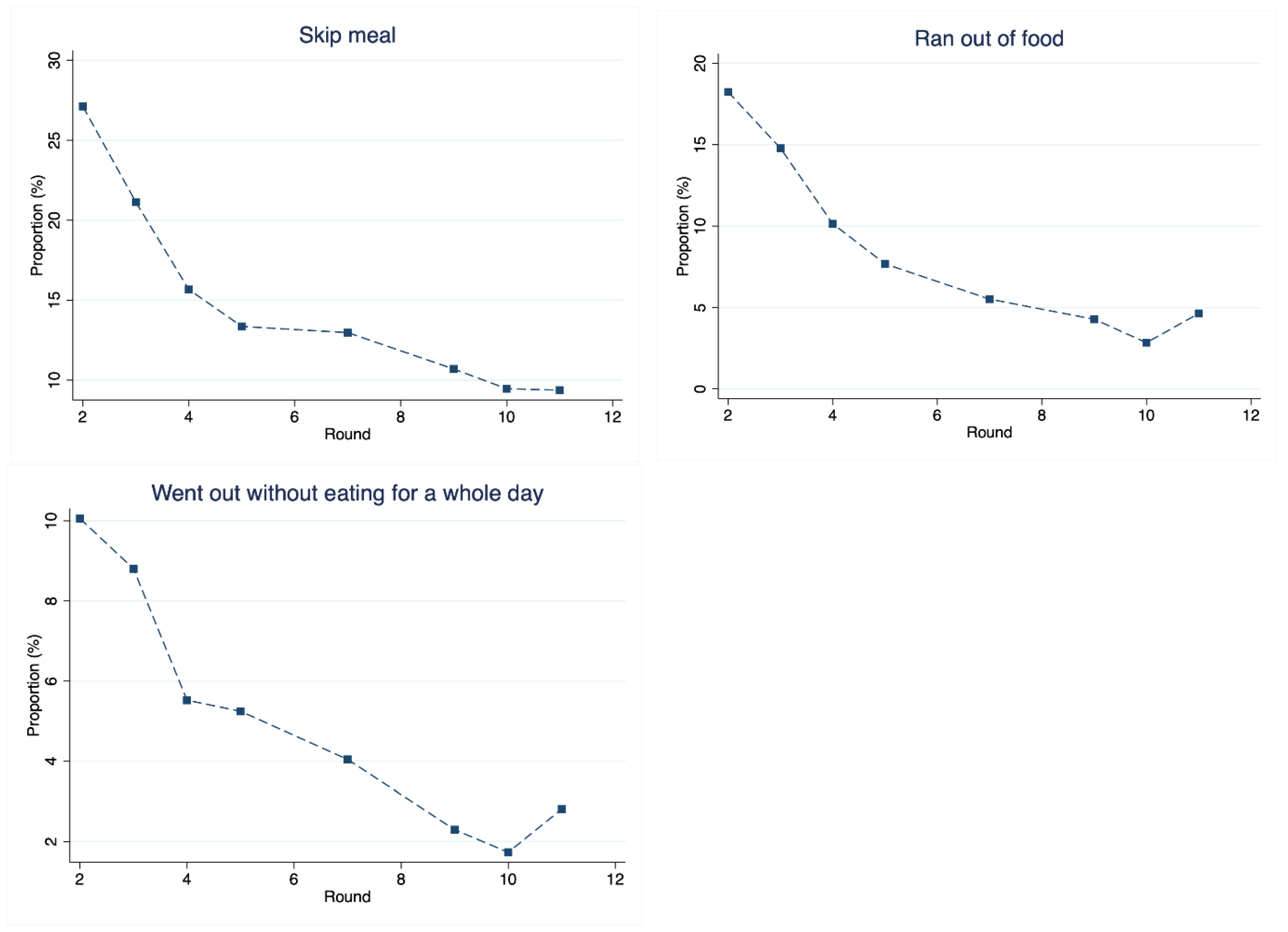
Figure 2.
The dynamics of food insecurity and its transition between 2020 and 2021. Source: Authors using data from the HFPS 2020-21.
Figure 2.
The dynamics of food insecurity and its transition between 2020 and 2021. Source: Authors using data from the HFPS 2020-21.
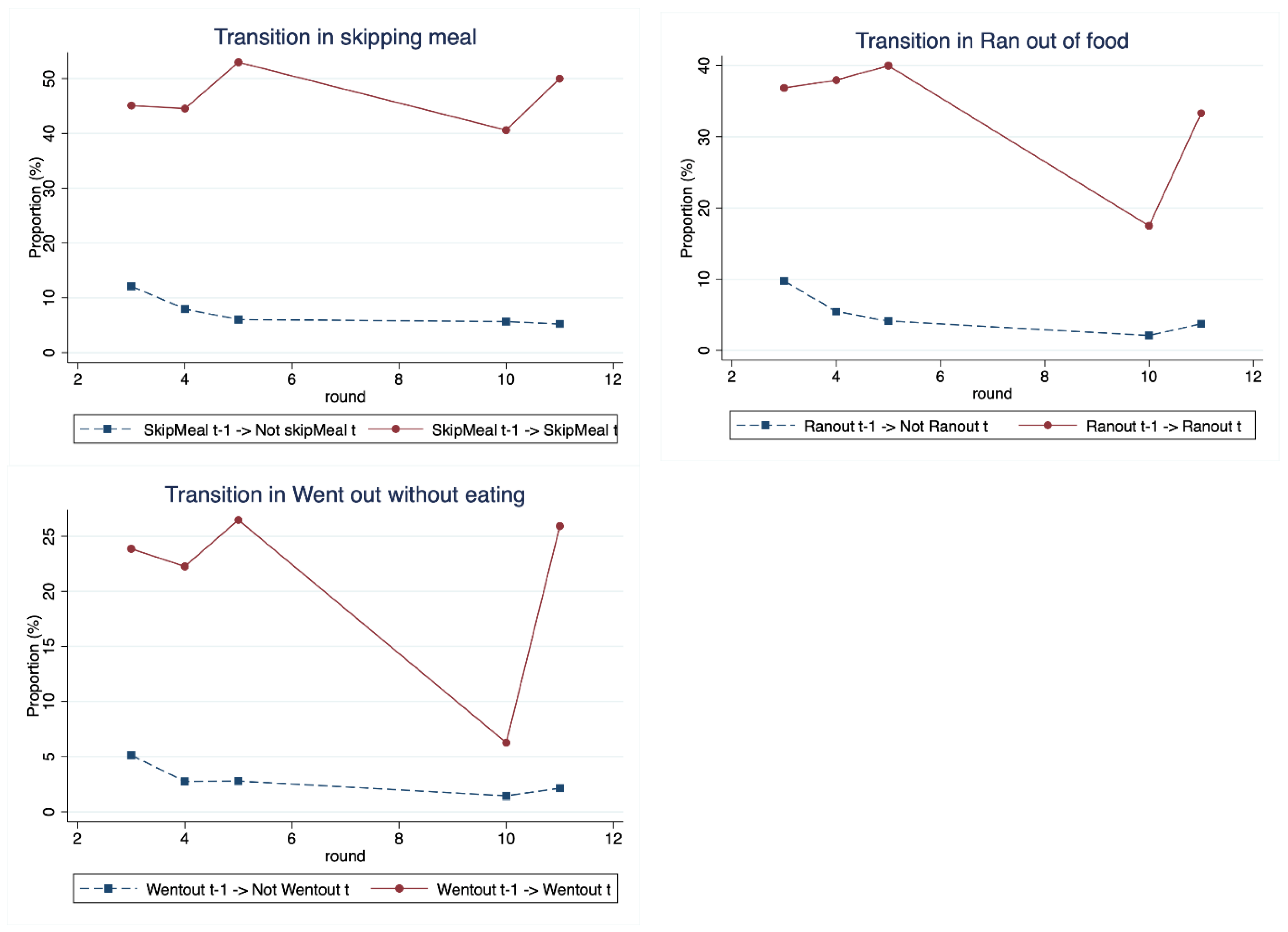

Table 1.
Dates of data collection.
| Rounds | Start | End | Survey |
|---|---|---|---|
| 1 | 2020-06-09 | 2020-07-01 | HFPS |
| 2 | 2020-07-20 | 2020-08-14 | |
| 3 | 2020-09-12 | 2020-10-21 | |
| 4 | 2020-11-06 | 2020-12-02 | |
| 5 | 2020-12-09 | 2020-12-30 | |
| 6 | 2021-01-15 | 2021-02-01 | |
| 7 | 2021-02-12 | 2021-03-02 | |
| 8 | 2021-03-13 | 2021-04-01 | |
| 9 | 2021-04-20 | 2021-05-04 | |
| 10 | 2021-05-25 | 2021-06-15 | |
| 11 | 2021-06-28 | 2021-07-20 |
Source: World Bank.
Table 2.
Summary statistics of key variables.
| Variables | Definition & Measure | Mean/ Percent |
St.Dev | Min. | Max. |
|---|---|---|---|---|---|
| Skipped a meal | =1 if the household skipped a meal; 0 otherwise | 14.92 | - | 0 | 1 |
| Ran out of food | =1 if the household ran out of food; 0 otherwise | 8.46 | - | 0 | 1 |
| Went without eating | =1 if a member of the household went without eating; 0 otherwise | 5.03 | - | 0 | 1 |
| Female | =1 if individual is a female; 0 otherwise | 15.60 | - | 0 | 1 |
| Age | Age in years | 47.83 | 13.909 | 18 | 102 |
| Age groups | |||||
| 18-24 group | =1 if the individual is aged 18-24 years | 0.97 | - | 0 | 1 |
| 25-44 group | =1 if the individual is aged 25-44 years | 40.56 | - | 0 | 1 |
| 45-64 group | =1 if the individual is aged 45-64 years | 36.59 | - | 0 | 1 |
| 65+ group | =1 if the individual is aged 65 or more | 21.18 | - | 0 | 1 |
| Household size | Number of household members | 7.89 | 0.354 | 4 | 8 |
| Household size classes | |||||
| 4-6 members | =1 if household has between 4 and 6 members in total | 1.29 | - | 0 | 1 |
| 7 members | =1 if household has 7 members in total | 7.26 | - | 0 | 1 |
| 8 members | =1 if household has 8 members in total | 91.43 | - | 0 | 1 |
| Urban | =1 if the household lives in urban area; 0 if the household lives in rural area | 65.80 | - | 0 | 1 |
| Farm activities | =1 if household is involved in farm (agriculture) activities; 0 if involved in nonfarm activities | 64.26 | - | 0 | 1 |
| Sample size | 8144 | - | |||
Source: Authors’ calculations using data from the HFPS 2020-21-.
Table 3.
a: LPM estimation results: food insecurity persistence: overall and by gender. b: LPM Estimation results: food insecurity persistence by age group. c: LPM estimation results: food insecurity persistence by household size.
Table 3.
a: LPM estimation results: food insecurity persistence: overall and by gender. b: LPM Estimation results: food insecurity persistence by age group. c: LPM estimation results: food insecurity persistence by household size.
| a | ||||
| Subgroups | Dependent variable: Food insecurity indicator in period t given insecurity in previous period | |||
| Skipped meal, period t-1 |
Ran out of food, period t-1 | Went without food, period t-1 | ||
| Overall | Constant | 0.224* (0.127) |
-0.074 (0.101) |
0.021 (0.081) |
| 0.368*** (0.017) |
0.280*** (0.019) |
0.253* (0.025) |
||
| R2 | 0.7129 | 0.5497 | 0.4974 | |
| No. observations | 8144 | 8144 | 8144 | |
| Male | Constant | 0.225* (0.136) |
-0.015 (0.113) |
0.051 (0.092) |
| 0.359*** (0.018) |
0.261*** (0.022) |
0.240*** (0.027) |
||
| R2 | 0.7229 | 0.6212 | 0.6243 | |
| No. observations | 6858 | 6858 | 6858 | |
| Female | Constant | 0.280 (0.391) |
-0.377* (0.202) |
-0.196 (0.121) |
| 0.407*** (0.040) |
0.352*** (0.040) |
0.313*** (0.064) |
||
| R2 | 0.5545 | 0.6212 | 0.6243 | |
| No. observations | 1286 | 1286 | 0.1286 | |
| b | ||||
| Age group | Dependent variable: Food insecurity indicator in period t given insecurity in previous period | |||
| Skipped meal, period t-1 | Ran out of food, period t-1 | Went without food, period t-1 | ||
| 18-24 | Constant | -0.945 (0.848) |
0.733 (0.502) |
0.612 (0.696) |
| 0.135 (0.098) |
0.221 (0.150) |
0.005 (0.101) |
||
| R2 | 0.5545 | 0.6807 | 0.3435 | |
| No. observations | 91 | 91 | 91 | |
| 25-44 | Constant | 0.381** (0.180) |
-0.020 (0.119) |
0.155 (0.122) |
| 0.358*** (0.027) |
0.220*** (0.029) |
0.209*** (0.039) |
||
| R2 | 0.5545 | 0.6807 | 0.3435 | |
| No. observations | 3,669 | 3,669 | 3,669 | |
| 45-64 | Constant | -0.100 (0.164) |
-0.174 (0.203) |
-0.071 (0.140) |
| 0.362*** (0.024) |
0.321*** (0.030) |
0.304*** (0.041) |
||
| R2 | 0.5545 | 0.6807 | 0.3435 | |
| No. observations | 3,341 | 3,341 | 3,341 | |
| 65+ | Constant | 0.401 (0.443) |
0.075 (0.300) |
-0.173 (0.149) |
| 0.391*** (0.039) |
0.347*** (0.045) |
0.200*** (0.043) |
||
| R2 | 0.5545 | 0.6807 | 0.3435 | |
| No. observations | 1,194 | 1,194 | 1,194 | |
| c | ||||
| Household size | Dependent variable: Food insecurity indicator in period t given insecurity in previous period | |||
| Skipped meal, period t-1 | Ran out of food, period t-1 | Went without food, period t-1 | ||
| 4-6 | Constant | -0.011 (0.438) |
0.117 (0.282) |
0.127 (0.315) |
| -0.407 (0.263) |
-0.163 (0.278) |
-0.266 (0.351) |
||
| R2 | 0.6861 | 0.5789 | 0.5232 | |
| No. observations | 39 | 39 | 39 | |
| 7 | Constant | 0.440*** (0.133) |
0.154 (0.173) |
0.305** (0.152) |
| 0.377*** (0.077) |
0.198*** (0.077) |
0.179** (0.084) |
||
| R2 | 0.6861 | 0.5789 | 0.5232 | |
| No. observations | 376 | 376 | 376 | |
| 8 | Constant | 0.017 (0.023) |
0.008 (0.016) |
-0.008 (0.012) |
| 0.362*** (0.017) |
0.282*** (0.020) |
0.257*** (0.026) |
||
| R2 | 0.6861 | 0.5789 | 0.5232 | |
| No. observations | 7,729 | 7,729 | 7,729 | |
Note: a: The numbers in parentheses are the standard errors. All estimations incorporate controls. Individual and time fixed effects are also included among the controls. Controls include age (in years), household size, urban residence, farm activities and regions. *, ** and *** indicate significance at 1%, 5% and 10% levels, respectively. Source: Authors using data from the HFPS 2020-21. b: The numbers in parentheses are the standard errors. All estimations incorporate controls. Individual and time fixed effects are also included among the controls. Controls include gender, household size, urban place of residence, farm activities and regions. *, ** and *** indicate significance at 1%, 5% and 10% levels respectively. Source: Authors using data from the HFPS 2020-21). c: The numbers in parentheses are the standard errors. All estimations incorporate controls. Individual and time fixed effects are also included among the controls. Controls include gender, age (in years), urban place of residence, farm activities and region. *, ** and *** indicate significance at 1%, 5% and 10% levels respectively. Source: Authors using data from the HFPS 2020-21.
Disclaimer/Publisher’s Note: The statements, opinions and data contained in all publications are solely those of the individual author(s) and contributor(s) and not of MDPI and/or the editor(s). MDPI and/or the editor(s) disclaim responsibility for any injury to people or property resulting from any ideas, methods, instructions or products referred to in the content. |
© 2025 by the authors. Licensee MDPI, Basel, Switzerland. This article is an open access article distributed under the terms and conditions of the Creative Commons Attribution (CC BY) license (http://creativecommons.org/licenses/by/4.0/).
Copyright: This open access article is published under a Creative Commons CC BY 4.0 license, which permit the free download, distribution, and reuse, provided that the author and preprint are cited in any reuse.


