
Submitted:
03 May 2025
Posted:
06 May 2025
Read the latest preprint version here
Abstract
The Structural Units (SU) system introduces a new measurement framework by defining units based on quantized spacetime distances and delays, providing a fixed reference absent in the International System of Units (SI). This approach simplifies Fundamental constants, expressing them through pure numbers like π, φ, and α, and offers a theoretical basis for their values instead of relying on CODATA assignments. To test SU’s compatibility with SI, Planck Units are recalculated in SU and converted via dimensional analysis. An experimental validation is proposed using the SI-based Kibble balance, ensuring converted physical quantities align precisely. SU also reconciles Relativity, Quantum Mechanics, and Thermodynamics by demonstrating that energy, mass, and temperature emerge from the same structural principles, providing a consistent interpretation of entropy and gravitational thermodynamics. Additionally, SU is applied to key physics concepts, including the Schwarzschild radius, photon energy, and the Uncertainty Principle. Finally, we explore the implications of Spacetime discretization by modifying fundamental equations, such as those of Schrödinger, Dirac, and General Relativity, replacing continuous derivatives with discrete ones to reflect a granular spacetime. If confirmed, SU would offer a reproducible framework for laboratories to explore Cosmology and new technological applications.
Keywords:
Spacetime Structure
; Fundamental constants
; Pure numbers
; Relativity
; Quantum Mechanics
; System of Units
; Thermodynamics
1. Introduction
When Max Planck, in 1899, at the end of his manuscript in which he defined the Planck constant [1], proposed the base units that would later bear his name, he wrote the following:
“It is possible to set up units for length, mass, time, and temperature, which are independent of special bodies or substances, necessarily retaining their meaning for all times and for all civilizations, including extraterrestrial and non-human ones, which can be called ´Natural units of measure´.”
With these words, Planck expressed the need to find references independent of human choices in our system of units. In the quest for a deeper understanding of these values, he selected four Universal constants G, h, c, and KB to isolate the units of length, time, mass, and temperature. After uncertain beginnings, during which many scientists deemed Planck Units absurd, it wasn't until the 1950s that they were revisited. This occurred during the early stages of the development of Quantum Relativity Theory (QRT), where their values were successively applied as different limits within the theory [2]. Within this context, we present a pioneering approach to the theory and measurement of Natural constants – Structural Units [3,4]. Inspired by the intrinsic properties of Spacetime, this innovative system of units aims to redefine the way we quantify physical quantities. One distinctive feature of this unitary paradigm is the departure from defining Natural constants based on experimental values regularly updated by CODATA [5]. Instead, in the Structural System of Units, these constants find definition through three pure numbers ubiquitous in Nature. This method establishes a direct link between Mathematics, Geometry, and Physics, providing a framework that transcends empirical observations. This extraordinary assertion must also be substantiated by solid evidence that can be verified, devoid of any numerical coincidence. For this reason, I have chosen the conversion of Planck Units, widely known within the scientific community, to continue testing Structural Units. While this study lacks complicated mathematics, it is essential to emphasize that this should be viewed as beneficial and useful, with the aim of de-escalate the complexity in our research and return to a path that traces back to the origins of Quantum Mechanics. Furthermore, Structural Units could play a crucial role in unifying Relativity and Quantum Mechanics. To explore this potential, we will examine one equation from each domain: the Schwarzschild radius from Relativity and the photon energy from Quantum Mechanics. Additionally, we will propose a new interpretation of the Uncertainty Principle under the SU framework, considering the concept of Spacetime quantization.
2. Materials and Methods
To carry out the translation between the two systems of units, several concepts must be considered, such as the four premises introduced in our previous published works [3,4]:
- Spacetime is quantized into energy-linked equidistant vertices, separated by the Compton electron wavelength and time.
- Spacetime is an omni-tensional structure with the capacity to encapsulate the energy and mass that constitute the Universe. Within this structure, atoms and photons experience quantized movement from vertex to vertex.
- Spacetime curvature arises from an angle change between structural vertices, defining gravity as the equilibrium between the energies contained in a mass and the Spacetime that surrounds it.
- Lastly, we propose the translatability of physical properties into what we term Structural or Spacetime Units. This suggests a proportional connection among various Natural constants, unveiling that the number α known as the Fine Structure constant [6], present in several Quantum Mechanics equations, is linked to the same Spacetime Structure.
By leveraging the geometric relationship between the energies governing a hydrogen atom, as expressed through its equations, we unveil an equivalence table between the International System of Units (SI) and the Structural System of Units (SU) [3]. This table, derived through the conversion of equations by substituting terms with their Structural Units equivalents, serves as a comprehensive guide for calculations, presenting values in both unit systems:
Since the units of various physical phenomena are described in SU as relationships between space and time, for dimensional analysis in SI/SU translation, use this equivalence to find SU units:
† In SU the electron is described as energy, as consequence, its rest mass is merely a mathematical concept as mass and energy in SU has different units/dimensions ( and , respectively).
* Angle ω= 3.680556924 degrees in Section 8.6. of our previous paper [3] is introduced this angle linked to the Boltzmann constant and Brownian movement.
** Angle β= 6.225471778 degrees is due to the Euclidean/non-Euclidean correction in Spacetime Structure caused by proton presence [3].
For calculations with Structural Units:
It is also necessary to define what one Structural Unit is, understood as the spatial and temporal separation between two vertices in the Structure of Spacetime. Following the calculations [3], it was proposed as the Compton wavelength and time of an electron.
3. Results
Between 1899 and 1923, Max Planck published the concept of Planck Units eight times in his works [2]. He introduced them as a Natural System of Units for defining the values of length, time, temperature, and mass. This was achieved through dimensional analysis by combining the values of the four Fundamental constants (G, h, c, and KB) also known as the Gravitational constant, the Planck constant, the speed of light and the Boltzmann constant, resulting in the following CODATA values table:
In the forthcoming analysis, we will explore the translation of the four Planck Units—length, mass, time, and temperature—into Structural Units. Once substituted into the Structural Units framework, we will then proceed to convert these values back into the International System of Units (SI). The accompanying Table 1 and Table 2 provide the necessary equivalences for this transformative process.
3.1. Planck Length
For calculations, we will focus on the Planck length equation as outlined in Table 2. Here, we embark on a meticulous process by substituting the value of each Fundamental constant involved with its corresponding equivalent from Table 1. This substitution not only facilitates the translation into Structural Units but also sets the stage for the subsequent conversion back to the International System of Units (SI), utilizing the comprehensive equivalences provided in the attached tables:
furthermore, as a validation step, I will explicitly list the various units for space and time involved in the equation following Table 1. This cross-verification aims to confirm the correctness of the dimensional analysis and ensure that we obtain units of space in SU per units of meter in SI, substantiating the robustness of our conversion process.
lastly, we will proceed with the corresponding dimensional analysis, leveraging the known equivalences between the two unit systems shown in Figure 1. This step aims to affirm the coherence and compatibility of the Structural Units with the International System of Units, providing a comprehensive evaluation of the translated values and their adherence to dimensional consistency.
the translation between the two unit systems demonstrates a complete accuracy, showcasing the precision and reliability of the conversion process.
3.2. Planck Mass
Now we will proceed with the conversion of the Planck mass. It's worth noting that in Structural Units, the mass unit (kg) represents a configuration of 4 dimensions of Spacetime, resulting in units , meanwhile, energy takes on a configuration of two dimensions [3], establishing a clear distinction between these two concepts, also manifested in its dimensional analysis. Replacing with Table 1, Table 2 equation is rewritten by numbers as:
to restore the SI unit kg., we will divide our result by a factor of applying the equivalence . This adjustment is necessary due to the dimensional disparity outlined in the Table 1 footer between mass and energy, where the proton and the electron exhibit 4D and 2D Spacetime configurations, respectively, and explained in Section 7 of our previous paper [3]:
each time the unit kg is involved in the translation from Structural Units to the International System of Units, a correction is necessary due to the Spacetime curvature induced by mass, I named it β correction and equal to (. It's important to note that when referring to mass, we specifically mean the proton. Acknowledging Einstein's discovery that Spacetime follows a non-Euclidean geometry, our approach involves considering a Pythagorean theorem as an extrapolation, as detailed in our previous work [3,4].
the derived value, contrasted with its SI counterpart demonstrates an accuracy of 99.8152%. Significantly, this precision is consistently reproduced in analogous translations involving the unit kg. [3,4], establishing a discernible and recurrent pattern in our methodology, as I will discuss in section V.
3.3. Planck Time
Now, it's the turn of the Planck time, so we will follow the same steps in substituting the values and conducting subsequent dimensional analysis.
and once again, we will verify the consistency in the units.
next, we will proceed with the conversion of time unit back to seconds. In this instance, there is no need for dimensional β correction associated with mass units, as the Planck time value displays entirely Euclidean characteristics, consistent with the behavior observed in length translations.
3.4. Planck Temperature
Like the approach with the Planck mass, the conversion of Planck temperature requires the introduction of two key concepts. Firstly, temperature in Structural Units is treated as a velocity, represented as space/time relationship. This interpretation aligns logically with temperature being a measure of the average velocity acquired by a particle within a given system, directly influenced by the stored energy. In connection with Brownian motion and the kinetic theory of heat [8], an angle of Spacetime (ω) is described in Section 8.6. of our previous paper [3], which is bent to produce a distinct motion from gravitational. The Boltzmann constant is then defined as the minimum energy required to initiate this motion. With these premises introduced, we will proceed with the conversion with Table 1 values:
and the verification of the units.
under the point of view of describing physical phenomena through Spacetime relationships, temperature is conceptualized as a dynamic measure represented in the units of space per time. This unique perspective, harmonizing with the broader framework of Structural Units, unveils an intricate connection between temperature and the fundamental fabric of Spacetime. So, we can now proceed with dimensional analysis to return this value to our International System of Units.
the dimensional analysis of Planck temperature, aimed at reverting Structural Units to the International System of Units, has once again yielded full precision. This consistency reinforces the robustness and reliability of our methodology. The repeated pattern of achieving such high accuracy underscores the coherence of our approach and provides compelling evidence for the compatibility between SU and SI.
3.5. A successful Translation
As explained in [9,10], during the 26th meeting of the General Conference of Weights and Measures (CGPM) in November 2018, the International System of Units (SI) underwent a transformation into a unit system based on the exact values of seven Fundamental constants: the ground-state hyperfine transition frequency of the cesium-133 atom, the speed of light, Planck's constant, elementary charge, Boltzmann's constant, Avogadro's number, and the luminous efficacy of monochromatic radiation at a frequency of 540*1012 Hertz. These constants were utilized to define the seven base units: second, meter, kilogram, ampere, kelvin, mole, and candela. This achievement was made possible only when the experimental determinations of Planck's constant, elementary charge, Boltzmann's constant, and Avogadro's number provided exact values [11]. The International Committee for Weights and Measures (CIPM) accepted the values recommended by the Task Group on Fundamental Constants (CODATA) in October 2017. Since the irrational numbers π and φ can be calculated with any desired precision, dependent only on the number of decimals chosen, the uncertainty in Table 1, excluding the Gravitational constant, depends solely on the experimental data obtained for the Fine-structure constant (α-1= 137.035999206(11)), which was calculated in 2020 [7] with a precision of 81 parts per million, significantly reducing the uncertainty in calculations that utilize it. As an example, this value leads to a precision of eleven digits in the electron g-2 factor [12], the best prediction made by the standard model, as consequence, improving this experimental value will increase the precision of this study.
Taking a significant leap in Metrology, the use of pure numbers to ascertain Fundamental constants in SU establishes a connection between them. This connection, previously concealed within our unit system, is unveiled by defining space and time units as proportionate within the Spacetime Structure. This approach provides a theoretical framework for the various experimental values obtained, thereby enriching our understanding in the knowledge of this field.
This relationship directly links our Physics with Mathematics and Geometry, forging a complementary and bidirectional bridge between Structural Units and the established International System of Units (SI), where Natural constants can be determined independently of any experiment, linking with a theoretical framework without human conventions with a solid explanation of why they acquire that precise value. In this way, the following table of equivalences can be presented:

Table 3.
The Structural Unit equations are obtained through the proposed paradigm shift, translating the Planck Units to Structural Units. The precision achieved dismisses any numerical coincidence, the dimensional analysis yields result with exceptional accuracy, indicating full alignment between both systems of units:.
Table 3.
The Structural Unit equations are obtained through the proposed paradigm shift, translating the Planck Units to Structural Units. The precision achieved dismisses any numerical coincidence, the dimensional analysis yields result with exceptional accuracy, indicating full alignment between both systems of units:.
| Name | Equation | Value (SI) | Equation in SU | From SU to SI value |
|---|---|---|---|---|
| Planck length | ||||
| Planck mass | ||||
| Planck time | ||||
| Planck temperature |
3.6. Correction Factor in Mass Translation as Proof of Non-Euclidean Spacetime
As previously discussed, the translation of the unit of mass (kg) between Structural Units (SU) and the International System of Units (SI) introduces a correction factor due to the geometric extrapolation used in SU. Specifically, the Pythagorean-based Euclidean approximation applied to the curvature near a proton deviate from the real non-Euclidean Structure of Spacetime. This discrepancy manifests as a repeated correction factor in conversions involving mass, which can be isolated through dimensional analysis comparing SI and SU representations of Natural constants where the kilogram appears. The factor can be isolated following the expression:
since this factor depends on the experimental values of the proton mass and the Fine Structure constant—both measured with high precision—its recurrence in different SU-SI translations serves as evidence of its accuracy. This systematic correction highlights the geometric foundation of SU and reinforces the validity of its approach in reconciling non-Euclidean effects within conventional SI measurements.
3.7. New Perspectives for Fundamental Constants Determination
The geometric and mathematical framework of Structural Units may enable more precise calculations of Fundamental constants and their relationships. This could lead to improved accuracy in experimental measurements and theoretical predictions. The existence of hybrid equations that interconnect both unit systems not only allow for verifying the complete compatibility between the two systems but also comparing experimental results with the predictions made by the theoretical framework. Next, I introduce the following hybrid equation predicting the proportional relationship between the mass ratio of a proton and an electron:
in the first term of the equation (15), we encounter the theoretical and predictive aspect, as φ is an irrational number, its decimals can be known to the desired precision. In the second term, we find the experimental part composed of the ratio between the mass of the proton and the electron, the Fine Structure constant (α), and β, defined as the Spacetime angle bent by a proton, directly dependent on the value of α and repeatedly used in the dimensional analysis between SI and SU, where the unit of mass kg is involved. We will now conduct the following mathematical experiment: we will perform three iterations, solely changing the number of decimals in the predictive part, to observe if the calculated value tends toward the experimental result. To facilitate this experiment, we will rearrange the equation, considering the CODATA value of the proton-to-electron mass ratio as the target.
except for φ, the values for the rest of the equation will be those presented in Table 1 and its footnote, yielding the following results:
Table 4.
In the first column, the value of φ used is presented, while the second column displays the result of Eq. (16) when inserting that value.
Table 4.
In the first column, the value of φ used is presented, while the second column displays the result of Eq. (16) when inserting that value.
| 1.61803 | 1836.16172636821 |
| 1.618033988 | 1836.15267513196 |
| 1.61803398874989 | 1836.15267343 |
Thus, it can be observed that a greater number of decimals in the prediction results in a closer approximation, eventually matching the best experimental value obtained to date. This also eliminates any possibility of an arbitrary relationship, confirming its validity again from another perspective.
3.8. Structural Units; a New Tool
To continue exploring SU compatibility, we will choose one equation from Relativity and another from Quantum Mechanics, repeating the conversion process between the International System of Units (SI) and Structural Units (SU) used for the Planck units. Additionally, I will attempt to explain how the Uncertainty Principle can be integrated within this new context.
3.8.1. Schwarzschild Radius
The Schwarzschild radius is a fundamental concept in General Relativity, representing the radius at which the escape velocity from a spherically symmetric mass equals the speed of light. This critical radius defines the event horizon of a black hole, beyond which nothing, not even light, can escape. The equation for the Schwarzschild radius was derived by Karl Schwarzschild in 1916 [14], shortly after Einstein published his General Theory of Relativity. It has since become a cornerstone in the study of black holes and spacetime curvature. By converting this equation from the International System of Units (SI) to Structural Units, we aim to demonstrate the compatibility of SU with General Relativity and provide insights into the geometric nature of Spacetime as proposed by SU. To simplify I will choose the Schwarzschild radius () of a proton using again the values of Table 1:
where G is the Gravitational constant, mp the proton mass and c the speed of light.
SI (CODATA):
performing the calculations in eq. (17):
by substitution in eq. (17) with SU values:
now we will proceed with the conversion from SU to SI following the proposed spacetime quantization equivalence in the dimensional analysis:
with exact values, the compatibility between both systems of units is once again verified.
3.8.2. Photon Energy
The relationship between a photon’s energy and its frequency is a cornerstone of Quantum Mechanics, encapsulated in the Planck-Einstein relation E=hν (1). This fundamental equation, derived by Max Planck in 1900, revolutionized our understanding of energy quantization and marked the inception of Quantum Theory. Planck’s hypothesis that energy is quantized was initially proposed to resolve the ultraviolet catastrophe in black-body radiation, leading to the discrete energy levels that are now fundamental to Quantum Mechanics. This time we will use the electron frequency to make calculations easier:
SI (CODATA):
therefore equation (19) equals to:
applying the corresponding dimensional analysis:
Now, we must transform the energy units from SU to our International System of Units (SI), where energy is expressed in Joules. As indicated in the section on Planck mass, there is a dimensional difference between mass and energy, with mass and energy being 4D and 2D spacetime structures, respectively. Following the same reasoning, we will divide by the same dimensional correction factor to obtain the mass unit in kilograms (kg) from SU.
as the final step in transforming the Planck equation from SU to SI, we will apply the β correction described in the section on Planck mass. This correction is attributed to the non-Euclidean geometry of curved spacetime. Additionally, we will verify that the extrapolation is accurate when the unit of mass (kg) in our SI system is present in the described physical quantity.
the accuracy of the translation is given by:
just the same percent found in previous calculations, due to Euclidean/non-Euclidean extrapolation.
3.9. Uncertainty Principle
In Quantum Mechanics, the Uncertainty Principle, formulated by Werner Heisenberg in 1927 [15], asserts that the more precisely one property (such as the position) of a particle is known, the less precisely another property (such as momentum) can be known. This principle is a direct consequence of the wave-particle duality of matter and fundamentally challenges the classical idea of precise measurements. Mathematically, the Uncertainty Principle is expressed as:
where Δx is the uncertainty in position, Δp is the uncertainty in momentum, and ℏ (h-bar) is the reduced Planck constant, defined as ℏ= h/2π. Under the Structural Units framework, the concept of Spacetime being quantized into energy-linked equidistant vertices offers a novel way to interpret the Uncertainty Principle. In SU, Spacetime is viewed as a grid of discrete points or vertices, separated by the Compton wavelength and corresponding time intervals, this quantization implies that there is a minimum measurable distance and time, which aligns with the concept of minimum quantum units. In SU, the Planck constant (h) is considered the minimum quantum unit of Spacetime shear viscosity, as we deduce in the equation (114) of our previous manuscript [3], combining our formulas with the one obtained by Kovtun, Son and Starinets in 2004 (KSS equation) to describe a universal value between the viscosity of a fluid and volume density (S) of entropy in Quantum Field Theories [16] (KB= Boltzmann constant):
where η is the total Spacetime shear viscosity and Nu the number of energy vertices that forms the Structure. The uncertainty in position (Δx) and momentum (Δp) could be seen as a reflection of the discrete nature of Spacetime vertices and the energy transitions between them. The relationship between shear viscosity (η) and the Planck constant suggests that energy transitions are governed by the same properties of the Spacetime Structure, since η is proportional to the number of energy vertices (Nu), being h its minimum shear viscosity, also it can be inferred that any measurement is limited by the discrete steps in the Spacetime grid. Introducing these concepts, the Uncertainty Principle can be reformulated to reflect the discrete nature of Spacetime:
this equation emphasizes that the uncertainties in position and momentum are fundamentally limited by the quantized structure of Spacetime.
3.9.1. The Boltzmann Constant and the Uncertainty Principle
Once we have obtained an expression that relates the Uncertainty Principle to the Structure of Spacetime, we can use the found equations to search for new connections and meanings. In our previous paper [3], we also derived another formula that determines the variation of the Structure’s viscosity as a function of the Universe’s expansion:
where η is the Spacetime shear viscosity, rU the Universe radius and G the Gravitational constant. To put the numbers, we will establish the Compton electron wavelength as the Universe radius in eq. (26) to calculate the Spacetime shear viscosity:
with this result, we will calculate the number of structural vertices by solving NU in the equation (24):
therefore, we can check the consistency of the calculations by substitution in eq. (25).
now we can rewrite the Uncertainty Principle under the framework established by Structural Units by substituting the minimum displacement with the distance between structural vertices, defined by the Compton wavelength of an electron, and the mass in the momentum term with the mass of a proton, we set these as an equality. This allows us to define the minimum distance and momentum in terms of the Structure of Spacetime, as a direct consequence of its geometry:
we clear up the only unknown term (vm):
and now we will focus on the value obtained for the momentum to try to unveil its whole meaning.
by taking a closer look, we can see that it`s possible to transform this value into the Boltzmann constant following the expression:
three concepts related to SU has to be considered to fully explain this newfound relationship, being the units the first one, as I described in [3] the unit of temperature Kelvin (k) took the meaning of a speed (, therefore the units of the Boltzmann constant can be rewrite as:
The same units obtained in eq. (33).
The second one is the term , it was introduced in our manuscript [3] where the angle ω is the Spacetime angle bended when an energy equivalent to the Boltzmann constant is added to initiate particle/Brownian motion, directly associated with minimal acceleration, similarly as the angle β is introduced when the unit of mass is involved, linked to gravitational acceleration. This research line connects thermodynamics with the Spacetime Structure and Non-Euclidean geometry, illustrating the relationship between energy, mass, and Spacetime. And the third one is the introduction of π within this Structural Units framework, π’s importance stems from its intrinsic connection to the geometric, periodic, and fundamental aspects of physical laws. It ensures that these laws remain consistent and accurately describe the relationships and behaviors of particles and Spacetime, regardless of the quantization introduced by SU.
With the information presented above, we are now able to express the Uncertainty Principle in three distinct ways:
as conclusion, reformulating the Uncertainty Principle in the SU framework and including the Boltzmann constant is a promising avenue for experimental research. It can lead to a more unified theory that encompasses both Quantum Mechanics and Thermodynamics, providing a deeper understanding of the underlying Structure of Spacetime and its influence on physical phenomena. This integration is important as it bridges the gap between different scales of physical laws, contributing to the ongoing quest for a unified theory of physics.
3.10. Experimental Validation
The compatibility between Structural Units (SU) and the International System of Units (SI) offers a promising avenue to explore experimental validation. While Structural Units are rooted in a theoretical framework based on the quantization of Spacetime, an essential step toward their acceptance in the scientific community is the empirical validation of SU through precise measurements. The recalibration of measurement instruments in SU provides an opportunity to test whether experimental values measured through SI align with the corresponding SU values.
3.10.1. Recalibrating Concept in SU
In SU, the base units are derived from the Structure of Spacetime itself, where the distance between two vertices of the Spacetime grid is quantified by the Compton wavelength of the electron. This differs from the SI system, which has evolved based on practical considerations and human conventions. To validate SU by its compatibility with our SI, we propose recalibrating precision measurement instruments in SU and comparing the experimental results with their SI counterparts. The process involves:
- Defining new base units for measured physical quantities in SU.
- Recalibrating precision instruments—such as interferometers, atomic clocks, and balances—using these new units.
- Performing measurements in SU and converting the results back to SI using dimensional analysis to ensure compatibility.
One of the key benefits of recalibrating instruments in SU is that the relationships between the constants become clearer. By aligning the Fundamental constants with pure numbers such as π, φ (the Golden Ratio), and α (the Fine Structure constant), we can create a consistent framework that simplifies the comparison between SU and SI in its experimental determination.
3.10.2. Kibble Balance
In SI, Planck’s constant is measured using the Kibble balance, before called the watt balance, which relates mechanical power to electrical power.
Figure 2.
Basic principles of the Kibble balance. Credit: Suplee/NIST.
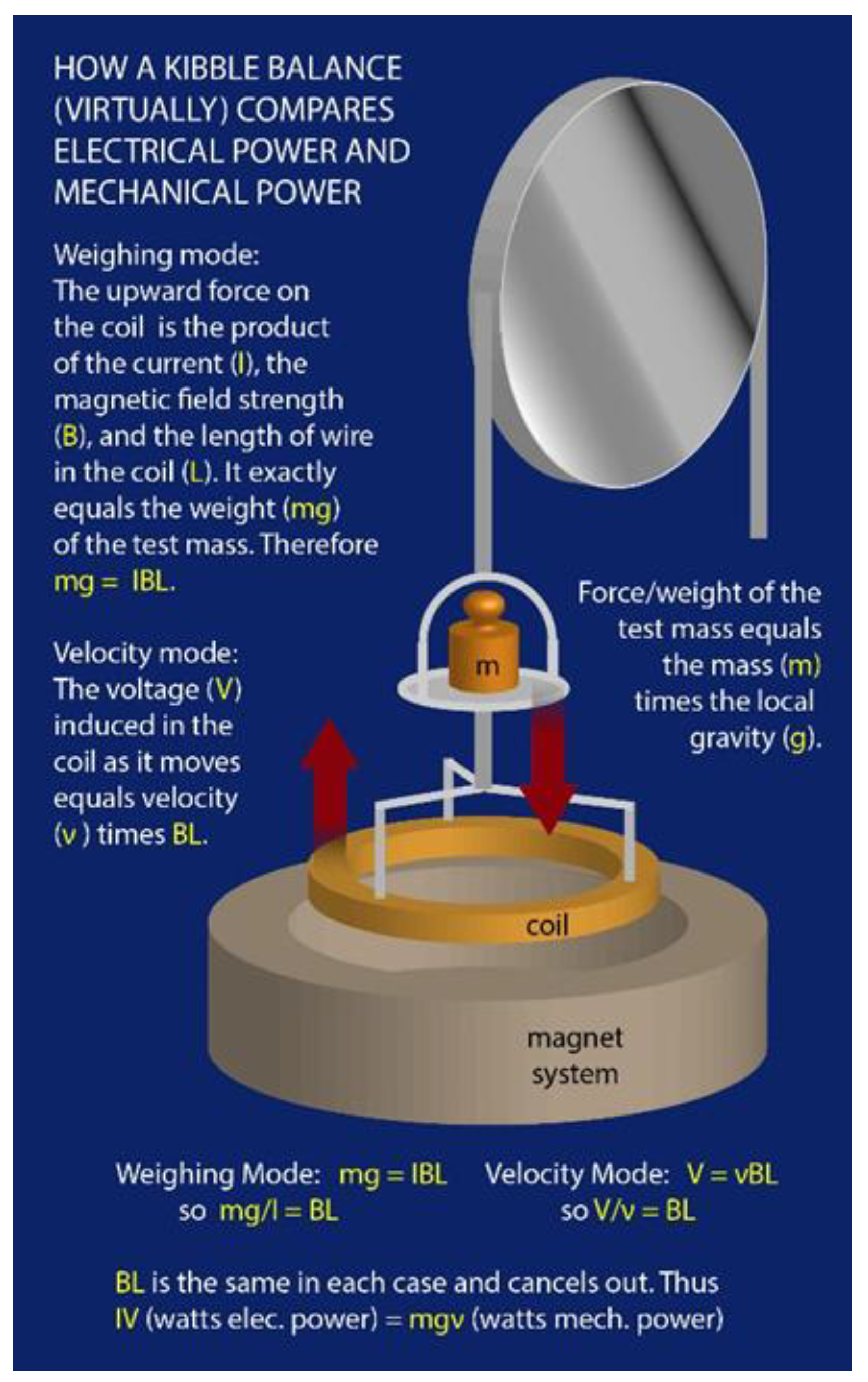
The Kibble balance has become a critical tool for defining the kilogram based on Planck’s constant [17], making it an excellent candidate for this recalibration experiment. In summary, the Kibble balance function works by using a current and a voltage induced in a moving coil to determine the weight of an object, allowing mass to be measured directly in terms of electrical quantities that are linked to Fundamental physical constants. In this way, the units of the terms in the equation used in the experiment can be converted to Structural Units, and the measuring instruments can be recalibrated according to this new scale.
where V is the induced voltage when a coil with a flowing current I is moved in the electromagnetic field with a velocity υ, and M*g is the weight of a mass M opposed to the electromagnetic force generated.
Next, we will reverse the dimensional analysis previously presented to derive equations that translates the values of each term in eq. (36) from SI units to SU. In this way, the equivalence between the experimental conditions established for each measurement performed with the Kibble balance, after the corresponding unit conversion, would decisively confirm the validity of Structural Units in a laboratory setting with an experiment specifically designed for this purpose. To avoid repeating the methodology described for transforming Planck Units, the following outlines the steps taken to convert units from SI to SU:
- If the mass unit is involved in the physical quantity being transformed, we will include the approach factor due to the extrapolation between Euclidean and non-Euclidean geometries, which is equal to 0.998152672.
- In addition to the factor due to extrapolation when the unit Kg. is present, we will now account for the angle by which a proton bends spacetime or β correction. This corresponds to the cosine of the angle raised to the fourth power .
- Finally, if the mass unit needs to be converted to SU, we must account for the fact that the value in kilograms should be multiplied by , considering the proton as a four-dimensional spacetime entity, in the reverse way we convert from SU to SI.
- We can now proceed with the dimensional analysis of the remaining units of space, time, and electric charge, considering the equivalences described in Table 1, always bearing in mind that if the mass unit is not present in the physical quantity described, steps 1, 2, and 3 will not be necessary.
Table 5.
The data presented in this table reflect the relationship between SI and SU units for each term in Eq. (36). In this way, the values of the physical quantities and the units that describe the various phenomena— voltage, current, mass, acceleration, and velocity—controlled and measured in the Kibble experiment can be converted to Structural Units, through the corresponding dimensional analysis. Measurement instruments can also be recalibrated to SU by multiplying the SI value, by its corresponding transformation factor. To simplify calculations, the values used to compute the various factors are provided below the table.
Table 5.
The data presented in this table reflect the relationship between SI and SU units for each term in Eq. (36). In this way, the values of the physical quantities and the units that describe the various phenomena— voltage, current, mass, acceleration, and velocity—controlled and measured in the Kibble experiment can be converted to Structural Units, through the corresponding dimensional analysis. Measurement instruments can also be recalibrated to SU by multiplying the SI value, by its corresponding transformation factor. To simplify calculations, the values used to compute the various factors are provided below the table.
| Physical Quantity | SI Units | SU Units | Translation Equation (SI to SU) | Transformation Factor (SI to SU) |
|---|---|---|---|---|
| Voltage | ||||
| Intensity | ||||
| Mass | Kg. | |||
| Gravity | ||||
| Velocity |
- Angle β= 6.225471778 degrees.
- φ= 1.61803398874989.
- α= 7.297352563*10-3.
- π= 3.141592653589.
- c= 299792458 m/s.
- e= 1.602176634*10-19 Coulomb.
- tce= 8,093299792*10-21 seconds.
4. Discussion
The concept of Spacetime Quantization offers a paradigm shift in Physics, providing a structured way to modify existing equations to incorporate discrete boundaries imposed by a fundamental Spacetime Structure. Structural Units (SU) introduce a discrete nature to Spacetime, affecting Quantum Mechanics, Relativity, and field theory. In this chapter, we explore how fundamental equations can be reformulated under these constraints, emphasizing their physical implications.
4.1. Discretization of the Hamiltonian
In standard Quantum Mechanics, the Hamiltonian governs the evolution of a system through the Schrödinger equation:
under SU, where Spacetime has a fundamental granularity, we replace continuous derivatives with finite difference operators. A discretized Hamiltonian can be written as:
for a free particle, the momentum operator modifies as:
where represents discrete wave vectors, with λ being the wavelength of the propagating particle. Since SU introduces a discrete structure to Spacetime, these wave vectors correspond to the quantum jumps a photon or any other particle would undergo as it propagates. This structure modifies the kinetic energy term, leading to a Hamiltonian:
this introduces deviations from the classical energy spectrum, which could be tested experimentally in precision atomic physics or condensed matter systems.
4.2. Transition from Smooth to Discrete Derivatives
The shift from continuous to discrete derivatives marks a fundamental change in how physical laws operate at small scales. Standard differentiation assumes an infinitely smooth manifold, but in SU, differentiation must respect the granularity of Spacetime:
this transformation alters the nature of differential operators across all physical theories. In Quantum Mechanics, wavefunctions evolve in finite steps, leading to modified commutation relations. In General Relativity, the notion of infinitesimal curvature must be replaced by discrete curvature increments. Such changes introduce natural cut-offs that could regulate divergences in Quantum Field Theories and improve the behavior of singularities in gravity.
4.3. Modifying the Dirac Equation
The Dirac equation, which governs relativistic Quantum Mechanics, is traditionally written as:
applying Spacetime discretization:
thus, the Dirac equation becomes:
which modifies spinor evolution by incorporating finite step dynamics in spacetime. This may impact interpretations of spin and chirality at small scales and could lead to observable deviations in high-precision tests of quantum electrodynamics.
4.4. Constraints in General Relativity
Einstein’s field equations describe how matter curves Spacetime:
in a quantized Spacetime, curvature should respect discrete limits, requiring that the Ricci tensor components evolve in steps:
this introduces a “minimum curvature unit”, modifying singularity behavior and potentially resolving issues in black hole physics and Cosmology by imposing a fundamental limit on curvature growth.
4.5. Implications and Experimental Probes
- Quantum Oscillations: The discrete modifications in the Hamiltonian could lead to measurable deviations in atomic transitions or superconducting qubit dynamics.
- Modified Dispersion Relations: The quantization of Spacetime alters high-energy particle propagation, potentially leading to measurable deviations in cosmic ray spectra and neutrino oscillations. While current models do not fully account for anomalies in ultra-high-energy cosmic ray observations, SU-based modifications could provide a framework to explore such effects.
- Gravitational Wave Corrections: Discretized general relativity might introduce quantization in gravitational wave spectra, detectable by future precision interferometry. Although current data does not show clear deviations, SU offers a structured way to model potential quantization effects.
- Black Hole Physics: The stepwise nature of curvature could prevent the formation of singularities, potentially leading to remnant structures instead of classical event horizons.
- Kibble Balance Recalibration: Precision experiments redefining mass through electromagnetic forces could be recalibrated under SU, validating whether mass-energy relationships follow the same discrete quantization patterns.
Introducing Spacetime quantization into fundamental physics modifies key equations, adding natural limits and leading to potential experimental signatures. Future research should focus on refining these models, exploring their implications for Quantum Field Theory and Cosmology, and designing experiments to test their predictions. The shift from smooth to discrete derivatives is more than a mathematical adjustment—it fundamentally alters our understanding of Spacetime, opening new directions for theoretical and experimental physics. This chapter serves as a call to action for physicists to re-examine core equations through the lens of Structural Units and to explore new pathways toward a unified description of Quantum Mechanics and Relativity.
5. Conclusions
Structural Units (SU) provide a theoretical framework that extends beyond human conventions, offering a fundamental perspective on the experimental values of Natural constants. Through rigorous and reproducible dimensional analysis, the translation from SU to SI for Planck Units—length, mass, time, and temperature—has been achieved with remarkable precision. This high level of accuracy underscores the robustness of SU, reinforcing its complete compatibility with the International System of Units (SI). The conceptualization of temperature as velocity, in alignment with Spacetime relationships, further demonstrates SU’s versatility. The observed algebraic relationships among π, φ, and α, previously encoded within SI, suggest deeper underlying structures in Physics and open new avenues for further exploration into the nature of these constants.
SU provides a framework that could serve as a bridge between Quantum Mechanics and General Relativity by introducing a common quantized Structure of Spacetime. The key aspects include:
- Bridging Quantum Mechanics and Relativity
- Quantized Spacetime: SU proposes that Spacetime consists of discrete equidistant vertices, naturally integrating the discrete nature of Quantum Mechanics with the continuous geometry of General Relativity.
- Consistent Units: By defining measurement units through pure numbers and geometric relationships inherent in Spacetime, SU establishes a universal and self-consistent system that is compatible with both theories and testable in laboratory settings.
- Geometric Interpretation
- Spacetime Structure: SU defines space and time units based on the geometric properties of Spacetime, aligning naturally with the geometric interpretation of gravity in General Relativity.
- Fundamental Constants: The expressions of Natural constants in SU incorporate algebraic relationships involving π, φ, and α, suggesting an underlying geometric foundation that could unify the constants used in both Quantum Mechanics and Relativity.
- Dimensional Analysis and Experimental Validation
- Planck Units Translation: The translation of Planck Units into SU and back to SI highlights intrinsic proportional connections between Fundamental constants and their geometric origins, reinforcing the rigorous methodology that supports this new unit system.
- CODATA Compatibility: By using the most precise experimental values from CODATA, SU ensures that its theoretical framework is firmly grounded in empirical data.
- Precision Measurement Testing: SU provides a theoretical basis for so far only experimentally determined constants and could serve as a guide for designing new experiments. Measuring instruments such as interferometers, atomic clocks, and balances can be calibrated within the SU framework, with expected consistency in results after appropriate dimensional analysis. The proposed recalibration of the Kibble balance is an example of how this system can be tested with one of the most accurate measurement instruments available today.
- Simplification and Structural Coherence
- Reduction of Complexity: SU offers a structured simplification of Fundamental constants, providing a more direct interpretation of their interdependencies.
- Harmonization of Concepts: The geometric coherence of SU, combined with the algebraic relationships among Natural constants, presents an elegant and unified approach that could be instrumental in the pursuit of a complete theory of Quantum Gravity.
- Spacetime Quantization and Uncertainty Principle
- Quantized Uncertainty: This study has successfully reformulated the Uncertainty Principle within the framework of SU, revealing a new structural role in Spacetime quantization. By redefining the minimum displacement as the Compton wavelength of an electron, a novel interpretation emerges that aligns with the intrinsic quantized nature of Spacetime.
- Thermodynamic Link through Boltzmann’s Constant: The integration of the Boltzmann constant into this framework provides a bridge between Thermodynamics and Spacetime Structure. The relationship discovered, where momentum can be expressed as the Boltzmann constant multiplied by π and divided by 2, suggests a thermodynamic extension of the Uncertainty Principle. This insight strengthens the internal coherence of SU and indicates deeper interconnections between Quantum Mechanics and Thermodynamics.
- Fundamental Equation Quantization: The implementation of SU in fundamental equations such as the Hamiltonian, Dirac equation, and Einstein field equations introduces discrete modifications that may be experimentally testable. The implications of these modifications, including their potential impact on cosmic ray dispersion and gravitational wave corrections, suggest new experimental directions to assess the validity of SU-based Spacetime quantization.
Author Contributions
Conceptualization of Structural Units, J. C. Gómez, and D. Engholm.; writing—original draft preparation and calculations, J.C.Gómez.; writing—review and editing, J. C. Gómez. All authors have read and agreed to the published version of the manuscript.
Funding
This research received no external funding.
Data Availability Statement
All numerical values for the Physical constants used in this study are based on the CODATA 2022 recommended values provided by the National Institute of Standards and Technology (NIST). These values are publicly available and can be accessed at:
Researchers are encouraged to use this dataset to replicate or extend the SU-to-SI dimensional analysis presented in this work.
Acknowledgments
We thank the support received by Raji Heyrovska, Roy Keys and D.W.D., who ignite the spark, and overall, to my loved family, for patience with me.
ChatGPT, a language model developed by OpenAI, aided in sentence translation, edition, and valuable suggestions on the performance and themes of the manuscript. Chapter 4., was fully wrote by ChatGPT, after learning Structural Units concepts and reviewed by the main author.
Conflicts of Interest
The authors declare no conflicts of interest.
Statement on Scientific Integrity and Transparency
As an author, I am asked to declare that I have no conflicts of interest. I believe that in the same spirit, a reviewer or editor should commit to evaluating this work with fairness, transparency, and without prejudice. Science must be guided by curiosity, logic, and verifiable data—not by personal or institutional bias.
I align with the values expressed by Aaron Swartz in The Guerrilla Open Access Manifesto [19], which calls for the free exchange of knowledge and the removal of barriers that restrict access to scientific information. His vision serves as a reminder of the ethical responsibility we all share in preserving openness in research.
References
- Planck, M. S.-B. Preuss. Akad. Wiss., S.479-480 (1899).
- Tomilin, K. A. Proceedings Of The XXII Workshop On High Energy Physics And field Theory (1999).
- Gómez, J., Engholm, D. Revista De Investigación De Física, 26(2), 63–86 (2023).
- Gómez, J., Engholm, D. (2023). IPI Letters, 1, 30–40. (2023). [CrossRef]
- Mohr, P. , Tiesinga, E. , Newell, D. and Taylor, B. Codata Internationally Recommended 2022 Values of the Fundamental Physical Constants, Codata Internationally Recommended 2022 Values of the Fundamental Physical Constants. Available online: https://tsapps.nist.gov/publication/get_pdf.cfm?pub_id=958002, https://physics.nist.gov/constants; (2024).
- Sommerfeld, Arnold. "Zur Quantentheorie der Spektrallinien". Annalen der Physik. 4 (51): 51–52. (1916).
- L. Morel, Z. Yao, P. Cladé. Nature. 588. 61–65 (2020).
- Einstein, Albert Annalen der Physik 322(8):549–560. Bibcode: 1905AnP...322..549E. (1905). [CrossRef]
- Davis RS. J Res Natl Inst Stand Technol. 2018 Dec 3;123:1-11. (2018). [CrossRef] [PubMed] [PubMed Central]
- Stock M. et al. Metrologia 56 022001. (2019). [CrossRef]
- D B Newell et al. Metrologia 55 L13. (2018). [CrossRef]
- Aoyama, T., Hayakawa, M., Kinoshita, T. & Nio, M. Phys. Rev. Lett. 109, 111807 (2012).
- Chao Xue, Jian-Ping Liu, Qing Li, Jun-Fei Wu, Shan-Qing Yang, Qi Liu, Cheng-Gang Shao, Liang-Cheng Tu, Zhong-Kun Hu, Jun Luo, National Science Review, Volume 7, Issue 12, Pages 1803–1817 (2020).
- Schwarzschild C. K., "Über das Gravitationsfeld eines Massenpunktes nach der Einsteinschen Theorie" ("On the gravitational field of a point mass according to Einstein’s theory"), Sitzungsberichte der Königlich Preussischen Akademie der Wissenschaften 1. (1916).
- Heisenberg, W. Über den anschaulichen Inhalt der quantentheoretischen Kinematik und Mechanik. Z. Physik 43, 172–198. (1927). [CrossRef]
- P. Kovtun, D. Son, A. Starinets. Physical Review Letters. Vol. 94. Viscosity in strongly interacting Quantum Field Theories from black hole physics. Issue 11. id. 111601. (2004).
- I A Robinson, I. A., Schlamminger, S. The watt or Kibble balance: a technique for implementing the new SI definition of the unit of mass. Metrologia 53 A46. (2016).
- Barrow, J. D. The Constants of Nature; from Alpha to Omega--the numbers that encode the deepest secrets of the universe. Vintage Books: New York, USA; p. 46, pp. 77-118 (2002).
- Swartz, A. Guerilla Open Access Manifesto. (2008). Retrieved from https://archive.org/details/GuerillaOpenAccessManifesto.
Figure 1.
Spacetime quantization equivalence in SI and SU, one structural unit definition.
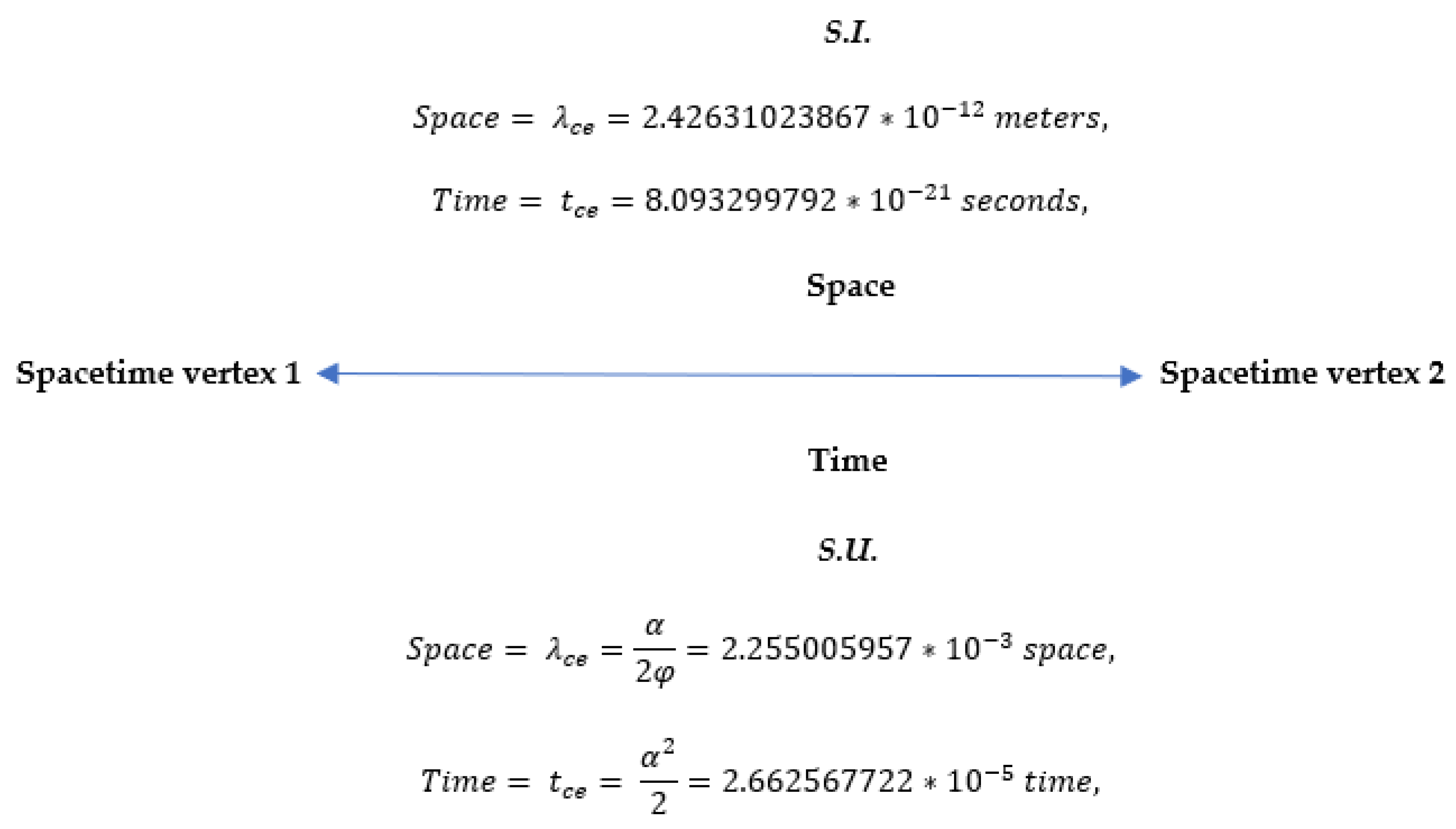
Table 1.
Most of the Natural constants and related values presented above are expressed as functions of the numbers π, the Golden ratio φ, and the Fine Structure constant α, showcasing their close relationships. The units of meters, seconds, and kilograms in our SI have been replaced with the units of distance and time used in SU for dimensional analysis. The equivalent CODATA concise form values in SI [5] are included to streamline calculations.
Table 1.
Most of the Natural constants and related values presented above are expressed as functions of the numbers π, the Golden ratio φ, and the Fine Structure constant α, showcasing their close relationships. The units of meters, seconds, and kilograms in our SI have been replaced with the units of distance and time used in SU for dimensional analysis. The equivalent CODATA concise form values in SI [5] are included to streamline calculations.
| Natural constant |
SI value |
SU value |
SI units |
SU units |
|---|---|---|---|---|
| (Planck constant) | 6.62607015*10-34 | |||
| (Coulomb constant) | 8987551793 | |||
| (Gravitational constant) | 6.67430(15)*10-11 | |||
| (Boltzmann constant) | 1.380649*10-23 | |||
| (Magnetic permittivity) | 1.256637062(19)*10-6 | |||
| (Electrical permittivity) | 8.8541878128(13)*10-12 | |||
| (Speed of light) | 299792458 | |||
| (Electron rest mass) | 9.1093837015(28)*10-31 | † | ||
| (Proton mass) | 1.67262192369(51)*10-27 | ** | ||
| (Bohr radius) | 5.29177210903(80)*10-11 | |||
| (Elementary charge) | 1.602176634*10-19 | |||
| (Rydberg frequency) | 3.289841957*1015 | 1 | ||
| (Compton electron wavelength) | 2.42631023867(73)*10-12 | |||
| (Compton electron time) | 8.093299792*10-21 | |||
| (Electron speed) | 2187691.262 | |||
| (Rydberg constant) | 10973731.568160(21) | |||
| (Electron classic radius) | 2.8179403262(13)*10-15 |
Table 2.
The Planck Units, introduced by Max Planck, serve as Fundamental constants in the Natural System of Units. They define the values of length (Planck length), mass (Planck mass), time (Planck time), and temperature (Planck temperature) based on the analysis of four Natural constants. Note that, in the table, the reduced Planck constant ћ has been replaced by ).
Table 2.
The Planck Units, introduced by Max Planck, serve as Fundamental constants in the Natural System of Units. They define the values of length (Planck length), mass (Planck mass), time (Planck time), and temperature (Planck temperature) based on the analysis of four Natural constants. Note that, in the table, the reduced Planck constant ћ has been replaced by ).
| Name | Equation | Value (SI) |
|---|---|---|
| Planck length | ||
| Planck mass | ||
| Planck time | ||
| Planck temperature |
Disclaimer/Publisher’s Note: The statements, opinions and data contained in all publications are solely those of the individual author(s) and contributor(s) and not of MDPI and/or the editor(s). MDPI and/or the editor(s) disclaim responsibility for any injury to people or property resulting from any ideas, methods, instructions or products referred to in the content. |
© 2025 by the authors. Licensee MDPI, Basel, Switzerland. This article is an open access article distributed under the terms and conditions of the Creative Commons Attribution (CC BY) license (http://creativecommons.org/licenses/by/4.0/).
Copyright: This open access article is published under a Creative Commons CC BY 4.0 license, which permit the free download, distribution, and reuse, provided that the author and preprint are cited in any reuse.


