

Submitted:
03 May 2025
Posted:
05 May 2025
Read the latest preprint version here
Abstract
Post-mining sustainability remains a major policy and governance challenge in resource-rich regions such as Indonesia, where extractive legacies often leave landscapes environmentally degraded and communities economically vulnerable. This study proposes a foundational framework for reframing sustainability in post-mining landscapes by integrating two interdependent pathways: institutional mechanisms and behavioral readiness. Using a qualitative meta-synthesis of 1,339 stakeholder-derived remarks and 80 thematically coded nodes, the study identifies ten core themes spanning land compensation, CSR co-financing, agroecological livelihoods, stakeholder engagement, social norms, and perceived legitimacy. The resulting dual-pathway framework demonstrates that long-term sustainability is not merely an outcome of regulatory reform or technical rehabilitation, but the product of mutually reinforcing processes involving policy alignment, community empowerment, and cultural acceptance. The study contributes to both Stakeholder Theory and Legitimacy Theory, offering empirical grounding for how trust, participation, and local belief systems shape the adoption and effectiveness of sustainability initiatives. A set of policy recommendations is also presented to guide multi-actor governance, participatory land planning, and behavioral integration in post-mining development. This framework provides a conceptual and operational tool for advancing sustainability in complex post-extractive settings.
Keywords:
post-mining sustainability
; institutional legitimacy
; stakeholder engagement
; community empowerment
; CSR co-financing
; agroecological livelihoods
; land compensation
; behavioral integration
; qualitative meta-synthesis
1. Introduction
Sustainable development in Indonesia’s nickel mining regions remains a complex challenge, marked by ongoing environmental degradation, socio-economic disruption, and governance fragmentation. While the mining sector drives national economic gains, its long-term consequences—ranging from ecological damage and displacement to rural disempowerment—demand a more systemic and future-oriented sustainability framework. Addressing these challenges requires a dual focus: reconfiguring institutional arrangements and fostering behavioral shifts that support post-mining recovery and the development of resilient, community-based livelihoods.
This article is intentionally designed to lay the conceptual groundwork for three subsequent sustainability models. It proposes a reframing of post-mining sustainability through the integrated lenses of institutional alignment and behavioral transformation. The resulting model—Reframing Sustainability in Post-Mining Landscapes: A Foundational Framework for Institutional and Behavioral Integration in Indonesia—establishes the theoretical base that informs and supports the development of: (1) A Community Development Model, grounded in cocoa-based agricultural transformation; (2) A Triple Bottom Line Performance Model, which evaluates CSR-driven metrics for sustainable outcomes; and (3) A Transformation-Readiness Model, which maps pathways for institutional adaptation and community mobilization.
These models are derived from a qualitative meta-synthesis of 1,339 coded remarks from academic and institutional literature, structured across ten parent themes and eighty sub-themes. Together, they form a unified research trajectory that advances sustainability theory and practice in Indonesia’s post-extractive landscapes.
This article aims to reorient the sustainability discourse in post-mining contexts by moving beyond fragmented, compliance-driven approaches toward a more integrated, participatory, and transformation-oriented strategy. Grounded in the combined insights of Stakeholder Theory [1], Legitimacy Theory [2], and the Theory of Planned Behavior (TPB) [3], the proposed framework emphasizes the dual necessity of institutional alignment and behavioral readiness. These theoretical foundations collectively support the conceptual development and empirical validation of the four interlinked manuscripts. Together, they explain how sustainability in post-mining landscapes requires more than regulatory adherence or technical reclamation; it must engage deeply with the co-evolution of governance structures and community agency, enabling long-term institutional legitimacy, stakeholder engagement, and socially grounded transformation.
The theoretical framework developed here views sustainability as the product of intertwined institutional reform and behavioral transformation. Drawing upon the three core theories—Stakeholder, Legitimacy, and TPB—it contends that meaningful outcomes only arise when both top-down governance and bottom-up behavior align. This approach provides a strategic lens for analyzing how policies and community agency interact to generate resilience in rehabilitated mining areas.
The development of this framework is grounded in a comprehensive literature review spanning topics in sustainability science, governance, community empowerment, and agroecological transition. The review draws heavily from both global and Indonesian sources addressing issues such as environmental degradation [4,5], socio-economic instability [6,7], and fragmented CSR implementation [8,9]. These studies reveal a critical gap in models capable of integrating institutional and behavioral dimensions into a unified sustainability framework.
The institutional integration pathway focuses on the policy frameworks and structural conditions required for sustainable transitions. This includes aligning land compensation schemes with local needs [10], building governance legitimacy through transparency and inclusive decision-making [2,11], and leveraging CSR funding to support community development [12,13]. Agroecological approaches—such as cocoa-based farming—are also emphasized for their dual role in land restoration and livelihood generation [14,15].
In parallel, the behavioral integration pathway addresses psychological and cultural drivers of sustainable practice. Informed by TPB, this includes fostering sustainable attitudes, strengthening social norms, building trust, encouraging stakeholder participation, and enhancing skills and motivation [3,16,17]. The coded remarks consistently pointed to behavioral intention and community readiness as central to the uptake and long-term success of sustainability programs, reinforcing the framework’s focus on social inclusion and participatory governance.
The model derives its strength from the fusion of empirical insights with theoretical rigor, identifying key mechanisms for achieving sustainability in post-mining settings. In the institutional domain, themes like Land Compensation & Planning underscore the need for compensation schemes that align with community aspirations [10,18]. Governance legitimacy emerges as a central concern, with inconsistent or extractive systems weakening trust and accountability [2,7,19]. CSR Co-Financing is reframed not as charity but as a mechanism for financing long-term public goods [12,13,20]. Agroecological Livelihoods, particularly cocoa-based systems, are presented as transformative land-use models that restore soil and empower farmers [14,15,16].
The behavioral dimension complements this by focusing on attitudes, trust, norms, and internal motivation. Attitude toward Sustainability reflects the degree to which sustainability principles are internalized [3,6,21]. Norms & Social Trust examines how peer expectations and social cohesion influence compliance and innovation [22,23]. Stakeholder Engagement calls for deeper, inclusive participation where farmers and Indigenous groups are active co-creators, not passive recipients [8,9,17] Finally, Motivation Empowerment captures the psychological readiness to transition from mining-based to sustainable livelihoods, emphasizing belief in one’s capacity to enact change [16,24]
In summary, achieving sustainability in Indonesia’s post-mining regions requires coordinated efforts on two fronts: institutional redesign and behavioral transformation. The model developed in this study demonstrates how legal frameworks, CSR co-financing, and agroecological planning must be aligned with cultural values, trust, and community empowerment [12,14,18,20]. The interplay of these forces shows that structural reforms and behavioral shifts are not sequential, but mutually reinforcing. This integrated approach represents a shift from extractive legacies toward regenerative, community-driven futures in post-mining landscapes.
The novelty of this study lies in its methodological and conceptual integration across multiple knowledge domains, using a qualitative meta-synthesis of 1,339 literature-based remarks to construct a unified, empirically grounded sustainability framework. While previous studies have often treated post-mining governance, environmental recovery, and social impact in isolation, this research uniquely combines institutional and behavioral dimensions into a single foundational model. Unlike conventional performance evaluations or CSR audits, this framework embeds stakeholder intention, trust, and empowerment alongside structural mechanisms such as CSR funding, legitimacy alignment, and agroecological planning. This dual-lens model not only advances theory through the triangulation of TPB, Legitimacy Theory, and Stakeholder Theory, but also offers a practical roadmap for sustainable transition in Indonesia’s mining regions—making it a critical departure from fragmented approaches toward a holistic and participatory sustainability architecture.
2. Materials and Methods
This study employs a theory-informed qualitative meta-synthesis to reframe a sustainability framework in Post-mining landscape in Indonesia. Drawing on 1339 literature-derived remarks, the methodology integrates multiple conceptual frameworks—CSR, Stakeholder Theory, Legitimacy Theory, TPB, and the Triple Bottom Line (TBL)—to guide both coding and model construction. A structured analytical process using NVivo software enabled thematic consistency across 10 parent nodes and 80 child codes, while the conceptual framework provided a bridge between institutional inputs, behavioral drivers, and sustainability outcomes. Together, these methods establish a rigorous foundation for synthesizing qualitative data into a practical, theory-driven model.
2.1. Research Design
This study employs a qualitative meta-synthesis methodology to reframe Sustainability in Post-Mining Landscapes, focusing on cacao-based agroforestry. Combining systematic literature review, thematic coding using NVivo 12, and theory-based model refinement, the methodology integrates CSR, TBL, Stakeholder Theory, TPB, and Legitimacy Theory. This explorative and interpretive approach allows diverse knowledge forms to be synthesized into a coherent analytical framework.
Data Sources and Selection Criteria. The primary dataset consists of 1,339 synthesized remarks drawn from 1,352 academic and institutional sources published between 1956 and 2025. Sources include peer-reviewed journals, dissertations, books, and official reports, accessed through platforms such as Scopus, Google Scholar, SpringerLink, and national repositories. Each remark represents a synthesized finding or recommendation from a single source. Remarks were collected between December 2022 and March 2025 and stored in a structured MS Access database. The database was relationally organized across four tables (Journal, Circulation, Article, DetailedStudy) and verified through paragraph count to ensure 1,339 unique entries. These remarks were then imported into NVivo for coding. In this study, the remarks become respondents. A two-level node structure was developed in NVivo: 10 parent nodes with 8 child nodes each, totaling 80 codes. Child node keywords were used in NVivo’s synonym-enabled search function to perform initial auto-coding. Manual corrections ensured accuracy between search reports and actual reference counts. Alternative phrasings were used when keywords returned zero hits. This refined coding process allowed comprehensive thematic coverage.
Conceptual Research Framework. Figure 1 illustrates the conceptual framework of this study, which is built upon two primary integration pathways. On the left side, the Institutional Integration pathway comprises four elements: Land Compensation & Planning, Legitimacy & Governance Alignment, CSR Co-Financing and Agroecological Livelihoods, and Agroecological Livelihoods. This pathway is mediated by Legitimacy Theory, which emphasizes trust-building and accountability within post-mining governance structures.
On the right side, the Behavioral Integration pathway addresses psychosocial dimensions, including Attitude toward Sustainability, Norms & Social Trust, Stakeholder Engagement, and Motivation & Empowerment. This pathway is mediated by Stakeholder Theory, which underscores the importance of inclusive participation and the active agency of communities in shaping sustainable outcomes.
Both pathways converge in the central objective of Reframing Sustainability in Post-Mining Landscapes, the core transformation model proposed in this study. The diagram demonstrates that sustainability is not the product of a single approach but rather emerges from the synergistic interaction between institutional reform and social readiness.
The conceptual framework presented in the Figure 1 delineates a dual-pathway integration model—institutional integration and behavioral integration—as a foundation for reframing sustainability in post-mining landscapes. On the institutional side, four key dimensions are highlighted: land compensation and planning, which addresses the need for equitable land redistribution and future land-use governance; legitimacy and governance alignment, which ensures regulatory compliance and social approval; CSR co-financing, which mobilizes corporate resources for public benefit; and agroecological livelihoods, which provide long-term economic alternatives for affected communities. On the behavioral side, sustainability is supported by factors such as attitude toward sustainability, norms and social trust, stakeholder engagement, and motivation and empowerment—all critical components that shape community readiness and participatory action.
These two integration pathways are theoretically grounded in Stakeholder Theory and Legitimacy Theory, both of which justify the need for inclusive governance and public accountability in resource-based industries. Together, they converge into a unified model titled “Reframing Sustainability in Post-Mining Landscapes: A Foundational Framework for Institutional and Behavioral Integration in Indonesia.” This framework positions sustainability not merely as an environmental goal but as an integrated socio-institutional transformation process essential to equitable post-mining development.
The determination of the ten parent nodes in this study is grounded in the systematic analysis of 1,339 coded remarks sourced from academic literature and institutional documents. These nodes were not arbitrarily selected but emerged through a qualitative meta-synthesis process using NVivo, guided by thematic convergence, theoretical relevance, and practical resonance in the context of post-mining sustainability. Four institutional integration themes—land compensation and planning, legitimacy and governance alignment, CSR co-financing mechanisms, and agroecological livelihoods—were distilled from patterns in the literature emphasizing the structural and policy-level interventions necessary for sustainable transitions [4,5,25]). These dimensions reflect how institutional arrangements shape the long-term viability of land reclamation and community empowerment.
On the behavioral side, four nodes—attitude toward sustainability, norms and social trust, stakeholder engagement, and motivation and empowerment—align with theoretical constructs drawn from the Theory of Planned Behavior and reflect the behavioral readiness of local communities to participate in transformation processes [3,26,27]. These nodes were substantiated by repeated references in the remarks dataset indicating the influence of trust, cultural attitudes, and social norms on sustainability outcomes.
To ensure analytical rigor and theoretical grounding, the final two parent nodes—Legitimacy Theory Application and Stakeholder Theory Application—were introduced to explicitly capture insights from legitimacy-focused evaluations of corporate behavior [2,8] and stakeholder salience frameworks in mining governance [28,29]. These nodes ensure the conceptual framework integrates not only thematic patterns from the data but also the underpinning theoretical logics that legitimize institutional and behavioral strategies. This ten-node structure thus represents a balanced and theory-informed coding architecture that enables deep analysis of Indonesia’s post-mining landscape.
The development of 80 child nodes, with 8 nodes systematically categorized under each of the 10 parent themes, was established through a dual-layered synthesis process combining thematic saturation and theoretical grounding. Using NVivo-assisted qualitative analysis, the child nodes were derived from high-frequency codes and pattern similarities that consistently emerged across the 1,339 remarks collected from both academic literature and institutional sources. Each child node represents a distinct sub-dimension that captures operational or behavioral indicators relevant to the broader thematic category.
For the institutional integration nodes, sub-themes such as “customary land rights recognition,” “CSR reporting standards,” and “agroforestry practices” were distilled from dense clusters of remarks discussing land legality, transparency in funding, and sustainable agriculture (e.g., [5,30,31]). This level of granularity was necessary to reflect the procedural, financial, and ecological instruments that govern post-mining transitions.
Meanwhile, the behavioral integration nodes reflect psychosocial and participatory dimensions such as “emotional connection to land,” “shared values on land use,” “participation in planning,” and “decision-making autonomy”—themes that are heavily cited in community-based sustainability studies (e.g., [27,32,33]). These were selected based on their analytical fit with Ajzen’s Theory of Planned Behavior, particularly in how attitudes, norms, and perceived control influence sustainability-related behavior.
The child nodes under Legitimacy Theory and Stakeholder Theory were informed directly by classic typologies (e.g., [2,28]) and further validated by empirical remarks on trust, fairness, salience, and institutional credibility [8,29]. These theory-specific nodes serve not only to categorize references but also to bridge empirical data with conceptual reflection, ensuring that the coding structure remains robust across both practice and theory.
In summary, the 80 child nodes were intentionally designed to operationalize abstract parent themes into analyzable sub-units, enabling a granular yet coherent analysis of post-mining sustainability transitions in Indonesia. This node design ensures consistency across the coding framework while preserving the contextual richness of the original remarks.
The thematic depth provided by eight subcategories ensures that each parent domain—such as behavioral change or institutional roles—is explored through nuanced, empirically observable practices. Moreover, this approach facilitates consistent replication in future qualitative studies seeking to apply this model to other post-extractive landscapes. To operationalize this framework, the study established a total of 10 parent nodes—each representing a key dimension of post-mining sustainability—and 80 child nodes that capture specific institutional practices, governance mechanisms, behavioral factors, and environmental outcomes related to sustainable cacao-based reclamation. These 80 child nodes reflect a comprehensive coding taxonomy that facilitated both thematic analysis and performance model design. The complete list and structure of all parent and child nodes are provided in Appendix A and Appendix B. Appendix A contains conceptual definitions for the ten parent nodes, while Appendix B presents a tabulated list of the 80 child nodes arranged under their respective categories. Together, these appendices offer a clear reference to the analytical framework that supports the model’s development. This coding framework—comprising a hierarchy of 10 parent nodes and 80 child nodes—ensures comprehensive thematic coverage and analytical consistency across institutional, behavioral, community participation in transformation processes, and stakeholder salience framework in mining governance. With this architecture and conceptual foundation in place, the subsequent analytical procedures were undertaken in a structured sequence, as outlined in the following subsections.
2.2. Analytical Procedures
To ensure that the conceptual model proposed in this study is grounded in robust empirical insight, a multi-stage qualitative analysis was employed. This process involved systematically extracting, coding, and synthesizing textual data from a curated body of literature on post-mining sustainability, community development, governance, and agroecology. The methodological goal was to distill recurring patterns, values, and discursive themes into a cohesive analytical structure that could inform both theory building and practical design. Through a combination of theory-informed node construction and computationally assisted coding, the study generated a nuanced matrix of interrelated concepts. This structure served as the empirical backbone for the dual-framework model, integrating both institutional and behavioral dimensions of post-mining transformation.
Coding Framework Development. The coding framework for this study was developed through a structured synthesis of 1,339 literature-derived remarks, which were subsequently matched to 80 thematic child nodes grouped under 10 parent categories. These nodes were derived from an iterative thematic analysis process informed by both theoretical constructs and empirical patterns within the sustainability, agriculture, CSR, and post-mining development literature. Initially, each child node was defined using its label and primary keywords; this was refined further through a domain-informed expansion, incorporating related terms and contextual synonyms to ensure semantic inclusiveness. A semi-automated keyword-based matching approach was employed to align remarks with relevant nodes, enhancing accuracy by integrating themes such as "climate-resilient agriculture," "customary land rights," and "CSR for livelihood transition." This framework allowed for multi-level coding where a single remark could be assigned to several nodes, reflecting the complex, overlapping nature of sustainability and community development narratives. The results were documented in a comprehensive matrix that not only detailed node definitions and reference frequencies but also preserved the contextual richness of each remark, thereby ensuring both analytical rigor and thematic fidelity. This coding infrastructure ultimately supported the formulation of a theory-informed model that integrates behavioral change, governance, land use, and agroecological strategies for post-mining sustainability
Thematic Coding and Meta-Synthesis Table 1 presnets the frequency distribution of ten parent nodes derived from NVivo-assisted coding of 1,339 literature-based remarks. These themes are organized to reflect a dual integration framework—Institutional Integration and Behavioral Integration—that underpins the reframing of sustainability in post-mining contexts. Institutional themes include Land Compensation and Planning, Legitimacy and Governance Alignment, CSR Co-Financing Mechanism, and Agroecological Livelihoods, which collectively represent formal strategies, policies, and structural interventions. In parallel, behavioral themes such as Attitude toward Sustainability, Norms and Social Trust, Stakeholder Engagement, and Motivation and Empowerment reflect community perceptions, socio-cultural readiness, and participatory involvement. The two theoretical anchors—Legitimacy Theory and Stakeholder Theory—serve to ground these dimensions in a robust conceptual model for post-mining transformation. Each parent node is accompanied by a brief description, clarifying its operational scope within the sustainability discourse, and the frequency column indicates its empirical weight based on coding saturation. The total of 7,513 coded references validates the depth and spread of thematic relevance across institutional and behavioral domains, making this table a central component for further analysis and model development.
This high volume of coding enabled the research to maintain strong fidelity to the conceptual framework. The structured and theory-aligned coding taxonomy ensured that each remark could be accurately interpreted within its relevant thematic and theoretical domain. As a result, the study was able to generate insights that are both contextually embedded and analytically robust, facilitating a grounded synthesis of sustainability practices specific to post-mining reclamation. The coded outputs summarized in Table 1 served not only as thematic descriptors but also as the analytical foundation toward reframing sustainability in post-mining landscapes.
The NVivo-assisted thematic coding process served as a foundational analytic strategy for synthesizing 1,339 literature-derived insights into a coherent model for Reframing Sustainability in Post-Mining Landscapes. Through a systematic application of 80 child nodes grouped under 10 parent themes, the coding exercise facilitated the identification of both institutional structures and behavioral dynamics that critically influence post-mining transformation. NVivo enabled the classification of dispersed qualitative evidence into thematic categories such as land compensation strategies, agroecological livelihoods, CSR mechanisms, community empowerment, and stakeholder engagement, revealing recurring patterns of policy alignment, local participation, and socio-environmental adaptation. These coded themes were then conceptually grouped under two integrative domains—Institutional Integration and Behavioral Integration—anchored respectively in Legitimacy Theory and Stakeholder Theory. This structured classification not only captured the complexity of sustainability transitions but also illuminated the interdependence between top-down governance and bottom-up community readiness. The coding frequencies (totaling 7,513 references) validated the thematic robustness and provided empirical grounding for the proposed reframing framework. Ultimately, the NVivo-based process enabled the development of a dual-theory informed model that reconceptualizes sustainability as a process of institutional legitimacy and behavioral alignment in the context of post-mining land recovery.
Thematic synthesis was employed as a structured methodological approach to translate 1,339 qualitative remarks into a coherent reframing of sustainability in post-mining landscapes. The process followed three interlinked stages: textual coding, thematic categorization, and conceptual integration. In the first stage, all remarks were subjected to open coding using NVivo, allowing each paragraph to be associated with relevant conceptual labels from an established framework of 80 child nodes grouped under 10 parent themes. This initial coding phase captured diverse insights ranging from agroecological practices and land tenure issues to CSR funding, stakeholder negotiation, and community resilience. In the second stage, the coded references were aggregated into higher-order thematic categories, where recurring patterns and intersecting ideas were analyzed across the dataset. This stage helped refine the structure into two overarching domains: Institutional Integration, covering policy, governance, and formal mechanisms; and Behavioral Integration, encompassing values, perceptions, empowerment, and collective action. Finally, the third stage involved the abstraction of these themes into a conceptual framework anchored in Legitimacy Theory and Stakeholder Theory, enabling a model that reflects both the structural and socio-cultural prerequisites for sustainable post-mining transformation. The total coding output—7,513 references—provided empirical saturation, ensuring that the final reframing framework is not only grounded in theoretical rigor but also reflects the lived realities and institutional complexities observed across post-mining landscapes.
2.3. Research Validity
To ensure that the analytical framework and resulting model were both reliable and theoretically sound, the study employed a comprehensive validation strategy. This included internal consistency checks, theory-driven construct development, and triangulation techniques designed to enhance both structural coherence and interpretive accuracy. These efforts strengthened the credibility of the coding framework and reinforced the robustness of the reframing model for post-mining sustainability.
To strengthen the credibility of the thematic coding and model construction, several layers of validation strategies were implemented. Internally, code co-occurrence checks in NVivo were conducted to ensure thematic consistency and logical coherence across categories. Construct validity in this study was ensured through a structured and theory-informed approach to thematic development. The foundation of the reframing framework was built from 1,339 literature-based remarks drawn from academic and institutional sources addressing post-mining sustainability, agroecological practices, and CSR mechanisms. These remarks were systematically coded in NVivo using a refined structure of 80 child nodes distributed across 10 parent themes. Rather than emerging arbitrarily, these themes were constructed based on established scholarly literature, validated sustainability indicators, and expert feedback from academic advisors and institutional collaborators. This ensured that the themes reflected theoretically sound constructs related to governance, empowerment, and landscape transformation—thereby reinforcing the internal validity of the study.
To enhance the validity of both structure and interpretation, the study incorporated a triangulated approach involving structural and conceptual components. Structurally, the relationship between nodes was validated through frequency distribution analysis, cross-thematic co-occurrence, and pattern saturation across the coded data. Conceptually, the findings were aligned with the dual theoretical foundations of Legitimacy Theory and Stakeholder Theory, which provided a lens to interpret both institutional and behavioral dynamics in post-mining development. This triangulated design confirmed that the emerging themes were not only empirically grounded but also logically coherent within broader academic and practical discourses on sustainability, participation, and governance.
The validation process also extended to content-level accuracy by ensuring thematic saturation, consistency, and representativeness within the coded material. Drawing from a diverse collection of literature spanning multiple disciplines—ranging from environmental science to rural development—the remarks encompassed the multidimensional aspects of post-mining sustainability. Each node was validated not only by the number of references it attracted but also through the diversity of its source material. The total of 7,513 coding references served as an empirical benchmark of saturation, while ongoing supervisory reviews, node description refinement, and calibration with conceptual definitions provided interpretative clarity. Together, these processes confirmed that the reframed model represents a valid and grounded synthesis of sustainability constructs, capable of informing transformative policies and participatory practices in post-mining contexts.
2.4. Research Limitations
This study, while grounded in a rigorous thematic synthesis of 1,339 coded remarks and informed by robust theoretical frameworks, is not without limitations. One primary limitation concerns the reliance on secondary data in the form of literature-derived remarks. While the breadth of sources ensured conceptual richness and cross-disciplinary relevance, the absence of direct field-based data may limit the depth of contextual specificity, especially in capturing localized socio-political dynamics, land tenure complexities, and on-the-ground behavioral responses of affected communities. As such, the findings, while generalizable within the Indonesian post-mining context, may not fully capture micro-level divergences that would emerge in more localized ethnographic or participatory studies.
Another limitation lies in the interpretative nature of qualitative coding. Despite the use of NVivo software and a clearly structured coding framework, the assignment of remarks to specific nodes involved an element of researcher subjectivity. Although triangulation and supervisory input were used to mitigate interpretive bias, the possibility remains that some remarks could have been coded differently under alternative assumptions or by different analysts. This subjectivity is particularly important given that several remarks were thematically relevant to multiple nodes, and forced decisions on prioritization may have reduced the nuance of certain interpretations.
Additionally, the process of thematic generalization through parent-child node grouping, while instrumental in structuring the dataset, may have led to some compression of nuanced insights. Nodes such as “community consultation mechanisms” and “legal harmonization for land status” represent complex and layered dynamics—spanning participatory governance, legal pluralism, and institutional coordination—that could not be fully unpacked within the limits of this framework. Although methodologically consistent with qualitative meta-synthesis, the aggregation process may have streamlined themes that, in reality, demand deeper disaggregation and contextual elaboration in future research.
Finally, the model development process was anchored in two central theories—Legitimacy Theory and Stakeholder Theory—which provided a solid conceptual backbone but may have excluded insights from other relevant frameworks such as Political Ecology, Institutional Analysis, or Theories of Justice. This theoretical selection, while strategic and justifiable, represents a deliberate narrowing of the analytical lens and may have constrained the exploration of alternative pathways for reframing sustainability. Future research could benefit from incorporating additional theoretical perspectives and mixed-method designs to triangulate, validate, and further contextualize the findings presented here.
The author extends deep gratitude to ChatGPT, for its continuous assistance, refinement, and scholarly guidance throughout the development of this article. While the original idea is always under control of the author and responsibility for interpretation and synthesis remains with the author, the collaborative use of this advanced tool has demonstrated the value of emerging technologies in supporting complex, multidisciplinary research in sustainability and post-mining development.
3. Results
Based on the NVivo-assisted thematic analysis of 1,339 remarks, the study produced 7,513 coding references across 80 child nodes grouped under 10 parent themes. These themes represent the most prominent institutional and behavioral dimensions of sustainability in post-mining landscapes. The results are presented in descending order of thematic frequency.
3.1. Prominent Result
The most frequently referenced theme was Motivation and Empowerment (913 references), highlighting the behavioral catalysts behind post-mining transformation. Key dimensions such as access to microfinance, psychological resilience, decision-making autonomy, and local entrepreneurship incentives appeared consistently across the dataset. The recurrence of these themes suggests that community readiness and internal motivation are central to sustainable land transitions, reinforcing the importance of behavioral agency in development models.
Following this, Stakeholder Engagement (818 references) emerged as a dominant institutional mechanism. This theme included participatory planning, dialogues with Indigenous communities, gender-inclusive representation, and multi-stakeholder forums. The high frequency of these dimensions illustrates the critical value of inclusive and transparent engagement processes in creating locally legitimate and practically implementable sustainability strategies.
Legitimacy Theory Application (808 references) was the third most cited theme, centering on institutional credibility, fairness, cognitive legitimacy, and moral alignment. Remarks frequently referred to perceptions of transparency, procedural justice, and trust-building between corporations, governments, and communities. The emphasis on legitimacy confirms that stakeholder acceptance is as vital as technical success in post-mining sustainability.
Next, CSR Co-Financing Mechanism (786 references) emphasized the operational role of corporate funding in sustainability transitions. This theme captured practices like linking CSR to SDG targets, monitoring CSR outcomes, and implementing multi-year budgeting schemes. The frequent appearance of these nodes signals the evolving role of private actors not just as funders but as governance partners in long-term rehabilitation.
Land Compensation and Planning followed with 766 references. It encompassed conflict resolution, customary land recognition, spatial zoning, and participatory mapping. These dimensions underscore the sensitivity of land as a contested resource in post-mining regions and validate the need for integrated, participatory, and legally coherent land-use planning.
Stakeholder Theory Application accounted for 747 references and provided conceptual tools for managing power dynamics and conflicting interests. Commonly coded elements included salience-based prioritization, stakeholder mapping tools, and expectation management. This theme reinforced the strategic complexity of post-mining landscapes, where legitimacy and urgency must be negotiated among actors with differing capacities and claims.
Legitimacy and Governance Alignment (711 references) focused on structural alignment within policy and regulatory systems. Frequent sub-nodes included anti-corruption safeguards, institutional trust-building, policy coherence across agencies, and regulatory enforcement. These dimensions suggest that procedural alignment and credible enforcement systems are critical enablers of sustainability.
Norms and Social Trust (694 references) addressed the cultural infrastructure of sustainability. It included themes like environmental care norms, reciprocity, intergenerational knowledge, and trust in external institutions. These values shape how communities interpret interventions and determine whether they align with local expectations and informal governance structures.
Agroecological Livelihoods received 679 references, representing the most applied dimension of sustainability in practice. Nodes such as soil health restoration, farmer field schools, and cocoa-based rehabilitation models illustrated a strong ecological focus, supported by community-centered implementation. These findings affirm the compatibility of post-mining land with diversified, climate-resilient agricultural systems.
Lastly, Attitude toward Sustainability (591 references) captured the psychological and aspirational dimensions of transformation. Sub-themes like emotional connection to land, belief in sustainability, optimism about post-mining futures, and youth engagement revealed that long-term vision and mindset change are foundational to lasting impact. Though least frequent, this theme represents the behavioral roots from which systemic transformation can grow.
The numeric distribution of coding references offers more than just a quantitative snapshot—it reflects the relative thematic saturation and empirical grounding of each sustainability dimension within the dataset. The high occurrence of certain themes, such as Motivation and Empowerment or Stakeholder Engagement, signals not only their conceptual importance but also their recurring presence across diverse academic and institutional discourses. This frequency pattern validates the selection of these domains as central pillars in the proposed reframing model, ensuring that the framework is not only theoretically sound but also empirically representative of the broader post-mining sustainability conversation.
Moreover, the total of 7,513 coding references derived from 1,339 remarks suggests that most statements were multi-thematically relevant, often coded to more than one node. This multi-dimensionality reflects the complexity of sustainability in post-mining contexts, where institutional, behavioral, environmental, and economic concerns frequently intersect. Rather than diluting the themes, this overlapping richness enhances the analytical depth of the model and supports a more holistic understanding of post-mining transformation.
Finally, the variation in frequency across themes also serves as a guide for prioritization in policy and practice. For instance, while Attitude toward Sustainability appears last in frequency, its presence across 591 remarks still affirms its foundational role in shaping readiness and long-term commitment. Conversely, the prominence of Motivation and Empowerment and CSR Co-Financing Mechanism highlights the need for structured investment in community capacity and inclusive funding mechanisms. In this way, the reference frequencies do not merely quantify thematic importance—they anchor the model in real-world emphasis, reinforcing its relevance for both theoretical exploration and practical application.
The most frequently referenced theme was Motivation and Empowerment (913 references), highlighting the behavioral catalysts behind post-mining transformation. This parent theme reflects a broad spectrum of enabling factors that shape community capacity and participation in sustainability efforts. The most frequently coded child node under this category was Local entrepreneurship incentives (195 references), indicating the growing importance of locally-driven business models and economic autonomy in sustaining post-mining transitions. This was followed by Access to microfinance (151 references), which reflects the structural need for inclusive financial services to empower marginalized stakeholders.
The third most frequent was Recognition and reward mechanisms (121 references), emphasizing the motivational power of symbolic and material acknowledgment in encouraging long-term participation. Other significant child nodes included Psychological resilience (95 references), Visioning and goal setting (94 references), Training and skills development (84 references), Community-led initiatives (90 references), and Decision-making autonomy (83 references). These distributions collectively portray empowerment as a multidimensional construct—combining financial, psychological, strategic, and social dimensions—thereby reinforcing the foundational role of Motivation and Empowerment in reframing sustainability from the ground up.
The distribution of these frequencies within the parent node Motivation and Empowerment holds particular relevance to the purpose of the study, as it empirically confirms that behavioral readiness is not a peripheral factor but a central pillar in sustainability transitions. The high frequency of empowerment-related codes reflects the literature’s strong emphasis on activating community agency, aligning with the study’s objective to reframe sustainability as a dual integration process—both institutional and behavioral. These values offer not only validation for the selected thematic framework but also practical insights for structuring policy and intervention models that prioritize local capacities, aspirations, and autonomy.
Among all 80 child nodes across the 10 parent themes, three sub-themes stood out as the most frequently referenced. The highest was Local entrepreneurship incentives (195 references), belonging to the parent node Motivation and Empowerment. This frequency underscores a strong emphasis in the literature on fostering locally driven economic initiatives as a central pillar of post-mining transformation. It suggests that sustainable outcomes are more achievable when communities are empowered to build businesses, generate income, and control their own development pathways.
The second most frequent node was Gender-inclusive representation (186 references), under the parent node Stakeholder Engagement. This high count indicates a significant concern with ensuring equitable participation across gender lines in sustainability efforts. Its prominence suggests that inclusivity is not just a normative value but a functional requirement for stakeholder legitimacy and long-term program adoption in post-mining communities.
The third was Resettlement planning (181 references), which falls under Land Compensation and Planning. This theme reflects both the logistical and ethical complexities of displacing and resettling populations in the context of land reclamation. Its frequency validates the central role of fair and participatory resettlement as a cornerstone in negotiating post-mining development, especially in areas where customary claims and spatial zoning intersect.
Taken together, the high frequencies of these three child nodes reflect the study’s central premise: that sustainability in post-mining landscapes must be reframed through a dual lens of behavioral empowerment and institutional legitimacy. Local entrepreneurship incentives affirms the importance of enabling local economic agency, Gender-inclusive representation reinforces inclusive stakeholder frameworks, and Resettlement planning highlights governance obligations in managing land transitions. These patterns directly support the study’s purpose to develop an integrated framework that captures both the structural and cultural dimensions necessary for sustainable transformation.
3.2. Reinforcing Theoretical and Practical Contributions
Together, the distribution and diversity of thematic references reinforce both the theoretical and practical contributions of this study. Theoretically, the findings validate the relevance of integrating Stakeholder Theory and Legitimacy Theory into the framing of sustainability in post-mining contexts. High frequencies in themes like Stakeholder Engagement, Stakeholder Theory Application, and Legitimacy Theory Application show how legitimacy, inclusion, and trust operate as foundational elements for understanding institutional performance and public acceptance. Simultaneously, the behavioral dimension—evident in Motivation and Empowerment, Norms and Social Trust, and Attitude toward Sustainability—extends theoretical discourse by highlighting how beliefs, resilience, and social values shape the community’s capacity to engage with institutional mechanisms.
Practically, the results offer a grounded reference for policymakers, corporate actors, and civil society in designing post-mining programs that align technical interventions with community-based values. The prominence of child nodes such as Local entrepreneurship incentives, Gender-inclusive representation, and Resettlement planning emphasizes the operational importance of enabling local agency, social equity, and fair land transitions. Moreover, the visibility of CSR reporting standards, policy coherence, and anti-corruption safeguards underlines the practical necessity for transparent governance and accountable funding schemes. Collectively, the results bridge theory and practice by showing how institutional frameworks and community dynamics must coalesce to support sustainable post-mining landscapes.
Furthermore, the coded themes serve as the empirical foundation for constructing the model of Reframing Sustainability in Post-Mining Landscapes. Each theme, along with its corresponding child nodes, represents an operationalized component of either institutional integration or behavioral transformation. Institutional nodes such as Land Compensation and Planning, CSR Co-Financing Mechanism, and Legitimacy and Governance Alignment provide the structural and regulatory scaffolding required for sustainability efforts to take root. Simultaneously, behavioral domains like Motivation and Empowerment, Attitude toward Sustainability, and Norms and Social Trust demonstrate how individual and collective agency, values, and perceptions interact with institutional systems.
This integration reflects the study’s conceptual stance that sustainability is not solely an outcome of formal policy or ecological recovery but a co-produced process shaped by both systems and people. The alignment between coded themes and the dual-framework model illustrates how empirical patterns drawn from literature can inform the design of transformative pathways. In doing so, the synthesis of these themes into a structured framework bridges the gap between thematic observation and actionable models for post-mining development.
3.3. Integrating Coded Themes into Model Construction
To ensure a coherent progression from data to model, the NVivo coding outcomes were systematically mapped onto the proposed theoretical structure. This integration involved aligning the 10 parent nodes and 80 child nodes—derived from 7,513 references across 1,339 remarks—with specific functional components of the framework, arranged consecutively as follows:
Together, the distribution and diversity of thematic references reinforce both the theoretical and practical contributions of this study. Theoretically, the findings validate the relevance of integrating Stakeholder Theory and Legitimacy Theory into the framing of sustainability in post-mining contexts. High frequencies in themes like Stakeholder Engagement, Stakeholder Theory Application, and Legitimacy Theory Application show how legitimacy, inclusion, and trust operate as foundational elements for understanding institutional performance and public acceptance. Simultaneously, the behavioral dimension—evident in Motivation and Empowerment, Norms and Social Trust, and Attitude toward Sustainability—extends theoretical discourse by highlighting how beliefs, resilience, and social values shape the community’s capacity to engage with institutional mechanisms.
Practically, the results offer a grounded reference for policymakers, corporate actors, and civil society in designing post-mining programs that align technical interventions with community-based values. The prominence of child nodes such as Local entrepreneurship incentives, Gender-inclusive representation, and Resettlement planning emphasizes the operational importance of enabling local agency, social equity, and fair land transitions. Moreover, the visibility of CSR reporting standards, policy coherence, and anti-corruption safeguards underlines the practical necessity for transparent governance and accountable funding schemes. Collectively, the results bridge theory and practice by showing how institutional frameworks and community dynamics must coalesce to support sustainable post-mining landscapes.
Furthermore, the coded themes serve as the empirical foundation for constructing the model of Reframing Sustainability in Post-Mining Landscapes. Each theme, along with its corresponding child nodes, represents an operationalized component of either institutional integration or behavioral transformation. Institutional nodes such as Land Compensation and Planning, CSR Co-Financing Mechanism, and Legitimacy and Governance Alignment provide the structural and regulatory scaffolding required for sustainability efforts to take root. Simultaneously, behavioral domains like Motivation and Empowerment, Attitude toward Sustainability, and Norms and Social Trust demonstrate how individual and collective agency, values, and perceptions interact with institutional systems.
This integration reflects the study’s conceptual stance that sustainability is not solely an outcome of formal policy or ecological recovery but a co-produced process shaped by both systems and people. The alignment between coded themes and the dual-framework model illustrates how empirical patterns drawn from literature can inform the design of transformative pathways. In doing so, the synthesis of these themes into a structured framework bridges the gap between thematic observation and actionable models for post-mining development.
4. Finding and Discussion
This study’s findings draw from 7,513 coded references and are organized into ten thematic clusters, each representing a distinct yet interconnected element of post-mining sustainability. Together, these themes reflect a dual emphasis on institutional integration and behavioral transformation—spanning issues of trust, empowerment, legitimacy, governance, land use, livelihood recovery, and cultural norms. The analysis reveals that sustainable transitions in post-extractive landscapes are neither linear nor solely technical, but deeply rooted in community agency, stakeholder alignment, and locally grounded strategies. These findings form the empirical backbone of the proposed reframing framework for sustainable post-mining futures in Indonesia.
4.1. Motivation and Empowerment—Behavioral Foundations for Post-Mining Sustainability
The prominence of the Motivation and Empowerment theme, supported by 913 references, highlights the critical role of individual agency, social learning, and community-based reinforcement mechanisms in driving sustainability transitions across post-mining landscapes. This theme is shaped by eight interlinked behavioral subcomponents: Local entrepreneurship incentives (195 references), Access to microfinance (151 references), Recognition and reward mechanisms (121 references), Psychological resilience (95 references), Visioning and goal setting (94 references), Community-led initiatives (90 references), Training and skills development (84 references), and Decision-making autonomy (83 references). Collectively, these elements reveal how motivation, when supported by opportunity and recognition, fosters the community readiness and behavioral depth necessary to sustain agroecological transformation. Each node points to a pathway through which empowerment becomes both an input and an outcome of sustainability transitions in post-mining areas.
Local Entrepreneurship Incentives—Empowering Agency Through Economic Autonomy. With 195 references, this was the most frequently cited sub-theme under Motivation and Empowerment, revealing a strong emphasis on localized economic revitalization as a catalyst for self-determination. Stakeholders widely supported strategies such as small business grants, enterprise incubation programs, and cooperative development to stimulate rural economies in the wake of mine closure. These findings point to the power of entrepreneurship as more than a livelihood strategy—it represents a reclamation of autonomy and dignity. Within the framework of the Theory of Planned Behavior, entrepreneurial incentives bolster both perceived behavioral control and intention to act, leading to tangible community-led development outcomes. Empowerment, in this sense, is not merely motivational—it is operationalized through practical mechanisms for financial independence and community resilience. Empirical evidence reinforces this viewpoint. Schoar [34] highlights the transformative role of entrepreneurship in fostering economic independence. De Mel, McKenzie, and Woodruff [35] demonstrate that capital grants can substantially enhance the performance of microenterprises. Meanwhile, the UNDP [36] underscores the importance of localized entrepreneurship in strengthening resilience within post-extractive communities.
Access to Microfinance—Unlocking Opportunity through Financial Inclusion. Cited in 151 references, access to microfinance emerged as a key enabler of behavioral empowerment in transitioning communities. Respondents emphasized that even modest access to capital could dramatically alter individual decision-making by reducing dependency, enabling business startups, or facilitating investment in sustainable agricultural inputs. This aligns with sustainability literature that frames microfinance as a gateway to participation, particularly for marginalized groups. From a theoretical perspective, microfinance enhances perceived capability while simultaneously reshaping subjective norms around financial agency. In practice, revolving loan schemes, savings groups, and CSR-backed financial literacy campaigns were identified as mechanisms that helped embed financial inclusion into post-mining regeneration efforts. This is well-supported by existing research: Ullah [36] has proved that the microfinance facilitates entrepreneurial development for poor and young unemployed youth; in the mean time, providing microfinances access to poor in rural areas have been the social mission of the microfinancing provider [37]. A recent study asked an urgent implementation of agroforestry practices as a restoration strategy in degraded landscapes to improve land productivity while promoting sustainable management in Indonesia’s critical areas [38].
Recognition and Reward Mechanisms—Reinforcing Engagement through Institutional Acknowledgment. This node, mentioned in 121 coded references, underscores the importance of validating individual and collective contributions to sustainability goals. Communities repeatedly cited symbolic recognition—such as awards, certificates, and public acknowledgment—as powerful motivators. These reward systems were viewed not only as tools for reinforcing behavior but also as signals of institutional fairness and credibility. Consistent with the Theory of Planned Behavior, recognition influences both attitude and normative beliefs, strengthening trust in local institutions and encouraging sustained engagement. Moreover, the presence of visible reward structures created a culture of appreciation, where success was celebrated and replicated across communities. This behavioral logic is grounded in motivational theory: In terms of increasing recognititon and intrinsic motivation, an affective strategy and responsibility are factors noted for continuance or normative commitment [39]. A recent study proposed a framework of non-monetary incentives explaining the contradiction between intrinsic and extrinsic incentives in participatory sensing [40]. In group contexts, the concept of self-efficacy functions as a dynamic psychosocial mechanism that enables collective performance by integrating personal belief, behavioral modeling, and environmental feedback—allowing groups to observe, assess, and enhance their shared ability to solve complex tasks, overcome fear, and strengthen motivation through micro-analytical self-assessment and cooperative learning strategies [41].
The findings strongly support and extend the premises of Stakeholder Theory by positioning local communities not merely as passive beneficiaries of post-mining programs, but as active agents of transformation. The emphasis on local entrepreneurship incentives and access to microfinance illustrates a stakeholder logic that is deeply rooted in distributive equity and participatory inclusion—two principles foundational to stakeholder engagement. These findings validate the idea that when communities are recognized as primary stakeholders and empowered to pursue their own economic agency, they are more likely to align with and sustain reclamation outcomes. The presence of training, visioning, and decision-making autonomy within this thematic group reinforces the notion that sustainable development must account for the varied interests, needs, and contributions of all actors—not only those with formal institutional roles.
From the perspective of Legitimacy Theory, the sub-finding on recognition and reward mechanisms is particularly salient. It demonstrates that institutional recognition of individual and group contributions helps build cognitive and moral legitimacy, especially in contexts where historical injustices or marginalization have eroded community trust. Reward structures—when applied transparently and meaningfully—act as signals of procedural fairness, which is central to gaining local acceptance of post-mining land reclamation programs. This contributes to an evolving legitimacy discourse where legitimacy is not only gained through formal compliance (e.g., legal licenses or CSR reports), but through tangible social feedback loops that communities themselves interpret as fair, affirming, and empowering. In this sense, these empowerment-related practices become legitimacy-producing mechanisms.
The integration of the Theory of Planned Behavior (TPB) in this study is deliberate and complementary, filling a conceptual gap not addressed explicitly by Stakeholder or Legitimacy Theory: the individual behavioral mechanisms that drive community-level outcomes. While Stakeholder and Legitimacy Theories address institutional relationships and social acceptance, TPB offers a lens through which to understand how individuals within communities make decisions to engage, adopt, and persist in sustainable practices. For example, entrepreneurship incentives and microfinance access elevate perceived behavioral control, training and visioning shape attitude toward behavior, and recognition strengthens subjective norms. These three core TPB constructs explain why empowered individuals choose to act and maintain commitment in post-mining development, thus bridging macro-level institutional logic with micro-level motivational dynamics.
The findings from the Motivation and Empowerment theme provide a foundational behavioral lens through which the sustainability of post-mining landscapes can be reframed—not simply as a matter of ecological restoration or infrastructure provision, but as a transformative process rooted in human agency, recognition, and inclusion. The emphasis on local entrepreneurship incentives, access to microfinance, and recognition mechanisms underscores the importance of empowering communities to actively co-produce their futures. These findings align with Stakeholder Theory by reinforcing the role of communities as central actors in sustainability transitions, and with Legitimacy Theory by demonstrating that trust and fairness emerge not only from formal structures, but from socially embedded practices like public acknowledgment and inclusive access to opportunity. By integrating the Theory of Planned Behavior, the study advances this reframing further—revealing how behavioral intentions, control, and social norms shape actual participation in sustainability programs. This supports a shift in sustainability thinking: from compliance-based models to behavioral and participatory ones, where sustainability is not merely imposed or planned, but grown from within through motivation, capability, and shared vision.
While individual motivation and empowerment are crucial drivers of sustainable behavior and community-led transformation, these efforts do not occur in isolation. The effectiveness of personal agency, entrepreneurial activity, and behavioral commitment is often shaped—and in many cases constrained—by the broader relational and institutional environment in which they unfold. Thus, sustaining empowerment beyond the individual level requires mechanisms for collective voice, equitable inclusion, and shared decision-making. This necessitates a deeper exploration of Stakeholder Engagement, where sustainability transitions are co-produced through trust-building, representation, and structured dialogue among diverse actors. The next findings examine how inclusive governance structures and participatory platforms enable empowerment to scale into collective impact, making stakeholder alignment a vital counterpart to behavioral readiness in post-mining recovery.
4.2. Stakeholder Engagement—Collaborative Mechanisms for Equitable Governance
With 818 references, the Stakeholder Engagement theme stands as a cornerstone of sustainable transformation in post-mining contexts. It encapsulates both formal and informal mechanisms through which diverse actors—ranging from Indigenous communities and NGOs to planning authorities—interact in co-producing reclamation processes. The eight most prominent sub-themes in this category include Gender-inclusive representation (186 references), Grievance redressal systems (93 references), Engagement mapping (93 references), Farmer cooperatives role (92 references), Multi-stakeholder forums (90 references), NGO involvement (89 references), Participation in planning (88 references), and Dialogues with Indigenous communities (87 references). These nodes reflect a governance model grounded not in hierarchical mandates but in horizontal collaboration, trust-building, and mutual accountability. The theme advances a deeper recognition that stakeholder engagement must be substantive, inclusive, and structured to accommodate power asymmetries.
Gender-Inclusive Representation—Redefining Participation Through Equity. With 186 references, gender-inclusive representation emerged as the most emphasized sub-theme, revealing a widespread consensus that equitable engagement is central to stakeholder legitimacy. Respondents highlighted the critical role of women not only as beneficiaries but as decision-makers in land-use planning, agricultural cooperatives, and post-mining livelihood projects. This perspective aligns with the participatory dimensions of Stakeholder Theory, where legitimacy is tied to the degree to which stakeholder voices are represented in proportion to their stake in outcomes. The data further supports evolving feminist sustainability scholarship that links inclusivity with adaptive governance. Rather than treating gender as a social safeguard, this sub-finding elevates it as a core governance variable—one that reshapes deliberation, priority-setting, and program ownership. As such, gender representation is not just equitable—it is strategic. This is echoed in empirical studies on natural resource governance which show that gender-balanced participation enhances collective decision-making and environmental outcomes [42]. Research by Meinzen-Dick et al. [43] also highlights that inclusive land institutions improve legitimacy and accountability. FAO [44] further emphasizes that gender-sensitive engagement leads to more sustainable and just resource use.
Grievance Redressal Systems—Institutionalizing Conflict Resolution for Long-Term Stability. Cited in 93 remarks, grievance redressal systems were regarded as essential for managing tensions that arise during land transition and benefit distribution processes. Stakeholders frequently called for mechanisms that were culturally appropriate, timely, and accessible, including ombudsman roles, mediation forums, and formalized escalation channels. These findings align closely with both Stakeholder Theory and Legitimacy Theory. From a stakeholder perspective, redress systems validate community agency by giving them a voice beyond initial consultation. From a legitimacy standpoint, the availability of fair and transparent conflict mechanisms reinforces procedural trust and institutional accountability. In both cases, conflict resolution is reframed not as a threat to sustainability, but as a tool for reinforcing resilience and long-term buy-in. This reflects broader institutional research which notes that communities are more likely to support projects when dispute mechanisms are clearly defined and context-sensitive [45]. UNDP [46] recommends grievance mechanisms as essential for upholding human rights in corporate-community relations. Moreover, Oxfam [47] asserts that trust is deeply rooted in the ability of communities to seek redress without fear of exclusion or retaliation.
Engagement Mapping—Clarifying Roles and Responsibilities in Complex Governance Networks. Also referenced in 93 remarks, engagement mapping emerged as a technical yet socially important sub-theme, reflecting a demand for transparency and coordination in stakeholder interactions. Many respondents described fragmented or overlapping governance arrangements that created confusion, duplicated efforts, and undermined trust. Engagement mapping tools—such as actor network diagrams, influence matrices, and participatory role assessments—were seen as critical to resolving these barriers. Theoretically, this sub-theme reinforces Stakeholder Theory’s claim that effective engagement requires more than consultation; it requires strategic visibility of who is involved, why they matter, and how responsibilities are distributed. In a legitimacy context, engagement mapping contributes to what Suchman calls pragmatic legitimacy—achieved when stakeholders can trace institutional actions to accountable structures. In practice, mapping also facilitates synergy, reduces institutional friction, and enables more targeted, inclusive policy responses. This finding echoes insights from multi-level governance literature, where coordination and stakeholder clarity are key to avoiding policy gaps [48]. The World Bank [49] highlights stakeholder mapping as foundational to risk mitigation in land governance. Likewise, Reed et al. [50] emphasize that visualizing stakeholder relationships enhances legitimacy and improves adaptive capacity in complex systems.
The three most prominent sub-findings under Stakeholder Engagement—gender-inclusive representation, grievance redressal systems, and engagement mapping—collectively emphasize that inclusive governance is not only ethical, but operationally strategic for sustainability in post-mining contexts. Gender-inclusive participation emerged as a foundational mechanism for reshaping deliberative spaces and elevating historically underrepresented voices, thereby enhancing legitimacy and adaptive capacity. Meanwhile, the institutionalization of grievance redressal systems revealed how conflict resolution, when embedded in culturally responsive and transparent frameworks, can transform community dissent into constructive dialogue and long-term cooperation. Engagement mapping further strengthened the governance ecosystem by promoting clarity, coordination, and accountability across complex stakeholder networks. Together, these findings reposition engagement as a multidimensional infrastructure—where inclusion, trust, and role visibility form the connective tissue for equitable and effective transformation of post-mining landscapes.
The findings significantly reinforce the central claims of Stakeholder Theory, particularly its emphasis on inclusivity, representation, anddialogic governance. The sub-theme of gender-inclusive representation supports the theory’s normative proposition that stakeholders deserve voice not merely based on power or capital, but on the moral legitimacy of their stake in community outcomes. When women are actively included as co-decision-makers in post-mining transitions, stakeholder processes become more equitable and contextually grounded. This inclusive lens expands the operational relevance of Stakeholder Theory by demonstrating that equitable structures not only fulfill ethical obligations but also enhance the functionality and sustainability of decision-making systems.
Similarly, the emphasis on grievance redressal systems aligns with both Stakeholder Theory and Legitimacy Theory by emphasizing responsiveness and procedural fairness. From a stakeholder perspective, the presence of redress mechanisms signals that affected communities are not simply consulted but are given sustained channels for feedback and correction, fulfilling expectations of accountability and dialogue. From a legitimacy standpoint, these mechanisms build procedural and moral legitimacy, particularly in contexts where historical marginalization has led to deep-seated distrust. In line with Suchman’s framework, these systems enhance both pragmatic legitimacy—by solving problems effectively—and normative legitimacy—by reflecting societal values of fairness and inclusion.
The third sub-finding, engagement mapping, further supports Stakeholder Theory’s emphasis on role clarity and inclusive planning by promoting transparency of power, influence, and responsibility across actors. This process ensures that stakeholder relationships are not only participatory but also strategically coordinated, thus increasing the integrity and coherence of governance systems. From the perspective of Legitimacy Theory, engagement mapping contributes to legitimacy by making institutional processes visible, traceable, and rationalized, all of which are essential for sustaining trust in complex post-mining transitions. This finding suggests that legitimacy is no longer derived merely from regulatory compliance, but from how well institutions structure, communicate, and share power within dynamic stakeholder ecosystems.
Taken together, these findings do not contradict but deepen the theoretical foundations of the study. They illustrate that stakeholder and legitimacy frameworks must be behaviorally enriched and procedurally grounded to address the realities of multi-actor governance in post-mining landscapes. These empirical insights argue for a more operationalized view of both theories—one that moves from principles to implementation logics that are inclusive, accountable, and adaptable.
The findings on stakeholder engagement contribute fundamentally to the reframing of sustainability in post-mining landscapes by emphasizing that equitable governance is not merely a procedural ideal but a practical necessity. The strong presence of gender-inclusive representation, grievance redressal systems, and engagement mapping illustrates that sustainable transformation requires the active recognition, voice, and coordination of diverse stakeholders—especially those historically excluded. These findings extend Stakeholder Theory by operationalizing what meaningful participation looks like in practice, and support Legitimacy Theory by showing that trust and social acceptance emerge not from compliance alone, but from fairness, responsiveness, and structural transparency. By demonstrating that engagement is not a one-time consultation but a continuously negotiated and structured process, these insights reinforce the central premise of the “Reframing Sustainability” model: that sustainability must be rooted in governance systems that are inclusive, adaptive, and morally grounded. This reframing moves beyond top-down restoration toward a participatory transformation, where the legitimacy of institutions and the strength of stakeholder ties become as critical as ecological metrics in sustaining post-mining futures.
While stakeholder engagement lays the groundwork for inclusive governance and collaborative decision-making, the sustainability of these engagements ultimately depends on the perceived legitimacy of the institutions and processes involved. As communities transition from extractive dependence to agroecological resilience, legitimacy becomes the social currency that determines whether policies, programs, and partnerships are accepted, trusted, and sustained. Thus, the next set of findings shifts the analytical focus toward the mechanisms, perceptions, and institutional behaviors that underpin Legitimacy Theory Application—uncovering how authority is earned, fairness is demonstrated, and long-term commitments are reinforced in the evolving landscape of post-mining development.
4.3. Legitimacy Theory Application—Institutional Trust as a Foundation for Program Endurance
The Legitimacy Theory Application theme, supported by 808 coded references, underscores that sustainability in post-mining landscapes is not only a matter of technical effectiveness, but of perceived fairness, transparency, and institutional integrity. Communities across the dataset emphasized that their willingness to support, adopt, or sustain programs was closely tied to how legitimate the institutions behind those initiatives were perceived to be. This theme is shaped by eight interrelated legitimacy dimensions: Perception of fairness (152 references), Institutional credibility (98 references), Role of transparency (95 references), Pragmatic legitimacy cues (95 references), Legitimacy crises (93 references), Reputation management (92 references), Moral legitimacy indicators (92 references), and Cognitive legitimacy patterns (91 references). Together, these nodes suggest that legitimacy is not a static attribute, but a dynamic and context-specific outcome earned through institutional behavior and stakeholder interpretation. It must be continually reinforced through signals of justice, clarity, and moral alignment.
Perception of Fairness—Building Legitimacy Through Distributive Justice. With 152 references, perception of fairness emerged as the strongest legitimacy signal observed by communities. Respondents consistently pointed to whether resources, opportunities, and recognition were equitably distributed across villages, genders, and interest groups. Programs perceived as favoring elites or ignoring community protocols were met with skepticism, while those guided by inclusive benefit-sharing were more likely to be accepted and internalized. This sub-finding affirms the foundational role of distributive justice in Legitimacy Theory, particularly in contexts where post-mining histories involve inequality or displacement. Fairness perceptions act as filters through which all institutional actions are interpreted—shaping not only compliance but also emotional allegiance to the initiative. In this way, fairness is not just a value; it is an operational principle for sustaining legitimacy on the ground. This is reinforced by Rawls’ [51] concept of justice as fairness, which emphasizes that legitimacy emerges when rules and benefits are equitably distributed. Tyran [45] further argues that perceived fairness, especially in procedural processes, is a stronger predictor of public support than outcomes alone. Moffat and Zhang [52] show that perceptions of fairness significantly influence social license to operate in resource-dependent communities.
Institutional Credibility—Sustaining Trust Through Competence and Consistency. Cited in 98 remarks, institutional credibility was viewed as a prerequisite for both stakeholder engagement and behavioral change. Respondents emphasized that organizations—whether government bodies, mining companies, or NGOs—must not only act with integrity but must also demonstrate technical competence, follow through on commitments, and maintain consistency over time. This reflects Suchman’s dimensions of legitimacy, particularly pragmatic and cognitive legitimacy, where institutions are assessed based on their capacity to deliver results and align with socially accepted norms. When credibility was compromised, even well-designed programs suffered from disengagement or suspicion. Conversely, credible institutions helped create stable expectations and reduced the perceived risks of participation. In essence, credibility serves as the institutional glue that binds commitments to outcomes. Edelman Trust Barometer [53] data supports that institutional trust is heavily influenced by perceived competence and ethical behavior. Levi and Sacks [54] argue that trustworthy institutions are more likely to generate compliance, even in low-capacity environments. The World Bank [55] adds that credibility is a key factor in sustaining reform implementation in fragile and post-extractive settings.
Role of Transparency—Institutional Visibility as a Mechanism of Legitimacy Maintenance. Mentioned in 95 remarks, role of transparency was repeatedly linked to program acceptance and institutional trust. Stakeholders described transparency not simply as an administrative practice (e.g., reporting CSR budgets), but as a relational process that allowed communities to monitor, question, and understand the motivations and operations behind sustainability programs. Transparency was especially important in decision-making about land status, fund allocation, and the selection of beneficiaries. The presence of transparent mechanisms—such as open community meetings, published financial records, or real-time updates on program implementation—acted as legitimacy-enhancing tools. This aligns with modern interpretations of Legitimacy Theory, which argue that in volatile or post-conflict contexts, transparency must be practiced performatively to signal trustworthiness, accountability, and alignment with public values. When transparency was visible and interactive, legitimacy was sustained; when it was absent or symbolic, distrust emerged. Fung, Graham, and Weil [56] argue that transparency must be "targeted, accessible, and relevant" to be effective in building legitimacy. Fox [57] highlights the distinction between “opaque transparency” and “answerability,” urging that true transparency empowers citizens to act. O’Neill [58] warns that transparency without context or follow-up may create cynicism rather than trust, reinforcing the need for meaningful, two-way institutional openness.
The findings under Legitimacy Theory Application emphasize that the long-term success of post-mining reclamation initiatives hinges not only on policy design or resource allocation, but on the social acceptability and perceived integrity of the institutions involved. Across the sub-themes of perception of fairness, institutional credibility, and role of transparency, a clear pattern emerged: communities are more likely to participate in and sustain programs when they view the underlying governance processes as just, consistent, and open. These legitimacy signals served as behavioral anchors that mediated trust, enabled cooperation, and fostered emotional investment in post-mining sustainability efforts. The data strongly suggest that legitimacy is not a background condition, but a strategic asset—one that must be actively cultivated and visibly maintained throughout the transformation process.
These legitimacy-related findings provide a strong empirical grounding for the theoretical framework of the study, particularly in affirming the multidimensional utility of Legitimacy Theory. They expand upon Suchman’s typology by showing how pragmatic, moral, and cognitive legitimacy interact dynamically within high-stakes, post-extractive landscapes. The prominence of perception of fairness directly affirms the role of distributive and procedural justice in securing normative legitimacy, while institutional credibility reinforces the importance of delivering consistent, competence-based outcomes. Meanwhile, transparency emerged as a performative practice that sustains both cognitive and moral legitimacy by rendering institutional action visible and understandable. Although Stakeholder Theory emphasizes the inclusion of diverse interests, Legitimacy Theory adds depth by addressing how institutions are judged and trusted over time. These findings validate the study’s integration of both theories, showing that legitimacy is not only an ethical concern, but a behavioral and strategic foundation for stakeholder collaboration and sustained transformation.
While legitimacy underscores the social acceptability and institutional grounding of sustainability programs, the ability to mobilize and sustain resources remains a parallel pillar of effective post-mining transformation. Legitimacy creates the environment of trust and acceptance, but without adequate financial infrastructure—especially mechanisms that integrate public, private, and community investments—the aspirations of sustainability risk becoming unfulfilled promises. The next set of findings shifts focus to the operational and economic dimensions of this challenge, unpacking how CSR Co-Financing Mechanisms serve as instruments not just of corporate responsibility, but of structural support for long-term development. This next theme explores how the convergence of stakeholder funding, institutional partnerships, and inclusive financial planning drives scalable, accountable, and resilient outcomes across reclaimed landscapes.
4.4. CSR Co-Financing Mechanisms—Institutionalizing Development Through Corporate Accountability
The theme of CSR Co-Financing Mechanisms, supported by 786 references, highlights the evolving role of Corporate Social Responsibility (CSR) as a financial and institutional driver of post-mining sustainability. Rather than being treated as a peripheral contribution or a compliance formality, CSR in this context has become central to enabling long-term livelihood programs, supporting infrastructure regeneration, and aligning development goals with national priorities. This theme is operationalized through eight key sub-themes: CSR reporting standards (147 references), CSR for livelihood transition (95 references), Public-private partnerships (93 references), Multi-year budgeting schemes (93 references), Allocation of CSR funds (93 references), Linking CSR to SDGs (92 references), Cross-sector CSR alignment (87 references), and Monitoring CSR outcomes (86 references). Collectively, these components frame CSR not only as a moral obligation, but as a strategic co-financing mechanism essential for sustaining post-extractive community transformation.
CSR Reporting Standards—Building Trust Through Transparency and Regulatory Alignment. With 147 references, CSR reporting standards emerged as the most dominant sub-theme, indicating a widespread demand for standardized, transparent, and enforceable frameworks for disclosing corporate contributions to post-mining development. Respondents emphasized that inconsistent or symbolic reporting weakened trust in CSR institutions, while clear, measurable, and comparable standards fostered credibility and facilitated collaboration. Standardization was particularly valued for its ability to harmonize expectations among companies, governments, and communities. This finding aligns with global sustainability reporting frameworks such as GRI and ESG, which treat disclosure as a pillar of accountability. In the post-mining context, CSR reporting serves as both a trust-building mechanism and a legitimacy-enhancing signal, helping align corporate practices with public expectations and development targets. Academic research reinforces this: GRI [59] underscores that standardization improves stakeholder trust and corporate comparability; Darus et al., [60] argue that transparent integrated reporting helps align financial and non-financial performance; and Etikan [61] found that CSR reporting fosters credibility when integrated with long-term strategy.
CSR for Livelihood Transition—Repositioning CSR as a Catalyst for Economic Resilience. Cited in 95 remarks, CSR for livelihood transition reflects a significant redefinition of corporate responsibility—from philanthropy to long-term community investment. Stakeholders described how CSR funds were increasingly directed toward practical livelihood interventions such as vocational training, cooperative formation, land restoration, and agroforestry. This marks a shift from one-off assistance toward structural support for economic independence and resilience. These findings emphasize that CSR should be evaluated not only in terms of spending volume but in terms of its alignment with community-defined development pathways. The effectiveness of CSR in this role is also enhanced when guided by participatory planning processes and embedded within broader regional development agendas. In this framing, CSR becomes a bridge—linking corporate capacity with community aspiration. This approach is supported by Blowfield and Dolan [62], who suggest that CSR must integrate into local livelihoods to be effective in development contexts. Jenkins & Obara [63] also shows that livelihood-oriented CSR initiatives result in stronger community ownership and impact. Meanwhile, UNDP [46] identifies CSR as a co-financing tool that can address both poverty reduction and business continuity in transition economies.
Public-Private Partnerships—Expanding the Development Envelope Through Collaborative Financing. Also cited in 93 references, public-private partnerships (PPPs) emerged as a critical mechanism for scaling and sustaining post-mining investments. Respondents pointed to examples where CSR funding was matched or complemented by government grants, NGO resources, or community contributions. These multi-source collaborations helped spread risk, enhance legitimacy, and ensure continuity of funding across electoral and market cycles. PPPs were particularly valued for their ability to integrate the planning capacity of government with the implementation speed and resources of the private sector. Conceptually, this sub-theme reinforces the shift from unilateral CSR delivery to networked development governance, where multiple actors share responsibility and accountability for outcomes. The success of PPPs in this setting is contingent on trust, transparency, and clearly defined roles—traits that were repeatedly emphasized in the remarks. World Bank [64] emphasizes PPPs as key to infrastructure and service continuity in rural transitions. Hodge and Greve [65] note that PPPs succeed when roles are clearly defined and risks are appropriately distributed. Nelson and Jenkins [66] stress that CSR integrated into multi-stakeholder financing platforms achieves higher impact and legitimacy in development partnerships.
The sub-findings under CSR Co-Financing Mechanisms reveal a critical evolution in how Corporate Social Responsibility is positioned and practiced within post-mining development. Rather than isolated acts of goodwill, CSR is increasingly institutionalized as a structured, transparent, and collaborative financing system. The emphasis on reporting standards, livelihood transition, and public-private partnerships highlights a shift from reactive to strategic CSR—one that is outcomes-oriented, community-aligned, and embedded in broader governance ecosystems. These findings demonstrate that CSR, when managed with clear expectations, long-term planning, and multi-actor involvement, can move beyond reputation management to become a pillar of financial and institutional sustainability in post-mining landscapes.
The findings on CSR co-financing mechanisms affirm and extend the theoretical framework of this study by connecting Stakeholder Theory with evolving forms of institutional legitimacy. The emphasis on reporting standards and multi-year budgeting links directly to Legitimacy Theory, where transparency, consistency, and regulatory alignment are foundational to public trust. At the same time, the integration of livelihood transition and multi-actor partnerships underscores the relational dynamics central to Stakeholder Theory, particularly the importance of responsiveness, empowerment, and co-ownership in development financing. Together, these findings confirm that CSR is no longer a voluntary adjunct, but a negotiated instrument of shared value creation. The ability of CSR to build credibility, deliver services, and attract complementary investment positions it not just as a corporate obligation, but as a legitimate governance tool within the reframed sustainability paradigm.
While CSR provides a vital financing mechanism for post-mining recovery, sustainable development cannot proceed without addressing the material and procedural foundations of land ownership, use, and redistribution. As stakeholders attempt to rebuild livelihoods, plan for agricultural revitalization, or reclaim degraded spaces, issues of land rights, valuation, and spatial justice come to the forefront. The next set of findings explores how land compensation and spatial planning systems influence sustainability outcomes—both by enabling equitable access and by structuring long-term land use in ways that reflect ecological, legal, and cultural priorities. This theme investigates how post-mining landscapes can be transformed from contested zones of extraction into planned territories of opportunity, where compensation frameworks serve as catalysts for inclusive and productive futures.
4.5. Land Compensation and Planning—Structuring Equity and Resilience into Spatial Recovery
With 766 references, the theme of Land Compensation and Planning reveals that equitable and strategic management of post-mining landscapes requires more than ecological restoration—it demands attention to how land is governed, valued, allocated, and made meaningful to communities. This theme brings into focus the spatial justice dimensions of post-mining transformation, including rights recognition, resettlement processes, and participatory planning mechanisms. Across the eight sub-themes—Resettlement planning (181 references), Legal harmonization for land status (90 references), Participatory land mapping (89 references), Land asset valuation (89 references), Spatial zoning for post-mining use (86 references), Conflict resolution over land (85 references), Customary land rights recognition (83 references), and Long-term land use strategy (63 references)—respondents consistently stressed that unclear land rights, exclusionary processes, or poorly executed compensation models risk undermining trust and program sustainability. These nodes collectively position land governance as a prerequisite for justice, legitimacy, and productive land reclamation.
Resettlement Planning—Navigating Displacement Through Participatory Transitions. With 181 references, resettlement planning emerged as the most cited issue under this theme, highlighting the complexity and sensitivity of displacing and relocating communities during or after mine closure. Respondents emphasized that resettlement is not just a logistical or compensation matter, but a deeply social, cultural, and psychological process. When managed without transparency or adequate consultation, resettlement fueled conflict and long-term resentment; but when approached with participatory methods—such as community forums, co-designed housing layouts, and livelihood support—it was seen as a gateway to new opportunity. These findings affirm that resettlement is not merely a side-effect of mining, but a defining moment for institutional credibility and community cohesion. The legitimacy of post-mining programs hinges, in part, on whether people are moved not just physically, but forward—toward stability, belonging, and future agency. Cernea [67] identifies participatory resettlement planning as key to mitigating the impoverishment risks of displacement. Downing [68] highlights that resettlement success is tied to the continuity of livelihoods and cultural identity. Vanclay [69] further supports that socially responsible resettlement must go beyond compensation to include consent, co-design, and development integration.
Legal Harmonization for Land Status—Aligning Jurisdictional Clarity with Social Legitimacy. Cited in 90 remarks, legal harmonization for land status reflects the institutional challenges of reconciling overlapping claims, jurisdictions, and customary rights within post-mining territories. Respondents frequently described legal confusion between national laws, provincial mandates, and traditional land systems—resulting in administrative paralysis or disputes. Harmonizing these frameworks was seen as essential not only for legitimizing land transfer processes, but also for enabling long-term investment in agriculture, forestry, and infrastructure. The findings suggest that legal harmonization is more than a technical fix—it is a governance necessity. In areas where regulatory clarity was achieved through multilevel coordination or land reform programs, there was greater program uptake and reduced contestation. Thus, legal harmonization serves as both a conflict prevention strategy and a foundation for durable land-based recovery. Quaye [70] argues that legal clarity enhances land productivity and social stability. Cotula [71] highlights that unresolved overlaps between statutory and customary systems often lead to contested authority and tenure insecurity. Toulmin [72] supports land law harmonization as a necessary condition for agricultural investment and rural transformation.
Participatory Land Mapping—Democratizing Spatial Knowledge for Inclusive Planning. With 89 references, participatory land mapping emerged as a critical tool for creating shared understandings of territory, boundaries, and resource distribution. Communities emphasized the value of inclusive mapping processes—such as using local guides, integrating Indigenous knowledge, or employing community-drawn maps—as a way to reclaim narrative control and reduce land-related tensions. The findings highlight that participatory mapping is not only a data-gathering activity but also a symbolic process of recognition, where communities visibly see their knowledge, memory, and rights being legitimized in official plans. This approach strengthens both the technical accuracy and the social legitimacy of land-use policies. In effect, maps become not only administrative tools, but platforms for negotiation, trust-building, and spatial justice in the context of post-mining transitions. Chambers [73] emphasizes participatory mapping as a form of citizen empowerment in spatial governance. Rambaldi et al. [74] show that community mapping enhances local ownership and reduces spatial conflict. Peluso [75] frames maps as “political tools” that can shift power toward marginalized communities when embedded in inclusive planning frameworks.
These findings reveal that the foundation of sustainable post-mining recovery lies not only in environmental and financial frameworks but in how land is perceived, governed, and equitably redistributed. Sub-themes such as resettlement planning, legal harmonization, and participatory land mapping underscore the critical role of procedural justice, inclusive knowledge systems, and jurisdictional clarity. When land-related transitions are navigated with fairness, recognition, and dialogue, they do more than prevent conflict—they enable communities to reclaim agency over their futures. These findings confirm that land is not just a physical asset, but a symbolic and strategic anchor of sustainable development in post-mining landscapes.
These findings extend the study’s theoretical grounding in both Legitimacy Theory and Stakeholder Theory by demonstrating that land governance mechanisms serve as tangible expressions of institutional integrity and stakeholder responsiveness. The legitimacy of land processes is affirmed not simply through legal formalities, but through inclusive planning and meaningful consultation, echoing Suchman’s concept of moral legitimacy. At the same time, Stakeholder Theory is reinforced by the observation that land planning must account for plural claims, competing narratives, and co-produced solutions. The frequent emphasis on participatory land mapping and resettlement consultations reflects the shift from top-down land management to stakeholder-integrated spatial planning, where communities become agents—not objects—of land reform. In this way, both theories converge around the principle that trust, recognition, and co-ownership are non-negotiable foundations for sustainable land-based transitions.
While land systems define the physical and legal terrain for sustainability, the success of any intervention ultimately depends on how well diverse stakeholders are mobilized, aligned, and sustained across time. The next theme—Stakeholder Theory Application—shifts the analytical focus from rights and territory to relationships and responsibilities. It explores how identity, influence, and shared value are negotiated among actors such as government agencies, mining companies, cooperatives, Indigenous groups, and civil society. In post-mining contexts where legacies of mistrust or exclusion are common, stakeholder engagement is not just a management function—it is a governance imperative. This next set of findings investigates how stakeholder inclusion, power balancing, and narrative convergence become the operating logic of post-extractive sustainability frameworks.
4.6. Stakeholder Theory Application—Navigating Interests, Influence, and Institutional Alignment
With 747 coded references, the Stakeholder Theory Application theme explores how sustainability in post-mining contexts depends on the careful identification, prioritization, and inclusion of diverse actors—each with varying levels of power, urgency, and legitimacy. This theme moves beyond generic engagement to examine how and why stakeholder relationships function, particularly in complex governance ecosystems where institutional accountability and community expectations must be reconciled. The top eight sub-themes—Stakeholder mapping tools (97 references), Power-legitimacy-urgency typology (97 references), Institutional responsiveness (96 references), Salience-based prioritization (94 references), Balancing stakeholder claims (93 references), Conflict mediation strategies (92 references), Stakeholder dialogue frameworks (89 references), and Managing stakeholder expectations (89 references)—reveal a structured logic behind effective stakeholder management. Together, these nodes frame stakeholder inclusion not as a symbolic exercise, but as a deliberate strategy for conflict mitigation, legitimacy building, and sustainable program co-ownership.
Stakeholder Mapping Tools—Structuring Inclusion Through Visibility and Classification. With 97 references, stakeholder mapping tools emerged as a foundational practice in stakeholder management, allowing planners to identify actors, classify interests, and allocate engagement strategies accordingly. Respondents noted that without proper mapping, key voices—especially those of local cooperatives, women, or Indigenous groups—were often excluded or overlooked. Tools such as influence-interest grids, power mapping, and participatory stakeholder charts were cited as crucial for designing inclusive platforms and avoiding engagement blind spots. These tools were also seen as essential for translating abstract engagement principles into operational frameworks, ensuring that no relevant actor is left behind. The findings highlight that mapping is not merely technical—it is political, strategic, and integral to building trust and transparency in post-mining governance. Reed et al. [50] argue that stakeholder analysis improves both inclusion and decision-making legitimacy in environmental planning. Bryson [76] emphasizes that stakeholder maps help clarify roles and reduce conflict in complex public projects. Grimble and Wellard [77] further demonstrate that participatory stakeholder tools can reveal hidden power dynamics and enable equitable planning outcomes.
Power-Legitimacy-Urgency Typology—Prioritizing Stakeholder Voice Based on Structured Relevance. Also appearing in 97 coded remarks, the Power-Legitimacy-Urgency (PLU) typology was frequently cited as a practical framework for differentiating the strategic importance of various stakeholders. Respondents discussed how the PLU approach helped decision-makers allocate time, resources, and negotiation attention to those with the greatest relevance to a given issue. This framework allowed programs to be responsive without becoming overwhelmed by competing or contradictory demands. Importantly, the PLU typology was not used solely to filter out low-priority voices, but rather to make engagement decisions more transparent and justifiable. In the context of post-mining sustainability, the typology proved useful in balancing stakeholder inclusion with implementation feasibility, ensuring that those with legitimate claims and urgent needs were neither marginalized nor delayed. Mitchell et al. [28] introduced the PLU model to define stakeholder salience and managerial prioritization. Hörisch et al. [78] applied this typology in sustainability contexts to balance competing claims without compromising accountability. Fassin [79] expands the model to highlight how symbolic and dormant stakeholders still carry normative legitimacy that should not be ignored.
Institutional Responsiveness—Converting Stakeholder Signals into Organizational Action. Cited in 96 remarks, institutional responsiveness emerged as a key dimension of stakeholder legitimacy and program credibility. Stakeholders emphasized that engagement is meaningless unless institutions actually respond to concerns, adapt to inputs, and adjust strategies accordingly. Responsive institutions were seen as those that maintain feedback loops, act upon community input, and deliver on agreed-upon timelines or promises. These findings illustrate that stakeholder engagement is not just about voice—it is about response capacity. Institutions that listened but failed to act were seen as performative or manipulative, while those that built responsive systems earned lasting trust. The data suggest that responsiveness should be institutionalized not only at the operational level but as a core value embedded into governance culture. Ebrahim [80] argues that accountability in development organizations hinges on how well they respond to stakeholder feedback. Nahimana [81] find that responsiveness improves stakeholder loyalty and corporate performance. O’Dwyer and Unerman [82] emphasize that institutional trust is undermined when stakeholder input is collected but not acted upon.
The findings on Stakeholder Theory Application show that post-mining sustainability hinges not just on engaging stakeholders, but on structuring that engagement strategically and responsively. From mapping tools to salience-based typologies and responsive institutional behavior, the sub-themes demonstrate that meaningful inclusion must be planned, prioritized, and followed through with action. Stakeholders expect more than visibility—they seek influence, fairness, and commitment. The data strongly support the idea that stakeholder inclusion is not a generic process but a governance technique, essential for mitigating conflict, generating co-ownership, and enhancing the legitimacy of transformation programs.
These findings reinforce the conceptual pillars of Stakeholder Theory, affirming that sustainability outcomes are shaped as much by who is engaged as by how engagement is structured. The application of stakeholder mapping and the Power-Legitimacy-Urgency typology shows that inclusivity can be systematized without sacrificing responsiveness. This expands Freeman’s foundational view by demonstrating how power relations and prioritization schemes influence legitimacy-building in high-stakes environments. Moreover, institutional responsiveness reflects the evolution of Stakeholder Theory toward a more dynamic, dialogic model—where stakeholder voice must lead to institutional adaptation. These findings bridge theory with practice, confirming that stakeholder-centered governance is a behavioral strategy, not just a normative stance.
As stakeholder engagement becomes more structured and responsive, attention must also be paid to the institutional conditions that govern those interactions. Effective sustainability programs depend not only on who participates, but on how governance systems themselves are aligned with local expectations and broader legitimacy standards. The next theme—Legitimacy and Governance Alignment—examines the institutional frameworks, administrative behaviors, and policy instruments that either strengthen or weaken public trust. It explores how governance performance, legal alignment, and civic recognition interact to produce institutional legitimacy in post-mining transitions. This shift in focus brings clarity to the idea that sustainability is not just co-produced by stakeholders, but co-governed through institutions that earn and maintain the right to lead.
4.7. Legitimacy and Governance Alignment—Institutional Integrity as the Pillar of Public Trust
With 711 coded references, the theme of Legitimacy and Governance Alignment underscores the critical role that institutional behavior plays in shaping perceptions of fairness, authority, and credibility within post-mining development. In fragile or contested landscapes, where historical mistrust and uneven enforcement prevail, legitimacy cannot be assumed—it must be actively built through integrity-driven governance. The eight central sub-themes include: Anti-corruption safeguards (133 references), Policy coherence across agencies (94 references), Transparent permitting process (92 references), Community consultation mechanisms (92 references), Regulatory enforcement capacity (91 references), Institutional trust building (90 references), Role of local government (89 references), and Compliance with EIA or AMDAL (30 references). Together, these governance dimensions reflect a collective demand that institutions be not only functional, but morally and procedurally legitimate, acting transparently, consistently, and in alignment with public values.
Anti-Corruption Safeguards—Earning Legitimacy through Accountability Infrastructure. With 133 references, anti-corruption safeguards emerged as the most dominant sub-theme in this category, pointing to public frustration over opaque decision-making, collusion, and patronage in licensing, land transfers, and CSR allocations. Respondents viewed anti-corruption mechanisms—such as public disclosure laws, third-party auditing, and whistleblower protections—not just as legal compliance, but as essential trust-building tools. These safeguards were seen as foundational to any institutional effort to restore legitimacy in post-mining settings. Communities that witnessed clear accountability procedures were more likely to accept regulatory oversight and participate in sustainability initiatives. Conversely, a lack of visible checks and balances fostered cynicism and resistance. The findings affirm that governance legitimacy is not only about outcomes, but also about the perceived integrity of the systems that deliver them. Basna and Gugushvili [83] argue that control of corruption is one of the most reliable predictors of institutional legitimacy. Kresina [84] emphasize that anti-corruption efforts must be systemic and visible to rebuild trust. Transparency International [85] further stresses that localized safeguards increase accountability and reduce regulatory capture in resource governance.
Policy Coherence Across Agencies—Coordinating Institutional Voice to Reduce Fragmentation. Cited in 94 remarks, policy coherence across agencies was described as a structural enabler of both legitimacy and efficiency. Respondents criticized disjointed or overlapping mandates between ministries, local governments, and regulatory bodies, which often led to conflicting directives, implementation delays, and legal uncertainty. Where coordination existed—through inter-agency task forces, integrated monitoring systems, or shared data platforms—governance was perceived as more competent, responsive, and aligned with stakeholder expectations. This finding reinforces the idea that fragmented governance is not merely inefficient, but legitimacy-eroding, especially when communities are caught in institutional contradictions. By contrast, coherent policy environments enable predictability and reinforce public belief in the state’s ability to manage complex transformations. OECD [86] highlights that policy coherence is essential for achieving sustainable development and building institutional credibility. Linn [87] argue that whole-of-government approaches reduce fragmentation and enhance alignment between goals and delivery. CPI [88] adds that coordination across institutions directly improves public sector legitimacy and trust.
Transparent Permitting Process—Rendering Institutional Decisions Visible and Justifiable. Also cited in 92 remarks, transparent permitting processes were repeatedly linked to public perceptions of fairness, particularly in decisions regarding land use, environmental impact assessments, and reclamation licensing. Respondents stressed that communities must be informed, consulted, and given timely access to permitting information—especially when such decisions affect livelihoods or environmental safety. Transparent processes—such as open hearings, public comment periods, and digital disclosure portals—were cited as tools that demystify institutional actions and demonstrate procedural fairness. The findings underscore that legitimacy is strengthened when institutional decisions are both traceable and contestable. In post-mining contexts, permitting becomes not just a technical matter, but a symbolic and substantive test of governance integrity. Fox [57] contends that transparency mechanisms improve public oversight only when paired with meaningful access to information. McGee and Gaventa [89] argue that visibility of decision-making is a key component of democratic accountability. World Bank [49] emphasizes that transparent permitting processes reduce corruption risks and improve investor and community trust in land-based projects.
These findings demonstrate that institutional legitimacy in post-mining sustainability is not a matter of legal formality alone, but of how governance is perceived and experienced at the community level. Key sub-themes such as anti-corruption safeguards, policy coherence across agencies, and transparent permitting processes show that procedural justice, inter-agency coordination, and visibility of decisions are non-negotiable for fostering public trust. These elements function as visible signals of integrity and competence, shaping whether communities believe that institutions deserve to govern. In a landscape shaped by historical grievances and administrative complexity, institutional legitimacy becomes both a precondition and an accelerator of effective sustainability interventions.
This set of findings adds critical depth to Legitimacy Theory by emphasizing the procedural and institutional behaviors through which legitimacy is constructed and contested in real time. Rather than abstract social approval, legitimacy in this context is grounded in practical governance functions—such as anticorruption enforcement, cross-agency coordination, and transparent permitting. These align directly with Suchman’s distinction between pragmatic, moral, and cognitive legitimacy, illustrating that communities evaluate institutions not only by their performance, but by their fairness, responsiveness, and clarity of purpose. The findings also intersect with Stakeholder Theory, particularly in the way that community consultation and regulatory clarity support ongoing stakeholder inclusion. Governance alignment thus acts as the bridge between institutional authority and stakeholder legitimacy—ensuring that what is done to communities is also done with them, through accountable and coherent systems.
As governance systems are formalized and institutional integrity is reinforced, attention must also turn to the informal drivers of sustainability—particularly the cultural, relational, and normative factors that shape everyday community behavior. Institutions can set the rules, but it is social trust, local norms, and reciprocal relationships that determine whether these rules are internalized and sustained over time. The next theme, Norms and Social Trust, explores how trust-building, shared values, and informal enforcement mechanisms contribute to program legitimacy and adoption. It investigates how relational capital—often embedded in community leadership, customary law, and intergenerational expectations—acts as the social infrastructure that sustains long-term transformation in post-mining landscapes.
4.8. Norms and Social Trust—Cultural Anchors of Compliance and Collective Action
With 694 coded references, the theme of Norms and Social Trust reveals that beyond policies and programs, sustainable post-mining recovery depends heavily on the social fabric and value systems that guide everyday behavior within communities. While institutions may design incentives and penalties, it is community norms, moral expectations, and trust-based relationships that often govern real-world participation and long-term compliance. The eight core sub-themes—Social sanctions (98 references), Intergenerational knowledge (95 references), Trust in external institutions (93 references), Local leadership influence (92 references), Norms of environmental care (91 references), Community rule adherence (87 references), Reciprocity in group behavior (72 references), and Shared values on land use (66 references)—suggest that sustainability is not just technical or institutional, but deeply social. These findings reflect that the legitimacy and uptake of post-mining programs are strongly mediated by informal governance structures and cultural continuity.
Social Sanctions—Reinforcing Behavioral Boundaries Through Communal Accountability. With 98 references, social sanctions emerged as the most cited sub-theme, illustrating how informal enforcement mechanisms shape behavior through shame, reputation, and collective pressure. Respondents described how non-compliance with environmental rules, land agreements, or group obligations often resulted in social exclusion, withdrawal of cooperation, or public censure. These sanctions function not as legal penalties, but as community-enforced norms, rooted in cultural expectations and mutual dependence. In areas where formal enforcement was weak or slow, social sanctions acted as immediate and powerful deterrents. The data suggest that such mechanisms are especially potent when communities share a strong identity and face-to-face accountability, reinforcing the idea that sustainability is socially negotiated at the ground level. Ingleby [90] explains that informal social control is often more effective than formal law in small, close-knit communities. Ostrom [91] also emphasizes that social sanctions are key to governing common-pool resources sustainably. Reviewing Platteau, Raiser [92] highlights how peer enforcement helps uphold cooperative norms in rural development contexts.
Intergenerational Knowledge—Transmitting Norms Through Embedded Experience. Cited in 95 remarks, intergenerational knowledge was consistently highlighted as a mechanism for sustaining land ethics, agricultural practices, and community identity over time. Respondents spoke of inherited rituals, customary taboos, seasonal calendars, and oral histories that shaped how land was perceived and managed. This knowledge transfer occurred through elders, storytelling, daily farming routines, and shared celebrations. These findings reinforce the concept that sustainable behavior is not solely the product of education or policy—but of cultural memory and lineage. Intergenerational continuity creates normative depth, anchoring practices in identity and tradition. In this way, sustainability is transmitted not just through technical training, but through relational pedagogy and lived history. Berkeset al. [93] note that traditional ecological knowledge plays a vital role in adaptive co-management. Lumpert and Kreft [94] show that intergenerational knowledge transmission enhances resilience and agroecological learning. Fernandez-Gimenez [95] documents how Mongolian pastoralists rely on ancestral land wisdom to adapt to changing environmental conditions.
Trust in External Institutions—Bridging Local Action and Organizational Legitimacy. Appearing in 93 coded remarks, trust in external institutions emerged as a decisive factor in whether communities were willing to engage with or adopt post-mining programs. Respondents often distinguished between institutions that consistently delivered on their commitments—earning credibility—and those whose past failures had eroded trust. Trust was built through responsiveness, fairness, and local partnership—not just formal authority. Importantly, institutional trust was often intermediated by local leaders or cultural brokers, who served as relational bridges between external actors and internal norms. These findings underscore that trust is not automatically granted based on legal status; it must be earned through socially attuned, respectful, and consistent engagement. In this sense, trust acts as a relational license to operate in post-mining spaces. Levi and Stoker [96] argue that institutional trust is fostered by perceived procedural justice and reliability. Pretty and Smith [97] show that trust is essential to community engagement and sustainable resource management. Tyran [45] demonstrates that procedural fairness is a core determinant of legitimacy and voluntary compliance with authorities.
These findings affirm that sustainable change in post-mining landscapes is not only institutional or economic—it is cultural and relational. Sub-themes such as social sanctions, intergenerational knowledge, and trust in external institutions reveal that informal governance structures, shared memory, and relational legitimacy shape whether communities engage with and uphold sustainability programs. These social mechanisms help anchor compliance and adaptive behavior in moral obligations, communal expectations, and cultural identity. In contexts where formal authority is limited or mistrusted, norms and trust become the invisible infrastructure holding transformation together.
This set of findings extends the interpretive reach of both Stakeholder Theory and Legitimacy Theory by illustrating that legitimacy is not only formal and institutional, but deeply social and normative. The relevance of community-imposed sanctions and trust in external actors reflects a layered understanding of legitimacy—where moral legitimacy intersects with culturally grounded authority and symbolic power. Meanwhile, the intergenerational transmission of land values highlights a stakeholder logic grounded not in static roles, but in evolving relationships that bridge time, knowledge, and identity. These insights show that theories of governance and legitimacy must account for cultural institutions and value systems that quietly but powerfully mediate program acceptance and long-term sustainability.
While social norms and trust provide the moral and relational foundations for post-mining transitions, the long-term viability of these landscapes ultimately hinges on livelihood regeneration that is environmentally sustainable and locally empowering. The next theme, Agroecological Livelihoods, explores how communities rebuild their economies through nature-based solutions, sustainable farming practices, and diversified income streams rooted in ecological resilience. These findings illuminate how agroecology is not only an economic pathway, but a socio-environmental model—integrating land ethics, local capacity, and livelihood security in a single continuum of regenerative development.
4.9. Agroecological Livelihoods—Regenerating Economies Through Nature-Based Solutions
With 679 coded references, the Agroecological Livelihoods theme emphasizes that post-mining sustainability is inseparable from the ability of local communities to develop environmentally regenerative and economically viable livelihoods. This finding marks a shift from extractive dependence to ecosystem-based productivity, positioning agroecology as a strategy for both ecological recovery and social resilience. The eight coded sub-themes include: Intercropping systems (94 references), Agroforestry practices (93 references), Cocoa-based rehabilitation models (92 references), Organic certification programs (88 references), Farmer field schools (87 references), Soil health restoration (78 references), Climate-resilient agriculture (74 references), and Market access support (73 references). Together, these practices reveal a holistic livelihood model that links land stewardship with food security, income generation, and long-term ecosystem health.
Intercropping Systems—Diversifying Risk and Revitalizing Soil Productivity. With 94 references, intercropping systems were the most frequently mentioned agroecological practice, cited for their ability to improve soil fertility, reduce pest pressure, and stabilize yields. Respondents emphasized that intercropping not only reduced input dependency, but also mimicked natural ecosystems, enhancing land use efficiency and resilience. This practice was seen as especially valuable in degraded post-mining plots, where monocultures had proven unsustainable. Intercropping was also linked to traditional knowledge systems and local experimentation, enabling farmers to adapt techniques to specific microclimates and land histories. These findings suggest that intercropping serves as both a technical and cultural innovation, strengthening food systems from below. Altieri [98] argues that intercropping mimics natural ecosystems and boosts resilience through crop diversity. Snapp et al. [99] show intercropping improves soil fertility and pest management, especially in marginal lands. Reviewing Vandermeer’s book, Hughes [100] confirms that spatial diversity in cropping systems leads to ecological stability and risk reduction.
Agroforestry Practices—Integrating Livelihood and Landscape Restoration. Cited in 93 remarks, agroforestry practices were widely viewed as a core pillar of sustainable land restoration and livelihood revival. Respondents highlighted the ability of trees to stabilize soil, regulate microclimates, and diversify income through fruits, timber, or non-timber forest products. In post-mining zones, agroforestry was particularly appreciated for its dual role in landscape rehabilitation and long-term economic return. These systems were often supported by local initiatives or CSR programs, and when aligned with community participation, they were seen as visibly transformative. Agroforestry thus emerged not only as a technical model, but as a socio-environmental platform for building farmer confidence, restoring ecosystem functions, and embedding resilience into daily agricultural practice. Nair [101] identifies agroforestry as a multi-functional land use strategy that enhances livelihoods and ecosystem services. Saho et al. [102] finds that agroforestry in degraded landscapes significantly improves biodiversity and farmer income. Leakey [103] argues agroforestry systems bridge ecological restoration and socioeconomic development in tropical smallholder systems.
Cocoa-Based Rehabilitation Models—Linking High-Value Crops with Land Recovery. Also cited in 92 coded remarks, cocoa-based rehabilitation models gained attention as a strategic intervention combining ecological restoration with high-value market potential. Respondents discussed the suitability of cocoa for post-mining soils, particularly when combined with shade trees and composting practices. These models were often linked with CSR support, research partnerships, and farmer training initiatives—offering a structured pathway to re-enter markets while restoring soil structure and biodiversity. Cocoa rehabilitation was valued for providing consistent income, attracting youth interest, and allowing former miners or displaced farmers to engage in long-term stewardship of the land. The model represents not just an agricultural solution, but a socioeconomic transition strategy anchored in ecological recovery. Gockowski and Sonwa [104] show that cocoa agroforests can restore degraded land and improve carbon storage. Rice and Greenberg [105] note that shaded cocoa systems enhance biodiversity while supporting rural livelihoods. Tscharntke et al. [106] emphasize that cocoa systems contribute to multifunctional landscapes, offering both conservation and economic benefits.
The findings on Agroecological Livelihoods reveal that ecological restoration and livelihood regeneration are not separate goals, but mutually reinforcing pathways toward post-mining sustainability. Sub-themes such as intercropping systems, agroforestry practices, and cocoa-based rehabilitation models demonstrate that environmental care, economic resilience, and cultural continuity can be integrated into one agroecological framework. These practices were consistently valued not only for their ecological outcomes, but for their ability to foster dignity, youth participation, and knowledge transfer in recovering communities. Agroecology in this context emerges not just as a farming strategy—but as a transformative livelihood model that redefines the relationship between people, land, and sustainability.
These findings expand the scope of Stakeholder Theory and Legitimacy Theory by showing how sustainability becomes legitimate not only through institutional design, but through lived practice—where communities see results, derive income, and reclaim degraded land through participatory agroecological models. The shift toward diversified, ecologically sound, and culturally embedded farming systems reflects what Suchman might call cognitive legitimacy—where ideas align with shared worldviews and gain acceptance through familiarity and coherence. Meanwhile, the success of cocoa-based rehabilitation and agroforestry models confirms the stakeholder-centered logic of development, where interventions are only sustainable if they are valued, trusted, and continuously shaped by the people they serve. These findings validate agroecology not only as a land strategy, but as a relational and ethical framework within post-mining transformation.
While agroecological livelihoods provide the material and ecological scaffolding for sustainability, the success of these interventions ultimately hinges on how communities think, feel, and choose to engage with sustainability itself. The next and final theme—Attitude Toward Sustainability—explores the behavioral and cognitive dimensions that influence long-term participation and program uptake. It examines how belief systems, risk perceptions, behavioral intentions, and prior experience shape whether individuals internalize sustainability as a personal and collective priority. This final finding closes the loop by revealing that sustainability is not only about systems and structures, but about human disposition, readiness, and intentionality in embracing the long-term transition away from extractive dependence.
4.10. Attitude Toward Sustainability—Behavioral Readiness for Long-Term Transformation
With 671 coded references, the theme of Attitude Toward Sustainability captures the psychological, emotional, and cognitive dispositions that influence how communities engage with and internalize sustainability programs. This theme reveals that technical knowledge and institutional support must be met with belief, hope, and perceived relevance for behavioral change to take root. The eight child nodes include: Perceived value of restoration (90 references), Emotional connection to land (90 references), Optimism about post-mining life (84 references), Economic security perception (84 references), Youth engagement in sustainability (80 references), Willingness to conserve land (77 references), Belief in sustainable agriculture (59 references), and Long-term vision of livelihoods (27 references). Together, these findings highlight that attitudes are not abstract beliefs—they are active predictors of participation, and often the decisive factor in whether sustainable practices are embraced or abandoned.
Perceived Value of Restoration—Recognizing the Practical and Symbolic Benefits of Reclaimed Land. With 90 references, perceived value of restoration emerged as a leading attitudinal driver. Respondents emphasized that land rehabilitation is not just about vegetation cover or soil health—it represents restored dignity, livelihood potential, and renewed cultural meaning. This perception increased willingness to participate in agroecological efforts and instilled long-term hope for intergenerational prosperity. Restoration was valued when it was visibly beneficial—when previously barren land became green, useful, and accessible again. These findings suggest that transformation becomes real when people can see and feel the value of change, both economically and emotionally. Raymond et al. [107] found that perceived environmental value shapes stewardship behaviors. Chan et al. [108] emphasize that recognizing cultural and symbolic values of ecosystems enhances participation. Pretty and Smith [97] note that visible improvements in landscape function act as powerful motivators for local engagement.
Emotional Connection to Land—Anchoring Sustainability in Place-Based Identity. Also cited in 90 remarks, emotional connection to land was highlighted as a critical yet often overlooked driver of environmental stewardship. Respondents described land as more than territory—it was remembered as home, ancestor, livelihood, and identity. This deep connection enhanced willingness to conserve, restore, and protect the land, even when economic returns were uncertain. Emotional ties to place were particularly strong among elders and customary landowners, who viewed sustainability not as an innovation, but as a return to rightful land relations. These findings reveal that emotions and memory are powerful motivators in shaping pro-environmental behavior and intergenerational commitment. Manzo [109] argues that emotional attachment to place strongly influences environmental commitment. Davenport and Anderson [110] found that place identity contributes to land management ethics. Stedman [111] explains that place meanings shape how individuals respond to environmental change.
Optimism about Post-Mining Life—Mobilizing Hope as a Behavioral Catalyst. Cited in 84 remarks, optimism about post-mining life was found to significantly influence engagement with sustainability programs. Where respondents felt that change was possible and that a future beyond mining was viable, they were more likely to participate in training, adopt new practices, or support land-based transitions. This optimism was often fostered through visible success stories, peer influence, and community-based achievements. It functioned not merely as a mood, but as a cognitive and motivational force—driving agency, risk-taking, and persistence in the face of adversity. In this sense, sustainable transition depends as much on the narrative of hope as it does on access to tools or land. Snyder [112] defines hope as a key driver of goal-oriented behavior, especially under challenging circumstances. Tschakert and Tutu [113] found that community optimism about land restoration increased climate resilience. Fredrickson [114] asserts that positive emotions such as hope build psychological resources essential for sustained action.
The findings under Attitude Toward Sustainability underscore that successful post-mining transformation requires more than tools, land, or programs—it demands a deep cognitive and emotional shift within communities. Sub-themes such as perceived value of restoration, emotional connection to land, and optimism about post-mining life show that the adoption of sustainability practices is driven by meaning-making, cultural attachment, and the belief that change is possible and worth the effort. These attitudes function not only as behavioral triggers, but as sustainability assets in their own right—ones that nurture commitment, reduce resistance, and reinforce adaptive behavior across generations.
This final finding completes the behavioral arc of your study by anchoring Theory of Planned Behavior (TPB) alongside Stakeholder Theory and Legitimacy Theory. The attitudes identified here—hope, attachment, perceived value—are central to TPB’s core constructs of attitude toward behavior, subjective norms, and perceived behavioral control. The emotional and cognitive dimensions explored go beyond rational calculations, showing that sustainability emerges when individuals internalize change as personally meaningful, socially supported, and realistically achievable. These reflections enrich your conceptual framework by affirming that structural legitimacy and stakeholder alignment are necessary, but not sufficient, unless underpinned by the attitudinal readiness of individuals to act, adapt, and lead in their own contexts.
Although Attitude Toward Sustainability appears as the least frequently coded theme among the ten, its interpretive weight within this qualitative framework is disproportionately significant. This paradox reflects a common phenomenon in qualitative research, where less frequently cited themes may carry higher conceptual centrality [115]. In this study, sustainability is not only the desired outcome but the underlying ethos that shapes every institutional, behavioral, and ecological dimension of post-mining transformation. The low frequency of explicit statements about sustainability attitudes may signal that these beliefs are often embedded implicitly within practices and relationships, rather than expressed as standalone declarations. Moreover, as the final thematic strand, this finding serves as the behavioral culmination of preceding themes—linking legitimacy, governance, livelihood, and trust back to the internal readiness and belief systems of individuals. Thus, while less visible in quantity, Attitude Toward Sustainability functions as a conceptual anchor, affirming that the success of structural interventions ultimately depends on the cognitive and emotional commitment of communities to envision and act upon a sustainable future.
Across the 10 thematic findings, a consistent message emerges: post-mining sustainability in Indonesia is neither linear nor one-dimensional. It is a multi-level, behaviorally grounded, and institutionally mediated process that unfolds through interconnected layers of trust, empowerment, governance, livelihood recovery, and cultural continuity. Institutional legitimacy (Findings 4.3, 4.7), participatory governance (Findings 4.2, 4.6), and agroecological regeneration (Findings 4.4, 4.9) form the structural backbone, while social norms, stakeholder agency, and attitude (Findings 4.1, 4.5, 4.8, 4.10) supply the emotional and relational energy that sustains the system. Taken together, these findings support a reframed model of post-mining sustainability—one that is community-led, theory-informed, and practice-anchored. It calls for development strategies that integrate not just land and policy, but also behavior, memory, trust, and belief.
Collectively, the ten findings substantiate the central argument of this study—“Reframing Sustainability in Post-Mining Landscapes: A Foundational Framework for Institutional and Behavioral Integration in Indonesia.” Each theme contributes to redefining sustainability not as a fixed technical endpoint, but as a dynamic interplay between institutional systems and human agency. Structural themes such as Legitimacy Theory Application, CSR Co-Financing, Governance Alignment, and Stakeholder Engagement affirm the importance of transparent institutions, coordinated policies, and inclusive planning in rebuilding trust and legitimacy. Simultaneously, behavioral themes—spanning Motivation and Empowerment, Norms and Social Trust, Land Compensation and Planning, and Attitude Toward Sustainability—highlight that long-term change emerges only when communities perceive value, feel ownership, and believe in the future of restored landscapes. Agroecological livelihood models further anchor this reframing by linking environmental recovery with culturally relevant, economically viable alternatives to mining. Altogether, these findings reinforce the study’s core proposition: that post-mining sustainability in Indonesia must be reframed through a foundational framework that integrates behavioral commitment with institutional credibility, rooted in localized governance, cultural norms, and regenerative livelihoods.
4.11. A Foundational Framework for Institutional and Behavioral Integration
This study presents a foundational framework that redefines post-mining sustainability in Indonesia as a dual-process of institutional structuring and behavioral transformation. The framework is grounded in the synthesis of 1,339 qualitative remarks and the thematic analysis of 80 refined child nodes grouped under 10 core categories. These categories—originally developed as parent nodes in NVivo—form the conceptual pillars of the framework and are organized into two interdependent domains: Institutional Integration and Behavioral Integration.
The Institutional Integration pathway focuses on formal mechanisms of governance, finance, land regulation, and development coordination. It is composed of five thematic clusters:
- Land Compensation and Planning, which establishes equitable, participatory, and transparent frameworks for resettlement, tenure security, and long-term land use;
- Legitimacy and Governance Alignment, which emphasizes institutional accountability through anti-corruption safeguards, regulatory coherence, and transparent permitting;
- CSR Co-Financing Mechanisms, which highlights the strategic role of corporate social responsibility as a driver of long-term, multi-actor development investment;
- Agroecological Livelihoods, which links ecological restoration with income generation through sustainable, diversified farming systems; and
- Stakeholder Theory Application, which operationalizes stakeholder inclusion through structured mapping, salience prioritization, and institutional responsiveness.
These institutional themes reflect the enabling environment necessary to rebuild trust, legitimacy, and operational capacity across post-mining landscapes. They ensure that sustainability transitions are not only policy-driven but systemically coordinated and locally adaptive.
Complementing this, the Behavioral Integration pathway captures the community-centered and value-driven dimensions of sustainability. It includes:
- Motivation and Empowerment, which reflects individual agency, training, recognition, and internalized goals;
- Norms and Social Trust, which emphasizes informal enforcement, cultural traditions, and relational accountability;
- Stakeholder Engagement, which advances meaningful dialogue, representation, and grievance redressal mechanisms;
- Attitude Toward Sustainability, which highlights perceptions, optimism, and the psychological willingness to adopt and maintain sustainability actions; and
- Legitimacy Theory Application, which underscores perceived fairness, moral authority, and the procedural legitimacy of institutions.
Together, these behavioral themes address the internal readiness and cognitive commitment of individuals and communities to co-produce sustainability. They reinforce the idea that post-mining transformation is not solely dependent on infrastructure or policy, but on the belief systems, identities, and emotional connections that shape behavior on the ground.
By integrating these two domains, the framework demonstrates that institutional reform and behavioral change must proceed in tandem. Sustainability is reframed not as an output of top-down programming, but as an emergent process of institutional credibility and stakeholder alignment—anchored in community norms, lived experience, and adaptive governance. The framework thus positions post-mining transformation as a dynamic system of mutual reinforcement between structures and agency, where both legitimacy and motivation are continuously negotiated and maintained.
This dual-pathway approach affirms the central thesis of the study: that post-mining sustainability in Indonesia must be reframed through a foundational model that integrates institutional trust, social empowerment, and ecological regeneration—each acting as a co-evolving force in long-term community resilience.
The finalized framework diagram (Figure 2) visually synthesizes the central proposition of this study: that sustainability in post-mining landscapes must be achieved through the integrated functioning of both institutional and behavioral domains. On the left, five institutional elements—land planning, governance alignment, CSR co-financing, agroecological livelihoods, and stakeholder prioritization—collectively represent the structural mechanisms required to ensure legitimacy, coordination, and long-term resourcing. On the right, five behavioral elements—motivation, norms, engagement, attitudes, and perceived legitimacy—capture the psychological, cultural, and social dimensions that drive community uptake and sustained participation. These dual pathways converge toward the central goal of sustainability, illustrated in the core circle. The addition of a bottom node labeled “Sustainability Reinforcement” reflects the study’s conclusion that sustainability is not a static endpoint, but a dynamic and self-renewing process—constantly reinforced through adaptive governance and community readiness. Enclosing the full system is the title “Reframing Sustainability in Post-Mining Landscapes”, now placed within a unifying rectangle to symbolize the integrative and foundational nature of this framework within Indonesia’s evolving post-extractive development paradigm.
5. Conclusions and Policy Recommendation
Building on the empirical insights from thematic coding and theoretical integration, this section presents the proposed sustainability framework, accompanied by targeted policy recommendations, theoretical reflections, and forward-looking research directions. The framework consolidates dual pathways—institutional and behavioral—into a cohesive model for guiding post-mining transformation in Indonesia. It offers not only a conceptual reframing but also practical tools for governance alignment, community empowerment, and policy design. This synthesis underscores the study’s contribution to both academic literature and real-world sustainability practice.
Proposed Framework. This study has proposed a foundational framework for reframing sustainability in Indonesia’s post-mining landscapes by integrating two mutually reinforcing pathways: institutional mechanisms and behavioral readiness. Drawing from a qualitative meta-synthesis of 1,339 coded remarks across academic and institutional sources, the study organized its findings into ten core themes and a final integrative model. The resulting framework illustrates that long-term sustainability cannot be achieved through institutional reform alone, nor through behavioral change in isolation. Rather, sustainability emerges at the intersection of institutional legitimacy, stakeholder alignment, participatory governance, and community empowerment.
The institutional pathway—comprising land compensation, regulatory coherence, CSR financing, agroecological livelihood design, and stakeholder mapping—offers structural stability and financial continuity. Meanwhile, the behavioral dimension—reflected in motivation, norms, attitudes, perceived legitimacy, and engagement—drives voluntary adoption, program legitimacy, and intergenerational resilience. The framework not only organizes these elements, but positions sustainability as a reinforcing system where policy and behavior continually shape one another. This reconceptualization is essential in the Indonesian context, where extractive legacies, land conflict, and fragmented governance often undermine well-intentioned development programs.
Policy Recommendation. Based on the integrated findings and the conceptual framework developed in this study, a set of policy recommendations is proposed to guide future action in post-mining landscapes. These recommendations aim to bridge the gap between institutional structures and community behavior by translating empirical insights into actionable strategies. Recognizing that sustainability in post-mining areas is a product of both formal governance and informal social dynamics, the proposed policies emphasize the need for coordinated governance, participatory planning, culturally embedded interventions, and performance-based resource allocation. These recommendations are intended to support policymakers, private sector actors, and civil society stakeholders in implementing a more coherent, locally grounded, and behaviorally responsive sustainability agenda.
- 1.
- Institutionalize Cross-Sectoral CSR Planning. overnment agencies should coordinate with private and civil society actors to convert CSR funding into structured, multi-year co-financing schemes that directly support community-led sustainability programs. Reporting standards should align with global frameworks such as GRI and ESG, but be localized for operational effectiveness.
- 2.
- Prioritize Community-Driven Land Planning. Land compensation and spatial planning must be participatory, inclusive of customary systems, and legally harmonized across administrative levels. Participatory land mapping and grievance redress mechanisms should be formalized within post-mining restoration policies.
- 3.
- Expand Agroecological Models through Farmer-Centered Platforms. Agroforestry and intercropping systems should be institutionalized as default rehabilitation options, supported through farmer field schools, cocoa-based models, and organic certification programs. Government support should include input subsidies, marketing access, and training in climate-resilient methods.
- 4.
- Embed Stakeholder Engagement as a Governance Standard. All sustainability programs in post-mining regions must include stakeholder salience analysis, mapping tools, and mechanisms for prioritizing urgent and legitimate voices. Institutional responsiveness—not just consultation—must be formalized in decision-making protocols.
- 5.
- Recognize Cultural Norms and Attitudes as Development Assets. Policies must go beyond economic incentives and recognize that attitudes, values, and emotional connections to land are critical enablers of behavioral change. Local leadership, youth engagement, and community optimism should be treated as indicators of readiness in land-use and livelihood planning.
- 6.
- Use the Framework for Monitoring and Adaptive Learning. The integrated framework presented in this study should be adopted as a monitoring tool for evaluating the performance of sustainability initiatives in post-mining landscapes. Programs should be assessed not only for outputs and outcomes, but for how well they balance behavioral agency with institutional integrity.
Theoretical and Practical Contributions. This study contributes to theory by operationalizing an integrated framework that advances the application of Legitimacy Theory and Stakeholder Theory within the context of post-mining sustainability. It extends Legitimacy Theory by demonstrating that institutional legitimacy is not only rooted in regulatory compliance or legal mandates, but also in perceptions of fairness, transparency, and responsiveness as experienced by local communities. Stakeholder Theory is expanded by framing engagement not merely as consultation, but as a process of structured prioritization, dialogue responsiveness, and salience-based planning. These theoretical contributions are embedded within a framework that connects institutional design to lived experiences, showing that sustainability depends on the alignment of governance structures with community expectations. Practically, the study provides a roadmap for mining companies, local governments, and development agencies to implement policies and programs that enhance legitimacy, activate stakeholder agency, and institutionalize behavioral integration in post-extractive landscapes.
Research Novelty. The novelty of this study lies in its development of a dual-pathway sustainability framework—integrating institutional architecture with behavioral agency—specifically tailored to Indonesia’s post-mining landscapes. While previous literature often treats sustainability as either a policy output or a community behavior, this study reframes it as a mutually reinforcing process, grounded in empirical codes derived from 1,339 remarks across stakeholder categories. Moreover, the framework introduces a new logic of “sustainability reinforcement,” emphasizing that success is cyclical, not linear—requiring continual feedback between system legitimacy and community motivation. The study also advances the methodological application of NVivo-assisted meta-synthesis to systematically translate large-scale qualitative data into a structured conceptual model. This level of integration—across theory, data, and multi-sectoral governance—is rarely seen in current post-extractive sustainability research, making the study both conceptually original and methodologically rigorous.
Future Research Directions. Building on this framework, future research should explore comparative applications across diverse post-mining contexts—such as coal, nickel, or bauxite regions—to examine how institutional and behavioral dynamics differ by commodity, geography, and socio-political setting. Longitudinal studies can test the durability of sustainability reinforcement over time, particularly under varying political regimes or economic shocks. Additionally, quantitative validation of the framework could be pursued through survey-based instruments derived from the 80 child nodes, enabling generalizability and benchmarking across regions. Future studies may also delve deeper into the role of youth engagement, digital transparency, and climate resilience as emerging variables within post-mining sustainability. Finally, expanding this model to address cross-border or transnational mining operations could yield insights into regional cooperation, CSR harmonization, and ecosystem-scale recovery.
Funding
This research was financially supported by a company owned by Prof. Dr. Ir. H. Andi Amran Sulaiman, MP., current Minister of Agriculture of the Republic of Indonesia. The funding supported all stages of the dissertation, including field research, data analysis, and academic writing.
Acknowledgments
The author extends sincere appreciation to Prof. Dr. Ir. H. Andi Amran Sulaiman, MP. for his early support and thematic guidance during the proposal stage of this dissertation. His encouragement to develop a dissertation that would be both academically rigorous and practically beneficial to the Ministry of Agriculture helped shape a broader and more policy-relevant research direction, particularly around sustainability reporting and poverty alleviation in post-mining contexts.
Author Contributions
Conceptualization, Justan Siahaan, Gagaring Pagalung, Eymal Demmallino, Abrar Saleng and Nadhirah Nagu; Data curation, Justan Siahaan; Formal analysis, Justan Siahaan, Gagaring Pagalung, Eymal Demmallino and Abrar Saleng; Investigation, Gagaring Pagalung and Abrar Saleng; Methodology, Justan Siahaan and Eymal Demmallino; Project administration, Justan Siahaan; Resources, Justan Siahaan; Software, Justan Siahaan; Supervision, Andi Sulaiman; Validation, Justan Siahaan, Gagaring Pagalung and Abrar Saleng; Visualization, Justan Siahaan and Nadhirah Nagu; Writing – original draft, Justan Siahaan; Writing – review & editing, Justan Siahaan, Gagaring Pagalung and Eymal Demmallino. Justan Siahaan and Gagaring Pagalung contributed equally to the coordination and communication of this work. All authors have read and agreed to the published version of the manuscript.
Conflicts of Interest
The author declares no conflict of interest.
Institutional Review Board Statement
Not applicable.
Informed Consent Statement
Not applicable.
Data Availability Statement
The data supporting this study’s findings are available from the corresponding author upon reasonable request. The NVivo-coded dataset of 1339 remarks were synthesized from publicly accessible academic and institutional literature.
Appendix A. Parent Nodes and Conceptual Definition
Appendix A outlines ten key parent nodes used in the thematic analysis, each with a clear conceptual definition. These definitions clarify the meaning and analytical role of each node, forming the foundation for organizing related child nodes in the study of post-mining sustainability.
| # | Parent Nodes | Conceptual Definition |
| 1 | Land Compensation and Planning | Refers to inclusive and participatory mechanisms to ensure fair and transparent land redistribution, compensation, and use planning in post-mining contexts. This includes recognizing customary rights, participatory mapping, and integrating community livelihoods into spatial strategies. |
| 2 | Legitimacy and Governance Alignment | Focuses on aligning institutional structures and governance procedures with community expectations, regulatory transparency, and policy legitimacy. It emphasizes trust-building, transparency in licensing, and participatory regulatory reform. |
| 3 | CSR Co-Financing Mechanism | Denotes the strategic use of CSR resources as co-financing instruments for sustainable recovery in post-mining regions, ensuring alignment between company initiatives and community needs through accountable, inclusive, and long-term funding models. |
| 4 | Agroecological Livelihoods | Refers to ecological and culturally grounded farming practices such as cacao-based systems, agroforestry, and intercropping that provide sustainable income, restore ecosystems, and empower communities in post-mining areas. |
| 5 | Attitude toward Sustainability | Captures community perceptions, beliefs, and behavioral intentions toward sustainable land use, emphasizing willingness to adopt restoration practices, long-term stewardship, and environmental identity transformation. |
| 6 | Norms and Social Trust | Highlights the cultural, ethical, and social norms that guide behavior in land reclamation, including adherence to communal rules, trust in institutions, and the role of adat (customary) systems in shaping sustainable transitions. |
| 7 | Stakeholder Engagement | Encompasses mechanisms for meaningful and continuous interaction among diverse stakeholders—government, private sector, communities, and indigenous groups—through dialogue, partnership, and collaborative planning in post-mining development. |
| 8 | Motivation and Empowerment | Refers to the internal and external drivers of change that enhance individuals’ and communities’ capabilities to act, including access to training, resources, recognition, and support systems that foster transformation agency. |
| 9 | Legitimacy Theory Application | Explores how various forms of legitimacy—pragmatic, moral, and cognitive—are constructed and perceived in post-mining governance, affecting institutional trust, policy acceptance, and social license to operate. |
| 10 | Stakeholder Theory Application | Applies stakeholder theory to understand how diverse interests are identified, prioritized, and integrated into decision-making, highlighting power dynamics, engagement strategies, and the distribution of benefits and responsibilities. |
Appendix B. Parent Nodes and Child Nodes
Appendix B presents the 80 child nodes grouped under the ten parent nodes defined in Appendix A. Each child node reflects specific themes or practices identified during the qualitative analysis, offering detailed insights into the components driving post-mining sustainability.
| # | Parent Nodes | Child Nodes |
| 1 | Land Compensation and Planning | Customary land rights recognition, Participatory land mapping, Spatial zoning for post-mining use, Conflict resolution over land, Legal harmonization for land status, Resettlement planning, Land asset valuation, Long-term land use strategy |
| 2 | Legitimacy and Governance Alignment | Transparent permitting process, Community consultation mechanisms, Policy coherence across agencies, Regulatory enforcement capacity, Role of local government, Compliance with EIA/AMDAL, Anti-corruption safeguards, Institutional trust building |
| 3 | CSR Co-Financing Mechanism | Allocation of CSR funds, CSR for livelihood transition, Multi-year budgeting schemes, CSR reporting standards, Public-private partnerships, Monitoring CSR outcomes, Linking CSR to SDGs, Cross-sector CSR alignment |
| 4 | Agroecological Livelihoods | Cocoa-based rehabilitation models, Intercropping systems, Soil health restoration, Agroforestry practices, Climate-resilient agriculture, Organic certification programs, Farmer field schools, Market access support |
| 5 | Attitude toward Sustainability | Perceived value of restoration, Willingness to conserve land, Long-term vision of livelihoods, Economic security perception, Belief in sustainable agriculture, Emotional connection to land, Optimism about post-mining life, Youth engagement in sustainability |
| 6 | Norms and Social Trust | Shared values on land use, Community rule adherence, Trust in external institutions, Norms of environmental care, Intergenerational knowledge, Local leadership influence, Social sanctions, Reciprocity in group behavior |
| 7 | Stakeholder Engagement | Multi-stakeholder forums, Dialogues with Indigenous communities, NGO involvement, Farmer cooperatives’ role, Engagement mapping, Participation in planning, Grievance redressal systems, Gender-inclusive representation |
| 8 | Motivation and Empowerment | Training and skills development, Access to microfinance, Local entrepreneurship incentives, Recognition and reward mechanisms, Community-led initiatives, Psychological resilience, Decision-making autonomy, Visioning and goal setting |
| 9 | Legitimacy Theory Application | Pragmatic legitimacy cues, Moral legitimacy indicators, Cognitive legitimacy patterns, Perception of fairness, Institutional credibility, Reputation management, Legitimacy crises, Role of transparency |
| 10 | Stakeholder Theory Application | Power-legitimacy-urgency typology, Stakeholder mapping tools, Balancing stakeholder claims, Salience-based prioritization, Managing stakeholder expectations, Stakeholder dialogue frameworks, Institutional responsiveness, Conflict mediation strategies |
References
- R. E. Freeman, Strategic Management: A Stakeholder Approach. Boston: Pitman, 1984.
- M. C. Suchman, “Managing legitimacy: strategic and institutional approaches,” Academy of Management Review, vol. 20, no. 3, pp. 571–610, 1995. [CrossRef]
- Ajzen, “The theory of planned behavior,” Organization Behavior and Human Decision Processes, vol. 50, no. 2, pp. 179–211, 1991. [CrossRef]
- R. R. Leinfelder, W. S. R. R. Leinfelder, W. S. Iramina, and S. M. de Eston, “Mineração como ferramenta para recuperação de uma Área degradada,” Revista Escola de Minas, vol. 68, no. 2, pp. 215–220, 2015. [CrossRef]
- K. Khobragade, “Impact of Mining Activity on environment: An Overview,” International Journal of Scientific and Research Publications (IJSRP), vol. 10, no. 05, pp. 784–791, May 2020. [CrossRef]
- R. M. Marsaoly, M. R. M. Marsaoly, M. Zais, M. Samiun, N. I. Muhammad, and Y. S. Kalengkongan, “Dampak alih fungsi lahan pertanian ke pertambangan terhadap kehidupan sosial ekonomi masyarakat di Desa Lelilef Waibulen Kabupaten Halmahera Tengah,” Jurnal Ekonomi Pembangunan Unkhair, vol. 15, no. 2, pp. 1–26, Oct. 2024.
- K. Karsadi and L. Aso, “Multidimensional Impacts of Nickel Mining Exploitation towards the Lives of the Local Community,” Jurnal Ilmu Sosial dan Humaniora, vol. 12, no. 2, pp. 222–227, Aug. 2023. [CrossRef]
- Putera, E. Putera, E. Sukotjo, T. Dharmawati, and E. A. Mokodompit, “Model of Community Empowerment Based on Local Wisdom through Corporate Social Responsibility in North Konawe District,” Asia Pacific Journal of Management and Education, vol. 3, no. 2, pp. 1–10, Jul. 2020. [CrossRef]
- Saleh and A., H. Saleh and A. H. Dalimunthe, “Model of Corporate Social Responsibility (CSR) Gold Mining for Community Empowerment Batangtoru District of South Tapanuli in North Sumatra Province,” Online, 2018. [Online]. Available: www.birci-journal.com.
- D. Adei, I. D. Adei, I. Addei, and H. A. Kwadjosse, “A Study of the Effects of Mining Activities on the Health Status of People: A Case Study,” Research Journal of Applied Sciences, Engineering and Technology, vol. 3, no. 2, pp. 99–104, Feb. 2011, [Online]. Available: https://www.researchgate.net/publication/294794859.
- Q. Hu et al., “Evaluation and Analysis of the Gross Ecosystem Product towards the Sustainable Development Goals: A Case Study of Fujian Province, China,” Sustainability (Switzerland), vol. 15, no. 5, Mar. 2023. [CrossRef]
- V. Bhukya, “Corporate Social Responsibility Practices in the Top Ten Indian Companiesand Its Impact on Community Development,” International Journal of Humanities, Management and Social Science (IJ-HuMaSS), vol. 6, no. 1, pp. 33–48, Jun. 2023. [CrossRef]
- R. C. Dewantara Lavinia, “Mechanism implementation of corporate social responsibility by the mining company,” WISESA: Jurnal Pengabdian Masyarakat, vol. 1, no. 2, pp. 36–43, 2022. [CrossRef]
- Dariah, A. Dariah, A. Abdurachman, and D. Subardja, “Reclamation of ex-mining land for agricultural extensification,” Jurnal Sumberdaya Lahan, vol. 4, no. 1, pp. 1–12, Jul. 2010.
- J. G. Kindangen, A. N. Kairupan, G. H. Joseph, J. B. M. Rawung, and R. Indrasti, “Sustainable agricultural development through agribusiness approach and provision of location specific technology in North Sulawesi,” in E3S Web of Conferences, EDP Sciences, Nov. 2023. [CrossRef]
- L. D. Landicho and M. A. J. P. Ramirez, “Strengthening adaptive capacity of rural farming communities in Southeast Asia: Experiences, best practices and lessons for scaling-up,” APN Science Bulletin, vol. 2023, no. 13, pp. 13–24, 2023. [CrossRef]
- J. S. Adiansyah et al., “Pemberdayaan masyarakat lingkar tambang dalam pengolahan limbah organik,” Jurnal Pengabdian Magister Pendidikan IPA, vol. 7, no. 3, pp. 961–967, 2018. [CrossRef]
- S. Amirshenava, “Post-mining land-use planning: An integration of mined land suitability assessment and SWOT analysis in Chadormalu iron ore mine of Iran,” in 27th International Mining Congress and Exhibition of Turkey, Antalya 22-25 March 2022, IMCET 2022 - Antalya, Mar. 2022, pp. 726–741. [Online]. Available: https://www.researchgate.net/publication/359439072.
- S. Lockie, M. S. Lockie, M. Franettovich, V. Petkova-Timmer, J. Rolfe, and G. Ivanova, “Coal mining and the resource community cycle: A longitudinal assessment of the social impacts of the Coppabella coal mine,” Environ Impact Assess Rev, vol. 29, no. 5, pp. 330–339, Sep. 2009. [CrossRef]
- Gillo, O. Gillo, O. Bilame, and E. Anthony Assenga, “Corporate social responsibility practices: insights from North Mara gold mine, Tanzania,” International Journal of Research in Business and Social Science (2147- 4478), vol. 12, no. 6, pp. 79–90, Sep. 2023. [CrossRef]
- J. E. Ikerd, “The need for a systems approach to sustainable agriculture,” 1993.
- M. Fayiah and M. S. Fayiah, “Long and short term implications of mineral mining operations in Sierra Leone: a review,” Natural Resources Conservation and Research, vol. 7, no. 1, pp. 44–52, Apr. 2024. [CrossRef]
- F. R. Valle Díaz et al., “Sustainability of Informal Artisanal Mining in the Peruvian Andean Region,” Sustainability (Switzerland), vol. 15, no. 21, Nov. 2023. [CrossRef]
- R. Savels, J. R. Savels, J. Dessein, D. Lucantoni, and S. Speelman, “Assessing the agroecological performance and sustainability of community supported agriculture farms in Flanders, Belgium,” Front Sustain Food Syst, vol. 8, pp. 1–17, Jun. 2024. [CrossRef]
- N. R. R. Jatmiko, H. N. R. R. Jatmiko, H. Lukito, S. Suharwanto, W. A. D. Kristanto, and A. R. Ade-Y, “Arahan reklamasi lahan pascatambang tanah liat (clay) PT X, Desa Temandang, Kecamatan Merakurak, Kabupaten Tuban, Jawa Timur,” Jurnal Lingkungan Kebumian Indonesia, vol. 1, no. 1, pp. 1–9, Dec. 2023. [CrossRef]
- L. L. da-Silva-Rêgo, L. A. L. L. da-Silva-Rêgo, L. A. de-Almeida, and J. Gasparotto, “Toxicological effects of mining hazard elements,” Energy Geoscience, vol. 3, no. 3, pp. 255–262, Jul. 2022. [CrossRef]
- Mutale, I. B. Mutale, I. B. Franco, and M. Jewette, “Corporate sustainability performance: An approach to effective sustainable community development or not? A case study of the Luanshya Copper Mine in Zambia,” Sustainability (Switzerland), vol. 11, no. 20, Oct. 2019. [CrossRef]
- R. K. Mitchell and B. R. Agle, “Stakeholder Identification and Salience,” Proceedings of the International Association for Business and Society, vol. 8, pp. 717–727, 1997. [CrossRef]
- J. R. Owen and D. Kemp, “Assets, capitals, and resources: frameworks for corporate community development in mining,” Bus Soc, vol. 51, no. 3, pp. 382–408, Sep. 2012. [CrossRef]
- J. Zhou and L. Wang, “Comprehensive study on ecological restoration and land exploitation of mining subsidence in suburbs of Chinese mining cities,” Int J Coal Sci Technol, vol. 1, no. 2, pp. 248–252, Jun. 2014. [CrossRef]
- P. Ansu-Mensah, E. O. P. Ansu-Mensah, E. O. Marfo, L. S. Awuah, and K. O. Amoako, “Corporate social responsibility and stakeholder engagement in Ghana’s mining sector: a case study of Newmont Ahafo mines,” International Journal of Corporate Social Responsibility, vol. 6, no. 1, Dec. 2021. [CrossRef]
- A. Adesipo, D. A. Adesipo, D. Freese, S. Zerbe, and G. Wiegleb, “An approach to thresholds for evaluating post-mining site reclamation,” Sustainability (Switzerland), vol. 13, no. 10, pp. 1–13, May 2021. [CrossRef]
- S. N. Chodijah and N. N. Suma, “Strategi gabungan kelompok tani dalam memberdayakan petani di sekitar area pertambangan batu bara,” Al-I’timad: Jurnal Dakwah dan Pengembangan Masyarakat Islam, vol. 1, no. 1, pp. 1–18, Apr. 2023. [CrossRef]
- Schoar, “The divide between subsistence and transformational entrepreneurship,” NBER Innovation Policy and the Economy, vol. 10, no. 1, pp. 57–81, May 2009. [CrossRef]
- S. De Mel, D. S. De Mel, D. Mckenzie, and C. Woodruff, “Business training and female enterprise start-up, growth, and dynamics experimental evidence from Sri Lanka,” Washington DC, 6145, 2012. [Online]. Available: http://econ.worldbank.org.
- S. Ullah, M. R. S. Ullah, M. R. Ali, and S. N. Sidiki, “Role of Microfinance in Entrepreneurial Development in Low-Income Areas,” Studies in Business and Economics, vol. 19, no. 3, pp. 272–290, Dec. 2024. [CrossRef]
- P. Lhoro Tegar and B. Wibowo, “Microfinance institutions: the effect of outreach to rural borrowers on the sustainability of microfinance institutions?,” in 5th International Conference of Economic, Business and Government Challenges 2022, Depok, 1 Agustus 2022, Depok: Universitas Indonesia, Aug. 2022, pp. 222–231.
- M. I. S. Sule, S. Y. M. I. S. Sule, S. Y. Siswanto, and I. Irwandhi, “Comprehensive Assessment of land criticality and agroforestry suitability in the upper Cikeruh sub-watershed, a degraded priority area in Indonesia,” Sustainability (Switzerland), vol. 17, no. 6, Mar. 2025. [CrossRef]
- Onaolapo, “Job motivation and organizational commitment of NGO employees: inputs for an improved employee retention,” Business Fora: Business and Allied Industries International Journal, vol. 3, no. 1, pp. 14–22, Sep. 2024. [CrossRef]
- S. Anawar and W. A. Wan-Adnan, “Non-monetary incentives for participatory sensing data collection: a sequential explanatory design,” Inpress, no. 1, pp. 1–15, 2022. [CrossRef]
- Bandura, “Self-efficacy mechanism in human agency,” Psihologìâ ì suspìlʹstvo, vol. 90, no. 2, pp. 63–94, Dec. 2024. [CrossRef]
- Agarwal, “Participatory Exclusions, Community Forestry, and Gender: An Analysis for South Asia and a Conceptual Framework,” World Dev, vol. 29, no. 10, pp. 1623–1648, Oct. 2001. [CrossRef]
- R. Meinzen-Dick, Q. R. Meinzen-Dick, Q. Bernier, and E. Haglun, “The six ‘ins’ of climate-smart agriculture: inclusive institutions for information, innovation, investment, and insurance,” Nairobi, Kenya, 114, Dec. 2013. [CrossRef]
- FAO, “Guidance note on gender-sensitive vulnerability assessments in agriculture,” Rome, 2018.
- J.-R. Tyran and L. P. Feld, Why people obey the law: experimental evidence from the provision of public goods. Princeton University Press, 2001. [Online]. Available: https://www.researchgate.net/publication/220011500.
- UNDP, “Report on Sustainable Financing for Poverty Alleviation in China,” Beijing, Nov. 2016. Accessed: May 02, 2025. [Online]. Available: https://www.undp.org/china/publications/sustainable-financing-poverty-alleviation-china.
- Oxfam, “Protection Assessment Report: Kenya Emergency Drought Response 2017,” Nairobi, 2017. Accessed: May 03, 2025. [Online]. Available: https://cng-cdn.oxfam.org/kenya.oxfam.org/s3fs-public/file_attachments/Protection%20Assessment%20Report%20%20Kenya%20Drought%202017.
- Pahl-Wostl, “A conceptual framework for analysing adaptive capacity and multi-level learning processes in resource governance regimes,” Global Environmental Change, vol. 19, no. 3, pp. 354–365, Aug. 2009. [CrossRef]
- World Bank, “Risk and Opportunity: Managing Risk for Development,” Washington, DC, 2013. doi: DOI:10.1596/978-0-8213-9964-4.
- M. S. Reed et al., “Who’s in and why? A typology of stakeholder analysis methods for natural resource management,” J Environ Manage, vol. 90, no. 5, pp. 1933–1949, 2009. [CrossRef]
- J. Rawls, A Theory of Justice, Revised Edition. Cambridge, Massachusetts: The Belknap Press of Harvard University Press, 1999.
- K. Moffat and A. Zhang, “The paths to social licence to operate: An integrative model explaining community acceptance of mining,” Resources Policy, vol. 39, no. 1, pp. 61–70, Mar. 2014. [CrossRef]
- Edelman, “21st Annual Edelman Trust Barometer,” New York, Jan. 2021.
- M. Levi and A. Sacks, “Legitimating Beliefs: Sources and Indicators,” Regul Gov, vol. 3, no. 4, pp. 311–333, Dec. 2009. [CrossRef]
- World Bank, “World Development Report 2017 Governance and the Law,” Washington, DC, 2017. doi: DOI:10.1596/978-1-4648-0952-1.
- Fung, M. Fung, M. Graham, and D. Weil, Full Disclosure: The Perils and Promise of Transparency, Digital Printing. Cambridge: Cambridge University Press, 2007. [CrossRef]
- J. Fox, “The uncertain relationship between transparency and accountability,” Dev Pract, vol. 17, no. 4–5, pp. 663–671, 2007. [CrossRef]
- O’neill, “Transparency and the ethic of communication,” in Transparency The Key to Better Governance?, Digital Printing., C. Hood and D. Heald, Eds., Edinburgh: Oxford University Press, 2012, ch. 5, pp. 1–12. [CrossRef]
- GRI, “The value of sustainability reporting and the GRI Standards,” https://www.globalreporting.org/media/jzylu3ek/the-value-of-sustainability-reporting-and-the-gri-standards.pdf. [Online]. Available: www.globalreporting.org.
- F. Darus, S. F. M. F. Darus, S. F. M. Safihie, and H. Yusoff, “Propagating transparency and accountability through integrated reporting: An empirical insight from a developing country,” International Journal of Financial Research, vol. 10, no. 5, pp. 92–109, 2019. [CrossRef]
- J. Etikan, “Corporate Social Responsibility (CSR) and its Influence on Organizational Reputation,” vol. 2, no. 1, pp. 1–12, 2023, [Online]. Available: www.carijournals.org.
- M. Blowfield, “Corporate social responsibility–the failing discipline and why it matters for international relations,” International Relations, vol. 19, no. 2, pp. 173–191, 2005. [CrossRef]
- H. Jenkins and L. Obara, “Corporate social responsibility (CSR) in the mining industry-the risk of community dependency,” in Corporate Responsibility Research Conference 2025 29-31 October 2025, Montparnasse, Paris: Queen’s University Belfast, Sep. 2008, pp. 1–23. [Online]. Available: http://www.oxfam.org.au/campaigns/mining/index.html.
- World Bank, “World Bank Group Support to Public-Private Partnerships Lessons from Experience in Client Countries, FY02–12,” World Bank, Washington, DC, 2015. doi: DOI:10.1596/978-1-4648-0630-8.
- G. A. Hodge and C. Greve, “PPPs: The passage of time permits a sober reflection,” IEA Economic Affairs, vol. March, pp. 33–39, Mar. 2009.
- J. Nelson and B. Jenkins, “Investing in Social Innovation: Harnessing the Potential of Partnership Between Corporations and Social Entrepreneurs,” Cambridge, MA, 20, Mar. 2006. [Online]. Available: http://www.hks.harvard.edu/m-rcbg/CSRI/.
- M. Cernea, “The risks and reconstruction model for resettling displaced populations,” World Dev, vol. 25, no. 10, pp. 1569–1587, Oct. 1997. [CrossRef]
- T. E. Downing, “Avoiding New Poverty: Mining-Induced Displacement and Resettlement,” Apr. 2002. Accessed: May 02, 2025. [Online]. Available: https://www.iied.org/sites/default/files/pdfs/migrate/G00549.pdf.
- F. Vanclay, “Project-induced displacement and resettlement: from impoverishment risks to an opportunity for development?,” Impact Assessment and Project Appraisal, vol. 35, no. 1, pp. 3–21, Jan. 2017. [CrossRef]
- A. Quaye, “The impact of social context on outcomes of land registration systems-An analytical framework,” Academia Journal of Scientific Research, vol. 7, no. 4, pp. 230–238, Apr. 2019. [CrossRef]
- Lorenzo. Cotula, “Changes in ‘customary’ land tenure systems in Africa,” IIED, 2007.
- Toulmin, “Securing land and property rights in sub-Saharan Africa: The role of local institutions,” Land use policy, vol. 26, no. 1, pp. 10–19, Jan. 2009. [CrossRef]
- R. Chambers, “Participatory Mapping and Geographic Information Systems: Whose Map? Who is Empowered and Who Disempowered? Who Gains and Who Loses?,” Electronic Journal of Information Systems in Developing Countries, vol. 25, no. 1, pp. 1–11, Jun. 2006. [CrossRef]
- G. Rambaldi, P. A. K. Kyem, M. McCall, and D. Weiner, “Participatory spatial information management and communication in developing countries,” Electronic Journal of Information Systems in Developing Countries, vol. 25, no. 1, pp. 1–9, Jun. 2006. [CrossRef]
- N. L. Peluso, “Whose woods are these? counter-mapping forest territories in Kalimantan, Indonesia,” Antipode, vol. 27, no. 4, pp. 383–406, Oct. 1995. [CrossRef]
- J. M. Bryson, “What to do when stakeholders matter: Stakeholder Identificatixon and analysis techniques,” Public Management Review, vol. 6, no. 1, pp. 21–53, Mar. 2003. [CrossRef]
- R. Grimble and K. Wellard, “Stakeholder methodologies in natural resource management: a review of principles, contexts, experiences and opportunities,” Agric Syst, vol. 55, no. 2, pp. 173–193, Oct. 1997. [CrossRef]
- J. Hörisch, R. E. J. Hörisch, R. E. Freeman, and S. Schaltegger, “Applying stakeholder theory in sustainability management: links, similarities, dissimilarities, and a conceptual framework,” Organ Environ, vol. 27, no. 4, pp. 328–346, Dec. 2014. [CrossRef]
- Y. Fassin, “The Stakeholder Model Refined,” Journal of Business Ethics, vol. 84, pp. 113–135, Mar. 2008. [CrossRef]
- Ebrahim, “Accountability In Practice: Mechanisms for NGOs,” World Dev, vol. 31, no. 5, pp. 813–829, May 2003. [CrossRef]
- J. Nahimana, “Evaluation of corporate social responsibility (CSR) initiatives on stakeholder engagement in Rwanda,” American Journal of Public Relations, vol. 3, no. 1, pp. 22–35, May 2024. [CrossRef]
- B. O’Dwyer and J. Unerman, “From functional to social accountability: transforming the accountability relationship between funders and non-governmental development organisations,” Accounting, Auditing & Accountability Journal, vol. 20, no. 3, pp. 446–471, 2007. [CrossRef]
- K. Basna and D. Gugushvili, “Corruption and the social legitimacy of the welfare state: A comparative cross-national analysis,” Glob Soc Policy, vol. Inpress, pp. 1–29, Jan. 2025. [CrossRef]
- O. Kresina, “Institutional priorities of Ukraine’s anti-corruption policy,” Politology Bulletin, vol. 92, pp. 130–152, 2024. [CrossRef]
- Transparency International, “Transparency International Annual Report 2022,” Berlin, Feb. 2023. Accessed: May 03, 2025. [Online]. Available: https://images.transparencycdn.org/images/2022_TransparencyInternationalAnnualReport_English.pdf.
- OECD, Policy Coherence for Sustainable Development 2019: Empowering People and Ensuring Inclusiveness and Equality. Paris: OECD Publishing, 2019. [CrossRef]
- J. F. Linn, “Scaling Up the Impact of Development Programs Must Complement Other Approaches to Achieve the SDGs and Climate Goals,” Apr. 2023, The Scaling Community of Practice and the Brookings Institution. [Online]. Available: https://www.devex.com/news/desperately-seeking-scale-as-pilots-to-nowhere-on-the-rise-84188.
- CPI, “Legitimacy Policy Action: The Public Impact Fundamentals Helping governments progress from idea to impact,” Boston, Jul. 2018.
- R. McGee and J. Gaventa, “Shifting Power? Assessing the Impact of Transparency and Accountability Initiatives,” Wiley, London, 383, Nov. 2011. [CrossRef]
- R. Ingleby, “Robert C. Ellickson, Order Without Law: How Neighbors Settle Disputes: Harvard University Press, 1991,” Mod Law Rev, pp. 330–331, 1994, Accessed: May 03, 2025. [Online]. Available: https://www.academia.edu/62914714/Robert_C_Ellickson_Order_Without_Law_How_Neighbors_Settle_Disputes?
- Elinor. Ostrom, Governing the Commons: The Evolution of Institutions for Collective Action, Reprinted 2003. Cambridge: Cambridge University Press, 1990.
- M. Raiser, “Institutions, Social Norms and Economic Development: Platteau, J.-P. (Ed.), Harwood Academic Publishers, Amsterdam,” Economic Systems, vol. 25, no. 4, pp. 405–408, Dec. 2001. [CrossRef]
- Berkes, J. Berkes, J. Colding, and C. Folke, “Rediscovery of traditional ecological knowledge as adaptive management,” 2000, Ecological Society of America. [CrossRef]
- M. Lumpert and S. Kreft, “Folk use of medicinal plants in Karst and Gorjanci, Slovenia,” J Ethnobiol Ethnomed, vol. 13, no. 1, Feb. 2017. [CrossRef]
- M. E. Fernandez-Gimenez, “The role of Mongolian nomadic pastoralists’ ecological knowledge in rangeland management,” Ecological Applications, vol. 10, no. 5, pp. 1318–1326, Oct. 2000, Accessed: May 03, 2025. [Online]. Available: http://www.jstor.org/stable/2641287 .
- M. Levi and L. Stoker, “Political Trust and Trustworthiness,” Annual Review in Political Science, vol. 45, pp. 475–507, 2000, [Online]. Available: www.annualreviews.org.
- J. Pretty and D. Smith, “Social capital in biodiversity conservation and management,” Conservation Biology, vol. 18, no. 3, pp. 631–638, Jun. 2004. [CrossRef]
- M. A. Altieri, “The ecological role of biodiversity in agroecosystems,” Agric Ecosyst Environ, vol. 74, no. 1–3, pp. 19–31, Jun. 1999. [CrossRef]
- S. S. Snapp, D. D. Rohrbach, F. Simtowe, and H. A. Freeman, “Sustainable soil management options for Malawi: can smallholder farmers grow more legumes?,” Agric Ecosyst Environ, vol. 91, no. 1–3, pp. 159–174, Sep. 2002. [CrossRef]
- Hughes, “Book Review: The ecology of intercropping by John Vandermeer,” Agric Syst, vol. 32, no. 4, pp. 395–396, Jan. 1990. [CrossRef]
- P. K. R. Nair, An introduction to agroforestry. Dordrecht, The Netherlands: Kluwer Academic Publishers in cooperation with International Centre for Research in Agroforestry, 1993.
- Sahoo, A. M. Wani, A. Sharma, and S. Rout, “Agroforestry for Forest and Landscape Restoration,” International Journal of Advance Study and Research Work, no. Special Issue, Sep. 2020, [Online]. Available: https://www.researchgate.net/publication/344316074.
- R. R. B. Leakey, “Agroforestry: participatory domestication of trees,” in Encyclopedia of Agriculture and Food Systems, vol. 1, N. K. van Alfen, Ed., And Diego: Elsevier Inc, 2014, pp. 253–269. [CrossRef]
- J. Gockowski and D. Sonwa, “Cocoa intensification scenarios and their predicted impact on CO 2 emissions, biodiversity conservation, and rural livelihoods in the Guinea rain forest of West Africa,” Environ Manage, vol. 48, no. 2, pp. 307–321, Aug. 2011. [CrossRef]
- R. A. Rice and R. Greenberg, “Cacao cultivation and biodiversity conservation,” Ambio, vol. 29, no. 3, pp. 167–173, 2000.
- T. Tscharntke et al., “Multifunctional shade-tree management in tropical agroforestry landscapes - a review,” Jun. 2011. [CrossRef]
- C. M. Raymond et al., “Mapping community values for natural capital and ecosystem services,” Ecological Economics, vol. 68, no. 5, pp. 1301–1315, Mar. 2009. [CrossRef]
- K. M. A. Chan et al., “Why protect nature? Rethinking values and the environment,” Proceedings of the National Academy of Sciences, vol. 113, no. 6, pp. 1462–1465, 2016. [CrossRef]
- L. C. Manzo, “For better or worse: exploring multiple dimensions of place meaning,” J Environ Psychol, vol. 25, no. 1, pp. 67–86, Mar. 2005. [CrossRef]
- M. A. Davenport and D. H. Anderson, “Getting from sense of place to place-based management: An interpretive investigation of place meanings and perceptions of landscape change,” Soc Nat Resour, vol. 18, no. 7, pp. 625–641, Aug. 2005. [CrossRef]
- R. C. Stedman, “Toward a social psychology of place: predicting behavior from place-based cognitions, attitude, and identity,” Environ Behav, vol. 34, no. 5, pp. 561–581, Sep. 2002. [CrossRef]
- C. R. Snyder, “Hope theory: rainbows in the mind,” Psychol Inq, vol. 13, no. 4, pp. 249–275, 2002, [Online]. Available: https://about.jstor.org/terms.
- P. Tschakert, R. Tutu, and A. Alcaro, “Embodied experiences of environmental and climatic changes in landscapes of everyday life in Ghana,” Emot Space Soc, vol. 7, no. 1, pp. 13–25, May 2013. [CrossRef]
- B. L. Fredrickson, “The Role of Positive Emotion in Positive Psychology_Fredrickson2001,” American Psychologist, vol. 56, no. 3, pp. 218–226, Mar. 2001.
- V. Braun and V. Clarke, “Using thematic analysis in psychology,” Qual Res Psychol, vol. 3, no. 2, pp. 77–101, 2006. [CrossRef]
Figure 1.
Conceptual Research Framework.
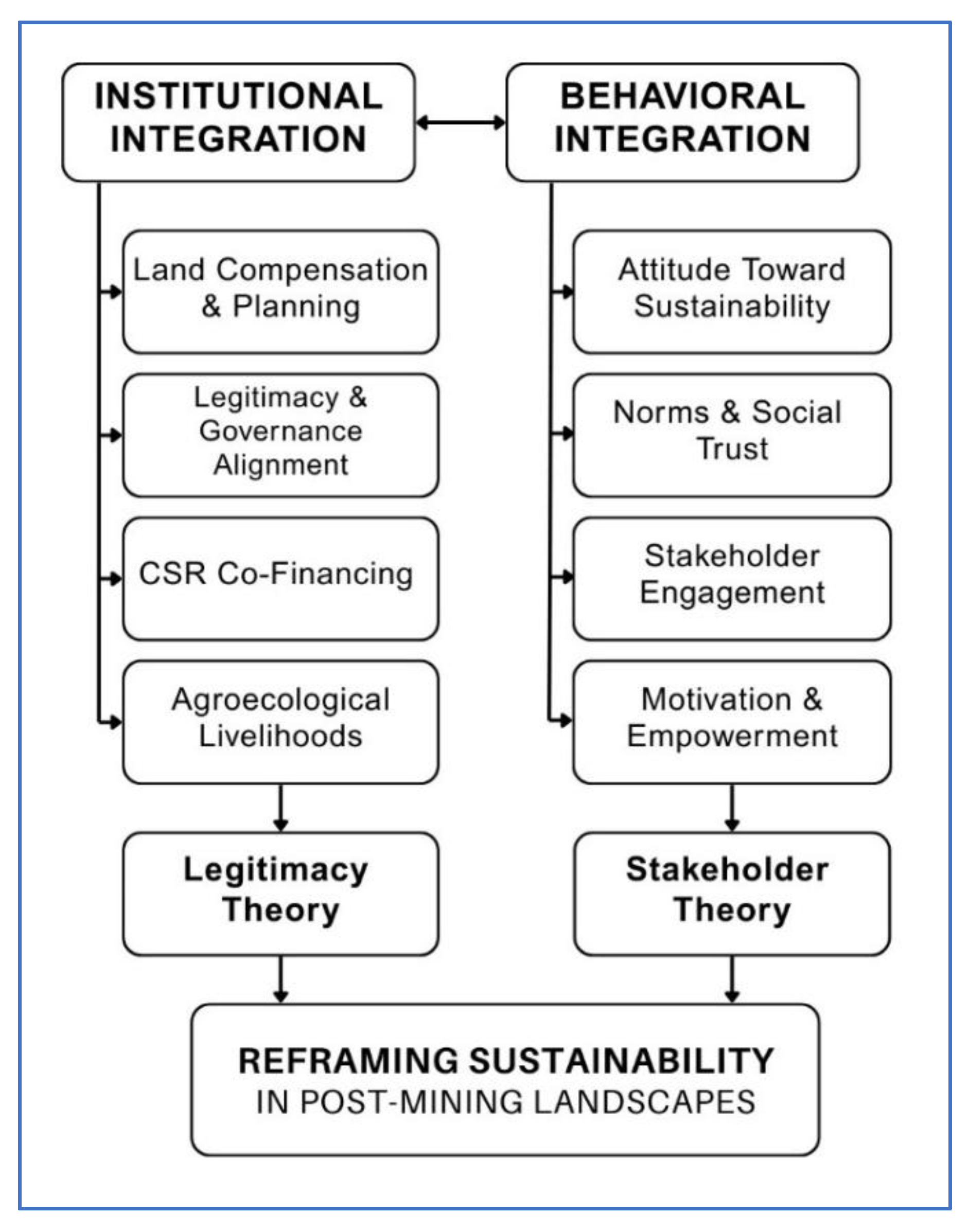
Figure 2.
Foundation Framework for Institutional and Behavioral Integration.
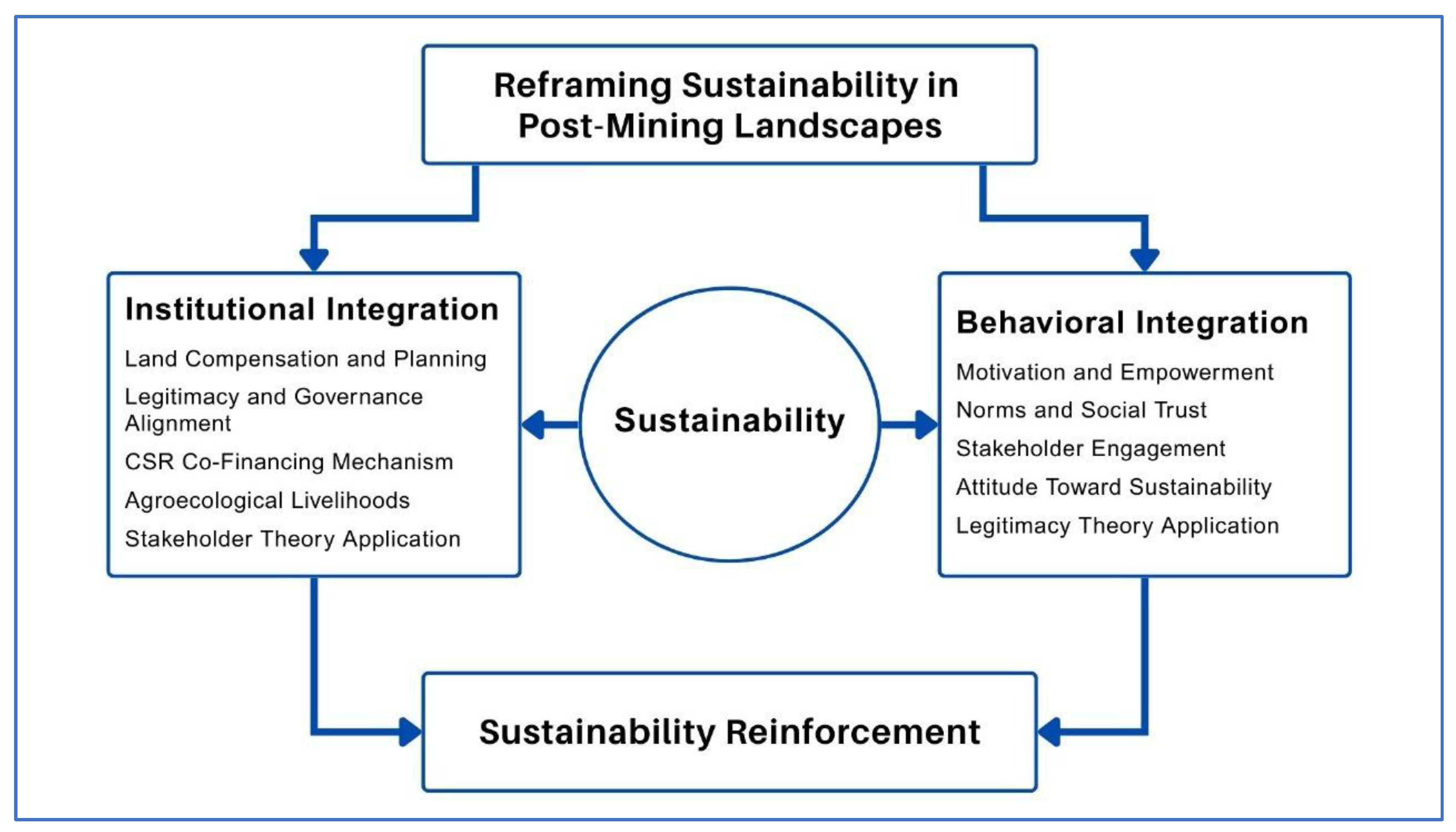

Table 1.
Thematic summary of Institutional and Behavioral Domain in Post-Mining Landscapes.
| # | Parent Node | Description | Fre-quency |
|---|---|---|---|
| 1 | Motivation and Empowerment | Capacity building and community agency | 913 |
| 2 | Stakeholder Engagement | Collaborative planning with key actors | 818 |
| 3 | Legitimacy Theory Application | Perceptions of fairness and moral authority | 808 |
| 4 | CSR Co-Financing Mechanism | Corporate contributions to social/environmental initiatives | 786 |
| 5 | Land Compensation and Planning | Fair land management and usage strategies | 766 |
| 6 | Stakeholder Theory Application | Balancing stakeholder interests and roles | 747 |
| 7 | Legitimacy and Governance Alignment | Policy compliance and governance structures | 711 |
| 8 | Norms and Social Trust | Local customs, rules, and institutional trust | 694 |
| 9 | Agroecological Livelihoods | Sustainable farming practices post-mining | 679 |
| 10 | Attitude toward Sustainability | Community beliefs and behavioral orientations | 591 |
| Total | 7513 |
Disclaimer/Publisher’s Note: The statements, opinions and data contained in all publications are solely those of the individual author(s) and contributor(s) and not of MDPI and/or the editor(s). MDPI and/or the editor(s) disclaim responsibility for any injury to people or property resulting from any ideas, methods, instructions or products referred to in the content. |
© 2025 by the authors. Licensee MDPI, Basel, Switzerland. This article is an open access article distributed under the terms and conditions of the Creative Commons Attribution (CC BY) license (http://creativecommons.org/licenses/by/4.0/).
Copyright: This open access article is published under a Creative Commons CC BY 4.0 license, which permit the free download, distribution, and reuse, provided that the author and preprint are cited in any reuse.


