

Submitted:
30 April 2025
Posted:
02 May 2025
You are already at the latest version
Abstract
Objective: To review progress of the recycling of electric vehicle batteries and prospects of it.
Design: Review based on PRISMA 2020.
Data sources: Scientific publications indexed in major databases such as Scopus, Web of Science, and ScienceDirect were searched for relevant studies published between 2020 and April 15, 2025.
Inclusion criteria: Studies were included if they were published in English between 2020 and April 15, 2025, and focused on the recycling of electric vehicle batteries. Eligible studies specifically addressed (i) recycling methods, technologies, and material recovery processes for EV batteries; (ii) the impact of recycled battery systems on power generation processes and grid stability; and (iii) assessments of materials used in battery manufacturing, including efficiency and recyclability. Review articles and meta-analyses were excluded to ensure the inclusion of only original research data.
Data extraction: One researcher independently screened all articles and extracted relevant data. A second researcher validated the accuracy of extracted data. The data were then organized and analyzed based on reported quantitative and qualitative indicators related to recycling methods, material recovery rates, environmental impact, and system-level energy benefits.
Results: The review identified significant advancements in battery recycling technologies, particularly in hydrometallurgical and direct recycling methods. Material recovery rates for critical metals such as Li, Co, and Ni are improving, with implications for resource efficiency. Furthermore, recycled batteries show potential in stabilizing power grids through second-life applications in BESS.
Conclusion: EV battery recycling represents a pivotal strategy in addressing raw material scarcity, reducing environmental burdens, and enhancing energy resilience. However, policy harmonization, technological scaling, and economic incentives remain key challenges for widespread implementation.
Keywords:
BEV
; EV batteries
; recycling
; lithium-ion battery
; circular economy
; sustainable material recovery
; end-of-life management
; policy and regulatory frameworks
1. Introduction
The rapid global adoption of electric vehicles (EVs) is a cornerstone of the transition toward sustainable transportation and net-zero carbon emissions [1]. With EVs projected to account for over 60% of new car sales by 2040 [2], the demand for lithium-ion batteries (LIBs) has surged, leading to an unprecedented accumulation of end-of-life (EoL) battery waste. While EVs significantly reduce greenhouse gas emissions during operation, the environmental footprint of their batteries-spanning resource extraction, manufacturing, and disposal-poses a critical sustainability challenge [3]. Efficient recycling of EV batteries is thus imperative to close the material loop, mitigate resource scarcity, and minimize ecological harm.
LIBs, the dominant energy storage technology in EVs, rely on critical materials such as lithium, cobalt, nickel, and graphite. The extraction of these materials is often associated with severe environmental degradation, geopolitical tensions, and human rights concerns, particularly in cobalt-rich regions like the Democratic Republic of Congo [4]. Furthermore, the linear economy model-where spent batteries are discarded in landfills-results in toxic leakage and wasted valuable resources. Recycling presents a circular economy solution, reducing reliance on virgin mining and cutting lifecycle emissions by up to 50% [5,6].
Despite these benefits, The current recycling rate is less than 5% of LIBs globally. Key barriers include technological limitations, economic viability gaps, regulatory fragmentation, and logistical complexities in battery collection and transportation. Addressing these challenges requires a systematic evaluation of existing recycling methods, emerging innovations, and policy frameworks to scale sustainable practices [4,6].
1.1. Technological Progress in Battery Recycling
Modern recycling techniques can be broadly classified into pyrometallurgy, hydrometallurgy, and direct recycling. Pyrometallurgical processes, which involve high-temperature smelting, are commercially mature but energy-intensive and inefficient in recovering lithium [7]. Hydrometallurgy, employing chemical leaching, offers higher material recovery rates (>95% for cobalt and nickel) but generates hazardous waste. Direct recycling, an emerging approach, refurbishes cathode materials without full breakdown, preserving their electrochemical properties and reducing energy use [8].
Recent advancements include solvent-based separation, bioleaching, and electrochemical methods that enhance efficiency and sustainability [9]. However, the heterogeneity of battery chemistries (e.g., NMC, LFP) complicates universal recycling solutions, necessitating adaptable technologies [10].
1.1.1. Background and Motivation
The global push toward decarbonization and the reduction of greenhouse gas (GHG) emissions has led to a significant shift in the transportation sector, most notably through the rise of electric vehicles (EVs). Governments, industries, and consumers alike have embraced EVs as a cleaner alternative to internal combustion engine vehicles, driven by technological advancements in battery storage, stringent environmental regulations, and rising awareness of climate change. As a result, the EV market has seen exponential growth. According to the International Energy Agency (IEA), the number of electric cars on the road surpassed 26 million in 2022, with projections indicating continued expansion over the coming decades [11,12].
However, this shift is accompanied by a new set of challenges. Central among them is the issue of how to sustainably manage the growing volume of end-of-life (EoL) EV batteries. Lithium-ion batteries (LIBs), which are the dominant energy storage solution for EVs, have a limited lifespan and eventually become inefficient for vehicular use. As EV adoption increases, so does the volume of batteries requiring disposal, reuse, or recycling. The environmental implications of improperly managed EoL batteries, which contain hazardous substances and valuable metals, are significant. Recycling these batteries is therefore not just an environmental imperative but also an economic opportunity [12,13,14].
1.1.2. Composition and Structure of EV Batteries
A clear understanding of the structural and chemical makeup of electric vehicle (EV) batteries is crucial for designing efficient recycling processes. These batteries are generally composed of four main parts: the cathode, anode, electrolyte, and separator. Cathodes are rich in critical metals like lithium, cobalt, nickel, and manganese, whereas anodes typically consist of graphite. The electrolyte often comprises a lithium salt in an organic solvent, and the separator serves to keep the cathode and anode from coming into direct contact.
Battery composition varies depending on the specific chemistry used, with common types including lithium nickel manganese cobalt oxide (NMC), lithium iron phosphate (LFP), and lithium cobalt oxide (LCO). Each type presents distinct implications for recyclability and material recovery. For instance, NMC batteries are favored for their high energy density but are more complex to recycle due to cobalt content. In contrast, LFP batteries are known for their safety and lower production costs but contain fewer high-value materials, making their recycling less economically attractive [15,16,17].
1.1.3. Environmental and Economic Importance of Battery Recycling
Recycling EV batteries addresses several key environmental and economic concerns. First, it prevents the accumulation of hazardous waste in landfills, where the potential for leaching toxic substances poses a threat to soil and groundwater quality. Second, recycling reduces the need for primary raw material extraction, which is associated with environmental degradation, high energy consumption, and socio-political risks. For instance, cobalt mining in the Democratic Republic of Congo has drawn criticism due to its environmental and ethical concerns.
From an economic perspective, battery recycling can support the development of a circular economy by recovering valuable metals that can be reintroduced into the production cycle. This not only reduces the demand for virgin materials but also stabilizes supply chains and lowers production costs. As demand for EVs increases, the global supply of critical battery materials will come under pressure, making recycling an essential strategy for resource conservation and market stability [16,17,18,19].
1.1.4. Overview of Recycling Methods
There are three main categories of recycling methods for EV batteries: pyrometallurgical, hydrometallurgical, and direct recycling. Each has distinct advantages and drawbacks, and the choice of method often depends on factors such as battery chemistry, available infrastructure, and environmental regulations.
- Direct Recycling, also known as physical or mechanical recycling, aims to preserve the integrity of battery components, such as the cathode, for reuse. Although still in the developmental stage, direct recycling has the potential to reduce energy consumption and maintain the functional value of recovered materials [24,25].
1.1.5. Challenges and Barriers to Effective Recycling
Despite technological advancements, several barriers hinder the effective implementation of EV battery recycling at scale. One major issue is the lack of standardized battery designs, which complicates the disassembly and sorting processes. Additionally, battery packs are often sealed and integrated with complex electronics, making manual or automated dismantling labor-intensive and costly.
Another significant challenge is the absence of a comprehensive collection and logistics network for used batteries. In many regions, consumers and service providers lack clear guidance on how to dispose of or return EoL batteries. Regulatory frameworks are still evolving, and enforcement remains inconsistent, leading to a fragmented recycling ecosystem.
Economic feasibility also plays a crucial role. While some metals, such as cobalt and nickel, offer high recovery value, others like lithium and manganese are less economically attractive to reclaim. The fluctuating prices of raw materials further complicate investment decisions in recycling infrastructure [16,26,27].
1.1.6. Policy and Regulatory Landscape
Governments and international bodies have begun to address the need for regulation in battery recycling. The European Union’s Battery Regulation, for instance, mandates minimum recycling efficiencies and material recovery targets for battery producers. It also promotes eco-design principles, such as design for disassembly, and the development of battery passports to track lifecycle information.
In the United States, policy efforts are more fragmented but are gaining momentum through initiatives like the Battery Recycling Prize and support from the Department of Energy. China, a leader in battery production, has also implemented regulations requiring producers to take responsibility for battery take-back and recycling.
1.1.7. Objectives and Scope of the Review
This review paper aims to provide a comprehensive analysis of the current state of EV battery recycling, highlighting technological advancements, economic considerations, and regulatory frameworks. The paper will explore the lifecycle of EV batteries, evaluate the strengths and limitations of existing recycling methods, and identify research gaps and future directions. Special attention will be given to the integration of recycling within a circular economy model, the role of stakeholders in the recycling value chain, and the potential for innovation through second-life applications and digital tracking systems.
By synthesizing insights from recent literature, industry practices, and policy developments, this paper seeks to inform researchers, policymakers, and practitioners on the pathways toward sustainable and efficient battery recycling systems that support the broader transition to clean energy and mobility.
1.2. Battery Lifecycle and End-of-Life Scenarios
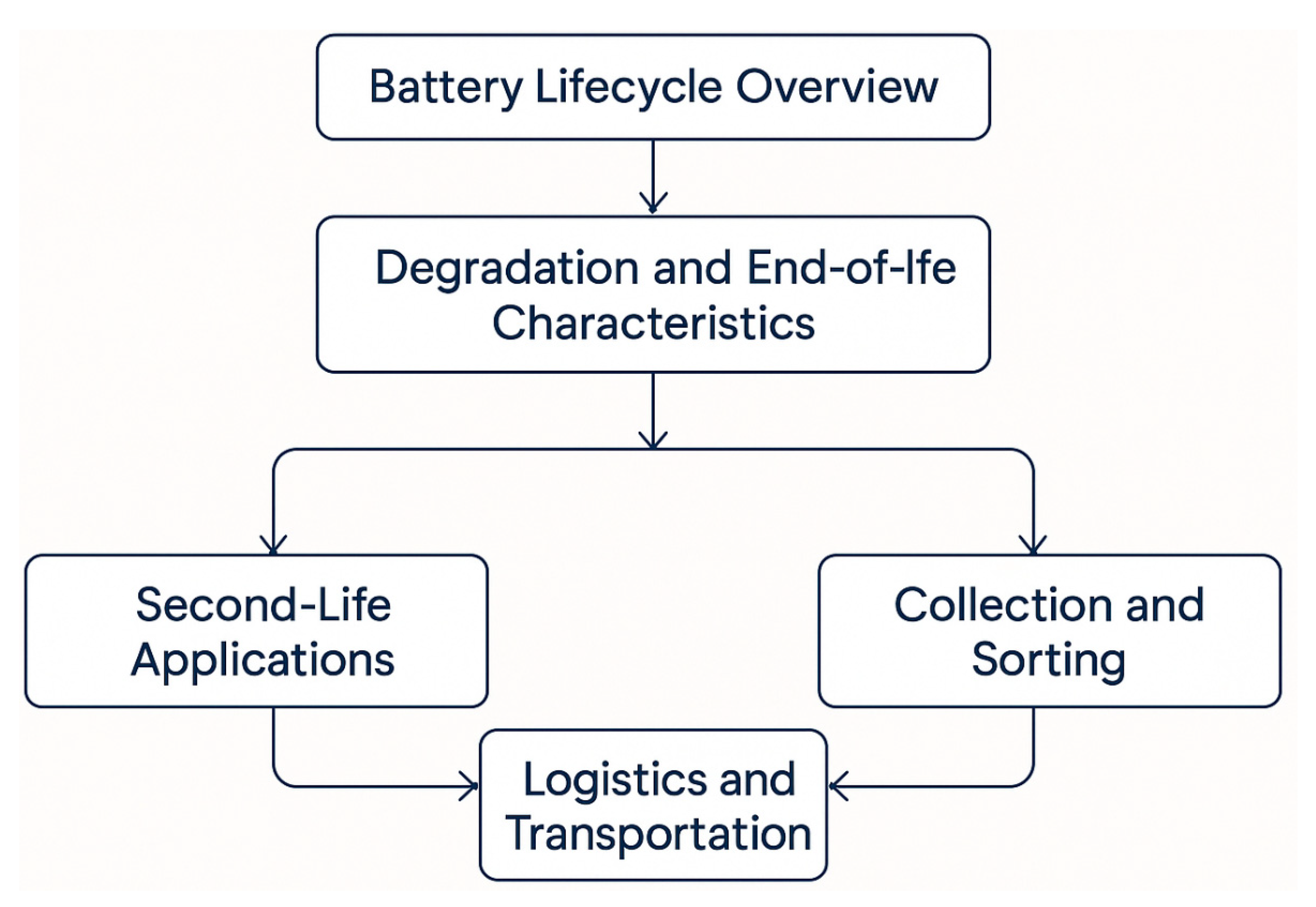
The lifecycle of an electric vehicle (EV) battery extends far beyond its operational service in mobility, encompassing complex stages of production, utilization, degradation, and eventual repurposing or recycling. While LIBs typically retain 70–80% of their initial capacity after 8–10 years of vehicular use (Neubauer et al., 2015), their performance degradation necessitates strategic end-of-life (EoL) management to maximize resource efficiency. Potential EoL pathways include second-life applications (e.g., stationary energy storage), direct material recycling, or, in poorly regulated markets, landfilling-each carrying distinct environmental and economic implications. This section analyzes the technical, logistical, and regulatory determinants of these scenarios, emphasizing the critical role of lifecycle planning in achieving a sustainable circular economy for battery materials [30,31,32].
1.2.1. Overview of Battery Lifecycle
An EV battery typically undergoes several stages during its operational life. These include raw material extraction, manufacturing, first-use in vehicles, second-life applications, and eventual recycling or disposal. Understanding these stages is crucial to identifying intervention points where sustainability measures, such as reuse or material recovery, can be most effectively implemented.
1.2.2. Degradation and End-of-Life Characteristics
Battery degradation is a natural process resulting from repeated charge-discharge cycles, high temperatures, and other operational stresses. Over time, battery capacity decreases, and its ability to deliver sufficient power declines. When a battery's state of health (SoH) drops below approximately 70–80%, it is generally considered no longer viable for vehicular use, marking its transition to the EoL phase [32,33].
1.2.3. Second-Life Applications
Before recycling, EoL EV batteries can be repurposed for second-life applications, such as stationary energy storage for renewable energy integration, backup power systems, or grid support services. These applications capitalize on the residual capacity of EV batteries and extend their useful life, delaying environmental impacts and improving overall resource efficiency. However, standardization, safety testing, and performance assurance remain barriers to widespread implementation [31,33].
1.2.4. Collection and Sorting
Effective recycling depends heavily on efficient collection and sorting mechanisms. Currently, many countries lack a streamlined system for collecting EoL EV batteries, which results in missed recovery opportunities and environmental risks. Advanced identification and tracking technologies-such as battery identification codes and digital battery passports-are being explored to facilitate better management and traceability of used batteries [33,34].
1.2.5. Logistics and Transportation
Transporting EoL batteries to recycling facilities poses logistical and safety challenges. Lithium-ion batteries are classified as hazardous materials, requiring compliance with stringent regulations for storage, packaging, and transportation. Innovations such as modular packaging systems and real-time monitoring can enhance safety and reduce logistical complexity [31,32,33,34].
Figure 1.
Battery Lifecycle and End-of-Life Scenarios.
1.3. Technological Advances in Recycling Processes
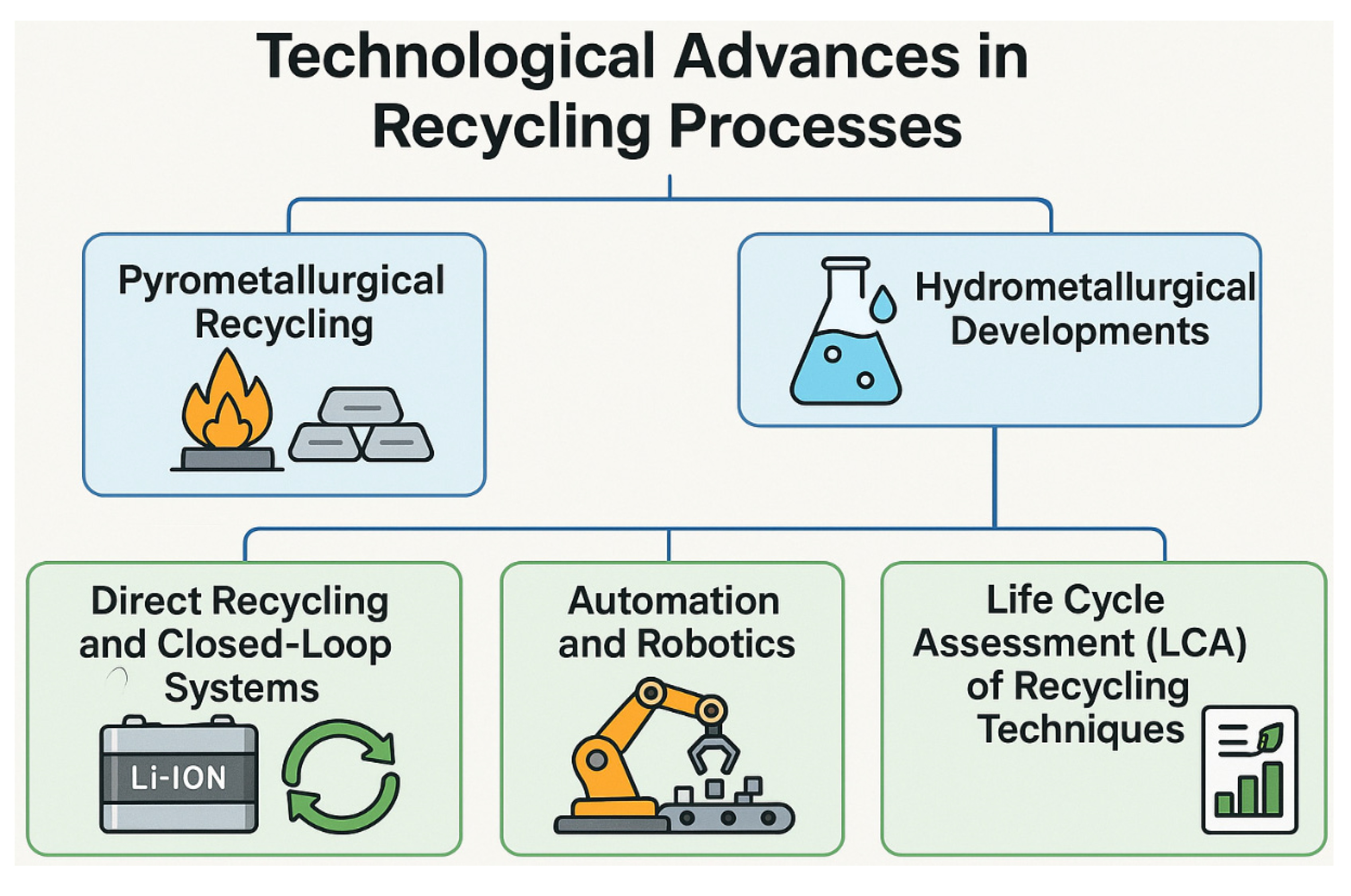
The recycling of electric vehicle (EV) batteries has undergone significant technological evolution in recent years, driven by the urgent need for sustainable material recovery and the growing volume of end-of-life lithium-ion batteries (LIBs). Conventional methods such as pyrometallurgy and hydrometallurgy, while effective for certain metals, face limitations in energy efficiency, material recovery rates, and environmental impact. In response, cutting-edge advancements-including direct recycling, solvent-assisted separation, and bioleaching-are reshaping the recycling landscape by improving selectivity, reducing energy consumption, and enabling higher purity material regeneration. Furthermore, innovations in automation, artificial intelligence (AI)-driven sorting, and closed-loop hydrometallurgical processes are enhancing scalability and economic viability. This section critically examines these emerging technologies, their comparative advantages, and their potential to overcome the existing barriers in large-scale battery recycling [35].
1.3.1. Pyrometallurgical Recycling in Practice
Several commercial recycling plants utilize pyrometallurgical techniques, particularly for processing mixed battery streams. The process involves shredding batteries followed by smelting in a high-temperature furnace. Metals like cobalt, nickel, and copper are recovered, but lithium and aluminum are typically lost in slag. Emerging improvements aim to lower energy use and recover more materials from the slag phase [36,37].
1.3.2. Hydrometallurgical Developments
Hydrometallurgy is gaining traction due to its higher selectivity and recovery rates. Recent research has focused on developing environmentally benign leaching agents, reducing chemical consumption, and integrating closed-loop systems to manage effluents. Startups and industrial players are piloting scalable processes to recover lithium, cobalt, and nickel with minimal environmental footprint [38,39].
1.3.3. Direct Recycling and Closed-Loop Systems
Direct recycling processes aim to retain the structure and chemistry of active materials for immediate reuse. Key steps include battery disassembly, material separation, re-lithiation, and quality testing. Though still in the lab and pilot stages, direct recycling offers a promising path to sustainable and low-energy battery recovery [40].
1.3.4. Automation and Robotics
Automation is increasingly being integrated into battery recycling operations to reduce human exposure to hazardous materials and improve efficiency. Robotic disassembly systems, AI-based sorting mechanisms, and automated diagnostic tools are being developed to handle diverse battery formats and compositions [41].
1.3.5. Life Cycle Assessment (LCA) of Recycling Techniques
LCA studies compare the environmental impacts of different recycling technologies. Results generally show that hydrometallurgical and direct recycling methods offer lower GHG emissions and energy use compared to pyrometallurgy. However, regional differences in electricity mix, regulatory context, and plant scale can influence these outcomes significantly [30,33].
Figure 2.
Technological Advances in Recycling Processes.
1.3.6. Global Battery Recycling Market Growth (2015–2025)
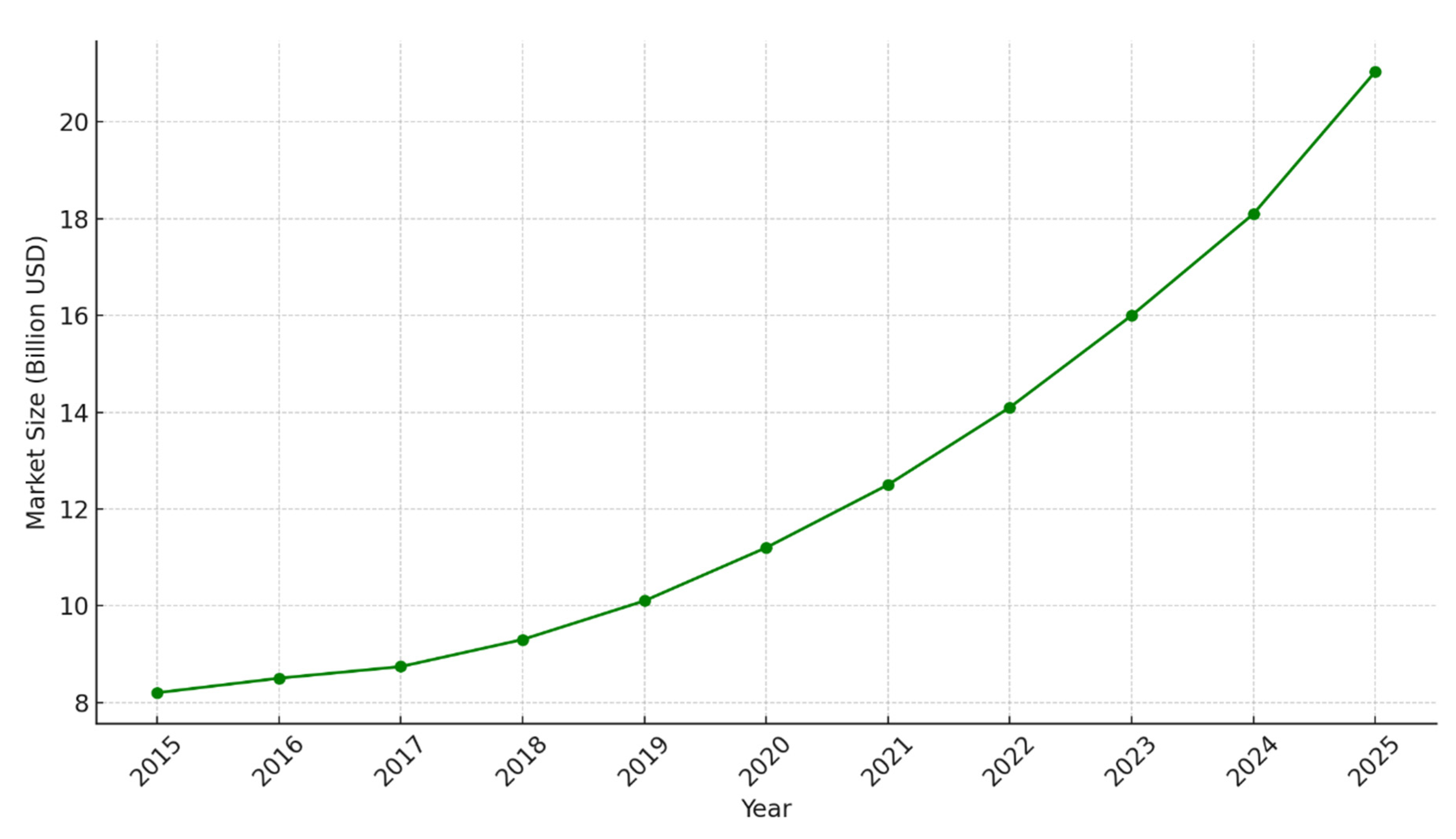
The global battery recycling market has expanded substantially over the past decade. In 2016, the market was valued at approximately $8.74 billion, and by 2025, it is projected to reach $21.04 billion, reflecting a compound annual growth rate (CAGR) of 10.4% [42].
Focusing specifically on lithium-ion batteries, which are prevalent in EVs and portable electronics, the recycling market was estimated at $3.54 billion in 2023. This segment is expected to grow at a CAGR of 21%, reaching nearly $24 billion by 2033 [43].
Figure 3.
Global battery recycling market trend (2015 – 2025).
2. Methodology
Based on the Prisma 2020 checklist [44], the present systematic review was conducted by extracting studies from three scientific databases: Web of Science, SCOPUS, and Pub-Med. Published studies from the last 6 years from 2020 to 15 April 2025 were restricted and categorized based on Boolean combinations. These 6 years were dedicated to assessing recent achievements and developments in the field of recycling of vehicle batteries. By adopting the keywords BEV, EV Batteries, Recycling, Lithium-ion Battery, Circular Economy, Sustainable Material Recovery, End-of-Life Management, Policy and Regulatory Frameworks, 16% of the found studies were selected (312 papers). Then, the titles and abstracts of the articles were independently reviewed by two researchers (HS, FDM). In cases of inconsistency, discussions were held until agreement was reached. Then, the titles and abstracts were screened. After this first selection process, the researcher (FDM) independently screened the full-text articles for inclusion. In case of disagreement, consensus was reached by discussion on inclusion or exclusion, and a second researcher (HS) was consulted if necessary. Finally, the selected articles were studied for in-depth review and examination of the results (23 papers).
3. Results
According to the PRISMA method used in this study, the search identified 1916 articles (Figure 4). First, reviews, meta-analyses (88) and duplicates (34) were excluded. After that, an independent researcher (FDM) provided further screening based on the relevance of each study’s title and abstract to the objectives of the current review. In case of doubt, a second independent researcher (HS) was involved. Finally, 1482 records were excluded. The remaining 312 studies were analyzed in more depth with respect to the introduction, methodology and results sections. Finally, 284 were excluded due to their lack of relevance to research on EV battery recycling and usually related to the scenario-based policy scenarios envisaged. Finally, 23 studies were included in the review.
23 studies in this review reported on EV battery recycling from 13 countries (Figure 5). Two studies were reported from Finland, seven from China, two from Brazil, three from the United States, one each from Germany and France, and one each from India and Sweden, four from East Asia, and two from the United Kingdom (Figure 5). A total of 23 studies were reported from 26 regions, of which eight were from the European Union, three from North America, two from South America, and 12 from Asia (some studies reported from more than one region).
After selecting the studies to be reviewed in this review, the results are summarized in Table 1. This table lists the studies' titles, objectives, and achievements. Table 2 also lists the parameters of the studies that are reported related to the structure of electric vehicle batteries, such as capacity, energy, voltage, current intensity, weight, and number of cells. These data have also been examined in terms of economics and optimization, and the minimum and maximum state of charge data as well as recycling costs have been provided. The results presented in the articles used in this review are also given in Figure 6. The graphs relate to the comparison of battery mass (6.a), state of charge (6.b), voltage and current (6.c), battery capacity (6.d), charging time (6.e), and recycling rate (6.f).
Some studies have reported the chemical elements present in the structure of batteries. Some of these elements are specified in the battery description and some in the battery recycling. These elements are reported in Table 3, separated by reference number. Also, the reported amount of each element is given separately in Table 4.
In more detailed studies, the cost of the elements used in the battery structure has been reported separately in three studies, which can be seen in Table 5.
4. Discussions
The comparative evaluation of different EV/HEV battery chemistries provides essential insights into their technical performance, recyclability, and sustainability, especially in the context of increasing global efforts towards a circular economy. Based on the collected data, Lithium Nickel Manganese Cobalt Oxide (NMC) and Lithium Iron Phosphate (LFP) batteries emerge as prominent contenders, each offering distinct characteristics in terms of energy density, environmental impact, and economic viability during recycling.
4.1. Energy Density and Technical Performance
One of the primary considerations in battery technology is the energy density, which directly influences the vehicle's driving range and overall efficiency [68]. Among the studied chemistries, NMC batteries show the highest energy density values, making them particularly suitable for long-range electric vehicles. Their high specific energy (ranging between 150-220 Wh/kg) enables automotive manufacturers to design vehicles that require fewer battery modules for a given range, thus optimizing space and weight.
Conversely, LFP batteries offer lower energy density values, generally in the range of 90-160 Wh/kg. Although this is a limitation for high-performance electric vehicles, LFP batteries compensate with superior thermal and chemical stability, longer cycle life, and greater resistance to thermal runaway. These attributes make LFP batteries particularly attractive for applications such as buses, commercial fleets, and lower-range passenger vehicles where safety, longevity, and cost take precedence over high range.
4.2. Recycling Efficiency and Metal Recovery
The recyclability of batteries is increasingly critical given the finite nature of raw materials like cobalt, nickel, and lithium. The study indicates that NMC batteries exhibit higher recovery rates for critical metals, with cobalt and nickel recovery efficiencies often exceeding 90% in optimized recycling processes such as hydrometallurgical treatment [69,70]. However, lithium recovery remains notably lower, typically ranging between 70-85%, due to its dispersion in the electrode materials and the technical challenges associated with its selective extraction.
In contrast, LFP batteries pose a different scenario. The absence of high-value metals such as cobalt and nickel simplifies the chemical processes involved in recycling but simultaneously reduces the economic incentive for recycling operations. While iron and phosphate recovery is technically achievable, the lower market value of these elements compared to cobalt and nickel results in a weaker economic case. Therefore, LFP battery recycling strategies often focus more on the recovery of lithium and the reuse of cathode materials rather than elemental extraction.
4.3. Environmental Impact and Process Conditions
The environmental burden associated with battery recycling is heavily influenced by the process conditions required for material recovery. NMC batteries, with their complex material compositions, often require high-temperature treatments (pyrometallurgy) or chemical-intensive methods (hydrometallurgy) for effective material recovery. These processes, although efficient in terms of metal yield, are energy-intensive and may generate hazardous waste streams if not carefully managed [71,72].
LFP batteries, owing to their simpler material composition and absence of heavy metals, can be recycled through less intensive processes, leading to potentially lower environmental impacts. For instance, direct recycling methods, which aim to recover entire cathode structures rather than elemental metals, are more feasible with LFP batteries and offer significant energy savings. Nonetheless, the widespread adoption of such methods requires advancements in sorting, pre-treatment, and process optimization to ensure high material purity and performance.
4.4. Cost Considerations and Economic Viability
The economic viability of recycling is a complex function of material value, processing costs, and market demand. NMC batteries, due to their high cobalt and nickel content, generally offer greater revenue potential per ton of recycled material [73]. However, the high complexity of the recycling process - involving multiple stages of disassembly, chemical leaching, and material purification - increases operational costs significantly.
On the other hand, LFP batteries, with their lower intrinsic material value, often result in a net negative economic outcome when processed through traditional recycling methods. The low market price of recovered iron and phosphate compared to cobalt and nickel diminishes profitability. Consequently, innovative business models, such as battery second-life applications before recycling, or government subsidies for recycling non-valuable materials, may be necessary to make LFP recycling economically sustainable.
4.5. Safety Considerations: State of Charge (SOC) and Thermal Stability
The State of Charge (SOC) parameters are crucial for both the operational safety of batteries and their handling during end-of-life processing. Batteries that operate within narrower SOC windows tend to exhibit greater stability but at the expense of reduced effective energy usage. The data indicates that LFP batteries maintain excellent thermal and electrochemical stability even at high states of charge, significantly reducing the risk of fire or explosion during transportation, storage, and recycling [74,75].
In comparison, NMC batteries, while offering higher energy densities, are more sensitive to overcharging and high temperatures. This necessitates stringent safety protocols during collection, transportation, and dismantling stages of recycling operations, including pre-discharge procedures, thermal monitoring, and specialized packaging.
4.6. Strategic Implications for Future Battery Design and Recycling
Given the EU’s Green Deal targets, the "Fit for 55" package, and other global regulatory frameworks, the future of EV battery design must be tightly linked to end-of-life management strategies. Eco-design principles - designing batteries for easier disassembly, standardized component labeling, and modular construction - will be key enablers of more efficient recycling [76,77].
Furthermore, developing "closed-loop" recycling systems, where recovered materials are directly reintroduced into the battery production supply chain, will be essential for reducing dependence on virgin raw materials. This is particularly important for critical materials such as cobalt and lithium, whose geopolitical supply chains are subject to significant volatility.
For NMC batteries, efforts should focus on improving lithium recovery rates and developing more environmentally benign recycling methods. For LFP batteries, innovations in direct recycling technologies and second-life applications (e.g., stationary energy storage) can enhance their economic and environmental profile.
4.7. Policy and Market Dynamics
Public policies and market mechanisms will play a decisive role in shaping the recycling landscape. Extended Producer Responsibility (EPR) regulations, mandatory recycling targets, and recycling content requirements for new batteries are likely to become more stringent. Financial incentives, subsidies for recycling infrastructure, and penalties for non-compliance will further influence manufacturers' choices regarding battery chemistry and design [79,79].
In particular, mandating minimum recovery rates for lithium and other critical materials can drive technological innovation in recycling processes. Similarly, establishing certification schemes for recycled materials can build trust among battery manufacturers and stimulate demand for secondary raw materials.
4.8. Processing
The new dataset offers a comprehensive examination of the concentrations and specific energy values (expressed in kg/kWh or g/kWh) of various elements (C, Al, Cu, Fe, Ag, Au, Pd, Li, Ni, Co, and Mn) across different samples (N = 1 to 19). This rich dataset enables a more detailed analysis of material compositions, particularly important for applications like battery recycling, metallurgical recovery, and energy storage systems.
4.8.1. General Overview
The dataset reveals that elements such as aluminum (Al), copper (Cu), lithium (Li), nickel (Ni), cobalt (Co), and manganese (Mn) are frequently present and show relatively significant concentrations across various samples. Elements like silver (Ag), gold (Au), and palladium (Pd), although present in smaller amounts, are nonetheless important due to their high economic value and critical role in electronic and catalytic applications.
In the first part of the dataset (N = 1-6), elemental concentrations are presented without energy normalization. These raw concentration values provide the initial mass content in different materials or components. Starting from sample N=7, the values are normalized based on energy output (kg/kWh or g/kWh), providing insights into the specific material intensity per unit of generated or stored energy. This transition is crucial for assessing the environmental impact and sustainability of energy systems.
4.8.2. Elemental Trends and Highlights
- Carbon (C):
Carbon values are reported only sporadically. For instance, in sample 4, C is measured at 1.6%, while sample 5 shows a high value of 22.44%. Carbon concentration appears strongly associated with organic or polymeric materials rather than metallic systems.
- Aluminum (Al):
Aluminum shows consistent presence across the samples, notably with 36.6% in sample 4. In energy-normalized data (N=7 onwards), Al concentrations vary between 0.075 kg/kWh and 0.457 kg/kWh. These results emphasize aluminum’s crucial role, likely due to its application in casings, connectors, and structural supports within battery modules.
- Copper (Cu):
Copper concentrations are notably high, peaking at 21.6% in sample 1 (second row). In energy-normalized terms, copper shows considerable variance from 0.075 kg/kWh to 0.758 kg/kWh across different energy scenarios, reflecting its extensive use in conductors, wiring, and battery current collectors.
- Iron (Fe):
Iron is notably present in raw form (e.g., 18.2% in sample 1), but fewer energy-normalized values are reported for Fe. Its lower representation in energy-specific terms suggests that Fe, although important, is less critical when viewed from a performance-to-weight ratio perspective compared to elements like Li or Ni.
- Silver (Ag) and Gold (Au):
Ag and Au show very small mass percentages, often around 0.001% to 0.06%. Despite low concentrations, their strategic value in electronics and catalysis makes them noteworthy. Au reaches up to 0.393% in some entries, highlighting selective opportunities for targeted recovery.
- Palladium (Pd):
Pd is significant particularly in sample 1 (24.3% and 71.9% in different entries). These figures suggest a specific type of sample, possibly related to catalytic components, where Pd is heavily used.
- Lithium (Li):
Lithium appears from sample 4 onwards with energy-normalized values starting at 0.084 kg/kWh and going as high as 1.21 kg/kWh. Sample 16 highlights lithium contents in grams per kWh (e.g., 176.3 g/kWh to 410.5 g/kWh), revealing lithium's central role in battery energy densities.
- Nickel (Ni) and Cobalt (Co):
Nickel and cobalt concentrations track each other closely. For example, in N=7 and N=18 samples, values like 0.759 kg/kWh (Ni) and 0.394 kg/kWh (Co) appear together, matching the stoichiometric ratios found in common battery chemistries like NMC (Nickel-Manganese-Cobalt) batteries.
- Manganese (Mn):
Mn content, particularly in sample 17, reaches 26.02%, emphasizing manganese's contribution to stabilizing the structure of battery cathode materials and improving cycling stability.
4.8.3. Observations on Energy-Normalized Values
Energy-normalized datasets provide critical insight into resource intensity per energy unit, important for life cycle assessments (LCA). Key observations include:
- The highest normalized mass concentration across the samples is associated with lithium (Li) and manganese (Mn).
- For instance, sample 16 shows 410.5 g/kWh lithium content, suggesting a lithium-rich energy storage solution, likely associated with high-energy-density battery chemistries (e.g., LCO or NMC batteries).
- Nickel and cobalt display typical co-dependence, reflecting modern trends in battery technology where high-nickel cathodes (like NMC811) are increasingly preferred for their higher energy density despite their higher cost and environmental impact.
4.8.4. Trends Across Samples
Analyzing the variation from samples 7 to 19 reveals gradual shifts:
- In earlier samples (N=7 to N=11), moderate values of Al, Cu, and Fe dominate, suggesting a mix of structural and conductive material focus.
- Samples 15–18 show more emphasis on active materials, particularly lithium, nickel, and cobalt, implying a shift from supporting structures to the active battery core materials.
- Sample 19 reveals relatively consistent normalized values for C, Cu, and Li, hinting at a stable design focused on performance consistency, possibly from a standardized battery cell production line.
4.8.5. Implications for Recycling and Sustainability
The heavy presence of aluminum, copper, lithium, nickel, cobalt, and manganese suggests that recycling efforts should prioritize these elements to maximize resource recovery and economic feasibility. The small quantities of precious metals (Au, Ag, Pd) remain attractive due to their high market value despite their low concentration.
Additionally, the normalized data allows evaluation of material criticality in future battery designs. High cobalt and nickel content may face supply chain risks and environmental concerns. Therefore, alternative chemistries like LFP (Lithium-Iron-Phosphate) that eliminate cobalt entirely may become more desirable, despite the trade-offs in energy density.
Conclusion
This systematic review provides a comprehensive analysis of recent developments in the field of electric vehicle battery (EVB) recycling, focusing on technological progress, persisting challenges, and future opportunities. Covering studies published between 2020 and April 15, 2025, this work captures a critical period of growth, innovation, and policy-driven urgency aligned with global sustainability goals, particularly within the context of decarbonization, circular economy adoption, and the Fit for 55 and EU 2030 objectives.
The results reveal that while significant strides have been made in the development of battery energy storage systems (BESS) and material recovery technologies, several gaps and inefficiencies still hinder large-scale, economically viable, and environmentally sustainable recycling efforts. Lithium, cobalt, nickel, and manganese remain the primary focus in most studies due to their high commercial value and critical role in cathode chemistry. Technologies such as hydrometallurgy and pyrometallurgy continue to dominate, but newer methods-including direct recycling and bioleaching-are gaining traction for their potential to reduce energy consumption and environmental harm.
From the data reviewed, a consistent theme emerges around the inefficiency of current material recovery processes when scaled beyond laboratory settings. Energy consumption per kilogram of material recovered often exceeds sustainability thresholds when not optimized through integrated BESS or renewable-powered processing systems. Additionally, many studies emphasize that the carbon footprint of recycling operations must be critically examined to ensure that the process genuinely contributes to decarbonization goals.
One of the clearest challenges identified in this review is the lack of standardization in battery design, which directly complicates the disassembly, sorting, and material recovery stages. Variability in chemistry (e.g., LFP vs. NMC), packaging, and manufacturing methods results in technical difficulties and cost inefficiencies. Furthermore, the absence of harmonized regulatory frameworks across regions creates barriers to cross-border collaboration and investment in recycling infrastructure.
At the same time, significant opportunities are evident. The use of artificial intelligence and machine learning to optimize disassembly, predict battery health, and automate sorting is a rapidly evolving area with strong promise. Moreover, second-life applications for EV batteries-particularly in stationary storage systems-present an underutilized yet practical approach to extending battery lifespan and reducing waste. This dual benefit supports both grid stabilization and energy access, especially in remote or developing areas.
From a policy and economic standpoint, this review highlights the importance of extended producer responsibility (EPR) schemes, subsidies for recycling innovation, and stricter end-of-life regulations to incentivize investment and compliance. The European Union’s Battery Regulation, although still evolving, is a step in the right direction and may serve as a global benchmark for battery lifecycle governance.
In summary, while EV battery recycling technologies are progressing, the field is still in a transitional stage where large-scale, sustainable implementation remains limited. Overcoming the identified challenges-technical, economic, regulatory, and environmental-will require a multi-stakeholder approach involving governments, industry, academia, and consumers. The opportunity to establish a closed-loop battery economy is within reach but will depend on integrated innovation, policy coherence, and strategic investment. This review underscores the urgency and complexity of the task, while also pointing to a future where battery recycling becomes not only feasible but foundational to the sustainable energy transition.
CRediT authorship contribution statement
Hamid Safarzadeh: Writing, Investigation, Methodology, Investigation, Formal Analysis, Writing, Validation. Francesco Di Maria: Original draft, Validation, Formal analysis, Conceptualization.
Declaration of competing interest
The authors declare that they have no known competing financial interests or personal relationships that could have appeared to influence the work reported in this paper
Nomenclature
| BEV | Battery Electric Vehicle |
| BMS | Battery Management System |
| BESS | Battery Energy Storage System |
| Co | Cobalt |
| EV | Electric Vehicle |
| EOL | End of Life |
| LIB | Lithium-Ion Battery |
| Li | Lithium |
| LFP | Lithium Iron Phosphate |
| LCO | Lithium Cobalt Oxide |
| LMO | Lithium Manganese Oxide |
| Li-NMC | Lithium Nickel Manganese Cobalt Oxide |
| Li-NCA | Lithium Nickel Cobalt Aluminum Oxide |
| Ni | Nickel |
| NMC | Lithium Nickel Manganese Cobalt Oxides |
| MHEV | Mild hybrid electric vehicle |
| Mn | Manganese |
| Pyrometallurgy | High-temperature process for metal recovery |
| Hydrometallurgy | Aqueous solution-based metal extraction |
| Direct Recycling | Recovery of battery components with minimal reprocessing |
| SOH | State of Health (battery degradation metric) |
| SOC | State of Charge |
| WEEE | Waste Electrical and Electronic Equipment Directive (EU legislation) |
| VOC | Volatile Organic Compounds |
| Circular Economy | Economic system aimed at eliminating waste and continual resource use |
References
- IEA (2024). Available at: https://www.iea.org/reports/italy-2023/executive-summary . (accessed 30.04.2025).
- Moore, Jon. "BloombergNEF: Strategies for a Cleaner, More Competitive Future." In World Scientific Encyclopedia of Climate Change: Case Studies of Climate Risk, Action, and Opportunity Volume 3, pp. 247-275. 2021.
- Meegoda, Jay N., Sarvagna Malladi, and Isabel C. Zayas. "End-of-life management of electric vehicle lithium-ion batteries in the United States." Clean Technologies 4, no. 4 (2022): 1162-1174.
- Bell, Matthew. "The Cobalt Mines of the Democratic Republic of Congo." Global Encounters: New Visions Department of Geography and Planning, Queen’s University: 24.
- Wu, Wenqi, Ming Zhang, Danlin Jin, Pingping Ma, Wendi Wu, and Xueli Zhang. "Decision-making analysis of electric vehicle battery recycling under different recycling models and deposit-refund scheme." Computers & Industrial Engineering 191 (2024): 110109.
- Tripathy, Asit, Atanu Bhuyan, Ramakrushna Padhy, and Laura Corazza. "Technological, organizational, and environmental factors affecting the adoption of electric vehicle battery recycling." IEEE Transactions on Engineering Management (2022).
- Wesselkämper, Jannis, and Stephan Von Delft. "Current status and future research on circular business models for electric vehicle battery recycling." Resources, Conservation and Recycling (2024).
- Chan, Ka Ho, Monu Malik, and Gisele Azimi. "Direct recycling of degraded lithium-ion batteries of an electric vehicle using hydrothermal relithiation." Materials Today Energy 37 (2023): 101374.
- Toro, Luigi, Emanuela Moscardini, Ludovica Baldassari, Flavia Forte, Ilario Falcone, Jacopo Coletta, and Lorenzo Toro. "A systematic review of battery recycling technologies: advances, challenges, and future prospects." Energies 16, no. 18 (2023): 6571.
- Wang, Yitong, Ruguo Fan, Rongkai Chen, Xiao Xie, and Can Ke. "Exploring the coevolution dynamics of residents and recyclers in electric vehicle battery recycling decisions on the two-layer heterogeneous complex networks." Applied Energy 382 (2025): 125235.
- Tang, Yanyan, Qi Zhang, Boyu Liu, Yan Li, Ruiyan Ni, and Yi Wang. "What influences residents’ intention to participate in the electric vehicle battery recycling? Evidence from China." Energy 276 (2023): 127563.
- Dong, Boqi, and Jianping Ge. "What affects consumers' intention to recycle retired EV batteries in China?." Journal of Cleaner Production 359 (2022): 132065.
- Huang, X., Lin, Y., Liu, F., Lim, M.K. and Li, L., 2022. Battery recycling policies for boosting electric vehicle adoption: evidence from a choice experimental survey. Clean Technologies and Environmental Policy, 24(8), pp.2607-2620.
- Hao, Hao, Wenxian Xu, Fangfang Wei, Chuanliang Wu, and Zhaoran Xu. "Reward–penalty vs. deposit–refund: Government incentive mechanisms for EV battery recycling." Energies 15, no. 19 (2022): 6885.
- Dikmen, İsmail Can, and Teoman Karadağ. "Electrical method for battery chemical composition determination." IEEE Access 10 (2022): 6496-6504.
- Lin, Jiao, Xiaodong Zhang, Ersha Fan, Renjie Chen, Feng Wu, and Li Li. "Carbon neutrality strategies for sustainable batteries: from structure, recycling, and properties to applications." Energy & Environmental Science 16, no. 3 (2023): 745-791.
- Latini, Dario, Marco Vaccari, Marco Lagnoni, Martina Orefice, Fabrice Mathieux, Jaco Huisman, Leonardo Tognotti, and Antonio Bertei. "A comprehensive review and classification of unit operations with assessment of outputs quality in lithium-ion battery recycling." Journal of Power Sources 546 (2022): 231979.
- Wasesa, Meditya, Taufiq Hidayat, Dinda Thalia Andariesta, Made Giri Natha, Alma Kenanga Attazahri, Mochammad Agus Afrianto, Mohammad Zaki Mubarok, Zulfiadi Zulhan, and Utomo Sarjono Putro. "Economic and environmental assessments of an integrated lithium-ion battery waste recycling supply chain: A hybrid simulation approach." Journal of Cleaner Production 379 (2022): 134625.
- Nguyen-Tien, Viet, Qiang Dai, Gavin DJ Harper, Paul A. Anderson, and Robert JR Elliott. "Optimising the geospatial configuration of a future lithium ion battery recycling industry in the transition to electric vehicles and a circular economy." Applied Energy 321 (2022): 119230.
- Van Hoof, Gert, Bénédicte Robertz, and Bart Verrecht. "Towards sustainable battery recycling: a carbon footprint comparison between pyrometallurgical and hydrometallurgical battery recycling flowsheets." Metals 13, no. 12 (2023): 1915.
- Liu, Aiwei, Guangwen Hu, Yufeng Wu, and Fu Guo. "Life cycle environmental impacts of pyrometallurgical and hydrometallurgical recovery processes for spent lithium-ion batteries: present and future perspectives." Clean Technologies and Environmental Policy 26, no. 2 (2024): 381-400.
- Saleem, Usman, Bhaskar Joshi, and Sulalit Bandyopadhyay. "Hydrometallurgical routes to close the loop of electric vehicle (EV) lithium-ion batteries (LIBs) value chain: a review." Journal of Sustainable Metallurgy 9, no. 3 (2023): 950-971.
- Chen, Quanwei, Yukun Hou, Xin Lai, Kai Shen, Huanghui Gu, Yiyu Wang, Yi Guo, Languang Lu, Xuebing Han, and Yuejiu Zheng. "Evaluating environmental impacts of different hydrometallurgical recycling technologies of the retired nickel-manganese-cobalt batteries from electric vehicles in China." Separation and Purification Technology 311 (2023): 123277.
- Chen, Quanwei, Xin Lai, Yukun Hou, Huanghui Gu, Languang Lu, Xiang Liu, Dongsheng Ren, Yi Guo, and Yuejiu Zheng. "Investigating the environmental impacts of different direct material recycling and battery remanufacturing technologies on two types of retired lithium-ion batteries from electric vehicles in China." Separation and Purification Technology 308 (2023): 122966.
- Rosenberg, Sonja, Leonard Kurz, Sandra Huster, Steven Wehrstein, Steffen Kiemel, Frank Schultmann, Frederik Reichert, Ralf Wörner, and Simon Glöser-Chahoud. "Combining dynamic material flow analysis and life cycle assessment to evaluate environmental benefits of recycling–A case study for direct and hydrometallurgical closed-loop recycling of electric vehicle battery systems." Resources, Conservation and Recycling 198 (2023): 107145.
- Rizos, Vasileios, and Patricia Urban. "Barriers and policy challenges in developing circularity approaches in the EU battery sector: An assessment." Resources, Conservation and Recycling 209 (2024): 107800.
- Gautam, Deepak, and Nomesh Bolia. "Fostering second-life applications for electric vehicle batteries: A thorough exploration of barriers and solutions within the framework of sustainable energy and resource management." Journal of Cleaner Production 456 (2024): 142401.
- Lin, Yang, Zhongwei Yu, Yingming Wang, and Mark Goh. "Performance evaluation of regulatory schemes for retired electric vehicle battery recycling within dual-recycle channels." Journal of environmental management 332 (2023): 117354.
- Bird, Robert, Zachary J. Baum, Xiang Yu, and Jia Ma. "The regulatory environment for lithium-ion battery recycling." (2022): 736-740.
- Kallitsis, Evangelos, Anna Korre, and Geoff H. Kelsall. "Life cycle assessment of recycling options for automotive Li-ion battery packs." Journal of Cleaner Production 371 (2022): 133636.
- Koroma, Michael Samsu, Daniele Costa, Maeva Philippot, Giuseppe Cardellini, Md Sazzad Hosen, Thierry Coosemans, and Maarten Messagie. "Life cycle assessment of battery electric vehicles: Implications of future electricity mix and different battery end-of-life management." Science of The Total Environment 831 (2022): 154859.
- Safarian, Sahar. "Environmental and energy impacts of battery electric and conventional vehicles: A study in Sweden under recycling scenarios." Fuel Communications 14 (2023): 100083.
- Castro, Francine Duarte, Eric Mehner, Laura Cutaia, and Mentore Vaccari. "Life cycle assessment of an innovative lithium-ion battery recycling route: A feasibility study." Journal of Cleaner Production 368 (2022): 133130.
- Lai, Xin, Quanwei Chen, Xiaopeng Tang, Yuanqiang Zhou, Furong Gao, Yue Guo, Rohit Bhagat, and Yuejiu Zheng. "Critical review of life cycle assessment of lithium-ion batteries for electric vehicles: A lifespan perspective." Etransportation 12 (2022): 100169.
- Chigbu, Bianca Ifeoma. "Advancing sustainable development through circular economy and skill development in EV lithium-ion battery recycling: A comprehensive review." Frontiers in Sustainability 5 (2024): 1409498.
- Reinhart, Linda, Dzeneta Vrucak, Richard Woeste, Hugo Lucas, Elinor Rombach, Bernd Friedrich, and Peter Letmathe. "Pyrometallurgical recycling of different lithium-ion battery cell systems: Economic and technical analysis." Journal of Cleaner Production 416 (2023): 137834.
- Ferrarese, Andre, Elio Augusto Kumoto, Luciana Assis Gobo, Amilton Barbosa Botelho Junior, Jorge Alberto Soares Tenório, and Denise Espinosa. Flexible hydrometallurgy process for electric vehicle battery recycling. No. 2022-36-0072. SAE Technical Paper, 2023.
- Wang, Junxiong, Jun Ma, Zhaofeng Zhuang, Zheng Liang, Kai Jia, Guanjun Ji, Guangmin Zhou, and Hui-Ming Cheng. "Toward direct regeneration of spent lithium-ion batteries: a next-generation recycling method." Chemical Reviews 124, no. 5 (2024): 2839-2887.
- Xu, Panpan, Darren HS Tan, Binglei Jiao, Hongpeng Gao, Xiaolu Yu, and Zheng Chen. "A materials perspective on direct recycling of lithium-ion batteries: principles, challenges and opportunities." Advanced Functional Materials 33, no. 14 (2023): 2213168.
- Yang, Tingzhou, Dan Luo, Aiping Yu, and Zhongwei Chen. "Enabling future closed-loop recycling of spent lithium-ion batteries: direct cathode regeneration." Advanced materials 35, no. 36 (2023): 2203218.
- Kay, Ian, Siamak Farhad, Ajay Mahajan, Roja Esmaeeli, and Sayed Reza Hashemi. "Robotic disassembly of electric vehicles’ battery modules for recycling." Energies 15, no. 13 (2022): 4856.
- Slotte, Patrycja, Elina Pohjalainen, Jyri Hanski, and Päivi Kivikytö-Reponen. "Effect of life extension strategies on demand and recycling of EV batteries–material flow analysis of Li and Ni in battery value chain for Finnish EV fleet by 2055." Resources, Conservation and Recycling 215 (2025): 108081.
- Statista. Forecast lithium-ion battery recycling market worldwide from 2023 to 2033. Available at: https://www.statista.com/statistics/1330758/lithium-ion-battery-recycling-market-value-worldwide/. (accessed 30.04.2025).
- Page, Matthew J., Joanne E. McKenzie, Patrick M. Bossuyt, Isabelle Boutron, Tammy C. Hoffmann, Cynthia D. Mulrow, Larissa Shamseer et al. "The PRISMA 2020 statement: an updated guideline for reporting systematic reviews." bmj 372 (2021).
- Bachér, J., J. Laatikainen-Luntama, L. Rintala, and M. Horttanainen. "The distribution of valuable metals in gasification of metal-containing residues from mechanical recycling of end-of-life vehicles and electronic waste." Journal of Environmental Management 373 (2025): 123526.
- Deloitte China, and CAS. Lithium-Ion Battery Recycling: Market & Innovation Trends for a Green Future. 2023. Available at: https://www.cas.org/resources/whitepapers/lithium-ion-battery-recycling. (accessed 30.04.2025).
- Niemi, Tero, Tero Kaarlela, Emilia Niittyviita, Ulla Lassi, and Juha Röning. "CAN Interface Insights for Electric Vehicle Battery Recycling." Batteries 10, no. 5 (2024): 158.
- de Castro, Roberta Hergessel, Denise Crocce Romano Espinosa, Luciana Assis Gobo, Elio Augusto Kumoto, Amilton Barbosa Botelho Junior, and Jorge Alberto Soares Tenorio. "Design of recycling processes for NCA-type Li-ion batteries from electric vehicles toward the circular economy." Energy & Fuels 38, no. 6 (2024): 5545-5557.
- Yang, Hanxue, Xiaocheng Hu, Guanhua Zhang, Binlin Dou, Guomin Cui, Qiguo Yang, and Xiaoyu Yan. "Life cycle assessment of secondary use and physical recycling of lithium-ion batteries retired from electric vehicles in China." Waste Management 178 (2024): 168-175.
- Kasy, Fransisca Indraningsih, Muhammad Hisjam, Wakhid Ahmad Jauhari, and Syed Ahmad Helmi Syed Hassan. "Optimizing the Supply Chain for Recycling Electric Vehicle NMC Batteries." Jurnal Optimasi Sistem Industri 23, no. 2 (2024): 207-226.
- Kamath, Dipti, Sharlissa Moore, Renata Arsenault, and Annick Anctil. "A system dynamics model for end-of-life management of electric vehicle batteries in the US: Comparing the cost, carbon, and material requirements of remanufacturing and recycling." Resources, Conservation and Recycling 196 (2023): 107061.
- Slattery, Margaret, Jessica Dunn, and Alissa Kendall. "Charting the electric vehicle battery reuse and recycling network in North America." Waste Management 174 (2024): 76-87.
- Mu, Nengye, Yuanshun Wang, Zhen-Song Chen, Peiyuan Xin, Muhammet Deveci, and Witold Pedrycz. "Multi-objective combinatorial optimization analysis of the recycling of retired new energy electric vehicle power batteries in a sustainable dynamic reverse logistics network." Environmental science and pollution Research 30, no. 16 (2023): 47580-47601.
- Lee, Hyunseok, Yu-Tack Kim, and Seung-Woo Lee. "Optimization of the electrochemical discharge of spent li-ion batteries from electric vehicles for direct recycling." Energies 16, no. 6 (2023): 2759.
- Kastanaki, Eleni, and Apostolos Giannis. "Dynamic estimation of end-of-life electric vehicle batteries in the EU-27 considering reuse, remanufacturing and recycling options." Journal of Cleaner Production 393 (2023): 136349.
- Tankou, Alexander, Georg Bieker, and Dale Hall. "Scaling up reuse and recycling of electric vehicle batteries: Assessing challenges and policy approaches." In Proc. ICCT, pp. 1-138. 2023.
- Dunn, Jessica, Alissa Kendall, and Margaret Slattery. "Electric vehicle lithium-ion battery recycled content standards for the US–targets, costs, and environmental impacts." Resources, Conservation and Recycling 185 (2022): 106488.
- Lima, Maria Cecília Costa, Luana Pereira Pontes, Andrea Sarmento Maia Vasconcelos, Washington de Araujo Silva Junior, and Kunlin Wu. "Economic aspects for recycling of used lithium-ion batteries from electric vehicles." Energies 15, no. 6 (2022): 2203.
- Yang, Hui, Xiaolong Song, Xihua Zhang, Bin Lu, Dong Yang, and Bo Li. "Uncovering the in-use metal stocks and implied recycling potential in electric vehicle batteries considering cascaded use: a case study of China." Environmental Science and Pollution Research 28, no. 33 (2021): 45867-45878.
- Qiao, Donghai, Gaoshang Wang, Tianming Gao, Bojie Wen, and Tao Dai. "Potential impact of the end-of-life batteries recycling of electric vehicles on lithium demand in China: 2010–2050." Science of the Total Environment 764 (2021): 142835.
- Fu, Yuanpeng, Jonas Schuster, Martina Petranikova, and Burçak Ebin. "Innovative recycling of organic binders from electric vehicle lithium-ion batteries by supercritical carbon dioxide extraction." Resources, conservation and recycling 172 (2021): 105666.
- Yao, Peifan, Xihua Zhang, Zhaolong Wang, Lifen Long, Yebin Han, Zhi Sun, and Jingwei Wang. "The role of nickel recycling from nickel-bearing batteries on alleviating demand-supply gap in China's industry of new energy vehicles." Resources, Conservation and Recycling 170 (2021): 105612.
- Abdelbaky, Mohammad, Jef R. Peeters, and Wim Dewulf. "On the influence of second use, future battery technologies, and battery lifetime on the maximum recycled content of future electric vehicle batteries in Europe." Waste Management 125 (2021): 1-9.
- Lander, Laura, Tom Cleaver, Mohammad Ali Rajaeifar, Viet Nguyen-Tien, Robert JR Elliott, Oliver Heidrich, Emma Kendrick, Jacqueline Sophie Edge, and Gregory Offer. "Financial viability of electric vehicle lithium-ion battery recycling." Iscience 24, no. 7 (2021).
- Sun, Bingxiang, Xiaojia Su, Dan Wang, Lei Zhang, Yingqi Liu, Yang Yang, Hui Liang, Minming Gong, Weige Zhang, and Jiuchun Jiang. "Economic analysis of lithium-ion batteries recycled from electric vehicles for secondary use in power load peak shaving in China." Journal of Cleaner Production 276 (2020): 123327.
- Bat-Orgil, Turmandakh, Bayasgalan Dugarjav, and Toshihisa Shimizu. "Cell equalizer for recycling batteries from hybrid electric vehicles." Journal of Power Electronics 20, no. 3 (2020): 811-822.
- Skeete, Jean-Paul, Peter Wells, Xue Dong, Oliver Heidrich, and Gavin Harper. "Beyond the EVent horizon: Battery waste, recycling, and sustainability in the United Kingdom electric vehicle transition." Energy Research & Social Science 69 (2020): 101581.
- Hoarau, Quentin, and Etienne Lorang. "An assessment of the European regulation on battery recycling for electric vehicles." Energy Policy 162 (2022): 112770.
- Li, Jizi, Fangbing Liu, Justin Z. Zhang, and Zeping Tong. "Optimal configuration of electric vehicle battery recycling system under across-network cooperation." Applied Energy 338 (2023): 120898.
- Sastre, Jose Paulino Peris, Usman Saleem, Erik Prasetyo, and Sulalit Bandyopadhyay. "Resynthesis of cathode active material from heterogenous leachate composition produced by electric vehicle (EV) battery recycling stream." Journal of Cleaner Production 429 (2023): 139343.
- Guzek, Marek, Jerzy Jackowski, Rafał S. Jurecki, Emilia M. Szumska, Piotr Zdanowicz, and Marcin Żmuda. "Electric vehicles—an overview of current issues—Part 1—environmental impact, source of energy, recycling, and second life of battery." Energies 17, no. 1 (2024): 249.
- Tao, Ren, Peng Xing, Huiquan Li, Zhigen Cun, Zhenhua Sun, and Yufeng Wu. "In situ reduction of cathode material by organics and anode graphite without additive to recycle spent electric vehicle LiMn2O4 batteries." Journal of Power Sources 520 (2022): 230827.
- Chaianong, Aksornchan, Chanathip Pharino, Sabine Langkau, Pimpa Limthongkul, and Nattanai Kunanusont. "Pathways for enhancing sustainable mobility in emerging markets: Cost-benefit analysis and policy recommendations for recycling of electric-vehicle batteries in Thailand." Sustainable Production and Consumption 47 (2024): 1-16.
- Adaikkappan, Maheshwari, and Nageswari Sathiyamoorthy. "Modeling, state of charge estimation, and charging of lithium-ion battery in electric vehicle: a review." International Journal of Energy Research 46, no. 3 (2022): 2141-2165.
- Fallah, Narjes, and Colin Fitzpatrick. "Exploring the state of health of electric vehicle batteries at end of use; hierarchical waste flow analysis to determine the recycling and reuse potential." Journal of Remanufacturing 14, no. 1 (2024): 155-168.
- Gonzales-Calienes, Giovanna, Ben Yu, and Farid Bensebaa. "Development of a reverse logistics modeling for end-of-life lithium-ion batteries and its impact on recycling viability—A case study to support end-of-life electric vehicle battery strategy in Canada." Sustainability 14, no. 22 (2022): 15321.
- Safarzadeh, Hamid, and Francesco Di Maria. "How to Fit Energy Demand Under the Constraint of EU 2030 and FIT for 55 Goals: An Italian Case Study." Sustainability 17, no. 8 (2025): 3743.
- Nie, Shuai, Guotian Cai, Yuping Huang, and Jiaxin He. "Deciphering stakeholder strategies in electric vehicle battery recycling: Insights from a tripartite evolutionary game and system dynamics." Journal of Cleaner Production 452 (2024): 142174.
- Zhu, Jianhua, Taiwen Feng, Ying Lu, and Runze Xue. "Optimal government policies for carbon–neutral power battery recycling in electric vehicle industry." Computers & Industrial Engineering 189 (2024): 109952.
Figure 4.
Flow diagram of the selection process of the studies included in the review.
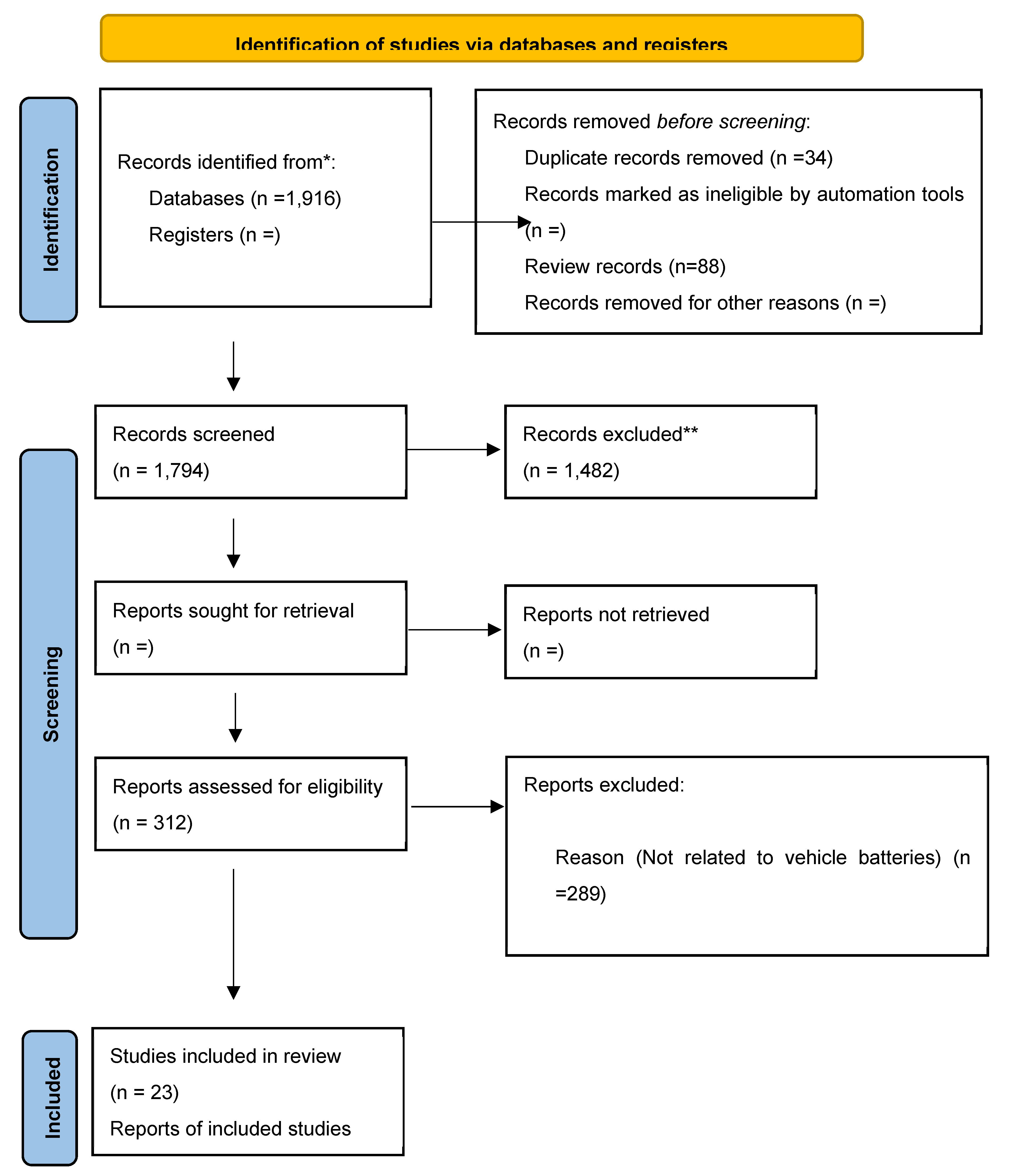
Figure 5.
The number of geographical areas related to the included studies.
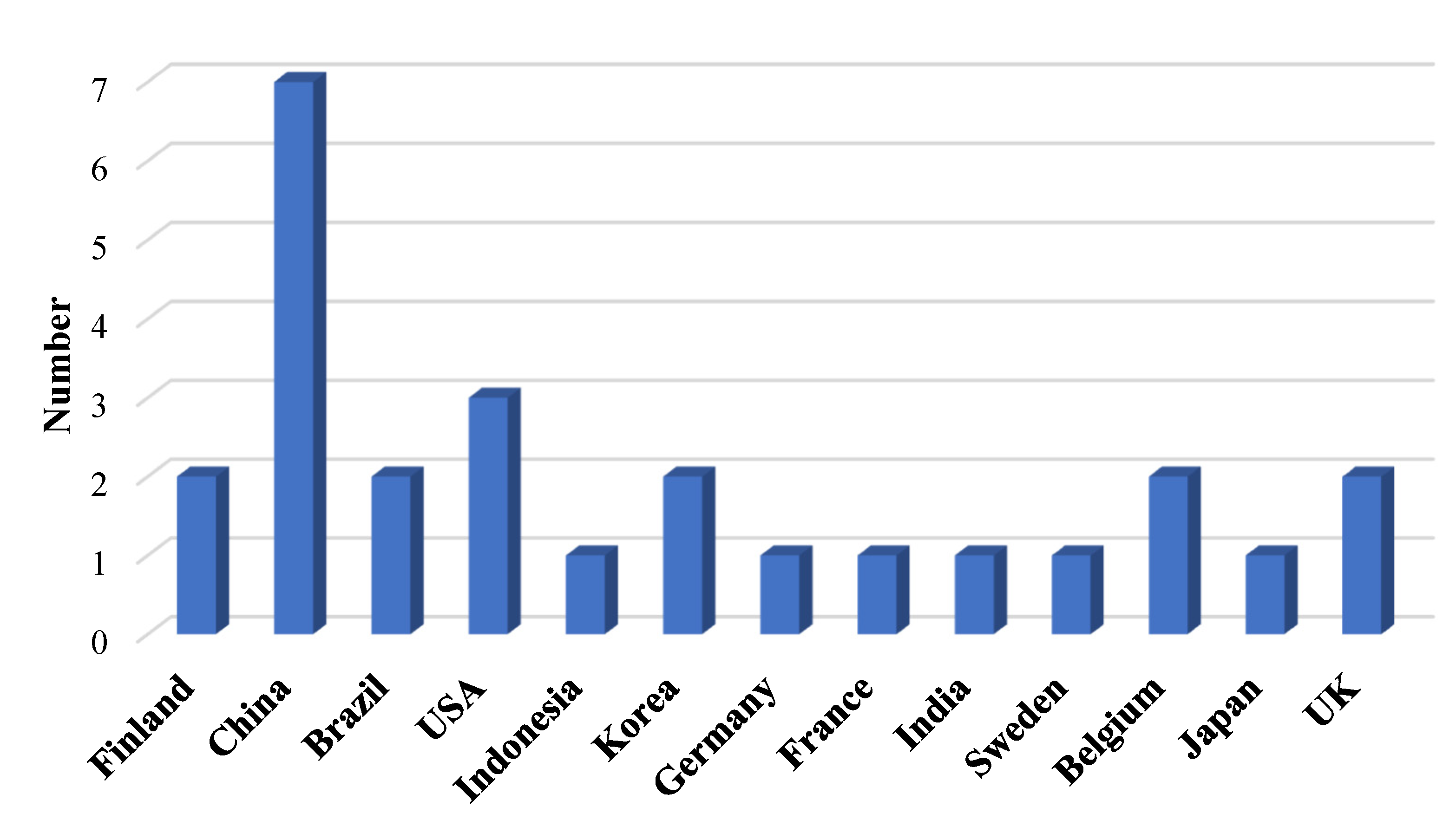
Figure 6.
Comparison the important parameters includes: a) Battery mass, b) State of charge, c) voltage and current, d) Battery capacity, e) Charging time, and f) Recycling rate.
Figure 6.
Comparison the important parameters includes: a) Battery mass, b) State of charge, c) voltage and current, d) Battery capacity, e) Charging time, and f) Recycling rate.
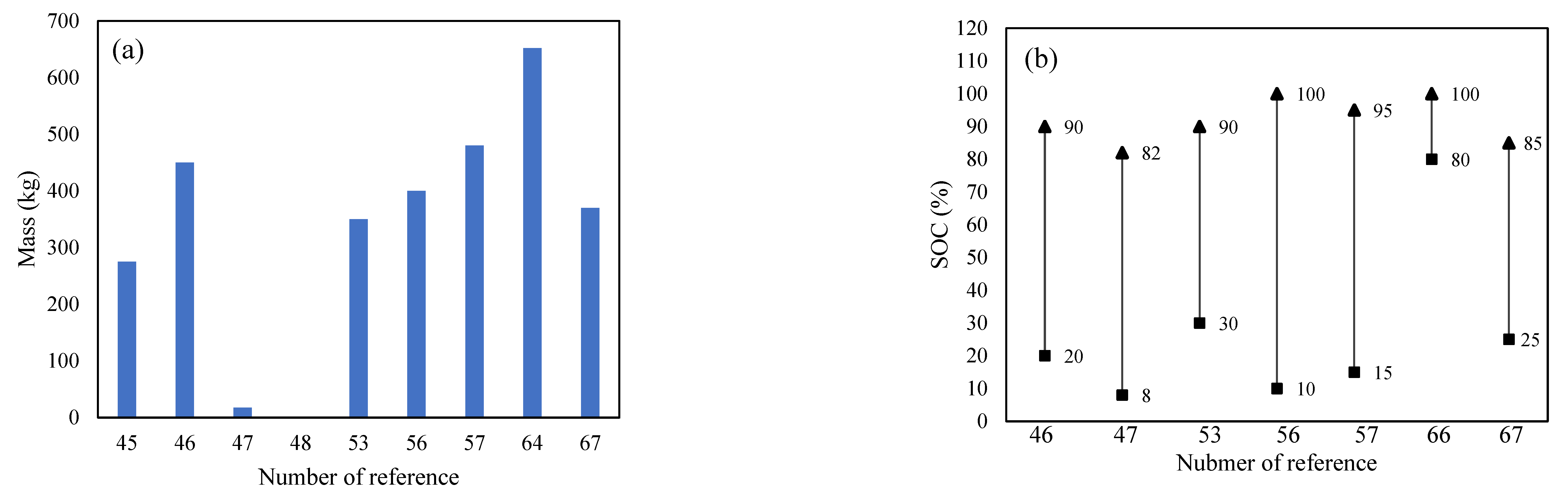
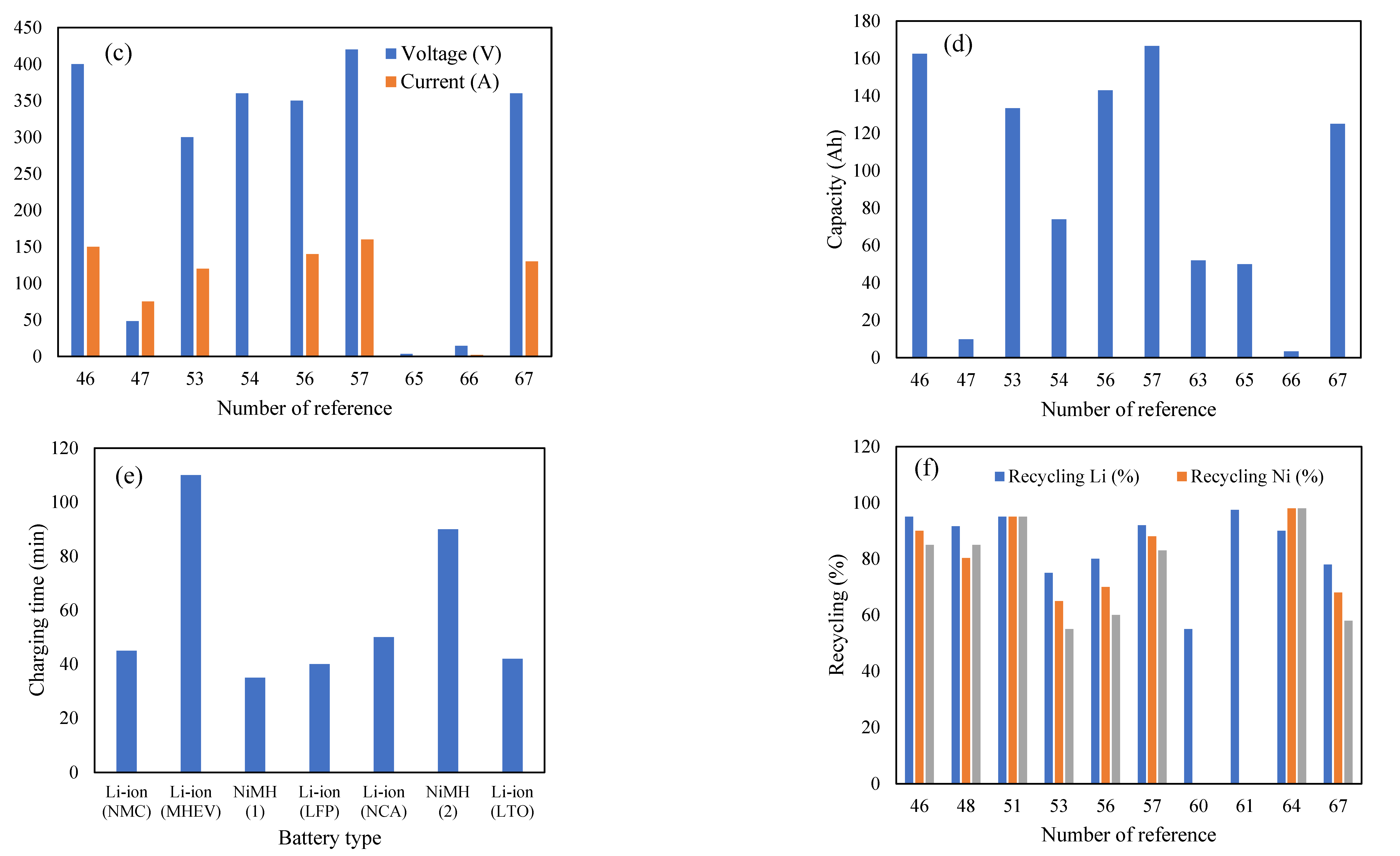

Table 1.
Overview of the research selected in this review in terms of title, key focus, algorithm, and key funding.
Table 1.
Overview of the research selected in this review in terms of title, key focus, algorithm, and key funding.
| Ref | Title | country | Methodology | Main Focus | Key funding | Year |
| [45] | The distribution of valuable metals in gasification of metal-containing residues from mechanical recycling of end-of-life vehicles and electronic waste | Finland | Experimental | Recycling of metal-containing wastes such as end-of-life vehicles (ELV) | The gasification abled to remove the organic matter efficiently and liberate metals. | 2025 |
| [46] | Deloitte China, and CAS. Lithium-Ion Battery Recycling: Market & Innovation Trends for A Green Future | China | Simulation | The future of recycling of Li-ion Batteries in China | - | 2025 |
| [47] | CAN Interface Insights for Electric Vehicle Battery Recycling | Finland | Simulation | Controller Area Network Interface Insights for Electric Vehicle Battery Recycling | - | 2024 |
| [48] | Design of Recycling Processes for NCA-Type Li-Ion Batteries from Electric Vehicles toward the Circular Economy | Brazil | Experimental | Hydrometallurgical recycling process of NCA cylindrical batteries | 92% of Li, 80% of Ni, and 85% of Co can be recovered in hydrometallurgical processing | 2024 |
| [49] | Life cycle assessment of secondary use and physical recycling of lithium-ion batteries retired from electric vehicles in China | China | Experimental | LCA of secondary use and physical recycling of lithium-ion batteries | Secondary use has the greatest impact on assessment results in dynamic situations. | 2024 |
| [50] | Optimizing the Supply Chain for Recycling Electric Vehicle NMC Batteries | Indonesia | Simulation | Optimizing the Supply Chain for Recycling EV Batteries | - | 2024 |
| [51] | A system dynamics model for end-of-life management of electric vehicle batteries in the US: Comparing the cost, carbon, and material requirements of remanufacturing and recycling | USA | Simulation | End-of-life management of electric vehicle batteries | Remanufacturing can reduce the carbon footprint of the EV battery life cycle. | 2024 |
| [52] | Charting the electric vehicle battery reuse and recycling network in North America | USA | Simulation | Electric vehicle battery reuse and recycling network in North America | EV and EV battery EoL is market-driven system, relying on profitability. | 2024 |
| [53] | Multi-objective combinatorial optimization analysis of the recycling of retired new energy electric vehicle power batteries in a sustainable dynamic reverse logistics network | China | Simulation | Explore the layout of the sustainable reverse logistics network for batteries recycling | The dynamic reverse logistics network is superior to its static counterpart | 2023 |
| [54] | Optimization of the Electrochemical Discharge of Spent Li-Ion Batteries from Electric Vehicles for Direct Recycling | Korea | Experimental | Optimization of the Electrochemical Discharge of Spent Li-Ion Batteries | The process will be suitable for the direct recycling of spent LIBs | 2023 |
| [55] | Dynamic estimation of end-of-life electric vehicle batteries in the EU-27 considering reuse, remanufacturing and recycling options | Germany - France | Simulation | Dynamic estimation of end-of-life electric vehicle batteries | The recycled metals could meet 5.2–11.3% of the demand for EU Battery Directive | 2023 |
| [56] | Scaling up reuse and recycling of electric vehicle batteries: Assessing challenges and policy approaches | India | Experimental | Challenges and policy approaches | - | 2023 |
| [57] | Electric vehicle lithium-ion battery recycled content standards for the US – targets, costs, and environmental impacts | USA | Simulation | Electric vehicle lithium-ion battery recycled content standards for the US | Recycling US EV retirements domestically is more expensive than recycling in China | 2022 |
| [58] | Economic Aspects for Recycling of Used Lithium-Ion Batteries from Electric Vehicles | Brazil | Simulation | Factors that influence the economic feasibility of disposing of batteries | A business model is created for recycling LIBs in Brazil | 2022 |
| [59] | Uncovering the in-use metal stocks and implied recycling potential in electric vehicle batteries considering cascaded use: a case study of China | China | - | Recycling potential in electric vehicle batteries | Increasing recycling potential by 2030 | 2021 |
| [60] | Potential impact of the end-of-life batteries recycling of electric vehicles on lithium demand in China: 2010–2050 | China | Simulation | Potential impact of batteries recycling on lithium demand in China | The recovered lithium could meet 60% of the lithium demand for LIBs produced by 2050. | 2021 |
| [61] | Innovative recycling of organic binders from electric vehicle lithium-ion batteries by supercritical carbon dioxide extraction | Sweden | Experimental | Innovative recycling of organic binders | Recovered PVDF remained the same surficial chemical properties as the raw sample. | 2021 |
| [62] | The role of nickel recycling from nickel-bearing batteries on alleviating demand-supply gap in China's industry of new energy vehicles | China | Simulation | Nickel recycling from nickel-bearing batteries | Recovered nickel is likely to play vital role for closing nickel loop in the industry of NEVs in China. | 2021 |
| [63] | On the influence of second use, future battery technologies, and battery lifetime on the maximum recycled content of future electric vehicle batteries in Europe | Belgium | Simulation | A novel forecasting model is developed to include second-use of vehicle batteries. | Cobalt content of recycled EV batteries may fulfil 91% of Europe’s 2040 EV demand. | 2021 |
| [64] | Financial viability of electric vehicle lithium-ion battery recycling | UK- Belgium- USA- South Korea- China | Simulation | Comprehensive techno-economic cost model for electric vehicle battery recycling | Economies of scale and battery materials are decisive for recycling profits | 2021 |
| [65] | Economic analysis of lithium-ion batteries recycled from electric vehicles for secondary use in power load peak shaving in China | China | - | A novel cost-benefit modelfor battery energy storage system of recycled Li-ion batteries | - | 2020 |
| [66] | Cell equalizer for recycling batteries from hybrid electric vehicles | Japan | Experimental | Cell equalizer for recycling | - | 2020 |
| [67] | Beyond the EVent horizon: Battery waste, recycling, and sustainability in the United Kingdom electric vehicle transition | UK | Simulation | Recycling, and sustainability in the United Kingdom electric vehicle | Sustainable recycling solutions will require sustainable business models. | 2020 |
Table 2.
Overview of the research on the recycling of EV batteries optimization objectives and parameters.
Table 2.
Overview of the research on the recycling of EV batteries optimization objectives and parameters.
| Ref | Battery type | EV/HEV | Energy | Voltage (V) | Current (A) | Peak current (A) | Capacity (Ah) | Mass (kg) | Number of Cells | Min SOC (%) | Max SOC (%) | Process. time (min) | Charge time (min) | Temp. (C) | pH | Rec. Li (%) |
Rec. Ni (%) |
Rec. Co (%) |
Rec. cost |
| [45] | - | - | - | - | - | - | - | 150 - 400 | - | - | - | - | - | 415 - 885 | - | - | - | - | - |
| [46] | Li-ion (NMC) | EV | 65 | 400 | 150 | 300 | 162.5 | 450 | 96 | 20 | 90 | 120 | 45 | 25 | 7 | 95 | 90 | 85 | 1,000 /ton |
| [47] | Li-ion | HEV | 430 Wh | 48 | 75 | 250 | 9.8 | 17.5 | 16 | 8 | 82 | - | 110 | 23 - 65 | - | - | - | - | - |
| [48] | Li-ion | EV | - | - | - | - | - | - | - | - | - | 30 - 180 | - | 25 - 90 | 1-3.5 | 91.6 | 80.3 | 85 | - |
| [49] | Li-ion | - | - | - | - | - | - | 1 | - | - | - | - | - | - | - | - | - | - | - |
| [50] | NMC | - | - | - | - | - | - | - | - | - | - | - | - | - | - | - | - | - | 128,000 IDR/kg |
| [51] | LiCoO2 (LCO) | EV | 0.175 kWh/kg | - | - | - | - | - | - | - | - | - | - | - | - | 95 | 95 | 95 | - |
| LiMn2O4 (LMO) | EV | 0.125 kWh/kg | - | - | - | - | - | - | - | - | - | - | - | - | - | ||||
| LiF2PO4 (LFP) | EV | 0.105 kWh/kg | - | - | - | - | - | - | - | - | - | - | - | - | - | ||||
| NMC 111 |
EV | 0.185 kWh/kg | - | - | - | - | - | - | - | - | - | - | - | - | - | ||||
| NMC 622 |
EV | 0.185 kWh/kg | - | - | - | - | - | - | - | - | - | - | - | - | - | ||||
| NMC 811 |
EV | 0.185 kWh/kg | - | - | - | - | - | - | - | - | - | - | - | - | - | ||||
| LiNiCoAlO2 (NCA) | EV | 0.3 kWh/kg | - | - | - | - | - | - | - | - | - | - | - | - | - | ||||
| [53] | NiMH | HEV | 40 | 300 | 120 | 240 | 133.3 | 350 | 80 | 30 | 90 | 90 | 35 | 25 | 6.8 | 75 | 65 | 55 | 800 /ton |
| [54] | SM3 ZEs | EV | 35.9 kWh | 360 | - | - | 74 | - | 192 | - | - | 24 (h) | - | 40 | - | - | - | - | - |
| [55] | NCA | EV / HEV |
8.6 - 72 kWh | - | - | - | - | - | - | - | - | - | - | - | - | - | - | - | - |
| LMO | - | - | - | - | - | - | - | - | - | - | - | - | - | - | - | - | |||
| LFP | - | - | - | - | - | - | - | - | - | - | - | - | - | - | - | - | |||
| NMC 811 | - | - | - | - | - | - | - | - | - | - | - | - | - | - | - | - | |||
| NMC 622 | - | - | - | - | - | - | - | - | - | - | - | - | - | - | - | - | |||
| NMC 111 | - | - | - | - | - | - | - | - | - | - | - | - | - | - | - | - | |||
| NMC 955 | - | - | - | - | - | - | - | - | - | - | - | - | - | - | - | - | |||
| NMC 532 | - | - | - | - | - | - | - | - | - | - | - | - | - | - | - | - | |||
| [56] | Li-ion (LFP) | EV | 50 | 350 | 140 | 280 | 142.9 | 400 | 90 | 10 | 100 | 100 | 40 | 30 | 6.5 | 80 | 70 | 60 | 900 /ton |
| [57] | Li-ion (NCA) | EV | 70 | 420 | 160 | 320 | 166.7 | 480 | 100 | 15 | 95 | 130 | 50 | 35 | 7.2 | 92 | 88 | 83 | 1,100 /ton |
| [58] | - | - | - | - | - | - | - | - | - | - | - | - | - | - | - | - | - | - | 33.79 /kWh |
| [59] | NMC | EV | - | - | - | - | - | - | - | - | - | - | - | - | - | - | - | - | - |
| LFP | EV | - | - | - | - | - | - | - | - | - | - | - | - | - | - | - | - | - | |
| LMO | EV | - | - | - | - | - | - | - | - | - | - | - | - | - | - | - | - | - | |
| [60] | LFP-G | EV | - | - | - | - | - | - | - | - | - | - | - | - | - | 49-60 | - | - | - |
| NMC-G | EV | - | - | - | - | - | - | - | - | - | - | - | - | - | - | - | - | ||
| NCA-G | EV | - | - | - | - | - | - | - | - | - | - | - | - | - | - | - | - | ||
| Li-S | EV | - | - | - | - | - | - | - | - | - | - | - | - | - | - | - | - | ||
| Li-Air | EV | - | - | - | - | - | - | - | - | - | - | - | - | - | - | - | - | ||
| [61] | ALB | EV | - | - | - | - | - | - | - | - | - | 4 - 17 | - | - | - | 97.5 | - | - | - |
| [62] | NCA | EV / HEV |
- | - | - | - | - | - | - | - | - | - | - | - | - | - | - | - | - |
| NCM 111 |
- | - | - | - | - | - | - | - | - | - | - | - | - | - | - | - | - | ||
| NCM 523 |
- | - | - | - | - | - | - | - | - | - | - | - | - | - | - | - | - | ||
| NCM 622 |
- | - | - | - | - | - | - | - | - | - | - | - | - | - | - | - | - | ||
| NCM 811 |
- | - | - | - | - | - | - | - | - | - | - | - | - | - | - | - | - | ||
| [63] | Li-Iron Phosphate | EV / HEV |
- | - | - | - | 44 - 60 | - | - | - | - | - | - | - | - | - | - | - | - |
| LMO | - | - | - | - | - | - | - | - | - | - | - | - | - | - | - | - | |||
| LMO blend | - | - | - | - | - | - | - | - | - | - | - | - | - | - | - | - | |||
| NMC 111 | - | - | - | - | - | - | - | - | - | - | - | - | - | - | - | - | |||
| NMC 532 | - | - | - | - | - | - | - | - | - | - | - | - | - | - | - | - | |||
| NMC 622 | - | - | - | - | - | - | - | - | - | - | - | - | - | - | - | - | |||
| NMC 811 | - | - | - | - | - | - | - | - | - | - | - | - | - | - | - | - | |||
| Li-Ni-Co-AlO3 | - | - | - | - | - | - | - | - | - | - | - | - | - | - | - | - | |||
| Advanced and beyond li-ion | - | - | - | - | - | - | - | - | - | - | - | - | - | - | - | - | |||
| [64] | NCA | EV / HEV |
24 - 93 kWh | - | - | - | - | 295 - 1,009 | 192 - 10,368 | - | - | - | - | - | - | 90 | 98 | 98 | 10.55 - 21.9 /kWh |
| NMC 622 |
- | - | - | - | - | - | - | - | - | - | 3.51-14.86 /kWh |
||||||||
| NMC 811 |
- | - | - | - | - | - | - | - | - | - | 1.43-12.77 /kWh |
||||||||
| LFP | - | - | - | - | - | - | - | - | - | - | 0-10.77 /kWh |
||||||||
| LMO | - | - | - | - | - | - | - | - | - | - | 0-9.15 /kWh |
||||||||
| [65] | Li-ion | EV | - | 3.2 | 0.5 | - | 50 | - | - | - | - | - | - | - | - | - | - | - | 0.45 CNY/Wh |
| [66] | NiMH | HEV | - | 14.37 | 1.8 | 2.2 | 3.3 | - | - | 80 | 100 | 110 | 90 | - | - | - | - | - | - |
| [67] | Li-ion (LTO) | HEV | 45 | 360 | 130 | 260 | 125 | 370 | 85 | 25 | 85 | 110 | 42 | 28 | 6.9 | 78 | 68 | 58 | 950 /ton |
Table 3.
Reported elements in battery structure or recycling.
| Ref | C | H | N | O | Al | Cu | Fe | Sn | Zn | Ag | Au | Pd | Dy | Nd | Li | Ni | Co | Mn |
| [45] | * | * | * | * | * | * | * | * | * | * | * | * | * | |||||
| [47] | * | * | * | * | * | * | ||||||||||||
| [48] | * | * | * | * | * | * | * | |||||||||||
| [49] | * | * | * | |||||||||||||||
| [50] | * | * | * | * | * | * | * | |||||||||||
| [51] | * | * | * | * | * | |||||||||||||
| [53] | * | * | * | * | ||||||||||||||
| [54] | * | * | * | * | * | * | * | |||||||||||
| [55] | * | * | * | * | * | * | * | |||||||||||
| [58] | * | * | * | * | * | * | * | |||||||||||
| [59] | * | * | * | * | * | |||||||||||||
| [60] | * | * | * | * | * | |||||||||||||
| [61] | * | * | * | * | * | * | * | * | ||||||||||
| [62] | * | * | * | * | ||||||||||||||
| [63] | * | * | * | * | * | * | * | * |
Table 4.
The contribution of each element in the battery structure.
| Ref | C (%) | Al (%) | Cu (%) | Fe (%) | Ag (%) | Au (%) | Pd (%) | Li (%) | Ni (%) | Co (%) | Mn (%) |
| [45] | - | 3 | 4.4 | 18.2 | 0.001 | - | - | - | - | - | - |
| - | 1.5 | 21.6 | 6.1 | 0.06 | 0.0151 | 24.3 | - | - | - | - | |
| - | 1.1 | 6 | 0.14 | 0.01 | 0.393 | 71.9 | - | - | - | - | |
| [48] | 1.6 | 36.6 | - | - | - | - | - | 4.2 | 30.3 | 5.2 | - |
| [49] | 22.44 | 8.76 | 9.83 | - | - | - | - | - | 5.74 | 2.3 | 3.22 |
| [50] | - | - | - | - | - | - | - | - | 22 | 22 | 20 |
| [51] | - | 0.304 (kg/kWh) | 0.426 (kg/kWh) |
0.963 (kg/kWh) |
- | - | - | 0.119 (kg/kWh) |
0.071 (kg/kWh) |
0.01 (kg/kWh) |
- |
| - | 0.075 (kg/kWh) |
0.075 (kg/kWh) |
1.105 (kg/kWh) |
- | - | - | 0.104 (kg/kWh) |
- | - | 1.37 (kg/kWh) |
|
| - | 0.457 (kg/kWh) |
0.571 (kg/kWh) |
2.53 (kg/kWh) |
- | - | - | 0.084 (kg/kWh) |
- | - | - | |
| - | 0.263 (kg/kWh) |
0.390 (kg/kWh) |
0.866 (kg/kWh) |
- | - | - | 0.139 (kg/kWh) |
0.367 (kg/kWh) |
0.394 (kg/kWh) |
0.392 (kg/kWh) |
|
| - | 0.263 (kg/kWh) |
0.390 (kg/kWh) |
0.866 (kg/kWh) |
- | - | - | 0.126 (kg/kWh) |
0.2 (kg/kWh) |
0.214 (kg/kWh) |
0.641 (kg/kWh) |
|
| - | 0.263 (kg/kWh) |
0.390 (kg/kWh) |
0.866 (kg/kWh) |
- | - | - | 0.111 (kg/kWh) |
0.088 (kg/kWh) |
0.094 (kg/kWh) |
0.75 (kg/kWh) |
|
| - | 0.379 (kg/kWh) |
0.758 (kg/kWh) |
- | - | - | - | 0.112 (kg/kWh) |
0.759 (kg/kWh) |
0.143 (kg/kWh) |
- | |
| [55] | - | - | 0.76 (kg/kWh) |
- | - | - | - | 0.1 (kg/kWh) |
0.67 (kg/kWh) |
0.13 (kg/kWh) |
- |
| - | - | 0.96 (kg/kWh) |
- | - | - | - | 0.11 (kg/kWh) |
0.07 (kg/kWh) |
0.07 (kg/kWh) |
- | |
| - | - | 0.9 (kg/kWh) |
- | - | - | - | 0.1 (kg/kWh) |
- | - | - | |
| - | - | 0.77 (kg/kWh) |
- | - | - | - | 0.11 (kg/kWh) |
0.75 (kg/kWh) |
0.09 (kg/kWh) |
- | |
| - | - | 0.76 (kg/kWh) |
- | - | - | - | 0.13 (kg/kWh) |
0.61 (kg/kWh) |
0.19 (kg/kWh) |
- | |
| - | - | 0.82 (kg/kWh) |
- | - | - | - | 0.15 (kg/kWh) |
0.4 (kg/kWh) |
0.4 (kg/kWh) |
- | |
| - | - | 0.76 (kg/kWh) |
- | - | - | - | 0.1 (kg/kWh) |
0.7 (kg/kWh) |
0.04 (kg/kWh) |
- | |
| - | - | 0.8 (kg/kWh) |
- | - | - | - | 0.14 (kg/kWh) |
0.59 (kg/kWh) |
0.23 (kg/kWh) |
- | |
| [59] | - | 5.26 | 7.8 | - | - | - | - | 1.14 | 9.46 | 9.67 | 9.03 |
| - | 6.25 | 8.15 | 9.71 | - | - | - | 1.21 | - | - | - | |
| - | 1.12 | 1.12 | - | - | - | - | 1.54 | - | - | 20.38 | |
| [60] | - | - | - | - | - | - | - | 176.3 (g/kWh) |
- | - | - |
| - | - | - | - | - | - | - | 113.15 (g/kWh) |
- | - | - | |
| - | - | - | - | - | - | - | 239.0 (g/kWh) |
- | - | - | |
| - | - | - | - | - | - | - | 410.5 (g/kWh) |
- | - | - | |
| - | - | - | - | - | - | - | 138.0 (g/kWh) |
- | - | - | |
| [61] | - | 0.06 | - | - | - | - | - | 5.91 | 11.5 | 11.7 | 26.02 |
| [62] | - | - | - | - | - | - | - | 0.112 (kg/kWh) |
0.759 (kg/kWh) |
0.143 (kg/kWh) |
0 |
| - | - | - | - | - | - | - | 0.139 (kg/kWh) |
0.392 (kg/kWh) |
0.394 (kg/kWh) |
0.367 (kg/kWh) |
|
| - | - | - | - | - | - | - | 0.134 (kg/kWh) |
0.564 (kg/kWh) |
0.263 (kg/kWh) |
0.316 (kg/kWh) |
|
| - | - | - | - | - | - | - | 0.126 (kg/kWh) |
0.641 (kg/kWh) |
0.214 (kg/kWh) |
0.2 (kg/kWh) |
|
| - | - | - | - | - | - | - | 0.111 (kg/kWh) |
0.75 (kg/kWh) |
0.094 (kg/kWh) |
0.088 (kg/kWh) |
|
| [63] | 1.19 (kg/kWh) |
- | 0.9 (kg/kWh) |
- | - | - | - | 0.1 (kg/kWh) |
- | - | |
| 1.04 (kg/kWh) |
- | 0.96 (kg/kWh) |
- | - | - | - | 0.1 | - | - | ||
| 1.04 (kg/kWh) |
- | 0.96 (kg/kWh) |
- | - | - | - | 0.11 (kg/kWh) |
0.07 (kg/kWh) |
0.07 (kg/kWh) |
||
| 1.1 (kg/kWh) |
- | 0.82 (kg/kWh) |
- | - | - | - | 0.15 (kg/kWh) |
0.4 (kg/kWh) |
0.4 (kg/kWh) |
||
| 1.09 (kg/kWh) |
- | 0.8 (kg/kWh) |
- | - | - | - | 0.14 (kg/kWh) |
0.59 (kg/kWh) |
0.23 (kg/kWh) |
||
| 1.06 (kg/kWh) |
- | 0.76 (kg/kWh) |
- | - | - | - | 0.13 (kg/kWh) |
0.61 (kg/kWh) |
0.19 (kg/kWh) |
||
| 1.06 (kg/kWh) |
- | 0.77 (kg/kWh) |
- | - | - | - | 0.11 (kg/kWh) |
0.75 (kg/kWh) |
0.09 (kg/kWh) |
||
| 1.08 (kg/kWh) |
- | 0.76 (kg/kWh) |
- | - | - | - | 0.1 (kg/kWh) |
0.67 (kg/kWh) |
0.13 (kg/kWh) |
||
| - | - | 0.6 (kg/kWh) |
- | - | - | - | 0.22 (kg/kWh) |
- | - |
Table 5.
Disaggregated cost of electric vehicle battery structure elements.
| Ref | Al | Cu | Fe | Li | Ni | Co | Mn |
|---|---|---|---|---|---|---|---|
| [49] | - | - | - | - | 208,000 (IDR/kg) | 832,000 (IDR/kg) | 48,000 (IDR/kg) |
| [50] | 2.6 ( /kg) |
9.1 ( /kg) |
0.435 ( /kg) |
70.29 ( /kg) |
13 ( /kg) |
49 ( /kg) |
0.0052( /kg) |
| [58] | 2,658 ( /Ton) |
9,688 ( /Ton) |
90.5 ( /Ton) |
30,930 ( /Ton) |
20,171( /Ton) |
61,550( /Ton) |
5.4 ( /Ton) |
Disclaimer/Publisher’s Note: The statements, opinions and data contained in all publications are solely those of the individual author(s) and contributor(s) and not of MDPI and/or the editor(s). MDPI and/or the editor(s) disclaim responsibility for any injury to people or property resulting from any ideas, methods, instructions or products referred to in the content. |
© 2025 by the authors. Licensee MDPI, Basel, Switzerland. This article is an open access article distributed under the terms and conditions of the Creative Commons Attribution (CC BY) license (http://creativecommons.org/licenses/by/4.0/).
Copyright: This open access article is published under a Creative Commons CC BY 4.0 license, which permit the free download, distribution, and reuse, provided that the author and preprint are cited in any reuse.


