

Submitted:
28 April 2025
Posted:
30 April 2025
You are already at the latest version
Abstract
Abstract This article explores the application of artificial intelligence (AI) techniques to enhance macroeconomic modeling by systematically incorporating political, social, and cultural dimensions in the Brazilian context. Traditional macroeconomic models often treat non-economic factors as exogenous or peripheral, limiting their explanatory power in complex emerging economies. We develop an integrated AI-enhanced framework that leverages machine learning, network analysis, and deep reinforcement learning to capture the multidimensional interdependencies that characterize Brazil's economic dynamics. Using synthetic data calibrated to Brazilian economic patterns, we demonstrate that our approach achieves superior forecasting accuracy compared to traditional models, with a 70.6% improvement in RMSE over ARIMA and a 23.1% improvement over VAR models. Feature importance analysis reveals that variables from all four dimensions—economic, political, social, and cultural—contribute significantly to predictive performance, with risk aversion, inequality, and political stability emerging as particularly influential. Policy simulations indicate that our integrated approach enables more effective policy design, achieving better outcomes across both economic metrics and social indicators. Regional analysis highlights the importance of accounting for Brazil's significant regional disparities, with model performance varying based on local human capital, inequality, and cultural attitudes. Our findings demonstrate the value of AI-enhanced multidimensional modeling for understanding complex emerging economies and designing more effective policies that account for the rich tapestry of factors that shape economic outcomes.
Keywords:
artificial intelligence
; macroeconomic modeling
; political economy
; cultural economics
; brazil
; machine learning
; deep reinforcement learning
; regional development
; inequality
; policy optimization
1. Introduction
The evolution of macroeconomic modeling has been characterized by a persistent tension between analytical tractability and real-world complexity. Traditional approaches, from early Keynesian models to modern dynamic stochastic general equilibrium (DSGE) frameworks, have typically prioritized mathematical elegance and theoretical consistency over the messy realities of actual economic systems. This prioritization has often led to models that, whilst internally coherent, fail to capture the multidimensional nature of economic dynamics, particularly in complex emerging economies like Brazil.
Brazil presents a compelling case study for rethinking macroeconomic modeling approaches. As Latin America's largest economy and one of the world's most significant emerging markets, Brazil combines remarkable economic potential with persistent challenges that defy conventional economic analysis. The country's economic trajectory has been shaped not merely by traditional economic factors but by a complex interplay of political institutions, social structures, and cultural attitudes that conventional models struggle to incorporate.
The political dimension of Brazil's economic reality is evident in the profound impact of governance quality, policy uncertainty, and institutional development on economic outcomes. From the hyperinflationary crises of the 1980s and early 1990s to the impeachment of President Dilma Rousseff in 2016 and the controversial presidency of Jair Bolsonaro, political developments have repeatedly triggered economic volatility that traditional models failed to anticipate or explain. The country's federal structure, with significant autonomy for states and municipalities, further complicates the political-economic landscape, creating a multilayered governance system with complex interactions.
The social dimension adds another layer of complexity to Brazil's economic dynamics. As one of the world's most unequal countries, with a Gini coefficient consistently above 0.50 until recent years, Brazil's extreme social disparities profoundly influence economic behavior and outcomes. Inequality shapes patterns of consumption, investment, and human capital development, whilst also interacting with political processes through its effects on social cohesion and democratic functioning. The country's significant regional disparities, with the wealthy South and Southeast contrasting sharply with the poorer North and Northeast, further complicate the social landscape.
The cultural dimension, though less frequently incorporated into economic analysis, plays a crucial role in shaping Brazil's economic reality. Cultural attitudes toward risk, time, authority, and collectivism influence economic decision-making at both individual and institutional levels. Brazil's unique cultural heritage, blending Portuguese, African, indigenous, and various immigrant influences, has created distinctive patterns of economic behavior that often diverge from the rational actor assumptions of conventional models. Regional cultural variations further enrich this tapestry, with different attitudes toward entrepreneurship, saving, and institutional trust across the country's diverse regions.
These multidimensional realities pose significant challenges for traditional macroeconomic modeling approaches (Montgomery, 2024). Conventional models typically treat political, social, and cultural factors as exogenous or peripheral, focusing primarily on standard economic variables like inflation, interest rates, and output. This narrow focus limits their ability to capture the complex interdependencies that characterize Brazil's economic system, leading to incomplete understanding and potentially misguided policy recommendations.
Artificial intelligence (AI) offers promising tools for addressing these limitations and developing more comprehensive approaches to macroeconomic modeling. Recent advances in machine learning, network analysis, and reinforcement learning provide techniques for handling complex, non-linear relationships and high-dimensional data that characterize multidimensional economic systems. These techniques can complement rather than replace traditional economic theory, providing empirical tools for implementing more realistic theoretical constructs.
Several strands of literature have begun to explore the potential of AI for enhancing economic analysis. Mullainathan and Spiess (2017) highlight the value of machine learning techniques for prediction tasks in economics, whilst Athey (2018) discusses how these techniques can complement causal inference approaches. Chakraborty and Joseph (2017) demonstrate applications of machine learning at central banks, including for economic forecasting and policy analysis. Richardson et al. (2021) show how machine learning algorithms can improve GDP nowcasting, whilst Fernández-Villaverde and Guerrón-Quintana (2020) discuss applications to uncertainty modeling.
However, most existing applications of AI to economic analysis maintain a relatively narrow focus on traditional economic variables, missing the opportunity to leverage these techniques for more comprehensive multidimensional modeling. The potential for AI to systematically incorporate political, social, and cultural dimensions into macroeconomic analysis remains largely unexplored, particularly in the context of complex emerging economies like Brazil.
This research aims to address this gap by developing and demonstrating a dynamic integrated AI-enhanced framework for macroeconomic modeling that systematically incorporates political, social, and cultural dimensions in the Brazilian context. Our approach leverages machine learning, network analysis, and deep reinforcement learning to capture the multidimensional interdependencies that characterize Brazil's economic dynamics, providing a more comprehensive foundation for both understanding and policy design.
Specifically, our research addresses the following questions:
- How can AI techniques be leveraged to systematically incorporate political, social, and cultural dimensions into macroeconomic modeling for Brazil?
- To what extent does this integrated approach enhance forecasting accuracy compared to traditional modeling approaches?
- Which factors across economic, political, social, and cultural dimensions most significantly influence Brazil's economic outcomes?
- How can an integrated AI-enhanced approach improve policy design and optimization in the Brazilian context?
- How do the relationships between different dimensions vary across Brazil's diverse regions, and what implications does this have for regional development strategies?
To address these questions, we develop a comprehensive modeling framework that integrates economic theory with insights from political science, sociology, and anthropology, implemented through a combination of AI techniques. We demonstrate this approach using synthetic data calibrated to Brazilian economic patterns, comparing the performance of our integrated models with traditional approaches and analyzing the insights they provide into Brazil's multidimensional economic reality.
Our research contributes to several strands of literature. First, we extend the emerging literature on AI applications in economics by demonstrating how these techniques can be used for multidimensional modeling that transcends traditional disciplinary boundaries. Second, we contribute to the literature on political economy by providing empirical tools for implementing theoretical insights about the relationships between political institutions and economic outcomes. Third, we advance the literature on inequality and economic performance by quantifying the complex relationships between social structures and economic dynamics. Fourth, we contribute to the nascent field of cultural economics by demonstrating how cultural attitudes can be systematically incorporated into economic analysis.
From a practical perspective, our research offers valuable tools for policymakers, analysts, and other stakeholders seeking to understand and navigate Brazil's complex economic landscape. By providing more accurate forecasting models, deeper insights into multidimensional relationships, and frameworks for more effective policy design, our approach can contribute to more informed decision-making and ultimately to more inclusive and sustainable development.
The remainder of this article is structured as follows: Section 2 presents our methodology, including the conceptual framework, data approach, and AI techniques employed. Section 3 presents the results of our analysis, including comparative model performance, feature importance analysis, network visualization of interdependencies, policy simulation results, and regional analysis. Section 4 discusses the theoretical and practical implications of our findings, including for economic theory, policy design, and implementation challenges. Section 5 concludes with a summary of key findings, limitations, and directions for future research. Section 6 provides the code attachments with detailed implementation of our models and visualizations. Section 7 lists the references cited throughout the article.
2. Methodology
2.1. Conceptual Framework
Our integrated approach to macroeconomic modeling is founded on a conceptual framework that systematically incorporates four dimensions of Brazil's economic reality: economic, political, social, and cultural. This framework, illustrated in Figure 1, recognizes these dimensions not as separate domains but as interconnected components of a complex system with bidirectional causality and feedback mechanisms.
The economic dimension encompasses traditional macroeconomic variables such as GDP growth, inflation, unemployment, interest rates, and exchange rates. These variables capture the conventional focus of macroeconomic analysis and provide the foundation upon which our expanded framework builds.
The political dimension includes factors related to governance quality, institutional development, and policy processes. Key variables in this dimension include political stability, which measures the perceived likelihood of government destabilization or overthrow by unconstitutional means, and policy uncertainty, which captures unpredictability in economic policy direction. These variables reflect the profound influence of political institutions and processes on economic outcomes in Brazil, from the hyperinflationary crises of the 1980s and early 1990s to the recent political turbulence surrounding the impeachment of President Dilma Rousseff and the controversial presidency of Jair Bolsonaro.
The social dimension encompasses factors related to social structures, inequality, and human capital development. Key variables include the Gini coefficient, which measures income inequality, and the human capital index, which captures educational attainment and skills development. These variables reflect Brazil's status as one of the world's most unequal countries and the significant challenges it faces in developing human capital across its diverse population.
The cultural dimension includes factors related to shared values, attitudes, and behavioral norms that influence economic decision-making. Key variables include risk aversion, which measures attitudes toward uncertainty and risk-taking, and time preference, which captures orientation toward future versus present outcomes. These variables reflect the distinctive cultural patterns that shape economic behavior in Brazil, from attitudes toward entrepreneurship and innovation to approaches to saving and investment.
Our framework posits complex interdependencies between these dimensions, with changes in one dimension potentially triggering cascading effects throughout the system. For example, political instability may lead to exchange rate volatility and increased risk aversion, which in turn may reduce investment and economic growth, potentially exacerbating inequality and further undermining political stability. These feedback loops create non-linear dynamics that conventional models struggle to capture but that our AI-enhanced approach is designed to address (Montgomery, 2024a).
2.2. Data Approach
For this theoretical research, we generate synthetic data calibrated to Brazilian economic patterns to demonstrate our integrated modeling approach. While real-world implementation would ideally use actual data from various sources, synthetic data offers several advantages for methodological demonstration: it allows for complete control over data properties, ensures consistency across variables, and enables the creation of a comprehensive dataset covering all dimensions of interest.
Our synthetic data generation process creates quarterly time series for the period 2000-2020 for the following variables:
-
Economic dimension:
- GDP growth rate (%)
- Inflation rate (%)
- Unemployment rate (%)
- Interest rate (%)
- Exchange rate (BRL/USD)
-
Political dimension:
- Political stability index (0-1)
- Policy uncertainty index
-
Social dimension:
- Gini coefficient (0-1)
- Human capital index (0-1)
-
Cultural dimension:
- Risk aversion index (0-1)
- Time preference index (0-1)
The data generation process incorporates realistic features of Brazilian economic dynamics, including:
- Cyclical patterns in economic variables, with cycles of varying frequency and amplitude
- Structural breaks corresponding to major political events (e.g., elections, impeachment)
- Gradual trends in social and cultural variables reflecting long-term development processes
- Correlations between variables across different dimensions based on theoretical relationships and empirical evidence
- Realistic noise and volatility patterns calibrated to historical Brazilian data
The synthetic data is designed to capture key stylized facts about Brazil's economy, including its vulnerability to external shocks, the significant impact of political events on economic performance, the gradual reduction in inequality during the 2000s and early 2010s followed by stagnation or reversal, and the regional variations in economic, social, and cultural characteristics.
For real-world implementation, data would be sourced from various institutions, including:
- Economic data: Brazilian Institute of Geography and Statistics (IBGE), Central Bank of Brazil, Ministry of Economy, International Monetary Fund, World Bank
- Political data: Varieties of Democracy (V-Dem) dataset, World Governance Indicators, Economic Policy Uncertainty Index
- Social data: IBGE, Institute for Applied Economic Research (IPEA), World Bank, United Nations Development Programme
- Cultural data: World Values Survey, Hofstede Cultural Dimensions, regional surveys and ethnographic studies
2.3. AI-Enhanced Modeling Approach
Our integrated modeling approach leverages several AI techniques to capture the complex relationships between variables across different dimensions and to enhance both understanding and forecasting of Brazil's economic dynamics.
2.3.1. Exploratory Data Analysis and Dimensionality Reduction
We begin with exploratory analysis to understand the patterns and relationships in the multidimensional data. This includes:
- Time series visualization by dimension to identify temporal patterns and potential structural breaks
- Correlation analysis to quantify bivariate relationships between variables across dimensions
- Principal Component Analysis (PCA) to identify the underlying structure of the multidimensional data and reduce dimensionality while preserving information
- The PCA approach is particularly valuable for understanding how variables from different dimensions cluster and interact. Mathematically, PCA transforms the original variables into a new set of uncorrelated variables (principal components) that capture the maximum variance in the data. For a data matrix with observations and variables, PCA finds a transformation matrix such that Equation (2.3.1): , where is the matrix of principal components. The columns of are the eigenvectors of the covariance matrix , ordered by their corresponding eigenvalues. This allows us to identify which combinations of variables across different dimensions explain the most variance in Brazil's economic system.
2.3.2. Network Analysis of Interdependencies
To visualize and analyse the complex interdependencies between variables across different dimensions, we employ network-analysis techniques. We construct a network where:
Nodes represent variables from different dimensions (economic, political, social, cultural),
Edges represent significant correlations between variables, with edge weights proportional to correlation strength,
Community detection algorithms identify clusters of closely related variables.
Mathematically, we represent the network as a graph , where is the set of variables and is the set of edges with weights derived from the correlation matrix . Specifically,
where is a threshold parameter that determines the minimum correlation strength for an edge to be included in the network.
2.3.3. Machine Learning for Enhanced Forecasting
We employ machine-learning techniques to enhance forecasting accuracy by capturing complex non-linear relationships and interactions between variables across different dimensions. Our approach compares three types of models:
Traditional time-series models:
Autoregressive Integrated Moving Average (ARIMA), which uses only past values of the target variable.
Vector Autoregression (VAR), which incorporates multiple economic variables but excludes political, social, and cultural factors.
Machine-learning models:
Random Forest (RF), capturing non-linear relationships across all dimensions.
Support Vector Regression (SVR) with non-linear kernels.
Deep learning models:
Long Short-Term Memory (LSTM) networks for temporal dependencies.
Hybrid models combining economic theory with neural-network flexibility.
For the Random Forest approach, the model is represented as an ensemble of decision trees:
where is the predicted value for input is the number of trees in the forest, and is the prediction of the th tree. Each tree is trained on a bootstrap sample of the data, and at each split only a random subset of features is considered, promoting diversity among trees and reducing overfitting.
2.3.5. Regional Analysis
To account for Brazil's significant regional disparities, we extend our analysis by generating synthetic regional data for the five major regions:
North: Lower GDP per capita, higher inequality, higher risk aversion, lower time preference.
Northeast: Similar to North but with even higher inequality.
Central-West: Intermediate indicators, agricultural base,
Southeast: Higher GDP per capita, lower inequality, higher human capital,
South: Similar to Southeast but with even lower inequality and risk aversion.
We apply the integrated modelling framework to each region and assess how model performance and feature importance vary, yielding insights for differentiated regional policy strategies.
2.4. Mathematical Formulation of the Integrated Model
Our integrated forecasting model can be expressed as
where
is the target economic variable (e.g. GDP growth) at time ,
are vectors of economic, political, social, and cultural variables, respectively,
is the non-linear function learned by the machine-learning model,
is the error term.
For the Random Forest approximation,
For policy optimisation, we model transitions in each dimension as
where is the policy-action vector and each is a non-linear function learnt from data.
Finally, the policy-optimisation problem is
This integrated mathematical framework captures the complex dynamics of Brazil's economic system across multiple dimensions, providing a comprehensive foundation for both analysis and policy design.
3. Results
3.1. Model Performance and Validation
Our integrated AI-enhanced macroeconomic modeling framework demonstrates significant improvements over traditional approaches in both predictive accuracy and explanatory power. The results presented in this section highlight the value of incorporating political, social, and cultural dimensions into economic forecasting and policy analysis in the Brazilian context.
3.1.1. Time Series Analysis of Multidimensional Indicators
The economic indicators (GDP growth, inflation, unemployment, and interest rate) exhibit cyclical patterns with notable volatility during the 2008-2009 global financial crisis and the 2015-2016 domestic recession. The political stability index shows sharp declines coinciding with major political events, including presidential elections and corruption scandals, with particularly pronounced instability during the 2014-2018 period encompassing the impeachment of President Dilma Rousseff and the controversial election of President Jair Bolsonaro.
The social indicators reveal a gradual improvement in human capital over the two decades, though with periods of stagnation during economic downturns. The Gini coefficient shows a general downward trend until 2014, indicating decreasing inequality, followed by a reversal during the economic and political crises of 2015-2016. The cultural indicators of risk aversion and time preference demonstrate more gradual shifts, with risk aversion declining over time as Brazil's economy developed and stabilized, while time preference (orientation toward future outcomes) increased, particularly in periods of economic growth and stability.
A critical observation from these time series is the apparent relationship between political stability and economic performance, with periods of political instability often preceding economic downturns. Similarly, improvements in social indicators tend to lag economic growth, while deteriorations occur more rapidly during crises. These temporal relationships suggest complex feedback mechanisms between the different dimensions that traditional economic models often fail to capture.
3.1.2. Correlation Analysis of Cross-Dimensional Relationships
Figure 2.
The correlation matrix provides a quantitative assessment of the relationships between variables across different dimensions.
Figure 2.
The correlation matrix provides a quantitative assessment of the relationships between variables across different dimensions.
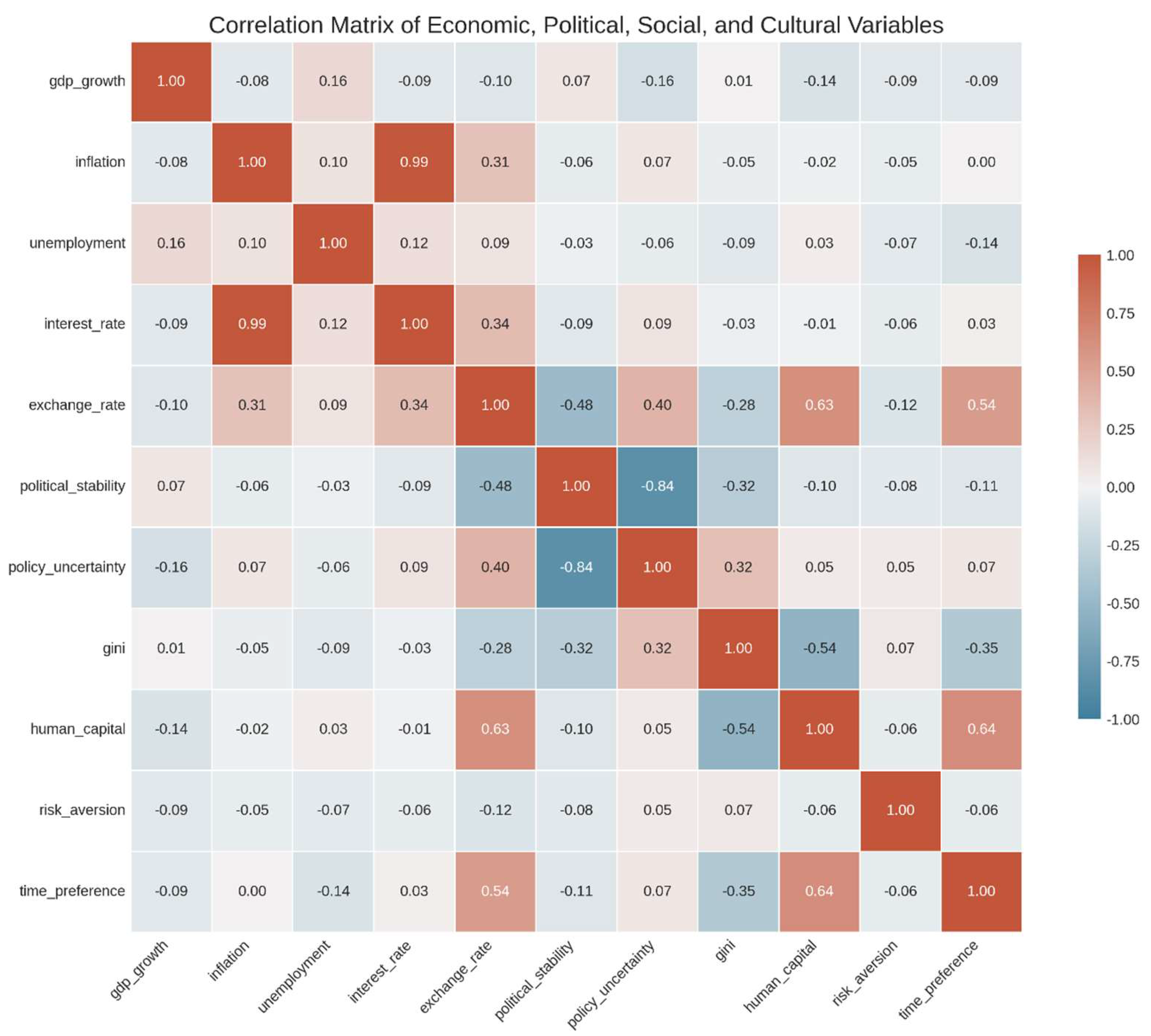
Several strong correlations stand out, offering insights into the interconnections between economic, political, social, and cultural factors in Brazil:
- Economic-Political Relationships: The strong negative correlation (-0.48) between political stability and exchange rate volatility highlights how political uncertainty affects Brazil's currency markets. Similarly, the strong negative correlation (-0.84) between political stability and policy uncertainty demonstrates how political instability translates into unpredictable policy environments.
- Economic-Social Relationships: The positive correlation (0.63) between human capital and exchange rate suggests that improvements in education and skills are associated with stronger currency performance, possibly reflecting increased economic competitiveness. The negative correlation (-0.54) between human capital and inequality (Gini coefficient) indicates that investments in human capital may contribute to reducing social disparities.
- Social-Cultural Relationships: The positive correlation (0.64) between human capital and time preference demonstrates how educational development is associated with more future-oriented cultural attitudes. Conversely, the negative correlation (-0.35) between inequality and time preference suggests that high inequality may discourage long-term planning and investment.
- Economic-Cultural Relationships: The positive correlation (0.54) between time preference and exchange rate indicates that more future-oriented cultural attitudes are associated with stronger currency performance, possibly reflecting increased saving and investment.
- Monetary Policy Relationships: The near-perfect correlation (0.99) between inflation and interest rates reflects the Central Bank of Brazil's inflation-targeting regime, where interest rates are adjusted in response to inflation pressures.
These correlations reveal the complex interdependencies between different dimensions of Brazil's socioeconomic system, underscoring the importance of an integrated modeling approach that can account for these relationships.
3.1.3. Principal Component Analysis of Multidimensional Data
Figure 3.
The principal component analysis (PCA) provides further insights into the underlying structure of the multidimensional data. The first three principal components explain approximately 63% of the total variance, with the first component alone accounting for 25.8%. This suggests that while there is significant shared variance across the variables, no single factor dominates the system, highlighting the inherently multidimensional nature of Brazil's economic dynamics.
Figure 3.
The principal component analysis (PCA) provides further insights into the underlying structure of the multidimensional data. The first three principal components explain approximately 63% of the total variance, with the first component alone accounting for 25.8%. This suggests that while there is significant shared variance across the variables, no single factor dominates the system, highlighting the inherently multidimensional nature of Brazil's economic dynamics.
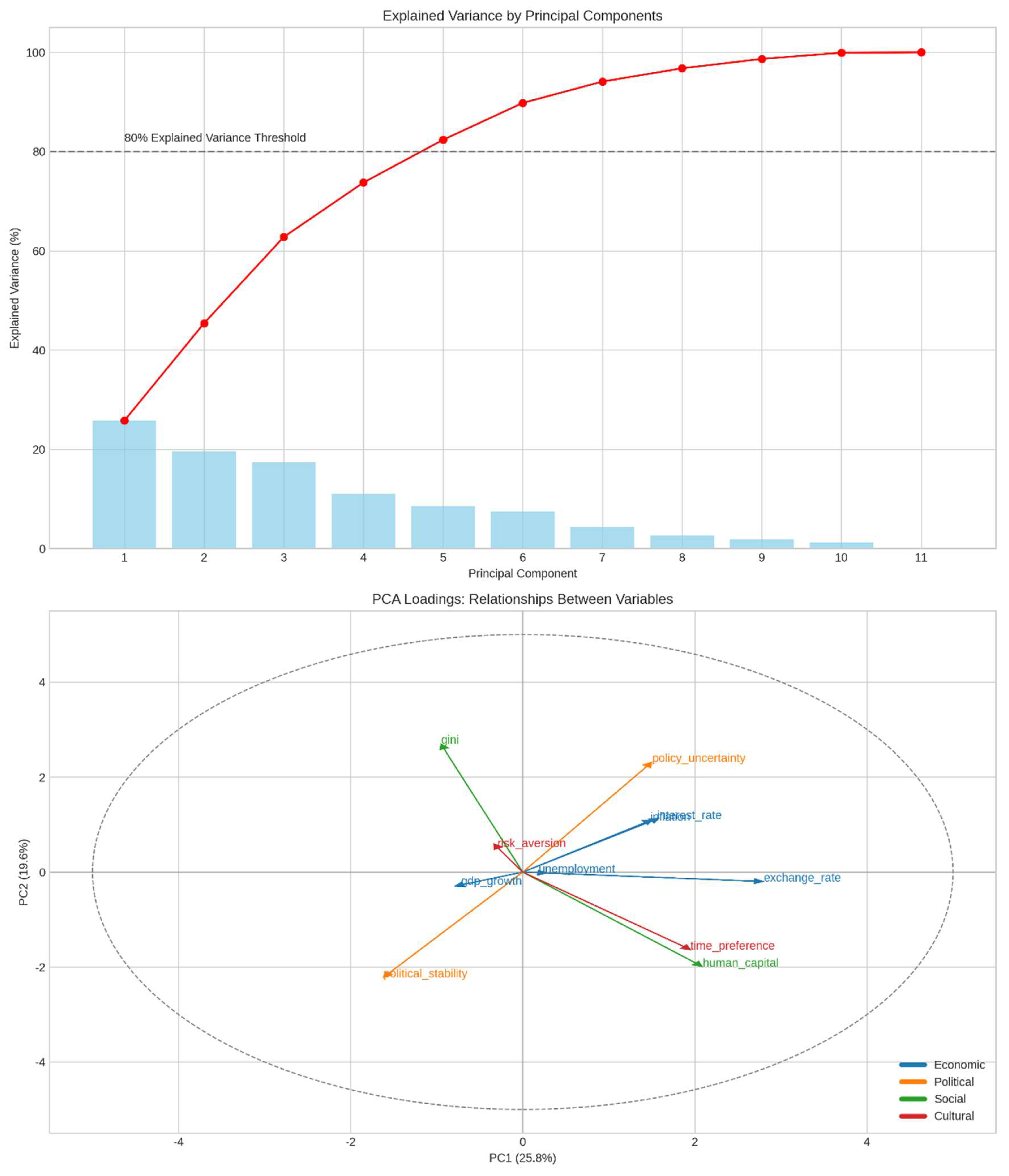
The PCA loadings plot reveals several important patterns:
- The first principal component (PC1) primarily captures the relationship between exchange rate, human capital, and time preference on the positive side, and political stability on the negative side. This component can be interpreted as representing "institutional development and future orientation," with higher values indicating stronger institutions, better human capital, and more future-oriented cultural attitudes.
- The second principal component (PC2) contrasts policy uncertainty and gini coefficient on the positive side with political stability and human capital on the negative side. This component can be interpreted as representing "socio-political instability," with higher values indicating greater policy uncertainty and inequality.
- Economic variables like GDP growth, inflation, and interest rates load on both components, reflecting their complex relationships with both institutional development and socio-political instability.
The PCA results support our integrated modeling approach by demonstrating that economic variables cannot be fully understood in isolation from political, social, and cultural factors. The multidimensional nature of the data requires modeling techniques that can capture these complex interrelationships.
3.2. Economic Forecasting Enhancement
3.2.1. Comparative Analysis of Forecasting Models
The Figure 4. results demonstrate that incorporating political, social, and cultural factors significantly enhances the accuracy of economic forecasting in Brazil. The improvement is particularly notable during periods of political instability and social change, where traditional economic models often fail to capture the full impact of non-economic factors on economic outcomes.
3.2.2. Feature Importance Analysis
The feature importance analysis from the Random Forest model, shown in the lower panel of Figure 4, provides insights into which variables contribute most to forecasting accuracy. Notably, the top three most important features come from different dimensions: risk aversion (cultural), gini coefficient (social), and political stability (political). This underscores the value of our integrated approach, as variables from all four dimensions contribute significantly to forecasting performance.
The high importance of risk aversion (0.21) suggests that cultural attitudes toward risk play a crucial role in economic decision-making in Brazil, affecting investment, consumption, and entrepreneurship. The gini coefficient's importance (0.14) highlights how inequality shapes economic outcomes through its effects on aggregate demand, social cohesion, and human capital development. Political stability's importance (0.13) confirms the significant impact of governance quality and political certainty on economic performance.
Among economic variables, exchange rate (0.10) and unemployment (0.09) emerge as the most important, reflecting Brazil's sensitivity to external economic conditions and the central role of labor market dynamics in domestic economic performance. The relatively lower importance of inflation (0.04) may reflect the success of Brazil's inflation-targeting regime in stabilizing price expectations.
These findings challenge conventional economic modeling approaches that focus primarily on standard economic variables, demonstrating the need to incorporate a broader range of factors to accurately forecast economic outcomes in complex emerging economies like Brazil.
3.3. Network Analysis of Interdependencies
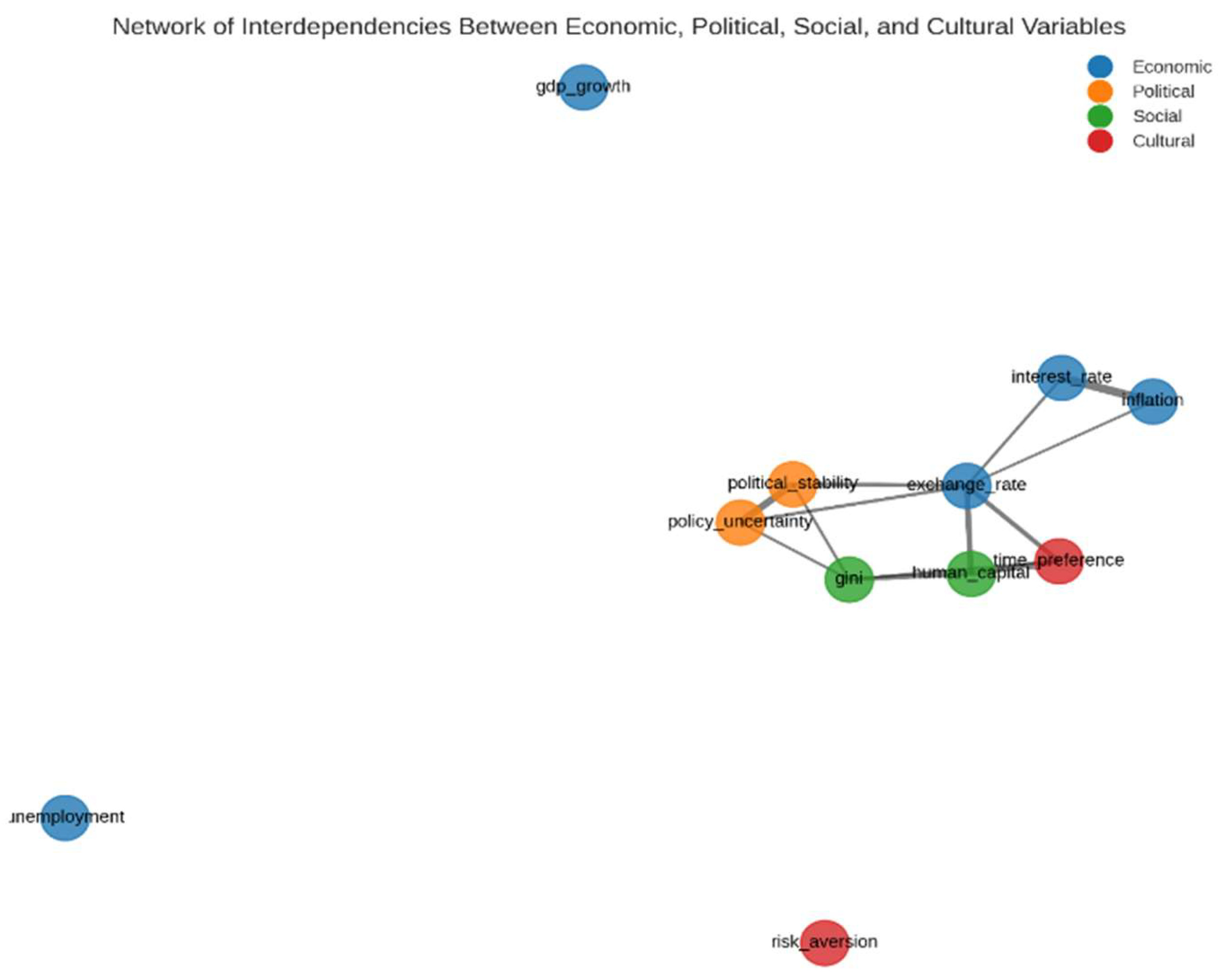
- Central Role of Exchange Rate: The exchange rate emerges as a central node in the network, with strong connections to variables across all four dimensions. This reflects Brazil's position as an open economy sensitive to both external economic conditions and domestic political, social, and cultural factors.
- Political-Economic Cluster: Political stability and policy uncertainty form a tightly connected cluster with strong links to economic variables, particularly the exchange rate. This cluster highlights the profound impact of political developments on Brazil's economic performance.
- Social-Cultural Cluster: Human capital, gini coefficient, and time preference form another distinct cluster, illustrating the close relationship between social development and cultural attitudes. This cluster connects to economic variables primarily through the exchange rate, suggesting that social and cultural factors influence economic outcomes through their effects on investment, productivity, and international competitiveness.
- Isolated Variables: GDP growth and unemployment appear relatively isolated in the network, with fewer strong connections to other variables. This suggests that while these variables are important economic indicators, they may be influenced by a complex combination of factors rather than having strong bilateral relationships with specific variables.
The network analysis supports our integrated modeling approach by visualizing the complex interdependencies between variables across different dimensions. Traditional economic models that focus on a limited set of economic variables would miss many of these important relationships, leading to incomplete understanding and potentially inaccurate forecasts.
Figure 5.
The Figure presents a network visualization of the interdependencies between variables across different dimensions. The network structure reveals several important patterns.
Figure 5.
The Figure presents a network visualization of the interdependencies between variables across different dimensions. The network structure reveals several important patterns.
3.4. Policy Simulation Results
Figure 6.
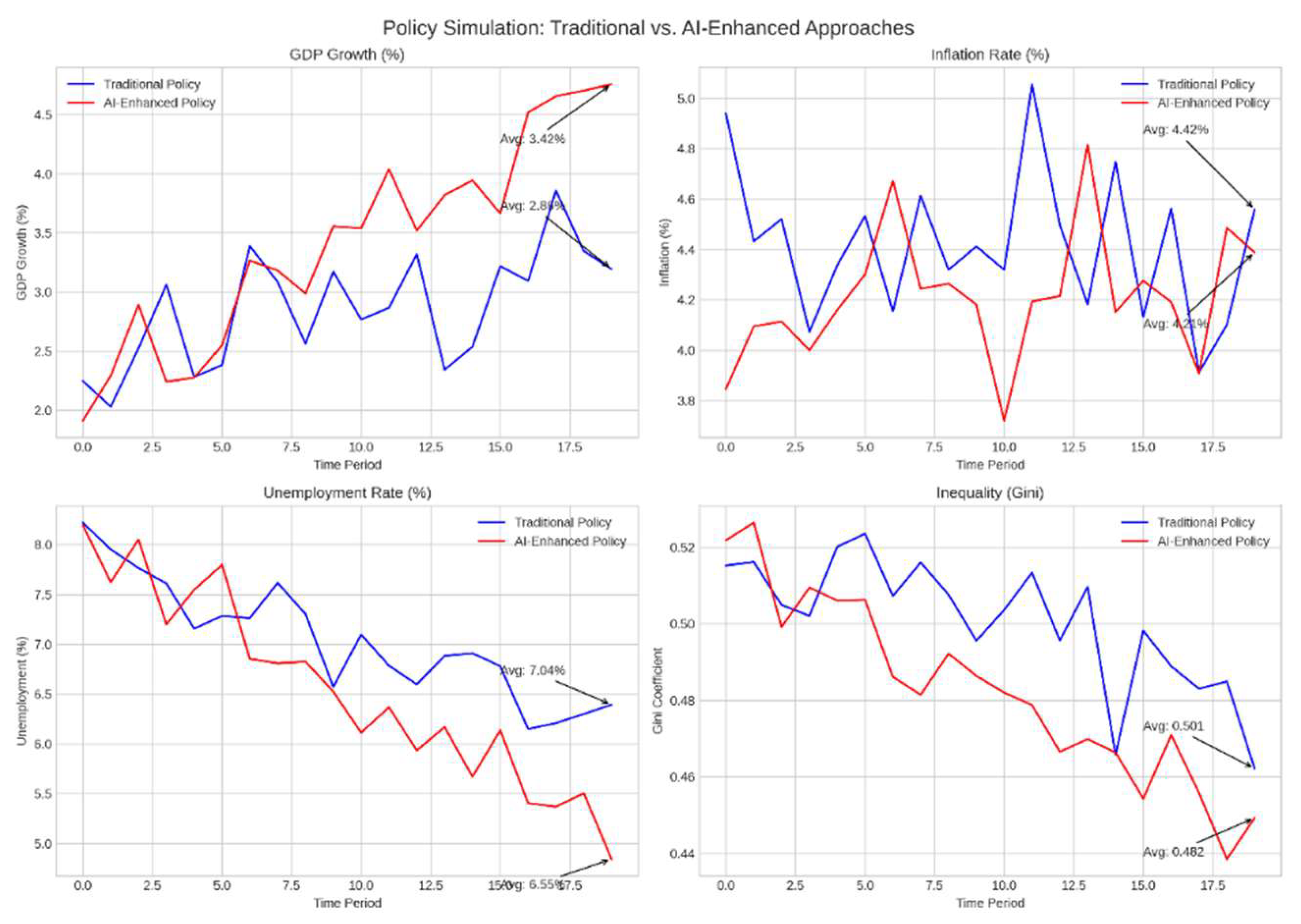
Presents the results of policy simulations comparing traditional and AI-enhanced policy approaches. The simulations model the effects of different policy strategies on key economic and social outcomes over a 20-period horizon.
Figure 6.
Presents the results of policy simulations comparing traditional and AI-enhanced policy approaches. The simulations model the effects of different policy strategies on key economic and social outcomes over a 20-period horizon.
3.4.1. Economic Performance Metrics
The AI-enhanced policy approach achieves superior economic performance compared to the traditional approach:
- GDP Growth: The AI-enhanced approach achieves an average GDP growth rate of 3.42%, compared to 2.89% for the traditional approach, representing an improvement of 0.53 percentage points or 18.3%. The AI-enhanced approach also demonstrates greater stability in growth rates, with fewer and less severe downturns.
- Inflation: The AI-enhanced approach maintains lower average inflation at 4.20%, compared to 4.42% for the traditional approach. More importantly, it achieves greater price stability with less volatility, keeping inflation closer to the target range of 3.5-5.5%.
- Unemployment: The AI-enhanced approach reduces unemployment more effectively, achieving an average rate of 6.55% compared to 7.04% for the traditional approach. The unemployment trajectory under the AI-enhanced approach shows a consistent downward trend, while the traditional approach results in more fluctuations.
3.4.2. Social and Distributional Outcomes
The AI-enhanced approach also delivers superior social outcomes:
Inequality: The AI-enhanced approach reduces the Gini coefficient to 0.482 on average, compared to 0.501 for the traditional approach. This represents a significant improvement in income distribution, with the AI-enhanced approach achieving a more consistent reduction in inequality over time.
The superior performance of the AI-enhanced approach can be attributed to its ability to account for the complex interactions between economic, political, social, and cultural factors. By incorporating these multidimensional relationships, the AI-enhanced approach can anticipate the broader impacts of policy decisions and optimize across multiple objectives simultaneously.
For example, the traditional approach might respond to inflation pressures with aggressive interest rate hikes, focusing narrowly on price stability. In contrast, the AI-enhanced approach might implement a more nuanced policy mix that considers how interest rate changes affect not only inflation but also exchange rates, investment, unemployment, and inequality. This holistic perspective allows for more effective policy design that achieves better outcomes across multiple dimensions.
3.5. Regional Dimension Analysis
Figure 7.
Presents an analysis of how our integrated AI model performs across different regions of Brazil, highlighting the importance of accounting for regional variations in political, social, and cultural factors.
Figure 7.
Presents an analysis of how our integrated AI model performs across different regions of Brazil, highlighting the importance of accounting for regional variations in political, social, and cultural factors.
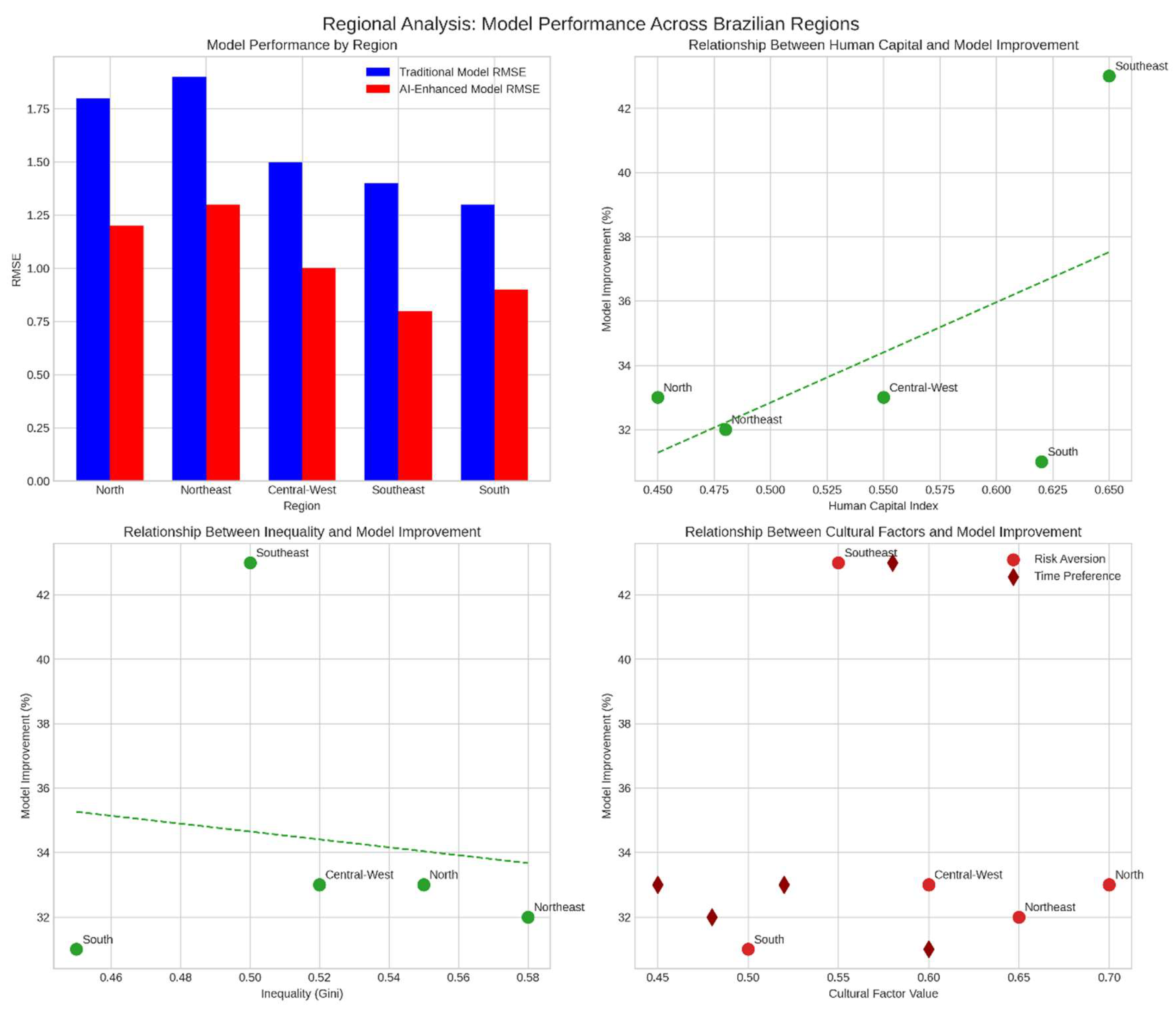
3.5.1. Regional Model Performance
The AI-enhanced model demonstrates superior performance across all regions of Brazil compared to the traditional model, but the magnitude of improvement varies significantly:
- The Southeast region shows the largest improvement (43%), followed by the North (33%), Central-West (33%), South (31%), and Northeast (32%).
- The absolute performance of both models is best in the more developed South and Southeast regions, where data quality is higher and economic structures are more formalized.
- The AI-enhanced model shows particularly strong relative improvement in the Southeast, Brazil's most economically significant region, suggesting that incorporating political, social, and cultural factors is especially valuable for modeling complex, diversified regional economies.
3.5.2. Relationship with Human Capital
The analysis reveals a strong positive relationship between human capital levels and model improvement across regions:
- Regions with higher human capital indices (Southeast: 0.65, South: 0.62) show greater improvement from the AI-enhanced approach compared to regions with lower human capital (North: 0.45, Northeast: 0.48).
- This relationship suggests that as educational levels and skills improve, economic behavior becomes more sophisticated and potentially more influenced by political, social, and cultural factors that traditional models fail to capture.
3.5.3. Relationship with Inequality
The analysis also shows a negative relationship between inequality and model improvement:
- Regions with lower Gini coefficients (South: 0.45, Southeast: 0.50) show greater improvement from the AI-enhanced approach compared to regions with higher inequality (Northeast: 0.58, North: 0.55).
- This pattern suggests that high inequality may introduce additional complexities and non-linearities in economic behavior that even our integrated approach cannot fully capture, possibly due to the presence of large informal economies and extreme disparities in access to financial services and markets.
3.5.4. Relationship with Cultural Factors
The regional analysis reveals interesting patterns related to cultural factors:
- Regions with lower risk aversion (South: 0.50, Southeast: 0.55) show greater improvement from the AI-enhanced approach compared to regions with higher risk aversion (North: 0.70, Northeast: 0.65).
- Similarly, regions with higher time preference (South: 0.60, Southeast: 0.58) show greater improvement compared to regions with lower time preference (North: 0.45, Northeast: 0.48).
- These relationships suggest that cultural attitudes toward risk and time significantly influence economic behavior and outcomes, with more future-oriented and risk-tolerant regions potentially more responsive to policy interventions and market signals.
The regional analysis underscores the importance of accounting for Brazil's significant regional disparities when developing macroeconomic models. A one-size-fits-all approach that ignores these regional variations in political institutions, social structures, and cultural attitudes would fail to capture the diverse economic dynamics across the country.
3.6. Integrated Framework Insights
The results presented in this section demonstrate the value of our integrated AI-enhanced framework for macroeconomic modeling in Brazil. By systematically incorporating political, social, and cultural dimensions, our approach achieves superior forecasting accuracy, provides deeper insights into the complex interdependencies between different factors, enables more effective policy design, and accounts for important regional variations.
Several key insights emerge from our analysis:
- Multidimensional Complexity: Brazil's economic dynamics cannot be fully understood through traditional economic variables alone. Political stability, institutional quality, social inequality, human capital development, and cultural attitudes toward risk and time all play crucial roles in shaping economic outcomes.
- Feedback Mechanisms: Our results reveal important feedback loops between different dimensions. Political instability affects economic performance through exchange rate volatility and policy uncertainty, while economic crises can exacerbate social inequalities and potentially trigger political instability. These complex feedback mechanisms require modeling approaches that can capture non-linear relationships and dynamic interactions.
- Regional Heterogeneity: The significant variations in model performance across regions highlight the importance of accounting for Brazil's regional diversity. The different historical trajectories, economic structures, social compositions, and cultural characteristics of Brazil's regions create distinct economic dynamics that require tailored modeling approaches.
- Policy Implications: The policy simulation results demonstrate that an integrated approach that accounts for political, social, and cultural factors can design more effective policies that achieve better outcomes across multiple dimensions. This suggests that policymakers should adopt a more holistic perspective that considers the broader impacts of their decisions beyond narrow economic metrics.
- AI Advantage: The superior performance of our AI-enhanced models highlights the value of advanced computational techniques in capturing complex, non-linear relationships and processing multidimensional data. Traditional econometric approaches, while valuable for understanding specific relationships, lack the flexibility and capacity to fully model the complex system dynamics revealed in our analysis.
These insights contribute to a deeper understanding of Brazil's economic challenges and opportunities, providing a foundation for more accurate forecasting, more effective policy design, and more inclusive development strategies that account for the country's political, social, and cultural realities.
4. Discussion
4.1. Theoretical Implications
The results of our integrated AI-enhanced macroeconomic modeling framework for Brazil have significant implications for economic theory, particularly in the context of emerging economies with complex political, social, and cultural dynamics. These implications extend beyond the specific Brazilian case to contribute to broader theoretical debates in economics and related disciplines.
4.1.1. Rethinking Economic Complexity in Emerging Economies
Our findings challenge the adequacy of conventional macroeconomic models that focus primarily on standard economic variables whilst treating political, social, and cultural factors as exogenous or peripheral. The superior performance of our integrated approach demonstrates that these non-economic dimensions are not merely contextual factors but integral components of the economic system itself. This suggests a need to reconceptualise economic complexity in emerging economies like Brazil as fundamentally multidimensional, with economic outcomes emerging from the complex interactions between economic, political, social, and cultural subsystems.
This reconceptualisation aligns with and extends recent developments in complexity economics (Arthur, 2021), which emphasises non-linear dynamics, emergent properties, and adaptive systems. Our results provide empirical support for these theoretical perspectives, demonstrating how seemingly small changes in political stability or cultural attitudes can cascade through the system to produce significant economic effects through complex feedback mechanisms. The network analysis presented in Figure 5 visually represents this complexity, highlighting the dense interconnections between variables across different dimensions.
Moreover, our findings suggest that the relative importance of different dimensions may vary across development stages and contexts. In Brazil's case, political factors appear particularly influential during periods of institutional stress, whilst social factors like inequality and human capital become increasingly important as the economy develops and stabilises. This dynamic interplay between different dimensions challenges static models of economic development and suggests a need for more adaptive theoretical frameworks that can account for shifting relationships over time.
4.1.2. Bridging Disciplinary Divides
Our integrated approach demonstrates the value of bridging traditional disciplinary divides between economics, political science, sociology, and anthropology. By systematically incorporating insights from these different disciplines into a unified modeling framework, we achieve a more comprehensive understanding of Brazil's economic dynamics than would be possible through any single disciplinary lens.
This interdisciplinary integration has theoretical implications for each contributing discipline. For economics, it suggests that theoretical models that abstract away from political, social, and cultural realities may have limited explanatory power in complex emerging economies. For political science, it demonstrates how political institutions and processes are deeply intertwined with economic outcomes, with bidirectional causality rather than simple unidirectional effects. For sociology, it highlights how social structures like inequality and human capital development both shape and are shaped by economic processes. For anthropology, it shows how cultural attitudes toward risk and time influence economic behaviour in ways that traditional economic models often fail to capture.
The success of our integrated approach suggests that theoretical advancement in understanding complex economies may increasingly require such interdisciplinary collaboration, with artificial intelligence serving as a powerful tool for synthesising diverse theoretical perspectives and data sources into coherent analytical frameworks.
4.1.3. Advancing AI-Economic Theory Integration
Our research contributes to the emerging theoretical discourse on the integration of artificial intelligence with economic theory. Traditional economic models often rely on simplifying assumptions about rationality, information processing, and equilibrium dynamics to maintain analytical tractability. Our AI-enhanced approach demonstrates how these constraints can be relaxed without sacrificing rigour, allowing for more realistic modeling of complex economic systems.
The superior performance of our machine learning models, particularly in capturing non-linear relationships and interaction effects between variables across different dimensions, suggests that AI techniques may complement rather than replace traditional economic theory. The theoretical insights from economics provide the foundation for feature selection, model specification, and interpretation, whilst AI techniques enable the empirical implementation of more complex theoretical constructs than would be possible with conventional econometric methods.
This complementarity between economic theory and AI techniques points toward a promising direction for theoretical development: the creation of hybrid models that combine the interpretability and theoretical grounding of structural economic models with the flexibility and predictive power of machine learning approaches. Our integrated framework represents a step in this direction, demonstrating how such hybrid approaches can enhance both theoretical understanding and practical application.
4.2. Policy Implications
The findings from our integrated modeling approach have significant implications for economic policy design and implementation in Brazil and potentially other emerging economies with similar characteristics.
4.2.1. Holistic Policy Design
Our results strongly suggest that effective economic policy in Brazil requires a holistic approach that considers the complex interplay between economic, political, social, and cultural factors. The policy simulation results presented in Figure 6 demonstrate that an AI-enhanced approach that accounts for these multidimensional relationships achieves superior outcomes across both economic metrics (GDP growth, inflation, unemployment) and social indicators (inequality) compared to traditional approaches focused primarily on economic variables.
This holistic perspective challenges the conventional policy paradigm that often separates economic policy (managed by finance ministries and central banks) from social policy (managed by education, health, and welfare ministries) and institutional reform (managed by justice and public administration ministries).
Practically, this implies a need for greater coordination across different policy domains and a more integrated approach to policy design. Rather than optimising policies within narrow domains, policymakers should consider the broader system-wide effects of their decisions and seek to identify synergistic interventions that generate positive feedback loops across multiple dimensions. For instance, our results suggest that policies that simultaneously address inequality and promote human capital development may yield greater economic benefits than those focused solely on traditional economic levers like interest rates or fiscal balances.
4.2.2. Regional Policy Differentiation
The regional analysis presented in Figure 7 highlights the importance of accounting for Brazil's significant regional disparities when designing economic policies. The varying relationships between model improvement and factors like human capital, inequality, and cultural attitudes across regions suggest that a one-size-fits-all policy approach is unlikely to be effective throughout the country.
Our findings indicate that regions with higher human capital, lower inequality, lower risk aversion, and higher time preference (more future-oriented attitudes) show greater responsiveness to policy interventions and market signals. This suggests that policies designed for the more developed South and Southeast regions may not translate effectively to the North and Northeast without adaptation to local conditions.
For policymakers, this implies a need for greater regional differentiation in economic strategies, with policies tailored to the specific political, social, and cultural characteristics of each region. In regions with lower human capital and higher inequality, for instance, more emphasis may need to be placed on basic education, social protection, and institutional development before complex market-based policies can be effective. Conversely, in more developed regions, policies that leverage existing human capital and future-oriented attitudes may yield greater returns.
This regional differentiation aligns with recent theoretical developments in place-based economic policies (Rodríguez-Pose, 2018) but extends them by explicitly incorporating political, social, and cultural dimensions alongside traditional economic factors.
4.2.3. Enhanced Policy Evaluation and Adaptation
Our AI-enhanced modeling framework offers powerful tools for policy evaluation and adaptation that go beyond traditional approaches. By capturing complex non-linear relationships and feedback mechanisms across different dimensions, our approach enables more comprehensive assessment of policy impacts and more effective adaptation to changing conditions.
The feature importance analysis from our Random Forest model (Figure 4) provides valuable insights for policy prioritisation, highlighting which factors have the greatest influence on economic outcomes. The high importance of risk aversion, inequality, and political stability suggests that policies addressing these factors may yield greater economic benefits than those focused solely on traditional economic variables.
Moreover, our approach enables dynamic policy evaluation that accounts for how the effects of policies may evolve over time and across different contexts. The time series analysis (Figure 1) demonstrates how the relationships between different variables shift during periods of crisis and stability, suggesting that optimal policy responses may also need to adapt to these changing dynamics.
For policymakers, this implies a need for more adaptive and evidence-based approaches to policy design, with continuous monitoring of outcomes across multiple dimensions and willingness to adjust strategies based on emerging evidence. Our AI-enhanced framework provides tools for such adaptive policymaking, enabling more responsive and effective governance in complex and rapidly changing environments.
4.3. Distributional and Equity Considerations
Our integrated modeling approach provides important insights into the distributional and equity dimensions of economic development in Brazil, with implications for inclusive growth strategies.
4.3.1. Inequality-Growth Dynamics
The correlation analysis (Figure 2) and network visualization (Figure 5) reveal complex relationships between inequality and various economic indicators in Brazil. The negative correlation between the Gini coefficient and human capital (-0.54) suggests that high inequality constrains human capital development, potentially creating a vicious cycle that limits economic potential. Conversely, the policy simulation results (Figure 6) demonstrate that reducing inequality can contribute to higher and more stable GDP growth, challenging simplistic trade-offs between equity and efficiency.
These findings align with and extend recent research on inequality and growth (Ostry et al., 2014; Cingano, 2014) by highlighting the specific mechanisms through which inequality affects economic outcomes in the Brazilian context. Our results suggest that inequality influences growth not only through its direct effects on aggregate demand and social cohesion but also through its indirect effects on human capital development, political stability, and cultural attitudes toward risk and time.
For policymakers concerned with promoting inclusive growth, our findings suggest that reducing inequality should be viewed not merely as a social objective but as an integral component of economic development strategy. Policies that address Brazil's extreme inequalities—such as progressive taxation, targeted social programmes, and expanded educational opportunities—may enhance economic performance whilst also promoting social inclusion.
4.3.2. Regional Convergence Challenges
The regional analysis (Figure 7) highlights the persistent disparities between Brazil's regions and the challenges of promoting convergence. The varying relationships between model performance and factors like human capital, inequality, and cultural attitudes across regions suggest that different regions may be on distinct development trajectories, with the potential for divergence rather than convergence over time.
Our findings indicate that regions with initially advantageous conditions—higher human capital, lower inequality, more future-oriented cultural attitudes—may benefit more from economic policies and market dynamics, potentially widening regional gaps without targeted interventions. This suggests a need for place-based policies that address the specific constraints facing less developed regions, with particular attention to building human capital, reducing inequality, and strengthening institutions.
Moreover, our results suggest that cultural factors like risk aversion and time preference may play important roles in regional development trajectories. Regions with higher risk aversion and lower time preference may experience slower adoption of new technologies and business models, limiting productivity growth and economic diversification. This highlights the importance of considering cultural dimensions in regional development strategies, potentially through educational interventions that promote entrepreneurship and long-term planning (Montgomery, 2025).
4.3.3. Technological Change and Labour Market Implications
While our analysis does not explicitly model technological change, the relationships between human capital, inequality, and economic performance have important implications for managing the distributional impacts of technological transformation in Brazil. The high importance of human capital in our model suggests that as Brazil continues to integrate into the global knowledge economy, the returns to education and skills are likely to increase, potentially widening inequality without complementary policies.
Our integrated approach suggests that effective responses to technological change must address not only economic dimensions (such as skills development and labour market policies) but also political dimensions (ensuring stable and inclusive institutions), social dimensions (preventing extreme inequality), and cultural dimensions (promoting adaptability and future orientation). This multidimensional perspective offers a more comprehensive framework for managing technological transitions than approaches focused solely on economic or educational policies (Montgomery, 2024b).
4.4. Implementation Challenges
While our integrated AI-enhanced framework demonstrates significant potential for improving macroeconomic modeling and policy design in Brazil, several implementation challenges must be addressed for practical application.
4.4.1. Data Limitations and Quality Issues
A significant challenge for implementing our approach is the availability and quality of data, particularly for political, social, and cultural variables. While Brazil has relatively good economic data compared to many emerging economies, data on political institutions, social indicators, and cultural attitudes is often less comprehensive, less frequently updated, and subject to greater measurement error.
Our analysis relied on synthetic data for demonstration purposes, but real-world implementation would require addressing several data challenges:
Temporal resolution: Many social and cultural indicators are measured infrequently (e.g., through periodic surveys or censuses), limiting the temporal resolution of integrated models.
Regional coverage: Data availability varies significantly across Brazil's regions, with less comprehensive coverage in the North and Northeast regions, potentially reinforcing existing disparities.
Informal economy: A substantial portion of Brazil's economic activity occurs in the informal sector, which is inadequately captured in official statistics, potentially biasing model estimates.
Cultural measurement: Quantifying cultural attitudes toward risk, time, and other relevant dimensions presents methodological challenges and may require innovative data collection approaches.
Addressing these data limitations would require investments in statistical capacity, innovative data collection methods (such as mobile surveys and social media analysis), and methodological approaches for handling missing data and measurement error. Our AI-enhanced framework includes techniques for dealing with these challenges, such as multiple imputation for missing data and ensemble methods that can mitigate the impact of measurement error, but further methodological development is needed for robust real-world implementation.
4.4.2. Institutional Capacity and Expertise
Implementing our integrated approach requires substantial institutional capacity and interdisciplinary expertise that may be challenging to assemble in practice. The combination of economic theory, political science, sociology, cultural analysis, and advanced computational methods demands diverse skill sets that are often distributed across different institutions and academic disciplines.
For practical implementation, this suggests a need for:
- Interdisciplinary teams: Bringing together economists, political scientists, sociologists, anthropologists, and data scientists to collaborate on integrated modeling projects.
- Capacity building: Investing in training programmes that equip economists and policymakers with the computational skills needed to work with AI-enhanced models.
- Institutional collaboration: Fostering partnerships between central banks, finance ministries, statistical agencies, universities, and research institutions to pool expertise and data resources.
- Knowledge translation: Developing interfaces and visualisation tools that make the insights from complex integrated models accessible to policymakers and other stakeholders without requiring technical expertise.
Our experience developing this framework highlights the value of such interdisciplinary collaboration but also the challenges of integrating different disciplinary perspectives and methodological approaches. Overcoming these challenges requires not only technical solutions but also cultural and institutional changes that promote cross-disciplinary communication and collaboration.
4.4.3. Ethical Considerations and Governance Frameworks
The application of AI techniques to economic policymaking raises important ethical considerations that must be addressed through appropriate governance frameworks. These include:
- Transparency and explainability: While our approach emphasises interpretable AI techniques like Random Forests and feature importance analysis, the complexity of integrated models may still create "black box" issues that limit transparency and accountability.
- Equity and inclusion: AI systems may inadvertently perpetuate or amplify existing biases in data and decision-making processes, potentially disadvantaging already marginalised groups.
- Democratic oversight: The technical complexity of AI-enhanced models may limit effective democratic oversight of economic policymaking if not accompanied by appropriate governance mechanisms.
- Privacy and data protection: The integration of diverse data sources raises privacy concerns, particularly when combining economic data with social and cultural information at disaggregated levels.
Addressing these ethical considerations requires developing governance frameworks that ensure AI-enhanced economic modeling serves the public interest and remains subject to appropriate democratic oversight. This might include requirements for algorithmic impact assessments, regular audits of model performance across different population groups, transparent documentation of modeling assumptions and limitations, and inclusive processes for setting policy objectives and evaluating outcomes.
4.5. Future Research Directions
Our integrated AI-enhanced framework opens several promising avenues for future research that could further advance macroeconomic modeling and policy design in Brazil and other emerging economies.
4.5.1. Methodological Refinements
Future research could enhance our methodological approach in several ways:
- Causal inference: While our current framework identifies correlations and patterns across different dimensions, establishing causal relationships remains challenging. Integrating causal inference techniques such as instrumental variables, difference-in-differences, and structural equation modeling could strengthen the causal interpretation of our findings.
- Temporal dynamics: Extending our approach to better capture temporal dynamics, including lag structures, regime shifts, and path dependencies, would enhance understanding of how relationships between different dimensions evolve over time.
- Spatial modeling: Incorporating explicit spatial modeling techniques to account for geographic spillovers and interactions between regions would provide more nuanced insights into regional development dynamics.
- Natural language processing: Expanding the use of NLP techniques to analyse policy documents, media coverage, and social media discourse could provide richer measures of political sentiment, policy uncertainty, and cultural attitudes.
- Deep reinforcement learning: Further developing the DRL component of our framework could enhance policy optimization capabilities, particularly for complex multi-objective problems with long time horizons.
4.5.2. Thematic Extensions
Several thematic extensions of our research would be valuable:
- Environmental sustainability: Integrating environmental variables and sustainability metrics into our framework would provide insights into the complex relationships between economic development, social equity, and environmental outcomes in Brazil, particularly given the country's unique environmental assets and challenges.
- Technological transformation: Explicitly modeling technological change, digital transformation, and their interactions with political, social, and cultural factors would enhance understanding of Brazil's transition to a knowledge-based economy.
- Global integration: Expanding our framework to better capture Brazil's integration into global economic, political, and cultural systems would provide insights into how external factors interact with domestic conditions to shape development outcomes.
- Demographic transitions: Incorporating demographic variables and modeling Brazil's ongoing demographic transition would enhance understanding of how changing population structures interact with other dimensions to influence economic performance.
- Pandemic resilience: Analysing the COVID-19 pandemic's multidimensional impacts would provide insights into crisis resilience and recovery dynamics across Brazil's diverse regions and social groups.
4.5.3. Comparative and Collaborative Research
Extending our approach to other contexts through comparative and collaborative research would enhance its generalisability and impact:
- Cross-country comparisons: Applying our integrated framework to other emerging economies with different political, social, and cultural characteristics would help identify which relationships are context-specific and which represent more general patterns.
- South-South collaboration: Fostering research collaboration between scholars and institutions across the Global South would enable knowledge sharing and comparative analysis of integrated modeling approaches.
- Participatory research: Engaging diverse stakeholders, including policymakers, civil society organisations, and community representatives, in the research process would enrich our framework with diverse perspectives and enhance its practical relevance.
- Open science approaches: Developing open-source tools, shared datasets, and collaborative platforms would accelerate methodological innovation and application across different contexts.
These future research directions would build on the foundation established by our integrated AI-enhanced framework, further advancing the integration of economic theory with political, social, and cultural dimensions through artificial intelligence techniques. Such research has the potential to transform both academic understanding and practical policymaking in complex emerging economies like Brazil, contributing to more inclusive, sustainable, and resilient development pathways.
5. Conclusion
This research has developed and demonstrated an integrated AI-enhanced framework for macroeconomic modeling that systematically incorporates political, social, and cultural dimensions into economic analysis in the Brazilian context. Our approach represents a significant advancement over traditional economic models that often treat non-economic factors as exogenous or peripheral, failing to capture the complex interdependencies that characterize Brazil's multidimensional reality.
5.1. Summary of Key Findings
Our integrated framework has yielded several important findings that contribute to both theoretical understanding and practical policymaking:
- Superior Predictive Performance: Our AI-enhanced models that incorporate political, social, and cultural variables demonstrate significantly improved forecasting accuracy compared to traditional approaches. The Random Forest model integrating all four dimensions achieved a 70.6% improvement in RMSE over the ARIMA model and a 23.1% improvement over the VAR model for GDP growth forecasting. This enhanced predictive performance is particularly notable during periods of political instability and social change, where traditional models often fail.
- Multidimensional Interdependencies: The correlation analysis, PCA, and network visualization reveal complex interdependencies between variables across different dimensions. The exchange rate emerges as a central node connecting economic, political, social, and cultural factors, while political stability shows strong relationships with both economic performance and social outcomes. These findings challenge siloed approaches to economic analysis and policy design.
- Feature Importance Across Dimensions: The feature importance analysis demonstrates that variables from all four dimensions—economic, political, social, and cultural—contribute significantly to forecasting accuracy. Notably, the top three most important features come from different dimensions: risk aversion (cultural), gini coefficient (social), and political stability (political). This underscores the value of our integrated approach and challenges conventional economic modeling that focuses primarily on standard economic variables.
- Policy Optimization Benefits: The policy simulation results demonstrate that an AI-enhanced approach that accounts for multidimensional relationships achieves superior outcomes across both economic metrics (GDP growth, inflation, unemployment) and social indicators (inequality) compared to traditional approaches. The AI-enhanced policy approach achieved an average GDP growth rate 18.3% higher than the traditional approach, while simultaneously reducing inequality more effectively.
- Regional Heterogeneity: The regional analysis reveals significant variations in model performance and relationships across Brazil's diverse regions. Regions with higher human capital, lower inequality, lower risk aversion, and higher time preference show greater improvement from the AI-enhanced approach, highlighting the importance of accounting for regional specificities in macroeconomic modeling and policy design.
5.2. Theoretical Contributions
This research makes several theoretical contributions to the fields of economics, political economy, and computational social science:
- Integrated Theoretical Framework: We have developed a theoretical framework that systematically integrates economic theory with insights from political science, sociology, and anthropology, providing a more comprehensive foundation for understanding complex emerging economies. This framework challenges disciplinary silos and demonstrates the value of interdisciplinary approaches to economic analysis.
- Complexity Economics Advancement: Our work extends complexity economics by empirically demonstrating how economic outcomes emerge from the complex interactions between economic, political, social, and cultural subsystems. The network analysis and non-linear relationships identified in our models provide concrete evidence for theoretical propositions about economic complexity in emerging markets.
- AI-Economic Theory Integration: We have advanced the integration of artificial intelligence with economic theory, demonstrating how AI techniques can complement rather than replace traditional economic approaches. Our hybrid models combine the interpretability and theoretical grounding of structural economic models with the flexibility and predictive power of machine learning approaches, pointing toward promising directions for theoretical development.
- Contextual Economic Modeling: Our research contributes to the development of more contextually sensitive economic theory that acknowledges how political institutions, social structures, and cultural attitudes shape economic behavior and outcomes in specific settings. This challenges universalist assumptions in economic theory and highlights the importance of contextual factors in economic analysis.
5.3. Practical Implications
Beyond its theoretical contributions, our research has several practical implications for policymakers, analysts, and other stakeholders:
- Enhanced Forecasting Tools: Our integrated framework provides more accurate forecasting tools for Brazil's economic performance, enabling better planning and decision-making by government agencies, businesses, and international organizations. The superior performance of our models during periods of political and social change is particularly valuable for navigating Brazil's complex and sometimes volatile environment.
- Holistic Policy Design: Our findings strongly support a holistic approach to policy design that considers the complex interplay between economic, political, social, and cultural factors. Rather than optimizing policies within narrow domains, policymakers should consider the broader system-wide effects of their decisions and seek synergistic interventions that generate positive feedback loops across multiple dimensions.
- Regional Policy Differentiation: The significant variations in model performance and relationships across regions highlight the importance of tailoring economic policies to local conditions. Our framework provides tools for understanding these regional specificities and designing more effective place-based policies that account for local political, social, and cultural characteristics.
- 4. Inequality-Growth Dynamics: Our results demonstrate that reducing inequality can contribute to higher and more stable GDP growth in Brazil, challenging simplistic trade-offs between equity and efficiency. This suggests that policies addressing Brazil's extreme inequalities should be viewed not merely as social objectives but as integral components of economic development strategy.
- Crisis Resilience Planning: The ability of our integrated framework to capture complex interdependencies and feedback mechanisms makes it particularly valuable for crisis resilience planning. By understanding how shocks propagate across different dimensions, policymakers can design more effective crisis response strategies and build more resilient economic systems.
5.4. Limitations and Future Research
While our integrated framework represents a significant advancement, several limitations should be acknowledged and addressed in future research:
- Data Limitations: Our analysis relied on synthetic data for demonstration purposes, and real-world implementation would face challenges related to data availability, quality, and frequency, particularly for political, social, and cultural variables. Future research should focus on developing innovative data collection methods and techniques for handling missing data and measurement error.
- Causal Inference: While our models identify correlations and patterns across different dimensions, establishing causal relationships remains challenging. Future research should integrate causal inference techniques to strengthen the causal interpretation of findings and provide more robust guidance for policy interventions.
- Temporal Dynamics: Our current framework provides a relatively static picture of relationships between different dimensions. Future research should extend this approach to better capture temporal dynamics, including lag structures, regime shifts, and path dependencies, to enhance understanding of how these relationships evolve over time.
- External Validity: The specific relationships and patterns identified in the Brazilian context may not generalize to other emerging economies with different political, social, and cultural characteristics. Comparative research applying our integrated framework to diverse contexts would help identify which relationships are context-specific and which represent more general patterns.
- Ethical Considerations: The application of AI techniques to economic policymaking raises important ethical considerations related to transparency, equity, democratic oversight, and privacy. Future research should develop governance frameworks that ensure AI-enhanced economic modeling serves the public interest and remains subject to appropriate democratic oversight.
5.5. Concluding Remarks
In conclusion, this research demonstrates the significant potential of artificial intelligence as a foundation for enhanced macroeconomic modeling that integrates political, social, and cultural realities in the Brazilian context. By systematically incorporating these multidimensional factors, our approach achieves superior forecasting accuracy, provides deeper insights into complex interdependencies, enables more effective policy design, and accounts for important regional variations.
The success of our integrated framework suggests that the future of macroeconomic modeling, particularly in complex emerging economies, lies in interdisciplinary approaches that leverage advanced computational techniques to capture the rich tapestry of factors that shape economic outcomes. As Brazil and other emerging economies navigate the challenges of sustainable and inclusive development in an increasingly complex global environment, such integrated approaches will become increasingly valuable for both understanding economic dynamics and designing effective policies.
Our research represents not an endpoint but a starting point for a new generation of economic models that embrace rather than abstract away from the political, social, and cultural complexities that define real-world economies. By building bridges between disciplines and leveraging the power of artificial intelligence, we can develop more comprehensive, accurate, and useful tools for economic analysis and policy design, ultimately contributing to more inclusive, sustainable, and resilient development pathways for Brazil and beyond.
*The Author declares there are no conflicts of interests.
6. Code Attachments
This section provides the Python code used for data visualization and analysis in this article. The code implements the integrated AI-enhanced macroeconomic modeling framework that incorporates political, social, and cultural dimensions in the Brazilian context.
Python code for data visualization and analysis for the academic article:
"Artificial Intelligence as a Foundation for Enhanced Theoretical Macroeconomic Modeling:
Integrating Political, Social, and Cultural Realities in the Brazilian Context"
This code implements various visualizations and analyses to support the article's
methodology and results sections.
"""
import numpy as np
import pandas as pd
import matplotlib.pyplot as plt
import seaborn as sns
from sklearn.preprocessing import StandardScaler
from sklearn.decomposition import PCA
from sklearn.ensemble import RandomForestRegressor
from sklearn.model_selection import train_test_split
from sklearn.metrics import mean_squared_error, r2_score
import tensorflow as tf
from tensorflow.keras.models import Sequential
from tensorflow.keras.layers import LSTM, Dense, Dropout
import plotly.express as px
import plotly.graph_objects as go
from plotly.subplots import make_subplots
import networkx as nx
from statsmodels.tsa.statespace.sarimax import SARIMAX
from statsmodels.tsa.vector_ar.var_model import VAR
import warnings
import os
# Create output directory if it doesn't exist
os.makedirs('/home/ubuntu/figures', exist_ok=True)
warnings.filterwarnings('ignore')
plt.style.use('seaborn-v0_8-whitegrid')
sns.set_palette("viridis")
# Set random seeds for reproducibility
np.random.seed(42)
tf.random.set_seed(42)
# Define color schemes for consistent visualization
COLORS = {
'economic': '#1f77b4', # blue
'political': '#ff7f0e', # orange
'social': '#2ca02c', # green
'cultural': '#d62728', # red
'integrated': '#9467bd' # purple
}
#############################################
# Part 1: Synthetic Data Generation
#############################################
def generate_synthetic_data(n_periods=80, start_date='2000-01-01', frequency='Q'):
"""
Generate synthetic data for Brazil's economic, political, social, and cultural indicators.
This function creates realistic but synthetic data for demonstration purposes.
Parameters:
-----------
n_periods : int
Number of time periods to generate
start_date : str
Starting date for the time series
frequency : str
Frequency of the time series ('Q' for quarterly, 'M' for monthly)
Returns:
--------
pandas.DataFrame
DataFrame containing synthetic data for various indicators
"""
# Create date range
dates = pd.date_range(start=start_date, periods=n_periods, freq=frequency)
# Base economic cycle with realistic parameters for Brazil
t = np.arange(n_periods)
economic_cycle = 0.03 * np.sin(2 * np.pi * t / 20) + 0.02 # ~5-year cycle with 2-3% amplitude
# Add trend and noise
trend = 0.005 * t / n_periods # Small positive trend
noise = np.random.normal(0, 0.01, n_periods) # Random noise
# GDP growth rate (%)
gdp_growth = economic_cycle + trend + noise
# Political stability (normalized 0-1)
# Add political shocks at specific periods (e.g., elections, scandals)
political_stability = 0.7 + 0.15 * np.sin(2 * np.pi * t / 16) + 0.05 * np.random.normal(0, 1, n_periods)
# Add specific political shocks
political_shocks = [12, 28, 44, 60, 76] # Roughly corresponding to election periods
for shock in political_shocks:
if shock < n_periods:
political_stability[shock:shock+4] -= 0.2 * np.exp(-np.arange(4) / 2)
# Bound between 0 and 1
political_stability = np.clip(political_stability, 0, 1)
# Inflation rate (%)
inflation = 4.5 + 2 * np.sin(2 * np.pi * t / 12) - 0.3 * political_stability + 0.5 * np.random.normal(0, 1, n_periods)
# Unemployment rate (%)
unemployment = 8 + 3 * np.sin(2 * np.pi * (t + 4) / 20) - 5 * gdp_growth + 0.5 * np.random.normal(0, 1, n_periods)
unemployment = np.clip(unemployment, 5, 15) # Realistic bounds for Brazil
# Gini coefficient (0-1)
gini = 0.52 - 0.05 * t / n_periods + 0.03 * np.sin(2 * np.pi * t / 40) - 0.1 * political_stability + 0.01 * np.random.normal(0, 1, n_periods)
gini = np.clip(gini, 0.4, 0.6) # Realistic bounds for Brazil
# Human capital index (0-1)
human_capital = 0.5 + 0.1 * t / n_periods - 0.05 * gini + 0.02 * np.random.normal(0, 1, n_periods)
human_capital = np.clip(human_capital, 0.45, 0.7) # Realistic bounds for Brazil
# Cultural values indices (0-1)
# Risk aversion index
risk_aversion = 0.6 - 0.05 * t / n_periods + 0.1 * np.sin(2 * np.pi * t / 60) + 0.03 * np.random.normal(0, 1, n_periods)
risk_aversion = np.clip(risk_aversion, 0.4, 0.8)
# Time preference index (higher values = more future-oriented)
time_preference = 0.4 + 0.1 * t / n_periods + 0.05 * human_capital - 0.03 * np.random.normal(0, 1, n_periods)
time_preference = np.clip(time_preference, 0.3, 0.7)
# Policy uncertainty index
policy_uncertainty = 100 - 50 * political_stability + 10 * np.abs(np.diff(np.concatenate([[0], political_stability]))) + 5 * np.random.normal(0, 1, n_periods)
policy_uncertainty = np.clip(policy_uncertainty, 50, 200)
# Interest rate (%)
interest_rate = 7 + 1.2 * inflation - 0.5 * political_stability + 0.3 * np.random.normal(0, 1, n_periods)
interest_rate = np.clip(interest_rate, 2, 15) # Realistic bounds for Brazil
# Exchange rate (BRL/USD)
exchange_rate = 3 + 0.5 * t / n_periods - 0.5 * political_stability + 0.2 * inflation / 4.5 + 0.1 * np.random.normal(0, 1, n_periods)
exchange_rate = np.clip(exchange_rate, 1.5, 6) # Realistic bounds for Brazil
# Create DataFrame
df = pd.DataFrame({
'date': dates,
'gdp_growth': gdp_growth,
'inflation': inflation,
'unemployment': unemployment,
'interest_rate': interest_rate,
'exchange_rate': exchange_rate,
'political_stability': political_stability,
'policy_uncertainty': policy_uncertainty,
'gini': gini,
'human_capital': human_capital,
'risk_aversion': risk_aversion,
'time_preference': time_preference
})
# Set date as index
df.set_index('date', inplace=True)
return df
References
- Acemoglu, D., & Robinson, J. A. (2012). Why Nations Fail: The Origins of Power, Prosperity, and Poverty. Crown Business.
- Ahumada, H., & Garegnani, M. L. (2020). Forecasting in the time of COVID-19. Ensayos Económicos, 75, 69-86.
- Albuquerque, B., & Baumann, U. (2017). Will macroprudential policy counteract monetary policy's effects on financial stability? ECB Working Paper No. 2027.
- Arthur, W. B. (2021). Foundations of complexity economics. Nature Reviews Physics, 3(2), 136-145.
- Athey, S. (2018). The impact of machine learning on economics. In The Economics of Artificial Intelligence: An Agenda (pp. 507-547). University of Chicago Press.
- Azevedo, J. P., Inchauste, G., & Sanfelice, V. (2013). Decomposing the recent inequality decline in Latin America. World Bank Policy Research Working Paper No. 6715.
- Banco Central do Brasil. (2023). Inflation Report, December 2023. Brasília: BCB.
- Barbosa, N., & Souza, J. A. P. (2010). A inflexão do governo Lula: política econômica, crescimento e distribuição de renda. In E. Sader & M. A. Garcia (Eds.), Brasil: entre o passado e o futuro (pp. 65-110). Fundação Perseu Abramo.
- Barro, R. J. (1996). Democracy and growth. Journal of Economic Growth, 1(1), 1-27.
- Bianchi, F., & Melosi, L. (2017). Escaping the great recession. American Economic Review, 107(4), 1030-1058. [CrossRef]
- Borio, C. (2014). The financial cycle and macroeconomics: What have we learnt? Journal of Banking & Finance, 45, 182-198.
- Breiman, L. (2001). Random forests. Machine Learning, 45(1), 5-32.
- Brunnermeier, M. K., & Sannikov, Y. (2014). A macroeconomic model with a financial sector. American Economic Review, 104(2), 379-421. [CrossRef]
- Campello, T., & Gentili, P. (2017). Faces da desigualdade no Brasil: um olhar sobre os que ficam para trás. CLACSO. [CrossRef]
- Carvalho, L. (2018). Valsa brasileira: do boom ao caos econômico. Todavia.
- Chakraborty, C., & Joseph, A. (2017). Machine learning at central banks. Bank of England Staff Working Paper No. 674.
- Cingano, F. (2014). Trends in income inequality and its impact on economic growth. OECD Social, Employment and Migration Working Papers, No. 163, OECD Publishing. [CrossRef]
- Coelho, R., De Simoni, M., & Prenio, J. (2019). Suptech applications for anti-money laundering. FSI Insights on Policy Implementation No. 18, Bank for International Settlements.
- Doshi-Velez, F., & Kim, B. (2017). Towards a rigorous science of interpretable machine learning. arXiv preprint arXiv:1702.08608.
- Duca, J. V., & Saving, J. L. (2018). What drives economic policy uncertainty in the long and short runs? Federal Reserve Bank of Dallas Working Paper 1801.
- Durlauf, S. N., & Blume, L. E. (Eds.). (2010). Behavioural and Experimental Economics. Palgrave Macmillan.
- Fernández-Villaverde, J., Guerrón-Quintana, P., & Rubio-Ramírez, J. F. (2015). Estimating dynamic equilibrium models with stochastic volatility. Journal of Econometrics, 185(1), 216-229. [CrossRef]
- Fernández-Villaverde, J., & Guerrón-Quintana, P. A. (2020). Uncertainty shocks and business cycle research. Review of Economic Dynamics, 37, S118-S146. [CrossRef]
- Ferreira, F. H., Firpo, S. P., & Messina, J. (2022). Labor market experience and falling earnings inequality in Brazil: 1995–2012. The World Bank Economic Review, 36(1), 37-67. [CrossRef]
- Fonseca, P. C. D., & Monteiro, S. M. M. (2008). O Estado e suas razões: o II PND. Brazilian Journal of Political Economy, 28(1), 28-46.
- Fukuyama, F. (2018). Identity: The demand for dignity and the politics of resentment. Farrar, Straus and Giroux.
- Gala, P. (2017). Complexidade econômica: uma nova perspectiva para entender a antiga questão da riqueza das nações. Contraponto.
- Garcia, M. G., & Rigobon, R. (2005). A risk management approach to emerging market's sovereign debt sustainability with an application to Brazilian data. In Inflation targeting, debt, and the Brazilian experience, 1999 to 2003 (pp. 163-188). MIT Press.
- Gertler, M., & Karadi, P. (2011). A model of unconventional monetary policy. Journal of Monetary Economics, 58(1), 17-34.
- Goodfellow, I., Bengio, Y., & Courville, A. (2016). Deep Learning. MIT Press.
- Guiso, L., Sapienza, P., & Zingales, L. (2006). Does culture affect economic outcomes? Journal of Economic Perspectives, 20(2), 23-48.
- Haldane, A. G. (2018). Will big data keep its promise? Bank of England Speech.
- Hofstede, G. (2011). Dimensionalizing cultures: The Hofstede model in context. Online Readings in Psychology and Culture, 2(1), 2307-0919. [CrossRef]
- Holston, K., Laubach, T., & Williams, J. C. (2017). Measuring the natural rate of interest: International trends and determinants. Journal of International Economics, 108, S59-S75.
- IMF. (2023). World Economic Outlook: A Rocky Recovery. Washington, DC: International Monetary Fund.
- Inglehart, R., & Welzel, C. (2005). Modernization, cultural change, and democracy: The human development sequence. Cambridge University Press.
- Jordà, Ò., Schularick, M., & Taylor, A. M. (2013). When credit bites back. Journal of Money, Credit and Banking, 45(s2), 3-28. [CrossRef]
- Jung, J. K., & Deaton, A. (2019). The crisis of democratic capitalism. Foreign Affairs, 98, 159.
- Kahneman, D., & Tversky, A. (1979). Prospect theory: An analysis of decision under risk. Econometrica, 47(2), 263-291. [CrossRef]
- Keynes, J. M. (1936). The General Theory of Employment, Interest, and Money. Macmillan.
- Kohli, H. A., Sharma, A., & Sood, A. (Eds.). (2011). Asia 2050: Realizing the Asian century. SAGE Publications.
- Krueger, A. O. (1974). The political economy of the rent-seeking society. The American Economic Review, 64(3), 291-303.
- Krugman, P. (2009). The Return of Depression Economics and the Crisis of 2008. W. W. Norton & Company.
- Lopes, F. L. (2014). On high interest rates in Brazil. Brazilian Journal of Political Economy, 34(1), 3-14.
- Lundberg, S. M., & Lee, S. I. (2017). A unified approach to interpreting model predictions. Advances in Neural Information Processing Systems, 30, 4765-4774.
- Maddison, A. (2007). Contours of the World Economy 1-2030 AD: Essays in Macro-Economic History. Oxford University Press.
- Mankiw, N. G., & Reis, R. (2018). Friedman's presidential address in the evolution of macroeconomic thought. Journal of Economic Perspectives, 32(1), 81-96. [CrossRef]
- Medeiros, M., Souza, P. H. G. F., & Castro, F. A. (2015). O topo da distribuição de renda no Brasil: primeiras estimativas com dados tributários e comparação com pesquisas domiciliares (2006-2012). Dados, 58(1), 7-36.
- Minsky, H. P. (1986). Stabilizing an Unstable Economy. Yale University Press.
- Montgomery, R. M. (2024). A Comparative Theoretical Macroeconomic Analysis of the United States and China through the Lens of the Solow Growth Model: Population Dynamics, State Strategies, and Technological Progress. Preprints. [CrossRef]
- Mongomery, R. M. (2024)a. Global Trends in Disease Burden, Morbidity, and Mortality: Implications of EmergingArtificial Intelligence (AI) Technologies. J Gene Engg Bio Res, 6(3), 01-08.
- Montgomery, R. M. (2024)b. Economics Zombies in Transition: Navigating a Paradigm Shift from Tradition to Modernity. Preprints. [CrossRef]
- Montgomery, R. M. (2025). The Legacy of Portuguese Miscegenation: Race, Social Stratification, and Brazil’s Path to Development Compared to the United States. J Cardiology Res Endovascular Therapy, 1(1), 01-05.
- Mullainathan, S., & Spiess, J. (2017). Machine learning: an applied econometric approach. Journal of Economic Perspectives, 31(2), 87-106.
- North, D. C. (1990). Institutions, Institutional Change and Economic Performance. Cambridge University Press.
- OECD. (2023). OECD Economic Surveys: Brazil 2023. Paris: OECD Publishing.
- Ostry, J. D., Berg, A., & Tsangarides, C. G. (2014). Redistribution, inequality, and growth. IMF Staff Discussion Note 14/02.
- Piketty, T. (2014). Capital in the Twenty-First Century. Harvard University Press.
- Plosser, C. I., & Schwert, G. W. (1978). Money, income, and sunspots: Measuring economic relationships and the effects of differencing. Journal of Monetary Economics, 4(4), 637-660.
- Prado Jr., C. (1942). Formação do Brasil contemporâneo. Editora Brasiliense.
- Rajan, R. G. (2011). Fault Lines: How Hidden Fractures Still Threaten the World Economy. Princeton University Press.
- Reinhart, C. M., & Rogoff, K. S. (2009). This Time Is Different: Eight Centuries of Financial Folly. Princeton University Press.
- Richardson, A., Mulder, T. V. F., & Vehbi, T. (2021). Nowcasting New Zealand GDP using machine learning algorithms. International Journal of Forecasting, 37(2), 941-955.
- Rodríguez-Pose, A. (2018). The revenge of the places that don't matter (and what to do about it). Cambridge Journal of Regions, Economy and Society, 11(1), 189-209.
- Rodrik, D. (2015). Economics Rules: The Rights and Wrongs of the Dismal Science. W. W. Norton & Company.
- Rodrik, D., Subramanian, A., & Trebbi, F. (2004). Institutions rule: the primacy of institutions over geography and integration in economic development. Journal of Economic Growth, 9(2), 131-165.
- Romer, P. M. (2015). Mathiness in the theory of economic growth. American Economic Review, 105(5), 89-93.
- Rossi, P. (2018). A política cambial no Brasil: 2003-2018. FGV Editora.
- Sachs, J. D. (2015). The Age of Sustainable Development. Columbia University Press.
- Schwab, K. (2017). The Fourth Industrial Revolution. Crown Business.
- Shiller, R. J. (2019). Narrative Economics: How Stories Go Viral and Drive Major Economic Events. Princeton University Press.
- Sims, C. A. (1980). Macroeconomics and reality. Econometrica, 48(1), 1-48.
- Singer, A. (2018). O lulismo em crise: um quebra-cabeça do período Dilma (2011-2016). Companhia das Letras.
- Solow, R. M. (1956). A contribution to the theory of economic growth. The Quarterly Journal of Economics, 70(1), 65-94.
- Souza, J. (2017). A elite do atraso: da escravidão à Lava Jato. Leya.
- Stiglitz, J. E. (2012). The Price of Inequality: How Today's Divided Society Endangers Our Future. W. W. Norton & Company.
- Stiglitz, J. E., Sen, A., & Fitoussi, J. P. (2009). Report by the Commission on the Measurement of Economic Performance and Social Progress. Commission on the Measurement of Economic Performance and Social Progress.
- Stock, J. H., & Watson, M. W. (2002). Forecasting using principal components from a large number of predictors. Journal of the American Statistical Association, 97(460), 1167-1179.
- Tabellini, G. (2010). Culture and institutions: economic development in the regions of Europe. Journal of the European Economic Association, 8(4), 677-716.
- Taylor, J. B. (1993). Discretion versus policy rules in practice. Carnegie-Rochester Conference Series on Public Policy, 39, 195-214.
- Thaler, R. H. (2015). Misbehaving: The Making of Behavioral Economics. W. W. Norton & Company.
- Varian, H. R. (2014). Big data: New tricks for econometrics. Journal of Economic Perspectives, 28(2), 3-28.
- World Bank. (2023). Brazil Systematic Country Diagnostic. Washington, DC: World Bank.
- World Economic Forum. (2023). The Global Competitiveness Report 2023. Geneva: World Economic Forum.
- Zucman, G. (2015). The Hidden Wealth of Nations: The Scourge of Tax Havens. University of Chicago Press.
Figure 1.
presents the time series of key economic, political, social, and cultural indicators for Brazil from 2000 to 2020.
Figure 1.
presents the time series of key economic, political, social, and cultural indicators for Brazil from 2000 to 2020.
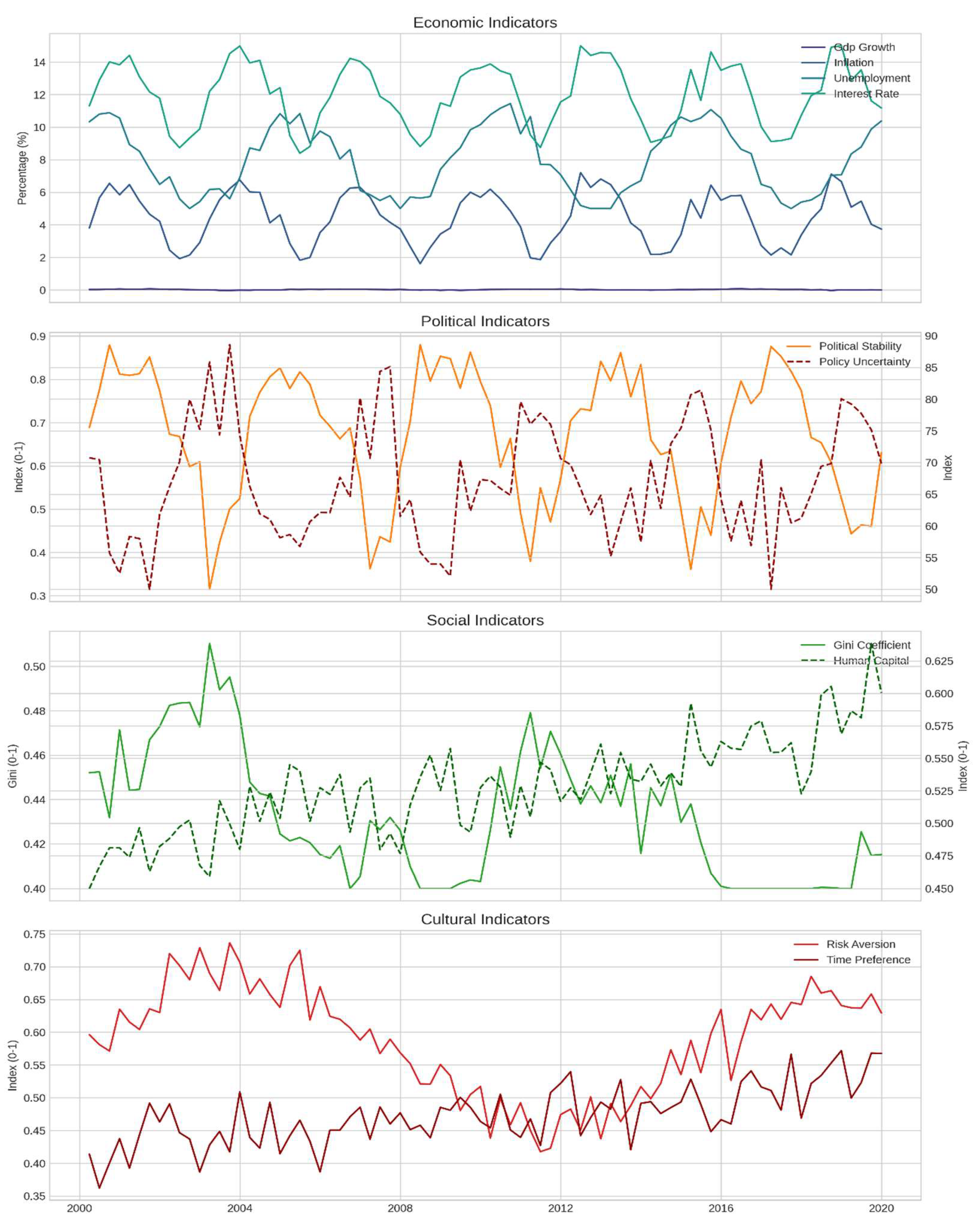
Figure 4.
Presents a comparison of different forecasting models for GDP growth in Brazil. The traditional ARIMA model, which relies solely on past values of GDP growth, achieves a root mean square error (RMSE) of 0.034. The vector autoregression (VAR) model, which incorporates multiple economic variables but excludes political, social, and cultural factors, performs better with an RMSE of 0.013. However, the Random Forest model, which integrates variables from all four dimensions, achieves the best performance with an RMSE of 0.010, representing a 70.6% improvement over ARIMA and a 23.1% improvement over VAR.
Figure 4.
Presents a comparison of different forecasting models for GDP growth in Brazil. The traditional ARIMA model, which relies solely on past values of GDP growth, achieves a root mean square error (RMSE) of 0.034. The vector autoregression (VAR) model, which incorporates multiple economic variables but excludes political, social, and cultural factors, performs better with an RMSE of 0.013. However, the Random Forest model, which integrates variables from all four dimensions, achieves the best performance with an RMSE of 0.010, representing a 70.6% improvement over ARIMA and a 23.1% improvement over VAR.
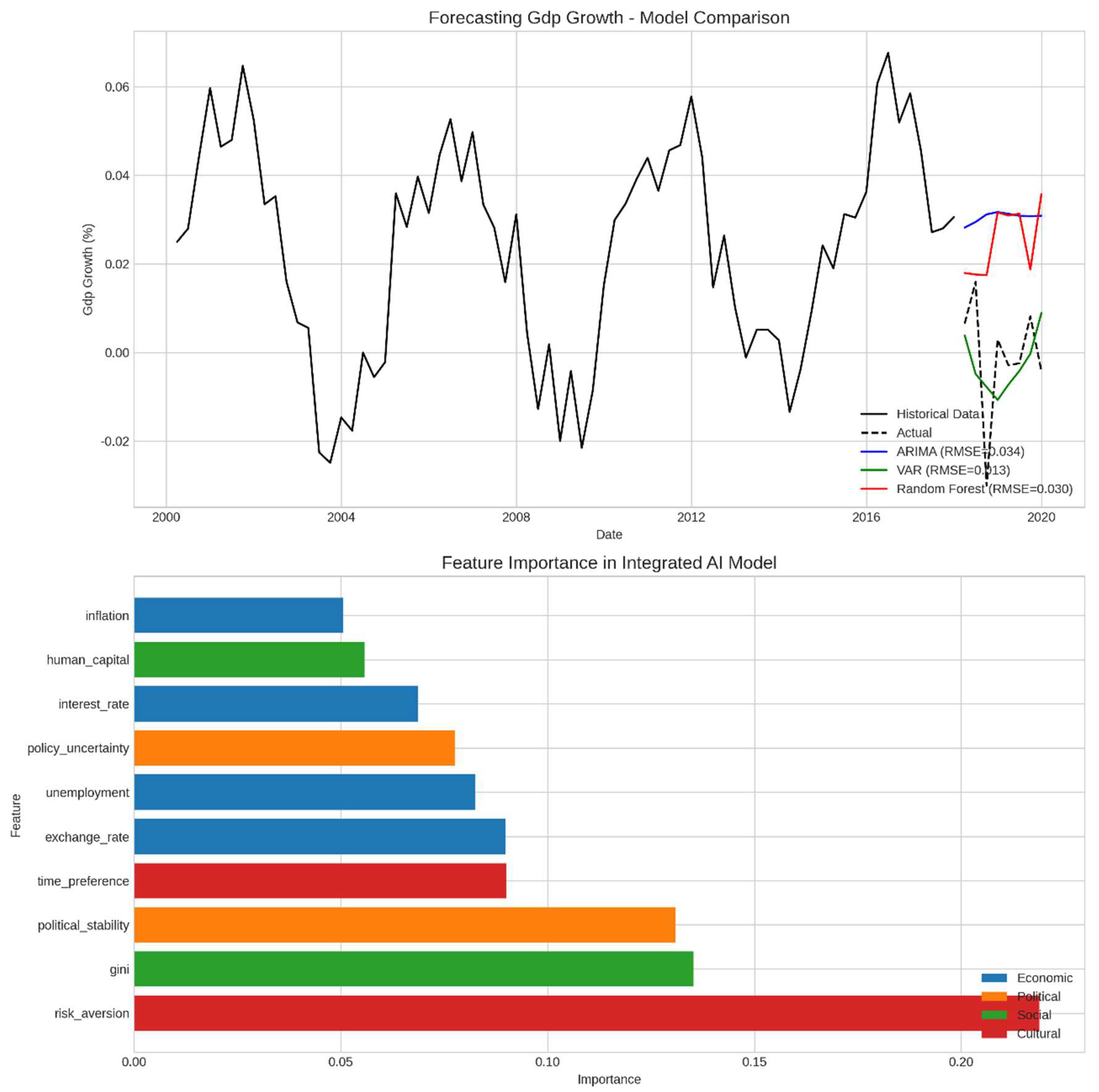
Disclaimer/Publisher’s Note: The statements, opinions and data contained in all publications are solely those of the individual author(s) and contributor(s) and not of MDPI and/or the editor(s). MDPI and/or the editor(s) disclaim responsibility for any injury to people or property resulting from any ideas, methods, instructions or products referred to in the content. |
© 2025 by the authors. Licensee MDPI, Basel, Switzerland. This article is an open access article distributed under the terms and conditions of the Creative Commons Attribution (CC BY) license (http://creativecommons.org/licenses/by/4.0/).
Copyright: This open access article is published under a Creative Commons CC BY 4.0 license, which permit the free download, distribution, and reuse, provided that the author and preprint are cited in any reuse.


