
Submitted:
30 April 2025
Posted:
30 April 2025
You are already at the latest version
Abstract
In reality, there is often information asymmetry between upstream and downstream enterprises in a closed-loop supply chain (CLSC) system, which can have a profound impact on the decisions of member enterprises and the operation of system. Under the condition of asymmetric market demand information of manufacturer, the CSR (Corporate Social Responsibility) input and recycling decision-making problems for CLSC were researched. Four decision-making models of CLSC were constructed for manufacturer and retailer to implement CSR input and recycling respectively, and the impacts of consumer CSR input sensitivity coefficient and demand information asymmetry on operation optimization of CLSC were analyzed. The results show that the increased sensitivity of consumers to CSR input is not only conducive to improving the CSR input level and recycling rate of used products in CLSC, but also benefits manufacturer and retailer to increase profits. In terms of increasing CSR input levels, the manufacturer has the best effect when implementing CSR input and recycling by herself. While, in terms of increasing the recycling rate of used products and market demand, the retailer is more effective when he is responsible for CSR input and the manufacturer is responsible for recycling waste products. Moreover, in contrast to information symmetry, the demand information asymmetry of manufacturer will always lead to a decrease in her own profits, but not necessarily reduce the profits of retailer, and the operation mode that retailer is responsible for CSR input and manufacturer is responsible for recycling used products is more conducive to the overall operation of CLSC system.
Keywords:
closed-loop supply chain
; information asymmetry
; corporate social responsibility
; recycling decisions
1. Introduction
With the general enhancement of people’s awareness of environmental protection, in order to deal with the environmental pollution caused by a large number of waste products, countries in the world have issued laws and regulations on waste product recycling, the environmental directives in the European Union (EU) [1,2] and Japan [3] have been introduced earlier. Other countries, such as the United States, advocate that enterprises actively carry out recycling activities for used and end-of-life products and set up convenient recycling facilities to increase consumer participation in their recycling activities [4]. The Chinese government also issued relevant guidance encouraging local authorities to accelerate the development of the waste recycling industry [5]. In the process of recycling waste products, although the manufacturers currently handle the product recycling labor in the majority of industries, for example, Apple Inc. engages in self-recycling by issuing an announcement of trade-in through its official website, new participants in closed-loop supply chain (CLSC) are beginning to enter the collecting industry. For example, the retailer [6] are also growing more enthusiastic about gathering the waste, Kodak, such as, entrusts the recycling of its disposable cameras to some large retailers and compensates them for the costs incurred in the recycling process through fixed payments.
In recent years, under the influence of government regulations and consumer preferences, more and more enterprises have begun to pay attention to corporate social responsibility (CSR) while pursuing profits. For example, the Guiding Opinions on the Fulfillment of Social Responsibilities by Central Enterprises issued by the Chinese government provides provisions and guidance for the disclosure of CSR by central enterprises, and requires enterprises to publish CSR reports every year since 2012. As a matter of fact, a global poll by Ernst & Young in 2002 revealed that 94% of corporations believed that adopting CSR behavior might have a positive impact on businesses [7]. Meanwhile, in the real operation of enterprises, because the retailers are closer to consumers and have more abundant and accurate sales data, they have a better understanding of the demand market than the manufacturers, so it is easy to cause information asymmetry between the manufacturers and retailers [8]. For example, retailers such as Walmart can obtain more accurate information about demand than manufacturers through rich consumption data.
Based on this, in the case of asymmetric market demand information of manufacturers, it is of great theoretical significance and practical value to discuss CSR input and recycling decision-making of member enterprises of CLSC for promoting environmental protection and sustainable development.
In view of the shortcomings and gaps in the above studies, we focus on the following three questions: First, how does the sensitivity coefficient of consumer CSR input affect the CLSC members and the overall operation? Second, how does the asymmetric demand information of manufacturer affect the profits and recycling strategies of CLSC members? Third, under the asymmetric market demand information of manufacturer, what is the best CSR input and recycling strategy for CLSC?
The following are the primary innovations in our paper:
(1) In the case of asymmetric demand information, the decision-making models in CLSC when both the manufacturer and retailer to carry out CSR input and recycling are constructed, and the influence of different CSR input strategies on the operation of CLSC are analyzed.
(2) The impact mechanism of consumer CSR input sensitivity coefficient and manufacturer demand information asymmetry on the product pricing, waste product recycling rate, CSR input level and performance of CLSC are revealed.
(3) The optimal CSR input and recycling channel selection strategy for CLSC under asymmetric demand information are established.
The remaining sections of our paper are structured as follows: In Part 2, we review the pertinent literature. We introduce the pertinent hypotheses and symbols used of our paper in Part 3. In Part 4, we establish game models and solve the optimal equilibrium results. We analyze the equilibrium results in Part 5. In Part 6, we carry out numerical simulation analysis. We present the key conclusions along with suggestions for additional research in Part 7.
2. Literature Review
The literature closely related to this paper mainly involves three aspects: recycling channel selection in CLSC, CSR behavior in CLSC and supply chain information asymmetry.
2.1. Recycling Channel Selection in CLSC
Recycling channel selection and optimization has always been one of the hot research issues in CLSC, and abundant research results have been obtained. Savaskan et al. [9] discussed the three recycling modes of CLSC earlier and pointed out that for manufacturer, the recycling effect implemented by retailer is better. Huang et al. [10] studied the optimal pricing decisions of retailers and third-parties in competitive recycling of waste products and made a comparative analysis of dual-channel recycling and single-channel recycling. Shi et al. [11] constructed three different recycling remanufacturing modes, analyzed the results of the three modes, and point out that different subjects choose different recycling modes. Feng et al. [12] researched the design and coordination of a reverse supply chain with dual recycling channels, considering consumer behavior, and showed that mixed recycling channels are always better than single recycling channels. Wang et al. [13] studied the recycling channel selection and pricing of manufacturers, and found that the recycling channel selection depends on the recycling cost and the recycling compensation when outsourcing recycling. Yang et al. [14] discussed the conditions under which a manufacturer chooses to have a third-party recycle or a retailer recycle. Wang et al. [15] compared and analyzed the optimal decisions of sales mode and recovery mode in the E-CLSC. Cao et al. [16] studied the optimal recycling strategy for manufacturer under the EPR Regulations. Zhang et al. [17] analyzed the impact of government policies on power battery recycling under different recycling modes. Wan et al. [18] examined the impact of government intervention on CLSC recycling under differential recycling strategies. Huang et al. [19] conducted a comparative analysis by constructing three differential game models-manufacturer recycling, retailer recycling, and third-party recycling, and found that manufacturer-led recycling is the optimal choice. Miao et al. [20] investigated the influence of different sales models on manufacturer’s recycling strategy selection. Their findings indicate that agency sales can effectively mitigate the double marginalization effect within the CLSC and reduce the costs associated with direct manufacturer recycling.
The above literature studied different recycling channel selection strategies in CLSC, and the impact of different recycling channels on the recycling rate and system operation performance, but did not discuss the impact of CSR input on the operation of CLSC.
2.2. CSR Behavior in CLSC
The existing literature on CSR in CLSC can be roughly divided into two categories. One type of research focuses on the issue of CSR behavior awareness, such as, Ni et al. [21] studied how two supply chain members interact in terms of CSR behavior. Panda et al. [22] introduced CSR behavior into CLSC modeling earlier, believed that the recycling of waste products is also the embodiment of CSR fulfillment by enterprises, and pointed out that CSR behavior of enterprises can help improve the overall performance of CLSC. Wang et al. [23] examined how the CSR coefficient, fairness concerns, and government subsidies affect decision-making by contrasting the ideal solutions of CLSC models. Wang et al. [24] investigated the influence of channel power structure on the CLSC, which consists of a CSR-conscious manufacturer, a retailer with sales efforts, and a third-party who takes on the responsibility for collecting used goods. Another type of research focuses on CSR input, Modak et al. [25] believed that CSR is a kind of social donation behavior and introduced the CSR into the two-level supply chain to study the selection and coordination of recycling channels. Modak et al. [26] further studied the selection of optimal recycling channels in the CLSC under the manufacturer’s CSR input, and designed two pricing coordination contracts. In recent years, many scholars have discussed the optimization of CLSC operation considering CSR from the perspective of CSR input. Liu et al. [7] discussed the decision-making and coordination problems of two competing retailers in terms of CSR input and pointed out that the retailer with CSR input will obtain more profits than the retailer without CSR input. Mondal et al. [27] studied the CSR input behavior of retailers and establish the centralized and decentralized decision models according to three different recycling models of waste products, and discussed the influence of retailers’ CSR on the optimal decision. Taking CSR behavior into account, Chen et al. [28] investigated the equilibrium strategies for a dyadic CLSC consisting of one manufacturer, one fairness-concerned retailer and one capital-constrained recycler in the static and dynamic frameworks, respectively. Liu et al. [29] explored the incentive strategies for CSR recyclers outperform, and how the equilibrium is affected by the recyclers’ Stackelberg game. The above literature discusses issues such as CSR behavior awareness and input decision of supply chain from different perspectives, only a few scholars have studied demand information asymmetry, such as, Vosooghidizaji et al. [30] studied the problem of coordinating CSR, in a dyadic supply chain when a supplier and a manufacturer, two independent entities, commit CSR activities while both possess private CSR cost information, bilateral information asymmetry. Wang et al. [31] analyzed the influence of different channel power structures on CLSC under information symmetry and information asymmetry. Yi et al. [32], within the context of a trade-in-based CLSC, integrated financial constraints and CSR into their analytical framework to examine decision-making behaviors under various financing scenarios. However, the recycling decision-making of CLSC with CSR under asymmetric demand information is not discussed in the above literature.
2.3. Supply Chain Information Asymmetry
Research on information asymmetry of supply chain, Ma et al. [33] designed the wholesale price contract under the background of asymmetric CSR effort cost information. Under the asymmetric demand information, Li et al. [34] designed the wholesale price contract without sharing information and the two-part pricing contract with sharing information, and pointed out that the two-part pricing contract can be the dominant choice under certain conditions. Mobini et al. [35] studied how suppliers design the optimal contract when retailers have private information about customer demand and cost parameters. Under the double information asymmetry of manufacturers’ demand information and green impact efforts, Xia et al. [36] designed a menu contract to ensure manufacturers’ profitability and compliance with environmental responsibility. Xu et al. [37] discussed the channel encroachment and carbon reduction strategies of the production enterprise under no information and information asymmetry. Huang et al. [38] investigated the optimal contract design with countervailing incentives under asymmetric selling cost information in a dual-channel supply chain comprising a manufacturer and retailer. Suvadarshini et al. [39] studied the impact of reverse channel competition, individual rationality, and information asymmetry on multi-channel CLSC design. Xie et al. [40] investigated the complexity of decision-making outcomes in e-commerce-based CLSC, focusing on scenarios involving information asymmetry between different supply chain entities. Wang et al. [41] discussed information sharing strategies in a CLSC comprising three echelons and dual channels, and pointed out that the optimal strategy for information sharing by the retailer. Zhao et al. [42] examined the effects of information asymmetry on green advertising strategies for remanufactured products within CLSC, and revealed that, under conditions of information asymmetry, manufacturers with high green advertising return (GAR) efficiency may strategically mimic those with lower GAR efficiency to gain competitive advantage. Zhao et al. [43] also investigated the channel invasion strategies within dual-channel CLSC under conditions of information asymmetry, and indicated that information asymmetry may adversely affect high-type retailers, potentially undermining their competitive position in the CLSC.
The above literature has discussed the issues of supply chain pricing and recycling decision, coordination contract design, under the asymmetric demand information, however, as far as we know, no studies have been found to discuss the CSR input and recycling decision of CLSC under the asymmetric demand information.
The existing literature has made fruitful research in selection and design of recycling channels, CSR behavioral awareness and input in CLSC. However, most previous studies have assumed that channel information between CLSC members is symmetric, ignoring the impact of asymmetric demand information on the decisions of CLSC members and overall. To the best of our knowledge, no research has been found to explore the CSR input and recycling decision problems of CLSC under the asymmetric demand information, as well as the impact mechanism of consumer CSR input sensitivity coefficient and demand information asymmetry on the performance of CLSC system.
3. Problem Description and Assumptions
Taking the CSR operation of the CLSC with electronic products as an example, in January 2020, Gree Electric Appliances donated 2 million yuan of epidemic materials to Jinyintan Hospital with love action, as a direct contact with consumers, retailers often invest in CSR to stimulate consumption. For example, Walmart once held the "Love Food" charity donation activity to fulfill its CSR by actively donating to the society. At the same time, considering the reverse recycling channel structure that the manufacturer and retailer implement waste product recycling respectively, and the asymmetry of manufacturer’s market demand information, the CLSC system in this paper is assumed to consist of one manufacturer and one retailer, in which the manufacturer is in the dominant position and responsible for the production of new products and the remanufacturing of waste products. The retailer is responsible for the sale of new and remanufactured products and has real information about market demand. Under the asymmetric market demand information of the manufacturer, four scenarios are considered: the manufacturer is responsible for CSR input and recycling (MM model), the manufacturer is responsible for CSR input and the retailer recycling (MR Model), the retailer is responsible for CSR input and the manufacturer recycling (RM model), and the retailer is responsible for CSR input and recycling (RR model). The specific CLSC structure is shown in Figure 1.
Other related symbols are described in the Table 1.
Assumption 1.
Assumption 2.
Assume that market capacity is the retailer’s private information and the manufacturer’s forecast market capacity , follows the normal distribution, , can be regarded as an indicator of prediction accuracy, the smaller is, the higher the prediction accuracy will be, the larger is, the lower the prediction accuracy will be (Modak et al. [26]).
Assumption 3.
Assumption 4.
The market demand has a linear relationship with sales price and CSR input level (Liu et al. [7]). The retailer’s known market demand is , while the market demand predicted by the manufacturer is .
4. Model Construction and Solution
4.1. The Manufacturer Is Responsible for the CSR Input and Recycling (MM Model)
In the MM model, the manufacturer is responsible for CSR input, new product production and waste product remanufacturing, and the retailer is responsible for product sales. At this time, the expected profit functions of manufacturer and retailer are as follow
The equilibrium result can be obtained by using backward induction method. See Appendix A for the specific solution and proof process.
Theorem 1.
Under the condition that the manufacturer is responsible for CSR input and recycling, the optimal wholesale price and selling price of new products are respectively , , the optimal CSR input level of manufacturer and the recycling rate of waste products are , , the market demand is , the profits of manufacturer, retailer and overall are , , . Where, , , , , , , , .
4.2. The Manufacturer Is Responsible for CSR Input and the Retailer Recycling (MR Model)
In the MR Model, the manufacturer is responsible for CSR input, production of new products and remanufacturing of used products, while the retailer is responsible for recycling of used products and sales of new products and remanufactured products. At this time, the expected profit functions of manufacturer and retailer are as follow
Where, , , , , , , , .
Similar to the treatment in section 3.1, using backward induction, it is easy to obtain the Hessian matrix of manufacturer’s profit with respect to and as
Under the assumption of the scale parameter , it is known that the Hesson matrix is negative definite. The equilibrium result under the condition that the manufacturer is responsible for CSR input and the retailer recycles can be obtained according to the first-order condition. For specific results, see theorem 2.
Theorem 2.
If the manufacturer is responsible for the CSR input and the retailer recycles, the wholesale price and selling price of new products are respectively , , the manufacturer’s CSR input level is , the retailer’s recycling rate for waste products is , the market demand is . The profits of manufacturer, retailer and system as a whole are respectively , , .
4.3. The Retailer Is Responsible for CSR Input and the Manufacturer Recycling (RM Model)
In the RM model, the retailer is responsible for CSR input, sales of new products and remanufactured products, while the manufacturer is responsible for recycling of used products, production of new products and remanufacturing of used products. At this time, the expected profit functions of manufacturer and retailer are as follow
Where, , , .
Similar to the treatment in section 3.1, using backward induction, it is easy to obtain the Hessian matrix of manufacturer’s profit with respect to and as
Under the assumption of the scale parameter , it is known that the Hesson matrix is negative definite. The equilibrium result under the condition that the retailer is responsible for CSR input and the manufacturer recycles can be obtained according to the first-order condition. For specific results, see theorem 3.
Theorem 3.
In the case that the retailer is responsible for the CSR input and the manufacturer recycles, the wholesale price and selling price of new product are respectively , , the retailer’s CSR input level is , the recycling rate of the manufacturer’s waste products is , the market demand is , the profits of manufacturer, retailer and system as a whole are respectively , , .
4.4. The Retailer Is Responsible for the CSR Input and Recycling (RR Model)
In the RR model, the retailer is responsible for CSR input, waste product recycling and new product sales, while the manufacturer is responsible for new product production and waste product remanufacturing. At this time, the expected profit functions of manufacturer and retailer are as follow
where, , , , , , .
Similar to the treatment in section 3.1, using backward induction, the second derivative of easy manufacturer’s profit with respect to is .
Under the assumption of the scale parameter , it is known that the Hesson matrix is negative definite. Therefore, the equilibrium result under the condition that the retailer is responsible for CSR input and self-recovery can be obtained according to the first-order condition. For specific results, see theorem 4.
Theorem 4.
In the case that the retailer is responsible for CSR input and recycling, the wholesale price and selling price of new product are respectively , , the CSR input level of retailers and the recycling rate of waste products are respectively , , the market demand is , the profits of manufacturer, retailer and system as a whole are respectively , , .
5. Equilibrium Result Analysis
Property 1.
In the CLSC with asymmetric demand information, under the MM model, it satisfies: , , , , , , , .
Property 1 shows that in the CLSC with asymmetric demand information, when the manufacturer is responsible for CSR input and recovers by herself, the manufacturer’s CSR input level, waste product recycling rate, unit product wholesale price and sales price, and market demand are all positively correlated with the sensitivity coefficient of consumers’ CSR input, and the increase of the sensitivity coefficient of consumers’ CSR input is conducive to increase the profits for the manufacturer and retailer.
In fact, the increase in CSR input sensitivity coefficient of consumers not only prompts the manufacturer to increase CSR input level, but also increases wholesale prices, which can make up for the loss caused by CSR input. At the same time, the increase in wholesale prices will also lead retailers to increase sales prices, but it will not offset the positive effect of increasing consumer CSR sensitivity coefficient and CSR input level on market demand. Therefore, market demand will increase, which will improve the profits of the manufacturer and retailer, and enhance the enthusiasm of the manufacturer to recycle waste products and the recycling rate of waste products. Therefore, from the perspective of the government and enterprises, continuous cultivation and guidance of consumers’ CSR input sensitivity is one of the effective means to improve the recycling rate of waste products and achieve environmental protection.
Property 2.
In the CLSC with asymmetric demand information, under the MR model, it satisfies: , , , , , , , .
Property 2 shows that in the CLSC with asymmetric demand information, when the manufacturer is responsible for CSR input and the retailer recycles, the manufacturer’s CSR input level, waste product recycling rate, unit product wholesale price and selling price, market demand, and the profits of the manufacturer and retailer are all positively correlated with the sensitivity coefficient of consumers’ CSR input.
It can be seen from property 2 that with the increase of the CSR input sensitivity coefficient of consumers, the CSR input level of manufacturer, the recycling rate of waste products, the wholesale and selling price of unit product, the market demand, and the profits of the manufacturer and retailer all increase. In fact, the greater the CSR input sensitivity coefficient of consumers, it means that consumers will be more willing to buy the products of CSR enterprises, so enterprises will be motivated to respond to consumers’ purchasing behavior by increasing the level of CSR input, so as to form a good positive cycle. At the same time, the increase in CSR input level of enterprises will also bring corresponding cost expenditure. Therefore, enterprises will increase revenue by appropriately raising product prices on the one hand, and increase the recycling rate of waste products on the other hand to reduce production costs. As prices rise in tandem with demand, both the manufacturer and retailer gain more. Therefore, the increase of consumers’ CSR input sensitivity coefficient can indirectly promote enterprises’ CSR input level, increase the recycling rate of waste products, and improve the overall performance of member enterprises and CLSC system.
Property 3.
In the CLSC with asymmetric demand information, under the RM model, it satisfies: , , , , , , , .
Property 3 shows that in the CLSC with asymmetric demand information, when the retailer is responsible for CSR input and the manufacturer recycles, with the increase of consumers’ CSR input sensitivity coefficient, the retailer’s CSR input level, recycling rate of waste products, selling price and market demand will all increase, while the wholesale price of unit product will decrease, and the profits of the manufacturer and retailer will also increase all of them increase with the increase of the sensitivity coefficient of consumer CSR input.
It can be seen from property 3 that the increase of CSR input sensitivity coefficient of consumers not only promotes the retailer to increase CSR input level, but also increases consumers’ willingness to buy products of enterprises with CSR input behavior. Therefore, while promoting the increase of product selling price, the manufacturers is forced to reduce wholesale price. Therefore, the increase of CSR input sensitivity coefficient of consumers is more conducive to CSR inputs benefit. The increase in sales price will not offset the positive effect on market demand brought by the increase in CSR input level and the increase in consumers’ purchase intention. Therefore, market demand will increase, which will improve the profits of the manufacturer and retailer, and increase the enthusiasm of the manufacturer to recycle waste products and the recycling rate of waste products.
Property 4.
In the CLSC with asymmetric demand information, under the RR model, it satisfies: , , , , , , , .
Property 4 shows that in the CLSC with asymmetric demand information, when the retailer is responsible for CSR input and recycling, with the increase of consumers’ CSR input sensitivity coefficient, the retailer’s CSR input level, recycling rate of waste products, selling price and market demand will all increase, while the wholesale price of unit products will decrease, and the profits of both manufacturer and retailer will be equal. The sensitivity coefficient of CSR input increases with consumers.
It can be seen from property 4 that the situation in which the retailer is responsible for CSR input and recycling is similar to property 3. The increase of consumers’ CSR sensitivity coefficient is beneficial to the improvement of CSR input level, recycling rate of waste products and overall performance of CLSC system.
Property 5.
In the CLSC with asymmetric demand information, under the MM model, it satisfies: , , , , , , . , when , , when .
Property 5 shows that in the CLSC with asymmetric demand information, when the manufacturer is responsible for CSR input and recycling, the market demand will increase with the increase of the certain part of the manufacturer’s forecast market capacity, but the wholesale price, CSR input level, recycling rate of waste products, and selling price will all decrease. With the increase of the determining part of the market capacity of the manufacturer’s forecast, the retailer’s profit increases, and the manufacturer’s profit reaches the maximum when .
As can be seen from property 5, in the case that the manufacturer is responsible for CSR input and recycling, when , the market capacity predicted by the manufacturer is equal to the real market capacity, that is, the manufacturer can accurately predict the real market capacity information market at this time, and the profits of manufacturer, retailer and the overall under the asymmetry of demand information are equal to the profits under the symmetry of market demand information. Therefore, the equilibrium result when can be taken as the equilibrium result under the market demand information symmetry. When , the market demand and the overall profit of the CLSC system under the asymmetric demand information are larger. However, under the asymmetric demand information, the wholesale price, selling price, CSR input level, waste product recycling rate and manufacturer’s profit are all lower. When , the market demand information is asymmetric, the profits of manufacturer and retailer are smaller than that of market demand information is symmetric. However, under the asymmetric demand information, the wholesale price, sales price, CSR input level and waste product recycling rate are higher.
Property 6.
In the CLSC with asymmetric demand information, under the MM model, it satisfies: , , , , , , .
Property 6 shows that in the CLSC with asymmetric demand information, when the manufacturer is responsible for CSR input and the retailer recycles, the market demand and recycling rate of waste products will increase with the increase of the manufacturer’s prediction of market capacity, but the wholesale price, CSR input level and sales price will all decrease. Retailer’s profit rise as manufacturer’s forecast increase the portion of the market that determines capacity. Due to the complexity of the partial derivative analysis of manufacturer’s profit on its market forecast capacity, this paper will further explore in the numerical simulation part.
As can be seen from property 6, in the case that the manufacturer is responsible for CSR input and recycling, when , compared with market demand information symmetry (that is, when ), the overall profit of market demand and CLSC system under asymmetric demand information is larger. However, under the asymmetric demand information, the wholesale price, sales price, CSR input level and waste product recycling rate are all lower. When , compared with market demand information symmetry (that is, when ), the overall profit of market demand and CLSC system under asymmetric demand information is lower. However, under the asymmetric demand information, the wholesale price, sales price, CSR input level and waste product recycling rate are all higher.
Property 7.
In the CLSC with asymmetric demand information, under the RM model, it satisfies: , , , , , , . , when , , when .
Property 7 shows that when the manufacturer’s demand information is asymmetric, the market demand and CSR input level will increase with the increase of the certain part of the manufacturer’s forecast market capacity, but the wholesale price, waste product recycling rate and selling price will all decrease. With the increase of the determining part of the market capacity of the manufacturer’s forecast, the retailer’s profit increases, and when , the manufacturer’s profit reaches the maximum.
It can be seen from property 7 that the retailer is responsible for CSR input and the manufacturer recycles similar to Property 5. The asymmetric demand information of the manufacturer will reduce her own profit. When the market forecast capacity of manufacturer is higher than the real market capacity, it is conducive to increasing the profit of retailer. On the contrary, it will reduce the profit of retailer.
Property 8.
In the CLSC with asymmetric demand information, under the RR model, it satisfies: , , , , , , .
Property 8 shows that in the CLSC with asymmetric demand information, when the retailer is responsible for CSR input and recycling, the market demand, CSR input level and waste product recycling rate will increase with the increase of the manufacturer’s market forecast capacity, but the wholesale price and selling price will decrease. As the manufacturer increase the capacity determination part of the market forecast, the retailer’s profit increase. Due to the complexity of the partial derivative analysis of manufacturer’s profit on its market forecast capacity, this paper will further explore it in the numerical simulation part.
It can be seen from property 8 that the situation in which the retailer is responsible for CSR input and recycling is similar to property 6. Compared with the case of information symmetry, when the manufacturer’s predicted market capacity is higher than the true market capacity, the CSR input level, waste product recycling rate, market capacity and the overall performance of CLSC system are all greater.
It can be seen from property 5-property8 that the retailer’s profit increases with the increase, and when , the retailer’s profit at this time is just equal to the profit under the symmetry of market demand information. Therefore, , , it can be concluded that when the market forecast capacity of the manufacturer is higher than the real market capacity, it is conducive to increasing the retailer’s profit, and vice versa. That is, when the manufacturer’s market forecast capacity is higher than the real market capacity, it is conducive to increasing the retailer’s profit, and vice versa.
Proposition 1.
In the CLSC with asymmetric demand information, under four different situations, it satisfies: , .
Proposition 1 shows that the level of CSR input is highest when the manufacturer is responsible for CSR input and recycling, and the level of CSR input is lowest when the retailer is responsible for CSR input and recycling. When the retailer is responsible for CSR input and the manufacturer recycles, the recycling rate of used products is the highest, and when the manufacturer is responsible for CSR input and the retailer recycles, the recycling rate of used products is the lowest.
The above research conclusions reveal that regardless of whether the manufacturer or the retailer is responsible for CSR input, the recycling rate of the manufacturer is higher when the manufacturer is responsible for the recycling of waste products, which is because the asymmetric information demand of the manufacturer leads to its lower profit in the forward supply chain, and the manufacturer has stronger motivation to increase the enthusiasm of recycling waste products, which is obviously conducive to its own recycling and remanufacturing of waste products Get more profit. Therefore, in the CLSC with asymmetric demand information of manufacturer, the operation mode that the manufacturer is responsible for the recycling of waste products is more effective. Based on information symmetry and without considering CSR input of enterprises, (Savaskan et al. [9] and Hong et al. [45]) compared the difference in recycling effect between manufacturer recycling and retailer recycling in CLSC, and pointed out that retailer recycling mode is better than manufacturer recycling mode. However, in the case of asymmetric demand information and CSR input of the manufacturer or the retailer, the research shows that compared with the retailer recycling mode, the recycling effect of waste products is better when the manufacturer is responsible for recycling herself. This also indicates that the asymmetry of demand information and the difference of CSR input mode are one of the important factors affecting the selection of recycling channels in CLSC.
Proposition 2.
In the CLSC with asymmetric demand information, under four different situations, it satisfies: .
Proposition 2 shows that the market demand is greatest when the retailer is responsible for CSR input and the manufacturer recycles, while the market demand is minimum when the manufacturer is responsible for CSR input and the retailer recycles. Regardless of whether the manufacturer or the retailer is responsible for CSR input, the market demand is greater when the manufacturer recycles the used products. In the manufacturer-led CLSC, CSR input by channel follower is more conducive to increasing market demand.
6. Numerical Simulation Analysis
This section will analyze and verify the above properties and propositions through numerical simulation, and reveal the influence of consumer CSR input sensitivity coefficient on the optimal decision and profit of each member of the CLSC.
On the premise that the relevant parameter assumptions in this paper are satisfied, the values of the relevant parameters are assumed to be , , , , , , , (Liu et al. [7]). According to the relevant research results of this paper, the specific simulation results are shown in Figure 2, Figure 3, Figure 4, Figure 5, Figure 6, Figure 7, Figure 8, Figure 9 and Figure 10.
As can be seen from Figure 2, under the four different situations, the CSR input level increases with the increase of consumers’ CSR sensitivity coefficient, and meets . Since the highest product selling price that consumers are willing to pay is related to the sensitivity coefficient of CSR input and the level of CSR input is increasing, both the manufacturer and retailer have stronger motivation to increase the level of CSR input to increase his own profit, which also verifies the relevant conclusions of proposition 1. Counterintuitively, it can be seen from Figure 3 and Figure 4 that the recycling rate of waste products by the manufacturer is higher than that by the retailer. In the case of information symmetry, many previous studies have pointed out that "because retailers are closer to consumers than manufacturers, it is better for manufacturers to be responsible for recycling by retailers", while this paper shows that the demand information of the manufacturer is incorrect. In this case, whether the manufacturer or the retailer is responsible for CSR input, the recycling effect by the manufacturer is better, which also validates the relevant conclusions of proposition 1.
For , without analytical solution comparative analysis, add a set of data with and draw Figure 6 and Figure 8. By adding a set of data for comparison, it can be found that the change of does not change the trend of graph change and the relative size relationship. From Figure 5 and Figure 6, it’s clear that , and with the increase of consumers’ CSR input sensitivity coefficient, CSR input by the manufacturer is conducive to increasing wholesale prices, thus making up for the losses caused by CSR input. On the contrary, when the retailer makes CSR inputs, the manufacturer will reduce wholesale prices to make up for the losses caused by retailer’s CSR input. This also confirms the relevant conclusion of property 3. As can be seen from Figure 7 and Figure 8, , and with the increase of consumers’ CSR sensitivity coefficient, the sales price of new products will increase in four different situations. However, when the retailer is responsible for CSR input, the sales price will increase faster, because when the retailer is responsible for CSR input, they will increase the sales price to offset the loss caused by CSR input, while when the manufacturer is responsible for CSR input, the manufacturer will increase the sales price. The loss caused by CSR input will be offset by increasing wholesale prices, which will lead the retailer to increase the selling prices of products. As can be seen from Figure 9, , and the increase of CSR input sensitivity coefficient of consumers is conducive to increasing market demand. This is because with the increase of CSR input sensitivity coefficient of consumers, both the manufacturer and retailer choose to maximize his profit by increasing CSR input level, and at the same time, the increase of CSR input level will stimulate market demand.
Corollary 1.
For , without analytical solution comparative analysis, add a set of data with and draw Figure 11 and Figure 13. As can be seen from Figure 10 and Figure 11, the recycling of waste products by the manufacturer is more conducive to maximizing her own profit, and in the four different cases, the increase of consumers’ CSR input sensitivity coefficient is conducive to the manufacturer obtaining higher profit. As can be seen from Figure 12 and Figure 13, , and in any case, the increase of consumers’ CSR input sensitivity coefficient is conducive to the retailer to obtain greater profit. It can be further seen from Figure 10, Figure 11, Figure 12 and Figure 13 that when the retailer is responsible for the CSR input and the manufacturer recycles, it is more conducive to realizing the overall profit of the CLSC system. This also indicates that under the asymmetric manufacturer information, the manufacturer’s responsibility for recycling waste products is not only conducive to improving the recycling rate of waste products, but also conducive to increasing the overall performance of the CLSC. The channel follower’s responsibility for CSR input is conducive to increasing the market demand and the overall performance of CLSC. This also reveals that the asymmetry of the manufacturer demand information has a certain impact on the recycling channel, but has a low impact on the selection of CSR input members.
As can be seen from property 5, property 7 and Figure 14, when the market capacity predicted by the manufacturer is equal to the real market capacity (that is, when the market demand information is symmetric), the manufacturer’s profit reaches the maximum. Therefore, when the market capacity predicted by the manufacturer is not equal to the real market capacity, the manufacturer’s profit is lower than the manufacturer’s profit under the information symmetry, so it is compared with the information symmetry. The asymmetric demand information of the manufacturer will lead to the reduction of her own profit. This also indicates that timely and accurate market demand information is particularly critical for the manufacturer. Manufacturers should constantly strengthen cooperation with retailers to improve the ability to obtain market demand information, which will help improve their own performance and maintain the stable operation of CLSC.
7. Conclusions
In the case of asymmetric market demand information of the manufacturer, this paper constructs four CLSC decision models for CSR input and recycling decision-making of a CLSC consisting of a dominant manufacturer and a retailer, and analyzes the impact of consumer CSR input sensitivity coefficient and asymmetric demand information on the optimization of CLSC, and draws the following conclusions: (1) Regardless of the combination strategy of CSR input and recycling channel, the increase of consumers’ CSR input sensitivity coefficient is conducive to improving the CSR input level and market demand of CLSC, and improving the profits of manufacturer and retailer. (2) The level of CSR input is the highest when the manufacturer is responsible for CSR input and recycles, and the market demand is the highest when the retailer is responsible for CSR input and the manufacturer recycles. (3) It is counterintuitive that the recycling rate of waste products is higher when the manufacturer is responsible for the recycling of waste products, and the asymmetry of manufacturer’s market demand information leads her to be more inclined to recycle herself, rather than entrust to retailers for recycling. (4) When the retailer is responsible for the CSR input and the manufacturer recycles, the profit of both the manufacturer and the retailer is the highest. Therefore, for the CLSC as a whole, it is best to choose the operation mode that the retailer is responsible for CSR input and the manufacturer recycles. (5) Compared with the case of information symmetry, the asymmetric demand information of the manufacturer will lead to the reduction of her own profit. When the manufacturer’s market forecast capacity is higher than the real market capacity, it is beneficial to increase the retailer’s profit, and vice versa.
Based on the above research conclusions, this paper draws the following management implications: First, in terms of the optimization of CLSC system operation, enterprises need to improve the overall performance of the CLSC by establishing a good CSR reputation and enhancing consumers’ CSR input sensitivity. Secondly, from the perspective of government regulation, the government can encourage member enterprises of the CLSC to actively fulfill CSR and participate in the recycling of waste products by formulating relevant policies, so as to achieve the purpose of increasing social welfare and protecting the environment. Finally, manufacturers should continue to strengthen cooperation with retailers, improve the ability to obtain market demand information, in order to obtain real market demand information, which is beneficial to improve their own performance and maintain the stable operation of CLSC.
Since the research in this paper only involves the CLSC system with single sales and recycling channels under the asymmetric market demand information of manufacturers, the future can further explore the CSR input and recycling decision-making of CLSC with double sales and recycling channels under the asymmetric information.
Author Contributions
Conceptualization, Minghui Ni, Wenbo Bo and Fengmin Yao; Data curation, Wenbo Bo; Formal analysis, Xudong Qin; Funding acquisition, Fengmin Yao; Investigation, Minghui Ni; Methodology, Wenbo Bo; Project administration, Minghui Ni, Wenbo Bo and Fengmin Yao; Resources, Wenbo Bo and Fengmin Yao; Software, Xudong Qin; Supervision, Fengmin Yao; Validation, Minghui Ni, Wenbo Bo, Xudong Qin and Fengmin Yao; Visualization, Xudong Qin; Writing – original draft, Minghui Ni, Wenbo Bo and Fengmin Yao; Writing – review & editing, Minghui Ni, Wenbo Bo and Fengmin Yao.
Funding
This research was supported from the Heilongjiang Provincial Natural Science Foundation of China (No. LH2023G016).
Data Availability Statement
Data sharing is not applicable to this article as no datasets were generated or analyzed during the current study.
Acknowledgments
The authors appreciate the valuable comments and constructive suggestions of the reviewers. These comments and suggestions were very useful in the improvement of the presentation of this paper.
Conflicts of Interest
The authors declare that there are no conflicts of interest regarding the publication of this study.
Appendix A
Proof of Theorem 1:
It can be seen from equation (2) that it is a concave function with respect to . According to the first order condition, the best feedback function of the retailer is , since the manufacturer does not know the true value of , therefore, the manufacturer can only substitute the predicted value into formula (1), it is easy to know the Hessian matrix of with respect to is . Under the assumption of scale parameter , , , , so the Hesse matrix is negative definite. According to backward induction, the equilibrium results under MM model can be obtained.
Proof of Theorem2:
The Hessian matrix of retailer profit with respect to is easily obtained from formula (4) as . With the proof of theorem 1, it is easy to obtain the Hessian matrix of manufacturer’s profit with respect to as
.
Under the assumption of scale parameter , , , so the Hessian matrix is negative definite. According to backward induction, the equilibrium result under MR Model can be obtained.
The proof process of theorem 3 and theorem 4 is similar to theorem 1 and theorem 2, which are omitted here.
Proof of Property 1:
According to theorem 1, we can easily find
, , , , .
Proof of Property 2:
According to theorem 2, it’s easy to get
,
,
,
,
.
The proof of properties 3 and 4 is similar to the proof of properties 1 and 2, and is also omitted here.
Proof of Property 5:
According to theorem 1, we can easily find
, , , , , , .
Proof of Proposition 1:
Theorem 1–Theorem 4, we can easily find
,
,
,
,
.
References
- Official Journal of the European Union. Directive 2006/12/EC of the European Parliament and of the Council of 5 April 2006 on waste. Available online: http://data.europa.eu/eli/dir/1975/442/2006-05-17 (accessed on 20 April 2006).
- Official Journal of the European Union. Directive 2008/98/EC of the European Parliament and of the Council of 19 November 2008 on waste and repealing certain Directives. Available online: http://data.europa.eu/eli/dir/2008/98/oj (accessed on 20 November 2008).
- Ministry of the Environment, Government of Japan. Waste & Recycling. Available online: https://www.env.go.jp/en/laws/recycle/index.html (accessed on 30 December 2007).
- Global Mayor Magazine. U.S. establishes convenient e-waste recycling system. Available online: http://www.globalmayor.org/magazine-detail.aspx?id=375&classcode=007008 (accessed on 30 January 2015).
- Yu, S.H. China’s recycling volume will reach 350 million tons of renewable resources in 2020. Available online: https://www.gov.cn/xinwen/2017-01/26/content_5163750.htm (accessed on 30 January 2017).
- Xiong, Y.; Zhao, Q.; Zhou, Y. Manufacturer-remanufacturing vs supplier-remanufacturing in a closed-loop supply chain. Int. J. Prod. Econ. 2016, 176, 21–28. [Google Scholar] [CrossRef]
- Liu, S.; Yao, F.; Chen, D. CSR investment decision and coordination strategy for closed-loop supply chain with two competing retailers. J. Clean. Prod. 2021, 310, 127378. [Google Scholar] [CrossRef]
- Li, L.; Zhang, H.T. Confidentiality and information sharing in supply chain coordination. Manage. Sci. 2008, 54, 1467–1481. [Google Scholar] [CrossRef]
- Savaskan, R.C.; Bhattacharya, S.; Van Wassenhove, L.N. Closed-loop supply chain models with product remanufacturing. Manage. Sci. 2004, 50, 239–252. [Google Scholar] [CrossRef]
- Huang, M.; Song, M.; Lee, L.H.; Ching, W.K. Analysis for strategy of closed-loop supply chain with dual recycling channel. Int. J. Prod. Econ. 2013, 144, 510–520. [Google Scholar] [CrossRef]
- Shi, Y.; Nie, J.; Qu, T.; Chu, L.-K.; Sculli, D. Choosing reverse channels under collection responsibility sharing in a closed-loop supply chain with re-manufacturing. J. Intell. Manuf. 2015, 26, 387–402. [Google Scholar] [CrossRef]
- Feng, L.P.; Govindan, K.; Li, C.F. Strategic planning: Design and coordination for dual-recycling channel reverse supply chain considering consumer behavior. Eur. J. Oper. Res. 2017, 260, 601–612. [Google Scholar] [CrossRef]
- Wang, N.M.; He, Q.D.; Jiang, B. Hybrid closed-loop supply chains with competition in recycling and product markets. Int. J. Prod. Econ. 2019, 217, 246–258. [Google Scholar] [CrossRef]
- Yang, L.; Hu, Y.; Huang, L. Collecting mode selection in a remanufacturing supply chain under cap-and-trade regulation. Eur. J. Oper. Res. 2020, 287, 480–496. [Google Scholar] [CrossRef]
- Wang, Y.; Yu, Z.; Shen, L.; Jin, M. Operational modes of e-closed loop supply chain considering platforms’ services. Int. J. Prod. Econ. 2022, 251, 108551. [Google Scholar] [CrossRef]
- Cao, J.; Gong, X.; Lu, J.; Bian, Z. Optimal Manufacturer Recycling Strategy under EPR Regulations. Processes, 2023, 11, 166. [Google Scholar] [CrossRef]
- Zhang, M.; Wu, W.; Song, Y. Study on the impact of government policies on power battery recycling under different recycling models. J. Clean. Prod. 2023, 413, 137492. [Google Scholar] [CrossRef]
- Wan, Y.; Yang, L. Differential recycling strategies and government intervention in a closed-loop supply chain. Comput. Ind. Eng. 2024, 187, 109816. [Google Scholar] [CrossRef]
- Huang, Z.S.; Zhao, Y.X.; Cheng, T.C.E.; et al. Reverse channel selection in a dynamic stochastic closed-loop supply chain. Transport. Res. E-log. 2024, 192, 103774. [Google Scholar] [CrossRef]
- Miao, Z.W.; Peng, H.M.; Lan, Y.Q. The role of online platform selling mode in recycling channel selection: A game-theoretic analysis of profit and environmental impact. Int. J. Prod. Econ. 2025, 280, 109471. [Google Scholar] [CrossRef]
- Ni, D. B.; Li, K.W. A game-theoretic analysis of social responsibility conduct in two-echelon supply chains. Int. J. Prod. Econ. 2012, 138, 303–313. [Google Scholar] [CrossRef]
- Panda, S.; Modak, N.M.; CÁRDENAS-BARRÓNC L, E. Coordinating a socially responsible closed-loop supply chain with product recycling. Int. J. Prod. Econ. 2017, 188, 11–21. [Google Scholar] [CrossRef]
- Wang, Y.; Su, M.; Shen, L.; et al. Decision-making of closed-loop supply chain under corporate social responsibility and fairness concerns. J. Clean. Prod. 2021, 284, 125373. [Google Scholar] [CrossRef]
- Wang, Q.; Chen, K.; Wang, S.; et al. Channel structures and information value in a closed-loop supply chain with corporate social responsibility based on the third-party collection. Appl. Math. Model. 2022, 106, 482–506. [Google Scholar] [CrossRef]
- Modak, N.M.; Panda, S.; Sana, S.S.; et al. Corporate social responsibility, coordination and profit distribution in a dual-channel supply chain. Pac. Sci. Rev. 2014, 16, 235–249. [Google Scholar] [CrossRef]
- Modak, N.M.; Kazemi, N.; CÁRDENAS-BARRÓNC L, E. Investigating structure of a two-echelon closed-loop supply chain using social work donation as a corporate social responsibility practice. Int. J. Prod. Econ. 2019, 207, 19–33. [Google Scholar] [CrossRef]
- Mondal, C.; Giri, B. C.; Biswas, S. Integrating corporate social responsibility in a closed-loop supply chain under government subsidy and used products collection strategies. Flex. Serv. Manuf. J. 2022, 34, 65–100. [Google Scholar] [CrossRef]
- Chen, J.; Hou, R.; Xiao, L.; et al. Dynamic corporate social responsibility adjustment strategies of a closed-loop supply chain with fairness concerns and supply chain financing. Chaos. Solliton. Fract. 2023, 168, 113158. [Google Scholar] [CrossRef]
- Liu, Q.; Zhu, X. Incentive strategies for retired power battery closed-loop supply chain considering corporate social responsibility. Environ. Dev. Sustain. 2024, 26, 19013–19050. [Google Scholar] [CrossRef]
- Vosooghidizaji, M.; Taghipour, A.; Canel-Depitre, B. Coordinating corporate social responsibility in a two-level supply chain under bilateral information asymmetry. J. Clean. Prod. 2022, 364, 132627. [Google Scholar] [CrossRef]
- Wang, Q.; Chen, K.; Wang, S.; et al. Channel structures and information value in a closed-loop supply chain with corporate social responsibility based on the third-party collection. Appl. Math. Model. 2022, 106, 482–506. [Google Scholar] [CrossRef]
- Yi, Y.X.; He, X.W.; Li, Y.Q.; et al. Decision-making in a green trade-ins closed-loop supply chain under financial constraints and corporate social responsibility (CSR). Comput. Ind. Eng. 2024, 197, 110626. [Google Scholar] [CrossRef]
- Ma, P.; Shang, J.; Wang, H.Y. Enhancing corporate social responsibility: Contract design under information asymmetry. Omega, 2017, 67, 19–30. [Google Scholar] [CrossRef]
- Li, X. J.; Chen, J.; Ai, X.Z. Contract design in a cross-sales supply chain with demand information asymmetry. Eur. J. Oper. Res. 2018, 275, 939–956. [Google Scholar] [CrossRef]
- Mobini, Z.; Heuvel, W.V.D.; Wagelmans, A. Designing multi-period supply contracts in a two-echelon supply chain with asymmetric information. Eur. J. Oper. Res. 2019, 277, 542–560. [Google Scholar] [CrossRef]
- Xia, J.; Niu, W.J. Carbon-reducing contract design for a supply chain with environmental responsibility under asymmetric information. Omega 2020, 102, 102390. [Google Scholar] [CrossRef]
- Xu, W.; Xu, H. Channel encroachment and carbon reduction with demand information asymmetry. J. Clean. Prod. 2022, 371, 133443. [Google Scholar] [CrossRef]
- Huang, S.; Wang, Y.; Zhang, X. Contracting with countervailing incentives under asymmetric cost information in a dual-channel supply chain. Transport. Res. E-log. 2023, 171, 103038. [Google Scholar] [CrossRef]
- Suvadarshini, P.; Biswas, I.; Srivastava, S.K. Impact of reverse channel competition, individual rationality, and information asymmetry on multi-channel closed-loop supply chain design. Int. J. Prod. Econ. 2023, 259, 108818. [Google Scholar] [CrossRef]
- Xie, F.J.; Wen, L.Y.; Cui, W.T.; et al. Complexity analysis and control of output competition in a closed-loop supply chain of cross-border e-commerce under different logistics modes considering Chain-to-Chain information asymmetry. Entropy, 2024, 26, 1073. [Google Scholar] [CrossRef] [PubMed]
- Wang, T.Y.; Chen, Z.S.; Wang, X.J.; et al. Strategic information sharing in the dual-channel closed loop supply chain with nonlinear production cost. Inform. Sciences, 2024, 657, 119944. [Google Scholar] [CrossRef]
- Zhao, S.L.; Wang, M.X.; Zhu, Q.; et al. Effects of information asymmetry on green advertising for remanufacturing within a closed-loop supply chain. Transport. Res. E-log. 2024, 188, 103618. [Google Scholar] [CrossRef]
- Zhao, S.L.; Wang, M.X.; Zhou, Q.; et al. Managing manufacturer encroachment and product conflicts in a closed-loop supply chain: The case of information asymmetry. Omega, 2025, 132, 103236. [Google Scholar] [CrossRef]
- Choi, T. M.; Li, Y.; Xu, L. Channel leadership, performance and coordination in closed loop supply chains. Int. J. Prod. Econ. 2013, 146, 371–380. [Google Scholar] [CrossRef]
- Hong, X.P.; Zhang, H.G.; Zhong, Q.; et al. Optimal decisions of a hybrid manufacturing-remanufacturing system within a closed-loop supply chain. Eur. J. Ind. Eng. 2016, 10, 21–50. [Google Scholar] [CrossRef]
Figure 1.
CLSC structure with different CSR input and recycling modes.
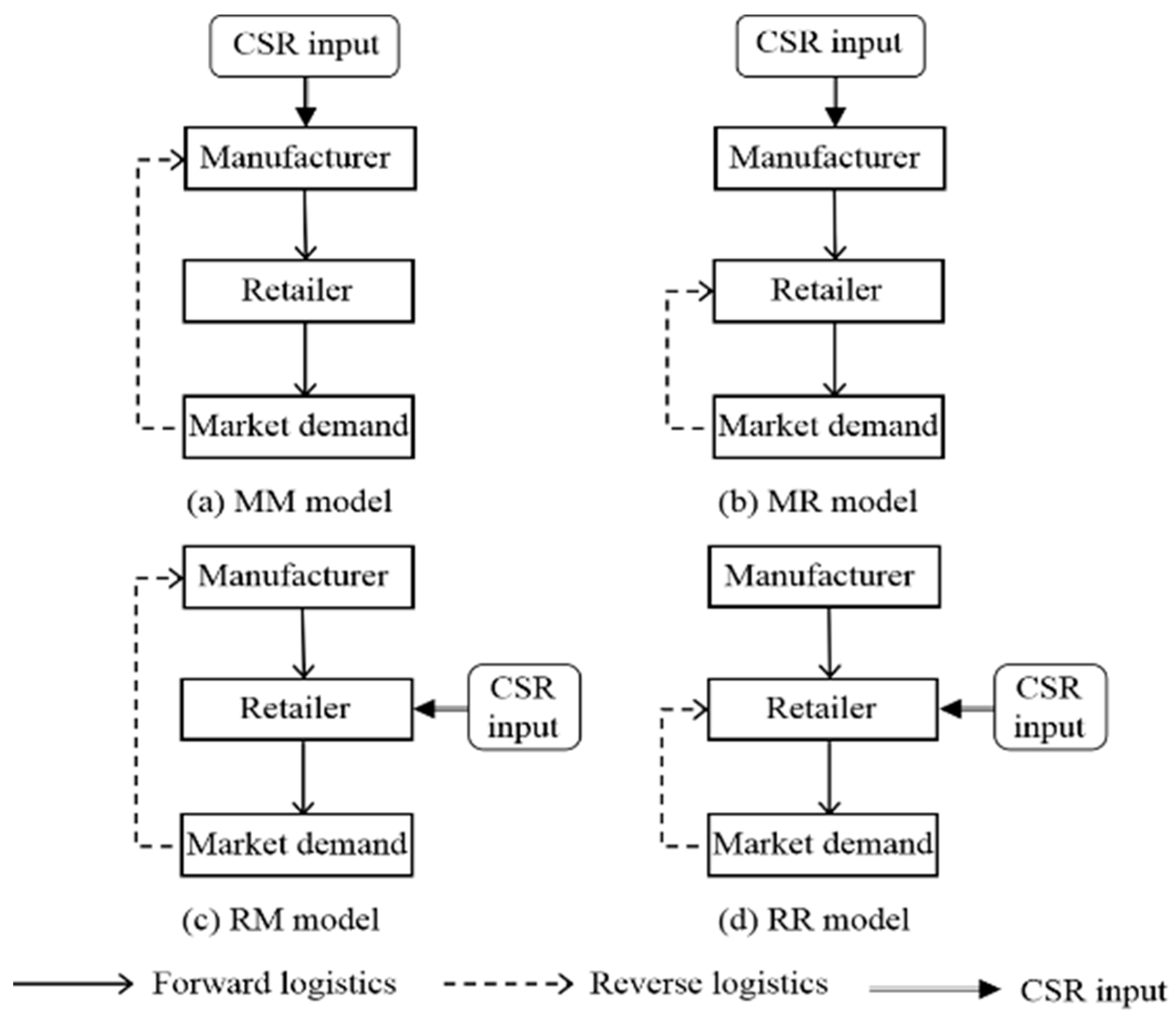
Figure 2.
Influence of consumer CSR input sensitivity coefficient on CSR input level.
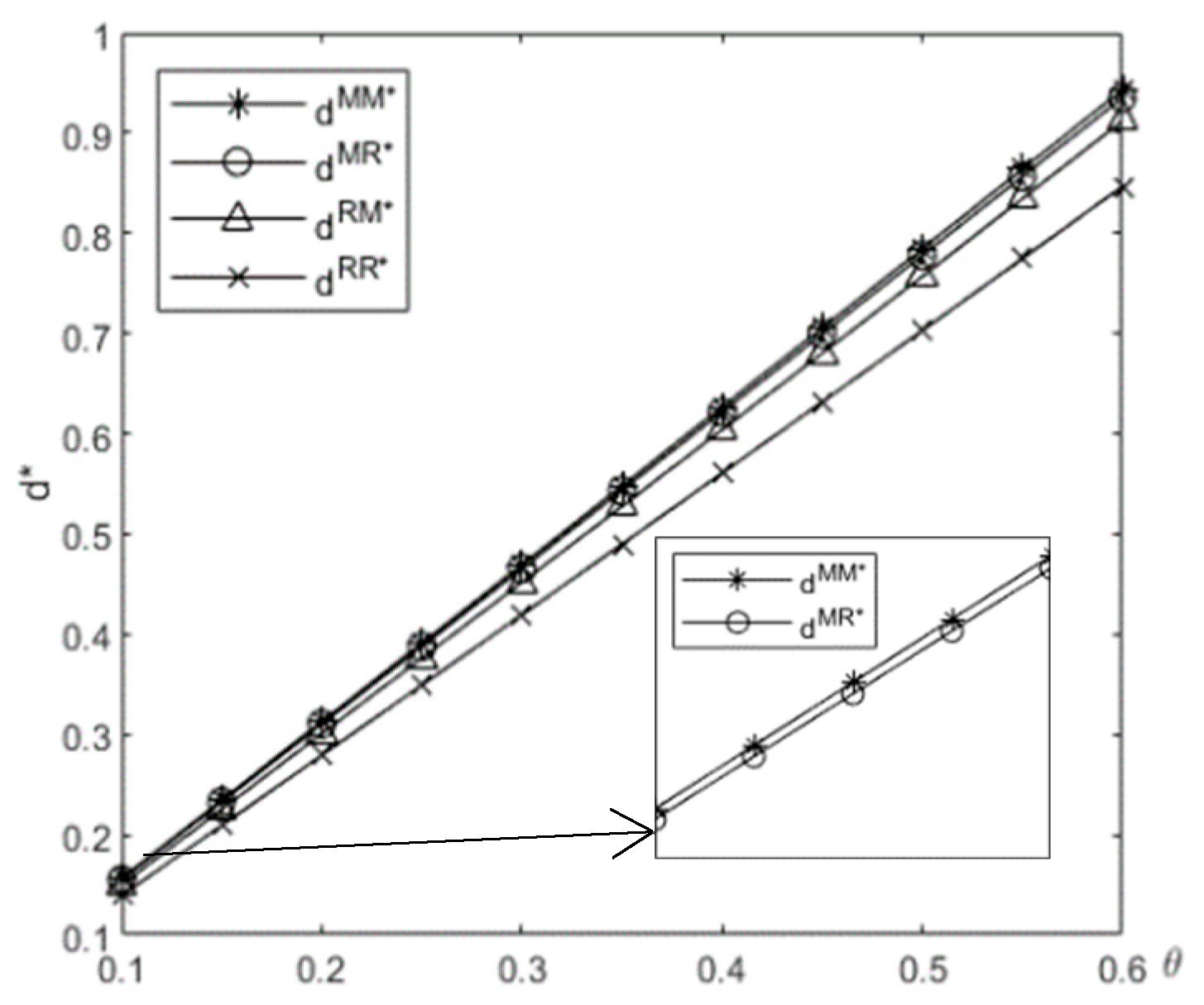
Figure 3.
Recycling rate of waste products when manufacturer is responsible for recycling.
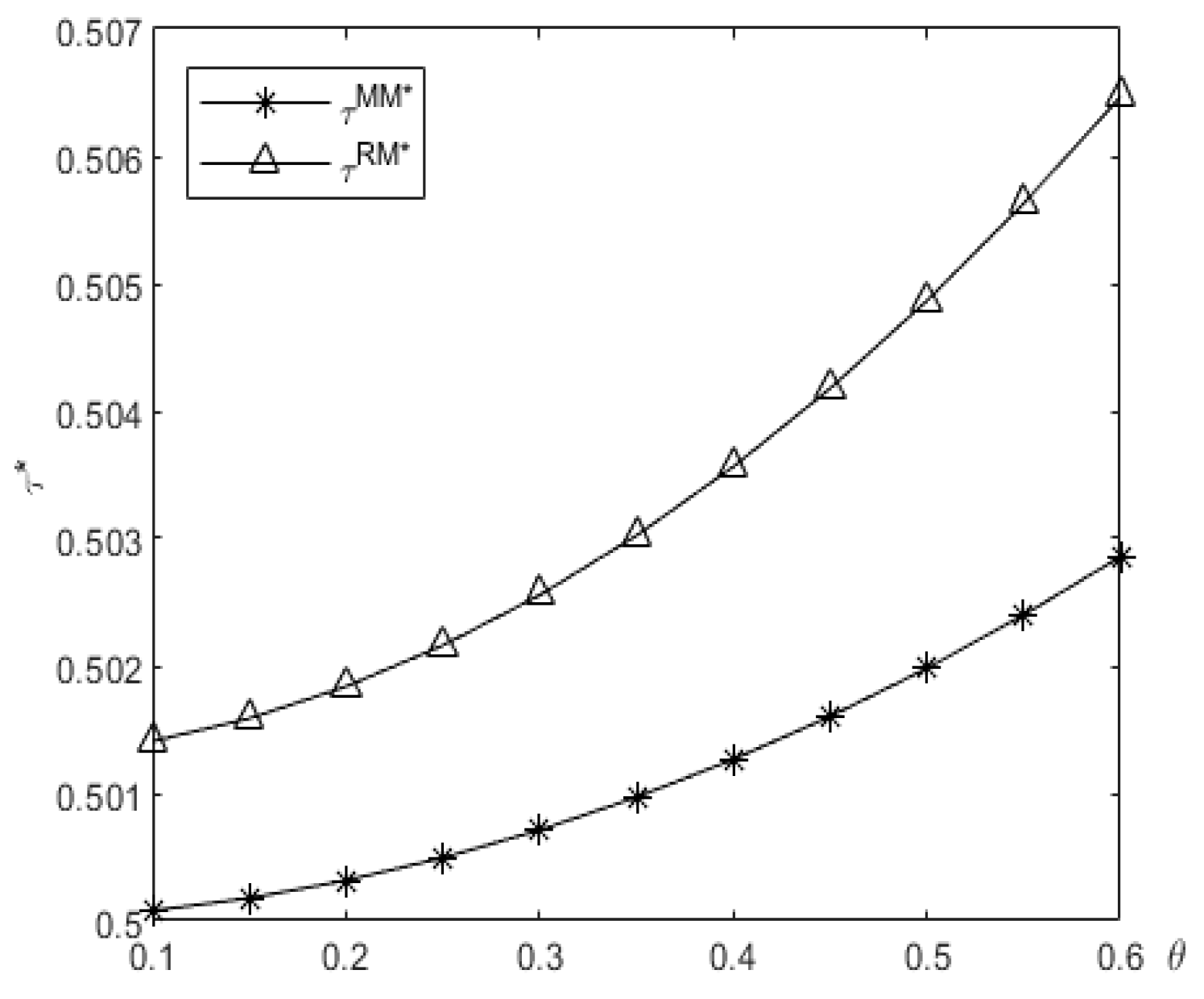
Figure 4.
Recycling rate of waste products when the retailer is responsible for recycling.

Figure 5.
Influence of consumer CSR input sensitivity coefficient on wholesale price.
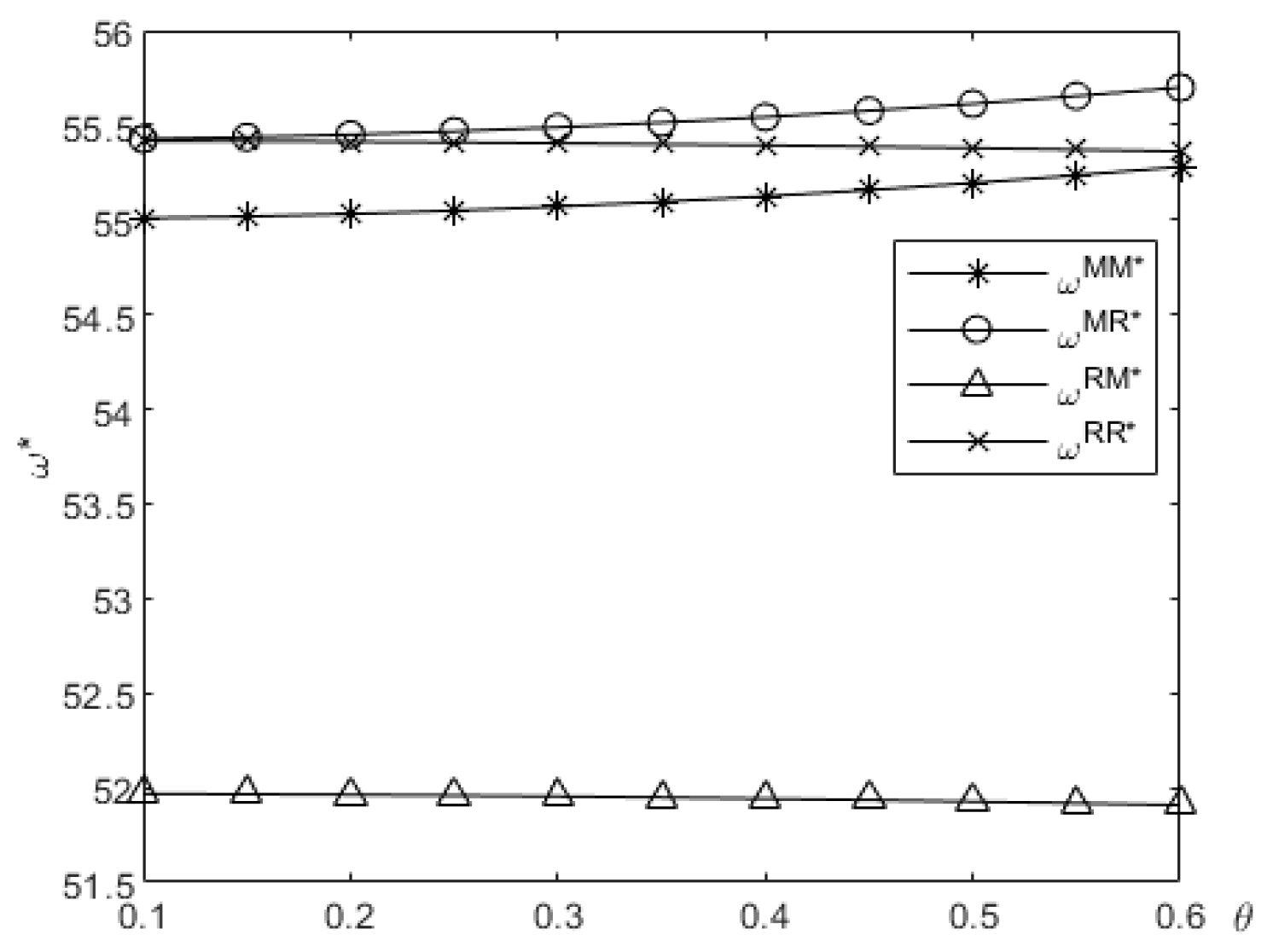
Figure 6.
Influence of consumer CSR input sensitivity coefficient on wholesale price.
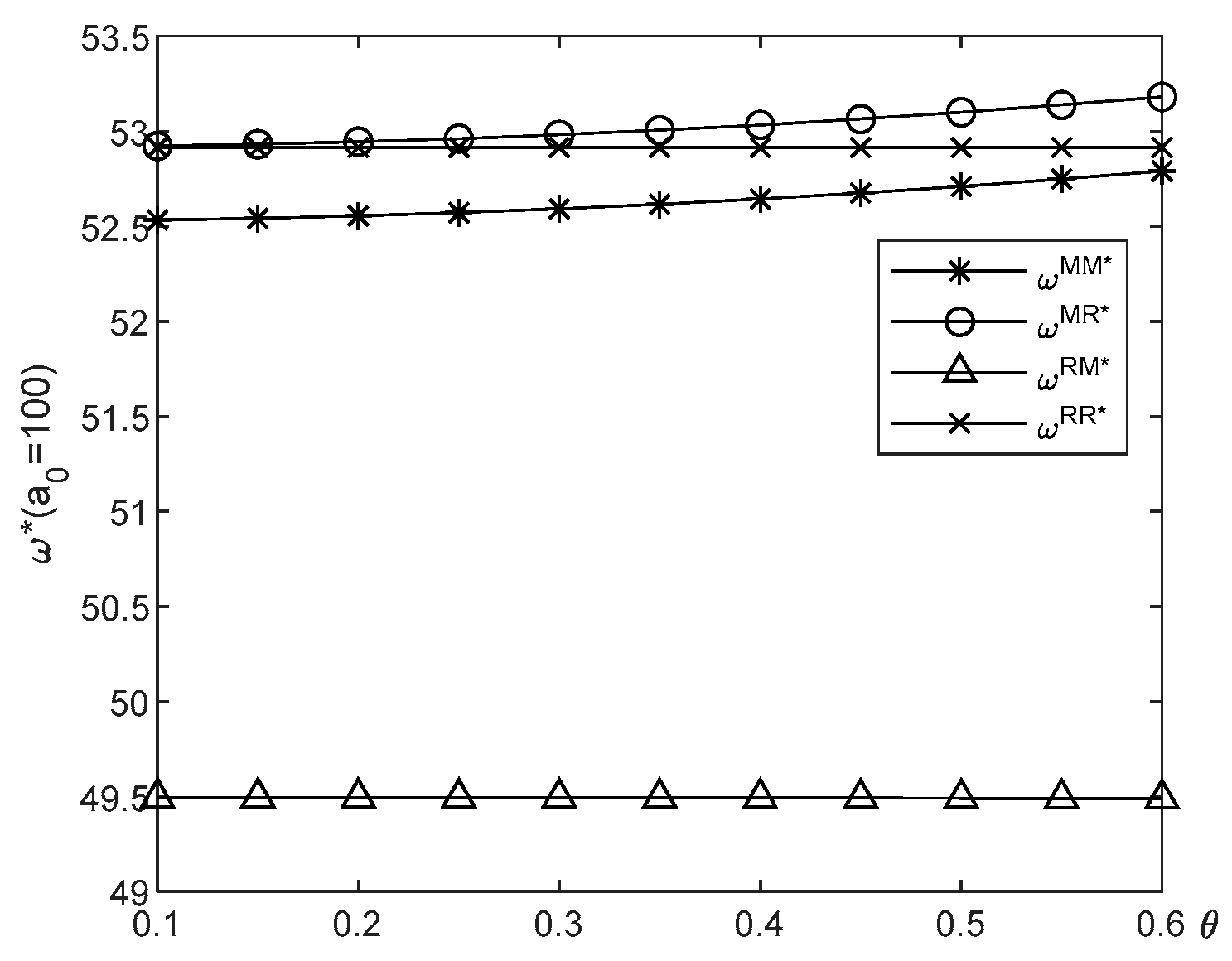
Figure 7.
Influence of consumer CSR input sensitivity coefficient on selling price.
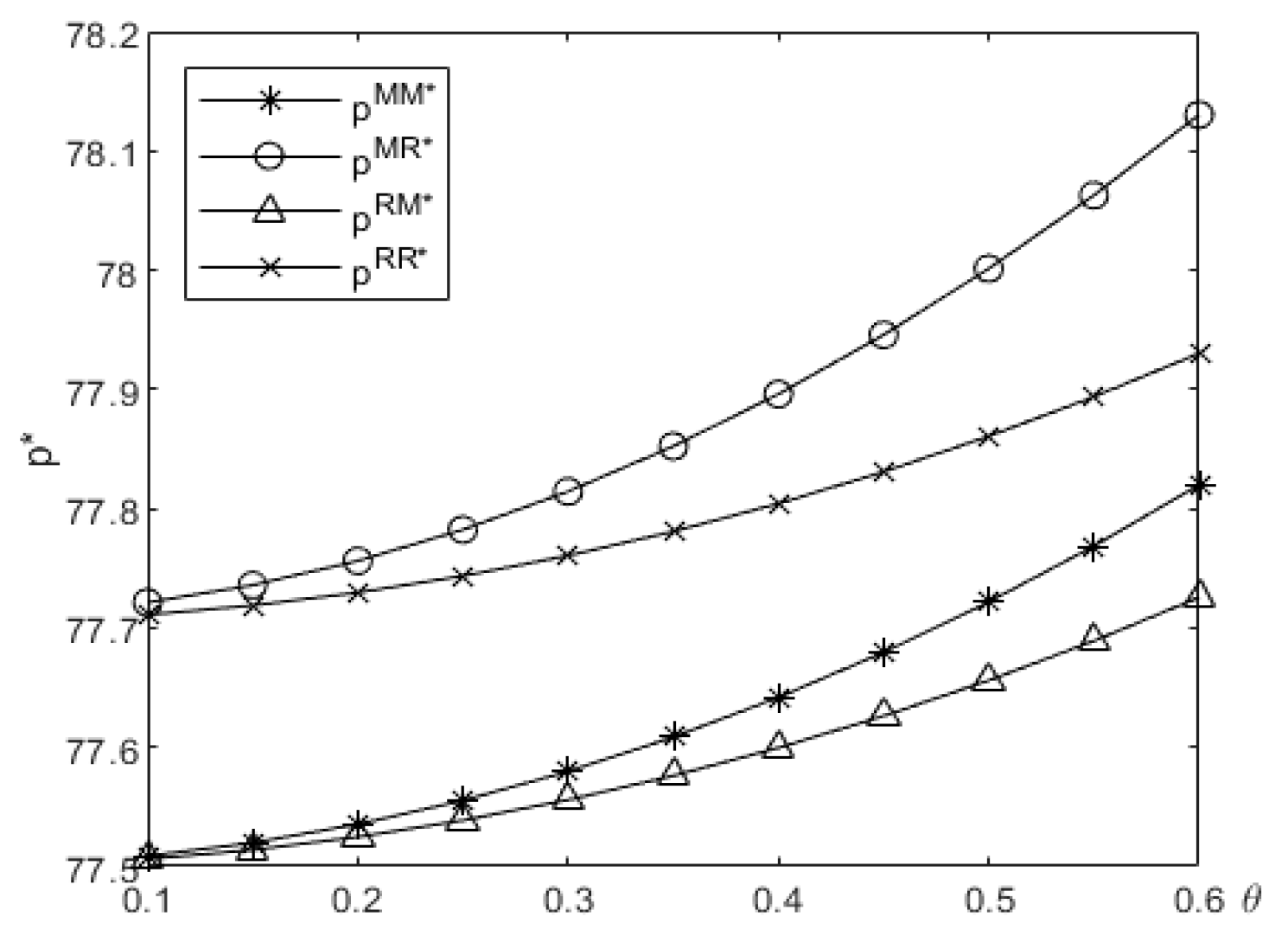
Figure 8.
Influence of consumer CSR input sensitivity coefficient on selling price.
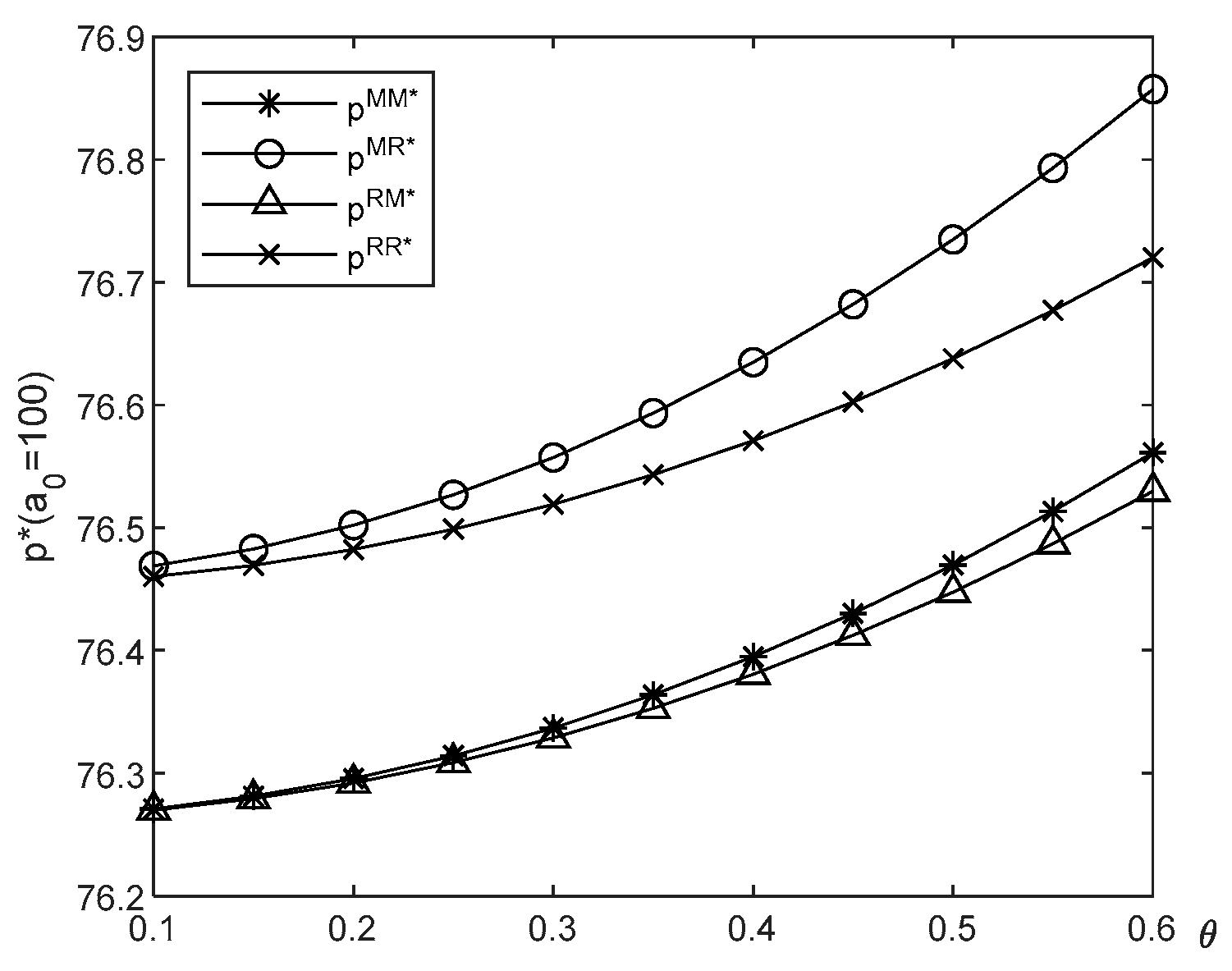
Figure 9.
Influence of consumer CSR input sensitivity coefficient on market demand.
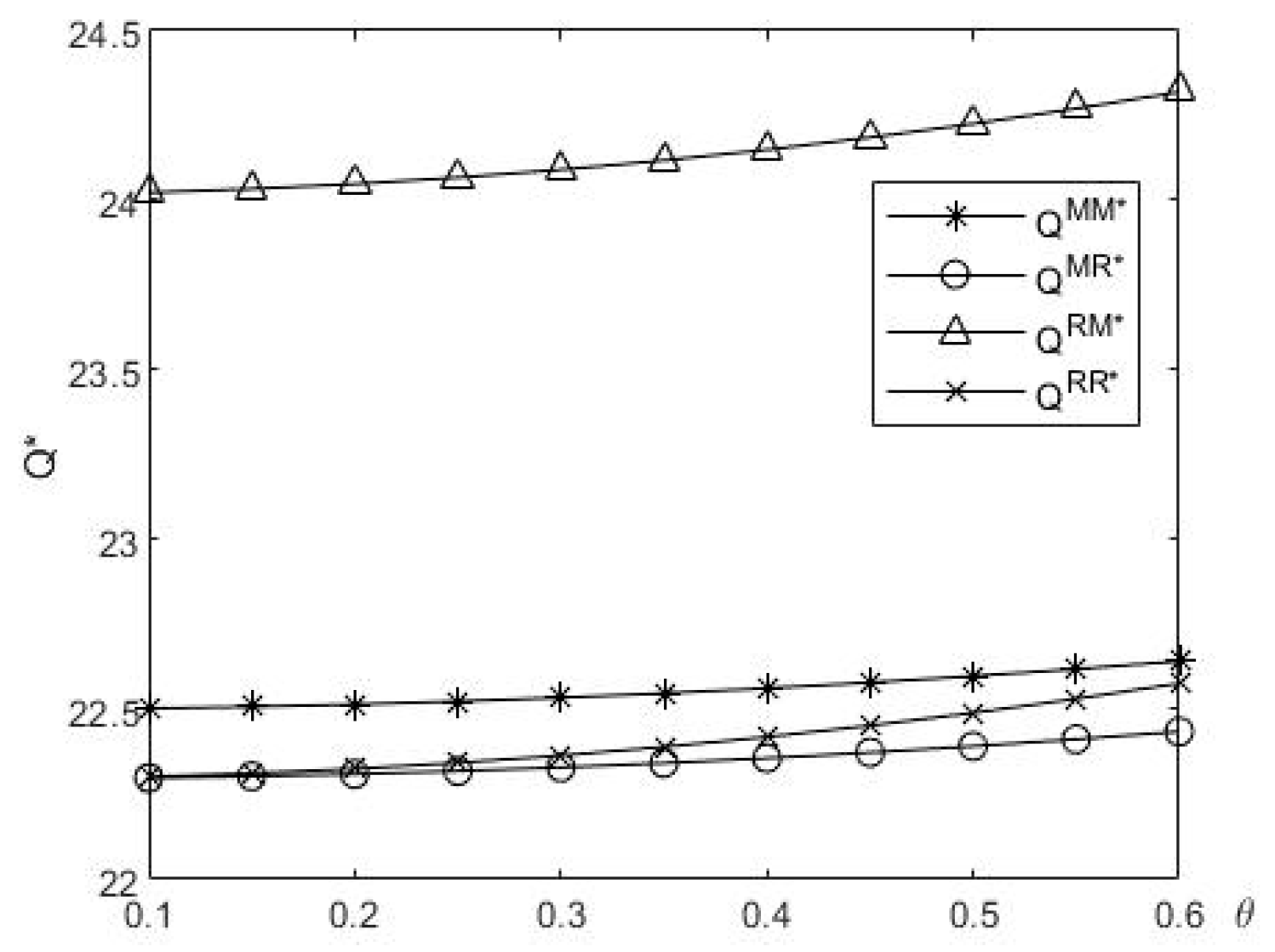
Figure 10.
Influence of consumer CSR input sensitivity coefficient on manufacturer’s profit.
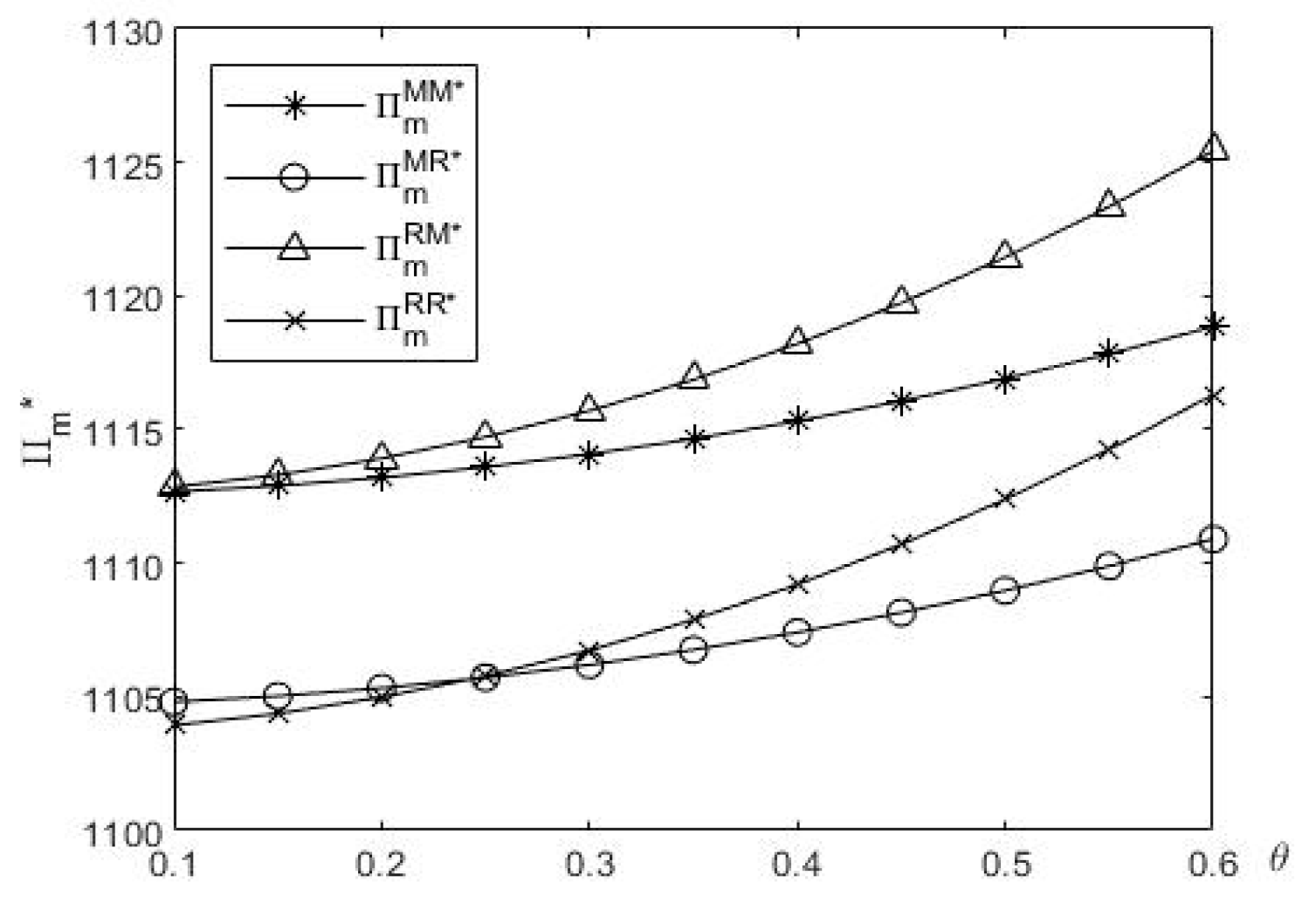
Figure 11.
Influence of consumer CSR input sensitivity coefficient on manufacturer’s profit.
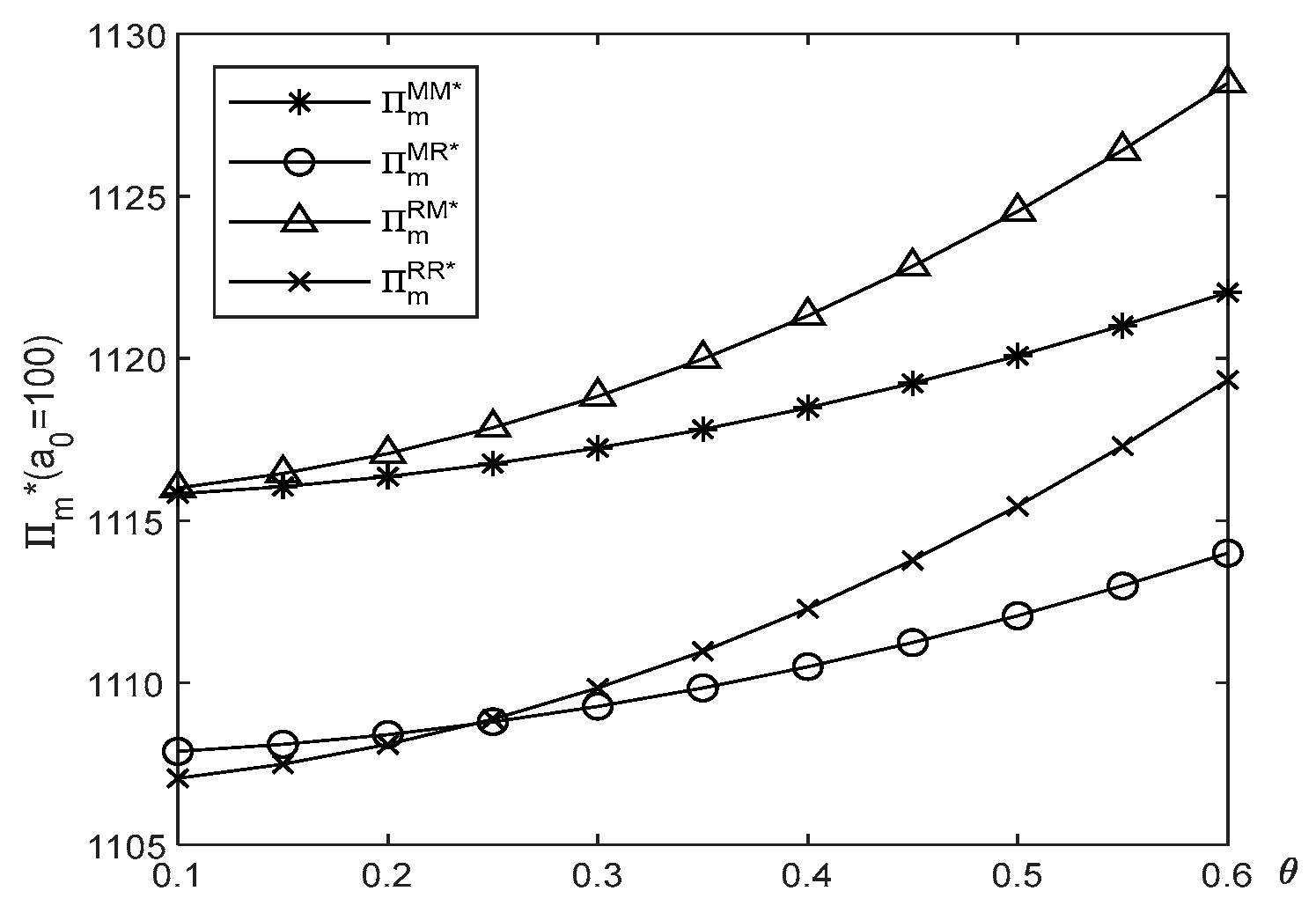
Figure 12.
Influence of consumer CSR input sensitivity coefficient on retailer’s profit.
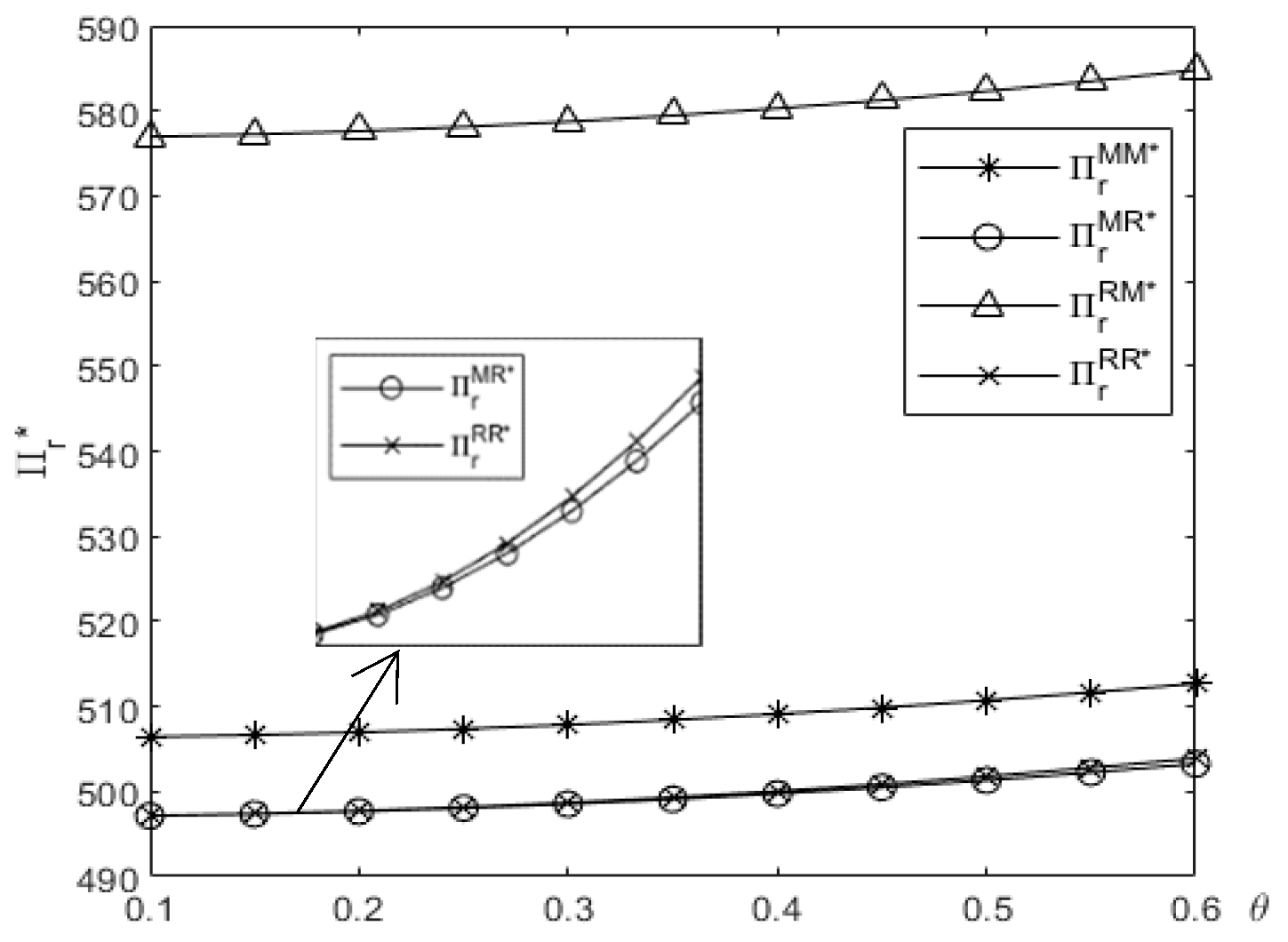
Figure 13.
Influence of consumer CSR input sensitivity coefficient on retailer’s profit.
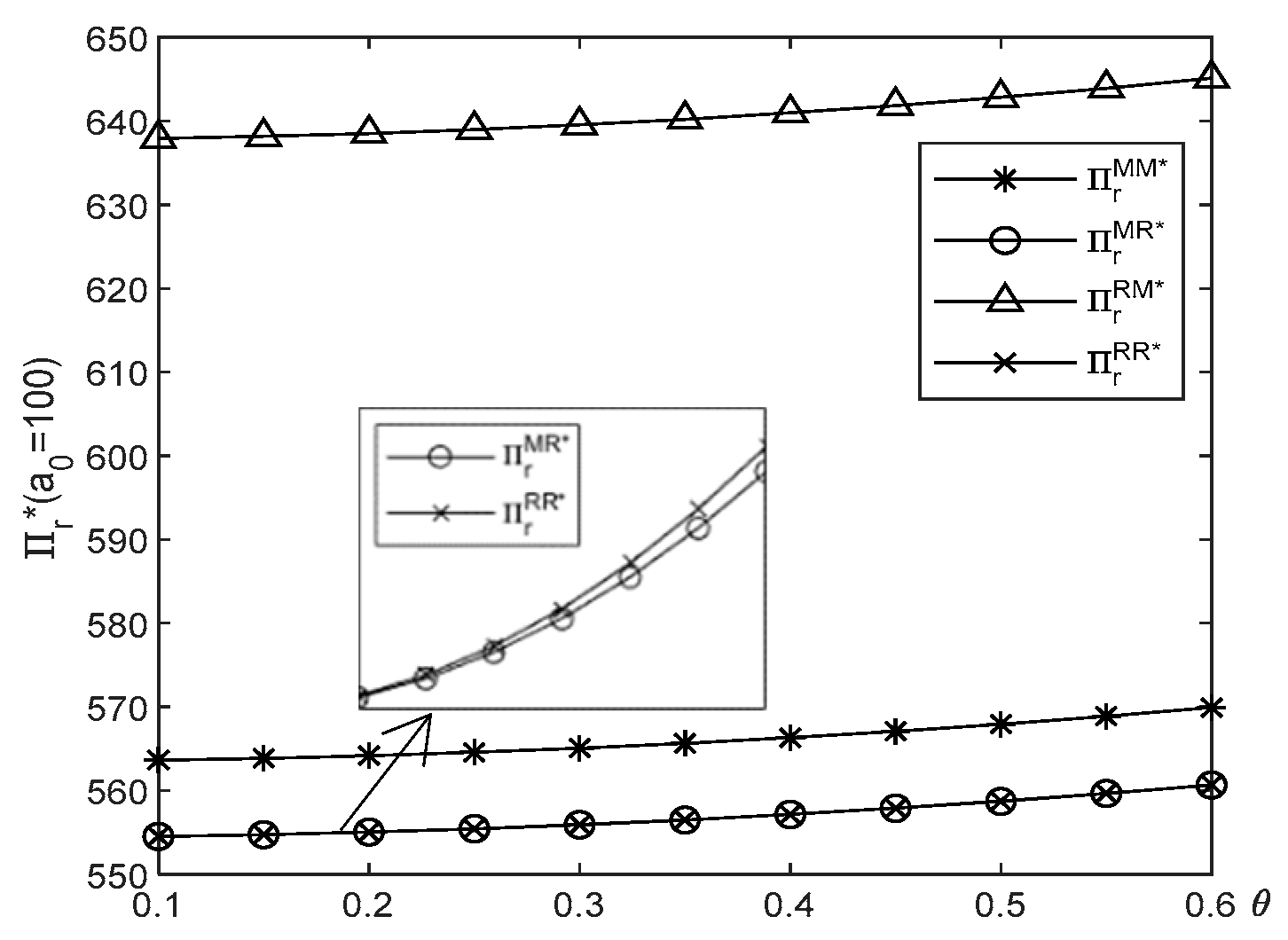
Figure 14.
Influence of market capacity predicted by manufacturer on its profit.
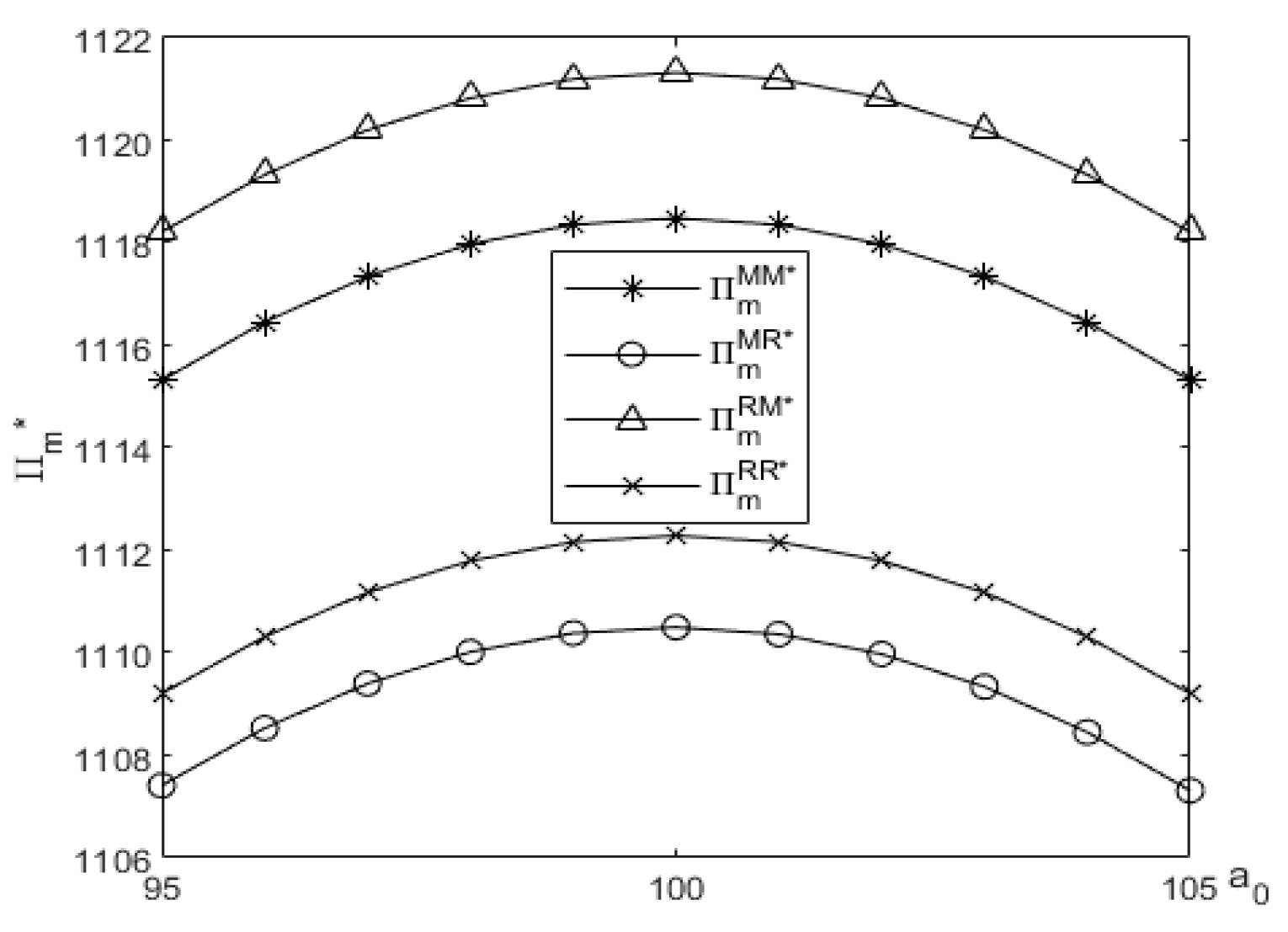

Table 1.
Description of symbols.
| Symbol | Definition |
|---|---|
| Wholesale price per unit of product | |
| Selling price per unit of product | |
| Market capacity, | |
| Market capacity determination part, | |
| Price sensitivity coefficient, | |
| Market demand | |
| The unit production cost of new products | |
| The unit production cost of remanufactured products | |
| Manufacturer’s profit | |
| Retailer’s profit | |
| CLSC system’s profit | |
| The recycling rate of waste products, | |
| Coefficient of the recycling cost, | |
| CSR input cost coefficient, | |
| CSR input level, | |
| Sensitivity coefficient of consumers to CSR input, | |
| Market capacity information uncertainty degree | |
| Market capacity predicted by the manufacturer, | |
| Unit transfer payment of waste product, | |
| Demand error () |
Disclaimer/Publisher’s Note: The statements, opinions and data contained in all publications are solely those of the individual author(s) and contributor(s) and not of MDPI and/or the editor(s). MDPI and/or the editor(s) disclaim responsibility for any injury to people or property resulting from any ideas, methods, instructions or products referred to in the content. |
© 2025 by the authors. Licensee MDPI, Basel, Switzerland. This article is an open access article distributed under the terms and conditions of the Creative Commons Attribution (CC BY) license (http://creativecommons.org/licenses/by/4.0/).
Copyright: This open access article is published under a Creative Commons CC BY 4.0 license, which permit the free download, distribution, and reuse, provided that the author and preprint are cited in any reuse.