

Submitted:
29 April 2025
Posted:
30 April 2025
You are already at the latest version
Abstract
This paper introduces the design and implementation of an IoT-based smart street lighting system to improve energy efficiency and facilitate sustainable urban development. The system utilizes sensors to sense ambient light and movement, allowing street lights to automatically turn ON in low-light conditions and OFF during daylight or inactivity. By maximizing energy efficiency and minimizing human intervention, this solution is part of the overall objective of smart city infrastructure. The method is cost-efficient, scalable, and consistent with the vision of engineers as key drivers of sustainable national development.
Keywords:
Smart Street Light
; IoT
; Energy Efficiency
; Sustainable Development
; Sensor Automation
1. Introduction
In the last few years, there has been a major boost in the need for energy-efficient and sustainable infrastructure, particularly in cities. The conventional street lighting system lacks automation, causing wasted power usage and increased maintenance requirements. In an attempt to meet these needs, the installation of smart street lighting systems with the aid of Internet of Things (IoT) technology has come into vogue.
This essay suggests an automatic street lighting system that utilizes sensors and microcontrollers to switch ON/OFF street lights according to environmental conditions and human activity. The system automatically switches ON the lights during darkness or when motion is sensed and switches them OFF during daylight or when there is no activity. This automation saves energy, apart from generating cost savings and helping in environmental sustainability.
The suggested system fits into the country's vision of creating smart cities and complements the engineers' role in bringing about sustainable development. It presents a low-cost, scalable solution that can be readily implemented in urban and rural areas to update public infrastructure.
2. System Design
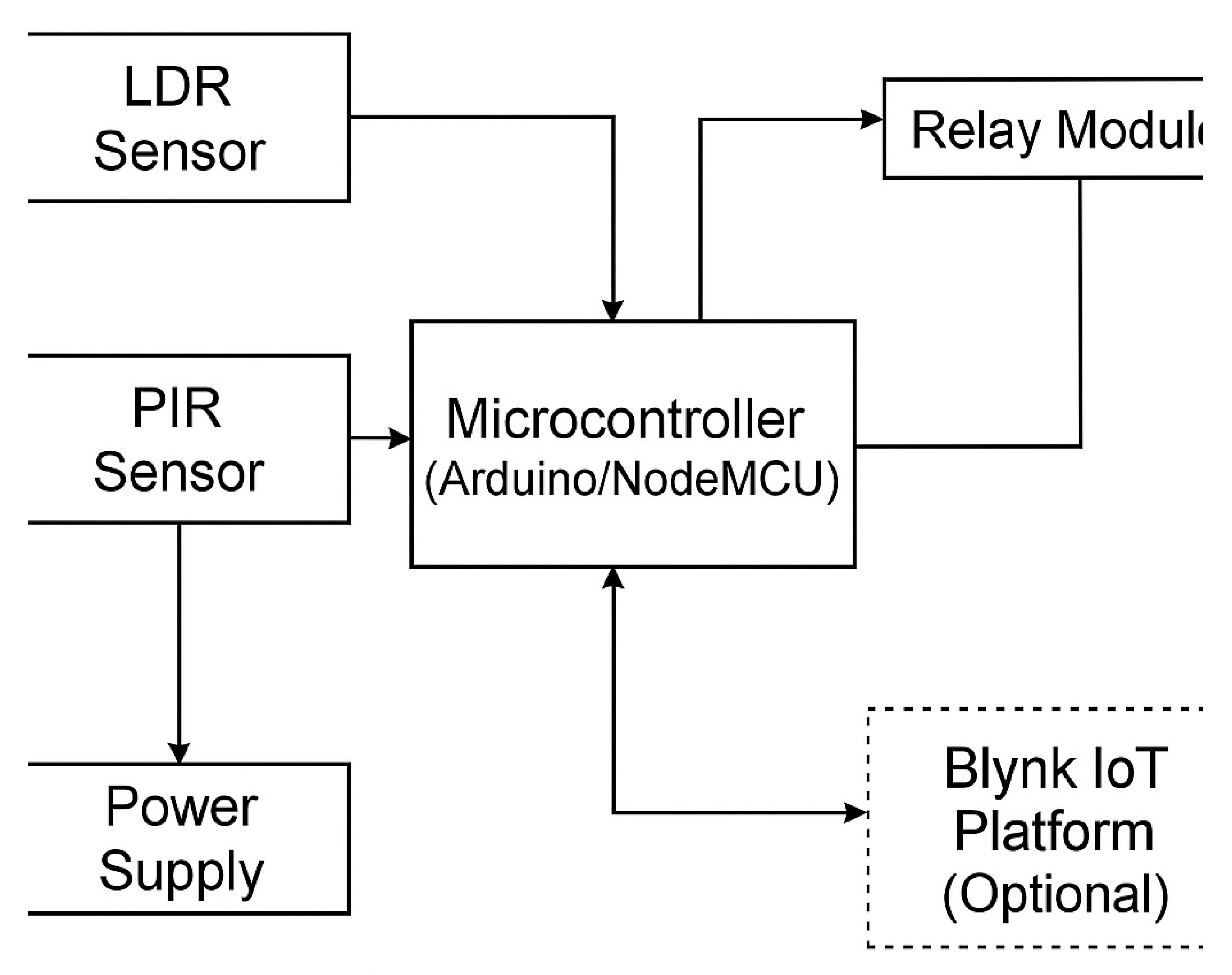
The proposed smart street lighting system is built using IoT-based components that automate the switching of lights based on environmental conditions and motion detection. The system comprises Light Dependent Resistors (LDRs), Passive Infrared (PIR) motion sensors, microcontrollers (such as Arduino or NodeMCU), and LED street lamps.
- LDR Sensor: Detects the ambient light intensity to determine whether it is day or night.
- PIR Sensor: Detects human or vehicular movement and triggers the lights when motion is sensed.
- Microcontroller: Processes input data from sensors and controls the street lights accordingly.
- Power Supply: Powers the microcontroller and sensors, potentially sourced from solar panels for enhanced sustainability.
- Connectivity: In an IoT-enabled version, the system can be monitored or controlled remotely via Wi-Fi and a mobile app or dashboard.
The working principle is simple yet effective: During daytime, the LDR detects sufficient light and keeps the street lights turned OFF. At night, if motion is detected by the PIR sensor, the lights turn ON. In the absence of motion, the lights remain OFF or operate at a dimmed level to conserve energy.
3. Implementation
The intelligent street lighting system was developed with an Arduino Uno microcontroller, LDR for ambient light, and a PIR sensor for motion. The circuit was mounted on a breadboard for testing purposes, with the streetlight being simulated by an LED. A relay module was also employed to control the switching mechanism so that the system could support higher voltage lights if the system were to be scaled.
During installation, the LDR was adjusted to accurately sense low light levels, prompting the microcontroller to switch to an active monitoring mode at night. When motion was sensed by the PIR sensor, a signal was sent to the Arduino, which switched ON the LED (streetlight). Following a set time period and with no movement, the lights automatically switched OFF to save energy.
To meet the requirements for real-time tracking and scalability, the system was updated with NodeMCU (ESP8266) to facilitate Wi-Fi capabilities. Sensor data was sent to the Blynk IoT platform so that users can monitor system status remotely and control settings such as light timing and sensitivity.
This system proves that using low-cost elements is possible and efficient in designing a smart and eco-friendly street lighting solution.
4. Results and Discussion
The smart street lighting system was tested under different light and motion conditions. Under daytime conditions, the LDR sensor was able to sense ambient light beyond the threshold level, and the system maintained the streetlight OFF. When the light intensity decreased as the evening hours approached, the system was in active mode and reacted to the motion input from the PIR sensor.
When there was detection of motion during nighttime, the lights switched ON instantly and stayed ON for a defined time duration (e.g., 30 seconds). In the absence of motion detection, the lights remained OFF or run in a dim state, thus conserving energy. This routine was executed repeatedly during numerous test cycles.
The Blynk IoT platform integration offered real-time monitoring of sensor data and remote control of the system. End users were able to adjust parameters such as light ON time and sensitivity levels remotely through the mobile app, enhancing convenience and flexibility of the system.
In all, the system exhibited:
- ▪
- Drastic minimization of unnecessary power consumption.
- ▪
- Hands-free operation with no need to switch manually.
- ▪
- Potential for scaling to smart city applications.
This supports the fact that IoT-based automation for street lights can be a pivotal factor in attaining energy-efficient urban infrastructure and national sustainability objectives.
5. Block Diagram
Figure 1.
Block diagram of the IoT-based smart street lighting system.
6. Future Scope
- Adding solar panels for self-sustainability
- Adaptive brightness
- Centralized monitoring
- Machine learning for traffic prediction
- Fault detection system
7. Conclusion
- The proposed IoT-based smart street lighting system successfully demonstrates the potential of automation in public infrastructure. By integrating sensors and microcontrollers, the system efficiently manages street lighting based on real-time environmental conditions and motion detection. This not only reduces energy consumption but also minimizes manual intervention and maintenance efforts.
- The implementation confirms that such a system is cost-effective, scalable, and suitable for both urban and rural areas. Moreover, the use of IoT platforms like Blynk adds flexibility and remote accessibility, making it ideal for future smart city deployments. This project reflects the crucial role engineers play in designing innovative, sustainable solutions that contribute to national development.
References
- A. Ghosh, S. Ghosh, and P. Bhaumik, "Smart Street Light Management System using IoT," International Journal of Engineering Research & Technology (IJERT), vol. 8, no. 5, pp. 22–26, 2019.
- S. Kulkarni and R. Jadhav, "Energy Efficient Smart Street Light using Arduino and LDR," International Journal of Innovative Research in Electrical, Electronics, Instrumentation and Control Engineering, vol. 7, no. 3, pp. 43–46, 2020.
- Blynk IoT Platform. [Online]. Available online: https://blynk.io.
- A. S. Salunkhe and P. A. Tijare, "Automated Street Lighting System using Wireless Sensor Network," International Journal of Advanced Research in Electrical, Electronics and Instrumentation Engineering, vol. 5, no. 6, pp. 5019–5025, 2016.
- Arduino Documentation. [Online]. Available online: https://www.arduino.cc/en/Guide.
Disclaimer/Publisher’s Note: The statements, opinions and data contained in all publications are solely those of the individual author(s) and contributor(s) and not of MDPI and/or the editor(s). MDPI and/or the editor(s) disclaim responsibility for any injury to people or property resulting from any ideas, methods, instructions or products referred to in the content. |
© 2025 by the authors. Licensee MDPI, Basel, Switzerland. This article is an open access article distributed under the terms and conditions of the Creative Commons Attribution (CC BY) license (http://creativecommons.org/licenses/by/4.0/).
Copyright: This open access article is published under a Creative Commons CC BY 4.0 license, which permit the free download, distribution, and reuse, provided that the author and preprint are cited in any reuse.


