

Submitted:
06 July 2025
Posted:
07 July 2025
You are already at the latest version
Abstract
Green IoT is designing and implementing IoT systems using sustainable methods and technologies. The primary goal of Green IoT is to reduce the environmental impact of IoT networks and devices during their manufacturing and operation. This includes maximizing resource use, minimizing electronic waste, and lowering energy consumption. Intelligent sensors provide self-sufficient data collection and interpretation through embedded processing, adaptive communication, and real-time analytics. When integrated with G-IoT systems, these technologies support sustainable development by prioritizing energy efficiency and environmentally friendly practices. Waste management, renewable energy systems, intelligent agriculture, and air and water quality evaluation are just a few of the areas where they are applied. One of the technical components of Green IoT is the integration of IoT devices and smart sensors with energy storage, energy management, and renewable energy systems. These internet-connected systems enable the monitoring, analyzing, and regulating of real-time energy consumption. The Internet of Things technology combined with environmentally friendly methods is known as "green IoT" or "sustainable IoT." Its aim is to enhance resource efficiency and management while reducing the environmental impact of technology. The recommended approach is a tiered architecture that combines cloud-based sustainable analytics with intelligent edge devices. This method adheres to sustainability standards while facilitating adaptive decision-making and real-time environmental monitoring. The findings demonstrate how utilizing a large number of smart sensors in the G-IoT can significantly aid in achieving climate action objectives and fostering intelligent, sustainable development in both urban and rural areas.
Keywords:
green IoT
; smart buildings
; agriculture
; smart grids
; smart cities
; smart sensors
I. Introduction
The Internet of Things (IoT) paradigm was introduced over two decades ago, and its deployment has been ongoing for nearly one year. In its most general definition, IoT is a network of devices that gather and exchange data, possibly over the Internet. The ultimate goal of IoT is to enhance existing services and applications or deliver new ones to users with minimal human intervention [1,2].
The extreme heterogeneity of application domains and devices has led to different requirements and expectations. Therefore, a wide variety of wireless communication technologies has gradually emerged to enable IoT, which is expected to connect up to 75 billion devices by the end of 2025, with an economic impact of around $11.1 trillion per year [3,4].
One of the crucial roles of IoT is in environmental monitoring. By leveraging IoT technology, businesses can gather data on various environmental factors, such as air quality, temperature, and humidity. This data can be analyzed to gain a better understanding of both indoor and outdoor conditions, enabling informed decisions that mitigate adverse environmental impacts. It also guides companies in adjusting their operations to support sustainability and protect the local community and the planet.
IoT systems play a major role in identifying environmental issues that are often overlooked, normalized, or unnoticed. By detecting these challenges, businesses can proactively reduce their ecological footprint while safeguarding the well-being of employees, visitors, and the wider community.
IoT technologies[5] have been heavily felt in environmental monitoring. Governments and industries can identify harmful substances, chemical spills, and dangerous pollutants by using connected devices and sensors[6]. This way, we can purify, protect, and save our air, land, and water resources using these IOT solutions. In addition, IoT sensors play a key role in perfecting operations, thus aiding positive ecological impact and leading to a sustainable future.
There are four key steps in IoT-based environmental monitoring [7]:
- 1.
- Observation (Monitor the Environment and Collect Data)
The first step is to observe the environment and gather data through IoT sensors. These devices measure factors like air quality, temperature, and humidity. The collected data is then transmitted to a central hub, which can be reviewed in real time or analyzed offline. This step may reveal unexpected patterns or variances, such as high CO2 levels in crowded offices leading to drowsiness or discomfort. This could also apply to public spaces like bars and restaurants, where unseen environmental factors affect the experience.
- 2.
- Analysis (Measure and Interpret Data)
The next step involves analyzing the collected data. This includes identifying trends, correlations between environmental variables, and any relationships between indoor and outdoor metrics. By looking at the data over time, businesses can spot issues such as chemical leaks, air pollution, or changes in environmental conditions that may impact their operations. This analysis helps companies to assess their ecological footprint and make informed decisions about reducing their impact. For some businesses, this might be about improving employee comfort. In contrast, for others, it could be related to safety and compliance, such as detecting harmful pollutants in waste or water systems.
- 3.
- Storage (Catalogue Data for Future Use)
After analysis, the data needs to be stored for future reference. IoT systems typically store this data in secure cloud-based databases, enabling easy access and long-term tracking of environmental metrics. This stored data can help businesses monitor how their environmental impact evolves. Large-scale databases, such as the Microsoft Planetary Computer, aggregate global ecological data, though not all systems are as expansive.
- 4.
- Action (Provide Actionable Insights and Implement Solutions)
The final step is to use the insights gained from the data to take action. IoT environmental monitoring systems provide businesses with actionable insights and recommendations for reducing their ecological footprint, such as switching to renewable energy sources or adopting water conservation practices. These actionable insights empower businesses to make operational changes, adopt new technologies, or even adjust their overall business strategy to promote sustainability.
In this paper, the focus is on soil monitoring and the usage of IoT in agriculture to help farmers. The paper's first section briefly introduces green IoT, its key components, and the benefits of Green IoT in agriculture. In section 2, we focus on a real-life project that uses IoT and Arduino to monitor the soil for water, and if the soil has a dryness below a threshold, it then uses IoT to water the soil. The simulation is based on simple plants but can be expanded to larger areas. The last section consists of conclusions and recommendations.
II. Green Iot
According to studies, the carbon footprint of electronic gadgets, the Internet, and the systems supporting them accounts for approximately 3.7% of global greenhouse emissions [8]. In the greenhouse effect, concentrated gases absorb energy, thereby increasing the global temperature.
The escalating usage of IoT-enabled devices equipped with additional sensors and communication add-ons consume vast amounts of energy and produce carbon emissions. The most pressing issue is a methodology that prioritizes resource conservation and environmental governance and intensifies efforts to decarbonize the atmosphere. The future challenge of IoT is to develop processes and policies that make sustainable use of IoT to reduce the greenhouse effect and further optimize IoT's greenhouse footprint.
Green IoT (GIoT) represents the energy-efficient procedures (hardware and software) adopted by IoT to facilitate the reduction of energy consumption and carbon emission of existing applications and services, as well as IoT devices, to achieve a sustainable smart world. Also known as sustainable IoT, it is the marriage of Internet of Things technology and environmentally friendly practices. It aims to minimize the ecological impact of technology while enhancing resource management and efficiency.
Several green technologies, such as green RFID tags [9], green sensor networks, and green cloud computing networks, have become essential parts of Green IoT research. Organizations are nowadays being motivated to use more natural or renewable energy sources like solar and wind energy. Technologies such as artificial intelligence, along with mathematical algorithms, are making IoT more intuitive and user-friendly.
Green IoT in agriculture [10,11] refers to the use of Internet of Things (IoT) technologies to promote sustainable farming practices that are environmentally friendly and resource-efficient. The aim is to improve agricultural productivity while minimizing the environmental footprint by optimizing the use of water, energy, fertilizers, and other resources.
Key Components of Green IoT in Agriculture are:
Precision Farming:IoT devices such as soil moisture sensors, weather stations, and drones collect time data on various environmental conditions. This data helps farmers decide when and where to irrigate, fertilize, or apply pesticides, reducing resource wastage and environmental impact.
Smart Irrigation [12]: Automated irrigation systems, controlled by IoT sensors, deliver the right amount of water to crops based on soil moisture levels and weather forecasts. This prevents over-irrigation and reduces water consumption, making farming more sustainable.
Energy-Efficient Operations: IoT technologies help optimize the energy usage of farm equipment and facilities. For example, greenhouses' smart lighting and HVAC systems can be adjusted based on real-time data, reducing energy consumption and costs.
Waste Reduction [13]: IoT systems can monitor and optimize the use of fertilizers and pesticides, ensuring they are applied only when needed and in precise amounts. This reduces chemical runoff into the environment and minimizes waste.
Benefits of Green IoT in Agriculture include:
Resource Efficiency: Better management of water, energy, and fertilizers reduces wastage and lowers environmental impact.
Increased Yields: Precision farming and real-time monitoring improve crop yields while minimizing the use of harmful chemicals.
Sustainability: By reducing farming's environmental footprint, Green IoT supports long-term sustainability and helps mitigate the effects of climate change.
Cost Savings: Efficient use of resources and energy can lead to significant cost savings for farmers, making sustainable practices more economically viable.
Improved Food Security: Enhanced productivity and reduced waste create a more stable and reliable food supply.
III. Green Iot: A REAL-LIFE Project
This section will present a real-life project that uses IoT combined with Arduino [14] to create an Automatic Watering and Water Reuse system. This is an Arduino-based project [15] that involves the use of electronic components like Arduino, sensors, breadboards, relays, etc. The system is designed to handle the watering of a plant by measuring the soil's moisture in different time periods of the day and reusing the water collected at the plate of the plant. The system's function is based on checking the humidity of the plant's soil. The moment the sensors gather the necessary data, the soil's moisture is below a threshold established at the beginning, and it hydrates the plant at the right moment and with the right amount of water by improving the plant's growth. Also, it reuses the water leaked at the plate and uses this water to water the plant again by pumping it into the initial reservoir. The functioning of the Arduino scheme is shown in the Figure 1.
This project includes using an Aloe Vera plant, which is placed in a container with water and connected via different tubes to an Arduino circuit. This is an example of Green IoT in agriculture, contributing to precise farming, waste reduction, and smart irrigation.
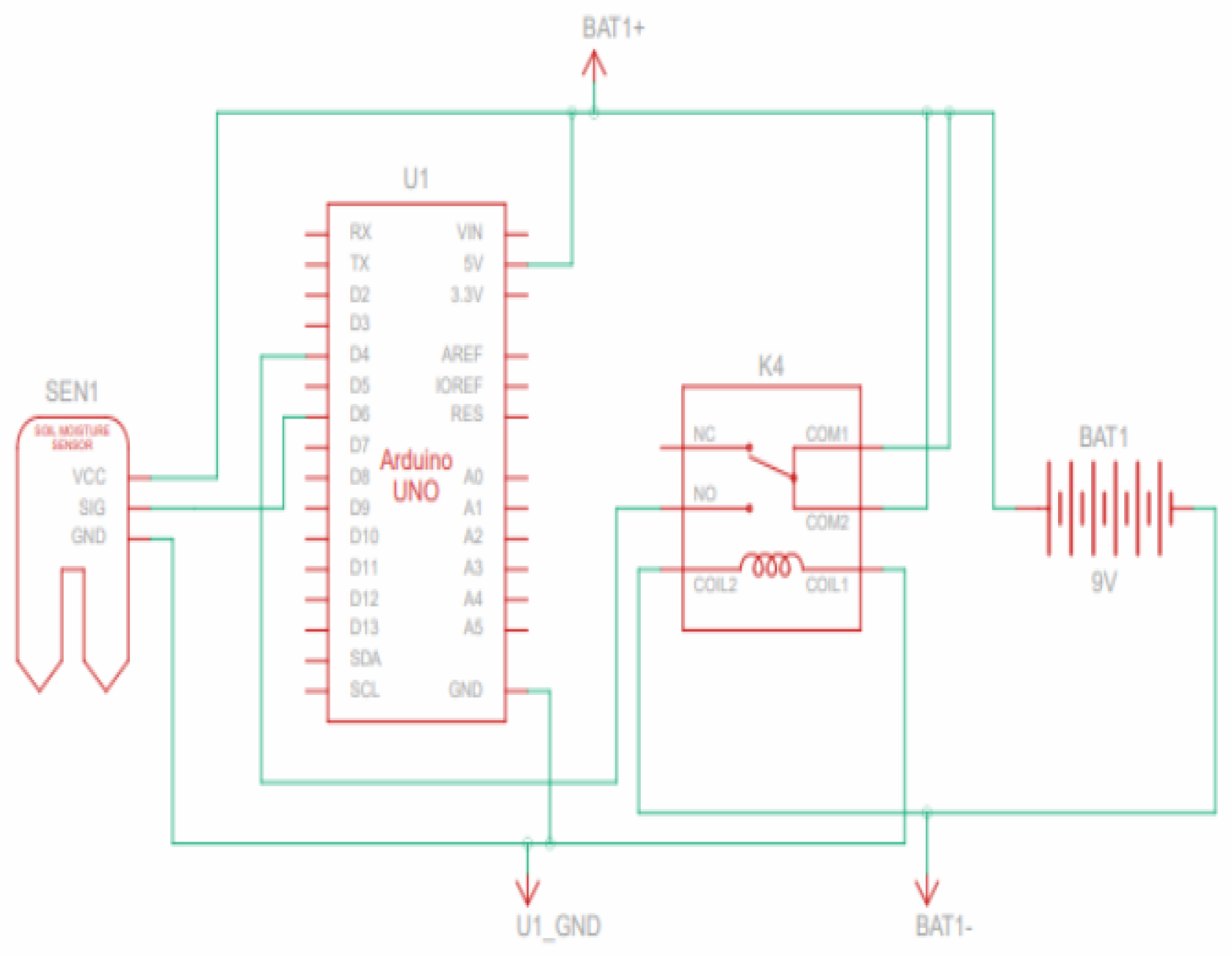
Key Components of the System include Arduino Uno, Soil Moisture Sensor, Water Pump, Water Level Sensor, and Relay Module, Figure 2 and Figure 3.
The system operates through an Arduino Uno, which receives signals from a sensor that constantly checks the dryness/moisture of the soil. If the sensor detects dry soil, the Arduino will activate the water pump. Once the Arduino gets the signal, it turns on the water pump. Water flows from the reservoir to the plant, hydrating the soil. After watering, any extra water drains into a tray beneath the plant. The water level sensor detects if the water in the tray is too high.
If too much water is collected, the sensor signals the Arduino to pump the water back to the main reservoir, saving water and keeping the tray from overflowing.
Arduino is an open-source electronics platform based on easy-to-use hardware and software. Except for the hardware part, it requires code to operate; Arduino code is written in C++ with an addition of special methods and functions. The Arduino Integrated Development Environment (IDE) is the main text editing program used for Arduino programming.
The code that was used to program the above circuit is given below:
void setup() {
pinMode(3, OUTPUT); // output pin for relay board, this will send signal to the relay
pinMode(6, INPUT); // input pin coming from soil sensor pinMode(4, OUTPUT); //output pin for relay board pinMode(5, INPUT); //input pin from water level sensor
}
void loop() {
intmoistureLevel = digitalRead(6); // reading the signal coming from the soil sensor
int waterLevel = digitalRead(5); //reading the signal coming from the water sensor
if (moistureLevel == LOW) { // if water level is low (i.e., soil is dry) then turn on the relay
digitalWrite(3, HIGH); // high is to turn on the relay
}
else { // if water level is high (i.e., soil is wet) then turn off the relay
digitalWrite(3, LOW); // low is to turn off the relay
}
if (waterLevel == HIGH) { // if water level on the plate is high, turn on the relay
digitalWrite(4, HIGH);
}
else { digitalWrite(4, LOW); // if it is low, turn off the relay
}
delay(400);
}
IV. Conclusions
Green IoT is transforming industries using innovative technology to reduce energy consumption and environmental impact. In agriculture, it offers a sustainable solution to resource management, ensuring efficient water use, reducing waste, and promoting eco-friendly practices.
This project demonstrates how smart systems can automate plant care, recycle water, and optimize water usage, contributing to more sustainable farming and gardening practices. With further improvements like IoT integration, solar power, and machine learning, this project can be scaled up for larger farms or urban environments, contributing to more efficient and eco-friendly food production. It can be used by houses to water their gardens efficiently or by farmers to monitor their crops better. In this way, they will be able to water the crops when they need to be watered and will not risk the possibility of ruining their crops by overwatering or not giving them the necessary water, the crops need.
References
- Atzori, L.; Iera, A.; Morabito, G. The internet of things: A survey. Comput. Netw. 2010, 54, 2787–2805. [Google Scholar] [CrossRef]
- ITU. Internet of Things Global Standards Initiative. 2015. Available online: https://www.itu.int/en/ITU-T/gsi/iot/Pages/default.aspx (accessed on 18 March 2021).
- Statistica. Internet of Things (IoT) Connected Devices Installed Base Worldwide from 2015 to 2025 (in Billions). 2015. Available online: https://www.statista.com/statistics/471264/iot-number-of-connected-devices-worldwide/ (accessed on 18 March 2021).
- Gillis, A.; Rosencrance, L.; Shea, S.; Wigmore, I. Internet of things (IoT). 2016. Available online: https://internetofthingsagenda.techtarget.com/definition/Internet-of-Things-IoT (accessed on 18 March 2021).
- Achar, S. , 2020. Influence of IoT Technology on Environmental Monitoring. AsiaPacific Journal of Energy and Environment, 7(2), pp.87-92.
- Nizetic, S. , Soli, P., González-de, D.L.D.I. and Patrono, L., 2020. Internet of Things (IoT): Opportunities, issues and challenges towards a smart and sustainable future. Journal of cleaner production, 274, pp.1-32.
- https://caburntelecom.com/iot-environmental-monitoring/.
- https://www.bbc.com/future/article/20200305-why-your-internet-habits-are-not-as-clean-as-you-think. 2020.
- Khan, M.A. , Sharma, M. and Prabhu, B.R., 2009. A survey of RFID tags. International Journal of Recent Trends in Engineering, 1(4), p.68.
- Ruan, J. , Wang, Y., Chan, F.T.S., Hu, X., Zhao, M., Zhu, F., Shi, B., Shi, Y. and Lin, F., 2019. A life cycle framework of green IoT-based agriculture and its finance, operation, and management issues. IEEE communications magazine 57(3), pp.90-96.
- Majumdar, P. , Bhattacharya, D., Mitra, S. and Bhushan, B., 2023. Application of green IoT in agriculture 4.0 and beyond: Requirements, challenges and research trends in the era of 5G, LPWANs and Internet of UAV Things. Wireless Personal Communications, 131(3), pp.1767-1816. [Google Scholar]
- Obaideen, K. , Yousef, B.A., AlMallahi, M.N., Tan, Y.C., Mahmoud, M., Jaber, H. and Ramadan, M., 2022. An overview of smart irrigation systems using IoT. Energy Nexus, , 7, p.100124. [Google Scholar]
- Shyam, G.K. , Manvi, S.S. and Bharti, P., 2017, February. Smart waste management using Internet-of-Things (IoT). In 2017 2nd international conference on computing and communications technologies (ICCCT) (pp. 199-203). IEEE.
- https://docs.arduino.cc/learn/starting-guide/whats-arduino/, consulted 3 , 2024. 6 September 6, 2024.
- https://projecthub.arduino.cc/Aswinth/soil-moisture-sensor-with-arduino-91c818, consulted. 3 September.
Figure 1.
The model of the plant and the Arduino circuit.
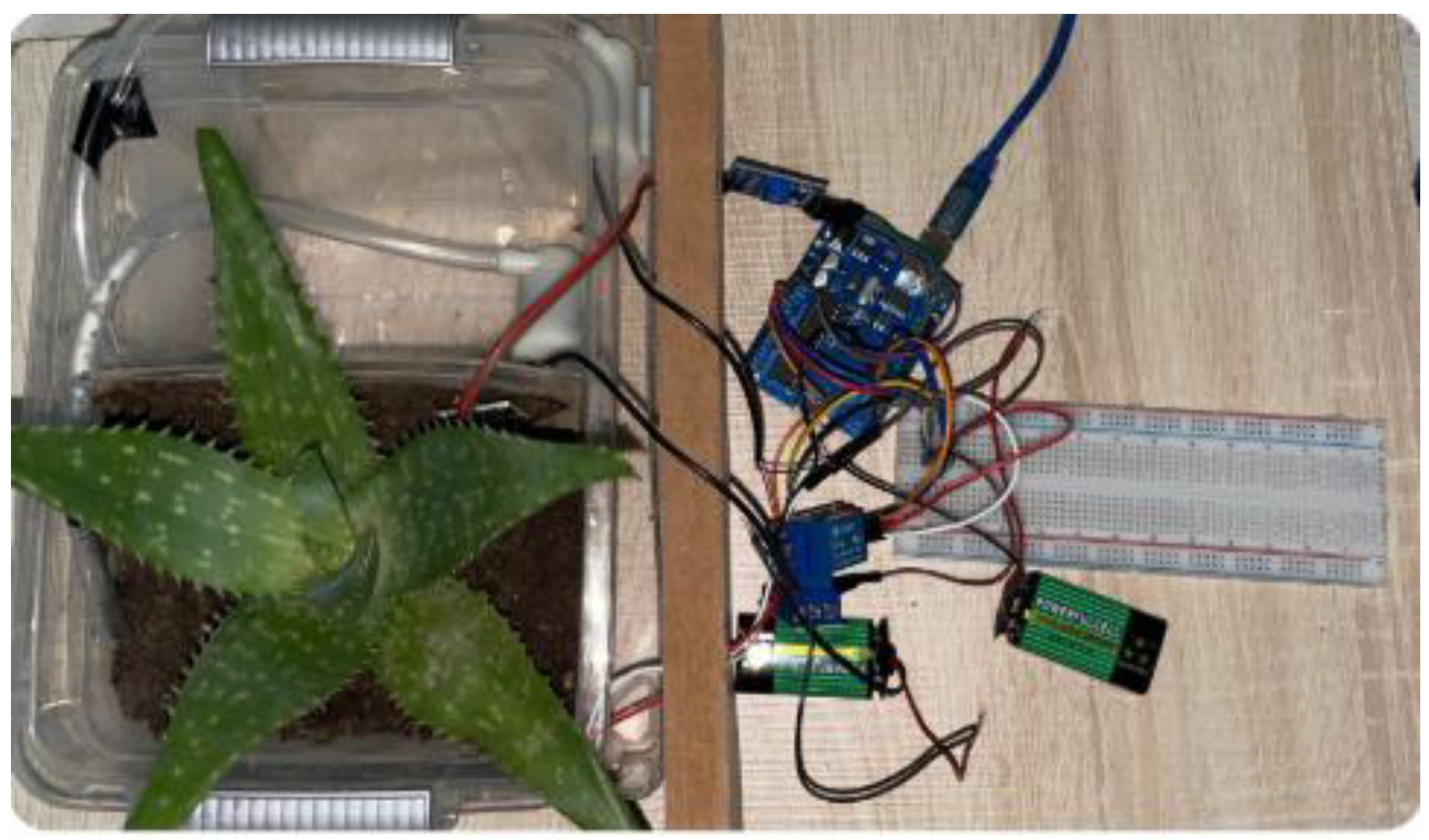
Figure 2.
Circuit view.
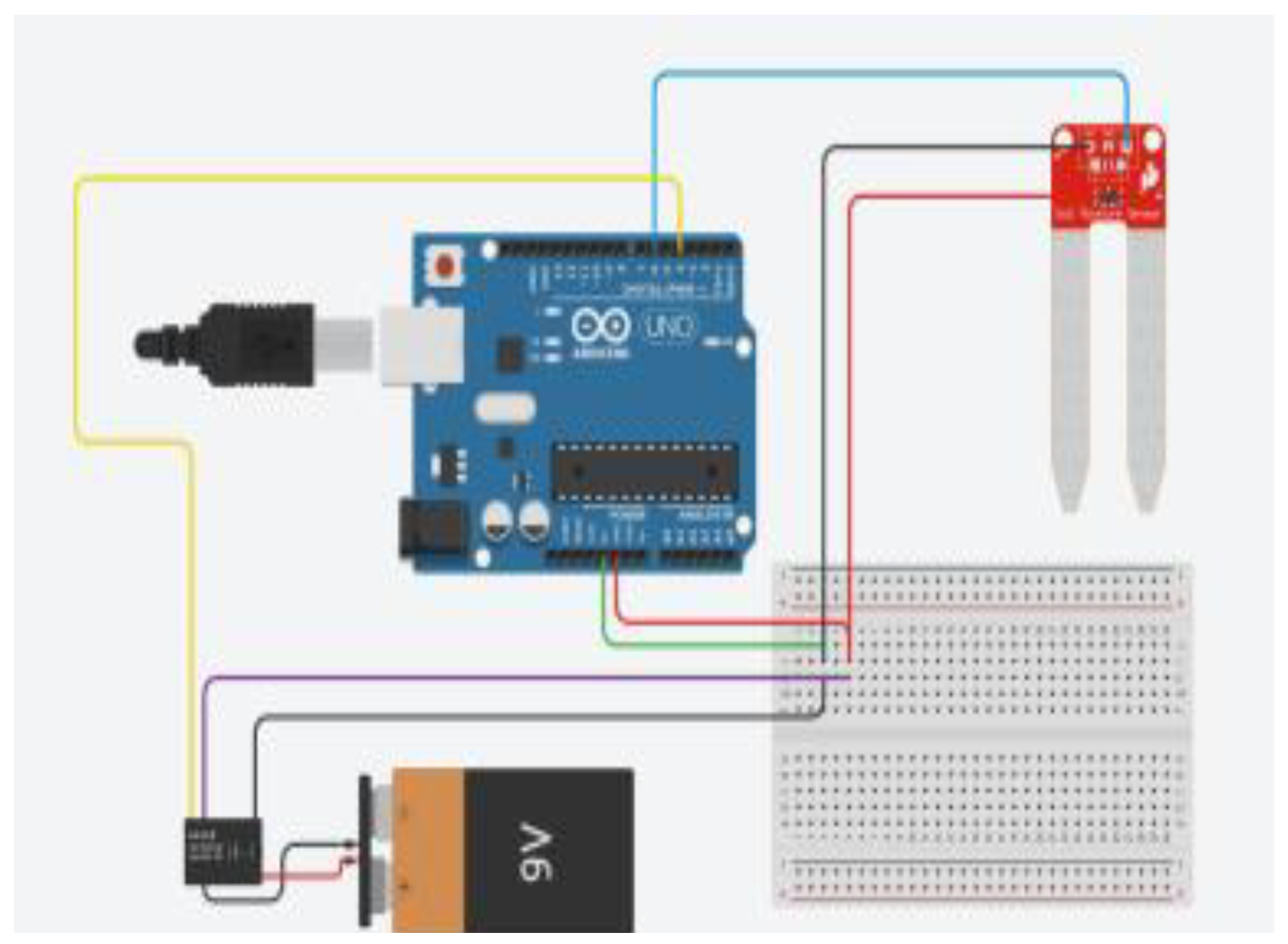
Figure 3.
Schematic view.
Disclaimer/Publisher’s Note: The statements, opinions and data contained in all publications are solely those of the individual author(s) and contributor(s) and not of MDPI and/or the editor(s). MDPI and/or the editor(s) disclaim responsibility for any injury to people or property resulting from any ideas, methods, instructions or products referred to in the content. |
© 2025 by the authors. Licensee MDPI, Basel, Switzerland. This article is an open access article distributed under the terms and conditions of the Creative Commons Attribution (CC BY) license (http://creativecommons.org/licenses/by/4.0/).
Copyright: This open access article is published under a Creative Commons CC BY 4.0 license, which permit the free download, distribution, and reuse, provided that the author and preprint are cited in any reuse.


