

Submitted:
28 April 2025
Posted:
29 April 2025
You are already at the latest version
Abstract
Wicked problems are inherently societal and cut across temporal, geographical and value related dimensions. Climate change is considered a super wicked problem, appearing at the intersection of science, economics, politics, and human behaviour. The diverse interests, traditions and values of people, companies and politicians make ideological, ethical and religious beliefs and worldviews important in public discourse and policymaking on climate change. The social and political context of climate change also make climate politics emotional. Growing powers of climate denying far-right parties around the world has led to even more emotional politics on climate change. Such politics is not only based on emotions, but shaped to invoke emotions. Right-wing and far-right populist politicians use emotional governance with nasty rhetoric including hate speech and hate crime to polarise climate politics, mobilise ingroup followers, and delegitimise and dehumanise outgroup advocates of strong climate policy while at the same time radically demounting climate policy to increase greenhouse gas emissions. Based on a qualitative case study of nasty rhetoric in Swedish climate politics, used strategically by the current government in a process of autocratisation, this paper analyses the impacts of emotional governance with hate speech and hate crime on politics and governance in liberal democracies. It is found that nasty rhetoric make many climate scientists and journalists silent, reducing the flow of information that make people freely form an opinion on climate policy and hold policymakers accountable. It is also found that many climate activists are radicalised, leading to increased state repression that reduces the civic space and possibilities for civil society organisations and concerned people to take part in policy debates. In all, nasty rhetoric reduces the dignity and equality of people and undermine the legitimacy of democracy, which may lead to its breakdown. The paper ends with a discussion on social, political and academic debates on how to curb nasty rhetoric, where both advocates and opponents to restrictions on nasty rhetoric accuse the other for being antidemocratic.
Keywords:
climate politics
; democracy
; emotions
; far-right populism
; hate crime
; hate speech
; magic
; nasty politics
; religion
; wicked problem
1. Climate Change, Wicked Problems and Politics of Emotions
1.1. Climate Change—A Super Wicked Problem
Could one imagine a more wicked problem
(Rittel & Webber, 1973) than climate change? The scope, viable responses,
and appropriate mechanisms and pathways towards achieving improvement regarding
climate change mitigation are complex and uncertain, and appear at the
intersection of science, economics, politics, and human behaviour (Incropera, 2015;
Grundmann, 2016). Wicked problems are inherently societal and cut across
temporal, geographical and value related dimensions, for which, in pluralistic
societies with diverse interests, traditions and values there is seldom
consensus on the problem and potential solutions (Crowley & Head, 2017).
The social context in which climate change is framed makes ideological, ethical
and religious beliefs and worldviews important in public discourse and
policymaking (Incropera, 2015; Hornsey, 2021). Besides different views on
solutions, the social context also impacts the perception of climate change as
a problem at all, with the existence of climate change deniers and sceptics
questioning that climate change takes place and thus the need for climate
change policy (Sharman & Howarth, 2017; Hultman et al., 2019; Lewandowsky,
2021; Vowles & Hultman, 2021a, 2021b; Ekberg & Pressfeldt, 2022).
Recognising the difficulties in agreeing on framing and formulating problems
and viable solutions, climate change has even been called a super wicked
problem (Lazarus, 2008; Levin et al., 2012).
1.2. Climate Politics as Politics of Emotions
The witnessing of climate change events like more
frequent and extreme rains, storms, floodings, landslides, heatwaves, droughts
and wildfires, and their negative impacts on people, societies and economies
all over the world (Intergovernmental
Panel on Climate Change, 2023) make a lot of people emotionally affected
(Brosch, 2021; Howe, 2021; Schneider et al., 2021). World leaders, including
the UN Secretary General (UNSG) António Guterres and President of the European
Commission Ursula von der Leyen, as well as climate activists talk about a
climate emergency. People like Greta Thunberg, the figurehead number one of the
climate justice movement, find an emotionally and ideologically motivated
identity in being climate justice activists, devoting their work or leisure
time to advocate for strong climate policy (Masson & Fritsche, 2021).
Having worked with national, EU and global climate policy and governance as
non-political policy officer and deputy director in the Swedish Government
Offices for more than 15 years, I know that many colleagues in Sweden, the EU
and globally started working with climate change to help save the world.
Politics, including climate politics, is emotional
(Beattie et al., 2019; Shah, 2024). This is not a new phenomenon. It is long
since known that emotions are important to political behaviour. Emotions
influence action tendencies because they inform an individual about a situation
and prepare the body for a certain course of action (Frijda, 1986). Emotions
are modes of relating to the environment: states of readiness for engaging, or
not engaging, in interaction with that environment (Frijda & Mesquita, 1994;
Keltner et al., 2014). The role of emotions for shaping climate policy was
highlighted in the first party leader debate after the Swedish general
elections in 2022 (von Malmborg, 2025a). The leader of the far-right populist
party Sweden Democrats (SD) claimed that the previous Social Democrat
(S) and Green Party (MP) government, together with the Left Party
(V) and the Centre Party (C) were emotional on climate policy, not
basing it on facts, and that everything was about the children and what
children think. In a similar vein, the current prime minister (PM) of Sweden,
representing the conservative Moderate Party (M), claimed in the same
debate that the symbol politics of the previous red–green government will be
replaced by things that have a real effect. In essence, they claimed that
climate policy should not be based on emotions, but being technically-economically
rational.
However, climate politics and climate policy may
not only be based on emotions. It can also be shaped to invoke
emotions. Analysing the strategic agency of the new right-wing government
in the radical transformation of Swedish climate policy since 2022, von
Malmborg (2024a) identified systematic use of emotional hate speech such as
insults, accusations, denigration and in rare cases violence, targeting
advocates of strong climate policy. It was a tactic of leading politicians,
including the PM and cabinet ministers of the right-wing government, supported
by SD, to use such nasty politics with nasty rhetoric (Zeitzoff,
2023) to discredit oppositional politicians and to delegitimise and dehumanise
climate scientists, climate activists and climate journalists to make them
silent and disappear from the climate policy debate (von Malmborg, 2024b,
2024c). A leading Swedish newspaper recently described Swedish climate politics
as “a musty rant with accusations of betrayal, sin and devil pacts”.1
Use of nasty rhetoric, including hate speech and
hate crime, as a tactics in strategic agency of far-right populists is
well-known in policy domains such as migration and identity policy (see e.g.
Yılmaz, 2012; Lutz, 2019; Peters, 2020; Weeks & Allen, 2023; Svatoňová
& Doerr, 2024). For instance, members of the Jewish diaspora, the Muslim
community and the LGBTQi communities in EU countries are victimised by online
hate speech on an almost daily basis (Berecz & Devinat, 2017). It is now
used also to polarise climate politics in a culture war (Cunningham et
al., 2024) to demount national climate policy and governance in line with
far-right populist whims (von Malmborg, 2024a). This is a dangerous development
that counters the need for pluralistic approaches to democratic governance of
climate change (Newell, 2008; Goodman & Morton, 2014; Pickering et al.,
2020; Lindvall & Karlsson, 2023) as a truly wicked problem.
Research on hate speech and nasty rhetoric in
climate politics has mainly focused on its polarising role (e.g. Eubanks, 2015;
Bsumek et al. 2019; Pandey, 2024), and hate campaigns towards specific groups
of targets, such as the climate justice movement (Agius et al., 2021;
Andersson, 2021; White, 2022; Arce-García et al., 2023) and climate journalists
(Björkenfeldt & Gustafsson, 2023; Schulz-Tomančok & Woschnagg, 2024).
The latter has shown that anti-climate rhetoric is often intersected with anti-feminism
(Andersson, 2021; Vowles & Hultman, 2021a; White, 2022; Arce-García et al.,
2023), resulting in female activists and journalists being victimised more
often and more aggressively. Less is known about the use and harms of nasty
rhetoric as strategy and tactics in radically changing climate politics and
governance.
The strategic use of nasty rhetoric in climate
politics, as seen from the perpetrators’ perspectives—the initiators and the
followers—was recently analysed by von Malmborg (2025a). He suggests that nasty
rhetoric is a double-edged sword to initiators, aimed at silencing
opponents in the outgroup, but also at mobilising ingroup followers to expand
nasty rhetoric. To the followers, nasty rhetoric can be described as a weird
kind of sport. Sociological research has found that followers in nasty
rhetoric and hate speech spread hate and threats in social media for reasons of
social gratification, including as entertainment and having fun (Walther,
2025). The resulting emotional, cognitive and behavioural harms of nasty
rhetoric in climate politics on different groups of victims was analysed by von
Malmborg (2025b), finding that climate scientists and journalists are targeted
with more aggressive hate speech than climate activists. The former are more
often receiving threats of physical violence and death threats. To victims, nasty rhetoric is perceived as asynchronous
or coordinated swarms of instants that keep coming in a vertical
temporality (von Malmborg, 2025c). It leaves many victims with fear of crime
and anxiety from not knowing when life will go normal. They resign or stay
silent in the public policy debate. Nasty rhetoric also ignites anger, a holy
wrath, radicalising some victims. Not to turn violent,
but to intensify peaceful protests to pursue their science-based argumentation
for strong climate policy. Thus, nasty rhetoric victimisation can also be
seen as a traffic cone (von Malmborg, 2025c) Some victims hide in the
wide end and turn silent, others use it to speak louder to backfire on the
perpetrators of nasty rhetoric.
1.3. Aim of the Paper
Given that emotion laden nasty rhetoric in Swedish
climate politics is found to be part of a strategy for radical change of
climate policy and governance (von Malmborg, 2024a)—an iconoclastic paradigm
shift—this paper aims to explore and explain the wider effects on democracy of
nasty rhetoric in climate politics as a specific case of emotional politics of
wicked problems. The following research questions are addressed:
- How is democracy affected by nasty rhetoric targeting climate scientists?
- How is democracy affected by nasty rhetoric targeting climate journalists?
- How is democracy affected by nasty rhetoric targeting climate activists?
In this paper, climate scientists refer to
academic researchers studying the causes and effects of global warming, those
developing technologies to mitigate and adapt to climate change, as well as
those studying responses, actions, policies and measures (including political,
economic, technological, social and behavioural) taken or that could or should
be taken by politicians, business leaders, economists, public organisations,
social organisations and people to mitigate and adapt to climate change. Climate
activists refer to people who, organised in climate movements or
unorganised, participate in the public debate advocating a need for urgent
action to mitigate and adapt to the climate change emergency. Climate
journalists refer to journalists that report on climate change, climate
science, climate action and climate politics in news media.
Since Zeitzoff’s theory of nasty politics is mainly
developed to explore and explain nasty rhetoric between oppositional
politicians (see section 2), the paper will also contribute to development of
the theory on nasty politics and nasty rhetoric, including other groups of
actors in society and politics.
The paper is outlined as follows. Section 2 presents the theory of nasty rhetoric
and emotional governance, as well as findings from the literature on harms of
nasty rhetoric and related areas such as hate speech, cyberhate and hate crime.
Section 3 presents the method and
material used to analyse nasty rhetoric in the case of Swedish climate
politics. Section 4 presents the case
study, while section 5 presents and discusses different harms on democracy,
including the Swedish debate on whether or not to ban nasty rhetoric. While
left-liberal politicians and debaters call for its ending, far-right populists
and libertarians claim that a ban on nasty rhetoric would restrict freedom of
expression. Contributing to the overall theme of this special issue, section 6
draws conclusions on the politics of emotions in governance of wicked problems.
The analysis and discussion draw on a broad literature to grasp the many
aspects and layers of nasty rhetoric and its harm on democracy, ranging from
political science, sociology and law studies to philosophy, history of religion
and history of arts.
2. Theory of Nasty Rhetoric
The concept of nasty politics was introduced
by Zeitzoff (2023, p. 6) to describe the phenomenon when politicians use “a set
of tactics […] to insult, accuse, denigrate, threaten and in rare cases
physically harm their domestic political opponents”, which can include
“political parties, partisans, ethnic groups, police and security services,
immigrants, judges, businessmen, companies, journalists, members of the press,
NGOs, government officials, military, business groups, or other domestic
political opponents broadly construed” (Zeitzoff, 2023, p. 9). The core of
nasty politics is the use of nasty rhetoric, characterised by divisive
and contentious rhetoric with insults and threats containing elements of hatred
and aggression that entrenches political divides vith ‘us vs. them’ narratives,
i.e. polarisation (Klein, 2020), designed to denigrate, deprecate,
delegitimise, dehumanise and hurt their target(s) to make them silent (Kalmoe
et al., 2018). Nasty rhetoric can be used in “campaign rallies, speeches, via
social media or face-to-face in debates or in actual violent confrontations”
(p. 6).
In that sense, nasty rhetoric covers offline and
online hate speech (the latter often referred to as cyberhate) as well as hate
crime (Whillock & Slayden, 1995; Chetty & Alathur, 2018;
Castaño-Pulgarín et al., 2021; Vergani et al., 2024). Hate crime can be defined
as “a crime motivated by prejudice and discrimination that stirs up a group of
like-minded people to target victims because of their membership of a social
group, religion or race” (Peters, 2022, p. 2326). In comparison, there is a spectrum
of definitions of hate speech, reflecting the jurisprudence in different
polities (Assimakoupoulos et al., 2017; Hietanen & Eddebo, 2022). Media
scientist Sponholz (2018, p. 51) defines hate speech as “the deliberate and
often intentional degradation of people through messages that call for, justify
and/or trivialise violence based on a category (gender, phenotype, religion or
sexual orientation)” (my translation). As such, hate speech is not restricted
to speech acts, but also encompasses, e.g., image-based communication and can
be unintentional. Zeitzoff (2023) has proposed a typology of nasty rhetoric, to
which economic and legal violence, e.g. repression, has been added since it is
increasingly used against climate activists in Europe (Table 1).
As described by Zeitzoff
(2023), different types of nasty rhetoric do not happen in isolation, but tend
to happen together, with more threatening and aggressive rhetoric happening
alongside less aggressive rhetoric. Social psychology research on hate,
described as a strong, intense, enduring, and destructive emotional experience
intended to harm or eliminate its targets physically, socially, or symbolically
(Fischer et al., 2018; Martínez et al., 2022a; Opotow & McClelland, 2007),
finds a causal relationship between hate and aggression in terms of aggressive
tendencies and hurting behaviour experienced towards specific individuals and
entire outgroups (Martínez et al., 2022b). What starts with different
expressions of hate soon escalates to different forms of threats, one more aggressive
than the other, and further to violence.
Deprecation, i.e. insults and accusations to make
claims about action, may be a precursor to more targeted violent rhetoric and
action, and act as a provocation and incitement to addressees and bystanders as
much as emotional sentiments that wound the targets of a speech, text, picture
or video. As for violence, “speech can and does inspire crime” (Cohen-Almagor
et al., 2018, p. 38; Schweppe & Perry, 2021). As stated by Maria Ressa,
Nobel Peace Prize laureate in 2021:2
Online violence does not stay online. Online violence leads to real world violence.
Thus, hate speech is also seen as a type of
terrorism or trigger event of terrorism, i.e. any intentional act directed
against life or related entities causing a common danger (Chetty & Alathur,
2018; Piazza, 2020a).
2.1. Nasty Rhetoric and Far-Right Populism
Far-right populist parties have increased their
votes in every election to national parliaments in Europe since the 1980s and
autocratisation is increasing (Mudde, 2004, 2021; V-Dem Institute, 2024). Recently, far-right populist “insulter in chief” Donald
Trump (Vargiu et al., 2024) was inaugurated as President of the USA a second
time. To reach their political aims, populists disseminate conspiracy
theories about the state of society and use incivil and nasty rhetoric with coarse, rude, and disrespectful language (Moffitt & Tormey, 2013; Moffitt, 2016; Lührmann et
al., 2020; Mudde, 2021; Zeitzoff, 2023; Törnberg & Chueri, 2025).
Dellagiacoma et al. (2024) report that people adhering to right-wing
authoritarianism are significantly more likely to produce online hate than
people with a social liberal orientation.
Narratives of ‘disaster’ or ‘anxiety’ are important
for the success of far-right populists (Kinnvall & Svensson, 2022). These
refer to a fictional fantasy of a constant crisis, rather than an actual crisis
of the nation, caused by long-term mismanagement by a corrupt ‘elite’ (Kinnvall
& Svensson, 2022; Ketola & Odmalm, 2023; Abraham,
2024). Entrenching an ‘us vs. them’ narrative, far-right populists refer to
a homogeneous ‘people’, the popular (the ingroup), as a counterpoint to the
‘elite’ (the outgroup). They portray themselves as the saviour of the nation
and the people, and they claim that the ‘elite’ should be punished for their
crimes against the ‘people’. The notion of ‘people’, the central tenet of
populism, is constructed and sustained through the stories of peoplehood told
by political leaders (Smith, 2003), often linked to an emotional response
(Koschorke & Golb, 2018).
In political science, populism, either left or
right, is seen as a thin ideology, which largely lacks in content beyond its
distinction between the pure people and the corrupt elite (Mudde, 2004). The
populist argument is therefore based on politics as an “expression of the volonté
générale (general will) of the people” (Mudde, 2004, p. 543). While
sometimes talking the language of the ‘people’, populists are not responsive to
popular will. Their political stance is based on a unitary and non-pluralist
vision of society’s public interest, and they themselves are rightful
interpreters of what is in the public interest—a putative will of the ‘people’
(Bitonti, 2017; Caramani, 2017), systematically presenting misinformation and
conspiracy theories (Törnberg & Chueri, 2025). They act on their own will
and invite their audience to identify with them (White, 2023). And some people
do. As mentioned by Valcore et al. (2023, p. 251), “deprecation is a
perlocutionary message and permission to hate not because of some
characteristic of the hated other, but for what has presumably been done by the
hated other to the safe, clean, Arcadian, white world the speaker cherishes”.
2.2. Nasty Rhetoric and Emotional Governance
Based on the work of Mouffe (2013), Chang (2019)
and Olson (2020) show that nasty rhetoric is not only about what is conveyed
explicitly by use of language. Political sentiments are often emotional and
affective, determined by viscerally experienced sentiments and a physically
imagined sense of rightness or wrongness. Political persuaders, particularly
populists, use language or images to affect emotions, perceptions of knowledge,
belief, value, and action (Shah, 2024). This aligns with notions of persuasion
that stress pathos as an equally important part of rhetoric as logos and ethos
respectively (Olson, 2020). Populist rhetoric operates in a world where it is
not required for “every statement be logically defensible” (McBath &
Fisher, 1969, p. 17).
Populism is based on emotional appeals to the
‘people’ as the ingroup, anti-elitism, and the exclusion of outgroups who are
routinely blamed and scapegoated for perceived grievances and social ills
(Aalberg & de Vreese, 2016). Emotions are central in nasty rhetoric, thus
in the structural and affective changes that underlie populist mobilisation and
the polarisation of everyday insecurities in general (Kinnvall & Svensson,
2022). Such emotional governance includes techniques of surveillance,
control, and manipulation, i.e. how society governs emotions through cultural
and institutional processes, meaning how it “affords individuals with a sense
of what is regarded as appropriate and inappropriate behavior” (Crawford, 2014,
p. 536). Emotional rhetoric is central in reproduction of structural power and
power relations between ‘us’ and ‘them’ as it pays attention to collective
emotions as patterns of relationships and belonging (Kinnvall & Svensson,
2022), thus central in cultural-institutional as well
as structural policy entrepreneurship aimed at changing other actors’
beliefs and perceptions and enhancing governance influence by altering the
distribution of formal authority (Boasson & Huitema, 2017; von Malmborg,
2024a).
In all, populist politics is very much about
emotional governance through storytelling (Polletta et al., 2011) where the
“core populist narrative about good people reclaiming power from corrupt elites
is rooted in evocative stories drawing on mythical pasts, crisis-driven
presents, and utopian futures” (Taş, 2022, p. 128). Populism is less about
great ideas and more about spinning a good yarn containing heroes, villains and
plotlines promising change (Nordensvärd & Ketola, 2021).
2.3. Democracy Harms of Nasty Rhetoric
The aim of nasty rhetoric is to silence the
outgroup in political discussions (Kalmoe et al., 2018). Hate speech and hate
crime evocate feelings and do emotional harm to outgroup targets (e.g. Lazarus,
1991; Calvert, 1997; Lang et al., 2000; Chang, 2019; Wagner & Morisi, 2019;
Olson, 2020; Hagerlid, 2021; Allwood et al., 2022;
Cowan & Hodge, 2022; Glad et al., 2024). Emotions are important to
behaviour because they are modes of relating to the environment: states of
readiness for engaging or not engaging, fighting or fleeing, in interaction
with that environment (e.g. Frijda, 1986; Frijda &
Mesquita, 1994; Izard, 2010; Keltner et al., 2014). Being emotionally
harmed, victims to hate speech and hate crime are also harmed cognitively,
normatively and behaviourally (e.g. Cassese, 2021; Wahlström et al., 2021;
Abuín-Vences et al., 2023; Renström et al., 2023). As analysed by von Malmborg
(2025b), victims to nasty rhetoric in Swedish climate politics respond
behaviourally in two main ways, mirroring the basic behavioural reactions to
hate, i.e. fleeing or fighting:
- Silence and self-censoring: Withdrawing from public debates, ending civil disobedience, changing job, or changing research area.
- Resistance and radicalisation: Increased argumentation for climate action, strike-backs with nasty rhetoric, more actions of civil disobedience, or radicalised climate actions such as sabotage and trespass.
Zeitzoff (2023) argues that nasty politics and
nasty rhetoric may have some positive effects to democracy since it provides a
tactic for marginalised groups and politicians to exercise power. However, he
claims that the negative impacts are more detrimental. Without specifying
relations and causalities, he particularly mentions that (p. 53):
- it makes people more cynical of democracy and less willing to vote and participate;
- politicians in power can use nasty politics as a tool to demonise their political rivals and stay in power, eroding the democracy in the process;
- an increase in nasty politics leads good politicians to choose not to run and to retire, and nastier politicians take their place; and
- heightened nasty politics precedes actual political violence.
As for nasty politics and rhetoric as a precursor
to political violence, Piazza (2020b), analysing terrorism and hate speech data
for about 150 countries globally for the period 2000–2017, found that hate
speech by political figures boosts domestic terrorism, mediated through
increased political divides caused by hate speech (Klein, 2020). Donald Trump
is a well-known user of nasty rhetoric targeting several groups in society,
promoting hatred and violence (Valcore et al., 2023).
He is not the only world leader accused of publicly denigrating people beyond
politicians based on their racial, ethnic or religious backgrounds, or for
their political opinions (Piazza, 2020b), but he actively incited violent riots
at the storming of Capitolium on 6 January 2021 (Zeitzoff, 2023), and he
violates numerous democratic norms such as legitimacy and accountability in
delivery and content of his speeches (e.g., Jamieson & Taussig, 2017; Ross
& Rivers, 2020).
When politicians view and talk about their
opponents as traitors or illegitimate, they violate a core principle in liberal
and deliberative democracy—pluralism of ideas—leading to political polarisation
(von Malmborg, 2024a). Political hate speech and polarisation breeds general
mistrust in politics (Mutz & Reeves, 2005) and feeds political intolerance,
defined as the support or willingness to denounce basic democratic values and
the equal rights of people belonging to a defined outgroup in a particular society
(Oates et al., 2006).
Focusing on politicians’ use of nasty rhetoric
targeting oppositional politicians, Zeitzoff (2023) and other political
scientists studying nasty rhetoric only analyse effects of nasty rhetoric on
politics and democracy based on harm on politicians as victims and wider
message effects. But nasty rhetoric in climate politics does not only target
oppositional politicians, but also climate scientists, climate journalists,
civil servants, climate justice activists and people in general worried about
climate change for their political opinions and their professional work (von
Malmborg, 2025a).
Going beyond nasty rhetoric between politicians,
research on hate speech and hate crime targeting journalists and scientists
indicate that nasty rhetoric restricts the flow of information, which may
invoke knowledge resistance (Strömbäck et al., 2022). This poses grave
challenges for the functioning of liberal and deliberative democracies, e.g.
(i) free formation of opinion, (ii) public deliberation, (iii) citizens ability
to evaluate public policy, hold politicians accountable and make informed votes
(Tenove, 2020; Wikforss, 2021; Pawelec, 2022), (iv) undermining democratic
processes by corrupting political discussions (Gutmann & Thompson, 1996;
Dahl, 1998), and (v) undermining the legitimacy of the democratic system as
such (Lago & Coma, 2017; Pawelec, 2022). In all, political hate speech
breeds general mistrust in politics (Mutz & Reeves, 2005) and feeds
political intolerance, defined as the support or willingness to denounce basic
democratic values and the equal rights of people belonging to a defined outgroup
in a particular society (Oates et al., 2006). This is considered one of the
most problematic phenomena in democratic societies as it paves the way for
democratic breakdown (Levitsky & Ziblatt, 2018).
Democracy scholars highlight the need for strong
civil society organizations and civic education as an important effort to
defend liberal democracy against ongoing autocratisation (Lührmann, 2021;
Mudde, 2021; Silander, 2024; V-Dem Institute, 2024). As reported by von
Malmborg (2024a), the Swedish government has taken measures to reduce financial
support to civic education and civil society organizations, in parallel to the
attacks on climate justice activists. Thus, reduction of the civic space may
also be a key harm of nasty rhetoric on democracy.
In all, drawing on the literature on behavioural
and democratic harms of nasty rhetoric and more generally hate speech and hate
crime, targeting oppositional politicians as well as other kinds of outgroups
victims, a framework with typologies for analysing democracy harms of nasty
rhetoric is developed (Table 2), which is
used in this study.
3. Method and Materials
3.1. A Qualitative Case Study
This paper analyses the harm of nasty rhetoric on
democracy, based in the emotional and behavioural harms on different groups of
victims to nasty rhetoric in the case of Swedish climate politics. The research
is undertaken as a qualitative case study of Sweden, chosen since the use of
nasty rhetoric has sky-rocketed in only a few years, linked to a recent
far-right turn of Swedish politics entrenching a populistic ‘us’ vs. ‘them’
polarisation of Swedish climate politics (von Malmborg, 2024a).
As discussed in section 2.3.1, there are many
studies of emotional and behavioural harm of hate speech, but except for
studies of von Malmborg (2025b, 2025c) none of emotional and behavioural harms
of nasty rhetoric. These negative effects are intentional, with perpetrators
using nasty rhetoric to culturally and structurally change policy and
governance. As indicated by von Malmborg (2024a, 2024b, 2024c), this may have
detrimental effects on democracy, contributing to autocratisation. The analysis
is qualitative, exploring and explaining how victimisation of climate
scientists, climate journalists and climate activists affects democracy.
3.2. Data Collection and Analysis
The analysis of democracy harms in the case draws
on secondary data from newspapers, magazines, blogs, radio and television
programmes, podcasts etcetera, describing the use and effects of hate speech.
News articles, essays, editorials and op-eds in newspapers, magazines and blogs
were identified through Boolesk searches during April 2024–April 2025 in Retriever
Mediearkivet3, the largest media archive in the Nordic
countries. Searches were made using “climate” in combination with different
search terms in Swedish, translations of which are presented in Table 3. I also analysed programmes in radio
and television discussing hate speech, hate crime and increasing legal
repression of climate activists, searching webpages of state-owned and
privately owned national television and radio using the search terms ‘climate
politics’ and ‘climate activism’. As for blogs, videos (YouTube) and social
media, posts on the largest pro-climate, libertarian and far-right extremist
accounts from January 2022 to February 2025 were screened and analysed.
Nasty rhetoric is usually emotional and affective,
but emotions are not always contained in the written or spoken language itself,
but they can be triggered by it and be used to anticipate a phenomenon (Chang,
2019; Olson, 2020). Nasty rhetoric can also be expressed visually (Bleiker,
2018) to distinguish ‘rational men’ from ‘emotional women’ (White, 2022), or
more subtly by refusal to give interviews to certain journalists. The latter is
currently used by the White House, rejecting interviews with journalists using
pronouns.
Editorials, op-eds and articles reporting or
commenting use and harmful effects of Tidö nasty climate politics were found in
left, green, social democrat, liberal, conservative and far-right extremist
media. In total, 99 editorials, op-eds, news articles, blogs, videos,
television and radio programmes were identified, showing, reporting or
discussing the use of and responses to nasty rhetoric in Swedish climate
politics between January 2022 and April 2025 (Table 4).
To follow up on these testimonies, interviews were also made with six climate scientists, four of which also being climate activists, one climate journalist and 18 climate activists, the latter representing Extinction Rebellion Sweden (XR), and its subgroups Mothers Rebellion (MR) Fathers Rebellion (FR), Scientist Rebellion (SR), Restore Wetlands (RW) and Take back the Future (TBF). Several activists are members of more than one organization. Six people were interviewed in person, while 19 were interview in two focus groups. Interviewees were asked about their experiences of hate speech and different kinds of threats, the emotional impacts thereof, how they reacted behaviourally, and how they perceive the effects on democracy from nasty rhetoric.
In this written, visual and audio-visual material, different views on democracy harm was identified and coded in relation to a model and typology developed from democracy theory in combination with previous research in political science, sociology, philosophy and media studies on effects of nasty rhetoric, hate speech and hate crime on democracy as outlined in section 2.3 (see table 2).
4. The Case of Nasty Rhetoric in Swedish Climate Politics
4.1. A Far-Right Populist Takeover
Sweden has been considered a bastion of strong liberal democracy since the end of World War II, able to develop and maintain a green and equitable welfare state (Boese et al., 2022; Silander, 2024). However, the 2022 elections to the Swedish parliament (Riksdag) marks a shift. Then, far-right nativist populist SD won 20.5 % of the votes and 73 out of 349 seats, becoming the second largest party in the Riksdag after the Social Democrats (S). This progress made SD gain formal powers in the Riksdag, holding the chairs in the committees of justice, labour market, foreign affairs and industry, and having direct influence over the government in most policy areas.
Bargaining on who was to form a government for the 2022–2026 term resulted in the Tidö Agreement (Tidö parties, 2022) between SD and a liberal-conservative troika of M, the Christian Democrats (KD) and the Liberals (L). SD supports the Tidö government, under the condition that SD takes part in decisions in six policy areas to undergo a rapid paradigm shift: climate and energy, criminality, economic growth and household economy, education, migration and integration, and public health, of which criminality, migration and climate change are deemed the most important (Rothstein, 2023). SD holds no seats in the cabinet but has political staff in the PM’s Office within the Government Offices of Sweden. In that sense, SD holds tangible powers but is not accountable for the government’s decisions. In all, the Tidö quartet holds majority with 176 of 349 seats in the Riksdag, while the opposition, consisting of S, MP, C and V, holds 173 seats.
When formed in 1988, SD was extremist and violent, rooted in neo-fascism, but with the election of current party leader Jimmie Åkesson in 2005, SD tried to distance itself from its neo-fascist past and show a more respectable façade to gain legitimacy (Rydgren & van der Meiden, 2016; Widfeldt, 2023). Compared to other far-right movements in Sweden, SD’s ideology is culture-oriented rather than race-oriented or identity-oriented, focusing on beliefs, values and behaviours that are consider to be Swedish.4 Based on the works of British nationalist political philosopher Roger Scruton (2004), SD acts to counter oikophobia, i.e. the contempt for one’s own culture, one’s history and one’s country. To SD, oikophobia characterizes postmodern Western society, where the only thing that is valued is the foreign. Countering oikophobia needs a culture war, in which religion has moved from the periphery to the centre of SD’s populist nativist ideology, where the Church of Sweden’s Protestantism is at the centre of what SD considers Swedish (Poletti Lundström, 2022). Religion is recurrently one of the adjacent concepts that temporarily stabilises the core of Swedish far-right nativist populism: people and territory.
In this culture war, SD combines populism, anti-pluralism and authoritarianism with nativism—the longing for a homogenous nation state—and propose, based on populist storytelling, illiberal policies in many areas, primarily migration but also culture, media, social, justice and environmental policy (Hellström, 2023). SD hails Victor Orbán’s Hungary, the worst example of autocratisation in the world (Meléndez & Rovira Kaltwasser, 2021; Mudde, 2021; Boese et al., 2022; Silander, 2024; V-Dem Institute, 2024), as a role model of democratic governance. They have also welcomed the recent developments in the US and world politics since the installation of Donald Trump as the 47th President of the US in January 2025. Due to the success of SD, Sweden is currently one of the strongholds of far-right populists in the EU (Widfeldt, 2023). To understand SD political agency, they “sacralize their core ideas and predominantly employ virtue ethical justification strategies, positioning themselves as morally superior to other parties” (Vahter & Jakobson, 2023, p. 1). They assign essentialist value to their key political concepts, a stance that sharply contrasts with the moral composition of the rest of the political spectrum adhering to liberal or deliberative perspectives on democracy.
Accusing Swedish established media of belonging to a “left-liberal conspiracy”, SD and other nationalist right-wing groups built their own ecosystem of digital media news sites, blogs, video channels and anonymous troll accounts in social media, which did not have to relate to the rules of press ethics (Vowles & Hultman, 2021b). Normalising knowledge resistance and using nasty rhetoric were central to their strategy of structural policy entrepreneurship (von Malmborg, 2024a).
Nasty rhetoric is an outspoken tactic of SD to entrench the polarising ‘us’ vs. ‘them’ and the ‘people vs. elite’ narratives. It was recently revealed by Swedish news media that SD’s communications office, inspired by Donald Trump and directed by party leader Åkesson, runs a ‘troll factory’. Using anonymous ‘troll accounts’ in social media, SD has deliberately and systematically spread misinformation and conspiracy theories to shape opinion, manipulate voters and incite outgroups by spreading insults, hate and threats.5 SD Party leader Åkesson has confirmed that SD, representing the ‘people’, use and will continue to use ‘troll accounts’, particularly on TikTok, to avoid getting public accounts reported and closed due to their frequent use of hate and threats:
To you in the Cry...we are not ashamed. It is not us who have destroyed Sweden... It is you who are to blame for it.
Swedish scholars of democracy (Rothstein, 2023; Silander, 2024; V-Dem Institute, 2024; von Malmborg, 2024a) as wll as Civil Rights Defenders (CRD, 2023), United Nations Association of Sweden (2023) and Gustavsson (2024) have identified several signs of autocratisation in Sweden since the 2022 elections. Nasty rhetoric is one important sign. They argue that the current developments in Swedish politics and society risk weakening Sweden’s liberal democracy and may be another step in the process of gradual autocratisation overseen by democratically elected but antidemocratic leaders. Tidö parties use democratic institutions to erode democratic functions, e.g. censoring media, imposing restrictions on civil society, harassing activists, protesting, and promoting polarisation through disrespect of counterarguments and pluralism (Silander, 2024; V-Dem Institute, 2024; von Malmborg, 2024a). Even the editorial offices of Sweden’s largest newspapers, independent liberal Dagens Nyheter, and Sweden’s largest tabloid, independent social democrat Aftonbladet, are worried of the development, arguing that “Sweden is now taking step after step towards less and less freedom”.
4.2. From Climate Policy Role Model to International Scapegoat
Sweden used to be considered an international role model in climate policy (Matti et al., 2021), advocating high ambitions in global and EU climate governance as well as nationally. In 2017, the Swedish Riksdag adopted with support of all parties but SD a new climate policy framework, including:
- A target that Sweden should have net-zero emissions of greenhouse gases (GHGs) by 2045;
- A Climate Act, stating among other things that the government shall present to the Riksdag a Climate Action Plan (CAP) with policies and measures to reach the targets, at the latest the calendar year after national elections; and
- Establishment of the Swedish Climate Policy Council (SCPC), an independent and interdisciplinary body of climate scientists, to evaluate the alignment of the government’s policies with the 2045 climate target.
Sweden’s GHG emissions in total decreased by approximately 37% from 1990 to 2022 and a decoupling of emissions and economic growth began in 1992, when Sweden introduced carbon dioxide taxation. This long-term trend of emissions reductions made a U-turn when the Tidö government supported by SD entered office. They advocated a radical change of Swedish climate policy and governance. SD has long since been vocal as a climate change denier (Jylhä et al., 2020; Vihma et al., 2021), wanting to abort national climate targets and climate policies. SD is culturally and cognitively motivated by conflicting ‘evil’ beliefs of previous governments for decades, both S-led and M-led. Like other European far-right populist parties,6 SD is mobilising a culture war on climate change, making climate policy less ambitious (Buzogány & Mohamad-Klotzbach, 2022; Marquardt et al., 2022; Cunningham et al., 2024). Climate policy was purposefully included in the Tidö Agreement by SD, opening a window of opportunity for SD to dictate and veto the government’s climate policy. Bargaining on finalising the Tidö CAP in 2023, SD now accepts the 2045 target but managed to reduce overall climate policy ambitions by deleting short- and medium-term targets and actions important for reaching long-term targets. The Tidö quartet focuses entirely on emission reductions by 2045, ignoring climate science saying that reducing every ton of GHG emitted from now to 2045 is what counts (Lahn, 2021).
Tidö climate policy can be characterised as anti-climate action with increased GHG emissions. The CAP was welcomed by the Confederation of Swedish Enterprise (CSE) and its libertarian thinktank Timbro, but heavily criticised domestically by the political opposition, climate scientists, economists, government authorities, the environmental and social justice movement, business associations other than CSE, citizens and editorial writers in leading national newspapers, for its lack of short- and medium-term domestic action, manipulation of information, and a large focus on new nuclear power and climate compensation in other countries.7 SCPC (2024) and Swedish Environmental Protection Agency (SWEPA, 2024) claimed that Tidö policies lead to increases of annual GHG emissions, corresponding to more than 10 % of Sweden’s total annual emissions, and that the CAP will not suffice for Sweden to reach the target on climate neutrality by 2045, nor Sweden’s responsibilities in relation to EU’s 2030 climate target.
In critique of Tidö climate policy, three out of four parties in the Riksdag opposition (C, MP and V) tabled a motion of non-confidence, calling for the setting aside of climate minister Romina Pourmokhtari (L) for failing to deliver policies that reduce GHG emissions. The critique towards Pourmokhtari also refers to the fact that she herself promised to resign if Sweden does not meet Swedish and EU climate targets—which it will not. In addition, more than 1 350 critical L-politicians from local and regional levels demanded the resignation of Pourmokhtari because she and L gave way to SD’s influence over the CAP, implying crossing several red lines of L’s party program and ideology. However, when the Riksdag voted, the critics did not gather enough support to set Pourmokhtari aside.
Besides domestic criticism, Tidö climate policies were criticised also internationally, claiming that Sweden is losing its role as climate policy frontrunner and risk dragging the EU down with it.8 Due to the Tidö climate policies, Sweden dropped from number one to number eleven between 2021 and 2024 in the Climate Change Performance Index (Burck et al., 2024). The European Commission has rejected Sweden’s application for SEK 40 billion funding from the EU Recovery Fund since Sweden will meet neither national nor EU climate targets for 2030.9 In March 2025, the international Organization for Economic Cooperation and Development (OECD) mentioned in its review of Sweden’s environmental policies that “recent policy shifts, particularly in the transport sector, have put into question Sweden’s ability to meet EU and domestic climate targets, with emissions projected to increase” (OECD, 2025).
4.3. Use of Nasty Rhetoric in Swedish Climate Politics
In a related study, von Malmborg (2025a) found that nasty rhetoric is widely used by party leaders and cabinet ministers, including the PM to target oppositional politicians, climate scientists, climate activists and climate journalists. It is also used by neoliberal, libertarian and far-right influencers and climate sceptics, applauding the weakening of Swedish climate policy.
That high-level politicians in the government and the Riksdag utter insults, accusations and intimidations towards climate scientists, journalists and particularly activists can be considered an important reason for the increase in online hate and threats (von Malmborg, 2025a). Nasty rhetoric has become normalised and collectivised (cf. Peters, 2022) when the PM and other cabinet ministers and people with leading positions in the Riksdag use it, calling the climate justice movement “totalitarian”, “security threats”, “terrorists”, “saboteurs” and “a threat to Swedish climate governance and Swedish democracy” that should be “sent to prison” and “executed”. In addition, they accuse climate science of being “just an opinion”. Green politicians are “strawmen” that should be “killed”, and female climate journalists are a “left pack” and “moron hags” that “will be raped”. Insults, accusations, intimidations and incitements are made openly, mainly in social media from official accounts of ministers and other politicians. Intimidations and incitement targeting climate activists are also made in national radio, on the streets, and in political debates in the Riksdag.
Hate speech is also conveyed anonymously. Accusing Swedish established media of being “climate alarmist propaganda centres” belonging to a “left-liberal conspiracy”, SD and other nationalist right-wing groups built their own ecosystem of digital media news sites, blogs, video channels and anonymous troll accounts in social media, which did not have to relate to the rules of press ethics (Vowles & Hultman, 2021b). Normalising knowledge resistance and using nasty rhetoric were central to their strategy of structural policy entrepreneurship (von Malmborg, 2024a, 2025a).
Swedish politicians rarely humiliate or denigrate other politicians in person, but other political parties. Swedish politics is not as person fixated as, for example, American politics. It is rather far-right extremist persons that target politicians in person. Except for the hate on Greta Thunberg, the same holds true for nasty rhetoric of politicians targeting climate activists or scientists. It is primarily the organizations, not the persons, who are targeted (von Malmborg, 2025b). In contrast, hate and threats sent by anonymous offenders online are often targeting individual climate activists, scientists, journalists and other outgroups, orchestrated by SD and far-right extremist Alternative for Sweden (AfS),10 who display names, photos, addresses and phone numbers of the ‘enemies’ in far-right extremist web forums, i.e. doxxing11.
Hate speech in Swedish climate politics has resulted in hate crime in terms of physical violence, but also to increased legal and economic repression of climate activists. In spring 2022, XR reported that five masked people attacked a climate action, and that one activist had been assaulted, following infiltration and doxxing organized by AfS.12
Since 2020, 310 climate activists have been prosecuted in Swedish district courts for different crimes related to civil disobedience, some of them several times. Of these, 200 persons were convicted, mainly to fines or suspended sentence. In 2022, leading SD politician now chair of the industry committee in the Riksdag, and the former M spokesperson on legal policy issues, now minister of migration, accused climate activists performing traffic blockades at demonstrations of being “saboteurs”, and that they should be charged for “sabotage” instead of “disobedience to law enforcement”.13 This change was later supported by the current minister of justice, saying that the actions of climate activists must be seen as sabotage so that they can be “sentenced to prison”.14 In 2022, without change of legislation, prosecutors around Sweden suddenly began to charge climate activists performing roadblocks at demonstrations for sabotage. Between summers 2022 and 2023, 25 persons were convicted for sabotage, some of which were sentenced to prison, but most were later acquitted in the Court of Appeal.15
In 2024, a person engaged in MR, a subgroup of XR that not engage in civil disobedience but only friendly actions such as singing,16 was fired from her job at the Swedish Energy Agency due to accusations and intimidations of her predecessor, right-wing and far-right media and minister for civil defence that she was a threat to Swedish national security. In 2023, a scientist engaged in SR was arrested for alleged sabotage of an airport. The action took place outside the airport and the scientist activist held a banner. The court case, which includes several lies from the airport manager, is still ongoing, but the activist recently got her application for Swedish citizenship rejected with the motivation that “[s]ince you are suspected of a crime, you have not shown that you meet the requirement of an honest way of life”.17
4.4. Emotional and Behavioural Harm on Victims to Nasty Rhetoric
Nasty rhetoric is not empty words, it is emotional. Political sentiments in nasty rhetoric stress the evocation of feeling, aiming at persuading ingroup people to join the weird kind of sport of hating and threatening ‘enemies of the nation’, and at dehumanising and hurting outgroup people emotionally and eventually physically, economically or legally. Being hit, nasty rhetoric does something to people. Results of this qualitative study identify some similarities but also differences in emotional and behavioural effects on the different groups of victims. In common, nasty rhetoric violates the victims’ fundamental right to dignity and equality. Like other forms of hate speech and hate crime, nasty rhetoric targeting climate scientists, climate journalists and climate activists also has message effects (cf. Ilse & Hagerlid, 2025). The motive behind the act is aimed at more than just the victim. Hate and threats are directed against people or groups of people to prevent them from participating in the public and democratic discourse. They should refrain from expressing opinions that do not agree with those of the perpetrator or perpetrators.
Climate journalists and non-activist climate scientists, targeted as individuals for what they do professionally, report threats of being fired, physical violence and death threats, beyond insults and accusations. They react with fear of crime and being followed or chased, insecurity, anxiety and exhaustion, but also anger. To cope with mental stress, many of them withdraw from the public debate or change research area or job. They self-censor. But some get angry, bite the bullet and try to win the battle. They hit back with insults and accusations, showing with the eye of a child and based on science that the offenders are wicked and naked like the emperor. Scientists’ and journalists’ reactions with fear and insecurity are in line with research on Swedish hate crime based on other motives, e.g. anti-feminism, sexual identity and ethnicty (Hagerlid, 2021; Atak, 2022; Ilse & Hagerlid, 2025).
In comparison, climate activists are targeted for their political opinions and actions in leisure time, outside their professional occupations. They are targeted with insults, accusations, intimidations and incitement, mainly as a group, less so as individuals. The same holds true for science activists, where the activism is performed in their leisure time, not at work. When targeted as individuals, it is through secondary victimisation from legal and economic repression—a late stage of nasty rhetoric—more seldom incitement about physical violence or death threats. One exception is Greta Thunberg, who has experienced plenty of hate and threats based on climate scepticism and misogyny. Some activists react with fear and choose to revert to more friendly actions, while others, particularly the core group activists react with anger and plan new actions over and over again, while eventually getting physically exhausted. Their fear and anxiety are related to the climate emergency, which made them climate activists. They react with anger since their perpetrators continue to deny the climate emergency, despite their actions. They also react with physical exhaustion since they find it difficult to combine job, family, court trials and climate actions while the Earth is burning and flooding at the same time. An uncertainty factor for climate activists changing behaviour is that politicians and other haters do not see any difference between the very heterogeneous group of climate justice organizations. All are lumped together. Backing down from civil disobedience to peaceful actions makes no difference to the perpetrators, and there is a risk that you will continue to be exposed to hatred and threats. But as mentioned, hate and threats are primarily aimed at the organizations, not individual persons.
Targeted as a group, climate activists seem to spur each other to learn individually and collectively to ignore insults, accusations, intimidations and incitements. They undergo a process of desensitisation (cf. Soral et al., 2018). They are less sensitive to hate speech and more prejudiced toward hate speech perpetrators, finding nasty rhetoric to be part of a larger strategy orchestrated by (far) right-wing politicians to polarise and break down society and democracy. They are strengthened in their conviction that they are right, and the perpetrators are wrong. They are more afraid and anxious about the climate emergency and get angry because they think that politicians and business leaders are not acting appropriately fast and ambitious given the severe situation. Fear, angst and anger about social, economic and political inaction to curb climate change made them climate activists. Instead of being silenced by nasty rhetoric, they are radicalised and do more actions.
Compared to climate scientists and journalists, climate activists and scientist activists are victimised twice. First by hate speech, second by the state repression through economic and legal violence being fired and prosecuted and sometimes sentenced for criminal acts. Climate activists testify about hateful and threatening behaviour of individual police officers. This resembles experiences of legal estrangement among racist hate crime victims in Sweden (Atak, 2022).
4.5. A Message Effect
Emotional governance with nasty rhetoric does not only target individuals in the outgroup. It includes techniques of surveillance, control, and manipulation to govern emotions in society, providing individuals with a sense of what is regarded as appropriate and inappropriate behaviour (Crawford, 2014). Nasty rhetoric has a message effect that target people and society in general. Nasty rhetoric is central in reproduction of structural power and power relations between ‘us’ and ‘them’ as it pays attention to collective emotions as patterns of relationships and belonging (Kinnvall & Svensson, 2022).
The climate activist who got fired from the Swedish Energy Agency initially thought that her case would make people more afraid to get involved in climate activism. But the aftermath of her case made her change opinion:18
Now I don’t think so anymore. I think I’m a winner somewhere. It’s sick that this could have happened. But if it can lead to people becoming less afraid, if it becomes more difficult to subject people who engage in activism to repression, then this has contributed to something good. We have shown that if you fire people who are committed to the climate issue without reason, then you will be in the newspaper. Even the UN steps in and writes the world’s finest documents. Such strong words! The UN’s letter was to all of us. Not just for me. I’ve come out of this stronger. And now I feel that there has been a point to everything. We have managed to turn a drive into something positive.
What made her change her mind was that the Green Party and the Left Party reported the minister of civil defence for ministerial rule. A trade union for state employees, ST, took the case to the Chancellor of Justice, and later to the district court. And the UN rapporteur on rights of environmental organisations wrote a letter to the Swedish Government, stating that he was deeply concerned with the actions of the minister of civil defence. The trade union’s formulations are crystal clear:
You cannot hide behind the Security Protection Act in order to restrict a constitutional right, such as freedom of speech. The Civil Defence Minister’s actions can easily be interpreted as a desire to restrict the freedom of expression of government employees.
But this turned out to be wrong. It has been the other way around. Due to the message effect of nasty rhetoric, more state employees feel anxious about getting involved in the climate debate, of saying what they think. A culture of silence has spread. The fact is that many state employees testify about widespread fear and a culture of silence, and that the climate issue is polarised and difficult to discuss.19 A civil servant in a municipality states:20
That we feel that we have to hide, because we are fighting for our children and grandchildren to have a planet that can safely be lived on. But that’s the general mood right now.
The hunt for climate activist employees in state agencies has not only been limited to the energy agency. According to the World Health Organization (2021), climate change is the biggest threat to human health. When officials at the Public Health Agency of Sweden (PHAS) appealed to raise the issue, they were called activists by their superiors, who also told that they had behaved inappropriately and violated the state’s values—the rules that government officials must follow. “We were being silenced”, says one employee.21 Officials of PHAS raised the issue after an action by Scientist Rebellion at the entrance of PHAS, arguing for the agency to address climate change as a public health issue. The fear of some kind of repression from the employers have made more than 60 civil servants in 18 state agencies, regions and municipalities, many of which have key roles in climate policy, to form a secret climate network.22
The hate and threats targeting the climate activist that got fired from the energy agency and the silencing of employees at PHAS were preceded by leading Tidö members of the Riksdag claiming that non-political staff in the Government Offices and national agencies are activists, taking employment to drive their private agenda.23 It has later been found that leaders in SD have an exclusion list of people they want to fire from the Government Offices for having wrong opinions.24 This is similar to, but far behind the Trump administration’s Project 2025 to reshape the federal government of the United States and consolidate executive power in favour of far-right extremist policies.25
Policy officers, managers and director generals in state agencies are reacting emotionally. People sit crosswise and slow down the clean energy transition because they become suspicious and afraid of doing wrong. An employee of a state agency working with climate policy and member of the secret network testifies:26
I work at a government agency that really works with environmental and climate issues. Every employee and manager know how bad the situation is with climate change. Still, we downplay the external information about how serious it is. There is an anxiety about the political situation—we are giving in before anyone has even demanded it.
A recent study from a Swedish labour union reports that civil servants in state agencies have become more silent (TCO, 2025). They are afraid of telling their opinion openly, and if they do or if they act as whistle-blowers, they are afraid of the consequences.27
After the civil defence minister’s outburst and demand that ‘this should not happen again’, the Swedish Energy Agency has rearranged its recruitment routines with additional question batteries. They react by tightening the seat belt for other climate engaged people and people sympathetic with civil disobedience who seek security-classified positions. If you show climate commitment, there will be tougher tests and controls, which does not make it easier for the agency to find qualified aspirants. And, if you show an understanding that people are protesting something through peaceful civil disobedience, you will not pass a security clearance. In other agencies, staff perceived as activistic have been replaced in their job.
5. Nasty Rhetoric as a Threat to Democracy
Noting “a disturbing groundswell of xenophobia, racism and intolerance”, where “social media and other forms of communication are being exploited as platforms for bigotry, and that neo-Nazi and white supremacy movements are on the march”, the United Nations has launched a Strategy and plan of action on hate speech.28 In the foreword, UNSG António Guterres mentions that:
This is not an isolated phenomenon or the loud voices of a few people on the fringe of society. Hate is moving into the mainstream—in liberal democracies and authoritarian systems alike. And with each broken norm, the pillars of our common humanity are weakened. Hate speech is a menace to democratic values, social stability and peace. /…/ Silence can signal indifference to bigotry and intolerance, even as a situation escalates and the vulnerable become victims.
As noted by the UNSG, and analysed by political scientists and sociologists, nasty rhetoric is divisive and contentious and includes insults and threats with elements of hatred and aggression that entrenches ‘us vs. them’ polarisation, designed to denigrate, deprecate, hurt, dehumanise and delegitimise their target(s) (see e.g. Moffitt & Tormey, 2013; Aalberg & de Vreese, 2016; Moffitt, 2016; Kalmoe et al., 2018; Lührmann et al., 2020; Mudde, 2021; Kinnvall & Svensson, 2022; Zeitzoff, 2023). As for Swedish climate politics, nasty rhetoric is used by climate sceptic right-wing and far-right politicians and their anonymous followers to emotionally hurt their outgroups enemies, threatening climate activists, climate scientists and climate journalists to silence (von Malmborg, 2025a, 2025b). Some may do it to get attention, to fit in, or just for fun.
Previous research on nasty rhetoric primarily focuses on nasty rhetoric between politicians and the silencing of politicians, having been exposed for many years by oppositional politicians and online warriors who hide behind their computer screens shouting “traitor”, “assassinate”, “kill” (cf. Zeitzoff, 2023). But these scholars do not analyse and problematise nasty rhetoric targeting scientists, activists and journalists. As discussed below, these groups have important roles in liberal democracies, and the nasty rhetoric attacks on these groups are also harming democracy. This study has identified a multitude of negative impacts of nasty rhetoric on liberal democracy, taking place in different stages where one leads to other, also with feedback loops that strengthens the effects or invoke new kinds of nasty rhetoric (Figure 1). These effects are discussed in the remainder of this section.
Before analysing how nasty rhetoric targeting climate scientists, activists and journalists affect liberal democracy based on the silencing or radicalisation of victims, the more general effect of populist nasty rhetoric in terms of anti-pluralist, dualistic polarisation is analysed.
5.1. Polarisation of Society and Politics
5.1.1. Theological Dualism and Magick
According to Zeitzoff (2023) and other scholars of nasty rhetoric, hate speech and hate crime, and as described in section 4, nasty rhetoric entrenches a division of society and politics into an antagonistic dualistic state. Political science literature often refers to Manichaeism or Manichean to figuratively describe the existence of dualism (e.g. Klein, 2020; Zulianello & Ceccobelli, 2020; Somer et al., 2021), but it seldom relates to the actual meaning of Manichean dualism. Developing a more elaborated understanding of dualism in far-right populist politics, I refer explicitly to Gnostic and proto-orthodox29 theological dualism of Good–Evil and God–World and an Aristotelean dualism of intellect–body. References to theological dualism and theories of mind are made since they define different kinds of dualism that can help us understand the sort of dualistic divide entrenched by far-right populists, which are largely embedded in different sorts of Christianity, e.g. Protestantism in Sweden and Evangelic Christianity in the US.
Analysing the understanding of religion in the landscape of Swedish radical nativism between 1988 and 2020, Poletti Lundström (2022) found that the concept of religion has moved from the periphery to the centre of SD’s populist nativist ideology, where the Church of Sweden’s Protestantism is at the centre of what SD considers as Swedish. In SD’s universe of ideas, what are termed religious and political views are interwoven with each other—there is no sharp boundary between religion and politics. Religion, more specifically Protestantism, is used by SD to shape ideologies in a discursive struggle to define the language of politics and public policy. Poletti Lundström (2022) concludes that religion is recurrently one of the adjacent concepts that temporarily stabilises the core of Swedish far-right nativist populism: people and territory.
To Gnostics as well as proto-orthodox Christians the world had become dreadfully corrupt since its creation and that people need to be saved from it. This dualism of God and the World, the Good and the Evil, originated in the writings of John and Paul, which were held as sacred scripture by both the Gnostics and the proto-orthodox. 1 John 5:19 declares, “We know that we are God’s children, and that the whole world lies under the power of the evil one”.30 Paul repeatedly uses the term ‘archon’ to refer to sinister beings who govern the world from the part of the sky below the highest heaven (Pétrement, 1990). For the proto-orthodox Christians, as well as for evangelical Christians like the US Christian right, salvation would occur via bodily resurrection rather than spiritual enlightenment. The material world may have been corrupt, but it was created to be perfect and therefore contained within itself the capacity for perfection, which would be realised again when Jesus returned to earth a second time on the eschatological Judgement Day ensuing separation of the righteous from the wicked, i.e. the good from the evil (Ehrman, 2003).
Professor of climate justice Naomi Klein claims that what we are now witnessing in the US is that “the most powerful people in the world are preparing for the end of the world, an end they themselves are frenetically accelerating”, partly by denying the need for climate action (Klein & Taylor, 2025). She argues that is not so far away from the more mass-market vision of fortressed nations that has gripped the far-right globally, including Australia, Italy, Isreal and Sweden:
In a time of ceaseless peril, openly supremacist movements in these countries are positioning their relatively wealthy states as armed bunkers. These bunkers are brutal in their determination to expel and imprison unwanted humans (even if that requires indefinite confinement in extra-national penal colonies).
In Sweden, the Tidö parties proposed in 2023 that Sweden shall rent prisons in other countries to house people that have committed crime and been sentenced to prison in Sweden.31 To Klein and Taylor (2025), both the priority-pass corporate state in the US and the mass-market bunker nation in Sweden share a great deal in common with the Christian fundamentalist interpretation of the biblical Rapture, when the faithful will supposedly be lifted up to a golden city in heaven, while the damned are left to endure an apocalyptic final battle down here on earth. The far-right’s fascination for the Judgement Day, the Rapture, has been described also by Italian philosopher and novelist Umberto Eco (1995), reflecting upon his childhood under Mussolini. He states that fascism typically has an “Armageddon complex”—a fixation on vanquishing enemies in a grand final battle. Weintrobe (2021, p. 251) depicts a fascination of libertarians and neoliberal economists for what she calls a “Noah’s Arkism twenty-first-century style”.
Following the Gnostic and proto-orthodox dualism, the concept of religion provides SD with a demarcation between ‘us’ and ‘them’—between a homogenic people and external enemies as well as internal traitors (Poletti Lundström, 2022). Swedish Protestantism, which is however not fundamentalistic, provides an essential exclusionary mechanism aimed at imagined outgroups who are assumed to, in varying degrees, be superstitious, conspiratorial, fanatical, or divisive. Swedish Protestantism also provides a mechanism for construing an imagined ingroup through ideas of a Volksgeist that via Christianity travels from a distant, and often forgotten, mythological past (Poletti Lundström, 2022).
Far-right populist politics is very much about polarising storytelling (Polletta et al., 2011 Taş, 2022) with conspiracy theories and nasty rhetoric to spin a good yarn containing heroes, villains and plotlines promising change (Nordensvärd & Ketola, 2021). They act on their own will and invite their audience to identify with them (White, 2023). In this sense, nasty rhetoric can be seen as a sort of ceremonial magic—Magick—the science and art of causing change to occur in conformity with will (Crowley, 1912/1988; Bogdan & Starr, 2012; Asprem, 2013).
5.1.2. A Response to Post-Politics
In the case of climate politics, the dualistic polarisation comes after years of global depoliticisation or ‘post-politicisation’ of climate politics (Swyngedouw, 2011). For decades, there had been a consensus that something must be done to mitigate climate change. What should be done was mainly turned into a technocratic practice through consensus building on techno-economic solutions among national authorities and businesses, suppressing the articulation of social conflict and justice (Thörn & Svenberg, 2016). Being part of the hegemonic ecological modernisation discourse of liberal environmental democracy, climate post-politics conflicts with the deliberative ecological democracy worldview of the climate justice movement and many green and left parties, stressing the existence of and need to address social conflicts related to equity and justice in climate politics (von Malmborg, 2024a).
The current cycle of climate activism is very much a response to this climate post-politics (Schlosberg, 1999; Cassegård & Thörn, 2017; Berglund & Schmidt, 2020; de Moor et al., 2020). Until climate politics is re-politicised, focusing on the urgency of the zero-carbon transition including focus on equity and climate justice, the climate justice movement will continue to view the movement as challenging the prevailing social-political paradigm through confrontation such as iconoclastic attacks on airports, buildings, painted art or art performances, civil disobedience such as road blocks, or peaceful activism such as flash mobs, sit-ins or singing, targeting politicians and companies portrayed as ‘enemies’ but also aimed at raising awareness of the public (von Malmborg, 2025b). The climate justice movement is clearly antagonistic and dualistic. Some argue that the movement and Greta Thunberg are even populists, since they use a story with a clear plotline containing emotions, agency, antagonism, heroes and enemies (Nordensvärd & Ketola, 2021). I tend to disagree, since they have clear ecocentric and deliberative ideology, they do not claim to represent the people, and their stories and narratives are based on science, not fiction (cf. Zuliyanello & Ceccobelli, 2020).
5.1.3. Liberal Environmental Democracy Under Attack
Beyond referring to a climate emergency, climate justice activists formulate system criticism based on climate science calling for a just transition (Evans & Phelan, 2016; Wang & Lo, 2021; Fischer et al., 2024). It is about the realisation that the whole economic system of today is wrongly inverted (Bailey et al., 2011; Davidson, 2012). An insight transformed into a critique of the neoliberal economic system and its focus on free markets and economic growth (Euler, 2019; Khmara & Kronenberg, 2020). In addition, a critique of the hegemonic liberal democratic system with its increasing focus on restricted and competitive participation where it pays off to invest large in lobbying, as opposed to a more deliberative and inclusive ecological democracy (Pickering et al., 2020; von Malmborg, 2024a).
But liberal environmental democracy is also criticised from far-right populists. Climate change tends to be discussed as a technical issue, a transnational issue and, as stressed by the climate justice movement, an issue that invites alternative ways of living and post-material values—in essence a wicked problem requiring a pluralism of perspectives to solve. This is the very opposite of a populist policy issue, with simple problem framings and simple solutions. Thus, climate change is perfect for populist negation imaginary (Buzogány & Mohamad-Klotzbach, 2022; Marquardt et al., 2022). White (2023) finds another important explanation for populists negating ambitious climate policy—the discourse of climate emergency—that it is something necessitating an urgent response. Framing climate change as an emergency casts politics about responding to external demands as a politics of necessity rather than politics of choice. The possible options for political agency to choose among are drastically narrowed. As claimed by White (2023, p. 8), “populists are well placed to draw support by defining themselves against the necessity-centred discourses of the national and supranational mainstream”, and present an opposing problem framing and policy option triggered by a value-laden, devil-shift-influenced threat (cf. Caramani, 2017). In addition to this anti-emergency politics, there is also an alter-emergency politics, in which far-right populists argue that authorities are dealing with the wrong emergency, e.g., climate change instead of migration (White, 2023).
Like other right-wing populist parties in Europe, SD is waging a culture war on climate policy (Cunningham et al., 2024) as a response to the politics of emergency advocated by climate scientists, the climate justice movement, and leading politicians in the EU and Sweden (White, 2023). Through its significant voter base, SD has had a great opportunity to influence the Tidö government to adopt the same anti-emergency climate policy. SD deliberately included climate policy in the Tidö agreement that frames which policy areas that should undergo a paradigm shift for SD to support the M–KD–L government, thus giving SD a veto on Swedish climate policy and governance. SD’s top candidate in the 2024 elections to the European Parliament, as well as the SD environment and climate policy spokesperson, want to repeal the EU’s new climate legislation Fit for 55 and the EGD climate strategy.
5.1.4. Polarisation as a Response to Threats to Populist Worldviews
Calls for economic degrowth (Heikkurinen, 2021), with a resulting perceived intrusion upon their worldviews and dominant status in society, is a symbolic threat to right-wing and far-right politicians and other climate sceptics (Vowles & Hultman, 2021a, 2021b). Such threats predicts hatred (Stephan & Stephan, 2017), which in turn predicts aggressive tendencies and hurting behaviour (Martínez et al., 2022b). Based on a combination of anti-establishment rhetoric, knowledge resistance and emotional communication of doubt, industrial/breadwinner masculinities, anti-feminism and nativism (Hultman et al., 2019; Jylhä et al., 2020; Agius et al., 2021; Vihma et al., 2021; Vowles & Hultman, 2021b), SD presented a fictional ‘disaster’ narrative (cf. Kinnvall & Svensson, 2022) to polarise climate politics into a Gnostic and proto-orthodox Christian dualistic worldview of ‘good’ vs. ‘evil’, ‘us’ vs. ‘them’, the ‘people’ vs. the corrupt ‘elite’ (cf. Ketola & Odmalm, 2023; Abraham, 2024), accusing the former red-green government, the EU, climate scientists and climate activists for mismanagement and being a threat to and ‘enemies’ of Sweden and the Swedish. Analysing the psychological roots of the climate crisis, psychoanalyst Sally Weintrobe (2021) argue that wealthy people in wealthy countries are stuck in a state of exceptionalism, i.e. a specific psychological state in late capitalism where people seize to compromise. If reality or conspiratory fiction in any way challenges that perception, it is the threatening challenge that needs to be denied. Therefore, individuals or groups who tell difficult, challenging things—such as climate activist, climate scientist or climate journalists—needs to be ostracized. Or be accused of terrorism.
SD, mainly attracting white older men, look back to a great national past during the oil-fueled record years of the 1950s and 60s when men had lifelong jobs in industry and sole access to society’s positions of power (Vowles & Hultman, 2021a, 2021b). This reference to a mythical past (cf. Taş, 2022) is similar to the narrative of Trump–Vance and the MAGA movement, imposing high trade tariffs on export to the US to protect and stimulate American industrial production to bloom like it did in the late 19th century.
Portraying themselves as the saviour of the nation and the people from the wrong-doings of the corrupt elite, following a Gnostic and proto-orthodox Christian narrative, the Tidö parties referred to popular legitimacy and a skewed interpretation of climate justice to take measures a few months after entering office to reduce costs of fossil fuels for cars and aviation, which they considered be too high and harmful for Swedish households. Despite that costs of public transportation had increased much more than fuel prices, and that three out of four Swedes wanted the government to invest more in public transport, the Tidö parties actively refrained from taking measures to reduce costs for public transport. Critics have claimed that the GHG emissions increased significantly and that cost reductions for fossil fuels do not benefit the groups who are most vulnerable (SCPC, 2024). Thus, climate policies adopted are not responsive to popular will. Popular legitimacy has nothing to do with democratic legitimacy, but is rather another term for populist legitimacy (von Malmborg, 2024c).
Instead of countering the threatening degrowth narrative with good arguments in a public debate, as would be the case in liberal or deliberative democracy, Tidö politicians and their followers responded with nasty rhetoric, painting a threatening picture of climate activists but also climate scientists and climate journalists as enemies to the people that should be punished for their crimes against the homogeneous ‘people’. Climate scientists and climate science are portrayed as “just an emotional opinion” in conflict with the Aristotelean intelligible knowledge of the Tidö parties. Non-violent climate activists are portrayed as “a threat to democracy”, “totalitarian forces” or simply “terrorists” to be “sent to prison” and “executed”. That Greta Thunberg has gone from pet peeve to pariah among Tidö parties, CSE and Timbro and other climate sceptics from 2018 to 2020 is no coincidence (Vowles & Hultman, 2021a).
5.1.5. Dualistic Polarisation to Dismantle Ideational Pluralism
From a perspective of liberal democracy, the current developments in Swedish climate politics is worrying. As analysed elsewhere, agency of the Tidö parties violates democratic norms such as legitimacy, accountability and justice in several ways, and climate politics is a key area of an ongoing process of autocratisation (Silander, 2024; von Malmborg, 2024a). The use of nasty rhetoric feeds into this processes, disqualifying the liberal democratic conception of the public interest as based on the coexistence and aggregation of various political visions and of various stakeholders in a political society (cf. Rawls, 1993). While ideational pluralism is central in liberal democracy (Lijphart, 1977), populists are ideologically strongly negative to pluralism (Bitonti, 2020). Their ideology is based on a unitary and non-pluralist vision of society’s public interest (Bitonti, 2017; Caramani, 2017). To them, the conception of the public interest focuses on the Only Truth or the Ultimate Goal, and one or more self-appointed leaders or ideologists are rightful interpreters of what is in the ‘public interest’—a putative will of the ‘people’. Individuals’ interests or rights may be sacrificed for the good of society (Popper, 1945). They act on their own will and invite their audience to identify with them (White, 2023). In this sense, populists are similar to Gnostics, who according to the pagan Platonist philosopher Plotinus thought “very well of themselves and very ill of the universe” (Pagels, 1979). As discussed by Vahter and Jakobson (2023, p. 1), “SD sacralize their core ideas and predominantly employ virtue ethical justification strategies, positioning themselves as morally superior to other parties”.
In all, nasty rhetoric is used to reduce the idea of pluralism, a core tenet of liberal democracy. With reference to theological dualism, SD and the Tidö government defined an ingroup, for which they are spokespersons and define what is in the public interests. They also defined an outgroup of ‘enemies’ to be silenced. In the end, there will be only one unitary voice in climate politics, the voice of the climate sceptics. In that sense, the dualistic polarisation of populists can be seen as a tactic to reach monism, autocracy or totalitarianism. Referring to the radical change of Swedish climate politics as a paradigm shift, being part of a process of autocratisation, this in turn can be interpreted as salvation in proto-orthodox, evangelical and protestant Christianity, which includes transformation. 2 Corinthians 5:17 states: “Therefore, if anyone is in Christ, the new creation has come: The old has gone, the new is here!”.
5.1.6. Transformative Repolarisation
The widespread critique of Tidö climate politics from different quarters in Sweden, may open the way for transformative repolarisation (Somer et al., 2021) and a genuine political space of disagreement and conflict. Advocates of climate justice could create broad and unexpected discourse and advocacy coalitions with more institutionalized NGOs, academics, think tanks, progressive companies, authorities, and politicians at local, regional, national, supranational, or international level (cf. Weber, 1998; Dalton et al., 2003; Thörn & Svenberg, 2016; von Malmborg, 2024a). It has also been suggested that climate activists should joint with artists to use the aesthetics of visual and performative arts to raise awareness and mobilise supporters (e.g. von Malmborg, 2024d; Klein & Taylor, 2025). Such re-politicization and repolarization may be successful if it “seeks to change the axis of polarization away from the Manichean line emphasized by the polarizing incumbent and toward one that is more flexible and programmatic, such as those based on democratic or social justice principles” (Somer et al., 2021, p. 19). What we need is more rather than less politics. While it might sound odd, populism can only be defeated by re-politicizing politics. But politics should once again become ‘responsive’, meaning that governments and parties do what their voters want (Mair, 2013), not be ‘responsible’, as in the neoliberal era shaping ecological modernization, meaning that governments and parties do what they (or rather neoliberal economic theory and the whims of markets) believe is ‘responsible’.
But among victims of nasty rhetoric, many climate activists have been radicalised (cf. Bilewicz & Soral, 2020; Schäfer et al., 2022). Instead of becoming silent, giving in to the populist perpetrators, they strike back and contribute to further dualistic polarisation between the two groups defined by the far-right populists, not to transformative repolarisation. They do not turn violent but intensify civil disobedience actions to pursue their science-based argumentation for strong climate policy and degrowth (von Malmborg, 2025b, 2025c). For instance, RW made a series of actions at Swedish airports during April 2025, trespassing security objects, to highlight the need to end extraction of peat,32 leading to several activists being arrested. They also made an action at the world famous Vasa Museum in Stockholm. RW claim themselves that they have not been radicalised, that they are just doing what they have always done, but they increase the intensity of actions. SD has responded to the airport actions by proposing that climate activists are prosecuted for terrorism, which if they are found guilty would render prison in four to eight years.33
More peaceful and thought-provoking actions in line with suggestions of von Malmborg (2024d) and Klein and Taylor (2025) for transformative repolarisation were made by XR with arts performances at the Tesla showroom in Stockholm34, and at an exhibition at the Swedish Academy of Arts where a piece of art itself together with a speech by the artist called for climate action35.
5.2. Discouraging Public Deliberation and Critical Scrutiny of Power
Besides contributing to dualistic polarisation, nasty rhetoric in the Swedish case of climate politics aims at silencing climate scientists and climate science as well as climate journalists. This restricts the flow of information to the public, which has high costs to democracy.
When scientists, science and even universities are attacked and feel threatened by the far-right, as is currently the case in the US, and withdraw from controversial research or public discussions, it risks leading to perspectives on climate change and climate policy that are considered controversial by the far-right populists being weeded out. Perspectives of the outgroup are self-censored. Regarding accusations of climate scientist activism undermining the trust in science and universities, Swedish professor of philosophy of science, Harald A. Wiltsche, argues that passive consent, i.e. non-activism, would be contrary to what is expected of Swedish scientists under the Swedish law on higher education.36 One does not have to look far at history to see that science-based activism and civil disobedience have been instrumental in ending social injustices such as discrimination, slavery, apartheid, and providing universal suffrage, and thereby in building our modern liberal society. In response to the Tidö parties’ inclreasingly articulated conspiratory accusations on science as “just an opinion”, invoking knowledge resistance, 1,046 Swedish scientists from several disciplines at 30 universities wrote an op-ed in Sweden’s largest newspaper to speak out against how politicians misuse and ignore science, with detrimental impacts on democracy and a better future.37
State agencies have key roles in Sweden’s liberal democratic governance. They provide statistics in their area of responsibility, the act as intermediaries translating science, and they do analyses and provide science-based expert input to the government’s policies. Most agencies are also tasked to inform the public and companies. State agencies are also responsible for executing the government’s policies. The message effect of nasty rhetoric have made agencies and their employees more silent and cautious about what they communicate externally, to the government and the public (TCO, 2025). Swedish professor of political science, Lennart J. Lundquist (2012), highlights the perils of a silent public administration. Freedom of expression in the public workplace is a guarantee that political decisions made are based on the best expert input and are implemented legally and professionally. The fact that civil servants speak out thus becomes a very important political instrument of control and connects to the democratic norm of transparency in the administration and the government, and constitutes a very important part of democratic governance. Public administrations restricting what information they communicate externally not only undermines the epistemic quality of government policies, but also reduces the flow of important information that could help people shape an opinion and scrutinise politicians.
Since independent media plays an important role to raise awareness in societies, far-right populist parties often begin to target established media in nasty rhetoric campaigns as part of autocratisation processes (Laebens & Lührmann, 2021). Attacks on public service and independent media can discourage free formation of opinion and critical scrutiny of power. When journalists are hated and threatened, it risks that investigations are not carried out and important facts are never published. Consequently, citizens loose important information.
Besides nasty rhetoric targeting journalists, Tidö parties have recently reviewed the guidelines for public service, proposing that public service journalism in the future must be evaluated by external reviewers, and adapt the content to a certain type of populist political opinion, which goes against basic journalistic principles of impartiality, neutrality of consequences and truth-seeking (Bjereld, 2024). As a response, Swedish public service television and radio have decided not to keep their climate correspondents, effectively reducing the dissemination of information and knowledge about climate change and climate policy to Swedish citizens.
In all, nasty rhetoric sped up and expanded with the help of the Internet and social media (Miller & Vaccari, 2020) leads good scientists and journalists, but also employees in state agencies and even entire state agencies to silence, giving space to nastier people to take their places and plant deepfake. Restricting the flow of scientific knowledge and information, communicated by scientists, state agencies or independent media, exchanging it with deepfake may invoke knowledge resistance (Strömbäck et al., 2022). To far-right populists, their (deepfake) will represents the Aristotelean intellect, as compared to the bodily “opinions” of scientists. This poses grave challenges for the functioning of and may erode liberal and deliberative democracies by further marginalising certain societal groups (Pawelec, 2022), and undermining:
- Free formation of opinion, collective agenda-setting and public deliberation by threatening the epistemic quality of deliberation and citizens’ empowered inclusion in debates and decisions that affect them (e.g. Tenove, 2020; Wikforss, 2021; Pawlelec, 2022); and
- Democratic processes by corrupting political discussions and citizens’ mutual empathy and respect (e.g. Gutmann & Thompson, 1996; Dahl, 1998; Pawlelec, 2022).
This in turn undermines two central norms in liberal democracy (von Malmborg, 2024a):
- Accountability: Citizens’ ability to evaluate public policy, hold political representatives accountable and make informed votes (cf. Pawelec, 2022); and
- The legitimacy of public policy the democratic system as such (cf. Lago & Coma, 2017; Pawelec, 2022).
5.3. State Repression to Reduce the Civic Space
As found in this study, nasty rhetoric targeting climate activists, including science activists, is different from that targeting non-activist climate scientists and climate journalists. The early phases of nasty rhetoric, focusing on hate and threats, have soon come to be accompanied with legal and economic repression by the state. The direct effects on democracy are somewhat different, but in the end they lead to the same overall harm.
The new legal praxis in Swedish lower courts, sentencing climate activists performing roadblocks to prison for sabotage can be seen as a threat to human rights and freedom of demonstration. Since the change was proposed by leading M and SD politicians in a nasty rhetoric campaign and later cheered by the minister of justice,38 several climate activists felt that this change in the judicial system was an act of political commissioning. Swedish law professor Anna-Sara Lind considers that the criminal classification of roadblocks as sabotage to be disproportionate.39 “Limitations of constitutional rights may only take place in the manner specified in the constitution”, Lind says and specify that a “restriction may not extend so far that it constitutes a threat to the free formation of opinion”. Categorising roadblocks as sabotage gives the police the right to preventive interception of people without concrete criminal suspicions, and a person can be charged of sabotage for just planning a roadblock. This happened in the UK in July 2024, when several climate activists were sentenced to four years in prison for planning a roadblock in a Zoom meeting.
Failure to understand climate actions such as roadblocks as a right to demonstrate is a mistake in an antiliberal democratic direction, where constitutional rights are at stake. The right to demonstrate is a central building block in every democratic society. It is protected in Swedish constitution and through several international conventions. Even civil disobedience is covered by the right to demonstrate if violence is not used.
But not all who perform roadblocks are considered terrorists. Think of farmers blocking highways in Europe and burning hay bales in Brussels months before the EU elections in June 2024. Some even destroyed public buildings. They were not treated as terrorists but hailed as heroes by far-right populist politicians such as Marine le Pen and Victor Orbán. It’s a matter of money and political clout.40
In relation to state repression of climate activists in Sweden, UN special rapporteur on environmental organizations’ rights under the Aarhus Convention, Michel Forst, has criticised the Tidö government for its handling of a case where a person engaged in MR was fired from her job in a national agency due to accusations and intimidations that she was a threat to Swedish national security. In a letter to the Swedish government, Forst states:
She appears to have been subjected to punishment, persecution and harassment because of her climate commitment and participation in peaceful environmental demonstrations. /…/ In this time of climate emergency, I am gravely concerned that the government has deemed her participation in peaceful environmental protests a threat to national security. /…/ I am also deeply concerned about minister Bohlin’s public statements. Bohlin, as a minister in the Swedish government, has a responsibility under the Aarhus Convention to protect citizens’ right to be active in environmental issues.
A similar development of increased state repression of climate activists is seen in other European countries, e.g. Austria, France, Germany, Spain and the UK. UN special rapporteur on environmental organizations’ rights under the Aarhus Convention expresses well the impact of nasty rhetoric and nasty politics targeting climate activists (Forst, 2024, p. 11, highlight by author):
By categorising environmental activism as a potential terrorist threat, by limiting freedom of expression and by criminalising certain forms of protests and protesters, these legislative and policy changes contribute to the shrinking of the civic space and seriously threaten the vitality of democratic societies.
Accusations of climate activists being terrorists were intensified in April 2025, when SD’s spokesperson on legal issues proposed that climate activists are prosecuted for terrorism instead of sabotage, which if they are found guilty would render prison in four to eight years.41 The shrinking of the civic space by equalling demonstrations to sabotage or even terrorism and imprisoning activists reduces the number and plurality of voices in the public debate. It also reduces the possibility for other people to critically learn about climate change since activists are conveying the messages from climate science. In turn, this risk reduce free formation of opinion, public deliberation and citizens ability to evaluate public policy, hold politicians accountable and make informed votes (Tenove, 2020; Wikforss, 2021; Pawelec, 2022). In the end, the legitimacy of public policy the democratic system as such risk being eroded (Lago & Coma, 2017; Pawelec, 2022; von Malmborg, 2024a).
Democracy scholars highlight the need for strong civil society organizations and civic education as an important effort to defend liberal democracy against ongoing autocratisation (Lührmann, 2021; Mudde, 2021; Silander, 2024; V-Dem Institute, 2024). It is therefore ominous that the Tidö parties, besides attacking climate activists with more severe repressions, have changed the Swedish system of support for civic education and civil society prior to the Civic Education Inquiry presented its report in June 2024, thus without an impact assessment. The state financial support to study associations, which have an important role in civic education on climate change and democracy, is deliberately reduced gradually by 30 %. Protest, unrest, or an organized monitory civil society, making clandestine autocratisation apparent to a wider public, may prevent or stop the autocratic ambitions of the government (Laebens & Lührmann, 2021). But the Tidö parties’ attacks on civic education and civil society organizations, such as CRD and XR, are an important organizing principle for a societal transformation that goes deeper than individual decisions and budget items. It is part of a pattern that opposes pluralism and fundamentally liberal and deliberative democracy. In Tidö Sweden, climate policy is also cultural policy and the Tidö parties are aware of how a liberal democracy can be dismantled in a very short time (Lagerkvist, 2024).
5.4. Ending Nasty Rhetoric: Defending or Threatening Liberal Democracy?
The negative, at least implicit, impacts of nasty rhetoric on liberal democracy has led to calls for a ban or restriction globally (cf. Tsesis, 2009). This section resumes and reflects upon the current debates in Sweden and academia about ending emotional governance and nasty rhetoric. The debates are wicked. When the victims of nasty rhetoric raise their voice to safeguard democracy, right-wing and far right haters accuse them of being antidemocratic.
5.4.1. Nasty Political Debates in Sweden
The widespread use of nasty rhetoric by the Tidö parties to polarise Swedish politics and demount Swedish democracy has been sharply criticised by opposition and party leader Magdalena Andersson (S), former PM, accusing the government of showing totalitarian tendencies:42
Instead of a traditional government, we have a right-wing regime led by Sweden Democrats. A regime that uses its position of power to threaten and silence critical voices. /…/ The SD led government destroys what makes Sweden Swedish.
In response, she was accused of being totalitarian, wanting to limit the constitutional freedom of speech. Following her claim, 17 representatives of labour unions, civil society organizations and left-liberal think tanks called in 2024 for a public commission to (i) appoint an inquiry with proposals to defend and strengthen democracy, (ii) protect the right to freedom of organization and assembly, and (iii) strengthen support for civil society and journalism.43
Shortly after, 74 scientists, journalists and writers in Sweden, made an appeal in Sweden’s largest newspaper that Swedish policy leaders, including the Tidö government and the Riksdag, must take measures to end nasty rhetoric due its detrimental effects on democracy.44 The appeal includes 25 emotional testimonies embodying the emotions and vulnerabilities of the victims of nasty rhetoric. Many victims were threatened to silence but chose to raise their voices again in company of others, to stand the grounds for liberal democracy. They spoke also for those who continue to stay silent, those who do not dare to speak of fear to be hated and threatened again and eventually physically harmed.
Significant for the nasty political climate in Sweden and the self-positioning of right-wing and far-right influencers as morally superior, this call was immediately attacked by neoliberal, libertarian and far-right political influencers claiming that the appeal itself, not the use of nasty rhetoric, is the real threat to democracy. A right-wing extremist newspaper claimed anonymously that the signatories are “hypocritical democracy-hating journalists”. Worth noting, two of the critics have secret addresses as a result of threats and should know what the appeal is about. Desensitisation has made them ignorant and symptomatically, they belittled and ridiculed the appeal and its signatories with insults and accusations, not substantial criticism. Thus, they responded to the call for an end of nasty rhetoric with more nasty rhetoric.
A well-known Swedish libertarian YouTube-influencer wrote on Facebook that the appeal is a “loudly quivering pejorative” written by “puffed-up prima donnas who perceive their lost privilege of problem framing as a threat to democracy”.45 He and other critics claimed that insults and accusations are not a threat to democracy and that you must be able to tolerate gross hate speech if you want to participate in the public sphere. The Facebook post has got several thousand likes and has been share more than 270 times, indicating that many share his view. But many people liked his post without reading the appeal. When informed by me that the signatories had not only been insulted, but threatened with physical violence and death, they changed opinion and said that nasty rhetoric is not ok. The critical influencers also claim that safeguarding freedom of speech is more important than restricting nasty rhetoric. One critic argued that:46
One must be allowed to express emotions and that it is perfectly legitimate to question the competence of those in power, repeatedly even, without having to be accused of witchcraft.
Accountability, scrutinising political rulers and holding them accountable for their policies, is a central norm in a liberal democracy (Peters & Pierre, 2006). But why would it be legitimate for political rulers to delegitimise and dehumanise on emotional grounds those who critically scrutinise power? Why do leading right-wing and far-right politicians, including the PM and cabinet ministers, not respond to their critics with good arguments in substance? With a one-sided emotionally based nasty rhetoric, it appears that they have no answers—that they are standing naked like the Emperor. That is what the appeal is about. The call for an end to nasty rhetoric was not about privilege of interpretation, but about our dignity as human beings and more importantly about safeguarding basic norms and institutions in a liberal, pluralistic democracy (Tsesis, 2009).
Libertarian critics of the appeal claimed that any restriction of nasty rhetoric is a restriction of the freedom of speech and expression, the latter provided for in, e.g., Article 10 of the European Convention on Human Rights. They claim that it is essential to the legitimacy of democracy that citizens could choose to embrace inegalitarian principles and policies (cf. Howard, 2019). Free speech and democracy are justified by the fundamental value of autonomy. But the reasoning of libertarian critics of curbing hate speech is lame. They proclaim their freedom of speech and expression whilst neglecting that hate speech restricts the freedom of speech and expression of victims to hate speech. They seem to follow Crowley’s (1909) Western esoteric Law of Thelema—Do what thou wilt shall be the whole of the law—seemingly advocating a libertarian freedom to follow one’s true desires and instincts no matter how it affects others (cf. Sutin, 2000).
PM Kristersson is aware of the negative consequences of silencing people and what is currently happening due to nasty rhetoric as well as criminal gangs silencing people: “The development is really dangerous.47 If clear boundaries are not set early, there are no boundaries at all.” He also underlined that what moves boundaries are the unpleasant and increasingly drastic consequences for those who speak out: “This creates fear”. But he himself is afraid of criticising SD leader Åkesson—the man who can bring down the PM at any time and show who is in charge.
5.4.2. Scientific Debates on Ending Nasty Rhetoric
The question of banning hate speech and thus nasty rhetoric has been analysed in legal studies, political science and philosophy for a long time with focus on hate speech related to religion, ethnicity, gender and sexual identity (see e.g. Yong, 2011; Brudholm, 2014; Bleich, 2015; Howard, 2017; Enarsson & Lindgren, 2018; Howard, 2019; Mchangama & Alkiviadou, 2021; Hietanen & Eddebo, 2022). Brudholm (2014) argues that we should hesitate or even abstain from classifying hate crime as a human rights violation, and that doing so is compatible with taking both hate crimes and human rights seriously. Following this line of thought, Howard (2019) argues that we must show that agents have moral duties to refrain from the conduct in question to justifying criminal prohibition of nasty rhetoric. He proposes five moral duties as a basis for banning hate speech and nasty rhetoric: (i) a duty not to threaten, (ii) a duty not to harass, (iii) a duty not to offend, (iv) a duty not to defame, and (v) a duty not to incite wrongdoing. These are similar to the true sentiment of Crowley’s Law of Thelema, that the central role of the individual and her pursuit of self-fulfilment arises when our actions align not only with our own desires but also with a sense of compassion and empathy towards others (Wheeler, 2019). While it is essential to pursue personal fulfilment, Crowley’s philosophy reminds us of the responsibility we have towards others. It is through this balance that we can truly live a life aligned with our deepest desires while fostering a more compassionate and harmonious society. Crowley’s moral and Howard’s suggestion echoes the classical harm-based liberal moral principle of John Stuart Mill (1859/1956, p. 13):
That principle is, that the sole end for which mankind are warranted, individually or collectively, in interfering with the liberty of action of any of their number, is self-protection. That the only purpose for which power can be rightfully exercised over any member of a civilized community, against his will, is to prevent harm to others.
But this kind of liberal harm-principle is essentially unremarkable in the modern Western world, where the liberal tradition apparently is under increasing threat from libertarians and far-right movements. Reviewing and analysing both efforts to regulate and to define hate speech in legal, paralegal, and tech platform contexts, Hietanen and Eddebo (2022, p. 454) arrive at four possible modes of defining hate speech:
- Teleological definition, where the intentionality and tendency of the speech act towards certain ends is in focus;
- Pure consequentialist definition, which focuses on the effects of the speech act alone;
- Formal definition, which builds on the essential character of the speech act and the ideas involved; and
- Consensus or relativist definition, where any speech act can become denoted hate speech by fiat.
To balance institutional suppression of hate speech and the liberal democracy freedom of speech, Hietanen and Eddebo suggest that outright prohibitions of specified ideas are implemented and for clear reasons, rather than ambiguous suppressions of a vague category of speech acts. Explicit lists with clearly specified axiological reasons for the suppressions can at least, in principle, be targeted by rational arguments. In addition, they claim that any consequential definition must be agreed on internationally (e.g., through the International Covenant on Civil and Political Rights), since we should not have to rely on big tech platforms to restrict their own activities.
Ever since the 1960s, laws restricting freedom of speech to curb hate speech and hate crime has risen in liberal democracies (Bleich, 2011), though without a common approach on what hate speech is and the threshold which needs to be met for legal regulation to be permissible (Alkiviadou, 2018; Brudholm & Johansen, 2018). As for European legislation, the relevant acts are the European Convention of Human Rights, the European Union Framework Decision on Racism and Xenophobia, and the Additional Protocol to the Cybercrime Convention of the Council of Europe. Referring to the case law of the European Court of Human Rights (ECHR), Howard (2017) claims that nasty rhetoric, hate speech and freedom of expression related to religion should not be restricted except when offenders incite to hatred and violence and there is an imminent danger that violence will follow or where it stops people from holding or manifesting their religion. Based on quantitative and qualitative analyses of the ECHR case law, Mchangama and Alkiviadou (2021, p. 1008) argue that both the ECHR and the European Commission have “adopted an overly restrictive approach to hate speech, which fails to provide adequate protection to political speech on controversial issues”. In comparison, they find that EU member states “have adopted more convincing approaches of hate speech, providing a robust protection of free speech while leaving room for the State to curtail the most extreme forms of non-violent hate speech” (2018, p. 1008). Most European countries focus on specific categories of victims of hate speech, while others take a more generic approach (Bengtsson Mueller & Evans, 2024). Recently, the European Commission (2021) proposed to extend the list of EU crimes to all forms of hate crime and hate speech, whether because of race, religion, gender or sexual identity. But the list does not include hate speech and hate crime fuelled by differences in political opinion on non-identity related policy issues such as climate change.
Besides criminalising the act of hate speech, the European Commission signed in 2016 a code of conduct with large tech companies such as Meta, Twitter/X, YouTube and Microsoft including a series of commitments to combat the spread of illegal hate speech online in Europe.48 In January 2025, the Commission and the European Board for Digital Services presented a revised code of conduct, which has also been integrated into the EU Digital Services Act (DSA). According to the Commission, Code of Conduct+ will strengthen the way online platforms deal with content that EU and national laws define as illegal hate speech. The integrated Code of conduct will facilitate compliance with and the effective enforcement of the DSA when it comes to risks of dissemination of illegal content on their services.49 The DSA was firmly criticised by antidemocratic US Vice President J.D. Vance for being antidemocratic, restricting freedom of speech,50 but since then, the Commission has fined some US tech companies for violating the legislation, and more fines may come.51
6. Conclusions
Leading right-wing and far-right politicians in Sweden use insults, accusations, intimidations and incitements to demonise, delegitimise and silence political opponents to the radical reform degrading Swedish climate policy since October 2022. They also use such nasty rhetoric to mobilise more offenders in a global culture war on climate politics. Climate science is described as “just an opinion”, climate scientists threatened with “death squads”, climate journalism as a “left-liberal conspiracy of climate alarmists”, female climate journalists as “left pack” and “moron hags” that “will be raped”, and climate activists as “climate extremists”, “totalitarian terrorists” and “a threat to democracy” that should be “sent to prison” and “executed”.
Nasty rhetoric is not empty words, it is emotional and make people respond behaviourally. To cope with emotional harms, many climate scientists and climate journalists withdraw from the public debate or change research area or job. They self-censor and silence. But some get angry, bite the bullet and try to win the battle. They hit back with insults and accusations, showing with the eye of a child and based on science that the offenders are wicked and naked like the emperor. Some climate and science activists also react with fear and choose to revert to more peaceful actions, while other, particularly the core group activists react with anger and plan new and more actions over and over again, while eventually getting mentally and physically exhausted. Their fear and anxiety are mainly related to the climate emergency, which made them climate activists. They react to nasty rhetoric with anger since their perpetrators continue to deny the climate emergency, despite their actions.
As explored and explained in this paper, these harms on individuals and organizations have impacts on social relations and the functioning and legitimacy of politics in liberal democracy. This study confirms but also adds to previous research on the impacts of nasty politics on democracy (see e.g. Zeitzoff, 2023). The silencing of scientists who change subject areas or withdraw from public debates to cope with mental illness and avoid being physically hurt reduces the creation as well as inflow of important knowledge to free formation of opinion, public policy deliberations and public scrutiny of policymakers’ accountability. The silencing of journalists who stop reporting on climate change or change job, further restricts the information flow that help people form opinions and scrutinise politicians in power. The silencing of climate activists, which is also done via state repression with fines and prison, is an attack on civil society and the civic space that goes hand in hand with the government’s cuts of state financial support to civil society organizations and civic education. Climate activists are like journalists, messengers of climate science. The climate justice movement is also a place where people can gather, form opinion and develop new solutions. In all, what we have witnessed and are still witnessing in Sweden and many other countries since about 2020 is a populist political and sometimes economic elite that uses conspiracy theories and emotionally based nasty rhetoric to actively shut down the sources of information and knowledge, the messengers of information and knowledge, and the forums for free and informed formation of opinion and engaged deliberation. The populist (far) right-wing Tidö quartet, claiming to represent ‘the people’, are taking every step possible to make it difficult for the real people of Sweden to keep themselves informed about climate change and the Tidö climate policy. This iconoclastic paradigm shift, the ultimate aim of the populists, closing pluralistic debates, is negatively affecting the right to free formation of opinion and the central scrutiny of power in democracies—in climate politics and other policy areas. When free speech and informed and dignified political conversation is silenced by nasty rhetoric, liberal democracy is silenced. The Swedish democracy is under threat. Nasty rhetoric is used as ceremonial Magick to change the world in conformity with will in emotional governance.
The tie between Tidö ministers and climate denying SD is tighter and stronger than the Tidö Agreement. Tidö climate governance, including nasty rhetoric, adheres not only to populist far-right leaders and supporters, but also to libertarians who want to abolish the state (von Malmborg, 2024a). Many strategies and actions of far-right populists around the world ascend from libertarian philosophy and neoliberal economics and the ‘There is no Alternative’ narratives used to support it (Goldwag, 2017; Séville, 2017). The Tidö government of Sweden knows very well that we are entering, if not already living in, an age of emergency and existential danger from climate breakdown. But it has responded with various fantasies to let the Earth burn. The contemporary far-right movements lack any credible vision for a hopeful future and offer instead remixes of a bygone past, alongside the sadistic pleasures of dominance over an ever-expanding assemblage of dehumanized others. The governing ideology of the far right in our age of escalating wicked problem disasters has become a monstrous, supremacist survivalism. This is most obvious in the US, but this paper shows that it is also apparent in Sweden.
Critical and emotional writing about nasty rhetoric, explaining its effect on people, society and democracy, is an important step to mobilise supporters for its ending (von Malmborg, 2025c). But it must be followed with talk and action to shape a durable discourse that questions nasty rhetoric. It would be possible. Four out of five Swedes and three out of four voters for parties in the government are critical to Tidö climate policy and nine out of ten believe that liberal democracy is the best governance model (von Malmborg, 2024a). Talking about climate politics, we must talk about threats to pluralistic democracy and dignified dialogue based on the good argument based also on social science. People with informal and formal power must collaborate and take responsibility and table concrete proposals for how to stifle nasty rhetoric. Such proposals will be criticized by libertarians, neoliberals and far-right supporters currently demounting liberal democracy, manipulatively claiming that it reduces the liberal democratic institution of free speech—that they will be silenced.
This paper is based on a case study of climate politics in Sweden. Notwithstanding its limitation for generalisation on nasty rhetoric and emotional governance of wicked problems in genal, the paper structures a large amount of dispersed literature on emotional governance of wicked problems, nasty rhetoric, hate speech and hate crime and democracy. It also advances a more theoretically grounded analysis of emotional nasty rhetoric by explicating the democratic goods it threatens. This may provide a basis for more expedient policy and societal responses—albeit considering that impacts of policies to restrict nasty rhetoric on democracy (e.g. on free speech), in turn, must always be analysed critically (Tenove, 2020). Voices have been raised in politics as well as society to end nasty rhetoric. Not surprisingly, those who use it the most, as a strategic and tactical tool in politics and governance, claim that such restrictions would imply restricting the fundamental human right of freedom of expression. But legislation has been adopted around the world that criminalises hate speech and hate crime, as well as the tech platforms for such crime. In most cases, such legislation focuses on racist, religious, gender or identity related hate, not differences in political ideology. More research is needed on existing legislation to ban nasty rhetoric, either as a crime in itself or targeting the tech platforms that make if possible. [19 309]
References
- Aalberg, T. & De Vreese, C. (2016) Introduction: Comprehending populist political communication, In: Populist Political Communication in Europe, Aalberg, T., Esser, F., Reinemann, C., De Vreese, C. & Stromback, J. (eds.), London: Routledge; 3-11.
- Abraham, A. Hating an outgroup is to render their stories a fiction: A BLINCS model hypothesis and commentary. Imagination, Cognition and Personality. [CrossRef]
- Abuín-Vences, N. , Cuesta-Cambra, U., Niño-González, J.I. & Bengochea-González, C. Hate speech analysis as a function of ideology: Emotional and cognitive effects. Comunicar: Media Education Research Journal 2022, 30, 35–45. [Google Scholar] [CrossRef]
- Agius, C. , Bergman Rosamond, A. & Kinnvall, C. Populism, ontological insecurity and gendered nationalism: Masculinity, climate denial and Covid-19. Politics, Religion & Ideology 2021, 21, 432–450. [Google Scholar] [CrossRef]
- Allwood, M. , Ghafoori, B., Salgado, C., Slobodin, O., Kreither, J., Waelde, L.C., Larrondo, P. & Ramos, N. Identity-based hate and violence as trauma: Current research, clinical implications, and advocacy in a globally connected world. Journal of Traumatic Stress 2022, 35, 349–361. [Google Scholar] [CrossRef] [PubMed]
- Alkiviadou, N. The legal regulation of hate speech: The international and European frameworks. Politička Misao: Croatian Political Science Review 2018, 55, 203–229. [Google Scholar] [CrossRef]
- Andersson, M. The climate of climate change: Impoliteness as a hallmark of homophily in YouTube comment threads on Greta Thunberg’s environmental activism. Journal of Pragmatics 2021, 178, 93–107. [Google Scholar] [CrossRef]
- Arce-García, S. , Díaz-Campo, J. & Cambroneo-Saiz, B. Online hate speech and emotions on Twitter: a case study of Greta Thunberg at the UN Climate Change Conference COP25 in 2019. Social Network Analysis and Mining 2023, 13, 48. [Google Scholar] [CrossRef]
- Asprem, E. (2013) Arguing with Angels: Enochian Magic and Modern Occulture, Albany, NY: State University of New York Press.
- Assimakoupoulos, S. , Baider, F. H. & Millar, S. (2017) Online Hate Speech in the European Union, Heidelberg: Springer.
- Atak, K. Racist victimization. legal estrangement and resentful reliance on the police in Sweden, Social & Legal Studies 2022, 31, 238–260. [Google Scholar] [CrossRef]
- Beattie, A.R. , Eroukhmanoff, C. & Head, N. Introduction: Interrogating the ‘everyday’ politics of emotions in international relations. Journal of International Political Theory 2019, 15, 136–147. [Google Scholar] [CrossRef]
- Bengtsson Meuller, E. & Evans, E. (2024) Comparing policy responses to incels in Sweden and the UK, Policy & Politics, early view. [CrossRef]
- Berecz, T. & Devinat, C. (2017) Relevance of cyberhate in Europe and current topics that shape online hate speech, International Network Against Cyber Hate (INACH). Available online: https://www.inach.net/wp-content/uploads/FV-Relevance_of_Cyber_Hate_in_Europe_and_Current_Topics_that_Shape_Online_Hate_Speech.
- Berglund, O. & Schmidt, D. (2020) Extinction Rebellion and Climate Change Activism: Breaking the Law to Change the World, London: Palgrave Macmillan. [CrossRef]
- Bitonti, A. (2017) The role of lobbying in modern democracy: A theoretical framework, In: Lobbying in Europe: Public Affairs and the Lobbying Industry in 28 EU Countries, Bitonti, A. & Harris, P. (eds.), London: Palgrave Macmillan; 17-30.
- Bitonti, A. Where it all starts: Lobbying. democracy and the public interest, Journal of Public Affairs 2020, 20, e2001. [Google Scholar] [CrossRef]
- Bjereld, U. (2024) SD:s hat påverkar public service framtid, Magasinet Konkret, . https://magasinetkonkret.se/sds-hat-paverkar-public-service-framtid/.
- Björkenfeldt, O. & Gustafsson, L. Impoliteness and morality as instruments of destructive informal social control in online harassment targeting Swedish journalists. Language & Communication 2023, 93, 172–187. [Google Scholar] [CrossRef]
- Bleich, E. The rise of hate speech and hate crime laws in liberal democracies. Journal of Ethnic and Migration Studies 2011, 37, 917–934. [Google Scholar] [CrossRef]
- Bleich, E. (2015) Freedom of expression versus racist hate speech: Explaining differences between high court regulations in the USA and Europe, In: Regulation of Speech in Multicultural Societies, Maussen, M. & Grillo, R. (eds.), London: Routledge; 113-131.
- Bleiker, R. (2018) Visual Global Politics, Oxford: Routledge.
- Boasson, E.L. & Huitema, D. Climate governance entrepreneurship: Emerging findings and a new research agenda. Environment & Planning C: Politics and Space 2017, 35, 1343–1361. [Google Scholar] [CrossRef]
- Boese, V.A. , Lundstedt, M., Morrison, K., Sato, Y. & Lindberg, S.I. State of the world 2021: Autocratization changing its nature? Democratization 2022, 29, 983–1013. [Google Scholar] [CrossRef]
- Bogdan, H. & Starr, M.P. (2012) Aleister Crowley and Western Esotericism, Oxford: Oxford University Press.
- Brosch, T. Affect and emotions as drivers of climate change perception and action: a review. Current Opinion in Behavioral Science 2021, 42, 15–21. [Google Scholar] [CrossRef]
- Brudholm, T. Hate crimes and human rights violations. Journal of Applied Philosophy 2014, 32, 82–97. [Google Scholar] [CrossRef]
- Brudholm, T. & Johansen, B.S. (2018) Hate, Politics, Law: Critical Perspectives on Combating Hate, Oxford: Oxford University Press.
- Bsumek, P.K. , Schwarze, S., Peeples, J. & Schneider, J. Strategic gestures in Bill McKibben’s climate change rhetoric. Frontiers in Communication 2019, 4, 40. [Google Scholar] [CrossRef]
- Burck, J. , Uhlich, T., Bals, C., Höhne, N., Nascimento, L., Wong, J., Beaucamp, L., Weinreich, L. & Ruf, L. (2024) Climate Change Performance Index 2025, Bonn: Germanwatch, NewClimate Institute & Climate Action Network. https://ccpi.org/download/climate-change-performance-index-2025/.
- Buzogány, A. & Mohamad-Klotzbach, C. (2022) Environmental populism, In: Oswald, M. (ed.), The Palgrave Handbook of Populism, Cham, CH: Palgrave Macmillan; 321-340.
- Calvert, C. Hate speech and its harms: A communication theory perspective. Journal of Communication 1997, 47, 4–19. [Google Scholar] [CrossRef]
- Caramani, D. Will vs. reason: The populist and technocratic forms of political representation and their critique to party government. American Political Science Review 2017, 111, 54–67. [Google Scholar] [CrossRef]
- Cassegård, C. & Thörn, H. (2017) Climate justice, equity and movement mobilization, In: Climate Action in a Globalizing World, Cassegård, C., Soneryd, L., Thörn, H. & Wettergren, Å. (eds.), London: Routledge; 33-56.
- Cassese, E.C. Partisan dehumanization in American politics. Political Behavior 2021, 43, 29–50. [Google Scholar] [CrossRef]
- Castaño-Pulgarín, S.A. , Suárez-Betancur, N. , Tilano Vega, L.M. & Herrera López, H.M. Internet. social media and online hate speech. Systematic review, Aggression and Violent Behavior 2021, 58, 101608. [Google Scholar] [CrossRef]
- Chang, W.L. The impact of emotion: A blended model to estimate influence on social media. Information Systems Frontiers 2019, 21, 1137–1151. [Google Scholar] [CrossRef]
- Chetty, N. & Alathur, S. Hate speech review in the context of online social networks. Aggression and Violent Behavior 2018, 40, 108–118. [Google Scholar] [CrossRef]
- Cohen-Almagor, R. Taking North American white supremacist groups seriously: The scope and challenge of hate speech on the internet. International Journal for Crime, Justice, and Social Democracy 2018, 7, 38–57. [Google Scholar] [CrossRef]
- Cowan, G. & Hodge, C. Judgments of hate speech: The effects of target group. publicness, and behavioral responses of the target, Journal of Applied Social Psychology 1996, 26, 355–374. [Google Scholar] [CrossRef]
- Crawford, N.C. Institutionalizing passion in world politics: Fear and empathy. International Theory 2014, 6, 535–557. [Google Scholar] [CrossRef]
- CRD (2023) Ett år med Tidöavtalet: Det är helheten som oroar (One year with the Tidö Agreement: It is the overall pattern that worries), Stockholm: Civil Rights Defenders Sweden. https://crd.org/wp-content/uploads/2023/12/Civil-Rights-Defenders-granskning-Ett-ar-med-Tido.pdf.
- Crowley, A. (1909/2018) The Book of the Law: Liber Al Vel Legis, San Francisco, CA: Red Wheel/Weiser. San Francisco, CA: Red Wheel/Weiser.
- Crowley, A. (1912/1998) Magick: Liber ABA, San Francisco, CA: Red Wheel/Weiser.
- Crowley, K. & Head, B.W. The enduring challenge of ‘wicked problems’: revisiting Rittel and Webber. Policy Sciences 2017, 50, 539–547. [Google Scholar] [CrossRef]
- Cunningham, K. , Hix, S., Dennison, S. & Laermont, I. (2024) A Sharp Right Turn: A Forecast for the 2024 European Parliament Elections, Berlin: European Council on Foreign Relations. https://ecfr.eu/publication/a-sharp-right-turn-a-forecast-for-the-2024-european-parliament-elections/.
- Dahl, R.A. (1998) On Democracy, New Haven, CT: Yale University Press.
- Dalton, R.J. , Recchia, S. & Rohrschneider, R. The environmental movement and the modes of political action. Comparative Political Studies 2003, 36, 743–771. [Google Scholar] [CrossRef]
- Davidson, S. The insuperable imperative: A critique of the ecologically modernizing state¸ Capitalism Nature Socialism 2012, 23, 31–50. 23. [CrossRef]
- de Moor, J. , De Vydt, M., Uba, K. & Wahlström, M. New kids on the block: Taking stock of the recent cycle of climate activism. Social Movement Studies 2020, 20, 619–625. [Google Scholar] [CrossRef]
- Dellagiacoma, L. , Geschke, D. & Rothmund, T. Ideological attitudes predicting online hate speech: the differential effects of right-wing authoritarianism and social dominance orientation. Frontiers in Social Psychology. [CrossRef]
- Eco, U. (1995) Ur-Fascism: Freedom and liberation are an unending task, The New York Review, . https://www.nybooks.com/articles/1995/06/22/ur-fascism/.
- Ehrman, B. (2003) Lost Christianities: The Battles for Scripture and the Faiths We Never Knew, Oxford: Oxford University Press.
- Ekberg, K. & Pressfeldt, V. A road to denial: Climate change and neoliberal thought in Sweden. 1988–2000, Contemporary European History 2022, 31, 627–644. [Google Scholar] [CrossRef]
- Enarsson, T. & Lindgren, S. Free speech or hate speech? A legal analysis of the discourse about Roma on Twitter. Information & Communications Technology Law 2018, 28, 1–18. [Google Scholar] [CrossRef]
- Eubanks, P. (2015) The Troubled Rhetoric and Communication of Climate Change: The Argumentative Situation, London: Routledge.
- Euler, J. The commons: A social form that allows for degrowth and sustainability. Capitalism Nature Socialism 2018, 30, 158–175. [Google Scholar] [CrossRef]
- European Commission (2021) A more inclusive and protective Europe: extending the list of EU crimes to hate speech and hate crime, Brussels. https://eur-lex.europa.eu/resource.html?uri=cellar:4d768741-58d3-11ec-91ac-01aa75ed71a1.0002.02/DOC_1&format=PDF.
- Evans, G. & Phelan, L. Transition to a post-carbon society: Linking environmental justice and just transition discourses. Energy Policy 2016, 99, 329–339. [Google Scholar] [CrossRef]
- Fischer, A. , Joosse, S., Strandell, J., Söderberg, N., Johansson, K. & Boonstra, W.J. How justice shapes transition governance—a discourse analysis of Swedish policy debates. Journal of Environmental Planning and Management 2024, 67, 1998–2016. [Google Scholar] [CrossRef]
- Forst, M. (2024) State repression of environmental protest and civil disobedience: a major threat to human rights and democracy, Position Paper by UN Special Rapporteur on Environmental Defenders under the Aarhus Convention, February 2024, Geneva: United Nations Economic Commission for Europe. https://unece.org/sites/default/files/2024-02/UNSR_EnvDefenders_Aarhus_Position_Paper_Civil_Disobedience_EN.pdf.
- Frijda, N.H. (1986) The Emotions, Cambridge, UK: Cambridge University Press.
- Frijda, N.H. & Mesquita, B. (1994) The social roles and functions of emotions, In: Kitayama, S. & Markus, H.R. (eds.), Emotion and Culture: Empirical studies of mutual influence, NN: American Psychological Association; 51-87. [CrossRef]
- Glad, K.A. , Dyb, G., Hellevik, P., Michelsen, H. & Øien Stensland, S. “I wish you had died on Utøya”: Terrorist attack survivors’ personal experiences with hate speech and threats. Terrorism and Political Violence 2023, 36, 834–850. [Google Scholar] [CrossRef]
- Goldwag, A. (2017) Accelerating the climate of hate: The Austrian school of economics, Hayek, and ‘The New Hate’, In: Hayek. A Collaborative Biography, Leeson, R. (ed.), Cham: Palgrave Macmillan; 175-189.
- Goodman, J. & Morton, T. (2014) Climate crisis and the limits of liberal democracy? Germany, Australia and India compared, In: Democarcy & Crisis, Isakhan, B. & Slaughter, S. (eds.), London: Palgrave Macmillan; 229-252.
- Grundmann, R. Climate change as a wicked social problem. Nature Geoscience 2016, 9, 562–563. [Google Scholar] [CrossRef]
- Gustavsson, P. (2024) Angreppet—så urholkar Tidöregeringen vår demokrati, Lund, SE: Arkiv förlag.
- Gutmann, A. , & Thompson, D. (1996) Democracy and Disagreement, Cambridge, MA: Belknap Press.
- Hagerlid, M. Swedish women’s experiences of misogynistic hate crimes: The impact of victimization on fear of crime. Feminist Criminology 2021, 16, 504–525. [Google Scholar] [CrossRef]
- Heikkurinen, P. The nature of degrowth: Theorising the core of nature for the degrowth movement. Environmental Values 2021, 30, 367–385. [Google Scholar] [CrossRef]
- Hellström, A. The populist divide in far-right political discourse in Sweden: Anti-immigration claims in the Swedish socially conservative online newspaper Samtiden from 2016 to 2022. Societies 2023, 13, 108. [Google Scholar] [CrossRef]
- Hietanen, M. & Eddebo, J. Towards a definition of hate speech: — With a focus on online contexts. Journal of Communication Inquiry 2022, 47, 440–458. [Google Scholar] [CrossRef]
- Hornsey, M.J. The role of worldviews in shaping how people appraise climate change. Current Opinion in Behavioral Science 2021, 42, 36–41. [Google Scholar] [CrossRef]
- Howard, E. (2017) Freedom of Expression and Religious Hate Speech in Europe, London: Routledge. [CrossRef]
- Howard, J.W. Free speech and hate speech. Annual Review of Political Science 2019, 22, 93–109. [Google Scholar] [CrossRef]
- Howe, P.D. Extreme weather experience and climate change opinion. Current Opinion in Behavioral Science 2021, 42, 127–131. [Google Scholar] [CrossRef]
- Hultman, M. , Björk, A. & Viinikka, T. (2019) The far right and climate change denial, In The Far Right and the Environment: Politics, Discourse and Communication, Forchtner, B. (ed.), London: Routledge; 121-136. https://books.google.se/books?id=qBmvDwAAQBAJ&pg=PT16&dq=info:-OJFZ9oVXewJ:scholar.google.com/&lr=&hl=sv&source=gbs_toc_r&cad=2.
- Ilse, P.B. & Hagerlid, M. ‘My trust in strangers has disappeared completely’: How hate crime. perceived risk, and the concealment of sexual orientation affect fear of crime among Swedish LGBTQ students, International Review of Victimology 2025, 31, 39–58. [Google Scholar] [CrossRef]
- Incropera, F.P. (2015) Climate Change: A Wicked Problem. Complexity and uncertainty at the intersection of science, economics, politics, and human behavior, New York: Cambridge University Press.
- Intergovernmental Panel on Climate Change (2023) Climate Change 2023: Synthesis Report, Geneva. [CrossRef]
- Izard, C.E. More meanings and more questions for the term “emotion”. Emotion Review 2010, 2, 383–385. [Google Scholar] [CrossRef]
- Jamieson, K.H. & Taussig, D. Disruption. demonization, deliverance, and norm destruction: The rhetorical signature of Donald J. Trump, Political Science Quarterly 2017, 132, 619–650. [Google Scholar] [CrossRef]
- Jylhä, K.M. , Strimling, P. & Rydgren, J. Climate change denial among radical right-wing supporters. Sustainability 2020, 12, 10226. [Google Scholar] [CrossRef]
- Kalmoe, N. P. , Gubler, J. R. & Wood, D. A. Toward conflict or compromise? How violent metaphors polarize partisan issue attitudes. Political Communication 2017, 35, 333–352. [Google Scholar] [CrossRef]
- Keltner, K. , Oatley, K. & Jenkins, J. M. (2014) Understanding Emotions, 3rd ed., London: Wiley.
- Klein, E. (2020) Why We’re Polarized, Avid Reader Press: New York.
- Klein, N. & Taylor, A. (2025) The rise of end time fascism, The Guardian, 13 April 2025. https://www.theguardian.com/us-news/ng-interactive/2025/apr/13/end-times-fascism-far-right-trump-musk.
- Ketola, M. & Odmalm, P. (2023) The end of the world is always better in theory: The strained relationship between populist radical right parties and the state-of-crisis narrative, In: Political Communication and Performative Leadership, Lacatus, C., Meibauer, G. & Löfflmann, G. (Eds.), London: Palgrave Macmillan; 163-177.
- Khmara, Y. & Kronenberg, J. Degrowth in the context of sustainability transitions: In search of a common ground. Journal of Cleaner Production 2020, 267, 122072. [Google Scholar] [CrossRef]
- Kinnvall, C. & Svensson, T. Exploring the populist ‘mind’: Anxiety. fantasy, and everyday populism. The British Journal of Politics and International Relations 2022, 24, 526–542. [Google Scholar] [CrossRef]
- Koschorke, A. & Golb, J. Fact and Fiction: Elements of a General Theory of Narrative.
- Laebens, M.G. & Lührmann, A. (2021) What halts democratic erosion? The changing role of accountability. Democratization 2018, 28, 908–928. [Google Scholar] [CrossRef]
- Lagerkvist, S. (2024) Så snabbt kan vår demokrati avskaffas, Tidningen Syre, 23 March 2024. https://tidningensyre.se/2024/23-mars-2024/sa-snabbt-kan-var-demokrati-avskaffas/.
- Lago, I. & Coma, I. Challenge or consent? Understanding losers’ reactions in mass elections. Government & Opposition 2017, 52, 412–436. [Google Scholar] [CrossRef]
- Lahn, B. Changing climate change: The carbon budget and the modifying-work of the IPCC. Social Studies of Science 2021, 51, 3–27. [Google Scholar] [CrossRef]
- Lang, P.J. , Davis, M., & Öhman, A. Fear and anxiety: Animal models and human cognitive psychophysiology. Journal of Affective Disorders 2000, 61, 137–159. [Google Scholar] [CrossRef]
- Lazarus, R.S. (1991) Emotion and Adaptation, Oxford, UK: Oxford University Press.
- Lazarus, L.J. Super wicked problems and climate change: Restraining the present to liberate the future. Cornell Law Review 2008, 94, 1153. [Google Scholar]
- Levin, K. , Cashore, B., Bernstein, S. & Auld, G. Overcoming the tragedy of super wicked problems: constraining our future selves to ameliorate global climate change. Policy Sciences 2012, 45, 123–152. [Google Scholar] [CrossRef]
- Levitsky, S. & Ziblatt, D. (2018) How Democracies Die, New York City: Crown.
- Lewandowsky, S. Liberty and the pursuit of science denial. Current Opinion in Behavioral Science 2021, 42, 65–69. [Google Scholar] [CrossRef]
- Lijphart, A. (1977) Democracy in Plural Societies: A Comparative Exploration, New Haven, CT: Yale University Press.
- Lindvall, D. & Karlsson, M. Exploring the democracy–climate nexus: A review of correlations between democracy and climate policy performance. Climate Policy 2023, 24, 87–103. [Google Scholar] [CrossRef]
- Lührmann, A. Disrupting the autocratization sequence: Towards democratic resilience. Democratization 2021, 28, 1017–1039. [Google Scholar] [CrossRef]
- Lührmann, A. , Gastaldi, L., Hirndorf, D. & Lindberg, S.I. (2020) Defending Democracy Against Illiberal Challengers: A Resource Guide, Gothenburg: V-Democracy Institute/University of Gothenburg. https://www.v-dem.net/documents/21/resource_guide.pdf.
- Lundquist, L.J. (2012) Slutet på yttrandefriheten (och demokratin?), Stockholm: Carlsson Bokförlag.
- Lutz, P. Variation in policy success: radical right populism and migration policy. West European Politics 2019, 42, 517–544. [Google Scholar] [CrossRef]
- Mair, P. (2013) Ruling the Void: The Hollowing of Western Democracy, London: Verso.
- Marquardt, J. , Oliveira, C. & Lederer, M. Same. same but different? How democratically elected right-wing populists shape climate change policymaking, Environmental Politics 2022, 31, 777–800. [Google Scholar] [CrossRef]
- Martínez, C.A. , van Prooijen, J.-W. & Van Lange, P.A.M. Hate: Toward understanding its distinctive features across interpersonal and intergroup targets. Emotion 2022, 22, 46.63. [Google Scholar] [CrossRef] [PubMed]
- Martínez, C.A. , van Prooijen, J.-W. & Van Lange, P.A.M. A threat-based hate model: How symbolic and realistic threats underlie hate and aggression. Journal of Experimental Social Psychology 2022, 103, 104393. [Google Scholar] [CrossRef]
- Masson, T. & Fritsche, I. We need climate change mitigation and climate change mitigation needs the ‘We’: a state-of-the-art review of social identity effects motivating climate change action. Current Opinion in Behavioral Science 2021, 42, 89–96. [Google Scholar] [CrossRef]
- Matti, S. , Petersson, C. & Söderberg, C. The Swedish climate policy framework as a means for climate policy integration: an assessment. Climate Policy 2021, 21, 1146–1158. [Google Scholar] [CrossRef]
- McBath, J.H. & Fisher, W.R. Persuasion in presidential campaign communication. Quarterly Journal of Speech 1969, 55, 17–25. [Google Scholar] [CrossRef]
- Mchangama, J. & Alkiviadou, N. Hate speech and the European Court of Human Rights: Whatever happened to the right to offend. shock or disturb? Human Rights Law Review 2021, 21, 1008–1042. [Google Scholar] [CrossRef]
- Meléndez, C. & Rovira Kaltwasser, C. Negative partisanship towards the populist radical right and democratic resilience in Europe. Democratization 2021, 28, 949–969. [Google Scholar] [CrossRef]
- Mill, J.S. (1859/1956) On Liberty, New York: Liberal Arts Press.
- Miller, M.L. , & Vaccari, C. Digital threats to democracy: Comparative lessons and possible remedies. The International Journal of Press/Politics 2020, 25, 333–356. [Google Scholar] [CrossRef]
- Moffitt, B. (2016) The Global Rise of Populism: Performance, Political Style, and Representation, Stanford, CA: Stanford University Press.
- Moffitt, B. & Tormey, S. Rethinking populism: Politics. mediatisation and political style, Political Studies 2013, 62, 381–397. [Google Scholar] [CrossRef]
- Mouffe, C. (2013) Agonistics: Thinking the World Politically, London: Verso.
- Mudde, C. The populist Zeitgeist. Government and Opposition 2004, 39, 541–563. [Google Scholar] [CrossRef]
- Mudde, C. Populism in Europe: An illiberal democratic response to undemocratic liberalism. Government and Opposition 2021, 56, 577–597. [Google Scholar] [CrossRef]
- Mutz, D.C. & Reeves, B. The new videomalaise: Effects of televised incivility on political trust. American Political Science Review 2005, 99, 1–15. [Google Scholar] [CrossRef]
- Newell, P. Civil society. corporate accountability and the politics of climate change, Global Environmental Politics 2008, 8, 122–153. [Google Scholar] [CrossRef]
- Nordensvärd, J. & Ketola, M. Populism as an act of storytelling: analyzing the climate change narratives of Donald Trump and Greta Thunberg as populist truth-tellers. Environmental Politics 2022, 31, 861–882. [Google Scholar] [CrossRef]
- Oates, S. & Gibson, R.K. (2006) The Internet, civil society and democracy: A comparative perspective, In: The Internet and Politics: Citizens, Voters and Activists, Oates, S., Owen, D. & Gibson, R.K. (eds.), Abingdon: Routledge; 1-16.
- Olson, G. (2020) Love and hate online: Affective politics in the era of Trump, In: Violence and Trolling on Social Media: History, Affect, and Effects of Online Vitriol, Polak, S. & Trottier, D. (eds.), Amsterdam, NL: Amsterdam University Press; 153-178. [CrossRef]
- Opotow, S. & McClelland, S.I. The intensification of hating: A theory. Social Justice Research 2007, 20, 68–97. [Google Scholar] [CrossRef]
- Pagels, E. (1979) The Gnostic Gospels, New York: Randon House.
- Pandey, S. (2024) A comparative rhetorical analysis of Trump and Biden’s climate change speeches: Framing strategies in politics, Journal of Technical Writing and Communication, early view. [CrossRef]
- Pawelec, M. Deepfakes and democracy (theory): How synthetic audio-visual media for disinformation and hate speech threaten core democratic functions. Digital Society 2022, 1, 19. [Google Scholar] [CrossRef]
- Peters, B.G. & Pierre, J. (2006) Governance, accountability and democratic legitimacy, In: Governance and Democracy: Comparing National, European and International Experiences, Benz, A. & Papadopoulos, Y. (eds.), London: Routledge; 29-43.
- Peters, M.A. Limiting the capacity for hate: Hate speech. hate groups and the philosophy of hate, Educational Philosophy and Theory 2020, 54, 2325–2330. [Google Scholar] [CrossRef]
- Pétrement, S. (1990) A Separate God: The Origins and Teachings of Gnosticism, San Francisco, CA: Harper.
- Piazza, J. A. Politician hate speech and domestic terrorism. International Interactions 2020, 46, 431–453. [Google Scholar] [CrossRef]
- Piazza, J.A. When politicians use hate speech political violence increases. The Conversation, 28 September 1466. [Google Scholar]
- Pickering, J. , Bäckstrand, K. & Schlosberg, D. Between environmental and ecological democracy: Theory and practice at the democracy-environment nexus. Journal of Environmental Policy & Planning 2020, 22, 1–15. [Google Scholar] [CrossRef]
- Poletti Lundström, T. (2022) Trons försvarare: Idéer om religion i svensk radikalnationalism 1988–2020, Uppsala: Uppsala University Press.
- Polletta, F. , Chen, P.C.B., Gardner, B.G. & Motes, A. The sociology of storytelling. Annual Review of Sociology 2011, 37, 109–130. [Google Scholar] [CrossRef]
- Popper, K.R. (1945) The Open Society and Its Enemies, London: Routledge.
- Rawls, J. (1993) Political Liberalism, New York: Columbia University Press.
- Renström, E. A, Bäck, H. & Carroll, R. Threats. emotions, and affective polarization, Political Psychology 2023, 44, 1337–1366. [Google Scholar] [CrossRef]
- Rittel, H.W.J. & Webber, M.M. Dilemmas in a general theory of planning. Policy Sciences 1973, 4, 155–169. [Google Scholar] [CrossRef]
- Ross, A.S. & Rivers, D. J. Donald Trump. legitimisation and a new political rhetoric, World Englishes 2020, 39, 623–637. [Google Scholar] [CrossRef]
- Rothstein, B. The shadow of the Swedish right. Journal of Democracy 2023, 34, 36–49. [Google Scholar] [CrossRef]
- Rydgren, J. & van der Meiden, S. (2016) Sweden, Now a Country Like All the Others? The Radical Right and the End of Swedish Exceptionalism, Sociology Working Paper Series 25, Stockholm: Stockholm University, Department of Sociology. https://su.figshare.com/ndownloader/files/26487815.
- SCPC (2024) Klimatpolitiska rådets rapport 2024, Stockholm: Swedish Climate Policy Council. https://www.klimatpolitiskaradet.se/wp-content/uploads/2024/03/klimatpolitiskaradetsrapport2024.pdf.
- Schlosberg, D. (1999) Environmental Justice and the New Pluralism: The Challenge of Difference for Environmentalism, Cary, NC: Oxford University Press.
- Schneider, C.R. , Zaval, L. & Markowitz, E.M. Positive emotions and climate change. Current Opinion in Behavioral Science 2021, 42, 114–120. [Google Scholar] [CrossRef]
- Schulz-Tomančok, A. & Woschnagg, F. Credibility at stake. A comparative analysis of different hate speech comments on journalistic credibility and support on climate protection measures. Cogent Social Sciences 2024, 10, early. [Google Scholar] [CrossRef]
- Schweppe, J. & Perry, B. A continuum of hate: Delimiting the field of hate studies. Crime, Law and Social Change 2021, 77, 503–528. [Google Scholar] [CrossRef]
- Scruton, R. (2004) England and the Need for Nations, London: Civitas. https://www.civitas.org.uk/pdf/EnglandAndTheNeedForNations.
- Séville, A. (2017) ‘There is no Alternative’: Politik zwischen Demokratie und Sachzwang, Frankfurt am Main: Campus Verlag.
- Shah, T.M. Emotions in politics: A review of contemporary perspectives and trends. International Political Science Abstracts 2024, 74, 1–14. [Google Scholar] [CrossRef]
- Sharman, A. & Howarth, C. Climate stories: Why do climate scientists and sceptical voices participate in the climate debate? Public Understanding of Science 2017, 26, 826–842. [Google Scholar] [CrossRef]
- Silander, D. (2024) Problems in Paradise? Changes and Challenges to Swedish Democracy, Leeds, UK: Emerald.
- Smith, R.M. (2003) Stories of Peoplehood: The Politics and Morals of Political Membership, Cambridge: Cambridge University Press.
- Somer, M. , McCoy, J.L. & Luke, R.E. Pernicious polarization. autocratization and opposition strategies. Democratization 2021, 28, 929–948. [Google Scholar] [CrossRef]
- Soral, W. , Bilewicz, M., & Winiewski, M. Exposure to hate speech increases prejudice through desensitization. Aggressive Behavior 2018, 44, 136–146. [Google Scholar] [CrossRef] [PubMed]
- Sponholz, L. (2018) Hate Speech in den Massenmedien: Theoretische Grundlagen und empirische Umsetzung, Wiesbaden: Springer.
- Stephan, W.G. & Stephan, C.W. (2017) Intergroup threats, In: Sibley, C.G. & Barlow, F.K. (eds.), The Cambridge Handbook of the Psychology of Prejudice, Cambridge: Cambridge University Press; 131-148. [CrossRef]
- Strömbäck, J. , Wikforss, Å., Glüer, K., Lindholm, T. & Oscarsson, H. (2022) Knowledge Resistance in High-Choice Information Environments, New York, NY: Routledge.
- Sutin, L. (2000) Do What Thou Wilt, New York: St Martin’s.
- Svatoňová, E. , & Doerr, N. How anti-gender and gendered imagery translate the Great Replacement conspiracy theory in online far-right platforms. European Journal of Politics and Gender 2024, 7, 83–101. [Google Scholar] [CrossRef]
- SWEPA (2024) Naturvårdsverkets underlag till regeringens klimatredovisning 2024, Stockholm: Swedish Environmental Protection Agency. https://www.naturvardsverket.se/49732a/globalassets/amnen/klimat/klimatredovisning/naturvardsverkets-underlag-till-regeringens-klimatredovisning-2024.pdf.
- Swyngedouw, E. Depoliticized environments: The end of nature. climate change and the post-political condition, Royal Institute of Philosophy Supplements 2011, 69, 253–274. [Google Scholar] [CrossRef]
- Taş, H. The chronopolitics of national populism. Identities 2022, 29, 127–145. [Google Scholar] [CrossRef]
- TCO (2025) Tyst Förvaltning, TCO Report, Stockholm. https://tco.se/media/kpclvdtf/tco_rapport_tyst-fo-rvaltning.pdf.
- Tenove, C. Protecting democracy from disinformation: Normative threats and policy responses. The International Journal of Press/Politics 2020, 25, 517–537. [Google Scholar] [CrossRef]
- Thörn, H. & Svenberg, S. ‘We feel the responsibility that you shirk’: Movement institutionalization. the politics of responsibility and the case of the Swedish environmental movement, Social Movement Studies 2016, 15, 593–609. [Google Scholar] [CrossRef]
- Tidö parties (2022) Tidöavtalet: En överenskommelse för Sverige (Tidö Agreement: An agreement for Sweden), 14 October 2022, Tidö, SE: Moderaterna, Kristdemokraterna, Liberalerna, Sverigedemokraterna. https://www.liberalerna.se/wp-content/uploads/tidoavtalet-overenskommelse-for-sverige-slutlig.pdf.
- Törnberg, P. & Chueri, J. (2025) When do parties lie? Misinformation and radical-right populism across 26 countries, The International Journal of Press/Politics, early view. [CrossRef]
- Tsesis, A. Dignity and speech: The regulation of hate speech in a democracy. Wake Forest Law Review 2009, 44, 497. [Google Scholar]
- United Nations Association of Sweden (2023) Varningslampor blinkar för demokratin i Sverige, Stockholm. https://fnse/aktuellt/varldshorisont/varningslampor-blinkar-for-demokratin-i-sverige/.
- V-Dem Institute (2024) Democracy Winning and Losing at the Ballot: Democracy Report 2024, Gothenburg, SE: University of Gothenburg. https://v-dem.net/documents/43/v-dem_dr2024_lowres.pdf.
- Vahter, M. & Jakobson, M.L. (2023) The moral rhetoric of populist radical right: The case of the Sweden Democrats, Journal of Political Ideologies, preprint. [CrossRef]
- Valcore, J. , Asquith, N.L. & Rodgers, J. “We’re led by stupid people”: Exploring Trump’s use of denigrating and deprecating speech to promote hatred and violence. Crime, Law and Social Change 2023, 80, 237–256. [Google Scholar] [CrossRef]
- Vargiu, C., Nai. & Valli, C. (2024) Uncivil yet persuasive? Testing the persuasiveness of political incivility and the moderating role of populist attitudes and personality traits, Political Psychology, early view. [CrossRef]
- Vergani, M. , Perry, B., Freilich, J., Chermark, S., Scrivens, R, Link, R., Kleinsman, D., Betts, J. & Iqbal, M. Mapping the scientific knowledge and approaches to defining and measuring hate crime, hate speech, and hate incidents: A systematic review. Campbell Systematic Reviews 2024, 20, e1397. [Google Scholar] [CrossRef]
- Vihma, A. , Reischl, G. & Andersen, A.N. A climate backlash: Comparing populist parties’ climate policies in Denmark, Finland, and Sweden. The Journal of Environment & Development 2021, 30, 219–239. [Google Scholar] [CrossRef]
- von Malmborg, F. Strategies and impacts of policy entrepreneurs: Ideology, democracy, and the quest for a just transition to climate neutrality. Sustainability 2024, 16, 5272. [Google Scholar] [CrossRef]
- von Malmborg, F. (2024b) Tidöpolitiken hotar både klimatet och demokratin, Tidningen Syre, . https://tidningensyre.se/2024/06-april-2024/tidopolitiken-hotar-bade-klimatet-och-demokratin/.
- von Malmborg, F. (2024c) Regeringens klimatpolitik är populistisk, Magasinet Konkret, . https://magasinetkonkret.se/regeringens-klimatpolitik-ar-populistisk/.
- von Malmborg, F. (2024d) Vem tar ansvar för klimaträttvisan? Dagens ETC, 26 August 2024. https://www.etc.se/debatt/vem-tar-ansvar-foer-klimatraettvisan.
- von Malmborg, F. (2025a) Weird sporting with double edged swords: Understanding nasty rhetoric in Swedish climate politics, Humanities and Social Science Communications. [CrossRef]
- von Malmborg, F. (2025b) Victims of nasty rhetoric in Swedish climate politics, International Review of Victimology. [CrossRef]
- von Malmborg, F. (2025c) ‘Executed in front of your children’: Writing from the body to understand victims of nasty politics, Humanity & Society. [CrossRef]
- Vowles, K. & Hultman, M. Dead white men vs. Greta Thunberg: Nationalism. misogyny, and climate change denial in Swedish far-right digital media. Australian Feminist Studies 2021, 36, 414–431. [Google Scholar] [CrossRef]
- Vowles, K. & Hultman, M. Scare-quoting climate: The rapid rise of climate denial in the Swedish far-right media ecosystem. Nordic Journal of Media Studies 2021, 3, 79–95. [Google Scholar] [CrossRef]
- Wagner, M. & Morisi, D. (2019) Anxiety, fear and political decision making, Oxford Research Encyclopedias Online: Politics. [CrossRef]
- Wahlström, M. , Törnberg, A. & Ekbrand, H. Dynamics of violent and dehumanizing rhetoric in far-right social media. New Media & Society 2021, 23, 3290–3311. [Google Scholar] [CrossRef]
- Wang, X. & Lo, K. Just transition: A conceptual review. Energy Research & Social Science 2021, 82, 102291. [Google Scholar] [CrossRef]
- Walther, J.B. (2025) Making a case for a social processes approach to online hate, In: Social Processes of Online Hate, Walther, J.B. & Rice, R.E. (eds.), Oxon: Routledge; 9-36.
- Weber, E.P. (1998) Pluralism by the Rules: Conflict and Cooperation in Environmental Regulation, Washington DC: Georgetown University Press.
- Weeks, A.C. & Allen, P. Backlash against “identity politics”: far right success and mainstream party attention to identity groups. Politics, Groups, and Identities 2023, 11, 935–953. [Google Scholar] [CrossRef]
- Weintrobe, S. (2021) Psychological Roots of the Climate Crisis: Neoliberal Exceptionalism and the Culture of Uncare, New York: Bloomsbury Academic.
- Wheeler, G.J. “Do what thou wilt”: the history of a precept. Religio 2019, 27, 17–44. [Google Scholar]
- Whillock, R.K. & Slayden, D. (1995) Hate Speech, Thousand Oaks, CA: Sage.
- White, M. Greta Thunberg is ‘giving a face’ to climate activism: Confronting anti-feminist, anti-environmentalist, and ableist memes. Australian Feminist Studies 2022, 36, 396–413. [Google Scholar] [CrossRef]
- White, J. (2023) What Makes Climate a Populist Issue? Grantham Research Institute on Climate Change and the Environment Working Paper 401, London: London School of Economics and Political Science. https://www.lse.ac.uk/granthaminstitute/wp-content/uploads/2023/09/working-paper-401-White.pdf.
- Widfeldt, A. (2023) The far-right Sweden, In: The Routledge Handbook of Far-Right Extremism in Europe, Kondor, K. & Littler, M. (eds.), London: Routledge; 193-206.
- Wikforss, Å. (2021) Därför demokrati. Om kunskapen och folkstyret, Stockholm: Fri Tanke.
- World Health Organization (2021) COP26 special report on climate change and health: the health argument for climate action, Geneva. https://www.who.int/publications/i/item/9789241514972.
- Yılmaz, F. Right-wing hegemony and immigration: How the populist far-right achieved hegemony through the immigration debate in Europe. Current Sociology 2012, 60, 368–381. [Google Scholar] [CrossRef]
- Yong, C. Does freedom of speech include hate speech? Res Publica. 2011, 17, 385–403. [Google Scholar] [CrossRef]
- Zeitzoff, T. Nasty Politics: The Logic of Insults, Threats and Incitement, 2023.
- Zulianello, M. & Ceccobelli, D. Don’t call it climate populism: on Greta Thunberg’s technocratic ecocentrism. The Political Quarterly 2020, 91, 623–631. [Google Scholar] [CrossRef]
Figure 1.
Harms of nasty rhetoric on liberal democracy.
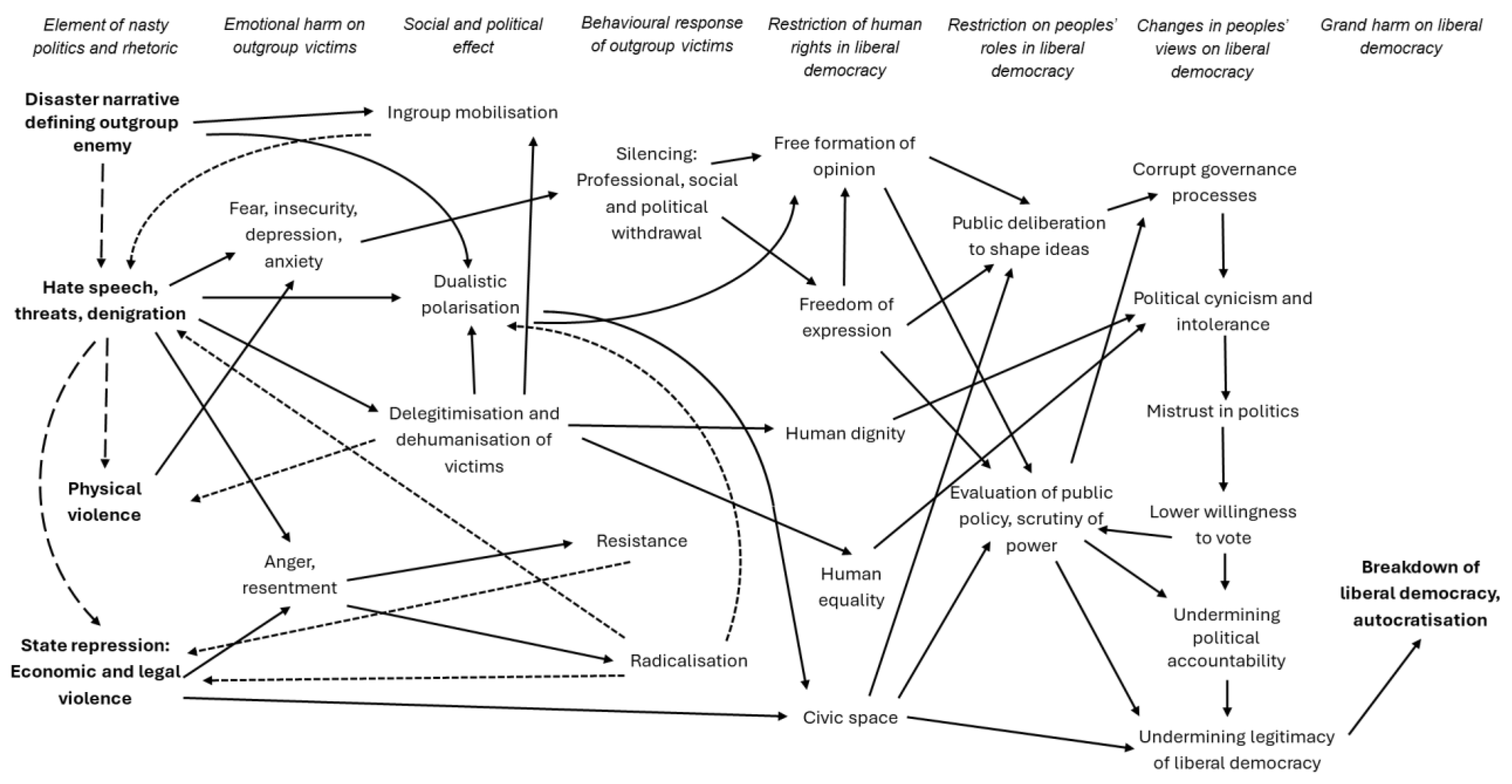

Table 1.
Typology of nasty rhetoric.
| Type of nasty rhetoric | Description | Level of aggression |
|---|---|---|
| Insults | Name-calling that influences how people make judgement and interpret situations and could sometimes include dehumanising and enmity rhetoric. | Hate |
| Accusations | Blaming opponents of doing something illegal or shady, or promulgating conspiracy theories about opponents. | Hate |
| Intimidations | Veiled threats advocating economic or legal action against an opponent, e.g., that they should get fired, be investigated or sent to prison. | Threat |
| Incitements | The most aggressive rhetoric includes people threatening or encouraging sometimes fatal violence against opponents. If the statement is followed, which happens, it implies physical harm to, or in the worst case, death of opponents. | Threat |
| Economic/legal violence (repression) | Denunciation, detention | Violence |
| Physical violence | Assault, beating, rape, murder. | Violence |
Modified from Zeitzoff (2023).
Table 2.
Framework for analysing democracy harms of nasty rhetoric.
| Element of nasty politics and rhetoric | Social and political effect | Emotional harm | Behavioural response of victims | Restriction of human rights in liberal democracy | Restriction of peoples’ roles in liberal democracy | Change in peoples’ views of liberal democracy | Grand effect on liberal democracy |
|---|---|---|---|---|---|---|---|
| Disaster narrative defining enemy | Dualistic polarisation | Fear, insecurity | Professional withdrawal | Restriction of civic space | Evaluation of public policy, scrutiny of power | Corrupt processes | Breakdown of liberal democracy |
| Hate speech, threats, denigration | Delegitimisation and dehumani-sation of victims | Depression, anxiety | Social and political withdrawal | Free formation of opinion | Public deliberation to shape ideas | Political cynicism and intolerance | Autocratisation |
| Physical violence | Anger | Resistance | Freedom of expression | Mistrust in politics | |||
| Economic and legal state repression | Radicalisation | Dignity | Lower willingness to vote | ||||
| Equality | Undermining legitimacy of liberal democracy | ||||||
| Undermining political accountability |
Table 3.
Search terms for articles, editorials and op-eds.
| Activist | Democracy | Hate | Polarisation | Scientist |
| Aggression | Demonise | Insecurity | Politics | Silence |
| Anger | Emotion | Journalist | Populism | Terrorist |
| Antidemocratic | Far-right | Liberal | Repression | Threat |
| Dehumanise | Fear | Libertarian | Research | Violence |
Table 4.
Data sources.
| Type of media | Media source | No. of sources |
|---|---|---|
| Newspapers and magazines | Total | 80 |
| Aftonbladet (independent social democrat) | 14 | |
| Altinget (independent liberal) | 3 | |
| Arbetsvärlden (journal on labour rights) | 1 | |
| Dagens Arena (independent progressive newspaper) | 2 | |
| Dagens ETC (independent left) | 6 | |
| Dagens Nyheter (independent liberal) | 25 | |
| Expressen (independent liberal) | 5 | |
| Fokus (independent right-wing) | 3 | |
| Frihetsnytt (far-right populist) | 1 | |
| GöteborgsPosten (independent liberal) | 3 | |
| Landets Fria Tidning (independent green) | 2 | |
| Magasinet Konkret (independent liberal democratic) | 3 | |
| Publikt (journal of labour union for state employees) | 2 | |
| Svenska Dagbladet (independent conservative) | 8 | |
| Tidningen Syre (independent green liberal) | 4 | |
| The New Republic (independent liberal) | 1 | |
| News agencies | 2 | |
| Reuters | 1 | |
| Politico (global nonpartisan policy news organization) | 1 | |
| Blogs | Total | 6 |
| Anna from the Swedish Energy Agency (personal)* | 1 | |
| CarbonBriefs (business) | 1 | |
| Klimataktion (climate activist) | 1 | |
| Smedjan (independent libertarian, Timbro) | 1 | |
| Supermiljöbloggen (independent green deliberative) | 2 | |
| National television |
Total Sveriges Television (public service) |
9 6 |
| TV4 (private) | 3 | |
| National radio | Sveriges Radio (public service): | 2 |
| Sum total | 99 |
* This blog describes the hate and threats and reactions of a climate activist that lost her job due to her activism. It contains several sections describing the process. It also links all articles in Swedish and international press about the case.
Disclaimer/Publisher’s Note: The statements, opinions and data contained in all publications are solely those of the individual author(s) and contributor(s) and not of MDPI and/or the editor(s). MDPI and/or the editor(s) disclaim responsibility for any injury to people or property resulting from any ideas, methods, instructions or products referred to in the content. |
© 2025 by the authors. Licensee MDPI, Basel, Switzerland. This article is an open access article distributed under the terms and conditions of the Creative Commons Attribution (CC BY) license (http://creativecommons.org/licenses/by/4.0/).
Copyright: This open access article is published under a Creative Commons CC BY 4.0 license, which permit the free download, distribution, and reuse, provided that the author and preprint are cited in any reuse.


