

Submitted:
28 April 2025
Posted:
29 April 2025
You are already at the latest version
Abstract
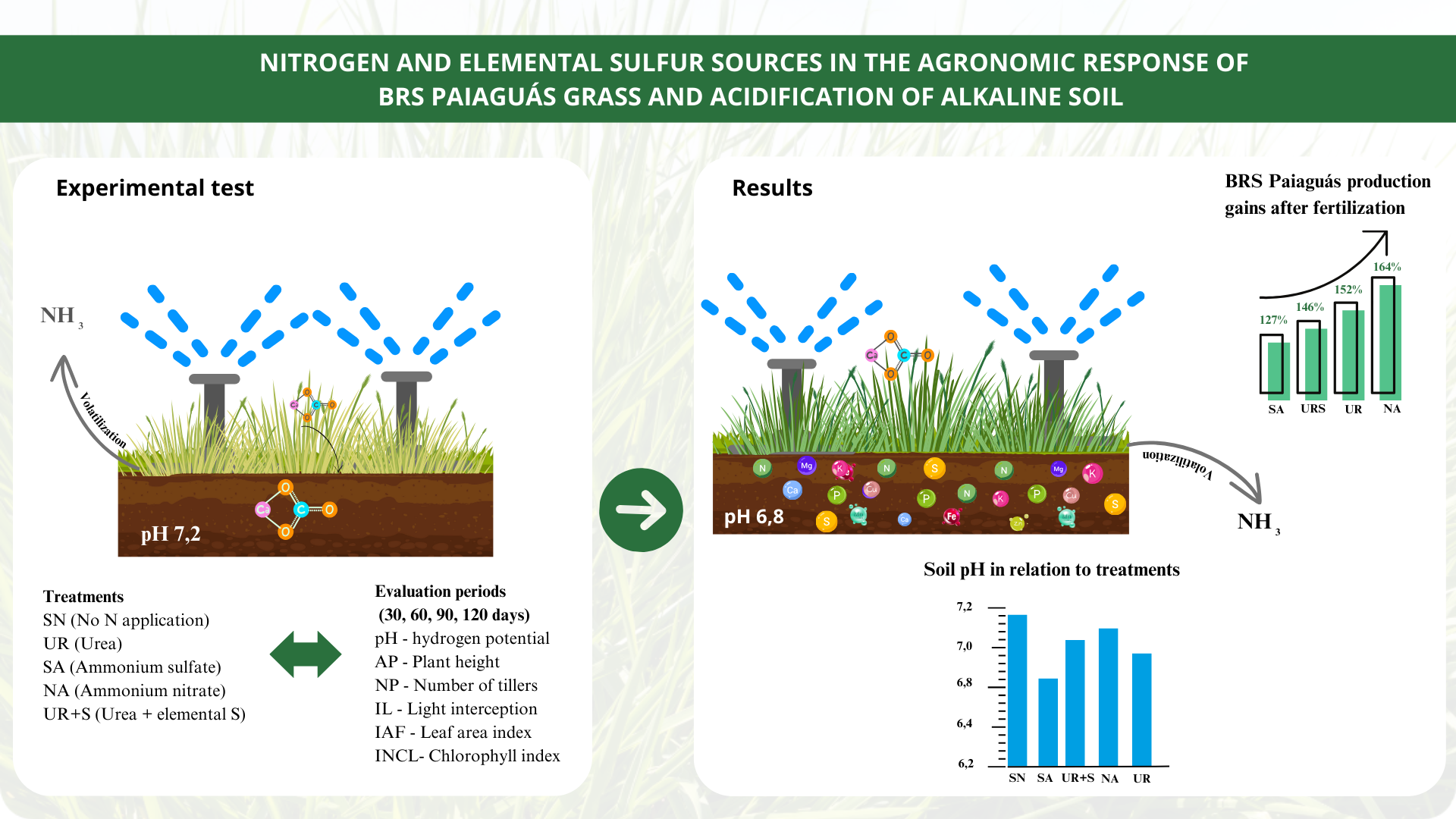
Alkaline soils can limit micronutrient uptake and increase ammonia loss in irrigated pastures. To address this, nitrogen and sulphur fertilization are commonly used to reduce soil pH. This study assessed the impact of five treatments on BRS Paiaguás grass: Urea (UR), ammonium sulphate (SA), ammonium nitrate (NA), urea with elemental sulphur (URS), and a control with no nitrogen (SN). Nitrogen treatments received 250 kg ha⁻¹ of N in four applications, and sulphur treatments received 60 kg ha⁻¹ of elemental S. Agronomic characteristics—including plant height, tiller count, dry matter yield, and leaf nutrient content—were measured over four growing periods and analyzed using Tukey’s test at a 5% significance level. Ammonium nitrate produced the highest dry matter yield (3,607.5 kg ha⁻¹), while urea led in tiller density (887 tillers/m²). Ammonium sulphate was the most effective at lowering soil pH, reducing it by 0.28 units. No changes in available phosphorus were observed, though potassium levels declined by 42% across the seasons. The study highlights the potential of choosing appropriate nitrogen sources and incorporating elemental sulphur to improve pasture productivity and regulate soil pH, ultimately enhancing fertility management in irrigated systems.
Keywords:
Forage grass
; Soil pH
; Nitrate fertilization
; Alkalinity
1. Introduction
BRS Paiaguás grass (Urochloa brizantha) is a tropical forage widely used in semi-arid regions due to its ability to adapt to environments with low rainfall and prolonged dry periods (Véras et al., 2020). Its resistance to water stress compared to other cultivars of the same species reinforces its importance for areas with low water availability. Recent studies show that U. brizantha responds well to fertilization, especially nitrogen, which can increase its productivity and improve the nutritional quality of the forage (Merloti et al., 2024).
In tropical grasses, nitrogen fertilization significantly increases forage production and nutritional value, demonstrating its effectiveness in improving pasture quality under various environmental conditions (Mattera et al., 2023). Urea, for example, is a widely used source, but it is subject to losses due to volatilization, especially in soils with a high pH. On the other hand, ammonium sulphate and ammonium nitrate, which provide N in forms ready for absorption (NH₄⁺ and NO₃-), have lower volatilization and higher acidification potential, and are more efficient in alkaline soils (Powlson & Dawson, 2022). The addition of elemental sulphur (S) to urea can also increase the effectiveness of fertilization, as S promotes soil acidification and makes sulphate available to plants (Boubakry et al., 2023).
Irrigating pastures is a strategy used to intensify production during periods of prolonged drought. It is usually associated with fertilization, but when it is carried out with water rich in carbonates, it can increase the soil’s pH. Groundwater has a high concentration of CaCO3 , which promotes an alkaline reaction in the soil and increases its base saturation and pH (Mohanavelu et al., 2021). Therefore, when irrigation is carried out in this way, it can have negative impacts from a soil chemistry point of view.
Continuous use of water with high levels of carbonates can aggravate soil alkalization (Minhas et al., 2021), especially in semi-arid areas that are already prone to this condition. Soil pH is one of the main factors affecting the availability of nutrients for plants. In this sense, the absorption of micronutrients such as iron (Fe), zinc (Zn) and manganese (Mn) decreases in alkaline soils and limits plant development (Dhaliwal et al., 2019). High pH also increases the volatilization of nitrogen in the form of ammonia (NH₃), compromising the efficiency of fertilization (Hurtado et al., 2024).
However, the application of nitrogen fertilizers, such as ammonium sulphate, can help acidify the soil through the release of protons (H⁺) during the nitrification process (Weng et al., 2021). This contributes to lowering the pH and improves nutrient availability by bringing the pH into optimal ranges for cultivation. Thus, managing fertilization and irrigation in soils with high pH can be seen as a strategy to maximize the productive potential of BRS Paiaguás grass and ensure the sustainability of pastures.
The aim was to evaluate the effect of nitrogen sources and elemental S on the agronomic response of BRS Paiaguás grass (Urochloa brizantha) and the acidification of soils irrigated with limestone water at different cuts.
2. Materials and Methods
The experiment was conducted at the Institute of Agricultural Sciences of the Federal University of Minas Gerais - Montes Claros Campus, at the geographical coordinates of 16°49’40 59” S and 43°50’16” O at an altitude of 617m from the sea.
The region’s climate is Aw, classified as tropical sub-humid with rainy summers and dry winters (Alvares et al., 2013). Throughout the experimental period, temperatures ranged from 18 to 35°C (Figure 1). The species under study was classified in the Angiosperm division, monocot class; order: Poales; family: Poaceae; genus: Urochloa; species: Urochloa brizantha (Hochst. ex A. Rich.) R.D. Webster (Syn. Brachiaria brizantha (Hochst. ex A. Rich.) Stapf), cultivar BRS Paiaguás. This plant was chosen for its drought tolerance, potential response to fertilizers and excellent regrowth capacity, making it suitable for semi-arid regions.
The soil in the experimental area is classified as Cambissolo háplico with a loamy-clay texture (Sampaio & Fernandes, 2021) and its physical and chemical composition are described in Table 1.
The soil in the experimental area was prepared in the conventional way, with scarification, loosening, levelling and uniformization of the soil. The plots with the forage were established in beds measuring 3.0 x 3.0 m (9 m²) with a spacing of 1.5 m between beds in the block and 2.0 m between blocks.
The irrigation system was a fixed sprinkler system, applying an average of 7.0 mm per day- 1 with an irrigation time of 40 minutes. The seeds used came from commercial production and the quantity of seeds was determined by calculating the minimum sowing rate using the cultural value. Sowing was carried out manually in the furrows (0.40 m distance between furrows), with simultaneous incorporation of phosphorus, supplied in the form of simple superphosphate, at a dose of 30 kg ha-1 , at the time of planting.
The experimental design was randomized blocks, with five treatments and four replications. The treatments corresponded to fertilization with: urea (UR), ammonium sulphate (SA), ammonium nitrate (NA), urea with elemental sulphur (URS) and without nitrogen (SN). All the treatments containing N received the same dose of 250 kg ha-1 , divided into four doses of 63 kg ha-1 , during the growing season. The treatments containing S received a dose of 60 kg ha-1 divided into three doses of 20 kg ha-1 . All the plots were subjected to three uniformization cuts, carried out at 20 cm above the soil surface, a value corresponding to half the height of the grazing entry simulation for BRS Paiaguás grass. The first dose was applied 60 days after forage establishment and before the first uniformization cut, while the second and third applications were made 60 days and 90 days after the uniformization cut, respectively. The replications consisted of four forage harvests in a time-subdivided plot design
Evaluations were carried out during four different periods of forage growth, with 30-day intervals between each one: period 1 corresponded to the first 30 days, period 2 to 60 days, period 3 to 90 days and period 4 to 120 days. At the end of each period, plant height (PH), number of tillers (NP), light interception (LI), leaf area index (LAI) and chlorophyll index (CLI) were assessed. Leaf area was obtained by taking five random measurements within the useful area using a ruler graduated in centimeters. To standardize the measurement, the height of the highest blade at each evaluation point was taken into account (Cecato et al., 2001). The number of tillers (NP) was counted within a 0.25 x 0.25 m frame, positioned within the useful area and set at 1m2 . IL and IAF measurements were also taken on the day of harvest using an Accupar LP-80 ceptometer (Metter Group, United States, Washington). The ceptometer estimated the parameters using measurements taken above and below the canopy with two probes simultaneously. The chlorophyll index was obtained by taking readings with a chlorophyll meter (Chlorophyllog, Model CFL1030, Falker). The readings were taken within the useful area and ammonium nitrate in the middle of the last expanded leaf, obtaining measurements of chlorophyll a, b and total.
After all the non-destructive evaluations had been carried out, the plants within the useful area were cut down using a 0.5 m x 0.5 m metal frame. The cut was made at 0.20 m above ground level. After cutting, the forage was weighed in the field and stored in plastic bags to determine the total fresh matter. Two sub-samples of fresh forage were then separated, one of which was used to separate the morphological components leaf blade, thatch + sheath and dead material. Each component was dehydrated in an oven at 55ºC until the mass reached constant weight, in order to estimate its relative participation in the morphological composition of the forage. The second sub- sample was dehydrated in a forced air circulation oven until it reached constant weight. Subsequently, the pre-dried samples were ground and the percentage of final dry matter and estimated dry mass of forage per cut (DMF) were determined. The total production was obtained from the sum of the crops harvested in four cuts. Representative samples of the pre-dry aerial part were sent to a commercial laboratory for analysis of the leaf contents of N, P, K, Ca, Mg, S, B, Zn, Cu, Mn and Fe, assessed in the first and last periods of the experiment. At each cutting, five ammonium nitrate soil samples were also taken at a depth of 0 to 20 cm per plot to obtain a homogeneous sample for determining the chemical analysis of total soil nitrogen (Kjeldahl method), available phosphorus (Mehlich, 1978)potassium, calcium and magnesium in the soil (Teixeira et al., 2017).
The data from the periods (subplots) corresponded to repeated measures over time and were studied with the aid of the diagnosis of residual variance and covariance matrices with greater capacity to represent the structure of the errors. Thus, the five structures available in the statistical package adopted were studied: autoregressive, heterogeneous autoregressive, continuous autoregressive process, compound symmetry and unstructured. The choice was made for the one that minimized the values of the Akayke and Bayesian information criteria.
The data was analyzed using a 5% significance level. When significant treatment effects were found, the means were compared using the Tukey test. When the treatment x cut interaction was significant, the interaction was decomposed. The tests were carried out using the Easyanova package implemented in the statistical software RStudio (R CORE TEAM, 2021).
3. Results
The hydrogeonic potential (pH) of the soil as a result of the application of different nitrogen sources was evaluated over four periods (30, 60, 90 and 120 days) (Figure 2). The average soil pH for the 30 and 90 day periods was 6.9 to 7.3 and did not differ for the different nitrogen sources (Figure 2A,C). However, the different N and S sources modified the average soil pH for the 60 and 90 day periods (p<0.05) (Figure 2B,D). The treatment with ammonium sulphate showed a 3.88% decrease in the average soil pH over all the periods and was the only one to show a pH below 7 (Figure 2E).
The different sources of N and S modified (p≤0.05) the total nitrogen content of the soil (NTS) (Table 2). In this sense, the urea+ S-element treatment had the highest average and did not differ statistically from ammonium sulphate and ammonium nitrate. The NTS of the urea+ S- element treatment was 25.84% higher than the treatment without nitrogen and 33.78% higher than the urea treatment. The NTS gradually decreased throughout the experiment and periods 1 and 2 were 29.78% and 41.47%, respectively, higher compared to periods 3 and 4 (Table 2).
The N and S sources applied did not change the available phosphorus content in the soil (P Mehlich1 ) (Table 3). The four periods evaluated did not show significant variations in the available P content (p≤0.05). The K content in the soil did not change in all the treatments, but it did decrease as the evaluation periods progressed (Table 3) so that the concentration was 41% higher in period 1 compared to period 4. Period 2 was also statistically higher (95.14 mg dm-3 ) than period 4, when the nutrient content reached the lowest value (71.44 mg dm-3 ).
The application of the different N sources did not result in significant changes in the (Mg) content of the soil. On the other hand, there was a significant difference (p≤0.05) in Mg content over the different periods (Table 3). In this sense, periods 3 and 4 showed an increase in Mg content in the soil of 57.14% and 45% respectively, higher than period 2 when the lowest content of 0.98 mg dm-3 was observed (Table 3).
The interaction between N sources and periods significantly influenced (p≤0.05) the calcium (Ca) content of the soil in the study (Table 4). This was the only response variable where the interaction was significant, so it was necessary to break down the interaction to study how the nutrient content behaved as a function of the sources of variation. When analyzing the effect of the N and S sources in each of the periods, it can be seen that the response of the Ca content to the different treatments, including the control (without nitrogen), was uniform. This can be seen from the lack of significant differences between the sources (Table 4).
On the other hand, the Ca content over the four periods evaluated differed between the different sources. The treatment without nitrogen showed a high value of ammonium nitrate in the first period and reached a lower value in the third. The treatments with ammonium sulphate and urea + S-element, both with S, showed higher levels in periods 1 and 2 (8.23 and 8.61 cmolc dm-3 ) than 3 and 4. In the treatment with only urea, ammonium nitrate in period 1, the Ca content was higher than ammonium nitrate in periods 2, 3 and 4. The ammonium nitrate treatment also showed a significantly higher value (9.01 cmolc dm-3 ) in the second period, followed by 1, 4 and 3, where the lowest value was recorded (Table 4).
There was no significant difference (p≤0.05) between the treatments with different nitrogen sources for the variable chlorophyll index (INCL) (Table 5). In this study, the average value among the treatments, including the treatment without N, was 38.44. On the other hand, the advancement of the periods resulted in a significant change in the INCL, where an increase of 14.62 and 11.35 % was recorded in periods 2 and 4 respectively, which were statistically higher than period 1 (Table 5).
The fertilization strategies used modified (p≤0.05) productive aspects of the BRS Paiaguás grass, such as forage dry mass (DBM), plant height (PH) and number of tillers (NP) (Table 6). The sources applied did not differ from each other, but showed superior performance compared to the SN control. The same variables, with the exception of NP, also responded significantly to the evaluation periods (Table 6).
However, there was no influence from the interaction between source and periods. The dry mass of forage (DMF) corresponds to the average amount of forage produced over 30 days of growth (one period). This variable was significantly higher in plants fertilized with different N sources compared to those in the control treatment without nitrogen (SN) (Table 6), resulting in a uniform biomass production response to fertilization.
The gains in production after fertilization with SA, URS, NA and UR were 127, 146, 164 and 152%, respectively. In this sense, all types of N sources provided production more than double that of the unfertilized condition, showing that N is indeed the main strategy for increasing forage production and stocking rate. The effect of the periods resulted in a large monthly variation in SBM (Table 6). In this sense, the highest result occurred in period 3, followed by periods 2 and 4, which did not differ from each other. The percentage gain in production observed in period 3 was 79.08% higher than in period 1.
The PA and NP responded to the N sources in a similar way to the SBM (Table 6), where the grass had its vegetative growth limited only in the absence of N fertilization. Thus, the gain in PA between N-fertilized and non-fertilized plants was 25.81% at the time of harvest (Table 6). The same gain in NP was 64% compared to the SN control.
The growth periods had no influence (p≤0.05) on the NP of BRS Paiaguás grass (Table 6). Plant height (PH) in periods 1, 3 and 4 (Table 6) showed no statistical differences between them, but was higher than in period 2.
The different nitrogen sources with S did not change the percentages of leaves and stalks in the forage (p≤0.05) of BRS Paiaguás grass (Table 7), but fertilizing with SA and UR resulted in a
lower proportion of dead material (DEAD) than the SN control. The SN control, in turn, did not differ statistically from the URS and NA treatments (Table 7). The proportion of DEAD in SN was 167% higher than SA and 148% higher than UR, showing accelerated leaf senescence in the SN treatment.
The periods changed the morphological composition of the grass in terms of the percentage of LEAF and STEM, but there was no difference in the percentage of DEAD (Table 7). In this sense, cut 3 was characterized by more leaves and fewer stalks than the other periods. The percentage of DEAD was the same between the periods.
In the leaf area index (LAI) and light interception (LI) variable, the SN treatment was the only one that differed statistically from the others, showing the lowest averages for the sources evaluated (Table 7). In this sense, all the treatments with N or N and S showed a similar response in terms of their ability to take advantage of and respond to light from the environment. In fact, the SA IAF was 70% higher than the SN treatment (Table 7) and this value resulted from the lower development of the aerial part due to the N deficiency.
The period factor (Table 7) also modified the forage plant’s ability to interact with light. Period 3 provided the highest leaf area index (LAI), with an average of 4.32 (Table 7). The lowest LAI value was observed in period 2, which was significantly lower than all the periods and 66.4% lower than period 3 where the highest LAI was observed. Light interception (LI) did not differ statistically between periods 2 and 3, which were 14.53 and 18.67 % higher in periods 1 and 4 respectively.
The different sources of N and S did not change the foliar potassium (K) content. However, the different periods studied showed a significant reduction of 35.83% in the K content from period 1 to period 4 (Table 8). The leaf magnesium (Mg) content showed a similar response to Ca, but with lower absolute values (Table 8). Thus, Mg in the leaves did not respond to the different fertilizers, but rather to the periods. The reduction in Mg was 22.72% between periods 1 and 4. The different sources of N and S and the evaluation periods did not change the leaf sulphur (S) content, which was 1.58 g kg-1 of dry leaf biomass (Table 8).
The foliar content of the micronutrients boron (B), copper (Cu), manganese (Mn) and iron (Fe) did not respond to the different sources of N and S and the evaluation periods (Table 8). Only the leaf content of zinc (Zn) responded to the progression of the periods, but did not respond to the sources of N and S. In this sense, a 20.7% decrease in leaf Zn was observed between periods 1 and 4.
4. Discussion
The fertilizers or N sources used in the experiment are those most commonly used in agriculture, including in the cultivation of BRS Paiaguás grass (Pinho et al., 2022). The study of soil pH variations with different nitrogen (N) sources reveals that ammonium sulphate (AS) is particularly effective at acidifying alkaline Cambisols, reaching a pH of 6.9, similar to treatments with urea and urea combined with elemental sulphur (Figure 2). This finding is in line with wider research into soil acidification, which highlights the role of nitrogen fertilizers in altering soil pH levels (H. Zhang et al., 2024; Zamanian et al., 2024). The effectiveness of SA in this context can be attributed to its chemical properties and the specific soil conditions of the study area.
Ammonium sulfate is particularly effective in acidifying soils due to its high ammonium content, which undergoes nitrification, releasing more H+ compared to other N sources such as urea (Dong et al., 2021). Urea, although it also contributes to acidification, does so to a lesser extent unless combined with sulfur, which increases its acidifying effect by further promoting nitrification and sulfate formation (Tkaczyk et al., 2020). The buffering capacity of soil, which is its ability to resist changes in pH, is influenced by the type and amount of nitrogen fertilizer applied. Sustainable management practices, such as balanced fertilization and organic matter addition, are recommended to mitigate the adverse effects of soil acidification (Tkaczyk et al., 2020). Although ammonium sulfate is effective in acidifying alkaline soils, it is crucial to consider the long-term impacts on soil health and productivity.
The study observed a gradual decline in NTS over time, with the first two periods having significantly higher NTS than the last two (Table 2). This suggests that nitrogen availability decreases as the growing season progresses (Bao et al., 2024). Similar studies have shown that chemical fertilization, including nitrogen and sulfur, can significantly increase soil nitrogen availability (Bao et al., 2024), supporting the findings of increased NTS with specific treatments.
The role of sulfur in nitrogen cycling is further supported by research indicating that sulfur can influence nitrogen transformations and retention in soil (Balan et al., 2023). Urea combined with elemental sulfur significantly increased NTS (Tabela 2), indicating a synergistic effect of these elements in increasing nitrogen retention in the soil (Brodowska et al., 2024). Ammonium sulfate and ammonium nitrate also maintained high NTS levels, suggesting their effectiveness in nitrogen management.
Regarding the impact of nitrogen (N) and sulphur (S) sources on the phosphorus (P), potassium (K) and magnesium (Mg) content of the soil over time, the results indicate that the N and S sources did not alter the available P content, while the K content decreased over time and the Mg content varied significantly over different periods (Table 3). This application of different P sources can significantly influence the availability and transformation of P in the soil. For example, superphosphate (SSP) has been shown to increase available P in the soil by increasing the pool of labile P, which is crucial for crop uptake (Zhou et al., 2024). The presence of water-soluble organic matter (WSOM) can also increase available P levels, with highly humified WSOM maintaining higher P levels over time (Takahashi & Katoh, 2024). (Vieira et al., 2021), studying phosphorus adsorption in soils from the Brazilian semi-arid region, reported that the highest P adsorption was observed in soils with clayier, alkaline and iron- and calcium-rich textures, conditions similar to those in this study.
The decrease observed in K content over time can be attributed to continuous sorption reactions and the absorption of nutrients by plants. The co-application of K with other nutrients can further reduce the availability of P due to the displacement of exchangeable cations (McKenna et al., 2024). The interaction between N, K and S can have synergistic or antagonistic effects on nutrient content, depending on the proportions used (Brodowska et al., 2024).
Variations in Mg content over different periods suggest that Mg availability is influenced by soil properties and nutrient interactions. The precipitation of magnesium phosphates can affect Mg levels, as seen in studies on the transformation of P in different soil types (McKenna et al., 2024). Although the application of N and S sources did not significantly alter P content, the dynamics of K and Mg highlight the importance of understanding nutrient interactions and soil properties. These findings underscore the need for tailored fertilization strategies that consider specific nutrient dynamics and soil conditions to optimize nutrient availability and growth of BRS Paiaguás grass.
The different N sources and periods interacted in such a way as to provide complex variations in the soil’s Ca content (Table 4). Thus, the interaction between the plants and the form of N absorbed promotes conditions that can modify the Ca in the soil. In this sense, when NO3- is the predominant form absorbed, there is a chance of an increase in soil pH. When NH4+ is the main form absorbed, there is a consequent reduction in pH (Xiong et al., 2021). This explains the increase in the Ca content of plants fertilized with NO in the second period. Thus, the absorption of NO3- by the BRS Paiaguás grass may have contributed to an increase in soil pH. This created conditions of lower acidity and facilitated the solubilization of the nutrient.
In general, the interaction between nitrogen (N) sources and periods significantly influenced the levels of calcium (Ca) in the soil (Table 4). The study found that Ca content varied over different periods, with treatments involving ammonium sulphate and urea+S-element showing higher levels of Ca in the early periods compared to the later ones. This may be due to the extraction of Ca by BRS Paiaguás grass, which produced a high level of plant biomass. In addition, acidification resulting from N fertilization, especially in the SA, URS and UR treatments, may result in greater solubility and absorption of Ca as harvests and N doses progress (Hynicka et al., 2016). In agricultural environments, the application of nitrogen fertilizers can significantly affect Ca accumulation in plants and soil. For example, in peanut cultivation, the combined application of Ca and N fertilizers improved the accumulation of nutrients, including Ca, increasing plant growth and yields (Wang et al., 2023).
The study in question found no significant difference in the chlorophyll index (INCL) between treatments with different nitrogen sources, but did observe significant changes in the INCL over time (Table 5). This suggests that although the type of nitrogen source may not affect chlorophyll content (Padilla et al., 2018), the timing or duration of nitrogen application does. In maize, for example, different nitrogen rates did not significantly affect chlorophyll SPAD values between certain treatments, but showed an increase in chlorophyll content at specific growth stages when nitrogen was applied appropriately (Liu et al., 2018). Temporal patterns in chlorophyll meter readings can reflect changes in nitrogen status and recovery from plant deficiencies, indicating that the timing of nitrogen application is crucial for optimizing chlorophyll content and plant health (J. Zhang et al., 2007). In this way, the chlorophyll index showed more sensitivity to discriminate the difference over the months of evaluation, but was not enough to show patterns of response of the BRS Paiaguás grass to the fertilizers that added the same amount of N.
Regarding the impact of the different fertilization combinations on the productive aspects of BRS Paiaguás grass, specifically dry forage mass (DBM), plant height (PH) and number of tillers (NP). The results indicate that nitrogen fertilization significantly increased dry forage mass (DBM) by 127% to 164% compared to the control, demonstrating its effectiveness in increasing biomass production (Camargo et al., 2024). Plant height (PA) and number of tillers (NP) also showed substantial gains with N fertilization, with PA increasing by 25.81% and NP by 64% compared to the control. This highlights the critical role of N in increasing forage production and stocking rates in pastures. The response of these variables to fertilization is consistent across different periods, although the interaction between sources and periods is not significant.
The study of nitrogen sources and their effects on BRS Paiaguás grass reveals that although different sources of nitrogen with sulphur (S) did not alter the percentage of leaves and stems, they significantly impacted the proportion of dead material (Table 7). Fertilization with ammonium sulphate (AS) and urea (UR) resulted in a lower proportion of dead material compared to the nitrogen control without sulphur (SN), indicating that these treatments can reduce leaf senescence. The SN treatment had 167% more dead material than SA and 148% more than UR, suggesting accelerated leaf senescence under SN treatment. In addition, the leaf area index (LAI) and light interception (LI) were notably lower in the SN treatment, highlighting the importance of nitrogen in plant development and light utilization.
The periods affected the morphological composition, with cut 3 showing more leaves and fewer stems. The SN treatment had the lowest IAF, with SA showing a 70% higher IAF, indicating better growth and utilization of light with adequate nitrogen (Lopes et al., 2024; Bastidas et al., 2024). IL did not differ significantly between periods 2 and 3, but both were higher than periods 1 and 4, indicating better light capture in these periods (Risso Barbosa et al., 2024). Although nitrogen fertilization improves plant growth and reduces senescence, the type of nitrogen source and the timing of application are crucial. Different nitrogen sources can lead to varying results in plant health and productivity.
The results indicate that although the N and S sources did not affect the leaf potassium (K) content, a significant reduction in K was observed over time (Table 8). Potassium content in plants can be influenced by seasonal and inter-annual dynamics, as seen in sour cherry orchards, where K levels were affected by weather patterns and tree uptake (Roeva et al., 2023). ). Similarly, the magnesium (Mg) content decreased over the periods, while sulphur (S) and other micronutrients remained unchanged (Table 8).
The antagonistic relationship between K and Mg suggests that high levels of K can lead to Mg deficiency, affecting photosynthesis and plant quality (Peršurić Palčić et al., 2022). Despite the application of different fertilizers, the foliar S content remained stable, which is in line with findings in strawberries, where S levels were generally low but consistent across all samples (Osvalde et al., 2023).
The stability of micronutrients such as boron (B), copper (Cu), manganese (Mn) and iron (Fe) in different treatments and periods (Table 8) suggests that these elements are less sensitive to the factors studied.
While the research highlights the stability of certain nutrients, it also underscores the complexity of nutrient interactions and the importance of considering environmental and management factors. The reductions observed in K and Mg over time can be attributed to factors such as nutrient uptake dynamics and nutrient availability in the soil, which not only depend on the type of fertilizer, but also on broader ecological and management practices.
5. Conclusions
The study highlighted the efficiency of using different nitrogen and sulphur sources to manage BRS Paiaguás grass in alkaline soils. The results confirm that ammonium sulphate excelled in acidifying the soil, reducing the pH and increasing the availability of nitrogen for plants. In addition, the combination of urea with elemental sulphur showed a higher calcium content in the soil, indicating beneficial interactions between these nutrients. In terms of productivity, nitrogen fertilization resulted in significant increases in forage dry mass, plant height and number of tillers, highlighting the central role of nitrogen in increasing biomass and improving the agronomic performance of the forage. The chlorophyll index was efficient at capturing variations over the growth periods, but did not differ between fertilizer sources, suggesting that its usefulness is more related to the temporal conditions of the experiment.
The findings reinforce the importance of management practices that combine nitrogen and sulphur sources to maximize productivity and promote adjustments in soil fertility under conditions of irrigation with water rich in carbonates. Thus, the appropriate choice of fertilizer sources and the planning of application periods are essential to optimize forage production and the sustainability of agricultural systems in alkaline soils.
Author Contributions
“Conceptualization, methodology, (J.S.S.M), (L.A.F), and (T.G.d.S.B); ; software, (J.S.S.M) and (T.G.d.S.B); validation, X.X., Y.Y., and Z.Z.; formal analysis, (M.M.d.S).; investigation, resources, (L.A.F) and (T.G.d.S.B); data curation, X.X.; writing—original draft preparation, (J.S.S.M), (M.M.d.S), (A.F.R), (A.B.N); writing—review and editing, (E.M.M.P); visualization, (F.F.d.H); ; supervision, project administration, (J.S.S.M), (L.R.M), and (E.M.V); funding acquisition, (T.G.d.S.B). All authors have read and agreed to the published version of the manuscript.
Funding
We acknowledge the financial support of the Coordination for the Improvement of Higher Education Personnel (CAPES) - financial code 001 - for the scholarship.
Conflicts of Interest
The authors declare that they have no competing financial interests or personal relationships that may have influenced the work reported in this article.
References
- Alvares, C. A. , Stape, J. L., Sentelhas, P. C., de Moraes Gonçalves, J. L. & Sparovek, G. (2013). Köppen’s climate classification map for Brazil. Meteorologische Zeitschrift, 711–728. [CrossRef]
- Balan, S. A., Welsh, H. & Amundson, R. (2023). Comparative C, N, and S cycling along a Californian grassland chronosequence. Geoderma, 439, 116682. [CrossRef]
- Bao, W. , He, P., Han, L., Wei, X., Feng, L., Zhu, J., Wang, J., Yang, X. & Li, L.-J. (2024). Soil nitrogen availability and microbial carbon use efficiency are dependent more on chemical fertilization than winter drought in a maize–soybean rotation system. Frontiers in Microbiology, 15. [CrossRef]
- Bastidas, M. , Vázquez, E., Villegas, D. M., Rao, I. M., Gutierrez, J. F., Vivas-Quila, N. J., Amado, M., Berdugo, C. & Arango, J. (2024). Optimizing nitrogen use efficiency of six forage grasses to reduce nitrogen loss from intensification of tropical pastures. Agriculture, Ecosystems & Environment, 367, 108970. [CrossRef]
- Boubakry, C. , Agyin-Birikorang, S., Adu-Gyamfi, R., Chambers, R. A., Tindjina, I. & Angzenaa, A. B. (2023). Improving agronomic effectiveness of elemental sulfur to increase productivity in sulfur-deficient soils. Agronomy Journal, 115(6), 3131–3143. [CrossRef]
- Brodowska, M. S., Wyszkowski, M. & Karsznia, M. (2024). Application of Urea and Ammonium Nitrate Solution with Potassium Thiosulfate as a Factor Determining Macroelement Contents in Plants. Agronomy, 14(6), 1097. [CrossRef]
- Camargo, T. A. de, Alves, L. A., Mendes, I. C., Gasques, L. R., Oliveira, L. G. S. de, Pires, G. C., Almeida, T. O., Carvalho, P. C. de F. & Souza, E. D. de. (2024). Enhancing soil quality and grain yields through fertilization strategies in integrated crop-livestock system under no-till in Brazilian Cerrado. European Journal of Soil Biology, 121, 103613. [CrossRef]
- Cecato, U. , Castro, C. R. de C., Canto, M. W. do, Peternelli, M., Almeida Júnior, J., Jobim, C. C. & Cano, C. C. P. (2001). Perdas de forragem em capim-Tanzânia (Panicum maximum Jacq cv. Tanzania-1) manejado sob diferentes alturas sob pastejo. Revista Brasileira de Zootecnia, 30, 295–301. [CrossRef]
- Dhaliwal, S. S. , Naresh, R. K., Mandal, A., Singh, R. & Dhaliwal, M. K. (2019). Dynamics and transformations of micronutrients in agricultural soils as influenced by organic matter build-up: A review. Environmental and Sustainability Indicators, 1–2, 100007. [CrossRef]
- Dong, Y., Yang, J.-L., Zhao, X.-R., Yang, S.-H. & Zhang, G.-L. (2021). Contribution of different proton sources to the acidification of red soil with maize cropping in subtropical China. Geoderma, 392, 114995. [CrossRef]
- Hurtado, J., Velázquez, E., Lassaletta, L., Guardia, G., Aguilera, E. & Sanz-Cobena, A. (2024). Drivers of ammonia volatilization in Mediterranean climate cropping systems. Environmental Pollution, 341, 122814. [CrossRef]
- Hynicka, J. D., Pett-Ridge, J. C. & Perakis, S. S. (2016). Nitrogen enrichment regulates calcium sources in forests. Global Change Biology, 22(12), 4067–4079. [CrossRef]
- Liu, Z., Gao, J., Gao, F., Liu, P., Zhao, B. & Zhang, J. (2018). Photosynthetic Characteristics and Chloroplast Ultrastructure of Summer Maize Response to Different Nitrogen Supplies. Frontiers in Plant Science, 9. [CrossRef]
- Lopes, A. da R., Lage Filho, N. M., do Rêgo, A. C., Domingues, F. N., Silva, T. C. da, Faturi, C., Silva, N. C. da & da Silva, W. L. (2024). Effect of nitrogen fertilization and shading on morphogenesis, structure and leaf anatomy of Megathyrsus maximus genotypes. Frontiers in Plant Science, 15. [CrossRef]
- Teixeira, P. C. , Donagemma, G. K., Fontana, A., & Teixeira, W. G. (2017). Manual de métodos de análise de solo, Embrapa, 3.
- Mattera, J. , Romero, L. A., Iacopini, M. L., Gaggiotti, M., Cuatrín, A. L. & Tomás, M. A. (2023). Nitrogen fertilization effects on forage production and nutritive value of 4 tropical grasses on alkaline soils in Argentina. Tropical Grasslands-Forrajes Tropicales, 11(3), 233–239. [CrossRef]
- McKenna, B. A., Kopittke, P. M., Bell, M. J., Lombi, E., Klysubun, W., McLaren, T. I., Doolette, C. L. & Meyer, G. (2024). Phosphorus availability and speciation in the fertosphere of three soils over 12 months. Geoderma, 447, 116913. [CrossRef]
- Mehlich, A. (1978). New extractant for soil test evaluation of phosphorus, potassium, magnesium, calcium, sodium, manganese and zinc. Communications in Soil Science and Plant Analysis, 9(6), 477–492. [CrossRef]
- Merloti, L. F. , Bossolani, J. W., Mendes, L. W., Rocha, G. S., Rodrigues, M., Asselta, F. O., Crusciol, C. A. C. & Tsai, S. M. (2024). Investigating the effects of Brachiaria (Syn. Urochloa) varieties on soil properties and microbiome. Plant and Soil, 503(1), 29–46. [CrossRef]
- Minhas, P. S., Bali, A., Bhardwaj, A. K., Singh, A. & Yadav, R. K. (2021). Structural stability and hydraulic characteristics of soils irrigated for two decades with waters having residual alkalinity and its neutralization with gypsum and sulfuric acid. Agricultural Water Management, 244, 106609. [CrossRef]
- Mohanavelu, A. , Naganna, S. R. & Al-Ansari, N. (2021). Irrigation Induced Salinity and Sodicity Hazards on Soil and Groundwater: An Overview of Its Causes, Impacts and Mitigation Strategies. Agriculture, 11(10), 983. [CrossRef]
- Osvalde, A. , Karlsons, A., Cekstere, G. & Āboliņa, L. (2023). Leaf Nutrient Status of Commercially Grown Strawberries in Latvia, 2014–2022: A Possible Yield-Limiting Factor. Plants, 12(4), 945. [CrossRef]
- Padilla, F. M., de Souza, R., Peña-Fleitas, M. T., Gallardo, M., Giménez, C. & Thompson, R. B. (2018). Different Responses of Various Chlorophyll Meters to Increasing Nitrogen Supply in Sweet Pepper. Frontiers in Plant Science, 9. [CrossRef]
- Peršurić Palčić, A., Jeromel, A., Pecina, M., Palčić, I., Gluhić, D., Petek, M. & Herak Ćustić, M. (2022). Decreased Leaf Potassium Content Affects the Chemical Composition of Must for Sparkling Wine Production. Horticulturae, 8(6), 512. [CrossRef]
- Pinho, A. G. P. , Bonfim-Silva, E. M., Oliveira, J. R. de, Castaon, T. H. F. M., Meneghetti, L. A. M. & Silva, T. J. A. da. (2022). Eficiência da ureia de liberação controlada e convencional nas características produtivas do capim Urochloa brizantha cv. Paiaguás / Efficiency of controlled-release and conventional urea on the productive characteristics of Urochloa brizantha cv. Paiaguas grass. Brazilian Journal of Development, 8(1), 700–712. [CrossRef]
- Powlson, D. S. & Dawson, C. J. (2022). Use of ammonium sulphate as a sulphur fertilizer: Implications for ammonia volatilization. Soil Use and Management, 38(1), 622–634. [CrossRef]
- Risso Barbosa, M. , Durante, M., Marin, L., Cazzuli, F., Ferreira de Quadros, F. L., Dixon, R. M., Riet Correa, F. & Jaurena, M. (2024). How Long Should Grasses of South American Campos Grasslands Rest for Stockpiling Forage? Agronomy, 14(8), 1790. [CrossRef]
- Roeva, T. , Leonicheva, E., Leonteva, L., Vetrova, O. & Makarkina, M. (2023). The Features of Potassium Dynamics in ‘Soil–Plant’ System of Sour Cherry Orchard. Plants, 12(17), 3131. [CrossRef]
- Sampaio, R. A. & Fernandes, L. A. (2021). Aspectos geológicos e pedológicos dos solos do município de Montes Claros – MG. Caderno de Ciências Agrárias, 13, 1–18. [CrossRef]
- Takahashi, Y. & Katoh, M. (2024). Variations in the level of available phosphorus with changes in the status of water-soluble organic matter derived from different organic materials in soil. Journal of Environmental Management, 370, 122531. [CrossRef]
- Tkaczyk, P. , Mocek-Płóciniak, A., Skowrońska, M., Bednarek, W., Kuśmierz, S. & Zawierucha, E. (2020). The Mineral Fertilizer-Dependent Chemical Parameters of Soil Acidification under Field Conditions. Sustainability, 12(17), 7165. [CrossRef]
- Véras, E. L. L. , Difante, G. S., Gurgel, A. L. C., Costa, C. M., Emerenciano Neto, J. V., Rodrigues, J. G., Costa, A. B. G., Pereira, M. G. & Ítavo, L. C. V. (2020). Tillering Capacity of Brachiaria Cultivars in the Brazilian Semi-Arid Region During the Dry Season. Tropical Animal Science Journal, 43(2), 133–140. [CrossRef]
- Vieira, M. D. S. , Oliveira, F. H. T. D., Gurgel, M. T., Santos, H. C. & Tavares, H. A. M. (2021). PHOSPHORUS SORPTION ISOTHERMS IN SOILS OF THE SEMIARID REGION OF BRAZIL. Revista Caatinga, 34, 166–176. [CrossRef]
- Wang, J., Geng, Y., Zhang, J., Li, L., Guo, F., Yang, S., Zou, J. & Wan, S. (2023). Increasing Calcium and Decreasing Nitrogen Fertilizers Improves Peanut Growth and Productivity by Enhancing Photosynthetic Efficiency and Nutrient Accumulation in Acidic Red Soil. Agronomy, 13(7), 1924. [CrossRef]
- Weng, Z. (Han), Butterly, C. R., Sale, P., Li, G. & Tang, C. (2021). Combined nitrate and phosphorus application promotes rhizosphere alkalization and nitrogen uptake by wheat but not canola in acid subsoils. Journal of Soils and Sediments, 21(9), 2995–3006. [CrossRef]
- Zamanian, K. , Taghizadeh-Mehrjardi, R., Tao, J., Fan, L., Raza, S., Guggenberger, G. & Kuzyakov, Y. (2024). Acidification of European croplands by nitrogen fertilization: Consequences for carbonate losses, and soil health. Science of The Total Environment, 924, 171631. [CrossRef]
- Zhang, H. , Wang, L., Fu, W., Xu, C., Zhang, H., Xu, X., Ma, H., Wang, J. & Zhang, Y. (2024). Soil Acidification Can Be Improved under Different Long-Term Fertilization Regimes in a Sweetpotato–Wheat Rotation System. Plants, 13(13), 1740. [CrossRef]
- Zhang, J., Blackmer, A. M., Blackmer, T. M., Kyveryga, P. M. & Ellsworth, J. W. (2007). Nitrogen deficiency and recovery in sustainable corn production as revealed by leaf chlorophyll measurements. Agronomy for Sustainable Development, 27(4), 313–319. [CrossRef]
- Zhou, L. , Zhao, T., Thu, N., Zhao, H., Zheng, Y. & Tang, L. (2024). The Synergistic Effects of Different Phosphorus Sources: Ferralsols Promoted Soil Phosphorus Transformation and Accumulation. Agronomy, 14(10), 2372. [CrossRef]
Figure 1.
Accumulated monthly precipitation (mm) and maximum, compensated average and minimum monthly temperatures obtained from a meteorological station positioned 500 m from the experimental area (Source: INMET, 2023).
Figure 1.
Accumulated monthly precipitation (mm) and maximum, compensated average and minimum monthly temperatures obtained from a meteorological station positioned 500 m from the experimental area (Source: INMET, 2023).
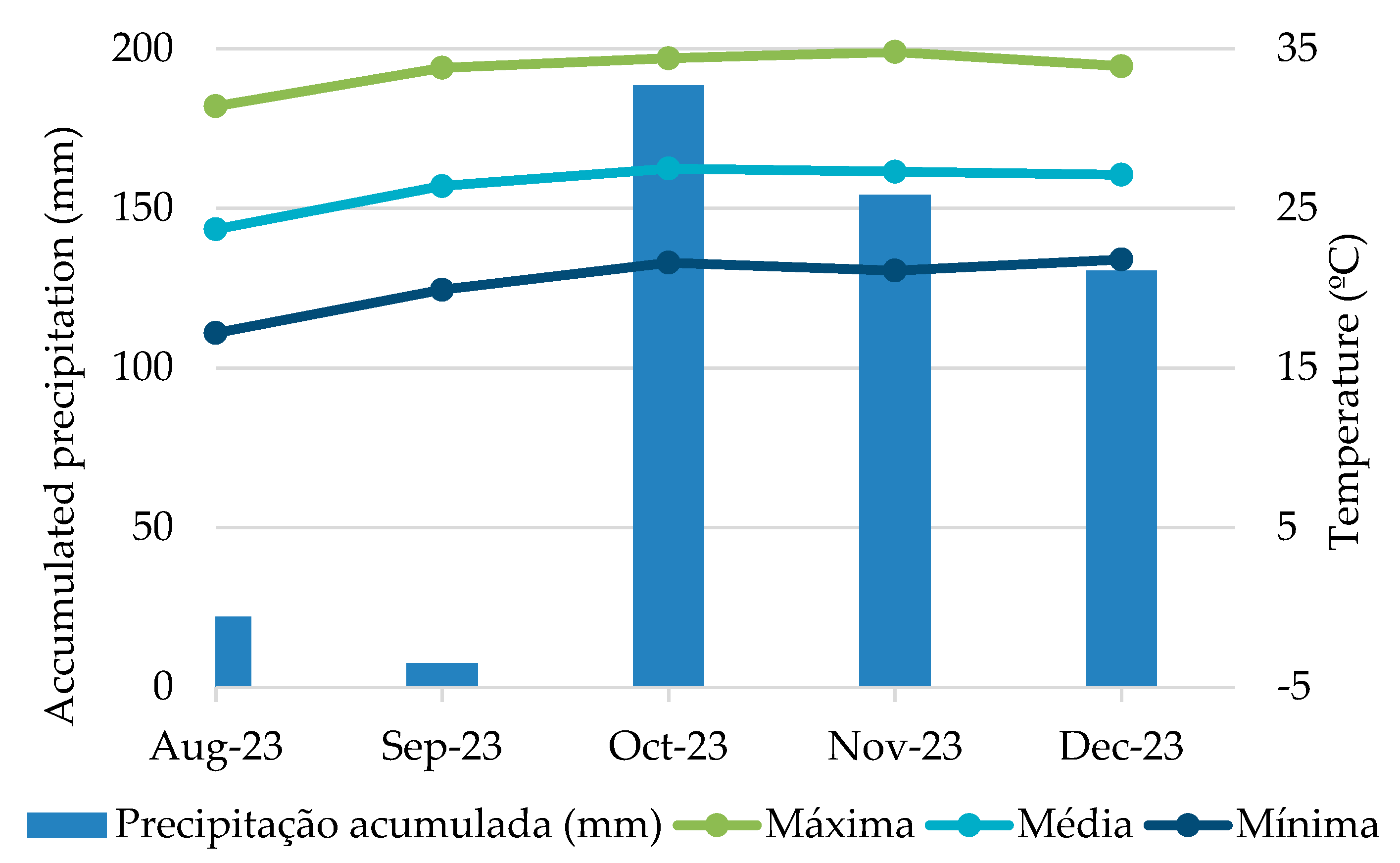
Figure 2.
Soil hydrogen potential (pH) as a function of the application of different nitrogen sources in soil acidification. UFMG, Montes Claros-MG, 2024. (A) Soil pH in the period 1 - 30 days; (B) soil pH in the period 2 - 60 days; (C) soil pH in the period 3 - 90 days; (D) soil pH in the period 4 -120 days and (E) average soil pH over all periods. Means followed by the same letter do not differ from each other by Tukey’s test at 5% significance.
Figure 2.
Soil hydrogen potential (pH) as a function of the application of different nitrogen sources in soil acidification. UFMG, Montes Claros-MG, 2024. (A) Soil pH in the period 1 - 30 days; (B) soil pH in the period 2 - 60 days; (C) soil pH in the period 3 - 90 days; (D) soil pH in the period 4 -120 days and (E) average soil pH over all periods. Means followed by the same letter do not differ from each other by Tukey’s test at 5% significance.
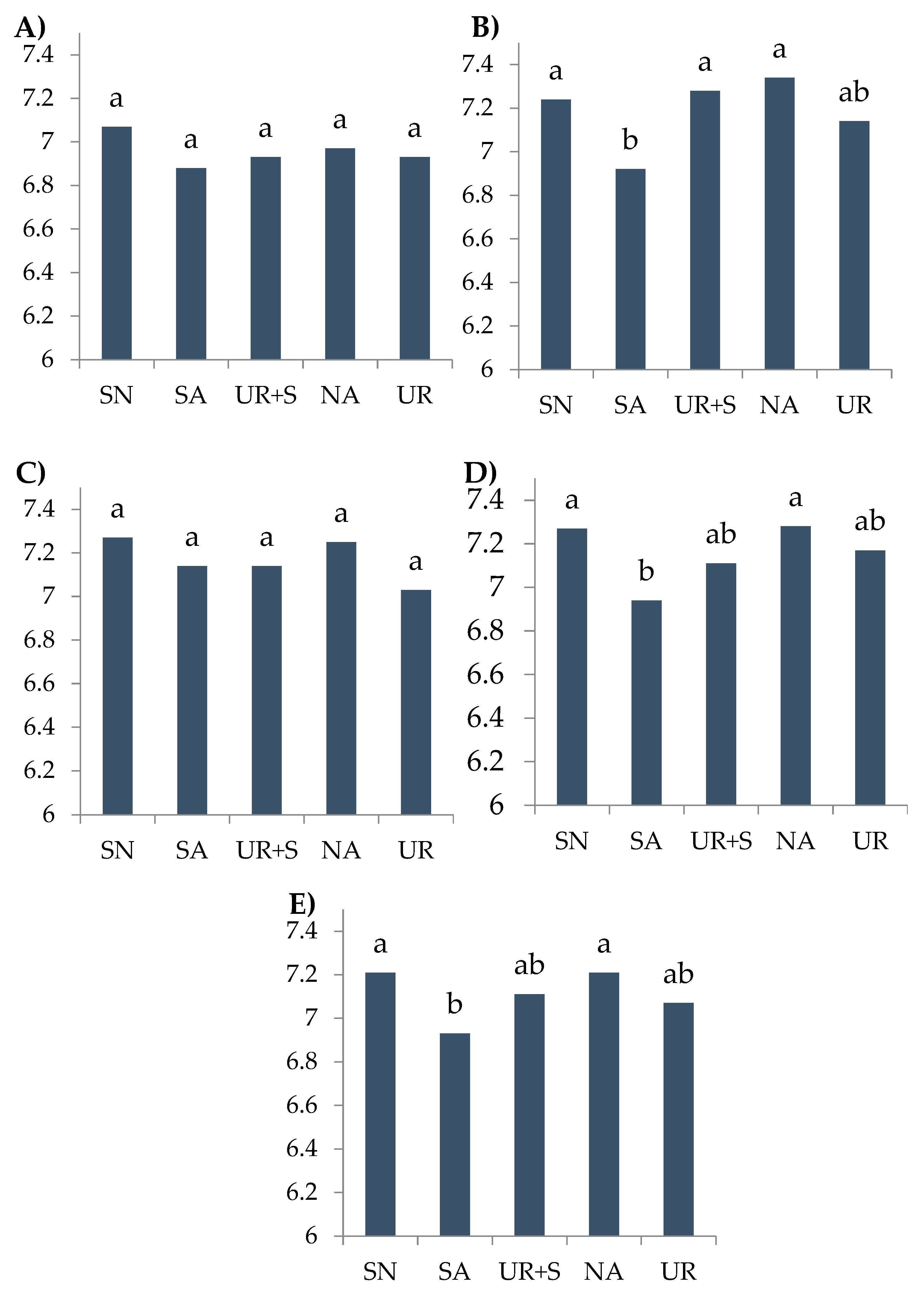

Table 1.
Physical and chemical characteristics of the soil in the experimental area collected in the 0-20 cm layer.
Table 1.
Physical and chemical characteristics of the soil in the experimental area collected in the 0-20 cm layer.
| CHEMICAL CHARACTERISTICS OF THE SOIL | |
| Parameter | Results |
| pH in water | 6,99 |
| Organic Matter (MOS) | 2,4 dag kg-1 |
| Total organic carbon | 1,39 dag kg-1 |
| Potassium -K | 194,19 mg dm-3 |
| Phosphorus - P (Mehlich) | 21,53 mg dm-3 |
| Sulphur- S | 2,63 mg dm-3 |
| Calcium - Ca+2 | 8,94 cmolc dm-3 |
| Magnesium - Mg2+ | 1,78 cmolc dm-3 |
| Aluminum - Al3+ | < 0,1 cmolc dm-3 |
| Potential acidity - H+ Al | 0,41 cmolc dm-3 |
| Potential CTC | 11,32 cmolc dm-3 |
| Base saturation - V% | 96 |
| Aluminum saturation - m% | 0 |
| Boro- B | 0,35 mg dm-3 |
| Copper - Cu | 1,33 mg dm-3 |
| Iron - Fe | 74,32 mg dm-3 |
| Manganese-Mn | 44,35 mg dm-3 |
| Zinc-Zn | 7,13 mg dm-3 |
| Physical characteristics of the soil | |
| Sand -% | 18 |
| Silt - % | 41 |
| Clay - % | 41 |
Reference method: pH in water (active acidity). Organic carbon - Walkley & Black method; Exchangeable calcium and magnesium - KCl 1 mol/L method and titration with EDTA; Aluminum (exchangeable acidity) - KCl 1 mol/L method and titration with NaOH; H+Al (potential acidity) - Ca(OAc)2 0.5 mol/L method. Available phosphorus - Mehlich-1 method and colorimetry; Available potassium - Mehlich method-1 and flame photometry. Boron, iron, copper, manganese and zinc - Mehlich method-1 Texture (granulometry) - pipette method.
Table 2.
Total soil nitrogen (TSN) cultivated with BRS Paiaguás grass as a funtion of the application of different nitrogen sources in soil acidification evauated over four growing seasons.
Table 2.
Total soil nitrogen (TSN) cultivated with BRS Paiaguás grass as a funtion of the application of different nitrogen sources in soil acidification evauated over four growing seasons.
| TREATMENTS | TSN |
| g kg -1 | |
| Without nitrogen | 2,36bc |
| Ammonium sulphate | 2.94ab |
| Urea + S-element | 2,97a |
| Ammonium nitrate | 2,49ac |
| Urea | 2,22c |
| CV (%) | 18,12 |
| PERIODS | |
| P1- 30 days | 2,99a |
| P2-60 days | 2,98a |
| P3-90 days | 2,30b |
| P4-120 days | 2,11b |
| CV (%) | 19,55 |
Averages followed by the same letter in the column do not differ by the Tukey test at 5% significance level.
Table 3.
Contents of available phosphorus (P), potassium (K) and magnesium (Mg) in the soil cultivated with BRS Paiaguás grass as a function of the application of different nitrogen sources in soil acidification evaluated in four growth periods.
Table 3.
Contents of available phosphorus (P), potassium (K) and magnesium (Mg) in the soil cultivated with BRS Paiaguás grass as a function of the application of different nitrogen sources in soil acidification evaluated in four growth periods.
| Soil content | |||
| TREATMENTS |
P Mehlich 1 mg dm-3 |
K mg dm-3 |
Mg cmolc dm-3 |
| Without nitrogen | 3,29a | 104,56a | 1,31a |
| Ammonium sulphate | 5,55a | 84,34a | 1,24a |
| Urea + S-element | 3,63a | 81,46a | 1,42a |
| Ammonium nitrate | 3,69a | 101,12a | 1,24a |
| Urea | 3,00a | 93,32a | 1,38a |
| CV (%) | 123,42 | 34,11 | 25,74 |
| PERIODS | |||
| P1- 30 days | 3,53a | 121,13a | 1,32ab |
| P2-60 days | 4,02a | 95,14b | 0,98b |
| P3-90 days | 4,51a | 84,13bc | 1,54a |
| P4-120 days | 3,27a | 71,44c | 1,42a |
| CV (%) | 46,06 | 18,11 | 34,67 |
Averages followed by the same letter in the column do not differ by the Tukey test at 5% significance level.
Table 4.
Calcium (Ca) content in the soil cultivated with BRS Paiaguás grass as a function of the application of different nitrogen sources in soil acidification evaluated in four growth periods.
Table 4.
Calcium (Ca) content in the soil cultivated with BRS Paiaguás grass as a function of the application of different nitrogen sources in soil acidification evaluated in four growth periods.
| TREATMENTS |
Ca content in the soil cmolc dm-3 |
Average | CV (%) | |||
| 1 | 2 | 3 | 4 | |||
| Without nitrogen | 8,55Aa | 8,23Ba | 6,71Da | 7,86Ca | 7,84a | 4,58 |
| Ammonium sulphate | 8,30Aa | 8,46Aa | 7,94Ba | 8,06Ba | 8,19a | |
| Urea + S-element | 8,71Aa | 8,77Aa | 8,25Ba | 8,42Ba | 8,54a | |
| Ammonium nitrate | 8,46Ba | 9,01Aa | 8,07Ca | 8,52Ba | 8,51a | |
| Urea | 8,64Aa | 8,19Ba | 8,13Ba | 8,15Ba | 8,28a | |
| Average | 8,53a | 8,53a | 7,82c | 8,20b | ||
Averages followed by the same uppercase letter in the row and lowercase letter in the column do not differ by the Tukey test at 5% probability.
Table 5.
Chlorophyll index (INCL) of BRS Paiaguás grass as a function of the application of different nitrogen sources in soil acidification, evaluated in four growth periods.
Table 5.
Chlorophyll index (INCL) of BRS Paiaguás grass as a function of the application of different nitrogen sources in soil acidification, evaluated in four growth periods.
| TREATMENTS | Chlorophyll |
| Without nitrogen | 35,40a |
| Ammonium sulphate | 38,46a |
| Urea + S-element | 38,56a |
| Ammonium nitrate | 39,48a |
| Urea | 40,30a |
| CV (%) | 11,58 |
| PERIODS | |
| P1- 30 days | 35,49b |
| P2-60 days | 40,68a |
| P3-90 days | 38,07ab |
| P4-120 days | 39,52a |
| CV (%) | 10,94 |
Averages followed by the same letter in the column do not differ by the Tukey test at 5% significance level.
Table 6.
Productive aspects of BRS Paiaguás grass as a function of the application of different nitrogen sources in soil acidification, evaluated in four growth periods.
Table 6.
Productive aspects of BRS Paiaguás grass as a function of the application of different nitrogen sources in soil acidification, evaluated in four growth periods.
| TREATMENTS | MSF | AP | NP |
| Kg ha-1 | cm | Profiler/m2 | |
| Without nitrogen | 1366,6b | 43,4b | 501b |
| Ammonium sulphate | 3102,9a | 55,3a | 866a |
| Urea + S-element | 3370,9a | 53,2a | 727a |
| Ammonium nitrate | 3607,5a | 54,5a | 807a |
| Urea | 3451,7a | 55,4a | 887a |
| CV (%) | 24,03 | 14,33 | 20,24 |
| PERIODS | |||
| P1- 30 days | 2184,3c | 56,35a | 743a |
| P2-60 days | 2706.2bc | 45,06b | 764a |
| P3-90 days | 3911,7a | 55,09a | 770a |
| P4-120 days | 3117,4b | 53,02a | 753a |
| CV (%) | 22,08 | 9,93 | 17,37 |
Averages followed by the same letter in the column do not differ by the Tukey test at 5% significance level. DM: total dry mass; PH: plant height; NP: number of tillers.
Table 7.
Morphological aspects of BRS Paiaguás grass as a function of the application of different nitrogen sources in soil acidification, evaluated in four growing seasons.
Table 7.
Morphological aspects of BRS Paiaguás grass as a function of the application of different nitrogen sources in soil acidification, evaluated in four growing seasons.
| LEAF | COLMO | DEAD | IL | ||
| TREATMENTS | % | IAF | % | ||
| Without nitrogen | 70,33a | 21,89a | 7,75a | 1,92b | 73,74b |
| Ammonium sulphate | 73,25a | 23,82a | 2,90b | 3,27a | 87,07a |
| Urea + S-element | 73,75a | 22,31a | 3.92ab | 2,89a | 81,99a |
| Ammonium nitrate | 70,05a | 24,79a | 5.13ab | 3,16a | 85,09a |
| Urea | 72,89a | 23,96a | 3,12b | 3,12a | 85,12a |
| CV (%) | 8,32 | 27,17 | 82,21 | 24,74 | 8,01 |
| PERIODS | |||||
| P1- 30 days | 69,91b | 25,37a | 4,70a | 3,52b | 78,27b |
| P2-60 days | 69,22b | 25,45a | 5,29a | 1,45d | 91,58a |
| P3-90 days | 76,61a | 19,57b | 3,80a | 4,32a | 88,55a |
| P4-120 days | 72,47b | 23,03a | 4,47a | 2,19c | 72,01c |
| CV (%) | 5,84 | 15,13 | 70,41 | 17,95 | 8,72 |
Averages followed by the same letter in the row and column do not differ by the Tukey test at 5% significance. LEAF: percentage of leaves; CORM: percentage of thatch; DEAD: percentage of dead material; IAF: leaf area index; IL: light interception.
Table 8.
Nutrient content in the leaf tissue of BRS Paiaguás grass as a function of the application of different nitrogen sources in soil acidification, assessed over two growing seasons.
Table 8.
Nutrient content in the leaf tissue of BRS Paiaguás grass as a function of the application of different nitrogen sources in soil acidification, assessed over two growing seasons.
| TREATMENTS | N | P | K | Ca | Mg | S | B | Cu | Zn | Mn | Fe |
| ---------------------- g kg-1 ----------------------- | ----------------------- mg kg-1----------------------- | ||||||||||
| Effect of sources | |||||||||||
| Without nitrogen | 14,8b | 2,5a | 19,1a | 8,2a | 1,9a | 1,5a | 9,0a | 5,1a | 21,7a | 53,7a | 169,3a |
| Ammonium sulphate | 18,9a | 2,5a | 20,0a | 6,8a | 2,7a | 1,7a | 10,0a | 5,8a | 22,3a | 44,1a | 145,0a |
| Urea + S-element | 18,0a | 2,3a | 20,7a | 8,0a | 2,6a | 1,5a | 10,0a | 6,1a | 22,0a | 51,0a | 151,3a |
| Ammonium nitrate | 18,2a | 2,7a | 22,1a | 7,9a | 2,5a | 1,5a | 9,7a | 6,5a | 24,9a | 49,2a | 187,2a |
| Urea | 17,5a | 2,6a | 22,2a | 7,1a | 2,6a | 1,7a | 8,9a | 6,1a | 23,8a | 45,7a | 169,9a |
| Average | 17,4 | 2,5 | 20,8 | 7,6 | 2,4 | 1,58 | 9,5 | 5,9 | 22,9 | 48,7 | 164,5 |
| Cv (%) | 9,0 | 14,2 | 15,8 | 13,6 | 18,6 | 9,3 | 17,6 | 16,8 | 15,4 | 24,1 | 22,2 |
| PERIODS | Effect of periods | ||||||||||
| P1- 30 days | 18,6a | 2,9a | 25,4a | 6,4b | 2,2b | 1,5a | 10,3a | 6,1a | 25,6a | 47,8a | 164,1a |
| P4-120 days | 16,3b | 2,1b | 16,3b | 8,8a | 2,7a | 1,6a | 8,8a | 5,7a | 20,3b | 49,7a | 164,5a |
| Average | 17,4 | 2,5 | 20,7 | 7,6 | 2,4 | 1,5 | 9,5 | 5,9 | 22,9 | 48,7 | 164,3 |
| Cv (%) | 8,6 | 13,4 | 4,2 | 6,7 | 17,0 | 10,0 | 24,0 | 14,0 | 14,6 | 17,8 | 17,3 |
Averages followed by the same uppercase letter in the row and lowercase letter in the column do not differ by the Tukey test at 5% probability.
Disclaimer/Publisher’s Note: The statements, opinions and data contained in all publications are solely those of the individual author(s) and contributor(s) and not of MDPI and/or the editor(s). MDPI and/or the editor(s) disclaim responsibility for any injury to people or property resulting from any ideas, methods, instructions or products referred to in the content. |
© 2025 by the authors. Licensee MDPI, Basel, Switzerland. This article is an open access article distributed under the terms and conditions of the Creative Commons Attribution (CC BY) license (http://creativecommons.org/licenses/by/4.0/).
Copyright: This open access article is published under a Creative Commons CC BY 4.0 license, which permit the free download, distribution, and reuse, provided that the author and preprint are cited in any reuse.


