

Submitted:
04 July 2024
Posted:
05 July 2024
You are already at the latest version
Abstract
Enhancing soil fertility and maize productivity is crucial for sustainable agriculture. This study aimed to evaluate the effects of tillage practices, nitrogen management strategies, and acidified hydrochar on soil fertility and maize productivity. The experiment used a randomized complete block design with split-split plot arrangement and four replications. Main plots received shallow tillage and deep tillage. Sub-plots were treated with nitrogen (120 kg ha⁻¹) from farmyard manure and urea, including control, 33% FYM + 67% urea (MU), and 80% FYM + 20% urea (MF). Acidified hydrochar treatments H0 (no hydrochar) and H1 (with hydrochar, 2 t ha⁻¹) were applied to sub-sub plots. Deep tillage significantly increased plant height, biological yield, grain yield, ear length, grains ear-1, thousand grain weight, and nitrogen content compared to shallow tillage. MU and MF improved growth parameters and yield over the control. Hydrochar effects varied; H1 enhanced certain yield components but reduced plant height and soil properties compared to H0. Canonical discriminant analysis linked deep tillage and MU/MF nitrogen management with improved yield and soil characteristics. In conclusion, deep tillage combined with integrated nitrogen manage-ment enhances maize productivity and soil health. However, hydrochar application requires op-timization. These findings highlight the importance of selecting appropriate tillage and nitrogen strategies for sustainable maize production. These insights guide policymakers, agronomists, and agricultural extension services in adopting evidence-based strategies for sustainable agriculture, enhancing food production, and mitigating environmental impacts. Future research should in-vestigate long-term impacts across diverse environments to validate these results.
Keywords:
Agricultural sustainability
; Organic amendments
; soil health
; crop yield
; soil fertility
; Canonical discriminant analysis
1. Introduction
Maize (Zea mays L.), a member of the Poaceae family, is a globally significant crop cultivated across various regions, following the ranks of rice and wheat [1]. It serves as a primary source of nutrition for both humans and livestock, as well as a valuable resource for various industrial applications. With its high nutritional value, comprising 10% protein, 4.8% oil, 3% sugar, 5.8% fiber, 72% starch, and 1.7% ash, maize holds a pivotal position in the agricultural landscape [2]. In Pakistan, maize stands as the second most important crop after wheat, contributing significantly to both national and regional agricultural economies, particularly in Khyber Pakhtunkhwa province [3].
Despite its importance, various factors such as geographical conditions, soil quality, climatic variations, pest and disease pressures, seasonal fluctuations, and irrigation practices have posed challenges to maize productivity [4]. Among these factors, soil management practices, particularly tillage, emerge as crucial determinants influencing soil structure and nutrient availability, consequently affecting crop yields [5,6].
Tillage operations represent one of the fundamental methods for mitigating soil compaction and enhancing soil tilth and physical properties, thereby facilitating improved nutrient utilization and higher crop yields [7,8]. However, intensive agricultural practices often lead to the formation of compacted subsurface layers, negatively impacting root penetration, soil bulk density, porosity, and ultimately crop productivity [9,10]. Techniques such as deep plowing have been advocated to alleviate subsurface compaction, thereby promoting enhanced root growth and nutrient uptake [11,12,13]. Additionally, tillage practices have been associated with increased carbon sequestration, soil structure enhancement, and overall yield improvement [8,14].
In the realm of sustainable agriculture, organic farming practices play a pivotal role in preserving soil fertility and physical integrity [15]. Organic agriculture prioritizes ecosystem management and natural processes, emphasizing the importance of maintaining soil health for optimal agricultural productivity [2]. Incorporating organic manures alongside inorganic fertilizers has been shown to enhance soil organic matter content, soil structure, water holding capacity, nutrient cycling, and biological activity, thereby sustaining soil fertility and improving crop performance [15,16,17]. However, over-reliance on chemical fertilizers has been linked to soil quality degradation over time [18].
Innovative approaches such as hydrothermal carbonization (HTC) sometimes called as hydrochars offer promising avenues for improving soil fertility and enhancing crop productivity [19,20]. Hydrothermal carbonization, characterized by its low-cost and efficient conversion of wet biomass into hydrochars, presents an alternative to traditional biochar production methods [21]. Although hydrochars exhibit similar properties to biochar, their production process and characteristics differ, offering unique opportunities for soil carbon sequestration and improvement [22,23].
Given the challenges and opportunities in maize production, this study aims to investigate the effectiveness of integrating hydrochar and farmyard manure with various tillage practices to enhance soil fertility and maize productivity. Therefore, it is hypothesized that the integration of hydrochar and farmyard manure with different tillage practices would lead to enhanced soil fertility, improved soil structure, and increased maize productivity compared to conventional tillage methods without organic amendments. The objectives include: 1. Assessing the impact of different tillage practices on soil physical properties and, nutrient availability 2. Evaluating the individual and combined effects of hydrochar and farmyard manure applications on soil fertility indicators and maize growth parameters. 3. Determining the optimal combination of tillage practices and organic amendments for maximizing soil health and maize yield.
2. Materials and Methods
2.1. Experimental Site and Soil Characteristics
The experiment was performed at the Agronomy Research Farm, the University of Agriculture Peshawar, Pakistan (34° 01′, 14.2″ N and 71° 28′, 52.6″ E), during Summer 2022. This region lies 340 m above sea level and is classified as a warm-temperate zone. The average annual temperature is ~22°C, with the highest average in June at ~33°C and the lowest in January at ~10°C. The average annual precipitation is 640 mm, with the least amount of rainfall occurring in November [15].
A composite soil sample was collected with the help of soil auger at 0–20 cm depth before the experiment with the following results: pH = 8.3 [24], salinity as electrical conductivity (EC) = 0.26 dS m−1 [24], SOM = 5.7 g kg−1 [25], total nitrogen (N) = 4.8mg kg−1, and plant-available P and potassium (K) = 4.7 and 130 mg kg−1, respectively, as determined through extraction with ammonium bicarbonate-diethylenetriamine pentaacetate (AB-DTPA) [26]. Similarly soil post-harvest total nitrogen and organic matter content were also determined, while soil mineral nitrogen content was determined according to the procedure of Keneey and Nelson [27].
2.2. Treatments and Experimental Setup
The research consisted of three experimental factors: (i) two tillage practices Shallow tillage (0-15 cm depth) (ST) and Deep tillage (15-30 cm depth) (DT), (ii) Three levels of nitrogen management, control (MC), 33% FYM + 67% Urea (MU), and 80%FYM + 20% Urea (MF), and (iii) two levels of hydrochar, Control (H0) (No Hydrochar) and Acidified Hydrochar (H1) at 2 t ha-1. Randomized complete block design (RCBD) with a split-plot layout having four replications were used; Different tillage methods were assigned to the main plots, with nitrogen (N) treatments applied to the subplots, and varying levels of acidified hydrochar allocated to the sub-subplots. Tillage operations involved the use of a field cultivator and chisel plough. The nitrogen concentrations in farmyard manure (FYM) were computed, and the specified rates were determined on a dry basis, with the remaining nitrogen supplied by urea (46%). However, an additional 23kg N ha-1 derived from hydrochar was not taken into account. According to the nitrogen content assessment, the calculated quantity of farmyard manure was applied to the plots 20 days before sowing, along with acidified hydrochar (2 t ha-1). After applying all treatments, the farmyard manure (FYM) and hydrochar were incorporated into the soil using a rotavator. Half of the nitrogen was applied during seedbed preparation, with the remaining urea applied during the second irrigation. The field was prepared using a rotavator. Each plot measured 4.2 m x 5 m, with rows 5 m long and a spacing of 70 cm between rows, accommodating 6 rows per subplot. The maize variety Jalal was planted at a seeding rate of 30 kg ha-1. Standard agronomic practices, including hoeing, weeding, and irrigation, were consistently applied across all treatments.
2.3. Procedure for Hydrochar Preparation
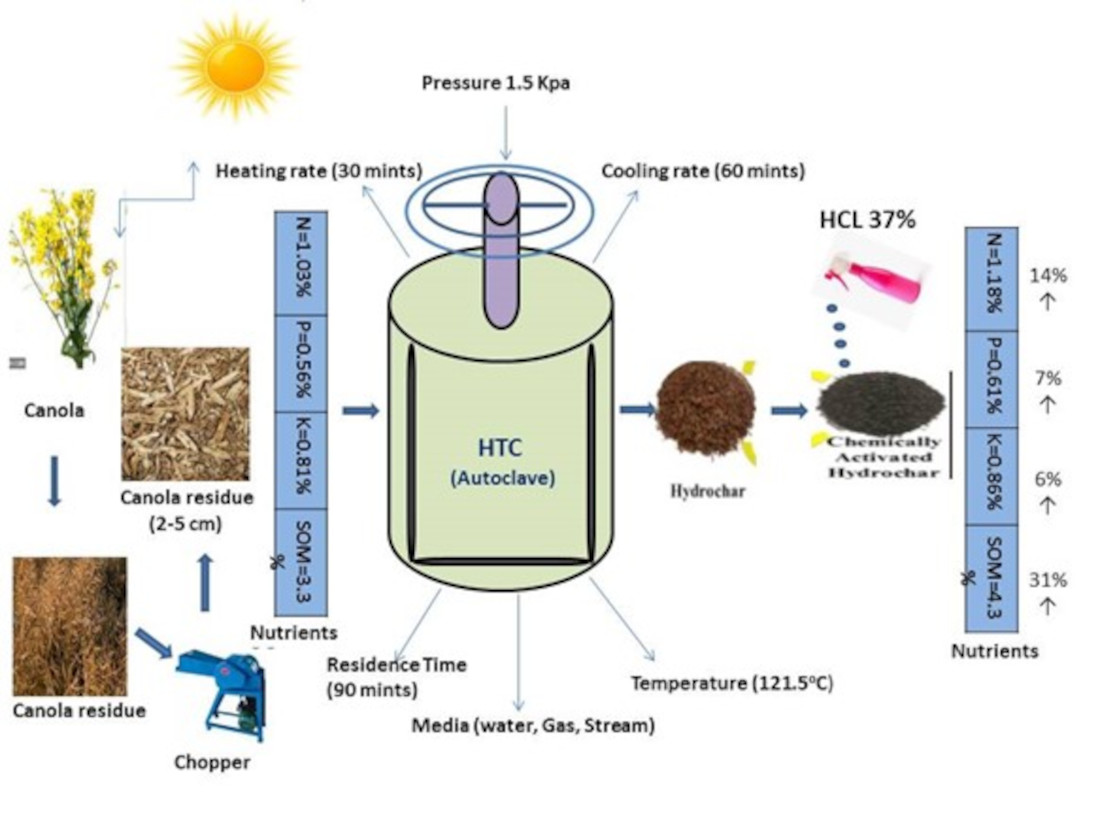
Hydrochar was produced from Canola residues in the laboratory using an autoclave. The residues were chopped into 2-3 cm pieces, then milled into smaller particles. The conversion process was carried out at a temperature range of 125°C for 30 minutes, with a water ratio of 1:10, using an autoclave reactor under a pressure of 2 MPa. Following the conversion process, the hydrochar was chemically activated using 2.0 N HCl (100 ml per kg of fresh hydrochar) as a catalyst. The procedure described by Costa et al. [28] was followed for the preparation of the hydrochar.
2.4. Field History
The field history indicates that since 2016, wheat has been grown in the Rabi season and maize in the Kharif season, using the same treatment structure for shallow and deep tillage and nitrogen management. This includes 120 kg N ha-1 sourced from urea (either 20% or 67%) and farmyard manure (33% and 80%), alongside a control. In 2016, the physico-chemical properties of the soil were as follows: soil total nitrogen (0.04%), soil mineral nitrogen (21 mg kg-1 soil), soil organic matter (0.79%), soil pH (8.1), and soil bulk density (1.23 g/cm³). In this study, a third factor, acidified hydrochar, was introduced as a sub-subplot factor to evaluate its impact on soil fertility and maize productivity.
2.5. Data Collection
Days to emergence, silking, tasseling, and physiological maturity were calculated by counting the days from the date of sowing to the date when emergence, silks, tassel production, and complete loss of glumes green color were observed on 80% of plants in each plot. Emergence per unit area, number of leaves per plant, plant height, and leaf area per plant were determined at the milk stage, BBCH 75 (11 June 2021). Maize yield and related trails were also recorded at final harvest, BBCH 89 (24 July 2021). Ear weight was calculated by weighing the cob without the husk on a weight balance and measuring the ear length, and 10 plants from each sub-plot were randomly selected and then averaged. To count the number of grains per ear, five cobs were randomly selected from each sub-plot, the grains were counted separately, and their average was calculated. The number of seedlings in each plot was calculated with a meter rod at three different places and the emergence m-2 was calculated using the formula below.
Thousand grain weight (g) was recorded using an electronic balance and counting a thousand grains from each sub-plot at random. The biological yield was measured by harvesting four central rows in each sub-plot and calculated as in Equation (2) [29]. The harvested material was sun dried and weighed.
Grain yield and harvest index were calculated using Equation (3) and Equation (4), respectively by following the method of [29].
2.5.1. Plants Pigments
Plant pigments in the leaves were measured using a spectrophotometer. Fresh flag leaf material (200 mg) from each sub-subplot was submerged in 5 mL of 80% acetone solution (v/v) and stored at 4°C in the dark for 48 hours to extract chlorophyll (Chl a and Chl b), total chlorophyll, and carotenoids. The extracts were then spectrophotometrically analyzed at absorbance wavelengths of 663.2 nm, 646.8 nm, and 470 nm to determine pigment concentrations (Chl a, Chl b, and carotenoids, respectively). The concentrations were estimated using Lichtenthaler’s formula [30] and expressed in mg per mL of fresh leaf weight.
Where A, is the measured absorbance following spectrophotometer of each sample at 663.2, 646.8, 470 wavelengths.
2.5.2. Grains and Stover Nitrogen Content
To quantify the nitrogen content in maize grains and stover, samples from each sub-subplot were dried and ground into a powder (2 mm particle size) using a tissue grinder. For each sample, 3 mL of concentrated H2SO4 and 1.23 g of digestion mixture (K2SO4: CuSO4: Selenium = 200: 20: 1.0) were used to digest 0.2 g of powdered sample material. After cooling, the extract was transferred to a 100 mL volumetric flask and filtered before further testing. An aliquot (20 mL) of the extract was distilled using a Kjeldahl ammonium distillation unit, where nitrogen was collected as ammonia. The collected ammonia was titrated against 0.005 N HCl in a receiver containing 4% boric acid solution and a mixed indicator (Bromocresol green and methyl red), following the procedure outlined by Jackson [31].
2.5.3. Nitrogen Use Efficiency and Nitrogen Uptake
2.6. Statistical Analysis
The collected data were statistically analyzed with the analysis of variance (ANOVA) as appropriate for split-plot RCBD using statistical package Statistix8.1 (Statistix8.1, Tallahassee, FL, USA). If the F values were significant, the means were compared with the LSD test at probability levels of 5%.
3. Results
3.1. Phenological and Growth Parameters
Table 1 presents the main effects of tillage practices, nitrogen management, and hydrochar application on the growth stages of maize. For tillage practices, both shallow tillage (ST) and deep tillage (DT) resulted in similar days to emergence (DtoE), days to tasseling (DtoT), and days to silking (DtoS) with no significant difference between them. However, shallow tillage (ST) showed a significantly shorter time to physiological maturity (DtoPM) (93.4 ± 0.40 days) compared to DT (94.3 ± 0.36 days).
In terms of nitrogen management, the growth stages of maize were positively affected by nitrogen management, except for DtoE (Table 1). Maize plants took more days to tasseling (DtoT), silking (DtoS), and physiological maturity (DtoPM) when treated with MU (53.9 ± 0.35, 64.3 ± 0.35, and 95.0 ± 0.34 days, respectively) and MF (53.4 ± 0.30, 63.4 ± 0.20, and 94.3 ± 0.40 days, respectively) compared to MC (control). The use of acidified hydrochar (H1) resulted in an increase in days to emergence (DtoE) (7.8 ± 0.15 days) while causing a decrease in days to tasseling (DtoT) (52.7 ± 0.25 days), silking (DtoS) (62.8 ± 0.25 days), and physiological maturity (DtoPM) (93.3 ± 0.33 days) compared to the control (H0).
3.2. Plant Height
Deep tillage (DT) exhibited taller plants (195.1 ± 3.75 cm) compared to shallow tillage (ST) (181.7 ± 3.47 cm). Regarding nitrogen management, MU and MF resulted in taller plants (193.7 ± 3.56 cm and 196.3 ± 5.00 cm, respectively) in contrast to the control (175.1 ± 3.69 cm). Additionally, H0 led to taller plants (192.5 ± 3.81 cm) compared to those treated with H1 (184.1 ± 3.76 cm) (Table 2).
3.3. Biological Yield
The biological yield of maize was significantly influenced, with DT resulting in a higher biological yield (9.59 ± 2.16 t ha⁻¹ of DM), while ST resulted in a lower yield (8.82 ± 0.94 t ha⁻¹ of DM). The effect of nitrogen management was also prominent, showing that maize produced a higher biological yield with fertilization of MU (9.26 ± 1.74 t ha⁻¹ of DM) and MF (9.72 ± 2.73 t ha⁻¹ of DM) treatments compared to the control (8.64 ± 1.14 t ha⁻¹ of DM). Moreover, applying no hydrochar (H0) led to a higher biological yield (9.45 ± 1.98 t ha⁻¹ of DM) when compared to those plots that were treated with H1 (8.96 ± 1.56 t ha⁻¹ of DM) (Table 2).
3.4. Harvest Index
Mean data revealed that the harvest index of maize did not differ significantly due to tillage practices and hydrochar application; however, nitrogen management had a prominent effect on the harvest index (Table 2). Notably, a higher harvest index was observed in plots that were fertilized with MU (41.1 ± 0.76%) and MF (41.3 ± 0.86%), while control plots had a lower harvest index (37.1 ± 1.10%).
3.5. Grain Yield
Applied treatments led to notable variations in the grain yield of maize (Table 3). DT practice resulted in the highest grain yield (3.80 ± 1.09 t ha⁻¹), surpassing the yield obtained from ST (3.53 ± 0.79 t ha⁻¹). Among nitrogen management practices, the utilization of MU and MF yielded the highest grain yields (4.00 ± 0.97 and 3.80 ± 0.79 t ha⁻¹, respectively), while the use of MC exhibited the lowest grain yield (3.20 ± 0.81 t ha⁻¹). In terms of hydrochar application, plots treated with H1 demonstrated a slightly superior grain yield (3.96 ± 0.94 t ha⁻¹) compared to the control (H0) (3.76 ± 0.99 t ha⁻¹).
3.6. Ear Density
ST practices exhibited the highest ear density for maize (7.5±0.12 n. m-2), followed closely by deep tillage DT (7.3±0.13 n. m-2). Among nitrogen management, MF displayed the highest ear density, (7.6±0.13 n. m-2) which statistically similar to MU (7.4±0.17 n. m-2) while MC presented the lowest ear density (7.1±0.12 n. m-2). In terms of hydrochar application, there was no statistical difference between H0 and H1 in the recorded results (Table 3).
3.7. Ear Length
Among tillage practices DT resulted in longer ears, (17.0 ± 0.33 cm) compared to ST at (16.1±0.24 cm). Among the nitrogen management, MF exhibited the longest ears (17.8 ± 0.32 cm) followed by MU (16.6±0.26 cm) while mineral fertilizer alone (MC) resulted in shorter ears, (15.3±0.24 cm). In terms of hydrochar application, plots where H1 was applied had longer ears, (17.1±0.28 cm) compared to H0 (16.0±0.30 cm) (Table 3).
3.8. Grains Ear-1
Among the tillage practices, DT resulted in the highest grains per ear (324.6 ± 5.36) while ST yielded fewer grains per ear (307.8 ± 5.13). Regarding nitrogen management, the highest grain count was observed in plots treated with MF (342.2 ± 2.24) followed by MU at (321.7±3.95) and MC (284.6 ± 2.61). For hydrochar application, the highest grain count was found in plots treated with H1 (319.7±4.93) compared to the control (H0) (312.6 ± 5.99) (Table 3).
3.9. Thousand Grain Weight
DT practices resulted in higher TGW (221.5 ± 1.03 g), while ST had lower TGW (217.0 ± 1.57 g). Among the nitrogen management, plots treated with MF exhibited the highest TGW, (224.8 ± 1.19 g) followed MU (218.4 ± 1.73 g) and MC (214.6 ± 1.08 g). In terms of hydrochar application, plots treated with H1 displayed higher TGW at (221.0 ± 1.18 g) compared to the control group without hydrochar (H0) at (217.5 ± 1.53 g) (Table 3).
3.10. Grain N Content
Among the tillage practices, DT resulted in higher grain N content, (14.1±0.42 g kg-1) whereas shallow tillage ST had lower grain N content (12.3±0.45 g kg-1) Regarding nitrogen management, the highest grain N content was observed in plots treated with MF (14.1±0.57 g kg-1) followed by MU (13.5±0.54 g kg-1) while MC and the lowest (12.0±0.55 g kg-1). For hydrochar application, plots treated with H1 exhibited the highest grain N content, (13.9±0.46 g kg-1) compared to H0 (12.6±0.46 g kg-1) (Table 3).
3.11. Stover N Content
DT resulted in higher stover N content, with an average of (4.3±0.20 g kg-1) while ST had lower stover N content (3.6±0.24 g kg-1). Among the nitrogen management, plots treated with MF exhibited the highest stover N content (4.4±0.28 g kg-1) that was also comparable to MU (4.3±0.23 g kg-1) while lowest results were recorded with MC (3.1±0.21 g kg-1). In terms of hydrochar application, plots treated with H1 displayed higher stover N content (4.2±0.24 g kg-1) compared to H0 at (3.6±0.21 g kg-1) (Table 3).
3.12. Nitrogen Uptake
Nitrogen uptake by maize plant was improved with DT that resulted in higher nitrogen uptake, (45.45±2.40 kg of N ha-1) compared to ST) (36.34±1.79 kg of N ha-1) (Table 4). Among the nitrogen management, the highest nitrogen uptake was observed in plots treated with MF (47.39±2.77 kg of N ha-1) followed by the MU (42.96 ± 2.29 kg of N ha-1) while MC recorded lowest nitrogen uptake (32.32±1.97 kg of N ha-1). The plots that did not received any hydrochar treatment (H0) exhibited higher nitrogen uptake (44.14±2.38 kg of N ha-1) compared to plots treated with H1 (37.64 ± 2.05 kg of N ha-1) (Table 4).
3.13. Nitrogen Use Efficiency (NUE)
DT resulted in higher NUE for maize plant (31.69±0.91 kg of N ha-1) over ST that recorded lowest NUE (29.38±0.66 kg of N ha-1) (Table 4). In terms of Nitrogen management, the highest NUE was observed in plots treated with MF (33.31±0.81 kg of N ha-1) that was comparable to results obtained with MU treatment (31.64±0.66) over control (26.64±0.67 kg of N ha-1). For hydrochar application, plots treated with H0 exhibited higher NUE (31.46±0.83) compared to plots treated with H1 (29.61±0.78 kg of N ha-1) (Table 4).
3.14. Plant Photo Pigments
Various management practices including tillage, nitrogen management and hydrochar application had a positive effect on plant photo pigments (Figure 1). Chlorophyll a content was recorded higher with deep tillage (DT) at approximately 1.00 μg ml⁻¹ compared to shallow tillage (ST) at about 0.80 μg ml⁻¹. Regarding nitrogen management, the treatments MU (33% FYM + 67% Urea) and MF (80% FYM + 20% Urea) recorded higher Chl a level, around 0.95 μg ml⁻¹, over the control plots (MC) which had approximately 0.80 μg ml⁻¹. The application of hydrochar significantly affected Chl a, with the control (H0) recording improved results at 0.95 μg ml⁻¹ compared to acidified hydrochar (H1) at 0.80 μg ml⁻¹.
Chlorophyll b content revealed that DT had higher levels at about 0.50 μg ml⁻¹, whereas ST had lower levels at approximately 0.40 μg ml⁻¹. Among nitrogen management practices, higher and statistically similar Chl b levels were noted in plots treated with MU and MF, around 0.45-0.50 μg ml⁻¹, while MC had the lowest recorded values at approximately 0.40 μg ml⁻¹. Hydrochar application also caused significant differences in Chl b, with H0 producing higher Chl b content at 0.50 μg ml⁻¹ compared to H1 at 0.40 μg ml⁻¹ (Figure 1).
Total chlorophyll content was higher in DT applied plots at about 1.40 μg ml⁻¹, while ST applied plots produced lower total chlorophyll at approximately 1.20 μg ml⁻¹. Among nitrogen management practices, higher and statistically similar total chlorophyll content was recorded in plots treated with MU and MF, around 1.35 μg ml⁻¹, while MC had the lowest recorded values at about 1.20 μg ml⁻¹. Hydrochar application caused significant differences in total chlorophyll, with H0 producing higher total chlorophyll at 1.35 μg ml⁻¹ compared to H1 at 1.20 μg ml⁻¹ (Figure 1).
Carotenoids were significantly improved with DT at about 110 μg ml⁻¹ compared to ST at approximately 95 μg ml⁻¹. Application of MU and MF led to higher carotenoid content in maize leaves, around 110 μg ml⁻¹, over the control (MC) which had approximately 85 μg ml⁻¹. The effect of hydrochar treatment showed that carotenoids were higher with H0 at about 100 μg ml⁻¹, whereas H1 treated plots had lower carotenoid content at approximately 90 μg ml⁻¹ (Figure 1).
3.15. Soil Properties
Soil organic matter (SOM) was positively influenced by the combined application of tillage practices and nitrogen (N) management (Figure 2). The highest and statistically similar values of SOM were noted in plots where deep tillage (DT) or shallow tillage (ST) was done and fertilized with MF (80% FYM + 20% Urea), both recording approximately 0.60%. Moreover, recorded SOM in plots that had received acidified hydrochar (H1) was lower at about 0.45% compared to the control (H0) at around 0.55%.
Soil total nitrogen (STN) showed significant disparity. It was noted that DT-applied plots had higher and statistically similar STN among all treatment combinations regardless of N management, with values around 0.70%. Among ST practice, the MF treatment recorded higher results, approximately 0.70%, over the MU (33% FYM + 67% Urea) and control (MC) treatments. Moreover, STN in plots that had received H1 was lower at about 0.65% compared to H0 at around 0.70% (Figure 2)
The interactive effect of tillage and N management was notable for soil mineral nitrogen (SMN). It was revealed that DT application in plots, when combined with MU and MF, produced similar and higher SMN at around 35 mg kg⁻¹ dry soil, which was also similar to ST application in MF-treated plots. No notable difference was observed with hydrochar application in SMN, with both H0 and H1 treatments recording similar levels around 35 mg kg⁻¹ dry soil (Figure 2).
3.16. Relationship of SOM, Total Chl and SMN with NUE and N Uptake
Scatter plots were drawn to analyse the impact of SOM, total Chl and SMN on NUE and N uptake by maize plants. It was observed that mentioned parameters had a positive association with NUE and N uptake (Figure 3). Specifically, soil organic matter significantly and linearly increased NUE and uptake of N (R2=0.22* and 0.24*, respectively). Similarly, increase in total Chl was associated with increase in NUE (R2=0.49**) and N uptake (R2=0.35*) and vice versa. In last, increase in SOM resulted in improved NUE (R2=0.38*) and N uptake (R2=0.31*) by plants.
3.17. Canonical Discriminant Analysis (CDA) for Yield Characteristics of Maize
CDA was performed to evaluate the sole effect of various management practices (tillage, N management and hydrochar application) from a multivariable perspective. Among tillage practices, the association of all yield characteristic of maize were more associated with DT compared to ST that was not associated with single variable (Figure 4A). Among N management, more variables were influenced by MU and MF whereas no association was shown for MC (Figure 4B). In terms of hydrochar application more association was observed for H0 with the studied variables except for ear numbers of maize that showed association with H1 (Figure 4C).
3.18. Canonical Discriminant Analysis (CDA) for Post-Harvest Soil Characteristics
CDA was performed to estimate the main effect of various management practices (tillage, N management and hydrochar application) from a multivariable perspective. Significant discrimination was seen in soil characteristics due to applied management practices. Various tillage managements showed that soil mineral nitrogen (SMN), soil organic matter (SOM) and soil total nitrogen (STN) were associated with DT while soil pH and bulk density (BD) showed more tilt towards ST (Figure 5A). N management showed that MF was associated with most of the soil characteristics including STN, SOM, SNM and soil pH whereas BD had more association with MU. No significant association of MC was recorded on the biplot (Figure 5B). Application of hydrochar to maize field caused prominent variability in soil characteristics with SMN, SOM and STN more affected by H0 compared to H1 that only showed effect on soil pH and BD (Figure 5C).
4. Discussion
The effect of tillage implements, integrated nitrogen management, and acidified hydrochar were found to have no significant impact on the days to maize emergence and emergence m-2 of maize. This could be attributed to maize primarily utilizing the stored nutrients within the seed during the germination phase, rather than relying heavily on the nutrients present in the soil during sowing. Furthermore, maize was mostly sown using the dibbler method, which places seeds uniformly with proper plant-to-plant (P-P) and row-to-row (R-R) distances, resulting in no significant difference in days to emergence and emergence m-². These findings align with those of Ibrahim and Khan [34], who also reported non-significant effects of tillage and nutrient application on emergence metrics.
Nitrogen is a crucial nutrient for plant growth and development, affecting various growth-related processes [35]. Studies by Iqbal et al. [36] and Amanullah et al. [37] revealed that integrated nitrogen management significantly affects maize phenology, influencing the timing of tasseling, silking, and physiological maturity. Similarly, acidified hydrochar, produced through the hydrothermal carbonization of organic waste, affects maize phenological development by improving soil fertility and plant nutrition [38]
Deep tillage significantly increased plant pigments compared to shallow tillage. Soil tillage is a successful crop production practice that influences the nutritive qualities and agro-physical properties of maize [39]. Soil disruption typically enhances organic matter and mineralization, thereby increasing nitrogen availability [40]. Nitrogen, being an essential plant nutrient, is a major source for chlorophyll synthesis, photosynthetic activity, and crop growth [41,42]. Increased nitrogen content helps plants develop more chlorophyll per unit area [43]. Qiang et al. [44] also reported that nitrogen increases the leaf area index (LAI), directly boosting photosynthetic activity. Yang et al. [45] confirmed that nitrogen application enhances leaf expansion and plant pigment activity.
Acidified hydrochar significantly increases chlorophyll and carotenoid contents compared to non-acidified hydrochar. Hydrochar, composed mainly of carbon derived from biomass, improves soil chemical, physical, and biological processes, resulting in increased nutrient availability and plant biochemical processes [46]. Hydrochar is particularly effective as a soil additive due to its high phosphorus and nitrogen concentrations, essential for chlorophyll synthesis [47].
The interaction between tillage practices and farmyard manure as a nitrogen source significantly influenced chlorophyll levels in maize. However, this interaction did not have a significant effect on the carotenoid content of maize. Simić et al. [48] demonstrated a significant correlation between nitrogen levels and tillage practices. Wang et al. [49] reported a positive interaction between nitrogen availability and chlorophyll content in plants. Additionally, Imani et al. [50] found that tillage practices and nitrogen management significantly increased chlorophyll a, chlorophyll b, and total chlorophyll levels due to enhanced nitrogen availability, a crucial component of chloroplasts that promotes increased plant pigment production.
Maize plant height and ear length were significantly higher with deep tillage compared to shallow tillage. Integrated nitrogen management, acidified hydrochar, and the interaction between tillage and nitrogen management significantly influenced plant height and ear length of maize. However, all other interactions were found to be non-significant. Deep tillage significantly enhances maize plant height and ear length compared to other tillage practices. This method improves seedbed conditions by loosening the soil, thereby promoting better crop growth parameters such as plant height and ear length [51]. Deep tillage increases root proliferation and soil aeration [52] while decreases soil bulk density, leading to increased root proliferation and enhanced soil aeration, which in turn facilitates greater nutrient uptake by roots [53].
The significant increase in plant height and ear length with acidified hydrochar can be attributed to its enriched content of soil organic carbon (SOC) along with a variety of essential macro- and micronutrients [54]. According to Sahin et al. [55] hydrochar treated with sulfuric acid enhances soil properties and nutrient availability, leading to improvements in plant height, biomass, and ear length. The interaction between tillage and integrated nitrogen management significantly enhanced plant height and ear length, likely influenced by factors such as soil compaction, moisture availability, and root development [56]. According to Xiao et al. [57] deep tillage promotes deeper root growth, enabling better access to soil nutrients.
Tillage practices, integrated nitrogen management, and acidified hydrochar had non-significant effects on the number of ear m-2 of maize, likely due to maintaining proper P-P and R-R distances with the dibbler method. Akmal et al. [58] and Cai et al. [59] similarly found non-significant effects on the number of maize ears per square meter with various tillage practices and integrated nitrogen management.
Maize grains ear-1 benefitted positively from tillage, integrated nitrogen management, and acidified hydrochar. Tillage practices manipulate soil mechanically, impacting physical properties such as soil structure, moisture content, and nutrient availability, thereby promoting enhanced maize growth and yield. According to Singh et al. [60], deep tillage alleviates soil compaction, enhances nutrient and water availability, and contributes to increased maize grain yield and the number of grains ear-1 .Gu et al. [52] reported that deep tillage significantly increases the number of grains ear-1, leading to a 6.3% increase in grain yield. Conventional tillage positively affects the number of grains cob-1 compared to zero tillage [61]. Integrated nitrogen management affects grains ear-1 in maize by influencing nitrogen availability during critical growth stages [62]. Nitrogen is essential for plant growth and development, and its deficiency or excess can impact maize grain yield and quality [63].
Acidified hydrochar, a carbon-rich soil amendment from organic waste, enhances grains per ear by improving soil fertility and nutrient availability [64]. Soothar et al.[65] showed that hydrochar enhances soil fertility and nutrient availability, improving grains ear-1. Ding et al. [66] found that acidified hydrochar raises soil pH, increases organic matter content, and enhances nutrient availability, thereby resulting in improved crop yields and quality.
Tillage, nitrogen management, and acidified hydrochar each positively affected the thousand-grain weight (TGW) of maize, although the interactions among these factors did not show significant effects. Higher TGW was recorded in deep tillage compared to shallow tillage, attributed to soil loosening, which enhances root growth and nutrient uptake [67]. Deep tillage enhances the availability of essential nutrients for plant growth, directly contributing to increased maize thousand-grain weight (TGW) and overall production [68].
The combined use of FYM as an organic and urea as an inorganic nitrogen source significantly increased the TGW of maize. Nitrogen application enhances tissue development, cell division, and plant growth, increasing grain weight and maize yield [33]. Acidified hydrochar enhances maize thousand-grain weight (TGW) by improving nutrient availability and water-holding capacity in the soil [69]. According to Shah et al. [70], acidified hydrochar enhances nitrogen and phosphorus uptake, crucial macronutrients that contribute to increased wheat grain weight and yield. Wang et al. [71] found that TGW increased by up to 12.4% with acidified hydrochar application.
Biological yield production was greater with deep tillage compared to shallow tillage. Deep tillage loosens compacted soil, thereby improving soil structure, drainage, aeration, and facilitating movement of NO3- and nitrogen uptake. [72]. Shallow tillage increases bulk density and reduces root growth [73]. Xu et al. [74] reported that tillage affects soil organic carbon (SOC) and organic matter content, improving crop growth and biological yield. Li et al. [75] stated that deep tillage enhances root growth, nutrient availability, and biological yield, confirming our findings.
Integrated nitrogen management significantly increased biological yield production compared to urea or FYM alone. Nitrogen is a major nutrient for plant growth and development, increasing biomass production and yield. Imran, [76] and Zhou et al. [77] found that combining organic and inorganic nitrogen sources increases maize biological yield. Farmyard manure (FYM) improves soil structure, fertility, and nutrient availability, enhancing crop growth and yield [15].
Acidified hydrochar significantly increased biological yield production due to its nutrient-rich composition and improved soil properties. Baronti et al. [78] reported that hydrochar enhances soil fertility, microbial activity, and nutrient availability, increasing biomass production and yield. Similar findings were observed by de Jager and Giani [79] and Islam et al. [64], who reported that acidified hydrochar improves soil quality and nutrient availability, leading to higher crop yields.
Maize grain yield significantly increased with deep tillage compared to shallow tillage. Tillage proves to be an effective farm operation that enhances soil tilth and improves soil physical conditions [72], which increased crop nutrient use efficiency and ultimately improved crop yield [59]. Deep tillage increased SOM [12], as it enhances soil aeration, aids in residue decomposition, promotes nitrogen mineralization, and improves nitrogen accessibility in the soil, thereby supporting root and crop growth [48]. Deep tillage breaks up the hardpan layer caused by the use of heavy machinery, improving soil structure and root penetration [72].
Another effective approach to achieving higher maize yields is through integrated nitrogen management. Combining 80% farmyard manure (FYM) and 20% urea has been shown to increase grain yield significantly. This is because inorganic fertilizers enhance soil fertility and crop productivity in the short term, while the combined use of organic and inorganic fertilizers provides essential nutrients at optimal growth stages [17]. Organic fertilizers increase mineral nitrogen, available phosphorus, and organic matter, thereby enriching the nutrient content in the root zone. This enhances nutrient uptake by plants and improves soil fertility over the long term [80]. The application of acidified hydrochar leads to higher grain yield compared to control plots. According Wang et al. [71], maize grain yield improved by up to 18.1% with acidified hydrochar compared to non-acidified hydrochar treatments. Similarly, Khosravi, et al. [69] reported a significant increase in maize grain yield due to improved soil fertility and enhanced nutrient availability with the application of acidified hydrochar.
The harvest index (HI) of maize was significantly influenced by deep tillage, integrated nitrogen management, and the application of acidified hydrochar. Deep tillage improves soil structure, water-holding capacity, and nutrient availability, increasing maize biomass and yield [51]. Integrated nitrogen management enhances nutrient availability and uptake, increasing biomass production and harvest index [76] Acidified hydrochar improves soil properties and nutrient availability, increasing maize growth and yield [20,64].
Integrated nitrogen management significantly increased nitrogen content in maize stover and grains. Nitrogen plays a critical role in chlorophyll formation and protein structure [81]. The nitrogen content in maize stover and grain increased with the application of acidified hydrochar compared to non-acidified hydrochar. This increase is attributed to the hydrothermal carbonization of residues, which raises the nitrogen content from 2.52% to 3.81% [82]. According to Fregolente et al. [83], the application of hydrochar significantly enhances the germination and growth of maize, resulting in greater biomass and nitrogen content. The results were also supported by Islam et al.[64], who concluded that hydrochar increases the concentration of nitrogen (N), phosphorus (P), and potassium (K). This improvement in nutrient availability enhances soil fertility and promotes root uptake of these nutrients.
Deep tillage significantly improved both soil organic matter (SOM) and total nitrogen content in the soil. This increase can be attributed to enhanced decomposition of organic sources in the soil facilitated by deep tillage practices. Additionally, these operations facilitate nutrient availability within the root zone, even for nutrients previously located farther from the rhizosphere [72,75].
Among various nitrogen management sources, nitrogen (N) sources resulted in higher soil organic matter and total nitrogen compared to untreated plots. This is likely due to the significant amounts of macronutrients (N, P, K) and micronutrients provided by organic sources such as farmyard manure (FYM). [15]. The increase in soil organic matter improves soil physicochemical properties because organic sources also function as soil conditioners [17].
The application of acidified hydrochar significantly enhanced soil organic matter and total nitrogen content. Hydrochar, derived from plant material, decomposes in a low oxygen environment, serving as a form of brown carbon that provides nutrients essential for plant growth [64]. The porosity of hydrochar provides a favorable environment for the development of microorganisms such as rhizobia and mycorrhiza, which are involved in nitrogen fixation [84]. Hydrochar improves soil fertility due to its charged surface and large surface area, which allows it to adsorb nutrients such as nitrogen, phosphate, and carbon. This aids in the retention of nutrients in the soil [20]. In soil, hydrochar serves as a water retention agent, protects nutrients from erosion, boosts microbiological activity, and promotes plant development [38].
Tillage systems had a significant impact on soil bulk density (BD), while nitrogen management, hydrochar application, and their interactions showed insignificant effects. Higher soil bulk density was observed with tillage systems changed from chisel plough to cultivator. This may be attributed to the improved soil tilth and reduced soil compaction associated with deep tillage practices [85], enhanced water penetration [52], and increased soil porosity associated with deep tillage practices, all contributing to a reduction in soil bulk density [39]
Soil pH was significantly affected by the application of acidified hydrochar, while tillage practices, nitrogen management, and their interactions were found to have non-significant effects. This is because hydrochars typically exhibit an acidic character (pH 6.6) due to the presence of organic acids [79]. Similar findings reported by Islam et al. [64] suggest that hydrochar can effectively lower the pH of soils, particularly alkaline and calcareous soils. This reduction in pH helps alleviate salt stress and enhances nutrient availability in the soil. [86].
5. Conclusions
This study concludes that deep tillage, coupled with integrated nitrogen management practices, significantly enhances maize productivity and soil health. Deep tillage consistently outperformed shallow tillage in promoting plant growth and yield, while the combined application of manure and urea proved to be the most effective nitrogen management strategy. Hydrochar application showed mixed results, indicating a need for further optimization. Importantly, selecting appropriate tillage and nitrogen management practices is crucial to maximizing crop performance and maintaining soil fertility. The study highlights the potential of integrating organic and inorganic fertilizers to achieve sustainable agricultural productivity. The findings are limited to the specific soil and climatic conditions under which the experiment was conducted. Future research should explore the long-term impacts of these practices across diverse environments to validate and expand upon these results.
Author Contributions
Conceptualization, W.I. and A.K.; methodology, A.J.; software, E.R.; validation, M.F.E., M.A.A. and R.M.; formal analysis, A.J. and E.R; investigation, W.I.; resources, A.K.; data curation, M.F.E., and M.A.A.; writing—original draft preparation, W.I.; writing—review and editing, A.J., R.M., M.A.A., E.R. and M.F.E.; visualization, R.M.; supervision, A.K.; project administration, A.J.; funding acquisition, R.M. and M.A.A. All authors have read and agreed to the published version of the manuscript.
Funding
This research was funded by Researchers supporting project number (RSP2023R349), King Saud University, Riyadh, Saudi Arabia.
Data Availability Statement
The datasets generated and/or analyzed during the current study are available from the corresponding author on reasonable request. Any data that support the findings of this study are included within the article.
Acknowledgments
The authors extend their appreciation to the Researchers supporting project number (RSP2023R349), King Saud University, Riyadh, Saudi Arabia.
Conflicts of Interest
The authors declare no conflicts of interest.
References
- Salman, M.; Inamullah; Jamal, A.; Mihoub, A.; Saeed, M.F.; Radicetti, E.; Ahmad, I.; Naeem, A.; Ullah, J.; Pampana, S. Composting sugarcane filter mud with different sources differently benefits sweet maize. Agronomy 2023, 13, 748. [CrossRef]
- Ullah, J.; Shah, S.; Mihoub, A.; Jamal, A.; Saeed, M.F.; Székely, Á.; Radicetti, E.; Salman, M.; Caballero-Calvo, A. Assessing the effect of combining phosphorus fertilizers with crop residues on maize (Zea Mays L.) productivity and financial benefits. Gesunde Pflanz. 2023, 75, 1995–2008. [Google Scholar] [CrossRef]
- Zia, A.; Munsif, F.; Jamal, A.; Mihoub, A.; Saeed, M.F.; Fawad, M.; Ahmad, I.; Ali, A. Morpho-physiological attributes of Different maize (Zea mays L.) genotypes under varying salt stress conditions. Gesunde Pflanz. 2022, 74, 661–673. [Google Scholar] [CrossRef]
- ul Shahid, Z.; Ali, M.; Shahzad, K.; Danish, S.; Alharbi, S.A.; Ansari, M.J. Enhancing maize productivity by mitigating alkaline soil challenges through acidified biochar and wastewater irrigation. Scientific Reports 2023, 13, 20800. [Google Scholar] [CrossRef] [PubMed]
- Mancinelli, R.; Allam, M.; Petroselli, V.; Atait, M.; Jasarevic, M.; Catalani, A.; Marinari, S.; Radicetti, E.; Jamal, A.; Abideen, Z. Durum Wheat Production as Affected by Soil Tillage and Fertilization Management in a Mediterranean Environment. Agriculture 2023, 13, 433. [Google Scholar] [CrossRef]
- Pramanick, B.; Kumar, M.; Naik, B.M.; Kumar, M.; Singh, S.K.; Maitra, S.; Naik, B.; Rajput, V.D.; Minkina, T. Long-term conservation tillage and precision nutrient management in maize–wheat cropping system: effect on soil properties, crop production, and economics. Agronomy 2022, 12, 2766. [Google Scholar] [CrossRef]
- Lv, L.; Gao, Z.; Liao, K.; Zhu, Q.; Zhu, J. Impact of conservation tillage on the distribution of soil nutrients with depth. Soil Tillage Res 2023, 225, 105527. [Google Scholar] [CrossRef]
- Zhang, X.; Wang, J.; Feng, X.; Yang, H.; Li, Y.; Yakov, K.; Liu, S.; Li, F.-M. Effects of tillage on soil organic carbon and crop yield under straw return. Agric. Ecosyst. Environ. 2023, 354, 108543. [Google Scholar] [CrossRef]
- Tater, A.; Vashisht, B. Long-Term Effect of Crop Establishment Methods and Tillage Practices on Soil Physical Properties in Rice-Wheat System. Commun. Soil Sci. Plant Anal. 2024, 1–16. [Google Scholar] [CrossRef]
- Gürsoy, S. Soil compaction due to increased machinery intensity in agricultural production: its main causes, effects and management. Technology in agriculture 2021, 1–18. [Google Scholar]
- Grover, D.; Mishra, A.K.; Rani, P.; Kalonia, N.; Chaudhary, A.; Sharma, S. Soil Management in Sustainable Agriculture: Principles and Techniques. In Technological Approaches for Climate Smart Agriculture; Springer: 2024; pp. 41–77.
- Shi, X.; Li, C.; Li, P.; Zong, Y.; Zhang, D.; Gao, Z.; Hao, X.; Wang, J.; Lam, S.K. Deep plowing increases soil water storage and wheat yield in a semiarid region of Loess Plateau in China: A simulation study. Field Crops Res. 2024, 308, 109299. [Google Scholar] [CrossRef]
- Zhang, X.; You, Y.; Wang, D.; Wang, Z.; Liao, Y.; Li, S. Soil failure characteristics and loosening effectivity of compacted grassland by subsoilers with different plough points. Biosyst. Eng. 2024, 237, 170–181. [Google Scholar] [CrossRef]
- Dou, S.; Wang, Z.; Tong, J.; Shang, Z.; Deng, A.; Song, Z.; Zhang, W. Strip tillage promotes crop yield in comparison with no tillage based on a meta-analysis. Soil Tillage Res 2024, 240, 106085. [Google Scholar] [CrossRef]
- Jamal, A.; Saeed, M.F.; Mihoub, A.; Hopkins, B.G.; Ahmad, I.; Naeem, A. Integrated use of phosphorus fertilizer and farmyard manure improves wheat productivity by improving soil quality and P availability in calcareous soil under subhumid conditions. Front. Plant Sci 2023, 14, 1034421. [Google Scholar] [CrossRef] [PubMed]
- Mihoub, A.; Naeem, A.; Amin, A.E.-E.A.Z.; Jamal, A.; Saeed, M.F. Pigeon manure tea improves phosphorus availability and wheat growth through decreasing p adsorption in a calcareous sandy soil. Commun. Soil Sci. Plant Anal. 2022, 53, 2596–2607. [Google Scholar] [CrossRef]
- Khan, I.; Amanullah; Jamal, A.; Mihoub, A.; Farooq, O.; Farhan Saeed, M.; Roberto, M.; Radicetti, E.; Zia, A.; Azam, M. Partial substitution of chemical fertilizers with organic supplements increased wheat productivity and profitability under limited and assured irrigation regimes. Agriculture 2022, 12, 1754. [CrossRef]
- Gonçalves, J.; Freitas, J.; Fernandes, I.; Silva, P. Microalgae as biofertilizers: a sustainable way to improve soil fertility and plant growth. Sustainability 2023, 15, 12413. [Google Scholar] [CrossRef]
- Dang, C.H.; Cappai, G.; Chung, J.-W.; Jeong, C.; Kulli, B.; Marchelli, F.; Ro, K.S.; Román, S. Research Needs and Pathways to Advance Hydrothermal Carbonization Technology. Agronomy 2024, 14, 247. [Google Scholar] [CrossRef]
- Islam, M.T.; Sultana, A.I.; Chambers, C.; Saha, S.; Saha, N.; Kirtania, K.; Reza, M.T. Recent progress on emerging applications of hydrochar. Energies 2022, 15, 9340. [Google Scholar] [CrossRef]
- Cavali, M.; Junior, N.L.; de Sena, J.D.; Woiciechowski, A.L.; Soccol, C.R.; Belli Filho, P.; Bayard, R.; Benbelkacem, H.; de Castilhos Junior, A.B. A review on hydrothermal carbonization of potential biomass wastes, characterization and environmental applications of hydrochar, and biorefinery perspectives of the process. Sci. Total Environ. 2023, 857, 159627. [Google Scholar] [CrossRef]
- Sharma, R.; Jasrotia, K.; Singh, N.; Ghosh, P.; Srivastava, S.; Sharma, N.R.; Singh, J.; Kanwar, R.; Kumar, A. A comprehensive review on hydrothermal carbonization of biomass and its applications. Chemistry Africa 2020, 3, 1–19. [Google Scholar] [CrossRef]
- Tu, W.; Liu, Y.; Xie, Z.; Chen, M.; Ma, L.; Du, G.; Zhu, M. A novel activation-hydrochar via hydrothermal carbonization and KOH activation of sewage sludge and coconut shell for biomass wastes: Preparation, characterization and adsorption properties. J. Colloid Interface Sci. 2021, 593, 390–407. [Google Scholar] [CrossRef] [PubMed]
- Richards, L.A. Diagnosis and improvement of saline and alkali soils; US Government Printing Office: 1954.
- Nelson, D.W.; Sommers, L.E. Total carbon, organic carbon, and organic matter. Methods of soil analysis: Part 2 chemical and microbiological properties 1982, 9, 539–579. [Google Scholar]
- Soltanpour, P. Use of ammonium bicarbonate DTPA soil test to evaluate elemental availability and toxicity. Communications in Soil Science and Plant Analysis 1985, 16, 323–338. [Google Scholar] [CrossRef]
- Keeney, D.R.; Nelson, D.W. Nitrogen—inorganic forms. Methods of soil analysis: Part 2 chemical and microbiological properties 1982, 9, 643–698. [Google Scholar]
- Costa, M.E.G.; da Costa Assunção, F.P.; Teribele, T.; Pereira, L.M.; de Castro, D.A.R.; Santo, M.C.; da Costa, C.E.F.; Shultze, M.; Hofmann, T.; Machado, N.T. Characterization of bio-adsorbents produced by hydrothermal carbonization of corn stover: Application on the adsorption of acetic acid from aqueous solutions. Energies 2021, 14, 8154. [Google Scholar] [CrossRef]
- Saeed, M.F.; Jamal, A.; Muhammad, D.; Shah, G.M.; Bakhat, H.F.; Ahmad, I.; Ali, S.; Ihsan, F.; Wang, J. Optimizing phosphorus levels in wheat grown in a calcareous soil with the use of adsorption isotherm models. J Soil Sci Plant Nut 2021, 21, 81–94. [Google Scholar] [CrossRef]
- Chlorophyllsandcarotenoids, L.K. Pigmentsof photosyntheticbiomembranes. MethodEnzymol 1987, 148, 350G382. [Google Scholar]
- Jackson, M. Soil chemical analysis.,(Constable & Co Ltd: London). 1958.
- Gheith, E.; El-Badry, O.Z.; Lamlom, S.F.; Ali, H.M.; Siddiqui, M.H.; Ghareeb, R.Y.; El-Sheikh, M.H.; Jebril, J.; Abdelsalam, N.R.; Kandil, E.E. Maize (Zea mays L.) productivity and nitrogen use efficiency in response to nitrogen application levels and time. Front. Plant Sci. 2022, 13, 941343. [Google Scholar] [CrossRef]
- Dawar, K.; Dawar, A.; Tariq, M.; Mian, I.A.; Muhammad, A.; Farid, L.; Khan, S.; Khan, K.; Fahad, S.; Danish, S. Enhancing nitrogen use efficiency and yield of maize (Zea mays L.) through Ammonia volatilization mitigation and nitrogen management approaches. BMC Plant Biol. 2024, 24, 74. [Google Scholar] [CrossRef]
- Ibrahim, M.; Khan, A. Phenology and Maize Crop Stand in Response to Mulching and Nitrogen Management. Sarhad J. Agric. 2017, 33. [Google Scholar] [CrossRef]
- Bhavya, K.; Geetha, A. Plant growth promoting rhizobacteria. Adv. Agric. Sci 2021, 61, 87. [Google Scholar]
- Iqbal, B.; Jan, M.T.; Muhammad, Z.; Khan, A.A.; Anwar, S. 07. Phenological traits of Maize influenced by integrated management of compost and fertilizer Nitrogen. Pure appl. biol. 2021, 5, 58–63. [Google Scholar] [CrossRef]
- Amanullah; Khan, I.; Jan, A.; Jan, M.T.; Khalil, S.K.; Shah, Z.; Afzal, M. Compost and nitrogen management influence productivity of spring maize (Zea mays L.) under deep and conventional tillage systems in Semi-arid regions. Commun. Soil Sci. Plant Anal. 2015, 46, 1566–1578. [CrossRef]
- Battipaglia, G.; Niccoli, F.; Kabala, J.P.; Marzaioli, R.; Di Santo, T.; Strumia, S.; Castaldi, S.; Petriccione, M.; Zaccariello, L.; Battaglia, D. Hydrochar Application Improves Growth and Intrinsic Water Use Efficiency of Populus alba, Especially during Hot Season. Forests 2023, 14, 658. [Google Scholar] [CrossRef]
- Shevchenko, S.; Derevenets-Shevchenko, K.; Desyatnyk, L.; Shevchenko, M.; Sologub, I.; Shevchenko, O. Tillage effects on soil physical properties and maize phenology. Int. J. Environ. Stud. 2024, 81, 393–402. [Google Scholar] [CrossRef]
- Even, R.J.; Cotrufo, M.F. The ability of soils to aggregate, more than the state of aggregation, promotes protected soil organic matter formation. Geoderma 2024, 442, 116760. [Google Scholar] [CrossRef]
- Noor, H.; Ding, P.; Ren, A.; Sun, M.; Gao, Z. Effects of nitrogen fertilizer on photosynthetic characteristics and yield. Agronomy 2023, 13, 1550. [Google Scholar] [CrossRef]
- Mahboob, W.; Yang, G.; Irfan, M. Crop nitrogen (N) utilization mechanism and strategies to improve N use efficiency. Acta Physiol. Plant. 2023, 45, 52. [Google Scholar] [CrossRef]
- Zhou, Z.; Struik, P.C.; Gu, J.; van der Putten, P.E.; Wang, Z.; Yin, X.; Yang, J. Enhancing leaf photosynthesis from altered chlorophyll content requires optimal partitioning of nitrogen. Crop Environ. 2023, 2, 24–36. [Google Scholar] [CrossRef]
- Qiang, B.; Zhou, W.; Zhong, X.; Fu, C.; Cao, L.; Zhang, Y.; Jin, X. Effect of nitrogen application levels on photosynthetic nitrogen distribution and use efficiency in soybean seedling leaves. J. Plant Physiol. 2023, 287, 154051. [Google Scholar] [CrossRef] [PubMed]
- Yang, Z.; Tan, S.; Yang, Q.; Chen, S.; Qi, C.; Liu, X.; Liang, J.; Wang, H. Nitrogen Application Alleviates Impairments for Jatropha curcas L. Seedling Growth under Salinity Stress by Regulating Photosynthesis and Antioxidant Enzyme Activity. Agronomy 2023, 13, 1749. [Google Scholar] [CrossRef]
- Yu, S.; Yang, X.; Zhao, P.; Li, Q.; Zhou, H.; Zhang, Y. From biomass to hydrochar: Evolution on elemental composition, morphology, and chemical structure. J. Energy Inst. 2022, 101, 194–200. [Google Scholar] [CrossRef]
- Aragón-Briceño, C.; Pozarlik, A.; Bramer, E.; Niedzwiecki, L.; Pawlak-Kruczek, H.; Brem, G. Hydrothermal carbonization of wet biomass from nitrogen and phosphorus approach: A review. Renew Energ. 2021, 171, 401–415. [Google Scholar] [CrossRef]
- Simić, M.; Dragičević, V.; Mladenović Drinić, S.; Vukadinović, J.; Kresović, B.; Tabaković, M.; Brankov, M. The contribution of soil tillage and nitrogen rate to the quality of maize grain. Agronomy 2020, 10, 976. [Google Scholar] [CrossRef]
- Wang, N.; Fu, F.; Wang, H.; Wang, P.; He, S.; Shao, H.; Ni, Z.; Zhang, X. Effects of irrigation and nitrogen on chlorophyll content, dry matter and nitrogen accumulation in sugar beet (Beta vulgaris L.). Sci. Rep. 2021, 11, 16651. [Google Scholar] [CrossRef]
- Imani, R.; Samdeliri, M.; Mirkalaei, A.M. The effect of different tillage methods and nitrogen chemical fertilizer on quantitative and qualitative characteristics of corn. Int J Anal Chem 2022, 2022, 7550079. [Google Scholar] [CrossRef]
- Huang, S.; Islam, U.; Jiang, F. The effect of deep-tillage depths on crop yield: A global meta-analysis. Plant, Soil Envir 2023, 69. [Google Scholar] [CrossRef]
- Gu, Y.; Liu, Y.; Li, J.; Cao, M.; Wang, Z.; Li, J.; Meng, D.; Cao, P.; Duan, S.; Zhang, M. Mechanism of intermittent deep tillage and different depths improving crop growth from the perspective of rhizosphere soil nutrients, root system architectures, bacterial communities, and functional profiles. Front. microbiol. 2022, 12, 759374. [Google Scholar] [CrossRef]
- Wan, H.; Liu, X.; Shi, Q.; Chen, Y.; Jiang, M.; Zhang, J.; Cui, B.; Hou, J.; Wei, Z.; Hossain, M.A. Biochar amendment alters root morphology of maize plant: Its implications in enhancing nutrient uptake and shoot growth under reduced irrigation regimes. Front. Plant Sci. 2023, 14, 1122742. [Google Scholar] [CrossRef]
- Puccini, M.; Ceccarini, L.; Antichi, D.; Seggiani, M.; Tavarini, S.; Hernandez Latorre, M.; Vitolo, S. Hydrothermal carbonization of municipal woody and herbaceous prunings: hydrochar valorisation as soil amendment and growth medium for horticulture. Sustainability 2018, 10, 846. [Google Scholar] [CrossRef]
- Sahin, O.; Taskin, M.; Kaya, E.; Atakol, O.; Emir, E.; Inal, A.; Gunes, A. Effect of acid modification of biochar on nutrient availability and maize growth in a calcareous soil. Soil Use Manag. 2017, 33, 447–456. [Google Scholar] [CrossRef]
- Yang, J.; Zhou, Y.; Ye, X.; Liu, E.; Sun, S.; Ren, X.; Jia, Z.; Wei, T.; Zhang, P. Continuous ridge-furrow film mulching enhances maize root growth and crop yield by improving soil aggregates characteristics in a semiarid area of China: An eight-year field experiment. Plant and Soil 2024, 499, 173–191. [Google Scholar] [CrossRef]
- Xiao, Q.; Zhao, W.; Ju, C.; Peng, K.; Yuan, M.; Tan, Q.; He, R.; Huang, M. Effects of Different Tillage Depths on Soil Physical Properties and the Growth and Yield of Tobacco in the Mountainous Chongqing Region of China. Agriculture 2024, 14, 276. [Google Scholar] [CrossRef]
- Akmal, M.; Shah, A.; Zaman, R.; Afzal, M.; Amin, N. Carryover response of tillage depth, legume residue and nitrogen-rates on maize yield and yield contributing traits. Int. J. Agric. Biol 2015, 17, 961–968. [Google Scholar] [CrossRef]
- Cai, H.; Ma, W.; Zhang, X.; Ping, J.; Yan, X.; Liu, J.; Yuan, J.; Wang, L.; Ren, J. Effect of subsoil tillage depth on nutrient accumulation, root distribution, and grain yield in spring maize. The Crop J. 2014, 2, 297–307. [Google Scholar] [CrossRef]
- Singh, K.; Mishra, A.K.; Singh, B.; Singh, R.P.; Patra, D.D. Tillage effects on crop yield and physicochemical properties of sodic soils. Land Degrad. Dev. 2016, 27, 223–230. [Google Scholar] [CrossRef]
- Woźniak, A.; Rachoń, L. Effect of tillage systems on the yield and quality of winter wheat grain and soil properties. Agriculture 2020, 10, 405. [Google Scholar] [CrossRef]
- Bao, F.; Zhang, P.; Yu, Q.; Cai, Y.; Chen, B.; Tan, H.; Han, H.; Hou, J.; Zhao, F. Fresh maize yield in response to nitrogen application rates and characteristics of nitrogen-efficient varieties. J. Integr. Agric. 2024. [Google Scholar] [CrossRef]
- Djalovic, I.; Prasad, P.V.; Akhtar, K.; Paunović, A.; Riaz, M.; Dugalic, M.; Katanski, S.; Zaheer, S. Nitrogen Fertilization and Cultivar Interactions Determine Maize Yield and Grain Mineral Composition in Calcareous Soil under Semiarid Conditions. Plants 2024, 13, 844. [Google Scholar] [CrossRef]
- Islam, M.A.; Limon, M.S.H.; Romić, M.; Islam, M.A. Hydrochar-based soil amendments for agriculture: a review of recent progress. Arab. J. Geosci. 2021, 14, 102. [Google Scholar] [CrossRef]
- Soothar, M.K.; Mounkaila Hamani, A.K.; Kumar Sootahar, M.; Sun, J.; Yang, G.; Bhatti, S.M.; Traore, A. Assessment of acidic biochar on the growth, physiology and nutrients uptake of maize (Zea mays L.) seedlings under salinity stress. Sustainability 2021, 13, 3150. [Google Scholar] [CrossRef]
- Ding, S.; Wang, B.; Feng, Y.; Fu, H.; Feng, Y.; Xie, H.; Xue, L. Livestock manure-derived hydrochar improved rice paddy soil nutrients as a cleaner soil conditioner in contrast to raw material. J. Clean. Prod. 2022, 372, 133798. [Google Scholar] [CrossRef]
- Shen, F.; Zhu, C.; Jiang, G.; Yang, J.; Zhu, X.; Wang, S.; Wang, R.; Liu, F.; Jie, X.; Liu, S. Differentiation in Nitrogen Transformations and Crop Yield as Affected by Tillage Modes in a Fluvo-Aquic Soil. Plants 2023, 12, 783. [Google Scholar] [CrossRef] [PubMed]
- Wang, L.-Q.; Yu, X.-F.; Gao, J.-L.; Ma, D.-L.; Liu, H.-Y.; Hu, S.-P. Regulation of tillage on grain matter accumulation in maize. Front. Plant Sci. 2024, 15, 1373624. [Google Scholar] [CrossRef]
- Khosravi, A.; Yuan, Y.; Liu, Q.; Zheng, H.; Hashemi, M.; Tang, Y.; Xing, B. Hydrochars as slow-release phosphorus fertilizers for enhancing corn and soybean growth in an agricultural soil. Carbon Res. 2024, 3, 7. [Google Scholar] [CrossRef]
- Shah, S.H.; Hussain, M.B.; Haider, G.; Haq, T.U.; Zahir, Z.A.; Danish, S.; Paray, B.A.; Kammann, C. Acidified manure and nitrogen-enriched biochar showed short-term agronomic benefits on cotton–wheat cropping systems under alkaline arid field conditions. Sci Rep. 2023, 13, 22504. [Google Scholar] [CrossRef] [PubMed]
- Wang, Z.; Yin, D.; Wang, H.; Zhao, C.; Li, Z. Effects of different amounts of biochar applied on soil nutrient, soil enzyme activity and maize yield. J. Northeast Agric Sci. 2019, 44, 14–19. [Google Scholar]
- Azevedo, R.P.; Corinto, L.M.; Peixoto, D.S.; De Figueiredo, T.; Silveira, G.C.D.; Peche, P.M.; Pio, L.A.S.; Pagliari, P.H.; Curi, N.; Silva, B.M. Deep tillage strategies in perennial crop installation: Structural changes in contrasting soil classes. Plants 2022, 11, 2255. [Google Scholar] [CrossRef]
- Schjønning, P.; Thomsen, I.K. Shallow tillage effects on soil properties for temperate-region hard-setting soils. Soil Tillage Res. 2013, 132, 12–20. [Google Scholar] [CrossRef]
- Xu, J.; Han, H.; Ning, T.; Li, Z.; Lal, R. Long-term effects of tillage and straw management on soil organic carbon, crop yield, and yield stability in a wheat-maize system. Field Crops Res. 2019, 233, 33–40. [Google Scholar] [CrossRef]
- Li, L.; Guan, J.; Chen, S.; Zhang, X. Intermittent deep tillage on improving soil physical properties and crop performance in an intensive cropping system. Agronomy 2022, 12, 688. [Google Scholar] [CrossRef]
- Imran. Integration of organic, inorganic and bio fertilizer, improve maize-wheat system productivity and soil nutrients. J. Plant Nutr. 2024, 1–17. [Google Scholar]
- Zhou, H.; Wang, Y.; Wang, J.; Liu, H.; Li, H.; Guo, J. Effects of long-term organic–inorganic nitrogen application on maize yield and nitrogen-containing gas emission. Agronomy 2023, 13, 848. [Google Scholar] [CrossRef]
- Baronti, S.; Alberti, G.; Camin, F.; Criscuoli, I.; Genesio, L.; Mass, R.; Vaccari, F.P.; Ziller, L.; Miglietta, F. Hydrochar enhances growth of poplar for bioenergy while marginally contributing to direct soil carbon sequestration. GCB Bioenergy 2017, 9, 1618–1626. [Google Scholar] [CrossRef]
- de Jager, M.; Giani, L. An investigation of the effects of hydrochar application rate on soil amelioration and plant growth in three diverse soils. Biochar 2021, 3, 349–365. [Google Scholar] [CrossRef]
- Javeed, H.M.R.; Ali, M.; Kanwal, N.; Ahmad, I.; Jamal, A.; Qamar, R.; Zakir, A.; Andaleeb, H.; Jabeen, R.; Radicetti, E. Nitrogen mineralization in texturally contrasting soils subjected to different organic amendments under semi-arid climates. Land 2023, 12, 989. [Google Scholar] [CrossRef]
- Anas, M.; Liao, F.; Verma, K.K.; Sarwar, M.A.; Mahmood, A.; Chen, Z.-L.; Li, Q.; Zeng, X.-P.; Liu, Y.; Li, Y.-R. Fate of nitrogen in agriculture and environment: agronomic, eco-physiological and molecular approaches to improve nitrogen use efficiency. Biol Res. 2020, 53, 1–20. [Google Scholar] [CrossRef]
- Song, C.; Shan, S.; Yang, C.; Zhang, C.; Zhou, X.; Ma, Q.; Yrjälä, K.; Zheng, H.; Cao, Y. The comparison of dissolved organic matter in hydrochars and biochars from pig manure. Sci. Total Environ. 2020, 720, 137423. [Google Scholar] [CrossRef]
- Fregolente, L.G.; dos Santos, J.V.; Mazzati, F.S.; Miguel, T.B.; de, C. Miguel, E.; Moreira, A.B.; Ferreira, O.P.; Bisinoti, M.C. Hydrochar from sugarcane industry by-products: assessment of its potential use as a soil conditioner by germination and growth of maize. Chem. biol. technol. agric. 2021, 8, 1–13. [Google Scholar] [CrossRef]
- Thunshirn, P.; Wenzel, W.W.; Pfeifer, C. Pore characteristics of hydrochars and their role as a vector for soil bacteria: A critical review of engineering options. Crit. Rev. Environ. Sci. Technol 2022, 52, 4147–4171. [Google Scholar] [CrossRef]
- Boland, M.M.; Choi, Y.U.; Foley, D.G.; Gobel, M.S.; Sprague, N.C.; Guevara-Ocana, S.; Kuleshov, Y.A.; Stwalley III, R.M. Reducing Soil Compaction from Equipment to Enhance Agricultural Sustainability. In Sustainable Crop Production-Recent Advances; IntechOpen: 2022.
- Torabian, S.; Farhangi-Abriz, S.; Alaee, T. Hydrochar mitigates salt toxicity and oxidative stress in maize plants. Arch. Agron. Soil Sci 2021, 67, 1104–1118. [Google Scholar] [CrossRef]
Figure 1.
The main effect of tillage practices, nitrogen management and hydrochar application on Chl a, Chl b, Total Chlorophyll and total carotenoids content in the flag leave of maize plants at flowring stage, respectively. ST = Shallow tillage; DT = Deep Tillage; MC = Control; MU = 33%FYM + 67% Urea; MF = 80%FYM + 20% Urea; H0 = Control (No Hydrochar); and H1 = Acidified Hydrochar. The data represent means of four replicates. Means with different letters indicate statistically significant differences at p < 0.05. Error bars denote standard deviation.
Figure 1.
The main effect of tillage practices, nitrogen management and hydrochar application on Chl a, Chl b, Total Chlorophyll and total carotenoids content in the flag leave of maize plants at flowring stage, respectively. ST = Shallow tillage; DT = Deep Tillage; MC = Control; MU = 33%FYM + 67% Urea; MF = 80%FYM + 20% Urea; H0 = Control (No Hydrochar); and H1 = Acidified Hydrochar. The data represent means of four replicates. Means with different letters indicate statistically significant differences at p < 0.05. Error bars denote standard deviation.
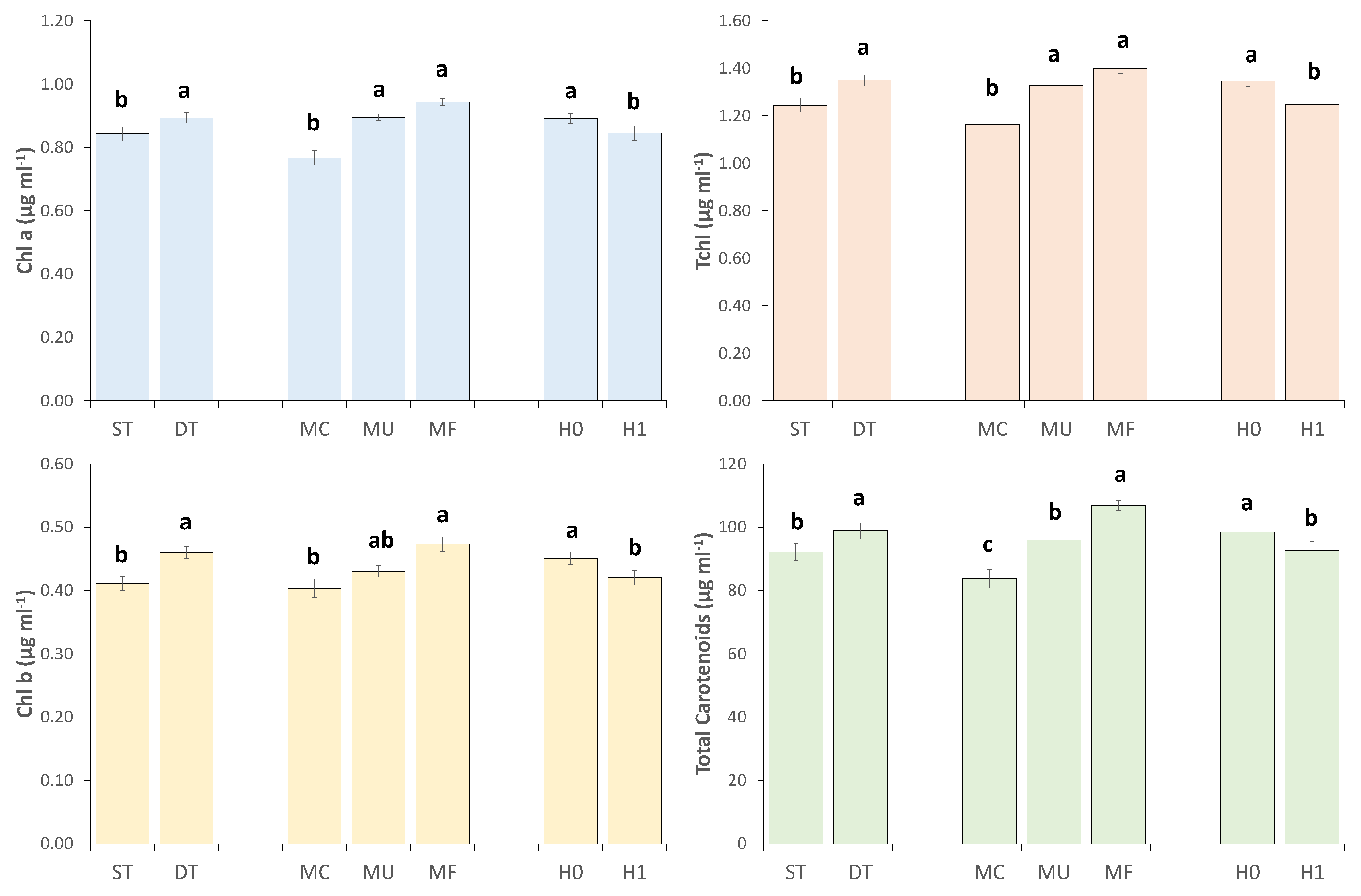
Figure 2.
The interaction effect of tillage practice × nitrogen management and the main effect of hydrochar application on soil organic matter, soil total nitrogen and soil mineral nitrogen on maize crop at harvesting, respectively. ST = Shallow tillage; DT = Deep Tillage; MC = Control; MU = 33%FYM + 67% Urea; MF = 80%FYM + 20% Urea; H0 = Control (No Hydrochar); and H1 = Acidified Hydrochar. The data represent means of four replicates. Means with different letters indicate statistically significant differences at p < 0.05. Error bars denote standard deviation.
Figure 2.
The interaction effect of tillage practice × nitrogen management and the main effect of hydrochar application on soil organic matter, soil total nitrogen and soil mineral nitrogen on maize crop at harvesting, respectively. ST = Shallow tillage; DT = Deep Tillage; MC = Control; MU = 33%FYM + 67% Urea; MF = 80%FYM + 20% Urea; H0 = Control (No Hydrochar); and H1 = Acidified Hydrochar. The data represent means of four replicates. Means with different letters indicate statistically significant differences at p < 0.05. Error bars denote standard deviation.
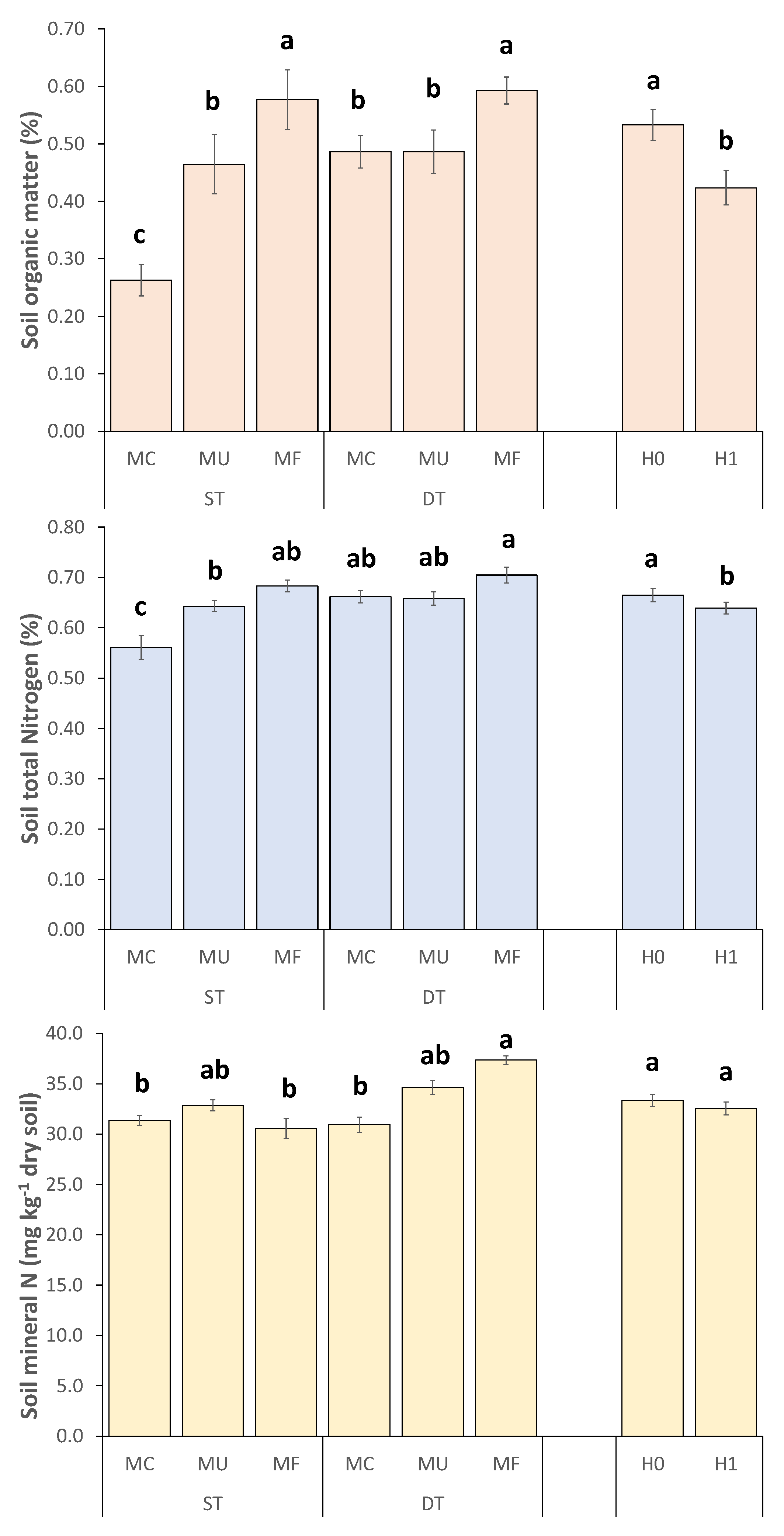
Figure 3.
The relationships between Nitrogen Use Efficiency (NUE) and N uptake of maize plants against soil organic matter, total maize leave chlorophyll and soil mineral nitrogen (n = 48), respectively. Data correspond to tillage practices, nitrogen management and hydrochar application and the significance level is * and ** significant at P < 0.05 and P < 0.01 level, respectively.
Figure 3.
The relationships between Nitrogen Use Efficiency (NUE) and N uptake of maize plants against soil organic matter, total maize leave chlorophyll and soil mineral nitrogen (n = 48), respectively. Data correspond to tillage practices, nitrogen management and hydrochar application and the significance level is * and ** significant at P < 0.05 and P < 0.01 level, respectively.
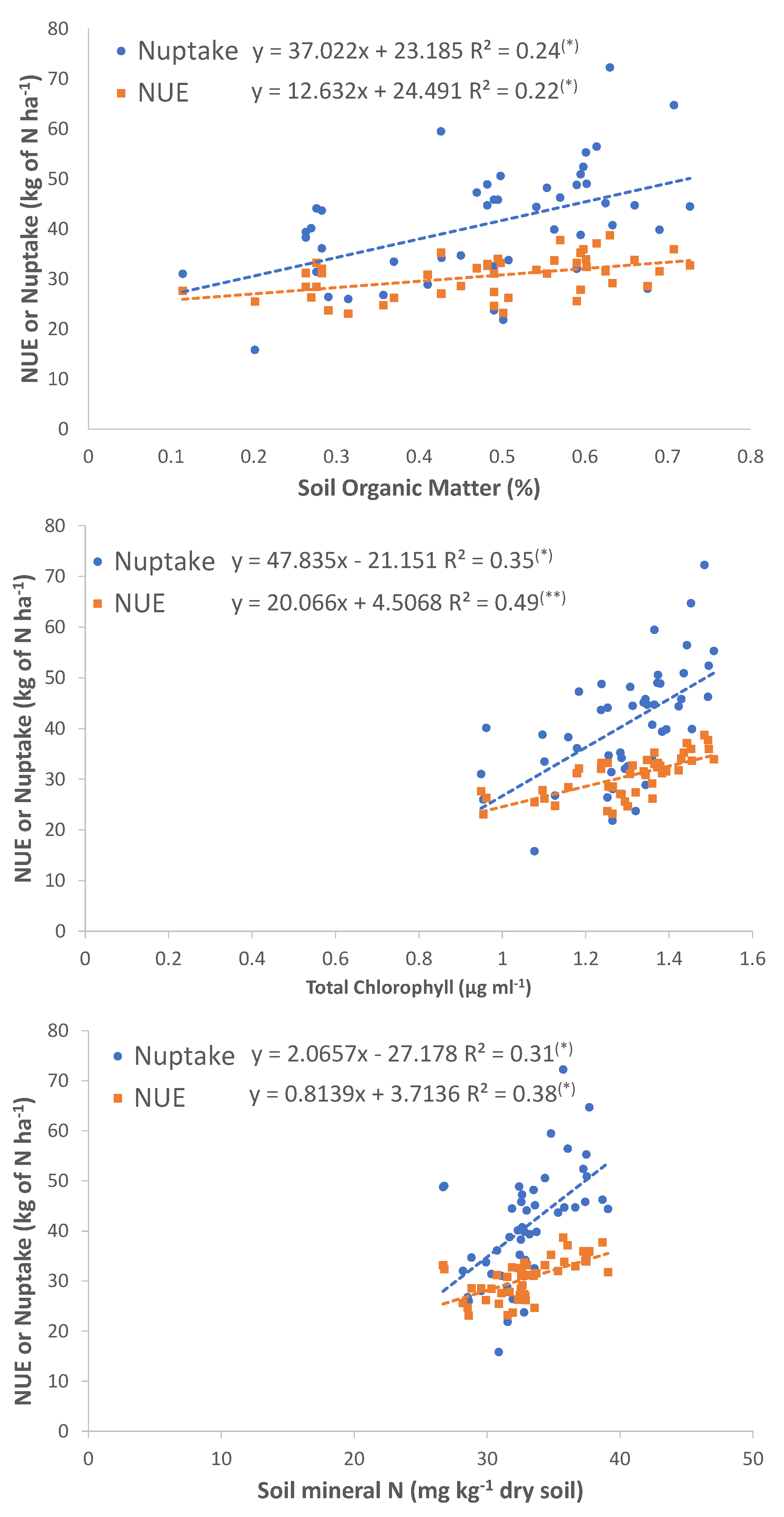
Figure 4.
The canonical discriminant analysis (CDA) of the yield characteristics of maize subjected to tillage practices (A), nitrogen management (B) and hydrochar application (C). ST = Shallow tillage; DT = Deep Tillage; MC = Control; MU = 33%FYM + 67% Urea; MF = 80%FYM + 20% Urea; H0 = Control (No Hydrochar); and H1 = Acidified Hydrochar.
Figure 4.
The canonical discriminant analysis (CDA) of the yield characteristics of maize subjected to tillage practices (A), nitrogen management (B) and hydrochar application (C). ST = Shallow tillage; DT = Deep Tillage; MC = Control; MU = 33%FYM + 67% Urea; MF = 80%FYM + 20% Urea; H0 = Control (No Hydrochar); and H1 = Acidified Hydrochar.
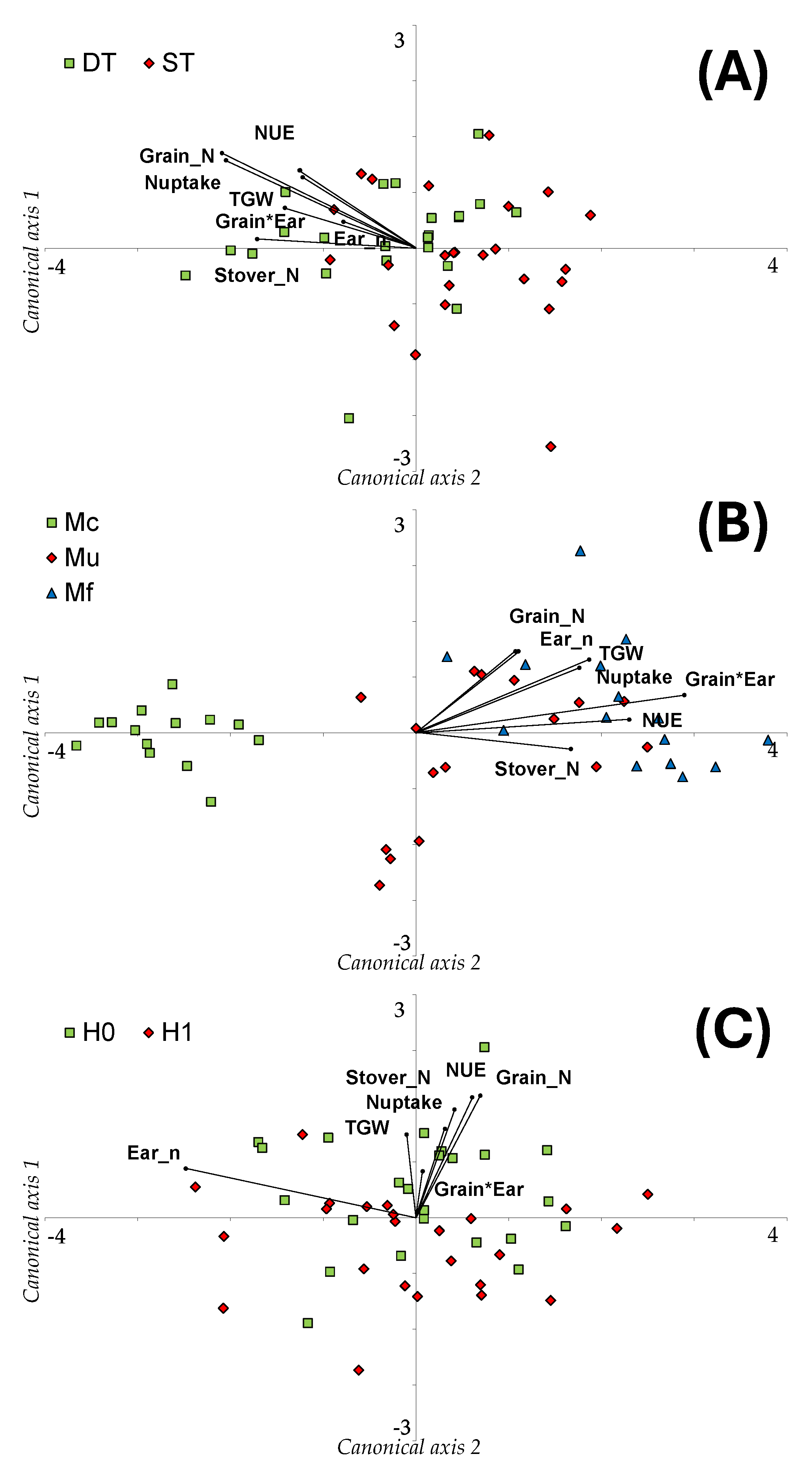
Figure 5.
The canonical discriminant analysis (CDA) of soil characteristics of maize subjected to tillage practices (A), nitrogen management (B) and hydrochar application (C). ST = Shallow tillage; DT = Deep Tillage; MC = Control; MU = 33%FYM + 67% Urea; MF = 80%FYM + 20% Urea; H0 = Control (No Hydrochar); and H1 = Acidified Hydrochar.
Figure 5.
The canonical discriminant analysis (CDA) of soil characteristics of maize subjected to tillage practices (A), nitrogen management (B) and hydrochar application (C). ST = Shallow tillage; DT = Deep Tillage; MC = Control; MU = 33%FYM + 67% Urea; MF = 80%FYM + 20% Urea; H0 = Control (No Hydrochar); and H1 = Acidified Hydrochar.
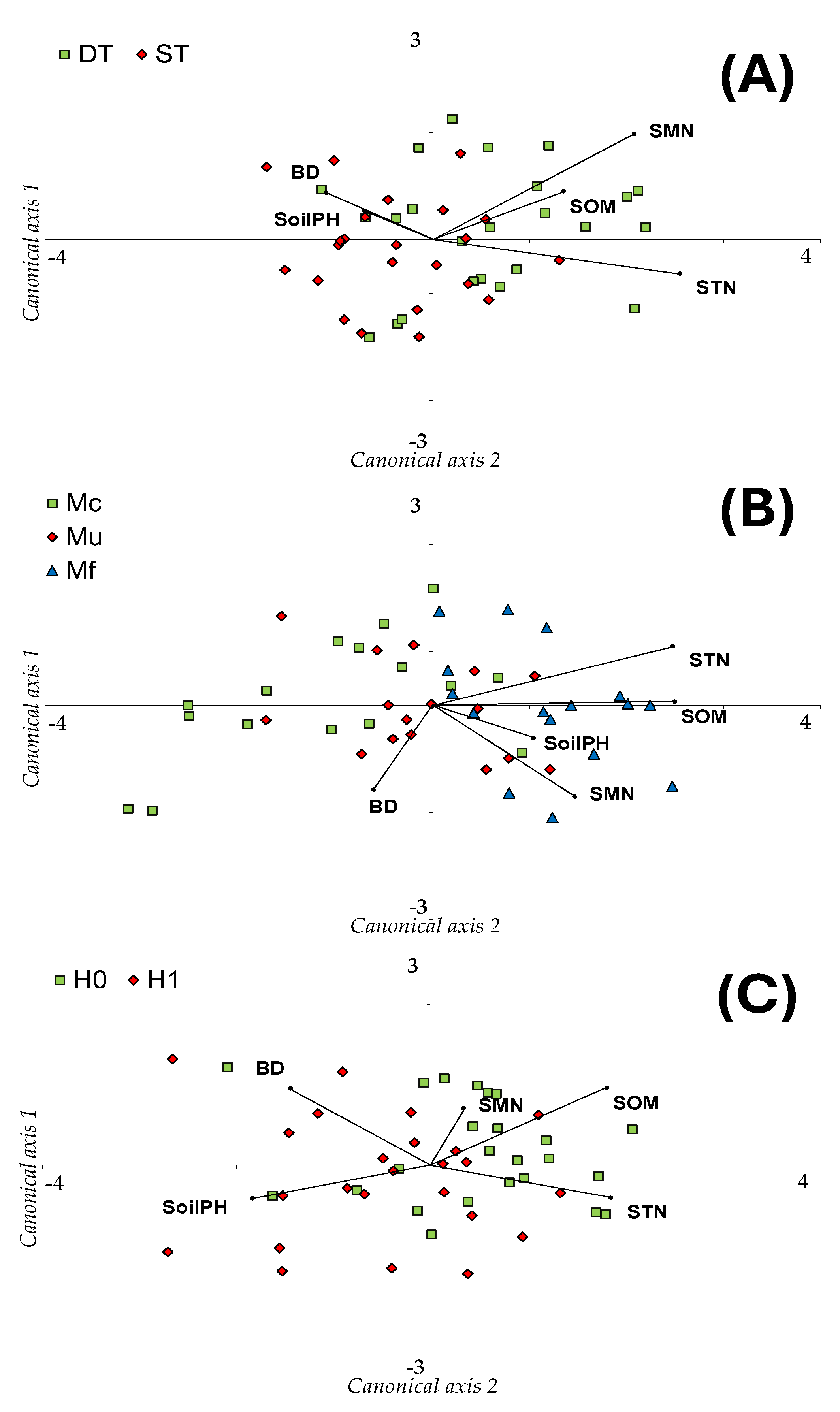

Table 1.
The main effect of tillage practices, nitrogen management and hydrochar application on the main growth stages of maize.
Table 1.
The main effect of tillage practices, nitrogen management and hydrochar application on the main growth stages of maize.
| DtoE | DtoT | DtoS | DtoPM | |||||
| ------------------------------------ days ---------------------------- -------- | ||||||||
| Tillage Practices | ||||||||
| ST | 7.7 (±0.14) | a | 52.8 (±0.34) | a | 63.2 (±0.31) | a | 93.4 (±0.40) | b |
| DT | 7.4 (±0.17) | a | 53.4 (±0.28) | a | 63.3 (±0.26) | a | 94.3 (±0.36) | a |
| Nitrogen management | ||||||||
| MC | 7.9 (±0.22) | a | 51.9 (±0.30) | b | 62.0 (±0.18) | b | 92.3 (±0.42) | b |
| MU | 7.4 (±0.18) | a | 53.9 (±0.35) | a | 64.3 (±0.35) | a | 95.0 (±0.34) | a |
| MF | 7.4 (±0.15) | a | 53.4 (±0.30) | a | 63.4 (±0.20) | a | 94.3 (±0.40) | a |
| Hydrochar | ||||||||
| H0 | 7.4 (±0.16) | b | 53.5 (±0.35) | a | 63.7 (±0.30) | a | 94.4 (±0.42) | a |
| H1 | 7.8 (±0.15) | a | 52.7 (±0.25) | b | 62.8 (±0.25) | b | 93.3 (±0.33) | b |
DtoE = Days to Emergence; DtoT = Days to Tasseling; DtoS = Days to Silking; DtoPM = Days to Physiological Maturity, respectively (mean ± SE; n = 4). ST = Shallow tillage; DT = Deep Tillage; MC = Control; MU = 33%FYM + 67% Urea; MF = 80%FYM + 20% Urea; H0 = Control (No Hydrochar); and H1 = Acidified Hydrochar. Means within the same column followed by different letters are significantly different at P < 0.05.
Table 2.
The main effect of tillage practices, nitrogen management and hydrochar application on plant height, biological yield, grain yield and harvest index of maize plant at harvesting, respectively (mean ± SE; n = 4).
Table 2.
The main effect of tillage practices, nitrogen management and hydrochar application on plant height, biological yield, grain yield and harvest index of maize plant at harvesting, respectively (mean ± SE; n = 4).
| Plant height (cm) |
Biological yield (t ha-1 of DM) |
Harvest index (%) |
||||
| Tillage Practices | ||||||
| ST | 181.7 (±3.47) | b | 8.82 (±0.94) | b | 40.0 (±0.78) | a |
| DT | 195.1 (±3.75) | a | 9.59 (±2.16) | a | 39.7 (±0.90) | a |
| Nitrogen management | ||||||
| MC | 175.1 (±3.69) | b | 8.64 (±1.14) | b | 37.1 (±1.10) | b |
| MU | 193.7 (±3.56) | a | 9.26 (±1.74) | a | 41.1 (±0.76) | a |
| MF | 196.3 (±5.00) | a | 9.72 (±2.73) | a | 41.3 (±0.86) | a |
| Hydrochar | ||||||
| H0 | 192.5 (±3.81) | a | 9.45 (±1.98) | a | 40.0 (±0.93) | a |
| H1 | 184.1 (±3.76) | b | 8.96 (±1.56) | b | 39.7 (±0.74) | a |
ST = Shallow tillage; DT = Deep Tillage; MC = Control; MU = 33%FYM + 67% Urea; MF = 80%FYM + 20% Urea; H0 = Control (No Hydrochar); and H1 = Acidified Hydrochar. Means within the same column followed by different letters are significantly different at P < 0.05.
Table 3.
The main effect of tillage practices, nitrogen management and hydrochar application on grain yield and yield components in terms of, ear number, ear length, grain number, thousand grain weight, grain nitrogen content and stover nitrogen content of maize plant at harvesting, respectively (mean ± SE; n = 4).
Table 3.
The main effect of tillage practices, nitrogen management and hydrochar application on grain yield and yield components in terms of, ear number, ear length, grain number, thousand grain weight, grain nitrogen content and stover nitrogen content of maize plant at harvesting, respectively (mean ± SE; n = 4).
| Grain yield (t ha-1 of DM) |
Ear (n. m-2) |
Ear length (cm) |
Grains (n. ear-1) |
TGW (g) |
GrainN (g kg-1) |
StoverN (g kg-1) |
||||||||
| Tillage Practices | ||||||||||||||
| ST | 3.53 (±0.79) | b | 7.3 (±0.13) | a | 16.1 (±0.24) | b | 307.8 (±5.13) | b | 217.0 (±1.57) | b | 12.3 (±0.45) | b | 3.6 (±0.24) | b |
| DT | 3.80 (±1.09) | a | 7.5 (±0.12) | a | 17.0 (±0.33) | a | 324.6 (±5.36) | a | 221.5 (±1.03) | a | 14.1 (±0.42) | a | 4.3 (±0.20) | a |
| Nitrogen management | ||||||||||||||
| MC | 3.20 (±0.81) | b | 7.1 (±0.12) | b | 15.3 (±0.24) | c | 284.6 (±2.61) | c | 214.6 (±1.08) | b | 12.0 (±0.55) | c | 3.1 (±0.21) | b |
| MU | 3.80 (±0.79) | a | 7.4 (±0.17) | ab | 16.6 (±0.26) | b | 321.7 (±3.95) | b | 218.4 (±1.73) | ab | 13.5 (±0.54) | b | 4.3 (±0.23) | a |
| MF | 4.00 (±0.97) | a | 7.6 (±0.13) | a | 17.8 (±0.32) | a | 342.2 (±2.24) | a | 224.8 (±1.19) | a | 14.1 (±0.57) | a | 4.4 (±0.28) | a |
| Hydrochar | ||||||||||||||
| H0 | 3.76 (±0.99) | b | 7.4 (±0.12) | a | 17.1 (±0.28) | a | 319.7 (±4.93) | a | 221.0 (±1.18) | a | 13.9 (±0.46) | a | 4.2 (±0.24) | a |
| H1 | 3.96 (±0.94) | a | 7.3 (±0.13) | a | 16.0 (±0.30) | b | 312.6 (±5.99) | b | 217.5 (±1.53) | b | 12.6 (±0.46) | b | 3.6 (±0.21) | b |
ST = Shallow tillage; DT = Deep Tillage; MC = Control; MU = 33%FYM + 67% Urea; MF = 80%FYM + 20% Urea; H0 = Control (No Hydrochar); and H1 = Acidified Hydrochar. Means within the same column followed by different letters are significantly different at P < 0.05.
Table 4.
The main effect of tillage practices, nitrogen management and hydrochar application on Nitrogen uptake and Nitrogen Use Efficiency (NUE) of maize plant at harvesting, respectively (mean ± SE; n = 4).
Table 4.
The main effect of tillage practices, nitrogen management and hydrochar application on Nitrogen uptake and Nitrogen Use Efficiency (NUE) of maize plant at harvesting, respectively (mean ± SE; n = 4).
| Nitrogen uptake | NUE | |||
| ----------- kg of N ha-1 ------------ | ||||
| Tillage Practices | ||||
| ST | 36.34 (±1.79) | b | 29.38 (±0.66) | b |
| DT | 45.45 (±2.40) | a | 31.69 (±0.91) | a |
| Nitrogen management | ||||
| MC | 32.32 (±1.97) | c | 26.64 (±0.67) | b |
| MU | 42.96 (±2.29) | b | 31.64 (±0.66) | a |
| MF | 47.39 (±2.77) | a | 33.31 (±0.81) | a |
| Hydrochar | ||||
| H0 | 44.14 (±2.38) | a | 31.46 (±0.83) | a |
| H1 | 37.64 (±2.05) | b | 29.61 (±0.78) | b |
ST = Shallow tillage; DT = Deep Tillage; MC = Control; MU = 33%FYM + 67% Urea; MF = 80%FYM + 20% Urea; H0 = Control (No Hydrochar); and H1 = Acidified Hydrochar. Means within the same column followed by different letters are significantly different at P < 0.05.
Disclaimer/Publisher’s Note: The statements, opinions and data contained in all publications are solely those of the individual author(s) and contributor(s) and not of MDPI and/or the editor(s). MDPI and/or the editor(s) disclaim responsibility for any injury to people or property resulting from any ideas, methods, instructions or products referred to in the content. |
© 2024 by the authors. Licensee MDPI, Basel, Switzerland. This article is an open access article distributed under the terms and conditions of the Creative Commons Attribution (CC BY) license (http://creativecommons.org/licenses/by/4.0/).
Copyright: This open access article is published under a Creative Commons CC BY 4.0 license, which permit the free download, distribution, and reuse, provided that the author and preprint are cited in any reuse.


